Ram has reportedly canceled plans for its 1500 REV with a 229-kwh, 500-mile range battery
The electric truck, due in 2026, is said to be offered exclusively with a 168-kwh, 350-mile range battery
Ram will direct long-range customers to its 1500 Ramcharger series plug-in hybrid, which has 690 miles of range
Ram’s electric version of its 1500 pickup truck seemingly won’t deliver the long-promised 500 miles of range.
The information was first reported on Jan. 15 by Mopar Insiders. A Stellantis spokesperson responded by saying Ram has decided to launch the Ramcharger plug-in hybrid pickup first due to shifts in customer interest.
The electric 1500, known as the 1500 REV, was first unveiled in early 2023. It was originally scheduled for release in 2024, but Ram announced last month that the debut will now take place sometime in 2026.
The 1500 REV was initially promised with a standard 168-kwh battery, targeting 350 miles of range, and an optional 229-kwh battery, targeting 500 miles.
2025 Ram 1500 REV
The 350-mile range estimate for the 168-kwh battery lags behind what electric trucks already on the market can deliver. This equates to less than 2.1 miles per kwh—an efficiency level lower than that of the rival Ford F-150 Lightning, which achieves about 2.4 miles per kwh. Notably, the Ford uses a platform originally developed for gas-powered trucks.
With the 1500 REV delayed until 2026, Ram will instead focus initially on the 1500 Ramcharger series plug-in hybrid, with order books for the model set to open in the first half of 2025. The 1500 Ramcharger is expected to deliver 690 miles of range, combining a 92-kwh battery with a gas V-6 serving as a range extender.
The spokesperson stated that the decision to prioritize the 1500 Ramcharger was driven by “consumer interest and maintaining a competitive advantage in the segment.”
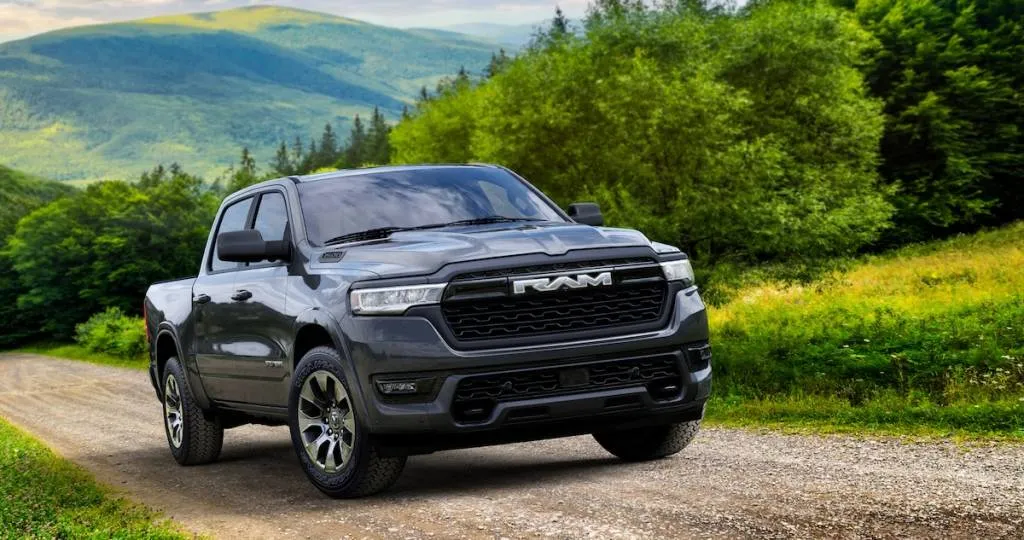
2025 Ram 1500 Ramcharger
Volkswagen Group’s new Scout brand will also offer a series plug-in hybrid option for its Terra electric truck. Scout’s CEO revealed during last week’s 2025 CES event in Las Vegas that most reservations so far have been for the hybrid, citing the lack of charging infrastructure as the reason rather than resistance to EV technology.
The 500-mile 1500 REV isn’t the only EV delayed or canceled by a Stellantis brand since CEO Carlos Tavares quit in December. Chrysler confirmed this month that it has canceled an electric midsize crossover that was originally planned for 2025.
These days, pickup trucks are no longer basic work vehicles that may or may not have power windows or air conditioning. Now, they offer almost any feature you’ll find on a crossover in addition to being able to tow, haul and off-road. The upside is that trucks are more comfortable and daily drivable than they’ve ever been. The downside is that they’re also expensive as hell now, too. Also, they’re uniquely dangerous to pedestrians, but that’s another topic for a different time.
A Comfortable And Reliable Hauler For The Family | What Car Should You Buy?
If you’re going to spend the kind of money it takes to get a new truck, you want to be sure you’re actually going to like it and won’t immediately regret your decision. The question is, which truck will you actually like best? No one can say for sure, but our friends at Consumer Reports recently put together a list of pickup trucks that have the highest owner satisfaction scores. If you’re in the market for a new truck, this is a good place to start.
Ford Maverick
Available with either a conventional or hybrid powertrain, the Ford Maverick is just cool. It’s pretty small by modern standards and built on a car platform, so it can’t tow much, but not everything with a bed needs to be able to tow a train. The hybrid gets great gas mileage, it’s easy to drive and park, and getting in and out is simple. The interior materials could be nicer, but owners don’t seem to care. They love their Mavericks.
Honda Ridgeline
Like the Maverick, the Honda Ridgeline isn’t body-on-frame, and therefore purists would say it isn’t a real pickup truck. It has a bed, though, so who cares what technically is or isn’t a “real” truck? The Ridgeline isn’t the midsize truck to buy if you need to tow more than 5,000 pounds or go off-road, but as a daily driver, it’s quiet, comfortable and just a solid all-around vehicle. Owners really can’t get enough of the Ridgeline.
Chevrolet Silverado 3500HD
Both the Chevrolet Silverado 3500HD and GMC Sierra 3500HD made the list, which makes sense since they’re mechanical twins. And while Consumer Reports doesn’t usually talk much about them, it’s nice to see heavy-duty trucks get some attention. Then again, it is a little confusing why an HD truck beat out all the regular full-size trucks, especially since there’s no reason to buy a 3500 unless you do some serious towing. But, apparently, the interior improvements that GM made to the interior were enough to push the Silverado 3500HD over the top.
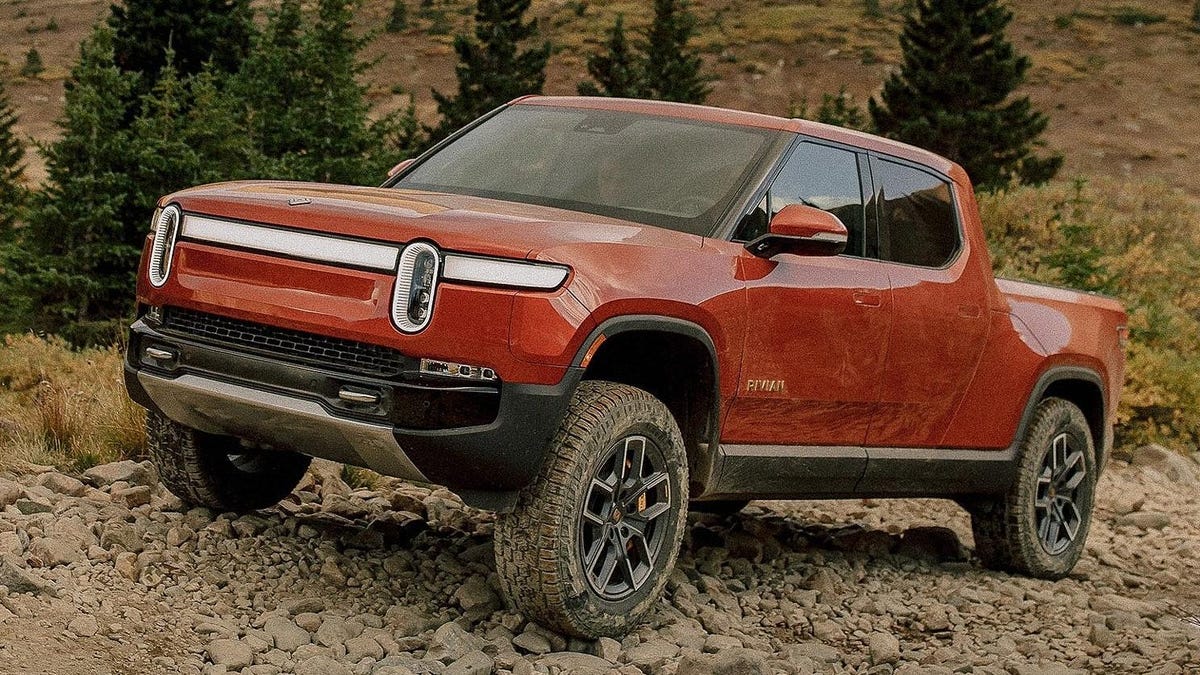
Rivian R1T
Consumer Reports owners haven’t had the best luck with Rivian’s reliability, especially when it comes to powertrain issues. And yet, owners absolutely love their Rivian R1Ts. In fact, if it weren’t for the Chevrolet Corvette, the R1T would have had the highest owner satisfaction score in this year’s Consumer Reports survey. It’s quick, nimble, quiet and innovative while also offering excellent off-road performance and plenty of range. If only it came with support for Apple CarPlay and Android Auto, though.
When the Porsche 718 Cayman GT4 was introduced in 2019, it brought an exciting moment for Porsche enthusiasts, bringing naturally aspirated power back to the mid-engine lineup. Designed to deliver performance on both the road and track, the GT4 revived the raw driving dynamics that purists crave.
Three years later, in 2022, Porsche unveiled the 718 Cayman GT4 RS, taking the platform to new heights with the race-focused philosophy that defines every RS model in Porsche’s lineup.
At the heart of the 718 Cayman GT4 lies a 4.0-liter naturally aspirated flat-six engine, delivering 414 hp and 309 lb-ft of torque. This engine offers a high-revving character, with a redline of 8,000 rpm, paired with either a 6-speed manual transmission for purists or an optional 7-speed PDK dual-clutch transmission for faster, more precise shifts.
The GT4 RS raises the bar even higher, borrowing the 4.0-liter flat-six from the 992-generation 911 GT3, producing an impressive 493 hp and 331 lb-ft of torque, exclusively paired with the PDK transmission. This ensures lightning-fast acceleration, with the GT4 RS sprinting from 0 to 60 mph in just 3.2 seconds.
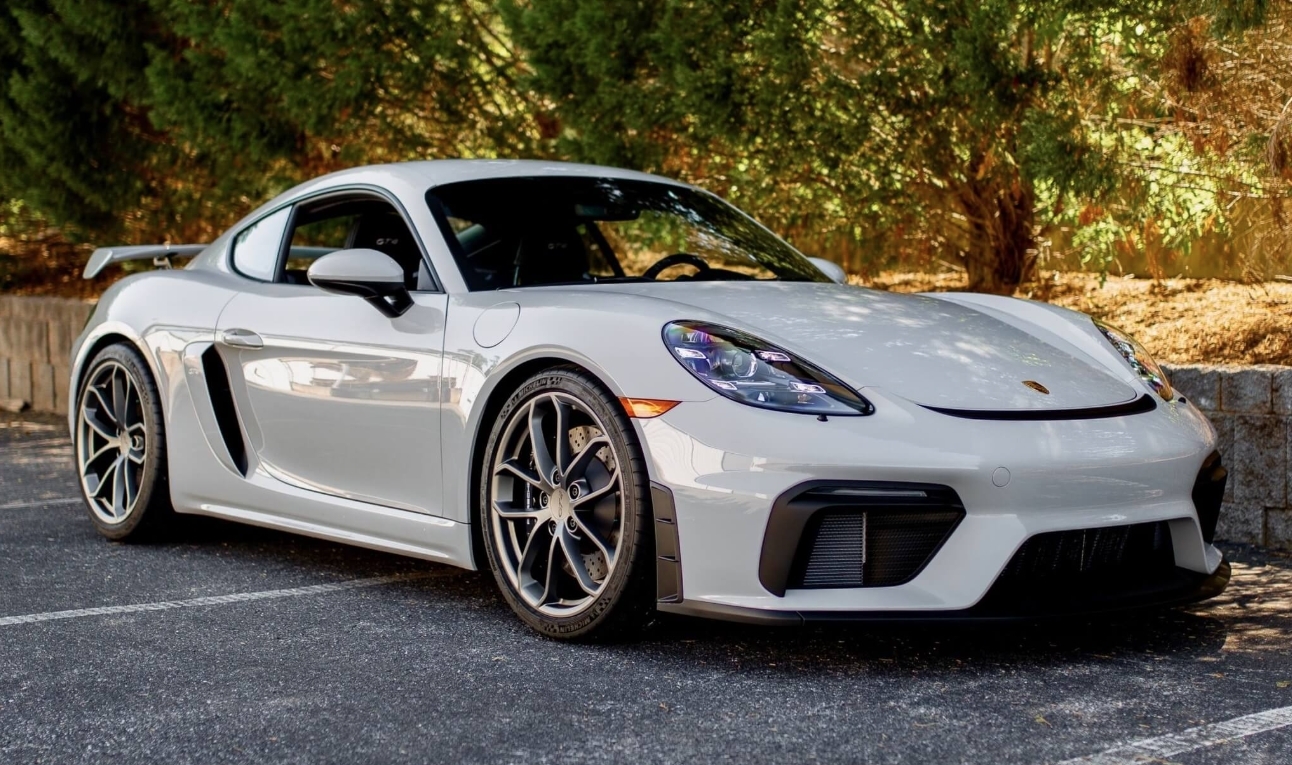
The exterior design of the 718 Cayman GT4 and GT4 RS is both aggressive and functional. The GT4 features a fixed rear wing, large front air intakes, and an aerodynamic splitter, all optimized to generate significant downforce while maintaining it’s timeless styling.
The GT4 RS takes aerodynamics to a new level, with a swan-neck rear wing, enlarged front diffuser, and a lightweight carbon-fiber hood. Lightweight materials such as aluminum and carbon fiber are used extensively in both variants. Inside, the cabin is tailored for a driver-focused experience. Both models feature sport bucket seats, Alcantara upholstery.
The GT4 RS further emphasizes weight savings, offering carbon-fiber-reinforced plastic (CFRP) seats, reduced sound insulation, and door pull straps in place of traditional handles. Advanced technology like Porsche Communication Management (PCM) with Apple CarPlay ensures a modern touch within a purpose-built cockpit.
The 718 Cayman GT4 and GT4 RS sit in a highly competitive segment, facing rivals like the Chevrolet Corvette Z06, Lotus Emira, and Jaguar F-SVR Coupe.
Despite the competition, the GT4 and GT4 RS are in a league of their own with their naturally aspirated engines, mid-engine balance, and Porsche’s unmatched motorsport heritage, making them favorites among enthusiasts seeking the best driving experience.
Model Changes (Breakdown by Year)
2019 Porsche 718 GT4
In 2019, Porsche unveiled the 718 Cayman GT4, a high-performance addition to the 718 lineup.
Powered by a 4.0-liter flat-six engine producing 414 hp and 309 lb-ft of torque, the GT4 was offered exclusively with a 6-speed manual transmission, with the 7-speed PDK dual-clutch transmission being introduced as an option later, in 2021.
Designed with lightweight materials and optimized for track performance, the GT4 featured a fixed rear wing for increased downforce and an upgraded suspension system with Porsche Active Suspension Management (PASM), ensuring exceptional handling and agility.
In 2020, the Porsche 718 Cayman GT4 had a starting price of $100,550.
2021 Porsche 718 GT4
In 2021, Porsche expanded the appeal of the 718 Cayman GT4 by introducing the option of a 7-speed dual-clutch PDK transmission, making the car more accessible to a wider range of enthusiasts.
The PDK brought performance improvements, including an enhanced 0–60 mph time of 3.7 seconds, compared to 4.2 seconds with the manual transmission. The faster and more precise shifts of the PDK also contributed to slightly better lap times, making it a good choice for drivers who are focused on getting the fastest lap times.
Apart from the transmission upgrade, no significant changes were made to the platform for this model year.
In 2021, the Porsche 718 Cayman GT4 had a starting price of $102,900.
2022 Porsche 718 GT4 and GT4 RS
In 2022, Porsche enhanced the 718 Cayman GT4 by introducing several customization options, allowing owners to tailor their vehicles to personal preferences. These enhancements included a broader selection of exterior colors, such as special and custom paint options, and interior materials, offering choices between standard Race-Tex and extended leather trims.
Additionally, Porsche provided various wheel designs and finishes, including the option for 20-inch forged magnesium wheels for improved performance and aesthetics.
For the standard 718 Cayman GT4, Porsche made minor updates in 2022. These enhancements included a broader selection of exterior colors, such as special and custom paint options, and interior materials, offering choices between standard Race-Tex and extended leather trims.
Additionally, Porsche provided various wheel designs and finishes, including the option for 20-inch forged magnesium wheels for improved performance.
In 2022, the Porsche 718 Cayman GT4 had a starting price of $106,500. The newly introduced 718 Cayman GT4 RS began at $141,700.
2023 Porsche 718 GT4 and GT4 RS
In 2023, Porsche expanded the customization options for the 718 Cayman GT4 and GT4 RS, further enhancing their appeal to enthusiasts.
The introduction of an expanded Paint to Sample (PTS) program allowed buyers to create more bespoke builds, offering a wider selection of unique colors and finishes to personalize their cars.
In 2023, the Porsche 718 Cayman GT4 had a starting price of $106,500, while the 718 Cayman GT4 RS began at $149,100.
2024 Porsche 718 GT4 and GT4 RS
In 2024, Porsche made subtle refinements to the 718 Cayman GT4 and GT4 RS.
Updates to the infotainment system included support for the latest versions of Apple CarPlay and additional tech updates included improved navigation with real-time traffic updates, a more intuitive interface, and wireless software updates, ensuring the system stayed up to date without requiring dealership visits.
Porsche also offered exclusive limited-edition models, featuring heritage-inspired colors such as classic shades from the brand’s history, like Gulf Blue or Signal Yellow. Inside, these editions came with rare interior trim combinations, including unique stitching patterns, Alcantara, and extended leather options with contrasting accents
In 2024, Porsche adjusted the pricing for its 718 Cayman lineup. The 718 Cayman GT4 RS now starts at $160,700.
2025 Porsche 718 GT4 and GT4 RS
In 2025, Porsche confirmed the 718 platform’s gradual transition to electrification, signaling a significant shift in the brand’s future direction.
This announcement positioned the 718 Cayman GT4 RS as potentially one of the last naturally aspirated, mid-engine models in Porsche’s storied lineup.
Enthusiasts speculated that 2025 could mark the final production year of the GT4 RS, with rumors circulating about a potential farewell edition, though Porsche has yet to confirm these reports.
In 2025, the Porsche 718 Cayman GT4 RS had a starting price of $164,200. Notably, the 718 Cayman GT4 model was discontinued for the 2024 model year and was not available in 2025.
Porsche 718 GT4 and GT4 RS Common Problems
While the Porsche 718 Cayman GT4 and GT4 RS a true performance sports cars, no car is entirely free of potential issues. Owners have reported a few recurring problems that, while not universal, are worth noting for prospective buyers. These concerns primarily revolve around mechanical reliability, manufacturing defects, and usability quirks, particularly under high-performance conditions. Below is a detailed look at some of the most commonly reported issues with these cars.
Keep in mind, that it is essential that all cars, even supercars, can have issues and it is crucial to perform a Pre-Purchase Inspection (PPI) from an authorized dealer or experienced independent mechanic to reveal all issues.
Engine Reliability Concerns: Some 718 GT4 RS owners have reported significant engine issues, including complete engine failures. These failures often required full engine replacements, even on relatively low-mileage cars. While not widespread, these problems have raised concerns about long-term reliability under extended track use or high-performance driving conditions.
Connecting Rod Defects: A number of 2021 GT4 models were delayed or recalled due to defective connecting rods, which are critical for the engine’s function. These defects were identified during quality control and led to engine replacements prior to delivery. Porsche addressed this issue, but affected cars caused frustration for early adopters.
Wheel Detachment Risk: Porsche issued a recall for certain 718 models, including the GT4 and GT4 RS, due to issues with defective central locking wheel nuts. If not replaced, these nuts could fail, resulting in wheels potentially detaching while driving. This issue posed serious safety risks, particularly at high speeds or during track use, where wheel stresses are greater.
Lifter Noise in GTS 4.0 Engines: Some owners of the 4.0-liter flat-six engine, especially in the GTS 4.0 variant, reported lifter noise, which could indicate wear or improper lubrication. While the noise does not always signify a critical problem, it has raised concerns about long-term engine durability, especially for those using the car extensively on track days.
Fueling Difficulties: Certain 718 models, including the GT4, have exhibited a problem where the fuel nozzle prematurely shuts off during refueling. This issue makes it difficult to fill the tank and can be particularly inconvenient on longer trips or at the track. Owners have reported inconsistent fixes for this problem, ranging from software updates to replacing fuel system components.
The center lock wheel bolt may fracture and cause the wheel to detach. Wheel detachment can result in a loss of vehicle control, increasing the risk of a crash.
Maintenance and Ownership Costs
Compared to other high-performance sports cars, owning a Porsche 718 Cayman GT4 or GT4 RS is generally considered to come with relatively manageable maintenance requirements.
However, it’s important to keep in mind that regular maintenance and occasional repairs are essential to ensure optimal performance, especially if the car is frequently used for track driving. Maintenance costs can vary significantly depending on whether you choose to service the car at an authorized Porsche dealership or through a trusted independent mechanic.
Below are the recommended service schedules and intervals provided by Porsche:
Annual Maintenance (Every 10,000 miles or 1 year):
Every 20,000 miles or 2 years:
Brake Fluid Replacement
Cabin Air Filter Replacement
Engine Air Filter Replacement
Coolant Level and Condition Check
Every 30,000 miles or 3 years:
Every 40,000 miles or 4 years:
Every 60,000 miles or 6 years:
Here is a rough estimate of typical service costs associated with the Porsche 718 Cayman GT4 or GT4 RS:
Oil Change – Oil changes are essential to keep the 4.0-liter flat-six engine running smoothly, especially under the demands of spirited driving or track use. At a Porsche dealership, an oil change typically costs between $300 and $500, reflecting the use of Porsche-approved synthetic oil and OEM filters. Independent shops can often perform the same service for $200 to $350, depending on labor rates and parts pricing.
Minor Service – A minor service includes an oil change, fluid top-offs, brake system inspection, and a multi-point vehicle check to ensure all systems are functioning properly. At a dealership, this service usually costs around $500 to $700, while independent shops may offer it for $400 to $600, providing similar thoroughness at a slightly reduced price.
Major Service – Major services are more comprehensive, covering all aspects of a minor service while also including spark plug replacements, air and cabin filter changes, brake fluid replacement, and detailed inspections. At a dealership, a major service typically ranges from $1,200 to $1,500, reflecting the labor-intensive nature of the service and the use of genuine Porsche parts. Independent shops can often complete the same service for $900 to $1,200, offering a cost-effective alternative without compromising quality.
Tires – High-performance tires like the Michelin Pilot Sport Cup 2 are a crucial part of the 718 GT4 and GT4 RS experience, providing exceptional grip and handling. However, these tires wear faster due to the car’s aggressive driving dynamics. Replacing a set of four performance tires at a Porsche dealership generally costs between $1,800 and $2,500, including mounting and balancing. Independent shops may charge slightly less, with prices ranging from $1,500 to $2,200, depending on the tire brand and specifications.
Brakes – The high-performance braking systems in these models, particularly when subjected to frequent track use, require regular maintenance. Replacing the brake pads and rotors on all four wheels costs approximately $2,000 to $2,500 at a dealership, while independent shops typically charge between $1,500 and $2,000. Owners also have the option to choose high-quality aftermarket components for additional cost savings.
Clutch – For manual transmission models, clutch replacement is a labor-intensive service costing $2,500 to $3,500 at a dealership and $2,000 to $3,000 at independent shops. For PDK-equipped models, while clutch replacement isn’t needed, the PDK transmission fluid requires periodic replacement, costing around $800 to $1,200 at dealerships and $600 to $1,000 at independent shops. Regular maintenance ensures smooth operation, especially for track use.
Options List
When it comes to the Porsche 718 Cayman GT4 and GT4 RS, the extensive options list allows buyers to spec their car to the way they want it.
For those focused on maximizing track capabilities, Porsche provides several performance-enhancing options. Ceramic Composite Brakes (PCCB) deliver lightweight, fade-resistant stopping power, perfect for extended track sessions. The Front Axle Lift System is an invaluable addition, allowing the car to navigate steep driveways or speed bumps without damaging the front splitter.
Lightweight magnesium wheels, available on the GT4 RS, further improve handling by reducing unsprung weight. Additionally, the Weissach Package, exclusive to the GT4 RS, includes extensive use of carbon fiber on the hood, air intakes, and rear wing, along with titanium exhaust tips and an Alcantara-wrapped steering wheel, giving the car a motorsport-inspired edge.
Despite their performance focus, the GT4 and GT4 RS are not without comfort and convenience. Options such as Adaptive Sport Seats Plus offer 18-way adjustability, providing the ideal balance of support and comfort for both spirited driving and long-distance trips.
The Porsche Communication Management (PCM) system comes with navigation, Apple CarPlay, and real-time traffic updates, ensuring modern connectivity. Audiophiles can upgrade to either the BOSE or Burmester sound system, delivering premium audio quality within the cabin.
Porsche’s attention to detail extends to the exterior and interior customization of the 718 lineup. The Paint to Sample (PTS) program offers a vast selection of heritage-inspired and custom colors. Vehicles that go through this program tend to command a higher premium on the resale market due to its exclusiveness.
Inside, buyers can opt for extended leather and Race-Tex upholstery with contrast stitching or choose carbon fiber trim for a lightweight, performance-oriented aesthetic.
For enthusiasts planning frequent track use, Porsche provides additional accessories to enhance the experience. The Track Precision App allows drivers to monitor and analyze lap data directly through the infotainment system.
When selecting options for the GT4 or GT4 RS, it’s worth considering how they can affect the car’s performance and resale value.
Performance upgrades like PCCB brakes, the Weissach Package, and lightweight wheels not only improve driving dynamics but also increase the car’s desirability in the market. Customization features such as Paint to Sample (PTS) and premium interior materials further boost exclusivity, making these models highly sought after by collectors and enthusiasts.
2020 Porsche 718 GT4 options list
Key Options
Paint to Sample (PTS) colors
Carbon bucket seats (GT4)
Front Axle Lift System
Lightweight Magnesium Wheels (GT4 RS)
Weissach Package (GT4 RS)
Porsche 718 Cayman GT4 and GT4 RS Price and Values
The Best Porsche 718 Cayman GT4 and GT4 RS to Buy
When it comes to choosing the best Porsche 718 Cayman GT4 or GT4 RS, several factors can influence your decision.
For those seeking the most refined version of the 718 Cayman GT4, models from 2021 onward are an excellent choice. These later GT4s benefit from the addition of the PDK transmission option, which offers faster gear shifts and improved acceleration while retaining the manual transmission as an option for purists.
Additionally, the later production years of the GT4 are known for minor reliability updates and expanded customization options.
When considering the 718 Cayman GT4 RS, the 2023 model year offers significant appeal. It combines the cutting-edge technology and engineering introduced at launch with the expanded Paint to Sample program, allowing for a bespoke build that enhances exclusivity.
The Weissach Package and lightweight magnesium wheels, available as options, further elevate the car’s track-ready performance and desirability.
Regardless of the model year, the condition and mileage of the vehicle are critical factors. Well-maintained examples with full-service history and lower mileage are more likely to retain their value over time.
It’s also important to consider how the car has been used, as vehicles subjected to frequent track use may require additional maintenance. Thorough inspections and documentation reviews are essential to ensure you’re making a sound investment.
For those prioritizing long-term value and performance, targeting a later-model GT4 or a 2023 GT4 RS with low mileage, desirable options like PCCB brakes, and a complete service history is a wise choice.
It’s important to conduct thorough research, compare prices, and look for models with a documented service history if you are considering purchasing a Porsche 718 Cayman GT4 and GT4 RS with long-term value in mind.
Conclusion
In summary, with a starting price of over $120,000+, the Porsche 718 Cayman GT4 and GT4 RS stand out as excellent choices for enthusiasts seeking a high-performance sports car.
While alternatives like the Chevrolet Corvette Z06, Lotus Emira, and Jaguar F-Type SVR Coupe offer strong competition, the GT4 and GT4 RS distinguish themselves with their mid-engine layout, naturally aspirated flat-six engines, and unparalleled driving dynamics.
The GT4 caters to purists with its engaging manual transmission, while the GT4 RS takes performance to new heights with its PDK gearbox and motorsport-inspired enhancements.
For those who value an amazing driving experience, exclusivity, and Porsche’s rich heritage, the 718 Cayman GT4 and GT4 RS offer an unmatched ownership experience that is hard to replicate in this segment.
There is no substitute.
Car Hacking Shortcuts
Look for models equipped with Ceramic Composite Brakes (PCCB)
Front Axle Lift System for added functionality and resale value
Opt for a GT4 RS with the Weissach Package and lightweight magnesium wheels
Carbon bucket seats are desirable in GT4 cars
Spec matters: Paint to Sample (PTS) colored cars are desirable
Prioritize well-maintained, low-mileage vehicles with a complete service history
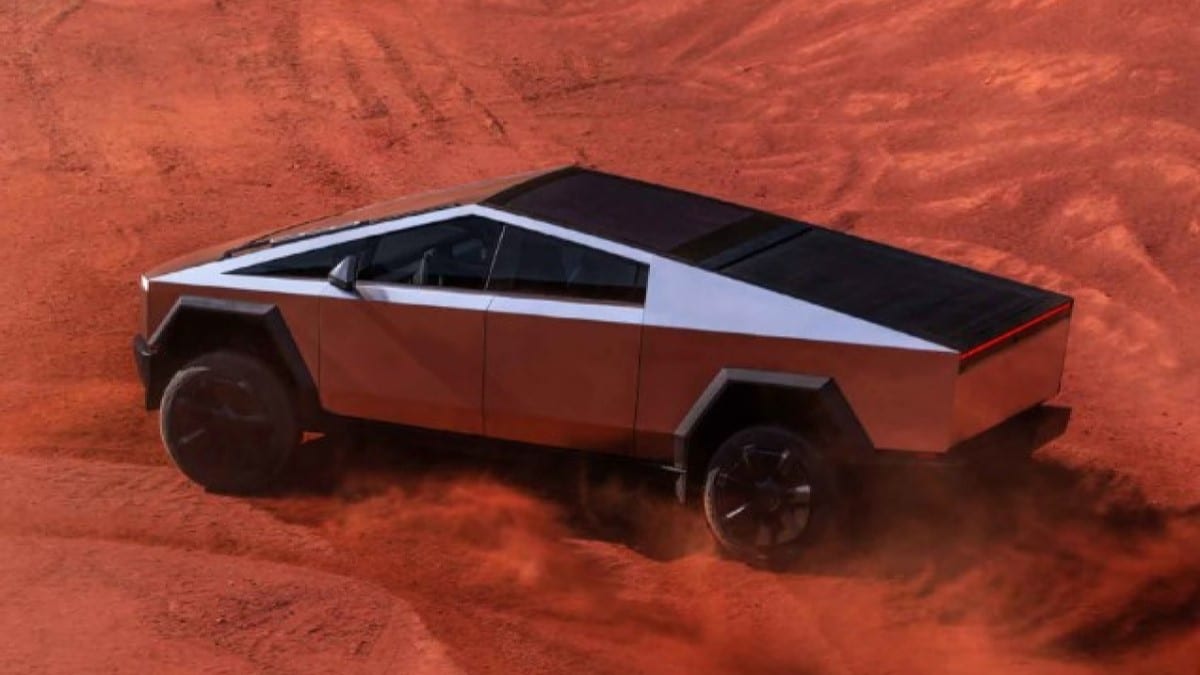
Tesla this week began offering discounts of up to $2,600 on Cybertrucks in its inventory – the latest signal that demand for the unusual electric truck has leveled off lower than the company expected.
The Cybertruck debuted late in 2023, with a level of buzz rarely seen in the automotive industry. Its science-fiction-inspired looks and extreme performance claims helped it become the best-selling vehicle of any kind priced over $100,000 by early summer of 2024.
But demand dropped off late in the year. By the end of the year, the automaker had sold just under 40,000 of the trucks and had already fulfilled all orders and started accumulating unsold inventory. The company began removing special edition badges from trucks to sell them at lower prices.
Now, CNBC reports, “Discounts are as high as $1,600 off new Cybertrucks, with the reduced price depending on configuration, and up to around $2,600 for demo versions of the trucks in inventory.”
More Than a Million Orders Became 40,000 Sales
At launch, Tesla claimed to have more than a million reservations for the pickup. However, reservations are often an inaccurate measure of consumer interest in a new electric vehicle (EV). Most automakers set the price of a reservation very low and refund it when consumers cancel. So, getting in line and deciding not to buy is a low-risk affair.
Tesla sold Cybertruck reservations for just $100, fully refundable.
We should note that finding and filling a niche is not necessarily a bad business strategy. Headlines about the discounts characterize them as a failure for Tesla. However, the company created a unique product and delivered it to an excited audience.
Their challenge remains to find an audience for the truck after that initial enthusiastic group of buyers. Tesla suffered its first-ever annual sales drop in 2024. Tesla has no significant new products publicly scheduled for 2025, though a low-volume $250,000 Roadster may appear after a years-long delay. A refreshed version of its best-selling Model Y could boost interest in that car.
In recent months, Tesla has launched leasing programs for the truck and offered some buyers free charging at its nationwide network of Supercharger stations to entice more Americans to consider the truck.
The luxury fashion industry may soon witness a monumental shift as the Prada Group positions itself to acquire Versace. As reported by Reuters, Capri Holdings — the parent company of Versace, Michael Kors, and Jimmy Choo — is considering the sale of its brands. Among the interested parties, the Prada Group — with Citi as its advisor — has reportedly shown significant interest in acquiring Versace. Such a move could further bolster the global standing of the “Made in Italy” legacy within the luxury sector.
Capri Holdings — a conglomerate that has faced well-documented financial struggles — had initially put the brand, along with Jimmy Choo, on the market in December 2024 following the collapse of a USD 8.5 billion proposed merger with Tapestry. As a brand, Versace is synonymous with opulence, extravagance, and a frisson of daring approach to design — embodying luxury as a status symbol. Prada on the other hand, is introspective and sophisticated — defining luxury as a statement of refinement and understated elegance. Both brands occupy distinct spaces in the fashion, appealing to vastly different sensibilities.
In 2023, when luxury American company Tapestry announced its intention to acquire Capri Holdings in a bid to compete with European luxury conglomerates, Tapestry CEO Joanne Crevoiserat stated, “The combination of Coach, Kate Spade, and Stuart Weitzman, along with Versace, Jimmy Choo, and Michael Kors, creates a powerful new global luxury house.” Capri Chairman and CEO John Idol responded, saying, “By joining forces with Tapestry, we will gain greater resources and capabilities to accelerate the expansion of our global reach while preserving the unique DNA of our brands”.
Could the Prada Group be keen on a similar direction?
What Prada Stands to Gain:
Prada Fall/Winter 2024 campaign
Versace’s distinctively bold aesthetic contrasts sharply with Prada’s reputation for understated elegance. This acquisition would allow Prada to tap into a different segment of the luxury market, appealing to consumers drawn to glamour and maximalism. Additionally, Versace’s strong presence in North America— a region where Prada has traditionally had a more subdued influence — presents immediate opportunities for growth and market penetration. According to Bain & Company, North America accounted for approximately 34 percent of global luxury sales in 2024. A potential acquisition could significantly strengthen Prada’s foothold in the market.
Next, few brands rival Versace when it comes to its association with Hollywood and pop culture symbols. One could argue this goes back to 1994 when the late Gianni Versace famously loaned the “Versace pin dress” to the then relatively unknown Elizabeth Hurley to the premiere of Four Weddings and a Funeral. The dress would go on to be considered one of the most recognisable fashion moments in history, significantly elevating Hurley’s public profile.
One would be amiss not to mention Jennifer Lopez’s highly publicised Versace green jungle-print dress, worn to the 2000 Grammy Awards. The impact of this saw the daring look become so widely searched that Google realised the need for an image-specific search engine (thus the birth of Google Images) and reinforced Versace’s reputation for creating daring designs that celebrate sensuality and set a precedent for the brand’s strategy of making headlines with statement pieces on high-profile celebrities.
Most recently, Donatella Versace collaborated with singer Dua Lipa to unveil their co-designed women’s collection at Versace’s High Summer “La Vacanza” see-now-buy-now fashion show on the French Riviera in 2023. In recent years, Prada has also embraced celebrity muses, with Prada’s Autumn/Winter 2022 menswear collection featuring notable actors such as Thomas Brodie-Sangster, Louis Partridge, Kyle MacLachlan, and Jeff Goldblum.
When it comes to revenue, Jing Daily reports that Versace experienced a sharp decline, recording USD 201 million in revenue for the second quarter of the 2025 fiscal year ending 28 September — a 28.2 percent drop compared to the same period the previous year. In contrast, Jimmy Choo — another luxury brand under Capri Holdings — reported a revenue increase, reaching USD 140 million. This stark disparity highlights Versace’s challenges, making its financial struggles more pronounced within the Capri portfolio.
Prada posted double-digit growth, reaching EUR 3.829 billion in the first nine months of 2024. With prestigious brands such as Prada and Miu Miu, the Milan-based group could strengthen its portfolio with the addition of such an iconic house as Versace. Versace, meanwhile, is suffering a significant drop in sales, recording a 28.2 percent fall in the second quarter of 2024. This situation weakens Capri Holdings, already faced with the failure of a merger with the American group Tapestry, valued at approximately EUR 8.24 billion.
Why, in a time of economic uncertainty, would Prada consider acquiring Versace? The answer could lie in strategic economics — when markets are down, opportunities to invest at a lower cost often arise. Capri Holdings has struggled to maintain profitability, particularly with Versace. This precarious financial state presents a timely opportunity for Prada to negotiate favourable terms for the acquisition. The current economic environment — marked by lowered valuations across industries — further “sweetens” the deal.
Next, the luxury sector has seen increasing consolidation, with larger players acquiring smaller but renowned brands to consolidate market power. Prada’s move could be both defensive and strategic, ensuring it remains competitive against conglomerates like LVMH and Kering. This is where the significance of the aforementioned “Made in Italy” legacy comes in, to preserve and champion Italian craftsmanship and heritage against the French conglomerates giants of LVMH and Kering.
When it comes to potential pitfalls, maintaining Versace’s bold identity while aligning it with Prada’s values will require careful balancing. With global inflation and a potential downturn, luxury spending could contract, making this a risky time for significant capital investments. Reviving Versace’s profitability may necessitate operational restructuring, which could face resistance from existing stakeholders.
All That Glitters…
On the flipside, here is why the potential acquisition could be hearsay. Prada has historically been cautious about overextending itself through acquisitions, focusing instead on organic growth and nurturing its existing brands. As reported by Reuters in October 2024, Miu Miu exceeded Prada Group’s expectations, contributing one-quarter of the group’s total retail sales. Throughout the year, the Prada Group achieved strong, high-quality growth, reflected in positive revenue and margin gains. For the first nine months, revenues reached had reached approximately EUR 3.8 billion. Last year as the luxury fashion industry experienced various sales slumps, Prada saw revenues rise by 16 percent, the result of an increase in Miu Miu sales and continued growth in Asia with a boost in sales coming from China and Japan.
The company’s recent financial success — posting double-digit growth in 2024 — may indicate that it is well-positioned to act, but it also raises the question: why take on the risks of acquiring a struggling brand like Versace when Prada is thriving independently? Furthermore, no official confirmation or public statement has been made by either Capri Holdings or Prada, leaving room for speculation and industry gossip to amplify unverified rumours.
Interestingly, such rumours might work in Prada’s favour by keeping the brand in the spotlight and reinforcing its status as a serious contender in the luxury sector’s consolidation race. By being linked to a high-profile potential acquisition, Prada signals its ambition and financial strength to competitors and investors alike, even if no deal materialises. This strategic perception play ensures that Prada remains a focal point in discussions about the future of the luxury market.
Prada’s potential acquisition of Versace signals a bold ambition to reshape the luxury fashion landscape. While the timing may seem precarious, it could also be the perfect moment to seize an iconic brand at a strategic inflexion point. For Prada, this is more than a business transaction — it is a statement of intent to redefine luxury for a new era. The question remains: will Prada succeed in harmonising two distinct yet complementary legacies to create a powerhouse for the future? Only time will tell.
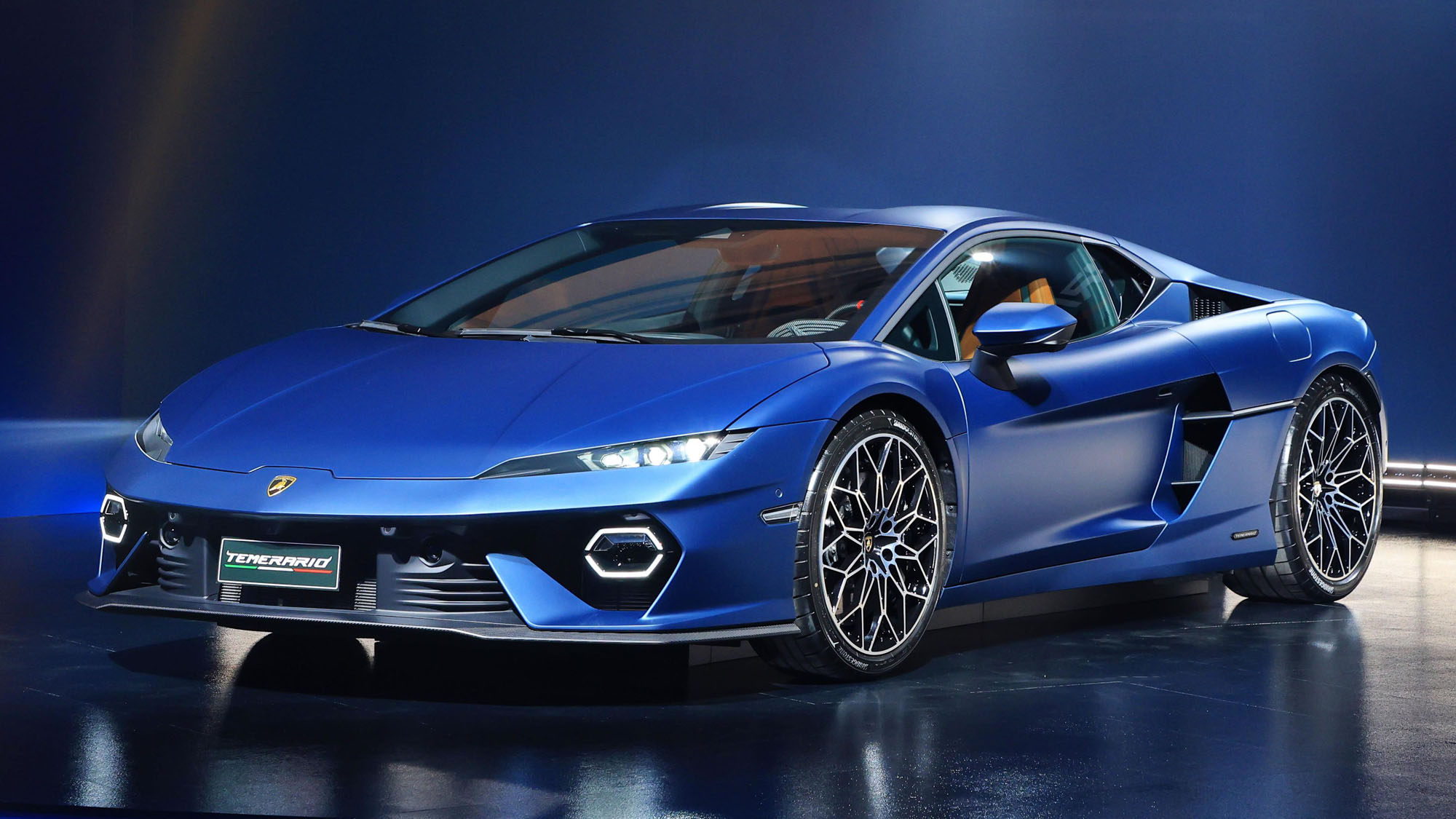
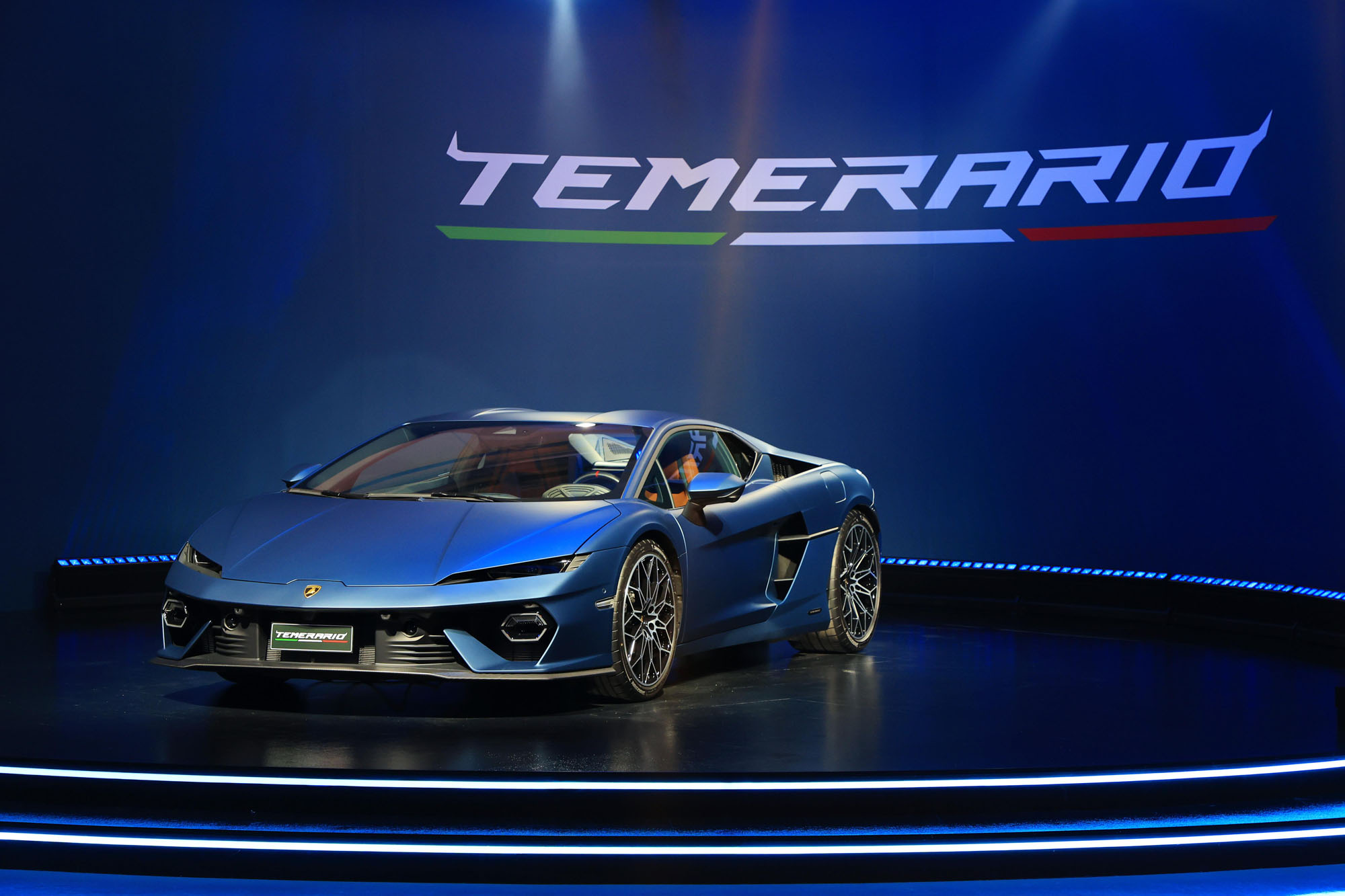
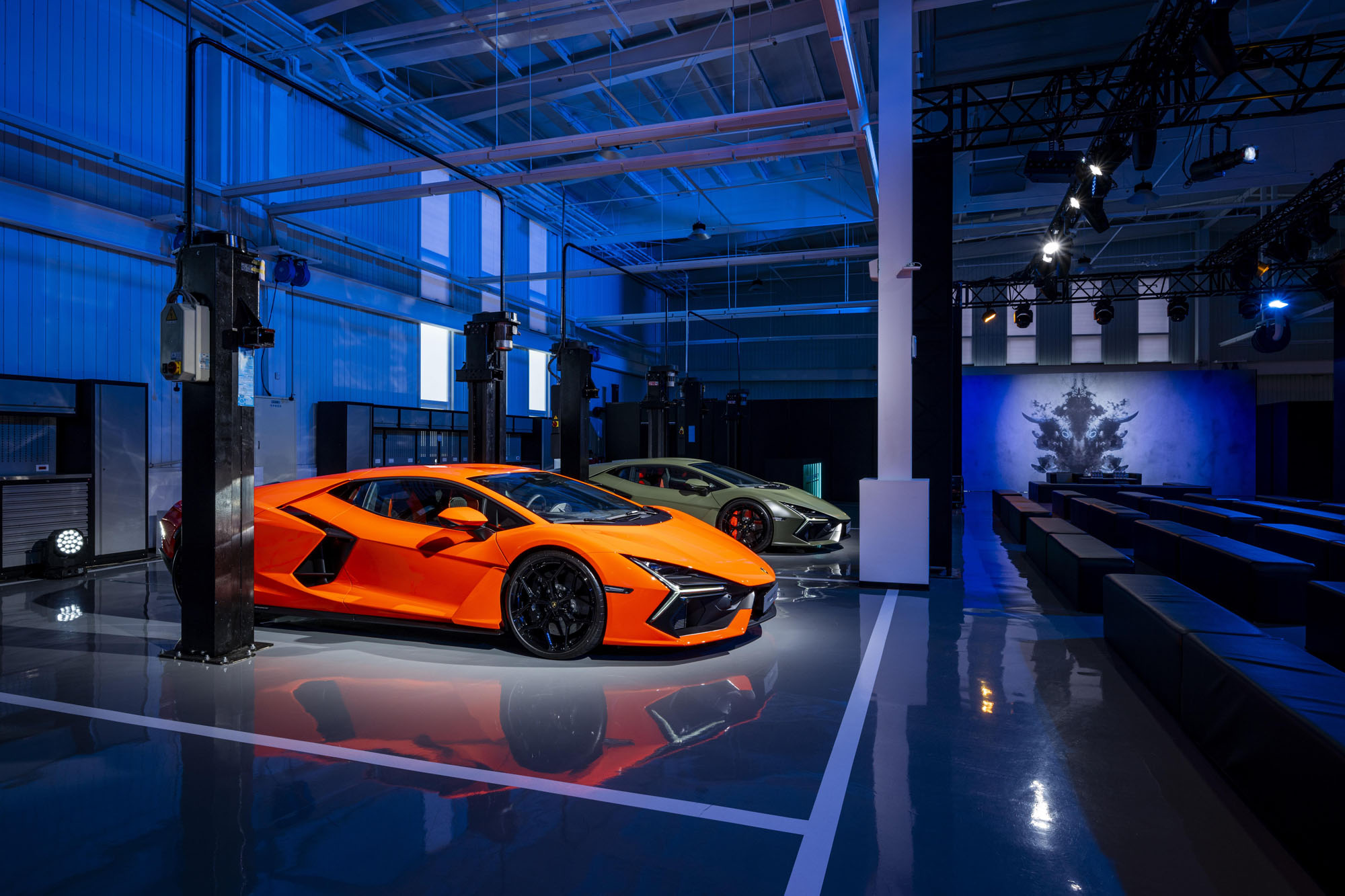
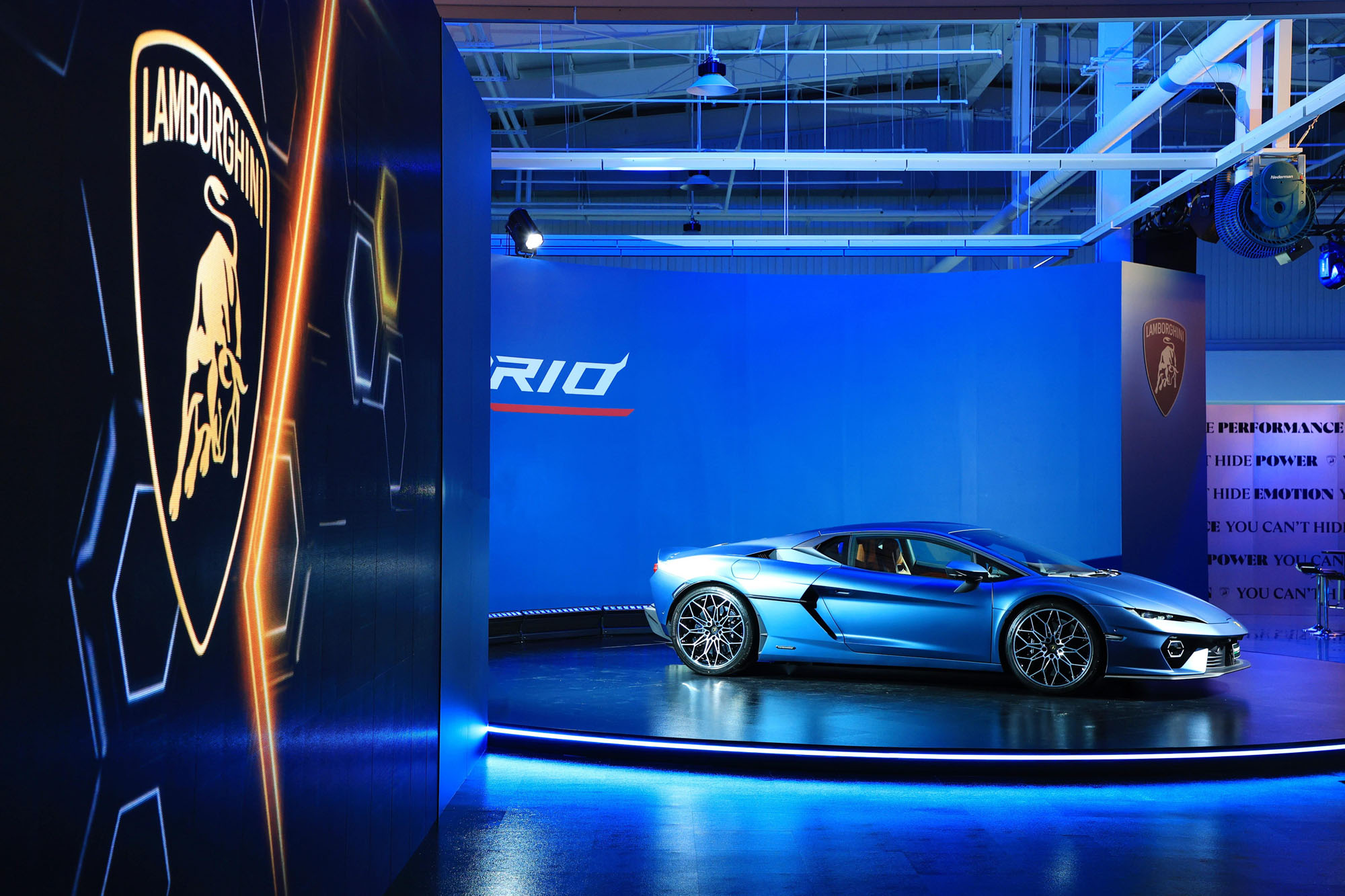
Following its Asia Pacific premiere in Japan last November, Lamborghini Taipei proudly introduces the highly anticipated Temerario to dynamically kick off the year. The second market in Asia to showcase this groundbreaking model, Lamborghini Taipei offers Taiwanese enthusiasts their first look at the latest addition to the brand’s line-up, marking a significant milestone for the hybrid transformation of Sant’Agata Bolognese’s iconic vehicles and underscoring the importance of this market.
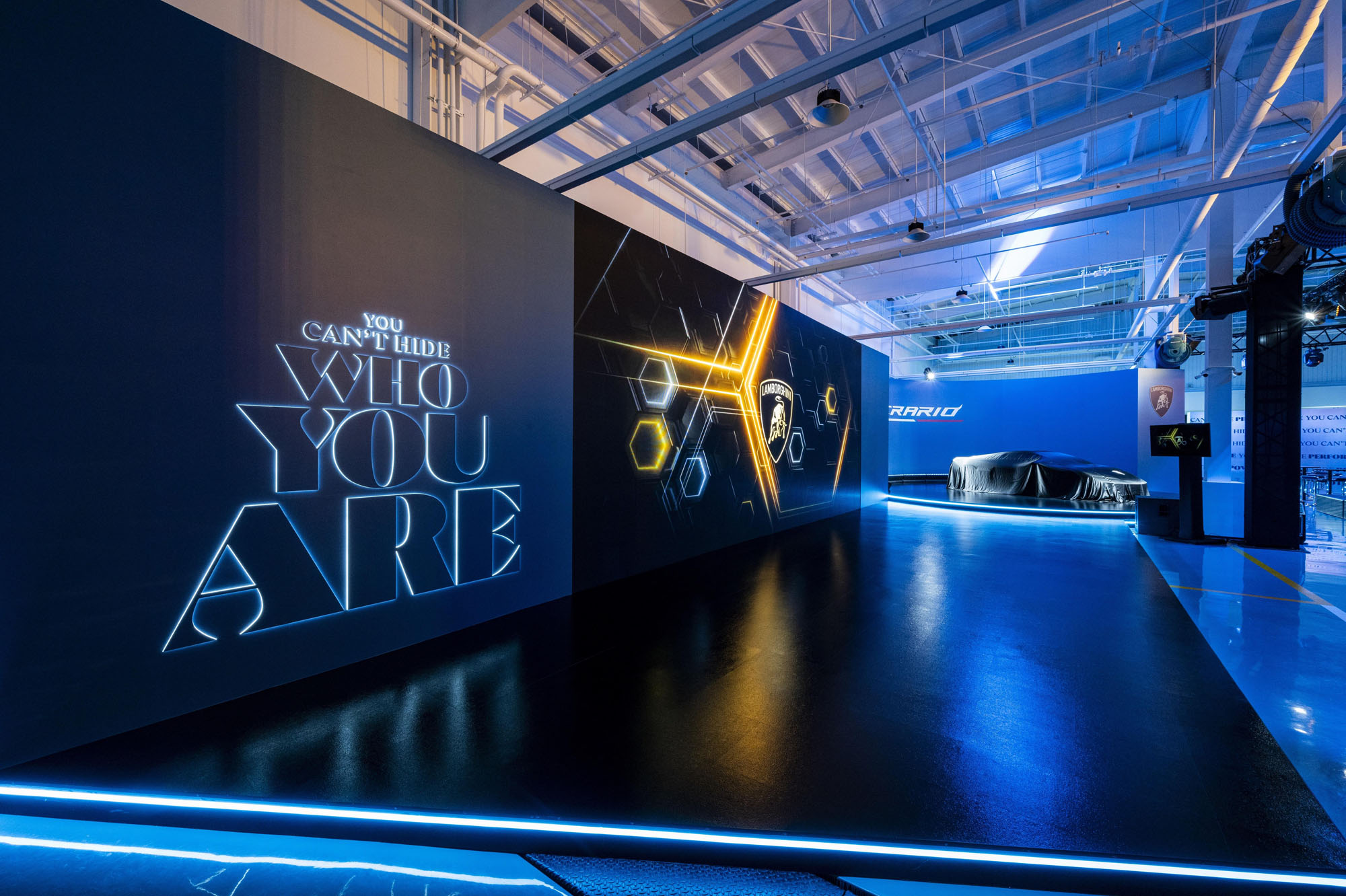
Held at the newly opened Lamborghini Taipei Service Center, the exclusive event welcomed esteemed customers and media representatives. Federico Foschini, Automobili Lamborghini’s Chief Marketing and sales Officer, and Francesco Scardaoni, Regional Director of Automobili Lamborghini Asia Pacific, honored the event.
The Temerario is the second vehicle in Lamborghini’s HPEV (High Performance Electrified Vehicle) range, following on from the Revuelto. It redefines performance, driving pleasure and comfort and, together with the Urus SE[3], makes Lamborghini the first luxury automotive brand to offer a completely hybridized range.
Temerario presents itself as the new benchmark in the super sports car segment, delivering unmatched performance. The new hybrid powertrain, designed and developed from scratch in Sant’Agata Bolognese, combines a completely new twin-turbo V8 engine with three electric motors, delivering a total power output of 920 CV and is the first production super sports car to achieve 10,000 rpm. The performance is an absolute revelation: maximum speed of 343 km/h (210+ mph), 0 to 100 km/h (0-62 mph) in just 2.7 seconds.
“We are honored to unveil the Temerario in Taipei, a car in a class of its own and embodying innovation and performance from both a technical and stylistic point of view. Temerario, Revuelto and Urus SE complete our lineup, finalizing our electrified roster within the Direzione Cor Tauri strategy. Hybridization for Lamborghini always brings additional features to a car: we are redefining the concept of sportiness and dynamic driving pleasure with improved efficiency and reduced emissions, always consistent with our DNA of emotive performance,” said Federico Foschini, Automobili Lamborghini Chief Marketing & Sales Officer.
Francesco Scardaoni, Region Director of Automobili Lamborghini Asia Pacific, commented, “We are thrilled to welcome the New Year with the highly anticipated premiere of the Temerario in Taipei. The Temerario showcases Lamborghini’s dedication to combining exceptional performance with cutting-edge hybrid technology. We are confident that the Temerario will resonate strongly with customers, media and enthusiasts across the Taiwanese market.”
Powertrain
The heart of a Lamborghini has always been its drive system. With the new Temerario, Lamborghini takes an entirely new approach, with five years of development delivering an unprecedented super sports car powertrain, comprised of an extremely high-revving biturbo Internal Combustion Engine concept combined with three electric motors.
The new powertrain is integral to the second super sports car in Lamborghini’s High-Performance Electrified Vehicle (HPEV) product range. The first target was to achieve the highest possible specific power and torque while at the same time offering the response of a classic high-revving naturally aspirated engine. Therefore, only high-performance components are used in the drivetrain: the new 4.0-liter V8 biturbo engine has a specific output of 200 CV per liter and works together with an oil-cooled axial flow electric motor fully integrated in the V8 housing. Propulsion is supported by two electric motors on the front axle.
The linearity and progression with high revving characteristics, which was previously only possible with naturally aspirated engines, now offers high torque up to very high engine speeds thanks to the turbochargers.
The new engine with the internal designation L411 is one of the segment’s most powerful engines. The V8 biturbo delivers its peak power of 800 CV from 9,000 to 9,750 rpm and 730 Nm of torque between 4,000 and 7,000 rpm. The electric motor, in P1 position (between the V8 engine and the gearbox), ensures immediate response starting from low engine speed and continues consistently through gear transitions, working as a “torque gap filler” and improving the transient response, giving the sensation of linear and limitless progression up to 10,000 revs. Thanks to the two large turbochargers, efficiency and performance are increased at top speeds. These are located compactly in the V of the engine as a “hot V8” to optimize the packaging and thermal management. The V8 biturbo can rev up to 10,000 revolutions per minute: the maximum boost pressure of the turbochargers is 2.5 bar (abs). The turbines are controlled with an electrical wastegate and a wheel-speed sensor. Lamborghini has designed air filter boxes with tubular cartridges, making them extremely compact to create space and become even more efficient.
At the heart of the crankshaft housing is a flat-plane crankshaft with a 180-degree angle between the crankshaft bends. This crankshaft, which is typically used in racing engines, ensures optimal fluid-dynamic behavior due to even firing orders compared to the cross-plane crankshaft and a unique engaging sound. Titanium conrods reduce the rotating masses and offer excellent material properties in terms of strength and lightness, reducing weight. The engine casting material consists of A357+Cu, the same used in motorsport applications.
The particularly robust and reliable finger followers covered in DLC (Diamond Like Carbon) can withstand speeds of up to 11,000 revolutions per minute – a range previously reserved for racing engines in motorsport. This is also where the engineers drew their inspiration for the engine layout concept. As is usual in motorsport, most of the auxiliary units are located on one side, including the two water pumps for the intercooler and engine cooling, as well the electronically-controlled barrel valve for fine temperature control.
The oil and water pumps, which are arranged in series on the right-hand side of the engine, are driven up to a specific ratio up to a pump speed of 7,800 rpm. The engineers integrated the oil tank in one side of the engine that works according to the dry sump principle with five-stage gear scavenge pumps. As a result, the drive unit is flat, sits low in the Temerario, and lowers the Temerario’s center of gravity, improving its handling characteristics. A newly designed water-cooling system ensures a balanced temperature regime. The internal cooling of the cylinder heads has been extremely refined using 3D printing technology for the casting core, allowing a uniform cooling of the combustion chamber and high knock resistance. The direct petrol injection atomizes the fuel extremely finely into the eight combustion chambers at up to 350 bar, thus ensuring fast and clean combustion.
The characteristics of a smoothly revving, naturally aspirated engine, with the power delivery of a turbo engine in combination with electric drives, is unique in the way it works and sounds. Lamborghini has thus succeeded in developing a new V8 biturbo that combines the pronounced linearity of the rev development in the previous Lamborghini aspirated V10 with the enormous power and torque of a modern turbo engine. The system output is an outstanding 920 CV / 676 kW in conjunction with the three electric motors.
Sound
Lamborghini has invested significant technical effort in developing a unique and unmistakable audio experience from Temerario’s completely new drive system, ensuring a highly emotive and unmistakably Lamborghini sound and sensation feedback.
The technical complexity of this special soundscape is immense. To ensure that the crescendo up to 10,000 rpm provides an emotional, sporty sound, Lamborghini integrates various technical measures and enriches them with high-frequency modulation effects.
A special connection between the engine banks enhances the sound effect of the power unit subject to the engine speed. Depending on the driving mode, the silencer box and exhaust valve of the V8 biturbo work in the low rev range to improve acoustic comfort. At the same time, the different driving modes are clearly differentiated through acoustic tuning.
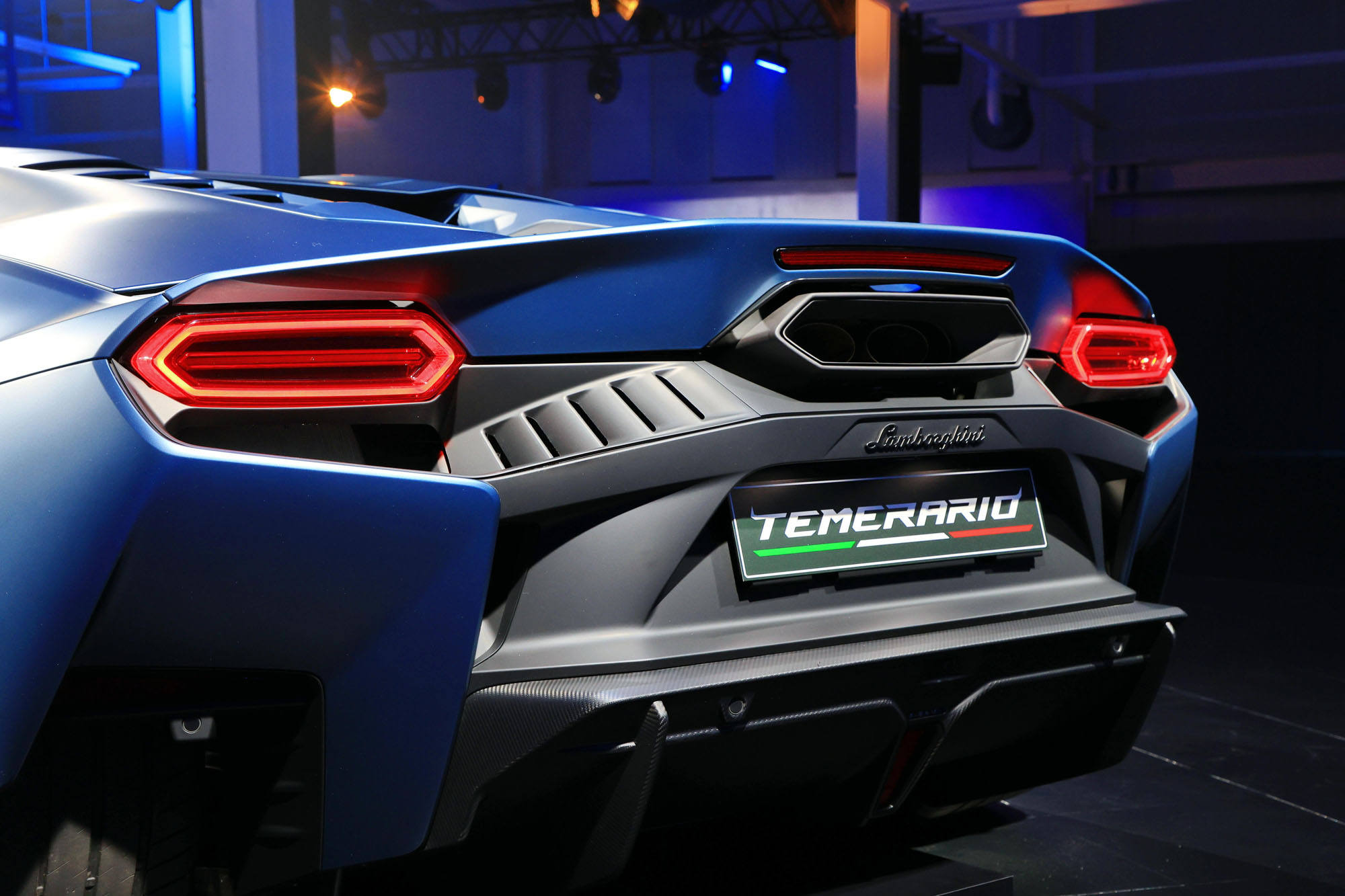
An exhaust system routed from the manifold to the tailpipes also acoustically emphasizes the engine’s combustion processes. Thanks to the smoothed pipe routing, Lamborghini guarantees a clear and clean sound. The height and position along the transverse axis of the exhaust tailpipes further focus the sharpness of the engine with a high-frequency component, thus emphasizing its power.
In addition, Lamborghini has designed the engine mounts and body so that the drive has a flat crankshaft character that can be felt by the driver at high engine speeds and under full load. Thanks to the flat-plane crankshaft, in which the crank pins are at an angle of 180 degrees, the V8 biturbo produces subtle vibrations.
Lamborghini makes the amplitude of these vibrations more pronounced at high engine speeds, which enhances the overall impression of speed and power at high revs. The sound engineers also manage to transport the pleasantly sporty acoustics into the interior and at the same time emphasize the desired frequencies using lightweight body parts and panels. The light vibrations transmitted to the frame provide a comprehensive sensory experience in addition to the thrilling soundtrack. As the engine speed increases, the seat vibrations intensify, especially at higher engine speeds of up to 10,000 rpm: a speed range previously only known from motorsport.
Furthermore, an additional sound symposer emits acoustic waves into the interior, creating an immersive auditory experience in every driving mode.
Lamborghini has also designed a completely different soundscape for the different driving modes Città, Strada, Sport and Corsa. In Città mode, Lamborghini offers a high level of comfort with a special sound from the electric drive unit. The composition achieves a smooth and pleasant listening experience in urban environments. In Città mode, the Temerario is emission-free and quiet.
In Strada mode for country roads and fast autoroutes, occupants enjoy a comfortable and homogeneous V8 biturbo sound experience with evenly distributed frequencies, without any barking or sharp peaks for sporty yet discreet driving pleasure. In Sport and Corsa modes, Lamborghini amplifies the second- and fourth-order overtones of a V8 four-stroke engine and air-intake harmonics, creating an exhilarating and powerful listening experience. At speeds of up to 10,000 rpm, the engine not only delivers incredible power of up to 920 CV but also an inimitable sound – a new Lamborghini sound of a new generation.
Three electric motors for support
The new drivetrain incorporates three electric motors. With 110 kW of power each, the electric motors are an integral part of the powertrain strategy. Two oil-cooled axial flow electric motors with a total peak output of 220 kW and up to 2,150 Nm of torque (the continuous output is 60 kW) drive the front axle when required to achieve all-wheel drive. The electric front axle weighs just 73 kilograms, and each electric motor only 15.5 kilograms.
A major challenge was the design of the powertrain to be as compact as possible. To achieve this, the engineers integrated the electric motor into the housing of the V8 biturbo, directly, without an intermediate clutch. This fills any turbo lag, no matter how small, at any speed delivering 300 Nm of torque. The entire electric drive unit is located compactly between the combustion engine and the dual clutch transmission. This electric motor also works as a starter motor and three-phase generator.
Furthermore, the two electric motors on the front axle also improve the power output and can transform the new Temerario into a fully electric super sports car. In this way, Lamborghini reduces CO2 emissions by up to 50 percent compared to the Huracán[4].
Battery
The Lamborghini Temerario is equipped with a lithium-ion high-specific-power (4500 W/kg) battery pack situated within the central tunnel. This keeps the car’s center of gravity as low as possible and ensures optimal weight distribution. The battery is protected by a lower structural layer and connected to the front electric motors, the rear electric motor, and an integrated recharging unit.
The battery pack is 1550 mm long, 301 mm high, and 240 mm wide, containing pouch cells with an overall capacity of 3.8 kWh. When the charge drops down to zero it can be recharged using both ordinary domestic alternating and charging column current up to 7 kW in power, and completely recharges in just 30 minutes. It can also be recharged under regenerative braking from the front wheels or directly from the V8 engine.
Thanks to the e-axle, the Temerario incorporates the Lamborghini Dinamica Veicolo (LDV) 2.0 system. Electric torque vectoring increases the car’s agility in narrow cornering as well as its stability in high-speed cornering, distributing torque optimally to each wheel. Unlike conventional systems, the new torque vectoring intervenes on the brakes only when strictly necessary to maximize efficiency and ensure a more natural driving style as well as an even higher level of performance. When braking, the e-axle and rear electric motor contribute to deceleration, reducing stress on the brakes while recharging the battery.
Dual-clutch transmission
The eight gears of the second Lamborghini super sports car in the High-Performance Electrified Vehicle (HPEV) category are shifted by an eight-speed dual-clutch transmission (DCT) installed transversally behind the V8. The newly-designed compact transmission meets all the requirements of such a powerful drive unit.
To save installation space and weight, the layout is not a standard DTC one. An additional hollow shaft is used to share the same synchronizers for different gear torque paths. Without electrical components, the new DCT weighs less than the Huracán’s seven-speed dual-clutch transmission and achieves faster shift times. At 560 millimeters long, 750 millimeters wide and just 580 millimeters high, the new DCT also remains extremely compact.
Lamborghini has installed the new eight-speed dual-clutch transmission behind the V8 biturbo. This creates sufficient space in the center tunnel for the lithium-ion battery that powers the electric motors. Another advantage is that this technical layout optimizes the weight distribution of the Temerario and ensures a compact wheelbase for ideal driving dynamics and balanced handling.
With the new eight-speed dual-clutch transmission, drivers experience extremely fast shift times even with a very sporty driving style, even in daily driving. Continuous downshifts in particular are easy: when braking and simultaneously pressing and holding the left shift paddle the transmission shifts down gears sequentially, allowing the driver to feel and hear the gear change. The long ratio eighth gear reduces the engine speed, which helps to optimize fuel consumption and improves drivability at cruising speed. The Temerario gearbox has been equipped with a mechanical reverse gear system.
Design
Brave, unexpected and authentically a Lamborghini: with the Temerario Lamborghini Centro Stile has created a new and inimitable super sports car that opens a fresh chapter in Lamborghini design DNA. following the new styling with its own essential and iconic identity. The new design creates its own essential and iconic identity.
The new car’s design points towards the future of Lamborghini’s legendary mid-engine sports cars, while its shapes stay pure, athletic, and well-defined. With a clean-sheet design and new drive concept, the Temerario connects to its legendary predecessors, while its all-new persona is characterized by reduction, clarity, sharpness, and recognizability.
Exteriors
From first glance, the Temerario reveals Lamborghini DNA in its typical Lamborghini silhouette: clear and puristic lines, short and compact overhangs, integrated aerodynamics and a bold shark nose.
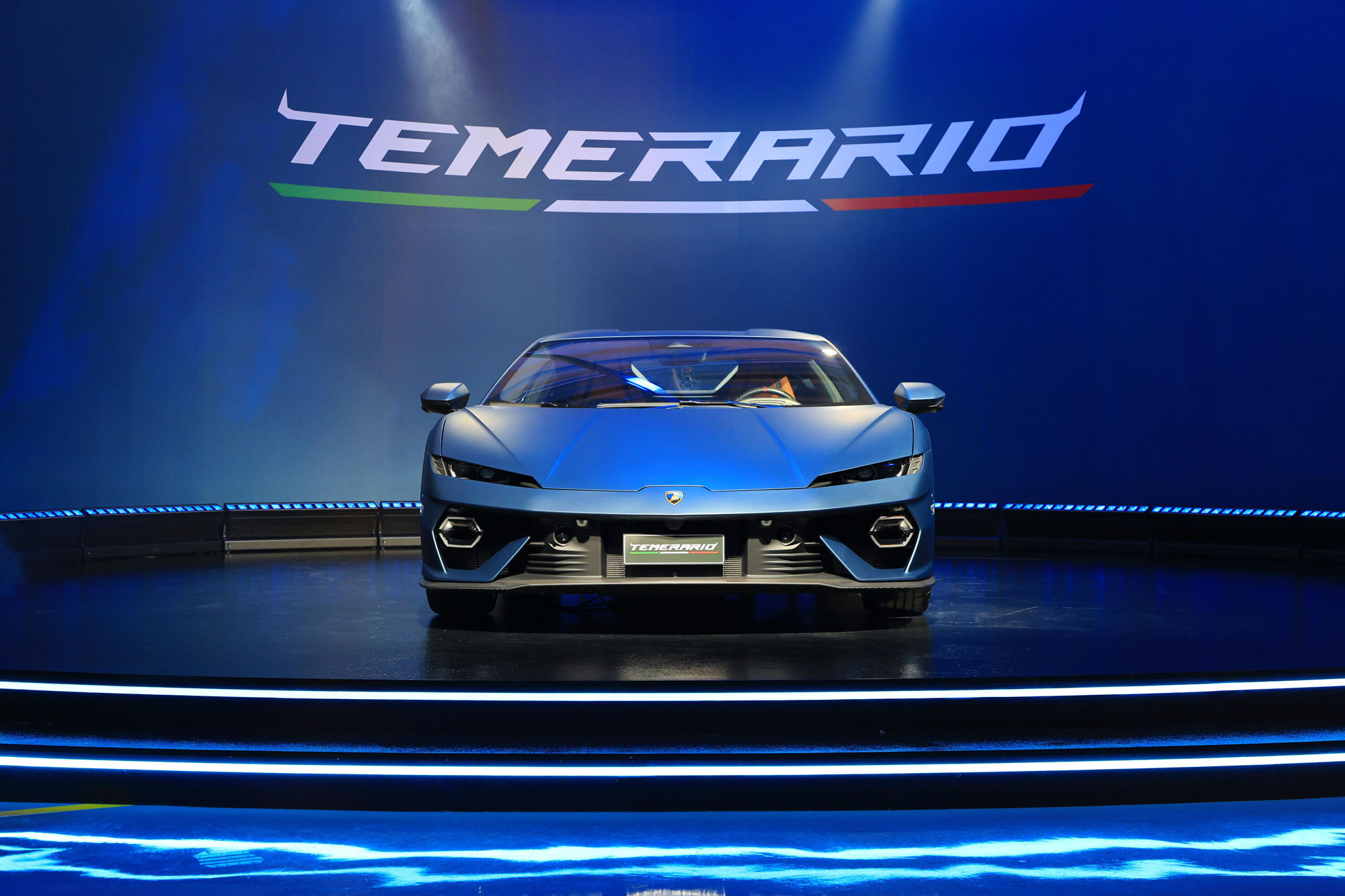
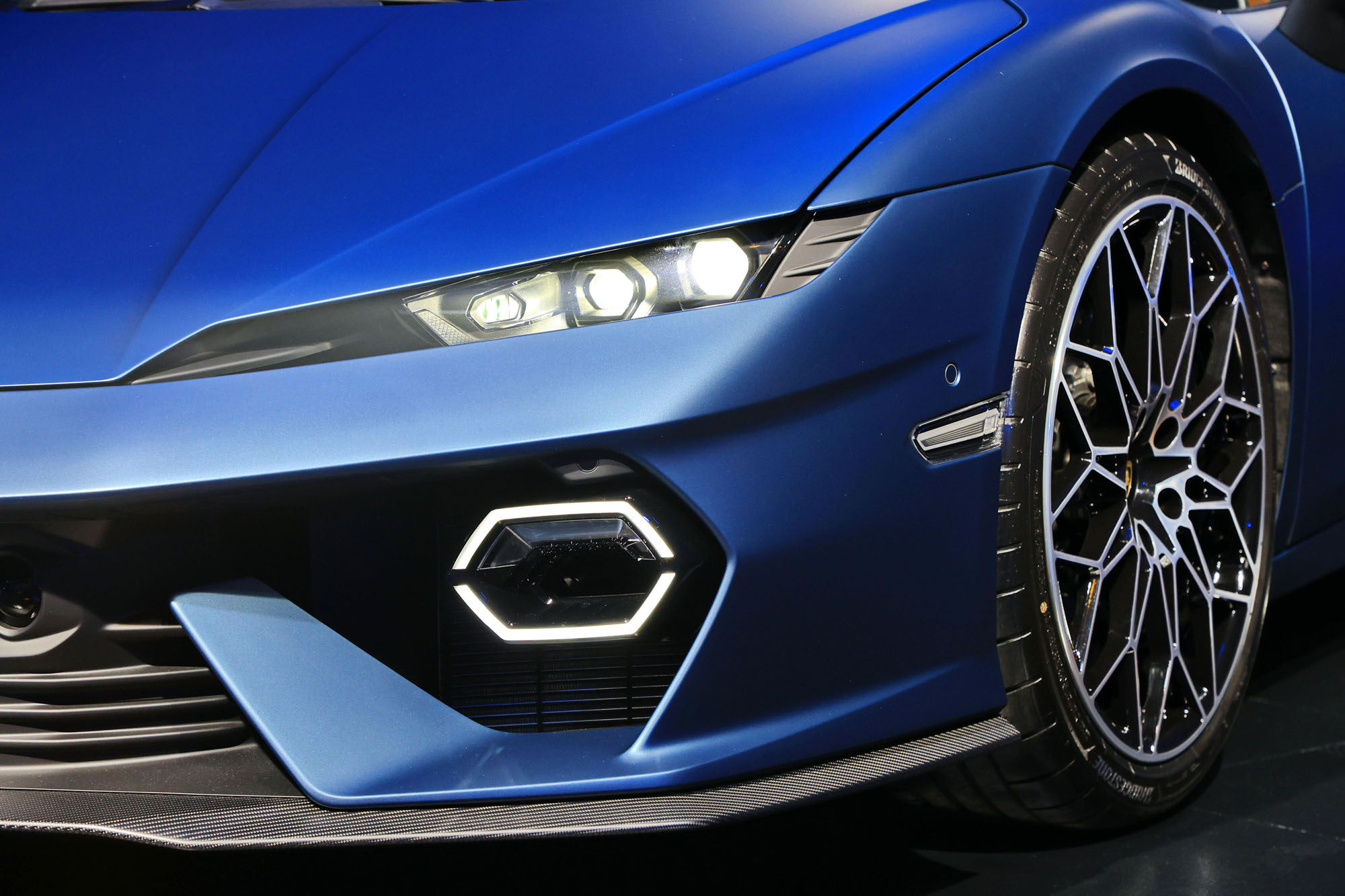
The Lamborghini design language has evolved to create a new hexagonal Daytime Running Light (DRL) signature, rendering it strongly recognizable and identifiable from far away. The hexagon concept can be found as the main design theme throughout the car: on the main bodywork, the side air intakes, the taillights and in the remarkable hexagonal exhaust pipe. “This unique hexagonal light signature ensures a high recognition value within the Lamborghini range, and is also a clearly identifiable in the distance,” emphasizes Mitja Borkert: the geometric hexagon paradigm has been one of Lamborghini’s most recognizable symbols since the 1960s.
The hexagonal daytime running lights incorporate an integrated radar sensor as well as an air tunnel, part of the design philosophy of incorporating lights within the aerodynamic concept. Furthermore, air channels positioned just below the headlights improve the aero performance and cooling of the front high-performance braking system for even better efficiency.
The Temerario’s designers combine elements from aviation with a visceral muscularity that starts at the front. The design is characterized by well-formed athletic surfaces and a cabin that tapers towards the hexagonal tailpipes. The tip of the hood dominates the entire front end in a strong and striking shark’s nose design: a symbol of bravery and speed. The sharp, elegant headlights are slightly overlapped by the hood, drawing inspiration from the sports motorcycle world. Air-guiding slats connect the low front spoiler with the hood, while fins on the sides direct the airflow along the flanks. Sharply shaped side skirts support the aerodynamics and increase downforce at the same time.
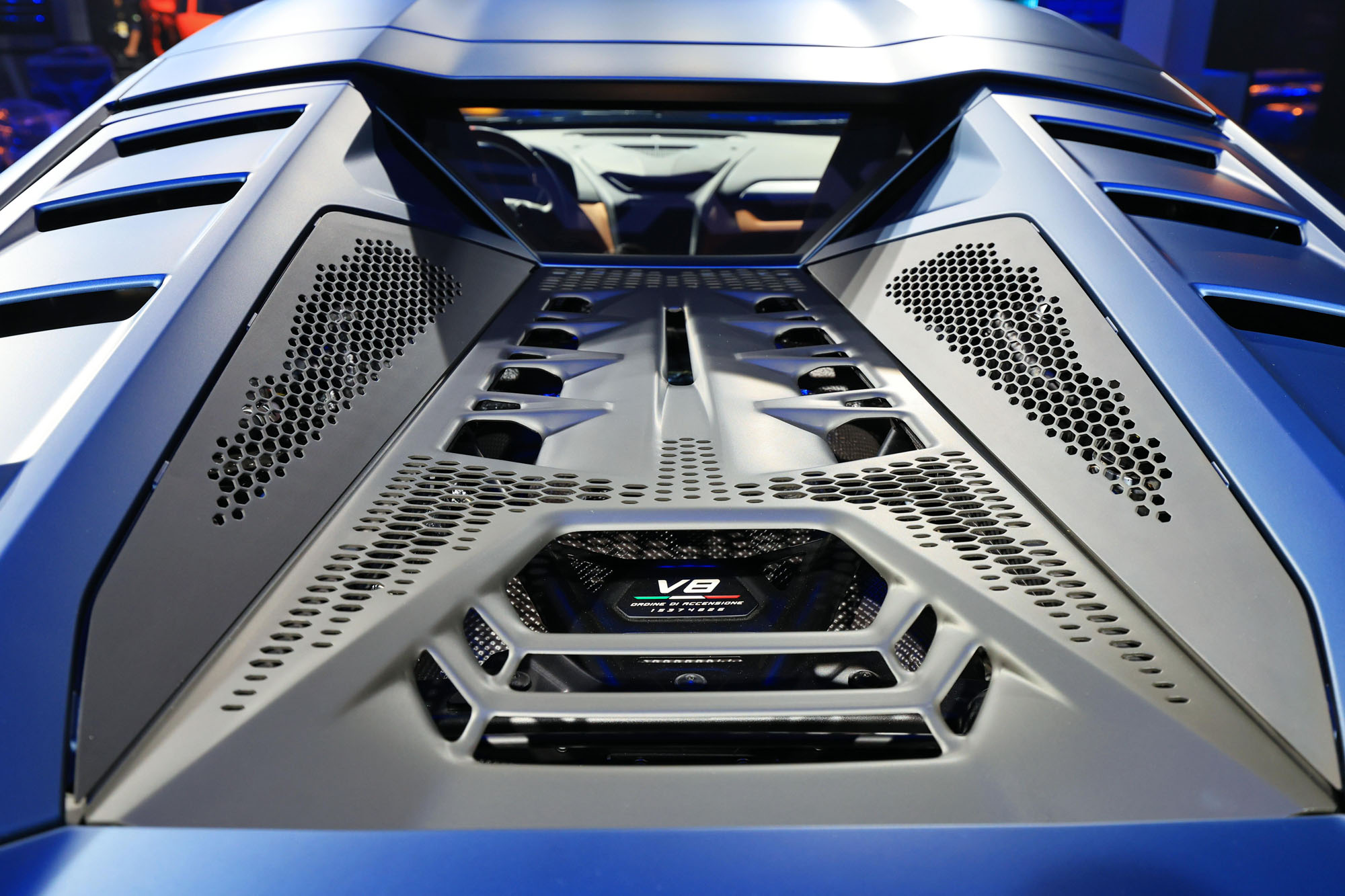
The heart of the Temerario is the completely new 4.0-liter V8 biturbo engine with an integrated axial flux electric motor. In realizing the new powertrain concept, designers and engineers developed a new chassis and a new body: the Centro Stile Lamborghini had the greatest possible freedom to present the drive system in a visually appropriate way to emphasize a true mid-engine feeling. Lamborghini presents the V8 biturbo openly, like a motorcycle’s engine under a transparent hood.
Interiors: “Feel like a pilot”
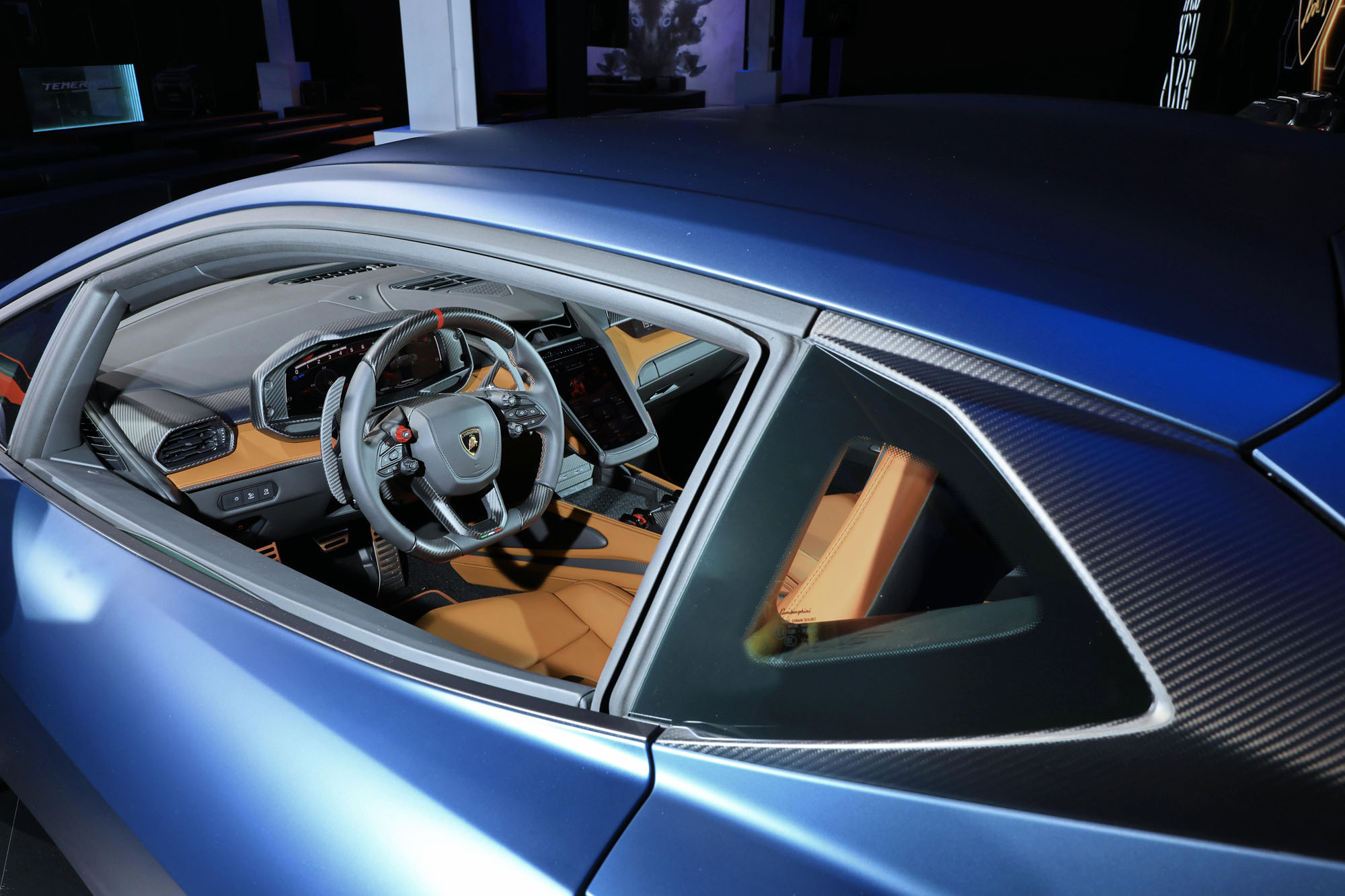
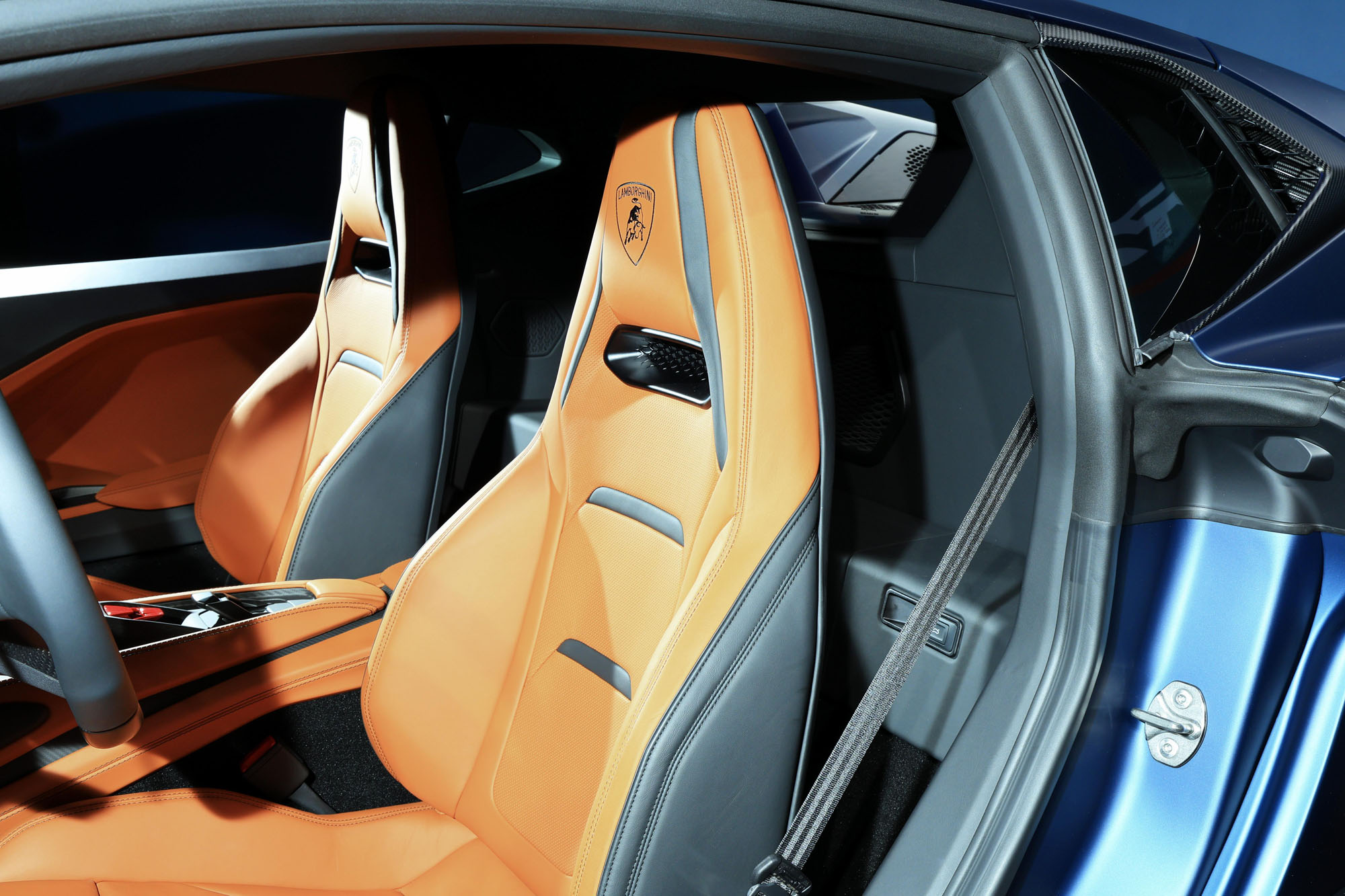
Lamborghini’s ‘Feel like a pilot’ philosophy comes to life in a new way in the Temerario, through a low seat position; the slim and lightweight dashboard; and a perfect inclination of the steering wheel allowing the driver to feel part of the typic fun-to-drive approach of Lamborghini. The combination of digital screens and mechanical and physical buttons such as the iconic start button or the racing car inspired steering wheel, results in the unique experience of ‘pilot interaction. New, electrically adjustable and comfortable sports seats are standard, or optional carbon fiber double-shell sports seats encompass the passengers within the vehicle like a perfectly fitting glove, ergonomically surrounding them with the cockpit and center console unit. The seats are available in many different colors and four different stitching patterns. No other Lamborghini seat currently offers such a wide range of options as the newly developed comfort seat in the Temerario: the 18-way adjustable comfort seat is heated and ventilated.
The interior mirrors the extraordinary exterior design, balancing digital and physical experiences. Lamborghini uses best-quality materials such as carbon, leather and Corsatex microfiber throughout the interior, combining them to create a high-quality interior experience with a special feel. Many interior elements can also be ordered in carbon fiber as an option, including parts of the center console, air vents, door panels, dashboard parts, steering wheel and steering column. In addition to the elegant lightweight materials, customers can find classical Lamborghini elements such as the Start/Stop “Power button” inspired by aviation; e-gear lever; and red ‘line-up’ indicator on the steering wheel to emphasize the extreme sportiness of the new Temerario.
Following the “Feel like a pilot” philosophy, thanks to the new generation dashboard, the pilot and co-pilot quickly become one with the new car. Clear and intuitive to operate, the pilot can reach all the controls from their perfect seating position. Iconic hexagonal air vents are elegantly integrated into the cockpit, and the center console has space for a smartphone and wallet.
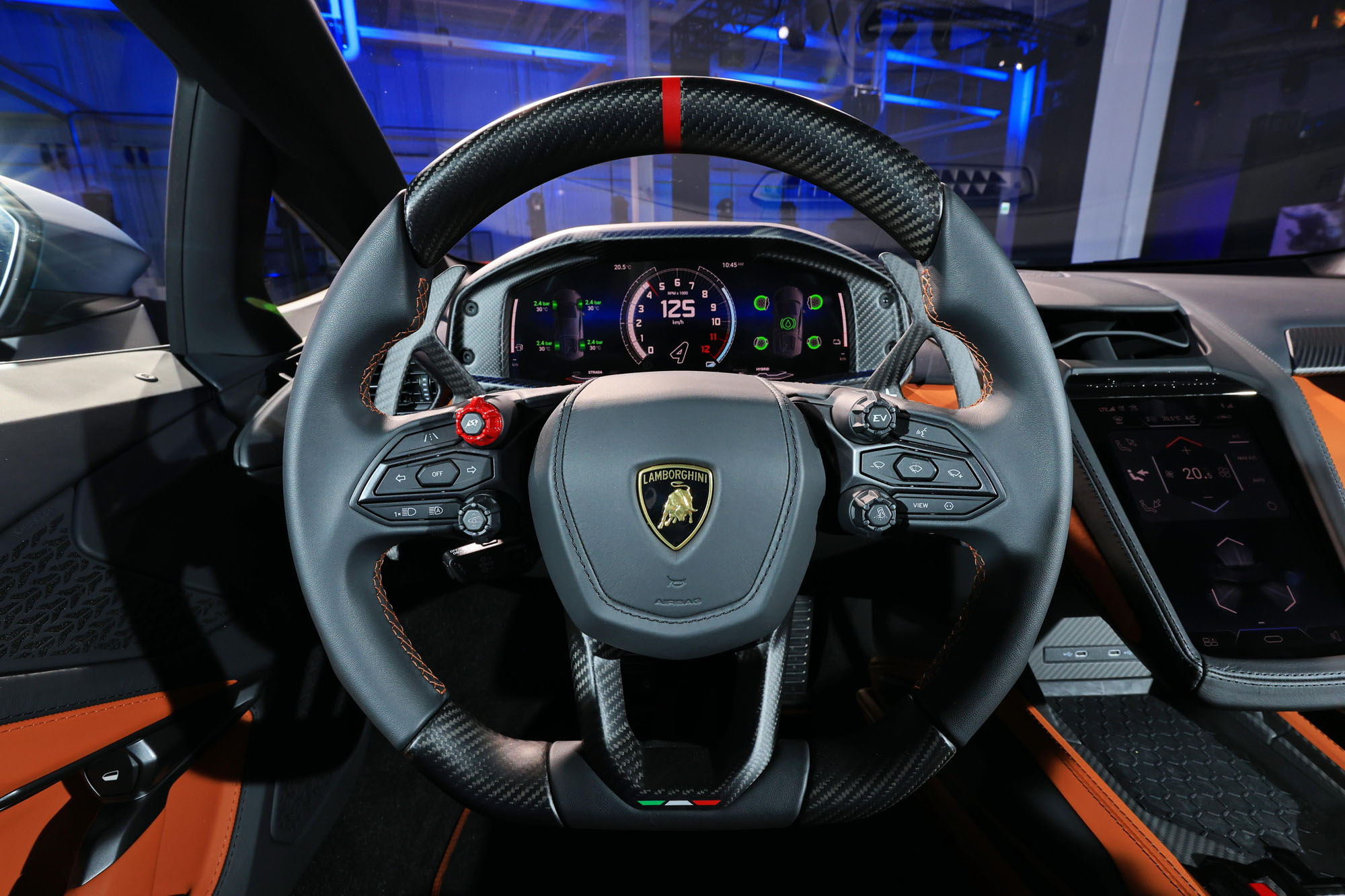
The newly developed steering wheel with optional carbon elements takes inspiration from the racing world and allows the driver to control the main driving functions. On the left-hand side of the steering wheel is the red-crowned rotor, which is used to select driving modes. Below this are buttons for the lift function to raise the vehicle; the ‘race start’ button; and between them the switches for the indicators. The driver can operate Launch Control with a simple touch of a button, for maximum control.
Pilot Interaction
For the first time, the co-pilot has their own slim and informative display, which they can use to call up driving information and vehicle functions. Pilots operate the important driving instruments in analog form, while those for the entertainment system and navigation are operated by touch via the display in the center console. The “Pilot Interaction” concept actively involves the driver even more closely in the operation of the Temerario, providing perfect control in driving.
The new Human-Machine Interface (HMI) “Pilot Interaction” serves as the information center of the new Temerario. Lamborghini developed the new graphics and design exclusively for the Temerario, evolving the new graphic design DNA started with Revuelto. A new 8.4-inch display mounted on the center console gives the option to swipe and individualize the themes. The pilot and copilot can use it to slide apps and information left and right from the central display to the driver’s and co-pilot’s screens, just like a smartphone. While the driver receives information on the 12.3-inch digital instrument cluster, the data for the front passenger is shown simultaneously on a 9.1-inch screen in front of them. If the pilot changes the driving mode, the display graphics change to match the drive.
More space and room for everyday life
The interior of the Temerario has been completely redesigned compared to the Huracán, while at the same time further developing the design language first seen on the Revuelto. The Temerario offers significantly more interior space than its predecessor, thanks to the new spaceframe chassis. A low and ergonomic seating position offers the pilot and co-pilot a perfect connection and integration with the vehicle while at the same time providing a high level of comfort, true to the Lamborghini philosophy of “Feel like a pilot”.
The new spaceframe chassis concept increases headroom by 34 mm and legroom by 46 mm, plus a 4.8° increase in visibility and accommodates passengers up to 200 cm tall even when wearing a helmet. This means that even the tallest drivers wearing a helmet can comfortably complete their laps on a racetrack. There is room for items such as sports equipment in the load compartment under the front hood with 112 liters of stowage volume available equivalent to two cabin trolleys. Other everyday items can be stowed behind the seats.
Personalization and ‘Alleggerita’ Package
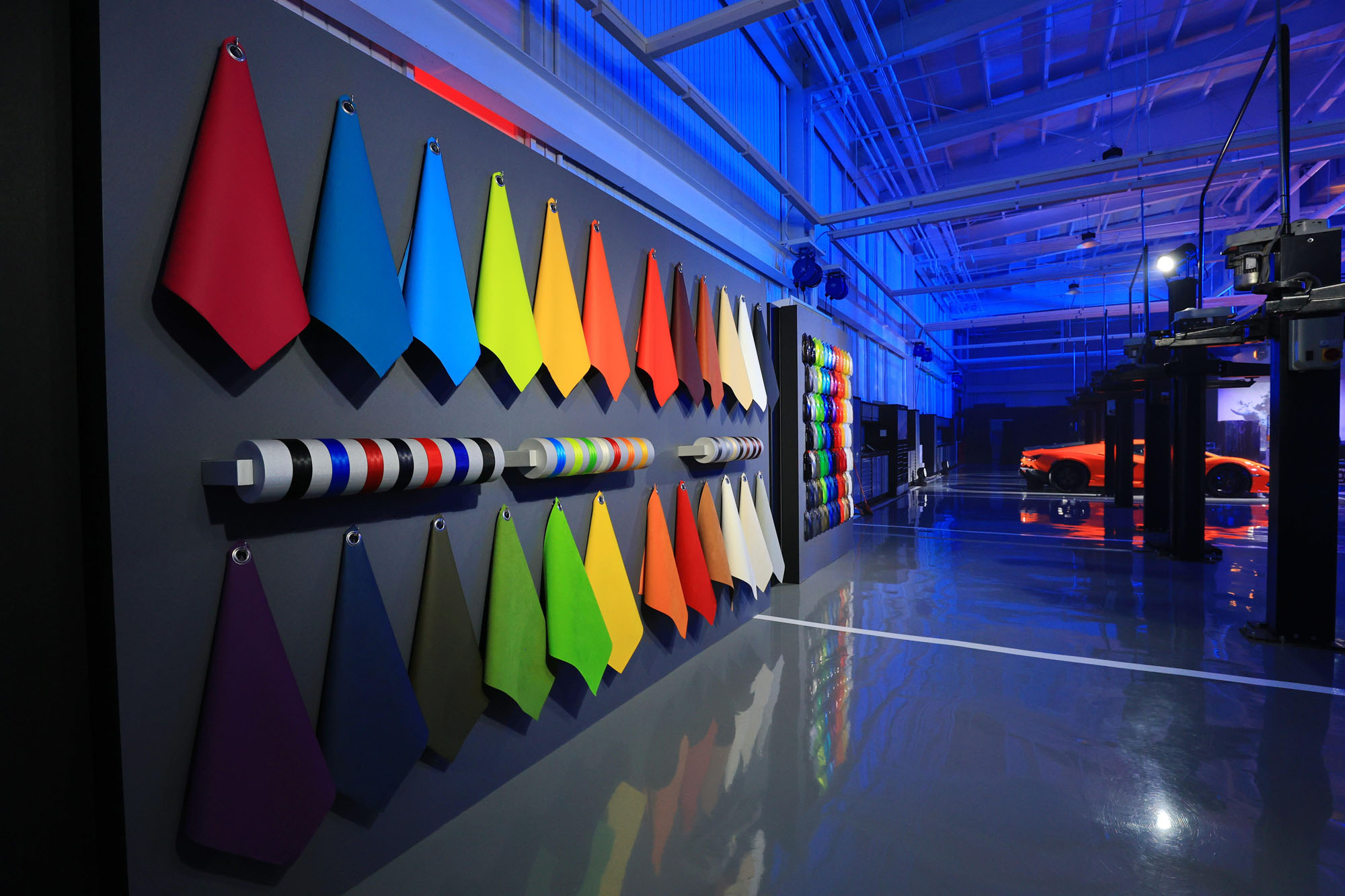
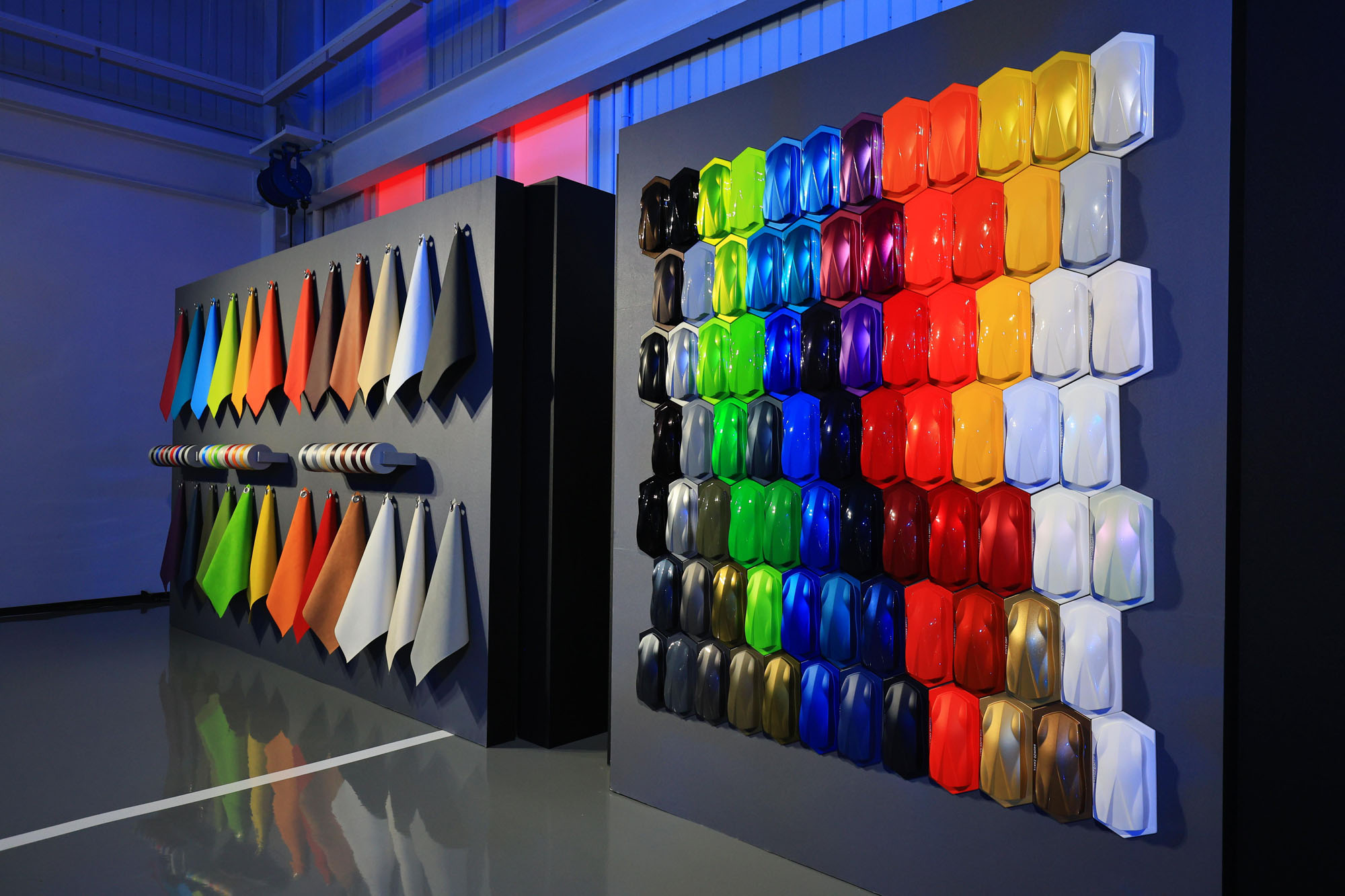
The Temerario is launched with two new dedicated colors, Blu Marinus (blue) and Verde Mercurius (green). Over 400 body colors and special liveries will be available, offering clients almost infinite customization possibilities through Lamborghini’s Ad Personam program. The new rims, 20” at the front and 21” at the rear, are available in three different designs and materials: cast rims (three colors), forged (four colors), and carbon. A wide range of carbon fiber elements for exteriors and interiors is offered: front splitter, mirror caps, side upper vents, rear diffuser, central tunnel, instrument cluster, air vents, door switch frame; steering wheel in carbon; steering column cover and gearshift.
The Temerario will also be available with the ‘Alleggerita’ (lightweight), package for customers more oriented towards track driving. It reduces the car’s weight by 12.65 kg through body components alone, with a reduction of over 25 kg when incorporating lightweight interior elements and carbon rims and is even more efficient from an aerodynamic point of view (+67% aerodynamic load).
The Alleggerita pack includes a splitter made of CFRP carbon fiber reinforced polymers (-0.19 kg) and recycled carbon fiber underbody panels (-0.55 kg): a further step in Lamborghini’s commitment to sustainability. New side skirts in CFRP deliver a further 0.6 kg of weight saving, as do the rear bonnet (-9.2 kg) and the panel where the high-load spoiler is integrated (-1.6 kg).
Inside, the Lightweight Pack incorporates carbon fiber door panels and structural carbon twin-shell sports seats to offer a driving experience inspired by the world of competition. Window weights are also reduced: the rear window in lightweight glass saves 0.85 kg, while the fixed side windows are in polycarbonate (-0.45 kg).
Aerodynamics
With the Temerario, Lamborghini has achieved the peak of aerodynamic efficiency through the attainment of three primary design goals: stability at high speeds; increased cooling performance; and maximum braking efficiency.
Lamborghini’s designers and engineers took into account the new hybrid powertrain and the increased aerodynamic load targets, particularly at the rear, when developing the bodywork and underbody of the Temerario: the result is +103% rear downforce compared to the Huracán EVO, increasing to +158% if the car is equipped with the Alleggerita Pack.
Each indivudual element was designed to contribute to excellent aerodynamic performance. Starting with the front, where the DRLs have also become aerodynamic elements, the hexagonal lights with dedicated air intakes and deflectors convey airflow from the bumper to the upper part of the side radiators, where two fins have been installed on the inlets. The upper fin with a wing-shaped profile diverts the flow downwards, which is captured by the second horizontal fin, directing it to enter the radiator perpendicularly and maximizing cooling efficiency.
Moreover, the fins which make up the grilles on the wheel arches convey the flow to the outside of the wheel, moving it away from the side radiator and minimizing its slipstream, with the dual effect of reducing aerodynamic resistance and moving the downforce towards the rear.
The wing mirrors, working in unison with the front of the vehicle, have the goal of not only minimizing drag, but also of directing the air towards the side radiators, increasing the cooling capacity of the mechanical components.
The roof’s design with a central channel directs air towards the rear spoiler, integrated in the vehicle body and thus improving the aerodynamic efficiency and increasing downforce. The curved sides of the engine hood also contribute to this result, increasing the portion of air which flows through the side part of the spoiler. The optional Alleggerita package features a high-load lightweight rear spoiler, obtained by increasing the height of the trailing edge with consequent increase in curvature.
The vehicle’s underside also plays a structural role in aerodynamic efficiency. The underbody is equipped with vortex generators: three pairs of fins arranged like the branches of a tree increase the rear aerodynamic load, assisting the action of the diffuser, which, thanks to a 70% greater surface area compared to the Huracán EVO and an angle increased by 4°, maximizes the vertical extraction of the air flow from the bottom. The increased cooling demand dictated by the new turbo-hybrid powertrain has necessitated the development of a new radiator layout, providing a 30% improvement in cooling performance.
Moreover, to maximize the Temerario’s exceptional performance, a new brake cooling concept has been developed to optimize vehicle braking. The front section incorporates a deflector fastened to the lower suspension arm, which exploits the flow diverted by the front diffuser and directs it towards the front brake caliper, helping to cool it. Another two specific inlets have been incorporated into the bumper to convey a high air flow from the bumper itself towards the disc ventilation channels; then a wye duct – with dual inlet but a single outlet – draws in air at high pressure, helping to improve the brake system cooling. The overall result is a total improvement in cooling performance over the Huracán EVO of 20% for the discs and 50% for the calipers.
The rear incorporates a solution already successfully tested on the Revuelto. The ventilation channels of the rear discs are fed via a NACA duct positioned in the front part of the rear wheel housing, which collects the high-energy flow of the underbody and directs it towards the brake cooling duct.
Spaceframe
The structural assembly of the Temerario sees the new Body-in-White constructed with a multi-technology spaceframe approach to withstand the higher stresses deriving from the new hybrid power unit. This guarantees excellent mechanical qualities together with remarkable efficiency in weight reductions.
Made entirely of aluminum, the frame of the Temerario debuts a new high-strength alloy for high-pressure castings; the use of high-strength hydroformed extrusions; and an increase in the number of hollow castings with thin closed inertia sections, achieved through the use of internal cores. These technologies allowed the constructional complexity of the spaceframe to be minimized and weight to be optimized, while at the same time the new hybrid powertrain adopts over 50% fewer components compared to the same parameters on the Huracán. In addition, the Temerario incorporates a significant reduction in the number of heat welds: over 80% less total weld bead length compared to the Huracán.
The new construction archetype has delivered increases in torsional stiffness of over 20% compared to the previous generation spaceframe. It also offers the best possible vehicle weight limitation, ensures the highest level of occupant safety, and significantly contributes to the vehicle’s excellent driving dynamics.
Driving Experience
Temerario offers 13 driving experiences that make the super sports car versatile and capable of exciting both in daily driving and on the curbs of a circuit. The drive modes can be selected via the rotors on the steering wheel: the upper left, red-crowned rotor allows the driver to choose between Città, Strada, Sport, Corsa and Corsa Plus (ESC Off – electronic controls deactivated); furthermore, by pressing the “checkered flag” button for two seconds, Launch Control is activated to exploit the maximum potential when starting from a standing start.
“Temerario offers an innovative and puristic driving experience at the same time. The e-4WD system combined with torque vectoring is a perfect combination,” comments Rouven Mohr, Chief Technical Officer at Lamborghini. On the one hand we have a car that is absolutely precise and effective on the track, on the other we can have a more typically rear-wheel drive character, oriented towards maximum involvement for the driver.”
Together with the hybrid system, three new dedicated driving modes also debut: Recharge, Hybrid and Performance, selectable via the upper right rotor. The choice of driving mode is displayed on the driver’s 12.3-inch digital dashboard, where the animated graphics replicate the rotation of the selectors to make the selection made immediately intuitive.
Città is the experience designed for driving in urban areas, which can be used both in Hybrid mode (fully electric with 2WD traction via the front e-axle, which delivers a maximum power of 140 kW – 190 CV) and in Recharge mode, to allow to the V8 to quickly recharge the battery if necessary. Strada is ideal for extra-urban routes and long autoroute journeys, for efficient and sporty driving, with all-wheel drive that activates on demand. The V8 engine always supports electric motors, with maximum power of 800 CV delivered by the powertrain in Hybrid mode, while in Recharge mode the maximum power output is 725 CV. The front e-axle supports torque vectoring and the active aerodynamics work to offer maximum stability at high speeds, for example on the motorway.
By selecting Sport, the Temerario changes character and the car’s behavior is set to offer emotive, fun and responsive driving in each of the three combinable modes: Recharge, Hybrid and Performance. The combustion engine, assisted by the hybrid system, is active in all three situations, delivering a maximum of 920 CV of power while the sound of the V8 becomes more present; the gearbox responds with maximum responsiveness while the suspension and aerodynamics enhance the agility of the car and the pleasure of driving in corners.
The pinnacle of effectiveness and power expressed, both in terms of performance and sound, is reached with Corsa, the mode designed to enhance the dynamic capabilities of Temerario on the track. In Performance the powertrain expresses the peak of its potential by delivering 920 CV, and the control of the hybrid system is calibrated to get the most out of the e-axle both in terms of torque vectoring and all-wheel drive, for ultra-sporty driving but accessible at the same time. The sound also reaches maximum emotiveness for an engaging and exhilarating sound experience.
The Drift Mode option also makes its debut on the Temerario, to help the driver generate controlled oversteer and maximize driving fun. Operated via the lower rotor on the right side of the steering wheel, Drift Mode is adjustable according to three different levels: from level 1, which facilitates oversteer while maintaining a limited yaw angle, up to level three dedicated to expert drivers to allow a wide angle of yaw.
The Lamborghini Temerario embodies the essence of the authentic “Fuoriclasse,” redefining excellence in the super sports car realm with its groundbreaking hybrid technology and unparalleled performance. As a masterpiece of engineering and design from Sant’Agata Bolognese, the Temerario stands as a symbol of Lamborghini’s relentless pursuit of innovation. For those seeking to experience this extraordinary creation, Lamborghini Taipei offers an exclusive gateway to the next chapter of the brand’s storied legacy.
Anyone who knows me knows that I live for comfort. Sneakers instead of heels? Absolutely. A pair of lounge pants that can double as a date night outfit with the right shirt? Yes, please. I’ve tried nearly every activewear brand to complement my quest for comfort and life as a travel writer, and I’ve always landed on Vuori as a favorite.
A testament to my loyalty is my closet, full of the brand’s uber-soft joggers, leggings, and versatile jackets. My staple airport outfit for long-haul flights is the boyfriend-style Vuori joggers with the Long Sleeve Halo Crew — both of which rival my most comfortable pair of pajamas. Last summer on a whirlwind trip through Hvar, Sicily, and London, I wore trousers, rompers, and shorts from Vuori’s Villa Collection; everything is made of breathable, four-way stretch material that was welcome during humid European days.
Vuori’s high-quality fabric, made from a special elastane and cotton combo, does come at a price, which is why I am always checking their website for the latest deals. Fortunately, deals are plentiful: I spotted dozens of my favorite styles up to 60 percent ahead of the long weekend. Don’t miss a chance to stock up on travel clothes that are so supremely comfortable, you’ll look forward to wearing them. Find the 33 best deals from this Vuori sale, including savings on joggers, stylish tank tops, buttery-soft leggings, and more.
Best Vuori Sale Deals Overall
Vuori
As if I needed another reason to stock up on more Vuori clothes, its current sale is a perfect excuse to snag some of my favorites, including the Women’s Daily Legging and Rib Crop Tank — a winning combo for easy travel days. They’re both on sale now, alongside the Halo Essential Half Zip that I’ve had my eye on for a few months; at 20 percent off, I’ll definitely be taking advantage before it sells out.
I can never have too many pairs of Vuori pants, so I was so happy to see that some picks in its Performance line are marked down to $75, including a vibrant turquoise color and everyday options like grey and black. Some of my other must-haves from the brand are also on sale, including the fun Bondi Jumpsuit for gym days, and the Daily Split Flare, my go-to pants on mornings in hotels when I want to run and grab a coffee or explore the surrounding area in comfort.
Men’s Vintage Ripstop Pant
Vuori
Best Vuori Leggings Deals
Vuori
I can always find a reason to wear ultra-soft Vuori leggings, from errand runs to long flight days. The Daily Leggings are smooth as butter, made from a lightweight fabric — and they’re currently on sale for $71. For a throwback ‘90s look that still has all the style to make it work, the Women’s Track Legging is marked down a whopping 60 percent.
Women’s Track Legging
Vuori
Best Vuori Jacket and Sweatshirt Deals
Vuori
I recently discovered Vuori’s wide range of jackets — and I haven’t looked back. From versatile rain jackets to stylish puffers, there are options suitable for every type of climate. The Women’s Hudson Insulated Jacket is a medium-weight coat that provides breathability and comfort — and it’s 50 percent off. For hikes and general lightweight coverage, the Women’s Willow Jacket fits the bill and is currently 20 percent off.
Women’s Hudson Insulated Jacket
Vuori
Best Vuori Tops Deals
Vuori
In addition to all of the comfy bottoms, Vuori also has a great selection of tops, including my go-to Women’s Rib Crop Tank, made from stretch knit fabric in a number of earthy tones like oregano and cinnamon. Snag it now or just $26. Another fun option I have my eye on is the Women’s Cove Funnel Neck Tank; it’s slightly cropped with a cut that welcomes the opportunity to dress it up or down — and it’s on sale for $35.
Women’s Pose Fitted Tee
Vuori
Best Vuori Shorts Deals
Vuori
I used to avoid wearing shorts; they never seemed to fit right and lacked the cozy room I needed for long days of walking. That changed once I discovered Vuori’s diverse short selections, all built with four-way stretch for room to move. The Halo Sport Short is my go-to pick for humid days. They offer all the moisture-wicking protection you need and are currently on sale for $59. For a looser fit that pairs well with a cute cami top or light cardigan, consider the Isla Baggie Short, also currently on sale.
Ahead of the Lunar New Year, fashion brands from around the world are unveiling exclusive collections and campaigns that celebrate the rich cultural traditions and symbolism of this festive season. This year, Maisons are embracing the Year of the Snake, along with themes of renewal, family, and hope.
Prada’s “We, The Snake” campaign for the 2025 Lunar New Year offers a symbolic and metaphorical vision that weaves together themes of belonging and transformation. Featuring an eclectic cast of ambassadors, including Jia Ling, Li Xian, Ma Long, and Ma Yili, the campaign showcases human silhouettes linked together like a snake, embracing interconnectedness.
Similarly, Alexander McQueen’s Lunar New Year campaign is set against a backdrop of a sprawling cityscape. Led by Chinese actor Zhang Youhao, the campaign tells the story of new beginnings, as the characters leave behind the past and look toward a hopeful future on the eve of the Lunar New Year, navigating the streets to catch the rising sun — a symbol of renewal that comes with the new year. Other brands such as Bottega Veneta, Loewe, and Gucci have also launched celebratory campaigns, with the addition of exclusive Lunar New Year capsule collections. Whether through limited-edition accessories, ready-to-wear pieces, or bespoke artworks, these collections creatively incorporate serpentine embroideries and rich reds to honour the Year of the Snake.
Dior X Kaws Collaboration
This New Year, Dior unveiled a captivating new collaboration between artistic director Kim Jones and renowned New York artist Kaws, which hit boutiques on 2 January. The collection — which builds on their partnership from Dior’s Spring/Summer 2019 show — blends Dior’s classic codes with Kaws’ pop-inspired aesthetic with this iteration incorporating a dynamic snake motif. The graffiti-style snake playfully forms the Dior lettering and “CD” initials on neon-hued jackets and sporty tracksuits. Dior’s B35 NXXT sneakers and bags from the Rider 2.0 line are reimagined in bold colours of bright orange and highlighter yellow.
Ralph Lauren
Ralph Lauren is ushering in the Year of the Snake with a special collection of Lunar New Year essentials, celebrating the occasion with a festive twist on the brand’s timeless silhouettes. The capsule includes standout pieces like the Polo Ralph Lauren Corduroy Shirt, and a tang suit-style shirt made from fine-wale corduroy and fastened with Chinese knot buttons. The collection also showcases re-interpretations of the popular Polo Bear Sweatshirt, featuring a festive Polo Bear graphic suited up in a red outfit, gold-embellished slippers, and clutching a red packet. Lastly, the Lunar New Year Crest Blazer is a sleekly tailored jacket, adorned with a bullion-embroidered crest that pays homage to the holiday’s traditions.
Loewe
Loewe continues its annual tradition of honouring Chinese craftsmanship with a special capsule collection for the Lunar New Year, this year drawing inspiration from the ancient art of Chinese cloisonné (a technique of creating intricate patterns on metal objects using metal wires and coloured glass paste). To bring this art form to life, Loewe has collaborated with Xiong Songtao — a Master of Chinese Arts and Crafts and third-generation enameller — to create the collection’s jewellery and hardware finishes. Loewe’s Nest bag is adorned with a snake head and lotus details, while a range of necklaces feature cloisonné pendants in auspicious images of snakes, monkeys, and clouds. Its ready-to-wear collection includes special edition bags inspired by the cloisonné technique, like cloud-shaped clutches, coiled snake keychains, and animated versions of the Puzzle Bag and Pebble Bucket.
Miu Miu
Miu Miu celebrates Lunar New Year with The Encounter (如期而遇), a whimsical short film directed by the renowned filmmaker Shujun Wei. Starring Miu Miu ambassadors — Liu Haocun and Zhao Jinmai — the pair embark on a fantastical adventure into a dreamlike world, all while paying tribute to the Year of the Snake. The accompanying collection mirrors the joyful and optimistic spirit of the film, offering a playful yet refined take on celebratory fashion. Preppy tweeds and jewel-encrusted denim are paired with the brand’s signature footwear: ballet flats, kitten heels, and exclusive sneakers from the New Balance X Miu Miu collection. The release also features a fun nod to the occasion with crochet-knit serpent charms and personalised Chinese knots at select stores.
Bottega Veneta
For the Lunar New Year, Bottega Veneta unveils a stunning campaign set in Liuyang, Hunan, the birthplace of fireworks, symbolising a blend of cultural heritage and artistic craftsmanship. The campaign — captured by the acclaimed Wing Shya — features ambassadors Yo Yang and Shu Qi alongside actor Fan Wei, who wear pieces from the latest ready-to-wear collection as well as exclusive Lunar New Year designs. The collection is marked by signature leatherwork elevated with snake-inspired details in shades of deep red and earthy tones. Snake-tongued zippers and subtle serpent-like buckles are fitted onto the House’s most popular bags. The ready-to-wear collection highlights intricately woven dresses speckled with red and black sequins, offering a luxurious interpretation of the new year.
READ MORE: The Biggest Menswear Losses of 2024
Loro Piana
Loro Piana marks the Year of the Snake with a refined Lunar New Year Capsule that reimagines several of the brand’s iconic pieces, paying tribute to the symbol of wisdom. At the heart of the collection is the Bomber jacket, first introduced in 2003 and a staple of the brand’s sailing-inspired aesthetic. This season, the Bomber is reinterpreted in seven distinct versions, including a luxurious merino shearling version, a sophisticated Silk Wool Cash Bomber for women, and a New Year knit version with suede leather inserts. Other pieces featured in the collection are baseball caps and silk accessories embellished with regal snakes and Loro Piana’s signature fiore di cardo thistle motif, symbolising strength and resilience.
Gucci
To celebrate Lunar New Year, Gucci has released a new campaign and collection featuring Global brand ambassadors Ni Ni and Xiao Zhan. The campaign is rooted in family and tradition, capturing intimate moments as two families come together to partake in the joyous rituals of the festive season. For the collection, Gucci spotlights its snake motif, a longstanding symbol within the House’s heritage. The serpent is prominently featured across a range of ready-to-wear pieces and accessories, available in shades of red, blue, and beige. Fluid, snake-like patterns are stripped across bomber jackets and mini-dresses. Meanwhile, snake detailing can also be seen on Gucci’s Re-Web sneakers and GG monogrammed bags.
Burberry
Burberry rings in the auspicious new year with a striking new campaign, starring actress and brand ambassador Zhang Jingyi, who also fronts the capsule collection. Shot by photographer Walter Pfeiffer, the campaign also highlights serpentine handwoven bamboo art sculptures created by acclaimed Chinese artist Qian Lihuai. The capsule collection blends traditional Burberry styles with the festive season, offering a range of versatile apparel including outerwear, a trench dress, and jersey separates. A seasonal version of the iconic Burberry Check is introduced in red, to represent luck and prosperity. Additionally, a rounded B snake motif adorns oversized cashmere scarves, sweaters and sporty Bubble Sneakers.
Fendi
Fendi’s Lunar New Year capsule collection also marks the House’s centenary. In honour of this momentous occasion, Fendi has launched the Fendi Eyes capsule collection — a playful reimagining of their “monster eye” motif, which was first introduced in the Spring/Summer 2014 collection. The capsule brings a fresh, festive energy to some of the brand’s most sought-after pieces, including the Mini Peekaboo and Baguette bags, which are now adorned with vibrant “Fendi Eyes” in colours of black, pink, and yellow. Men’s pieces include the Peekaboo ISeeU Small and Baguette Soft Trunk bags crafted from black Cuoio Romano leather, as well as accessories like the Fendi Strike Mini backpack. In addition to the playful eye motifs, the collection revisits Fendi’s orchid print, which originally debuted in the Spring/Summer 2015 collection, adding a floral touch to select womenswear pieces.
Giorgio Armani
Going for a pared down approach, Giorgio Armani‘s New Year capsule collection combines classic elegance with the festive charm of the season, featuring global brand ambassador Hu Ge. Inspired by the snake’s symbolism of wisdom, agility, and grace, Giorgio Armani incorporates delicate embroidery and refined graphic designs onto an array of crew necks, outerwear, and shirts, for an understated nod to the Lunar New Year.
READ MORE: Autumn/Winter 25 Menswear Show Season: What to Expect
Chloé
Chloé‘s interpretation of Lunar New Year features bold updates to its bohemian-style silhouettes, with coiling serpent designs reminiscent of a snake-embroidered dress designed by the late Karl Lagerfeld. The collection pays homage to Chloé’s heritage — minimalist baby tees feature a snake illustration first designed by Lagerfeld for Chloé’s Spring/Summer 1969 collection; charms and brass jewellery are reimagined as circular serpents; and its popular Bracelet Hobo Bag and Camera Bag are introduced in red and black colourways.
Roger Vivier
Roger Vivier‘s limited-edition 2025 Lunar New Year Collection showcases the colour red, with striking versions of their signature shoes. Brand ambassador Allen Ren stars in the accompanying campaign, sporting limited-edition gold and red Viv’ on the Run sneakers. Designed by creative director Gherardo Felloni in Paris, the collection also includes patent red Très Vivier babies, featuring a lacquered daisy buckle, ideal for both casual and formal occasions.
Max Mara
Max Mara puts forth a sophisticated take on its Lunar New Year collection. Each piece in this exclusive lineup is thoughtfully designed to embody an element of the fashion industry’s latest trend — quiet luxury — while adding a contemporary twist to the House’s signature pieces. The collection is anchored in lavish outerwear, featuring bold red versions of signature styles like the Teddy Bear Icon coat and the 101810 Icon Coat. The latter is further elevated with a custom silk twill lining and intricate floral embroidery on the back. Its more simple offerings of sweaters and T-shirts are adorned with delicate floral prints, with the letter “M” re-envisioned in embroidered forms.
Acne Studios
Acne Studios’ 2025 Year of the Snake collection blends the bold energy of the serpent with the brand’s signature avant-garde style, starring brand ambassador Sandra Ma. The Stockholm-based brand offers a mix of red tones, python prints, and intricate textures, that exude contemporary luxury style. Notable pieces include a crimson ruffle strap dress featuring red python-print detailing, printed snakeskin jeans in a relaxed fit, and silk scarves with a graphic serpent design. Acne Studios also introduces accessories that perfectly complement the collection’s spirit. A rich red gradient wool mohair scarf and multipocket bag add a streetwear touch to the lineup, while the Bowlina bag comes in an embossed leather version.
Tory Burch
In celebration of the Lunar New Year, Tory Burch unveils a special limited-edition collection for 2025, honouring the Year of the Snake with a festive mix of elegant accessories and embellished ready-to-wear pieces. A standout piece from the collection is a handbag with a crystal-encrusted serpent winding around the clasp, as well as a satin mini tote with enamel handles inspired by the reptile’s graceful curves. Tory Burch’s statement jewellery also gets a Lunar New Year makeover with a delicate golden snake pendant, matching earrings, and a coiling bejewelled snake ring.
For more on the latest in style and fashion reads, click here.
AI agents are poised to transform productivity for the world’s billion knowledge workers with “knowledge robots” that can accomplish a variety of tasks. To develop AI agents, enterprises need to address critical concerns like trust, safety, security and compliance.
New NVIDIA NIM microservices for AI guardrails — part of the NVIDIA NeMo Guardrails collection of software tools — are portable, optimized inference microservices that help companies improve the safety, precision and scalability of their generative AI applications.
Central to the orchestration of the microservices is NeMo Guardrails, part of the NVIDIA NeMo platform for curating, customizing and guardrailing AI. NeMo Guardrails helps developers integrate and manage AI guardrails in large language model (LLM) applications. Industry leaders Amdocs, Cerence AI and Lowe’s are among those using NeMo Guardrails to safeguard AI applications.
Developers can use the NIM microservices to build more secure, trustworthy AI agents that provide safe, appropriate responses within context-specific guidelines and are bolstered against jailbreak attempts. Deployed in customer service across industries like automotive, finance, healthcare, manufacturing and retail, the agents can boost customer satisfaction and trust.
One of the new microservices, built for moderating content safety, was trained using the Aegis Content Safety Dataset — one of the highest-quality, human-annotated data sources in its category. Curated and owned by NVIDIA, the dataset is publicly available on Hugging Face and includes over 35,000 human-annotated data samples flagged for AI safety and jailbreak attempts to bypass system restrictions.
NVIDIA NeMo Guardrails Keeps AI Agents on Track
AI is rapidly boosting productivity for a broad range of business processes. In customer service, it’s helping resolve customer issues up to 40% faster. However, scaling AI for customer service and other AI agents requires secure models that prevent harmful or inappropriate outputs and ensure the AI application behaves within defined parameters.
NVIDIA has introduced three new NIM microservices for NeMo Guardrails that help AI agents operate at scale while maintaining controlled behavior:
By applying multiple lightweight, specialized models as guardrails, developers can cover gaps that may occur when only more general global policies and protections exist — as a one-size-fits-all approach doesn’t properly secure and control complex agentic AI workflows.
Small language models, like those in the NeMo Guardrails collection, offer lower latency and are designed to run efficiently, even in resource-constrained or distributed environments. This makes them ideal for scaling AI applications in industries such as healthcare, automotive and manufacturing, in locations like hospitals or warehouses.
Industry Leaders and Partners Safeguard AI With NeMo Guardrails
NeMo Guardrails, available to the open-source community, helps developers orchestrate multiple AI software policies — called rails — to enhance LLM application security and control. It works with NVIDIA NIM microservices to offer a robust framework for building AI systems that can be deployed at scale without compromising on safety or performance.
Amdocs, a leading global provider of software and services to communications and media companies, is harnessing NeMo Guardrails to enhance AI-driven customer interactions by delivering safer, more accurate and contextually appropriate responses.
“Technologies like NeMo Guardrails are essential for safeguarding generative AI applications, helping make sure they operate securely and ethically,” said Anthony Goonetilleke, group president of technology and head of strategy at Amdocs. “By integrating NVIDIA NeMo Guardrails into our amAIz platform, we are enhancing the platform’s ‘Trusted AI’ capabilities to deliver agentic experiences that are safe, reliable and scalable. This empowers service providers to deploy AI solutions safely and with confidence, setting new standards for AI innovation and operational excellence.”
Cerence AI, a company specializing in AI solutions for the automotive industry, is using NVIDIA NeMo Guardrails to help ensure its in-car assistants deliver contextually appropriate, safe interactions powered by its CaLLM family of large and small language models.
“Cerence AI relies on high-performing, secure solutions from NVIDIA to power our in-car assistant technologies,” said Nils Schanz, executive vice president of product and technology at Cerence AI. “Using NeMo Guardrails helps us deliver trusted, context-aware solutions to our automaker customers and provide sensible, mindful and hallucination-free responses. In addition, NeMo Guardrails is customizable for our automaker customers and helps us filter harmful or unpleasant requests, securing our CaLLM family of language models from unintended or inappropriate content delivery to end users.”
Lowe’s, a leading home improvement retailer, is leveraging generative AI to build on the deep expertise of its store associates. By providing enhanced access to comprehensive product knowledge, these tools empower associates to answer customer questions, helping them find the right products to complete their projects and setting a new standard for retail innovation and customer satisfaction.
“We’re always looking for ways to help associates to above and beyond for our customers,” said Chandhu Nair, senior vice president of data, AI and innovation at Lowe’s. “With our recent deployments of NVIDIA NeMo Guardrails, we ensure AI-generated responses are safe, secure and reliable, enforcing conversational boundaries to deliver only relevant and appropriate content.”
To further accelerate AI safeguards adoption in AI application development and deployment in retail, NVIDIA recently announced at the NRF show that its NVIDIA AI Blueprint for retail shopping assistants incorporates NeMo Guardrails microservices for creating more reliable and controlled customer interactions during digital shopping experiences.
Consulting leaders Taskus, Tech Mahindra and Wipro are also integrating NeMo Guardrails into their solutions to provide their enterprise clients safer, more reliable and controlled generative AI applications.
NeMo Guardrails is open and extensible, offering integration with a robust ecosystem of leading AI safety model and guardrail providers, as well as AI observability and development tools. It supports integration with ActiveFence’s ActiveScore, which filters harmful or inappropriate content in conversational AI applications, and provides visibility, analytics and monitoring.
Hive, which provides its AI-generated content detection models for images, video and audio content as NIM microservices, can be easily integrated and orchestrated in AI applications using NeMo Guardrails.
The Fiddler AI Observability platform easily integrates with NeMo Guardrails to enhance AI guardrail monitoring capabilities. And Weights & Biases, an end-to-end AI developer platform, is expanding the capabilities of W&B Weave by adding integrations with NeMo Guardrails microservices. This enhancement builds on Weights & Biases’ existing portfolio of NIM integrations for optimized AI inferencing in production.
NeMo Guardrails Offers Open-Source Tools for AI Safety Testing
Developers ready to test the effectiveness of applying safeguard models and other rails can use NVIDIA Garak — an open-source toolkit for LLM and application vulnerability scanning developed by the NVIDIA Research team.
With Garak, developers can identify vulnerabilities in systems using LLMs by assessing them for issues such as data leaks, prompt injections, code hallucination and jailbreak scenarios. By generating test cases involving inappropriate or incorrect outputs, Garak helps developers detect and address potential weaknesses in AI models to enhance their robustness and safety.
Availability
NVIDIA NeMo Guardrails microservices, as well as NeMo Guardrails for rail orchestration and the NVIDIA Garak toolkit, are now available for developers and enterprises. Developers can get started building AI safeguards into AI agents for customer service using NeMo Guardrails with this tutorial.
Images of a wrecked Ferrari F40 had surfaced online a few hours ago. The supercar was reportedly crashed by a service technician while out on a test drive. We now have a video that shows the exact moment when the driver lost control.
The video posted on Instagram shows the Ferrari F40 crashing heavily. The car swerves to the right, which suggests that the rear wheels might have lost traction. The driver clearly didn’t have enough time to react as the F40 ploughed into the roadside, taking a light pole with it. As you can see in the video, the F40 first hits the curb, and the car flips over as the wheels dig into the mud.
Reports suggest that no one was hurt in the accident. While the driver escaped unscathed, he certainly has some explaining to do.
The Ferrari F40 is powered by a 3.0-liter twin-turbo V8 engine that produces 471 hp and 426 lb-ft of torque. The engine is bolted to a 5-speed manual transmission.
The technical storage or access is strictly necessary for the legitimate purpose of enabling the use of a specific service explicitly requested by the subscriber or user, or for the sole purpose of carrying out the transmission of a communication over an electronic communications network.
Preferences
The technical storage or access is necessary for the legitimate purpose of storing preferences that are not requested by the subscriber or user.
Statistics
The technical storage or access that is used exclusively for statistical purposes.The technical storage or access that is used exclusively for anonymous statistical purposes. Without a subpoena, voluntary compliance on the part of your Internet Service Provider, or additional records from a third party, information stored or retrieved for this purpose alone cannot usually be used to identify you.
Marketing
The technical storage or access is required to create user profiles to send advertising, or to track the user on a website or across several websites for similar marketing purposes.