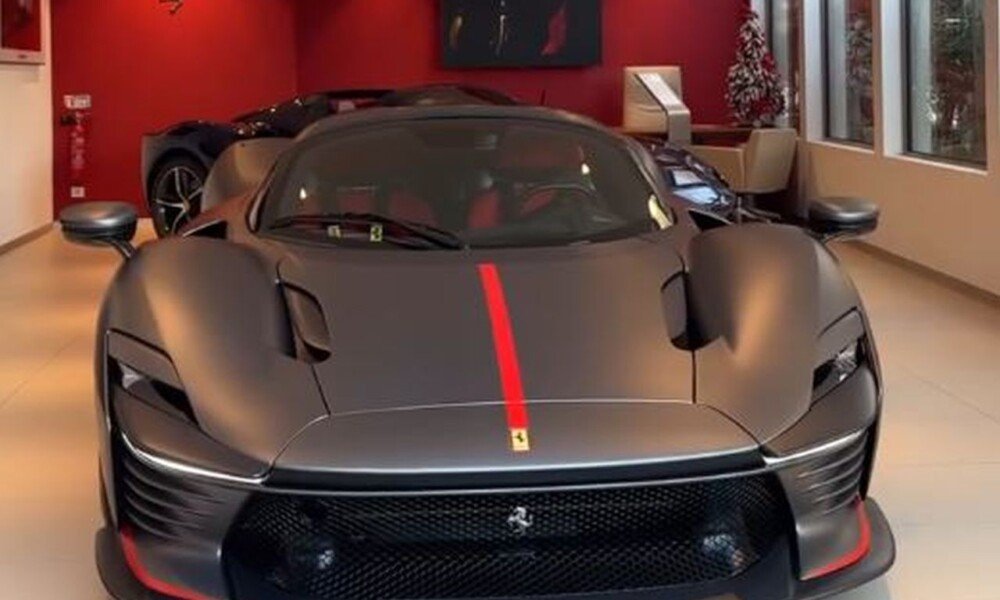
Formula 1 driver Carlos Sainz Jr. recently took delivery of his brand-new Ferrari Daytona SP3 in Monaco. Perhaps it’s a parting gift from the Scuderia as he leaves the team for Williams next season.
Carlos Sainz’s Ferrari Daytona SP3 has a matte grey exterior with red accents. It has a red stripe running down the centre of the car and matching highlights around the front splitter and along the sides. There is a tonne of carbon and Alcantara on the interior with red seats and a black dashboard.
Some of the unique touches that make this Daytona SP3 special are the red pinstripes with #55 on the side skirts and the “Smooth Operator” script on the intakes and centre console.
The Daytona SP3 is powered by a mid-mounted 6.5-liter V12 engine from the 812 Competizione. It develops 850 hp and comes paired with a 7-speed dual-clutch transmission.
Sainz’s ex-teammate Charles Leclerc also owns a unique Daytona SP3. Check out the Monagasque’s matte black example here.
With 2024 coming to a close, the countdown to qualify for Delta Medallion status is on. However, Delta SkyMiles members have one important task to complete before the year ends.
In late 2023, the airline overhauled its Medallion Program, simplifying three elite-qualifying metrics into one for the 2024 calendar year. Medallion Qualification Miles (MQMs), representing the distance flown, and Medallion Qualification Segments (MQSs), tracking the number of flights taken, have officially been retired.
Now, qualifying for Delta’s 2025 elite status is all about earning Medallion Qualification Dollars (MQDs), representing the amount spent on airfare with Delta and its partner airlines. To bridge the gap with this major transition, Delta Medallion members can participate in a “one-time rollover MQM conversion” based on their MQMs earned during the 2023 calendar year.
Members have the option to convert their MQMs into SkyMiles, redeemable for free flights, or MQDs, to pad their balance of elite-qualifying dollars needed to earn status again. However, the deadline to make this decision is rapidly approaching—conversions must be completed by Tuesday, December 31. Those who do not make a selection will automatically see their MQMs converted into MQDs, the airline shared with T+L.
To complete this one-time conversion, travelers should log in to their frequent flier accounts and go to the “My SkyMiles” overview page. If you haven’t done so already, a notification at the top will guide you to make your selection. Rollover MQMs can be converted into MQDs at a 10-to-1 ratio, SkyMiles at a 2-to-1 ratio, or a combination of the two.
In addition to streamlining its elite-qualifying metrics to focus solely on MQDs, Delta also significantly increased the requirements, making it harder to achieve status. Choosing whether to convert MQMs into MQDs or SkyMiles will depend on one’s travel goals—whether it’s more important to prioritize earning miles for award tickets or gaining a head start toward elite status.
To recap, Delta fliers need 5,000 MQDs for Silver, 10,000 MQDs for Gold, 15,000 MQDs for Platinum, and 28,000 MQDs for Diamond status. Once achieved, the status is valid for the rest of the current year and all of the following year, but these metrics reset at the start of each calendar year.
In addition to flying (and spending a lot) with Delta, several of its cobranded American Express credit cards offer an MQD headstart each calendar year. The Delta Reserve and Delta Platinum cards—available in both personal and business versions—automatically provide 2,500 MQDs per card. In addition, it’s possible to earn 1 MQD per $10 spent and 1 MQD per $20 spent on each card, respectively.
However, a lesser-known way to rack up a substantial number of MQDs is by booking a Delta Vacations package. SkyMiles members earn 1 MQD for every dollar spent on these bundles, which include airfare, hotels, activities, and rental cars into a single price. While each traveler earns MQDs for their own flights, the package holder receives full elite credit for the total cost of accommodations and travel extras.
Stuck in a gaming rut? Get out of the loop this GFN Thursday with four new games joining the GeForce NOW library of over 2,000 supported games.
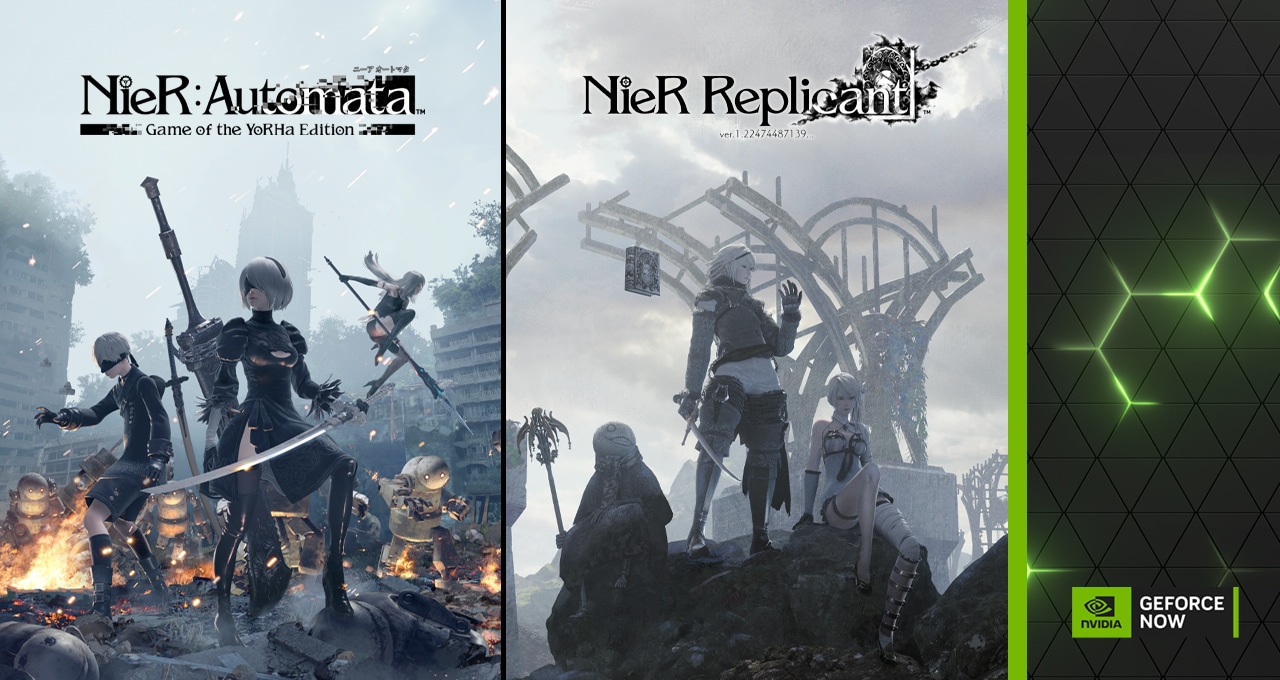
Dive into Square Enix’s mind-bending action role-playing games (RPGs) NieR:Automata and NieR Replicant ver.1.22474487139…, now streaming in the cloud. Plus, explore HoYoverse’s Zenless Zone Zero for an adrenaline-packed adventure, just in time for its 1.4 update.
Check out GeForce Greats, which offers a look back at the biggest and best moments of PC gaming, from the launch of the GeForce 256 graphics card to the modern era. Follow the GeForce, GeForce NOW, NVIDIA Studio and NVIDIA AI PC channels on X, as well as #GeForceGreats, to join in on the nostalgic journey. Plus, participate in the GeForce LAN Missions from the cloud with GeForce NOW starting on Saturday, Jan. 4, for a chance to win in-game rewards, first come, first served.
GeForce NOW members will also be able to launch a virtual stadium for a front-row seat to the CES opening keynote, to be delivered by NVIDIA founder and CEO Jensen Huang on Monday, Jan. 6. Stay tuned to GFN Thursday for more details.
A Tale of Two NieRs
NieR:Automata and NieR Replicant ver.1.22474487139… — two captivating action RPGs from Square Enix — delve into profound existential themes and are set in a distant, postapocalyptic future.
Existence is futile, except in the cloud.
Control androids 2B, 9S and A2 as they battle machine life-forms in a proxy war for human survival in NieR:Automata. The game explores complex philosophical concepts through its multiple endings and perspective shifts, blurring the lines between man and machine. It seamlessly mixes stylish and exhilarating combat with open-world exploration for a diverse gameplay experience.
The hero’s journey leads to the cloud.
NieR Replicant ver.1.22474487139…, an updated version of the original NieR game, follows a young man’s quest to save his sister from a mysterious illness called the Black Scrawl. Uncover dark secrets about their world while encountering a cast of unforgettable characters and making heart-wrenching decisions.
Unravel the layers of the emotionally charged world of NieR with each playthrough on GeForce NOW. Experience rich storytelling and intense combat without high-end hardware. Carefully explore every possible loop with extended gaming sessions for Performance and Ultimate members.
Find Zen in the Cloud
Dive into the Hollows.
Zenless Zone Zero, the free-to-play action role-playing game from HoYoverse, is set in the post-apocalyptic metropolis of New Eridu. Take on the role of a “Proxy” and guide others through dangerous alternate dimensions to confront an interdimensional threat. The game features a fast-paced, combo-oriented combat system and offers a mix of intense action, character-driven storytelling and exploration of a unique futuristic world.
The title comes to the cloud in time for the version 1.4 update, A Storm of Falling Stars, bringing additions to the game for new and experienced players alike. Joining the roster of playable characters are Frost Anomaly agent Hoshimi Miyabi and Electric Attack agent Asaba Harumasa. Plus, the revamped Decibel system allows individual characters to collect and use Decibels instead of sharing across the squad, offering a new layer of strategy. Explore two new areas, Port Elpis and Reverb Arena, and try out the new “Hollow Zero-Lost Void” mode.
Experience the adventure on GeForce NOW and dive deeper into New Eridu across devices with a Performance or Ultimate membership. Snag some in-game loot by following the GeForce NOW social channels (X, Facebook, Instagram, Threads) and be on the lookout for for a limited-quantity redemption code for a free reward package — including 20,000 Dennies, three Official Investigator Logs and three W-Engine Power Supplies.
Fresh Arrivals
Look for the following games available to stream in the cloud this week:
NieR:Automata (Steam)
NieR Replicant ver.1.22474487139… (Steam)
Replikant Chat (Steam)
Zenless Zone Zero v1.4 (HoYoverse)
What are you planning to play this weekend? Let us know on X or in the comments below.
As we get to the end of each year, I reflect on the cars I’ve driven, what I’ve liked, what I haven’t liked, and what the most significant and important vehicles of the year are. I think about cool technology, drivability, user experience, driving position, practicality and, of course, price. When I roll all those things together, there are usually a few standout vehicles from at-home tests and media programs. As 2024 rolls to a close, and I’m sitting in Austin, Texas, as I write this, I think I just experienced the most significant vehicle I’ve driven in 2024: The 2025 Kia K4.
2025 Kia K4
While I absolutely loved the Dodge Charger Daytona I reviewed last week, and the new VW ID. Buzz is clever and cool, their price tags are just a bit stiff to make them the most significant vehicles I’ve driven this year.
The 2025 Kia K4 GT-line Turbo, however, starts at $29,245, including destination. Combine that with the fact it has decent ride and handling for a vehicle in this class, and you have a winning combination as well as a very significant vehicle.
Kia K4 GT-Line Turbo
What is the 2025 Kia K4?
To better align with global strategy, Kia has started renaming its vehicles in the U.S., ditching actual words in favor of an alpha-numeric code. So, the Optima midsize sedan became the K5, and now the Forte becomes the K4. It’s still a compact sedan, but its proportions do grow a bit. It’s about 3 inches longer and 2 inches wider than the outgoing Forte.
It will come in five trim levels: LX, LXS, EX, GT-Line and GT-Line Turbo, and the base price will be $23,145, including destination. The base engine will be a 2.0-liter 4-cylinder that delivers 147 horsepower, and it’s mated to a continuously variable transmission (CVT) — or as Kia likes to call it an “intelligent variable transmission.” The uplevel powertrain is a 1.6-liter, 4-cylinder turbo mated to a conventional 8-speed automatic transmission.
It will get standard features such as a 12.3-inch infotainment screen, wireless Apple CarPlay and Android Auto, smart key with passive entry and remote start, adaptive cruise control, lane keep assist and automatic high beams. Up-level features will include heated-and-cooled seats, the 30-inch display that goes from gauge cluster to infotainment, a digital key, AI voice assistant, 360-degree camera, premium Harman Kardon-brand audio, Google points of interest and MyQ garage door app integration.
Non turbo versus turbo powertrains
This media preview in Texas focused on the GT-Line models with all the premium accents, and our test vehicles were tricked out with the available Premium and Tech packages. The as-tested prices were $28,345 for the GT-Line and $31,445 for the GT-Line Turbo.
Kia K4 GT-Line Turbo
So, was the $3k price difference worth it?
I’m going to say something that will probably put me in the minority: No. In terms of the powertrains, I really liked the base 2.0-liter engine better. It was more evenly and consistently powered, and I didn’t notice any lag or lack for my driving maneuvers–and I’m on the more aggressive side of the spectrum. Sure, the extra 43 horsepower is nice, but the tradeoff is a little lag. And I hate lag.
Kia K4 GT-Line Turbo
Another unpopular opinion: I didn’t hate the CVT. It didn’t feel loud or whiny to me, and I think it is well-paired with the base engine. Keep in mind we’re talking about a compact vehicle that has a base price under $25k. This is a great powertrain for that price point.
If you want to bring fuel economy into it, the 2.0-liter engine delivers 33 mpg in combined driving, whereas the 1.6-liter turbo gets 29 mpg. The EPA estimates that’s about a $200 savings between these two powertrains.
One curious thing I noticed about the 2025 Kia K4: Neither powertrain came with automatic stop/start functionality. Can I get an “Amen,” here? I hate this feature, and it often has a clunky implementation, especially in lower-cost vehicles. The fact K4 doesn’t have auto stop/start is a huge selling point in my book. And it doesn’t appear fuel economy suffers because of it.
Driving dynamics
The 2025 Kia K4 is a plucky little vehicle. While I wouldn’t call it sporty, it is easy to drive as well as maneuverable. I played around with the two drive modes, Sport and Normal, and the primary change is to throttle mapping. So, vehicle stays in lower gears longer to aid with quicker accelerations when passing on the highway. But there are no suspension or steering tweaks.
I essentially spent six hours behind the wheel of the K4 in a single day, and it didn’t matter if I was on surface streets or the highway, it was comfortable for the long haul. I liked the seats, I liked the ride and handling, and I enjoyed the drive. While the GT-Line trims do get a multi-link rear suspension to aid on-road comfort, the general drivability will be similar throughout the lineup. Plus, the power output is the same from LX to GT-Line, and as previously stated, it’s really good.
The price points
With the average transaction price of a new vehicle hitting the $48,000 point, the pricing of the 2025 Kia K4 is very significant. Especially since the number of vehicles that are priced less than $25,000, including destination, is less than 10. That’s mind boggling. But the K4 is one such vehicle, and it has two well-equipped trims priced below $25,000.
Here’s the breakdown, including destination:
LX ($23,145):
This includes safety tech such as automatic emergency braking, automatic high beams, lane keep assist and adaptive cruise control as well as features like a 12.3-inch touch-screen display, wireless Apple CarPlay/Android Auto, a smart key with passive entry and push-button start and LED exterior lights.
LXS ($24,145):
This adds blind spot monitoring, 16-inch alloy wheels, rear cross traffic alert, 60/40 split folding rear seats, drive modes and a 6-speaker audio system.
EX ($25,145):
This adds 17-inch alloy wheels, a 12.3-inch digital cluster, dual-zone automatic climate control, upgraded interior materials and a wireless phone charger.
GT-Line ($26,345):
This adds a multi-link rear suspension, GT-Line exterior and interior styling, 18-inch alloy wheels, two-tone seats, power driver’s seat, heated front seats and navigation.
GT-Line Turbo ($29,245):
This adds the 1.6-liter engine and 8-speed automatic transmission, 18-inch black alloy wheels, LED projection headlights, synthetic leather seats, sunroof, Harman Kardon premium audio and acoustic glass on the windshield.
While most of these trims are WYSIWYG (what you see is what you get), there are two packages on the GT-Line models. A GT-Line Premium package ($,1,100) adds the Harman Kardon audio, synthetic leather seats, memory driver’ seat and mirrors, ventilated front seats and acoustic windshield. The GT-Line Turbo Tech package ($2,200) adds more uplevel forward collision avoidance tech, blind view monitor, memory seats and side mirrors, ventilated front seats, ambient lighting and the Digital Key 2.0.
Our take
Though this was just a quick first spin, it was long enough to understand this is a significant vehicle – both in terms of pricing and amenities. This is an economy-class vehicle with some nice upgrades. As the Kia execs said during the media presentation: This is everything a compact sedan owner needs and much more than they expect.
The 2025 Chevrolet Corvette ZR1 lives up to expectations by setting new performance benchmarks, including the quickest-ever 0-60 mph time for a production Corvette.
The new ZR1 will reach 60 mph from a standstill in 2.3 seconds, and run the quarter mile in 9.6 seconds, both with the optional ZTK Performance Package, Chevy confirmed Thursday in a press release. Chevy said acceleration tests were performed with 93-octane fuel on a non-prepped dragstrip, with the Michelin Pilot Cup 2R tires that are part of the ZTK package.
In addition to those near-slick tires, the ZTK package includes a big carbon-fiber rear wing, front dive planes, and a tall hood Gurney lip. These help generate more than 1,200 pounds of downforce at the ZR1’s 233-mph top speed, but with a drag penalty. The standard-aero car’s quarter-mile trap speed was 2 mph faster than the ZTK-equipped car’s, at 152 mph.
2025 Chevrolet Corvette ZR1
Chevy also recorded a 2.5-second 0-60 mph time and 9.7-second quarter mile time for the standard ZR1. The 0-60 mph time is identical to that of the Corvette E-Ray hybrid, and just 0.1 quicker than a Corvette Z06 with the Z07 package. That shows just how capable the current-generation C8 Corvette is. Even the base Corvette Stingray manages 0-60 mph in 2.9 seconds with the Z51 package. Of course, some of the reason is the limits of grip.
But recently retired Corvette Chief Engineer Tadge Juechter has told Motor Authority that the ZR1 has also put up seven-minute times at the Nürburgring with him at the wheel in traffic and using a standing start, implying faster times are likely. Chevy has also noted that four ZR1s have exceeded 200 mph on the ‘Ring’s longest straight, but putting everything together for an official time will depend on track time and weather conditions, among other factors.
2025 Chevrolet Corvette ZR1
Helping the ZR1 achieve these feats is the new LT7 twin-turbocharged 5.5-liter V-8, which produces 1,064 hp at 7,000 rpm and 828 lb-ft of torque at 6,000 rpm. The 8-speed automatic transmission from other Corvette models remains mandatory, but it’s been modified for this application with wider gear profiles, stronger shafts, and improved lubrication.
The extra power compared to the Z06’s 670-hp LT6 V-8, from which the LT7 is derived, counterbalances a weight increase of about 200 pounds. That gives the ZR1 a dry weight of 3,670 pounds for the coupe and 3,758 pounds for the convertible.
The 2025 Chevy Corvette ZR1 is scheduled to reach dealerships next year.
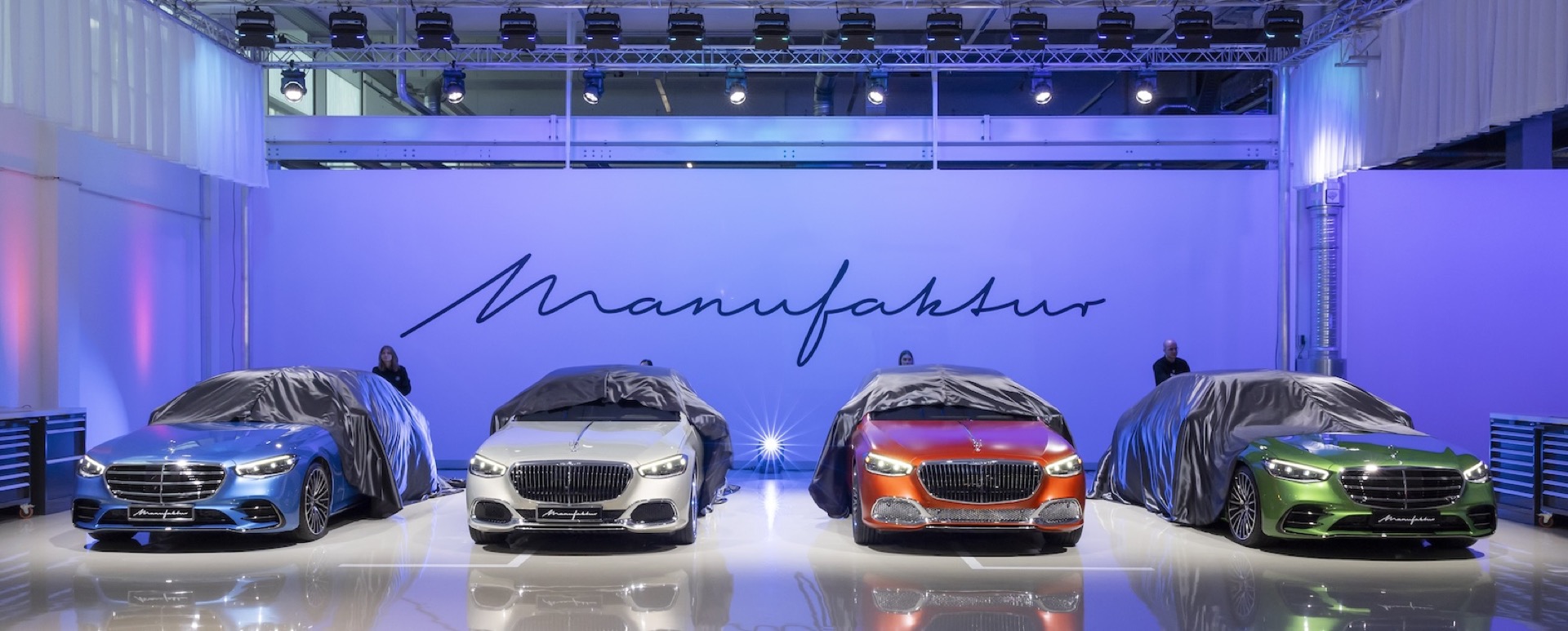
Factory cars are a thing of the past. High-end buyers demand individuality, setting their vehicles apart from the masses. From Mercedes EQS to Range Rover, bespoke options redefine luxury.
Cars That Reflect You Gone are the days of off-the-shelf luxury vehicles. For those investing in premium segments, a car is no longer just a mode of transport—it’s a personal statement. Automakers like Mercedes-Benz, BMW, and Land Rover are now catering to the growing demand for customisation, offering an unmatched level of individualisation. Whether you opt for an electric vehicle, a plug-in hybrid, or a traditional internal combustion engine, bespoke design has become the ultimate status symbol.
The Art of Bespoke Design Luxury brands like Rolls-Royce and Bentley have long offered tailored vehicles, but now brands such as Jaguar, BMW, and Mercedes are following suit. At Jaguar Land Rover’s Special Vehicle Operations, customers can transform their Range Rover into a masterpiece of personal taste. Want a bespoke pearl-inspired paint? Or a bulletproof VR9 armoured SUV? The possibilities are nearly endless, with some models exceeding €750,000.
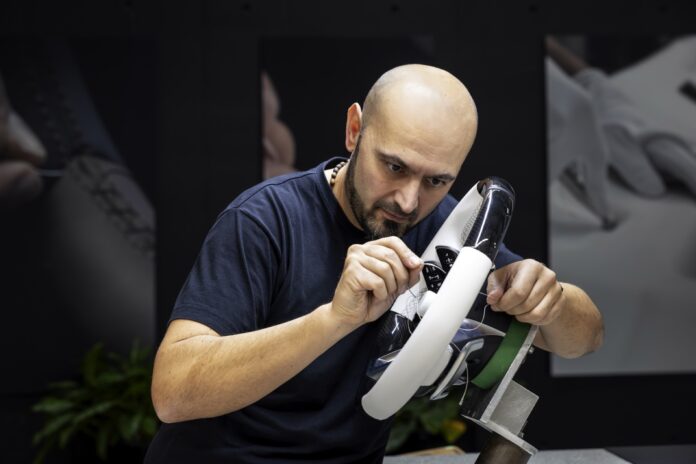
Mercedes’ Manufaktur Division Mercedes-Benz takes this idea further with its Manufaktur division. Here, customers can select from a range of exclusive paints, handcrafted interiors, and personalised elements, such as family crests inlays or custom leather stitching. The Center of Excellence in Sindelfingen even allows clients to watch their dream car come to life, ensuring every detail meets the highest standards of craftsmanship.
BMW’s Artful Collaborations In Munich, BMW’s bespoke options are as much about lifestyle as they are about luxury. Recent collaborations, such as the limited-edition BMW XM created with designer Ronnie Fieg, demonstrate how customisation extends to every detail, including bespoke luggage for plug-in hybrid charging cables.
Customisation isn’t limited to unique colours and premium materials. It’s about creating an experience that embodies the essence of luxury, turning every interaction with your car into a personal statement. From Dubai-inspired crystal finishes to Miami art-inspired editions, luxury brands are elevating personalisation to a new art form.
After Olivier Polge took over the reins as Chanel’s fourth in-house perfumer from his father and legendary perfumer Jacques Polge in 2015, Chanel’s olfactory offerings have evolved and embraced novel interpretations that honour Gabrielle Chanel’s legacy. Armed with a background in art history, Polge embodied an artistic sensibility in his craft that intertwined history, culture and scent. This perspective allowed him to view fragrance as an expressive storyteller beyond merely a product of Chanel’s enduring style.
“A good scent lifts the spirit. It’s like the smell of fresh bread or coffee in the morning — simple yet evocative, much like the understated elegance Chanel embodies”
— Olivier Polge
Polge’s journey into the world of perfumery was not an unequivocal path carved out by virtue of his father’s career. He distanced himself from his father’s work and delved into art history. “Since my father was a perfumer, I didn’t want to follow in his footsteps as a teenager,” shared Polge. It changed one summer when he caved into scent’s compelling nature during a summer internship in his father’s fragrance lab. That discovery of how delicate the dance of perfection is between technical prowess and creative intuition drew him in. The hands-on experience ignited a fire within him, one intoxicating enough to steer his life towards the path of perfumery. However, contrary to what most people would expect, Polge did not learn the ways of perfumery from his father. “When I wanted to train in perfumes, my father thought it was a good idea to send me away. Instead, he sent me to learn from others,” said Polge. “He taught me more about building my sensibility and taste and indirectly shaping my professional approach.”
At the heart of Polge’s philosophy lies the commitment to create and transform instead of simply reproducing an existing fragrance. Polge’s work on the N°5 L’Eau, released in 2016, showcases this philosophy. He revisited the foundational elements of the original N°5 but reimagined them with a modern twist. It was fresher, lighter, and spoke to contemporary sensibilities while retaining the N°5’s signature complexity. Polge has since created 20 new scents for Chanel, including this year’s latest addition to the Les Exclusif range, the Comete.
Grasse Jasmine plays a key role in Chanel’s olfactory universe as the genesis of Ernest Beaux’s 1921 creation, the iconic N°5.
As the global landscape evolved, so too did scent preferences. Polge remains acutely aware of the importance of creating universally appealing fragrances. Instead of chasing trends and fads, Polge roots his creations in Gabrielle Chanel’s pioneering spirit and universe, weaving them into each new fragrance he creates. We spoke to Olivier Polge during his first-ever visit to Singapore and Southeast Asia about Chanel’s olfactory universe and more.
It’s your first time in Singapore, and you have visited Chinatown and Little India. How do you think different cultures influence perceptions of fragrance?
Diversity is important, and I’m glad we live in such an interconnected world. Perfume is a cultural element, and even though Chanel is a globally recognised brand with roots in French and European culture, we create scents from France for the world. It’s beautiful to see how different countries have their preferences.
Fragrances can smell differently on people. Can you elaborate and share what someone should look for when choosing a fragrance?
There’s a chemistry that makes a perfume bloom differently on each person. This individual reaction is part of what makes perfumery so interesting. There isn’t a single correct answer when choosing a fragrance. I create scents with a specific identity that’s meaningful to the brand. I believe it’s intriguing when someone chooses an unexpected scent for themselves, much like how they might decide to dress uniquely.’
“Gabrielle Chanel’s vision was about transformation — taking the ordinary and making it extraordinary. It’s this philosophy I carry into every new fragrance creation”
— Olivier Polge
How do you reinterpret a classic like Chanel N°5 to appeal to a modern audience while respecting its history?
Rather than focusing on legacy and history, I view it as a style. When we celebrated 100 years of N° 5, I realised we no longer make perfumes the same way. The N°5 has a strong identity, allowing us to experiment with its structure, like with N°5 L’Eau, where we dressed the classic elements differently.
How do you push the boundaries of perfume making at Chanel, and what traditions do you choose to honour?
You always have to play with the boundaries. Chanel perfumes are not tied to specific raw materials, giving us the freedom to explore. However, it’s crucial that the creations are meaningful to the brand and add something new to our signature.
“Fragrances bloom differently on each person; this is where the magic lies. It’s about creating something personal yet universally resonant, just as Chanel intended”
— Olivier Polge
Can you give us an example of pushing boundaries in a fragrance?
For instance, with Le Lion de Chanel, one of my creations in the Les Exclusifs line, I aimed to capture an impression we didn’t already have. It’s a powerful scent compared to others. Sometimes, links emerge with past creations, even if they weren’t intended. That’s the beauty of it.
When creating a new perfume, do you look back at past creations or start from scratch? Has there been any creation you felt wasn’t ready and revisited later?
It depends. For N°5 L’Eau, I examined previous formulas to find its essence. However, I started with a new formula with Gabrielle Chanel (the perfume). I always have ideas outside of specific projects. Sometimes, I experiment with a combination of raw materials that can later become part of a perfume. It’s an ongoing process of exploring potential scents.
Are there ingredients in Chanel’s fragrances that you find fascinating or versatile that can appear in different perfumes yet take on unique characteristics?
Yes, certain raw materials can have a subtle or transformative role. For instance, iris is not an outspoken ingredient but interacts beautifully with woody notes. Flowers often play a crucial role at Chanel, either major or secondary, creating a thread that links the different elements. Some raw materials, like gardenia or lily of the valley, have incredibly strong scents that the industry doesn’t know how to extract.
Given your heritage, I’m sure life has always been filled with fragrances and perfume making. At what point did you realise you had a passion for perfume making, and what made you decide to pursue it?
Well, I realised it quite late. Since my father was a perfumer, I rebelled against following in his footsteps as a teenager. I was studying art history instead. One summer during my university days, I interned at my father’s lab, and that’s when I discovered the appeal of this craft.
Would you say that stepping away from perfume-making gave you a new perspective when you eventually returned to it?
It was a more intimate process. It’s like watching your kids grow when you become a father. You guide them but allow them to find their way back if they want to. In my case, I was fortunate that the door was still open for me.
You succeeded your father in 2015. Did you discover surprising facets about him as a father that you hadn’t noticed before while researching his work?
I knew his creations well before I joined Chanel. It’s hard to separate his professional persona from being my father. He didn’t teach me perfumery directly; instead, he sent me to learn from others. What he did teach me was more about building my sensibility and taste and indirectly shaped my professional approach. On a professional level, I began to understand his taste for patchouli and certain fragrances when I researched his work more deeply.
This article was first seen on Men’s Folio Singapore.
For more on the latest in luxury beauty and leaders articles click here.
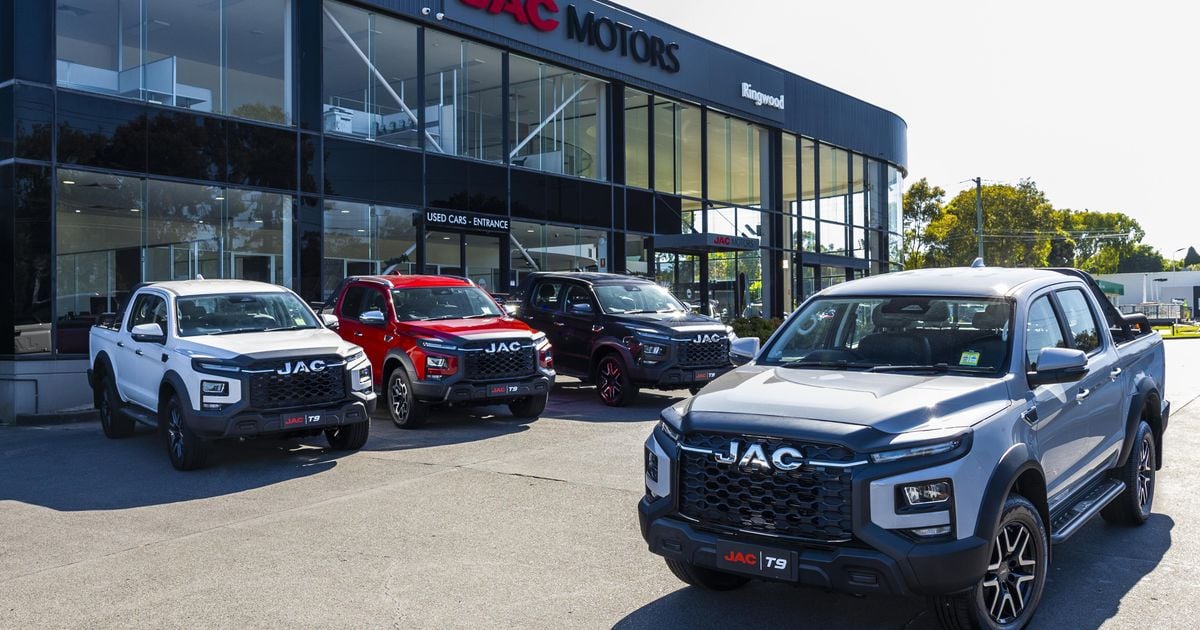
The first customer deliveries of the JAC T9 – the latest dual-cab ute from China – have begun just in time for the Christmas holiday break, and more examples are due to come in the new year.
JAC’s distributor LTS Auto received its first volume shipment of the T9 earlier this month, following the arrival of media and evaluation vehicles in early 2024.
Priced from $42,662 before on-road costs in entry-level Oasis guise, and $45,630 plus on-roads for the Haven variant, the T9 is now being sold via 62 Australian dealership locations.
100s of new car deals are available through CarExpert right now. Get the experts on your side and score a great deal. Browse now.
JAC Australia hasn’t confirmed how many examples have arrived in showrooms, but this month the 1000th Australia-bound T9 was produced in China before being shipped here.
The JAC T9 is powered by a 2.0-litre turbo-diesel engine making 125kW of power and 410Nm of torque, mated with an eight-speed automatic from ZF and four-wheel drive.
It’s backed by a seven-year, unlimited-kilometre warranty, for both private and commercial operators.
Servicing intervals are 15,000km or 12 months, whichever comes first. JAC has announced the following capped prices across the first seven services.
Service intervals
Cost
12 months, 15,000km
$269
24 months, 30,000km
$511
36 months, 45,000km
$390
48 months, 60,000km
$521
60 months, 75,000km
$442
72 months, 90,000km
$651
84 months, 105,000km
$285
Total
$3069
This is more than the average capped-price service costs for the Ford Ranger (four years), Isuzu D-Max, Volkswagen Amarok and GWM Ute (all five years), but JAC offers a longer capped-price service program.
JAC has also partnered with CarBiz to offer complimentary loan vehicles to T9 owners while warranty repairs are being undertaken.
MORE: Everything JAC T9 MORE: JAC T9 price and specs MORE: JAC T9 – Australian aftersales program locked in for new Chinese ute
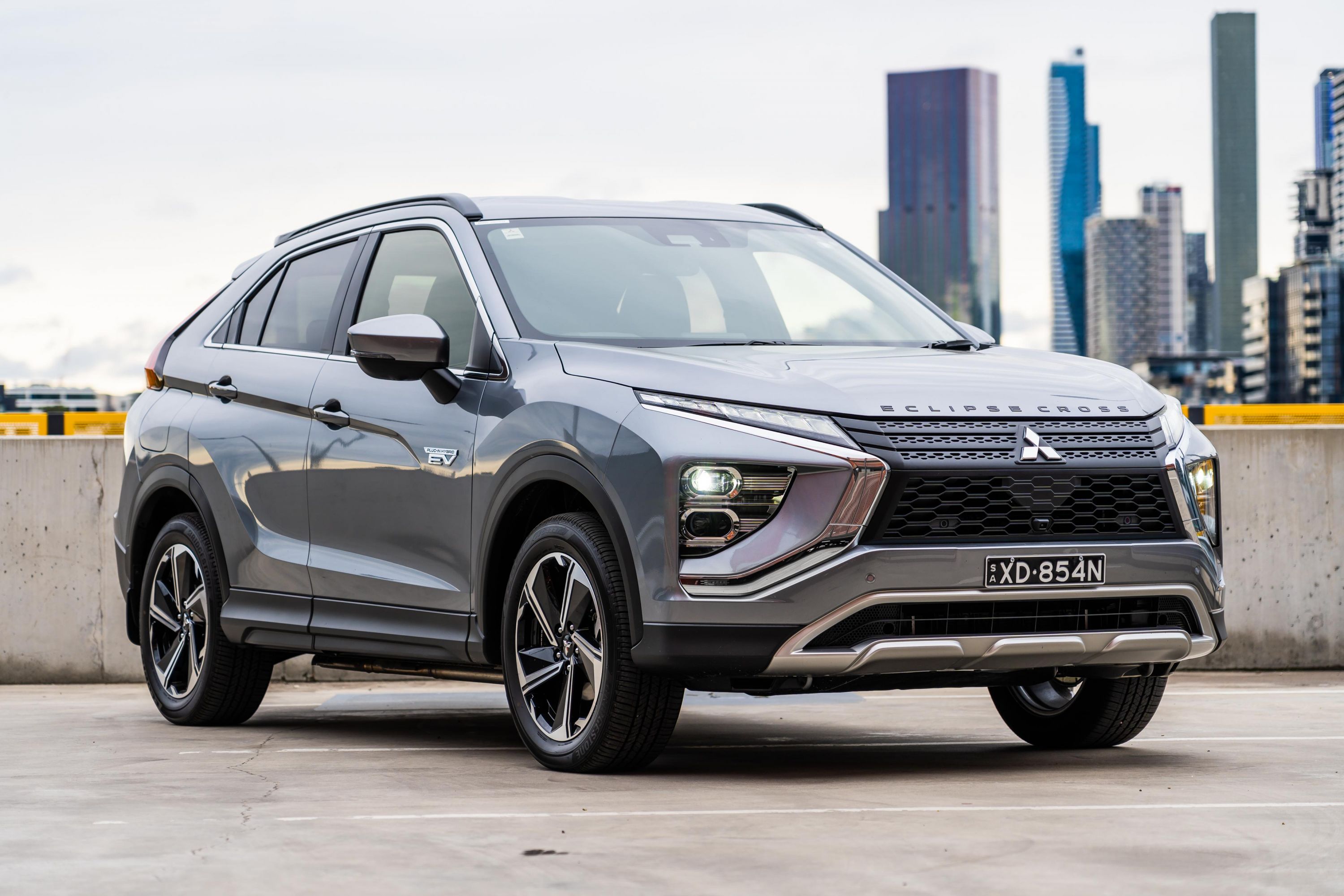
The Mitsubishi Eclipse Cross was the first plug-in hybrid vehicle (PHEV) in the small SUV class, making it an especially important model in Australia as a result.
It might have been among the first auto brands to commit the sin of recycling a historically sporty nameplate for a crossover SUV, but Mitsubishi struck gold with its recipe for the Eclipse Cross.
Now the MG HS Plus EV is on hiatus as we await the arrival of its mid-sized PHEV SUV replacement, Mitsubishi is pretty much alone in offering a PHEV in the affordable SUV segments – but that doesn’t mean there isn’t more convincing competition elsewhere.
Mitsubishi’s own larger Outlander PHEV has progressed and the current generation is now a solid option, even if it is more expensive. The Eclipse Cross, meanwhile, is largely the same as it was when it launched in 2018.
It has since received a light facelift inside and out, but its interior remains very 2010.
WATCH: Paul’s video review of a 2022 Mitsubishi Eclipse Cross PHEV
There’s also a selection of gear that’s only available at the very top of the range, even though the Mitsubishi Eclipse Cross PHEV Aspire on test here is the first of two variants to cost more than $50,000 before on-road costs.
That means it’s up against tough competition from the likes of multiple non-hybrid SUVs sold by other legacy Japanese manufacturers, and it’ll likely receive a wake-up call when the next-generation MG HS PHEV arrives.
Still, plug-in hybrid SUV buyers could do a lot worse, especially when tax exemptions are considered and the price of one of these Eclipse Cross PHEVs starts to look more appealing – even if its interior does the opposite.
Is the Eclipse Cross PHEV still a good choice in today’s market, or has Mitsubishi sat on it for just a bit too long?
How does the Mitsubishi Eclipse Cross compare?
View a detailed breakdown of the Mitsubishi Eclipse Cross against similarly sized vehicles.
Mitsubishi
Eclipse Cross
How much does the Mitsubishi Eclipse Cross cost?
There are three Eclipse Cross PHEV variants available to purchase right now, and the Aspire sits right in the middle.
Model
Price before on-road costs
Mitsubishi Eclipse Cross ES FWD
$31,990
Mitsubishi Eclipse Cross LS FWD
$34,740
Mitsubishi Eclipse Cross LS Black Edition FWD
$35,990
Mitsubishi Eclipse Cross Aspire FWD
$36,990
Mitsubishi Eclipse Cross LS AWD
$37,240
Mitsubishi Eclipse Cross Exceed FWD
$40,990
Mitsubishi Eclipse Cross Exceed AWD
$43,490
Mitsubishi Eclipse Cross PHEV ES
$47,790
Mitsubishi Eclipse Cross PHEV Aspire
$51,740
Mitsubishi Eclipse Cross PHEV Exceed
$56,490
At $51,740 plus on-roads, it’s nearly $15,000 more expensive than the front-wheel drive non-hybrid Aspire on which it’s based. But you could stand to save thousands on a novated lease for a car like this, as owners will not have to pay Fringe Benefits Tax (FBT) until April 1, 2025.
At the moment, plug-in hybrid versions of the Eclipse Cross have no direct budget rivals. That will change in mid-2025 though, when the next-generation MG HS PHEV arrives, since the outgoing HS is no longer available.
Standard Eclipse Cross models, however, have a packed list of competitors. The new petrol HS is one of them, and it ranges in price from $34,990 to $40,990 drive-away.
To see how the Mitsubishi Eclipse Cross stacks up against its rivals, use our comparison tool
What is the Mitsubishi Eclipse Cross like on the inside?
The Eclipse Cross is getting long in the tooth, and nowhere is that better demonstrated than its interior.
Being the Aspire, it benefits from some nicer cabin materials like the ‘mi-suede’ and synthetic leather upholstery found on the seats, but for the most part it’s struggling to keep up with the times.
The infotainment system leaves a lot to be desired. At 8.0 inches it’s comparatively small alongside the competition, and it pokes out of the dashboard awkwardly as if it was an afterthought, although that’s not uncommon these days.
It’s also old graphically and its resolution isn’t as crisp as we would like, but it’s at least easy to navigate. Its home screen features five large tile icons for the various menus available, while touch-capacitive buttons and two knobs are included along the screen’s bottom bezel.
We don’t mind the mix of the touchscreen and physical controls, and similar setups in other cars – Skoda in particular – are useful to keep things clear and simple. Sure, this may be another product of its age, but this is one that works.
In terms of presentation, some of the material choices are also telling of the car’s age. The hard silver plastic is one giveaway, and the faux carbon-fibre trim pieces on the central panel and door armrests were always a bit iffy.
The interior of the Eclipse Cross has hardly changed at all since the car launched, and that’s a big part of the problem. It means those who will have test driven other new cars with cleaner, screen-heavier setups may be underwhelmed, but of course there are many different buyer types.
If you’re coming from an older car, the setup of this car will feel much less alien than something like a new Hyundai Tucson, for example. That’s helped by the continued inclusion of physical controls which, as mentioned, is something that benefits useability.
Where others have shifted to effectively screen-only multimedia approaches, the Eclipse Cross still has a traditional climate control interface that is clear and easy to use.
It’s made up of an LCD display surrounded by an array of buttons, while below that you’ll find clearly marked switches and buttons for things like front seat heating and drive modes.
All the buttons are clearly labelled too, which means those unfamiliar with the car are unlikely to feel overwhelmed when jumping in for the first time. Again, its age helps make the Eclipse Cross be more approachable.
While that’s all fine, there’s still a strange mix of themes going on in here. Around the strangely shaped gear selector is loads of gloss black trim, which is then broken up by some hard, dull plastic switches for the seat heating.
More silver trim appears on the centre console too, and all of that means there’s simply too much going on. Some simplification here could go a long way for both cleaning things up and modernising its appearance.
A pet peeve is the use of more gloss black on the steering wheel, which is just a magnet for fingerprints and smudges. The rest of the wheel is leather-wrapped, but it doesn’t feel like the same quality of leather we’ve experienced in other cars.
The tiller rim feels relatively small in the hands too, which adds to the old-school feel. Even if it is based on the non-hybrid Aspire, we’d want something a bit nicer for the money.
You still get the standard steering wheel buttons for infotainment and driver assist controls, and at least they’re finished in more durable hard plastic instead of anything glossy.
Ahead of the steering wheel is a traditional two-gauge cluster, with the digital acreage limited to a smaller display in the middle. While the whole unit may be simple and a little clunky in appearance, it’s perfectly functional and easy to read.
We’ve said the infotainment screen is lacking compared to the competition, but we can’t ignore the fact you still get some useful features here. Standard on this grade of Eclipse Cross is a reversing camera, as well as a handy surround-view camera.
Neither camera may be of particularly high resolution, but we’d rather have both views even if it means sacrificing some legibility. It all helps make this car easy to live with.
A downside of the aging interior is that Apple CarPlay and Android Auto are wired only, and connect via one of two USB-A ports up front, but you’ll at least have the reliability of a hardwired link.
As such, we had no issues with smartphone mirroring during our week with the car. Other power sources are limited to the 12V outlet nearby, and unfortunately there’s no wireless phone charging pad to be found here.
Stepping into the back can be a squeeze, as the opening angle of the doors is relatively limited. There’s not a lot of room on the floor to step in either, and the door sills are wider than what you may expect.
Once you’re in though, you’ll find the rear seats are upholstered in the same suede and synthetic leather as up front, and they’re comfortable to sit in for longer periods of time. There’s loads of head and legroom, but it’s a fairly barebones experience.
The cabin presentation is actually easier to digest than it is up the front, as there’s much less variation in materials and it all stays relatively coherent. There’s none of that silver trim back here, where everything is dull-finished hard plastic.
Amenities are limited to a fold-down armrest, a USB-A and USB-C port, and that’s it. There aren’t even any rear-facing air vents, which is disappointing for anyone spending time in the rear.
The boot of the Eclipse Cross is one of its strengths. While it’s quoted as less than the smaller Volkswagen T-Roc (392L) and Nissan Qashqai (429L), you still get loads of floor space up to the second-row seatbacks.
The sharply sloped roofline does mean vertical space is compromised. The wheel-arches also eat into space either side, and the floor sits relatively high because of the storage for charging-related equipment underneath.
Being the Aspire, it also misses out on a power tailgate, which is another one of those things we think a model variant one rung down from the top of the range should feature.
At least because it’s a PHEV you do benefit from a 1500W V2L outlet, but it misses out on a spare tyre. Overall, while it may all be functional, the Eclipse Cross interior is desperately in need of a refresh, even if it’s just a minor update to keep up with the times.
To see how the Mitsubishi Eclipse Cross stacks up against its rivals, use our comparison tool
What’s under the bonnet?
All Eclipse Cross PHEVs utilise a 2.4-litre naturally aspirated four-cylinder petrol engine, supported by electric motors on the front and rear axles.
Specifications
Mitsubishi Eclipse Cross PHEV
Engine
2.4L 4cyl petrol PHEV
Engine outputs
94kW @ 4500rpm 199Nm @ 4500rpm
Electric motor outputs
60kW / 137Nm (front) 70kW / 195Nm (rear)
Battery
13.8kWh lithium-ion
Generator output
80kW
Transmission
Single-speed fixed
Driven wheels
AWD
Kerb weight
1920kg
Fuel economy (claimed)
1.9L/100km
Fuel economy (as tested)
4.0L/100km
Electric driving range (PHEV)
55km
Fuel tank capacity
45 litres
Fuel requirement
91 RON
Braked tow capacity
1500kg
Our week with the car primarily involved highway driving, with some time also spent on slower roads in built-up areas.
The higher-than-claimed fuel economy figure we recorded is a result of the PHEV powertrain’s limitations, primarily its electric-only range. More on that below.
To see how the Mitsubishi Eclipse Cross stacks up against its rivals, use our comparison tool
How does the Mitsubishi Eclipse Cross drive?
The Eclipse Cross is classed as a small SUV, but it doesn’t really feel like one on the road.
PHEVExceed pictured
Of course, it’s nowhere near as large as the Pajero Sport or even the Outlander, but the PHEV powertrain probably has a large part to play in the way this particular Eclipse Cross feels on the road.
For one, it’s more than 400kg heavier than the standard non-hybrid Aspire, which is front-wheel drive only. While this AWD PHEV doesn’t feel heavy thanks to its appropriately peppy throttle response, you do notice the extra weight being lugged around.
Its kerb weight is listed at nearly two tonnes, which for a ‘small SUV’ is nothing to sneeze at. The compromise is its handling dynamics, which we’d stop short of calling sloppy but it’s by no means nimble.
The car’s suspension is set up well enough to handle its extra mass, and at no point does the Eclipse Cross PHEV feel unwieldy. It doesn’t clatter over bumps nor wallow over softer undulations either.
It’s a solid ride/handling balance that we can’t really knock. The added weight may even help it to feel more planted than the standard Aspire, and you get the added security of all-wheel drive if you decide to head off-road or to the snow.
Of course, the the main drawcard of this car is its PHEV powertrain. While 55km of electric-only range doesn’t seem like a lot, there isn’t anything else at this price that offers the same zero-emissions driving capability – let alone more.
The Eclipse Cross’ tried-and-tested approach to plug-in tech actually works in its favour in this case.
When you consider the upcoming Ford Ranger PHEV – which of course is a much bigger, heavier and more capable vehicle – is expected to have an electric-only range of 45km and will likely be considerably more expensive, this suddenly doesn’t seem so bad.
And, to its credit, the Aspire PHEV was able to match or better its 1.9L/100km fuel economy claim in normal conditions, meaning standard urban traffic and, crucially, a fully charged battery to start with.
But once the battery goes flat – which happens surprisingly quickly if you have a longer commute – you’re relying solely on the 2.4-litre naturally aspirated engine, and consumption rises dramatically from the paltry sub-2.0L/100km claimed average.
Mitsubishi claims the 55km EV range is enough for the daily commute of most Aussies, but I have a 60km commute twice daily, so after fully charging the battery at home each night, arriving at work with a flat battery, then driving home on engine power alone, I averaged 4.0L/100km.
So even without engaging the handy electric vehicle (EV)-only mode, the battery still won’t be able to last a full day’s driving for me and therefore this PHEV won’t be as efficient as it can be.
That makes it less suited to longer-distance commuters, but 4.0L/100km is still more efficient than the Toyota Corolla Cross hybrid and the Nissan Qashqai E-Power. And unlike an EV, the Eclipse Cross won’t leave you stranded when its battery is depleted, making its longer total range well suited to many Aussies.
Of course, Mitsubishi could increase the range of the Eclipse Cross PHEV, but that would also drive up its price. Instead, it’s worth remembering this car is still incoporates previous-generation Mitsubishi PHEV tech, which makes it a reliable setup that’s comfortably under-budget for most PHEVs.
It’s also currently unique in the market until the new MG HS plug-in hybrid arrives. The MG will have the advantage of being a bigger new PHEV with an up-to-date interior, but that doesn’t mean the Eclipse Cross PHEV should be overlooked.
Rivals from brands like BYD and even Mitsubishi’s own Outlander PHEV have EV ranges of more than 80km, but they’re much more expensive.
If you do go for the Eclipse Cross PHEV and your commute is as long as mine, and you can plug in your car when you get to your destination, you might spend a lot more time charging but you’ll also spend very little on fuel and almost all your driving in EV mode.
And if your each-way commute is less than about 25km, all your driving will be in EV mode and you’ll pay off this PHEV’s price premium a lot more quickly.
If, on the other hand, your commute is longer than 55km and, like most people, you can’t be bothered recharging your PHEV regularly, then you might as well get a non-hybrid Eclipse Cross.
On its own then, the Eclipse Cross PHEV is a good choice if you have a shorter daily commute. The fact it’s produced by an established carmaker with a solid – albeit uninspiring – track record with such tech also improves buyer confidence, as does Mitsubishi’s conditional 10-year warranty.
As you may have deduced from our thoughts on its interior, the issues with this car don’t relate to the PHEV powertrain but its outdated presentation as a whole.
Its age is also evidenced by the standard safety tech. Being the higher-spec Aspire, you do benefit from adaptive cruise control and a surround-view camera, as well as rear cross-traffic alert and blind spot monitoring, which isn’t available in the entry-level Eclipse Cross.
But Mitsubishi’s clever Ultrasonic Misacceleration Mitigation System, which stops the car when it detects the accelerator has been pressed instead of the brake pedal at low speeds, is only found in the top-spec Exceed.
It’s also worth remembering the Aspire PHEV is roughly $15,000 more expensive than the non-hybrid Aspire, which gets all the same equipment. The only real difference is the petrol version has no electric motors and therefore uses more fuel, and it’s front-wheel drive only.
Petrol-only or PHEV, the Eclipse Cross thrives in urban areas. It’s easy to manoeuvre thanks to its well weighted steering feel, which isn’t as light as in some of its competitors.
Visibility out the windows is also good, with rear-view visiion not compromised despite the sharply angled rear window. Blind spot monitoring and front parking sensors are welcome additions that help in navigating tight streets and carparks.
All that means the Aspire PHEV’s on-road experience is largely misaligned with its aged interior presentation, which is one of the reasons it’s relatively good value.
To see how the Mitsubishi Eclipse Cross stacks up against its rivals, use our comparison tool
What do you get?
There are four distinct grades of Eclipse Cross, with the Aspire tested here sitting second from the top of the range. The PHEV version gains a series of tweaks over its non-hybrid counterpart.
Eclipse Cross ES equipment highlights:
16-inch alloy wheels
LED daytime running lights
Automatic headlights
Rear LED fog lamp
Soundproof windshield glass
Rain-sensing wipers
Black fabric upholstery
Climate control air-conditioning
8.0-inch touchscreen infotainment system
Wired Android Auto and Apple CarPlay
4-speaker sound system
Tilt and telescopic steering column adjustment
Cruise control
Keyless entry
Eclipse Cross ES PHEV adds:
Illuminated front door trim
Leather-wrapped steering wheel
Rear centre armrest with cupholders
Electric park brake
Mode 2 charging cable
Mode 3 charging cable
Acoustic vehicle alert system
Eclipse Cross LS adds (over ES):
18-inch alloy wheels
LED front fog lights
Automatic high-beam
Privacy glass
Power-folding exterior mirrors
Electric park brake with auto hold
6-speaker sound system
Rear USB-A and USB-C outlets
Electrochromatic rear-view mirror
Eclipse Cross LS Black Edition adds:
Black 18-inch alloy wheels
Gloss black mirrors, skid plates
Mi-suede and synthetic leather upholstery
Black dimpled leather-wrapped steering wheel with grey stitching
Black headliner, pillar trims
4-way power driver’s seat
Heated front seats
PVC leather door cards
Grey stitching details
Silver garnishes on instrument panel, centre console sides, door grips
Eclipse Cross Aspire variants gain (over LS):
Gloss black front and rear skid plates
Black grille
Mi-suede and synthetic leather upholstery
Dual-zone climate control
8-speaker sound system with 4 tweeters
4-way power driver’s seat
Heated front seats
Eclipse Cross Aspire PHEV adds:
Automatic LED headlights
Roof rails
Silver front lower bumper
Black front bumper centre garnish
Black grille insert
Black and insert rear lower bumper
Black side door garnish
1500-watt V2L capacity
To see how the Mitsubishi Eclipse Cross stacks up against its rivals, use our comparison tool
Is the Mitsubishi Eclipse Cross safe?
As of January 2024, the Mitsubishi Eclipse Cross is ‘unrated’ by ANCAP, with its five-star safety rating – awarded in 2017 – stripped due to the organisation’s six-year expiry policy.
Standard safety equipment across the range includes:
7 airbags
AEB with pedestrian detection
Reversing camera
Rear parking sensors
Lane departure warning
LS and above get:
Blind-spot monitoring
Rear cross-traffic alert
Aspire and above get:
Adaptive cruise control
Front parking sensors
Surround-view camera
Exceed and Exceed PHEV receive Mitsubishi’s Ultrasonic Misacceleration Mitigation System, which is designed to stop the car when it detects the accelerator has been pressed instead of the brake at low speeds.
To see how the Mitsubishi Eclipse Cross stacks up against its rivals, use our comparison tool
How much does the Mitsubishi Eclipse Cross cost to run?
Mitsubishi backs its Eclipse Cross with a 10-year, 200,000km warranty if you service at a Mitsubishi dealer (if not it’s five years and 100,000km), and its PHEV models are covered by an eight year, 160,000km battery warranty.
Servicing and Warranty
Mitsubishi Eclipse Cross PHEV
Warranty
10 years or 200,000km
Battery warranty
8 years or 160,000km
Roadside assistance
Up to 10 years (12 months free, then service-activated)
Service intervals
12 months or 15,000 kilometres
Capped price servicing
Up to 10 years
Total capped price service cost
$5940 – 10 years
Servicing intervals are 12 months or 15,000km, whichever comes first. The total price for capped-price servicing over 10 years is exactly $1000 cheaper for petrol models compared to PHEVs.
To see how the Mitsubishi Eclipse Cross stacks up against its rivals, use our comparison tool
CarExpert’s Take on the Mitsubishi Eclipse Cross PHEV Aspire
Fundamentally, this is a solid small SUV that can comfortably get the job done, but it’s incredibly outdated.
Apart from its comparatively short EV range, the Eclipse Cross doesn’t do a lot wrong when you’re on the move. And there are really no other small PHEV SUVs available at this price point, which is a compelling case on its own.
Its dynamics are predictable and user-friendly, and there’s no unnecessary safety tech to annoy you. It’s easy to park and manoeuvre, and has enough space inside to comfortably transport a handful of passengers and their luggage – or a large load of groceries.
In its natural urban environment it’s also more economical than comparable small plugless hybrid SUVs, and if you have a short commute and keep its battery charged you’ll quicky pay off the purchase price premium and start saving big money on fuel bills.
We like that it can be locked in EV mode up to a certain speed, and naturally the e-motors contribute to the Eclipse Cross’ ability to quickly get going.
The car’s ageing design results in a largely analogue driving experience that some buyers may appreciate, but it comes at the detriment of its interior.
The Eclipse Cross isn’t the worst offender in this area on sale right now, given other Mitsubishis like the ASX are arguably more outdated, but it’s hard for us to rally around the way this car presents.
There are too many different materials including that tacky faux carbon-fibre, while most of the interior is draped in uninviting hard plastic. Its cabin tech is functional, but the omission of wireless smartphone mirroring continues to be disappointing… but not surprising.
That’s a shame, because a well-considered interior update would go a long way to addressing one of our only complaints here, especially given the exterior doesn’t look bad and it drives as well as it does.
As a budget-friendly alternative to larger, more expensive PHEVs, the Eclipse Cross does the job well and the Aspire version is probably the pick of the bunch. But once the larger yet similarly priced MG HS PHEV arrives, we expect Mitsubishi will have to pull its socks up.
Interested in buying a Mitsubishi Eclipse Cross? Get in touch with one of CarExpert’s trusted dealers here
Do you dream of road trips, marveling at the beauty of the United States of America and its splendid natural features?
Driving through the United States assures unique excitement and would be truly unforgettable. Whether through rolling hills or long and flat deserts, each driven mile would be historical.
But let’s be honest: the more miles add up, the more costs there are. Following the tips in this article will enable you to minimize such costs, making you enjoy the trip to the fullest.
Why Road Trips?
Road trips are very flexible. They allow you to plan your schedule and visit unnoticed locations. Road trips are ideal for families, friends, or even single travelers.
Here’s why people love them:
Freedom to explore: As there is no strict plan, and the tour is not strictly timed, one can sit near picturesque views or change the path in the middle of the journey.
Affordable travel options: For many people, driving may be cheaper than flying, especially if a large group travels to a similar destination.
Unique experiences: Driving through the United States will enable you to discover various scenic destinations you probably would not have noticed when flying.
Scenic views along the way: Road trips allow you to tour some of the most scenic views and beautiful countryside settlements on the USA’s maps.
Road at Fay Canyon trailhead in Sedona, Arizona.
Money-Saving Tips for Your Journey
Before planning for that next road trip, uncovering some money-saving tips during such trips is essential.
Here are some of the most common:
Plan your route wisely It pays to take the correct route to cut down on fuel costs. You can use either Google Maps or Waze to find the best route. When planning the route, try to settle for the more interesting ones, the routes you have never been to before.
Search out promo codes and online offers Whatever your plans are for your trip, check online to see if you can find special offers and promo codes to save some cash. Check for hotel discounts via sites like Groupon, if Vegas and its casinos are on your list of things to do, see if you can find any special offers on the food and drinks. And if you’re planning on playing online, a promo code for BetMGM should enable you to get some free play in and some much-needed practice before heading to a venue like the MGM Grand.
Pack your snacks A meal on the road might cost a lot of dollars especially if you intend to get a test of the best culinary tours in the U.S. and the rest of the globe. To reduce costs on food and takeaways, it is recommended that you prepare your food and snacks by yourself. Candies, fruits, nuts, protein bars, sandwiches, and yogurt(s) are ideal examples. They will cost you much less and help you feel energetic throughout your trip. And you can stock up on these options at the grocery store. Use a cooler that plugs into your car’s 12-volt system to keep food fresh longer.
Cook your own meals While you are exploring some off-the-beaten-path spots, why not take a moment to whip up a delicious meal on the road? Cooking together with family and friends in your motorhome can bring so much joy, and it’s a fun and budget-friendly way to take a break from eating out. If you’ve planned ahead and rented a motorhome, you’re in luck! You’ll have a cozy little kitchen at your disposal, complete with sink, refrigerator, and stove. And hey, even if you’re a little rough around the edges, you can still enjoy roasting hot dogs over a crackling campfire. Even if you’re not on the road with an RV, you can add a gas stove and some cutlery to your gear.
Ask a Local Where to Eat When it comes to eating out, you can always opt for the classic American fast-food options, but isn’t the real adventure in immersing yourself in the local cuisine? Often, the best food can be found in those charming little hole-in-the-wall spots that offer a taste of the area’s true flavor. Plus, the local vibe makes for unforgettable stories! Instead of relying solely on Google Maps or other review websites, take a moment to chat with a local and ask for their favorite place to eat. Trust me, their recommendations can lead you to hidden gems, especially those quaint cafes you might not find on a website!
Choose budget accommodations Food and shelter are two of the most significant expenses, making up most of your daily expenditures during a road trip. Instead of staying in 3, 4 or 5-star hotels, clients may choose hostels, apartments like Airbnb rentals, or motels. If you like nature, then you can go camping instead.
Sleep under the stars There’s something incredibly romantic about road trips, isn’t there? You spend the day cruising down scenic routes, discovering hidden gems, and then at night, you gather around a crackling campfire with your friends and family. The warmth of the fire, the sparkle of stars above, and that refreshing breeze giving you chills—it’s a vibe that no hotel can ever match. Whether you’re cozied up in the comfy fold-out beds of your campervan or camping on the ground in a tent, sleeping under the stars can totally shift your perspective. It’s all about embracing the adventure and making unforgettable memories!
Take advantage of free attractions Luckily, many cities in America have plenty of exciting things to do that do not require you to pay any money to enjoy the town’s beauty. Many parks, historical sites, and museums always have free entrance days or days on which communities will be celebrating. Find out what extra activities you can do for free or cheap in the cities you will pass through.
Fuel up smartly The gas price differs from state to state, so being sensitive to the change in fuel cost is appropriate. As for fuel prices, try using the GasBuddy or Waze app to determine where you can pay less for gasoline. Here’s a tip: If you’re driving through a state known for high gas prices – like Illinois, Utah or Idaho – and you’re coming from a neighboring state with cheaper options, like Missouri or Colorado, fill up before you cross the border! Some savvy travelers even bring a few spare cans of this cheaper fuel. If their tank starts to look a little low, they just top it off with their stash instead of paying the extra dollar per gallon at the pump. If you take a moment to plan your trip ahead of time, you’ll have a good idea of your fuel costs and other expenses. This habit of filling up in a cheaper state can really add up over time, especially during the busy summer months.
American Automobile Association (AAA) They’ve got everything you need, from car insurance to trip planning and even some sweet discounts on travel-related goodies. Plus, they’ll keep you up to date on gas prices across the country. Now, you might be wondering how to get in on the action. It’s as simple as paying an annual membership fee, which unlocks a bunch of extra perks. But here’s the cool part: you don’t even have to join to access their awesome free information online! For example, you can use their app (or desktop version) to check fuel prices in the states you plan to drive through. Sure, they offer a ton of other services, but this fuel data alone is a good money saver.
Highway in the desert in Nevada.
Considerations for specific cities
Anytime one plans to visit a popular tourist attraction center such as Las Vegas, research is fundamental. You can limit the risks by grasping the dynamics in the local landscape. For instance, if you plan on engaging in casino gameplay in Las Vegas during your road trip, read more about various casino games before you begin to play them. This information will make your experience richer and preserve you from losses.
A Dodge on the road to Las Vegas.
In large cities, public transport may be cheaper. You could take buses or subways instead of getting a rental car: it will be more affordable, and you won’t have to worry about where to park.
Why these tips matter
These money-saving tips should help you plan a hassle-free road trip. They assist you in breaking your budget stretch and expanding your happiness.
A road trip should be a time to bond with companions and enjoy the various sceneries you come across. Exercising these money-saving tips frees up your mind from any money-related stress, allowing you to enjoy the trip to the fullest. And when you save money, you can spend it on exciting experiences.
A road trip across America can always be described as fun and exciting. You need not be stressed over financing the trip when you can plan and incorporate the money-saving tips discussed in this article.
The next time you plan a road trip, make it enjoyable and relatively cheap so you do not have to break the bank to have a nice time.
I’m sure you’ve had similar experiences I had whilst traveling. You’re in a certain place and a fellow traveler, or a local, tip you off on a little-known beach, bar or accommodation. Great travel tips from other travelers or locals always add something special to our travels. That was the inspiration for Travel Dudes.
I’m sure you’ve had similar experiences I had whilst traveling. You’re in a certain place and a fellow traveler, or a local, tip you off on a little-known beach, bar or accommodation. Great travel tips from other travelers or locals always add something special to our travels. That was the inspiration for Travel Dudes.
The technical storage or access is strictly necessary for the legitimate purpose of enabling the use of a specific service explicitly requested by the subscriber or user, or for the sole purpose of carrying out the transmission of a communication over an electronic communications network.
Preferences
The technical storage or access is necessary for the legitimate purpose of storing preferences that are not requested by the subscriber or user.
Statistics
The technical storage or access that is used exclusively for statistical purposes.The technical storage or access that is used exclusively for anonymous statistical purposes. Without a subpoena, voluntary compliance on the part of your Internet Service Provider, or additional records from a third party, information stored or retrieved for this purpose alone cannot usually be used to identify you.
Marketing
The technical storage or access is required to create user profiles to send advertising, or to track the user on a website or across several websites for similar marketing purposes.