Mercedes In-Drive system mounts the brakes to the electric motor
In-Drive is a friction-based braking system
Mercedes has In-Drive in active testing, hasn’t given a timeline for production
Mercedes-Benz is rethinking how the braking system works, and where it’s located, in upcoming EVs.
In Germany last week, Mercedes-Benz engineers showed Green Car Reports one of its latest innovations dubbed In-Drive. It’s a system that relocates the entire braking system from inside the wheels to inside an EV’s electric motor housing.
The automaker didn’t commit to when, or which vehicle, the system might debut on and go into production, but it said the feature is already in active testing.
Mercedes-Benz In-Drive brake system
Referred to internally as “the brake of the future,” the In-Drive system is still a friction-based brake system that consists of a water-cooled brake disk that isn’t exposed to air. Mercedes engineers said they are still experimenting with different fluids. They want a lot of water in the unit to dissipate the heat, but they don’t want a giant radiator to assist. Completely enclosed, the brake discs reside on both sides of the electric motor.
Mechanical braking in EVs is only needed about 2% of the time while 98% of braking situations can be handled by regenerative braking, according to Mercedes engineers.
The new regenerative braking system in the 2026 CLA-Class, which will be the first EV on the automaker’s next-gen MMA platform, is capable of up to 200 kw of recuperation, according to Mercedes. The current EQS—a heavier car—is capable of up to 290 kw of recuperation, a Mercedes engineer said.
Mercedes-Benz In-Drive brake system
The Mercedes team said In-Drive is designed to be a lifetime system good for about 15 years and 186,400 miles (300,000 km), given it would theoretically only be engaged 2% of the time. Today’s brake pads only cover a small percentage of the brake disc, but the In-Drive system’s pads cover the entire surface area of the disc, which results in less force being used.
The In-Drive braking system could be mounted on a front axle that’s devoid of an electric motor, but the system would still sit in the center of the car and axle rather than by the wheels like today’s brakes.
Moving the brakes inboard shifts the weight to the center of the car and creates less unsprung mass, which will result in better handling.
By enclosing the brakes fully there’s no brake dust particulates and the wheels can be closed off to be more aerodynamic.
Mercedes-Benz paid for travel and lodging along with some German pretzels for Green Car Reports to bring you this firsthand report
The Pagani Zonda, unveiled at the 1999 Geneva Motor Show, is regarded as one of the world’s premier supercars. Despite not sharing the decades-long legacy of brands like Ferrari or Lamborghini, the Zonda carved its place in automotive history with its breathtaking design and exceptional performance.
Models such as the Zonda Cinque Roadster and Zonda R, introduced later in its production cycle, pushed the boundaries of engineering and design. Featuring advanced technologies like a robotized sequential transmission, adjustable suspensions, and weight reductions, these variants elevated the Zonda’s status even further.
The Zonda’s core was a mid-mounted V-12 DOHC engine, and its design was inspired by jet fighters and the iconic Sauber-Mercedes Silver Arrow Group C cars. Distinctive elements, such as its signature four-pipe circular exhaust, set it apart. During its roughly 15-year production run, 140 Zondas were built, including numerous special editions and unique one-offs.
One of these Pagani Zondas is is set to go under the hammer at RM Sotheby’s auction in Dubai on December 1st with an estimated value of over $12 million USD. Built to the exclusive 760 specification, this 2014 Pagani Zonda 760 LM Roadster features bare lacquered carbon fiber with green accents and integrates design elements from the Zonda Cinque, Tricolore, and Zonda R.
Highlights include 19-inch Zonda R-style wheels, a Tricolore exhaust outlet, and a Le Mans prototype-inspired headlight cluster. Inside, competition-inspired details such as Alcantara trim, leather bucket seats, four-point harnesses, and green stitching complement its striking exterior.
Since its delivery, this Zonda LM Roadster has participated in several high-profile events, including Pagani Radunos and Supercar Owners Circle tours. Unlike most Paganis, this Zonda 760 LM Roadster has been enjoyed by its owner with the odometer reading 28,505 kilometers at the time of cataloging.
Back in 2018, the Selangor state government indicated it was planning to build a motorcycle racing circuit in Sungai Tua, Gombak. The project never came to be, but six years on, the dream to get the race track to become a reality remains, as Bernama reports.
The track will however need to be in another location. According to state executive councillor for youth, sports, and entrepreneurship, Najwan Halimi, the original proposal to develop the facility in Sungai Tua was derailed by the less than desirable findings of the project’s viability and environmental impact during the assessment as well as from the high costs involved.
He said that consultants had presented their findings based on a 16.2 ha area, in which only a 2.25 km-long racing circuit could be built. “This distance is insufficient for drag racing (400 metres in a straight-line) because the maximum straight line that can be constructed is only 340 metres, whereas the minimum approved length for safety standards is 600 metres,” he said.
He added that there was also a river flow in the study area, with the water ending up at Batu Dam. “If earthworks are carried out and it rains, it will affect the river’s water quality, impacting cleanliness and causing disruptions to the water supply,” he explained.
He said this at the Selangor State Legislative Assembly, in response to a question from Mohd Razali Saari (PN-Sungai Panjang), who wanted to know whether the state government had conducted any social and environmental impact studies on the proposed area for the motorsport racing circuit development in Selangor.
Najwan said that the state government remains committed to the project and is looking for a new location to build the dedicated circuit. The design of the planned Sungai Tua circuit, which would have had a seating capacity for 1,000 spectators, included facilities such as a paddock, cafeteria, surau and sales booths.
Buyers who can get their cars registered this year receive a free portable charging unit worth RM1,088, a free front cabin storage worth RM1,250 and any one of these three: one year’s charging credit worth RM3,000 (subject to fair usage policy), a home wall charger worth RM3,288 or service maintenance worth RM3,000.
A front-mounted 95 PS/160 Nm electric motor (same power as the BYD Dolphin but 20 Nm less torque) gives the CBU-China-for-now (CKD expected next year) Box a 140 km/h top speed. The E2’s 31.45 kWh battery can take 3.3 kW AC charging for a 330 km CLTC range; for the E3 it’s 42.3 kWh, 6.6 kW AC and 430 km. Both LFP batteries can be charged from 30-80% in around 30 minutes (max DC rate undisclosed).
You’ll spot some smart #1-like design elements, including the wraparound windscreen design and distinctive C-pillar cutout – both giving it the fashionable ‘floating roof’. Flush pop-out door handles and frameless windows, too – you won’t find these anywhere else in the segment, at least for now.
Also quite ‘premium’-looking are the LED head and tail lamps as well as the full-width front light bar. Both variants have 17-inch wheels – steelies with aero covers on the E2 and two-tone five-spoke alloys on the E3.
Step inside and – wow, that’s a lot of quilted faux leather – a tiny five-inch digital meter panel peeks through a slightly-oblong two-spoke steering wheel that’s rake- but not reach-adjustable.
You’ll see decorative straps on the passenger-side dashboard (making it look like a luxury bag) and a floating centre console that houses a 50W Qi wireless charger, an armrest box and additional open storage underneath. No glovebox; you get a small drawer instead.
What’s not small is the 12.8-inch centre touchscreen with Android Auto/Apple CarPlay, which has a cute home screen that shows a cat curled up on a chair (tap on it to make it stretch!) in a very colourful living room. Customisable inspirational quotes, too.
Other features include auto air-con, a frameless rear-view mirror, a 360 camera with a transparency function, 32-colour ambient lighting, six speakers and proximity locking and unlocking. No power seats, but both front seats are height-adjustable, which isn’t common.
Safety-wise, only the E3 gets ADAS (AEB, ACC, lane centring assist, traffic sign recognition, park assist). Unfortunately, the entire range only has two airbags.
The Dongfeng Box can be had in white, purple, green or blue. E3 buyers can get a white roof (‘floating cloud’ is the marketing name) for RM2,000, unless of course their car is white to begin with.
Warranties are five years/150,000 km for the vehicle and eight years/150,000 km for the high-voltage battery. A total of 16 authorised dealers and two Klang Valley experience centres are ready to serve customers.
The BMW M5 has put on a lot of weight since the E28 first came out. The latest generation of the flagship sedan weighs over 2.4 tonnes and has received a lot of flak for this reason. However, power has also gone up considerably, more than what it says on the tin in fact.
BMW claims the 4.4-liter twin-turbo V8 and electric motor combination develops 717 hp and 738 lb-ft of torque. However, a recent dyno test shows that the official figures could be a tad conservative.
IND Distribution took their G90 BMW M5 to the dyno at Performance Eurowerks to see just how much power it actually had under the hood. After three runs, it was clear that the new M5’s V8 hybrid powertrain made 696 hp and 729 lb-ft of torque at the wheels.
If you adjust this figure for drivetrain losses, which are usually considered to be around 15%, the overall output of the V8 hybrid at the crank turns out to be 820 hp and 859 lb-ft.
That’s quite impressive. It also explains why reviewers claim that the new M5 masks its weight well.
The U.K.’s Alan Mann Racing has signed on to become the high-performance division of Boreham Motorworks, a fellow British company working on modern iterations of Ford’s iconic RS200 and Mk1 Escort rally-bred machines.
Both companies are part of the DRVN Automotive Group, which also operates a Koenigsegg dealership in London, as well as companies offering restomod and restoration services for the Ferrari F355 and Jaguar E-Type.
Alan Mann Racing, or AMR for short, today specializes in servicing and maintenance for classic road and race cars, particularly Fords, though in recent years it has expanded its operations, including developing an electric conversion for the original Ford Mustang.
AMR and Ford have a history that goes back six decades, including racing the Mk1 Escort. AMR started out life in the 1960s as a British racing team that fielded Fords in various events, including the Monte Carlo Rally, Tour de France Automobile, and 24 Hours of Le Mans. Some of the drivers who raced for AMR included legends like Graham Hill, Jacky Ickx, Jackie Stewart, Jack Brabham, Mario Andretti, and Bruce McLaren.
Boreham Motorworks Ford Escort Mk1 and RS200 continuation cars
AMR also helped develop a lightweight body for the GT40, with two examples built and raced in the 1966 24 Hours of Le Mans, though both ended up retiring. Ford celebrated the partnership in 2022 with a special version of its modern GT supercar.
AMR hasn’t said anything specific about what its new partnership with Boreham Motorworks will entail, but has confirmed that the first joint project will be announced in early 2025. No mention has been made of racing.
One possibility could be the development of hardcore, track-only versions of Boreham Motorworks’ modern RS200 and Mk1 Escort. AMR is also known to be organizing a new Boreham High Performance Club, a community aimed at Ford enthusiasts that will host events like workshops, track days, and group driving tours.
Lotus is developing a series plug-in hybrid powertrain called the Hyper Hybrid EV
Lotus cited evolving market demands for abandoning the previous electric-only stance
Lotus delivered 7,600 vehicles in the first nine months of 2024, up 136% versus the same period a year ago
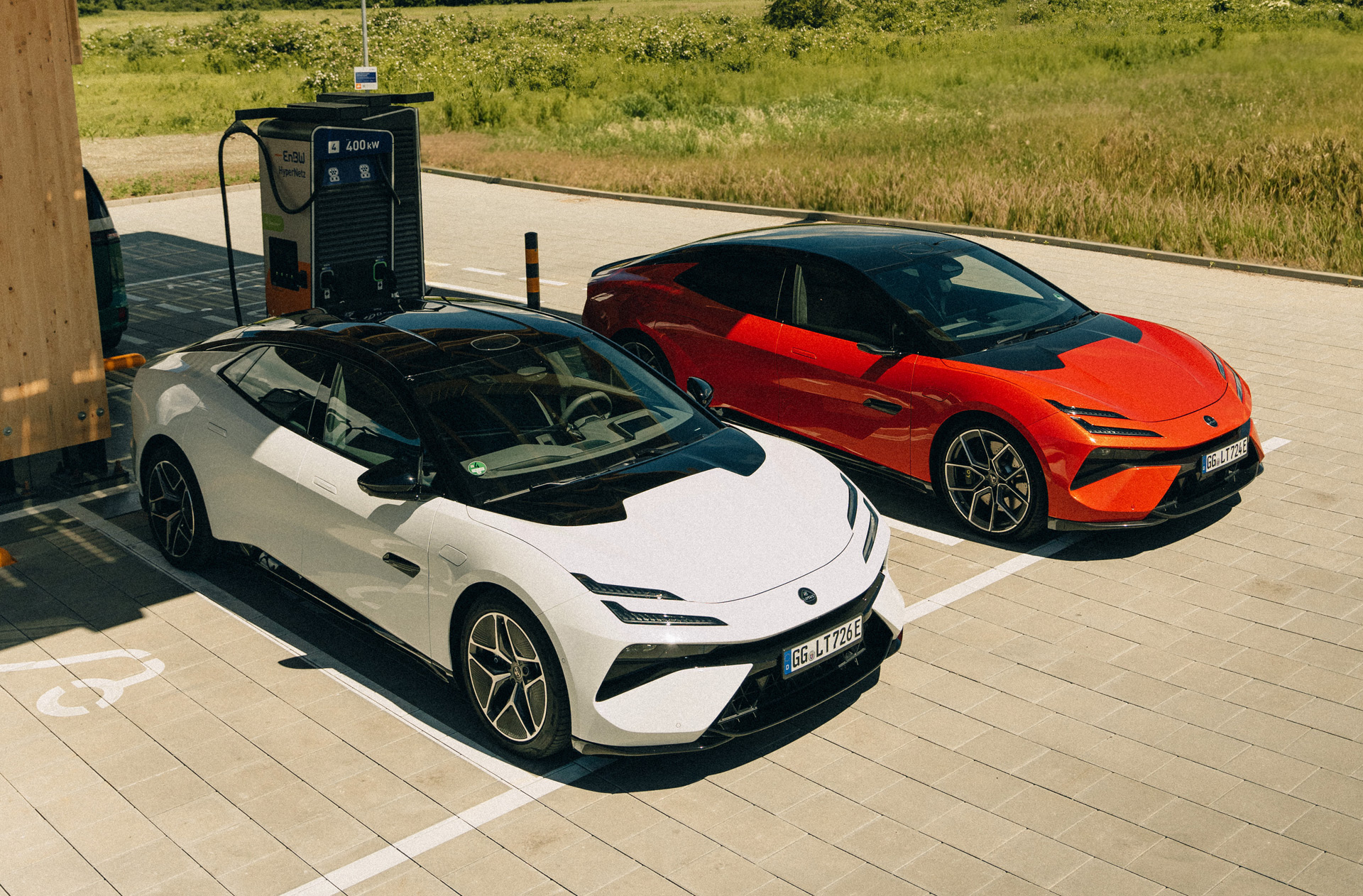
The Lotus Emira sports car won’t be the brand’s last car with a gas engine after all.
The automaker used last week’s 2024 Guangzhou auto show in China to announce new plug-in hybrid technology called the Hyper Hybrid EV powertrain.
Lotus Eletre
The powertrain is still being developed, but Lotus said vehicles equipped with it will be able to cover a distance of 684 miles, using a mix of gasoline and electricity stored in a battery. Lotus also said the electrical side of the powertrain will use 900-volt technology, which will enable quick charge times when using a DC fast-charger.
The gas engine will be used as a generator to charge a battery, which in turn will power the electric motors, a setup known as a series hybrid, and something Lotus calls Ultra-Fast On-The-Drive Charging. Lotus CEO Feng Qingfeng during an investor call on Thursday said the gas engine will be able to charge the battery faster than the electricity is used in regular driving.
Feng Qingfeng
Lotus didn’t say when and in what vehicles the Hyper Hybrid EV powertrain will be launched. The automaker also didn’t say what gas engine it will use, but one of the hybrid-optimized engines from parent company Geely’s new Horse Powertrain engine supplier is likely.
Lotus originally planned for its Emira to be its final car with a gas engine, but like other automakers, including fellow Geely-owned brand Volvo, Lotus is finding that growth in demand for EVs is a lot slower than anticipated. Lotus said the launch of a hybrid powertrain will help it keep up with evolving market demands.
Lotus Emira
A hybrid powertrain will also enable Lotus to avoid tariffs aimed at its Chinese-built EVs. For example, the European Union’s tariff rules exempt plug-in hybrid vehicles.
In addition to the Emira, Lotus offers the Evija, Eletre, and Emeya EVs. Its sales have been steadily growing over the course of the year, with deliveries for the first nine months of 2024 coming in at more than 7,600 units, up 136% versus the same period a year ago. Revenues also doubled to $653 million. Lotus still reported an operating loss of $598 million, though, up 18% from a year ago.
The Jeep Recon has been spied testing with minimal camouflage gear
The Recon will use the STLA Large platform shared with the Jeep Wagoneer S EV
The design was previewed in 2022 and first deliveries are expected to start in 2025
The production version of the Jeep Recon electric off-roader has been spied testing in prototype form for the first time.
The Recon is an electric alternative to the iconic Jeep Wrangler, and was originally due in 2024, though the launch will likely be pushed back into 2025 given that prototypes are only now testing in public view.
Jeep Recon
The Recon was first shown as a concept in 2022, together with concepts for the midsize Wagoneer S and subcompact Avenger electric vehicles. The Wagoneer S was launched earlier this year, and the Avenger was launched in 2022, though not in the U.S.
The production Recon looks identical to the original concept, right down to the brightly colored tow hooks. The rear-most side windows on the concept were removable, though the glass appears to be fixed on the production model. The rubber is a set of Nexen Roadian ATX tires likely measuring 285/70R17 at all four corners.
2025 Jeep Recon spy shots – Photo via Baldauf
The Recon is a midsize SUV built around the STLA Large modular platform of parent company Stellantis, just like the Wagoneer S. All Jeep has said about the Recon is that it will come with Jeep Selec-Terrain traction management, an e-locker axle, under-body protection, and chunky off-road tires. It will also have removable doors and a power top with a large opening for a semi-open-air experience.
The powertrain will likely be similar to what’s found in the Wagoneer S. The luxury-oriented electric SUV is being offered initially with a dual-motor, all-wheel-drive powertrain rated at 600 hp, as well as a 100-kwh battery estimated to deliver a range of more than 300 miles. The STLA Large platform also supports gas and hybrid powertrains, though all of the Recon prototypes spotted testing were EVs.
2024 Jeep Wagoneer S
Production will be handled at plant in North America, possibly the same Mexican plant where the Wagoneer S is built.
Jeep is committed to offering an electric option in all of its SUV segments. A compact electric crossover will follow the Recon. It’s coming soon with a starting price around $25,000 for the U.S. market, Stellantis CEO Carlos Tavares confirmed during an investor meeting held in May. Jeep is also expected to launch a full-size electric Wagoneer based on the STLA Frame platform later this decade.
2025 Jeep Recon spy shots – Photo via Baldauf
Jeep will also add plug-in hybrid powertrains to more of its lineup, either as parallel hybrid systems or series hybrid systems. In the latter, a gas engine serves as a generator only. The first series plug-in hybrid powertrain for Jeep is expected to be launched next year in the Wagoneer. The automaker has also hinted that lower-cost conventional hybrid powertrains without a plug may be offered.
A couple of weeks ago, we revisited a Mk3 Volkswagen Golf, featuring all-wheel-drive and a Precision 6266 turbocharged VR6 engine, pushing over 550whp. True to the spirit of Gatebil, this Golf was engineered for all-out performance.
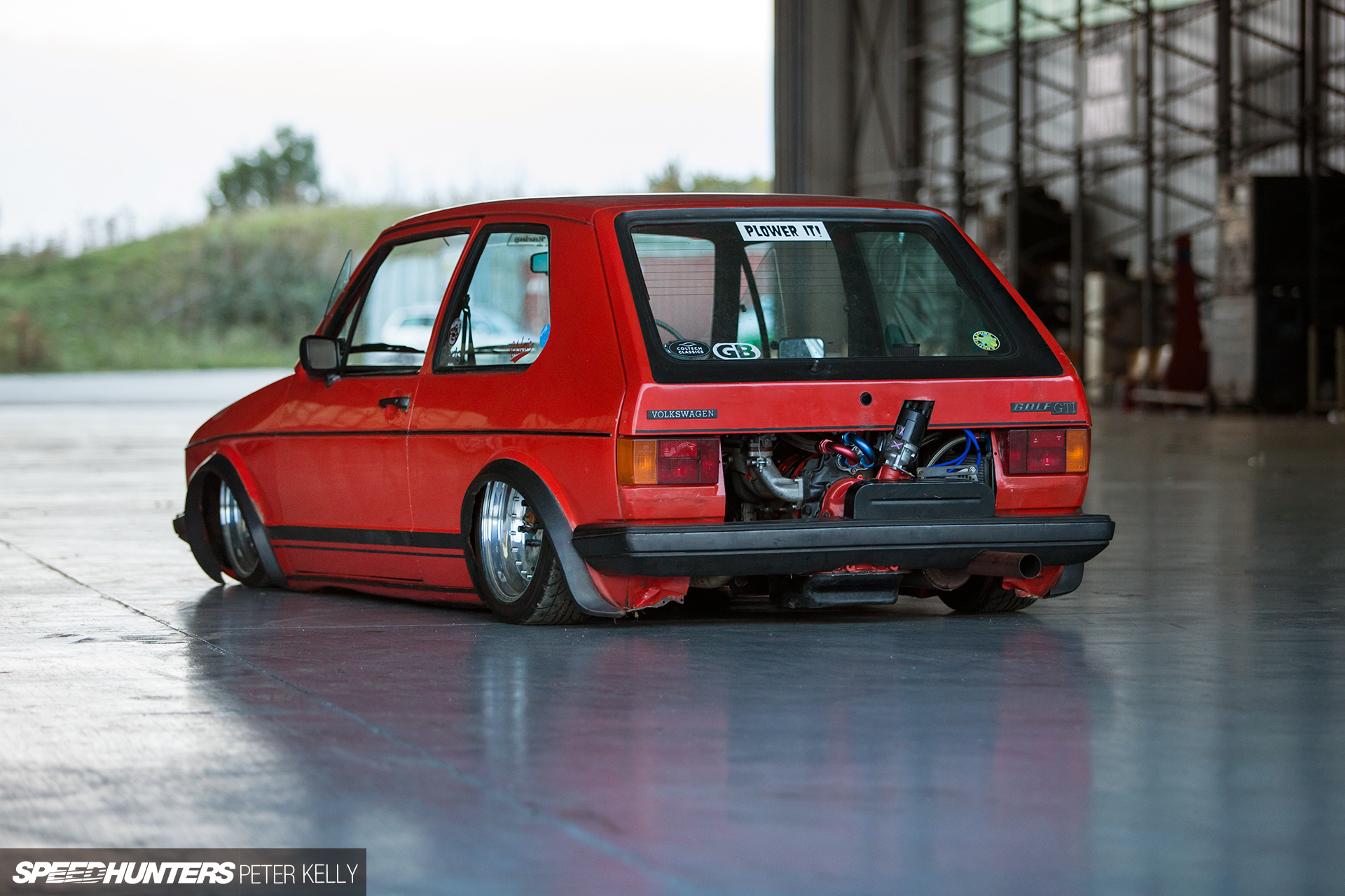
For this week’s throwback post, we’re revisiting a different type of Golf build. In fact, in the world of custom Golfs, we’ve never encountered anything quite like Pipey McGraw‘s Mk1 GTI – an slammed-to-the-ground creation with VW Beetle underpinnings and a pulsating Mazda rotary engine.
2014 Feature
If there’s one sound I have a truly tuned ear for, it’s the pulse of a Mazda rotary; there’s just nothing else quite like it. As many readers might know, my home country of New Zealand is a wankel enthusiast’s mecca and I have grown up with the idle of ported rotary engines ringing in my ears.
While in England recently attending the 2014 Players Show at North Weald Airfield, that familiar rhythmic pulse was the last thing I expected to hear, but there it was, ebbing towards me as soon as I opened the door of my rental car. Like the smell of an ex’s perfume or a particular song from your teenage years, the brap brap brap sound instantly brought back memories for me: the traditional Kiwi summer spent cruising the beach spots as RX-2s, RX-3s, RX-7s and all the rest rolled past. Hearing this sound in the middle of an airfield in the UK, with a biting blustery wind cutting right through my jumper, I felt nostalgic – patriotic even – and I had to know more.
The faint pulse had disappeared before I’d even finished getting my camera gear out, and with only a rough direction in which to start hunting, I began my search for the elusive Mazda. As you’ve no doubt already guessed by looking at these images, it would turn out that I was looking for entirely the wrong car. After plenty of aimless wandering and head scratching, I finally saw the tell-tale distributor and upwards-sweeping IDA carburettor manifold – sticking out the boot of a Mk1 Volkswagen Golf GTI. Well, that’s a first…
What exactly was I looking at and why? More information was needed, and I eventually found the owner, Pipey McGraw, who was able to fill me in on the details. It turns out this is really only partially a Golf. In truth, it’s probably more of a 1970 VW Beetle, though it’s registered as an ‘SMT ULC’. It’s also completely street legal.
Pipey kicked off his project back in early 2012 after finding this GTI body, which had had the bottom cut out and placed over the top of a scrap Beetle pan with a few tack welds to hold it in place. What he first thought would be a quick weekend fix-up for a laugh has turned into a life-consuming labour of love for the Bournemouth local and his mates. Besides the Golf shell itself, nothing else now remains from the project he originally purchased.
The first Beetle chassis was scrapped and replaced with a nearly all-new pan, which uses a spine from a 1970 Beetle and brand new floor pans, front frame head panel and rear spring plates. British MOT rules dictate that the floor pan of a car cannot be modified, so all the work went into the body, fabricating strengthened mounting points that aligned with the Beetle’s stock points. Pipey also used the opportunity to sit the mounts up higher, resulting in a 4-inch body drop. This allows the GTI portion of the car to sit extremely low to the ground while the Beetle chassis remains at a more reasonable height, which also allows the car to retain some reasonable suspension geometry.
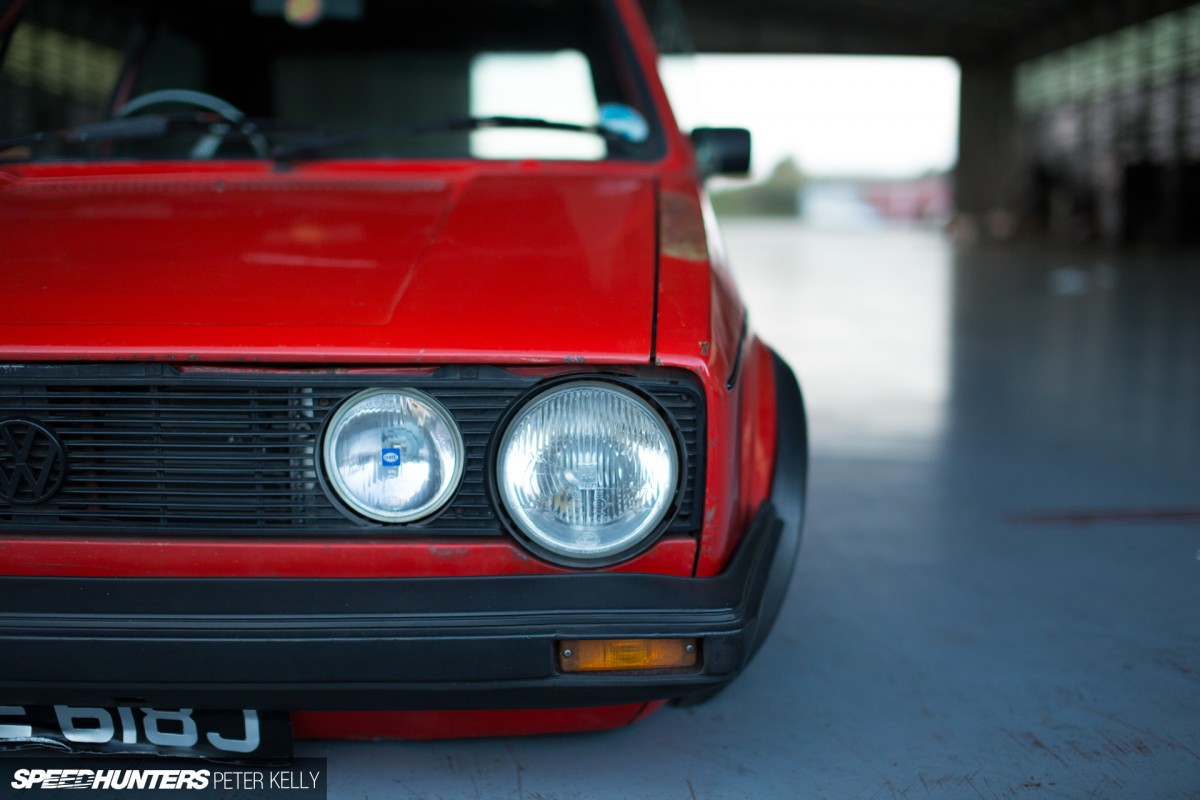
Although the body itself is clearly a little beaten up, that’s exactly how Pipey wanted it. He says that although he appreciates all the work that goes into immaculate show builds, it just isn’t him – there’s something to be said for battle scars and character. Although nothing has been repaired as such, originally this body looked like it had been sitting in the sun for 30 years; it had turned shades of pink and white, and was completely rough to the touch. Pipey spent countless hours sanding back the tired paint and polishing it up, resulting in a strange high-sheen, yet ratty look.
Another Beetle has been raided for its bulkhead, which was then welded into the Golf body. In a rush to get the VW done for the summer of 2013, the car ran a stock Beetle air-cooled flat four that Pipey had lying around behind that bulkhead. The car travelled so well, performing faultlessly on big trips to the huge RadikalBugz and European Bug In meets in Belgium, that Pipey decided to stick with the motor for the rest of the year. As you can now see though, he soon grew bored: Pipey needed something with more power. Although the easy option would have been to build a monster VW mill, it wasn’t going to be weird and different enough for Pipey. It was time to look farther abroad.
With only very limited space available, Pipey needed a motor that would be small enough to fit, yet still provide a big upgrade in power over the stock flat four (that’s not really the hardest of asks, mind you). Plenty of time was spent researching the matter, but eventually it was the countless videos of angry rotary-powered machines pulsing away that can be found online, and a subsequent search that turned up off the shelf Mazda-to-VW gearbox adapters, that convinced Pipey to go with a Hiroshima screamer. This was found in the form of an early twin-rotor 1300cc 13B, originally from a Series 3 RX-7.
Upon trial fitting the rotary, it quickly became clear that the sump of the Mazda motor hung a good couple of inches lower than the VW engine’s, and with the car being so low, it was genuine cause for concern. Pipey and friends fabricated new mounts for the 4-speed VW Type 2 Transporter gearbox that had been adapted to the motor, and then cut into the bulkhead to allow the box and motor to sit two inches higher. Finally, after plenty more hours spent sorting out the wiring and cooling and with a summer full of events fast approaching, it was time to start the Mazda-powered VW up.
Unfortunately, the ‘great running engine’ Pipey had purchased turned out to be a complete dud, and not long after it was fired up for the first time, it dropped a rotor and fell to pieces. With only two weeks until the 2013 Retro Rides Gathering in Worcester, Pipey now had himself a dead duck, and spirits were low – but it wouldn’t last. Help came from Carl and the team at Hayward Rotary in Berkshire, who dropped everything to get the motor apart and not just fixed up, but transformed into a monster.
The block has now been fully bridgeported and runs high-compression Series 5 RX-7 rotors with Hayward’s own highly-regarded apex seals. Rotary engine porting, for those who may not have had much to do with these motors in the past, involves enlarging the intake and exhaust ports to allow more air and fuel into and out of the engine, similar in concept to porting/polishing the head and fitting a more aggressive camshaft/s into a piston motor. The ‘bridgeport’ specifically refers to a process of not only enlarging the standard port, but creating a second thin port just above it, almost like an eyebrow to an eye. The bridge that is left between the two ports ensures that the corner seals of the rotor don’t fall out and make mincemeat of the motor.
The engine now pulls air and fuel through a 46mm Weber IDA carb, which is bolted to a port-matched Racing Beat manifold and was originally pulled off a Porsche 914 race car.
Spark is provided to RX-8 plugs by a pair of MSD Blaster coils via big Magnacor leads.
Big braided water lines can be seen running from the rear of the car to the front, where a radiator is located between the two enlarged wheel tubs.
A bridgeported motor requires a whole lot of breathing room, so in order for the 13B to exhale efficiently, a custom set of headers was fabbed up, which dump into a short exhaust pipe running down below the bumper. As you can imagine, with such a short exhaust tract, this car isn’t exactly the quietest…
Though the motor hasn’t been dyno tested, wisdom states that it should be making somewhere around the 250hp at the flywheel mark – a good five times more than the stock air-cooled flat four that was in the car previously. Though the big hike in power was great, it made the car scary to drive on its current static suspension set up. It was time to make this machine a little more practical.
Sure, Pipey had already been driving this car around for a good year crazy-low on static suspension, but for the sake of practicality he decided to acquire a Rayvern hydraulic suspension set up, which has been designed specifically for the Bug platform. He admits that it’s the one big thing he doesn’t like about the car, but at some point, you’ve got to be realistic about practicality, and nothing screams practical like being able to lift your car and drive without being followed by fireworks as your panels go toe-to-toe with the road surface.
The set up runs hydraulic rams with inline shock absorbers and adjustable rear spring plates. The front beam has also been narrowed considerably, which Pipey carried out firstly because it’s a traditional aircooled Bug modification, and because it also allows the front wheels to achieve full lock.
The two-piece drag-style wheels measure 16×6 inches and were made to Pipey’s specifications in California by Custom Metal Spinning, before being sent over to the UK. In this image you can see just how far inside the fenders the front wheels sit.
Like the rest of the VW, the interior has a very rat-bug feel about it and is pieced together from various bits and bobs. With that said, Pipey says that he wouldn’t mind going for a more complete interior some time in the near future.
For now though, the bead-rolled dash is about as simple as it gets and houses an array of gauges from an Audi 80.
The steering wheel has been custom made by Coltech Classics, using a variety of bits and pieces from vintage euros.
These awesome Vabric tweed-trimmed bomber seats are by far my favourite addition though, and they suit the style of the build perfectly.
With its sparse Beetle interior, ratty Golf GTI exterior and raucous Mazda engine jutting from its boot, Pipey’s car is what some might call a European hot rod of sorts. It’s made of up so many different vehicles, and is about as far from the stock car – whichever one you choose – as is possible. Considering it’s completely street legal and it has driven all over Europe, we have to wonder how a car like this is received by all the people that pass it by on the roads.
“It’s not a very inconspicuous car at all,” Pipey says matter-of-factly. “From the second I roll out the drive to the second I turn it off at my destination people just seem to go crazy on the roads. People have stopped traffic on the M25 to take photos of it rolling. Others try and pull me over to talk about the car; my lip reading’s great now – you can clearly see people swearing. I think the thing that baffles people most is how low it is and how I can physically drive it on the road. From kids to grandparents – every time I stop someone’s running over to the car trying to take photos or talk to me about it.”
We’re well aware that this mash-up-mobile isn’t for everyone, and that’s exactly what both we and Pipey himself love about it. It’s an outside-the-box, unique creation that has served as both a talking point for anyone Pipey meets, and a campfire of sorts. A place that friends can gather around, have a laugh and build something interesting at the same time. “For me, my favourite thing about this car is looking at it and thinking about the three years of hard work that has gone into it. I’m extremely lucky to have the friends I do that have put up with this stupid car for so long. I like the fact it causes such a reaction of passion from people when they see it. From absolute love to extreme hatred, it gets people talking regardless, whether they understand it or not.”
A Southern California truck driver who Walmart fired after falsely accusing him of workers comp fraud has been awarded millions by a jury.
It’s Time To Discontinue The Model S | Jalopinions
The Inland Valley Daily Bulletin reports that Jesus Fonseca was a commercial truck driver out of Walmart’s Apple Valley Distribution Center for over 14 years until he was hurt when a vehicle rear ended his truck. He filed a workers comp claim and asked for Walmart to place him on restricted duty. Walmart didn’t listen.
After Fonseca was treated at a hospital for his injuries, he filed a workers’ compensation claim and was evaluated by a doctor every few weeks beginning in June 2017 to modify his work restrictions, the lawsuit said.
Fonseca’s work restrictions changed at times, but generally included that he couldn’t push, pull or lift more than five to 10 pounds or drive commercial vehicles. While the restrictions were communicated to Walmart leadership, they failed to accommodate Fonseca’s needs, his lawyers argued.
The day after the accident, Fonseca was placed on medical leave, and Walmart didn’t explore alternative tasks he could perform, the lawsuit said. Even though Fonseca requested he be allowed to do modified duties and asked if he could perform desk duty at an office position, but he wasn’t allowed to, the lawsuit said.
Right before the accident, Fonseca had planned two family trips, something his lawyers say he informed Walmart of. He had a doctor’s note with restrictions that included things like no driving, bending or stooping, which Fonseca says meant no driving of commercial vehicles, not for his personal use. His lawyers claim that Walmart interpreted the restrictions differently and hired a private investigator who found him on his trip and witnessed him driving an RV and bending and stooping.
In early 2018, Walmart management called in Fonseca for questioning, essentially interrogating him over a “report” they had received that said that he had been doing things that were doctor restricted while on vacation. He was eventually told that he had committed fraud and would be fired.
Fonseca told them he didn’t believe he did anything wrong as the restrictions prevented him from driving commercial vehicles, and he believed he could drive for personal reasons, the lawsuit said.
He hadn’t talked to anyone at Walmart about the reported fraud again, until an official called him in March 2018 and said Fonseca was accused of fraud and would be fired for “gross misconduct and integrity,” according to the lawsuit.
Fonseca says he tried to speak with Walmart’s vice president of transportation over his firing, but the VP refused because he was “being represented by workers’ compensation counsel.” After he was fired, Fonseca couldn’t land another job because he had to disclose that he had been accused of workers comp fraud. So Fonseca sued Walmart for “for disability discrimination, failure to accommodate his disability, failure to engage in an interactive process, retaliation and failure to prevent discrimination, all in violation of the Fair Employment and Housing Act.”
He also accused the company of maintaining a hostile work environment, wrongful termination and emotional stress. A jury agreed and he was awarded $25 million in punitive damages and another $9.7 million for “future and past losses.” Fonseca’s lawyer David deRubertis said he hopes the verdict is the beginning of change at Walmart but also that he thinks what was done to Fonseca was part of something bigger against all of the company’s truck drivers.
“We believe the evidence at trial showed that Walmart’s defamation of Jesse was part of a broader scheme to use false accusations to force injured truckers back to work prematurely or, if not, terminate them so that Walmart can cut down workers’ compensation costs.”
Walmart is pissed of course. Calling the verdict outrageous, the company said it’s going to take “further action” with the case. “Accordingly, we will pursue all available remedies.”
The technical storage or access is strictly necessary for the legitimate purpose of enabling the use of a specific service explicitly requested by the subscriber or user, or for the sole purpose of carrying out the transmission of a communication over an electronic communications network.
Preferences
The technical storage or access is necessary for the legitimate purpose of storing preferences that are not requested by the subscriber or user.
Statistics
The technical storage or access that is used exclusively for statistical purposes.The technical storage or access that is used exclusively for anonymous statistical purposes. Without a subpoena, voluntary compliance on the part of your Internet Service Provider, or additional records from a third party, information stored or retrieved for this purpose alone cannot usually be used to identify you.
Marketing
The technical storage or access is required to create user profiles to send advertising, or to track the user on a website or across several websites for similar marketing purposes.