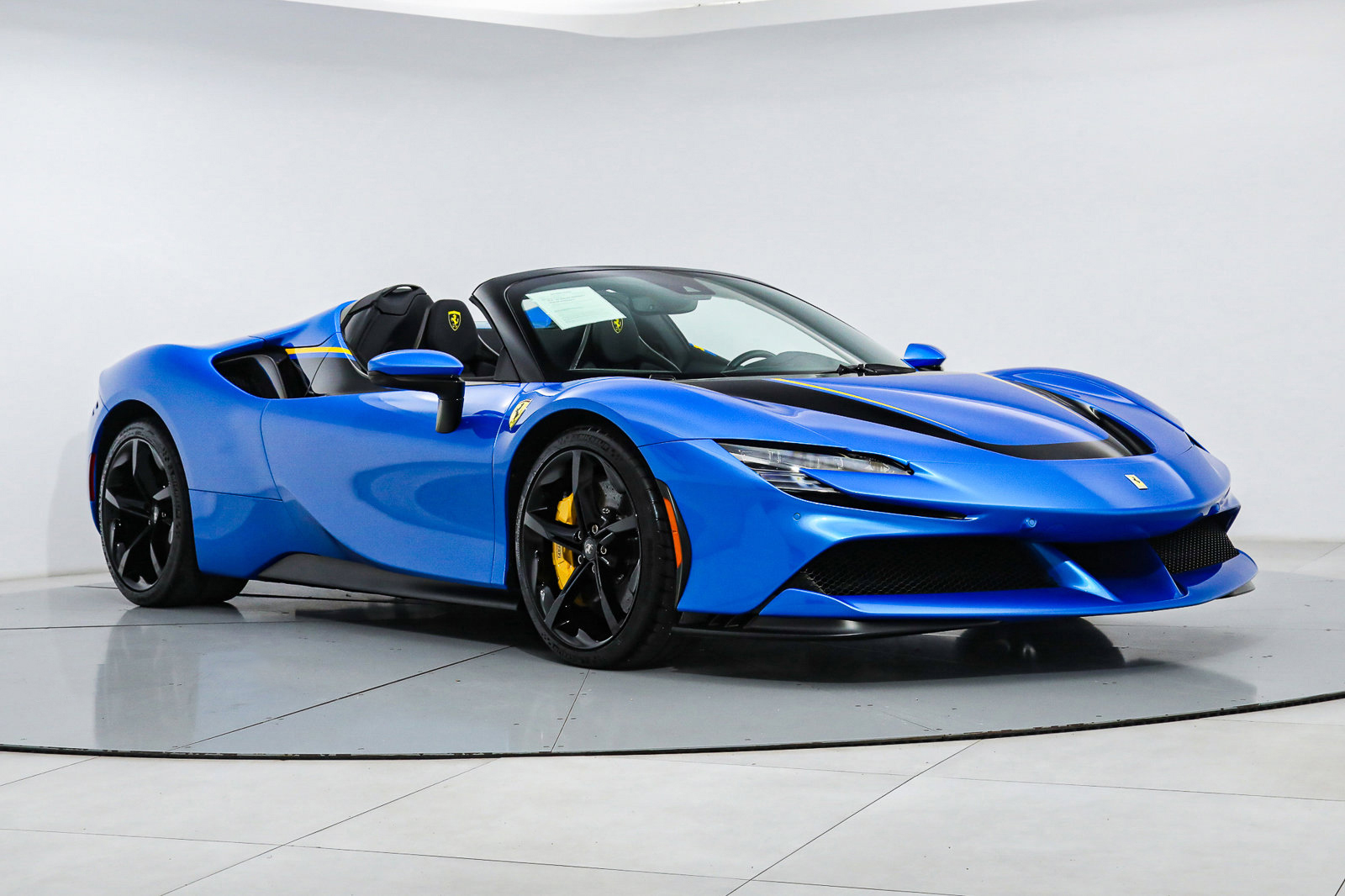
Ferrari, using knowledge from the LaFerrari and its Formula One programs, created the SF90 Stradale with extraordinary performance and impressive fuel efficiency. Named for Scuderia Ferrari’s 90th Anniversary, the SF90 shares its ‘SF90’ name with the 2019 SF90 F1 car, tying the model to Ferrari’s racing legacy.
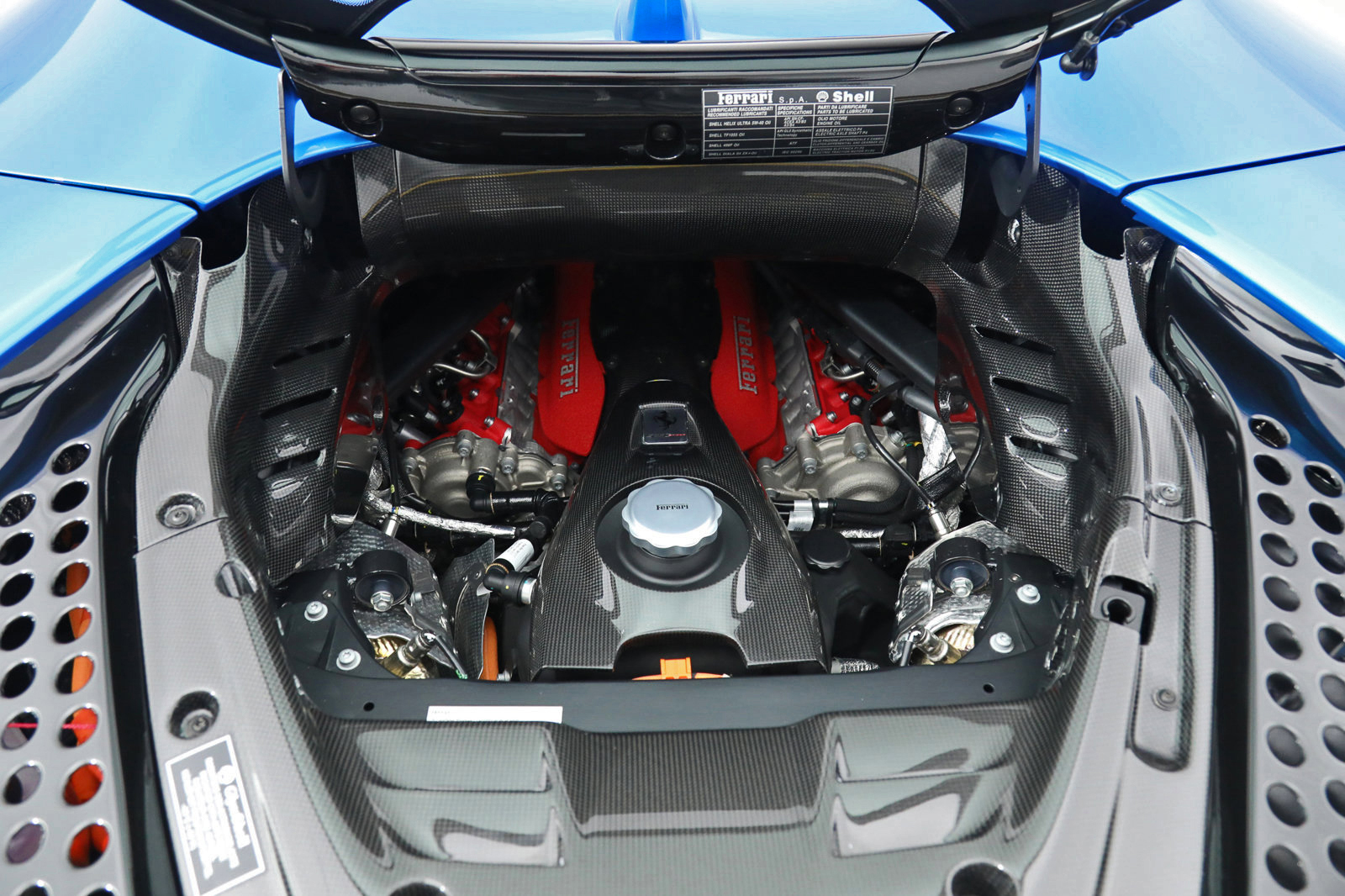
Unlike the LaFerrari’s V12, the SF90 Stradale features a 4.0-liter V8 engine, augmented by twin turbochargers and three electric motors. One motor powers the crank-mounted MGU-K system, while the other two drive the front wheels, improving traction and balance. This hybrid V8 produces a combined 986 horsepower—769 from the engine and 217 from the motors.
The SF90 Stradale was launched in 2019, with the open-top SF90 Spider revealed in 2020. The Spider features a unique retractable hardtop that preserves the coupe’s sleek design and converts to open-air driving in 14 seconds. The lightweight aluminum roof is 88 pounds lighter and half the size of a conventional retractable top when stowed.
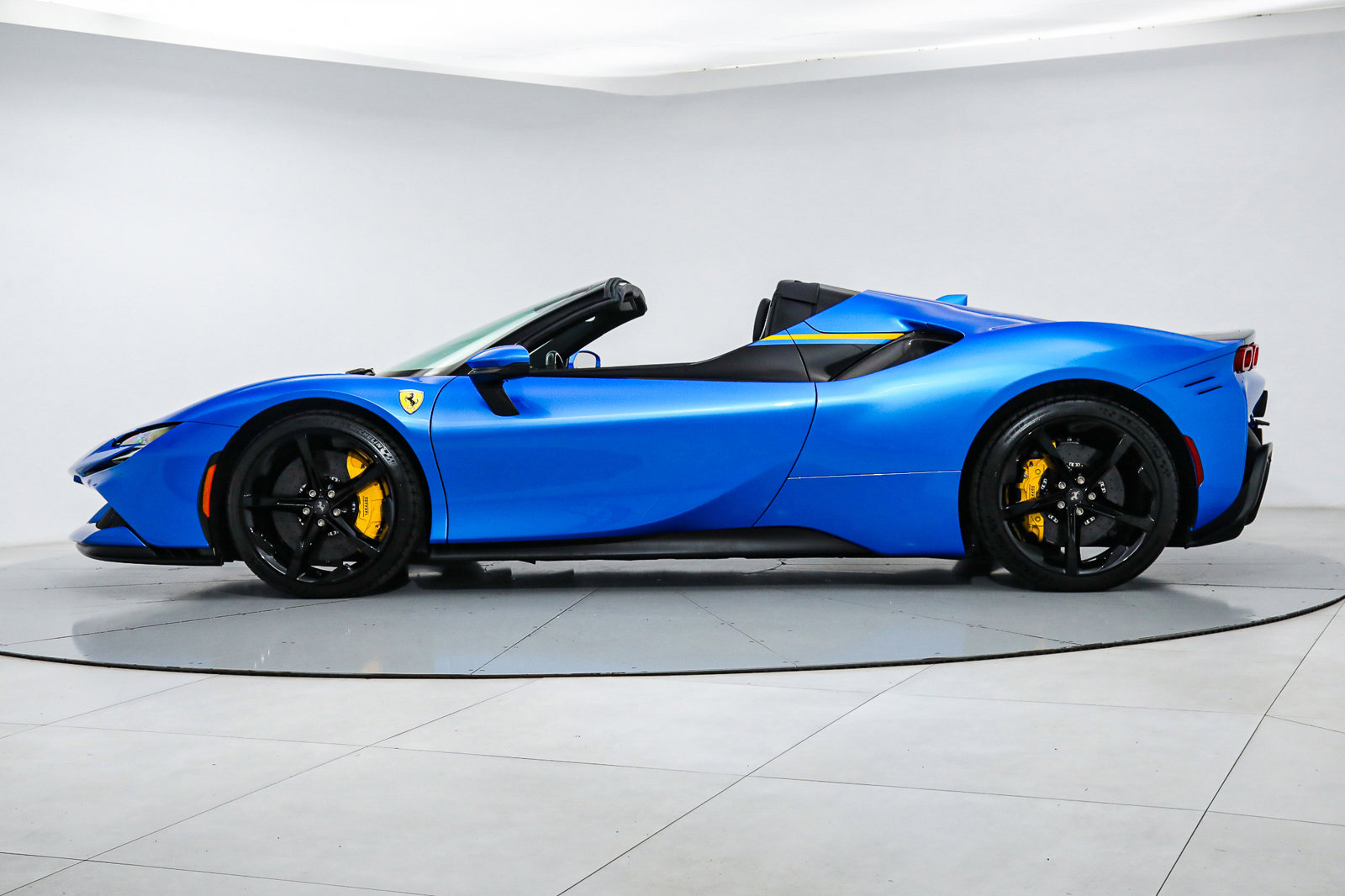
This one-of-one SF90 Spider is a custom masterpiece, created through Ferrari’s Atelier program with $178,000 in bespoke options. It features a stunning Azzurro Dino Mica paint, accented by a black and yellow livery, black 20-inch forged wheels, and exposed carbon-fiber elements, all enhancing its bold design.
The interior boasts Nero leather with blue stitching, yellow seatbelts, and carbon-fiber Daytona racing seats with Alcantara inserts. Custom features include Ferrari’s Advanced Front Lighting System, a suspension lifter, Apple CarPlay, a fire extinguisher, and titanium wheel stud bolts.
The charming, colourful Unesco World Heritage city of Guanajuato, in the north of Mexico, is nestled within a scenic valley and is steeped in history.
The cobbled streets and historic tunnels, that were once subterranean rivers, twist their way around and through the hillsides, which are peppered with a range of colourful homes.
Two days is the perfect amount of time to experience the vibrant city, found just 4-5 hours north of Mexico City by car.
We’ve rounded up the top 10 things to do in Guanajuato in just two days below. If you’re interested in more Mexico articles, you can check them out here.
Here’s an overview:
Top Things to Do in Guanajuato in 2 Days
Here’s our top itinerary for two days in Guanajuato.
First things first, head to Alhóndiga de Granaditas, a grain storage-turned-museum, for a slice of Guanajuato’s history. The building was front-and-centre of the Mexican Independence movement in the 19th century, as the site where the Spanish formed a defensive position inside to hold off the Mexican rebels.
The museum is home to lots of artwork and artefacts that really highlight the city’s importance during this turbulent time.
Entry costs $30 pesos, which is around £1.15 or $1.50 USD, and is open 10am – 6pm Tuesday to Saturday, and 10am – 3pm on Sundays.
Square with a monument in the center of Guanajuato, Mexico.
El Pípila Monument
One of the most famous Mexican rebels to storm the Alhóndiga de Granaditas was El Píplia. He was a miner who strapped a stone shield to his back, charged at the building and set the doors on fire, allowing the rebels to eventually breach the Spanish defences.
El Píplia is memorialised with a statue high above the city, which is also an incredible viewpoint of the entire city below.
Funicular up to El Píplia Monument in Guanajuato, Mexico.
El Píplia Monument in Guanajuato, Mexico.
The view of all the colourful buildings spread out below is hard to beat, especially as the sun sets.
You can reach the monument without the funicular, but the walk up is steep! If you’re taking the funicular, the prices as of Nov 2024 are below.
Tickets each way cost $35 MXN for adults and $15 MXN for children (aged 4 to 11) and older adults with an INAPAM ID. Children aged 3 and under can travel for free.
Tip: Ride the funicular up to the monument, then walk back down for a change of pace and to save a few pennies!
Mummies Museum (Museo de las Momias)
The Mummies Museum is one of the most famous, yet most bizarre, attractions in Guanajuato.
During efforts to make room for more bodies in a local cemetery, naturally mummified remains were unearthed and relocated to the museum.
It really emphasises the Mexican people’s acceptance and celebration of death! Tickets cost $8 MXN, which is roughly £0.30 or $0.40 USD.
Mercado Hidalgo
Named after one of the leader’s of the independence movement, Miguel Hidalgo, this massive market hall is a perfect stop on your first day to fuel up on some delicious street food.
The enormous iron structure was originally intended to be a grand central train station, but the project was abandoned after the building was completed, when it was quickly repurposed into a market.
It’s a brilliant place to wander through and haggle for a souvenir, or sample some enchiladas mineras, or just soak up the chaotic and lively atmosphere.
Tip: Make sure you pick up a cup of aguas frescas (fruity drinks), which are a great way to cool off from the warm weather you’ll no-doubt experience here.
Mercado Hidalgo in Guanajuato, Mexico.
Callejón del Beso
No visit to Guanajuato would be complete without visiting the most iconic spot in the city!
Guanajuato might be home to many small alleys, but Callejón del Beso is definitely the most narrow! It translates to Alley of the Kiss in English, and measures just 168cm or 66 inches wide at some points, with the balconies on both sides of the alleyway almost touching.
Callejón del Beso in Guanajuato, Mexico.
Colorful houses at the Callejón del Beso in Guanajuato, Mexico.
The famous alleyway even has its own legend: a tragic, forbidden love story between Ana and Carlos, a daughter of a wealthy man and a humble miner…
Despite Ana’s father demanding that she marry a wealthy man, she fell in love with humble, poor Carlos. Her father found out and he locked her away to attempt to separate the two of them, but love knows no bounds! Carlos soon after bought the house next door, which had a balcony practically touching Ana’s bedroom balcony. The lovers would meet every night in secret and kiss across the narrow alleyway. Sadly, all good things must come to an end, and one night Ana’s father caught them in an embrace. He fell into a fit of anger, shouting at and threatening Carlos, and accidentally killed his own daughter in the chaos. Carlos was distraught, and legend has it that he died of a broken heart not long after.
Despite being a very short alley – only about 25 metres in length – it’s a fun spot to visit. If you’re with a loved one, you can even pay the homeowners to each go onto a balcony and share a kiss across the gap!
Day 2: Enjoy Guanajuato’s Art, Architecture, and Delicious Food
Jardín de la Unión
Start your day by visiting Jardín de la Unión, which is a triangular plaza and one of Guanajuato’s main hangout areas.
You’ll find plenty of cafes, bars and restaurants around the edges, making it a great spot for breakfast, lunch or dinner – in case you wanted to come back later!
The Jardín, which means Garden in English, is lined with neatly trimmed trees and plenty of benches where you can sit in the shade.
Bring a book and rest here for a while with a morning coffee before tackling the day ahead!
Jardín de la Unión in Guanajuato, Mexico.
Teatro Juárez
Right next to the Jardín de la Unión is the Teatro Juárez. Built in the late 19th century, it was inaugurated by the infamous dictator Portfirio Díaz, and remains one of the most stunning theatres in all of Mexico.
If you know a little Spanish – or even if you don’t – experiencing a performance here is a great experience. You’ll find posters outside the theatre or bump into people selling tickets for upcoming shows, which are very affordable, often costing around $100 MXN (£3.85 or $4.90 USD).
Teatro Juárez in Guanajuato, Mexico.
Even if you’re not planning to catch a show, the architecture itself is worth a visit, which is a mix of neoclassical and Moorish styles. The interior is also beautiful, with stained glass and lavish woodwork everywhere you look.
Tip: You won’t be able to see much of the interior without a guided tour, which are in Spanish only. If you’re interested, the tours operate throughout the day – just ask a member of staff when the next tour will start.
Diego Rivera Museum
Most visitors to Mexico will already be aware of Diego Rivera, one of the country’s most famous artists. Many will know his wife even more – Frida Kahlo.
Mr Rivera was born in Guanajuato, and lived there with his family until he was 6 years old. Thankfully, his childhood home remained standing over the next 100 years until it was turned into a fantastic museum showcasing many of his early works, as well as a re-creation of the home as it would have looked in the 19th century.
If you’re a fan of art, it’s a great place to wander through the permanent (and temporary) exhibits, and learn a little more about one of Mexico’s most famous figures.
Callejones (Alleys)
In case you haven’t done this already simply by wandering around between sights, exploring the maze of narrow alleyways is a brilliant way to spend an afternoon. Without a map or route in mind, just explore on foot and see what you find. The colourful city streets are home to so many hidden gems, tucked away little courtyards and cafes with incredible views across the valley.
Go hunting for street art, for which Mexico is famous for, or follow the sound of mariachi bands playing in various plazas. Hop into local artist shops and pick yourself up something nice, or stop for a sip of tequila in one of the many quirky bars.
Callejones – Alleys in Guanajuato, Mexico.
Callejones – Alleys in Guanajuato, Mexico.
We’d recommend the area around the Diego Rivera Museum (Positos Street) for exploring. It’s full of aforementioned gems and seems to stay a little quieter than the main street at the bottom of the valley.
Another favourite of ours was the Plaza de San Fernando, which had plenty of restaurant and bar options, with a lovely atmosphere around the plaza!
Tip: Listen out for the Callejoneadas in the evening, which are tours led by local musicians (troubadours) through the tunnels and alleys in the underbelly of the city, telling various legends and tales through song!
Guanajuato Cuisine
Last (but by no means least) is sampling some of the delicious food native to Guanajuato. A local tour guide once told us that Mexico should be explored, experienced and LIVED through food – and we couldn’t agree more!
Make sure you try Enchiladas Mineras before you leave. The tortillas, originally prepared by local women hoping to sustain their husbands who worked the mines, are filled with chicken or cheese then topped with a healthy layer of cheese, lettuce and onion. They’re then smothered in a delicious enchilada sauce… so, so delicious!
If you’re not already full, give Tlacoyos or Gorditas a try, which are popular dishes in Guanajuato. Tlyacoyos are essentially a doughy pocket filled with cheese, beans or your choice of meat, then fried or grilled. Gorditas are similar, but they’re thicker and are often veggie-friendly! Both are often paired with salsa or guacamole.
Don’t forget to grab a cold cerveza alongside your delicious food, and you’ll have the perfect final meal for your two-day Guanajuato adventure!
We’re Hannah & Connor, founders of Laws of Travel. Travelling and trying new things together is our love language, and we’re lucky enough that we now get to travel full time! We hope you enjoy our tips, itineraries, guides, and everything in between, and find them super helpful so that you can make the most of your adventures!
We’re Hannah & Connor, founders of Laws of Travel. Travelling and trying new things together is our love language, and we’re lucky enough that we now get to travel full time! We hope you enjoy our tips, itineraries, guides, and everything in between, and find them super helpful so that you can make the most of your adventures!
Robots are moving goods in warehouses, packaging foods and helping assemble vehicles — bringing enhanced automation to use cases across industries.
There are two keys to their success: Physical AI and robotics simulation.
Physical AI describes AI models that can understand and interact with the physical world. Physical AI embodies the next wave of autonomous machines and robots, such as self-driving cars, industrial manipulators, mobile robots, humanoids and even robot-run infrastructure like factories and warehouses.
With virtual commissioning of robots in digital worlds, robots are first trained using robotic simulation software before they are deployed for real-world use cases.
Robotics Simulation Summarized
An advanced robotics simulator facilitates robot learning and testing of virtual robots without requiring the physical robot. By applying physics principles and replicating real-world conditions, these simulators generate synthetic datasets to train machine learning models for deployment on physical robots.
Simulations are used for initial AI model training and then to validate the entire software stack, minimizing the need for physical robots during testing. NVIDIA Isaac Sim, a reference application built on the NVIDIA Omniverse platform, provides accurate visualizations and supports Universal Scene Description (OpenUSD)-based workflows for advanced robot simulation and validation.
Three computers are needed to train and deploy robot technology.
A supercomputer to train and fine-tune powerful foundation and generative AI models.
A development platform for robotics simulation and testing.
An onboard runtime computer to deploy trained models to physical robots.
Only after adequate training in simulated environments can physical robots be commissioned.
The NVIDIA DGX platform can serve as the first computing system to train models.
NVIDIA Ominverse running on NVIDIA OVX servers functions as the second computer system, providing the development platform and simulation environment for testing, optimizing and debugging physical AI.
NVIDIA Jetson Thor robotics computers designed for onboard computing serve as the third runtime computer.
Who Uses Robotics Simulation?
Today, robot technology and robot simulations boost operations massively across use cases.
Global leader in power and thermal technologies Delta Electronics uses simulation to test out its optical inspection algorithms to detect product defects on production lines.
Deep tech startup Wandelbots is building a custom simulator by integrating Isaac Sim into its application, making it easy for end users to program robotic work cells in simulation and seamlessly transfer models to a real robot.
Boston Dynamics is activating researchers and developers through its reinforcement learning researcher kit.
Robotics Company Fourier is simulating real-world conditions to train humanoid robots with the precision and agility needed for close robot-human collaboration.
Using NVIDIA Isaac Sim, robotics company Galbot built DexGraspNet, a comprehensive simulated dataset for dexterous robotic grasps containing over 1 million ShadowHand grasps on 5,300+ objects. The dataset can be applied to any dexterous robotic hand to accomplish complex tasks that require fine-motor skills.
Using Robotics Simulation for Planning and Control Outcomes
In complex and dymanic industrial settings, robotics simulation is evolving to integrate digital twins, enhancing planning, control and learning outcomes.
Developers import computer-aided design models into a robotics simulator to build virtual scenes and employ algorithms to create the robot operating system and enable task and motion planning. While traditional methods involve prescribing control signals, the shift toward machine learning allows robots to learn behaviors through methods like imitation and reinforcement learning, using simulated sensor signals.
This evolution continues with digital twins in complex facilities like manufacturing assembly lines, where developers can test and refine real-time AIs entirely in simulation. This approach saves software development time and costs, and reduces downtime by anticipating issues. For instance, using NVIDIA Omniverse, Metropolis and cuOpt, developers can use digital twins to develop, test and refine physical AI in simulation before deploying in industrial infrastructure.
High-fidelity, physics-based simulations have supercharged industrial robotics through real-world experimentation in virtual environments.
NVIDIA PhysX, integrated into Omniverse and Isaac Sim, empowers roboticists to develop fine- and gross-motor skills for robot manipulators, rigid and soft body dynamics, vehicle dynamics and other critical features that ensure the robot obeys the laws of physics. This includes precise control over actuators and modeling of kinematics, which are essential for accurate robot movements.
To close the sim-to-real gap, Isaac Lab offers a high-fidelity, open-source framework for reinforcement learning and imitation learning that facilitates seamless policy transfer from simulated environments to physical robots. With GPU parallelization, Isaac Lab accelerates training and improves performance, making complex tasks more achievable and safe for industrial robots.
To learn more about creating a locomotion reinforcement learning policy with Isaac Sim and Isaac Lab, read this developer blog.
Teaching Collision-Free Motion for Autonomy
Industrial robot training often occurs in specific settings like factories or fulfillment centers, where simulations help address challenges related to various robot types and chaotic environments. A critical aspect of these simulations is generating collision-free motion in unknown, cluttered environments.
Traditional motion planning approaches that attempt to address these challenges can come up short in unknown or dynamic environments. SLAM, or simultaneous localization and mapping, can be used to generate 3D maps of environments with camera images from multiple viewpoints. However, these maps require revisions when objects move and environments are changed.
The NVIDIA Robotics research team and the University of Washington introduced Motion Policy Networks (MπNets), an end-to-end neural policy that generates real-time, collision-free motion using a single fixed camera’s data stream. Trained on over 3 million motion planning problems and 700 million simulated point clouds, MπNets navigates unknown real-world environments effectively.
While the MπNets model applies direct learning for trajectories, the team also developed a point cloud-based collision model called CabiNet, trained on over 650,000 procedurally generated simulated scenes.
With the CabiNet model, developers can deploy general-purpose, pick-and-place policies of unknown objects beyond a flat tabletop setup. Training with a large synthetic dataset allowed the model to generalize to out-of-distribution scenes in a real kitchen environment, without needing any real data.
How Developers Can Get Started Building Robotic Simulators
Get started with technical resources, reference applications and other solutions for developing physically accurate simulation pipelines by visiting the NVIDIA Robotics simulation use case page.
Robot developers can tap into NVIDIA Isaac Sim, which supports multiple robot training techniques:
Synthetic data generation for training perception AI models
Software-in-the-loop testing for the entire robot stack
Robot policy training with Isaac Lab
Developers can also pair ROS 2 with Isaac Sim to train, simulate and validate their robot systems. The Isaac Sim to ROS 2 workflow is similar to workflows executed with other robot simulators such as Gazebo. It starts with bringing a robot model into a prebuilt Isaac Sim environment, adding sensors to the robot, and then connecting the relevant components to the ROS 2 action graph and simulating the robot by controlling it through ROS 2 packages.
Stay up to date by subscribing to our newsletter and follow NVIDIA Robotics on LinkedIn, Instagram, X and Facebook.
Whether you drive a car, need a car, or just occasionally bum a ride with friends, you’ve come to the right place. Join Jill and Tom as they break down everything that’s going on in the auto world. New-car reviews, shopping tips, driving green, electric cars, classic cars, and plenty of great guests. This is the Consumer Guide Car Stuff Podcast. – Subaru Solterra Review
–
Episode: 248
Broadcast date: November 21, 2024
Guest: Robert Colangelo
–
(Show Notes)
–
In this special crossover episode of the Car Stuff Podcast, Tom rides along with Robert Colangelo of the Green Sense Show to experience Subaru’s first all-electric vehicle, the Solterra small crossover. Robert and Tom share their takes on the likable little EV, and take note of a few drawbacks in the process. All this after lunch at Chicago’s legendary Superdawg Drive-in.
The internet is perplexed by Jaguar’s latest message due to its revolutionary rebranding effort. In contrast to earlier campaigns, the absence of a car in the new images led PR heavyweights and industry veterans to write off Jaguar’s PR efforts as a failure.
The new Jaguar rebranding campaign video that features quirky models, nary a car in sight. Image: Jaguar.
Fans who have followed Jaguar for years have enjoyed driving some of the cars, most admirably the F-Type. So, Jaguar’s new rebranding exercise certainly turned heads worldwide in the luxury car segment. People were curious to see what the rebranding was all about. The images created were colourful and vibrant, encompassing many models looking far too serious for what they were decked up in.
The press pack did not offer any new car images or a teaser. Jaguar fans were definitely eager to see the upcoming Jaguar concept car, which will be unveiled next month.
The first of Jaguar’s anticipated three ultra-luxury EVs will be displayed at Miami Art Basel next month. However, the first launch is not expected until 2026 — so it will not happen soon. Although the Miami event appears appropriate for this rebranding campaign, many wonder if it is the ideal setting for revealing a high-end vehicle of the future. I hope the Jaguar Design Vision Concept is more than just another strange piece of art.
Jaguar’s new type face. Image: Jaguar.
With a history spanning more than a century, Jaguar abruptly concluded that the brand’s poor sales performance was due to its image. The British automaker threw out everything, including its ethos, logo, and typeface, to address its issues. It then startled everyone with an odd public relations effort. A graphic package that appears to mimic the fonts used by Smart in its emblem replaced the recognisable Jaguar logo, which has persisted since 1945.
The rebranding video that kicked off the campaign made things stranger. For most people, the Jaguar brand conveys elegance and sophistication tempered with its automobile heritage. However, the video served up shock therapy. Perhaps it was necessary to drum up the brand’s image, considering that the marque has fallen behind in sales and identity.
One of the bold phrases fronting the Jaguar rebranding exercise. Image: Jaguar.
In 2023, Jaguar sold less than 67,000 vehicles globally, nearly half as much as it did during the 2019–2020 fiscal year, which included the pandemic lockups. By presenting a new brand image that would be more enticing to auto purchasers, the rebranding campaign seeks to reverse the situation.
However, this is by no means Jaguar’s most contentious action. In preparing for the total brand overhaul, new cars were taken off-sale more than a year ago — with only the upcoming new all-electric car to be unveiled at Art Basel that will only go on sale in 2026. This means Jaguar is ready to keep steady on their downward trend by not introducing newness into the brand and hedge all bets in the new PR move to regain market leadership.
The new Jaguar font style does not convey luxury but depicts minimalism. People questioned how the British marque would fend off competition from Mercedes-Benz and BMW, which are in the luxury segment.
A Tilda Swinton-esque model raises eyebrows among Jaguar fans. Image: Jaguar.
The promo video features a Tilda Swinton-like model swinging a hammer with the caption “Break Moulds,” taking inspiration from the 1984 Apple Macintosh commercial that is still remembered well. Some Jaguar fans said portraying a stale company as imaginative and bold was a reasonable effort.
Naysayers of the rebranding campaign say the new logos are questionable. They say the campaign tried to build a new brand identity on the mantra of “copy nothing” while doing the exact opposite in a strange effort.
Even the new Jaguar logo gets reimagined. Image: Jaguar.
Lulu Cheng Meservey — co-founder of Rostra PR group — made clear the difficulty Jaguar faces by pointing out that sales in the US have decreased by 70% over the last five years. This problem puts the sale of automobiles at the top of any rebranding campaign, which should have emphasised demonstrating that Jaguar recognised the issues and the reasons behind the downturn. In addition to a perplexing market positioning, its new aesthetics are realised with antiquated technologies.
Is Jaguar making a leap of faith with its new rebranding? You decide. Image: Jaguar.
For a storied British automobile marque that’s going fully electric by 2026, there is still more to be seen how it all comes together when their new EVs are launched and whether all the visuals support their new DNA for EV design. But the proof is in the pudding if Jaguar fans will place orders or win converts.
For more on the latest in luxury automotive news and reads, click here.
The Tesla Model 3 electric sedan is set to enter 2025 unchanged, after a comprehensive facelift arrived late last year.
The only change since the introduction of the facelifted ‘Highland’ model has been the addition of a new exterior finish called Quicksilver, which sets buyers back an additional $2600 over the standard Pearl White finish.
As before, the range kicks off with the Model 3 RWD priced from $54,900 before on-roads, while the Long Range is priced at $64,900 before on-roads. The flagship Model 3 Performance wears a sticker price of $80,900 plus on-road costs.
100s of new car deals are available through CarExpert right now. Get the experts on your side and score a great deal. Browse now.
Tesla dropped prices across its model range multiple times earlier this year, but they’ve remained steady during the second half of this year.
While the Australian lineup is expected to remain consistent for the 2025 model year, overseas markets have welcomed new variants in recent months.
Tesla introduced its most basic Model 3 yet in Mexico, a rear-wheel drive variant stripped of multi-colour ambient lighting, a rear passenger screen, leatherette upholstery, seat heating and ventilation, and a heated steering wheel.
Model 3 Performance
The sound system has also been downgraded from 17 speakers to nine, losing an amplifier and the two subwoofers in the process.
Building on that value focus, a new Long Range rear-wheel drive (RWD) model has landed in the UK with a claimed WLTP driving range of 702km, more than any other variant of the best-selling electric sedan.
Pricing
Model
Price before on-road costs
2025 Tesla Model 3 RWD
$54,900
2025 Tesla Model 3 Long Range AWD
$64,900
2025 Tesla Model 3 Performance AWD
$80,900
Drivetrains and Efficiency
Tesla only provides a limited set of specifications for the Model 3, so power figures have been sourced from industry guide Redbook.
Specifications
Tesla Model 3 RWD
Tesla Model 3 Long Range AWD
Tesla Model 3 Performance
Drivetrain
Single-motor electric
Dual-motor electric
Dual-motor electric
Battery
60kWh lithium iron phosphate
79kWh lithium iron phosphate
79kWh lithium iron phosphate
Power
208kW
366kW
461kW
Driven wheels
Rear-wheel drive
All-wheel drive
All-wheel drive
0-100km/h (claimed)
6.1 seconds
4.4 seconds
3.1 seconds
Claimed range (WLTP)
513km
629km
528km
Max AC charge rate
11kW
11kW
11kW
Max DC charge rate
170kW
250kW
250kW
Dimensions
The Model 3 RWD weighs 1761kg, the Long Range weighs 1824kg, and the Performance weighs 1854kg.
Dimensions
Tesla Model 3
Length
4720-4724mm
Width
1933mm (2089mm incl. mirrors)
Height
1431-1441mm
Wheelbase
2875mm
Storage space
594-682L
Servicing and Warranty
Tesla backs the Model 3 with a four-year or 80,000km warranty – with a separate eight-year or 160,000km warranty for the battery and drive unit (eight years or 192,000km for the Long Range and Performance).
Given it has very few moving parts, there isn’t much maintenance required on the Model 3. Tesla recommends having the air-conditioning filters changed every two years, and checking the tyre tread, balance, and rotation every 20,000km.
Thanks to regenerative braking, the brake pads and discs require work less frequently than in internal-combustion vehicles. However, the Model 3 will need to have brake fluid checked every two years, and the pads and discs lubricated every 12 months in colder climates.
Safety
The updated Model 3 doesn’t currently have an ANCAP safety rating, though the pre-update model received five stars in 2019. It’s unclear when ANCAP will award a rating to the updated model.
Standard safety equipment includes:
Autonomous emergency braking with pedestrian detection
Blind-spot monitoring
Lane-keep assist
Adaptive cruise control
Reversing camera with front and rear parking sensors
Standard Equipment
The Model 3 RWD comes standard with the following equipment:
18-inch ‘Photon’ alloy wheels
LED headlights with integrated fog lights
Acoustic glass
15.4-inch touchscreen infotainment system
Satellite navigation
Black interior
Ventilated front seats
Ambient lighting
8.0-inch rear touchscreen with climate, entertainment controls
9-speaker sound system
Dual 65W wireless phone chargers
Panoramic glass roof
App connectivity
Dog Mode (maintains cabin temperature)
Camp Mode (maintains cabin temperature, keeps entertainment system on overnight)
Sentry Mode (monitors vehicle, notifies you of potential threats)
The Model 3 Long Range adds:
The Model 3 Performance adds:
Sports seats with ventilation
Adaptive suspension
High-performance brakes
20-inch forged wheels
Track mode V3
Carbon-fibre interior and exterior trim
Options
The following features are optional:
19-inch ‘Nova’ alloy wheels: $1800 (RWD, Long Range only)
Black and white interior: $1500
Enhanced Autopilot: $5100
Navigate on Autopilot
Auto Lane Change
Autopark
Summon
Smart Summon
Full Self-Driving Capability: $10,100
All Enhanced Autopilot functionality
Traffic Light and Stop Sign Control
Autosteer on city streets (upcoming)
A Premium Connectivity subscription is complimentary for 30 days, and adds:
MG has a storied history, and in recent years it has established a strong presence in the Australian market, primarily by selling cheap cars with mass-market appeal.
MG ZS Hybrid+
It’s currently ranked seventh in Australia’s new-vehicle sales chart, and while it isn’t on track to surpass its 2023 sales record, it’s still a top contender with an ever-expanding local model lineup.
MG’s model range is being bolstered by the arrival of new and upgraded vehicles across a variety of market segments, which are serving to help the brand elevate itself up and away from its cheap-and-cheerful roots roots.
Indubitably, it’s cheap cars like the MG 3 hatch that come to mind when MG is mentioned, though the all-new MG 4 electric hatch, the long-awaited new MG 3 and subsequent renewals of other models like the HS mid-sized SUV and ZS small SUV are helping to shift perceptions – as is the arrival of the $100,000-plus Cyberster electric sports car.
But MG as we know it now is just its latest iteration, and there’s a lot more to the brand name than what’s happened in only the past 15 years.
MG Cyberster
Most car enthusiasts and anyone middle-aged won’t be surprised to read MG was originally an entirely British manufacturer most notable for small sports cars loaded with charm.
But did you know the MG name came from modifying another company’s vehicles? Or that the brand established its historical sporting pedigree through motorsport success as long ago as the 1930s?
Here we’ll break all that down, including the factors that led to its eventual downfall in the early 2000s and its subsequent rebirth as a global automotive powerhouse under Chinese ownership.
As the marque celebrates its 100th birthday, here’s everything you need to know about MG.
MG – specifically MG Motor – is headquartered in Shanghai, China, and has been owned by the Chinese state-owned carmaker SAIC Motor since 2007. Many will know the MG badge for its much older origins though, and there’s plenty to unpack from its 100-year history.
MG 3
MG was established in 1924, when the first vehicles created by British car designer Cecil Kimber appeared in Oxford. Its origins aren’t as clear cut as other carmakers though, because the brand effectively began as an unofficial spin-off of Morris Garages – owned by British motor manufacturer William Morris.
Morris Garages was an automobile retail sales and service centre in Oxford, where Mr Kimber was hired as a sales manager in 1921 and promoted to general manager in 1922. He went on to become the founder of MG.
He began by modifying the standard production Morris Oxford, a model that had been in production since 1913. Mr Kimber’s modified versions were dubbed Kimber Specials, and they featured both Morris and MG badges.
A reference to MG with its iconic octagon badge first appeared in a local newspaper in late 1923, and the symbol was later registered as a trademark by Morris Garages in 1924. In the same year, the MG 14/28 appeared as the company’s first recognised model, and in 1925 the MG Old Number One went on sale.
1924 MG 14/28 Tourer
Continued expansion over the coming years led to Morris Garages moving to several new locations, until a facility near the main Morris factory in Cowley, Oxford became its home in 1927. That factory provided the company its first opportunity to employ an actual production line.
MG continued to grow and by 1928 it was large enough to warrant the establishment of an identity separate to the original Morris Garages, and so it was subsequently dubbed the M.G. Car Company in March 1928 – a name derived from its origins.
1928 also saw the launch of the first MG model that wasn’t a modified Morris, the MG 18/80.
In October of that year it hosted its first exhibit at the London Motor Show, followed by another necessary relocation to a larger factory in Abingdon, Oxfordshire in 1929. In that year, it launched the first in a long line of its iconic sporty Midgets, the Morris-derived M-Type.
1929 MG M-Type Midget
The official M.G. Car Company was incorporated on July 21, 1930. It soon rolled out several small T-Series models that were later exported worldwide following World War II.
Those cars achieved unexpectedly high success thanks to models like the MG TC, TD, and TF – all of which were based on the pre-war MG TB. Throughout the 1930s, MG also began enjoying success in motorsport after toppling British giants like Bentley.
Mr Kimber stayed with the company as its managing director until 1935, when Mr Morris – who was still the company’s main shareholder – formally sold the M.G. Car Company to Morris Motors, which meant Mr Kimber was no longer the sole controlling owner.
In the coming years the outbreak of WWII halted car production at MG, but it continued making basic items for the British army until Mr Kimber controversially obtained a contract to work on aircraft.
He did so without prior approval, which led to company executives asking him to resign. He left in 1941 and soon found work elsewhere, though he was tragically killed in a railway accident at London’s King’s Cross station in 1945.
1955 MGA
In 1952, the M.G. Car Company and Morris were absorbed into the British Motor Corporation (BMC), which was created through a merger between Morris Motors and the Austin Motor Company.
MG soon departed from its earlier pre-war designs to release the MGA in 1955. It was later followed by the iconic MGB in 1962, in response to demand for a more modern and comfortable sports car.
From 1967 to 1969 a short-lived MGC was produced, which was based on the MGB but featured a larger, heavier six-cylinder engine and noticeably worse handling.
Aside from those small sports cars though, many of MG’s cars under BMC were simply badge-engineered versions of models from other marques. One such car was the MG Midget of 1961, which was a rebadged and slightly restyled Austin-Healey Sprite.
1961 MG Midget
1961 Austin-Healey Sprite
In 1966, BMC merged with Jaguar Cars to form British Motor Holdings (BMH), which itself merged with the Leyland Motor Corporation in 1968 to form the British Leyland Motor Corporation (BLMC).
From the early 1970s under BLMC, the M.G. Car Company name disappeared and the MG marque began to only be used for rebadged models from BLMC’s other brands. The exception was the unsuccessful MGB GT V8, which was only in production from 1973 to 1976.
While both the MGB and Midget designs were frequently modified to keep up to date with changing safety regulations, primarily in the United States, those two popular models were becoming outdated under BLMC ownership.
MG’s step back during this period was largely caused by BLMC, later British Leyland, whose management and engineering staff were predominantly carried over from the former Leyland organisation. That was unfortunate for MG, as the Leyland company previously incorporated Triumph – its historically close rival.
1973 MGB GT V8
In fact, while Triumph was able to release new models during the 1970s like the TR7 and Dolomite, no new MG models were introduced except for that short-lived V8 MGB.
Several distinct tiers emerged at British Leyland, with Triumph, Rover and Jaguar bundled into its Specialist Division, while MG was placed in the Austin-Morris division that generally made mass-produced family cars.
Despite its lower status, MG proved to be profitable, though its profits were offset by substantial losses mounting from the rest of the Austin-Morris division. That meant any funding allocated to the division by British Leyland was diverted away from MG and instead to desperately needed mass-market models.
That left MG with limited funding to maintain its tired lineup, let alone develop new models. The Abingdon plant closed as a result (bringing with it the death of the MGB and Midget), and in the 1980s MG returned to being used for badge-engineering Austin Rover models like the Metro, Maestro, and Montego.
1993 MG RV8
1995 MG F
It wasn’t until 1992 that the MG marque reappeared in its own right, with the MG RV8 – an updated MGB Roadster with a V8 engine from Rover – previewed at that year’s Birmingham Motor Show. It entered low-volume production in 1993.
That car was followed by the MG F in 1995, which was the first mass-produced all-new MG sports car since the death of the MGB in 1980. By that point, MG ownership had shifted hands multiple times.
British Leyland became the Rover Group in 1986, which led to the MG marque being passed to British Aerospace in 1988 and then BMW in 1994.
BMW sold the business in 2000, when the MG marque was passed on to the MG Rover Group based at the historic car factory in Longbridge, Birmingham. MG’s own sports cars continued to be sold alongside rebadged Rovers, and the lineup included the models like the MG ZS small sedan (a rebadged Rover 45) and the Rover 75 mid-sized sedan, both of which were sold in Australia in the mid-2000s.
In 2005, the overarching MG Rover Group entered administration with £1.4 billion (~A$2.7 billion) in debt, and car production was suspended on April 7, 2005. Interestingly, the group wasn’t formally dissolved until May 2023.
China had entered the MG picture as early as 2004, when reports of a joint venture between SAIC and MG Rover led to speculation from British media that a takeover was imminent. That initial venture fell through, and SAIC denied it had tried to purchase the company.
In July 22, 2005, Nanjing Automobile Group purchased the rights to MG along with the MG Rover Group’s other assets, but it couldn’t acquire the Rover name from BMW and thus created Roewe. The company formed was titled NAC MG UK, and Nanjing Automobile later merged with SAIC Motor in 2007.
Earlier in 2007 though, Nanjing had restarted MG production, which saw sports cars like the MG TF manufactured at Longbridge from 2008 to 2010.
The company was renamed to MG Motor UK in 2009, and MG continues to be controlled by SAIC to this day. The first all-new MG in 16 years hit the market in the form of the MG 6 in 2011 – though it was derived from the SAIC-owned Roewe 550 and was thus distantly related to the Rover 75, which ended production in 2005.
It was built both in China and in the United Kingdom at Longbridge, and was followed by the MG 3 in 2013.
2011 MG 6
MG Motor ended production at the Longbridge plant in September 2016. MG vehicles have been primarily built in China ever since – with the exception of localised operations in countries like Thailand and India.
SAIC has since designated MG as its main international brand, and it became China’s largest single-marque car exporter in 2019. MG Motor went on to sell around 840,000 units globally in 2023, when 88 per cent of its sales were outside of China.
Apart from of SAIC-developed MG models, MG Motor also sells rebadged versions of other vehicles from SAIC-owned brands like Roewe (successor to Rover) and Maxus (founded by SAIC in 2011).
One such vehicle is the second-generation MG HS, which is a rebadged version of the Chinese-market Roewe RX5.
2024 MG Cyberster
The new HS was released in 2024, alongside new-generation versions of the MG 3 and ZS, replacing Australia’s top-selling light car and small SUV, respectively. MG Motor has also since released its first roadster under Chinese ownership, the battery-electric Cyberster.
Between 2020 and 2023, MG was one of the fastest-growing brands in the UK and Europe, and during the same period its Australian sales quadrupled.
Its most popular global model continues to be the ZS, while MG’s sales were boosted by the arrival of its first electric vehicle (EV) developed from the ground up – the MG 4 in 2022.
In 2023, China was MG Motor’s largest market with 99,441 sales. It was followed by the UK with 81,289, Mexico with 60,128, and Australia with 58,346.
Prices are based on a Victorian postcode, and all exclude on-road costs unless specified as drive-away (D/A). You can click the names of the cars in the table above to be taken to their dedicated CarExpert showrooms.
Prices for the MG 3, 4, and 5 are all as-listed, though specific drive-away pricing for the MG 4 range is only listed for the base-spec Excite 51. It’s also worth noting there are currently several factory bonus deals available, which bring discounts for models like the ZS EV – check MG’s website for more details.
There are also several ZS models, which can be explained as standard (ZS), updated and restyled (ZST), electric (ZS EV), and new-generation (ZS Hybrid+) – the latter of which is hitting showrooms this month and will be followed by new petrol versions early next year.
The HS and 3 are now officially in their second-generation guises, while the all-new Cyberster has only just arrived in Australia and will go on sale next month.
While the HS and 3 are two models that received significant updates this year, you can still purchase new previous-generation versions of both models while stocks last.
Previous-generation MG 3
Previous-generation MG HS Plus EV
The old MG 3 is currently discounted through MG’s run-out sale for $19,990 drive-away, alongside the old HS for either $28,990 drive-away or $30,990 drive-away depending on the variant.
Similarly, the outgoing HS Plus EV plug-in hybrid is on sale for either $34,990 drive-away or $37,990 drive-away.
We’ll now provide a top-line overview of each of the new and incoming models, though it’s worth checking out our individual price and specs articles for detailed information.
These will be linked to the model’s name below.
MG 3
MG 5
The MG 3 is the brand’s smallest model, and it’s available as either a standard petrol variant or the electrified Hybrid+.
Each employ a 1.5-litre four-cylinder engine, and non-hybrids get a continuously variable transmission (CVT) compared to the ‘hybrid’ transmission in the Hybrid+. Drive is sent to the front wheels only.
It’s a similar story with the MG 5, though its higher-spec version adds a turbocharger and a dual-clutch transmission to its 1.5-litre four-cylinder petrol engine. Lower grades utilise a CVT, and all are front-wheel drive.
A facelift for the MG 5 has been revealed in China, and it’ll likely arrive in Australia early next year.
New MG ZS Hybrid+
As for MG’s SUVs, there are currently two in the lineup. The smallest of the pair is the ZS, which has been on sale for some time and has just been released in next-generation Hybrid+ form.
The outgoing ZS only has one variant available, which utilises a 1.5-litre four-cylinder engine and a four-speed torque converter transmission. It’s front-wheel drive only.
Above that is the ZST, which is updated and restyled compared to the standard ZS. It’s front-wheel drive only and there are four variants; the bottom two use a 1.5-litre four-cylinder mated with a CVT, while the top two gain a 1.3-litre turbo three-cylinder and a six-speed torque converter automatic.
The new-gen ZS Hybrid+ is arriving this month in two variants, both with a 1.5-litre four-cylinder engine. That’s mated with a three-speed motor-assisted hybrid transmission, with drive again sent to the front wheels only.
MG 4 XPower
There’s also the larger HS, which is now in its second generation. It’s sold in three variants, and all use a 1.5-litre turbo four-cylinder mated with a seven-speed dual-clutch automatic.
MG’s EV range also includes SUVs with the ZS EV, which is sold in three variants. The two cheapest variants utilise a 50.3kWh battery pack for 320km of WLTP range, while the top-spec Long Range gains a 72kWh unit for a claimed range of 440km.
Then there’s the dedicated-electric MG 4, Australia’s cheapest EV, that is sold in five variants. The base Excite 51 is the only one to use a 51kWh battery for a claimed range of 350km, while the next two up use a 64kWh battery for ranges of 450km and 435km respectively.
The Long Range 77 has a 77kWh battery pack and a claimed range of 530km, and all are rear-wheel drive. The odd one out is the XPower at the top of the range, which has a dual-motor all-wheel drive setup, a 64kWh battery, and 400km of driving range.
MG Cyberster
Finally, MG Motor’s most unique global car to date is the all-electric Cyberster. It’s coming to Australia in one all-wheel drive variant, and it’s the most expensive car MG has ever brought here.
The scissor-door convertible utilises a 77kWh battery pack for a claimed range of 443km, while MG says it can reach 0-100km/h in just 3.2 seconds.
MG is primarily competing against auto brands that sell similarly affordable cars in Australia, namely Chery, GWM, Suzuki, Mitsubishi, and – at a stretch – Mazda.
Chery Tiggo 4 Pro
Haval Jolion
Firstly Chery, as it’s another Chinese brand competing in similar Australian market segments. Its Omoda 5 and Tiggo 4 Pro are strong rivals for the ZST and ZS respectively, largely due to their price and size.
The entry-level Omoda 5 FX is priced at $27,990 drive-away, compared to the ZST Core’s $26,990 drive-away price tag. On the cheaper end, the Tiggo 4 Pro costs as little as $23,990 drive-away, while the ZS is priced from $20,990 drive-away.
In terms of larger SUVs, the closest matched vehicles are the Chery Tiggo 7 Pro ($39,990 drive-away) and the MG HS ($34,990 drive-away).
GWM – another Chinese manufacturer – competes against MG’s SUVs with its Haval-branded Jolion and H6 models, while the Ora EV is also a strong rival for the MG 4.
Suzuki Swift Hybrid
Mitsubishi ASX
The MG 3 is MG’s cheapest and smallest car, therefore making it a rival for the Suzuki Swift Hybrid.
There are some differences though – the MG 3 is cheaper than the Swift Hybrid, and the cheapest Swift Hybrid offers a manual transmission instead of a CVT.
Mitsubishi’s ASX small SUV goes up against the ZS on price in particular, while its larger models like the Eclipse Cross and Outlander can also be compared to the HS in size and price – though the HS wins out on standard tech.
Mazda 2 sedan
Mazda isn’t a direct rival for MG, though its smaller and older models like the Mazda 2 and CX-3 would likely be cross-shopped against the MG 3 (MG 5 in sedan guise) and ZS respectively.
The key difference is Mazda’s cheapest models tend to offer a slightly higher level of luxury (albeit without being legitimately luxurious) than comparable MGs.
Similarly, the Cyberster doesn’t currently have any direct competitors, given its unique positioning as an all-electric high-performance roadster.
MG is currently Australia’s seventh-best selling auto brand, sandwiched between Mitsubishi in sixth and Isuzu in eighth.
MG HS
Against the above rivals on yearly sales to the end of October this year, MG (41,302) ranks considerably higher than both Chery (8956) and Suzuki (17,670), though there’s a much smaller gap to GWM (35,143).
It’s still well behind Mazda (81,143) and Mitsubishi (62,588), the latter of which is currently enjoying a year-to-date sales increase of a sizeable 20.1 per cent. MG, meanwhile, is currently down 15.6 per cent on its figure from this time last year.
That means MG is on track to fall short of its record sales figure of 58,346 in 2023, if it maintains October’s monthly sales of 5206 for the rest of the year. It is, however, only around 8000 units down on its 2022 sales figure of 49,582.
MG remains Australia’s top-selling Chinese brand, with GWM currently its closest rival on the charts.
MG ZST
The brand’s best-selling model here is the ZS, which has found 18,668 new homes so far this year. It’s worth noting that figure combines sales of the ZS, ZST, and ZS EV.
It’s followed by the MG 3 on 10,421, but after that is a sizeable gap to the MG 4, its second most popular model with 5258 sales. Making up the rest of the total are the HS and MG 5 with 3530 and 3425 sales respectively.
Interestingly, both the ZS and MG 4 made the sales top 20 for the month of October this year.
MG has multiple new models on the way in 2025 alone, following the launch of several others in late 2024.
MG 7
The two recently launched new models are the Cyberster and the ZS Hybrid+, which will be on sale shortly. The next new MG expected to arrive here is the MG 7 fastback, which entered production in China in 2022.
It’ll fill the large sedan space currently unoccupied by MG, whose only current sedan is the smaller MG 5. On that note, an update to the MG 5 is expected to arrive at a similar time to the MG 7, and it’s expected to improve the current model’s ANCAP safety rating.
Next up is the new petrol-powered ZS, which is expected to arrive in the first half of 2025. Though it follows the Hybrid+ version, it’ll feature the same design and bring the rest of the ZS range into the current generation.
Similarly, a replacement for the ZS EV is expected to arrive in first half of next year – though it’ll likely look different to the new ZS and more like the S5 electric SUV spied in Australia earlier this year. Unlike the MG 3-based ZS, the S5 will share its platform with the MG 4.
Roewe RX9
Another MG 4-influenced car is the second-generation Marvel R, which is another electric SUV but appears to be closer in size to the HS.
The current Marvel R has been sold overseas for some time, but never in Australia. The second-generation version is expected to arrive in local showrooms in the first half of 2025.
As MG’s largest SUV, however, the HS is expected to gain hybrid and plug-in hybrid versions in mid-2025. They’ll join the latest petrol HS, which itself arrived in Australia earlier this year.
MG is also looking to bring its first seven-seat SUV to Australia in the future, and – like the HS – it’s expected to be a rebadged SUV from fellow SAIC brand Roewe. In this case it’ll be the RX9, but timing is unconfirmed.
While MG has confirmed the RX9 for the Philippines, it may need a different name in Australia given Mazda owns the rights to the RX-9 trademark here.
In the ever-evolving realms of fashion, beauty, and lifestyle, brands are no longer just purveyors of products — they also aim to be storytellers crafting narratives that resonate beyond their core customer bases. The holiday season amplifies this art of storytelling alongside reinforcing brand legacy and heritage by transforming limited-edition capsules and festive releases into offerings of joy, elegance, and emotional connection. From Berluti’s ode to timeless sophistication and Loewe’s whimsical craftsmanship to The Macallan’s cultural whisky narratives and Gucci’s festive glamour, every brand weaves its own unique narrative designed to enforce brand tradition while simultaneously delivering elevated experiences. This year’s offerings are a celebration of identity, artistry, and the enduring power of storytelling in shaping the way we live, dress, and celebrate.
Each subcategory in this gift guide introduces the idea of luxury and storytelling, inviting consumers to explore thoughtfully crafted gifts that go beyond the surface to celebrate the deeper connections that define this special season.
Fashion
This holiday season, fashion takes on a new narrative, blending heritage with modernity in a dazzling array of gifting options. From classic craftsmanship to playful reinventions, brands like Berluti, Loewe, and MCM elevate the art of gifting, offering luxurious pieces that are seasonal yet transcend timely trends. Each item is more than just a gift — it is a staple of the brand’s timeless allure. From Berluti’s leather goods or Loewe’s whimsical, dream-inspired accessories, fashion this season is about celebrating both tradition and creativity in equal measure.
Berluti
For the discerning gentleman, Berluti offers a treasure trove of luxurious gifts that sees the reintroduction of class staples. With footwear, Berluti puts forward the Alessandro lace-up, Andy loafer, and Shadow sneaker as timeless presents. At the same time, the Maison’s Un Jour, Deux Jours, and Journalier bags — along with Bambou and Makore wallets, and distinctive B-Volute belts — perfectly complement its refined aesthetic.
Berluti’s cashmere sweaters in pastel hues — alongside elegant leather accents — blend comfort with elegance. Signature Alessandro and Andy shirts, paired with thoughtful details like socks, scarves, and cufflinks, complete a look of understated distinction. Adding a festive flair, Berluti’s Tangram collection reimagines small leather goods with a marquetry-inspired motif, combining elegant Venezia leather with Scritto patterns in striking colour combinations. From wallets to cardholders, these sophisticated pieces are the ideal gift for year-end celebrations.
Where Berluti maintains their nod to understated elegance, LOEWE enchants with their otherworldly holiday campaign that brimms with vibrant colours, playful details, and shimmering metallics. Under creative director Jonathan Anderson, the collection continues the collaboration with Kyoto-based ceramists Suna Fujita, bringing to life whimsical dreamscapes of oceanic creatures, verdant meadows, and cosmic wonders. Signature bags like the Flamenco, Hammock, and Puzzle showcase intricate leather marquetry, with octopuses, whales, bunnies, and hamsters dancing across aquatic and earthy palettes.
Accessories and small leather goods sparkle with embroidery, graphic prints, and crystal embellishments, while ready-to-wear shines in sumptuous coats, puffer bombers, and shearling jackets. Metallic and rhinestone-adorned Petal Bow shoes and silver nappa Toy bags add sleek sensuality for evening celebrations. Alongside this holiday release, LOEWE’s festive campaign captures this spirit of imagination and craft with twinkling window displays, animated characters, and enchanting pop-ups.
MCM
MCM’s festive offerings for 2024 blend luxury, charm, and heartfelt moments, spotlighting their renowned collections alongside a tribute to our beloved pets. Featuring standout pieces from the Autumn/Winter ’24 and Spring/Summer ’25 lines, the selection includes men’s and women’s apparel, accessories, and beloved pieces such as the Diamant 3D, Ella Boston, and Aren sling bag — all showcasing MCM’s signature Visetos motif in timeless Black and Cognac colourways. Expanding the gifting possibilities, MCM’s permanent pet collection features stylish beds, leashes, and harnesses, ensuring that even furry family members can partake in the festivities. Shearling jackets, bold eyewear, and luxurious knits add further playful sophistication, making this year’s collection ideal for everyone on your Christmas list.
This campaign also brings a heartwarming twist, with international personalities and their four-legged companions celebrating the joy pets bring to our lives, perfectly capturing the season’s spirit of connection and tradition. MCM’s thoughtful curation ensures that this festive season is unforgettable, with gifts that exude both originality and refinement.
Dolce & Gabbana
True to the brand, Dolce & Gabbana’s holiday collection exudes festive opulence, spotlighting a refined colour palette of gold and black that channels classic elegance and sophisticated allure. For women, signature pieces like the Sicily Handbag, DG LOGO heels, and shimmering ensembles in lamé jersey and sequins capture the magic of the season. For men, gold DG leather sneakers, bronze calfskin derby shoes, and textured gold cufflinks blend sporty pieces with a luxurious flair.
With exquisite detailing, streamlined silhouettes, and bold embellishments, the collection offers one-of-a-kind gifts and dazzling party attire. Available now in select boutiques and online, this collection is one’s gateway to a festive season in style.
Dior Men
Dior celebrates the end-of-year festivities with a captivating collection of exceptional pieces, unveiled against a minimalist backdrop infused with holiday enchantment. Designed by Kim Jones, the creations come to life amid mesmerising textures — dustings of snow and shimmering gold — capturing the joy of the season and Dior’s timeless elegance.
The famed Dior Oblique motif takes centre stage, reimagined across a series of luxurious designs. From B23 sneakers and the Messenger Saddle Mini Bag in jacquard to the statement-making Dior Gravity leather weekender, these pieces merge heritage with bold, contemporary flair. The ultra-modern Dior 8 leather line adds further sophistication with innovative design and functionality, complemented by a chic down jacket and beanie — perfect for both polished and casual looks. Crafted as objects of desire, these pieces are not just accessories but celebrations of Dior’s storied heritage, offering the ultimate in refined gifting this holiday season.
Beauty & Fragrances
When it comes to the beauty industry, the festive season brings an abundance of opulence and innovation. Brands like Chloé and Gucci transform gifting into an immersive experience, where each fragrance and skincare offering is a story unto itself. Through sustainability, creativity, and indulgence, these beauty collections allow consumers to connect with nature and self-expression. From Chloé’s Atelier des Fleurs collection, which marries florals with skin care, to Gucci’s vibrant, limited-edition makeup sets, beauty this season is about celebrating the transformative power of storytelling and craftsmanship.
Chloé
Chloé extends the narrative of its signature Atelier des Fleurs collection, transforming its signature floral fragrances into a new chapter of luxurious beauty rituals. Building on its heritage of crafting perfumes inspired by nature, Chloé introduces Atelier des Mains, a line of scented hand creams and soaps that harmonise the elegance of florals with skincare.
Atelier des Mains showcases three emblematic fragrances from the collection: Cedrus, a warm cedarwood composition with notes of resin and amber; Santalum, a comforting blend of sandalwood with soft, nuanced depths; and Magnolia Alba, a fresh, delicate floral inspired by magnolia blossoms in early spring. These products are crafted from vegan, eco-conscious formulas containing at least 95 percent naturally derived ingredients. Encased in elegant ivory packaging adorned with the Maison’s signature gadroon detailing, they reflect both refinement and sustainability. This debut line marks the beginning of a new journey for Chloé, with plans for floral body lotions, bath infusions, and solid perfumes to follow. True to the Atelier des Fleurs legacy, Chloé continues to celebrate nature through its timeless blend of craftsmanship, sustainability, and sensory storytelling, making each product more than a gift — a cherished tale of beauty and care.
Gucci Beauty
Gucci Beauty invites beauty enthusiasts to celebrate the joy of thoughtful gifting with its exclusive, limited-edition holiday collection. Each piece — from makeup essentials to luxurious fragrances — tells a story of craftsmanship, creativity, and festive glamour. Designed in captivating red and gold hues adorned with starry details, these selections reflect the essence of Gucci’s brand legacy: a perfect blend of sophistication and playful charm. Gucci’s fragrances — ranging from the beloved Gucci Bloom and Flora Gorgeous Gardenia to the luxurious scents of The Alchemist’s Garden collection — offer an olfactory narrative, capturing the spirit of celebration with every spritz. Each scent is crafted to complement the holiday’s cherished memories, making them timeless companions for the season.
With regards to make up, the collection’s standout pieces include the Rouge à Lèvres Mat lipsticks, which deliver rich, velvety colour in collectible vintage-inspired red caps, and the Gucci Blush de Beauté, housed in golden star-patterned compacts. These versatile blushes, formulated with emollient waxes and the signature Black Rose Oil, provide a luminous matte finish in shades that infuse warmth and radiance into any festive look. The Palette de Beauté Quatuor adds a touch of storytelling to the eyes with shimmering and matte shadows, creating shared moments of connection through its thoughtfully curated shades. Through evocative campaign imagery featuring the signature Gucci Rosso Ancora red and glittering silver backdrops, Gucci Beauty encapsulates the magic of festive moments. This collection transforms gifting into an art form, where every item becomes a treasured memory, an enduring symbol of Gucci’s timeless elegance and modern creativity.
Fenty Beauty’s Holidaze Hustle Collection brings the spirit of celebration to life with exclusive, limited-edition gifts that embody Rihanna’s unique vision of beauty, self-expression, and joy. The collection, a fusion of makeup, skincare, and fragrance, offers something for everyone — whether treating yourself or gifting a loved one. With festive packaging and curated holiday sets, each item tells a story of indulgence, confidence, and radiant glamour, elevating the season’s festivities.
At the heart of the collection is the Gloss Bomb Vault, a curated 10-piece set of universally flattering lip luminisers in exclusive shades, including the shimmering Smok’d Quartz and Purple Pepp’r. For those who crave a little extra sparkle, the Gloss Bomb Swirl in Fu$$y Flex combines two favorite shades in a festive twist, offering nourishing shine and playful glamour. The Fenty’s Most Want’d Kit is a deemed as a must-have for those on the go, combining bestsellers for lips, eyes, and cheeks into one travel-friendly trio.
Fenty’s skincare offerings also play a key role in this festive narrative. The Butta Dropz Mini Whipped Oil Body Cream Trio introduces three limited-edition scents — Salted Caramel and Toasted Marshmallow —while the Plush Puddin’ Intensive Recovery Lip Mask in Salted Caramel provides long-lasting hydration for a plumper, smoother pout. The Fruit Quench’rz Lip Oil Trio brings a juicy burst of hydration with flavours like Barbados Cherry, Kalahari Melon, and the new Passion Fruit.
For Rihanna, the holidays are about surprising and delighting with beauty that transcends the ordinary. Each product in the Holidaze Hustle Collection embodies the essence of Fenty: inclusive, innovative, and effortlessly chic. Whether it’s a shimmering body cream, a bold lip gloss, or a festive fragrance, these limited-edition treasures are designed to indulge the head-to-toe beauty experience
Spirits & Libations
Fine spirits and whiskies comes alive this holiday season with exquisite expressions, telling rich stories of heritage and craftsmanship. Whether it’s the innovative releases from The Macallan, Johnnie Walker, or Glenfiddich, each bottle offers a sensory journey into tradition, luxury, and festive celebration. These premium spirits invite you to indulge in the timeless ritual of gifting, as their intricate flavours and bespoke designs elevate both the festive occasion and the drinking experience. For the connoisseur and collector alike, these spirits are more than just drinks — they are an invitation to celebrate moments of connection and reflection.
The Macallan
The Macallan continues its legacy of exceptional craftsmanship with the third release in its A Night on Earth series, marking the culmination of the brand’s 200th-anniversary celebrations. Titled A Night on Earth in Jerez de la Frontera, this limited-edition single malt pays homage to the Spanish city where the brand’s iconic sherry-seasoned oak casks are meticulously crafted, anchoring The Macallan’s reputation for unparalleled quality. Inspired by the traditions and flavours of Jerez, the whisky is matured in a balanced combination of European and American sherry-seasoned oak casks. The result is a harmonious profile featuring notes of pastry, white grapes, honey, and spices, evoking the Spanish New Year custom of eating twelve grapes and the festive sweetness of Pestiños, a traditional aniseed-flavoured pastry. More than a whisky, it is a sensory journey that celebrates the shared moments of togetherness, reflection, and renewal that define the end-of-year festivities.
To bring this story to life, The Macallan collaborated with Jerez-born artist María Melero, whose evocative designs adorn the packaging. From the crimson sunset of Jerez’s vineyards to intricate azulejos (traditional tiles) symbolising the shared heritage of the region and the brand, the packaging captures the spirit of celebration and the beauty of craft. The vivid imagery ensures the unboxing experience is as memorable as the whisky itself.
Johnnie Walker Blue Label
Johnnie Walker Blue Label unveils its latest limited-edition release, Blue Label Ice Chalet — a collaboration with luxury skiwear brand Perfect Moment. This partnership, championed by Blue Label ambassador Priyanka Chopra Jonas, embodies the elegance of après-ski culture, merging fashion-forward aesthetics with the whisky’s renowned craftsmanship. Inspired by the enchanting “Blue Hour,” when the slopes transition into vibrant social scenes, this edition celebrates both indulgence and storytelling. The release features a bespoke bottle design adorned with Perfect Moment’s signature houndstooth and star motifs, housed in a reversible crossbody bag that seamlessly combines style with function. Paired with Perfect Moment’s new Ice Chalet ski capsule collection, this collaboration highlights the effortless evolution from the slopes to city chic.
Master Blender Emma Walker’s new blend draws on Scotland’s high-altitude, northernmost distilleries — such as Brora, Clynelish, and Dalwhinnie — delivering notes of salted honey, cacao, and soft malt. This rare expression is best savoured ultra-cold, echoing its Alpine inspiration. It follows the precedent set by last year’s collaboration with Michelin-starred chef Kei Kobayashi, furthering Blue Label’s cultural resonance and luxurious appeal. With its velvety depth and après-ski allure, it’s poised to captivate whisky aficionados, collectors, and fashion enthusiasts alike.
WILDMOOR
WILDMOOR’s range of precious and rare blended Scotch whiskies takes you on a journey through Scotland’s ancient moorlands, rugged coastlines, dense forests, untouched mountains and imposing lochs. Crafted under the masterful eye of Master Blender Brian Kinsman, the collection is curated from a reserve of rare, high-aged malt and grain whiskies from some of Scotland’s most remote and beautifully located distilleries.
The latest Glenfiddich 31-Year-Old Grand Château is the perfect addition to any distinguished collection. This limited edition whisky marks the first release by the distillery to use red wine casks from the Bordeaux region. The liquid is finished in these casks for an extended period of nine years, making this an incredibly intriguing and collectable bottling. With notes of caramelised cherry, apple, and earthy oak, it’s a rare gem for those who appreciate the finer things in life. To add another layer of exclusivity, Glenfiddich has partnered with French artist André Saraiva to design the bold interior packaging.
The Balvenie
The Balvenie unveils A Collection of Curious Casks, a quartet of limited-edition single malts that celebrate the artistry, collaboration, and curiosity at the heart of its craft. This release pays homage to the partnership between Malt Master Kelsey McKechnie and warehouse coordinator George Paterson, whose shared expertise and instinct for identifying rare casks have brought these remarkable expressions to life. Each whisky tells a unique story of innovation and serendipity, transforming hidden gems into exquisite single malts.
The collection features a 14-Year-Old American Bourbon Barrel, shaped by a subtle smoky profile imparted during “peat week,” a 17-Year-Old New Spanish Oak Cask that redefines maturation through unseasoned oak, and an 18-Year-Old French Pineau Cask, born from Malt Master David C. Stewart’s pioneering experiments. These join the travel-exclusive 11-Year-Old Hungarian Red Wine Cask, completing a range that showcases The Balvenie’s commitment to pushing the boundaries of whisky-making while honouring its heritage. A Collection of Curious Casks encapsulates the storytelling spirit of The Balvenie, where chance, craft, and collaboration converge to redefine expectations of luxury.
Lifestyle Accessories
From the sleek, innovative designs of Rimowa luggage to the elevated fashion statements found in Givenchy’s Holiday Game collection, luxury is not just about refinement but about embracing the joy of the season. These lifestyle pieces elevate everyday experiences with a touch of elegance and artistry, transforming practical accessories into collectible treasures.
Rimowa
RIMOWA redefines its signature grooves with a bold artistic evolution in the limited-edition Original Cabin Optical. Inspired by the golden age of aviation and the intricate allure of optical art, this new release transforms the brand’s much-loved design with a striking geometric pattern that creates the illusion of the grooves vanishing. The dynamic interplay of brushed and unbrushed aluminium, crafted meticulously at RIMOWA’s historic Cologne factory, gives the suitcase a shimmering effect that changes with light and perspective.
The artistry extends inside, where jacquard patterns on the Flex Dividers mirror the optical motif, offering both style and practicality for travellers. The design is completed with features synonymous with RIMOWA’s engineering excellence, including a stage-free telescopic handle, the Multi-Wheel system, and TSA-approved locks. Each of the 2002 individually numbered pieces — a nod to the symmetry and perception central to optical art — includes a matching geometric leather tag and is backed by RIMOWA’s Lifetime Guarantee, embodying craftsmanship meant to endure. The Original Cabin Optical is more than luggage; it’s a story of innovation, artistry, and precision, a collector’s piece designed for journeys both imaginative and real.
Givenchy
For the 2024 holiday season, Givenchy invites customers into an intimate celebration of elegance and play with A Holiday Game. Photographed by Mark Kean, the campaign merges the brand’s sophistication with the warmth of classic board games, evoking a sense of connection and joy during the festive season. Women’s looks centre on statement-making party pieces, including cage dresses adorned with crystals and feather pompoms, alongside standout outerwear such as cheetah print coats and tactile faux fur jackets. Casual offerings like cosy knits, denim, and the suede-shearling Voyou bag bring a relaxed charm to the collection. Accessories shine with the minimalistic P’tit Voyou, the bold Antigona Toy Lock in dark ebony leather, and the Pumpkin bourse bag with a metallic chain strap, while Shark Lock boots in burgundy python and crystal-studded 4G sunglasses add a touch of opulence. A crystal-fringed 4G necklace, styled against bare skin, pays homage to Hubert de Givenchy’s timeless aesthetic.
Men’s tailoring balances refined tradition with bold flair, featuring tuxedo jackets and cummerbunds accented in rust and purple hues. Updated argyle patterns in aqua tones incorporate the archival Monogram 72 motif, while accessories like chunky-soled Chelsea boots and GV Day sunglasses underscore a dandy-chic sensibility. The A Holiday Game edit, for both women and men is a testament to Givenchy’s ability to weave elegance into every detail.
The Las Vegas Grand Prix is round 22 of the 2024 F1 season
The race runs on a Tilke-designed street circuit known as the Las Vegas Strip Circuit
The race is scheduled for Saturday night instead of F1’s usual Sunday setting
The 2024 Formula 1 World Championship heads to Las Vegas this weekend for what will be the third to last race of the season.
The Las Vegas Grand Prix was held for the first time last year, though there have been prior F1 races in Sin City. The current format uses the Las Vegas streets to form the Las Vegas Strip Circuit, which was designed by Tilke, the design company of racetrack designer Hermann Tilke and his son, Carsten.
The Las Vegas Strip Circuit features a 17-corner, 3.85-mile long track, which is second only to Spa-Francorchamps in length. The circuit captures several of the city’s most famous landmarks in its backdrop, including the Sphere, and actually runs down the famous Strip. Since the race is held at night, many of the city’s neon lights can also be seen.
The circuit’s layout consists of a short run from the start line to the first corner, a tight left-hander followed by a series of more flowing corners that lead into the first of two DRS zones. The second sector sees drivers accelerating out of Turn 9, going into a sharp left that leads onto the second straight as the cars fly down the Strip, where the second DRS zone is found. After that comes a narrow chicane at Turns 14, 15, and 16 that leads back to the main straight.
Las Vegas Strip Circuit, home of the Formula 1 Las Vegas Grand Prix
As has become the norm for street circuits, Pirelli has selected its three softest compounds for the race, C3, C4, and C5. The main challenge on the tire front will be maintaining temperatures in the cool conditions, especially during qualifying. The temperatures on the track are expected to get down to around 50 degrees during the race.
The schedule for the weekend is slightly different than a typical F1 weekend as both qualifying and the race take place on Saturday, instead of the race being run on Sunday as usual.
Following the first practice session on Thursday, Mercedes-Benz AMG drivers Lewis Hamilton and George Russell delivered surprising pace. McLaren’s Lando Norris was also at the top of the time sheets, while reigning champion Max Verstappen of Red Bull Racing got bogged down.
Going into the weekend, Verstappen leads the 2024 Drivers’ Championship with 393 points. Norris is second with 331 points and Ferrari’s Charles Leclerc is third with 307 points. In the Constructors’ Championship, McLaren leads with 593 points. Ferrari is second with 557 points, while Red Bull is third with 544 points. Last year’s winner in Las Vegas was Verstappen, driving for Red Bull.
Honda on Thursday unveiled what it calls a demonstration production line for solid-state batteries, with aims to commercialize the technology later this decade.
Located in Sakura City, in Japan’s Tochigi Prefecture, the 295,000-square-foot facility is intended to establish the process for eventual mass production, as well as determine costs and some final cell specifications, Honda said.
Construction was completed this past spring, and all necessary equipment has now been installed, according to the automaker. Honda plans to start making cells in January 2025. That’s almost a year later than the spring 2024 target date Honda executives mentioned when first publicly discussing the demonstration plant in 2022.
Honda solid-state battery production demonstration plant in Sakura City, Japan
Honda said the production process it plans to use is based on that of liquid-electrolyte lithium-ion cells, albeit with a roll-pressing step designed to increase the density of solid electrolyte layers that’s unique to solid-state cells. This also increases the degree of interfacial contact between by the electrolyte and electrodes, according to Honda.
The automaker also claims to have consolidated or accelerated several other parts of the production process, including bonding the positive and negative electrodes, and hopes to cut other associated costs, including by lowering energy consumption.
Honda solid-state battery prototype
Honda aims to start mass production of solid-state batteries in the second half of the 2020s, for use “not only in automobiles, but motorcycles and aircraft.” With this wider array of applications, Honda hopes to achieve reasonable economies of scale to make solid-state batteries financially viable.
Honda has been discussing solid-state batteries since at least 2021, at the time also saying that they would arrive later in the decade. Honda CEO Toshihiro Mibe told Green Car Reports earlier this year that solid-state batteries may enable a small affordable EV by 2030 thanks to lower battery costs and higher potential range than current cell chemistries.
The technical storage or access is strictly necessary for the legitimate purpose of enabling the use of a specific service explicitly requested by the subscriber or user, or for the sole purpose of carrying out the transmission of a communication over an electronic communications network.
Preferences
The technical storage or access is necessary for the legitimate purpose of storing preferences that are not requested by the subscriber or user.
Statistics
The technical storage or access that is used exclusively for statistical purposes.The technical storage or access that is used exclusively for anonymous statistical purposes. Without a subpoena, voluntary compliance on the part of your Internet Service Provider, or additional records from a third party, information stored or retrieved for this purpose alone cannot usually be used to identify you.
Marketing
The technical storage or access is required to create user profiles to send advertising, or to track the user on a website or across several websites for similar marketing purposes.