Home Blog Page 331

2025 Volkswagen Caddy review | CarExpert

0


While many Australians may only know the Volkswagen Caddy exclusively as a commercial van, it’s also available as a rather practical people mover.

Locally, the Caddy Maxi offers seven seats, and is available with two powertrains and two trim levels. On test here is the flagship Caddy Life Maxi with the TDI320 four-cylinder turbo-diesel powertrain.

This van-based model forms as the entry point to Volkswagen’s people mover range in Australia, given we’ve never received the Touran. Larger VW people movers in the local lineup include the Multivan and Caravelle, and will soon include the electric ID. Buzz.

The Caddy is the smallest size of traditional people mover on sale in Australia, though there are plenty of seven-seat SUVs that are similarly priced and sized.

The current-generation Volkswagen Caddy was unveiled in early 2020 and launched in Australia in late 2021. It’s based on a version of the monocoque MQB Evo platform that underpins the likes of the Volkswagen Golf Mk8, Skoda Octavia and Cupra Formentor, among others.

There haven’t been any updates to this model yet, though globally Volkswagen has unveiled a plug-in hybrid (PHEV) powertrain option, which is yet to be confirmed for Australia.

How does this characterful and compact German people mover hold up against the ever-growing wealth of seven-seat crossover SUVs? Read along to find out.

How does the Volkswagen Caddy compare?

View a detailed breakdown of the Volkswagen Caddy against similarly sized vehicles.

Volkswagen Caddy cutout image

Volkswagen

Caddy

How much does the Volkswagen Caddy cost?

There are a total of four Caddy Maxi people mover variants offered locally. Our tester is a turbo-diesel powered Life.

ModelPrice before on-road costs
2025 Volkswagen Caddy Maxi TSI220$52,290
2025 Volkswagen Caddy Maxi TDI320$54,290
2025 Volkswagen Caddy Life Maxi TSI220$56,790
2025 Volkswagen Caddy Life Maxi TDI320$58,790

In addition to the Caddy Maxi people mover range, there’s the Caddy California camper van, as well as the Caddy Cargo light commercial van.

To see how the Volkswagen Caddy stacks up against its rivals, check out our comparison tool

What is the Volkswagen Caddy like on the inside?

Much like a Golf, but super-sized.

Walking up to the Caddy, the first thing I realised is you need to fish the key out of your pocket to unlock it. Proximity entry is an optional extra, which is a little wild given our tester costs over $60,000 drive-away.

This is even more confusing because the Caddy Life comes standard with keyless entry. Thankfully, there’s somewhere you can put the key fob on the centre tunnel, but it’s annoying have to pull it out in the first place.

This people mover has rather large front door apertures and a high-set seating position, which makes ingress and egress easy. You also step across into the cabin rather than hopping up into it, like you would in a crossover SUV.

As standard, the Caddy has so-called ErgoComfort front seats. These have to be one of, if not the most comfortable seats I’ve sat in. They are so squishy yet supportive, providing the perfect place for long road trips.

Both front seats are manually adjustable, which is also surprising given the car’s asking price, but you can lift up the front of the seat base and there’s also a thigh extender. These are both great for those with longer legs, like myself.

Ahead of the driver there’s a nicely sized steering wheel that fills your hands. Its leather wrapping feels buttery soft and premium, and there’s also plenty of tilt and reach adjustment so people of different heights and statures can get comfy behind the wheel.

Another positive is that the Caddy’s steering wheel has proper physical buttons, rather than the glossy black haptic ‘buttons’ that are thankfully being phased out across the range. They’re all clearly signed and logically placed.

Behind the steering wheel is a 10-inch digital instrument cluster that’s common with the Mk8 Golf. It can be configured in countless different ways, though you can’t show mapping because this car doesn’t have satellite navigation as standard.

Moving across, the 8.25-inch touchscreen infotainment system now looks rather small in a new car. It’s basically the same size as my iPhone 15 Pro Max. You can get a larger 10-inch unit as part of an option pack, which fills the space a bit more nicely.

Despite its small size, the touchscreen appears high-resolution and is very responsive to touch inputs. The interface is also easy to understand and navigate, so you can’t really get lost.

A strange touch is the removal of the touch slider under the touchscreen, which is typically for volume and climate controls. Instead there’s a divot where it usually resides.

Thankfully, there’s a physical knob beside the touchscreen for adjusting the volume, but you need to dig into a sub-menu to change the climate controls. This is a common gripe with current Volkswagen vehicles.

Something that took me by surprise is that the Caddy Life Maxi only comes with wired Apple CarPlay and Android Auto as standard. You need to plug your phone into one of the USB-C ports ahead of the gear selector. For this vehicle’s asking price, you’d rightly expect standard wireless smartphone mirroring compatibility.

Wireless smartphone mirroring is available as a $75 standalone optional extra, or as part of the $1740 Navigation Package that also brings the larger touchscreen and satellite navigation.

As is to be expected with a wired smartphone mirroring connection, there were no dropouts whatsoever during my week of testing.

Besides the two USB-C ports there’s a wireless smartphone charger that has a clever fold-down lid so you can put stuff on top of it.

Looking around the cabin, it’s hard to hide the Caddy’s commercial vehicle roots. There are plenty of hard plastics, but the high-touch points like the armrests are still soft and supple.

A benefit of the van-like nature, however, is there’s plenty of storage up front. This includes a huge storage area above the windscreen, nooks on top of the dashboard, deep door bins, as well as an adequately sized glove box and centre console box.

Another positive is that the cabin feels large and airy due to the huge amount of headroom and large windows. If you opt for the fixed panoramic glass sunroof it’s even airier and rather special-feeling, given this car is pigeon-holed as a boring people mover.

The last thing I’ll mention before discussing the second and third rows is this Caddy feels considerably better put together than other recent Volkswagen Group vehicles I’ve driven. Everything feels solid, though our tester had a rattle near the windscreen, and another developed towards the back of the cabin.

Hopping into the second row, you need to use the sliding doors which are rather heavy. If you park on a hill there isn’t much holding them locked back into place, and with some momentum they could potentially pinch little fingers very easily, or worse. I’d love to see power sliding side doors become available.

Once you’re sat in the second row it’s rather spacious, plus the stadium-style seating allows you to have clear forward visibility. The bench seat isn’t quite as squishy as the front seats, but it’s still comfortable enough. The backrest also reclines to allow more passenger comfort.

Like up front, passengers in the second row have heaps of headroom, as well as great shoulder and toe room, though legroom is adequate. It’s also easy to go three abreast in the second row of the Caddy. You do get more second-row space in a Kia Carnival or Hyundai Staria, though they are both larger overall.

Second-row amenities include cute fold-down tables for the outboard seats, air vents on the back of the centre console, USB-C ports and big door bins. A let-down, however, is that there’s a load of hard plastics that reveal the commercial van roots here.

Hopping into the third row is pretty easy once you know the steps. It requires you to pull a string to fold the middle seat, and then another to tumble it. I do wish there was one string that did both of these functions.

Another gripe about getting into the third row is that the larger portion of the 60/40-split folding second row is kerbside in Australia. This means if you want to use/access the third row you can’t have child seats fitted on the left-side or central second-row seats.

Speaking of fitting child seats, the Caddy offers ISOFIX points on the two outboard second-row seats and two third-row seats, as well as top-tether anchors for all second- and third-row seats.

The third-row seats are noticeably thinner and harder than the ones in the other two rows, but you still have enough space for adults and the stadium-style arrangement alleviates any potential claustrophobia.

There’s basically exclusively hard plastic back there, and there aren’t any major storage spots, and also no air vents.

Around the back, the Caddy has a humongous tailgate that you need to account for when reversing into a parking space. It’s manual-opening as standard, and requires a fair pull to close in one go.

With all three rows of seating in place, there’s a surprising amount of boot space on offer. The cargo cover can slightly get in the way if you’re reaching into the boot, but it’s good to have for privacy sake.

Folding the third-row and then, if you want, the second-rows of seats, liberates a palatial amount of space. One of the few catches is that the cargo floor isn’t flat with the seats folded.

However, you can remove all of the third- and second-row seats in the Caddy, which allows you to utilise this vehicle like a van.

Lastly, there’s a full-size spare wheel as standard, which is fantastic and sometimes critical for people who live in rural and regional areas.

DimensionsVolkswagen Caddy Life Maxi
Length4853mm
Width1855mm
Height1860mm
Wheelbase2970mm
Cargo capacity446L (7 seats)
1720L (5 seats)
3105L (2 seats)

To see how the Volkswagen Caddy stacks up against its rivals, check out our comparison tool

What’s under the bonnet?

The Volkswagen Caddy people mover range comes with a choice of two four-cylinder engines – a turbo-petrol and turbo-diesel. Our tester is equipped with the latter.

SpecificationsVolkswagen Caddy Life Maxi TDI320
Engine2.0-litre 4cyl turbo-diesel
Power90kW @ 2750-4250rpm
Torque320Nm @ 1500-2500rpm
Transmission7-speed dual-clutch automatic
Driven wheelsFWD
Weight1742kg (tare)
Fuel economy (claimed)4.9L/100km
Fuel economy (as tested)5.9L/100km (730km)
Fuel tank capacity50L
Fuel requirementDiesel
CO2 emissions129g/km
Emissions standardEuro 6
Braked tow capacity1500kg

To see how the Volkswagen Caddy stacks up against its rivals, check out our comparison tool

How does theVolkswagen Caddy drive?

Starting up this particular Caddy with a press of the start button, you get a refined diesel rev surge and then a relatively smooth idle. There’s no noticeable chug like you get with some other, more agricultural-sounding diesel engines.

Setting off, the 2.0-litre turbo-diesel proves to be a rather sweet unit, offering ample and effortless pulling power despite only producing a diminutive 90kW of power. Instead it’s a grunt-maker, with the full 320Nm of torque available from as low as 1500rpm.

When pushed, it makes a funky sound and actually has enough oomph to win most traffic light grands prix, although the car feels considerably more settled and at ease when driven sedately.

This torquey small-displacement turbo-diesel pairs perfectly with the seven-speed dual-clutch automatic transmission. There aren’t nearly as many low-speed hesitation quibbles as seen in some other lower-torque turbo-petrol Volkswagen Group vehicles.

Takeoffs are always smooth and gear shifts are snappy, making everyday driving a breeze. Like many DCT-equipped VW Group vehicles, the Caddy likes to shift up to second gear as quickly as possible, and if you almost come to a complete stop and then take off again, it’ll stay in second gear.

Around town, it keeps the revs down as low as possible to minimise fuel use. At 60km/h, the engine is ticking over just above idle, yet it never lacks performance due the plethora of low-end torque.

Further on the fuel-saving front, there’s a coasting function, as well as an engine idle stop/start system that’s rather seamless. An annoyance, however, is that if you want to switch off the latter you’re required to do it using the touchscreen.

Despite the Caddy’s 1.7-tonne unladen heft, it’s pretty fun to chuck around. This is thanks in part to the car being based on the MQB Evo platform, which is monocoque rather than body-on-frame. The nicely weighted steering also helps massively in this regard.

This Caddy has some of the best urban suspension compliance I’ve experienced to date in a mainstream vehicle. The Subaru Outback still holds this title for me, but it’s very much up there.

Virtually every single road imperfection and ripple is soaked up by the Caddy’s suspension with no worries at all. Speed bumps also don’t faze it whatsoever, though if you’re sat in the back things can get a little bouncy if the driver is a little overzealous with speed.

While this people mover defies its size around city streets, it feels large when it comes to parking. As standard, there are front and rear parking sensors, plus only a reversing camera. It would be nice if there was a surround-view camera in a vehicle that’s so family-centric.

Out on the open road is where the Caddy comes into its element. The turbo-diesel engine feels most comfortable at 80km/h, but it can easily handle highway and freeway speeds without breaking a sweat.

It’s surprising how much this car can deliver in its top gear. There’s just so much torque on tap, making it an effortless tourer. You need to meet a pretty steep hill or properly mash the throttle to get the engine to drop a gear, but even in seventh there’s still more than enough urge to overtake at highway speeds.

The low engine revs at higher speeds makes the cabin pretty serene. You can easily have a conversion with those in the third row. There isn’t a great deal of high-speed wind noise, though on rougher coarse-chip roads there’s a bit of tyre roar, which is common in European vehicles.

At high speeds the Caddy feels planted and somewhat dynamic, though its heft makes it lean in the bends. Don’t expect this people mover to handle like a Golf GTI, by any means.

The ride is compliant up front, though for passengers in the second and third rows it can get a little bouncy if the going gets tough. Given the Caddy is a van-based people mover, however, the rear suspension becomes more supple and comfortable with added weight at the back.

On the safety front, the adaptive cruise control system is fantastic at keeping distance between you and a car ahead, even if it drops into your lane. I’ve praised this VW Group system many times and it continues to be a benchmark.

A sticking point, however, continues to be the undertaking prevention feature, especially when many Australians don’t understand lane etiquette.

During my week of testing I did experience a fair few moments when the lane-keep assist intervened and jerked at the steering wheel, though it was never enough to make me want to switch it off. The system seemed to be the most perplexed with freeway exits.

There’s also the Travel Assist system that combines the adaptive cruise and lane centring functions. It’s great on clearly marked highways and freeways at reducing the amount of fatigue.

Lastly, the Caddy Life Maxi only comes as standard with halogen headlights. There are optional LED units, but for $60,000 we’d expect these to be standard.

What do you get?

The Volkswagen Caddy people mover range is available in two trim levels.

2025 Volkswagen Caddy Maxi highlights:

  • Seven seats (2+3+2 seating configuration)
  • 17-inch steel wheels with wheel covers
  • Full-size spare wheel
  • Colour-coded bumpers and door handles
  • Electric, power-folding and heated side mirrors
  • Halogen headlights
  • Left and right sliding doors
  • Electric child-proof lock on sliding doors
  • Hinged windows on sliding doors
  • 8.25-inch touchscreen infotainment system
  • Wired Apple CarPlay and Android Auto
  • DAB+ digital radio
  • 6-speaker sound system
  • Wireless charger
  • 2x USB-C ports
  • 12V socket
  • Manual air-conditioning system
  • Roof storage gallery
  • Electric park brake with auto-hold
  • Folding tables on front seat backs
  • Leather-wrapped steering wheel
  • Double Grid fabric upholstery
  • ErgoComfort front seats
  • Removable second- and third-row seats
  • Carpet flooring
  • Luggage compartment cover

Caddy Life Maxi adds:

  • 17-inch alloy wheels
  • Double chrome radiator grille
  • Chrome roof rails
  • Chrome sliding door rails
  • Heat-insulating windows
  • Power latching tailgate
  • Rain-sensing wipers
  • 10-inch digital instrument cluster
  • Dual-zone climate control
  • Keyless start
  • Auto-dimming rear-view mirror
  • Load compartment 12V socket
  • Trialog fabric upholstery
  • Adaptive cruise control with stop & go
  • Travel Assist (adaptive cruise control + lane centring)
  • Emergency Assist
  • Front parking sensors

Optional Extras

Like many commercial van-based vehicles, the Caddy comes with a wide range of optional extras.

Navigation Package: $1740

  • 10.25-inch touchscreen infotainment system
  • Satellite navigation
  • Wireless Apple CarPlay and Android Auto

Winter Package: $850

  • Heated windshield washer jets
  • Heated front seats

There are additional standalone options such as a panoramic glass sunroof, a power tailgate, keyless entry, LED headlights and tail-lights, among many others.

Is theVolkswagen Caddy safe?

The Caddy has a five-star ANCAP safety rating based on Euro NCAP testing conducted in 2021.

CategoryVolkswagen Caddy
Adult occupant protection84 per cent
Child occupant protection86 per cent
Vulnerable road user protection69 per cent
Safety assist79 per cent

Standard safety equipment includes:

  • Autonomous emergency braking
    • Pedestrian detection
    • Cyclist detection
  • Blind-spot monitoring
  • Rear cross-traffic alert
  • Driver fatigue detection
  • Lane-keep assist
  • Rear parking sensors
  • Reversing camera
  • 7 airbags incl. front-centre airbag

Caddy Maxi Life adds:

  • Adaptive cruise control with stop & go
  • Travel Assist (adaptive cruise control + lane centring)
  • Emergency Assist
  • Park Assist
  • Front parking sensors

How much does theVolkswagen Caddy cost to run?

The Volkswagen Caddy is covered by a five-year, unlimited-kilometre warranty.

Running costsVolkswagen Caddy
Warranty5 years, unlimited-kilometre
Roadside assistance12 months
Service intervals12 months or 15,000km
Capped-price servicing5 years
Total capped-price service cost$3275

Volkswagen also offers a five-year Care Plan for the Caddy at $2000. This is a $1275 saving compared to paying for each capped-price service.

To see how the Volkswagen Caddy stacks up against its rivals, check out our comparison tool

CarExpert’s Take on theVolkswagen Caddy

The Volkswagen Caddy Maxi is unlike any other people mover on sale in Australia and is packed full of charm and character. It’s actually something I’d look at buying.

I must be part of the minority, however, as not many Australian new car buyers are looking at this type of vehicle. That’s unfortunate, because if you’re in need of carrying a lot of people and/or stuff, it’s a lot better suited than a higher-riding SUV.

It feels unfair to compare the Caddy to the Kia Carnival and Hyundai Staria because they’re considerably larger and offer more seats, but they do have similar price ranges and there aren’t a great deal of people movers on sale in Australia, where those two currently dominate the segment.

But there’s a lot to like about the Caddy. Given it’s a Golf-based vehicle base on a monocoque platform, this means the driving dynamics are on point with small-car feel and ride quality isn’t nearly as commercial vehicle-like as you’d expect.

The torquey turbo-diesel engine fitted to our tester is an absolute peach and is firmly the pick of the bunch. Perhaps a bit more power wouldn’t go astray, but this people mover is almost hybrid-like in terms of fuel efficiency.

The fact the Caddy Maxi is based on a commercial van isn’t the end of the world either, as this means there’s plenty of space for people and their cargo. The flexibility of removing the third- and second-row seats is also pretty neat.

Things aren’t perfect, however. The Caddy Maxi isn’t necessarily what you’d call affordable and there are plenty of features relegated to the options list, jacking up transaction prices even further.

Surely LED headlights could be standard across the range instead of halogen units, and the puny 8.25-inch touchscreen could be replaced by the larger 10-inch unit. It is 2025 after all.

Interested in buying a Volkswagen Caddy? Get in touch with one of CarExpert’s trusted dealers here

Click the images for the full gallery

MORE: Everything Volkswagen Caddy


Source link

Future Stellantis EVs might flex 800V at 400V Superchargers

0


  • Patent enables higher charge rates from lower-voltage DC fast chargers
  • Solution adds a series of relay switches and a capacitor
  • It’s a smart workaround for Tesla V3 Superchargers, which can’t charge at 800 volts

Stellantis is working on hardware to boost the output of low-power DC fast-chargers for electric vehicles that can handle that extra power, while keeping added weight and complexity to a minimum.

Between the lines, although the patent makes no mention of Tesla, it could make a serious real-world charging difference. The idea might allow 800-volt EVs—large EVs like the upcoming Ram 1500 REV—to charge at a higher rate when plugged into sub-800-volt fast-charge connectors, such as the vast majority of those on the Tesla Supercharger network.

Stellantis confirmed plans to adopt the Tesla-based charge port, otherwise called NACS and now part of a standard called SAE J3400, in February.

Rivian NACS adapter

Rivian NACS adapter

This proposed boost system is described by the automaker in a patent filing published by the United States Patent and Trademark Office (USPTO) Oct. 31, 2024, but originally filed Apr. 25, 2023. In it, Stellantis says the system is designed to take full advantage of the charging capabilities of 800-volt vehicle electrical architectures even when charging at 400-volt DC fast-charging stations.

Stellantis DC fast-charging boost system patent image

Stellantis DC fast-charging boost system patent image

While dedicated DC boost modules exist, these add significant cost and weight, and can be difficult to package, Stellantis says in the document. As an alternative, the automaker proposes using a series of relay switches to boost voltage. These switches, along with a small DC capacitor, would be the only additional components needed, according to Stellantis, which added that such hardware could be applied to plug-in hybrids as well as EVs.

When charging at a lower-power station, the relay switches would allow current to flow through a vehicle’s inverter and an electric motor during charging, with those components generating two AC phase currents that could be converted into a third, higher-power DC current that would then be fed into the battery.

Stellantis DC fast-charging boost system patent image

Stellantis DC fast-charging boost system patent image

The feature might not immediately be relevant for all that many models. Stellantis is sticking with a 400-volt architecture for most of the near-term EVs built on its STLA platform strategy set to underpin the 2024 Dodge Charger Daytona and 2024 Jeep Wagoneer S. But it has confirmed those big Ram EVs will charge at 800 volts.

Streamlining charging hardware has been a major focus for Stellantis. In 2023 the automaker discussed plans to drop onboard chargers and inverters altogether in a bid to simplify future EVs.


Source link

BYD’s Yangwang U9 electric supercar laps ‘Ring in 7:17

0


  • The Yangwang U9 is one of the fastest EVs around the Nürburgring
  • The electric supercar packs four motors rated at a combined 1,288 hp
  • Pricing in China starts at about $232,000

Chinese automakers are quickly growing into a formidable force when it comes to setting blistering Nürburgring lap times.

Hot on the heels of Xiaomi setting a record time of 6:46.874 for a four-door car at the German racetrack with its stripped-out SU7 Ultra sedan prototype in October, the Yangwang U9 electric supercar from BYD has just set a time of 7:17.900.

The U9’s time isn’t a record but is still one of the quickest for a production electric vehicle. The car has been available in China since August, where it retails with a starting price of 1.68 million renminbi (approximately $232,000).

The record for production EVs remains the 7:05:298 lap set by the 1,914-hp Rimac Nevera in 2023. Porsche’s 1,092-hp Taycan Turbo GT came close to that time, setting a 7:07.55 earlier this year, but needed to remove its rear seats to achieve it.

Yangwang U9

Yangwang U9

The record for a production car of any type is the 6:29.090 set in October by the Mercedes-Benz AMG One hybrid hypercar, meaning EVs still have a long way to go to catch up to cars still packing a gas engine.

Yangwang is a new luxury brand from BYD, which overtook Tesla earlier this year to become the world’s biggest manufacturer of EVs. The U9 was first shown together with a rugged SUV called the U8 during Yangwang’s launch in early 2023.

Yangwang U9

Yangwang U9

The U9 is powered by a quad-motor, all-wheel-drive powertrain rated at a peak 1,288 hp, which according to BYD is enough for the car to accelerate to 62 mph from rest in 2.36 seconds. The car was also tested hitting a top speed of 243.5 mph. However, the car during the ‘Ring lap only reached a top speed of 171 mph on the long straight, perhaps hinting that a faster time may be possible still.

The U9’s motors are independently controlled and help to ensure power is directed where it is needed, and the handling also benefits from a sophisticated adjustable suspension system known as DiSus-X. The system can deliver up to 75 millimeters of suspension travel at each corner, and due to its fast reacting speed, can even cause the U9 to hop in the air.

Yangwang U9

Yangwang U9

The U9’s battery is an 80-kwh unit capable of charging at rates as high as 500 kw, according to BYD. It isn’t clear how many laps of the Nürburgring the U9 could make at full tilt, though the car has a thermal management system designed to keep the battery cool during extended high-load situations, like driving on a racetrack. The system partially relies on active aerodynamic features to enhance heat dissipation.

The interior of the U9 features all the details one would expect in a modern supercar, including a carbon-fiber passenger cell, sports seats with 14-way adjustment, and a high-end audio system.


Source link

Column: Dancing With Your Dealer – The Tears of Unobtainable

0


Whether you’ve recently come into money or decided that it’s the right time to purchase a high-end car, you might be surprised by the multiple hoops you’ll have to jump through just to spend your hard-earned cash.

When you exist in the upper tax brackets, you’re exposed to opportunities not available to the average person. For instance, if you’re fortunate enough to be in the market for a new supercar, it’s not as simple as walking into a dealership and putting money on the table. Much like visiting a Rolex dealer, you can’t just ask to purchase a product—you must participate in a dance just to be considered for the opportunity.

High-end car retailers consider several factors when deciding who gets what at the dealership. How many cars have you bought from that dealer? How frequently do you purchase cars? What other cars are in your garage? How long do you typically keep your vehicles? Do you tend to flip them quickly for profit? These are just a few questions a dealer might ask when sizing you up. Then the dance begins…

When purchasing a premium car, there are varying levels of exclusivity: in-demand but not limited, in-demand and limited by production, and finally, in-demand with limited production. The more limited the car, the more back-and-forth you’ll have to endure with the dealer.

In-Demand but Not Limited Cars
These include facelifts or new generations of common luxury runabouts—the types of high-end cars you frequently see on the road. These vehicles are daily drivers, produced in large quantities. A great example is the 2025 Mercedes G Wagon, featuring an all-electric powertrain and, more importantly for some, soft-close doors. Walk into a Mercedes dealership today, and they’ll tell you there’s an 18-month wait due to high demand. They’ll take your deposit and spec choice, provided the dealership has allocations. It’s usually a straightforward process, with no dance involved.

In-Demand but Limited by Production
A prime example would be any Porsche GT product, such as the GT3 Touring. Here, you decide whether to buy at market value, often paying a hefty premium for a new car you didn’t spec yourself, or to engage in the dance. Walking into a Porsche dealership and asking for a brand-new 992.2 GT3 Touring is like walking into an Hermès boutique and asking for a Birkin—you’re setting yourself up to be ridiculed. The dealership won’t directly say no but will inform you of a long list of loyal customers who take priority.

Despite the 992.2 GT3 Touring not being a limited-run vehicle, it is limited by production. Porsche will continue building them until the product cycle ends, but demand is so high that premiums are common, especially on 911 models. To vet potential buyers, dealers look for loyalty—previous purchases, long-term ownership, and a history of buying through that dealer.

The Dance Begins
If you’re new to a Porsche dealer and have no recent purchase history, you’ll need to prove your commitment. Consider starting with non-limited models like the Taycan, Cayenne, or a standard 911. Some dealers may even suggest purchasing limited-edition watches as part of the dance. After buying a couple of cars, you might be offered a slot for a 718 GT4/RS or Spyder/RS. These are solid entry points into the Porsche GT world, but they’re not quite the 911.

To be considered for a full-fat Porsche 911 GT product, you’ll need to show consistent loyalty: holding onto your cars, selling through the dealer, and making recurring purchases. Only then will you be in the running for the more coveted models. As for the limited-run vehicles—don’t even get me started.

Shortcuts to the Final Dance
While there are no true shortcuts, you can improve your chances by being among the first customers at a new Porsche centre. New dealerships often look to build their customer base without cannibalising existing customers at other locations. Establishing a relationship early can make you a VIP in their eyes.

The Crème de la Crème: Limited-Run, High-Demand Cars
These are the cars that even the wealthy can’t easily obtain—they’re reserved for the most loyal collectors or those with seemingly unlimited budgets. Publicly listing such a car within the first 12 months of ownership is a major faux pas, often resulting in blacklisting. Manufacturers may require an ownership agreement outlining a minimum ownership term. Despite this, discreet sales do happen through specialist brokers, often under the table and without public pricing.

Dancing with A Horse
Ferrari operates similarly. Their latest halo hypercar, the F80, is limited to just 799 units. To be considered, you must have purchased all the previous special V12s, such as the LaFerrari, Monza SP1/SP2, and Daytona SP3. This ensures the value of these models is retained. Purchasing a Roma Spider or Purosangue won’t guarantee you a slot for a ‘special’ Ferrari. To impress your Ferrari dealer, you might opt for Atelier or Tailor Made options, significantly increasing the car’s value and solidifying your purchase history.

Hypercars: The Couture of the Automotive World
For brands like Bugatti, Koenigsegg, and Pagani, it’s less about proving loyalty and more about proving worthiness. At this level, every vehicle is bespoke, much like a custom-tailored suit. Client relationships are more intimate, with elevated levels of service, exclusive events, factory visits, and private driving tours. The community of owners is close-knit, often becoming part of your social circle.

The ultimate tier is commissioning a one-off special project. This is the realm of the unobtainable—cars made of pure fantasy. Manufacturers may agree to these projects if the budget is unlimited, but R&D costs must be covered, often by producing several examples for other buyers.

Facing the Tears of Unobtainable
These are first-world problems, no doubt. You might find yourself crying in your Ferrari because you weren’t allocated a Versione Speciale slot or scratching your head after purchasing yet another Porsche family car. But, as problems go, there are far worse ones to have.


Source link

Jeep Wrangler hardtop being redesigned to fit inside the SUV

0


Jeep is developing a modular hardtop system that would allow removable hardtop pieces to be stowed onboard vehicles, which could be big news for the Wrangler.

The current Jeep Wrangler requires owners to leave its hardtop behind, an inconvenience not asked of Ford Bronco drivers. But a patent application published by the United States Patent and Trademark Office (USPTO) Oct. 31, 2024, after being filed by Jeep Apr. 27, 2023, indicates the automaker is working to solve that design issue.

Jeep modular hardtop patent image

Jeep modular hardtop patent image

This will be accomplished by dividing the hardtop into multiple roof panels and vertical supports. These would be attached to each to enclose the roof and vehicle sides, while still leaving small enough pieces for onboard stowage.

That would be a major improvement over the current Wrangler, where most of the hardtop is one big piece that can’t be broken down to fit inside the vehicle, and also takes up garage space when removed. Jeep hasn’t seen a need to change this previously, but the Bronco’s more convenient hardtop design might have caused the automaker to take a second look. This isn’t the first Jeep patent influenced by the Bronco; the automaker has also patented its own version of the Ford’s donut doors.

Jeep modular hardtop patent image

Jeep modular hardtop patent image

Not all patented ideas make it to production, but we do know that a next-generation Wrangler is in development, giving Jeep an opportunity to deploy this feature. Known as the J70 series, it’s slated to be built exclusively as an EV or plug-in hybrid, according to a 2023 UAW document outlining the union’s latest agreement with Jeep parent Stellantis. Production is due to start in 2028 at the Wrangler’s current plant in Toledo, Ohio.

The current-generation JK Wrangler received a refresh for the 2024 model year to keep it competitive until the J70 arrives, adding more features and a full-float Dana rear axle for some grades. Smaller changes were made for the 2025 model year.


Source link

Pro-Trump EV disinformation worked in Michigan, polling suggests

0


EV policy was one of the top issues for Michigan voters in the 2024 Presidential election. And in a state where the Biden administration’s policies have created some of the most jobs, negative messaging may have helped deliver the key swing state to Donald Trump.

That’s the conclusion of a postmortem report by the American EV Jobs Alliance, which noted that by Election Day, more than $30 million had been spent in Michigan on television ads that mentioned EVs—94% of the $35.5 million spent in total on EV-related political ads nationwide.

Influence of EV policy on Presidential vote - American EV Jobs Alliance

Influence of EV policy on Presidential vote – American EV Jobs Alliance

Pro-Trump ads tended to focus on an erroneous narrative that Vice President Kamala Harris would ban internal-combustion cars if elected, devastating Michigan auto-industry jobs in the process, according to the report. But for the most part Democrats did not respond with ads defending the party’s EV policies, with 89% of ads attacking Democrats.

The negativity had an impact, the report found. In a poll two weeks before the election, twice as many Michigan voters believed that a push for more EVs would be bad for Michigan jobs, and 73% of auto-industry households believed this. More than half (61%) believed that pushing for more EV sales would be a bad thing for Michigan, and more than a third believed that it was “probably true” that Democrats planned to ban gasoline vehicles. 

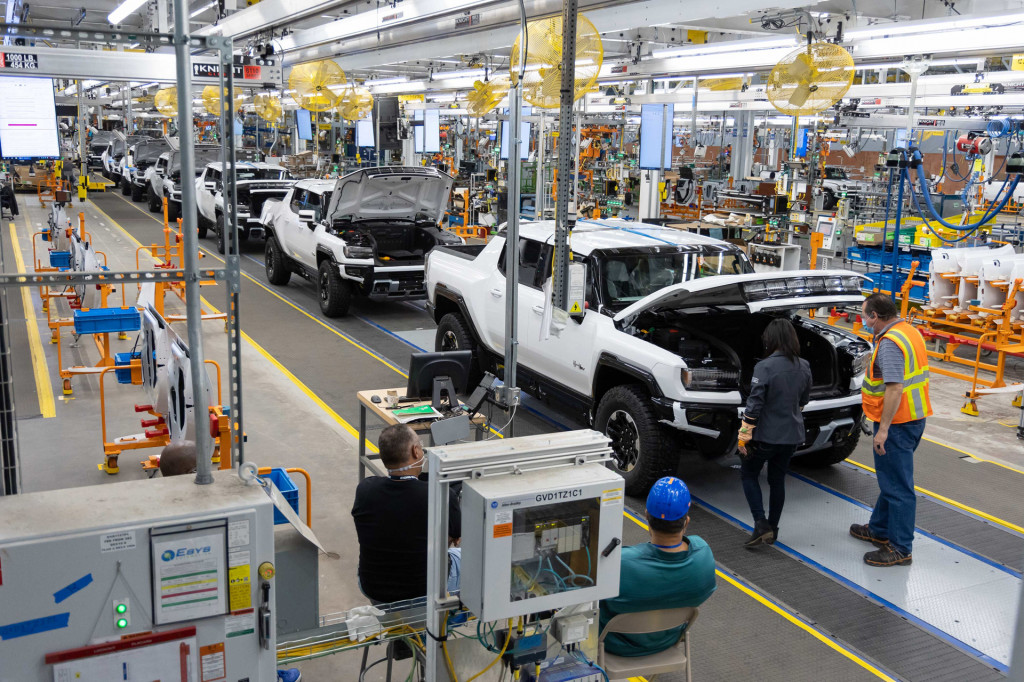
2022 GMC Hummer EV pre-production at Factory Zero plant in Detroit, Michigan

2022 GMC Hummer EV pre-production at Factory Zero plant in Detroit, Michigan

Michigan has gained nearly 20,000 new manufacturing jobs from EV investment, and it’s carved out the space for more with examples like the EV conversion of GM’s Lansing Grand River plant, otherwise in danger of closing, aided by $500 million of federal funds designated by the Biden administration. But the lack of positive ads mentioning this meant those gains and examples were largely unknown to voters in the state, the report concluded.

Uninformed Michigan voters may soon feel the consequences of their actions. The incoming Trump administration is likely to curtail EV investments. During the campaign, Trump reportedly offered to nix EV incentives in exchange for a $1 billion donation for Big Oil, and scrapping the federal EV tax credit is reportedly near the top of the agenda for his transition team. And while China’s CATL is willing to negotiate with Trump on a U.S. battery factory, his own party has drafted legislation to eliminate subsidies for batteries based on Chinese tech.


Source link

BYD Sealion 7 – experience and test drive the brand’s flagship EV SUV at The Exchange 106 this weekend

0


BYD Sealion 7 – experience and test drive the brand’s flagship EV SUV at The Exchange 106 this weekend

The BYD Sealion 7 made its Malaysian launch debut earlier this week and is currently available for public viewing and test drives at The Exchange 106 in Kuala Lumpur this weekend from November 15-17, 2024.

Arriving as a fully-imported electric vehicle (EV), the Sealion 7 is BYD’s fifth model to be launched here and comes in two variants. These include the Premium that retails for RM183,800 as well as the Performance at RM199,800.

In terms of powertrains, the base variant features a rear-mounted electric motor rated at 313 PS (308 hp or 230 kW) and 380 Nm of torque, which is good for a 0-100 km/h time of 6.7 seconds. Pay the extra for the Performance and you get an additional electric motor at the front providing 218 PS (215 hp or 160 kW) and 310 Nm.

The dual-motor, all-wheel drive setup has a total system output of 530 PS (523 hp or 390 kW) and 690 Nm that enables an even quicker century sprint time of 4.5 seconds. Both variants share the same lithium iron phosphate battery with an energy capacity of 82.56 kWh.

There is difference in terms of range, with the Premium offering as much as 567 km following the NEDC standard, while the Performance offers up to 542 km. As for charging, both support AC charging at 11 kW and DC fast charging at 150 kW, the latter enabling the battery to get from a 10-80% state of charge in 32 minutes.

As you can see in the spec sheet attached here, the Sealion 7 is well equipped regardless of which variant you go for. Highlights include a comprehensive suite of advanced driver assistance systems (ADAS), a 15.6-inch rotating touchscreen infotainment display, support for wireless Android Auto and Apple CarPlay, powered front seats, dual-zone climate control and a wireless charging pad.

BYD Sealion 7 specification sheet and price/warranty list; click to enlarge.

A few reasons why you should go with the Performance, aside from its higher outputs, are the larger 20-inch wheels (with 245/45 profile tyres) compared to the Premium’s 19-inch units (235/50 front and 255/45 profile tyres) and coloured front brake calipers.

If the Sealion 7’s features appear interesting to you, see the EV for yourself in-person at The Exchange 106 this weekend. Is this worth considering over its direct competitor, the Tesla Model Y? Share your thoughts in the comments below.

GALLERY: BYD Sealion 7 Premium Extended Range

GALLERY: BYD Sealion 7 Performance AWD

Looking to sell your car? Sell it with Carro.

Learn more:


Source link

2025 Nissan Kicks e-Power Malaysian review – too little, too late, or true-blue EV with zero range anxiety?

0


2025 Nissan Kicks e-Power Malaysian review – too little, too late, or true-blue EV with zero range anxiety?

Ladies and gentlemen, the Nissan Kicks e-Power. Ahead of the B-SUV’s launch next month (after what has seemed like an eternity) at the Kuala Lumpur International Motor Show (KLIMS) 2024, we’ve given you a full gallery and specs. Now that we’ve taken the car on a trip to Melaka and back courtesy of Edaran Tan Chong Motor (ETCM), it’s time to go deep.

Let’s start with size. The Kicks’ 4,290-mm length and 1,760-mm width place it between the Perodua Ativa and the Proton X50 in the horizontal sense, but its 1,605-mm height makes it as tall as the X50 and slightly taller than the Chery Omoda 5 and Honda HR-V. No beating the 1,635-mm tall boy Ativa, though. The Kicks’ 2,615-mm wheelbase just about equals the HR-V; in other words, between the X50 and O5.

Honey, I expanded the Almera? Quite – sharp edges all around, V-Motion face and squinting LED headlamps. I particularly like the side profile, with its ‘floating roof’, upswept C-pillar kink that’s sharper than the Almera’s, and the deep swage lines along the doors. Together with the connected LED tail lamps, roof rails and 17-inch five-spoke alloys wrapped in 205/55 Yokohama BluEarths, the Kicks is a sight for my sore eyes at least.

It’s Almera-like inside, too. You’ll recognise the flat-bottomed steering wheel (rake- and reach-adjustable), padded dashboard with contrasting-colour opportunities (brown here), eight-inch touchscreen, half-analogue-half-digital instrument cluster, circular air vents and single-zone auto air-con control panel, but of course here you get a stubby e-Power-specific gear lever, an electronic parking brake with auto hold, Drive Mode button and an EV mode switch.

It’s a nice place to be – I actually like the brown bits, which you’ll also find on the door cards and seats courtesy of the range-topping VLT, although mine could be an unpopular opinion in the face of Malaysians’ penchant for all-black interiors. The tops of the dashboard and door cards are hard plastic, but the brown padded bits go some way towards elevating the atmosphere.

In a time when car interiors are looking more and more like cinemas, the half-analogue-half-digital instrument cluster does unfortunately look old hat. The seven-inch unit’s graphics are fine, legible and fairly modern-looking, but it’s completely at odds with the big traditional speedo and its trip reset knob poking out of the glass, which reminds you of the Kicks’ age.

Fighting back the years are the very-intuitive touchscreen (with wired Apple CarPlay/Android Auto) and digital rear-view mirror (VLT only) – you turn the latter on simply by flicking the lever beneath, exactly as you do to dim a conventional mirror. This is a B-segment-first in Malaysia.

I find it a boon – the view is very wide-angle and won’t be blocked by D-pillars, rear passengers’ heads and luggage stored up to the roof. Even in heavy rain, although you would still need to operate the back wiper from time to time, you will see better than with a conventional mirror on the whole.

The manually-adjustable Zero Gravity front seats, while a little narrow on the thighs, are very supportive and comfortable. Also narrow is the centre console, being just wide enough to house dual cupholders (with two ‘floor’ settings to fit big and small cups) lengthwise. It follows that the armrest box is also narrow, and opening it reveals a shallow cubby that could probably only take a bi-fold wallet and some keys at best.

Back seat space is acceptable – no centre armrest nor rear air-con vents, but you do get two USB-A charging ports. The boot swallows a very respectable 423 litres; if you need more, the back seats fold 60:40, but the load floor is not flat and there’s quite a big protrusion on the floor where the seats split. Under the boot floor you’ll find a tyre repair kit instead of a spare tyre.

This is the facelifted first-gen Kicks that launched in Thailand over four years ago (you read that right and it’s not the new second-gen, no RHD nor e-Power for that yet), although Malaysia now gets the second-gen e-Power powertrain (updated for Japan, Thailand and Singapore in 2022), which increases the battery’s capacity from 1.57 to 2.06 kWh and the number of cells from 80 to 96.

Nissan says the second-gen e-Power powertrain is more compact, lighter and offers better performance. In the Kicks, which is the first e-Power model in Malaysia, a 1.2 litre three-cylinder engine acts purely as a generator to charge a 2.06 kWh battery that feeds a front-mounted 129 PS/280 Nm electric motor.

2025 Nissan Kicks e-Power Malaysian review – too little, too late, or true-blue EV with zero range anxiety?

It’s a series hybrid in the same vein as the Perodua Ativa Hybrid, the Mazda MX-30 R-EV and the BMW i3 REx. Since the petrol engine never drives the wheels, it’s an EV where propulsion is concerned. It’s an EV with zero range anxiety, but not zero emissions.

Indeed, the Kicks e-Power is very EV-like to drive – instant torque and silent progress. Around town, you really wouldn’t realise that the petrol engine has kicked in unless you’re keeping an eye on the instrument cluster – there are next to no vibrations despite it being a three-cylinder. You’d really have to perk up your ears to hear just a muted hum. Of course, the engine wake-up is more discernible when you’re waiting at the lights, but overall, refinement levels are very high.

I said it feels like an EV to drive, didn’t I? But it can also feel like an ICE vehicle in some respects – bear with me. You know when you give a CVT vehicle the beans, you hear the engine first before vehicle speed catches up? Well, it’s uncannily the opposite here. Floor it and the EV-like instant torque shoves you forward, but a split second later you hear the engine, and the revs correspond very closely to throttle position (very ICE-like) as it toils to charge the battery based on your right foot’s demand.

2025 Nissan Kicks e-Power Malaysian review – too little, too late, or true-blue EV with zero range anxiety?

I must reiterate here that at no point is engine operation intrusive or rough in the slightest. This is undoubtedly the Kicks e-Power’s top strength – its quietness. Even at speed, I can only stop short of saying there’s zero road and wind noise, lest someone brings out a NASA-grade decibel meter to prove me wrong.

A 0-100 km/h time of 9.5 seconds is all well and good; what’s perhaps more impressive is its mid-range acceleration of 100-120 km/h in four seconds flat. Indeed, when you ask for more power at highway speeds, the Kicks e-Power simply complies, the speedo needle climbing relentlessly in a manner you wouldn’t expect from a 129 PS/280 Nm car.

Let’s talk modes. Besides Normal, there are Eco and Sport which influence throttle response and increase regen braking (Normal has the least amount of regen). Funnily enough, EV mode, which tells the engine not to wake up, can only be engaged when you’re in Eco or Sport, but due to the small battery, you’ll only manage at best 2.5 km of zero-emissions driving given a constant 40 km/h and a full battery.

Since the system always tries to keep the battery’s state of charge between 20% and 80%, how do you maximise EV-only driving? Well, there’s a hidden Charge mode, accessible by holding the EV mode switch for two seconds. The engine will then come alive and stay alive until it has fully charged the battery.

The ride is on the comfortable side of stiff, while handling, although the Kicks is light on its feet, is perhaps par for the course. The e-Pedal Step is unlike the Leaf’s in that the car will slow to a creep instead of coming to a complete stop when you get off the throttle.

Standard safety equipment includes seven airbags, AEB and Intelligent Driver Alertness – the top VLT spec adds adaptive cruise control (VL gets normal cruise control), a 360 camera, blind spot warning and rear cross traffic alert. Warranties? Five years/100,000 km for the vehicle and eight years/160,000 km for the battery, ECU, inverter and electric motor.

2025 Nissan Kicks e-Power Malaysian review – too little, too late, or true-blue EV with zero range anxiety?

Nissan touts an NEDC figure of 21.7 km/l and a max range of 900 km on a 41-litre tank of petrol. From Petaling Jaya to Melaka, 15 cars covered 231 km solely on trunk roads and were rebrimmed at the destination. The drive was quite spirited with a fair bit of overtaking, and the median car took 13.99 litres of petrol, corresponding to 16.5 km/l. It was half-B-road, half-highway on the way back, and although we did not rebrim the cars this time, my readout hovered around 15 km/l in spite of a good turn of speed on the highway.

All in all, it’s not going to be a breeze for ETCM’s first all-new model in four years. Even before we single out the hybrid rivals (upcoming Toyota Corolla Cross Hybrid RM140k estimated, Honda HR-V e:HEV RM142k, Haval H6 HEV RM140k), the B-SUV market is a very red ocean, with some C-SUVs eating into the pie as well (Proton X70 RM99k-127k, Chery Tiggo 7 RM124k, Jaecoo J7 2WD RM139k).

And these are all CKD. Our Nissan Kicks e-Power is going to come CBU from Thailand. But who knows – if ETCM can somehow get the all-important pricing right, this car could just be the viable quiet, comfortable and good-looking alternative the market needs.

Nissan Kicks e-Power VLT Malaysia drive gallery

Nissan Kicks e-Power VLT two-tone in Malaysia full gallery

Nissan Kicks e-Power VLT two-tone in Malaysia showroom

Nissan Kicks e-Power VL in Malaysia showroom

Looking to sell your car? Sell it with Carro.

Learn more: Nissan Kicks P15


Source link

Italian company to debut quad-turbo V-12 creation in 2025

0


A startup company based in Modena, Italy, came out of the woodwork this week with a teaser video promising something new on May 22, 2025.

The company is called Giamaro, and its video doesn’t show anything car related apart from confirming a quad-turbocharged V-12. It also states that a “formidable power is coming,” likely referring to the engine’s output.

Given the company’s base in Modena, often nicknamed Italy’s supercar valley, due to the proximity of Italian performance houses such as Ferrari, Lamborghini, Maserati, and Pagani, it’s safe to assume Giamaro’s engine will end up in a supercar of some sorts, though as Ferrari has shown with the Purosangue, a V-12 is just as at home in an SUV as it is in a supercar.

There aren’t many models with V-12 engines left, let alone ones with quad-turbocharging systems. However, Giamaro won’t be the only company with a modern quad-turbocharged W-12. Danish hypercar marque Zenvo last year unveiled the Aurora powered by a quad-turbocharged 6.6-liter able to deliver 1,250 hp on its own. However, in the Aurora, the engine is paired with a hybrid system taking output to 1,450 hp in a track-focused Agil version and 1,850 hp in a Tur grand-touring version.

Giamaro also won’t be the first company out of Modena to offer a quad-turbocharged V-12. Before it was bought by the Volkswagen Group in the late 1990s, Bugatti was based in Modena and was building the EB110 powered by quad-turbocharged 3.5-liter V-12. The EB110 engine delivered 592 hp in its most powerful form, and was replaced by the famous quad-turbocharged 8.0-liter W-16 engine in the EB110’s Veyron successor.


Source link

New Audi A5 launched as proper sedan in China

0


  • Audi A5L launches at 2024 Guangzhou auto show
  • The A5L is a long-wheelbase A5 with a conventional trunk lid
  • A5s bound for the U.S. feature a liftback design

The new Audi A5 that goes on sale next spring as the replacement for both the current A5 Sportback and gas-powered A4 is referred to by Audi as a sedan, but that’s a misnomer, as the car is actually a hatchback—where a sloped rear window and trunk lid open together as one element.

There is a proper sedan version of the new A5 coming, though only for China, where it will be sold as the A5L. The debut took place on Friday at the 2024 Guangzhou auto show.

The A5L is a long-wheelbase variant of the new A5 family, but instead of the liftback of the regular A5, the A5L has a fixed rear window, leaving only the trunk lid to open. The roof line is also less curved, resulting in more headroom for rear-seat occupants. Audi did the same with an A7L that was launched in China three years ago.

The A5L has a wheelbase of 116.7 inches and an overall length of 193 inches. The regular A5 has corresponding numbers of 114.1 and 190.1 inches. Most of the extra length benefits rear-seat passengers with more generous legroom, something that’s important in China where long-wheelbase vehicles are typically used for chauffeur services.

2025 Audi A5 L (China spec)

2025 Audi A5 L (China spec)

2025 Audi A5 L (China spec)

2025 Audi A5 L (China spec)

2025 Audi A5 L (China spec)

2025 Audi A5 L (China spec)

The A5L will be built in China by Audi and local partner FAW.

The new A5 also comes with a wagon body style, though Audi hasn’t announced whether any of the wagons, a body style Audi calls an Avant, will make it to the U.S. The current A5’s coupe and convertible body styles won’t make a return with the new generation.

The Guangzhou auto show runs until Nov. 24. Audi also used the event for the launch of its new China-only AUDI brand. The brand (all caps, and minus the four-ring logo) will focus on electric vehicles designed to meet the need of Chinese customers, particularly in the area of connectivity and automated driving technology. At least three vehicles will be launched by AUDI starting from mid-2025, and a concept in Guangzhou hints at what’s to come.


Source link