Home Blog Page 374

Art Works Gallery Welcomes Visitors to the Perception Exhibition

0


Photo: Jaya Khidir

Leading contemporary art investment gallery Art Works, is where breathtaking artistry converges with a broadening global reach. In showcasing up and coming artists, handpicked and curated by Global Fine Arts Director Cassi Young, Art Works brings new perspectives, nurtures promising creative forces and gives new life to art beyond the emerging artists. Located at One Holland Village, Art Works Gallery continues its visionary mission to support the promising careers of exceptional young talents with an upcoming exhibition dubbed “Perception” — featuring the likes of London-based artists Araminta Blue, Callum Harvey and Max Boyla.

That being said, LUXUO had the opportunity to attend the opening night of Art Works Gallery’s “Perception” exhibition, along with Cassi Young and her dedicated Art Works team, featured artist Araminta Blue and over 80 of Singapore’s knowledgeable art collectors. The sophisticated space was abuzz with discussion amongst mingling guests and the walls spotted with the spectacular works of none other than young talents, Araminta Blue, Callum Harvey and Max Boyla. The skilled brushstrokes of the visionaries were put on display to showcase their distinct response of how they articulate reality through their unique practice and challenge conventional notions of form, space and meaning.

Photo: Jaya Khidir

A panel discussion was held with Art Works global fine arts director Cassi Young and featured artist Araminta Blue, hosted by Heart Media CEO Olivier Burlot. With experience as the former Director of Post-War & Contemporary Art at Bonhams, Cassi Young’s unparalleled expertise is a huge asset in meeting the rapidly growing demand for fine art in Singapore and APAC markets. Young’s insightful advice to individuals looking to start collecting — she stressed the importance of being well researched as well as speaking to knowledgeable art advisors to fully immerse oneself in the art world and to navigate the multi-dimensional world of art.

Araminta shared insights into her creative process, highlighting her passion for discussing different interpretations with those who view her art. She mentioned how these conversations inspire her future projects. Additionally, she elaborated on her conversation with the two other featured artists Callum Harvey and Max Boyla, all of whom placed much importance having the art “exist in the room with you”. In admiring the material in person, it is easier for individuals to establish an emotional connection with it.

Perception will run from 24 October to 24 November 2024 at Art Works Gallery, One Holland Village, 7 Holland Village Way, Singapore.

Visit artworks.com.sg for more information.

For more on the latest in art and culture reads.


Source link

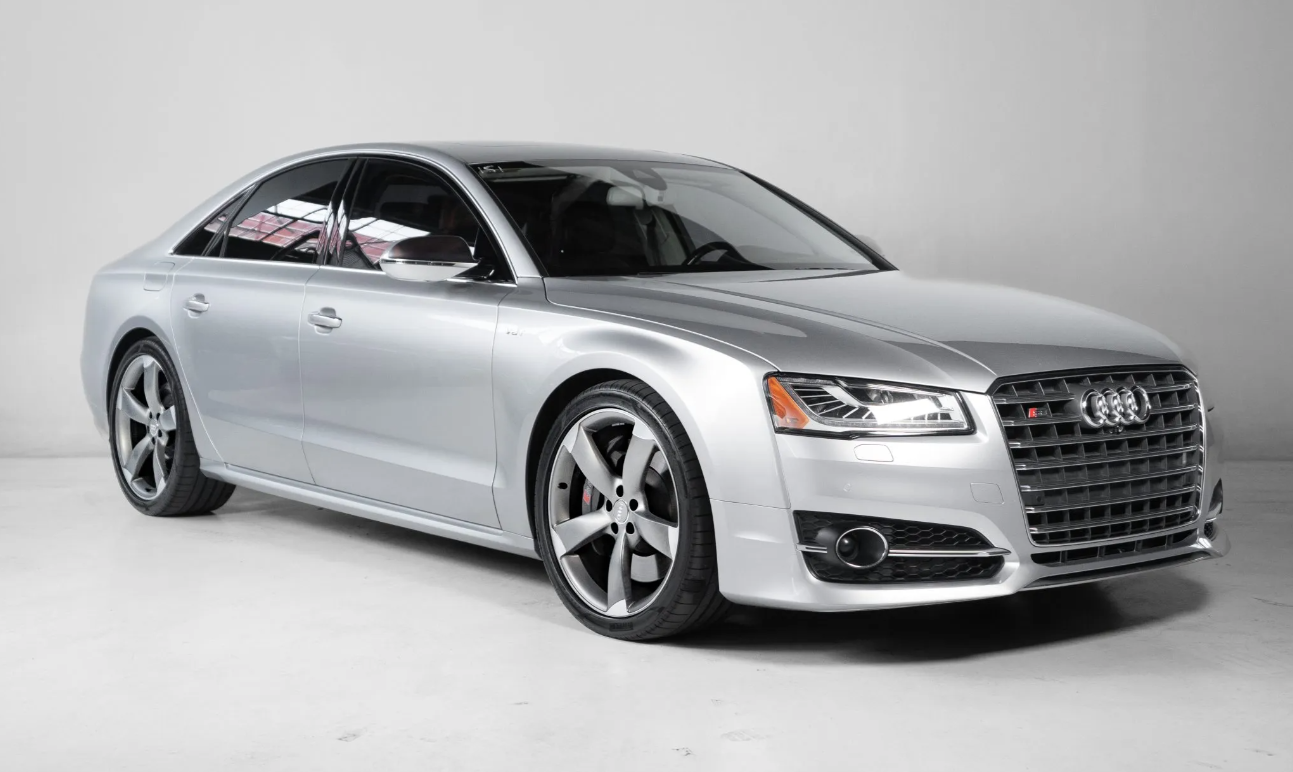
Audi S8 Third Generation (D4; 2012 to 2018) Buyers Guide

0


When the Audi S8 3rd Generation (D4; 2012–2018) was introduced, it was the next step in the evolution of Audi’s performance luxury sedan. Launched in 2012, the D4 S8 brought a refined yet aggressive presence to the luxury segment, focusing on delivering exhilarating performance without sacrificing comfort.

At the heart of the D4 S8 lies a potent 4.0-liter twin-turbocharged V8 engine, producing 512 hp and 479 lb-ft of torque. This engine mated to an 8-speed automatic transmission, propelled the S8 from 0 to 60 mph in just 4.1 seconds, making it one of the fastest sedans of its time. Audi’s Quattro all-wheel-drive system also ensured exceptional grip and handling, even in challenging driving conditions.

The engine also featured cylinder deactivation, allowing the S8 to operate more efficiently during lighter driving, adding a layer of fuel economy to its performance credentials.

The exterior design of the S8 is sleek, understated body features subtle yet aggressive enhancements, including larger air intakes, quad exhaust outlets, and signature LED headlights that give the car a sharp, modern look. With aerodynamic profile and lightweight aluminum construction not only improved performance but also contributed to a smooth, confident ride at high speeds.

In the 2015 facelift, Audi further refined its appearance with a sharper front grille and updated Matrix LED headlights, enhancing its visual appeal.

Inside, the S8 cabin was a showcase of fine craftsmanship, featuring leather upholstery, carbon fiber or wood inlays, and a sophisticated MMI (Multi Media Interface) system. Audi’s Virtual Cockpit and a heads-up display provided the driver with essential information in a clear, intuitive layout.

Comfort wasn’t overlooked either, as the S8 offered adjustable sport seats with memory functions, along with an optional Bang & Olufsen sound system for an immersive audio experience.

Throughout its production run, the Audi S8 competed in the high-performance luxury sedan segment against other rivals. Notable competitors included the BMW 7 Series M760Li, and Mercedes-AMG S63.

While each of these vehicles brought its own strengths to the table, the Audi S8 distinguished itself with its combination of all-wheel-drive capability, and twin-turbo V8 power making it an exciting choice for enthusiasts.

Model Changes (Breakdown by Year)

2012 Audi S8

The Audi S8 3rd Generation made its debut in 2012, based on the D4 A8 platform. Powered by a 4.0-liter twin-turbocharged V8, it produced 512 hp and was paired with an 8-speed automatic transmission and Audi’s Quattro all-wheel-drive system. This combination allowed the S8 to accelerate from 0 to 60 mph in just 4.1 seconds, showcasing its performance credentials.

One of the key innovations of the S8 was Audi’s cylinder-on-demand (COD) system, which improved fuel efficiency by deactivating half of the engine’s cylinders under lighter loads. The car also featured adaptive air suspension, dynamic steering, and a sport-tuned chassis, providing a balanced ride between comfort and performance.

Visually, the S8 had subtle yet aggressive styling, with larger air intakes, quad exhaust outlets, and signature LED headlights. Inside, it offered a luxurious interior with leather upholstery, carbon fiber trim, and Audi’s latest MMI infotainment system, maintaining a refined environment for both driver and passengers.

The starting price for the 2012 Audi S8 was approximately $110,000.

2013 Audi S8

The 2013 Audi S8 carried over largely unchanged from its debut year.

The starting price for the 2013 Audi S8 remained the same as the previous year at around $110,000.

2014 Audi S8

The 2014 Audi S8 saw no major mechanical or visual changes for the year 2014. 

The starting price for the 2012 Audi S8 was approximately $112,500.

2015 Audi S8

In 2015, Audi gave the S8 a mid-cycle facelift, refining its design for a more modern and sophisticated look. The front fascia was updated with a new single-frame grille, sharper LED Matrix headlights, and revised air intakes, giving the car a more aggressive stance. At the rear, updated taillights and quad exhaust tips.

Along with the design changes, Audi also tweaked the engine slightly, boosting its power output to 520 hp, while torque remained the same at 479 lb-ft.

The 2015 model also introduced updates to its technology, particularly in driver assistance systems. Improvements included enhanced active lane assist, adaptive cruise control, and new safety features such as night vision assist and Audi pre-sense, all aimed at making the S8 safer and more advanced in terms of driving assistance.

The starting price for the 2014 Audi S8 was approximately $112,500.

2016 Audi S8

In 2016, Audi introduced a more powerful variant of the S8, known as the S8 Plus. This version came with 605 hp and 553 lb-ft of torque, with the option of boosting to 590 lb-ft with an over-boost function. With this added power, the S8 Plus could accelerate from 0 to 60 mph in just 3.7 seconds, making it one of the quickest sedans available at the time.

The top speed of the S8 Plus was electronically limited to 155 mph, but with the optional Dynamic Package, it could reach 190 mph. This variant also featured several exterior enhancements, including carbon-fiber accents, black exterior trim, and sportier styling with unique 21-inch wheels. 

The quad exhausts and aggressive rear diffuser further set it apart from the standard S8.

Inside, the S8 Plus offered upgraded materials, including exclusive leather and Alcantara finishes, along with additional carbon-fiber inlays. 

The starting price for the 2016 Audi S8 Plus was approximately $115,825, with the S8 Plus variant priced higher at around $128,500.

2017 Audi S8

The 2017 Audi S8 saw no major mechanical or visual changes for the year 2017. 

The starting price for the 2017 Audi S8 was approximately $116,850 in the U.S. market. However, by 2017, Audi had largely shifted focus to the S8 Plus variant, which started at around $128,700.

2018 Audi S8

The 2018 model marked the final year of production for the D4 generation of the Audi S8. As Audi prepared to transition to the next-generation S8, no major updates were introduced for this model year. 

The starting price for the 2018 Audi S8 Plus was approximately $116,875.

Audi S8 3rd Generation Common Problems

The 3rd Generation Audi S8 (2012–2018) has its share of common problems. These issues can affect various parts of the vehicle, including the engine, suspension, and electronics. Being aware of these potential issues can help owners maintain their S8 and avoid costly repairs. Below are some of the most common problems associated with the S8, ranging from turbocharger failures to electrical malfunctions.

Keep in mind, that it is essential that all cars, even supercars, can have issues and it is crucial to perform a Pre-Purchase Inspection (PPI) from an authorized dealer or experienced independent mechanic to reveal all issues.

Turbocharger Failure: This can occur due to oil starvation or leaks, causing significant loss in engine power and potentially leading to engine damage. Repairs can be expensive due to the labor-intensive nature of replacing the turbochargers.

Carbon Build-Up: The direct injection system tends to accumulate carbon deposits on the intake valves, which may result in misfires, poor fuel economy, and rough idling. Regular carbon cleaning is recommended to prevent this issue.

Air Suspension Problems: The S8’s adaptive air suspension system is prone to leaks and compressor failures over time. When the air suspension fails, the car may drop to its lowest height, affecting ride quality and necessitating costly replacements of suspension components.

Electrical Malfunctions: The Audi S8 is equipped with numerous electronic systems, and failures can occur in the infotainment system, sensors, or modules. Common problems include malfunctioning backup cameras, navigation systems, or random electrical faults, which can be difficult to diagnose and repair.

Brake Wear: Due to the high performance of the S8, brake components such as pads and rotors tend to wear faster than in regular vehicles. Owners report frequent replacements, especially if the car is driven aggressively.

Recalls

2013 to 2017 Audi S8 vehicles

Engine and engine cooling (Recall no. 22V178000)

The turbocharger oil supply strainer can become blocked, causing wear to the bearings due to lack of lubrication. Worn bearings can cause the turbine wheel to contact the turbocharger housing or cause the shaft to break, causing an engine stall and increasing the risk of a crash.

2013 to 2018 Audi S8 vehicles

Structure (Recall no. 20V397000)

The seal around the engine compartment may come loose and contact hot engine components. If the seal contacts hot engine components, there could be an increased risk of a fire.

2013 to 2016 Audi S8 vehicles

Fuel system, gasoline (Recall no. 19V057000)

The fuel supply line for the high pressure fuel pump may become porous and leak fuel. Leaking fuel, in the presence of an ignition source, increases the risk of fire.

2013 to 2015 Audi S8 vehicles

Fuel system, gasoline (Recall no. 18V430000)

The fuel supply line for the high pressure fuel pump may become porous over time, resulting in a fuel leak. A fuel leak in the presence of an ignition source can increase the risk of a fire.

2013 to 2014 Audi S8 vehicles equipped with a standard sunroof, manufactured March 12, 2013, through July 15, 2013

Visibility (Recall no. 13V448000)

These vehicles are equipped with a standard sunroof glass panel that may shatter. Should the sunroof’s glass break while the vehicle is in use, the falling glass could injure the driver or passengers. It could also distract the driver, increasing the risk of a crash.

Maintenance and Ownership Costs

Compared to other high-performance luxury sedans, owning an Audi S8 3rd generation is generally considered manageable in terms of maintenance costs, though it remains a premium vehicle. Routine maintenance, such as oil changes, tire rotations, and brake servicing, is crucial to keeping the car running smoothly, and costs can vary depending on whether you choose a dealership or an independent mechanic for service. 

It is important to remember that regular maintenance and repairs will still be necessary, and the costs can vary depending on whether you take your car to a dealer or an independent mechanic.

Here are the suggested service schedule and intervals per Audi:

Every 5,000 MILES

  • Rotate tires.
  • Change oil and filter.

Every 15,000 MILES

  • Perform comprehensive checks and replacements.
  • Battery service.
  • Fuel filter replacement.
  • Door lubrication.
  • Cabin air filter replacement.

Every 25,000 MILES

  • Continue with regular oil and filter changes to ensure engine health.

Every 35,000 MILES

  • Conduct more in-depth maintenance.
  • Lubricating the hood hinge.
  • Servicing battery/cables.
  • Transmission fluid service.
  • Replacing the cabin air filter.

Here is a rough estimate of typical service costs associated with the Audi S8:

  • Oil Change – For oil changes at independent shops you can expect to pay $200 to $250, while dealerships may charge $300 to $400.
  • Minor Service – Minor services, which include fluid checks, tire rotation, and inspections, typically range from $500 to $800. These are generally recommended every 10,000 miles.
  • Major Service – A major service, required around every 40,000 miles, involves more in-depth inspections, filter replacements, and sometimes spark plug replacements, costing around $1,500 to $3,000.
  • Tires – Replacement tires such as Michelin Pilot Super Sport can range from $2,000 to $2,500 for a set of four.
  • Brakes – Brake pad replacements cost between $600 to $1,000, with rotor replacements adding another $1,200 to $1,500. Carbon ceramic brakes should not require any replacement. 

Options List

When selecting options for the 3rd Generation Audi S8, buyers have several packages to choose from.

The Dynamic Package is a standout for performance enthusiasts. It includes carbon-ceramic brakes, offering superior stopping power, and raises the top speed to 190 mph, making it a popular choice for those who want the ultimate handling experience. The precision and durability of these brakes are particularly advantageous for high-speed driving and spirited performance.

For audiophiles, the Bang & Olufsen Advanced Sound System is a premium option that transforms the cabin into a concert hall on wheels.

With 1,400 watts of power distributed through 19 speakers, this system delivers impeccable audio quality, ensuring an immersive and crystal-clear listening experience whether you’re driving or stationary. The design of the speakers, with pop-up tweeters on the dashboard, also adds a luxurious touch to the cabin.

When it comes to comfort, the Comfort Seating Package is a must-have for long drives. This package includes 22-way power-adjustable seats with ventilation and massage functions, ensuring that both the driver and passengers can enjoy maximum comfort during long journeys. The seats are designed to reduce fatigue, making the S8 a suitable choice for extended trips or everyday commuting.

For added safety and convenience, the Driver Assistance Package incorporates advanced driving aids, including adaptive cruise control, Audi pre-sense, active lane assist, and night vision assist. These features enhance driver confidence by making the vehicle more intuitive and safer to operate in a variety of driving conditions, including nighttime and highway driving.

In terms of aesthetics, the Black Optic Package is ideal for those looking to give the S8 a sportier, more aggressive appearance. This package includes gloss black accents, 21-inch wheels, and darkened trim elements that create a bold, stealthy look. These visual enhancements not only add to the car’s appeal but also give it a distinct presence on the road.

Choosing the right combination of these options can significantly enhance the driving experience of the 3rd Generation Audi S8, making it an excellent blend of performance, luxury, and technology tailored to individual preferences.

2017 Audi S8 Options List (Includes Audi A8)

Key Options

  • Dynamic Package
  • Comfort Seating Package
  • Bang & Olufsen Advanced Sound System
  • Driver Assistance Package
  • Black Optic Package

Audi S8 3rd Generation Price and Values

The Best Audi S8 3rd Generation to Buy

When it comes to choosing the best 3rd Generation Audi S8 (2012–2018), the 2016 Audi S8 Plus stands out as the top pick. 

This model year saw the introduction of the S8 Plus, offering a substantial performance boost with a 605 horsepower engine, 553 lb-ft of torque (with an available over-boost to 590 lb-ft), and the optional Dynamic Package, which raised the top speed to 190 mph.

The S8 Plus also included exclusive features like carbon-ceramic brakes and a sportier design with black exterior accents and 21-inch wheels, which enhanced its aggressive styling and driving dynamics.

In addition to its outstanding performance, the 2016 S8 Plus benefits from Audi’s incremental updates throughout the 3rd generation, including advanced driver assistance technologies such as adaptive cruise control, active lane assist, and night vision assist.

Inside, the S8 Plus boasts upgraded materials, including exclusive leather and Alcantara finishes, along with an optional Bang & Olufsen Advanced Sound System, providing an immersive audio experience.

When evaluating the best version of the 3rd Generation S8, it’s crucial to consider factors such as mileage and maintenance history. 

Low-mileage models that have been well-maintained and serviced regularly are more likely to retain their value and offer long-term reliability. It’s also important to check for any records of significant repairs or replacement of wear-prone components, such as the air suspension or turbochargers, which are known to be areas of concern for these vehicles.

Conclusion

In summary, the 3rd Generation Audi S8 (2012–2018) is an excellent choice for those seeking a high-performance luxury sedan. With a starting price in the range of $30,000+, the S8 is a lot of car for the money. 

Its powerful twin-turbo V8, adaptive air suspension, and available performance options like the S8 Plus, make it stand out in its class.

While competitors like the BMW M760Li and Mercedes-AMG S63 are around, the S8 stands out with quattro all-wheel-drive handling and sleek, understated styling. For those who value luxury and performance, the Audi S8 remains an excellent option in the performance luxury segment.

Car Hacking Shortcuts

  • 2016 to 2018 models are good hacks

  • Go for S8 Plus

  • Look for fully loaded S8 models with options like the Dynamic Package, Bang & Olufsen Sound System, and Driver Assistance Package for maximum value.

  • Prioritize well-maintained, low-mileage models


Source link

Throwback: Blue Shark Attack – The LB Works Aventador

0


2024 Intro

Think supercar wide-body kits and one name springs to mind: Liberty Walk.

While the Nagoya-based company got its start more than 30 years ago, it’s been over the last decade that Liberty Walk has become a household name in the car community. That’s no surprise, given its founder’s penchant for cutting up rare cars for overfender conversions. Wataru Kato definitely doesn’t do things by halves.

Ten years ago, Dino and Larry teamed up to shoot Liberty Walk’s then-newest creation a couple of days before the 2014 SEMA Show. For this week’s throwback post, we’re revisiting that feature of the first LB Works Lamborghini Aventador.

larry_chen_speedhunters_liberty_walk_lamborghini_aventador-2

2014 Feature

Welcome to Kato-san’s latest middle finger to the world of motoring. Now, you couldn’t possibly think that we’d pass up an opportunity to shoot the LB Works Lamborghini Aventador once it landed in the US, right? A few days before the car’s unveiling at the SEMA Show – where it’s currently the centerpiece of the Forgiato Wheels booth – we met up with the Liberty Walk crew to take a look at yet another one of their creations that is bound to generate as much love as it will hate.

After seeing it spit fat flames in the video above, we couldn’t wait to take in the latest installment of Liberty Walk style. After all, it’s not every day that someone takes an angle grinder to Lamborghini’s flagship supercar.

larry_chen_speedhunters_liberty_walk_lamborghini_aventador-3

So Larry set a date with the car during an overcast afternoon in California right before it was pointed toward the Las Vegas Convention Center.

larry_chen_speedhunters_liberty_walk_lamborghini_aventador-4

We’ve seen enough of Kato’s creations in the last couple of years to know exactly what the recipe is, so I won’t dwell on this too much and instead just give you a quick summary of the process.

larry_chen_speedhunters_liberty_walk_lamborghini_aventador-25

It all begins with Kato picking a suitable base for the transformation. The Aventador has been in line for the LB Works treatment from the moment Lamborghini released it into the wild, but at this year’s SEMA Show, you’ll also find Kato’s signature style applied to the Porsche 997 and BMW 4 Series. Kato then sits down with his designer and comes up with the most suitably-styled set of overfenders and various other accents before sending the concepts off to our good friend Miura-san at TRA Kyoto.

larry_chen_speedhunters_liberty_walk_lamborghini_aventador-43

The Crazy Bunny then gets busy – first digitally mapping the exterior of the base car with a prohibitively expensive laser scanner, and then working his magic in CAD over the 3D image to translate the designs into CNC machine speak. Hitting print then creates the moulds for the moulds. FRP production is outsourced, and the parts are ready to be fitted in about a week. Of course, there is much more work to it, but like I’ve said, I’m just touching on the main parts of the process here.

larry_chen_speedhunters_liberty_walk_lamborghini_aventador-6

Kato and his crew built the Aventador at the LBW body shop in the outskirts of Nagoya and only finished the car the night before it was due to be put in a container and shipped Stateside.

larry_chen_speedhunters_liberty_walk_lamborghini_aventador-18

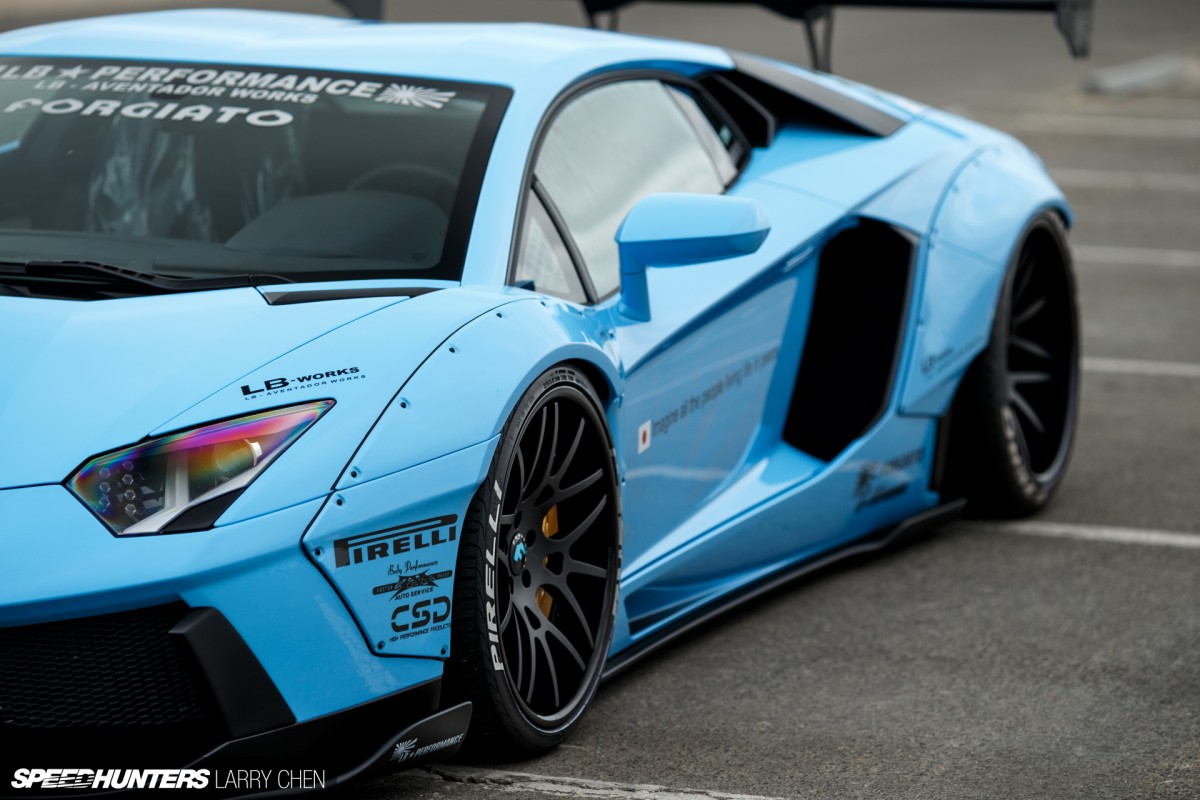
The color alone makes this car stand out even more than it should; the light metallic ‘Shark Blue’ contrasts with matte black additions along the way. Take the front end, for example, the Aventador’s jagged nose is emphasized with an aggressive lip spoiler that replaces the lower and cut-out section of the stock bumper and protrudes well beyond the dimensions of the car to extend the lower section of those massive side intakes.

larry_chen_speedhunters_liberty_walk_lamborghini_aventador-38

Additional side splitters create a layered look, curving upwards around the corners of the bumper.

larry_chen_speedhunters_liberty_walk_lamborghini_aventador-9

The overfender treatment begins at the front, where the two-piece blistering is bolted down onto both the stock bumper and fenders. These pieces follow Lamborghini’s angular design language pretty well, which is the only way that you can get away with doing something like this to a supercar of this pedigree.

larry_chen_speedhunters_liberty_walk_lamborghini_aventador-22

The front bumper finisher draws a parallel with the slant that creates the bumper side intakes, while the fender section itself lines up with the door line, creating a well-integrated addition.

larry_chen_speedhunters_liberty_walk_lamborghini_aventador-7

Now, to the stuff that will make purists cringe. Yes, the stock fenders need to get cut – a little at the front, but quite a lot at the rear…

larry_chen_speedhunters_liberty_walk_lamborghini_aventador-15

This is so the intimidating offset of the wheels allows them to sit just right within the 30mm widening that each front overfender creates.

larry_chen_speedhunters_liberty_walk_lamborghini_aventador-16

When the project was still in its planning stage, Kato called in the help of Forgiato, who was more than happy to jump on board and spec up a custom set of rims for the Aventador. Forgiato’s deeply concave and split-spoke Maglia ECL design was chosen for its sporty appearance and prepped in 20×9-inch sizing for the front with a carefully measured and thought about offset of -7. The rear wheels are a whole lot bigger again, but we’ll get to those in a moment.
larry_chen_speedhunters_liberty_walk_lamborghini_aventador-17

The factory carbon-ceramic brakes were left alone – they’re a great package that just doesn’t need to be messed with.

larry_chen_speedhunters_liberty_walk_lamborghini_aventador-10

Given a need for the slammed look that Liberty Walk cars are always known for – but also having the requirement for on-road drivability – the stock Öhlins suspension was replaced with AirRex air suspension. Yes, I can hear some collective cringes, but like we have touched on before, Kato and his crew simply don’t care. They are out to achieve a look, a style and a way of doing things that sets them apart from every other Lamborghini or supercar owner out there.

larry_chen_speedhunters_liberty_walk_lamborghini_aventador-8

The whole point here is to create a unique look – one that is only available and acceptable to a few people around the world.

larry_chen_speedhunters_liberty_walk_lamborghini_aventador-41

It’s the only way they are able to drive a Lamborghini, or a Ferrari, or a BMW – yet be able to differentiate themselves from owners that may only go as far as replacing the wheels.

larry_chen_speedhunters_liberty_walk_lamborghini_aventador-24

When the car is dumped as low as it will go, you can see why there was a need to cut a sizeable chunk of metal away from the fenders.

larry_chen_speedhunters_liberty_walk_lamborghini_aventador-14

There is simply no other way that the Forgiato wheels would otherwise clear the bodywork. At the rear the Aventador is 70mm wider on each side, with massive 21×13-inch -20 wheels filling up the newfound girth.

larry_chen_speedhunters_liberty_walk_lamborghini_aventador-11

Like the Aventador needed extra girth, right?

larry_chen_speedhunters_liberty_walk_lamborghini_aventador-27

But you just have to take it as it comes, served up with a nice, loud, happy dose of laughter from Kato himself.

larry_chen_speedhunters_liberty_walk_lamborghini_aventador-26

This is one guy that knows not to follow the mainstream. In fact, he keeps as far away from it as he can, which is precisely what has allowed this little shop from Japan to have such a big impact on car culture the world over.

larry_chen_speedhunters_liberty_walk_lamborghini_aventador-33

Coherence and continuity is important in giving a sense of flow to a specific car, or in this case – aero kit, so accent pieces like the underskirt boards that gently curve upwards as they meet the rear fenders are a much-needed addition that seem to work so well.

larry_chen_speedhunters_liberty_walk_lamborghini_aventador-19

It sort of makes you wonder why Lamborghini doesn’t go for touches like these itself!

larry_chen_speedhunters_liberty_walk_lamborghini_aventador-20

And as if the widened rear end wasn’t enough, there was a need to really give the Liberty Walk Aventador a works racecar feel. And what better way to do so than with a carbon fiber GT wing mounted on a pair of stays that sprout out from the very center of the rear bumper.

larry_chen_speedhunters_liberty_walk_lamborghini_aventador-40

Kato isn’t saying if this wing is functional or not, but something tells us that he’ll be testing its performance worth at the first opportunity he gets!

larry_chen_speedhunters_liberty_walk_lamborghini_aventador-29

To help bring that rear end closer to the ground, four of the fins on the stock diffuser have been extended with elongated sections and then connected with a sub-diffuser – effectively giving a second layer to the extremities. But what everyone is going to be looking at back there is the squared pipes of the quad-exit Armytrix exhaust system.

larry_chen_speedhunters_liberty_walk_lamborghini_aventador-21

We have seen and heard this in action but we really need to talk more about it as it’s quite an impressive piece of art – not to mention the only performance upgrade that the car is actually fitted with. Not that this 700hp V12 machine is short on performance though! The system completely replaces the stock exhaust from the manifolds down, first taking the place of the twin downpipes with ceramic-coated (and de-cat’d) titanium replacements, just to make sure the frequencies the V12 produces aren’t muted in any way.

larry_chen_speedhunters_liberty_walk_lamborghini_aventador-5

The rest of the system then entails a complex series of intricate curves of hand-welded, aero-grade titanium pipes that either channel exhaust gasses straight out through those quad tail pipes – hence the afterburner-like fire show – or into a small silencer which quietens things down a little, just so you don’t scare too many people on the road. The exhaust gas route is decided by a pair of valves, which are either controlled manually with a switch on the key fob, or programmed to open at a specific RPM, just like the stock Lamborghini system does from factory.

larry_chen_speedhunters_liberty_walk_lamborghini_aventador-31

The complete system liberates an additional 35.2hp and boosts torque marginally. However, the number that makes the biggest difference is the actual weight saving. The whole system hits the scales at 7.77 kg to shave off a substantial 28.23kg.

larry_chen_speedhunters_liberty_walk_lamborghini_aventador-28

Then, of course, there’s the noise. Did we mention the noise?

larry_chen_speedhunters_liberty_walk_lamborghini_aventador-34

Seeing the level of trim, fit and finish inside, it was deemed unnecessary to add any custom touches to the well-appointed cabin.

larry_chen_speedhunters_liberty_walk_lamborghini_aventador-37

Stock, it’s still a very special place to be in. For those that don’t believe this car came from Japan, the display on the center stack might convince you otherwise.

larry_chen_speedhunters_liberty_walk_lamborghini_aventador-35

After spending an afternoon with this Italian beast from the Orient, we must ask ourselves if the Aventador rivals the impact the LBW Ferrari 458 had exactly one year ago.

larry_chen_speedhunters_liberty_walk_lamborghini_aventador-13

Call it a tried and tested method, but something tells us that Kato is stealing just as much attention this time around, and that’s without taking into account the other cars he’s showing at SEMA 2014.

larry_chen_speedhunters_liberty_walk_lamborghini_aventador-32

Add to that the fact that Kei Miura has a total of six cars there as well, and something tells us the overfender works-style from Japan isn’t quite over yet. Quite the contrary actually…

Dino Dalle Carbonare
Instagram: dino_dalle_carbonare
dino@speedhunters.com

Photography by Larry Chen
Instagram: larry_chen_foto


Source link

Chevy Installed Phone Microphone Backwards On Some Blazer EVs, Making Calls Nearly Impossible

0


Front 3/4 view of the 2024 Chevrolet Blazer EV RS in Galaxy Gray Metallic driving down the road.

Photo : Chevrolet

Chevrolet sent out a service bulletin in September stating that the microphone on the 2024 and 2025 Blazer EV may have been installed backward. With handheld cellphone use being illegal in 30 states, the in-car microphone is vital for making calls while behind the wheel. Thankfully, the fix is simple for technicians: Just turn the mic around.

The bulletin noted that the microphone could have been placed incorrectly on the roof console. The microphone’s holes don’t align with the roof console’s holes, blocking the mic from picking up sound. Blazer owners mentioned online that their voices sound muffled on the other end. The fix is simple, and confident owners could just do it themselves. The bulletin reads:

“Lower the overhead console and inspect the microphone. If the microphone is installed correctly the wires on the microphone will exit to the left of the console as shown in the photo below. If the circuits exit the microphone towards the right side of the roof console rotate the microphone 180 degrees and reinstall.”

The microphone installation issue only necessitated a technical service bulletin instead of a recall because it wasn’t deemed a safety issue. Yes, that phone call you desperately needed that happens to hit while driving isn’t considered life-or-death situation.

The Blazer EV was nowhere near perfect before this point. GM issued a stop-sale on the vehicle late last year after significant software issues emerged. The electric vehicle returned to market with the issues fixed and over $6,000 slashed off the retail price.


Source link

David Lee adds a Green Carbon Ferrari Daytona SP3 to his garage

0


David Lee, popularly known as @ferraricollector_davidlee, has added a brand-new Ferrari Daytona SP3 to his garage. The supercar was recently delivered to his HQ, and the spec looks absolutely gorgeous!

David Lee’s Ferrari Daytona SP3 has to be among the most highly specced examples out there. It has an exposed carbon fibre exterior with a green lacquer on top and gold highlights. The golden stripe with the ‘SP3’ lettering is also quite rare. According to the owner, there is at least one other car that has this stripe. The wheels have a matte gold finish and have green carbon centre caps. Green carbon can even be found in some parts of the engine bay.

Ferrari Daytona SP3 David Lee-1

The Daytona SP3 shares its underpinnings with the LaFerrari Aperta. Its design was inspired by mid-engine V12 sports prototypes from the past.

At the heart of the Daytona SP3 is a mid-mounted 6.5-liter V12 engine from the 812 Competizione. It develops 850 hp and comes paired with a 7-speed dual-clutch transmission. 


Source link

2005 Mercedes-Benz CLK DTM AMG Coupe

0


The CLK DTM AMG coupé is one of the most exclusive and sought-after Mercedes-Benz models, with only 100 units produced. Developed by AMG, Mercedes-Benz’s performance division, the car takes inspiration from the Deutsche Tourenwagen Masters (DTM) racing series.

Based on the second-generation C209 CLK, launched in 2002, the car features height-adjustable suspension, stiffer suspension bushes, and AMG composite brakes. It accelerates from 0-100 km/h in just 3.9 seconds and has a top speed of 320 km/h.

The CLK DTM AMG’s styling mirrors the racing version driven by Bernd Schneider to victory in the 2003 DTM championship, with features like a deep front apron, wide wheel arches, and a rear wing. Its body and interior make extensive use of carbon fiber, and the two-seater cabin includes lightweight bucket seats, a digital rev counter, and AMG logos, while omitting rear seats entirely.

Unlike the race car, which was limited to a naturally aspirated 4.0-liter V8 engine with under 500 horsepower, the road version boasts a supercharged 5.4-liter engine delivering 582 horsepower. This makes it the most powerful model in the CLK range, paired with a five-speed semi-automatic transmission controlled by steering-wheel-mounted paddle shifters.

Photo Source: RM Sotheby’s


Source link

Sunreef’s Eco-Conscious Super-Cats in Demand

0


Sunreef 100 Eco sailing catamarans feature solar panels integrated into the hull

Sunreef Yachts was recently commissioned to build two Sunreef 100 Eco superyachts, both sailing catamarans ordered by repeat customers. One of the commissioned vessels is scheduled to be delivered to Europe in late 2025, and the other to the Americas in 2026.

The Polish shipyard is pioneering a sustainable revolution in the superyacht world, with a growing global interest in large, eco-responsible catamarans.

The Sunreef 100 Eco was designed to provide an emissions-free cruising experience in complete silence and luxury. Using green high-tech solutions developed in-house by Sunreef, both 100 Eco catamarans will feature composite integrated solar panels, maximising solar power generation.

With custom-engineered batteries and state-of-the-art electric engines, the Sunreef 100 Eco is designed to offer hours of e-motoring with no fumes or vibrations, and offer a smooth experience under sail, while the yacht’s hydro-generators will provide a steady supply of green energy. These elements help achieve a 2,000-nautical-mile range for the 100 Eco.

Expandable Ocean Lounge

One of the catamaran’s standout features is her invisible aft garage that can stow a jet ski and a collection of water toys. Another key feature is the vast Ocean Lounge combining the aft platform and fold-down balconies. Dedicated to sunning, lounging and watersports, the lounge provides direct access to voluminous toy storage and diving gear.

With cutting-edge green tech and imposing living space, the Sunreef 100 Eco is the essence of sustainable superyacht design. This bespoke all-electric luxury craft joins Sunreef’s Eco range of sail catamarans alongside the 50 Eco, 60 Eco, 70 Eco and 80 Eco.

The vast Ocean Lounge combines the aft platform and fold-down balconies while providing direct access to toy storage and diving gear

Fitted with twin 270kW electric engines, the Sunreef 100 Eco offers a sustainable yachting experience with ultralight, high-performance batteries as well as Sunreef’s proprietary solar power system. Because of the shipyard’s award-winning technology, the craft can welcome up to 242.5sqm of composite-integrated solar panels, generating up to 46kWp.

The Eco Ethos

Following the Sunreef Yachts Eco philosophy, the 100 Eco offers a variety of responsibly sourced or recycled finishing materials and an ultramodern, energy-saving air-conditioning system.

Sunreef’s Eco catamarans are the result of a 360-degree approach to eco-responsible cruising. They offer cutting-edge green propulsion solutions, naturally-sourced finishing materials, smart energy management, and new technology that includes the proprietary composite-integrated solar power system produced in-house to power the Polish builder’s newest range of solar catamarans.

Their design also incorporates wind-generators, non-toxic bottom paints, green composite structures, as well as state-of-the-art watermakers and water-saving systems.

Sunreef’s electric catamarans have the option to be equipped with ultramodern hybrid propulsion systems. Besides significantly reduced CO2 emissions, hybrid engines take eco cruising to the next level by combining the best of electric motoring with the advantages of thermal (heat-generated) engines.

The Sunreef 100 Eco is designed to offer hours of e-motoring

Hybrid engines not only offer reliable propulsion, but can also be used to recharge the yacht’s battery bank for even more energy-efficiency. Relying on wind as an essential source of propulsion is the most natural way to think about yachting. Sunreef’s sailing range of electric catamarans offer top-quality rigging and fully recyclable performance sails.

Wind can be a precious support when it comes to motoryacht propulsion. The shipyard’s range of eco-friendly power yachts can be fitted with high-performance kites to also harness wind propulsion. Frequently used for towing large container ships, kites are an extremely powerful support for leisure craft.

Hull Optimisation

When under electric motor propulsion, all Sunreef yachts are energy efficient due to advanced hulls designed in tandem with realistic computer simulation scenarios at the shipyard. Here adjustments to the hydrodynamics and aerodynamics are part of the development of every model’s hull.

Engineers are constantly optimising hulls for more energy efficiency, seaworthiness and performance in various sea conditions.

The aft garage is invisible

Weight Efficiency

Weight optimisation is crucial for energy-efficient yachts; Sunreef’s Eco catamarans can be built using light carbon fibre to reduce the overall yacht weight and increase the energy efficiency. Carbon is used for masts, booms, and structural reinforcements.

Light lithium battery banks on board are smartly placed to minimise the impact on the yachts’ movement at sea, and solar panels installed are the world’s lightest solar-power system.

Energy And Water Management

To reduce energy consumption on board, Sunreef’s yacht range features well insulated interiors, using sustainable insulation materials, helping maintain stable temperatures in interior living spaces, which can retain heat and cold equally well. The silent smart air-conditioning system is battery powered.

Smart energy management is essential on board an energy-efficient yacht. To be able to maintain all house loads and air-conditioning throughout the day with only a minimum use of the generator, a yacht needs to find the perfect balance of energy production and consumption.

Sunreef Eco catamarans achieve that due to smart engineering and very efficient lithium battery packs that can be easily recharged across the globe in varying voltage ranges. A special eco mode is currently being developed by Sunreef’s R&D department for even less energy consumption.

The catamaran was designed for emissions-free cruising in complete silence

Fresh-water generation is essential for sustainable cruising. Thanks to highly efficient watermakers and an advanced purification system, Eco yachts can enjoy unlimited access to fresh water, helping avoid the use of plastic bottles on board.

The yacht’s boiler can be heated with the help of heat obtained from solar panels or an inverter-powered heater, and a rain-collection system saves water for washing the deck.

Linen and Basalt

Sunreef’s Eco catamarans can feature basalt and linen-bases in the production of hulls, superstructures and yacht furniture. A hard, dense rock of volcanic origin, basalt is a sustainable base ingredient.

Basalt fibre not only outperforms glass fibre in terms of strength but is also environmentally safer to produce as no greenhouse gases are released during its fabrication process. It presents no toxic reaction with air or water, is non-combustible and is explosion-proof.

Linen fibre is another natural component used in the Eco range building process. Produced from flax, the strongest and stiffest natural fibre, it is non-toxic, safe to produce and has a minimal carbon footprint.

Sunreef uses fine responsible materials including fabrics, cork and reclaimed teak

Other Sustainable Materials

For its ecologically-conscious yacht design, Sunreef uses fine responsible materials without any compromise on luxury. Eco catamarans reduce the use of animal skins by offering a variety of natural fabrics and alternatives to genuine leather. Interior floors can feature advanced hardwood flooring systems or reclaimed teak salvaged from old houses, boats or other wooden structures.

Compressed paper-based materials can be used for countertops to obtain weight-efficient, solid and practical surfaces. This innovative solution not only provides for a luxury finish but is also very easy to repair, as scratches can be quickly removed by applying heat.

Cork-based decking is also an option, a green and fully recyclable alternative to traditional teak. Reusable and recyclable non-PVC-based synthetic teak is also offered for decking.

Non-toxic, silicon-based hull-bottom paints provide efficient protection against marine growth while offering a very low surface roughness. Slick, impermeable and highly durable, they significantly reduce drag, which leads to increased performance as well as smarter energy management.

Sunreef’s electric sailing catamarans offer top-quality rigging and fully sustainable performance

Sunreef’s Eco sustainable yachts offer fully recyclable sails, pairing great performance and a responsible approach to the environment. Recycled sailcloth gains a second life, transforming into durable bags and accessories.

“The Sunreef 100 Eco is an outstanding electric superyacht,” Francis Lapp, Sunreef’s founder and President, told Yacht Style. “She combines massive living space with smooth sailing and modern green tech.

“She would be a great pick for the Asia-Pacific, especially in Australia and New Zealand, where Sunreef gains more and more attention. We have a strong local dealership there, and we feel the customers are genuinely interested in our new catamarans.”

sunreef-superyachts.com
sunreef-yachts-eco.com

This article was first seen on YachtStyle.co

For more on the latest in luxury yachting news and reads, click here.


Source link

One-Off Rolls-Royce Phantom Inspired By ‘Goldfinger’ Has A Real Gold Bar On Display In The Center Console

0


While far from my favorite installment in the franchise, there’s no doubt that the most iconic James Bond film is 1964’s “Goldfinger.” The third film in the series saw Sean Connery’s Bond going after villain Auric Goldfinger, a gold magnate that wants to infiltrate Fort Knox. It’s well known for introducing Bond’s Aston Martin DB5, but even cooler is Goldfinger’s 1937 Rolls-Royce Phantom III Sedanca de Ville, which inspired a new one-off Phantom VIII that was commissioned by a customer in celebration of the movie’s 60th anniversary.

Side view of the two-tone yellow Rolls-Royce Goldfinger one-off

Photo : Rolls-Royce

Rolls-Royce says this special new Phantom took three years of continuous development to complete, and it has “some of the most extensively engineered Bespoke features” ever put into a Rolls-Royce. It all starts with the “long-side” two-tone paint job that’s a new layout for Rolls. The company precisely matched the yellow of the original movie car, which uninterruptedly wraps around the black body with a subtle pinstripe surrounding it. Awesome polished 21-inch disc wheels have black centers that make them appear to float, a similar look to the old car’s hubcaps and white wall tires.

Spirit of Ecstasy of the Rolls-Royce Goldfinger one-off

Photo : Rolls-Royce

The Spirit of Ecstasy hood ornament has been offered in lots of different finishes for years now, from solid gold or rose gold to illuminated crystal and carbon fiber, but this Goldfinger Phantom has a finish that’s never been done before. Inspired by how Goldfinger used his car to smuggle gold in the film, the new car’s Spirit of Ecstasy is made from solid silver with hand-plated 18-carat gold sections that are revealed depending on the light and how you view the ornament. It looks truly spectacular.

Dashboard of the Rolls-Royce Goldfinger one-off

Photo : Rolls-Royce

Nearly every bit of the interior is covered in Navy leather, which is nicely offset by Royal Walnut veneers. The leather has gold stitching, gold double-R headrest monograms and gold-colored metal “bullets” that cap the ends of the seat piping. All of the air vents, organ stops and speaker grilles have a “lustrous” gold finish, with the speakers engraved with the movie title in the correct font. The gold-plated three-dimensional treadplates are meant to look like gold bars and are also embossed with the film title, and the VIN plaque is gold-plated. Rolls made sure the car’s VIN ends with 007, of course.

Center console detail of the Rolls-Royce Goldfinger one-off

Photo : Rolls-Royce

A hidden vault in the center console houses a solid 18-carat gold bar that has been shaped into a speedform of the Phantom, designer speak for a small scale model that’s a stylized version of the car’s shape used to determine how different paint colors and light conditions look on the design. The vault is illuminated to show off the speedform, and the insides of the center consoles and glovebox are lined with a gold finish. The glovebox is debossed with a quote from early on in the movie, when Goldfinger tells Bond, “This is Gold, Mr. Bond. All my life, I l have been in love with its colour, its brilliance, its divine heaviness.”

Dashboard detail of the Rolls-Royce Goldfinger one-off

Photo : Rolls-Royce

One of the coolest features of the Phantom VIII is the Gallery that runs the width of the upper dashboard, in which customers can commission all sorts of different works of art. In this Goldfinger tribute, it has a hand-drawn three-dimensional isoline map of the Furka Pass in the Swiss Alps, where Bond tails Goldfinger to his gold smelting plant. This artwork is made from stainless steel that was darkened by physical vapour deposition, and the terrain and elevation lines are engraved into the dark substrate to reveal the brighter metal beneath. The Furka Pass road is cut out from the steel, exposing a gilded gold surface. To create the piece, Rolls-Royce developed ten prototypes over years of “painstaking” development. The clock surround in the Gallery is designed after the gun barrel intro that has been used in every single Bond movie.

Rear picnic tables of the Rolls-Royce Goldfinger one-off

Photo : Rolls-Royce

Each Royal Walnut picnic table in the rear has a 22-carat gold inlay that’s a tenth of a millimeter thick, showing a fictional map of Fort Knox from the film. These took six months and required three prototypes to develop, and they highlight different locations from the movie’s plot. The starlight headliner depicts the night sky as it looked above the Furka Pass on the last day of filming on July 11, 1964, made of 719 stars that glow a subtle gold and are accompanied by eight shooting stars.

Open trunk of the Rolls-Royce Goldfinger one-off

Photo : Rolls-Royce

The Phantom has some special accessories, too. The classic Rolls-Royce umbrellas that slot into the doors are the same colors as Goldfinger’s umbrella in the movie — blue, green, red and yellow. Bond places a tracking device on Goldfinger’s Phantom in the film, so Rolls’ Bespoke division created a device that projects the 007 logo onto the carpet whenever the trunk is opened. Also mounted in the trunk is a gold-platted putter golf club, a recreation of the one used by Goldfinger and guarded by his henchman Oddjob, which has an “AG” engraving like the one on Goldfinger’s signet ring. Sadly, it doesn’t seem like Rolls made a killer hat like the one worn by Oddjob.

Open glovebox of the Rolls-Royce Goldfinger one-off

Photo : Rolls-Royce

For one last special touch, Rolls-Royce acquired the AU 1 license plate — a nod to the chemical symbol for gold — that was used by the Phantom III in the movie. The new Phantom is now registered with that plate, having been delivered to a “significant” client and collector in England. As for the price? Well, if you have to ask… I hope the buyer paid for this thing in gold bars, at least.

1937 Rolls-Royce Phantom from "Goldfinger"

Photo : Rolls-Royce

Front 3/4 view of the two-tone yellow Rolls-Royce Goldfinger one-off

Photo : Rolls-Royce

Top-down view of the two-tone yellow Rolls-Royce Goldfinger one-off

Photo : Rolls-Royce

Rear seat of the Rolls-Royce Goldfinger one-off

Photo : Rolls-Royce

Gold treadplate of the Rolls-Royce Goldfinger one-off

Photo : Rolls-Royce

Starlight headliner of the Rolls-Royce Goldfinger one-off

Photo : Rolls-Royce

Gold speaker grilles of the Rolls-Royce Goldfinger one-off

Photo : Rolls-Royce

Dashboard detail of the Rolls-Royce Goldfinger one-off

Photo : Rolls-Royce

Golf club of the Rolls-Royce Goldfinger one-off

Photo : Rolls-Royce

Image for article titled One-Off Rolls-Royce Phantom Inspired By 'Goldfinger' Has A Real Gold Bar On Display In The Center Console

Photo : Rolls-Royce

Image for article titled One-Off Rolls-Royce Phantom Inspired By 'Goldfinger' Has A Real Gold Bar On Display In The Center Console

Photo : Rolls-Royce


Source link

Lancia Gamma flagship EV based on STLA Medium due in 2026

0


  • Modern Lancia Gamma due in 2026
  • Vehicle has been described as a fastback
  • Production to take place alongside next-generation Jeep Compass at Italian plant

Lancia, part of the Stellantis fold, is working on a trio of electric vehicles for launch this decade, and the third was confirmed on Friday as a modern Gamma. It’s due in 2026 as the flagship of the brand, and will join a previously announced Delta and Ypsilon.

The Ypsilon was shown in February and is due to start sales next year in markets where Lancia operates. The Gamma will follow in 2026 and the Delta in 2028. While the Ypsilon will eventually be offered with the option of a gas engine in mild-hybrid form, the Gamma and Delta are expected to be offered exclusively as EVs.

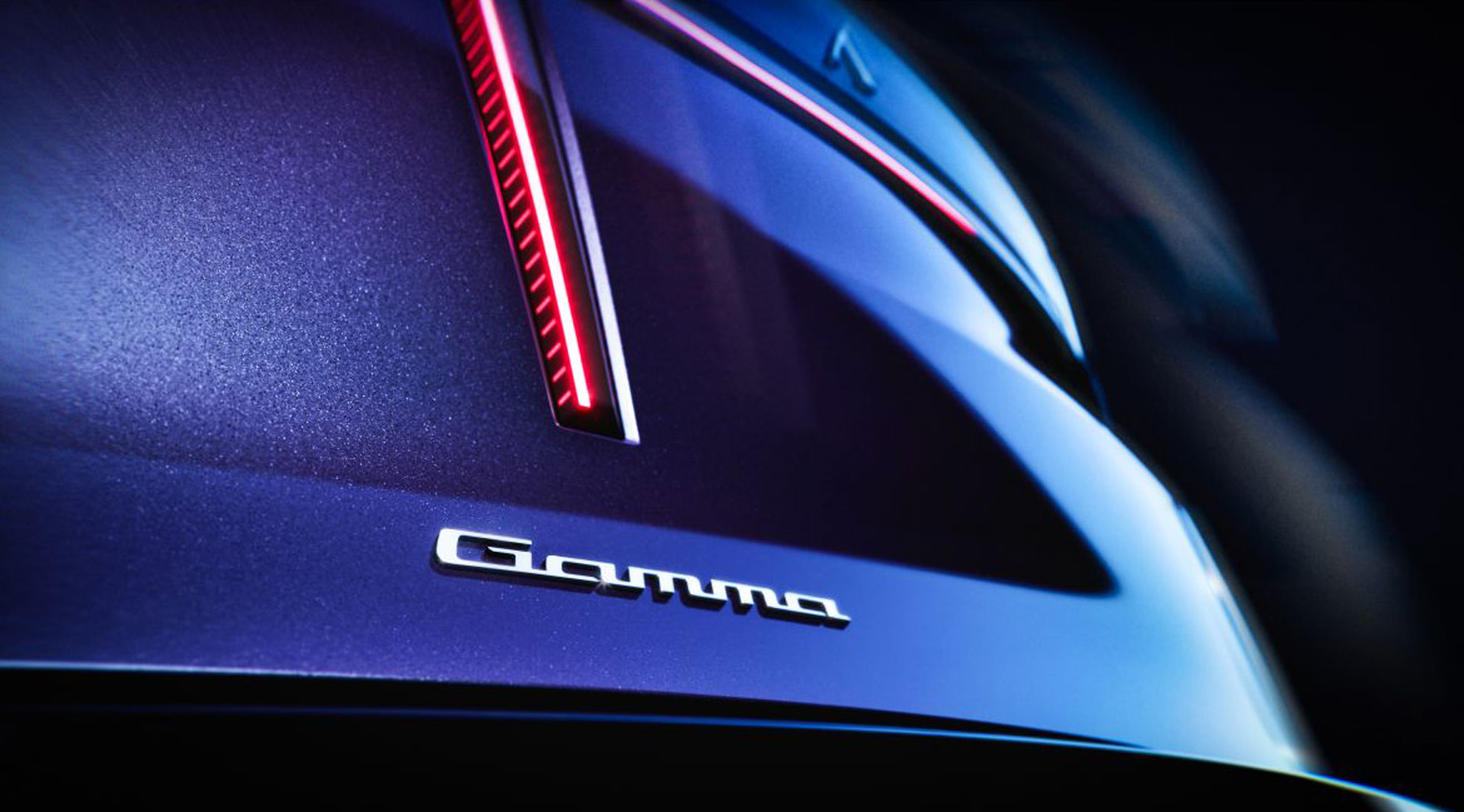
A teaser shot released as part of Friday’s announcement doesn’t show much of the Gamma’s design, but the vehicle has previously been described by Lancia as a “fastback,” a body style the original Gamma of the 1970s and ’80s offered, known as the Gamma Berlina. Lancia has also said the modern Gamma will measure 185 inches long and ride on Stellantis’ STLA Medium platform.

The STLA Medium is one of four highly modular platforms announced by Stellantis two years ago, and can support gas, hybrid, and electric powertrains. EVs based on the platform can offer either front- or all-wheel drive, as well as batteries with a capacity of up to 98 kwh. The platform’s supported power outputs range from 214-382 hp, and the maximum range is about 370 miles, as measured by the EPA.

Stellantis STLA Medium platform

Stellantis STLA Medium platform

Production of the Gamma will take place at a plant in Melfi, Italy. The plant is currently home to the aging Jeep Renegade and Compass, and is earmarked to build a new Compass based on the STLA Medium platform starting next year.

The Lancia flagship’s design will likely share elements with Lancia’s Pu+Ra HPE concept unveiled last year. The concept featured a wedge-like shape with round elements for the taillights and a Y-shaped motif at the front forming something resembling daytime running lights.

Lancia’s three new vehicles will replace the previous-generation Ypsilon which has been on sale since 2011. One of Italy’s oldest car brands, having been founded in 1906, Lancia has languished for years but is being given a new shot at life under the guidance of Stellantis. A previous attempt last decade to rebadge Chryslers as Lancias didn’t find much ground.

Don’t look for any of the new Lancias to reach the U.S., as the brand is fully focused on the European market at present.


Source link

German dealer selling Ferrari F80 build slot for $6.3 million!

0


A supercar dealer in Germany has listed a Ferrari F80 build slot on Mobile.de. The car is being offered at a ridiculous price of $6.3 million!

As you may be aware, the Ferrari F80 is Maranello’s latest hypercar that replaces the LaFerrari. 799 examples are being built, which, frankly, is a lot for a flagship Ferrari. While they are already sold out, we can expect more build slots popping-up for sale now that the car has been revealed.

Ferrari F80 build slot for sale

First impressions of the F80 following its dynamic debut at Finali Mondiali aren’t too positive, though. As far as the design is concerned, opinions are split. It certainly isn’t as good-looking as the LaFerrari. Under the skin is a twin-turbo V6 hybrid powertrain derived from the 499P Le Mans racer. While it packs 1200 hp, the overall driving experience is unlikely to be as exciting as its V12 predecessors.

Then there’s the price tag. The F80 has a base price of around $4 million. To put that in perspective, Bugatti is building 250 units for the Tourbillon for the same price. So, the F80 will be more common, and there is most certainly an F80 Aperta around the corner.

Source: Mobile.de


Source link