Last week, I took you behind the scenes at Vink Motorsport, a BMW-centric race car shop in the Netherlands. Here, Ton Vink and his team meticulously build and restore classic machines from motorsport’s golden eras, preparing them for historic racing meets across Europe.
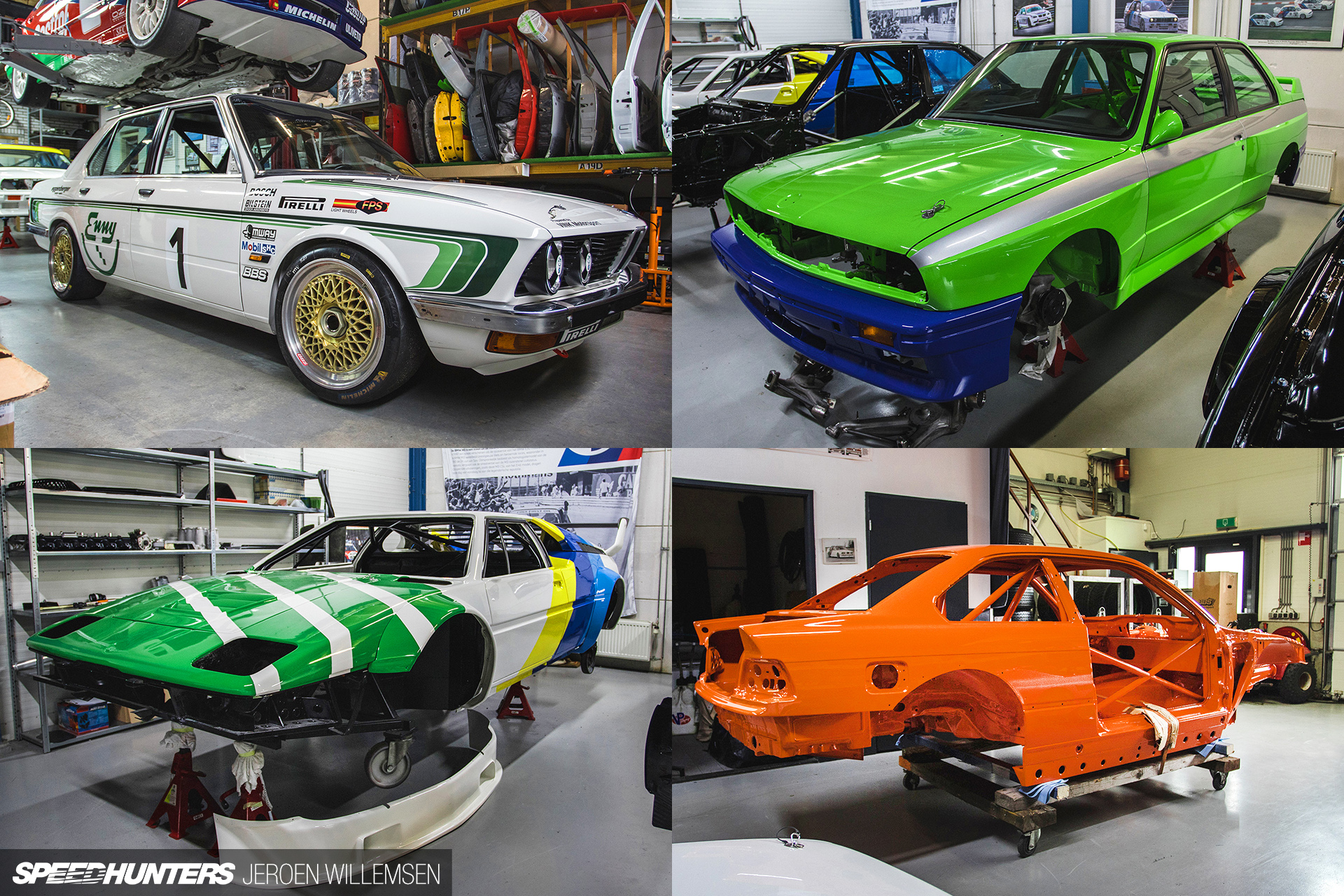
In that feature, I showcased several cars currently in the shop. Today, let’s delve deeper into four more Vink Motorsport builds.
Team Eggenberger Motorsport BMW E28
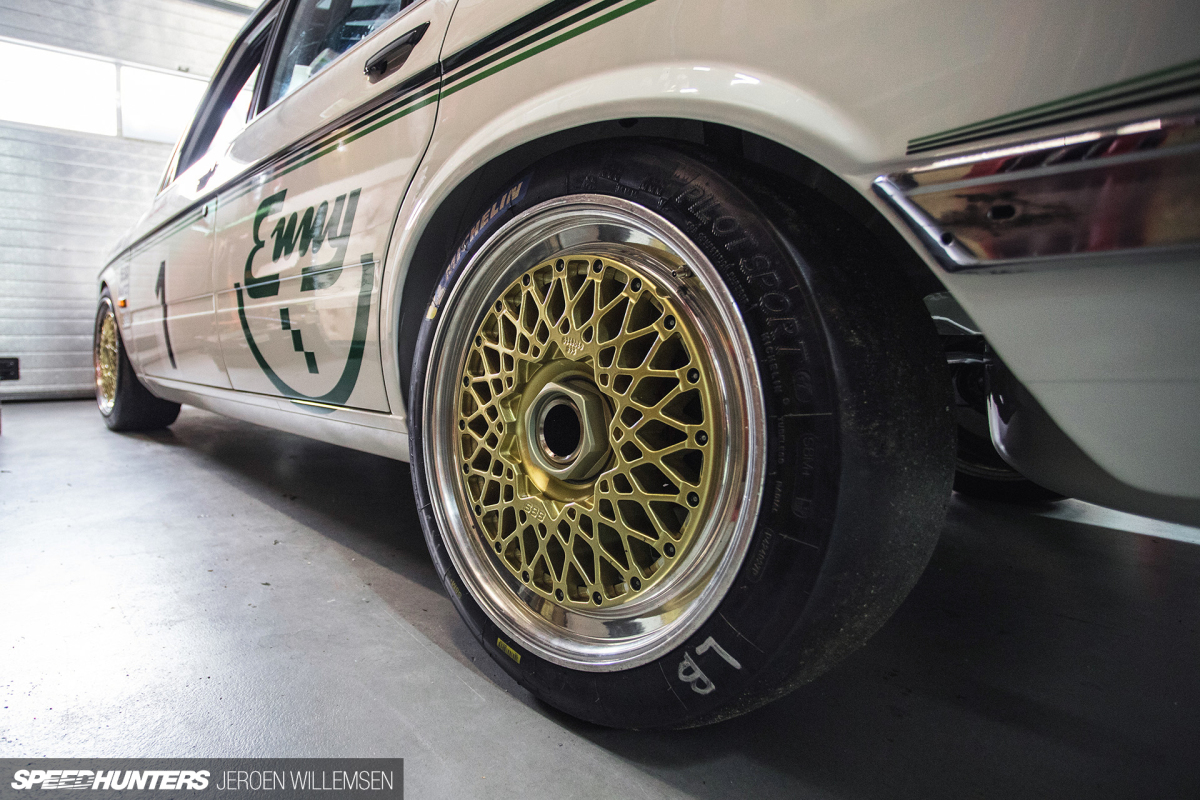
Entering Vink Motorsport, the first car that caught my eye was the Team Eggenberger Motorsport BMW E28 that clinched the European Touring Car Championship (ETCC) in 1982. At the season’s start, BMW faced new Group A regulations, rendering the earlier Group 2 635CSi unsuitable. Thus, the newly introduced BMW E28 528i was chosen to compete.
Partnering with Switzerland’s Eggenberger Motorsport, BMW developed a kit to transform the E28 for Group A touring car racing. To meet the 1,035kg weight limit for its engine class, the car had all unnecessary components removed. Furthermore, its inline-six engine was expertly tuned to produce nearly 240hp, up from the production model’s 180hp.
Driven by Umberto Grano and Helmut Kelleners, the E28 dominated the early rounds of the 1982 ETCC, winning five consecutive races. Although no further victories followed, they amassed enough points to secure the championship title.
In Vink Motorsport’s hands, the E28 has undergone a complete rebuild. A re-shell was necessary due to extensive rust around the exterior of the original body, yet many components were salvageable and reused. Parts beyond repair were recreated from original blueprints or donated from another car.
Ton and the Vink team can remanufacture certain components, such as uprights or front steering arms. They do this using molds created from original parts of that era, replicating the production methods used by BMW. This means that many previously unavailable parts are now accessible through channels like BMW Classic or the second-hand market.
BMW Alpina E30 DTM
Next up is a mid-restoration BMW Alpina E30 DTM, one of only two remaining (the other resides at Alpina). After its time in the Deutsche Tourenwagen Masters (DTM), this car was sold to a racing team in England, later ending up in a barn until Ton discovered it two years ago.
Contrary to my belief in the existence of multiple Alpina E30 DTM cars, most are replicas; many were even constructed by Ton himself. However, this particular car was built and campaigned by Alpina in the 1987 and ’88 DTM seasons. It features many unique details like green mirrors, which were intentionally chosen for easy identification during races.
Another notable detail is the onboard radio, which Ton received during a visit to Alpina. A retired mechanic from the car’s racing era was present during the visit and pointed out the exact location of the radio’s mounting, with screw holes perfectly matching those on the chassis beneath the dashboard.
These amazing stories, shared by Ton, highlight his passion for ensuring historical accuracy in every project he takes on.
BMW E36 325i Coupe DTM Linder
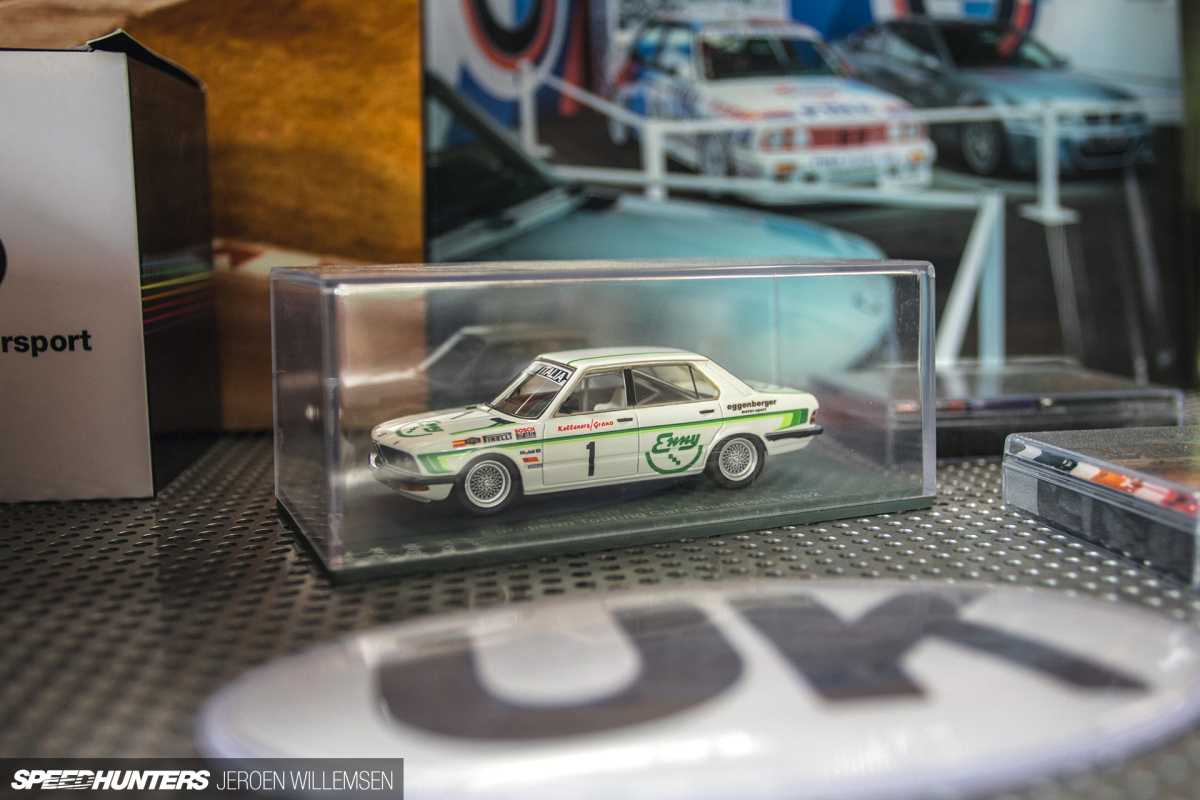
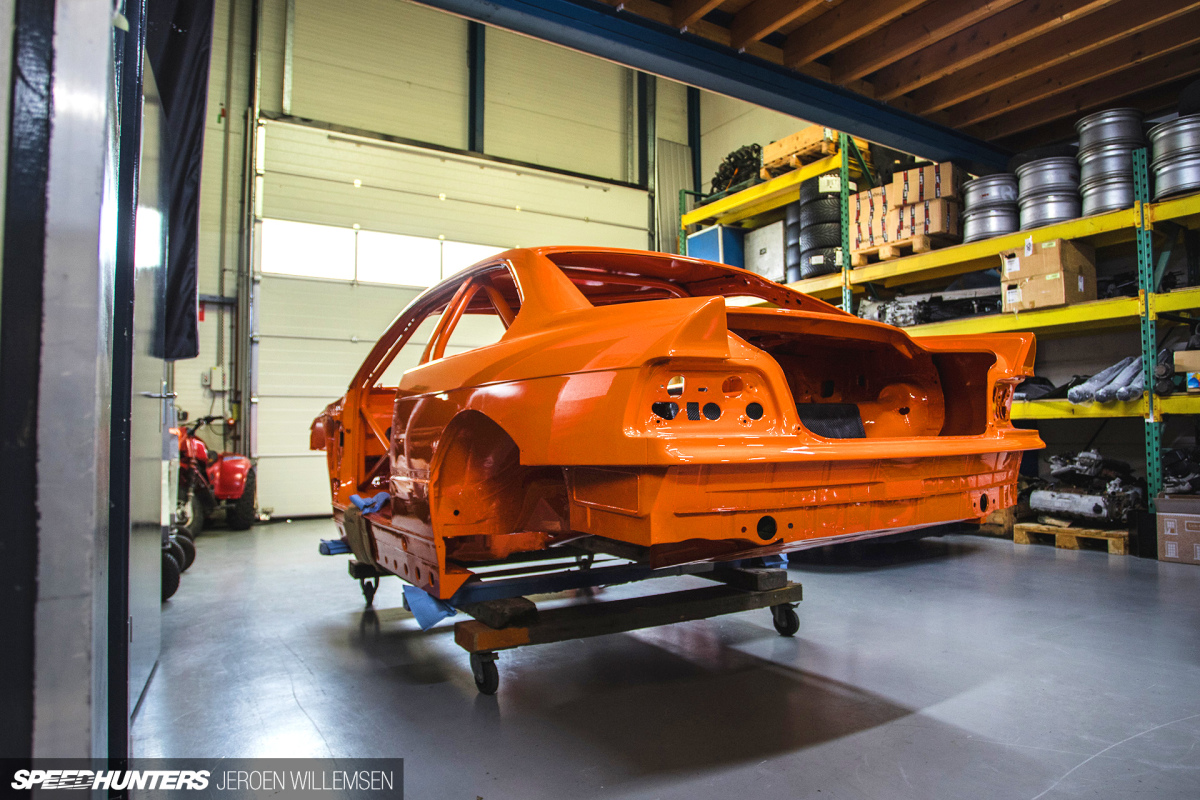
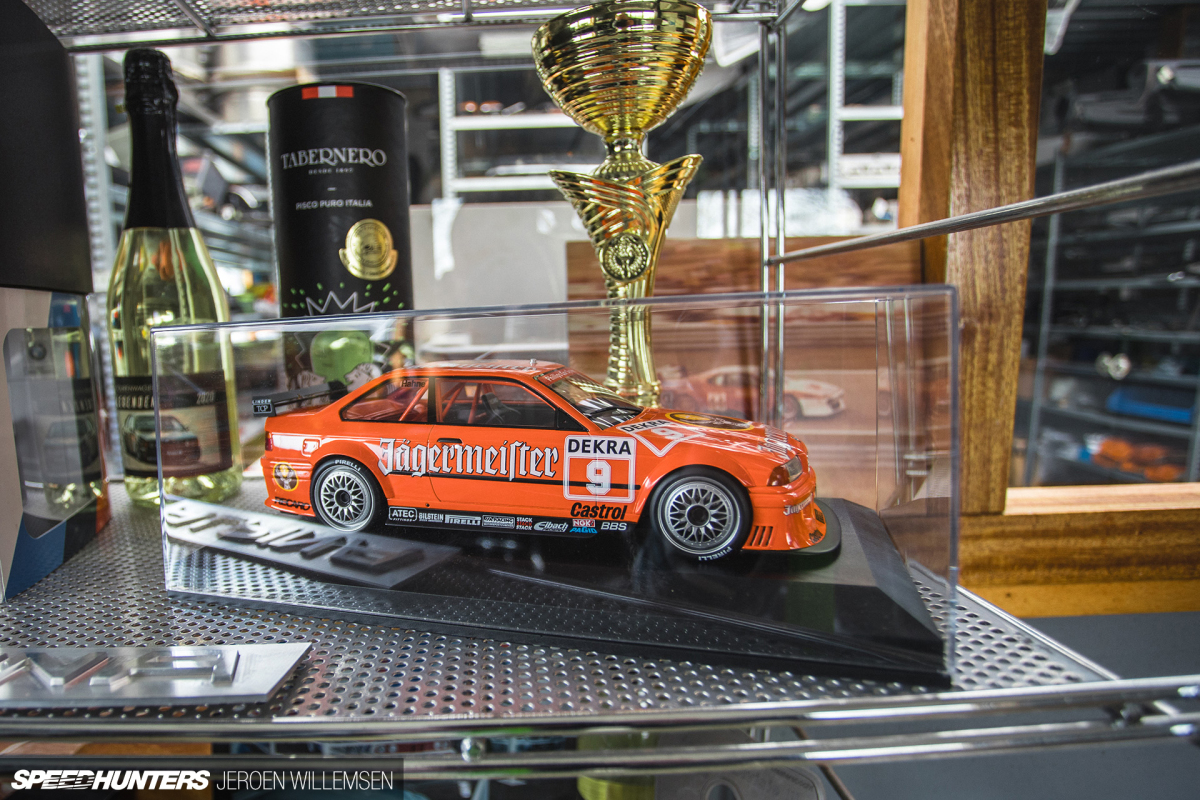
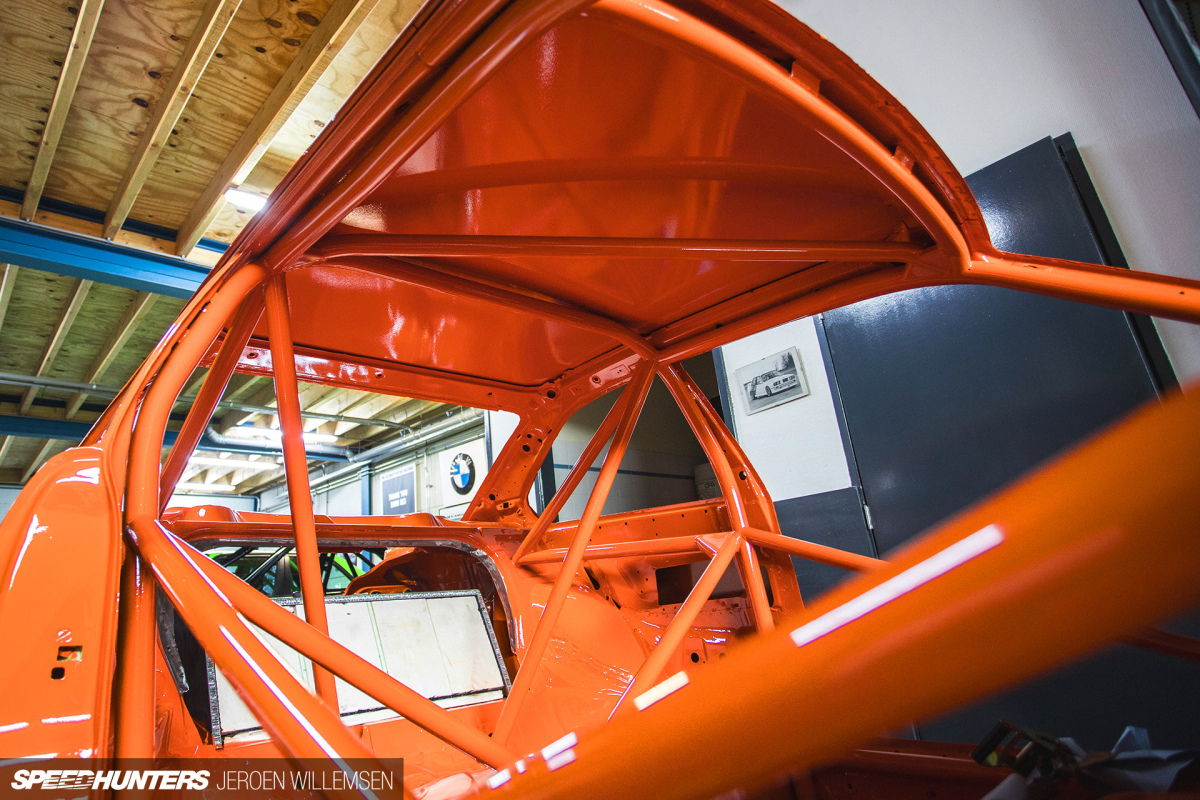
This car was unearthed in Thailand, where a Vink Motorsport customer purchased it from a collector. Upon its return to the Netherlands, its dire state necessitated a complete restoration. After a meticulous chassis rebuild by Jan Buijs of Multi-tech, adhering to the original specifications, the car has just returned from the paint shop with fresh coats of Jägermeister orange.
In Vink’s canteen, an array of model cars includes a scale version of this exact vehicle, offering a glimpse of its future appearance.
Scattered around the shop are various parts from the car, including the hood on the first floor and the front bumper and rear hatch with a spoiler on one of the shelves. Once the car takes shape, I plan to return to Vink Motorsport and capture it in all its glory.
BMW M1 Procar
Finally, we come to the BMW M1, which started as a production street car but is now undergoing a remarkable transformation into a Procar – a move reminiscent of what BMW Motorsport has done in the past. Vink has been entrusted with this ambitious conversion, and progress is evident in the array of parts lining the shelves next to the car. The only thing left to complete is the engine, which is currently being assembled.
The BMW M1 is significant as the first to carry the iconic ‘M’ designation. Produced between 1978 and 1981 in collaboration with Lamborghini, a total of 453 M1s were built, with 399 being street cars and 54 dedicated Procar versions commissioned for Group 5 racing. While the exact number of street M1s converted into Procars is unknown, soon, another will join this elite group.
Stay tuned as this BMW M1 undergoes its stunning transformation, adding yet another chapter to the storied legacy of one of BMW’s most legendary models.
I hope you’ve enjoyed this second and final feature from my visit to Vink Motorsport. Big thanks to Ton and the team for having us!
Jim Cramer, the CNBC finance host with such bad takes they sparked an Inverse Cramer movement, has a new message for retail investors: Tesla screwed up its robotaxi launch, and now isn’t the time to go putting your money into Elon Musk’s no-longer-a-car company. Given Cramer’s history, this can only mean that Tesla is going to the moon, immediately, and forever.
Cramer had been looking forward to the robotaxi launch, and called the event “gorgeous” on CNBC. Yet, he was disappointed by the lack of specifics, and advised against putting more money into the stock right now. From CNBC:
“Even though Tesla’s robotaxi event was gorgeous, we didn’t get enough detail to justify treating this company like an autonomous driving business rather than an electric vehicle maker,” he said. “So, for now, I recommend taking a page from Switzerland and staying on the sidelines with this one.”
…
While impressed by the look and concept of the robotaxi, Cramer said the event’s demonstration lacked substance and failed to prove its technological prowess. Musk provided few details about the actual costs of the vehicle, he added, and gave an “underwhelming” answer when asked about timing of the rollout.
By Friday’s close, Tesla stock was down 8.78%, and Cramer said the market’s reaction speaks for itself. While Tesla plunged, shares of Lyft and Uber rallied, with the latter hitting a new all-time high. The “existential threat” of robotaxis had weighed on the rideshare companies, but Wall Street doesn’t seem to be confident that Tesla’s Cybercab will be usable any time soon, he added.
Cramer’s excitement for the car means it may well be a flop, but his recommendation against investing means we could get more rallies in the months to come. In the long term, however, Cramer doesn’t recommend shorting Tesla — meaning the stock’s total collapse could still be on the horizon.
If you’re like me, you’re always on the lookout for ways to make your adventures more affordable and enjoyable. That’s why I collect points and miles. They help me travel longer, better, and cheaper.
Today I want to talk about a card that’s been growing in popularity over the past few years: the Capital One Venture X Rewards Credit Card. It’s designed for travelers who want to easily rack up miles without having to keep track of bonus categories.
And, in the past couple of years, they have really improved the card. It’s one of the main cards I use now because I love their travel portal, their transfer partners, and all the perks that come with the card.
With a hefty sign-up bonus, premium travel benefits, and an impressive rewards structure, the Venture X is worth considering if you’re looking for a new card. Here’s everything you need to know about the card and why I think you should consider getting it:
What is the Capital One Venture X Rewards Credit Card?
The Capital One Venture X Rewards Credit Card is a travel rewards card issued by Capital One. What I love about this card is its miles system. For every dollar you spend, you earn two miles, which (along with the lower-fee Capital One Venture Rewards Card) is unique among travel credit cards. There’s also no additional cost for up to four authorized users, making this a good option for families who need several cards.
In addition to earning at least 2x miles on every purchase, you can earn miles the following ways:
75,000 bonus miles when you spend $4,000 on purchases in the first three months after opening the account
10x miles on hotels and rental cars booked through Capital One Travel
5x miles on flights and vacation rentals booked through Capital One Travel
Other Perks and Benefits of the Capital One Venture X
Aside from earning miles, the Venture X packs a punch with its range of perks:
$300 travel credit when booking through the Capital One portal
Up to $120 credit for Global Entry or TSA PreCheck
Unlimited complimentary access to Capital One, Priority Pass, and Plaza Premium lounges
10,000 bonus miles every year, starting on your first anniversary
$100 experience credit and other premium benefits with every hotel and vacation rental booked from the Premier Collection
Travel insurance coverage, including primary car rental insurance, trip interruption and cancellation, and luggage reimbursement
No foreign transaction fees
With an annual fee of $395, it’s also the cheapest premium travel card out there (plus, if you can use the $300 travel credit, that brings the fee down to a manageable $95).
Using Your Capital One Miles
Capital One miles can be redeemed in a few ways. One is by booking travel directly through Capital One’s portal. While I usually don’t recommend booking through credit card portals, to fully benefit from the Venture X’s travel credit, you’ll need to book at least $300 worth of travel this way.
Another option is to use your miles to get reimbursed for any travel purchase. For 90 days after making such a purchase, you can reimburse yourself at a redemption rate of one cent per mile. After 90 days, and for all other purchases, you can use miles as cash back, at a redemption rate of 0.5 cents per mile (but avoid doing this, as it’s not a good value).
However, you’ll get the most out of your miles by transferring them to Capital One’s 15+ airline and hotel partners. While the actual value varies based on what you book, you can usually find airline and hotel redemptions worth much more than the aforementioned one cent per mile. (The process is pretty straightforward and can be done through your Capital One account.)
Here are Capital One’s current travel partners:
Accor Live Limitless
Aeromexico Club Premier
Air Canada Aeroplan
Air France/KLM Flying Blue
Avianca LifeMiles
British Airways Executive Club
Cathay Pacific Asia Miles
Choice Privileges
Emirates Skywards
Etihad Airways Guest
EVA Air Infinity MileageLands
Finnair Plus
Qantas Frequent Flyer
Singapore Airlines KrisFlyer
TAP Portugal Miles&Go
Turkish Airlines Miles&Smiles
Virgin Red
Wyndham Rewards
Using transfer partners is a game-changer if you’re looking to maximize the value of your miles. That’s why, unless I find a super cheap flight or hotel room (less than $150 USD), I always transfer miles to Capital One’s travel partners. That’s especially true when booking business class flights or fancy hotel rooms. You just get more value for your money.
Plus, with tools like point.me and Awayz (search engines that help you find the best flights and hotels to book with miles), it’s easier than ever to find the best redemption options.
Pros of the Capital One Venture X
Substantial welcome offer
2x miles on every purchase
$300 annual travel credit
15+ transfer partners
Travel accident and car rental insurance
Up to a $120 credit for Global Entry or TSA PreCheck
Access to Capital One and Priority Pass airport lounges
No foreign transaction fees
Cons of the Capital One Venture X
Steep $395 annual fee
Must use Capital One’s Travel Portal to take advantage of some benefits (e.g., 10x miles per dollar on hotels, vacation rentals, and rental cars)
Transfer partners are a bit lacking (no US airlines and not the best hotels)
Who is this card for?
The Capital One Venture X is best for frequent travelers who want a straightforward card with a higher earning rate on all purchases. If you frequently fly and stay in hotels, and are willing to pay an annual fee for premium benefits, this card is tailored for you.
Who is this card not for?
On the flip side, if you’re not a frequent traveler or don’t spend enough to offset the $395 annual fee, the Venture X might not be the best fit. It’s also not ideal if you’re looking for a card with a high rewards rate in specific categories like dining or groceries.
If you travel occasionally or prefer a lower annual fee, you might want to pick another card that better aligns with your spending habits and travel frequency. Because there is no right card — only the card that’s right for you!
***
The Capital One Venture X Rewards Credit Card is a powerhouse for those who travel often and want to enjoy top-tier perks. Weigh the pros and cons to see if it’s the right fit for your travel lifestyle but I bet it is! Like I said in the intro, it’s one of my favorite cards and I definitely recommend getting it.
Book Your Trip: Logistical Tips and Tricks
Book Your Flight Find a cheap flight by using Skyscanner. It’s my favorite search engine because it searches websites and airlines around the globe so you always know no stone is being left unturned.
Book Your Accommodation You can book your hostel with Hostelworld. If you want to stay somewhere other than a hostel, use Booking.com as it consistently returns the cheapest rates for guesthouses and hotels.
Don’t Forget Travel Insurance Travel insurance will protect you against illness, injury, theft, and cancellations. It’s comprehensive protection in case anything goes wrong. I never go on a trip without it as I’ve had to use it many times in the past. My favorite companies that offer the best service and value are:
Want to Travel for Free? Travel credit cards allow you to earn points that can be redeemed for free flights and accommodation — all without any extra spending. Check out my guide to picking the right card and my current favorites to get started and see the latest best deals.
Need Help Finding Activities for Your Trip? Get Your Guide is a huge online marketplace where you can find cool walking tours, fun excursions, skip-the-line tickets, private guides, and more.
Ready to Book Your Trip? Check out my resource page for the best companies to use when you travel. I list all the ones I use when I travel. They are the best in class and you can’t go wrong using them on your trip.
I got a text message from someone in Mercedes-Benz’s public relations department last week who had a tempting offer — If I’d be willing to drive to Braselton, Georgia, for Petit Le Mans, they would send a car for me to drive and get me in for free. We already had a freelancer attending, which I made sure to mention up front, but they still wanted me to come anyway. On Friday afternoon, a driver showed up with the keys to a Starling Blue Magno Mercedes-AMG GT63 Coupe.
2024 Mercedes-AMG GLC43 Is A Hot Compact SUV With A Fascinating Engine
You’d think I would have been thrilled. Who wouldn’t want to drive a free sports car for a week, especially one with 577 horsepower, 590 pound-feet of torque and enough options to drive the $175,900 base price up to $209,310? That’s basically a dream come true! For about as long as I’ve been in the industry, though, the opposite has been the case. The actual driving experience has always been enjoyable, but living with expensive press cars day-to-day has given me anxiety for years.
One of these days, maybe my therapist and I will make our way through all the more serious problems in my life and get around to figuring out why being seen getting out of an expensive car gave me anxiety, but that’s going to have to stay onto the back burner for now, in part because either the GT63 fixed me, or something else changed my brain. The entire time I’ve had it, I’ve just enjoyed driving without even thinking about other people. When I drove it to the doctor’s office, I even parked like a normal person in the first open space I saw.
I also need to clarify that I’m not mad. I wanted something to change. There’s nothing fun about dealing with anxiety even when you know it’s irrational, so it felt so good to just drive around and enjoy the car without my brain running a million miles a minute. However, that raises the question — Did the GT63 fix me, or did something else change my brain?
Arguments in favor of the AMG being responsible for my miraculous turnaround include the fact that it looks fantastic, the paint makes it look even better and there’s nothing a V8 with more than 500 horsepower can’t fix. I guess you could also argue that it’s just a Mercedes, and the brand doesn’t carry quite the same level of prestige that Porsche and more exotic coupes command. It’s probably not the best argument, but it’s certainly not the worst one I’ve ever heard, either.
The more I think about it, though, I don’t think the AMG fixed me. Instead, I’m convinced something literally changed my brain, and while I know we’re bordering on conspiracy theory territory here, at least hear me out. About a month ago, I nearly suffered a grand mal seizure. I got to the hospital in time, and they were able to stop it, but I can officially say it was Not Fun. Do not recommend. Zero out of 10 (two out of 10 after they pumped me full of drugs, and I didn’t die), would not buy again.
If that were the only thing that felt different, I might just chalk it up to a weird fluke or something and forget about it. That is, uh, decidedly not the case. It’s not like I completely changed who I am, and don’t worry, I still hold all the same 100-percent correct opinions, but plenty of things still feel different. And if there really is a lasting personality change, I’m certainly not going to complain about having less anxiety and generally feeling happier or more positive. When things get wonky in people’s brains, it feels like there’s a huge risk they’ll end up becoming giant assholes, so positive changes are more than welcome.
Of course, I am a man of science, which means I have to test this theory for myself. I’m going to have to find a press loan that costs more than the AMG and see how I feel. Ferrari still hasn’t forgiven us, but I don’t remember doing anything to upset Maserati too badly. What are the odds they’d be willing to mail an MC20 to Georgia so I can drive it for a week? Not for personal enjoyment, of course. Purely for science.
Catherine Deneuve stars in Eric Khoo’s feature film, ‘Spirit World’, supported by Chanel (Photo: Laurent Champoussin. MI. Movies, Zhao Wei, Knockonwood, Wild Orange, Fourier)
Continuing its legacy as champion of cinema, Chanel lends its support to Singaporean director Eric Khoo’s latest film, Spirit World. Khoo’s feature film, which premiered at the 2024 Busan International Film Festival in South Korea this week, boasts a star-studded cast, including French cinema icon Catherine Deneuve, and Japanese stars Yutaka Takenouchi, Masaaki Sakai and Jun Fubuki.
Spirit World follows the journey of the musician Claire Emery (played by Deneuve) who travels to Tokyo and unexpectedly meets the end of her earthly life. She transforms into a ‘yokai’ (a spirit in Japanese folklore) and ventures into the afterlife.
Chanel offered financial backing for the production of Khoo’s film, which was shot in Japan. The French luxury brand’s support for Spirit World is also reflected on screen: Chanel’s outfits and accessories were loaned to the film’s costume designer Pascaline Chavanne for actress Maiya Goshima’s wardrobe. Chanel’s exquisite jewellery creations were also worn by the film’s lead, Catherine Deneuve.
Japanese actor Yutaka Takenouchi and Catherine Deneuve in ‘Spirit World’ (Photo: Laurent Champoussin. MI. Movies, Zhao Wei, Knockonwood, Wild Orange, Fourier)
The French actress—famous for her roles in films like Belle de Jour and The Umbrellas of Cherbourg—has close ties to the maison, having previously been the face of the Chanel N°5 fragrance. Deneuve also starred in the 2024 film Marcello Mio, for which she wore outfits created for her by the maison.
Indeed, Chanel has a history of supporting the film industry, which began when founder Coco Chanel designed costumes for MGM films in the 1930s. The French fashion house is a partner of the Busan International Film Festival, and has also dressed some of cinema’s biggest stars for events like the Cannes Film Festival and the Venice Film Festival. In recent years, Chanel has especially supported the works of female directors, offering financial backing and costumes to films like Greta Gerwig’s Barbie, Sofia Coppola’s Priscilla, and Maïwenn’s Jeanne Du Barry.
Japanese actress Maiya Goshima, clad in a Chanel outfit and earrings, in ‘Spirit World’ (Photo: Laurent Champoussin. MI. Movies, Zhao Wei, Knockonwood, Wild Orange, Fourier)
Chanel’s collaboration with Eric Khoo’sSpirit World marks a major moment for Singaporean cinema. Khoo put Singaporean cinema on the map with his first films, Mee Pook Man (1995) and 12 Storeys (1997). He became the first Singaporean director to be invited to present his films at major international film festivals. Khoo’s first animated film, Tatsumi, was highlighted at the 2011 Cannes Film Festival; in 2017, he served as a jury member for the festival’s short film competition.
Chanel will continue to strengthen its ties with Asian cinema. In November, the maison is partnering with award-winning Japanese director Hirokazu Kore-eda for a series of talks in Tokyo, featuring special appearances from Chanel ambassador Tilda Swinton.
Below, watch a trailer for Eric Khoo’s Spirit World.
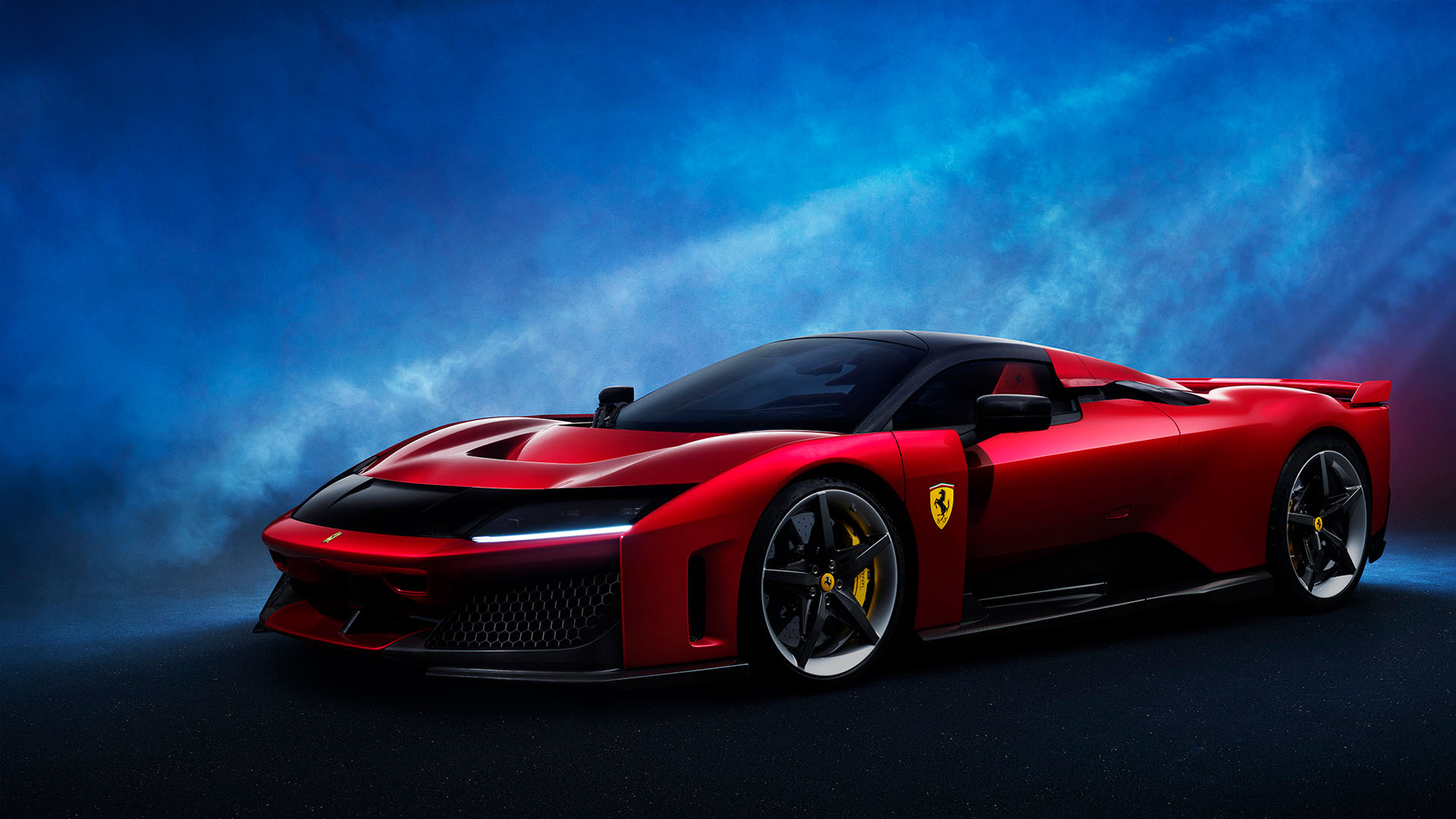
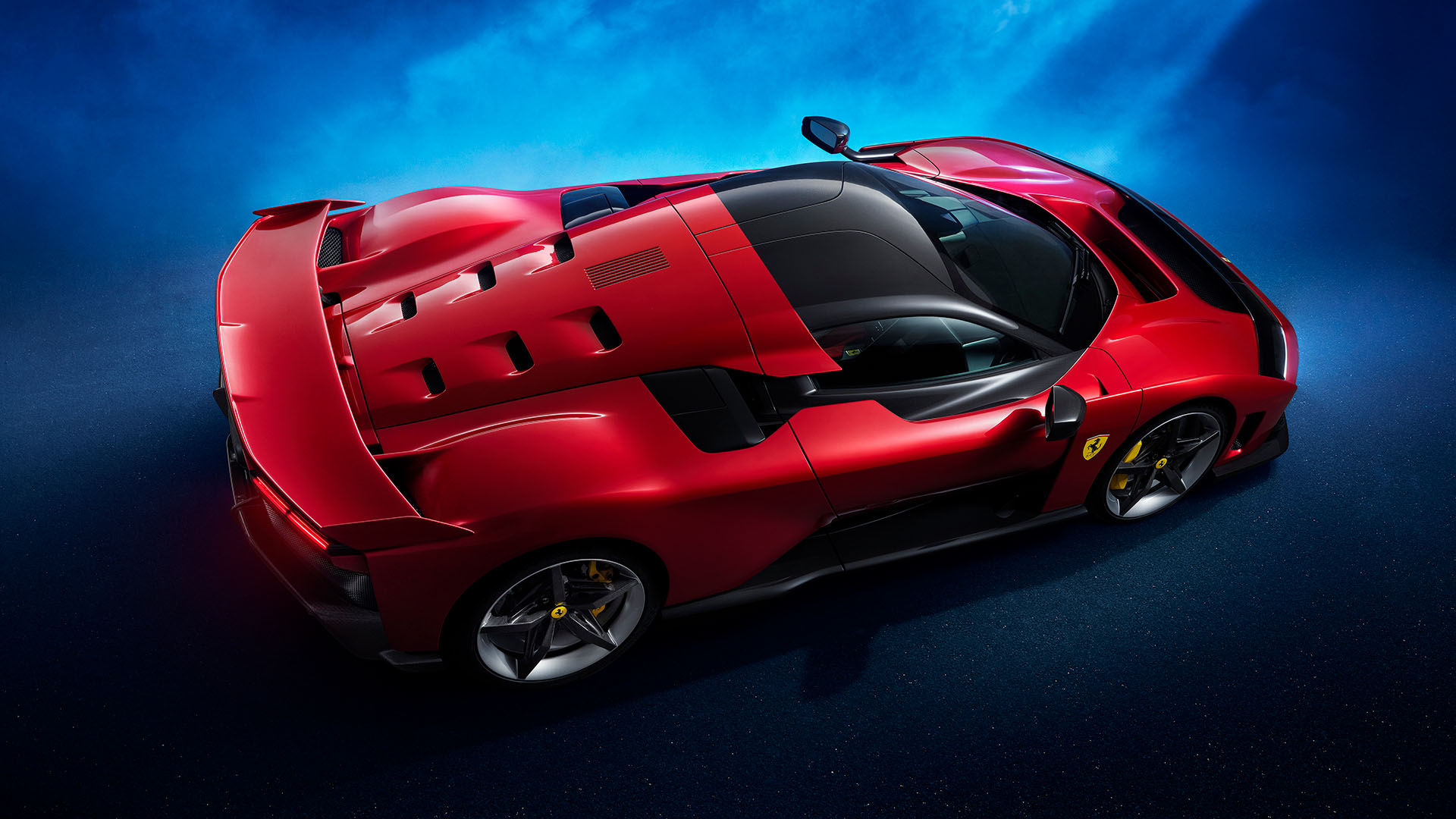
Over the last decades, some truly amazing masterpieces have come from the factory gates in Maranello, Ferrari has been building automotive icons since the beginning with cars like the 250 GTO, but it was in 1984 that the famous GTO name returned to a production car in the form of the 288 GTO, which evolved into magnificent F40, as close as you could get to an actual street-legal race car at that time, celebrating the 40th Anniversary, followed a decade later by the F50, somewhat of a street-legal Formula One car, and let’s not forget the LaFerrari, all highly sought-after supercars made in Italy, and Ferrari has just written the next chapter in this illustrious series … the F80.
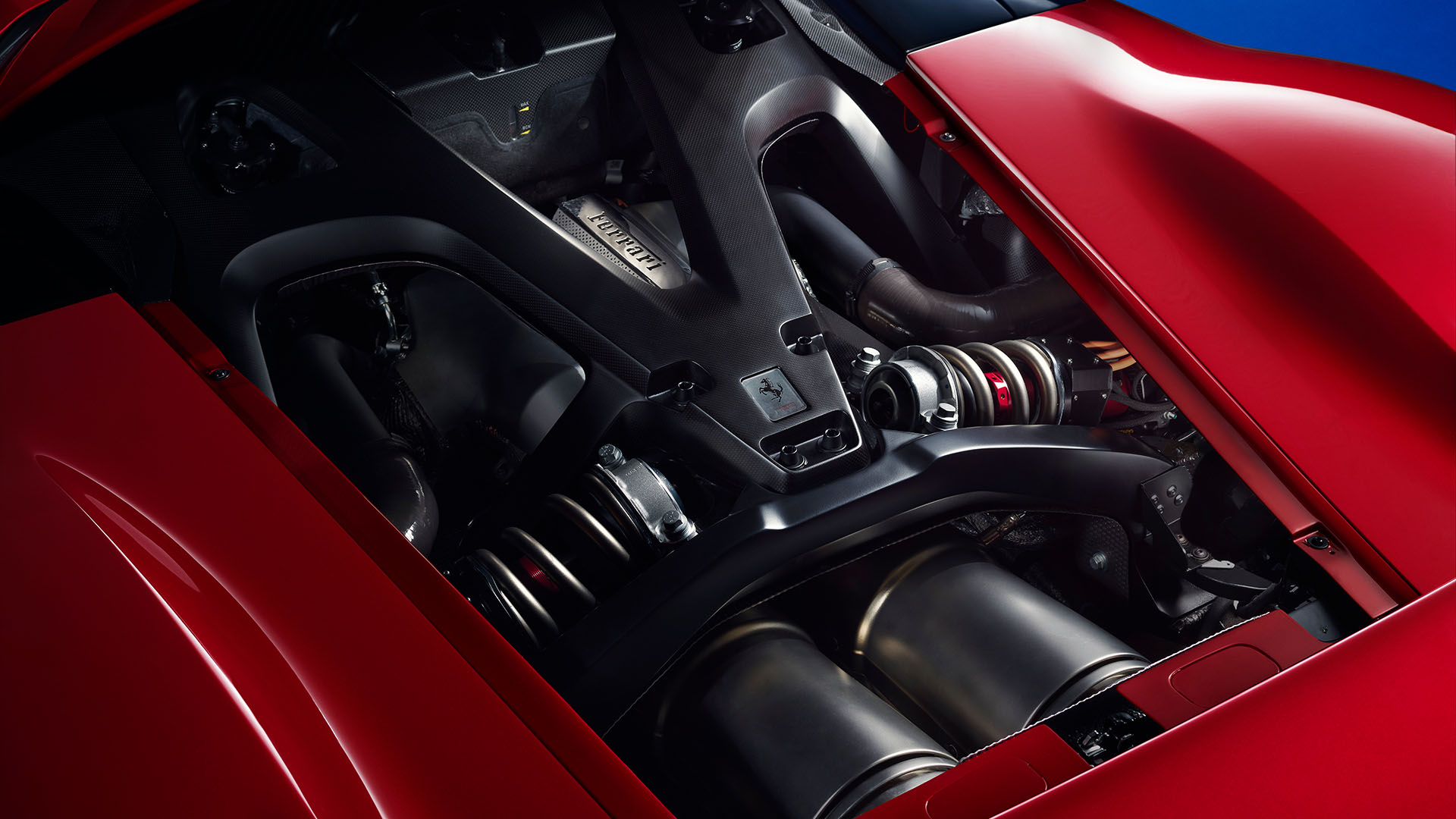
Where the 288 GTO and F40 were fitted with a V8 engine, the F50 with a V12 and the LaFerrari with a V12 hybrid powerplant, the new F80 hides a 120° V6 engine underneath that beautiful aerodynamic bodywork, but make no mistake, this 3-Liter beauty puts down 900 hp, making it the Ferrari engine with the highest specific power of all time (300 cv/l), and that’s not even all of it, remember we’re in the hybrid era these days, so there is an electric front axle and a rear motor adding another 300 hp into the mix for a total of 1,200 hp … in a road-legal, limited edition Ferrari.
Inspiration for this V6 engine comes straight from racing, more specifically the unit from the Ferrari 499P that won the last two editions of the legendary 24 Hours of LeMans, and this translates into a maximum engine speed of no less than 9,000 rpm, with a dynamic limiter as high as 9,250 rpm, and despite an additional power of 237 hp compared to the engine of the production model 296 GTB, this new engine doesn’t put any more weight on the balance, an amazing feat from the Ferrari engineering team. Thanks to the offset angle of 120° and a firing order of 1-6-3-4-2-5 we still get a traditional Ferrari sound from the Inconel exhaust manifolds.
For the first time, Ferrari has developed, tested, and built electric motors for the Ferrari F80 in-house. Two electric motors are on the front axle, one for each wheel, to create a 4WD setup, and an additional electric motor is mounted at the rear of the car. These electric motors use solutions derived from the design of the MGU-K unit used in Formula 1, thanks to some amazing engineering, the entire electric motor setup on the front axle only weighs 61,5 kg, while the inverter from the high-voltage battery is capable of delivering 210 kW of power to the front units, while the rear electric motor can receive up to 60 kW of power to assist the internal combustion engine or generate up to 70 kW to feed the high-voltage battery in regeneration mode, this battery pack is configured with 204 cells connected in series and subdivided equally into 3 modules, for a total energy capacity of 2.3 kWh and a maximum power output of 242 kW.
The new Ferrari F80 takes aerodynamic performance to never-before-seen highs, there is a total of 1,000 kg of downforce at 250 km/h from a perfect symbiosis between all the internal Ferrari departments working on the definition of the car’s architecture; for each department, the perfect balance between downforce and top speed was the basis for every design choice, giving shape to a suite of extreme solutions befitting a true supercar. At the front the F80 was inspired by the aerodynamic concepts employed in Formula 1 and World Endurance Championship (WEC), developing 460 kg of downforce at 250 km/h.
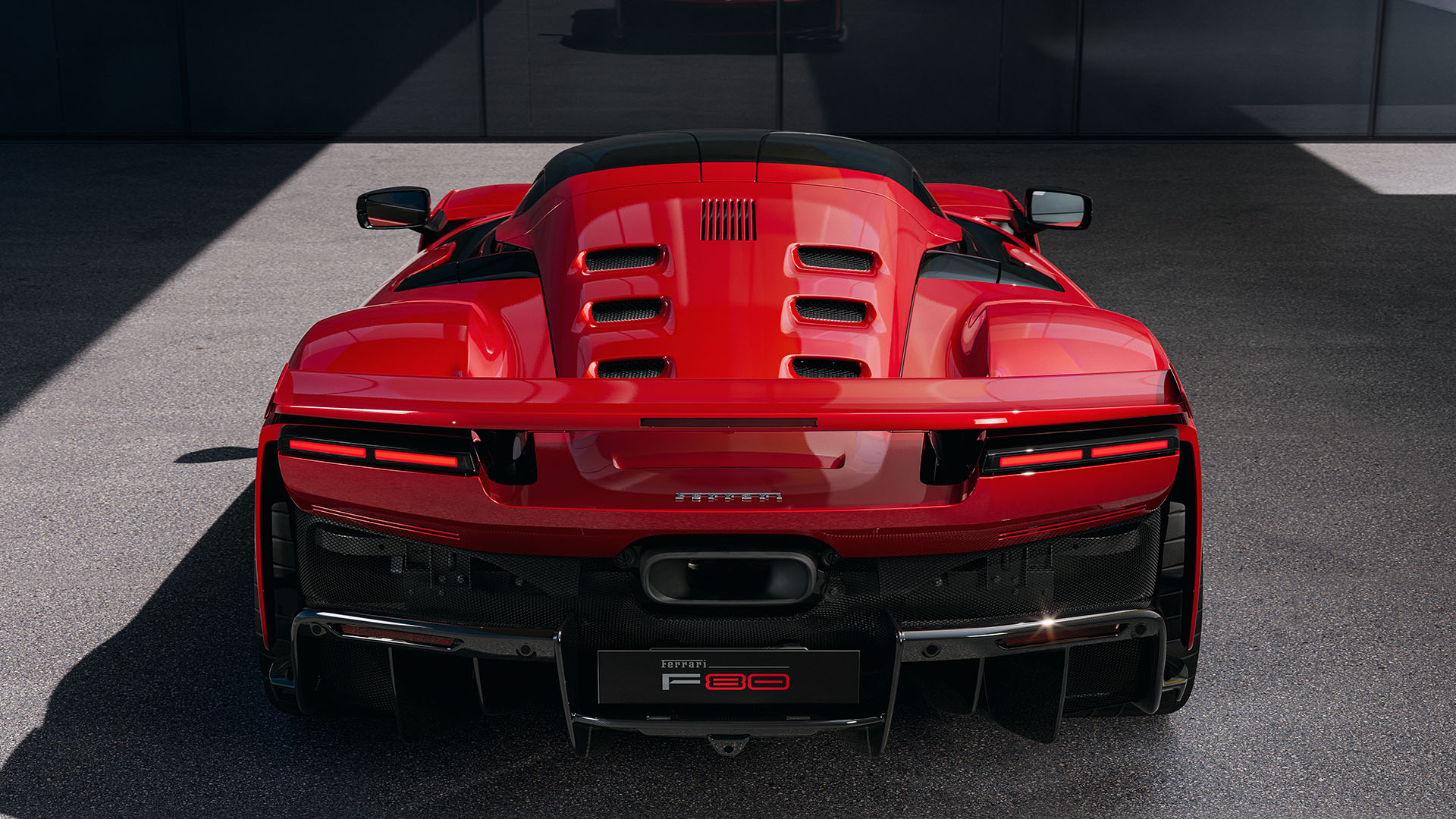
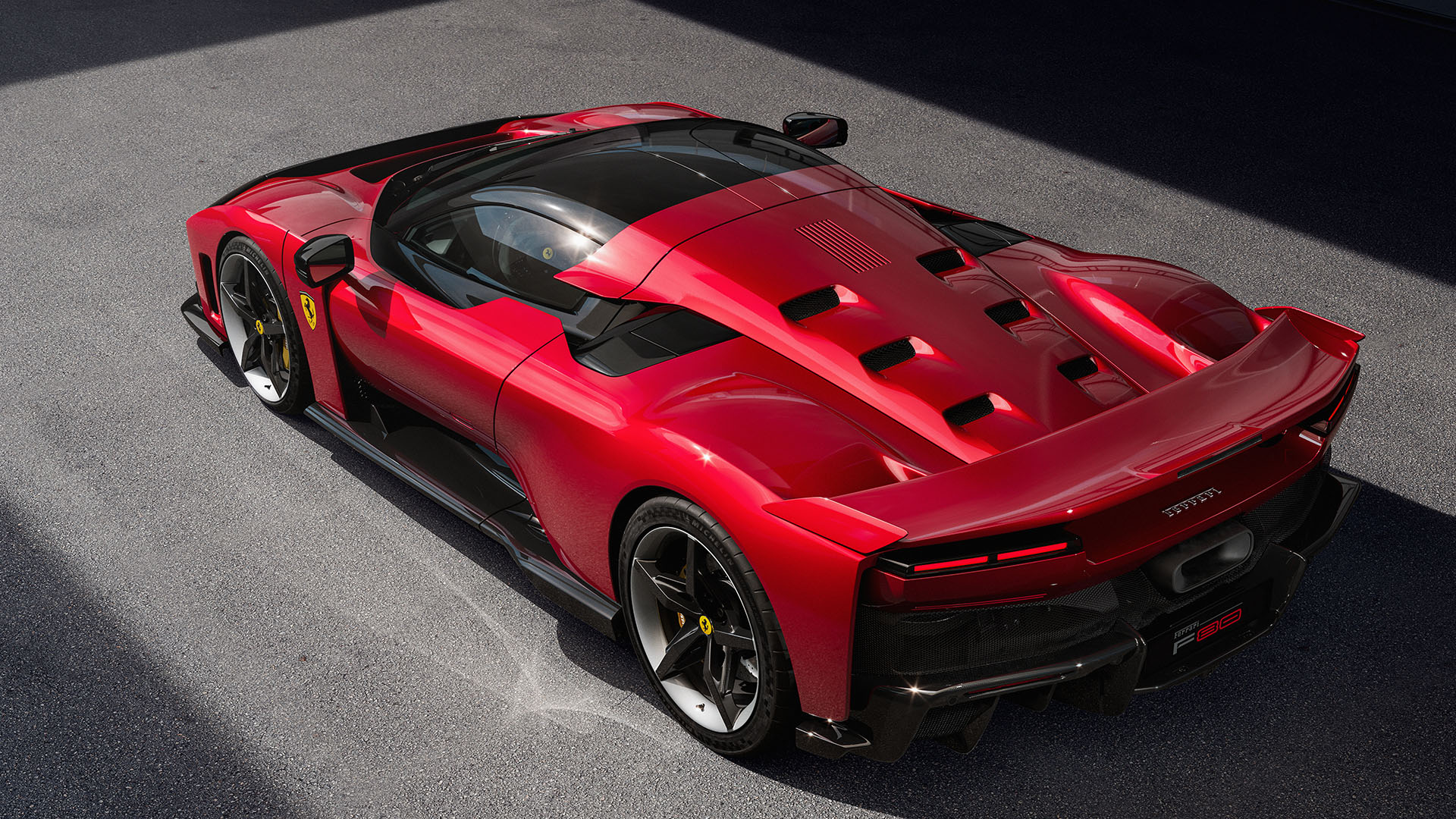
At the rear of the F80, we get the remaining 590 kg of downforce at 250 km/h thanks to combining the active rear wing with the diffuser, the expansion volume of the diffuser itself has been maximized by inclining the engine-gearbox unit by 1.3° in the Z axis, and by the configuration of the rear chassis and suspension components. The starting point of the upward curvature of the diffuser has been brought forward, resulting in a diffuser measuring a record-breaking 1800 mm in length, which generates a huge low-pressure zone underneath the vehicle, which in turn draws a massive flow of air into the underbody area.
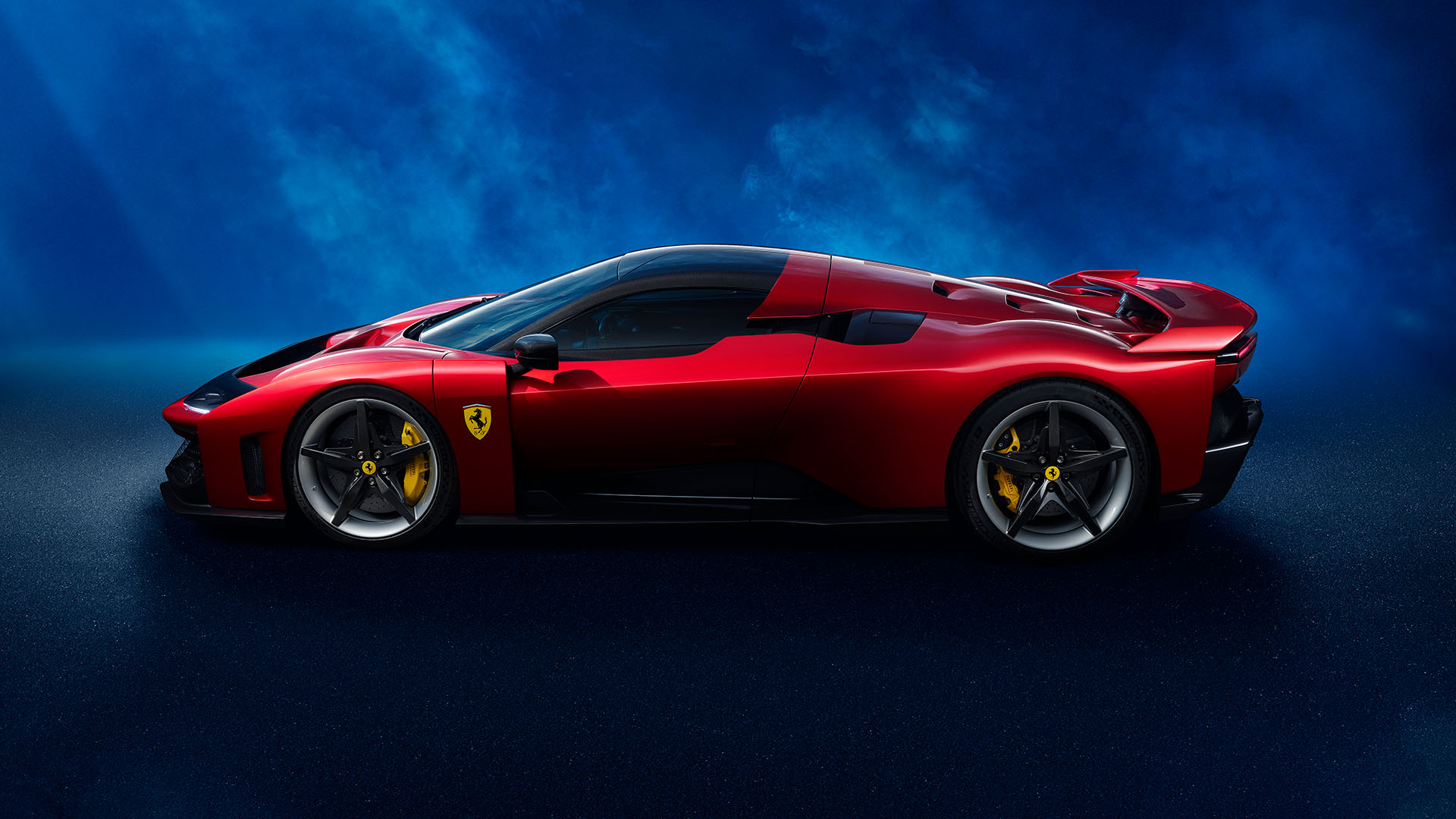
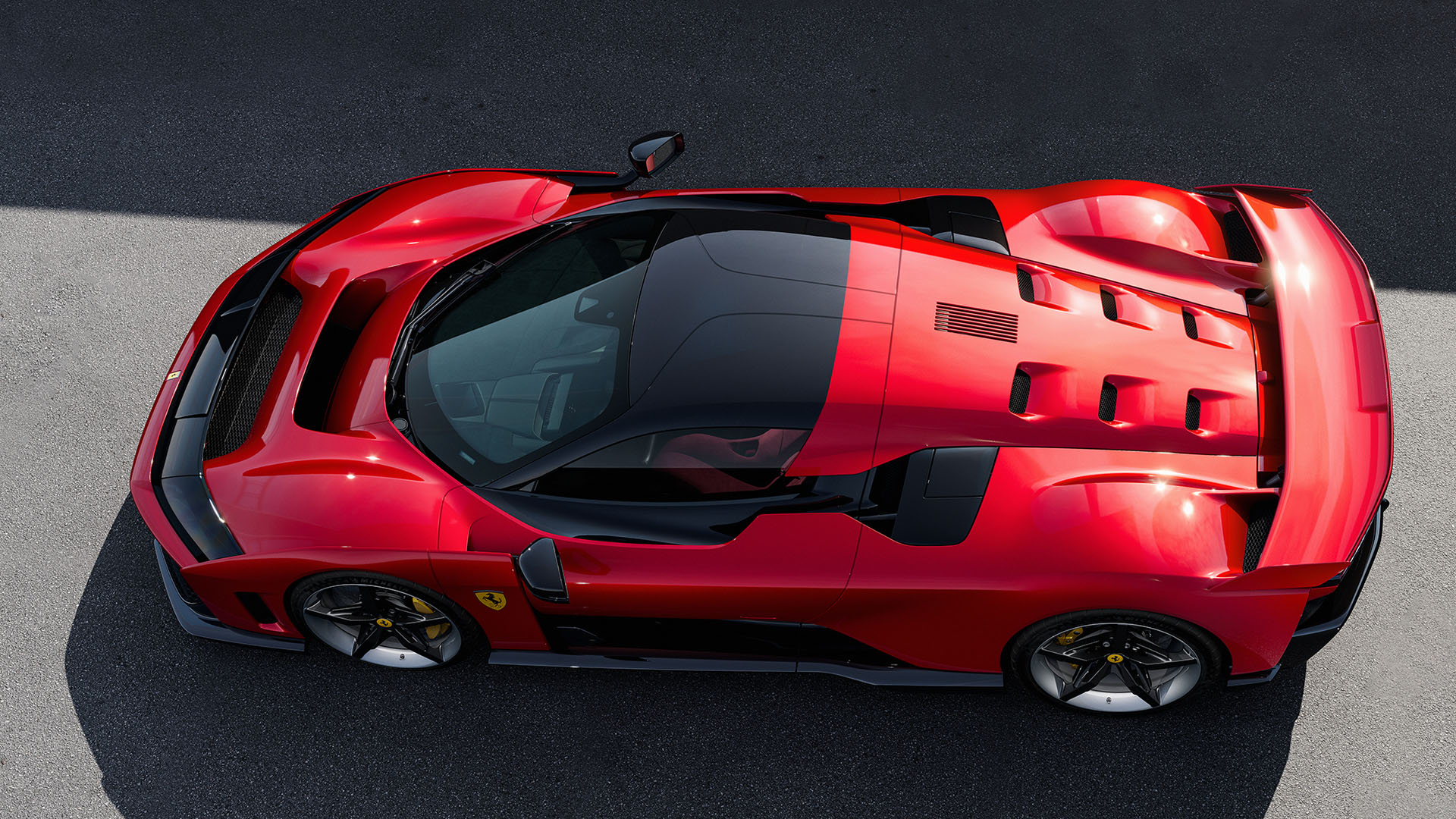
The active wing is the most visually distinctive aero feature of the F80, which completes the entire aerodynamic concept of the vehicle. The actuator system of the rear wing adjusts not only its height but also controls the angle of attack continuously and dynamically, for precisely modulable downforce and drag. In the High Downforce (HD) configuration, which is used during braking, turn-in, and cornering, the wing assumes an angle of 11° relative to the direction of the airflow to generate over 180 kg of downforce at 250 km/h.
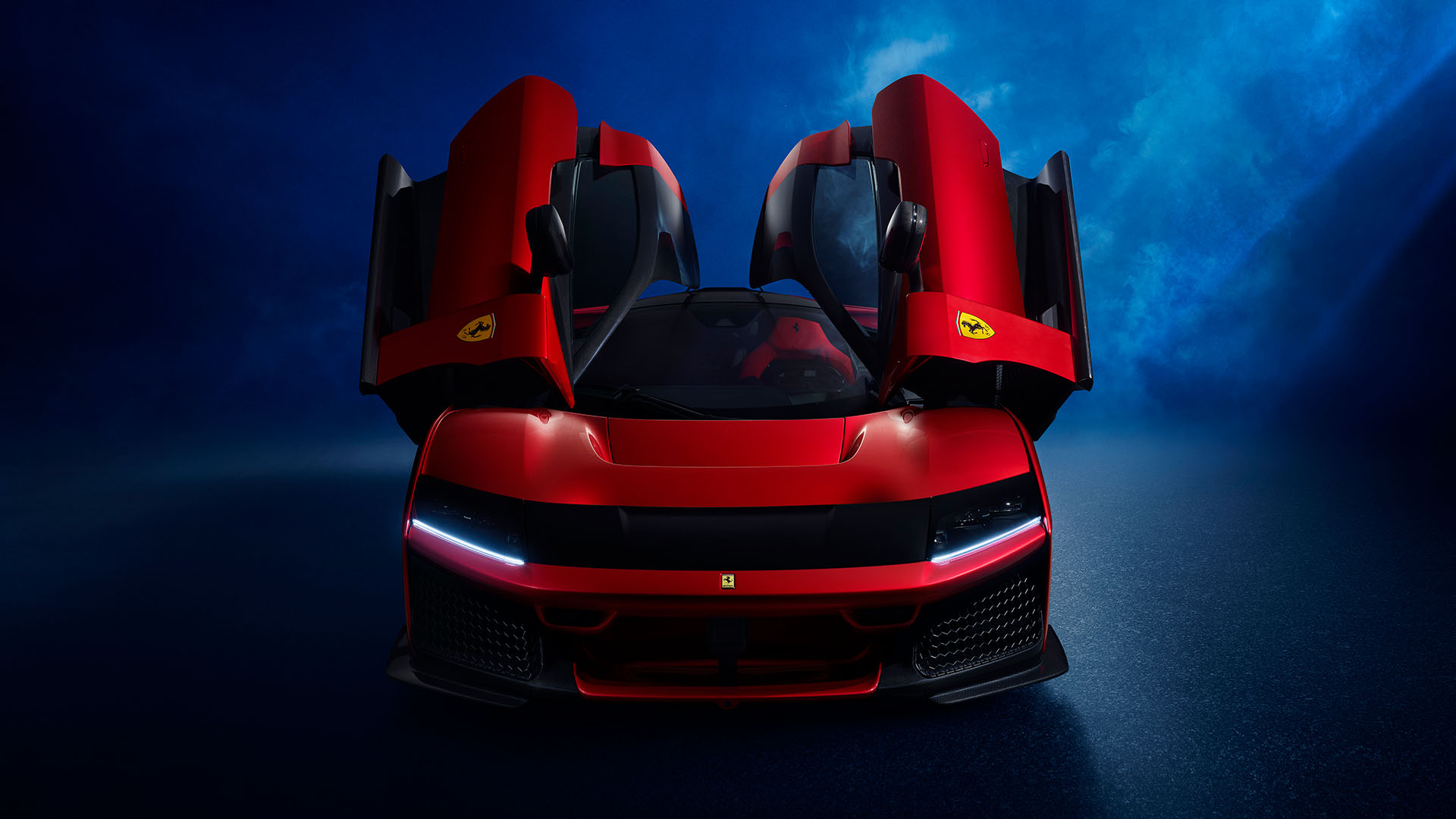
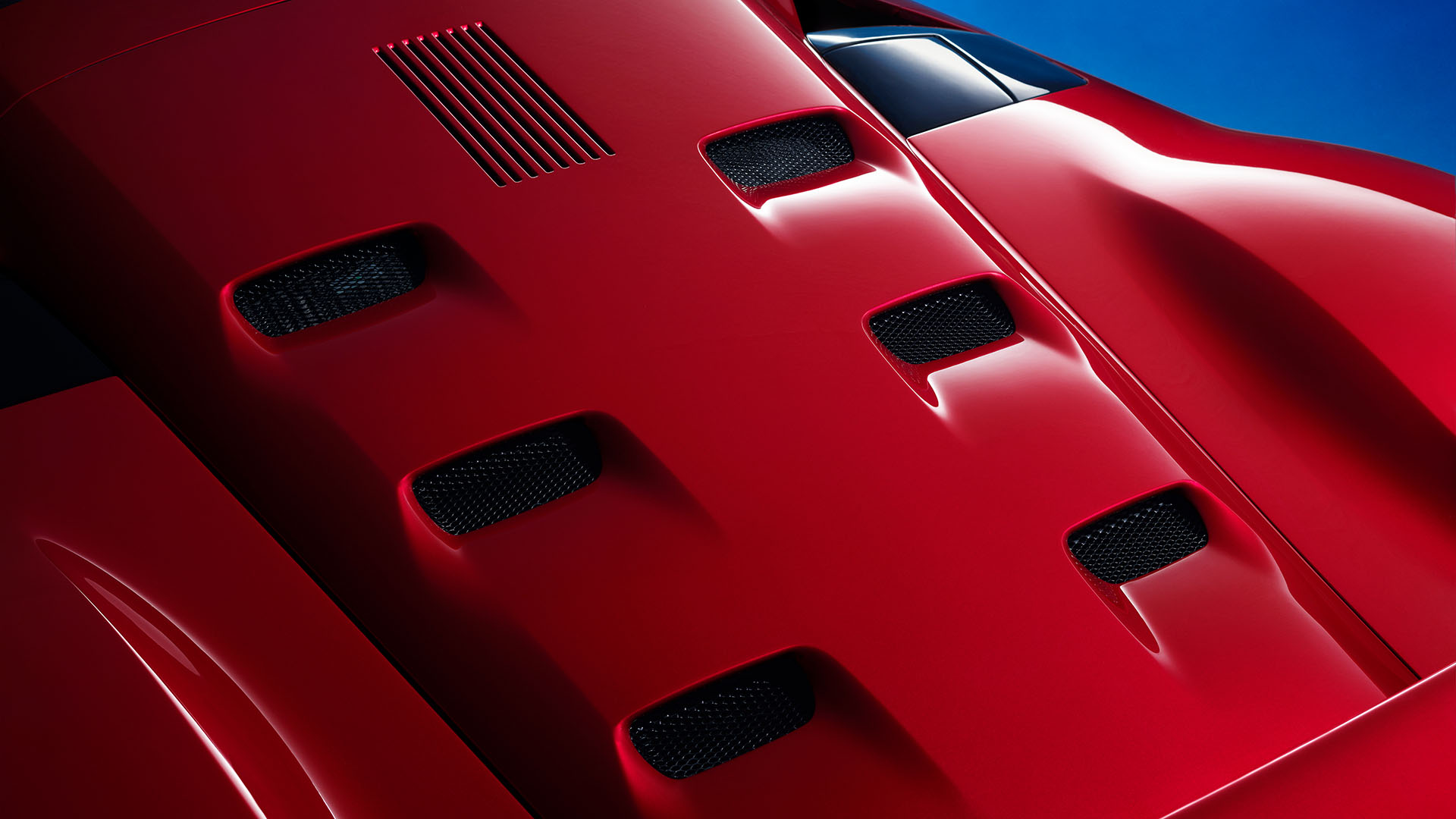
The body of the Ferrari F80 is completely made from pre-preg carbon fiber, created similarly to Formula1 cars, and the F80 comes with ‘Butterfly doors’ similar to the ones seen on the legendary LaFerrari, with a dual axis of rotation hinge mechanism allowing them to open vertically to an angle of almost 90°, and just like the rest of the body, these doors are made from high-performance carbon fiber to become a structural part of the body in case of a side impact during an accident, furthermore the rear engine cover takes styling cues from the door, featuring six air vents to allow hot air from the V6 engine to escape, with an additional grille to vent even more air.
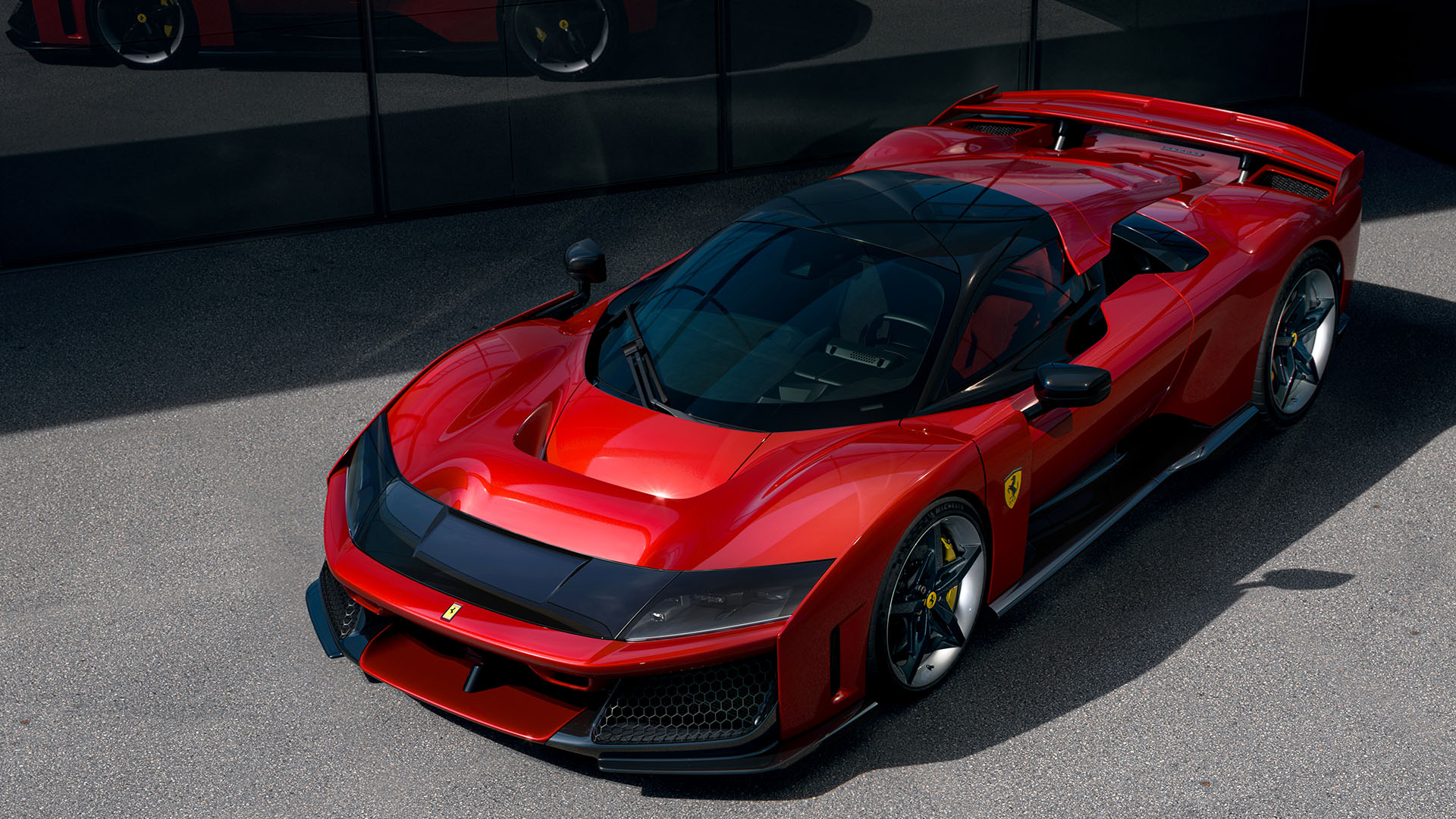
The F80 has some clear references to aerospace in her overall design to get a futuristic impact in her looks, defined by a dihedral cross section with its two bottom corners clearly set down on the wheels while the side view comes with a visual flow that shows the importance of the massive rear wing on the F80, and when you take a closer look at the wheel arches with that vertical panel, you just have to remember the design we’ve seen on the legendary Ferrari F40. If you keep looking at the new Ferrari F80 from the side, you’ll notice the ‘floating bubble’ of the cockpit, which happens to be 50 mm lower than the greenhouse seen on the LaFerrari, making the F80 look wide-shouldered while the cockpit still looks compact.
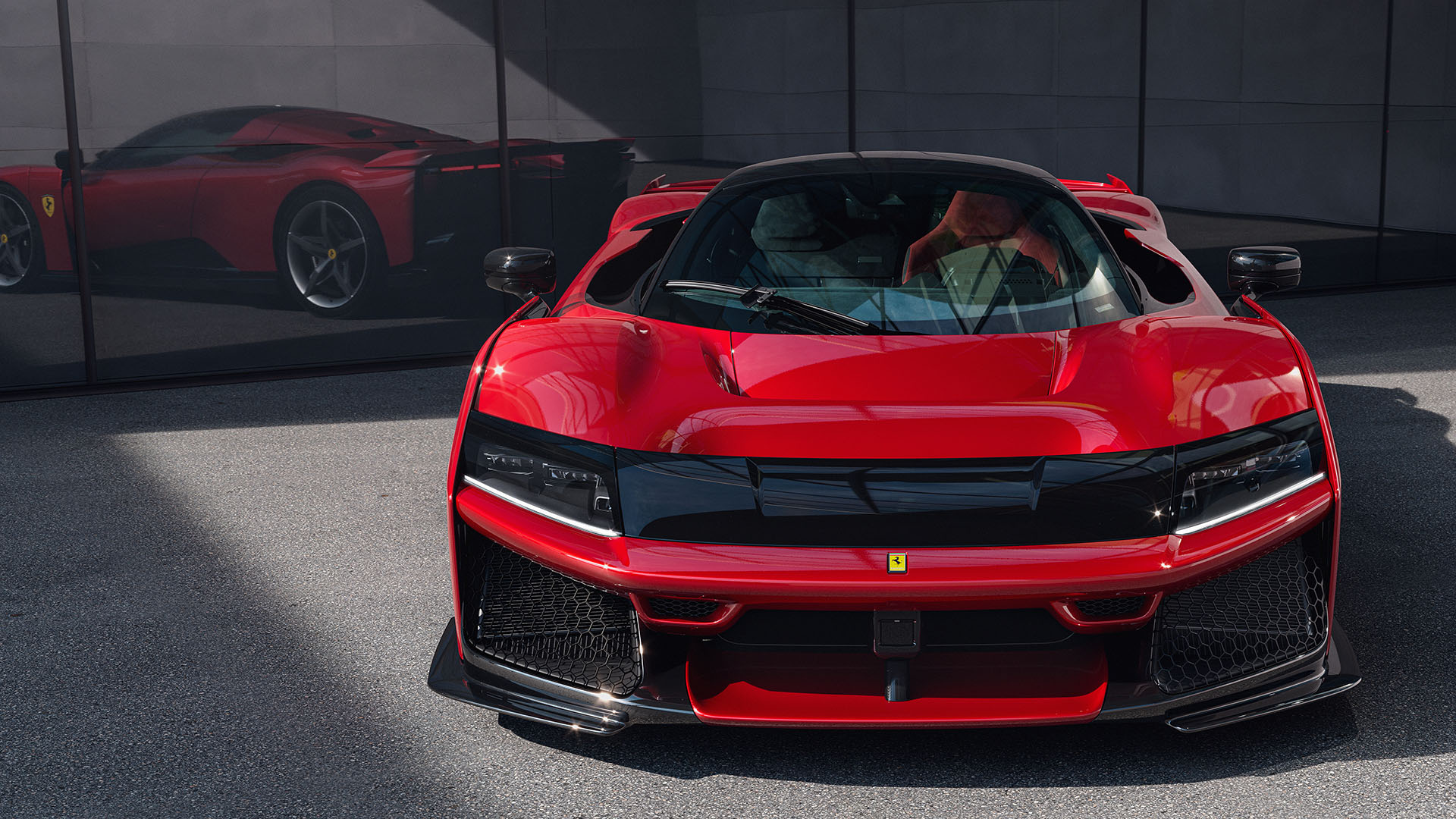
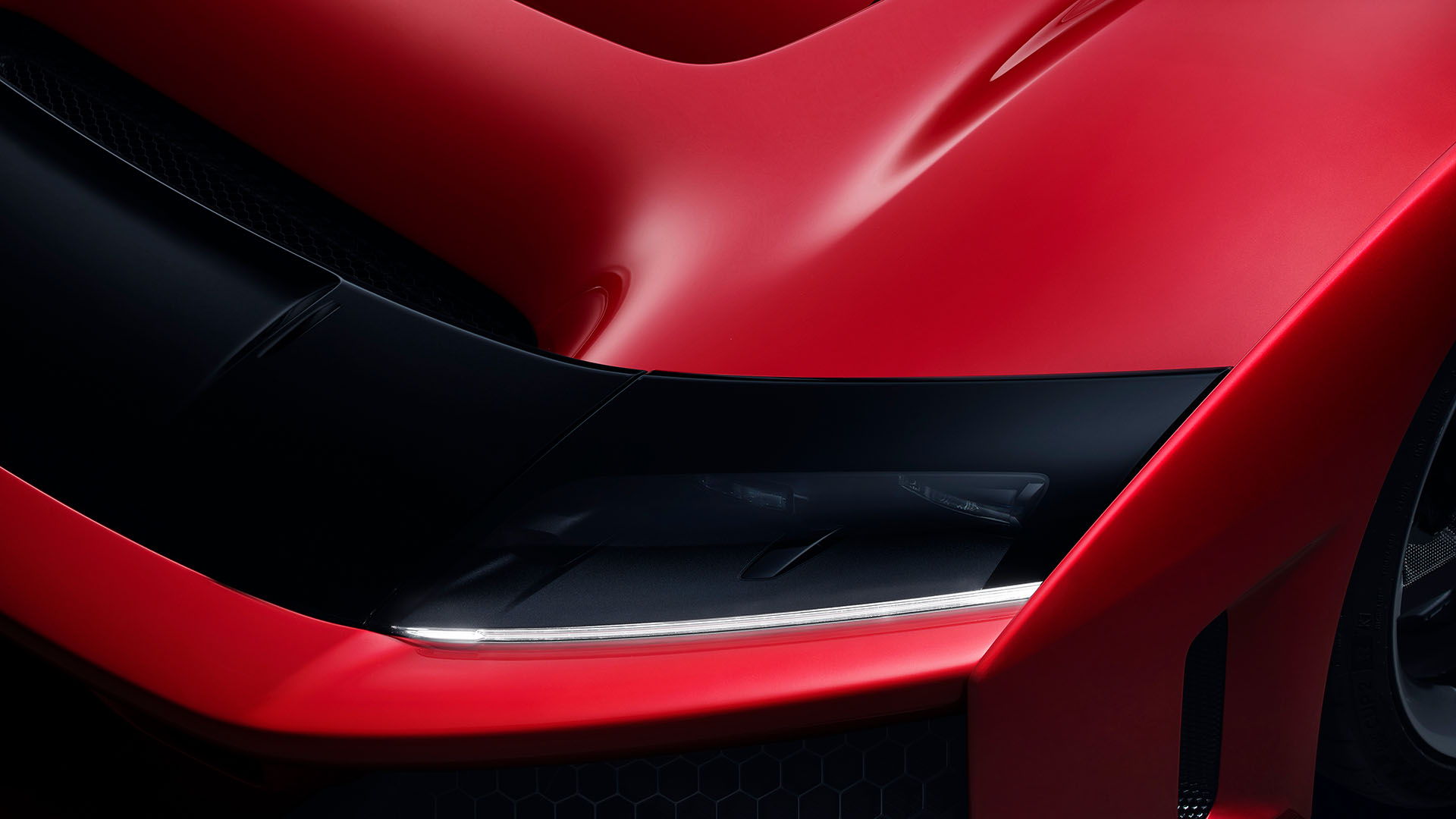
Something we’ve been seeing on a lot of cars, especially on the recent Ferrari models, is the use of bodywork finished in a nice color being contrasted with clear carbon fiber accents to set apart the overall design of the car, be it with carbon fiber lower front bumper, side sills, and rear diffuser, but usually also part on the bodywork itself, like exterior rearview mirrors, or air intakes carved into the body, or even the roof panels, but for the Ferrari F80 they wanted to do something different, so on this model, the headlight are hidden underneath some kind of visor, a black screen that’s both aerodynamic and has a lighting function to give an unmistakable appearance to the F80.
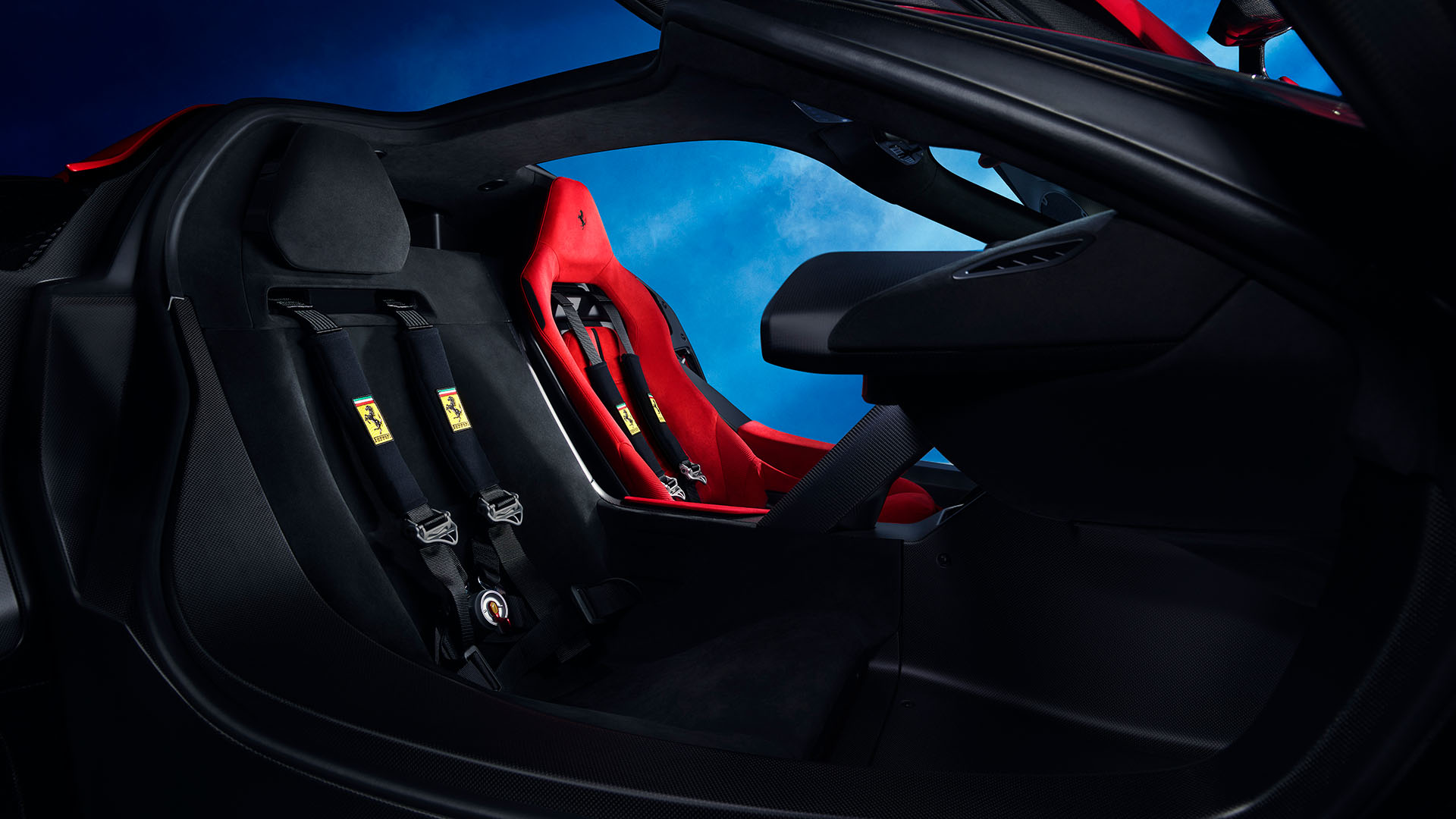
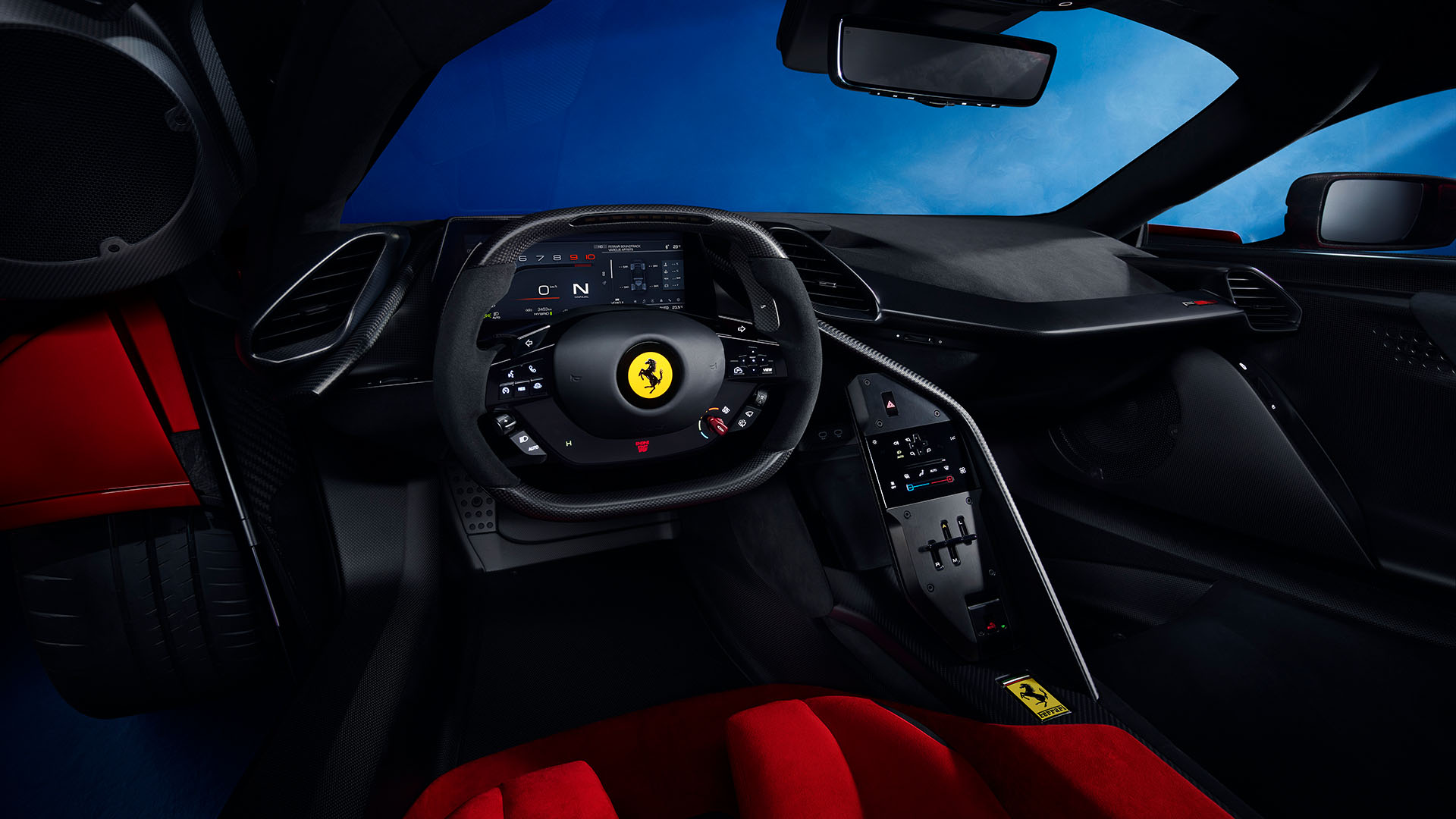
For the interior the Ferrari designer wanted to focus on the driver, almost creating a single-seater vibe inside a supercar that can still seat two people in relative comfort during their drive behind the wheel of this limited-edition model from Maranello, when you look at the seats inside the F80 you get the impression this is a 1+ design as Ferrari calls it, which starts with the control panel of the F80 being ergonomically oriented towards the driver, almost creating a cocoon around the person behind the steering wheel.
To further emphasize that impression of a single-seater car, the passenger seat is upholstered in a totally different color to the driver’s seat, making the passenger blend into the rest of the cockpit, making the seat almost invisible in the grand scheme, putting the seat at a longitudinal offset compared to the driver’s seat sets the passenger seat further backward, which helped in designing the entire cockpit narrower compared to the LaFerrari for instance.
For the new F80, Ferrari developed a new steering wheel, which will be used in other road-going models in the future, ever so slightly smaller than previous steering wheels, this new unit comes with flattened top and bottom sections, and a smaller boss, which improves visibility and gives an unmistakable sense of sportiness in your hands. The outsides of the steering wheel itself are optimized to ensure a better grip with or without gloves. But the best improvement over the previous steering wheel are the actual buttons we now get on either side of the spokes, no more full-digital layout as before, back to basics with easier-to-use buttons that can be instantly identified by touch.
The Ferrari F80 will be made in a strictly limited production run of just 799 units, if you are interested in some figures, the maximum speed is listed at 350 km/h with acceleration numbers of 0 to 100 km/h in just 2.15 seconds, 200 km/h is reached in a mere 5.75 seconds from a standstill, very impressive for a car with an overall weight of 1,525 kg … the press release doesn’t mention an MSRP, but rumor has it you’ll be looking at an invoice of $3,900,000 to add one of these supercars to your garage, but you probably won’t be able to walk into your local Ferrari dealership and sign an order form, these limited edition Ferrari are available ‘on invitation’ only, sorry.
Artù, an elegant chocolate-colored Lagotto Romagnolo — the curly-haired breed of canine known for its truffle-hunting capabilities — was not in the least bit interested in me. Me, friend to all dogs! No matter how hard I tried to get his attention, making whispery noises and wiggling my fingers in his face, Artù wouldn’t so much as cast a glance in my direction. While his owner, Giovanni Calderini, lectured our small group on the kinds of truffles found in Italy’s Umbria region, Artù stared into the distance, toward the brown and green of the forest, where he knew the prized nuggets were to be found.
Villa Castiglione Ugolino, set in a 13th-century church on the Tenuta di Murlo estate.
Federico Ciamei
A short while later, we were tramping through the woods of Tenuta di Murlo, the sprawling estate where I was staying with the photographers (and life partners) Federico Ciamei and Martina Giammaria, who had driven down from their home in Milan. Truffle hunting is one of Umbria’s marquee activities, and Tenuta di Murlo offers excursions led by Calderini over its 18,000 largely untamed acres. It was late October, black truffle season and also peak rainy season. We were barely on our way when it started to drizzle — it would rain off and on for the entirety of my week in the region — so we pulled out our umbrellas and put up our hoods. Now off-leash, Artù, still spry at 12 years old, bounded ahead.
After only about 10 minutes, the dog pulled up short in a clearing, snuffled around a spot on the ground, and then stepped back as Calderini dug with a kind of spade at the end of a spear, eventually prying up, ever so gently, what looked like a small blond rock. We passed it around, cupping it in our hands like gold. I recognized the earthy, musky scent — not from truffles, which I had never eaten, but from the truffle-flavored popcorn sold at my neighborhood movie theater back in Brooklyn. Calderini pocketed the mushroom while Artù sat patiently for photos. I was finally able to pat his silky coat as he looked up at me with forbearance. Then it was time for his reward: a game of fetch, initiated by Calderini.
From left: Giovanni Calderini and his dog, Artù, after a successful truffle hunt at Tenuta di Murlo; scrambled eggs with white truffles at Il Caldaro, the restaurant at Tenuta di Murlo.
Federico Ciamei
That night, at Tenuta di Murlo’s homey Il Caldaro restaurant, Federico, Martina, and I were served velvety eggs on toasted sourdough, topped with flecks of the same truffle Artù had unearthed. Later, in my room, I texted a friend back in the United States: “Today I went truffle hunting with a dog in the forests of Umbria.” It sounded like a line from Shakespeare.
“Isn’t it strange that life has brought you to a place where you could write that sentence?” my friend replied.
It’s a piece of received wisdom that Umbria is “the next Tuscany,” the idea being that discerning travelers for whom Florence and the surrounding countryside are a bit too popular will uncover similar attractions — hill towns, rustic trattorias, artistic masterworks — in the region’s less touristy southeastern neighbor. But judging from my admittedly brief time in Umbria, the comparison doesn’t quite hold up. Umbria is its own thing. Maybe it was the cool autumn air, or the moody clouds that shadowed us throughout the week. But on my first morning at Tenuta di Murlo, looking out over the misty landscape just outside our villa, Umbria seemed a little wilder than Tuscany, more lush and atmospheric.
From left: A guest room at Tenuta di Murlo, an estate in Umbria; Carlotta Carabba Tettamanti, the estate’s owner.
Federico Ciamei
Over drinks and snacks in the Orangerie, which serves as the estate’s check-in station and breakfast room, Carlotta Carabba Tettamanti, who owns Tenuta di Murlo with her husband, Alessio, told me the history of the property. The land has been in Alessio’s family for more than 300 years. For most of its lifetime it was a farm that followed the old mezzadria system: farmers, or mezzadri, lived on the estate and cultivated it, giving a portion of the harvest to the landowner, or padrone. As modernization spread throughout Italy in the 1960s, the system was abolished, and farmers abandoned their rustic dwellings in favor of houses with electricity and running water in towns and cities. Eventually the old Tenuta di Murlo farmhouses fell to ruin. Since 2006, Carlotta has been carefully restoring them and turning them into fully serviced luxury villas. There are currently nine, with more on the way, as well as a few traditional guest rooms in a separate building.
Federico, Martina, and I stayed at Villa Penna, a pair of white stone buildings — once a church and its priory — just down the road from Carlotta and Alessio’s castle-like home. A few steps from our door was our private infinity pool, which met the crest of a hill, and though in October it was too cool to swim, we could imagine the crystalline view we would have enjoyed from the water in summer. Inside the former church was a sunken living room with comfortably oversize seating arranged around a fireplace, an enormous kitchen and dining area with a ceiling crossed by rough-hewn wooden beams, and a grand bedroom that had the presence of a theater set.
Carlotta had included a number of thoughtful details: when I got up in the middle of the night to use the bathroom, tiny motion-sensitive lights at ankle level led the way. The sense of solitude and serenity was enveloping. Stepping out in the twilight to do some laundry in the nearby pool house, I scanned the dusky horizon for the wildlife I’d been told I might see — porcupine, wild boar, roe deer, fox. (For better or worse, I didn’t encounter any.)
From left: Guide Rudston Steward digs into a plate of strangozzi at L’Alchimista, in Montefalco; setting the stage for in-villa dining at Tenuta di Murlo.
Federico Ciamei
A tour of the estate gave us the chance to visit a few of the other villas — all of them white stone buildings with characteristically Umbrian terra-cotta roofs. Villa Molinella, the smallest, is a former mill that sits next to a quietly burbling stream and has an underground Jacuzzi where the mill wheel used to be. The most romantic of Tenuta di Murlo’s villas, it wouldn’t look out of place in a Monet painting. Villa Torre was once a defense tower from which soldiers monitored the nearby road, so it has wide-angle views of the countryside.
The most recent renovation was also the most spectacular. Located on a hill high above the town of La Bruna, the 10-bedroom Villa Castiglione Ugolino is another former church, this one built in the 13th century. The main chapel, which has frescoes from the school of Cimabue in Easter-egg colors, remains untouched, and functions as an event space.
Tenuta di Murlo has a working farm where Federico, Martina, and I fed sheep and goats and nuzzled with rabbits. We suited up in yellow beekeeper outfits and toured the resident apiary, from which the property draws its own honey. On our last night, a team of chefs turned the kitchen of our villa into a hive of activity, too, preparing a private feast that blended the flavors of late summer and early fall: a pecorino soufflé with pear sauce; agnolotti del plin with black truffles and burrata; scallops with tomatoes, caperberries, and olives; and fresh berries and ice cream.
From left: Rudston Steward leading a tour through an olive grove near the town of Montefalco; the apiary at Tenuta di Murlo.
Federico Ciamei
One morning, Federico, Martina, and I met up with an American expat named Rudston Steward, who was taking us on a half-day walk from the tiny medieval village of Giano dell’Umbria to the hill town of Montefalco, a distance of about eight miles. Steward has been giving walking tours around his adopted home of Italy for almost two decades; in 2016, he founded the Maremma Safari Club, which is more or less a one-man operation. He once guided walks in Bhutan, Nepal, and other countries, but, as he became concerned about air travel’s carbon footprint, realized that one doesn’t have to fly around the world to reap the benefits of travel. Every corner of Italy offers its own treasures. “You can have a huge variety of experiences in one country,” he told me.
Each year Steward conducts a handful of four- to five-day group trips — next spring and summer’s roster includes hikes in Calabria, Sicily, Tuscany, and the Dolomites — as well as custom tours for private clients. A few weeks before my trip, we had spoken by phone. When he mentioned that the deconsecrated Church of San Francesco in Montefalco had an early fresco cycle by the Renaissance master Benozzo Gozzoli, whose joyous paintings in Florence’s Chapel of the Magi I had seen years ago and loved, we agreed to structure a walk around seeing it.
From left: An entryway at the San Michele suites, housed in a former church vestry on the grounds of the Reschio resort; pomegranates in the village of Rustichino.
Federico Ciamei
For all the talk in the travel industry about “authentic experiences,” moments when we pierce the membrane between ourselves and our surroundings can be rare. Steward’s walk was the real deal: a four-hour amble along secondary roads past farmsteads and olive groves, the undulating terrain fanning out around us on all sides. Goats peered skeptically at us from behind fences; dogs barked at our approach. Just outside Giano dell’Umbria, we passed hunters darting in and out of the woods. A few of their gunshots sounded a bit too close for my comfort, but Steward paid them no mind, unflappably pointing out broom, juniper, wild asparagus.
As we passed through the quiet hamlet of Rustichino, we met an elderly man walking down the main road. “Do you want to walk with us?” Steward asked. Where are you going? the man queried in Italian. We told him our destination, pointing toward the hill town in the distance, still some miles away. You’d better have some food before you get there, he replied, laughing, or you’ll be hungry. (Indeed, Steward had packed us a snack of fruit and trail mix.)
We finally reached Montefalco, a little tired but invigorated and hungry. Steward led us to L’Alchimista, an enoteca in the main square, where we were seated next to a tableful of cheerful Montefalchesi having a long, leisurely work lunch, and where Steward insisted we try the season’s newly pressed olive oil, grass-green and peppery, on bruschetta. The cuisine of landlocked Umbria is meaty, and I’m a vegetarian, which meant that I was forced — forced! — to eat a pasta dish at almost every meal. Chef Patrizia Moretti’s strangozzi — a thick wheat noodle, which she tossed with zucchini and a creamy saffron cheese sauce — was among the best.
From left: Cypresses along the drive to a restored farmhouse on the Reschio estate, as seen from the Castello; a fresco by the Renaissance artist Benozzo Gozzoli in Montefalco’s church of San Francesco.
Federico Ciamei
The Gozzoli frescoes, which occupy a high octagonal apse in San Francesco, had the same warmth and intimacy of the artist’s Magi paintings. The cycle tells the story of Saint Francis, who was born and died in nearby Assisi, and spent much of his life in Umbria. (On the drive to meet Steward that morning, we passed through the parish of Canarra, where Francis famously preached to the birds.) Gozzoli painted the Montefalco frescoes in 1452, more than two centuries after Francis’s death, but the fields and farms with which he filled in the background of the saint’s life seem to exist outside of time, and looked a lot like the ones we had just hiked through.
Assisi’s Basilica of Saint Francis also holds a fresco cycle that illustrates Francis’s life, this one by Giotto, Cimabue, and other medieval artists. These paintings are keystone works of Western art, and were at the top of my list of Umbrian must-sees. On the day Federico, Martina, and I set out to visit the town, heavy rain was forecast, but we decided to take our chances. Halfway there the sky unleashed sheets of water so thick that we could barely see the road in front of us; I checked my phone and saw that Assisi was at risk of flash floods. It was hard not to think of our warm and dry hotel rooms, and we turned around, leaving Francis for another trip.
A smaller but no less sublime work awaited me in the university city of Perugia, where Tenuta di Murlo had arranged for me to meet Elisabetta Federici, a licensed guide. Federici led me into the empty Nobile Collegio del Cambio, a suite of street-level rooms in a medieval palazzo used by the guild of money changers in the 15th century. The walls were painted by Perugino (with some help from his apprentices, one of whom may have been Raphael) and feature an assembly of Greek and Roman figures — Socrates, Pericles, Cato — as well as religious and mythological figures, all delicately rendered in radiant colors. It might be the most beautiful conference room in the world.
From left: The Palm Court, the main reception hall at Reschio; cabbage ravioli in a verbena broth at the estate’s Ristorante al Castello.
Federico Ciamei
Federico, Martina, and I sensed that we were in for something different — something playful — as we drove up the twisting driveway of Reschio, an estate that sits on Umbria’s border with Tuscany. We parked near the Castello, or castle, a 10th-century structure that’s been remodeled as a 36-room hotel with an appealing fun-house sensibility. We wandered into the Palm Court, where a pianist was playing a cocktail-bar take on the Beatles’ “Golden Slumbers,” then toured the adjacent lawn, with its lozenge-shaped pool surrounded by umbrella pines. My room had ocher walls, a wide canopy bed, a pumpkin-colored divan, and oddball vintage paintings, the kind you might come across at a flea market: a black French bulldog, a somber woman in a straw hat. (These paintings popped up throughout the public spaces as well; my favorite was a Victorian whitebeard with two enormous pink flowers over his ears.)
Like Tenuta di Murlo, Reschio was once a farm that operated under the mezzadria system. Count Antonio Bolza, who was born in Hungary but whose ancestral family hails from Italy, acquired the 3,700-acre property in 1994 with his Austrian wife, Countess Angelika, and began restoring its 50 abandoned farmhouses. In time, their son, Count Benedikt, who had studied architecture in London, took over the project, raising a family in the Castello with his wife, Donna Nencia, and eventually turning the building into a hotel that also serves as a showcase for his furniture designs.
From left: Benedikt and Donna Nencia Bolza, owners of Reschio, in the estate’s design studio; the terrace of Reschio’s Tower Suite.
Federico Ciamei
We met Count Benedikt at the Tabaccaia, a long, two-story building that was once a tobacco factory and now holds his design studio. With his thick swoop of hair, crimson wool blazer, and striped scarf, he reminded me of a younger Jeremy Irons. He has continued to restore the scattered farmhouses, which are now owned by private clients and come with the services of cooks, gardeners, drivers, and housekeepers. Some of those clients are famous, and the Castello, too, draws well-known actors and musicians; in fact, Reschio requests that, if you take photographs during your stay, you make sure that other guests don’t appear in them.
Strolling back to our rooms after dinner in the pitch dark, we heard a snuffling sound coming from the adjacent fields: Umbria’s famous wild boars.
Over the next few days, Federico, Martina, and I explored Reschio the way kids might explore a new playground. Donna Nencia is a passionate equestrian, and the hotel’s stables, populated by beautiful Spanish horses, were the most luxurious (and cleanest) I had ever seen. We watched a freshly shampooed horse dry off under an enormous heat lamp. We sat on deck chairs by the pool and ordered pressed sandwiches from the adjacent bar. We monkeyed around at the outdoor gym and watched other guests playing tennis on the Astroturf courts. I had a massage in the spa, which occupies the former wine cellar, in a room that looked like a medieval kitchen, lit by candles and a blazing fireplace. And I ate additional quantities of pasta at the hotel’s two restaurants: the quietly refined Castello and the more casual Ristorante alle Scuderie. The latter is a tall, airy room with floor-to-ceiling windows that sits a short walk from the Castello. Strolling back to our rooms after dinner in the pitch dark, Federico, Martina, and I heard a snuffling sound coming from the adjacent fields. Umbria’s famous wild boars, we realized, and picked up the pace.
I couldn’t help comparing Reschio and Tenuta di Murlo, and considering the way the two properties complement each other. Reschio is fizzy and social and whimsical. Tenuta di Murlo is a little more grown-up, a little more subdued. If Reschio is drinks by the pool and the surprise of quirky design, Tenuta di Murlo is a peaceful evening with family and a good book, and the deep satisfaction of privacy and proximity to nature. Stay first at one, and then the other, in whichever order suits your emotional needs.
From left: Ribollita soup at Locanda di Nonna Gelsa; Chiara de Chirico, the restaurant’s owner.
Federico Ciamei
On our last night, we drove to the town of Niccone in search of a restaurant I had read about. It was a Wednesday night and the main street was deserted. It took us a while to find Locanda di Nonna Gelsa — the entrance was in a greenhouse at the back of an unassuming building. The décor was simple and unfussy; the tables were covered with checkered cloths. The jolly owner, Chiara de Chirico, brought a blackboard with the night’s menu. I ordered a hearty ribollita soup and then fagottini, star-shaped pockets of pasta, drizzled with arugula pesto.
On that night Nonna Gelsa seemed to be populated by nearby residents and a few tourists, but de Chirico said that Reschio and other new high-end hotels had, over time, brought an infusion of new patrons, some of them well-known. (My entrée, she pointed out, was Meryl Streep’s favorite.) But it was clear that no amount of celebrity had changed Nonna Gelsa, and no amount would. “If you are posh,” said de Chirico, “this is not the place for you.” Nonna Gelsa was the kind of authentic Italian trattoria that travelers dream about — the kind that looks the same in the 2020s as it did in the 1920s.
I thought of something Count Benedikt had told me: “The world has changed, but Umbria hasn’t. And you don’t want it to change. It’s beautiful as it is.”
Where to Stay
Reschio
Reschio is a beguiling, richly designed resort set on an idyllic 3,700-acre swath of northern Umbria. Take advantage of the many activities on hand — including horseback riding, foraging, cooking classes, e-bike riding, and tennis — or hang by the pool with a panini and a drink by your side.
Tenuta di Murlo
Rent a villa on this peaceful, secluded estate and you’ll feel like you’ve made your fortune and retired to the Umbrian countryside. Each house is handsomely decorated and comes with its own private pool. The service is outstanding.
Where to Eat
L’Alchimista
An inviting wine bar on the main square in Montefalco, with a menu of hearty meat dishes and, come autumn, truffle-inflected recipes.
Locanda di Nonna Gelsa
No frills, no fuss — just a rotating menu of Umbrian classics enhanced by the good humor of owner Chiara de Chirico and her friendly staff. This restaurant is located in the blink-and-you’ll-miss-it village of Niccone.
What to Do
Maremma Safari Club
The amiable, American-born Rudston Steward, who has lived in Italy for more than two decades, offers multiday group and private walking tours throughout the country. While Umbria isn’t currently on his roster of planned itineraries, he can custom-design a private tour.
A version of this story first appeared in the November 2024 issue of Travel + Leisure under the headline “Earthly Delights.”
Photo: Photo: Courtesy of Nicolas Kantor, via Louis Vuitton
Louis Vuitton has turned a new page in its rich history with the launch of its Le Damier de Louis Vuitton Fine Jewellery Collection—an artistic masterpiece where heritage meets modernity.
The Damier pattern, first created in 1888 by Louis Vuitton and his son Georges, is no ordinary motif. It was born as a signature of distinction, a checkered design that, with its repeating squares, echoed the idea of infinity. Inspired by the number eight, a symbol of continuity and endless possibilities, this motif has become more than just an adornment; it’s a hallmark of Louis Vuitton’s unparalleled craftsmanship and originality.
At the heart of this rebirth is Francesca Amfitheatrof, artistic director for Watches and Jewellery at Louis Vuitton, who has masterfully reimagined the Damier in her latest collection.
“[Le Damier] is a diamond collection that is not just about the stones but the pattern that they create,” she says.
Indeed, the diamonds, delicately set within the Damier’s form, become an integral part of a geometric symphony that celebrates both strength and grace. Gleaming squares of yellow and white gold shimmer with an interplay of light and shadow.
The collection features 12 contemporary pieces, including rings, necklaces, bracelets, and earrings, all crafted with a fresh perspective on fine jewellery.
Read more: AET REMOULD is at the Forefront of Luxury Jewellery and Watch Customisation
Le Damier de Louis Vuitton Large Bracelet in white gold & diamondsLe Damier de Louis Vuitton Bracelet in yellow gold & diamonds
When it comes to the collection’s tennis bracelet, a defining moment in jewellery history served as the inspiration: during the infamous 1978 US Open, tennis star Chris Evert’s diamond bracelet flew off mid-match, halting the game until it was recovered. This iconic incident gave birth to the “tennis bracelet” as we know it today.
In Amfitheatrof’s hands, the tennis bracelet becomes more than a symbol of heritage. Known for her visionary approach, the designer has transformed this iconic design into a piece that feels effortlessly chic, with a refined fluidity that echoes the grace of the original moment, while embracing a bold new direction in luxury craftsmanship.
The piece features two radiant rows of diamonds, available in both yellow and white gold. While its exquisite craftsmanship is expected, what truly sets it apart is its remarkable fluidity. This liquid-like suppleness, rarely associated with metal, creates a stunning visual and tactile experience. Designed to wrap effortlessly around the wrist, it feels like a second skin, moulding to the body with seamless grace.
Read more: The Enduring Influence of Middle Eastern Inspirations in Jewellery
Photo: Courtesy of Nicolas Kantor, via Louis Vuitton
But the brilliance doesn’t stop there. The collection boasts other standout creations—a delicate round pendant that captures the eye with its dance of diamonds on a slim yellow gold chain, and a pair of yellow gold hoop earrings, each studded with gems that catch the light with every movement. Every detail, from the fine lines of the jewellery to the perfect arrangement of diamonds, tells the story of precision and artistry, reflecting Louis Vuitton’s commitment to craftsmanship.
Photo: Photo: Courtesy of Nicolas Kantor, via Louis Vuitton
Read more: Tiffany & Co. Honours 50 Years of Elsa Peretti’s Iconic Bone Cuff
Yet, it’s the rings that truly steal the show. Offered in a trio of widths and designs, the signature ring of the collection is the epitome of versatility. Whether you choose the refined version with two shimmering rows of diamonds or the bolder iteration featuring four, these rings are more than just accessories—they’re statements.
Unisex in design and endlessly stackable, they invite the wearer to experiment, to tell their own story of elegance. In each piece, the symbolic infinity of the Damier motif whispers through the meticulous rows of diamonds, inviting you to play, layer, and reinvent your look.
Le Damier de Louis Vuitton has proved that it’s a journey through time, connecting the past with the future. This is jewellery meant to be worn, cherished, and passed down—pieces that carry stories, spark conversations, and radiate a quiet, powerful sophistication.
In the words of Amfitheatrof herself: “Le Damier de Louis Vuitton embodies what modern jewellery is all about.”
This article was first seen on Grazia Singapore.
For more on the latest in luxury style and accessories reads, click here.
Some electric vehicles (EVs) debut with much fanfare and publicity. The GMC Sierra electric vehicle (EV) nearly slid under the radar. The truck has already been on sale (in very limited numbers) for one model year, and a second is on the way. For 2025, the Sierra EV will get a lower price and a more extended range, though it may keep its quiet media presence.
EV Trucks a Slow Market at First
The stealth approach is likely an intentional strategy. The market for electric trucks has been small at first, with pickup consumers skeptical about the switch to electric transportation. Tesla has an easy time selling its Cybertruck, often sought out by buyers new to truck ownership who want its unique sense of presence.
The GMC Hummer EV pickup, less a traditional pickup than a slightly ostentatious off-road toy, fills a niche.
The Ford F-150 Lightning and Chevrolet Silverado EV have been slower sellers. They’re aimed at traditional truck buyers looking to go electric — a crowd that may take time to grow.
From Ultra-Exclusive to Just Exclusive
With that in mind, GMC launched the Sierra EV as an ultra-high-end truck. The 2024 version came only in a supremely well-equipped trim level called “Denali Edition 1,” which cost over $100,000.
For 2025, the model will take a slight step down in both features and price.
GMC will drop the Edition 1 trim and offer two in its place: Denali Extended Range and Denali Max Range. The Extended Range truck will start at $94,090 (including a mandatory $2,095 destination fee).
In this case, “extended” range means 390 miles. The Max Range version boasts a 460-mile range between charges — 20 miles more than the Edition 1 version. It starts at $102,590 delivered.
GMC says both can add 100 miles of range in 10 minutes hooked up to a Level 3 public charger. They’ll include an adjustable suspension capable of adding 2 inches of ground clearance when needed and a unique midgate that “offers room for hauling items nearly 11 feet in length, while still leaving room for a rear-seat passenger.”
GMC expects to “expand the GMC Sierra EV lineup with the addition of Elevation and AT4 models, providing customers even greater choice and rugged off-road capability” in the first half of next year.
Ferrari has taken the wraps off its next-generation hypercar, the F80. The new flagship replaces the LaFerrari in the brand’s lineup.
The Ferrari F80 is said to mark the beginning of a new technological era for the brand. Unlike its predecessors, the Enzo and LaFerrari, the new F80 is a hybrid. It drops the screaming V12 for a more sensible twin-turbo V6. Yet, it’s the most powerful road-going Ferrari ever.
The F80 features a mid-mounted 3.0-liter twin-turbo V6 engine that produces 900 hp. The internal combustion engine is paired with an electric front axle and an F1-derived MGU-K, which adds another 300 hp, taking the total output to 1200 hp. Ferrari claims a 0-62 mph time of 2.15 seconds. 0-124 mph comes up in 5.75 seconds, and it can reach a top speed of 217 mph.
In terms of its design, the F80 looks like an evolution of the F40. The driver cell is made from carbon fibre and other composites, with aluminium subframes on both ends. The car has a flat nose section with an active S-duct and butterfly doors. At the rear, it has a large active wing that can be raised or lowered depending on the downforce requirement. The rear fascia comprises slim LED taillights with an aero channel in the centre, a large diffuser, and a centrally mounted exhaust.
Step inside, and you will feel like you’re a race car. There’s carbon fibre and Alcantara all around with a new steering wheel and digital instrument cluster. The centre console is angled towards the driver and houses the H-pattern drive mode selector. As you can see, the F80 is built around the driver in a 1+ configuration.
The Ferrari F80 comes with a price tag of €3.6 million. Production will be limited to 799 units.
The technical storage or access is strictly necessary for the legitimate purpose of enabling the use of a specific service explicitly requested by the subscriber or user, or for the sole purpose of carrying out the transmission of a communication over an electronic communications network.
Preferences
The technical storage or access is necessary for the legitimate purpose of storing preferences that are not requested by the subscriber or user.
Statistics
The technical storage or access that is used exclusively for statistical purposes.The technical storage or access that is used exclusively for anonymous statistical purposes. Without a subpoena, voluntary compliance on the part of your Internet Service Provider, or additional records from a third party, information stored or retrieved for this purpose alone cannot usually be used to identify you.
Marketing
The technical storage or access is required to create user profiles to send advertising, or to track the user on a website or across several websites for similar marketing purposes.