As someone who spends a lot of time outside, especially during the summer months, I have become adamant about protecting my skin from the sun.
I wasn’t always this way, though. In my 20s, I was a little careless about applying sunscreen and covering my skin up with UV-protective clothing. As a result, I now have a lot of sunspots on my face that could have been prevented had I been more vigilant about sun protection.
What’s more, not that long ago, my mom had some skin cancer on her nose removed and I also had a friend in her 30s who experienced a melanoma scare. Suffice to say, all of this has been a wake-up call for me to take better care of my skin as I age.
Now, whenever I head out for a hike or spend a lot of time outdoors, I make sure to cover up with a UV protective sun shirt, a hat, and sunscreen and take other measures to protect my skin from sun damage.
In this post, I share all my best tips on sun protection for hikers including our favorite UV-protective gear, clothing items, and how to keep your skin safe while outside
Wear a Hiking Shirt with UPF
When choosing the best sun protection shirts, opt for t-shirts that cover your chest, back, and shoulders rather than tank tops that expose more of your skin. These days, I usually opt for long-sleeves as it minimizes the amount of sunscreen I have to wear. I always look for lightweight, breathable, moisture wicking materials that will keep me cool even on hot days. Here are a few of my favorites that have a high UPF rating. For more recommendations and details, check out my roundup on the Best Sun Protection Shirts for Hiking.
Patagonia Capilene Cool Daily Hoody: This long-sleeved Patagonia tee (men’s version here) is made out of fast-drying and moisture-wicking Capilene with built-in UPF 50+ sun protection. I can wear these for days when I’m on the road without them stinking and own them in a bunch of different colors. It’s super lightweight, so even though it’s long sleeve it will keep you cool in warm weather. It also comes in a non-hooded version.
Outdoor Research Astroman Shirt: This long-sleeve Outdoor Research Astroman shirt (men’s version here) is perfect for a sunny day of hiking. It’s the lightest-weight sun shirt I own and is rated for UPF 30-50 sun protection. With the button up, it doesn’t scream “hiking shirt” and can it is moisture-wicking and lightweight, making it a great UV sun protective option for the trail.
REI Co-op Sahara Shade Hoodie: The REI Sahara Shade Hoodie (men’s version here) offers UPF 50, offers more neck coverage than the two above, and also has thumb holes so you can cover the tops of your hands. I wore this almost everyday when I was on Maui, and I stayed comfortable even in the muggy climate.
Wearing the Patagonia Capilene Cool Long Sleeve Hoody on a hike during our BC Icefields Parkway road tripWearing the REI Sahara Shade Hoody on Maui
Wear a Wide Brimmed Hat
Sun hats are a great way to protect your face and neck from the sun while keeping your head cool. When choosing a sun hat, look for ones with a full brim that provides protection all around including the sides of your face and back of your neck.
The Wallaroo Sedona hat is my all-time favorite wide-brimmed hat. It provides a good amount of sun protection, and it’s cute too. I like that it’s not too floppy so it doesn’t get in the way of my vision, and it also has a drawstring in the brim that allows you to tighten the hat if it gets windy on the trail. *DISCOUNT CODE: get 20% off Wallaroo hats with code BEARFOOT20
If you want something more packable, a good old bucket hat works great. Alternatively, a baseball-style cap works in a pinch, and I especially like them for backpacking since there’s no back brim to rub up against your pack. Need more recommendations? Check out our post on Best Hiking Hats for Women.
Lather Up with Sunscreen
In addition to protecting your skin with clothing and a hat while you hike, it’s also important to apply sunscreen whenever you go outside. I always go with a paraben-free sunscreen to avoid harmful chemicals.
If you’re going for a longer hike, bring a small bottle of sunscreen with you so you can reapply as needed. It’s easy to find that you’ve been out the whole day and only put sunscreen on once in the morning, so remind yourself to reapply.
Don’t forget your lips! There’s nothing worse than burnt, cracked, and bloody lips after a hike. My go-to is Jack Black Lip Balm with SPF 25. I’ve been using it for years, and it lasts so much longer than other lip balms I’ve tried.
Wear these Sun Protection Accessories
You should always wear sunglasses when you hike to protect your eyes. While I don’t always follow this advice, but wearing the wrap around shades covers the sides of your eyes.
I always wear a Buff to cover my neck. It also can be used to cover your mouth and nose if it’s dusty out or can even double as a headband.
I use a Buff to covers up my neck
Stay Hydrated
Staying hydrated is always important but especially if you’re out hiking in the heat. Being out in the hot sun makes you more prone to heat exhaustion and dehydration. Bring lots of water, electrolytes, and some salty hiking snacks so you stay hydrated.
I always hike with a hydration reservoir in my backpack so I can drink from the hose without taking my pack off
Additional Tips for your Hike
To further protect your skin from the sun while hiking, here are a few additional tips:
Hike early in the day: Hike early in the morning or early in the evening to avoid peak sun intensity and heat. You’ll stay much cooler
Check the weather: For long hikes, check ahead weather of time to see how hot it’s going to be so you can cover up appropriately. Also, research whether there is shade along the trail or whether you’ll be completely exposed so you can be prepared.
Pick a shady trail: If possible, pick a shady trail if you’re going to be hiking midday or if it’s going to be particularly hot.
Take breaks in the shade: This sun protection tip is pretty obvious, but it really is helpful to take rest and water breaks in the shade. You’ll be surprised how much a few minutes in the shade will help you cool off.
Understand the environmental conditions
Certain conditions like high altitude or reflection off of snow can increase the need for added sun protection. If you’ll be hiking at a high elevation, be sure to protect your skin with long sleeves and sunscreen.
If you’re hiking in snow, the sun reflects off of the snow and can burn you in places you never thought possible, like the bottom of your nostrils. Wear wrap around shades so the sun doesn’t reflect off the snow into your eyes, and reapply sunscreen to your face throughout your hike. Don’t miss the bottom of your nose
The sun is more intense on high altitude hikes where you’ll want to take your sun protection seriously.
Frequently Asked Questions
Does UPF Clothing really work?
Yes! UPF stands for Ultraviolet Protection Factor, and the rating determines how much UV light is able to get through the fabric. All of the sun protection shirts I recommend in this post have a UPF rating of 50, which means that 1/50th or 2% of the UV radiation can penetrate the shirt. In comparison, cotton has a UPF between 5-15, which on the lower end allows 20% of the radiation to reach your skin.
What SPF sunscreen should I wear while hiking?
The Skin Cancer Foundation recommends that you wear broad spectrum sunscreen with SPF of 30 or higher when you’re doing outdoor activities. I typically wear SPF 30 and reapply at least once during my hike. If I’m at high altitude, on the water, or on snow, where the sun is reflected, I will reapply more frequently. If you are wearing UPF clothing, you don’t need to apply sunscreen underneath.
Save this post to Pinterest
Do you have any other suggestions or questions on sun protection for hiking or an experience you’d like to share? Let me know in the comments below!
Meet Media.Monks’ Wormhole, an alien-like, conversational robot with a quirky personality and the ability to offer keen marketing expertise. Lewis Smithingham, senior vice president of innovation and special ops at Media.Monks, a global marketing and advertising company, discusses the creation of Wormhole and AI’s potential to enhance media and entertainment with host Noah Kravitz in this AI Podcast episode recorded live at the NVIDIA GTC global AI conference. Wormhole was designed to showcase Monks.Flow, an AI-powered platform that streamlines marketing and content creation workflows. Smithingham delves into Media.Monks’ platforms for media, entertainment and advertising and speaks to its vision for a future where AI enhances creativity and allows for more personalized, scalable content creation.
Stay tuned for more episodes recorded live from GTC, and hear more from Smithingham in this GTC interview.
Time Stamps
1:45: What is Media.Monks? 6:23: Description of Wormhole 8:49: Possible use cases for Wormhole 10:21: Takeaways from developing Wormhole 12:02: What is Monks.Flow? 16:54: Response from creatives on using AI in their work 21:23: Smithingham’s outlook on hyperpersonalized content 34:24: What’s next for the future of AI-powered media?
You Might Also Like…
Exploring Filmmaking With Cuebric’s AI: Insights From Pinar Seyhan Demirdag – Ep. 214
In today’s episode of NVIDIA’s AI Podcast, host Noah Kravitz talks with Pinar Seyhan Demirdag, co-founder and CEO of Cuebric. Cuebric is on a mission to offer new solutions in filmmaking and content creation through immersive, two-and-a-half-dimensional cinematic environments.
Deepdub’s Ofir Krakowski on Redefining Dubbing From Hollywood to Bollywood – Ep. 202
On the latest episode of NVIDIA’s AI Podcast, host Noah Kravitz spoke with Deepdub’s cofounder and CEO, Ofir Krakowski. Deepdub uses AI-driven dubbing to help entertainment companies boost efficiency and cut costs while increasing accessibility.
WSC Sports’ Amos Bercovich on How AI Keeps the Sports Highlights Coming – Ep. 183
On this episode of the AI Podcast, host Noah Kravitz spoke with Amos Bercovich, algorithm group leader at WSC Sports, makers of an AI cloud platform that enables over 200 sports organizations worldwide to generate personalized and customized sports videos automatically and in real time.
Maya Ackerman on LyricStudio, an AI-Based Writing Songwriting Assistant – Ep. 153
Lennon and McCartney. Ashford and Simpson. Many of our all-time favorite tunes have come from songwriting duos. Now, anyone can find a snazzy compositional partner in AI. In this episode of the AI Podcast, Maya Ackerman, CEO of WaveAI, spoke with host Noah Kravtiz about WaveAI’s LyricStudio software, an AI-based lyric and poetry writing assistant.
Subscribe to the AI Podcast
Get the AI Podcast through iTunes, Google Podcasts, Google Play, Amazon Music, Castbox, DoggCatcher, Overcast, PlayerFM, Pocket Casts, Podbay, PodBean, PodCruncher, PodKicker, Soundcloud, Spotify, Stitcher and TuneIn.
Make the AI Podcast better: Have a few minutes to spare? Fill out this listener survey.
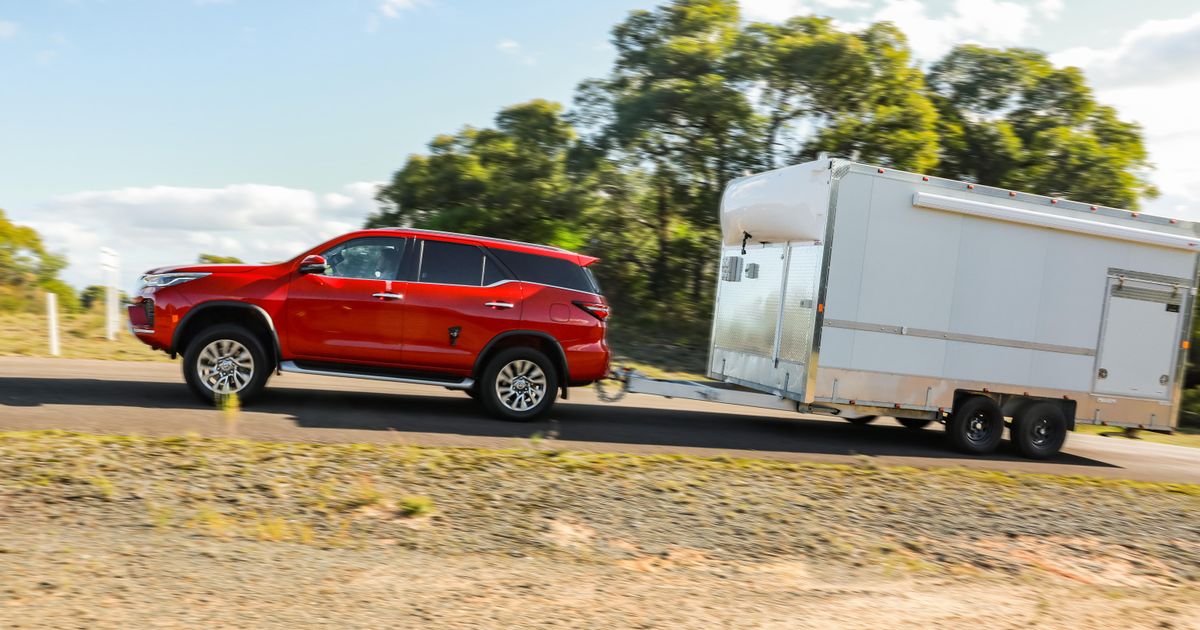
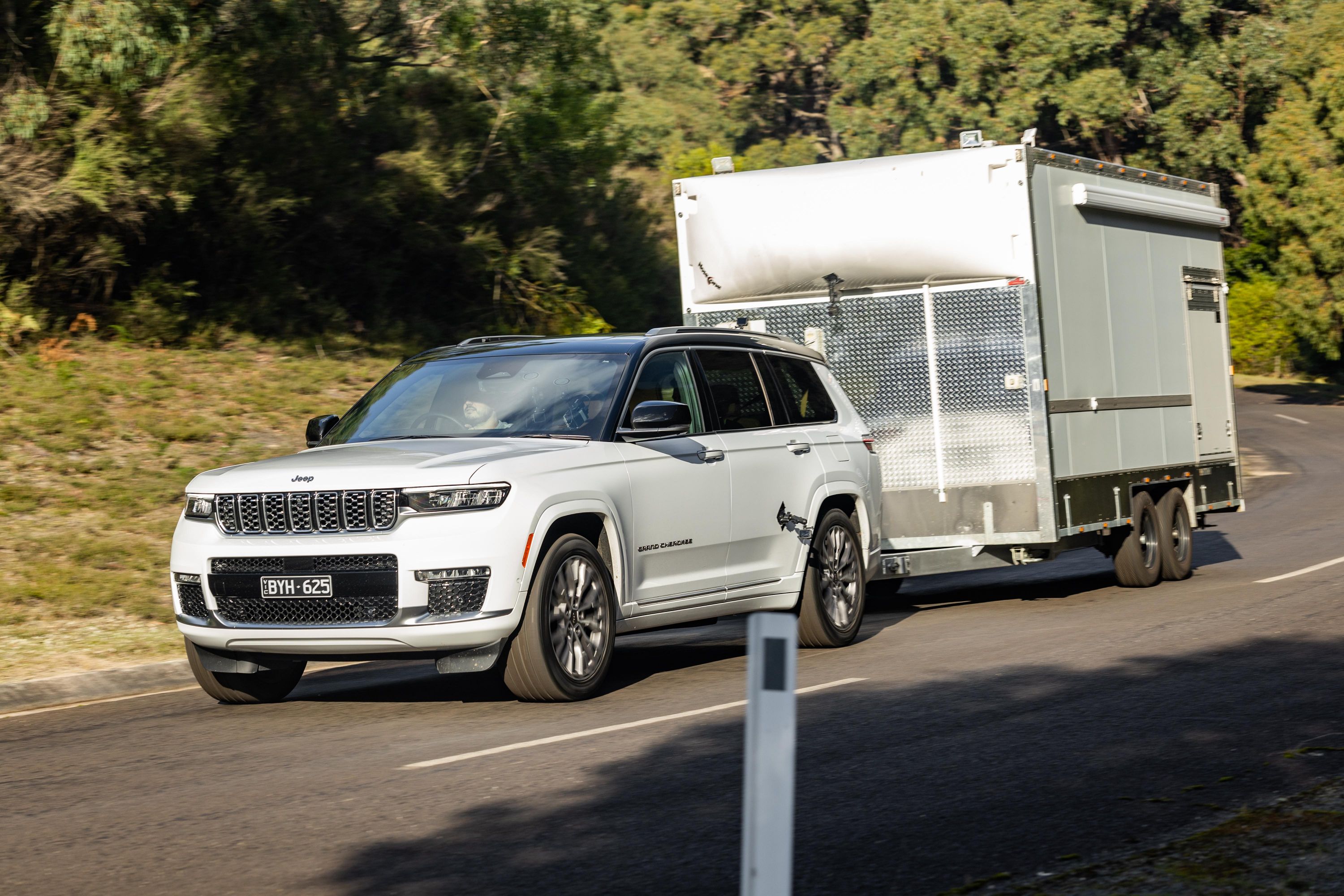
There is no Australia-wide rule when it comes to towing when you are a learner driver licence holder.
The rules vary depending on where you hold your licence
Towing is potentially dangerous, and inexperienced drivers may lack the skill to stop accidents
Always make sure you know the rules of what you can and can’t tow
However, towing a trailer, caravan, camper trailer, horse float, wood chipper, porta-loo or anything else is an act that shouldn’t be taken lightly.
Towing can end in tragedy if attempted by someone who doesn’t know what they’re doing. Just search “towing fail” on YouTube and you’ll see some confronting footage of drivers who seemingly have all the gear and no idea when it comes to towing.
There are two arguments as to when you should start learning about driving while towing something.
The first is that you should learn when you’re learning to drive in the first place. The logic being that if you learn that sort of skill straight away, it could come in handy if you need that talent at a later date.
The other way of looking at it is that L-platers should be learning how to drive and understand the road first, before they’re expected to be able to cope with the additional burden of towing something in a ‘live’ situation.
That’s basically how some of the different jurisdictions across the country see it, too – the rules vary, depending on where your L plates are issued. Here’s a rundown of the different rules for Australian L-plate drivers when it comes to towing.
The jurisdictions where L platers ARE NOT ALLOWED to tow:
New South Wales
According to the State Government’s transport agency, learner and provisional P1 drivers have towing restrictions. “Learner drivers and learner and provisional motorcycle riders are not allowed to tow.”
It’s also worth considering if you live near any of the borders with neighbouring states or territories that do allow L-plater towing, the NSW Centre for Road Safety states: “NSW learner, P1 and P2 drivers and riders must obey the same licence conditions and restrictions that apply to them in NSW when they drive or ride in other states or territories in Australia.”
Victoria: According to the Vicroads site around learner driver restrictions, those drivers who are on their L plates must “not tow a trailer, caravan or another vehicle”.
Tasmania: The island state doesn’t allow L-platers to tow. The state’s PlatesPlus website states that learner-stage drivers must “never tow another vehicle, including trailer”.
The jurisdictions where L platers ARE ALLOWED to tow:
Queensland: L-plate drivers are allowed to tow provided they “have the L Plate on the back of the caravan or visible on the trailer as well”.
However, Queensland Police state that towing is not a task that should be taken lightly – and, ideally, shouldn’t happen for the first time on a public road with other traffic around: “Towing a trailer or caravan requires extra concentration and skill. You should gain experience before trying to tow at high speed or in confined spaces.”
ACT: The ACT Road Rules Handbook states: “Towing is restricted to small trailers not exceeding 750 kilograms GVM (gross vehicle mass). Holders of a learner driver licence for a motorcycle are NOT permitted to tow.”
South Australia: MyLicence SA states: “If your permit or licence was issued in South Australia, you may drive a vehicle of no more than 4.5 tonne and tow a trailer, caravan, boat or horse float as SA does not restrict learner’s permit or provisional licence drivers from towing such vehicles. In most cases your permit/licence conditions travel with you if you drive interstate, however, be aware that some rules may be different.”
Western Australia: Learner drivers are permitted to tow in Western Australia. “L drivers are not restricted from towing a trailer as long as the learner driver is driving within the conditions of their learning permit – and this includes having a supervising driver alongside them in the vehicle”.
Northern Territory: The NT’s learner drivers’ guide states: “Towing – You are allowed to tow trailers”. Further, the Territory states that “L plates must be clearly displayed on the front and back of the vehicle. If towing a trailer, an L plate must also be displayed on the back of the trailer”.
Not intended as legal advice. Check with the relevant roads authority in your state or territory.
In 1992, McLaren took the supercar market by storm with the astonishing McLaren F1. It was a supercar like nothing before it. It was light, fast, agile and it absolutely obliterated just about every record in the books. It was the cost-no-object approach to building a car and was such a leap ahead in almost every imaginable way that it changed way we think about supercars forever.
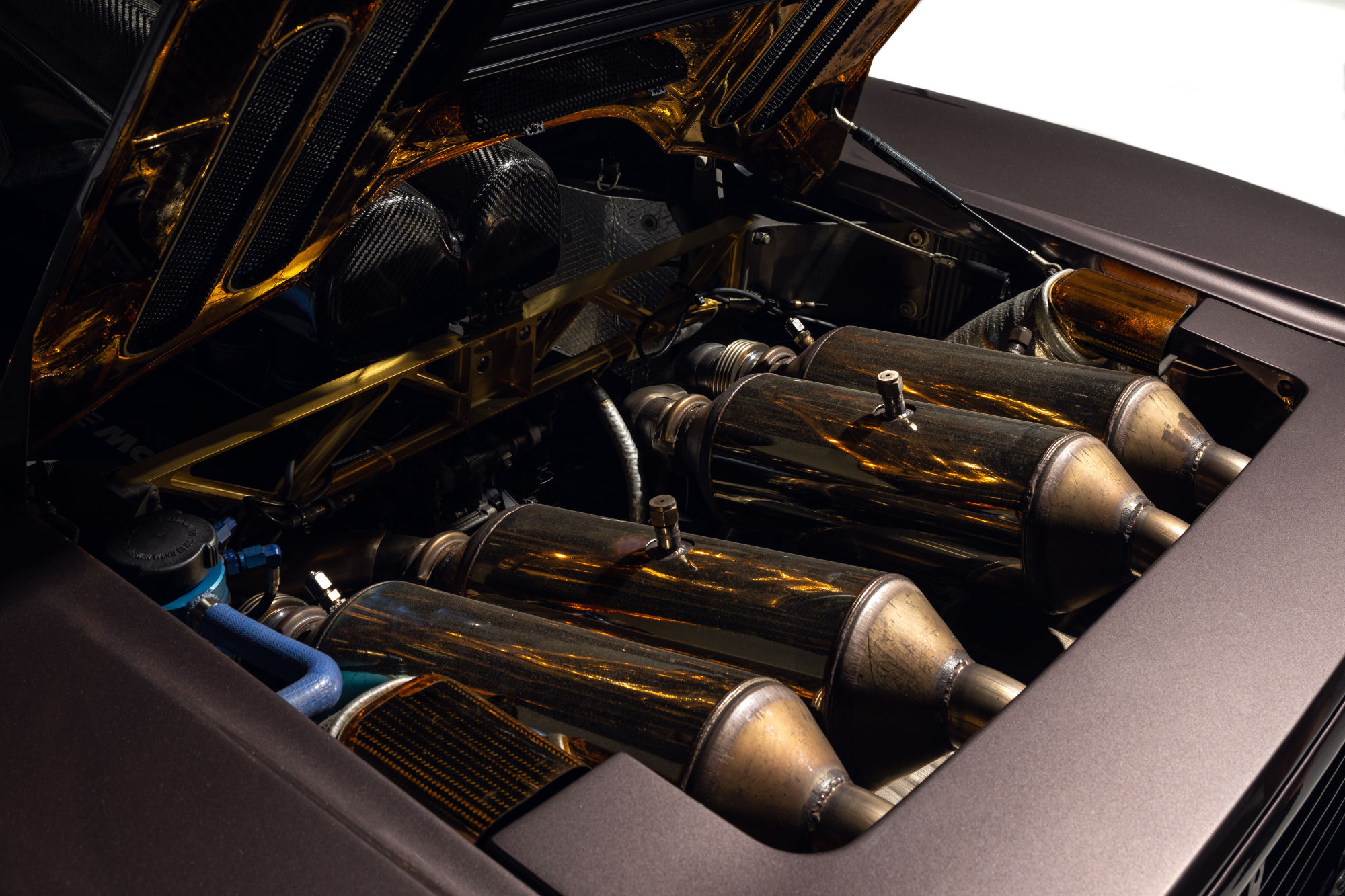
Amongst the firsts, the McLaren F1 was the first production car to feature a carbon-fiber monocoque and a center-mounted driver’s seat, among many other unique features and innovations. It became the world’s fastest production car at 240.1 mph thanks to its 6.1-liter, 48-valve, naturally-aspirated V12 engine from BMW that pumps out 627 horsepower and 479 lb-ft of torque.
Unsurprisingly, the McLaren F1 became the most expensive production car ever built at launch, with a price tag of a staggering $815,000. With only 64 units ever produced, demand has far outpaced supply, making the F1 a coveted collector’s item with ever-increasing value.
RM Sotheby’s is thrilled to offer a one-off 1995 McLaren F1 with only 400 kilometres since new, making this example the lowest mileage of any publicly offered F1. What makes this particular F1, chassis 029, truly one of a kind is its special “Creighton Brown” paint finish, named after McLaren co-founder Creighton Brown.
Factory records show it as the 25th and final F1 built in 1994. Even more special, it came with custom luggage and a tool roll crafted in the same Light Tan leather as the interior – features exclusive to chassis 029. The car remained primarily in Japan until 2013, when it was brought to the US and made road-legal.
This totally unique car, with its jaw-dropping specifications, ranks among the absolute finest of the tantalizingly few McLaren F1s ever created. Bidding for this McLaren F1 will open on May 13 and is expected to fetch over $20 million USD.
Iceland is a total dream country to visit, especially if you’re keen on the kind of trip that’s a little different from a beach or tropical holiday. That being said, it’s totally huge (much bigger than you might think)! So, I wanted to share our 1-week itinerary to visit Iceland that’ll help you along your way.
Not only that, but there’s also a heap of delicious meals and yummy restaurants that you really can’t miss. Oh, and don’t forget to head out on one of the most spectacular hikes in Iceland, too. Trust me, you’re going to be spoilt for choice.
Honestly, the landscape is like another world! It’s so dramatic and to make things even better, everyone is so friendly and welcoming.
The first time we visited Iceland, we had two main bases, the Blue Lagoon and Reykjavik, both of which are incredible in their own right. Though, seeing as they’re located fairly close to one another, it was somewhat limited as you can only wander so far from your base location; even when you have a car.
The next time we visited however, we had the benefit of hindsight to guide us and developed a more detailed and comprehensive itinerary to see as much of Iceland as we possibly could in one week. All focus on the south and west of Iceland which can be much easier to visit on a first-time trip.
Now, to save to you the hassle of organising everything from scratch, I wanted to pop our full 1-week itinerary to visit Iceland. Though, if you want to spend longer, just check out some of our other Iceland posts on some incredible places all across the island. Have the best trip!
DAY 1
1.) Arrive in Iceland
Now, one of the best ways to get around Iceland is by car. So, after booking your car, pop over to the rental centre and head out on the open road. Although rental cars can be a little pricier than other destinations, they still work out much cheaper than booking individual tours around the island. Especially if there is more than one of you.
Truth be told, lots of the best things to do in Iceland are free to see and so all you need is a car to get to them. We can’t recommend this enough, it’s totally worth it.
Oh, and if you’re feeling brave enough, take a dip in the nearby ice-cold lake. Personally, I think you need to give this a go at least once. Though, it’s totally chilly. Brrrr!
These two places, along with Thingvellir National Park, all form part of the Golden triangle and seeing the geyser erupt is truly a magnificent experience. It’s really easy to visit by car and you don’t need to go on any long hikes or trails to see them.
They’re totally gorgeous at any time of the year! Just be sure to pack some good hiking shoes. You’ll be walking on lots of wet or muddy trails at times.
We stayed at the Reykjavik Residence Hotel (we booked this almost immediately after we paid for our flights). It was also brilliant for parking (the car park is almost opposite it) and is centrally located enough that you can just stroll around Reykjavik. Though it has to be said, Reykjavik is generally a very walkable city.
Once here, be sure to check out some of the best restaurants in Reykjavik and even, explore the iconic cathedral (and see the views from the top) and pop out on a whale-watching tour.
5.) Drive out of the city (for the Northern Lights)
You only need to drive around 30-minutes from the very centre of Reykjavik to be in complete wilderness. That’s the beauty of Iceland, all this incredible nature is right on your doorstep.
Not only that, but Iceland is also a great place to watch the Northern Lights, too. Now, you can book a tour from the city but we personally preferred to just drive out into the national park and wait for them to appear. This way, you can spend as long or as little as you want and travel totally on your own terms.
It’s easily one of the easiest experiences to include on your 1-week itinerary to visit Iceland, especially when heading east.
Plus, this is the only one of the waterfalls on here where you can do that and it’s such a unique experience to actually be able to walk behind such a huge and powerful waterfall.
2.) Visit Skogafoss
Not too far Seljalandsfoss, Skogafoss is perched on the historic cliffs where the sealine once was. It’s totally awe-inspiring to see and totally huge.
Now, if you want to avoid the majority of the crowds, head across here in the early morning or late afternoon. Also, if you’re visiting in Summer, you can easily head here later in the evening as it stays light very late.
3.) Go on a glacier hike
The tour we were meant to do was with the folks over Atarcanum but this was the one item we couldn’t do in the end due to the storm in Iceland when we visited.
They come very highly recommended so I have no reservations in recommending them but alas, that storm meant that we’ve had to add this to our growing list of reasons why we need to return to Iceland.
The glacier walk and ice climbing base are by Sólheimajökull glacier about 28km west of Vík and 6 km east of Skógar. Just remember, If you’re heading here from Reykjavík, it is about 160 km and the driving time is about 2 hours.
Alternatively, book this Ice Cave Tour from Vik that’s totally incredible to visit. We had the best trip and it’s such a unique experience to have whilst in Iceland.
You can see the Northern Lights from your room at Hotel Laki. Alternatively, you can head up to the balcony upstairs where you’ll have an unrestricted view of the Northern Lights.
You get where I’m going with this – the choices are endless. We saw the Northern Lights here and it was incredible. Though you don’t need to stay at Hotel Laki to see them, if you choose somewhere else to rest your head that will work totally great, too.
Wherever you stay, just be sure to include some northern light spotting on your 1-week itinerary to visit Iceland.
Jökulsárlón is another amazing sight you have to see in Iceland and one place that’s great for a little stop before you start heading back east towards Reykavik.
There’s also a lagoon boat tour that you can get right from the shore edge and it’s pretty cool. Now, it’s not a whole-day kinda spot, but it’s still well worth stopping to see the floating icebergs.
3.) Visit Geysir and Gullfoss or Höfn
In case you missed it on the first day… or if you just haven’t gotten your fill of those two amazing sites. This is great to include if you’re heading back west.
Alternatively, if you want to head further west, drive and stay in Höfn that’s pretty gorgeous. The landscape around this area of Iceland is just so beautiful, especially around Stokksnes.
Icelandic horses are very unique to the country. You see, you can’t import horses into Iceland and if you export horses, they’re never allowed to return back to the country. What?!?
That all being said, there’s no better way to see the Icelandic countryside than ambling around at your own pace on these horses.
We went horse riding at Hestheimar during the tail-end of a storm! Which, I have to admit, made it all the more exciting.
We always spend at least one night here, and though it can be more pricey than most other spots in Iceland, it’s a total treat that we love!
You not only get to stay here and have your private blue lagoon (which opens earlier and closes later than the general one), but you also get free access to the general lagoon, too.
Address: Blue Lagoon, 240 Grindavik, Iceland
3.) See the Northern Lights
Yes, again! 😉
You can do this from your Blue Lagoon hotel room balcony/patio…. or even from the Blue Lagoon itself. We did this and floated around in the Blue Lagoon in the hotel and just watched the lights above. It was bliss and easily one of the best things to include within our 1-week itinerary to visit Iceland.
You’ve earned the ‘down-time’ after all and there’s no better way to spend it than chilling at the Blue Lagoon. We spent the whole day here and totally loved it.
2.) Dinner and music in Reykjavik
Reykjavik has such an interesting music scene and pretty good live music spots, so it’s worth checking this out. Take a wander down the ‘main street’ and you’ll see exactly what I mean.
After a night on the town, pop to the famous Baejarins Beztu Pylsur (hot dog stand) that’s by the harbour. It’s become something of an institution for locals and visitors to grab a quite bite!
DAY 7
1.) Explore Reykjavik
This is your chance to see the city at your own pace and carry on from where you left off last night right before your flight leaves from Keflavik Airport (around 30-minutes away).
Now, your 1-week itinerary to visit Iceland might be complete, but maybe next time you can explore some more by driving the whole coastal road of Iceland (see below).
At the recent CES event in Las Vegas, there were numerous new electric and hybrid vehicles. But one unique vehicle stood head and shoulders above them all, sporting an older technology built around a modern engine and all installed in an old classic.
Could this be the common sense alternative to EVs many of us ‘die-hards’ have been waiting for?
CES (Consumer Electronics Show), an event put together by the Consumer Technology Association, is a massive new tech expo featuring everything ‘cutting edge’ within the fields of electronics and software.
The show sprawls across four halls of the Las Vegas Convention Centre in the US state of Nevada, and is held in the second week of January every year.
It highlights everything from the latest medical equipment through to developments in AI, VR, AR, robotics and of course every type of electric vehicle (cars, bikes, dirt bikes, water propulsion, scooters, earth movers, drones and more).
While the show was distinctly focussed on a plethora of new electric cars, there was one small glistening ray of hope and nostalgic sanity in a display vehicle born from the collaboration between GCK and Motul!
GCK is a group of industrial companies offering technological solutions to accelerate the decarbonisation of transport while Motul is an international French company specialised in the formulation, production and distribution of high-performance motor oils with a known expertise in the area of synthetic lubricants.
Beginning with a program in 2022 to improve battery performance, the collaboration between the two saw the development of a highly specialised dielectric heat transfer fluid in which the entire battery is immersed, helping to control heat build-up caused by high-speed charging, while helping to prevent the spread of thermal runaway.
The success of this program saw the two companies look at other ways of working together and after a merger of sorts, the pair began looking at ways for Motul to assist with some of GCK’s developing engine technologies which includes hydrogen-powered engines.
To highlight the success and diverse benefits of this, a very distinct customer build featuring the collaborative technology was brought to this year’s CES.
Nestled deep within the ‘vehicle focussed’ West Hall of the CES event, was a beautifully restored 1976 banana yellow Jeep Cherokee Chief, sporting GCK’s hydrogen powered 6.2 litre V8 hydrogen internal combustion engine.
Motul’s contribution included the development of an engine lubricant able to cope with the challenges of hydrogen power, such as the sensitivity to abnormal combustions, the risk of emulsification due to the greater production of water and particulate emissions in the exhaust dependent on the specialised lubricant.
As a fully functional real-world build, this amazing remodelling will serve as a test bed for the two groups to explore the hydrogen retrofit market within the US and hopefully beyond!
From the ground up, the build has created a modern and practical platform to make the most of the powertrain while maximising the comfort, drivability and thrill.
Custom off-road solid axles front and rear are located with triangulated five-link suspension arm configurations controlled by remote reservoir King Shock coil overs and hydraulic bump stops.
The chassis was taken back to bare metal, powder coated and modified with the required suspension, engine and drivetrain mounts.
The body was sand-blasted, prepped with painstaking care and painted in a stunning canary yellow (although we also refer to it as banana yellow).
The interior has been fully re-trimmed and modernised with a full digital instrument cluster finishing off the overall feel of a modernised classic with all the bells and whistles yet still the character, pizazz and impact of a legendary off-road warrior.
Particular attention has been applied to create fuel cells also capable of dealing with the complexities of storing hydrogen. Inner steel cylinders are encased in a carbon-fibre shell to ensure the stability, integrity and protection of the fuel.
While the setup is designed specifically to highlight the technology, future applications would be far less intrusive and more homologous with the vehicle to ensure the retention of cabin space.
Technically referred to as the GCK Foenix H2 hydrogen internal combustion engine (HICE), the 6.2-litre V8 is aimed at tackling the urgent need for sustainable transportation without the ethical implications of manufacturing modern electric vehicle (EV) batteries, the excessive loads EVs will place on our insufficient electrical grids and the burden of recycling the chemicals and components of EV batteries.
These advancements are expected to reshape the future of mobility, making it more eco-friendly and efficient. It is in essence a cleaner transportation option, pioneering green solutions for the automotive industry that will pave the way for a carbon-neutral future where mobility is synonymous with sustainability.
While EVs retain the attention for carbon-neutral technology, this project squarely puts hydrogen energy back into the conversation. It’s technologically feasible, it offers the same or better environmental results as EV and it makes sense economically.
At the end of the day, you really need to ask the questions: is EV the only viable solution, is it the best solution and have we been led down the EV path as a trend more than a truly viable option?
Whatever your answers are, most automotive enthusiasts will see the value not just in the hydrogen movement but in the retention of the internal combustion engine.
No matter your language, the rumble, thrill and exhilaration of driving an actual V8-equipped vehicle with cubic inches and not Watts still holds all of its original appeal, yet it is environmentally clean and green. What a future that would be!
In its latest production-bound version of hydrogen fuel-cell semis, Toyota is adding much more of something that will help it go the distance consistently: batteries.
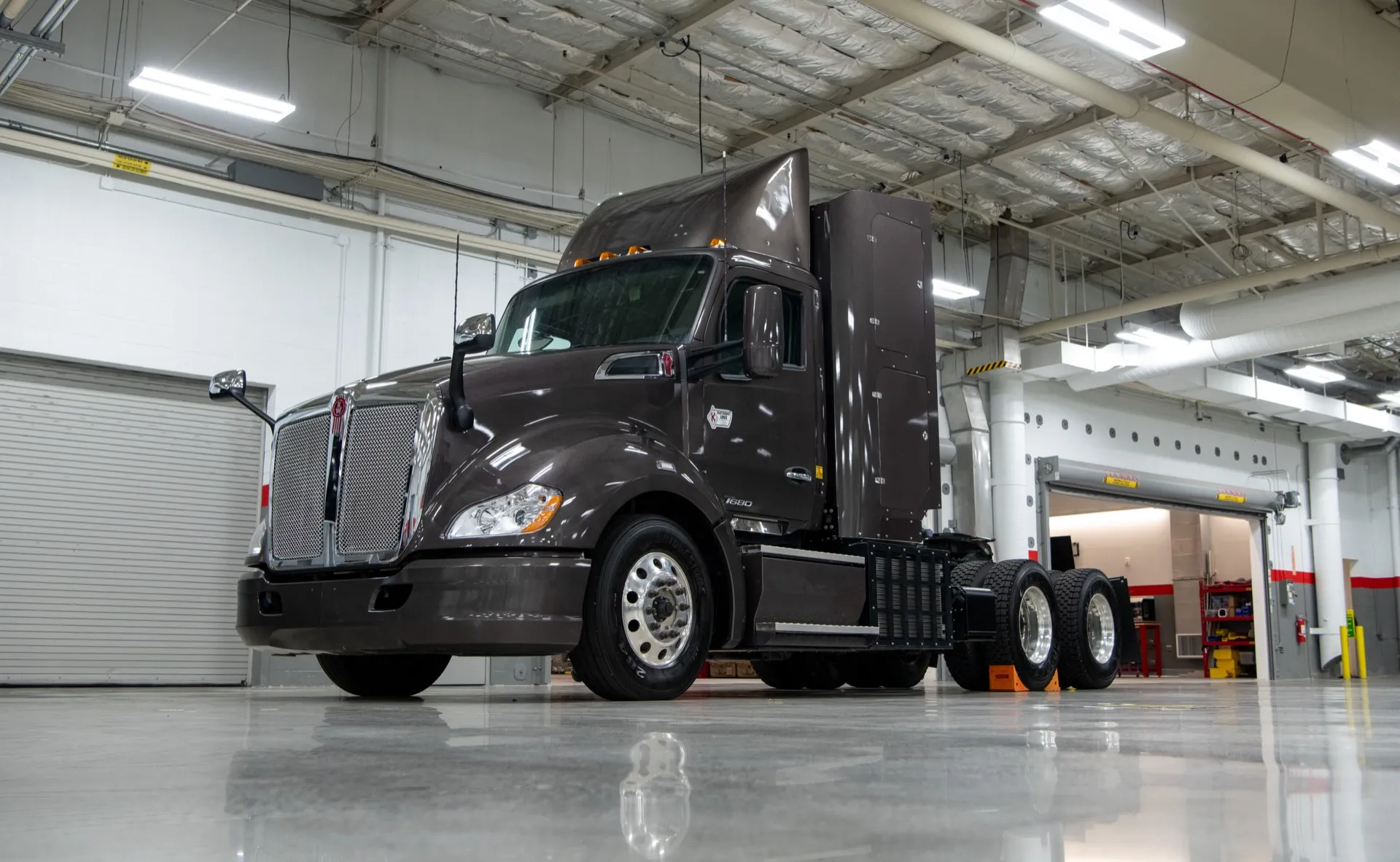
Hydrogen fuel cell power is often seen as an alternative to batteries, but here the latter makes the former better. Toyota has opted to fit 200 kwh of lithium-ion NCA (nickel cobalt aluminum) battery cells in the special hydrogen fuel-cell Kenworth T680 set to be showcased at the Advanced Clean Transportation (ACT) Expo later this month.
It’s a formula that may serve as a template for the future for making hydrogen fuel-cell commercial vehicles viable, and as Toyota executives underscored this past week, the batteries are a necessary piece to create an effective regional-use fuel-cell semi.
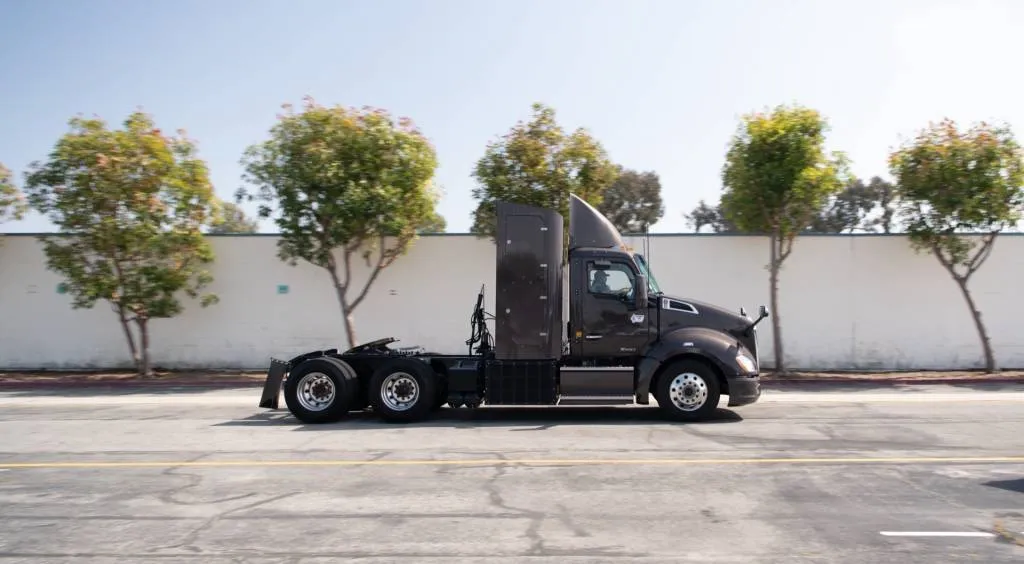
Kenworth-Toyota fuel-cell semi with 200-kwh battery pack
Such a big battery pack isn’t needed the vast majority of the time, but it gives this format a lot more flexibility. This huge Class 8 semi is an evolution of the hydrogen fuel-cell semis that Toyota and Kenworth have tested in prototype form for years with port duty and local runs, and with this change the semi is now good for regional runs: up to 82,000 pounds of payload and a target 300 miles no matter what the terrain—or up to 450 miles on calmer terrain.
Batteries are always used as an energy buffer with fuel-cell stacks, which take some time to ramp up and are best producing a steady power output. Having a much larger battery pack on board helps ultimately boost the efficiency of this semi’s fuel-cell stack, Toyota said, and the battery pack potentially allows a great amount of energy recovery on steeper downgrades.
In its latest version, this specially fitted Kenworth T680 can comfortably get from Long Beach, California, over the infamous Interstate 5 Grapevine, at speed, with a full load, to Barstow and back—nearly 270 miles—without needing to ever worry about being refueled.
Up to 450 miles of range on a hydrogen fill
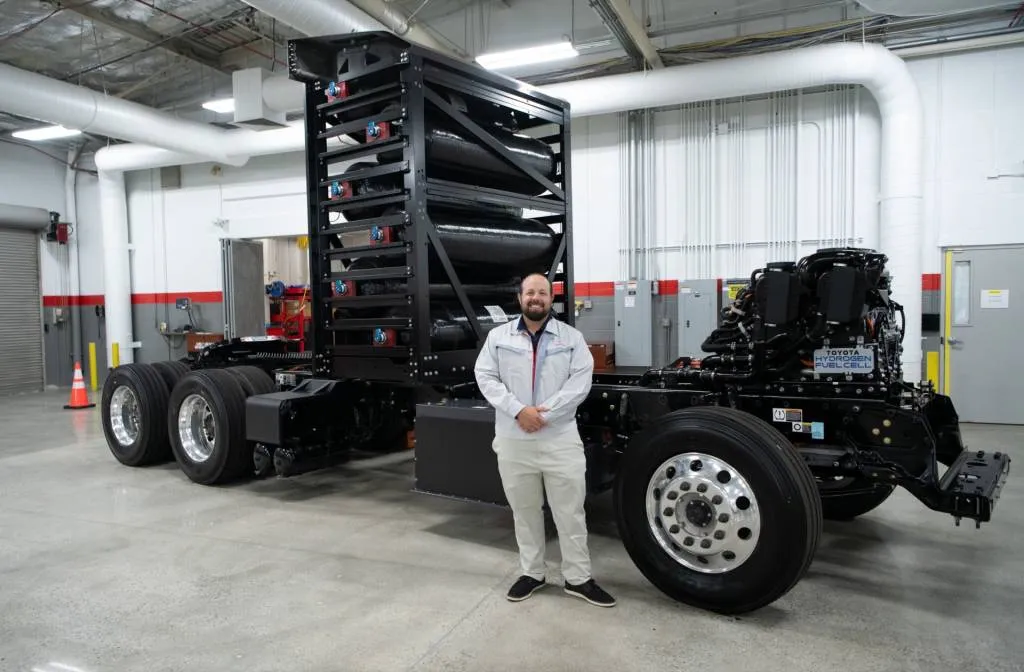
The latest prototype produces 415 hp of continuous power through a 310-kw dual-motor system, and it returns an official range of up to 450 miles from its 58.8 kg of hydrogen. It’s set to be powered by a modularized kit built on the current Gen 2 stack that’s used in the Toyota Mirai. The module will be put together by Toyota in Kentucky and offered to a range of companies—although the fuel cells themselves will still come from Japan.
Kenworth-Toyota hydrogen fuel-cell semi prototype. – May 2024
The new configuration essentially results from Toyota listening to the truck’s potential commercial customers, and addressing their direct needs, explained Scott Friedman, the senior program manager at Toyota North America tasked with the fuel-cell semi’s powertrain integration. Batteries and module aside, the layout of the previous port trucks carries mostly over to this new prototype.
The dual-motor system, the transmission, and overall integration are Toyota responsibilities in addition to the fuel-cell module itself. The battery packs ride side-saddle, mounted somewhat low on the cab pretty close to where the fuel tanks would be, while the large hydrogen tanks are a lot lighter and mounted higher up, occupying what would otherwise be the sleeper.
Big battery, no charge port
Toyota isn’t planning to charge this semi through any means other than the fuel-cell stack, and there’s no charge port, according to Friedman. So the battery pack amounts to a giant buffer that, it seems, could and will be used smartly by fleet management software. “We don’t want our trucks to have to go to a battery stop and a hydrogen stop,” Friedman said.
“We developed it based on duty cycles and customer expectations, and that’s kind of the scope,” summed Friedman. “You can easily adapt this,” he added, after a pause when pressed about whether a charge port could be added for a customer who, for instance, did want that capability.
Kenworth-Toyota hydrogen fuel-cell semi prototype. – May 2024
Toyota has likely mapped out the possibilities already. It has a heavy-duty testbed at its center for hydrogen development (H2HQ) in Gardena, including a dyno rated to 1.2 megawatts of power to keep in mind the kinds of applications it may prepare in the future.
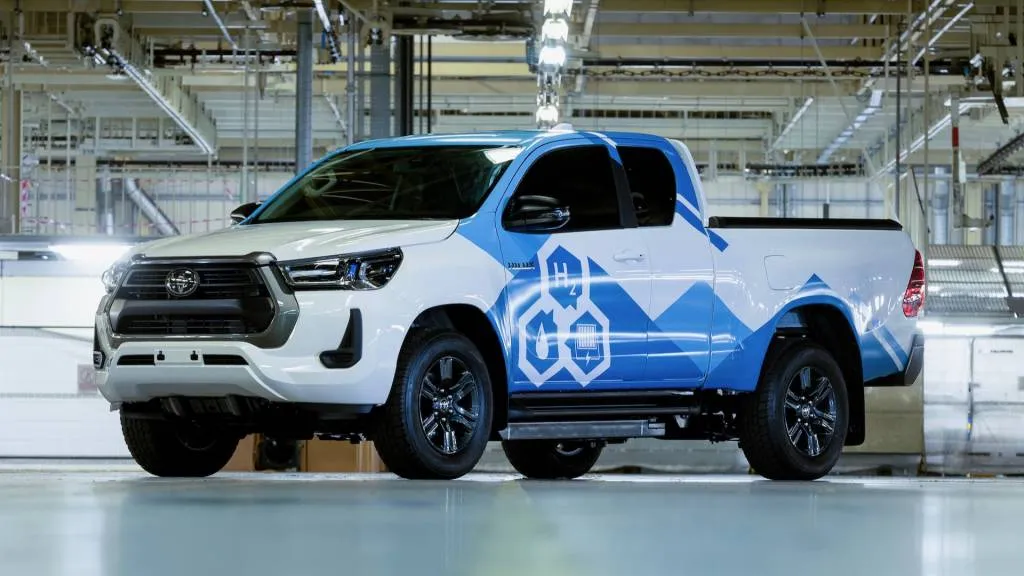
In a tour of H2HQ last week, Toyota executives dropped plenty of hints that it’s working on hydrogen fuel-cell pickups. It even has a working fuel-cell Tundra prototype in Japan that it uses to tow its hydrogen combustion-engine race car. And that’s in addition to a Hilux hydrogen fuel-cell prototype pickup in the U.K.
Toyota Hilux hydrogen fuel-cell prototype
Toyota presented an unexpectedly straightforward reason for bypassing chargers in passenger vehicles: Adding a charge port disincentivizes the buildout of the hydrogen network.
Speaking to Green Car Reports in late 2019, Mirai chief engineer Yoshikazu Tanaka told us that to grow the hydrogen infrastructure you needed to consume it; if customers started charging at home then they wouldn’t consume (and depend on) the hydrogen.
But it’s different for trucks, argued Jay Sackett, the former Toyota Tundra chief engineer now working directly with fuel cells as chief engineer for advanced mobility. Just as Toyota steps up the battery size but doesn’t add a charge port on its fuel-cell semi, Toyota doesn’t see a lot of use for the charge port on a pickup.
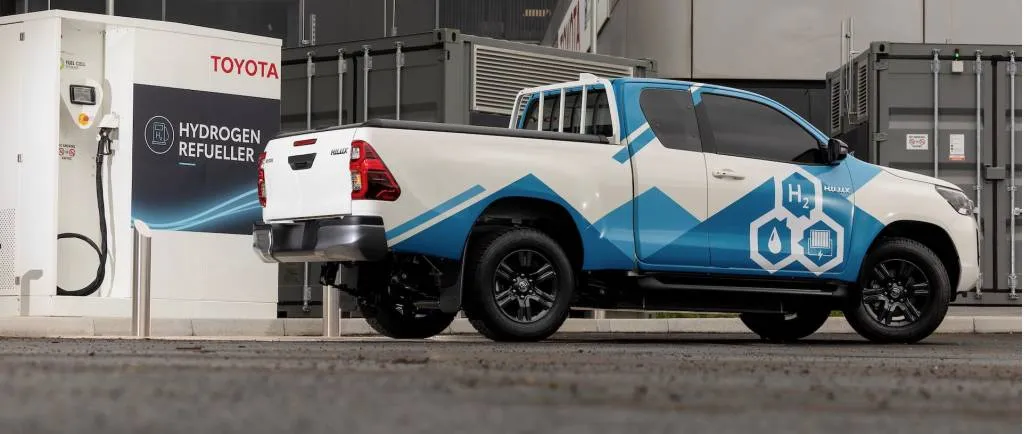
Toyota Hilux hydrogen fuel-cell prototype
If Toyota makes a fuel-cell truck, Sackett suggested to Green Car Reports, it would be one oriented toward those who frequently tow or truly use the capability of the truck—and charging and towing simply don’t work together, he said. And its Tundra customers tow frequently.
In short, Sackett summed, it’s a matter of time and consistency—and energy density. You can get a 20-minute refuel of hydrogen, good for hundreds of miles even when towing. But charging the kind of battery needed for that kind of range remains a serious hurdle today.
Responding to several prompts about how this might be put to use in the real world, Sackett made no confirmation that plug-in capability was something the company was seriously considering. Yet Sackett pointed to the semi project and its bigger battery buffer as a template for what works in a predictable commercial or fleet situation, where fueling stations are established.
Perhaps that would be around one of the hydrogen hubs that are set to be federally funded with $8 billion.
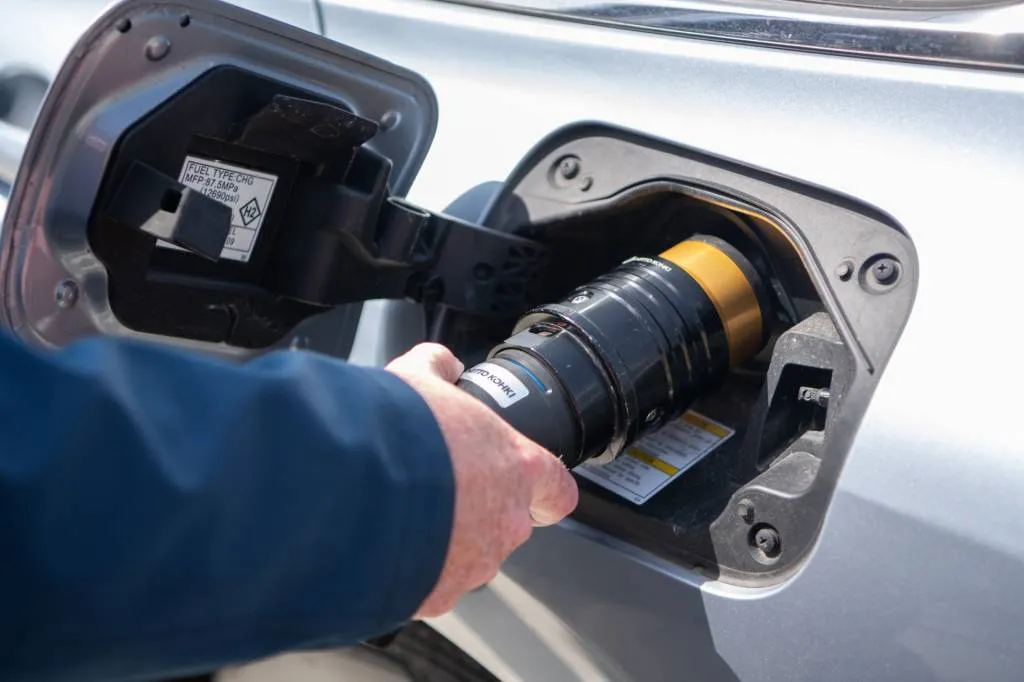
Hydrogen fueling at Toyota H2HQ
Still the same hydrogen fueling challenges
This also more closely aligns with other formulas used in the industry—such as that of the Nikola Tre, which packs 200 kw of fuel-cell power modules with 164 kwh of battery energy. Nikola this week announced its second HYLA fueling station in California, near the Port of Long Beach. It’s due to create 60 hydrogen stations by 2026, aided by incentives.
The port itself is the home of Toyota’s Tri-Gen facility, which takes Toyota’s biggest U.S. port off the grid, generating 2.3 megawatts of electricity daily from natural gas made renewable through credits via methane generated at Orange County Sanitation. It also generates up to 1,200 kg of hydrogen per day—to be used for fueling hydrogen vehicles—along with 1,400 gallons of water per day that can be used to wash vehicles arriving at port.
While the carbon portion of the calculation requires a litany of hypotheticals and what-ifs, what does or doesn’t come out of such fuel-cell solutions, as semis or pickups, is far more straightforward. If it’s covering solutions that don’t yet practically work with batteries alone, with a solution that is rid of the smog-forming emissions and particulates of diesel exhaust, why not?
What a night! To celebrate the opening of the “Sleeping Beauties: Reawakening Fashion” exhibition at the Metropolitan Museum of Art’s Costume Institute, this year’s Met Gala attendees brought out their floral best in their interpretation of the theme, The Garden of Time. Along with the otherworldly headpieces, avant-garde makeup looks, and spellbinding gowns, celebrities added their biggest and brightest watches and jewellery to the mix. Here are some of the best ones spotted.
Barry Keoghan Wearing Omega
Friend of the brand Barry Keoghan wears a rare 1930’s Omega Lépine “Sideros” art deco pocket watch, a De Ville Prestige in yellow gold, and a Seamaster Aqua Terra in Sedna Gold and diamonds.
Jonathan Bailey Wearing Omega
Friend of the brand Jonathan Bailey wears a De Ville Trésor with a diamond-paved bezel and a black leather strap.
Penelope Cruz Wearing Chanel
Penelope Cruz wears the Chanel Tweed Pastel high jewellery necklace in white gold with diamonds and cultured pearls.
Steven Yeun Wearing Cartier
Steven Yeun wears the Cartier Clash [Un]limited small model watch in yellow gold and purple gold.
Ayo Edebiri Wearing Boucheron
Ayo Edebiri wears the Boucheron Hopi the Hummingbird ring in white gold with an aquamarine, sapphires and diamonds, and the Timeless Bleu Infini high jewellery pendant earrings in white gold with aquamarines and diamonds.
Brooklyn Beckham wearing Piaget
Brooklyn Beckham wears the Piaget Polo 79 in yellow gold.
Rachel Zegler Wearing Chopard
Rachel Zegler wears Chopard Red Carpet Collection high jewellery earrings in white gold with diamonds.
Chris Hemsworth Wearing Chopard
Met Gala co-chair Chris Hemsworth wears the Chopard Alpine Eagle watch in rose gold with a diamond bezel.
Amanda Seyfried Wearing Chaumet
Amanda Seyfried wears the Chaumet Mélodie Nacrée tiara, Josephine Duo Eternel earrings, and Laurier and Joséphine Aigrette Impériale rings.
Vivian Kao Wearing Chaumet
Wife of Met Gala 2024 co-chair and TikTok CEO Shou Zi Chew, Vivian Kao wears the Chaumet Joséphine Aigrette Impériale ring in platinum with diamonds.
Kieran Culkin Wearing IWC
Kieran Culkin wears the IWC Portugieser Automatic 40 (Ref. IW358402) in white gold with a Horizon Blue dial.
Jennifer Lopez wearing Tiffany & Co
Jennifer Lopez wears the Tiffany & Co Blue Book 2024 Tiffany Céleste necklace in platinum and yellow gold with diamonds.
Storm Reid Wearing Pomellato
Storm Reid wears the Pomellato Catene high jewellery necklace in white gold and diamonds.
Jeremy Strong wears Richard Mille
Jeremy Strong wears the Richard Mille RM UP-01 Ferrari watch.
Nicole Kidman wearing Harry Winston
Nicole Kidman wears the Harry Winston Secret Combination bracelet in platinum and diamonds, and the Winston Cluster earrings in platinum with diamonds.
Need a fire extinguisher for your motorhome, campervan or caravan? Not sure what the best type is, how to care for it or how to maintain it? Here’s everything you need to know about choosing the best van and motorhome fire extinguisher for you.
Don’t forget to grab your FREE motorhome maintenance checklist below
*We work hard to make this the best motorhome travel blog and road trip website possible, full of helpful content for you. The website is supported by our readers, so if you buy through links on this site we may earn a commission- at no extra cost to you. All opinions remain our own.
If you find this post useful, you can also treat us to a coffee – we promise to enjoy it while creating more useful content like this- we might even indulge in a biscuit (or two!)
Motorhome Fire Extinguishers- the problem
Choosing a motorhome or campervan fire extinguisher can be difficult, especially for those of us not familiar with the different types of fire extinguishers and their uses.
Some of the most common problems and concerns people have when choosing a fire extinguisher for their van include:
Lack of knowledge: Many people do not have enough knowledge about the different types of fire extinguishers available and which one is most appropriate for a motorhome or camper. This makes the entire process confusing and ultimately makes it difficult to choose (meaning we often put it off entirely!)
Size and weight: Van owners are often concerned about their motorhome weight & payload, meaning they’re concerned about the size and weight of the fire extinguishers they’re adding.
Cost: The cost of fire extinguishers can vary greatly, and some people may be reluctant to spend a lot of money on a fire extinguisher for their motorhome.
Compatibility: As you may remember from school, not all fire extinguishers are suitable for use on all types of fires. Choosing a fire extinguisher that is not compatible with the type of fire which may occur in a motorhome could be ineffective or even dangerous.
Maintenance: Some van owners may be concerned about the maintenance required for a fire extinguisher, such as refilling or replacing it after use or over time.
Accessibility: The fire extinguisher needs to be easily accessible in case of an emergency. It should be placed in a visible and reachable location. BUT- do you put it near the door? Near your bed? Near the hob? With only one habitation exit in most vans, it can be tough to know where to put it!
Legal requirements: Depending on the country you’re based in, there may be legal requirements for the type and size of fire extinguishers that need to be carried on a motorhome, which can add further complexity to the decision-making process.
Motorhome fire extinguishers- the differences
Watch this video to understand more about the different motorhome fire extinguisher options and how to use them properly!
We hope you found the video useful. If you did, we’d love it if you followed us on Youtube. New videos with tips for motorhoming and campervanning in the UK and Europe are released weekly.
Do I need a fire extinguisher in my motorhome?
At the moment, it is NOT a legal requirement to carry a fire extinguisher of any sort in your motorhome, campervan or caravan. However, during a habitation check, the engineer may have as part of their check list, a check for the presence of a fire extinguisher.
But that doesn’t mean you shouldn’t carry one. If you think about all the different systems which you have in a motorhome, and the fact that they all get shaken around, which can cause loose wiring etc (which is how our motorhome fire occurred), a motorhome is one of the most important places to have a good fire extinguisher to hand!
What size fire extinguisher do I need for my van?
The short answer to this is- the size required to put a fire out!
Did you know that a traditional 1kg powder fire extinguisher only lasts for about 7 seconds?
7 SECONDS!
Most small fires will take longer than this to put out!
NOTE: Do not tackle anything bigger than a waste paper bin sized fire. Get out and stay out!
Motorhome fire extinguisher- the options
The Scariest thing about traditional motorhome fire extinguishers…
Be honest, when was the last time you did any maintenance at all on your fire extinguisher?
I know I never did, other than to check the pressure was still in the green.
BUT- traditional fire extinguishers, especially dry powder extinguishers, ARE NOT DESIGNED TO BE BUMPED AROUND.
You know, like in a moving vehicle…
They’re also not designed to withstand huge temperatures ranges. Most motorhomes and campers in the UK regularly go from -5 ish to 30+ in any 6-month period.
So, what is the best fire extinguisher for a motorhome, campervan or caravan?
Scarily, the most common motorhome and campervan fire extinguisher (dry powder) is dangerous if used in small spaces- like a van!
It’s toxic, makes a mess and causes huge amounts of damage after the fire has been put out.
Thankfully, there’s a new kid on the market- and it’s pretty fricking awesome. Enter, the Fire Safety Stick.
Fire Safety Stick Review
I was gobsmacked when I first tried out the Fire Safety Stick. Here are some of the things I love about it:
It’s smaller and lighter than a traditional fire extinguisher
It lasts for 50 or 100 seconds, rather than just 7!
It works on almost ALL types of fire (including most of the ones you’re likely to find in a motorhome)
It NEVER needs maintenance, even after 15 years!
It’s EASY to use. Even if you’ve never ever done it before. Watch the video of me using it for the first time here.
Can be recycled after use
Environmentally friendly, non-toxic and safe for humans and pets to breathe
Despite it being new technology, I’ve now removed the old traditional fire extinguisher from my motorhome and have replaced it with a fire safety stick. I feel far more confident about both my ability to use it if needed, and its likelihood of working!
Given that I live in my motorhome full-time, I have more faith in this than any other type of extinguisher I’ve used to help protect my home.
Motorhome fire- fire safety stick review
If you’d like to get one for your motorhome, campervan, caravan, car, boat, house, motorbike or anything else, you can get 10% off here using the code ‘KAT’.
Want more tips for motorhoming?
Here are some more ideas you might find useful:
Want FREE checklists, eBooks and additional tips to help? Visit our resource page
Trump reportedly offers to scrap EV-friendly EPA emissions rules. BP seeks to rescue stranded Supercharger stations as Tesla’s charging plans fizzle. And does going with a very large battery pack but no charge port make sense in fuel-cell semis and even pickups? Toyota thinks so. This and more, here at Green Car Reports.
Although big batteries and hydrogen fuel cells are often seen as two opposing ways to electrify trucks with no tailpipe emissions, Toyota is reworking the formula in its hydrogen fuel-cell semi to include both. With a supersized battery pack but no plug-in capability, Toyota makes more of the fuel-cell tech. Look for the same formula, potentially, in future pickups.
Former President and current Presidential candidate Donald Trump reportedly tried to collect $1 billion in donations from top oil executives at Mar-a-Lago over the promise that Trump would scrap stricter EPA emissions rules anticipated to drive up the sales of EVs. Although with many of these companies recast as diversified, greener “energy companies,” the extra pollution might not be the image they’re looking for.
And in a strange turn of events, the oil giant BP may rescue Tesla Supercharger sites left in the lurch after Tesla’s still puzzling decision to cut its Supercharger program. BP intends to spend $1 billion by 2030, with half of that investment to be made within the next two to three years. That will include 3,000 U.S. chargers, with some large-scale sites with 12 or more chargers, to be called Gigahubs.
The technical storage or access is strictly necessary for the legitimate purpose of enabling the use of a specific service explicitly requested by the subscriber or user, or for the sole purpose of carrying out the transmission of a communication over an electronic communications network.
Preferences
The technical storage or access is necessary for the legitimate purpose of storing preferences that are not requested by the subscriber or user.
Statistics
The technical storage or access that is used exclusively for statistical purposes.The technical storage or access that is used exclusively for anonymous statistical purposes. Without a subpoena, voluntary compliance on the part of your Internet Service Provider, or additional records from a third party, information stored or retrieved for this purpose alone cannot usually be used to identify you.
Marketing
The technical storage or access is required to create user profiles to send advertising, or to track the user on a website or across several websites for similar marketing purposes.