Itasha – is it a fad? Given how long this curious Japanese automotive subculture has been going on, I have to conclude that itasha is not a fad but a certified style. Or, in fact, a scene all to itself.
A few weeks ago, I headed to Odaiba to check out the 2024 edition of Itasha Tengoku (Itasha Heaven). This annual event sees well over 500 vehicles, their owners, and anime fans, all come together to celebrate itasha.
Until around 20 years ago when this style emerged, itasha was a simple way of referring to an Italian car. ‘Ita’ from Italy combined with the kanji for car, ‘sha’.
But the itasha we now know combines ‘itai’, which means pain/painful/ouch, again combined with ‘sha’. Together, it simply means a car that is painful to look at.
Whether or not you think that is an accurate description will depend on what you make of itasha. After all these years, it still baffles me.
At its core, itasha brings two interests together: cars and Japanese anime and game characters. And it spans all the way to race cars.
The Goodsmile GT300 Super GT team has been running an itasha livery for as long as I can remember.
When Speedhunters first started reporting on the itasha scene, it seemed like only late-teen and early-20-something-year-olds in Japan were involved in it.
That is no longer the case. Today, all age groups are represented.
Like all other aspects of Japanese car culture, even though itasha is replicated abroad, there is something special about these cars in Japan.
Take away the stickers and you often have perfectly built high-end cars – both JDM and imported.
Right down to proper legends.
I even spotted a DeLorean DMC-12 at this year’s event. It lacked sticker coverage, though.
You can never underestimate what you might find at an event like Itasha Tengoku. This Y32 Nissan Gloria on Work Emitz wheels ticked all the boxes for me.
And this newer-body Nissan Gloria looks like it’s built for drifting.
Perhaps a wide-body Mitsubishi Lancer Evolution with RAYS Volk Racing 21C wheels is more your style? As you can see, a simple itasha rear window sticker qualifies you as part of this scene.
Bikes can enter as well.
Yakuza style?
It’s crazy that I still come across these Speedhunters tire stencils.
More and more classic cars are entering the itasha scene, but I did not expect to see a stickered-up Prince Skyline.
Or Toyota Century-style hubcaps on a Daihatsu Mira.
Even if itasha isn’t your thing, learning what it’s all about and how people approach it is fun.
Did you know you can buy itasha Bride bucket seats? This was news to me!
ASL Garaya electric cars are few and far between. Even rarer is one with itasha style.
If this event taught me one thing, it’s that you should never be afraid to venture out of your automotive comfort zone.
Try, because you might be surprised at what you find.
The first time I visited Yosemite National Park, I was blown away by the incredible scenery. I knew from photos and friends that it was going to be beautiful, but I wasn’t quite prepared for how stunning it would be in person. The Valley – with its views of Half Dome and El Capitan – is magical!
My plan for my visit was to explore the best hikes in Yosemite National Park. From the iconic Mist Trail to the lesser-known – but no less scenic – hike out to Dewey Point, I had a list of trails I wanted to check off. In this post, I’ve rounded up my personal favorites from my trip that highlight all the best that Yosemite has to offer from gushing waterfalls to epic overlooks.
Important: Reservations are required to enter Yosemite National Park during some weeks and months out of the summer. You can learn more about how to get a reservation and other tips for visiting in my Yosemite National Park guide.
Yosemite National Park Layout
Before I dive into my favorite hikes, it’s important to get an understanding of how Yosemite is laid out. The Park covers nearly 1,200 square miles, which means preplanning your hikes is essential to maximize your time on trails instead of spending a ton of time in the car.
Yosemite can be broken down into the following sections:
Yosemite Valley
Glacier Point Road
Mariposa Grove
Tuolumne Meadows
Crane Flat
Hetch Hetchy
I based my visit and hikes around Yosemite Valley, Glacier Point Road, Mariposa Grove, and Tuolumne Meadows. Visit the National Park website to read more about hiking in Crane Flat and Hetch Hetchy.
Yosemite Valley Hikes
Yosemite Valley features the most popular hikes in the park. Most are accessible year-round and include Yosemite’s iconic viewpoints and waterfalls.
1. Mist Trail to Vernal Falls and Nevada Falls
Trail Basics
Distance: 6.4 miles roundtrip
Type: Loop
Elevation Gain: 2,208 ft
Time: 6 hours
Difficulty: Hard
Trailhead: Happy Isles Trailhead
Trail Description
Mist Trail to Vernal and Nevada Falls is Yosemite’s most popular hike, but it shouldn’t be missed. I like to get away from the crowds as much as I can, but this hike was 100% worth the trail traffic!
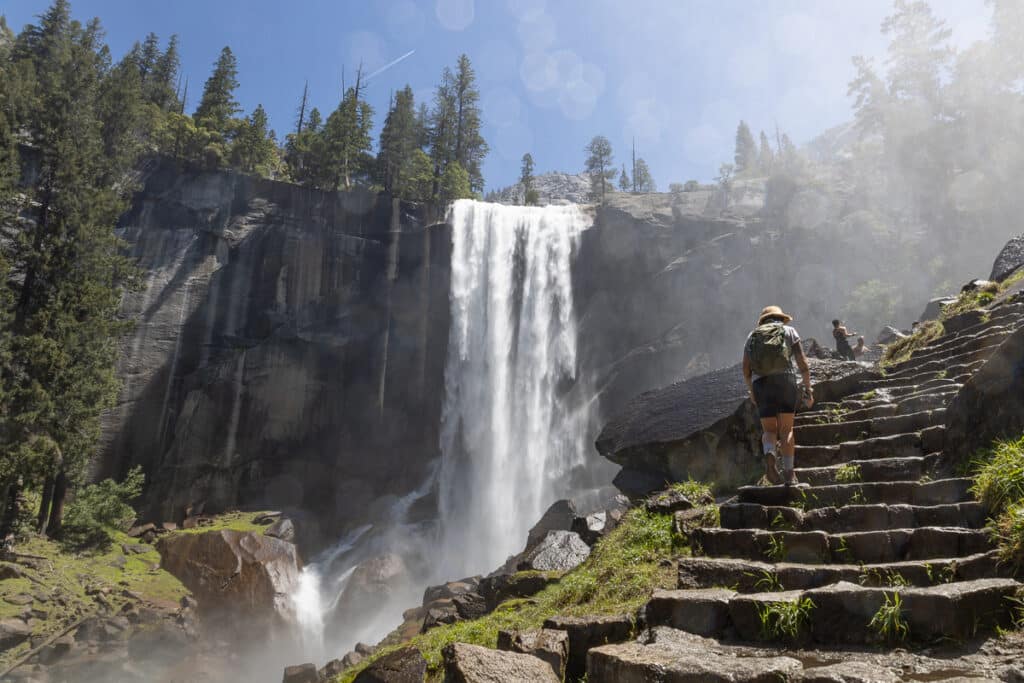
The trail ascends steeply up the valley walls for about 1.5 miles until reaching Vernal Falls. It was here that I understood why the trail is called Mist Trail! When I visited in spring, I got drenched from the mist coming off of the falls. I was also lucky to see the Vernal Falls rainbow in the spray, which can typically be seen in spring and summer.
This section can be very busy, so the earlier you start the better.
I found the hike from Vernal Falls to the top of Nevada Falls to be pretty challenging. It’s steep and there is a long set of stone steps that climb out of the valley.
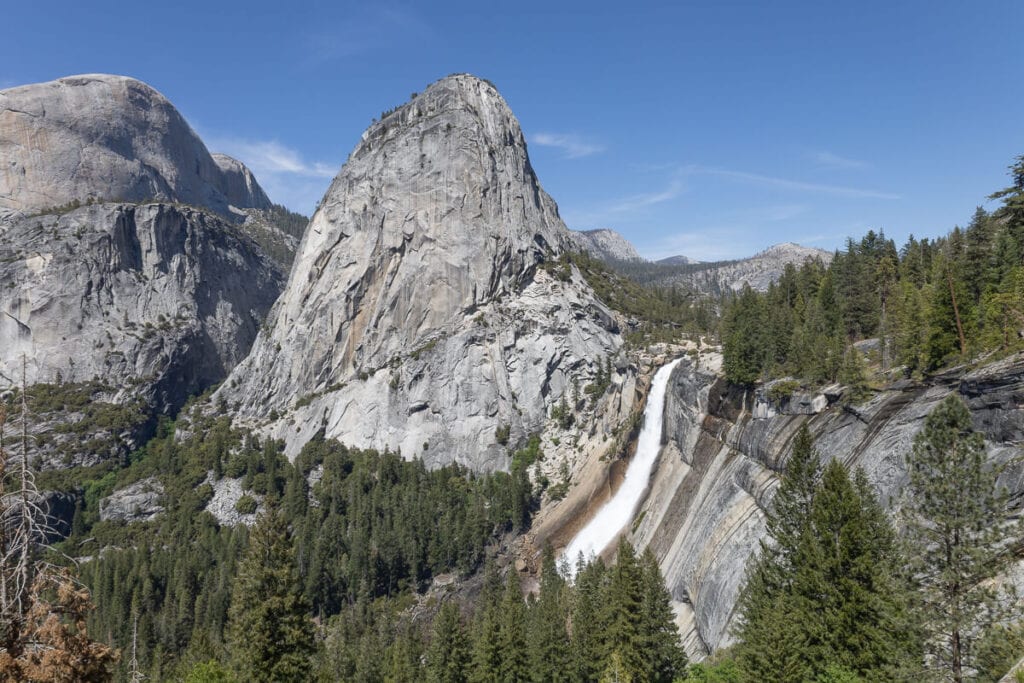
Once I reached the top of Nevada Falls, I found a nice place to rest by the Merced River where I took in the Yosemite Valley views before starting my hike back down. You can go back the same way you came, but I recommend crossing the bridge over Nevada Falls and taking the John Muir Trail back down to the Valley. I found this descent to be more gradual than the stairs and it also provided a different view of Nevada Falls and the valley below.
Nevada Falls from the Mist Trail
Tips for hiking the Mist Trail
Get an early start so you can enjoy the trail with fewer people. This is one of the most popular hikes in Yosemite and the trail can get very busy.
Pack a lightweight rain jacket because you’ll get misted by the waterfalls!
Good hiking shoes are a must. The mist from the falls can make the stone steps slippery.
2. Upper Yosemite Falls Trail
Trail Basics
Distance: 6.6 miles
Type: Out-and-back
Elevation Gain: 3,254 ft
Time: 6-7 hours
Difficulty: Hard
Trailhead: Camp 4 Area
Trail Description
Did you know that Yosemite is home to one of the tallest waterfalls in the world? Yosemite Falls (which is actually made up of 3 separate waterfalls), cascades down 2,425 feet between Lower Yosemite Falls, middle cascades, and Upper Yosemite Falls.
I loved hiking this area because it’s the perfect “choose your own adventure”. You can stop at the lower falls for an easy hike, head to the bottom of Upper Yosemite Falls for a moderately strenuous uphill hike, or continue all the way up to the top of Upper Yosemite Falls for a very strenuous Stairmaster of a hike. I chose to hike all the way up!
I also added a quick detour to Yosemite Point. This added about 30 minutes and 300ft elevation gain to my hike, but it was well worth it. Yosemite Point was one of my favorite viewpoints in the park (it was also way less crowded than Upper Yosemite Falls).
Tips for hiking to Yosemite Falls
Choose your own adventure! The trail to the lower falls is relatively easy while the hike all the way up to the top of Yosemite Falls is very strenuous.
The hike to reach Upper Yosemite Falls is incredibly steep, so I highly recommend trekking poles.
The extra 30-minute hike to Yosemite Point is well worth it if you have the time and energy.
Upper Yosemite Falls in May
3. Mirror Lake Trail
Trail Basics
Distance: 4.4 miles
Type: Loop
Elevation Gain: 300 ft
Time: 1 to 2.5 hours
Difficulty: Easy
Trailhead: Mirror Lake Trailhead
Trail Description
After a few days of challenging treks up the Valley walls, I wanted to do a nice, mellow hike. I chose Mirror Lake because it’s a beautiful, tranquil, mostly flat walk along Tenaya Creek.
Mirror Lake doesn’t have a lot of water in it most of the year, but in the spring and early summer, it’s often higher due to fresh snowmelt. When I hiked it in the spring, the water was calm and the lake reflected the beautiful surrounding canyons (hence the name).
I chose to do the full 4.4-mile loop, which follows Tenaya Creek past Mirror Lake, but you can make it shorter and just do an out-and-back to the lake shore. This is a great place to pack a picnic and relax on the rocks or beach by the water for the afternoon.
4. Half Dome
Trail Basics
Distance: 16.3 miles
Type: Loop
Elevation Gain: 5,318 ft
Time: 10-12 hours
Difficulty: Very hard
Trailhead: Happy Isles Trailhead
Trail Description
The iconic Yosemite Half Dome hike is not for the faint of heart. Rising 5,000 feet above Yosemite Valley, it takes a minimum of 10-12 hours to complete. The last 400 feet require ascending up a steep rock face using cables. When I hiked Half Dome, I found this final section to be very challenging, both physically and mentally, but the reward was worth it! Standing at the top of Half Dome was an exhilarating feeling.
But climbing the rock face isn’t the only highlight of hiking Half Dome. On the hike there, I passed amazing views of Vernal Falls, Nevada Falls, Liberty Cap, and sweeping vistas of Yosemite Valley. Keep in mind, though, that the hike is 16.3 miles round-trip, so make sure you’re prepared for a long day on the trail.
Hiking Half Dome requires a permit. The pre-season lottery happens every year from March 1-March 31. You will receive confirmation by mid-April if you’ve been awarded a permit. If you are not successful in the preseason lottery, you can try for the in-season daily lottery.
Tips for hiking Half Dome
For more info on the lottery system and how to get a permit, read through my post on how to hike Half Dome.
Aim to get a very early morning start to beat the crowds and the heat so you’re not rushed on your 16.3-mile hike.
I recommend wearing gloves on the Half Dome cable section to prevent blisters. Gloves will also improve your grip.
Be patient on the cables. It can be nerve-wracking for people and most people are moving slow.
If you look closely, you can see the cables leading up the side of Half Dome
5. Four Mile Trail
Trail Basics
Distance: 9.7 miles
Type: Out-and-back
Elevation Gain: 3,418 ft
Time: 6-8 hours
Difficulty: Hard
Trailhead: Four Mile Trailhead
Trail Details
The Four Mile Trail was one of my favorite hikes in Yosemite. I’m not sure why it’s called “four mile” since the climb from the Valley floor to the top of Glacier Point and back is just under 10 miles round-trip. The steep switchbacks do end after 4 miles, though, so maybe that’s why!
With stunning views of El Capitan and Yosemite Falls on my way up and panoramic views of Half Dome and the Sierra Mountains at the summit, this was a very memorable hike. There is the option to tack on Union Point about two-thirds of the way up which offers an amazing view of Yosemite Valley.
I chose to hike back to Yosemite Valley by reversing my route, but you can also take the Panorama Trail down to the Happy Isles Trailhead. This loop is about 16.3 miles.
Glacier Point Road Hikes
Glacier Point Road is a seasonal road that ends at the spectacular Glacier Point. Starting your hikes from Glacier Point Road (vs. hiking from the valley floor) typically means less elevation gain, but still amazing views out over Yosemite Valley.
6. Sentinel Dome to Taft Point Loop
Trail Basics
Distance: 5.1 miles
Type: Loop
Elevation Gain: 1,122 ft
Time: 3-4 hours
Difficulty: Moderate
Trailhead: Sentinel Dome/Taft Point Trailhead
Trail Description
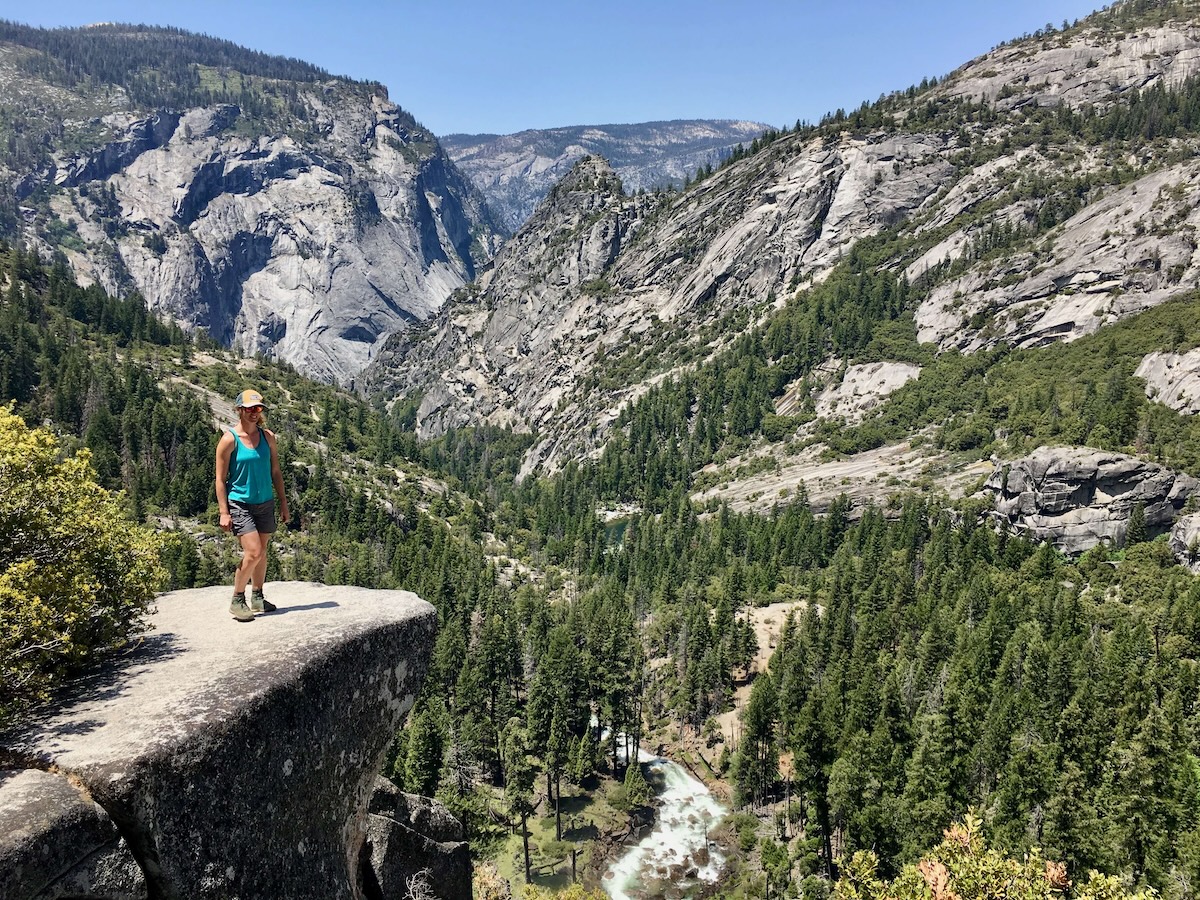
This loop has spectacular views out over Yosemite Valley without the steep elevation gain of starting from the valley floor. I hiked the loop counterclockwise, first stopping at Sentinel Dome which is a large granite boulder that offers different vantage points of the valley. Then I continued on to Taft Point.
Rising 3,500 feet above the valley floor, Taft Point is totally exposed with sheer dropoffs and 360-degree views. If you are short on time, I recommend skipping Sentinel Dome and hiking to Taft Point as an out & back (2.3 miles roundtrip). It’s incredible!
7. Dewey Point via McGurkin Meadow Trail
Trail Basics
Distance: 7.7 miles
Type: Out-and-back
Elevation Gain: 1,338 ft
Time: 4-6 hours
Difficulty: Moderate
Trailhead: McGurk Meadow Trailhead
Trail Description
The Dewey Point via McGurkin Meadow Trail is a less popular hike in Yosemite National Park, but I thought it was spectacular. During summer there are tons of wildflowers in the area and the views from Dewey Point are some of the best in the park.
The trail has a mellow grade as it slowly climbs through McGurkin Meadow to meet up with Pohono Trail. From there, it’s a steady incline to Dewey Point where you’ll take in unique views of El Capitan, Cathedral Rocks, Half Dome, and the Yosemite high country.
Tuolumne Meadows Hikes
All of the hikes from Tuolomne Meadows start from Tioga Road, which is a seasonal road that typically opens in late May or early June and closes sometime in November. I visited in early spring and there was still some wet and/or snowy conditions on the trails.
Hiking in Tuolumne Meadows is one of Yosemite’s best-kept secrets because people never make it to this section of the park, they only stay in the Valley. If you are looking to escape the crowds, like I was, these are the best Yosemite hikes to do!
8. Clouds Rest
Trail Basics
Distance: 13.5 miles
Type: Out-and-back
Elevation Gain: 3,152 ft
Time: 6-8 hours
Difficulty: Very Hard
Trailhead: Sunrise Lakes Trailhead
Trail Description
Clouds Rest is a great alternative for those who didn’t win permits to hike Half Dome (or who are afraid of the cables on Half Dome). At nearly 14 miles, it is a strenuous hike with over 3,000 feet of elevation gain, but I think it’s well worth the effort. There are jaw-dropping views from the top and at 9,931 feet, you actually climb higher than Half Dome have have similar stunning views of the valley.
As you approach the top of Clouds Rest, you’ll be waking on a ridge that drops off steeply on both sides. It’s not technical in any way, and the ridge isn’t so narrow that if you trip, you’re going to fall off. However, if you have an extreme fear of heights, this trail will get your heart pumping. I also loved this hike because there were far fewer people on the trail likely due to the distance and elevation gain.
Clouds Rest can be done as a long day hike, which can be rewarded with a dip in chilly Tenaya Lake when you get back to your car. If you are looking for an epic Yosemite backpacking adventure, tack on Sunrise Lakes to make it an unforgettable 23-mile multi-day loop.
This is the ridge that you hike up to get to the top of Cloud’s Rest
9. North Dome
Trail Basics
Distance: 9.2 miles
Type: Out-and-back
Elevation Gain: 2,017 ft
Time: 5-7 hours
Difficulty: Moderate
Trailhead: Porcupine Creek Trailhead
Trail Description
The hike to North Dome offers one of the best up-close views of Half Dome in the entire park. From the top of North Dome, you’re literally looking directly across Tenaya Canyon at Half Dome. And, since the trail starts on Tioga Road outside of Yosemite Valley, the crowds are typically much slimmer than the other day hikes in the Park. I had the trail almost entirely to myself!
This hike is a bit different than other Yosemite Trails. Here you are starting higher up and descending at you hike towards North Dome. Then you will be gaining elevation on the return, so make sure you save some snacks and water.
For the first 2 miles, the trail meanders through the forest and is fairly flat with a few ups and down. From there on, the trail opens up and eventually the trail turns to granite. Keep an eye out for trail markers known as cairns as you enjoy the amazing views all the way to North Dome.
Like many of the trails in Yosemite, the North Dome Trail doesn’t have a ton of shade once you get out of the forest, so make sure you take precautions to protect yourself from the sun which can be rather intense at this elevation.
10. Cathedral Lakes
Trail Basics
Distance: 9.5 miles
Type: Out-and-back
Elevation Gain: 1,663 ft
Time: 4-6 hours
Difficulty: Moderate
Trailhead: Cathedral Lakes Trailhead
Trail Description
I love the Cathedral Lakes hike because it leads to two beautiful alpine lakes: Upper and Lower Cathedral Lakes. This trail is the most popular hike along Tioga Road, but I found it to be still much less crowded than other Yosemite hikes. Still, like the other popular hikes in Yosemite, I recommend getting an early start!
The elevation gain is steepest at the beginning of the trail when you’re in the forest, then it becomes gradual enough to not be super strenuous. Eventually, the trail emerges from the forest into a beautiful meadow with wide open views of the granite peaks.
At the fork in the trail, hang a right to go to the Lower Lake, which, in my opinion, is the nicer of the two Cathedral Lakes. I had to hop across a few rocks, but I think it’s worth skirting around the right shore for some epic views of Cathedral Peak. If you have time and energy left, you can hike to Upper Cathedral Lake, which will add another 1.8 miles.
Lower Cathedral Lake offers gorgeous reflections of Cathedral Peak on a calm day
11. Dog Lake to Lembart Dome
Trail Basics
Distance: 5 miles
Type: Out-and-back
Elevation Gain: 912 ft
Time: 3 hours
Difficulty: Moderate
Trailhead: Lembart Dome Parking Area
Trail Description
I was looking for a short hike in Tuolumne Meadows after a few long and challenging hikes, and the Dog Lake to Lembart Dome trail was perfect. It’s a scenic 5-mile out-and-back trail that has panoramic views of Tuolumne Meadows and the surrounding high country.
The trail circumnavigates Dog Lake and there are lots of nice places to relax and have a picnic lunch. I chose to visit Lembart Dome on my way to the lake, but you can also visit it on the way back down. Note that Lembart Dome is extremely exposed, though, so be sure to check the weather to avoid being on top during a thunderstorm!
12. Mono Pass
Trail Basics
Distance: 8 miles
Type: Out-and-back
Elevation Gain: 1,174 ft
Time: 4 – 6 hours
Difficulty: Moderate
Trailhead: Mono Pass Trailhead
Trail Description
If you’re looking for alpine solitude in Yosemite National Park, add Mono Pass to your list of hikes. This trail climbs through tranquil meadows and flowing creeks to a max elevation of 10,600 feet at the top of the pass. From the top, you can take in gorgeous views of Bloody Canyon and Mono Lake – a very different type of landscape than anywhere else in Yosemite National Park. From the peak, you can hike a bit farther to Upper Sardine Lake for even more stellar vistas.
When I hiked this trail in the peak of summer it was still relatively empty and totally gorgeous with wildflowers, lakes, and mountain views. Note that this trail requires a few river crossings, where in early season you may not be able to avoid getting your feet wet. So you may want to bring hiking sandals to cross in.
Mariposa Grove Hikes
Did you know that you can see giant sequoia trees in Yosemite National Park? Most of the 500 sequoia trees in the park are located in Mariposa Grove, which is south of the Valley.
13. Mariposa Grove of Giant Sequoias Trail
Trail Basics
Distance: 6.7 miles
Type: Out-and-back
Elevation Gain: 1,217 ft
Time: 4-6 hours
Difficulty: Moderate
Trailhead: Mariposa Grove Arrival Area
Trail Description
The Mariposa Grove of Giant Sequoias Trail weaves through quiet forest and passes giant sequoias including Grizzly Giant, The Bachelor and Three Graces, Faithful Couple, and the Clothespin Tree.
You can simply meander through the forest on the network of trails, or I recommend continuing on to Wawona Point. You are almost guaranteed to have the trail and viewpoint to yourself, which is a stark contrast from the popular viewpoints in the valley. I loved the solitude on my visit.
From Wawona Point, you can see the South Fork of the Merced River, Wawona Meadow, and across the valley to Wawona Dome.
Frequently Asked Questions
When is the best time to visit Yosemite?
Yosemite Valley is generally open year round (unless there is a crazy snow event), but if you want to hike the best trails in Yosemite and to get into the high country, the best time to visit is in summer or early fall. At lower elevations, all of the snow generally melts by June and at higher elevations may persist into July. Bugs are usually the worst in late June and July. By August all of the snow is usually melted and the mosquitos are not as bad. In August and September there is a higher risk of wildfire and smoke. If there are no wildfires, my favorite time to visit is September. It’s less busy than the summer, easier to find campsites, and the temperatures are a little more mild for hiking.
Should I carry bear spray on my Yosemite hikes?
No. Bear spray is not allowed in Yosemite. The only bears you might encounter in Yosemite are black bears that pose little risk to humans. If you encounter a black bear while hiking in Yosemite, keep your distance and if it approaches you, make lots of noise in an attempt to scare it off.
Do you need a permit to day hike in Yosemite?
The only day hiking trail you need a permit for in Yosemite is Half Dome. All of the other trails do not require a permit.
What shoes should I wear to hike in Yosemite?
I recommend wearing a hiking shoe or a hiking boot with decent tread that will provide adequate traction on the steeper sections. Many of the hikes in Yosemite are long, and you want something that is going to be supportive and comfortable throughout your hike. For recommendations, check out my post on the Best Hiking Boots for Women.
More Yosemite Planning Tips
Are you planning a trip to Yosemite National Park? What hikes in Yosemite are you looking forward to?
A brand-new, base-model Porsche 718 Boxster may cost more than $70,000, but the biggest downside isn’t the price. It’s driving one and realizing that it’s absolutely worth the money and that you can no longer tell yourself it’s overhyped and overpriced. The Boxster really is just that good. For the 981 generation of the Boxster, though, Porsche went above and beyond to create one of the most desirable cars possible — the 2016 Porsche Boxster Spyder. And there’s currently one for sale over on Cars & Bids.
Porsche’s Latest Concept Is The Sexy Electric EV HyperCar Of Our Dreams
If you’re only familiar with the 987-generation Boxster Spyder, it would be understandable if you were confused. That version was cool enough but only came with a small horsepower bump over the Boxster S. For the 981, Porsche did something many people thought would never happen and gave the Boxster Spyder the same engine that you got in the 911 Carrera S.
Photo : Cars & Bids
So in addition to other weight-saving measures bringing things down to about 2,900 pounds, power also jumped up to 375 horsepower and 309 pound-feet of torque. Unlike the mechanically similar Cayman GT4, the 981 Boxster Spyder didn’t get the 911 GT3’s suspension, which means it’s much more usable on public roads. You do still get the steering rack from the 911 Turbo S and upgraded brakes to handle the extra power.
The 981 Boxster Spyder was also only sold with a manual transmission, and only 2,500 were made for the entire world, meaning that this car isn’t just special, but it’s also quite rare. If you can afford it, you’re definitely not going to be disappointed. After all, it’s a Boxster with an engine from a 911. What’s not to love?
Just make sure you either live somewhere that rarely gets rain or have a couple other cars to drive in bad weather because you definitely don’t want to get caught in a thunderstorm with the top down. Let’s just say putting the top up probably isn’t something you want to learn how to do on the fly.
The Porsche Boxster Spyder Is a Brilliant, Underrated Sports Car
YouTube’s Vin Anatra recently took a trip to the Porsche Experience Center smack in the middle of Los Angeles to test the theory. He brought his lightly modified 997-generation GT3 RS, the car he calls his favorite of all time, to compare it to the newest and wildest car in the Porsche stable, the 992-generation GT3 RS. These are wildly different cars that approach speed in very different ways. Before you watch the video, think about which one you’d rather have.
PORSCHE GT3RS OLD vs NEW – 2010 997 vs 2024 992 – 15 YEARS OF TECHNOLOGY!
Okay, now that you’ve seen it, did your opinion change? I know mine didn’t. I’ve spent a lot of time in a lot of 911s, and the 997 remains my personal sweet spot. The later 991 and 992 feel significantly bigger and more video-gamey. Vin even comments while on track that the 992 — with its PDK gearbox, launch control, track modes, downforce-inducing control arms and electronically-controlled everything — “feels like it just does everything for you, not for you, but it’s so assertive.”
Porsche definitely knows what it’s doing in building these cars, as they seem to get more popular and more expensive every year. That said, I will always gravitate toward a car that requires more from the driver. I want the three-pedal, sawing-at-the-wheel, get-all-your-braking-done-in-a-straight-line driving experience that 911s have always been known for. I want something that puts the sport in sports car. I don’t particularly care about lap times, I just want to listen to that clutch chatter.
What do you think? Which 911 GT3 RS are you taking home?
“I can buy myself flowers,” goes the famous chorus from Miley Cyrus’ 2023 hit single Flowers — an anthem of self-empowerment and independence. However, the song also speaks to the prominence of the role that flowers play in our society. Beyond a showcase of love, flowers are a personalised gift that works for just about any occasion — a second date, a wedding table centrepiece, a birthday, an anniversary, or an apology. They can also be scaled to fit a range of events from a phenomenal arch to a dainty bouquet. Plus they also smell heavenly which only adds to their appeal. Enter BLISS Flowers, a floral service providing breathtaking bouquets and floral arrangements. The bespoke service includes event designs and brand activations from dinner parties to corporate engagements and grand weddings. With over 15 years of experience and a rare selection of flowers found nowhere else in the region, BLISS prides itself on providing a carefully curated experience that reflects its client’s wishes.
Now, BLISS Flowers is opening its doors in Asia with the opening of a physical store in Singapore after the success of its Middle Eastern counterparts in the United Arab Emirates, Saudi Arabia and Qatar. BLISS Flowers also boasts an esteemed list of partners including Cartier, Gucci, Ferrari, Louis Vuitton, Burberry and the Four Seasons hotels to name a few, highlighting the company’s versatility in providing for clients across the automotive, fashion, and luxury hotelier industries. LUXUO speaks to Iryna Palahniuk, the retail & franchise marketing manager to find out more about the latest developments on BLISS and how they differentiate themselves from other luxury floral services on the market.
Tell us about the birth of BLISS in the UAE and its distinctive DNA?
My journey in the Emirates began in 2006 as head florist at Jumeirah Beach Hotel, where my passion for flowers flourished. BLISS was born out of a shared love for florals and a keen eye for design. In 2008, my co-founder Michael Lennon and I recognised a gap in the market for luxury floral design in the UAE. We were at an age where taking risks was a possibility. In hindsight, it was an entrepreneurial mindset, an intrinsic motivation, and drive, coupled with a lot of hard work.
Our growth since then has been incredible, yet our core values remain unchanged — we still want to source the freshest florals, provide superior service, and keep up with design trends, while staying true to our signature aesthetic. We always have a plan! However, a dynamic foresight is key to growth through different life cycles of the business.
You have expanded to other countries in the Middle East (Qatar, Saudi Arabia) and have set up a dynamic branch in Singapore. How unique is the service provided to clients?
We have the most talented florists and designers on our team. Our florals are the freshest; they don’t spend a lot of time in freezers and or simply kept for longer. We have forged relationships with our suppliers globally over decades and you will find flowers here that are found nowhere else in other boutiques in the region.
Looking at the century-long tradition of flower compositions in Japan (Ikebana), is floral arrangements an art in itself?
Florals speak their own language, don’t they? Of course, there’s floriography in literature and art; flowers and plants have been ascribed emblematic meaning to them historically and across cultures. To me, a floral gift from BLISS is the most effective way to convey human emotion. It’s luxury without being material, it is timeless and so alive.
BLISS provides a bespoke house flower service; can you tell us more about this initiative?
Our Bespoke+ service is truly one-of-a-kind, offering exclusive service arranging for every new replenishment with our top floral designers. Subscribers specify their preferred flower types, colours, styles, and even the location to adorn the house. With each new replenishment, our team will meticulously curate exquisite designs that reflect the client’s unique tastes and preferences. It’s a personalised experience like no other, ensuring that every arrangement is tailored to meet the individual’s needs.
When working with customers looking at organising an event and using BLISS services, what are your initial questions?
I make sure my first questions aren’t too overwhelming or intrusive so I start with a light-hearted conversation that tells me more about my client’s preferences. I love hearing their story whether it’s a corporate client, a luxury brand, or a bride. For corporate clients and brands, it’s more about getting to know their tone and voice whereas for brides it’s getting to know their favorite movie, shoe brand, or favourite scent. During this conversation, I also try to understand their dislikes and make them feel comfortable enough to communicate almost any thought, feeling or feedback at any time.
Can our readers order BLISS flower arrangements online?
Yes, absolutely! Ordering BLISS’s flowers and gifts online is a pure breeze. In fact, I want to make a gift for your readers. Let’s make it a 15 percent discount code valid for a month from the publication of this article. Let’s call the discount code: BLISSFULLYABBEY.
What is the BLISS Personal Shopper experience all about?
It’s part of our loyalty program, BLISS LEVELS, where clients unlock exclusive rewards as they level up. Once you reach the highest BLISS Level, you get access to our Personal Shopper service. Our skilled florists offer 24-hour consultation services, guiding you through all floral, event, and subscription shopping needs.
Where do you see your company, BLISS grow in five years? Would it expand to other South-East Asian markets?
Oh so much in terms of expansion and consolidation but let me tell you about an aspect of my work that always gets me excited. We’re pushing boundaries with floral event production, challenging ourselves when it comes to timelines, new ideas, and innovative materials. I have become increasingly interested in eco-sustainable floristry — I have much to explore in that space.
What is your ultimate mantra in life?
Keep smiling, even when the going gets tough. I smile even when I’m having a bad day, and when I get a smile back from a stranger, it just changes my mood. Believe in yourself; we are all meant to achieve greatness. Make a plan, and then make it work, no matter what. Resilience is everything!
This vibrant, dazzling and futuristic mega city has a huge amount to offer visitors, from its famous neon cityscape to its reputation for outstanding food (earning it the nickname of Japan’s kitchen), to super cool neighborhoods, shrines, temples, castles, nightlife, theme parks, aquariums, and much more.
Of course, it’s always good to take a break from city life too and Osaka is an ideal base to explore the rest of the Kansai region, whether you’re craving the coast or countryside or just want to sample a different city.
From sacred mountains and historic rural villages to coastal retreats, famous shrines, and art islands, Osaka has the best of Japan on its doorstep, especially if you have a JR Pass for unlimited travel on Japan’s domestic rail network.
Japan’s railway system is super-fast, clean, safe, and comfortable, and it is the perfect way to travel across this unforgettable country.
Ready to start exploring? Here are the top day trips from Osaka.
8 of The Best Day Trips From Osaka
As Japan’s second-largest city, Osaka is extremely well connected by transport, making it the perfect base for day trips to many other outstanding destinations.
Thanks to its location (and the speed and efficiency of Japanese trains), you can reach other major cities, rural hideaways, shrines, temples, mountains, coastlines, and more within an hour or two of Osaka.
Here are eight of the best day trips from Osaka by train:
Kyoto
An obvious day trip from Osaka is another of Japan’s most famous and most visited cities – Kyoto, which is just 15 minutes away from Osaka on the Shinkansen.
Known as the cultural heart of Japan, Kyoto is packed full of incredible history. The only downside is that Kyoto is so famous for its historic buildings, cultural treasures, shrines, and temples, that it is extremely popular with international visitors. It is, however, 100% worth it to see the beauty and history of Kyoto with your own eyes.
Kyoto was the capital of Japan from the 8th Century to 1868 and the city embodies more than 1,000 years of history.
Arguably the city’s most famous and historic districts are Gion, which is famous for its geisha district, and Pontocho, which was the birthplace of Kabuki.
Kyoto is also home to some of Japan’s best shrines and temples. In fact, it boasts more than 1,600 temples which can make it hard to know where to start.
Thankfully, we’ve done the hard work for you by putting together a list of our best temple recommendations when visiting Kyoto. Our list includes Kinkaku-ji Temple, Kiyomizudera Temple, Saiho-ji Temple, Kennin-ji Temple, Tofuku-ji Temple, Nanzen-ji Temple, Ginkaku-ji Temple, and Ryoan-ji Temple.
Perhaps the most iconic temple in Kyoto is the “Golden Pavilion” of Kinkaku-ji – this iconic building has been the postcard of the city for many years. While Kinkaku-ji was founded in 1397, the temple had to be rebuilt in 1955 after a devastating fire. Despite that, it is one of many temples on this list that make up the Historic Monuments of Ancient Kyoto recognised by UNESCO as a World Heritage Site.
Also vying for the top spot among Kyoto’s temples is Kiyomizudera and its magnificent veranda. Kiyomizudera is found on Mt. Kiyomizu and overlooks the city. The original temple dates back to 798 although what you’ll see now is the version that was rebuilt in 1633. The temple’s name translates as “Pure Water Temple” and comes from the pure waters flowing over the Otowa Waterfall close by. But it’s really the immense wooden stage, said to have been built without a single nail, that is the star attraction here.
Kyoto is also famous for its Shinto shrines of course. The most famous and most important being Fushimi Inari Taisha, whose vermillion red torii gates were featured in the 2005 film ‘Memoirs of a Geisha’.
Fushimi Inari Taisha was founded in 711, which makes it one of the oldest shrines in Kyoto. It was originally located on Inariyama hill, in the southwest of the city, before being relocated to its present and permanent home by the Hata family in 816. A century later, in 942, it was given the highest rank among Shinto shrines, and in 1499, after the beautiful and ornate main shrine structure was built, Japan designed Fushimi Inari Taisha as an Important Cultural Property.
The origin of Fushimi Inari Taisha is steeped in legend. The story goes that a rice cake was fired into the air and turned into a swan that flew to the peak of Mt. Inari. Rice began to grow on the mountain top and the spot became the head shrine for Inari Okami, the Japanese god of rice, sake, and prosperity, and the patron of businesses, merchants and manufacturers.
Today, thousands of people from across Japan,and millions of visitors from around the world,come to pray for fruitful harvests, business success, and other blessings. It is particularly popular for New Year prayers in Japan – one of the most important dates in the calendar.
Of course, many international visitors come to see the famous Senbon Torii—the thousands of vermilion red gates in dense rows leading to the Torii gate hiking trail. Each one bears the name of a person or business carved in black who donated the gate to receive good luck and fortune.
How to get from Osaka to Kyoto by train
The JR Tokaido Shinkansen from Shin-Osaka Station to Kyoto Station takes just 15 minutes and is fully covered by the JR Pass while travelling on Hikari and Kodama trains.
Nara
Another excellent day trip from Osaka, just 40 minutes away by train, is Nara—an area packed with history, wildlife, scenic views, temples, and shrines.
Most of Nara’s historic attractions, as well as its famous free-roaming deer, are located within the 660-hectare Nara City Park, which is relatively small and easy to navigate.
Start with a visit to the Heijo Palace site, which is a remnant from the time when Nara was the Capital of Japan and is now a World Heritage site.
From here, go to the city centre for a visit to Kohfukuji and its three-story pagoda. This is one of the most famous pagodas in Japan.
Next, the Nara National Museum is only a five-minute walk away. It houses a magnificent collection of Buddhist art and historic national treasures.
After lunch head east through the deer park to the Kasuga Taisha Shrine, known for the many stone lanterns donated by worshippers, a profound atmosphere of calm can be felt. After visiting the shrine, take a walk through the forest and soak in the peaceful atmosphere surrounding the place.
The last and most famous of our recommendations is Tōdai-ji – the crown jewel of Nara. This Buddhist temple complex houses the Great Buddha and its guardians. Even though it was completed in 752 A.D., it remains as one of the national masterworks of Japan.
How to get from Osaka to Nara by train
You can use both the JR Yamatoji Line and the Kintetsu Nara Line to reach Nara by train from Osaka, with a journey time of around 40-50 minutes.
Kobe
Just 1.5 hours from Osaka and the home of the world-famous beef, Kobe is an attractive coastal city and a great day trip destination.
What’s so special about Kobe beef we hear you ask?
Kobe beef is one of the most legendary types of beef in the world, both for its quality and its price. Of course, Kobe beef is more than just food; it’s a once-in-a-lifetime culinary experience, and there’s nowhere better than Kobe itself to sample this delicious meat. While it can be served in many different ways, arguably the best dishes to eat it are either in shabu shabu, which is a soup that has boiled meat, sukiyaki (hot pot), or teppanyaki, which is most people’s favorite. That is when the chef prepares, cooks, and serves the Kobe beef right in front of you.
As we said, it is a truly special experience and Kobe is the place to go for this culinary adventure!
Kobe isn’t just famous for food too. If you want to try one of Japan’s most famous traditional drinks, then be sure to visit the city’s Hakutsuru Sake Brewery Museum.
If that is not enough to convince you to visit Kobe, the city also boasts plenty of shopping opportunities, scenic views from the top of the nearby Mt. Rokko and its own Onsen Hot Springs Resort (Arima Onsen) within the city limits.
And finally, Kobe (Ashiya district in particular) was also the childhood home of famous Japanese author Haruki Murakami!
Using a JR Pass, take either the Shinkansen from Shin-Osaka Station to Shin-Kobe Station in just 15 minutes or for a more centrally located terminus, take the JR special rapid train from Osaka Station to Kobe’s Sannomiya Station, which takes 20 minutes. Either way, it’s a quick journey and a perfect day trip.
Koyasan and Kumano
The three grand shrines of the Kumano region are collectively known as the Kumano Sanzan temples. They consist of the Kumano Hongū Taisha, Kumano Nachi Taisha, and Kumano Hayatama Taisha. These Shinto shrines are incredibly sacred and a common pilgrimage destination.
Hidden away in the forests near the southern end of the peninsula, the three shrines are connected by the ancient pilgrimage trails of the Kumano Kodo. This means that visiting the Kumano Sanzan isn’t just for those interested in Japan’s spiritual side, it’s also perfect if you want the country’s natural side.
You even have the chance to witness one of Japan’s most breath-taking waterfalls, Nachi-no-taki, when you stop at Nachi Taisha shrine.
Amazingly, the Kumano Sanzan Temples and Ise Grand Shrine are not the only historic attractions in the Kii Peninsula. You’ll also find the historic and beautiful Buddhist monastery complex at Mt. Koya. Known as Kōyasan Shingon and located 800 meters above sea level, this is a unique and spiritual destination.
One of the most important temples here is Danjo Garan, which has been a center of religious teaching since the 9th century. If you’re lucky you might even spot some current students walking around in their yellow robes. Sights to see there include the recently renovated Chūmon gate and the bright red Konpon Daitō pagoda.
Another major temple is the Oku-no-in sanctuary, home to a cemetery of 200,000 tombs and the mausoleum of Kōbō Daishi, the founder of Shingon Buddhism. There in the forest, you’ll find many stupas covered in moss and an air of tranquility and reverence.
Koya-san is also the beginning and end of the Shikoku Pilgrimage, which features 88 temples and shrines and can take three months to complete on foot.
Even if you don’t have time for all 88, you can book a Shukubo (a ‘temple stay’) in Koya-san (which has more than 100 temples to choose from, many with their own onsen and zen gardens for maximum relaxation).
Temples such as Eko-in and Muryoko-in are 1,000 years old and allow guests to meditate, practice calligraphy, take part in morning chanting and other rituals, and much more. It’s possible to stay for weeks to fully immerse yourself in the spiritual life.
How to get from Osaka to Koyasan by train
With a travel time of around two hours, this is one of the longer day-trip destinations, but it’s definitely worth it. You will need to set off from Nankai Namba Station in Osaka before getting off Gokurakubashi Station at the foot of Mount Koya.
Himeji Castle
One of Japan’s most beautiful and historic castles and just 50 minutes from Osaka on the Shinkansen, Himeji Castle is well worth a visit. Together with the castle garden, it’s a UNESCO World Heritage Site and a national treasure of the highest rank. Because of its brilliant white exterior and resemblance to a heron taking flight, the castle bears the name “White Heron Castle” (Shirasagi-jō).
The history and identity of Himeji city had long revolved around its castle, which originated in 1333 when the first fort on Mount Himeji was built. A little over two centuries later, in 1581, the fort was turned into a castle. In the following decades, Himeji castle was steadily expanded, creating an extensive castle complex with advanced defensive systems, which ended up being the largest castle in Japan.
Unlike other castles in Japan, Himeji castle stood the test of time and was never destroyed by war or natural disaster, it survived firebombs during WWII and the great Hanshin earthquake in 1995. In 2010 Himeji castle underwent a massive restoration project that took over 5 years and re-opened to the public in 2015.
Today Himeji castle remains open to the public on most days and is an excellent example of prototypical Japanese castle architecture, feudal defense works and overall cultural significance.
How to get from Osaka to Himeji by train
Take the Hiraki Shinkansen train from Shin-Osaka to Himeji Station. It’s a direct line and just 50 minutes away.
Naoshima Art Island
Famous for both its modern indoor and outdoor art, sandy beaches, stunning panoramic views and sunny weather, Naoshima Art Island makes for a great place to unwind, and you can stay there too.
The island is home to the iconic Yellow Pumpkin by Yayoi Kusama. This is only the beginning of the collection of open air-sculptures and installations, including works by Dan Graham, Shinro Otake and Karel Appel.
What about accommodation you ask? How about staying in a museum? Benesse Art House is the most well-known and perhaps most intriguing museum on Naoshima. Created in 1992, Benesse House is not just a museum but an upscale hotel as well.
Staying guests can wander the exhibitions at night without being distracted by others. The art collection includes work by Tadao Ando, George Rickey, Alberto Giacometti, Yasuo Kuniyoshi, Andy Warhol and others.
How to get from Osaka to Naoshima Art Island by train
Take the JR Sanyo Shinkansen Line to Okayama before changing to the JR Uno Line to Uno Station. It’s then just a short 20-minute ferry ride to the island) departing from opposite the train station).
Ise Jingu
Known as the spiritual home of the Japanese people, Ise Grand Shrine (or Ise Jingu) dates back almost 2,000 years and remains the most important and culturally significant shrine in all of Japan. If you’re fascinated by Japan’s spiritual history and the beauty of its shrines and temples, then Ise Grand Shrine should be at the very top of your list.
The shrine is the home of the sun goddess Amaterasu, Japan’s supreme deity, and the location of the Sacred Mirror of the Emperor. One of the most fascinating facts about Ise Grand Shrine is that every 20 years, the inner and outer shrines as well as the Uji Bridge, are taken down and completely rebuilt in keeping with Shinto beliefs of rebirth and renewal.
Ise Grand Shrine is not just spiritually and culturally important to Japan, it is also one of the most beautiful shrines you could ever hope to visit.
Ise Grand Shrine is known as Ise Jingu because ‘Jingu’ is the highest classification of Shinto shrines. Shinto is one of the two main spiritual belief systems in Japan, the other being Buddhism.
As a basic rule, shrines like Ise Grand Shrine are related to Shinto, while temples belong to Buddhism. Unlike Buddhism, Shinto originated in Japan and is deeply woven into the fabric of Japanese culture and history.
The Shinto religion involves the worship of multiple gods or spirits known as kami, who are said to inhabit all things. Purity is the big focus of Shinto, and different rituals involve cleansing worshippers.
Since Shinto has evolved organically and has no single origin or sacred text, practices vary depending on the kami and the region of Japan in which they take place.
How to get from Osaka to Ise Jingu by train
First, use the JR Tokaido Shinkansen from Shin-Osaka Station to travel to Nagoya then transfer to the “Mie” rapid train to Ise. The Rapid Mie train is one of the few options to access the prefecture of Mie, famous for the city of Toba, Ise Jingu temple, Ise Shima National Park and of course, Mie itself.
The Japan Rail Pass is valid on the Rapid Mie train, and as mentioned above, seat reservations can be made for free. There’s one catch though, as between Kawarada Station and Tsu Station the train travels on private railways operated by the Ise Railway. For this part, a 540 yen extra fare is required, which is not included in the pass. The fare is collected on board by the conductor but can also be paid ahead of time at the ticket office.
Uji
Osaka’s rail connections are a passport to smaller towns and villages you may not have heard of or considered visiting before. Uji is a prime example and can be reached in around one hour from Osaka on the Shinkansen.
Uji is mainly known for three things: its World Heritage sites, which consist of historic temples and shrines, its tea and the Tale of Genji.
Let’s start with Uji’s temples and shrines.
Of the various temples in Uji, one you won’t want to miss is the Byodo-in Temple. This historic Buddhist temple dates back to 1053 and is one of two World Heritage sites in the city. Byodo-in Temple is celebrated for its elegant Phoenix Hall, a picture of which actually adorns one side of the 10¥ coin. Within this deceptively tall hall you’ll find a beautiful three-metre-tall statue of Buddha Amida. Aside from seeing the Phoenix Hall, make sure to visit the temple museum and see its assortment of artefacts.
Next is Ujigami Shrine, the most important place of Shinto worship in Uji and another of Japan’s monuments recognized by UNESCO. The shrine isn’t particularly large but is shrouded in plenty of imperial history and is said to have been constructed by 1060. This makes it one of the oldest Shinto shrines in Japan.
Next is an amazing literary fact that relates to Uji. Did you know that the oldest novel in the world is believed to be a Japanese tale from the 11th century? The novel is The Tale of Genji written by Murasaki Shikibu, a Japanese noblewoman, recounting a romance story of a prince and his adventures.
Uji is the setting for the final ten chapters of the novel, a fact that the city is still quite proud of. No surprise then that there are multiple landmarks around Uji that commemorate that connection. One is a statue celebrating the novelist Murasaki Shikibu, just by the Uji Bridge across the river.
But the city also hosts the Tale of Genji Museum dedicated to the story. Inside the museum exhibits show you what contemporary life was like during the period when the novel was set.
KYOTO, JAPAN – OCTOBER 21: Murasaki Shikibu statue in Kyoto, Japan on October 21, 2014. A Japanese novelist, poet and lady-in-waiting at the Imperial court during the Heian period, best known as the author of The Tale of Genji
Drinking green tea is ever-present in life in Japan, being both the most popular beverage and part of many customs and traditions. Uji and its surrounding region has long had a reputation for its superior tea, and it was one of the first places to properly adopt this habit from China.
While in the city, the best way to experience tea in Uji is by visiting one of its riverside tea houses. You’ll also find Uji tea in most local restaurants and stores, while it’s common to find matcha-flavoured food like ice-cream for sale. There are even certain places, like the Taihoan tea house where you can experience a traditional Japanese tea ceremony first-hand.
Finally, as a side attraction, the Uji River, running through the city, is one of the most beautiful spots in Uji. As you look along the river to the surrounding hills blanketed in forest, plenty of nature is on display, especially pretty in spring or autumn.
To really relax, take a boat ride on a local boat usually used for cormorant fishing.
How to get from Osaka to Uji by train
Using your Japan Rail Pass, travel on the JR Kyoto Line from Osaka to Kyoto before switching to the JR Nara Line from Kyoto to Uji. The total journey time is around an hour.
Day Trips from Osaka by Train
Osaka is the heart of Japan, perfectly blending historical richness with urban elegance. As a gateway to the Kansai region, it offers easy access to nearby cultural treasures and culinary delights, thanks to excellent connectivity and the JR Pass, making every excursion a unique glimpse into Japan’s diverse tapestry.
If you’re thinking about diving deep into Japan and covering long distances, you should totally think about getting the Japan Rail Pass (also known as JR Pass). Taking the train in Japan is all about being efficient, cost-effective, and easy to access – and the JR Pass delivers on all those perks.
If not for its width and weight, the 2024 GMC Hummer EV SUV would be the most off-road-capable passenger vehicle direct from the factory on sale today. It climbs more assuredly than a stock Wrangler Rubicon or Bronco Raptor, it negotiates obstacles more easily and more safely than aRivian R1S, and don’t even come at me with a Cyberfridge. But if not for the width and weight of the proverbial elephant in the room, you’d have something else entirely.
Girth and weight are not off-road advantages. At 86.5 inches wide, the Hummer EV SUV classifies as wide enough to legally require three amber lights at the top of the vehicle in front, and three in red in the rear, same as what’s federally mandated for semis, dump trucks, and other heavy haulers. At about 9,000 pounds, give or take a few hundred, the GMC Hummer EV SUV shares an EPA classification with heavy duty pickup trucks.
2024 GMC Hummer EV SUV
I didn’t see one pickup truck, heavy duty or otherwise, navigating the slickrock outside Moab, Utah, on the rocky shelves and sandy washes of Jax Trax, under the auspices of the snow-capped La Sal Mountains. A small convoy of large Hummer EV SUV 3Xs negotiated an earthly plane where rock formations frozen in time form natural bridges and dystopian mesas loom over desert valleys, like something out of Tatooine or Arrakis.
Somewhere out there, somewhere in here, in the geological frieze of southeastern Utah between Arches and Canyonlands National Parks, where the Road Runner and Coyote were born, I didn’t hear any meep-meep zip-tang. The silence of off-roading an EV envelops you in the natural world instead of estranging you from it as in a combustion vehicle, a conqueror vanquishing its natural foe.
The gasp of the air suspension, the caw of a hawk, the hum of the HVAC, the whisper of a breeze, the squish of rocks under the Goodyear Wrangler 305/70R18 35-inch mud-terrain tires, the sun-baked earth pushing back—that’s all there was, until the end.
Late in the day, in this place that knows no human time, the buzzsaw of combustion engines broke the otherworldly serenity. Two side-by-sides—open cages, tube chassis, made for off-roading, illegal near civilization—killed their engines and waited for the EV mastodons to pass. In the back of the first side-by-side were two child safety seats, toddlers in goggles, googling at the future.
We were in shock of each other. So it goes for interplanetary passersby.
2024 GMC Hummer EV SUV
2024 GMC Hummer EV SUV 3X on-road handling
Unlike the movies and cartoons, we didn’t just get dropped into our desolate beauty. I drove the 2024 Hummer SUV EV 3X from Grand Junction, Colo., into Moab, Utah, winding alongside the Colorado River, that great imperiled gateway to southwestern living.
This wasn’t the first time I tested or GMC hosted an event for the2024 GMC Hummer SUV EV. In March 2023, GMC hosted a program in Napa Valley, where record rainfall soaked a parched Earth that only a year before had been scorched by wildfire. With enough rainfall in weeks to fill reservoirs that had been barren for years during the drought, it was impossible to off-road.
The reborn Hummer EV SUV looks more the part of the old Hummer than theHummer EV pickup truck. The wheelbase is 8.9 inches shorter, and it’s 20 inches shorter in length, prompting GM to nip and tuck the 24-module battery setup of the 205-kwh pack in the truck down to a 170-kwh battery pack using 20 modules stacked 10 and 10 in the ladder frame. From the C-pillar forward it’s the same as the pickup, and with the rear wheels near the swinging tailgate, it has better departure and breakover angles than the truck. Hummer doorbell logos speckle this bulldog on wheels
The big bulldog on 22-inch wheels let in plenty of road and tire noise, even if the sound beyond the firewall was absence. The range beats original estimates to 314 miles, but like its namesake, it is the least efficient EV available. I was happy to get 1.2 miles per kwh in mostly highway and rural driving.
The Watts-To-Freedom mode still rips, rocketing the bulldog to 60 mph in an absurdly improbable 3.5 seconds. I was gleefully if not stupidly reminded that no passenger vehicle this large moves that quickly. A 3-motor system generating 830 hp and 1,200 lb-ft of torque can do that. WTF lowered the air suspension from 10.1 inches to about 6.5 inches of ground clearance, firmed up the damping, and pinned me in my seat.
2024 GMC Hummer EV SUV
2024 GMC Hummer EV SUV
2024 GMC Hummer EV SUV
2024 GMC Hummer EV SUV
Another pleasant reminder on the road was how all five modes, including a My Mode setting, flashed a different style of lunar graphics as sharp as PC gaming graphics into the 13.4-inch touchscreen and adjacent 12.3-inch instrument cluster. Any automaker intent on developing an intuitive interface that doesn’t sacrifice functionality for flashiness, check it out; that’s you, Mercedes.
I also appreciated how GMC balances the interface with futuristic graphics and classic toggles and dials for the climate, drive modes, and other vehicle functions.
An unpleasant reminder was how poor the outward vision was, despite the commanding ride height. The squat greenhouse includes a windshield so wide and short that it required three small windshield wipers to clear away rain. Despite all the technological innovation, a head-up display wasn’t offered because there’s nowhere safe to project it. Removing the t-tops and stowing them in the frunk would be the way to open up the outward vision and soak up all of the natural beauty along the Colorado.
2024 GMC Hummer EV SUV
2024 GMC Hummer EV SUV navigates Moab off-road
Somehow, all the engineering wizardry that thrums under the surface on the highway becomes foremost when off-roading, essentially shrinking and lightening the Hummer SUV’s massive presence.
For the excursion, I stepped up into the Extreme Off-Road package, which is $9,995 extra on the 3X ($4,995 on Edition 1) and more than half of Hummer EV SUV buyers opt for it. They should.
In addition to the 18-inch wheels and mud-terrain tires, it deletes the rear stabilizer bar; adds four more skid plates to cover the front motor, the rear motor, and two skid plates covering the battery pack; has two additional underbody cameras with washers to check out what’s under the front axle and rear axle; and it has rock rails with built in assist steps, the better to step up into the Hummer, especially when it’s in full extract mode at 15.9 inches of ground clearance.
Fortunately, I and no one else on my wave had to use extract mode or Crab Walk to regain the trail. The closest it came was descending down a steep, maybe 25-degree shelf into a turn around an outcropping. With the front central locker on and virtual rear locker engaged through the two rear motors, wheel slip was controlled, even with the front driver wheel hanging in the air. But as all four wheels stair-stepped down the shelf into the turn, the driver cranked the wheel and held the brake; that front driver-side wheel plowed into the loose sand and looser rock that had come dislodged from the previous driver. A small rock slide ensued; the heavy Hummer slid with it, initially.
2024 GMC Hummer EV SUV
GMC’s off-road instructors never wavered or worried. That included GMC Hummer EV lead development engineer Aaron Pfau, who later admitted to me that it was nowhere close to perilous, and the Hummer had so many tricks left up its raised sleeves, before even considering Crab Walk or Extract mode. When the slide and vehicle stopped, the Hummer’s rear-wheel steering bumped the rear around as the front wheels scrabbled out of the slide. The drive mode handled the correction more than the driver.
Off-Road mode acts more like a high-speed baja mode with less traction control and the equivalent of open lockers. I mostly kept it in Terrain mode that raises the suspension from 10.1 to 11.9 inches, among many other things. Selecting either of those two modes on the dial in the console triggers a kind of 2-factor authentication from the touchscreen; no one likes 2-factor authentication and initially it was easy to forget to push the confirmation screen until realizing Normal’s mode limitation on the trail.
The excellent graphics on the touchscreen show pitch and roll meters, as well as the mode setting and other info like altitude. But most of the time off-roading, I had it set to display the excellent camera angles–up to 17 of them—that gave me eyes in front, back, under, around, and from above. Those extra eyes helped size the vehicle in my mind’s eye, but it was the rear-wheel steering at up to 10 degrees counterphase, or opposite of the front wheels, that truly opened my eyes to how GMC shrinks the Hummer SUV.
It essentially brings the rear-end around hairpins and other turns quicker and cleaner. It also aids with grip, with more wag from the rear to get unstuck before getting stuck is an option. Originally, GMC calibrated the rear wheels to turn at a ratio of 1.5:1 of the front wheels, but the wag was so wide it could’ve surprised drivers in too great a way and lead to overcorrection. Instead, GMC settled for a ratio of 1.2:1, so not only does it shrink the turning circle but it makes that bulldog able to deftly sidewind in and out of obstacles and, if needed, use all four wheels to steer out of a sand pit.
Many luxury and performance cars have adopted rear-wheel steering, but GMC’s off-road application in tandem with the constant and instant torque vectoring from the three motors made it next level. The front locker can be manually engaged with a long press of the locker button on the panel below the touchscreen (and it will automatically disengage over 25 mph), but the drive modes mostly take care of all the settings.
2024 GMC Hummer EV SUV
2024 GMC Hummer EV SUV
2024 GMC Hummer EV SUV
I preferred moving the gear shifter from D to L for the max regenerative braking. This enabled me to brake with my left foot and throttle with my right both up and down slopes to keep the wheels moving but not allow the SUV to move too much. Just leaving it in L, where under 5 mph the mode uses all friction braking, resulted in the kind of jerkiness that might have made me go off the throttle entirely and lose momentum.
There’s so much going on at all four corners, but all I had to do was point and go, really. It made me a better off-roader, and it all felt seamless, almost natural.
That’s intentional. Since the drive a year ago in 2023, GMC made about two dozen enhancements to the control modules and calibration to the off-road systems.
“When you have the infinite variability of an off-road electric vehicle, there are a lot more adjustments to make,” Pfau told me. “Figuring out the physics problem of where the torque needs to go when you have slip with three motors is a challenge, instead of say a transfer case with a central front and rear locker, where mechanically it’s gonna find the slip. It takes time to deeply analyze how we’re sending torque when it comes to ones and zeroes.”
Here’s some not-zeroes: The 3X costs $106,995, including an industry-leading $2,295 destination fee. Add the Extreme Off-Road package (you should) and it’s $116,990. There are far more expensive and far less capable toys.
Off-roading for seven hours over a 16-mile trail with an elevation change of more than 2,500 feet, and driving about 85 miles there and back, never once amounted to range anxiety. I had 124 miles of range remaining from the 295-mile start.
Out here, in the middle of nowhere, the Hummer EV SUV flexed all the revolutionary EV technology that not only shrinks its width and offsets its weight, but demonstrates what the next era of off-road vehicles can aspire to.
Bundle all these features together with all the other capabilities of the Hummer EV SUV and there’s truly no other vehicle from the factory like it. Its silence under extraterrestrial strain is just another bonus.
GMC paid for airfare and lodging for us to dispatch these impressions from afar.
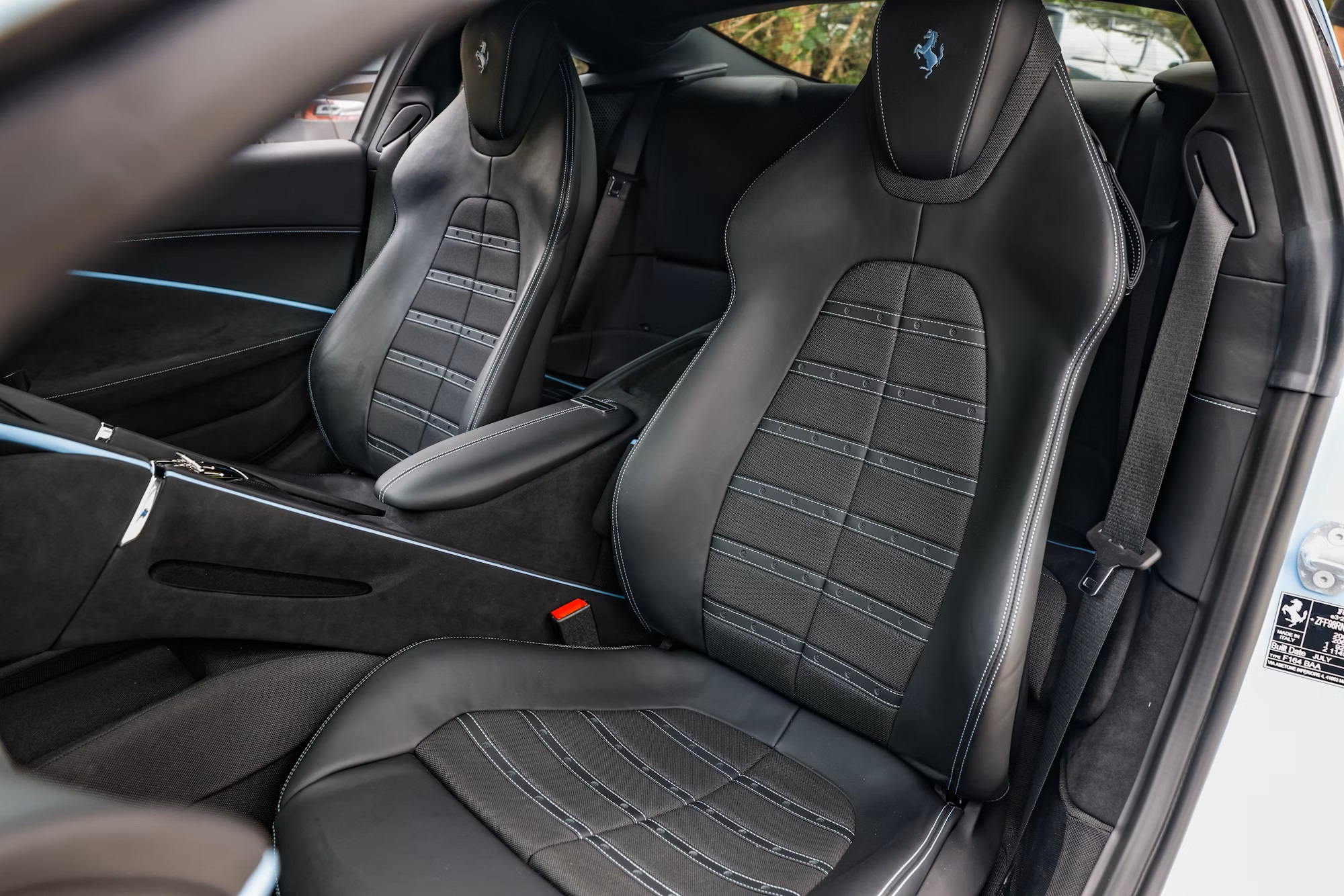
The Roma is a Ferrari that embodies the spirit of grand touring, with a design that evokes the iconic GTs of the past. It’s a feast for the eyes, featuring a sleek minimalist grille and a distinctive shark-nosed front end. The car’s elegant proportions and undeniable Ferrari flair will surely ignite a passion in any car enthusiast.
Under the hood lies a powerful 3.9-liter V8 engine with a soul-stirring voice. Enhanced with new cam profiles and a high-revving capability, this engine is a true Italian Stallion. A single-piece exhaust manifold ensures optimal performance, resulting in a breathtaking 612 horsepower and 560 lb-ft of torque.
This particular Roma belongs to the “Ispirazioni 2020” collection, drawing inspiration from the legendary 1960 Ferrari 250 GT Berlinetta SWB-Competizione. Its stunning Azzuro La Plata paint job is complemented by a touch of racing heritage.
Carbon-fiber accents, including the front spoiler, rear diffuser, under-door covers, and sill kicks, add a modern edge. The doors and bonnet are adorned with contrasting white racing roundels, featuring a unique design element.
Flying international for the first time? Here’s the entire departure process. Although the title specifically names the Ninoy Aquino International Airport (NAIA), this also applies to any other international airport in the Philippines. We’ll also be highlighting the travel requirements you need to present every step of the way.
The idea of traveling abroad can be nerve-wracking especially for first timers. The airport process alone can be pretty overwhelming for the uninitiated. There seems to be a lot of steps, a lot of queuing, and a lot of documents that you need to prepare in advance. But don’t worry, in this article, we’ll take you through the entire process, from the pre-departure preparations all the way to boarding the aircraft.
WHAT’S COVERED IN THIS GUIDE?
1. Accomplish the eTravel form.
What is the eTravel form? It is a government-mandated electronic form that collects your personal and travel information for Immigration record. By completing this form, you’re telling the government where you are going, what you’ll be doing in your destination, and when you are coming back. It is the digital replacement of the paper Immigration departure card.
You must fill out the e-Travel form online as early as 72 hours (3 days) before your departure time through any of the following:
You can do this up to 3 days (72 hours) before your flight. I usually accomplish this on my way to the airport.
If it’s your first time, you’ll have to create an account first using a valid email address. Once you have an account, you can add a trip and enter your travel details.
This is required for departing Filipinos. Some would say that they weren’t asked to present this. It’s true. But that’s because Immigration Officers can see in their system if a passenger has accomplished an eTravel form or not. If they see that the passenger has done it, they don’t ask them for it anymore. If they don’t find the passenger’s eTravel, they will ask them to step aside and do one at the tablet area nearby.
Note that the Philippines isn’t the only country implementing a digital border control form. Singapore and Japan have something similar, too.
2. Make your way to the right airport terminal.
Most international airports outside Manila have just one terminal, so it’s pretty straightforward. But Manila’s Ninoy Aquino International Airport has four: Terminals 1, 2, 3, and 4.
How to determine which terminal you should go to? Check your booking confirmation. It’s usually indicated there. But to be absolutely certain, you can contact the airline or try checking in online.
Upon entering the airport terminal, the guard will ask to see the following documents:
passport
booking confirmation
Only passengers are allowed at the Departure Hall, where the check-in counters are located. At Terminals 1 and 2, if you’re not a passenger, the guard won’t let you in.
At Terminal 3, although the Departure Hall is largely for passengers only, some parts are accessible for non-passengers and well-wishers. The “mall area”, which is occupied by a wide selection of restaurants and shops, is also open to non-passengers.
3. Pay the travel tax.
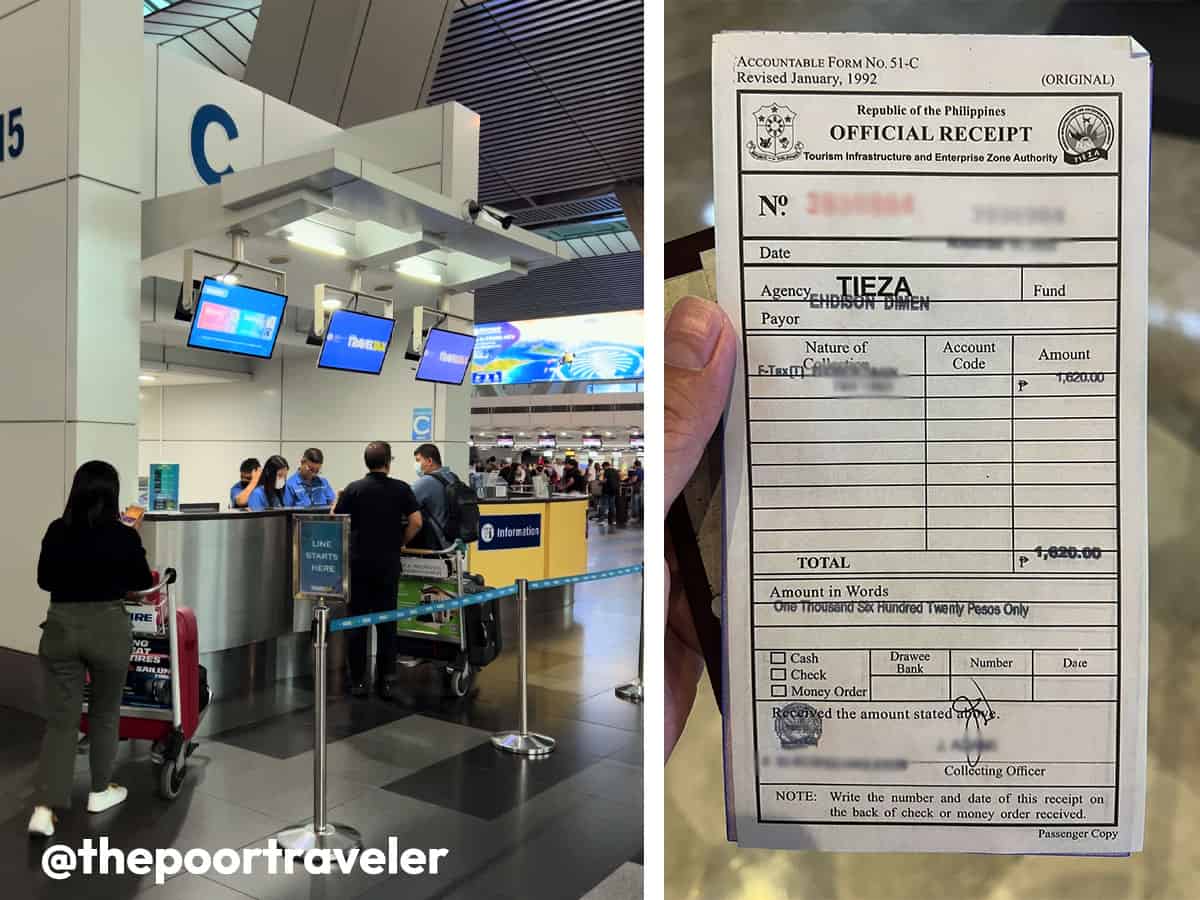
Once inside, find the TIEZA counter to settle the travel tax. This is the levy imposed by the government on Filipino travelers exiting the Philippines.
Here are the rates:
Economy-class passengers: PHP 1620
First-class passengers: PHP 2700
Note that not all travelers are required to pay this. Some are eligible for a reduced or discounted rate or full exemption. To check if you’re qualified, visit this page first: TRAVEL TAX EXEMPTION & DISCOUNT!
If you’re a group/family, a representative can do this step alone to avoid crowding.
After payment, you’ll be given two (2) copies of the TIEZA receipt. The original copy is yours; you can keep it. The duplicate copy must be submitted to the check in agent later on.
But before you pay, check if the travel tax is already paid for when you booked your flight. Some airlines — usually legacy carriers — automatically include this upon booking. To be sure, check the breakdown of payment in your booking confirmation or ticket. Look for PH TAX amounting to PHP 1620 or the equivalent in another currency.
If it’s already included, no need to approach the TIEZA counter to pay again. Skip this step and head straight to the check in counters.
If you can’t confirm that it’s already paid for, don’t pay yet lest you be charged twice. Instead, skip this step and queue up at the check in counters for now.
4. Check in for your flight or drop bags.
On the flight info board or screen, find the check in counters to your flight. These screens are located in the middle of the departure hall for NAIA Terminals 1 and 2. At NAIA Terminal 3, you’ll find multiple screens near the entrance gates.
Proceed to the assigned check in counter and fall in line. Business-class passengers have their own queue, while economy-class passengers have two choices:
Online check-in or Bag Drop: This is for economy passengers who have already checked in online. This queue tends to be shorter and move much quicker. It’s sometimes labeled “bag drop” because if you’ve already checked in online, all you’re checking in at this point is your luggage.
Regular check-in: This is for economy passengers who didn’t check in online. This queue is often much longer and slower.
Once you reach the counter, present your passport and visa (if applicable). If you’re a group or family, everyone has to be present. The check-in agent will check and match the passport to the passenger. Then, they will instruct you to put your bags on the weighing scale one by one.
Make sure you’re familiar with the baggage policy. The agent will ask you questions about the content of your bags. It’s a lot more complicated but in a nutshell:
Dangerous, flammable, and corrosive items are prohibited.
Gadgets with batteries are not allowed for check-in and must be hand-carried (carry-on).
Liquids in 100ml containers or smaller are allowed for check-in and hand-carry.
Liquids in containers larger than 100ml must be checked in.
Once all bags have been checked in, the agent will check the system if your travel tax had been settled.
If travel tax is already included in your flight booking, you’ll be handed a boarding pass right away.
If travel tax is not yet paid, the check in agent will ask for your TIEZA official receipt. If you have it already, just hand it over. If you don’t have one yet, you’ll be instructed to proceed to the travel tax counter, pay, and then come back to them to receive your boarding pass. Don’t worry, you won’t need to queue up all over again. Once you’ve settled the tax, just go back straight to the agent that checked you in and hand her your receipt.
Once everything is in order, the check-in agent will give you a boarding pass.
5. Clear Immigration inspection.
Upon entry to the Immigration Area, the staff will check your passport and boarding pass. Then, fall in line again.
If you’re pregnant, senior or PWD or traveling with one, there is a dedicated priority lane. Only one companion is allowed.
When it’s your turn, approach the Immigration counter and hand over your passport and boarding pass. If your destination requires a visa, the officer will also ask to see it.
The officer will also ask you to step back a little and face the camera as they take a photo of you. While all this is happening, they can ask you questions about your background and your trip.
Some of the usual questions are:
Where are you going? Tell the officer your destination country.
What’s the purpose of your trip? Leisure/vacation, business, visiting someone?
When are you coming back to the Philippines? Make sure you know your return date.
But if it’s your first time traveling abroad, it’s likely that they ask more, including:
What’s your occupation in the Philippines? You may be asked for proof of your answer such as company ID or Certificate of Employment for employees or business registration documents for self-employed travelers. If you’re a government employee, you must have a Travel Authority with you.
Who is funding your trip? – If it’s self-funded, you may be asked to present proof that you could financially support the trip. This is why some travelers bring a bank certificate. One of my teammates was asked to open her banking app on the spot. – If someone else is paying for your trip in any way, you may be required to submit an Affidavit of Support and Guarantee (AOSG) and proof of relationship with the sponsor.
⚠️ REMINDER:Approach the Immigration counter one at a time. You will be evaluated individually. That said, in my experience traveling with my teenage nephew and senior mother, there have been several instances when the officer asked me to join in and they processed us at the same time. But by default, you should approach the counter individually.
If you’re worried about your dependent, let them go first. Anyone who makes it past the counters is NOT ALLOWED to go back or wait and linger at the nearby areas. If you let your dependents go first, you can stay in line and assist them should they need anything from you.
This whole immigration process is so nuanced and complicated, it deserves its own article. We’ll write more detailed articles about it soon, but for now, you may refer to these posts:
⚠️ Taking photos and recording videos are strictly prohibited. This policy is not exclusive to the Philippines. All countries I’ve been to have this rule.
6. Go through Security Check.
Immediately after clearing Immigration checks, proceed to the security check area. There’s a good chance you’ll be lining up here again. While waiting for your turn, prepare for a smooth inspection.
Take your laptop out of your bag.
Empty your pockets and put them in your bag.
Remove your belt.
Remove your shoes, when required. (This is not implemented all the time.)
Liquids are only allowed in 100ml containers or smaller. Otherwise, they may be confiscated.
Put your belongings on a tray and let it pass through the x-ray machine. You’ll also need to walk through the body scanner. If it makes a beeping sound, the security officer may frisk you.
If every thing is OK, get your bags and other items when they make it to the other side.
7. Find your gate and wait for boarding.
Beyond the security area, you’ll find shops and restaurants. If you still have time, you can walk around or have a meal/drink. But my recommendation is to find the gate assigned to your flight first.
At this point, it’s best to take another look at your boarding pass. On this piece of paper, you’ll find important details about your flight, including:
Sample Boarding Pass
Gate number. This is the gate that will be used to board your flight.
Boarding time. You should be at the gate by this time, usually 20-30 minutes before your scheduled departure time.
Zone number. Airlines usually let passengers board the plane by batch or by zone. Wait for your zone to be called. Sometimes, this is done by row, instead of by zone.
Seat number. Your assigned seat inside the aircraft.
Pay attention to the flight information screens and announcements. Sometimes, the gate assignment and boarding time change because the flight is delayed or other reasons. In rarer cases, the flight can leave earlier than scheduled. Avoid using your earphones or headset as you might miss these announcements.
8. Board the aircraft.
Once your zone or row is called for boarding, fall in line. The staff will check your passport again and scan your boarding pass.
Inside the aircraft, look for your assigned seat. Your boarding pass indicates your alphanumeric seat number. The number tells you your row and the letter your seat position: aisle, middle, or window. Check the labels on the overhead compartment. Please do not take other passengers’ seats.
If you have a carry-on bag (hand-carry), stow it inside the overhead compartment. You can place your smaller bag under the seat in front of you.
That’s it! Fasten your seatbelt and enjoy your flight.
Where to Stay Near NAIA (Manila Airport)
If you’re looking for a hotel or apartment close to the airport, here are some top recommendations on various online booking websites.
In Asia-Pacific waters, Sanctuary Cove also heads the North-South boat show network, as recent hub Singapore struggles post-COVID, and China and Japan suffer deflation and other issues. Boat buyers now commute regularly in the region, particularly to and from Southeast Asia, East Asia and Australasia, so Sanctuary Cove seems destined to become the gathering place not only for the broader market but also for next-generation superyacht sales.
SYBAss, the Superyacht Builders Association, already has members like Horizon and Benetti as long-term exhibitors at Sanctuary Cove, with SilverYachts of West Australia and Gulf Craft from the Middle East swelling the ranks.
Damen Yachting and its Amels superyachts is the yard whose vessels are most frequently found in Indo-Asia-Pacific waters, according to our annual Top 100 guide, and Australians own many of its largest custom builds.
Burgess and brokers GLI, Leigh-Smith Yachts and Grant Torrens are among big boat specialists using Sanctuary Cove
Germany’s Lürssen and Dutch yard Feadship are leading builders with assorted Asia-Pacific contracts, while the two Dutch super sailboat yards Royal Huisman and Vitters have both built superb yachts for media magnate Lachlan Murdoch recently.
Add Sanlorenzo and Nautor Swan, and most other SYBAss members have gravitated to Sanctuary Cove anyway, without a formal vote being taken that this should be the new Asia-Pacific hub. The concept is backed by leading brokers like Burgess and Gold Coast outfits GLI, Leigh-Smith Yachts and Grant Torrens.
Riviera and Maritimo, Australia’s leading production builders both based across the Coomera River from Sanctuary Cove, are rising to the occasion too, having released 78ft and 75ft models that are akin to the 80-foot or 24m starting LOA for the definition of superyachts only a few decades back.
Maritimo M75
Custom touches have long been creeping in at the upper echelons of production boat building, ‘semi-custom’ has become a much-used term, and it would be no surprise to see almost fully custom larger vessels being turned out by these yards in the future if the price is right.
Likewise, Taiwan yards Horizon and Ocean Alexander, and Chinese OEMs that produce high-quality Alaskas, Hamptons and many others are filling the niche ranges for serious boaters in smaller superyacht LOAs.
The Gold Coast has the ambiance to make it work. Like Fort Lauderdale, with which it is a sister city, or Cannes, Monaco and Genoa, wealthy buyers can settle into familiar surroundings, and it is not unusual to find them at fancy Main Beach restaurants with Penfold’s Grange flowing freely in pre-boat show days.
They commute to the show via limousine or helicopter, and have often arranged for similar gatherings in the resort’s extensive restaurant-packed Marine Village or in the InterContinental nearby, or perhaps in the Lagoon Beach Club for what organisers say is the very latest VIP experience.
Riviera 78 Motor Yacht
Riviera and Maritimo have substantial stands at the show, along with The Yacht Sales Co which contests with Simpson Marine in Asia for the mantle of Asia-Pacific’s largest boat dealer.
Altogether, says Mulpha Events General Manager Johan Hasser, the event has circa 330 exhibitors, 750 boats and 2,500 marine accessories on offer in a complex that spans the waterways, Marine Village roads and specially-erected Pavilions. Attendance is about 50,000, more than Monaco, less than Cannes.
“Riviera will host a world premiere at their Festival of Boating as part of a record 12-model showcase in 2024,” said a spokesman.
Riviera Australia owner Rodney Longhurst said: “This will be a magnificent display, and will be our only boat show in Australia in 2024,” highlighting the trend in recent years for Riviera, Maritimo and others to focus on Sanctuary Cove rather than larger cities like Sydney and Melbourne.
ILIAD 53S
The Yacht Sales Co, incorporating Multihull Solutions, has a stellar line-up of world-leading brands including Fountaine Pajot, Dufour Yachts, Absolute Yachts, ILIAD Catamarans and Tesoro Yachts.
Fountaine Pajot’s Astrea 42 and the also-acclaimed Dufour 41 are among the sailing models to be shown, and their power vessels will include the recently debuted ILIAD 53S catamaran.
The Yacht Sales Co has specialist knowledge of multihull construction, sales ranges and brand options, including resales, and has a lot of hands-on experience. They have offices in Southeast Asia and across the Pacific.
Absolute Navetta 48
Also being shown is the Absolute Navetta 48, which has four cabins all offering ample windows with panoramic views. This Italian-designed and made vessel is en route to Sanctuary Cove and the concept, indoors and out, is said to offer a very high level of liveability, especially suited to long-distance voyaging.
We have also reviewed the Tesoro T40 outboard from Spain after the initial model was bought by a superyacht captain as a tender when he saw her performance in Sydney Harbour. This vessel has many more features than are apparent at first sight.
Tesoro T40
Other well-known brands on display include Princess from Britain, Fleming, Palm Beach, Whitehaven and Leopard Catamarans. Among favourite marine accessories in the Pavilions are the latest developments and packages from Club Marine, Garmin, Raymarine, Navico, Dometic, Savwinch, and Vetus-Maxwell.
The latter, a Dutch-New Zealand company, will doubtless be showing its range of advanced winches at Sanctuary Cove, but interestingly it also custom-makes deck hardware and windlasses for the world’s top superyachts. Some of these systems are valued at over USD 500,000 alone.
Add in nearby Gold Coast, Brisbane, and Cairns superyacht refit and repair yards that are increasingly in demand by locals and visitors alike, and the gradual upgrade of Sanctuary Cove to a full-scale one-stop superyacht sales centre for Asia-Pacific seems inevitable.
www.sanctuarycoveboatshow.com.au
This article was originally published in YACHT STYLE issue 76 and was also seen on yachtstyle.co
For more on the latest in yachting news, click here.
The technical storage or access is strictly necessary for the legitimate purpose of enabling the use of a specific service explicitly requested by the subscriber or user, or for the sole purpose of carrying out the transmission of a communication over an electronic communications network.
Preferences
The technical storage or access is necessary for the legitimate purpose of storing preferences that are not requested by the subscriber or user.
Statistics
The technical storage or access that is used exclusively for statistical purposes.The technical storage or access that is used exclusively for anonymous statistical purposes. Without a subpoena, voluntary compliance on the part of your Internet Service Provider, or additional records from a third party, information stored or retrieved for this purpose alone cannot usually be used to identify you.
Marketing
The technical storage or access is required to create user profiles to send advertising, or to track the user on a website or across several websites for similar marketing purposes.