
Home Blog Page 753

How to Accomplish eTRAVEL Form for Philippine Departure and Arrival

0


By continuing to read this article, you agree to double check with the authorities or other concerned entities for the latest updates.By continuing to read this article, you agree to double check with the authorities or other concerned entities for the latest updates.

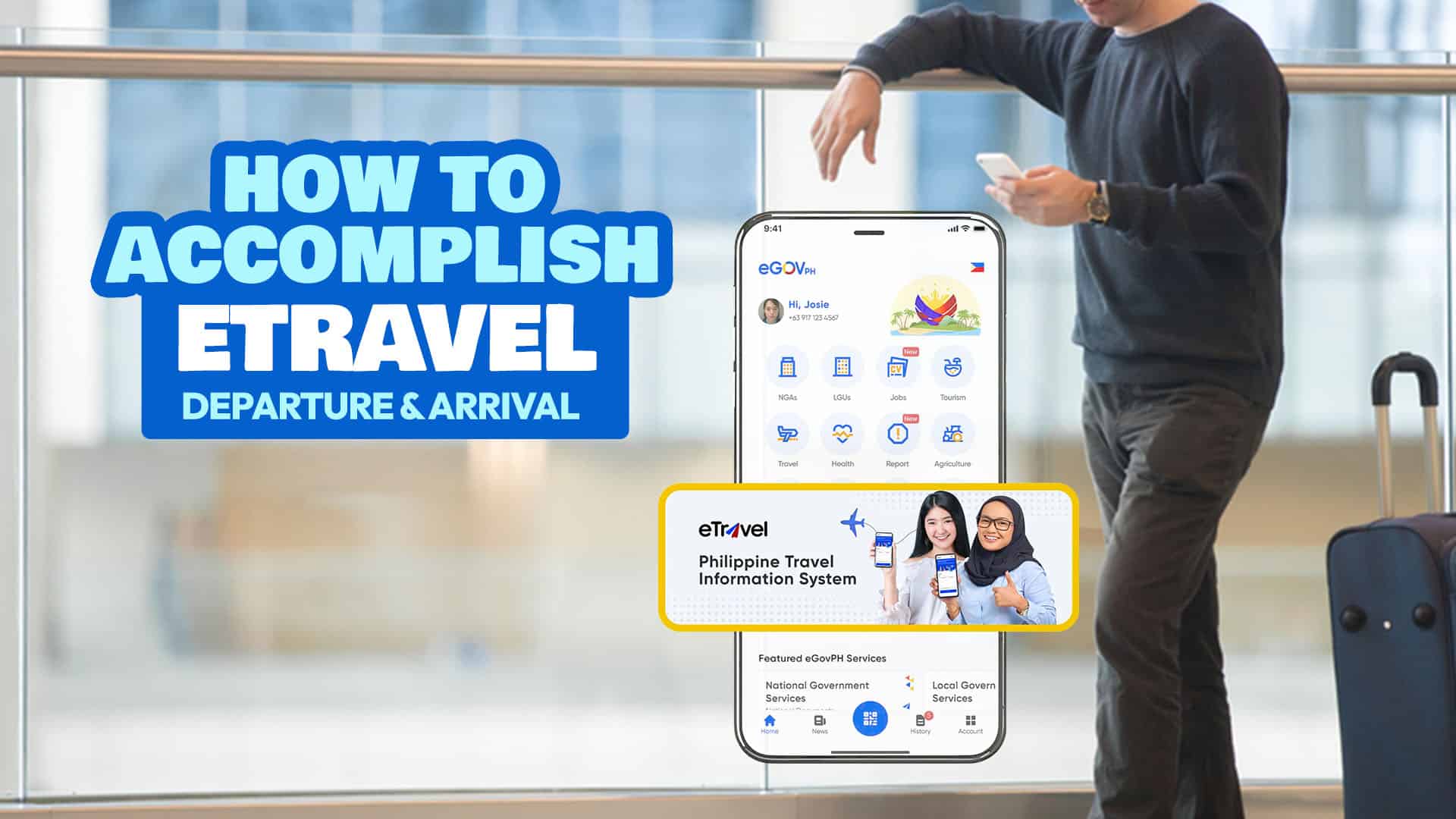
When traveling to or from the Philippines, one of things you should know is that you’ll need to accomplish the eTravel form. In this article, we’ll tell you exactly how to get and accomplish it!

WHAT’S COVERED IN THIS GUIDE?

What is eTravel?

The eTravel form is an online form used to collect personal and travel information from passengers entering and exiting the Philippines for the purpose of immigration, border control, data analysis, and health surveillance. It serves as your departure/arrival card, health declaration, and contact tracing form.

ETravel Gov PH WebsiteETravel Gov PH Website

It was first implemented at the height of the COVID-19 pandemic to reduce physical contact between the passengers and airport personnel, replacing the traditional paper departure cards. Today, no more pandemic, but it has remained in use.

Who are required to accomplish the eTravel form?

Most travelers are required to complete and submit the form, including the following:

  • arriving Filipinos and foreign nationals
  • departing Filipinos

Adults and children alike falling under these two categories must submit an eTravel form. That covers most travelers.

I say “most” because, as you can see, it does not include departing foreigners. The following are also exempted from submitting eTravel:

  • foreign diplomats and dependents
  • foreign dignitaries and members of delegation
  • 9(e) visa holders
  • holders of diplomatic and official/service passport

The eTravel form must be completed and submitted as early as 72 hours (3 days) before your departure from the Philippines or expected arrival time in the Philippines.

If you’re traveling with family, you can also complete this form on behalf of your family members.


How to Create an eTravel Account

Whether you’re outbound or inbound traveler, the first step is to create an account, if you don’t have one yet. You can do so in two ways:

If you have traveled internationally and submitted an eTravel form before 2024, it doesn’t mean that you automatically have an account. Prior to 2024, creating an account was not a requirement. One could simply accomplish the form and submit without having to sign up for an account. However, in early 2024, this has become mandatory. Don’t worry. It does feel like a lot of work in the beginning, but it will make your subsequent submissions a breeze because, unlike before, the system is now able to save your personal details and automatically fill in some of the fields with pre-saved data.

If you don’t have an account yet, here’s how:
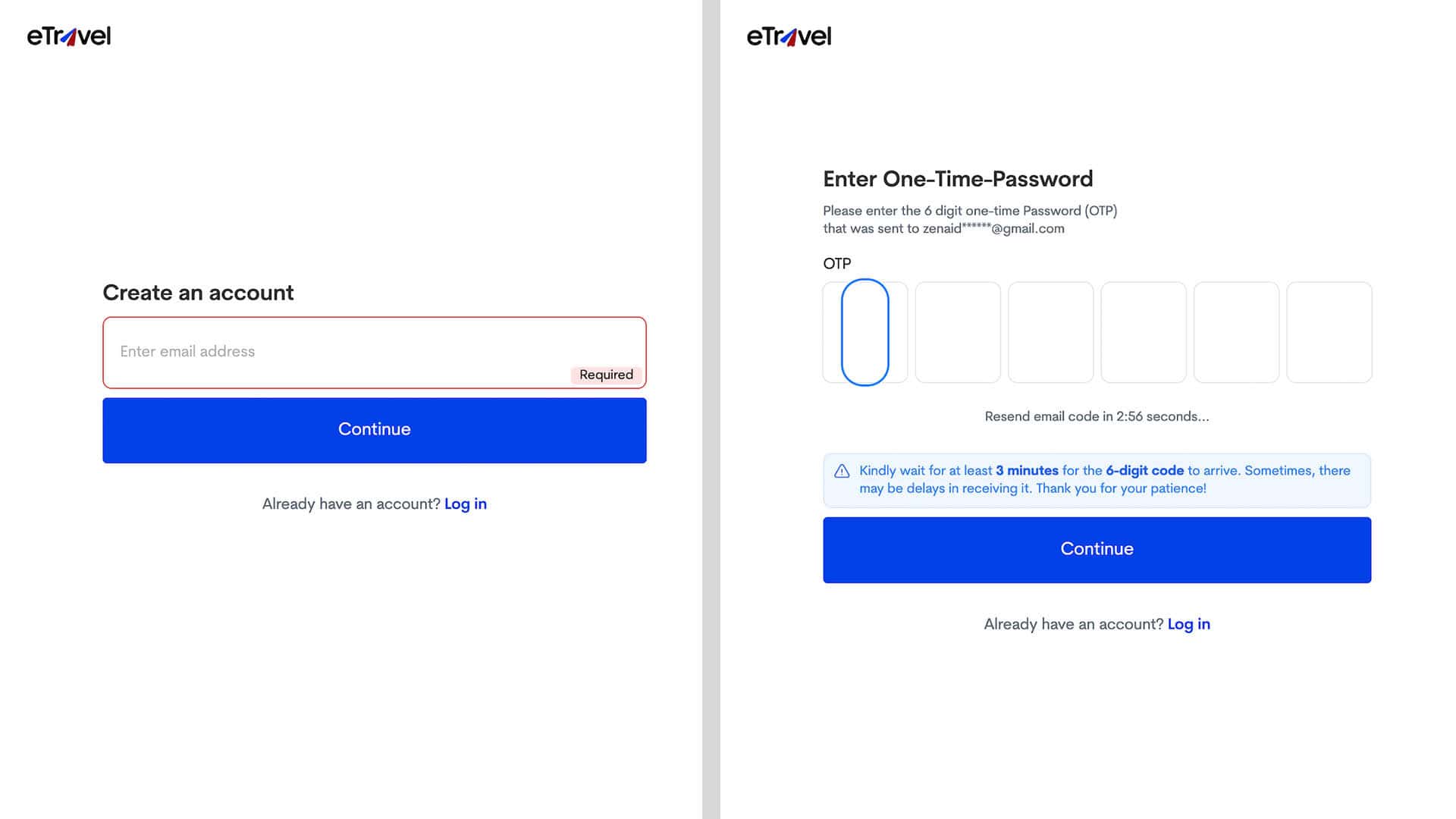
ETravel Create Account 1ETravel Create Account 1

  1. Visit the etravel.gov.ph/authentication. This is the official sign-up page. Make sure you’re on the right website.
  2. Enter a valid email address. Make sure it’s correct because the system will be sending a one-time password (OTP) to this email address.
  3. Enter the OTP. Check your email to retrieve it. It should have 6 digits.
  4. Create a password. The password must have at least 8 characters, with at least one uppercase and one lowercase letter. Re-enter your password to confirm.
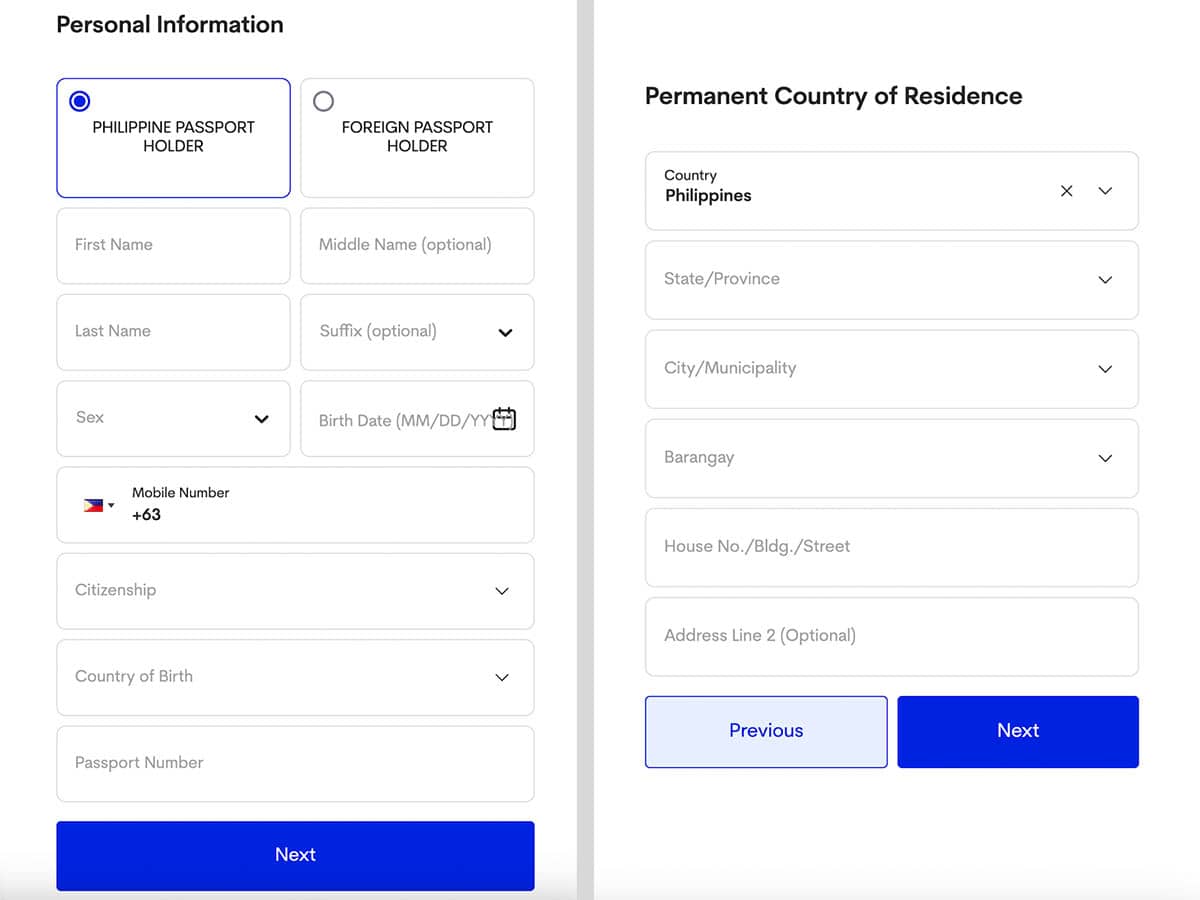
  5. Enter your personal information. The system will ask for the following:
    – Full name
    – Sex
    – Birth date
    – Mobile number
    – Citizenship
    – Country of birth
    – Passport number
    Tap NEXT.
  6. eTravel PH Create AccounteTravel PH Create Account

  7. Enter your residential address. Click NEXT after.
  8. Review all the information you entered. The system will show you a summary of your details. If every thing is correct, hit SUBMIT.
That’s it! You now have an eTravel account!

Using this account, you can register a trip for yourself and even family members.

Now, it’s time to register your trip.


How to Accomplish eTravel for DEPARTING Passengers

Now that you have an account, all you need to do is register your upcoming trip. Every time you do so, you’ll be asked if you’re completing the form for yourself or for a family member. (Yes, you can submit a form on their behalf.) You’ll also be asked if it’s for ARRIVAL or DEPARTURE.

This section is for DEPARTURE, i.e. for those flying OUT of the Philippines. This applies to all Filipino passengers and crewmembers. Foreign nationals departing the Philippines do not need to register their departure trip.

Here’s how to register a departure trip:
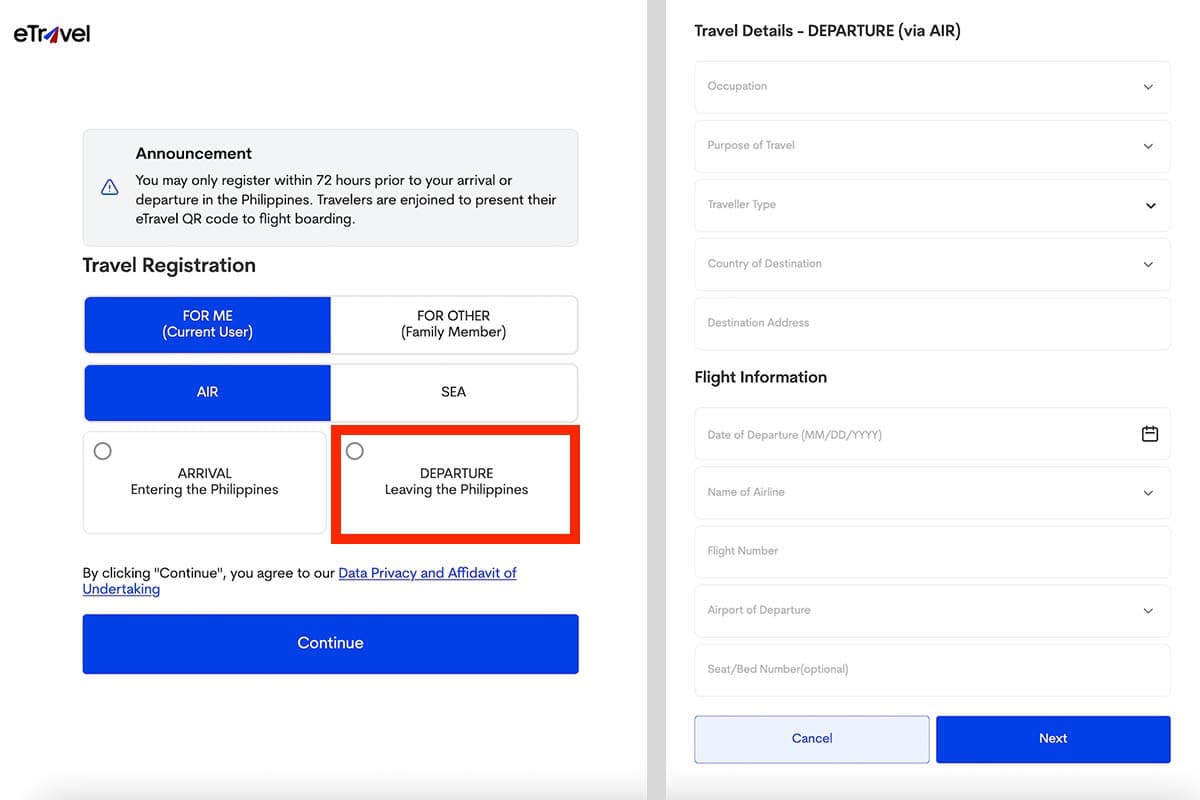
eTravel DepartureeTravel Departure

  1. Select whether you’re accomplishing the form for yourself or a family member. You should also select whether you’re traveling by air or by sea. Let’s assume you’re flying, so choose AIR.
  2. Choose DEPARTURE (Leaving the Philippines). Make sure you select the right one! Then click CONTINUE.
  3. Enter your travel details, including the following:
    – Your occupation. Select the industry closest to yours)
    – Purpose of travel. If you’re traveling as a tourist, choose HOLIDAY/PLEASURE/VACATION. Other choices are OFW, Convention/Conference, Education/Training/Studies, Religion/Pilgrimage, and Transit. Just pick what applies to you..
    – Traveler type. Choose AIRCRAFT PASSENGER.
    – Destination country and address. If you’re staying at a hotel, enter your hotel’s address. If you’re staying with someone else, type their address.
  4. Enter your flight information. Provide the following details:
    – Date of departure
    – Name of airline
    – Flight number
    – Airport of departure. If flying out of Manila, choose NINOY AQUINO INTERNATIONAL AIRPORT (MNL). But make sure you pick the right terminal, too.
    – Seat number (optional)
    Click NEXT.
  5. Review your details. You’ll be shown a summary of all the info you entered. Make sure everything is correct. If so, click SUBMIT.
  6. Save or take a screenshot of your eTravel QR code. This will also be sent to the email address you used.

That’s it! All your information will also be sent to the Immigration Officer’s database. In most cases, they won’t even ask to see your QR code because they can already see it on their screen as you clear Immigration Check.


How to Accomplish eTravel for ARRIVING Passengers

Assuming you already have an eTravel account, you only need to register your trip. For ARRIVAL registration, all passengers — Filipinos and foreigners alike — must complete and submit an ARRIVAL eTravel form. Just follow these steps.
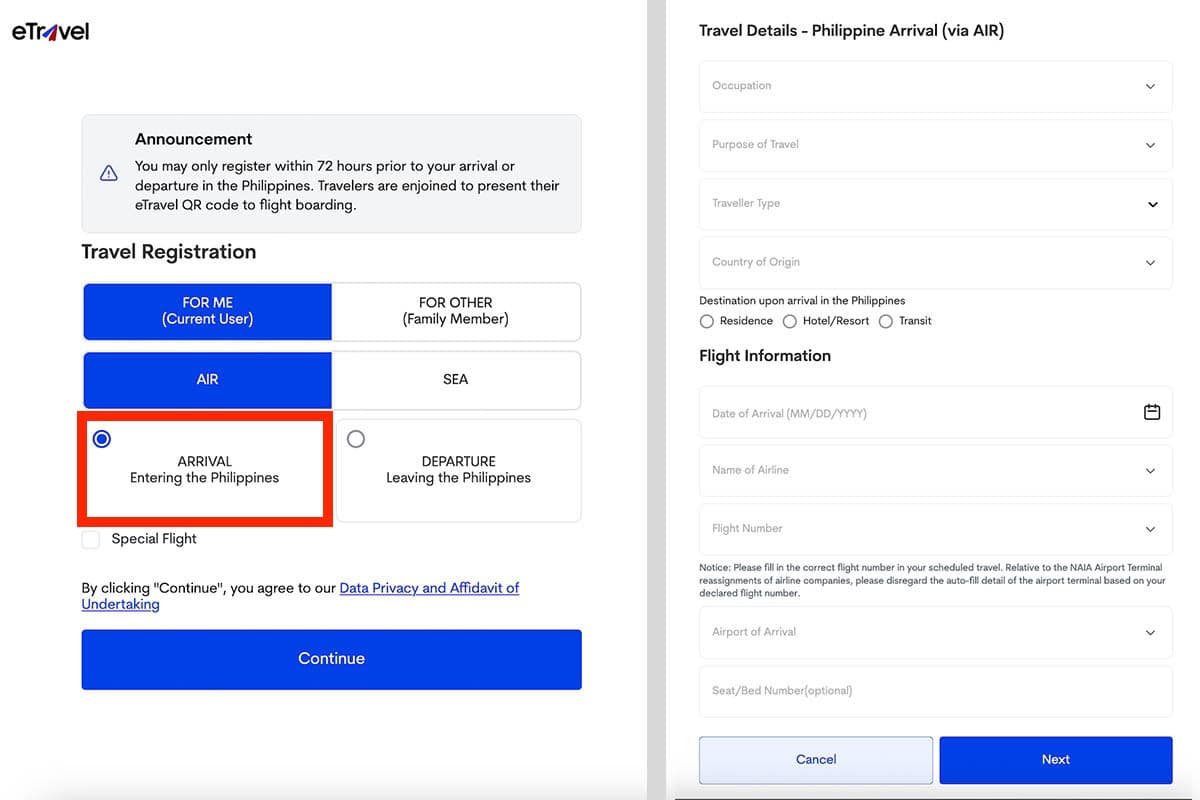
eTravel ArrivaleTravel Arrival

  1. Select whether you’re accomplishing the form for yourself or a family member. You should also select whether you’re traveling by air or by sea. Let’s assume you’re flying, so choose AIR.
  2. Choose ARRIVAL (Entering the Philippines). Make sure you select the right one! Then click CONTINUE.
  3. Enter your travel details, including the following:
    – Your occupation. Select the industry closest to yours)
    – Purpose of travel. If you live in the Philippines and you just went abroad for business or holiday, choose RETURNING RESIDENT. Other options are OFW, Convention/Conference, Education/Training/Studies, Religion/Pilgrimage, and Transit. Just pick what applies to you.
    – Traveler type. Choose AIRCRAFT PASSENGER.
    – Country of origin. This is the country where you will be flying from.
  4. Enter your address in the Philippines. Choose where you will be staying in the Philippines: Residence, Hotel/Resort, or Transit. Once you select, type in the address of your residence or hotel, whichever is applicable.
  5. Enter your flight information. Provide the following details:
    – Date of arrival
    – Name of airline
    – Flight number
    – Airport of arrival. If flying to Manila, choose NINOY AQUINO INTERNATIONAL AIRPORT (MNL). But make sure you pick the right terminal, too.
    – Seat number (optional)
    Click NEXT.
  6. Fill out the Health Declaration Form. Enter all the countries you have visited within the past 30 days. You’ll also be asked if you have been sick, have experienced symptoms, or have been exposed to someone with symptoms within the past 30 days. After answering all the items, click NEXT.
  7. Review your details. You’ll be shown a summary of all the info you entered. Make sure everything is correct. If so, click SUBMIT.
  8. Save or take a screenshot of your eTravel QR code. This will also be sent to the email address you used.

That’s it! All your information will also be sent to the Immigration Officer’s database. In most cases, they won’t even ask to see your QR code because they can already see it on their screen as you clear Immigration Check.


Frequently Asked Questions (FAQs)

I want to change something after generating the QR code. How to correct it?

You can still edit your info if you noticed a typo error or you entered wrong data. However, note that you can only do this BEFORE it gets validated or verified by the BOQ officer upon your arrival sa Pilipinas. Ensure that you make your corrections before your flight to the Philippines.

To do this, just go to the main page or home page of eTravel, then click the UPDATE REGISTRATION button. Provide your reference number or transaction number and birth date.

At what point of the airport process should I present the QR code?

In most cases, you won’t be asked to present this at any point. But it doesn’t mean you can skip it. The Immigration Officer can see on their screens if you’ve accomplished this form.

  • If they see that you have, they usually won’t ask for it.
  • If they can’t find your eTravel for this trip, they will ask you to step aside and accomplish one at the tablet station nearby.

Do I have to pay for eTravel QR Code? How much is the charge?

No, you don’t need to pay anything for the eTravel QR Code. It is FREE of charge. If you landed on a website requiring you to pay for the service, it’s definitely a scam.

I’m traveling with family. Does every one of us need to accomplish eTravel?

YES and NO. YES, every member of the family on your trip must have an eTravel record, but not everyone needs to create an account. One member can create an account and then they can register all the accompanying family members under that one account. I’ve done it myself for my mother and sister on our most recent trip, and we didn’t encounter any problem.

Note that this does not apply to friends, colleagues, or romantic partners. If you’re not family, each of you must create an account.

Is there a Tagalog version of this article?

We will be publishing a Tagalog video version of this on our YouTube channel.


Do I still need to accomplish One Health Pass and eArrival Card?

No need. The eTravel has officially replaced the now obsolete One Health Pass and eArrival Card starting 2 December 2022.

To be honest, all these systems are very similar. The changes are not too drastic. Some items were removed such as the Philhealth Number, and then some required items are now optional. The noticeable difference is not really the content but the appearance or the user interface.


Updates Log & Credits

2024 • 5 • 4 – Reflected “account creation requirement” update, and included Departure process: Yosh Dimen
2023 • 2 • 24 – Original publication, covers only Arrival process: Asta Alvarez


More Tips on YouTube ⬇️⬇️⬇️


Is this post helpful to you?


Tip UsTip Us


Source link

Jaeger-LeCoultre and Roy Wang Present the Dragon of Time

0


Jaeger-LeCoultre collaborates with Roy Wang for dynamic new artistic expression

Light is perhaps one of the single most important elements of human vision. It facilitates the creation of images in our minds and forms the basis of our perception. Without it, the wondrous creations of nature and artisans are imperceptible. Within the hallways of Jaeger-LeCoultre’s Vallée de Joux manufacture, light allows its masterpieces to sparkle with splendour, where every stroke of hand decoration and the intricacies of watchmaking come to life. In the same spirit of artistic expression, Jaeger-LeCoultre welcomes rising light painter Roy Wang into its Made of Makers family of esteemed artists gathered to expand La Grande Maison’s dialogue between watchmaking and the arts.

The rising Chinese artist, renowned for his culturally rich imagery, brings his signature dragon to life through calligraphic-like strokes of light and a peculiar paradox — tempering with the speed of time. Wang’s rapid light strokes and the camera’s slow shutter speed combine to capture the ephemerality of light painting. Precision, another hallmark of Jaeger-LeCoultre and a central element to this year’s novelties plays a critical role in Wang’s spatial awareness when conceptualising his art. While larger pieces, be it in watchmaking or light painting, are more forgiving with tolerances, the need for precision amplifies as creations are miniaturised.

Light painter, Roy Wang

Jaeger-LeCoultre commissioned three photographs and a stop-motion video as part of this collaboration, as Wang drew from his experience after visiting and discovering watchmaking in depth at La Grande Maison. Together with Wang’s dynamism and signature styles, the two worlds of East and West combine seamlessly for the artistic expressions of 龘 (dá – Flying Dragon), 叒 (ruò – All the Best), and 燚 (yì – Burning Flame). The former 龘 pays tribute to the Maison’s iconic Reverso, while the latter two 叒 and 燚 respectively celebrate the intricacies of the Duometre watch calibre (this year’s novelty highlight) and pay homage to a 19th-century Jaeger-LeCoultre pocket watch. At the pinnacle of the duo’s collaboration is the stop-motion video 时光绘龙 (Dragon of Time), as Wang’s dragon embarks on a fantastical journey through the Jaeger-LeCoultre manufacture shrouded in darkness and shining a new light on La Grande Maison. 

Wang’s four commissioned works will make their public debut on the opening day of Jaeger-LeCoultre’s The Precision Pioneer exhibition in Dubai from 7–19 May (click here to register if you happen to be in Dubai). Men’s Folio had the opportunity to speak to Catherine Rénier, CEO of Jaeger-LeCoultre, and Roy Wang two weeks before the exhibition about their artistic collaboration and the facets of precision in their lives.

Catherine Rénier, CEO of Jaeger-LeCoultre, at the Maison’s Watches & Wonders Geneva booth this year.

Precision is the central theme of Jaeger-LeCoultre this year. Though it’s a very complex topic that can go on for hours, what is the simplest expression of precision in La Grande Maison?

Catherine Rénier (CR): Precision is about the perfect gesture if I have to condense it into a few words. It is the perfect gesture when elaborating the artistic expression of a watch’s decoration, the perfect gesture of the watch’s hairspring and beating heart that gives the energy and chronometric precision, and the perfect gesture of the components’ production because this is almost the starting point of precision in watchmaking. Precision has been an ongoing topic and a foundation from day one throughout the 190-plus years of history of our maison, and a value that has run through under manufacture since then.

Describe the importance of precision during your process and how it affects the final results as a light-painter, Roy.

Roy Wang (RW): Precision is very important for me, too, especially when the light strokes are invisible to me during the process. I control the light through muscle memory and spatial memory. I was a sportsman before, and I dedicated my time to practicing my basic skills. I did the same when I first started with light painting in 2010. I spent so much time painting a single shape. With practice and knowing that practice makes perfect, I can draw whatever I want now with maybe one or two attempts.

What is an element of precision that goes into your everyday life?

RW: I’m an easygoing person, you know, but my friends always say, “Roy goes into a crazy mode when he’s light painting”. All the details and precision involved with light painting, such as the shooting time, camera settings, the distance between me, the light source, and the background, make me very serious. My concentration levels are 120% when I’m light painting or even when I played rugby last time.

CR: I would say the mastery of time. Being extremely busy, professionally and personally, like everyone else, the precision of allocating the right time and being fully dedicated to what you do at every moment is essential. That requires careful and precise time management and the precision of being present in whatever you are doing at any given moment.

The Made of Makers program explores the relationship between horology and art, including contemporary art, gastronomy and music. What was your first impression when you came across Wang’s artworks, and what did they bring to Jaeger-LeCoultre?

CR: Photography has been a long-time inspiration for the manufacture. We saw the canvas camera, and we also have a partnership with the Museum of Photography in France, so it’s an artform that is very present in Jaeger-LeCoultre. With Roy’s light painting, we come across a modern and new interpretation of photography. I love to see the evolution of the Maison’s relationship with this art form. It’s very meaningful.

The Duometre Calibre 388 housed in the Jaeger-LeCoultre Duometre Heliotourbillon Perpetual.

What are some values of Jaeger-LeCoultre that convinced you to join as one of their Made of Makers?

RW: Firstly, I’m very honoured and proud to be the first Chinese artist to join the Jaeger-LeCoultre’s Made of Makers family. I was very happy working with the (Jaeger-LeCoultre) team and incorporating Chinese elements into the three single-exposure works. This project challenged me a lot because I usually work on large-scale paintings, but Jaeger-LeCoultre brought me into the tiny watchmaker’s universe. I had to review my tools and techniques, but I enjoyed the challenge and the final outcome. I drew the dragon around a hundred times, and the team spent roughly six hours working on the stop-motion video of the dragon flying through the manufacture that Catherine likes. I love the connection between the two cultures.

The stop-motion video shows the Jaeger-LeCoultre manufacture in complete darkness, only illuminated by Wang’s dragon flying through the halls and corridors. Did it give you a different perspective of the manufacture?

CR: Seeing the centuries-old Jaeger-LeCoultre manufacture open up to another culture, another art form, is very touching. The best moment was seeing Wang’s dragon flying through the corridors because it’s a symbol of how two worlds of technical expertise, artistic expression, and two cultures can meet each other and give a whole different perspective on their artistic expression.

The Jaeger-LeCoultre Reverso Tribute Chronograph housing the new integrated chronograph calibre 829.

Your work involves an element of the unknown, as you rely on spatial awareness and muscle memory. What do you “see” when you plan your work?

RW: As I said, it’s all about practice. When I started light painting in 2010, I saw a little beam of light for the first time while drawing. I started seeing light trails about one or two seconds long with more practice. Afterward, I used my left hand to mark my drawings. For instance, I’ll mark the position of the dragon’s eye before moving to its head, and so on. Now, I remember the positions through muscle memory. Practice makes perfect; that is my idea for light painting.

A picture of Pablo Picasso from 1949 in Life magazine captured by Gjon Mili sparked your interest and passion in light painting, Roy. What would you like to communicate with people when they see your artworks many years later?

RW: Years ago, a Spanish girl emailed me saying she was inspired by my light dragon from Pingyao, which I posted on Instagram and asked many questions about her graduation thesis. I later started my light painting series about the 山海经  (The Classic of Mountains and Seas, a compilation of mythic geography and beasts). I adapted it and drew different beasts in modern cities, and through this art, people learned more about Chinese culture. People later started asking about my days as a light painter and rugby player. All of these are for the future, and after this project (with Jaeger-LeCoultre), more people around the world will know about light painting. I love the video so much and could watch it the whole day! [laughs]

The dragon is one of Roy’s signature subjects in his artworks. In Chinese culture, the dragon represents strength, power, success and ambition, to name a few. How do these values resonate with you and Jaeger-LeCoultre?

CR: Well, ambition, strength, and power resonate with any company that wants to shine in its field of expression. From an artistic standpoint, it’s a beautiful representation of a very expressive animal with a lot of detail, as seen in the images and video. The dragon has inspired some of our creations over the years, and there’s always an intricacy to it. So, at many levels, and again, this time with Wang, it means stretching ourselves every time we work with the dragon.

This article was first seen on mens-folio.com.

For more on the latest in watchmaking reads, click here.


Source link

Rolls-Royce Cullinan: Facelift unveiled | CarExpert

0


Approaching its sixth birthday the Rolls-Royce Cullinan has been given a bolder face, and an even swankier interior.

Most of the visual changes with the so-called Series II update have been made up front, where there’s a new slightly taller grille that’s available for the first time with illumination.

This is flanked by a new set of headlights, which are now framed by L-shaped driving light arc. The lower air intakes ditch the rectangular shape in favour of something that’s a little more aggressive, and less classically Rolls-Royce.

The choice of a sportier look might have do with the average age of Rolls-Royce buyers dropping from 56 in 2010 to 43 today.

Along the sides there are new rubbing strips and gloss black sills, as well as fresh alloy wheel designs, including a new 23-inch option.

While at the rear the changes are limited to the lower bumper where gloss black is the new black. The exhaust tips now have mirror-finish stainless steel surround, while the bash plate has been given a brushed stainless steel look.

Step inside, and the interior will look instantly familiar. Although the dashboard architecture hasn’t changed, the upper section now has single pane of glass stretching the entire width of the vehicle.

Behind the glass is BMW’s latest infotainment system — rebranded as Spirit in Rolls-Royce vehicles — and a new customisable digital instrumentation display.

Those sitting in the rear seats can pair Bluetooth headphones to the sound system, or enjoy the 1400W 18-speaker audio system.

The section ahead of the front passenger is an “Illuminated Fascia” area that houses a 3D-effect laser-etched cityscape graphic and Cullinan word mark. If the standard design isn’t to your liking, Rolls-Royce’s Bespoke division can whip up a personalised piece of art instead.

Wedged between the fascia and infotainment screen is an analog clock, underneath which is an illuminated stainless steel Spirit of Ecstasy figurine housed in glass.

The Cullinan’s interior has been spruced with a selection of new materials, such as new open pore wood choices and a new bamboo-derived rayon twill seating fabric, dubbed Duality Twill, that can be embroidered with the brand’s interlocking R logo.

An interior full bedecked in Duality Twill takes about 20 hours to finish, and will feature 2.2 million stitches and almost 18km of thread.

Alternatively buyers can specify the Placed Perforation trim that has up to 107,000 perforations placed 0.8 to 1.2 millimetres apart to recreate a scene of clouds over Rolls-Royce’s Goodwood headquarters.

Being a Rolls-Royce it’s likely most customers will dive deep into the car’s menu of options or engage the services of the company’s Bespoke customisation division.

The Cullinan is still powered by a 6.75-litre twin-turbo V12 petrol engine.

The company hasn’t released any specs regarding the drivetrain, but it’s probably safe to assume it still produces 420kW/850Nm in standard trim, and 441kW/900Nm in Black Badge models.

MORE: Everything Rolls-Royce Cullinan


Source link

Ram hydrogen fuel-cell truck, BMW EV batteries, rural charging: Today’s Car News

0


EV battery production for BMW is setting up south of the border. Ram aims to scale up its hydrogen fuel-cell muscle. And why do rural governments see EV charging as less important? This and more, here at Green Car Reports. 

BMW has started building a battery plant in Mexico that will provide more energy-dense cylindrical cells for longer range and faster charging in next-generation Neue Klasse EVs. If Inflation Reduction Act rules remain, the products might eventually qualify for the EV tax credit. 

As part of a commercial vehicle push, Stellantis plans a hydrogen fuel-cell Ram heavy-duty truck. Although details are yet to come, the decision to push well into the medium-duty sector with fuel cells coincides with other automakers’ decisions to shift away from fuel-cell passenger vehicles. 

And in what might be yet another example of an urban-rural divide, a recent University of Michigan survey suggested that EV charging is seen as less relevant to rural communities than to cities. While more local governments are interested versus a version of this survey in 2019, they’re still concerned about cost.

 _________________________________

Follow Green Car Reports on Facebook and Twitter

Green Car Reports Newsletter

Sign up to get the latest green car and environmental news, delivered to your inbox daily!

I agree to receive emails from Green Car Reports. I understand that I can unsubscribe at any time. Privacy Policy.


Source link

Rolls-Royce Cullinan Series II updates luxury brand’s bestseller

0


Since its launch in 2018, the Cullinan SUV has become Rolls-Royce’s most popular model. Rolls is now applying some design and tech updates to ensure it stays that way.

The Rolls-Royce Cullinan Series II features a refreshed exterior highlighted by tall vertical daytime running lights that frame the headlights and grille, which itself is now illuminated. The front bumper now bends downward as well, blending with the running lights to create a line fully encircling the grille. Other changes include a trim line running along the sides of the Cullinan and a stainless steel piece between the exhaust outlets in the rear bumper.

The Cullinan Series II is also available with 23-inch wheels—a first for the Cullinan—and is available in Black Badge spec from launch. The Black Badge treatment brings darkened exterior trim, an option for carbon fiber interior trim, and a more lively color palette.

Rolls-Royce Cullinan Series II

Rolls-Royce Cullinan Series II

Inside, the dashboard now incorporates a miniature version of the Spirit of Ecstasy hood ornament below the clock, as well as the illuminated front-passenger fascia panel previously seen on the Ghost sedan and Spectre electric coupe. To make this, 7,000 dots are laser-etched onto security glass at different angles to create a perception of depth within the flat dash panel.

For infotainment, the Cullinan switches to the Spirit operating system that debuted on the Spectre. Wifi connectivity and an 18-speaker audio system are included as well, along with an app called Whispers that lets owners send directions to the vehicle’s navigation system, remotely lock and unlock the doors, and track the vehicle’s location.

The Cullinan Series II also marks the debut of a new interior material Rolls-Royce calls Duality Twill, a fabric made from bamboo sourced from a grove on the Mediterranean Côte d’Azur neighboring Rolls-Royce founder Sir Henry Royce’s onetime winter home. A full interior made with this fabric can incorporate up to 2.2 million stitches with 11 miles of thread and takes 20 hours to complete, according to the automaker.

Rolls-Royce Cullinan Series II

Rolls-Royce Cullinan Series II

Unchanged is the twin-turbocharged 6.7-liter V-12, which drives all four wheels through an 8-speed automatic transmission. This engine makes up to 591 hp and 663 pound-feet of torque in Black Badge models, which also have model-specific throttle and transmission calibration aimed at livelier acceleration.

Expect the Cullinan Series II to start deliveries later this year as a 2025 model. It will be followed by an updated Ghost Series II, which should arrive next year.


Source link

Exploring The Grand Palaces Of Merida, Mexico – Hand Luggage Only

0


By our fourth day in Merida in Mexico, it felt like we’d pretty much seen most of the major sites to see in Merida (especially on this day and then on this day for the incredible cenotes and Mayan ruins just outside of Merida) but there was one place that we still hadn’t covered yet as that was Paseo de Montejo which is this street that’s famous for it’s grand homes and palaces.

Some of these grand palaces have been converted to buildings for private use or office but there are quite a few that you can actually visit.

Now seeing as this was our main major plan for the day, breakfast at our hotel – Casa Olivia was a long and leisurely affair.

Exploring The Grand Palaces Of Merida, Mexico

Exploring The Grand Palaces Of Merida, Mexico

Exploring The Grand Palaces Of Merida, Mexico

Exploring The Grand Palaces Of Merida, Mexico

Exploring The Grand Palaces Of Merida, Mexico

We were still at the breakfast table 3 hours after we started and only broke with proceedings to get some more tea on the sofa in the dining area. It was amazing.

Exploring The Grand Palaces Of Merida, Mexico

Exploring The Grand Palaces Of Merida, Mexico

Exploring The Grand Palaces Of Merida, Mexico

I was tempted to get into the pool but decided we had to go check out Paseo de Montejo first before relaxing for the rest of the day.

Exploring The Grand Palaces Of Merida, Mexico

Exploring The Grand Palaces Of Merida, Mexico

With that, we hopped into a taxi and made our way over.

The first things we saw on Paseo de Montejo was actually a stand selling fresh ice-cold coconuts and so we started things off with that first before making our way over to Monumento a La Patria.

Exploring The Grand Palaces Of Merida, Mexico

Exploring The Grand Palaces Of Merida, Mexico

Monumento a La Patria is like the main start of the street and is described as a homage to Mexican history.

Exploring The Grand Palaces Of Merida, Mexico

Leaving it, we made our way back on ourselves heading down Paseo de Montejo towards Quinta Montes Molina which is a museum now and a former stately home.

You can visit properly but we decided it wouldn’t make sense to visit every single one of these places so we saved our potential visiting for Montejo 495 which is a lot further down the street.

Exploring The Grand Palaces Of Merida, Mexico

Exploring The Grand Palaces Of Merida, Mexico

Exploring The Grand Palaces Of Merida, Mexico

Before that though, we went past Museo Regional de Antropología, Palacio Cantón – which is typically just referred to as “Palacio Cantón” for short.

It’s such a grand building and again, is another one to visit if you have time but pick wisely otherwise you might end up with Palace fatigue after attempting to visit all of them.

Exploring The Grand Palaces Of Merida, Mexico

Montejo 495 is quite literally named that because it’s the address on the street and it is one of the most gorgeous palaces on this street, inside and outside.

When we arrived there, we were told we would have to wait for the next English tour which would be starting soon but that we would have to spend about an hour in there.

Gorgeous as it is, from speaking to locals, you don’t really need an hour to explore the place.

Exploring The Grand Palaces Of Merida, Mexico

Our only options to visit however were a guided tour.

We got a quick sneak peek inside and just before deciding to go on the tour, we were told that the upstairs is currently being renovated and can’t be visited so we just decided not to bother.

It would have meant for a shorter tour but you don’t get to see everything so it didn’t seem to make much sense to visit.

Exploring The Grand Palaces Of Merida, Mexico

With that, we popped over to Parroquia Santa Ana which was just a few doors away.

The entrance was beautifully draped with flowers which is absolutely gorgeous but those flowers were for a wedding that was being held in the church and unlike Merida Cathedral the other day which had some people in for a service, this seemed pretty full so we didn’t go inside and just instead appreciated it from the outside.

Exploring The Grand Palaces Of Merida, Mexico

Exploring The Grand Palaces Of Merida, Mexico

Exploring The Grand Palaces Of Merida, Mexico

We then hopped into a taxi to take us to our hotel but got out like a street or so away to check out Parroquia de Santiago Apóstol before walking back to Casa Olivia.

Back in Casa Olivia, Mexican wine and well-earned dips in the pool were the order of the day before heading over to Merida Cathedral to watch the ancient Mayan Ball Game that happens every Saturday at 8pm.

Exploring The Grand Palaces Of Merida, Mexico

Exploring The Grand Palaces Of Merida, Mexico

It’s actually a really fascinating part of Mayan culture and at one point, the ball gets lit which takes things up a notch.

Exploring The Grand Palaces Of Merida, Mexico

The lighting of the ball reduces the amount of time the players can be in contact with the ball so that makes the game a little harder.

Actually saying that, I should probably give a quick summary of the rules.

Exploring The Grand Palaces Of Merida, Mexico

The rule is effectively for players on each side to try to get the ball through a hole in the middle of the field.

They can’t touch it with their hands or kick it. They have to use their sides to hit it which adds a totally understandable level of complexity to the proceedings.

Exploring The Grand Palaces Of Merida, Mexico

The game historically was done for more than just for fun.

There’s also a religious element to this for the Mayan people so it was a lot more serious than it looks.

Exploring The Grand Palaces Of Merida, Mexico

This game is free to watch by the way and there are even seats in some areas so you definitely should check it out if you can when you visit.

The advice we were given was to arrive before 7:30pm for a great view but we got there probably around 8:05pm and the view we had was still pretty fantastic.

The game is played properly so it could end 30 minutes after it starts or an hour after it starts. It all just depends on the players really.

Exploring The Grand Palaces Of Merida, Mexico

This one finished around 45 minutes after it started which was perfect because we had dinner booked for 9pm at Teya Santa Lucía.

It’s a nice enough place for dinner but it paled in comparison to some of the other places we’d been to for dinner before.

Exploring The Grand Palaces Of Merida, Mexico

Exploring The Grand Palaces Of Merida, Mexico

There is live music here too so it might be a good spot to grab a drink in town and a few snacks.

Exploring The Grand Palaces Of Merida, Mexico

On the walk back to the hotel after dinner, we stumbled upon Dzalbay Cantina which we’d seen before while walking through town but hadn’t popped into as it had been closed (it was in the middle of the afternoon).

This evening it was open and I’m not sure if they do food there (they probably do) but it’s got a really cool bar and judging from the stage, there’s also live music there.

The bar staff are really fun in here too and before long we found ourselves continuing in our journey to taste even more tequilas and mezcals and learn more about them while in Mexico.

It was a delicious experience.

Eventually, we bade them adieu and headed back to our hotel to pack and get ready to head back home the next day (after breakfast, of course).

Exploring The Grand Palaces Of Merida, Mexico

Exploring The Grand Palaces Of Merida, Mexico

Merida had turned out to be quite a highlight of Mexico for us and we absolutely recommend visiting whenever you get the chance to.


Check Out The Very Best Of Great Britain!

Hand Luggage Only Great Britain Travel Book Advert Banner


Check out our YouTube channel for travel videos!


Source link

Ultra-exclusive Bentley Batur Convertible takes open-top motoring to the next level

0


Bentley has taken the wraps off its latest coachbuilt creation, the Batur Convertible. It’s the third modern Bentley to be crafted by Mulliner, after the Bacalar and Batur coupe.

We loved the Batur when it first came out, and let’s be honest, it looks even better with its roof chopped off. The low-set grille is flanked by expressive LED headlamps. One can really appreciate the elegant design of the car with its wide hips, especially in the front 3/4 view.

Bentley Batur Convertible - 4

Moving to the rear, the Batur convertible has slim wraparound taillights and a subtle ducktail spoiler. The 2-seater also features an “airbridge” behind the seats. According to Bentley, the convertible roof can be raised or lowered in just 19 seconds at speeds of up to 30 mph.

The Bentley Batur Convertible #0 is painted in a bespoke Vermillion Gloss with a Vermillion Satin Duo tone interior. The front splitters, side skirt and rear diffuser are finished in high gloss carbon fibre. It rides on 22-inch wheels that have Gloss and Satin Black Titanium spokes with Vermillion Gloss accents.

Bentley Batur Convertible - 2

Powering the Batur Convertible is Bentley’s most powerful W12 engine. This 6.0-liter twin-turbo unit puts out 740 hp. Production is limited to just 16 units, which is 2 units less than the coupe.

Bentley Batur Convertible - 12

Source: Bentley


Source link

Fuel-cell Ram HD pickup included in Stellantis hydrogen rollout

0


Stellantis will produce a hydrogen fuel-cell Ram commercial truck, the head of the automaker’s fuel-cell program said in a recent interview with German publication Welt am Sonntag (via Electrive).

Following the start of at-scale production of fuel-cell vehicles in Poland later this year, Stellantis plans to start building a fuel-cell version of the Ram 5500 in Mexico, for the North American market, Jean-Michel Billig said in the interview. 

2024 Ram 5500 chassis cab

2024 Ram 5500 chassis cab

Stellantis began selling fuel-cell medium-duty commercial vehicles in some markets in late 2022, but only 350 have been sold to date, Billig said. The automaker hopes to grow production to 100,000 vehicles per year by 2030 as it targets 40% fuel-cell commercial vehicle sales, with a “completely decarbonized product range in Europe” by the end of the decade, according to the executive.

The Ram 5500 is the beefiest version of the Ram HD pickups, and is generally sold as a chassis cab in the U.S., making it much bigger than previous efforts at hydrogen pickups. Toyota, for example, has already revealed a hydrogen fuel-cell pickup overseas, but it’s a prototype and production plans haven’t been announced.

2025 Ram 1500 Ramcharger

2025 Ram 1500 Ramcharger

The Nikola Badger fuel-cell pickup might have been eventually sold by the hydrogen-focused company, though it reportedly would have depended heavily on General Motors. Once a leader in fuel cells, GM has backed away from their application in light-duty vehicles and instead is focusing on semi trucks. Hyundai and Toyota have followed similar paths, shifting away from fuel-cell passenger vehicles and toward larger commercial vehicles.

In the meantime Ram is set to offer an intriguing proposition—a series hybrid with a 92-kwh plug-in battery pack. Called the Ramcharger and expected to launch as a 2025 model, this variant of the Ram 1500 will go 145 miles on electric-only power from the battery, then another 545 miles with its gasoline V-6 engine running a generator and functioning as a range extender.


Source link

Yamaha MT-25 terima warna baru – harga naik RM1k

0


Yamaha MT-25 terima warna baru – harga naik RM1k

Hong Leong Yamaha Motor (HLYM) sekali lagi memperkenalkan warna baru untuk model naked MT-25, yang kini ditawarkan dalam warna Midnight Black dan Midnight Cyan. Bersama dengan warna baru ini, harga untuk model ini juga naik RM1k berbanding harga akhir pada tahun 2022, menjadi RM23,998 tidak termasuk insurans.

Bagi warna baru Midnight Black ini, seperti yang dapat dijangka dari namanya, menggunakan hampir keseluruhan panel berwarna hitam manakala warna Midnight Cyan jadi lebih menyerlah dengan rim serta pelekat tepi berwarna terang.

Bahagian lain motosikal ini masih tidak berubah, dengan enjin masih menggunakan unit dua silinder selari suntikan bahan api 249 cc DOHC penyejukan cecair serta kotak gear enam kelajuan, menghasilkan 35.5 hp pada 12,000 rpm dan tork 22.6 Nm pada 10,000 rpm.

Yamaha MT-25 terima warna baru – harga naik RM1k

Memegang rim 17 inci pada MT-25 adalah suspensi yang terdiri daripada fork USD di hadapan dan monoshock di belakang, manakala brek yang terdiri daripada unit cakera hadapan dan belakang dilengkapi secara standard dengan ABS.

Kelengkapan lain MT-25 adalah termasuk tangki bahan api 14 liter, meter LCD, semua lampu jenis LED, berat 167 kg dan tinggi tempat duduk 780 mm. Setiap pembelian diberikan jaminan dua tahun atau 20,000 km serta kunci cakera brek yang bernilai RM100.

Nak jual kereta anda? Jual dengan Carro.


Source link

10 Reasons Why Croatia is a Digital Nomad’s Dream Destination

0


This European destination is one of my favorite places in the world, and once you visit, I think you’ll agree – I loved my time as a digital nomad in Croatia. Not only is it a beautiful place, but it’s a top spot for digital nomads. The world is full of hubs for remote workers nowadays, but for me, Croatia stands out head and shoulders above the rest for so many reasons.

Having spent many months in Croatia, I believe it’s somewhere everyone should live and work in at least once. I can honestly say that I never once got bored, I met so many wonderful people, and the food! Oh, don’t get me started on the food – it’s pretty incredible.

What I’m trying to say is that if you’re on the fence about whether or not you should head to Croatia for a few months, or even a year, go for it. You can choose from various towns and cities, move around as much as you like, and make memories on the go. It’s a win-win.

Top Reasons Why Croatia is a Digital Nomad’s Dream Destination

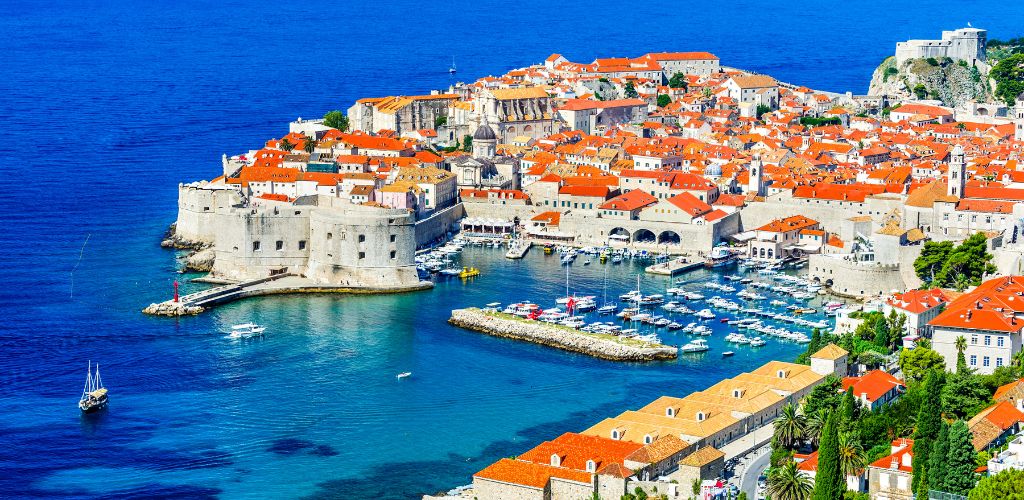
Aerial view of Croatia, port city with white building houses and terracotta roofing Aerial view of Croatia, port city with white building houses and terracotta roofing

There are countless countries to choose from as a digital nomad these days, so why Croatia? I’ve put together my top ten reasons why I believe that Croatia is a digital nomad’s dream destination. By the end, I hope you’ll be pressing the ‘book’ button on your flight.

1. Amazing Food

Burek, a traditional Croatian dish with knife and fork Burek, a traditional Croatian dish with knife and fork

Food glorious food indeed! Croatian cuisine is extremely fresh, seasonal, and very hearty. Of course, you’ll find many international menus no matter where you go, but it’s always cheaper and more authentic to try local dishes wherever possible.

I’m not usually the biggest risotto fan, but I love black risotto in Croatia; it just hits differently somehow. Burek is also a must-try, as well as locally sourced truffles, gregada (a traditional fish stew), and pag cheese in particular. As far as drinks go, be brave and try rakia with friends—just be warned; it’s extremely strong!

Eating local food will save you plenty of money during your stay. Touristic resorts, especially in places like Dubrovnik, will set you back a large amount, but if you head to where the locals go, you’ll enjoy your food so much more and keep cash in your pocket in the process. You could also try learning how to cook Croatian fare and that will teach you a new skill and save you money at the same time.

2. Fantastic WiFi Connectivity

laptop and coffee in cafe laptop and coffee in cafe

As a digital nomad, the internet is extremely important. For the most part, you can’t work without it, so you need to know that you’re going to be able to connect easily and that you’ll have high-quality service available. During my time in Croatia, I never struggled with the internet once, even when I was traveling around.

According to Speedtest, Croatia’s average upload and download speeds are 29.23 Mbps and 71.65 Mbps respectively. In large towns, cities, and resorts, almost all bars, restaurants, hotels, and cafes have WiFi you can use. You can also use an eSIM, such as Airalo, or purchase a regular SIM card and use your data as a hotspot.

I used both cafes and coworking spaces around Croatia and conducted video calls and heavy internet work with ease. I never had a problem and managed to be super-productive in general. Even the more rural areas and islands didn’t pose major issues, so the internet shouldn’t be a concern for you.

3. Easy to Meet Other Digital Nomads and Locals

digital nomad friends with laptop working from a beach location laughing and smilingdigital nomad friends with laptop working from a beach location laughing and smiling

Since Croatia introduced its digital nomad visa (more on that shortly), the country has become a real hub for remote workers. As such, you won’t struggle to meet other like-minded people from all over the world. Most coworking spaces and hotels also arrange social evenings, where you can make new friends, network, and socialize to your heart’s content.

I found the locals in Croatia to be extremely friendly and very welcoming. In large towns and cities, many people speak English well enough, and even if they don’t, Google Translate is your friend. It helps to learn a few words of the language if possible, but I felt like I was struggling to communicate.

The most popular digital nomad hotspots are Dubrovnik, Split, the capital city of Zagreb, Zadar, Hvar Town, and my personal favorite, Korčula. However, that doesn’t mean you can’t travel around and stay in other places if you find somewhere that calls out to you. I mentioned the high quality of the internet in the last point, and that extends generally across Croatia, so you really do have the freedom to go wherever you want.

4. Stunning Beaches

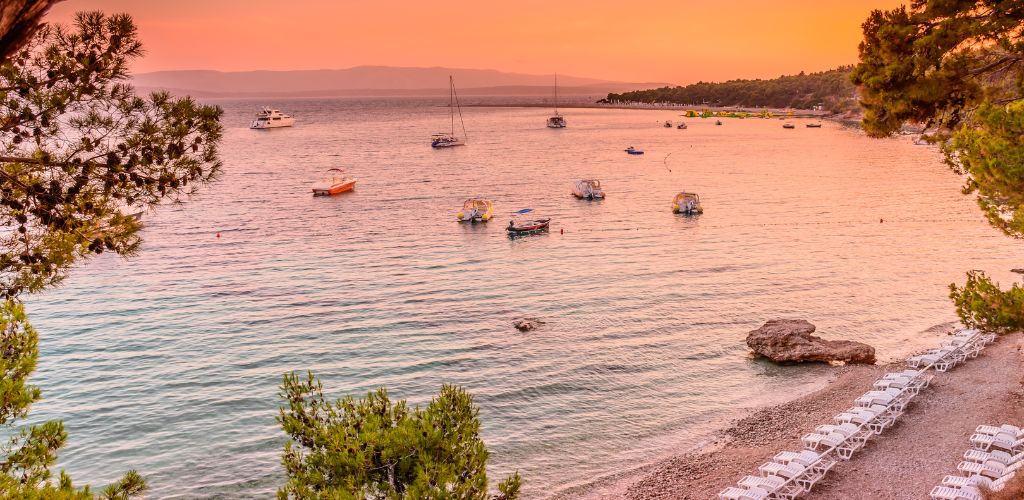
Golden Horn beach in Croatia at dusk, boats line the shore Golden Horn beach in Croatia at dusk, boats line the shore

I love a good beach, and I found plenty during my time in Croatia. With 1777.3km/1104.4 miles of coastline, you’ve got a lot to choose from! Copacabana Beach in Dubrovnik is a great starting point, but don’t be afraid to travel to slightly off-the-beaten-track to find some stunning, secluded coves to relax.

Golden Horn on Brač Island is like something out of a beach dream, and Bacvice Beach in Split is somewhere I spent a lot of time. All of this makes it easy to chill out when you’ve finished work for the day or on a precious day off. There are also plenty of boat trips you can take which show you the coastline from a different viewpoint.

If you’re into beaches in particular, it’s a good idea to base yourself somewhere close to the coast, such as Zadar or Split. Dubrovnik is an amazing spot, but it’s extremely busy during the summer months, to the point where you can barely move. I’d personally choose to dip in and out of the city during the hottest months and visit during the shoulder seasons instead.

5. Easy to Travel Around and Explore

KRKA Waterfalls Croatia, Krka National Park Croatia on a Bright Summer EveningKRKA Waterfalls Croatia, Krka National Park Croatia on a Bright Summer Evening

Croatia is packed with many things to see and do, and when you’re staying for an extended amount of time, you’re free to head out and explore. The good news is that it’s pretty easy to do so, with many organized trips, a great public transport network, and easy-to-follow roads. Even if you’re not super adventurous, you won’t find it difficult to get around.

Plitvice Lakes National Park is somewhere that really blew my mind, along with the beautiful Krka Waterfalls. These are two places that are pretty easy to reach if you have a day off and trust me when I say you’ll fill up your camera with amazing photographs. Of course, checking out the Dubrovnik city walls should also be on your to-do list.

In Split, you’ll find the amazing Diocletian’s Palace, and if you’re a Game of Thrones fan, you’ll find several of the filming locations dotted around Dubrovnik and Split. Additionally, there are many beautiful Croatian islands to check out, all of which have their own charm. Put simply, your days off will be packed with amazing sightseeing opportunities and boredom won’t be an issue.

6. Relatively Low Cost of Living

person cooking at home Mediterranean food with frying panperson cooking at home Mediterranean food with frying pan

While prices have increased over the last few years, as they have across the world, the cost of living in Croatia is still relatively low when you compare it to other major European cities. There are many ways you can look to cut costs here and there, and I found cooking at home or eating in traditional restaurants to be big money savers.

If you’re looking to rent an apartment, you’ll notice that prices are higher if you try to stay in the center of a city or close to the sea, but venturing a little further back will yield savings. For instance, the average price of a furnished apartment in Split is around €538/$577, with utilities on top. That’s cheaper than some other European cities, such as Barcelona, where you’re looking at prices around €850/$912.

Of course, if you try to live like you’re on vacation, you’ll notice that your money goes a lot faster. However, if you’re careful, and truly immerse yourself in regular, local life, your cash will last longer, and you’ll experience so much more as a result.

7. You can Immerse Yourself in the Culture

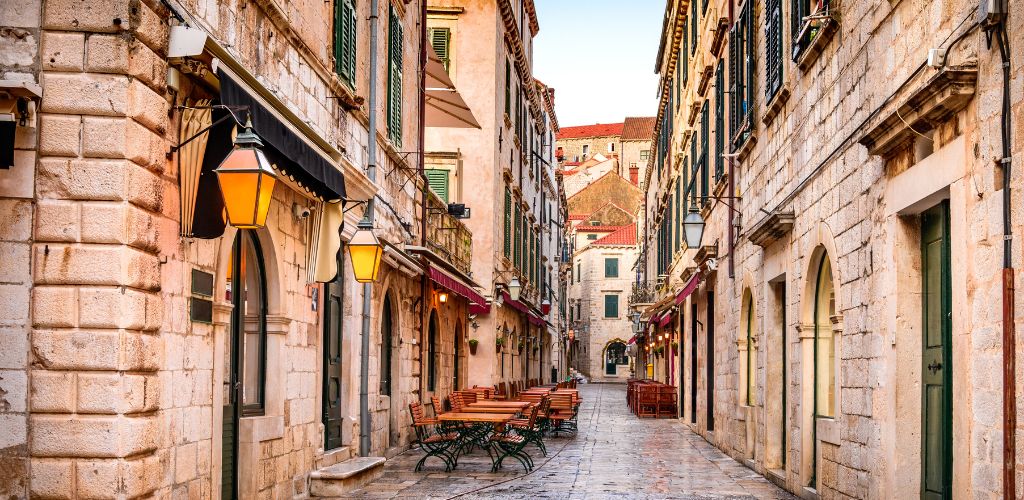
Dubrovnik, Croatia - Stradum old street view lined with traditional buildings and seatingDubrovnik, Croatia - Stradum old street view lined with traditional buildings and seating

The great thing about Croatia is that you get the best of both worlds. You can throw yourself into the touristic fun that’s available in all major towns, cities, and resorts in the summer months, or you can go down the authentic, local route, and experience the culture. It’s easy to experience both sides of the place depending on your preferences.

Croatian culture is rich and varied, and as I mentioned earlier, the locals are super friendly. It’s fun to learn about the regional differences between areas, and if you venture over to the islands, you’ll find an entirely different way of life. From one place to another, every region has its own special quirks that are truly fun to explore.

For me, experiencing the culture of a new location is what makes travel so enriching, and I never found it hard to live an authentic life in Croatia. In fact, I’d say it’s one of the easiest places to experience the traditions and customs the country is famous for. It’s a big reason for me wanting to return!

8. Digital Nomad Visas are Easy to Obtain

USA passport, waiting for flight in boarding lounge with aeroplane in backgroundUSA passport, waiting for flight in boarding lounge with aeroplane in background

In January 2021, Croatia introduced its dedicated digital nomad visa, which opened the doors in more ways than one for remote workers to spend more time in this beautiful country.

The good news is that this visa is relatively easy to apply for as long as you have all the necessary documentation. In short, it allows freelancers and remote business owners from foreign countries to stay for up to one year, as long as their business is registered outside of Croatia.

It’s also possible to bring your spouse and/or children over with you as part of the family reunification process. The visa lasts for a year and cannot be renewed after that time, however, you can wait for six months and then reapply again. During this time, you don’t have to constantly stay at your registered address; you can travel around the country and only have to update your address if you don’t intend to return to your original location.

You can check all necessary documentation here, and you can apply once you arrive in Croatia or before you intend to travel. If you apply beforehand, I’d recommend applying online a couple of months beforehand, so you have time to receive your visa without any stress.

SEE ALSO: Croatia Digital Nomad Visa: How to Apply & Requirements

9. Countless Coworking Spaces & Laptop-Friendly Cafes

open-planned coworking space with white desks and high stall seating open-planned coworking space with white desks and high stall seating

One thing about working remotely in Croatia stood out for me, and that’s the sheer number of places to work from. If you’re not a fan of sitting in your apartment and working, you’ll find many coworking spaces and laptop-friendly cafes dotted around. I worked from both, and I have to say that cafes are my favorite; there’s something fun about getting your work done, soaking up the atmosphere, and getting your caffeine fix at the same time.

Split and Zagreb have the largest number of coworking spots overall, but you’ll find them in all major towns, cities, and resorts. Croatia also has a very active cafe scene, so you won’t struggle to find a comfortable coffee shop to stay for a few hours, as long as you purchase food and drinks proportionate to the amount of time you spend there.

Many coworking spaces also organize social evenings, and they’re great places to network too. I found most coworking spaces in Croatia to be pretty laid-back and creative, and not at all ‘stuffy’ or too office-like. You’ll need to pay to work from a coworking spot but you’ll also get plenty of additional extras, such as free refreshments, a shared kitchen, comfortable chairs, and more.

SEE ALSO: 10 Best Coffee Shops & Cafes in Split (Laptop Friendly!)

10. No Dual Taxation Issues

mixture of euro and dollar notes mixture of euro and dollar notes

The digital nomad visa in Croatia doesn’t impose any dual taxation rules, which means you don’t need to pay taxes in the country while you’re living and working there on this visa. Of course, you need to carry on paying tax wherever you’re originally registered to avoid any problems at the end of the tax year.

This isn’t the case for all visas in major digital nomad hotspots so it’s a great perk of choosing Croatia in general. I found the digital nomad visa to be very easy to apply for and I didn’t experience any problems with it during my stay. What’s more, if you receive your income in dollars (in particular), you’ll find that you get a lot more for your money, and the fact you don’t need to pay tax in Croatia helps even more.

In Closing

There’s no denying that Croatia is a super beautiful country and it’s packed with many things to see and do. For me, as far as choosing a place to stay and work from goes, it ticks all the boxes. Croatia really does feel like home once you arrive; the locals are keen to embrace you as part of their community, and as long as you commit to immersing yourself in the culture, you’ll learn and gain so much during your stay.

With the new digital nomad visa in place, Croatia has everything you could possibly need as a remote worker. Of course, nowhere in the world is perfect, but I didn’t encounter any major issues at all during my time there. The biggest issue for me was trying to decide what to do on my days off, as there was too much to choose from!


Source link