Tiffany Titan by Pharrell Williams medium link bracelet in 18k yellow gold with pavé diamonds.
Tiffany & Co. has just unveiled a new collaborative collection with Pharrell Williams dubbed the “Tiffany Titan”. As the name would suggest, “Titan” is not simply a clever use of wordplay but rather an ode to the structure of Poseidon’s trident which the collection’s spear-like spikes — seen on an array of necklaces, earrings, bracelets, and rings — are inspired by. The collection not only references Greek mythology but its sharp edges embody the spirit of punk. Much like how the punk movement was born from anarchy, each piece of the collection — 18k yellow gold or titanium with all metal and diamond iterations — challenges conventional methods in their design.
Tiffany Titan by Pharrell Williams medium link clasp necklace in 18k yellow gold with pavé diamonds.
The Tiffany Titan marks a new departure from the delicate and demure pieces that fans of the brand have become accustomed to seeing like the “Lock”, “T” and “Knot” designs. The Titan instead plays on the juxtaposition of hard and soft as its motif incorporates a link that is curved and soft against the sharpness of the spear to form a symbol of fearless individuality. The collection is close to home for Pharrell who comments, “I’m very inspired by the water, and the name of this collection “Titan” draws inspiration from Poseidon, ruler of the sea, King of Atlantis.” “Atlantis” also being the name of the community Pharrell grew up in Virginia Beach. Pharrell goes on to explain that every detail in the collection is intentional, for instance, the use of black titanium is “a physical manifestation of beauty in blackness”.
Blake Lively
To celebrate the launch of the collection, Tiffany & Co. hosted an intimate event at the House’s famed Fifth Avenue flagship: The Landmark which saw a bevy of famous faces including Pharrell Williams, ROSÉ, Blake Lively, Anitta, Rosalía, KAWS, Pusha T, Gabrielle Union, A$AP Rocky, Hannah Einbinder, Ayo Edebiri, Daniel Arsham, Maggie Rogers, and Tyshawn Jones.
Alexandre Arnault and A$AP Rocky
Tiffany & Co. is going through something of a rebirth and the collection speaks to a wider shift happening in the luxury industry. First, it speaks to the role that Alexandre Arnault plays within the brand as the executive vice president of product, communications, and industrial at Tiffany & Co. Having previously secured Beyoncé and Jay-Z for a Tiffany campaign in 2022, it is imperative that Alexandre Arnault continues to make strategic steps when it comes to moving the brand in a new direction particularly as his father Bernard Arnault plans for a succession within LVMH.
Tiffany Titan by Pharrell Williams medium link clasp necklace in 18k yellow gold with pavé diamonds.
Next, the collection also cements Pharrell Williams’ position not only in the luxury industry but within LVMH as he settles into his role as Louis Vuitton’s new men’s creative director — Louis Vuitton, also being under the LVMH umbrella. By having a part to play in the design process of the Tiffany Titan and not simply being the face of the campaign, Pharrell highlights that his influence goes beyond music and into the fashion and luxury jewellery industry.
Tiffany Titan by Pharrell Williams five-row ring in 18k yellow gold with pavé diamonds.
Tiffany Titan by Pharrell Williams will be available this May exclusively on Tiffany.com in the US and at The Landmark in New York City. The collection will be available globally at Tiffany & Co. stores and Tiffany.sg in June.
For the latest in luxury jewellery reads, click here.
I’ve been fortunate enough to spend some time behind the wheels of some of the greatest SUV’s ever made but I’ll also be quick to tell you that the Maserati Levante Trofeo is the best all-around SUV made. With its stylish bodywork, its luxurious interior, its adjustable air ride suspension, and lastly, that incredible Ferrari-supplied biturbo V8, the Levante Trofeo was the SUV to own, in my opinion. Pushing the start button and hearing that V8 explode to life with a vicious growl just made you reflexively grin.
Last year, Maserati introduced the Grecale. The Grecale is the second SUV in Maserati’s line-up and is supposed to be “The Everyday Exceptional.” Which, by definition, could also be the Levante, which proved to be “everyday exceptional” too. The dimensions are similar also. The Grecale is a few inches shorter, but the width and height are nearly identical. The wheelbase is about 4” shorter than the Levante. The Grecale has a similar but different design style than the Levante and (as it should) feels fresher, more open, and more inviting than the Levante. The Grecale is supposed to get an all-electric version soon, and I suspect that’s another major difference for the newer platform.
2023 Maserati Grecale Trofeo
It’s currently offered in three different trim levels: the GT, the Modena, and the uber-desireable Trofeo. Frankly, after Maserati announced that the the Ferrari-sourced biturbo V8 wouldn’t be available in future Trofeo versions, we weren’t sure what was going to happen to the Trofeo trim line but we hoped it would continue with a version of Maserati’s incredible new Nettuno turbo V6 engine in place of the Ferrari unit. And that’s exactly what Maserati did. While the GT and the Modena are powered by a torquey hybrid turbo-four, the Grecale Trofeo comes with a detuned 525 hp version of the turbo-V6. It sounds incredible and drives even better.
Maserati was kind enough to loan us a gorgeous blue Grecale Trofeo for a few days and we jumped at the chance to experience it for ourselves.
The outside, as stated before, feels fresher than the Levante. From certain angles you can almost detect a little bit of Porsche Macan inspiration and, if true, that’s not a bad thing. The whole package looks tighter, leaner, and more athletic. The Grecale is one of the sharpest looking SUV’s on the market right now.
2023 Maserati Grecale Trofeo
The interior also feels fresher, a bit sexier than the Levante’s more staid interior. Things feel better laid out than in the Levante and the large, “bent” infotainment screen does a fantastic job of centralizing the various controls in one large intuitive screen. The leather is sumptuous and the stitching is flawless, both on the seats and the dash. The seats are bolstered and comfortable, both heated and ventilated, and electrically adjustable in 14 different directions. The front seats don’t feel cramped as in some SUV’s. You don’t just HAVE plenty of room, you FEEL like you have plenty of room as well. The backseats are also comfortable to sit in and they’re heated for your passengers comfort. Legroom is a little short in the backseats but not terrible. Behind the back seats is plenty of cargo room and if you need more, the back seats fold flat to provide even more room.
The engine in the Trofeo is incredibly sweet. We first experienced the Nettuno engine in the insane MC20 and it won us over instantly with it’s silky smooth acceleration, it’s raw power, and it’s sublime sound. While detuned a bit for this application, it’s still provides monster thrust and extraordinary passing power while sounding so Italian it makes you crave gelato. Need to get around Grandma and her three Yorkie-Poohs on their way to the pet store? Just lean on the right pedal and the Grecale ROCKETS around her with nary a complaint and leaves her Chrysler T&C rocking in the disturbed air behind you. The engine provides huge torque from about 2000 rpm right up to redline, getting exponentially faster the higher it climbs in the rev range. It’s not quite the Levante’s 590 hp, but I think the Grecale makes better use of it’s inferior power levels. It’s more instantaneous, more explosive, more sudden in it’s fury. And yet, impressively sedate when you want it to be. In fact, unlike the MC20’s Nettuno, the Grecale’s version has a cylinder-deactivation system that will shut down one bank of the V6’s cylinders to give improved fuel mileage and decreased carbon emissions.
The engine is attached to an 8-speed automatic transmission with sublimely responsive (and beautiful) paddle shifters behind the steering wheel. You can click up and down through the gears all day long without it getting tired or messing up.
The brakes are large (enormous) Brembo units that stop the Grecale as well as you’d expect from Brembo. They’re completely intuitive in their use and thats the highest compliment you can give a braking system. Fully linear, they give excellent feedback and control.
They’re tucked behind 21” Maserati Pegaso wheels, wrapped in sticky three-season rubber. Tied in with Maserati’s AWD system, they help provide a confident and comfortable ride.
The suspension is an air-adjustable system that, frankly, is just amazing. With a little dial on the steering wheel, the ride can be adjusted from “Comfort” to “Corsa”. And yes, Corsa is completely track-worthy. Once Corsa is selected, the Grecale will lower itself down about 2” below normal ride height to lower the center of gravity and reduce the free space between the chassis and the road. But the Grecale isn’t just about pavement performance. Turn the selector wheel to “Off-Road” and the Grecale will lift up about 2” above it’s standard ride height for additional ground clearance. Impressive.
We came away very impressed with the Grecale Trofeo. I’d argue it’s 90% of the Levante for 60% of it’s price. Our Grecale Trofeo stickered as tested at $119,000. The last Levante Trofeo we tested came in closer to $190,000. By comparison the Grecale Trofeo is a steal. Available now at your Maserati dealer, it demands a look.
Here, we are looking at what it takes to climb the Rwenzori Mountains, the highest mountain range in Uganda.
Mount Rwenzori is located in the western part of the country, in Bundibugyo District, on the border of Uganda with the Democratic Republic of Congo. One of the biggest reasons people trek Mount Rwenzori is that it is home to the tallest point in Uganda, Margherita Peak.
Mount Rwenzori is often referred to as the “Mountains of the Moon” due to its snow-capped peaks. It has six peaks separated by deep gorges: Mount Stanley (5,109 meters), Mount Speke (4,890 meters), Mount Baker (4,843 meters), Mount Emin (4,798 meters), Mount Gessi (4,715 meters), and Mount Luigi di Savoia (4,627 meters).
Margherita Peak, at 5,109 meters, is the highest point and a dream destination for many hikers. Hikers can reach the peak via three constructed hiking trails on the mountain, and completing the hike typically takes 8 to 9 days.
There are a few circuits to climb the Rwenzori Mountains. The Central Circuit Trail is the oldest, the Kilembe Trail is the longest, and the Bukurungu Trail is the newest.
Here’s a quick summary of what we cover:
Climbing the Rwenzori Mountains
Hiking Mount Rwenzori is done every day, and it starts with a briefing at the starting point of the hiking trails to be used. There are three hiking trails on Mount Rwenzori: the Kilembe trail, the Central Circuit trail, and the Bukurungu trail. During the briefing, the hikers are taught about the rules and regulations of the hiking activity.
At the start of the hiking trails, rangers lead and protect the hikers. Porters help hikers carry their excess luggage. Before the hike starts, hikers are briefed and given hiking sticks, which help them balance throughout the hike.
Rwenzori Mountains in Uganda
The Rwenzori Mountain Hiking Trails
The oldest trail on the mountain is the central circuit trail, which can be used by both inexperienced and experienced hikers. It’s said that the trail is the shortest route to Margherita Peak, passing through five vegetation zones. The Kilembe trail was the second trail to be made. It’s the longest and is said to have great views of the lakes, rivers, waterfalls, glaciers, and wildlife.
The Bukurungu trail is the newest trail on Mount Rwenzori, created after the Central Circuit trail and the Kilembe trail. It has spectacular views of most lakes on the mountain, such as Bukurungu, Bujuku, Irene, and Mughuli. Like the Kilembe trail, it takes 8 days to complete.
Hiking Mount Rwenzori can be done on any of the three trails mentioned above. The hike takes 7 to 9 days to complete, and the time taken depends on the trail used. Armed ranger guides lead the hikers throughout the hike, making sure everyone is safe.
When the hiking has just began, the hikers will go through different vegetation covers where they have chances of meeting different wildlife species and vegetation of the park. Different birds, mammals, and primates are seen in the vegetation cover on the mountain.
Hiking involves traversing different vegetation zones and terrains. Each day, hikers spend about 7 to 8 hours on the trail, and they rest at different accommodations constructed on the slopes of the mountain. For 7 to 8 days, hikers visit different attractions on the slopes and in nearby areas.
Reaching the summit, which is at Margherita Peak, is every hiker’s dream come true, and those who get to reach there are the champions. At the summit of Mount Rwenzori, hikers take pictures and record videos of themselves at the tallest point in Uganda and the surrounding attractions and areas.
Africa Adventure Vacations
Here, you will find incredible African safaris that you will never forget.
They are a premier safari company based in Uganda offering fantastic tours. Whether you are interested in wildlife, culture, bird watching, luxury gorilla safaris or trekking Kilimanjaro, you will find it here.
You can customize all tours to suit your travel preferences, budget and schedule.
Contact Africa Adventure Vacations using the form below!
Plan Your Hiking Trip To Mount Rwenzori
Climbing Mount Rwenzori requires some planning, here are our top tips to plan the best trekking trip.
What To Pack for Mount Rwenzori Hiking?
When coming for Mount Rwenzori hiking, it’s always good to pack most of the things necessary for the hiking to go on smoothly.
The average cost of hiking Mount Rwenzori is $200 to $1400. The price varies depending on the number of days and the service providers used; some are budget, others mid-range, and others luxury. Other costs may also apply, such as hiring porters, tipping, and much more.
Mount Rwenzori hiking fees by UWA:Uganda Wildlife Authority put up a fee for hiking Mount Rwenzori for 24 hours. Each day, hikers must pay $50 for foreign non-residents, $40 for foreign residents, and UGX50,000 for East African Member States citizens. The hiking fee is not part of the entrance fee which is 35$ for foreign residents, $25 for foreign non-residents, and 15,000 citizens of East African Member States.
Mount Rwenzori is best hiked during the driest months of the year, which are June to September and December to February. These months have little rainfall and plenty of sunshine, which doesn’t affect the activity negatively. In the dry season, the hiking trails are dry and easier to walk through, so hikers reach different mountain levels in time.
In the dry season, tourists also find the vegetation on the mountain’s slopes short and scattered, which leads to clear views of the different attractions on the slopes. Hikers can still try out Mount Rwenzori during the rainy season from March to May and October to November; however, there will be too much rainfall, which can affect the activity.
Tourists who visit Uganda during the rainy season benefit from discounted packages but should be aware of the weather. The rain makes the hiking trails muddy and slippery, vegetation is always tall and thick which gives unclear views of some of the attractions on the mountain’s slopes and the roads leading to the mountain are muddy.
Tourists can reach mountain Rwenzori via road or air transport in a single day. Road transport is the quickest, taking less than 2 hours. Flights land at Kasese, the closest major town to the mountain. Aerolink Uganda and Bar Aviation Uganda have flights to the Rwenzori mountains every day using the Kasese airstrip from Entebbe in the morning, mid-morning, and afternoon.
Rwenzori mountains are well accessed by road transport, which is affordable to all travelers. From Entebbe, it takes 7 to 8 hours to get to Rwenzori, and the time taken depends on the speed of the driver and the number of stopovers. Tourists who use this mode of transport get great views of different attractions along the way.
From Entebbe to Rwenzori Mountain, tourists drive through Mityana, Mubende, Kyegegwa, Kyenjojo, Fort Portal, and then to Bundibudyo, where the park is found. Tourists can drive from Entebbe via Kampala, Mpigi, Masaka, Lyantonde, Mbarara, Bushenyi, Kasese, and then Bundibudyo however this route takes longer hours.
Get in touch with Africa Adventure Vacations to book your Rwenzori mountain hiking experience:
Africa Adventure Vacations is a one-stop center for the best and most memorable African safaris. We are a renowned safari operator based in Uganda, offering exceptional tours throughout the East African region, ranging from wildlife adventures, culture, birding, luxury gorilla safaris to Kilimanjaro trekking tours. All our tours can be customized to best suit your travel needs, budget and time.
Disclaimer: This page may contain affiliate links. Please review our full Terms and Conditions for more information and our Privacy Policy. Note that any pricing, operating hours, or other such information provided below may have changed since initial publication.
Compiled by the Road Trip Alberta team
Last updated on May 3, 2024
Camping in Lake Louise is probably one of the nicest spots in the world to either set up the trailer or pitch a tent. Although very few campgrounds are actually “in” Lake Louise, there are some nearby and many within Banff National Park. Depending on where you want to spend your time in the national park may dictate where you set up camp. That being said, if you want to find a spot at Lake Louise Campground in the summer or any nearby campground in Banff National Park, you’ll have to book early. Reservations open up in January and book up fast. If you’re lucky enough to get one, savour camping in one of the most beautiful spots in the world.
The Best Lake Louise Campgrounds
Lake Louise Campground – Hard-Sided/Trailer
Campground highlights:
Open year-round – Reservations Required for stays from June to September
Size: 189 sites
Amenities:Washroom and shower facilities including flush toilets, potable water, firepits, electricity, cooking shelter, wheelchair accessible, sani-dump
Divided from the Lake Louise tent campground (sometimes referred to as the “soft-sided campground) by the Bow River, the Lake Louise Trailer Campground is a fantastic spot for those looking to explore Lake Louise and Moraine Lake. With access to numerous hiking trails and nearby attractions, the forested campground is only a short drive from the Icefields Parkway and the Bow Valley Parkway, making it a great base to explore Banff National Park.
Credit Travel Alberta / Ryan Bray
The campsites are shared double-length sites best suited for units up to 15 metres (50 feet) and are serviced with 15-30-50 amps. For groups that want to camp together, please note that there are fire and no-fire sites available.
Another benefit of staying at the Lake Louise Hard-Sided Campground is that there is a Parks Canada shuttle stop. You can leave your car at the campground and use the Park and Ride Connector Service to head into Lake Louise Village (although the village is only about a 15-minute walk away).
As with every Lake Louise campground, we recommend booking as far in advance as possible, especially for the busy summer months.
Lake Louise Campground – Soft-Sided/Tent
Campground highlights:
Open from June to September – Reservations required
Size: 206 sites
Amenities:Washroom and shower facilities including flush toilets, potable water, fire pits, cooking shelter, wheelchair accessible, sani-dump
Another fantastic base to explore the Lake Louise area is the Lake Louise Tent Campground. Perfect for those wanting easy access to some of the best hikes in Banff National Park, the campground also offers free access to the Park and Ride Connector service, linking it with Lake Louise Village so that you can easily visit its attractions. This “soft-sided” section is enclosed by an electric fence and allows tents, soft-sided trailers, and camping equipment with soft-sided pop-outs.
Campsites are unserviced and best suited for tents, tent trailers, or small motorhomes and trailers up to 7 metres (24 feet). For groups wanting to camp together, please note that there are fire and no-fire loops when selecting a site.
The Lake Louise Campground books up quickly, so mark your calendar and try to book as far in advance as possible.
The boathouse at Lake Louise.
Campgrounds Near Lake Louise
If you don’t mind a bit of a drive, here are a few more campgrounds near Lake Louise. Make sure to also check out our guide to camping in Banff National Park.
Protection Mountain Campground
Distance to Lake Louise: 15 km / 15 minutes
Campground highlights:
Open June to September 6 – First come, first served basis
Size: 72 sites
Amenities: Washroom facilities including flush toilets, potable water, fire pits, cooking shelter, wheelchair accessible
Protection Mountain Campground is about a 15-minute drive south of Lake Louise on the Bow Valley Parkway. It offers amazing views of both the Protection and Castle Mountains and is also known for its incredible stargazing in the evening. Campsites are unserviced and best suited for tents, motorhomes, or trailers up to 10 metres (35 feet), and RV campers may use the sani-dump located at the Lake Louise Campground. Note that cell service is limited here, and, as it’s a fairly new campground, there aren’t as many trees around as some of the other Lake Louise campgrounds.
Credit Travel Alberta
Another bonus to staying at Protection Mountain Campground is that there is a Roam Transit Stop, which helps you get around Banff National Park with the ease of public transportation.
Mosquito Creek Campground
Distance to Lake Louise: 27 km / 22 minutes
Open June to October – First come, first served basis
Campground highlights:
Size:32 sites
Amenities:Outhouse facilities, potable water, fire pits, cooking shelter
Only twenty minutes from Lake Louise, Mosquito Creek Campground offers beautiful views and a much more secluded camping experience than if you were to stay in one of the main Lake Louise campgrounds. Campsites are unserviced and best suited for tents, motorhomes, or trailers up to 10 metres (35 feet). RV campers may use the sani-dump located at the Lake Louise campground.
With gorgeous views of the Rocky Mountains and many hiking trails nearby, Mosquito Creek Campground is great for those looking for more authentic and rustic camping (there is no cell phone service, for example). And don’t worry… mosquitos are no worse here than in any other spot in Banff National Park!
Johnston Canyon Campground
Distance to Lake Louise: 33 km / 24 minutes
Campground highlights:
Open July – September – Reservations required
Size: 132 sites
Amenities:Washroom and shower facilities including flush toilets, potable water, fire pits, cooking shelter, wheelchair accessible, sani-dump, interpretive programs
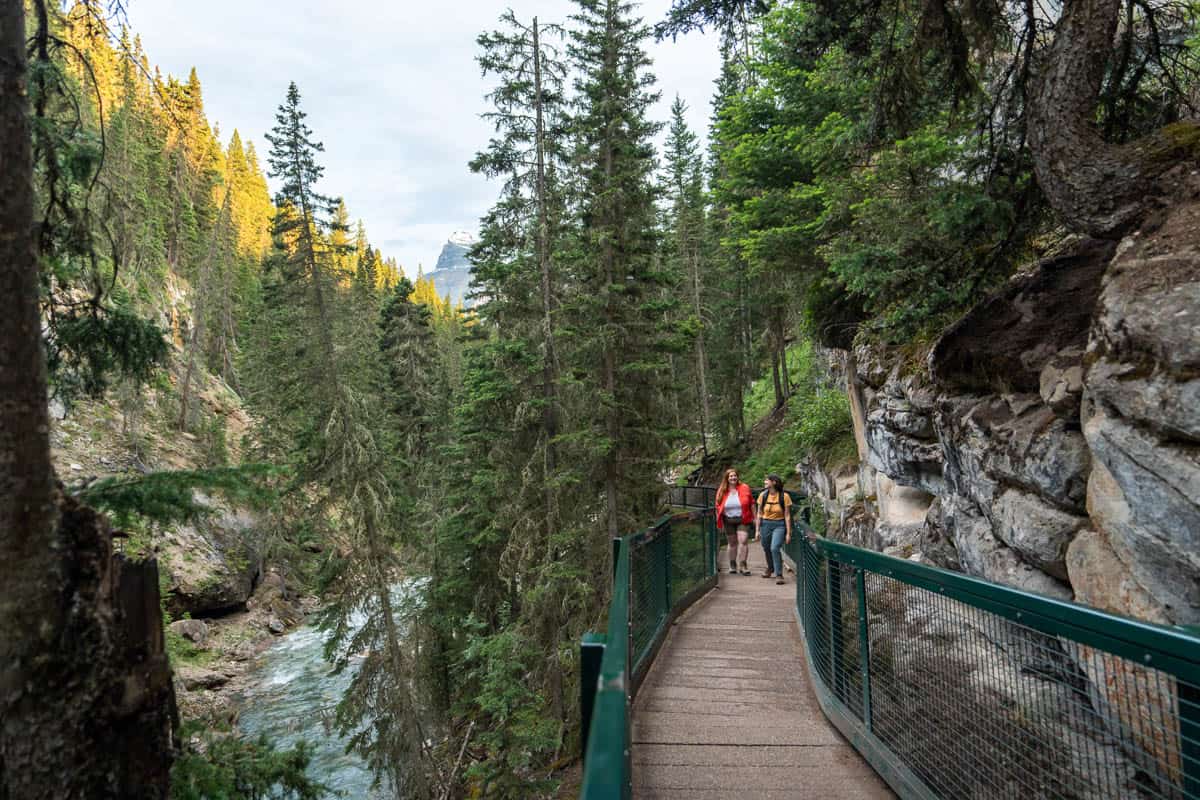
Johnston Canyon Campground is approximately a thirty-minute drive south of Lake Louise and is a good option for those who prefer a more rustic camping experience. It’s about equidistant from both Banff and Lake Louise, making it a fantastic base to explore both areas (especially if you want to spend some time on the Johnston Canyon Trail, one of the best hikes in Banff). Sites are available for tents and small RVs up to 8.2 metres (27 feet), and there’s a public transit stop that will take you to Banff Townsite in summer.
Credit Travel Alberta / ROAM Creative
Silverhorn Creek Campground
Distance to Lake Louise: 54 km / 43 minutes
Campground highlights:
Open from June to September – First come, first served basis
Found along the Icefields Parkway approximately 40 minutes north of Lake Louise, Silverhorn Creek Campground is best suited for tents, motorhomes, or trailers up to 20 metres (70 feet). This RV-friendly campground is unserviced and doesn’t have any cell phone service, but it’s just minutes from Waterfowl Lakes, Bow Lake, and the Peyto Lake viewpoint. RV campers can fill with potable water and use the sani-dump station located at the Waterfowl Lakes campground.
Waterfowl Lakes Campground
Distance to Lake Louise: 60 km / 46 minutes
Campground highlights:
Open from June to September – First come, first served basis
Size: 110 sites
Amenities: Washroom facilities with flush toilets, potable water, fire pits, cooking shelter, wheelchair accessible, interpretive programs
Located approximately 45 minutes north of Lake Louise, the Waterfowl Lakes Campground sits between Upper and Lower Waterfowl Lakes on the Mistaya River, putting you in the perfect place to spend some time on the water. Spend your days paddling, canoeing, or kayaking on the glacier-fed lakes, or take the short drive to Saskatchewan Crossing, Bow Lake, and the Peyto Lake viewpoint. There is no cell phone service here, making it an ideal spot to fully unwind and connect with nature.
The campsites are unserviced and best suited for tents, motorhomes, and trailers up to 9 metres (31 feet) in length. Make sure to ask about the free Saturday evening interpretive programs hosted by Parks Canada at the campground theatre.
Tunnel Mountain Village 1 Campground
Distance to Lake Louise: 63 km / 41 minutes
Campground highlights:
Open from May to October – Reservations required
Size:618 sites
Amenities:Washroom and shower facilities including flush toilets, potable water, fire pits, wheelchair accessible, sani-dump, interpretive programs
Found only a few kilometres from the Banff townsite, this is one of the largest campgrounds in the national park. A 45-minute drive from Lake Louise, Tunnel Mountain Village 1 Campground offers a more traditional camping experience with firepits for cooking; a maximum of two vehicles, two tents and six people are permitted on each site. Thankfully, there are beautiful mountain views as well as incredible access to nearby hiking trails.
A view of Mt. Rundle from Tunnel Mountain
Tunnel Mountain Village 2 Campground
Distance to Lake Louise: 65 km / 43 minutes
Campground highlights:
Open year-round (oTENTik Camping – May to October) – Reservations Required
Size: 209 sites
Amenities: Washroom and shower facilities including flush toilets, potable water, fire pits, wheelchair accessible, electricity, cooking shelter, sani-dump
One of the closest campgrounds to Banff Townsite (only 2.5 kilometres), Tunnel Mountain Village 2 Campground is great for people wanting power without full hook-ups or those who need space for larger units, as there are a few sites that accommodate RVs that are 12+ metres (40+ feet). One of the few spots that offers camping year-round near Lake Louise, Tunnel Mountain Village 2 Campground has three-season camping in 21 oTENTiks and year-round camping for tents and RVs.
Credit Travel Alberta
Tunnel Mountain Trailer Court
Distance to Lake Louise: 65 km / 45 minutes
Campground highlights:
Open May to October – Reservations required
Size:321 sites
Amenities: Washroom and shower facilities including flush toilets, potable water, wheelchair accessible, full RV hookups, sani-dump
For trailers and larger units, the Tunnel Mountain Trailer Court has some sites that can accommodate RVs that are 15+ metres (50+ feet) in length. Only 2.5 kilometres from Banff Townsite, the campground offers fantastic access to nearby attractions as well as hiking and biking trails.
Two Jack Main Campground
Distance to Lake Louise: 65 km / 44 minutes
Campground highlights:
Open June to September – Reservations Required
Size: 313 sites + 30 equipped sites
Amenities: Washroom facilities with flush toilets, potable water, fire pits, cooking shelter, sani-dump
Located just minutes from Lake Minnewanka and nearby attractions, Two Jack Main Campground is approximately 45 minutes from Lake Louise. This rustic, no-service campground has sites available for tents or RVs up to 7.3 metres (24 feet), as well as a few equipped campsites. These equipped campsites are perfect for those travelling without any camping gear, as they provide tents, sleeping pads, stoves with propane, and a few other amenities. The campground itself is also stunning, with plenty of trees and mountain views.
Two Jack Lake Campground
Two Jack Lakeside Campground
Distance to Lake Louise: 65 km / 44 minutes
Campground highlights:
Open May to October – Reservations required
Size: 64 sites + 10 oTENTiks
Amenities: Washroom and shower facilities with flush toilets, potable water, fire pits, cooking shelter
Perhaps the closest thing you’ll find to backcountry camping in Banff National Park without actually backcountry camping, the Two Jack Lakeside Campground is one of the park’s most popular campgrounds due to its goergous setting on the lake. Accommodating tents or small RVs up to 8.2 metres (27 feet), it has amazing access for non-motorized recreation on the lake as well as nearby hiking and biking trails.
Credit Travel Alberta
Rampart Creek Campground
Distance to Lake Louise: 92 km / 1 hr 10 min
Campground highlights:
Open June to September – Reservations required
Size: 50 sites
Amenities: Outhouse facilities, potable water, fire pits, cooking shelter, picnic shelter, and food storage lockers
One of the more rustic campgrounds near Lake Louise, the Rampart Creek Campground is found along the Icefields Parkway, just over an hour’s drive from Lake Louise Village. With stunning views of the North Saskatchewan River and surrounding mountains, campsites are unserviced and best suited for tents, motorhomes, and trailers up to 10 metres (35 feet). Note that some loops are unsuitable for motorhomes or trailers over 8 metres (25 feet). RV campers can fill potable water and use the sani-dump station located at Waterfowl Lakes Campground, which is about 30 kilometres (18 miles) away.
Unfortunately, unlike both Lake Louise Campgrounds, Rampart Creek Campground does not have a Parks Canada shuttle stop, nor does it have any cell phone coverage. That being said, this campground is ideal for those who want to get away from it all.
Castle Mountain Campground – CURRENTLY CLOSED
Distance to Lake Louise: 27 km / 19 minutes
Campground highlights:
On a first come, first serve basis when open
Size: 43 sites
Amenities: Washroom facilities, potable water, fire pits, cooking shelter
Perfect for those who love a more rustic and intimate campground, Castle Mountain Campground is approximately 20 minutes from Lake Louise. Suitable for tents or small RVs up to 7.3 metres (24 feet), this no-service campground is in a beautiful wooded area off the Bow Valley Parkway. Head here for great hiking and vast starry skies at night.
Backcountry Camping in Banff National Park
For those who love a real adventure, there’s a lot of backcountry to explore in Banff National Park. With so much natural beauty to discover – think snowcapped mountains, crystal-clear lakes, and fields of wildflowers – backcountry camping is great for those who aren’t afraid to tackle the elements. Thankfully, there are a few alpine huts or other shelters around the park to visit, too. Trip ideas for varying lengths of time can be found here.
Backcountry camping in Banff National Park
A backcountry permit is mandatory for anyone planning an overnight trip into the backcountry of Banff National Park and must be purchased in advance. Campers must carry a copy of their permit when in the park (paper copy or a screenshot) and present it to Parks Canada staff if and when requested.
The backcountry permits must be purchased in advance. Nightly rates are $13.50 per person, plus an additional booking fee depending on how you do it ($11.50 per booking online, $13.50 per booking by phone – call 1-877-RESERVE).
Winter Camping in Lake Louise
For those who aren’t afraid of a little snow, there are a couple of winter camping sites available in Banff National Park – one near Banff Townsite and the other near the village of Lake Louise. Both Lake Louise Trailer and Tunnel Mountain Village II are both open for the winter months.
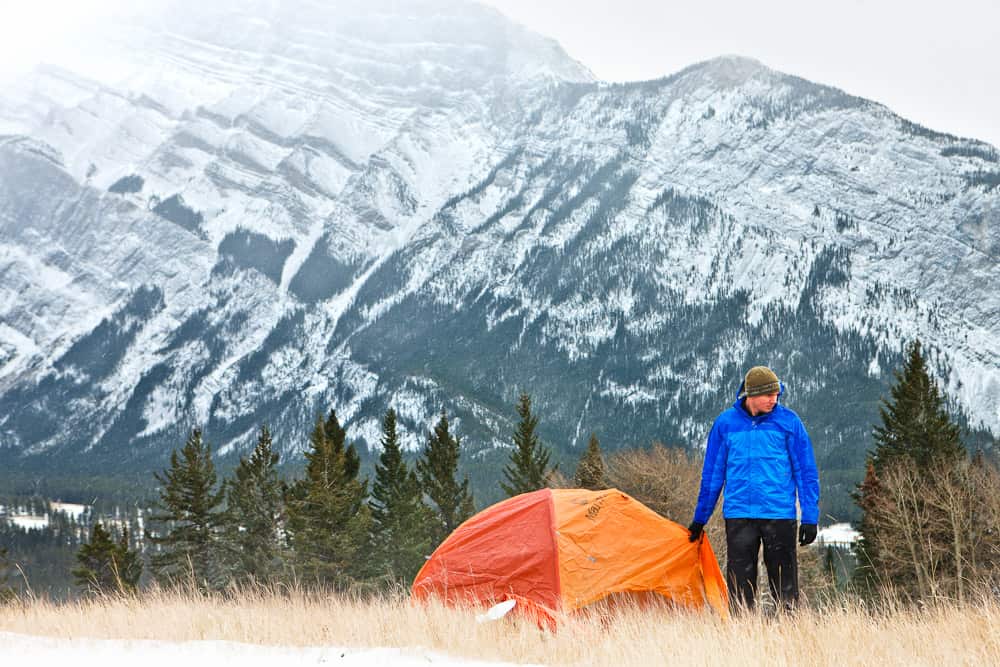
Winter camping at Tunnel Mountain – credit Travel Alberta / Paddy Pallin
For more information, see our guide to winter camping in Alberta.
Looking for more?
Other Alberta Camping Articles
Pete is a co-founder of Road Trip Alberta. Growing up in Edmonton he has an extensive knowledge of Alberta and everything the province has to offer. He loves to eat good food, hike (especially in the winter), play tennis and curl. Apart from running Road Trip Alberta, he is a director with HMI, a digital media agency, half of the Hecktic Travels duo, and a co-creator of the popular card game Trip Chaser.
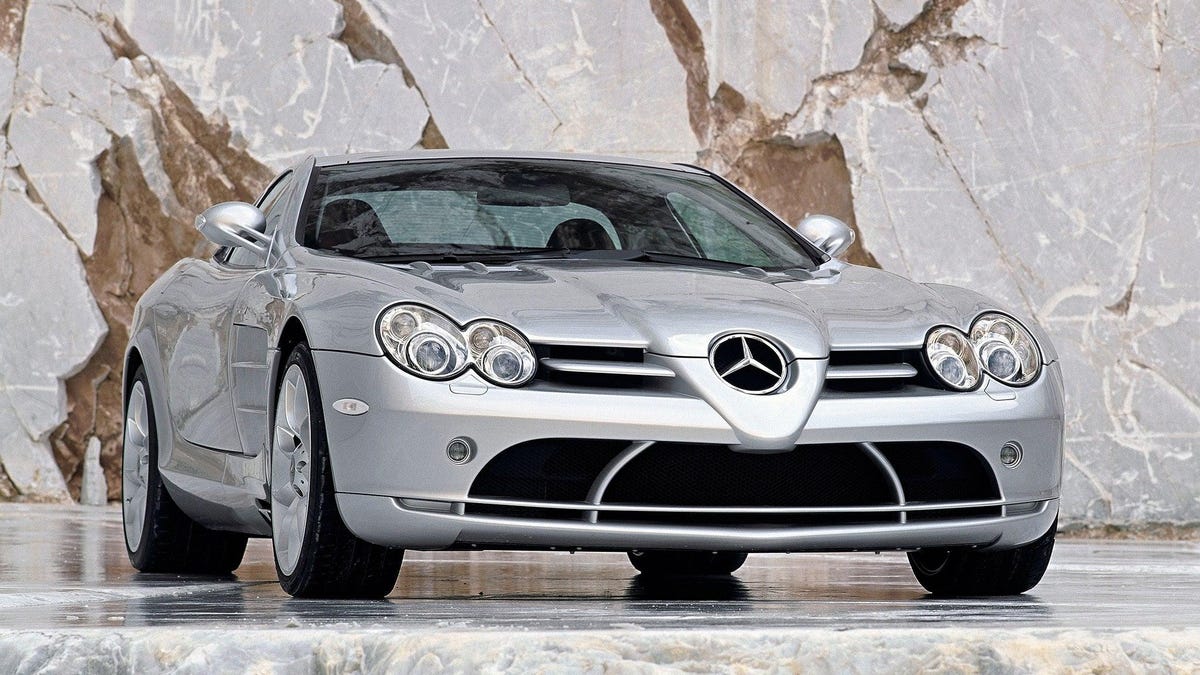
Owning a supercar can be expensive, even if you have the means. The engineering and parts that go into making these vehicles perform the way they do can be shockingly expensive. Take what one dealership charged a Mercedes-Benz SLR McLaren owner for brakes.
Racing Tech | How Formula E’s New Front Powertrain Extends Battery Life on its Race Cars
In creating the SLR together, Mercedes and McLaren developed a new braking system called Sensotronic Brake Control. Essentially a brake-by wire-system, it eliminated many of the mechanical parts that were used in normal braking systems. Mercedes said the carbon-ceramic brakes were fade-resistant up to temperatures of 2,200 degrees fahrenheit. They were massive, measuring just over 14 inches for both the front and rear discs, the fronts used eight-piston calipers while the rears had four-piston calipers.
Brakes like these, especially on a car with performance of the SLR, unsurprisingly have an equally massive price when they need to be replaced. This particular 2005 SLR is owned by @humped.my.importer, a car collector and enthusiast who took to social media to tweet his frustration over how much he paid for his brakes. He took his SLR to Mercedes-Benz of Knoxville, Tennessee for the service. Whatever number you’re thinking of in your head probably still won’t prepare you for the actual cost of what they charged this man to do a brake job: $120,462.79. No, that number is not a mistake.
I mean sure, the SLR cost nearly half a million dollars when it new, and fewer than 3,000 were made. But still, it can’t be that expensive, can it? Wanting to know more, I called a few local Mercedes dealers here in Southern California to see if that is what it would really cost to do the brakes on this supercar.
I started with Mercedes of Downtown Los Angeles. After putting me on hold for nearly 10 minutes, the service advisor came back and laid it on me: the front brakes would be $67,219 while the rears would be a slightly cheaper $65,283. He also informed me that the rear brakes were out of production and they’d have to order them from Germany. Wanting a bit more convincing, I called another dealer.
Photo : Mercedes-Benz
Next I got in contact with Mercedes of Beverly Hills, a dealer who should have some pretty good experience dealing with SLRs. Weirdly I got a price quote that was as if the SLR was any other Mercedes, as he quoted me prices of just $3,350 for the front and $1,858 for the rear. If true, this could be a steal, though I actually suspect the guy misunderstood me or something.
Since that didn’t seem quite right, I called Mercedes of Ontario, who were happy to help me out. The customer service was excellent but it went to another level when I told them what car I was calling about. Their pricing almost lined up with Downtown LA’s: including parts and labor it would be $64,840 for the front brakes and $62,840 for the rears, so figure just under $128,000 for a full brake job. It looks like that really is the going rate for a brake job on one of these things, so the original Twitter poster was actually getting a bit of a deal. Even if you have deep pockets, it’s still a sphincter clenching price.
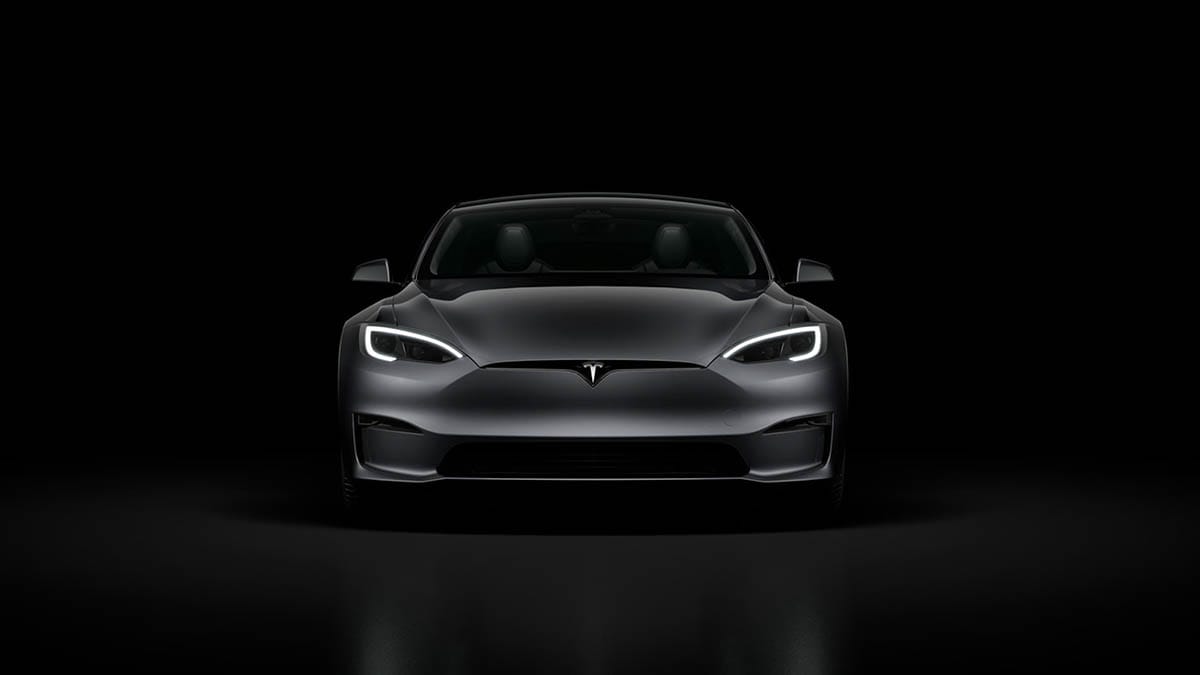
If you are thinking about driving greener with an electric car, you probably wonder what your options are and need answers to questions before you step away from your gas-powered vehicle.
Electric vehicles (EVs) made up 7.6% of all U.S. new vehicle sales in 2023, up from 5.9% in 2022 and 3.2% the year before that. Of the more than 14 million new cars and trucks sold each year, even less than 10% of the total is still a lot of vehicles. Total EV sales will increase as manufacturers continue introducing new models into the mainstream.
Below, we break down the different EV car options. We show you the basics of what you need to know about charging, range, ownership costs, safety features, and more so you can choose the right electric vehicle that meets all your needs. Keep reading for answers to all your EV questions.
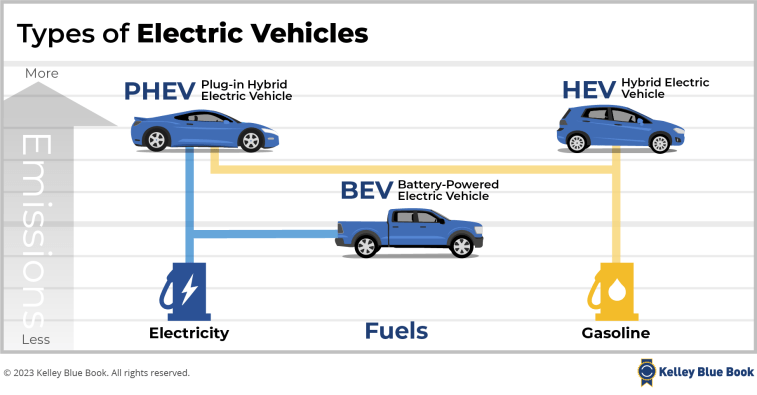
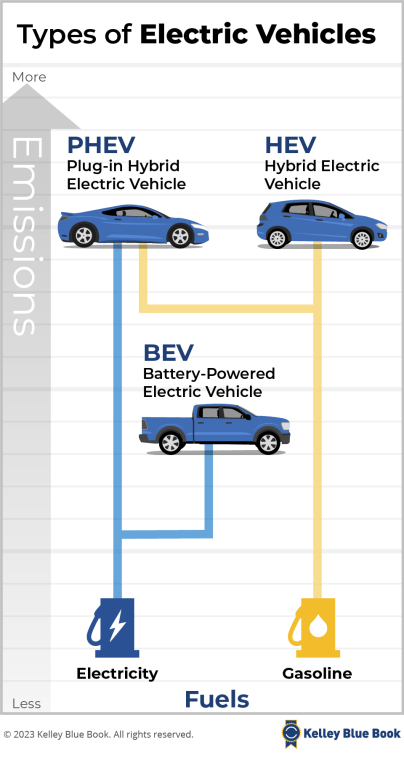
Electric Vehicle Types: EV, BEV, HEV, PHEV, FCEV
An introduction to electric cars begins with an explanation of the abbreviations used to describe different types of electric vehicles.
EV
“EV” is the catch-all term for an electric vehicle. Fully electric cars get all of their power from motors that use batteries charged with electricity. Another type, the fuel cell electric vehicle, or FCEV, runs on compressed hydrogen. The limited availability of hydrogen fuel cell cars is in California due to limited infrastructure available to the public outside of that state.
BEV
A BEV, or battery-powered electric vehicle, uses only its electric motor or motors for propulsion. Because they lack a traditional internal combustion engine and use no gasoline, BEVs produce no tailpipe emissions. A BEV is another term for a fully electric vehicle (EV). The term “BEV” isn’t used nearly as often as “EV.”
HEV
“HEV” stands for “hybrid electric vehicle.” An HEV is an electrified car that runs on both an internal combustion engine and an electric motor that uses energy from a battery. Hybrids use regenerative braking to store energy created when slowing the car to charge its battery. HEVs are known for their fuel economy because using battery power decreases how much gas the internal combustion engine uses.
PHEV
A PHEV is a plug-in hybrid. PHEVs plug into a power outlet to charge their batteries and also have a gasoline engine on board that can power the vehicle once the battery is depleted. Some PHEVs can travel over 40 miles on electric power alone, rather than a couple of miles with a standard HEV.
MHEV
The goal of a mild-hybrid electric vehicle is to reduce the load on its internal combustion engine, improving the car’s gas mileage. For example, an MHEV may use a modest electric motor, small battery pack, and regenerative braking system to reduce fuel consumption. Mild hybrid means electric-assist, not electric power. A mild hybrid can be up to 20% more fuel-efficient than the same vehicle without this type of powertrain.
FCEV
FCEV stands for fuel cell electric vehicle. These cars run on compressed hydrogen but are not widely available except in California. Filling up an FCEV is similar to fueling up a gas-powered vehicle. Due to the lack of availability of hydrogen fuel stations open to the public, it will take time for FCEVs to expand to other states.
Electric Vehicle Range
Electric car range can contribute to apprehension that buyers might feel when deciding to give up their vehicle that uses a traditional gasoline engine. This apprehension is often called “range anxiety.” Even while today’s EVs can easily accommodate most daily driving, electric car battery manufacturers continue to improve capacity and recharge times.
Many EVs can travel more than 250 miles on a full battery charge, and the most advanced models can go about 400 miles between charges. Both long-range and short-range EVs can perform well in start-and-stop driving during rush hour.
EVs consume significantly more of their battery at steady speeds on highways when used for more extended getaways.
Hot weather and cold temperatures reduce the range of electric cars, partly because of air conditioner and heater use but also the negative effect extreme temperatures have on battery chemistry.
Some EV drivers worry about depleting the battery without a charging station nearby. One perk of an electric vehicle is that you can plug in and recharge at home or use EV charging stations when you’re out and about.
A searchable map of electric vehicle charging stations from the United States Department of Energy Alternative Fuels Data Center shows more than 64,000 Level 2 and DC Fast charging locations across the country. That number continues to grow.
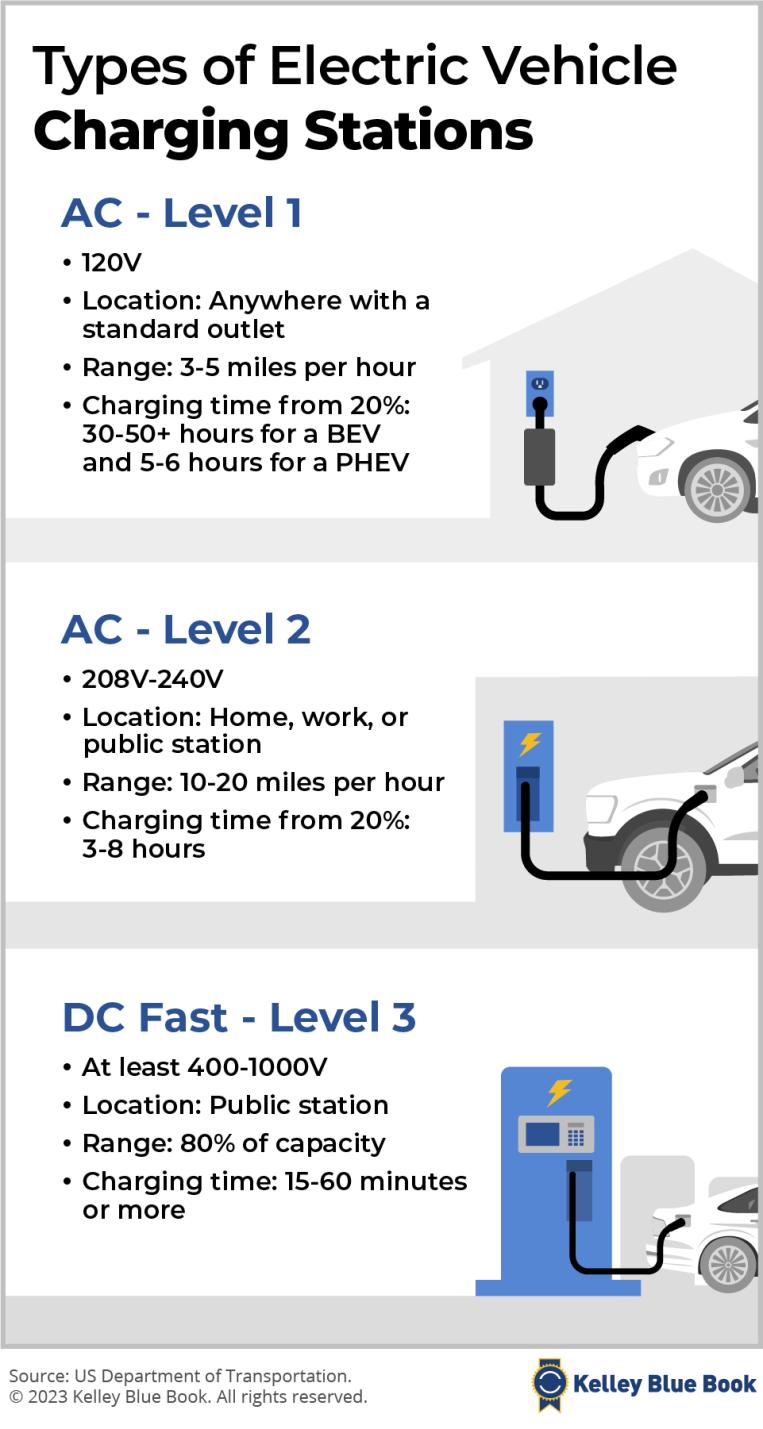
There are Three Types of Chargers for Electric Cars
Level 1 — This level refers to household three-prong outlets like those your computer or a desk lamp will use. Few electric car users charge their vehicles this way simply because of how long it takes. A Chevrolet Bolt EV, for instance, adds about 4 miles of range per hour this way and can take at least 36 hours to charge.
Level 2 — Most people prefer Level 2 charging capability, whether at home or at a public charging station. These chargers provide 240 volts of power and require an external device that plugs into a receptacle like that of an electric clothes dryer. For example, according to the car manufacturer, Level 2 charging can add 25 miles of range per hour to a Chevy Bolt EV.
Level 3 — Also called a “DC fast charger,” the fastest-charging option is Level 3. These quick chargers can add 100 miles of range to a Chevy Bolt EV in 30 minutes. But you will only find Level 3 options in public charging stations that typically cost money to use.
Charging times are rough guidelines and estimates because electric cars also don’t charge at a constant rate. When looking at figures for the 5 Fastest-Charging Electric Cars, remember that manufacturers can claim whatever they want. No one is verifying what they say.
A common question from potential electric car buyers is: How much does it cost to charge an EV? For charging at home, the answer requires some math and depends on several factors, primarily how much you drive and the price you pay for residential electricity.
Consider this rough example where you put 1,000 miles on your vehicle each month and pay the national average of 16 cents for each kilowatt-hour of electricity. Your at-home EV recharging bill will be $40 to $53 per month (based on the calculation of 3-4 driving miles equaling kWh). If your electricity rate is in the high range at 25 cents per kWh, your electric car recharging cost would be $63 to $83 each month in this scenario.
Now, look at the cost of filling a tank with gasoline. Let’s say you’re driving an economical car that has a combined average of 30 mpg during a mix of city and highway driving. Using a 12-gallon tank as a reference point, you’ll have 360 miles of driving range for each fill-up.
If you’re driving the same 1,000 miles monthly, you’ll need to refuel at least three times each month. With the average price of gas about $3.68 per gallon as of this writing, according to AAA, your monthly fuel expense will be about $132.
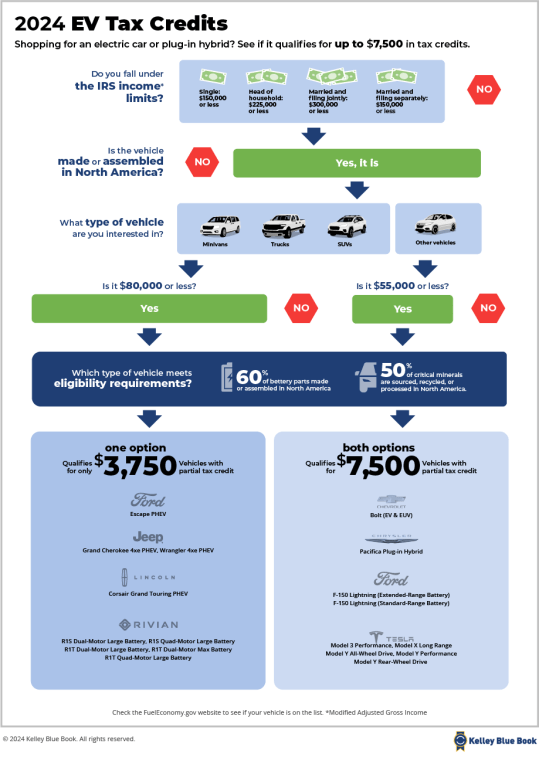
Even so, the sticker price is typically higher for EVs than for comparable models equipped with gasoline engines. Buyers of some new EVs and PHEVs might receive a tax break from their purchase. These incentives can drive down the overall price of a new electric car, but the rebates may not be immediate, and the rules can be difficult to navigate. We break down the facts in our articles on how electric car tax credits work and EV rebates and incentives by state.
Depreciation Costs of an Electric Car
EVs have greater depreciation than their gas-powered counterparts. While this can be disappointing to a buyer who drives off the lot in a new EV, it’s good news if you’re buying a used electric car. Read on for more on that below.
Tips for Buying a Used EV
Use the battery life as a bargaining chip. Just like a mobile phone or laptop, an electric car’s battery begins to degrade over time. If you’re buying a used electric car for your commute, a shorter range may be just fine, but it’s a bargaining point if the battery is not new.
Find out if the battery got replaced. Battery failure may be rare, but it does happen. Higher-mile electric cars are more likely to have had their batteries replaced entirely. If this has happened — and the seller can provide documentation confirming the work — it means that someone before you went through the effort and expense of having this job performed.
Investigate how much battery warranty is left. All mainstream automakers include more warranty coverage for battery packs. Many used electric cars will still be under warranty. But read the fine print to learn whether it is transferable. Most battery coverage runs for 8 years or 100,000 miles after the initial purchase, whichever comes first. However, not all warranties are transferable to subsequent owners.
Check the value of the vehicle. Use the Kelley Blue Book valuation tool to determine the vehicle’s fair purchase price.
Look for repeated recalls. Check the EV you want to buy for recalls. Use our recall tool to know what recall items may affect your used electric vehicle purchase. Also, if you notice repeated recalls on the electric vehicle you want, you’ll want to weigh that information to determine if you want to go through with the purchase or use it as leverage for the final sales price.
Choosing All-Electric or Hybrid
What to Know About All-Electric Cars
Owning an EV has many benefits, whether it’s a fully electric model or a plug-in hybrid. For starters, all EVs have lower overall fuel costs.
Fully electric vehicles often have lower maintenance costs because they have fewer components than gas-powered cars. Battery-powered electric cars don’t require oil changes or tune-ups, typically only rotating their specialized tires and wiper replacement. Fully electric cars never need to stop at a gas station for fuel before running errands around town because their batteries can be charged at home when not in use.
What to Know About Plug-in Hybrids
PHEVs strike a balance between eco-friendly motoring and go-anywhere flexibility. Most commuters can drive to and from work on electric power alone, while the gas engine stands in reserve waiting for longer road trips.
When charged, a PHEV’s battery pack powers an electric motor. Once that battery pack depletes, a gas engine kicks on seamlessly. Then the car alternates between gasoline and electric power depending on how much is needed. The car’s regenerative braking system captures otherwise lost energy when coasting or slowing down and feeds it to the battery, further reducing its reliance on its gas engine.
Driving an electric car is no more dangerous than operating a traditional gas-powered vehicle. EVs are relatively new in the mainstream, but cutting-edge safety and driver-assist features are standard or available options for most models.
Price isn’t necessarily an indication of what level of advanced safety technology an electric vehicle packs.
Most of the following innovative safety features come standard in a 2024 Nissan Leaf S, which starts at $29,235, including destination charges of $1,095. Others, such as adaptive cruise control and 360-degree camera, are standard on the higher-grade SV Plus.
Adaptive cruise control paces the speed of the car as the flow of traffic ahead slows and speeds up as the traffic does. See more information about adaptive cruise control.
Blind-spot monitoring with rear cross-traffic alert senses vehicles in adjacent lanes and warns of objects behind your vehicle or crossing behind while backing up.
Forward collision warning with emergency braking detects a possible crash as your vehicle closes the distance with a vehicle or other object ahead. It can automatically apply the brakes if you don’t respond to a warning sound. Find out how Forward Collision Warning works.
Lane-departure warning alerts when it senses the vehicle drifts out of its lane.
Lane-keeping assistnudges the vehicle back into its lane when a driver fails to respond to the lane-departure warning.
Lane-centering assist serves to keep the vehicle in the center of its lane as a companion technology to lane-departure warning and lane-keeping assist.
Rear automatic emergency braking senses obstacles behind your vehicle and automatically hits the brakes to avoid bumping them when you put the car in reverse. Read more about automatic emergency braking.
360-degree surround camera system provides a series of cameras placed around the vehicle for an all-around view to help with parking.
Automatic high-beam technology detects lights ahead of the vehicle and deactivates the high beams when the system senses the distance closing between one car and another.
Read Related Electric Vehicle Articles:
Editor’s Note: This article has been updated since its initial publication.
Update: The leaked image of the Cullinan Series II has been removed at the request of Rolls Royce.
The Rolls Royce Cullinan facelift has been spotted completely undisguised for the first time. The luxury SUV was captured at a warehouse while in transit. Unlike the spy pics posted earlier, the latest image reveals the car’s front fascia in detail.
Rolls Royce has made subtle changes to the exterior of the Cullinan. The most prominent update is the LED DRL strips that wrap around the front fascia. The headlamps house dual LED units, while the front bumper has been reworked as well.
The Cullinan facelift will be mechanically identical to the outgoing model. Currently, the luxury SUV is propelled by a 6.75-liter twin-turbo V12 engine that develops 563 hp as standard and 591 hp in Black Badge guise.
The facelift version is expected to debut later this year as the Rolls Royce Cullinan Series II.
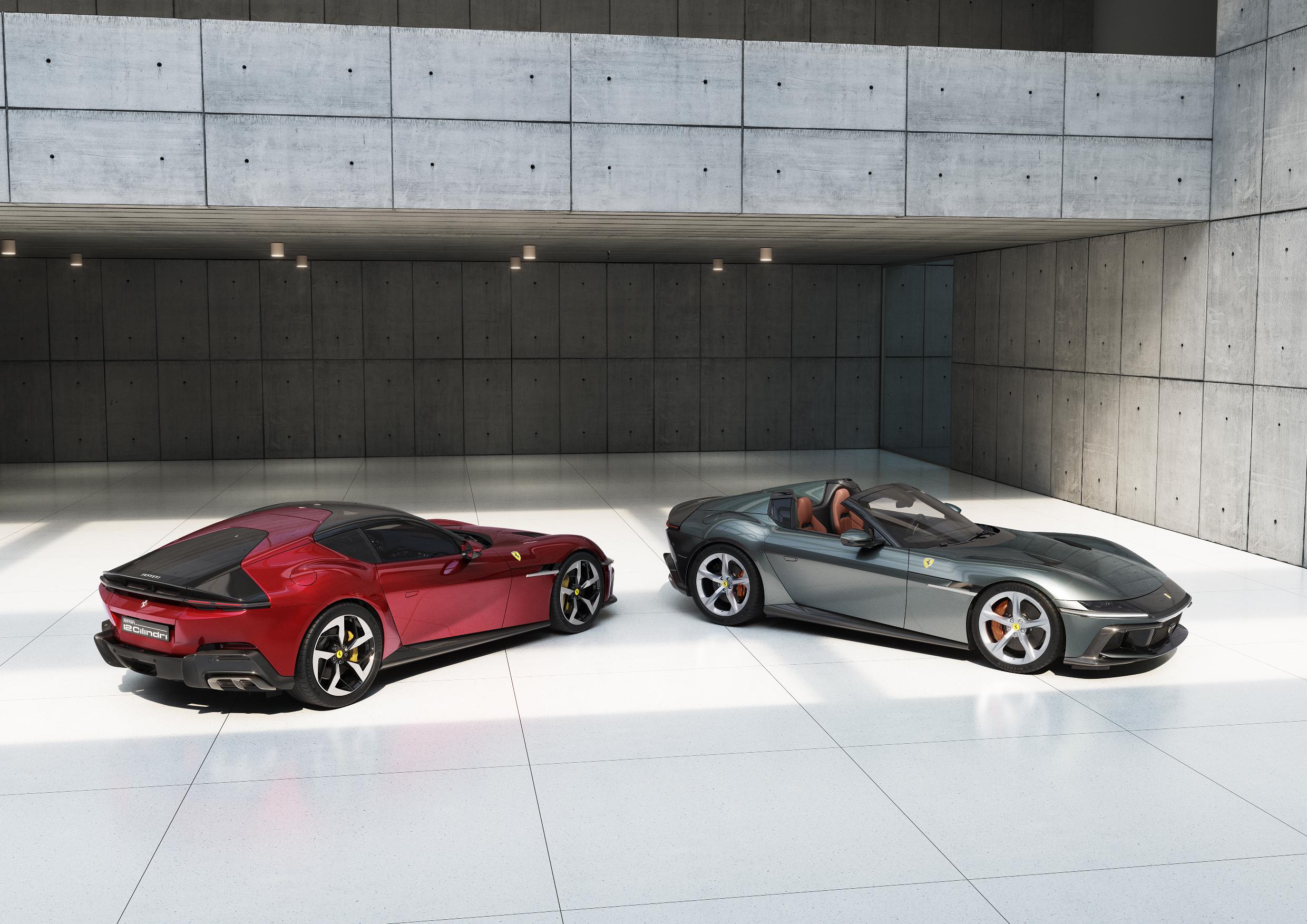
When you think of a classic Ferrari shape, there are two options. The modern interpretation is a low, long, sleek mid-engine car with an aggressive stance, ready to tear up a track. The other is the classic interpretation, a berlinetta with a low and long hood with a monstrous V12 rumbling beneath, with a rearward two-seat cabin almost over the rear axle.
The new 2025 Ferrari 12Cilindri (a.k.a. Dodici Cilindri) pays homage to that old school interpretation, with a ton of influence from the 1968 365GTB/4 Daytona’s classic shape. But, as with every Ferrari, what counts the most is the engine.
In perhaps the last interpretation of the by-now-legendary Tipo F140 that started life in the Enzo, this one is labelled the Tipo F140HD, and what a swan song it is.
Redline is 9,500 RPM. It uses a dry-sump lubrication system. It retains the splayed-out 65 degree V. Power is 819 BHP at a screaming 9,250 RPM. Torque is a flat 500 lbs-ft at 7,250 RPM.
New for the 12Cilindri is a variable-geometry intake system, reduced friction low mass valvetrain and rotating assemblies, and an all new bit of technical wizardry dubbed Aspirated Torque Shaping (ATS). ATS electronically controls the twisting action in the engine in third and fourth gears to optimize low to mid-range torque delivery, which translates to 80% of the torque available at a ridiculously low 2,500 RPM.
Also all new for the 12Cilindri is a close-ration 8-speed dual-clutch transaxle that changes gears in the time it takes you to think about blinking.
Weighing in at a dry 3,439 pounds, there will be a coupe and spider model, and both will achieve 60 MPH in 2.9 seconds, 124 MPH in 7.9 seconds, and the top speed is North of 200 MPH.
While we will have an ultimate guide up soon with all the technical information gone thought thoroughly, the last bit of pertinent immediate information is the price.
The 12Cilindri is definitely not an entry level supercar, as the coupe’s MSRP is the equivalent of $417,000, and the spider’s MSRP coming in at an eye watering $465,000. Both prices are before options, so you can realistically expect a production car to be in the $500,000+ range.
Collaborations have proven their worth in creating buzz so the news about TAG Heuer and Kith teaming up for the return of the Formula 1 Series 1 collection (1986) was uplifting and has already gotten tongues wagging. For those who do not know, these gleefully colourful quartz three-handers are reissues of that old series, which an entire generation that grew up in the 1980s and 1990s probably has warm feelings about. It was many people’s first proper watch, so to speak, from a big Swiss name. Formula 1, of course, resonates across the history of TAG Heuer, long before it attained the TAG (the 1986 collection was the first with the TAG badge). All watch enthusiasts will want to know what the story behind this release is, and everyone seems keen on an explanation of the SGD 2,150 price (CHF1,500); it only goes up from there.
TAG Heuer Formula 1 | Kith
Starting with the price is a bad idea, in our opinion; what is the watch (or watches) is a much better question to begin with. Value aside, you might reasonably be uninterested, especially since this is a quartz watch and the original was quartz too. The new Formula 1 Kith will be of interest to collectors though because instead of TAG Heuer on the dial, it is a joint Kith Heuer logo; TAG Heuer has dropped the TAG a number of times but it has never offered any other brand a place above it on the dial. That alone is worth the price of admission here, in our opinion. Bear in mind that this quality does not even take into consideration if you might like any of the 10 versions of the Formula 1 Kith limited edition.
TAG Heuer Formula 1 | Kith
If you have fond memories of the 1986 models, the new series will resonate and you might be able to make peace with the logo by recalling that TAG itself first appeared right here. So having another name there is not unpalatable (this writer also owned a late 1980s version of this watch); perhaps TAG Heuer will make this a staple of future collaborations (or collabs if you will). Looks-wise, you can tell most of what you need to know from the pictures, except that the contemporary TAG Heuer team sought out the original casemakers to revive this 35mm form factor. The straps are now in rubber and also a steel bracelet, where they were once plastic; the crystal is sapphire though it too was originally plastic. Interestingly for committed originalists, the bezel remains in the signature arnite that owners will recall. It has a very specific feeling to it.
TAG Heuer Formula 1 | Kith
Even with all this information though, one does wonder: why does this limited edition series exist? Well, here is TAG Heuer CEO Julien Tornare to explain it:
“The rebirth of the original TAG Heuer Formula 1 watch is something the collector community has been clamouring after for years. One of these collectors was Kith founder Ronnie Fieg, who shared that, like so many others, this was also his first watch when he was younger. It is one of the most meaningful pieces in TAG Heuer’s history. The first to wear the TAG Heuer name, it introduced a generation of collectors to our commitment to making premium timepieces at the intersection of culture and motorsports.” Fieg’s first watch was the red and black version.
TAG Heuer Formula 1 | Kith
This supports the story that Fieg wanted this revival to happen, and thus it makes sense for Kith to take such a prominent position here. It is also a way to appeal to a generation that knows what Kith is but may not know the 1986 watch model at all. To that end, Kith worked on the design details for the new pieces, which are everywhere in the collection but most evident in the seven models exclusive to Kith stores. These are named for and inspired by these seven stores, and each one is limited to 250 pieces. The green and blue models are TAG Heuer exclusives (limited to 825 pieces), while the most conservative black with red accents model is common to both TAG Heuer and Kith outlets, and is the most widely available (1,350 pieces).
Will this Formula 1 Kith episode be a meaningful one? It will ultimately depend on sales, to be blunt, as it did with a certain other famous collab at a rival watch group. It may also be that LVMH wants to experiment with the Heuer name, which would be extremely bold. Just imagine the possibilities…
For more on the latest in watch reads, click here.
There’s an app for everything right? Just about it seems. Now obviously I’m not suggesting you should be staring at your phone while driving, but your co-pilot could help you make the most out of your time on the road with some road trip apps designed specifically for the highways and byways in America.
Below is the list of apps we have used or currently use on the road and why:
RVParky – Probably the best app we have come across to date for using while on the road. Its got a map with icons for the nearest truck stops, Walmart (if there’s a Walmart, there’s other things in that town) gas stations, cracker barrels and camp grounds.
Motel 6 – When we were road tripping in our suburban, this was our Go To for a quick nights rest. Its not an all inclusive resort, but that’s not what you’re looking for. Its an inexpensive place to catch some sleep before hitting the road for the next leg of your trip.
KOA – This tends to be where we stay along the highways when we are going on long trips. The KOA system is broken down into three different classes of campgrounds, which I’ll expand on in a moment; Journey, Holiday and Resort. KOA is a favorite among travelers because there are certain amenities that are required to fly the KOA flag like showers, laundry services etc. KOA Journey is relatively close to the highway for a quick pull off, rest up, and back on the road. KOA Holiday has expanded amenities, RV sites with patios, and deluxe cabins for the automobile road tripper to take an extended rest in the great outdoors. KOA Resort is designed to be the destination, with recreational facilities, staff led activities, and a resort style pool for when you are looking to get away and just go camping for the weekend or longer.
Geocaching – If you don’t know what geocaching is, well, I can’t tell you. It’s like a first rule of fight club thing… What I can tell you is that you can geocache literally everywhere. It is a great app to have to enhance any stop along your route with a reason to get out of the car and stretch your legs with some great family friendly fun just about every single place you can think of.
Gas Buddy – We used this a lot when we were using the suburban. Its a great one to have when you aren’t sure where the next gas station out in the Midwest. There are times it could be hours before you pass another one. Along with showing the nearest gas you can compare prices and see if its worth waiting for the second station instead of pulling in to the first one you see
Pilot/Flying J – This is a great on if you are using an RV. When you pull in to your first Pilot or Flying J, go inside and sign up for the rewards card. The rewards card can save you a few cents a gallon on fuel, as well as get you discounts and combo deals on things in the store. Another great thing about this app, you can see where the next Flying J along your route is. Flying J has an RV Island with everything you need. A dump station, fresh water fill, gas and diesel pumps and a black tank flush. The other nice thing is you can take a shower here. I know ya may be thinking “shower at a truck stop? Are you nuts?” But I can tell you we were pleasantly surprised by how clean they were. We have honestly showered at campgrounds that were WAY worse.
MyRadar – This is an app that I use all the time. It is a no frills live radar feed so you can see how long the rain or snow is going to last and if its worth pushing through it or finding a spot to pull off for the night.
If you have any apps that we should add to the list, or suggest we add to our repertoire then let us know! We love adding to our tools to enhance our trips and stops and would love to hear from you!
The technical storage or access is strictly necessary for the legitimate purpose of enabling the use of a specific service explicitly requested by the subscriber or user, or for the sole purpose of carrying out the transmission of a communication over an electronic communications network.
Preferences
The technical storage or access is necessary for the legitimate purpose of storing preferences that are not requested by the subscriber or user.
Statistics
The technical storage or access that is used exclusively for statistical purposes.The technical storage or access that is used exclusively for anonymous statistical purposes. Without a subpoena, voluntary compliance on the part of your Internet Service Provider, or additional records from a third party, information stored or retrieved for this purpose alone cannot usually be used to identify you.
Marketing
The technical storage or access is required to create user profiles to send advertising, or to track the user on a website or across several websites for similar marketing purposes.