Electric cars are more expensive than gas-powered cars. That fact slows adoption, as many car shoppers can’t afford the premium or question paying more for a vehicle with access to less infrastructure.
But every new technology gets cheaper to build over time. For electric vehicles (EVs), that could happen fast.
Related: When Will Electric Cars Be Prices Like Gas-Powered Cars?
Pedro Pacheco, vice president of research at technology analysis firm Gartner, told industry publication Automotive News that EVs could be cheaper to build than their gas-powered counterparts by 2027.
Gartner will release a new report on the issue soon, Pacheco says. The report will show automakers are “reaching this tipping point earlier than expected.”
Batteries Getting Cheaper, Building From Fewer Parts
Two developments are driving costs down.
Battery costs are falling, he says, as global supply chains grow to support the construction of millions more EVs. Drivers bought more than 15.5 million EVs worldwide last year, with just 8.5% of sales happening in the U.S.
Related: The Most Expensive Part of Electric Cars Is Getting Cheaper
Automakers are also saving through so-called gigacasting. The manufacturing technique involves building cars from very few, very large parts.
Tesla pioneered it, but larger automakers are starting to follow its lead. Toyota has begun moving toward the technology.
Pacheco estimates that gigacasting could cut the cost of building a car by “at least” a fifth.
Survivors, Failures Inevitable
Both traditional automotive giants and nimble startups build EVs. But some of those startups are likely to fail.
Launching a new automaker is among the hardest business challenges. To succeed, startups must lose money for many years before they log their first profit.
“Gartner predicts that 15 percent of companies on the EV value chain that were founded in the last decade will fail,” according to Automotive News. Just last week, startup Fisker warned investors that it faces “substantial doubt about its ability to continue as a going concern.”
Nissan’s Ariya electric SUV is getting a lot cheaper. Nissan has knocked between $3,575 and $6,035 off the price of every Ariya trim level for the new model year.
Apart from the price change, there are no substantive differences between the 2023 and 2024 Ariya models. That creates the unusual circumstance of the new model year being less expensive than the old.
Our expert test driver praised the Ariya’s “bold look and an inviting yet practical interior, a full suite of active safety features, and the latest version of Nissan’s ProPilot semi-autonomous system featuring hands-off highway driving.” It’s spacious, with lovely wide-grain wood trim options and the “zero gravity” seats car critics tend to praise in most Nissan vehicles.
But the Ariya does not qualify for the federal government’s $7,500 EV tax credit.
2024 Nissan Ariya Pricing:
All prices include the mandatory destination charge — $1,365 on 2023 models and $1,390 on 2024 models.
I spent 6-weeks in Vietnam’s biggest city as a digital nomad and was spoilt for choice when it came to great locations to work from. If you’re looking for the best coworking spaces in Ho Chi Minh, you’re in the right place!
From dedicated coworking setups to ideal cafes aiming to attract the digital nomad crowd, HCMC has plenty to offer anyone who works remotely. You’ll find a range of coworking options to suit all budgets and requirements in Ho Chi Minh.
So, if you’re seeking a quiet space to catch up on a few emails or a month-long desk of your own, rest assured I’ve got it all covered here.
Best Coworking Spaces in Ho Chi Minh
I loved my time coworking in Ho Chi Minh. There’s an abundant digital nomad culture and a significant ex-pat scene. I found it to be an ideal location for remote workers and took full advantage of the many cool coworking spots in the city. It’s always great to get a change of scenery and if there’s free coffee on tap, even better!
Let’s explore the 10 best coworking spaces in Ho Chi Minh.
1. GEEK Hub (D1)
One of the biggest benefits of being a digital nomad in Ho Chi Minh is the cost of coworking spaces. They’re significantly lower than in lots of other countries I’ve worked from. GEEK Hub is a fine example of a coworking space that doesn’t break the bank and offers everything you could need for a productive day.
I visited here a few times because there weren’t any monthly fees or a significant commitment required. You can buy a 4-hour package and be up and running straight away. It’s a bright, comfortable, and convenient coworking space.
Ideally located in the heart of D1, GEEK Hub also has a second very similar base in the Phu Nhuan District, west of the city. They have fully equipped meeting rooms to accommodate up to 12 people and event facilities for up to 70 people.
A 4-hour hot desk session costs as little as $1 which can be renewed on expiry. If you’re in town for a while, consider a hot desk package for $17/week which includes unlimited usage and free drinks from the cafe.
If you’re staying in the city for longer, a dedicated desk for a month starts at $77. You can even bag your own private office for $277/month. For meeting rooms and event spaces, contact GEEK Hub directly for a quote.
Amenities at GEEK Hub
Varying Options: From 4-hour hot-desk deals to month-long dedicated offices and event spaces.
Fully Equipped: Comfortable desks and space for up to 50 coworkers at a time. Great WiFi and printing/scanning facilities are available to everyone.
Onsite Cafe: The GEEK Hub cafeteria serves a range of excellent drinks and a few snack options at low prices.
Pros of GEEK Hub
Price: Short-term hot desk options are available for under $1. Longer packages and dedicated workspaces are also available at very competitive rates.
Onsite Cafe: It’s always great to have a ready supply of caffeine nearby. Some of the extended packages even throw in complimentary drinks.
Ideal Location: Situated in the heart of D1, GEEK Hub is surrounded by all the delights of a big city.
Cons of GEEK Hub
4-Hour Cut Off: If you’re hot desking on the 4-hour package you’ll be cut off at 4 hours. You can immediately renew but this can be annoying if you’re on a roll with something or in the middle of a Zoom call.
No Parking: There aren’t any facilities on site for parking bikes or cars. Customers will need to find their own parking facilities.
Space: GEEK Hub is on the smaller side but with enough hot-desk space for 50 people at a time, it’s rarely an issue.
Limited Food Options: The onsite cafe doesn’t serve any lunch options – you can order food in or venture out easily enough.
2. WinPlace (D1)
I’m always interested in where my fellow digital nomads find a base. WinPlace is a name that crops up a lot. It’s a popular coworking space in Ho Chi Minh with several options to suit those seeking a more fixed working location.
With a great city center location in D1 and a second site with a pool in D7, WinPlace is ideal for business professionals. If you’re in search of a personal workspace in Ho Chi Minh City, a conference room for your team, or a business lounge, look no further.
WinPlace has a couple of different membership packages to suit certain working requirements. A private workstation costs $174/month although you may be tempted to upgrade to an entire office – at $292/month it’s a great deal. Conference and meeting facilities are available by the hour for around $12.
Amenities at WinPlace
Kitchen: All membership options come with access to a fully equipped shared kitchen facility.
Inclusive Meeting Room: All membership options include a varying amount of meeting and conference room time allowance.
Personal Phone Line: WinPlace offers free installation of a dedicated phone line and number for each workspace.
Tech Support: Onsite tech support means computer glitches and WiFi connection problems aren’t any issue.
Pros of WinPlace
Free Pantry: A pantry full of teas, coffee, and water is available free to all members.
Onsite Pool: The WinPlace in D7 has a pool for remote workers to use. Just imagine taking a quick dip between meetings!
Great Facilities: Printers, scanners, and copiers are readily available, and varying amounts of printouts are included with every membership option.
Cons of WinPlace
No Short-Term Options: WinPlace requires a minimum one-month commitment to use their facilities.
No Cafe Onsite: Although the use of a shared kitchen is available, there aren’t any cafeteria facilities at either site.
Meeting Room Limits: A set number of meeting room hours are included with each membership. You’ll need to purchase more if you need them.
3. Hello World Saigon (D1)
I spent quite a few days working from Hello World Saigon and there’s a lot to like about this place.
It’s one of the most unique coworking spaces in Ho Chi Minh. As well as coworking facilities, the complex features a hotel, serviced apartments, a yoga studio, a pool, and an excellent restaurant. There’s also a networking and social events space that longer-term members have free access to.
Even day pass members get many inclusive benefits. It’s a cool, modern coworking space that’s a popular spot for individuals and small groups.
A day pass costs less than $8 and includes free tea and coffee, business hour access, and a mail-handling service. Signing up for the week costs just $30. Private offices and dedicated desk spaces are available by the month and start from around $200, (contact Hello World Saigon directly for pricing).
Amenities at Hello World Saigon
Varying Workspace Options: From one-day coworking passes to longer-term private office space, there’s an option to suit every work requirement.
Additional Facilities: Hello World Saigon features a pool, yoga studio, restaurant, and accommodation options onsite. A one-stop shop for any business professional.
Kitchen Facilities: A shared kitchen is available to everyone and includes free tea and coffee.
Pros of Hello World Saigon
Impressive Common Areas: The modern and well-designed common spaces are great areas for rejuvenating between bouts of work and networking with other digital nomads.
Short-Term Options: The ability to simply purchase a day pass means no long-term commitment for those traveling through HCMC.
Personal Touches: Members opting for a fixed desk for a longer period are encouraged to make themselves at home with photos, plants, and any personal items to make your desk more fun.
Cons of Hello World Saigon
Day Pass Restrictions: Those staying for just the day will be limited to business hour access and won’t have access to all additional facilities.
No Free Use of Meeting Rooms: Though fully equipped meeting rooms are available, anyone wanting to use them must obtain a quote directly and book ahead of time.
No Cafe: Although a nice restaurant is available, Hello World Saigon doesn’t have a cafe which means making your own coffee.
4. The Hive (D1 and D2)
One of the best workspaces in Ho Chi Minh is The Hive. The international organization with 23 branches in 6 countries has a knack for creating environments that people simply love working in.
The Hive has 3 locations in HCMC, and what I love is their attention to creating serene spaces like chilled rooftop terraces and tranquil gardens. The Villa Saigon branch in D2 has a beautiful pool that’s accessible to all guests.
As a well-established global brand in the coworking market, everything you could need is to hand. A range of membership options are available from single-day use to long-term office space rental.
Hot-desking is available for less than $8 a day. For this, expect a comfortable workspace, great WiFi, free coffee, and business hour access. Sign up for a minimum month, and enjoy round-the-clock access along with printing privileges and meeting room credits.
Personal office spaces and dedicated desks require at least a month-long commitment and prices start at $135 but include mailbox facilities, printer usage, 24/7 access, and meeting rooms.
Amenities at The Hive
Printing and Meeting Room Facilities: Though not included with day passes, printing, and meeting rooms are available.
Community Events: The Hive hosts regular social and networking events for its members.
Serene Spaces: Two of the HCMC locations have wonderful rooftop gardens, while the Villa Saigon location has a serene garden and pool.
Pros of The Hive
Experience: The Hive has branches in 6 different countries so are coworking space experts!
Free Coffee: Everyone from day pass members on up receive an unlimited amount of free coffee at all Hive branches.
Discounted Rates: If you’re a young entrepreneur or budding start-up, speak directly to The Hive about discounted prices.
Cons of The Hive
Noise: During busy times it can get quite loud in the D1 coworking space. Day pass members are situated in somewhat of a communal area/walkway.
Limited Facilities: Day pass members will need to pay extra to buy credits for meeting rooms and printer usage.
No Cafe: There isn’t an onsite cafe onsite at any of The Hive’s 3 HCMC branches. Free ‘make your own’ coffee is available to everyone though.
5. Highlands Coffee @ Landmark 81 (Binh Thanh)
I’m going to throw a wildcard in at number 5 and suggest a Highlands Coffee location as one of the best free coworking spaces in Ho Chi Minh. Highlands Coffee is the biggest chain of coffee stores in Vietnam and the location at Landmark 81 is such a great spot to work from.
Highlands Coffee consistently has reliable, free WiFi, quality coffee, and plenty of spaces to situate for a spot of work. After you’ve completed your tasks for the day, I recommend a trip to the Blank Lounge on the 76th floor.
A cup of coffee will cost a little over $1, and soft drinks are even cheaper. WiFi is free and plenty of tables have access to power sockets.
Amenities at Highlands Coffee
Free WiFi: Efficient and reliable WiFi is available to all customers.
Food Options: Highlands Coffee offers a selection of excellent sandwiches, cakes, and snack choices.
Power Sockets: If you’re rocking a super old laptop like me, power sockets are available close to many tables.
Pros of Highlands Coffee
Availability: Although I favored the Landmark 81 location, Highlands stores are all over HCMC.
Free Working Space: Okay, so you should probably buy a coffee, but for around $1 it’s as good as free.
Great Coffee Options: Highlands is a big chain akin to Starbucks so if you drink specialty coffee or concoctions of your own creation they’ll be able to make it for you.
Cons of Highlands Coffee
Limited Facilities: As it’s a coffee shop and not an official coworking space there aren’t any printers, scanners, or private meeting rooms.
Busy Environment: Highlands is a popular coffee shop that at times can become very busy. Don’t bank on it being quiet.
Unable to Reserve Tables: Although I’ve seen the occasional reserved sign on a Highlands table, it’s generally for larger groups.
Limited WiFi: I never had issues with basic emails and such. But, for larger projects or those needing a secure network, a public coffee shop’s internet is probably best avoided.
6. Work Not Work (Binh Thanh)
I’m all about the work/life balance; it’s a big part of why I choose to be a digital nomad. Work Not Work is an excellent option for anyone else with this same frame of mind. It’s a modern and cool place that has a strong emphasis on art and culture which is designed to inspire a healthy working environment.
I loved their open-air rooftop terrace with fantastic graffiti-laden walls. There’s also an excellent canteen that serves a whole range of food and beverage options.
Day passes are available, and there are some great deals on weekly hot-desking. Additionally, Work Not Work provides several excellent, practical, and handy services.
A daily membership costing less than $7 buys a comfortable and bright working environment for the day. Paying by the week will bring the hot-desking price down to $6/day. Private offices and dedicated desks can also be rented by the month, desks start at $130, and office spaces at $500.
Amenities at Work Not Work
Storage and Locker Facilities: If you’re carrying a lot of work baggage with you, Work Not Work has storage options to deal with everything from documents to furniture.
Excellent Cafeteria: The onsite cafe serves a range of good quality healthy food choices for reasonable prices throughout the working week.
Conference and Meeting Facilities: Bookable by the hour for competitive rates that depend on your group size.
Pros of Work Not Work
Rooftop Terrace: The views of the Saigon skyline from the roof are excellent and all guests can work from there.
Cheap Day Rate: The prices are competitive if you need a one-day working option. It’s even cheaper if you book the entire week.
Great Location: Located in the Bhanh Thanh area of HCMC, this coworking space is right in the heart of the city’s business district.
Good Food: The onsite cafe doesn’t serve just the standard burger and fries. Healthy food options are readily available.
Cons of Work Not Work
No Free Coffee: Making your own free coffee is not always possible despite evidence suggesting otherwise on their website. Food and drinks can be purchased from the cafe, however.
Space: Work Not Work is not the biggest coworking environment and spaces can be limited during busy periods. A lot of the areas advertised are for monthly renters.
No Extras Included: Printing and meeting room credits aren’t included with hot desking customers. These need to be pre-agreed and pre-paid for.
7. XÓM (D1)
Perhaps the most popular coworking space in Ho Chi Minh City is XÓM. It’s a cool and friendly coworking facility that embodies the spirit of the digital nomad culture.
XÓM offers a full range of amenities and is welcoming of single-day users. The rates are pretty reasonable for the level of service and comfort that’s offered. There are also discounts available by paying weekly and monthly.
What’s most unique about XÓM as a coworking space is the cocktail bar. It’s not free; you will need to pay for drinks, but you can get a sense of the vibe by the bar’s neon signs – one says ‘Stop Thinking, Start Drinking’. It’s my kind of place!
XÓM offers a range of membership options at very affordable rates. A desk is just $9/day but you’ll save money by paying $38 for the week. A dedicated desk costs less than $240/month. A plush lobby, pantry, cocktail bar, and free coffee are available to all customers.
Amenities at XÓM
Excellent WiFi: Connections so fast that XÓM’s website describes it as ‘super duper’.
Meeting Rooms: Fully equipped meeting rooms are available to book for up to 15 people.
Event Space: An excellent space with enough room to host 60 people. There’s plenty of parking for everyone too.
Pros of XÓM
Discounts: Paying weekly or monthly for hot desking will save money. All members get discounts on XÓM’s in-house food and beverages.
Free Stuff: Free coffee and a regular supply of fresh water is available to all users.
Parking: XÓM has a huge parking lot, so there’s no stress for anyone if you plan a meeting or event.
Clean: The cleaners seem to be constantly at work. It’s one of the best-maintained coworking spaces I’ve visited.
Cons of XÓM
Price: It’s not the cheapest coworking space in HCMC, but paying weekly will bring the price down.
Additional Costs: Meeting rooms, printing facilities, and the event space aren’t included with hot desking memberships.
8. Designers Hub Coworking (D7)
Designer Hub Coworking, nestled in Ho Chi Minh City’s bustling D7 region, caters exclusively to minds in architectural and art design. Located within the dynamic C Space Building, a hub for construction, Designer Hub is purposefully designed and integrated with utilities tailored for design, architectural, and art projects.
If you’re in the architectural sector, this is the best coworking spot in Ho Chi Minh for you. But, with day rates available for digital nomads from any walk of life, it’s a great space to get work done, no matter your niche.
Daily hot desks are available for under $7, but you can save a few bucks by paying by the week. A personal dedicated desk isn’t a bad deal either at $140/month. A spacious and very comfortable working space plus a pantry, access to a modern meeting room, and printing facilities are available with any membership.
Amenities at Designer Hub
Printing Area: A dedicated and efficient space for any printing needs.
Spacious and Comfortable Environment: A 500m2 area of hot desks with ergonomic office chairs and well-thought-out lighting.
Telephone Booths: Designated booths for private phone calls or online meetings.
Pros of Designer Hub
Pantry: Access to fresh water, coffee, and tea-making facilities are available to everyone.
Parking: Secure and free parking is available onsite.
Sleek Environment: Without a doubt, Designer Hub is one of the classier places to remote work from.
Library: There is a comfortable lounge and reading area with many books in English – a great bonus in HCMC.
Cons of Designer Hub
Lighting: Although I’ve included this as a pro, it can be quite a dark setting which may not be everyone’s preferred working environment.
No Cafe: There isn’t a cafe which means that there are no food options available onsite.
Limited Extras: Hot desk members will need to pay for extras such as printing facilities and meeting rooms.
9. WorkFlow (D2)
It’s not the most famous coworking space in Ho Chi Minh but WorkFlow is certainly one of the most convenient. It’s the only place I’ve come across in HCMC that has an app where individual work pods can be booked by the hour. You can even order your coffee from the app so it’s ready for when you arrive!
WorkFlow is based in D2, so it’s outside of the main city center. Xuan Thuy is close by which is a street full of great bars and restaurants.
Single pods can be booked for $1.80/hour and double pods are less than $1.50pp/hour. For this, you’ll get a private, soundproofed, lockable pod, an international plug socket, a high-speed WiFi connection, an ergonomic chair, and discounts on drinks. Meeting rooms for up to 6 people are around $8/hour.
Amenities at WorkFlow
Privacy: Enjoy the peace and quiet of your own soundproofed and lockable work pod.
High-Speed Internet: Work away to your heart’s content without WiFi issues.
Comfort: An ergonomic chair, air filtration, and a ventilation system means all pods are very comfortable to work in.
Pros of WorkFlow
Ease: Book work pods from an app. Secure your spot, pay, and even order your coffee remotely.
Flexibility: Secure pods by the hour, add more time if you need and never pay for more than you use.
Location: WorkFlow is located outside of the city center but is very close to the excellent Xuan Thuy area in D2.
Discounts: Pod bookings come with discounts in the WorkFlow cafe.
Cons of WorkFlow
Space: The pods aren’t huge. If you like to spread out, consider a more open-plan coworking space.
Price: Being able to book by the hour is great, but an 8-hour day will make it one of the more expensive coworking spaces in HCMC for daily members.
No Freebies: There are discounts available for those who book pods but there aren’t any free coffee-making facilities.
10. Bibli Library Cafe (D1)
Bibli Library Café combines two of my loves; coffee and books, and it also has an excellent designated quiet area for reading and working.
The coffee and food options here are decent and fairly priced. The cafe is well maintained with a cozy decor and is airconditioned. The upstairs provides the feeling of working from a traditional library – it’s without a doubt, one of my favorite places to spend an afternoon.
The WiFi is reliable, desk spaces are free to anyone who purchases a drink, and it’s situated just a block and a half from the beautiful Saigon River.
As it’s a public cafe, there aren’t any membership options. But a coffee costs around $1.50 and will secure you WiFi access and a desk for as long as you want it.
Amenities at Bibli Library Cafe
Good Coffee: Coffee is a big deal in Vietnam and Bibli Library Cafe serves a great selection of local and international coffees.
Ample Spacing: There are many tables and comfy seating areas for customers to enjoy.
Pros of Bibli Library Cafe
Low Cost: Being a cafe, you’re not required to pay for a desk space; simply grab a drink and find somewhere to base yourself.
Free WiFi: Good and reliable WiFi is available to all customers.
Food Options: On top of the unending supply of coffee, there are some great breakfast, brunch, and lunch options on the menu.
Cons of Bibli Library Cafe
No Additional Facilities: As it’s a cafe, there aren’t any printing, scanning, or meeting room facilities available.
Busy and Noisy: It’s a public cafe so there aren’t any guarantees on the volume level if you work downstairs. Upstairs is a designated quiet area, but it is not overly enforced.
No Reservations: It’s not possible to reserve a desk.
Limited WiFi: Although the WiFi is good, it is a public connection and as such is probably not suited to downloading/uploading large files or for anyone who requires a secure internet connection.
Best Coworking Spaces in Ho Chi Minh: FAQs
Here are some answers to the most commonly asked questions about the best coworking spaces in Ho Chi Minh:
What is coworking?
Coworking is a collaborative workspace concept where individuals from diverse professions share a communal environment. It promotes a flexible and shared working culture, allowing independent professionals, freelancers, and remote workers to work alongside each other in a communal setting.
Are there free coworking spaces in Ho Chi Minh?
Yes, Ho Chi Minh has many free coworking spaces. There are also several low-cost alternatives for those seeking space by the day or even hour. Some cafes and libraries offer a casual coworking environment for individuals to work in, although amenities may be limited.
What’s the best coworking space in Ho Chi Minh?
The best place to cowork in Ho Chi Minh City for me is WorkFlow. I love being able to book and pay for hour blocks via the app. The privacy, security, and quietness of the soundproof pods are a great bonus. You can even order from the cafe via the app too.
How much does a coworking space cost in Ho Chi Minh?
The price of coworking spaces in Ho Chi Minh can vary depending on your needs. When booking by the hour, WorkFlow is the cheapest at $1.80/hour. Daily hot desking costs around $6-$8. Dedicated desks per month set you back a figure in the low hundreds while private offices start in the high hundreds.
Where do ex-pats hang out in Ho Chi Minh?
There are many ex-pats in Ho Chi Minh, but Xuan Thuy is a busy street of bars, cafes, and restaurants known as ‘ex-pat street’.
Where is the best area to stay in Ho Chi Minh?
The best area to stay in Ho Chi Minh depends on your preferences and interests. D1, often considered the city center, is popular for its vibrant street life, museums, historical landmarks such as Ben Thanh Market, and a huge number of dining and entertainment options.
If you prefer a more upscale and quieter environment, D3 offers a mixture of local charm and modern amenities. D2 is another option, known for its ex-pat community, spacious accommodations, and a range of international schools.
In Closing
I loved my time in HCMC; being a digital nomad there was fun and easy. The range and number of coworking options surprised me and the low costs were a delight! Be sure to also check out my previous article – Digital Nomad Guide to Living in Ho Chi Minh City.
My preference is always to hop around and try lots of places, but Ho Chi Minh is also a great place for those who want a regular, affordable, and reliable desk or office space to work from.
After checking into my hotel in Portsmouth, I began searching for things to do in Columbus, Ohio. It was my next destination on a road trip along U.S. Highway 21 that started a week earlier in Asheville. I scrolled through the search results and then froze as solid as granite. Three words caught my attention, like the first lightning bolt from an approaching storm.
Columbus Coffee Trail.
Columbus is the gleaming capital of Ohio. It’s known for the German Village’s distinct architecture, The Book Loft’s endless shelves, the Scioto Mile’s spectacular scenery, and the adorable pair of polar bears at the Columbus Zoo and Aquarium.
But I was most excited to explore the Columbus Coffee Trail, a collection of independently owned brick-and-mortar coffee shops throughout the city. I was determined to earn a coffee mug to take home with me. But, I needed to visit several coffee shops during my three-day trip to Columbus to accomplish that goal.
Would I be able to complete it?
Columbus Coffee Trail Map
How to use this map | Click the icon in the top-left corner to open the Map Legend, then click on any of the legend items to display more information. If you have a Google account, click the (very faint) star at the end of the map’s name to save this map to your account, then access the map from your smartphone during your trip.
What is the Columbus Coffee Trail?
National Coffee Day is celebrated in the United States and Canada on September 29. During the annual celebration in 2014, Experience Columbus launched the Columbus Coffee Trail.
In an article written for the coffee industry website Fresh Cup, Lara Kaylor categorized the coffee trail as a disloyalty program. “Rather than ask people to repeatedly come back to one shop, a disloyalty program encourages patrons to try multiple cafés all over the city,” she explained.
Initially, the coffee trail included 17 coffee shops with 25 locations. In 2022, the coffee trail was relaunched with an updated logo, website app, and a few additional coffee shops. There are now 24 coffee shops with 29 locations on the Columbus Coffee Trail.
Michelle Wilson, Director of Destination Experience at Experience Columbus, listed four primary qualifications for being included on the coffee trail:
Must have a brick-and-mortar location
Must use ethically sourced beans
Must use locally roasted coffee beans
Serve a wide variety of coffee-based beverages
Wilson said the Columbus Coffee Trail “remains to be a free experience and primary goals are to offer visitors and residents a fun, engaging way to visit and support local businesses while also having the opportunity to earn prizes as they do.”
Using the Columbus Coffee Trail App
To begin your journey on the Columbus Coffee Trail, visit the Experience Columbus website and sign up to download the Columbus Coffee Trail app to your smartphone. You’ll receive an email with a link to a website to “download” the online-based app.
Note | The Columbus Coffee Trail is not a traditional app downloaded from the Apple App Store or Google Play Store. Instead, it’s a website designed to function like an app. The website asks permission to add a custom icon to your smartphone home screen and then functions like any traditional app.
The app uses your smartphone’s geolocation to determine if you’re visiting one of the coffee shops on the trail. After making a purchase, use the app to check in while inside the shop to verify your location.
You’ll collect 1 point for each coffee shop visited. As Wilson explained, the points are cumulative and never expire. After reaching a certain number of points, trail explorers receive a notification of an available prize. Or, you can wait until you’ve earned enough points to collect all the prizes.
Here are the 3 prizes available throughout the journey on the coffee trail:
4 points for a “Live to Caffeinate” t-shirt
12 points for an insulated tumbler
13 points for a stainless steel coffee press
I earned 7 points during my three-day exploration of the trail. The experience left me amusingly jittery – a by-product of my travel lifestyle and desire to visit as many craft coffee shops as possible. I never cashed in my points, though. I’m waiting until I have enough to collect all three prizes.
Tips on Completing the Columbus Coffee Trail
The Columbus Coffee Trail is a “disloyalty program.” It’s an odd term I’d never heard before exploring this tourism trail.
A disloyalty program encourages people to visit all the places on a trail instead of repeatedly returning to a single place. Think of it as the difference between the Columbus Coffee Trail and Starbucks. You earn stars for each purchase at Starbucks to pay for future purchases.
But the Columbus Coffee Trail is about visiting all the coffee shops.
Here are a few tips on making the most of your experience with the Columbus Coffee Trail:
You can visit the coffee shops in any order
You can visit a coffee shop on the trail more than once, but you’ll only get credit for visiting it once
Remember to check in with the app while visiting the coffee shop
Some coffee shops are open from breakfast through dinner, but others are only open earlier in the day. Plan your visit carefully.
Plan to spend about an hour at each coffee shop to enjoy the unique vibe and amenities
Java Central Coffee Roasters
Java Central Coffee Roasters is one of Columbus’s most beautiful coffee shops. The coffee shop opened in 2007 inside a gorgeously renovated 1945 brick hardware store in Westerville, a nearby suburb of the capital city. The coffee shop was an instant hit and quickly grew with a dedicated base of coffee drinkers.
In 2016, Camilla joined the coffee family – a roasting machine for the directly sourced coffee beans from Don Eli Farm. The owners added nitro cold brew to the coffee beverage lineup the following year.
Java Central Coffee Roasters is a community hub frequently hosting live music on the Java Stage, displaying local artwork on the walls, and fostering a friendly spirit. Inside tables and chairs are comfortable places to enjoy the music and coffee, but you may want to sit outside with a couple of tables along the quiet State Street.
Crimson Cup Coffee & Tea
This is 1 of 2 Crimson Cup Coffee & Tea locations on the Columbus Coffee Trail.
I discovered Crimson Cup Coffee during my epic U.S. Highway 23 road trip in Johnson City, Tennessee. I met the owner at Open Doors Coffeehouse, who explained that she had learned how to open a coffee shop through Crimson Cup’s 7-Step Program. 10 days later, I visited Crimson Cup Coffee & Tea in Columbus.
Founded in 1991 by Greg Ulbert, Crimson Cup is a coffee roaster, coffee shop, and coffee educator. The company’s startup program is recognized as one of the best in the country for helping other independently owned coffee shops open their doors.
There are five locations in Columbus in addition to a location in Cincinnati and Akron.
I visited the Crimson Cup Coffee in Clintonville on my way to the Columbus Zoo and Aquarium. The freestanding building was spacious, with several comfortable tables and chairs where I could enjoy the coffee. I ordered my typical mocha latte, but the menu also includes cold brew and frozen coffee drinks.
Coffee Connections
There are 3 Coffee Connections locations, but this is the only one on the Columbus Coffee Trail.
In 2013, Nate and Sharon Grenier moved to Hillard, a suburb northwest of Columbus. The couple opened a catering company with a mobile coffee cart. In 2016, they partnered with fellow church members and good friends Jeff and Jenn Heimberger. Later that year, the co-owners opened Coffee Connections on Main Street in Old Hillard.
Roasting their own beans has been a part of the business since the beginning. After years of running a small batch 2-pound roaster in a corner of the coffee shop, the co-owners invested in a 10-pound Coffee Crafters roaster and moved it to another location on Main Street.
Coffee Connections is inside a beautifully renovated two-story white house on Main Street near Station Park, a public water park and event venue. Quirky, comfortable seating is available in various rooms of the house. But the best seat in the coffee shop is outside, where you can enjoy the peaceful town.
Florin Coffee
When Hans and Joelle Hochstedler opened Florin Coffee, they wanted to create a people-first coffee roaster and café. The couple works directly with coffee bean farmers to provide a high-quality source for their small-batch roasting. You can buy the freshly roasted beans by the bag or get a freshly ground coffee at their small shop.
The commercial coffee shop is small, with only a couple of tables inside and a few chairs outside on the quiet street. The menu includes a variety of coffee beverages like drip coffee, cold brew, and espresso.
Cup O Joe Coffee & Desserts
There are 2 locations for Cup O Joe, but this is the only one on the Columbus Coffee Trail.
Cup O Joe is one of Columbus’s oldest coffee shops. In 1999, Stauf’s Coffee Roasters founder Tom Griesemer and company president Mark Swanson bought the coffee shop in Clintonville. The coffee shop was renovated and reopened as a dessert café.
The large coffee shop has many unique attributes, like a central gas fireplace surrounded by large picture windows and dozens of tables with metal chairs. It’s a great place to relax with a fresh coffee and enjoy the endless throng of traffic buzzing along High Street.
Cup O Joe uses freshly ground beans roasted at Stauf’s Coffee Roasters. The beverage menu includes almost every kind of coffee drink, from espresso to cold brew. You can also browse a selection of pastries and muffins.
Crimson Cup Coffee & Tea
This is 2 of 2 Crimson Cup Coffee & Tea locations on the Columbus Coffee Trail.
I discovered Crimson Cup Coffee during my epic U.S. Highway 23 road trip in Johnson City, Tennessee. I met the owner at Open Doors Coffeehouse, who explained that she had learned how to open a coffee shop through Crimson Cup’s 7-Step Program. 10 days later, I visited Crimson Cup Coffee & Tea in Columbus.
Founded in 1991 by Greg Ulbert, Crimson Cup is a coffee roaster, coffee shop, and coffee educator. The company’s startup program is recognized as one of the best in the country for helping other independently owned coffee shops open their doors.
There are five locations in Columbus in addition to a location in Cincinnati and Akron.
The freestanding location on Northwest Boulevard might look familiar outside – it’s a former gas station with service bays. But on the inside, it looks nothing like its former incarnation. Leather armchairs surround a gas fireplace, and the service bay doors have been replaced with large picture windows that flood the coffee shop with natural light.
With lots of parking and about five minutes from The Ohio State University, it’s one of Crimson Cup’s most popular locations.
Chocolate Café
This is 1 of 2 Chocolate Café locations on the Columbus Coffee Trail.
In 2007, the husband and wife team of Phil Wolfe and Lisa Boyle opened the Chocolate Café in Kingswood near The Ohio State University. After watching their Video Central franchise collapse beneath the weight of Netflix, the couple saw the coffee and chocolate shop as an exit strategy.
The locals loved the café because of the diverse menu and “dessert catalog.” Made-to-order breakfast, lunch, and dinner give guests savory food to enjoy at any time throughout the day. Display cases are filled with savory cakes, cookies, and brownies baked fresh daily. And the coffee menu includes a variety of espresso and drip options using locally roasted beans.
The spacious café has lots of room for people to comfortably sit for a while to enjoy their coffee, food, and dessert. Large picture windows in steel frames allow natural light to flood the building, creating an invigorating vibe.
Stauf’s Coffee Roasters
This is 1 of the 4 Stauf’s Coffee Roasters locations on the Columbus Coffee Trail.
Tom Griesemer developed the idea of opening a coffee roaster after a horrible experience at one of the city’s few coffee shops in the 1980s. In 1988, he opened Stauf’s Coffee Roasters in Grandview Heights. While celebrating the company’s 30th anniversary in 2018, Grisemer told the Columbus Monthly that the coffee shop was profitable within the first two months.
Stauf’s Coffee Roasters sells their roasted beans by the bag or via subscriptions. The extensive coffee menu uses freshly ground beans for every cup, offering espresso, drip, cold brew, and tea.
In 2019, company president Mark Swanson purchased an 1880s church building on Neil Avenue. The church was carefully renovated with a mid-century interior design, utilizing the former stained glass windows as artwork and pews as seating. It’s the most gorgeous coffee shop in Columbus and one that I recommend everyone visit at least once.
Fox in the Snow Cafe
There are 4 locations for Fox in the Snow Café, but this is the only location on the Columbus Coffee Trail.
The folks at Fox in the Snow Café believe finely crafted coffee goes best with freshly homemade pastries – so they decided to do both. The bakery and coffee shop was started in the Italian Village inside a renovated auto repair shop, an appropriate destination during a road trip adventure.
Large glass-plated garage doors allow natural light to flood the interior. The real wood tables and chairs are complemented with natural house plants, creating a comfortable and homey feel inside the industrial space. Interestingly, the coffee shop features no Wi-Fi connection – much to my chagrin since I enjoy writing at these coffee shops.
Saucy Brewpub & Coffeehouse
Saucy Brew Works is one of my favorite kinds of coffee shops – it offers coffee by day and beer by night.
In 2017, Brent Zimmerman and Eric Anderson opened a craft brewery in Cleveland, Ohio. Saucy Brew Works expanded into Pinecrest and Columbus in 2020 and now has six locations in Ohio.
In 2020, the business expanded with a different kind of brewing with Saucy Coffee. Three brewpubs were expanded with a coffeehouse, including the one in Columbus. Guests can order freshly roasted beans by the bag or a coffee beverage at the coffeehouse. Options include espresso, pour-over, and drip coffee.
The Harrison West location is about fifteen minutes from downtown Columbus. It’s a spacious, comfortable place to enjoy craft coffee, savory pizza, or craft beer. Sit inside at the wooden tables or outside on the covered patio overlooking Michigan and 3rd Avenues. Saucy Coffee has a separate entrance on Michigan Avenue.
This was the previous location of Boston Stoke Coffee Co. in a shopping center that no longer exists. It’s an excuse for me to return to Columbus.
Boston Stoker Coffee Co.
In 1973, Don and Sally Dean opened a specialty tobacco shop, Boston Stoker Pipe Shop, in Englewood, Ohio. In the first few years, the couple began brewing specialty coffee and offering it free of charge to their tobacco customers. Interest in the coffee outpaced the interest in their original business, and eventually, they began roasting their own beans purchased directly from a farm in Costa Rica.
After the original location closed, Boston Stoker Coffee Co. opened The Roastery in nearby Vandalia, a small town north of Dayton. There are five coffee shop locations in Ohio, including one in Grand View, a suburb of Columbus.
The first time I visited Boston Stoker Coffee Co., it was in a small shopping center one block from Goodale Park. While updating this list, I realized that shopping no longer exists! Unwilling to leave Columbus, the coffee shop moved a mile west.
The new coffee shop is bigger than their first. Vintage furniture and area rugs give the coffee shop a 60s vibe that works well with great craft coffee. Every coffee is made with freshly ground coffee beans from their proprietary roast.
Stauf’s Coffee Roasters
This is 2 of the 4 Stauf’s Coffee Roasters locations on the Columbus Coffee Trail.
Tom Griesemer developed the idea of opening a coffee roaster after a horrible experience at one of the city’s few coffee shops in the 1980s. In 1988, he opened Stauf’s Coffee Roasters in Grandview Heights.While celebrating the company’s 30th anniversary in 2018, Grisemer told the Columbus Monthly that the coffee shop was profitable within the first two months.
Stauf’s Coffee Roasters sells their roasted beans by the bag or via subscriptions. The extensive coffee menu uses freshly ground beans for every cup, offering espresso, drip, cold brew, and tea.
This location is one of Stauf’s largest in Columbus. Plenty of indoor seating means getting a table throughout the day is easy. But just in case, a few tables are outside along Grandview Avenue.
Third Way Coffee House
In 2017, John and Tim Rush founded Third Way Café, the latest extension of their entrepreneurial spirit. The veteran-owned business roasts its own beans at a cozy corner shop along a busy highway and whips up savory coffee drinks.
In 2023, the coffee shop moved across the street to a former drive-through fast food chain. This opened the door for Third Way Coffee House to offer drive-through coffee service – perfect for taking it on the go while exploring Columbus.
But I recommend stepping inside the quaint community coffee shop. It’s less than 700 square feet, but you’ll find additional seating outside the rural location.
Bottoms Up Coffee
The owners of Bottoms Up Coffee are on a mission to make a social impact with their business. Standing in line, I read a sign about a Diaper Fund. The small coffee shop raises awareness of the child mortality rate by raising money to give diapers to newborn families. It was a unique fundraiser for a coffee shop, one the locals were passionate about.
Fresh ground beans are used for every coffee drink. The menu also includes breakfast sandwiches, muffins, and lunch sandwiches. Floor-to-ceiling windows flood the space with natural light. The creaking wood floor contrasts with the white tin metal ceiling. Square tables with wooden chairs are spread around couches and armchairs, offering plenty of places to sit and enjoy the coffee.
Early morning is a great time to visit Roaming Goat Coffee. Warn sunlight bathes the modern chic coffee shop.
Roaming Goat Coffee
In 2013, Jason Thomas started a coffee roasting business in Columbus. After four years of steady growth, he bought Impero Coffee in the Short North area and rebranded it as the Roaming Goat Coffee Shop.
The long countertop is accented with natural wood panels and white subway tile, giving the coffee shop a modern chic vibe. Highchair seating at a bar along a wall of windows offers a place to watch the world pass by on North High Street. It’s a comfortable place to spend time in one of Columbus’s most exciting areas.
And I’ll never forget my first visit because this is where I got my first and only parking ticket in Columbus. I was only inside the coffee shop for ten minutes, but that was long enough for the little slip of paper to appear on my windshield.
Pro Travel Tip | My favorite morning in Columbus developed from coffee to go at Roaming Goat and One Line Coffee. After getting the coffee to go, I drove one block west of North High Street to Goodale Park. The park has plenty of walking trails and a spectacular elephant-themed water fountain in a large pond – the perfect place to enjoy great craft coffee.
The only photo I captured at One Line Coffee was of my coffee to go. Why? I don’t remember.
One Line Coffee
This is 1 of 2 One Line Coffee locations on the Columbus Coffee Trail.
In 2009, the father and son team of Mark and Dave opened One Line Coffee with the intent to source the best beans, roast them in-house, and serve coffee to the community. Established in the Short North neighborhood, it was the perfect location for visitors to sit with a fresh coffee while exploring the galleries, retail shops, and restaurants.
The circular bar stands at the very center of the small space – a testament to complete transparency. Plenty of seating is available along the exposed brick walls, and there is even a custom pour-over station for avid coffee drinkers.
Stauf’s Coffee Roasters
This is 3 of the 4 Stauf’s Coffee Roasters locations on the Columbus Coffee Trail.
Tom Griesemer developed the idea of opening a coffee roaster after a horrible experience at one of the city’s few coffee shops in the 1980s. In 1988, he opened Stauf’s Coffee Roasters in Grandview Heights.While celebrating the company’s 30th anniversary in 2018, Grisemer told the Columbus Monthly that the coffee shop was profitable within the first two months.
Stauf’s Coffee Roasters sells their roasted beans by the bag or via subscriptions. The extensive coffee menu uses freshly ground beans for every cup, offering espresso, drip, cold brew, and tea.
Stauf’s Coffee Roasters at North Market is one of the best coffee shops to visit in Columbus because of the location. North Market began in 1876 as the city’s premiere public market. After rocky times from the 1940s until the 1980s, the current market was built in 1995.
The coffee shop is one of over a dozen authentic shops in North Market. Get a coffee and head upstairs to sit along a mezzanine overlooking the market. It’s a great place to watch the throngs of people shopping for goods.
Photo courtesy Experience Columbus.
The Roosevelt Coffeehouse
The Roosevelt Coffeehouse interestingly serves more than just great coffee – they’re also on a mission to serve injustice. It doesn’t take long to learn about their fight against unclean water, world hunger, and human trafficking.
The modern chic space was filled with natural light from enormous windows. The large space probably had more seating than any other coffee shop in Columbus – and they were more than excited about long-term remote workers.
They use Roosevelt Coffee Roasters beans – a new addition to their lineup – roasted locally from beans around the world. The baristas take coffee seriously – you can order drip, V60, Chemex, or espresso in various ways. However you order the coffee, it’s made carefully and with expert knowledge, and it might be the best coffee you’ll have all day.
Brioso Roastery & Coffee Bar
The folks at Brioso Coffee take coffee roasting and brewing seriously. Roasting in small batches and meticulously studied, the local coffee roastery determines the best way to describe the roast for their loyal customers.
Brioso Coffee features two coffee bar locations, both in downtown Columbus. The location on Long Street is “where the magic happens,” the roastery. Featuring traditional coffee shop hardwood floors and brick walls, the coffee shop is a comfortable place to enjoy a fresh brew. The location on High Street features a modern appearance with large windows, natural light, and light tones.
Bexley Coffee Shop
In 2015, Nikki Ore and Maria Schlegel bought a five-year-old coffee shop in Bexley, a residential suburb east of downtown Columbus. The new owners renovated the space and opened Bexley Coffee Shop.
The menu includes every kind of coffee beverage, smoothies, and tea. Fresh-baked pastries and muffins are available daily.
There is a small amount of indoor seating. But the best seat is outside beneath a former covered drive-thru – a fantastic re-use of the space. The drive-thru is surrounded by hefty planters, so no one thinks of driving through anymore.
Kittie’s Cakes
There are 3 Kittie’s Cakes in the Columbus area, but only the Bexley location is on the Columbus Coffee Trail.
Kittie’s Cakes was founded in 2011 by Kelly and Mollie Fankhauser. Business was good, and the couple expanded their German Village bakery to a second location in Bexley. In 2022, Steve and Diane Herman bought the two locations. The couple bought Highline Coffee in Worthington the following year, making it Kittie’s Cakes’ third location.
Cakes are still the business’s core. Mini cupcakes are baked daily in a variety of year-round and seasonal flavors. The springtime lemon meringue and year-round carrot cake are my favorites. The baked goods menu includes cinnamon rolls, cookies, and sheet cakes. The food menu includes savory quiche.
Coffee beverages are made with freshly ground coffee from Stumptown, Online Line, and Upper Cup Roasters. Drip, espresso, and cold brew will get you caffeinated quickly with delicious drinks.
The Bexley location is one of my favorite kinds of coffee shops – it’s connected to a bookstore. Gramercy Books is an independent bookshop founded by Linda Kass. Kittie’s has indoor booth-style seating and outdoor tables.
Maudine’s
In 2023, local capital investment firm Rockbridge and Dallas-based Makeready opened The Junto, an independent luxury boutique hotel. It’s an ideal place to stay in Columbus, with the Center of Science and Industry, National Veterans Memorial and Museum, and Scioto Mile within walking distance.
And you can walk to Maudine’s, the hotel’s coffee shop.
The black and white tile floor resembles a cow’s spotted pattern. A cow’s head adorns the ceramic mugs. If it seems like the coffee shop is obsessed with a cow, it is – and there’s an interesting story behind it. After widespread corruption during voting for the 1926 The Ohio State University Homecoming Queen, the Election Committee opted to anoint Maudine Ormsby the homecoming queen.
Maudine was a cow in the university’s agriculture department.
It’s the only coffee shop on the Columbus Coffee Trail that is not independently owned by a local. But the baristas use locally roasted coffee beans from One Line Coffee. Drinks include a variety of espresso and drip coffees. The food menu includes breakfast sandwiches made with local ingredients and savory pastries.
One Line Coffee
This is 1 of 2 One Line Coffee locations on the Columbus Coffee Trail.
In 2009, the father and son team of Mark and Dave opened One Line Coffee with the intent to source the best beans, roast them in-house, and serve coffee to the community. Established in the Short North neighborhood, it was the perfect location for visitors to sit with a fresh coffee while exploring the galleries, retail shops, and restaurants.
One Line Coffee’s Franklinton location is larger than its original Short North coffee shop. The 2,500-square-foot coffee shop is a gorgeous modern space with enormous picture windows flooding the place with natural light. Comfortable tables, chairs, and booths offer a great place to enjoy savory coffee and food.
Pistacia Vera
In 2004, the brother and sister team of Spencer Budros and Anne Fletcher opened Pistacia Vera in Columbus’s historic German Village. The sweet shop is known for its savory baked goods, like macarons, tarts, and cookies. I recommend the lemon tart made with freshly squeezed lemon curd or the delectable Chocolate Bombe.
But Pistacia Vera made it onto the Columbus Coffee Trail because of their coffee beverages. The variety includes espresso, drip, and cold brew coffee made with freshly ground and locally roasted beans.
The modern dessert and coffee shop is anachronistic inside a traditional brick German-style building. Floor-to-ceiling windows flood the cavernous interior with natural light. Interior seating is limited, but additional tables and chairs are outside on the peaceful sidewalk.
Photo courtesy Experience Columbus.
Stauf’s Coffee Roasters
This is 4 of the 4 Stauf’s Coffee Roasters locations on the Columbus Coffee Trail.
Tom Griesemer developed the idea of opening a coffee roaster after a horrible experience at one of the city’s few coffee shops in the 1980s. In 1988, he opened Stauf’s Coffee Roasters in Grandview Heights.While celebrating the company’s 30th anniversary in 2018, Grisemer told the Columbus Monthly that the coffee shop was profitable within the first two months.
Stauf’s Coffee Roasters sells their roasted beans by the bag or via subscriptions. The extensive coffee menu uses freshly ground beans for every cup, offering espresso, drip, cold brew, and tea.
The German Village location embodies everything charming about the historic neighborhood. The architecturally gorgeous building has limited indoor seating, but there’s plenty of room along the wide brick sidewalk in front and in the small courtyard.
It’s also conveniently located beside the German Village’s best attraction – The Book Loft. Plan to browse the endless bookshelves for a great book before getting coffee next door.
Chocolate Café Express
This is 2 of 2 Chocolate Café locations on the Columbus Coffee Trail.
In 2007, the husband and wife team of Phil Wolfe and Lisa Boyle opened the Chocolate Café in Kingswood near The Ohio State University. After watching their Video Central franchise collapse beneath the weight of Netflix, the couple saw the coffee and chocolate shop as an exit strategy.
The locals loved the café because of the diverse menu and “dessert catalog.” Made-to-order breakfast, lunch, and dinner give guests savory food to enjoy at any time throughout the day. Display cases are filled with savory cakes, cookies, and brownies baked fresh daily. And the coffee menu includes a variety of espresso and drip options using locally roasted beans.
In 2021, Boyle expanded her business with Chocolate Café Express, a smaller location she calls a “satellite shop.” Indoor seating is at a premium in the express coffee shop, but there’s plenty of outdoor seating on the wide sidewalk. Although, admittedly, it’s not peaceful to sit outside along South High Street, the main thoroughfare through the German Village.
Winans Coffee & Chocolate
In 1961, Max and Dick Winans opened the Winans Carriage House Candies in Piqua, Ohio. When Max’s daughter, Laurie Winans Reiser, and her husband, Joe Reiser, bought the company in 1993 and added coffee to the menu.
Max once commented that chocolate and coffee “seem to fit together like a glove.”
There are almost two dozen locations across Ohio, with two in Columbus. But the German Village location is the only one on the Columbus Coffee Trail. The chocolate and coffee shop occupies the first floor of a typical German-style brick building. Interior seating is limited, but additional tables and chairs are on the wide sidewalk.
Although it’s delightfully painful to browse the chocolates in the display case and enjoy the sweet aroma, the best option is to take the coffee to go. Schiller Park is one of Columbus’s best public parks, with walking trails and plenty of places to sit with a coffee and chocolate treat.
Everything about Community Grounds Coffee is about the local community. When the small coffee shop opened its doors, the idea was to create a friendly co-working space while offering locally roasted beans and fantastic coffee drinks.
But the most interesting aspect of Community Grounds Coffee is their “Suspended South Side” program. Customers can pay for a drink or food item in advance for a future customer in need. Called “suspensions,” the pay-it-forward scheme is not a novel idea, but it is still nice to see in a local coffee shop.
Get a drip coffee, pour-over, espresso, or tea drink, take it to the comfortable tables with wooden chairs, or relax on the sofa while getting work done.
Mission Coffee Co.
In 2015, Matt Roberson opened Mission Coffee Co. in Columbus’s Short North area. The renovated warehouse served as a roastery and café until 2021 when Roberson moved to an industrial building in The Fort area on South High Street.
The move comes with a new method for customers. Orders from a mobile truck are picked up and taken inside a wonderfully industrial lounge. The concrete floors, vintage furniture, and rollup door offer a comfortable place to enjoy the espresso and drip coffee beverages.
With generative AI and hybrid work environments becoming the new standard, nearly every professional, whether a content creator, researcher or engineer, needs a powerful, AI-accelerated laptop to help users tackle their industry’s toughest challenges — even on the go.
The new NVIDIA RTX 500 and 1000 Ada Generation Laptop GPUs will be available in new, highly portable mobile workstations, expanding the NVIDIA Ada Lovelace architecture-based lineup, which includes the RTX 2000, 3000, 3500, 4000 and 5000 Ada Generation Laptop GPUs.
AI is rapidly being adopted to drive efficiencies across professional design and content creation workflows and everyday productivity applications, underscoring the importance of having powerful local AI acceleration and sufficient processing power in systems.
The next generation of mobile workstations with Ada Generation GPUs, including the RTX 500 and 1000 GPUs, will include both a neural processing unit (NPU), a component of the CPU, and an NVIDIA RTX GPU, which includes Tensor Cores for AI processing. The NPU helps offload light AI tasks, while the GPU provides up to an additional 682 TOPS of AI performance for more demanding day-to-day AI workflows.
The higher level of AI acceleration delivered by the GPU is useful for tackling a wide range of AI-based tasks, such as video conferencing with high-quality AI effects, streaming videos with AI upscaling, or working faster with generative AI and content creation applications.
The new RTX 500 GPU delivers up to 14x the generative AI performance for models like Stable Diffusion, up to 3x faster photo editing with AI and up to 10x the graphics performance for 3D rendering compared with a CPU-only configuration — bringing massive leaps in productivity for traditional and emerging workflows.
Enhancing Professional Workflows Across Industries
The RTX 500 and 1000 GPUs elevate workflows with AI for laptop users everywhere in compact designs. Video editors can streamline tasks such as removing background noise with AI. Graphic designers can bring blurry images to life with AI upscaling. Professionals can work on the go while using AI for higher-quality video conferencing and streaming experiences.
For users looking to tap AI for advanced rendering, data science and deep learning workflows, NVIDIA also offers the RTX 2000, 3000, 3500, 4000 and 5000 Ada Generation Laptop GPUs. 3D creators can use AI denoising and deep learning super sampling (DLSS) to visualize photorealistic renders in real time. Businesses can query their internal knowledge base with chatbot-like interfaces using local large language models. And researchers and scientists can experiment with data science, AI model training and tuning, and development projects.
Performance and Portability With NVIDIA RTX
The RTX 500 and 1000 GPUs, based on the NVIDIA Ada Lovelace architecture, bring the latest advancements to thin and light laptops, including:
Third-generation RT Cores: Up to 2x the ray tracing performance of the previous generation for high-fidelity, photorealistic rendering.
Fourth-generation Tensor Cores: Up to 2x the throughput of the previous generation, accelerating deep learning training, inferencing and AI-based creative workloads.
Ada Generation CUDA cores: Up to 30% the single-precision floating point (FP32) throughput compared to the previous generation for significant performance improvements in graphics and compute workloads.
Dedicated GPU memory: 4GB GPU memory with the RTX 500 GPU and 6GB with the RTX 1000 GPU allows users to run demanding 3D and AI-based applications, as well as tackle larger projects, datasets and multi-app workflows.
DLSS 3: Delivers a breakthrough in AI-powered graphics, significantly boosting performance by generating additional high-quality frames.
AV1 encoder: Eighth-generation NVIDIA encoder, aka NVENC, with AV1 support is up to 40% more efficient than H.264, enabling new possibilities for broadcasting, streaming and video calling.
Availability
The new NVIDIA RTX 500 and 1000 Ada Generation Laptop GPUs will be available this spring in mobile workstations from global manufacturing partners including Dell Technologies, HP, Lenovo and MSI.
Learn more about the latest NVIDIA RTX Laptop GPUs.
With the 2018 launch of RTX technologies and the first consumer GPU built for AI — GeForce RTX — NVIDIA accelerated the shift to AI computing. Since then, AI on RTX PCs and workstations has grown into a thriving ecosystem with more than 100 million users and 500 AI applications.
Generative AI is now ushering in a new wave of capabilities from PC to cloud. And NVIDIA’s rich history and expertise in AI is helping ensure all users have the performance to handle a wide range of AI features.
Users at home and in the office are already taking advantage of AI on RTX with productivity- and entertainment-enhancing software. Gamers feel the benefits of AI on GeForce RTX GPUs with higher frame rates at stunning resolutions in their favorite titles. Creators can focus on creativity, instead of watching spinning wheels or repeating mundane tasks. And developers can streamline workflows using generative AI for prototyping and to automate debugging.
The field of AI is moving fast. As research advances, AI will tackle more complex tasks. And the demanding performance needs will be handled by RTX.
What Is AI?
In its most fundamental form, artificial intelligence is a smarter type of computing. It’s the capability of a computer program or a machine to think, learn and take actions without being explicitly coded with commands to do so, or a user having to control each command.
AI can be thought of as the ability for a device to perform tasks autonomously, by ingesting and analyzing enormous amounts of data, then recognizing patterns in that data — often referred to as being “trained.”
AI development is always oriented around developing systems that perform tasks that would otherwise require human intelligence, and often significant levels of input, to complete — only at speeds beyond any individual’s or group’s capabilities. For this reason, AI is broadly seen as both disruptive and highly transformational.
A key benefit of AI systems is the ability to learn from experiences or patterns inside data, adjusting conclusions on their own when fed new inputs or data. This self-learning allows AI systems to accomplish a stunning variety of tasks, including image recognition, speech recognition, language translation, medical diagnostics, car navigation, image and video enhancement, and hundreds of other use cases.
The next step in the evolution of AI is content generation — referred to as generative AI. It enables users to quickly create new content, and iterate on it, based on a variety of inputs, which can include text, images, sounds, animation, 3D models or other types of data. It then generates new content in the same or a new form.
Popular language applications, like the cloud-based ChatGPT, allow users to generate long-form copy based on a short text request. Image generators like Stable Diffusion turn descriptive text inputs into the desired image. New applications are turning text into video and 2D images into 3D renderings.
GeForce RTX AI PCs and NVIDIA RTX Workstations
AI PCs are computers with dedicated hardware designed to help AI run faster. It’s the difference between sitting around waiting for a 3D image to load, and seeing it update instantaneously with an AI denoiser.
On RTX GPUs, these specialized AI accelerators are called Tensor Cores. And they dramatically speed up AI performance across the most demanding applications for work and play.
One way that AI performance is measured is in teraops, or trillion operations per second (TOPS). Similar to an engine’s horsepower rating, TOPS can give users a sense of a PC’s AI performance with a single metric. The current generation of GeForce RTX GPUs offers performance options that range from roughly 200 AI TOPS all the way to over 1,300 TOPS, with many options across laptops and desktops in between. Professionals get even higher AI performance with the NVIDIA RTX 6000 Ada Generation GPU.
To put this in perspective, the current generation of AI PCs without GPUs range from 10 to 45 TOPS.
More and more types of AI applications will require the benefits of having a PC capable of performing certain AI tasks locally — meaning on the device rather than running in the cloud. Benefits of running on an AI PC include that computing is always available, even without an internet connection; systems offer low latency for high responsiveness; and increased privacy so that users don’t have to upload sensitive materials to an online database before it becomes usable by an AI.
AI for Everyone
RTX GPUs bring more than just performance. They introduce capabilities only possible with RTX technology. Many of these AI features are accessible — and impactful — to millions, regardless of the individual’s skill level.
From AI upscaling to improved video conferencing to intelligent, personalizable chatbots, there are tools to benefit all types of users.
RTX Video uses AI to upscale streaming video and display it in HDR. Bringing lower-resolution video in standard dynamic range to vivid, up to 4K high-resolution high dynamic range. RTX users can enjoy the feature with one-time, one-click enablement on nearly any video streamed in a Chrome or Edge browser.
NVIDIA Broadcast, a free app for RTX users with a straightforward user interface, has a host of AI features that improve video conferencing and livestreaming. It removes unwanted background sounds like clicky keyboards, vacuum cleaners and screaming children with Noise and Echo Removal. It can replace or blur backgrounds with better edge detection using Virtual Background. It smooths low-quality camera images with Video Noise Removal. And it can stay centered on the screen with eyes looking at the camera no matter where the user moves, using Auto Frame and Eye Contact.
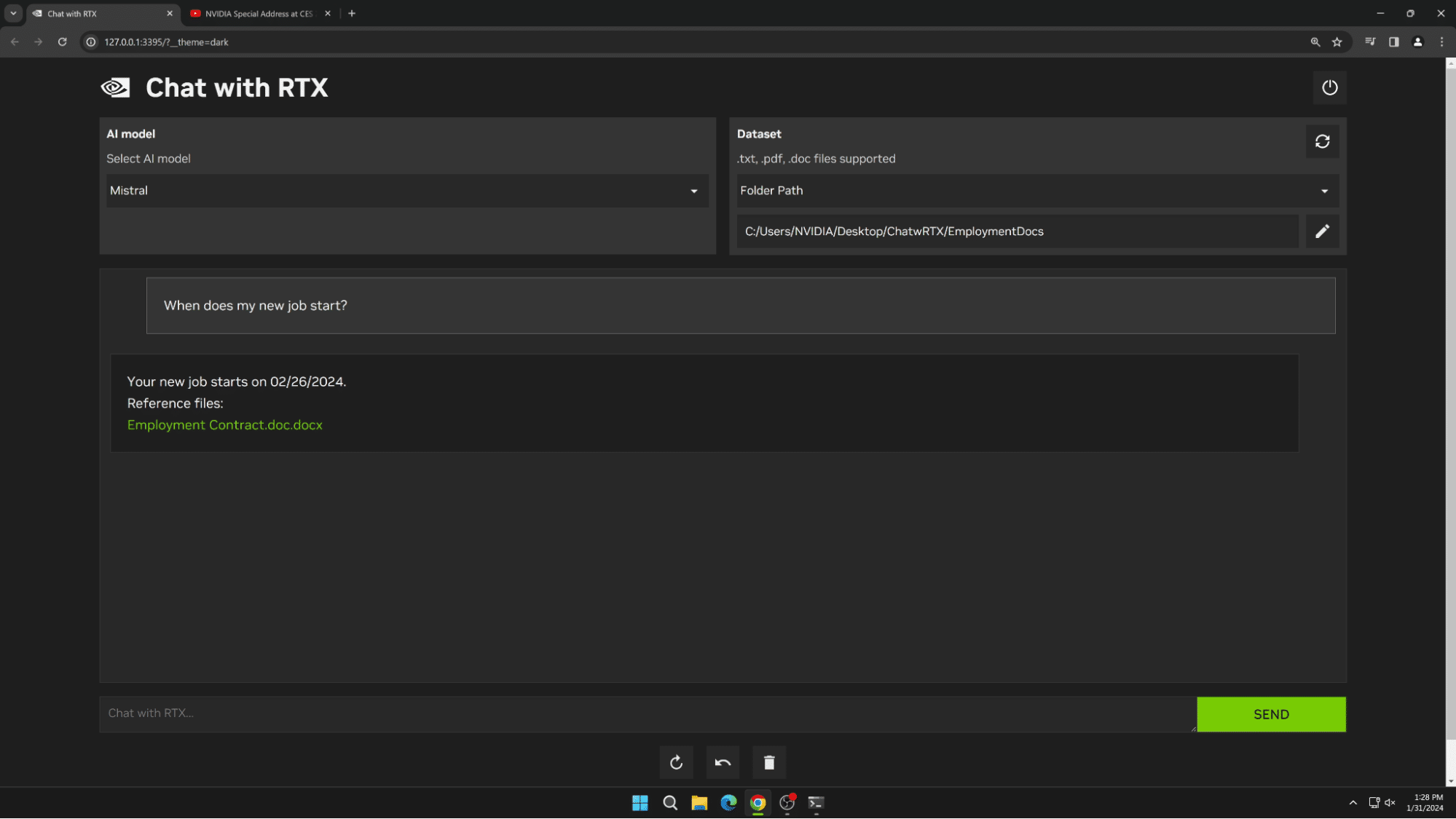
The tech demo, originally released in January, will get an update with Google’s Gemma soon.
Users can easily connect local files on a PC to a supported large language model simply by dropping files into a single folder and pointing the demo to the location. It enables queries for quick, contextually relevant answers.
Since Chat with RTX runs locally on Windows with GeForce RTX PCs and NVIDIA RTX workstations, results are fast — and the user’s data stays on the device. Rather than relying on cloud-based services, Chat with RTX lets users process sensitive data on a local PC without the need to share it with a third party or have an internet connection.
AI for Gamers
Over the past six years, game performance has seen the greatest leaps with AI acceleration. Gamers have been turning NVIDIA DLSS on since 2019, boosting frame rates and improving image quality. It’s a technique that uses AI to generate pixels in video games automatically. With ongoing improvements, it now increases frame rates by up to 4x.
And with the introduction of Ray Reconstruction in the latest version, DLSS 3.5, visual quality is further enhanced in some of the world’s top titles, setting a new standard for visually richer and more immersive gameplay.
There are now over 500 games and applications that have revolutionized the ways people play and create with ray tracing, DLSS and AI-powered technologies.
Beyond frames, AI is set to improve the way gamers interact with characters and remaster classic games.
NVIDIA ACE microservices — including generative AI-powered speech and animation models — are enabling developers to add intelligent, dynamic digital avatars to games. Demonstrated at CES, ACE won multiple awards for its ability to bring game characters to life as a glimpse into the future of PC gaming.
NVIDIA RTX Remix, a platform for modders to create stunning RTX remasters of classic games, delivers generative AI tools that can transform basic textures from classic games into modern, 4K-resolution, physically based rendering materials. Several projects have already been released or are in the works, including Half-Life 2 RTX and Portal with RTX.
AI for Creators
AI is unlocking creative potential by reducing or automating tedious tasks, freeing up time for pure creativity. These features run fastest or solely on PCs with NVIDIA RTX or GeForce RTX GPUs.
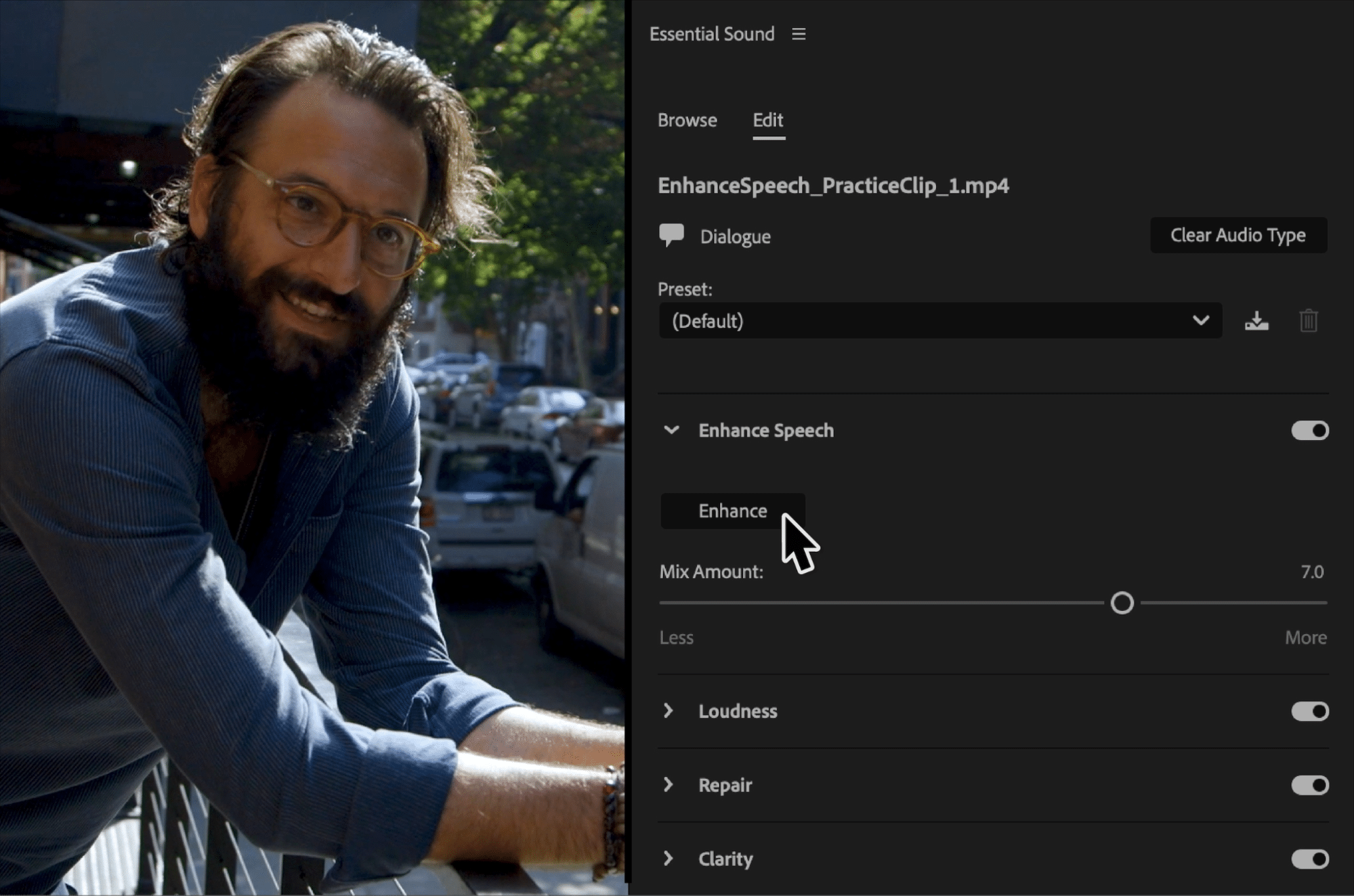
Adobe Premiere Pro’s Enhance Speech tool is accelerated by RTX, using AI to remove unwanted noise and improve the quality of dialogue clips so they sound professionally recorded. It’s up to 4.5x faster on RTX vs. Mac. Another Premiere feature, Auto Reframe, uses GPU acceleration to identify and track the most relevant elements in a video and intelligently reframes video content for different aspect ratios.
Another time-saving AI feature for video editors is DaVinci Resolve’s Magic Mask. Previously, if editors needed to adjust the color/brightness of a subject in one shot or remove an unwanted object, they’d have to use a combination of rotoscoping techniques or basic power windows and masks to isolate the subject from the background.
Magic Mask has completely changed that workflow. With it, simply draw a line over the subject and the AI will process for a moment before revealing the selection. And GeForce RTX laptops can run the feature 2.5x faster than the fastest non-RTX laptops.
This is just a sample of the ways that AI is increasing the speed of creativity. There are now more than 125 AI applications accelerated by RTX.
AI for Developers
AI is enhancing the way developers build software applications through scalable environments, hardware and software optimizations, and new APIs.
NVIDIA AI Workbench helps developers quickly create, test and customize pretrained generative AI models and LLMs using PC-class performance and memory footprint. It’s a unified, easy-to-use toolkit that can scale from running locally on RTX PCs to virtually any data center, public cloud or NVIDIA DGX Cloud.
After building AI models for PC use cases, developers can optimize them using NVIDIA TensorRT — the software that helps developers take full advantage of the Tensor Cores in RTX GPUs.
TensorRT acceleration is now available in text-based applications with TensorRT-LLM for Windows. The open-source library increases LLM performance and includes pre-optimized checkpoints for popular models, including Google’s Gemma, Meta Llama 2, Mistral and Microsoft Phi-2.
Developers also have access to a TensorRT-LLM wrapper for the OpenAI Chat API. With just one line of code change, continue.dev — an open-source autopilot for VS Code and JetBrains that taps into an LLM — can use TensorRT-LLM locally on an RTX PC for fast, local LLM inference using this popular tool.
Every week, we’ll demystify AI by making the technology more accessible, and we’ll showcase new hardware, software, tools and accelerations for RTX AI PC users.
The iPhone moment of AI is here, and it’s just the beginning. Welcome to AI Decoded.
Get weekly updates directly in your inbox by subscribing to the AI Decoded newsletter.
Ethanol only contains two thirds the amount of energy of an equivalent amount of gasoline, yet engines make more power burning it than gasoline. This video from Engineering Explained will tell you why.
The key is ethanol’s higher octane rating than pump gasoline. Straight ethanol has an octane rating of 109, compared to a maximum 97 octane for pump gasoline (ethanol is usually mixed with gasoline when sold, however). The higher rating means greater resistance to knock, the premature detonation of fuel that can damage engines. That allows engines to run higher compressions ratios and, in the case of charged engines, more boost. In both instances you’re looking at increased power.
As explained in the video, ethanol has a higher octane rating than gasoline in part because it helps keep cylinder temperatures lower. Like sweat cooling you down on a hot day, fuel pulls heat out of the surrounding cylinder while vaporizing. This process, called heat of vaporization, happens at a greater rate with ethanol than gasoline—particularly with direct injection.
The performance advantage of ethanol was shown in a Ford study in which the automaker ran a twin-turbo 3.5-liter V-6 from an F-150 pickup truck on a variety of fuels. That included E85 (85% ethanol and 15% gasoline), the most common ethanol blend, and E10, the 90%-gasoline/10%-ethanol blend that is the default fuel at most U.S. gas stations.
At 5,000 rpm and with turbo boost turned up, the engine made 380 hp and 400 lb-ft of torque on E85, but only 190 hp and 200 lb-ft on E10—in part because the engine was able to run a higher compression ratio on E85.
One potential drawback is worse fuel economy. Ford engineers did note efficiency improvements, and even saw a 1% mpg increase on E20 fuel (20% ethanol, 80% gasoline), but higher amounts of ethanol would cancel that out because ethanol is less energy dense than gasoline. With less energy in a gallon of ethanol than a gallon of gasoline, more fuel is required to drive a given distance.
The production cars that take advantage of the power-producing capabilities of E85 aren’t concerned with mpg, though. The Koenigsegg Jesko’s twin-turbo 5.0-liter V-8 makes 1,600 hp on E85, compared to 1,280 hp on pump gasoline.
E85 is also how the 2023 Dodge Challenger SRT Demon 170 gets the full 1,025 hp and 945 lb-ft of torque from its supercharged 6.2-liter V-8. Output falls to 900 hp and 810 lb-ft on E10 fuel. At full power, Dodge says the Demon 170 will do 0-60 mph in 1.66 seconds on a prepped surface, sending the current-generation Challenger off on a high note.
Understanding how much your car is worth is one thing, but then pricing it for a private sale is another art altogether. If you price your car properly, you’ll not only enjoy a more pleasant selling experience – but get better coin for your efforts.
Here are eight things to keep in mind when pricing your car for the private market.
Know the market
Read our How much is my car worth? article which guides you on how to research your car’s current value – and the variables that you need to consider. This will give you an idea of a value range – the minimum price other people are selling your car, versus the maximum of a few speculators.
Know your minimum acceptable price
Only you can determine this, but it should fit within the value range of your vehicle.
Think about how much time you have to sell the car
If you’re not in a rush, you can price your vehicle a bit higher.
If you’ve prepared your car properly and taken some great photos, you should be pricing it a little bit higher anyway – a great ad attracts great buyers. If you’re in a rush to sell, you should price your vehicle lower.
Consider the variables that affect your price
We’ve gone over these extensively but you need to consider other variables such as a roadworthy certificate (if you live in Victoria, Queensland or the ACT). Victorians, for example, might decide to sell their car without a roadworthy certificate, putting the onus on the buyer. But that means the buyer will expect a discount, so you should price your car lower accordingly.
How much rego is on your car? If you’ve just put on 12 months, you can price the car higher. If it has just one month rego, you’ll have to go a bit lower. Unregistered cars are worth less again.
Some cars require major services at certain intervals, like 100,000km. Did you recently undertake this – or spend a big wad of cash on a service generally? This means you can price the car a bit higher as well.
Allow for negotiation
When selling a car privately, expect the buyer to haggle – everybody wants a good deal, it’s human nature. So you should build a bit of fat into the asking price in anticipation. Depending on the value of the car, a couple of hundred dollars should do the trick at the very least.
Set your starting price
Once you’ve taken all the above into consideration, you can put your car on the private market with your starting price – and sit back and wait, hopefully, for the enquiries to roll in.
If you get inundated with enquiries, you could consider raising the price slightly, although this is a bit of dud thing to do as a seller. Hence why it’s important to set the price correctly the first time – and price a little higher, if you’ve got time up your sleeve.
How to haggle
Haggling is a bit of an odd dance – or a black art – but if you’ve prepared yourself, both parties can come away feeling great. One major benefit of selling a car privately, instead of to a dealer, is you’re negotiating with another member of the public (instead of a professional salesperson). It’s more of a level playing field.
When a potential buyer comes to look at your car, there should be two prices in your head – the price the car has been advertised (call it $22,500) and your minimum acceptable price (call that $21,000). Never reveal this to any buyer.
Don’t reveal that you’re open to negotiating – let the buyer make the first negotiating move. They might not want to negotiate at all, and just pay you the $22,500 – in which case, brilliant! If they indicate they want a lower price, however, invite them to make an offer or the first move. If they ask, “what’s your best price?” Respond with, “well, make me an offer!”
It could go something like this.
Buyer: I’d like to offer you $21,500. You: Okay, thanks for that – could you do $22,000? Buyer: Can we meet halfway – call it $21,750?
About this point, you should accept – and both parties should be thrilled. Them, because they feel like they’ve just knocked $750 off the price (which they can tell their husband or wife later). And you, because you’re making $750 more than you were willing to accept.
The buyer may very well want to continue negotiating, but you can feel secure knowing you’ve got another $750 to play with.
It never goes exactly like this, of course, so make sure you keep a playful, friendly attitude and know it’s a bit of a sport. Be prepared to call off the sale and walk away if the buyer won’t at least offer your minimum acceptable price. They’ve gone to the effort to inspect and test-drive the car, and they’ve presumably got the cash – if they’re a decent person, they’ll come to the party.
Note that some people will try to bargain you down with an offer of “paying with cash and I can come get the car today”. Unless you’re looking to sell the car that day and desperately need the money, be wary. These people are on the hunt for desperate sellers to take advantage of.
When to lower the price
Depending on the car, the market, the time of year, and even where you’re trying to sell, you just don’t seem to get any bites. The car is sitting out the front, slowly morphing into a spider colony.
It’s time to lower the price.
The increments depend on how much of a hurry you are in to sell the car. Going back to our $22,500 example, and if you’re in no rush, you should lower the price first to $22,000 and see what happens. Wait a few days and see if you get any enquiries.
If you don’t, you have to go lower again – unfortunately pushing ever-closer to your minimum acceptable price, but sometimes that’s just life.
A tactic you can try is lowering the price to your minimum – call it $21,000 – and stating on your advertisements that the price is “firm”. This lets the market know you don’t want to negotiate. If you’ve done your research properly, this should be a pretty sharp deal and buyers, who’ve done their own research, should know.
Happy selling!
If you want to sell your car, click here and receive a price quickly.
Chery has hit the ground running with its SUV line-up, with the Tiggo 7 Pro having arrived in Australia in the second half of 2023.
This was our first chance to drive the most affordable version of the range, the 2024 Chery Tiggo 7 Pro Urban 2WD, which is more affordable than plenty of its midsize rivals despite offering an immense standard equipment list.
It’d be easy to surmise that this model is all about showroom wow-factor with so much glitz and glam inside and out… but is there more to it? Read on and you’ll find out.
How does the Chery Tiggo 7 Pro compare?
View a detailed breakdown of the Chery Tiggo 7 Pro against similarly sized vehicles.
Chery
Tiggo 7 Pro
How much does the Chery Tiggo 7 Pro cost?
At the time of writing, Chery is offering some sharp deals on the Tiggo 7 Pro – with this Urban 2WD model seeing huge savings.
To see how the Tiggo 7 Pro lines up against its rivals, check out our comparisons tool.
What is the Chery Tiggo 7 Pro like on the inside?
There’s some showroom ‘wow factor’ when it comes to the interior of the Tiggo 7 Pro, even in the entry-level version.
From the moment you sit in the seat and the musical showpiece comes up across the twin screens, through to the comfort and space on offer in the cabin, it does feel like a pretty nice place to sit for this kind of money.
There are some ‘not cheap’ feeling materials, including soft finishes wherever your elbows might hit or even where your knees might touch. And the seat comfort and adjustability is good as well.
There’s a leather-lined steering wheel and gearshift as well, and all grades including this base model have the big glass sunroof, dual-zone climate control and heated front seats.
There’s also a wireless phone charger, a couple of USB ports, and decent storage including a pair of big cupholders, large bottle holders in the doors, a decent sized glovebox, and a big centre console bin – and that bin is cooled too!
The issues arise when you come to try and use a lot of the functionality of the systems in this car.
You do get used to the fact that you have to adjust the climate controls and fan controls using the little touch bar down below the screen, and thankfully it is there – some other cheaper SUVs don’t have any useful form of interactivity with the system, unless you go directly through the screen.
You also have to go through the screen for a lot of stuff, especially if you don’t appreciate some of the driving safety systems that are fitted – more on that in the driving section.
Suffice to say, though, that the screens are relatively good when it comes to simply hooking up a phone – I used wireless Apple CarPlay during my time with this car, and it is largely fine – but when you connect your phone, I found that you must start the sequence by connecting from the car, not from your phone. The driver info screen is pretty decent too.
Likewise, the other driving controls aren’t too bad, with a decent array of buttons, and controls on the steering wheel, a standard stalk on the right side for your indicators – the right side!
There’s also a volume dial and a couple of buttons down near the shifter – and that gear selector takes a little bit of learning, because it’s not a traditional T-bar auto. It’s an e-shifter, so you just need to pull the selector down for drive or push it up for reverse, rather than push the button in on the side (that is the manual mode button).
Second-row space in the Tiggo 7 Pro is excellent – far more spacious and family-friendly than plenty of other midsize SUVs, like a Mazda CX-5.
With the driver’s seat set for my position (182cm or 6’0 tall), I had inches of knee room, heaps of toe room and loads of head room as well, with a decent view out the window too, which will keep little ones happy.
There are ISOFIX points in the window seats and three top-tethers, and the doors open pretty wide for loading in the little ones.
Amenities in the backseat include sizeable door pockets, map pockets on the seatbacks, directional air vents with a small storage space below (and USB-A port), and even in the base model you still get a drop-down armrest with cupholders. Seat comfort is good, and the floor is pretty flat too, so you could fit three adults across if you needed to.
Boot space is decent with a fair amount of room for luggage for a family – Chery quotes 626L ‘minimum’ for the luggage capacity, expanding to a maximum of 1672L. It’s not clear which measuring standard is used for these figures, though it appears the volume is measured to the roof.
But you do get two flip-down shopping bag hooks and a bright LED light to make night time loading easier, as well as a 12V outlet – and, best of all, there’s a full-size spare wheel under the boot floor.
What’s under the bonnet?
All models in the Tiggo 7 Pro range are powered by a 1.6-litre four-cylinder turbocharged petrol engine producing 137kW of power (5500rpm) and 275Nm of torque (2000-4000rpm).
All versions also come with a seven-speed dual-clutch automatic transmission, and as mentioned above this version is front-wheel drive. That means it’s supposedly quicker than the AWD model (which is heavier), and runs 0-100km/h in 9.5 seconds (versus 9.9s AWD).
The official combined cycle fuel use figure for the 2WD models is 7.0L/100km (7.8L/100km AWD), and all versions require 95 RON premium unleaded fuel. The 2WD models have a 51-litre fuel tank. During my test, which included a mix of urban, highway, freeway and stop-start traffic, I saw a displayed consumption of8.3L per 100km.
Now, if you’re a family car buyer and you might occasionally need or want to tow something, keep this in mind – no version of the Tiggo 7 Pro is rated to tow anything.
And further to that, the tare weight of this car is 1512kg and the maximum capacity is 1895kg, meaning if you’ve got a heavier family, you might have to go on a diet before you buy one, as there’s only 383kg of usable capacity.
How does the Chery Tiggo 7 Pro drive?
For the most part, this is a liveable SUV.
While the turbocharged petrol engine and dual-clutch automatic transmission might not be the smoothest pairing in automotive history, they are usable enough in the majority of situations around town, or at speed as well.
Where they don’t work as well together is when you have cruise control active, and you encounter any form of incline while driving. In that instance, you will notice that the transmission simply doesn’t know what it’s doing – shifting between fifth, sixth and seventh gear at multiple different speeds (I tested this over a 500km road trip).
The transmission, in combination with the radar cruise system, simply doesn’t possess any grade logic compared to other automatic transmissions. If that isn’t a big deal for you – maybe you don’t like using cruise control – then this could be fine. And in other ways it’s also relatively fine.
The suspension offers a very good balance between control and cushiness over bumpy sections, and never did I really feel that I was unhappy with how this car was handling itself when it came to dealing with smaller lumps, sharp bits or bigger potholes.
Likewise, the steering – while a little bit slow at low speeds – is manageable in the majority of different driving scenarios. It’s easy enough to park this car. And even though the base model just gets a reversing camera rather than the surround view of higher grades, it’s very crisp and easy to view.
What could be definitely better is the tyres – Atlas A51 225/55 R18 units. A set of name brand tyres would (in theory) dramatically improve the drive experience for those who, like for their car to follow the path they intend it should. The standard tyres are easily overwhelmed by the engine’s torque, especially in the wet, and they can even squeal when you’re not trying to make them do that.
Otherwise, refinement is decent in terms of noise, vibrations, and harness, there’s not too much to complain about as an open road commuter car, apart from that annoying adaptive cruise control.
However, in order to make this car as liveable as I’ve made it out to be, you simply cannot leave the active safety technology on in its full capacity.
The driver monitoring camera system is one of the worst pieces of new car technology that I have ever experienced – and I’ve been driving new cars for more than 15 years now.
Likewise, the emergency lane-keeping assistance will consistently get it wrong, and it seems that the car will also slow you down for corners when you have cruise control active, even though there’s no danger.
It’s hardly enjoyable, and the speed and recognition system is incessantly insistent to the point of abstract frustration.
If only this car was available with those things missing from spec sheet, it would be 100 times more compelling. And I’m not exaggerating.
What do you get?
I think this is where the Tiggo 7 Pro Urban 2WD makes its strongest argument because really, you don’t need much more than you get in this base spec car.
Tiggo 7 Pro Urban highlights:
Automatic LED headlights
Rain-sensing wipers
18-inch alloy wheels in Atlas tyres
Full-size spare
Tyre pressure monitoring
Three drive modes (Eco, Sport, Normal)
Keyless entry and start
Remote start
Electronic parking brake with auto hold
Artificial leather upholstery
Artificial leather-wrapped steering wheel
4-way steering wheel adjustment
Heated front seats (cushion and backrest)
6-way power driver’s seat
4-way power passenger seat
Dual-zone climate control
Panoramic sunroof
12.3-inch digital instrument cluster
12.3-inch touchscreen infotainment system
Wireless Apple CarPlay and Android Auto
Satellite navigation
Voice assistant
8-speaker Sony sound system
Wireless phone charger
Ambient lighting
Front and rear USB outlets including USB-C
2 x 12V outlets (front, boot)
Tiggo 7 Pro Elite adds:
Power-folding exterior mirrors
Power tailgate
Illuminated sill plates
Air quality management system with negative ion air freshener
The Chery Tiggo 7 Pro scored a five-star ANCAP safety rating in 2023.
It certainly managed some impressive scores as part of the watchdog’s testing, including an adult occupant protection rating of 88 per cent, a child occupant protection rating of 87 per cent, a vulnerable road user protection rating of 72 per cent, and a safety assist rating of 86 per cent.
As I mentioned above, the advanced safety systems don’t seem to have been tailored to real-world driving so much as they have to pass these tests with flying colours. But even so, it is an extensive range of technology offered range-wide.
Standard safety equipment includes:
8 airbags incl. front-centre, driver’s knee
Autonomous emergency braking (AEB)
Blind-spot monitoring
Child presence detection
Driver monitoring system
Forward collision warning
Integrated Cruise Assist
Adaptive cruise control
Lane centring assist
Traffic jam assist
Intelligent Headlamp Control
Lane departure warning
Lane keep assist
Parking sensors front, rear
Rear cross-traffic assist
Safe exit warning
Speed limit assist
Traffic sign recognition
Tiggo 7 Pro Elite adds:
How much does the Chery Tiggo 7 Pro cost to run?
Chery Australia has a seven-year, unlimited-kilometre warranty for the Tiggo 7 Pro.
There’s also seven years of capped-price servicing, with service intervals set at 12 months/15,000km for all grades.
The average cost for the 2WD models is just $294 per year, while the top-spec AWD costs a little more to maintain ($315 per year) – those are astounding prices for maintenance, undercutting most mainstream rivals by hundreds of dollars per year on average.
There’s also up to seven years of roadside assistance included, provided you service the car with Chery’s network of dealers – it renews on a yearly basis with each service.
CarExpert’s Take on the Chery Tiggo 7 Pro
The price is very enticing, so is the warranty cover and the fact you’re getting a five-star safety rating for a new model from a challenger brand.
But there are some deeper design, technology, usability and implementation issues here.
For some they won’t be a big deal, but for those who appreciate a car that is intuitive and simple to interact with, there are certainly better options out there.
Rivian on Thursday delivered what was expected—the R2 electric SUV. And then it stole the R2’s stage with products that fans, investors, and EV shoppers didn’t know they needed: the Rivian R3 and R3X.
A short time after the reveal, I noted that while plenty of fans were checking out the R2, there was a frenzy around the R3. And Rivian executives themselves appeared full of enthusiasm about these compact EVs—including Rivian’s head designer Jeff Hammoud.
“The thing I most love about R3 is I’ve asked quite a few people, what kind of car would you call this? Is it a hatch or an SUV? And nobody really has an answer, and that’s great.”
Hot hatch, rally car, trail runner? All of the above
“When I was first talking about this with RJ we were going through the conception of it and the conversation we had was just, like, I don’t want to fall into a segment, I want people to just say it’s an R3,” recalled Hammoud, in a Q&A session with media. “And I think we’ve achieved that.”
Hammoud added that with the high-performance R3X version, the goal was simply something that’s really fun. “Hopefully you guys look at it and agree that, like, I don’t know what it is but I just want to drive that.”
Rivian R3X
To me, standing between the two, it was hard to believe the R2 and R3 share so many common cues—even their front-end look—as they impress as completely different design statements and personalities. The R3 follows in the footsteps of eccentric hatchbacks like the Lada Niva and Golf Country but could also win the hearts of many Subaru Crosstrek owners.
The R3 family measures 170.3 inches long and rides on a 110.2-inch wheelbase. That makes it about 15 inches shorter than the R2, which is in itself about 15 inches shorter in length than the R1S.
What that amounts to is the heart of the European market, or something that could jumpstart a stagnant U.S. small-car market—especially with respect to EVs.
Today, those dimensions roughly align, by length, with the Hyundai Kona Electric, Volkswagen ID.3, Renault Megane E-Tech, or MG4, among EVs. And likewise, it’s effectively in the same size class as the Toyota Corolla hatchback, the Volkswagen Golf, the Škoda Octavia, the Ford Focus, or the Seat León. But it looks more exciting than any of them—or, of course, an American-market Bolt EV or Leaf.
We’ll have to wait a bit. If the R2 arrives in early 2026, an R3 might follow relatively soon after—perhaps in 2027. Unfortunately, the timeline for the next-generation Bolt EV and Leaf isn’t looking much better, past Tesla’s ever-flaky timelines suggesting the arrival of a compact Tesla Model 2 before then. While Rivian confirmed that it wants to make the R3, it didn’t confirm when it might take reservations or where, for sure, it might be sold.
Rivian R2
Range and battery details yet to come
These models share the 4695-format cylindrical cells, packaged within a structural battery pack. Rivian didn’t yet speak to range for the R3, but Hammoud did speak a bit to charging. The vehicles shown Thursday all had their NACS charge ports on the rear right quadrant, under a tidy little flush cover.
“We did a lot of research and specifically in left-hand-drive countries in Europe,” said Hammoud, when asked why it’s there—volunteering that Europe was indeed a big consideration. “We saw a lot of people charging cars on the street, and you’d see anything from charging cables wrapped over hoods to get to the other side, and we wanted to solve that.”
Rivian R3
“The other thing is, building off our current charging network, it’s in the front driver’s side,” he explained. “So if you’re gonna flip the car back into the space, essentially the exact same location.”
Putting the port there, Hammoud summed, also means less wires, less weight, and less cost—for the whole R2/R3 family
Which leads to a point. According to Hammoud, although the R3 and R2 don’t have shared sheetmetal, there are a lot of shared points between the interiors of these two models that make it easier from a manufacturing point of view. Same steering wheel, our screen strategies, the center console, the seat frames.
Rivian R2
R2 design didn’t come so easy
While from the sound of it the design of the R3 was fun, the R2 design process sounded more fraught as described by Hammoud—as it tapped into the expectations of those who loved what they saw in the R1 but wanted something more affordable or more sensibly sized.
The R1 was designed through addition, Hammoud recalled, but the R2 involved a lot more debate about what it didn’t want R2 to subtract, and what the key elements were that it needed to carry over. That’s no surprise; Rivian CEO RJ Scaringe has said at several points that the follow-up will have less complexity than its R1 lineup and be much easier to build.
Rivian juggled wheelbase length and the placement of the glass roof and pillar so as to maximize rear headroom and spaciousness, while European pedestrian protection standards played a role, too, requiring a line at the side of the hood, which was then incorporated into the design itself.
As Green Car Reports covered with the debut yesterday, the Rivian R2 lands in early 2026 with a target price around $45,000, starting with single-motor rear-wheel drive but stepping up to two- and three-motor AWD versions offering a range of more than 300 miles (less in base form, it’s since been said), and in some cases 0-60 mph times below 3.0 seconds. The team ended up with an overall length around 185 inches long and riding on a 121.1-inch wheelbase, with an overall height of 66.9 inches and width around 75 inches.
Rivian R2
According to Hammoud, the R2 builds off the profile of the R1S, although the overall proportions of the vehicle are “a lot more athletic” with very short front and rear overhangs. As shown it had 32-inch all-terrain rubber, and the truck’s 25-degree approach angle, 27-degree departure angle, and 9.8-inch ground clearance gave it a stocky, trail-ready look.
Meanwhile, shorter vehicles can pose more of an aerodynamic challenge, and so getting that part right for maximizing range with smaller battery packs was of course a priority. “We were working very closely with our aerodynamics team, doing CFD (computational fluid dynamics) analysis really early on, according to Hammoud, to understand the key attributes required for range. In the R2’s case, one of those is the way the roofline drops toad the back, bringing airflow through a pass-through spoiler.
The big subtraction items are the suspension. One that raises or lowers isn’t coming to R2, although Rivian made sure to give it a tune that would work for on- and off-road and allow the capability via ground clearance. The R2 offers a ground clearance of 9.8 inches, while the R1S, with its adjustable air suspension and up to 14.9 inches, remains secure in its top off-roader spot for the brand.
And there are no plans for a third row in the R2. “To have a third row for R2 would make the package very tight.”
Rivian R2
Lots of innovation inside R2
That said, there is some serious innovation in the packaging in the R2—like the front and rear seats that fold fully flat, allowing enough continuous length to transport very long project items like 16-foot baseboard trim with it resting on the liftgate’s rim (the glass rolls down). Once that window’s down, don’t forget about the little table good for drinks or the fine bits as you gear up for your outdoor activity of choice. And dogs are likely going to love the breeze from the pop-out panel windows in back.
On the adventure front the R2 boasts an entirely new kind of bike-rack system that can be put up with one person and stored away much more easily. Rivian plans to offer both a bed to sit on that flat floor and a rooftop tent, and a revised camp kitchen is in the works.
R1S complex split-tailgate setup was one of the most difficult items to solve for R2. Owners really like the R1S tailgate and “being able to sit there and basically have a little awning there to cover you if it’s raining,” he described, but it’s cost and complexity. So Rivian’s solution, with a one-piece liftgate, was a pull-out tray that you can sit on.
Interface-wise, the steering wheel and its large rotary dials were touted in multiple instances. With it, two haptic-twist controllers within the wheel use different types and levels of haptic feedback depending on what you’re scrolling through or selecting at the moment.
Rivian R3
Rivian R3
Rivian R3
R2, R3, R3X made for the same assembly line?
“A lot of work went into designing R3 and R2 together to make sure as a platform, a lot of the components are shared, a lot of network architecture is obviously shared,” said Hammoud, and that extends to manufacturing and the supply chain.
R2 wlll be a little more dynamically focused toward on-road performance than R1, Hammoud summed, while R3 will be the most focused on-road of the three.
Hammoud pointed to the area behind the rear wheel of the R2 and noted that when the vehicle gets damaged that’s just an injection-molded part and easy to replace. And, he said, there are also a lot of shared points between the interiors of the R2 and R3 that makes it easier from a manufacturing point of view—like the same steering wheel, screen strategies, center console, and seat frames.
Essentially during the time Rivian was revealing the R2, R3, and R3X on Thursday, the company confirmed a whopper of a manufacturing announcement. It will pause construction on its $5 billion Georgia factory, which had up until then been set for a 2026 ramp and an eventual 400,000 vehicles per year, in favor of a “capital efficient launch” first at its Illinois plant, for deliveries starting in early 2026. Georgia remains part of the plan, just later, so as to preserve the funds that might be needed to keep these models headed toward production.
Sure, the R3 family might be a shiny surprise to distract from some sobering financial realities at the company. But it deserves all the attention it gets and shows that Rivian has lots of innovation yet to come.
The technical storage or access is strictly necessary for the legitimate purpose of enabling the use of a specific service explicitly requested by the subscriber or user, or for the sole purpose of carrying out the transmission of a communication over an electronic communications network.
Preferences
The technical storage or access is necessary for the legitimate purpose of storing preferences that are not requested by the subscriber or user.
Statistics
The technical storage or access that is used exclusively for statistical purposes.The technical storage or access that is used exclusively for anonymous statistical purposes. Without a subpoena, voluntary compliance on the part of your Internet Service Provider, or additional records from a third party, information stored or retrieved for this purpose alone cannot usually be used to identify you.
Marketing
The technical storage or access is required to create user profiles to send advertising, or to track the user on a website or across several websites for similar marketing purposes.