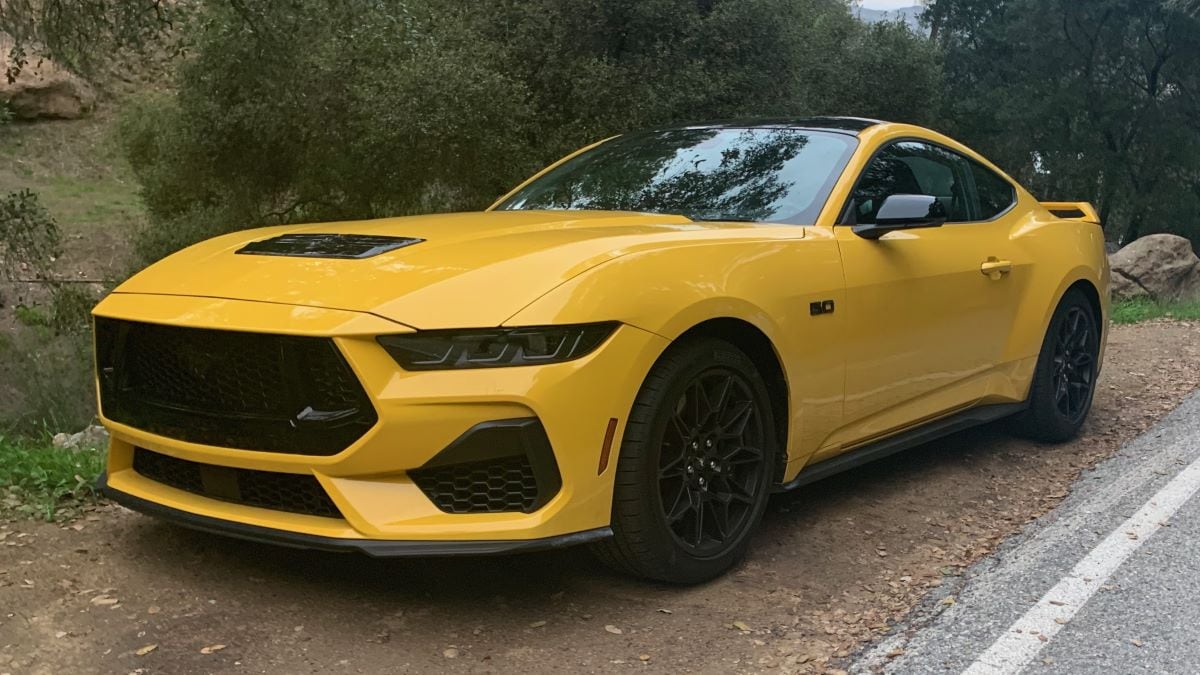
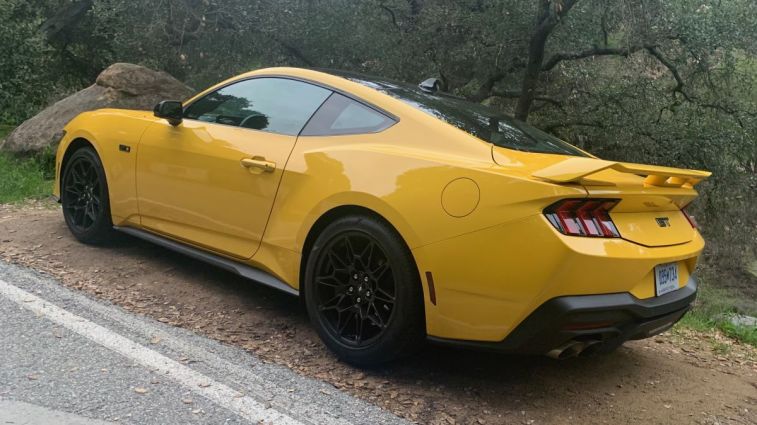
Normal isn’t normal. When the Mustang GT’s exhaust system is in Normal mode, it sounds both glorious and slightly worrying. Making an early-morning getaway isn’t done quietly. Who doesn’t love the roar of a naturally aspirated V8? But an hour before sunrise?
Gentle on the throttle, waiting for the right time and place, the Mustang GT is civilized but always feels ready to burst into action. A turbocharged V6 is often the modern replacement for a V8, but I’m thankful that Ford has retained it for this newest generation of Mustang. One icon deserves another, right? It develops 480 horsepower and 415 lb-ft of torque from a 5.0-liter displacement. At a drag strip, the Mustang GT could run from standstill to 60 mph in a fleeting 4.5 seconds. In real-life driving, there’s plenty of extra thrust to tap into just by flexing the right foot.
Real-Life Driving
Actually, this particular Mustang GT Fastback has the GT Performance package, which includes an Active Valve Dual Exhaust system, raising horsepower to 486 and torque to 418 — when using 93 octane gasoline. I filled the tank with 91 octane because that was the highest available and the car still feels fast. I reach a section of freeway with a steep incline, the kind where 18-wheelers stick to the inside lane and keep their hazard lights flashing. The Mustang GT works a little harder than usual, but it’s like when you or I exert a bit more force to open a recalcitrant jar. Once it kicks down a gear or two (a 6-speed manual transmission is standard, another nod to old-school fun; this car has the 10-speed automatic with paddle shifters), the slope seems immaterial and every other vehicle recedes into the distance. All the while, there’s that beautiful bark of the V8 shaking the air.
There’s quite a bit of road noise created by the wide Pirelli P Zero tires, but I’ll take it if it means this much precision, this much grip, this much fun.
An upgraded suspension is also part of the GT Performance package. This includes heavier-duty front springs and a stouter rear anti-roll bar. Yet the ride quality isn’t too firm. Controlled yes; uncomfortable no. Factor in the Torsen limited-slip differential as well, and I can honestly say that this is the best-handling Mustang I’ve ever driven. There’s quite a bit of road noise created by the wide Pirelli P Zero tires, but I’ll take it if it means this much precision, this much grip, this much fun.
In the past, I’ve liked the turbocharged 4-cylinder Mustang with the High Performance package, because there’s less weight in the nose than a V8. But like I said, I’m impressed by the GT. I also like the steering feel and how responsive it is, the front wheels flow into corners easily, so that extra weight is a non-issue. And the Brembo brakes (also part of the GT Performance package) are supremely confident.
Internal affairs
Keeping their occupants in place while the car blasts through turns are (optional) sport front seats made by Recaro. These are well-shaped and supportive. I could easily imagine still being comfortable and not especially tired after many hours of driving. I would also recommend sitting in the driver’s seat for a good 10 minutes before heading off, because it’s going to take at least that long to become acquainted with the less-than-user-friendly infotainment system and digital controls for the heating/air conditioning.
Like most modern cars, the Mustang GT has a single unit housing a digital instrument cluster and an infotainment touchscreen. Apparently, the system also responds to voice commands, but I never had much luck with that during my time with it. Nor was my search for a cabin air recycle function successful, and I had to spend several minutes coughing while stuck behind a truck that was burning oil. While delving through the menus, though, I did manage to come across a Quiet mode for the exhaust system. Small mercies.
The screens look dramatic at night. I would have preferred an illuminated PRND section by the shift lever, though. I know there’s a display in the instrument cluster, but if Toyota can do it for its humblest cars, then surely Ford can for one of its halo models. And for my next gripe, I’m going back to the driving experience. Scrolling through the drive modes is done with a button on the steering wheel. That’s fine.
What isn’t fine is the order of those modes. In most conditions, drivers will be clicking between Normal and Sport modes, yes? But the Mustang GT makes you click through several others before reaching Sport — like Drag, Slippery and Track. Sorry, but that’s ridiculous. The Mustang GT also has a handbrake-like Line Lock that holds the front wheels while the driver revs the engine to spin the rears. I never used it once. I really liked those Pirelli tires and I wasn’t going to mess them up. With the exhaust system finally in Quiet mode, I did appreciate the excellent 12-speaker B&O audio system even more.
As tested, this 2024 Mustang GT Fastback Premium costs $55,505. For a muscle car with a great chassis and plenty of equipment, I don’t think that’s unreasonable.
The ivory-hued 25th Anniversary Lamborghini Countach in The Wolf of Wall Street epitomises the extravagant life of Jordan Belfort. The film featured a pair of cars, with one unfortunately facing a distressing finale. The remaining unscathed vehicle is now set to hit RM Sotheby’s Luxury Week Auction, its price estimated to cross the two million dollars mark.
The 25th Anniversary Countach by Lamborghini, of which around 650 models exist, found 23 models sporting the same Polo Bianco finish as the famed movie car. Horacio Pagani, who later established Pagani Automobili, oversaw the design modifications, introducing revamped front and rear bumpers and air inlets behind the doors. Despite a divisive styling, with critics comparing it to the Ferrari Testarossa, the performance left no room for reproach. As one might expect, all Countach models were equipped with a V12 engine, albeit with variable displacements based on the specific model. For instance, the LP400 and LP400 S sported a 3.9-litre unit, while the LP500 S was powered by a 4.8L variant. The 5000 QV and the 25th Anniversary housed a 5.2-litre V12 engine. Each was mated to a five-speed manual transmission, effectively transferring the generated horsepower and torque, peaking at 449 hp (455 ps/335 kW) and 369 lb-ft (500 Nm) respectively in the 25th Anniversary model, to the rear wheels.
In The Wolf of Wall Street, the Lamborghini Countach features significantly in a scene where Jordan Belfort, played by Leonardo DiCaprio in an intoxicated state, laboriously reaches the vehicle and employs his foot to open the passenger door. Subsequently, he ends up wrecking the vehicle, colliding with stationary cars, road signs, and a golf cart, leading to his arrest by the police.
The remaining unharmed vehicle, bearing the chassis number KLA12722, will prominently appear at RM Sotheby’s Auction in New York this December. The white Countach, owing to its role in the movie, has gained immense fame, or as described by Sotheby’s, “An iconic specimen that intertwines the legacies of Lamborghini and Hollywood, serving as a symbol for multiple generations.”
Renowned American artist Lindsey Nobel unveils her “Liquidline” series as part of an upcoming immersive art exhibition dubbed “Into the Invisible”. Organised by SJArt+ (She&Jul Media), the showcase is set to tantalise the senses and challenge the perception of viewers. Curated by acclaimed media producer Julliet Pan, the exhibition will take guests on a transformative journey through Nobel’s mesmerising artworks that take center stage alongside the premiere of an original musical composition by talented composer and Berklee School of Music graduate, Daniel Grace.
“Into the Invisible,” is comprised of approximately 30 selections from four bodies of work that, together, represent many of her key techniques and formal motifs.
Held at the Visual Art Centre from 4 March to 10 March, this ground-breaking exhibition aims to “shatter the mold” of traditional art displays by combining bespoke musical compositions with Nobel’s captivating visual pieces to indulge audiences in a multi-sensory odyssey that transcends the boundaries of sight and sound. For over 30 years, Lindsey Nobel has explored ways of visualising the interconnectedness between biological life forms and the informational networks through which life is expressed, from the cellular level to the digital infosphere — which is communicated through her “Liquidline” series.
Julliet Pan, Daniel Grace and Jocelyn Ng
Utilising a dynamic interplay of diverse mediums, including oil paintings, acrylics, watercolor, coffee, resin, plastic, and bronze, “Into The Invisible” is a series of works that epitomises Nobel’s contemporary artistic style. Her signature syringe pieces feature her innovative “Liquidline” technique which for Nobel, came from a place close to home, “it is from when I lived in a stilt house on top of the ocean in Malibu. I would watch the water and the waves crash and see all the white lines of foam form patterns on top of the ocean,” she explains. Here, Nobel transforms abstract concepts into visually compelling expressions of human connection and technological advancement. Her work masterfully captures the intangible energy that permeates our interactions with technology, the natural world, and the ever-evolving digital landscape.
Nobel’s artistic vision is deeply rooted in the exploration of the invisible connections that bind humans to the vast network of organic and inorganic phenomena that pervade our existence.
“Into the Invisible” will transcend the visual realm with an original musical composition by talented composer Daniel Grace, inspired by Lindsey Nobel’s ethereal artistic style. The composition will seamlessly intertwine classical violin melodies with contemporary electronic textures, creating an auditory journey that mirrors the transformative nature of the exhibition. The fusion of Lindsey Nobel’s mesmerising artworks with the musical maestro of Daniel Grace’s original composition and a live performance by renowned Singaporean violinist Jocelyn Ng promises to create an immersive and unforgettable experience for visitors. This unique artistic synergy aims to “transport” audiences to a realm where the seen and unseen gracefully intertwine, mirroring the essence of Nobel’s captivating “Liquidline” series.
Lindsey Nobel’s artwork
Julliet Pan also founded SJArt+ which lies the belief that art is not just a visual experience but a total sensory journey that engages the viewer on multiple levels. “Our aim is to craft these immersive experiences, drawing audiences into a world where each piece tells a story that resonates both visually and emotionally,” she explains. She also states that she plans to make SJArt+ a vibrant hub for international artistic exchange and for it to become more than just an art space but to serve as “a catalyst for evoking deep emotions, stimulating thought, and adding meaningful depth to people’s lives”. Through this endeavour, she aims to not just build a community but to also nurture a space where art becomes a bridge to richer, more reflective life experiences.
To RSVP for the exhibition, click here.
“Into the Invisible” takes place at the Visual Arts Centre at 10 Penang Rd, #01-02 Dhoby Ghaut Green, Singapore 238469, from 4 March to 10 March 2024
SJArt+ will also collaborate with Soho House for a members-only opening night reception on 4 March, and New York University, ESSEC Business School for their alumni exclusive reception on 6 March and 7 March.
For more on the latest art and culture reads, click here.
Italy is a dream destination for foodies who are fond of road trips. The country’s diverse regions offer a delightful culinary adventure, from the pasta of Emilia-Romagna to the seafood delights of Sicily. Scenic routes wind through picturesque landscapes with vineyards, olive groves, and charming trattorias. Savor authentic flavors as you stop by bustling local markets, family-run osterias, and Michelin-starred restaurants.
Whether traversing the Amalfi Coast’s scenic narrow road or exploring coastal villages in Sicily, a foodie road trip in Italy promises an unforgettable gastronomic journey.
Here are the best places for foodie road trips around Italy.
Foodie Road Trips Around The Amalfi Coast
Embarking on a road trip along the Amalfi Coast takes you on an exciting journey of breathtaking scenery and culinary delights. As you wind along the scenic coastal roads overlooking the azure waters of the Tyrrhenian Sea, each twist and turn reveals panoramic vistas of sheer cliffs, colorful villages, and lush lemon groves.
Exploring the Amalfi Coast’s culinary scene is an adventure, with its rich tapestry of flavors, aromas, and traditions. Begin your gastronomic journey by indulging in local specialties such as fresh seafood dishes, handmade pasta, and savory sauces infused with sun-ripened tomatoes and fragrant basil.
As you drive along scenic roads, stop in charming coastal towns like Positano, Amalfi, and Ravello, where quaint trattorias and family-run restaurants lure travelers with authentic Neapolitan cuisine. Savor the delicate flavors of locally sourced ingredients, including succulent mozzarella di bufala, tangy limoncello liqueur, and sfogliatella pastries.
Don’t miss the chance to visit traditional lemon groves and artisanal limoncello factories, where you can sample the region’s signature liqueur and learn about its centuries-old production techniques.
As the sun sets over the shimmering sea, dine al fresco on cliff-side terraces, serenaded by the gentle lapping of waves and the aroma of freshly baked pizza from wood-fired ovens.
Emilia Romagna is Perfect for a Foodie Road Trip in Italy
Embark on a captivating culinary tour through Emilia Romagna, where each bite unveils a tale of culinary artistry. This Italian gastronomic heartland, with its rolling hills, medieval towns, and fertile plains, sets the stage for a feast of local flavors and traditions. As you traverse the picturesque countryside, dotted with vineyards, olive groves, and rustic farmhouses, you’ll discover the region’s rich culinary heritage coming to life.
Start your culinary adventure in Bologna, the region’s capital, renowned for its exquisite cuisine and historic charm. Indulge in classic dishes like tagliatelle al ragù (Bolognese sauce), tortellini in brodo (broth), and mortadella, a beloved local cold cut.
Continue your journey to Parma, home of Parmigiano Reggiano cheese and Prosciutto di Parma. Visit cheese factories and ham curing houses, where artisans uphold centuries-old traditions in producing these local products.
Venture into Modena to savor the sweet and tangy flavors of traditional balsamic vinegar aged in wooden barrels for decades. Explore local markets, where stalls display seasonal produce, artisanal pasta, and regional specialties.
As you wind through charming towns of Emilia Romagna, like Ravenna, Ferrara, and Rimini, discover trattorias and osterias tucked away in cobblestone streets, hearty dishes like cappelletti in brodo, piadina flatbread, and seafood risotto.
Sicily Italy
Road tripping through Sicily unveils a culinary odyssey rich in flavors, history, and tradition. As you navigate the island’s diverse landscapes of rugged coastlines, rolling hills, and ancient ruins, you’ll discover Sicily’s vibrant culinary scene with its mouth-watering array of dishes influenced by centuries of cultural exchange.
Begin your journey in Palermo, the island’s capital, where bustling markets like Ballarò and Vucciria overflow with colorful displays of fresh seafood, aromatic spices, and seasonal produce. Indulge in street food delicacies like arancini (rice balls) and panelle (chickpea fritters).
Travel inland to explore the fertile valleys of Enna and Agrigento, where olive groves, citrus orchards, and vineyards flourish. Take this opportunity to savor local specialties, such as caponata (sweet and sour eggplant stew) and cannoli (crisp pastry filled with sweet ricotta).
Along the coast, you’ll come across fishing villages like Cefalu and Taormina, where seafood reigns supreme. Feast on grilled swordfish, seafood risotto, and freshly caught sardines, accompanied by Sicily’s renowned wines, such as Nero d’Avola and Marsala.
Florence Italy Road Trips
Indulge in a deluxe tour of Florence that promises a sensory adventure through Renaissance art, architecture, and cuisine. As you walk through the cobblestone alleys lined with centuries-old palaces, beautiful churches, and tiny piazzas, you’ll come across a rich culinary legacy that invites you to indulge in a symphony of flavors and fragrances.
Florence’s historic center is the best place to start, where trattorias, osterias, and gelaterias beckon with tempting offerings. Sample traditional Tuscan dishes like ribollita, pappa al pomodoro, and bistecca alla Fiorentina (Florentine steak) paired with locally produced Chianti wines.
Visit Mercato Centrale, Florence’s bustling food market, where local vendors sell an array of artisanal cheeses, cured meats, fresh pasta, and seasonal fruits and veggies. Join a cooking class or food tour to learn the secrets of Tuscan cuisine from local chefs.
Explore the surrounding countryside, where vineyards, olive groves, and medieval villages dot the rolling hills of Chianti and Val d’Orcia. Discover wineries and agriturismo offering tastings of Sangiovese wines, extra virgin olive oils, and pecorino cheeses.
Rome Italy
Road-tripping through Rome presents a stimulating blend of ancient history, vibrant culture, and exquisite cuisine. Discover the city’s culinary treasures as you explore its cobblestone streets, lined with majestic ruins, Baroque fountains, and bustling piazzas.
Head to the historic center, where numerous trattorias and osterias await, serving traditional Roman dishes like cacio e pepe (cheese and pepper pasta), carbonara, and supplì (fried rice balls). Indulge in classic Roman street food such as pizza al taglio (thick-crusted pizza by the slice) and porchetta (roast pork).
Explore Rome’s diverse neighborhoods, each boasting culinary traditions and specialties. Sample Jewish-Roman cuisine in the ancient Jewish Ghetto, enjoy authentic Roman-style pizza in Testaccio, and feast on seafood delicacies in Trastevere along the Tiber River.
Venture beyond the city limits and drive to Rome’s surrounding countryside, where vineyards, olive groves, and medieval towns dot the scenic hills of Lazio. Visit wineries and agriturismo and enjoy tastings of Frascati wines, extra virgin olive oils, and artisanal cheeses.
If you have any questions about doing any of the foodie road trips around Italy, leave a comment below.
Our Santa Clara-based software quality assurance team boasts some of the world’s top gamers, whose search for bugs and errors is as strategic as their battle plans for toppling top-tier opponents in video games.
Two team members of the QA team — friendly colleagues in the office but fierce rivals in the esports arena — recently competed against one another at the finals of the Guildhouse Fighters tournament, a local circuit in Northern California.
Eduardo “PR Balrog” Perez-Frangie, a veteran Street Fighter player, fought his way to the Grand Final to face Miky “Samurai” Chea.
Perez-Frangie came out on top, but there was a twist: he’d brought to the contest his two-year-old son, who fell asleep on his father’s chest mid-match. “I played the rest of the game with a deadweight in my lap,” he said.
Perez-Frangie and Chea play at work — guess who won? QA team members Alyssa Ruiz and DaJuan McDaniel cheer them on.
A Competitive Spirit
Perez-Frangie has competed for 15 years in a series of fighting game titles, including Marvel vs. Capcom, Killer Instinct and Mortal Kombat. He was part of the Evil Geniuses esports organization when he joined NVIDIA almost a decade ago but now plays without a sponsor so he can enjoy more family time.
He’s played against Chea in esports events for years, and they’re just as competitive in the office as in the stadiums.
“Even when we’re in the test environment, when we’re looking for bugs, we are competitive,” Perez-Frangie said. “But Miky stays calm — he was a teacher, so he can put everyone in their place.”
Chea’s days teaching kindergarten through eighth grade in Fresno, California, are behind him, but the coaching aspect of his current gaming-related role reminds him of the classroom — a place to share insights and takeaways.
As new games are released and older ones updated, “the hardware and software stack needs to work in harmony,” Chea said. “Our pro gaming team is the last line of defense to ensure our customers have the best gaming experience possible.”
The QA team gathers to check out a new game.
QA team member DaJuan “Shroomed” McDaniel is a top-ranked Super Smash Bros. Melee player whose signature characters are Sheik and Marth. He’s also widely considered to be the best Dr. Mario player of all time.
“Being a competitive gamer, visual fidelity is so important,” McDaniel said. “We can see and feel visual anomalies, frame discrepancies, general latency and anything that’s off in ways that others won’t see.”
McDaniel playing “Cyberpunk 2077.”
A Winning Formula
Alyssa Ruiz joined the QA team a year ago, initially testing drivers as part of the pro gaming team before switching to testing NVIDIA DLSS, a suite of neural rendering techniques that use deep learning to improve image quality and performance.
Introduced to gaming by her brothers through Halo 3, she later dedicated hours to Fortnite before deciding to stream the gameplay directly from her console. She posted the content to TikTok and began playing in online tournaments. By then, her game of choice was Riot Games’ Valorant.
“The game has a large female player base with visually appealing graphics and an engrossing storyline,” she said. “It can be more complex than a fighting game because it relies on a combination of abilities with strategies. It’s also a team game, so if someone isn’t pulling their weight, it’s a loss for all of us.”
That’s not unlike the team dynamic in the office.
Perez-Frangie, Ruiz, Chea and McDaniel.
Each member brings their own specialties to the testing environment, where they’re using their keen eyes to scrutinize DLSS technologies.
Their acute awareness of game latency and image fidelity — honed through hundreds of hours of gameplay — means the team can achieve better test coverage all around.
“We’re all very competitive, but there’s a real diversity that contributes to a stronger team,” Ruiz said. “And we all get along really well.”
Learn more about NVIDIA life, culture and careers.
The Geneva International Motor Show, one of the most important and long-standing global auto exhibitions, opened this week, with the spotlight on several China and U.S. EV makers building on NVIDIA DRIVE that are expanding their presence in Europe.
BYD
One of the key reveals is BYD’s Yangweng U8 plug-in hybrid large SUV, built on the NVIDIA DRIVE Orin platform. It features an electric drivetrain with a range of up to 1,000 kilometers, or 621 miles, thanks to its 49 kilowatt-hour battery and range-extender gasoline engine.
IM Motors
The premium EV brand by SAIC and Alibaba, IM Motors, unveiled its IM L6 mid-size electric saloon (aka sedan), which will soon be available to the European market.
The L6 features IM’s proprietary Intelligent Mobility Autonomous Driving System, powered by NVIDIA DRIVE Orin. The advanced system uses a comprehensive sensor suite, including one lidar, three radars, 11 cameras and 12 ultrasonic sensors. IM reports that the L6 is capable of highway navigation on autopilot, marking a milestone in the company’s mission to bring advanced self-driving vehicles to market.
IM Motors has been working with NVIDIA since 2021, using NVIDIA DRIVE Orin as the AI brain for its flagship LS7 SUV and L7 sedan.
IM Motors IM L6
Lucid
The Geneva Motor Show marks the European debut of Lucid’s Gravity SUV.
The Gravity aims to set fresh benchmarks for sustainability and technological innovation when its production commences in late 2024. Powered by NVIDIA DRIVE, the luxury SUV features supercar levels of performance and an impressive battery range to mitigate range anxiety.
Lucid Gravity SUV
Explore the latest developments in mobility and meet NVIDIA DRIVE ecosystem partners showcasing their next-gen vehicles at GTC, the conference for the era of AI, running from March 18-21 at the San Jose Convention Center and online.
The automotive industry is rapidly changing due to emerging technologies like electrification, autonomy, and connectivity. But, despite government support and growing economies of scale, these technologies remain rather expensive to develop and commercialise. Not only that, battery electric vehicles (BEVs) have low entry barriers, making the car business a lot more difficult, even for luxury manufacturers.
Needless to say, brand differentiation becomes critical in such situations, which in turn necessitates a greater emphasis on design, aesthetics, and visual appeal by the automakers. “Design works. Because it translates what a brand is at its core—where it comes from, where it’s going, and what makes it unique,” said Michael Mauer, Head of Volkswagen Group Design. “People automatically relate to a brand through design because it communicates with them as an emotional language.”
Porsche 911 GT3
VW Group and other European carmakers are, of course, well-recognised for their design roots, having produced icons such as the Porsche 911, the Jaguar E-Type, the Lamborghini Miura, and the BMW Z8. Mauer himself led the Porsche team that won the coveted Red Dot: Design Team of the Year award in 2012. Meanwhile, his counterparts at Ferrari won the same accolade under Flavio Manzoni in 2019. Besides, Ferrari has won 26 Red Dot awards between 2015 and 2023, more than any other automaker.
What has proven to be particularly effective in the designs of European carmakers is their consistency. For example, the Porsche 911’s basic structure hasn’t changed much through the years. Meanwhile, the kidney grille has been a feature of BMW since 1933. And Ferrari’s motorsport DNA is generally reflected by the red color. Without such visual cues, these brands would have struggled to develop a unique character.
Porsche 911 GT3
However, highlighting Europe’s aesthetic excellence does not imply that automakers from other regions are not coming up with memorable designs.
In fact, some vehicles from American and Chinese upstarts, such as the Tesla Model 3 and the NIO ET7, perfectly embody the sleek, minimalistic styling that buyers expect from high-tech luxury these days (thanks to Silicon Valley and Apple). And these firms have won plenty of plaudits for their work, too. The Model 3 was Automobile magazine’s Design of the Year in 2018 and received an impressive 4.77 (out of 5) rating in Bloomberg’s Tesla Owners Survey. Similarly, the NIO ET7 won the Red Dot Product Design award in 2021.
Tesla Model 3
While these entrants typically differentiate themselves via innovation or software, they understand the value of design in getting consumer attention and visibility. “Design is not an expense. Design is a fundamental investment for the growth of any company,” said Javier Verdura, Tesla’s Director of Product Design, in an interview with GeneXus. “I strongly believe that, without design, a company can’t move forward nowadays. What is offered to consumers has to be well thought out and carefully designed and must provide a pleasant experience.”
Having said that, Silicon Valley’s obsession with sophisticated minimalism did not deter Tesla from taking a bold and dramatic approach with the Cybertruck. The USD 60,000 pickup’s futuristic styling is polarizing and almost ostentatious, but it perhaps supports the notion that high-end brands are not supposed to appeal to everyone.
Incidentally, Tesla’s rival Lexus too had a similar idea in mind when it came up with the “Spindle Grille” over a decade ago. The conspicuous front fascia of the company’s cars alienated many customers, however, Toyota was eager to give its luxury marque a stronger personality after years of being criticised for “bland” design.
Lexus LC500
Such a strategy may not always work, but Lexus didn’t make design its core proposition anyway. Instead, that has usually been quality and durability. The Japanese brand was placed first in both the J.D. Power Vehicle Dependability Study and the Consumer Reports Reliability Rankings. A more attractive design would undoubtedly aid in competing with the German establishment, but it is not going to take away the company’s focus from the more important aspects of product development.
After all, aesthetics can only take you so far. Over the years, many car companies have thrived in design, but their growth has been restrained because of struggles in other departments.
Case in point: Jaguar Land Rover. Though aesthetically alluring, JLR’s vehicles don’t exactly have a good reputation for quality, and its previous CEO, Thierry Bollore, said the company was losing out on 100,000 sales because of that. “The dissatisfaction of our customers was detrimental to our natural volume,” he observed.
Jaguar E-Type
Similarly, JLR’s compatriot Aston Martin has consistently produced exquisite supercars, but its market cap is less than USD 2 billion, whereas competitor Ferrari is valued at over USD 75 billion. It is due, in part, to the fact that Aston Martin has been somewhat “over-defined by James Bond” and lacks the racing pedigree of its Italian counterpart.
Aston Martin Valkyrie
Make no mistake – design and aesthetics do matter. Especially in the luxury market, where they often persuade customers to spend far beyond the car’s functional value. But visual appeal is meaningless if there is not enough substance to back it up. And car companies that lose sight of that will find it difficult to stay relevant in the long run.
For more on the latest in luxury automotive reads, click here.
Made famous for its role in Miami Vice and Sega’s Out Run, the Testarossa was Ferraris leading supercar in the mid-eighties. Its distinctive side strakes and ultra-wide rear track inspired many other supercar designs and they became a symbol of 1980’s retrograde culture.
Compared to the 512i BB it effectively replaced, the Testarossa was a larger car that accommodated mid-mounted radiators. This helped reduce cockpit heat and also had the effect of making the car much wider at the rear. It also provided more space in the front trunk.
The Testarossa was powered by a 4.9-liter version of Ferrari’s Boxer-12 which was effectively a 180º V12. Producing 390 bhp, 0–60 miles per hour was typically clocked at 5.2 seconds.
As released at the 1984 Paris Motor Show, the Testarossa was a world car which required little modification for importation to America. It was produced with very few changes up until 1991 when it was updated to the 512TR.
Upon its debut, the Ferrari Testarossa captivated automotive enthusiasts with its bold styling and performance. Early versions of the Testarossa, identifiable by a single high-mounted mirror on the A-pillar, earned the nickname “Monospecchio.”
24 hours in Lisbon is not a lot of time. But if it’s all you have, you better make the most of it!
You don’t have to go far to soak up Lisbon’s charm, no matter where you’re staying in the city. Every corner has a story to tell and something tasty to try. Plus, breathtaking views of the city are never too far away. Just be prepared to climb a few steep hills along the way.
With only one day in Lisbon, you need to plan your time carefully. So, keep reading for a complete guide to making the most of 24 hours in Lisbon.
We hope you got a good night’s sleep and packed your walking shoes because you’ve got a busy day lined up!
Wear your most comfortable and Instagrammable outfit—just so you’re ready for those photo opportunities! If you’re visiting Lisbon in Summer, be prepared for the heat. It gets hot, so wear breathable clothing. Pack a backpack with everything you need for the day, including sunscreen, sunglasses, hat and water.
Morning: The Historic Heart of Lisbon
Once you’re ready, head to the city center and meet your guide in front of the main door of the Cais do Sodre train station (Cais do Sodre, 1).
Your day begins in Lisbon’s vibrant city center. Here, you’ll meet your guide and a small group of fellow travelers, ready to explore. A quick train ride takes you to Belém, the maritime district testament to Portugal’s Age of Discoveries.
9:30 AM – Jeronimos Monastery
The first stop is the Jeronimos Monastery, where the grandeur of Manueline architecture awaits. As you wander through the cloisters, you’ll walk the same halls as Vasco da Gama and other explorers who prayed here for safe voyages.
10:15 AM – A Sweet Treat
Next, indulge in Portugal’s famous custard tarts at the original bakery. Enjoy this sweet moment as your guide shares tales of explorers and the Age of Discoveries, setting the stage for what’s next.
11:00 AM – Belém’s Monuments
Discover Belém’s iconic monuments, including the Monument of the Discoveries and Belém Tower. Learn about Portugal’s navigational triumphs and the empire that spanned continents.
Now that you’ve covered some historic sights, it’s time to explore some scenic views and touch on the culture and cuisine of Lisbon.
12:00 PM – River Cruise Relaxation
After exploring on foot, a scenic boat trip offers a different perspective of Lisbon. Glide beneath the 25th of April Bridge and past the Cristo Rei statue, enjoying unparalleled city views of Lisbon.
1:00 PM – Lunch Break
Back in Lisbon’s city center, lunch awaits! This is your opportunity to immerse yourself in Portugal’s rich culinary scene.
Here’s how to make it unforgettable:
Get local recommendations: Skip the tourist spots. Ask locals—your tour guide, a shopkeeper—for their go-to places.
Explore side streets: Authentic eateries are often hidden away from main roads. These spots are where you’ll find genuine Lisbon flavors.
Seek out seasonal specialties: Go for menus that showcase fresh, seasonal produce. It’s the essence of Portuguese cuisine.
Use online reviews smartly: A quick scan of reviews can guide you to noteworthy spots, focusing on atmosphere and standout dishes.
Opt for family-run restaurants: These establishments promise a homely vibe and traditional cooking, enriching your dining experience.
Try traditional dishes: Don’t leave without tasting classics like bacalhau, cozido à portuguesa, or a bifana. It’s a taste of true Portugal.
As your tour continues, you’ll step into Alfama, the soul of Lisbon and its oldest surviving district. This area is a living museum, a canvas painted with the rich hues of history, culture, and tradition.
Here’s what makes Alfama truly special and what you should keep an eye out for:
Rich history: Walking through Alfama is like traversing centuries, with its medieval charm and layers of history visible in its architecture and streets.
Architectural gems: From viewpoints to Gothic churches and azulejos-covered houses, Alfama showcases the essence of Portuguese design and tradition.
Fado music: Experience the soul of Portugal with a visit to a Fado house in Alfama, where the traditional music genre fills the air with melancholic tunes.
Authentic local life: Witness the genuine daily life of Lisbon’s residents, a living example of community and tradition.
Breathtaking viewpoints: Don’t miss the panoramic views of Lisbon and the Tagus River from spots like Miradouro de Santa Luzia and Miradouro das Portas do Sol.
Historic sites: Explore landmarks like São Jorge Castle and the Sé Cathedral to delve deeper into Lisbon’s rich religious and historical heritage.
When visiting Alfama, let curiosity be your guide. Engage with the locals, savor the small details, and allow the rhythm of the neighborhood to lead you. Alfama is not just a place to visit; it’s an experience to be lived, offering a profound connection to the soul of Lisbon.
The Take Walks tour wraps up near Lisbon’s imposing castle. While admission isn’t included, you’re encouraged to explore the castle’s rich history and stunning views at your leisure.
Visiting São Jorge Castle (Castelo de São Jorge) is like stepping back into a pivotal chapter of Lisbon’s history. Perched atop one of Lisbon’s highest hills, this iconic fortress offers a journey through the past and some of the most stunning views of the city and the Tagus River.
The castle’s origins trace back to the 11th century when it was a Moorish royal residence. As you wander through its robust walls and towers, you’ll walk through centuries of history, from the Islamic period to the age of Portuguese exploration and beyond.
The castle’s vantage point provides breathtaking panoramic views. You can see across Lisbon’s rooftops, the winding Tagus River, and beyond from its ramparts. It’s a perfect spot for photographers and anyone looking to capture the city’s essence from above.
The castle’s gardens are a serene retreat from the bustling city below. Here, you can enjoy the shade of olive and cork trees, accompanied by the resident peacocks that roam freely, adding an exotic touch to the castle’s ambiance.
It’s a lovely spot to relax after a busy day on your feet and in the sun!
After a day of taking in the history, food and culture, it’s time to enjoy a fun (or relaxing) evening in Lisbon.
Depending on your travel style, energy levels and preferences, here are a few options to spend your only evening in Lisbon:
Sunset at Miradouro de Santa Catarina
Make your way to Miradouro de Santa Catarina, a beloved local spot known for its stunning sunset views. This picturesque terrace overlooks the Lisbon skyline, the Tagus River, and the 25th of April Bridge, offering a canvas of oranges, pinks, and purples as the sun dips below the horizon.
It’s a moment of pure magic, shared with locals and travelers alike, often accompanied by street musicians’ gentle strumming of a guitar. Bring a small picnic or grab a drink from the nearby kiosk, find a spot, and let the panoramic views and ambient sounds provide a perfect end to the afternoon.
View from Sardines in Lisbon
Dinner in Bairro Alto
As night falls, Bairro Alto comes alive. This historic neighborhood, with its narrow cobbled streets and traditional buildings, transforms into one of Lisbon’s most vibrant dining and nightlife areas.
From traditional Portuguese restaurants serving classics like Bacalhau à Brás (shredded cod with potatoes and eggs) and grilled sardines, to modern eateries offering fusion cuisine, Bairro Alto caters to all tastes.
Wander the streets and choose a spot that catches your eye—the area is known for its welcoming atmosphere, where the delicious cooking smells fill the air, and the sound of lively conversations creates a buzz.
Tapisco, Lisbon, Portugal
Fado Experience
To immerse yourself in Portuguese culture, end your evening with a live Fado performance. Fado, a UNESCO-listed music genre, is characterized by its melancholic tunes and lyrics that express the Portuguese concept of “saudade,” a deep sense of longing.
Alfama is home to many intimate Fado houses where you can experience these emotional performances up close. Venues like Clube de Fado, A Baiuca, or Sr. Fado de Alfama offer dinner and show combinations, allowing you to enjoy traditional dishes while being serenaded by Fado singers and guitarists.
It’s a soul-stirring experience that connects you to the heart of Portuguese tradition, making for an unforgettable conclusion to your day in Lisbon.
Spending 24 hours in Lisbon is an exhilarating journey through time, tastes, and tales. From the historic depths of the Jeronimos Monastery to the charming alleys of Alfama, and concluding with the rhythm of Fado, Lisbon offers a day you’ll never forget.
We hope you manage to squeeze in as much Portuguese flavor, spirit, history and culture into your 24 hours in Lisbon. No matter what you end up doing, one thing is for sure: you’ll leave planning your next visit to this exciting city.
Our philosophy is simple: We believe the best way to travel is to take walks.
Every city has a story to tell – but you won’t hear it on a tour bus! The only way to truly understand a place is to explore it at street level; meet people, take shortcuts, hear stories… And that’s exactly what we do at Walks.
Our intimate tours are highly regarded for their exclusive feel – and that’s no accident! Skip-the-line and out of hours access, together with our small group sizes, carefully planned itinerary and the most experienced guides in the business have led us to become an industry leader.
Earlier this week, Bugatti announced its all-new V16 hybrid engine. It will power the brand’s next-generation hypercar, aka the Chiron successor.
While Bugatti has yet to reveal the full details of the new engine, Auto Motor und Sport has just published the complete spec sheet, along with other interesting bits of information.
As we had reported earlier, the new Bugatti V16 Hybrid has been developed by Cosworth. It uses an 8.3-liter V16 block that revs to 9000 rpm and produces around 1000 PS (986 hp). The internal combustion engine is paired with three electric motors (two on the front axle and 1 in the gearbox), generating 349 PS (335 hp) each, for a combined output of 1800 PS (1775 hp).
A 28.4 kWh battery pack mounted in the central tunnel provides juice for the batteries. It also gives the car an electric range of 60 km. The gearbox is an 8-speed dual-clutch unit.
The report also mentions that the target weight for the Bugatti Chiron successor is less than 2 tonnes. It is likely to have a sub-2 second 0-60 mph time and a top speed of 277 mph.
The Chiron successor will debut later this year with deliveries expected to commence in 2026. Production is expected to be capped at 250 cars, with a base price of over €3.6 million.
The technical storage or access is strictly necessary for the legitimate purpose of enabling the use of a specific service explicitly requested by the subscriber or user, or for the sole purpose of carrying out the transmission of a communication over an electronic communications network.
Preferences
The technical storage or access is necessary for the legitimate purpose of storing preferences that are not requested by the subscriber or user.
Statistics
The technical storage or access that is used exclusively for statistical purposes.The technical storage or access that is used exclusively for anonymous statistical purposes. Without a subpoena, voluntary compliance on the part of your Internet Service Provider, or additional records from a third party, information stored or retrieved for this purpose alone cannot usually be used to identify you.
Marketing
The technical storage or access is required to create user profiles to send advertising, or to track the user on a website or across several websites for similar marketing purposes.