Tesla’s facelifted Model 3 Performance sedan has leaked ahead of schedule, all but confirming previous speculation about the electric vehicle (EV).
In a post on X – formerly known as Twitter – user Desmond Wisley uploaded two videos of what is claimed to be the new Tesla Model 3 Performance without camouflage, allegedly being filmed in Spain for an ad.
There are two cars across two videos: a black Model 3 Performance which shows a unique front bumper design, as well as a red version of the EV with visibly different wheels (sitting in front of upgraded brakes) and a rear lip spoiler.
Another interesting element of the red car is the inclusion of a small badge in the bottom right-hand corner of its boot, with what appears to be the pattern from the 1987 cult film Spaceballs when the protagonist’s spaceship accelerates to “Ludicrous Speed”.
There has been online speculation that the Tesla Model 3 Performance could be renamed Ludicrous, in line with the Model S electric sedan’s flagship ‘Plaid’ variant – the next speed up in Spaceballs.
As previously seen, the Model 3 Performance will be fitted with sports seats that feature chunkier bolstering, while most interior features from the standard car will carry across.
It’s expected the new Tesla Model 3 Performance will boast better performance figures than its predecessor.
The pre-update model was capable of accelerating from zero to 100km/h in a claimed 3.3 seconds, courtesy of its dual electric motors with a combined output of 393kW and 660Nm.
The 2024 Tesla Model 3 Performance is due to be unveiled in the first half of this year, with Australian deliveries likely in the second half of 2024 or early 2025.
It’s unclear how much the price will change. The pre-update Performance was priced from $83,400 before on-road costs when it was last available.
MORE: Everything Tesla Model 3 MORE: Our first look at the updated Tesla Model 3 Performance
Dodge is readying its first all-electric muscle car, and it’s set to offer new technology that aims to replicate the sounds and sensations of its old V8s.
The company is attempting to bridge the gap between traditional internal-combustion (ICE) powered muscle cars like its defunct Challenger and electric vehicles (EV) like its upcoming Charger Daytona with a number of devices.
The American automaker has recently patented an “active vibration enhancement” (AVE) system that will work in tandem with the previously announced Fratzonic Chambered Exhaust and eRupt Multi-speed transmission to simulate the sensations of the brand’s ICE powerplants.
According to the patent, first shared by Mopar Insiders, the AVE system would use multiple sensors to monitor vehicle conditions in order to generate vibrations in the chassis that would replicate the cadence and vibrations of an ICE powerplant.
For example, actuators would attempt to mimic the sensations of an engine idling, driving and, combined with other systems, even shifting gears.
In addition, Dodge thinks these systems aimed at replicating the sound and feel of its old V8 models could increase safety for vehicle occupants and pedestrians.
The company claims the combination of speakers and vibration generators “will [allow the driver to] know the vehicle is on and ready to drive because it provides audible and tactile feedback to the driver, which does not occur with current electric vehicles and can lead to unintended vehicle movement”.
Additionally, while perhaps sounding like a gimmick, the previously announced Fratzonic Chambered Exhaust “could double as a pedestrian warning sound”.
This system sees a number of speakers and a tuning chamber installed, in place of a muffler in an ICE vehicle, to create “a visceral “Dark Matter” sound profile experience in concert with the eRupt transmission”.
Dodge claims the system can generate “a 126 dB roar that equals the SRT Hellcat”.
Little is known about the company’s eRupt transmission. It seems to be more than a purely software-driven system however, with Dodge claiming the unit is a “multi-speed transmission with electro-mechanical shifting”.
In theory, that makes the eRupt transmission similar to the multi-clutch two-speed gearbox found in the Porsche Taycan. In the Taycan, the two-speed gearbox allows for quicker acceleration while balancing efficiency at higher speeds.
Dodge has previously confirmed the Charger Daytona will feature both 400V and 800V architectures depending on the model grade, with multiple ‘stage’ upgrades available for both architectures.
STLA Large platform
With the 400V system, there’s a 340kW base output available with eStage 1 and eStage 2 upgrades that boost power to 370kW and 400kW, respectively.
A 440kW variant also runs a 400V electrical system, and can be had with eStage 1 and eStage 2 upgrades that boost power to 470kW and 500kW, respectively.
Dodge hasn’t disclosed outputs for the wildest Charger SRT Daytona. The company has teased an 800V SRT Banshee powertrain package that will be offered with its own stage upgrades.
According to parent company Stellantis, this architecture could support a dual-motor drivetrain boasting up to 660kW of power. That’s more than even the 603kW-626kW outputs of the outgoing Challenger SRT Demon.
Even as Dodge tries to make the Charger Daytona seem like an combustion-powered car, rumours suggest it could still be making one with an actual petrol engine under the bonnet.
Dodge CEO Tim Kuniskis has previously confirmed the new STLA Large architecture (which the Daytona is based on) is a “multi-energy platform” that “has the ability to run an ICE engine”.
“I can put an ICE engine in it. It doesn’t mean we’re going to,” he told The Drive.
“We’re certainly not launching with anything like that. We’re launching full battery electric.”
That denial hasn’t stopped rumours that Dodge will put the new Hurricane twin-turbocharged inline six into its next-generation Charger, however. In its highest-output tune, this 3.0-litre six pumps out 380kW of power and 677Nm of torque.
If the Charger Daytona releases with the multitude of ICE simulation technologies detailed in this article, it would stand apart from most of its EV peers, except for one: the Hyundai Ioniq 5 N.
The Ioniq 5 N is a flagship performance EV for the South Korean brand and features simulated gear shifts and artificial engine and exhaust sounds that can be heard from both inside and outside the vehicle.
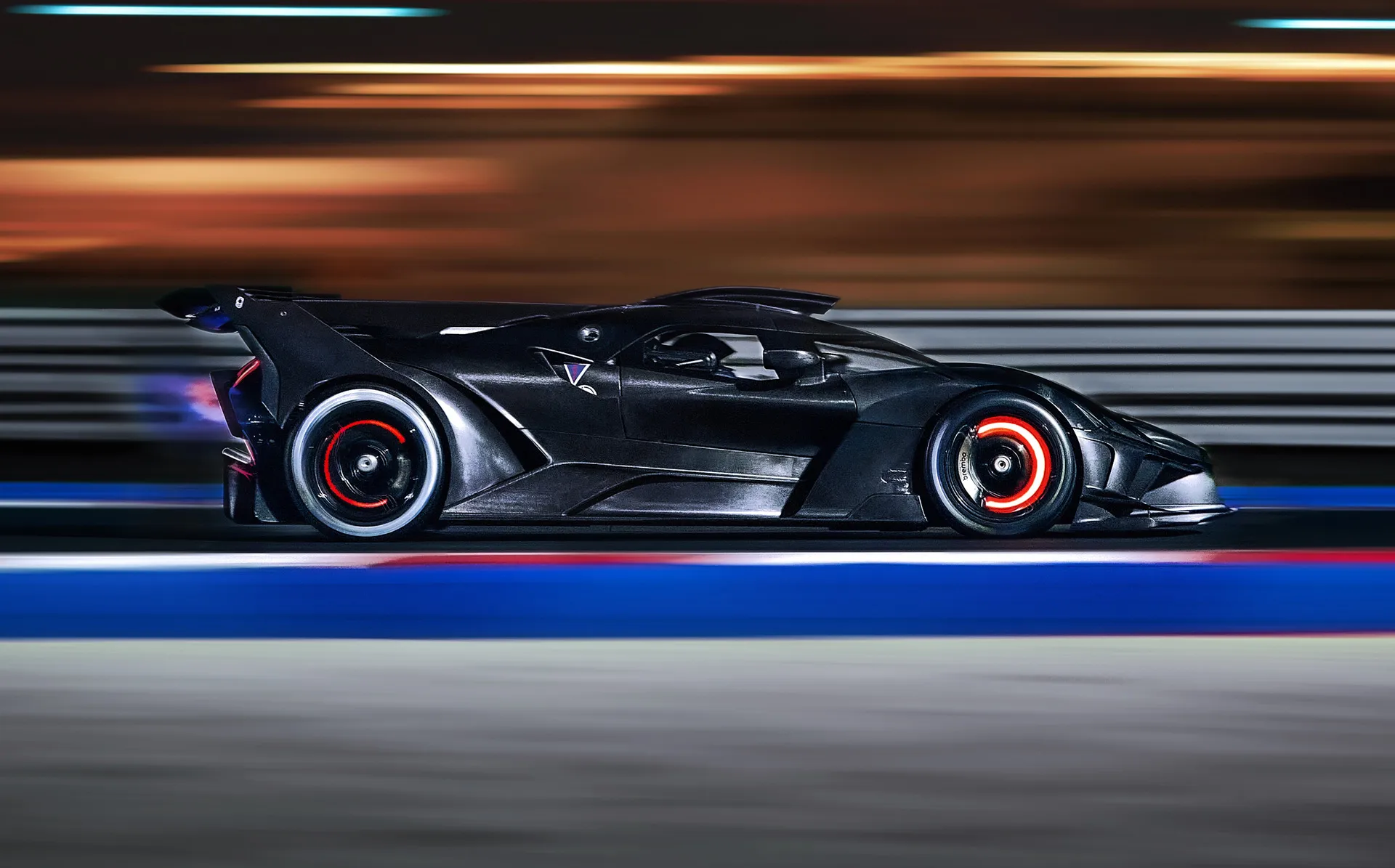
Bugatti is the final stages of development for its Bolide track car, which is due to start deliveries later this year.
The car is the production version of the Bolide concept first shown in 2020, and remarkably the design is very close to the original concept, which was never actually intended for production. It was the result of a challenge put forward by then-Bugatti chief Stephan Winkelmann to his team to imagine a Bugatti developed without restraint.
That best describes the production version as well, as the Bolide features elements not seen on any other car, an example of which is Brembo’s biggest carbon-carbon brake system yet.
Carbon-carbon brakes are used in Formula 1 cars and top-level endurance racers, and are very different than carbon-ceramic brakes found on many high-performance cars today. One of the first applications was the brake system for the Concorde supersonic jet.
Bugatti Bolide’s Brembo brake package
As the name implies, carbon-carbon brakes feature rotors made from carbon-fiber-reinforced carbon. The material is designed to handle high heat and is the stuff that was used on the nose cone and wings of the Space Shuttle to prevent it from burning up upon reentry to the Earth’s atmosphere.
Brembo spent around two years developing the brake system for the Bolide. The resulting design consists of two 8-piston monobloc calipers machined from aluminum and coated in nickel up front, both equipped with high-performance pads and carbon rotors measuring more than 15 inches across. Similar size rotors feature at the rear, clamped down by 6-piston calipers.
Thanks to the carbon construction, each rotor weighs just seven pounds, while delivering ideal heat dissipation even when driving at the limit, meaning no brake fade on long track days.
Air flow was also an important factor in achieving the performance targets for the brakes. In this regard, Brembo engineers worked closely with Bugatti’s design team to arrive at a specific design for the brake air ducts. The targets included directing up to 90% of the air exiting the ducts to the rotors and pads, and the remainder to the calipers.
The brakes aren’t simply overkill. They are needed to handle the extreme performance of the car’s powertrain. The Bolide uses Bugatti’s familiar quad-turbocharged 8.0-liter W-16, but here the engine is tuned to deliver 1,578 hp on 98-octane fuel. It can also run on 110-octane racing fuel, which ups the output to 1,824 hp.
As the car is designed for track use, all four turbochargers are always in operation, and the engine has also been tuned to rev higher than in road-going Bugattis. The engine also gets mated to an upgraded version of the 7-speed dual-clutch automatic found in the road cars. As always, power goes to all four wheels.
The dry weight for the Bolide is a little under 3,200 pounds, and performance should be on par with top motorsports levels, according to Bugatti.
Bugatti will build a total 40 examples and all build slots are gone, despite the price of 4 million euros (approximately $4.3 million). The Bolide together with the Mistral roadster are the last cars to feature Bugatti’s W-16 engine. Bugatti plans to show the Chiron’s successor this year, a car that will introduce a new hybrid powertrain.
Which automaker pushed an important EV target back by five years?
Which brand is at least considering adding artificial engine vibration to its EVs?
This is our look back at the Week In Reverse—right here at Green Car Reports—for the week ending February 23, 2024.
In a first drive of the 2024 Honda Prologue EV, we found that this roomy, refined, and feature-packed electric crossover fits in just fine as an establishing statement toward flashier Honda EVs arriving in the near future.
2025 Porsche Panamera 4S E-Hybrid
The new-generation 2025 Porsche Panamera plug-in hybrid lineup revealed this week mixes in more electric miles, gets quicker acceleration, and gains an active suspension system, among its many improvements.
The legions of legacy automakers announcing delays to their EV plans grew again this week, as Mercedes-Benz delayed its EV targets announced earlier in the decade. While it had planned for EVs and hybrids to make up 50% of its sales by 2025, it now expects to hit that target in 2030. It also appears to have scrapped its plan to only sell EVs by 2030 where market conditions allowed.
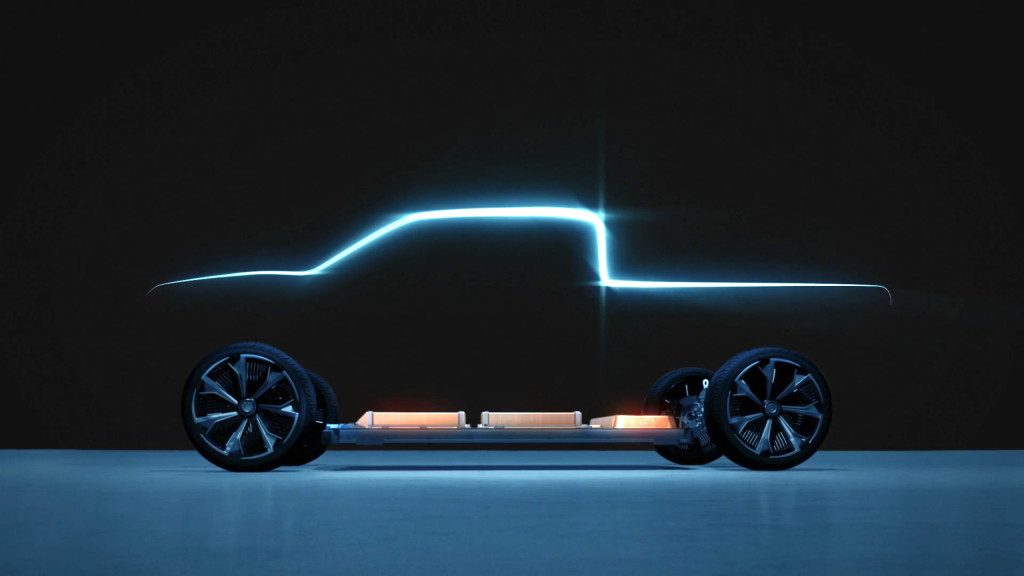
GM electric pickup silhouette – from 2020 Ultium platform preview
Further, GM is reportedly rushing plans for full-size plug-in hybrid pickups, as it pivots away from a new generation of electric vans and a smaller electric pickup. And Hyundai’s Genesis may not shift to fully electric on quite the timeline it’s been detailing in recent years, according to a report from South Korea. A report, citing insiders, suggests that the luxury brand now plans to add hybrids next year, whereas it had previously said all additions to the lineup from 2025 on would be EVs or hydrogen fuel-cell models.
Ford on Tuesday cut Mustang Mach-E EV prices by up to $8,100. The price adjustment brings base versions of remaining 2023 stock to $41,695, or about $2,700 less than the entry Tesla Model Y. A bonus cash incentive also chopped up to $12,500 off F-150 Lightning electric trucks.
2025 Volvo EC40 (Europe spec)
Volvo, on the other hand, has recently reaffirmed its plans to go all-electric by the end of the decade, and on the way there it’s retiring its Recharge badge for plug-ins. That means adding two new EV badges to align the old with the new—recasting the XC40 Recharge and C40 Recharge as the EX40 and EC40, respectively. Volvo also later in the week clarified exactly how it will shed most of its stake in Polestar, as the EV startup struggles and has become, as some have observed, a drag on Volvo resources.
According to several reports from earlier in the week, the Biden administration is considering pulling back on stricter emissions rules, so as to give full-line automakers more time to ramp up EV production levels and produce more gas-guzzlers. The tweaks would reportedly “slow the pace at which auto manufacturers would need to comply,” pushing sharper gains to 2030 and beyond.
Ready for a European vacation? The Volkswagen ID.7 Tourer electric station wagon revealed Monday looks all set for a family road trip—and with the three-row ID.Buzz coming here later this year, it’s hard to imagine this attractive electric wagon being U.S.-bound anytime soon.
2025 Volkswagen ID.7 Tourer
According to a patent filing made last year and recently found via a Mopar fan site, parent company Stellantis may be considering more than just noisemaking for its screaming-loud electric muscle car, now due for a reveal March 5. A so-called “Active Vibration Enhancement” system might potentially provide a muscle EV with the shake of a V-8.
Sono Motors is undergoing something of a revival, post bankruptcy, with a solar electric bus kit aimed at converting commercial vehicles. But there’s no mention of the Sion solar EV project, which had previously appeared to be for sale. As of this weekend, the company still hasn’t responded to Green Car Reports regarding the status of the program or its potential sale.
Sono Sion and other vehicles equipped with Sono solar panels
Before the end of the decade, EVs may be cheaper than gas models. According to a study out this week from the International Council on Clean Transportation (ICCT), a glut of lithium plus Biden policy will result in lower battery prices and, most importantly, much lower EV sticker prices relative to gasoline vehicles. The affordability gains will happen even without Biden incentives, just more slowly.
And as misinformation spreads about EV sales being down, send your friends to an easy-to-read chart—showing that 2023 EV sales blew past 2022 levels every single month of this past year.
As EV charging infrastructure expands, lawmakers in the Kentucky legislature have introduced a bill to “protect” gas stations, local television station WKYT reports.
House Bill 581 seeks to prevent zoning authorities from treating EV charging differently from gasoline dispensing. That means any location considered suitable for EV charging would also have to host gas stations.
“For an ordinance to say that you can build an electric charging station, but you can’t build a gas station or a retail gas station, we feel like that is discriminatory,” Republican state representative Ken Upchurch said in an interview with WKYT.
But with gas stations still vastly outnumbering EV charging stations, it’s unclear what form that discrimination is taking. According to U.S. Census data there are more than 110,000 gas stations nationally, whereas according to the Department of Energy there are 61,700 publicly accessible charging stations.
Fast-chargers capable of anything close to gas-station fueling speeds are few and far between. Nearly 54,000 of those public charging stations are just Level 2, good for all-day or overnight EV charging, many of which might be seen as 240-volt appliances and extensions of the existing residential or commercial power grid, with no additional buildout required.
Proposed streetlight charging station for Kansas City (via Kansas City MEC)
“While Representative Upchurch said the bill is an important step at preventing electric vehicles from being favored over gas ones, proponents of electric vehicles said they are confused about the intent of the bill,” WKYT noted.
Provided the legislators are referring to fast-charging stations, the thing that makes EV charging different is that there’s no huge underground tank of flammable liquid to accommodate—just, in some cases, a boost battery where the grid isn’t up to the task.
Restrictions on the storage and dispensing of flammable liquids aren’t an issue for EV chargers, and it doesn’t take regular tanker-truck visits to keep them primed. Yet the lawmakers appear to be arguing that if an EV charging station is allowed in a residential neighborhood, a gas station should also be allowed.
It’s unclear from the bill where the line might be drawn. For instance, if curbside EV chargers are installed in residential neighborhoods, as in Seattle, does that mean a city also has to say yes to tiny residential gas stations?
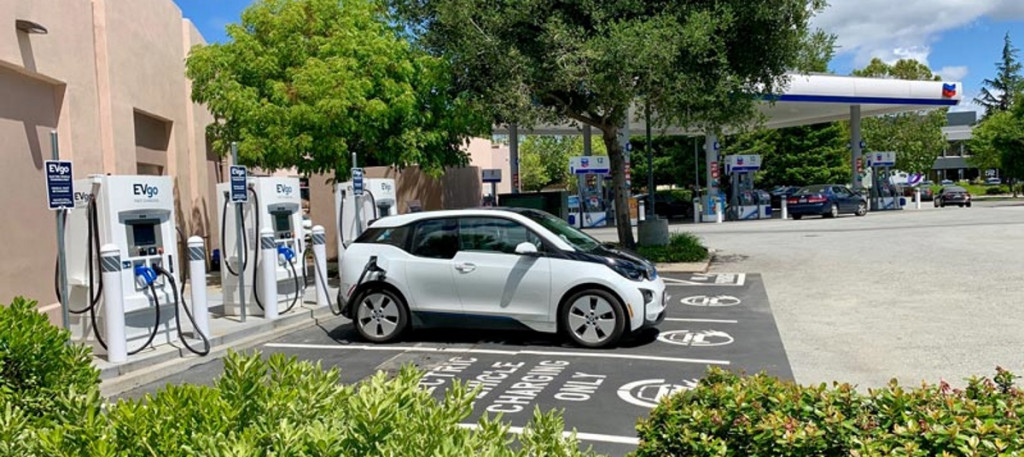
BMW i3 charging at EVgo fast chargers at Chevron station in Menlo Park, California
So far, though, the development of EV charging infrastructure seems to be heading in the other direction.
Most of the charging stations that are part of the Biden administration’s National Electric Vehicle Infrastructure (NEVI) buildout actually dolook more like gas stations than charging stations of the past—and many are actually at gas stations—with only a handful of exceptions so far. Another recent study suggested that the gas-station template really isn’t far from the mark, and EV drivers want traditional gas-station perks.
Delivery Hero has announced that talks between it and Grab over the sale of its foodpanda Southeast Asian business to the latter have ended, Business Times reports. In a statement, the German multi-national online food ordering and food delivery company said it had terminated discussions on the potential sale, without naming any parties.
This comes following weeks of speculation on whether the deal would be struck. Earlier this month, it was reported that Grab’s bid for the foodpanda’s Southeast Asian business had fallen through, with the talks having collapsed due to issues concerning pricing. This was then denied by Delivery Hero, which said that negotiations for the potential sale were still ongoing.
In its announcement, the Berlin-based company said that at the start of the month, it remained optimistic that it would reach agreeable terms to ink a deal. “At that time, the company believed it had reached an alignment with the potential buyer on the fundamental terms regarding the sale of the business. However, Delivery Hero took the decision to withdraw from negotiations as this is no longer the case,” its statement read.
News of the potential sale first emerged last September, when German business magazine Wirtschaftswoche reported that Delivery Hero was in negotiations to sell the foodpanda brand in the region to Grab for more than one billion euros (RM5.1 billion).
While its Asia business – which covers Singapore, Malaysia, Philippines, Thailand, Cambodia, Myanmar and Laos – is Delivery Hero’s largest market, growth has dropped since pandemic lockdowns eased, and the company was said to be looking to focus on profitability following years of heavy investment.
Delivery Hero said it remains open to mergers and acquisitions and will continue to assess potential strategic alternatives, but added that it will only proceed with negotiations where there is a high certainty of closing a deal.
It’s safe to say that BYD has set the country alight with the Seal, an electric sedan that goes toe-to-toe with the ever-popular Tesla Model 3. The Chinese company has been quite aggressive with its latest model, particularly in terms of pricing.
Doubtless, there will be those of you who will be wondering how the BYD compares against the Tesla in terms of price, size and bare numbers. Here, we’re taking a closer look at how the Seal stacks up against its fiercest rival.
Pricing: Seal undercuts Model 3 considerably
We’ve been eagerly awaiting pricing for the Seal since it was confirmed it would be coming to Malaysia, and now that it’s here, it’s clear that BYD isn’t messing about. Prices are as follows:
BYD Seal Premium RWD – RM180,430 on-the-road without insurance
BYD Seal Performance AWD – RM200,430 on-the-road without insurance
As such, the Seal Premium RWD undercuts the Model 3 LR (RM190,700) by more than RM37,000. Meanwhile, no Model 3 Performance competitor for the Seal Performance AWD has been launched, yet the Seal Performance AWD is over RM19,000 cheaper than the Model 3 Long Range AWD (RM219,700), and you get more performance to boot.
Dimensions: Model 3 is smaller but more practical
Given that the Seal has been designed to compete with the Model 3, it’s no surprise they are largely the same size. However, the Chinese car edges out its Chinese-built American rival ever so slightly, being 80 mm longer and 19 mm taller; the Tesla counters by being 42 mm wider.
This advantage should give the BYD greater interior room compared to the Tesla, although the Model 3 is by no means cramped inside. But if luggage space is what you’re looking for, then the Model 3 has a slight edge, both in terms of the rear boot (425 litres vs 400) and especially the front (88 litres versus 40). The fact the Seal even has a front boot, however, is noteworthy, especially as the Atto 3 and Dolphin don’t have one.
Performance and range: Seal is faster, Model 3 can drive further
Tesla is known for providing a staggering amount of performance for your money, but it’s been upstaged by BYD here. The Seal Premium RWD makes 313 PS and 360 Nm of torque and is able to sprint from zero to 100 km/h in a claimed 5.9 seconds.
Meanwhile, the Performance AWD variant churns out 530 PS and 670 Nm from its dual motors, enabling it to complete the century sprint in just 3.8 seconds. That’s six tenths of a second quicker than the Model 3 Long Range AWD. To be fair, the Seal Performance AWD is more of a competitor for the Model 3 Performance, which in its latest Highland guise isn’t out yet. We’d expect the latter to be significantly more expensive.
The cheapest Seal is the one that has the most range (as the 82.5 kWh LFP battery comes standard). Even so, the Model 3 Long Range comfortably beats the Seal Premium RWD with a range of 629 km, versus 570 km for the BYD (both figures are WLTP) – despite the fact it has all-wheel drive.
Charging: Advantage Tesla
Charging times are inconclusive as Tesla doesn’t provide any figures for the Model 3 (only that its 250 kW DC Superchargers are able to provide up to 282 km of additional range in 15 minutes). But the car can accept a higher amount of DC fast charging power than the Seal (170 kW vs 150 kW), the latter taking 37 minutes to charge from 10 to 80%.
The Model 3 will also charge quicker when plugged up to an AC charger, as it can support up to 11 kW, compared to just 7 kW for the Seal. The latter takes a staggering 15.2 hours for a full charge.
And that’s with the right 7 kW single-phase charger. If you use an 11 kW or 22 kW three-phase charger thinking it’ll be faster, the Seal’s onboard charger will step down to between 3.5 and 3.7 kW, meaning that it will take twice as long (more than a full day) compared to a technically slower 7 kW charger. Electric vehicles with a three-phase 11 kW (like the Tesla) or 22 kW OBC don’t suffer from this issue.
It also goes without saying that only the Model 3 can use Tesla’s Supercharger network as well as its Destination Chargers.
Maintenance: Less servicing with Model 3, but shorter warranty
It’s here where you really see the difference between Tesla’s unconventional attitude to maintenance and BYD’s more traditional approach. The former hardly has a service schedule at all, simply recommending you to replace your cabin air filter every two years and an air-con desiccant bag replacement and brake fluid check every four years.
Tesla does not provide any pricing details on its Malaysian website, nor the cost of a replacement cabin air filter, which is user-serviceable. However, the Tesla Shop in the US lists the latter at US$17 (RM81) at the time of writing. We assume all these maintenance jobs (along with tyre rotations, recommended every 10,000 km) can be done by third-party workshops, although Tesla warns this may affect warranty coverage.
By contrast, BYD will sell you various service packages to keep you in its after-sales network. The Standard package includes tyre alignment, single-speed transmission oil service, air-con filter replacement and refrigerant service, brake fluid service, motor coolant service. This is priced at RM2,688 for three years, RM6,288 for six years and RM8,288 for eight years (add RM200 each for the Performance AWD model).
BYD Seal service packages
Alternatively, you can purchase a Plus package that throws in replacements for wipers, washer fluid, remote control and 12V batteries, and brake pads and discs. This is very expensive, weighing in RM11,488 for six years and RM17,488 for eight years. As yet, BYD has not released a schedule for these replacements, nor has it confirmed if servicing your car at its service centres is required to maintain warranty coverage.
Speaking of which, Tesla’s more lenient maintenance schedule means you get less warranty coverage – just four years or 80,000 km for the vehicle, compared to six years or 150,000 km for the BYD. The Model 3’s battery and drive motor warranty is at least competitive with the BYD, with the same eight-year/160,000 km coverage (the BYD’s warranty for the drive motor is only up to 150,000 km).
What else?
BYD Seal (left), Tesla Model 3 (right)
If you’re looking for the car with the most value for money, the Seal trumps the Model 3 hands down. The kit list is basically identical across both variants, including full-LED lighting, massive 19-inch alloy wheels, flush pop-out door handles, a 10.25-inch digital instrument cluster, a novel rotating 15.2-inch infotainment touchscreen, powered leather seats, a glass roof, a 12-speaker Dynaudio sound system and a 360-degree camera system.
You also get a full suite of driver assists, such as autonomous emergency braking, adaptive cruise control and lane centring assist, plus nine airbags that include rear side and driver’s centre airbags.
By contrast, you have a lot of option boxes to tick with the Tesla, such as alloy wheels (lowly 18s as standard), colours (only white is free) and even the choice of Autopilot (normal, Enhanced or the dubious Full Self Driving). On the plus side, even the standard Autopilot is one of the best in the business, as are the standard 15.4-inch front and eight-inch rear touchscreens. No stalks, however, so there’s that.
The wallywhy150 has a similar profile to the wallywhy200
Following the arrival of Asia’s first wallywhy200 in Singapore last year, Wally is set to enjoy an even higher profile in the region this year with the arrival of at least two units of the new wallywhy150.
Since debuting in Italy at last year’s Venice Boat Show, the 24m wallywhy150 earned plaudits in France at the Cannes Yachting Festival, Europe’s biggest in-water show, before making its US bow at the Fort Lauderdale International Boat Show, the world’s biggest.
Coming up this year is the model’s Asia premiere, with hull two expected to be delivered in May after being sold by Speedo Marine to a client who plans to use it between the likes of Shenzhen and Hong Kong. As on hull one and most subsequent builds, hull two will feature the wallywhy200-inspired main-deck master suite, which offers 270-degree views around the towering bow.
The wallywhy150 is shown with a power-grey hull
However, the space will be used for a dining room on Asia’s next hull, which is scheduled to arrive in Hong Kong through Ferretti Group Asia Pacific in late summer. Both units destined for Asia have the upgraded option of three Volvo Penta D13-IPS1350 (1000mhp/735kW) engines, which give the yacht a top speed of 23 knots, a cruising speed of 20 and a 1,000nm range at 10 knots.
Stefano de Vivo, Wally’s Managing Director, said: “Our goal was to anticipate market demands by developing a yacht capable, once again, of being ahead of its time, starting from those innovative features that made the wallywhy200 successful.
“The wallywhy150 is a flexible yacht, ideal for experienced owners who understand and appreciate the skilful use of space, considerable living areas and its unmistakable personality. We’re sure the wallywhy150 will establish itself in the most diverse international markets.”
The yacht has a two-deck-high bow and stealth-like flybridge superstructure
Familiar Shape and Style
Look from the side and the 78ft wallywhy150 looks much like the 88ft wallywhy200, with an almost identical profile to the 200GT ‘big sister’ that kick-started the why (Wally hybrid yacht) series, which features models numbered after their volume.
Like the wallywhy200, the wallywhy 150 features a full-length widebody design – so no side passages on the main deck – and is fronted by the almost vertical bow rising the height of two decks. Again, each side features two long, parallel strips of dark glazing that run below full-length ‘bulwarks’ in the chosen hull colour.
“In the next 20 years, I think that this shape of boat will be much more common because when you come inside and see the volume, you understand why,” de Vivo says.
The beach club leads into the saloon; the aft flybridge offers fixed and loose furniture
Also like her big sister, the wallywhy150 is topped by an angular, stealth-like flybridge superstructure that only Wally could design, although this time it’s an open design without an enclosed skylounge.
Furthermore, the proportion of length and width is almost identical. In fact, the wallywhy150 initially just looks like a slightly smaller edition of the wallywhy200 – until you approach the aft deck.
Open Terrace and Flybridge
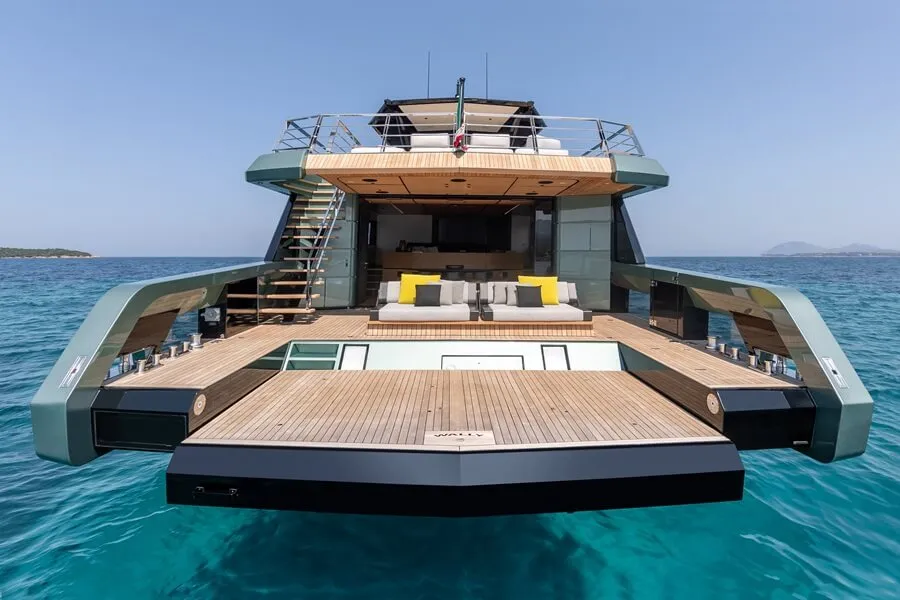
Instead of a beach club dominated by two raised garages accessed by drop-down sides, the wallywhy150 has a large, clean aft deck described by Wally founder Luca Bassani as a “terrace on the sea”, a concept he popularised on the Tiketitan and Tiketitoo sailing yachts over two decades ago.
The aft deck can deploy a 3.9m tender on a high-low platform with integrated steps
The aft terrace features a high-low platform that can deploy a tender up to 3.9m (12ft 8in) and has integrated steps to port. Just forward are fitted low sofas with adjustable backrests, so guests can enjoy the sea views including through the glass-panelled bulwarks, or face forward into the remarkable split-level saloon.
To port of the sofas are steps to a fantastic flybridge, the yacht’s other major outdoor social zone. Sheltered under the end of the hard top, an attractive three-sided sofa takes centre stage and faces a clean, aft deck that can be dressed with sunpads and loungers offering clear views through wraparound railings.
Forward of the sofa is a wide wet bar, which is flanked by Y-shaped hard top supports and serves a covered dining table offering breezy alfresco dining for eight. Most of the upper deck offers guests panoramic views, even forward, where the recessed pilothouse is set four steps down and feels like a different planet.
The flybridge’s covered dining table, as seen from the wheelhouse
Featuring two high-backed, Poltrona Frau helm seats and three Simrad screens, the enclosed control room recreates the Darth Vader vibes of the wallywhy200’s wheelhouse, with an almost all-black décor only interrupted by a light daybed on port side. You can also enjoy a front-on view of the pilothouse from the foredeck, a working area accessed by a low door starboard of the dining table.
Split-level First
If the terrace on the sea and open flybridge are notable differences to the wallywhy200, the saloon is also different. In fact, the double-height saloon is not only a first for Wally but also Ferretti Group.
On most motor yachts, the aft platform is well below the cockpit, but on the wallywhy150 it’s on the same level as the saloon, so a vast indoor-outdoor terrace is created when all the doors electronically slide out of sight. When needed, stoppers can be raised to create a seaworthy barrier.
Entrance to the two-height saloon, with both levels offering enough space to feature a lounge, dining, bar or galley
“This is the first vessel with direct access to the sea at cockpit level with no stairs necessary,” says Bassani, Wally’s Chief Designer. “It’s effectively a floating loft on the water.”
The interior by Studio Vallicelli Design immediately stands out due to a 2.5m-high, ribbed-teak ceiling that rises like a wave above the saloon’s upper level, which is reached by four steps on either side. The lower and upper levels can feature an array of furniture and Ferretti Group has already designed multiple arrangements.
The lower level has an oblong dining table on hull one, a wide bar with bar stools for an upcoming US delivery, and low-slung loungers for the second Asia-bound hull, which has the dining room in the forward suite. De Vivo’s own ideas include bringing the outdoor vibe inside and continuing the unpolished teak decking into the lower level.
The saloon’s upper level offers sea views above a cabinet with high-low, double-sided TV
The upper level typically features an aft-facing sofa or sofas. On hull one, a large Edra sofa offers guests views of the aft terrace and sea, plus a central cabinet with a retractable, double-sided TV.
“As the beach club is on the same level as the saloon, it becomes so much more useable as you’re fully engaged with everyone inside. Even on the upper level, you’re overlooking the beach club and sea,” he says. “There are so many ways to arrange the saloon, so you almost want to have three or four boats just to try them all.”
Supreme Master Suite
In the forward bulkhead, a central door leads to a four-sided galley, the laundry facilities and stairs down to two crew cabins with en-suite bathrooms in the bow. The galley can also be designed in an open style, visible from the saloon.
The main-deck master is a signature offering, offering sensational 270-degree views
The upper saloon also has a starboard door to the master suite, where a long hallway by the windows passes cupboards in fluted panelling before the door to the near full-width, twin-sink bathroom. Going beyond the bathroom door leads to one of the wallywhy150’s ‘wow’ moments.
Described as an “amphitheatre of the sea”, the symmetrical, spaceship-style bedroom offers spectacular views through windows wrapped around the bow and both sides of the room.
“All visitors love it, especially the ladies. They say, ‘Wow, yeah, I like this’,” Bassani smiles. “If the wives or girlfriends like it, then it’s a very positive sign.”
Aft view of the master suite; clients can choose to use the space as a dining room
The guest cabins are on the lower deck. The standard layout includes two en-suite cabins midships, with an inward-facing double bed to port and forward-facing twins to starboard, while the forward,
full-beam VIP has a bed facing port to a large bathroom. Wally also offers the option of two full-beam VIP cabins by combining the space of the two midships cabins.
Overall, the wallywhy150 features many of the best bits of the wallywhy200, but offers a novel way to live on the water, with a huge aft terrace leading straight into a game-changing, double-height saloon.
“We tried to make the wallywhy150 a bit different from the wallywhy200 and we’re happy we had the chance to change the concept a bit,” Bassani says. “We needed something smaller as the wallywhy200 was too big for some people walking onto an 88ft motor yacht because it has the space of a 115-footer.
Three lower-deck guest cabins include a midship double to port
“A lot of people prefer the wallywhy150, but that’s expected because the wallywhy200 was the first to introduce the look and concept of the wallywhy series, so people understand it better and are more familiar by the time they see the wallywhy150. There are many reasons why the wallywhy150 is so popular.”
Photos by Gilles Martin-Raget & Toni Meneguzzo
www.wally.com www.ferrettigroupasiapacific.com
This article was first published on yachtstyle.co.
For more on the latest in luxury yachting stories, click here.
The month of May brought some not-so-great dining experiences my way. However, I won’t write about them. Many years ago when I owned my own restaurants in New York City, a Japanese journalist came to feature one of my locations. She told me that in Japan it is not common practice to write subjectively about an establishment because a reporter’s negative opinion can jeopardize a business. Following Buddhist principles, in Japan, they steer away from writing anything that can hurt someone’s livelihood. This stuck with me. So when I absolutely dislike a restaurant, I don’t write about it altogether. Although a couple of restaurants I was really excited about checking out this month failed my expectations, there were several others that brought a wonderful dining adventure into my San Diego culinary journey. Exploring new restaurants has not only provided me with marvelous foodie memories but doing so has also introduced me to many charming neighborhoods in this beautiful city. Eating is more than just digesting, it’s a way of life that connects you to other cultures, brings you closer to your dining companions, and gets you into parts of your city that you may not visit otherwise. Let’s delve into some of my May discoveries together. Bon Appetito!
From the moment I stepped into the lobby of the Machester Financial Center I knew that just twelve floors up, a special gourmandizing expedition was awaiting. Upon walking into Mister A’s you will be immediately tantalized by the breathtaking 180-degree views of the San Diego skyline, the well-dressed patrons, and the superior attention to detail which includes the staff’s uniform matching the blue hue of the table linens. Formal, but not stuffy, the service is on point attending to every detail without interrupting too often. The French-American menu offers a delicious array of options. Our favorites were the beet salad, lobster pot pie, wagyu ribeye, and truffle fries; all outstanding and perfectly prepared. Enjoying a delightful dinner, while overlooking downtown San Diego, and counting the airplanes that make their descent into the nearby airport, as the sun begins to set, with The Gypsy Kings playing in the background, is my idea of a heavenly dinner. Add this to your list.
This bustling, expansive Mission Hills restaurant, proudly serves wood-fired seafood and a plethora of raw bar options in a non-pretentious environment. Clearly, the focus here is on delivering innovative, clean, and extremely flavorful cuisine. Highlights here are the Kanpachi ceviche prepared in a spicy red curry with peanuts and Thai basil; the albacore poke blended with ponzu, Asian pear, shisho, and furikake crunch; the Ahi tartare perfectly paired with cured egg yolk, crispy shallots, and smoked oyster mayo with a serving of buttered brioche for dipping needs; the hearth roasted carrots mixed with quinoa, pickled fennel, smoky yogurt, and fresh tarragon; and the fire-grilled branzino topped with fried herbs and salsa verde. These are all outstanding options. I recommend avoiding the scallop aguachile- we couldn’t get past one bite due to its overwhelming fishy flavor. The service here is very attentive – perhaps too attentive. The waiters kept removing the menu from our table that I wanted nearby. I am sure they just wanted to make more room for all the dishes we were tasting but the cute dance of asking for a menu that kept being taken away got a little annoying. However, they did call us two days later to notify us that my husband left his sunglasses there and loyally held onto them until we were able to pick them up a couple of weeks later. Overall, we had a superb time eating here and I was constantly amazed by how well-prepared, healthy, and delicious each dish was.
Although the ambiance is a little lacking here, mainly because it was empty, every bite of each dish we ordered off the menu was truly fantastic. The kitchen takes pride in its wood-fired creations, which are actually a specialty here. The crispy shrimp, charred cabbage, and corn cake skillet are out-of-this-world kind of good. I could not get myself to ignore my knowledge to share fairly with our dinner guests; I had no control over my fork pulling itself towards the plates and back into my mouth. The homemade pappardelle in mushroom ragu is also a solid option while the Baja striped sea bass offered a lot of promise but was a tad too dry. The major con here is that our table was stripped down by 9:15 pm by the eager staff wanting to go home. In my opinion, when you add a 5% surcharge to the check, you do not kick out your patrons. That being said, make an early reservation and you won’t hit this hiccup, perhaps earlier there are more diners to liven up the space as well.
Hidden Fish is a hidden gem. This tiny thirteen-person sushi bar serves an extraordinary sixty-minute, eighteen-piece, Omakase at $135 per person. Enjoy the freshest seafood delivered daily from Japan’s best fish markets while watching the sushi chef whip up remarkably creative bites with his impeccably manicured hands. During the omakase, we ate our way through snow crab, sea bream, fluke, barracuda, striped jack, jack mackerel, striped sea bass, golden eye snapper, striped bonito, yellowtail, salmon, albacore, amberjack, black cod, bluefin tuna, uni, O Toro, and tuna tartare. Each bite was sprinkled with its own unique ingredients (like black truffle, yuzu pepper paste, chimi-churri, and roasted sesame seeds. Each delicate piece is meant to be eaten by hand. Although chopsticks are offered, we didn’t use them once. Service is stellar with eight people on staff for thirteen guests. We were lucky and had the owner and executive chef serve us which added to the special vibe at the bar. The excellent quality of the ingredients is worth the ticket price although the quick one-hour, in-and-out experience, takes away from the overall mood. There is no lingering around here over a meal. I’ve been on the prowl for superb sushi in San Diego. Hidden Fish would have ended my hunt if the pace was a little slower and allowed for lurking just a little longer at the sushi bar.
This new coffee shop is a welcomed addition to the Bird Rock neighborhood of La Jolla. Adjacent to the swanky Paradisaea eatery, DoDo Bird provides an equally beautiful space in line with the tropical theme next door and highlights a curated selection of donuts (although I am not sure who eats donuts anymore?) This is not your regular local cafe, it’s a step up in terms of elegance and it is a great option to hunker down with your laptop and get some work down. Their iced lattes are delicious and the staff is friendly. The only downside is that they are closed on Mondays and Tuesdays, which I learned the hard way by showing up on both of these days to get my caffeine fix.
This bar may not be where you’d head in search of an inspiring menu per se, yet it’s definitely a place to check out for its lively scene, great ocean views, and just a fun overall vibe. Evenings are packed with the post-office crowd and friends meeting to mingle to throw back some drinks after a long day. Tables with a view are hard to snatch although any seat in the house works just as well for an overall good time. They do not accept reservations.
Each month I pinch myself. How lucky am I to live in a city with such a robust culinary scene? My list of restaurants to scope out continues to grow, as does my calorie count, yet I wouldn’t have it any other way. I wonder how long it would take me to actually eat through San Diego. This may be a lifelong mission.
Rivian is developing software that would allow its EVs to be free-wheel towed, according to a patent filing.
Free-wheel towing is when a car is towed behind another vehicle with all four wheels on the ground. It’s a common practice for RV owners, who often tow cars behind their motorhomes so they have a way to get around when they reach their destination.
In the patent application in question, which was published by the United States Patent and Trademark Office (USPTO) on Feb. 13 (but filed on May 12, 2021), Rivian proposes adding a software mode for free-wheel towing to its electric pickup trucks and SUVs, alongside the various drive modes and other software-enabled features already available.
Free-wheel towing mode would disconnect the motor or motors that normally power the rear wheels, but keep the front-axle motor or motors engaged. Torque would still be applied to the front wheels to keep the vehicle from rolling out of sync with the tow vehicle. Software would use a vehicle’s existing sensors to measure wheel speed and gradient, applying torque when necessary and cutting it off at a predetermined threshold.
Rivian free-wheel towing patent image
It’s unclear if Rivian will add this feature to production EVs, but it won’t have to wait for a refresh or redesign to do it. Like Tesla, Rivian adds new features via over-the-air (OTA) software updates, such as the Snow mode that joined other drive modes on the R1T and R1S in 2022, or Camp mode, designed to automatically level vehicles at campsites.
Rivian’s next production model, the R2, is scheduled to debut on March 7. It’s an electric SUV that’s expected to be smaller and cheaper than the R1S, but won’t enter production until 2026.
The technical storage or access is strictly necessary for the legitimate purpose of enabling the use of a specific service explicitly requested by the subscriber or user, or for the sole purpose of carrying out the transmission of a communication over an electronic communications network.
Preferences
The technical storage or access is necessary for the legitimate purpose of storing preferences that are not requested by the subscriber or user.
Statistics
The technical storage or access that is used exclusively for statistical purposes.The technical storage or access that is used exclusively for anonymous statistical purposes. Without a subpoena, voluntary compliance on the part of your Internet Service Provider, or additional records from a third party, information stored or retrieved for this purpose alone cannot usually be used to identify you.
Marketing
The technical storage or access is required to create user profiles to send advertising, or to track the user on a website or across several websites for similar marketing purposes.