

Quick Facts About Car Prices
New car prices began falling in recent months but now appear stuck in neutral, even as consumers see plentiful dealer inventory and more buying incentives.
In the last several years, car shoppers have become accustomed to paying more than the manufacturer’s suggested retail price (MSRP). They watched car prices rise with no apparent end in sight. The situation left many shoppers scratching their heads, and the question our experts hear most is, “When will new car prices drop?”
New vehicle price inflation all but disappeared by the end of 2023. That’s great news on its face. Still, car prices have increased dramatically in the past three years. Read on for guidance if you want to purchase a vehicle. We can equip you with the best information from our experts. We dig deeper to answer concerns about car prices.
New Car Prices Remain Elevated
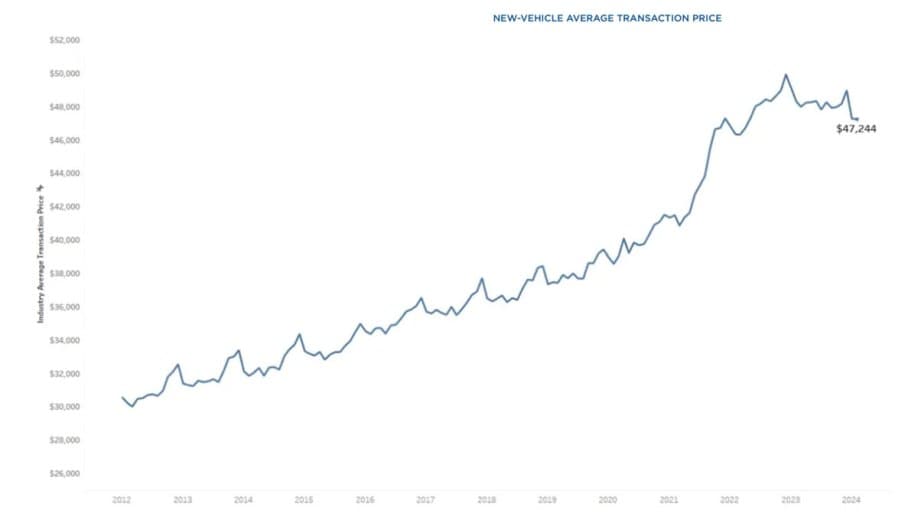
According to Kelley Blue Book data, the average transaction price (ATP) for new cars was $47,244 in February. Cox Automotive analysts calculate a 2.2% drop year-over-year as downward price pressure favors car shoppers. Cox Automotive is the parent company of Kelley Blue Book.
“While everyone may applaud that prices are coming down, even marginally for the moment, affordability is still challenging the market,” said Erin Keating, executive analyst for Cox Automotive. “Most shoppers have not seen their incomes increase as quickly as vehicle prices, so affording a new vehicle remains difficult. We should also note that despite rising inventory, which is good for consumers, the levels are muted, not alarming.”
Average transaction prices remain $6,600 higher than in February 2021 as the realities of the COVID-19 pandemic seemed never-ending. At that time, average transaction prices for new vehicles were 14% lower at $40,630.
Manufacturer incentives increased to an average of $2,787 in February. More on that in a bit.
Vehicle Pricing Breakdown
- Non-luxury vehicle prices: In February, car buyers paid an average transaction price of $44,052. Overall, prices dropped 2.1% year-over-year.
- Luxury vehicle prices: The average transaction price was $61,424 for luxury vehicles. Luxury vehicles make up about 18% of total vehicle sales. Luxury prices dropped by more than 6% year-over-year.
- Electric vehicle prices: The average transaction for a new electric car is $52,314, down 12.8% from a year ago. The Tesla Model Y, the electric car industry’s volume leader, saw its average transaction prices drop by about 16% compared to February 2023. Model 3 prices were lower year over year by 12% and near the lowest level on record.
“Our research continues to show that price remains a significant barrier for consumer adoption,” said Stephanie Valdez Streaty, director of Industry Insights at Cox Automotive. “While the higher inventory levels and increased competition continue to drive down the price premium of EVs, it’s important to acknowledge that EVs remain priced above mainstream non-luxury vehicles by nearly 19%.”
What Drives New Car Prices
- Inventory availability
- Manufacturer incentives
- Dealer discounts
- Trade-in vehicle value
All four of those factors experienced significant disruptions in the past several years.
New Car Inventory Update
Dealerships measure their stocks of new cars to sell in a measurement called “days of inventory” — how long it would take them to sell out of new vehicles at today’s sales pace if the automaker stopped building new ones. By the start of February, many brands’ inventories were 52% higher than a year ago. Some manufacturers need to heavily discount vehicles because of a glut of supply. However, a handful of carmakers, like Toyota, Honda, and Lexus, can’t fill all car orders due to a lack of inventory. Days’ supply calculations include vehicles in dealer inventory and in transit or pipeline.
Despite plentiful car inventory for most carmakers, stock issues continue for some carmakers and particular models.
According to Erin Keating, executive analyst and senior director of economic and industry insight with Cox Automotive, the new Toyota Grand Highlander had the lowest stock. Also in low supply, it’s hard for consumers to find the Ford Maverick compact pickup and the new Chevrolet Trax. The Chevy Trax is among the least expensive cars for sale in the U.S. at $21,495 (including a $1,095 destination fee).
Which Automakers Have the Most Vehicles?
Cox Automotive’s analysis of its vAuto new car dealership management software data shows that the Dodge, Jeep, Chrysler, and Ram brands offer days’ supply that’s at least twice the industry average. Shoppers can also find plenty of vehicles in stock from Lincoln and Genesis.
Brands with inventory well below normal include Toyota, Honda, Lexus, Land Rover, Kia, and Cadillac.
RELATED: Is Now the Time to Buy, Sell, or Trade-In a Car?
Overall, the auto industry stocked 76 days’ worth of vehicles at the beginning of February. Brisk sales drew down inventory from a supply of 80 days’ worth last month. By comparison, automakers during pre-pandemic times in the summer of 2019 stocked an 86-day supply of vehicles.
Vehicle Incentives Hold Steady
Carmakers used more incentives to attract buyers last month than at any point in the past two years. According to Kelley Blue Book’s analysts, carmakers spent 5.9% of the average transaction price on incentives, or $2,787, meant to move vehicles. Still, that figure is low compared to fall 2020, when incentive levels were about 20% of the average transaction price.
When automakers build up an oversupply of cars, they discount the vehicles to get them off dealer lots. For several years, carmakers and dealerships showed no glut of vehicles to sell, and they barely offered discounts. Now, supply is bulking up again, partly because of higher interest rates on car loans.
According to our analysis, the luxury car segment offered the biggest incentives through much of last year. In February, luxury brand incentives, including for electric cars, topped 6%.
Manufacturers offered the most incentives for electric cars. These inducements to buy have jumped more than 3-fold in the past year.
Shop Around for the Best Offer on Your Trade-In
Trade-in value is another factor driving car prices. A lack of used vehicle stock is pushing used car prices higher, giving credence to the idea that buying a new vehicle is cheaper than purchasing a recent model used one. As a result, it’s a great time to trade in your car. Automakers scaled back production for several years after the 2008 recession, leaving the higher-mileage, older cars dealers sell for less than $20,000 hard to find now.
Dealers value your trade-in partly based on what they need in stock. They’re more likely to offer an excellent deal to buyers on a car fewer people are looking for currently. Car dealers are oversupplied with relatively expensive used cars.
In other words, a consumer trading in a 2018 Honda Civic will be much happier with the trade-in appraisal than one trading in a 2021 Jeep Grand Cherokee.
Shoppers should also be prepared to shop their trade-in around. It’s slightly more complicated to pull off, but selling your old car to one dealership and buying your new car from a different one may make sense if the final invoice numbers work out in your favor. Use the Kelley Blue Book Instant Cash Offer tool to shop your trade-in vehicle at nearby dealerships. When you let the deals come to you, you can select the best trade-in offer for your situation.
It’s a Buyer’s Market for New Cars
The new car landscape is a buyer’s market. Shoppers heading out to purchase a new vehicle will find many incentives to help lower the price. For some brands and dealerships like Toyota, Honda, and Lexus, shoppers must be prepared to hunt and pay more for tougher-to-find models.
Toyota executives recently told the Cox Automotive Industry Insights team that its Toyota and Lexus brands are both running too lean, closing 2023 at about 13 days’ supply, by their measure.
Cox analysts say, “At the other end of the spectrum, pickup trucks, led by the Ram 1500, and SUVs, led by the Ford Explorer, had the highest inventory among the best-selling products in the US.”
Small Number of Vehicles Still Sell at Markup Prices
The days of paying more than MSRP that seemed never-ending during the COVID-19 pandemic seem largely behind us. Most carmakers and dealers now offer plenty of inventory and provide incentives that lower car prices below MSRP. Still, a small number of vehicles remain in short supply, and dealerships still mark up prices on those.
According to Markups.org, it’s mostly Toyota models, and harder to find new vehicles that sell above MSRP in places like North Carolina, Virginia, and New York. The days of paying In Georgia, a Hyundai Tucson was recently seen with markups at a dealership in the Atlanta area.
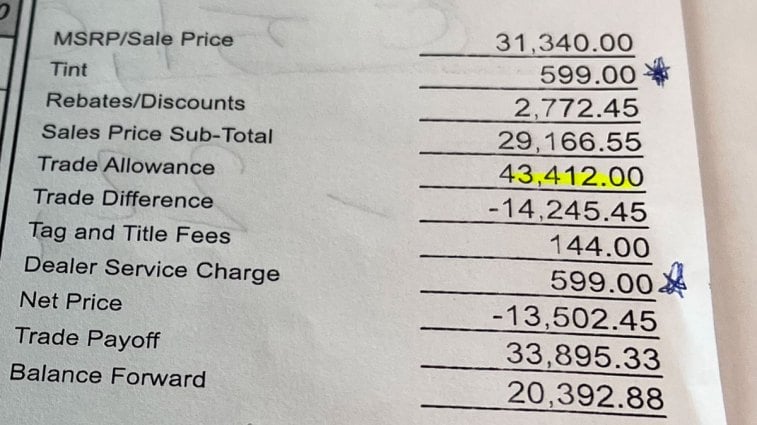
PRO TIP: Since shopping recently for a vehicle, I found markups varied at dealerships that sold vehicles such as Kia and Hyundai. One dealer charged $599, and another $699. Another called them “doc fees.” Before you shop, understand how much those document filing fees cost for car tax, tag, and title in your state before you buy a vehicle. Those are pure markups or profit centers for the dealership. Another markup on an invoice may say “paint and fabric protection” or “window tint.” Before you sign anything, it’s wise to ask the salesperson to remove those fees if they want to sell you the car.
Read our article How to Avoid Dealer Markups in 2024: Buyer Beware to learn how to spot and avoid them.
The Higher Costs of Car Insurance
According to the Bureau of Labor Statistics, car insurance costs are up nearly 21% in February compared with a year earlier. Bankrate says car insurance costs $2,545 a year for full coverage. Before you seal the deal and sign anything for a new vehicle, compare quotes for car insurance.
What to Expect: Looking Ahead
But what if you desperately want a popular car that’s in low supply? Then, it’s time to test your patience or wait. Last year’s Federal Reserve interest rate hikes were aimed to rein in inflation but still make it hard for many consumers to afford cars if they need a loan. According to the most recent Cox Automotive research, the typical new car loan interest rate was an average of 9.7%. Vehicle affordability is improving, but the second half of 2024 will look better for car shoppers. Additionally, any interest rate cut, if one comes, could help affordability.
For now, car shoppers must remain flexible and look for deals. The best deal may not be for the car you thought you would buy.
Editor’s Note: This article has been updated for accuracy since it was initially published. Sean Tucker contributed to this report.