Home Blog Page 1012

The Ultimate Guide to the Best 5 Road Trips in Germany

0


Embarking on a road trip is an exhilarating way to immerse yourself in the wonders of a country, and when it comes to road trips in Germany, it offers a captivating tapestry of stunning landscapes, rich history, and vibrant cities. From the winding scenic routes through picturesque villages to the iconic autobahns, Germany is a beautiful country that has it all for avid road trippers. 

Road Trips in Germany to Neuschwanstein Castle
Road Trips in Germany | Neuschwanstein Castle

Whether you’re a nature enthusiast seeking breathtaking mountain vistas, a history buff eager to explore medieval castles, or a food lover in search of culinary delights, Germany has something to offer everyone. Join us as we delve into the realm of road trips in Germany, uncovering hidden gems, cultural treasures, and unforgettable adventures along the way. Get ready to rev up your engines and embark on an unforgettable journey through the heart of Deutschland.

This site contains affiliate links to products. We may receive a commission for purchases made through these links. Support my blog here

The Ultimate Guide to the Best 5 Road Trips in Germany

Planning a road trip can be an exciting and adventurous way to explore a new country. Germany, with its stunning landscapes, rich history, and diverse cities, is the perfect destination for a road trip. Whether you’re interested in exploring the scenic routes, immersing yourself in the culture, or indulging in delicious food and drink, Germany has something to offer every traveler. In this ultimate guide, we will provide you with all the information to decide which of the many road trips in Germany are perfect for you.

1. The Wine Route: Savoring the Flavors of the Mosel Valley in Germany

An Image of the city of Cochem, Germany for Road Trips in Germany
Road Trips in Germany | Cochem, Germany

Koblenz – Eltz Castle – Cochem – Traben Trarbach – Bernkastel Kues – Trier

Indulge your senses on the German Wine Route filled with many small towns, a road trip that takes you through the sun-kissed vineyards and charming wine villages of southwestern Germany. Starting in the small town of Koblenz, this route meanders through the stunning landscapes of the Palatinate region, renowned for its vineyards and wine production.

Visit historic wineries, sample exquisite Rieslings, and enjoy the warm hospitality of the locals. After stopping by Burg Eltz, explore the fairytale-like town of Cochem, stroll through vineyard-covered hills, and savor the flavors of regional cuisine paired with outstanding wines. The Wine Route is a tantalizing journey for wine enthusiasts and a feast for the senses.

Where to Stay

  • Cochem
  • Traben Trarbach
  • Berkastel Kues
  • Trier

2. The Romantic Road: A Journey Through Fairy Tales and Castles

Image of the town of Rothenburg ob der Tauber with Traditional Colorful German Buildings with a clock tower
Road Trips in Germany | Rothenburg ob der Tauber

Wurzburg – Weikersheim – Rothenberg ob der Tauber – Dinkelsbühl – Augsburg – Fussen

Prepare to be enchanted as you embark on the legendary Romantic Road or Romantic Route, a picturesque route that winds its way through the heart of Germany. This is one of the best road trips within Germany to experience classical German towns.  Stretching from Würzburg to Füssen, this scenic drive takes you through storybook landscapes, charming medieval towns, and awe-inspiring castles.

Explore the narrow streets of the well-preserved medieval town of Rothenburg ob der Tauber and Indulge in local delicacies like the Schneeball, wander through vineyards, and witness the architectural marvels that dot the route. Immerse yourself in the fairy-tale castles like Neuschwanstein Castle, the inspiration behind Disney’s Sleeping Beauty Castle. There are a lot of panoramic views within Füssen due to the beautiful Bavarian Alps close to the Austrian border. 

Where to stay 

  • Wursburg
  • Rothenburg ob der Tauber
  • Fussen

3. The Black Forest Panorama Route: Nature’s Splendor Unveiled

Image of Baden Baden from above with the cathedral and clock tower in front and the rolling green hills along with many German buildings
Road Trips in Germany | Baden Baden, Germany

Baden Baden – Triberg – House of 1000 Clocks – Triberg Waterfall – Largest Cuckoo Clock – Hollentalbahn – Europa Park – Freiburg im Breisgau

If you yearn for breathtaking natural beauty, the Black Forest Panorama Route is the perfect road trip for you. The first stop taking place in the charming old town of Baden-Baden, this scenic route winds through the enchanting Black Forest region, known for its dense forests, cascading waterfalls, the storytales of the Brothers Grimm and idyllic lakes.

Drive along curvy roads offering stunning vistas of rolling hills, charming villages, and the famous cuckoo clocks. Immerse yourself in the region’s folklore and indulge in delectable Black Forest cake while exploring the picturesque towns of Triberg and Freiburg im Breisgau. Nature lovers and outdoor enthusiasts will find solace in the pristine hiking trails and tranquil serenity of this remarkable destination.

Where to stay

  • Baden-Baden
  • Triberg
  • Freiburg

4. The Castle Road: Discovering Germany’s Regal Past

Image of Neuschwanstein Castle with lots of green trees, a lake in the distance with blue skies and clouds along with lots of green farmland
Road Trips in Germany | Neuschwanstein Castle in Bavaria

Fussen – Nueschwanstein Castle – Hohenschwangau Castle – Lichtenstein Castle – Ludwigsburg Residential Palace – Heidelberg Castle – Eltz Castle – Rheinstein Castle – Cochem Castle – Koln

Embark on a regal journey along the Castle Road, a captivating route that weaves through Germany’s historical treasures. From Fussen to Koln, this road trip takes you on a majestic adventure, passing over 70 magnificent castles, palaces, and fortresses.

Explore the grandeur of Heidelberg Castle perched high above the Neckar River, marvel at the medieval splendor of Eltz Castle, and be transported back in time as you wander through the stunning UNESCO World Heritage site of Neuschwanstein Castle in Southern Germany. Immerse yourself in the stories of kings and queens, soak in the architectural wonders, and embrace the rich history that resonates in each stone of these remarkable fortifications.

Where to stay 

  • Garmisch
  • Heidelberg
  • Cochem

5. Major Cities Germany Road Trip Itinerary
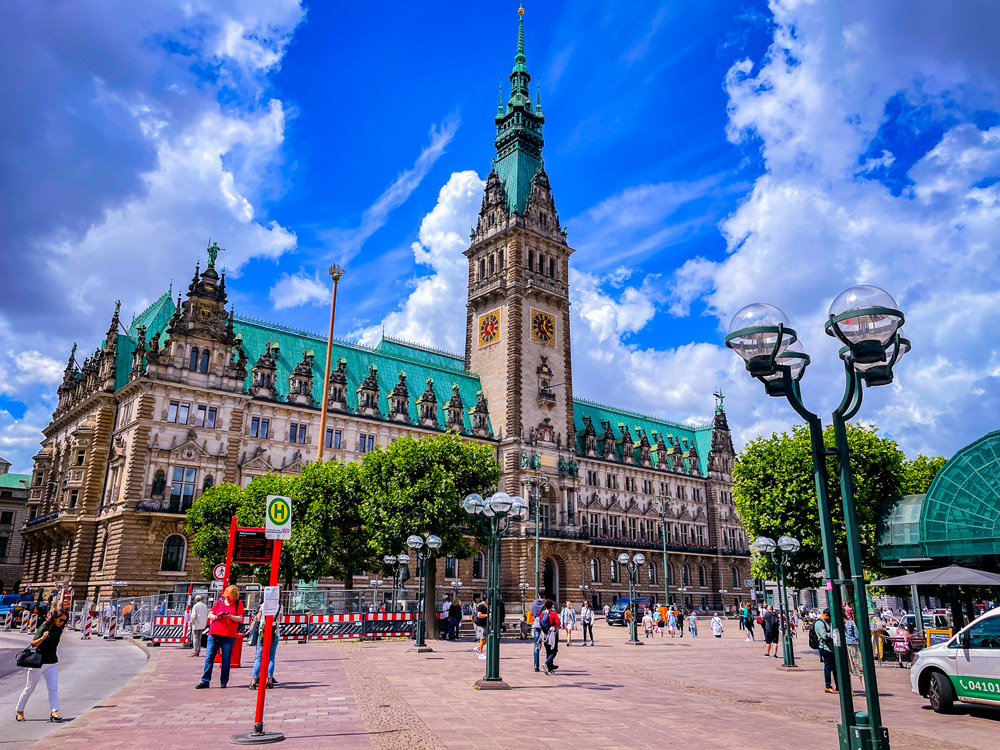
Image Hamburg's City Hall with blue skies, gothic style building with a clock tower and aged green roofing probably from aged copper

Frankfurt – Koln – Hanover – Hamburg – Berlin – Leipzig – Nuremberg – Munich – Stuttgart 

Embark on a captivating road trip through the heart of Germany, as you journey from the bustling streets of Frankfurt to the serene landscapes of Stuttgart. Each city on this route, from the awe-inspiring Cologne Cathedral in Koln to the historic charm of Nuremberg’s Imperial Castle, tells a unique story of Germany’s rich history and culture.

Explore the maritime allure of Hamburg, immerse yourself in the dynamic energy of Berlin, and bask in the artistic vibes of Leipzig. Discover the blend of modernity and tradition in Munich, and conclude your adventure and final stop in Stuttgart, surrounded by picturesque hills and architectural wonders. This road trip is a remarkable passage through the diverse tapestry of Germany’s major cities, offering an unforgettable fusion of experiences and memories.

Tips for Driving for road trips in Germany 

There are a lot of rules when it comes to driving in Germany. These are some of the rules you should keep in mind for taking one of the many road trips in Germany.

  • Keep your car filled: It’s illegal to run out of fuel on the AutoBahn and you can really get some major fines if this happens. You need to make sure your vehicle is always filled up
  • Most rental cars in Europe are Stick Shift: Either be prepared to know how to drive stick shift in Germany or be sure to reserve an automatic car well in advance as these cars can often be selected first. 
  • Be aware of traffic cameras: There are many cameras all over Germany that result in heavy fines if you are even 1km over the speed limit. The autobahn does have unlimited speed zones, but they can quickly drop down to 80km an hour in some areas. You have to pay attention to the speed limit, especially in construction zones where fines can be double or triple the price. 
  • Get your international driver’s license in advance: Be sure to get your international drivers license in advance, if you are from the US, you can go to a AAA office to get one and they will provide you with a book of the rules of the road for Germany. Typically, driving in Germany with an International driver’s license is only good up to 6 months while in the country
  • Follow the Rules of the Road: Familiarize yourself with the traffic rules and regulations in Germany. Observe speed limits, traffic signs, and signals. Remember that the autobahn, while famous for its stretches without speed limits, still has recommended speed guidelines and rules for passing.
  • Stay in the Right Lane: On the autobahn, keep in mind that the left lane is primarily for passing. Slower vehicles should use the right lanes, and it’s important to be mindful of faster vehicles approaching from behind. It’s illegal to be in the left lane preventing people from passing. This can also cause major accidents while people are driving fast. 
  • Maintain Safety Distances: Maintain a safe distance from the vehicle in front of you, especially when driving at high speeds. The general rule is to keep a distance of at least a two-second interval or more in good weather conditions.
  • Be Aware of Road Signs: Pay attention to road signs, as they provide crucial information about speed limits, construction zones, parking regulations, and other important details. Familiarize yourself with common signs to ensure a smooth and safe journey.
  • Plan for Toll Roads: While most highways in Germany (autobahns) are toll-free, there are some exceptions. Research your planned route in advance to check for any toll roads and consider purchasing a vignette or paying tolls electronically, if necessary. If you plan to drive outside of Germany check to see if a vignette is needed. Many surrounding countries like France, Switzerland, and Austria require vignettes.
  • Use GPS or Navigation Systems: Utilize GPS or navigation systems to aid your journey. They can provide real-time traffic updates, and alternative routes, and help you navigate unfamiliar roads and cities with ease.
  • Be Mindful of Pedestrians and Cyclists: Keep an eye out for pedestrians and cyclists, especially in urban areas and designated zones. Always yield to them and be cautious while turning or maneuvering through intersections.
  • Adhere to Parking Regulations: When parking, make sure to comply with parking regulations and signs. Pay attention to designated parking zones, time restrictions, and any necessary permits or payment requirements.
  • Carry Required Documents: Ensure you have all necessary documents while driving in Germany, including a valid driver’s license, vehicle registration, and proof of insurance. It’s also a good idea to carry your passport or identification in case of any unexpected situations.
  • Practice Defensive Driving: Stay alert, anticipate the actions of other drivers, and be prepared for changing road conditions. Maintain focus, avoid distractions, and adapt your driving to the prevailing circumstances to ensure a safe and enjoyable road trip in Germany.
  • Make sure your rental car has the following: A first aid kit, reflective jacket, warning triangle, spare tire, and tools to change the wheel or tire repair kit. Ask the rental office who to call if there are any issues or an accident. 

Why Germany is the Perfect Destination for a Road Trip

From the rolling hills of Bavaria to the stunning coastline of the Baltic Sea, there are countless scenic routes to explore. The country is also home to several national parks, such as the Black Forest and the Harz Mountains, where you can immerse yourself in nature and enjoy outdoor activities like hiking and biking. To be honest, to see the best of Germany must be seen by car. It’s more than just the busy cities but more of the small German towns and villages that make Germany so beautiful. 

In addition to its natural beauty, Germany is steeped in history and culture which is why road trips in Germany are essential to see the best highlights. From the iconic Brandenburg Gate in Berlin to the fairy-tale Neuschwanstein Castle in Bavaria, there are countless historical sites and landmarks to visit. The country is also known for its vibrant arts scene, with world-class museums and galleries in cities like Munich and Dresden.

Germany is also home to a diverse range of cities and towns, each with its own unique charm. From the medieval architecture of Rothenburg ob der Tauber to Heidelberg, there is something for everyone. You can explore charming villages, visit local markets, and sample regional cuisine as you make your way through the country.

No road trip in Germany would be complete without indulging in the delicious food and drink that the country has to offer. From hearty sausages and pretzels to world-renowned beers and wines, Germany has a lot to offer. You can visit traditional beer gardens, dine in Michelin-starred restaurants, and sample local specialties as you travel through the country.

Choosing the Best Route for Your German Road Trip

When planning a road trip in Germany, it’s important to choose the best route that suits your interests and preferences. There are several popular routes and itineraries to choose from, depending on the duration of your trip and the areas you want to explore.

One popular route is the Romantic Road, which stretches from Würzburg to Füssen. This scenic route takes you through charming towns and villages, such as Rothenburg ob der Tauber and Dinkelsbühl, and allows you to experience the beauty of the Bavarian countryside.

Another popular route is the Black Forest High Road, which winds its way through the stunning Black Forest region. This route offers breathtaking views of the forest, as well as opportunities to visit charming towns like Freiburg and Baden-Baden.

When choosing a route for your road trip, it’s important to consider factors such as the time of year, the duration of your trip, and your interests. If you’re interested in history and culture, you may want to include cities like Berlin, Munich, and Dresden in your itinerary. If you’re more interested in nature and outdoor activities, you may want to focus on routes that take you through national parks and scenic landscapes.

If none of the popular routes suit your interests, you can also create a customized route based on your preferences. Consider the areas you want to visit, the attractions you want to see, and the activities you want to do, and plan your route accordingly. This will allow you to have a unique and personalized road trip experience.

Essential Tips for Renting a Car in Germany

Renting a car is a convenient and flexible way to explore Germany on a road trip. However, there are certain requirements and considerations to keep in mind when renting a car in Germany.

To rent a car in Germany, you must be at least 21 years old and have a valid driver’s license. Some rental companies may require you to be at least 25 years old, so it’s important to check the age requirements before making a reservation. You will also need a credit card in order to make the reservation and provide a security deposit and international driver’s license that you can easily get in your home country.

There are several types of rental cars available in Germany, ranging from compact cars to luxury vehicles. It’s important to choose a car that suits your needs and preferences, as well as your budget. Consider factors such as the number of passengers, the amount of luggage, and the type of terrain you will be driving on.

When renting a car in Germany, it’s important to shop around and compare prices from different rental companies. You can use online travel agencies or rental comparison websites to find the best deals. It’s also a good idea to read reviews and check the terms and conditions before making a reservation.

Most vehicles in Germany are manual cars, so if you do not have a manual car, I suggest you reserve and pay for in advance an automatic vehicle. If you do not pay for it in advance, you may not be as lucky when you arrive and it may not be the option available to you. When you return the car, be sure to take photos before and after you took the vehicle so that you have evidence that the car was fine when you dropped the vehicle off to prevent any additional charges. 

Some companies I suggest renting from in Germany are Hertz, Sixt, EuropaCar, and Enterprise. 

Packing for Your German Road Trip: What to Bring and What to Leave Behind

Packing for a road trip can be a daunting task, but with some careful planning, you can ensure that you have everything you need for your German adventure.

When packing for a road trip in Germany, it’s important to bring essential items such as a valid driver’s license, passport, and credit card. You should also bring a map or GPS device, as well as a charger for your electronic devices. It’s also a good idea to bring a first aid kit, a flashlight, and a roadside emergency kit in case of any unforeseen circumstances. I’d suggest bringing a car charger as well, as some of the vehicles do not have provided car charges.

In terms of clothing, it’s important to pack layers, as the weather in Germany can be unpredictable. Bring comfortable walking shoes, as well as a waterproof jacket and umbrella. It’s also a good idea to pack a swimsuit if you plan on visiting any lakes or beaches.

When it comes to toiletries, it’s important to pack travel-sized items to save space. Many vehicles in Germany are smaller, so storage space can be difficult. You should also bring any necessary medications, as well as sunscreen and insect repellent. It’s also a good idea to bring a reusable water bottle and a travel mug for hot drinks.

When packing for a road trip, it’s important to consider what you can leave behind. Avoid overpacking by only bringing essential items and leaving behind anything that you can easily purchase or rent during your trip. It’s also a good idea to pack items that can serve multiple purposes, such as a sarong that can be used as a towel or a picnic blanket.

The Best Time of Year to Take Road Trips in Germany

The best time of year to take road trips in Germany depends on your preferences and the activities you want to do. Germany has a temperate climate, with warm summers and cold winters, so it’s important to consider the weather and climate when planning your trip. If you are not comfortable driving in snow, I highly suggest you don’t rent a vehicle in Germany as it can be icy and difficult to maneuver. 

The summer months of June, July, and August are the most popular time to visit Germany, as the weather is warm and sunny. This is the perfect time to explore the country’s outdoor attractions, such as the national parks and lakes. However, it’s also the peak tourist season, so you can expect larger crowds and higher prices.

If you prefer milder weather and smaller crowds, consider visiting Germany in the spring or fall. The months of April, May, September, and October offer pleasant temperatures and beautiful scenery. This is also the time when you can experience events such as Oktoberfest in Munich or the Christmas markets in December.

If you don’t mind the cold weather, winter can be a magical time to visit Germany. However, the snow can make it quite difficult to go on some road trips in Germany – so make sure you are comfortable driving in the snow or willing to take a day or two to relax until it’s safe to drive. The country is known for its Christmas markets, where you can shop for unique gifts and sample traditional food and drink. You can also enjoy winter sports such as skiing and snowboarding in the Bavarian Alps.

Must-See Destinations on Your German Road Trip Itinerary

When planning road trips in Germany, there are several must-see destinations that you should include in your itinerary. These destinations offer a mix of history, culture, and natural beauty, and will provide you with a well-rounded experience of the country.

Berlin, the capital city of Germany, is a must-visit destination on any road trip itinerary. The city is known for its vibrant arts scene, historical landmarks, and diverse neighborhoods. You can visit iconic sites such as the Brandenburg Gate and the Berlin Wall, explore world-class museums like the Pergamon Museum, and enjoy the city’s vibrant nightlife.

Munich, the capital of Bavaria, is another must-see destination in Germany. The city is known for its beer gardens, traditional architecture, and rich history. You can visit famous attractions such as the Marienplatz and the Nymphenburg Palace, explore the beautiful English Garden, and indulge in traditional Bavarian cuisine.

The Romantic Road is a scenic route that stretches from Würzburg to Füssen and is a must-visit destination for those who want to experience the charm of medieval Germany. Along this route, you can visit picturesque towns such as Rothenburg ob der Tauber and Dinkelsbühl, explore stunning castles like Neuschwanstein and Hohenschwangau, and enjoy the beauty of the Bavarian countryside.

The Black Forest is another must-see destination on your German road trip. This region is known for its dense forests, charming villages, and delicious food. You can hike through the forest, visit the famous cuckoo clock makers in Triberg, and indulge in Black Forest cake and other regional specialties.

The Rhine Valley is another must-see destination for its stunning landscapes and charming towns. You can take a scenic boat ride along the Rhine River, visit the famous Lorelei rock, and explore the medieval town of Cochem. The region is also known for its vineyards, so you can enjoy wine tasting and sample the local Riesling.

No road trip in Germany would be complete without a visit to Neuschwanstein Castle. This fairy-tale castle is located in the Bavarian Alps and is one of the most famous landmarks in Germany. You can take a guided tour of the castle, explore the surrounding hiking trails, and enjoy breathtaking views of the surrounding mountains.

How to Budget for Your German Road Trip: Costs to Consider

When planning road trips in Germany, it’s important to budget for the various costs associated with the trip. This will help you determine how much money you need to save and how to allocate your funds.

One of the main costs to consider when planning a road trip in Germany is the rental car. The cost of renting a car can vary depending on the type of vehicle, the duration of the rental, and the rental company. It’s important to shop around and compare prices from different rental companies to find the best deal.

Another cost to consider is gas and tolls. There aren’t really any tolls within Germany, however, if you happen to travel into other of the surrounding countries there are many. Gas prices in Germany are generally higher than in other countries, so it’s important to budget accordingly. 

Accommodations are another cost to consider when planning a road trip in Germany. The cost of accommodations can vary depending on the type of accommodation, the location, and the time of year. It’s important to research different options and compare prices to find the best deal. Consider staying in budget-friendly accommodations such as hostels or guesthouses, or consider camping if you’re traveling with a tent.

To save money on food and drinks while traveling in Germany, I suggest buying water at a local grocery store like Aldi, Lidl, or Globus. You can also save on breakfast by going to the local bakery instead of restaurants. While there are plenty of budget-friendly options available, such as street food and local markets, it’s important to budget for meals and snacks. You should also budget for drinks, especially if you plan on indulging in the local beer or wine in restaurants. It’s much more affordable to buy alcohol at a local store than when out. 

Finally, it’s important to budget for activities and attractions. Germany is home to a wide range of attractions, from museums and castles to outdoor activities and festivals. It’s important to research the cost of these activities and factor them into your budget.

Staying Safe on the Road: German Driving Laws and Regulations

When driving in Germany, it’s important to familiarize yourself with the local driving laws and regulations to ensure a safe and enjoyable road trip. If you are from the US, you need to ensure that you have an international driver’s license prior to renting a car abroad. Understand that most rental car places have manual or stick shift vehicles and you need to ensure at booking in order to rent an automatic car if you are unable to drive a manual. 

The speed limit on German highways, known as the autobahn, is only unrestricted in certain areas with unlimited speed zone signs. However, there are certain sections where speed limits are enforced, so it’s important to pay attention to the signs. In urban areas, the speed limit is usually 50 km/h (31 mph), while on rural roads it is usually 100 km/h (62 mph). Ensure you are driving the speed limit or you may be caught by the German speed cameras which often result in a hefty fine. 

It’s important to pay attention to road signs and signals when driving in Germany. Signs are usually in German, but some major roads and tourist areas may have signs in English as well. It’s also important to familiarize yourself with the meaning of different road signs and signals before your trip. 

Drinking and driving laws in Germany are strict, with a blood alcohol limit of 0.05%. It’s important to avoid drinking and driving and to designate a sober driver if you plan on consuming alcohol. It’s also important to note that Germany has a zero-tolerance policy for drug use while driving.

In case of an emergency, it’s important to know the emergency procedures in Germany. The emergency number for police, fire, and medical emergencies is 112. It’s also a good idea to have a basic understanding of German phrases related to emergencies, such as “help” and “emergency.”

Finding the Best Accommodations for Your German Road Trip

When planning a road trip in Germany, finding the best accommodations is an important part of the planning process. There are several types of accommodations available, ranging from budget-friendly options to luxury hotels. Keep in mind that many hotels and airbnbs or houses within Germany do not have air conditioning as Germans find it wasteful. So if you are prone to the heat, be sure to double-check to see if your accommodation has AC available. 

One of the most popular types of accommodations in Germany is a hotel. There are hotels available in every price range, from budget-friendly options to luxury hotels. It’s important to research different hotels and compare prices to find the best deal. Consider factors such as location, amenities, and customer reviews when making your decision.

Another popular type of accommodation in Germany is the guesthouse or bed and breakfast. These accommodations offer a more personal and intimate experience, with hosts who can provide local recommendations and insights. Guesthouses and bed and breakfasts are often located in charming towns and villages, allowing you to immerse yourself in the local culture.

If you’re traveling on a budget, consider staying in a hostel. Hostels offer dormitory-style accommodations, as well as private rooms, at a fraction of the cost of a hotel. Hostels are a great option for solo travelers or those who want to meet other travelers.

Camping is another popular option for accommodations in Germany. The country is home to numerous campsites, ranging from basic facilities to fully-equipped sites with amenities such as showers and restaurants. Camping allows you to immerse yourself in nature and enjoy outdoor activities such as hiking and biking.

Liked this post on Road Trips in Germany? Pin it!

The Ultimate Guide to the Best 5 Road Trips in Germany


Source link

WMoto SM125i dilancar untuk pasaran Malaysia – kapcai 124 cc dengan meter LCD, lampu LED, RM6k

0


WMoto SM125i dilancar untuk pasaran Malaysia – kapcai 124 cc dengan meter LCD, lampu LED, RM6k

Mforce Bike Holdings Sdn Bhd hari ini juga telah melancarkan sebuah kapcai mampu milik yang dipanggil sebagai SM125i untuk pasaran Malaysia, dengan ditawarkan dalam pilihan tiga warna iaitu merah, biru dan kuning, pada harga RM5,888 tidak termasuk insurans.

Model ini dipacu oleh enjin satu silinder 123.7 cc dengan sistem suntikan bahan api dan SOHC, dipadankan bersama transmisi empat kelajuan dan mampu menghasilkan kuasa 7.8 hp pada 8,000 rpm dan tork 8.5 Nm pada 6,000 rpm.

Walaupun digelar sebagai motosikal mampu milik, SM125i datang dengan beberapa kelengkapan moden seperti meter digital LCD berwarna, semua lampu jenis LED, soket pengecas USB di bawah bahagian pemegang serta brek cakera pada roda hadapan.

Brek belakang bagaimanapun masih lagi menggunakan jenis dram manakala rim datang dengan unit aluminium 17 inci dengan tayar tanpa tiub bersaiz 70/90 di hadapan dan 80/90 di belakang. Di bawah tempat duduk terdapat ruang simpanan barang bersaiz sederhana.

Kelengkapan lain pada SM125i adalah termasuk fork teleskopik di hadapan, dua penyerap hentak di belakang, tangki bahan api empat liter, soket kunci anti kecurian serta pemula enjin elektrik dan tendang. Motosikal ini datang dengan jaminan dua tahun tanpa had batuan.

Nak jual kereta anda? Jual dengan myTukar.


Source link

I’m In The Vulnerable Class for COVID-19. A Plea To Take This Virus Seriously.

0


This post was published March 12, 2020 and has been updated frequently since then.

A friend of mine recently texted me in a fury.

“Someone just posted on FB that we’re doing things to stop the virus only because it’s going to ‘hurt old people’s feelings’ if we don’t,” he said.

His mother has respiratory issues and thus falls into the “older person vulnerable to the new coronavirus” category, as do many others.

Like me.

And I can read.

So when I read tweets or posts about how it’s basically “just a flu” (false) that “only hurts the vulnerable,” it makes me worry for us as a society. If we can’t protect our most vulnerable, what are we doing?

COVID-19: We Need to Consider Society As a Whole

I’ve received many reader emails about COVID-19 asking for my thoughts given that I am currently dealing with a cerebrospinal fluid (CSF) leak and an inflammatory immune condition that already predisposes me to medication reactions and a cytokine storm.

It’s been very surreal to see the news unfold at a time when I have been in quarantine of sorts (bedrest) for many, many months. Due to the CSF leak, I rely on family and friends for groceries and to make food as I cannot do so myself.  For those who are chronically ill, the lack of independence for basic needs adds an extra layer of concern and need for care on a daily basis.

The discourse about COVID-19 seems to consist of differing responses from several distinct groups of people

First, the people who are well and who believe they’ll be unscathed. This “isn’t a big deal,” they say. “Why is the media making us panic?”

Second, those who are vulnerable like me, and who know they are at risk for significant complications if they contract the virus.

There are some people who live in between those two extremes, and while healthy themselves are nonetheless able to remember a series of subclasses whose lives legitimately depend on the collective to stay safe.

And then, there are others whose actions are downright dangerous for all of us. This includes NBA player Rudy Gobert. Per Hot Air’s report:

I doubt we’ll get a better case study during this nightmare of how a single person’s cavalier denialism about the threat from the disease can put entire industries at risk. This happened two days ago. Gobert apparently thought it was silly that the NBA had set a new rule requiring reporters to stay six feet away from players at all time. So, as a goof, he decided to touch all of their microphones after his Q&A ended.

After mocking COVID-19 precautions by touching a bunch of things, he then tested positive. And as with any exponentially spreading virus, this exposure and infection have predictably led to others testing positive.

Ultimately, Engel isn’t wrong from a statistical perspective.

He’s also not the first or last person I’ve seen try to stem the panic by reminding people of the expendability of the vulnerable like me.

I’m writing this post as a plea to each person to put overall societal needs above individual desires until this virus peaks and subsides.

I am not a doctor, and the following is not medical advice. It is, however, a summary of what I’ve researched for my own safety given my risk levels due to the issues with my immune system

Disinformation and panic don’t help anyone, especially during a pandemic.

By now, you’re probably living under a rock if your’e unaware of severe acute respiratory syndrome coronavirus 2 (SARS-CoV-2), the artist formerly known as 2019-nCoV. SARS-CoV2 is the virus, and COVID-19 is the disease which that virus spreads.

People also refer to it as “coronavirus”, but since it’s one of many coronaviruses, I’m not going to do that here. MERS-CoV and SARS-CoV are two other coronaviruses you may have heard of. COVID-19 is a unique virus.

COVID-19 is a called Novel Coronavirus because it’s a new disease for humans. The World Health Organization estimates a global death rate of 3.4% of those who are infected. While many people around the world may have built up immunity to various flu strains over time, the newness of COVID-19 means no one had immunity to it when it first broke out. There is also no established treatment for COVID-19, and there is presently no way to cure it. There are some treatments in trial, however, and I’ve detailed them below.

The fast spread of this virus has led to heavy amounts of disinformation and even outright conspiracy theories. I’ve argued with quite a few people online who suggest that this is “just like the flu,” or that “most people barely feel sick.” In an internet age where we are able to quickly get data from countries that are ahead of our curve here in North America, there is simply no excuse for not acting as swiftly as possible.

Panic isn’t useful.

Changing nothing in your life isn’t useful either. It’s actually outright dangerous right now.

In the middle lies being informed, prepared, and willing to think about society as a whole. Doing so lowers the burden on our health care systems, and buys a bit more time for treatments and research to happen. Reducing the number of people who are sick at once is the best way to keep our health system from being overwhelmed. And that in turn helps not just COVID-19 patients but also everyone else who must seek treatment in a hospital.

Two factors that make COVID-19 a big concern to everyone:

  1. A medical system that is over capacity, where doctors will need to decide who coming in gets a ventilator, who gets a bed, and more – not just COVID-19 patients, but other vulnerable patients with chronic diseases. Data tracks at a 10% hospitalization rate in Italy for people infected with Covid-19, with those in critical condition needing 3-6 weeks for recovery. That puts a prolonged strain on the system.
  2. The lack of immunity to the disease worldwide means that there’s no ceiling on the amount of people who can get infected. Presently, cases of COVID-19 are doubling every few days. Research labs and scientists around the world are racing to find a vaccine that works, but as of today the only ways to address the outbreak are mitigation, and planning in an attempt to slow down the spread.

Asymptomatic carriers can help fuel a pandemic

Yes, the bulk of infections will be mild, per the available statistics we have.

But those mildly infected people can and will transmit this highly contagious disease to others. It is imperative that we keep the numbers low. At the beginning of COVID-19 coverage, news outlets reported that you were at risk of transmission if you had symptoms. As of mid-March 2020, however, studies are showing that even if you’re fully asymptomatic, you can still spread this virus as a vector.

For example, per CNN earlier in March 2020, Dr. Sandra Ciesek, director of the Institute of Medical Virology in Frankfurt, Germany, tested 24 passengers who had just flown in from Israel. Seven of the 24 passengers tested positive for coronavirus, despite four having no symptoms at all. Of great concern regarding the spread of this virus is that the viral loads for those four asymptomatic patients were actually higher than for the patients who exhibited symptoms. Viral load measures how concentrated a virus is in someone’s respiratory secretions, and a person with a higher load has a higher probability of spreading the virus to others

That is… not good.

The risk of transmission by people who seem healthy due to lack of symptoms is also contrary to what we were told initially, right? I know people keep saying that new information that they’re hearing about this virus contradicts what we’ve previously been told; but the reality remains that COVID-19 is a new virus that we are learning about globally, as the outbreaks continue.

Thanks to data shared from scientists in China and from doctors in Italy, South Korea, Singapore, and Taiwan, those of us ‘next in line’ — such as people in North America — are able to learn lessons from those other countries, and to model and see how we can adapt our protocols to this novel virus.

Joshua Weitz, a professor at Georgia Tech, co-authored a paper about the asymptomatic transmission of COVID-19, and published his takeaways in a mini tweet thread here. He urges everyone to practice social distancing now, to the extent possible. He notes that doing this reduces both your chances of getting sick and the chances of others getting sick because you can be “unknowingly ‘asymptomatic’ but infectious.”

Or, see the tweets from evolutionary biologist Benjamin Kerr below:

(Full thread here.)

Which is why acting now, even if you’re healthy, is critical.

This also means preparing without panic, being reasonable about what we need and don’t need without hoarding, and above all considering our roles as citizens in a collective. As Mark Manson said in a new post:

So, while staying home, from an individual risk perspective, seems unnecessary and an overreaction, from a systemic risk perspective, it’s the only prudent thing to do. The more people who go out and about, the faster this thing spreads, and the faster this thing spreads, the more the hospitals get flooded, and the more the hospitals get flooded, the more people die unnecessarily.

Or, as Dr. David Juurlink, a physician at Toronto’s Sunnybrook Health Sciences Centre, says, “The faster this hits us, the less able we will be to provide care. The less able we are to provide care, the more people will die. It is as simple as that.”

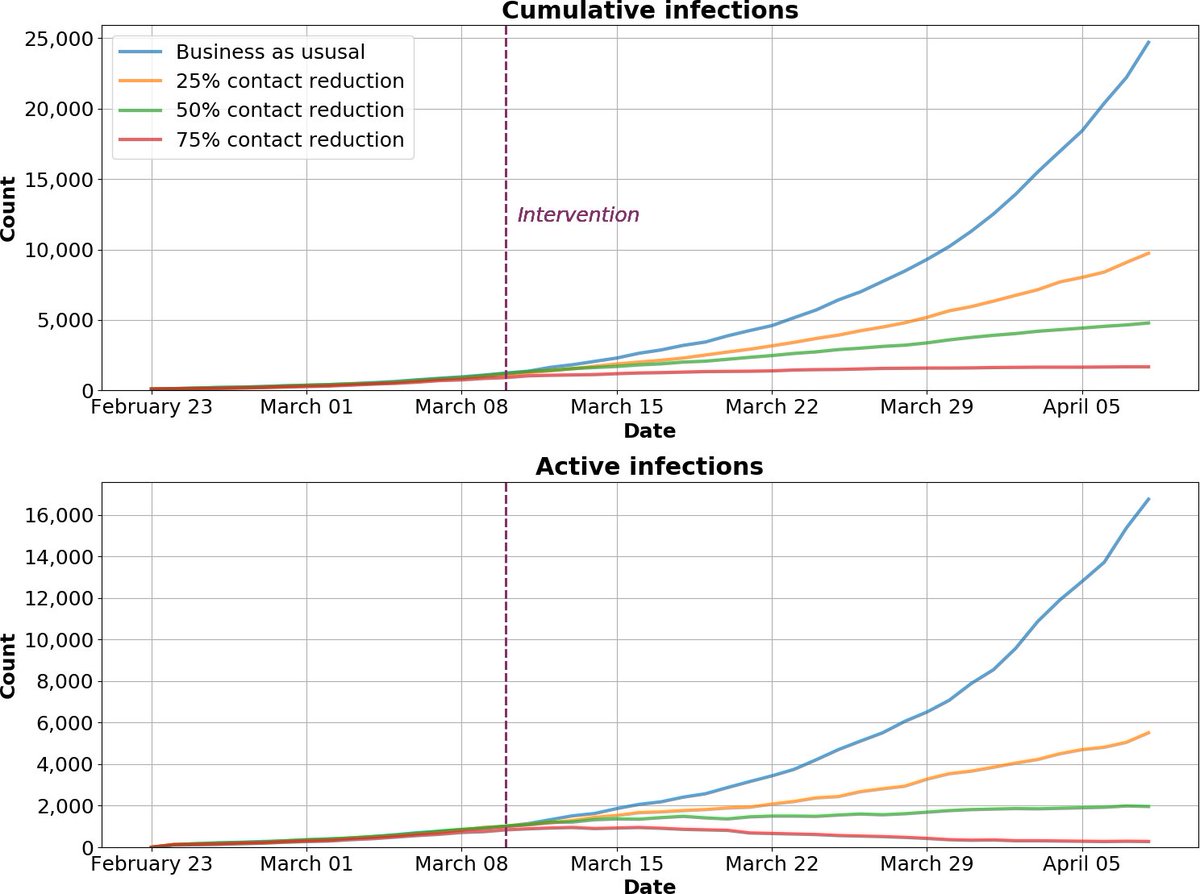
This chart put together today by the Institute of Disease Prevention shows the potential mitigation of COVID-19 for King and Snohomish counties in Washington State by taking precautions sooner rather than later. The chart shows effects if people reduce contact with others by 75% vs. 50% vs 25% or .. nothing.

Infections with and without social distancing COVID19
Infections with and without social distancing COVID-19, courtesy of the Institute for Disease Prevention

This virus is beyond containment worldwide, and acting swiftly but calmly is imperative.

Learning from Italy

Outside of mainland China, Italy now has the highest number of deaths in the world from COVID-19. And the country’s fatality rate from COVID-19—at 5%—is much higher than the global average of 3.4%.

Why is Italy’s death rate so high? Italy has conducted a substantial number of tests — more than 42,000 as of Saturday (March 7), according to Al Jazeera. But the size of the outbreak and the late adoption of containment measures combined with speed of spread meant that Lombardy and to a lesser extent other areas in Italy are unable to get back to a place of balance. The strain on the system is so bad that the Italian College of Anesthesia, Analgesia, Resuscitation and Intensive Care (SIAARTI) has shared guidelines (link is in Italian) for the criteria that doctors and nurses should follow in these extraordinary circumstances, likening them to the moral choices doctors face during wartime. They require doctors to allocate ICU access to the patients with the highest chance of therapeutic success. This may seem logical and even utilitarian, but it’s a devastating position to be in every day during an outbreak.

At the same time, an Italian doctor begged other countries to act now. Dr. Daniele Macchini posted (link is in Italian; English here) about what’s happening on the front lines of Italian’s coronavirus response, noting that each ventilator was like gold and that many of the doctors were themselves getting sick with the virus. He notes that there are no more specialist doctors, just doctors as a whole, a single team to try and stop the inflow of sick people. Italy does have a sizeable older population, but the case study of Dr Macchini and others on the front lines would be foolish to ignore.

The foregoing is not “media hype” but rather published testimony and guidelines from a country right in the middle of a substantial outbreak. Most Western countries are on a similar trajectory as Italy, with a time delay. From March 14th:

Exponential growth of COVID-19 cases over time, tracking countries in the EU, as well as USA and Asia.
Graph via this tweet.

We need to think through the exponential growth of this disease, and we don’t seem to be doing so on a systemic level. The way exponential growth works is that it seems tolerable until suddenly it’s an avalanche – and then it’s often too late.

Let’s try to avoid the avalanche.

Risk Groups for COVID-19

Briefly, because we’ve all been bombarded with graphs these days, a note about mortality and risk groups.

The CDC has released the following guidance for pre-existing conditions that are known to be factors in worsening COVID-19 infections in patients, in a Community Mitigation Strategy document:

Underlying medical conditions that may increase the risk of serious COVID-19 individuals at any age.

The medical consensus is that those over 60 years old, and those with the conditions above, are most at risk.

In addition to the main pre-existing conditions listed above, immunocompromised patients are at higher risk for fatalities. And there are millions of immunocompromised people in America alone, a number which not only comprises those with immunodeficiency syndromes but also people with cancer (who are accounted for in the above chart), or who have been treated for it, people who have received transplants, people with HIV, and more.

For those who fall in the vulnerable class of patients, extra precaution is needed. What is also needed — as this post will keep saying over and over — is for everyone to take social distancing seriously, especially because of testing limitations in many countries but especially the United States.

It’s NOT just the elderly

While the bulk of fatal infections have shown to strike those in advanced years and/or those who have the pre-existing conditions referenced above, this does not mean that if you’re young you’re all good. In the United States, we are learning, young people are hospitalized in large numbers. CDC data shows that nearly 40% of patients sick enough to be hospitalized were between 20 to 54 years old. And in a system that risks being overwhelmed, every hospital bed counts. All the more reason to self-isolate now.

ProPublica interviewed a respiratory therapist in New Orleans (article not for the faint of heart), and noted:

Since last week, he’s been running ventilators for the sickest COVID-19 patients. Many are relatively young, in their 40s and 50s, and have minimal, if any, preexisting conditions in their charts. He is overwhelmed, stunned by the manifestation of the infection, both its speed and intensity.

Stay. Home. Now.

Symptoms of COVID-19

The symptoms of Covid-19 vary from case to case. From China’s data, the most common are:

  • fever
  • dry cough (majority of cases)
  • fatigue
  • mucus coughing up from the respiratory tract (called sputum)

If you have a fever and dry cough alone, advice from interviewed doctors is to get tested by calling your department of health – NOT by presenting to the ER or Urgent Care where you could potentially infect others.

It’s important to note that anecdotal data from around the world suggests that the sudden loss of smell in otherwise asymptomatic adults may be a sign of COVID-19 infection. A significant number of coronavirus patients experienced anosmia (loss of sense of smell), per UK rhinologists. In South Korea, 30% of 2,000 patients who tested positive experienced anosmia as their major presenting symptom. These were milder cases, but the point remains: you do not want to be a vector for this virus, and if you have COVID-19 you’re contagious, period — even if loss of smell is your only symptom.

“We really want to raise awareness that this is a sign of infection and that anyone who develops loss of sense of smell should self-isolate,” Prof. Claire Hopkins, president of the British Rhinological Society, noted to the New York Times on March 22, 2020.

Most common symptoms in China, up to February 22, 2020

Contacting your Department of Health for your state, province, or territory is a starting open, since many have opened Coronavirus Hotlines to help direct you appropriately toward testing.

  • For Americans: state department of health contact information here.
  • For Canadians, scroll down to the phone numbers of each provincial health department, here.

Also call your GP or primary care doctor if you have one, as well as local hospitals, if there is no hotline or dedicated response from your local Department of Health.

And – it goes without saying but here we go: STAY HOME unless advised otherwise by one of the hotlines or medical professionals in your life.

Are there any treatments for COVID-19?

No drugs or biologics have been proven to be effective for the prevention or treatment of COVID-19. But, numerous antiviral agents, immunotherapies, and vaccines are being investigated and developed as potential therapies.

In trials/studies to ascertain whether it could work for COVID-19:

Genetic Engineering and Biotech News summarizes the 60 current treatments under investigation for COVID-19, including potential vaccines in development.

Where testing comes in

Data from Italy suggests that many cases went undetected and enabled community spread. This data is part of why it is extremely important to get testing capacity up to population numbers, and why containment in the USA is going to be a big problem.

As of late-March 2020, it’s still difficult to get tested in the USA.

Several Legal Nomads readers in the USA have reported symptoms consistent with COVID-19, obtained doctors’ requests for testing, and still were told by the Departments of Health in their states that they were not eligible for testing. New York State has now begun testing widely and as a result has more COVID-19 cases than France or South Korea. As of March 22, 2020, New York State had tested 61,000 people. Other states will hopefully follow suit.

Those readers did the smart thing and put themselves on self-quarantine, but what of the many potentially infected people who did not?

Strain on the hospital system when catastrophe medicine is at play, especially in the USA

The facts for the US health care system during this pandemic are not great.

According to the American Hospital Association, as of 2017, the US had 924,107 beds total. On a per capita basis, that was 2.77 beds per 1000 people. For comparison, China’s 2017 per capita bed ratio was 4.05 beds per 1000 people. (See OECD healthhcare stats here.)

Put simply, there are not enough hospital beds in the USA for an outbreak of the kind we’ve seen elsewhere, nor for the projection of hospitalizations – 4 to 8 million – that researchers estimate the United States will see. In fact, the US’s ratio of hospital beds per 1000 people is also smaller than those of the other main countries overwhelmed with outbreaks of this virus. The respective ratios for Italy and South Korea as of 2017 were 3.18 and 12.27.

Moreover, with at-will employment in many states and many employees receiving few sick days — especially in jobs that are front-facing (service industry, food industry, etc.) — increased community spread is likely.

And then there are patients who are chronically ill and depend on medication and hospital needs even outside the “at-risk” aspect of COVID-19. If the system is overwhelmed as we’ve seen happen elsewhere, deaths from pre-existing conditions that can’t get properly treated are more likely.

From a family friend, a doctor in Indiana who reviewed the Indiana State Department of Health Crisis Standard for Ventilator Allocation:

Here’s the problem: If we can’t find a way to slow the spread of this virus in the United States, the healthcare system will be faced with a surge of patients that may overcome available healthcare resources. Things like ventilators and ICU beds may be inadequate.

But most patients survive, right? The flu kills more people, right? Well, that’s again not the whole truth. Take a look at the news out of Italy. Hospitals are overrun at 200% capacity. They have ICU patients in operating rooms. They have run out of ventilators. Patients are being triaged into likely to survive or not likely to survive. The former receive a ventilator. The latter receive oxygen and medications to keep them comfortable as they die. That’s because this virus is capable of making people – especially older people and people with comorbid conditions – very very ill. None of us have immunity to this illness, and unlike flu none of us have been vaccinated against COVID-19. If this illness is allowed to spread unchecked, far too many patients will require care at the same time forcing doctors and hospitals to choose between patients who are likely to survive and those who are not – a process called ventilator allocation.

Oh come on, isn’t it just like the flu?

No.

For the love of all things holy, NO.

This isn’t the flu – it’s a different virus altogether. Scientists in Asia have described it as a cross between SARS and AIDS in terms of how it impacts the body.

It is more contagious than the flu.

It is more deadly than the flu.

Even assuming a global death rate of 1% (despite the current death rate of 3.4-3.5% of infected people per the WHO), it would be 10 times more deadly than the flu, which has a death rate of 0.1%.

COVID19 vs the flu, courtesy of Bloomberg.
COVID-19 vs the flu, courtesy of Bloomberg.

The data from all around the world indicates a much higher mortality rate and a very different virus altogether from seasonal influenza. China’s datasets, as well as those from countries like Taiwan and Singapore where so far containment has been possible, have all provided us with information to help us see what’s coming.

Won’t it go away when temperatures rise?

We don’t know. This virus is so new that we just don’t know yet. We know that COVID-19 is an “envelope” virus, meaning that it’s packaged not only in a capsid protein, but also in a membrane (the envelope), usually made of lipids. Soap’s effectiveness at breaking down these lipids when people wash their hands properly is part of why the “wash your hands!” instructions are being shouted from every rooftop.

This envelope interacts with our cells during infection, and helps the virus dodge attempts to eradicate it from the body. Generally speaking, viruses with envelopes are more fragile and vulnerable to adverse conditions, says Neal Nathanson, an emeritus virologist at the University of Pennsylvania Perelman School of Medicine.

In a 2010 paper “Absolute Humidity and the Seasonal Onset of Influenza in the Continental United States,” scientists posited that a drop in in absolute humidity was far more relevant to the flu’s ability to replicate than temperature or general humidity in the air. But why that is we just don’t know. One of the authors of that paper, climate geophysicist Jeffrey Shaman, confirms in a Science Magazine piece that yes, lower absolute humidity might favor some viruses. But the why remains unclear.

“Variables that could affect the viability of the viral membrane could include changes in osmotic pressure, evaporation rates, and pH, Shaman says. “Once you get down to the brass tacks of it, we don’t have an answer.”

I mention seasonality because quite a few people have brought that up as an argument not to worry now. “Oh, it’ll go away in the summer,” they’ve said.

We just don’t know that. And even if it does go away in warmer, more humid places, it may roar back just like the 1918 influenza did. So slowing the curve down to make sure our hospitals don’t get overwhelmed remains important.

So what are the projections for infected people within the United States?

Per a New York Times article updated March 18th:

“Between 160 million and 214 million people in the United States could be infected over the course of the epidemic, according to one projection. That could last months or even over a year, with infections concentrated in shorter periods, staggered across time in different communities, experts said. As many as 200,000 to 1.7 million people could die.”

Those worst-case assumptions, however, do not take into account the mitigation measures that are now swiftly being put in place by states, cities, businesses, and individuals. As I’ll explain below, social distancing really is helpful in slowing down the strain on the system, and ensuring that the sick get the care they need to lower the chances of them being casualties.

People who are usually reasonable and rational are nonetheless comparing this virus erroneously to the flu or saying it’s just overblown hype. This is not only unkind, to belittle someone’s fears about their own health and safety, but negligent for the wellness of society.

Please don’t make fun of people who are scared of this very real threat, especially if they’re in the vulnerable class.

Please don’t downplay actual data and case reports from around the world where doctors have been fighting this virus to the point of exhaustion.

The success of our outcome depends on individual willingness to mitigate risk moment to moment.

So what can we do? Think collectively, not individually, to help flatten the curve of the epidemic.

Those who require hospitalization require the long term stays of ICU care that I mentioned earlier, for a period of 3-6 weeks. Italy thus far estimates that many COVID-19 patients need at least 4 weeks on mechanical ventilators.

That number would put hospital systems over capacity very quickly if we don’t flatten the curve on this virus.

An infographic that shows the goals of mitigation during an outbreak with two curves. The X-axis represents the number of daily cases and they Y-axis represents the amount of time since the first case. The first curve represents the number of cases when no protective measures during an outbreak are implemented and displays a large peak. The second curve is much lower, representing a much smaller rise in the number of cases if protective measures are implemented.
via Vox news

This virus is going to affect your life. And you get to decide if you want to contribute to flattening the curve, or spiking it.

I sound like a broken record for social distancing because we know testing isn’t going to get everyone and thus if we want to have a bell curve more like South Korea versus like Italy, we need to start taking action on an individual level yesterday.

I realize not everyone has the privilege to work from home or to take all the measures I list below.

But doing as much as possible is extremely important for EVERYONE, in order to help ease the impact of this pandemic.

“When people change their behavior,” said Johns Hopkins associate professor Lauren Gardner in the New York Times, “those model parameters [i.e., the worst-case scenario numbers cited above] are no longer applicable . . . There is a lot of room for improvement if we act appropriately.”

Fine, you’ve convinced me. Now how do I help stop the spread for COVID-19?

Starting place: do not panic.

Each of us thinks better and makes smarter decisions when we are not in cognitive overload. The earlier you take precautions, even if you’re not directly impacted yet by the virus, the better you can help lower the societal burden. Choose compassion for the societal burden over fear and distrust. I know it’s not easy, but as a collective we do depend on it.

Worldwide data shows there is no advantage to being a late mover here. As the WHO director general, Dr. Tedros Adhanom Ghebreyesus, said on March 13th, all possible action should be taken. “Not testing alone. Not contact tracing alone. Not quarantine alone. Not social distancing alone,” he said. “Do it all.”

1. SOCIAL DISTANCING

Does your company let you work from home? Start doing so now.

Limit nonessential public gatherings.

Make small choices that can take away from groups of people, even in quotidian activities. Refrain from museums, clubs, dancing, religious services, and more as this plays out. Crowded spots are prime dissemination spots.

What is a “public gathering”? Doctors I have spoken with define a public gathering as anything more than 6 people, but there doesn’t seem to be consensus overall as you can see with the number (5) below. Regardless of the actual numbers, social distancing is how we can have a hope at slowing the spread of COVID-19, and potentially mitigate its effects on the hospital system. The Atlantic has a “DOs and DON’Ts of Social Distancing” piece from March 12th here.

The same doctor in Indiana who wrote about ventilator allocation above, says:

This means not flying on a plane or taking a cruise or a train. This means cancelling your vacation. This means not going to gatherings of people. How many is too many people? To give you an idea, one of the health organizations I work for has banned meetings of more than 5 people. Most meetings are video or teleconferenced. So should you go to a crowded school event or a sporting event? NO! And schools shouldn’t be so irresponsible to continue to offer such gatherings.

This also includes cancelling non-critical medical visits, to keep the hospitals and systems as clear as possible for the coming burden. Telemedicine has been available for a few years now, and this is definitely the time to avail yourself of it if you have the privilege to do so.

I’ve been telling people, “be St. Louis, not Philadelphia,” because in 1918, Philly held a huge parade during an influenza outbreak. In contrast, St. Louis cancelled all gatherings. As you can see from the chart below, the death toll was very different in those two cities.

It’s selfish to complain about “changing your plans” or making adjustments to social activity when the downside of doing nothing is systemic overload and catastrophe medicine.

It should go without saying, but do NOT fly on a plane if you’re awaiting COVID-19 results. A passenger from New York to West Palm Beach, Florida did just that.

Again, this isn’t hype, this is simply a summary of what we’ve seen in other countries to date with medical systems that don’t have enough beds for contagion at this volume.

People like me don’t have the privilege to be out in the world safely right now, and nor do your parents and grandparents.

2. WASH YOUR HANDS. OFTEN. LONGER THAN YOU WANT TO.

The most important thing other than social distancing is to wash your hands, for 20 seconds.

That’s a lot longer than most of us are accustomed to taking when we wash our hands. And we need to do it frequently. Before and after eating food. When returning home from outside. When in contact with anyone else. If there is a chance your unwashed fingers have the virus on them, you do not want them anywhere near your face (see below), nor do you want them touching surfaces in your home

“Happy Birthday” sung twice is about the right length, so many people are singing that as they wash. Here’s a song generator from The Verge that can help you choose other options so you don’t hate birthdays by the end of this COVID-19 pandemic.

If Neil Diamond is your jam, he has generously released a special edition of ‘Sweet Caroline’ specifically for COVID-19 hand-washing, called ‘Hands Washing Hands’:

Proper handwashing technique COVID19

Soap works very well on this virus, and it doesn’t need to be anti-bacterial soap. It just needs to be a looooong wash, because of the nature of the virus.

For the science behind why that is, see the thread below:

If you cannot use soap and water because you’re away from access to them, alcohol-based hand sanitizer with over 60% alcohol content is a good stand in. When you do get access to soap and water, though, wash immediately.

3. STOP TOUCHING YOUR FACE

THIS IS SO HARD.

I’m not alone; a study from 2015 shows people touch their faces an average of 23 times per hour.

It’s very important though, and we have to keep avoiding it as much as possible. This includes the eyes, since ocular transmission has been one of the ways the virus is spread.

4. DISPOSABLE GLOVES IN CERTAIN SITUATIONS.

Wear nitrile or latex disposable gloves when in public spaces like buses, subways, and other areas where you will be touching areas that others have touched like pumping gas.

If you are in a social situation where you need to remove your gloves, do not touch your face or eyes, no matter how much something itches. And before you put gloves back on, wash your hands thoroughly with soap and warm water, scrubbing the fingers.

If you don’t have gloves but are using light switches, elevators, or other public buttons or switches, use your elbow to hit the button instead of your hand.

As with everything involving a virus this contagious, it’s extremely important to discard your gloves safely. The CDC has a PDF on how to dispose of contaminated gloves safely from its Ebola guidance, here.

5. STAY 2m (6 FT) AWAY FROM SICK PEOPLE, AND TRY TO KEEP DISTANCE OF 1m (3 FT) GENERALLY WHEN OUTSIDE.

This means life changes that have irritated some people, but nonetheless are reasonable precautions during an outbreak like this.

And still, social distancing takes precedence.

Netflix instead of a movie theatre. There’s even a Chrome Extension called Netflix Party that allows you to watch as a group while chatting with friends. If you’re want to dine out, there are ways to keep distance. Either get take-out food and bring it home, or sit outside if there is a terrace instead of staying inside a closed restaurant.  You get the drill.

Serious Eats has a Comprehensive Food Safety and Coronavirus primer from the exceptional J. Kenji López-Alt*, who discusses all things food, including special precautions restaurant owners, kitchen managers, or other folks with food-related businesses should be taking.  He also gets into the safest ways to shop at grocery stores or supermarkets. Worth a bookmark.

Some further advice for safely receiving food delivery: pay the entire amount, not just the tip, online or over the phone in advance (since cash is an effective medium for transmitting viruses); ask for food to be left outside your door instead of actually interacting with the deliverer; use your own pen if you’re signing for the food in person; and transfer the food to your own dishes before eating.

*Kenji’s book is one of my favourite cookbooks. He is presently donating 100% of his sales commissions towards producing food to be served free of charge to needy families and individuals affected by school and business shut-downs in San Mateo, an additional 10% of the sale cost will go to a nationwide network of independent bookstores.

6. THIS MEANS NO HAND SHAKING OR CHEEK KISSING TO GREET PEOPLE. OR ELBOW BUMPING, DESPITE THE POPULARITY OF THAT GESTURE AS A SUBSTITUTE

Curtsy, briefly bow, bring your hands together as if in prayer, nod your head with a smile at someone — these are just a few options or just do a head nod with a smile.

No hand shaking or cheek kissing for greetings as they bring you too close.

According to the WHO, no elbow bumping either as it also brings you into contact:

7. AVOID PUBLIC TRANSPORTATION AS MUCH AS YOU CAN.

This likely doesn’t require an explanation, but is to avoid a cough, sneeze, or hand-to-hand contact that can put us in the danger zone for droplet splatter or air particles that can transmit the virus.

8. DOORKNOBS: LEARN TO CLEAN THEM OFTEN AND TRY NOT TO USE THEM IN PUBLIC. 

I’m very limited here because of my CSF leak, but for those of you who can open and close doors using your elbows, hips, or shoulders: do it. If not, wear gloves to turn a doorknob, or wash your hands immediately after touching it. If someone does get sick in your household, wiping down your doorknobs is a good idea too.

A March 17, 2020 study notes that “SARS-CoV-2 was more stable on plastic and stainless steel than on copper and cardboard, and viable virus was detected up to 72 hours after application to these surfaces.”

The CDC has a list of cleaning recommendations for COVID-19 (which notes that the virus can survive on some surfaces for days) here.

9. WIPE DOWN YOUR CELL PHONE WHEN YOU RETURN HOME FROM OUTSIDE. 

I use alcohol-wipes for this, small size, but the ones I bought are no longer available. A spray bottle with rubbing alcohol sprayed onto a wipe will usually suffice. Apple used to say not to clean phones this way, but due to COVID-19, Apple has changed its guidelines. The company now says you can use a wipe with 70% isopropyl alcohol or a Clorox wipe to clean your iPhones. For non-Apple devices, see this piece from CNET.

10. WHEN THE WEATHER ALLOWS, OPEN A WINDOW.

This virus cannot linger in a well-ventilated space, per this FP article, though it’s quite cold in much of North America still.

11. ON MASKS 

There is a lot of controversy about masks. If you do choose to use one, you need to don and doff it with gloves on, and then make sure you properly dispose of the gloves.

When the mask has been taken off, place it inside of a disposable container or bag, seal it, and put it in the trash.

In a March 12th piece, The Guardian recommends wearing masks when caring for sick people and when around sick people:

Wearing a face mask is certainly not an iron-clad guarantee that you won’t get sick – viruses can also transmit through the eyes and tiny viral particles, known as aerosols, can penetrate masks.

However, masks are effective at capturing droplets, which is a main transmission route of coronavirus, and some studies have estimated a roughly fivefold protection versus no barrier alone (although others have found lower levels of effectiveness).

If you are likely to be in close contact with someone infected, a mask cuts the chance of the disease being passed on. If you’re showing symptoms of coronavirus, or have been diagnosed, wearing a mask can also protect others. So masks are crucial for health and social care workers looking after patients and are also recommended for family members who need to care for someone who is ill – ideally both the patient and carer should have a mask.

However, masks will probably make little difference if you’re just walking around town or taking a bus so there is no need to bulk-buy a huge supply.

If someone is coughing or sneezing it’s good to ask them to put on a mask to protect you.

The guidelines from China, Hong Kong, and Japan do suggest wearing masks, and while surgical masks will not protect you 100% from the virus there is reason to don one if you have them available. Priority remains that medical providers have sufficient masks and gloves to wear. If in North America and Europe we are able to access them without shortages to critical care personnel, then they might be a good idea.

The Czech Republic has made them mandatory, already, and people are sewing them across the country:

If you’re in North America, Speakeasy Travel Supply company is currently sewing masks on a donation basis, here.

12. DON’T FORGET TO STAY SOCIAL, EVEN INSIDE

I’ve been on bedrest now for close to two years, and with technology I’ve been able to keep myself sane and connected with friends. In times like this, where fear often takes over, it’s even more important to stay in touch with people you love even if you can’t see them.

An epidemic of loneliness is not what does the immune system good. These are three things that really helped me during bedrest and isolation the last few years:

  • I scheduled nighttime calls with friends to calm myself before bed.
  • I watched Netflix programmes with friends and family in faraway places, with each of us pressing “play” at the same time.
  • I started meditations in groups every Sunday for 10 weeks, where we all meditated to the same track at the same time. At the peak of these sessions, we had hundreds participating and it was delightful.

I found that connecting to others was the most helpful way to keep my spirit high, and it also gave me ample time to catch up with people I loved who I had not spoken with in years. Video calls on FaceTime or Skype kicked it up a notch and gave me even more smiles.

Plus, many companies and cultural institutions have begun streaming such content as video recordings of operas, Broadway shows, and ballets; virtual tours of museums from around the world; films that normally are unavailable online, including movies that had been scheduled to screen at festivals that have been cancelled, and more.

The bottom line is to find a way to be a part of the human experience as a whole, even if you’re stuck inside.

Or if you’re in a city, do as residents of various Italian cities have done and start a massive singalong with your neighbours from your window or balcony:

https://twitter.com/leonardocarella/status/1238511612270690305

12. STOCK UP, RESPONSIBLY

Make a list of crucial prescription medication as well as over-the-counter medication such as and cold/pain relief, and stock up for a month’s extra supply – or more if your insurance allows.

In Canada, most people I’ve spoken with have gotten 2 months’ extra supply of prescription medication when they refilled their prescriptions. In the USA, this will vary by state and insurance provider.

Examine also has a list of immune-supporting supplements that may be of interest, including Vitamin C and Vitamin D (the latter of which has been shown to help with respiratory infections in studies).

Other things to have in the house:

  • All-purpose cleaner
  • Hand soap
  • Dish soap
  • Rubbing alcohol in case you need to dilute it to make a spray.
  • Paper towels
  • Cold & flu medicine that you favour, if any.
  • Painkillers like Tylenol or Advil
  • Latex gloves or nitrile gloves to wear donning and doffing masks, or for use outside the home.
  • Toilet paper (for a few weeks extra not a panicked buy of a monster load of toilet paper!)
  • Bleach or Lysol or Clorox Wipes for cleaning.
  • Toothpaste
  • Laundry detergent

Some non-perishables that are easy to have in case you want to minimize your food trips: rice, canned tuna or chicken, protein bars, popcorn, crackers, nutritious seeds like flax or chia, peanut butter, oats, cans of chickpeas and beans, and oils you use to cook with. Also some frozen veggies.

Don’t forget the pets! Stock up on pet food for an extra month.

How long will the COVID-19 outbreak last?

We don’t know yet. But experts like Michael Osterholm, who appeared on MSNBC in a MSNBC on March 15, 2020 video interview, are approaching the coronavirus outbreak “like a Minneapolis blizzard, where if we just hunker down for a couple days … we’ll get through. This is really much more like a coronavirus winter.”

In the UK, Public Health England documents accessed by The Guardian note that the outbreak is expected to last until Spring 2021.

The vulnerable are worthy of protection too.

On March 12th, Norway instituted a mandatory quarantine for all inbound travelers and cancelled classes at all schools, as well as all sporting events. They also have a mandatory quarantine for people coming into the country from abroad.

In the USA and Canada, many of these large-scale domestic measures have not happened yet, though more and more cancellations are happening each day.

We know that the countries that have been most successful at lowering their overall death rate are the ones that take swift, aggressive measures quickly.

In South Korea, for example, nearly 20,000 people are being tested every day for the virus and labs are working 24/7 to get testing kits processed. This morning, I heard a segment on NPR from a man there who tested positive despite his only symptom being a slight cough. In Seoul, the radio anchor reported drive-through testing with results delivered via text in 5-6 hours.

Taiwan, too, has tested every resident with unexplained flu-like symptoms for COVID-19 since January 31, 2020, and tests every traveler with fever or respiratory symptoms. Taiwan has had only one death from COVID-19 so far. Moreover, in addition to proactive testing, the government acted swiftly with crisis management tools, combatted misinformation, and focused on resource management throughout.

We can see from Italy what happens when we don’t take a preemptive, wide-reaching approach. Let’s not squander the horrifying lesson they taught us. It’s clear that the US does not have the capacity to test at high levels like South Korea, meaning many people who are otherwise asymptomatic could be infecting the vulnerable classes in society.

It took me many days to write this article because I can only stand for small 20-minute increments to write it with my CSF leak. But it’s well worth the “up time” if it makes a few more people take COVID-19 seriously.

Stay home.

Do what you can to protect the at-risk population.

Change your schedule, your patterns, your habits to the maximum extent you can.

Just because I’m vulnerable to this virus doesn’t mean I’m less worthy of staying well.


COVID-19 Resources


Source link

Mercedes-AMG CLA EV, baby Toyota Land Cruiser: Car News Headlines

0


Mercedes-Benz is working on its next-generation CLA-Class, a vehicle that will be powered batteries but may offer the option of a hybrid powertrain in some markets. Our spy photographer recently spotted a prototype for a high-performance variant being cooked up by AMG.

Toyota has hinted at an expanded Land Cruiser family with the reveal of a pair of concepts. One of those concepts was a baby Land Cruiser powered by batteries. According to reports, the baby Land Cruiser is coming to target younger buyers, especially in urban areas.

Maserati ceased production of the Quattroporte late last year. A next-generation Quattroporte is planned, though delays mean it won’t arrive until 2025, at the earliest. The car’s arrival will mark a shift at Maserati toward exclusively launching EVs.

You’ll find these stories and more in today’s car news, right here at Motor Authority.

2026 Mercedes-Benz AMG CLA EV spied for first time

Toyota reportedly plans compact Land Cruiser EV

Redesigned Maserati Quattroporte with electric power delayed

2024 Hyundai Elantra price hiked by up to $1,735 for hybrid

Volvo was designing SUVs as early as the 1970s

2025 Honda Civic Hybrid could catch 40% of Civic sales

2024 Ford Mustang Mach-E GT gets a touch of bronze

Review: 2024 Genesis GV60

2025 Jeep Wagoneer S electric SUV arrives this fall with 600 hp

Tesla starts applying EV tax credit at time of purchase


Source link

“School of Rock” 1987 Dodge Ram B250 van up for auction

0


A 1987 Dodge Ram B250 van used in filming the 2003 movie “School of Rock” is up for auction on Bring a Trailer.

The movie starred Jack Black as a hapless rock-band guitarist who finagles his way into a job as a music teacher at a prep school. Few movie cars have been as well-matched to their characters as this van. It’s a stereotypical band wagon complete with a Grim Reaper mural over poorly maintained brown paint with both real and simulated corrosion.

no title

The interior sports front captain’s chairs with red cloth upholstery, tan shag carpets, wood paneling, and plumbing for a smoke machine. The van comes with three guitars, as well as a drum case and some memorabilia from the movie.

Power is provided by a 3.7-liter inline-6 connected to a 3-speed automatic. Drive goes to the rear wheels through a limited-slip differential. The engine got an oil change in 2023 in preparation for sale, but the tires exhibit dry-rot cracking, the listing notes.

no title

Total mileage is unknown, but the odometer currently shows 99,000 miles, about 1,000 of which were added by the current owner, who acquired the van in 2012.

It may not be in the best condition, or offer the most thrilling driving experience, but the “School of Rock” van may be a bargain as movie cars go. At the time of this writing, the high bid was well under $10,000 with two days left in the auction. In comparison, the 1949 Buick Roadmaster convertible featured in “Rain Man” sold for $335,000 at auction in 2022, while the 1976 AMC Pacer from “Wayne’s World” sold for $71,500 at another auction that year.


Source link

Travel Benefits of Having a Psychiatric Service Dog

0


Psychiatric service dogs (PSD) are necessary companions for many individuals, and there are several important benefits to traveling with your PSD. For many people, having their psychiatric service dog at their side allows them to travel with easy access to the support they need for relief of certain symptoms. 

Here are a few benefits of having a psychiatric service dog with you while traveling.

What Is a Psychiatric Service Dog?

A psychiatric service dog is a type of service dog that is trained specifically to help individuals with psychiatric disabilities or mental health conditions, such as PTSD, OCD, anxiety, or depression. 

These dogs can be trained by their owner or with a professional trainer to complete a variety of tasks for their owners, such as bringing medication and water, reminding their owners of a routine, opening and closing doors, protecting their owner’s back in public, calming down panic attacks, and guiding their owners to safe or quiet spaces.

For many individuals, their psychiatric service dog is essential to going about their day as smoothly as possible. When it comes to traveling, your PSD can continue their work for you as you travel so that you don’t need to worry about dealing with the symptoms of your disability alone.

Benefits of Traveling With Your Psychiatric Service Dog

Psychiatric Service Dog on a train

There are a few different benefits to traveling with your PSD. We list the most important benefits of traveling with a psychiatric service dog below.

Symptom Relief While You Travel

One of the biggest benefits of traveling with your psychiatric service dog is having access to the benefits that your PSD brings for the duration of your travel. Psychiatric service dogs are granted federally protected access rights like other service animals, and you will be able to have them with you in nearly any hotel, airplane, or business that you need to visit while traveling. 

This allows you the equal opportunity to make the most of your travel without worrying about symptom relief or maintaining your daily routine with the help of your PSD.

Air Cabin Travel Benefits

Air cabin travel benefits are what most people think of when it comes to traveling with a service animal. The Air Carrier Access Act allows individuals with service dogs, such as psychiatric service dogs, to bring their animals into the cabin with them. 

It’s essential if you are planning air travel with your PSD that you fill out the proper forms and check any customs requirements for the areas you are traveling to ahead of time to ensure that your psychiatric service dog doesn’t need to leave your side.

Register your service animal for easy traveling

Register your service animal, emotional support animal, or apply for a letter from a licensed mental health professional for housing with US Service Animals.

Benefits include:
– Registration is valid for the lifetime of your animal.
– Your service animal or emotional support animal will be placed in the official US Service and Support Animal Registry Database.
– Get access to their legal team.

Save 15% on your Emotional Support Animal Registration with coupon code: ESAImpact15

Register your pet now.

No Pet Fees or Pet Restrictions

A notable federally protected access right for individuals with service animals is not having to pay pet fees or adhere to specific pet restrictions while traveling. This means that an airline cannot charge you for having your PSD in the cabin, nor will you be required to pay hotel fees if you stay with your psychiatric service dog. 

Keep in mind, though, that if your PSD damages any property you are staying in, it can still be legal to hold you financially responsible for any associated fees.

Related: How to Find Pet-Friendly Accommodation

What May I Be Asked About My PSD?

Traveling with your Psychiatric Service Dog
Travel Benefits of Having a Psychiatric Service Dog

You may be asked specific questions about your dog when you bring your psychiatric service dog with you during your travel. Only two questions are allowable under the Americans with Disabilities Act (ADA):

  • Is this dog a service animal?
  • What tasks or services is this animal trained to perform?

You do not need to elaborate about your psychiatric service dog, and you are not required to show proof in the form of paperwork, IDS, registrations, or asking your dog to perform certain tasks. Any individual asking these things of you is in violation of the ADA.

How Do I Prepare My PSD for Traveling?

Preparing your psychiatric service dog for travel is essential, as you want your dog to be comfortable while they accompany you wherever you need to go. If you are planning to take a flight with your PSD, you should allow your dog to use the bathroom ahead of time and give them some exercise to expend any energy. 

Once your dog is in working mode, make sure they are totally focused on you. Be certain to listen to any airport or public transport officials for directions on how to bring your dog with you every step of the way.

Related read: Top Tips for Traveling With Your Dog

Can My PSD Be Turned Away When Traveling?

Your psychiatric service dog may be turned away in limited circumstances. Typically, only when your dog is out of control, destructive, or dangerous will they not be allowed to travel with you.

It’s important to ensure that your PSD is fully trained and ready to accompany you for travel so that you avoid any potentially negative encounters.

Benefiting From Travel With Your Service Animal

Traveling with your psychiatric service dog has many benefits, including no pet fees or restrictions, and symptom relief while you travel. 

If you know that you want to bring your PSD during your next vacation or business trip, ensure that they are properly prepared for the task and that you meet any pre-travel requirements with airlines, hotels, or other forms of transportation. 


Source link

Tokyo Auto Salon 2024 The Liberty Walk Way

0


Tokyo Auto Salon isn’t Tokyo Auto Salon without all the hype of a Liberty Walk car reveal, and for 2024, Wataru Kato and his team delivered all the energy with another ’80s supercar icon at the center of it all.

We’ll get to the LB-Works Lamborghini Countach in a moment, because that was just one of a lot of Liberty Walk cars on display at the Makuhari Messe last weekend.

ARD09803

Liberty Walk shared space with Tag, Bullet, and Sphere Light brands, with a total of 100 staff working across the giant booth over the course of the three-day event.

ARD09908

No one does it bigger at Tokyo Auto Salon than Kato-san, and come 2:00pm on Friday afternoon when the covers came off Liberty Walk’s two TAS 2024 headliners, there was a rock concert vibe.

Toby_Thyer_Photographer-4-2
ARD09983

Let’s start with the Countach, which features a brand new LB-Works body kit that adds 40mm of extra width to each side of the this ’80s poster car. On top of the fenders, which of course require the original bodywork to be cut to fit, the complete kit features a new front bumper with diffuser and canards, side skirts and side diffusers, and out back a rear diffuser, rear wing and roof air intake.

ARD09961

Pricing has yet to released, but given the full kit features more pieces than the LB-Works Ferrari F40 equivalent, it’s unlikely to be any cheaper than that, which runs US$127,600 in FRP and US$160,600 in CFRP, plus fitting of course and the other necessities – air suspension and custom wheels.

ARD09959

The question is though, if you had a Countach, would you consider the LB-Works conversion?

ARD09832

Speaking of F40s, the most talked about car of Tokyo Auto Salon 2023 was back, this time with a new Metallic Blueberry exterior courtesy of Inoztech. It is, of course, not the first F40 that’s been given the Inoztech wrap treatment, but we’re loving the blue vinyl and contrasting white livery from Blackfish Graphics.

ARD09941

If you dream of owning and driving a Liberty Walk-enhanced supercar but only have a kei car budget, don’t worry, Kato-san has something special for you. This sweet little machine was unveiled by the LB Kids. No, it’s not the electric ride-on, although that does look cool…

ARD09968

It’s this – the LB-Works LB40.

ARD09973

If you can get your hands on an Autozam (Mazda) AZ-1, LB-Works can turn it into a micro F40 replica. And even better, the conversion doesn’t come with a full-size price tag; the full kit, which is a combination of FRP and dry carbon, runs just US$22,660 plus fitting.

The Fiat Abarth 595 is not quite as small as a kei car but is still compact by modern standards, and it too now has a Liberty Walk solution. LB-Works teamed up Abas Works for this demo car, and it wears the full kit – front bumper with canards, hood, side skirts, rear diffuser and wing, and of course wide body fenders at all four corners.

ARD09804

Kato-san might be best known for his shock supercar-widening antics, but his roots are squarely in shakotan. So it was cool to see his old Kenmeri Skyline back at Tokyo Auto Salon – albeit this time with The Smurfs collaboration we didn’t know we needed. And how cool is the C10 Skyline parked alongside?!

ARD09862

Blurring the lines between contemporary car design and shakotan style is the LB-Works Nissan Fairlady Z/400Z, which Kato-san unveiled at the SEMA Show last year.

Another 2023 release was this – the LB-Works McLaren 720S. The complete body kit adds a front diffuser, front canards, hood, side diffusers and door panels, a rear diffuser, rear wing and wide fenders. The black on black scheme looks sinister.

ARD09814
ARD09816

The final car we want to show you is a collaboration between Liberty Walk, Alpharex USA and Likewise. This GR86 is tough!

ARD09813
ARD09827
Toby_Thyer_Photographer-1-3
Toby_Thyer_Photographer-3-2

Another year of Liberty Walk at Tokyo Auto Salon has us asking the same question as always – how will Kato-san top this? I guess we’ll all find out 12 months from now.

The Speedhunters
Instagram: thespeedhunters

Photography by Rick Muda
Instagram: ardskellig

Additional Photography by Toby Thyer
Instagram: _tobinsta_
tobythyer.co.uk


Source link

Ford brings the Mustang GT3 and GT4 to Daytona

0


Ford Mustang, the iconic sports car that created the pony car segment, is leading Ford’s return to global sports car racing at the Rolex 24 at Daytona as Ford Performance kicks off its sports car 2024 racing season.

Mustang will compete in multiple races at the legendary endurance event, with Mustang GT3 race cars competing in the GTD Pro and GTD classes of the headline Rolex 24 at Daytona and Mustang GT4 competing in both the IMSA Michelin Pilot Challenge and the IMSA VP Racing Sports Car Challenge. All of the cars have been developed as part of a joint program by Ford Performance and long-time racing collaborator Multimatic Motorsports.

“We are ready to unleash the Ford Mustang GT3 and GT4 cars during a very exciting time for the sport,” said Mark Rushbrook, Global Director of Ford Performance Motorsports. “Daytona International Speedway has been the site for many remarkable moments through our history, and we can’t wait to return to IMSA competition.”

In GTD Pro, Ford and Multimatic are fielding a two-car, factory-backed GT3 team. Drivers Chris Mies, Mike Rockenfeller, and Harry Tincknell will campaign in the No. 64 Mustang while Le Mans winners Joey Hand and Dirk Müller are joined by Frédéric Vervisch racing in No. 65. The numbers for both factory-backed cars honor Ford Mustang’s 60th anniversary.

“The first race for a new car is always the most challenging,” said Larry Holt, Multimatic Special Vehicle Operations Executive Vice President. “Daytona is the culmination of two years of intense work by Multimatic, Ford and M-Sport, with no effort spared in creating a car capable of taking on the legendary twice around-the-clock contest. We are ready!”

Mustang GT3 customer Proton Competition is entering its GT3 in the GTD Class with drivers Dennis Olsen, Corey Lewis, Ryan Hardwick, and Giammarco Levorato piloting the No. 55 car.

At Daytona, two customer teams are set to launch the all-new Mustang GT4 in the IMSA Michelin Pilot Challenge series and the IMSA VP Racing Sports Car Challenge. KohR Motorsports will see the return of Luca Mars and Bob Michaelian in the No. 59 Mustang GT4, with Mars simultaneously competing in VP Racing Sports Car Challenge. McCumbee McAleer Racing also celebrates the exciting next chapter of Mustang, welcoming back the No. 13 of Chad McCumbee and Jenson Altzman to the Michelin Pilot Challenge.

The Rolex 24 at Daytona has been the scene of multiple racing successes for Ford Motor Company, from the first victory in 1966 to Ford’s most recent win: a class victory for the Ford GTLM in 2017.


Source link

How to Get Accredited TRAVEL INSURANCE for SCHENGEN VISA Application Online

0


By continuing to read this article, you agree to double check with the authorities or other concerned entities for the latest updates.

The Schengen Visa is one of the hardest visas to get, especially for Filipino travelers. The sheer number of requirements alone can make any nervous applicant think twice about pursuing their application. Some of them are quite hard to secure, but there’s one item that is incredibly easy to get online — travel insurance.

Yes, a travel insurance is required when applying for a Schengen visa. And not just any travel insurance, it should meet the coverage criteria set by the embassies. In this article, we’ll walk you through the insurance details you should check and how to conveniently purchase one online.

WHAT’S COVERED IN THIS GUIDE?

What travel insurance is approved for Schengen visa?

The travel insurance policy you should buy and submit to any Schengen embassy must meet the following requirements:

  • It must have coverage of at least EUR 30,000.
  • It must be valid for all Schengen member states.
  • It must cover the entire duration of the stay. (Note: some embassies like the Italian Embassy requires an additional 15-day coverage beyond the travel dates.)
  • It must include medical treatment in case of accident or illness (including COVID-19)
  • It must include transportation home for treatment in case of illness or injury, or repatriation in case of death
  • It must allow cashless settlements of claims with the toll-free number indicated.
  • The insurance company must be accredited and reinsured.

There are a number of insurance companies that are accredited by Schengen embassies, but the one we tried in our most recent visa application is PGA SOMPO, a joint venture of the two of the most trusted insurance companies in the Philippines and Japan, which offers TravelJOY Plus.

PGA Sompo TravelJoy Travel Insurance

TravelJOY Plus’s SUPREME plan is specifically designed for Schengen visa applications, and this is what we availed of. It was one of the cheapest we found and definitely the easiest to book! (We paid for our policy in full, and yes, our application was approved.)

So when PGA SOMPO approached us for a feature, we said yes immediately. Now, The Poor Traveler readers like you can enjoy a special rate when you book on the and use the promo code: WORTHIT.


How to Book Travel Insurance Online

1. Visit .

The first thing you’ll see is this short form:

Travel Insurance PGA Sompo

Supply the following information:

  • Trip type (single or annual multi-trip): If you need a policy for just one trip, select SINGLE.
  • Package: Pick INDIVIDUAL.
  • Destinations: Enter ALL the countries or territories that you intend to visit. The system will choose the appropriate plan for you, depending on the countries you select. For example, if you enter a country within the Schengen Zone, the system will automatically present the SUPREME PLAN, which meets the Schengen visa requirements.
  • Depart Date: the date you’re leaving your usual residence for the trip.
  • Return Date: the date you’ll arrive at your usual residence after the trip.
  • Number of Travelers: You can select up to five travelers. If you’re a party of more than five, you may book another batch.
  • Promo/Product Code: Type WORTHIT to get an affordable rate.

TravelJoy PGA Sompo Code

Once the form is filled out, click GET QUOTE.


2. Select the SUPREME plan.

If you entered a Schengen state in the previous page, you won’t have any other choice. It will automatically offer you the SUPREME Plan, the Schengen-accredited policy. It’s what I submitted in my most recent application.

Travel Insurance for Schengen Visa

Note: The cost of the plan varies depending on how long your trip is and what countries you will be visiting.

If everything is to your satisfaction, click BUY NOW.


3. Accomplish the personal information form.

Type your personal details correctly in the right field.

Under Applicant Details, type in your information. If you’re a group, only one needs to complete this part. Below it are the fields for the insured persons, which can be up to 5 travelers. If you’re also traveling, you may just tick the “Copy Applicant details to Insured Persons” button to automatically duplicate your answers and avoid typing them all over again.

Here are some of the details needed:

Travel Insurance Application Form

  • full name
  • birth date
  • contact number
  • email address
  • nationality
  • ID type and number

In the bottom section, enter the personal details of your beneficiary. If you skip this, the system will consider “Succession of Law” by default.

Agree to the Terms and Conditions as well as the Privacy Policy, and tap CONTINUE.


4. Pay for the insurance.

The next page will lead you to the PesoPay Payment Service, which is the official payment partner of PGA SOMPO. There are a number of payment options available, namely:

PesoPay PGA Sompo

  • GCash
  • GrabPay
  • Visa or MasterCard credit card or debit card
  • BDO (over the counter)
  • RCBC (over the counter)
  • Bayad Center
  • EC Pay

Tap on the logo of your chosen payment method.

If via card, you’ll be required to enter your credit card or debit card details.

If via GCash, you’ll be required to log in to your GCash account.

Once payment is complete, the screen will show you a Transaction Result. Then click CONTINUE. It will take you back to the PGA SOMPO website with a summary of your purchase.

PGA Sompo Travel Joy Payment Successful


5. Keep a copy of your Confirmation of Cover.

Check the inbox of the email address you entered in the previous page. You should receive a copy of the Confirmation of Cover (COC), similar to this:

PGA Sompo TravelJoy Sample Insurance

Save or print it out as needed.


FREQUENTLY ASKED QUESTIONS

Is travel insurance really required when applying for a Schengen visa?

YES. There’s no way around it. You have to have a travel insurance. It is one of the most important documents the embassies need to see.


What are the countries that require a Schengen visa?

Austria
Belgium
Croatia
Czechia
Denmark
Estonia
Finland
France
Germany
Greece
Hungary
Iceland
Italy
Latvia Liechtenstein
Lithuania
Luxembourg
Malta
Netherlands
Norway
Poland
Portugal
Slovakia
Slovenia
Spain
Sweden
Switzerland


How many days should the travel insurance cover?

That depends on how long your trip will be. In most cases, the policy should cover the entire duration of your trip, from the day you depart to the day you return. But some embassies require additional days. In our experience, the Italian Embassy requires an additional 15-day coverage beyond your declared travel dates. We were told that the Swiss Embassy does the same.

It’s best to double check with the respective embassy to be sure.


What is PGA SOMPO TravelJOY Plus? What are its benefits?

TravelJOY Plus is the travel insurance offered by PGA SOMPO, a joint venture of Prudential Guarantee and Assurance, the top non-life insurance company in the Philippines, and SOMPO Holdings, a leading non-life insurance company in Japan. Both are known for providing high-quality service.

Together, they put together TravelJoy, which can give travelers like you relief and compensation for untoward incidents like personal accidents, medical emergencies, flight or baggage delays, trip cancellation, evacuation, loss of money, and more! COVID-19 coverage is also included!

PGA Sompo Travel Insurance Benefits


How much is TravelJOY Plus?

One great thing about TravelJOY Plus is its competitive pricing. It is one of the most value-for-money travel insurance products out there. The Schengen-accredited Supreme plan costs PHP 717 (1-4 days), and this also applies not just to the countries within the Schengen Zone but also the UK, Ireland, Turkey, and European Russia.

Here’s the full price list. But just in case there are cost movements in the future, best to visit to get a more updated quote.


Is there a GROUP or FAMILY option?

There used to be a FAMILY option, but it’s currently unavailable. In the meantime, you may choose INDIVIDUAL and select the number of pax that applies to you.


Why choose TravelJOY Plus?

Aside from its competitive prices, PGA SOMPO is part of the SOMPO Group which is present in over 30 countries around the world. These SOMPO offices worldwide can provide necessary assistance and support should the time come that you need it.


How to contact PGA SOMPO in case something happens?

The TravelJOY Plus Hotline is +632 8866 7388. It’s open 24/7.


Disclosure: This article is made possible through collaboration with PGA SOMPO.


More Tips on YouTube ⬇️⬇️⬇️


Is this post helpful to you?


Tip Us


Source link

This Low-Mileage 2000 Pontiac Grand Prix GTP Can Be Yours For Just $22,000

0


I can understand the whole “something is worth whatever someone is willing to pay for it” mindset that people like to pivot to whenever we point out things with stupid prices, but some things are just more expensive than they should be. For example, take this Pontiac found for sale in Pennsylvania.

First spotted by GM Authority, the car is for sale at Miller Brothers Auto Sales in Mill Hall, Pennsylvania. Aside from more than a few listings of Bobcats, there are decent used cars for sale, including some classic stuff like a 1979 Corvette with just over 5,100 miles and a 1984 Nissan 300ZX. Among the rest of the inventory sits a clean example of a car that would appeal to just a select few of us enthusiasts.

Image for article titled This Low-Mileage 2000 Pontiac Grand Prix GTP Can Be Yours For Just $22,000

Image: Miller Brothers Auto Sales

Miller Brothers has this 2000 Pontiac Grand Prix GTP sedan listed for sale. It’s clean, as it should be since it has just 8,718 miles on it. If you’re unfamiliar with this car, it was special in its own unique way. Pontiac was GM’s “Excitement Division.” Before the performance sub-brand that was GXP in the late 2000s, GTP was the highest-performing trim you could get on the seventh-gen Grand Prix. In addition to that wide- track stance, you got a supercharged 3.8-liter, 240-horsepower V6, sport bucket seats, a four-speed automatic transmission, quad exhausts, a head-up display (which was a big deal back then), a rear spoiler, and big “GTP Supercharged” badges on the front doors.

Image for article titled This Low-Mileage 2000 Pontiac Grand Prix GTP Can Be Yours For Just $22,000

Image: Miller Brothers Auto Sales

1997-2003 Pontiac Grand Prix GTP

Image: Pontiac

Back in 2000, you could pick one of these things up for $24,870 (just over $44,000 adjusted for inflation). Today, you’ll be paying close to that if you want this example at Miller Brothers: the dealer is asking $21,998 for this GTP.

Is it worth it? On one hand, the quality of GM cars of this era leaves a lot to be desired, especially that plastic fantastic interior. On the other hand, GM’s 3800 V6 is damn near bulletproof, so that might be worth it to some alone. While this is a clean example of a car you’d probably be hard-pressed to find this on the road anywhere, $22,000 might be $10,000 too much for something like this, even one with low miles.


Source link