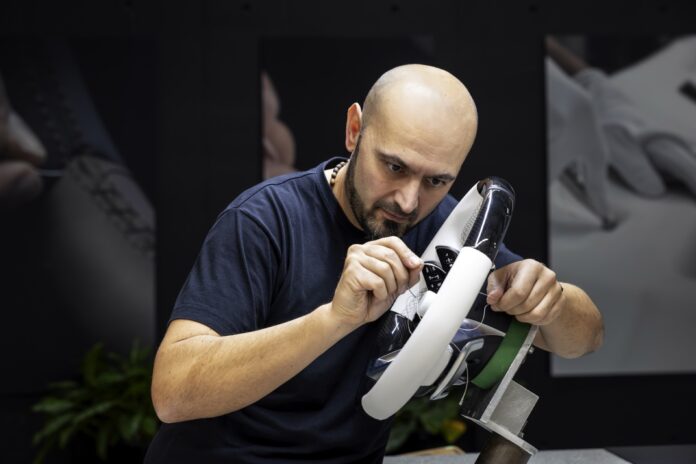
Rome has long been synonymous with elegance, history and timeless style. This year, Hotel de la Ville and Rocco Forte House have elevated the city’s sartorial legacy with The Gentleman’s Journey — a meticulously curated shopping experience designed exclusively for men who appreciate the finest in Italian craftsmanship.
Guided by an expert Italian tastemaker, this bespoke itinerary takes participants on a journey through Rome’s best-kept shopping secrets, from historic barbershops and legendary tailors to refined boutiques and artisanal ateliers. Whether you seek a perfectly tailored suit, handcrafted leather shoes or a signature fragrance, this curated experience promises a sophisticated exploration of the city’s most distinguished establishments.
A Tailored Itinerary of Excellence
Each stop has been carefully selected to showcase the artistry and heritage of Italian menswear. Here’s a glimpse into the exclusive destinations included in this refined experience:
Antica Barberia da Peppino
Since 1957, this historic barbershop has been a haven of impeccable grooming for Rome’s elite, including royalty, politicians and celebrities. Offering a masterful blend of tradition and modern luxury, a visit here is the perfect way to begin your journey into refined Italian style.
Sartoria Tommy & Giulio Caraceni
This legendary tailor has dressed some of the world’s most stylish men, from Cary Grant to Gianni Agnelli. Known for its dedication to craftsmanship and quintessential Italian elegance, Caraceni is the ultimate destination for bespoke, handcrafted suits that stand the test of time.
Marini Calzature
Founded in 1899, this renowned shoemaker became an international symbol of sophistication during Rome’s La Dolce Vita era. Having crafted bespoke shoes for icons like Marcello Mastroianni and Anna Magnani, Marini continues to uphold its legacy of unparalleled artistry from its original workshop near Via Veneto.
Brioni
A global icon of sartorial luxury, Brioni has defined Italian menswear since 1945. Offering both bespoke and ready-to-wear collections, the boutique epitomizes refined elegance with meticulously crafted garments and accessories, all designed in the spirit of “slow luxury” and sustainability.
Schostal
For over 150 years, Schostal has specialised in high-quality Made in Italy sleepwear and fine knitwear, offering timeless pieces that bring effortless sophistication to everyday dressing.
Cruciani & Bella
This intimate haberdashery in Rome’s historic center curates an exquisite collection of gentleman’s accessories, including silk ties, cashmere scarves and sterling silver cufflinks — each designed to add a touch of personal refinement to any outfit.
Campomarzio70
A paradise for fragrance connoisseurs, this storied Roman perfumery has been crafting and curating exquisite scents for four generations. Guests can explore a world of rare and artisanal fragrances, guided by expert perfumers who specialise in creating signature scents tailored to individual tastes.
The Ultimate Personalised Experience
For those seeking even deeper sartorial guidance, The Gentleman’s Journey can be enhanced with bespoke styling advice from renowned Italian menswear expert Giorgio Giangiulio. Known for his refined aesthetic and deep appreciation of classic menswear, Giangiulio will provide exclusive insights into curating a wardrobe that reflects true Italian elegance.
With prices starting from EUR 2,000, this exclusive experience is available for booking through the Concierge Team at Hotel de La Ville and Rocco Forte House.
A Stay Steeped in Elegance
Guests embarking on this curated journey in the Eternal City will have the privilege of staying at Hotel de La Ville, a striking 18th-century palace perched atop the Spanish Steps. Since its grand reopening in 2019, the hotel has become a pinnacle of Roman luxury, boasting elegantly designed suites, world-class dining curated by Chef Fulvio Pierangelini, and the serene Irene Forte Spa. The breathtaking Cielo Terrace offers sweeping views of this iconic destination — an ideal setting to unwind after a day of refined shopping.
For the modern gentleman who appreciates tradition, craftsmanship, and effortless sophistication, The Gentleman’s Journey is more than a shopping experience — it’s an immersion into the very essence of Italian style.
To book your Gentleman’s Journey, contact the Concierge Team at Hotel de La Ville or Rocco Forte House.
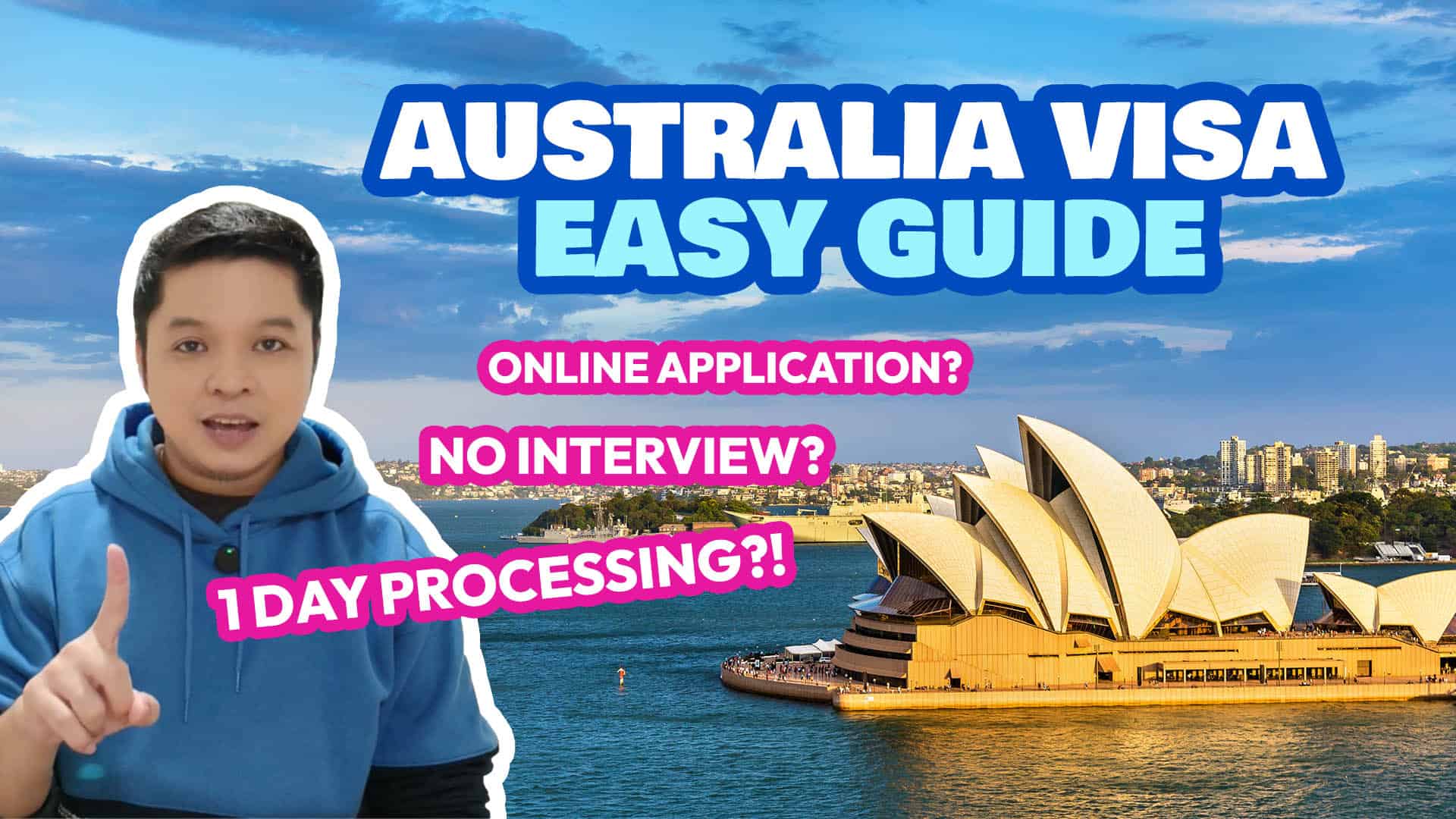
This is our AUSTRALIA VISITOR VISA Application Guide. In this article, you’ll find a list of requirements and the application steps to secure a tourist, business or visit visa online. Note that this is based on our own experience applying for an Australian visa. This is not official advice. For that, please check out the Australian Immigration website or consult an immigration advisor.
So you want to go to Australia?
Whether it’s to spot a koala or kangaroo, snap a selfie at the Sydney Opera House, or snorkel over the Great Barrier Reef, you’re going to need an Australia visa first.
The good news? Getting an Australian tourist visa isn’t as complicated as most people think, at least not for most nationalities. For the most part, the application is done online. For Filipino applicants, it used to be 100% online. But after the pandemic, a new biometric collection step was added, which has to be done in person. But I’m getting ahead of the story.
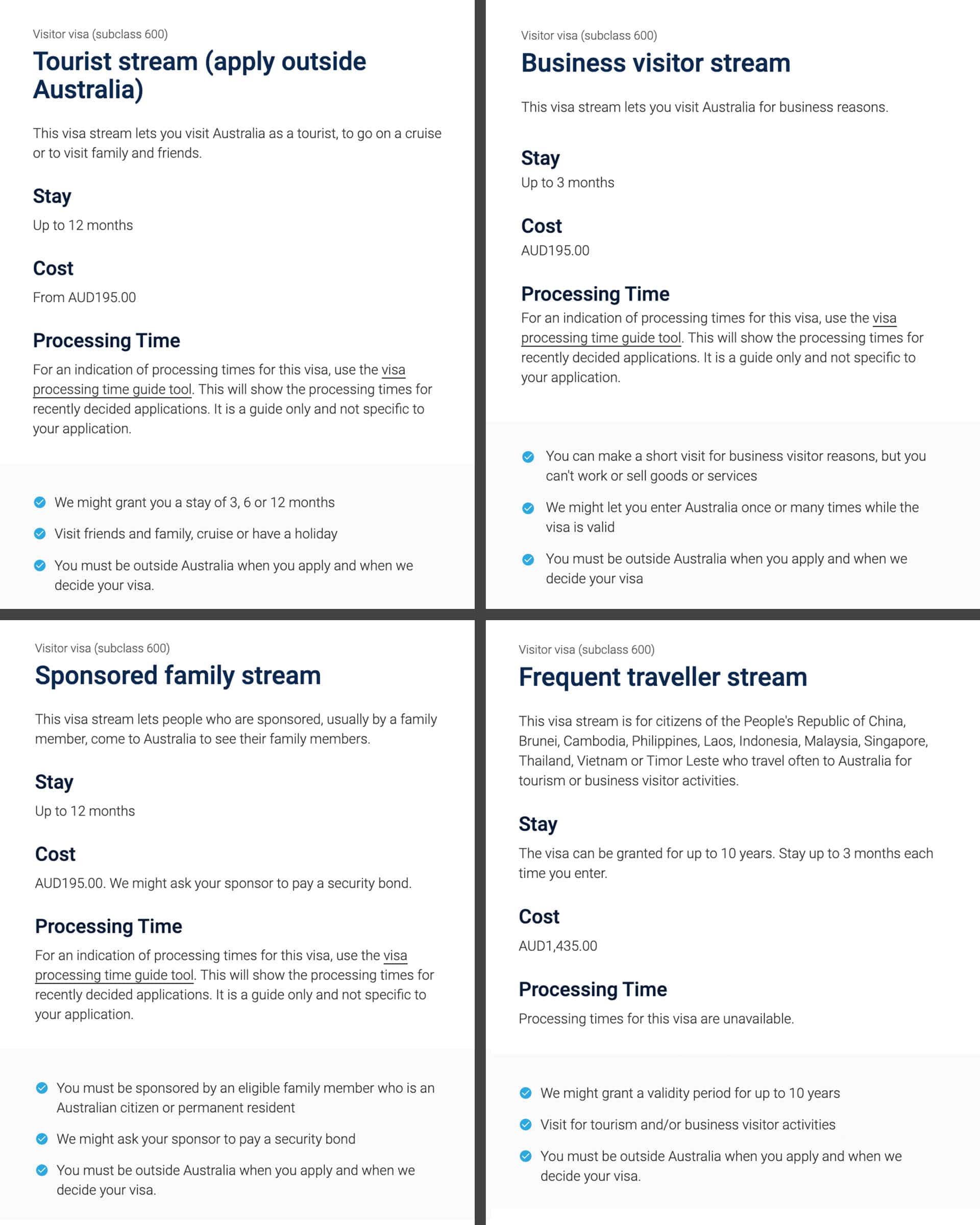
If you’re traveling to Australia for tourism, business or to visit someone, you’ll most likely need a VISITOR VISA Subclass 600. But under it are several types or streams:
TOURIST STREAM, for applicants traveling for leisure, joining a cruise, or visiting family or friends who will not be sponsoring your trip. Cost: AUD 195 (PHP 6750). Duration of stay: 3 months, 6 months or 12 months.
SPONSORED FAMILY STREAM, for those who will be sponsored by family or friends who are citizens or permanent residents of Australia. Cost: AUD 195 (PHP 6750) but sponsor may be asked to pay a security bond. Duration of stay: 3 months, 6 months or 12 months.
BUSINESS VISITOR STREAM, for those traveling for business-related reasons such as meeting a client or attending a conference. Not to be confused with a WORK VISA, which is a completely different type. Cost: AUD 195 (PHP 6750). Duration of stay: 3 months only
FREQUENT TRAVELER STREAM, for those who visit Australia multiple times for tourism or business purposes. Eligible countries: China, Brunei, Cambodia, Philippines, Laos, Indonesia, Malaysia, Singapore, Thailand, Vietnam, Timor Leste. Cost: AUD 1,435 (PHP 49,600) Validity: 10 years Duration of stay: 3 months per visit
You’ll find more information about the different types of Visitor Visa on this page. Make sure you choose to correct stream for you!
Step 2: Complete the Australian visa requirements.
Here are the documents you need to gather when applying for an Australia Visitor Visa:
IMMI application form. To be accomplished online.
Scanned copy of the passport info page. Must be clear and readable. Passport must be valid.
Evidence of applicant’s previous travels. Scanned copy visas and stamps on current and old passports. If you’ve been granted an Australia visa before, chances are you won’t be required to submit this anymore.
Family Register and Composition Form (Form 54). List out all the members of your immediate family (parents, siblings, children, and spouse or de facto partner, if any). De facto partner means a domestic partner but not married. It has two (2) pages. Page 1 is Chinese; Page 2 is in Latin letters. Even if you accomplish just the second page, all your answers will automatically reflect on the first page. Make sure to affix your signature and your witness’. Digital signature is OK. No need to print it out. – You may also upload a copy of your birth certificate or marriage certificate (if the last name you’re using is different from what’s on your birth certificate).
Evidence of financial status and funding for visit. You can upload any or all of the following: – personal bank statement – income tax return (ITR) – pay slip – title deed, if meron kayong properties – retirement pension book, if retired
Evidence of current employment or self-employment. – For employees, it can be certificate of employment explaining your role in the company and proof that your leave of absence is approved. – For self-employed applicants, you can upload your business registration documents. – For students, certificate of enrollment.
If TOURIST STREAM: Evidence of planned tourism activities in Australia. This can be a detailed itinerary or day-to-day activities.
If part of a GROUP: Group tour details. – If you’re traveling DIY style, upload a list of all your travel companions. – If you booked a group tour, upload a letter from the agency that arranged your tour.
If BUSINESS STREAM: Evidence of business-related reason for travel. This can be any of the following, whichever is applicable: – proof of conference registration – details of previous contacts with Australian company or organization – letter from your employer explaining why you need to travel to Australia
If SPONSORED FAMILY VISIT STREAM, so we haven’t tried it so we have no first-hand information. But you may be asked to submit the following: – Letter of invitation. Only if you’re visiting a friend or relative. Best if you have photos with that friend and relative showing that you really know each other. – Identification Documents of Sponsor. If you declare that your trip will be paid for by someone other than yourself. – Evidence that your sponsor in Australia can financially support your trip. If you declare that your trip will be paid for by someone other than yourself. – Your sponsor might also be required to pay a bond.
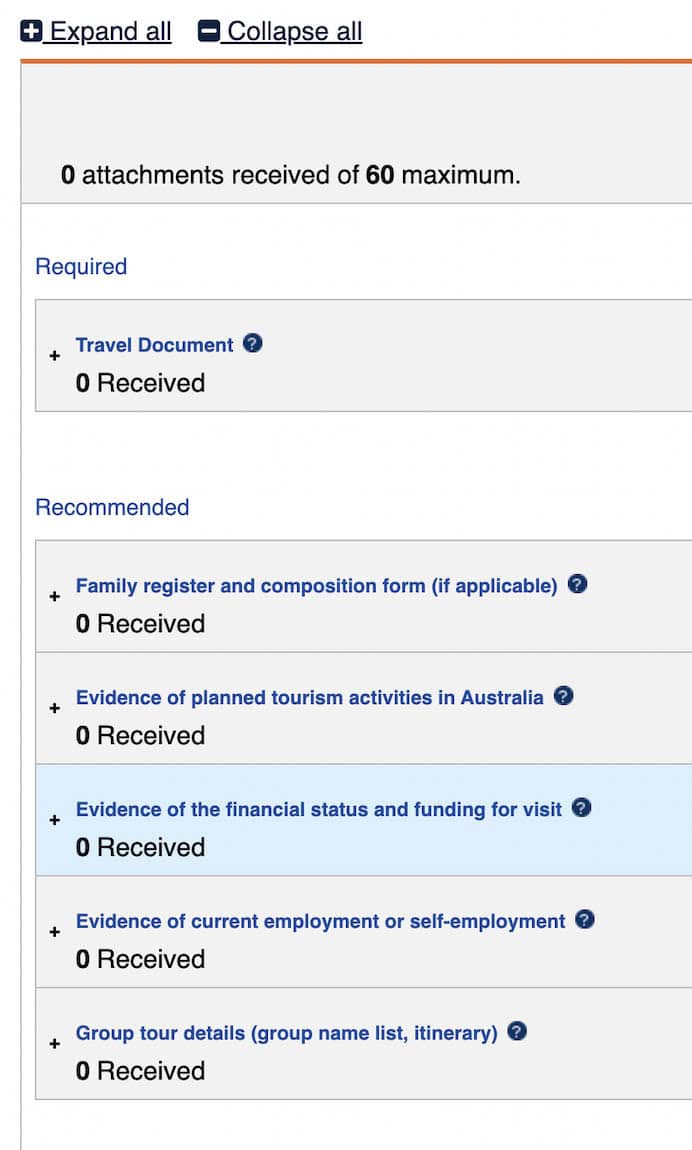
Technically, only the above three documents are tagged REQUIRED on the website. The rest of the items are marked RECOMMENDED. But it goes without saying that you should also submit those for better chances of approval.
In addition, here are other documents that are NOT required but could help your application. I submit these whenever I apply for an Australia visa:
Cover letter. Remember, there will be NO INTERVIEW. So I always submit a cover letter to give better context and explain anything that I think they might find confusing.
Flight reservation. If you have this already — say, you snagged promo fares from an airline’s seat sale — go ahead and submit it. But if you don’t have flights yet, you are discouraged to book before you’re granted a visa to avoid wasting funds in case you are denied. What we submit instead is a “flight reservation”. It’s sometimes called a “dummy booking” but I don’t like this term because flight reservations are actually legit documents that can be cancelled, issued by travel agencies. You can get one here: HOW TO GET FLIGHT RESERVATION FOR VISA APPLICATION! ✅
Hotel booking. Again, only if you have it. If you decide to submit, search Klook and pick a hotel with FREE CANCELLATION so you can easily cancel refund your payment if your application is rejected.
Upload PDF files. If your document is in a different format, best to convert it to PDF.
Each file must not exceed 5MB. If your file is larger, compress it. There are plenty of free compression tools online.
Make sure the documents are not encrypted. Remove the file’s password if it requires one.
ZIP files are not accepted. You must upload each item one file at a time.
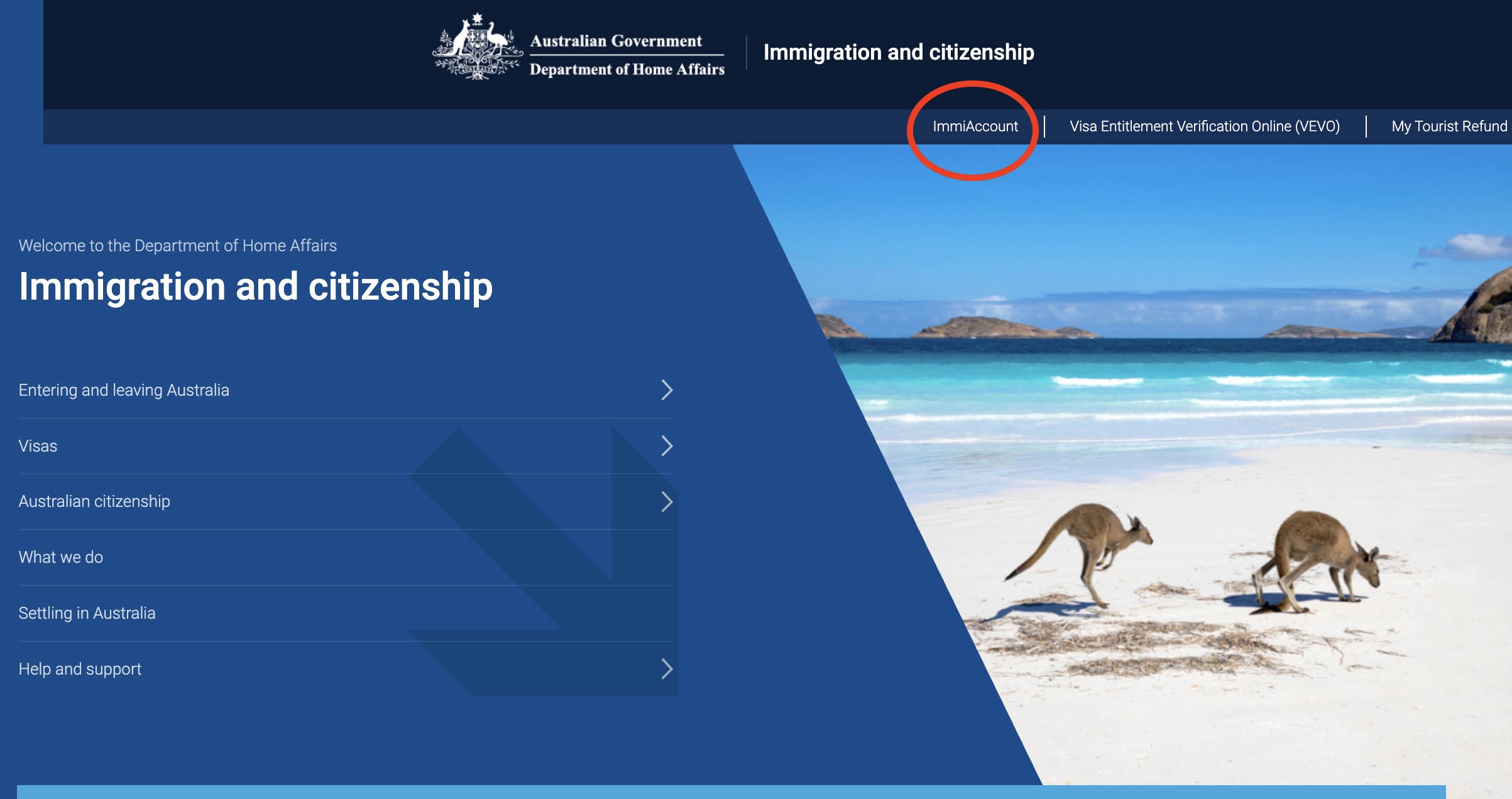
Step 3: Create an ImmiAccount.
ImmiAccount means an account with Immi.gov.au. This is the official immigration website of the Australian government.
It’s easy to register. Just go to this site and sign up using a valid email address.
Make sure you use a working email address. Any update about your application will be sent to this email (including the acknowledgment of receipt of your application and the actual visa grant). You will also get notified every time you log into your account.
If you’re a family, no need to create an account for each member. You can start and lodge multiple applications under just one IMMI account. Just make sure to declare the owner of the Immi account as the authorized recipient by also submitting a Form 956A. I will explain this better in the FAQs section below.
Once you have an account, you’ll receive a confirmation link via email. Check your inbox and follow the link.
Step 4: Fill out the application form.
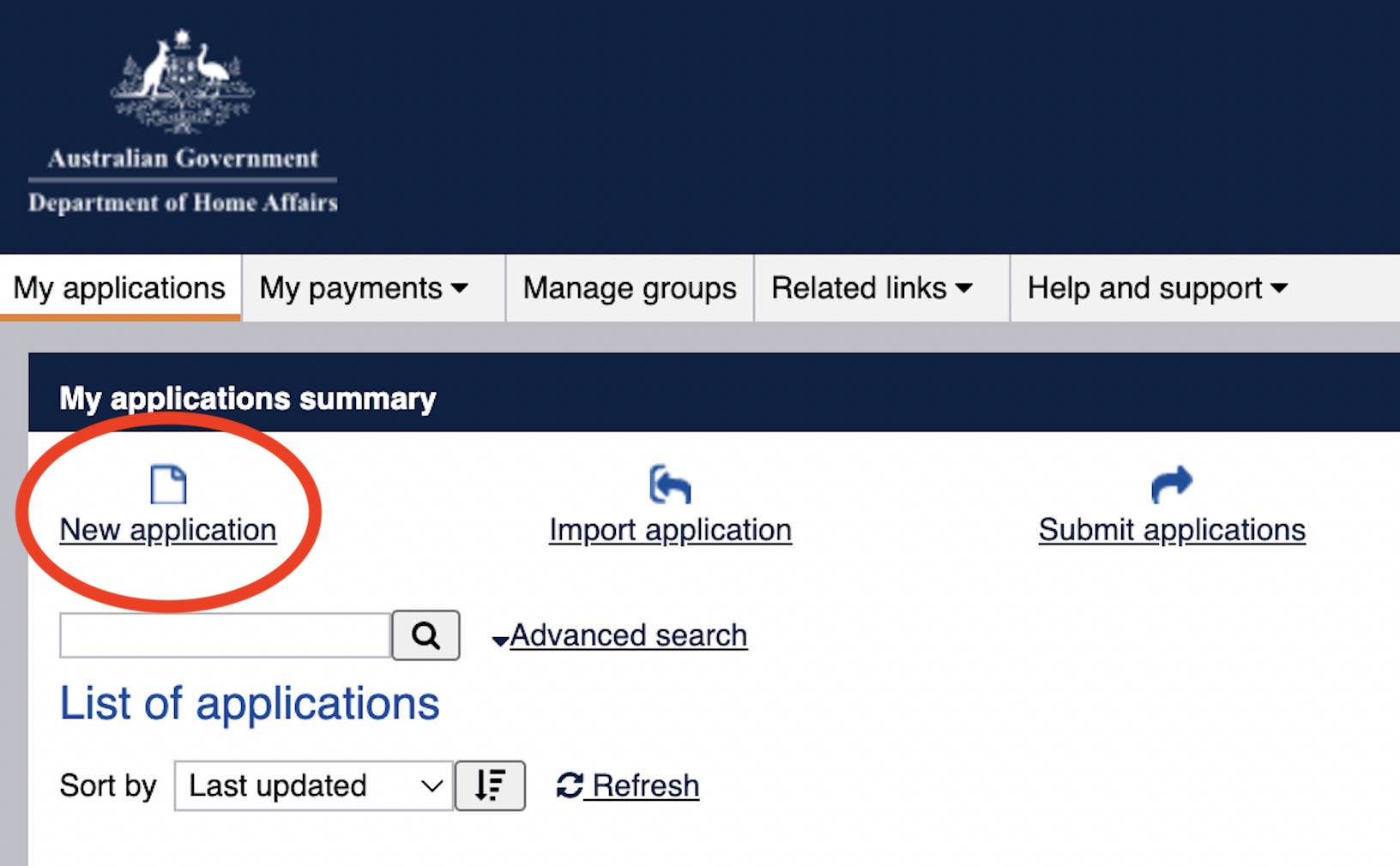
After confirming your email, follow these steps:
On the dashboard, click on NEW APPLICATION. On the next page, you’ll be presented with a list of the different types of visa.
Click VISITOR and under that, select VISITOR VISA (600).
Answer all the questions and fill out all the next pages.
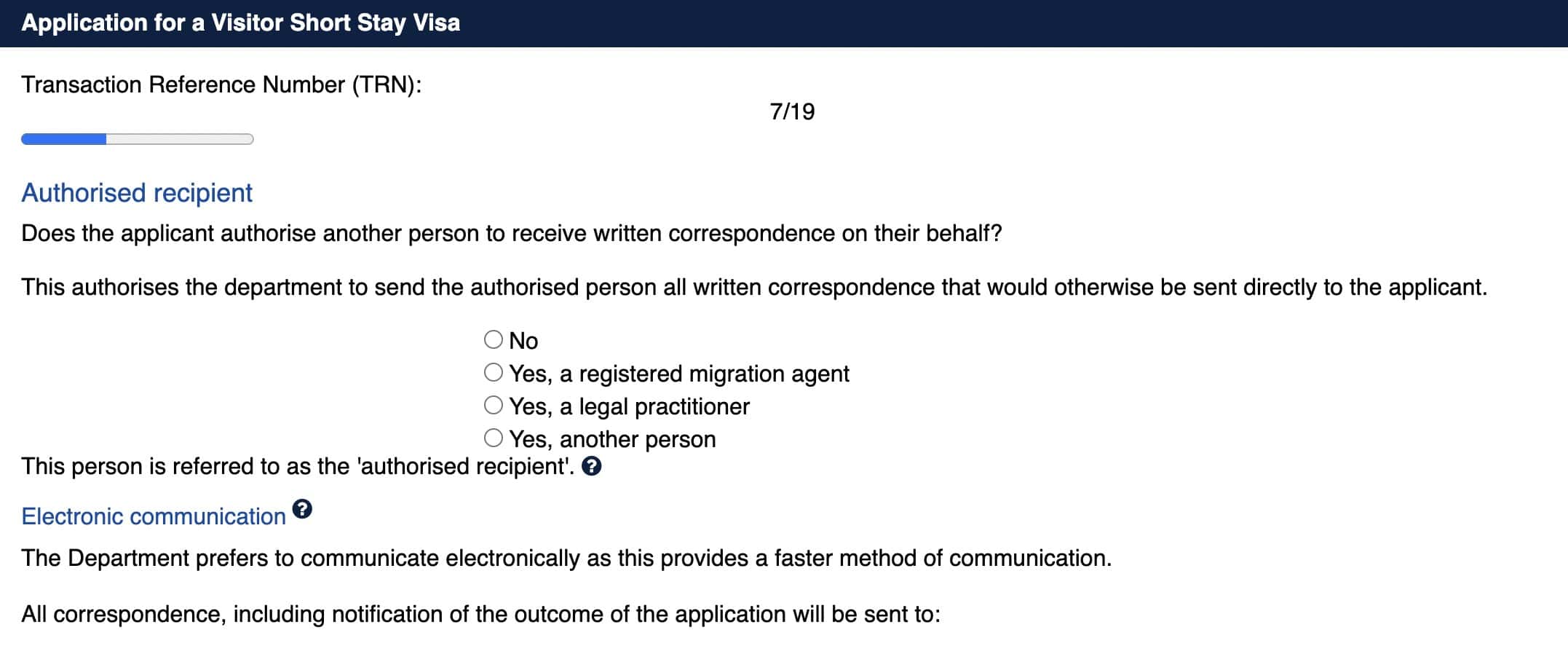
The application form has 19 pages total so it takes a lot of time to finish, but they’re easy to understand. But there are three things that I want to explain further:
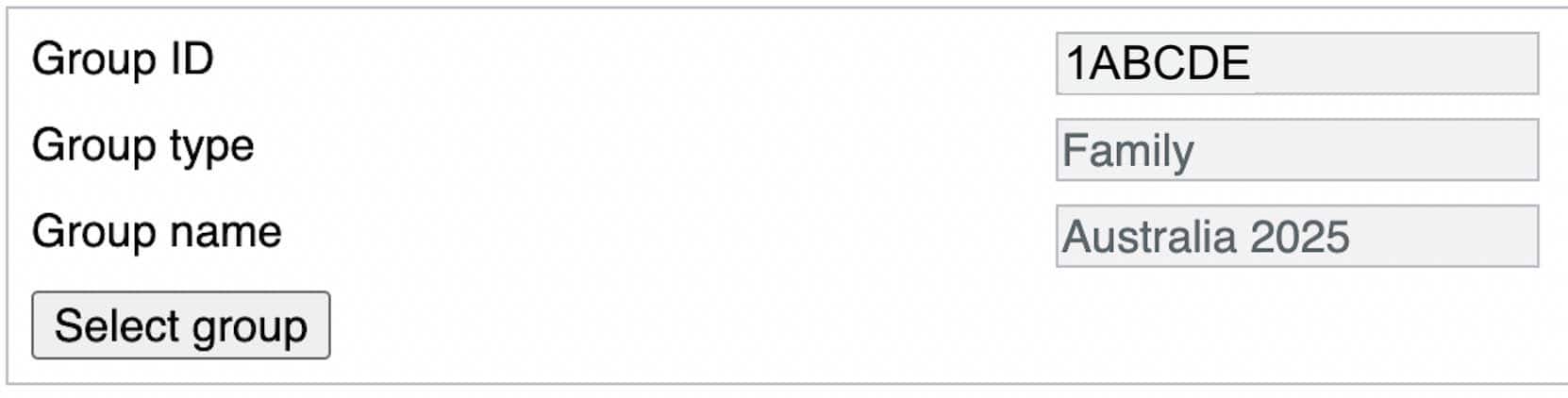
Group processing. If you’re traveling as part of a group, one of you can generate a group code that you can save and share with your travel companions. Other members of the group can enter that same code to tell the system that you’re all traveling together.
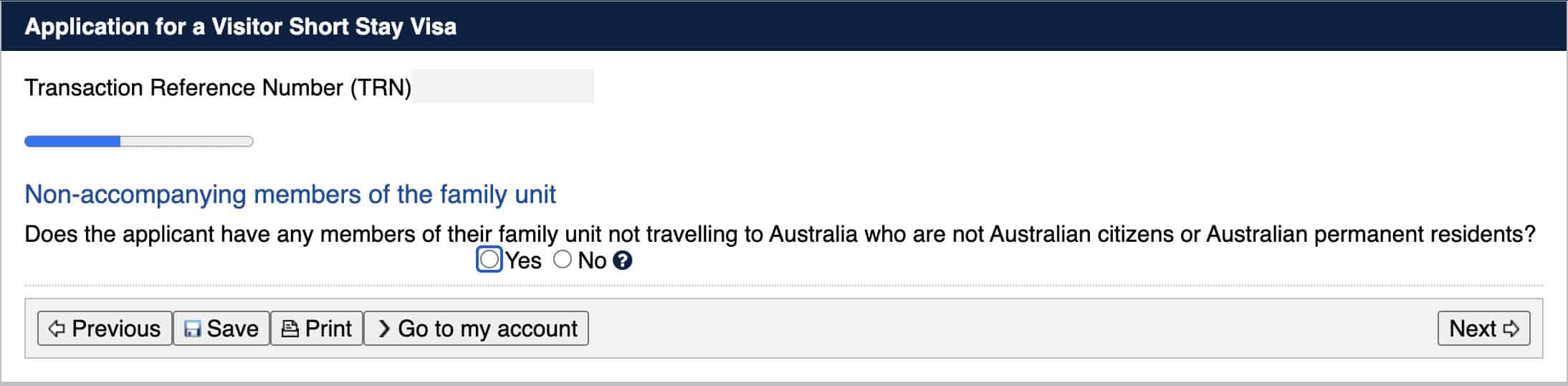
Family unit. On the page 8 or page 9 of the form, you’ll encounter this question: “Does the applicant have family members of their family unit not travelling to Australia who are not Australian citizens or Australian permanent residents?” According to the Australian Immigration website, a family unit is defined as a partner (married or de facto) and a dependent child below 23 years old. If you’re single with no kids, just tick NO. If you have a spouse/de facto partner or child who won’t be joining you to Australia, choose YES and fill out the form that appears. We have a more detailed explanation in the FAQs section below.
Significant dates. If there are specific dates that are crucial or important to your purpose of travel, write them down under the “Any Significant Date” field. For example, if you’re attending a wedding or a concert, input the date of the event. If you have no significant date in particular — say, you’re simply sightseeing or touring — you can skip this part.
If you’re not able to complete the application form in one sitting, you can always save your progress and pick up where you left off next time. As long as you don’t hit the SUBMIT button, you can always go back to it and edit your answers.
🚨 Do NOT submit the form unless you are 100% certain that your answers are correct and final. You’ll be asked to review all your answers, but once you submit it, you won’t be able to edit it anymore.
Step 5: Upload supporting documents.
After reviewing and submitting the form, you’ll be led to the UPLOAD DOCUMENTS page. This is what it looks like for TOURISM STREAM.
For other streams, some documents will be replaced/added.
Upload your documents one file at a time. Again, each file must not exceed 5MB.
When everything looks great, click SUBMIT NOW.
Step 6: Pay the visa fee.
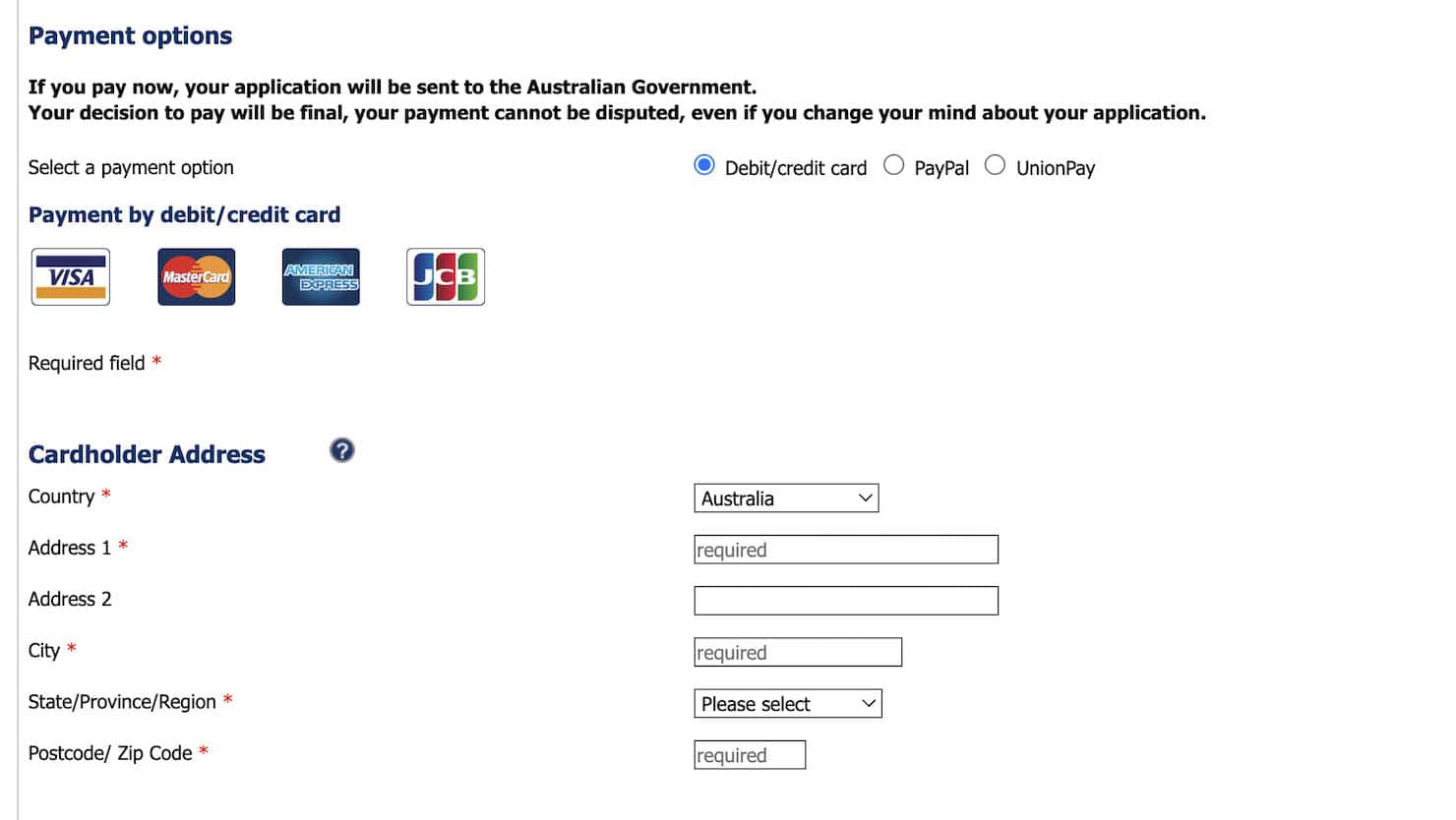
You’ll be redirected to the Payment Page.
How much is the Australian Visitor Visa Fee? For Tourist, Business or Sponsored Family Visit Streams, an Australian visa costs AUD 195.
You can pay via credit card, debit card, PayPal or UnionPay.
After payment, you’ll most likely receive two (2) messages in your email or in your IMMI account’s inbox, each with an attached document:
Acknowledgment of Application Receipt
Requirement to Provide Biometrics
And this brings us to our next step.
Step 7: Schedule a biometrics collection appointment.
You must schedule a biometrics collection appointment within 14 DAYS of submitting your application.
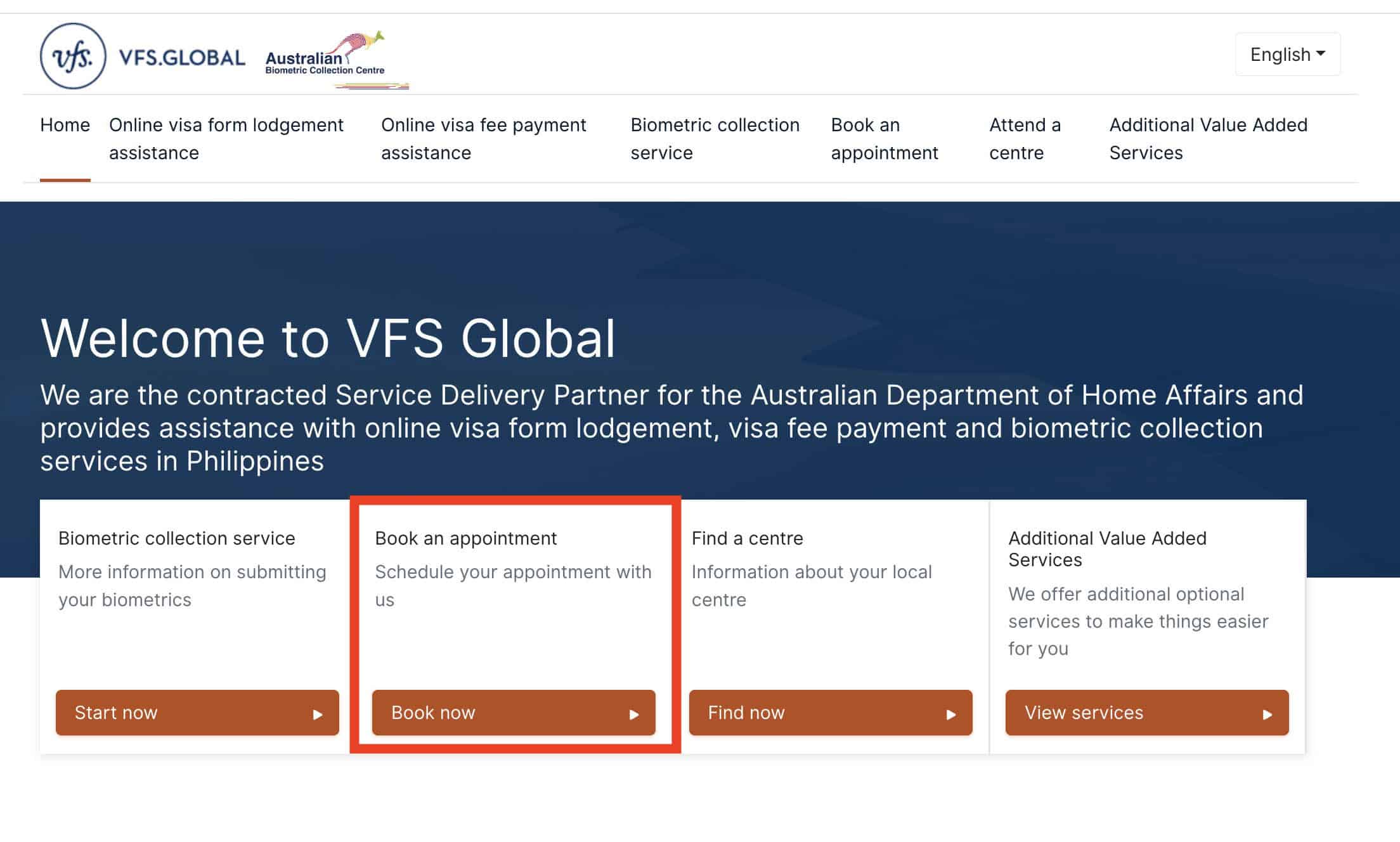
To do that, visit the Australia visa page of the VFS website, and create an account. As always, you’ll need to enter a valid email address and mobile number, and set a password.
Once you have a VFS account, do the following:
On the dashboard, click on START A NEW BOOKING. It’s the orange button in the upper right corner of the screen.
Enter your appointment details. Choose your preferred location. As of this writing, the Australian Biometric Collection Centre has three sites: Makati (Metro Manila), Cebu, and Davao.
Under appointment category and sub category, choose Biometrics collection. Then click CONTINUE.
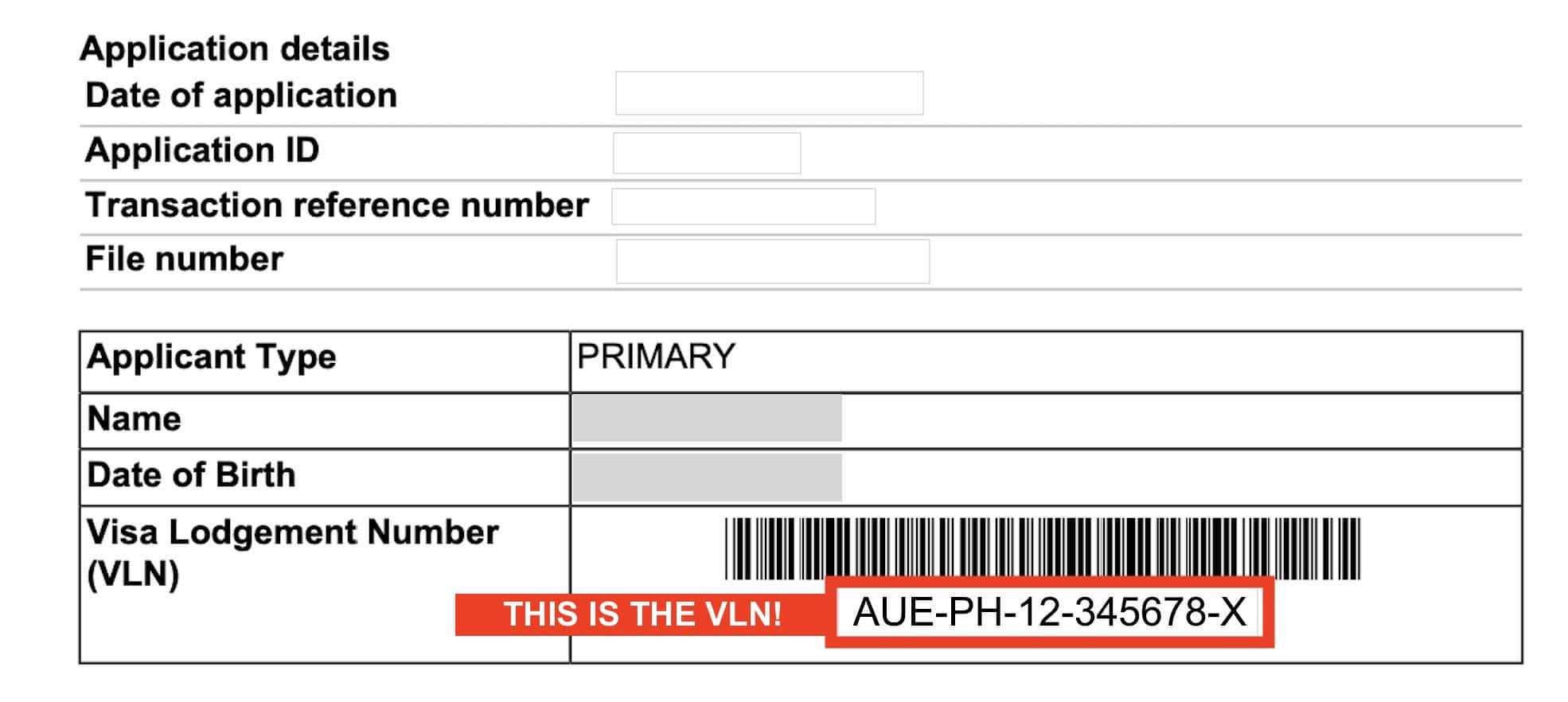
Enter your personal and application details. The most important bit is the VLN (visa lodgment number), which can be found in the file labeled S257A (S40) Requirement to Provide Biometrics, which was sent to your email after paying the visa fee. This is the number just below the barcode. Then, in the Identity Document number, type your passport number. Click SAVE. You’ll be taken back to the dashboard.
If you’re part of a group and you’re submitting biometrics together, you can also add them to your account. Just click on ADD ANOTHER APPLICANT. You’ll be required to enter their VLN and passport numbers, too. In our family’s case, only I created an account but I added them all. I didn’t encounter any issue. Click CONTINUE.
Choose an appointment date. Dates that are green are still open. Greyed out ones are no longer available.
Select appointment time. The earliest time slot is 7:30 AM and the latest is 2:45 PM. Within this period, the biometrics processing fee is only PHP 557 per person, to be paid on site during your appointment. (This is different from the visa fee that you paid for online.) This is the cheapest option. If you really can’t make it within this period, you can choose a later time, but it’s pricier, at PHP 2350 per person. There is also a “lounge” option, but you won’t need it so just ignore that.
Review your appointment details. If everything looks good, click PAY AT VFS CENTER.
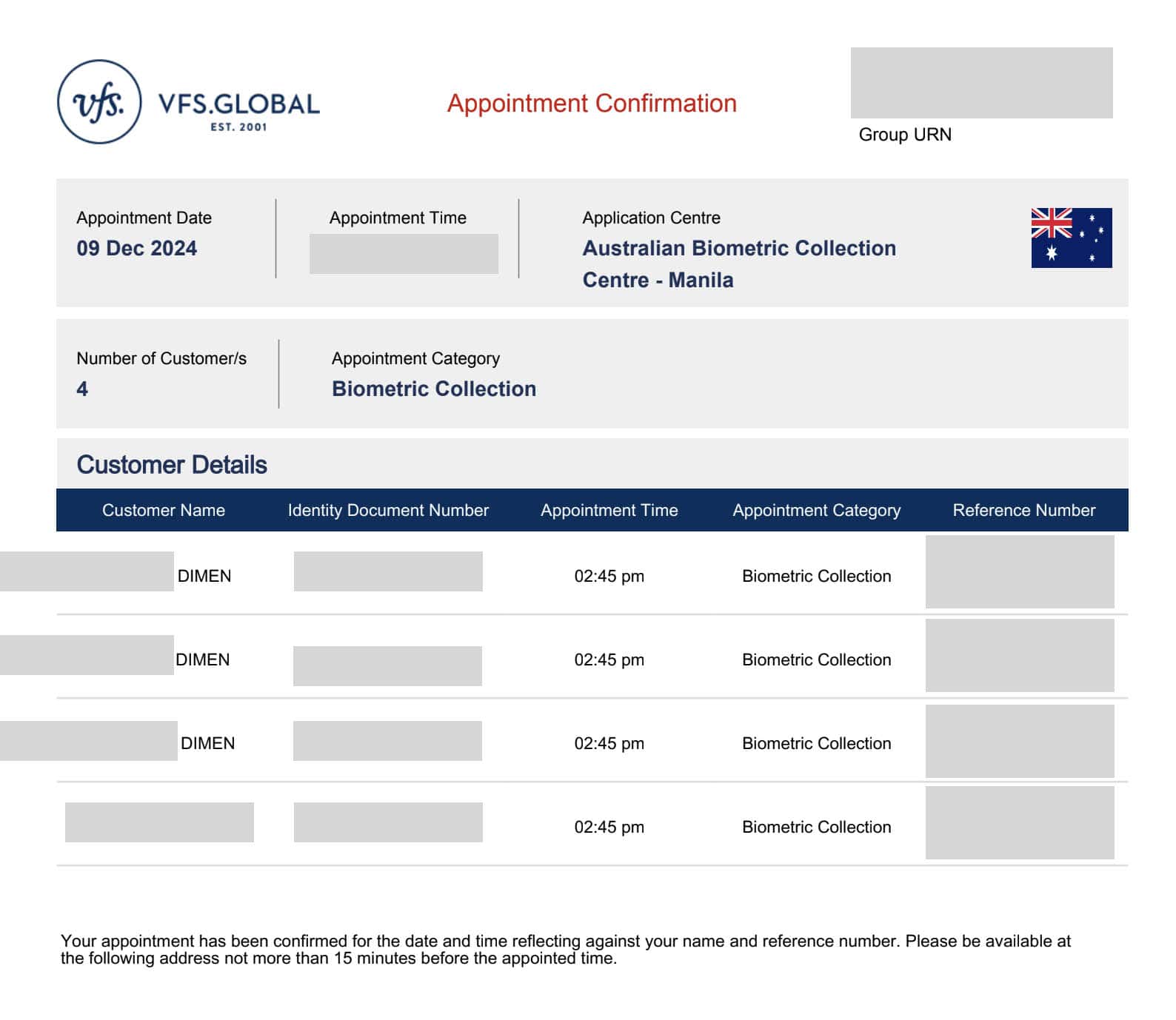
Check your email. You will receive an appointment confirmation message with an attached file. Save it or print it out. It looks like this.
Step 8: Submit your biometrics at Australian Biometric Collection Centre.
The Australian Biometric Collection Center has three (3) locations in the Philippines:
Metro Manila. 6F, Makati Circuit Corporate Center Tower II, AP Reyes St. Brgy. Carmona, Theater Drive Circuit Makati, Makati City, 1207 Philippines
Cebu. Unit 905, 9F, Kepwealth Center, Samar Loop Corner, Cardinal Rosales Avenue, Cebu Business Park, Cebu City 6000 Philippines
Davao. Unit FES08, 2nd Floor, Alfresco Area Felcris Centrale, Barangay 40-D Quimpo Boulevard, Davao City, 8000 Philippines
For all these sites, business hours: 07:30 AM to 03:00 PM
Arrive at the biometrics collection center 30 minutes before your schedule.
Bring the following:
Passport. Original.
s257A Requirement to Provide Biometric document. This is the attachment with the VLN or barcode. Printed or digital copy.
Appointment confirmation letter. Printed or digital copy.
Don’t bring power bank, laptop or other gadgets because you’ll be forced to deposit it in a locker, which you have to pay for (at least at the Manila/Makati site). If you have a non-applicant companion, ask them to wait outside and hold your gadgets for you while you’re upstairs. They won’t be allowed to enter the center anyway.
NOTE: THIS IS NOT AN INTERVIEW. So relax and don’t be too stressed. What they’re doing here is NOT to evaluate you or your application. They will just take a photo and your fingerprints. That’s all. Chill out.
Once you’re at the Biometrics Collection Center, follow these steps:
Approach the reception.
There usually is a line forming in front of it. The staff will check your passport and documents. If everything is in order, you’ll be given a number.
Enter the main area and wait for your number to be called.
You’ll be surrounded by numerous small rooms and TV screens, where you can track which numbers are being served at any given time.
Once called, enter the assigned room.
Only one person is allowed at a time. If you’re a group, you’ll be assigned just one room, but you’ll still need to enter the room one by one.
Inside the room, the staff will take your photo and fingerprints.
The rooms are closed, so you have total privacy. In our experience, the staff were all so pleasant and courteous.
When done, pay the P557 biometrics servicing fee.
Cash and card payments are accepted, but cards take much longer because there are only a couple of terminals on site, shared by all staff. If you’re in a hurry, pay cash.
That’s it! It was quick. The whole process took less than 30 minutes, considering we were a group and there was a minor glitch in the numbering system when it was our turn. For some of our friends who visited alone, it took roughly 15 minutes.
Step 9: Wait for the result.
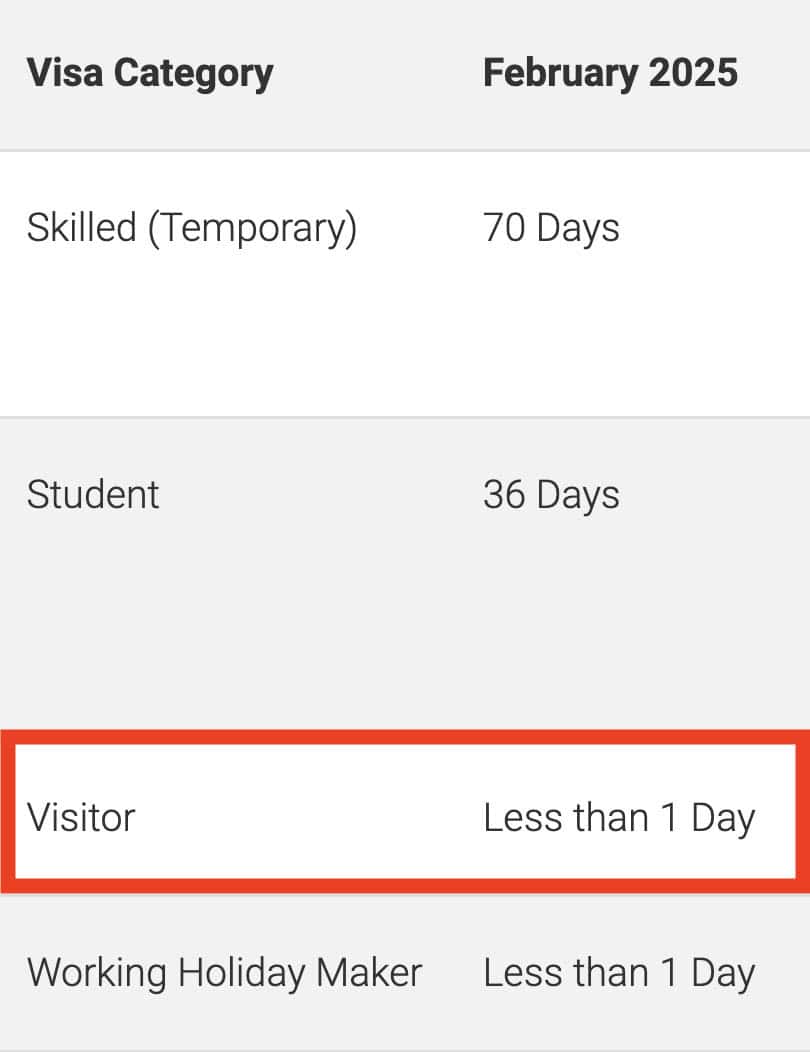
How long will you be waiting? It varies. But according to the official website of the Australian Immigration, the median processing time is 1 DAY (as of this writing, April 2025). Yes, you read it right.
But again, it varies. In our group alone, our wait times range from mere minutes from biometrics submission time to more than a month.
Two of my friends who have been to Australia before: 30 MINUTES after submitting their biometrics. They were so shocked by how fast it was. They had not even left the biometrics center yet. The visa arrived even before their Grab booking. I think it’s because applications are being assessed while waiting for the biometrics collection.
My mom and I, who have also been to Australia before: 1 DAY. We received our visa the day after we submitted our biometrics. Our appointment was afternoon. I feel like if our schedule was in the morning, we’d also get the result on the same day.
My sister and cousins who are applying for an AU visa for the first time: 7 DAYS. That’s exactly a week after their biometrics appointment.
A few of our friends who are applying for AU visa for the first time: 2 WEEKS. This confused us a little because they are well-travelled, but theirs took longer that my sister and cousins.
Vins’s sister and another friend, both first-timers in Australia: MORE THAN 1 MONTH.
Yes, a few on our group had to wait for over a month, which is why despite the quick processing for most, we encourage you to apply at least 2 MONTHS before your travel date, just to be on the safe side.
FREQUENTLY ASKED QUESTIONS
How long is the validity of the Australia visitor visa?
Single-entry visa: valid for 6 months, stay up to 3 months
Multiple-entry visa: valid for 12 months (1 year), each stay should not be longer than 3 months
This is just based on our experience.
Can I apply for a multiple-entry Australian visa even though it’s my first time?
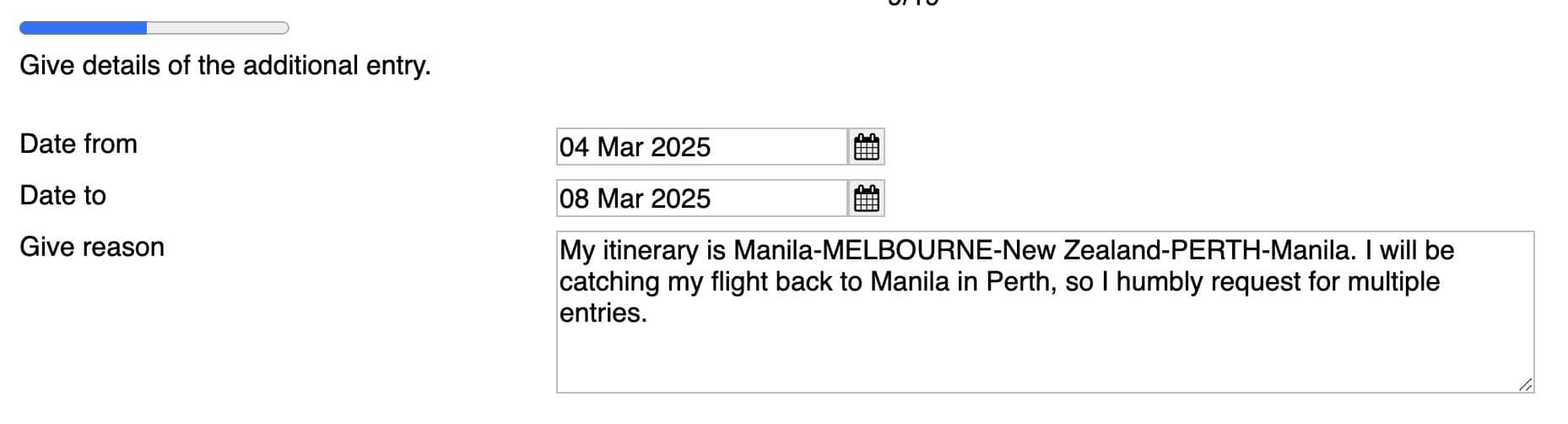
YES. On the application form, you will be asked whether you need to enter Australia more than once on that trip. If you want a multiple entry visa, declare it, but make sure you can justify and prove it.
But in many cases, even if you apply for a single-entry visa, you can still be granted multiple entries. That’s what happened to my family and friends in our most recent application. Most of them are first-timers in Australia and applied for single-entry. But they all received multiple-entry visas valid for one year.
Don’t count on it though. Sometimes, you just can’t say what you’ll get. So far, I have been granted an AU visa four times. On my third application, I was granted a single-entry visa even though it would be my third time visiting Australia.
What are “non-accompanying members of your family unit”?
This question is on Page 8 or 9 of the application form: “Does the applicant have family members of their family unit not travelling to Australia who are not Australian citizens or Australian permanent residents?”
First, we need to define “family unit.”
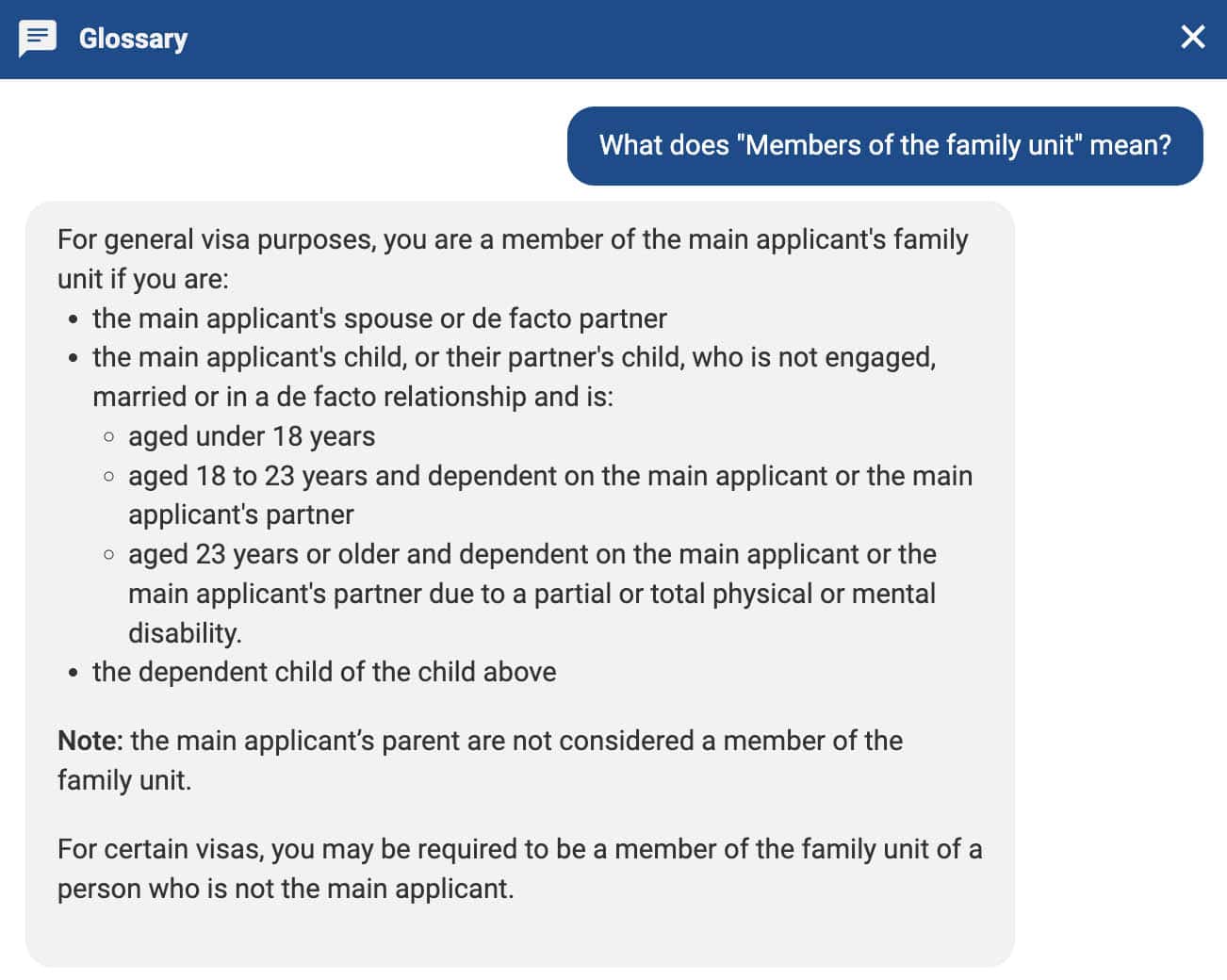
According to the glossary of the Australian Immigration website, a family unit is defined as a partner (married or de facto) and a dependent child below 23 years old. (See screenshot below.)
Based on this, siblings (brothers, sisters), parents (mother, father) and in-laws are NOT included.
If you’re single with no kids, just tick NO.
If you have a spouse or de facto partner or child who will NOT be traveling with you, choose YES and fill out the form that appears.
This is different from Form 54.
I’m being asked to submit Form 956A. What is it?
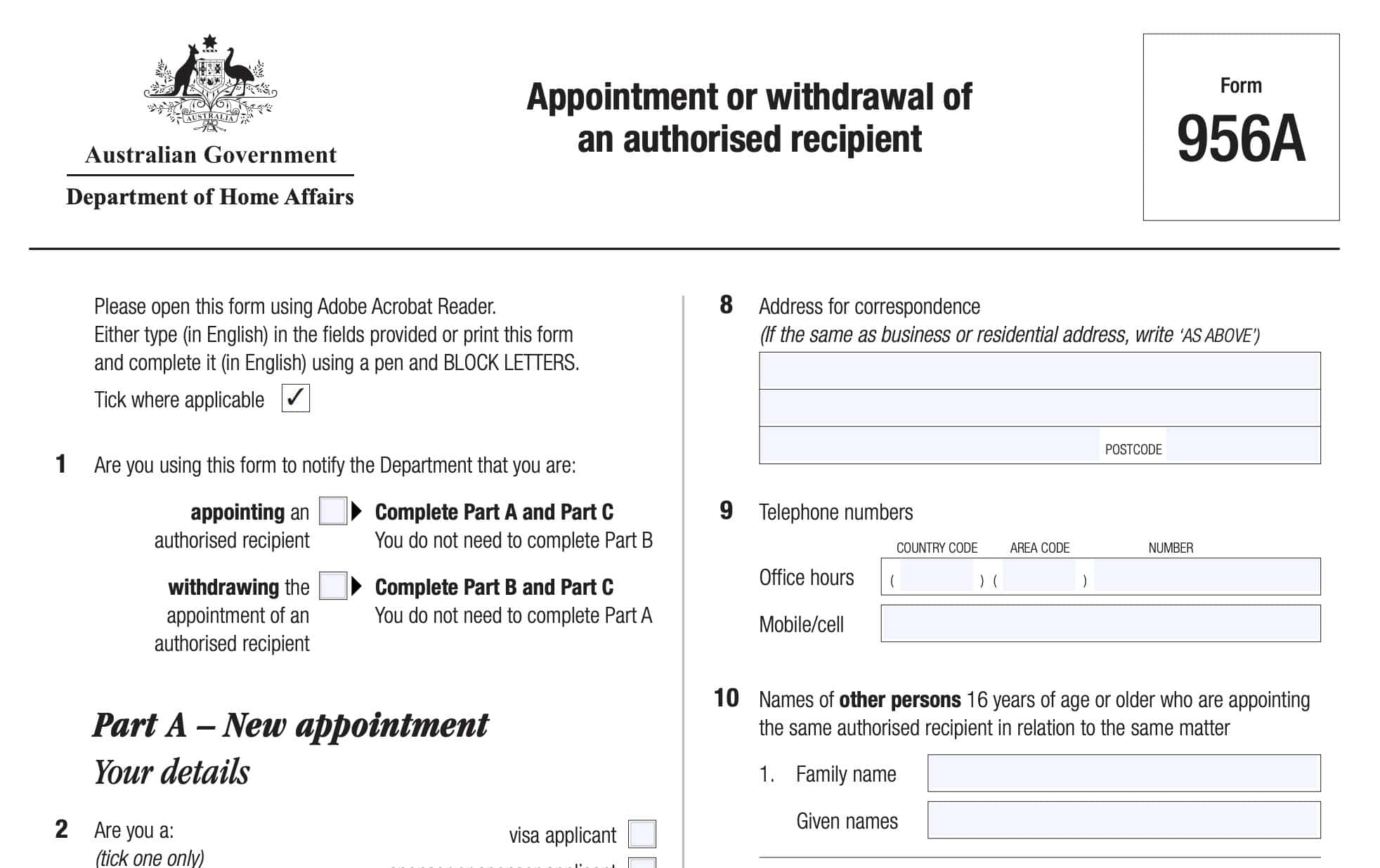
Form 956A is a document that grants someone else authorization to receive files from the Australian Government. In the Application Form, you will be asked if you have an Authorized Recipient who would be receiving documents on your behalf. If you answer YES to this, you will be required to complete and submit Form 956A.
For efficiency, my family decided to have me as the Authorized Recipient for ALL of us. I received all the messages regarding their application.
Be careful when accomplishing Form 956A. This form is also used to withdraw authorization, so make sure you’re filling out the right sections and skip the withdrawal parts.
Is medical/health exam required when applying for an Australian visa?
There is no clear-cut answer to that, as it depends on a lot of factors. But you can easily find out if you need to undergo health examinations. Here’s how:
Log in to your ImmiAccount.
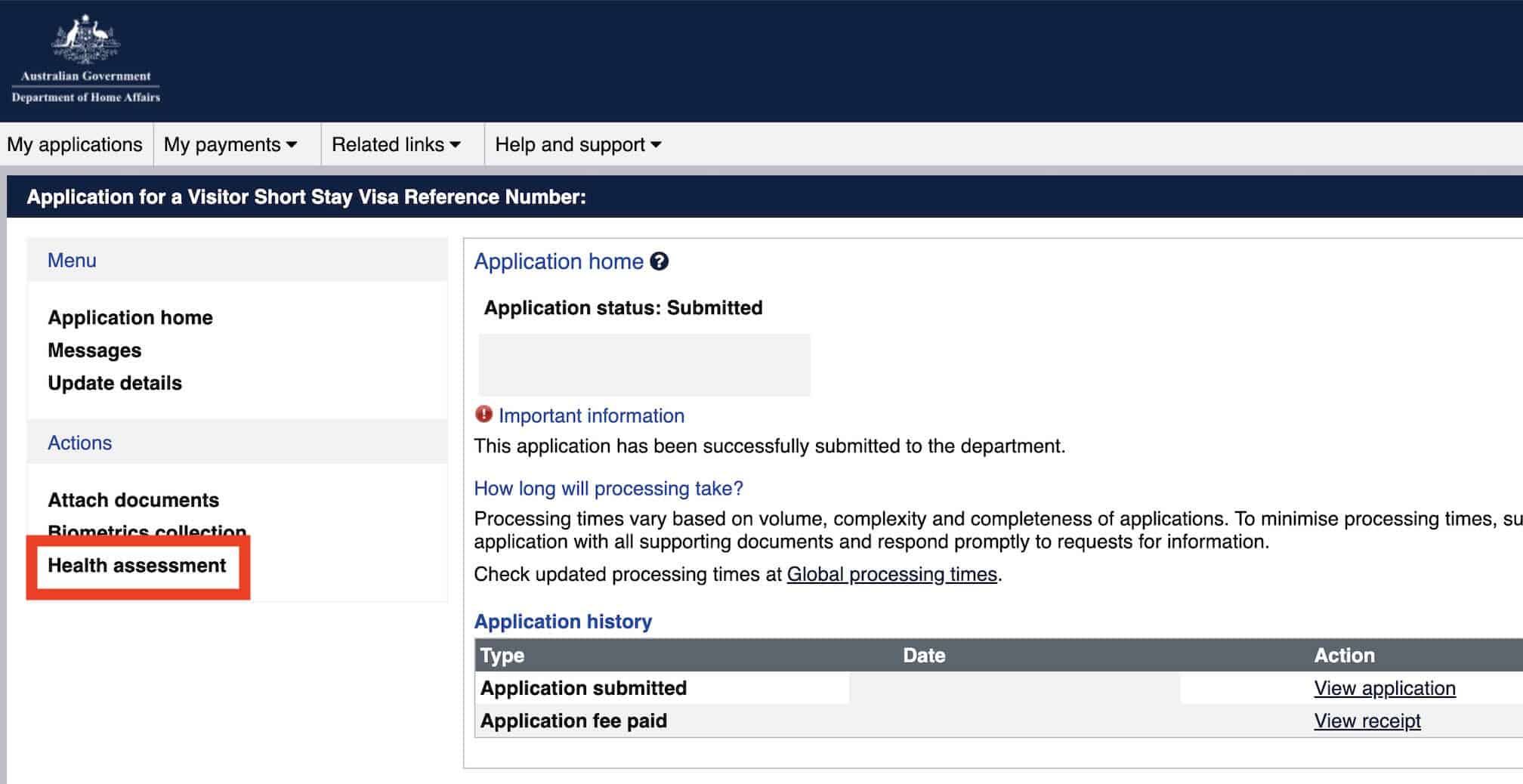
Go to your application. Find the Applications Status section.
Tap on the ‘View health assessment’ link.
If you need to undergo medical or health examinations, you will see a link called ‘Organise health examinations‘. If you don’t need one, it will be explicitly stated on the page, too.
What are the possible reasons why visa applications are rejected or denied?
You may be refused a visa if:
You can’t prove that you intend to return to the Philippines. You probably don’t have a stable job at this point or are newly employed or newly resigned, and it’s giving the impression that you plan on staying longer than your declared duration.
You can’t prove that you can financially support yourself on this trip. You or your sponsor may not be in good financial standing.
There are inconsistencies in your answers. Your answers and/or your documents may be raising some red flags.
You uploaded unreliable documents. The files you submitted may have been unreadable, forged, fake, corrupted, or encrypted.
Your purpose in Australia is unclear. This is why it is best to be specific when you’re detailing the reasons for your visit.
What does an Australian Visa look like?
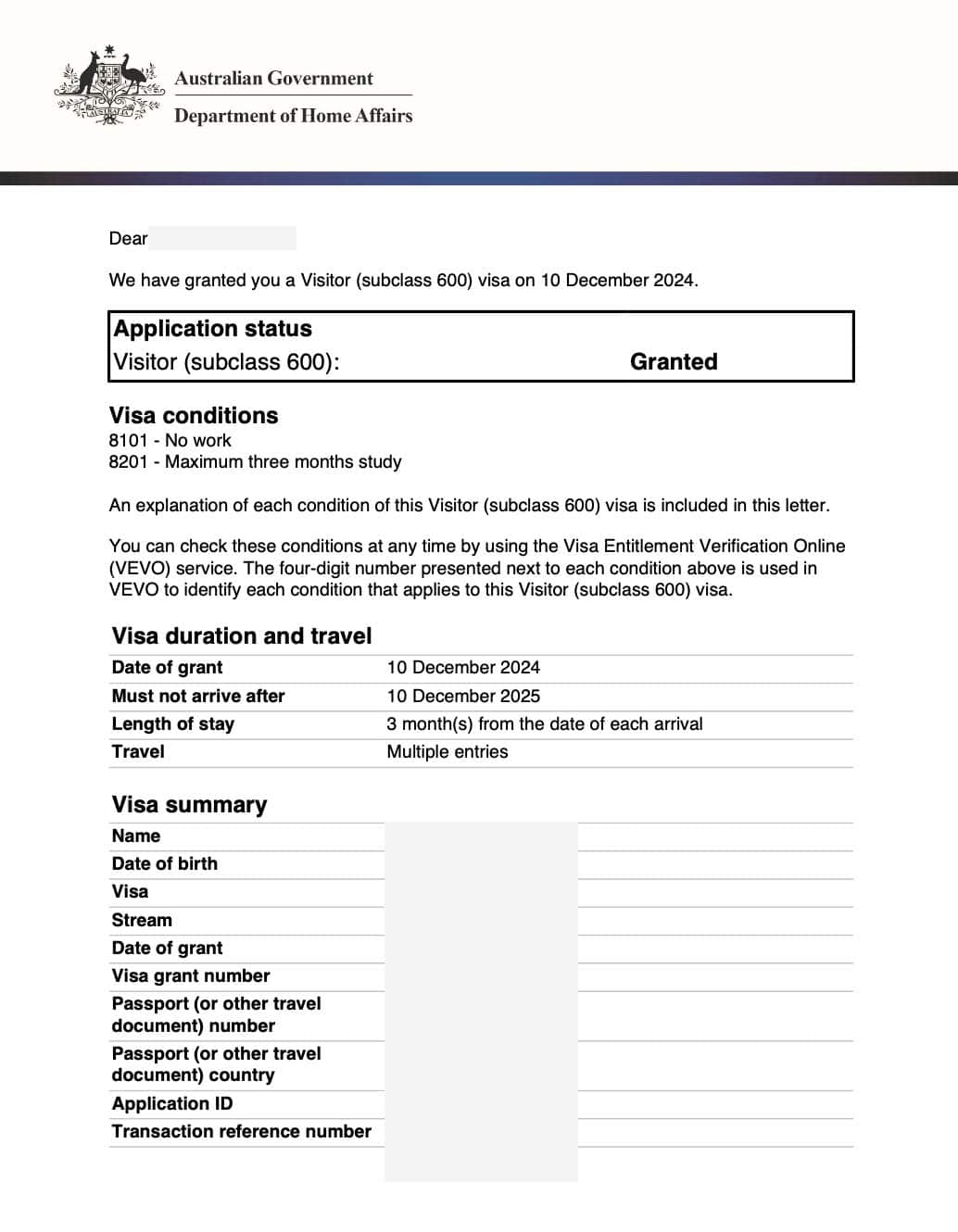
Here’s what the Australian Visa looks like when you receive it online. It doesn’t get attached to the passport. Just bring a copy of it on your travel date.
Note that Immigration officers in Australia no longer stamp passports upon entry or exit.
A rare Hennessey Venom F5 Roadster is up for sale in the United States. The world’s most powerful open-top hypercar has been listed at RAFA Motors in Houston, TX. The asking price on this one is $2.8 million.
With production limited to just 30 units, there aren’t many Roadsters around for sale. This particular example has a Magna White exterior with Sapphire Blue stripes running along the centre, while the interior is trimmed in brown leather. It is also equipped with the exclusive John Hennessey Heritage Series package.
The Venom F5 Roadster is powered by a 6.6-liter, twin-turbocharged V8 engine, which develops 1817 hp @ 8000 rpm and 1,193 lb-ft @ 5000 rpm. The engine is paired with a semi-automatic single-clutch transmission, allowing the car to sprint from 0-60 mph in just over 2.6 seconds.
According to the listing, this vehicle is in “brand new showroom condition”, and the odometer reading shows delivery miles.
The next-generation Chevrolet Corvette is already in the works, and General Motors design studios have been tasked with coming up with a fresh new design language for the Corvette C9. One such design studio is located in the UK, and Top Gear recently got a sneak peek of one of the first concept Corvettes.
What you see here is a fresh take on what a future Corvette might look like. While this concept is designed to be a pure EV, GM will offer a V8 option on the C9 Corvette.
With that out of the way, let’s take a closer look at the styling. The C9 Corvette concept has a top half that has more classic proportions with a flat, sharp front fascia with heavily flared wheel arches on either side, a wraparound windscreen split in the centre and a short rear section with muscular wheel arches.
The lower half of the car has all the aero surfaces integrated into it. At the front are two massive rectangular vents with a wide tunnel channelling air to the rear diffuser. On the sides are additional vents forcing air towards the rear section.
The GM design studio in Los Angeles is also working on a future Corvette concept. The final version will include the best bits from the concepts designed by the UK and LA studios.
This isn’t an article I wanted to write… but here it goes.
Blogging as a business model isn’t just dying—it’s already dead.
In recent months, we’ve seen major blogs shut down, course creators abandon ship, and even people who made millions from SEO declare it game over.
But here’s what no one is saying…
This isn’t just about Google updates or AI. The way people consume content has fundamentally changed, and blogs are no longer part of the equation.
So the real question isn’t just “Is blogging still worth it?” It’s “If blogging is dead, what actually works now?”
Let’s get into it.
Why Even Top Bloggers Are Walking Away
For years, blogging was an incredibly lucrative business model. High-ranking blog posts brought in steady organic traffic, which could be monetized through ads, affiliate marketing, and digital products.
But in 2023, that all changed. Some of the biggest names in blogging started pulling out. Even we were offered over half a million dollars for our blog—but we turned it down. And then, things took a turn.
Traffic disappeared. Revenue plummeted. And old SEO strategies stopped working overnight.
So what happened?
The Brutal Truth About Why Blogging Tanked
This isn’t just another fluff story like the thousands of other clickbaity articles on the internet right now. I’m not going to tell you blogging is dead, and then later in this post say… unless you do it the way I teach in my courses.
No. I’m going to give you my real, honest take on the state of SEO, content sites, affiliate marketing, and blogging as a business model.
If you’re currently a blogger and you’ve been holding on optimistically dreaming of your traffic coming back, or if you’re a brand new blogger and you’ve just put a ton of work into your new site… or if you’ve always wanted to start a blog but now I’m sitting here and shitting all over the entire business model… don’t worry.
There IS a silver lining here. It’s a part of this story that no one is talking about… a shift that actually opens up the biggest online business opportunity we’ve ever seen.
And those who adapt now are going to win bigger than ever before.
Make sure you read to the end of this post because I’m going to talk about exactly what that shift is and how you can leverage it to explode your own online business.
So how did we get here? Why has blogging taken such a drastic downturn in such a short time? It wasn’t just one thing—it was a perfect storm of changes that hit all at once. If you’ve been wondering why blogs are shutting down and SEO strategies are failing, here are the biggest culprits behind the collapse of blogging as a business model.
1. Google Changed the Rules
Google rolled out AI-generated search results, which means fewer people are clicking over to actual blogs. At the same time, they prioritized forums like Reddit and Quora over independent websites.
If you search for something like “Best Travel Credit Cards,” you’re more likely to see a Reddit thread or TripAdvisor post at the top of search results than a well-researched blog article.
And this wasn’t an accident—Google struck a $60 million per year deal with Reddit to use their forums to train AI models. In return, Reddit’s content gets priority in search rankings, effectively pushing smaller blogs out of visibility.
This all started with the Helpful Content Update in 2022, and continued with the Hidden Gems Update in the fall of 2023. Instead of rewarding high-quality blog content, Google handed the search results over to forums.
Remember those traffic graphs of your favorite travel bloggers tanking? Well, Reddit’s traffic increased by over 650%, hitting 1.3 billion in that same timeframe. This was no mistake.
For small bloggers, this is devastating. Even if you write the best post on the internet, you’re fighting an uphill battle just to get seen.
2. AI Flooded the Internet with Junk Content
When ChatGPT launched, bloggers didn’t think, “How can I use this to make better content?” They thought, “How many AI-written posts can I publish per day?”
As a result, search results became flooded with generic, AI-generated content. Google responded by rolling out updates that penalized AI-heavy websites, but even high-quality blogs got caught in the fire.
And here’s the problem… most bloggers didn’t use AI to improve their content, or to help them research their facts, or make their sites more user-friendly—they used it to spam the web.
Since the release and mainstream adaptation of ChatGPT, research shows that as many as 7.5 million blog posts are being published every single day. The search results have turned into a wasteland of soulless, regurgitated AI content. Google knew this was a problem, so their response? Burn it all down.
Unfortunately, that meant even high-quality blogs got caught in the fire.
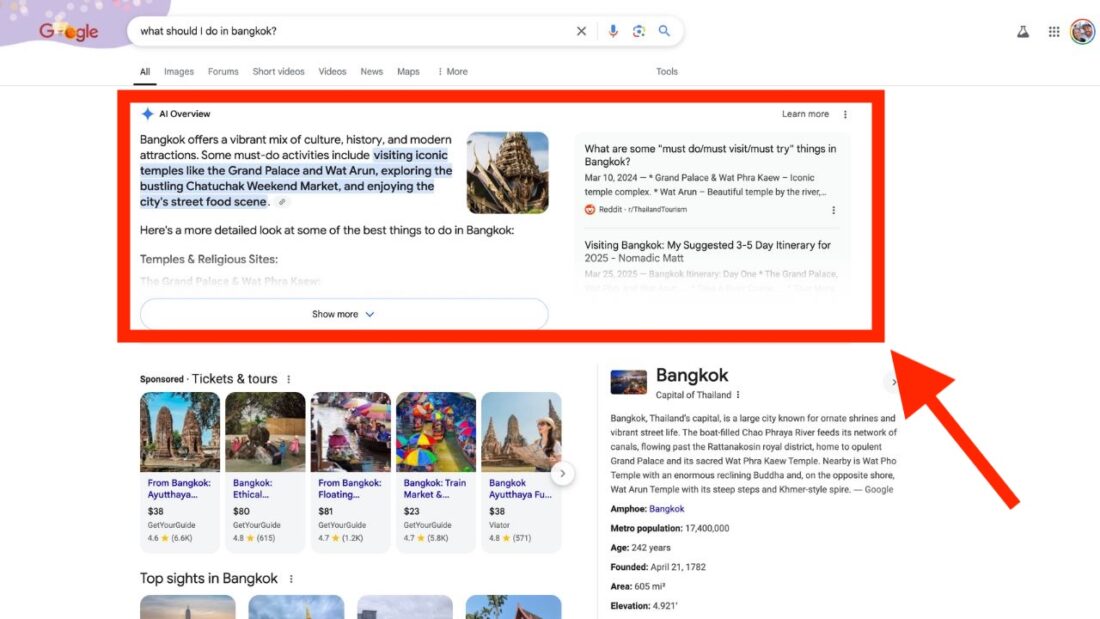
3. Google’s AI Answers Took Over Search Results
Google now generates AI answers right in the search results—pulling information directly from blogs without sending any traffic back to them.
If you search “Best Places to Visit in Thailand,” Google’s AI summarizes the best options at the top of the page. Users get the information they need without ever visiting a blog.
For bloggers, this means they’re not just getting buried in search rankings—they’re getting erased from the equation entirely.
If UGC and AI spam were the storm, Google’s AI-generated answers were the final tsunami that wiped out everything left standing. It’s like playing a game where you do all the work… and someone else takes the trophy.
Here’s the other brutal truth no one is talking about—even if Google wasn’t killing blogs, consumers already moved on.
Think about it. When was the last time you made a purchase decision—whether it was for a trip, a new phone, or a course—by reading a 3,000-word blog post?
You didn’t.
Instead, you probably:
Watched a YouTube review
Checked TikTok for quick pros & cons
Looked at Instagram reels for real-world examples
Asked in a Facebook or Reddit group for recommendations
Read Amazon reviews and checked testimonials on social media
This is just how people buy now—we want quick, visual, and trusted information from people we actually follow and engage with.
You might think that this is a direct result of people losing trust in blogs because so many are just written with AI, but that’s not the case. The truth is, this change started happening long before bloggers had tools like ChatGPT and Claude.
Is SEO Totally Dead?
Not entirely—but for most independent bloggers, it might as well be.
Big brands with massive budgets will still use SEO. Even though ChatGPT recently became one of the top 10 websites in the world, currently at number 7, and is climbing quickly, Google is still the god of online traffic for now. It’s at the top of that list, so big companies with a lot of money will still fight for those top spots.
But the days of new bloggers ranking with great content alone are gone. The fight for search engine visibility is too competitive, and Google’s constant algorithm changes make it impossible to rely on organic traffic.
So if you’re still trying to grow your business through SEO blogging in 2025, you’re not just competing with Google—you’re competing with how people actually consume content now.
If you’re writing SEO blog posts and trying to rank in Google for keywords…. Stop it.
If you’re doing some variation of that, like trying to rank for Bing or ChatGPT… Stop it.
If you’re working on the technical SEO for your website and trying to optimize it. Stop it.
It’s a complete waste of time.
There are other things you should be working on if you want to build a sustainable, future-proof business, and we’ll get to that a bit later.
What Actually Happened to Our Blogging Businesses (And How We Pivoted)
We still make passive income from our websites, but only because we’ve been around for many years. We have 4 of them, and (thankfully) they’re still bringing in over six-figures a year from ads and affiliates.
We’ve invested in SEO and link building over the years, and built up our audience, which gave us some cushioning as everything collapsed.
But we knew we needed to pivot years ago. More than 7 years ago, we realized that we were putting WAY too many eggs in the blogging basket.
We relied completely on Google SEO, Affiliates, and Ads to pay us our salary. But it didn’t take long to realize that Ads dropped as much as 50% seasonally or depending on the political situation, and affiliates? Don’t even get me started…
I already wrote a post on how Airbnb cancelled their affiliate program without warning, costing us $100,000 per year. And that was just one of MANY times that happened to us.
Basically, we were making incredible money, but we had no control over our traffic sources, or the income coming into our bank accounts.
That’s why we started focusing on building our email list (a traffic source that we OWN) and selling our own products—something we had control over. This took me down a rabbit hole and years of research into learning how to create an awesome course, how to sell a course, how to create email sales automations and funnels, and basically how to earn money selling our own products through emails.
That part of our business was really successful and it got us to where we are now. But now, for the past 2 years, instead of relying on blog traffic and SEO to bring in leads, we’re doing it through social media.
Now before you say what I used to say back then and be like “I hate social media”, let me tell you that for one, you’re probably 40+ like me, and two, that attitude will likely be the single reason you probably won’t have a successful online business in 5 years.
What This Means for the Future of Online Business
Blogging is no longer a viable business model, but that doesn’t mean online business is dead. In fact, there has never been a better time to build a profitable business.
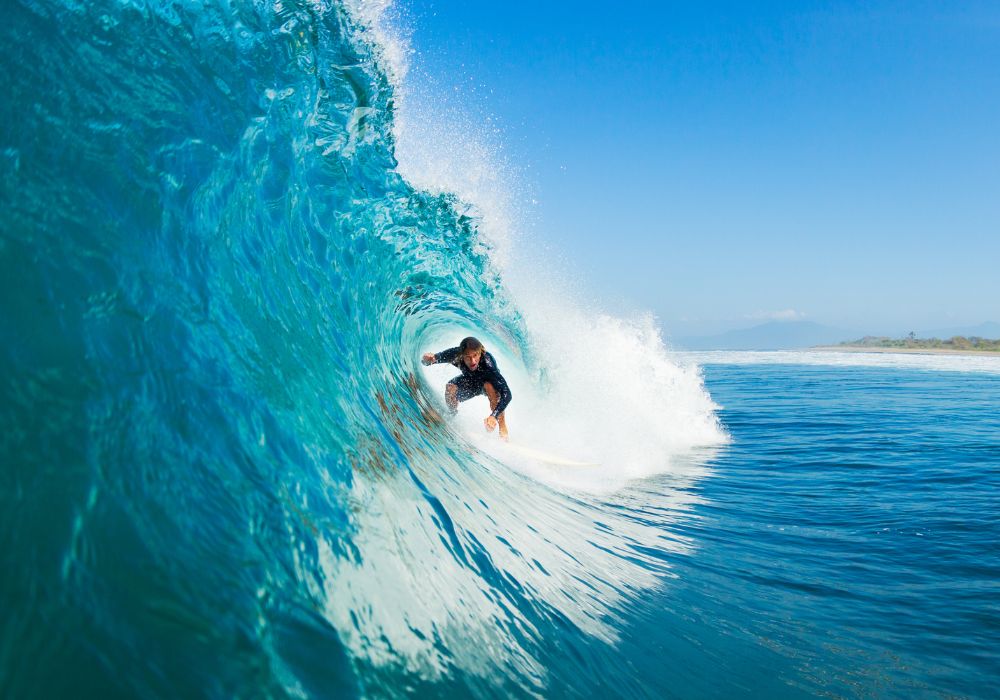
The best way I can explain this is through a surfing analogy. No, I’m not a surfer, but just bear with me for a minute…
We were riding this massive wave of SEO and Blogging. We made millions of dollars on that wave and at the time, we thought it was the best wave in the sea.
But while we were cruising on that wave… a bigger, more beautiful, and more sustainable wave was building momentum behind our wave.
That wave was Social Media.
In business, you have to know when to get off the wave. Because if you ride it too long, it’ll crush you. And in businesses that involve technology, those waves can come extremely quickly.
In the tech landscape, the SEO wave was like a massive tidal wave. It lasted SO long, and we’re incredibly grateful for that.
But now, the new wave is here, and it’s been here for a long time, us older generation just didn’t see it.
The Future of Online Business: Social Media, Digital Products, and Email Marketing
If blogging was the old wave, social media is the new one. And it’s the biggest opportunity for organic traffic and monetization we’ve ever seen.
This wave is the biggest opportunity we’ve ever seen in the online world:
It’s the biggest opportunity to build a massive audience for free
It’s the biggest opportunity for organic traffic
And it’s by far the biggest opportunity to monetize and make millions of dollars from selling digital products
1. Build an Audience with Short-Form Video
Platforms like Instagram, TikTok, and YouTube Shorts are where people are consuming content now. Instead of writing 3,000-word blog posts, creators are building massive audiences through short-form video.
2. Sell Your Own Digital Product
Unlike blogging, social media lets you monetize fast—if you have the right product. Instead of earning $0.002 per visitor through ads, you can sell a $37 digital product and make real money instantly.
People like Natalie from Boss Babe have made over $100,000 per month selling a simple digital product. And we know of a woman who made over a million dollars in a year from her tiny audience of less than 3,000 people.
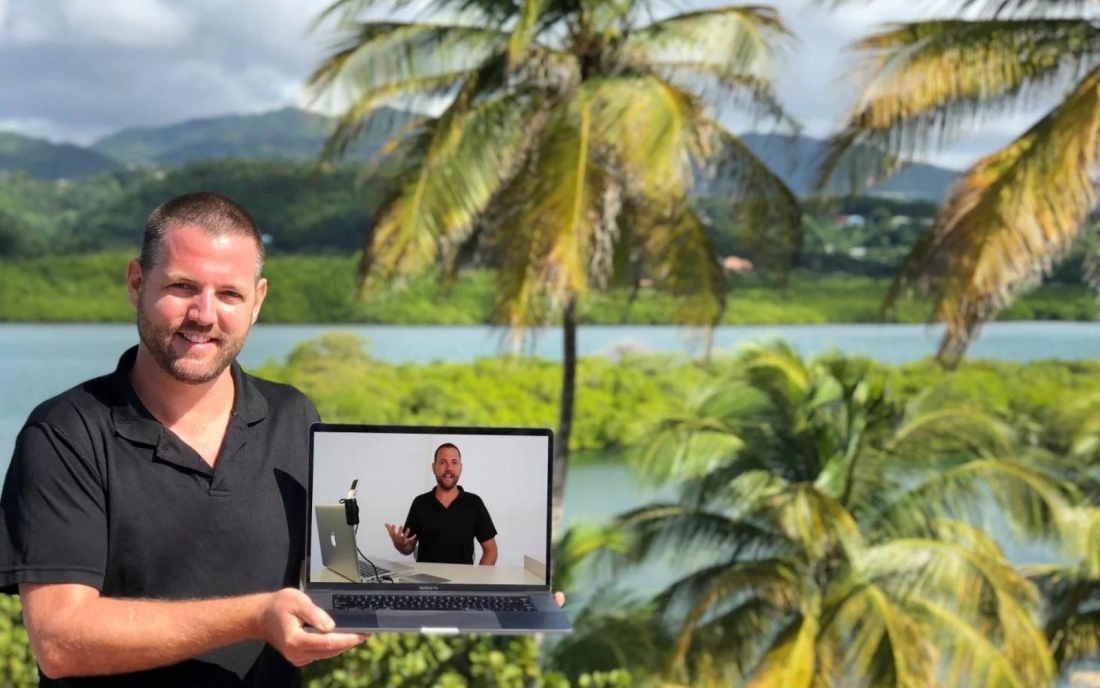
A much fatter version of me unveiling my first blogging course 😂
This just wasn’t possible with blogging. There might’ve been some off chance that you got picked up by a big TV network or something and you went viral overnight, but for 99.9% of bloggers who were just writing blog posts for SEO, it would take months, often years, before they’d see any income.
Even me. I built a fly fishing website from $0 to $8,400 per month in a single year. But for the first 6 months, it earned next to nothing. And I knew what I was doing!
3. Use Email Marketing to Automate Sales
Your blog should be a website—not a content hub. It should:
Build authority
Capture emails
Sell your product
Email marketing is where the real money happens. By leading social media followers to a freebie, you can build an email list that nurtures leads and automates sales.
Of course, you can’t just make money on social media by posting funny cat videos. You create highly targeted content that speaks to a specific person, helps them achieve a specific transformation, and that content sends them to your email list where they enter their name and email to get your super valuable freebie.
It’s from that freebie, and from the magic of email marketing that you’re able to sell your digital product to them and make money on autopilot.
Look, making $17 on a $500 Airbnb booking was great, and earning 0.002 cents per visitor on our blog was also cool, but there’s nothing like the feeling of waking up and seeing that someone purchased your $500 course or your $4,000 coaching program. It’s validation, it’s exciting to be able to have a real impact and help people, and it’s the first steps in building a real, loyal community.
The Future is Here—And It’s Not Blogging
Blogging used to be an incredible business model, but times have changed. Google and AI have made it nearly impossible for new bloggers to succeed the way we did years ago.
But that doesn’t mean the opportunity is gone. It’s just moved.
Writing SEO blogs had become monotonous and boring. Ask any successful blogger, we were tired of writing the 10 best things to do in Bangkok and the 15 best budget microwaves.
Do I miss the passive income from blogging? Absolutely, but that same passive income is available with short-form video and great email marketing.
Blogs take a TON of work. So to do all that work just to have a Google Algorithm update or AI completely wipe you out overnight? That’s just not worth it.
The future is short-form video. The future is creating a valuable product. The future is having an epic email list that people love being subscribed to. The future is being a real human being, and really connecting with your audience online.
This is the future. And the people who embrace this shift now are going to win big.
If you want to build a business that actually works in 2025, focus on short-form video, digital products, and email marketing. This is how you create a real, future-proof business.
If you’re ready to stop wasting time on outdated strategies and start building a profitable business, grab our free training below that shows exactly how we—and our clients—are doing it.
The biggest online business opportunity we’ve ever seen is happening right now. The only question is—are you going to take it?
Step into the heart of Rome, where history, art and luxury converge. The newly opened Palazzo Talìa Hotel, designed by the acclaimed movie director Luca Guadagnino, promises to be an experience unlike any other. Nestled near the Sant’Andrea delle Fratte, the hotel welcomes you with its grand wooden doors, through which you are greeted by the whispers of ancient tales, the fragrance of timeless history and the promise of a remarkable stay.
Lobby Sofa
A Rich Inheritance of a Storied Past
Their story is one steeped in centuries of history. Originally built in the 16th century as the private residence of Angelo Maria Colocci, a celebrated humanist, the building soon became home to the prestigious Nazarene College, under the care of San Giuseppe Calasanzio. This was no ordinary palace – it was a vibrant hub of learning, housing scholars, nobles, and even pontiffs. As the centuries passed, it survived Napoleon’s occupation, the turbulent Nazi occupation, and became a gathering space for some of Italy’s most influential filmmakers and artists.
Aula Magna
Today, the Palazzo stands as an extraordinary blend of Rome’s rich history and contemporary luxury. Following a meticulous restoration that began in 2021, this architectural gem combines ancient frescoes and stonework with modern design sensibilities, maintaining the essence of its storied past while embracing modern luxury. “Palazzo Talìa is not about anonymous hotel chains or standardized luxury,” says Elia Federici, the project’s visionary behind this blend of old and new. “It is a palace, crafted to evoke the syncretism of three centuries of history while infusing a contemporary flair”.
Guadagnino’s Cinematic Touch: A Singular Vision
For Luca Guadagnino, the director behind Call Me By Your Name and Suspiria, creating the interiors of Palazzo Talìa was a labor of love, combining his keen eye for design with a deep respect for the building’s history. Through his studio, studiolucaguadagnino, Guadagnino brought his signature cinematic aesthetic to the hotel’s public spaces, including the restaurant, bar, wellness spa and even the grand Terrace Suite. The chromatic design, rich with color and texture, sets the tone for the hotel’s entire atmosphere.
Noble Floor
A monumental carpet, created by the renowned designer Nigel Peake, winds its way through the hotel’s interior, its bold colors acting as a visual path that invites guests to wander through the space. In the Terrace Suite, peach wood paneling and muted pink hues evoke a sense of intimacy and warmth, offering sweeping views of an inner courtyard brimming with tropical greenery. “This is not just a hotel; it is a theatrical space, filled with surprises at every turn,” says Elia Federici.
Home Away from Home
What makes this marvel of a boutique stay stand out is its unique ability to blend the solemnity of ancient history with the comfort of modern living. “Our goal was to provide guests with a home away from home,” explains Federici. “The traditional Roman residence, with its opulent architectural details, has been reimagined with a relaxed, contemporary flair”.
Every aspect of the hotel exudes this personal touch — from the bespoke furnishings to the curated works of art that adorn the walls. The hotel features 26 rooms, each individually designed by a team of talented architects, including the all-female design studio Mia Home Design Gallery and Laura Feroldi Studio. With custom-made furniture and carefully chosen artworks, each room reflects the balance of classic elegance and contemporary style. The colors and textures have been thoughtfully curated, with details like multicolored bathroom tiles, wrought-iron canopy beds, and round sofas in shades of pink and burgundy that make each space feel like a personal sanctuary.
Bar Main Room
Gastronomy That Tells a Story
The culinary experience here is equally rich in history and flavor. The hotel’s restaurant, Tramae, takes inspiration from the 19th-century Grand Tour, a period during which travelers ventured through Italy’s storied landscapes, tasting the delicacies of each region. Chef Marco Coppola has crafted a menu that spans Italy’s diverse culinary heritage, with dishes inspired by the canals of Venice, the hills of Florence, and the sun-kissed shores of Sorrento.
Each meal is an exploration of flavors, from the Federici family’s signature recipes, like la milanese con osso (a veal shank stew) and vitello tonnato, to Roman specialties such as ravioli alla vaccinara and decadent artichokes and potatoes millefeuille. The hotel also prides itself on its farm-to-table ethos, sourcing many ingredients from the Federici family’s organic farm in the nearby countryside, which boasts lush gardens, olive groves, and pasture-raised livestock.
Relaxation pool
A Sanctuary of Wellness and Design
The hotel’s wellness spa offers a serene escape, where modern touches meet Roman tradition. The wellness area features lush green majolica tiles crafted by Spanish artisans, a nod to the timeless nature of Rome’s architectural heritage. Every detail has been thoughtfully designed to ensure an experience that is both luxurious and relaxing, offering guests a space to unwind after a day of exploration.
Timeless Experience
Not just a hotel; it is an invitation to step into a world where history, design and modern luxury coexist harmoniously. From its cinematic interiors to its gastronomic offerings, every moment at the hotel feels like a part of a grand narrative. Whether you’re wandering through the ancient streets of Rome or indulging in a bespoke culinary journey, Palazzo Talìa promises an unforgettable experience — a place where the past and present come together in the most extraordinary way.
Inaugurated in May 2024, Palazzo Talìa has become a fabulous landmark in the Eternal City, captivating the hearts and imaginations of all who visit. It is a celebration of the city’s rich history, reinterpreted for the discerning traveler who seeks not only luxury but an authentic connection to the past, present, and future.
For more on the latest in lifestyle, culture and travel reads, click here.
At this year’s Miami International Boat Show in February, visitors at the Museum Park Marina – one of the show’s six locations – were eager to tour the yachts on display and Leopard’s booth drew a good crowd, with the new Leopard 46 sailing catamaran as its highlight.
The model had its premiere at the Cannes Yachting Festival in September 2024 before making its US debut the following month at the Annapolis Sailboat Show. This year, it follows its Miami appearance with its Asia debut at the Singapore Yachting Festival (April 10-13) and a display at the International Multihull Show (April 23-27) in La Grande-Motte, France.
Solar panels can cover the aft cockpit
Having already won awards such as Boat of the Year: Best Full-Size Multihull 45ft to 50ft and one of the Top 10 Best Boats 2025, the Leopard 46 model in Miami attracted sailing enthusiasts of all ages to marvel at its innovative design.
With a refined layout that provides a seamless integration between the aft cockpit and saloon, the spacious-yet-sporty cruising catamaran offers plenty to help those on board enjoy their voyage.
The Leopard 46 raises the bar with its innovative, luxurious and eco-conscious design
INNOVATION MEETS SUSTAINABILITY
The Simonis Voogd-designed Leopard 46 feels more spacious than expected, facilitating versatility for personalisation. The 46-footer’s exterior design draws inspiration from its powercat siblings, featuring a sleek and modern design, with wraparound windows to maximise natural light.
While retaining the popular features of its predecessor, the Leopard 45, the elimination of the skipper cabin creates a roomy configuration. Owners can choose to have three cabins plus a utility room, a four-cabin layout, or five double cabins each with en-suite head or shower.
The sleek layout seamlessly integrates the aft cockpit and saloon
A comfortable environment for onboard living and cruising is enhanced by the sliding door, which seamlessly integrates the aft cockpit and interior saloon.
From a distance, the sailing catamaran looks ready to deliver a high-performance experience for eco-conscious sailors. This cutting-edge yacht features an optional hybrid electric drive, boasting integrated solar panels that increase autonomy and reduce reliance on the generator.
Equipped with twin 45hp Yanmar diesel engines as standard, it offers the option to upgrade to 57hp. Meanwhile, with the optional hybrid electric drive system, which includes a power management box, electric propulsion pod, high-voltage lithium-ion battery, solar array, and range-extending generator, the boat’s power source is diversified. This includes solar panels, sailing regeneration, shore power, and a range extender.
The saloon’s L-shaped sofa and large windows create an airy space for socialising
The innovative system makes charging and discharging efficient, providing power for both propulsion and house loads.
The Leopard 46 can reach propulsion speeds over 8 knots and regeneration capabilities up to 1.8kW per hour per hull. Such versatility extends to the stepped hulls and powerful rig with overlapping genoa, which provides optimal handling in all wind conditions. For single-handed offshore sailing and long-distance voyages, the protected helm station makes it a pleasant experience.
Guests can easily get aboard by using the symmetrical staircases on both sides of the aft platform. Wraparound double railings offer guest safety when guests walk along the side decks around the boat.
Wraparound windows help to maximise natural light
The four-panel glass door creates a smooth integration between the interior and exterior. The cockpit has a forward-facing sofa and an extendable foldable table, making the dining experience more spacious.
The forward saloon door, a signature feature of Leopard models, allows ease of access to the foredeck. The sunpads in the middle of the bow area create a perfect space for relaxation, while the storage space beneath in the base cleverly hides clutter.
The port-side stairs located at the cockpit lead to the flybridge, a vast outdoor space. The C-shaped sofa and a table fitted with multiple cup holders allow guests to stay seated while enjoying cool drinks and conversations.
The helm gives the skipper a great view of inside and outside the boat
Visible to the helm to starboard at the deck level, the captain, either seated at the double bench seat or standing upright, can keep an eye on the guests for their comfort and safety. The spacious flybridge offers a prime location for panoramic views, sunlight and wind.
LUXURIOUS INTERIOR
From the foredeck, the saloon can be accessed through a forward door. It can also be accessed from the aft cockpit. To starboard are the refrigerators, stove and oven. The L-shaped galley includes a sink, dishwasher, and ample storage space.
The countertop, with its neutral colour, creates an aura of sophistication. A television screen and power controls are above the countertop, providing entertainment and easy access to various indicators. To port, the L-shaped sofa, cosy pillows and large windows create an airy space for socialising.
The owner’s stateroom with forward-facing double bed is aft in the starboard hull
For the four-cabin version, the owner’s stateroom with forward-facing double bed is located aft in the starboard hull. It has its own companionway, television, vanity mirror, workspace and cabinets. Equipped with en-suite showers and heads, this version creates a comfortable onboard living environment.
In the five-cabin version, there is an extra stateroom with bunks to starboard near the middle of the boat. Moreover, there is an option for a utility room in the port hull forward cabin that’s equipped with washer and dryer, as well as extra storage space. There are plenty of opportunities for owners to choose their desired configuration.
The soft light that glows along the edges of the beds and the ceilings in all the cabins creates a luxurious ambience. For extra privacy, the windows can be covered with shades. The wooden pattern of the cabinet surfaces and the carpets in an earthy tone resonate with the natural theme.
One of the layout options includes a large VIP cabin
The Leopard 46 raises the bar in sailing catamarans with its innovative, luxurious, and eco-conscious design.
For owners who care about mechanical and sail performance in the water and convenience within living areas, options for upgrades include the hybrid electric propulsion system, large capacity inverter, a full lithium battery bank, electric induction cooktop, and a water maker to reduce environmental impact. A taller mast and optional performance sail package can improve the sailing experience.
The stepped hulls and powerful rig with overlapping genoa provide optimal handling in all wind conditions
For watersports enthusiasts, there is an optional lifting tender platform to make it more convenient when enjoying a day on the water in a tender or with marine toys.
Robertson & Caine, one of South Africa’s leading yacht makers, crafts the Leopard 46 in Cape Town. It also builds charter-specified versions branded for The Moorings and Sunsail. The Leopard 46 is available for charter and private owners under a management programme through The Moorings, which also offers the most affordable entry into the world of Leopard’s renowned catamarans.
Located in the Coachella Valley about 125 miles east of Los Angeles, Indio has been nicknamed the “City of Festivals” for the many events held there. The annual Coachella Valley Music and Arts and Stagecoach Festivals are perhaps the best known, but a number of other celebrations fill Indio’s annual calendar. “Indio is a vibrant City where culture, community, art, and music come together, offering something new to discover year-round,” Indio’s Mayor, Glenn A. Miller, told Travel + Leisure.
Indio is surrounded by the San Bernardino, Santa Rosa, and San Jacinto Mountain ranges, offering gorgeous views, hiking trails, and outdoor recreation. The area’s desert climate means warm winters, hot summers, and nearly 350 days of sunshine a year. As a major agricultural center as well as a tourist destination, Indio’s farms and orchards produce cotton, grapes, onions, citrus, and dates.
We’ve rounded up some of the best reasons to plan a trip to Indio or to add a few days to your festival visit to get to know this thriving city.
Coachella Valley Music & Arts Festival
Fans at Coachella Music Festival.
Christina House / Los Angeles Times via Getty Images
Each April brings at least 250,000 visitors from around the world to the Empire Polo Club for the two-weekend festival. Top names and upcoming musical performers, an array of visual arts, dance competitions, games, craft activities, shops, food, and drink make Indio the place to be in April.
Stagecoach Festival
Luke Bryan performing at Stagecoach Music Festival.
Allen J. Schaben / Los Angeles Times via Getty Images
This three-day country music event at Empire Polo Club follows the Coachella Festival each April, celebrating music and culture with the best of country, bluegrass, folk, alternative country performances. Line dancing lessons, honky tonk music, barbeque, craft beer, and ferris wheel rides add to the entertainment.
The Riverside County Fair & National Date Festival
A dance performance at Riverside County Fair.
Courtesy of Riverside County Fair
This two-week festival is held each year starting in mid-February at the Riverside County Fairgrounds in Indio. Events include rodeo performances, carnival rides, concerts, circus acts, monster truck shows, a Presidents’ Day Parade, livestock exhibitions, petting zoo, displays of dates from local growers, and more.
The County Fair began in 1921, and the event includes the National Date Festival highlighting the area’s agricultural significance, especially date cultivation and the celebration of the region’s Middle Eastern cultural influences. More than 15 types of dates are grown in the area.
The Indio International Tamale Festival
A large crowd at Indio International Tamale Festival.
Courtesy of Indio International Tamale Festival.
This annual festival is held each December in downtown Indio’s Miles Avenue Park. Open to the public, the free event is popular with families who enjoy delicious food, entertainment by local musicians, traditional Mexican dancers, luchadores (wrestlers), magicians, games, a tamale eating contest, and an ice skating rink.
Tamales, especially popular during the Christmas holidays, are bundles of corn masa stuffed with savory or sweet fillings and wrapped in a corn husk. A traditional Mexican comfort food, they are available to eat at the festival or to purchase and take home to enjoy during the season.
Shields Date Garden
The Shields Date Garden on a sunny day.
Taylor McIntyre/Travel + Leisure
Known for its high quality dates, charming café, mail order business, and delicious date shakes, Shields Date Garden opened in 1924. The Indio store offers a variety of dates, many developed by Shields experts, as well as date products like cakes, cookies, and candies. These date shakes are deliciously creamy concoctions made of milk or ice cream and blended with date crystals invented by Shield’s Date Garden.
Their film, “The Romance and Sex Life of the Date,” not as titillating as the title suggests, but quite educational, describes the labor-intensive process of date cultivation on tall palm trees. Begun as a lecture for visitors, the film evolved into a slideshow and now to a film presented in a small theater at Shields Date Garden.
Southwest Arts Festival
This acclaimed art festival is held each January at Indio’s Empire Polo Club. Featuring contemporary, traditional, and abstract art, as well as quality crafts, the event attracts more than 10,000 visitors durings its four-day run. Artists from around the world showcase their paintings, sculptures, photographs, glasswork, ceramics, and digital art.
In the Polo Club’s beautiful setting among mountains and desert, more than 200 artists participate. Food and beverage stands, places to relax in the shade and listen to music, and opportunities to watch the artists at work attract visitors who enjoy the atmosphere along with the art.
Fantasy Springs Resort Casino
Exterior of Fantasy Springs Resort Casino.
Courtesy of Fantasy Springs Resort Casino Photos
More than a resort, Fantasy Springs Resort Casino offers a wide range of entertainment, from the best cover bands playing all-time favorites in the Rock Yard to big name entertainers in the Special Events Center. Professional boxing, iconic Mexican Lucha Libre, Latin dance music, the Price is Right Stage show, and Thursday night rock shows attract guests year-round.
There’s also bowling, casino gaming, golf at Indio’s Eagle Falls Golf Course, four bars, and restaurants from fine dining to casual. Resort guests have the hotel pool, Jacuzzi, fitness center, and concierge service.
Cabazon Indio Powwow
Dancers at a Pow Wow in Cabazon.
Terry Pierson/The Press-Enterprise via Getty Images
This annual celebration is hosted by the Cabazon Band of Cahuilla Indians to honor their culture and traditions. Held at the Fantasy Springs Resort Casino, the free event offers visitors an immersive experience. Dance competitions for all ages showcase diverse styles and colorful regalia, and drumming groups compete, demonstrating the rhythms central to traditional ceremonies.
Bird songs of the Cahuilla culture are performed, and traditional foods such as fry bread are available. Artisans offer jewelry, weaving, dream catchers, and other crafts, and visitors are invited to join dancers during non-competitive dances for an opportunity to engage with the cultural heritage of the Cabazon Band of Cahuilla Indians and other tribes.
Empire Polo Club
Empire Polo Club at sunset.
Courtesy of Empire Polo Club
This 1,000-acre events venue was founded in 1987 for international polo tournaments. The polo season typically begins in December and ends in late March, with a variety of leagues, events, and tournaments, including women, juniors, and international players. Polo is an exciting game to watch, and tailgating, clubhouse seating, and private cabanas make it enjoyable for spectators. A time-honored tradition is the “divot stomp” where spectators may walk on the field during halftime to repair the divots made during play.
Coachella Valley History Museum
Old school house in Coachella Valley History Museum.
Courtesy of Coachella Valley History Museum
Historic buildings, annual events, a permanent collection, and special exhibitions offer a wide variety of educational and entertaining opportunities at Indio’s Coachella Valley History Museum. Its mission to preserve, interpret, and share artifacts about the history of the Coachella Valley is supported by a rich variety of exhibits and experiences. Free monthly admission days and Sunday storytimes encourage locals to take advantage of all the museum offers.
In the Smiley-Tyler House, once a personal residence, visitors can see a 1930s and 1940s kitchen, an eclectic collection of Mexican folk art, costumes, and textiles, and other exhibits. In the California Date History Museum, the exhibit covers the history of the date palm, the world’s oldest cultivated crop, from its origins in the Middle East to its introduction to the Coachella Valley. There’s a 1909 schoolhouse, a Japanese memorial garden, and a display of vintage farm tools.
Indio Performing Arts Center
Production of Tootsie at Indio Performing Arts Center.
Courtesy of Indio Performing Arts Center
Located in the heart of downtown, the Indio Performing Arts Center (IPAC) promotes arts and entertainment for the community, with theater, music, motion pictures, and other artistic mediums. Since Desert Theatreworks began performances at IPAAC in 2017, they have staged 45 productions, 25 special events, and have received numerous accolades and awards, attracting nearly 1,000 subscribers.
Desert Theatreworks also runs KidsWorks to inspire love of the performing arts for youth with summer, spring break, and after school programs, focusing on teamwork, creativity, and self-expression as well as performance skills. ArtsWorks is a specialized program for senior performers, inspiring creative expression, social connection, and personal growth through a variety of activities.
The Lights at Indio Golf Course
The lights at Indio Golf Course.
Courtesy of Indio Golf Course
You can play golf until 10 p.m. among mountain views and balmy summer evenings at the only night-lighted golf course in the Coachella Valley. Indio Golf Course is one of the longest par-three golf courses in the country, with holes from 100 to 240 yards. With their full length driving range and short game practice area, you can tune up your game, and the fully stocked golf shop has whatever you need for a fun day or night of golf.
Indio Golf Course also features FootGolf, an 18-hole combination of soccer and golf, using soccer balls with similar rules to traditional golf. The course is designed to allow both traditional golf and FootGolf to be played simultaneously, and players of both games can either walk the course or use a golf cart. Snacks, beverages, beer, and wine are available.
Explore Downtown Indio
Downtown Indio, California.
Matt Gush/Adobe Stock
“There’s always something happening in Downtown Indio with new restaurants, bars, retail, and the brand-new Center Stage,” Miller told T+L.
Locals and visitors gather at the Saturday Farmers Market (Saturdays from October to May), join the crowd on Food Truck Fridays (5 to 10 p.m. weekly), and enjoy free live concerts at Center State on Second Saturdays. There’s free popcorn on monthly movie nights for outdoor family fun, and the first event included a classic car show. Touring Indio to see the public art, from murals on walls and in alleys to sculptures in parks, is a great way to get to know the city.
Factory cars are a thing of the past. High-end buyers demand individuality, setting their vehicles apart from the masses. From Mercedes EQS to Range Rover, bespoke options redefine luxury.
Cars That Reflect You Gone are the days of off-the-shelf luxury vehicles. For those investing in premium segments, a car is no longer just a mode of transport—it’s a personal statement. Automakers like Mercedes-Benz, BMW, and Land Rover are now catering to the growing demand for customisation, offering an unmatched level of individualisation. Whether you opt for an electric vehicle, a plug-in hybrid, or a traditional internal combustion engine, bespoke design has become the ultimate status symbol.
The Art of Bespoke Design Luxury brands like Rolls-Royce and Bentley have long offered tailored vehicles, but now brands such as Jaguar, BMW, and Mercedes are following suit. At Jaguar Land Rover’s Special Vehicle Operations, customers can transform their Range Rover into a masterpiece of personal taste. Want a bespoke pearl-inspired paint? Or a bulletproof VR9 armoured SUV? The possibilities are nearly endless, with some models exceeding €750,000.
Mercedes’ Manufaktur Division Mercedes-Benz takes this idea further with its Manufaktur division. Here, customers can select from a range of exclusive paints, handcrafted interiors, and personalised elements, such as family crests inlays or custom leather stitching. The Center of Excellence in Sindelfingen even allows clients to watch their dream car come to life, ensuring every detail meets the highest standards of craftsmanship.
BMW’s Artful Collaborations In Munich, BMW’s bespoke options are as much about lifestyle as they are about luxury. Recent collaborations, such as the limited-edition BMW XM created with designer Ronnie Fieg, demonstrate how customisation extends to every detail, including bespoke luggage for plug-in hybrid charging cables.
Customisation isn’t limited to unique colours and premium materials. It’s about creating an experience that embodies the essence of luxury, turning every interaction with your car into a personal statement. From Dubai-inspired crystal finishes to Miami art-inspired editions, luxury brands are elevating personalisation to a new art form.
Porsche has refined its updated 911 with subtle changes that make a strong impression. The Carrera S now boasts more power and added attention to detail, keeping it more desirable than ever — though as a convertible, it now approaches the €170,000 mark.
Lack of power was never an issue for the Carrera S. But with the new GTS model now benefiting from a T-hybrid and an electric turbocharger, Porsche had to give the volume-selling Carrera S a performance bump as well. Instead of the 290 kW / 394 PS and 450 Nm of the Carrera T, the S now offers 353 kW / 480 PS and 530 Nm of torque — the same as the previous GTS. Whether drivers will ever notice these improvements in measurable on-road performance is debatable. Acceleration from 0 to 100 km/h takes 3.7 seconds — marginally quicker than before — and 200 km/h arrives in 11.6 seconds. Impressive figures, perhaps, but unlikely to matter to anyone but stopwatch enthusiasts.
2025 992 Porsche 911 Carrera S Cabriolet
The Carrera S remains the benchmark of all sports cars. With top speeds of 308 km/h, it now performs at a level once reserved for Turbo models. Yet it’s the everyday usability and effortless drivability that continue to make the latest Carrera S so desirable. Ideally, this would be enhanced with Porsche’s variable all-wheel drive, especially for putting all that power to the ground on wet or uneven roads. However, the 4S all-wheel-drive variants are being released in typically strategic Stuttgart fashion — later. For now, enthusiasts of this sharpened S version must make do with rear-wheel drive and the excellent eight-speed PDK transmission. The AWD option is expected later this year.
Still, even without four driven wheels, the Carrera S lays down its 480 PS in commanding fashion, with strong pull across the rev range and sublime steering feel that remains unmatched in the segment. The 4.54-metre-long Cabriolet is pure joy — especially when, at speeds up to 50 km/h, the fabric roof folds away behind the small rear seats at the press of a button, filling the leather-trimmed cabin with light and air. Those rear seats are more for luggage than passengers, and necessary too, as the front boot offers just 135 litres of storage space — even in this rear-drive version. But cargo volume was never the appeal here. It’s the superb seats, the retro-flavoured digital gauges, the tactile steering wheel, and features like the electric wind deflector and the optional sound system that lets the flat-six turbo sing, tailored to the driver’s mood.
There are only minor gripes. The centre console feels underutilised, and it’s high time Porsche introduced a proper head-up display — something long overdue. Yes, the instruments are clear and stylish, but projecting vital information into the driver’s line of sight would be a significant step forward. At least the chassis updates make up for it. There’s now a 20/21-inch staggered wheel setup, GTS-spec brakes, a torque vectoring system that adjusts power across the rear axle, and the popular sports exhaust — all standard. The result is a dynamic package that hides the car’s 1.7-tonne weight exceptionally well, with pinpoint steering, impressive turn-in, and exiting power that thrills in every bend.
The forthcoming all-wheel-drive version will no doubt enhance this further, especially in transferring front-end grip under pressure. For convertible buyers, there’s little need to opt for the 10-millimetre-lowered sport suspension, as the standard setup strikes a brilliant balance between agility and comfort — perfect for open-top drives in the sun. In this price range, ticking the extended leather interior option is recommended, as it upgrades key surfaces like the glovebox, door trims, and seat bases, adding a sense of richness throughout the cabin.
The technical storage or access is strictly necessary for the legitimate purpose of enabling the use of a specific service explicitly requested by the subscriber or user, or for the sole purpose of carrying out the transmission of a communication over an electronic communications network.
Preferences
The technical storage or access is necessary for the legitimate purpose of storing preferences that are not requested by the subscriber or user.
Statistics
The technical storage or access that is used exclusively for statistical purposes.The technical storage or access that is used exclusively for anonymous statistical purposes. Without a subpoena, voluntary compliance on the part of your Internet Service Provider, or additional records from a third party, information stored or retrieved for this purpose alone cannot usually be used to identify you.
Marketing
The technical storage or access is required to create user profiles to send advertising, or to track the user on a website or across several websites for similar marketing purposes.




















:max_bytes(150000):strip_icc()/TAL-indio-international-tamale-festival-TODOINDIOCA0325-3d73c53e747d456ca0184ebe171a449b.jpg "13 Best Things to Do in California’s ‘City of Festivals’")
:max_bytes(150000):strip_icc():format(jpeg)/TAL-indio-international-tamale-festival-TODOINDIOCA0325-3d73c53e747d456ca0184ebe171a449b.jpg)