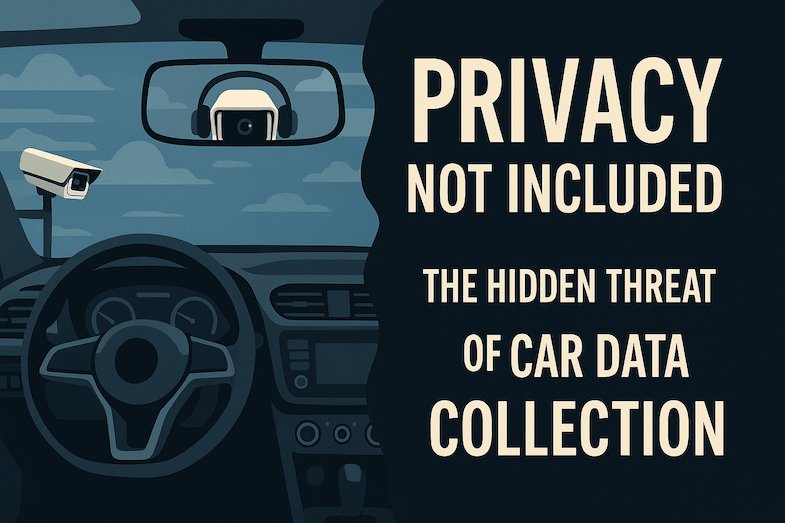
Wind whipping through your hair, the open road stretching endlessly before you, your favorite playlist pumping through the speakers—a road trip is the epitome of freedom. But what if that freedom came at a hidden cost? In today’s tech-driven world, even the seemingly harmless conveniences in your car can be silently collecting a treasure trove of data about you. Car data collection has become a quiet passenger, turning your liberating adventure into a digital trail for prying eyes. Buckle up, road trippers—because we’re about to take a detour into the unsettling world of automotive surveillance.
🚘 The Hidden Hitchhiker: What Car Data Collection Really Tracks
Cruising down the highway, you glance at the GPS for directions, but unbeknownst to you, your car might be recording more than just your route. This unseen hitchhiker, car data collection, is silently gathering information about your journey. It can track everywhere you roam, from scenic overlooks to hidden gas stations, piecing together a detailed map of your travels.
But the destination isn’t just on the map, it’s the data itself. Every turn, stop, and acceleration can be logged, building a profile of your driving habits. Beyond your whereabouts, the car might also be monitoring its performance, keeping tabs on engine health and fuel efficiency. In some cases, the data net extends further, capturing snippets of your in-car entertainment choices and even biometrics like fingerprints or retina scans for keyless entry.
🎯 From Point A to Big Brother: How Car Data is Used
Where does all this collected data end up, and how is it used? Car companies benefit by using car data collection to improve vehicle performance or target you with eerily personalized ads. Imagine cruising past a billboard for the exact diner you visited on your last trip—it’s not a coincidence.
The data can also enhance tech features, like gear shifts and lane assist, or trigger proactive maintenance alerts. But the concern lies in third-party sharing. Advertisers may exploit location data to bombard you with promotions, and law enforcement might request access to your vehicle’s digital diary—raising serious privacy concerns.
🔐 Road Trip Privacy Tips: Taking Control Behind the Wheel
While automakers collect this information, driver control over car data collection remains a bumpy road. Privacy policies are often buried in legalese, leaving drivers unsure of what’s collected and how it’s used. Opting out isn’t easy—certain in-car features require data sharing, making the choice between convenience and privacy more difficult.
Here are a few road trip privacy tips to help you strike a balance:
Be Informed: Look up data collection practices specific to your vehicle on consumer advocacy or tech privacy websites.
Choose Wisely: Consider a pre-2000s used car with minimal tech for maximum privacy.
Limit Use: Rely on downloaded playlists and offline maps to reduce tracking.
Avoid Logins: Skip infotainment systems that require personal credentials or cloud sync features.
🚨 A Cautionary Tale: When Car Data Gets Too Personal
Imagine Sarah, on a long-awaited road trip with friends, blasting classic rock as they cruised toward a secluded national park. Unbeknownst to them, their car’s entertainment system—synced with Sarah’s phone—was collecting data on their music preferences. Hours later, their GPS rerouted them… directly toward the “Giant Guitar Museum.”
Confused, they realized the route matched their listening habits. The harmless car data collection had morphed into subtle manipulation. What started as a carefree journey became a reminder of how much influence your vehicle’s systems can exert on your real-world decisions.
🧳 Road Trip Privacy Tips: Pack for a Digital Detox
As the miles tick by, remember—you’re not alone on your road trip. Here are more road trip privacy tips to help reclaim your digital freedom:
Bring a Faraday bag to block phone signals when desired.
Use a burner phone if you need truly private communication.
Download offline maps in advance.
Keep a physical journal to record memories the old-school way.
These simple changes can help you enjoy your trip without leaving a trail of data breadcrumbs behind.
🛣️ Conclusion: Mind the Digital Hitchhiker
As the wind whispers through your open windows, be mindful: the open road isn’t quite as private as it once was. Car data collection casts a long, quiet shadow. By staying informed and taking control of the features you use, you can preserve your privacy without sacrificing the joy of the journey.
Your voice matters—advocate for transparency and stronger data privacy regulations. With the right precautions and a few road trip privacy tips, the open road can remain what it should be: a place of freedom, not surveillance.
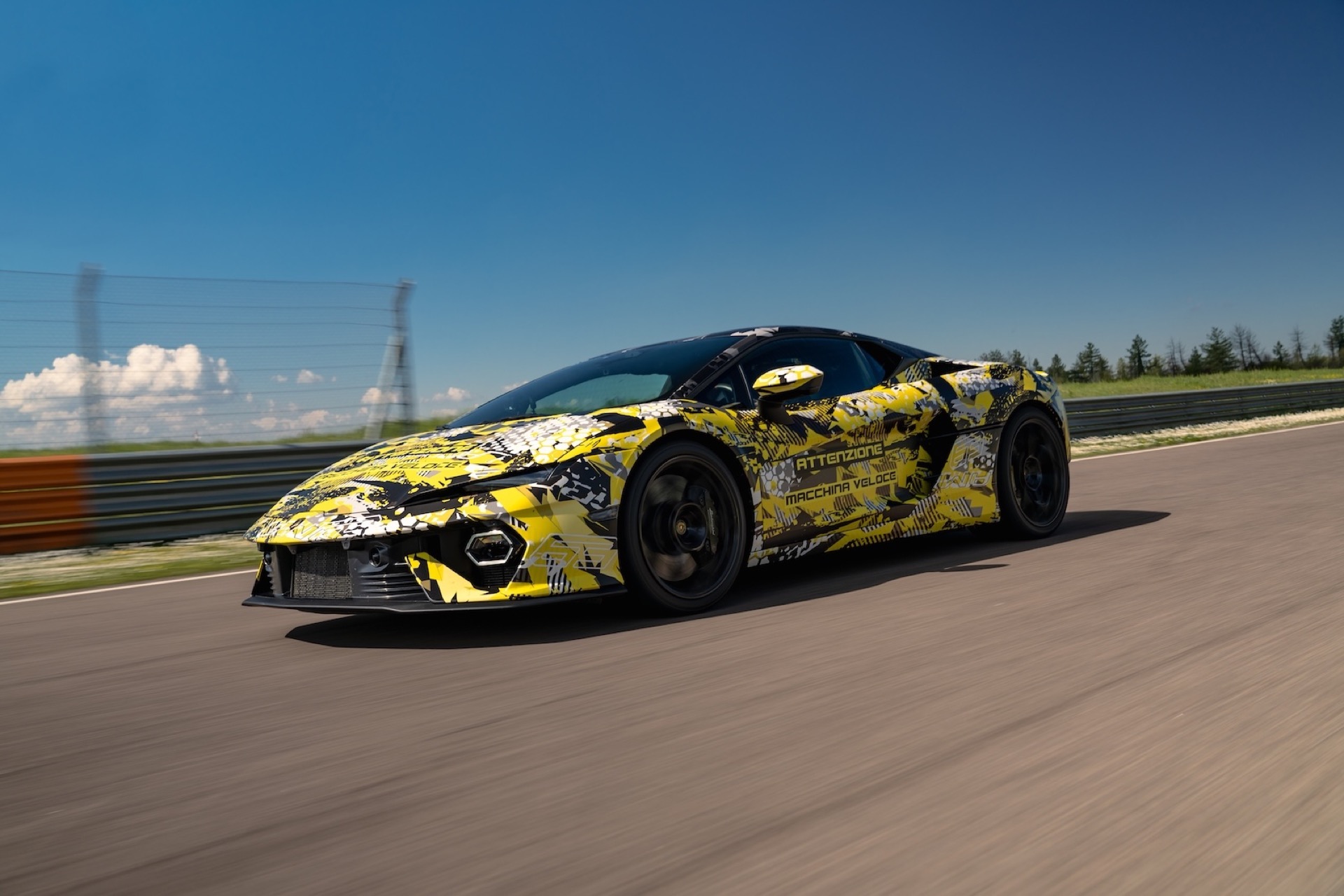
Aston Martin, Ferrari, McLaren and Porsche – all of them need to brace themselves, even though spring is already knocking on garage doors at home. The first test drive of the 920-hp plug-in hybrid Lamborghini Temerario shifts the boundaries of driving dynamics into a new sphere.
Lamborghini is bidding farewell to its naturally aspirated V10, and those responsible, including CEO Stephan Winkelmann and development boss Rouven Mohr, make no secret of the fact that saying goodbye to the charismatic naturally aspirated engine in the power duo of Gallardo and Huracán after more than two decades was not easy. But after the Revuelto in Sant’Agata was already impressively infused with electric breath, things are now becoming even more spectacular. The Huracán successor Temerario, as the production version of the former Project 634, impresses not only with its stunning design but also with an engine output that drives even more impressively than expected.
V10 power is yesterday – behind the now larger and more comfortable driver’s cabin roars a twin-turbo four-litre V8, which has nothing in common with the base engine from the Volkswagen Group and is handmade at the main factory west of Bologna. While the most powerful version of the predecessor Huracán delivered a no-less-than-bold 640 hp, the 4.71-metre-long Temerario receives a mad boost to 920 hp. This is made possible not only by the new V8 twin-turbo but also by a component adopted from the larger Revuelto sibling. The entire front axle of the V12 hypercar was transplanted into the significantly more compact Temerario, which thereby becomes an electric all-wheel-drive vehicle, as there is no longer a driveshaft to the front axle.
“The high-revving concept that we were able to implement with the new V8 turbo gives the car a unique character,” development board member Rouven Mohr already whets the appetite for more before the first drive. Into the car, a quick glance at the large displays, the grippy steering wheel with its still-futuristic-looking rotary switches and buttons, which also appear on the bold centre console. Flap up, button pressed, and the powerhouse comes to life. Clearly no longer a V10 and unmistakably a V8 that, thanks to appropriate turbocharging, delivers a crazy 588 kW / 800 hp and provides a maximum torque of 730 Nm. An electric motor is hidden between the combustion engine and the eight-speed dual-clutch transmission, which is flanged to the rear of the engine. It prevents turbo lag and allows the engine to respond particularly quickly. Two additional axial electric motors, each with a maximum output of 110 kW / 150 hp, drive the two front wheels when needed. Their continuous output of 60 kilowatts ensures that the total system output of the Italian plug-in hybrid rises to 676 kW / 920 hp.
The first laps on the test track near Modena not only reveal the incredible power of this new energy bundle but also the agility of the Temerario – in this regard, the difference from the Huracán might even be greater than the increase in power – thanks to new aerodynamics, appropriate chassis and a stiffer overall package. Turning in, braking and accelerating out are not only impressive but simply magnificent – at least after getting used to the race track with its tight radii and never-ending hairpin bends.
The track is dry, the curbs harmless, and so one can push in Corsa mode. More and more willing – more and more aggressive over the short high-speed course. The thrust delivered by the four-litre turbo in cooperation with the electric front axle and the power module ahead of the gearbox is downright insane. At full throttle, more than 340 km/h is possible on the motorway, and from a standstill to 100 km/h takes significantly less than three seconds.
The torque is so massive that one could almost lazily circle the track in Italy’s north using only third and fourth gear. But before tight corners, it’s down to second, then up to third and fourth again, as the rev counter easily flicks past 9,000 rpm. On the long straight, one can even briefly go into fifth gear – only to then be compressed again from over 220 km/h. Again – for this track, the Temerario is simply too fast; but it shines with its agility, not only due to the significantly larger wheels (20-inch front / 21-inch rear).
This adds a lot of stability when braking and turning in, and massively helps with accelerating out of tight corners, even though the Temerario, unlike its big brother, manages without rear-axle steering. Since the two cars are so closely related technically, it is likely that technical features like a rear wing or rear-axle steering could follow in later sports versions.
Despite all the dynamics and this first trip to the racetrack, the Lamborghini Temerario can also do things differently: more comfort inside, space for two travel bags each in the front boot and behind the seats, and instead of sports seats, optionally ventilated comfort seats – or the option to leave quietly in the morning purely electrically from the underground car park or residential area.
For this, the electric motors are powered by a battery pack measuring just 15 x 3 cm, which can be recharged via plug with a capacity of 3.8 kWh – albeit only up to seven kilowatts. But is there currently a more impressive plug-in hybrid? Certainly not on a racetrack.
The worlds of luxury and cryptocurrency have become increasingly intertwined in recent years. Once dismissed as a fad, digital currencies have emerged as both investment vehicles and status symbols for a new generation of wealthy individuals. With ADA to USD conversion rates frequently monitored by investors seeking to maximize their portfolio value, this convergence has created novel expressions of affluence while challenging traditional notions of luxury consumption.
Redefining Wealth Display in the Digital Era
Traditional luxury has long been associated with tangible assets — mansions, yachts, exotic cars, and designer fashion. These physical manifestations of wealth provide immediate visual confirmation of status. However, cryptocurrency wealth presents an interesting paradox: it can represent immense value while remaining essentially invisible in everyday life.
This invisibility has spawned new forms of wealth signaling. Crypto millionaires and billionaires often identify themselves through subtle cues rather than ostentatious displays. Limited-edition hardware wallets have replaced the Rolex. Casual references to early Bitcoin investments have become the modern equivalent of mentioning one’s family estate. Even cryptocurrency-themed accessories and apparel have emerged as status markers within certain circles.
More significantly, cryptocurrency has introduced a new value system within luxury communities. Technical knowledge and early adoption are prized over hereditary wealth or traditional success metrics. The ability to discuss blockchain architecture or identify promising projects before they gain mainstream attention has become a form of cultural capital, separating the truly savvy from those merely wealthy enough to buy in at current prices.
Luxury Brands Embracing Digital Assets
Recognizing the growing purchasing power of cryptocurrency holders, prestigious brands have increasingly accommodated digital currency payments. Brands like Gucci, Tag Heuer, and Balenciaga now accept various cryptocurrencies for their products, acknowledging the significance of this customer segment.
Beyond simply accepting cryptocurrency as payment, luxury brands have ventured into NFTs (Non-Fungible Tokens) and virtual products. Dolce & Gabbana’s NFT collection generated approximately $6 million in sales, while virtual Gucci bags have sold for prices exceeding their physical counterparts in certain gaming platforms. These digital assets create new revenue streams while allowing luxury houses to connect with younger, tech-savvy consumers.
The most forward-thinking luxury brands have recognized that cryptocurrency represents not just a payment method but a cultural movement with its aesthetics and values. These companies have incorporated blockchain motifs into their designs, collaborated with prominent crypto artists, and sponsored events during major blockchain conferences. This approach acknowledges that crypto wealth often comes with distinct preferences and sensibilities that differ from traditional luxury consumers.
Transforming Luxury Real Estate
Perhaps nowhere is the impact of cryptocurrency wealth more visible than in luxury real estate. Properties in desirable locations from Miami to Dubai have been purchased with cryptocurrency, sometimes in transactions worth tens of millions of dollars. These sales highlight both the legitimization of digital assets and their holders’ immense purchasing power.
Developers have taken notice, with some luxury properties now marketed specifically to cryptocurrency investors. These listings frequently emphasize privacy features, cutting-edge technology integration, and the acceptance of direct cryptocurrency payments without conversion to fiat currencies. Some developments have even incorporated crypto themes into their designs, with amenities like built-in mining operations or blockchain-themed architectural elements.
Beyond marketing angles, cryptocurrency has introduced new methods for luxury property ownership. Fractional ownership through tokenization allows multiple investors to hold shares in premium properties, democratizing access to real estate that might otherwise remain available only to the ultra-wealthy. This approach maintains exclusivity while creating more liquid markets for high-value properties.
Exclusive Experiences and Private Access
While material goods remain important status markers, luxury increasingly emphasizes access and experiences over ownership. Cryptocurrency has accelerated this trend through exclusive events and communities accessible only to certain token holders.
Private clubs requiring ownership of specific NFTs or tokens have emerged in major cities, offering members networking opportunities with like-minded individuals and potential investment partners. These spaces often feature amenities designed specifically for cryptocurrency enthusiasts, such as mining rigs, trading terminals, and meeting spaces for project development.
Similarly, high-end experiences increasingly cater to cryptocurrency wealth. Private jet services, exclusive island retreats, and limited-attendance events now specifically target this demographic. These offerings frequently incorporate educational components around blockchain technology or investment strategies, blending leisure with potential financial benefits.
xx
Philanthropy and Impact Investment
A significant segment of cryptocurrency-wealthy individuals has embraced philanthropy, often with approaches reflecting the technology’s decentralized ethos. Rather than traditional charitable donations, many have established DAOs (Decentralized Autonomous Organizations) focused on specific causes, allowing token holders to determine funding priorities collectively.
These structures have directed substantial resources toward environmental initiatives, educational access, and technological development in underserved regions. The transparency inherent in blockchain technology allows donors to track precisely how their contributions are utilized, addressing a longstanding concern in philanthropic circles.
Beyond direct giving, impact investment has become popular among cryptocurrency holders seeking to align their financial decisions with their values while maintaining luxury lifestyles. Sustainable resort developments, eco-friendly transportation companies, and carbon-negative technology ventures have attracted significant cryptocurrency investment, allowing wealth preservation alongside positive social impact.
Challenges in the Crypto-Luxury Convergence
Despite growing acceptance, challenges remain at the intersection of cryptocurrency and luxury. Regulatory uncertainty creates complications for high-value purchases, with concerns about proper reporting and potential future liability. Price volatility introduces risk for both consumers and merchants, sometimes complicating major transactions.
Security concerns also persist, with high-profile holders sometimes becoming targets for sophisticated attacks. This has created a demand for specialized security services catering specifically to cryptocurrency wealth protection, from hardened storage solutions to personal security details trained in digital threats.
Additionally, luxury brands must balance cryptocurrency adoption with sustainability concerns, particularly given the increased scrutiny of energy-intensive blockchain networks. Many have addressed this by accepting only currencies operating on more efficient consensus mechanisms or by implementing carbon offset programs for cryptocurrency transactions.
Conclusion
The convergence of luxury and cryptocurrency represents more than a passing trend—it signals a fundamental shift in how wealth is created, displayed, and deployed. As digital assets continue maturing and gaining mainstream acceptance, their influence on luxury markets will likely increase further. The result may be a luxury landscape that balances traditional craftsmanship and exclusivity with technological innovation and new forms of community building, creating novel expressions of affluence suited to an increasingly digital world.
For more on the latest in properties and architecture reads, click here.
Don’t let Rick Steves’ gentle demeanor fool you. He’s one determined man—especially if something piques his curiosity, which is a great thing for all of us.
In the mid-’70s, while sitting in a classroom at the University of Washington, Steves listened intently to his professor lecture about his experience along the Hippie Trail, an overland route connecting Europe to Asia. Enthralled, Steves began asking question after question. The only problem was neither his professor nor the guidebooks at the time had any answers.
“I was just so impacted by that,” Steves shared with Travel + Leisure, adding that he was disappointed this man didn’t have the information he was seeking. “He dropped the ball.”
Luckily, an intrepid Steves was there to pick up.
Rick and Gene Openshaw consult their map of the Hippie Trail, 1978.
Courtesy Rick Steves’ Europe
In 1978, he set off on the first of many big adventures, traversing the Hippie Trail and writing down every experience in his journal along the way. “I wrote 60,000 words when I was 23 years old,” Steves shared.
“It’s just my journal—that’s the cool thing about it,” Steves explained about his “very candid, very unguarded” book. “And that’s what I really wanted to do. I wrote the book for me.”
Riding an elephant in 1978 in Jaipur, India.
Courtesy Rick Steves’ Europe
This personal look back at his younger, freer days, Steves said, is like an “anthropological” peek into who he was as a man, as a traveler, and as a writer. “When I look at it now, it was the notes of a travel writer in training,” he said. “As I read the book, I’m seeing the little seeds of everything I’ve dedicated my career to ever since.”
His career has included decades of helping people be less afraid of the world around them and to set off and explore it all through his tour company, guidebooks, and television show, so they, too, can learn all of life’s most important lessons. Because according to Steves, travel is actually a low-key political act.
“Fear needs to be considered,” he said. “Fear is rampant in our society now. Autocrats—whether they’re left-wing or right-wing—will use fear to shape the electorate, to derail a democracy. The flip side of fear is understanding. And we gain understanding when we travel.”
A photo of Rick in 1978 while he pedals to the Seti River in Nepal.
Courtesy Rick Steves’ Europe
For Steves, even the language we use to talk about trips needs to change.
“In the old days, people said, ‘Bon voyage—have a good trip.’ Now, what do they say? ‘Have a safe trip. Are you sure you want to go over there, considering all that’s happening?’” he said. “When somebody tells me, ‘Have a safe trip,’ I’m inclined to say, ‘Well, you have a safe stay at home.’”
And through this book—and his entire career, really—Steves wants us all to remember travel is not just safe, but it’s good for the soul, too.
“It’s safe to travel. There’s nothing scary about it. There’s nothing dangerous about it. If you care about your kids and you understand the statistics, you’ll take them to Europe tomorrow,” he said. “If you really want to be safe, you don’t need walls. You need bridges.”
Rick Steves in Afghanistan with an exuberantly painted truck in 1978.
Courtesy Rick Steves’ Europe
But Steves offers even deeper advice than to just go places. Instead, he says, it’s critical to fully immerse yourself in a new destination.
“I don’t care about your bucket list. I don’t care how many countries you’ve been to,” he said. “I wonder how many experiences you’ve had. That’s what we look for—opportunities to become temporary locals.”
This means embracing cultural differences, even in small ways. “When I cross the border, I like to be like a cultural chameleon. Suddenly, I’m into chocolate because I’m in Belgium. Suddenly, I’m into whiskey because I’m in Scotland. Suddenly, I’m into full-bodied red wine because I’m in Tuscany. Suddenly, I’m into pilsner beer because I’m in the Czech Republic.”
And traveling like Steves has paid off for both the people who follow him and Steves himself. “We took 30,000 people on our tours last year,” he noted.
Still, after all these years of sharing his sage travel advice, the new book may just be his greatest inspirational message yet for young travelers.
“The takeaway from ‘On the Hippie Trail’ is not that in 1978, a 23-year-old vagabond named Rick Steves did the Hippie Trail with all the other hippies going from Istanbul to Kathmandu and wrote a journal. I mean, that’s kind of cool, but what does that mean today,” he said. “[It’s about] a person coming of age and getting away from home without a safety net and seeing the world, traveling with abandon.” And that, he added with his signature laugh, is “a good thing to do before you settle down and you become the opposite of a hippie.”
Rick Steves Quick Travel Tips
Always pack light: “None [of our guests] are allowed to check any luggage. You’re limited to 9 by 22 by 14 inches.”
Embrace culture shock: “A good approach to travel is to recognize culture shock is not something to avoid. It’s a constructive thing. It’s the growing pains of a broadening perspective, and it needs to be curated.”
Step outside your comfort zone: “If you want to have a transformational experience, you have to get out of your comfort zone. You have to be a cultural chameleon, and you have to work to go home with the most beautiful souvenir.”
Do your homework: “Equip yourself with good information. That’s really important. If you do your homework, you can be your own guide.”
Recognize fear is the opposite of understanding: “Fear is rampant in our society now … The flip side of fear is understanding, and we gain understanding when we travel.”
Gift-giving has always been a profound expression of love, connection and thoughtfulness– strengthening bonds and uplifting spirits all year round. But what if there was a way to spin this cherished tradition by infusing it with an added layer of sentiment? Thus comes the trend of personalisation, and these brands offer top-notch artisanal services such as embossed initials, engraved words, and unique colours, helping you create truly meaningful and intimate gifts for your loved ones.
Louis Vuitton
For over 160 years, Louis Vuitton has perfected the art of gift-giving by offering a range of personalisation services that elevate the gifting experience. From hot stamping initials on their iconic leather goods to custom engraving messages on pieces from the maison’s Fine Jewellery collection, each gift is enriched with a personal touch. Selected Louis Vuitton perfumes can also be personalised with specialised engravings of initials or numbers, available in neutral and gold colours.
Discover more here.
Gucci
Gucci’s gift curation of ready-to-wear pieces and accessories are as elegant as they come, and each gift is imbued with more meaning when enhanced with customisation options offered by the brand. Ahead of his flight to Milan Fashion Week, the house’s global brand ambassador and BTS member Jin was spotted with a customised Gucci Horsebit 1995 Soft Small Shoulder Bag, featuring his name embossed against the black leather straps — turning the bag into a one-of-a-kind piece just for him.
Discover more here.
YSL Beauty
If you’re in search of an extra special gift for the discerning beauty and fragrance lover in your life, look no further than YSL Beauty’s engravable collection. This exquisite range features iconic fragrances like LIBRE and Y, along with the latest Rouge Pur Couture lipsticks. Simply select your desired product, personalise it with your choice of initials, messages, or pictograms, then top it off with their custom gift wrapping service — and voila, your gift is all ready.
Discover more here.
Goyard
The Art of Personalisation has always been at the heart of Goyard, and now the brand takes this fine craft to the next level with an innovative online simulator, allowing you to visualise how your gift will look. This feature offers a playful selection of initials, patterns, stripes, and colours, making it easy to create a design that truly reflects the taste and personality of your loved one — all in just a few clicks.
Discover more here.
Dior Beauty
Dior’s personalisation workshop offers a delightful experience through engraving bottles from their iconic fragrance collections with your initials, name, or message. Whether it’s the J’adore, Sauvage, Miss Dior or La Collection Privée scents, this added touch imbues meaning into each item, creating a unique and thoughtful gift that truly enamours your loved ones.
Discover more here.
This article was first seen on Men’s Folio Malaysia.
For more on the latest in luxury fashion and style releases, click here.
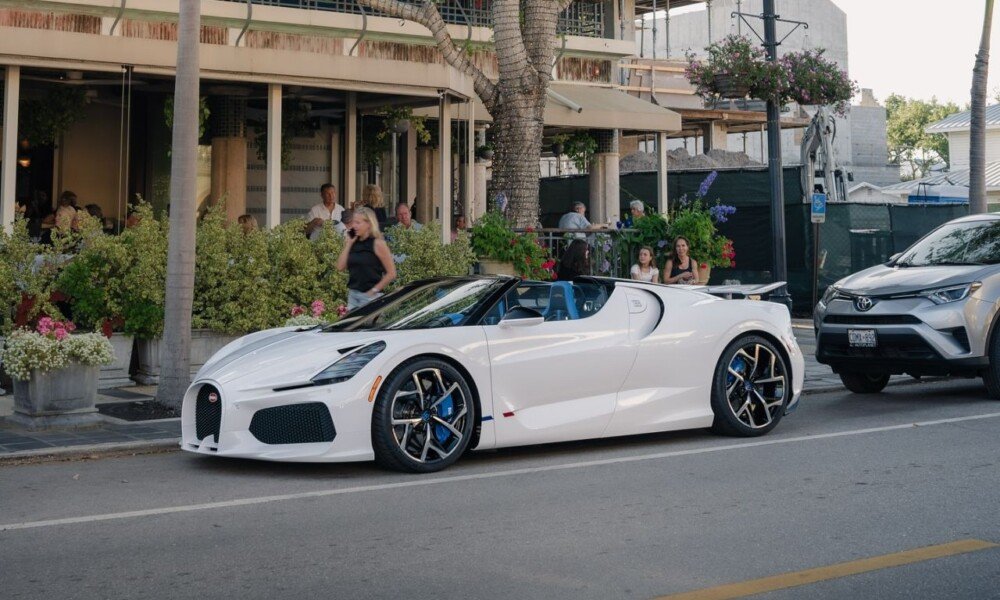
Last month, the first Bugatti Mistral in the United States was delivered. The hypercar arrived at Bugatti Broward in Florida before being carefully unboxed and prepared for delivery.
The dealership has shared a detailed walkaround video of the final Bugatti powered by the legendary W16 engine. The actual delivery, though, seems to have been a private affair.
The spec on the first US-spec Mistral looks similar to one of the first cars that left the Atelier in February. It has a clean white exterior with a subtle blue stripe running along the central ridge, blue calipers and a two-tone interior in black and blue leather.
The Bugatti Mistral is powered by the 8.0-liter quad-turbocharged W16 engine that delivers 1600 hp to all four wheels. It also holds the top speed record for an open-top production car. Last year, the Mistral clocked 282 mph on the high-speed oval at Automotive Testing Papenburg in Germany.
The first Mistral in America was recently spotted in Naples, FL. @shotsbytbo and @danielbhasin have captured some stunning shots of the car.
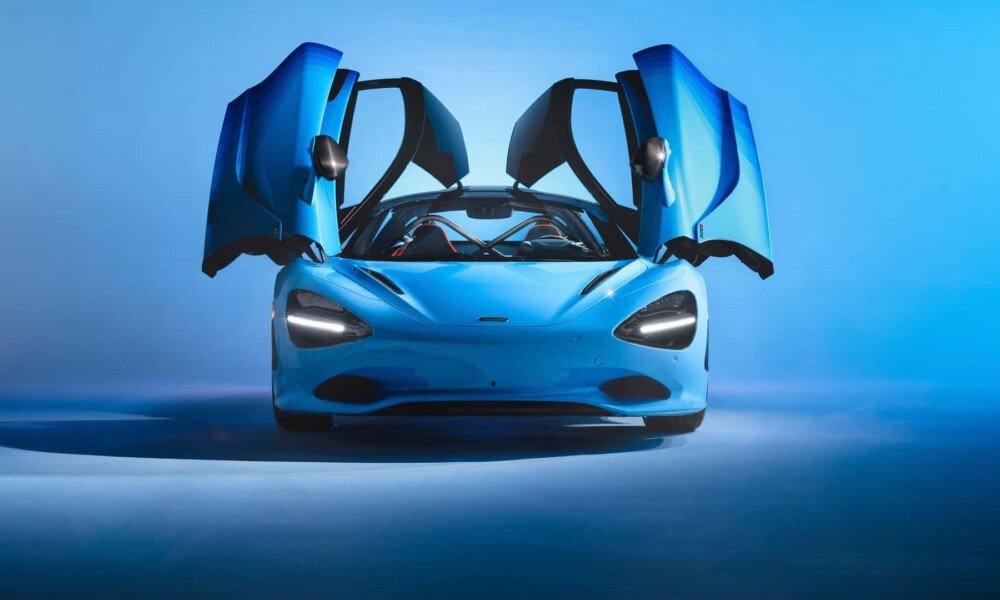
In a shock move, McLaren Automotive is set to merge with British start-up Forseven.
According to Autocar, the move will enable McLaren to expand into other segments beyond mid-engined supercars. Forseven will develop new models, which will be sold under the McLaren badge. One of the first products could be an SUV that will compete with the likes of the Lamborghini Urus and Aston Martin DBX.
Earlier today, Abu Dhabi-based investment firm CYVN Holdings and Bahrain’s Mumtalakat Holding Company announced that they had completed the acquisition of McLaren Automotive. The Middle Eastern investors also acquired a non-controlling stake in McLaren Racing. It’s worth noting that Forseven is also backed by CYVN Holdings.
The report also states that Forseven has been building a team of more than 700 professionals, including designers, engineers and executives as the company embarks on what has been described by CEO Nick Collins as “the most exciting British automotive story in decades.” The design team will be headed by ex-JLR Alister Whelan.
Forseven will not only focus on electric vehicles but will also include models powered by high-performance internal combustion engines.
“The future of propulsion is multi-propulsion. The more luxurious the vehicle gets, the better electric is for it because it’s quieter, more refined. So it will play a role,” Collins said.
“We genuinely think you can make a brilliant electric car in certain segments, but through the way the world is transiting at different paces in different parts of the world, we will have different propulsion technologies to allow us to grow in the right way,” the CEO added.
Nearly a hundred people crowded the Upper Overlook, eagerly gazing into the dark abyss above the thundering waterfall looking for a hint of a lunar rainbow. It was a perfectly clear night with twinkling stars above and the moonlight was beaming brightly. Somewhere in the mist above Cumberland Falls, I could see the faint moonbow.
And then my camera’s shutter clicked. The bright LCD came to life. There was the photo of a brilliant lunar rainbow reflecting in the water droplets in the air.
It was the first time I’d seen the Cumberland Falls moonbow in Kentucky. And years later, it’s still something I think about every month. If you want to witness this phenomenal natural event, here is everything you need to know to plan the best trip.
Cumberland Falls Map
How to use this map:Zoom out to see more lodging options. Click the icon in the top-left corner to open the Map Legend, then click on any of the legend items to display more information. If you have a Google account, click the (very faint) star at the end of the map’s name to save this map to your account, then access the map from your smartphone during your trip.
What is a Moonbow?
A “moonbow” is a naturally occurring event when moonlight is reflected off water droplets in the air around a waterfall and creates a colorful lunar rainbow.
Moonbows are rare because it requires three elements working in concert:
A churning waterfall with a clear line of sight to the sky
A full moon
A cloudless night
How a Moonbow Works
A full moon will reflect about 13% of the Sun’s light back to Earth. This is just enough light to create a lunar rainbow in the heavy mists at the base of a churning waterfall.
But it must be a cloudless night – even faint, wispy clouds are enough to prevent the moonbow from appearing.
So, if a churning waterfall has a clear line of sight to the sky when the full moon rises on a cloudless night, the conditions are perfect for witnessing a spectacular moonbow.
Cumberland Falls in southeast Kentucky is the only place in the South to see a moonbow.
Best Time to See the Moonbow
Choosing the best time to see the Moonbow is tricky. It’s not like buying tickets to a movie with a set start time. It’s more like trying to arrive at a baseball game just in time for the seventh inning stretch.
The first thing you need to understand about the Moonbow are two terms you’ll see the calendars below.
Zenith: The time when a celestial object is directly overhead.
Astronomical Twilight: The time before sunrise and after sunset when the fading sunlight in the sky gives way to a dark sky. The end of astronomical twilight is the best time to see the moonbow because the sky is dark enough for stars to appear.
With these terms in mind, here’s how you choose the best time to see the Moonbow:
Two days before or after the full moon
Arrive about half an hour after the end of astronomical twilight -or- two hours after moonrise, whichever is later
Leave about half an hour after zenith
Expect to stay 2-3 hours to see the Moonbow
The earliest you should attempt to view the moonbow is about half an hour after the end of astronomical twilight. This is about two hours after sunset. Winter sunsets are early. But in the summer, astronomical twilight won’t end until almost midnight.
Did you know a full moon rises at sunset? The moon rises about half an hour earlier each day before the full moon and half an hour later after the full moon. This means the best time to see the moon changes by about half an hour each day. And it’s better to see the Moonbow earlier than later – on or before the full moon.
It takes about 2-3 hours after moonrise for the Moon to rise high enough in the sky for the reflected sunlight to strike Cumberland Falls. If you arrive earlier, you might see the moonbow – but it won’t be as bright as later.
The latest you should attempt to view the moonbow is about half an hour after zenith. Once the Moon reaches the highest point in the sky for the night, it quickly descends into the forest surrounding the waterfall.
The best time to see the moonbow is from half an hour after the end of astronomical twilight until half an hour after zenith when the Moon reaches the highest point in the sky.
Cumberland Falls Moonbow Dates in 2025
Are you ready to see the spectacular moonbow? Use these charts to plan your trip to Cumberland Falls State Resort Park. Keep track of the upcoming schedule with this Google Calendar with all of the dates listed below.
Dates in bold are the full moon.
January
Date
Moonrise
Zenith
Best Time to View
Saturday, January 11
3:13 p.m.
11:08 p.m.
7:41 p.m. to 11:38 p.m.
Sunday, January 12
4:16 p.m.
11:38 p.m.
7:42 p.m. to 12:08 a.m.
Monday, January 13
5:24 p.m.
12:08 a.m.
7:43 p.m. to 12:38 p.m.
Tuesday, January 14
6:32 p.m.
1:05 a.m.
8:32 p.m. to 1:35 a.m.
Wednesday, January 15
7:39 p.m.
1:58 a.m.
9:39 p.m. to 2:28 a.m.
February
Date
Moonrise
Zenith
Best Time to View
Monday, February 10
4:17 p.m.
11:49 p.m.
8:09 p.m. to 12:19 a.m.
Tuesday, February 11
5:24 p.m.
12:14 a.m.
8:10 p.m. to 12:44 p.m.
Wednesday, February 12
6:29 p.m.
12:39 a.m.
8:29 p.m. to 1:09 p.m.
Thursday, February 13
7:30 p.m.
1:24 a.m.
9:30 p.m. to 1:54 a.m.
Friday, February 14
8:30 p.m.
2:06 a.m.
10:30 p.m. to 2:36 a.m.
March
Date
Moonrise
Zenith
Best Time to View
Wednesday, March 12
6:20 p.m.
12:21 am
9:37 p.m. to 12:51 p.m.
Thursday, March 13
7:20 p.m.
1:03 a.m.
9:38 p.m. to 1:33 a.m.
Friday, March 14
8:18 p.m.
1:44 a.m.
10:18 p.m. to 2:14 a.m.
Saturday, March 15
9:16 p.m.
2:23 a.m.
11:16 p.m. to 2:53 a.m.
Sunday, March 16
10:15 p.m.
3:03 a.m.
12:15 a.m. to 3:33 a.m.
April
Date
Moonrise
Zenith
Best Time to View
Thursday, April 10
6:12 p.m.
11:40 p.m.
10:07 p.m. to 12:10 a.m.
Friday, April 11
7:09 p.m.
12:23 a.m.
10:08 p.m. to 12:53 p.m.
Saturday, April 12
8:07 p.m.
1:02 a.m.
10:10 p.m. to 1:32 a.m.
Sunday, April 13
9:06 p.m.
1:42 a.m.
11:06 p.m. to 2:12 a.m.
Monday, April 14
10:06 p.m.
2:24 a.m.
12:06 a.m. to 2:54 a.m.
May
Date
Moonrise
Zenith
Best Time to View
Saturday, May 10
6:59 p.m.
11:40 p.m.
10:44 p.m. to 12:10 a.m.
Sunday, May 11
7:59 p.m.
12:22 a.m.
10:46 p.m. to 12:52 p.m.
Monday, May 12
9:00 p.m.
1:06 a.m.
11:00 p.m. to 1:36 a.m.
Tuesday, May 13
10:01 p.m.
1:52 a.m.
12:01 a.m. to 2:22 a.m.
Wednesday, May 14
11:00 p.m.
2:42 a.m.
1:00 a.m. to 3:12 a.m.
June
Date
Moonrise
Zenith
Best Time to View
Monday, June 09
7:53 p.m.
11:50 p.m.
11:16 p.m. to 12:20 a.m.
Tuesday, June 10
8:53 p.m.
12:37 a.m.
11:17 p.m. to 1:07 p.m.
Wednesday, June 11
9:50 p.m.
1:29 a.m.
11:50 p.m. to 1:59 a.m.
Thursday, June 12
10:40 p.m.
2:23 a.m.
12:40 a.m. to 2:53 a.m.
Friday, June 13
11:23 p.m.
3:17 a.m.
1:23 a.m. to 3:47 a.m.
July
Date
Moonrise
Zenith
Best Time to View
Tuesday, July 08
7:42 p.m.
11:30 p.m.
11:18 p.m. to 12:00 a.m.
Wednesday, July 09
8:35 p.m.
12:15 a.m.
11:17 p.m. to 12:45 p.m.
Thursday, July 10
9:21 p.m.
1:10 a.m.
11:21 p.m. to 1:40 a.m.
Friday, July 11
10:01 p.m.
2:05 a.m.
12:01 a.m. to 2:35 a.m.
Saturday, July 12
10:34 p.m.
2:57 a.m.
12:34 a.m. to 3:27 a.m.
August
Date
Moonrise
Zenith
Best Time to View
Thursday, August 07
7:58 p.m.
11:48 p.m.
10:45 p.m. to 12:18 a.m.
Friday, August 08
8:34 p.m.
12:48 a.m.
10:43 p.m. to 1:18 p.m.
Saturday, August 09
9:05 p.m.
1:40 a.m.
11:05 p.m. to 2:10 a.m.
Sunday, August 10
9:32 p.m.
2:30 a.m.
11:32 p.m. to 3:00 a.m.
Monday, August 11
9:59 p.m.
3:18 a.m.
11:59 p.m. to 3:48 a.m.
September
Date
Moonrise
Zenith
Best Time to View
Friday, September 05
7:03 p.m.
11:30 p.m.
9:57 p.m. to 12:00 a.m.
Saturday, September 06
7:32 p.m.
12:20 am
9:56 p.m. to 12:50 p.m.
Sunday, September 07
8:00 p.m.
1:09 a.m.
10:00 p.m. to 1:39 a.m.
Monday, September 08
8:26 p.m.
1:57 a.m.
10:26 p.m. to 2:27 a.m.
Tuesday, September 09
8:54 p.m.
2:46 a.m.
10:54 p.m. to 3:16 a.m.
October
Date
Moonrise
Zenith
Best Time to View
Saturday, October 04
5:58 p.m.
11:45 p.m.
9:10 p.m. to 12:15 a.m.
Sunday, October 05
6:25 p.m.
12:15 a.m.
9:09 p.m. to 12:45 p.m.
Monday, October 06
6:52 p.m.
12:33 a.m.
9:07 p.m. to 1:03 p.m.
Tuesday, October 07
7:22 p.m.
1:23 a.m.
9:22 p.m. to 1:53 a.m.
Wednesday, October 08
7:56 p.m.
2:16 a.m.
9:56 p.m. to 2:46 a.m.
November
Date
Moonrise
Zenith
Best Time to View
Monday, November 03
4:17 p.m.
10:59 p.m.
7:34 p.m. to 11:29 p.m.
Tuesday, November 04
4:49 p.m.
11:54 p.m.
7:33 p.m. to 12:24 a.m.
Wednesday, November 05
5:27 p.m.
12:20 a.m.
7:33 p.m. to 12:50 p.m.
Thursday, November 06
6:13 p.m.
12:54 a.m.
8:13 p.m. to 1:24 p.m.
Friday, November 07
7:10 p.m.
1:59 a.m.
9:10 p.m. to 2:29 a.m.
December
Date
Moonrise
Zenith
Best Time to View
Tuesday, December 02
3:17 p.m.
10:33 p.m.
7:21 p.m. to 11:03 p.m.
Wednesday, December 03
3:58 p.m.
11:34 p.m.
7:21 p.m. to 12:04 a.m.
Thursday, December 04
4:50 p.m.
12:15 a.m.
7:21 p.m. to 12:45 p.m.
Friday, December 05
5:53 p.m.
12:41 a.m.
7:53 p.m. to 1:11 p.m.
Saturday, December 06
7:05 p.m.
1:49 a.m.
9:05 p.m. to 2:19 a.m.
Getting to Cumberland Falls State Resort Park
I returned to Cumberland Falls State Resort Park a year after learning about the moonbow. I was staying at a cabin in the Big South Fork National River & Recreation about 45 minutes away. For months I had planned to see the moonbow – the time was finally approaching.
The park is hidden, but easy to find along KY Highway 90 – it’s only about a 20-minute drive from I-75. But it will feel like much longer on the winding, two-lane highway. It’s a scenic drive during daylight hours, but at night it feels like a tunnel on a carnival ride.
There is plenty of parking at the visitor center beside the river. But on the night of a moonbow, particularly if the conditions are favorable, the parking lot frequently fills up. If the parking lot is full, try parking at the picnic area across the road – but be careful walking across the road at night!
7351 KY Highway 90, Corbin, KY | 606-528-8412 | https://parks.ky.gov/corbin/parks/resort/cumberland-falls-state-resort-park
Insider Tip: Plan to arrive at the park about 3 hours before the Zenith Time – see the chart above – to guarantee a parking space. Looking for something to do while waiting for the moonbow? Bring a folding chair and walk about ten minutes on the Moonbow Trail to a beach area beside the river.
Best Place to See the Cumberland Falls Moonbow
After finding parking, head toward the visitor center. There is no admission fee for seeing the moonbow, but you’ll need to pass through the visitor center complex to reach the waterfall.
The best place to see the Cumberland Falls moonbow is the Upper Overlook. It’s less than a five-minute walk along a paved path from the visitor center. The overlook is situated at the top of the waterfall just feet from the churning water. Metal rails cemented into the exposed rocks keeps people a safe distance away from the turbulent water.
From this overlook, you’ll see the full spectacle of the moonbow.
The appropriately named Moonbow Trail descends a flight of concrete stairs, leading to a hidden Lower Overlook. Although this was my favorite place to view the waterfall by daylight, it was not a good place to see the moonbow.
Tips for a Fantastic Experience
Here are a few tips to help you make the most out of your trip to witness the Cumberland Falls Moonbow.
Arrive early. You won’t be able to see the best effect of the moonbow until about an hour or two after sunset, but I would still recommend arriving early to snag a parking spot.
Don’t wait until the last day. There is a five-day window each month to see the moonbow. Try going a day or two before the full moon, rather than waiting until a day or two after.
Bring a flashlight or headlamp. For obvious reasons there are no street lamps or lighting around the Upper Overlook. But be careful not to shine the line in anyone’s face or toward any cameras.
Bring a chair, snacks, maybe a blanket, and get comfortable.
For the best experience book a couple of nights at DuPont Lodge in the park. It’s just a 0.5-mile hike from the lodge to the visitor center parking lot along the Cumberland Falls Trail.
Photography Tips for Capturing the Moonbow
A mirrorless or bridge camera or a smartphone with the ability to manually control the settings is the best kind of camera for capturing photos of the moonbow. But although smartphone cameras have come a long way over just the past few years, most smartphone still cannot capture a great photo of the nighttime event.
Here are some tips on setting up a camera or smartphone to capture photos of the moonbow:
Digital Camera
Set the camera on a sturdy tripod
Use a remote shutter release or smartphone app to trigger the camera
Set the ISO to 800-1600
Set the aperture to f/5.6, f/4, or f/2.8
Start with an exposure of 30 seconds. If the photo is too dark or bright, adjust the exposure time – but do not change the other settings
Smartphone Camera
Turn off the camera flash
Attach the smartphone to a sturdy tripod
Use an app like Camera+
If possible, set the app to Shutter Priority mode
Lock the focus in the camera app
Start with the longest exposure possible for the smartphone
Set a selfie timer to capture the photos
Where to Stay
The obvious choice would be to stay at the state park while viewing the Moonbow, but if you want a more comfortable hotel you’ll have to travel back to Corbin, Kentucky. It will be an easy drive, but it will also be late.
Quality Suites is a moderately comfortable budget-friendly hotel located along I-75. The hotel features an outdoor swimming pool and complimentary breakfast. Choose from rooms with two queen beds or a single king bed.
Red Roof Inn & Suites is an excellent choice for place to stay. Located along I-75, the hotel features interior access rooms and an outdoor swimming pool. Rooms feature renovated faux hardwood floors and comfortable furnishings.
The Cumberland Falls State Resort Park Lodge features a dozen types of rooms ranging from a single bed to a two-bedroom suite in a cottage. The rooms feature comfortable furnishings, free on-site parking, and a range of amenities.
Cumberland Falls State Resort Park includes two campgrounds with a total of 50 campsites. 21 campsites have electric hookups while water is available for all the sites. The two campgrounds are located along the river with spectacular views.
Corbin/Laurel Lake KOA would be a great place to spend a few nights. The property features large RV sites, tent sites, and tiny home rentals. You’ll enjoy the nights with a hiking trail to the lake and outdoor swimming pool.
Frequently Asked Questions
What causes moonbows?
Moonbows are created when moonlight from a full moon is reflected in water droplets above a waterfall.
Are moonbows rare?
Yes and no. Moonbows can happen every month when there is a full moon. However, to see a moonbow you need a cloudless night and lots of water droplets in the air.
Where can you find a moonbow?
Moonbows can appear anywhere a powerful waterfall has clear sky overhead. Some of the most popular places for a moonbow in the United States is Niagara Falls, Yosemite Falls, and Cumberland Falls. Victoria Falls in Africa is one of the best places to see a moonbow in the world.
What does a moonbow look like?
A moonbow looks like a faint rainbow with the full spectrum of color reflected in water droplets.
What time can you see a moonbow?
You can see moonbows two days before and after a full moon each month. However, the spring months are the best time of year to see the moonbow.
Let’s plan for an unforgettable road trip through Québec’s maritime regions. From the dramatic coastlines of Gaspésie to the quaint villages of Bas-Saint-Laurent, this journey is packed with stunning landscapes, rich cultural heritage, and endless opportunities to connect with nature.
Whether you’re a history buff, an outdoor enthusiast, or just looking for a scenic escape, Québec by the sea has something for everyone.
Here is my itinerary for my Québec trip in June, complete with insider tips and must-see spots.
Let’s hit the road and discover the magic of Québec!
Getting There and Around
First I’ll explore Québec City for a few days, where I’ll do some sightseeing. Then the adventure kicks off and I’ll take a shuttle at 5:45 AM sharp to get to the Jean-Lesage Airport (YQB), where I’ll catch one of the first flights with PAL Airlines to Gaspé’s Michel-Pouliot Airport (YGP). It’s a quick hop and arrival is around 1.5 hours later. Just in time to get a solid breakfast at the airport that keeps the energy up.
Pro tip: Book flights early and double-check PAL’s baggage rules, as they’re a bit stricter than some airlines.
From Gaspé, a rental car is the way to go. Route 132, the iconic Gaspésie Tour loop, stretches about 900 kilometers (560 miles) and offers jaw-dropping views recognized by Michelin and National Geographic. Roads are well-kept, but some stretches feel remote—keep the gas tank full and a GPS handy. The scenery’s worth every mile, so no rush here.
Where to Stay
Accommodations on this trip blend comfort with local charm. Here’s where I’ll be crashing:
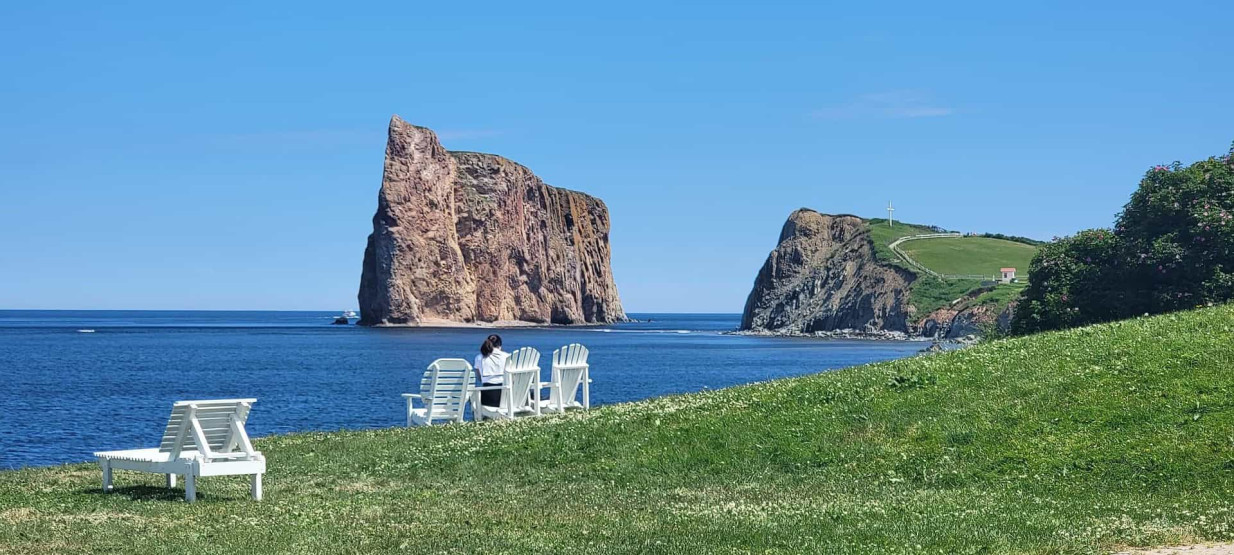
This spot boasts killer views of Percé Rock and Bonaventure Island. The 67 rooms are top-notch, and the vibe is warm and welcoming—perfect after a long day.
A small, historic gem in downtown Gaspé, this inn mixes old-school decor with modern comforts. The owners treat you like family, which makes it special.
Right on the St. Lawrence River, this place has 185 cozy rooms, a convention center, and an on-site restaurant (La Brigade 225, see below for more info). It’s a great hub for exploring Bas-Saint-Laurent.
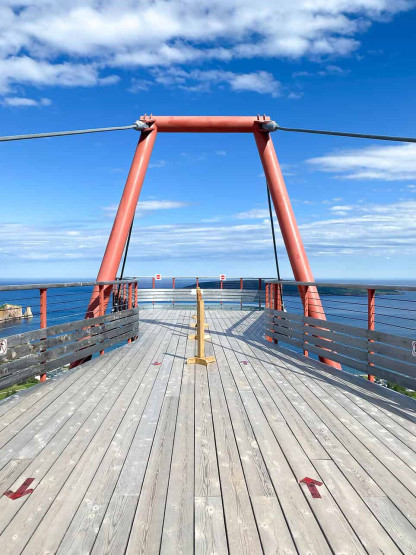
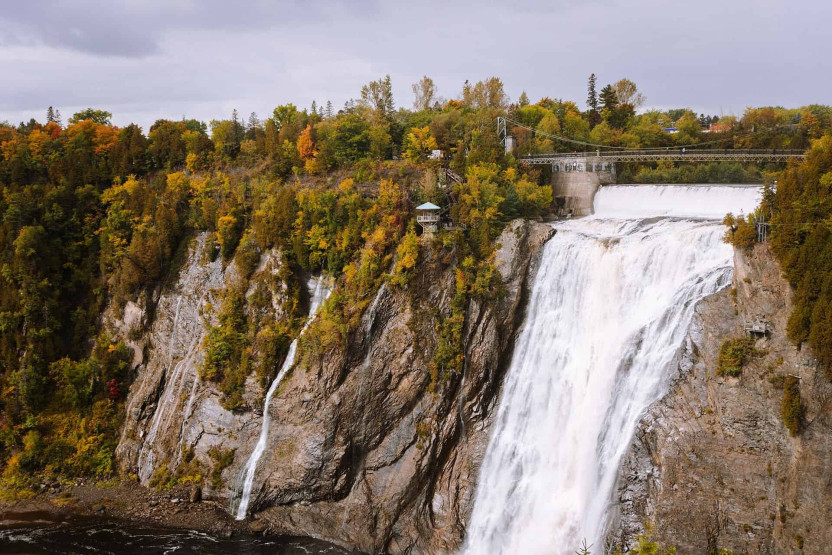
This site dives into 500 million years of Earth’s history. The glass platform, perched 200 meters (660 feet) up, is a heart-pounding highlight—skip it if heights freak you out, but the views are unreal from any angle.
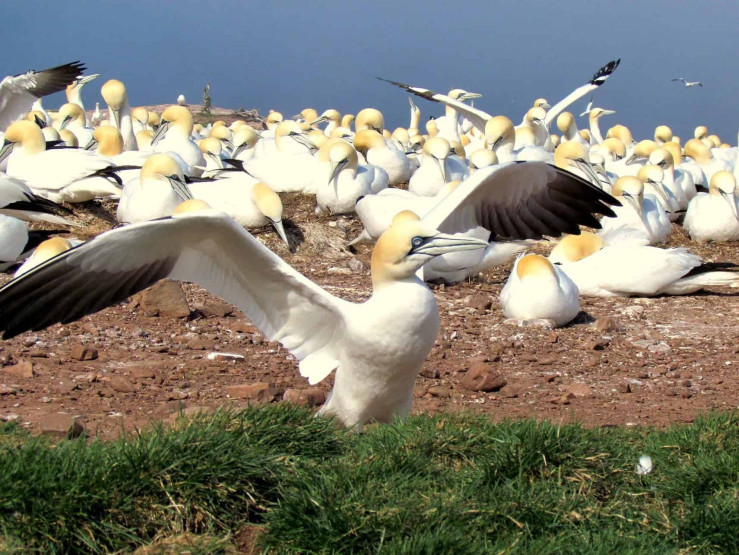
A boat ride from Percé lands you at North America’s largest migratory bird refuge. The Northern Gannet colony is a noisy spectacle, and the hiking trails are a blast. Budget three hours total, including the 60-minute boat trip out.
Spanning 245 square kilometers, this park mixes sea, cliffs, and forests. Trails like Les Graves offer whale-watching opps, and the Grande-Grave heritage site tells fishing tales.
This Migmaq village replica dives into First Nations history with guided tours and artisan demos. Here you can experience a hands-on look at local roots.
Climb 128 steps up Canada’s second-tallest lighthouse for a 360° St. Lawrence panorama, then hit the Empress of Ireland Museum to unpack a maritime tragedy. And you can board the submarine Onondaga, a 90-metre steel monster, to discover the daily life of the 70 men who were enclosed there for months.
Run by the Wolastoqiyik Wahsipekuk First Nation, this new deck offers beluga sightings and a digital trail on conservation. The sacred mountain setting adds depth.
Putep’t-awt Belugas Observation Site in Cacouna, Quebéc, Canada. Photo by Tourisme Wahsipekuk.
Cultural Experiences
Timing this trip around June 21’s National Indigenous Peoples Day means possible celebrations at the Micmac Interpretation Site—think artisan showcases or storytelling, though it’s weather-dependent. June 24’s St. Jean holiday might spark festivities in Gaspé, too, if the skies cooperate.
Both are a chance to soak up Québec’s vibrant “joie de vivre”.
Dining Recommendations
Food here is all about fresh catches and local flair. Check these out:
Weather: June’s a mixed bag—cool mornings, warm afternoons, and sudden rain. Pack layers, a waterproof jacket, and sturdy shoes. I learned the hard way more than once: soggy socks kill the vibe.
Language: French rules here, but tourist spots get by with English. Learn “bonjour” and “merci”—it’ll earn you smiles.
Photography: Sunsets over the St. Lawrence are pure gold, and Percé Rock at sunrise is a stunner. Bring a decent camera or a charged phone.
Driving: The Gaspé-to-Rimouski haul (5 hours, 385 km) is a slog. Break it up with stops like Mont-Saint-Pierre or a roadside café. Trust me, you’ll need the stretch, a good snack and some coffee.
The Lowdown: Challenges and Why It’s Worth It
This trip isn’t flawless. The early 5:45 AM shuttle to the airport sounds brutal and I hope there will be some coffee ready. A long day driving can wear you down, especially if traffic or weather turns sour. And if heights spook you, that glass platform in Percé might not be your dream place.
But here’s the flip side: the payoffs are massive. Gannets diving off Île Bonaventure, belugas popping up in Cacouna, and sunsets that make you forget the road fatigue—it’s all worth it.
Take it slow, plan your stops, and you’ll roll with the punches.
This road trip through Québec’s maritime regions is shaping up to be a wild ride—natural beauty, cultural depth, and those little moments that stick with you.
From rugged Gaspésie cliffs to Bas-Saint-Laurent’s sleepy villages, it’s a slice of Canada that begs to be explored.
I’m looking forward to pack my bags, hit the road, and see it for myself.
I’m sure you’ve had similar experiences I had whilst traveling. You’re in a certain place and a fellow traveler, or a local, tip you off on a little-known beach, bar or accommodation. Great travel tips from other travelers or locals always add something special to our travels. That was the inspiration for Travel Dudes.
I’m sure you’ve had similar experiences I had whilst traveling. You’re in a certain place and a fellow traveler, or a local, tip you off on a little-known beach, bar or accommodation. Great travel tips from other travelers or locals always add something special to our travels. That was the inspiration for Travel Dudes.
It was late January 2023, and I was queuing for the Moreton Island ferry in Brisbane when I first realised my goal in life.
As the 4WDs lined up to pack tightly onto the 90-minute ferry, I noticed a family get out of their sand coloured Land Cruiser 76 series. With fishing lines and a jet ski in tow, every cell in my body lit up to the adventure this family were about to embark on.
A weekend offline, on an island, in nature, with the kids rolling around in the wild. Heaven, right?
If you are someone who also lives for an off-grid adventure, cooking out under the stars and a bed that you can roll straight into the ocean from… you’re going to be as obsessed with Moreton Island as I am, and you’ll want to save this Moreton Island travel guide.
Moreton Island (Mulgumpin in the Indigenous Quandamooka language) is an absolute paradise located just off the coast of Brisbane in Queensland, Australia.
This raw and rugged island is one of the world’s largest sand islands and is one of the best 4WD adventures you can find along the east coast of Australia alongside Fraser island and North Stradbroke Island.
In this Moreton Island travel guide, I am going to share with you all of the best things to do on Moreton Island so that if you’re considering making your way over there, you’ll know exactly what kind of adventure to expect. I’ll also share the options you have to get over there, what to take with you and the best time of year to visit.
Notepads and pens at the ready…
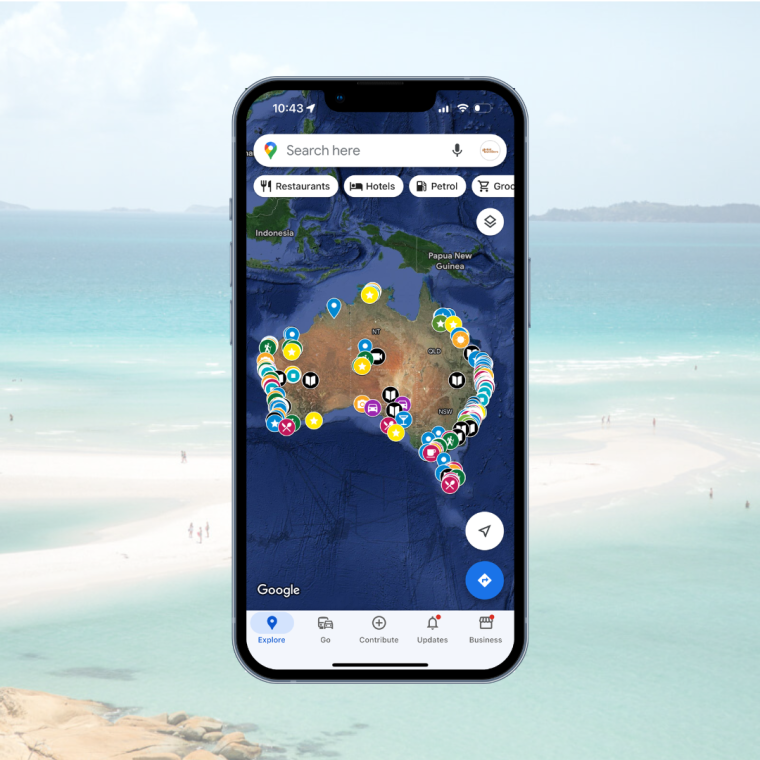
Get lifetime access to my endless hours of research and time spent on the ground finding the best places to eat, drink, relax and explore in the area. You simply open the Google Map on your device and all my pins are at the touch of your fingertips.
Getting To Moreton Island
Whilst Moreton Island is a 4WD-only island (no roads, just sand), you can still visit Moreton Island without a 4WD of your own. I have listed all the options below for you!
Getting to Moreton Island with a 4WD
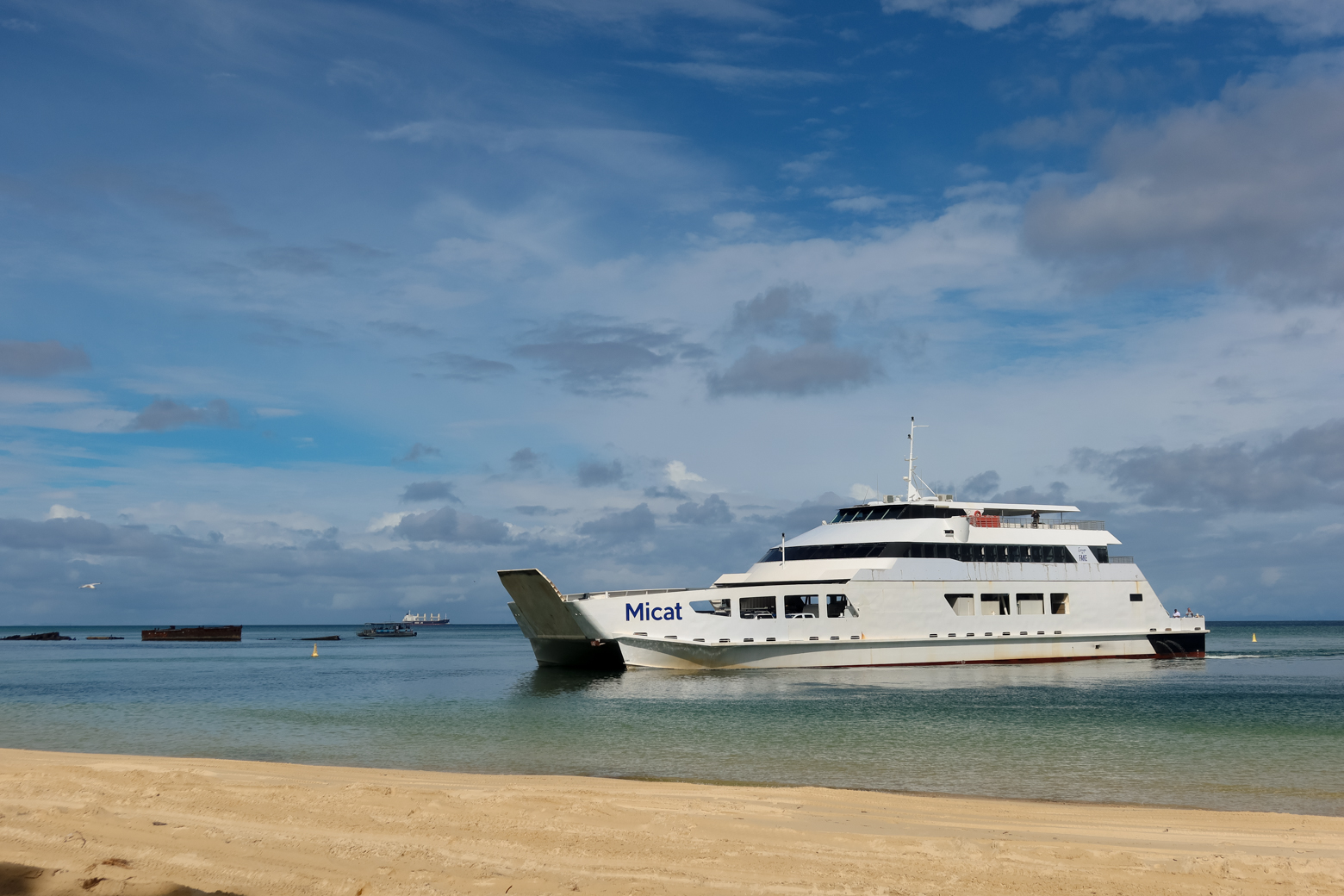
If you have a 4WD or are renting one, book yourself onto the Micat vehicle ferry from the Port of Brisbane. Travelling on this vehicle barge allows you to fill your car with all your camping gear and transport everything across to the island to roam freely. Book online here.
Price – Starts around $120 return for standard vehicles (lots of add-ons available)
Duration – around 90 minutes.
Tip – If you know your days, book well in advance! These ferries have limited space and they book out all the time. Keep an eye on school holidays and weekends as this is peak booking time.
You’ll need a 4WD vehicle permit
If you’re heading over with a 4WD, you’ll need to purchase a 4WD permit. You can get a monthly ($57) or annual ($297) one here: https://www.mulgumpincamping.net.au/pricing/4wd-permits/
Passengers Without Vehicles
If you don’t have a 4WD, do not fear; you can still explore this paradise in a few different ways.
Tangalooma (the one resort on the island) offers a passenger ferry, which gives you the option to come over for the day or you can stay overnight at their accommodation.
They currently have 4 ferries that depart from Brisbane’s Holt Street Wharf daily and tours that you can choose from if you want to see more of the island. See more here. I’ve heard you can also rent a 4WD from them, too.
Price for a day return on the ferry: Around $99 return per adult, $59 per child.
Duration: 75 minutes.
Best Time to Visit Moreton Island, Australia
Moreton Island is an epic year-round destination, so the best time to visit Moreton Island depends on what your priority adventure is whilst you’re here.
If it’s snorkeling, diving, and sand tobogganing you’re after – visit in the summer (December to February).
If it’s mild temperatures, fewer crowds, and great fishing conditions – visit in Autumn (March to May). This is the best chance to see dolphins and turtles active too.
If it’s whale watching and exploring the island with cooler temperatures that is your priority – visit in Winter (June to August).
Wildlife Spotting Calendar
Dolphins: Year-round at Tangalooma Resort
Humpback Whales: June to November, best viewed from Cape Moreton.
Turtles: Active from September to March, nesting from November.
Dugongs: Often seen in the protected waters near the island.
Birdlife: Migratory shorebirds visit in spring and summer.
Marine Life: Snorkelers can spot reef fish, wobbegongs, and rays.
1. 4WD around Moreton Islands Sand Tracks
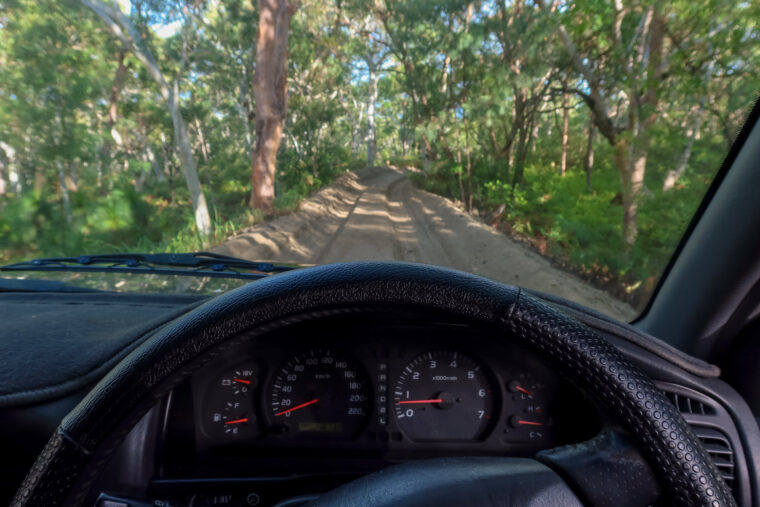
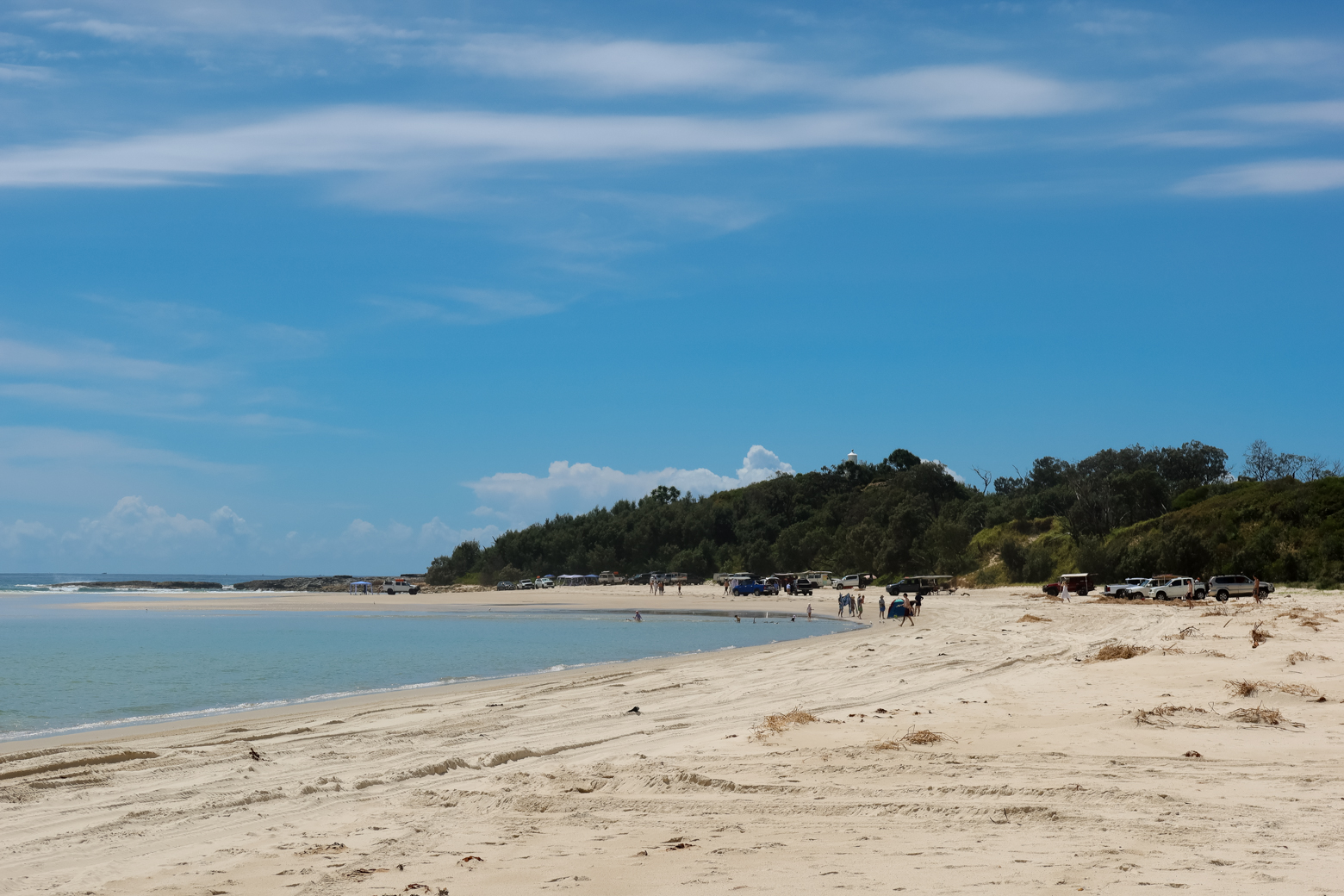
Moreton Island is 37 kilometers long and 10 kilometers wide, consisting of 98% sand. So if your visiting with a 4WD, you’re in for a fun adventure.
You have the option of driving along the beaches (watch out for the tide) and using the inland sand tracks, which present contrasting tropical jungle views (see below).
Things to remember:
You’ll need to purchase your 4WD permit before arriving on the island
Lower your tire pressure on the ferry or bring portable equipment
Take a screenshot of the tide times before you arrive so that you know when you can and cannot drive on the beaches!
2. Pull up somewhere and enjoy lunch/dinner in the wild
This is probably my favourite thing to do on Moreton Island.
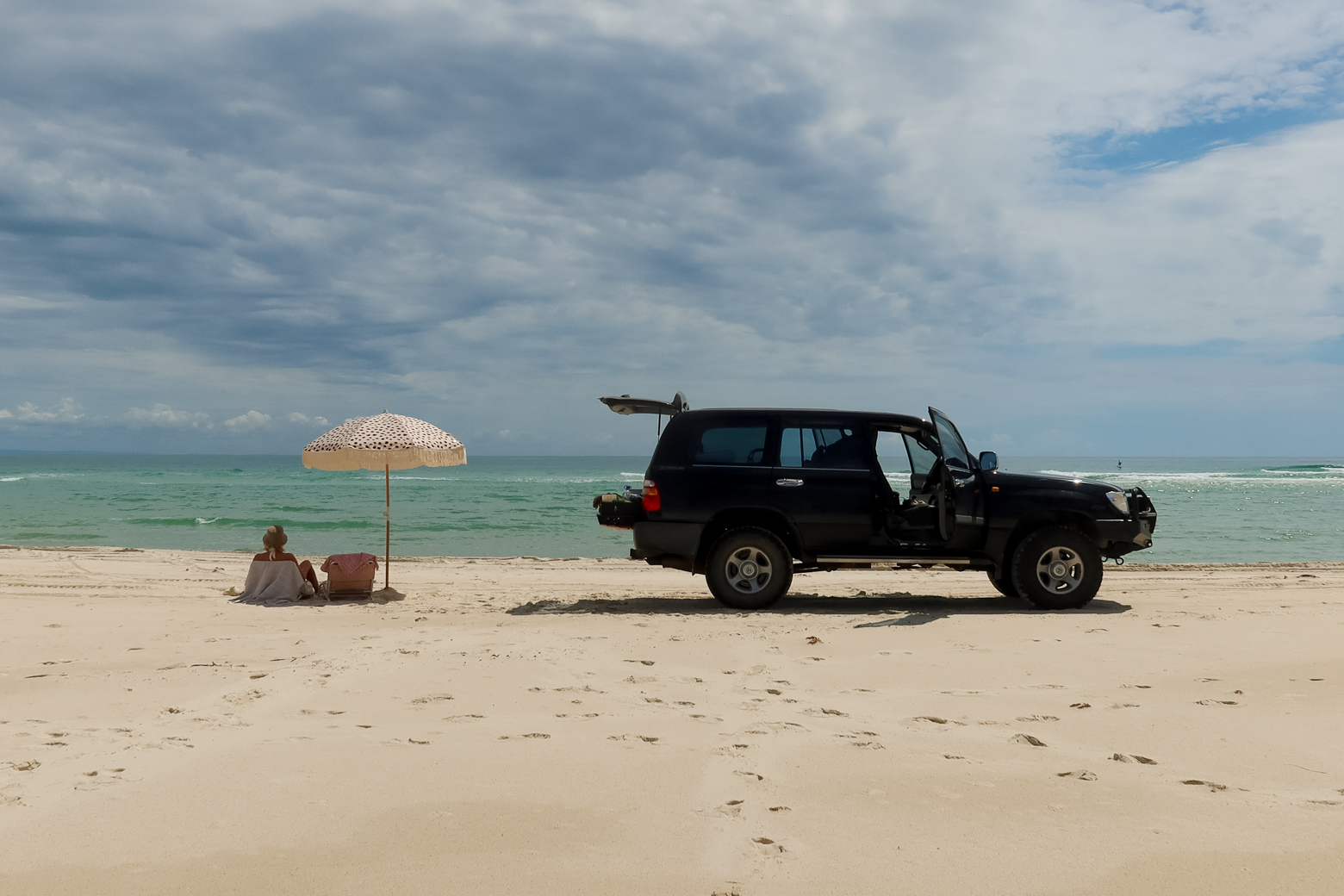
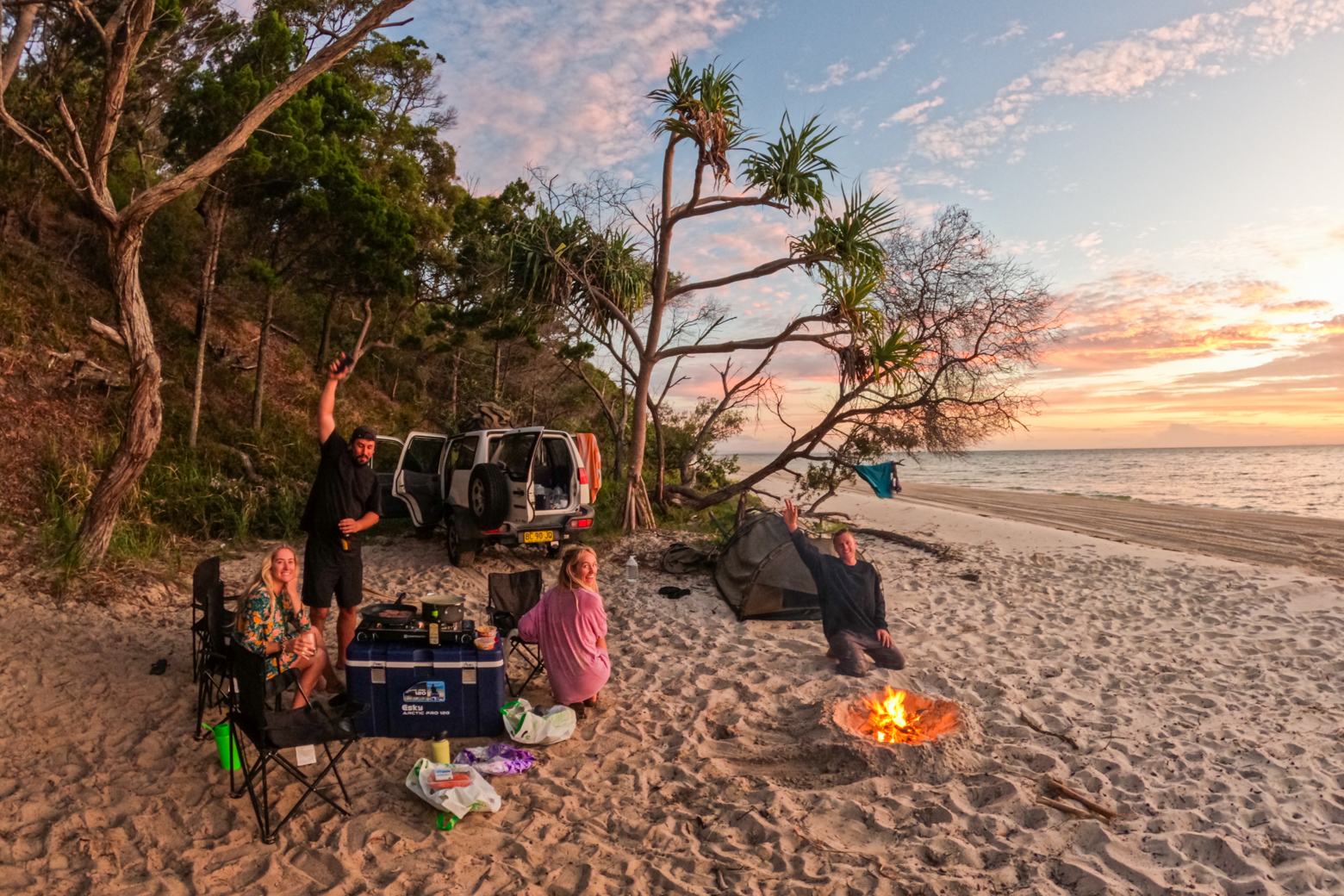
I love that you have everything with you in your car and you can drive around until you feel inspired, hungry or tired… pull up, have a tip and get the camp stove out.
For the most part of the year, you’ll find yourself with spots all to yourself. The ultimate unplug from the world and the ultimate plug into nature and restorative time with friends / family.
You can find all of my favourite pull up and camp spots on the island in my Australia Google Map Legend here. You can open this map on your phone and navigate to my exact location pins!
Get lifetime access to my endless hours of research and time spent on the ground finding the best places to eat, drink, relax and explore in the area. You simply open the Google Map on your device and all my pins are at the touch of your fingertips.
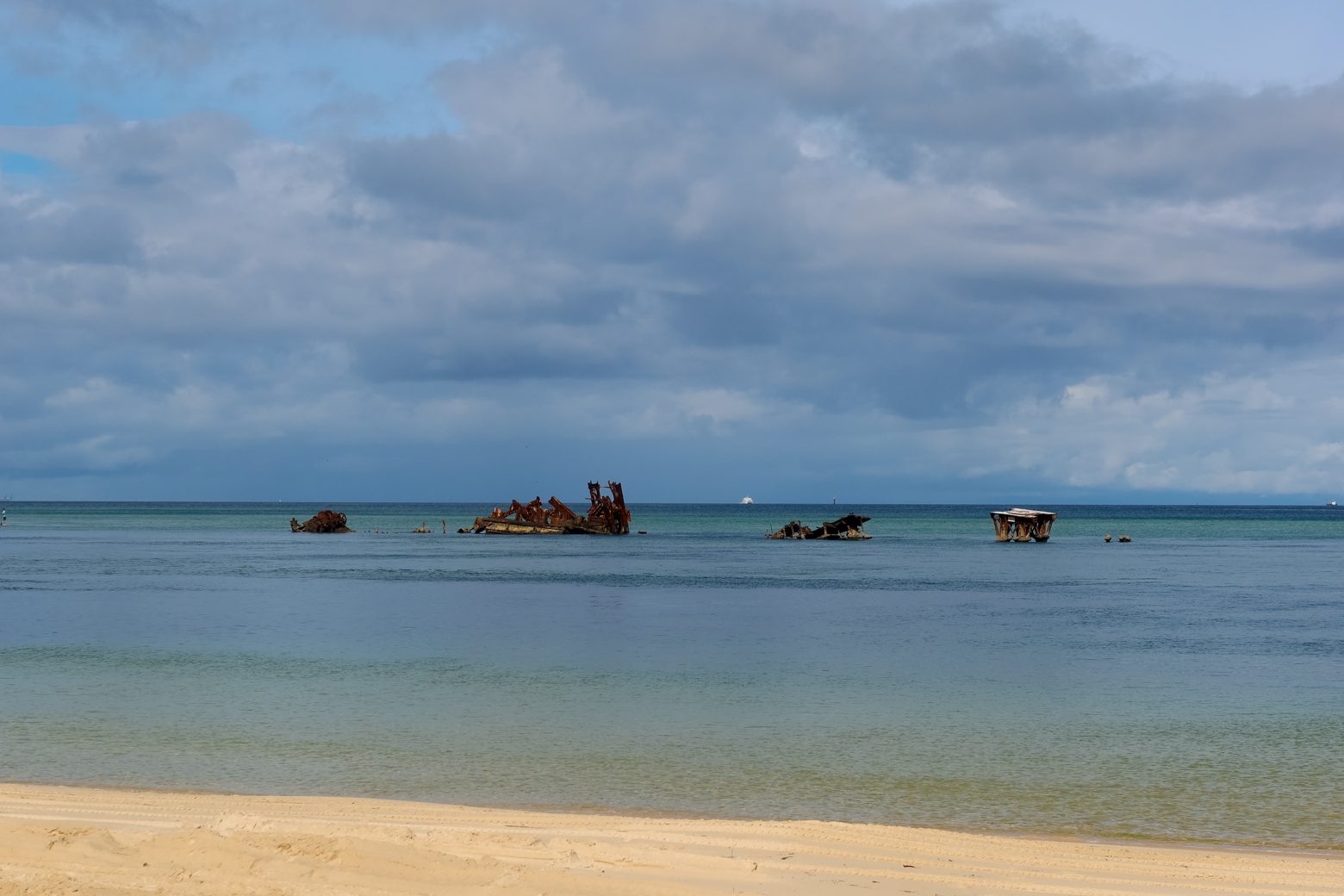
3. Go snorkeling at Tangalooma Wrecks
Snorkelling the wrecks is up there with the best things to do on Moreton Island. You’ll see these wrecks as you arrive to the island on the ferry as they are right outside the Tangalooma Resort.
These 15 sunken shipwrecks create an artificial reef that is teeming with marine life. You can swim out from the beach, hire a kayak or head out in a clear canoe.
Seeing turtles, tropical fish, and dolphins are no uncommon experiences here at the Tangalooma Wrecks!
4. Camp out and cook under the stars
This is just IT for me.
Moreton Island offers many camping spots (5 camp zones and 5 campgrounds) that feel truly wild and unplugged from the matrix. Some of my favourites are Yellow Patch, North Point and Blue Lagoon.
Camping on Moreton Island is, without a doubt, one of the most relaxing, restorative adventures I’ve ever been on so if you’re looking to switch off, you’re heading to the right place.
All you need is your swag, your rooftop tent, or your camper set up and to book a site! Spots are inexpensive to book but it just means you can reserve a spot. Book here.
Things to remember:
All camping permits must be purchased before you arrive on the island (there is no self-registration or reception on site).
A camping tag must be displayed at your campsite at all times.
A limit of one vehicle per campsite is allowed.
Get lifetime access to my endless hours of research and time spent on the ground finding the best places to eat, drink, relax and explore in the area. You simply open the Google Map on your device and all my pins are at the touch of your fingertips.
5. Visit Cape Moreton Lighthouse
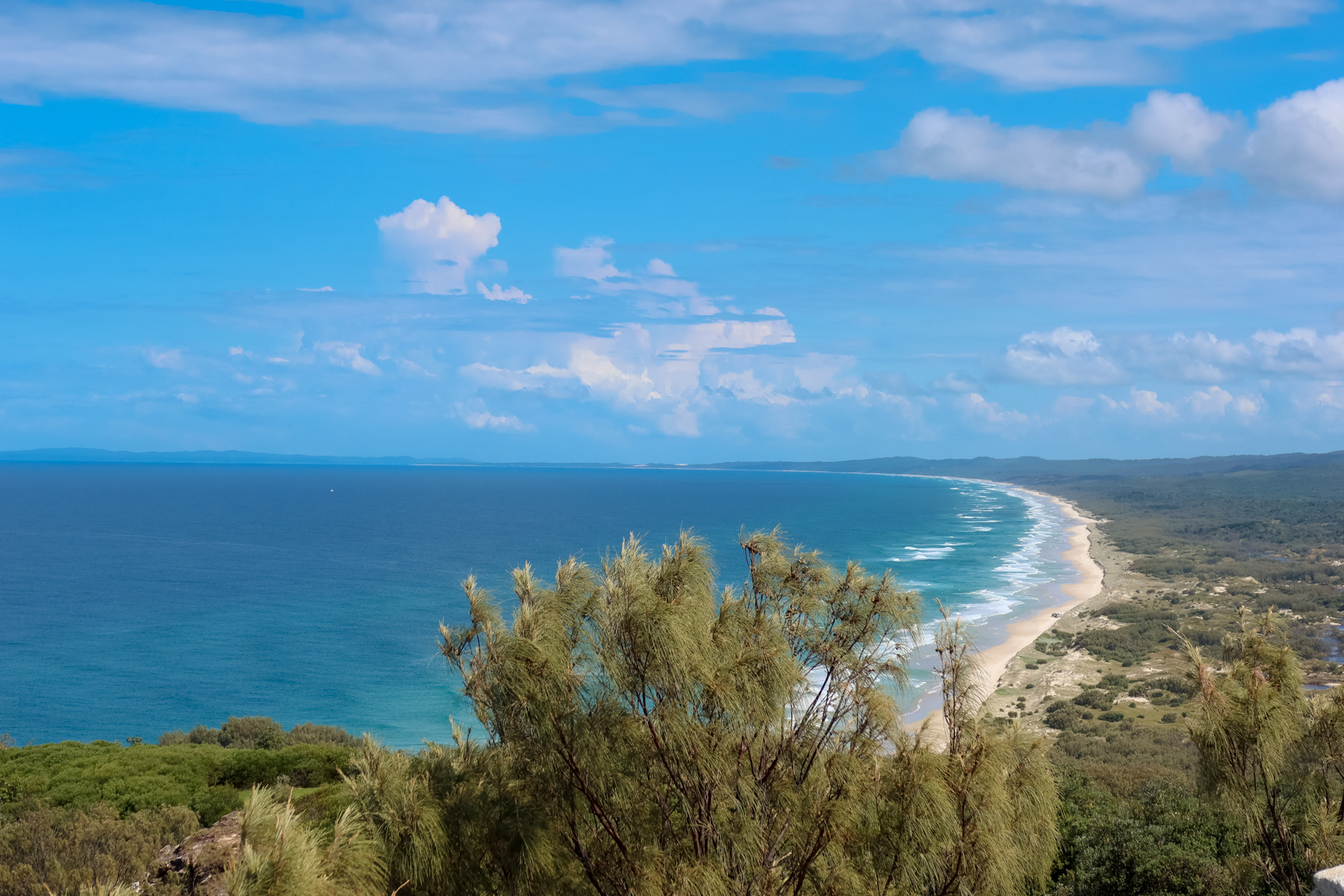
Whilst driving around the north part of the island, be sure to stop at the island’s highest point, Cape Moreton.
Once parked up in the sand car park, take the 5 minute walk up to the top, where you can bathe in 360-degree views of the coastline. You’ll see exactly why this is a prime whale-watching spot from June to November.
Tip: Bring binoculars for spotting marine life!
6. Sand Tobogganing at The Desert
This is one of the most popular adventures to go on and one of the best things to do on Moreton Island if you’re down for a bit of adrenaline. From the beachside sand dunes to the popular spots of Little Sand Hills, Big Sand Hills, and The Desert, this is your chance to slide down some epic dunes at thrilling speeds!!
If this sounds like a bit of you, be sure to pack your sand board, some cardboard OR check out sand dune tours!
Tip: Wax up your board for extra speed!
7. Pitch up for the day and surf at North Point
North Point is one of my favourite spots on the island and is, as you may have guessed, located on the North of the island by Champagne Pools and Honeymoon Bay – two other spots you can check out whilst you’re up here.
North Point is where you’re most likely to find yourself a wave on this right-hand break.
It’s also a vibey spot to hang out for the day as many people drive along the beach and pitch up here to play games on the beach, cook up long, sunbake and surf.
Whether it’s for an hour, a morning or a whole day, hanging out at North Point is one of the best things to do on Moreton Island.
Just look at the photos below!
8. Spot the whales migrating
If you’re on a whale mission, you’ll want to visit between June and November to witness the Humpback whales migrate past the island. As previously mentioned, one of the best spots to see this spectacle occur is on the north of the island at Cape Moreton.
Or, of course, you could book a specialised boat tour to get up close and personal with the gorgeous species. Check out Tangalooma Whale Watching for more.
9. Stop off at Blue Lagoon for a swim!
On the east side of the island, a short drive down from the North Point, lies a crystal-clear freshwater lake surrounded by pure white sand – Blue Lagoon!
Blue Lagoon is a dreamy spot to cool off in, and if you visit in the morning, you’ll likely have calm waters and the place to yourself! There’s a camp ground nearby that you could book into, too, if you’re looking for somewhere to stay.
10. Visit Champagne Pools
These natural rock pools at the northern end of the island are named Champagne Pools because of the sparkling ‘champagne’ effect created as ocean wave’s crash over the volcanic rock & sandstone breakwall.
These pools are a great one to tee up with a visit to Honeymoon Bay and North Point beach!
Tip: Visit at mid to high tide for the full effect.
11. Walk up to Five Hills Lookout for views across the Island
This lookout is located along the west side of the island as you drive from Tangalooma (where the ferry drops you off) up to Cape Moreton and is one of the best things to do on Moreton Island because of the epic views it offers for a relatively short walking distance.
On the side of the sand track, when you arrive, there are a few casual parking bays, and you can complete this stop-off in around 25 minutes once you’ve walked and taken 10 minutes to enjoy the view.
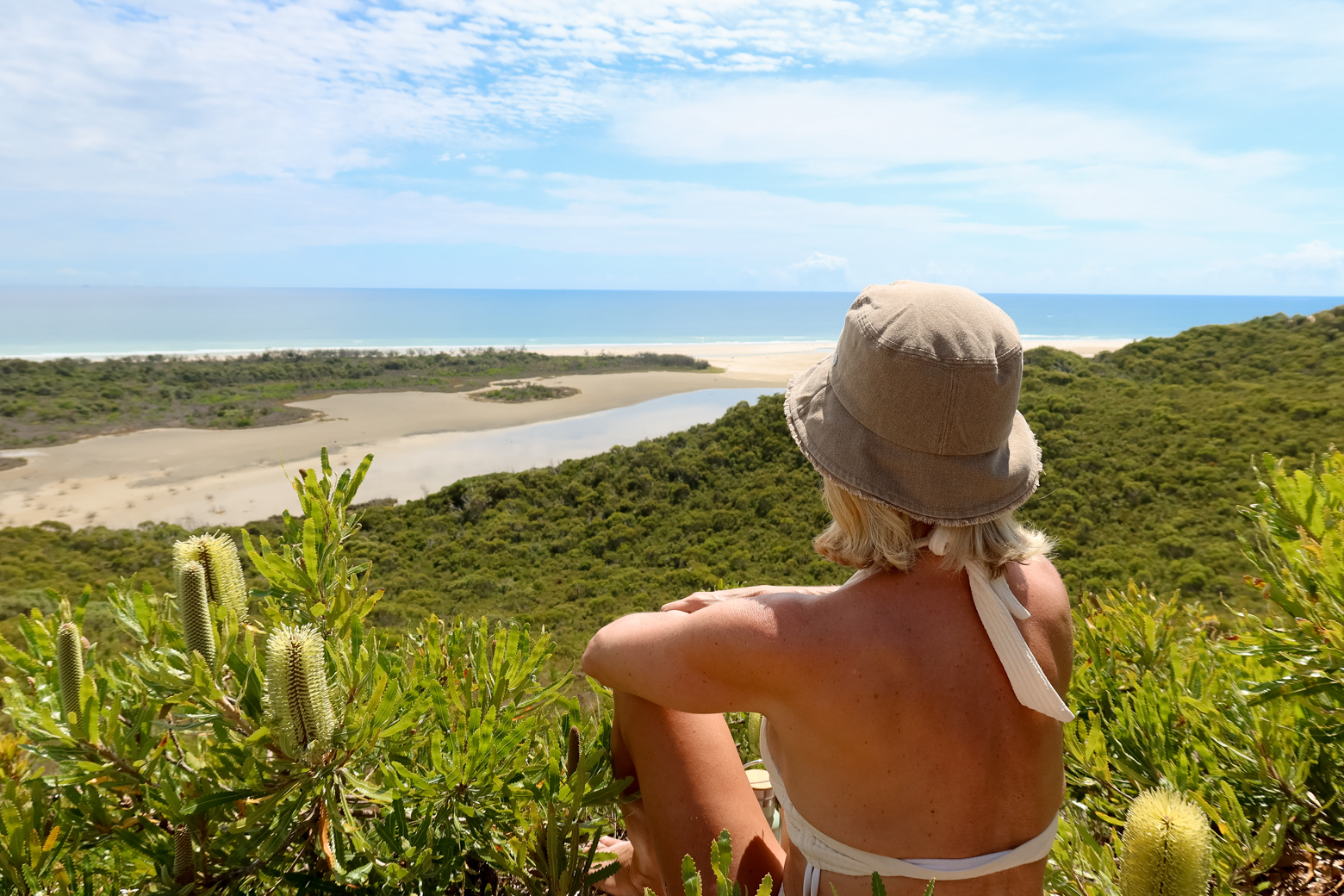
I didn’t do this on my first visit to the island, but I loved adding it in this time because it gives you a different perspective across the middle of the island (the bush) and gives you a real concept of the size of Moreton Island!
12. Look out for Dolphins
Okay, so I knew seeing the dolphins was one of the best things to do on Moreton Island, but I had no intention of being a visitor of Tangalooma Resort to experience it. It’s a well-known fact that every evening, a family of wild dolphins visits Tangalooma Resort’s pier to interact with visitors and guests staying there.
However, we ended up with a pretty surreal experience as we arrived just south of the resort to take a morning dip in the water (around 6 am).
Two dolphins joined us and swam around us for about 10 minutes just meters away. SO surreal. A once in a lifetime experience that I am over the moon I got to share with my mumma!
If you’re keen to add a dolphin experience to your time here on Moreton Island, check out the Tangalooma Dolphin Feeding.
My Top tips for Visiting Moreton Island:
Remember to pack:
Sunscreen, hat, and sunglasses
Swimwear and towel
Insect repellent
First-aid kit
For 4WD Travelers
Download Google Maps offline so that you can navigate even when you lose signal
Recovery gear, tire deflator, and shovel (prepare for getting stuck!)
Camping equipment and enough drinking water
Printed or screenshotted tide charts (so that you don’t get caught out!)
I think that’s everything you need to know before visiting Moreton Island!
Trust me, get it on your bucket list or even better, round up your friends and book your ferry!
Have you been to Moreton Island, Australia?
What are the best things to do on Moreton Island, Australia? Anything you’d add to this Moreton Island, Australia bucket list?
Love as always and happy adventuring…
Get lifetime access to my endless hours of research and time spent on the ground finding the best places to eat, drink, relax and explore in the area. You simply open the Google Map on your device and all my pins are at the touch of your fingertips.
The technical storage or access is strictly necessary for the legitimate purpose of enabling the use of a specific service explicitly requested by the subscriber or user, or for the sole purpose of carrying out the transmission of a communication over an electronic communications network.
Preferences
The technical storage or access is necessary for the legitimate purpose of storing preferences that are not requested by the subscriber or user.
Statistics
The technical storage or access that is used exclusively for statistical purposes.The technical storage or access that is used exclusively for anonymous statistical purposes. Without a subpoena, voluntary compliance on the part of your Internet Service Provider, or additional records from a third party, information stored or retrieved for this purpose alone cannot usually be used to identify you.
Marketing
The technical storage or access is required to create user profiles to send advertising, or to track the user on a website or across several websites for similar marketing purposes.










:max_bytes(150000):strip_icc()/TAL-rick-steves-switzerland-dolomites-RICKSTEVEWRITER0225-9cfb6a5eb815445cb2ebead1c2dc92e5.jpg "Rick Steves Just Shared His Best Advice for Young Travelers")
:max_bytes(150000):strip_icc():format(jpeg)/TAL-rick-steves-switzerland-dolomites-RICKSTEVEWRITER0225-9cfb6a5eb815445cb2ebead1c2dc92e5.jpg)