Home Blog Page 277

2026 Mercedes-Benz C-Class spied with updates

0


  • Mercedes-Benz has been caught testing a prototype for an updated C-Class
  • The prototype reveals several new design details
  • The updated C-Class is expected to arrive ahead of an electric C-Class that’s also testing in public view

Mercedes-Benz is readying an electric C-Class for launch in 2026, but the current gas-powered C-Class, on sale since the 2022 model year, isn’t going anywhere.

It’s set to receive an update, as evidenced by the recent sighting of a camouflaged prototype sporting some changes.

The prototypes feature a revised grille that appears similar to the design used on the latest E-Class. The headlights are also new and feature Mercedes star logos, a design trait expected to first appear on a redesigned CLA-Class due next year.

Other changes include a new design for the side mirror caps with clearly visible cameras for the surround-view camera system, plus a revised rear end. The interior design looks to be unchanged for now.

2026 Mercedes-Benz C-Class facelift spy shots - Photo via Baldauf

2026 Mercedes-Benz C-Class facelift spy shots – Photo via Baldauf

It isn’t clear what Mercedes has planned for the mechanicals. The C-Class currently comes standard in the U.S. with a 2.0-liter turbo-4 mated to a mild-hybrid system, and generating a peak 255 hp. Buyers can choose between rear- and all-wheel drive.

For performance fans, Mercedes’ AMG skunkworks offers the C 43 and C 63 S E Performance. The C 43 packs a 2.0-liter turbo-4 and mild-hybrid combination rated at 416 hp, while the C 63 S E Performance pairs a 2.0-liter turbo-4 with a plug-in hybrid system that adds a powerful electric motor at the rear axle. The peak output of the C 63 S E Performance is 671 hp, though there’s a hefty weight penalty associated with the plug-in hybrid system.

Look for the updated C-Class to debut late next year as a 2026 model. It should be followed shortly after by the electric C-Class, which has been confirmed to start sales in 2026, meaning it will likely arrive as a 2027 model in the U.S. An electric GLC-Class is also due to go on sale in 2026.

The C-Class used to be one of Mercedes’ top sellers in the U.S., averaging more than 70,000 units annually just a decade ago. Sales in recent years, however, have been less than half that, as more buyers in the compact segment opt for crossovers like the GLB-Class and GLC-Class.


Source link

2024 Dodge Charger Daytona brings muscle car nostalgia to the EV era

0


  • Dodge wants muscle car buyers to embrace EVs with nostalgia and speed
  • The Dodge Charger Daytona EV is anything but quiet
  • The 2024 Dodge Charger Daytona costs $61,590

Its looks are inspired by a 1960s muscle car. Its form factor was last popular in the 1970s. And its name is taken from a bewinged NASCAR special raced successfully by NASCAR legends in 1969 and ’70. But it’s also thoroughly modern, marking its brand’s first full step into the electric era.

It’s the 2024 Dodge Charger Daytona, and it aims to bring muscle car fans into the electric fold with nostalgia and performance.

The Charger arrives by the end of the year with a two-door fastback body, of the sort that was acceptable as a family vehicle in the 1970s when I was a kid but is now almost unheard of. A four-door version will arrive in the first half of next year as a 2025 model, and the gas Charger Sixpack will come later in the year, powered by a twin-turbocharged 3.0-liter V-6. All versions will ride on the STLA Large platform that parent company Stellantis has developed for gas and electric powertrains.

The 2024 Dodge Charger Daytona debuts in R/T and Scat Pack trims, both with dual-motor all-wheel-drive powertrains, a 100.5-kwh (93.9-kwh usable) battery, and power that exceeds their gas-motivated Charger and Challenger predecessors. 

No SRT variant is due until 2026, but the Charger Daytona is still a multifaceted performer, much of it enabled by its electric powertrains, for better and for worse. Dodge invited Motor Authority to Phoenix, Arizona, to experience those performance capabilities at the nearby Firebird Raceway’s Radford Racing School.

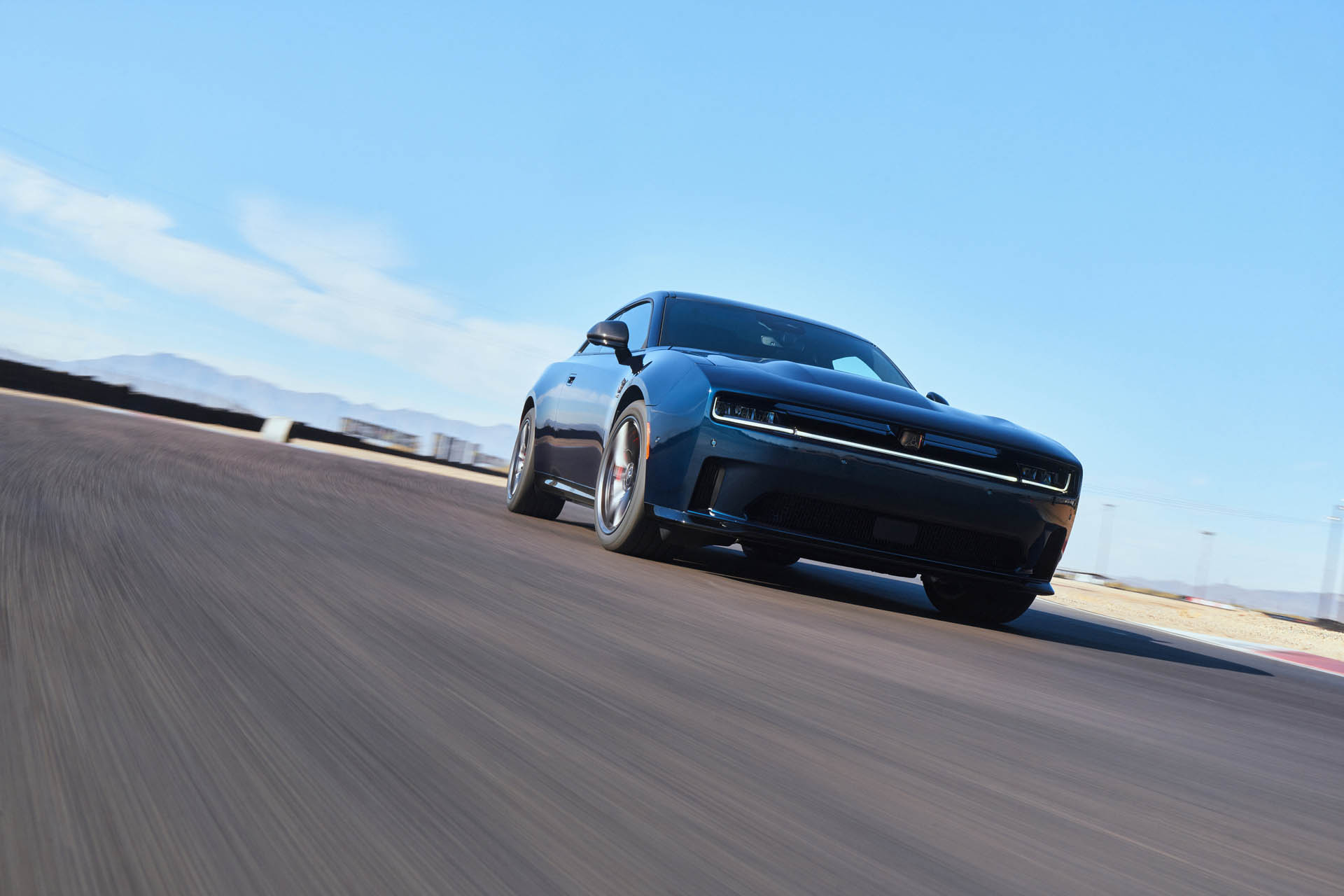
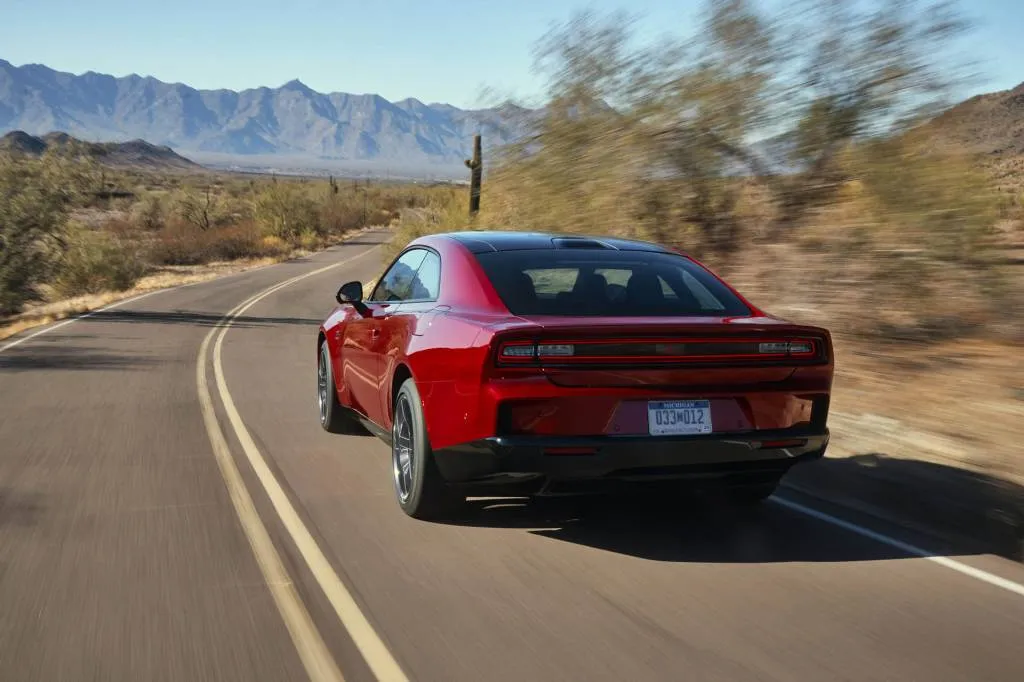
2024 Dodge Charger Daytona

2024 Dodge Charger Daytona

Charger Daytona: Fake sounds, muscle car rumble

My day started with a street drive into the hills in the base R/T model, and ended with a street drive through suburban traffic in a Scat Pack. The R/T’s dual permanent-magnet motors spin out 456 hp and 404 lb-ft of torque, and the standard Stage 1 tunes that up to 496 hp via a Power Shot feature that is available for 10-second bursts. It can get up to 308 miles of range on a charge, and its 400-volt battery can charge at up to 183 kw on a 350-kw plug, which will let it go from 5-80% in 32.5 minutes. 

2024 Dodge Charger Daytona

2024 Dodge Charger Daytona

The sound from the R/T’s Fratzonic “chambered exhaust” became apparent as soon as I hit the start button behind the shift lever. Rather than the typical EV spaceship whir, the Fratzonic chamber, which is essentially a subwoofer located below the rear bumper, belted out a V-8-inspired rumble that reacted to the throttle position with a proper muscle car note. It sounded and felt realistic from inside thanks to a little vibration, but from outside it sounded like it was being played through a tape deck.

Fratzonic really made itself heard during Power Shot stints, activated via a button on the flat-top-and-bottom steering wheel. The rumble became lower and louder while the power hit harder. It’s a gimmick, but a cool one for muscle heads. That Power Shot lets the R/T accelerate from 0-60 mph in a tidy 4.7 seconds, and that power was at the ready whenever my right foot requested it.

The willing power was even more noticeable and the Fratzonic sound louder in the Scat Pack model on my return trip. The Scat Pack ups the output to 630 hp and 627 lb-ft, though the standard Stage 2 tune, again available via the Power Shot, increases horsepower to 670. The Fratzonic note can reach 126 decibels, as much as an outgoing Hellcat. It’s a cool sound, but it can get so loud that some drivers will be tempted to turn it off and run in stealth mode.

2024 Dodge Charger Daytona

2024 Dodge Charger Daytona

Charger Daytona: Comfortable on the street

The Charger Daytona is a big car at 206.6 inches long on a 121.0-inch wheelbase. That’s 5.8 inches longer than the Dodge Charger it replaces. It’s even 1.6 inches wider than a Charger SRT Wide Body at 79.8 inches. It’s also much heavier, at 5,698 pounds for the R/T and 5,767 pounds for the Scat Pack, versus 4,273 pounds for the comparable 2023 Charger R/T and 4,361 pounds for the old Scat Pack.

On the road, this EV wears its size and weight well. My R/T tester was outfitted with the Blacktop Package that upgrades from the standard 245/55R18 tires to 275/40R20 Goodyear Eagle Sport all-seasons. It rode smoothly on city streets and mountainous twisties. The steering had direct responses but an overly light touch and too little feel through the steering wheel.

When charging into a few corners, the R/T felt a bit top heavy with a little too much lean, but the nose tucked in and the car rotated well. Running in Sport mode, the throttle response was a bit too quick mid-corner as the power began to lift the nose and send the car toward the outside of the turn. Easing off brought the car back in line.

The R/T comes with 13.9-inch front rotors with 2-piston calipers and 13.8-inch rotors with single-piston rear calipers. That’s not overly robust, but they have enough stopping power to get the job done for a couple of short, spirited runs. Better yet, the regenerative and friction braking proved well integrated, which resulted in a natural pedal feel. Dodge offers three levels of regen, which provides roughly 0.1, 0.2, and 0.3 g of deceleration. While Dodge calls it level three one-pedal driving, it’s not, and you’ll need to hit the brake for most turns.

2024 Dodge Charger Daytona

2024 Dodge Charger Daytona

Charger Daytona: Compromised on the track

The day also included laps in the Scat Pack with the Track Package on a small nine-turn, 0.7-mile road course. The $3,495 Track Package upgrades from a square set of 305/35R20 Goodyear Eagle Sport all-seasons to wider 325/35R20 rears. It also gets upgraded brakes, dual-valve adaptive dampers, a stiffer suspension tune, and a larger rear spoiler. The track cars also wore two important options ideal for the track: a set of Goodyear Eagle F1 Supercar 3 summer performance tires and the Drive eXperience Recorder that works like GM’s Performance Data Recorder to record video and telemetry of track laps.

The track time proved perplexing to me. My natural inclination was to run in Track mode, but it quickly became frustrating. As I attacked the corners, the stability control kicked in far too often, settling the body motions and cutting power to prevent me from keeping up with the lead driver. 

Then a Dodge rep turned off the stability control completely with a five-second press of the ESC button, a practice I don’t prefer because it can lead to a crash if I go too hard. However, it really revealed the car’s natural handling character. It’s not surprising that the car’s inclination is even more of that lean and push I experienced on the mountain road, with less control of oversteer caused by mid-corner throttle. From there, however, it takes a set and tracks nicely through corners. While I was able to go faster this way, I had to concentrate on smooth inputs to keep the suspension calm.

2024 Dodge Charger Daytona

2024 Dodge Charger Daytona

Sport mode proved to be the best way around the track. In this mode, the stability control’s targeted braking kept the understeer in check without cutting the power, which allowed me to rocket out of corners with the help of the standard limited-slip rear differential.

The track allowed the Charger Daytona to break into triple digit speeds and the Scat Pack’s big brakes were up to the task. It has 16.0-inch rotors all around with Brembo 6- and 4-piston calipers front and rear, but the Track Pack upgrades them to two-piece front rotors for better heat management. Hard braking into turn one on the front stretch brought on full ABS braking, but the car slowed as needed and the pedal retained its natural feel with no fade.

Track time didn’t overheat the motors or battery, and Sport mode kept the body motions mostly in check. Still, the weight makes the Charger Daytona a handful, throttle application can upset balance, and the steering needs more feel.

2024 Dodge Charger Daytona

2024 Dodge Charger Daytona

Charger Daytona: Drift machine

The Charger Daytona Scat Pack comes with a Drift mode that disables the front motor. To activate Drift mode, first go to the Vehicle tab along the left side of the touchscreen, then hit Drive Modes and choose Sport. Then back up one screen, choose Race Options, and hit Drift/Donut mode. Next, move a slider on the screen all the way over to Donut rather than Drift Min and Drift Max. Finally, hit the large green Activate Drift/Donut Mode button.

But wait, there’s more. To fully activate the mode you have to put your foot on the brake, shift to drive, make sure the steering wheel is straight, release the brake, and apply a little throttle. It’s now ready for mayhem.

2024 Dodge Charger Daytona

2024 Dodge Charger Daytona

Dodge’s drift exercise involved a simple three-cone slalom followed by a long left-hand turn on a sea of tarmac. The goal was to load up the suspension in each direction, with the emphasis on moving the weight to the right side before the big lefthander. At that point, it was a matter of steering left, mashing the throttle to overcome rear grip, and riding the wave to keep the car drifting.

I gave it four tries. On my first attempt, I got on the throttle too hard and too quickly. The tires easily overcame their traction and I spun out. On my next attempt and last attempt, I didn’t let the suspension load up before getting on the throttle and ended up going too wide. On my third attempt, however, I got it right and rode a glorious drift for about 180 degrees before pointing it back toward the start and letting off.

All the issues were driver error. The Scat Pack has plenty of power and balance to kill tires in magnificent, unnecessary, fun arcs of smoke.

2024 Dodge Charger Daytona

2024 Dodge Charger Daytona

Charger Daytona: Drag chops

I was surprised how much of a non-event it was to drag race the Charger Daytona Scat Pack and put up consistently fast times.

Before taking the Charger Daytona down the strip, it’s best to go to the Performance Pages screens in the infotainment system to check the high-voltage battery level and temperature. A charge of 75% or less will start to degrade power in the Drag mode, and the battery can’t be too hot or too cold, though anywhere from 20-120 degrees should work.

Next, choose the Drag mode either in the screen or with a toggle on the left side of the steering wheel to slow down the steering (you don’t want jerky motions in a high-speed, straight-line blast), and adjust the suspension and regenerative braking. It sends regen to full to help slow down after the run, and adjusts the front dampers to their full firm setting and the rears to full soft to let the car squat for more traction on launch.

2024 Dodge Charger Daytona

2024 Dodge Charger Daytona

From there, activate launch control in the Performance Pages. It has Max, High, Med (medium), Low, and Min (minimum) settings for how much torque will be unleashed at launch. The Max setting is for a prepped dragstrip with drag radials, and it releases all of the torque immediately. The other settings ramp up the torque after launch, ideally once the tires get full grip. Even though I was on a working dragstrip and the Scat Pack was on its summer tires, I still needed the Low setting to prevent too much tire spin.

The most difficult part of the process was hitting the launch control button while staging the car. Staging involves creeping forward to activate two lights with the front tire, the second about six inches after the first. The goal is to trigger the first light, activate launch control, and creep forward to trigger the second light. Then it’s a matter of quickly braking fully with your left foot and flooring the throttle before the Christmas Tree begins its three-yellow light countdown. Ideally, you’ll sidestep the brake on the second yellow and the car will leave the box on the green.

While I slept at the tree on my first run, the car performed admirably. With all-wheel drive and 670 hp (no need for a Power Shot here as Drag mode unlocks all the power), the rear tires slipped slightly at launch, the power came on hard and efficiently, and the car built speed relentlessly and tracked straight down the strip. I tripped the lights with a time of 11.87 at 117.23 mph. The run sapped about 2.5% of the battery charge.

I cut a better light on my second run, and the car performed consistently, with a time of 11.906 seconds at 117.15 mph.

A few other journalists put up times in the 11.70s, likely due to slightly better traction at launch. Dodge quotes a quarter-mile time of 11.5 seconds, which seems quite feasible with better conditions enabled by more rubber at the line. Given that time, I also buy Dodge’s quoted 3.3-second 0-60 mph time for the Scat Pack.

2024 Dodge Charger Daytona

2024 Dodge Charger Daytona

Charger Daytona: Interior and equipment

Dodge treats the Charger Daytona to a typical dark interior, though it can be brightened up with Demonic Red upholstery in suede and synthetic or real leather. Available ambient lighting highlights extra design flourishes, including crosshatched plastic on the door panels and a tiered dash with big screens aimed at the driver. A pistol grip shifter wrapped in black leather is a throwback to the 1960s Charger, though it would look more convincing if it incorporated some metal.

The cockpit is modern, too, with a 12.3-inch infotainment touchscreen and a standard 10.3-inch digital instrument cluster that can grow to 16.0 inches. The touchscreen uses the simple and quick-acting Uconnect 5 infotainment software, and incorporates both Performance Pages and new EV Pages information to monitor sprint times, power output, auxiliary gauges, battery charge, efficiency info, and much more.

Front seat occupants sit on low-back or high-back bucket seats. I only experienced the high-back buckets and they proved supportive and comfortable with wide seat bottoms and generous bolstering.

2024 Dodge Charger Daytona

2024 Dodge Charger Daytona

The three-door body style isn’t much of a detriment to passenger comfort. The only issue is snaking your way back to the second row, like I did in my family’s 1969 GTO when I was a kid. Once seated, it has a roomy 37.2 inches of legroom, and just enough headroom for a 6-footer, but no more. The hatchback body style makes cargo room more useful than a trunk. It has 22.8 cubic feet of space with the rear seats up and 37.4 cubes with those seats folded down. Oddly, buyers have to pay extra to get a tiny 1.5 cubic-foot frunk.

The Charger Daytona R/T starts at $61,590, including a $1,995 destination charge. The $75,190 Scat Pack teams its extra power with larger Brembo brakes, launch control, additional performance drive modes, a sportier suspension, and 20-inch alloy wheels. Unfortunately Dodge wraps several tempting options in a $4,995 Plus Group for both models.

Neither Charger Daytona is cheap, but both models improve upon the power and efficiency of their predecessors while delivering the look and sound (even if it’s synthetic) of a beloved 1960s muscle car. The Charger Daytona may be big and heavy, which hurts handling, but muscle cars have always looked good and gone fast in a straight line without the ability to turn corners all that well.

Dodge paid for travel, lodging, and track time for Motor Authority to bring you this firsthand report.


Source link

Mk1 Ford Escort RS back in production via Boreham Motorworks

0


  • Boreham Motorworks has unveiled a modern Mk1 Ford Escort RS
  • One of the available engines revs to 10,000 rpm and delivers 296 hp
  • Pricing starts at $375,000

The original Ford Escort sold in Europe was a popular economy car whose production spanned decades and also got Ford started in rallying. The Mk1 Escort would eventually become one of the most successful rally cars of all time, especially in RS guise.

The Mk1 ceased production in 1975, but now the U.K.’s Boreham Motorworks has brought it back with a modern continuation example built from the ground up using blueprints and other design materials from the originals.

Boreham’s version, known as the Escort Mk1 RS Continumod, uses a new chassis with continuation VINs approved by Ford. The car also benefits from modern technology while staying true to the spirit of the original.

Pricing starts at 295,000 British pounds (approximately $375,000), and the first prototype example will be shown to the public by mid-2025 ahead of production, which is set to start later that year. Just 150 examples will be built for worldwide sale.

Buyers have two powertrains to choose from: a standard 1.8-liter inline-4 rated at 182 hp or a 2.1-liter inline-4 that revs to 10,000 rpm and delivers 296 hp. While those numbers don’t seem high in comparison with many modern performance cars, the target weight for Boreham’s Mk1 Escort is 800 kilograms, or about 1,767 pounds. Each engine will come paired to a manual transmission (a 4-speed for the standard engine and a 5-speed for the performance option), with drive sent to the rear wheels only.

Like the exterior, the interior is a blend of new and old. A standout element is the low, horizontal dashboard, creating an open and spacious feel. While analog gauges and controls dominate the cabin, a small digital screen in the center stack accommodates the infotainment system. Customers can opt for either left- or right-hand-drive configurations.

Boreham Motorworks is part of DRVN Automotive Group, which also operates a Koenigsegg dealership in London, as well as companies offering restomod and restoration services for the Ferrari F355 and Jaguar E-Type. In addition to the Escort, Boreham is working on a modern interpretation of the iconic Ford RS200 homologation special of the 1980s.

Some of Boreham’s Fords may get enhancements from Alan Mann Racing at some point. Alan Mann originally raced Fords like the Mk1 Escort, and earlier this year, it also became part of the DRVN Automotive Group.


Source link

Motor Authority Best Car To Buy 2025 finalist

0


  • The Acura ZDX Type S is a Motor Authority Best Car To Buy 2025 finalist
  • The ZDX is well controlled and pleasant to drive, though its design is divisive 
  • At $75,850 in Type S form it costs a pretty penny

Our experience with General Motor’s midsize EV crossovers has been a good one. We liked the Cadillac Lyriq so much that it was a real contender for the Motor Authority Best Car To Buy 2023 award. The Acura ZDX shares the Lyriq’s platform and Ultium battery and EV component set, and it offers a more powerful Type S model that the Lyriq lacks. It was only natural to choose the ZDX as a Motor Authority Best Car To Buy 2025 finalist.

A GM in Acura clothing, the ZDX boasts a 102-kwh battery pack that delivers up to 313 miles of range. That falls to a still sufficient 278 miles in the Type S, and it can charge at up to 190 kw, which will add 77 miles in about 10 minutes and a 10-80% charge in 42 minutes on a 350-kw fast charger.

The ZDX starts with the rear-wheel-drive A-Spec model that makes 358 hp and 324 lb-ft of torque. An all-wheel-drive A-Spec adds a front motor and ups the output to 490 hp and 437 lb-ft. The The finalist here is the Type S, which also gets a dual-motor powertrain, but here it makes 499 hp and 544 lb-ft. That motivates this 6,052-pound SUV from 0-60 mph in less than five seconds. The power is obvious from behind the wheel, with plenty of gusto at any speed and lots in reserve for highway passing.

The ZDX Type S doesn’t make much more power than the A-Spec, but its multi-link front and rear suspensions are also tuned differently. It upgrades to a standard air suspension with adaptive dampers and larger and stiffer front and rear sway bars. It also has a quicker steering ratio at 15.9:1 instead of 18.2:1, and its brakes are bigger with 15.3-inch front rotors instead of 12.6-inch rotors. Finally, it rides on larger wheels and tires, with a set of 275/40R22s replacing 265/50R20s. Acura also offers summer performance tires for the Type S exclusively. 

Even with its sport-tuned suspension, the ZDX Type S rides comfortably on the street. It also has some decent moves despite its three-ton curb weight. The steering is light but direct and fairly quick, and the ZDX doesn’t lean too much in corners. It’s well controlled and pleasant to drive.

The ZDX is sized much like the three-row MDX, but it has just two rows of seats. Its 121.8-inch wheelbase is about eight inches longer than the MDX’s, and that gives it a very comfortable rear seat with lots of legroom. It’s also wide enough to fit three across in the back better than most SUVs. It has a high level of fit and finish, too, and it gets standard Apple CarPlay and Android Auto that the Lyriq and related Chevy Blazer EV lack.

Acura prices the ZDX Type S from $75,850, and it’s eligible for the $7,500 federal tax rebate. That’s a pretty penny, but it’s also well equipped with an 11.0-inch digital instrument cluster, an 11.3-inch touchscreen, a wireless device charger, 16-way power-adjustable front seats that are heated and cooled, Milano leather upholstery, heated rear seats, a heated steering wheel, and a panoramic sunroof. It also gets lots of standard safety equipment, including front and rear automatic emergency braking, adaptive cruise control, active lane control, blind-spot monitors, a driver-attention monitor, front and rear parking sensors, automatic parking, and a surround-view camera system. GM’s Super Cruise is even available as an option.

Will ready power, good range, pleasant dynamics, and a comfortable interior be enough for the Acura ZDX to be named Motor Authority Best Car To Buy 2025 over a sporty Porsche EV SUV, a pair of electric off-roaders, an EV hot hatch, and a quick and comfortable gas-powered German cruiser? Check back on Jan. 6 when we reveal the winner, along with the champs from our sister sites, The Car Connection and Green Car Reports.


Source link

12 Luxury Winter Jackets on Sale at Rue La La

0


The biting winter chill provides the perfect opportunity to lean into layering and get creative with your travel style while staving off the cold. The best way to do this? Invest in a cozy winter coat. This year, we’re dispelling the notion that in order to stay warm, your go-to outer layer should be simple and sensible. And really, all the evidence you need is at boutique retailer Rue La La’s luxury winter jacket sale.

With brands like Moncler, Canada Goose, and Mackage all discounted up to 80 percent off, we found some unbelievably luxe layers at far more wallet-friendly prices than usual. So, if you’re ready to invest in a winter wardrobe staple, read on to find the 12 best coats to shop from the sale. From lighter rain jackets to truly unparalleled puffers, Rue La La is serving up style on a silver platter, starting at $200.

Skea Jocelyn Ultra Puffy Jacket

Rue La La


If you’re drawn to filling your wardrobe with bold, bright colors, the Skea Jocelyn Ultra Puffy Jacket is the pick for you while it’s on sale for more than 50 percent off. Available in a full range of sizes from 2 to 16, this vibrant puffer is certainly a statement piece — but it’s also a functional and ultra-warm selection for the winter months. It’s fitted with a fuzzy pink hood that adds an extra layer of insulation, while two zippered front pockets are a secure place to store your phone and wallet on the go. It even has a built-in snow skirt and a drawcord hem which go the extra mile in keeping cold winter air from grazing the skin beneath your jacket.

Fleurette Long Wool Blend Coat

Rue La La


Simple, stylish, and undeniably timeless, this classic long wool coat will make a worthy addition to any outerwear collection this year — and it’s even on sale for 68 percent off. Button closures down the front of the coat promise to keep out the cold, while the longline fit keeps both your core and rear protected from the chill. It’s made with a fur trim around the neck as a de facto scarf, and this coat is easy to dress up or down whether you pair it with your nicest dress or a simple pair of jeans.

Post Card Lofoten Jacket

Rue La La


Now on sale for a staggering 79 percent off, this crisp white snow jacket is one of the best deals we’ve spotted so far on the Rue La La site. It’s perfect for hitting the slopes thanks to the wind-resistant nylon shell, but it’s also lightweight enough to be easily packed into your suitcase without taking up too much valuable space. A hidden, rolled-up hood is one sneaky feature that makes this jacket stand out from the rest, plus it boasts the standard zippered pockets and adjustable cuffs that you should look for in any good winter coat. At $240, this jacket is a luxurious (and flattering) addition to your shopping cart.

Moncler Filiria Jacket

Rue La La


Looking for a lightweight jacket to pack if you’re traveling this winter? Look no further than the Moncler Filiria Jacket, and it’s even on sale for 26 percent off right now. This sporty windbreaker is the perfect outerwear choice if your destination is warmer than where you’re traveling from, not to mention it’ll make an excellent layer on chilly flights. One sleeve is adorned with the classic Moncler logo, while a drawcord hood, zippered front pockets, and an adjustable hem add to the appeal of this layerable piece. It’s machine washable, will look great with everything from sweatpants to jeans, and will hardly take up space in your suitcase.

Post Card Courchevel Down Jacket

Rue La La


This packable down jacket is slightly less padded than the traditional puffer jacket, but that doesn’t mean it’s not just as cozy. On sale for an enticing 80 percent off, this gorgeous coat is practically made for whatever your next winter vacation has in store thanks to the impressive warmth and style it offers. Filled with goose down and feathers, it will easily ward off wind chill while looking effortlessly chic, and it’s fitted with functional features like a hood, zippered pockets, and interior cuffs that only work to further elevate the jacket in our rankings. Impressive sale price aside, you’d be remiss not to snag this gorgeous, cozy coat to prepare you for the months ahead.

Canada Goose Sherridon Down Parka

Rue La La


Now sitting at 20 percent off for the holidays, this insulated Canada Goose parka is a no-brainer if you’re looking for the perfect gift for yourself for the new year. This down-filled jacket boasts so many thoughtful features including a fur-lined hood, a soft chin guard, and rib knit cuffs that elevate it to luxury status — but that’s just the tip of the iceberg. The front pockets are lined with fleece, functioning as hand warmers on especially cold days, while the longer hem provides extra coverage, effectively locking in body heat. Not to mention the back of the coat is fitted with a zipper from the hem that allows for a larger range of motion (or extra ventilation) on warmer days.

Rudsak Laurence Jacket

Rue La La


If New Year’s Eve is your favorite holiday, it’s probably not a stretch to assume that you’ll also love this glitzy winter parka, adorned with sequins to make it shine like you do. While the exterior may be eye-catching and stylish, Rudsak hasn’t skimped on function, and the interior of the coat is filled with duck down and feathers for impressive insulation against the cold. The hem is fitted with an adjustable drawcord so you can cinch it tightly to keep out the wind, and additional cuffs complete with thumbholes make it easier than ever to slide on gloves without baring skin at your wrists. Did we mention it’s 62 percent off?

Fleurette Medium Wool Wrap Coat

Rue La La


At 75 percent off, this wool wrap coat from Fleurette will surely be flying off the shelves this holiday season, and for good reason. Not only is it incredibly versatile, looking gorgeous during a day of sightseeing or a night out on the town, but it’s also shockingly warm, thanks to the high-quality wool construction. An oversized lapel and tie-waist finish add to the style of this wearable piece, while the longer cut traps in warmth to your core. While it may not be intended for the coldest days of winter, it’s the perfect choice for traveling since it can be styled so many different ways, all of which are sure to turn heads.

Skea Coco Parka

Rue La La


Channeling the endlessly cool ski style of the 1970s, this fitted parka complete with an adjustable belt and removable fur hood is certainly a statement — and it’s now on sale for 51 percent off. The navy shade is a beautiful departure from the traditional black coats we’re seeing everywhere this winter, while fun details take this jacket up a notch. It’s lightweight enough that it’ll be easy to stow in your suitcase for any upcoming ski trips with room to spare for your other gear, and while it’s definitely fashion-forward, it doesn’t skimp on warmth.

Mackage Rain Jacket

Rue La La


Boasting a gorgeous two-toned finish, this navy and black rain jacket is perfect for milder winters, particularly if you’re going to be traveling to a rainy destination. Now on sale for 30 percent off and available in sizes ranging from XS to XL, this simple Mackage jacket is a must-have that can be worn through the winter and spring thanks to a highly adjustable design. A built-in storm panel at the hem will keep wind and rain from permeating the shell, while a drawcord at the waist allows for a more fitted and flattering finish than a traditional raincoat. It’s functional, packable, and looks great. What more could you want?

Herno Down Coat

Rue La La


If you have a flair for the dramatic, we’ve found the winter jacket for you in the form of the Herno Down Coat, now on sale for nearly 50 percent off. A play on the puffer jacket style you know and love, this coat is stuffed with goose down and feathers, making it exceptionally warm. It’s a bold choice for everyday wear, but if you’re on the lookout for a statement coat that’s actually suitable for winter weather, you’ve found a winner. It comes with a drawstring hood for added warmth, flowing cape sleeves, and two snapped pockets for keeping your hands warm and your belongings safely stowed away.

Bogner Dayla Down Ski Jacket

Rue La La


An ode to the 1980s, this retro ski coat puts the “fun” in functional with vibrant pink and green swaths of color adorning the front of the flattering jacket. An interior snow skirt makes it an asset for taking on winter sports in style, while a variety of hidden zippered pockets are the ideal places to store your belongings when you hit the slopes. You can trust that the zipper closure down the front is secure and will keep wind chill to a minimum, and a removable hood cinches its spot as a packable staple for your next trip. It certainly doesn’t hurt that it’s 67 percent off, either.

Love a great deal? Sign up for our T+L Recommends newsletter and we’ll send you our favorite travel products each week.


Source link

The Golden Age Of Touring Cars At Essen Motor Show 2024

0


It feels like every time a race series tries to ‘reinvent itself,’ it’s chasing the spirit of 1980s touring car racing.

Affordable budgets, close racing, and fan engagement – that’s all a race series can wish for, and luckily, motorsport seems to be in a healthy place right now. Let’s be honest, though; we’re still a long way from the iconic stature of the Group A era in the Deutsche Tourenwagen Meisterschaft (DTM).

EMS 24 MC SH DTM Edits-22

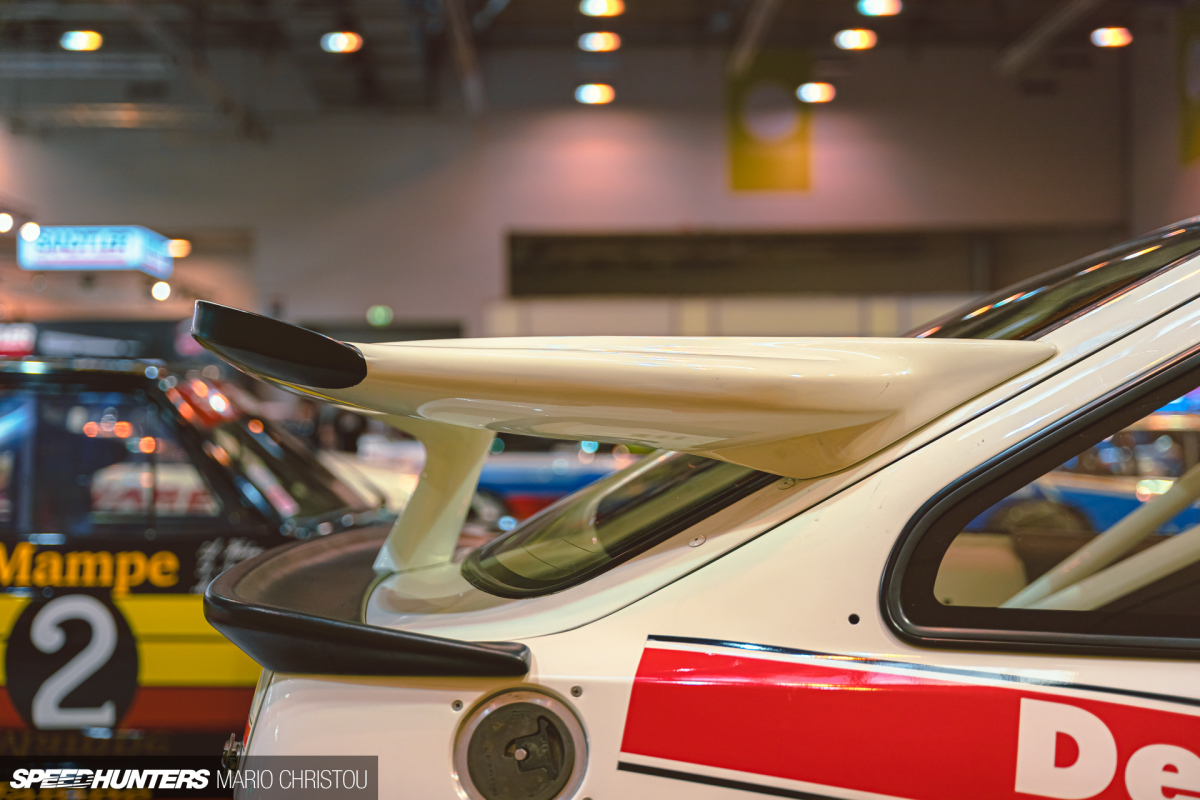
Launched in 1986 as a successor to the short-lived Deutsche Produktionswagen Meisterschaft (DPM) and the earlier Deutsche Rennsport Meisterschaft (DRM), the DTM championship exploded in popularity across Germany and mainland Europe. Weight ballast, turbocharging, and intense competition made for a fiercely contested field, as did lower weight limits and wider tyres for the underdogs.

EMS 24 MC SH DTM Edits-26

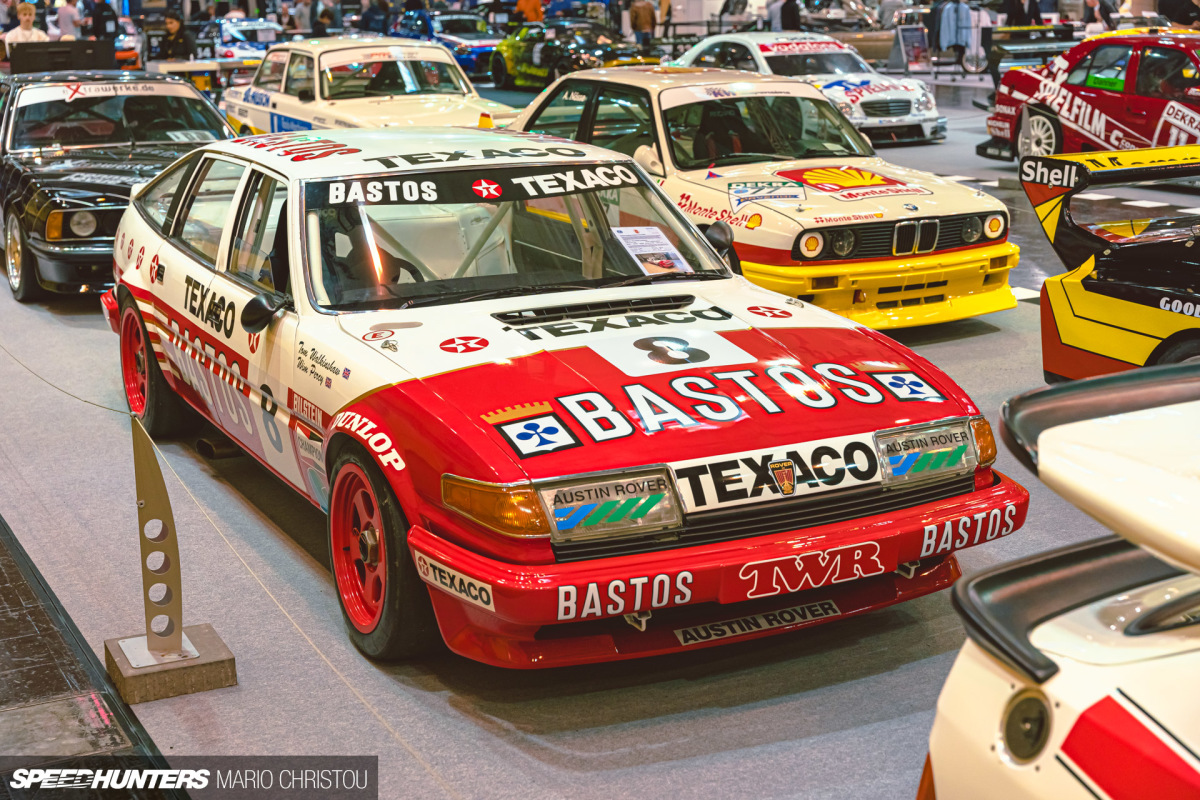
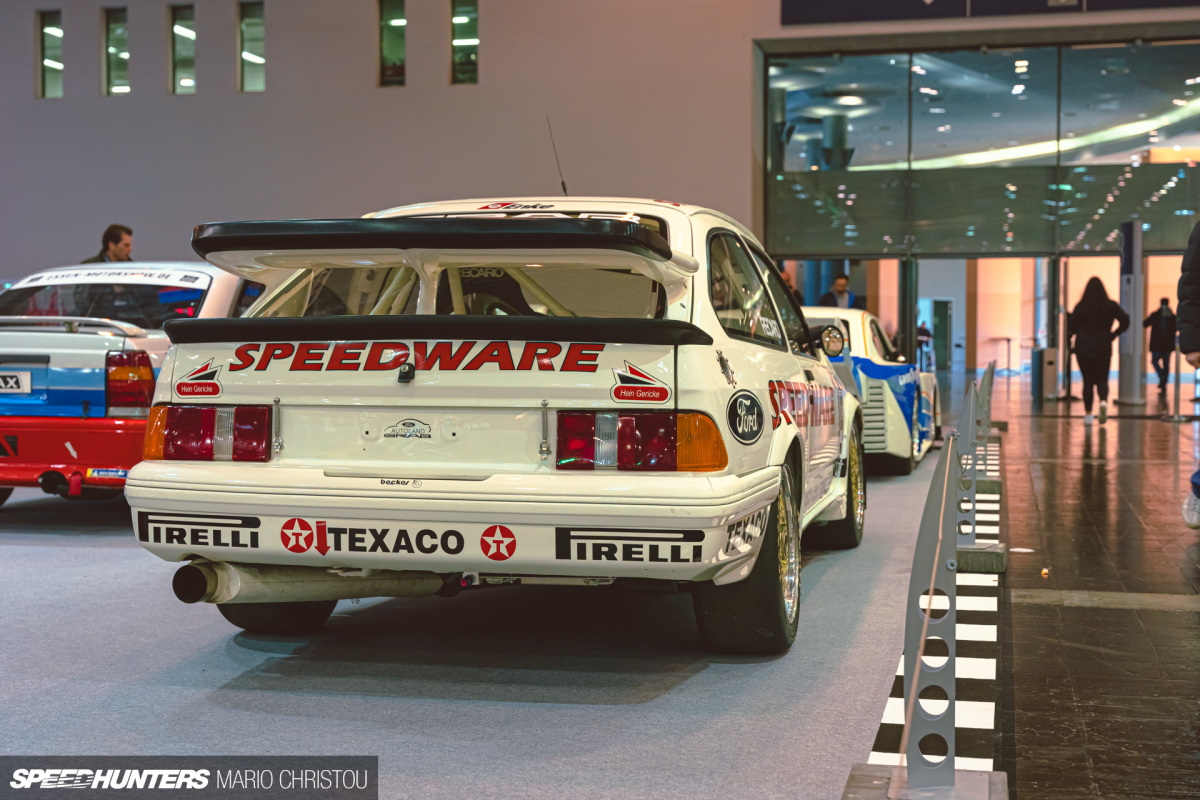
The E30 BMW M3, Ford Sierra RS Cosworth, and Mercedes-Benz 190 E Evo are the most fondly-remembered DTM machines, but let’s not forget earlier DPM cars like the BMW 635CSi, Volvo 240 Turbo, and V8 Rover SD1 Vitesse, which were still highly competitive in the Deutsche Tourenwagen Meisterschaft’s early years.

EMS 24 MC SH DTM Edits-37

In fact, the 1986 DTM champion was none other than Kurt Thiim, who piloted a Rover Vitesse with an epic Toshiba livery. Yes, my British pride has just kicked in hard…

EMS 24 MC SH DTM Edits-40
EMS 24 MC SH DTM Edits-36

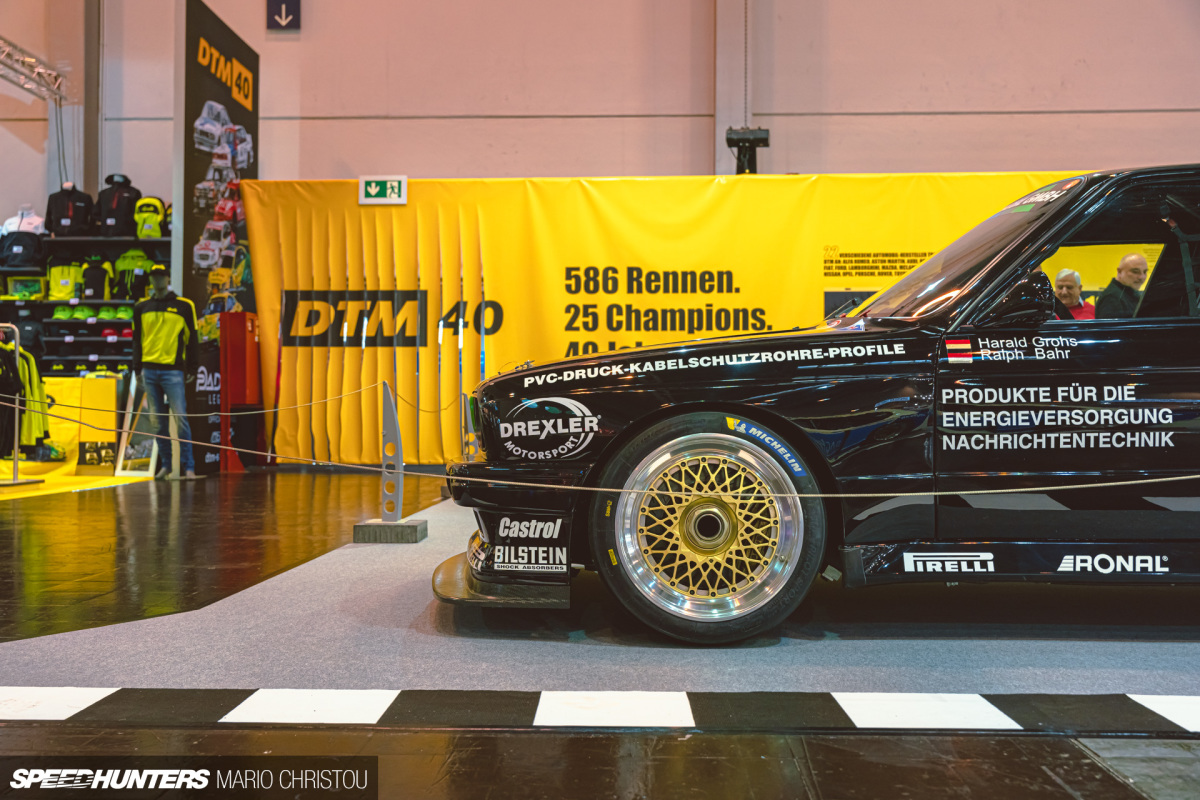
…though, as a traitor and a BMW enthusiast, I’d be remiss not to mention my favourite DTM liveries: the black Schnitzer 635CSi and the blue/green Vogelsang BMW Motorsport E30 M3. My hot take: the Vogelsang stripes – blue/green/green – were the perfect anti-hero to the red/purple/blue BMWs of the era, especially on Harald Grohs’ black M3 in 1987.

EMS 24 MC SH DTM Edits-34

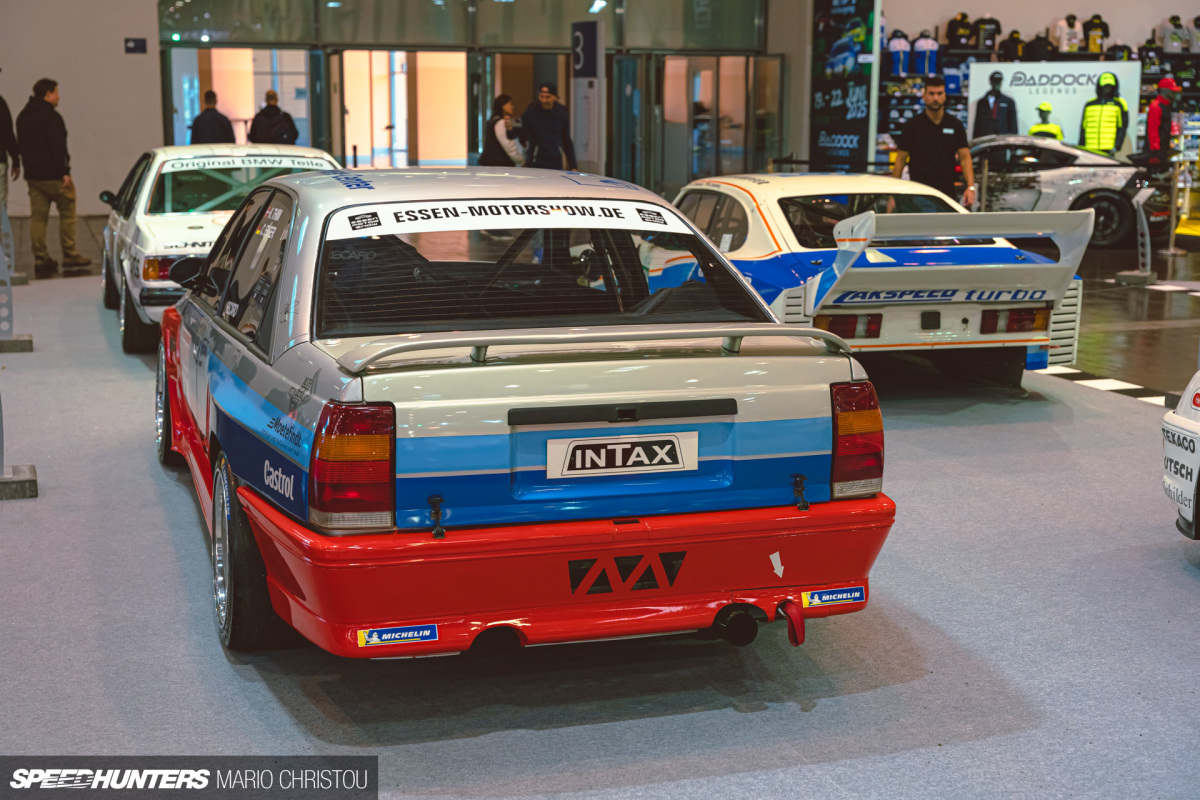
I’d love to own one – road-legal, of course, with all decals removed except the stripes. Either that or an Opel Omega Evo 500, the precursor to the Omega 3000 24V seen below in Kissling Motorsport’s livery. Though it never raced in the DTM, it laid the foundation for Opel’s future Deutsche Tourenwagen Meisterschaft campaign.

EMS 24 MC SH DTM Edits-21
EMS 24 MC SH DTM Edits-3

Back to the matter at hand – and no, I’m not being blinded by my rose-tinted glasses here – DTM was a victim of its own success. With every year, the competition pushed teams to pour more and more money into their cars, and by 1992, the Group A era had come to an end. The next three years of technical warfare between teams ultimately led to less exciting racing as the cars became more complex and fragile as a result.

EMS 24 MC SH DTM Edits-6

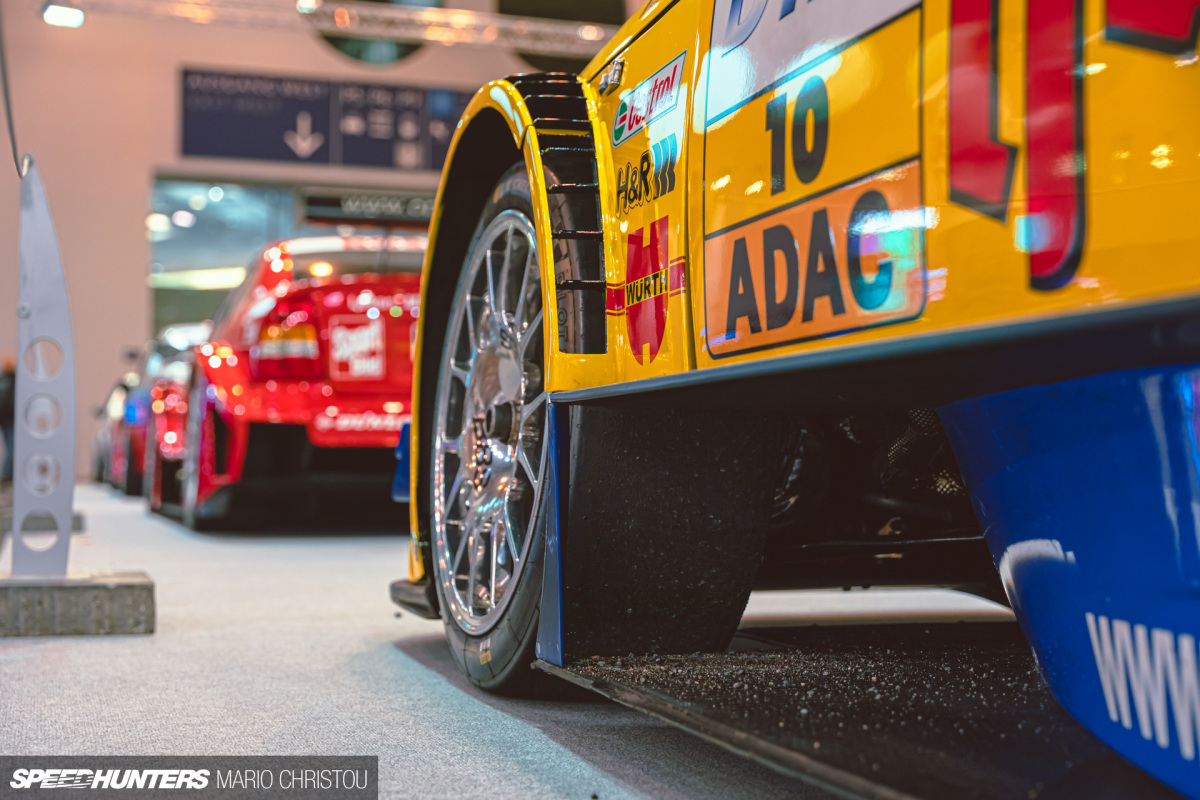
Active aero, weight transfer systems, sequential gearboxes, electronic diffs in four-wheel-drive systems, and traction control – by the time the 1990s rolled around, the rawness was gone. DTM was effectively absorbed into the ‘International Touring Car’ series by 1996, and by 1997, the Deutsche Tourenwagen Meisterschaft was effectively dead. While the German Super-Tourenwagen series tried to pick up where the DTM left off, it wasn’t until 2000 that German touring cars were back in force.

EMS 24 MC SH DTM Edits-16
EMS 24 MC SH DTM Edits-8

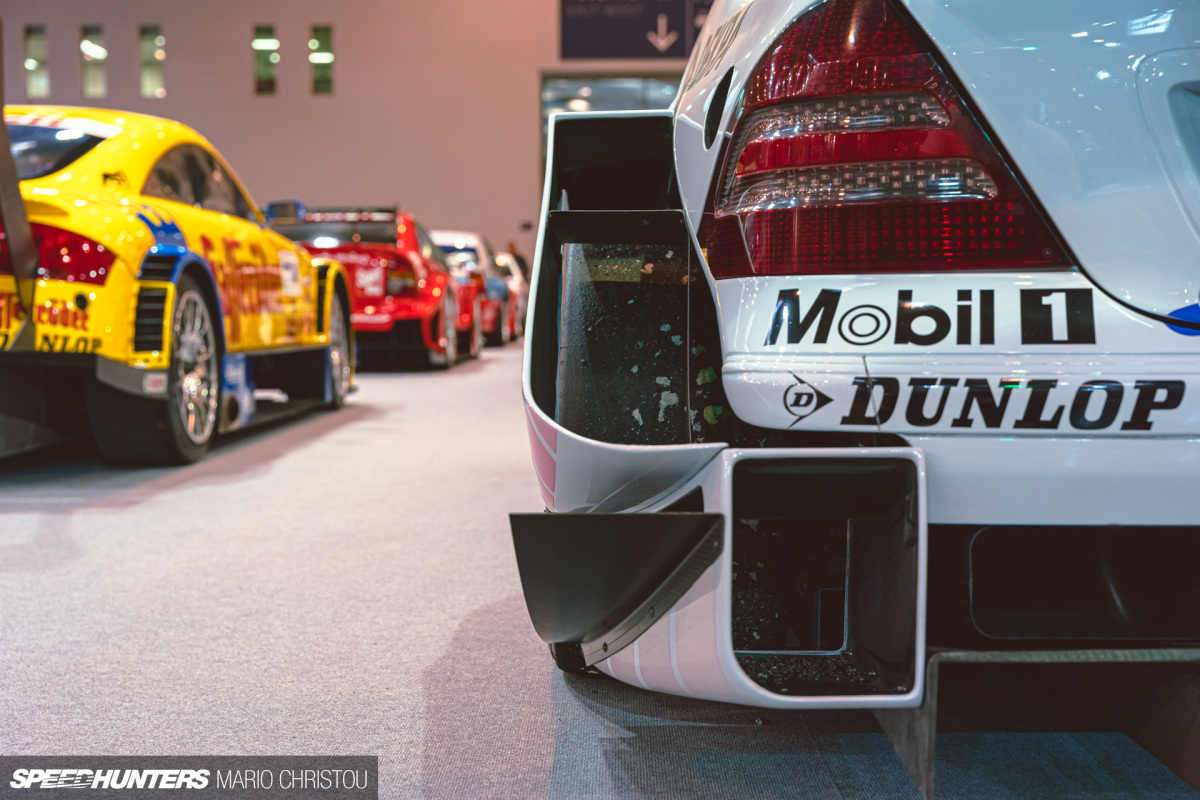
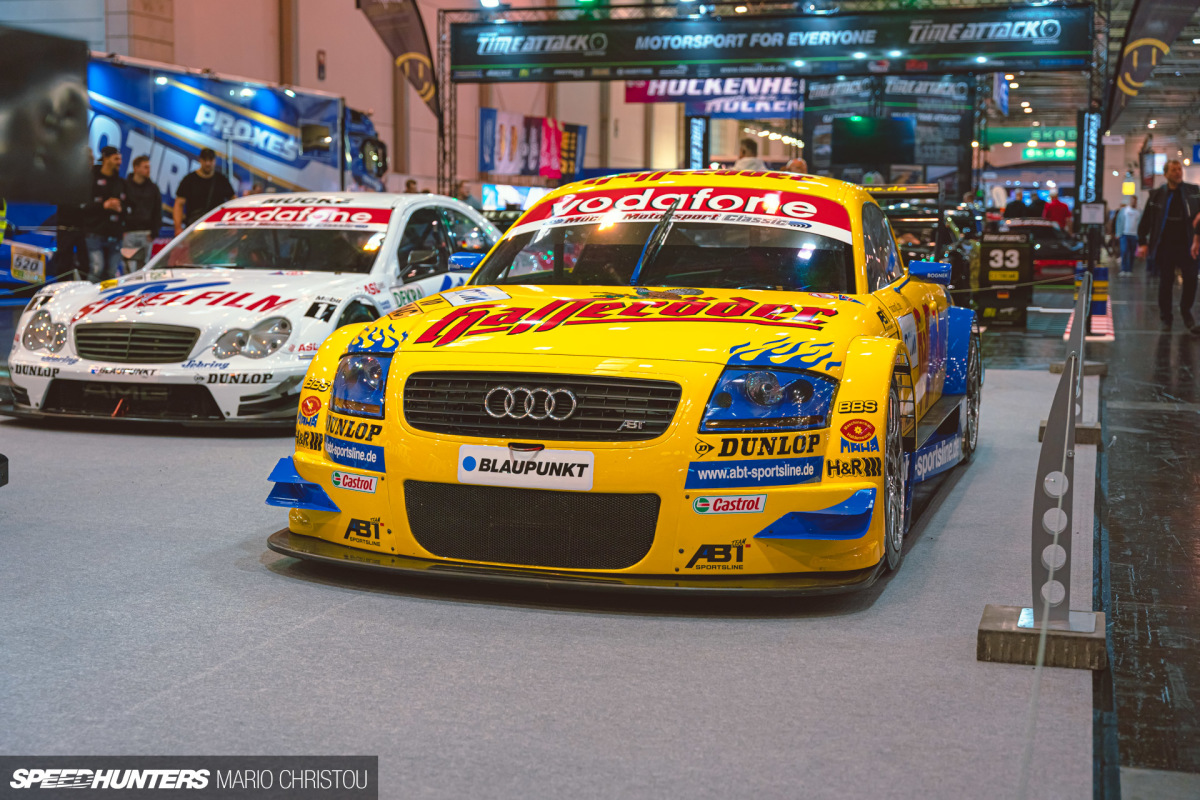
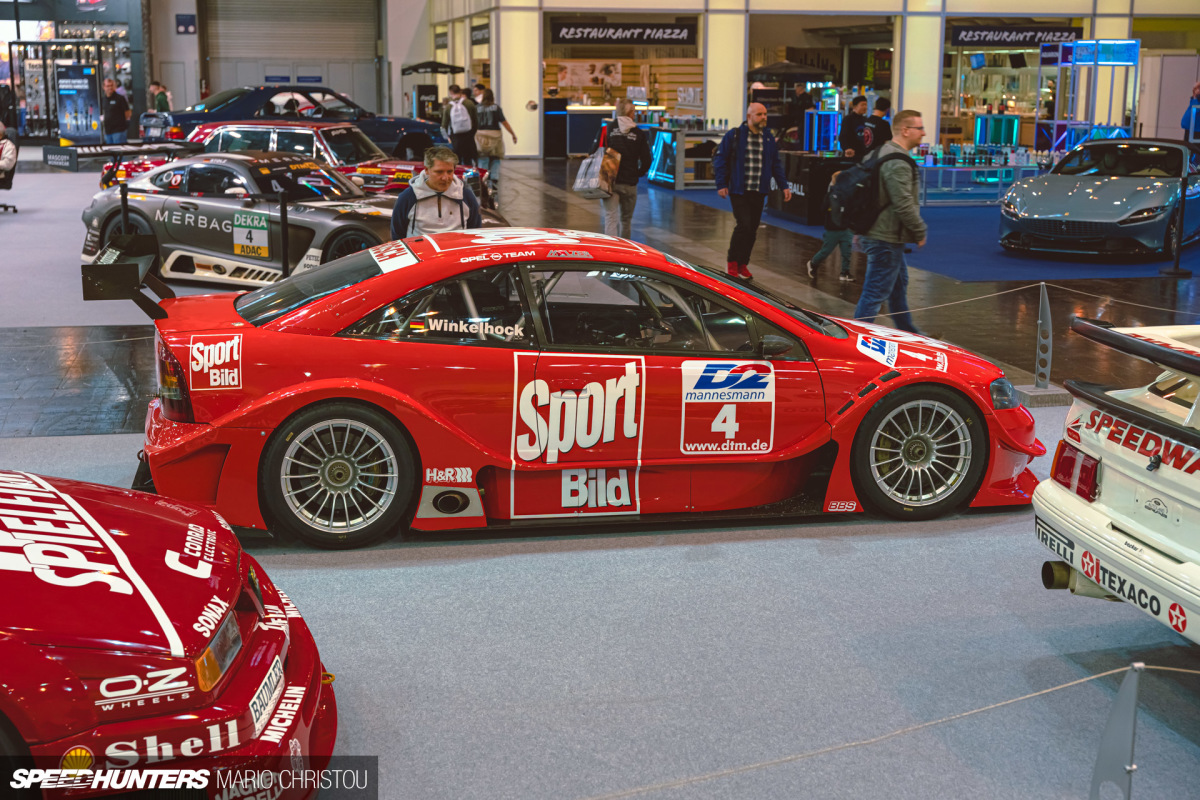
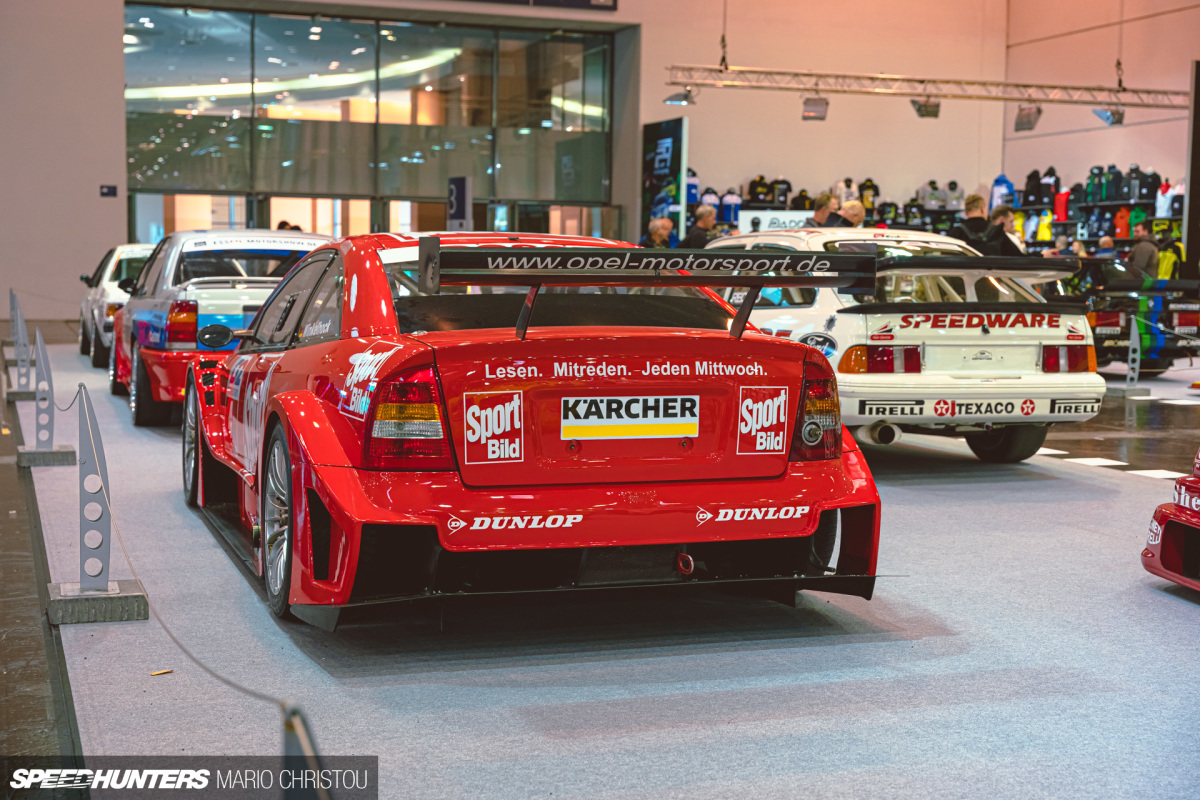
Mercedes-Benz, Opel, and Audi (via ABT) introduced a new breed of V8 coupés based on the CLK, Astra Coupé prototype, and TT silhouettes, respectively. While initially successful, over the next 20 years, DTM regulations would find varying degrees of success and complexity before succumbing to GT3-based regulations to keep – you guessed it – ever-rising costs in check.

EMS 24 MC SH DTM Edits-27

Today, the racing is fantastic, but so is GT3 racing around the world. DTM isn’t alone in losing its unique character, and it points to a deeper problem: how technical advances have drained the rawness from motorsport – and, in many ways, enjoyment in our everyday lives.

EMS 24 MC SH DTM Edits-4
EMS 24 MC SH DTM Edits-25
EMS 24 MC SH DTM Edits-28
EMS 24 MC SH DTM Edits-43

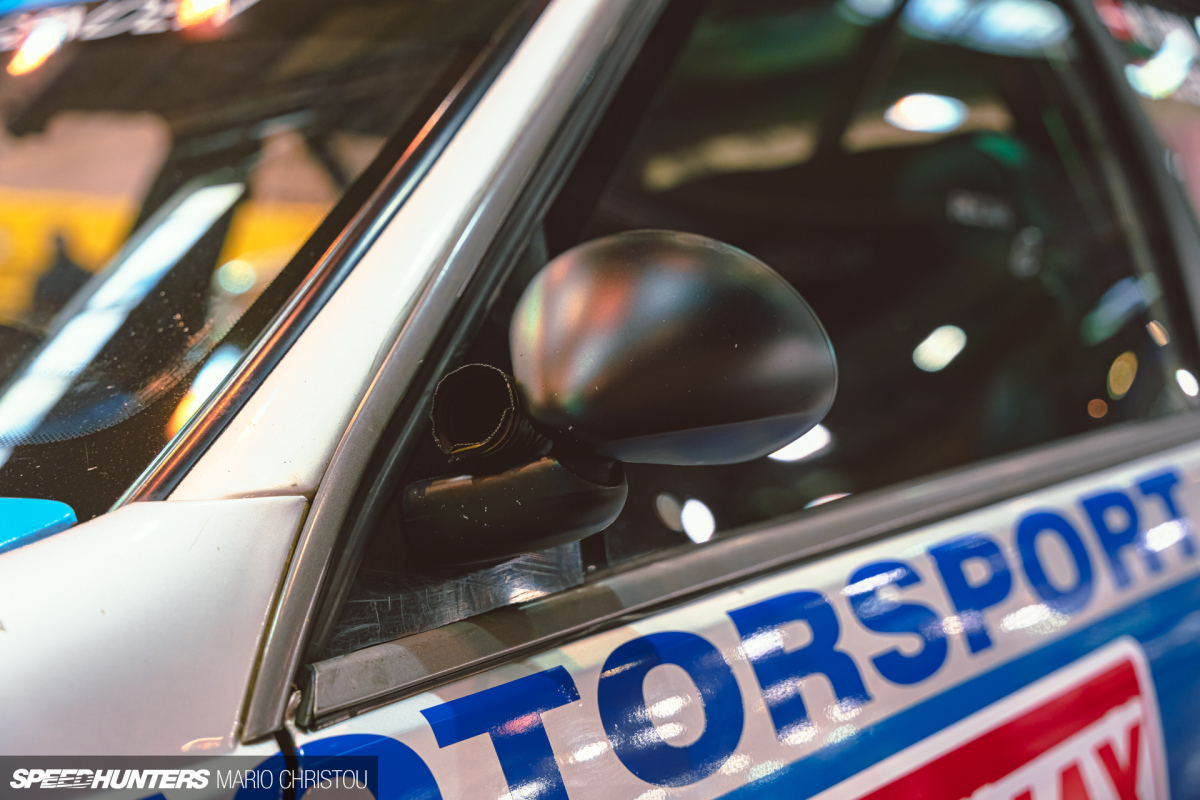
But I’m not here to discuss the moral dilemmas of the 21st century. So, let’s put all that aside and just enjoy these wonderful old race cars, shall we? That’s exactly what I did at the 2024 Essen Motor Show.

Mario Christou
Instagram: mcwpn, mariochristou.world
mariochristou.world


Source link

Peak Japan: An RE Amemiya 97GT-Kitted RX-7 Type RZ

0


At the height of the bubble economy, Japan was unlike anything else on the planet – its city skyline gleamed with the promise of limitless prosperity, and its streets pulsed with the electric energy of a nation on the brink of an unprecedented future.

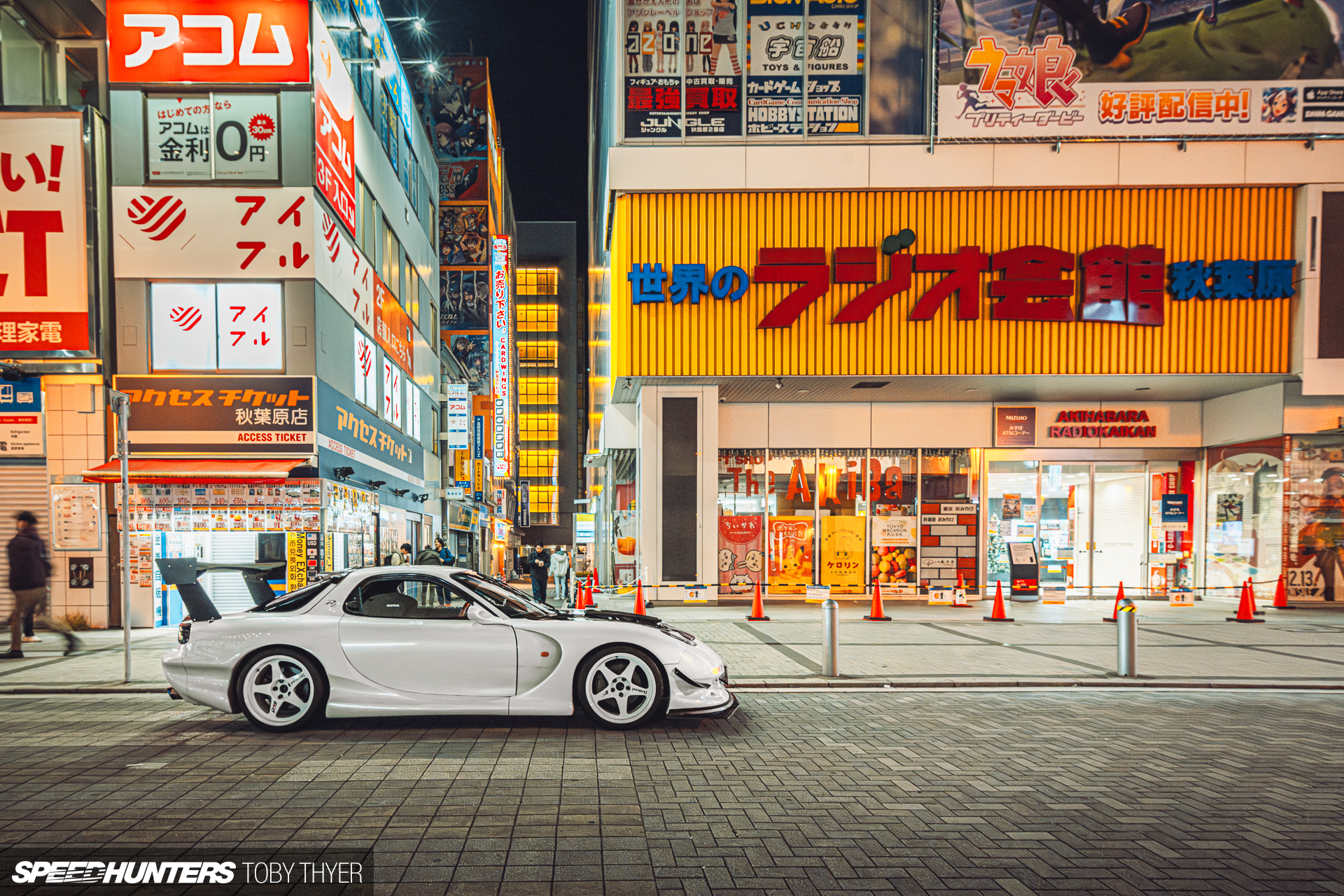
For many, Tokyo represents that golden era – a city transformed by an explosion of population, infrastructure, and innovation in the ’70s, ’80s, and ’90s. And nothing embodies the bubble era quite like Akihabara Electric Town. It’s the essence of Japan’s leap to global dominance in electronics manufacturing.

TobyThyerPhotography-19

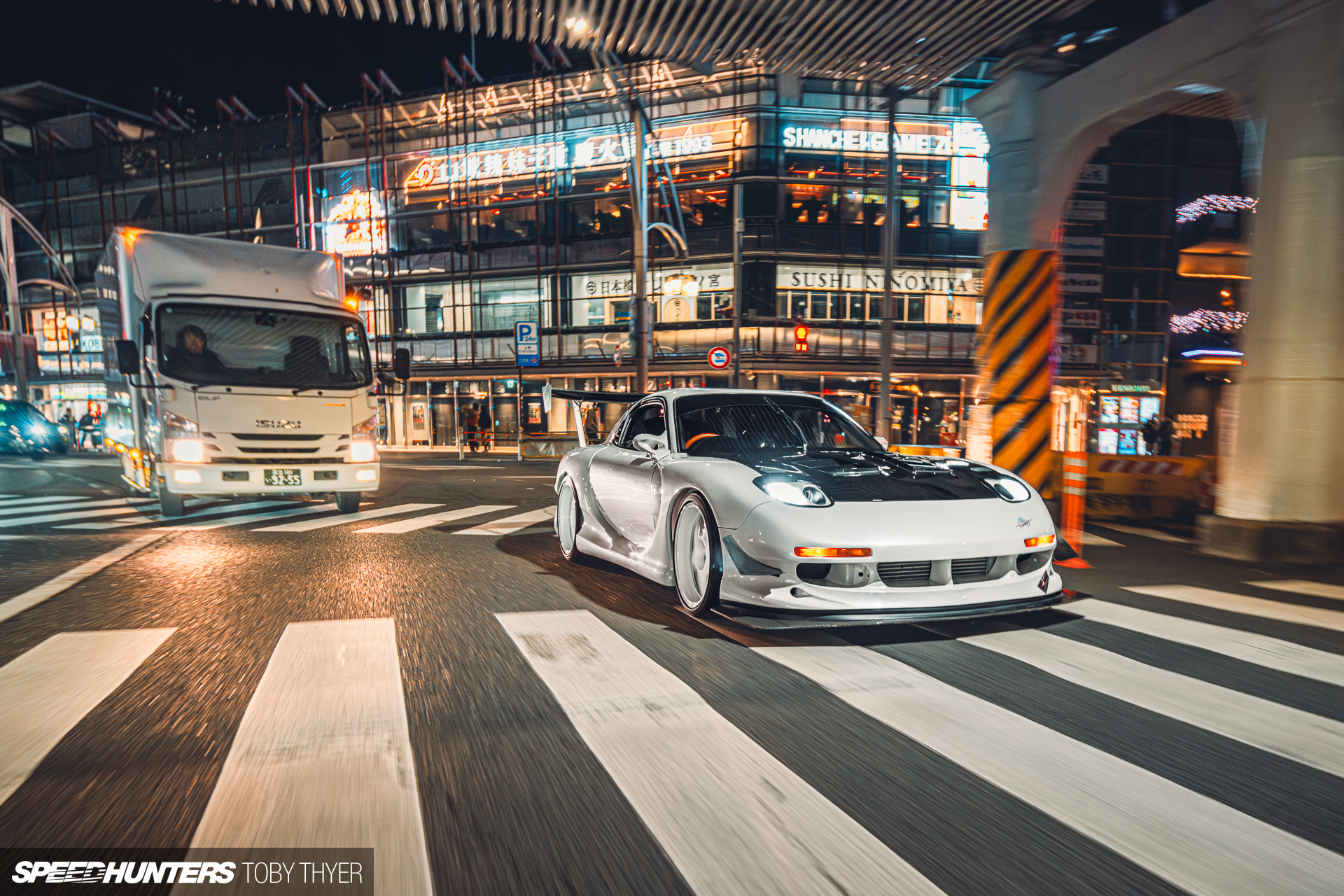
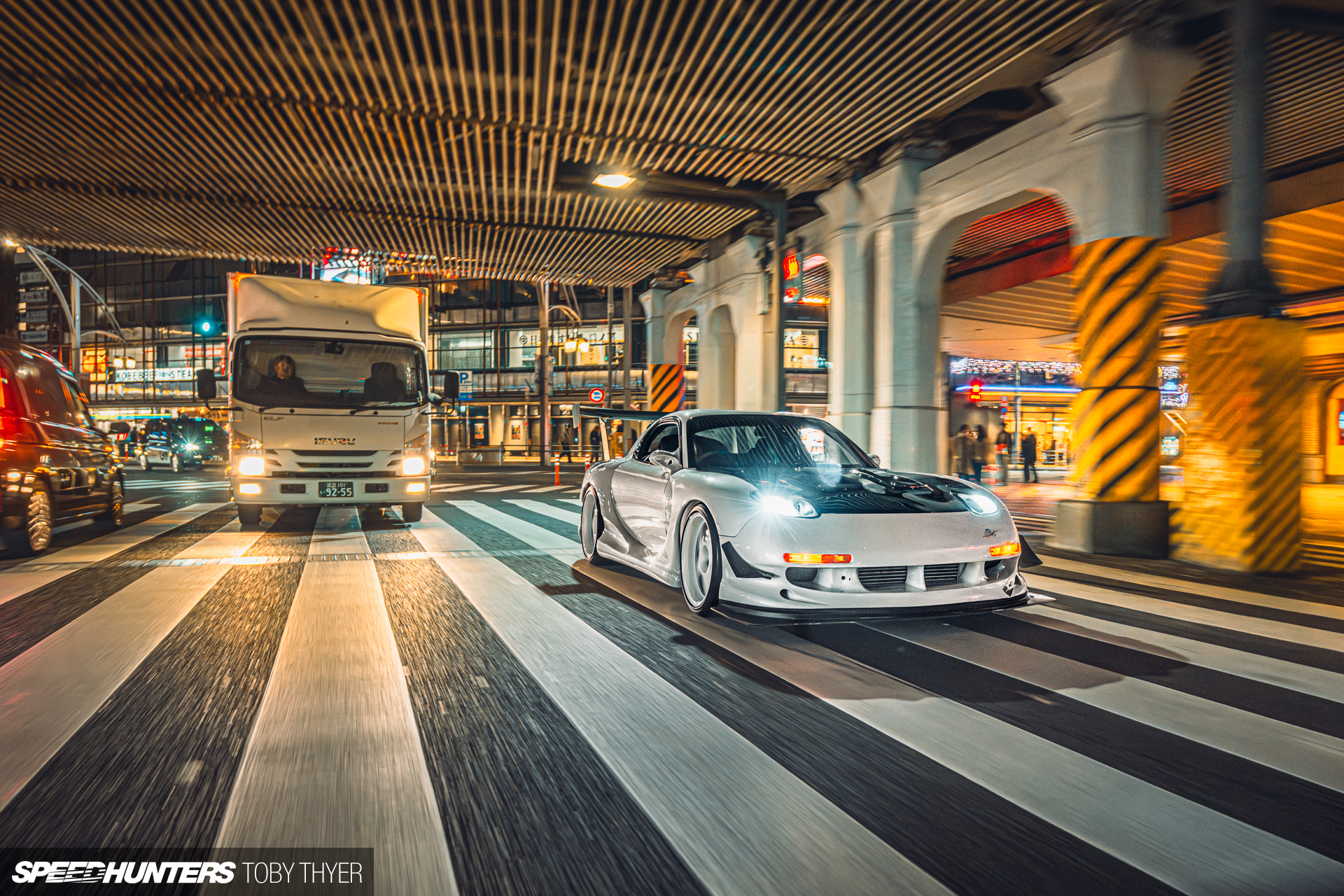
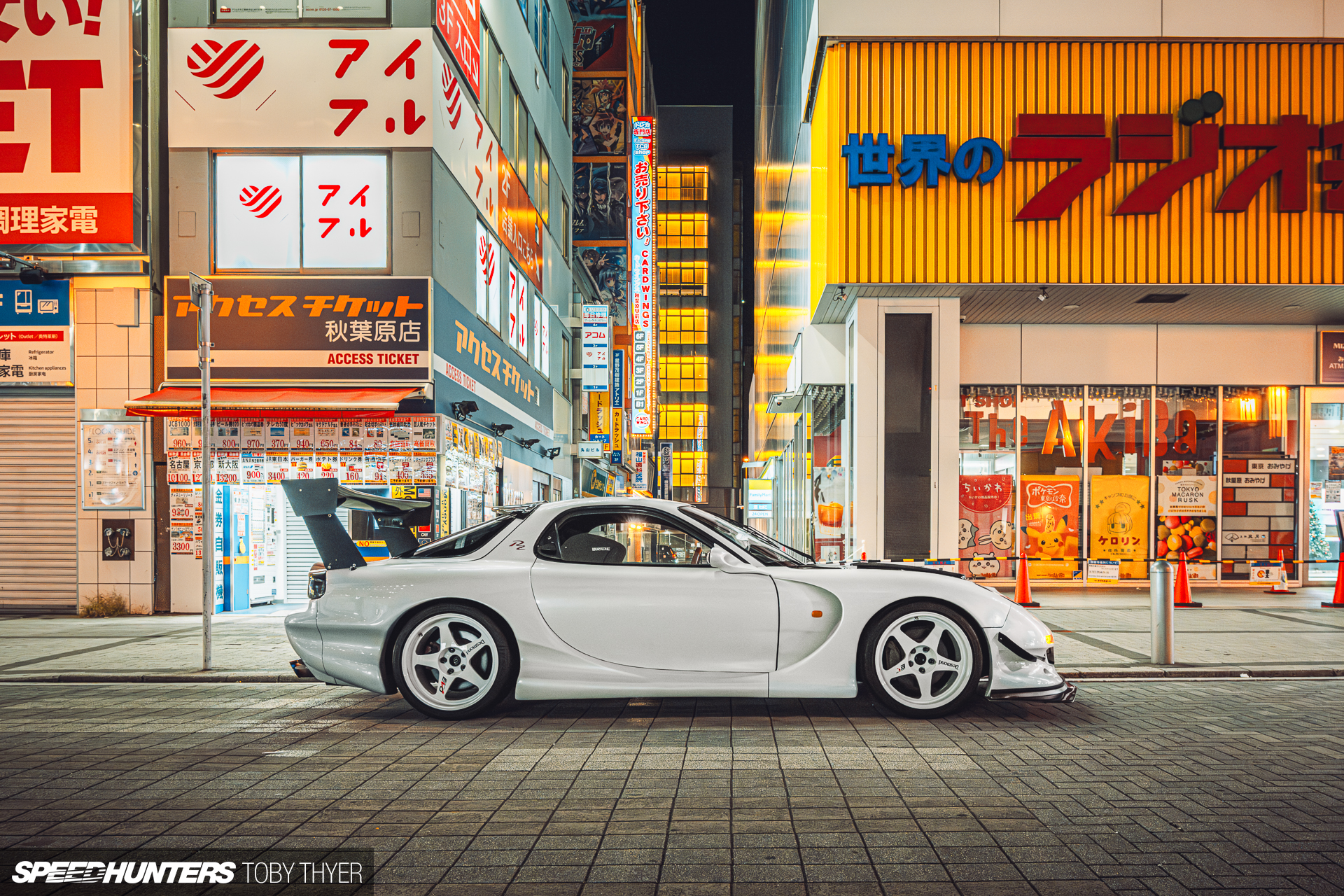
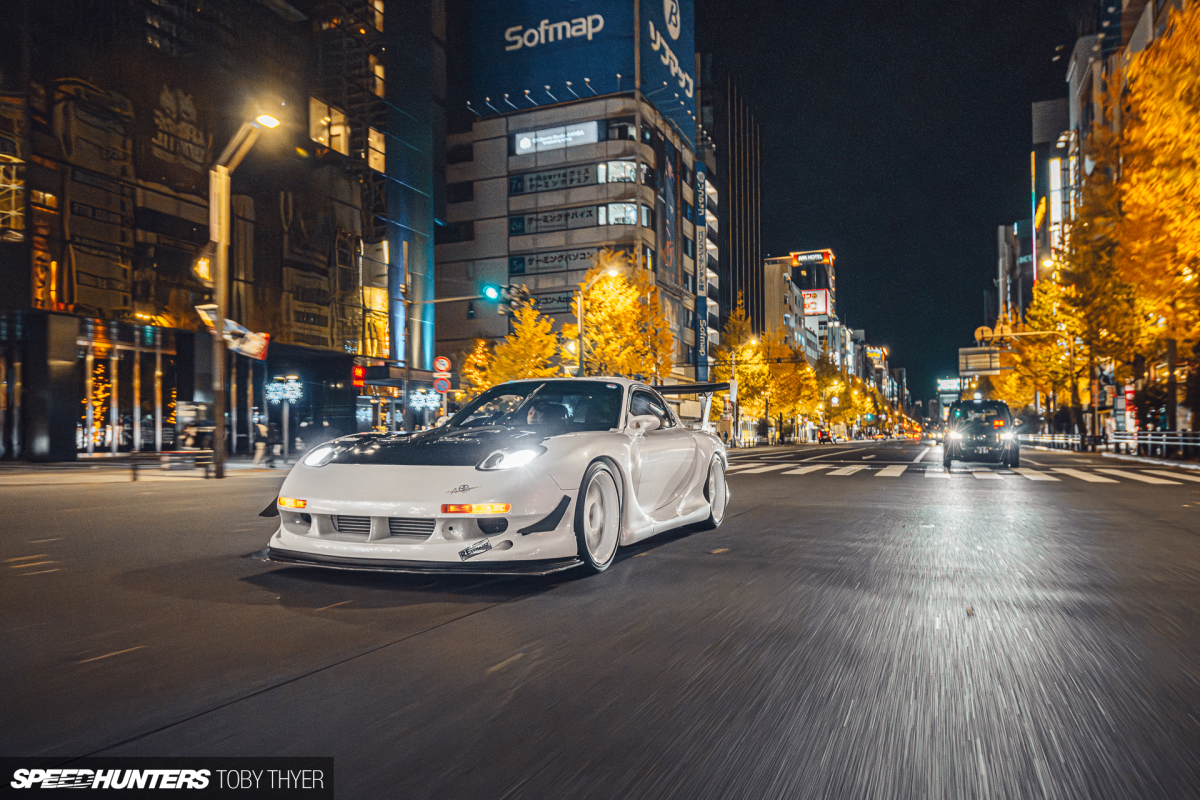
I’ve wanted to shoot in this neon-drenched corner of Akihabara ever since I saw Mark’s photos of Junya-san’s WRC Impreza back in 2018. When I started talking to the owner of this FD3S, Ayato-san, I knew it was the perfect car for the job.

TobyThyerPhotography-2

Sprawling electronics megastores and game arcades line the Electric Town streets. Outside, cosplay girls tout both innocent and questionable services – a reflection of Japan’s outward modesty masking a devilish, behind-closed-doors culture.

TobyThyerPhotography-21

I remember my first visit to Akihabara – stepping out of the JR station was an overwhelming sensory experience. The streets buzzed with energy, and J-Pop pumped from every store with an unexplainable politeness. Despite living here for five years now, I hadn’t been back to Electric Town since that first visit. This time – at 9:00pm on a Sunday – it felt quieter. Friday nights may be livelier, but there was something about it – it seemed like the party was over. It is 2024, after all, and Japan’s economic bubble has been deflated for over 30 years.

TobyThyerPhotography-1-5

So, what car could match this location? It has to scream ‘peak Japan.’ A Skyline GT-R? A Toyota Supra? Too obvious. Yes, the GT-R is the epitome of Japanese car design and mechanical excellence – but its iconic status worldwide has made it a bit too… vanilla. It’s still Japanese at heart, but it’s no longer quintessentially so.

For me, the FD3S Mazda RX-7 is the true Japanese sports car.

TobyThyerPhotography-29

Compact, beautiful, with a timeless design and an innovative (if slightly bonkers) rotary engine – it’s like nothing else on the planet. And Ayato-san’s RX-7 hits the mark. It perfectly mirrors Japan’s rise and fall as the most futuristic, the most eccentric and advanced automotive industry of its time.

TobyThyerPhotography-1-11

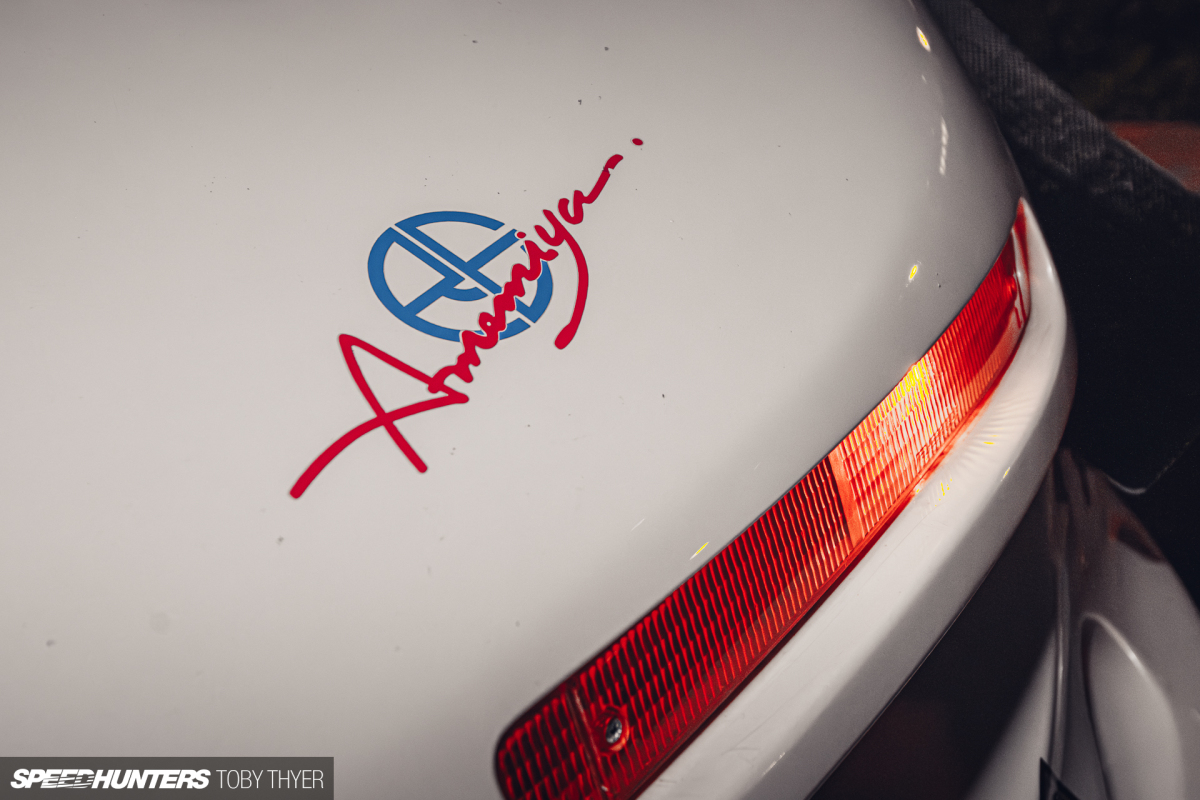
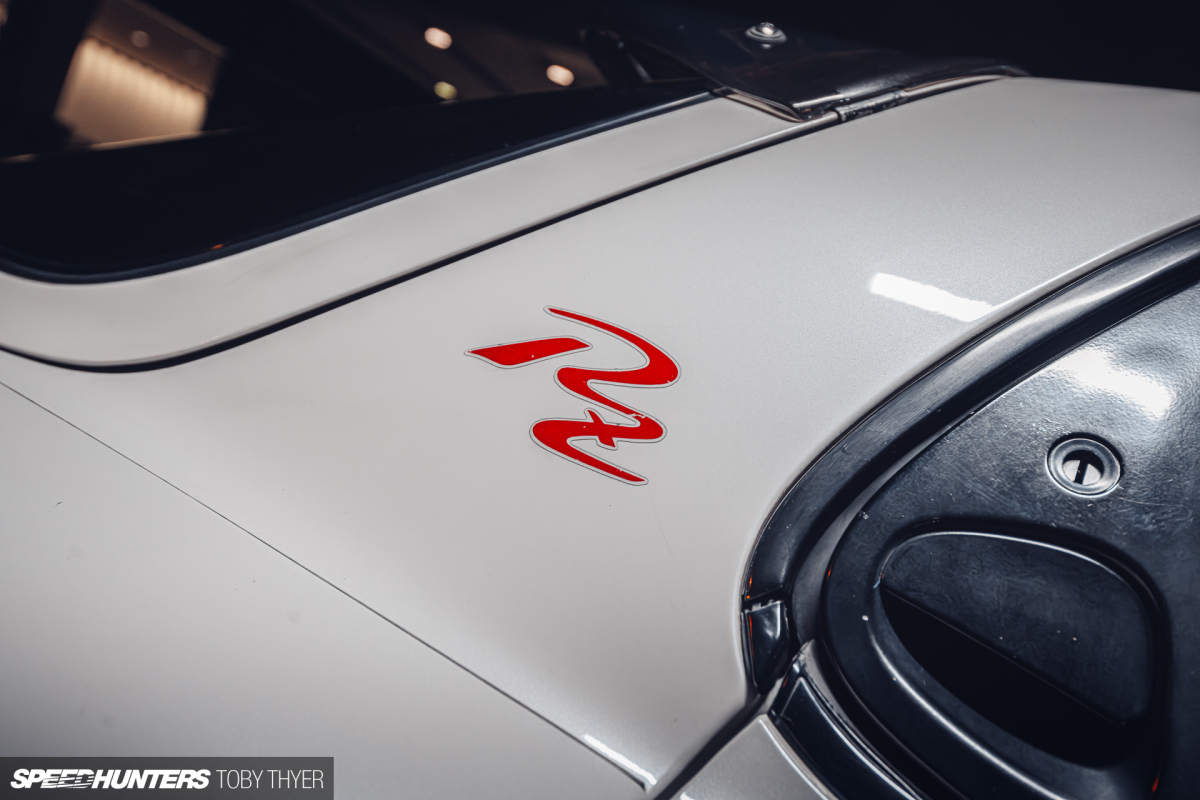
The base car is a Series 6 Type RZ, one of only 175 ever made, and Ayato-san is its second owner. But what truly sets this rare FD apart is the body kit it wears.

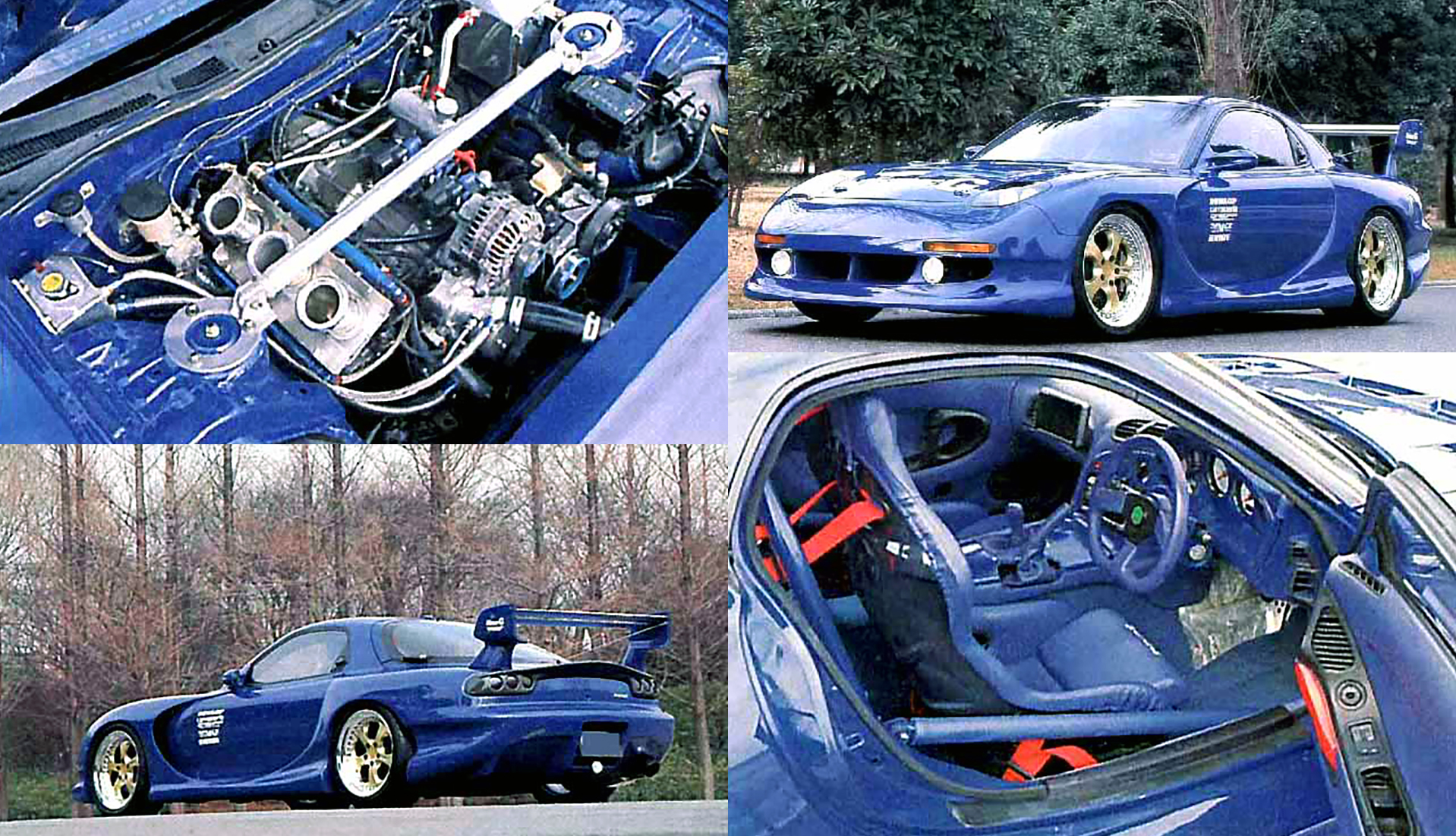
RE-AMEMIYA-97GT

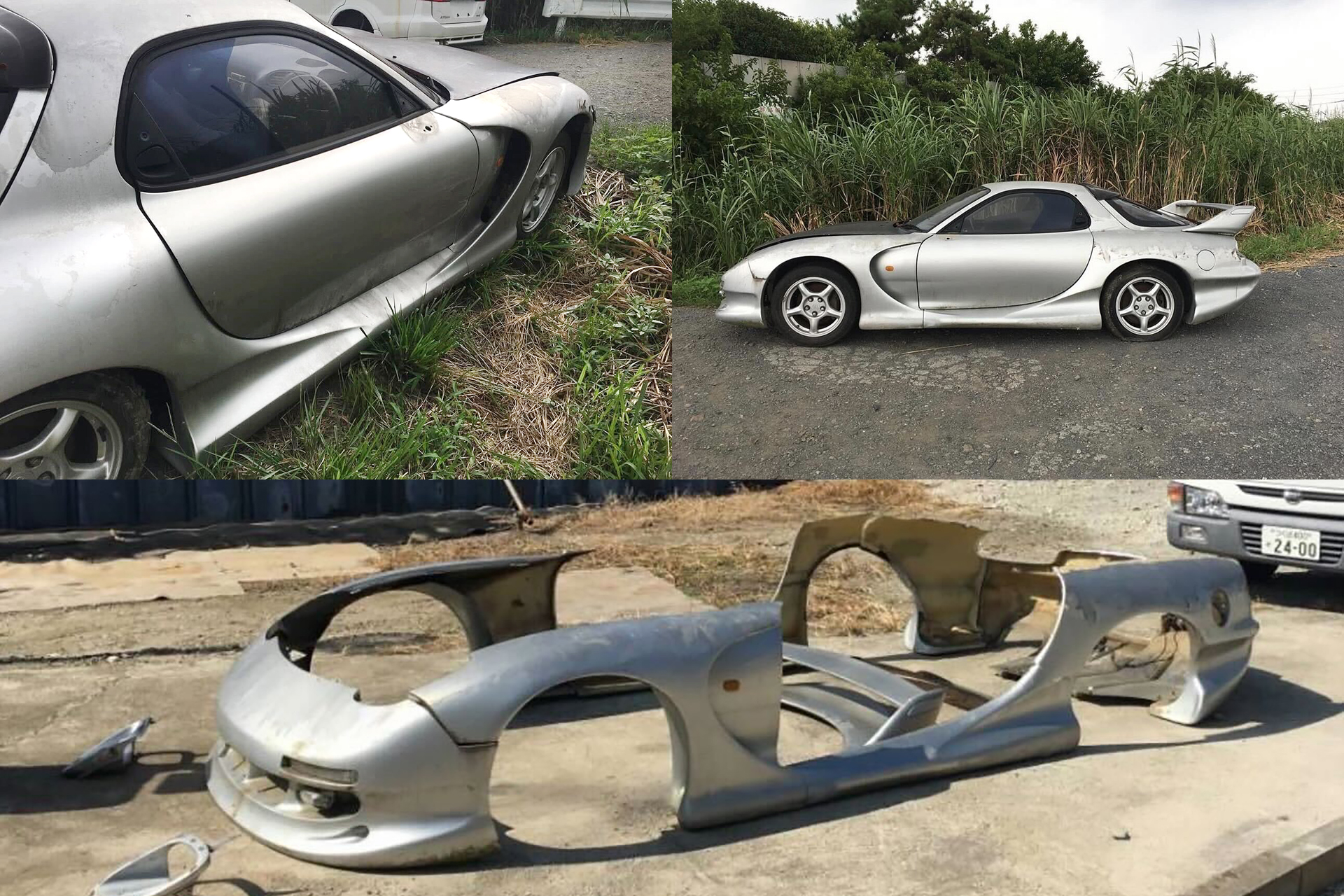
This is the 97GT wide-body kit designed by RE Amemiya for its 1997 Tokyo Auto Salon FD3S demo car (pictured above). Only two kits were made before it was deemed too expensive for mass production. We don’t know the whereabouts of the demo car – but it was either repurposed or scrapped – so Ayato-san’s 97GT kit is likely to be the only surviving example.

TobyThyerPhotography-1-10

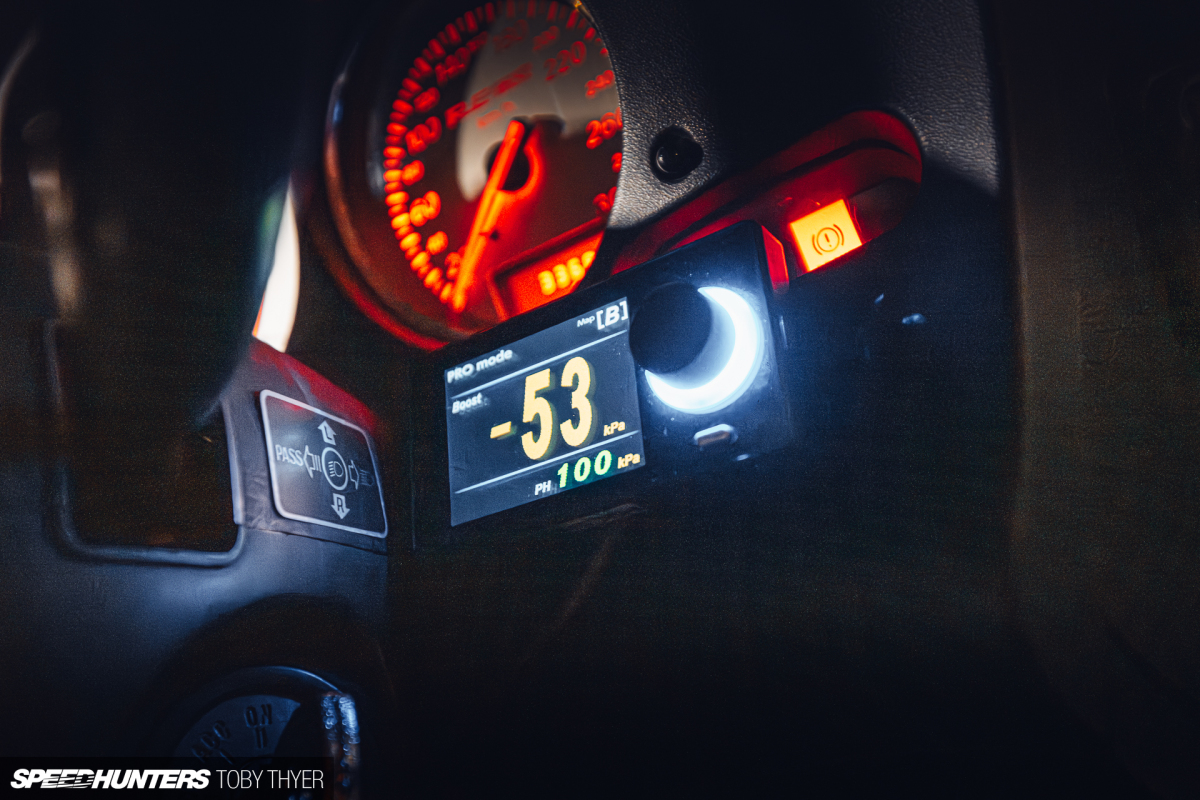
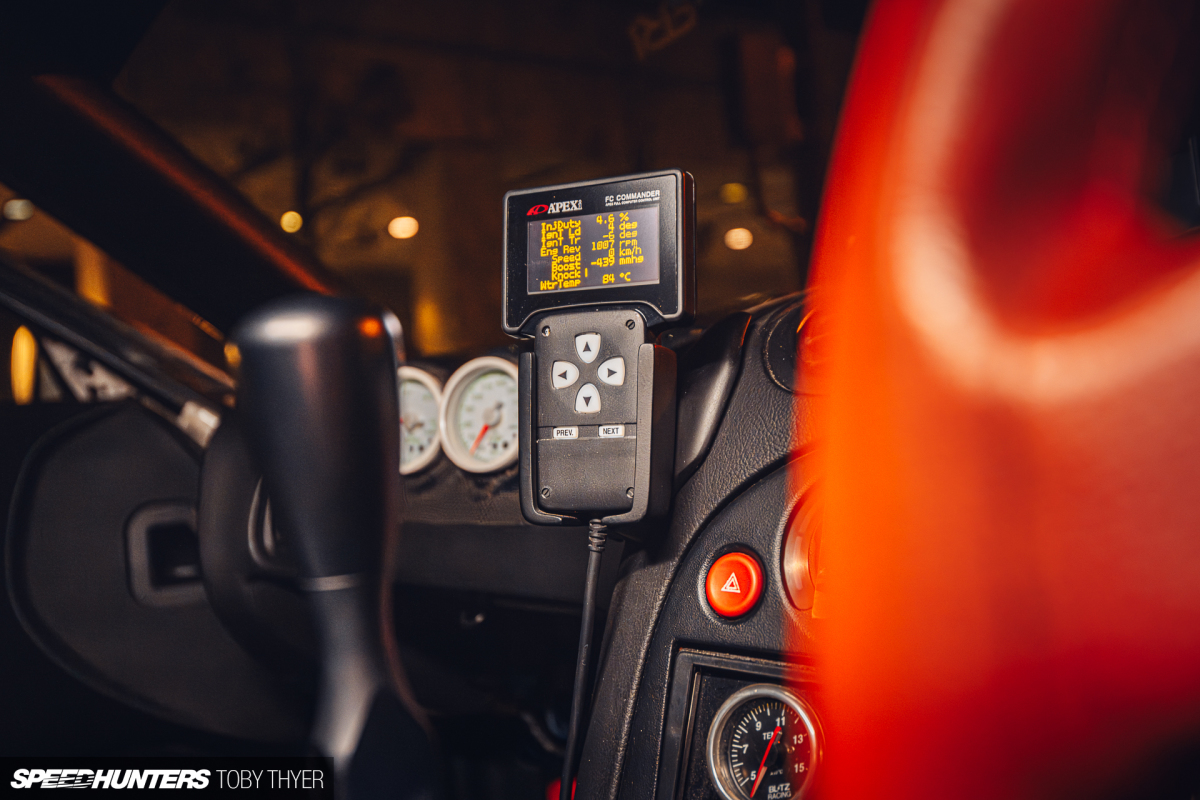
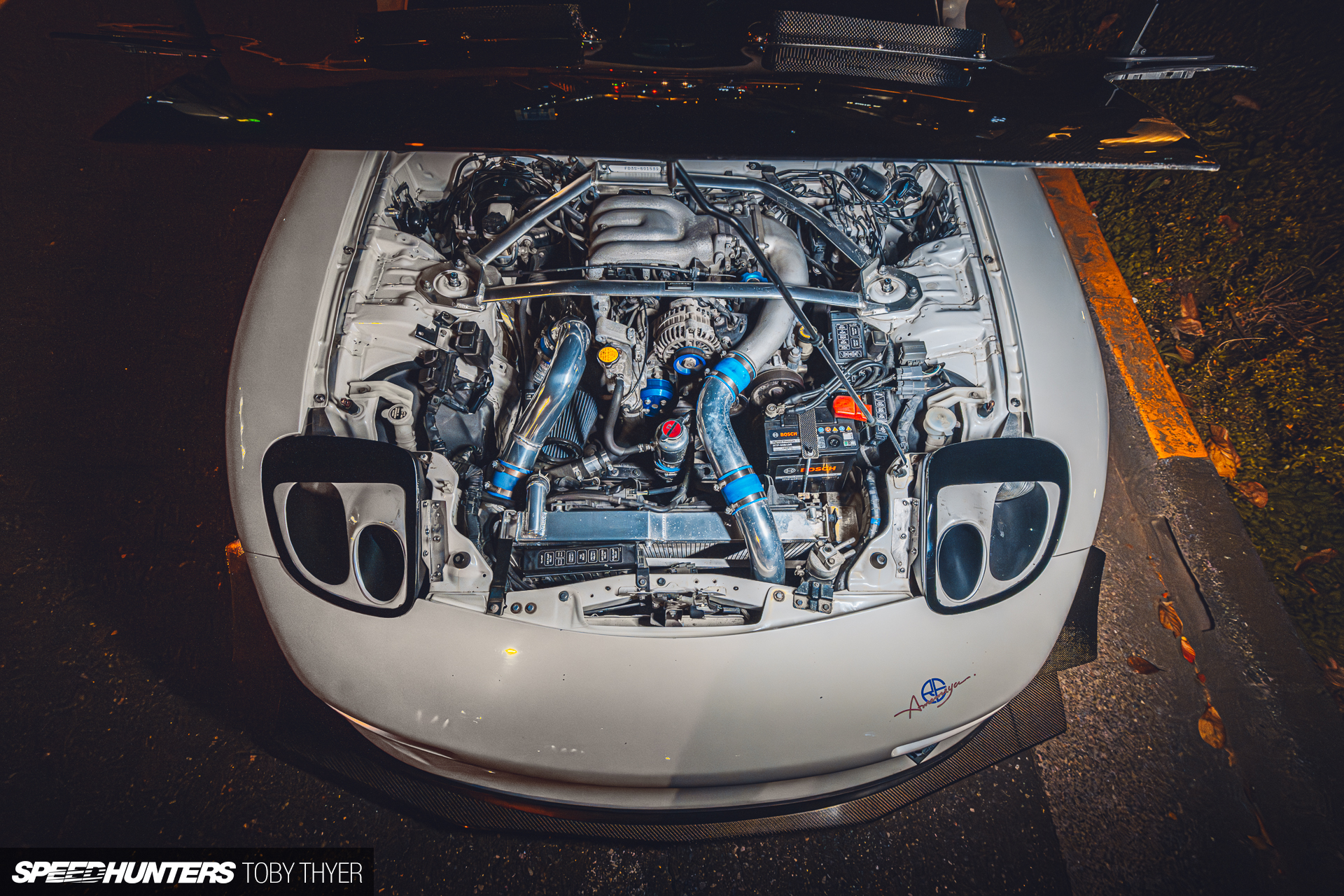
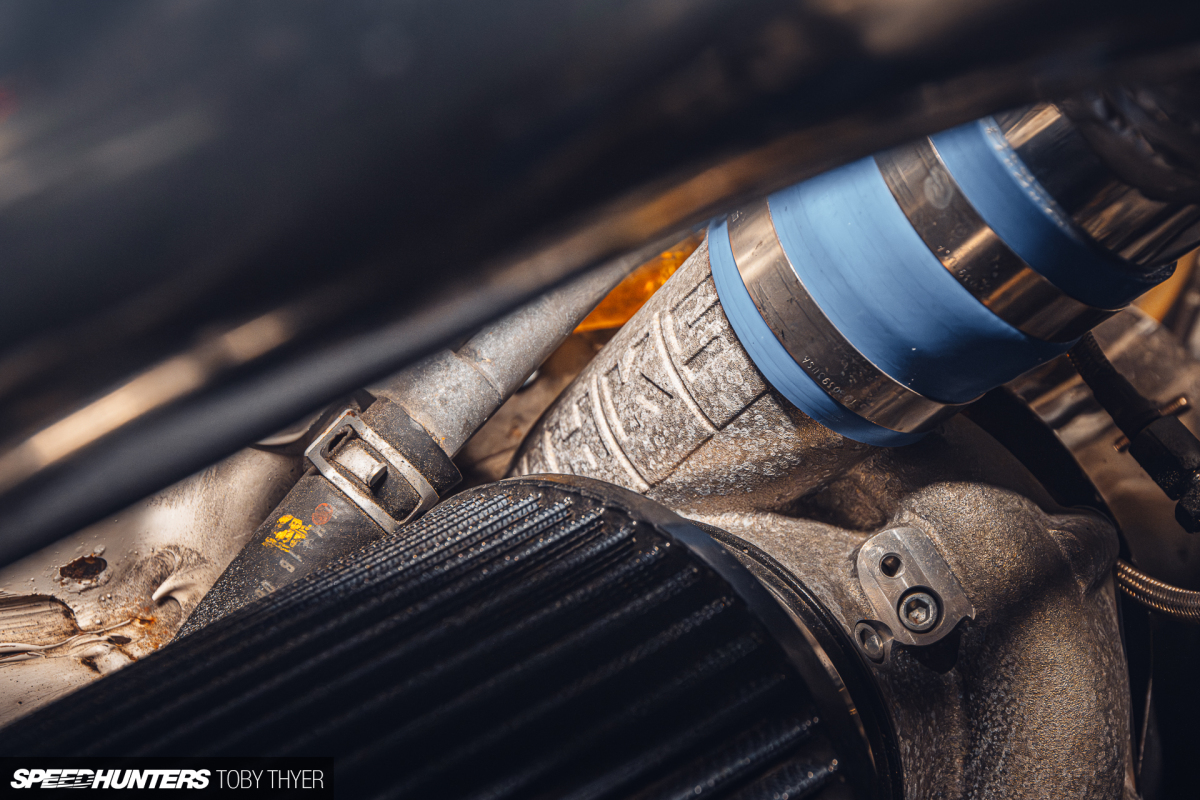
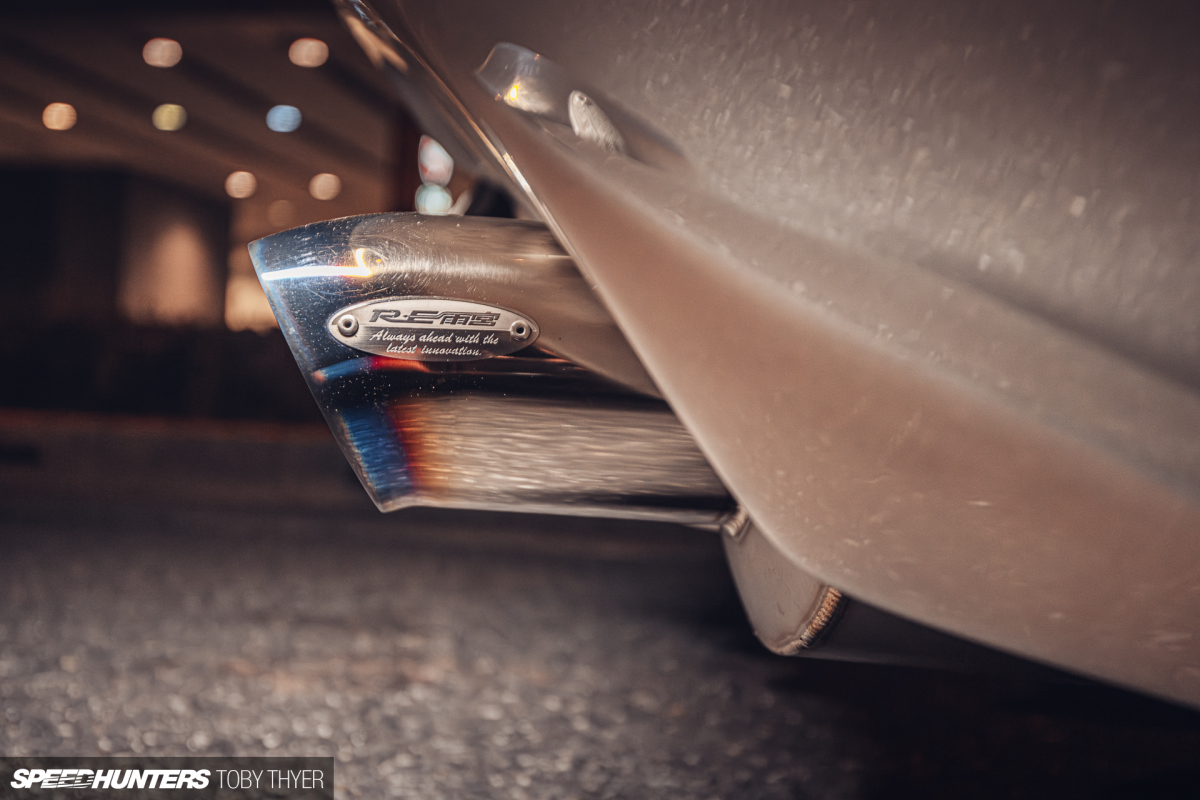
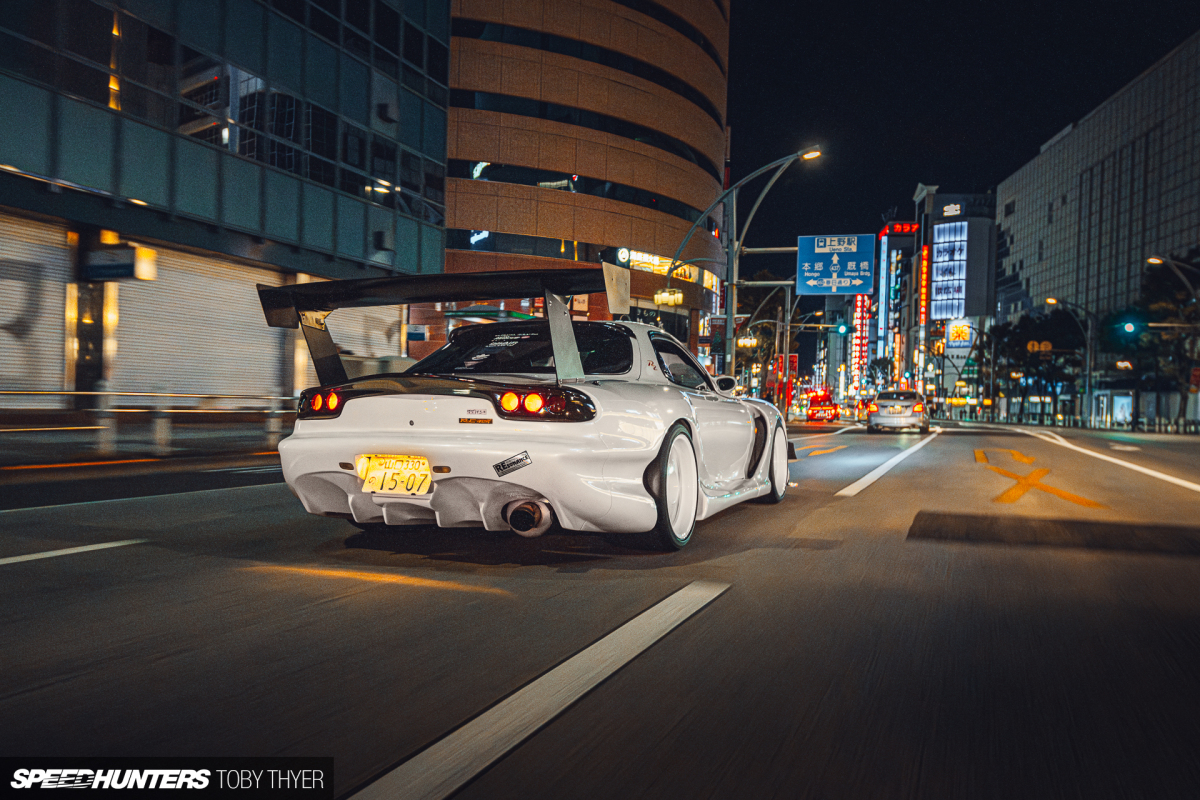
The RE Amemiya 97GT demo car featured a naturally aspirated 20B three-rotor peripheral ported engine with MoTeC management, backed up by a Supra 6-speed transmission. Ayato-san’s car is still powered by its original 13B-REW engine. However, it’s now bridge-ported and has traded its twin sequential turbochargers for a big single HKS GTIII-4R. With 400PS on tap, it gets along very nicely, and its titanium exhaust system, made by RE Amemiya in collaboration with Ito Syokai, ensures that its ported pulse is heard loud and clear.

TobyThyerPhotography-24
TobyThyerPhotography-1-12

I’m not sure if it was Ayato-san’s neo-goth aesthetic that influenced me, but the moment I saw his car parked in Electric Town, I couldn’t help but think of H.R. Giger’s designs for Alien. The sculpted rear bumper and organic curves of the fender cutaways resemble the armoured body of an alien insect from a distant galaxy.

RE-97GT

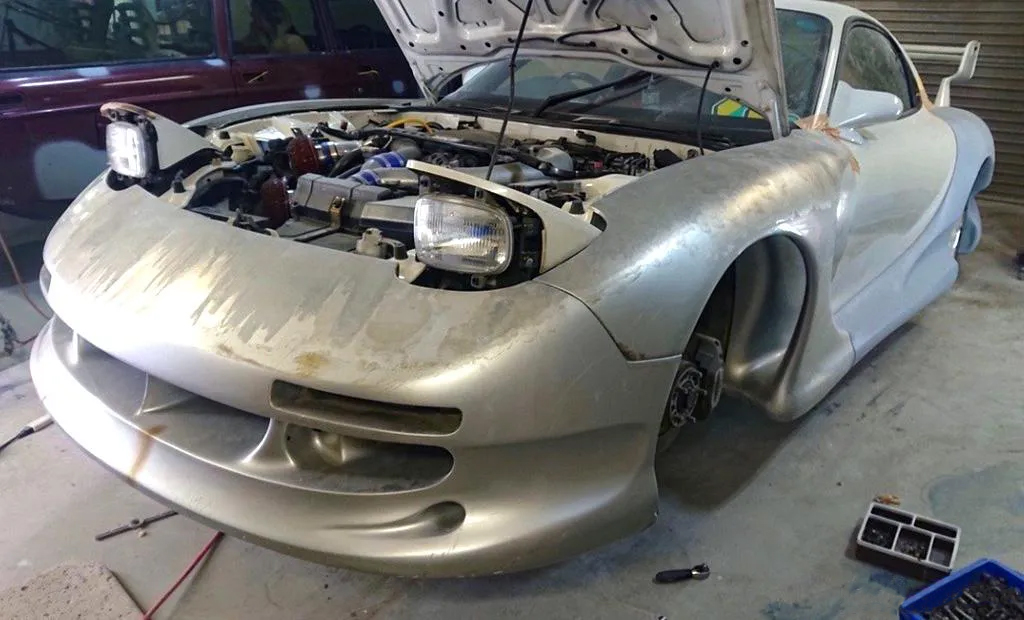
So, where on earth did Ayato-san find this rare piece of Japanese tuning history? Yahoo! Auctions Japan, of course. The RX-7 wearing the kit was covered in moss and ready for the scrapyard, but Ayato-san took a gamble, hoping a garage could successfully restore and refit the 97GT aero on his freshly acquired Type RZ.

TobyThyerPhotography-3

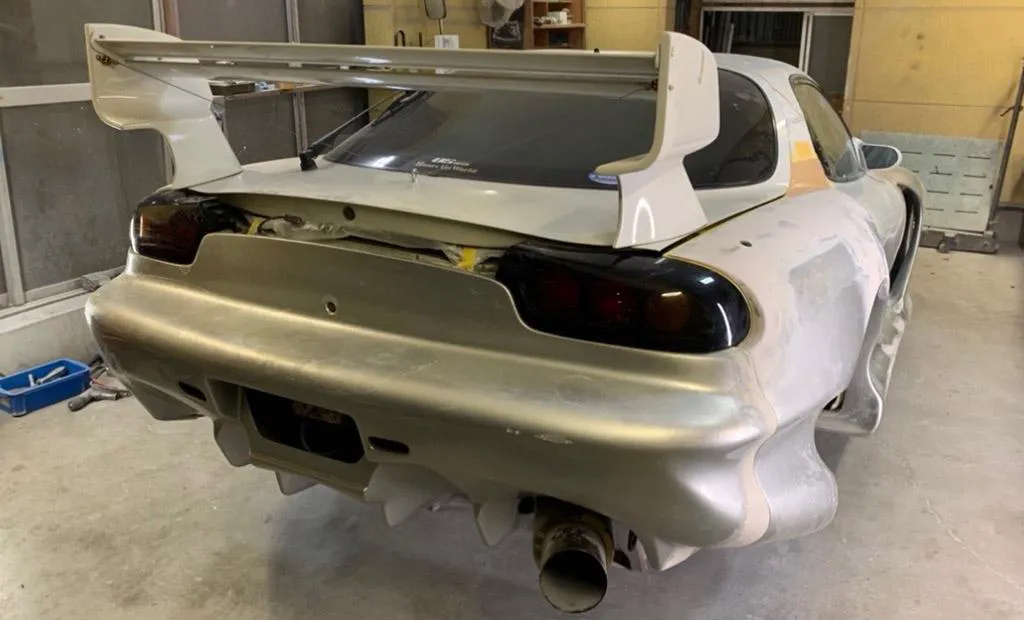
Ultimately, the specialist work was carried out by Matsuda Car Body. The kit required some fibreglass repair, but care was taken not to alter its original shape.

TobyThyerPhotography-7-2

Originally, Ayato-san ran the kit’s original rear wing and the same 17-inch RE Amemiya AW-7 wheels seen on the demo car, but he’s since changed up the look with a few contemporary touches. The FD sits on Desmond RegaMaster EVO II wheels – 18×10-inch +15 all around – while the front bumper has been fitted with a carbon fibre splitter and canards. The giant rear wing is still an RE Amemiya piece, but this time of GT300 design.

TobyThyerPhotography-22

I often wonder what Japan would look like today if its economy had continued on its futuristic trajectory after 1991. If you’d asked a tourist in 1990 what Akihabara Electric Town might look like in 2024, they’d probably have described something out of Blade Runner 2049. But the truth is, Japan peaked in the ’90s, and things haven’t changed as drastically as we’d hoped. ASIMO now looks like a Tamagotchi compared to the humanoids being built by Boston Dynamics.

TobyThyerPhotography-7

Geoeconomics are beyond our control, and Japanese automotive giants like Mazda, Subaru, Toyota, and Nissan are at their mercy. We can’t change the past, but we can keep driving it – just as Ayato-san is doing with his 97GT Mazda RX-7.

Toby Thyer
Instagram _tobinsta_
tobythyer.co.uk


Source link

Mysterious “Car-Sized” Drone Swarm Provokes Panic Across New Jersey

0


View north along Interstate 95 at Exit 1 (New Jersey State Route 29, Trenton, Lambertville) in Ewing Township, Mercer County, New Jersey at night

Photo : Famartin / Wikimedia Commons

The Garden State is currently under siege from a drone swarm of unknown origin. The scare reached a boiling point on Sunday when a swarm of a dozen drones tailed a U.S. Coast Guard boat and 50 other drones were sighted flying into New Jersey from the ocean. New Jersey Governor Phil Murphy told Congress that he can’t say whether or not the drones pose a threat to the public.

Other politicians want to be a bit more trigger-happy over this situation. Senator Richard Blumenthal of Connecticut said that the drone should be “shot down, if necessary,” according to the Associated Press. Chris Smith and Jeff Van Drew, Congresspeople representing districts on the Jersey Shore agreed with Blumenthal. The sightings began last month and haven’t stopped. The size of the drones themselves varies by eyewitness report, ranging from “a car” to “a dining room table.”

The White House noted there hasn’t been any drone sightings in restricted airspace, but that could change soon. The Federal Aviation Administration issued temporary restrictions banning drone flights over Picatinny Arsenal Military Base and Trump National Golf Club Bedminster. The FBI is also investigating the drone swarms, but it doesn’t seem like they are close to any answers when they are asking the public for information.

Why aren’t local police just opening fire on the drones? Officers don’t have the authority to shoot at them. If the day comes when bullets start flying at drones, it will likely be a member of the military pulling the trigger. However, federal agencies need to be sure what’s actually hovering in New Jersey’s skies. The FBI already confirmed that at least one drone sighting was a manned aircraft.


Source link

Gorgeous Aston Martin Valhalla PHEV Finally Launches With Better Performance Than Expected

0


After first being revealed in concept form in 2019 — a concept that got almost completely cut out of “No Time To Die” because the near-production design was shown in 2021 between when that movie was initially supposed to release and when it actually hit theaters, thus rendering the concept’s appearance obsolete — the plug-in-hybrid Aston Martin Valhalla supercar is now actually ready to go into production. Luckily for the 999 customers that will own them, the final version of the Valhalla is even better looking and more powerful than we expected.

The last we heard of the Valhalla was almost exactly a year ago when Aston Martin released photos of a camouflaged Valhalla prototype testing, with that car having a handful of styling changes from what the brand had shown in 2021. Now that the camo is off, the biggest differences are in reshaped vents, intakes and other aerodynamic elements, but overall it’s largely the same as what we first saw a few years ago, which is to say the Valhalla is gorgeous. There is so much interesting Formula 1–esque stuff going on here, from the vaned side skirts to the curvy rear diffuser. I love the gills that wrap around the window-less engine cover, the super wide grille and the way you can see the tires through the front fenders.

Rear 3/4 view of a green Aston Martin Valhalla

Photo : Aston Martin

One specific detail I must call out is the Valhalla’s exhaust. The pair of top-exit tailpipes on the rear deck ahead of the active spoiler are impossible to miss, but there’s an additional pair of exhaust tips mounted just below the license plate frame. Aston says this setup optimizes the exhaust gas flow and makes for a better sounding system, with the top pipes “maximizing visual and aural drama” and the lower pipes controlled by active valves when needed. This enters the Valhalla into the pantheon of cars with similarly wacky split-up exhaust systems like the AMG GT, Bugatti Veyron and Pagani Huayra BC.

What we hadn’t seen anything of until now was the Valhalla’s interior. Though it’s fairly sparse there are enough details to make it seem Aston-y, and it certainly looks more livable than the Valkyrie. The only seat option is a one-piece carbon-fiber racing bucket with minimal padding, which paired with raised footwells give you an F1-esque driving position. A carbon brace runs across the length of the dashboard, with a pair of screens for the gauge cluster and infotainment system floating above it and a set of vertical air vents below it.

Interior of a green Aston Martin Valhalla

Photo : Aston Martin

The raised center console has Aston’s latest metal toggle shifter and combo start button/drive mode selector, plus at least a bit of storage space and at least one cupholder. The design of the door cards is pretty cool, especially with how the air vents are integrated above the grab handles, and the carbon wheel looks like a race car’s in shape but has all the infotainment and driver-assist buttons intact. Aston says that its F1 team helped with the appearance and functionality of the infotainment system, specifically with the info shown in the gauges, and the system also has a dynamic display showing exactly what the powertrain is doing.

Aston describes the Valhalla as “the ultimate drivers supercar,” and it comes with a lot of firsts for the brand, mostly when it comes to the powertrain. The heart of the Valhalla is a twin-turbo 4.0-liter V8 with a flat-plane crank taken from Mercedes-AMG, which on its own makes 817 horsepower, almost 100 hp more than the AMG GT Black Series it’s from. A further 248 hp comes from two radial-flux electric motors on the front axle and a third mounted in the housing for the 8-speed dual-clutch automatic transmission, for a total system output of 1,064 horsepower and 811 pound-feet of torque. The company estimates the Valhalla will reach 62 mph in 2.5 seconds and have a top speed of 217 mph, but much more interesting than the Valhalla’s power and speed itself is how that power is deployed.

Seats of a green Aston Martin Valhalla

Photo : Aston Martin

The Valhalla is all-wheel drive, but the axles have no physical connection to each other. The mid-mounted V8 engine only sends power to the rear axle, which has an electronic limited-slip differential. The pair of electric motors in the nose only power the front axle — meaning the Valhalla is front-wheel drive in EV mode — and can act totally independently for torque vectoring. They also take care of reversing duties, as the transmission has no reverse gear. The electric motor inside the transmission is used as the engine’s starter, and it also charges the battery at speed and does torque-fill for turbo lag mitigation. A central integrated vehicle dynamics control system makes sure everything works seamlessly together.

Aston hasn’t said how big the Valhalla’s battery pack is, but it has 560 individual cells and an “ultra-effective” dielectric cooling system that allows for maximum performance to be deployed at any time. The Valhalla will have an electric-only range of around 9 miles, and it’ll be able to do about 80 mph under pure electric power. Speaking of cooling, the Valhalla also has three high-temp radiators in the nose, two air charge coolers fed by the roof scoop and two side radiators (the left for the engine oil and the right for the transmission oil). Oh, and the battery is cooled by the refrigerant system.

Side view of a green Aston Martin Valhalla

Photo : Aston Martin

A carbon-fiber monocoque designed by the F1 engineers forms the basis of the car, with the upper and lower sections undergoing resin transfer molding. Front and rear aluminum subframes are then attached to the tub; there’s F1-style pushrod suspension with inboard springs and dampers in the front, while the rear has a five-link setup with Bilstein’s DTX adaptive dampers. The Valhalla weighs 3,648 pounds dry according to Aston, which is pretty impressive — with fluids, a Ferrari 296 GTB PHEV was 3,532 pounds when weighed by Car and Driver, and that car has two fewer cylinders and two fewer motors.

Carbon-ceramic brakes with 16.1-inch front discs and 15.3-inch rears have a new power braking system, and there are two forms of regenerative braking in the Valhalla. The majority of the regen comes from the front motors when you hit the brake pedal, but the rear motor will also perform regen when you let off the throttle. Also aiding in braking is the active rear spoiler, which functions as a parachute-like airbrake under heavy braking, raising up 10 inches on hydraulic rams in as quick as half a second. That wing also has an automated DRS function, and there’s a hidden front wing in the underbody. Aston says the Valhalla produces 1,323 pounds of downforce at 149 mph.

Only 999 of the Valhalla will be built, with a likely price of around $1 million. (In 2021, Aston said it would start at $800,000.) First deliveries will start in the second half of 2025. With how tumultuous Aston has been since it first started talking about mid-engine supercars a decade ago, it’s pretty awesome to see the brand finally get the Valhalla into production, especially following the successful launch of the roadgoing Valkyrie.

Front view of a green Aston Martin Valhalla with the doors open

Photo : Aston Martin

Rear 3/4 view of a green Aston Martin Valhalla

Photo : Aston Martin

Top down view of a green Aston Martin Valhalla

Photo : Aston Martin

Rear of a green Aston Martin Valhalla

Photo : Aston Martin

Front fender of a green Aston Martin Valhalla

Photo : Aston Martin

Front wheel of a green Aston Martin Valhalla

Photo : Aston Martin

Rear deck of a green Aston Martin Valhalla

Photo : Aston Martin

Rear end of a green Aston Martin Valhalla

Photo : Aston Martin

Dashboard of a green Aston Martin Valhalla

Photo : Aston Martin

Center console of a green Aston Martin Valhalla

Photo : Aston Martin


Source link

Porsche Cayenne (Third Generation) Buyers Guide

0


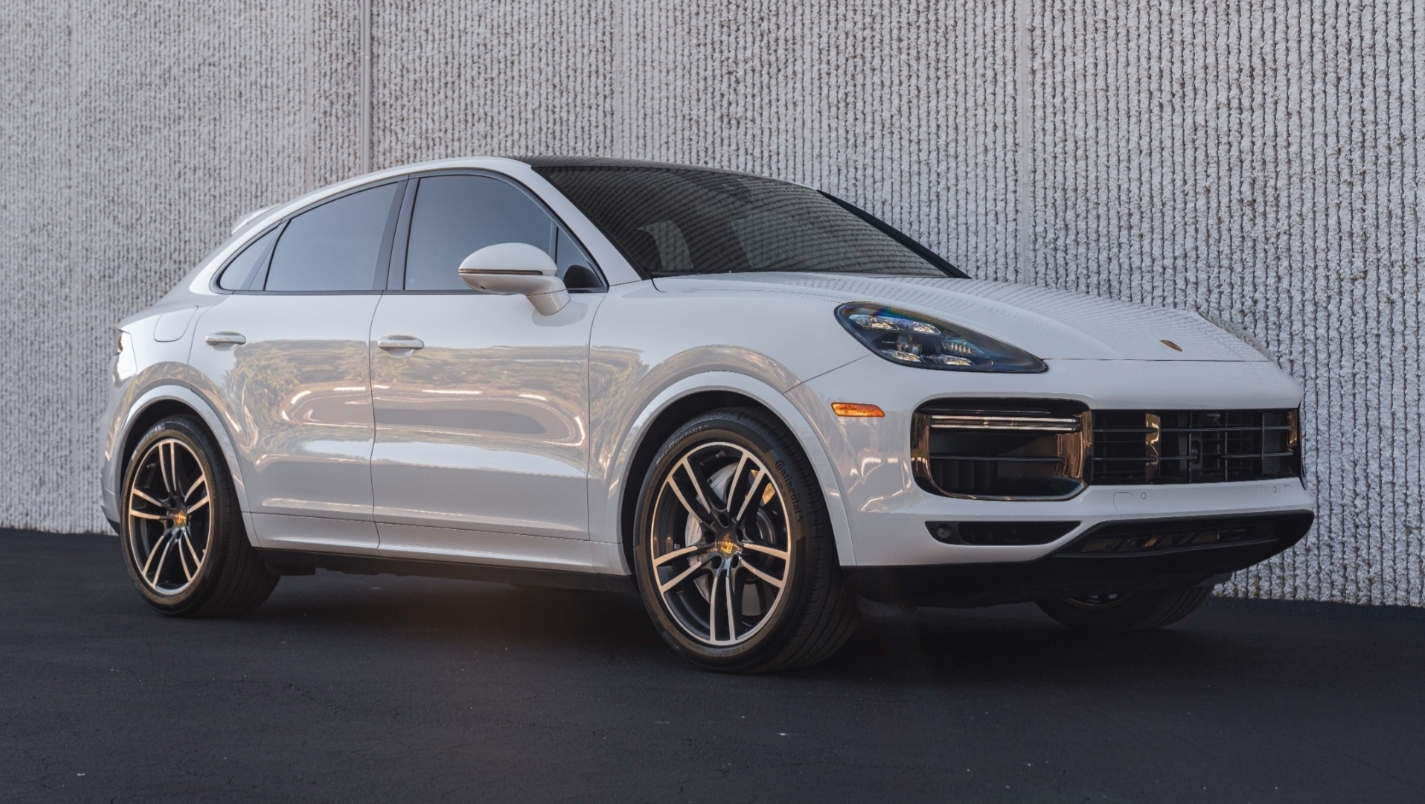
When the third generation Porsche Cayenne (E3) was introduced in 2017 for the 2018 model year, it marked a new generation for Porsche’s flagship SUV. Building on the success of its predecessors, the third generation set a new benchmark in the luxury SUV market.

Under its hood, the third generation Cayenne offers a variety of powertrains to suit different driving preferences. From the base model’s 3.0-liter turbocharged V6 engine producing 340 hp to the high-performance Turbo S E-Hybrid’s combined 680 hp. Notably, Porsche introduced its most powerful hybrid system in this generation.

The engines are paired with an eight-speed Tiptronic S transmission, ensuring smooth and responsive gear changes whether on highways or winding roads.

The exterior of the third generation has a sleeker profile, elongated hood, and sharper lines give it a sportier and more dynamic stance than previous iterations.

The signature four-point LED headlights and taillights emphasize Porsche’s focus on both style and functionality, while optional features such as 22-inch wheels and adaptive aerodynamics enhance its visual appeal and performance.

Inside, the Cayenne’s cabin features a 12.3-inch high-definition touchscreen that serves as the centerpiece of the infotainment system. The minimalist design incorporates premium materials such as leather, aluminum, and carbon fiber. Also, it comes with comfort features, including massaging seats, four-zone climate control, and a premium Burmester sound system.

In its segment, the Porsche Cayenne faces stiff competition from other luxury SUVs that combine performance, technology, and prestige. Rivals include the BMW X5 M, Mercedes-AMG GLE63, Range Rover Sport SVR, and Audi RSQ8. 

 Despite the competition, the Cayenne distinguishes itself through its unique ability to offer sports car-like handling and performance while maintaining the practicality and comfort expected of a luxury SUV.

Model Changes (Breakdown by Year)

2018 Porsche Cayenne

The 2018 model year marked the debut of the third-generation Porsche Cayenne.

It launched with three engine options: a 3.0-liter turbocharged V6 in the base Cayenne producing 340 hp, a 2.9-liter twin-turbo V6 in the Cayenne S delivering 440 hp, and a 4.0-liter twin-turbo V8 in the Cayenne Turbo generating an impressive 550 hp. 

Inside, the Porsche Advanced Cockpit made its debut, featuring a sleek 12.3-inch touchscreen and improved driver assistance systems.

In 2018, the Porsche Cayenne lineup offered a range of models with varying starting prices:

  • Cayenne Base Model: Starting at $60,600
  • Cayenne S: Priced from $81,560
  • Cayenne Turbo: Starting at $124,600
  • Cayenne Turbo S: Starting at $161,600

2019 Porsche Cayenne

The 2019 model year introduced two hybrid variants to the Cayenne lineup, showcasing Porsche’s commitment to performance and sustainability. 

The Cayenne E-Hybrid combined a 3.0-liter V6 engine with an electric motor to deliver a total output of 462 hp. For those seeking even greater power, the Cayenne Turbo S E-Hybrid offered a high-performance hybrid setup, producing an impressive combined output of 680 hp, making it one of the most powerful models in the lineup.

In 2019, the Porsche Cayenne had a starting price stated below:

  • Cayenne Base Model: Starting at $65,700
  • Cayenne S: Priced from $82,900
  • Cayenne Turbo: Starting at $124,600
  • Cayenne E-Hybrid: Priced from $81,150

Additional note: The Cayenne Turbo S model was not available in the 2019 lineup.

2020 Porsche Cayenne

The 2020 model year saw the introduction of the Cayenne Coupe, a new body style that brought a sloping roofline to the Cayenne lineup. This variant catered to buyers looking for a more aggressive design.

Additionally, Porsche reintroduced the Cayenne GTS in 2020, reviving the performance-focused model. Powered by a 4.0-liter twin-turbo V8 engine, the GTS produced 460 hp, offering an engaging driving experience. 

In 2020, the Porsche Cayenne had a starting price stated below:

  • Cayenne Base Model: Starting at $66,800
  • Cayenne S: Priced from $84,300
  • Cayenne Turbo: Starting at $126,500
  • Cayenne E-Hybrid: Priced from $81,100
  • Cayenne Turbo S E-Hybrid: Starting at $161,900

2021 Porsche Cayenne

The 2021 model year saw the introduction of the Cayenne GTS Coupe, expanding the lineup with a performance-focused variant in the sportier coupe body style. 

Sharing the same 4.0-liter twin-turbo V8 powertrain as the GTS SUV, the GTS Coupe delivered 460 hp.

In 2021, the Porsche Cayenne had a starting price stated below:

  • Cayenne Base Model: Starting at $67,500

  • Cayenne S: Priced from $85,100

  • Cayenne GTS: Starting at $108,650

  • Cayenne Turbo: With a starting price of $127,800

  • Cayenne E-Hybrid: Priced from $83,150

  • Cayenne Turbo S E-Hybrid: Starting at $164,550

2022 Porsche Cayenne

The 2022 model year brought subtle yet impactful enhancements to the Porsche Cayenne lineup. 

Standard equipment saw notable upgrades, including the integration of LED headlights with the Porsche Dynamic Light System, a panoramic roof, and a Bose Surround Sound system.

The infotainment system was updated to Porsche Communication Management (PCM) 6.0, offering a more intuitive interface, enhanced connectivity, and seamless integration with Apple CarPlay and Android Auto.

Additionally, Porsche expanded the suite of driver assistance technologies, introducing features such as adaptive cruise control and lane-keeping assist to bolster safety and convenience. 

In 2022, the Porsche Cayenne had a starting price stated below:

  • Cayenne Base Model: Starting at $69,000

  • Cayenne Platinum Edition: Priced from $80,350

  • Cayenne E-Hybrid: Starting at $83,150

  • Cayenne S: Priced from $86,800

  • Cayenne GTS: Starting at $109,000

  • Cayenne Turbo: With a starting price of $127,800

  • Cayenne Turbo S E-Hybrid: Starting at $164,550

  • Cayenne Turbo GT: At the pinnacle of the lineup, this model starts at $180,800

2023 Porsche Cayenne

The 2023 model year introduced the Cayenne Turbo GT, a performance-focused addition to the lineup, available exclusively in the coupe body style. Designed to push the boundaries of SUV performance, the Turbo GT features a 4.0-liter twin-turbo V8 engine that delivers an impressive 631 hp.

In 2023, the Porsche Cayenne had a starting price stated below:

  • Cayenne Base Model: Starting at $72,200

  • Cayenne Platinum Edition: Priced from $80,400

  • Cayenne E-Hybrid: Starting at $86,500

  • Cayenne S: Priced from $90,900

  • Cayenne GTS: Starting at $113,100

  • Cayenne Turbo: With a starting price of $135,900

  • Cayenne Turbo S E-Hybrid: Starting at $171,300

  • Cayenne Turbo GT: At the pinnacle of the lineup, this model starts at $188,700

2024 Porsche Cayenne

The 2024 Porsche Cayenne received a significant mid-cycle refresh, introducing a redesigned exterior with a more aggressive front end, standard Matrix LED headlights, and three-dimensional taillights. 

Inside, the dashboard now features a fully digital 12.6-inch instrument cluster, a 12.3-inch touchscreen, and an optional 10.9-inch passenger display. Powertrain updates include a more powerful base 3.0-liter V6 with 348 horsepower and a revamped E-Hybrid with a 174-hp electric motor and a larger 25.9 kWh battery. 

Enhanced suspension with dual-valve technology improves comfort and handling, while advanced driver-assistance features like InnoDrive and swerve assist enhance safety.

In 2024, the Porsche Cayenne had a starting price stated below:

  • Cayenne Base Model: Starting at $72,200

  • Cayenne Platinum Edition: Priced from $80,400

  • Cayenne E-Hybrid: Starting at $86,500

  • Cayenne S: Priced from $90,900

  • Cayenne GTS: Starting at $113,100

  • Cayenne Turbo: With a starting price of $135,900

  • Cayenne Turbo S E-Hybrid: Starting at $171,300

  • Cayenne Turbo GT: At the pinnacle of the lineup, this model starts at $188,700

2025 Porsche Cayenne

The 2025 model year brought a few updates to the Porsche Cayenne lineup. 

New standard features were introduced across all models, including ambient lighting for enhanced cabin ambiance, a surround view system with active parking support for improved maneuverability, and soft-close doors for a touch of refinement. Additionally, an upgraded PM2.5 cabin filter became standard, improving air quality inside the vehicle.

This model year also marked the return of the Cayenne GTS, a performance-oriented variant powered by a 4.0-liter twin-turbo V8 engine producing 493 hp. The GTS stood out with unique design elements, such as blacked-out trim and exclusive styling cues, along with a specialized suspension system tailored for sharper handling and a more dynamic driving experience. 

In 2025, the Porsche Cayenne had a starting price stated below:

  • Cayenne Base Model: Starting at $84,700

  • Cayenne E-Hybrid: Priced from $97,200

  • Cayenne S: Starting at $101,600

  • Cayenne S E-Hybrid: Priced from $105,100

  • Cayenne GTS: Starting at $124,900

  • Cayenne Turbo E-Hybrid: With a starting price of $157,000

  • Cayenne Coupe: The coupe body style starts at $89,800

  • Cayenne E-Hybrid Coupe: Priced from $101,200

  • Cayenne S Coupe: Starting at $108,000

  • Cayenne S E-Hybrid Coupe: Priced from $110,400

  • Cayenne GTS Coupe: Starting at $129,500

  • Cayenne Turbo E-Hybrid Coupe: With a starting price of $161,500

  • Cayenne Turbo GT: At the top of the range, this model starts at $203,800

Porsche Cayenne Third Generation Common Problems

The third generation Porsche Cayenne is a popular choice when it comes to luxury SUVs. However, as with any vehicle, it has certain problem areas that owners have reported over time. Identifying these potential concerns can help prospective buyers make informed decisions and prepare for ownership.

Keep in mind, that it is essential that all vehicles, can have issues and it is crucial to perform a Pre-Purchase Inspection (PPI) from an authorized dealer or experienced independent mechanic to reveal all issues.

Transfer Case Malfunction: Some Cayenne models experience transfer case failures, leading to vibrations during acceleration or turning at low speeds. Porsche has acknowledged this issue and extended the warranty on the transfer case for affected vehicles.

Electrical System Glitches: Owners have reported problems with the Porsche Communication Management (PCM) system, including unresponsive screens and connectivity issues. In some cases, replacing the PCM unit is necessary, although some third-party services offer repairs.

Ignition Coil or Spark Plug Failure: Premature failure of ignition coils or spark plugs can lead to engine misfires and reduced performance. Regular maintenance and timely replacement can mitigate this issue.

Fuel Pump Issues: Faulty fuel pumps have been reported, causing starting problems or stalling. Replacing the defective fuel pump typically resolves this issue.

Coolant Pipe Leaks: Some models have experienced coolant leaks due to defective plastic coolant pipes, which can lead to engine overheating if not addressed promptly. Upgrading to aluminum coolant pipes is a common solution.

Recalls

2018 Porsche Cayenne vehicles

Electrical system: Propulsion system: Charging: Cable/cord: Onboard (Recall no. 23V841000)

When using the industrial 220V/240V plug at the 100% charge setting, some home power outlets may be incapable of handling the electrical current required to utilize the compact charging system, causing the outlet or charging cable to overheat. An overheated outlet or charging cable can increase the risk of a fire.

2019 to 2020 Cayenne Turbo and 2020 Cayenne Turbo Coupe, Turbo S Hybrid and Turbo S Hybrid Coupe vehicles

Fuel system, gasoline: Delivery: Hoses, lines/piping, and fittings (Recall no. 20V270000)

The fuel line quick connector located in the engine compartment may leak. A fuel leak in the presence of an ignition source can increase the risk of a fire.

2019 Cayenne Hybrid, 2019-2020 Cayenne, Cayenne S, Cayenne Turbo, 2020 Cayenne Coupe, Cayenne Turbo Coupe, and Cayenne S Coupe vehicles

Service brakes (Recall no. 19V735000)

The instrument cluster may not provide a visual warning when the brake pads are worn out. As a result, these vehicles fail to comply with Federal Motor Vehicle Safety Standard (FMVSS) number 135, “Light vehicle brake systems.”. If the driver is not alerted when brake pads are worn out, the vehicle may not respond as expected when braking, increasing the risk of a crash.

2019 Cayenne and Cayenne S vehicles

Visibility: Rearview mirrors/devices: Interior (Recalls no. 19V111000)

A software failure may cause the rearview camera image display to be delayed in responding. As such, these vehicles fail to comply with Federal Motor Safety Standard (FMVSS) number 111, “Rearview Mirrors.”. A rearview camera display that does not function as designed can reduce the driver’s view of what is behind the car, increasing the risk of a crash.

2019 Cayenne S and Cayenne vehicles

Service brakes (Recall no. 19V115000)

The instrument cluster may not provide a visual warning when the brake pads are worn out. As a result, these vehicles fail to comply with Federal Motor Vehicle Safety Standard (FMVSS) number 135, “Light vehicle brake systems.”. If the driver is not alerted when brake pads are worn out, the driver may lose control of the vehicle while attempting to brake, increasing the risk of a crash.

2019 Cayenne Turbo vehicles

Suspension: Front: Shock absorber (Recall no. 19V112000)

The affected vehicle has shock absorber forks that may allow the shock absorbers to loosen. Loose shock absorbers may impair vehicle steering, increasing the risk of a crash.

2019 Porsche Cayenne vehicles

Seat belts: Rear/other (Recall no. 18V751000)

The passenger side rear seat belt buckle may break under load, such as in the event of a crash. As such, these vehicles fail to comply with the requirements of Federal Motor Vehicle Safety Standard (FMVSS) number 209, “Seat Belt Assemblies.”. If the seat belt buckle breaks in the event of a crash, the occupant will not be properly restrained, increasing their risk of injury.

2020 Porsche Cayenne vehicles

Electrical system: Propulsion system: Charging: Cable/cord: Onboard (Recall no. 23V841000)

When using the industrial 220V/240V plug at the 100% charge setting, some home power outlets may be incapable of handling the electrical current required to utilize the compact charging system, causing the outlet or charging cable to overheat. An overheated outlet or charging cable can increase the risk of a fire.

2021 Cayenne GTS, Cayenne GTS Coupe, 2020-2021 Cayenne Coupe, Cayenne S Coupe, Cayenne E-Hybrid Coupe vehicles

Seats (Recall no. 21V318000)

The passenger seat back heating element was not installed and may impact the calibration of the Occupant Classification System. The front passenger air bag may fail to deploy, increasing the risk of injury.

2019-2020 Cayenne Turbo and 2020 Cayenne Turbo Coupe, Turbo S Hybrid and Turbo S Hybrid Coupe vehicles

Fuel system, gasoline: Delivery: Hoses, lines/piping, and fittings (Recall no. 20V270000)

The fuel line quick connector located in the engine compartment may leak. A fuel leak in the presence of an ignition source can increase the risk of a fire.

2020 Cayenne vehicles

Power train: Automatic transmission: Cooling unit and lines (Recall no. 20V271000)

An insufficient weld on a transmission oil pipe may cause the vehicle to leak automatic transmission fluid (ATF). If transmission fluid leaks while driving, the road surface may be made slippery, increasing the risk of a crash.

2021 Porsche Cayenne vehicles

Electrical system: Propulsion system: Charging: Cable/cord: Onboard (Recall no. 23V841000)

When using the industrial 220V/240V plug at the 100% charge setting, some home power outlets may be incapable of handling the electrical current required to utilize the compact charging system, causing the outlet or charging cable to overheat. An overheated outlet or charging cable can increase the risk of a fire.

2021 to 2022 Cayenne vehicles 

Suspension: Rear (Recall no. 22V040000)

The rear axle alignment may not have been inspected after the repairs for Recall 21V-271 (AMA9) were performed.

2021 Cayenne vehicles

Steering: Column (Recall no. 21V493000)

The screw connection between the steering column and the steering box may fail, which can result in a detached steering column. A detached steering column can cause a loss of control, increasing the risk of a crash.

2021 Cayenne Turbo, Cayenne GTS, and Cayenne GTS Coupe vehicles

Engine (Recall no. 21V341000)

Cracks may develop on the surface of the engine cylinder bore. Cracks may cause engine damage and a stall or an oil leak, increasing the risk of a crash or fire.

2021 Cayenne GTS, Cayenne GTS Coupe, 2020-2021 Cayenne Coupe

Seats (Recall no. 21V318000)

The passenger seat back heating element was not installed and may impact the calibration of the Occupant Classification System. The front passenger air bag may fail to deploy, increasing the risk of injury.

2021 Cayenne, Cayenne S, Cayenne Turbo, Cayenne GTS, Cayenne Coupe, Cayenne S Coupe, Cayenne Turbo Coupe, and Cayenne GTS Coupe vehicles

Suspension: Rear: Axle: Non-powered axle assembly (Recall no. 21V271000)

The lock nut on the trailing arm of the rear axle may break due to stress corrosion. A broken lock nut may misalign the rear axle, causing a loss of control and increasing the risk of a crash.

2022 Porsche Cayenne

Electrical system: Propulsion system: Charging: Cable/cord: Onboard (Recall no. 23V841000)

When using the industrial 220V/240V plug at the 100% charge setting, some home power outlets may be incapable of handling the electrical current required to utilize the compact charging system, causing the outlet or charging cable to overheat. An overheated outlet or charging cable can increase the risk of a fire.

2021 to 2022 Cayenne vehicles

Suspension: Rear (Recall no. 22V040000)

The rear axle alignment may not have been inspected after the repairs for Recall 21V-271 (AMA9) were performed. Rear axle misalignment may cause premature or uneven tire wear, increasing the risk of a crash.

2023 Porsche Cayenne

Electrical system: Propulsion system: Charging: Cable/cord: Onboard (Recall no. 23V841000)

Please see the recall report for a list of the included vehicles. When using the industrial 220V/240V plug at the 100% charge setting, some home power outlets may be incapable of handling the electrical current required to utilize the compact charging system, causing the outlet or charging cable to overheat. An overheated outlet or charging cable can increase the risk of a fire.

2024 Cayenne vehicles

Suspension: Front: Control arm: Upper arm (Recall no. 24V533000)

The driver’s side front axle and upper left control arm installed on the vehicles may have been installed with cracks. which can result in the front axle control arm breaking and an unexpected loss of steering and wheel control. A sudden loss of steering control increases the risk of a crash.

2024 Cayenne vehicles

Electrical system: Propulsion system: Charging: Cable/cord: Onboard (Recall no. 23V841000)

When using the industrial 220V/240V plug at the 100% charge setting, some home power outlets may be incapable of handling the electrical current required to utilize the compact charging system, causing the outlet or charging cable to overheat. An overheated outlet or charging cable can increase the risk of a fire.

2024 Cayenne, Cayenne S, Cayenne Coupe, Cayenne Turbo GT, and Cayenne S Coupe vehicles

Exterior lighting: Lighting control module: Software (Recall no. 23V527000)

After the vehicle is turned off, the rear hazard warning lights and the parking lights may not illuminate if they are activated within 10 seconds after the gateway control unit shuts off. As such, these vehicles fail to comply with the requirements of Federal Motor Vehicle Safety Standard number 108, “Lamps, Reflective Devices, and Associated Equipment.”. Rear hazard warning lights and parking lights that fail to illuminate can reduce the vehicle’s visibility to other drivers, increasing the risk of a crash.

Maintenance and Ownership Costs

Ownership costs for the third-generation Porsche Cayenne are comparable to other Porsche models, with routine maintenance being manageable but repairs can be potentially expensive since it is a Porsche.

It is important to remember that regular maintenance and repairs will be necessary to maintain reliability. 

Annual Maintenance (Every 10,000 Miles or 1 Year)

  • Oil and Filter Change

  • Vehicle Inspection

  • Tire Rotation

Every 20,000 Miles or 2 Years

Every 40,000 Miles or 4 Years

Every 60,000 Miles or 6 Years

Every 80,000 Miles or 8 Years

16-Year Maintenance (Every 160,000 Miles or 16 Years)

Here is a rough estimate of typical service costs associated with the Porsche Cayenne:

  • Oil Change – An oil change typically costs between $300 and $400 at a dealership, while independent shops often charge $200 to $300. This includes the cost of oil, an oil filter, and labor.

  • Minor Service – Minor services, including oil changes, tire rotations, fluid top-offs, and inspections, are generally performed every 10,000 miles or annually. At a dealership, the cost for a minor service ranges from $500 to $600, while independent shops typically charge $350 to $450.

  • Major Service – Major services involve a thorough inspection, spark plug replacement, brake fluid changes, and other preventive maintenance tasks. These services are recommended every 40,000 miles or four years. The cost for a major service is approximately $1,200 to $1,500 at a dealership and $900 to $1,200 at an independent shop.

  • Tires – A full set of four tires such as the Pirelli P Zero costs between $1,500 and $2,000 at a dealership, while independent shops charge approximately $1,100 to $1,500, depending on the brand and specifications.

  • Brakes –  Replacing the brake pads and rotors on all four wheels typically costs $2,500 to $3,000 at a dealership, while independent shops charge between $1,800 and $2,200. For models equipped with the Porsche Ceramic Composite Brakes (PCCB), maintenance costs can be significantly higher. While PCCB systems offer superior fade resistance, reduced weight, and exceptional durability, replacing ceramic brake discs can cost $8,000 to $10,000 per wheel. Brake pads for PCCB systems are also more expensive, though their lifespan is generally longer under standard driving conditions.

Options List

When it comes to buying a Porsche Cayenne third generation, the options list plays a significant role in shaping the SUV’s value.

The options can be divided into a few key categories.

For those seeking the best performance options, opting for the Sport Chrono Package is a must. This package enhances driving dynamics with a mode switch on the steering wheel, a performance display, and a launch control feature.

The package also includes the Porsche Active Suspension Management (PASM) system, which adjusts the damping for improved ride quality and handling. The Porsche Torque Vectoring Plus (PTV+) system can also be added for further performance optimization, delivering superior cornering capabilities and stability.

In terms of comfort and convenience, the Premium Package and Premium Package Plus offer significant enhancements.

These packages include features such as ambient lighting, heated and ventilated seats, a panoramic roof system, and adaptive cruise control. The Four-Zone Climate Control option ensures every passenger enjoys a personalized level of comfort, making these packages ideal for family buyers.

For those who want the most up-to-date options, the Porsche InnoDrive with Adaptive Cruise Control is a solid option. This advanced driver assistance system utilizes navigation data and radar sensors to optimize speed and gear changes for a smoother and more efficient driving experience.

Additionally, the Head-Up Display provides crucial driving information directly in the driver’s line of sight, reducing distractions.

When it comes to aesthetics, the Lightweight Sport Package is a top choice. Available for Coupe models, this package adds carbon-fiber components, a lightweight roof, and unique design elements.

For an even more distinctive look, Porsche’s Exclusive Manufaktur program allows buyers to select custom paint colors, interior materials, and design elements to create a truly one-of-a-kind vehicle.

For off-road enthusiasts, the Off-Road Package includes underbody protection, reinforced bumpers, and off-road-specific driving modes. This package ensures the Cayenne remains capable and durable in rugged terrains.

While all Porsche Cayenne models come well-equipped as standard, selecting the right combination of options can enhance the vehicle’s long-term value and usability. Features like the Porsche Ceramic Composite Brakes (PCCB) not only boost performance but also attract buyers. Additionally, options such as the Bose Surround Sound System or the premium Burmester 3D High-End Surround Sound System cater to audiophiles.

Vehicles that go through Porsche’s Exclusive Manufaktur program offer custom paint colors, interior materials, and design elements for a one-of-a-kind vehicle. The Paint to Sample service includes over 160 pre-approved colors, while Paint to Sample Plus allows for a fully bespoke color based on a provided sample, ensuring it meets Porsche’s rigorous quality standards.

Cars that go through this program are typically desirable on the market, especially when configured with appealing specifications.

2018 Porsche Cayenne Options List

2019 Porsche Cayenne Options List

2020 Porsche Cayenne Options List

Key Options

  • Sport Chrono Package

  • Porsche Torque Vectoring Plus (PTV+)

  • Premium Package Plus

  • Porsche Ceramic Composite Brakes (PCCB)

  • Porsche InnoDrive with Adaptive Cruise Control

  • Lightweight Sport Package

Porsche Cayenne Third Generation Price and Values

The Best Porsche Cayenne Third Generation to Buy

When it comes to choosing the best Porsche Cayenne third generation (2018–present), the most desirable options typically center around the high-performance Turbo, Turbo S E-Hybrid, GTS, and Turbo GT models.

The Turbo models are an excellent option for those seeking a performance SUV. With a 4.0-liter twin-turbo V8 engine producing 541 hp, the Turbo combines fast acceleration with everyday usability.

Features like the Porsche Ceramic Composite Brakes (PCCB) and Porsche Torque Vectoring Plus (PTV+) further enhance its handling and stopping power, making it a well-rounded choice for enthusiasts and families alike.

The GTS models take performance a step further with a more aggressive and dynamic setup. Powered by a 4.0-liter twin-turbo V8 producing 453 hp, the GTS is tuned for sharper handling, featuring a lowered adaptive air suspension and sport-focused upgrades. The blacked-out styling elements and distinctive design cues make it a top pick for those looking for an exciting driving experience.

For buyers looking for both performance and hybrid technology, the Turbo S E-Hybrid is an exceptional option. It combines a 4.0-liter twin-turbo V8 with an electric motor, producing a staggering 670 hp.

This model not only delivers impressive acceleration but also improved efficiency. Its exclusivity and dual powertrain capabilities add to its desirability among individuals looking for a daily commuter.

At the top of the lineup is the Turbo GT, the most powerful and track-ready Cayenne ever. Available exclusively in the Coupe body style, the Turbo GT features a 4.0-liter twin-turbo V8 generating 631 hp.

It features unique suspension tuning, lightweight components, and enhanced aerodynamics. The Turbo GT is the ultimate choice for those wanting the best Cayenne in terms of performance.

In terms of market stability, model years 2017 to 2018 Cayenne Turbo and GTS are good choices. 

However, Turbo, Turbo S E-Hybrid, GTS, and Turbo GT models across the board should be safe bets for hacking if you find the right example

Prioritize vehicles with desirable options such as the Sport Chrono Package, PCCB, or a custom configuration from Porsche’s Exclusive Manufaktur or Paint to Sample program. 

Don’t forget that the condition and mileage of the vehicle are crucial factors to consider when buying a Porsche Cayenne. Well-maintained cars with lower mileage tend to hold their value better and offer more reliable performance. 

It’s important to conduct thorough research, compare prices, and look for models with a documented service history if you are considering purchasing a Cayenne with long-term value in mind.

Conclusion

In summary, with a starting price of around $50,000 to $75,000 and up, the Porsche Cayenne third generation is an perfect balance of Porsche’s sports car DNA with the practicality and versatility of an SUV.

While alternatives like the BMW X5 M, Mercedes-AMG GLE63, Range Rover Sport SVR and Audi RSQ8 exist, the Cayenne sets itself apart with its precision engineering, dynamic handling, and a lineup that includes high-performance models like the Turbo, GTS, Turbo S E-Hybrid, and Turbo GT.

For those who value a unique blend of luxury, technology, and exhilarating performance in a daily driver or weekend toy, the Porsche Cayenne third generation is an excellent choice that remains a benchmark in its segment.

Car Hacking Shortcuts

  • Look for models with the Sport Chrono Package or Porsche Torque Vectoring Plus (PTV+)

  • Opt for high-performance trims like the GTS, Turbo, Turbo S E-Hybrid, or Turbo GT for better resale value and long-term desirability

  • Porsche Carbon Ceramic brakes are sought-after

  • Any cars with Porsche’s Exclusive Manufaktur or Paint to Sample options are desirable

  • Prioritize well-maintained, low-mileage vehicles with a full-service history


Source link