Graeme Lowdon will serve as team principal for the future Cadillac F1 team
Cadillac F1 is expected to start racing in 2026 as an 11th team
A Cadillac power unit is in the works but likely won’t be ready for the 2026 debut
Former Marussia Sporting Director Graeme Lowdon was named on Thursday as the team principal for the planned Cadillac Formula 1 team, which aims to start racing in 2026.
The announcement comes less than two weeks after General Motors and its partner for the F1 endeavor, TWG Global, the parent company of Andretti Global and multiple other racing teams, reached an agreement in principle with F1 organizers to get Cadillac on the grid as an 11th team by 2026.
Lowdon previously helped the British racing team Manor develop an F1 team, which started competing in 2010 as Virgin Racing, and later would be branded as Marussia and finally Manor before the team was disbanded in 2017. During that time, he held various senior roles at the team, including sporting director when the team raced as Marussia. The sporting director is the person responsible for all of the team’s trackside operations.
More recently, Lowdon has been managing current F1 driver Zhou Guanyu, who races for Sauber but will be without a seat next year. Guanyu and current teammate Valtteri Bottas will be replaced by Nico Hülkenberg and Gabriel Bortoleto next year, the final year the team competes as Sauber. In 2026, Sauber will become the factory team of Audi.
Lowdon has also been working as an advisor for the Cadillac F1 project and was influential in getting the team’s entry approved. Other former F1 staff linked with the project include former Renault Technical Director Nick Chester and former Renault Operations Chief Rob White.
“Graeme has been a pleasure to work with over the past two years, and we’re excited he will lead our journey to the 2026 Formula 1 grid as team principal,” Mark Reuss, GM’s president, said in a statement. “He has great racing expertise, he knows how to assemble a high-performing team, and he embodies the values the Cadillac Formula 1 Team will represent in all its endeavors, on or off the track.”
Under its agreement with F1, GM also plans to develop its own power unit. However, any GM power unit isn’t expected to be ready until 2028 at the earliest, meaning the Cadillac team will need to purchase a power unit from another supplier initially. New power unit rules coming into effect in 2026 maintain the format of a turbocharged 1.6-liter V-6 hybrid setup, but with reduced power from the gas engine and more reliance on the hybrid system.
Tesla, a company which once claimed its cars were appreciating assets, has indicated that it expects Cybertruck values to dip 30 percent over the first three years of ownership. According to the truck’s recently opened lease program a three-year 30,000 mile lease on a standard Cybertruck AWD model would see a buyout option of $54,930 at the end of the lease. Considering the starting price of $79,990, you’re driving $25,070 of value out of the vehicle. A Cyberbeast, with a starting price of $99,990, would have a lease buyout price of $67,510.
Tesla’s Cybertruck Has Finally Arrived
Tesla has had a rocky start to the Cybertruck product lifecycle. It’s been marred by delays, recalls, and failures. Meanwhile demand has fallen off a cliff and Tesla is stuck with a bunch of trucks it can’t sell, forcing the company to slow production and reduce worker hours. After the initial surge of sales to dedicated Cybertruck enthusiasts, it seems the market has more or less saturated on these, and everyone who wanted one has already got it.
I’m inclined to believe Cybertruck valueswill crater like other Tesla models already do.
When the Cybertruck was unveiled all those years ago, it was said to have a starting price of $40,000, and it was that number that got an alleged two million orders on the books. Right now the cheapest you can buy a Cybertruck is almost double that, and people are not exactly happy with the bait and switch. When Tesla claims that even a three-year-old, used Cybertruck won’t hit that magic $40,000 price, demand just isn’t going to keep up with supply.
In time we will see how things shake out, but early Cybertrucks are already losing tremendous value in the first year of ownership. A Foundation Series Cybertruck recently sold on Bring A Trailer for $75,000, which based on the original MSRP of around $120,000 marks an already significant 38 percent loss in just one year of ownership. I’ll believe Tesla’s 70 percent residual values after three years claim when I see it come to fruition.
Porsche has recalled 2,941 Macan Electric SUVs from model years 2024 and 2025 to fix a safety problem that poses risks to drivers in other cars — the headlights are too bright.
Federal law requires headlights to fall within certain brightness limits. Too dim doesn’t provide enough illumination for the driver, and too bright temporarily blinds oncoming traffic. Porsche tells the National Highway Traffic Safety Administration it erred in programming some Macan Electric’s headlights. When the high beams are on, they’re brighter than legally permitted.
Porsche fixed the problem at the factory for many, but it needs to reprogram the headlights in a few thousand that made it into owners’ hands before the update.
Dealers will reprogram the headlight software to solve the problem. This can’t be done remotely, so drivers must bring their vehicles in for the update. Software updates are usually quick service appointments.
Recall repairs are always free.
Drivers sometimes miss recall notices, so check our recall center to see if your car has been subject to any urgent repair orders.
The Mercedes SL65 AMG Black Series was built at a time when AMG still had a sense of humour. Its massive 6.0-liter twin-turbo V12 delivered 670 hp to the rear wheels. But then, in came Brabus and turned it to eleven.
The Brabus Stealth 65 was created as a one-off based on an already limited-edition SL65 Black Series. The company installed its T65 RS tuning kit, which includes new intercoolers, redesigned turbos, a high-performance exhaust, and a remapped ECU.
These modifications resulted in a peak output of 820 hp and 1047 lb-ft of torque. That’s 20.7% more power compared to the standard SL65 Black Series and a 3.8% boost over the Brabus Vanish edition.
The Brabus Stealth 65 features a two-tone exterior with a black roof, a unique carbon fibre hood, carbon mirror caps, a carbon fibre rear spoiler, and black wheels. The interior of the car is trimmed in black and red leather.
This unique supercar is now available for sale at F1rst Motors in Dubai. The car has been listed for approximately $462,800. Its current odometer reading is 5,579 miles.
The luxury subcompact SUV market is flush with new entries, making it more and more difficult to zero in on the vehicle that makes the most sense. The 2025 BMW X1 and 2025 Audi Q3 rank as some of the best options in that cluster of vehicles.
Long known for producing the best of the best, BMW and Audi hit the mark with these two entries. Let’s look closer at the new BMW X1 and Audi Q3.
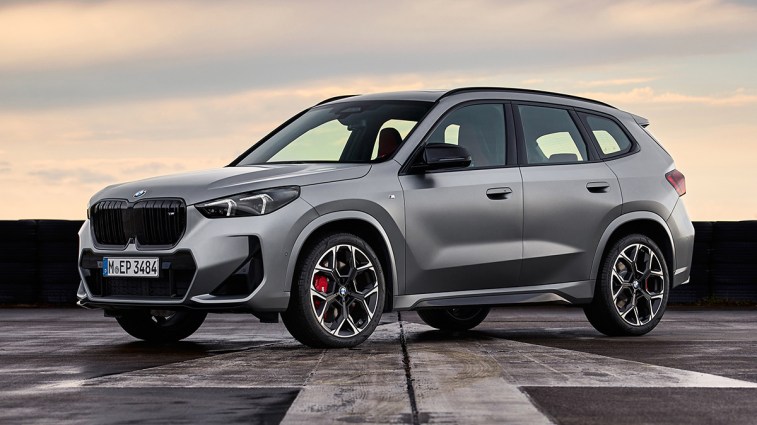
2025 BMW X1
2024 model shown
Not surprisingly, the 2025 BMW X1 offers an impressive synthesis of performance, looks, technology, and luxury. On the outside, the X1 looks the part of a BMW, starting with the impossible-to-miss kidney grille. It’s upright without looking stiff.
Like many luxury vehicles, it features a curved, dual-screen dash that makes everything crystal clear and easy to reach. While the technology-laden interior is a massive selling point, so too is the available space in the cabin. There is ample room for five passengers.
Powered by a 241-horsepower turbo 4-cylinder and standard all-wheel drive, X1 drivers can have as much or as little fun as they want behind the wheel. Also, an upgrade to a specially tuned version of the same engine nets you 313 hp in the form of M35i. Pricing begins at $42,125, including destination fees.
BMW X1 Highlights
Harman Kardon: This superb 12-speaker, 360-watt surround-sound system is part of the Premium package and includes several other desirable features.
Driver assist: Active Driving Assistant Pro includes assistance with changing lanes, emergency stops (if the driver has a medical crisis), and evasive steering.
Two choices: Putting out 241 horses, the standard engine on the X1 is a potent powerplant and will be better than satisfactory for most drivers. However, if you are not “most drivers,” you can upgrade to the lively 313-hp version found on the M35i.
Check this week’sFair Purchase Priceor see the X1 models near you.
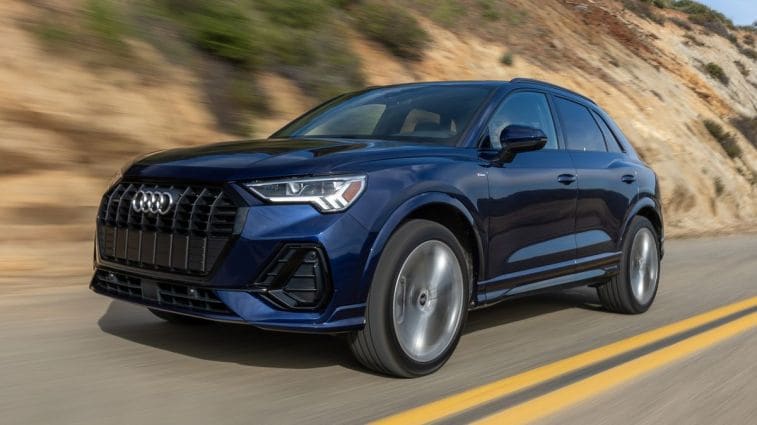
2025 Audi Q3
2024 model shown
The Q3 is Audi’s smallest SUV and its most affordable SUV. If you want to get a foothold in the German luxury brand, this may be the best way to do it. Well into its second generation, the Q3’s exterior styling fits right in with the rest of the Q lineup: clean and contemporary. It looks like an Audi.
That feeling carries over to the Q3’s interior space, which is simple, clean, and accented with a load of current safety and convenience technology. With nice, big screens, everyone can easily see the information they need.
The entry-level model is propelled by a 2.0-liter turbocharged 4-cylinder that develops 184 hp. All-wheel drive (AWD) is standard on all four trim levels of the Q3. If you need a bit more power, buyers can upgrade to a more powerful version of the same 4-cylinder that develops 228 hp. Prices start at $41,095, including destination charges.
Audi Q3 Highlights
Driver assistance: Adaptive cruise control with lane guidance is now standard equipment, or technology in this case, across all Q3 trim levels. This feature is often a costly option on its competitors.
Technology package: This bundle comes with the Premium Plus trim and includes a larger 12.3-inch digital driver information display, a larger infotainment touchscreen (10.1-inches), wireless Apple CarPlay/Android Auto, Amazon Alexa compatibility, road sign recognition, navigation, satellite radio, and an upgraded sound system.
Safety first: The Q3 earned a 5-Star rating from the National Highway Traffic Safety Administration (NHTSA) and achieved “Good” ratings in most of the Insurance Institute for Highway Safety (IIHS) tests.
Check this week’s Fair Purchase Price or see the Q3 models near you.
Similarities
The BMW X1 and Audi Q3 feature stylish exteriors and spacious interiors. Each SUV offers the latest convenience and safety technology.
Conclusion
This decision is not as difficult as it may seem on the surface. Pay the extra $2,500 to get the BMW X1 with a more powerful engine, greater fuel economy, more cabin space, and (we think) better exterior styling.
The Kelley Blue Book Fair Purchase Price for any individual used vehicle can vary greatly according to mileage, condition, location, and other factors.
The prices here reflect what buyers are currently paying for vehicles and vehicles in typical condition when purchasing from a dealership.
These prices are updated weekly. The manufacturer’s suggested retail price (MSRP) quoted includes the destination fee, but does not include tax, license, document fees, and options.
Field AI is building robot brains that enable robots to autonomously manage a wide range of industrial processes. Vention creates pretrained skills to ease development of robotic tasks. And Cobot offers Proxie, an AI-powered cobot designed to handle material movement and adapt to dynamic environments, working seamlessly alongside humans.
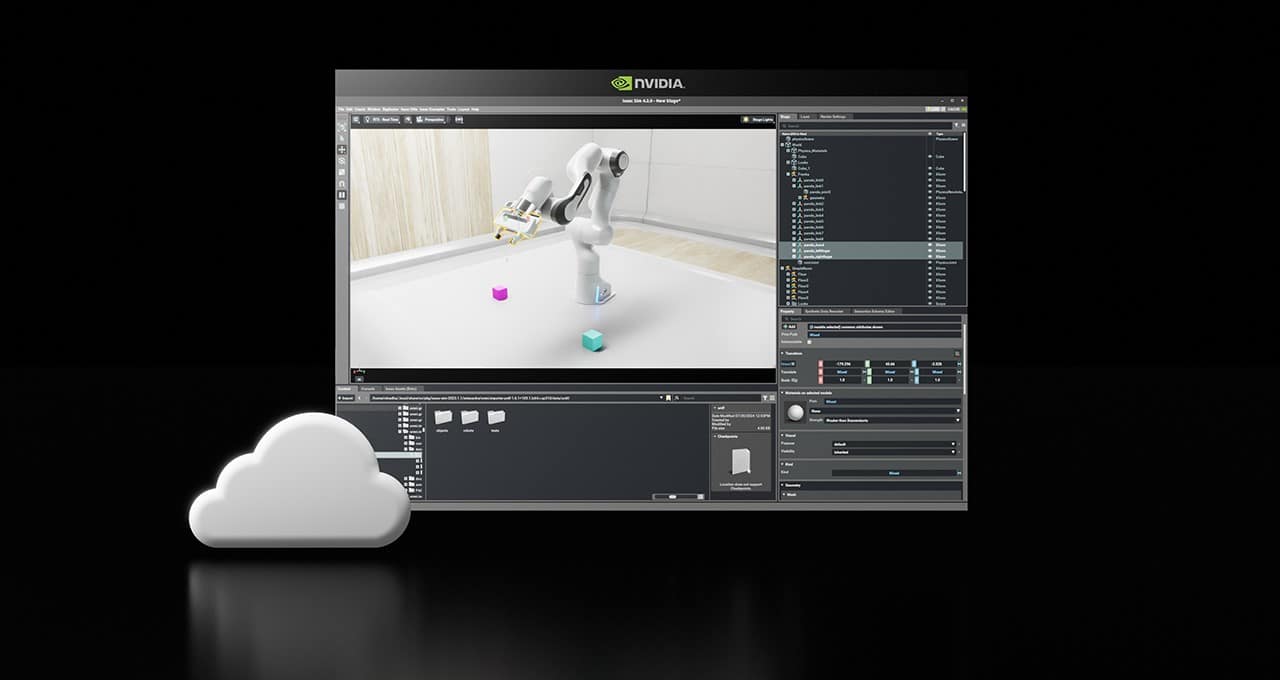
These leading robotics startups are all making advances using NVIDIA Isaac Sim on Amazon Web Services. Isaac Sim is a reference application built on NVIDIA Omniverse for developers to simulate and test AI-driven robots in physically based virtual environments.
NVIDIA announced at AWS re:Invent today that Isaac Sim now runs on Amazon Elastic Cloud Computing (EC2) G6e instances accelerated by NVIDIA L40S GPUs. And with NVIDIA OSMO, a cloud-native orchestration platform, developers can easily manage their complex robotics workflows across their AWS computing infrastructure.
This combination of NVIDIA-accelerated hardware and software — available on the cloud — allows teams of any size to scale their physical AI workflows.
Physical AI describes AI models that can understand and interact with the physical world. It embodies the next wave of autonomous machines and robots, such as self-driving cars, industrial manipulators, mobile robots, humanoids and even robot-run infrastructure like factories and warehouses.
With physical AI, developers are embracing a three computer solution for training, simulation and inference to make breakthroughs.
Yet physical AI for robotics systems requires robust training datasets to achieve precision inference in deployment. Developing such datasets, however, and testing them in real situations can be impractical and costly.
Simulation offers an answer, as it can significantly accelerate the training, testing and deployment of AI-driven robots.
Harnessing L40S GPUs in the Cloud to Scale Robotics Simulation and Training
Simulation is used to verify, validate and optimize robot designs as well as the systems and their algorithms before deployment. Simulation can also optimize facility and system designs before construction or remodeling starts for maximum efficiencies, reducing costly manufacturing change orders.
Amazon EC2 G6e instances accelerated by NVIDIA L40S GPUs provide a 2x performance gain over the prior architecture, while allowing the flexibility to scale as scene and simulation complexity grows. The instances are used to train many computer vision models that power AI-driven robots. This means the same instances can be extended for various tasks, from data generation to simulation to model training.
Using NVIDIA OSMO in the cloud allows teams to orchestrate and scale complex robotics development workflows across distributed computing resources, whether on premises or in the AWS cloud.
Isaac Sim provides access to the latest robotics simulation capabilities and the cloud, fostering collaboration. One of the critical workflows is generating synthetic data for perception model training.
These include the USD Code NIM microservice for generating Python USD code and answering OpenUSD queries, and the USD Search NIM microservice for exploring OpenUSD assets using natural language or image inputs. The Edify 360 HDRi NIM microservice generates 360-degree environment maps, while the Edify 3D NIM microservice creates ready-to-edit 3D assets from text or image prompts. This eases the synthetic data generation process by reducing many tedious and manual steps, from asset creation to image augmentation, using the power of generative AI.
Rendered.ai’s synthetic data engineering platform integrated with Omniverse Replicator enables companies to generate synthetic data for computer vision models used in industries from security and intelligence to manufacturing and agriculture.
SoftServe, an IT consulting and digital services provider, uses Isaac Sim to generate synthetic data and validate robots used in vertical farming with Pfeifer & Langen, a leading European food producer.
Tata Consultancy Services is building custom synthetic data generation pipelines to power its Mobility AI suite to address automotive and autonomous use cases by simulating real-world scenarios. Its applications include defect detection, end-of-line quality inspection and hazard avoidance.
Learning to Be Robots in Simulation
While Isaac Sim enables developers to test and validate robots in physically accurate simulation, Isaac Lab, an open-source robot learning framework built on Isaac Sim, provides a virtual playground for building robot policies that can run on AWS Batch.
Because these simulations are repeatable, developers can easily troubleshoot and reduce the number of cycles required for validation and testing.
Several robotics developers are embracing NVIDIA Isaac on AWS to develop physical AI, such as:
Aescape’s robots are able to provide precision-tailored massages by accurately modeling and tuning onboard sensors in Isaac Sim.
Cobot has used Isaac Sim with its AI-powered cobot, Proxie, to optimize logistics in warehouses, hospitals, manufacturing sites, and more.
Cohesive Robotics has integrated Isaac Sim into its software framework called Argus OS for developing and deploying robotic workcells used in high-mix manufacturing environments.
Field AI, a builder of robot foundation models, uses Isaac Sim and Isaac Lab to evaluate the performance of its models in complex, unstructured environments across industries such as construction, manufacturing, oil and gas, mining and more.
Standard Bots is simulating and validating the performance of its R01 robot used in manufacturing and machining setup.
Swiss Mile is using Isaac Sim and Isaac Lab for robot learning so that wheeled quadruped robots can perform tasks autonomously with new levels of efficiency in factories and warehouses.
Vention, which offers a full-stack cloud-based automation platform, is harnessing Isaac Sim for developing and testing new capabilities for robot cells used by small to medium-size manufacturers.
Learn more about Isaac Sim 4.2, now available on Amazon EC2 G6e instances powered by NVIDIA L40S GPUs on AWS Marketplace.
Lucid Gravity production is underway at the plant in Casa Grande, Arizona
The first examples are the Gravity Grand Touring, priced from $94,900 before destination
A Gravity Touring will be available starting in late 2025 with a price of $79,900 before destination
The first customer examples of Lucid’s long-awaited Gravity SUV started rolling off the line on Thursday at the company’s plant in Casa Grande, Arizona.
The start of Gravity production is a crucial moment for Lucid, as it marks the electric vehicle startup’s entry into the hugely popular three-row midsize SUV segment.
Today marks an exciting landmark for our company. Production of the Lucid Gravity is now underway at our factory in Arizona!
This milestone is a celebration of the hard work by our passionate and dedicated team to bring this groundbreaking SUV to life. Its combination of space… pic.twitter.com/ItJsOL3H3Y
Lucid has struggled with its debut model, the Air, despite the stylish sedan offering some of the best specifications of any EV on the market. Total Air deliveries for the third quarter of 2024 were just 2,781 units, and this was an increase of more than 90% compared to the same period a year ago.
The Gravity should significantly boost Lucid’s deliveries. It arrives as a 2025 model, and the first version available to order is the Gravity Grand Touring, priced from $94,900 before a destination charge that should be around $1,500. A Gravity Touring model will be the next to launch late in 2025 and will carry a starting price of $79,900 before destination.
2025 Lucid Gravity
Though not yet confirmed, a Gravity Pure model may be introduced at some point with an even lower starting price. The Pure is the entry-level model for the Air sedan, which starts at $69,900 plus destination for the 2024 model year.
The Gravity Grand Touring comes with 828 hp and a range estimated by the company to exceed 440 miles. That’s the highest range of any electric SUV.
2025 Lucid Gravity
Beyond the Gravity, Lucid is working on a compact crossover that will compete with the Tesla Model Y. It’s due in late 2026, and Lucid has hinted at a starting price below $50,000.
Lucid also has a plant in Saudi Arabia. The plant is initially being used to build semi knocked-down (partially assembled) examples of the Air at a rate of 5,000 units per year, but there are plans to expand the site later this decade to handle complete production of Lucid vehicles at a rate of 150,000 units annually. It’s possible the Gravity and the future compact crossover will also be built at the Saudi site.
The air was thick with the smell of yeast and morning dew. Julien Ben Hamou López, the 38-year-old vintner behind Bodegas Coruña del Conde, a family-owned estate in northern Spain, led us through a dark tunnel that was stacked with dusty, unlabeled bottles of natural wines. López told our group of nine how the ancient Romans had used the tunnels as escape routes from invaders, then grabbed a few of the mysterious bottles, wiped off the condensation, and led us out into the sunlight to taste them.
This was the first of several winery visits organized by Selections de la Viña, a boutique importer started in Brooklyn that specializes in organic and low-intervention wines from the Iberian Peninsula. Founded by Álvaro de la Viña, a gregarious entrepreneur from Spain, and his wife, the company began leading trips as a way for connoisseurs to meet some of Spain’s top natural vintners.
In the spring, I joined a group of American wine sellers and sommeliers on a weeklong tour of the Castilla y León region, about 90 minutes north of Madrid. While the area is known for its big-box wineries and bold Tempranillos, we would be focusing on winemakers who avoid using industrial machines, pesticides, added sugars, or yeast. “Wine isn’t as glamorous as people think,” said de la Viña, who leads the tours himself. “Wine is about history and people.”
From left: Paella at Bodegas Bigardo; the hillside farms around Bodegas Coruña del Conde.
James Jackman
A family-style lunch with Daniel Ramos (center).
James Jackman
We had an introductory dinner at La Caníbal, a lively restaurant in the Lavapiés neighborhood of Madrid that serves natural wines on tap. The following morning we piled into a gray Volkswagen van and drove northwest to Castilla Termal Monasterio de Valbuena, a wellness resort housed in a 12th-century monastery in the heart of Ribera del Duero, a prized wine district in the region.
Relaxed after a day in the spa, we drove an hour east to López’s 20-acre vineyard, Bodegas Coruña del Conde, named after the ancient village in which it is located. He offered us samples of his cheekily named wines, including “I’m Natural Don’t Panic” and “BC/DC,” directly from the fermentation tanks. Considering that the wines were made with Tempranillo grapes, they tasted surprisingly light and refreshing.
Hiking near the town of El Tiemblo.
James Jackman
Then we made our way to a stone dining room carved into the hillside where, in a monstrous hearth, López made a fire from pruned vines and then grilled milk-fed lamb on a metal grate. As we helped ourselves to a spread of soft sheep’s-milk cheese, chorizo, and peppery summer sausages, he uncorked a generous selection of bold vintages, including a cloudy white made from Airén grapes. As I took in the views from the hilltop, belly full, sipping the last of my unfiltered red, I was struck by how far natural wine making had progressed in Spain from its early days as a cult hobby among wine geeks.
On the third day, we drove to Bodegas Bigardo, an experimental winery in the town of Toro started in 2016 by Kiko Calvo, who fashions himself as something of a rebel. While the region, also called Toro (which means bull), is known for its punch-you-in-the-face reds, Calvo takes a softer approach, producing wines with more delicate structure and balance.
James Jackman.
Álvaro de la Viña (left), who led the author’s tour, at MicroBio Wines, and Ismael Gozalo, the winery’s owner.
From left: Drinking wine from a porrón; touring the cellar at MicroBio Wines.
James Jackman
After giving us a tour of the 60-acre vineyard, Calvo and his sister led us to a picnic table along the Douro River and served us a lunch of stewed cod with rice and braised bull tail, paired with several reds. One bottle, a 2020 Pellejo, was made with grapes from 100-year-old Tinta de Toro vines that grow on his property. Calvo’s affection for the native grape, and the town, is evident. “I’m in love with Toro,” he said as he savored his own creation.
There were more feasts to be had. The next day we hiked up the Gredos mountain range to a small organic outfit that specializes in old Garnacha vines planted on steep slopes and at high altitudes. Named after its Australian-born owner, the vineyard Daniel Ramos is located 2,700 feet above sea level, which protects the grapes from the hot, dry climate. Unlike the manicured vines of conventional wineries, these plants were untamed, growing in a field of wildflowers and grasses.
From left: Exploring Coruña del Conde; a tasting at Coruña del Conde.
James Jackman
For lunch, we headed to a small cinder-block warehouse in the town of Tiemplo. There we met Ramos’s wife and business partner, Pepi, who was stirring a cauldron of pork and paprika-flecked potatoes over a blazing fire. Ramos threw thick steaks on a grill while we scooped up vinegar-soaked anchovies and kicked around a soccer ball with their young son. Ramos brought out a dozen bottles of Garnacha wine, including a 2018 vintage for which the grapes were harvested by hand, spontaneously fermented with airborne yeast, and aged in clay amphorae for about a year.
Spaniards have a word for moments when the after-meal conversation flows like the wine and there’s no to-do: sobremesa. And it’s exactly how a Spanish meal should be. Our crew lingered past the point of fullness to taste more vintages that Ramos doesn’t sell to the public, like a Moscatel pét-nat. “I made 100 bottles but drank 50,” he said, chuckling.
Our last wine-soaked sobremesa was at MicroBio Wines, an innovative winery in the town of Nieva that uses clay jugs and handblown glass bottles to age its low-intervention wines. We uncorked a few sparkling wines made from Verdejo grapes and trekked down into a cryptlike cellar dating back to the 11th century. The walls were caked in natural molds and yeasts, which, we were told, add to the wine’s terroir. After a heavenly lunch of roasted pork leg with grainy mustard, we toured a 5,000-bottle collection of natural wines amassed by Ismael Gozalo, the owner.
The vineyard at Bodegas Bigardo.
James Jackman
From left: Jugs of wine at Bodegas Coruña del Conde; the narrow streets of Coruña del Conde.
James Jackman
As I sat swirling the last sips of one of MicroBio’s Verdejos, made with grapes from a 280-year-old vine that grows on the estate, I was struck by the contrast. I was sitting in a plastic chair in a warehouse, surrounded by pallets and barrels. My boots were dusty from trudging through vineyards. Yet in just one week I had tasted some of the most spectacular wine and food I had experienced in six years of living in Spain. De la Viña was right: natural wine is not always glamorous, but in Castilla y León, it is often exceptional.
Next year, U-Haul will add a new trailer to its rental fleet that’s perfect for hauling race cars to and from the track.
Called the Toy Hauler, this trailer measures just over 23 feet long and 8.5 feet wide. That creates 16 feet of usable deck space, and U-Haul included drive-over fenders to maximize use of that space. A 6,800-pound load capacity is a meaningful increase over the current U-Haul Auto Transport trailer’s 5,290-pound maximum weight rating.
U-Haul Toy Hauler
For loading and unloading, three individual 8.0-foot ramps at the rear are designed to accommodate three-wheelers as well as cars, conventional motorcycles, and side-by-sides. Increased demand for trailers to transport different types of vehicles like these led U-Haul to add the Toy Hauler to its fleet.
“By adding this higher-capacity option, the rental fleet can better serve a wider range of customer needs, ensuring that there are suitable trailers available for both smaller and larger vehicles, as well as a wide variety of cargo options,” Jasmine Spencer, manager of the towing program at U-Haul headquarters, told Road & Track, noting that the Toy Hauler is designed to “complement existing offerings rather than replace them.”
U-Haul Toy Hauler
Spencer also told Road & Track that U-Haul won’t be selling off any of its existing trailers as Toy Haulers enter the fleet, as most of its current trailers were built within the last decade and thus have several years of service left in them. So enthusiasts searching for a cheap trailer to haul their project car will need to look elsewhere.
Production is expected to start in early 2025 at the U-Haul Technical Center in Tempe, Arizona. Pricing will be available closer to that time.
The prime ministers of Thailand and Vietnam this week met with NVIDIA founder and CEO Jensen Huang to discuss initiatives that will accelerate AI innovation in their countries.
During his visit to the region, Huang also joined Bangkok-based cloud infrastructure company SIAM.AI Cloud onstage for a fireside chat on sovereign AI. In Vietnam, he announced NVIDIA’s collaboration with the country’s government on an AI research and development center — and NVIDIA’s acquisition of VinBrain, a health technology startup funded by Vingroup, one of Vietnam’s largest public companies.
These events capped a year of global investments in sovereign AI, the ability for countries to develop and harness AI using domestic computing infrastructure, data and workforces. AI will contribute nearly $20 trillion to the global economy through the end of the decade, according to IDC.
Canada, Denmark and Indonesia are among the countries that have announced initiatives to develop sovereign AI infrastructure powered by NVIDIA technology. And at the recent NVIDIA AI Summits in India and Japan, leading enterprises, infrastructure providers and startups in both countries announced sovereign AI projects in sectors including finance, healthcare and manufacturing.
Supporting Sovereign Cloud Infrastructure in Thailand
Huang’s Southeast Asia visit kicked off with a meeting with Thailand Prime Minister Paetongtarn Shinawatra, where he discussed the opportunities for sovereign AI development in Thailand and shared memories of his childhood years spent in Bangkok.
The pair discussed how further investing in AI education and training can help Thailand drive AI innovations in fields such as weather prediction, climate simulation and healthcare. NVIDIA is working with dozens of local universities and startups to support AI advancement in the country.
Huang and Shinawatra met in the Purple Room of the Thai-Khu-Fah building, which houses the offices of the prime minister and cabinet.
Huang later took the stage at an “AI Vision for Thailand” event hosted by SIAM.AI Cloud, a cloud platform company that offers customers access to virtual servers featuring NVIDIA Tensor Core GPUs.
“The most important part of artificial intelligence is the data. And the data of Thailand belongs to the Thai people,” Huang said in a fireside chat with Ratanaphon Wongnapachant, CEO of SIAM.AI Cloud. Highlighting the importance of sovereign AI development, Huang said, “The digital data of Thailand encodes the knowledge, the history, the culture, the common sense of your people. It should be harvested by your people.”
Following the conversation, Wongnapachant gifted Huang a custom leather jacket lined with Thai silk. The pair also signed an NVIDIA DGX H200 system in recognition of SIAM.AI Cloud’s plans to expand its offerings to NVIDIA H200 Tensor Core GPUs and NVIDIA GB200 Grace Blackwell Superchips.
Advancing AI From Research to Industry in Vietnam
In Hanoi the next day, Huang met with Vietnam’s Prime Minister Pham Minh Chinh, and NVIDIA signed an agreement to open the company’s first research and development center in the country. The center will focus on software development and collaborate with Vietnam’s enterprises, startups, government agencies and universities to accelerate AI adoption in the country.
The announcement builds on NVIDIA’s existing work with 65 universities in Vietnam and more than 100 of the country’s AI startups through NVIDIA Inception, a global program designed to help startups evolve faster. NVIDIA has acquired Inception member VinBrain, a Hanoi-based company that applies AI diagnostics to multimodal health data.
While in Vietnam, Huang also received the 2024 VinFuture Prize alongside AI pioneers Yoshua Bengio, Geoffrey Hinton, Yann Le Cun and Fei-Fei Li for their “transformational contributions to the advancement of deep learning.”
Broadcast live nationally in the country, the awards ceremony was hosted by the VinFuture Foundation, a nonprofit that recognizes innovations in science and technology with significant societal impact.
“Our award today is recognition by the VinFuture committee of the transformative power of AI to revolutionize every field of science and every industry,” Huang said in his acceptance speech.
Bengio, Huang and LeCun accepted the 2024 VinFuture Prize onstage in Hanoi.
Learn more about sovereign AI.
Editor’s note: The data on the economic impact of AI is from IDC’s press release titled “IDC: Artificial Intelligence Will Contribute $19.9 Trillion to the Global Economy through 2030 and Drive 3.5% of Global GDP in 2030,” published in September 2024.
The technical storage or access is strictly necessary for the legitimate purpose of enabling the use of a specific service explicitly requested by the subscriber or user, or for the sole purpose of carrying out the transmission of a communication over an electronic communications network.
Preferences
The technical storage or access is necessary for the legitimate purpose of storing preferences that are not requested by the subscriber or user.
Statistics
The technical storage or access that is used exclusively for statistical purposes.The technical storage or access that is used exclusively for anonymous statistical purposes. Without a subpoena, voluntary compliance on the part of your Internet Service Provider, or additional records from a third party, information stored or retrieved for this purpose alone cannot usually be used to identify you.
Marketing
The technical storage or access is required to create user profiles to send advertising, or to track the user on a website or across several websites for similar marketing purposes.