“JLR Malaysia’s extraordinary accomplishment of securing the Retailer of the Year award for the fourth consecutive year is a testament to our steadfast commitment to excellence. As the automotive sector continues to evolve with cutting-edge technological innovations and enhanced customer experiences, this accolade reinforces our ability to consistently set new benchmarks for operational excellence and customer satisfaction in a highly competitive market,” said Sime Motors MD for Southeast Asia Jeffrey Gan.
The annual award is given to the top JLR retailers in the region, with marketing, sales, customer service, staff training and retailer presentation comprehensively evaluated.
“We are deeply honoured to be recognised once again as the Retailer of the Year. This continued success not only reflects the robust strategic partnership between JLR Malaysia and Sisma Auto but also highlights the effective synergy and dedication of our unified team. We are proud to be acknowledged as a driving force in the luxury automotive market, continually raising the bar for innovation and customer service,” said Vantage Malaysia and JLR Malaysia MD Syed Ahmad Muzri Syed Faiz.
To celebrate this milestone, JLR Malaysia is offering loyal customers the chance to win accessories and merchandise vouchers worth up to RM8,000 from October 25, 2024 to January 31, 2025.
In 2020, 8.9% of road accidents involved elderly drivers aged 60 and up. The next year it became 9.2%, and the following year it was 12%, Malaysian Institute of Road Safety Research (MIROS) director-general Dr Siti Zaharah Ishak told the New Straits Times.
She said that the rise in road accidents involving elderly drivers in the country could be curbed if additional conditions are introduced for renewal of their driving licences.
One possible way is to require senior citizens aged 65 and up to pass a competency and health assessment before their licences can be renewed, she said, citing Japan, Singapore, South Korea, Australia, the US and the UK as countries that do this without banning senior drivers outright.
Likewise, there is no driver age limit in Malaysia (neither are there plans to introduce it), but Section 30(3) of the Road Transport Act 1987 (Act 333) mandates that drivers ensure they are in a healthy condition to drive.
This provision could be sufficient to ensure those at risk do not drive, but it does not stop healthy and capable elderly drivers from continuing to do so, Siti Zaharah explained.
This measure would require cooperation from various parties including the Road Transport Department (JPJ), health institutions, the elderly themselves and their families. The maximum licence renewal period for senior citizens is 10 years in Malaysia, but two or three years in other countries.
Although she understands the sense of freedom a driving licence gives the elderly, Siti Zaharah said that some of them may not realise that their ability to drive safely has been compromised.
“Aging can affect fitness and driving ability, including vision and hearing limitations, slower reaction times, joint stiffness, and muscle weakness, all of which can hinder safe driving,” she said.
Max Verstappen was named the 2024 F1 Drivers’ Champion after the Las Vegas Grand Prix
McLaren still leads the Constructors’ Championship with two races left this season
George Russell led a one-two finish for Mercedes-Benz AMG in Las Vegas
Red Bull Racing’s Max Verstappen secured his fourth-straight Formula 1 World Championship title following Saturday’s 2024 Las Vegas Grand Prix.
It means he joins an elite group of drivers with four or more championships under their belts. The list also includes Alain Prost and Sebastian Vettel each with four titles, plus Juan Manuel Fangio with five, and Lewis Hamilton and Michael Schumacher each with seven.
Verstappen only finished in fith place in Las Vegas, but the points scored means he’s now unbeatable this season despite there still being two races left, in Qatar and Abu Dhabi. The race for second in the championship is still on between McLaren’s Lando Norris and Ferrari’s Charles Leclerc, though the honors will likely go to Norris given his current gap of 21 points to Leclerc.
Unlike 2023, where Verstappen dominated with a record 19 wins as well as a record of 15-straight wins, the Red Bull driver wasn’t always the fastest in 2024, having thus far won only eight races. Red Bull’s pace has come off since the middle of the season, and the team next year also loses star aerodynamicist Adrian Newey to Aston Martin. Hamilton driving for Ferrari next season will be another wild card.
George Russell at the 2024 Formula 1 Las Vegas Grand Prix – Photo via Mercedes-Benz
The win in Las Vegas went to Mercedes-Benz AMG’s George Russell, who led teammate Hamilton in a one-two finish. Third place went to Ferrari’s Carlos Sainz. Russell led the race from pole, and finished seven seconds clear of Hamilton and close to 12 seconds ahead of Sainz.
Russell was mostly unsettled during the 50-lap race, while Hamilton drove impressively to move up to second after starting at 10th on the grid. Hamilton was helped somewhat by Leclerc, who fought for the lead early on, but fell back and had to pit early after being too aggressive on his tires.
Leclerc, together with Sainz, would get to move up again in the closing stages thanks to some caution from Verstappen. The Red Bull driver went into the race knowing he only had to finish ahead of Norris to secure the title, so despite holding a podium spot after the second round of pit stops, he opted not to battle the two Ferraris approaching his rear in the closing laps and let them easily pass. Sainz finished ahead of Leclerc, who had to settle for fourth place.
Carlos Sainz at the 2024 Formula 1 Las Vegas Grand Prix – Photo via Ferrari
At this point, Hamilton was closing in on Russell at the front in the final few laps, repeatedly taking several tenths of a second on his teammate. However, he couldn’t catch up before the checkered flag was waved.
Following the weekend’s action, Verstappen’s points tally in the 2024 Drivers’ Championship with 403 points. Norris is second with 340 points and Leclerc is third with 319 points. In the Constructors’ Championship, McLaren leads with 608 points. Ferrari is second with 584 points, while Red Bull, due to the poor performance of driver Sergio Perez, is back in third with 555 points.
The next race on the calendar is the Qatar Grand Prix, which is scheduled for the coming weekend.
2024 Formula 1 Las Vegas Grand Prix – Photo via Mercedes-Benz
Below are the full results from the 2024 Formula 1 Las Vegas Grand Prix:
1) George Russell, Mercedes-Benz AMG 2) Lewis Hamilton, Mercedes-Benz AMG +7.313 seconds 3) Carlos Sainz, Ferrari +11.906 seconds 4) Charles Leclerc, Ferrari +14.283 seconds 5) Max Verstappen, Red Bull Racing +16.582 seconds 6) Lando Norris, McLaren +43.385 seconds 7) Oscar Piastri, McLaren +51.365 seconds 8) Nico Hulkenberg, Haas +59.808 seconds 9) Yuki Tsunoda, RB +62.808 seconds 10) Sergio Perez, Red Bull Racing +63.114 seconds 11) Fernando Alonso, Aston Martin +69.195 seconds 12) Kevin Magnussen , Haas +69.803 seconds 13) Zhou Guanyu, Sauber +74.085 seconds 14) Franco Colapinto, Williams +75.172 seconds 15) Lance Stroll, Aston Martin +84.102 seconds 16) Liam Lawson, RB +91.005 seconds 17) Esteban Ocon, Alpine +1 lap 18) Valtteri Bottas, Sauber +1 lap NC) Alexander Albon, Williams – DNF NC) Pierre Gasly, Alpine – DNF
I’ll start with an apology. Ultimate Stance 2024 was almost a month ago, so this gallery is overdue. But there’s a good reason for the delay, so bear with me.
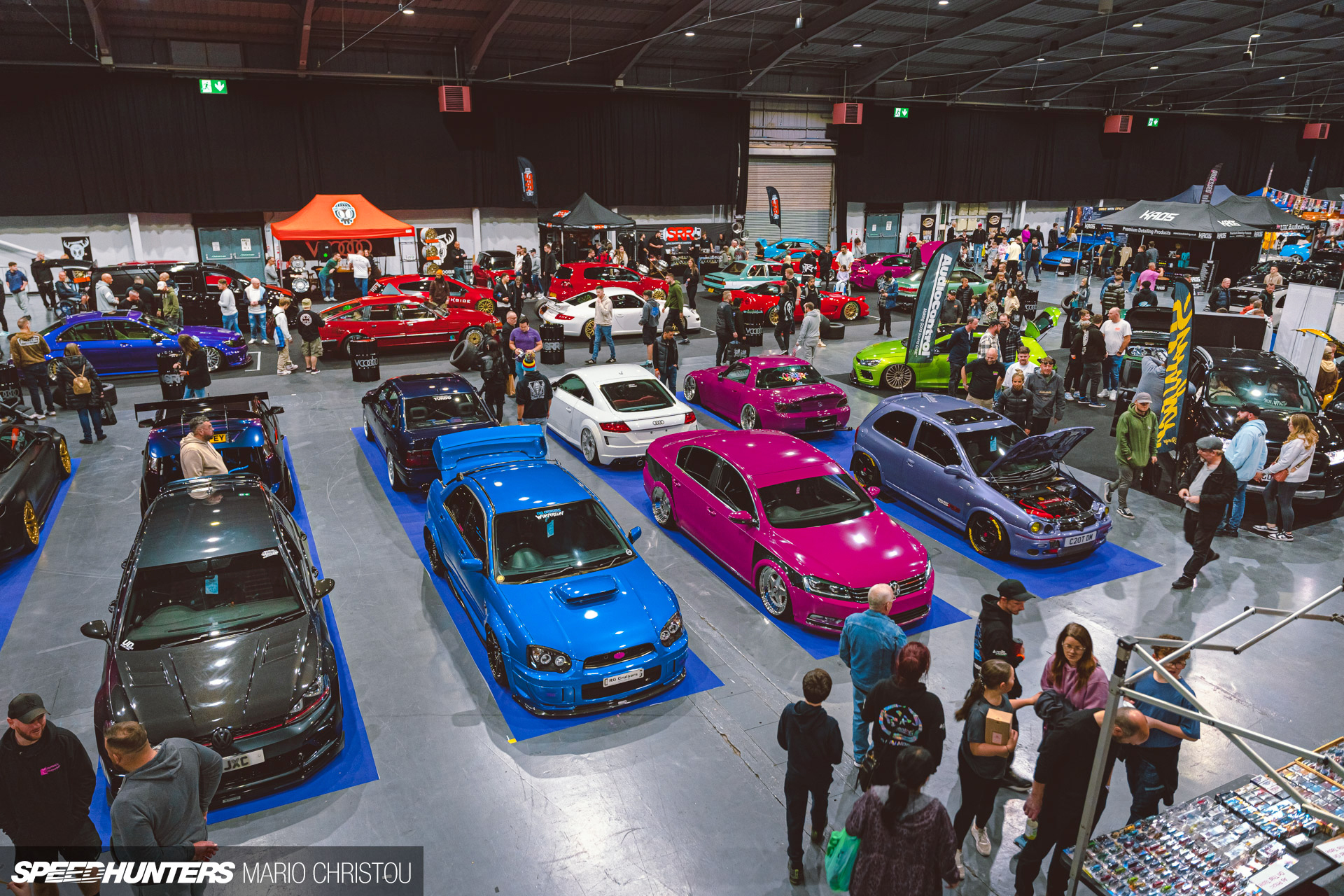
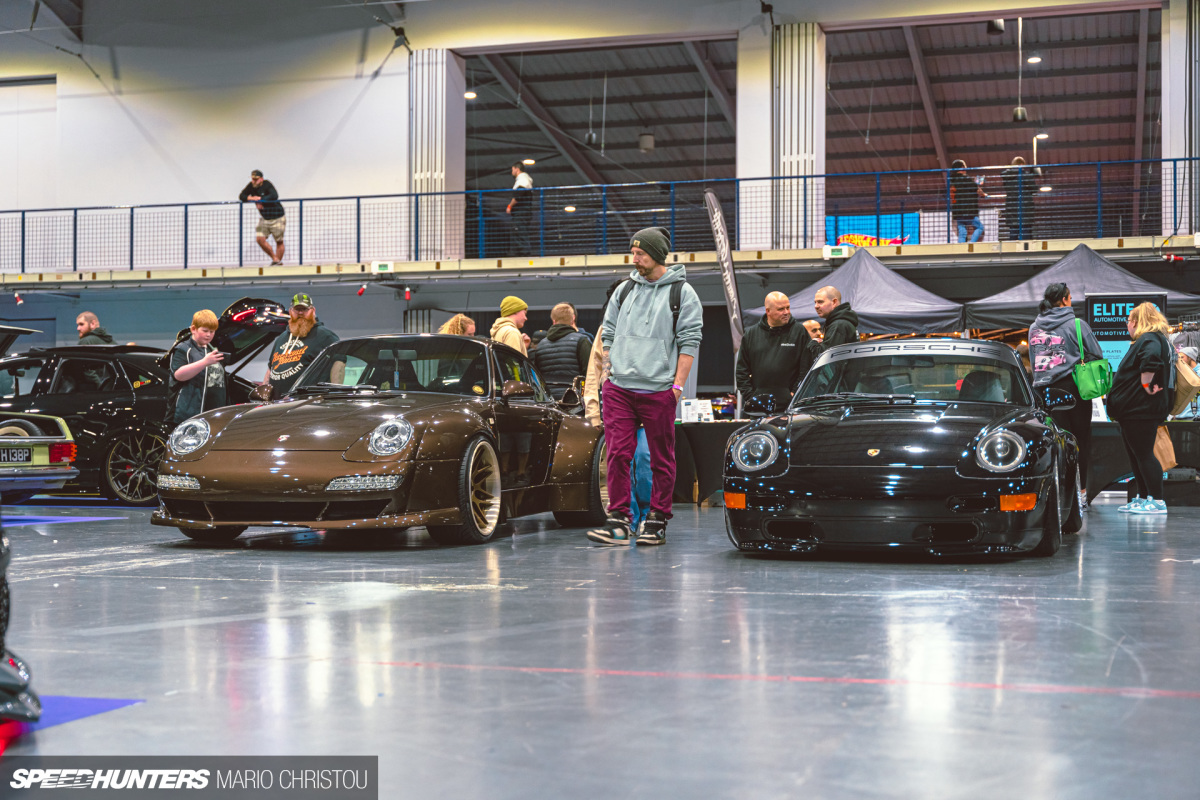
Ultimate Stance is known in the UK for three things: a diverse range of show cars, a lively atmosphere, and, most importantly, marking the end of the car show season before winter arrives.
Its sister show, Ultimate Dubs, is the UK season opener, and it’s an event I’ve attended for the past few years. I figured I’d close out the 2024 season with a show, so I took a quick trip to Telford and spent the day exploring the halls of the Telford International Centre.
Since then, my schedule has been packed with car culture, and there are no signs of it slowing down. So, instead of waxing lyrical about the ‘end of the UK car season,’ let’s dive straight into a selection of shiny cars from this year’s show.
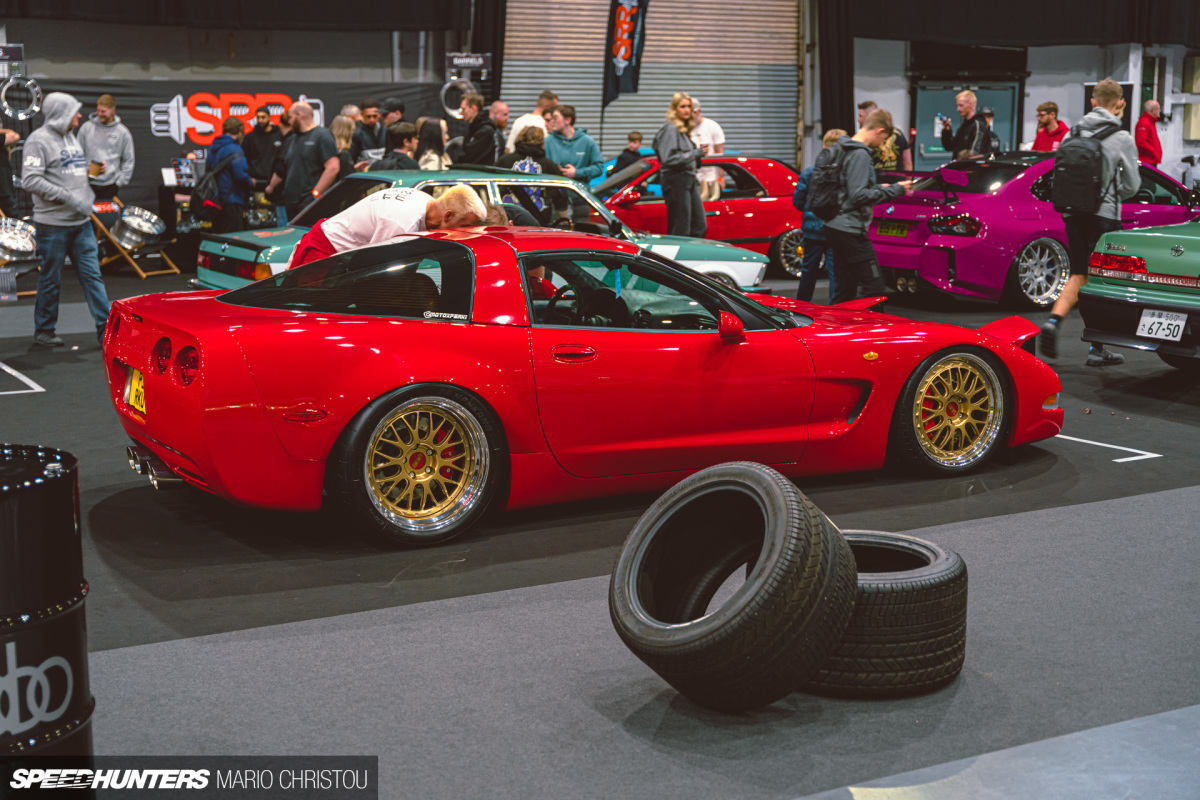
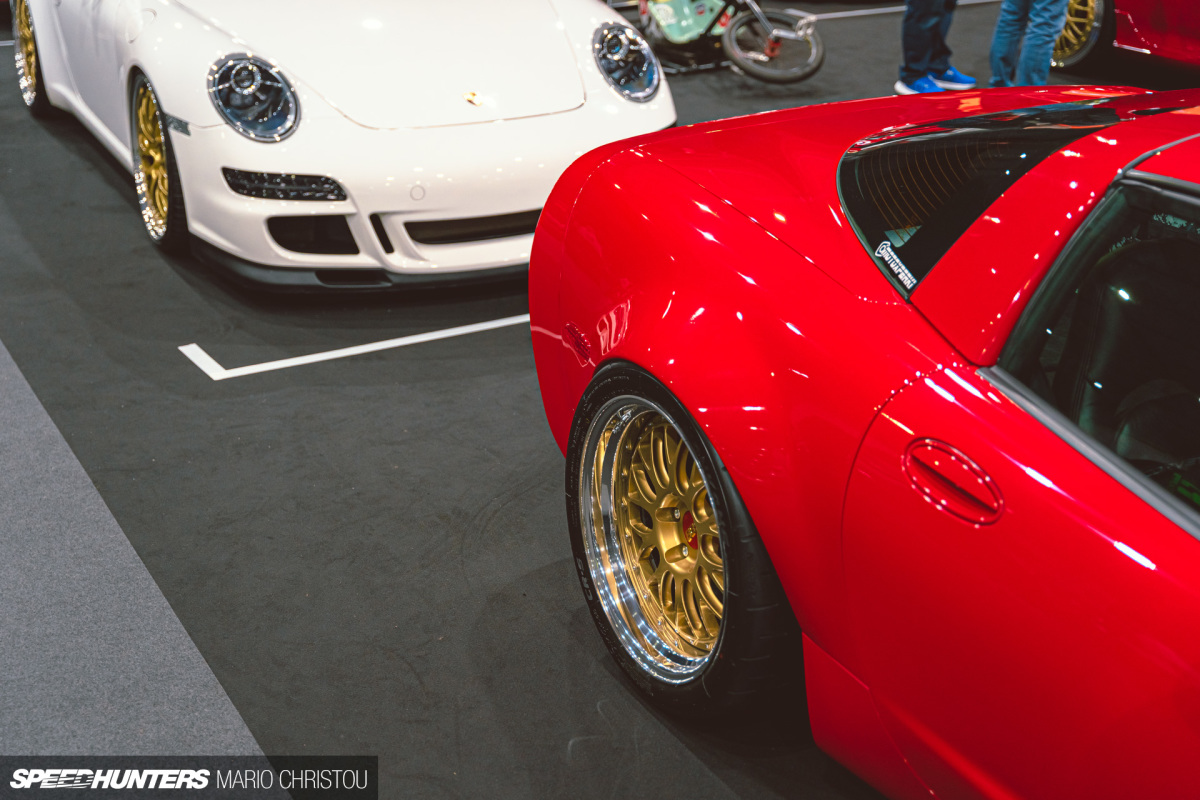
Cars like this C5 Chevrolet Corvette on the Voodoo Split Rims stand. I adore ’90s sports cars, especially those with pop-up headlights. There’s something special about their rising beltlines, pointed noses, and – in this case – BBS Motorsport splits.
Voodoo’s display deserves a special mention. They brought out some of the best-executed cars at the show on immaculate split rims…
…and this hilariously stanced trike, too!
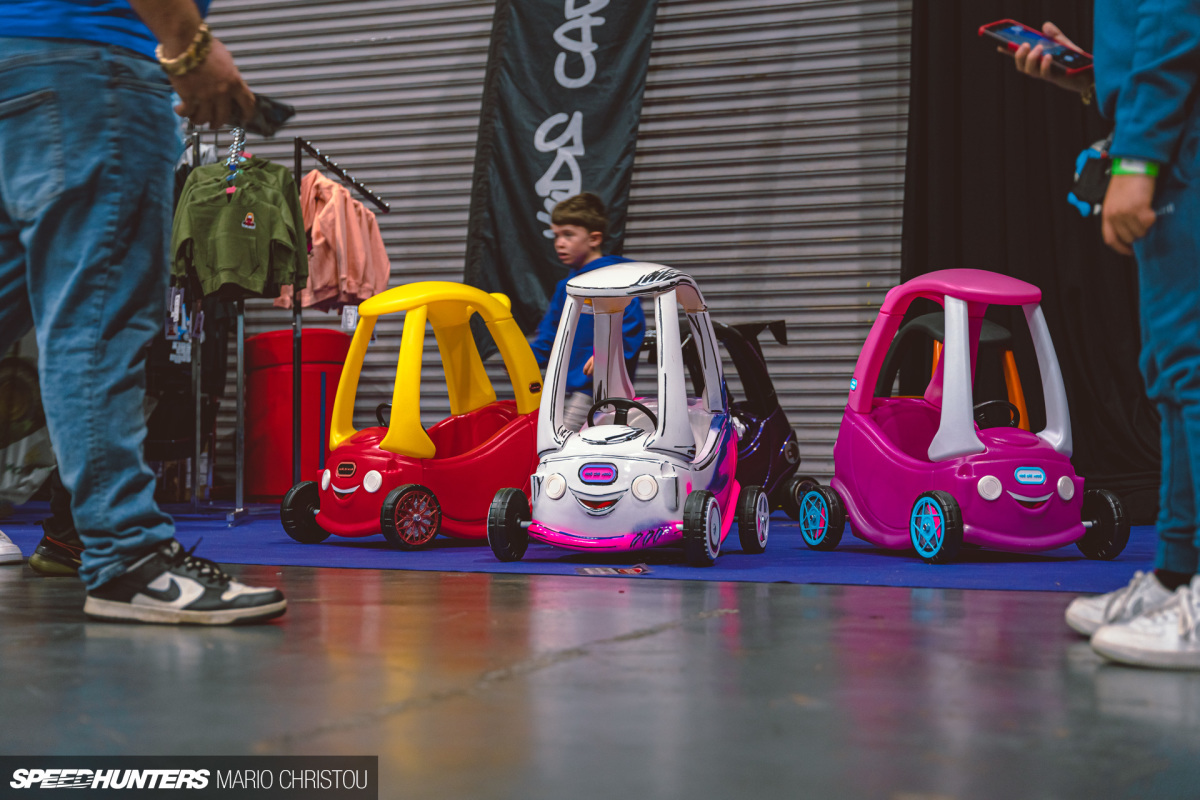
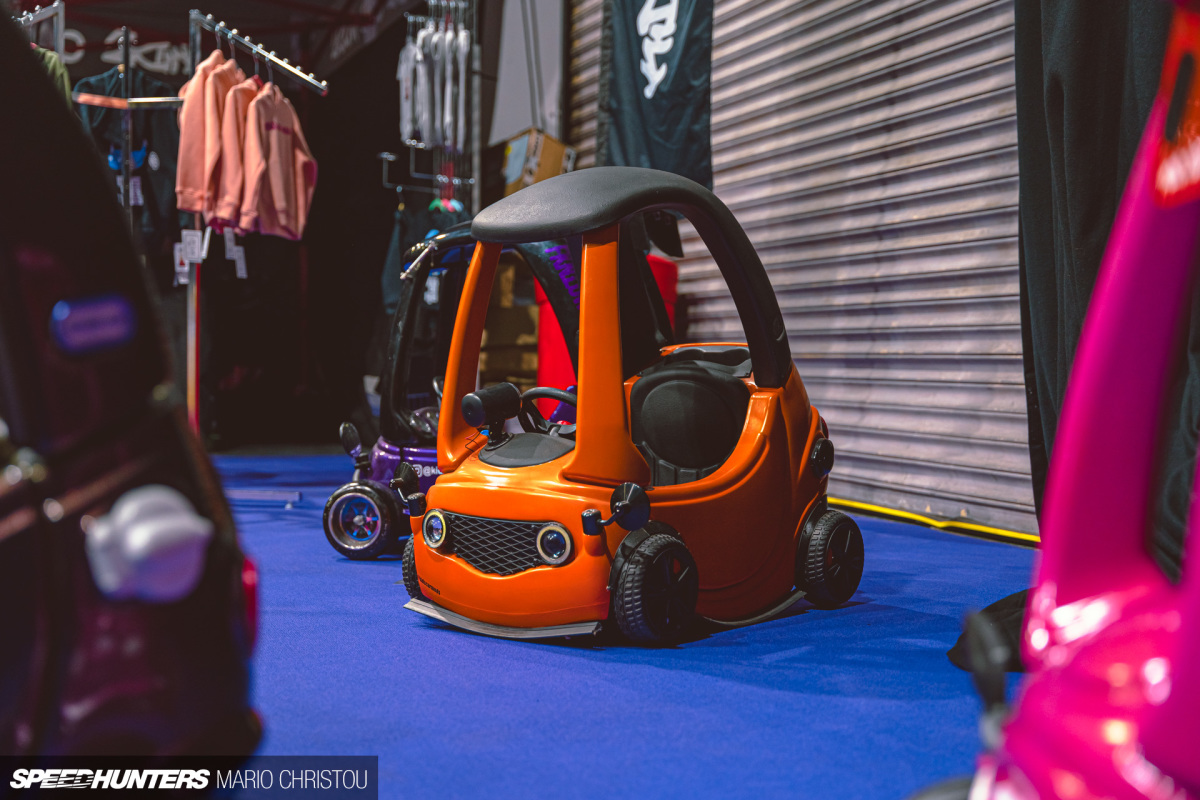
Elsewhere, young ones were entertained at the Kids Car Mods stand near the main stage. I wish my Little Tikes Cozy Coupe was this cool – but you’ve got to love the traditional yellow-and-red colour scheme, right?
Of course, it wasn’t just the kids spending their money. Adults (especially those in their 30s with disposable income) were happily dropping cash on collectable scale models. I left a couple of my mates browsing at one stand, grabbed photos of the entire hall, and returned to find them with a bag full of toys.
Yes, that is indeed a wedding ring on one of their hands. No, he doesn’t have a child.
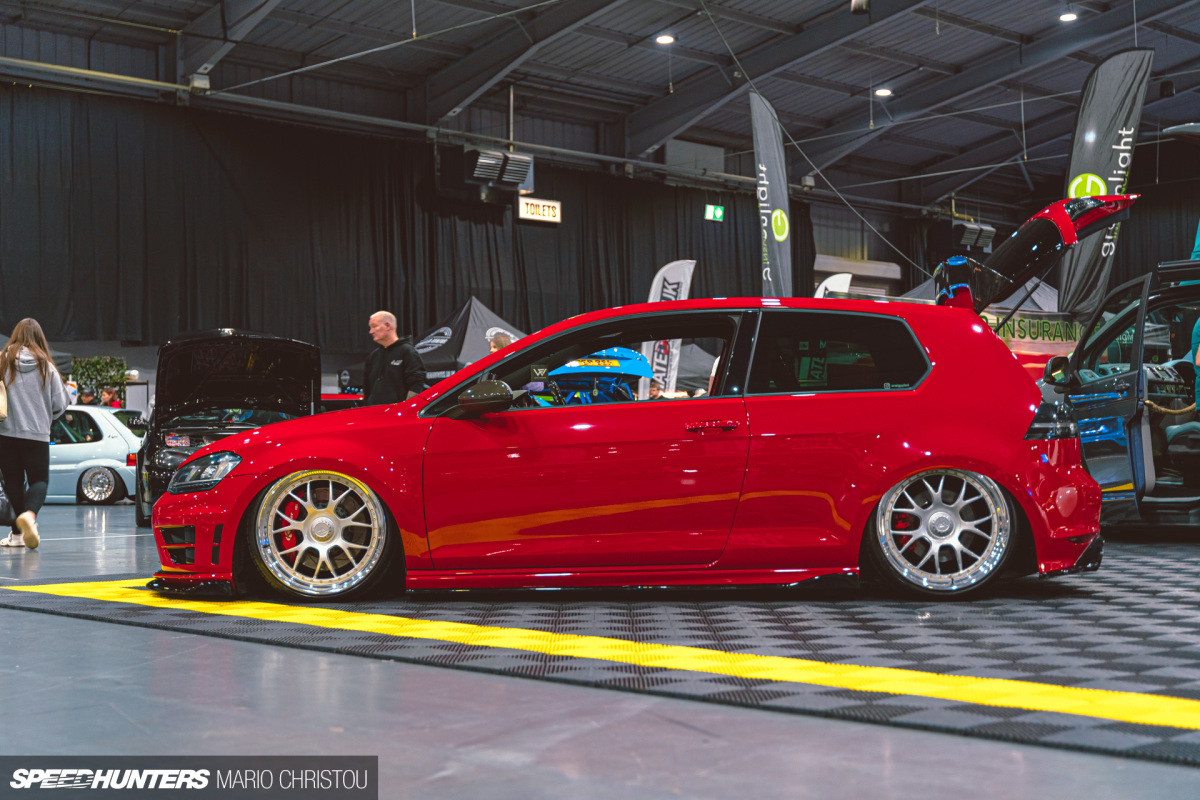
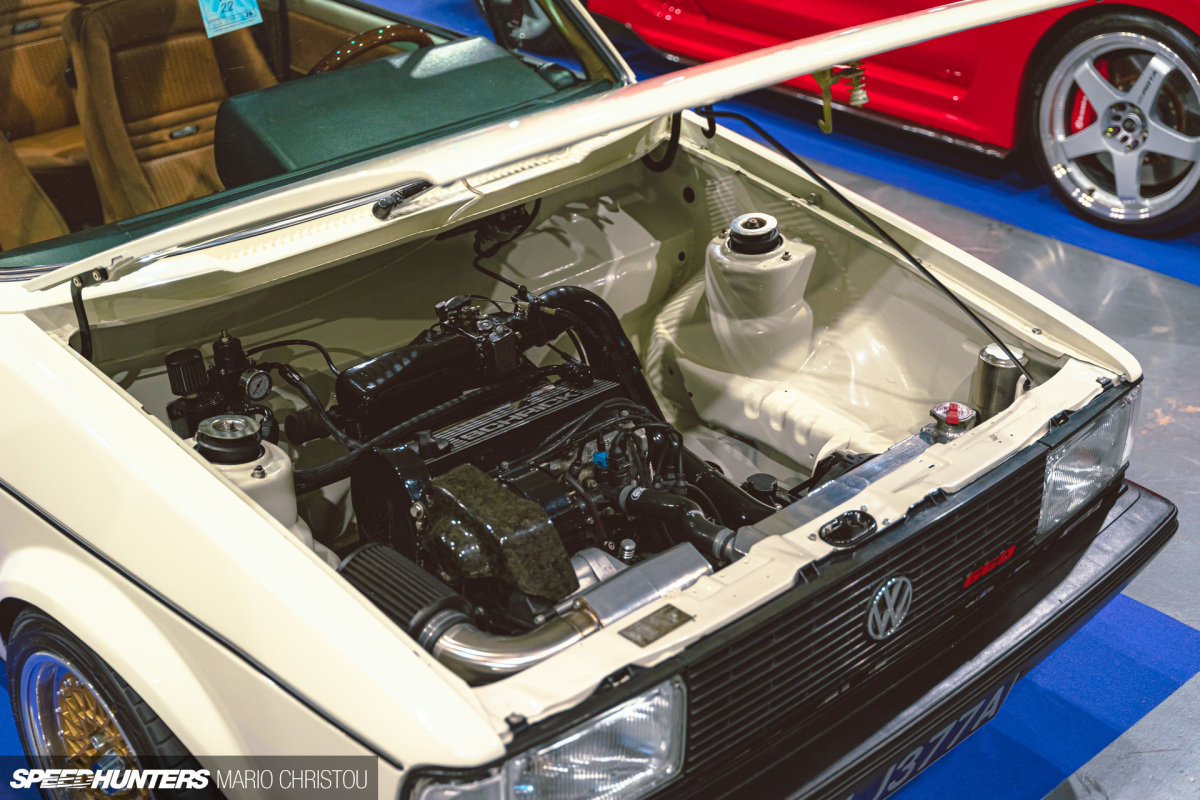
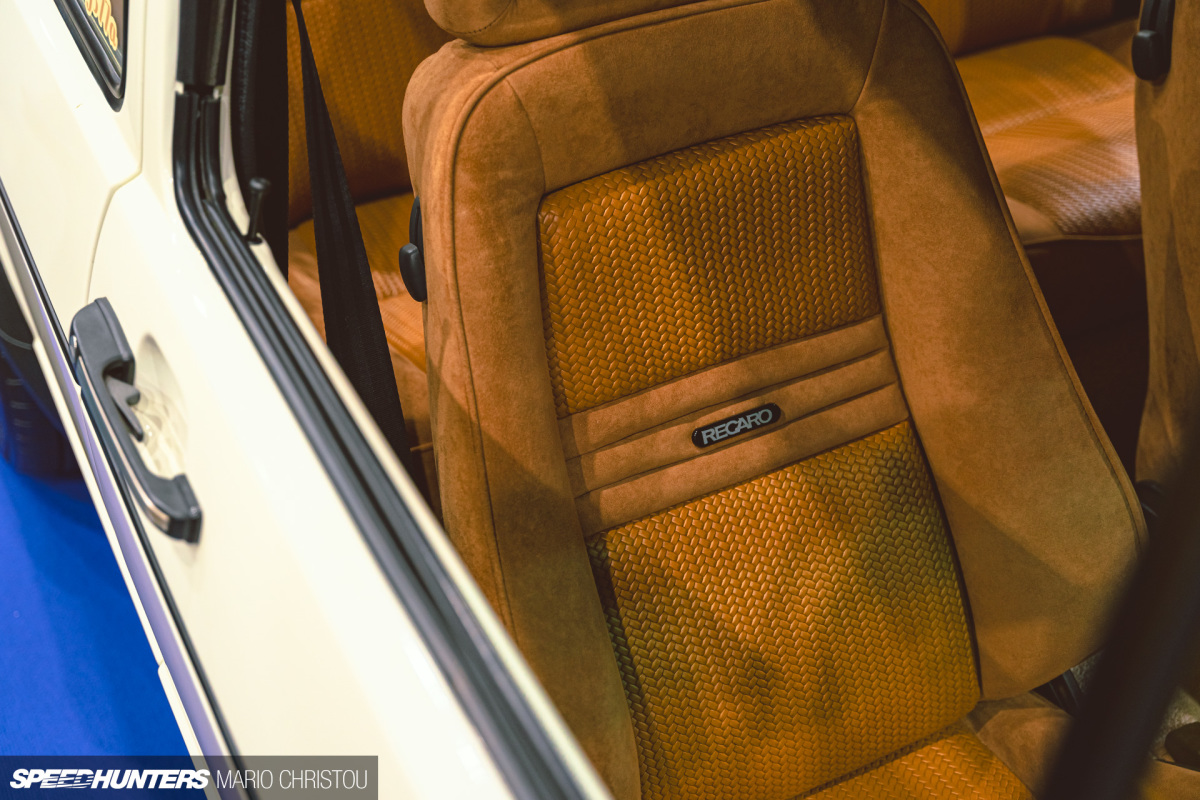
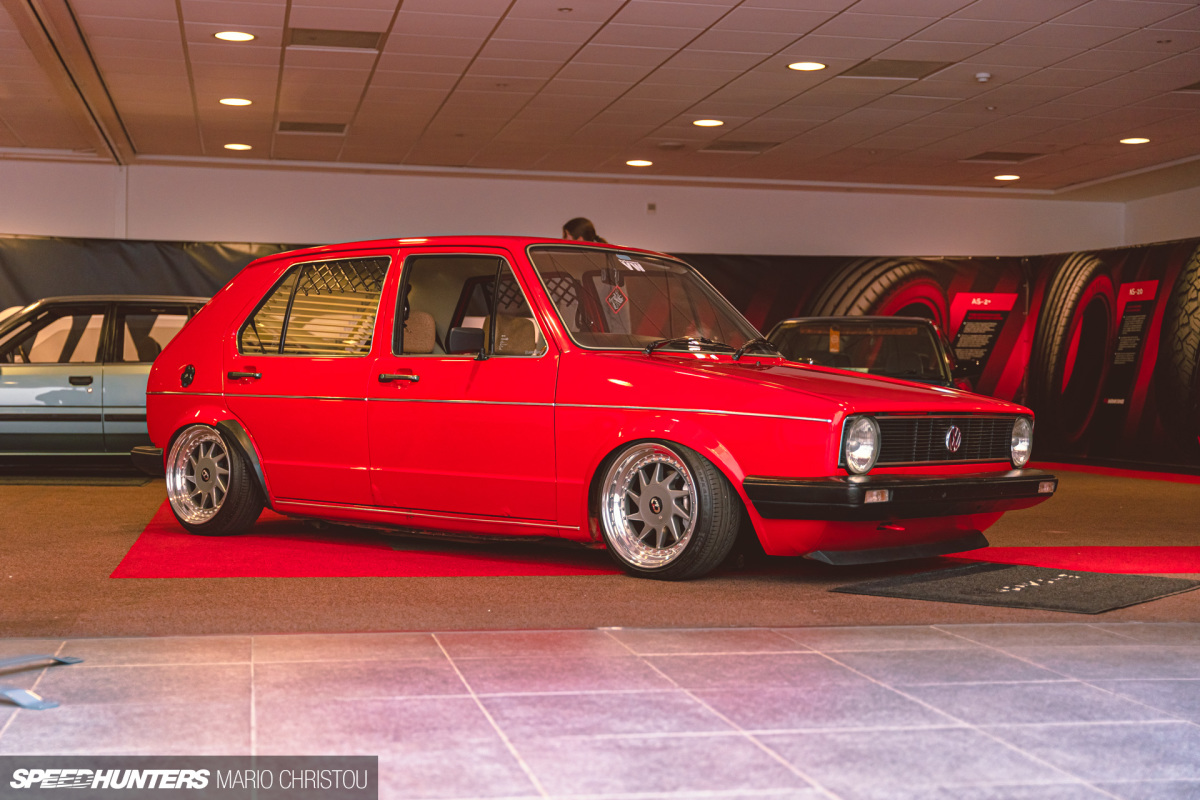
Ultimate Dubs is usually the go-to Volkswagen show of the Ultimate pair, but no matter where you go in the UK, you can’t escape VW culture. This three-door A1 Jetta stood out to me with its earth-toned colour scheme, immaculate supercharged engine bay, and interior treatment. Woven leather should be used more often – just look at those seat inners!
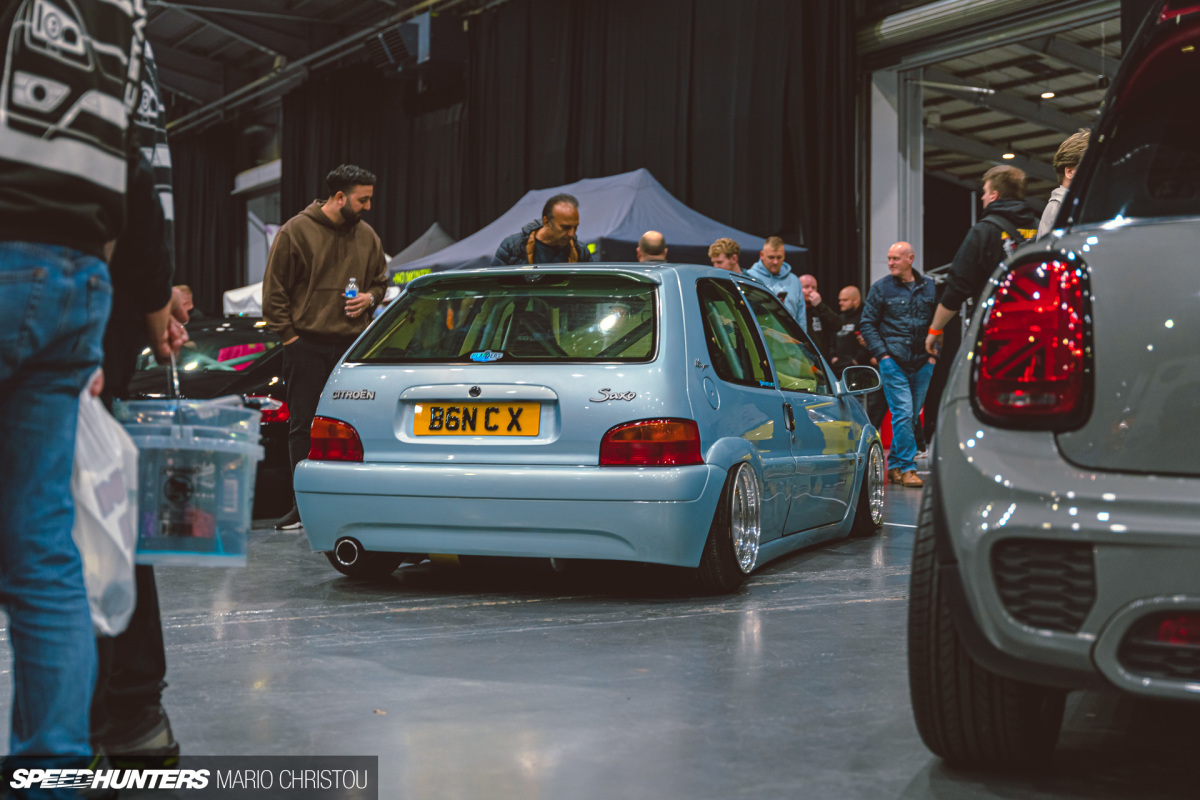
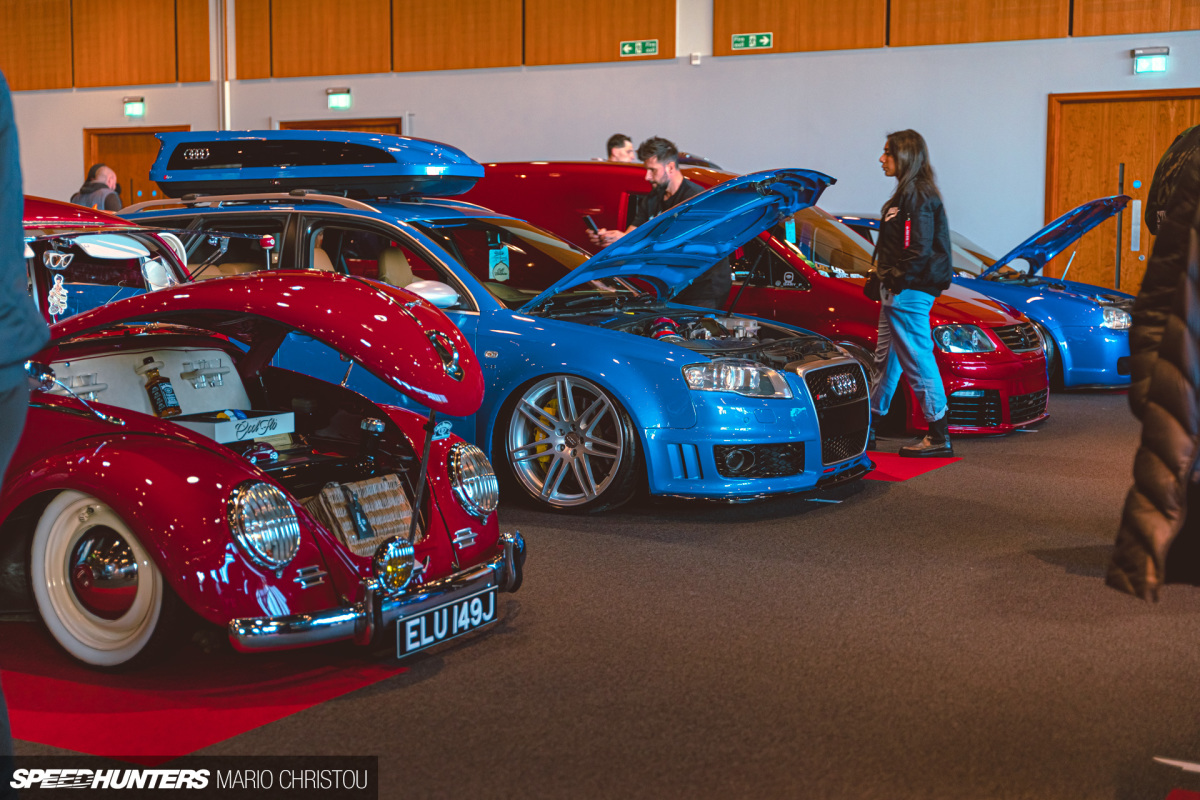
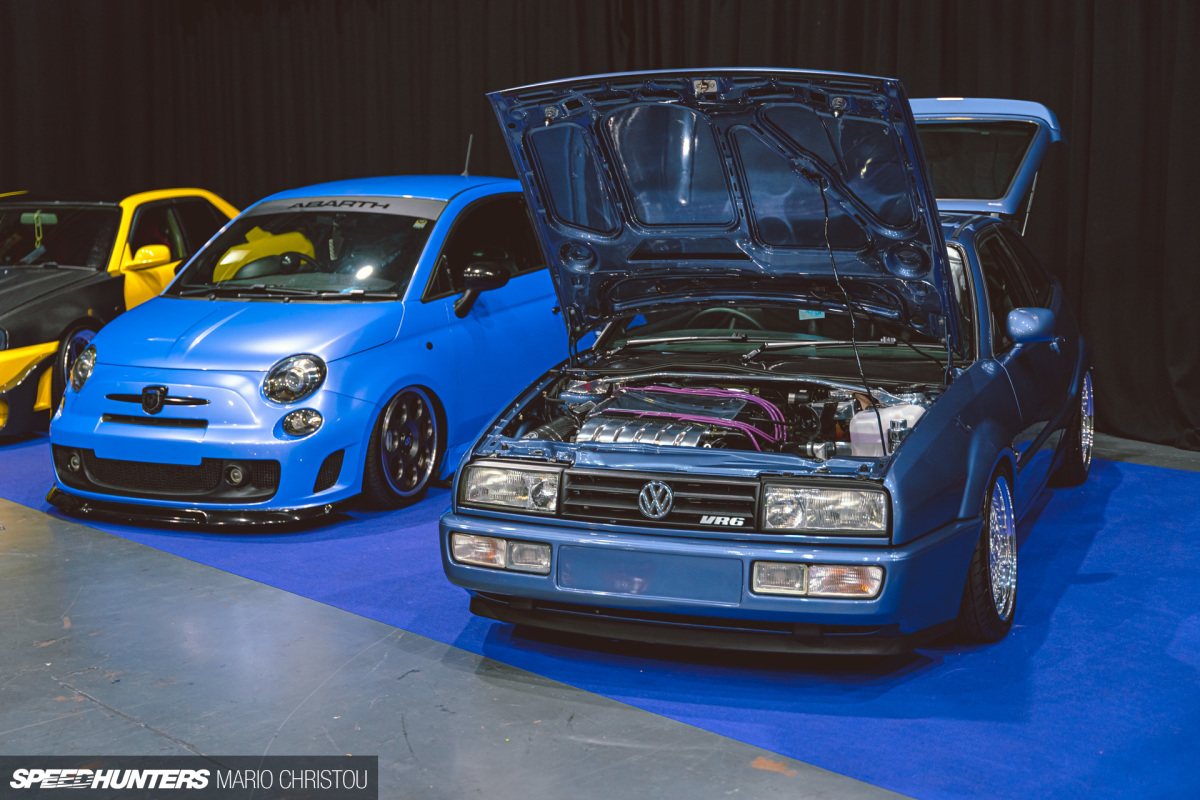
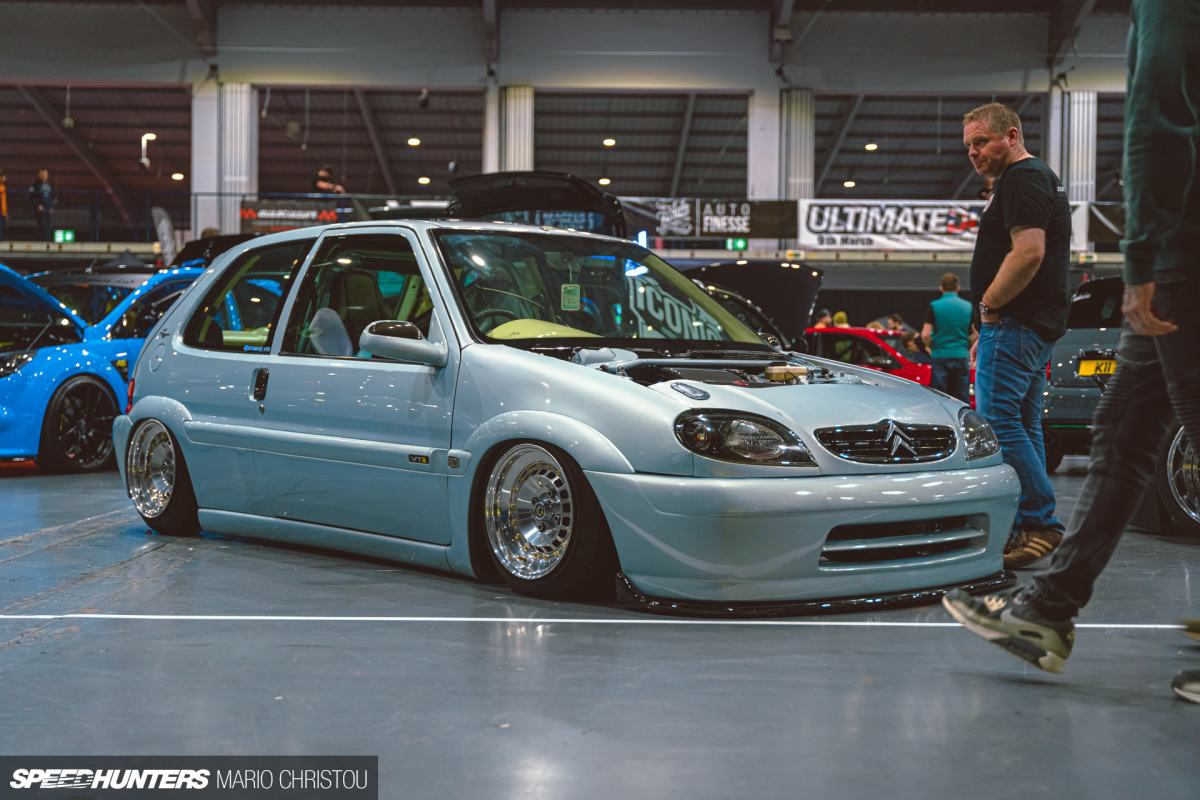
Vauxhall has always been Volkswagen’s direct competitor in the UK, so it was great to see this pair of ’90s street icons on display – a Cavalier and a Corsa GSi.
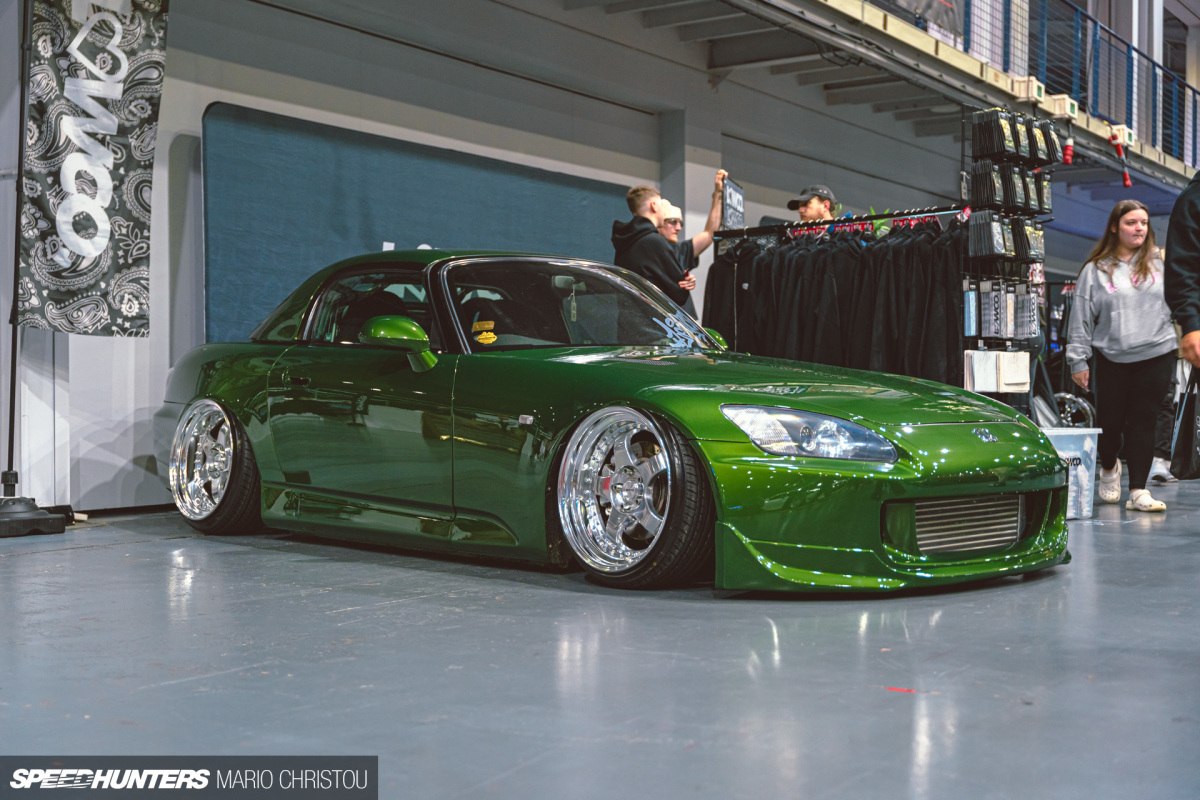
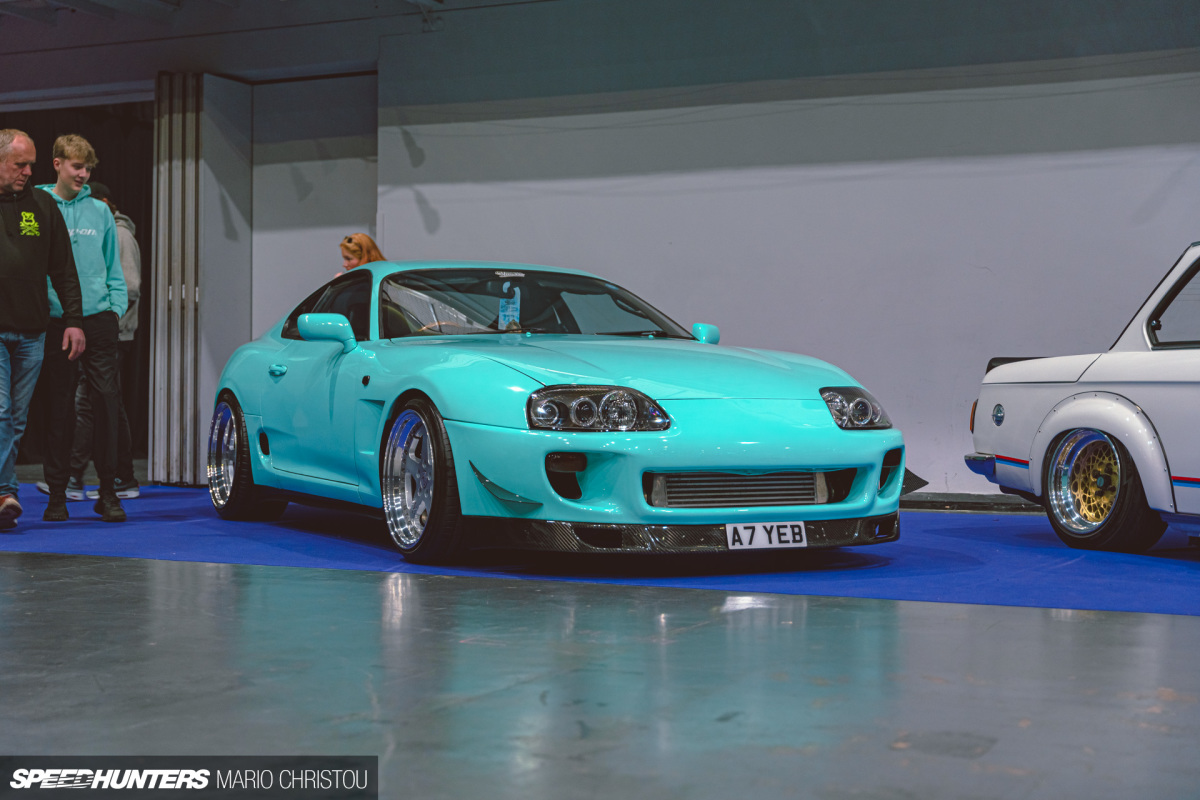
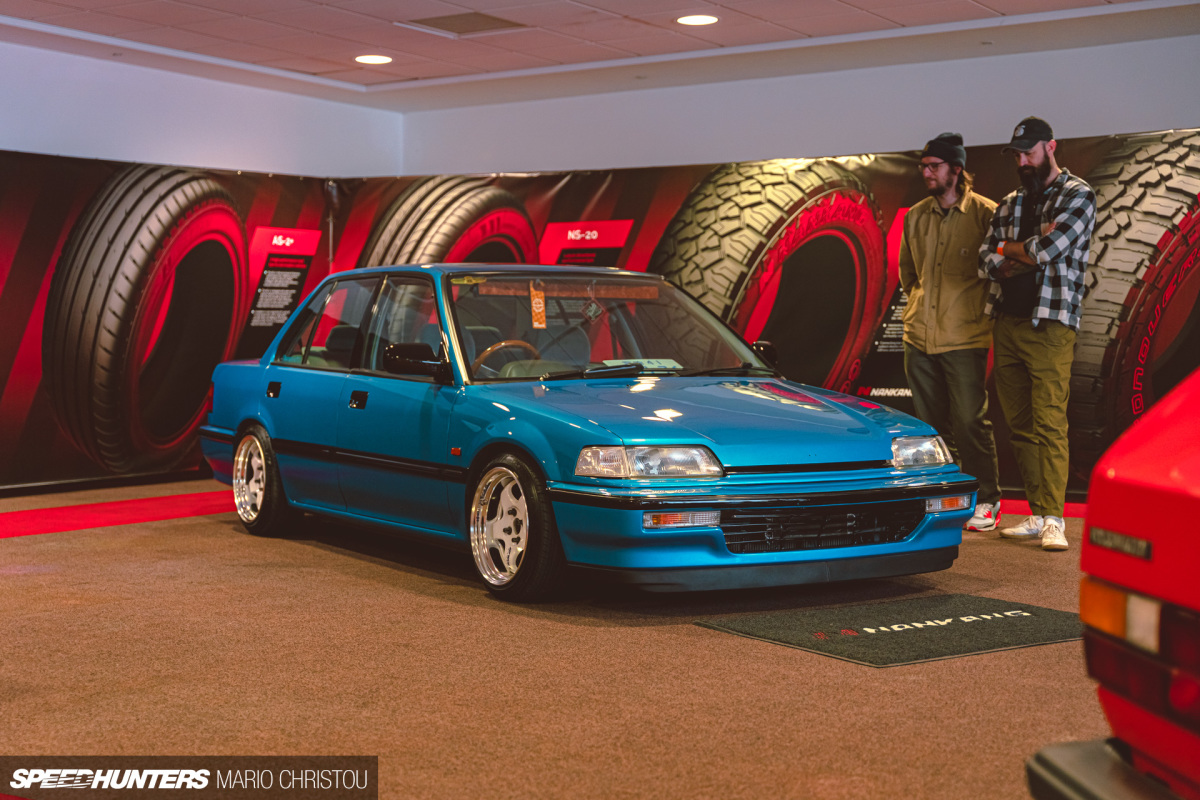
It felt like there were fewer Japanese builds this year, but this Honda S2000 and JZA80 Toyota Supra caught my attention with their vivid paint jobs and split-rim setups. The Honda was tucking a set of Work Meister S1s, while the Supra sported a more purposeful fitment.
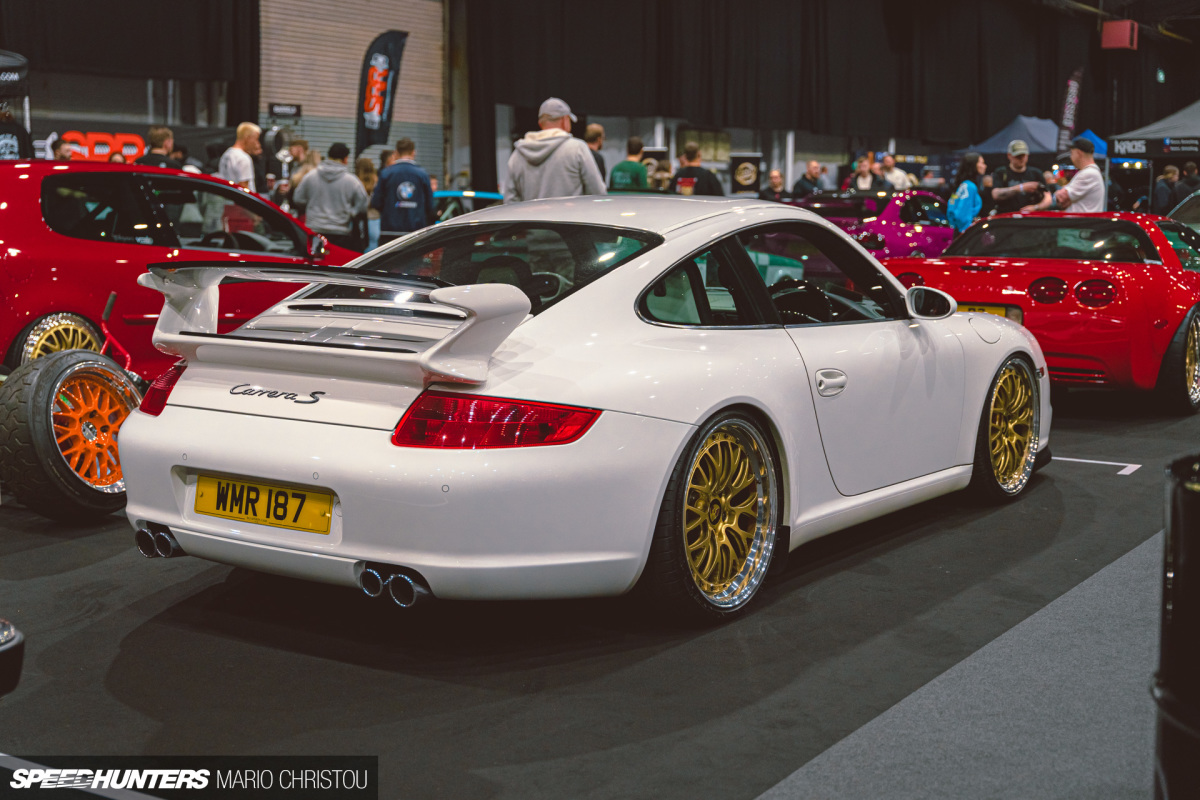
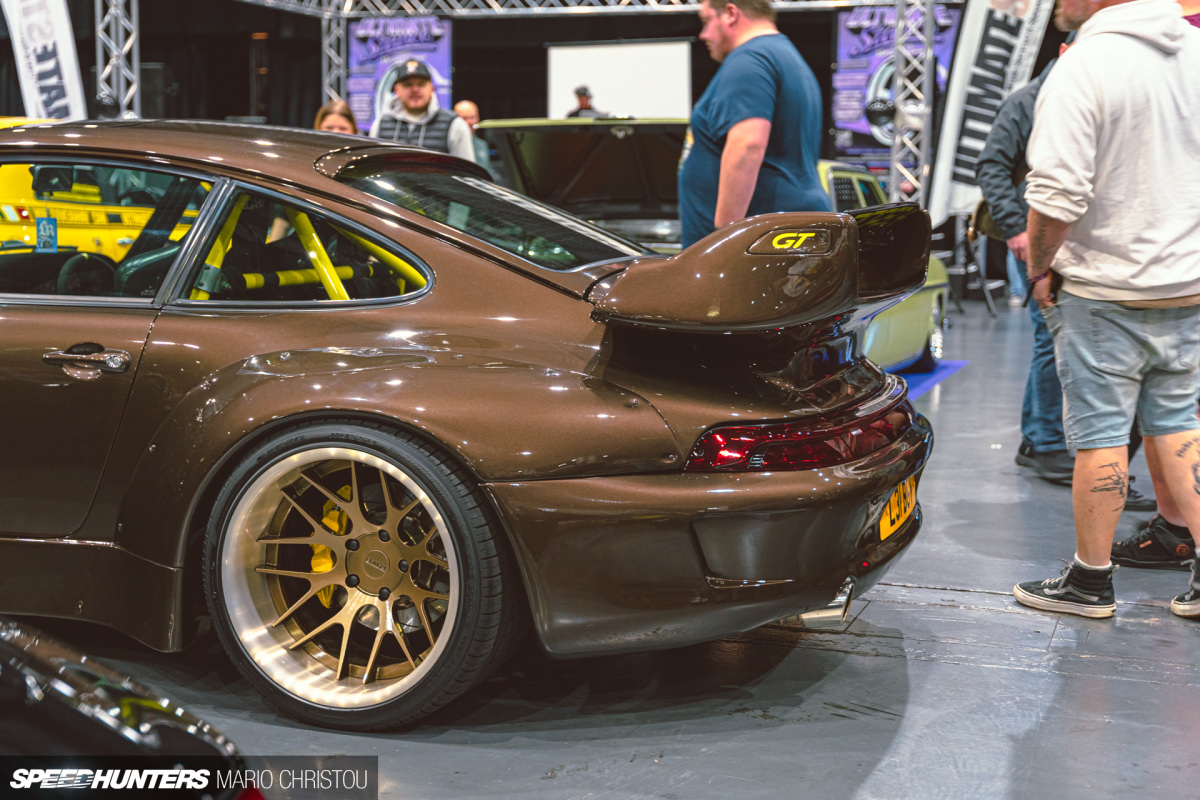
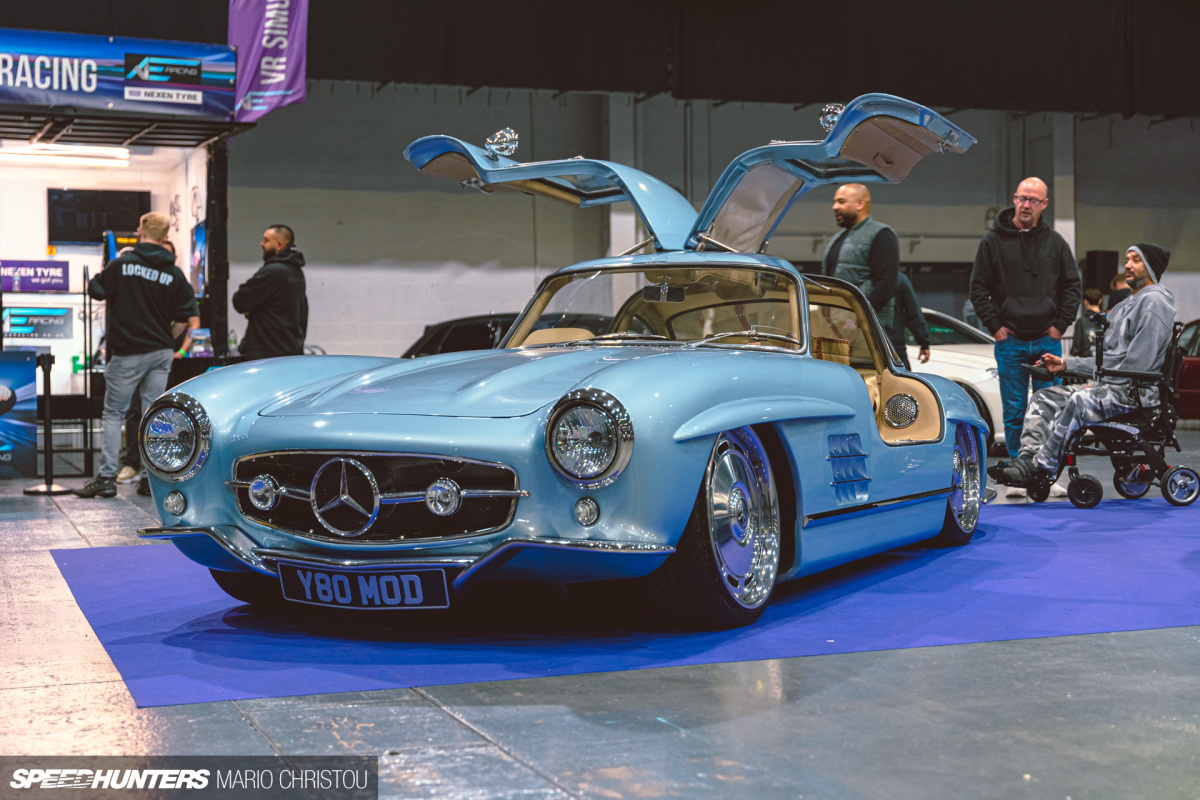
Lately, I’ve noticed more people stepping out of VWs and into BMWs, Mercedes-Benzes, and Porsches here in the UK – not just Audis, as you might expect. This means these marques are getting modified more frequently, and I’m not complaining about it.
With prices rising or plateauing fairly high, owning a retro German car has become increasingly out of reach for many enthusiasts. It’s a massive shame, but it’s also meant that the quality of builds and parts going into these cars is high.
There’s also a shift in the ‘snobbery’ that used to go on at shows, largely due to iconic and desirable aftermarket parts becoming harder to find every year. Where once anything less than BBS was looked down upon, now more cars are sporting custom designs from smaller, up-and-coming wheel brands.
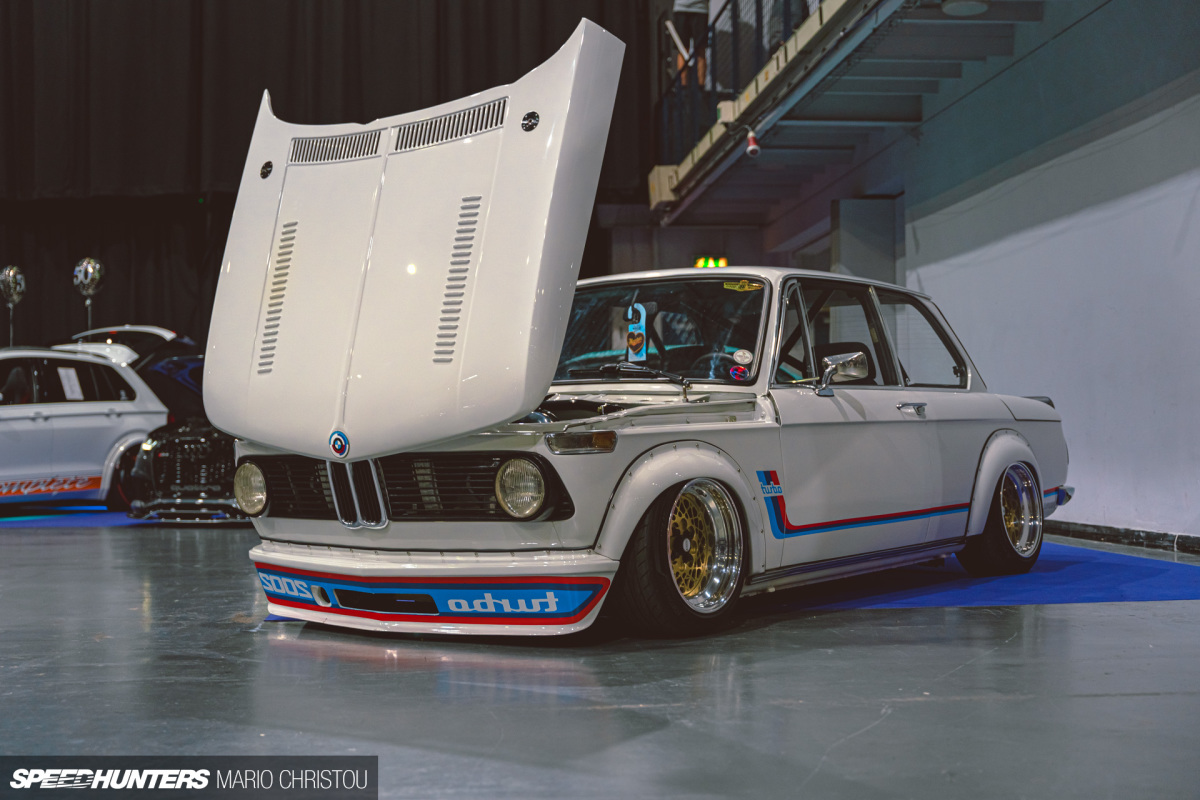
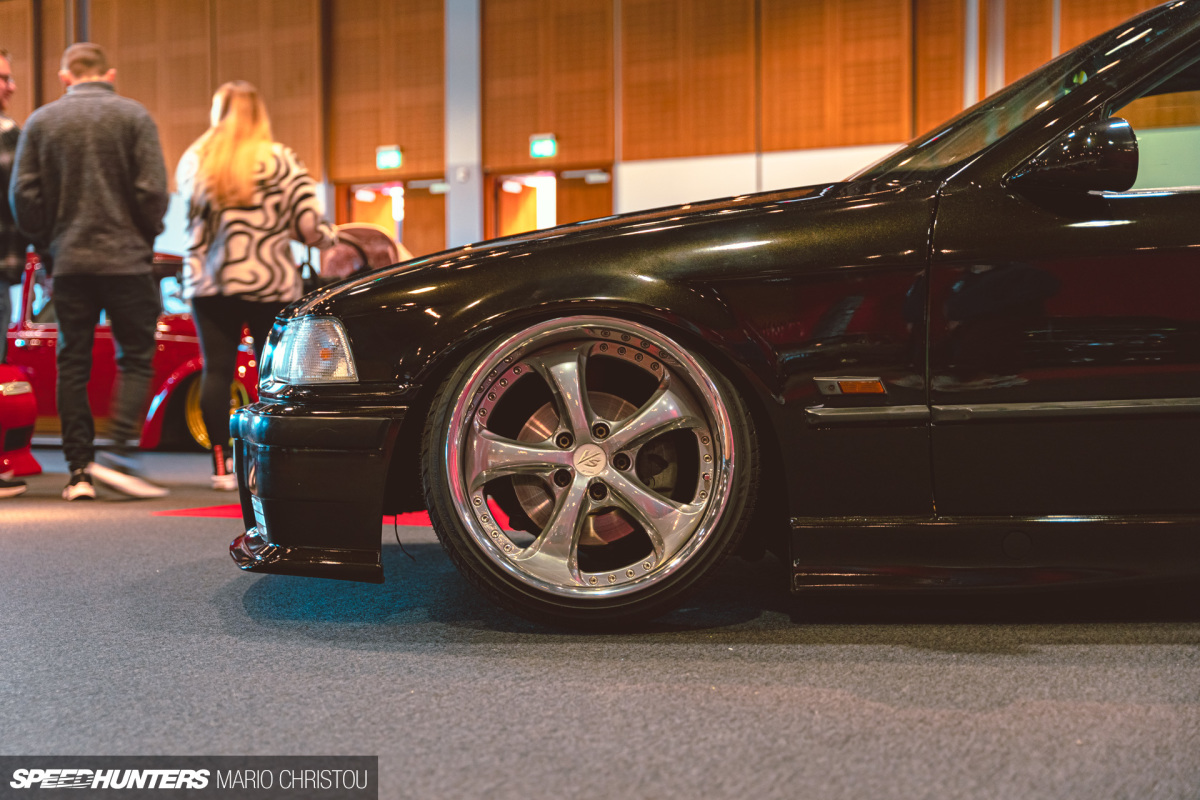
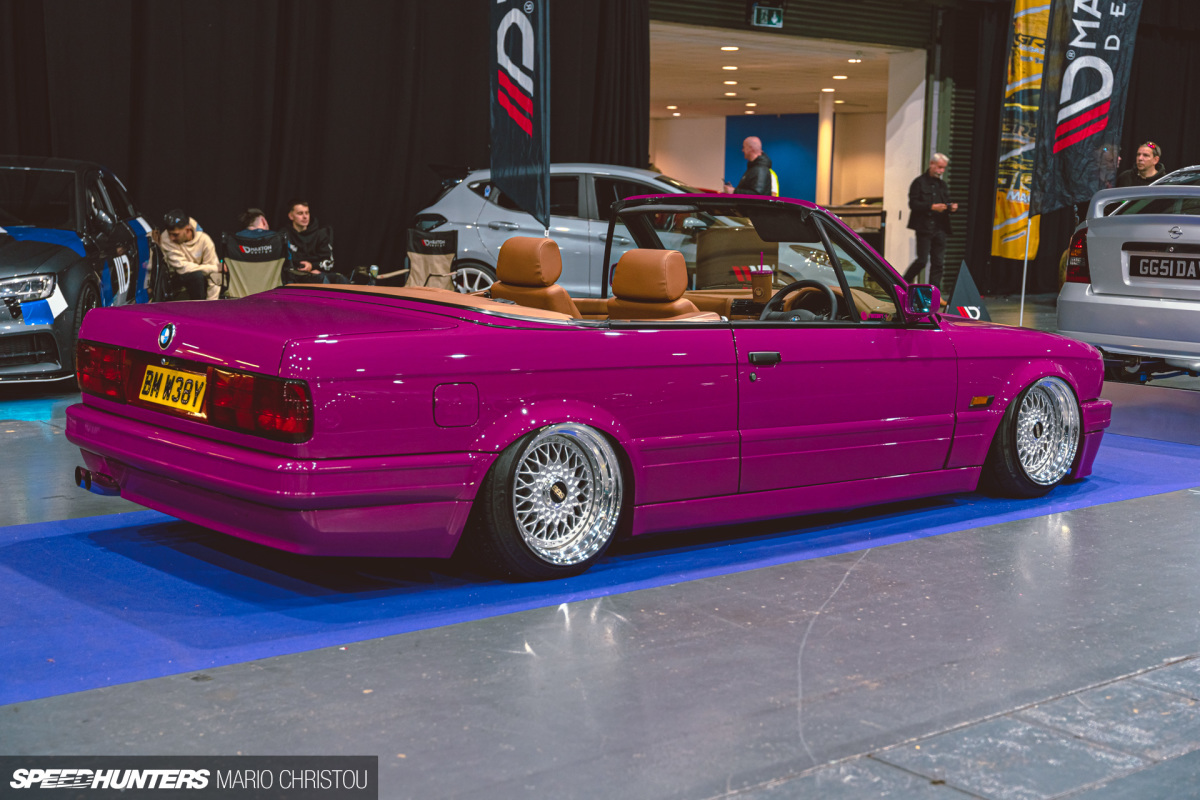
It’s refreshing to see, but to me, it’s still hard to beat a BMW on a classic set of splits!
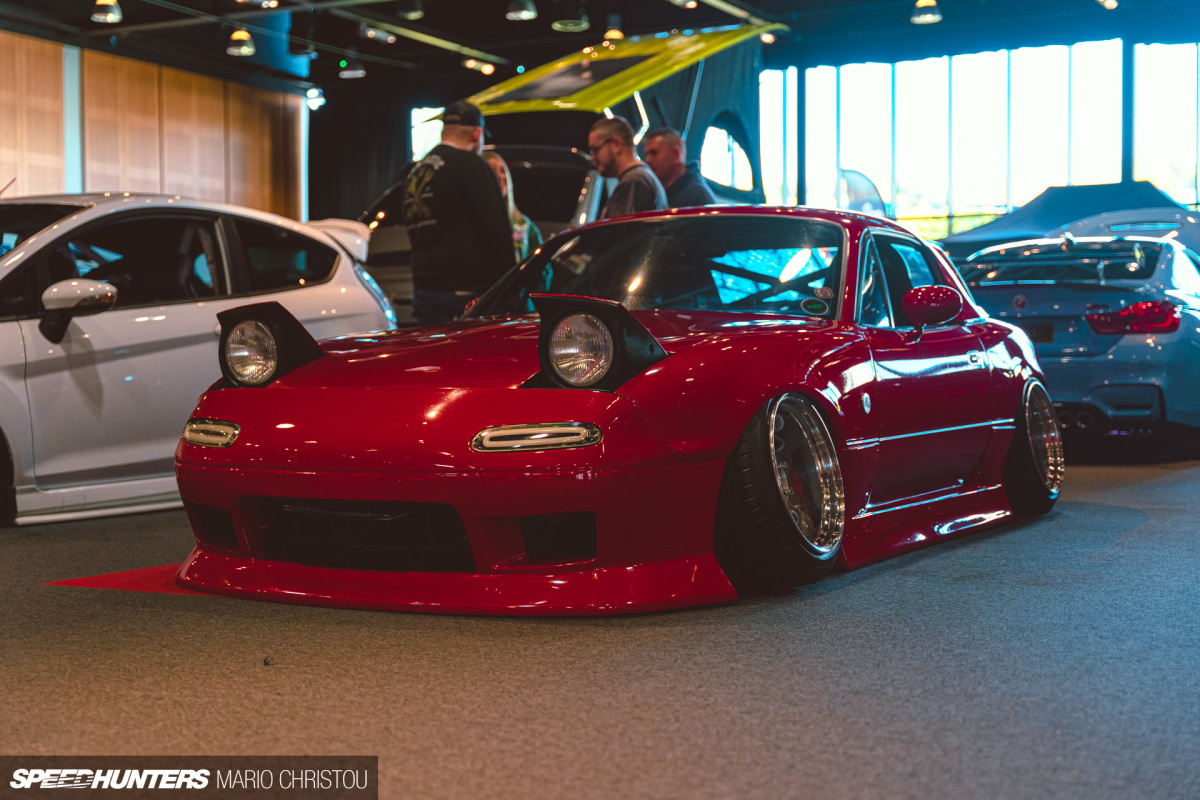
The ‘Red Room’ was home to a wide variety of cars, with more performance-oriented builds alongside the heavily cambered show cars – something we don’t often see at British stance-specific shows these days.
Despite everything great about Ultimate Stance this year, I came away from the show feeling a little disheartened. It wasn’t because of the event itself but because it feels like the UK’s modified car scene is in a bit of a lull right now.
These days, I spend as much (if not more) time away from this side of car culture – not because I’m trying to escape, but because that’s where my career is taking me. I’m an equal-opportunity enthusiast. I love race and classic cars just as much as stance cars.
But every time I return to the UK show circuit – except for the truly unique events like Players Classic or RollHard – I can’t help but feel that the high level of enthusiasm isn’t there anymore. Maybe I’m just getting older, or perhaps fewer teens are getting into modified cars these days.
It’s a silly hobby, but reading magazines like Fast Car, Performance VW, and Banzai meant so much to me when I was younger. Forums like Stanceworks and Edition38 were my go-to. For me, Instagram doesn’t inspire the same feelings – it’s fast-paced and often cold, focused more on making an impact than on fostering real passion.
So, Ultimate Stance 2024 was a bittersweet event for me, through no fault of its own. I can’t help but wonder where the UK car scene is heading and what the next few years will bring.
Mario Christou Instagram: mcwpn, mariochristou.world mariochristou.world
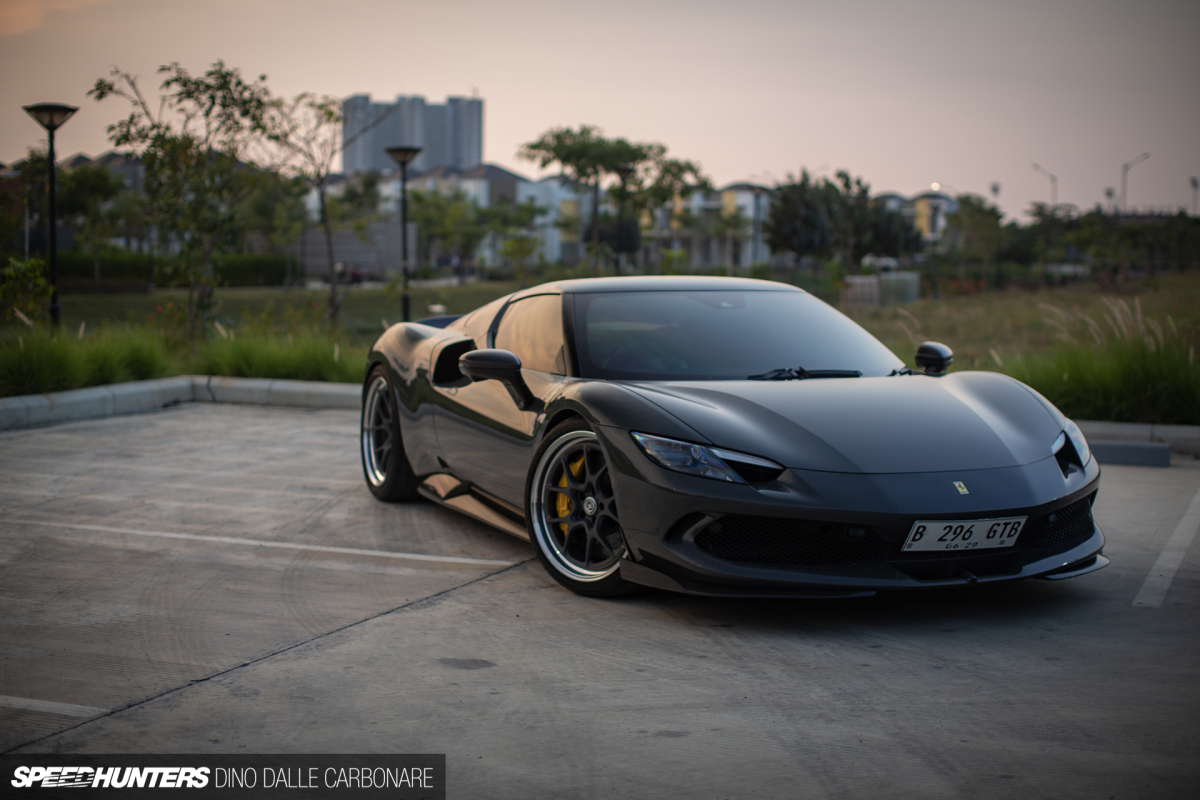
Ever since the Ferrari 296 GTB was first revealed in 2021, I’ve been a big fan.
I remember the initial negativity against the idea of a twin-turbo V6, but to me, it felt like a perfect fit for the more entry-level vibe of the car. Plus, it links back to the Dino and the V6 engine powering that baby Ferrari that wasn’t even badged as one. The Dino was criticized when new, too, but it’s now a true collectable that has appreciated tremendously over the years.
Oh, and let’s not forget the 296 GTB is a hybrid. A Ferrari hybrid? I know some purists still shudder at the idea, but the way Ferrari has integrated the hybrid system is the only way I think it makes sense for a high-end sports car.
But this post isn’t an opinion piece on the GTB; I’ll save that for my upcoming post on living with one for a week.
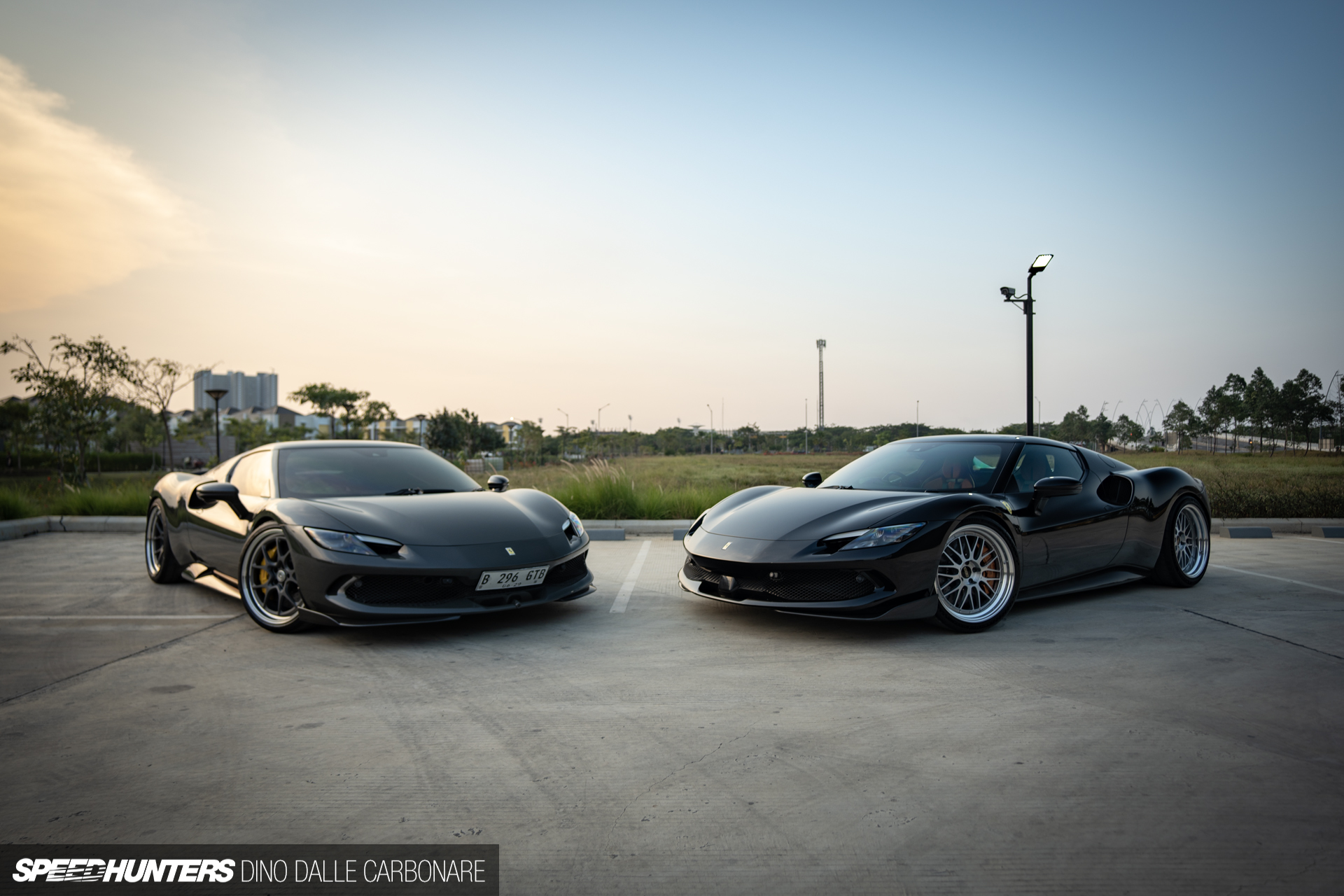
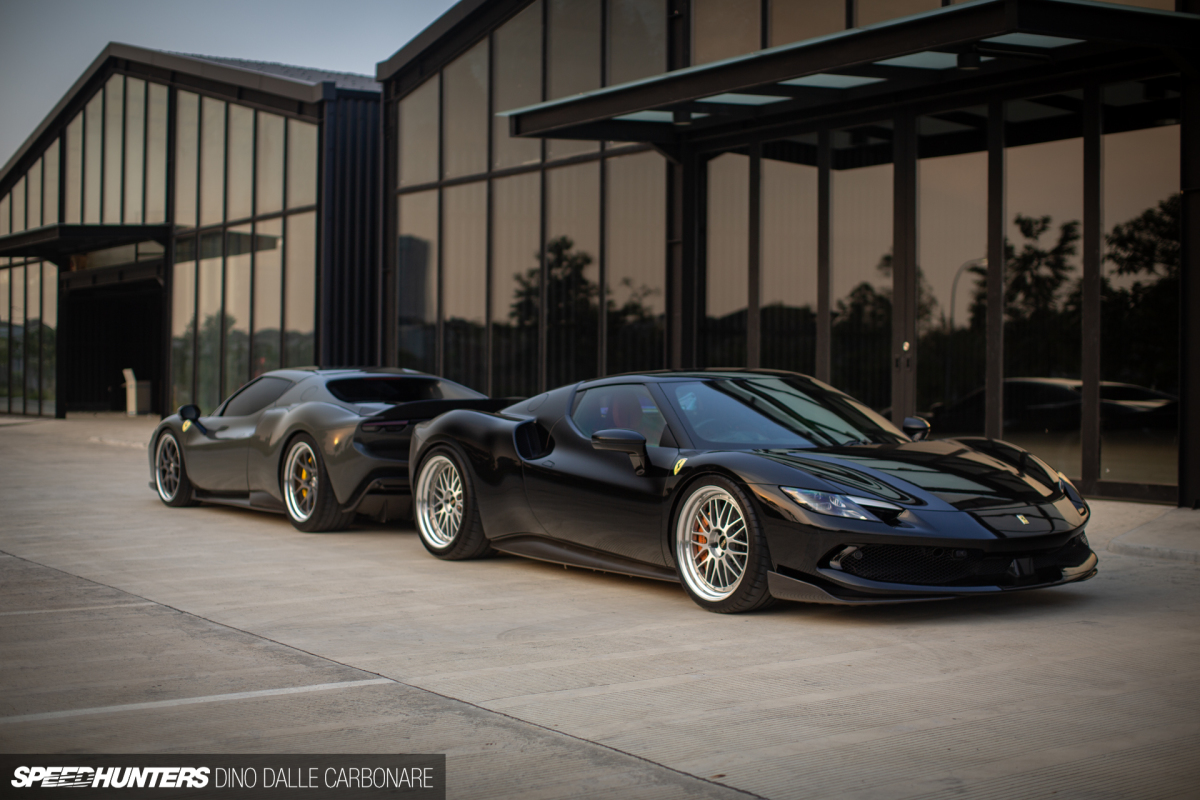
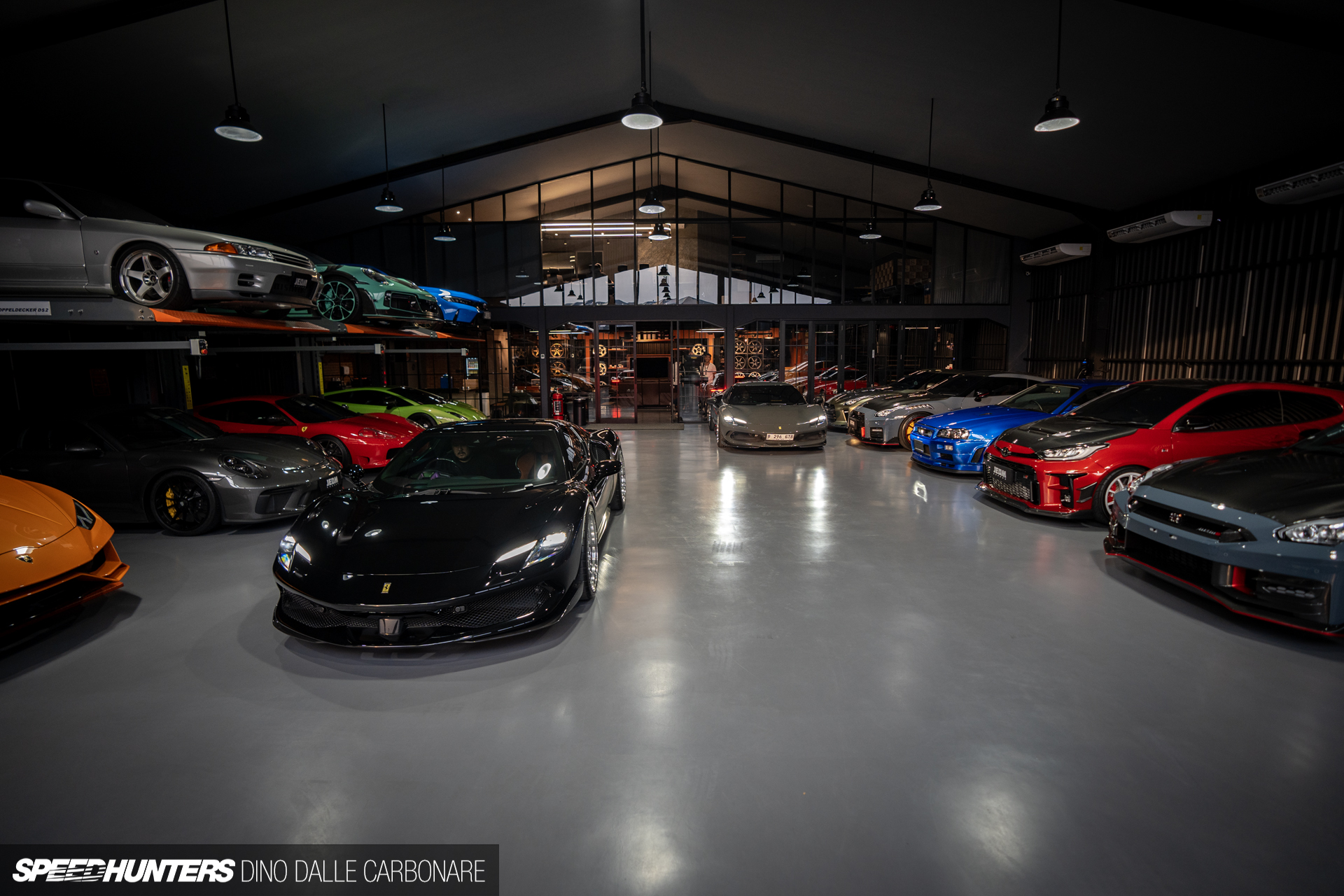
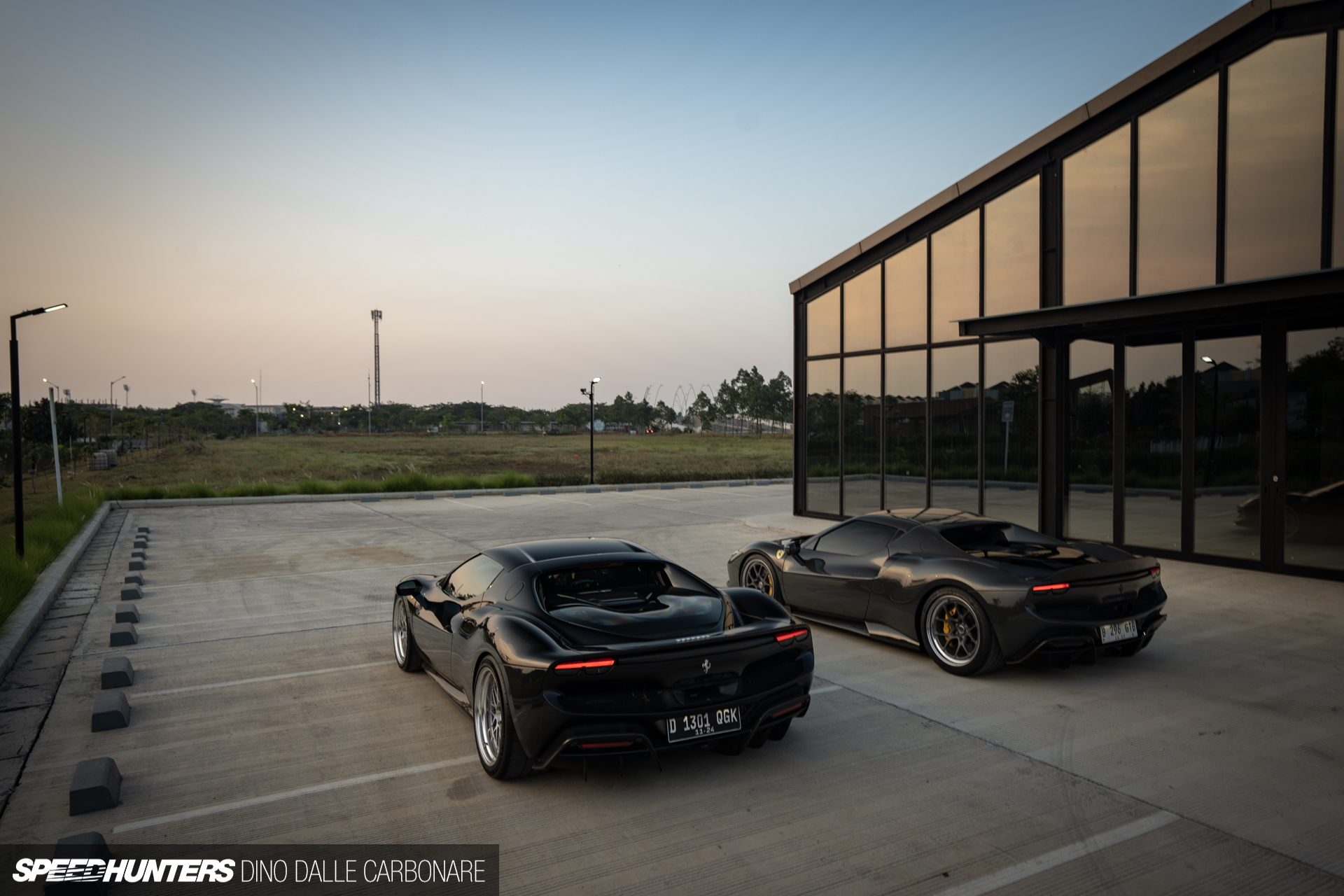
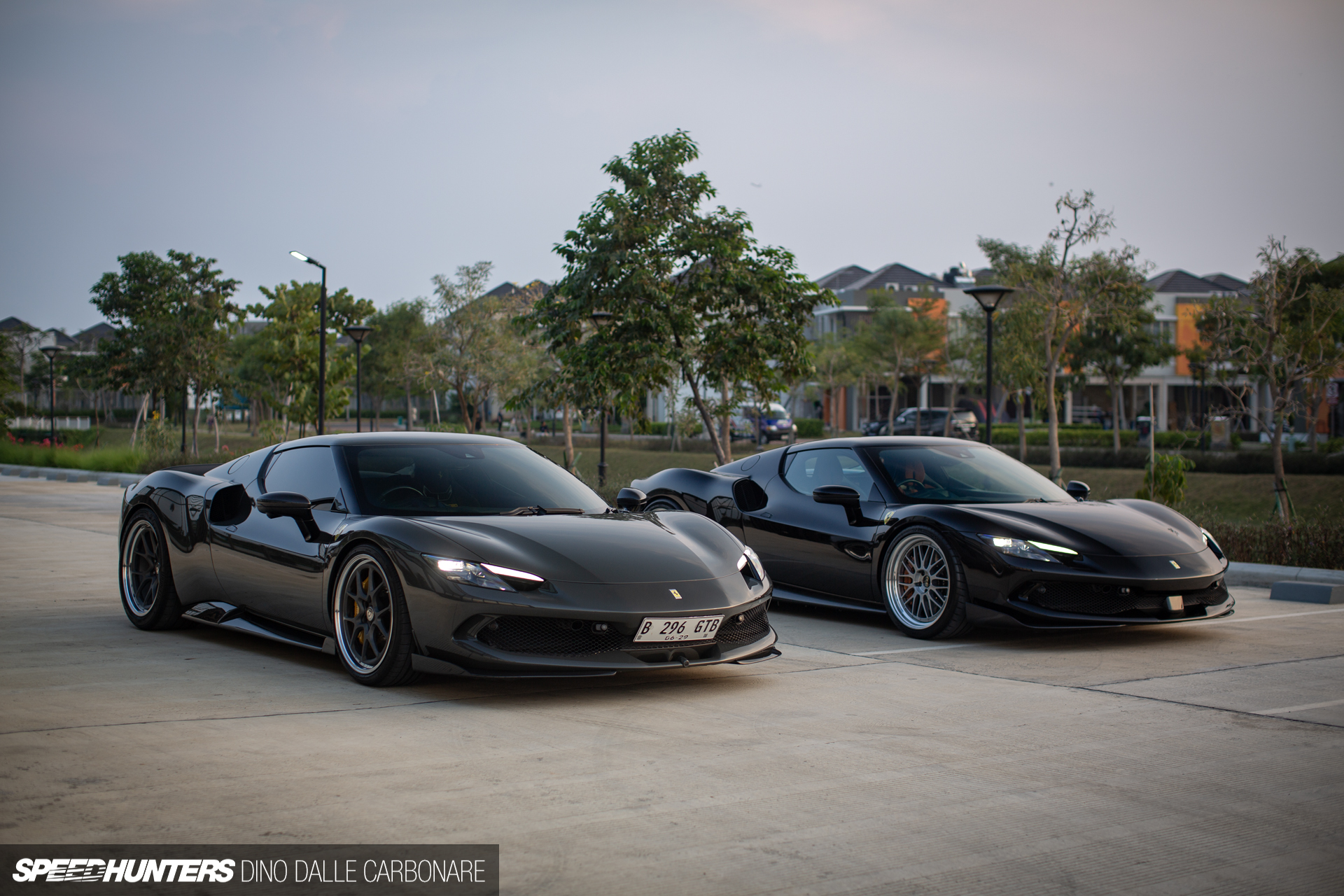
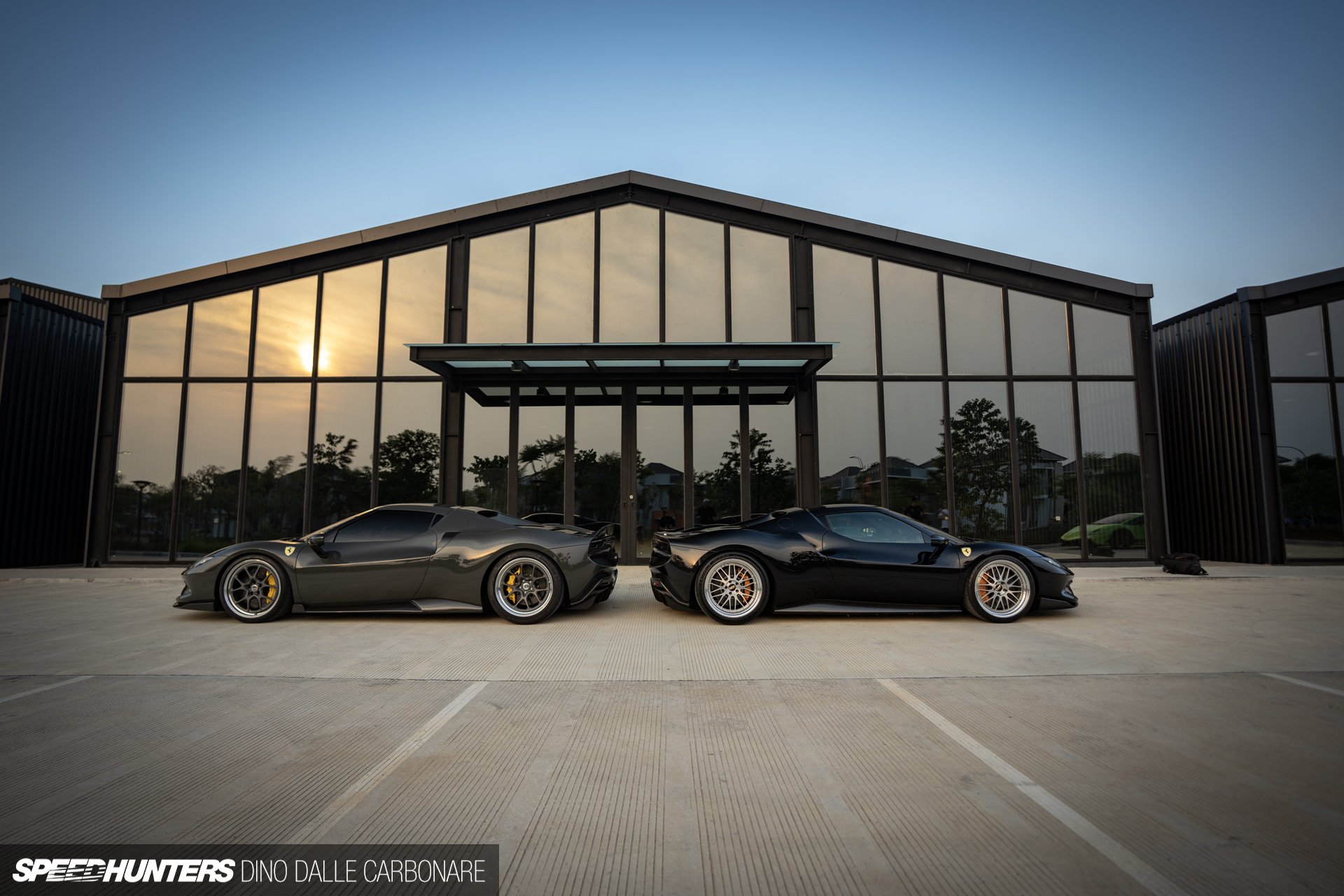
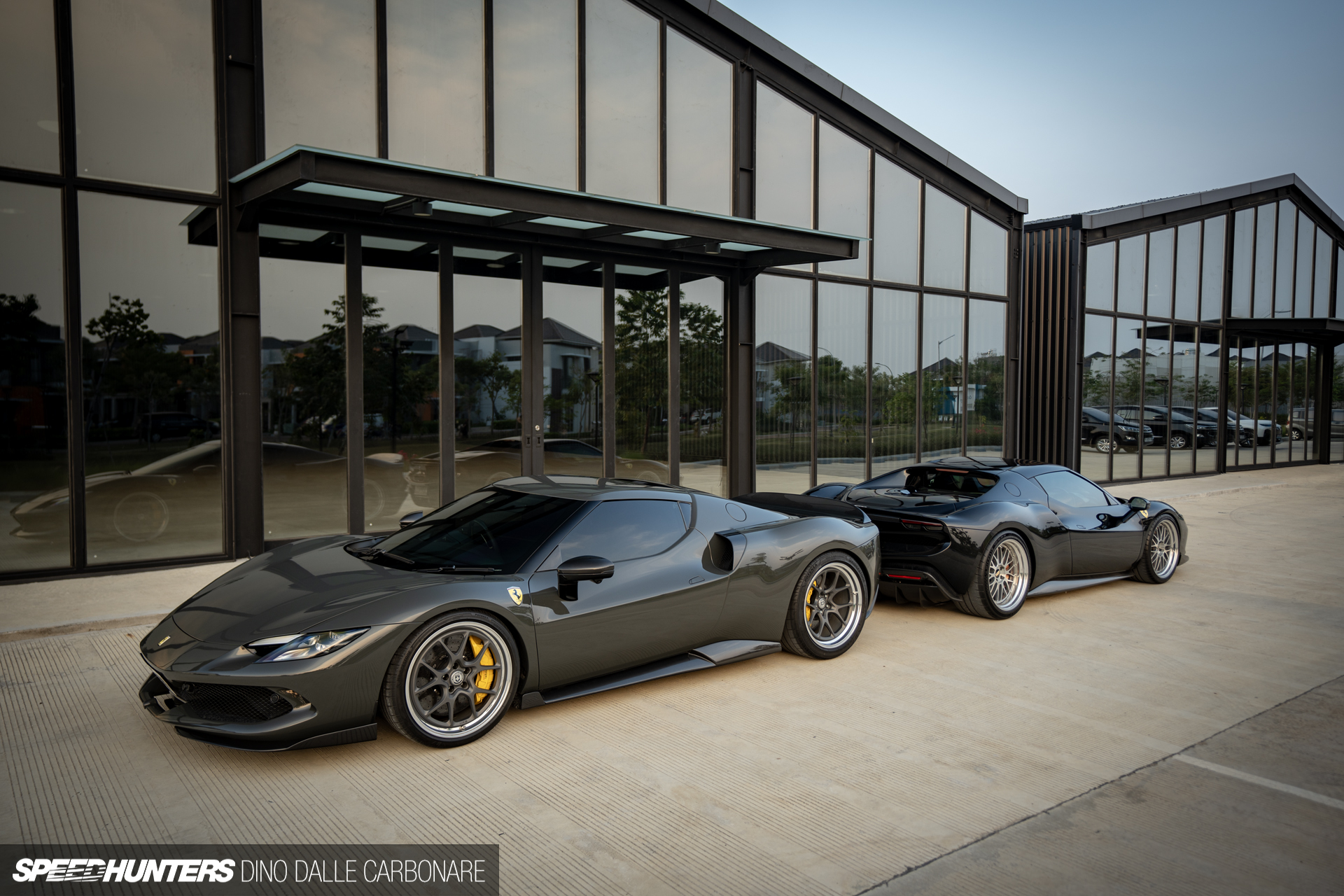
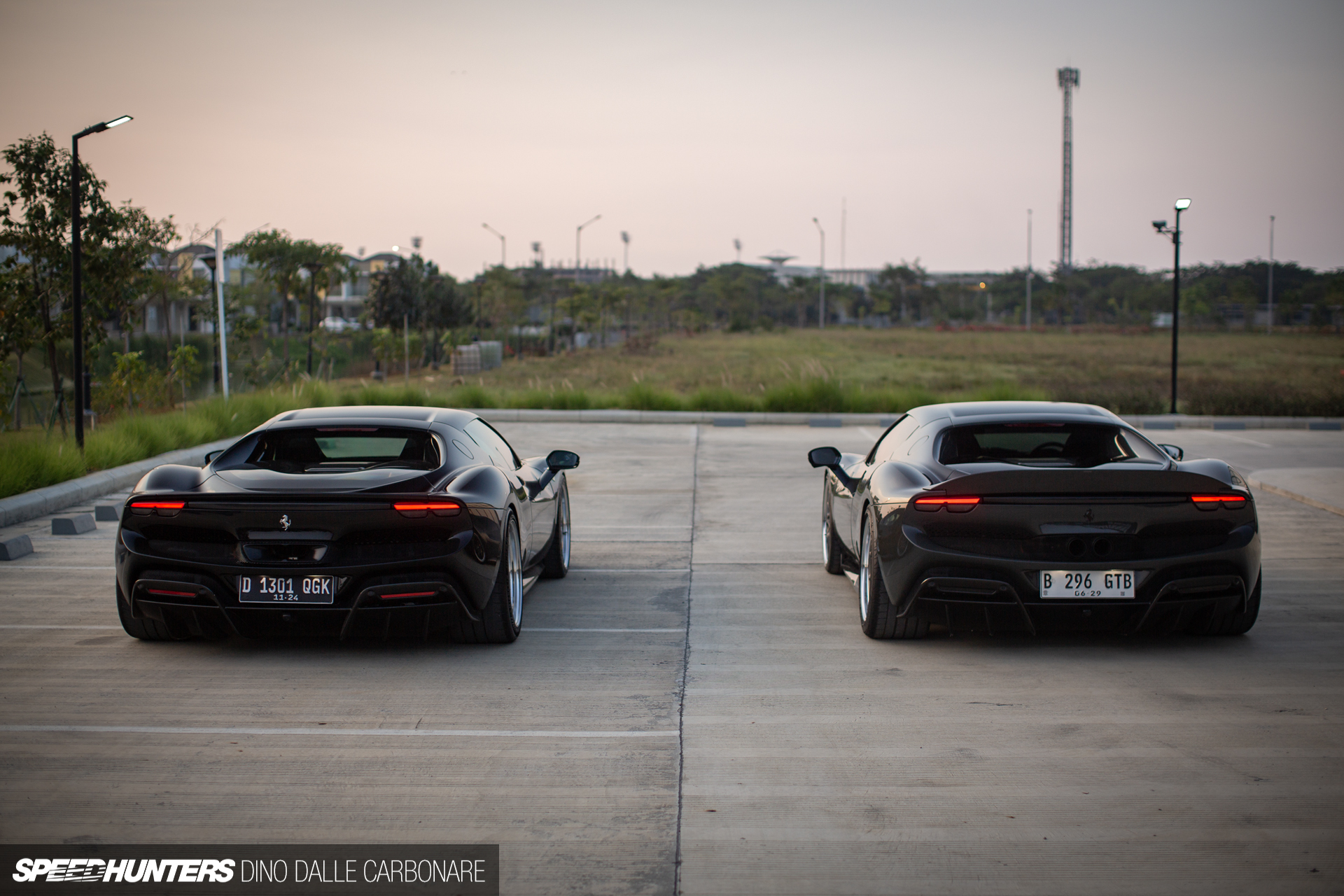
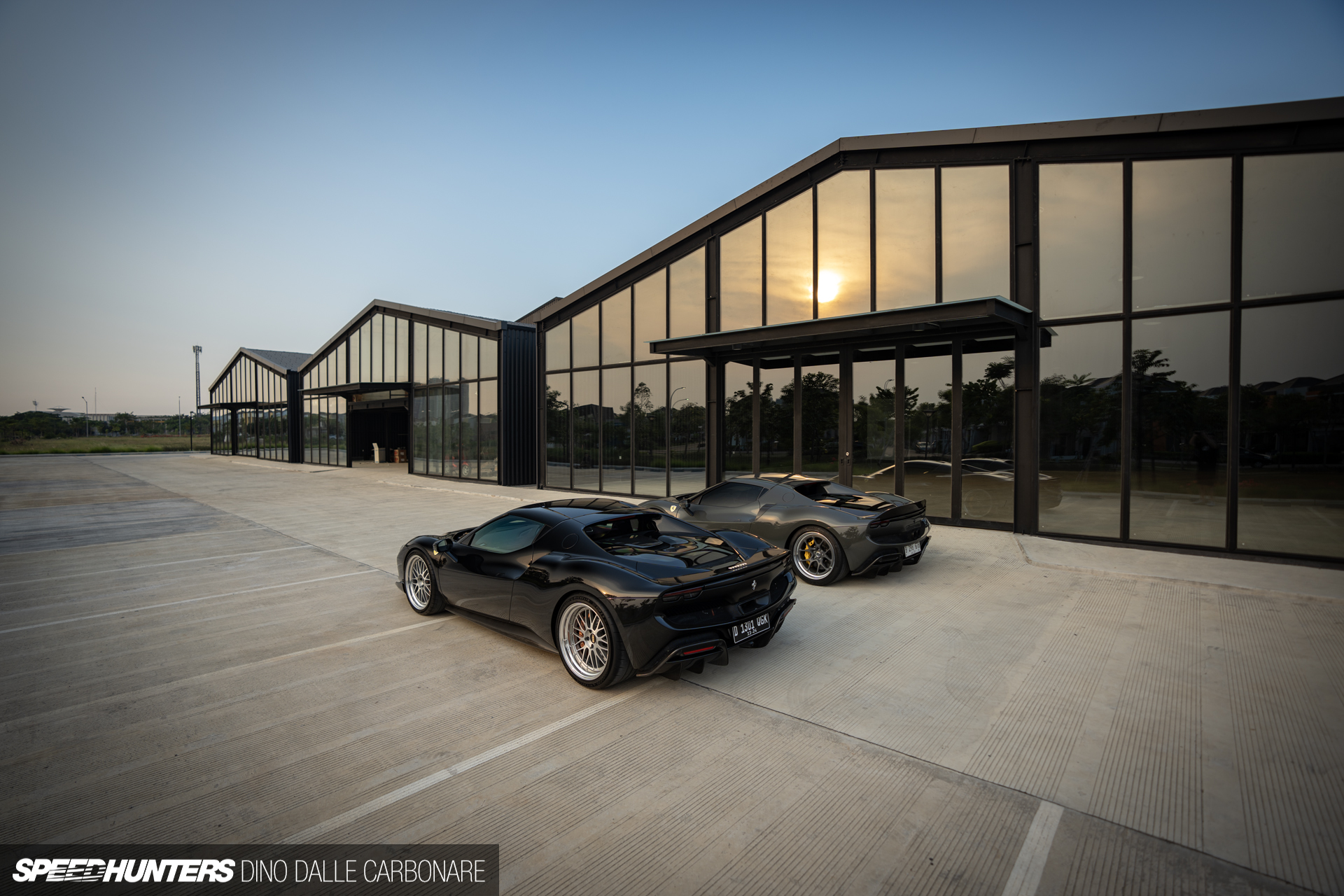
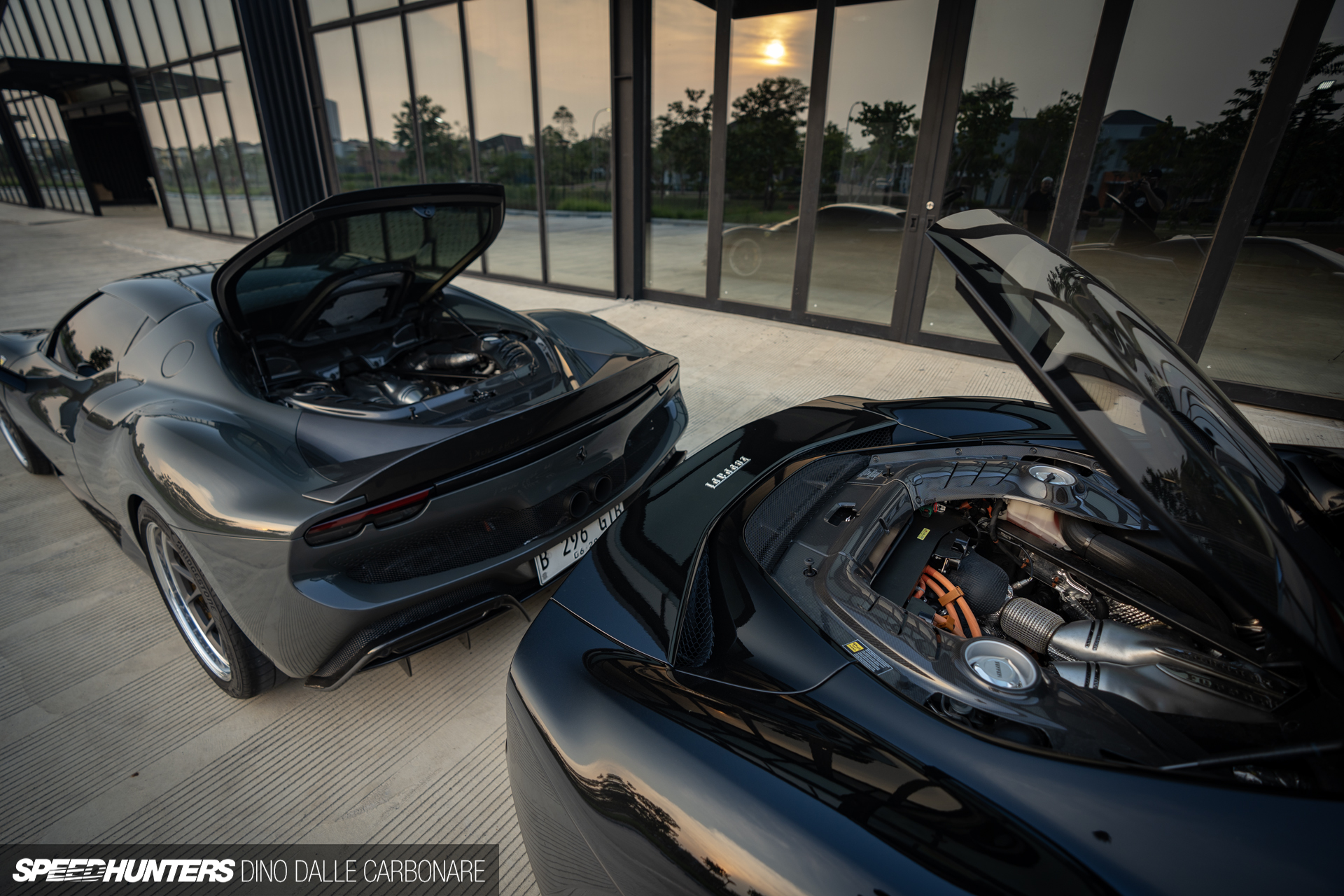
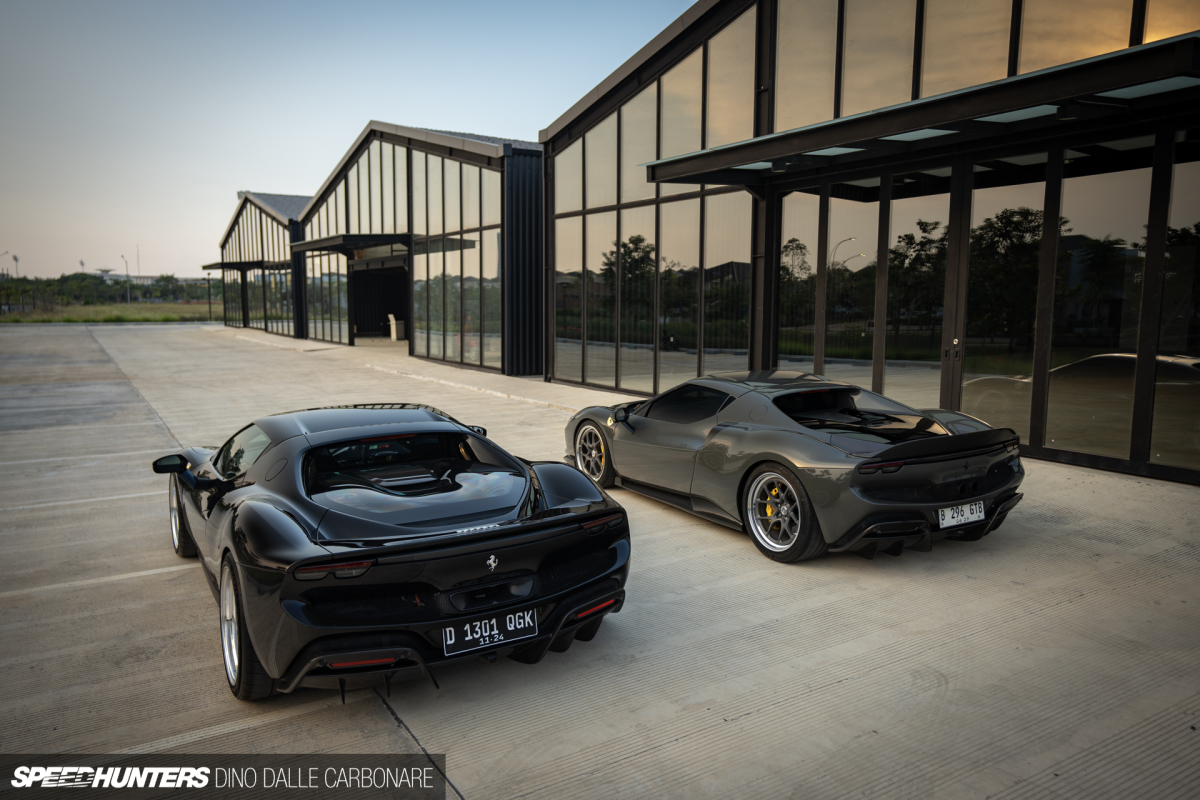
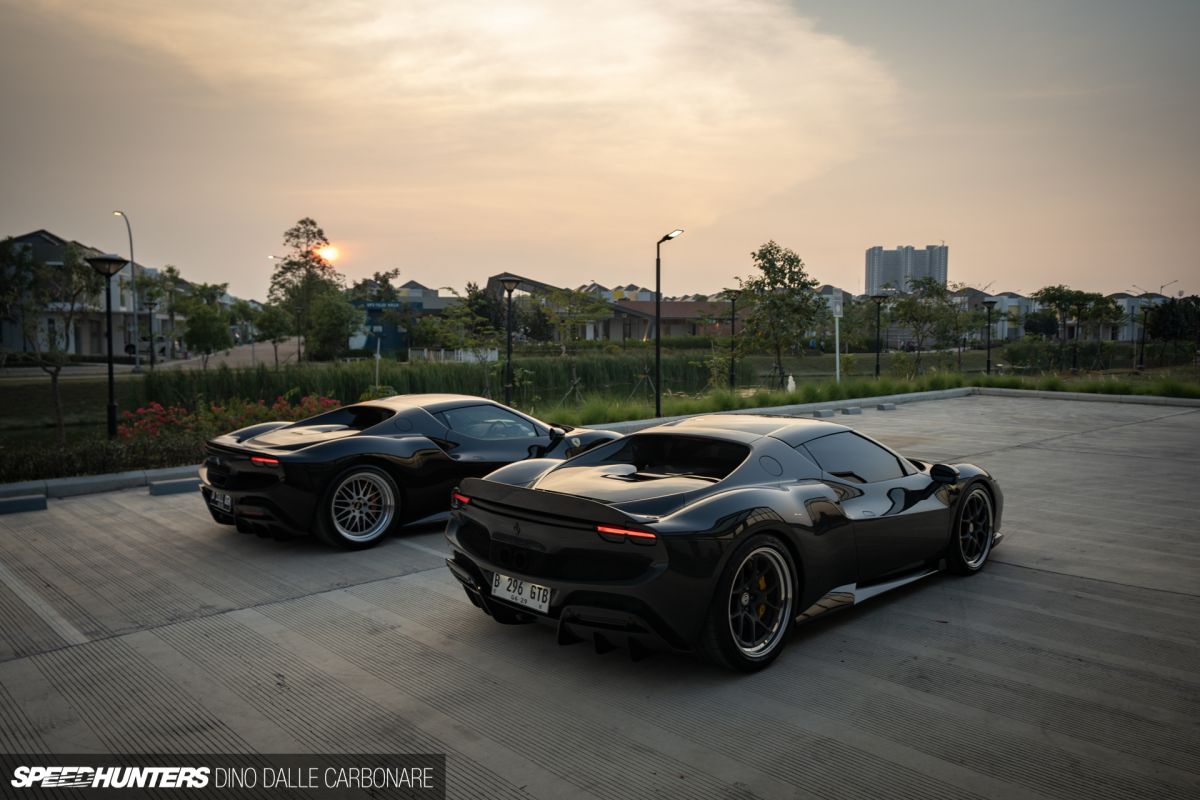
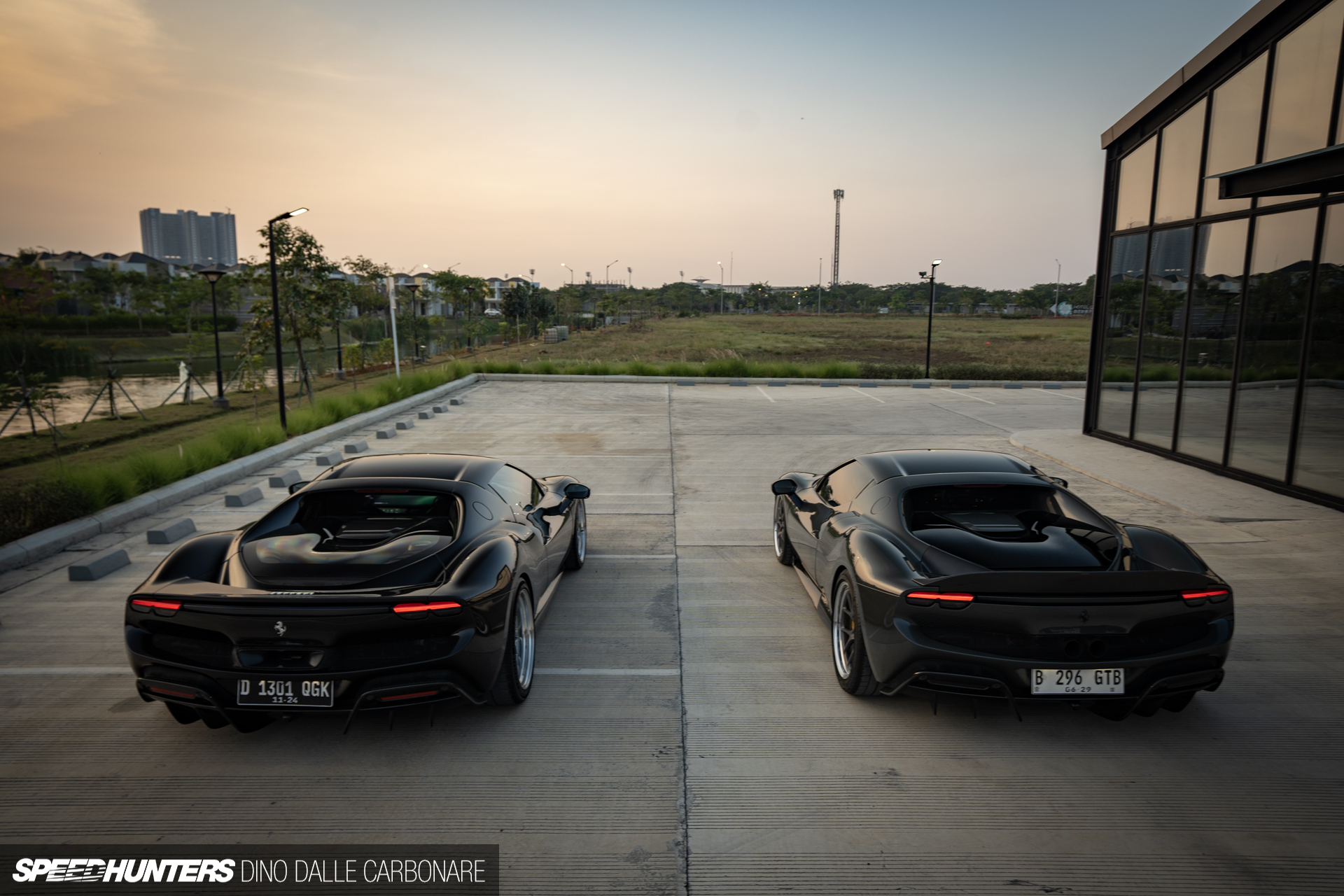
Instead, today, I want to explore how two different Indonesian 296 GTB owners have put their spin on the same Ferrari model. One car is owned by Mr. Jedm, the man behind JEDM Garage in Jakarta, and the other belongs to his friend.
Both owners share a history of tuning legendary Japanese machines like GT-Rs, Supras, and NSXs – and now, they’ve turned the modifying bug to Italian exotica with little regard for what Ferrari might think!
Let’s take a look at how they’ve done it…
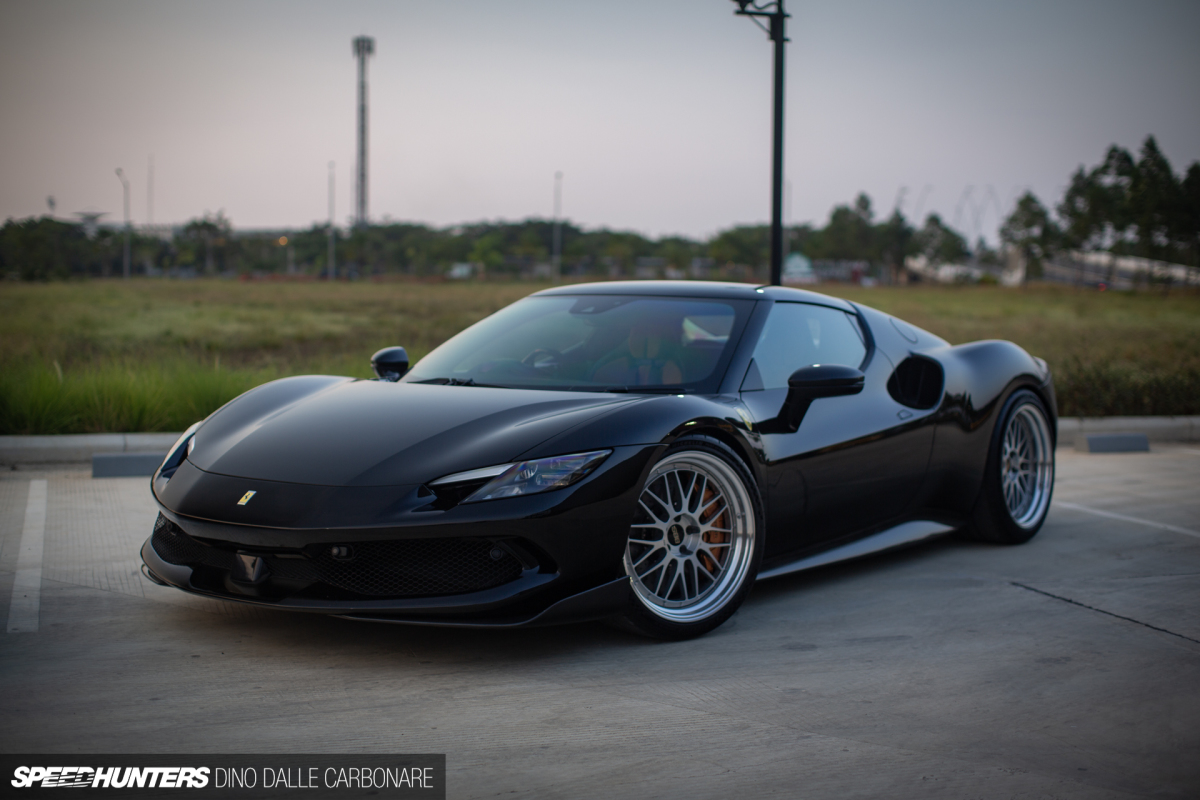
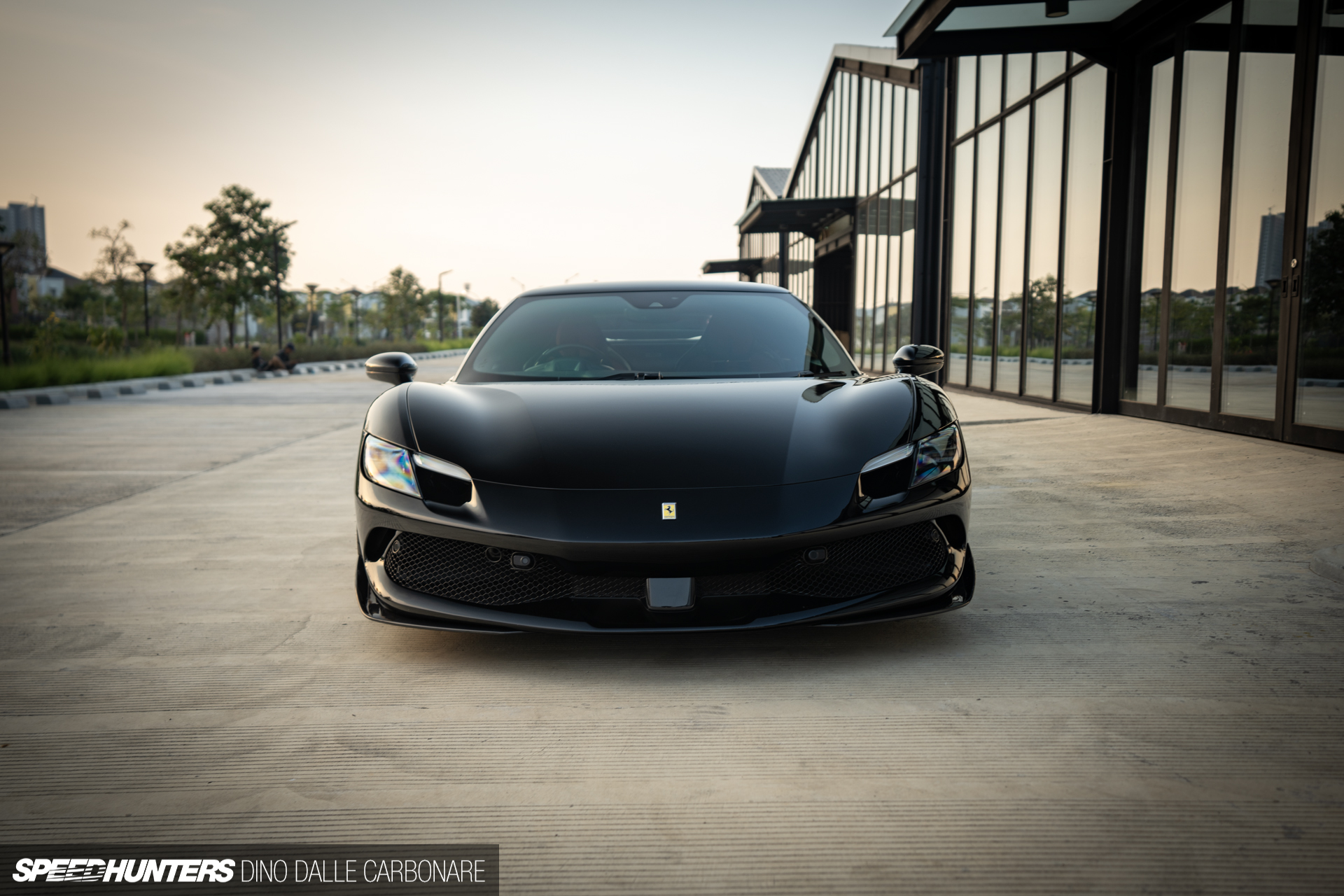
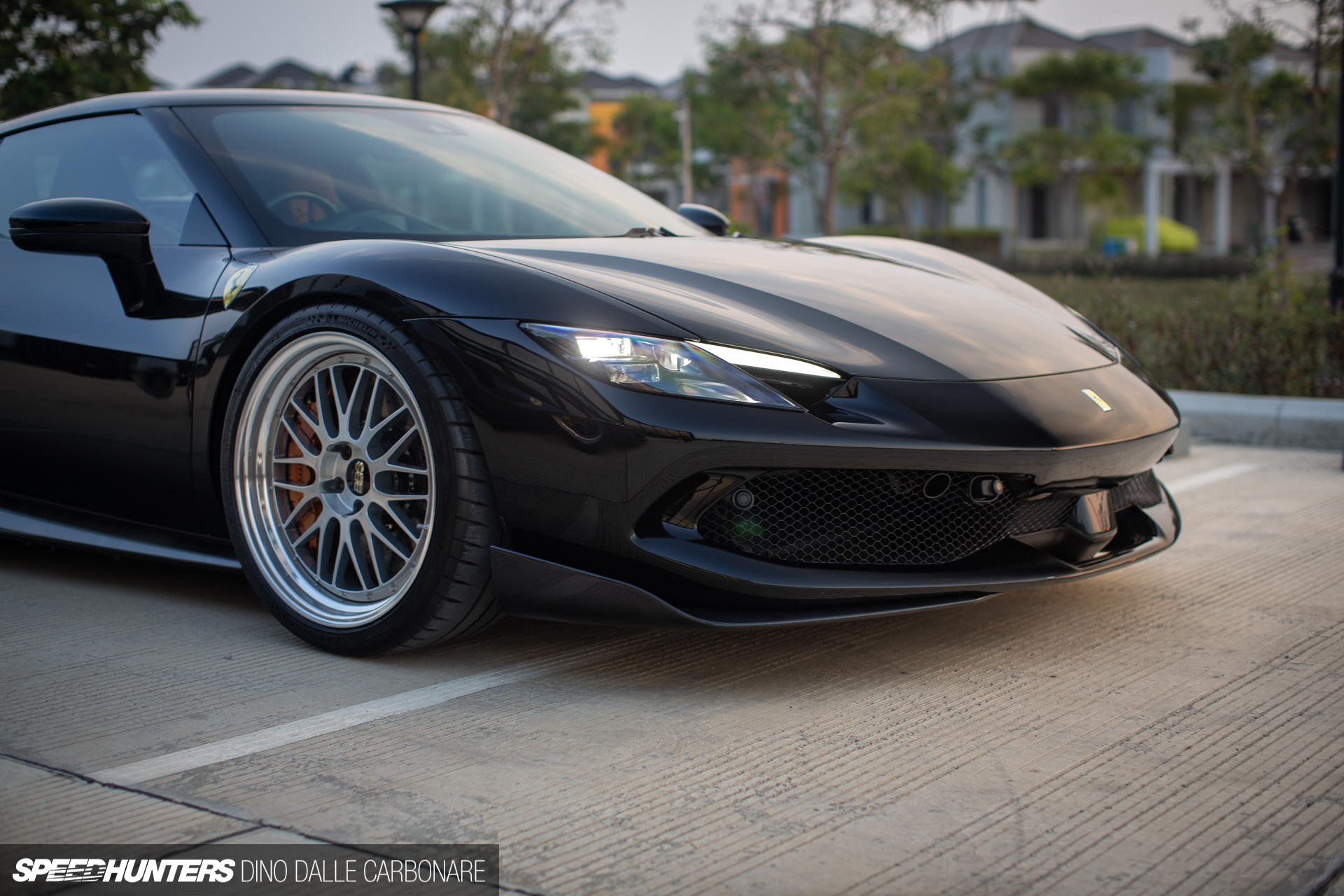
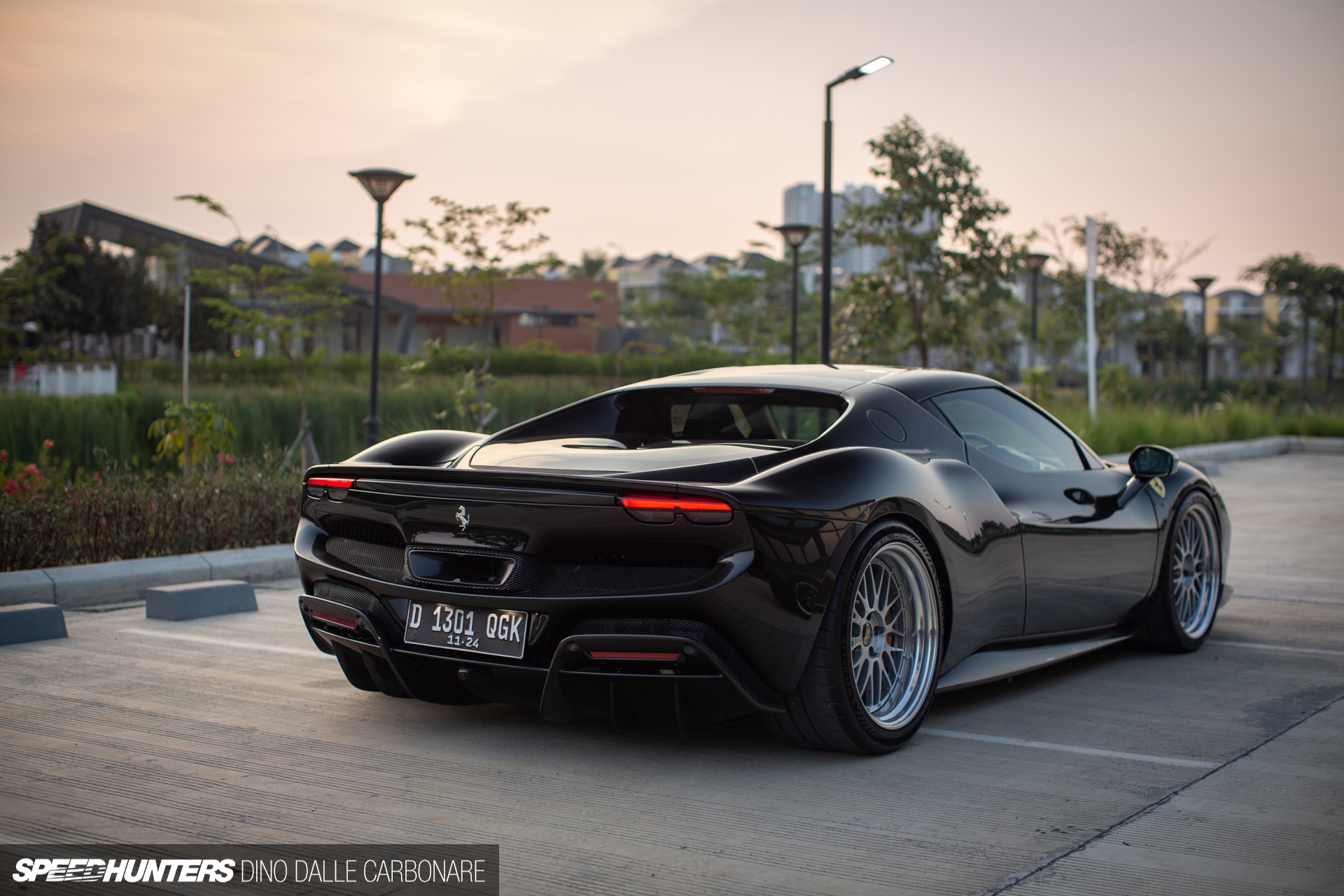
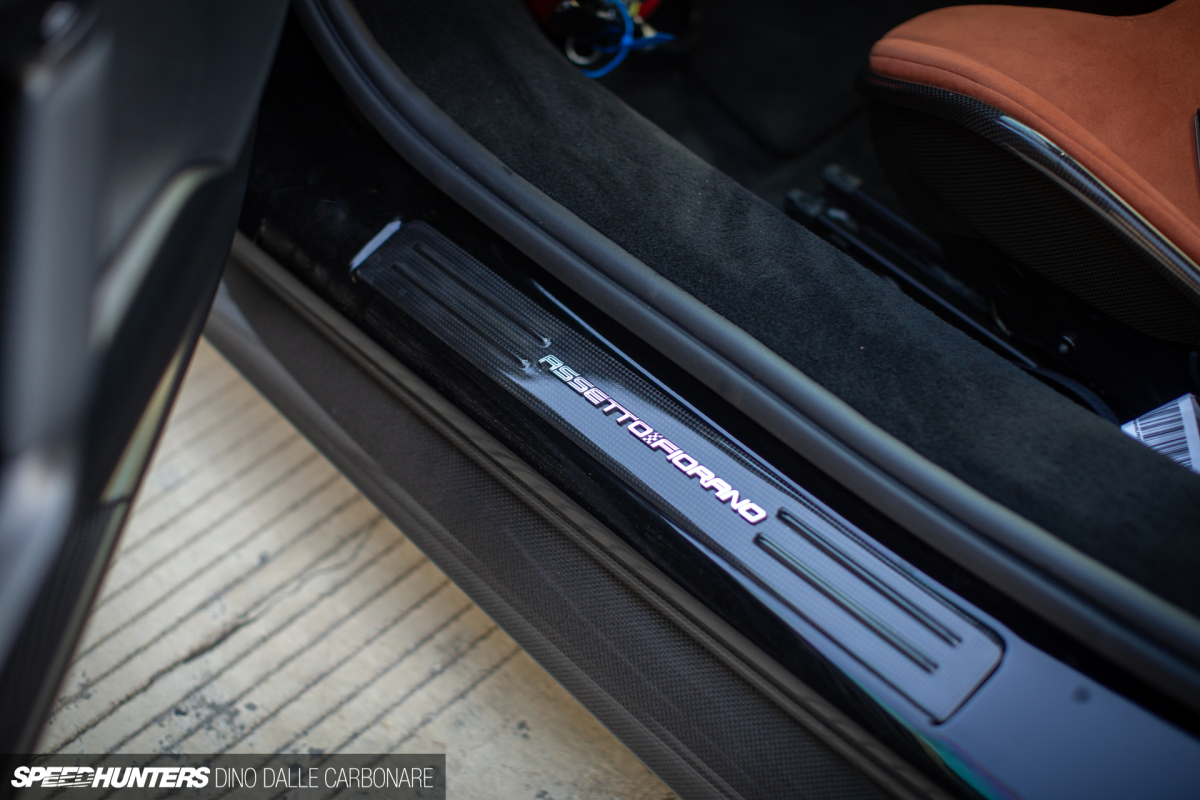
In the black corner, we have a 296 GTB with the ‘Assetto Fiorano’ package, which has more of a track focus through less mass, increased downforce, and improved performance.
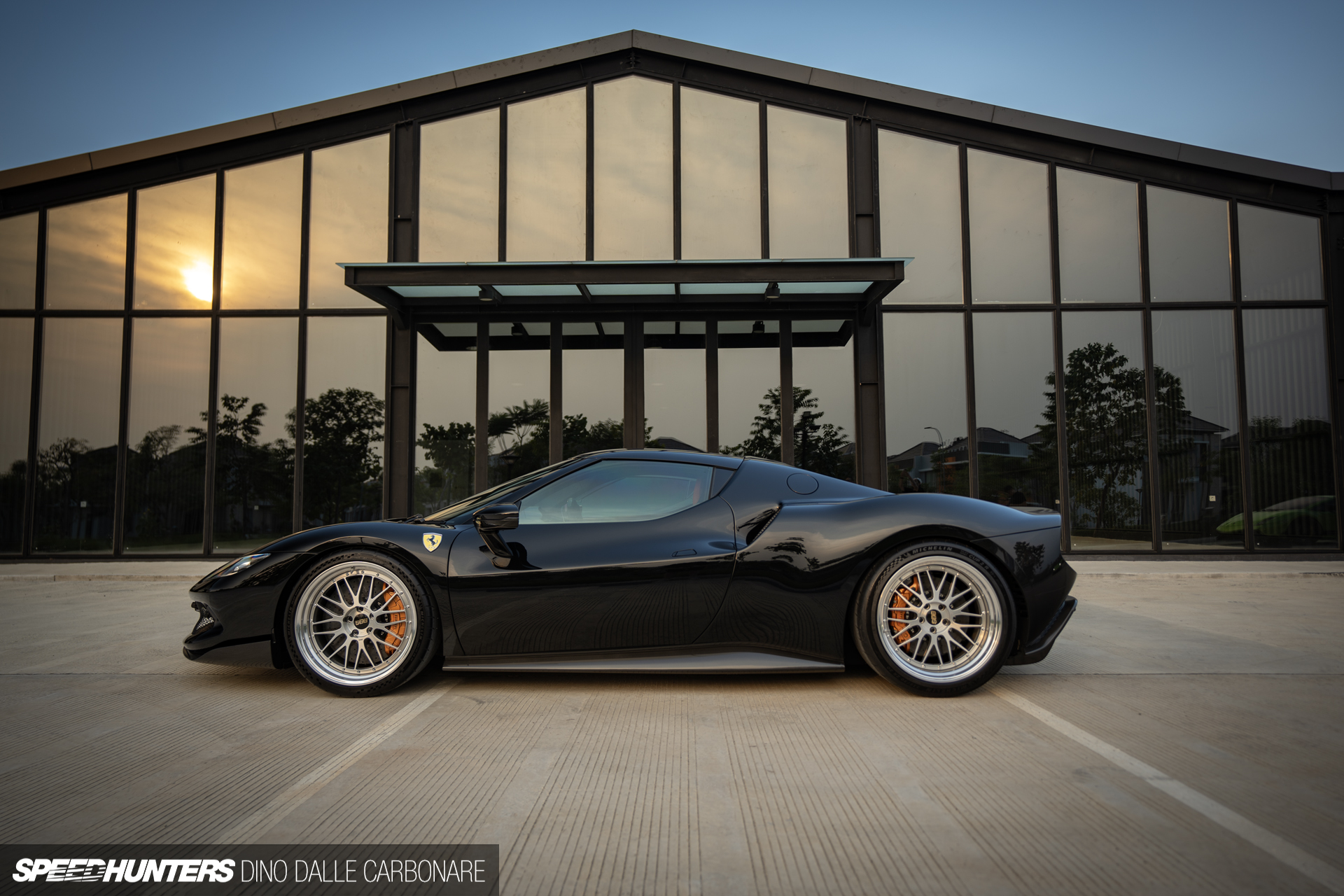
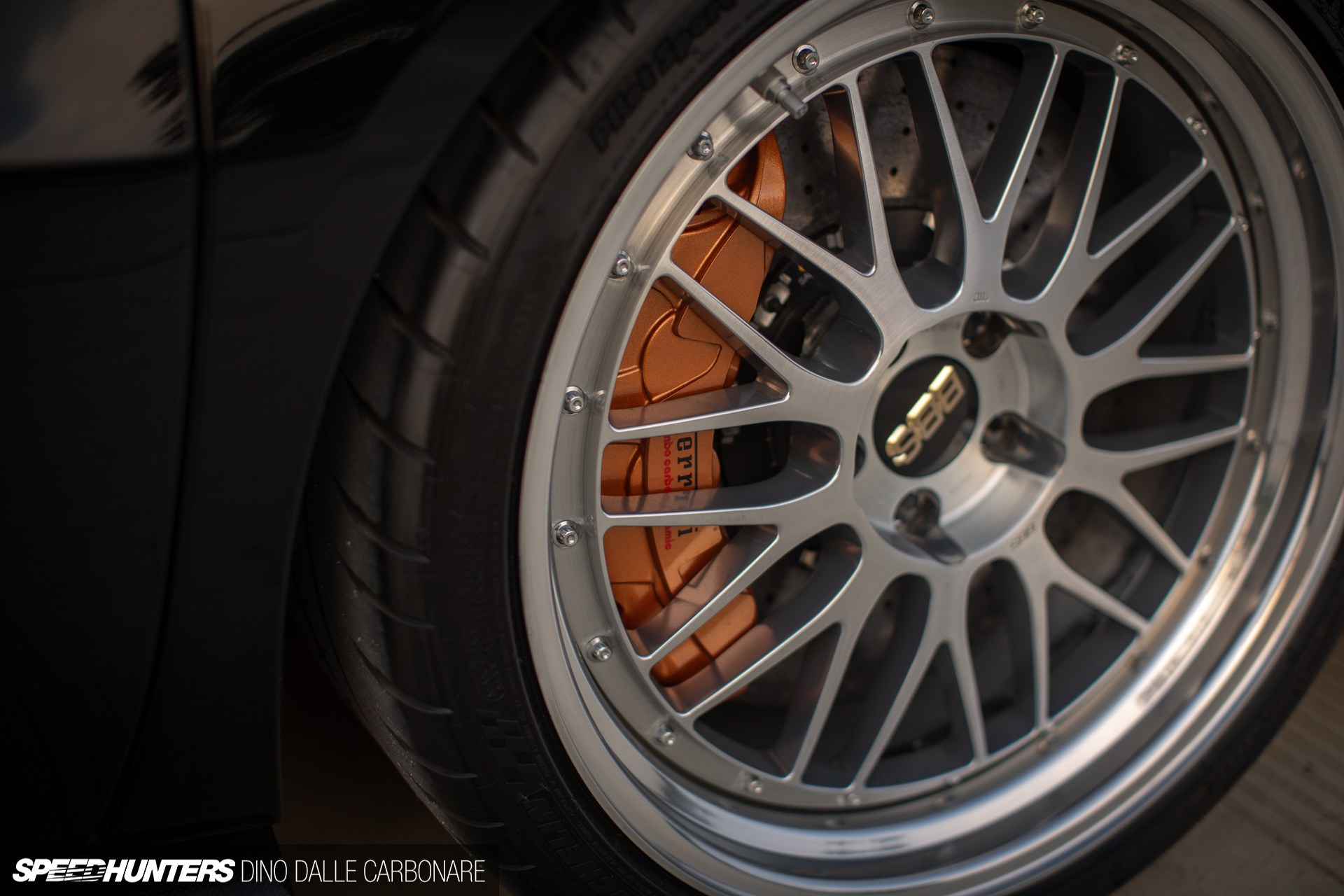
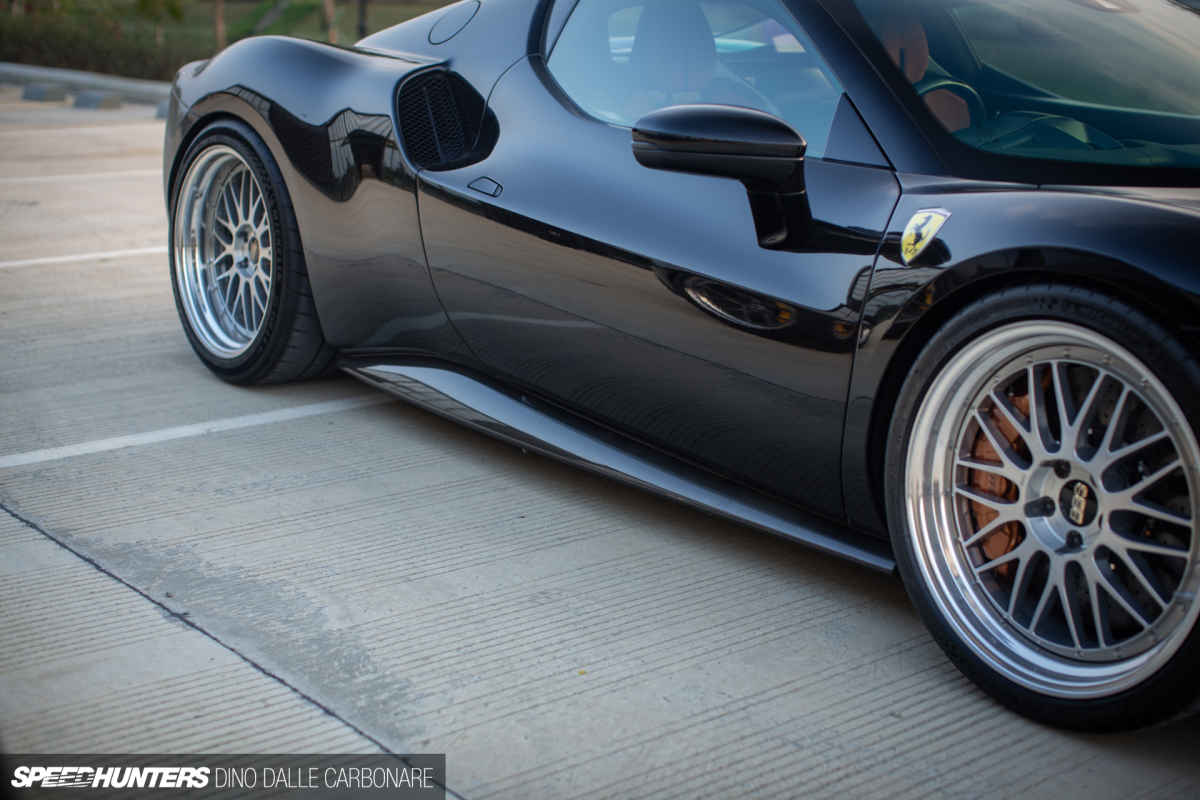
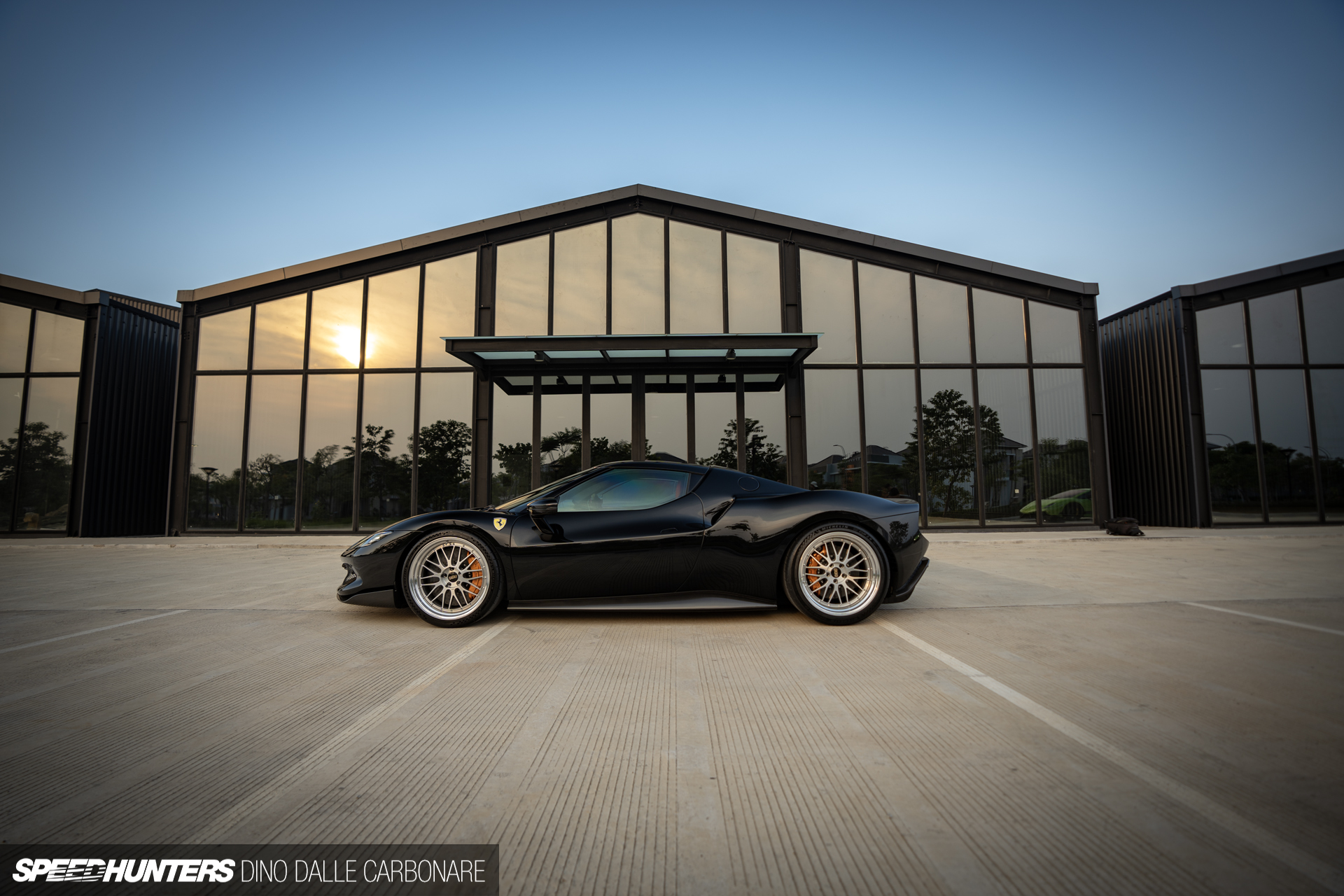
Over and above the factory enhancements, the owner has kept things understated, opting for a set of BBS LM wheels, which he then sent to a specialist to work their magic.
While the front wheels came in the right size and offset for perfect aggressive fitment, the rears had to be custom re-barreled to 13 inches wide, as BBS doesn’t offer anything wider than 12 inches. Why? Because this owner wanted to fit the fattest tires possible to handle the full power and torque of that electric-assisted, turbocharged V6. So for tires, you’ll find 295/30ZR20 Michelin Pilot Sport Cup 2s up front and massive 335/30ZR20 Pilot Sport Cup 2Rs out back.
To complete the aggressive look, the car was lowered, but the real cherry on top is the Brembo brake calipers that bite down on carbon-ceramic rotors. When placing his order for the car, the owner asked Ferrari to paint the calipers in the same gold as those found on the R35 Nissan GT-R Brembos, even going as far as to supply the paint code. Talk about a subtle nod to JDM culture on an Italian exotic!
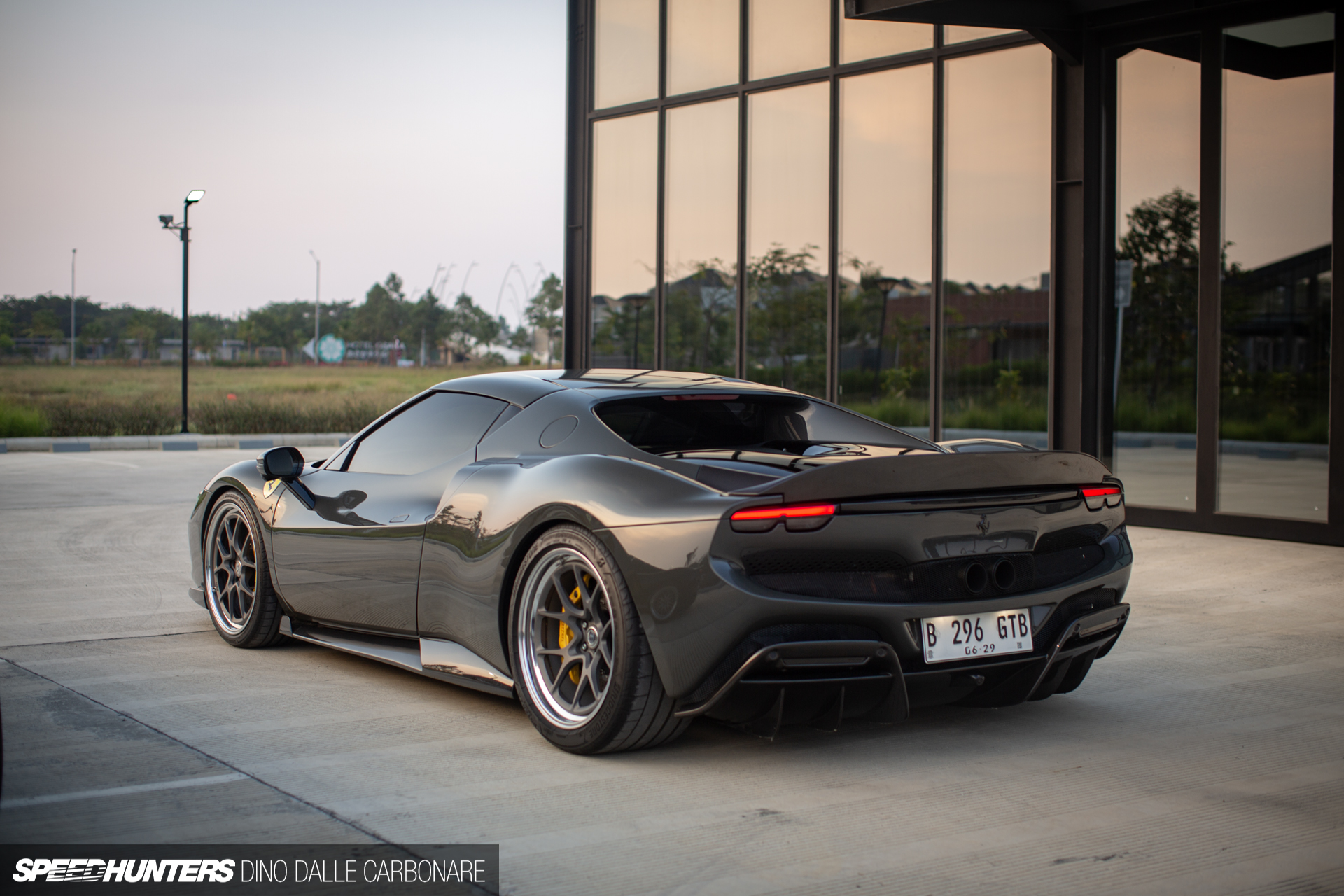
In the gray corner, we have Mr. Jedm’s 296 GTB, which is a non-Fiorano car with a very different approach taken.
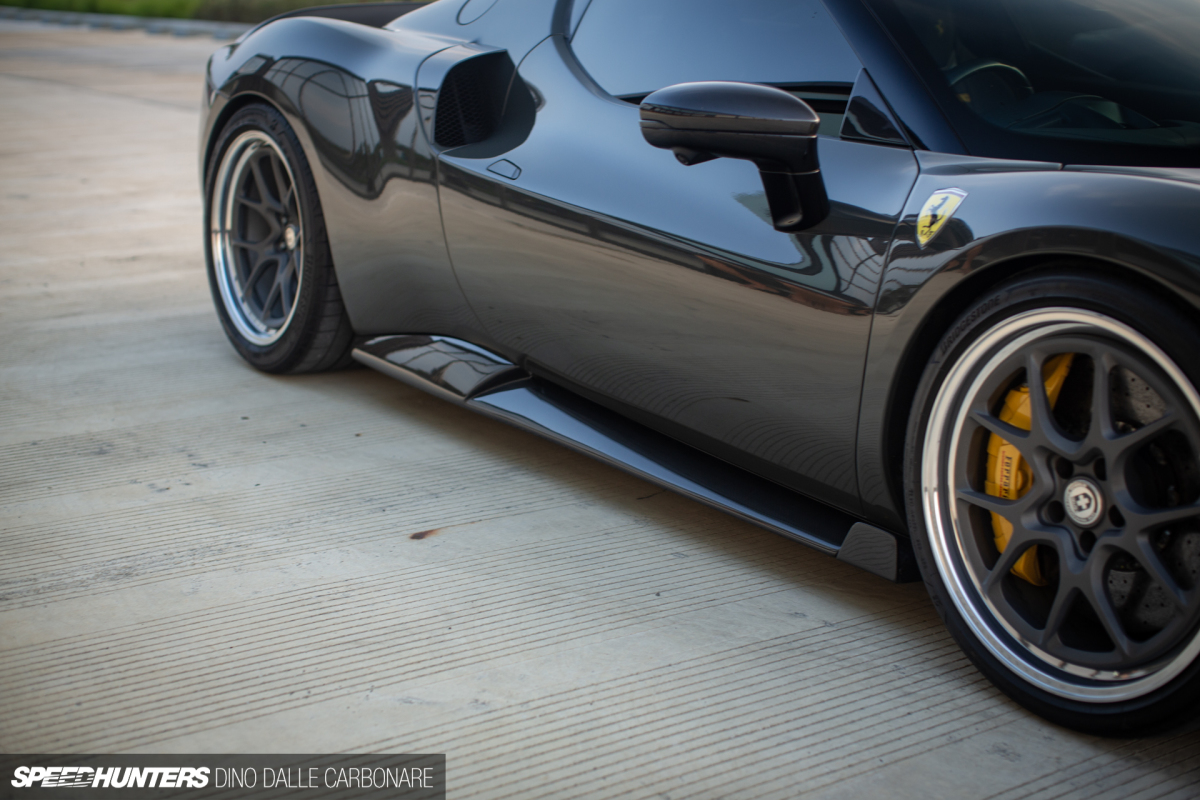
This car swaps out its original Ferrari wheels for a set of two-piece, forged HRE 521s finished with satin charcoal centers and polished barrels. The tires are Bridgestone Potenza Sports in the OEM sizes – 245/35ZR20 up front and 305/35ZR20 in the rear.
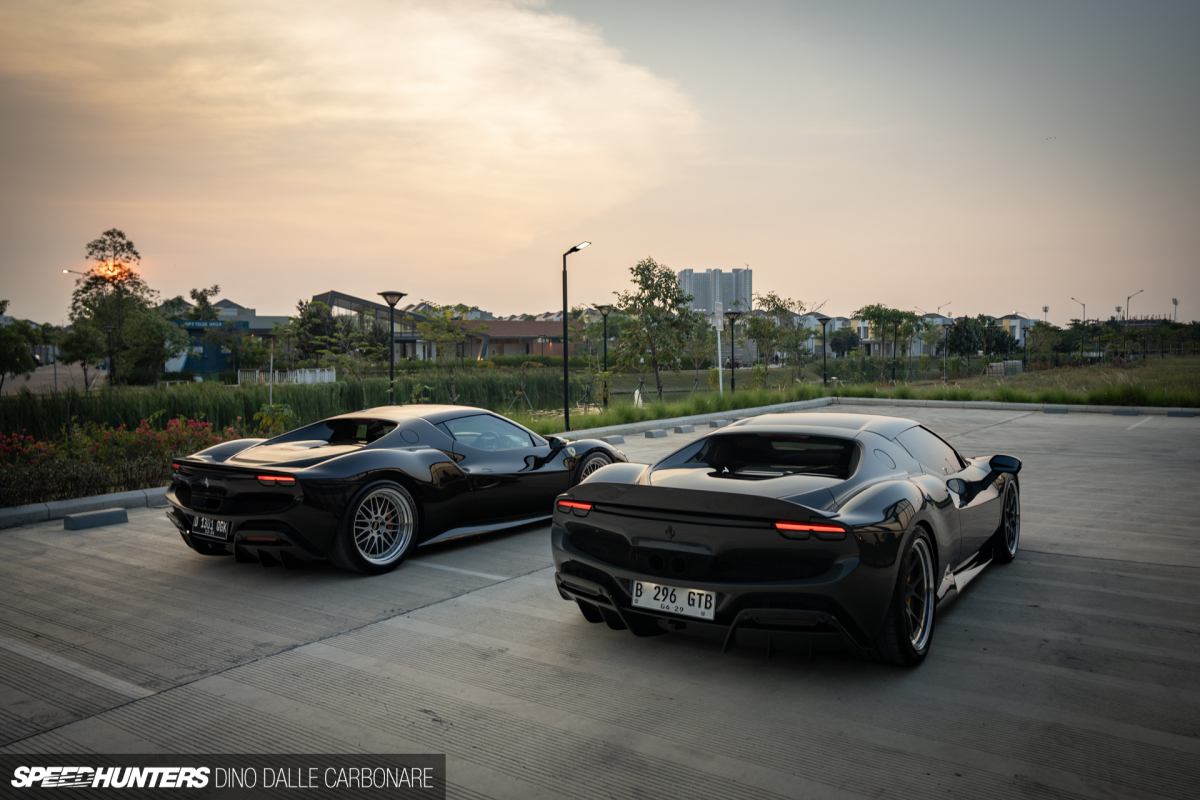
Aesthetically, the gray car has several Novitec upgrades. Up front, there are corner spoilers and air intakes, plus carbon fiber mirrors, and finally a ducktail spoiler to spice up the rear.
You can see how the black car has similar lip spoilers to those on the Assetto Fiorano upgrade.
But the Novitec side skirts are more aggressive and also feature integrated air intakes.
One press of the Start/Stop button (as long as the drive mode is in the ICE setting) instantly gives away the fact that Mr. Jedm’s car is running an aftermarket exhaust – also from Novitec. The hot-vee V6 now has the raucous idle and low-end bark it deserves, doing away with the stock valves of the original system.
Inside, the two 296s have a very different feel.
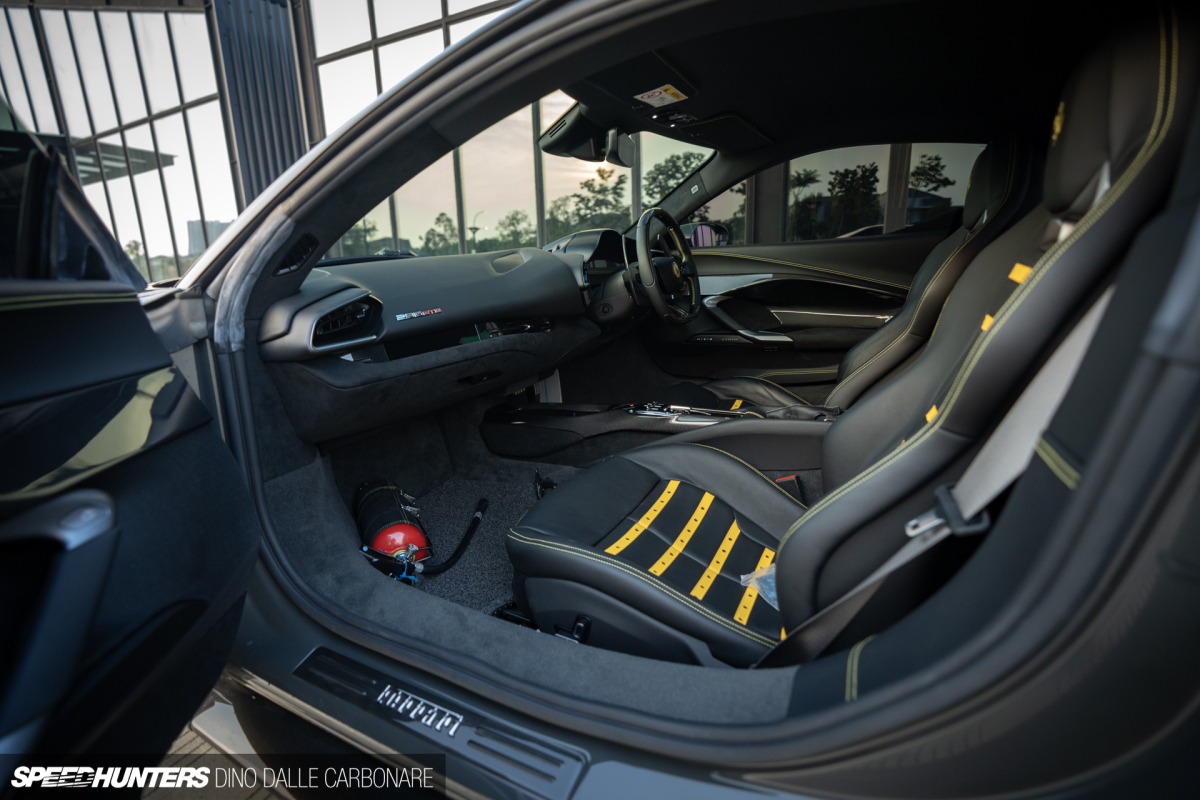
The gray car is set up with comfort and long-distance touring in mind.
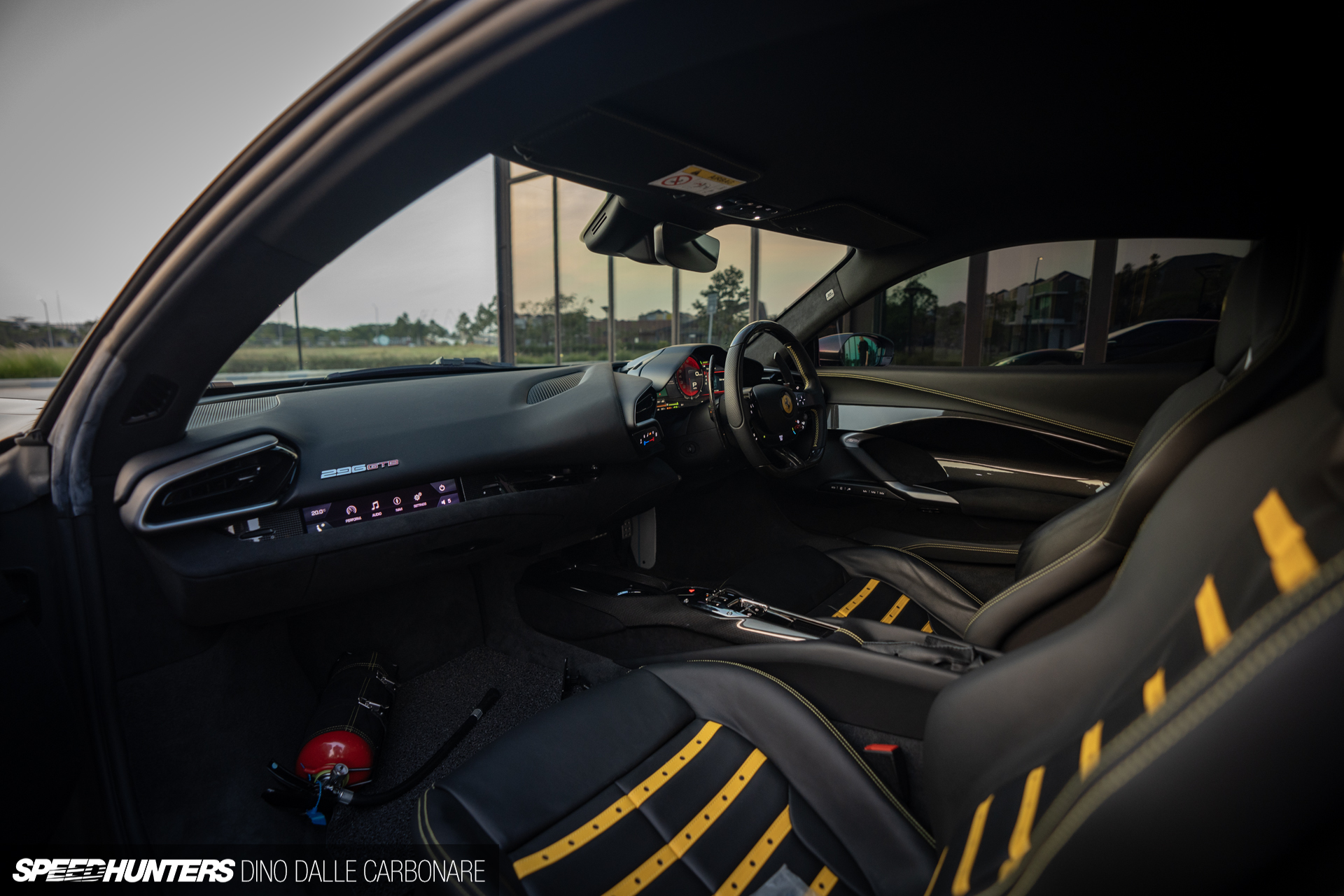
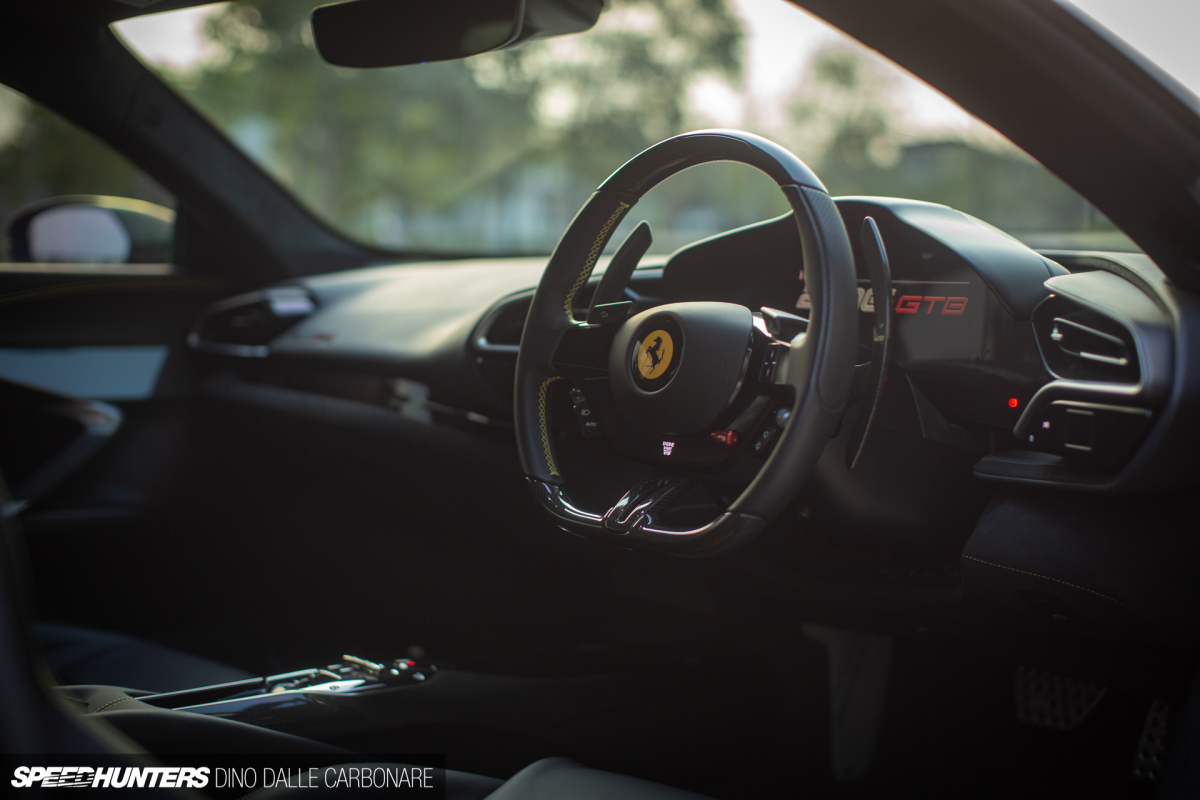
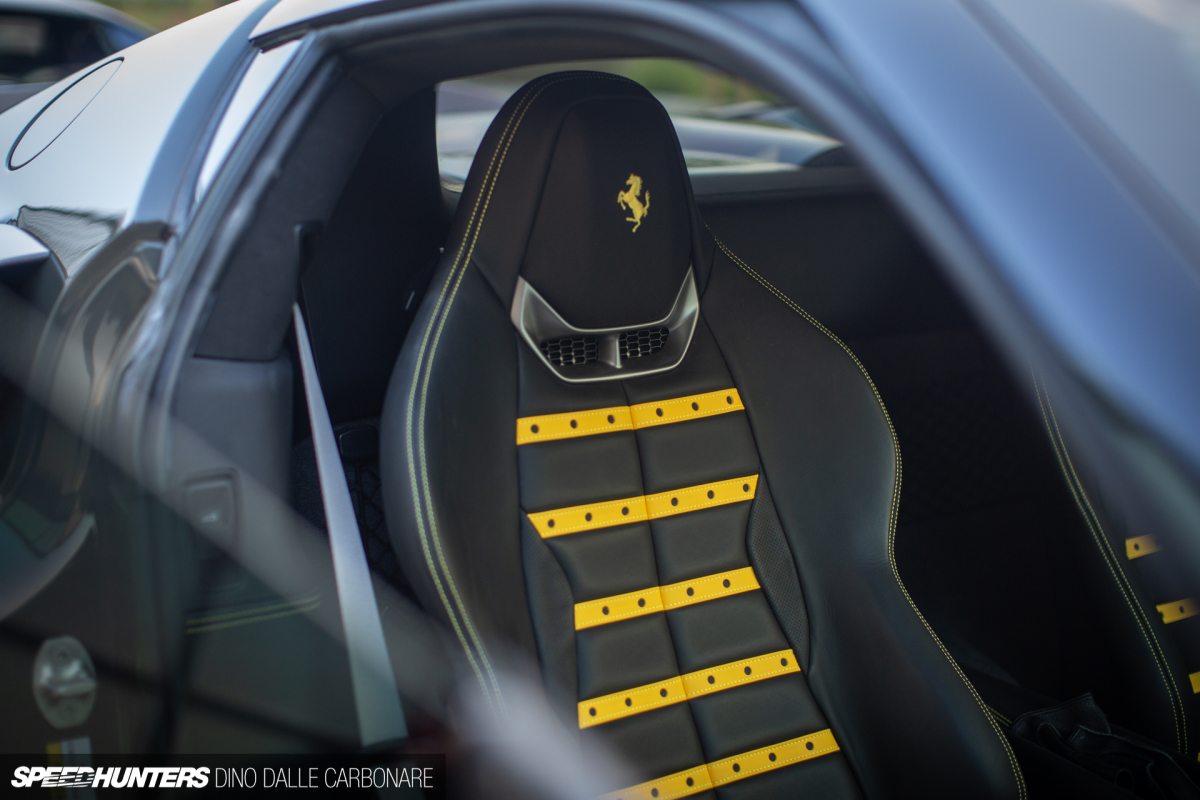
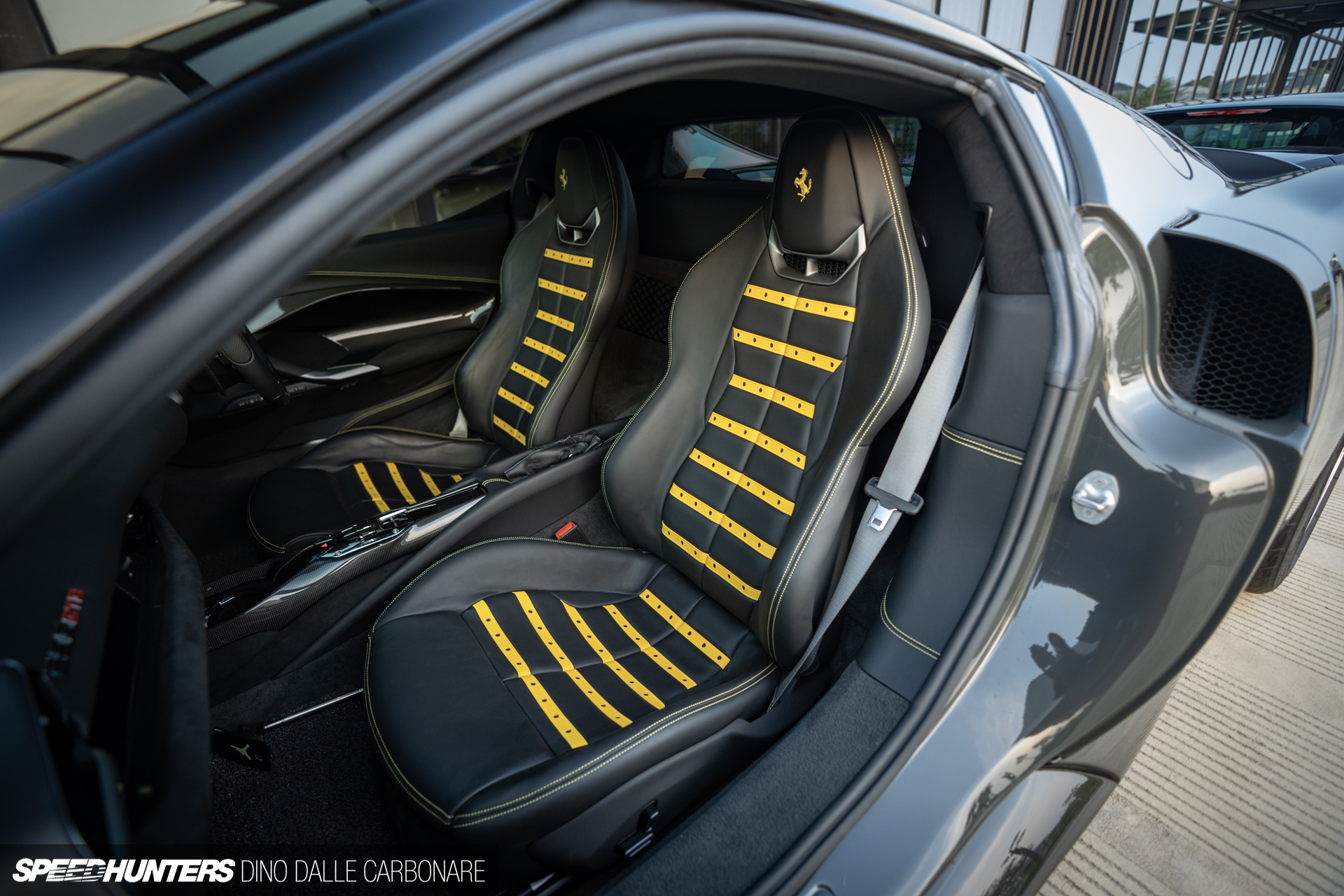
Yellow-on-black horizontal piping throws back to old Daytona seats, bringing that contrast across the rest of the cabin with yellow stitching.
The factory option passenger-side display keeps anyone riding shotgun entertained – or possibly terrified when the performance metrics are shown on screen.
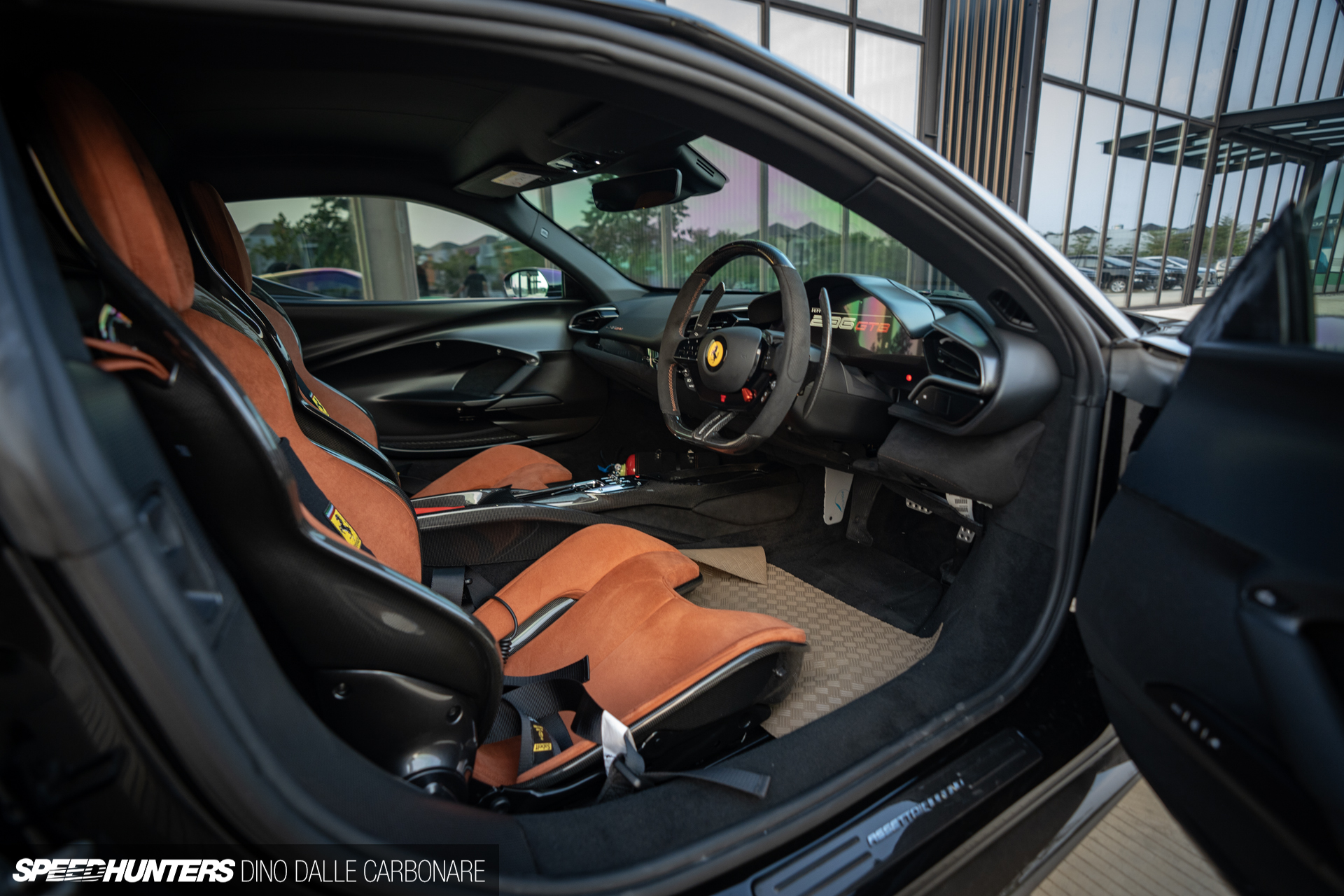
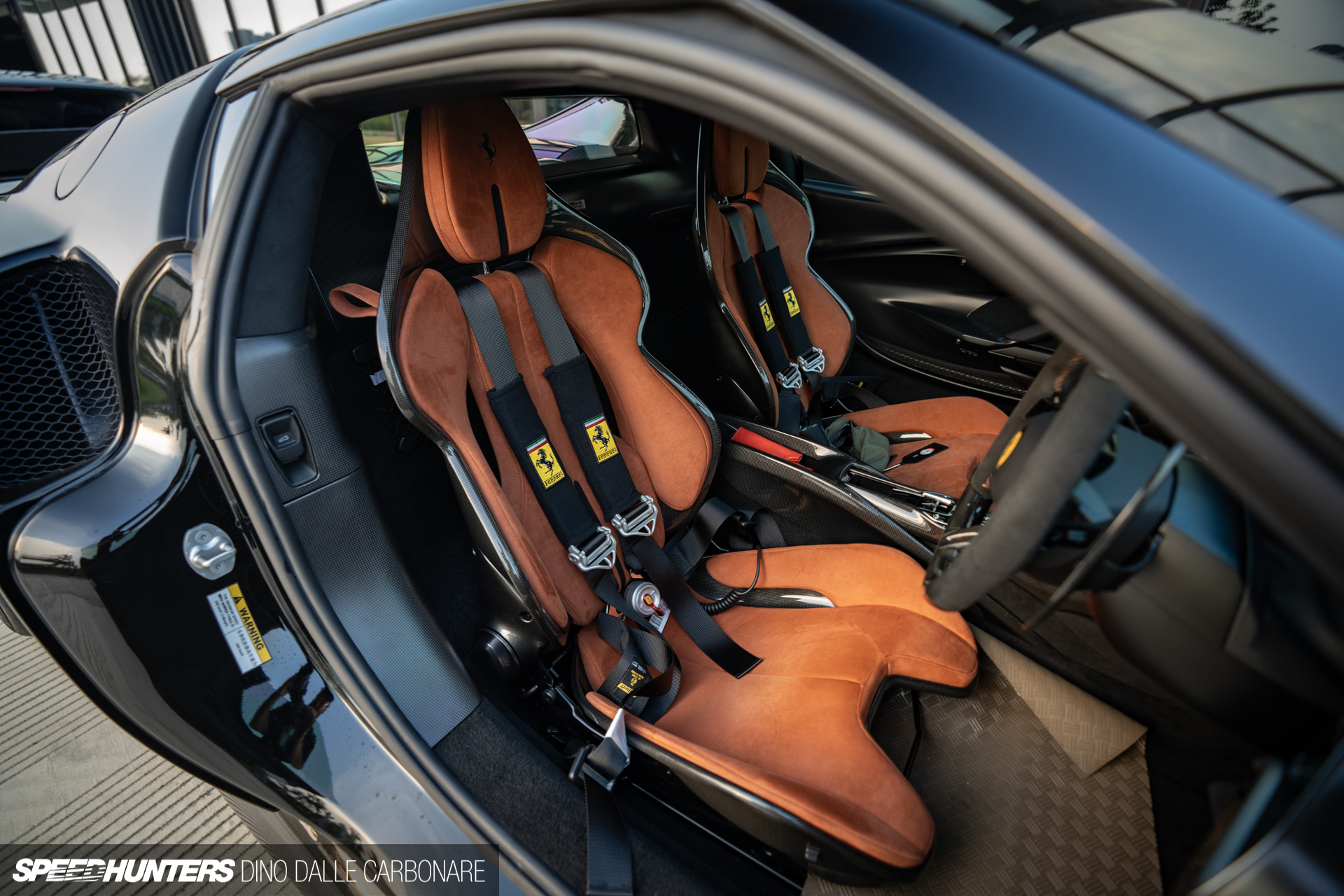
The Assetto Fiorano interior in the black car features carbon fiber reclinable bucket seats – complete with 4-point harnesses – upholstered in warm brown suede for a touch of class.
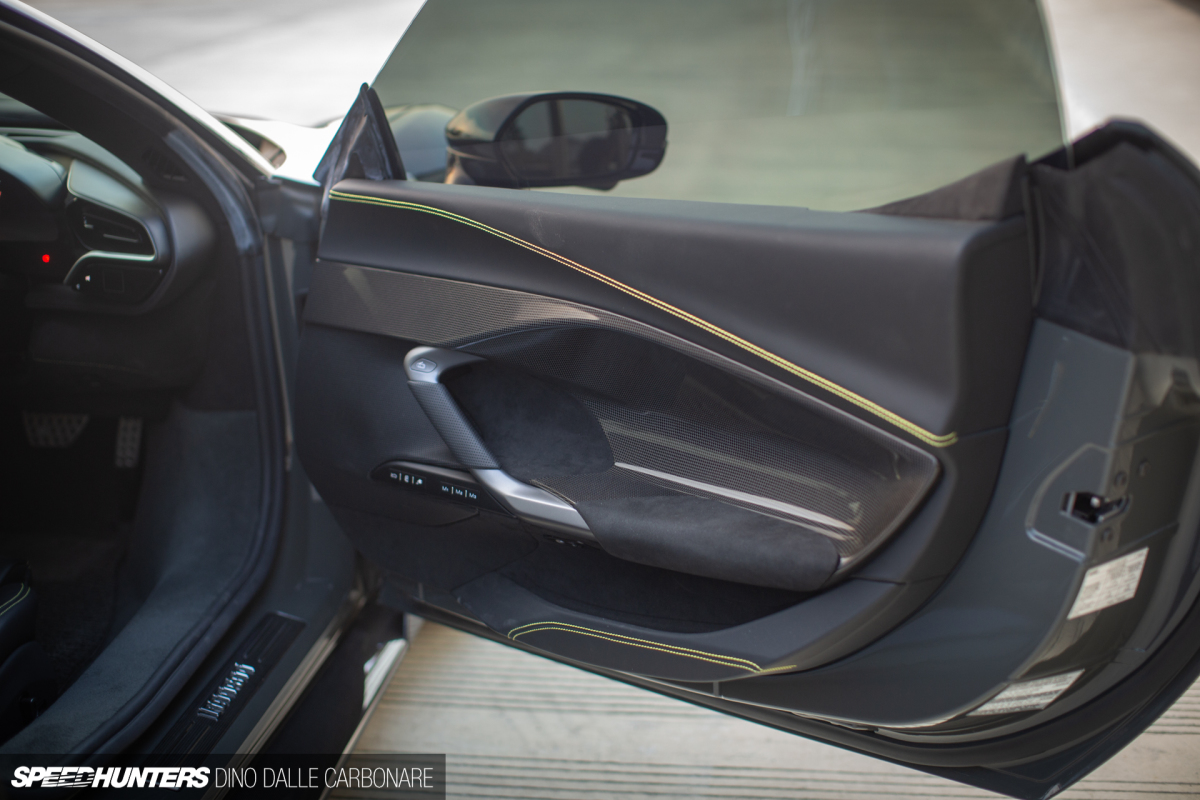
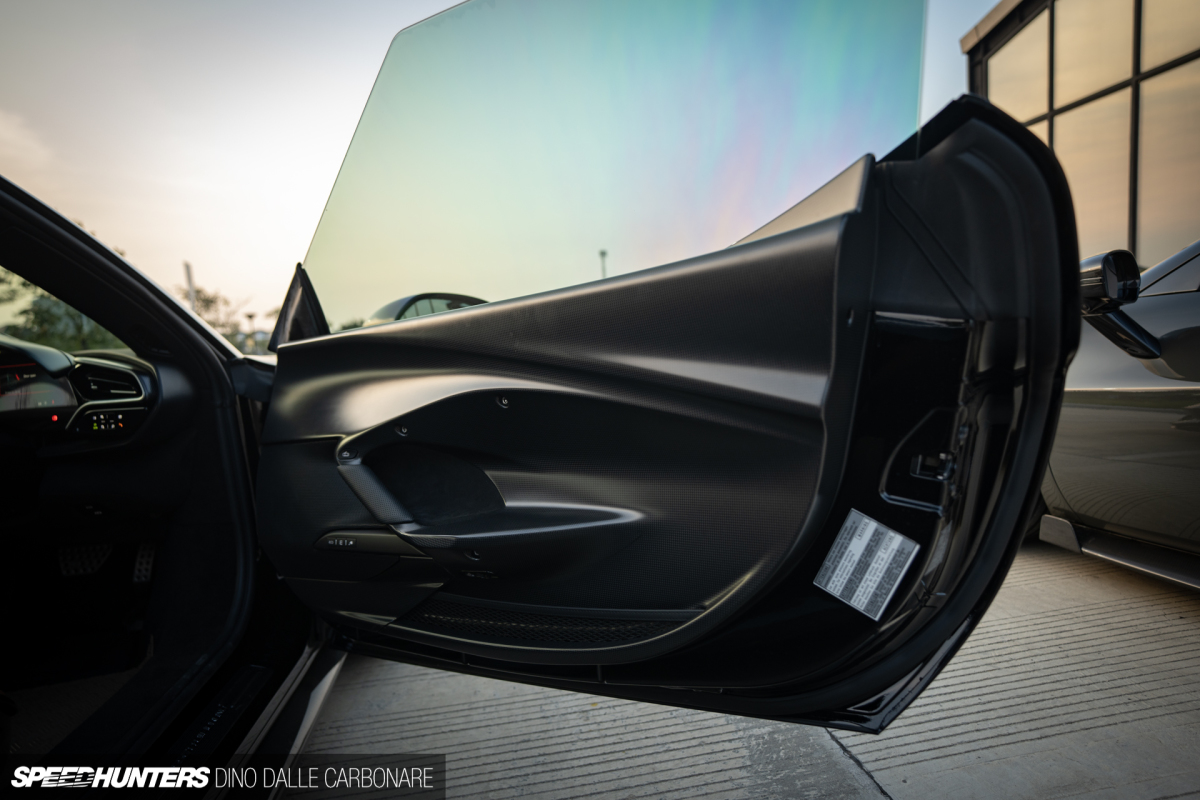
There’s more carbon trim throughout the cabin, including on the special door sills and cards, adding to its motorsport-inspired vibe.
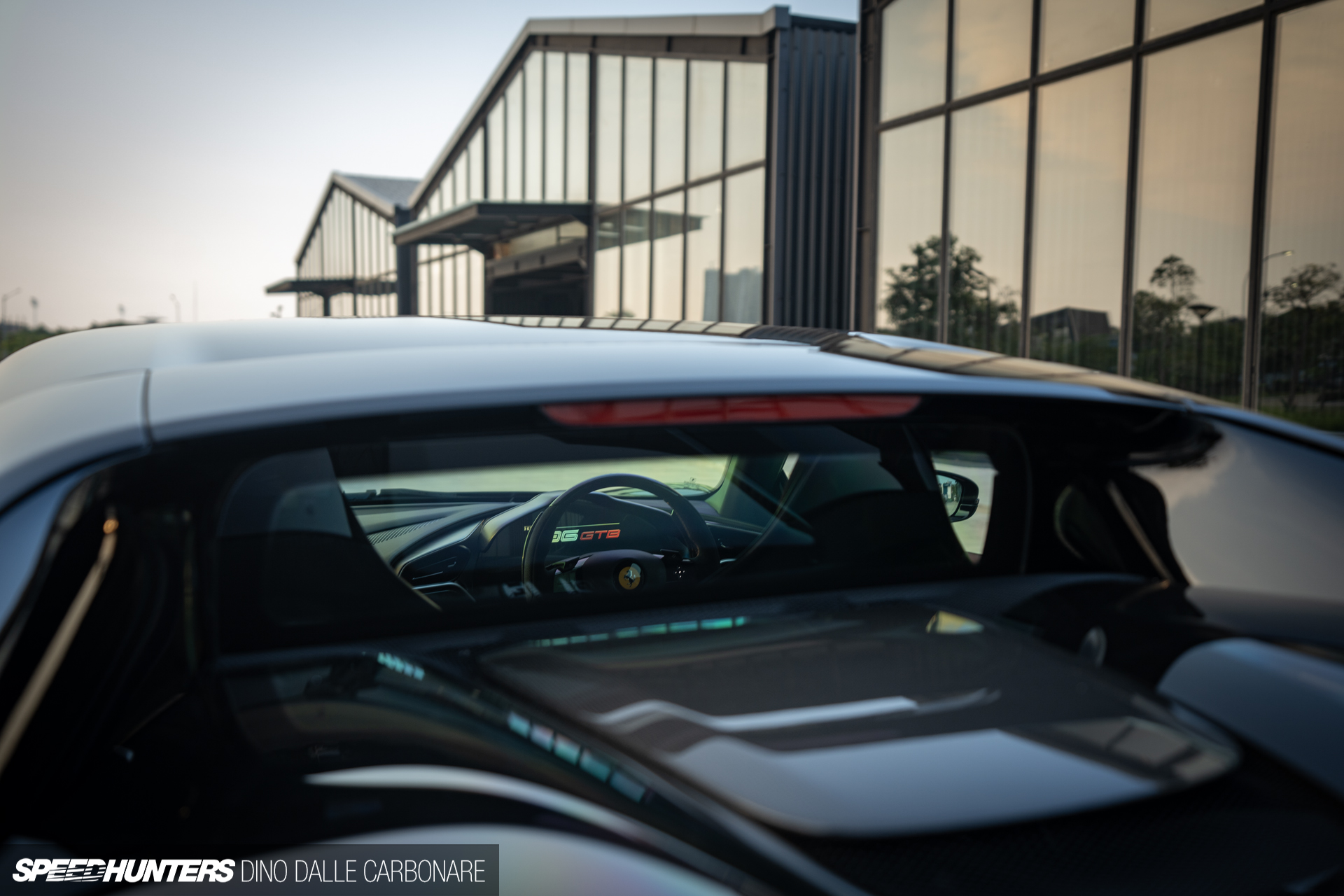
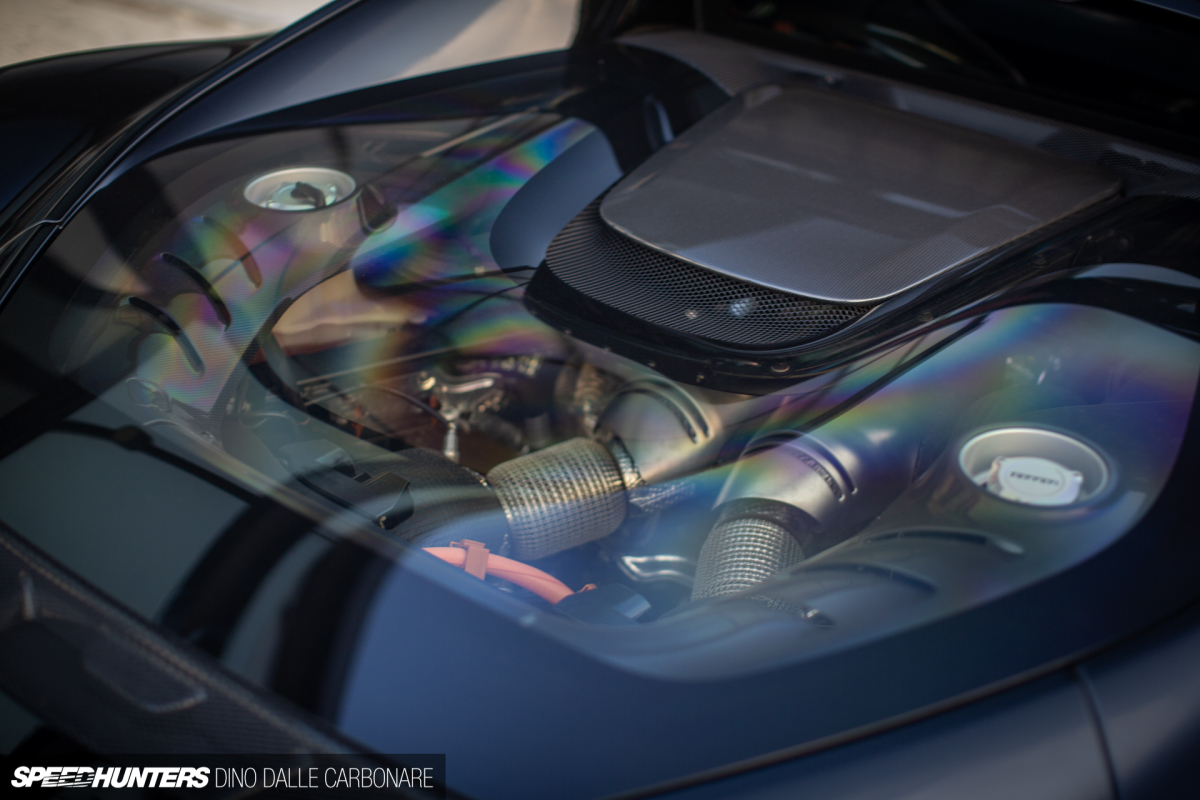
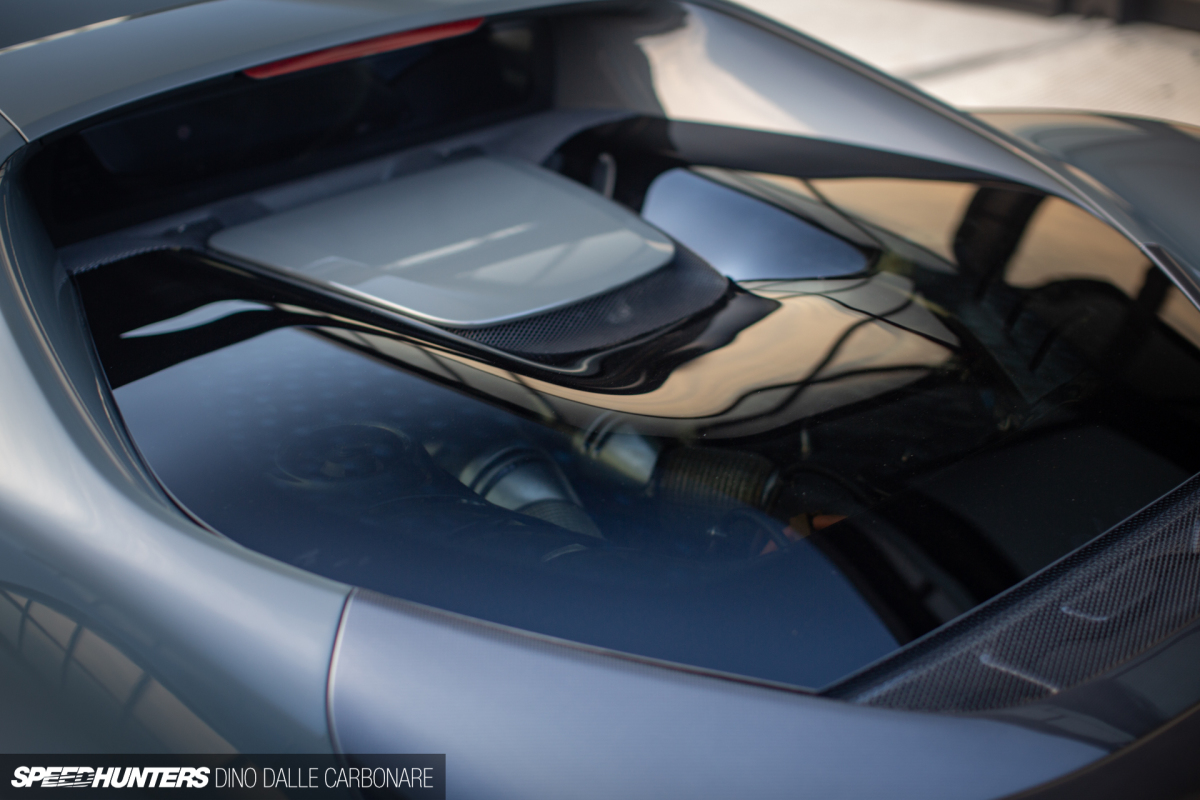
Curiously, the gray car features a transparent engine cover with a more smoked finish – perhaps another option that Ferrari offers.
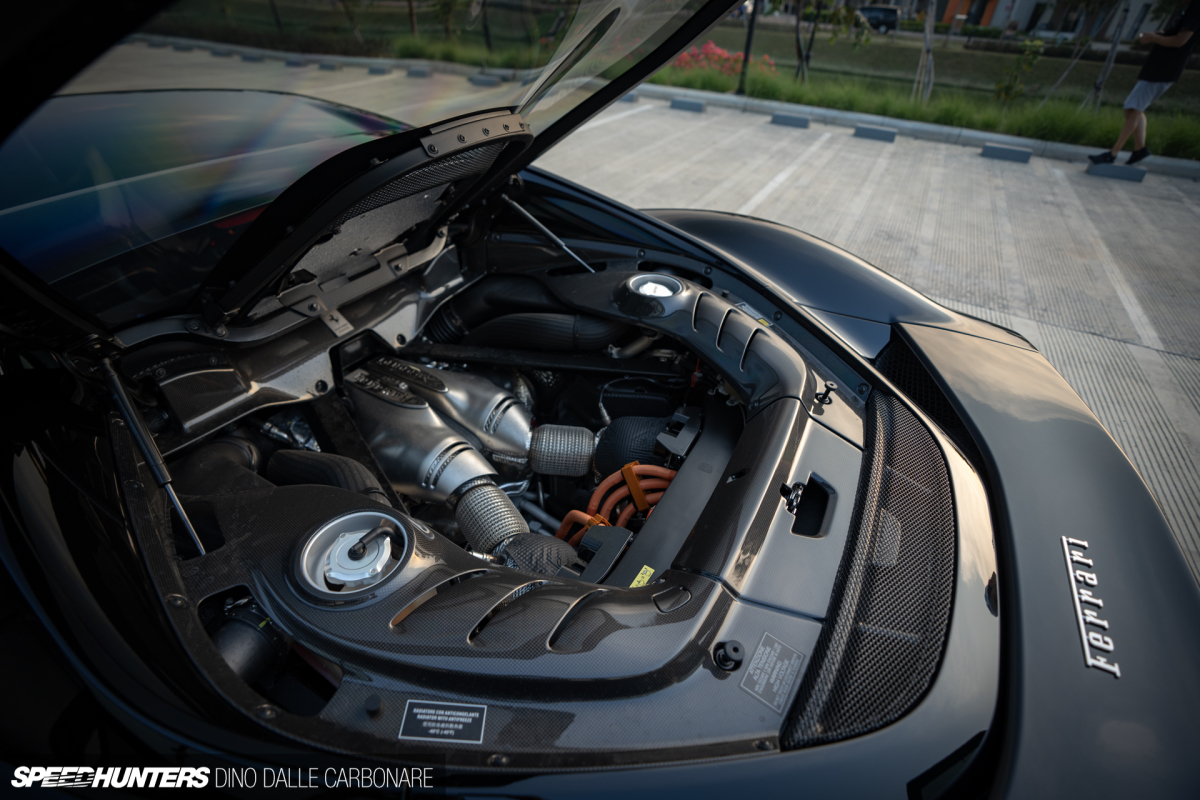
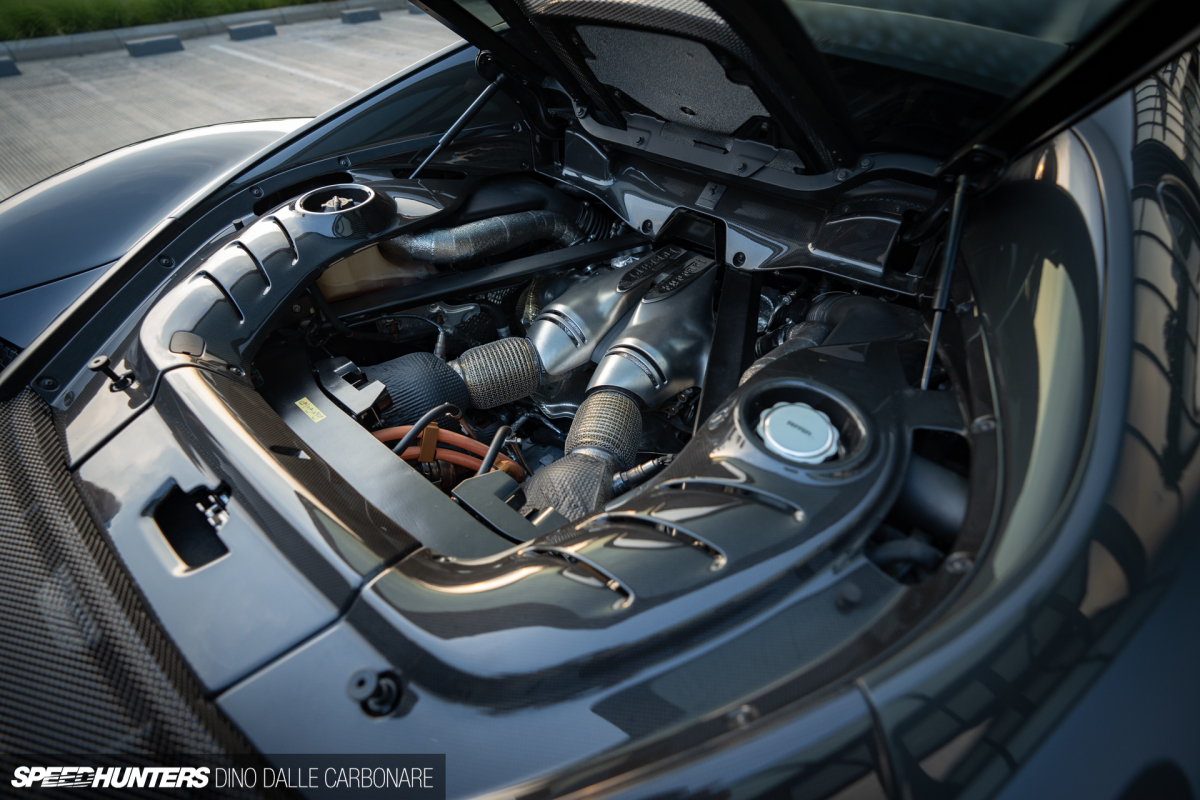
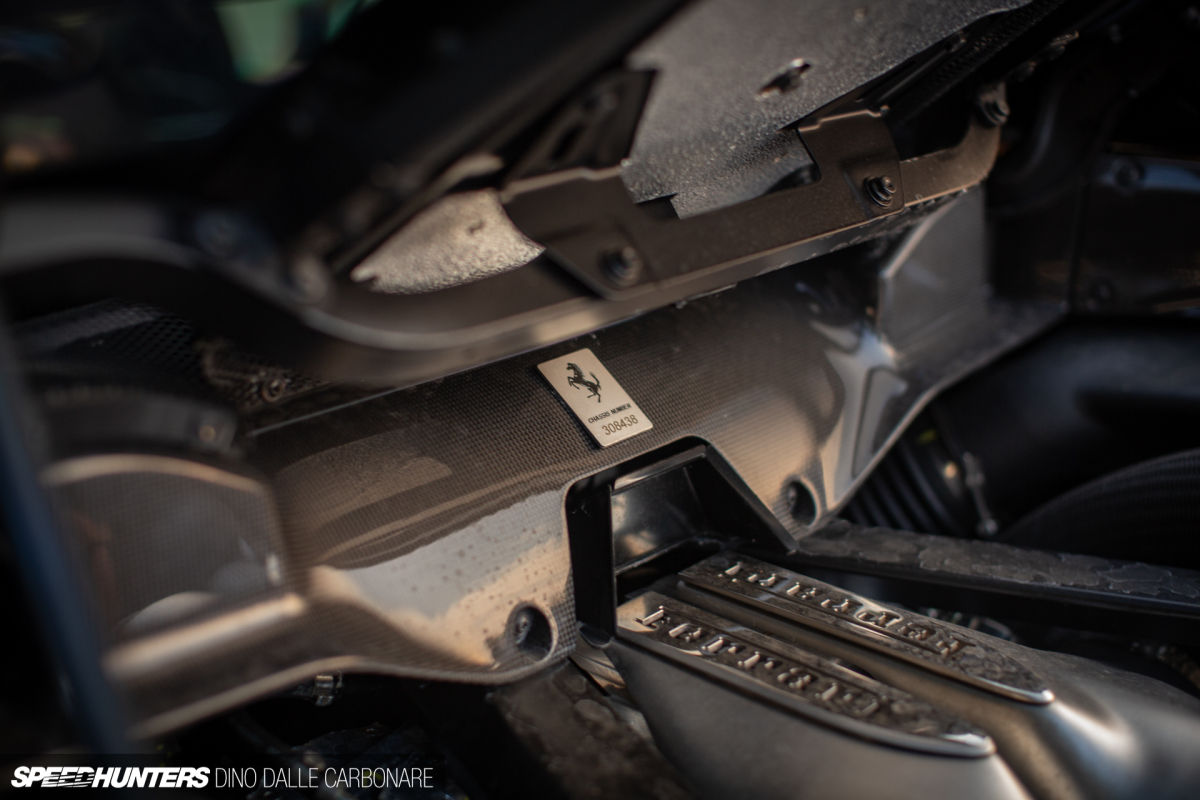
Opening up the lightweight covers on their gas struts reveals Ferrari’s most compact engine – the 120-degree 3.0L twin-turbo V6.
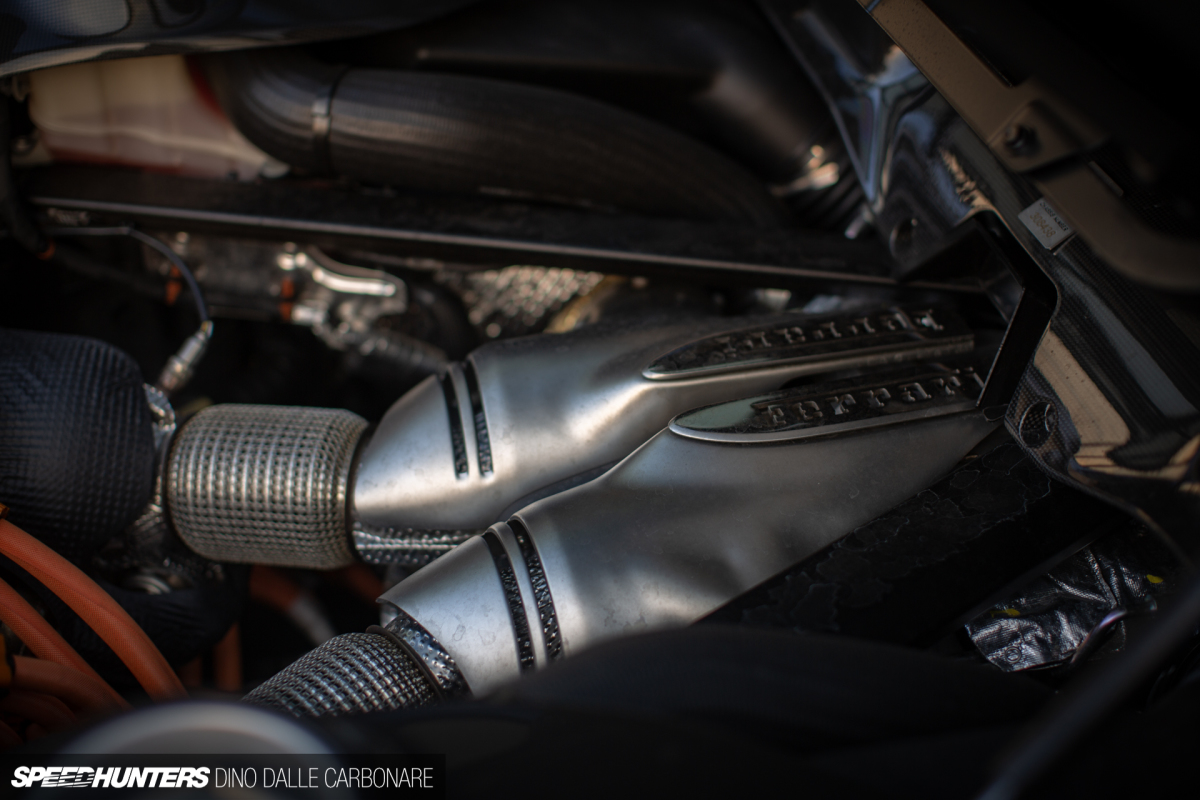
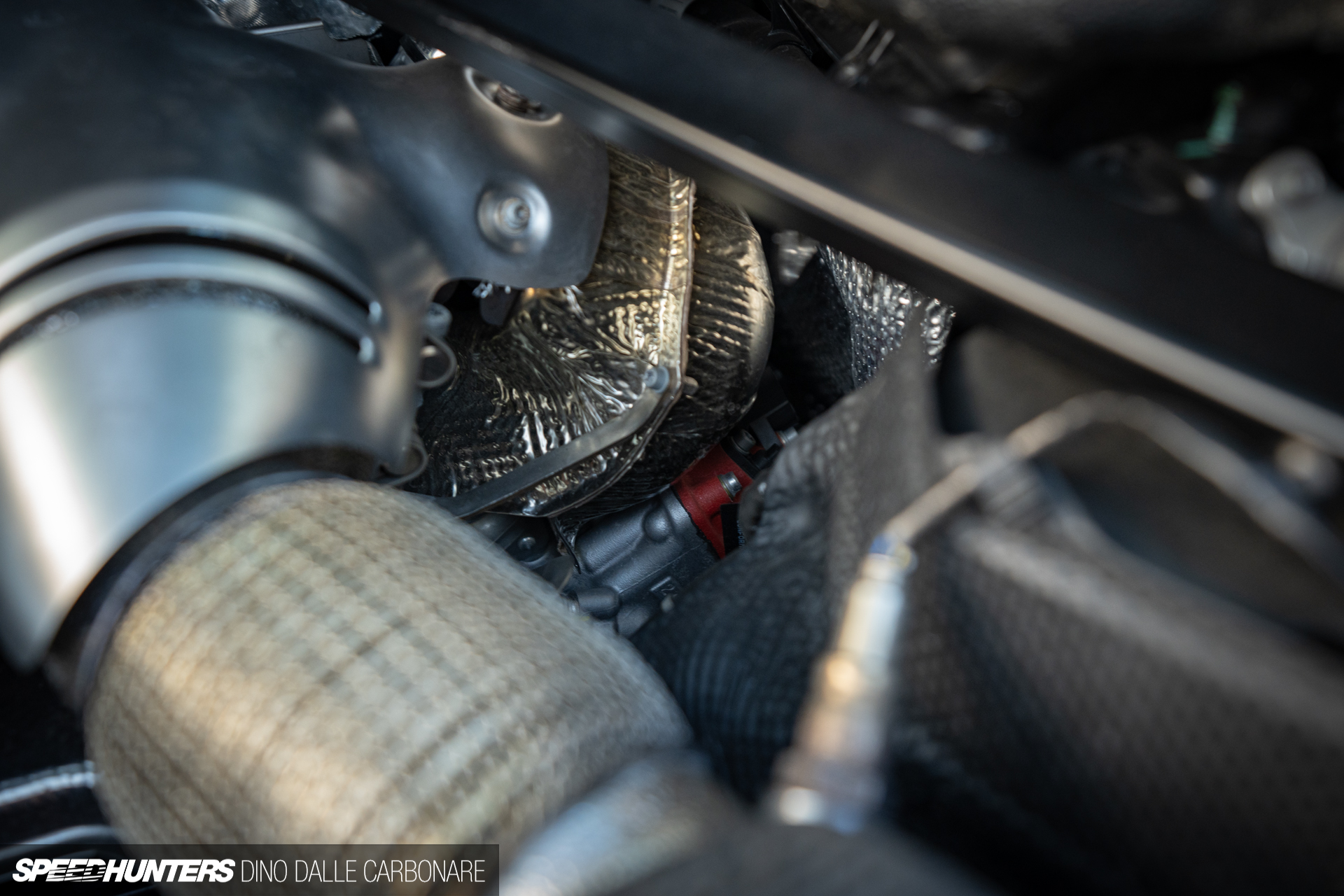
It’s not as visually exciting as the crackling red intake manifolds of Ferrari’s naturally aspirated engines, but at least it’s still got red cam covers, as well as Ferrari logos on the heat-shielded exhaust outlets that sprout out from the centrally-mounted turbos.
So, after all of this, it’s over to you. Which of these 819hp Ferrari 296 GTB beasts would you prefer to take home? The track-ready black machine, with its JDM-inspired touches, or the more refined, comfort-oriented gray car with its Novitec upgrades?
In 2018, as part of their trade war, the US imposed an average tax of 12.5 percent on imports from China. The direct consequence? The Yuan has gradually fallen by a similar proportion. Let the US impose a surcharge on imports from the Eurozone. For the European Union, the best defense will be…
“We Germans look towards Moscow and Warsaw. Paris and London are cities of the past,” a German acquaintance confided to me only three years ago. It was still the golden age for a country convinced that globalisation, so beneficial to its industry, would last forever. Angela Merkel, hailed as the “indispensable European” by The Economist, was considered the most powerful leader in Europe, if not the world!
Former German Chancellor Angela Merkel and former (and now incumbent) U.S. President Donald Trump at the G7 Summit
However, three years ago, the decisions that would seal Germany’s contemporary fate had already been made by successive Chancellors. They all emphasized their close relationship with Vladimir Putin, showing no critical distance when it came to his gas. Hence, Merkel’s unilateral and far-reaching 2011 decision to dismantle all of Germany’s nuclear power plants. It was decreed that the axis of a new Europe would hinge on the crucial bilateral German-Russian relationship, crowned by Nord Stream, flowing proudly beneath the Baltic Sea. Downstream, the partnership with China would guarantee delightful trade surpluses.
Vladimir Putin
For the country’s economic and political elites, the path seemed clear, regardless of whether German industry was rooted in another century. The combination of high-quality finished products, access to cheap energy, and Chinese markets gave the illusion that Germany could withstand the looming dominance of artificial intelligence.
German power plant
Yet today, Germany is facing a true existential crisis, as its economic model lies in ruins. It no longer knows who its partners are; it no longer knows who it is. Germany doesn’t know what it excels at anymore, and it has lost sight of its role in the world.
Chancellor Olaf Scholz, once a staunch advocate of Germany’s special relationship with China, is emblematic of this confusion. Between 2011 and 2018, when he served as mayor of Hamburg, Scholz made numerous visits to China, where the country’s top leaders courted him fervently. Now, as Chancellor, he has been unable to support a European vote to impose tariffs on Chinese electric vehicles. Paralyzed by fears of trade wars, Scholz now openly acknowledges Germany’s dependency on China — a dependency that poses immense challenges for his country.
Chinese Electronic Vehicles
The reality is that Chinese products are now flooding the German market, and they are highly competitive. Unlike Germany, China — having massively invested in 21st-century technologies — now delivers goods that are not only cheaper, but also of higher quality than those made in Germany.
Germany’s decline is structural, compounded by a loss of autonomy. Such are the side effects of long-standing trade surpluses. Profits may have been reaped but at the cost of dependency and sovereignty.
A version of this article was first published on michelsanti.fr
“The tyranny of distance” is a phrase Australians use half-seriously to express the peculiarity of their global position. Popularized by a book by historian Geoffrey Blainey, it describes a point of view held by British colonialists of the 1800s, who believed the center of the universe to be Buckingham Palace. From that perspective, residents of the Crown’s outposts Down Under were brutally distant, somehow even more than half a world away. It’s still a terribly long flight from Australia to London, or most any other place.
But what of the majesty of distance? That thought occurred to me as my flight touched down in Perth and a cheerful voice acknowledged the Whadjuk Noongar people as traditional owners of the land under our still-rolling wheels. (The ceremonial Acknowledgement of Country recognizes the ancestral claims of displaced Aboriginal people for whom, it hardly needs to be said, Buckingham Palace was not the center of the universe.) My head rushed, not so much from jet lag as jet wonder. A majestic distance: any farther and we’d be on our way home again.
From left: The porch of Mill House Collective, a store in Pemberton; swimmers at Denmark’s Green Pools beach.
Kevin West
A similar rush hit me a few days later, during a walk near Yallingup, in the Margaret River region south of Perth. I was accompanying a springy-legged naturalist named Hamish Gibson on a short stretch of the Cape-to-Cape Track, a 76-mile trail that runs between Cape Naturaliste in the north and the southerly Cape Leeuwin, where the Indian and Southern Oceans meet. Gibson’s corkscrew hair bounced as he walked, and every few steps he stopped to recite another extraordinary fact about the area’s unique biodiversity, unique ocean currents, unique geology.
“This is a chunk of India,” Gibson said, gesturing to the ground beneath us with a sweep of his arm. Some 3 billion years ago, he explained, the granite on which we stood was the proto-continent Gondwana. Across unfathomable spans of time the landmass moved north and west to become India, shifting at about the same speed as a human fingernail grows. A fragment split off — at this point, Gibson drew an arrow in the sand with a stick — and moved east until, like a sequin shed from the subcontinent’s sari, it stuck to Australia’s flank. The force of the collision pushed up mountains three miles high; millions of years of tempests wore them down. Now we stood among wildflowers and boulders as round as ripe peaches while surfers rode aquamarine waves toward a sugar beach. My head swam to contemplate this glimpse into the deep past — another majestic distance.
From left: Lucky Bay, in Western Australia’s Cape Le Grand National Park; backroads in the Margaret River region.
Kevin West
The Margaret River plays on the imagination like other land’s-end enclaves: Malibu and Big Sur often came to mind. A popular destination for wine-country R&R, Margs, as locals call it, was my jumping-off point for a road trip along Australia’s lower left-hand corner, the South West Edge. What I found, beyond the vineyards and surf breaks, was green mountains tumbling down to tidal pools, old-growth forests, cool-climate wines, and the surprise of a queer-friendly French-Vietnamese bistro in the Victorian-era port town of Albany. Farther along empty highways, I stopped in Bremer Bay for an orca-spotting cruise to the watery edge of the continental shelf, before finally reaching Cape Le Grand National Park, where white sharks patrolled the waters off kangaroo-haunted beaches.
The people I met along the way were chipper and keen, and everywhere the golden West Coast light cast a hue of nostalgia. But for what? It occurred to me, toward the end of the trip, that I was reminded of the United States from my earliest childhood, when the country felt optimistic, sunny, and sociable, even if a hint of repression simmered beneath the smiles.
From left: Chef Ben Jacob at his restaurant, Lagoon Yallingup; an amuse-bouche of crudo at Lagoon Yallingup.
Kevin West
The South West Edge is not an obvious itinerary for first-timers to Oz. But for Australians, the vineyards, giant jarrah trees, and white-sand beaches are as iconic as the outback. In Bremer Bay, I happened to cross paths with a top executive from the Australian tourism industry. She and her husband were driving the exact route I was following. Finding them there was like uncovering a secret: the South West Edge is Australia for connoisseurs.
To my American eye, the Margaret River looked like two familiar wine regions rolled into one. At first glance it resembled Napa: a scenic enclave of fine-dining restaurants and powerhouse vineyards. The spare-no-expense standard was set along Caves Road, the main north-south route. At Cherubino Wine’s restaurant, I lunched on seafood served by a Lady Gaga doppelgänger in a crisp white shirt. Half a mile farther south, a tasting-room attendant at Vasse Felix, the region’s oldest winery, poured chest-thumping Cabernets as she talked up a new visitor complex being built to showcase the house bubbly, Idée Fixe. Elsewhere on Caves Road, I previewed Cape Lodge 2.0, an esteemed Luxury Lodges of Australia property bought in 2021 by mining magnate Andrew Forrest, who plans to upgrade to meet the expectations of high-net-worth visitors from Sydney, Singapore, and London.
From left: Inside a rental cabin at Upland Farm, in the town of Denmark; a rental cabin at Upland Farm.
Kevin West
The second face of the Margaret River looked more like Sonoma — offbeat, quirky, a bit wayward. “I don’t see myself as part of the wine industry,” said Sam Vinciullo as we sat at a folding table surrounded by vineyards and clucking hens. “I’m more of a chicken farmer.” Be that as it may, Vinciullo’s delicious natural wines have been profiled in the New York Times.
A few miles inland, in the hamlet of Wallcliffe, I had sundowners with Iwo Jakimowicz and Sarah Morris, the husband-and-wife team behind Si Vintners, who began tinkering with organic wines nearly 15 years ago. “At the start we couldn’t sell a single bottle of wine in Western Australia,” Morris said. They still do things no commercial winemaker would dream of, like making rosé from a witch’s brew of Sauvignon Blanc and Cabernet Sauvignon. “It was a dare,” Jakimowicz said, laughing.
From left: The lighthouse at Cape Leeuwin; the Valley of the Giants treetop walk.
Kevin West
Iconoclasts like Vinciullo, Morris, and Jakimowicz found common cause with a new generation of Margaret River chefs, the ones whose genre-fluid restaurants pair chill vibes with culinary chops. In Yallingup I met Ben Jacob, who was trained in London and Perth but found his way to a bluff overlooking a sweet point break to open his first restaurant, Lagoon Yallingup. “It’s one of the iconic spots,” said Jacob, who doesn’t even surf. “The view never gets old.”
In the restaurant’s upstairs dining room, Jacob offers an unstuffy version of elevated coastal cuisine for dinner, while downstairs he serves casual lunch. Breakfast is at a walk-up kiosk outside. One morning he handed me a chilli-crab omelette through the takeout window: a fistful of crab meat wrapped in a golden-egg envelope, showered with foraged greens and minced herbs, and lubricated with a fire-engine-red sauce. I carried it to a bench with a view, where an envious seagull watched me eat. The first bite was perfect in the way that few things are after a certain point in life. The food, the setting, the weather — there was nothing else to wish for.
From left: Ben Ing and Kristy Merchant at Alberta’s, a culinary space in Busselton; the chilli-crab omelette from Lagoon Yallingup’s breakfast kiosk.
Kevin West
Before leaving Margs, I drove south to see the terminus of the Cape-to-Cape Track at Cape Leeuwin Lighthouse, which was manned by resident keepers until 1992. The guide on duty that day was a storm-weathered veteran named Bruce Murphy. As he led a tour of the 128-foot stone tower, Murphy said he knew of two ghosts on the premises. The first was a lighthouse keeper who can’t quit the place. “You smell old man and tobacco, with no rhyme or reason,” he said. The other appears in one of the former keeper’s cottages, where many years ago a woman was cleaning the drapes when she fell from a stool, went into labor prematurely, and died two agonizing days later. Keepers used to gather there for lunch, and once a new man prattled on about how he didn’t believe in ghosts. “Every door opened and closed at the same time,” the guide said. “He left a believer.”
The road southeast toward Albany ran through sheep-grazed paddocks and old-growth forests. The roster of giant eucalyptus trees in the Great Southern Forest included tall and skinny karri, stout jarrah, and tingle, with its buttressed roots. I stayed the night near Pemberton, which used to be a logging town, and set out early the next morning to visit a cathedral grove of karri trees in Gloucester National Park.
From left: A salmon dish at Liberté, a French-Vietnamese bistro in Albany; rhubarb-rose semifreddo with mascarpone gelato at Glenarty Road, a restaurant and tasting room in Karridale.
Kevin West
At that hour I didn’t expect to see anyone, but as I approached I saw Andrea Brick, a retiree from Cairns, in eastern Australia, climbing down from a living tower known as the Gloucester Tree. Between 1947 and 1952, fire spotters spent shifts in the canopy of this giant karri tree, on a platform 174 feet above ground. Although no longer used as a fire lookout, it is open to anyone who dares climb the ladder — unsupervised, unregulated, and unhindered by a safety harness. The Gloucester Tree stands as a libertarian test of bravery, and I knew it was not for me.
Then Brick told me about her ascent. “This is the reason we came to Western Australia — or, that I came to Western Australia,” she said as she caught her breath, correcting herself in deference to her husband, who captured video from the ground. Ashamed of my timidity, I screwed up my courage and climbed 153 rungs, my eyes quite wide the whole time.
From left: Andrea Brick at the base of the Gloucester Tree’s 153-rung ladder; Denise Louise Hargreaves, a volunteer at the Esperance visitors’ center.
Kevin West
Later in the day I found a less daredevil route into the treetops at Valley of the Giants, where a narrow steel walkway zigzagged 130 feet above the ground. As I looked down into the tingle trees, vertigo made me understand the aptness of their name. They were among the few primordial giants left in the Southern Forest; the rest were felled more than a century ago in the name of empire. Lumber shipped out from Busselton jetty built the Indian railway system and the London Underground.
As logging declined, wine cultivation spread. Tourism is still catching up, and for now the hotel gap along the South West Edge is filled by what Australians term “self-catering cottages.” Near the town of Denmark I spent a peaceful night at Upland Farm, in a modern cabin with a wood-burning stove. Another night, at Ampersand Estates, outside Pemberton, my farmhouse was provisioned with a hamper fit for a king’s picnic. I walked over to the tasting room to find someone to thank and found an attendant with one guest, a local with a glass of Pinot Noir. When I told them I’d been in the Margaret River region, they exchanged looks. The attendant said Margs was “too commercialized” for her taste, as if it were a strip-mall suburb of Perth.
“I wanted the smallest town I could possibly find,” she said. “The fact that there is nothing here is the reason to come. You come for the silence.”
From left: Winemaker Sam Vinciullo in the town of Margaret River; a farm vehicle at Brave New Wine, in the Great Southern Wine region.
Kevin West
Grapes were planted on nearby Mount Barker by an English settler in 1859, but the Great Southern appellation was established only in 2007. Today, it is the largest in the whole country. At Brave New Wine, I found wife-and-husband winemakers Yoko Luscher-Mostert and Andries Mostert among the fermentation tanks. It was getting to be the golden hour, and they popped the corks of several pétillants naturelles, or naturally sparkling wines. The hipster winemakers are anything but reverent. (Tasting notes for Nat Daddy, a cuvée: “Absolutely gagging to be smashed.”) Both said they love the Great Southern because it represents freedom from stress and convention.
“Perth is the most remote city in the world,” Luscher-Mostert explained. “Margaret River is where people from Perth escape to. Denmark is where people from Margaret River escape to. And Bremer Bay is where people from Denmark escape to.”
Storm clouds gather over Bremer Bay.
Kevin West
The next morning I set out for Bremer Bay, with a lunch stop in Albany at Liberté, a historic working man’s pub turned French-Vietnamese bistro offering garlic-crab noodles, natural wines by the glass, and safe-space inclusivity. The caption of a photo of Christopher Walken taped in the front window described the reservation policy: “We accept Walkens.”
Afterward I strolled up York Street, to the Kurrah Mia gallery of Indigenous art. Vernice Gillies, a Menang elder and the gallery’s owner, welcomed me in and asked if I’d seen Mokare. I hadn’t — and, who was he? Mokare was a Noongar man, Gillies explained, who in 1831 served settlers as a guide, translator, and advocate for peaceful relations with Indigenous landowners. In 1997, he was commemorated with a statue near the library, making him the first Black man portrayed by a public statue. “We’re so proud of him,” Gillies said.
From left: Naturalist Hamish Gibson leads a hike on the Cape-to-Cape Track in Yallingup; a surf lesson in Lucky Bay, part of Cape Le Grand National Park.
Kevin West
As I backtracked to pay my respects, I noticed the prosperity evoked by the fine Victorian buildings on either side of the street. Its source, for 178 years, was commercial whaling. According to Albany’s whaling museum, the last hunt occurred on November 21, 1978, when a lone sperm whale was sighted; the crew let it live. In the decades since the 1982 international moratorium on whaling, leviathans have returned in numbers to the Southern Ocean. My mind swimming, I drove on to Bremer Bay to look for them.
It’s called the Patch, and it’s a bit of open water 19 nautical miles off Bremer Bay. Whale watchers and biologists go to observe a cetacean oxymoron: a resident population of offshore orcas, or killer whales. Offshore, in this sense, describes a distinctive “ecotype,” or taxonomic subgroup, that typically inhabits the unknowable expanses of mid-ocean. This unique population never leaves the coastal zone from Cape Leeuwin to Esperance. Between January and March, they surface daily at the Patch, said Gemma Sharp, whose family runs Whale Watch Western Australia.
The Patch also draws prey species such as baleen whales, and the action can be dramatic. Sharp was with passengers several years ago as they witnessed multiple orca families, maybe 75 individuals, join forces to kill a blue whale. “Hunts are exciting,” Sharp said, “but a bad day for the creature on the other end.”
From left: Galahs in the trees between Bremer Bay and Esperance; orcas off Bremer Bay.
Kevin West
Within minutes of our boat’s arrival at the Patch, Sharp spotted a sperm whale lolling at the surface, its skin the color of tarnished silver. You could have taken a stroll on its 50-foot flank. We floated for a while, a cork in a punch bowl, then orcas surfaced and for the next four hours stayed within our sight.
Sharp knew them by name. The pod was led by matriarch Queenie, the “grand-orca” who kept her daughters and granddaughters close. Another family appeared, as well as several stray males — about 30 creatures in all. Sharp’s hushed but taut narration played out in real time, like an announcer calling a tennis game. Her ability to read the ocean’s surface turned our glimpses into a complex, multigenerational drama. “Every day is a bit of a storyline,” she said back onshore later, “and by the end everything makes sense.”
From left: Swamp bottlebrush growing near Cape Naturaliste; sheep graze under the gum trees in the Margaret River region.
Kevin West
The landscape became dry and flat on the way to Esperance, the farthest point on my itinerary. It looked like Oklahoma, with grain fields and rangeland, except for the flocks of galahs, the large pink cockatoos that gathered to peck at wheat spilled from passing trucks. Grain exports are shipped out of Esperance, a major commercial port. The other main cargo, iron ore, arrives in sealed carriers to prevent red dust from staining local beaches, which are said to be Australia’s whitest. Had I continued past Esperance and crossed the desiccated Nullarbor Plain, I wouldn’t have seen a town of equal size until I reached Port Lincoln, 1,100 miles away — the distance from Manhattan to Cape Canaveral.
At the Esperance tourist office, I met a real sparkler, Denise Louise Hargreaves, who described herself as “a fifth-generation Californian living in Australia.” Hargreaves sent me to catch the sunset on Great Ocean Drive, west of town. The views were ripping. Also at her instruction, the next morning I drove east to Cape Le Grand National Park — land traditionally owned by Wudjari people — to look for kangaroos at Lucky Bay. Australia’s pioneering navigator Matthew Flinders bestowed the name in 1802 after sheltering from a storm on his exploration of the treacherous southern coast, but I wasn’t lucky enough to see the ’roos.
From left: Twilight Beach Road, east of Esperance; kiteboarders on Fourth Beach, outside Esperance.
Kevin West
My last day was a sprint back toward the Swan Valley, just outside Perth. I wanted to talk about the Acknowledgement of Country — especially a line I’d remembered about respecting Aboriginal elders “past, present, and emerging” — with Noongar elder Dale Tilbrook. She describes herself as a Wardandi Bibbulmun woman whose traditional Aboriginal country was near Busselton; today she runs the Maalinup Aboriginal Gallery, on the grounds of Mandoon Estate vineyard.
We met in a thick-walled historic house built by John Septimus Roe, who arrived from England in 1829 as Surveyor-General of Western Australia and was given land along the Swan River by the Crown as a reward for his service. Roe cleared out the resident Whadjuk Noongar people to graze cattle and plant grapes, naming the property Sandalford after his estate in England.
Tilbrook spoke the Queen’s English with scalpel precision and embodied an inheritance of cultural knowledge dating back 45,000 years or more. One moment she would be describing the six seasons of the Noongar calendar and rattling off names of the edible and medicinal plants of the bush in multiple languages. The next she would lay out, with a barrister’s cool factuality, the colonial-era strategy of disproportionate justice: for every white person killed in territorial disputes, multiple Aboriginal people would be killed in revenge.
“They were teaching us a lesson we wouldn’t forget,” Tilbrook said, adding dryly, “and we haven’t.”
From left: Surfers on the beach in Yallingup; the lighthouse at Cape Naturaliste.
Kevin West
John Septimus Roe participated in one such retaliatory attack, at Pinjarra, where in 1834 as many as 40 Aboriginal men, women, and children were killed in an ambush. Textbooks from Tilbrook’s childhood legitimized the bloody day as “the Battle of Pinjarra”; conflicts that resulted in settler casualties at the hands of Aboriginal combatants were invariably described as “massacres.”
I asked Tilbrook if the Acknowledgement of Country had meaning for her, or if it sounded hollow. Reconciliation requires truth, she said. Truth is the difference between calling something a battle and calling it a massacre. Truth also reveals the contradictions of our present day. For example, we were meeting in the historic Roe house at Mandoon winery in Western Australia, but we were also meeting on a riverbank on Whadjuk Noongar land, where for many thousands of years people gathered to dig native yams. It was during those harvest feasts, Tilbrook explained, that elders would catch up with old friends, and youngsters would sometimes discover first love.
“John Septimus Roe must be turning in his grave,” Tilbrook mused as she poured lemon-myrtle tea made with wild plants gathered on the property, “to know the blackfellas have shown up and taken over.” She sipped from her cup and let out an unabashed laugh.
How to Visit
It’s a doozy of a flight to Perth, but long-haul specialist Qantas connects U.S. fliers via Sydney and, in the other direction, offers an epic nonstop from London. A car is essential to explore the South West Edge. Roads are excellent, but the abundance of wildlife makes driving between dusk and dawn risky.
Perth
Perth’s creative enclave is Fremantle — Freo to locals. Situated at the mouth of the Swan River, the once-derelict historic district is now packed with restaurants and bars. The Warders Hotel was built in 1851 to house prison guards; it has undergone industrial-chic renovation and has a busy Asian restaurant, Emily Taylor. Upriver at Mandoon Estate winery, a “bush tucker” tasting with Wardandi Bibbulmun elder Dale Tilbrook is a fascinating education in ethnobotany, historical truths, and the path to reconciliation.
Margaret River
Cape Lodge is a bucolic Luxury Lodges of Australia property near wineries, beaches, and restaurants. Lagoon Yallingup serves a superb all-seafood menu at lunch and dinner, plus surfers’ breakfasts at the takeout kiosk. A duo of Noma alums at Alberta’s, in Busselton, offers ticketed dinners, classes, and pop-ups via their Instagram account. Eighty percent of the hearty three-course farm lunch at Glenarty Road is grown on the property. Sam Vinciullo and Si Vintners are making some of Australia’s most interesting natural wines; the region’s first vineyard, Vasse Felix, pours collectible Cabernets, textbook Rieslings, and local bubbles.
Great Southern
This geographically vast wine region defies summary, but Settlers’ Cottage, at Ampersand Estates winery, near Pemberton’s tall tree country, is a standout two-bedroom farmhouse with a wraparound porch, chef’s kitchen, and views of the vines. The gorgeous Modernist cabins at Upland Farm, in Denmark, the region’s heart, feature deep soaking tubs and farm-country serenity. Denmark Farmhouse Cheese sells provisions for a killer cheese-and-charcuterie board. Albany’s Liberté presents Parisian décor, natural wines, and garlic-chilli-crab noodles.
The beautiful small-batch wines at La Violetta feel almost intellectual, while Brave New Wine specializes in easy-to-love party juice.
Bremer Bay and Esperance
Whale Watch Western Australia leads orca-spotting trips out of remote Bremer Bay. Esperance Chalet Village is a stylish gathering of A-frames and beachy cabins in a residential neighborhood three miles from town center. The funky takeaway counter Fish Face serves superb seafood — available grilled, fried, or broiled. Lucky Bay Brewing offers beer by the pint and a booze-friendly menu. A flying pub crawl by Fly Esperance — a fun, scenic flight between wheat-belt beer halls — fortunately comes with a designated flier.
A version of this story first appeared in the December 2024 / January 2025 issue of Travel + Leisure under the headline “Shore Leave.”
In 2018, as part of their trade war, the US imposed an average tax of 12.5 percent on imports from China. The direct consequence? The Yuan has gradually fallen by a similar proportion. Let the US impose a surcharge on imports from the Eurozone. For the European Union, the best defense will be…
“We Germans look towards Moscow and Warsaw. Paris and London are cities of the past,” a German acquaintance confided to me only three years ago. It was still the golden age for a country convinced that globalisation, so beneficial to its industry, would last forever. Angela Merkel, hailed as the “indispensable European” by The Economist, was considered the most powerful leader in Europe, if not the world!
Former German Chancellor Angela Merkel and former (and now incumbent) U.S. President Donald Trump at the G7 Summit
Read More: Germany Holds Back Europe
However, three years ago, the decisions that would seal Germany’s contemporary fate had already been made by successive Chancellors. They all emphasized their close relationship with Vladimir Putin, showing no critical distance when it came to his gas. Hence, Merkel’s unilateral and far-reaching 2011 decision to dismantle all of Germany’s nuclear power plants. It was decreed that the axis of a new Europe would hinge on the crucial bilateral German-Russian relationship, crowned by Nord Stream, flowing proudly beneath the Baltic Sea. Downstream, the partnership with China would guarantee delightful trade surpluses.
Vladimir Putin
For the country’s economic and political elites, the path seemed clear, regardless of whether German industry was rooted in another century. The combination of high-quality finished products, access to cheap energy, and Chinese markets gave the illusion that Germany could withstand the looming dominance of artificial intelligence.
German power plant
Yet today, Germany is facing a true existential crisis, as its economic model lies in ruins. It no longer knows who its partners are; it no longer knows who it is. Germany doesn’t know what it excels at anymore, and it has lost sight of its role in the world.
Read More: Opinion: Unemployment Weakens a Government, Inflation Kills It
Chancellor Olaf Scholz
Chancellor Olaf Scholz, once a staunch advocate of Germany’s special relationship with China, is emblematic of this confusion. Between 2011 and 2018, when he served as mayor of Hamburg, Scholz made numerous visits to China, where the country’s top leaders courted him fervently. Now, as Chancellor, he has been unable to support a European vote to impose tariffs on Chinese electric vehicles. Paralyzed by fears of trade wars, Scholz now openly acknowledges Germany’s dependency on China — a dependency that poses immense challenges for his country.
Chinese Electronic Vehicles
The reality is that Chinese products are now flooding the German market, and they are highly competitive. Unlike Germany, China — having massively invested in 21st-century technologies — now delivers goods that are not only cheaper, but also of higher quality than those made in Germany.
Germany’s decline is structural, compounded by a loss of autonomy. Such are the side effects of long-standing trade surpluses. Profits may have been reaped but at the cost of dependency and sovereignty.
A version of this article was first published on michelsanti.fr
For more on the author, Michel Santi and his exclusive opinion pieces like this one, visit his website here: michelsanti.fr
For more on the latest in global economic and business reads, click here.
Kendrick Lamar has always had excellent taste in cars, but he’s never incorporated them into his music like we’ve seen from, say, Frank Ocean. Today, with his surprise drop, “GNX,” he changed that in stunning form — pairing a hell of a car with a hell of an album.
Joe Bastianich Cruised NYC In His $1200 Buick LaSabre | My First Car
On “GNX,” the imagery of the car runs throughout the album. It comes up on the title track, of course, but it’s spread through other songs too — top to bottom, the Grand National is always in the periphery. K.Dot has clear love for the GNX, and he’s right to. It’s quite possibly the coolest car ever assembled and certainly the best Buick.
“GNX” also contains another Kendrick icon: A new installment of The Heart on “heart pt. 6.” That track, interestingly, also has an automotive link — Lamar mentions a “champagne Acura” owned by a friend back in his childhood. That’s not as cool as the GNX, for sure, but the contrast makes the Buick look even better in comparison.
Few people are doing it like Kendrick Lamar right now, and it’s clear in the response to “GNX” — as soon as it dropped, all other conversation online or in my texts seems to have disappeared in favor of talking about the album. Kendrick can drop an album with no lead up, no hype and have it take over the public consciousness. That popularity is earned through sheer skill and talent, and K.Dot has both in spades.
Give “GNX” a listen and tell me it isn’t worthy of the automotive parallel it draws. Comparing yourself to a car like the top-spec Grand National is a bold move, but if anyone can pull it off, it’s Kendrick Lamar.
Cars are often seen as fashion statements, or at least they end up taking on the same role as ones fashion choices do. The vehicles that people own can say a lot about them before any words are exchanged, and the 2025 Fiat 500e Giorgio Armani edition, as the press release states, “is meant to be worn, not driven.” Except that it’s a car so you can’t actually wear it, you can only drive it. This kind of nonsensical vibe-driven speech is indicative of one thing: The 500e Giorgio Armani isn’t about logic or practicality, it’s about the vibe.
Meet The Fiat 500e Before Its Return To America
The 500e has always been a tough sell for the American car buyer. It’s tiny, cutesy, not particularly fast, and has a short maximum range. Non-exotic Italian cars have a tough time in the American market too, but thankfully that hasn’t stopped Fiat from bringing the new 500e to the United States. Opting for the Giorgio Armani trim allows buyers a choice of two colors — a dark green or a ceramic Greige — and it also gets chevron stitching on the seats, laser-cut wood on the dash, and some Armani signatures and logos sprinkled around the car. My absolute favorite detail is the truly unique Giorgio Armani wheel design, which are asymmetrical and feature a stylized letter G and A.
Photo : Logan K. Carter
I checked out both flavors of 500e Giorgio Armani at the LA Auto Show, and aside from the cute looks, I was saddened to learn that there isn’t much else about the car that’s special. The door panels are covered in hard plastic, the trim pieces feel flimsy and wiggle in their mounts, the leather feels plasticky, and aside from the wheels and dedicated paint colors, it’s not massively visually distinctive from other 500es. Despite these many shortcomings, I still love it, and I suspect the target audience will too.
The Fiat 500 is already a vibe-based vehicle. It’s an objectively cute, quirky and left-of-center little car that appeals to a niche within a niche. I still do a double take whenever I spot a Gucci Fiat 500 on the fashion-conscious streets of LA, and that special edition faced similar challenges. Emotional connections are what create cult classics. The Fiat 500e Giorgio Armani is a silly car, but it elicits a strong emotional response, for better or for worse. As a 6-foot-8-inch tall dude whose daily driver is a Mini Cooper S, I totally get the allure of this automotive fashion accessory. Is it going to be the next Corolla? Absolutely not, but it is going to be a cool niche rarity that will cause car nerds like me to take a second glance. Bravo, Fiat and Armani, and here’s to more fun, whimsical cars.
The technical storage or access is strictly necessary for the legitimate purpose of enabling the use of a specific service explicitly requested by the subscriber or user, or for the sole purpose of carrying out the transmission of a communication over an electronic communications network.
Preferences
The technical storage or access is necessary for the legitimate purpose of storing preferences that are not requested by the subscriber or user.
Statistics
The technical storage or access that is used exclusively for statistical purposes.The technical storage or access that is used exclusively for anonymous statistical purposes. Without a subpoena, voluntary compliance on the part of your Internet Service Provider, or additional records from a third party, information stored or retrieved for this purpose alone cannot usually be used to identify you.
Marketing
The technical storage or access is required to create user profiles to send advertising, or to track the user on a website or across several websites for similar marketing purposes.