Zoom, a company that helped change the way people work during the COVID-19 pandemic, is continuing to reimagine the future of work by transforming itself into an AI-first communications and productivity platform. In this episode of NVIDIA’s AI Podcast, Zoom CTO Xuedong (XD) Huang shares how the company is reshaping productivity with AI, including through its Zoom AI Companion 2.0, unveiled recently at the Zoomtopia conference. Designed to be a productivity partner, the AI companion is central to Zoom’s “federated AI” strategy, which focuses on integrating multiple large language models.
Huang also introduces the concept of “AUI,” combining conversational AI and graphical user interfaces (GUIs) to streamline collaboration and supercharge business performance.
Time Stamps
6:49: The fundamental capabilities of generative AI
8:20: Zoom’s approach to AI, including the use of small language models
11:20: Zoom’s “federated AI” strategy, integrating multiple AI models
13:10: Introducing the concept of “AUI.”
20:00: Huang on how AI will impact productivity and everyday tasks
29:00: How Zoom helps business leaders understand AI and return on investment of AI projects
32:50: Huang’s near-term outlook on the development of AI
Mikhil Raja, cofounder and CEO of SonicJobs, shares how the company has have built AI agents to enable candidates to complete applications directly on job platforms, without redirection, boosting completion rates. Raja delves deep into SonicJobs’ cutting-edge technology, which merges traditional AI with large language models, to understand and interact with job application web flows.
Sunil Gupta, cofounder, managing director and CEO of Yotta Data Services, talks about the company’s Shakti Cloud offering, which provides scalable GPU services for enterprises. Gupta also shares insights on India’s potential as a major AI market and the importance of balancing data center growth with sustainability and energy efficiency.
Amjad Masad, CEO of Replit, aims to bridge the gap between ideas and software using the latest advancements in generative AI. Masad talks about the future of AI and how it can function as a collaborator that can conduct high-level tasks and even manage resources.
Scout Terra (left), and Scout Traveler – 2027 Scouts
Between 1961 and 1980, big-rig semi-tractor and farm-implement maker International Harvester built a tidy, rugged, capable off-road SUV called Scout. The Scout competed for sales with vehicles from Chevrolet, Ford, and Jeep, but preceded all of them to market. Respectively, the Blazer arrived for 1969, the Bronco for 1966, and the Wagoneer for 1963. The Scout never sold in especially big numbers, but served well Harvester’s core agricultural clientele, most of whom likely appreciated the Scout’s trim footprint and go-anywhere 4WD.
2027 Scouts
History
Later, then known as the Scout II, the scrappy Harvester enjoyed the marketing push of a serious ad campaign for 1979 and 1980, including the introduction of a Nissan-supplied diesel engine, but sales never reached hoped-for levels. Harvester abandoned the Scout after that, having already ended sales of a rugged but slow-selling pickup truck in 1975. Thought appreciated by a niche audience of classic-truck aficionados, the Scout never enjoyed the same love as did vintage Ford Broncos.
Scout Traveler Concept
Time passed, and International Harvester became Navistar, and in July of 2021, Navistar was acquired by the Volkswagen Group, and became part of the German maker’s vast Traton commercial-truck operation. For those not in the know, Traton’s holdings include such makers as Scania AB (once part of Saab), Man (busses and big rigs), and, of course, International. Though owned by VW, Navistar maintains its headquarters in suburban Chicago, and continues to build popular International-brand commercial trucks.
New Scouts
Fast forward to today: Volkswagen corporate types, looking to develop a new, electric-truck-only brand specifically for the U.S. market, realized it had marketing gold in its brand portfolio in the form of the Scout name, which it acquired as part of the Navistar deal.
Scout Traveler Concept
The all-new Scout brand, which is not a division of Volkswagen, but a wholly owned subsidiary (we’ll talk about why that distinction is important in a moment), revealed this week—in concept form– it’s two initial products, the Traveler SUV and Terra pickup truck. Note that Traveler and Tera were variations of the original Scout.
Scouts Will be Electric
Scout Traveler Concept
The Scout folks were sparse with information, but we know a couple things. First, in addition to the electric drivetrain always intended for these vehicles, Scout will also offer an extended-range variant, about which we know little. However, extended-range versions of either Scout will feature a gasoline engine that will provide electric power should the Traveler’s or Terra’s batteries fully deplete.
Size and Class
The 4-door Traveler crossover concept is 208 inches long, substantially longer than a Ford Explorer (199 inches), closing in on the full-size Ford Expedition (210 inches.)
Likewise, the Terra pickup truck concept is 229 inches long, just shy of a Ford short-bed F-150 crew-cab. Seems that Volkswagen will be trying to crack the full-size truck market just after Nissan discontinued the Titan. Of course, the Titan was not electric.
Cabin
Both trucks feature a charmingly reimagined Seventies/Eighties-era cabin, as well as a Scout logo true to the original.
Note that the Scout enjoyed a couple decades of on-again/off-again advertising support. You can check out some of those classic magazine advertisements
And about Scout being a subsidiary…
Scout Motors
Volkswagen intends to market Scout trucks via a direct-to-consumer model, thus sidestepping the traditional franchise-dealership model. This matters for a couple of reasons. First, Volkswagen dealers will certainly see this arrangement as a betrayal of their franchise agreements with VW, though their claim on the Scout brand is tenuous. Audi and Porsche, also VW division could make the same claim.
But, more importantly, Volkswagen’s U.S. operation has for years been petitioning the home office for a pickup truck to sell in the U.S. And while Volkswagen seems to agree that the time is right to sell a pickup Stateside, it won’t do so through the VW network.
Scout Terra Concept
Dealerships
Note that Scout will establish a network of “retail spaces” throughout the U.S., though expect the total count of stores to be relatively low, and, at least initially, located near EV-friend cities. Per Scout, the new trucks be produced in South Carolina, with the first vehicles rolling off the line in 2026 as 2027 models.
Fun Fact: Swiss bespoke luxury carmaker Monteverdi built a limited-production SUV called the Safari using the chassis of the Scout. You can read about that very-rare truck here.
Scout Terra Concept
CG Says
We very excited about Scout Motors, and it’s seemingly market-savvy approach to retailing electric vehicles. Volkswagen has struggled to move electric products, but this America-specific, legacy-themed effort feels solid. That said, only Toyota has ever cracked the full-size-pickup code in the U.S., though we’re cautiously optimistic VW in on the right path.
Adding and extended-range powertrain options to the trucks was a last-minute add by the Scout folks, but the feature, reasonably priced, may be enough to being EV averse folks into the brand.
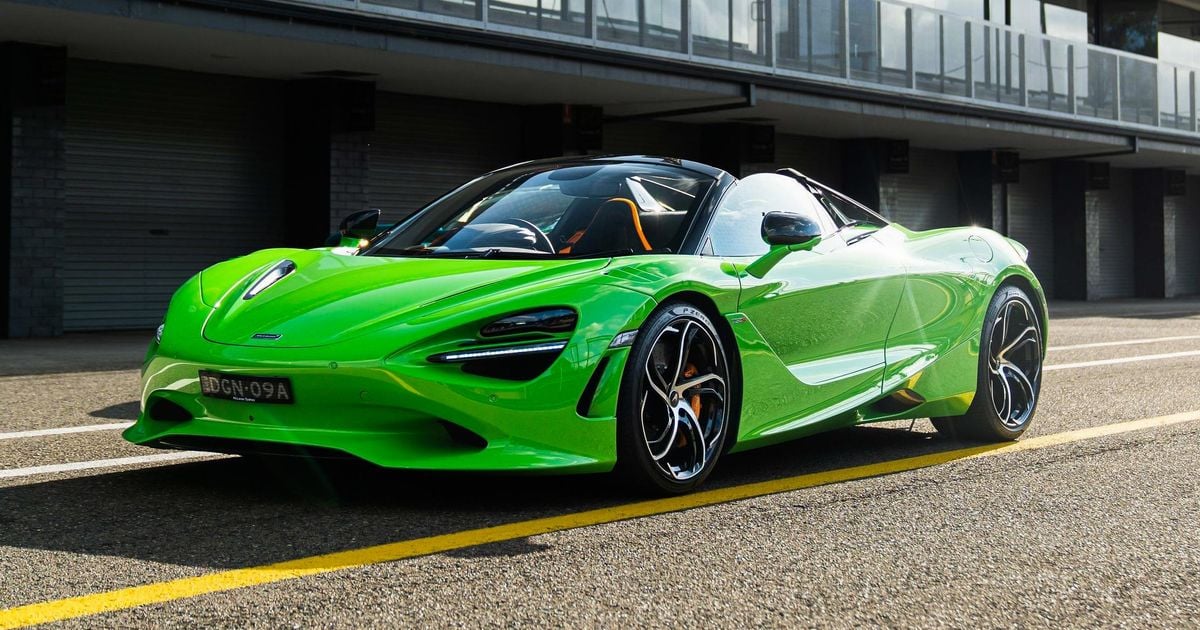
There’s a compelling argument that 2024 will be remembered as the year McLaren rediscovered its mojo.
With the COVID-19 pandemic now a distant memory in the rear-view mirror, the British carmaker has suddenly appeared as a front-runner in Formula 1 and is making big headlines with its upcoming product plans, headed by the insane W1 hypercar.
But headline acts aside, the most important indicator of McLaren’s wellbeing as a carmaker is the new McLaren 750S.
A replacement to the manic McLaren 720S, itself a blindingly quick and capable Woking export, the 750S is McLaren’s new full-time supercar flagship.
It is said to be lighter, faster and straddle a broader performance bandwidth than its predecessor, all while commanding a healthy $80,000 uptick in price.
The 750S has been on sale in Australia nigh on 12 months, but such is the present appetite for half-million-dollar McLarens that any unsold vehicles have promptly been snapped up as dealer demonstrators.
Although it looks similar to the outgoing 720S, McLaren says 30 per cent of 750S parts are new or upgraded. In fact, it is claimed the 750S now bridges the gap to the more manic McLaren 765LT – yet without compromising every driveability.
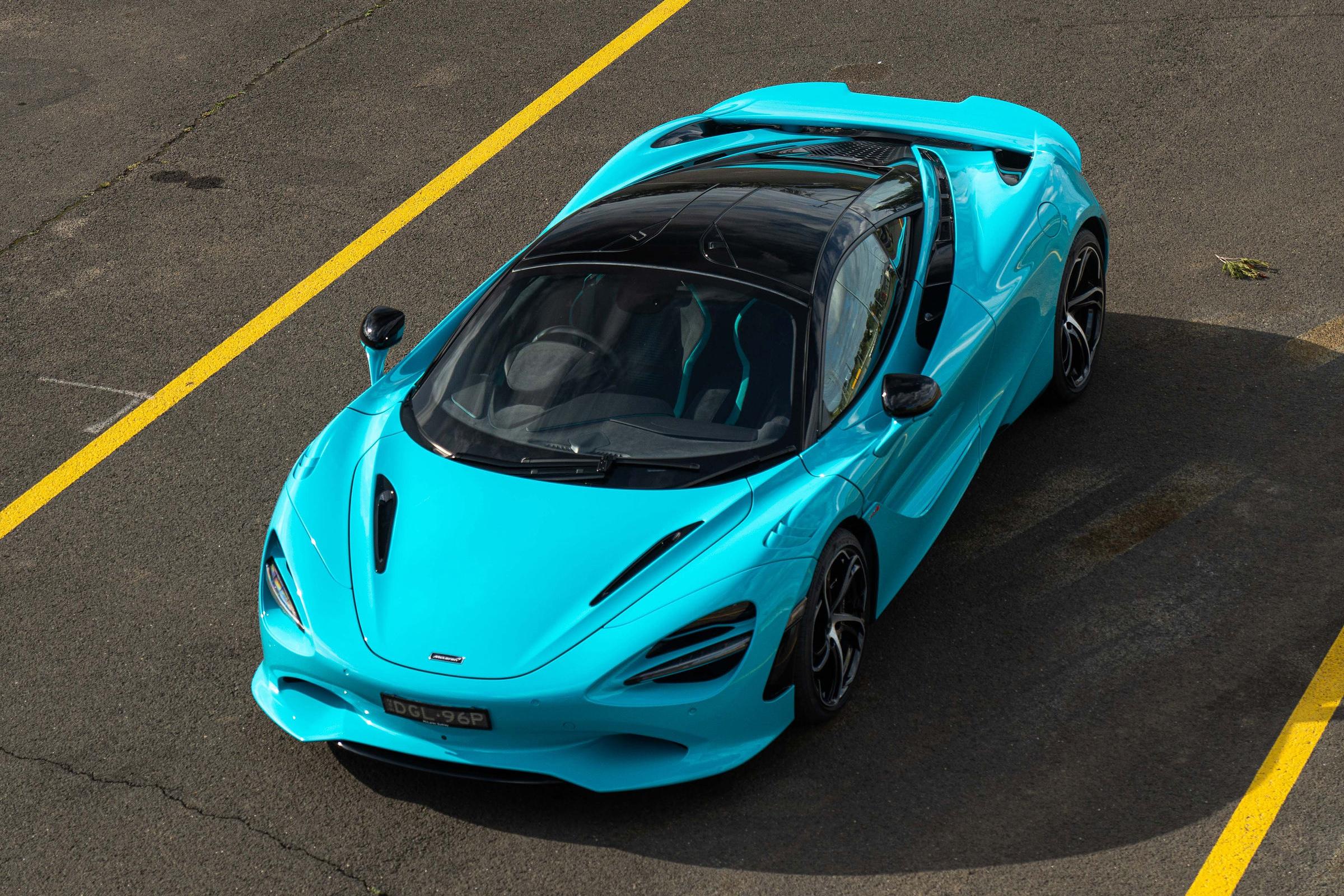
Cosmetically, the changes are denoted by an extended front splitter, narrower eye-socket intakes, new rear wheel-arch vents, a lengthened carbon-fibre active rear wing and new front and rear bumpers.
The visual differences are subtle for sure, but they have been fashioned in the name of improved aero, stability and cooling.
Upon closer inspection, it’s possible to distinguish minor differences between the coupe and convertible versions at the rear, too. The latter features a more open glasshouse structure aft of the cabin in order to accommodate its folding glass roof.
Less obvious are the weight savings, like the standard-fit carbon-fibre shelled racing seats that are 17.5kg lighter than the 720S pews, or the staggered-size wheels that shed 13.8kg in unsprung weight. Even the new exhaust system shaves off 2.2kg.
The almost maniacal focus on class-leading power-to-weight means the McLaren 750S tips the scales at 1348kg in coupe form, with the convertible adding an additional 49kg.
How does the McLaren 750S compare?
View a detailed breakdown of the McLaren 750S against similarly sized vehicles.
McLaren
750S
How much does the McLaren 750S cost?
In Australia, the McLaren 750S retails for $585,800 plus on-road costs in coupe form, or $654,600 plus on-road costs as a convertible.
At those prices, the 750S is dearer than just about every key rival, including the Ferrari 296 GTB ($568,300 plus on-roads), Maserati MC20 ($510,000 plus on-roads) and the Porsche 911 GT3 RS ($539,100 plus ORCs).
To see how the McLaren 750S stacks up against its rivals, check out our comparison tool
What is the McLaren 750S like on the inside?
McLaren has made evolutionary changes inside the 750S cabin in a bid to keep pace with the latest infotainment and safety expectations, but without detracting from its performance focus.
Perhaps the best demonstration of this ethos is the 750S steering wheel, which is completely devoid of buttons and switchgear.
At the other end of the spectrum, the 750S offers users (and watchers-on) a suitable amount of the usual supercar tinsel, compliments of dihedral doors and a relatively high-set door sill to clamber over into its carbon-fibre tub.
An updated 7.0-inch touchscreen display boasts improved graphics and increased touch sensitivity, together with Apple CarPlay and higher quality reversing and 360-degree cameras. Disappointingly, the 750S does without Android Auto.
Also on the infotainment, the 750S offers a better in-car microphone for phone calls (let’s face it, this supercar does all the shouting so you don’t need to) and an upgraded Bowers and Wilkins premium audio system that sounds the business. There are also USB-C and USB-A ports for charging devices.
Elsewhere, the 750S introduces a new instrument binnacle flanked by rocker switches at 10 and 2 o’clock. The left side allows the driver to quickly change the suspension parameters, while the right offers access to the different engine modes – all without taking your hands off the wheel.
The coupe version offers a larger 210-litre rear boot space behind the 4.0-litre engine than the convertible, which gets a 58-litre space. Both offer a relatively small 150-litre frunk that will squeeze in a small overnight bag, but not much more.
Vision front and rear is surprisingly thoughtful irrespective of variant, while there is ample odds-and-ends storage dotted throughout the cabin.
To see how the McLaren 750S stacks up against its rivals, check out our comparison tool
What’s under the bonnet?
The McLaren 750S continues to source power from a 4.0-litre twin-turbo V8 engine, codenamed M840T.
Overseas model shown
The mid-mounted bent eight outputs 750hp (hence the nomenclature), equating to 552kW, plus 800Nm of torque. Those figures represent 25kW/30Nm increases over its predecessor and result in a class-leading power-to-weight ratio.
The engine itself is a product of steady evolution over the past 10 years, though its performance credentials are as relevant as ever: 0-100km/h in 2.8 seconds, 0-200km/h in 7.2s and a top speed of 332km/h.
To achieve the performance fillip McLaren says it looked to the 765LT, borrowing its lightweight pistons and increased turbo boost pressure, and added a high-flow fuel pump plus retuned mapping for the engine management system.
The engine shuffles drive to the rear wheels via a retuned seven-speed dual-clutch automatic transmission with a shorter final drive ratio, and a new limited-slip rear differential.
Finally, the engine’s vocals are also clearer thanks to a new exhaust system that channels into a central outlet at the rear.
Elsewhere, the 750S boasts a 6mm wider front track for better turn-in, while lightweight springs with new spring rates (softer up front, stiffer at the rear) have been fitted at each corner.
Twin-valve shock absorbers employ both active and passive technology to improve ride comfort and stability at the same time, says McLaren. Even the front lift system on the 750S raises the nose in half the time it took on the 720S, at 4.0 seconds.
To see how the McLaren 750S stacks up against its rivals, check out our comparison tool
How does the McLaren 750S drive?
The McLaren 750S is billed as something of an all-rounder, a supercar capable of track days, touring or even a doddle to the shops.
It is a vehicle that borrows the most appealing elements of McLaren’s existing fleet – but to call the 750S simply a jack-of-all-trades is doing it a massive disservice.
On a vacant Sydney Motorsport Park circuit recently, we were afforded two 15-minute sessions under lights; the first stint in the coupe and the second in the convertible.
Our biggest takeaways from the drive experience was the tactility and feedback of the 750S. McLarens of the past 10 years have always had a knack of telegraphing what’s happening underneath you – a virtue of their electro-hydraulic steering and lightweight engineering ethos.
But the 750S extends that brief. It is a vehicle that talks to you at every point on a circuit, especially one as varying as Eastern Creek.
First the engine. Now, if the rumours are true, it may well be the last series-production supercar from McLaren to go without any kind of electric assistance. If that’s the case, the 750S is a fitting send-off: remarkably fast in straight line, visceral and highly user-friendly thanks to its clever seven-speed auto.
If you call for a downshift that would over-rev the engine, there is now software to essentially queue the downshift for when it is safe and appropriate.
Even the soundtrack adopts a rawer tone than before. Pulling away from pitlane, the vocals are louder and clearer than the 720S, complementing the engine’s more focussed tuning. At night, the exhaust belches blue flames between high-paced gearchanges, only adding to the theatre.
In Comfort or Sport settings, the McLaren 750S picks up speed effortlessly right through the rev range. You would never call its power curve linear though, such is the expediency of the engine’s rush to its circa-8500rpm cutout.
Rather, the 4.0-litre V8 makes meaningful power from idle but truly hits its straps in the mid-range, with peak torque materialising at 5500rpm and maximum power chiming in at 7500rpm.
In its most aggressive Track powertrain setting, the 750S is unapologetically raw, so much so that you have to brace your neck for the forward surge between gear changes, which are violent and accompanied by a sudden thud in the back.
The engine refuses to sign off as you climb the rev range, but you could argue that the stability control suite is a little too judicious with its interventions. The electronics will cut power for noticeable periods if you’re a little eager with the right foot or get too comfortable with the car occasionally breaking loose.
Now, we’re definitely advocates for stability control because it is crucial in a car with this much power. But we reckon the 750S would really come to life with a more liberal ESC tune; as it is, it brings a sudden halt to proceedings.
In any case, the handling is sharp, offering excellent balance between the front and rear axles, and loads of tactility and precision. The steering feels light at lower speeds, yet weights up meaningfully as you apply lock at higher speeds.
Exiting the long final turn onto the main straight, it was possible to steer the car on full throttle out onto the kerb with full control and peace of mind.
The level of front-end purchase is a noticeable improvement on the 720S, and there are no complaints around the effectiveness of its carbon-ceramic brakes, which are immune to fade and offer ample feel and modulation once warm.
As the speed rises, so too does the drama. The electro-hydraulic steering offers a precise and well-weighted action, while also delivering a high level of feedback to the driver’s hands. The 750S distils all the important information and sends it back to the driver’s seat, creating an communication-rich and rewarding drive experience.
The other impressive feature is the minimal dynamic compromise made by the heavier (by just 49kg) convertible version. It feels rigid and just as athletic as the coupe, even without additional structural bracing, and gives occupants a front-seat ticket to the 4.0-litre V8’s improved vocals.
Ultimately, on ageing Pirelli P Zero tyres, the McLaren will walk around and fidget through faster corners, only adding to its visceral appeal.
If you’d prefer your track experience to be even more hunkered-down and effective, there’s an argument that the 765LT is a more suitable accomplice. But in 95 per cent of driving, the McLaren 750S wants for very little – and it would improve dramatically with a better set of rubber, like Pirelli Trofeo Rs.
Unfortunately, we didn’t venture onto public roads this time round, but as Tony found at the international launch of the 750S last year, its broadened dynamic envelope is matched with better bump compliance and overall ride comfort. It’s also easier to access the engine’s vocals without breaking the speed limit.
What do you get?
The McLaren 750S is offered in Australia in both coupe and convertible guise.
McLaren 750S highlights:
Soft-close doors
Electrically folding, heated door mirrors
Active rear spoiler with air brake and automatic drag reduction system (DRS)
Adaptive LED headlights with automatic levelling and sequential indicators
Engine bay ambient lighting
Follow me home lights
Central-exit stainless steel sports exhaust
Alcantara interior trim; carbon black with choice of performance or luxury skews
Leather-wrapped steering wheel with matching stitching
Choice of Comfort seats or carbon-fibre racing seats
Power-adjust steering column
Ambient interior lighting
Solid machined-metal interior switches
Zircon Silver and brushed iridium brightwork
10-spoke ultra-lightweight forged alloy wheels in Silver finish
Pirelli P Zero tyres
Tyre-pressure monitoring system
Tyre temperature gauge
Carbon-ceramic brakes
Wired Apple CarPlay
8.0-inch touchscreen infotainment system
Column-mounted driver information display
Four-speaker audio system
Dual-zone climate control
Brake-pad wear sensors
Variable drift control
Keyless entry and start
Electrochromic rear-view mirror
Is the McLaren 750S safe?
The McLaren 750S definitely keeps pace with the latest safety standards, but don’t expect to see it independently crash-tested by Euro NCAP or ANCAP.
As standard, it comes with adaptive cruise control, road sign recognition, lane departure warning, high-beam assist and 360-degree park assist.
There’s also full airbag coverage and a suite of electronic driving aids, in addition to solid structural integrity courtesy of a carbon-fibre monocoque platform.
How much does the McLaren 750S cost to run?
If you need to ask, this car probably isn’t for you. That said, the warranty and service provisions for the 750S are quite competitive.
It’s backed by a five-year, unlimited-kilometre warranty in Australia, while servicing is inclusive for the first three years of ownership, based on 12-month/15,000km intervals.
To see how the McLaren 750S stacks up against its rivals, check out our comparison tool
CarExpert’s Take on the McLaren 750S
The McLaren 750S pushes the British car-maker’s flagship supercar to new heights – not only in terms of track thrills but also when it comes to broader road use and technology.
It offers the visceral sensation and raw speed a bona fide supercar ought to, yet feels incredibly well balanced, communicative and almost foolproof on circuit.
If you have the means, the new McLaren 750S deserves to be cross-shopped against the best supercars from Ferrari and Porsche. Especially if you prefer your supercar without any electric assistance.
Interested in buying a McLaren 750S? Get in touch with one of CarExpert’s trusted dealers here
Rolls-Royce has revealed a one-off Phantom that pays homage to the 1964 James Bond film, Goldfinger. It was commissioned by a British collector, who has reportedly paid $6 million for this car.
The Rolls-Royce Phantom Goldfinger celebrates 60 years of the famous James Bond film and takes inspiration from the 1937 Phantom III Sedanca de Ville, owned by the eponymous villain, Auric Goldfinger.
The one-off Phantom is finished in a 2-tone color scheme of yellow and black. The car rides on 21-inch disc wheels finished in black with silver floating hubcaps. The Spirit of Ecstasy also gets a unique finish. It is made from solid silver and has 18-carat gold plating on it.
The gold theme has been carried over to the interior, incorporating 18-carat and 24-carat gold details. The car has a hidden vault in the centre console, which houses an illuminated 18-carat gold bar. The glove box lid has the famous quote, “This is Gold, Mr. Bond. All my life, I have been in love with its colour, its brilliance, its divine heaviness.” inscribed onto it. There’s also a 24-carat gold-plated VIN plaque with a special VIN that ends in 007.
A bespoke artwork showing the isoline map of the Furka Pass has been presented in the Phantom’s Gallery. The Starlight headliner also reflects the constellations as they were positioned over the Furka Pass on July 11, 1964. Other details include Royal Walnut picnic tables with 22-carat gold inlays, Navy leather upholstery with Royal Walnut veneer, and gold detailing. The car also has a special license plate, “AU 1” – AU being the chemical symbol of gold.
When you first think about visiting Louisiana, the first thing that probably comes to my mind is New Orleans, which is one of the South’s incredible cities to visit in the United States. However, there are heaps more of the best places in Louisiana that go far beyond the city itself.
You see, Louisiana is a pretty big state, and you can easily visit a fair few of these if you’re driving on a wider US road trip. This is exactly what we did, and we totally loved how diverse and honestly surprising Louisiana is. The state is gorgeous.
So, to help you get the most out of your trip, I’m sharing our top places in Louisiana you should stop at as you traverse the state. This way, you’ll make the most of your time exploring the state without getting bogged down with the planning.
Have the most amazing trip to Louisiana.
1.) New Orleans
New Orleans is one of the most unique cities in the US to visit. It’s just incredible, and you can easily spend three or four days there, soaking up the culture, history, and, of course, the city’s neighbourhoods.
After arriving, be sure to explore New Orleans’ French Quarter. It’s beautiful and one of the city’s most prominent and oldest neighbourhoods. It includes magnificent houses that are 300 years old.
If you’re planning on going to Bourbon Street, expect lots of Mardi Gras crowds. It’s a fun-fuelled street that buzzes as the sun goes down. One thing I would say about Bourbon Street is that it can take some getting used to. We first ventured here in the early evening, and it was as busy as it gets.
As a first-time visitor to New Orleans, this felt a little daunting, but you quickly acclimate to the joy and ruckus. Once here, make sure to book a concert at Preservation Hall, a historic and intimate little venue that’s just incredible.
If you’re interested in museums, head over to the National WWII Museum. It’s a perfect place to visit if you’re interested in Military history and gives a huge insight into one of the world’s deadliest and most destructive wars. The “Road to Berlin” exhibit was one of the best things about the Museum, it shows an almost realistic experience of entirely recreated battles with sounds and sight.
Oh, and don’t forget to grab a bite at Antonie’s Restaurant. It’s the oldest restaurant in New Orleans, and the food is delicious. Their fish amandine is so yummy.
Lake Martin is a swamp area around a 2-hour drive from New Orleans. Although small, it is pretty epic to visit. You can join some of the swamp tours to spot some of the local wildlife (including alligators). For one of the best tours, head over to Cajun Country Swamp Tours.
A visit will take around 1 hour, and it is easily one of the best places in Louisiana to visit if you’re looking for a small activity as you drive through the state. We loved it.
3.) Laura Plantation
If you plan on travelling to Louisiana, you should visit the Laura Plantation. It is located at 2247 Hwy 18, Vacherie, Louisiana, and has been open to visitors since 1994.
This plantation was used to harvest sugarcane for over 180 years. The building still has furniture from the original period, and it’s quite pertinent to visit. The tour also focuses on the stories of enslaved people who, as we know, were integral to the running of the plantation. It’s a stark reminder of the horrors of slavery.
Visits will take around 90 minutes and are well worth visiting as you drive west from New Orleans.
4.) St. Francisville
Just north of Baton Rouge, St. Francisville is a relatively small town but the perfect stopping point as part of a wider Louisiana road trip. You see, once here, you can head to the Rosedown Plantation State Historic Site and learn more about the history of the plantation, its people and see the stunning grounds.
Also, don’t forget to pop by the Grace Episcopal Church and grab a bite to eat at The Francis. They serve a tasty shrimp leon and it’s the perfect stopping point for a casual lunch.
Although smaller than New Orleans and a little less lively, Baton Rouge is the state capital of Louisiana and a perfect place to spend a few days.
Once here, make sure to visit the Old State Capitol building. This landmark structure is in Baton Rouge, Louisiana, at 100 North Blvd. Both the inside design and the outside have an amazing Gothic style.
It is as similar as you can get in Louisiana to a castle. You can even spot the Mississippi River from the towers’ great heights.
Another key site to visit in Baton Rouge is USS Kidd and Veterans Memorial You can find the historic site at 305 South River Road, Baton Rouge. It was an active ship used during WWII. However, it has been used to produce films and TV shows and is well worth visiting if you’re interested in military history.
Right in the heart of the state, Alexandria is one of the best places in Louisiana to visit for an alternative city break. It’s got everything you want from a large American city, but it also has that small-town vibe (if that makes sense).
If you’re interested in art, visit the Alexandria Museum of Art. You can easily spend an hour wandering through the exhibitions here. We loved it.
Also, for some tasty boiled shrimp, head on over to Debarge’s Crawfish. It’s nothing fancy, but the food is so good for a lunch in Alexandria.
7.) Lafayette
West of New Orleans, Lafayette is another gem to visit in Louisiana if you drive across the state. It’s small enough that a day’s visit is just enough. However, if you want to take things slow, stay overnight and soak up the city’s vibe.
After arriving in Lafayette, make sure to visit Vermilionville. It’s a historical museum at 300 Fisher Road, Lafayette, Louisiana. It features some of the traditions of the Acadian people as they were between the 18th and 19th centuries. The skills and craftwork of the Acadian people have been preserved through many generations. We loved it, and it’s so interesting to hear about the lives of the First Nation people and other populations that made their homes in Louisiana.
Also, don’t forget to visit the Hilliard Art Museum. It has many seasonal exhibits that change throughout the year.
8.) Shreveport
Shreveport is one of the largest cities in the state and one of the best places in Louisiana to visit and spend a weekend away.
Once here, make sure to pop into the Sci-Port Discovery Center. It features everything and anything related to science, which makes it fun for the whole family. Visits take around 90 minutes, and it’s a perfect morning activity if you’re visiting Shreveport with your family.
Afterwards, head on over to the Louisiana State Exhibit Museum. Here, you can explore Louisiana’s long history and the people that make up the state. It’s a great way to learn more about the state’s history.
Oh, and pop into The Blind Tiger for their seafood gumbeaux. It’s a yummy and casual spot for lunch, and delicious.
Just shy of New Orleans, you can easily visit the wetlands of Jean Lafitte National Historical Park for a morning trip from the city itself. It’s one of the best places in Louisiana to visit if you want to explore the unique geographical history of the state’s coastlines.
Plus, it’s absolutely beautiful if you fancy a more relaxing day from the hustle and bustle of New Orleans. The Barataria Preserve is absolutely beautiful.
However, make sure to take some sunscreen with you; there’s very little shade in some parts of the historical park.
10.) St. Martinville
Southeast of Lafayette, St. Martinville is well worth exploring, a few hours’ trip from the city itself. It’s pretty epic to visit, and you can explore some of the town’s historical sites that date back centuries.
Not only that, it’s one of the best places in Louisiana to visit if you want to explore some of the state’s cultural history – which, in my opinion, makes St. Martinville well worth a visit.
For some time now, Mazdas have typically offered a more upmarket feel than rival brands.
Mazda is trying to build on that with its new family of Large Platform architecture SUVs, the first of which was the CX-60 launched here in 2023, which sit at a higher price point than the similarly sized SUVs they replace or complement in the lineup.
Mazda’s Large Platform SUVs are as close to clean-sheet as possible, riding a new rear/all-wheel drive chassis architecture, featuring new inline six-cylinder engines and a new eight-speed automatic and mild-hybrid system developed in-house.
Those specifications make them sound more like rivals for the likes of BMW than, say, Toyota, though Mazda Australia has avoided referring to these as luxury SUVs.
While the CX-60 range usually opens at $60,550, or $5550 more than a top-spec version of the also mid-sized CX-5, current promotional pricing puts the new SUV even closer to its older stablemate.
WATCH: Paul’s video review of the Mazda CX-60 G40e and D50e
Deal or no deal, is it worth the extra cash to step up from a CX-5?
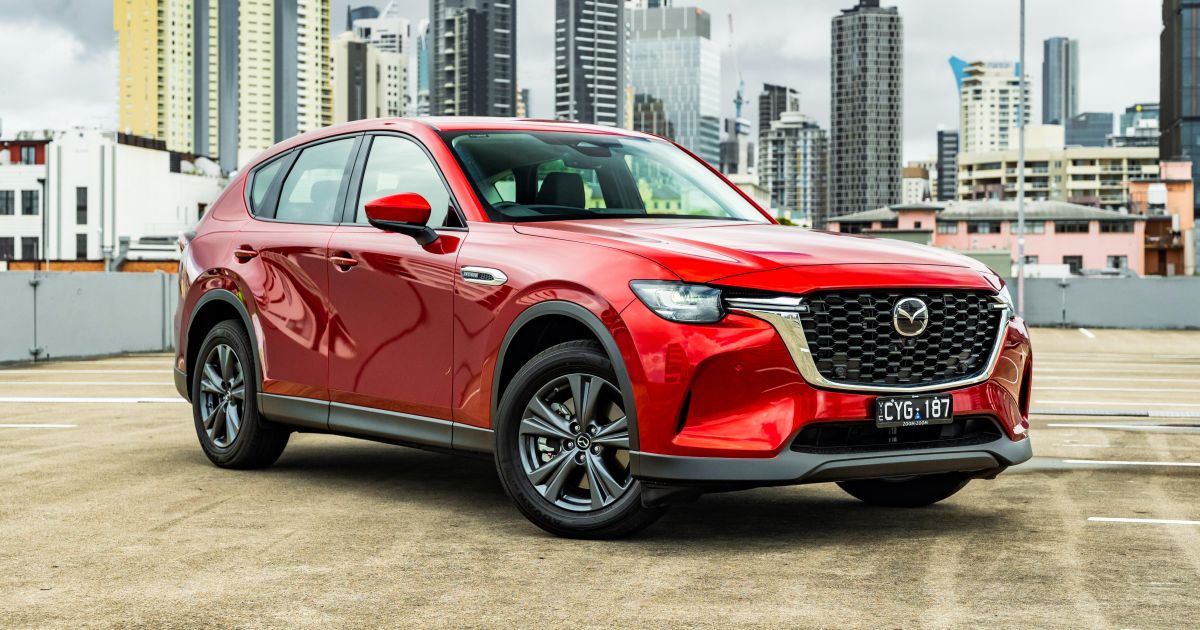
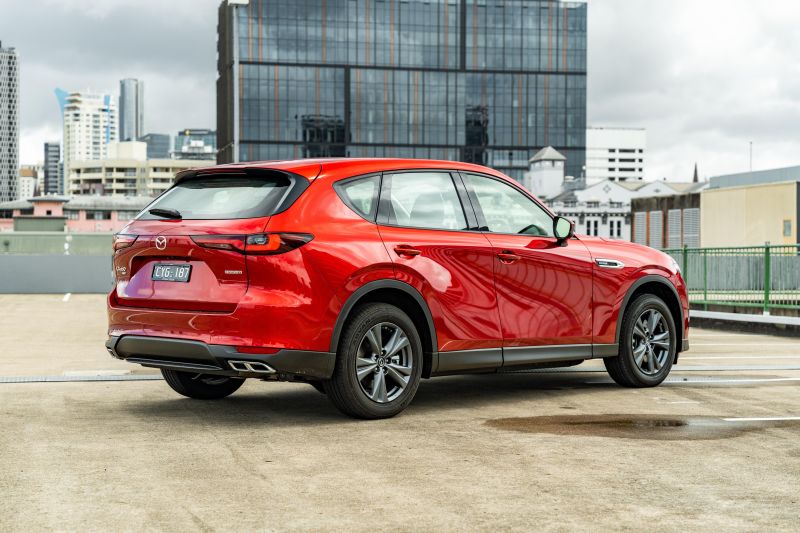
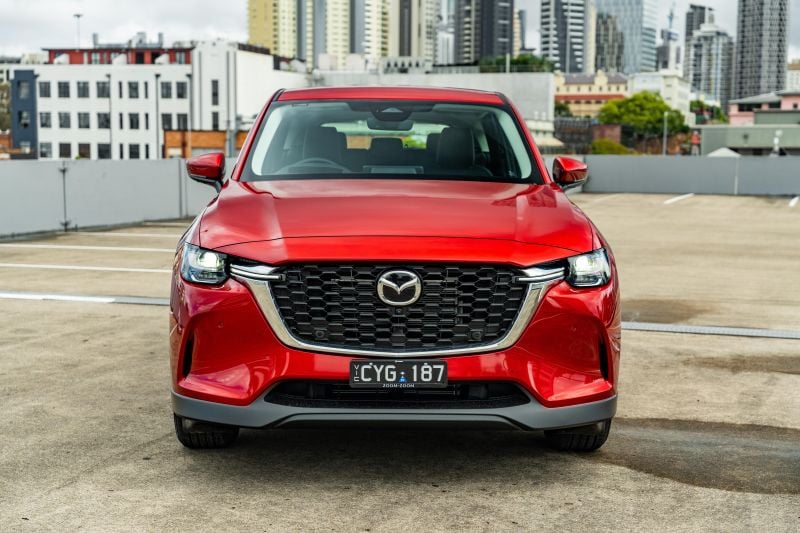
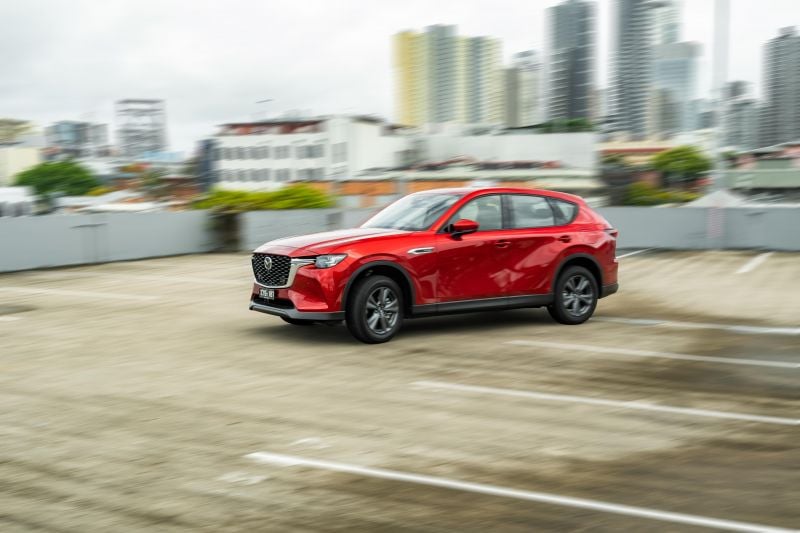
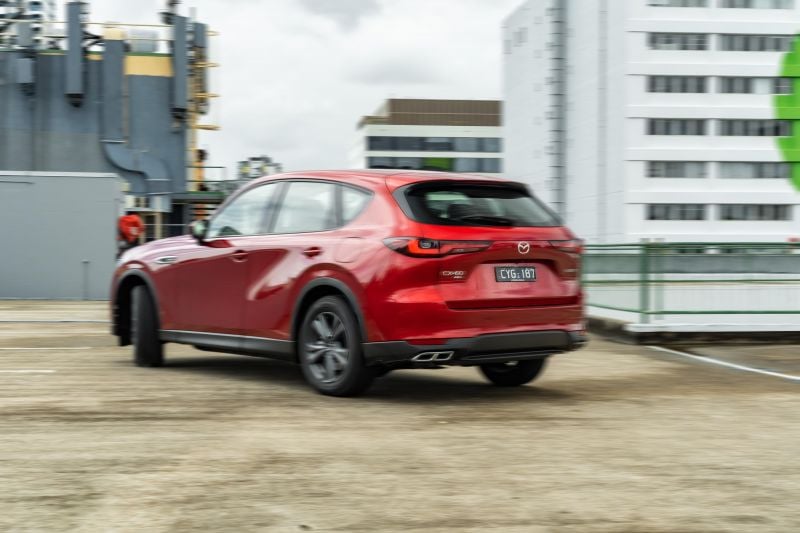
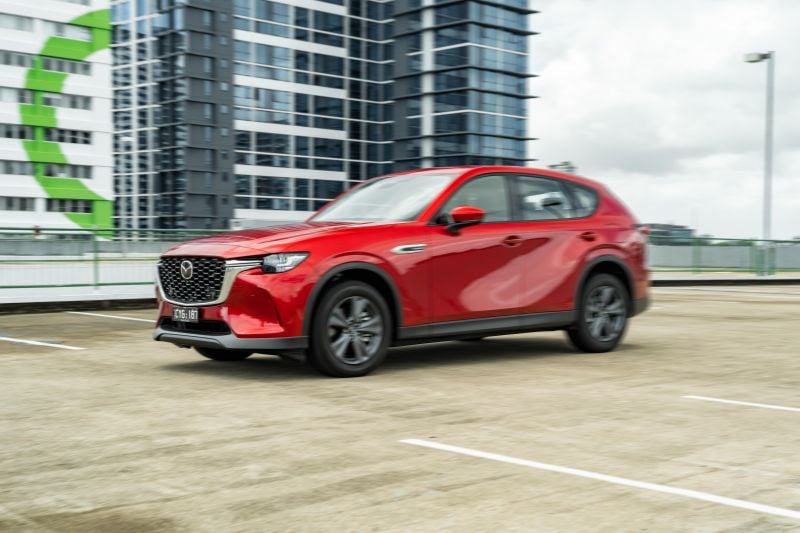
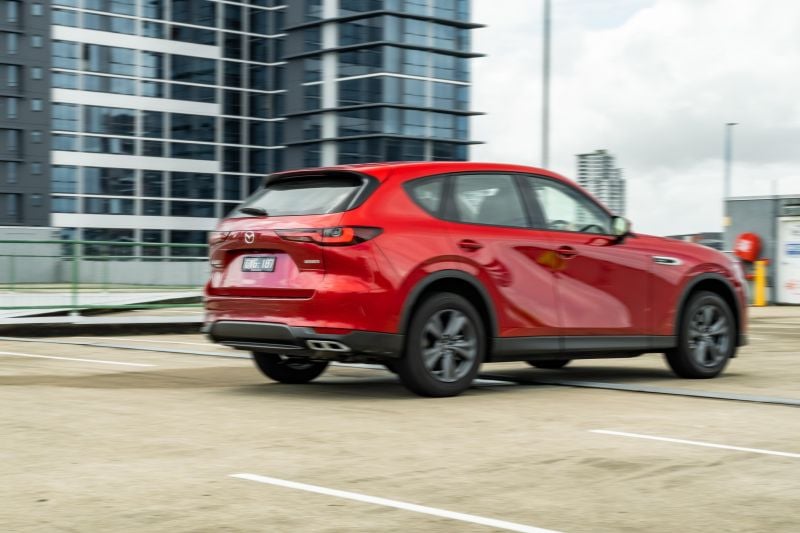
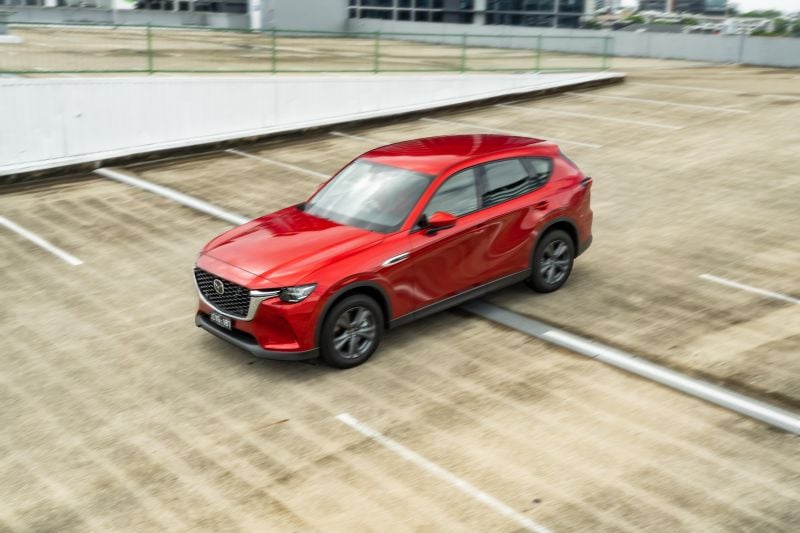
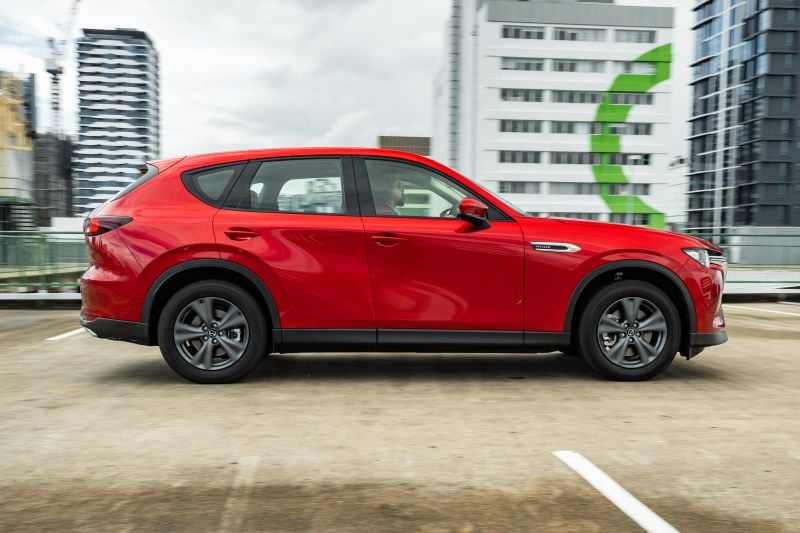
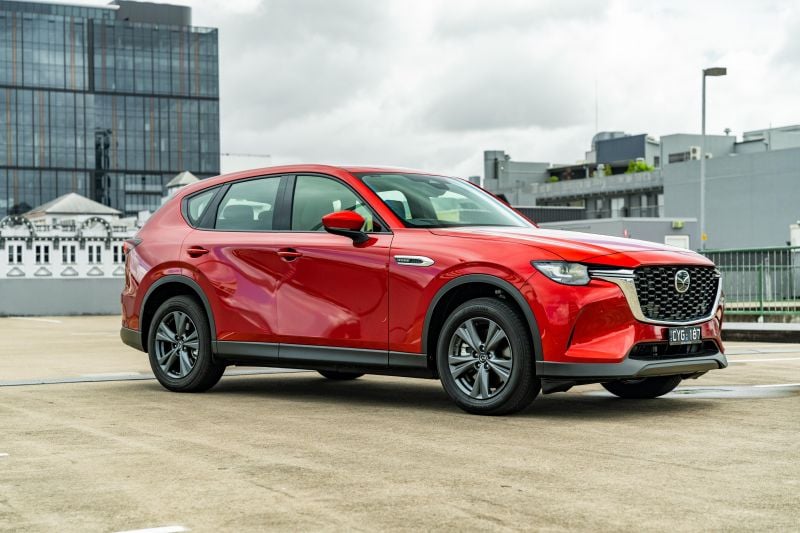
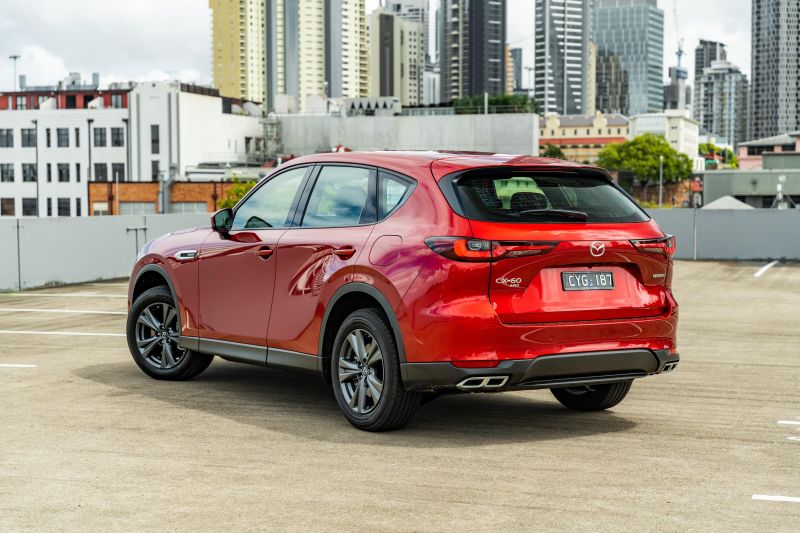
Walking to the carpark to pick up the CX-60 for the first time, I mistook it for the CX-5, not helped by its use of Mazda’s lustrous but ubiquitous Soul Red Crystal paint.
Come around the front and you can see the long bonnet that, more than anything else, distinguishes the CX-60 from the CX-5. However, Mazda missed a trick by not giving this new model more distinctive styling.
The nameplate is already alphabet soup, no doubt confusing buyers, so some more unique styling would have been a wise choice to distinguish the CX-60. But while this more ambitious Mazda SUV looks like its more humble showroom-mate, the driving experience couldn’t be more different.
How does the Mazda CX-60 compare?
View a detailed breakdown of the Mazda CX-60 against similarly sized vehicles.
Mazda
CX-60
How much does the Mazda CX-60 cost?
The Mazda CX-60 is offered with a choice of mild-hybrid petrol (G40e), mild-hybrid diesel (D50e), and plug-in hybrid petrol (P50e) powertrains, all three of which are offered in base Evolve, mid-range GT and top-spec Azami trims.
Our base CX-60 wasn’t exactly base, with Mazda specifying the optional $4000 Luxury Package.
Still, current promotional pricing available in all states bar Western Australia sees the Evolve G40e – already the most affordable CX-60 – cost $56,990 drive-away.
Opting for the diesel powertrain adds an extra $2000, while the plug-in hybrid version is currently being offered for $70,040 drive-away.
You can view all current offers on the Mazda Australia website.
Model
Price before on-road costs
Mazda CX-60 G40e Evolve
$60,550
Mazda CX-60 D50e Evolve
$62,550
Mazda CX-60 G40e GT
$68,550
Mazda CX-60 D50e GT
$70,550
Mazda CX-60 P50e Evolve
$73,600
Mazda CX-60 G40e Azami
$73,750
Mazda CX-60 D50e Azami
$75,750
Mazda CX-60 P50e GT
$81,600
Mazda CX-60 P50e Azami
$86,800
To see how the Mazda CX-60 lines up against its rivals, check out our comparison tool.
What is the Mazda CX-60 like on the inside?
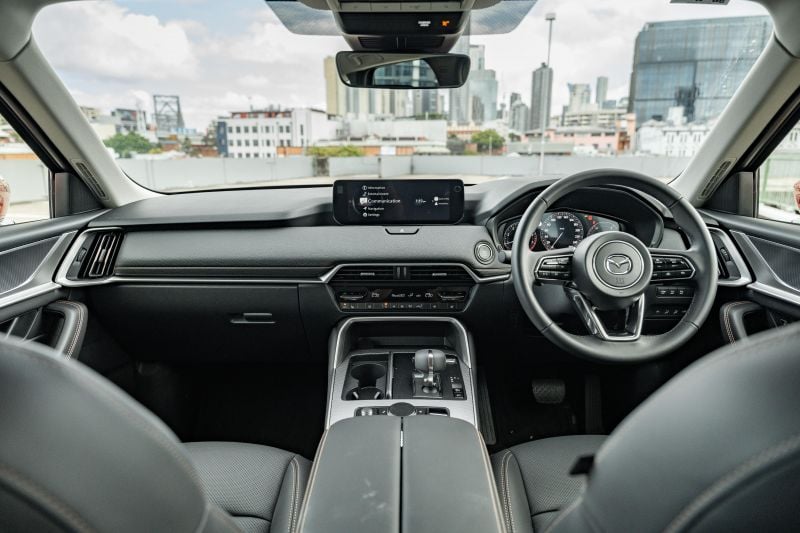
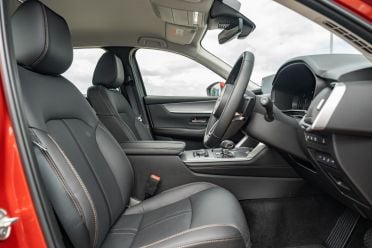
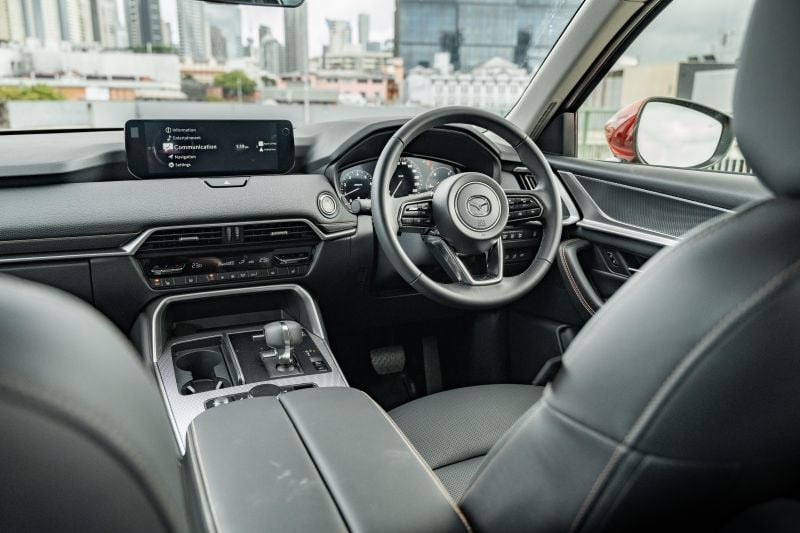
The CX-60 has a nice interior, but given how high the CX-5 sets the bar for the mid-sized SUV segment we might have expected the CX-60 to aim just a little bit higher.
Still, the CX-60 holds its own against the likes of the Lexus NX. Material quality is impressive, with the dash top among the softest out there.
Soft padding can be found on the sides of the centre console, too, while the tops of the doors front and rear are soft-touch; the bottoms of the door cards aren’t, but that’s common for even premium mid-sized SUVs.
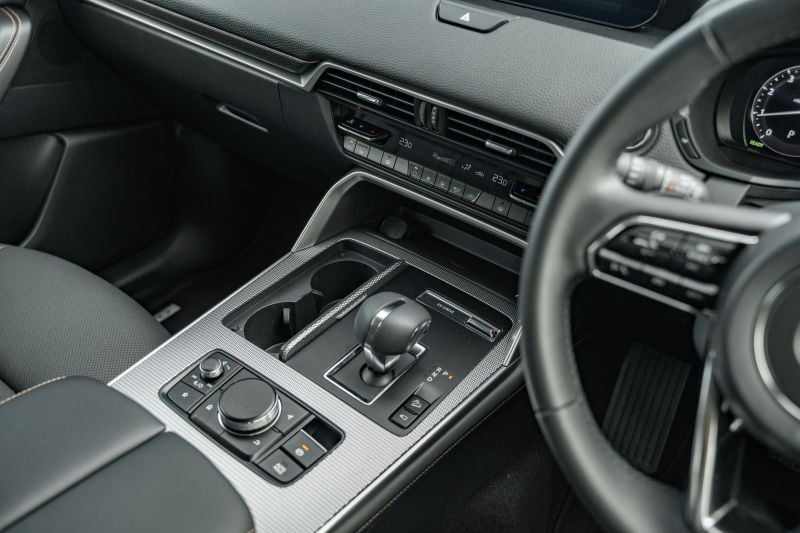
There’s mercifully no gloss black trim inside. The centre console instead uses a mixture of matte black plastic and metal-look trim, the latter of which has no real texture and is ultimately unconvincing.
There are also metal-look accents across the dashboard, but these don’t look especially authentic either.
The front of the dash is finished in an extremely soft material, which is nice, but it has a different graining to the rest of the dash, resulting in a somewhat disjointed look. On some more expensive CX-60s this section of the dash is finished in suede or cloth.
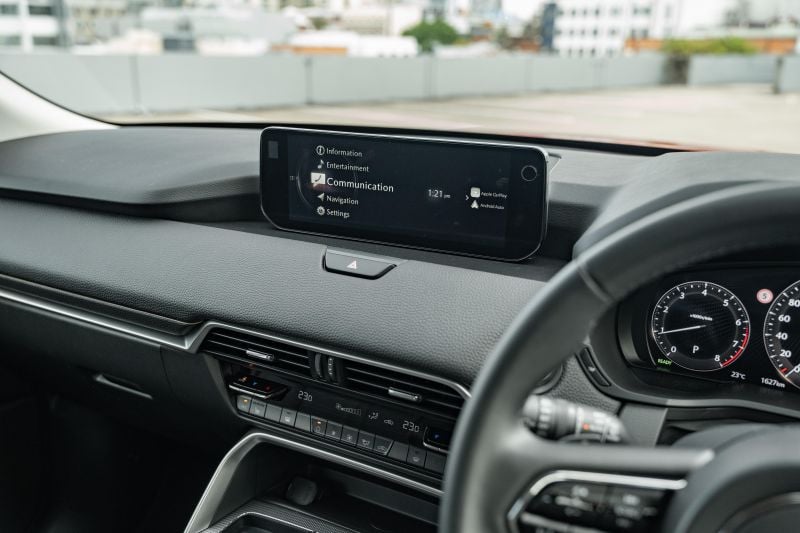
The Evolve is the only member of the CX-60 range to feature a 10.25-inch infotainment screen, with the GT and Azami featuring a 12.3-inch unit.
While both screens can be controlled with the rotary dial on the centre console, which proves intuitive, only the larger screen offers touch functionality for smartphone mirroring.
Anybody who has tried to use Apple CarPlay or Android Auto on a screen without touch functionality can attest it’s much more cumbersome than controlling these systems by touch.
The lack of touch functionality also underscores Mazda’s chopping and changing of its screen strategy.
The brand has gone from offering screens that could be touched while stationary, to banishing touch functionality altogether, to once again offering limited (but this time differently so) functionality. All three types of screens can still be found in Mazda’s current lineup.
There’s a traditional array of buttons for the climate control, while a volume knob can be found on the centre console along with shortcut buttons for the infotainment system.
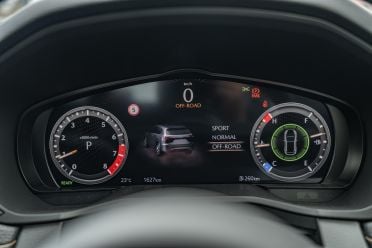
As our tester had the optional Luxury Package, it featured a 12.3-inch digital instrument cluster. While there’s no ability to view maps on this screen, it features attractive graphics simulating a traditional analogue cluster.
Standard on all CX-60 models is a head-up display, and this is an excellent unit with all the information you need clearly visible. We also appreciate the classy typefaces found here and elsewhere in the CX-60, a subtle differentiation from lesser Mazdas.
Surprisingly, the base CX-60 lacks power adjustment and heating for the front seats, but our tester’s Luxury Package addresses these omissions.
The latest generation of cameras used in Mazda products are impressively high-resolution, with the optional Luxury Package bringing a see-through function for the standard surround-view camera.
In terms of storage, there are bottle holders in the doors plus a shallow centre console bin with a pair of USB-C outlets inside and a softly padded, split-opening lid.
Step out of the car and the walkaway locking function proves irritating – I could practically hug the car as you walk around to the other side and it would still lock, and yet on other occasions I’d walk away from the car and it wouldn’t lock. Best to just turn this function off.
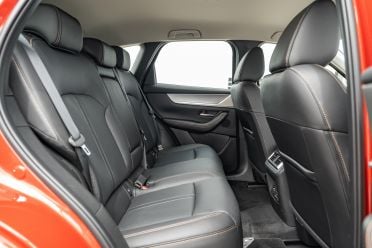
Stepping into the back is easy, with the rear doors opening 90 degrees. Once inside, you’ll find plenty of headroom and legroom, and it does feel more spacious than a CX-5.
The driveline hump is also relatively flat, so legroom for the centre-seat occupant isn’t constricted too much.
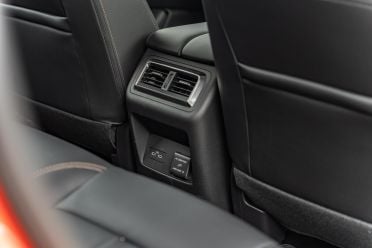
In terms of amenities, there are rear air vents, two USB-C outlets, and a 220V/150W power outlet.
Child seats can be secured using the ISOFIX points on the two outboard seats, or via one of the three top-tether points.
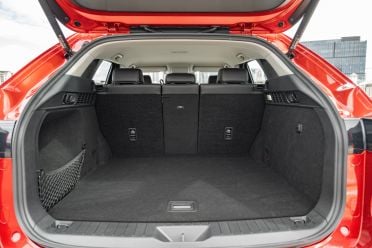
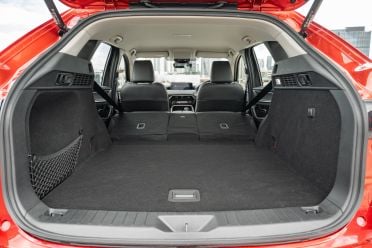
Open the (power-assisted) tailgate and there’s a claimed 477L of cargo space including the underfloor storage space. This expands to 1726L with the 40/20/40-split rear bench folded flat or, rather, as flat as it can be.
There are helpful levers in the back that allow you to drop the seats, as well as a netted compartment to keep items from rolling away.
To see how the Mazda CX-60 lines up against its rivals, check out our comparison tool.
What’s under the bonnet?
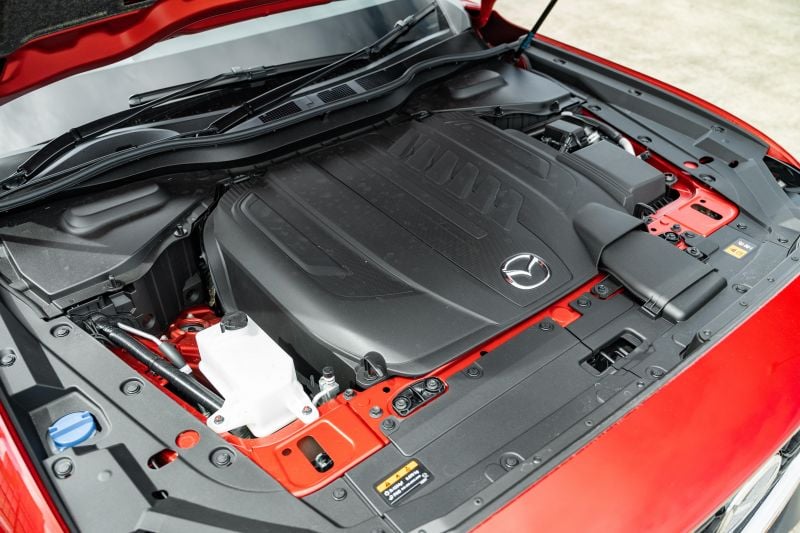
The CX-60 on test here is powered by the inline-six petrol engine with mild-hybrid assistance.
Specifications
Mazda CX-60 G40e MHEV
Engine
3.3L turbo inline six with 48V mild-hybrid system
Power
209kW @ 5000-6000rpm
Torque
450Nm @ 2000-3500rpm
Transmission
8-speed auto
Driven wheels
All-wheel drive
Weight
1921kg (kerb)
Fuel economy (claimed)
7.4L/100km
Fuel economy (as tested)
9.5L/100km (inner-city, suburban and highway loop) 11.7L/100km (over a week, with urban skew)
Fuel tank capacity
58L
Fuel requirement
91 RON regular unleaded
CO2 emissions
171g/km
Emissions standard
Euro 5
Braked tow capacity
2500kg (150kg tow-ball download)
Petrol CX-60s are rated to tow 500kg more than their diesel counterparts.
They have 22kW more power than diesel models, but are down 100Nm of torque. They also use more fuel – diesel models have claimed fuel consumption of 4.9L/100km.
How does the Mazda CX-60 drive?
The Mazda CX-60 might look like a CX-5 but it sure doesn’t feel like one to drive.
Push the start button and there’s a beefy sound from the inline six under the bonnet. A green ‘Ready’ icon flashes a few times before you can move the clunky shifter, while the surround-view camera provides a crystal-clear view of your surrounds as you pull out of your parking space.
Here’s where the CX-60 hits its first hurdle. At low speeds, the steering doesn’t seem to lighten up, which makes navigating a carpark a bit of a chore. The steering is simply too heavy and that, combined with the sound of the engine and the delay off the line (more on that later), makes this car feel big, heavy and dull.
There’s an annoying low-speed jerkiness to the transmission, with the CX-60 heaving repeatedly and dramatically on one occasion as I drove up my sloped driveway onto the street.
This jerkiness continues as you creep through traffic, with the vehicle audibly thunking as you slow down to stop at, for example, a set of traffic lights.
The automatic idle stop/start function isn’t particularly smooth either, though turning it off doesn’t resolve these low-speed driveability issues.
Getting back into my own car after driving this, I found myself waiting for the clunk as I slowed down before realising my car’s eight-speed auto is a much better unit…
When the light turns green and you punch it, you’ll find the CX-60 really doesn’t feel all that quick for something with a turbocharged six, even if it does weigh over 1900kg.
Plant your right foot and let the engine come on song, though, and the CX-60 proves to have good mid-range response and the transmission seems to eventually pull itself together.
Drive the CX-60 along any surface short of, say, the world’s largest billiard table, however, and you’ll find it rides very stiffly.
Mazda rolled out an update earlier this year to fit a revised rear shock absorber, with existing CX-60 owners also able to take advantage of this at its dealers.
Without driving pre- and post-update vehicles back-to-back, it’s hard to tell exactly how much the ride has improved. The CX-60 still, however, transmits every bump into the cabin.
No SUV should ride this stiffly unless it has, say, M Competition badging on the tailgate. The CX-60 has the ability to make what appears to be a smooth surface feel scarred, as if the suspension is doing a topographical study of the roadway.
It squirms like a cat you’re trying to dress in pyjamas, and never feels settled. Hit an expansion joint and you get a thunk. Surface changes are keenly felt.
Here’s one specific example. There’s a road I test cars on where the surface dips down slightly for a low bridge across a creek, and then dips up again ever so slightly when the bridge ends; the speed limit here is 80km/h.
On most comparable cars, the transition from road to bridge sees them take a moment to settle, with one rebound motion. The CX-60, however, was hugely upset, rebounding sharply and markedly around two or three times.
The Mazda also often feels unsettled at the rear, with sharper bumps appearing to jostle it not only up and down but side to side.
The ride could best be described as stiff but bouncy – not an ideal combination.
Around town, this doesn’t feel like a premium mid-sized SUV and, perhaps more gallingly, it doesn’t feel like a Mazda either. Take the CX-60 to a winding mountain road, however, and it starts to shine.
That steering that felt so cumbersome in the carpark? The weighting feels satisfying, if still heavy, and the road feel it transmits is most welcome.
The brake pedal feel is lacking, but otherwise this was a delight to drive along switchbacks and through hairpin turns.
The CX-60 feels planted in corners, with a centre of gravity that appears so low you may forget you’re driving an SUV.
Some of the roads were slick from recent showers, but the CX-60 never felt lacking for grip even if you can feel the subtle rear bias of this all-wheel drive system.
With the CX-60’s high level of noise suppression, knocking it into Sport mode – where it will hold gears for longer, as is typical of these modes – didn’t see the cabin dominated by engine noise. That means you can enjoy a spirited drive in relative peace.
Get onto the highway and you’ll find the cabin to be quite serene. There’s minimal wind and tyre noise at high speeds, with engine noise well suppressed.
The suite of active safety and driver assist systems is a mixed bag.
The lane-keep assist does a good job of nudging you back in your lane, though the lane centring isn’t as impressive. Some rivals feature systems that do a better job of keeping you centred, and on one curve in the road it just gave up and said Steering Assist Not Available.
We like the neat graphics in the digital instrument cluster, however, which includes a graphical depiction of the vehicle and surrounding traffic, with green outlining your lane.
Front cross-traffic alert works well, but I’ve still yet to find when this is useful unless you’re a really oblivious driver, with the chimes just sounding whenever someone drives past you in the carpark or while you’re waiting to turn.
The traffic sign recognition is very clever. Not only does it show you the current speed limit, it also warns you well ahead of time what the speed limit is about to change to.
The automatic high-beam is a bit sensitive, and we found it dipping on roads with no street lights and no oncoming traffic.
What do you get?
There are three trim levels. On test here is the entry-level Evolve G40e.
Mazda CX-60 Evolve highlights:
18-inch alloy wheels
Space-saver spare (petrol and diesel only)
Tyre repair kit (PHEV)
Electric parking brake
Auto hold
Hill descent control
Automatic stop/start
LED headlights
Automatic high-beam
Heated, power-folding exterior mirrors
Power windows with auto up/down for all windows
Power tailgate
Rain-sensing wipers
Proximity entry with push-button start
Head-up display
7.0-inch instrument cluster screen (petrol and diesel only)
12.3-inch digital instrument cluster (PHEV only)
10.25-inch infotainment system
Wireless and wired Apple CarPlay and Android Auto
DAB+ digital radio
Satellite navigation
Wireless phone charger
8-speaker sound system
Dual-zone climate control
Leather-wrapped steering wheel and shifter
Tilt and telescopic steering wheel adjustment
Maztex leatherette upholstery in black
Manually adjustable front seats
40/20/40 split fold rear seats
150W power outlet (1500W in PHEV)
To see how the Mazda CX-60 lines up against its rivals, check out our comparison tool.
Options
Two optional packages are available for the CX-60 Evolve.
The optional Vision Technology Package (Evolve, GT; $2000) adds:
Surround-view camera with see-through view
Adaptive LED headlights (GT)
12.3-inch digital instrument cluster (Evolve)
Cruising & Traffic Support
Front cross-traffic alert
Driver monitoring (Evolve only)
The Luxury Package (Evolve; $4000) features all of the Vision Technology Package additions for the Evolve, plus:
Heated front seats
Power-adjustable front seats with driver’s memory
Black leather upholstery
Exterior mirror memory
Is the Mazda CX-60 safe?
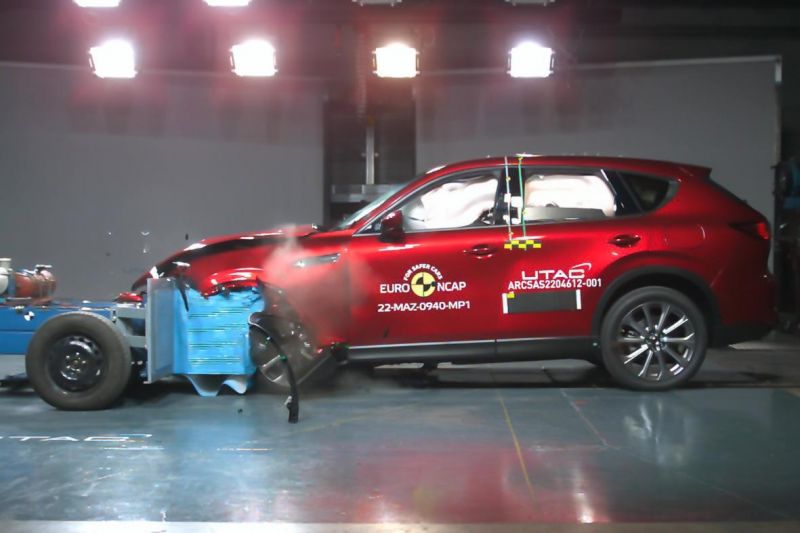
The Mazda CX-60 has a five-star safety rating from ANCAP based on testing conducted in 2022.
Category
Mazda CX-60
Adult occupant protection
34.82 out of 38 (91 per cent)
Child occupant protection
46.00 out of 49 (93 per cent)
Vulnerable road user protection
48.18 out of 54 (89 per cent)
Safety assist
12.32 out of 16 (77 per cent)
Standard safety equipment includes:
Adaptive cruise control
Autonomous emergency braking
Pedestrian detection
Cyclist detection
Rear AEB
Rear crossing function
Turn-across traffic function
Blind-spot monitoring
Lane-keep assist
Safe exit warning
Driver attention alert
Rear cross-traffic alert
Surround-view camera
Traffic sign recognition
Tyre pressure monitoring
Front and rear parking sensors
Dual front airbags
Front and rear side airbags
Front and rear curtain airbags
Driver’s far-side and knee airbags
GT adds:
Driver attention monitoring
Azami adds:
Cruising and Traffic Support
Front cross-traffic alert
How much does the Mazda CX-60 cost to run?
The CX-60 is covered by a five-year, unlimited-kilometre warranty.
Running costs
Mazda CX-60
Warranty
Five-year, unlimited-kilometre
Roadside assistance
Five years
Service intervals
12 months or 15,000km
Capped-price servicing
Seven years
Total capped-price service cost
$4696
To see how the Mazda CX-60 lines up against its rivals, check out our comparison tool.
CarExpert’s Take on the Mazda CX-60
The Mazda CX-60 is a missed opportunity for the brand, but I’m an optimist. This vehicle could be fixed and become a truly compelling alternative to premium mid-sized SUVs.
While the idea of simply putting in the 2.5-litre turbo four and six-speed automatic from the CX-5 is tempting, we suspect Mazda engineers could recalibrate this transmission and mild-hybrid system to improve refinement.
We also believe these engineers could retune the suspension to make this more comfortable. Tweak the steering for a lighter weighting at low speeds and the CX-60 would be in the hunt.
A turbocharged inline-six Mazda on a rear-biased all-wheel drive platform should be a lot more satisfying to drive than this, even if the CX-60 does boast a great chassis.
There’s no question the CX-60 handles well, it’s just that switchbacks and hairpin turns make up such a small portion of the average owner’s driving. What matters more is powertrain smoothness and ride comfort for the urban grind, and in both areas the CX-60 falls short.
If it seems like I’m being hard on Mazda, it’s because I know the company is eminently capable of building vehicles that are dynamic but also smooth and refined – its own CX-5 G35 is just one example.
Right after I returned the CX-60, I got behind the wheel of a top-spec CX-5 with the turbo four and was struck by just how responsive the powertrain is and how the suspension, while still firm, doesn’t crash over bumps.
Given the CX-5 G35 also offers most of the space and an interior only slightly less posh for a lower price, that’s where my money would be going.
Let’s see what Mazda has in store for the CX-60’s eventual update.
Interested in buying a Mazda CX-60? Get in touch with one of CarExpert’s trusted dealers here
The first true challenger to Rivian’s R1S off-road electric family hauler has come out of the shadows. VW’s Scout will be developing its off-road electric SUV aiming squarely at Rivian R1S.
Years away, theelectric Scout Traveler SUVwill be the most direct Rivian R1S rival when it arrives, which is targeted to happen in 2027.
Scout said the Traveler shown is a concept that is 85% production intent. Here’s a look at how the Scout SUV stacks up against the Rivian.
What are the Scout Traveler and Rivian R1S?
How much does the Scout Traveler and Rivian R1S cost?
The Rivian R1S costs $77,700 including an $1,800 destination charge, and it can be optioned up to about $110,000 today.
Quad-motor models returning next year will check in at about $120,000.
Scout said the Traveler will cost less than $60,000, though originally the electric SUV was said to start in the $40,000s.
Scout Traveler SUV concept
Which has more range: the Scout Traveler or Rivian R1S?
Rivian goes the distance, with between 270 and 410 miles of EPA-rated range.
Scout said the Traveler will have up to 350 miles of range.
Scout will offer a Harvester option on the Traveler, which adds a range-extender. Scout said the range-extender has no mechanical connection to the wheels, and gives the Traveler up to 500 miles of driving range with the small gas engine acting as a generator.
What size battery does the Traveler and Rivian R1S have?
The Rivian R1S can be had with a 92.5- 109.4-, or 141.5-kwh (usable) battery pack.
Scout hasn’t talked battery pack sizes for the Traveler, yet.
2025 Rivian R1T
How fast do the Scout Traveler and Rivian R1S charge?
The Rivian R1S runs a 400-volt electrical architecture and has a max charge rate of 220 kw.
Scout said the Traveler runs on a more future-ready 800-volt electrical architecture with project peak charge rate of 350 kw.
The Rivian R1S has bidirectional charging capabilities, and Scout said the Traveler will as well.
The Scouts will launch with Tesla’s NACS charge port; Rivians currently have CCS charge ports
Rivians already have Tesla Supercharger access via an adapter.
How many motors does the Scout Traveler and Rivian R1S have?
Rivian R1S can be optioned with dual-, tri-, or quad-motor powertrains with power outputs ranging from 533 hp to 1,025 hp and up to 1,198 lb-ft of torque.
Scouts will have two motors, one per axle, with up to nearly 1,000 lb-ft of torque. Scout isn’t talking hp at this time.
2025 Rivian R1 lineup
Which is quicker: the Scout Traveler or the Rivian R1S?
The Rivian R1S is quicker, by a lot.
Rivian R1S can do 0-60 mph in 4.5 seconds or as little as 2.5 seconds depending on the powertrain.
Scout said the Traveler will do 0-60 mph in 3.5 seconds.
Scout Traveler SUV and Terra pickup concepts
How large are the Scout Traveler and Rivian R1S and how many do they hold?
At 207.9 inches long the Scout Traveler is 7.1 inches longer than the Rivian R1S.
Every Rivian R1S has seating for seven passengers with two bucket seats up front, three seats on the second-row bench, and room for two in the standard third row.
The Scout Traveler is a two-row SUV with seating for either five or six passengers.
Scout Traveler buyers will choose between a pair of front bucket seats with a center console or three-person bench seat.
2025 Rivian R1 lineup
What kind of controls do the Scout Traveler and Rivian R1S have?
The Rivian R1S relies mostly on a 15.6-inch touchscreen, which is augmented by a 12.3-inch digital gauge cluster and 6.8-inch touchscreen for the second row.
The Scout Traveler has a 16.2-inch touchscreen augmented by hard switches and dials for the climate control and auxiliary systems. A 12.3-inch digital gauge cluster sits in front of the driver.
When can I buy the Scout Traveler and Rivian R1S?
What kind of suspensions do the Scout Traveler and Rivian R1S have?
The Rivian R1S features independent suspension at both ends.
Rivian’s ride on an air suspension paired with a hydraulic kinetic anti-roll system, which replaces conventional anti-roll bars.
The Scout Traveler has a solid rear axle with independent front suspension, but Scout hasn’t divulged full engineering details yet.
Rivian battery pack
Where are the Scout Traveler and Rivian R1S made?
The Rivian R1S is produced in Normal, Illinois.
The Scout Traveler will be produced in South Carolina.
Are the Scout Traveler and Rivian R1S good off-road?
Yes and probably.
The Rivian R1S sends power to all four wheels, can be lifted to have 15.0 inches of ground clearance, and can ford up to 43.0 inches of standing water.
The Scout Traveler will send power to all four wheels, have mechanical front lockers and front sway bar disconnect, both of which are things the Rivian lacks, will have over 12.0 inches of ground clearance, and will be able to ford nearly 36 inches of water.
2025 Rivian R1S
How much can the Scout Traveler and Rivian R1S tow and haul?
The Rivian R1S has a tow rating of 7,700 pounds and is rated to carry up to 1,764 pounds of payload.
The Scout Traveler is expected to carry a tow rating of over 7,000 pounds and be rated to haul nearly 2,000 pounds of payload.
Green Car Reports Newsletter
Sign up to get the latest green car and environmental news, delivered to your inbox daily!
I agree to receive emails from Green Car Reports. I understand that I can unsubscribe at any time. Privacy Policy.
The Rolls-Royce Phantom Goldfinger features a solid 18-carat gold bar in the center console
Movie references are littered throughout the Phantom Goldfinger’s bespoke design touches
Aston Martin also paid tribute to “Goldfinger” with a special-edition DB12
James Bond’s Aston Martin DB5 rightfully gets the most attention, but it’s not the only memorable car from 1964’s “Goldfinger.”
The counterpoint to 007’s Aston was the 1937 Rolls-Royce Phantom III Sedanca de Ville of titular villain Auric Goldfinger. To commemorate the movie’s 60th anniversary, Rolls-Royce built a one-off version of the current Phantom Extended Wheelbase inspired by the iconic villain car. The one-off is known as the Rolls-Royce Phantom Goldfinger.
The Phantom Goldfinger wears a similar two-tone paint scheme to the movie car, with 21-inch wheels designs to look like that car’s smooth disc wheels. In the movie, the Phantom’s bodywork was also made of gold being smuggled by Goldfinger. Rolls-Royce didn’t go quite that far with the tribute car, but used a combination of 18-carat gold plating and coats of silver to make it appear as if the hood ornament is made of solid gold.
Rolls-Royce Phantom Goldfinger
Rolls-Royce also incorporated 18-carat and 24-carat gold throughout the interior. An 18-carat gold bar shaped like a miniature Phantom is housed in a vault in the front center console. The front- and second-row consoles are also lined with gold, as is the glovebox, which also bears one of Goldfinger’s most memorable lines: “This is gold, Mr. Bond. All my life, I have been in love with its color, its brilliance, its divine heavenliness.”
The Phantom also sports a 24-carat gold VIN plaque, gold-finished air vents, and gold-plated scuff plates designed to look like gold bars. Walnut picnic tables feature a 22-carat gold inlay and a fictional map of the U.S. gold depository at Fort Knox, the target of Goldfinger’s heist in the movie. The rest of the interior is finished in navy leather with walnut wood veneers.
In the movie, Bond tails Goldfinger through the Furka Pass across the Swiss Alps, a scene that’s referenced by a three-dimensional map of the pass in the Phantom’s dashboard “gallery,” and the illuminated Starlight Headliner. This features 719 light points replicating the positions of the stars over the Furka Pass on Jul. 11, 1964—the last day of “Goldfinger” filming at that location.
Rolls-Royce Phantom Goldfinger
Other movie references include a gold-plated putter mounted on the underside of the trunk lid—a nod to the first encounter between Bond and Goldfinger over a round of golf—and a fake tracking device that projects the 007 logo onto the trunk floor. The Phantom’s door-mounted umbrellas also have the same design as Goldfinger’s and the car wears the same license plate number as the movie version—AU1.
Like other Rolls-Royce bespoke builds, the Goldfinger Phantom won’t be replicated. But the automaker’s continued emphasis on bespoke work means the automaker will continue to concoct unique cars.
Aston Martin is also celebrating the 60th anniversary of “Goldfinger” with a special-edition DB12. The automaker already built a limited run of “Goldfinger” continuation DB5 models—complete with working gadgets—although they can’t be driven on public roads.
One look at its broad front and it’s clear: this isn’t one to mess with. The new BMW M5 is bulkier, sportier, and more imposing than ever. Its V8 turbo power with electric support delivers stunning performance – and a hefty weight.
High performance in the executive class? Naturally, the BMW M5 springs to mind. Broad stance, fierce gaze, and massive power – nothing new for the sports car fan who loves the Porsche 911 or BMW M4 but also needs to transport a family. The latest generation, internally known as G90, catapults its passengers visually and technically into another league – thanks to its launch mode. The base engine is well-known: a 4.4-litre V8 with turbocharging, already producing around 600 PS on its own. However, the new M5 – offered once more in both saloon and estate versions – now boasts an electric boost. An electric motor cleverly hidden in the eight-speed automatic transmission bell housing contributes an additional 145 kW / 197 PS, providing exhilarating thrust and a cleaner conscience.
In electric mode, or with a lighter touch on the accelerator, the electric motor alone provides quiet propulsion up to 140 km/h. With a substantial 450 Nm of torque, the saloon accelerates purely on electric power more impressively than one might expect. The core of the hybrid drive is finely balanced to work harmoniously with the throaty V8 engine, making both the M5 saloon and Touring variant elite sports cars – with room for up to five people. From a standstill, the all-wheel-drive M5 hits 100 km/h in 3.5 seconds, reaching 200 km/h in just under eleven seconds. These figures may mean little in everyday use but are sure to elicit respectful, perhaps envious nods from friends. Push it hard, and this luxury saloon can blast along the Autobahn at speeds up to 305 km/h, all while offering an exceptional comfort level that’s hard to match. The superb handling, balanced weight distribution, and ability to seamlessly alternate between cruising and high-speed thrills owe much to the substantial 2.5-tonne weight, which also helps anchor it firmly on the road. Costs are equally weighty, with the saloon starting at a base price of €144,000 – as considerable as its weight and confident stance, with ample room for customisation to suit personal tastes.
The potent drive system, delivering a total of 535 kW / 727 PS, over 300 km/h maximum speed, and an astonishing system torque of 1,000 Nm, consistently leaves the driver momentarily speechless and almost forgetful of the car’s considerable mass. Admittedly, the hybrid competition now shares this heavyweight class, as battery packs and dual-power drive inevitably add hundreds of kilos. Anyone who drives the BMW M5 with true enthusiasm – cutting through corners, braking hard, steering sharply, and countering oversteer at the limit – will feel those extra pounds on the car’s strikingly wide rear arches. The BMW M5 has always been a thrill, but this new generation is even more brutal, unapologetic, and imposing – packing a hefty 730 hp in the standard version alone. Further iterations with cryptic suffixes and even more power, likely shedding a few pounds in the process, are all but guaranteed. Currently, the BMW’s only real competition is probably the Porsche Panamera Turbo S e-Hybrid, which handles a bit more sharply behind the wheel and offers a similar thrust at comparable weight.
However, the ability to turn in crisply, accelerate fiercely to 7,200 rpm, or flaunt its bold looks makes this first PHEV BMW M5 more than just a page-turner in the automotive “Sports Illustrated.” The new M5 has another side – comfortable, relaxing, and purely electric. Thanks to an 18.6 kWh battery, it offers an electric range of nearly 70 km when desired. With its driving modes, the M5 can shift between a gentle whisper and a thunderous roar to suit the driver’s mood.
Meanwhile, four adults will find ample space in the leather-clad interior, with rear passengers seated nearly as comfortably as those in the front. And should the 466-litre boot not suffice for everyday needs, there’s always the estate version, which offers a generous cargo capacity of between 500 and 1,630 litres.
German tuner Brabus had organised a massive event last night. The company is said to have showcased around 36 cars, including its latest creation, the Brabus Rocket GTS.
Brabus describes the Rocket GTS as a “hyper gran turismo”. It is based on the Mercedes-AMG SL 63 and features a custom shooting brake exterior, which not only looks unique but also adds a bit of practicality.
The entire body of the Rocket GTS is made from carbon fibre. The body kit is designed to be lightweight and to provide optimal aerodynamic balance on the front and rear axles. The rear section is rounded off with an integrated carbon spoiler, diffuser, and titanium exhaust tips.
The Brabus Rocket GTS is powered by a 4.5-liter twin-turbo V8 engine paired with a hybrid system. The higher displacement results in a peak output of 796 hp and 922 lb-ft of torque. The electric drive provides an additional 204 hp for a combined output of 1000 hp. Brabus uses a special crankshaft with a 100 mm stroke, special connecting rods, forged pistons, upgraded turbochargers and a 75 mm downpipe.
The car uses a 9-speed automatic gearbox, which allows it to sprint from 0-62 mph in 2.6 seconds. 0-124 mph is done in 9.5 seconds, while 186 mph comes up in 23.6 seconds. The top speed is limited to 197 mph.
The technical storage or access is strictly necessary for the legitimate purpose of enabling the use of a specific service explicitly requested by the subscriber or user, or for the sole purpose of carrying out the transmission of a communication over an electronic communications network.
Preferences
The technical storage or access is necessary for the legitimate purpose of storing preferences that are not requested by the subscriber or user.
Statistics
The technical storage or access that is used exclusively for statistical purposes.The technical storage or access that is used exclusively for anonymous statistical purposes. Without a subpoena, voluntary compliance on the part of your Internet Service Provider, or additional records from a third party, information stored or retrieved for this purpose alone cannot usually be used to identify you.
Marketing
The technical storage or access is required to create user profiles to send advertising, or to track the user on a website or across several websites for similar marketing purposes.