Kia has recalled 14,163 EV9 electric SUVs from model years 2024 and 2025 because their driver’s instrument panels can go blank. Kia will fix the problem with an over-the-air software update, so owners won’t need to bring the cars in for repair.
Kia tells the National Highway Traffic Safety Administration (NHTSA) that a software error can leave the driver’s screen blank at startup. Without it, the driver can’t see their speed or critical safety warnings.
The problem involves software, so Kia can fix it with software. Manufacturers are still legally obligated to tell owners about a recall through the mail. So, EV9 owners can expect a notice in their mailbox telling them that the problem existed and that it has been fixed.
By law, recall repairs are free. Many cars are recalled, often more than once, during their lifespan. Automakers try to contact every owner but don’t always reach them all. Find out whether your car has any outstanding recalls with the easy VIN tool at our recall center.
A new study found that drivers were happier with the service they received at car dealer service departments this year than last. However, the dealership experience still trails that offered by independent repair shops.
CDK Global, a company that sells software car dealers use to manage most of their operations, conducts its Service Shopper Study annually. In its fourth year, study researchers “ surveyed over 2,000 customers who had car maintenance and repairs completed to see where dealerships stand.”
Dealership service departments earned a satisfaction score of 59 on a 100-point scale. That’s 14 points better than last year.
Independent shops, however, earned a 66. Chain service providers not affiliated with dealerships earned the lowest score, at 48.
Customers thought independent shops were faster. Thirty percent of customers who went to an independent shop said their car was ready faster than expected, while just 24% said the same about dealership service.
“It probably isn’t a surprise that the happiest dealership customers are those still under warranty,” the researchers write. Customers with a car under warranty gave their service experience an average score of 63.9. Those with an expired warranty scored it 52.8. Those who had never had a warranty scored dealers at 56.5.
Drivers are still most likely to set an appointment over the phone. When they do, most want to talk to a human being, not an artificial intelligence (AI) powered assistant. Thirty-one percent of respondents said they’d prefer to speak with AI. Sixty-nine percent wanted to talk to a human.
That may change with time, however. CDK notes that 51% of Generation Z respondents (those 18 to 25 in this survey) would prefer AI. In every other generation, the human won out.
One of Uganda’s most outstanding wildlife safari destinations, Lake Mburo National Park provides tourists with an incredible safari holiday experience. The national park is famous for its exceptional wildlife, such as the huge population of zebras, giraffes, and antelopes. It is also known for sheltering over 315 bird species, which makes it a great bird-watching destination.
Lake Mburo National Park in Nyabushozi County Kiruhura district was gazetted as a national park in 1983. Uganda Wildlife Authority gazetted this area to protect different wildlife species and other attractions living there at the time. As of today, the national park shelters the highest number of zebras in Uganda.
On an area of 370 sq. km, Lake Mburo National Park is home to over 68 mammals and 315 bird species. It also has 13 lakes, Lake Mburo being the largest. Tourists can visit the park at any time of the year and explore the different attractions, thereby engaging in different park activities.
For tourists intending to visit Uganda, we would like to inform you that one of the national parks not to miss out on is Lake Mburo National Park. The national park has enough to expose tourists to the whispers of the wild as they explore the savannah grasslands of Lake Mburo National Park.
We’ve compiled a guide with everything you need to know when visiting Lake Mburu National Park, including reasons to go, how to get there, where to stay and the best time of year to visit.
Game drives are the most popular activity in Lake Mburo National Park, a habitat of over 68 mammals and 315 bird species. They are the best way for tourists to see and appreciate the rich diversity of wildlife in the park. Game drives are conducted twice during the day, in the morning and evening, while night game drives are conducted in the night for tourists to see nocturnal animals.
Morning game drives: After an early morning breakfast, tourists meet their driver guide and head to the wild, where they start searching for animals, including nocturnal animals, before going to their hideout places. Morning game drives are a 2—to 3-hour activity that takes tourists to different areas of the park.
Evening game drives: These are carried out in the evening hours after lunch, and tourists search for animals resting and grazing. The evening game drives last 2 to 3 hours and allow tourists to see a number of animals and other attractions of the park.
During day game drives in Lake Mburo National Park, tourists can see animals such as zebras, warthogs, giant forest hogs, impalas, sitatungas, elands, topis, defassa waterbucks, giraffes, buffaloes, crocodiles, hippos, leopards, hyenas, lions, side-st jackals, black and white colobus monkeys, vervet monkeys, and olive baboons, to mention but a few.
Night game drives: There are a few national parks in Uganda where nocturnal animals can be seen at night, and one of them is Lake Mburo National Park. Night game drives within this park are organized to see nocturnal animals. The activity starts in the evening after dinner, and tourists head out to the park for 2 to 3 hours searching for animals active at night.
For security reasons, the night game drives are conducted with armed ranger guides, and strong light torches are used to look for animals. During the night game drives, tourists can see lions, leopards, zebras, bush babies, spotted hyenas, side-tripled jackals, genet cats, porcupines, and nocturnal birds, among others.
Reasons to Visit Lake Mburo National Park in Uganda
Bird watching
Birdwatching in Lake Mburo National Park is a delightful activity that allows birders to see birds of different colors and sizes in the park’s different vegetation covers. Over 315 bird species have been recorded in the savannah vegetation, which gives birders an opportunity to carry out bird watching all throughout the year.
Tourists who enjoy birding on a safari to Lake Mburo National Park will be able to see bird species such as Handsome spurfowl, shoebill, saddle billed stork, little egret, red-headed lovebird, intermediate egret, grey crowned crane, white-throated bee-eater, Abyssinian ground hornbill, African crake, crested barbet, bare-faced go away bird, mourning collared dove, saddle billed stork, long tailed cisticola.
Lake Mburo National Park has seven lakes, and Lake Mburo is the largest. The national park gets its name from this lake. On a safari to Lake Mburo National Park, tourists can always take part in boat cruise activities to see water animals and water birds and also enjoy the fresh air.
Boat cruises on Lake Mburo National Park are conducted in the morning and afternoon for 2 to 3 hours. The activities enable tourists to see water animals like crocodiles and hippos and water birds such as the African jacana, African finfoot, and goliath heron. Tourists can also see some of the park animals near the water body drinking water or grazing, such as antelopes, buffaloes, and zebras.
Explore the land on foot
Lake Mburo National Park is a savannah-vegetated piece of land that allows tourists to have a rewarding nature walk full of great sightings of different attractions while on foot. Nature walks enable tourists to discover some hidden park attractions that can not be spotted during game drives. Tourists enjoy nature walks in this park because it’s blessed with so many attractions, like birds, animals, and lakes.
While taking guided nature walks in Lake Mburo National Park, tourists can see park animals such as zebras, antelopes, giraffes, monkeys, olive baboons, buffaloes, and hippos. Depending on the area where the walks are conducted, bird species can also be spotted if tourists are interested in bird watching.
Walking safaris in Lake Mburu National Park
Move around the park on a horseback
Lake Mburo National Park is the only park in Uganda where tourists can enjoy riding through the beautiful scenery in search of the park’s attractions. The horses are owned by Mihingo Safari Lodge, and tourists from outside are allowed to book and use their horses if they are available.
Horse riding in Lake Mburo National Park is done by tourists who are 80 kgs and below in the morning and afternoon. The horses take tourists around the park for 2 to 5 hours, depending on the time you pay. It’s a guided activity led by well-trained horse guides who ensure the tourists’ safety throughout the activity.
Unlike game drives, where vehicles use game tracks and see animals from a distance, horse riding takes tourists close to the animals, which include zebras, giraffes, warthogs, impalas, leopards, sitatungas, elands, topis, defassa waterbucks, buffaloes, side-striped jackals, and giant forest hogs, to mention but a few.
Horseback safari in Uganda
How Do You Get to Lake Mburo National Park?
Getting to Lake Mburo National Park from Entebbe, the starting point of most safaris in Uganda, is around 230 km, which takes tourists around 4 hours to access the park. From Entebbe, tourists pass via Kampala, Mpigi, Masaka, Lyantonde, and finally Sanga, where one of the park gates (Sanga gate) is found. From Sanga gate to Rwonyo, the park headquarters area is around 2km.
Tourists can also get to Lake Mburo National Park by flying to Mbarara. Mbarara is about an hour drive to Lake Mburo National Park. Airline companies like Bar Aviation Uganda and Aerolink Uganda have flights to Mbarara which take 45 minutes only. From the airstrip, tourists drive for less than an hour to access Lake Mburo National Park.
Accommodation in Lake Mburo National Park
There are budget, mid-range, and luxury accommodation facilities in Lake Mburo National Park where tourists can stay while on a safari. Tourists stay at the lodges of their travel budget but all lodges offer the best services.
Lodges of Lake Mburo include Mihingo Lodge, Rwakobo Lodge, Kigambira Safari Lodge, Hyena Hill Lodge, Kigarama Safari Lodge, and Mbogo Safari Lodge to mention but a few.
Get in touch with Africa Adventure Vacations to organize your entire Ugandan safari experience, from flights to tours and accommodation. Enquire with the team directly below:
Best Time to Visit Lake Mburo National Park
The driest months of June to September and December to February are the best times to visit Lake Mburo National Park. These months are characterized by little rainfall and plenty of sunshine. The game tracks and walking trails within the park are dry and easier to move through, while the vegetation is short and offers good views of the different attractions within the park.
Tourists, especially budget travelers and those who like less crowded places can visit Lake Mburo National Park during the rainy season. The tour packages are discounted since lodges reduce prices but tourists should know that there is plenty of rainfall which makes game tracks and walking trails muddy and slippery while the vegetation is thick and tall giving unclear views of some park attractions.
Africa Adventure Vacations is a one-stop center for the best and most memorable African safaris. We are a renowned safari operator based in Uganda, offering exceptional tours throughout the East African region, ranging from wildlife adventures, culture, birding, luxury gorilla safaris to Kilimanjaro trekking tours. All our tours can be customized to best suit your travel needs, budget and time.
Africa Adventure Vacations is a one-stop center for the best and most memorable African safaris. We are a renowned safari operator based in Uganda, offering exceptional tours throughout the East African region, ranging from wildlife adventures, culture, birding, luxury gorilla safaris to Kilimanjaro trekking tours. All our tours can be customized to best suit your travel needs, budget and time.
Greenland, the world’s largest island, is a destination like no other. For those seeking a true Arctic adventure, Greenland is a must-visit, offering experiences that blend adventure with cultural exploration.
Greenland expeditions invite visitors to explore the stunning ice-covered landscape while learning about the rich heritage of its native people. The island’s remote location and challenging environment make every journey an expedition into the unknown. With vast ice fjords, wildlife encounters, and vibrant Inuit traditions, Greenland is a place where nature and culture collide.
This article takes you through the highlights of Greenland expeditions, from majestic icebergs to the deep-rooted traditions of the Inuit people. Whether you’re hiking across frozen tundras or marveling at the calving glaciers, Greenland expeditions are an unforgettable experience for those seeking both adventure and cultural immersion.
The Majestic Icebergs of Greenland
One of the most iconic sights of Greenland is its towering icebergs, particularly in the Ilulissat Icefjord, a UNESCO World Heritage Site. This dramatic landscape is home to some of the world’s largest icebergs, which calve from the Sermeq Kujalleq glacier into the fjord, creating a breathtaking spectacle. These massive ice formations can be viewed up close on boat tours or even from the air, giving visitors a true sense of the island’s powerful, icy beauty.
Ilulissat is one of the most popular destinations for Greenland expeditions, as it offers a unique perspective on the sheer size and scale of these icebergs. Hikers can also trek along trails that overlook the fjord, providing panoramic views of the endless sea of ice. The best time to witness the calving of the glaciers is during the summer months when the ice is more active, breaking off in dramatic fashion.
Beyond Ilulissat, many other regions in Greenland provide equally stunning ice formations. The eastern coast, in particular, is renowned for its remote and untouched ice fields, making it a haven for adventurers looking to escape into the raw, natural beauty of the Arctic. Icebergs are not just a backdrop to Greenland expeditions; they are a centerpiece of the experience, offering a humbling view of nature’s power.
Wildlife Encounters on Greenland Expeditions
Greenland’s wildlife is as unique and fascinating as its landscape. During expeditions, travelers often have the chance to spot a variety of Arctic animals, including whales, polar bears, musk oxen, and Arctic foxes. The waters surrounding Greenland are rich with marine life, and boat tours frequently encounter pods of humpback whales, belugas, and narwhals. These majestic creatures are often seen breaching or playing in the icy waters, creating unforgettable moments for visitors.
On land, polar bears roam the northern parts of Greenland, although they are less commonly seen by visitors. Musk oxen, on the other hand, are more frequently encountered in the tundra regions, where they graze in herds. Greenland expeditions often include guided wildlife tours that focus on sustainable tourism practices, ensuring that the natural habitats of these animals remain undisturbed.
Birdwatchers will also find Greenland to be a paradise, with a wide range of species that migrate to the island during the summer months. Arctic terns, puffins, and snow buntings are just a few of the birds that can be observed nesting along Greenland’s rugged coastline. These wildlife encounters make Greenland expeditions an exciting experience for nature lovers and photographers alike.
Inuit Culture and Traditions
Greenland is not just about icy landscapes and wildlife; it’s also home to a vibrant and enduring culture. The Inuit people have lived on this harsh island for thousands of years, and their traditions and way of life remain deeply connected to the land and sea. Visitors to Greenland can explore small Inuit settlements, where they can learn about traditional practices such as fishing, hunting, and dog sledding.
One of the best ways to immerse yourself in Inuit culture is by visiting local museums or cultural centers, which often showcase art, artifacts, and stories passed down through generations. Greenland expeditions frequently include opportunities to participate in cultural activities, such as Inuit drumming and dancing, or even trying traditional foods like dried fish or seal. These experiences provide a deeper understanding of how the Inuit people have adapted to the extreme conditions of the Arctic. Inuit craftsmanship is also a highlight of Greenland’s cultural heritage. Beautifully carved figures made from bone, stone, and ivory are often sold as souvenirs, reflecting the deep artistic traditions of the Inuit people. Engaging with local communities not only enriches the expedition experience but also supports sustainable tourism initiatives that help preserve the cultural identity of Greenland’s native inhabitants.
Adventure Activities for Expeditioners
Greenland is a playground for adventure enthusiasts, offering a wide array of outdoor activities that push the boundaries of exploration. Kayaking is one of the most popular activities, allowing travelers to paddle through serene fjords surrounded by towering icebergs. The clear, icy waters provide a unique vantage point for viewing Greenland’s dramatic landscape, and it’s not uncommon to encounter seals swimming alongside your kayak.
For those who prefer land-based activities, hiking and snowshoeing are excellent ways to explore Greenland’s vast wilderness. Trails range from easy coastal walks to challenging mountain treks, with many routes offering stunning views of glaciers, fjords, and wildlife. Dog sledding, another iconic Greenland experience, is available in the winter months, providing a thrilling ride across frozen tundra.
Expeditioners looking for an adrenaline rush can also try ice climbing or heli-skiing, both of which offer unparalleled access to Greenland’s remote regions. Whether you’re scaling a glacier or carving fresh tracks down a mountainside, Greenland’s adventure activities cater to all levels of outdoor enthusiasts. These experiences, combined with the island’s natural beauty, make Greenland expeditions truly one-of-a-kind.
Greenland’s Changing Climate and Environmental Impact
Greenland is at the forefront of climate change, with its massive ice sheets melting at an alarming rate. Expeditions to the island offer a sobering glimpse into the effects of global warming, as travelers witness firsthand the calving glaciers and shrinking ice fields. Many tour operators in Greenland have adopted eco-conscious travel practices, ensuring that their expeditions have minimal environmental impact.
Visitors are encouraged to respect the fragile ecosystems they explore, from practicing leave-no-trace principles to supporting local conservation efforts. By choosing sustainable expeditions, travelers can help protect Greenland’s pristine environment for future generations. Witnessing the changing landscape of Greenland is a powerful reminder of the importance of environmental stewardship in the face of global climate change.
Conclusion
Greenland is a destination where adventure and culture meet, offering travelers the chance to experience both the raw power of nature and the rich traditions of the Inuit people. From kayaking among icebergs to learning about ancient Inuit customs, Greenland expeditions provide a unique and immersive journey into one of the world’s most remote and beautiful places. Whether it’s the towering ice formations or the warm hospitality of the local communities, a Greenland expedition leaves a lasting impression on all who visit.
For more on the latest in lifestyle and travel reads, click here.
NVIDIA founder and CEO Jensen Huang joined the king of Denmark to launch the country’s largest sovereign AI supercomputer, aimed at breakthroughs in quantum computing, clean energy, biotechnology and other areas serving Danish society and the world.
Denmark’s first AI supercomputer, named Gefion after a goddess in Danish mythology, is an NVIDIA DGX SuperPOD driven by 1,528 NVIDIA H100 Tensor Core GPUs and interconnected using NVIDIA Quantum-2 InfiniBand networking.
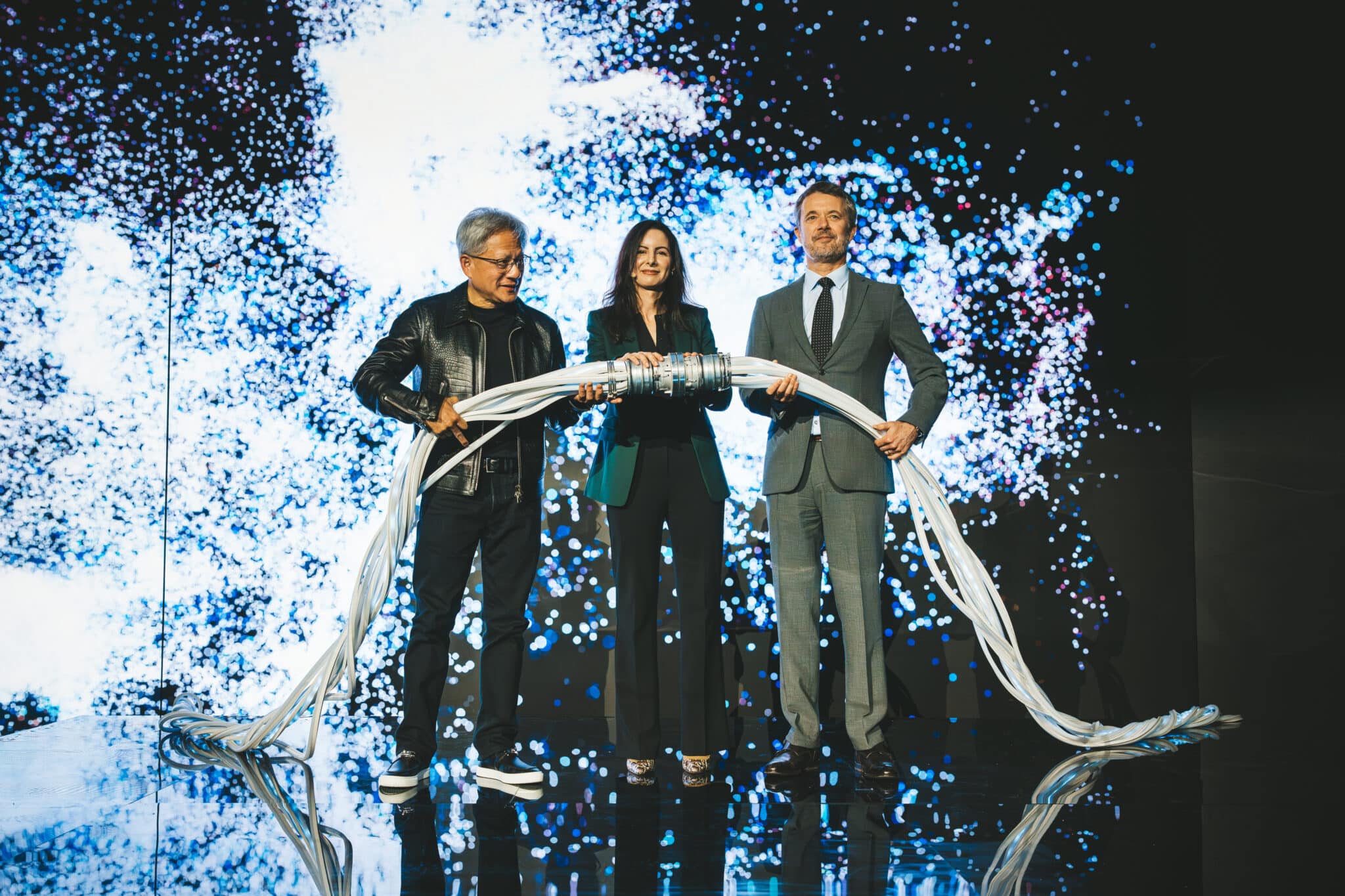
Gefion is operated by the Danish Center for AI Innovation (DCAI), a company established with funding from the Novo Nordisk Foundation, the world’s wealthiest charitable foundation, and the Export and Investment Fund of Denmark. The new AI supercomputer was symbolically turned on by King Frederik X of Denmark, Huang and Nadia Carlsten, CEO of DCAI, at an event in Copenhagen.
Huang sat down with Carlsten, a quantum computing industry leader, to discuss the public-private initiative to build one of the world’s fastest AI supercomputers in collaboration with NVIDIA.
The Gefion AI supercomputer comes to Copenhagen to serve industry, startups and academia.
“Gefion is going to be a factory of intelligence. This is a new industry that never existed before. It sits on top of the IT industry. We’re inventing something fundamentally new,” Huang said.
The launch of Gefion is an important milestone for Denmark in establishing its own sovereign AI. Sovereign AI can be achieved when a nation has the capacity to produce artificial intelligence with its own data, workforce, infrastructure and business networks. Having a supercomputer on national soil provides a foundation for countries to use their own infrastructure as they build AI models and applications that reflect their unique culture and language.
“What country can afford not to have this infrastructure, just as every country realizes you have communications, transportation, healthcare, fundamental infrastructures — the fundamental infrastructure of any country surely must be the manufacturer of intelligence,” said Huang. “For Denmark to be one of the handful of countries in the world that has now initiated on this vision is really incredible.”
The new supercomputer is expected to address global challenges with insights into infectious disease, climate change and food security. Gefion is now being prepared for users, and a pilot phase will begin to bring in projects that seek to use AI to accelerate progress, including in such areas as quantum computing, drug discovery and energy efficiency.
“The era of computer-aided drug discovery must be within this decade. I’m hoping that what the computer did to the technology industry, it will do for digital biology,” Huang said.
Supporting Next Generation of Breakthroughs With Gefion
The Danish Meteorological Institute (DMI) is in the pilot and aims to deliver faster and more accurate weather forecasts. It promises to reduce forecast times from hours to minutes while greatly reducing the energy footprint required for these forecasts when compared with traditional methods.
Researchers from the University of Copenhagen are tapping into Gefion to implement and carry out a large-scale distributed simulation of quantum computer circuits. Gefion enables the simulated system to increase from 36 to 40 entangled qubits, which brings it close to what’s known as “quantum supremacy,” or essentially outperforming a traditional computer while using less resources.
The University of Copenhagen, the Technical University of Denmark, Novo Nordisk and Novonesis are working together on a multi-modal genomic foundation model for discoveries in disease mutation analysis and vaccine design. Their model will be used to improve signal detection and the functional understanding of genomes, made possible by the capability to train LLMs on Gefion.
Startup Go Autonomous seeks training time on Gefion to develop an AI model that understands and uses multi-modal input from both text, layout and images. Another startup, Teton, is building an AI Care Companion with large video pretraining, using Gefion.
Addressing Global Challenges With Leading Supercomputer
The Gefion supercomputer and ongoing collaborations with NVIDIA will position Denmark, with its renowned research community, to pursue the world’s leading scientific challenges with enormous social impact as well as large-scale projects across industries.
With Gefion, researchers will be able to work with industry experts at NVIDIA to co-develop solutions to complex problems, including research in pharmaceuticals and biotechnology and protein design using the NVIDIA BioNeMo platform.
Scientists will also be collaborating with NVIDIA on fault-tolerant quantum computing using NVIDIA CUDA-Q, the open-source hybrid quantum computing platform.
Editor’s note: This post is part of the AI Decoded series, which demystifies AI by making the technology more accessible, and showcases new hardware, software, tools and accelerations for GeForce RTX PC and NVIDIA RTX workstation users.
Large language models (LLMs) are reshaping productivity. They’re capable of drafting documents, summarizing web pages and, having been trained on vast quantities of data, accurately answering questions about nearly any topic.
LLMs are at the core of many emerging use cases in generative AI, including digital assistants, conversational avatars and customer service agents.
Many of the latest LLMs can run locally on PCs or workstations. This is useful for a variety of reasons: users can keep conversations and content private on-device, use AI without the internet, or simply take advantage of the powerful NVIDIA GeForce RTX GPUs in their system. Other models, because of their size and complexity, do no’t fit into the local GPU’s video memory (VRAM) and require hardware in large data centers.
However, Iit i’s possible to accelerate part of a prompt on a data-center-class model locally on RTX-powered PCs using a technique called GPU offloading. This allows users to benefit from GPU acceleration without being as limited by GPU memory constraints.
Size and Quality vs. Performance
There’s a tradeoff between the model size and the quality of responses and the performance. In general, larger models deliver higher-quality responses, but run more slowly. With smaller models, performance goes up while quality goes down.
This tradeoff isn’t always straightforward. There are cases where performance might be more important than quality. Some users may prioritize accuracy for use cases like content generation, since it can run in the background. A conversational assistant, meanwhile, needs to be fast while also providing accurate responses.
The most accurate LLMs, designed to run in the data center, are tens of gigabytes in size, and may not fit in a GPU’s memory. This would traditionally prevent the application from taking advantage of GPU acceleration.
However, GPU offloading uses part of the LLM on the GPU and part on the CPU. This allows users to take maximum advantage of GPU acceleration regardless of model size.
Optimize AI Acceleration With GPU Offloading and LM Studio
LM Studio is an application that lets users download and host LLMs on their desktop or laptop computer, with an easy-to-use interface that allows for extensive customization in how those models operate. LM Studio is built on top of llama.cpp, so it’s fully optimized for use with GeForce RTX and NVIDIA RTX GPUs.
LM Studio and GPU offloading takes advantage of GPU acceleration to boost the performance of a locally hosted LLM, even if the model can’t be fully loaded into VRAM.
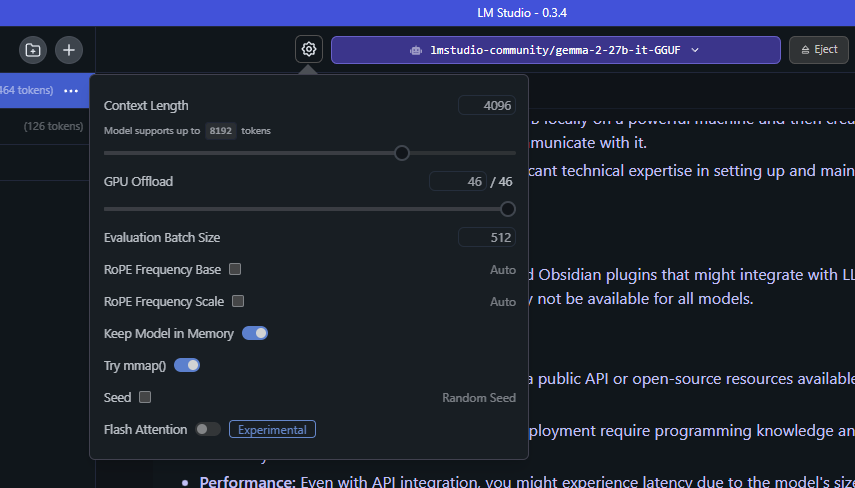
With GPU offloading, LM Studio divides the model into smaller chunks, or “subgraphs,” which represent layers of the model architecture. Subgraphs aren’t permanently fixed on the GPU, but loaded and unloaded as needed. With LM Studio’s GPU offloading slider, users can decide how many of these layers are processed by the GPU.
LM Studio’s interface makes it easy to decide how much of an LLM should be loaded to the GPU.
For example, imagine using this GPU offloading technique with a large model like Gemma 2 27B. “27B” refers to the number of parameters in the model, informing an estimate as to how much memory is required to run the model.
According to 4-bit quantization, a technique for reducing the size of an LLM without significantly reducing accuracy, each parameter takes up a half byte of memory. This means that the model should require about 13.5 billion bytes, or 13.5GB — plus some overhead, which generally ranges from 1-5GB.
Accelerating this model entirely on the GPU requires 19GB of VRAM, available on the GeForce RTX 4090 desktop GPU. With GPU offloading, the model can run on a system with a lower-end GPU and still benefit from acceleration.
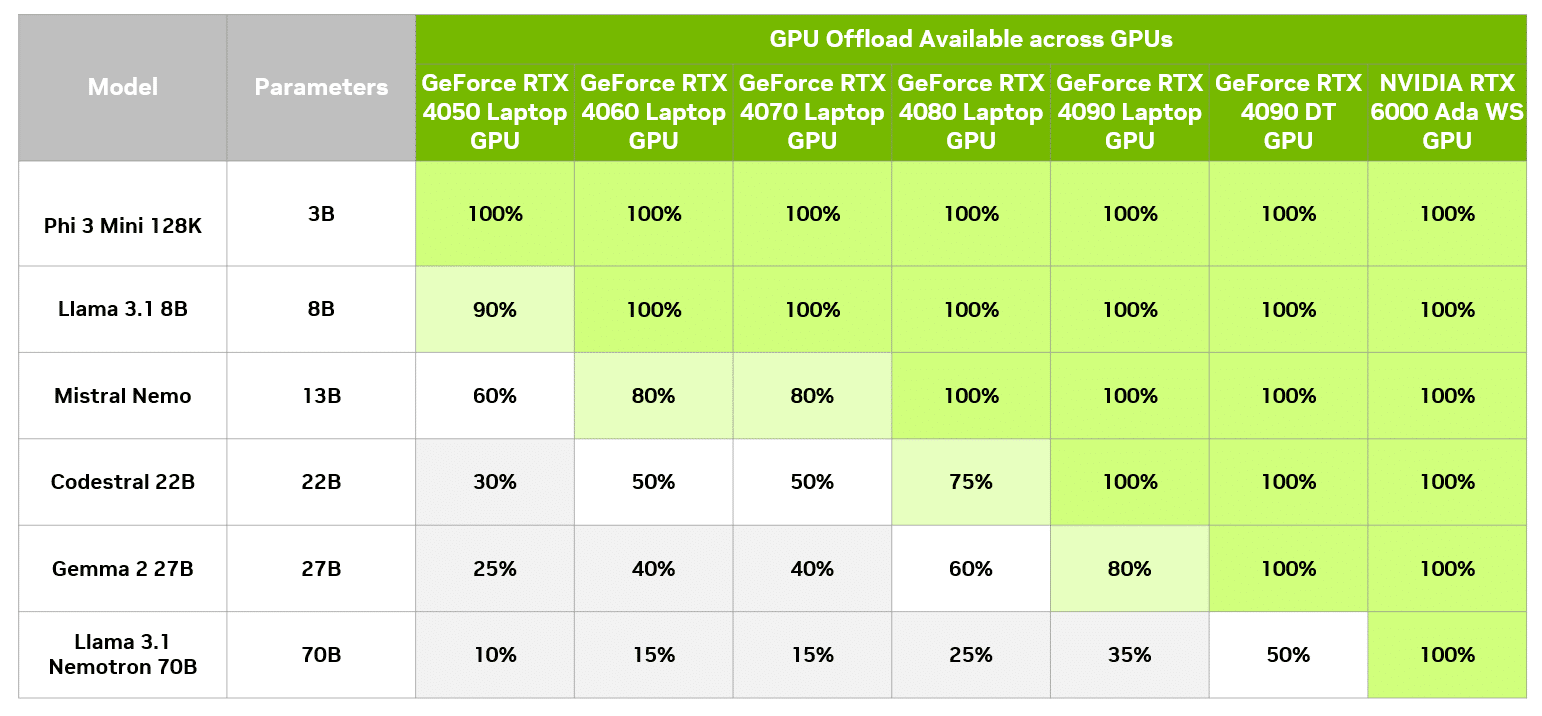
The table above shows how to run several popular models of increasing size across a range of GeForce RTX and NVIDIA RTX GPUs. The maximum level of GPU offload is indicated for each combination. Note that even with GPU offloading, users still need enough system RAM to fit the whole model.
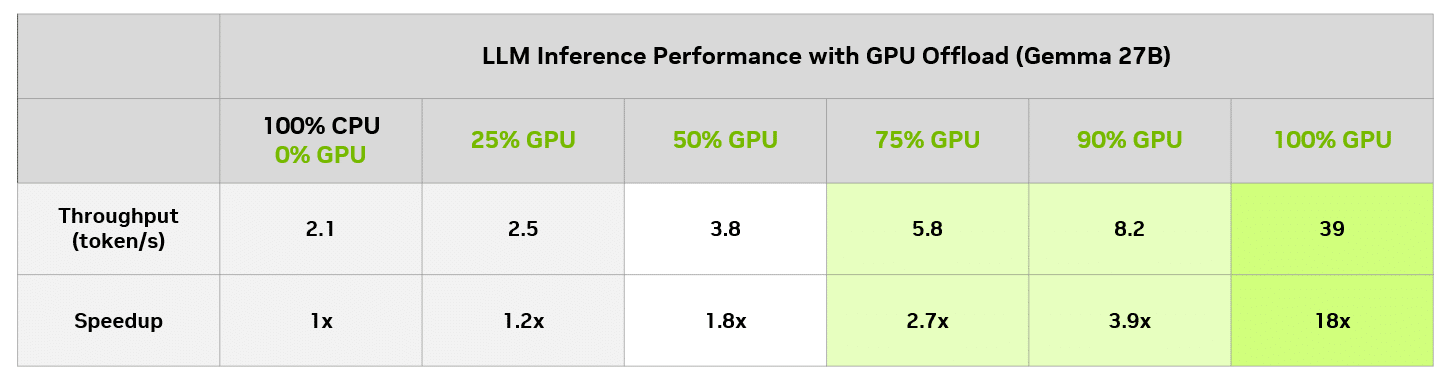
In LM Studio, it’s possible to assess the performance impact of different levels of GPU offloading, compared with CPU only. The below table shows the results of running the same query across different offloading levels on a GeForce RTX 4090 desktop GPU.
Depending on the percent of the model offloaded to GPU, users see increasing throughput performance compared with running on CPUs alone. For the Gemma 2 27B model, performance goes from an anemic 2.1 tokens per second to increasingly usable speeds the more the GPU is used. This enables users to benefit from the performance of larger models that they otherwise would’ve been unable to run.
On this particular model, even users with an 8GB GPU can enjoy a meaningful speedup versus running only on CPUs. Of course, an 8GB GPU can always run a smaller model that fits entirely in GPU memory and get full GPU acceleration.
Achieving Optimal Balance
LM Studio’s GPU offloading feature is a powerful tool for unlocking the full potential of LLMs designed for the data center, like Gemma 2 27B, locally on RTX AI PCs. It makes larger, more complex models accessible across the entire lineup of PCs powered by GeForce RTX and NVIDIA RTX GPUs.
Download LM Studio to try GPU offloading on larger models, or experiment with a variety of RTX-accelerated LLMs running locally on RTX AI PCs and workstations.
Generative AI is transforming gaming, videoconferencing and interactive experiences of all kinds. Make sense of what’s new and what’s next by subscribing to the AI Decoded newsletter.
Stellantis to test Factorial solid-state battery on public roads by 2026
Battery to be tested in Dodge Charger Daytona
Production expected later this decade
A fleet of Dodge Charger Daytona electric vehicles fitted with solid-state batteries developed in partnership with America’s Factorial will start testing on public roads by 2026, Dodge parent company Stellantis announced on Wednesday.
Massachusetts-based Factorial counts Stellantis as an investor, alongside other automakers like Hyundai and Mercedes-Benz. It has been developing solid-state batteries for the past decade (previously as Lionano) and appears to be on track to having them in production this decade.
Mercedes in September said it expects to have cars with Factorial solid-state batteries in production by the end of the decade, and said EVs with the batteries could have up to 80% more range compared to today’s average.
Stellantis is looking to install the batteries in its STLA Large platform initially. The platform, which also supports gas powertrains, is found in the latest Charger and is destined for multiple vehicles from Stellantis’ various brands. The platform is earmarked for larger SUV models and high-performance vehicles, Stellantis said.
STLA Large platform
The batteries Stellantis will test have an energy density of more than 0.39 kwh per kilogram (approximately 2.2 pounds), which is approaching double the density of current lithium-ion batteries. This has the potential to result in lighter EVs that charge faster and deliver more range.
The batteries, which derive their name from their solid electrolytes, also promise improved safety as they’re less prone to overheating. Although the technology isn’t new, scaling up production has proven more challenging than anticipated for automakers and battery manufacturers.
“By integrating Factorial’s innovative battery solution into the STLA Large platform, we are validating its potential to enhance our electric vehicle lineup, ensuring customers benefit from improved performance, longer driving ranges and faster charging times in the coming years,” Ned Curic, Stellantis’ chief engineering and technology officer, said in a statement.
The Charger Daytona is the electric version of the redesigned Dodge Charger, which arrived for the 2024 model year as the replacement for both the previous Charger as well as the Challenger. The Charger Daytona is initially offered in R/T and Scat Pack forms, priced from $61,590 and $75,185, respectively. They both feature a 100.5-kwh (93.5-kwh usable) lithium-ion battery estimated to deliver up to 317 miles of range in the R/T and 260 miles in the Scat Pack.
The Ford GT Mk IV is the ultimate and the most extreme track only Ford GT ever. It is hailed to be an extremely advanced supercar that delivers max performance through its unique body, powertrain, and suspension, with only 67 units made.
As the final version of the second-generation Ford GT, the Mk IV draws inspiration from the 12 Mark IV “J-Car” prototypes manufactured in 1966 and 1967. Notably, chassis J-5 was famously driven to victory by Dan Gurney and AJ Foyt at the 1967 24 Hours of Le Mans.
Equipped with model-specific carbon-fiber longtail bodywork and aerodynamic enhancements, the GT Mk IV features an extended wheelbase compared to its standard counterpart. Developed in collaboration with Multimatic, this track-only special includes essential race-ready features such as a roll cage, fire suppression system, racing bucket seats with six-point harnesses, MoTeC data capture, and a cool-suit system.
To surpass the performance of any Ford GT to date, the Ford GT Mk IV was given an enhanced 3.8-liter EcoBoost V6 engine, which delivers over 800 horsepower, aero-focused exterior design, racing transmission, and chassis with a longer wheelbase for improved on-track handling.
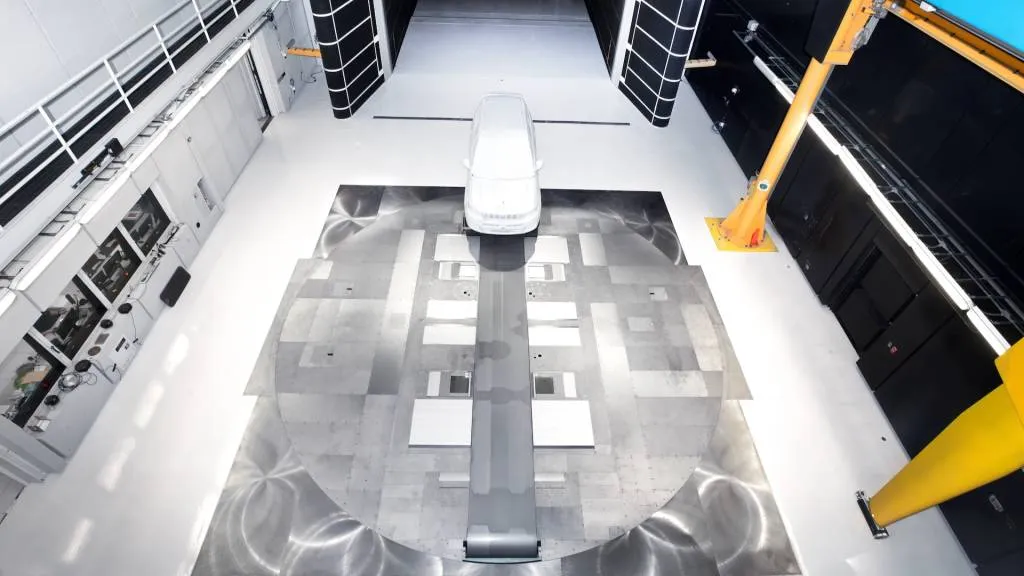
Stellantis has upgraded the wind tunnel located near its U.S. headquarters in Auburn Hills, Michigan, in its quest to boost range of electric vehicles by reducing drag.
The automaker on Wednesday said it invested $29.5 million in the site to add moving ground plane technology, essentially a rolling surface.
Each wheel gets its own belt that operates just like a treadmill, while a fifth belt runs longitudinally beneath the vehicle, which mimics on-road travel conditions.
The setup allows the wheels of the test vehicle to rotate at realistic speeds rather than remain static, which enables engineers to gather more accurate measurements of airflow resistance from the wheels and tires. The wind tunnel, which has been in operation since 2002, is capable of generating wind speeds of more than 160 mph.
Stellantis wind tunnel in Auburn Hills, Michigan
Stellantis said airflow resistance from wheels and tires alone can affect real-world aerodynamic drag by up to 10%. Reducing this can boost range and as a result could lead to smaller batteries, which in turn could lead to cost and weight savings, the automaker added.
Stellantis already uses moving ground plane technology at other sites, though those sites are focused on smaller vehicle platforms. Engineers at the Auburn Hills site will focus on larger vehicles, particularly those based on the STLA Large and STLA Frame platforms.
The investment comes as Stellantis looks to curb costs in other areas. In addition to reducing staff, Stellantis is also in the process of winding up a test facilty in Yucca, Arizona. CEO Carlos Tavares, who will retire in early 2026 at the end of his current contract, also warned in July that some of Stellantis’ 14 brands could be dropped if they continue to underperform. His warning came after the company reported earlier in the month a decline of 48% in net profits year-over-year, mostly due to declining sales in the U.S.
Whether you drive a car, need a car, or just occasionally bum a ride with friends, you’ve come to the right place. Join Jill and Tom as they break down everything that’s going on in the auto world. New-car reviews, shopping tips, driving green, electric cars, classic cars, and plenty of great guests. This is the Consumer Guide Car Stuff Podcast.
–
Episode: 243
Broadcast date: October 21, 2024
Guest: Alex Knizek
–
(Show Notes)
–
Jill is back in the studio this week, and opened the show by recapping her Rebelle Rally exploits. Visit the Car Stuff Podcast Facebook page for a link to pics from her trip. Tom shared august electric-vehicle registrations as reported by S & P Global Mobility. While Tesla still dominates the list, a few new vehicles are doing better than expected. Jill and Tom discussed the coming Ferrari F80 hyper car. Not only is the price breath taking, the car’s engine is proving controversial.
Still in the first segment, Tom shared his impressions of the Buick Envista small crossover. Is this bargain Buick too good to be true? Listen in.
In the second segment, the hosts welcome Alex Knizek of Consumer Reports to the show. Alex walked Jill and Tom through the organization’s list of most-reliable used-car brands, and called out several models as especially good used-car picks.
In the last segment Jill is subjected to Tom’s “Was it a Cadillac?” quiz, the hosts talk about Tesla slashing Cybertruck prices, and Tom shares a disturbing McDonald’s drive-thru story.
What is Winter-Blend Gas?
Follow the crew
The Crew
To advertise on the Car Stuff Podcast call Andy Lieb: 847-291-7414
Consumer Guide Car Stuff Podcast Episode 239: Patriotic Car Brands, Electric Fiat 500, Sam Fiorani on Hot Auto Topics
Consumer Guide Car Stuff Podcast Episode 242: Pickup Truck Sales, Thoughts on the Tesla Robo Taxi, Chatting with EV Startup TELO
The technical storage or access is strictly necessary for the legitimate purpose of enabling the use of a specific service explicitly requested by the subscriber or user, or for the sole purpose of carrying out the transmission of a communication over an electronic communications network.
Preferences
The technical storage or access is necessary for the legitimate purpose of storing preferences that are not requested by the subscriber or user.
Statistics
The technical storage or access that is used exclusively for statistical purposes.The technical storage or access that is used exclusively for anonymous statistical purposes. Without a subpoena, voluntary compliance on the part of your Internet Service Provider, or additional records from a third party, information stored or retrieved for this purpose alone cannot usually be used to identify you.
Marketing
The technical storage or access is required to create user profiles to send advertising, or to track the user on a website or across several websites for similar marketing purposes.