Learning a new language doesn’t have to feel impossible. In fact, some of the easiest languages to learn as an English speaker can make travel and work abroad much more rewarding. These languages open doors to smoother trips, stronger friendships, and even career opportunities around the world.
When you’re always on the move, you want tools that help you work smarter. That’s why digital nomads look for productivity tips like setting up a simple DIY mobile office. The same goes for language learning. The right system can save time and give you confidence while talking to any native speaker.
If you’re serious about starting your digital nomad journey, check outThe A-Z on Becoming a Digital Nomad. It’s packed with all the great tips on remote work and travel you’ll actually use.
The Foreign Service Institute (FSI) has ranked languages into categories. Some are hard, but others are simple for native English speakers. These languages use the Latin alphabet, follow simple grammar rules, and share English vocabulary.
For travelers and remote workers, choosing the right language means faster progress and more fun. It builds confidence, deepens cultural connections, and makes every journey more meaningful.
The Easiest Languages to Learn
Spanish Spanish is a very popular language spoken in Spain and Latin America. It shares vocabulary with English, like “animal” and “hospital.” It also belongs to the Romance languages, with simple grammar rules. Learning Spanish in countries like Mexico, Portugal, or even Suriname is practical and fun.
Italian Italian words are already familiar to English natives. The sentence structure is simple. The pronunciation flows smoothly. Italian has Latin roots, too.
Suggested Activity: Book a Pasta-Making Class in Rome where you can cook, eat, and learn basic phrases while chatting with locals.
French French is spoken in France, Switzerland, Canada, and parts of Africa. Many English words come from French due to shared vocabulary. Its grammar rules may feel tricky. But it remains a phonetic language once you practice.
Portuguese If you know Spanish, Portuguese feels close. It is the main language in Portugal, Brazil, and Cape Verde. It shares Latin roots and has simple grammar rules. You will find it especially useful in Angola and Mozambique, too.
Suggested Activity: Explore walking tours in Lisbon or try a food tour in São Paulo to boost your practice while traveling!
Dutch Dutch is spoken in the Netherlands and Belgium. It belongs to the Germanic language family, making it related to English. The grammar rules are straightforward. Many Dutch people also speak English, which makes practice easier.
Suggested Activity: Want to test your skills in real life? Join a walking tour in Amsterdam or book museum tickets in Brussels to immerse yourself in language and culture.
Norwegian This one might surprise you! Norwegian has two written forms: Bokmål and Nynorsk. Both use the Latin alphabet and follow simple grammar rules. The sentence structure is close to English. People in Norway often speak English, so it’s easy to practice.
Swedish Swedish has a simple vocabulary. Many learners pick it up quickly because of its simplicity and shared roots with English. It’s a very popular language in Sweden and has influenced culture worldwide. Think IKEA and every Swedish word you’ve seen in products.
Danish Danish shares a lot with English and other Scandinavian languages. The grammar rules are easy to follow. But pronunciation can be tough. Still, like Swedish and Norwegian, it has Latin roots.
Filipino (Tagalog) If you’re a Filipino nomad traveling abroad, learning your own language more deeply can still help. Many OFWs find pride and comfort in using Tagalog as their anchor while learning new foreign languages. Maybe because we get familiar vocabulary?
German German grammar looks harder at first. But English actually comes from the same Germanic language family. Many words overlap. Once you understand gender and basic grammar rules, it feels logical. German is widely spoken in Germany, Switzerland, Austria, and even parts of Croatia.
Suggested Activity: Book a guided tour in Berlin or explore museums in Vienna while improving your vocabulary on the go!
Start Learning with Rosetta Stone!
Pick Your Target Language – I began by selecting a language that genuinely excited me, which kept me motivated and engaged from the start.
Learn Anywhere – Install it on your phone or laptop for easy access anytime. A Lifetime Subscription is available for just $179.
Set a Goal – I committed to just 15 minutes a day. That small, consistent habit made a big difference in building my skills over time.
Practice Out Loud – I didn’t just read or listen—I spoke the words out loud, which really helped with memory and pronunciation.
Use It Daily – I made it part of my everyday routine, using the language to order coffee, greet strangers, or write a quick journal entry each morning.
Why Learning the Easiest Languages Matters
Learning the easiest languages for English speakers can change your whole travel experience. It doesn’t need to be stressful. With Rosetta Stone, you can boost your productivity and connect with locals. Even Esperanto, a constructed language built on simplicity and shared vocabulary, can help build confidence.
Ready to start? Choose your language today – may it be in Romania, Moldova, Finland, or South Africa. And see how far it takes you!
FAQs
What’s the fastest language to learn for English speakers?
Spanish is often the fastest because of its simple grammar and many familiar words. According to the FSI, it belongs to the easiest category.
How long does it take to learn a new language?
With daily practice, you can learn basic conversations in 3–6 months. Languages with simplicity in grammar rules like Indonesian, Swahili, and Romanian take less time.
Can Rosetta Stone really help beginners?
Yes! It teaches step by step, using pictures and sounds, like how kids learn naturally. Even English natives in Croatia or Switzerland can follow along with new script introductions.
Do I need to study every day?
Short daily practice works better than long sessions once a week. Even 10–15 minutes helps. The FSI recommends consistency for best results.
Which language is best for travel?
Spanish and French are very useful worldwide. But languages like Swahili in East Africa or Romanian in Europe are also practical. Choose one that excites you to stay motivated.
About The Writer
I’m Cyrine, a 19-year-old Filipina writer navigating college, freelancing, and the journey to becoming a digital nomad. I share real stories, budget tips, and lessons from chasing freedom through remote work, one step at a time.
Ferrari has revealed its latest one-off creation under its Special Projects programme. The new Ferrari SC40 draws inspiration from the legendary F40.
The Ferrari SC40 is based on the 296 GTB. It uses the same chassis and comes with a mid-rear-mounted twin-turbo V6 engine.
You will find several hints of the F40 in the exterior design of the new SC40. The first thing we noticed was the rear wing, which even has the SC40 script engraved in relief just like on the F40. The flat rear fascia is also a nod to the 1980s supercar.
The nose section has a flat profile with a black element that extends from the headlamp clusters and wraps around the front fascia.
The rear engine cover opens in the same fashion as that of the F40. Even the panel gap has been replicated. Ferrari says the white exterior colour was specifically developed for this car.
There have been mixed views about the latest designs coming out of Maranello. It all started with the LaFerrari successor – the F80, and more recently, the 849 Testarossa. What are your thoughts on the SC40?
While destinations like Iceland, Norway, and Greenland attract travelers with unparalleled views of the aurora borealis, there are plenty of places Americans can spot the natural wonder closer to home—including some that definitely haven’t been on your For You Page.
IcelandAir analyzed TikTok data and travel guides to determine which Northern Lights hotspots in the U.S. have stayed the most under the radar. After compiling a list of the best places to see Northern Lights in the country, the airline’s researchers examined how often hashtags related to each location were used on TikTok. The comparisons revealed which destinations are the most overlooked by astronomy lovers.
Midwestern states make the most appearances of any U.S. region on the least-mentioned list, with Idaho, Minnesota, and Wisconsin collectively making up half of the top—or bottom, on another hand—10. Spotting Northern Lights in Pennsylvania, Maine, and New York proved to be well-kept secrets on the East Coast, while Oregon was the only Pacific Northwestern state to make the list.
With only 32 mentions on TikTok as of August 2025, the Idaho Panhandle National Forest is the most hidden gem of them all. Although central Idaho became the country’s first Dark Sky Reserve recognized by the International Dark Sky Association in 2017, the state’s northern region also offers some spectacular displays. Even Idaho’s Craters of the Moon National Monument Dark Sky Park, which has some of the darkest skies in the national park system, made the list of obscure destinations for observing the colorful phenomenon.
Your next best bet for getting a private Northern Lights show is heading to Maine. While Acadia National Park hogs the spotlight—it’s the third most-mentioned location, according to the researchers—the state’s northernmost and easternmost park, Katahdin Woods and Waters National Monument, also has stunning views of the Northern Lights. The remote Aroostook National Wildlife Refuge is another under-the-radar aurora zone free of light pollution.
New Yorkers looking to escape the city’s crowds should make the five-hour road trip north to visit the rarely discussed Adirondack Sky Center & Observatory.
One advantage these lower-48 locations have over Arctic destinations is the Northern Light’s year-round visibility. While the midnight sun washes out celestial colors during summer in places like Alaska and Finland, the Midwest’s summer nights stay dark enough to enjoy the dancing ribbons in a T-shirt and shorts.
As for the most well-known places to see the Northern Lights in the U.S., Montana’s Glacier National Park was clearly the most popular. It was mentioned over twice as many times as the list’s runner-up, Michigan’s Upper Peninsula, in IcelandAir’s study.
With so many convenient destinations to choose from, there really is no reason to hesitate to put a Northern Lights trip on your calendar. Right now will be the best time to see the colors for quite some time: we’re currently in the solar maximum phase of the sun’s 11-year cycle, meaning the aurora borealis won’t be as active again for over a decade.
A fast, exciting pony car doesn’t need to have a big, heavy V8 up front. The new 2026 Ford Mustang RTR proves just that.
The Mustang RTR is based on the Ecoboost version. It offers hair-raising performance in an affordable package. And, it’s not just about the turbocharged 4-cylinder engine under the hood. The RTR package adds some significant upgrades over the standard model.
The turbocharged 2.3-liter 4-cylinder engine delivers 315 hp and 350 lb-ft of torque, which is the same amount of horsepower you get in the standard version. However, it is now paired with a Ford-patented, race-derived anti-lag system.
The rear subframe and front and rear sway bars are from the Dark Horse. It uses MagnaRide dampers that are designed to offer better performance while drifting. The steering gear has also been optimised for increased travel.
The brake setup comprises 6-piston front and 4-piston rear calipers from Brembo. The Electronic Drift Brake is available as standard. The car also comes with Active-Valve Performance Exhaust.
The Mustang RTR looks just as exciting on the outside as it is under the skin. It features an RTR grille with illuminated nostrils, GT front fascia, GT Performance Pack rear spoiler, RTR badging, Tarnished Dark Anodised pony and mirror caps and graphics.
The Hyper Lime Exterior Package is offered as an option. Inside, you get Hyper Lime accents all around with RTR graphics.
Prices for the 2026 Mustang Ecoboost RTR start at $36,510.
Take in stunning mountain views and feast on gourmet meals from the comfort of Mount Logan EcoLodge.
Enjoy the bounty of the Yukon by foraging for berries or fishing in a glacial lake.
Pick up a skillfully made handicraft at Northern Cultural Expressions Society.
Learn about the rich Indigenous history of the territory by checking out a visitor center or joining a festival.
Sip and eat from handblown glassware at Gather Cafe & Taphouse in Whitehorse.
Let’s get it out of the way now. Yes, it is hard to talk about the Yukon without mentioning Jack London’s “White Fang.” In the 1906 novel, the author described the territory as “the savage, frozen-hearted Northland Wild,” but I think London was wrong about the Yukon. The Yukon of today is quite warm in all the ways that matter.
While the Yukon is the smallest territory by land in Canada, it’s still a bit larger than the state of California. However, whereas California is home to around 40 million people, the Yukon’s population hovers around 46,000, and two-thirds of those inhabitants live in the capital, Whitehorse. To put it another way, there are twice as many moose as there are people in the Yukon. It also has the highest percentage of protected and conserved areas in any Canadian province or territory—so if you’re looking for an adventure in what feels like the edges of civilization, this is the place for you.
The territory landed in the global consciousness in 1896, when gold was found in the Klondike River, and visitors poured over the Chilkoot Pass from Alaska into the Yukon. Just as the miners once did, today’s visitors to the Yukon may find it easy to see the land as pristine or “untouched,” when in reality, it’s just been well cared for and well loved. This part of the world has been home to people for thousands of years, and there are 14 Yukon First Nations, as well as several other transboundary Indigenous groups that have traditional territory in the Yukon.
“The cultures are so diverse within the Yukon,” says Harmony Hunter, the manager of tourism development at the Yukon First Nations Culture and Tourism Association. “It’s a really interesting and beautiful place to live. Every little piece of the Yukon, I admire.”
In modern times, a certain type of creative person is attracted to—and thrives in—the wild heart of the Yukon. Chef and writer Michele Genest has lived here for 30 years and has authored a few cookbooks (with another in the works), including “The Boreal Gourmet: Adventures in Northern Cooking,” which explores the unique foodways and culture of the North.
“If I needed to encapsulate what makes the Yukon unique in one word, it would be ‘proximity.’ Not a very romantic word, but here’s what it means to me: The wilderness is right there,” she says.
All across the Yukon, you’ll notice evidence of its human history, whether it’s a lively group huddled around a table listening to a guide’s latest bear story, the eye-catching wood carvings marking the entrance of a gathering place, or a tree that’s beginning to grow around an antique nail hammered into it long ago. The Yukon is a far cry from a frozen wasteland.
“I hope visitors take away a feeling of connection—to the people, to the landscape, to the food,” says Genest. “I hope they get to taste a lowbush cranberry, sip birch syrup, and put spruce tip jelly on a cracker with cheese. I hope they leave with a sense of how we live our lives here.”
Here’s what you need to know before planning a trip to the Yukon.
Best Hotels & Resorts
Exterior of a cabin at Black Spruce.
Black Spruce
Mount Logan EcoLodge: Haines Junction
Close to Kluane National Park and Reserve, Mount Logan EcoLodge is the perfect home base for exploring all the area has to offer. This handsome property is owned by longtime Yukoner Roxanne Tanase-Mason, a climbing enthusiast, hiker, and conversationalist, who has a special knack for making every guest feel special. There are five accommodation types at the lodge, from a classic, spacious suite in the main building to quirky options like a yurt and a pod. After a day exploring, be sure to stick around for dinner; chef Mio Kucerova, who hails from the Czech Republic, serves up gourmet Czech-Japanese cuisine every night. If you want some recommendations or a helping hand during your adventures, the lodge also has guided tours, including scenic hikes and ice fishing.
Hyatt Place Whitehorse: Whitehorse
This brand-new Hyatt Place, which opened in 2025, has a clean, minimalist aesthetic. From the moment you arrive, you may notice this isn’t your typical Hyatt—Yukon First Nations culture and design has been integrated throughout the property, including the exterior wood carvings that greet guests upon arrival. The hotel is conveniently situated in the heart of downtown Whitehorse, putting you within easy walking distance to local shops and lively restaurants. There’s also an on-site eatery, Carved Restaurant, which uses locally sourced ingredients. There’s a complimentary airport shuttle as well as free on-site parking.
Black Spruce: Whitehorse
If you want to feel like you’re in the middle of the woods without actually being in the middle of the woods, Black Spruce, located on the outskirts of Whitehorse, may be exactly what you need. There are just five accommodations here, including a tiny house and four chic cabins. The cabins have a treehouse-like feel, and some are perched on stilts. But step inside and you’ll see the real stunner: massive picture windows that look out into the sprawling forest. Each cabin has a queen-size bed, a kitchenette stocked with teas and coffee, and a bathroom filled with organic towels and soaps. There’s also a small on-site sauna available to guests.
Dawson Lodge: Dawson City
If you want to explore the northern reaches of the Yukon, base yourself in the old gold mining boomtown of Dawson City. Although the 10-room Dawson Lodge is a historic property (it served as a warm storage space for the Caley General Store in the 1940s), it has all the modern bells and whistles travelers expect. Plus, as an added bonus, it was created with environmentally friendly principles in mind. It’s heavily insulated for maximum energy efficiency, and you’ll notice things like vegan snacks, low-energy lighting, and organic bath products.
Aurora Inn: Dawson City
This family-run hotel has been open in Dawson City since 1998. There are 20 rooms in total, all outfitted with homey, European-style decor and full bathrooms. A stay also gets you access to satellite television and complimentary Wi-Fi. Make time to check out the on-site restaurant, which specializes in grilled meats, from New York strip to pulled pork.
Best Things to Do
A canoe on a lake in Kluane National Park.
Greg Olsen/Travel Yukon
Visit Kluane National Park and Reserve.
There are three national parks in the Yukon, but one of the easiest to access (especially if you’re based in Whitehorse) is Kluane National Park and Reserve. Spanning more than 24 million acres, Kluane is massive, and visitors should be self-sufficient and prepared to handle emergencies on their own. Most visitors enter via the nearby village of Haines Junction, where you’ll find the Kluane National Park and Reserve Visitor Centre—an ideal place to learn about its history through the stories of First Nation elders. In addition to some of the most stunning northern landscapes the country has to offer (including the tallest peak in Canada, Mount Logan), Kluane is unique in that Parks Canada, the Kluane First Nation, and the Champagne and Aishihik First Nations cooperatively manage it. This means the land’s original stewards have a say in how it’s run, and they also have the right to harvest, hunt, and trap in certain designated areas.
Though there are some “easier” hikes with boardwalks through rough terrain, your best bet is to take on Kluane National Park and Reserve with a guide, like Pauly Sias, a citizen of the Kluane First Nation and descendant of Louis Jacquot, one of the first French settlers in the area. In addition to having cabins to rent, she leads thoughtful guided tours in the park and reserve—a walk with her through Kluane is a treat.
“For me, it’s the connection to the land that I feel, and the people who live here feel,” says Sias. “That’s what’s special to me about it. It’s my home. That’s what I try to tell people on a hike. The landscape tricks you into thinking no one has been here before, but it’s been well loved.”
See the northern lights.
Thanks to its snug position directly under the aurora oval, the Yukon is one of the best places to catch the aurora borealis in North America. The northern lights are typically visible between mid-August and mid-April, but the best time to see them is during the first few weeks of winter. While you may get lucky if you step outside your tent between 10 p.m. and 3 a.m., you’ll have a better chance of witnessing them by booking a tour with a local outfitter.
Northern Tales, based in Whitehorse, has a viewing site located about 30 minutes outside the city with experienced guides, snacks, and hot chocolate. If you’re determined to see the lights, you may want to opt for an aurora hunting experience with Nomada Excursions. It’s owned by Sandra Peña (fluent in both English and Spanish), who transports guests all across the Yukon to ensure they catch the natural wonder.
Go fishing.
The Yukon is an outdoor lover’s paradise, and one of the best ways to experience it is by casting a line in one of the stunningly blue glacial lakes, home to pike, lake trout, and grayling. Before you get started, you’ll need a fishing license, which can be purchased online (day passes are about $9 USD). Afterward, book an experience with an outfitter like Yukon Roots Adventure Co., which is run by Nicole Nielsen, a citizen of the Champagne and Aishihik First Nations, along with her husband, Reuben Nielsen. The couple has a deep love for the Yukon, and they also know all the best fishing spots in the territory.
Forage for berries.
The Yukon is overflowing with bounty, if you know where and how to look. Yukoners can be quite shy about revealing the location of their berry patches (for good reason). However, most of the land in the territory is Crown land, meaning there are plenty of places to explore—and many kinds of berries to pick. You can expect wild strawberries around June, saskatoon berries in late July, but many, including the coveted lowbush cranberry (a.k.a lingonberries), ripen in early autumn.
Come prepared with a few empty yogurt containers for harvesting your crop, as well as air horns and bear spray. If you’re picking in the autumn, you’ll be competing with bears, who also feast on the berries to fatten up before a long winter hibernation. Be sure you don’t pick berries in protected areas such as national parks, private property, or First Nations settlement land.
Learn about Indigenous Canadian history.
There are several places where you can learn about the Yukon’s Indigenous history across the territory. Haa Shagóon Hídi, in Carcross, is the Carcross/Tagish First Nation Learning Centre, where visitors can view art made by local community members, see artifacts, and experience cultural programming and activities. Up in Dawson City, the Dänojà Zho Cultural Centre serves as a warm introduction to the traditional territory of the Tr’ondëk Hwëch’in First Nation. And in Whitehorse, located near the Yukon River, the Kwanlin Dün Cultural Centre is a stunning homage to the heritage and modern lives of the Kwanlin Dün First Nation.
There are also ways to take an active role in learning about the Yukon’s history. Hunter recommends visitors take part in a festival during their visit. National Indigenous Peoples Day is celebrated across the Yukon, but there are several special events to keep an eye out for as well. Moosehide Gathering, which usually takes place in the summer) draws visitors from around the world with singing, drumming, and feasts to recognize Hän traditions and culture. The Blue Feather Music Festival, an annual, volunteer-run event, is an art and music jamboree that supports young Indigenous performers.
Best Shopping
Interior of the Northern Cultural Expressions Society.
Hannah Silverfox-Belcher
Northern Cultural Expressions Society
Located in downtown Whitehorse, the Northern Cultural Expressions Society is a nonprofit organization dedicated to fostering the talents of young artists in the community. Though the program is primarily aimed at Yukon First Nations students, it’s open to all students. There’s an on-site wood-carving studio in the back, but I recommend taking a look at the shop and gallery, where you’ll find skillfully handmade items such as beaded beaver fur gloves, fish leather earrings, skirts decorated with ribbons, and carved statues.
Horwoods Mall
If you’re not sure where to pick up a souvenir or knickknack, head to Whitehorse’s Horwoods Mall. It has several local stores conveniently located within a single building, and it’s a great place to warm up from the cold, too. Fuel up on pastries and coffee at Baked Cafe & Bakery, then browse North End Gallery, which specializes in creations made by Yukon artists, the jewelry at Vanessa Aegirsdottir Co., and the nice selection at Cultured Fine Cheese.
Best Restaurants
Dishes served at Gather Cafe & Taphouse.
Gather Cafe & Tap House/John Ferguson
Gather Cafe & Taphouse: Whitehorse
Gather is one of the most unique dining options in Whitehorse. Every piece of glass that diners eat or drink from was made next door at Lumel Studios. Gather serves draft beers, cocktails, and Mexican-inspired fare; expect things like pork carnitas tacos and halibut burgers on the menu.
“Gather is a great place to eat—fresh, lively flavors, great cocktails—for me, especially the Gin and Ginger,” says Genest. “It’s easy to strike up a conversation with strangers from here or out of town at one of the big shared tables. There’s a lovely atmosphere of welcome and belonging. Both the restaurant and the shop are run by community-minded folks who believe that community includes everybody.”
Mount Logan EcoLodge: Haines Junction
To some, the Yukon backcountry may seem like the very last place you would enjoy a memorable meal, but that’s not so at Mount Logan EcoLodge; dinners here are nothing short of gourmet. You do not have to be a guest to dine here, though you do need to call ahead. The culinary program is run by chef Kucerova, who draws on her Czech and Japanese heritage to create things like Yukon-inspired gyoza and roasted elk steak served with potatoes and local herbs. I especially loved the butter, which had local flowers mixed into it for a colorful presentation. On the days Kucerova isn’t cooking, owner Tanase-Mason takes over and prepares guests’ daily breakfasts.
Village Bakery & Deli: Haines Junction
Before a day of exploring Kluane National Park and Reserve, be sure to stop by local favorite Village Bakery & Deli, where you can indulge in homemade bread, pastries, and fresh coffee. There’s no set menu, but typical fare includes chocolate chip cookies, pepperoni garlic bread, and lots of sandwiches and wraps. In the summer, the bakery hosts weekly themed dinners and live music events.
Bonton & Company: Dawson City
Bonton & Company is a store, cafe, and restaurant all rolled into one. The majority of ingredients used in lunches and dinners are locally sourced and seasonal, so the menu frequently changes. If you’re looking to fuel up before the day starts, there are house-made pastries, coffee, and teas on offer in the morning.
Coopers: Whitehorse
Coopers specializes in upscale Italian cuisine, and the pizzas are the perfect size for sharing between two people. You have classics like Margherita, as well as more creative options such as the Pineapple Heat, which has roasted pineapple, pickled jalapenos, and salsa verde. Not into pizza? The restaurant also serves up steak frites and beef ragu linguine. With a nice bar and extensive beer and wine list, this is a popular spot for everyone in Whitehorse, from local miners to travelers.
Best Time to Visit
A beautiful mountain landscape in Yukon, Canada.
brytta/Getty Images
The best time to visit the Yukon depends entirely on what you hope to do while there. Most might caution against visiting in the winter, when temperatures drop well below freezing. But this is also the ideal time for dog sledding, cross-country skiing, and ice fishing. Yukoners have long learned to cope with the cold, and you’ll find no shortage of saunas in the territory.
That said, most travelers aim to visit the Yukon in the summer, when the region transforms into the “Land of the Midnight Sun” and sunlight lasts nearly all day. If you’re hoping to hike and explore without a heavy coat, this is the best time to go. Spring, with its wildflowers and wildlife activity, and fall, with a chance to see fiery foliage, also have their draws.
Towns to Visit
Front Street in Dawson City, Yukon.
Pierre Longnus/Getty Images
Whitehorse
For most visitors, the capital city will be the most convenient place to fly into and begin your Yukon adventures. Whitehorse is a thriving small city full of grocery stores, restaurants, bars, local stores, and outdoor gear shops.
Dawson City
Anyone taking on the stunning Top of the World Highway, a remote road that connects the Yukon to Alaska, will begin the journey in Dawson City. It was the original capital of the Yukon (Whitehorse got the title in 1953 after the construction of the Klondike Highway) and a gold mining boomtown—you’ll notice many of the buildings here are built in a period-correct manner. The area also has deep First Nations roots and is a Tr’ondëk Hwëch’in traditional territory. “Dawson is very glamorous, and it was the ‘Paris of the North,’” says Hunter. “[It] was and is a popular destination. People are fascinated by the history, and the cultural side of things is becoming important. It’s a vibrant town.”
Old Crow
Old Crow is a small, close-knit community located at the confluence of the Old Crow and Porcupine rivers. You cannot drive into Old Crow; there’s no road that connects it to the rest of the Yukon. Rather, you have to fly in, and there’s just one grocery store in town. Still, the journey is more than worth it for determined visitors. “It’s a choice to go to Old Crow,” says Hunter. “Old Crow has a unique, powerful energy in the area. It’s vibrant and alive, and when you’re up there, you really feel that you’re far up north.”
Hunter recommends exploring the region with an outfitter like Josie’s Old Crow Adventures, which offers packages with experiences like dog sledding, ice fishing, and northern lights viewings.
Carcross
Originally known as “Caribou Crossing,” the small Yukon town of Carcross packs a punch for adventurous travelers. Carcross is home to mountain biking trails, which were built by local First Nations youngsters and wind through scenic alpine vistas and lakes. (Fun fact: Carcross also has the smallest “desert” in the world, which is comprised of glacial silt.) However, the town has a rich and ancient history—the area was once a popular hunting camp for Tlingit and Tagish people. You can learn more about Carcross’s Indigenous roots at the Haa Shagóon Hídi center.
How to Get There
A sign for Yukon, Canada in front of mountains.
nickjene/Adobe Stock
The easiest and most common way to get to the Yukon is by flying into its capital, Whitehorse, through Erik Nielsen Whitehorse International Airport (YXY). Though there are a few smaller airports throughout the region, this is the largest and where you’ll find the most flight options. You can pick up a rental car here, too.
If you’re traveling to the area from another part of Canada, driving is also a good option. The easiest way to get here from Vancouver is on Highway 37, but if you’re coming from Alberta, you can hop on the iconic Alaska Highway, which runs all the way to Delta Junction, Alaska.
Some travelers reach the Yukon by sea, and it’s easy to do so if your cruise has a stop in Skagway, Alaska. After docking in Skagway, you can hop aboard the White Pass and Yukon Route Railway, which follows the original, historic path of gold prospectors who came to the area looking to strike it big. Keep in mind if you’re planning to travel between Canada and Alaska, you will need your passport.
How to Get Around
Considering the vast size of the Yukon, you will need a car to properly explore. Most travelers will fly into Erik Nielsen Whitehorse International Airport, where you can pick up a rental car. There are no car rentals available at Dawson City Airport (YDA). If you’re visiting in the winter, be sure to pack tire chains, just in case you get into a slippery situation. Keep in mind some parts of the territory, such as Old Crow, are only accessible by boat or plane.
Composite materials are, by far, the most interesting of all such options in watchmaking. We classify them with all other exotic materials, including sapphire crystal, because there are very few of these types of watch cases, once one separates bimetallic ones.
On the other hand, watches that combine metals, polymers and ceramics do count as properly exotic, such as the Ulysse Nardin Diver (Air). As you can tell, we are using our editorial prerogatives to define exotic and, since the word is redolent of bias and opinion, why not!
In our original story about composites two years ago, we used an AI-derived definition for composites. Here is one from a commercial producer of composites: “A composite material is a combination of two materials with different physical and chemical properties.
When they are combined, they create a material which is specialised to do a certain job, for instance, to become stronger, lighter, or resistant to electricity. They can also improve strength and stiffness.
The reason for their use over traditional materials is that they improve the properties of their base materials and are applicable in many situations.” (Source: TWI Global).
No specific strength, toughness, or any other characteristic works for all composites. A strange myth abounds, though, that composites might not be suitable for water-resistance, but this message did not reach Casio nor the various shipbuilders who deploy carbon fibre and other such materials in their hulls. The bottom line on material properties when it comes to composites is that each material has to be judged on its own merits.
Having made all these points and caveats, a watch like the Hublot Big Bang Meca-10 Concrete Jungle proves our point that the excitement in watch cases comes from. We are particularly enamoured with this watch because we discussed concrete in our composite special. While Hublot has been plying its concrete craft since 2016, concrete has been making its mark on human civilisation for hundreds of years.
For reference, here is what we wrote in 2023: By many accounts, and no shortage of hard evidence, the Romans were extraordinarily successful with concrete. They were not the first to get to this material, but their particular recipe is widely recognised as being closest in terms of properties to what we use today. This extends to the use of the material to build jetties and other partially submerged structures – the Romans were the first to use a type of concrete (opus caementicium) that can set underwater, which is a property we take for granted today.
Some of the ruins are still with us today, and structures such as the Pantheon in Rome continue to be public buildings in the 21st century, alongside other major tourist attractions such as the Colosseum. We should note here that concrete also demonstrates that composite materials sometimes appear in nature as well, because barnacles secrete a sort of organic concrete to bind themselves to substrates.
Of course, metals will also remain an attractive option in the exotic department. We refer here to metals such as tantalum, which grace parts of the case of the new F.P. Journe Chronomètre Furtif, and aluminium, which forms the entire case of the Franck Muller Vanguard Royal Bauxite. Aluminium has also been embraced by brands such as Bvlgari for many years, so it is hardly completely novel. We expect brands to continue these efforts, perhaps experimenting with something bold, now and again.
This story was first seen as part of the WOW #79 Summer 2025 Issue
For more on the latest in luxury watch reads, click here.
The 2025 Southern Living Idea House in Keswick, Virginia, invites travelers to tour a stunning Charlotte Moss–designed home surrounded by vineyards and history.
Located near Charlottesville, Virginia, the house showcases the region’s architectural charm and rich design heritage.
With seasonal décor, local art, and scenic fall views, it’s the perfect getaway for design lovers and weekend travelers alike.
Some fall getaways are about leaf peeping, others about pumpkin patch scouting—but this season in the foothills of Virginia, design is actually the main attraction. For a limited time, the 2025 Southern Living Idea House in Keswick—a horse-country hamlet dotted with chic vineyards just outside of Charlottesville, Virginia—is welcoming design lovers eager to make a weekend of it.
Southern Living’s 4,500-square-foot, four-bedroom residence, created by Rosney Co. Architects with interiors by renowned designer Charlotte Moss, blends classic details with modern touches and anchors the coveted Keswick Estate community. It’s an ideal address for travelers, given its proximity to the recently reimagined Keswick Hall, a bucolic Historic Hotels of America inductee that sits just down the road. With one of Virginia’s most notable collections of regional art at its core, the hotel was reinvented three years ago as a design haven by owners Molly and Robert Hardie, who also oversee Nashville’s Hermitage Hotel. For visitors eager to live—even briefly—inside the pages of a favorite magazine, central Virginia is autumn’s ultimate decorative arts destination.
“This area really represents the best of Virginia,” says Sid Evans, editor in chief of Southern Living. “There’s so much history in Charlottesville from a design point of view.”
Now marking its 36th year, the Idea House franchise aims to showcase not just aspirational decor, but also destinations that people are eager to experience. “It only takes so long to tour a house, so it’s nice to have lots of other things to do in the area,” Evans says. “Charlottesville has that in spades—vineyards, museums, shopping.”
For Moss, looking to Keswick and Charlottesville for inspiration came naturally. “Southerners are house-proud people,” she says, and adds that it’s a sentiment woven into the fabric of the region since its earliest days. “Virginia is the birthplace of eight U.S. presidents, with homes that stand as important historical landmarks.”
Thomas Jefferson’s Monticello, for example, is just a 13-minute drive from the Idea House and Keswick Hall. “There’s a legacy of design and architecture here that resonates on so many levels,” she says.
According to Hardie, the project’s developer, the Idea House owes its magnetism to Albemarle County’s distinctive vernacular—seen in its two grand porches, octagonal entryway, and grounds planted with native species, a choice that echoes her own landscape decisions at Keswick Hall. A push-pin map in the Idea House’s garage tells the story—its surface dotted with markers from travelers who’ve journeyed from across the country to see it for themselves.
Last year’s Idea House at Kiawah River in South Carolina welcomed more than 17,000 visitors from all 50 states. Evans expects a similar turnout at the Keswick property this year—especially come November, when the Southern Living team turns up the charm, bedecking the home in magazine-cover-worthy holiday decor. “It’s a great girlfriend getaway or mother-daughter trip,” Evans says.
Tickets to the Southern Living Idea House are available at keswick.com.
Subaru may have plans to bring back the STI. The carmaker has just confirmed two new STI concepts for the upcoming Japan Mobility Show, scheduled for October 31, 2025.
This year, the Subaru booth will be divided into two experiential worlds: Performance Scene and Adventure Scene. While the latter will showcase the Trailseeker, Forester and Outback, the STI concept models will be the centrepiece of the Performance Scene.
The Performance-E STI concept previews the next generation of Subaru cars. It features a sharper, more aggressive design language with sleek headlamps. Both concept cars are expected to be finished in the famous World Rally Blue paint with gold accents.
According to the company, the Performance-B STI concept represents Subaru’s Performance Scene. It features a horizontally-opposed internal combustion engine and symmetrical all-wheel drive.
The teaser reveals a familiar-looking hatchback concept with sharp lines, wide fenders, a hood vent and a large grille with red accents around the frame.
My partner Vins and I have been travel blogging for the past 15 years and Tokyo is one of our favorite cities. The Japanese capital might be known for its neon-lit streets and high-tech everything, but you don’t need to spend a fortune to enjoy this megacity!
Believe it or not, Tokyo is packed with awesome free experiences — from historic temples to futuristic city views, quirky street scenes, and even some unexpected cultural gems. So if you’re on a budget (or just love a good freebie), this list is for you!
Here are some of the countless attractions in Tokyo that you can enjoy for FREE. Note that the number is only for easy reference and is not an indication of any particular ranking.
WAIT, WAIT, WAIT! If you are also visiting Osaka, please also visit our The Poor Traveler Masterlist. Here, we compiled travel essentials, including immigration requirements and all our recommended hotels and attractions. Just visit this page: TPT Masterlist. Then, scroll until you see the section about Osaka. We also have a compilation for other destinations around the world.
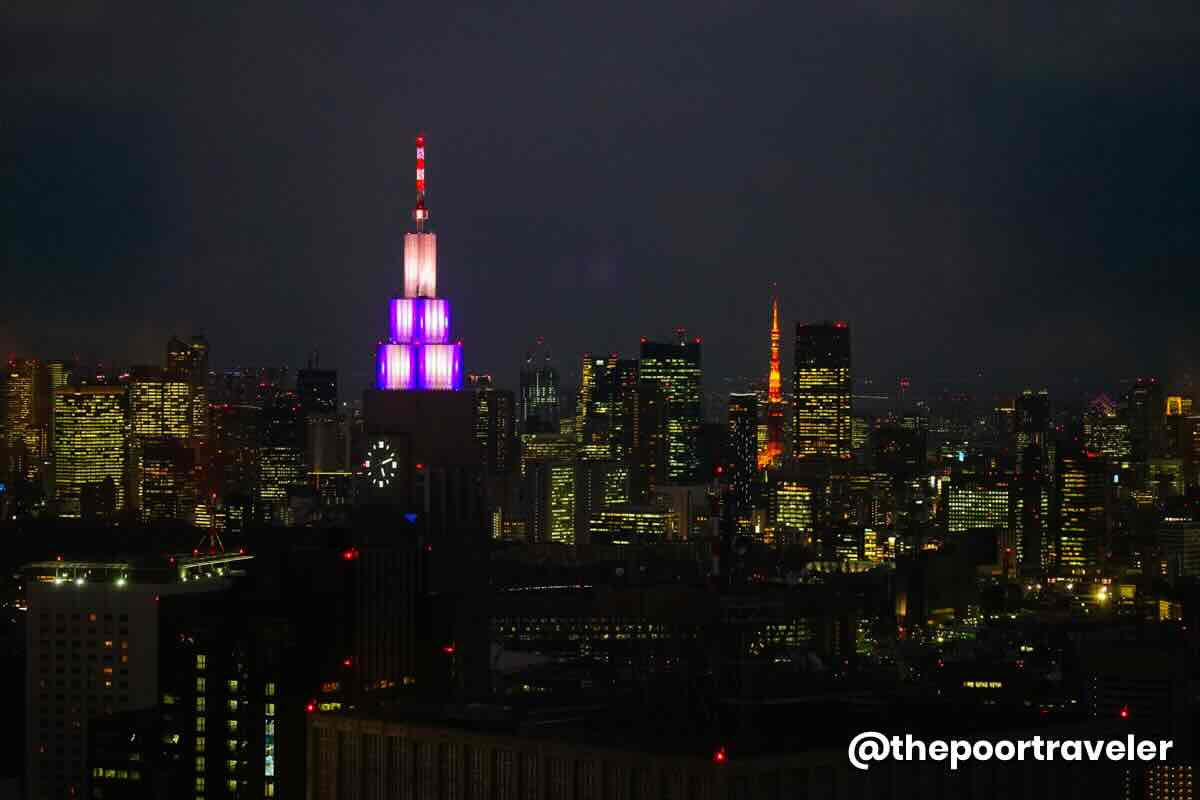
Most tourists rush to Tokyo SkyTree or Tokyo Tower for those panoramic city views. And that’s very understandable. After all, these are the two tallest structures in Japan. But did you know there’s a way to soak in Tokyo’s skyline for free? Enter the Tokyo Metropolitan Government Building in Shinjuku!
This twin-towered beast has two observatories and from here you can see the Tokyo Tower and the Tokyo SkyTree. You can even see Mount Fuji on a clear day. At least that’s what I’ve been told. I can’t confirm because we visited at night. But if you can make it before sunset, that would be super because you’ll get to enjoy the view in daytime, at twilight, and at night!
It’s completely free. No entrance fee, but you still get those breathtaking cityscapes. The Tokyo Metropolitan Building is the ultimate budget traveler’s hack! Because it’s free and there are only two elevators, expect to fall in line a bit, but the wait is worth it.
Address: Tokyo Metropolitan Government Building, 2 Chome-8-1 Nishishinjuku, Shinjuku City, Tokyo 163-8001, Japan Nearest Subway Station: Tocho-mae Station (Toei Oedo Line) Opening Hours: North Observatory – Daily, 9:30 AM – 11:00 PM (Closed on the first and third Tuesday of the month); South Observatory – Daily, 9:30 AM – 5:30 PM (Closed on the second and fourth Monday of the month). The building is closed on December 29-31 and January 2-3.
2. Senso-ji (Asakusa Kannon Temple)
Asakusa is one of the most well-known neighborhoods in Tokyo, primarily due to the iconic Senso-ji.
Not only is it Tokyo’s oldest temple — dating all the way back to 645 AD — it’s also one of the most visited and visually stunning landmarks in the city. And the best part? It won’t cost you a single yen to visit!
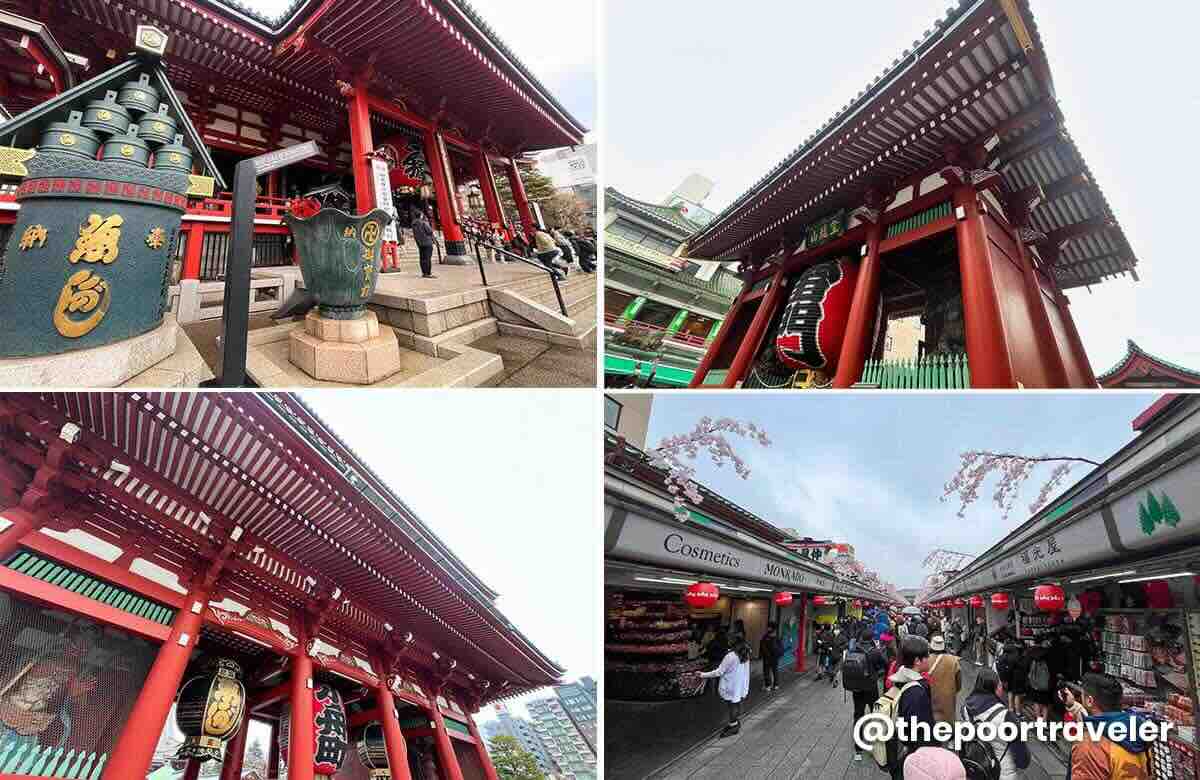
Main Hall (Top Left), Kaminarimon (Top Right), Hozomon (Bottom Left), and Nakamisedori (Bottom Right)
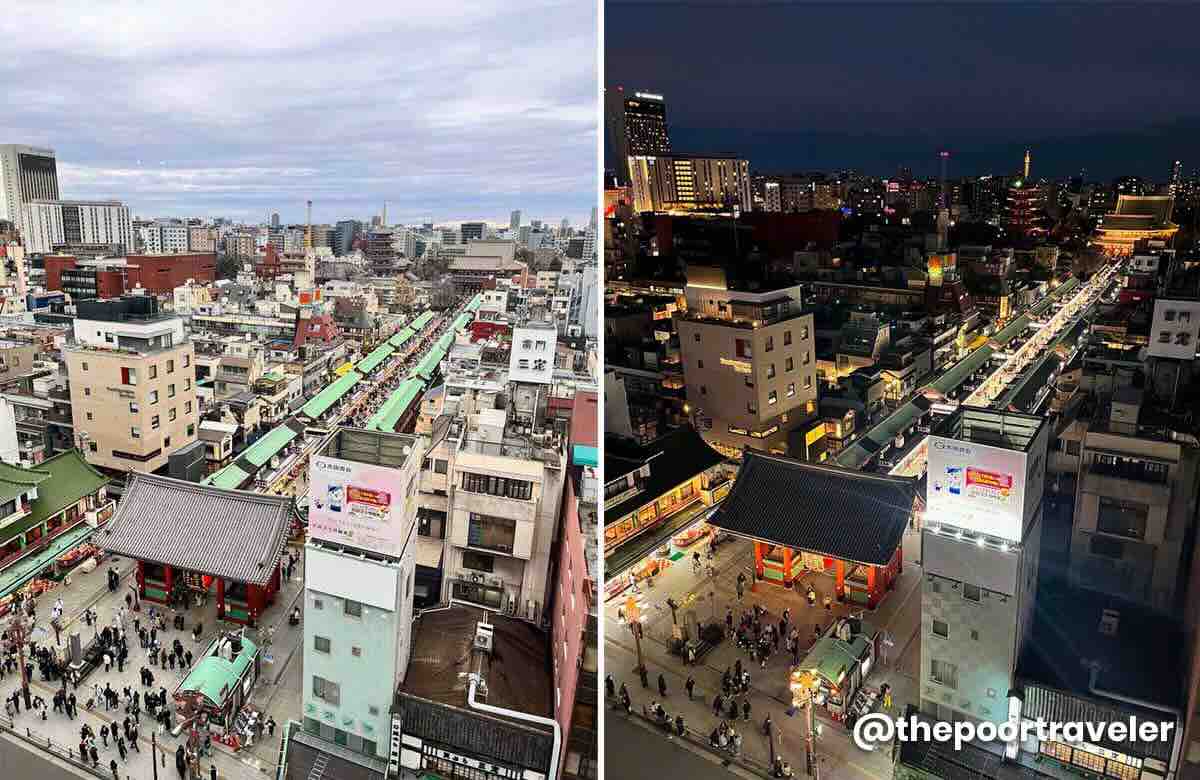
If you’re walking from Asakusa Station, the first structure that will greet you is the Kaminarimon (Kaminari Gate), constructed over a thousand years ago. From here, you’ll be walking down Nakamise-dori, a 250m long alley flanked with shops selling souvenirs and Japanese snacks. It’s a great place to browse, people-watch, or try senbei (rice crackers) and taiyaki (fish-shaped pastries) — though of course, the food isn’t free! Let’s be clear about that. Don’t just take those pancakes without paying! LOL
At the end, you’ll find Senso-ji’s main hall, built as a tribute to Kannon, the goddess of mercy. You’ll see visitors lighting incense for good luck, making wishes at the omikuji (fortune-telling stalls), and admiring the intricate details of the temple grounds.
By day, Senso-ji is bustling with energy and bursting at the seams with people, which is probably why it is sometimes tagged as a tourist trap, but I disagree. You see, I usually visit at night, when it transforms into a serene, beautifully lit-up site. Whether you’re here for the history, the culture, or just the snacks, this temple is an absolute must-visit—and did we mention it’s completely free?
Address: Senso-ji, 2 Chome-3-1 Asakusa, Taito City, Tokyo 111-0032, Japan Nearest Station: Asakusa Station (Tokyo Metro Ginza Line, Toei Asakusa Line, and Tobu Skytree Line) Opening Hours: Main Hall – Daily, 6:00 AM/6:30 AM – 5:00 PM; Grounds – 24/7
3. Meiji Shrine
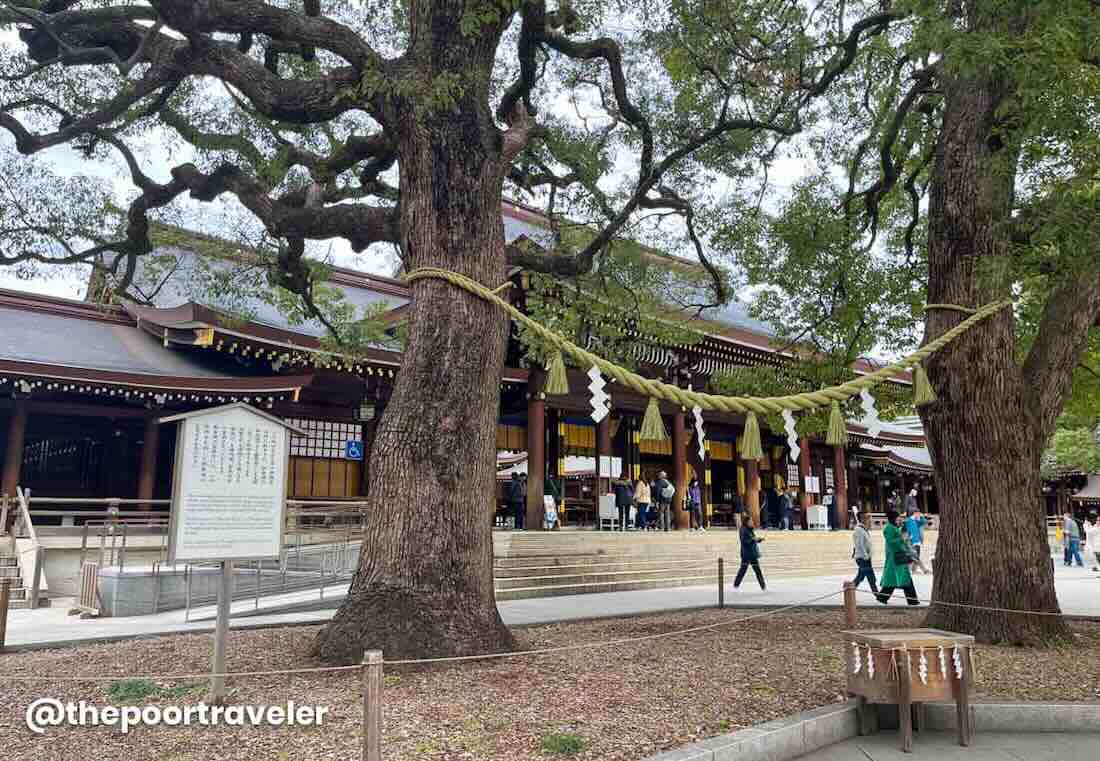
The Meiji Shrine is a peaceful oasis right in the heart of the city. It is located in Shibuya, next to the famous Harajuku district. Cradled inside a lush, 170-acre forest, this sacred site was built in 1921 in honor of Emperor Meiji and Empress Shoken, the beloved rulers who helped modernize Japan in the late 19th century.
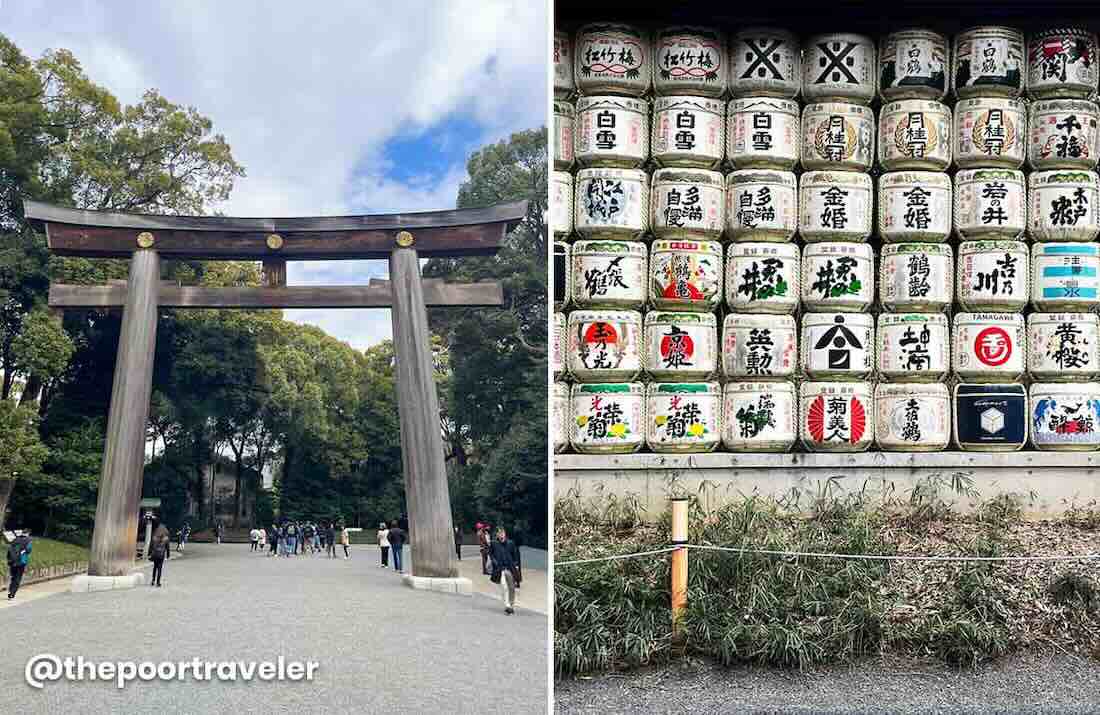
The shrine grounds are huge, so take your time and admire the verdant surroundings and the breath of fresh air. You’ll pass through the massive wooden torii gate, and follow the wide pathway leading to the main shrine.
At the shrine, you can witness traditional Shinto rituals, make a wish by writing on ema (wooden prayer plaques), and even see an occasional Shinto wedding procession, with couples dressed in stunning traditional attire. If you’re into sake, check out the impressive wall of sake barrels, donated by breweries from all over Japan as offerings to the deities.
Shrine admission is completely free, but the teahouse garden tucked next to it charges ¥500 per person.
Lying next to the shrine is Yoyogi Park, which you can also access for FREE! Takeshita-dori, the center of youth culture in Tokyo, is also right across the street, and yes, you can explore it for FREE too.
But there’s another iconic spot not too far away.
Address: Meiji Shrine, 1-1 Yoyogikamizonocho, Shibuya, Tokyo 151-8557, Japan Nearest Station: Harajuku Station (JR Yamanote Line) Opening Hours: The shrine opens at sunrise and closes at sunset. Time varies depending on the month. Entrance Fee: Main shrine grounds, FREE; Teahouse garden, ¥500
4. Shibuya Crossing & Hachiko Statue
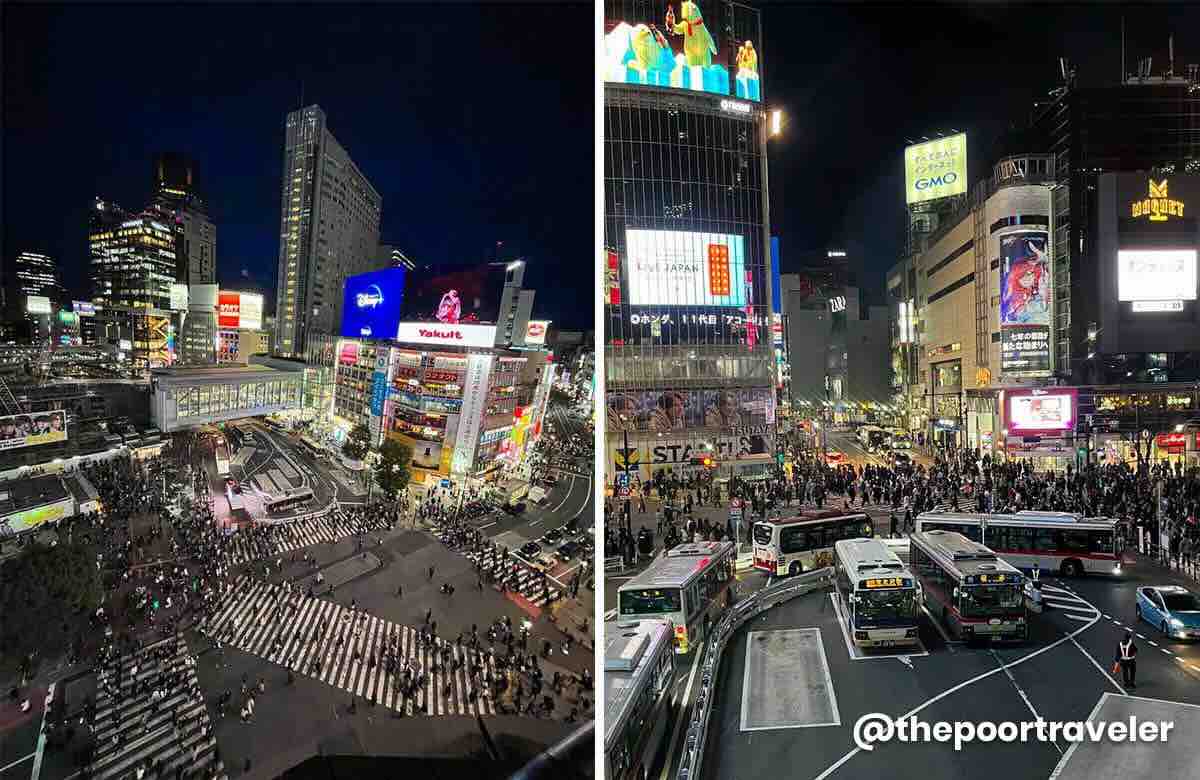
Said to be the world’s busiest intersection, Shibuya Crossing perfectly exemplifies Tokyo’s organized chaos. Even though this is probably the most touristy thing to do in the city, join the hundreds (sometimes over a thousand!) people flood the intersection all at once when the lights turn green.
If you don’t want to join the madness, you can just observe from a quiet distance, maybe from spots like Shibuya Sky, Magnet by Shibuya 109, or even the adjacent Starbucks store (which, by the way, is one of the busiest branches on the planet). Or fall in line for a moment with the statue of Hachiko, the most beloved faithful dog.
At night, this area surrounding Shibuya Station really comes alive with the kind of urban energy that makes Tokyo feel straight out of a cyberpunk movie.
Whether you’re snapping pics, filming a time-lapse, or just feeling the moment, just being in this area Shibuya is an experience on its own.
Address: Shibuya Crossing, 2-2 Dogenzaka, Shibuya-ku, Tokyo 150-0043, Japan Nearest Station: Shibuya Station (JR Yamanote Line)
5. Akihabara
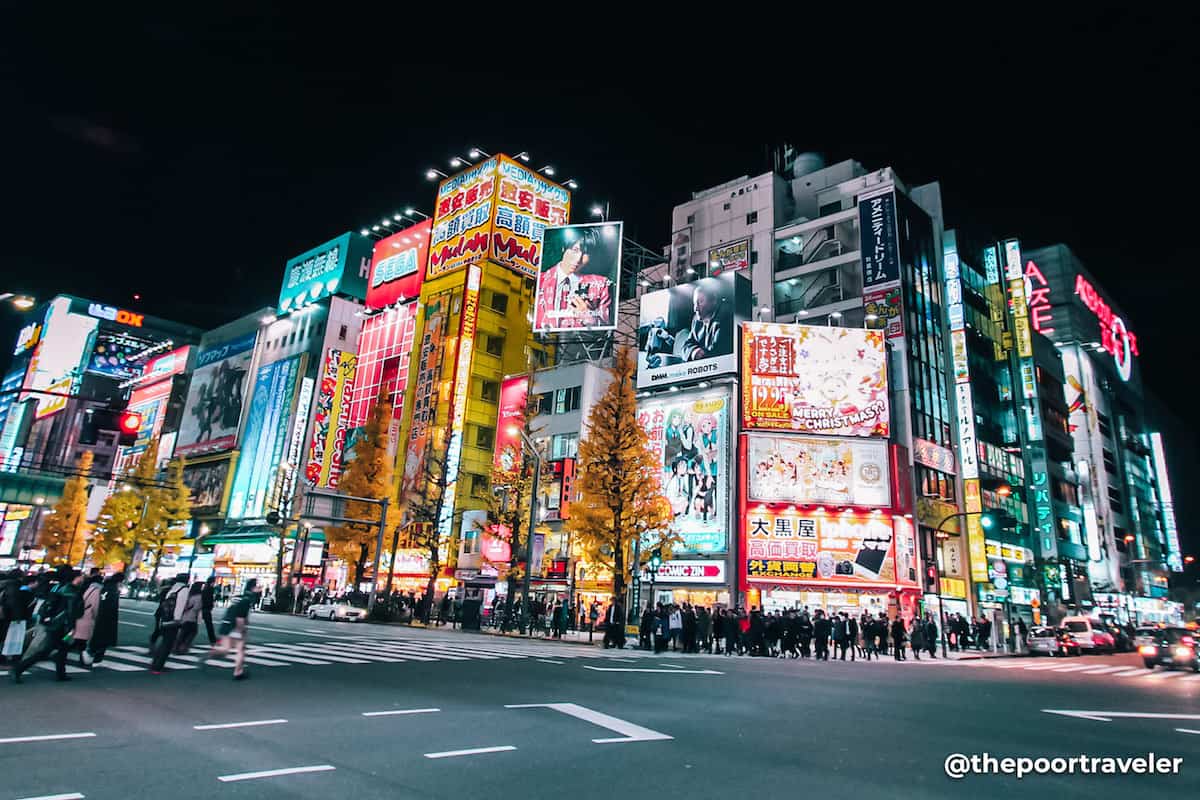
Another area that best illustrates Tokyo’s electric personality is Akihabara. If you love anime, manga, or video games, this is the place to be — and yes, you can see it all for free! Now I’m rhyming!
Akihabara is the otaku’s ultimate mecca and Tokyo’s quirkiest destination. The streets are lined with towering electronics stores, anime billboards, and gachapon (capsule toy) machines as far as the eye can see.
For anime and manga lovers, browsing stores like Animate, Mandarake, and Radio Kaikan is practically a pilgrimage — even if you don’t buy anything, just admiring the sheer volume of collectibles is worth the trip.
Gamers? You can check out classic arcades like Hey and Taito Station. My favorite spot here is probably Super Potato, an unassuming store where you can purchase nostalgic game consoles from family computers to Atari. They even sell old-school Gameboys and tamagochi!
Or just enter gadget stores! Bic Camera and Yodobashi have colossal multi-story branches here!
And if you’re just here for the vibe, take a walk down Chuo-dori, the main street, especially on Sunday afternoon when it becomes a pedestrian-only zone. It’s the best way to experience Akihabara’s unique atmosphere — without spending a single yen!
From Akihabara, if you keep walking north, you’ll eventually reach the next FREE item on this list.
Address: Akihabara, Sotokanda, Chiyoda-ku, Tokyo 101-0021, Japan Nearest Station: Akihabara Station (JR Yamanote Line, JR Keihin-Tohoku Line, and Sobu Line)
6. Ueno Park
But before you arrive in Ueno Park, you’ll be passing through Ameyayokocho, a vibrant shopping street offering all sorts of products! But once you make it through the crowd, you’ll find yourself at the gates of Ueno Park.
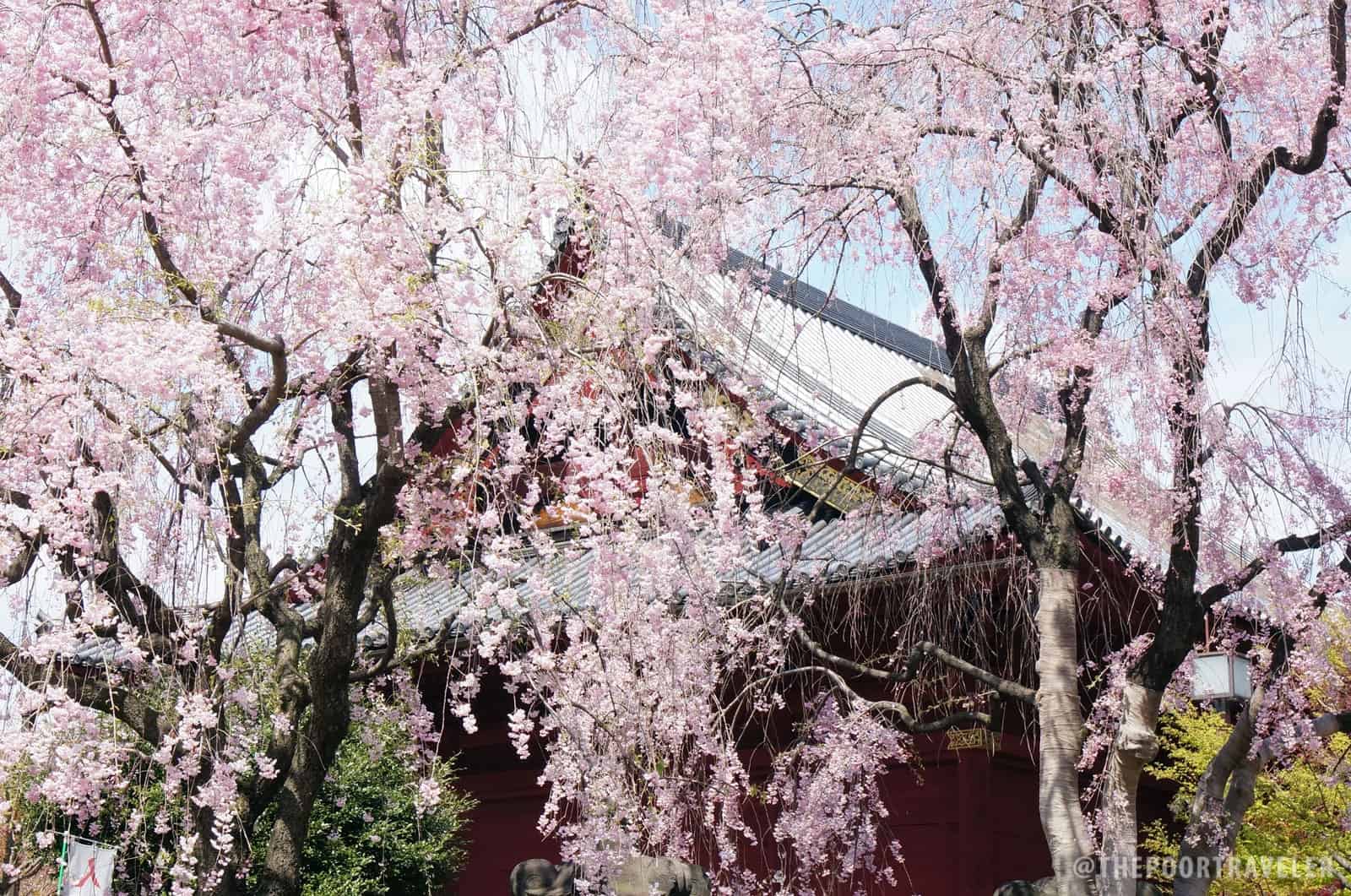
Ueno Park is most well-known as one of the best spots to see the cherry blossoms. In spring, the park is flooded with massive crowds — a mixture of locals and tourists, all enjoying the colorful season under the shade of over 1,000 cherry trees.
But when it’s not sakura season, it is one of Tokyo’s most peaceful corners, especially in the early morning. Stroll around Shinobazu Pond, where you’ll find lotus flowers, turtles, and even a small shrine in the middle of the water. The park itself is free of charge, but it is surrounded by six museums, some of which collect minimal entrance fees, ranging from 500 to 1,000 yen. You can spend a few hours learning more about the city here.
Address: Ueno Park, 5-20 Uenokoen, Taito City, Tokyo 110-0007, Japan Nearest Station: Ueno Station (JR East Line, Tokyo Metro Ginza Line, and Hibiya Line) Entrance Fee: The park itself is FREE, but some museums charge a fee.
Tokyo Metropolitan Art Museum: FREE
Shitamachi Museum: JPY 300
National Museum of Western Art: JPY 500
National Museum of Nature & Science: JPY 650
Tokyo National Museum: JPY 1000
Ueno Royal Museum: Fees vary with each exhibition.
7. Oji Inari Shrine
Oji is one of those hidden neighborhoods in Tokyo that most tourists overlook, but if you’re the type who doesn’t always like going with the flow, spending a few hours here could be worth it! Located in Kita Ward, Oji has a relaxed, old-Tokyo feel, which is in full display at its key attractions like the Oji Inari Shrine (not to be confused with Oji Shrine, which is also nearby).
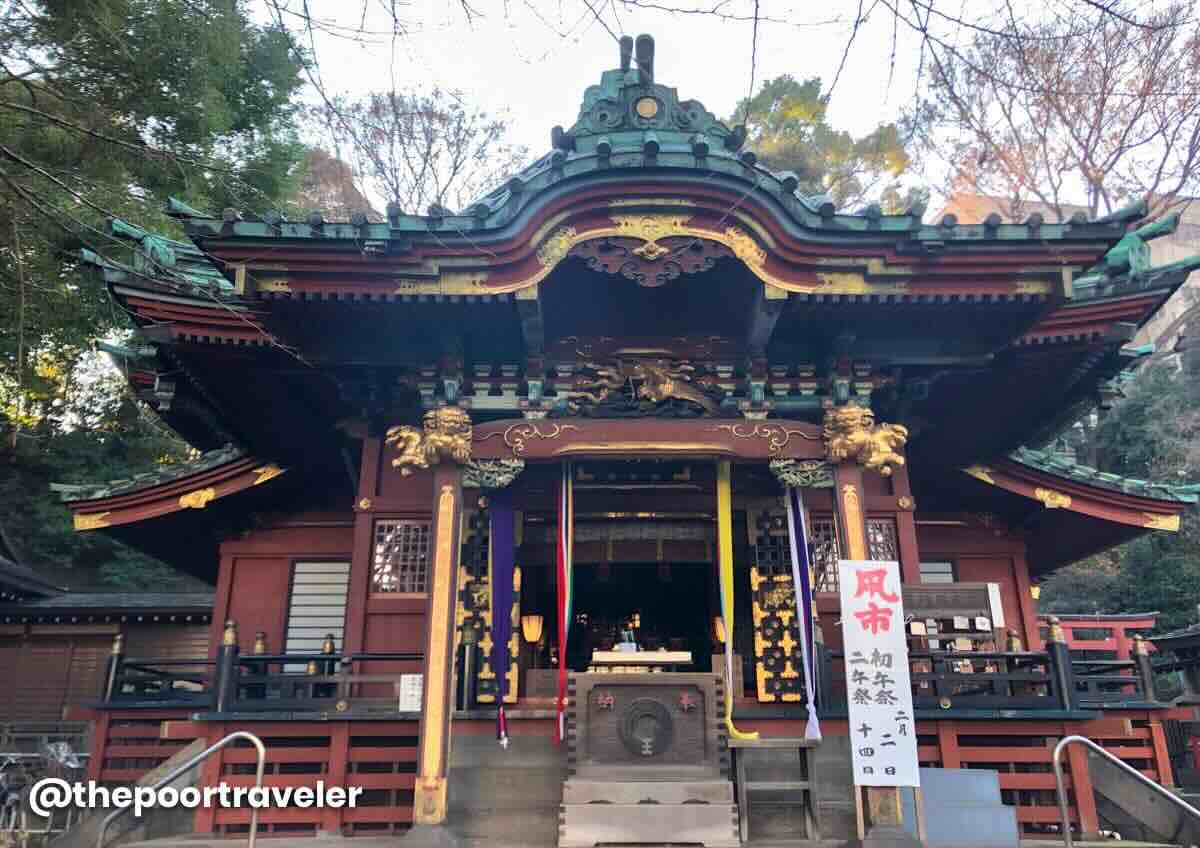
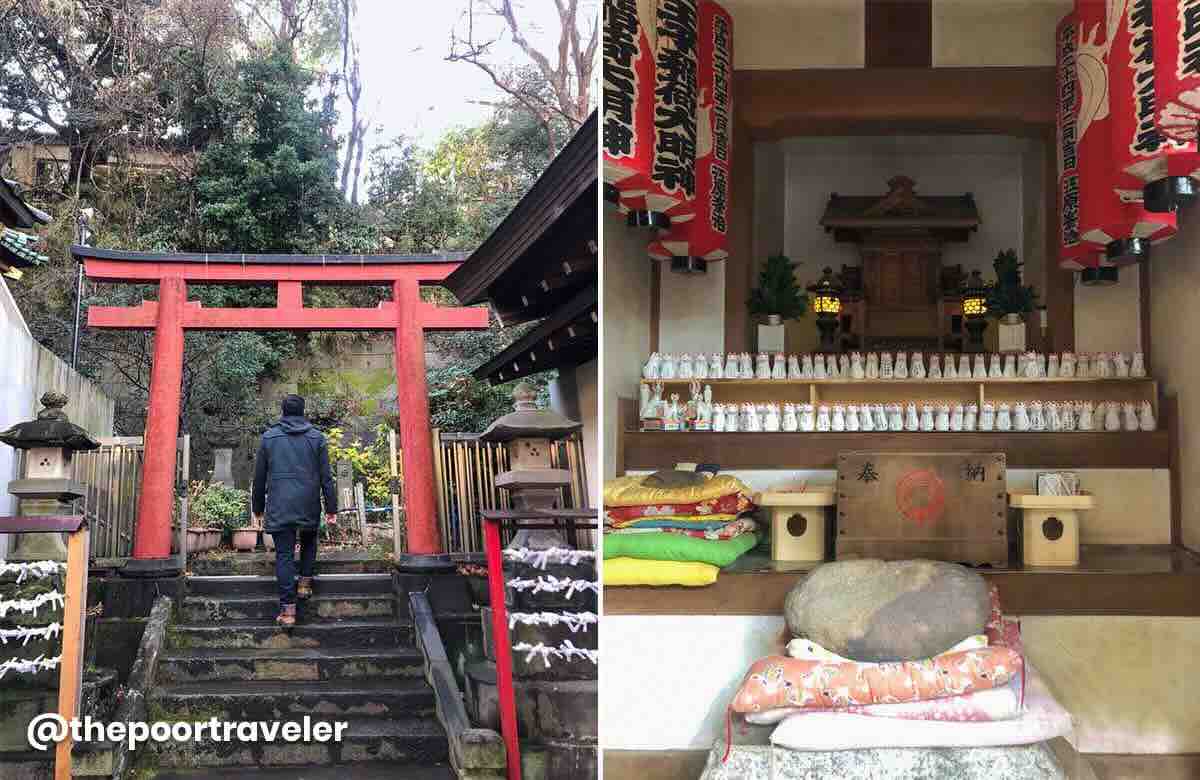
Built in 1822, this shrine is dedicated to Inari, the Shinto deity of rice and prosperity, and is said to be one of Tokyo’s oldest Inari shrines. Every New Year’s Eve, Oji hosts the Fox Parade (Kitsune no Gyoretsu), where people wear fox masks and reenact a legend about fox spirits gathering at this shrine!
Next to the main temple is a short series of torii gates that will take you to a big rock that is believed to be miraculous in a way.
Devotees hold this rock while thinking of what they want to attain, and then, legend has it that if they are able to lift this rock from its place, that wish will come true. Otherwise, according to legend, that dream isn’t for you. Vins and I tried it one at a time, and we both were able to lift it up. I still remember what I wished that time, and YES, it came true.
Just a short walk from the Oji Inari Shrine lies the next free spot on our list.
Address: Oji Inari Shrine, 1 Chome-12-26 Kishimachi, Kita City, Tokyo 114-0021, Japan Nearest Tram Station: Oji-ekimae Station (Toden Arakawa Line) Nearest Train Station: Oji Station (JR Keihin-Tohoku Line)
8. Asukayama Park
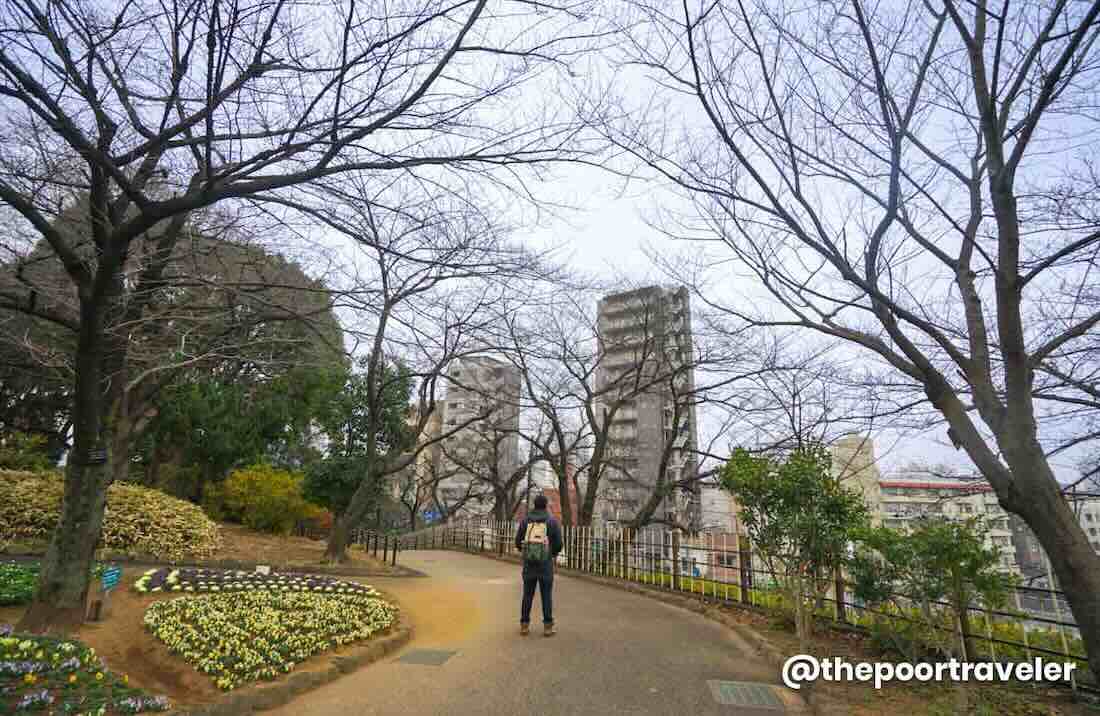
Asukayama Park is one of Tokyo’s OG cherry blossom spots. This park has been a hanami (flower viewing) favorite since the Edo period. Back then, the Daijō-kan established a number of parks in Tokyo. Among them are Ueno Park, Asakusa Park, and Asukayama Park. While others have become crowd-magnets, Asukayama Park remain an oasis of calm in the middle of the city.
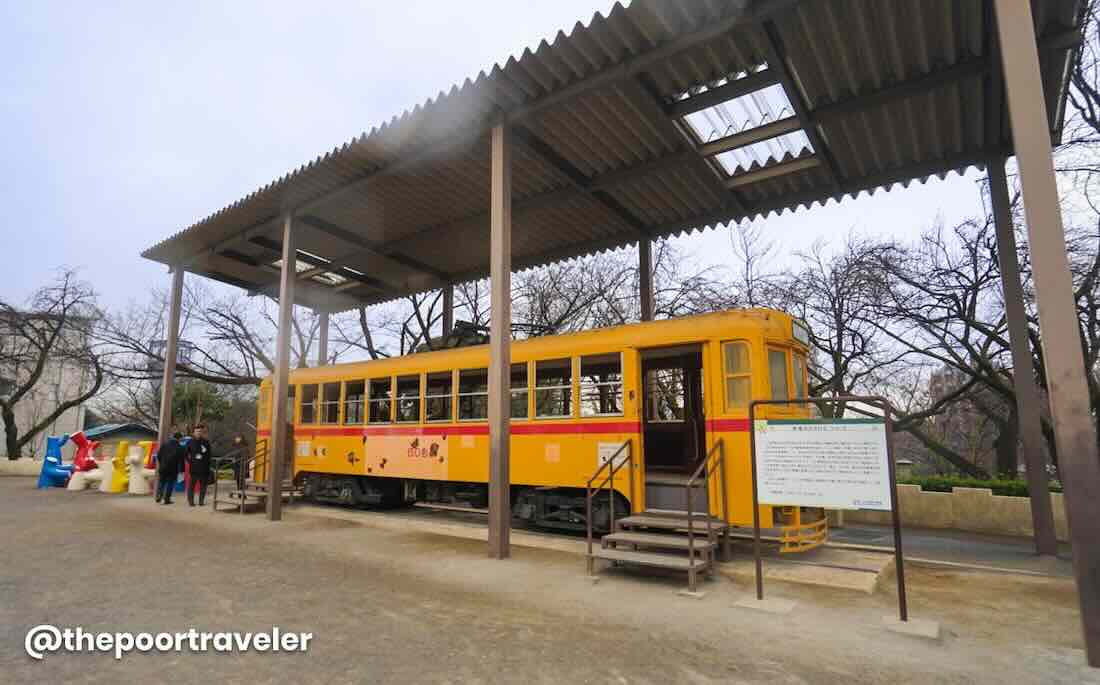
During our visit, there was no one else in the park. We had it all to ourselves. You’ll also find a couple of well-preserved trains inside the park, just next to a children’s playground. It also has three museums: the Paper Museum, Asukayama Museum, and Shibusawa Memorial Museum.
We visited in the middle of winter, so there wasn’t much color. But in spring, the park transforms into an unforgettable sakura destination. The park is covered with cherry trees, planted in the 18th century. If you’re visiting in late March or early April, instead of going to the crowded Ueno Park, come to Asukayama Park instead and enjoy the cherry blossoms better.
Both the Oji Inari Shrine and the Asukayama Park are along the historic Toden Arakawa Line (aka Tokyo Sakura Tram), Tokyo’s last surviving streetcar line. Just watching the old-school tram roll through the neighborhood adds to its nostalgic charm.
Address: Asukayama Park, 1 Chome-1-3 Oji, Kita City, Tokyo 114-0002, Japan Nearest Tram Station: Asukayama Station (Toden Arakawa Line) Nearest Train Station: Oji Station (JR Keihin-Tohoku Line)
9. Odaiba
If you’re looking for a blend of futuristic vibes, stunning views, and fun attractions, look no further than Odaiba — Tokyo’s waterfront wonderland! Located on a man-made island in Tokyo Bay, Odaiba is a hotspot for everything from shopping malls and theme parks to jaw-dropping views of Rainbow Bridge and the iconic Gundam Statue.
But the Gundam Statue we saw a few years ago is no longer here. There is a different giant Gundam figure in the area but we haven’t visited it yet. It’s really been a while since we were last here.
Odaiba Seaside Park
Anyway, you can start by strolling along the waterfront and enjoying the views of the Tokyo skyline, or head to Odaiba Seaside Park, where you can relax by the beach or take selfies with the mini Statue of Liberty that stands near the shore.
The best part? While Odaiba is home to lots of attractions that charge a fee, just wandering around the area and taking in the sights is completely free.
Address: Odaiba, Tokyo, Japan Nearest Station: Daiba Station (Yurikamome Line)
10. Imperial Palace East Gardens
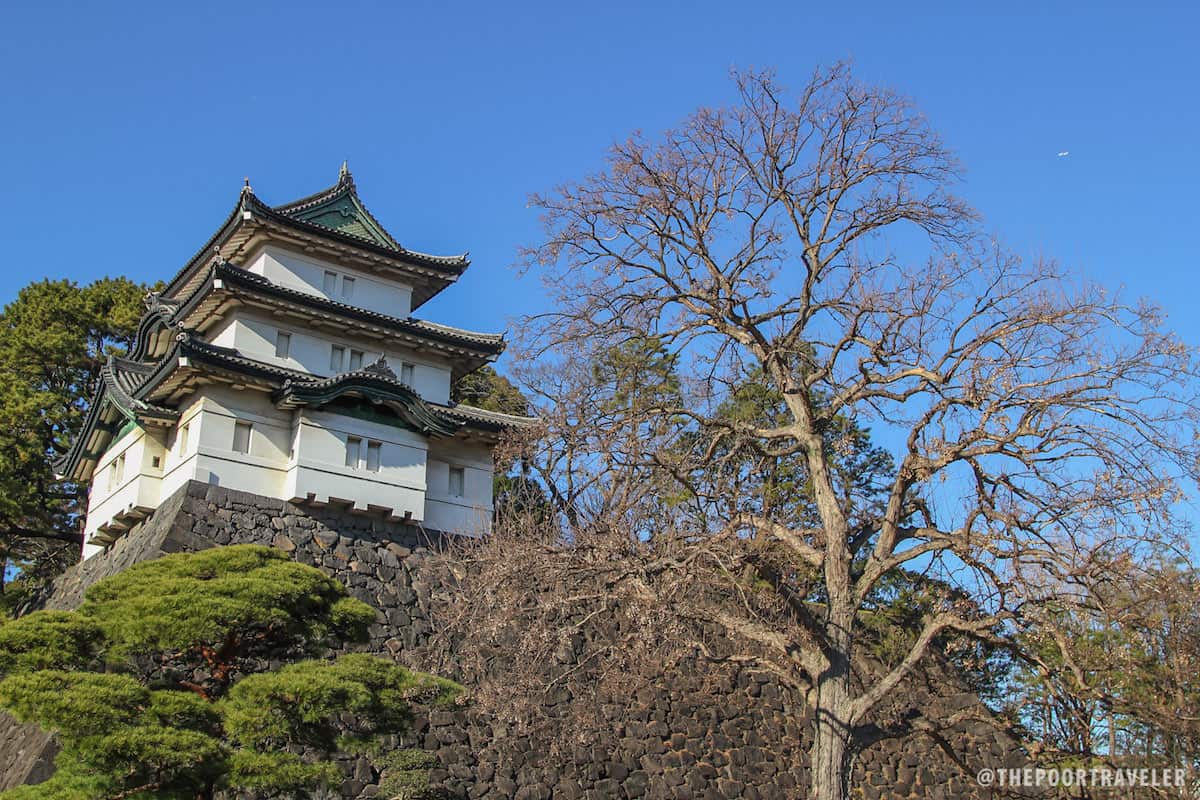
Another structure inside the palace grounds.
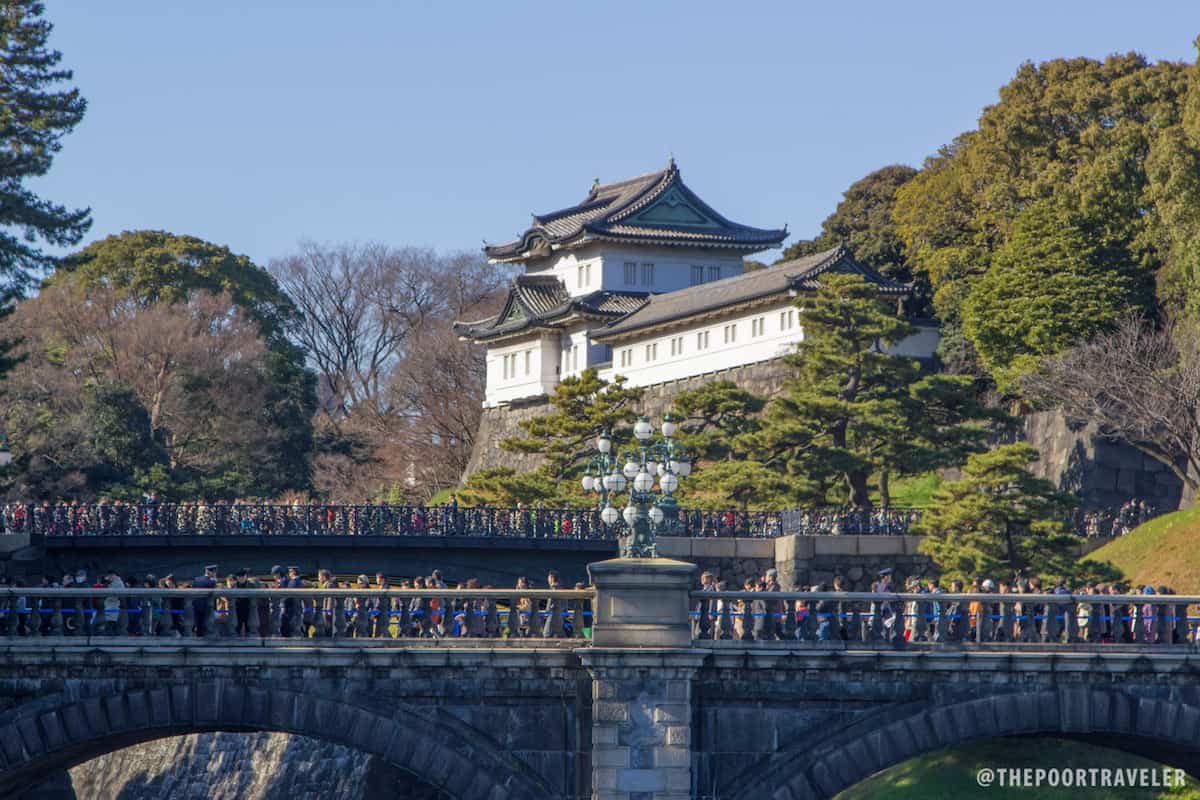
Located at the site where Edo Castle used to stand, the Imperial Palace sits at the center of a large park, scribbled with wide green moats and colossal stone dykes. Two bridges serve as the entrance to the inner section: the Maganebashi (Eyeglass Bridge) and Nijubashi (Double Bridge).
But it remains the official residence of the Japanese Imperial Family so you can’t just enter the building or the immediate area surrounding it. Thankfully, the East Garden is accessible to anyone year-round (except Mondays and Fridays).
The rest of the complex open to the non-touring public only twice a year: on January 2nd for Emperor Naruhito’s New Year Greeting and February 23rd, to celebrate his birthday. I haven’t seen the current emperor yet, but more than a decade ago, I was able to see his father, the former emperor Akihito. But I still remember the experience clearly.
The line snaked from the main building all the way to the roads, but it moved fast and in an extremely organized fashion. Just a few moments after I reached the central grounds, Emperor Akihito, Empress Michiko and the rest of the royal family made an appearance and addressed the crowd. Soon, everyone cheered at the top of their lungs, “Banzai!”
Address: Imperial Palace, 1-1 Chiyoda, Chiyoda City, Tokyo 100-8111, Japan Nearest Stations: Otemachi Station (Exit D2), Nijubashi-mae Station (Exit 6), and Tokyo Station (Marunouchi Central Exit) Emperor’s Appearance Dates: January 2 (New Year Address) and February 23 (Emperor’s Birthday)
Where to Stay in Tokyo
Tokyo is never short of accommodation options. From luxury to budget, there is something for every type of traveler. Because of their accessibility, Tokyo, Shinjuku, and Ueno stations are the favored tourist bases. Here are some of the top-rated budget hotels in these locations.
🔥🔥🔥 Use AGODATPT for 10% off on select hotels! 🔥🔥🔥
The Poor Traveler readers and followers can now use a special discount code to score 10% discount, up to USD 100 (roughly PHP 5700)! To apply and avail of the promo code, visit AGODATPT Promo Code.
Top Budget Hotels near Tokyo Station
Citan Hostel. Image via Agoda.
Top Budget Hotels near Shinjuku Station
Premiere Hotel Cabin Shinjuku. Image via Agoda.
Top Budget Hotels near Ueno Station
Ueno is our absolute favorite area to stay in Tokyo. When we’re in the city, we always stay here, close to Ueno Station and Ueno Park because it’s easily accessible and there is a direct line to Narita Airport. There are also plenty of relatively affordable hotels in the area.
Getting a travel insurance is optional, but we highly recommend this, especially when traveling abroad. Travel can be unpredictable, and though we hope we’ll never use it, having it gives us peace of mind in case of unexpected delays, cancellations, or emergencies.
For international destinations, consider PGA Sompo’s TravelJOY Plus insurance. You can GET IT HERE. Don’t forget to use WORTHIT for a special affordable rate.
Updates Log
2025 10 15 – First uploaded
Photos by: Yosh Dimen, Vins Carlos, and Asta Alvarez
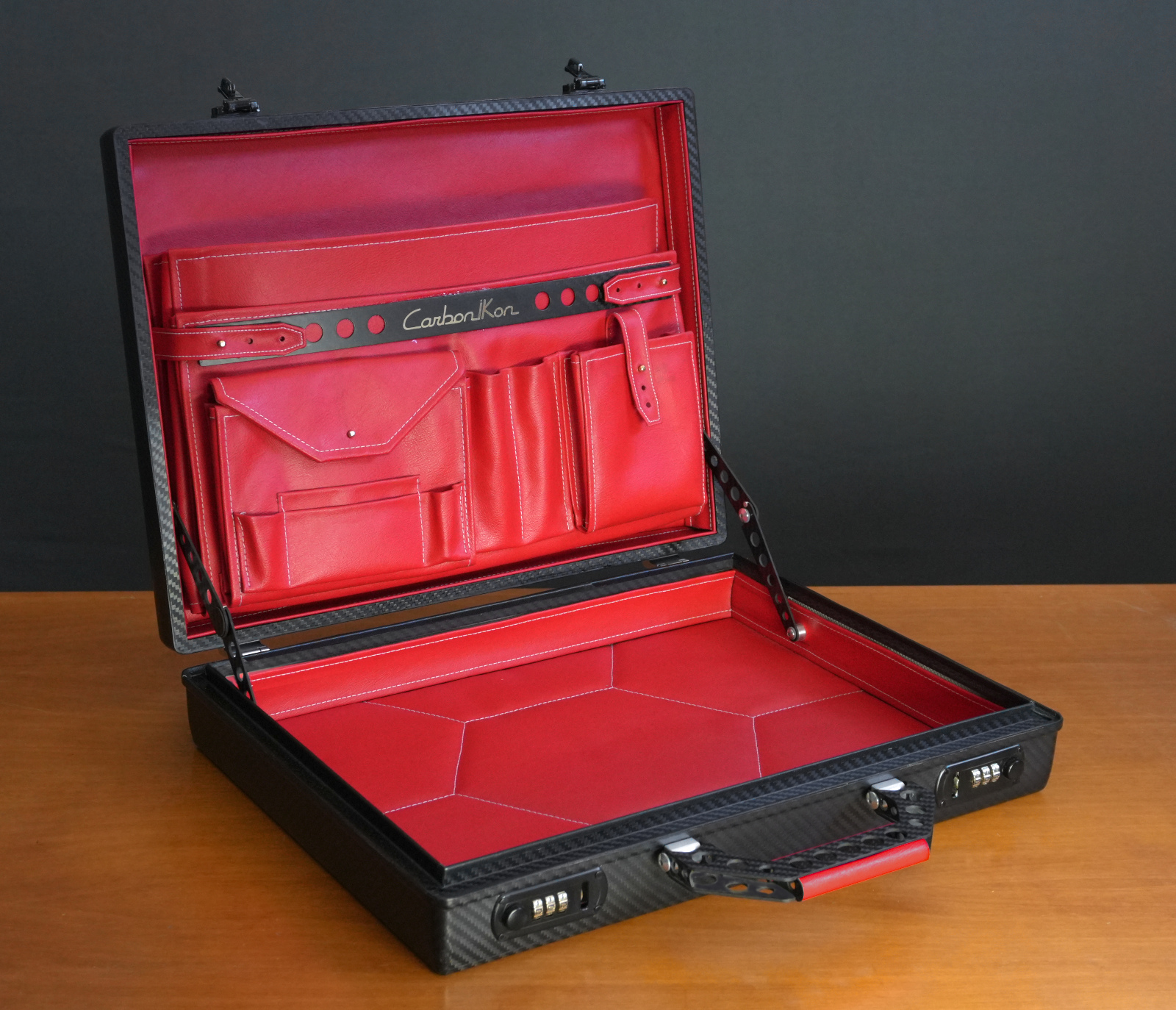
Founded in Rome, Carbonikon operates at the intersection of design and material science, applying aerospace-grade carbon fibre engineering to the luxury accessories market. The company’s roots in aeronautical manufacturing inform its commitment to structural performance, product longevity and lightweight design. Rather than rely on aesthetics alone, Carbonikon’s handbags and briefcases are positioned as long-term assets that combine industrial-grade precision with practical utility. By focusing on resilience and efficiency over seasonal trends, the brand challenges traditional notions of luxury and offers a performance-driven alternative for discerning consumers. With growing interest in high-performance materials within the luxury segment, Carbonikon’s approach aligns innovation with sustainability and measurable value.
Many of Carbonikon’s products have registered copyrighted designs. The company’s mission is to offer objects that reflect the feeling and passion for their work. “Our creations are part of us and our family who actively participate in their conception and creation,” says Fabio Manieri, Company Owner of Aviacompositi – Carbonikon. LUXUO speaks to Manieri on how the brand is translating aeronautical innovation into the language of luxury.
Your bags made of carbon are truly unique! Tell us about your passion for carbon, which is usually a material associated with the aerospace and automotive sectors?
My passion for carbon fibre stems from my passion for aeroplanes and their technologies. Having grown up in Ciampino, where Rome’s second airport is located, it’s easy to imagine why. My passion for aeroplanes and all the technologies applied to them dates back to when I was very young. I started building model aeroplanes at the age of five, and as I grew up I built all kinds of them. My passion for aeroplanes led me to attend the G. Galilei aeronautical construction school in Rome. In 1985, studying in even greater depth, I decided to build my own two-seater ultralight aircraft. I designed the aerodynamics and the structure and built it over three years of intense work. After many tests, I took it for a flight in 1988. I had realised my dream! I later took my wife, my father and many friends up for flights. It’s incredible to think that I built it in the family Woodshop, which was located on ‘Wright brothers’ street! It seemed like a sign of destiny…
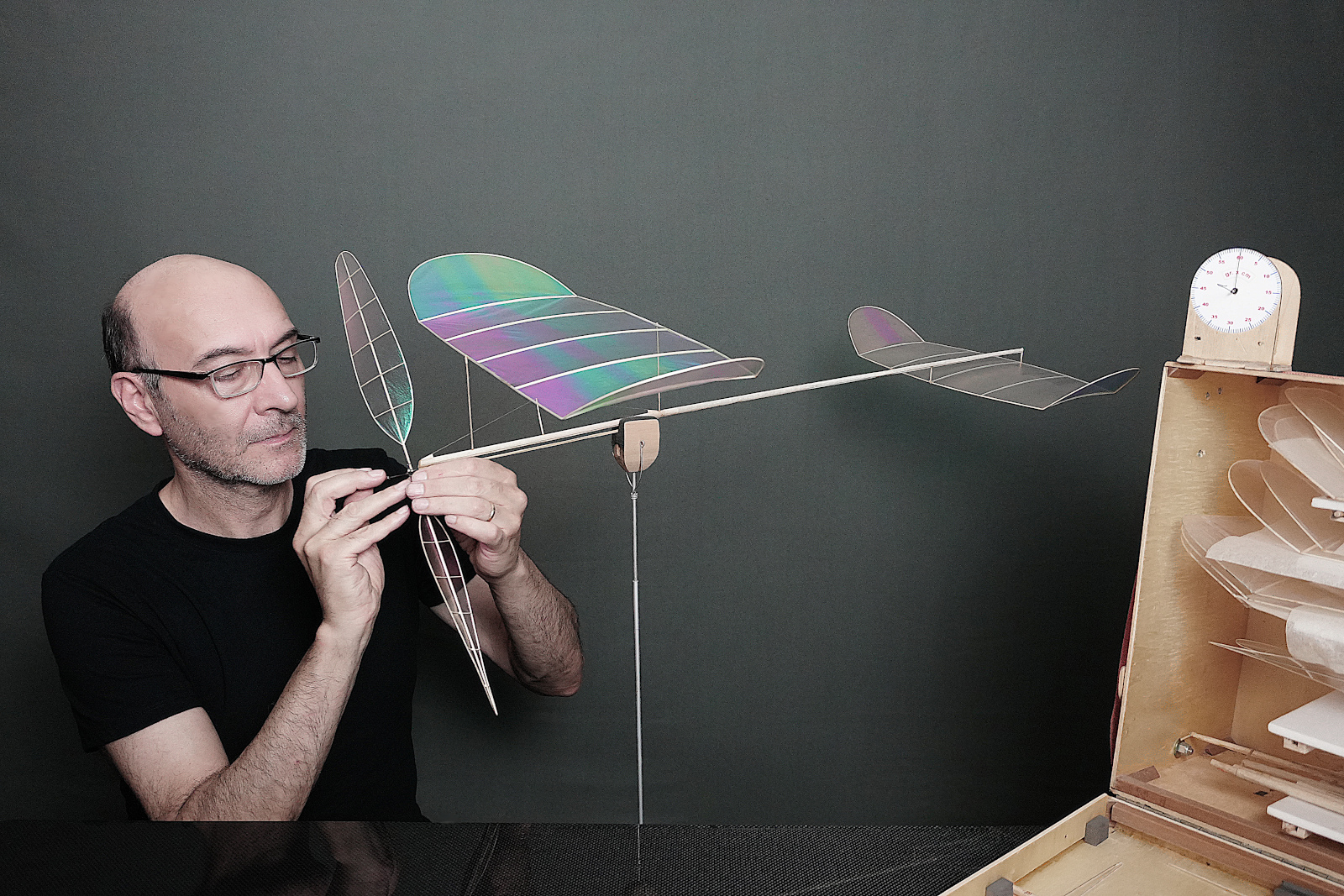
Many years later, from 2001 to 2018, I resumed my old passion for model aeroplanes, winning 18 consecutive Italian championships in the “FAI” (Fédération Aéronautique Internationale) F1D and F1M categories, Ministick and TH are endurance model aeroplanes weighing between 0.49 grams and 3 grams (this is not a mistake; they really weigh between 0.49 and 3 grams depending on the category). They fly on their own without radio control and with a rubber band motor. They are extreme in their construction and aerodynamics, and even have an automatic variable pitch propeller, built as if it were part of a watch! If well built and set up, F1Ds, which represent the top of the category, can fly for almost half an hour in a single flight. They are extremely efficient and represent the essence of flight physics. This is an ancient category of model aeroplanes that embodies all the modern concepts of lightness and energy saving, which are the same reasons why carbon fibre is used today.
Returning to carbon fibre, from 1988 to 1992 my passion led me to work at Agusta helicopter company in the composite materials plant, where I was employed in the experimental composite materials department and in the industrial engineering office, thus increasing my specialisation in these materials that I already knew. During those years, carbon fibre began to be used in other sectors as well, and I constantly followed its development. In fact, around 1992, after leaving Agusta, I began to manufacture model aircraft parts and motorcycle parts in carbon fibre. In 1998, I founded Aviacompositi, which for 27 years has been producing many carbon fibre parts for the automotive sector as well as for many research and development sectors.
One of the most important and unusual projects I have personally undertaken was the design and construction of the carbon fibre support for the statue of Apollo Belvedere for the Vatican Museums. It was a very challenging project that took me over eight months to design and build. The Apollo, a statue created around 150 AD by the Romans, is a landmark and icon of classical sculpture. It was once again shown to the world last October after five years of restoration. The video of the restoration, which also shows me installing the carbon support, can be viewed on YouTube.
Tell us about the unique properties of carbon?
The main properties of carbon fibre are its high mechanical strength and stiffness, compared to its low weight, which, when properly exploited, offer great advantages. Its low weight allows for significant energy savings. For example, in transport, many commercial aircraft make extensive use of carbon fibre. Being lighter, they consume less fuel, resulting in lower costs and less impact on pollution. As a general concept of high performance and maximum efficiency, just think of Formula 1 cars or America’s Cup boats.
You stated that the Carbonikon bags you have created are not just accessories, but style statements that reflect the harmony between form and function. Can you elaborate there?
Carbonikon bags and accessories are not just beautiful objects in themselves. When I design them, I don’t just think about their form, but also their practical everyday use. I believe they should bring satisfaction and lighten our days, not only by being beautiful objects to look at, giving us that feeling of enchantment we get when we look at a work of art, but also by having a practical use. For me, this is the concept of perfect balance between aesthetic form and functionality.
Why is the lightness of carbon a key element of differentiation for your bags?
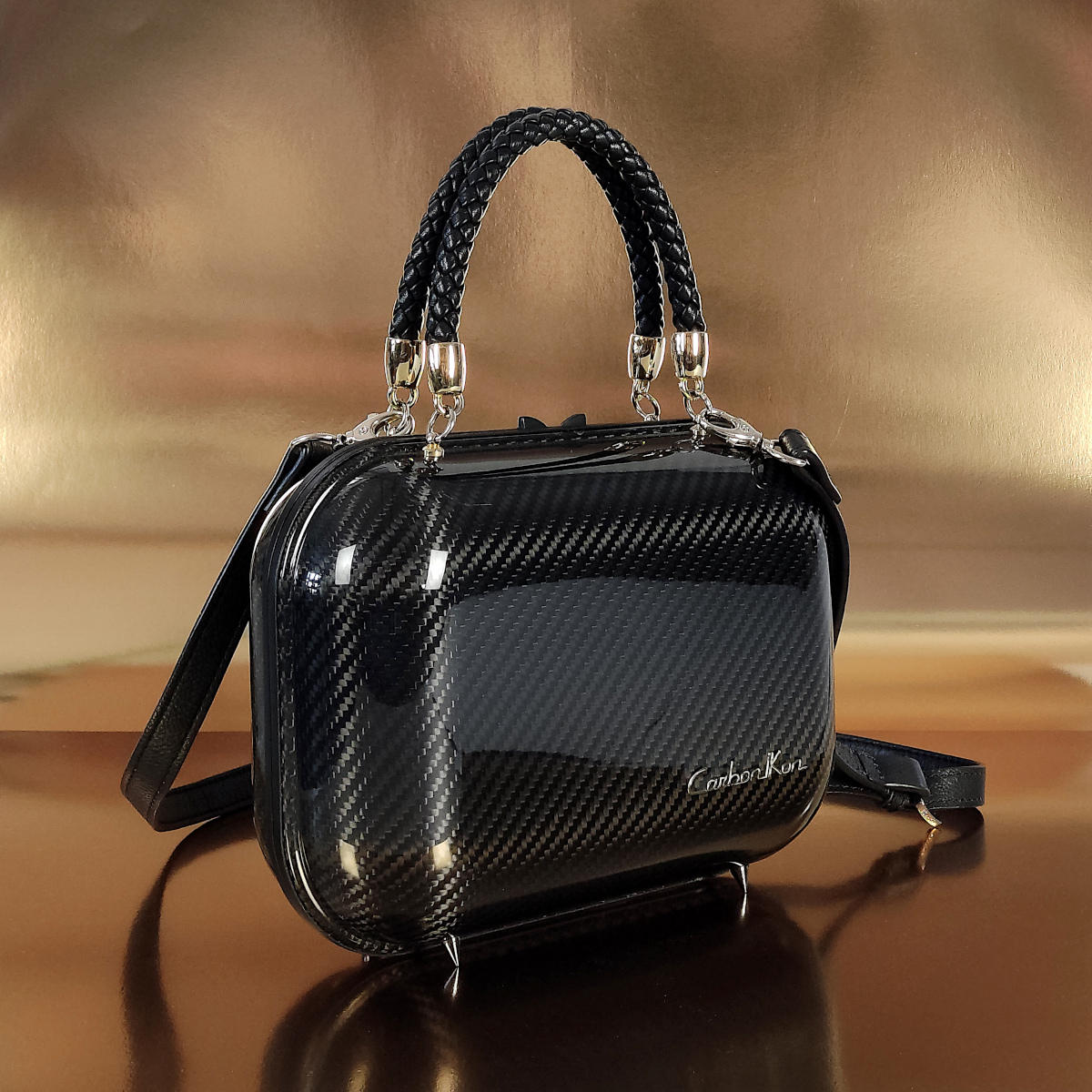
It is the same concept of energy efficiency expressed above: lightness reduces energy consumption for us too, as we tire less easily. It is better to have a lightweight container which, when added to the load to be carried, has the lowest possible weight. For example, our empty briefcase weighs about 1 kg (2.20 lbs) less than a standard one, which means that when full, it will weigh on average the same as or less than a normal empty briefcase. The same concept is applied to the women’s handbag that weights only 380 grams (0.84 lb).
Do you see yourself as an engineer or a fashion designer, or both?
Considering my passion for technology, my many interests, passions and studies – from aeronautics to mechanics, design, electronics, computer science, photography and so on – I believe I am a multifaceted engineer with an innate sensitivity to design and the beauty of things. This is not meant to be self-celebration, but rather a thoughtful reflection on a life devoted to pursuing my passions.
At Carbonikon, traditional craftsmanship meets technological precision. Tell us about the production process.
The production process for a carbon fibre component is very long and complex. There are stages where modern technology can be used, but there are also many stages where high-level craftsmanship and skills are required. For example, in the design phase, we move from pencil drawings to 3D CAD, and to create the mould, the model is normally milled using CNC, but in some cases it may be more convenient to do it by hand using the traditional method. To make the product, the carbon must be layered in the mould entirely by hand, and this is where human skill makes all the difference. To achieve a high-quality aesthetic effect, the fibres must be layered very carefully without distortion or asymmetrical orientation.
Then, in the finishing stage, there is a whole phase of manual sanding, followed by painting, which gives the carbon beauty and durability, and mirror polishing in the case of a glossy finish. The process is as long and complex as that of painting a supercar. in addition to this, taking our women’s bag or briefcase as an example, there is also the preparation and manual sewing of the inner lining, its gluing to the carbon shells, the gluing of the closing frames, the assembly of the handles and bottom studs, all very long and delicate manual operations that, when done skilfully, really make the difference.
What is the profile of your clientele and what do they look for when purchasing a Carbonikon bag?
Our customers seek the uniqueness of an object, its soul that carries with it a part of us, our passion for what we do and my personal history in the world of technology and design. Ours is a modern customer who appreciates the combination of technology and refinement, loves exclusivity and personalisation, and knows that the product they are buying is not a sterile industrial production but a product with a history, the result of the passion of people who have dedicated their lives to seeking excellence in their work.
You argue that a product that lasts over time is more sustainable. Can you tell us what you think about this?
Fast fashion certainly produces more pollution due to the large quantities produced, which generates a large amount of waste to be treated. My vision is of a product that lasts over time without ending up in a landfill after a few months. At Carbonikon, we apply this concept to everything we do, and it also represents our concept of quality, which translates into a benefit for both the planet and the customer.
Do you use recycled materials?
Where possible, we always try to use materials with a very low environmental impact, such as water-based mould release agents and so on. At the same time, we try to optimise production processes to minimise energy consumption.
Do you create limited series?
Yes, we plan to create limited series and unique pieces of our products.
Where do you see your brand in five years? Will you operate a network of Carbonikon boutiques?
I see steady growth towards the main global markets. At the moment, we operate directly through our online shop, but growth will most likely lead us to create a network of Carbonikon boutiques.
What is your definition of success?
For me, success means having people appreciate what we do. Of course, it also means seeing Carbonikon grow in terms of reputation and popularity around the world and knowing that many people identify with our style. Success in economic terms is obviously important, but for me it comes after these things.
If you were to name one person or mentor who has inspired you along your life and career, who would that be?
Both for inspiration and gratitude, to my father who was so creative in his work, called “Archimedes” by his friends, who passed on to me his passion for invention and ingenuity, to my mother too with her conviction that my creative activities and passions would help me in life. I think they were both absolutely right, to my wife Antonella, who has always stood by me and supported me in my work for many years, physically making our products with me and contributing her ideas and creativity which met mine as well; to my daughters, with whom I often discuss things, listening to their points of view and advice. They are all true sources of inspiration and guiding lights in my life.
For more information on Carbonikon, click here.
For more on the latest in leaders, style and fashion reads, click here.
The technical storage or access is strictly necessary for the legitimate purpose of enabling the use of a specific service explicitly requested by the subscriber or user, or for the sole purpose of carrying out the transmission of a communication over an electronic communications network.
Preferences
The technical storage or access is necessary for the legitimate purpose of storing preferences that are not requested by the subscriber or user.
Statistics
The technical storage or access that is used exclusively for statistical purposes.The technical storage or access that is used exclusively for anonymous statistical purposes. Without a subpoena, voluntary compliance on the part of your Internet Service Provider, or additional records from a third party, information stored or retrieved for this purpose alone cannot usually be used to identify you.
Marketing
The technical storage or access is required to create user profiles to send advertising, or to track the user on a website or across several websites for similar marketing purposes.


:max_bytes(150000):strip_icc()/TAL-idaho-northern-lights-SECRETNRTHLIGHTSPT1025-268c7ed4d2bd447cb18eb990f16ed5a2.jpg "The Most Overlooked Places in the U.S. to See the Northern Lights, According to a New Study")
:max_bytes(150000):strip_icc():format(jpeg)/TAL-idaho-northern-lights-SECRETNRTHLIGHTSPT1025-268c7ed4d2bd447cb18eb990f16ed5a2.jpg)


:max_bytes(150000):strip_icc()/TAL-lead-image-YUKONCANADA0925-8519838123dd455798b6670fa2e5329f.jpg "Yukon, Canada, Guide")
:max_bytes(150000):strip_icc():format(jpeg)/TAL-lead-image-YUKONCANADA0925-8519838123dd455798b6670fa2e5329f.jpg)




:max_bytes(150000):strip_icc()/TAL-header-exterior-keswick-hall-VADESIGNDEST1025-13938e8cbf544747ba0d5bb99cb6cdf7.jpg "This Stunning Home in Virginia’s Horse Country Is the Perfect Fall Getaway")
:max_bytes(150000):strip_icc():format(jpeg)/TAL-header-exterior-keswick-hall-VADESIGNDEST1025-13938e8cbf544747ba0d5bb99cb6cdf7.jpg)