Limassol, the vibrant coastal city on the southern edge of Cyprus, is one of the most popular destinations in the country. If Cyprus is part of your European trip, chances are, you’ll be landing at Larnaca International Airport, the main gateway to the island. So, how exactly do you get from Larnaca Airport to Limassol?
In this post, we’ll walk you through your transportation options and break down everything you need to know to get to Limassol.
Before we dive into the transport details, here are a few key things to know that might come in handy for your trip to Limassol from Larnaca in Cyprus:
Currency: Cyprus uses the euro (€) as its official currency. So all fare prices and travel costs we’ll mention in this post are in euro.
Language: Greek. The official language is Greek, but don’t worry — English is widely understood, especially in tourist-friendly areas. You might hit a small language barrier in some local spots, but it’s usually easy to get by.
Main Airport: The main entry point for most international travelers is Larnaca International Airport (LCA), also on the southern coast. From here, Limassol is just about an hour southwest.
How to Get to Limassol from Larnaca
Limassol is nestled along the southern coast of Cyprus. It’s the second-largest city on the island, just next to the capital Nicosia. You have two options to get to Limassol from Larnaca Airport: by Public Bus and by Direct Airport Shuttle or Airport Bus.
Upon landing at the airport, you’ll need to go through the usual arrival formalities like immigration and customs inspection. After picking up your luggage, you’ll be exiting into the Arrival Hall. Your next steps will depend on the transportation you’ll choose.
Larnaca Airport to Limassol By Direct Airport Bus
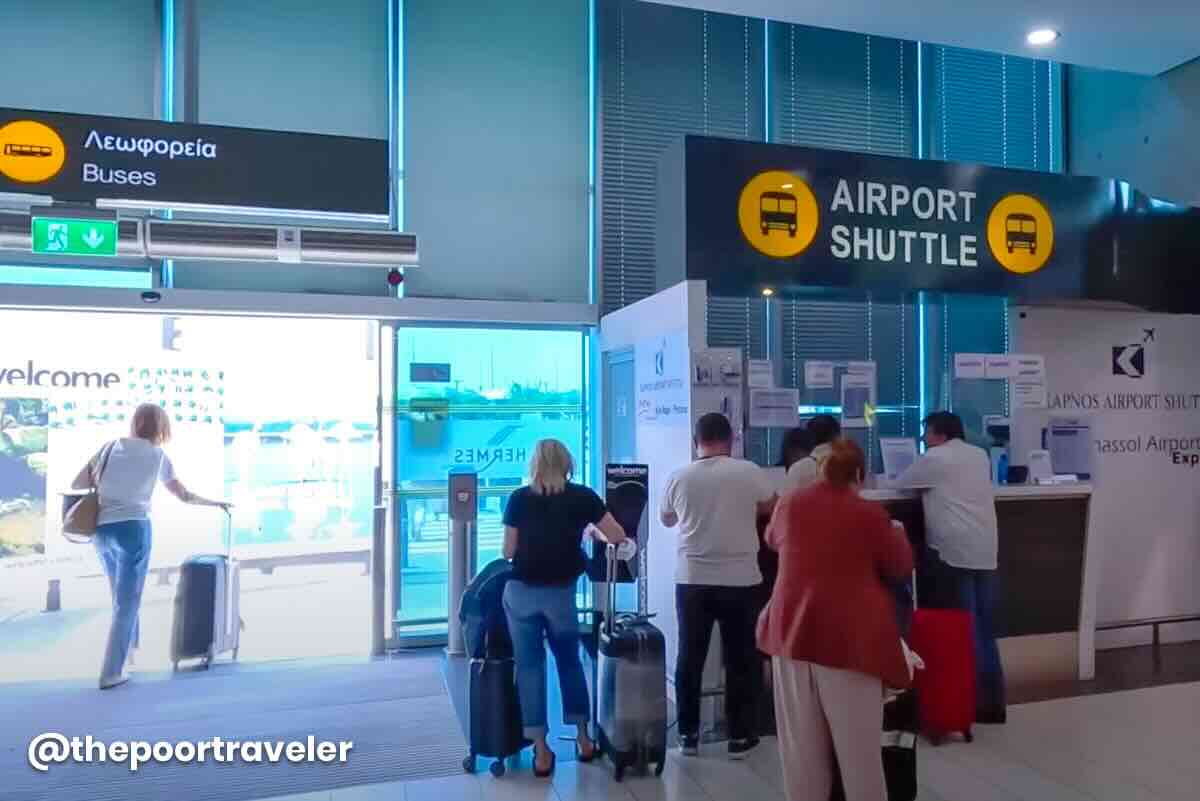
1. Go to the Airport Shuttle Counter.
Once you exit into the Arrival Hall, turn left. Then, walk all the way to the far end of the terminal. Just before you reach the exit doors, you’ll spot a ticket counter. Heads-up! It’s not possible to reserve a seat in advance for the Limassol Airport Express. Just buy your ticket when you arrive at the airport.
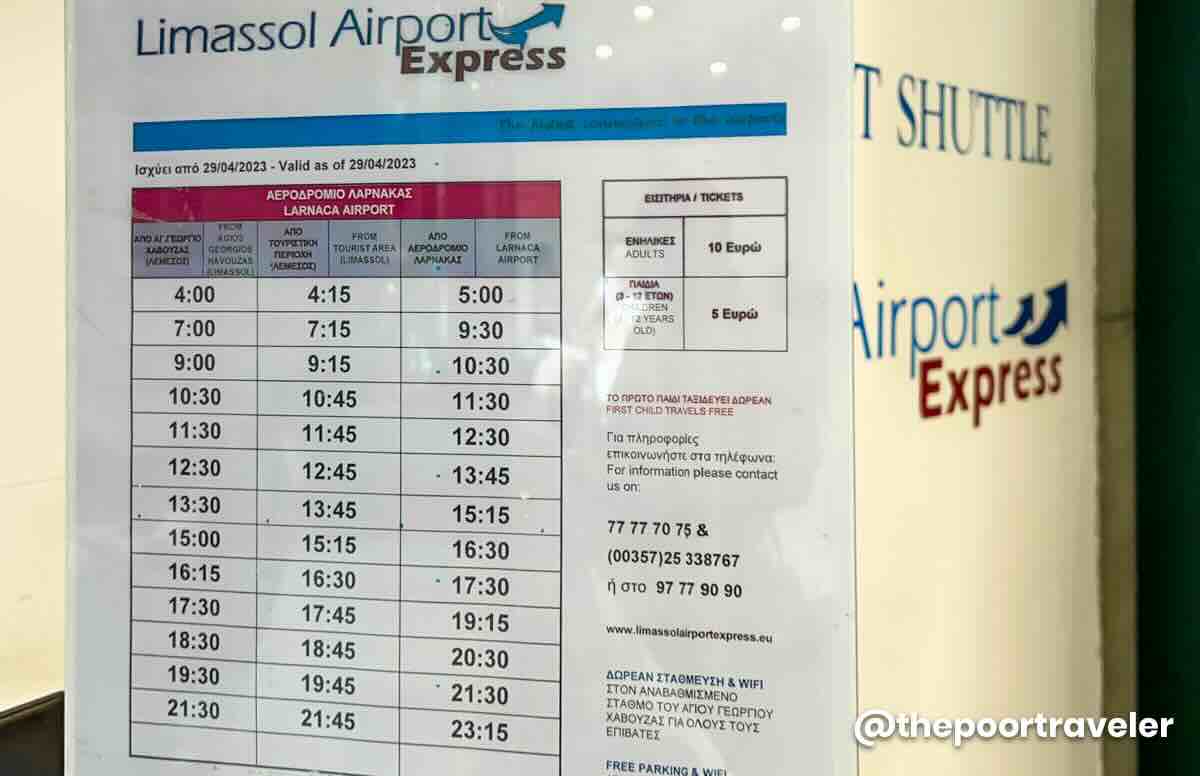
There’s only one direct bus service from Larnaca Airport to Limassol, and it’s run by Limassol Airport Express. It runs from 5:00 AM to 11:15 PM, making a total of 13 trips at varying intervals. As of our last visit in 2023, here’s the schedule:
This is hands down the fastest, most convenient, and hassle-free way to get to Limassol. The journey takes just around 50 minutes, with no transfers and only one quick stop before reaching its final destination.
First stop: Tourist Area, near the St. Raphael Resort, Grand Resort, and Kanika Elias Beach
Second and Final stop: Limassol Airport Express Station at the Agios Georgios Havouzas Station in Limassol’s city center.
2. At Agios Georgios Havouzas Station in Limassol, get a ride to your accommodation.
You’ve got a few options to reach your hotel: you can hail a taxi or use a ride-hailing app. If you prefer using an app, BOLT and CABCY are both popular ride-hailing options in Cyprus. We personally used Bolt, and a driver was assigned to us almost instantly! It was super easy and efficient. If your hotel is located at the Molos area, near Pier Beach, expect to pay around EUR 12.
There’s also an intercity bus that passes by, but unfortunately, we weren’t able to get detailed info about its schedule or route.
By the way, if you get hungry, no worries! You’ll find a few great food spots right beside the station. Here are some of them:
Bean Around. A cozy café, perfect if you’re in the mood for coffee or something light.
Feedos. Check it out if you’re craving something more filling, which is a really good burger joint.
Vending Machines. There are also vending machines scattered around the area, selling drinks and snacks in case you need a quick grab-and-go option.
Larnaca Airport to Limassol By Public Bus
1. Head to the City Bus Boarding Platform.
If you decide to take the public bus route, turn right once you get to the arrival hall. This will lead you to the area where city buses depart. This is the cheaper option, but it takes longer and involves a transfer.
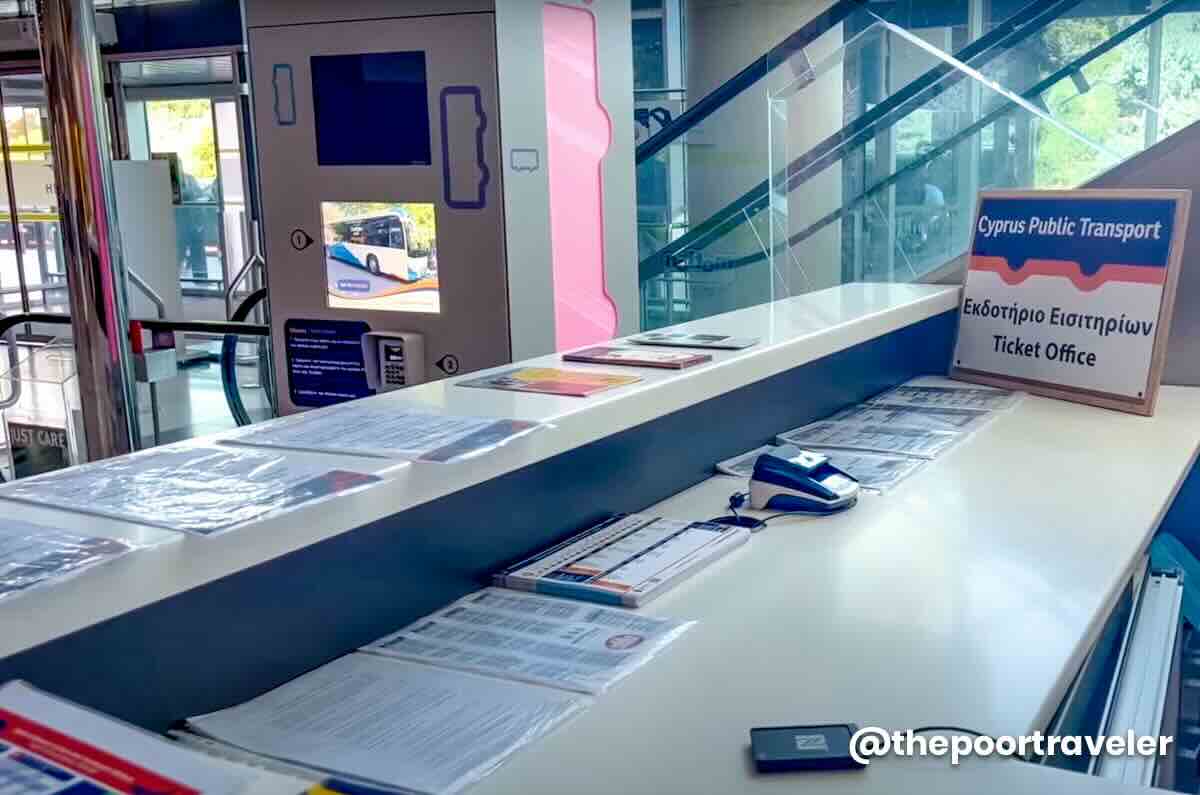
Now, we didn’t try this option ourselves, but we did gather some handy info. Just before the exit, there’s a public transport info desk. We spoke with the friendly lady there, and she explained exactly how to reach Limassol using the public bus system. Here’s what she told us:
From Larnaca Airport, take BUS 425, bound for Dekelia Power Station. A bus leaves the airport every 20 minutes from 6:30 AM until 11:50 PM. Fare is EUR 1.50 during the day and EUR 2.5 at night. Get off at the Old Hospital, which is the 6th stop from the airport.
Transfer to the InterCity Bus to Limassol. The fare is EUR 4. Travel time is one hour 30 minutes.
2. Alight at the Old Hospital and switch to an InterCity Bus to Limassol.
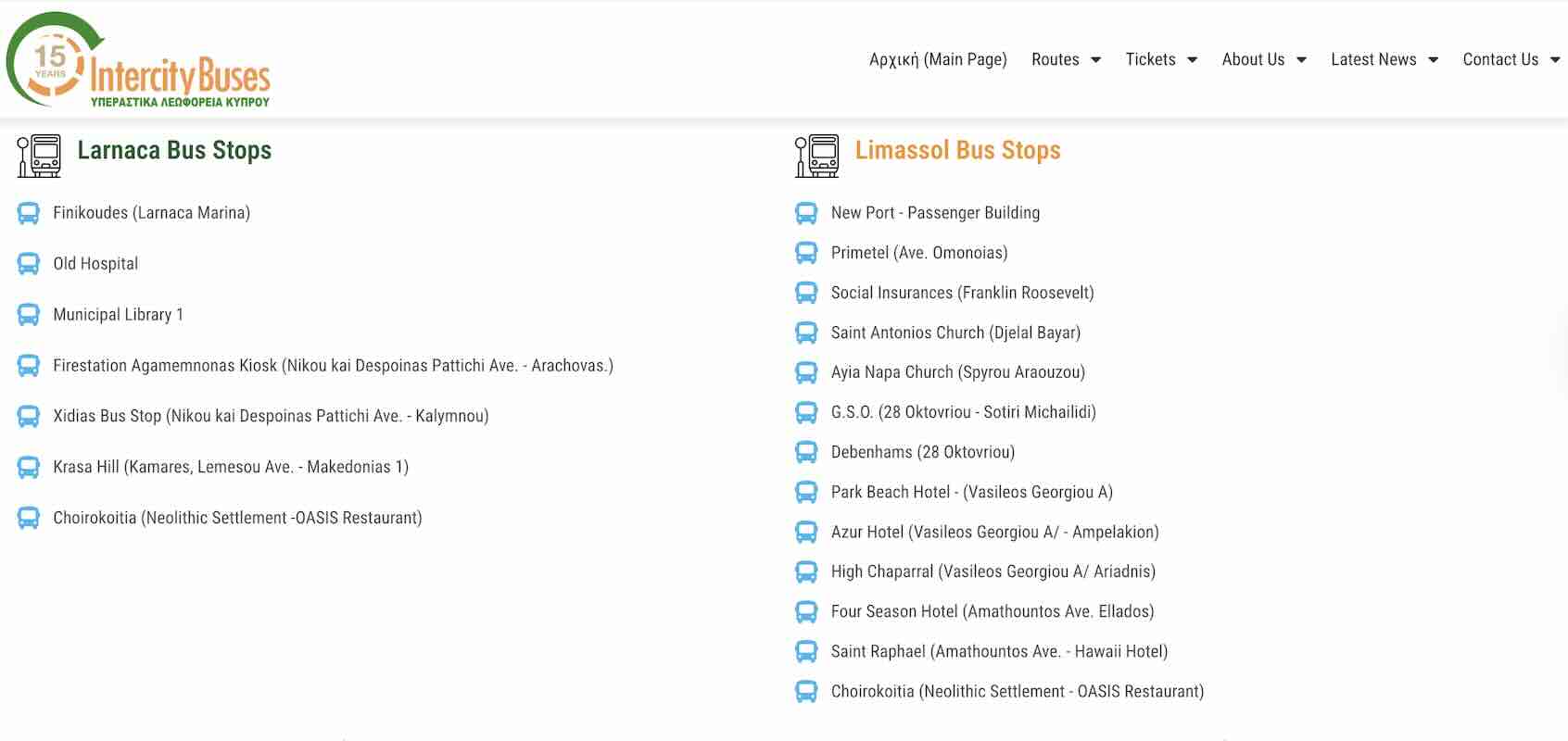
Before your trip, find out which stop is closest to your hotel or destination so you know where to alight. From there, you may hail a cab on site or use an app like Bolt or Cabcy. These are the stops:
Photo Credit: Cyprus InterCity Bus Official Website
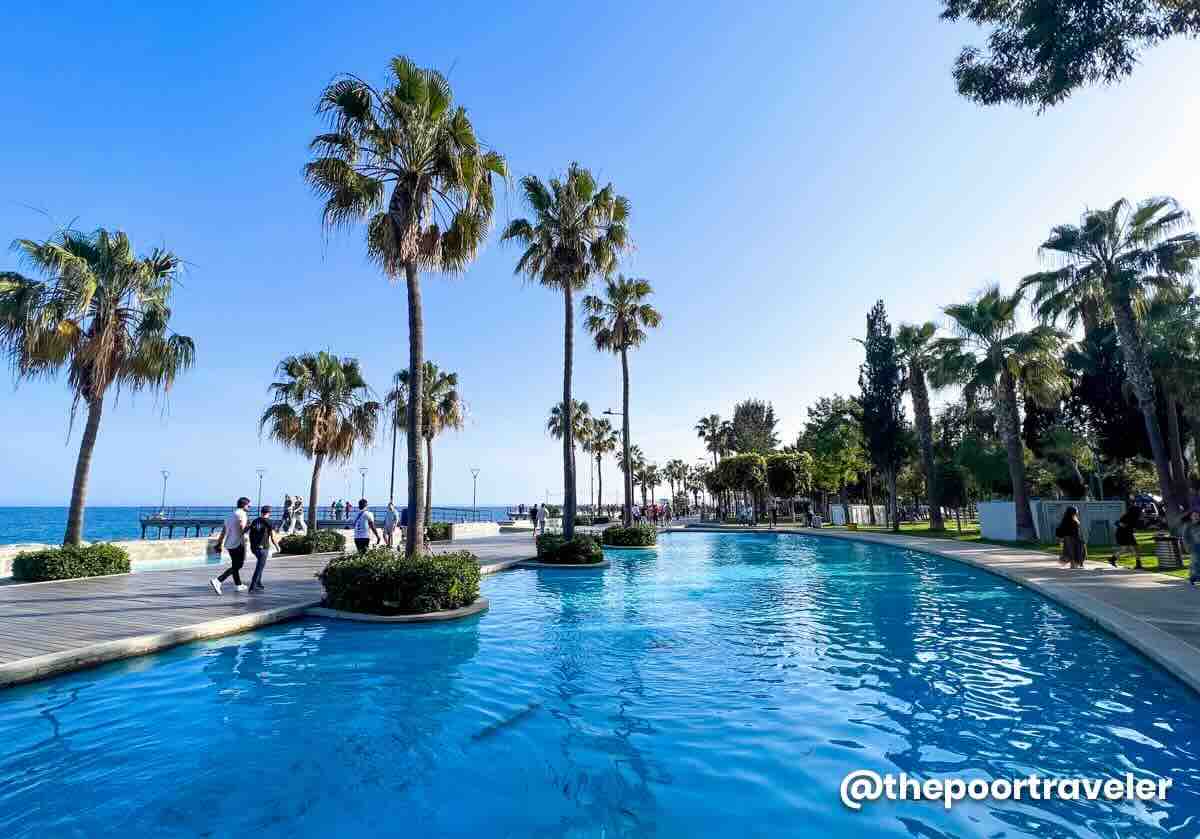
The city center is also home to the Old Town of Limassol and the Limassol Marina, making it an ideal base for tourists. Aside from the numerous accommodation options, the area is also dotted with restaurants and is close to several attractions. Here are some of the top-rated hotels according to user reviews online.
For our trip to Larnaca Airport from Limassol, we also took the Limassol Airport Express and simply retraced our steps. But here’s the catch: our flight was scheduled for 5:00 AM, and the first bus leaves Limassol at 5:00 AM, too. Obviously, that wouldn’t work.
So, we decided to take the last bus the night before and spend the night at the airport. Check-in opened at 2:00 AM anyway, so it made sense. At first, we were a bit concerned about availability and even tried calling to reserve seats, but they told us there was no need to reserve — just show up and buy our tickets on-site.
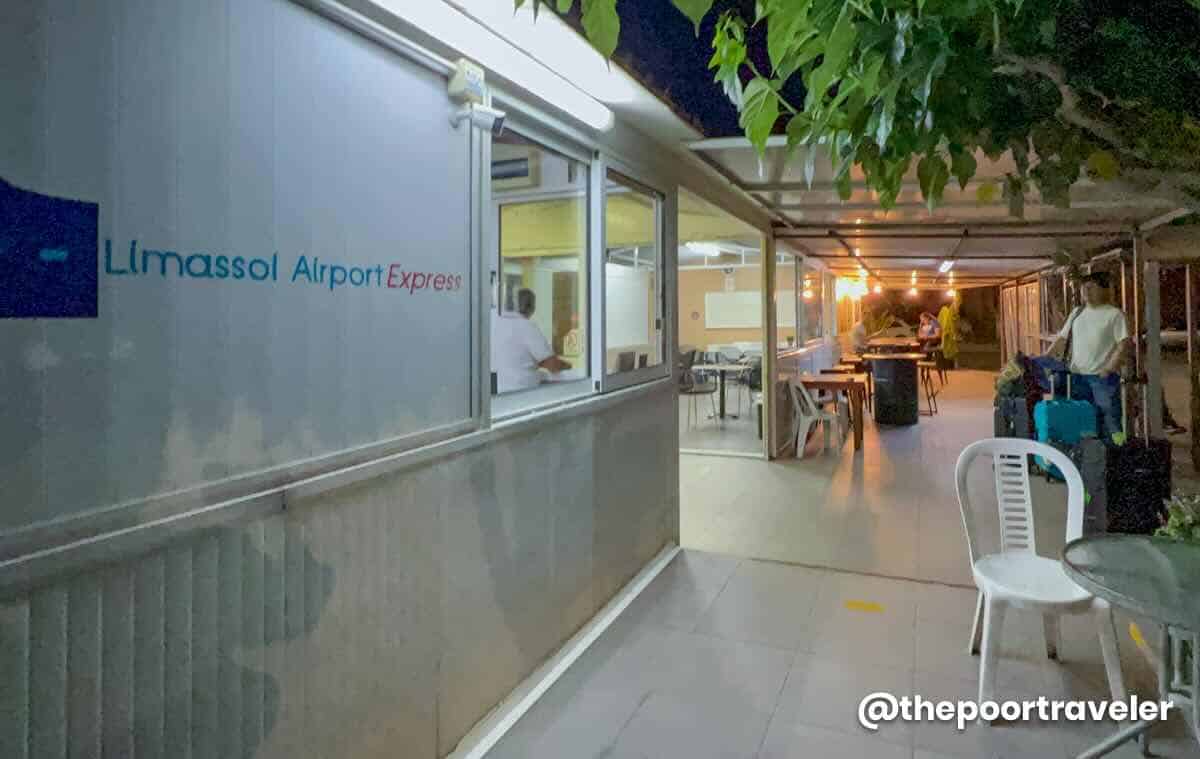
Limassol Airport Express booth at Agios Georgios Havouzas Station
We arrived at Agios Georgios Havouzas Station by 8:30 PM via taxi and bought our tickets for €10 each. The last bus was scheduled to depart at 9:30 PM.
We hadn’t had dinner yet, but thankfully, Feedos, the burger food truck right next to the station, was still open. So of course, we grabbed some burgers — and wow, they totally hit the spot!
The bus departed right on time at 9:30 PM. It was just us and one other passenger, so the ride was super quiet and relaxed. Around 50 minutes later, we arrived at Larnaca Airport, well ahead of time. From there, we just waited for the check-in counters to open.
The world of wealth is changing fast. For centuries, private banks have been the quiet guardians of the affluent, serving generations of families who built their fortunes through traditional industries. These banks have built their reputation on stability, discretion, and a deep understanding of complex financial instruments. But a new class of wealth has emerged, and it’s built on something entirely different – cryptocurrency.
We’re talking about the “crypto-rich” – individuals who have amassed significant fortunes through early investments in bitcoin, ethereum, and other digital assets. These often young, tech-savvy entrepreneurs, innovators, and early adopters who now find themselves with substantial liquid wealth are struggling to find a welcoming home in the traditional private banking landscape. In my view, many private banks are missing a huge opportunity by not adapting quickly enough to serve this increasingly important demographic.
It’s Not Hard to See Why This Disconnect Exists
Private banks operate within a heavily regulated environment. Their core business relies on “Know Your Customer” (KYC) and Anti-Money Laundering (AML) regulations. This means they need to understand where a client’s money comes from (source-of-funds) and how their wealth was accumulated (source-of-wealth).
For traditional assets like real estate, stocks, or company profits, these processes are well-established. Paper trails, company records, and verifiable transactions provide clear pathways.
But Crypto is Different
Crypto’s decentralised nature, pseudonymous transactions, and rapid global movement present unique challenges to traditional verification methods, even for the most savvy compliance professional.
When a crypto-millionaire approaches a private bank, they might be met with skepticism or, worse, outright rejection. This isn’t because their wealth is illicit, but because the bank’s existing systems and understanding are simply not equipped to handle it.
Many private banks still view crypto with caution, if not outright suspicion. They fear regulatory penalties, reputational damage, and the perceived volatility of digital assets. This fear is understandable, but it’s also limiting. While they deliberate and hesitate, the ranks of the crypto-rich are looking elsewhere for financial services, potentially taking their substantial wealth to more forward-thinking institutions or even staying entirely within the crypto ecosystem.
This prevailing fear is perhaps the biggest hurdle. It’s rooted in a lack of familiarity and a reliance on outdated perceptions rather than current realities. This is precisely why education is so incredibly important. Firms like ChainArgos, through its public-private partnership with the Blockchain Intelligence Academy are dedicated to demystifying the blockchain space for financial institutions and work to provide the necessary knowledge and tools, helping banks understand the nuances of digital assets, the mechanisms of the blockchain, and, critically, how to confidently verify the legitimacy of crypto wealth. By fostering a deeper understanding of crypto, fear can be transformed into confidence, allowing private banks to move forward strategically.
The problem isn’t a lack of wealth, it’s a lack of understanding and the right tools
The crypto-rich are not a monolithic group of anonymous internet users. They are legitimate entrepreneurs, successful investors, and individuals seeking to diversify their portfolios, plan for their future, and integrate their digital wealth into the broader financial system. They need traditional private banking services just like any other high-net-worth individual, including wealth management, estate planning, lending against assets, and even simply a secure place to hold their funds.
Imagine a scenario where a private bank, instead of turning away a potential client with millions in bitcoin, could confidently verify their source-of-funds and source-of-wealth.
This is where blockchain intelligence comes in. This specialized field uses sophisticated technology and forensic analysis to trace transactions on the blockchain, identify their origins, and build a comprehensive picture of a client’s digital financial history.
For example, a client might have acquired their wealth through mining, early investments, or even by building a successful crypto-related business. A robust blockchain intelligence firm can analyse these activities, linking specific transactions to verifiable events, and demonstrating a legitimate and transparent path to wealth. This provides the private bank with the verifiable data they need to satisfy their compliance obligations and onboard these valuable clients.
The private banking sector needs to recognise that the crypto economy is here to stay and it’s creating significant wealth. By ignoring this trend, they are not only losing out on a new generation of clients but also falling behind competitors who are embracing innovation.
The opportunity is immense for those who are willing to adapt
Here are three key takeaways for private banks:
The crypto-rich are a legitimate and growing segment of the high-net-worth market. They require and are seeking the same high-quality financial services as traditional clients. Ignoring them means missing out on significant potential revenue and market share.
Traditional onboarding processes are often inadequate for crypto wealth. The unique nature of digital assets demands new approaches to source-of-funds and source-of-wealth verification. Relying solely on outdated methods will lead to continued rejections and missed opportunities.
Blockchain intelligence is the bridge. Specialized firms like ChainArgos offer the technological solutions and expertise to provide private banks with the verifiable data they need to confidently onboard crypto-rich clients while meeting their regulatory requirements.
It’s time for private banks to stop seeing crypto as a threat and start seeing it as an opportunity. By embracing blockchain intelligence, they can unlock a vast new pool of wealth and solidify their position in the evolving financial landscape for years to come. The future of wealth management is already here.
This article was written by Patrick Tan, General Counsel, ChainArgos.com. https://patricktankt.medium.com/
Visit ChainArgos.com for more information.
For more on the latest in global economic and business reads, click here.
T’Lur Caviar is not just any premium caviar. Based in Malaysia, the company has achieved what many thought was impossible: farming cold-water sturgeon in a tropical climate and producing high-quality caviar that meets global standards. At the centre of this quiet revolution is AJ Lim, founder and managing director of T’Lur Caviar, a company known for producing the world’s first tropical caviar with a distinctly local approach and sustainability in mind. LUXUO speaks to Lim about how T’Lur Caviar overcame biological and environmental challenges to develop a premium product that competes on the global stage.
AJ Lim, founder and managing director of T’Lur Caviar
Founded in 2009, T’Lur Caviar has spent more than a decade investing in aquaculture research, adapting international best practices and developing sustainable systems to bring a rare product to market. As global demand for farmed caviar rises following the ban on wild caviar, T’Lur Caviar is positioning itself as a serious player in the premium food space, offering a fully traceable, eco-conscious alternative from Southeast Asia.
T’Lur Caviar is proudly produced in Malaysia. Could you share more about the story behind its origins and what makes it unique?
It all started with my passion for aquaculture. I first tasted caviar during a trip to Russia in my younger days, and the experience left a lasting impression on me. The texture, the flavour—it was unlike anything I had ever had. But sturgeon isn’t native to Malaysia, and caviar certainly wasn’t something you could easily find here. That changed when I heard about a sturgeon farming initiative looking for investors. The idea immediately sparked something in me, as the sturgeon farming journey began toward the end of 2009.
One of the biggest challenges in establishing a sturgeon farm in the tropics was adapting the species to an entirely different climate. Sturgeon are ancient cold-water fish that typically hibernate during winter, making them naturally unsuited to warmer environments. From stabilizing water temperatures to formulating the right feed, every step involved a steep learning curve. It was uncharted territory for everyone involved, and it took years of dedicated research and development before the efforts began to show meaningful results.
I consulted with foreign experts, and they told me that just getting the sturgeons to survive in Malaysia’s weather was already a significant achievement. However, we were told not to hold our hopes high for caviar. So, it was a real surprise when, during one of the inspections, we discovered caviar inside a sturgeon. We decided to give the fish more time to grow, and in 2019, we launched T’LUR Caviar.
Following the global ban on wild caviar, the market has shifted entirely to farmed alternatives. Could you share how many farmed varieties are currently available and which one T’Lur focuses on?
All over the world, most commonly farmed caviar available on the market today, ranked from the lowest to highest grade. Hackleback caviar is often considered the entry-level option, widely available and affordable overseas. Next is White Sturgeon caviar, followed by Siberian Sturgeon caviar. Kaluga Hybrid caviar is increasing in demand, offering a luxurious experience at a more accessible level than its pure counterpart. Alongside Sevruga, Amur caviar comes next, and above them stands Oscietra caviar, prized for its refined flavour. Near the top is pure Kaluga caviar and at the highest grade is Beluga caviar, the most exclusive and limited of all, coming from the largest species among all sturgeon.
At T’LUR, we only have some of the species mentioned above, and they are supplied seasonally. In the early days, we supplied Siberian, Kaluga Amur, and Amur caviar. Currently, we are supplying Kaluga Amur and Oscietra to allow sufficient time for other species to mature.
How would you describe the tasting profile of the T’Lur Caviar range? What key notes or characteristics should one expect on the palate?
For Kaluga Amur caviar, it has velvety and nutty undertones with a clean, briny finish. Meanwhile, Oscietra caviar has a smooth, lingering buttery finish. Sturgeon caviar has a firm yet delicate texture that gently pops on the palate, delivering a truly delectable experience on the tongue.
What processes are in place at T’Lur Caviar to ensure consistent quality across your range?
Caviar is a sensitive produce that demands strict control starting from processing to storage. It begins with the sturgeon selection process, we choose sturgeon that reaches the right maturity through its weight and roe quality before isolating them accordingly. Followed by a careful harvesting process in a controlled environment. It will then be stored at -2°C to – 0°C and aged for a few weeks to let the caviar absorb the salt before it is sold.
How does T’Lur Caviar ensure sustainability and biodiversity are respected throughout its supply chain?
Our sturgeon farm operates within a fully closed system, completely isolated from the surrounding natural ecosystem. We use cement ponds filled with fresh, running mountain water, preventing any contact with soil or sediment. All waste in the water is carefully filtered before being returned to nearby natural streams, ensuring we preserve the delicate balance of local biodiversity and leave minimal environmental impact.
Our unique farming process eliminates the need for extensive temperature control to keep the water cold. As a result, we significantly reduce our carbon footprint by avoiding the energy consumption typically required to power temperature-regulating equipment.
We are also believers in a “Zero Waste Policy”. Our sturgeons do more than produce caviar — we ensure that every part of the fish serves a purpose. The meat is processed for culinary use, offering a delicate and nutritious protein source. Its skin and cartilage are edible and valued for their unique texture and nutritional benefits, while its head is an excellent source of collagen. This holistic approach ensures minimal waste and highlights our commitment to sustainability and responsible aquaculture.
For more on the latest in luxury lifestyle and gastronomy reads, click here.
Cornwall is an absolute gem of a region to visit in England. With its gorgeous beaches, quaint fishing villages and natural beauty, it’s the kind of place you can easily spend a week travelling around. That being said, with it being quite a large area, it can be difficult to nail down the best areas in Cornwall to visit as part of your holiday or road trip.
Over the years, we’ve explored Cornwall many times. It’s stunning, especially in the warmer summer months when you can take a dip in the sea and really enjoy its glorious beaches. Best of all, Cornwall is the perfect place for a chilled holiday, or even a road trip around the wider region. It’s totally suited to both, and all ages!
So, to help you along on your merry way, I want to share our top places in Cornwall that you cannot miss. This way, you can focus on those all-important experiences and the important stuff, like how many Cornish Pasties you can feasibly eat!
1.) St Michael’s Mount
Easily one of the region’s most iconic places, St Michael’s Mount (Google Maps pin) is an absolute gem to visit in Cornwall. In fact, I’d say it’s one of the best areas in Cornwall to visit if you’re driving down the south coast or anchoring yourself in nearby St. Ives or Penzance.
Now, what makes St. Michael’s Mount is its stunning location, on a picturesque tidal island off the shores of Cornwall. Now, you might notice it has a very similar resemblance to Mont Saint-Michel in France. Well, it was built and influenced by its French counterpart many centuries ago. We won’t call out Cornwall as a copycat, but they certainly weren’t going to be left behind after France’s stunning construction!
Once here, you can wander around St Michael’s Mount, head inside the impressive buildings and spend a good two hours exploring the wider area of the island, the walled gardens and stop by the Harbour Loft for a light lunch.
Oh, and watch out for giants! Folklore from Cornwall suggests that St. Michael’s Mount was inhabited by Cormoran, a giant. The cave on the tidal island is where the giant is said to have (or does) live, so be sure to keep your eyes peeled.
Easily one of England’s most impressive open-air theatres, the Minack Theatre is a place you can’t miss when visiting Cornwall. Also, it’s just down the road from nearby Penzance. Well, about 20 minutes in the car.
In the summer months, performances are held in the Minack Theatre. Specifically, from May to September. So, if you want to catch one, make sure your trip fits the theatre’s schedule. The first shows at the Minack Theatre were held almost 100 years ago, and as the years went by, the size of the venue also increased.
Though, don’t fret if you can’t make a show. You can still tour the Minack Theatre and explore the grounds here. Oh, and stop off at Porthcurno Beach (Google Maps pin), which the theatre overlooks. It’s a stunning little beach and a sandy paradise in Cornwall.
We think that Rame Head (Google Maps pin) is one of the best areas in Cornwall to visit if you’re staying in Plymouth, but fancy a little time in the nearby countryside.
Once here, follow the trails along the Rame Head Heritage Coast and stop off at St Michael’s Chapel (Google Maps pin). The stroll is totally lovely, especially if you can plan to visit around sunset. It’s just amazing.
Also, if you’re on a wider stroll of the coastline along Rame Head, make sure to spot Queen Adelaide’s Grotto (Google Maps pin), which is facing Cawsand Bay. The scenery is just breathtaking.
Getting peckish? Head to The Devonport Inn, which is just in nearby Kingsand. They do a tasty Sunday roast, and their baked camembert is so good.
Newquay is one of the most well-known and best areas in Cornwall to visit, that’s gained traction over the last century. Known for its stunning beaches, surfing, and a vibrant nightlife, the town is a hive of activity, for what is a relatively small town in Cornwall.
If it’s beaches you’re after whilst visiting Newquay, make sure to visit Fistral Beach (Google Maps pin), Newquay Beach or Watergate Bay. The former two are within walk
ing distance of the town’s streets, and Watergate Bay is just up the road.
We had heaps of fun in Newquay and loved our stay at the Watergate Bay Hotel. They have gorgeous rooms and stunning restaurants if you’re looking for dinner by the beach.
If you’re spending some time in Newquay town itself, then make sure to stop off at the Concho Lounge for a delicious lunch. It’s such a chilled vibe and their milkshakes are so good, too. Also, another great spot for a sunset dinner is the Fort Inn. Their fish finger rolls are super yummy.
Just shy of Penzance, St Ives is a gorgeous seaside town that’s well worth visiting when exploring Cornwall. In fact, the whole area around St Ives Bay is stunning, and the beaches here are beautiful.
Once here, make sure to pop into the Tate St Ives, which is one of the UK’s four iconic Tate galleries. Once inside, you’ll be able to explore the magnificent modern art collection housed in the exhibition rooms, here. It’s a stunning gallery, and well worth a gander when you’re in St Ives itself. Visits take around 45 minutes, and you can grab these advance tickets here.
Also, make sure to visit either Porthmeor Beach or Porthminster Beach for a little dip in the sunny summer weather. On the latter, you have the Porthminster Beach Cafe, and they have the freshest seafood in the area. We loved the mackerel and hake.
The tiny fishing village of Port Isaac (Google Maps pin) is located on Cornwall’s Atlantic Coast. This is a picturesque little town, and one of the best areas in Cornwall that you shouldn’t miss when driving down the northern coastline.
Now, you can easily spend a fair few relaxing hours in Port Isaac, and although it’s quite small, it’s lovely to explore on foot. Once here, make sure to stop off at The Golden Lion for a tasty lunch. Their freshly-caught mussels are so yummy. So is their sticky toffee pudding for dessert.
Afterwards, take a stroll around Port Isaac (it’s really small and super easy to walk around). You can, then, explore the little streets and stroll along the coastal walks as you take your time in Port Isaac.
If it’s beaches you’re after, head just outside Port Isaac to Polzeath Beach (Google Maps pin). It’s much less busy than some of the more popular spots in Cornwall, but no less pretty!
Lizard Point is the southernmost point of the UK and one of the best areas in Cornwall to explore for a ramble. You see, the whole area around Lizard Point is stunning, and this is an outcrop of land on Cornwall’s South Coast that is just incredible to visit, especially at sunset.
If you like natural beauty, Lizard Peninsula will easily fit right into your Cornwall plans, and it feels so untouched and unspoilt. We love the area.
When you’re in the area, you will surely walk along the Lizard Coastal walk, which leads inland and takes you back to where you started. The Kynance Cove (Google Maps pin) in the area is also a must-see. In fact, I’d go as far as saying it’s one of the best sunset spots in the UK.
Not too far from St Austell, Fowey (Google Maps pin) is a lovely seaside town to visit when travelling the southern shorelines of Cornwall. Now, it might be small, but it’s lovely to stroll around.
Once here, take a stroll to St Catherine’s Castle, which was built almost 500 years ago. Visits take around 40 minutes, and it’s so worth going inside the ruins to learn more about the castle and its noble residents. Best of all, visits are free.
Also, don’t forget to board the Fowey to Polruan boat. It’s just across the bay and takes mere minutes to navigate the waters. It’s a great town to visit for lunch, as you can head to the Lugger Inn for their yummy Sunday roasts.
9.) Falmouth
Falmouth may be one of the most famous holiday getaway destinations in Cornwall, and one spot that’s worth visiting if you want to visit a larger town.
This is where you’ll find the Fal River estuary, Pendennis Castle, Trebah Garden, the coastal fortress of Henry VIII and other beautiful beaches and independent shops. Talking of independent shops, you need to visit Beerwolf Books. It’s so quaint and they even have their pub for some local draught beers and gin.
The area around St Agnes Head and the heritage coastline is one of the best areas in Cornwall to explore for a ramble. The whole coastline here is stunning in the Cornish sunshine!
Now, there are quite a few hiking routes around the heritage coast, but whichever you choose, make sure to see the iconic Towanroath shaft ruins and Wheal Coates (Google Maps pin). Also, Chapel Porth Beach is perfect for a picnic, especially as it has easy parking (if it’s not too busy).
North Cornwall’s wild coast is mostly known as a place of legends, especially King Arthur! It’s one of the best areas in Cornwall to explore some of the region’s long history, especially around Tintagel.
Said to be the birthplace of King Arthur, Tintagel Castle is one of the area’s main attractions and a spot you shouldn’t miss. The 13th-century beauty is coupled with an epic setting including glassy slopes, dark cliffs, Rock Valley and Merlin’s Cave and is perfect for a wander around the ruins.
If you’re in the village of Tintagel, you can also stop off at the Old Post Office, which is also from the 1300s! The building is so historic. Oh, and another place you can check out is the Norman Church of St Materiana, where you can see a Roman milestone inside.
Penzance is a larger town in Cornwall. Though relatively small by international standards. Being the last stop on the Great Western Train line, you can start exploring Cornwall from here if you take the train from London.
Now, Penzance is a great place to base yourself. You can also find hotels, shops and restaurants in Chapel Street before going to The Exchange Gallery, which is lovely for a little stroll. You can also head to the Jubilee Pool if you want to soak in the water but are not ready to swim in the sea. Though be warned, the water can be chilly! If you don’t like overly cold pools, you might want to skip this one.
Ofcourse, the town of Penzance is great in itself, but don’t forget you can easily check out Minack Theatre or St. Michael’s Mount when you’re in the area. Which, in my opinion, can’t be missed when visiting Cornwall.
Yes, Land’s End is the actual end of England! From here, you’ll see the Celtic Sea to the west and the English Channel to the east. Truly a memorable spot and has become something of a milestone to reach for travellers in Cornwall.
Just make sure to take your picture at the Lands End Sign (Google Maps pin). Now, obviously, lots of people come here for the photo opportunity, but the wider region has quite a few key spots to see.
You can also join a coastal path from here to reach Sennen Cove or Gwynver Beach (Google Maps pin) are well worth a visit. They’re totally unspoilt and you don’t get the same crowds at beaches like in Newquay, for instance.
On the south coast of Cornwall, between St Austell and Plymouth, Looe is a tiny little town that’s well worth a stop for a few hours whilst driving around the region.
Once here, be sure to spend some time on East Looe Beach (Google Maps pin). Here, you’ll be able to take a dip, and it’s a perfect place to spend a warm summer’s day in Cornwall. Also, don’t forget to pop into the Old Guildhall Museum & Gaol. It’s a small place that’s open in the Summer. It’s one of the best areas in Cornwall to have a totally relaxing day.
For lunch, pop by The Sardine Factory. Their Cornish crab linguine is so yummy.
One of Cornwall’s most unique attractions is The Eden Project, which can’t be missed when visiting the region. Situated about five kilometres away from St. Austell, the Eden Project consists of huge domes which contain a botanical garden inside. We’ve always loved visiting, and the two huge adjoining homes are hexagonal biome-shaped paradises.
Once inside, you’ll be able to stroll around a complete rainforest biosphere that can be found on the larger dome, while a Mediterranean atmosphere can be experienced in the other dome. It’s so special and it’s open all year round.
On-site (and throughout the year) festivals, music performances and several activities are also held in The Eden Project. Oh, and don’t forget to ride the Skywire. It is England’s longest zipline!
One of the first road-legal Lamborghini Sesto Elementos was spotted at the Goodwood Festival of Speed. We had reported about this car more than a year ago, and since then, its whereabouts have been unknown.
Introduced in 2011, the Sesto Elemento is a special edition track car based on the Gallardo. Initially, Lamborghini planned to build 20 units but ended up producing only 10 cars, with no plans for a road-legal version.
The Sesto Elemento is based on a forged carbon fibre chassis with carbon composite plastic developed in partnership with Boeing. It rides on forged carbon suspension and weighs just 999 kg.
The 5.2-liter naturally aspirated V10 engine was borrowed from the Gallardo Superleggera. It produces 562 hp and 398 lb-ft of torque that is sent to all four wheels via a carbon fibre drive shaft. Lamborghini claims a 0-62 mph time of 2.5 seconds and a top speed of 221 mph.
Ever smiled and said “hello” in a new country, only to feel something was wrong? That’s where cultural fluency comes in. It’s more than learning words. It means understanding how people think, speak, and connect.
Many travelers feel confused or uncomfortable at first. That’s called culture shock. It often happens when we don’t understand local habits. Learning about even the food diets in other cultures can help. It breaks down barriers and supports better collaboration across different cultural backgrounds.
If you want to thrive while working and traveling, my eBook can help. The A-Z on Becoming a Digital Nomad gives tips, tools, and ideas to make your journey smoother and more fun.
Cultural fluency also helps build inclusive environments and good employee engagement. Then it makes common ground with people in travel and at the workplace.
What is Cultural Fluency?
Cultural fluency helps bridge gaps between different cultures, backgrounds, and views. It includes communication styles, body language, and social norms.
Learning just a few local words shows empathy. It builds understanding and respect. It also improves your cultural intelligence. This helps in travel and in the global workforce.
I once used basic Turkish words to talk with a local family. They welcomed me with homemade bread. That’s the heart of cultural competence!
Benefits of Cultural Fluency
1. Deepens Cultural Connections
Speaking another language builds trust. It helps people feel seen and heard. You become part of their expressive culture, not just a visitor. This also sparks creativity, innovation, and new perspectives.
Jane Hyun, a leadership coach, says that cultural difference shapes how people connect. It’s not only what you say, but how and when.
I once joined a dinner in Morocco. I didn’t speak much, but I studied how to greet elders. That one act brought me into the family. That’s the importance of cultural knowledge!
2. Avoids Social Missteps Abroad
Every culture shows emotions in different ways. A thumbs-up may be fine in one place, but rude in another. Being too direct might feel cold. Being too quiet might feel odd.
I made a mistake in Japan… I handed money with one hand. It seemed small, but it upset someone. Since then, I learned to watch for stereotypes, biases, and assumptions.
In cross-cultural interactions, even small things matter. Learning cultural contexts helps you show emotion and work well with colleagues, team members, and new participants.
3. Supports Local Communities through Better Communication
When you ask locals questions in their language, you find special places. Maybe a small café or handmade market. It supports diversity and is also good for ethical travel.
I met a weaver in Laos. Because I asked and listened, I got more than a scarf – I got a story! This is what cultural fluency brings to multicultural teams and to travelers.
In Europe, especially in Germany, people appreciate this effort. It builds better ties.
Rosetta Stone: Your Cultural Bridge Before You Travel
Want to prepare to meet and greet people on your trip? Rosetta Stone is your best friend! It doesn’t just teach words. It teaches real-life speech and cultural awareness. It works well during travel and has real-world applications.
Here’s why it’s perfect for digital nomads and OFWs:
It works offline.
It has an Audio Companion.
It has Phrasebooks for real talk practices.
It works with speech tools to help you improve pronunciation.
Rosetta Stone helps you improve your language skills and teaches you how native speakers communicate. I used the Rosetta Stone app before traveling to Brazil. I loved how I could practice while hiking using the audio feature. By the time I arrived, I was ordering food and asking for directions like a local.
Use it with apps like Yesim (Code: KATRIN8414) and travel tools that offer travel health insurance. It’s what a good checklist should include! Even travel items like a blanket and neck pillow are useful companions to your Rosetta Stone prep.
A More Respectful, Enriching Way to Travel
Being culturally fluent is not about being perfect. It’s more about showing empathy, breaking barriers, and improving. It also supports leadership development.
When you make the effort, people respond. They see your heart. You get more than a trip. You gain trust, stories, and friendships.
Even in African American communities and among other groups with different backgrounds, showing an effort to understand cultural values helps build bridges.
“People don’t remember the exact words you said. They remember how you made them feel.”
So before your next adventure, go beyond “hello.”
Start your cultural fluency journey today with Rosetta Stone. Your next best memory could be just one word away!
FAQ
What is cultural fluency?
Cultural fluency is the ability to understand, communicate, and connect with people from different cultures. It includes language, behavior, and social customs.
Why is cultural fluency important for digital nomads and OFWs?
It helps build better relationships, avoid misunderstandings, and live more comfortably in another country.
How can I become more culturally fluent?
Start by learning the local language, reading about the culture, and observing local habits. Tools like Rosetta Stone make this easier.
Do I need internet to use Rosetta Stone while traveling?
No. Rosetta Stone lets you download lessons so you can learn offline anytime, anywhere.
How does cultural fluency support local communities?
It allows you to understand and respect local traditions. You can better support small businesses and communicate your interest clearly.
Some leaders – including some of the world’s most experienced – still haven’t understood that political maneuvering and intimidation almost always degenerate into macroeconomic disasters. What was initially just meant to sideline a political opponent immediately turned into investor panic and a financial hemorrhage. A textbook case of how to methodically and deliberately destroy what little trust remained in a Turkey whose desert crossing now seems endless.
The masterstroke came with the arrest, on March 19th, of the Mayor of Istanbul – the frontrunner for the upcoming Turkish presidential elections – on a grave charge that would disqualify many of our French political leaders. He was accused, without proof, of “irregularities” regarding his 1990 degree from the American University of Girne (Northern Cyprus). The University of Istanbul promptly responded by revoking the equivalency of his degree, which made him de facto ineligible for the presidency, as the Turkish Constitution requires presidential candidates to hold a university diploma. As of July 2025, an additional accusation alleges that Mr. İmamoğlu falsified his university degree, making him liable for prison time on charges of “forgery of official documents.”
That March 19th set off a historic chain reaction, triggered by irrational manipulations carried out by a ruling power that values ego over the economic and financial stability of the nation. This was not about reforms – however controversial – but about a destruction of confidence that cost the Central Bank USD 90 billion. The bank has nearly depleted its reserves in an attempt to defend against the uncontrollable collapse of its currency, which that day alone plummeted by 12 percent! In a global context where most central banks are cutting rates to stimulate their economies, Turkey once again stood out by being forced to raise its benchmark interest rate to 46 percent to contain the tsunami unleashed on March 19th – the day a presidential candidate was disqualified over a diploma.
The situation would be laughable if it weren’t so serious for the people of a country rendered completely dysfunctional, next to which even Argentina looks sober. The leadership shows no concern for the flatline of foreign investment or the economic bleeding, because staying in power is all that matters. Its survival comes before prosperity and before any bailout that might bring desperately needed liquidity to its people. The Turkish lira, which just 10 years ago was below two to the dollar, and below 5 seven years ago, has now plummeted to 40. The price of a liter of gasoline has risen from 1.48 lira in 2002 to 53 lira today. Inflation stands at 49 percent, likely underestimated since the government controls 85 percent of the national media.
Was there a particular message the country’s leaders wanted to send to the markets through this arrest?
Absolutely: that stability is optional – authority is not.
Welcome to Turkish governance.
For more on the author, Michel Santi and his exclusive opinion pieces, visit his website here: michelsanti.fr
For more on the latest in global economic and business reads, click here.
The Goodwood Festival of Speed 2025 is now underway with the sound of a naturally aspirated V12 engine rumbling across the landscape. This year, Goodwood is celebrating the legendary automobile designer Gordon Murray, and what better way to kick off the proceedings than with his latest creation, the GMA T.50.
The event was flagged off by the Duke of Richmond with a ride in the GMA T50. British racing driver Dario Franchitti was in the driver’s seat.
The GMA T50 is powered by a 3.9-liter, naturally aspirated V12 engine built by Cosworth. The engine produces 654 hp @ 11,500 rpm and 344 lb-ft @ 9,000 rpm. It is the highest-revving naturally aspirated road car engine ever built, and Dario was kind enough to keep the engine revs high as he made his way up the hill.
Gordon Murray Automotive also brought along the T.33 supercar at this year’s Goodwood Festival of Speed. The T33 is slightly less expensive than the T50 but is also powered by a V12 engine, which produces 609 hp @ 10,250 rpm.
Aston Martin has given its already potent Vantage a light update in the form of the new S package, aiming to entice fresh buyers with a single added letter.
When it comes to slicing its model range into ever finer slivers, Porsche remains the undisputed master of the alphabet soup. But Aston Martin is clearly learning fast from its Stuttgart counterpart, and nowhere is that more evident than in the new Vantage S. Offered as both coupé and roadster, the Vantage S receives a modest power increase from 489 kW / 665 PS to 500 kW / 680 PS, while torque remains unchanged at 800 Nm. Top speed is now a claimed 325 km/h.
2025 Aston Martin Vantage S
According to Aston Martin, throttle response and the mapping of the throttle valve have been refined under the Vantage S philosophy. In real-world use, the 0.1-second improvement in the 0–100 km/h sprint—now 3.3 seconds—is likely to go unnoticed, as are the rest of the subtle tweaks to the powertrain. Similarly fine are the revisions to springs, dampers and gearbox mounting, all intended to add a slightly sportier edge to this already striking machine.
More visible are the cosmetic upgrades: a carbon bonnet with prominent vents, S badging, and a large rear spoiler capable of generating up to 44 kilograms of additional downforce at maximum speed. Also included in the S package, available from Q4 this year, are distinctive 21-inch wheels, semi-aniline leather, and contrast stitching that continues through the seatbelts, headrests, and drive mode switches. Expect pricing to start at around €200,000.
Amazon Prime Day really is Christmas in July. As a flight attendant of 10 years, I use Prime Week as a chance to refresh the items that live in my carry-on (and work overtime when I’m on the clock). For the casual traveler, it’s a great time to look ahead and grab essentials like a new vacation outfit or a comfy pair of sneakers for your next trip.
Below, I’ve found 12 fantastic pieces of gear and accessories that have been total game-changers for me this summer, and they will upgrade the way you travel for the rest of the season by making you a sharper packer. There are also a few Amazon Prime Day deals that I’ve been eyeing, like the all-in-one Eeeza 5-piece Luggage Set that will help me tailor my packing depending on my trip.
Best Overall Deals
Eeeza 5-piece Luggage Set
Amazon
Don’t wait until right before your next trip to update your luggage, especially since this five-piece set is on sale right now. My trips are mostly a day or two, but sometimes they can spread out to a week-plus, and I love having several travel bag options. Here, the tote included is the perfect carry-on or personal item bag with its expansion zipper, so if you shop a little extra on your trip, you’ve got plenty of room to pack your treasures to come home.
Bagail 8-set Packing Cubes
Amazon
Compression cubes are the real travel game changers, and this Bagail set includes everything I need: a shoe bag, a laundry bag, and multiple sizes of compression cubes. It even has a small zipper bag and a cosmetics case. If you haven’t used packing cubes before, this is your nudge to start. I find that not only is everything more organized when I use them, but I can fit more items into smaller luggage.
Waterfly Crossbody Sling Backpack
Amazon
If you’re more of a minimalist packer (like me) and larger totes aren’t your bag, you might want to try this awesome crossbody sling backpack, on sale for $24. I love the two external mesh pockets for small water bottles, lip balm, and other tiny things you’ll need as soon as you’re seated. The zippered compartments provide spots for valuables while keeping you organized, and it hangs close to your body to keep everything close by and secure.
Anrabess 2-piece Matching Travel Set
Amazon
Dressing appropriately for your adventures should be a top priority, which is why I gravitate towards matching sets; they’re instant outfits that take the guesswork out of packing. When I’m shopping for travel sets, I look for a relaxed fit, pockets, and of course, stylish details that will make the pieces mesh well with my wardrobe. This Anrabess set, in particular, is appealing as the pants have elastic around the ankle to keep them off the floor of the airplane bathroom. The top, on the other hand, adds fun flair to my suitcase with its knit texture and posh front pocket-cap sleeve duo.
New Balance DynaSoft Nergize Cross Trainer Sneakers
Amazon
Comfort is key for me while traveling, and I love this neutral sneaker by New Balance that ties together your travel outfits without sacrificing arch support (resulting in fewer shoes packed in my suitcase since these do it all). The mesh upper part of the shoe allows for comfort when feet inevitably swell on longer trips. What’s more, this style slips on and off easily, helping you move quickly through TSA security lines.
Mumi Travel Toiletry Bag Set
Amazon
I won’t even consider packing without toiletry bags and compression cubes to keep me organized. Mumi has this three-piece set in several trim colors that’s perfect for any traveler. These clear bags make it easy to spot everything from your daily medications to your tweezers. I actually use each bag for a different task: hair products in one, face routine in another, and odds and ends in the smallest. So, when it’s shower time, just grab the shower bag and go; it’s got everything I need.
Not everything hair and skin-related comes in convenient TSA-approved sizes, so this travel bottle set solves the problem for me. I’m grateful for the snap top closures, which give me peace of mind that everything in the bottles is secure at just a glance. Labels are included in the set, so there’s no mixing up products.
Forge TSA-approved Cable Luggage Lock Set
Amazon
After 10 years as a flight attendant, I’ve found that I never regret being extra cautious with my bags. I have two of these small, cable luggage locks in my carry-on at all times; sometimes, the flight crew has to stow our luggage away from our jumpseats, so I slap one of these locks through the zipper pulls to make sure nothing goes on vacation with someone else. Outside of work, the Forge locks come in handy for lockers at the pool or the gym on layovers.
Amaski 5-foot Multi-charging Cable
Amazon
The constant changes in charging ports are enough to drive a person crazy, which is why I always have one of these multi-charging cables in my bag just in case I leave my primary cords in a hotel or someone needs help charging their device. It comes in two different lengths, but I always recommend getting the longest cord available (5 feet long) to ensure that it works with your space.
Jisulife Rechargeable Foldable Fan
Amazon
I was recently on a 1,800-mile road trip with family, and every day, I found myself on the sunnier and warmer side of the car. I was really missing my little Jisulife rechargeable fan, which is on sale for Prime Day. For faster cooling on the go, I recommend the foldable fan version; the kickstand is great for tray tables or for hanging it in the seat back organizers. I love the 13-hour battery life and that it’s just a little bigger than my phone. It doesn’t take up much space and ensures I’m the most comfortable person in the cabin.
T.N. Dickinson’s Witch Hazel Cleansing Pads
Amazon
It seems inevitable that when traveling, we put our hands in something sticky or need a quick refresh. Witch hazel has been around forever and is gentle enough for anyone to use, and these travel-friendly pads work great to clean up makeup smudges, treat scratches or bug bites, and double as a face wash if you’re saving toiletry bag space.
Kangqifen Striped Cotton-linen Scarf
Amazon
A wrap or scarf is a must-have item on my leisure trips. Whether by plane, train, or car, temperatures are rarely comfortable for everyone, and I love having a lightweight wrap to snuggle with. This Amazon-favorite scarf can act as an outfit saver if I spill a little something, and it mixes well with almost every shirt and bottom combo I have packed.
The technical storage or access is strictly necessary for the legitimate purpose of enabling the use of a specific service explicitly requested by the subscriber or user, or for the sole purpose of carrying out the transmission of a communication over an electronic communications network.
Preferences
The technical storage or access is necessary for the legitimate purpose of storing preferences that are not requested by the subscriber or user.
Statistics
The technical storage or access that is used exclusively for statistical purposes.The technical storage or access that is used exclusively for anonymous statistical purposes. Without a subpoena, voluntary compliance on the part of your Internet Service Provider, or additional records from a third party, information stored or retrieved for this purpose alone cannot usually be used to identify you.
Marketing
The technical storage or access is required to create user profiles to send advertising, or to track the user on a website or across several websites for similar marketing purposes.










:max_bytes(150000):strip_icc()/tal-flight-attendant-loved-hacks-tout-97aef556eed041ea9359f2e1739e2c0e.jpg "15 Flight Attendant-loved Amazon Travel Essentials")
:max_bytes(150000):strip_icc():format(jpeg)/tal-flight-attendant-loved-hacks-tout-97aef556eed041ea9359f2e1739e2c0e.jpg)