Lanzante has finally revealed the ‘Project 95-59’, and it’s slightly less exciting than we’d initially thought.
They say that looks can be deceiving. That’s been the case with this car. You would expect a McLaren F1-inspired 3-seater to be based on a hypercar. The Speedtail would be the ideal platform, but Lanzante chose the 750S instead.
The actual car looks smaller than what the teasers and leaked images suggested. It’s just over 4.5 meters long and features a bespoke exterior crafted in carbon fibre. It has a sharper nose section with a wide intake and a large splitter, and signature McLaren headlights.
There are large ducts on the door panels, split windows and high-mounted mirrors. The rear has also been completely reworked and has a lot of vents and ducts. The car has an active rear spoiler, a large diffuser and a central exhaust. It rides on newly designed, lightweight forged aluminium wheels which have links to the F1 GTR.
Powering the Project 95-59 is a 4.0-liter twin-turbo V8 engine that produces over 838 hp and 649 lb-ft of torque. The engine is mated to a 7-speed dual-clutch automatic gearbox. The car is expected to weigh around 1250 kg.
The LM30 package saves another 20 kg. It includes super-lightweight forged aluminium wheels, Inconel exhaust headers, titanium secondary and tailpipe, titanium body fixings, and gold-plated heat-shielding throughout the engine bay and exhaust.
Get ready for an incredible adventure with the Manaslu Circuit Trek, a stunning 12-20 day journey around the majestic Mount Manaslu, the world’s eighth-highest peak towering at 8,163 meters.
Kicking off in the bustling market town of Machha Khola and winding down in the peaceful village of Syange, this trek is a hidden gem for explorers. Compared to the busier Annapurna Circuit, the Manaslu route offers equally breathtaking views with fewer crowds, letting you soak in the Himalayan beauty in tranquility.
Here’s everything you need to know to plan your trip!
Here’s an overview:
Trekking in Manaslu
The Manaslu region is a restricted area, and as such, you can’t hike the Manaslu Circuit Trek alone. You need to have at least one person who’s been approved by the government with you. There are two ways to do this:
Do it yourself: You can hire a guide (and maybe a porter) to help you, and you’ll pay for food, lodging, and transportation along the way.
Book a package: You can book a tour that includes everything you need, so you don’t have to worry about planning anything
Walking in Manaslu is like discovering a hidden gem in the Himalayas. It’s tough, but the amazing views of Mount Manaslu and other snowy mountains make it totally worth it. You’ll also pass through cute villages and meet friendly people.
12 Day Manaslu Circuit Trek Itinerary
The Manaslu Circuit Trek itinerary can be customized to suit your needs and fitness level. However, a typical 12-day itinerary includes the following:
Day 1: Drive from Kathmandu to Machha Khola (8 hours)
Day 2: Trek to Jagat (3 hours)
Day 3: Trek to Deng (5 hours)
Day 4: Trek to Namrung (5 hours)
Day 5: Trek to Shyala (3 hours)
Day 6: Trek to Sama Gaun (4 hours)
Day 7: Rest day in Sama Gaun
Day 8: Trek to Samdo (3 hours)
Day 9: Trek to Dharmasala (7 hours)
Day 10: Trek to Bimtang via Larkey La Pass(4 hours)
Day 11: Trek to Dharapani (5 hours)
Day 12: Trek to Syange and drive back to Kathmandu (8 hours)
Manaslu Circuit Map
The Manaslu Circuit Map is available online and in guidebooks. It is essential to have a map with you on the trek, as it will help you to navigate the trail and stay on track.
The best way to the Manaslu Circuit is to fly to Kathmandu and then take a bus or jeep to Machha Khola. The journey takes about 8 hours. There is no airport at the starting point.
Best Time to Trek the Manaslu Circuit
The best time to do the Manaslu Circuit Trek is from September to November or from March to May. These are the dry seasons in Nepal, and the weather is generally pleasant during these months.
Autumn/Fall
The best time to go hiking in Nepal is from September to November. The weather is usually dry and sunny, with great views. It’s also safer because there are fewer natural disasters during this time.
The only downside of hiking Manaslu during the best time (September to November) is that the permit costs a little more ($100 per week instead of $75). And since it’s the most popular time, more people might be on the trail.
Spring
The spring (March to May) is also a good time to hike, but it’s a bit colder, especially up high. Mornings are sunny, and there are lots of flowers. However, there’s also a higher chance of rain or snow, and melting ice can cause landslides or avalanches.
Summer
You should avoid hiking from June to August because of the monsoon season. It’s hot and rainy, and clouds and fog make it hard to see anything. Leeches are also a big problem, and landslides are a risk. The Manaslu region was severely damaged in the 2015 earthquake, making landslides even more hazardous in wet weather.
Winter
In the winter (December to February), it gets really cold, especially at higher altitudes. There’s a lot of snow and ice, so it’s not a good time to hike the Manaslu Circuit.
Manaslu Circuit Cost
The cost of the Manaslu Circuit Trek varies depending on a number of factors, including the length of the trek, the type of accommodation, and the number of people in your group. However, you can expect to spend around $1,500 to $2,000 for a 13-day trek.
To trek in the Manaslu region, you need a Restricted Area Permit (RAP) and a Manaslu Conservation Area Permit (MCAP). These permits can be obtained from the Nepal Tourism Board in Kathmandu.
Manaslu Circuit Trek Difficulty
So, how difficult is the Manaslu Circuit Trek? This trek is considered moderate to challenging. It involves some steep ascents and descents, and you will need to be in good physical condition to complete it. However, it is not as difficult as the Annapurna Circuit Trek.
The Manaslu Circuit trek is about 180 kilometers long, which is around 110 miles. Each day is a different length, but a fit walker should expect to walk for 6 to 7 hours on most days, with some days being more challenging than others.
The Trail
The trail is usually in good shape, so you don’t need any special hiking skills. There are a few places where it might be a bit trickier, like when the trail goes around landslides. The ground can be a bit slippery there, so be careful.
The Effort
The trail rises from 700 meters to 5,106 meters, presenting a significant challenge to your body. And it’s not just going up. You’ll go up and down a lot, especially at the beginning, to cross rivers and climb hills.
You need to be in good shape to do this trek, but you don’t have to be a professional athlete. People of all ages and fitness levels can do it. The most important thing is to hike at your own pace.
How Much Weight Will You Carry?
Your physical fitness is the most significant factor in how hard the trek will be. If you carry all your stuff, it will be harder. To make it easier, think carefully about what you need and try to pack as lightly as possible.
The trek will be much easier if you have a guide and a porter to help you carry your stuff. You’ll only need to carry a small backpack with a few essentials, so anyone with a moderate fitness level can participate.
What to Pack for the Manaslu Circuit?
You should pack a variety of clothes for the Manaslu Trek, as the weather conditions change frequently. You’ll definitely need good hiking boots and poles, a warm sleeping bag, a good jacket, thermal layers, and a fleece jacket.
Don’t forget a water bottle with a filter, sunglasses, and other sun protection. You might also need gloves, a hat, mini crampons for the Larkya La pass, a camera, a phone, extra batteries, and a good book.
The accommodations on the Manaslu Circuit are simple yet comfortable. You’ll mostly stay in teahouses and guesthouses along the trail. These places usually have small rooms with shared bathrooms.
Accommodation at Dharamsala/Larke Phedi (4460 m)
Dharamsala, the last place to stay before crossing the Larkya La, has limited accommodation options. There used to be only one old lodge with tents outside and some dark, smelly rooms. Now there are two newer lodges, but if the trail is busy, they might be full.
You should plan to arrive in Dharamsala early to get a room or have someone from your group go ahead. Talk to your guide about this day in advance.
Getting a Manaslu Circuit Guide
A Manaslu Circuit Guide can be really helpful on the trek. A professional guide can make your journey safe and easy, and you can learn more about the history, culture, and geography of the places.
How to Choose a Guide
If you’re planning a trekking adventure in Nepal, we highly recommend checking out Places Nepal Trek and Tours. We used their services recently and were incredibly impressed.
Not only did they handle all the logistics seamlessly, but their guides were knowledgeable, experienced, and incredibly helpful. Whether you’re a seasoned trekker or just starting out, they’ll make sure your trip is unforgettable. Plus, being based in Kathmandu, they’re easy to find and talk to in person.
Manaslu Circuit Permit Cost
To do the Manaslu Circuit Trek, you need three permits per person. Your trekking agency can get them for you.
Restricted Area Permit for Manaslu (Manaslu RAP)
You need a Restricted Area Permit because Manaslu shares a border with Tibet. You need this permit between Jagat and Dharapani.
The price for the Restricted Area Permit depends on the season:
September to November: $100 for 7 days ($15 per extra day)
December to August: $75 for 7 days ($10 per extra day)
If you’re doing the standard 12-day Manaslu Circuit Trek, 7 days in the restricted area is enough, so you don’t need to pay for extra days.
You can only get the Restricted Area Permit from the Department of Immigration through a licensed trekking agency like Places Nepal Trek & Tours. You’ll need to show your passport and insurance.
You need at least two people to get the Restricted Area Permit, but there’s a workaround if you’re trekking alone. If the agency has guides trekking with solo travelers at the same time, they can apply for the permit as if they were together and then hike separately. If you’re traveling alone, talk to your guide and their company about these options.
Manaslu Conservation Area Project (MCAP Permit)
The MCAP Permit helps protect the environment and improve the lives of the local people.
The MCAP Permit costs 3000 NPR per person (only in local currency). You can get it yourself at the Nepal Tourism Board in Kathmandu, or your guide can get it for you. You’ll need your passport and two passport photos.
Annapurna Conservation Area Project (ACAP Permit)
The Manaslu Circuit goes through the Annapurna Conservation Area near Bimthang on the way to Dharapani. You need a permit for this area until you reach Besisahar.
The ACAP Permit also costs 3000 NPR per person (only in local currency). You can get it yourself at the Nepal Tourism Board in Kathmandu, or your guide can get it for you. You’ll need your passport and two passport photos. It looks very similar to the MCAP permit.
Culture and People on Manaslu Trek
The Manaslu region has many different cultures and people. You’ll meet people from different groups, like Sherpas, Tamangs, and Gurungs. The locals are usually friendly and welcoming.
The higher parts of the trek go through a region with a strong Tibetan Buddhist culture. You’ll see beautiful monasteries, long mani walls, meditation caves, prayer flags everywhere, and people chanting Buddhist mantras.
Altitude Sickness on Manaslu Circuit
Altitude sickness is common on the Manaslu Circuit Trek. The highest point is Larkya La Pass, which stands at 5,106 meters in height. It’s essential to go slowly and get used to the altitude to avoid getting sick.
The Manaslu Circuit Trek is an unforgettable journey through the heart of the Himalayas, circling the awe-inspiring Mount Manaslu. From the lively streets of Machha Khola to the tranquil village of Syange, this 12-20 day adventure offers stunning views, rich cultural encounters, and a peaceful escape from the crowds of the Annapurna Circuit.
With the right preparation—permits, a trusted guide, and a well-packed bag—you’re set for an epic experience. So, grab your hiking boots, embrace the challenge, and let the magic of Manaslu create memories you’ll cherish forever!
Working from home sounds like a dream. But let’s be honest. Some days, it’s hard to stay focused. That’s why keeping your work-from-home motivation strong is very important. A little planning and the right habits can help you get things done. You can even do it with a smile.
Living abroad or working remotely has many perks. You avoid commuting and enjoy more flexibility. You can work from your home office or enjoy more time with family. But distractions, chores, and even homesickness can mess up your mindset. The good news? You can take control of your working life. You can boost your energy and motivation levels without burning out.
Get a copy of “The A-Z on Becoming a Digital Nomad.” This eBook is filled with tools, checklists, and tips useful for the digital nomad. These will help you build your remote work life and succeed wherever you are!
Why Work-From-Home Motivation Matters
Being motivated at home helps you stay on track. It boosts your performance, keeps your stress level low, and makes your workday smoother. When you’re in the zone, you finish more tasks and feel proud of your progress.
Motivation doesn’t just appear. It’s something you build through habits, healthy rituals, and good workspaces. Whether you’re at a desk or the kitchen table, creating structure matters.
12 Easy Tips to Boost Motivation for Work
1. Wake Up at the Same Time Every Day
Starting your morning routine at the same time trains your body to feel alert in the morning. You don’t need to wake up super early. Just stay consistent. This simple habit gives structure to your day and makes you feel more in control.
2. Start Your Day With Water and Movement
Drink a glass of water as soon as you wake up. Then do a short walk, stretch, or a quick workout. Even yoga gets your blood flowing and clears your mind. It also boosts your mental health before logging in.
3. Write Down Your Daily Tasks
List 3 to 5 things you want to get done. Keep them realistic. Knowing your top priorities helps you manage your schedule and focus during your peak productivity hours. Checking each one off helps you feel proud, too!
4. Avoid Your Phone First Thing in the Morning
It’s tempting to check social media or messages right away, but it can start your day with distractions. Try doing something for yourself first. Try anything fun like journaling, stretching, or eating breakfast. Listening to a short podcast also works. These put your mind in the right place.
5. Set Up a Clean and Quiet Home Office
A good work environment makes it easier to focus. Keep your space neat, and find a spot with natural light if you can. Clear your clutter and avoid the couch or sofa if possible. Use a chair with good back support. Wanna work in pajamas? Change into something comfy but work-appropriate to mentally switch to work mode.
6. Add Something That Makes You Happy
Put a small plant, family photo, or a travel souvenir from your luggage on your desk. Personal touches like a plant, candle, or inspiring photo boost your mood. This simple self-care move makes your space welcoming.
7. Use the Pomodoro Method
Work for 25 minutes. Then take a five-minute break. These regular breaks help remote workers stay energized. After four rounds, enjoy a longer lunch break or stretch session.
8. Break Big Tasks Into Small Ones
If something feels too big, it’s okay to break it down. For example, if you need to write a report, make the first step “open the document.” Small steps feel easier and help you maintain your momentum.
9. Limit Distractions
Turn off notifications on your phone and wear headphones if your house is noisy. You can do your household chores after work. Focus on one thing at a time and try not to multitask. Let others know you’re working to reduce interruptions.
10. Talk to Your Colleagues or a Friend
Working alone can feel lonely. Chatting with colleagues or a fellow digital nomad can brighten your day. Even a short video call or message exchange can lift your mood and make you feel supported.
11. Take Breaks and Go Outside
Give your eyes and mind a rest by stepping outside during breaks. Get some fresh air, walk around, or just sit quietly. Being outdoors, even for 10 minutes, can clear your head and lower your stress.
12. Balance Work and Personal Time
Set clear workday hours. When work is done, stop. Don’t answer emails late at night. A good work-life balance means making time for rest, fun, and the basic needs that keep you healthy and happy.
Helpful Tools to Stay Motivated
Here are a few tools and things to keep near you:
Final Thoughts
Have Yesim (CODE: KATRIN8414) and you won’t need to worry about a thing about the internet. Make working from home fun and productive. Build good habits, set small goals, and take care of yourself. A few changes can make a big difference.
The important thing is to keep trying. Enjoy the freedom and autonomy of your remote job. Take care of your basic needs and don’t forget to breathe.
Plus, don’t forget to stay connected – video chatting or doing a quick check-in with a friend helps a lot!
Now it’s your turn! What’s one thing that helps you stay focused while working? Share your tip or send this to a friend who needs a motivation boost!
FAQ
How do I keep my work-from-home motivation strong?
Follow a routine. Set small, clear goals. Avoid distractions. Take short breaks.
Why does my motivation drop during the workday?
It could be from stress, boredom, or too many tasks. Take a short break or step outside.
How do I make my home office more comfortable?
Use a good chair. Keep your desk clean and well-lit. Add something personal, like a photo or a plant.
What’s one way to keep work and life balanced?
Set work hours. Don’t work after them. Take care of your basic needs and make time for rest.
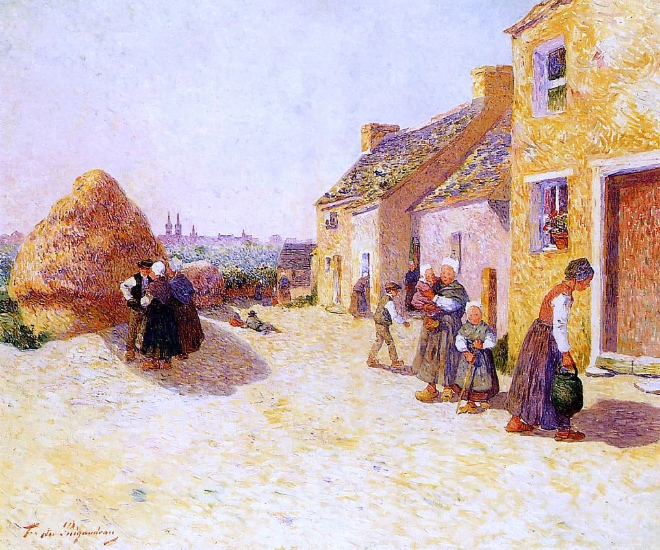
(Re)discover the fascinating world of Ferdinand du Puigaudeau through an exhibition dedicated to his luminous and poetic work
The city of La Baule-Escoublac invites you to discover the fascinating world of Ferdinand du Puigaudeau through an exhibition dedicated to his luminous and poetic work. A painter of intimacy and mystery, he summagnified twilight atmospheres and landscapes bathed in light in a very personal impressionist style.
This retrospective offers a sensitive journey through his most emblematic paintings, where scenes of life, silent natures and bewitching atmospheres are mixed. Each painting reveals a singular view of the world, oscillating between realism and reverie.
Ferdinand du Puigaudeau (1864-1930) holds a special place among the Post-Impressionist painters. Close to Paul Gauguin from his first stay in Pont-Aven, he was admired by his peers such as Edgar Degas, but struggled to make a living from his art. His science of light, his colourful or twilight atmospheres magnify his landscapes of Brittany, Venice, his scenes of popular festivals…
In 1907, he settled in the countryside of the port of Le Croisic, at the manor of Kervaudu, where, despite precarious means, he gathered his friends the artists Jean Emile Laboureur, Emile Dezaunay, Ernest de Chamaillard, the poet José-Maria de Heredia.
He never stopped painting his garden at the manor of Kervaudu, the Brière, the marshes of the Guérande peninsula. Today, his works are held in the collections of the Thyssen-Bornemisza Museum in Madrid, the Indianapolis Museum of Art, and the Musée des Beaux-Arts de Quimper in France, among others. He is the father of the ethnologist Odette du Puigaudeau (1894-1991), a specialist in the traditional cultures of the Sahara (Mauritania and Morocco).
The Bernard Boesch Museum came to life thanks to the philanthropic determination of Bernard Boesch, a painter and architect, who died in 2005, bequeathing a spectacular gallery completed by a rich and varied collection. By offering their property to the city of La Baule, the Boesch couple provided a space for past contemporary band artists.
Located in a prestigious setting in the center of La Baule, one of the world’s most beautiful bays, which flows from the Pouliguen towns to Pornichet, the Bernard Boesch Museum’s mission is to promote the work of artists. An independent workshop house is, among other things, open and only for local artists.
The Ferdinand du Puigaudeau exhibition dubbed “Capturing the Light” takes place from Saturday, 5 July to Sunday, 28 September 2025 at the MuséeBernard Boesch, 35, avenue François Bougouin, 44510 Le Pouliguen.
For more information, head to Musée Bernard Boesch’s official website here Musée Bernard Boesch
For the latest in art and culture reads, click here.
Amazon Prime Day kicked off yesterday, and the deals are still heating up. With incredible discounts across the site, we’ve found the very best travel finds, including high-quality luggage, comfy clothes, top-rated tech, and more—all for under $50.
Best Amazon Prime Day Deals Overall
Amazon
Editor favorite: Apple AirTag, $20 (originally $29)
With thousands of deals to sort through, we did the hard work for you and uncovered the best travel essentials at unbeatable prices. We’ve found shocking discounts on Apple, Samsonite, Crocs, and more top brands—and we can’t believe they’re all under $50.
Not only does this softside luggage set come at an unbelievably low price, but it also has over 10,000 five-star ratings. The set comes with a carry-on suitcase and tote bag, and according to one reviewer, they’re spacious enough for four-day trips.
Amazon Basics Hardside 21-inch Carry-on Spinner
Amazon
One shopper dubs this carry-on suitcase a “little tank,” because after six years of frequent use, it’s “still like new.” It has spinner wheels, a durable hardshell exterior, and multiple internal pockets to keep your packing list organized.
Samsonite Andante 22-inch Rolling Duffel Bag
Amazon
This Samsonite rolling duffel is incredibly spacious yet can still fit in the overhead compartment. According to one reviewer, it can fit up to four days’ worth of clothes. It has a relatively simple design, with a U-shaped opening to the main compartment and two water-resistant end compartments that can hold shoes or wet items.
Over 6,000 shoppers purchased the Pander Belt Bag in the past month, so needless to say, it’s a trendy style. It looks nearly identical to a designer version‚ but it costs much less now that it’s marked down to just $13. It keeps your belongings secure from pickpockets during travel, and it’s also great for hikes thanks to the hands-free design.
Samsonite Duffel Bag
Amazon
The Samsonite Duffel Bag is so durable that one reviewer said it’s still going strong after eight years of international trips. Plus, it “holds a ton” while still being lightweight enough to adhere to airline weight restrictions.
Matein Carry-on Backpack
Amazon
Snag this spacious carry-on backpack before it flies off the shelf. It has over 3,900 five-star reviews, and shoppers rave that it’s equally suitable for the office and the airport, easily holding a laptop, shoes, snacks, chargers, and more.
Every traveler needs a comfy neck pillow, and this best-selling Napfun option offers “unmatched comfort and support.” The cooling memory foam will keep you comfortable on planes, trains, and road trips, and the washable cover will keep you feeling fresh, trip after trip.
Travel Inspira Luggage Scale
Amazon
This now-$8 luggage scale will save you major headaches during travel. You can easily use it at home or on the go to ensure you never have to worry about extra baggage fees. If you love to shop during summer vacations, you should definitely add one to your cart.
Tocelffe 18-piece Toiletry Bottle Set
Amazon
For just $10, you can now snag this best-selling toiletry bag that includes four squeeze bottles, two spray bottles, four cream jars, and even more items. It’s selling quickly, so be sure to snag one while the deal lasts.
Linen pants are an essential style for summer, and you can now save on the Faleave Women’s Cotton-linen Pants. These comfy, breezy pants are marked down in black, green, brown, and even more colors.
Mcporo Men’s Workout Shirts 5-pack
Amazon
You can snag these sweat-wicking T-shirts for less than $5 apiece when you shop now. They’re ideal for long travel days, workouts, hikes, and any other time you want to stay comfy and cool.
These stylish Adidas sneakers are “perfect for all-day wear” thanks to their cushioned insole and arch support. They’ve earned over 12,000 five-star ratings and even tout an Amazon’s Choice badge. Snag them now while they’re 43 percent off.
Kuailu Women’s Arch-support Flip-flops
Amazon
It’s rare to find flip-flops that are actually supportive, but this popular pair is designed with substantial arch support. In fact, reviewers with plantar fasciitis praise the comfort of these sandals. “My podiatrist even approves of these,” one reviewer says.
Crocs Unisex Mellow Recovery Slides
Amazon
Crocs are known for their supreme comfort, and these recovery slides are no exception. They are cushy, supportive, and breathable. In fact, one reviewer with plantar fasciitis says these are “much more comfortable” than more expensive brands.
Best Amazon Prime Day Hiking and Camping Gear Deals
During any outdoor adventure, staying connected can provide you with an extra sense of security. That’s why it’s important to pack a power bank, and this popular option is ideal. It can be charged with a charging cable or via solar charging, so you never have to worry about your devices running low.
The possibilities are endless with the Raynesys Collapsible Wagon. Bring it to the beach, campsite, baseball game, or anywhere else you need plenty of gear. According to reviewers, it rolls easily over rough terrain, folds to a compact size, and is lightweight yet sturdy.
A portable speaker instantly sets the vibe at the beach, hotel room, or campsite—and this highly-rated option from Jbl packs a punch. It’s durable, waterproof, and holds up to five hours of battery life. Plus, its compact size means it can easily slip into your personal item, carry-on, or beach bag.
Newvanga Universal Travel Adapter
Amazon
If there’s one tech item that’s non-negotiable during travel, it’s a travel adapter. This top-rated adapter is universal, so you can bring it along on every trip. It’s compatible with plugs in over 150 countries and can charge multiple devices at once.
Charmast Portable Charger With Built-in Cables
Amazon
During long travel days, a portable charger is essential, and you can’t rely on airports or train stations to supply outlets. The Charmast Portable Charger can charge six devices at once and has built-in cables for extra convenience.
Amazon Prime Day deals are selling quickly, so be sure to score these major savings while the best deals last. There are thousands of deals to discover, including fashion, luggage, outdoor gear, and more.
In the refined world of contemporary luxury, wellness is not just a trend, it’s a philosophy. And within that philosophy, skincare stands as one of its most intimate expressions. Among the emerging essentials in high-performance skincare, the refresh mask is earning its place. It is, in every sense, a modern classic, perhaps even the best facial mask ever for those seeking immediate restoration, clarity, and calm.
Designed for those who balance global flights, high-stakes meetings, and discerning taste, refresh masks offer a moment of quiet efficacy: a spa-like reset, whether you’re between time zones or winding down after a long day.
What Defines a Refresh Mask?
Unlike heavier overnight treatments or detoxifying clay masks, refresh masks are typically lightweight, gel or cream-based, and formulated to hydrate, awaken, and decongest. They work in synergy with your skin’s natural rhythm, offering visible results in just 10 to 15 minutes.
The experience is discreetly luxurious: no downtime, no mess, just an elegant solution for modern skin fatigue.
The Science of Immediate Renewal
What sets these masks apart is their ability to perform quickly and visibly. Using occlusive technology, they seal in active ingredients like hyaluronic acid, niacinamide, or botanical antioxidants, allowing the skin to absorb and retain them more effectively.
This scientific approach mirrors the luxury of efficiency, where time is the ultimate commodity and visible results are expected.
For example, Vogue reports that tools and treatments combining instant hydration and improved circulation are among the most recommended by dermatologists for people with demanding lifestyles.
When to Indulge
• Post-flight reset: After the dehydrating effects of cabin air.
• Pre-event prep: For radiant, plumped skin under makeup.
• Screen fatigue relief: After long hours under artificial light.
• Urban detox: To refresh skin exposed to pollution and stress.
The versatility makes it not just skincare, but a ritual of restoration, adaptable to any setting,be it a hotel suite in Paris or your home vanity.
Key Benefits
1. Deep Hydration
With ingredients like aloe vera or marine collagen, refresh masks restore moisture to delicate facial zones almost instantly.
2. De-puffing and Brightening
Cooling agents combined with vitamin C or green tea extract help reduce inflammation, eliminate dullness, and tone the skin for a well-rested look.
3. Fine Line Softening
Peptides and other active ingredients can enhance skin texture, reducing the appearance of expression lines in minutes.
4. Elegant Self-Care
These masks are a symbol of slow beauty in a fast-paced world,both sensory and functional, offering results with refinement.
How to Use
1. Cleanse and tone the skin.
2. Apply a generous layer of the mask evenly across the face.
3. Allow it to sit for 10–15 minutes, ideally while reclining in a robe or during a quiet interlude between tasks.
4. Rinse gently or massage in the excess, depending on the formulation.
Use 2–3 times weekly to maintain hydration and skin balance.
As Women’s Health notes, targeted de-puffing and hydration rituals can significantly improve both the appearance and health of the skin when used consistently.
A Ritual Worth Embracing
True luxury in skincare is not about extravagance; it is about intentionality. A refresh mask embodies this principle, offering an effective yet elegant step toward balance and renewal. It’s not just about looking rested, it’s about feeling aligned.
For those looking to elevate their skincare with precision and poise, discover the ritual here.
For more on the latest in luxury beauty and skincare reads, click here.
Aston Martin has unveiled its “most performance focused” sports car, the Vantage S. The new model promises more power and precise handling. It will make its dynamic debut at the Goodwood Festival of Speed. It seems the DB12 S is still some time away.
At the heart of the Aston Martin Vantage S is an upgraded version of the 4.0-liter twin-turbo V8 engine. It now produces 671 hp @ 6000 rpm, 15 hp more than the standard Vantage, while torque remains the same at 590 lb-ft @ 3000-6000 rpm.
The drive-by-wire throttle has been recalibrated for better response. The car also gets a bespoke throttle map for each of the Drive Modes.
Aston Martin claims that the Vantage S can accelerate from 0-60 mph in just 3.3 seconds, while 124 mph comes up in 10.1 seconds. Top speed remains unchanged at 202 mph.
The carmaker has also made a few tweaks to the chassis. The Bilstein DTX adaptive dampers have been recalibrated for increased front-end feel and response. The rear spring stiffness has been reduced for a better low-speed ride quality. The car feels more refined thanks to a 10% reduction in the transmission mount stiffness. The camber, toe and caster have also been tweaked for sharper response and better front-end grip.
To make the Vantage S stand out, Aston Martin designers have made a few cosmetic changes on the outside. The subtle design details give it a more aggressive look. The bespoke 21-inch Y-spoke alloy wheels in satin black complement the sporty look.
The new rear spoiler is said to generate 111 kg of downforce at VMax. An additional 67 kg of downforce is generated by the underbody, new front airdam and venturi vanes.
The Aston Martin Vantage S will be available in Coupe and Roadster body styles. Deliveries will begin in Q4 2025.
Cappadocia is a dreamlike destination with unique landscapes, cave dwellings, and breathtaking hot air balloon rides. While spending multiple days in this magical region is ideal, many travelers visiting Turkey have limited time.
Thankfully, a 1-day Cappadocia tour from Istanbul provides the perfect opportunity to explore the highlights of this enchanting land in just one day.
Discover Cappadocia’s Magic with a Private Guided Tour
Experience the surreal beauty of Cappadocia on a tailored, full-day private tour from Istanbul.
➡ Customized Itinerary: Explore at your pace, focusing on the sights you love, from fairy chimneys to ancient cave churches. ➡ Expert Guidance: Learn the region’s history and secrets from a professional English-speaking guide. ➡ Must-See Stops: Visit Göreme Open-Air Museum, Uçhisar Castle, Pasabag’s fairy chimneys, Devrent Valley, Avanos’ pottery workshops, and an underground city like Derinkuyu. ➡ Comfort & Convenience: Enjoy a luxury minivan, entrance fees, and bottled water, with lunch included. ➡ Optional Sunrise Balloon Ride: Add a breathtaking hot air balloon experience to soar over Cappadocia’s stunning landscape.
If you are in Istanbul and want to experience the beauty of Cappadocia without an extended stay, a day tour is the perfect solution. Here’s why a day Cappadocia tour from Istanbul is highly recommended:
Time-Efficient Travel: Direct flights from Istanbul to Cappadocia take just an hour, letting you explore a bucket-list destination in a single day and be back by evening.
Hassle-Free Experience: A guided tour handles all logistics—flights, transfers, and a curated itinerary—so you can focus on enjoying the adventure with expert insights.
See Iconic Landmarks: In one day, you’ll see Cappadocia’s highlights: fairy chimneys, Göreme’s cave churches with ancient frescoes, and possibly an underground city like Derinkuyu.
The fastest and most convenient way to reach Cappadocia from Istanbul is by air. Two main airports serve Cappadocia:
Nevşehir Kapadokya Airport (NAV) – Closer to Göreme, with a transfer time of about 40 minutes.
Kayseri Erkilet Airport (ASR) – A bit farther, but offers more frequent flights.
Flights operate daily, typically departing early in the morning and returning late in the evening, allowing for a full-day adventure on a day Cappadocia tour from Istanbul.
Best Attractions on a 1-Day Cappadocia Tour
Göreme Open-Air Museum
A UNESCO World Heritage Site, the Göreme Open-Air Museum is a window into Cappadocia’s ancient past. This cluster of rock-cut churches, monasteries, and chapels, carved by early Christians, is adorned with vibrant Byzantine frescoes dating back to the 10th century.
As you wander through these sacred spaces, like the Dark Church with its stunningly preserved murals, your guide will share stories of the monks and communities who once thrived here. It’s a captivating blend of art, faith, and history that’s sure to leave you in awe.
Göreme Open-Air Museum
Pasabag (Monk’s Valley)
Prepare to be amazed by Pasabag’s otherworldly fairy chimneys—towering rock formations sculpted by millions of years of volcanic activity and erosion. Also known as Monk’s Valley, this area was once a retreat for hermits who carved homes into the soft tuff rock.
The unique, mushroom-shaped chimneys are unlike anything you’ve seen, and walking among them feels like stepping into a fantasy world. Keep your camera ready—this is one of Cappadocia’s most photogenic spots!
Devrent Valley (Imagination Valley)
Devrent Valley is where nature turns artist, with rock formations naturally sculpted into shapes resembling animals, people, and objects. Nicknamed Imagination Valley, it’s a playful landscape that invites you to let your creativity run wild. Spot a camel, a dolphin, or even a giant hand carved by wind and time. It’s a short but delightful stop that adds a whimsical touch to your tour.
Uchisar Castle
Perched at the highest point in Cappadocia, Uchisar Castle offers breathtaking panoramic views of the region’s valleys, fairy chimneys, and distant mountains. Carved directly into a massive rock formation, this ancient fortress once served as a defensive stronghold and community hub.
Climbing to the top (don’t worry, it’s manageable!) rewards you with a 360-degree vista that’s perfect for soaking in Cappadocia’s surreal beauty. It’s a great spot to pause and appreciate the vastness of this unique landscape.
Tekelli, Uchisar Castle, Uçhisar/Nevşehir Merkez/Nevşehir, Türkiye
Avanos Pottery Workshop
In the charming town of Avanos, you’ll dive into Cappadocia’s living traditions at a pottery workshop. For centuries, artisans here have crafted pottery using red clay from the nearby Kızılırmak River, a practice dating back to Hittite times.
Watch skilled potters shape intricate designs on a traditional kick-wheel, and if you’re feeling creative, try your hand at molding your own clay masterpiece. It’s a hands-on experience that connects you to the region’s vibrant cultural heritage.
Optional Hot Air Balloon Experience
If you catch an early morning flight, you might have time for a once-in-a-lifetime hot air balloon ride over Cappadocia. Floating above the surreal landscape at sunrise creates an unforgettable experience. Many Cappadocia tour packages from Istanbul offer this optional activity.
What to Expect During Your Tour
Morning Departure from Istanbul
Your journey begins with an early morning flight from Istanbul to Cappadocia. Upon arrival, your guide will greet you at the airport and take you to your first stop.
Exploring the Highlights
Throughout the day, you will visit the region’s famous attractions, enjoy traditional Turkish cuisine for lunch, and immerse yourself in the local culture during your day in Cappadocia.
We recommend booking a private guided tour to get the most out of your day in Cappadocia. The below tour includes Göreme panorama, Kaymakli, the town of Avanos and Pasabaglari valley.
Evening Return to Istanbul
After a full day of sightseeing, your transfer will take you back to the airport for your return flight to Istanbul, arriving late in the evening. The Day Cappadocia Tour From Istanbul will leave you with unforgettable memories.
Book in Advance: Flights and tours fill up quickly, especially during peak seasons.
Wear Comfortable Shoes: You will walk on uneven terrain, so comfortable footwear is essential.
Dress in Layers: Cappadocia’s weather varies throughout the day, so layering is key.
Bring a Camera: The landscapes are incredibly photogenic, and you’ll want to capture every moment.
Cappadocia Tour
Is a 1-Day Cappadocia Tour Worth It?
Absolutely!
While a longer stay allows for deeper exploration, a well-planned 1-day tour to Cappadocia from Istanbul ensures you experience the region’s most iconic sights in a short time. Whether it’s the fairy chimneys, ancient cave dwellings, or magical hot air balloons, a day Cappadocia tour from Istanbul promises an unforgettable adventure in one of Turkey’s most mesmerizing destinations.
LVMH has reported rare losses across its fashion division, despite Louis Vuitton’s continued cultural dominance. Kering, meanwhile, is in transition: the sudden CEO departure has left Saint Laurent steady but cautious, while Bottega Veneta and Balenciaga face their own identity recalibrations under Louise Trotter (succeeding Matthieu Blazy) and Demna, respectively. Add to that the mounting macroeconomic pressures — slower growth in China, weaker consumer confidence in Europe — and Parisian fashion now finds itself at a commercial crossroads.
At the centre of this upheaval is couture — Paris’ most exclusive, client-facing format. While haute couture has long been positioned as fashion’s most creative playground, it is also one of its most direct-to-consumer models. In a climate where retail is softening and brand loyalty is being redefined under new creative direction, couture’s relevance is arguably rising, not falling. In 2024, the top two percent of luxury fashion clients accounted for over 40 percent of sales at brands like Chanel, Hermès and Louis Vuitton.
With aspirational spending on the decline — especially in the U.S. and China — brands are doubling down on their most elite clientele. Luxury Maisons are increasingly investing in CRM (Consumer Relationship Management) programmes, bringing UHNW (Ultra-High-Net-Worth) clients directly into the fold and treating couture week not as a press event, but as a top-tier selling moment by hosting them at lavish runway-week galas, often at renowned venues like Hôtel Costes, Palais Garnier and even secluded abbeys.
Read More: Gaurav Gupta On Indian Craft, Paris Couture Week, And Beyoncé
VICs Are Fashion’s MVP
Chanel Fall-Winter 2025/26 Haute Couture Show Teaser Directed By Malick Bodian
Unlike ready-to-wear — which is broadly wholesale-driven — couture has always thrived on its exclusivity. However, that intimacy between Maison and client is now being systematised. Houses like Dior and Chanel have long built multi-tiered relationships with clients across Asia, the Middle East and the United States — but with purchasing power, today’s couture clients are no longer content with watching from afar.
Several maisons are now flying clients in, arranging front-row placements and offering post-show fittings. The couture show is no longer a spectacle but rather a conversion tool. In March last year, Miu Miu’s Fall/Winter 2024 runway show, Miu Miu invited one of its highest-spending customers to walk the runway, signalling a new era of consumer integration. It was a brand equity move targeted at its top-tier CRM list.
Maintaining loyalty is now a high-touch hospitality model. Brands deploy sales associates as personal concierges — managing everything from custom fittings to fixing customs mishaps. This concierge model has proven more effective post-pandemic than traditional retail. Events like Dolce & Gabbana’s Alta Moda or Vogue’s Vogue100 offer VICs a hybrid of fashion access and high-society networking. These events — often priced at tens of thousands per experience — offer top-tier clients cultural capital in return for financial loyalty. Spending thresholds to enter “VIC status” are rising steeply — USD 200K a year is now a baseline at houses like Louis Vuitton. This exclusivity — paired with invite-only shows and runway preorder access — allows brands to gatekeep access and maintain allure. Top clients often preorder entire looks directly after shows, securing one-of-a-kind pieces. Signature bags or trending shoes are quietly reserved behind the scenes for these VICs, further distancing them from the mass luxury consumer.
For fashion houses, success is not just about units sold — it is about how much cultural resonance and designers and stylists are increasingly discerning about which clients represent the brand visually, especially on social media or in front rows. Having money is no longer enough — clients are expected to reflect the brand’s image, taste and codes.
Creative director Glenn Martens will debut his first collection for Maison Margiela during the Autumn-Winter 2025 Paris Haute Couture week
As the Fall/Winter 2025–2026 Haute Couture shows approach, France’s fashion industry is entering a period of corporate and creative volatility that could reshape its global standing. From Glenn Martens’s Maison Margiela debut to Demna’s swansong for Balenciaga, the business of couture is becoming more personal, strategic and urgent than ever — particularly in an era where top clients are being courted with the same intensity as celebrities.
Read More: Haute Couture’s Homage to Athleticism, Iconic Inspirations and Reinvention
Corporate Turbulence & Creative Risks
2025 Couture Week also comes at a moment of high-stakes reshuffling. Jonathan Anderson’s Dior Couture debut marks a generational pivot for the house. Kering’s internal transition, meanwhile, has made Saint Laurent a quiet outlier in terms of consistency. Under Anthony Vaccarello, the house continues to focus on pared-back glam with steady commercial results, though the brand’s couture ambitions remain muted compared to Chanel or Dior.
Over at LVMH, the losses in fashion are being dealt with seriously. While Vuitton maintains its marketing grip thanks to high-profile campaigns and digital omnipresence, the conglomerate’s other fashion brands are under pressure to deliver more than virality. In this context, the upcoming couture shows will act as soft power barometers — where the lines between creative output and commercial intent are increasingly blurred.
This season’s couture calendar is packed with pivotal moments. At Chanel, the spotlight is on how the house will handle its first couture show since Virginie Viard’s quiet departure. Whether the collection serves as a bridge to a new era or a complete aesthetic reset remains to be seen. Dior also finds itself at a crossroads: while Maria Grazia Chiuri’s tenure saw the brand champion feminism in her womenswear collections, the recent appointment of Jonathan Anderson at Dior hints at broader creative shifts that could eventually ripple through the brand.
Daniel Roseberry’s Schiaparelli
Daniel Roseberry’s Schiaparelli opened the official couture calendar. His designs remain highly sought after by red carpet stars — including Lauren Sánchez, who wore one for her recent wedding in Venice. Under Daniel Roseberry, Schiaparelli has owned the red carpet conversation in recent seasons with its surrealist couture, and now, all eyes are on how the house will pivot its strategy to better serve clients directly. Perhaps a new direction that sees less ostentatious pieces towards wearable works of art?
Meanwhile, at Balenciaga, the question is whether Demna’s final couture collection will mark a turn away from shock value and toward a subtler recalibration of the house’s image, with some arguing that couture, after all, has always been his cleanest canvas. Finally, Fendi Couture may be due for a breakout moment. While some critics have noted that Kim Jones’ couture work has often been overshadowed by his ready-to-wear collections, increasing investment in the segment suggests that this could be a season for the house to reassert its positioning.
The Stakes Are Higher Than Ever
Fendi couture 2024
Couture was once considered simply a showroom for brand prestige over profits. But in 2025, couture could become one of the most commercially strategic platforms in fashion, offering high margins, deeper customer experiences and a stage that remains uniquely Parisian. With legacy maisons navigating creative change, corporate turnover and tightening client relations, Paris Couture Week arrives at a pivotal moment for the French fashion economy. In a season defined by leadership transitions, economic headwinds and CRM recalibrations, the real winners may not be those who wow the press — but rather those who close the sale.
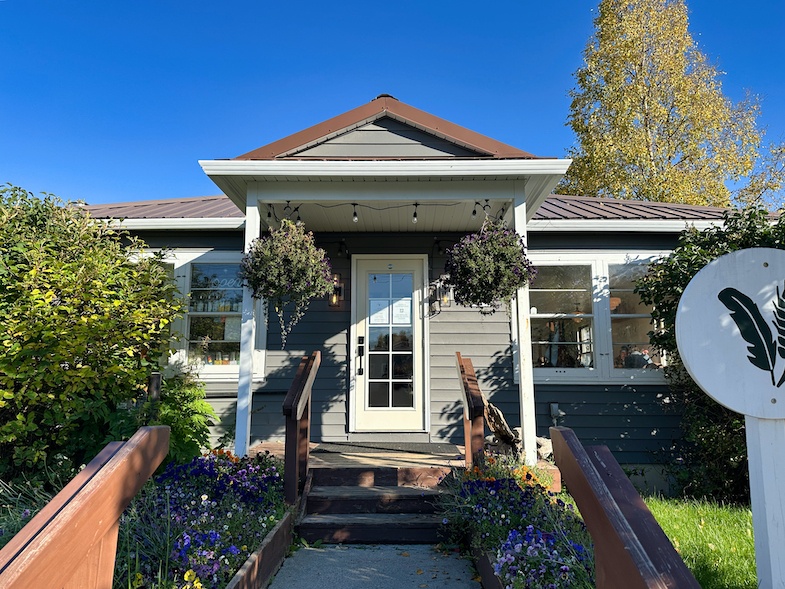
Located in the Mat-Su Valley of South Central Alaska, Feather & Flour in Palmer, is nothing short of extraordinary. As someone who has fine-dined around the world, I’ve developed an eye (and palate) for restaurants destined for greatness. Feather & Flour is one of them. I’ve predicted Michelin stars before—Bianc in Hamburg, Germany for example, now boasts two—and Feather & Flour has the potential to join those ranks.
How Feather & Flour is Redefining Fine Dining with Local Ingredients
Tucked away in the heart of Palmer, Alaska, where towering mountains kiss the sky and glacial rivers carve the land, Feather & Flour rises like a culinary oasis in the wild. Here, each dish tells the story of the Alaskan earth—of forests rich with life, of fjords brimming with bounty, and of farmers who coax beauty from the land with rugged hands. It is a place where the fleeting summer harvest is celebrated, and the deep hues of autumn linger long after the season fades. At Feather & Flour, the plate becomes a canvas, and every bite is a journey through the soul of Alaska.
A Memorable Start: Appetizers that Set the Bar High
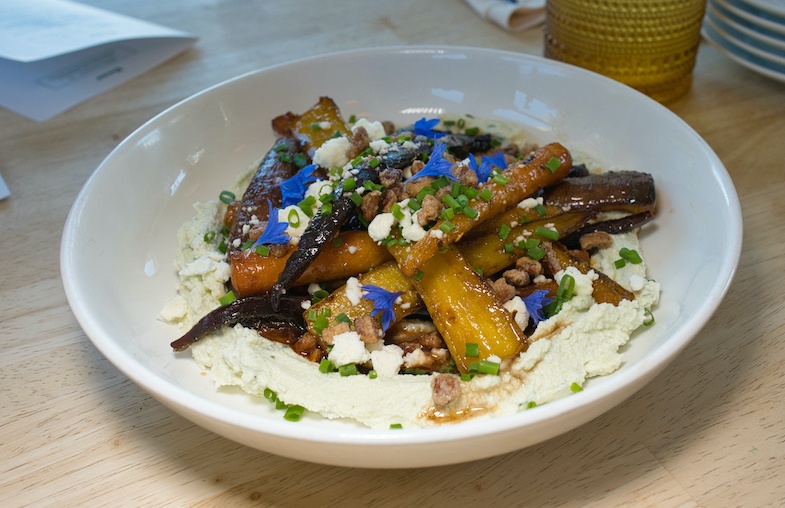
Our evening began with a selection of appetizers that immediately impressed. The roasted local carrots with house-made ricotta, honey, kelp, chili crisp, and candied pecans was a delightful medley of flavors. The creaminess of the house-made ricotta, the sweetness from the honey, and the briny touch of kelp made this dish stand out. The Caprese salad followed, featuring vibrant local tomatoes, mozzarella, basil, and a garden pesto that tasted as fresh as summer itself. A balsamic reduction added just the right balance to this already stellar dish.
Celebrating Local Ingredients: A Farm-to-Table Journey
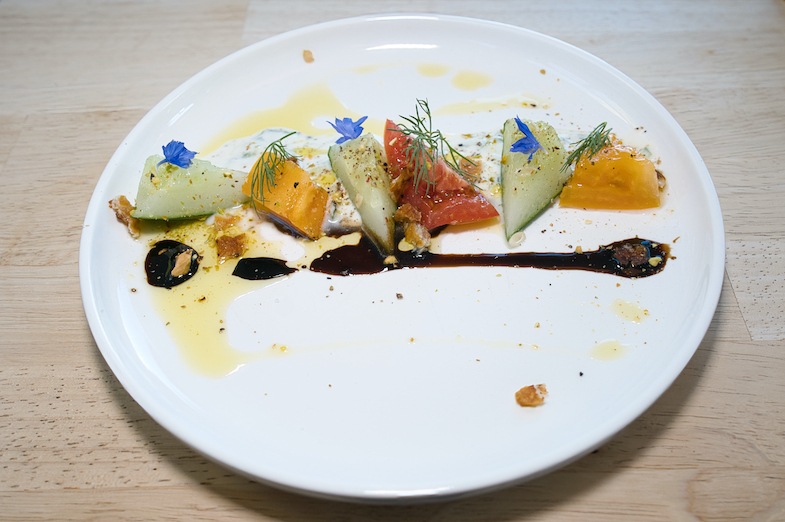
Feather & Flour takes its ‘Fjord, Forest & Farm-to-Table’ philosophy seriously, and this ethos shines through every course. The first course, the Tomato Meze, showcased local tomatoes, cucumbers, fresh dill, pistachios, and haloumi cheese. The dish was an impeccable blend of textures and flavors, enhanced by a silky local yogurt tzatziki and a drizzle of olive oil. Paired with a Pinot Noir Blanc, this was a dish that celebrated Alaska’s short but fruitful growing season.
The Essence of Autumn: A Fall Harvest Salad to Remember
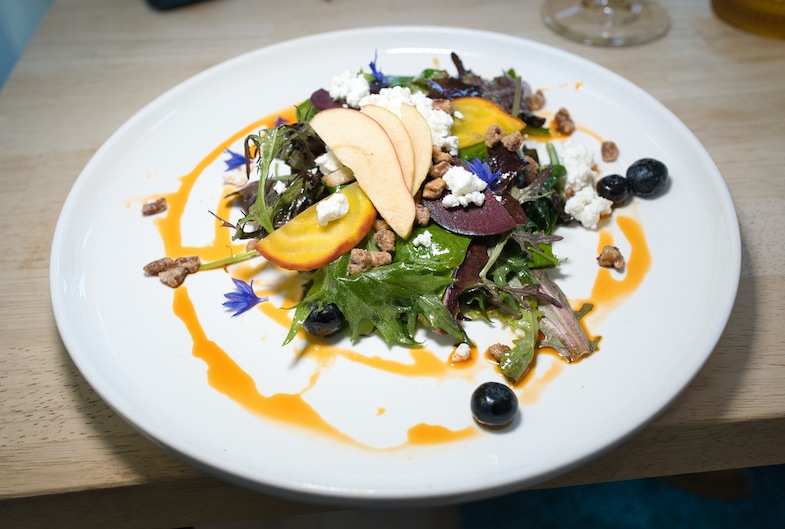
The Fall Harvest Salad brought the colors and flavors of Alaska’s autumn to the plate. Local greens were paired with beets, crisp apples, blueberries, goat cheese, and candied pecans, all tied together with an apple cider vinaigrette. Each bite was a beautiful contrast between earthy and sweet, with the creamy goat cheese and crunchy pecans adding depth to the dish. A Portuguese Rosé was the perfect companion to this autumnal masterpiece.
Unforgettable Main Courses: Scallops and Beef That Shine
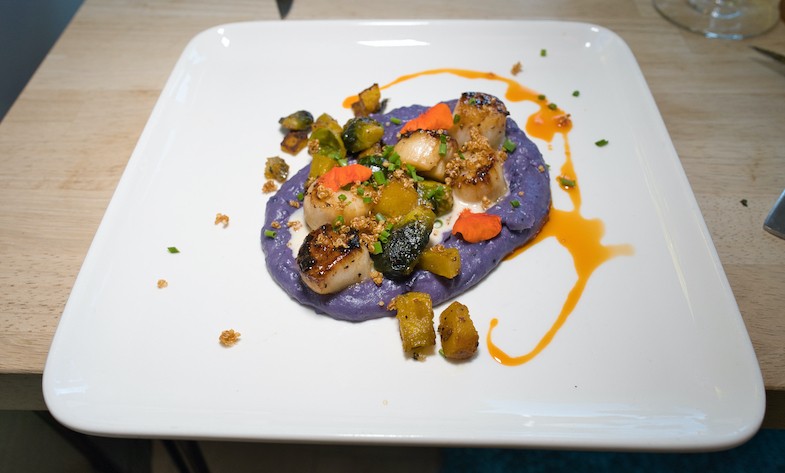
For my third course, I chose the Kodiak Weathervane Scallops, and they were nothing short of perfection. The seared scallops were buttery and tender, resting on a magic Molly potato purée that was impossibly smooth. Winter squash and Brussels sprout hash added a hearty, seasonal touch, while a dry Riesling complemented the richness of the white wine-garlic cream sauce.
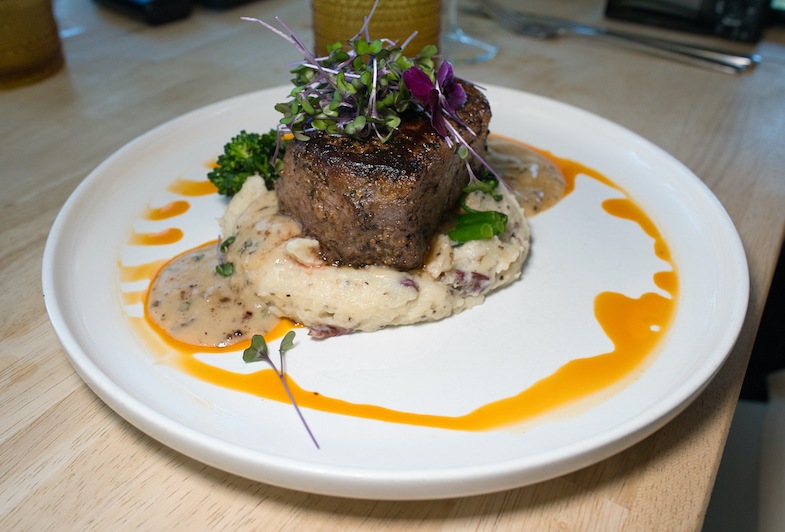
I also had the pleasure of tasting the Beef Tenderloin, which was equally impressive. The tender beef was paired with garlic and herb mashed potatoes and locally sourced vegetables, all brought together by a savory house-made pan sauce. Paired with a Bordeaux, this dish was pure comfort and sophistication—an unforgettable combination.
Sweet Endings: Desserts That Leave You Craving More
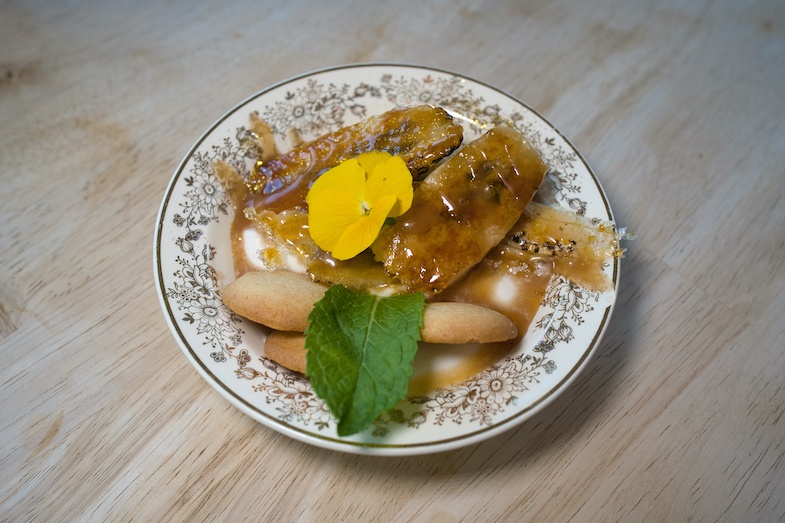
No meal is complete without dessert, and Feather & Flour did not disappoint. The Banana Pudding, with caramelized bananas and house-made vanilla wafers, was a delightful nod to nostalgia, elevated by a malted toffee sauce. The Peanut Butter-Chocolate Cake was equally impressive—made with local zucchini, it was rich, moist, and topped with fluffy peanut butter frosting. Paired with a Sun Thief Porter, this dessert was the perfect end to an incredible meal.
Exceptional Service in an Intimate Setting
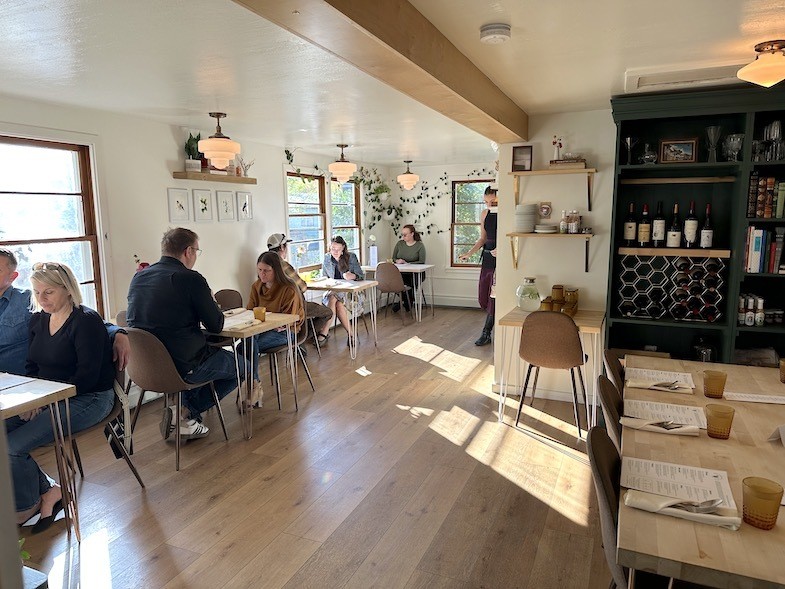
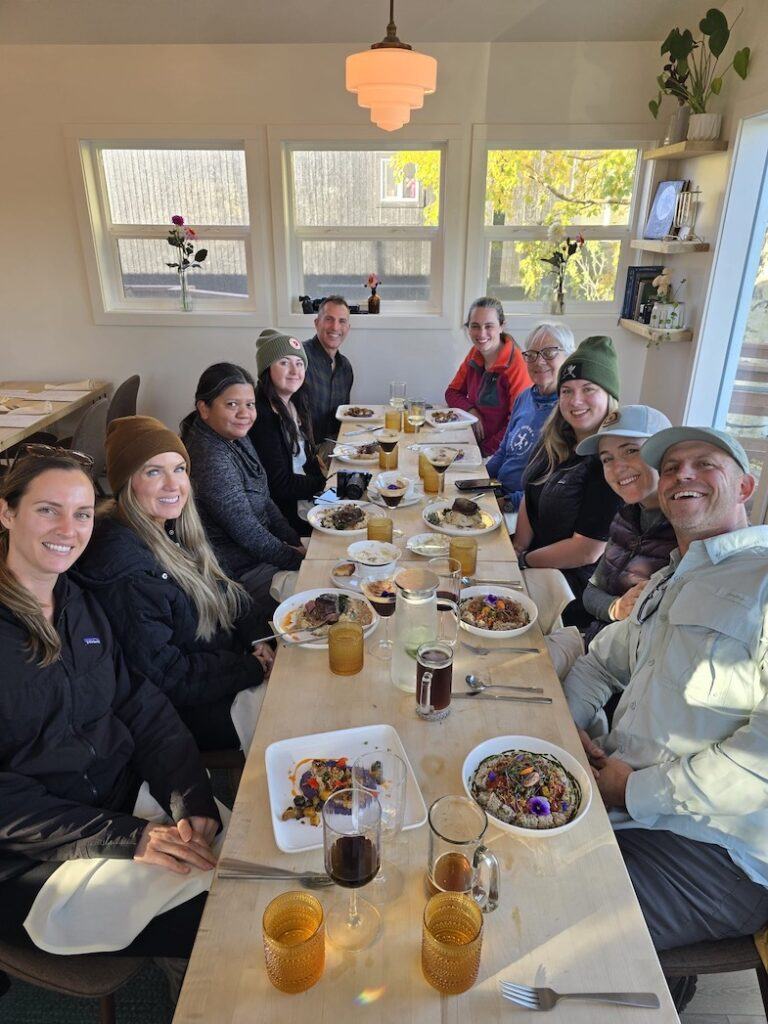
Feather & Flour is more than just a meal; it’s an experience. The service was impeccable, with knowledgeable staff who were well-versed in the provenance of each ingredient. The restaurant, housed in a 1950s home, offers an intimate and cozy atmosphere, adding to the charm of the evening. With just three seatings (Call to confirm), be sure to make a reservation—this place is in high demand, and for good reason.
A Vision Brought to Life by Passionate Alaskans
Heather Greenwood and Luke Hyde, the duo behind Feather & Flour, have poured their hearts into this venture. Heather’s culinary journey started at Le Cordon Bleu, and her passion for Alaskan ingredients is evident in every dish. Luke, with his background in design and photography, has created a space that reflects the beauty and ruggedness of Palmer, Alaska. Together, they’ve crafted a dining experience that’s as thoughtful as it is delicious.
The Next Michelin Star?
Feather & Flour has already made a name for itself in the local community, but I believe it’s on the cusp of something much bigger. If you appreciate fine dining and the extraordinary flavors that Alaska has to offer, this is one restaurant you don’t want to miss. And, as someone who has accurately predicted Michelin stars before, I wouldn’t be surprised if Feather & Flour earns one of its own in the near future, especially since Alaska only has one restaurant to boast this honor.
The technical storage or access is strictly necessary for the legitimate purpose of enabling the use of a specific service explicitly requested by the subscriber or user, or for the sole purpose of carrying out the transmission of a communication over an electronic communications network.
Preferences
The technical storage or access is necessary for the legitimate purpose of storing preferences that are not requested by the subscriber or user.
Statistics
The technical storage or access that is used exclusively for statistical purposes.The technical storage or access that is used exclusively for anonymous statistical purposes. Without a subpoena, voluntary compliance on the part of your Internet Service Provider, or additional records from a third party, information stored or retrieved for this purpose alone cannot usually be used to identify you.
Marketing
The technical storage or access is required to create user profiles to send advertising, or to track the user on a website or across several websites for similar marketing purposes.




:max_bytes(150000):strip_icc()/tl-travel-deals-under-dollar50-grad-2-tout-fbbf0d30219f434c8d184dde0166a9e7.jpg "110 Best Amazon Prime Day Travel Deals Under")
:max_bytes(150000):strip_icc():format(jpeg)/tl-travel-deals-under-dollar50-grad-2-tout-fbbf0d30219f434c8d184dde0166a9e7.jpg)