Home Blog Page 735

Top Ten Whiskies to Invest In

0


Photo: Unsplash

Whisky has earned its place as one of the best spirits to invest in with its steady growth in the past decade. The compelling pull of investing in whisky is that they have the ability to maintain its value overtime or increase its value in some cases, posing as a low risk investment in times of economic instability. It became a growing trend in the COVID-19 pandemic where we experienced one of the largest global recessions and disruptions to the global economy. This prompted people to invest money into items that have true value and reliable growth. That being said, the area of whisky investment has been consistently growing, with the global whisky market valued at a whopping USD 67.9 billion in 2023.

The global whisky market is anticipated to reach USD 101.10 billion by 2031, as reported by Straits Research. Furthermore, the spirit has grown both as a drink and investment opportunity, with its lower price tag and potential for large returns. Thus, making it a good time to look into investing in whisky. LUXUO presents our top ten picks for whiskies to invest in.

Macallan Archival Series Folio 1

Photo: The Macallan

The Macallan Archival series is one of the most sought-after collections, consisting of a total of 24 Folios paying homage to the brand’s distinctive advertising back in the 1970s to 1990s. Since launching the Archival series in 2015, Folios 2 to 6 have been released and only sold through their distilleries and online ballots, retailing for about USD 300 a bottle. Pictured above is The Macallan Archival Series Folio 1, released in 2015 and the first addition to the ongoing series with only 2,000 bottles produced. Based on the findings of analysts, Whisky Returns, this particular series has 40.90% annualised return with a liquidity score of 93.20%, meaning its value has massively appreciated since its release and is in high demand on the secondary market, despite its high resale price averaging at about USD 9,700.

Macallan 25 Year Old Sherry Oak

Photo: The Macallan

The Macallan Sherry Oak 25 Years Old is a part of the brand’s Sherry Oak Collection that releases annually and has become known as one of the most renowned single malt series in the industry. Its annual releases create demand in collectors for previous editions — when the annual release occurs, previous editions are discontinued, prompting an increase in demand due to the limited supply. In particular, the 2020 release of the Sherry Oak collection is one of the rarest on the secondary market, its scarcity raises its value with a liquidity score of 100% as recorded on Whisky Returns. That being said, any release of this collection is a fairly low risk investment with healthy annual returns. Additionally, with new bottles being released each year, the longer you hold onto it, the more valuable it becomes on the market.

Yamazaki 25 Year Old Whisky

Photo: The Whiskey.sg

The Yamazaki 25 Year Old whisky comes from Japan’s first and oldest malt distillery. The Yamazaki Sherry Cask produces limited quantities and is one of the most sought-after Japanese whiskies on the market. While it is still in production today, production is slowing down, resulting in a steady increase in rarity and demand on the secondary market. The winner of the World’s Best Single Malt Whisky in 2012, retailed for around USD 2,000, and is now selling on the secondary market for no less than USD 10,000. While its retail price is already significant, its investment potential is likely to result in high returns for short term investments.

Laroaig The Ian Hunter Story ‘Book 1:Unique Character 30 Year old Whisky’

Photo: Laphroaig

The Ian Hunter story is a collectable 15 series collection of whiskies honouring the legacy of Ian Hunter, who is one of the five founding brothers of the distillery. Each bottle is aged according to the significant years of Hunter’s life with Laphroaig starting with 30 years old and ending with 45 years old, of which, five have already been released. The Unique Character trait of “Book 1” is in the introduction of American oak into the maturation process, a reflection of Hunter’s influence. Only 4,800 bottles are released, at a retail price of around USD 700 USD to USD 800 — with “Book 1” being the rarest and most wanted, going for almost three times its retail price on the secondary market. A collection of this series is definitely one for long term investors to consider in the with 10 upcoming releases.

Read more: Luxury Alcohol Brands Hone in on Lifestyle Marketing

Karuizawa Ruby Geisha 38-year-old Single Malt Japanese Whisky

Photo: The Whisky Exchange

The Karuizawa Ruby Geisha 38-year-old Single Malt Japanese Whisky is one of the rarest and most sought-after whiskies in the world. Coming from Japan’s most unique distillery, it was located at high altitude and within close proximity to an active volcano, meaning that the products were made with some of the purest water the world has to offer. The brand developed a cult-like following for its small batch whiskies before closing its doors in 2000. Resulting in a spike in both rarity and value in the secondary market. With its growing market price and dwindling supply, these Karuizawa bottles have become one of the most high-profile and highly-coveted in the market. Previously sold at a retail price of around USD 300, its value has skyrocketed now, with the existing bottles being sold for hundreds of thousands of dollars. This option is definitely for an individual with extensive knowledge and resources to be able to invest wisely.

Glenfarclas 35 Year Old Warehouse Edition

Photo: Cellarbration

Glenfarclas has been around ever since the 1830s and now ran by its sixth generation. The 35 Year Old Single Malt Whisky Warehouse Edition came by when distillery manager, Callum Fraser came across some casks nearing the 35-year-old mark. He later decided to release the mature whisky after sampling. The special batch was bottled at the end of 2022 and released in 2023 in limited quantities. Additionally, each bottle was held within a special edition box, mimicking the doors of the warehouse. Since its release, these have become a collectable item retailing for around USD 155 to USD 220, and being sold for up to USD 2,000 on the secondary market. This series has become an annual collection, still maintaining its release of limited quantities, hence the longer one holds onto it, the better. Additionally for short term investors, this series is frequently traded within the market, making it a low risk investment with a sizeable return. Alternatively, to maximise returns, collect this series as a long term investment.

Hibiki 17 Year Old (Chrysanthemum & Crane)

Photo: The Whisky Shop

The Habiki 17 Year Old (Chrysanthemum & Crane) was a special edition of the Habiki series, their most popular collection. The limited edition bottle is decorated with the Japanese nation flower and cranes to fit the theme “Kacho Fugetsu” which is a design that represents the beauty of Japanese nature. In addition to its visual appeal, only 1,000 bottles were made and sold were for around USD 210 a piece. Its rarity had resulted in its market value has growing exponentially, reaching average price of around USD 3,000 on the current secondary market. The demand for this bottle is extremely high and annualised returns are above average at 21.1% according to Whisky Returns. Due to a large number of listings and current high demand, this whisky is best for short term investors.

Springbank 30 Year Old

Photo: The Oaks Cellars

The family-owned distillery has been producing high-quality single malt whisky for almost 200 years and among some of the most traded brands in the market. The distilleries are situated in Campbeltown and is the only one of its kind in the coastal area offering a unique flavour profile and impeccable quality. Springbanks’ younger whiskies are frequently in high demand on the secondary market with the Springbank 21 Year Old having an annualised return rate of over 20% as per Whisky Returns, making it a great investment for short term investment enthusiasts. Pictured above is the Springbank 30 Year Old significantly in more scarce quantities compared to its younger counterparts, with only 1,400 bottles released, going for no less than USD 4,000 on the secondary market. This number can be expected to grow year after year, ideal for investors that are in it for the long term.

Read more: Whisky Journey 2023 Teases with These Exclusive Tipples

Ardbeg 25 Year Old Lord of Isles

Photo: The Oaks Cellars

Scottish distillery, Ardbeg is popular among collectors with limited edition collections releasing annually. The 25 year Old Lord of Isles is particularly special, paying homage to the small island in west Scotland where the distilleries are located. Given that the classic Ardbeg 25 Year Old is already highly sought-after, the Lord of Isles series is even more in-demand with its special packaging and limited supply, especially after production halted in 2007. Furthermore, since its release in 2002, its market value has gone from around USD 750 to an average of USD 2,000 on the current secondary market. Its rarity and collectable characteristic makes it a low risk high return option for long-term investors.

Balvenie Tun 1401 Batch 1

Photo: Whisky Base

The original Balvenie Tun 1401 was handpicked by expert David Stewart, using a total of four casks and two sherry butts to make its first batch, which then matured in Tun 1401 the distillery’s traditional oak vessel. Each batch consisted of casks aged 35 to 45 years old and a single 21 or 22 year old blend to mixed in increase alcohol percentages. This collection had a total of nine batches with Batch 1 being the most valuable and most rare with a mere 336 bottles being sold as opposed to an average of 2,000 bottles in the later batches. The Balvenie Tun 1401 Batch 1 now sells for tens of thousands due to its exclusivity. If one is lucky enough to get their hands on one, it is perfect for a long term investment, and is likely to increase its value year after year.

For the latest in luxury alcohol reads, click here.


Source link

Sunday Best: Cars & Copters UK

0


Since 2022, Ciro Ciampi from Petrolheadonism and Nigel Colclough from Flitwick Helicopters have hosted an annual event in the United Kingdom.

As the name suggests, Cars & Copters UK brings cars and helicopters together for a spectacle similar to those seen in the US. Taking things a step further is an exclusive venue befitting of the machinery on display.

SH Petrolheadonism Cars and Copters-7
SH Petrolheadonism Cars and Copters-41

Importantly, all money raised at Cars & Copters UK goes to charitable institutions. For 2024, the recipients were the mental health non-profit organisation, Mind BLMK, and the St Andrew’s Healthcare charity.

SH Petrolheadonism Cars and Copters-46

Forty helicopters and 110 cars – mostly of the supercar variety – descended on a private residence in Great Missenden, Buckinghamshire this past weekend.

SH Petrolheadonism Cars and Copters-19
SH Petrolheadonism Cars and Copters-48

From the moment I arrived at the event, I knew it was one I would remember for many years to come. Basking in the sun centre stage was an exclusive and exquisite Koenigsegg Jesko.

SH Petrolheadonism Cars and Copters-12

Joining the hypercar ensemble was this imposing Bugatti Chiron. You can see the inspiration from the Type 57 Atlantic seeping through the flowing bodywork, from the iconic backbone splitting the rear window, and the organic sweep from the A-pillar to the doors where air is channelled towards the behemoth quad-turbo W16.

SH Petrolheadonism Cars and Copters-5

After taking in the magnificent array of hypercars, the rally car selection drew me in for a closer look. The first of two cars that stood out from the pack was this Ford Escort RS Cosworth, which looked fit to tackle any special stage challenge you could throw at it.

SH Petrolheadonism Cars and Copters-2

The second car was a legendary Ford Focus RS. For any rally fan, this model instantly takes your mind to the late, great Colin McRae.

SH Petrolheadonism Cars and Copters-36

The show curation was on point, too, with many cars parked next to helicopters with complementary colouring. Case in point, this gorgeous Fiat 500 Abarth.

SH Petrolheadonism Cars and Copters-39

This black Lotus Emira was positioned near a helicopter in black and gold, calling back to the famous John Player Special colours.

SH Petrolheadonism Cars and Copters-32
SH Petrolheadonism Cars and Copters-47

Towards the end of the day, one pilot showcased his skills by making his helicopter dance around the Jesko, which instantly drew an audience. That’s not something you see every day.

SH Petrolheadonism Cars and Copters-18
SH Petrolheadonism Cars and Copters-38
SH Petrolheadonism Cars and Copters-13

Car events with great causes at their heart don’t come around often enough. But given the popularity of Cars & Copters UK, I think this one will be around for a while. And I’m sure it will only get bigger and better as time goes on.

Samuel Cherry
Instagram: samgcherry

IAMTHESPEEDHUNTER related stories on Speedhunters

How To join the IATS program: We have always welcomed readers to contact us with examples of their work and believe that the best Speedhunter is always the person closest to the culture itself, right there on the street or local parking lot. If you think you have what it takes and would like to share your work with us then you should apply to become part of the IAMTHESPEEDHUNTER program. Read how to get involved here.


Source link

Mini-Truck Perfection: Kei Miura’s Pandem Hilux

0


Barrel-aged whiskey, dusty old bottles of wine from the cellar, a TRA Kyoto-built Toyota Hilux. All good things take a little time before they can be deemed perfect.

With its tube-frame rear chassis, custom suspension components and 2JZ engine swap, this Pandem Hilux does indeed seem like the perfect custom mini-truck. And it really is.

TobyThyerPhotography-26
TobyThyerPhotography-31

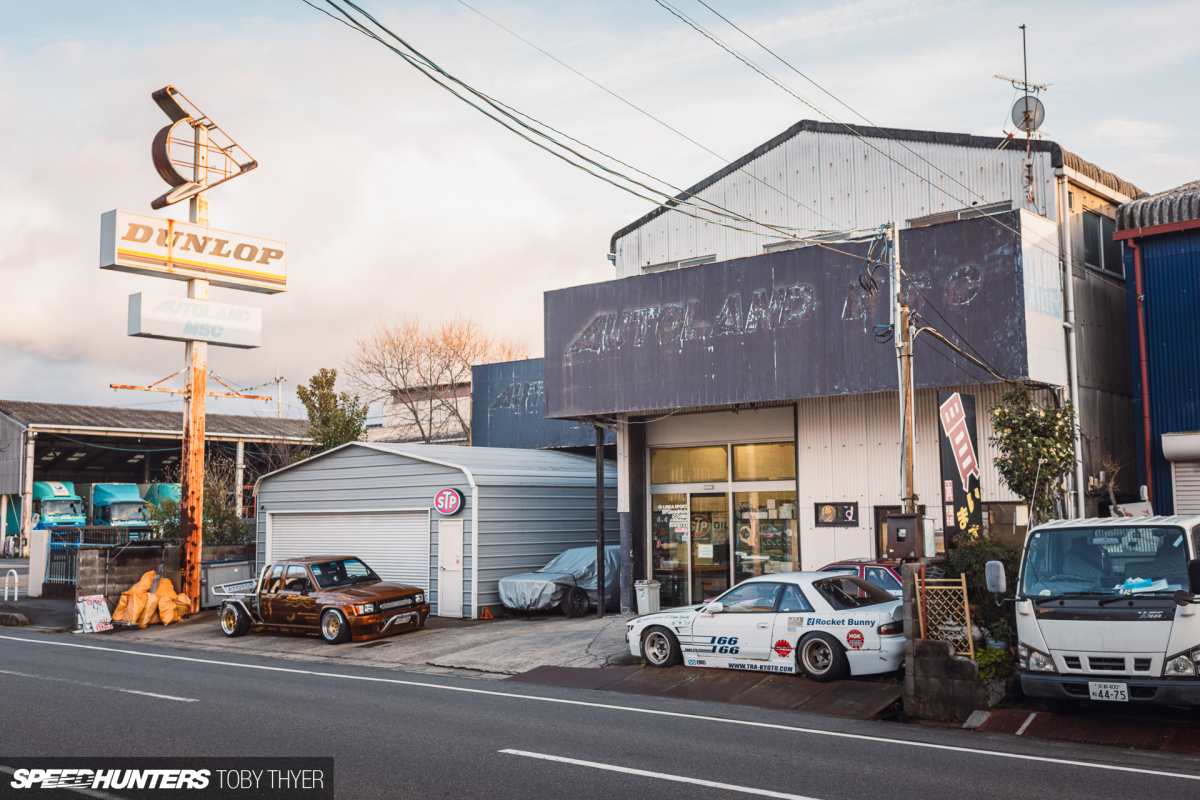
A little while ago, I dropped into TRA Kyoto to see Kei Miura and shoot the third build in a trio of new Pandem x Hardcore Tokyo x J.Beat Custom mini-trucks. The first was the J.Beat Datsun Sunny, and the second, Hardcore Tokyo’s Nissan Frontier.

TobyThyerPhotography-35

Naturally, I wanted to get Miura-san’s creation out for some tracking shots and the obligatory conbini photo outside 7-Eleven. I was keen to see this beast out in the wild and on the streets of Kyoto.

TobyThyerPhotography-4

But good things take time. You could distil a batch of whisky and drink the fresh wash straight from a new barrel, but you might expel the stuff pretty quickly. Aged in a barrel for three years in Scotland? People pay good money for that.

TobyThyerPhotography-1

I didn’t know it at the time, but the Hilux was fresh out of the still, and we only made it 200 metres down the road before Miura-san pulled up alongside our camera car and told us to head back to the shop. The wild mini-truck was far from happy.

TobyThyerPhotography-5

There was nothing to be worried about, nothing broken, leaking or out of whack – the Hilux is road-legal, after all. Miura-san muttered something about a fuelling issue and needing a proper tune, and promptly retired to his cozy office.

TobyThyerPhotography-10

Left to my own devices, I walked around the chopped-up utility, feeling simultaneously confused and amused.

TobyThyerPhotography-10

At the business end, a 2JZ-GE (the naturally aspirated variant) now calls this Hilux home. As you can see, though, it has been heavily modified with a Garrett G35 turbocharger and all of the associated hardware to provide plenty of kick.

TobyThyerPhotography-15

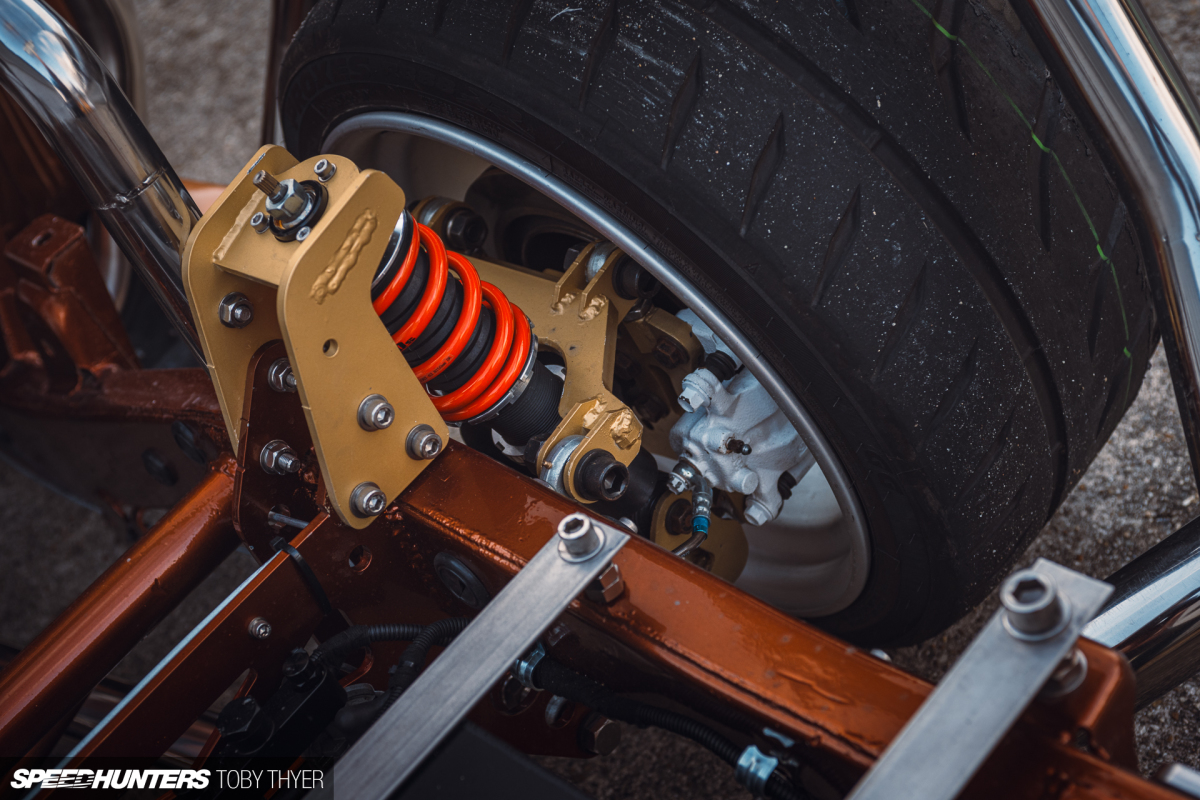
A custom front crossmember supports the turbo straight-six. There are also custom front suspension mounts and front brakes from an R32 Skyline, while the rear brakes came from an S14 Silvia. Mismatched wheels – Enkeis and Works – accentuate the contrasting front and rear halves of the truck.

TobyThyerPhotography-20

Moving into the cabin, the large hydraulic handbrake lever offers the promise of big, smoky drifts. Miura-san confirms this intent.

TobyThyerPhotography-5

At the party end of the truck, the exposed tube-frame chassis extension looks so cool. You get a great view of the R32 diff, too.

TobyThyerPhotography-31

Back in the office, Miura-san showed me his design process for the Hilux, which was achieved using CAD. What I saw reminded me of a giant Meccano set.

TobyThyerPhotography-29
TobyThyerPhotography-14

Now that these three mini-truck builds are complete, what’s next for Kyoto’s king of customs? We’ll just have to wait and see, although I’m sure the next Pandem creation isn’t far away…

Toby Thyer
Instagram _tobinsta_
tobythyer.co.uk


Source link

Luxury Fashion Maisons’ Expression of Craftsmanship & Quality

0


The devil’s in the details but what defines the perimeters of quality, calibre, and craftsmanship? One interpretation could be obvious design details, signature motifs or hours of work put in from highly-trained ateliers. Or perhaps the visual details that go into a piece — be it the fabrics, stitching, prints or manipulation of leather. The other is a bespoke, one-of-a-kind quality that is not only individual to the Maison but hard to replicate. In fashion terms, this is referred to as the “savoir-faire” or the technical know-how that goes into the creative process of crafting bespoke pieces. LUXUO examines different variations of craftsmanship and calibre through a range of latest offerings from luxury’s biggest fashion houses.

Louis Vuitton The GO-14 Bag

The GO-14 is the culmination of design prowess and artisanal ingenuity. An iteration of one of Nicolas Ghesquière’s first designs — hence its coded name: Ghesquière October 2014 — the bag made its debut at Ghesquière’s first collection as women’s artistic director at Louis Vuitton. The malletage motif brings in the spirit of the Maison’s history for trunk-making, referencing the crisscrossing pattern pads on the inside of trunks.

Read More: Fashion’s Flaunting of Flamboyance & Luxury Has Evolved

Today, the GO-14 comes in the form of a padded lambskin bag, covered in soft malletage with overstitching highlighting the design’s curves and “cushiony” feel. The GO-14 is a feat of skill and is a testament to the brand’s thriving heritage. The creative process requires more than 20 different steps, including the utmost meticulousness on the patina to ensure a satin or toasted finish and to perfect the colour’s subtle gradations. A highly precise technique for depositing the 17-metre-long trim is also needed for the rounded malletage of each GO-14. A more complex savoir-faire is required as compared to traditional quilting. The creation of the GO-14 requires the best of Louis Vuitton’s ateliers’ expertise.

Read More: Glorious Absurdity and Extreme Embellishments Dominate Couture Fashion Week

Valentino Altorilievo

Valentino clues us into their extraordinary savoir-faire of Italian craftsmanship with the unveiling of the Valentino Altorilievo. Altorilievo is a new technique named by Valentino that sees fabric sculpted into three-dimensional creations creating naturalistic forms like Baroque foliage, fruit, flowers and animals that frame the body. The technique is a form of honouring women — built around the body, the wearer becomes an active participant in its design.

Prints executed in grisaille echo these forms as fabrics are sliced away to reveal skin. Throughout the collection, prints of pomegranates, pineapples and flowers usher in a “contemporary renaissance”. On other looks, mythological elements like gryphons and sirens offer a new perspective, while their classic geometrical shapes transform into all-over patterns.

Dior Gravity

Conceived by Kim Jones, Dior Gravity leather features the emblematic Dior Oblique motif. The fruit of excellent savoir-faire, this exceptional material sublimates a selection of models from the Dior Fall 2024 collection, such as the Messenger and the Weekender, as well as a belt and a cardholder.

These graphics are also sketched onto a number of refined shoes, including the B33 and B27 sneakers.

Gucci Horsebit 1953 Loafer

Originally presented in 1953, the Horsebit loafer embodies the essence of equestrian-inspired sophistication. Under Sabato De Sarno’s vision, the Horsebit 1953 loafer emerges as a testament to Gucci’s commitment to reimagining elegance for the modern era. The shoe seamlessly weaves together the past and present, showcasing the loafer’s evolution as a symbol of sporty, casual, and sensual elegance. The double ring and bar, first introduced during the late 1940s as a decorative emblem in Gucci’s collections, draws inspiration from the world of equestrianism — a beloved pursuit among the House’s discerning clientele.

Read More: The Evolution of Haute Couture In The Modern Age

Ralph Lauren RL 888 Bag

Ralph Lauren’s RL 888 collection was named in honour of the brand’s flagship store at 888 Madison Avenue in New York City. The RL 888 Top Handle is inspired by the architecture of Ralph Lauren’s birthplace. Featuring a dual-compartment interior, a top handle, and a removable, adjustable crossbody strap accented by two polished keepers, each bag is exquisitely made by hand and individually constructed in Italy with the highest-quality materials.

Thirty-six pristine pieces of the finest Italian box calfskin are skillfully selected and hand-cut by Florentine artisans to create the body — its aniline finish and firm hand feel aids in the bag’s structured profile —while nappa lambskin serves as the lining. Embodying graceful function with luxurious form, the signature “RL” monogram is reimagined as a sculptural push-lock closure offered in palladium, brass, or champagne finishes. Additional touches, including subtle bombé filling at the flap and hand-painted edges, showcase Ralph Lauren’s commitment to fine details.

Giorgio Armani Bespoke Italian Tailoring

Giorgio Armani’s Made to Measure suits are a study in the fine art of tailoring, combining the world-famous Armani spirit with the exceptional quality of made-to-measure craftsmanship. “I realised that some of my clients wanted a unique product made especially for them. I decided to create a made-to-measure service that offers all the benefits of a tailor-made garment — unique fit, fabric, lining, buttons, and details. The service blends tradition and modernity, combining the art of tailoring with the innovation of a contemporary design studio”, explains the designer. Since its launch, Giorgio Armani Made to Measure has attracted a growing clientele.

Originally only available in a select number of stores around the world, the service can now be found in almost every Giorgio Armani boutique, run by highly specialised dedicated staff. Every element of a suit is meticulously designed from the the lining and style of button to specific silhouette, the type of lapel, pocket positions, single or double-breasted fastening, and the option of a pleated or non-pleated trousers. The final garment is an exclusive suit customised to the customer’s specifications.

For more on the latest fashion and style reads, click here.


Source link

The 12 Best Things to Do in Chicago (Updated 2024)

0


The famous Bean in Chicago at sunset, near the towering downtown of the city
Posted: 5/13/2024 | May 13th, 2024

Famously known as “the Second City” (meaning second in population to New York), I feel like Chicago is often overlooked by travelers. It sees a fraction of the visitors LA and NYC receive, which is a shame, as it’s one of my favorite cities in the world.

Chicago is chock-full of world-class institutions, Michelin-starred restaurants, awe-inducing architecture, and verdant parks. There is a lot to do here and the city has a really rich history. I think more people should visit.

Sure, the winters are brutal. But, come spring, Chicago blossoms into a dynamic urban landscape of street life, outdoor cafés, and sunny parks when locals take over the outdoors to enjoy the few months of nice weather. (I don’t think you can really beat Chicago in the summer.)

To help you plan your visit, here’s my list of the best things to do in Chicago:


1. Take a Walking Tour

One of the first things I do when I arrive in a city is take a walking tour. They’re a great way to see the main sights, get the lay of the land, and connect with an expert local guide who can answer all my questions. Free Chicago Walking Tours hosts regular free tours that can introduce you to the city. You’ll get to see many of the coolest buildings in the city while also learning about the history of Chicago. The tour lasts a few hours. Be sure to tip the guide at the end!

For a more unique tour, try the Gangsters and Ghosts Tour. You’ll learn all about Chicago’s dark side and creepy past as you explore the Chicago Loop. The tour lasts two hours and really talks about one of the pivotal times in Chicago’s history. Even if you’re not a history buff like me, you’ll get a lot out of it.
 

2. Relax in Grant and Millennium Parks

Located downtown, these gigantic parks provide a great place to hang out, have a picnic, or go for a run. People play chess here when the weather is nice and, during the summer, there are a lot of free concerts and events here. The larger Grant Park stretches along Chicago’s waterfront, while Millennium Park is the subsection where the famous “Chicago Bean” sculpture is located. This iconic work of public art is a must-see. And, starting at noon on the first and third Saturdays from April through November, the Chicago Cultural Center hosts walking tours focusing on the art of Millennium Park. It’s really interesting. I love strolling through the park or just chilling here with a good book on a nice day.
 

3. Take in some art at the Art Institute of Chicago

The exterior of the Art Institute of Chicago on a sunny dayThe exterior of the Art Institute of Chicago on a sunny day
Since 1879, the Art Institute of Chicago has been wowing visitors with its excellent collection of works from around the world. Located in Grant Park, the museum has a few immediately recognizable pieces, including “American Gothic” by Grant Wood, Edward Hopper’s “Nighthawks,” and “A Sunday Afternoon on the Island of Grande Jatte” by Georges Seurat. The vast collection also includes works by Picasso, Monet, Renoir, Van Gogh, Jasper Johns, and Jackson Pollock. There are also wings devoted to African, Asian, and American indigenous art. If you’re going to go to one museum in Chicago, this should be it. Expect to spend a few hours because the collection is so big.

To beat the crowds, skip a weekend visit as the place gets packed. Instead, go on a Monday or Thursday evening (they’re open late on Thursdays). You’ll have the place virtually to yourself.

111 S Michigan Ave, (312) 443-3600, artic.edu. Open Thursday-Monday 11am-5pm (8pm on Thursdays). Admission is $32 USD ($40 USD for advance skip-the-line entry). Daily tours (included in the price of your ticket) are offered at 1pm and 3pm.
 

4. Admire amazing architecture on a river cruise

Chicago is an architecture lover’s dream. The very best way to take in its famed buildings is via a river cruise. This way, you can sit back and cruise down the canals while an expert guide provides context for what you’re looking at. The guides will give you a detailed history of the architecture. Some of the buildings you’ll see on the boat ride include the Tribune Tower, 333 West Wacker, Navy Pier, the Willis Tower, the Wrigley Building, and Marina City, among others. All in all, there are about 50 structures to see on this fascinating tour, and I promise, it’s much more interesting than it sounds!
 

5. Stroll down the Magnificent Mile

Often nicknamed “Mag Mile,” this stretch along Michigan Avenue from the Chicago River to Oak Street is known for its upscale designer boutiques. In fact, rent here is the third highest in the US (after Fifth Avenue in New York City and Rodeo Drive in Beverly Hills). Even if you don’t want to blow your budget shopping, it’s still an experience to stroll along the avenue and take in the sights and the people, and enjoy the view of the Chicago River. There are several landmarks and attractions along the way too, including the 360 Chicago Observation Deck for expansive views over the city (more on this below).
 

6. Visit the Shedd Aquarium

If you’re visiting the city with kids (or you’re a kid at heart), head to the massive Shedd Aquarium. It’s the third-largest aquarium in the Western hemisphere and home to over 32,000 animals. They have turtles, penguins, sea otters, snakes, sharks, and more. They really emphasize education here so you’ll learn a ton while you roam the different exhibitions. You can even pay extra to do things like feed penguins and sharks, and they also host all kinds of fun evening events (such as live music after hours). I absolutely love coming here. Just make sure to book your ticket in advance as they do get busy and sell out!

To beat the crowds, skip the weekend and visit during the week instead. Also, try and visit right when it opens (especially Wednesday-Friday). It’s usually quieter then.

1200 S DuSable Lake Shore Dr, (312) 939-2438, sheddaquarium.org. Open 9am-5pm Monday-Friday (9pm on Tuesdays), 9am-6pm Saturday, and 11am-6pm on Sundays. Tickets start at $37 USD. Admission can also be included with the Chicago CityPASS.
 

7. Take in some natural history at the Field Museum

The exterior of the popular Field Museum in sunny Chicago, USAThe exterior of the popular Field Museum in sunny Chicago, USA
In 1893, the World’s Columbian Exposition (also known as the Chicago World’s Fair) took place in the Windy City to celebrate the 400th anniversary of Christopher Columbus’ arrival in 1492. The fair displayed some incredible artifacts from around the world, notably in the Columbian Museum of Chicago, which showcased anthropological and biological collections. After the fair was over, organizers wondered what to do with it all. So, the Columbian Museum became the Field Museum, named after benefactor Marshall Field, a department store mogul, and everything remained on display.

One of the biggest museums in the world, the Field houses extensive collections spanning anthropology, geology, botany, and zoology. Some important collections include the displays of taxidermied animals, a wing dedicated to astronomy, and fascinating artifacts from ancient Egypt. I recommend planning to spend at least 3-4 hours to really take it all in.

1400 S. Dusable Lake Shore Drive, (312) 922-9410, fieldmuseum.org. Open daily 9am-5pm (last admission is at 4pm). Basic admission is $30 USD. Special exhibitions are an additional charge (which varies), though you can get an all-access pass for $43 USD.


8. Get a stunning view at 360 Chicago Observation Deck

Chicago is a skyscraper city, including a few rather iconic towers. Located atop what was formerly known as the John Hancock Building and now (uninspiringly) called 875 N. Michigan, the 360-degree viewing deck a thousand feet up and allows visitors to get the best view of the Windy City and Lake Michigan. You can even grab a pint at the Cloud Bar, which serves beer from Moody Tongue, a local brewery.

If you’re a thrill seeker and want more than just the view, sign up for Tilt. This part of the observation deck is where you can stand in front of a glass window, which then tilts forward, until it appears you’re looking directly down at the street, 94 floors below.

Just make sure to check the weather before you go so you will actually have a view to enjoy. Additionally, if you want to beat the crowds, come early (before 10am).

875 N Michigan Ave, (888) 875-8439, 360chicago.com. Open daily 9am-11pm (the last entry is at 10pm). Admission starts at $30 USD (get your tickets in advance for skip-the-line access).

9. Feast on deep-dish pizza

A delicious deep-dish pizza made in the Chicago style in Chicago, USAA delicious deep-dish pizza made in the Chicago style in Chicago, USA
If there’s one food Chicago has become synonymous with, it is deep-dish pizza. It was invented in 1943 by Pizzeria Uno, which is now a national restaurant chain. For something more local, Chicagoans swear by Lou Malnati’s. Personally, I’m not usually a huge fan of deep-dish (I like NYC pizza better), but it’s something you have to try while you’re here.

If you really want to indulge, hop on a Chicago Pizza Tour, on which you’ll get to sample all the varieties on offer in town. Tours start at $49 USD.
 

10. Stroll the Chicago Riverwalk

Stretching from Lake Michigan to Lake Street, the 1.25-mile Riverwalk along the Chicago River makes for a fun stroll. Along the way, you’ll not only get fantastic views of the river and city, but you’ll encounter a legion of waterfront restaurants, cafés, and bars. There’s a ton of public art and green space too (great for picnicking and people-watching). It’s the perfect place to slow down and enjoy the moment in this Midwestern metropolis, but if you prefer a more active experience, there are also lots of aquatic activities here too (such as kayaking or taking a river cruise).
 

11. Eat your way through the Mexican eateries in Pilsen

The neighborhood of Pilsen was founded in 1878 by Czech immigrants, who named the area after the fourth-largest city in the Czech Republic, where pilsner beer was born. The Czechs may be gone now, but today Pilsen is Chicago’s main Latino neighborhood, particularly Mexicans from the Michoacán region. Today you can wander the area, eating some of the best tacos while taking in the vibrant street art.
 

12. Watch an improv show

The Second City is one of the most popular and well-known improv troupes in the country. It’s where greats like Bill Murray, John Candy, Catherine O’Hara, Steve Carell, Tina Fey, and Amy Poehler all cut their teeth. They put on regular performances and also host all kinds of special events. They even host workshops and classes if you want to give improv a try yourself. Just be sure to get your tickets in advance as the most popular shows sell out fast.

230 W North Ave, (312) 337-3992, secondcity.com. Performances are held daily so check the website for what’s on. Tickets start at $35 USD.
 

13. Have fun at Navy Pier

The fun and quirky Navy Pier with a tall Ferris wheel on the coast of Chicago, USAThe fun and quirky Navy Pier with a tall Ferris wheel on the coast of Chicago, USA
This 3,300-foot-long (1,010-meter) pier on the shore of Lake Michigan started off as a shipping site, but it has also been a prison for draft dodgers during World War II, a Naval training center, and a temporary university campus. Since 1995, it has reopened to the public in its current form and has become a sort of carnival. It’s Chicago’s second-most visited tourist attraction (after “The Bean”) and contains some rides, a Ferris wheel, lots of restaurants, a Shakespeare theater, boat tours, a large number of beer gardens, mini-golf, and more! It’s a good place to have some silly fun (especially if you have kids).

600 E Grand Ave, (312) 595-7437, navypier.org. Open Sunday-Thursday 11am-8pm and Friday-Saturday 11am-9pm (individual attractions and restaurants may have separate hours). Admission to the pier is free, though attractions charge their own fees (the Centennial wheel is $21.30 USD, for example).
 

14. Catch a game at Wrigley Field

Home of the Cubs, Wrigley Field, on Chicago’s North Side, is smack in the middle of town. It also happens to be one of the oldest baseball stadiums in the United States (it opened in 1914). If you’re in Chicago during the baseball seasons (April to October) and the Cubs are in town, do yourself a favor and go to a game. It’s one of the most intimate and atmospheric baseball stadiums in the country. If the Cubs are not in town, you can also take a 90-minute behind-the-scenes tour of the stadium.

1060 W Addison St, (773) 404-2827, mlb.com/cubs/ballpark. Tour dates and times vary depending on the season (check the website for availability). Tour admission is $30 USD. Tickets to see a game vary greatly but start at just $10 USD (for better seats at a popular game, expect to spend closer to $80-125 USD).
 

15. Feast in Chinatown

Bring your appetite to Chinatown, where you can feast on cheap dim dum, do karaoke, or relax at one of the many tea houses. One of the oldest Chinatown’s in the country, over a third of Chicago’s Chinese population lives in Chinatown, making it one of the largest concentrations of Chinese-Americans in the USA. Don’t miss Ping Tom Memorial Park, and keep an eye out for colorful murals around the neighborhood. Some of my favorite places here are Hing Kee, MCCB Chicago, and Phoenix.
&nbsp

16. Experience St. Patrick’s Day

A bright green river in Chicago during the rowdy St. Patrick's Day celebrationsA bright green river in Chicago during the rowdy St. Patrick's Day celebrations
Next to Ireland, Chicago is one of the best places to be on March 17th, St. Patrick’s Day. To honor its large Irish-American population, the city dyes the Chicago River green, hosts a huge parade, and parties until the sun comes up (complete with copious amounts of green beer).

The tradition began in 1843, when Chicago’s first Irish parade was held, but it wasn’t until 1962 that the dyeing of the river started, at the suggestion of a plumber’s union, which is still responsible for the green river each year, though it won’t divulge its secrets about what’s used (it’s environmentally friendly, though). Take a river cruise on the emerald waters or snap a pic from the sidelines and enjoy. This is one of the biggest days of the year here!
 

17. Explore Oz Park

This whimsical little park, located in the Lincoln Park area, was created to honor L. Frank Baum, the author of The Wizard of Oz. He lived in the area at the end of the 19th century, and when the city wanted to renovate the park they decided to do so in a way that honored Baum’s popular book.

There’s a playground named after Dorothy, a green space called the “Emerald Gardens,” and numerous life-size statues of popular characters from the musical adaptation, including the Dorothy, Toto, the Tin Man, the Cowardly Lion, and the Scarecrow.

Open daily 6am-11pm. Admission to the park is free.

***

Chicago doesn’t get the attention it deserves. I think it’s fun and perfect for a weekend getaway. And you really can’t beat the summers here either. With lots of interesting museums, plenty of green space, and some great eats, Chicago should be on every traveler’s list!

Book Your Trip to Chicago: Logistical Tips and Tricks

Book Your Flight
Use Skyscanner to find a cheap flight. They are my favorite search engine because they search websites and airlines around the globe so you always know no stone is left unturned.

Book Your Accommodation
You can book your hostel with Hostelworld as they have the biggest inventory and best deals. If you want to stay somewhere other than a hostel, use Booking.com as they consistently return the cheapest rates for guesthouses and cheap hotels.

Don’t Forget Travel Insurance
Travel insurance will protect you against illness, injury, theft, and cancellations. It’s comprehensive protection in case anything goes wrong. I never go on a trip without it as I’ve had to use it many times in the past. My favorite companies that offer the best service and value are:

Looking for the Best Companies to Save Money With?
Check out my resource page for the best companies to use when you travel. I list all the ones I use to save money when I’m on the road. They will save you money when you travel too.

Want More Information on Chicago?
Be sure to visit our robust destination guide on Chicago for even more planning tips!


Source link

2025 BMW M5 design sketch slips into latest official teaser

0


BMW has released a new teaser of the upcoming M5. The 2025 BMW M5 G90 will be available in both sedan and station wagon body styles. The latest teaser provides a short glimpse of the car’s design.

The new BMW M5 looks muscular, as it should. It features a redesigned kidney grille with a silver frame. It doesn’t look out of proportion like the M3/M4 and blends into the headlamp clusters, forming a single visual unit. The headlamp itself looks slimmer and has LED DRLs similar to the latest-gen 5 Series. We think the M5 looks great in this metallic bronze colour, with the M mirrors painted in silver.

2024 BMW M5-leaked-image

The new BMW M5 is said to be longer and wider than the outgoing model. The car’s wheelbase has also been extended. Reports suggest that it now weighs 2435 kg, which is quite a lot for a performance car.

Powering the new M5 will be S68 4.4-liter twin-turbo V8 plug-in hybrid from the XM. The internal combustion engine produces 577 hp and 553 lb-ft of torque, while the electric motor has a peak output of 194 hp and 207 lb-ft. The combined output is said to be pegged at 718 hp.

Source: BMW


Source link

‘California Stop’ Is Costing Californians Millions In Tickets

0


The “California Stop,” also known as the “California Roll,” is the act of not coming to a full and complete stop at a stop sign. Whatever it’s called where you live, it’s illegal and can get you a $200+ ticket and can land you in hot water with your driving record when it’s issued by an agency with authority. One California agency however, with no type of traffic authority has been issuing thousands of rolling stop tickets by secretly recording drivers.

KTLA reports that California’s Mountains Recreation and Conservation Authority issues around 17,000 rolling stop tickets each year, bringing in over $1.1 million in revenue annually. What exactly is the Mountains Recreation and Conservation Authority? According to the agencies site, it’s described as “a local public agency dedicated to the acquisition, preservation and protection of open space, wildlife habitat, and urban, mountain and river parkland that is easily accessible to the public.”

So how exactly does a state park agency that oversees over 75,000 acres of park lands in Southern California issue that many tickets? In secret, as KTLA described:

At 12:15 p.m. on a warm, sunny day last July, Andrew Rice’s adult kid did a rolling stop in a Prius while leaving the Temescal Canyon parking lot near Pacific Palisades.

What Rice’s kid didn’t know was that he was being filmed as he did so. And the recording would result in a $100 “administrative citation” from the Mountains Recreation and Conservation Authority, or MRCA…

The problem with these tickets — aside from being issued by a state park agency with no real authority to issue them — is that they’re technically not citations. It seems their sole purpose is to bring in revenue for the MRCA as one Prius driver who was ticketed discovered. “They’re engaged in a deceptive practice of pretending to enforce the motor vehicle code when they don’t have the authority to do that, and they’re tricking people into paying these tickets,” they told KTLA.

Jamie Court, president of the Los Angeles advocacy group Consumer Watchdog says even though they’re not actually tickets with no legal consequence, they can still hurt drivers financially. And that’s what forces people to pay them. “But it could go on your credit score and hurt your chances of getting a mortgage or a loan, and no one wants to deal with that. So people just pay it rather than fight it.”

What’s worse is that nothing has been done to stop it. A spokesperson for the agency told KTLA that the cameras and citations are about “public safety.” It seems though it’s more about collecting money with no oversight. “This is a program that is meant to make income for the park system. It’s a terrible abuse. And the fact that it’s gone on for a decade or more without anyone doing anything is really shameful,” Court said.


Source link

These Often Overlooked Family Crossovers Are All Under $35,000

0


Image for article titled These Often Overlooked Family Crossovers Are All Under $35,000

Image : Mazda

After years of high prices and low inventory car buyers are finally able to get some deals on pre-owned vehicles. While the EV market offers some compelling prices, there aren’t a lot of family-sized options. But if you are looking for three rows under $35,000 don’t ignore these excellent, but under appreciated, models.

If you need a vehicle to move the family around in comfort, you should probably just buy the damn minivan. But so many of you aren’t quite ready to make that jump just yet, and thus go shopping for the ever-popular three-row mid-size crossover. This is where a lot of car buyers get some sticker shock when they realize that “basic” versions of these family cars retail for about $40,000 and once you start adding desirable options you quickly get close to that $50,000 or higher price point.

Moving to the pre-owned realm keeps things a bit more budget-friendly while still getting a relatively new ride with the latest features. For folks looking beyond the default choices of the Toyota Highlander and Honda Pilot, here are five excellent alternatives that offer a lot of car for your money.

I based my value score criteria on overall build quality, warranty balance, and a savings delta from the new MSRP.


Source link

Crashed Pagani Zonda HP Barchetta rebuilt after 2 years

0


The Pagani Zonda HP Barchetta, which met with an accident during a rally in Croatia, has been finally rebuilt. The ultra-exclusive hypercar had been undergoing repairs at the Pagani factory for around two years. It has been spotted during one of its first pre-delivery test drives, which means it could be handed over to the owner soon.

Earlier this year, Oleg Egorov, who owns this Zonda HP Barchetta, shared an update on social media. The short video showed the car as it was being assembled at the factory. The owner also said that all the parts damaged in the accident were being replaced with brand-new ones.

Pagani Zonda HP Barchetta-Crash-Croatia-1

Pagani built only three examples of the HP Barchetta. Out of these, two cars were sold to customers, while Horacio Pagani kept one for himself. The estimated price of one of these cars is said to be $17 million. Therefore, it made absolute sense to rebuild the car.

The open-top speedster is powered by a 7.3-liter naturally aspirated AMG V12 paired with a 6-speed manual gearbox.

Source: @varryx


Source link

Portugal’s Douro Valley Is a Wine Lover’s Dream — With Historic Train Rides, Scenic Boat Tours, and Luxury Hotels

0


As a newly minted resident of Portugal, I am here to tell you, every single square inch of it is beautiful. But there’s something extra special about the Douro Valley.

Located in the northern region of Portugal, the Douro Valley is as enchanting a place as they come. Its rolling hills — punctuated by perfectly aligned vineyard vines, which are a testament to the agricultural dedication of local farmers dating back thousands of years — give away to winding river views that go on for as far as the eye can see. In the summer, the word “verdant” doesn’t do the greenery justice, and come fall, the dazzling foliage takes over.

“The Douro Valley is renowned for its breathtaking beauty, steeped in centuries of winemaking history,” Madalena Dinis, director of marketing and communication for the Porto and northern Portugal tourism board, told Travel + Leisure. “Notably, the Douro is the oldest demarcated wine region in the world, which adds a historical richness to its vineyards and winemaking traditions. It’s a haven for wine enthusiasts and a perfect place for anyone seeking a serene escape in nature. The region’s rich culinary traditions and the warmth of its people make it an inviting destination for all.” 

Ready to see it for yourself? Here are the best places to stay, attractions to see, and vineyards to visit on your next trip to Douro Valley. 

Top 5 Can’t Miss

  • Don’t miss the fantastic views from around the riverbanks, especially at sunset. 
  • Indulge in all the wonderful spa treatments offered in the Douro Valley hotels.
  • Book a table at one of the hotel restaurants for a taste of delicious regional Portuguese cuisine. 
  • The easiest way to explore the area’s fantastic history is by taking a ride on its Historical Train.
  • Taste the fruit of the valley during a wine tasting at any of the area’s vineyards. None of them will disappoint. 

Best Hotels and Resorts 

Courtesy of Six Senses Hotels Resorts Spas


Six Senses Douro Valley

The Six Senses was voted one of the best resorts in Portugal and Spain by T+L readers in the 2023 World’s Best Awards, and it’s easy to see why. The 19th-century manor-turned-hotel sits amid the terraced vineyards and offers spacious suites for you to call home. Here, guests can also indulge in spa treatments, walk the organic gardens, dig into locally sourced meals, and yes, enjoy plenty of wine tastings, too. 

Lamego Hotel & Life

Lamego Hotel & Life is tailor-made for those seeking a more modern experience. The property’s contemporary design, which includes a clean-lined pool surrounded by neutral-toned chaise loungers, provides the utmost relaxing atmosphere. Guests here can also swim in the indoor pool on chillier days, get a treatment at the L’Occitane spa, and indulge in traditional Portuguese cuisine at the restaurant, O Comendador. The hotel is also within walking distance of regional cultural landmarks, including Lamego Cathedral and the Sanctuary of Our Lady of Remedies.

Quinta de la Rosa

Perched on a bend in the Douro River, Quinta de la Rosa offers a family-style stay so guests can feel immersed in the destination. Calling it a “hotel” is a bit of a misnomer, as the rooms are sprinkled all over the property, giving everyone a sense of solitude during their stay. When ready for a meal, guests are invited to Cozinha da Clara (or Clara’s Kitchen) for a regionally inspired meal.

Vidago Palace

A few nights at Vidago Palace, a historic hotel set in a centuries-old forest, is bound to make you feel like royalty. The palace was the vision of King Carlos, who wanted to build a luxury spa to entice a global clientele — and he succeeded. Here, visitors will find opulence at every turn, from the grand staircase in the entryway to the manicured gardens, rooms with leather furnishings, and a thermal spa that will undoubtedly undo all your aches and pains. 

Best Things to Do 

Octavio Passos/Getty Images


Drink in the view at São Salvador do Mundo.

While the Douro Valley is beautiful from every angle, the São Salvador do Mundo viewpoint allows visitors to take in all of its splendor at once. Located high on the riverbank, this vantage point offers a sweeping view of the water and terraced vineyards. Plus, it’s a prime spot for admiring the sunset. There’s also a tiny chapel at the top, along with pre-Roman remains. 

Get to know the land at Côa Valley Archaeological Park.

The Côa Valley Archaeological Park, located about a one-hour drive from the heart of the Douro region, offers a glimpse into not just Portugal’s past, but into humanity’s. The museum and open-air gallery are home to an extensive collection of Paleolithic rock carvings, some dating as far back as 30,000 years ago. The museum itself is a sight to behold, made out of a natural-colored cement that blends seamlessly into the landscape. But don’t stop there — continue on to explore the park via a guided tour so you don’t miss a thing. 

Image Source/Getty Images


Take a boat tour.

Get a whole new perspective of the valley during a boat tour down the river. There are several local operators offering tours, from quick river trips to multiday cruises. For something even more unique, Anima Durius hosts trips on super-cool small vessels, including classic wooden boats and a few handsome sailboats. 

Octavio Passos/Getty Images


Hop aboard the Historical Train.

Travel back in time with a ride on Douro’s Historical Train. The trip, which runs between Régua and Tua, hugs the banks of the river, providing beautiful videos from the five historical carriages. Passengers can also expect entertainment and even a few little gifts on board. 

Best Vineyards

Taylor McIntyre/Travel + Leisure


Quinta do Seixo

Quinta do Seixo, located along the banks of the river, goes on for nearly 250 acres. The winery is well-known for its modern winemaking center that pairs perfectly with its traditional vineyard farming. Guests can come for a tour and tasting led by one of the vineyard’s experts. 

Quinta da Pacheca

Quinta da Pacheca has been producing wine since 1738, making it one of the Douro’s oldest estates. Here, guests can opt for the traditional tastings, book a picnic lunch or dinner to enjoy among the vines, or visit in the fall to experience the olive oil harvest. As for where to stay, you can book one of the vineyard’s massive wine barrels turned glamping sites, which have become popular thanks to Instagram. 

Quinta das Carvalhas

Quinta das Carvalhas is younger than Quinta da Pacheca, but not by much. It began producing wines in 1759 and has been a prominent vineyard in the region ever since. Here, guests can go on guided tours, which include climbing the hillside landscape for a 360-degree view of the Douro Valley and learning all about the history of viticulture along the way. 

Best Time to Visit

The best time to visit the Douro Valley, according to locals, is really whenever you’d like. 

“Whether you prefer the vibrant colors of spring, the bustling atmosphere of harvest season, or the serene tranquility of winter, there’s never a wrong time to visit the Douro Valley, Richard Bowden, the director of marketing and communications at the Six Senses Douro Valley, shared with T+L.  “Each season offers its own distinct charm and allure for travelers.” While he has a hard time picking a favorite, Bowden notes the grape harvest season, which runs from September to October, “is a particularly vibrant time to visit, as the vineyards are ablaze with autumn colors, and many wineries offer special events and experiences.”

If you had to choose, the most optimal time to visit is usually between late spring and early autumn (May to September), when the days are sunny, long, and warm. All that adds up to lovely days made for hiking, wine tasting, or cruising down the river. However, if you want to stretch your trip into late October, you’ll catch the olive harvest season, too. 

How to Get There

By Car: Driving is the easiest way to reach and explore the Douro Valley. From Porto, it’s about a 1.5- to two-hour drive via the A4 motorway and N222 road. With this drive, it really is about the journey and the destination, as the N222 road is often regarded as one of the most beautiful drives in the world thanks to its green hillsides and plenty of viewpoints. From Lisbon, you can make it to the Douro Valley in about 3.5 hours. It’s not as glamorous of a drive, but it will get you there. 

By Train: For a more relaxing alternative, try the train. The Linha do Douro (Douro Line) runs from Porto’s São Bento or Campanhã stations to Pocinho, passing through Régua, Pinhão, and Tua along the way. It, too, is known for its picturesque landscapes en route, including right along the river’s edge, making it a pleasant journey. 

How to Get Around

By Car: Again, it’s easiest to bring your own car when visiting the Douro Valley, as things are quite spread out. This way, you can see all the sights in your own time. Travelers can rent a car from either Porto or Lisbon; companies like Avis, Hertz, and Alamo all have stations in each city. 

Tour Guide: If you’re not comfortable driving on the narrow, winding roads, you can hire a private tour guide. There are plenty of local (and knowledgeable) guides ready to whisk you away to all their favorite spots, including some off-the-beaten-path gems.


Source link