Home Blog Page 801

6 Best Women’s Sleeping Bags for Backpacking in 2024 – Bearfoot Theory

0


There is nothing that ruins a good backpacking trip than being shivering cold all night long. I’ve been there, and it’s absolutely no fun at all.

A good sleeping bag is one of the best investments you can make as an outdoor enthusiast. Not only will you be warm, but a sleeping bag designed for backpacking is packable and light, saving you space and weight in your backpack.

Compressibility, temperature rating, weight, and versatility are all important factors to consider when buying the best sleeping bag for backpacking, and there’s a lot to choose from. From technology to new fabrics, a quick Google search might leave you with a dizzying amount of options, so I decided to do some of the work for you.

In this blog post, I list the 6 best sleeping bags for backpacking that my team and I have tested and researched over the years. These are some of the most popular on the market because they adhere to the standards of warmth, weight, and comfort.

Why trust me? The Bearfoot Team has more than two decades of collective hiking and camping experience. I’ve backpacked in remote regions of Alaska, the John Muir Trail, South America, and more. Between my team and I, we’ve tried dozens of sleeping bags and are always staying on top of the latest trends and developments in camping gear and equipment.


Best Backpacking Sleeping Bags at a Glance

REI Co-op Magma 15 Unisex Sleeping Bag

Best All Around Backpacking Sleeping Bag

Key Features

  • Weight: 2 lbs – 2 lbs 11.3 oz
  • Temperature Rating: 15°F (also available in 30F)
  • Insulation: 850-fill goose down
  • Shell: Pertex® 15-denier ripstop nylon (bluesign® approved)
  • Shape: mummy

Where to shop

  • Great for: 3-season backpacking, people who are in between sizes or looking for a perfect, custom fit
  • What we like: 9 sizes based on height and weight, comfortable for all positions, most sizes are very light and compressible, roomy yet warm foot box
  • What we don’t like: small stash pocket

New for 2024, the popular REI Magma sleeping bag has been completely redesigned. The previous version came in both a men’s and women’s bag, but in order to create more inclusive sizing, the new REI Magma is unisex and comes in 9 different sizes, so you can get a completely custom fit based on your height and width.

BFT Contributor Kaylin Zittergruen recently tested out the 15-degree REI Magma Sleeping Bag in the Medium size on a 3-night backpacking trip and loved how comfortable and warm it was. She says, “I had the perfect amount of room so I could roll onto my side and stomach, without having so much space that the bag felt drafty.”

The 15 degree version performed well when the low reached 20 degrees at night and Kaylin reported “I was toasty only wearing a base layer top, leggings, and wool socks.” In addition, “It has an anti-snag zipper so I didn’t have to worry about middle-of-the-night zipper snafus.”

Finally the compressed volume ranges from 6 liters to 9.5 liters depending on the size. The medium size packs down smaller than many popular 30-degree backpacking sleeping bags. Even without a special compression sack Kaylin said “I packed the sleeping bag into the bottom compartment of my 45-liter backpack and noticed I had room to spare, making it easy to quickly stuff the bag in and take it out of my pack.”

The full retail price of the 15-degree Magma is $429 which middle of the road for sleeping bags with comparable weight and temperature rating. For the price, quality, and seasonality, this is one of the best backpacking sleeping bags you can buy.

Woman laying down in the REI Magma sleeping bag on a sleeping pad inside of a tentWoman laying down in the REI Magma sleeping bag on a sleeping pad inside of a tent
BFT Contributor Kaylin Zittergruen testing out the REI Magma 15 degree sleeping bag

Sea to Summit Spark

Best Ultralight Backpacking Sleeping Bag

Key Features

  • Weight: 13 oz – 2lbs
  • Temperature Ratings: 15, 30, 45
  • Insulation: 850-fill UltraDry Down™
  • Shell: 10-denier nylon
  • Shape: mummy

Where to shop

  • Great for: ultralight 3-season backpacking
  • What we like: most lightweight bag on our list, available in multiple temperature ratings to fit your needs, highly compressible
  • What we don’t like: doesn’t fit well in the included compression sack

The Sea to Summit Women’s Spark is the best sleeping bag option on the market for ultralight backpacking. BFT Contributor Linda Romero says “it’s by far the lightest and warmest backpacking sleeping bag I’ve ever used.”

The Spark comes in a variety of temperature ratings, so you can decide which best fits your needs. The 45 degree version is less than 1lb (less than some sleeping pads!). Linda says “it packed down to the size of a football in my backpack, saving a ton of weight and space for my other backpacking gear.”

Like the Magma sleeping bag above, the Spark has a water-repellent treatment on the fabric which protects the down from external moisture and condensation. Anyone whose ever dealt with a wet down bag knows that it’s not fun (and can shorten the lifespan of the bag), so this extra protection is an added bonus.

Tent set up on flat gravel campsite in forested areaTent set up on flat gravel campsite in forested area
Testing out the Sea To Summit Spark sleeping bag on a Southern Utah camping trip

If you prefer a quilt over a mummy bag, the Sea to Summit Ember is the quilt version of the Spark, made from the same high-quality materials and baffling system. BFT Contributor Courtney Stephenson uses the Ember on backpacking trips and says, “as a side sleeper who tosses and turns often, I prefers the quilt vs. a full-zip sleeping bag with more freedom of motion.”

Enlightened Equipment Revelation Quilt

Best Backpacking Quilt

Key Features

  • Weight: 16 oz (20 degree regular size)
  • Temperature Rating: available in 0° – 50°F
  • Insulation: 850-fill down ethically sourced
  • Shell: ultralight nylon fabric coated with Durable Water Repellant
  • Handmade in Minnesota, USA
  • Price: $335

Where to shop

  • Great for: ultralight backpacking, 3-season backpacking, people who move around a lot while sleeping or don’t want to feel constricted in a sleeping bag
  • What we like: one of the lightest bags on our list, customizable, highly compressible, can easily be used as a blanket around the fire
  • What we don’t like: requires a proper sleeping pad for maximum warmth, custom orders can take a while to ship

If you’ve ever considered ditching the sleeping bag for a quilt, Enlightened Equipment’s Revelation quilt is the one to use. This is my favorite “sleeping bag” I’ve ever used as it’s ultralight and ultra-versatile, and it can be customized to your height, desired fill weight, and temperature rating. Like the REI Magma, the Revelation comes in a variety of sizes, so you can get the perfect fit depending on your height and width.

On warm nights, I simply lay the quilt out as a blanket and on colder nights, I cinch the neck collar closed, clip the sides to my sleeping pad with the straps, and zip up the foot box. This design is perfect for thru-hikers and anyone who wants a bag that can be used in various temperatures and climates.

I also find it extremely comfortable, and I feel less confined than I do in a normal mummy bag. The quilt comes with a set of elastic straps that allow you to attach the quilt to your sleeping pad to eliminate drafts and prevent it from shifting around during the night.

Along with the other advantages, even the 0-degree extra-long and extra-wide size weighs well under 2 pounds. The 20-degree regular size weighs 16 ounces and compresses to 7 liters, making it ideal for ultralight backpackers.

Ryan and I also use the Enlightened Equipment 2-Man Accomplice Quilt. I wasn’t so sure about sharing a quilt with Ryan, but we absolutely love it. It feels just like you are sharing a blanket on a bed. Each person is able to adjust their own side, we can snuggle underneath it, and it’s lighter than many 1-person mummy bags. If you’re looking to snuggle up with your partner, check out our roundup of the best 2-person sleeping bags.

The thing I don’t like about the Enlightened Equipment Quilts is that they don’t have a hood, a design intended to shave weight. If it’s cold, I either wear a beanie to bed or Enlightened Equipment also sells a separate Torrid Hood that only weighs 2 or 4 ounces depending on fill. Also since you sleep directly on your sleeping pad, I suggest wearing pants since I find my sleeping pad to be a bit scratchy when it’s directly touching my skin.
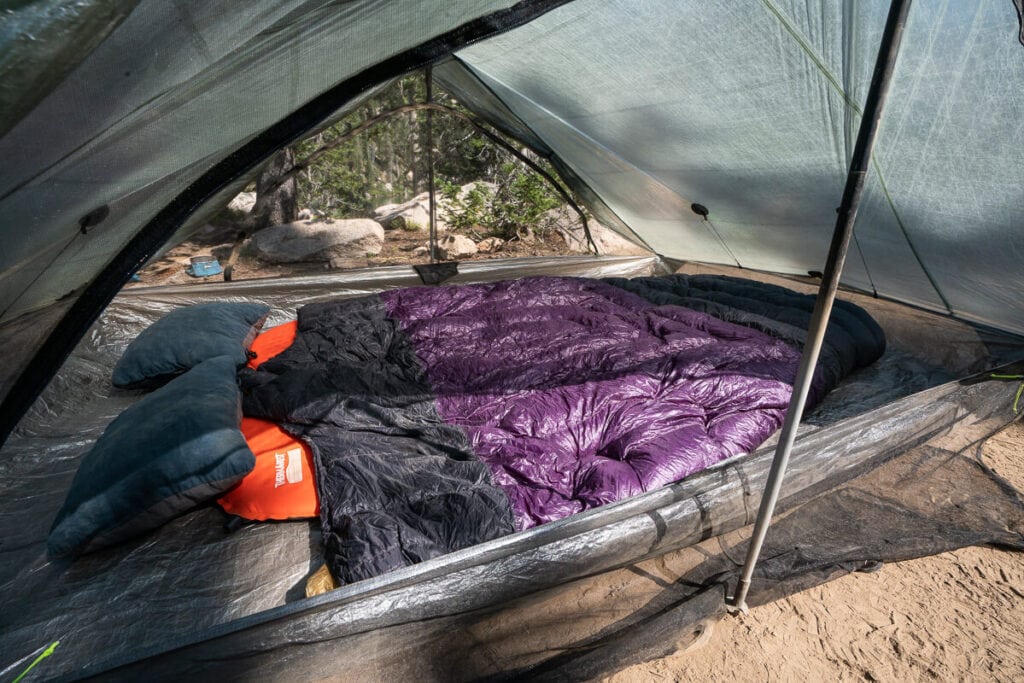
Enlightened Equipment two person sleeping quilt for backpacking laid out in tentEnlightened Equipment two person sleeping quilt for backpacking laid out in tent
Backpacking in Stanley Idaho, using the Enlightened Equipment Accomplice Quilt, which is just like the Revelation except it’s made for 2 people.

Nemo Disco 30

Best for Side Sleepers

Key Features

  • Weight: 2 lbs, 4 oz
  • Temperature Rating: 30°F (also available in 15°F)
  • Insulation: Down certified to the Responsible Down Standard (RDS)
  • Shell: 30-denier ripstop nylon
  • Shape: semi-rectangular
  • Price: $279.95

Where to shop

  • Great for: side and stomach sleepers, people who toss & turn, 3-season backpacking
  • What we like: provides maximum comfort, roomy to move around, pillow pocket, foot box is made of PFAS-free waterproof materials which is helpful in protecting the bag against tent condensation
  • What we don’t like: doesn’t compress down super well, roomy bags take longer to warm up, loose-fitting stuff sack

The NEMO Disco 30 is one of the most popular backpacking sleeping bags on the market for side sleepers because of the wide cut at the elbows and knees. When you roll over in the middle of the night, it gives you plenty of room to bend your legs and arms so you don’t feel constrained.

This bag has vents on the chest that you can open or close in order to regulate your body temperature without having to unzip the side of the bag.

This new version of the DISCO comes with an “endless promise” – meaning it was designed to stay out of landfills. The entire bag is recyclable (although I suggest repairing or donating if you don’t need it anymore).

People love that this bag can also be zipped together with another NEMO bag (one right zip and one left zip bag will zip together), creating a two-person cocoon.

The thing I don’t like about this bag is it’s heavier than the other bags on this list. The Enlightened Equipment quilt that I mention above is also great for side sleepers and a lot lighter. But if you are a side sleeper set on a traditional sleeping bag, this one is your ticket!

Marmot Trestles Elite Eco 20 Sleeping Bag

Best Synthetic Backpacking Sleeping Bag

Key Features

  • Weight: 2 lbs 10.8 oz
  • Temperature Rating: 20°F
  • Insulation: Recycled polyester
  • Shell: Recycled polyester
  • Shape: mummy
  • Price: $169

Where to shop

  • Great for: 3-season backpacking, vegans, wet weather camping, beginner backpackers
  • What we like: budget-friendly, holds up better than down in wet weather
  • What we don’t like: one of the heaviest and least compressible sleeping bags on our list

The Marmot Trestles Elite Eco 20 Sleeping Bag is a great 3-season bag that offers all-synthetic construction that will keep you warm even in wet camping conditions.

If you are fully vegan and don’t use gear made with animal products, this Marmot sleeping bag is one of the best options available. It’s lighter than other synthetic options, and at $169, it’s also a great price point.

This bag is made from recycled materials, making it a sustainable choice for environmentally-conscious campers. Additionally, the bag features a unique wave construction that helps to eliminate cold spots and provides excellent insulation.

My partner Ryan owns the men’s version of this bag, and he finds it very comfortable. What he doesn’t love is how bulky it is. He says “while budget-friendly, this bag takes up a lot more space in my backpack and is heavier than the down sleeping bags I own.”

Additionally, some users have reported that the bag’s zipper can be difficult to use, which can be frustrating when trying to get in and out of the bag. Despite these minor drawbacks, this bag remains a great choice for anyone looking for a sustainable and reliable synthetic, vegan-friendly sleeping bag.

two sleeping bags set up inside a tenttwo sleeping bags set up inside a tent
The Marmot Trestles is the blue sleeping bag on the left.

Mountain Hardwear Phantom 0F

Best 4-Season Sleeping Bag

Key Features

  • Weight: 2 lb 10.6 oz
  • Temperature Rating: 0F
  • Insulation: 850-fill down
  • Shape: mummy
  • Price: $650

Where to shop

  • Great for: winter backpacking, cold weather trips, people who run cold at night
  • What we like: warmest bag on our list, fairly compact for how warm it is
  • What we don’t like: expensive investment, bag is quite narrow

The Mountain Hardwear Phantom 0F Down Sleeping Bag is my choice for winter backpacking due to its high-quality insulation and efficient design. With a temperature rating of 0F, this sleeping bag is specifically designed to keep you toasty warm in cold winter conditions.

At 2 lbs, 6oz, it’s very light and compressible for a 0 degree bag. The bag is filled with high-loft down that provides excellent insulation and is still easy to pack and carry. Additionally, the bag features a draft collar and hood that help to trap heat inside and keep you comfortable throughout the night.

For temperatures down to 0 degrees, you can’t find a sleeping bag better than this one. It may be at the top of your price bracket at around $650, understandably. But, with proper care, this sleeping bag should last you a very, very long time.


How to Choose a Backpacking Sleeping Bag

Picking out a new backpacking sleeping bag for any outdoor adventure can be super overwhelming. There are so many choices and so many features to consider, not to mention the price tag. So, I’ve put together this simple guide on how to choose a backpacking sleeping bag for your next great adventure. Hopefully, this makes your gear-buying process easier.

Sleeping Bag Temperature Rating

The sleeping bag temperature rating is the first place to start when picking out a new backpacking sleeping bag. Think about when and where you plan to use it the most.

Sleeping bags can be broken down into three simple categories: summer, 3-season, and winter based on the temperature ratings shown in the table below.

Sleeping Bag Temperature RatingsSleeping Bag Temperature Ratings
Photo source: REI.com

If you are buying your first backpacking sleeping bag, I recommend a 3-season bag which will keep you comfortable for most of the year. Remember you can always zip down the bag for a summer camping trip or add a sleeping bag liner to your bag for an occasional winter camping trip. Most 3-season backpacking bags will list two temperature ratings known as the “comfort rating” and the “lower-limit rating”.

Comfort rating is the lowest temperature at which the bag will keep the average woman or “cold sleeper” comfortable. Lower-limit rating is the lowest temperature at which the bag will keep a man or “warm sleeper” comfortable. Women tend to run colder and for women’s sleeping bag ratings that is often taken into account. Note that ratings are based on a sleeper wearing one long underwear layer and a hat, and sleeping on a single one-inch thick insulating pad.

The number listed with most sleeping bags (example: Nemo Disco 30) is the Lower Limit which is usually 10-15 degrees lower than the Comfort Rating. So, for most people, the Nemo Disco 30 would be comfortable in 40F sleeping temperatures.

Group of people sitting on rocks cozy in their sleeping bagsGroup of people sitting on rocks cozy in their sleeping bags

Sleeping Bag Shape

While the sleeping bag shape might not seem important, it is for two big reasons:

First, sleeping bags keep you warm by trapping air and holding it in a layer next to your body. Your body heats up this layer of trapped air to keep you warm. The less air space there is in the bag, the faster you warm up and stay warm! Picking a bag based on your body size and shape is important for efficiency and warmth. Roomier sleeping bags will often be heavier as well, but they will be more comfortable for side-sleepers.

I recommend selecting a semi-rectangular bag or mummy bag which is versatile and can work for backpacking as well as car camping. Semi-rectangular bags are good for backpackers with larger frames or those who don’t like the constrictive feeling of a mummy bag.

To Quilt or Not to Quilt?

Some lightweight backpackers won’t even entertain the idea of a sleeping bag, and instead, opt for a camping quilt. Quilts are a lightweight backcountry option generally designed to be paired with a sleeping pad. It’s basically a blanket with a foot box that will keep you warm without any unnecessary insulation or weight. Quilts offer a better warmth-to-weight ratio since they cut out material that’s normally compressed under your body in a traditional mummy bag.

However, quilts can be more drafty than mummy bags, so in really cold or windy conditions we’d opt for a mummy bag. Be sure to check out Enlightened Equipment if you’re interested in going ultralight with a sleeping quilt. This is the quilt I’ve been using for years, and I’m not sure I’d ever go back to a normal sleeping bag in the summer months.

a backpacking tent set up next to the ocean with a purple 2-person backpacking quilt laid outa backpacking tent set up next to the ocean with a purple 2-person backpacking quilt laid out
I personally use the Enlightened Equipment Accomplice Lightweight Two Person Quilt which weighs less than 2 separate bags

Synthetic vs. Down Sleeping Bag Insulation

Since switching to a plant-based diet and eliminating all animal products from my diet, I’ve also questioned whether or not to switch out my outdoor gear made from animals – one of the biggest culprits being down (feathers). I have outlined the key differences and pros/cons below, but you can deep dive into the ethics of buying/using down in this blog post to help you understand the ethics and sustainability behind down feathers.

Synthetic Backpacking Sleeping Bags

Synthetic sleeping bags are usually insulated with polyester. Synthetic bags are quick-drying and still hold up to their insulation power even when damp or wet. Often, they are cheaper than down, and they’re non-allergenic. One of the downsides of synthetic bags is that they don’t compress as small as down sleeping bags, and they tend to be heavier than down (but that’s not always the case as technology improves). Also, polyester is usually derived from petroleum, although recycled polyester is now being made from plastic bottles and other recycled plastics for more sustainable options.

Person compressing sleeping back into stuff sack next to tent while backpackingPerson compressing sleeping back into stuff sack next to tent while backpacking
Using a compression sack can help reduce the space a bulky sleeping bag will take up in your backpack

Down Backpacking Sleeping Bags

The biggest advantage of down over synthetic sleeping bags is that down bags tend to be lighter and compress smaller when packed away – key characteristics when you’re looking for a backpacking sleeping bag.

Generally down is more expensive than synthetic, and some people say it’s more durable, so it’s a long-lasting investment. The primary downside to down is that it loses its insulation power when it gets wet. So, it’s most suited for cool, dry conditions. However, many down sleeping bags are now coated with a water-repellent finish that will keep you warm and dry in damp conditions. Otherwise, down sleeping bags are a lightweight, warm, and packable choice for backpacking.

Most of the notable outdoor gear companies have instituted the Responsible Down Standard (RDS), or Global Traceable Down Standard (TDS). These standards ensure that the down and feathers used in these products came from animals that were treated well, and were not force-fed or live-plucked. All of the down sleeping bags listed here are certified to the RDS or TDS.

Woman lying in hammock next to river with blue water of Havasu Creek bundled in sleeping bagWoman lying in hammock next to river with blue water of Havasu Creek bundled in sleeping bag
Cozy in my REI Down Sleeping bag next to Havasu Creek

Frequently Asked Questions

What temperature sleeping bag should I get?

You should choose a sleeping bag that is going to warm enough in the variety of climates you plan to backpack in. Typically for mountain backpacking, I’d suggest a 15-degree bag. Even in summer, the temperatures in the mountains can reach freezing, so a 30-degree bag might not be warm enough if you experience bad weather.

What is the best type of sleeping bag?

It depends on your priorities. If you are on a budget and don’t mind carrying a little extra weight, you can choose a synthetic sleeping bag. Synthetic sleeping bags also insulate better if they happen to get wet, although this is a situation that you should avoid at all costs. If you are looking for a sleeping bag that is lightweight and will compress well, you should choose a down sleeping bag. For these reasons, down is the most popular type of sleeping bag for backpacking.

How much does a good sleeping bag cost?

You should expect to pay somewhere around $300-450 for a sleeping bag that has a temperature rating of 15 degrees, weighs under 3 pounds, and compresses well so it doesn’t take up a lot of room in your pack. Sleeping bags with higher temperature ratings (such as 45 degrees) will cost less simply because they require less insulation and materials to produce. The lighter the sleeping bag is for a given temperature rating, the most it will cost.

What should I wear in my sleeping bag?

It is warmer to wear clothes in side your sleeping bag than to not wear clothes. If you are looking to add warmth, you should wear long johns made of wool or synethic materials and thick wool socks. If you are still cold, I’d recommend adding a down or synethic jacket and a beanie.

Does the size of my sleeping bag matter?

Yes! If you are 5’5″ like myself and decide to borrow a sleeping bag from someone who is over 6’0″ tall, all of that extra space will make the bag feel drafty. You want a sleeping bag that is the right size for your height and width in order to provide proper insulation.

Save this post to Pinterest


Source link

2023 Toyota RAV4 Prime XSE: Test Drive | The Daily Drive

0


2023 Toyota RAV4 Prime XSE
2023 Toyota RAV4 Prime XSE in Silver Sky Metallic

Consumer Guide Automotive 2023 Toyota RAV4 Prime XSE AWD

Class: Compact Crossover

Passenger capacity: 5

Color: Silver Sky Metallic

CG Report Card
Room and ComfortB+
Power and PerformanceA
Fit and FinishB+
Fuel EconomyA
ValueB
Report-card grades are derived from a consensus of test-driver evaluations. All grades are versus other vehicles in the same class. Value grade is for specific trim level evaluated, and may not reflect Consumer Guide’s impressions of the entire model lineup.
Big & Tall Comfort
Big GuyB-
Tall GuyB-
Big & Tall comfort ratings are for front seats only. “Big” rating based on male tester weighing approximately 350 pounds, “Tall” rating based on 6’6″-tall male tester.
Drivetrain
Engine Specs302-horsepower, 2.5-liter
Engine Type4-cylinder, plug-in hybrid
TransmissionCVT Automatic
Drive WheelsAWD

Miles driven: 101

Real-world fuel economy: 36.2 mpg

Driving mix: 65% city, 35% highway

EPA-estimated fuel economy: 94 MPGe/38 mpg (city/highway combined)

EPA-estimated EV range: 42 miles

Fuel type: Regular gasoline recommended

Base price: $46,210 (not including $1335 destination charge)

Options:  Weather Package ($375), Premium Package ($2585), carpet mats ($309), wheel locks ($65), roof-rack cross bars ($315), fog-light accents ($100)

Price as tested: $51,294


Quick Hits

The great: Impressive power, efficient operation

The good: Quiet and classy cabin, simple infotainment-control system

The not so good: Pricey compared to other RAV4s, a tight fit for the big & tall


Tom Appel:

If you’ve been shopping for a plug-in hybrid vehicle, there’s a good chance you’ve learned that the Toyota RAV4 Prime is difficult to come by. This isn’t surprising, as Toyota’s compact plug-in crossover is (spoiler alert) a fine vehicle, and one that asks little in exchange for its power and efficiency. Here’s some good news: The RAV4 Prime supply seems to have loosened up. More on that in a moment…

2023 Toyota RAV4 Prime XSE

A little background on the Prime: Toyota’s very-popular RAV4 is offered with three powertrains, each of which falls into a fairly well-defined price and performance class. “Standard” RAV4s are powered by Toyota’s ubiquitous 2.5-liter 4-cylinder engine. In the RAV, the 2.5 is good for 203 horsepower. Non-plug-in Hybrid versions of the RAV4 combine the aforementioned 4-cylinder engine with two electric motors for 219 net horsepower. Finaly, the RAV4 Prime mates what is essentially the Hybrid drivetrain with an 18-kWh battery. The Prime system is rated at 302 net horsepower, and allows for an EPA estimated 42 miles of electric-only gas-free operation. Note that all RAV4s make use of a CVT automatic transmission, and that Hybrid and Prime models come only with AWD.

While standard and Hybrid RAV4s are offered in seven trim levels each, the Prime comes only in high-zoot SE (starting around $45,000), and near-luxury XSE ($49,000).

2023 Toyota RAV4 Prime XSE

Consumer Guide recent spent a week behind the wheel of a 2023 RAV4 Prime XSE with the feature-packed Premium Package in Silver Sky Metallic. Including a few additional options and the destination charge, our test RAV4 came to $51,294. This is about all you can spend on a RAV4.

2025 Chevrolet Equinox: First Look

2023 Toyota RAV4 Prime XSE

Though the RAV4 can look a little pedestrian in lower trim levels, the Prime comes only in premium trim levels, and sports a decidedly upscale cabin as a result. Our test car’s black leather upholstery was finished with contrasting red stitching, and the soft-touch dash and door trim was punctuated with a lean dose of bright metal-finish accents. The overall look is one of sporty, clean, efficiency. Also, the rubber edged climate-control knobs had a hefty, substantial feel missing from many in-cabin control systems these days.

One ding on the RAV4 is that the front-row seating area is among the stingiest in the class in terms of space. Though we have awarded the RAV4 “Big & Tall” honors, it is cramped for larger folk compared to popular segment rivals including the Honda CR-V and Nissan Rogue. While our 6-foot, 5-inch tester found headroom limited, our largest driver found that the RAV’s wide center console cut into seating space. If you’re outside the statistical norm size-wise, before sure and take an extra-long test drive and see how well you fit. That said, rear-seat passenger space is borderline generous, and will easily accommodate most folks for even extended drives.

Toyota’s touchscreen infotainment system works well and is easy to decipher at a glance. Touch inputs register promptly, and screen icons are large and easy to read. We’re happy to report that climate functions are still manipulated via real buttons and knobs located below the touchscreen. Their operation is also simple and logical.

Though ostensibly a vehicle designed to be efficient, the RAV4 Prime has earned fawning praise for its straight-line acceleration. Toyota quotes a 0-60 mph time of just 5.7 seconds, while popular buff-book magazines put the figure even lower than that. Suffice it to say that the RAV4 Prime scoots away from a stop light with impressive vigor, and makes easy work of passing and merging. Additionally, the interplay of the gasoline and electric motors is mostly seamless, something which cannot be said some other plug-in hybrid vehicles.

2025 Toyota Crown Signia: 2023 Los Angeles Auto Show

2023 Toyota RAV4 Prime XSE

On a full charge, our test Prime travelled about 40 miles before the gasoline engine kicked, which is inline with the EPA’s range estimate. Note that if purchase a RAV4 Prime and choose not to install a level-2 charger, fully replenishing your RAV’s battery will take about 15 hours using a standard home wall outlet.

Note that the Prime actually delivers somewhat lower fuel-economy numbers than the conventional RAV4 Hybrid when running on gasoline. It is for this reason that plugging in your RAV4 Prime is key to extracting its full value. If you cannot commit to regularly plugging in your Prime, we strongly suggest opting for the excellent RAV4 Hybrid instead, it, too, will go easy on the gas, and cost less than the Prime, as well.

On the road the RAV4 Prime rides well, and is impressively quiet at speed. Handling never exceeds our “adequate” rating however, as the Prime feels competent in corners and on on-ramps, but doesn’t invite playful engagement. Frankly, it’s not especially fun to drive on curvy roads, despite all the available power. If it were our decision, the Prime would enjoy firmer, more direct-feeling steering, and less lean in aggressive cornering. That said, we suspect the RAV4 Prime chassis is tuned exactly the way most consumers would want it to be.

Note that our evaluation is of a 2023 RAV4 Prime. Save for pricing, very little has changed for 2024, so our impressions of the Prime reflect the vehicles on lots now. And speaking of those vehicles on lots now…we’re finding that while shoppers are still ordering their Primes, inventory is finally catching up with demand, and that it is possible to find an example at your local dealer—though it may not be the exact color/trim level you’re looking for. If not, order times have reportedly down, too.

If you’re not especially big or tall, and you promise to plug your plug-in hybrid in, the RAV4 Prime has the makings a fine, efficient, speedy, small-family crossover with upscale cabin trimmings, and healthy dose of long-trip comfort.

2023 Toyota Corolla Cross Hybrid SE: Test Drive

2023 Toyota RAV4 Prime XSE

Listen to the Car Stuff Podcast

Follow Tom on Twitter

2023 Toyota RAV4 Prime XSE Gallery

Click below for enlarged images

2023 Lexus NX 450h+: Guest Drive

Consumer Guide Car Stuff Podcast Episode 214: Tesla Abandons $25,000 Model, Jill Drives the Alfa Romeo Stelvio, Talking to the EVP of SUV Startup Ineos


Source link

Consumer Guide Car Stuff Podcast Episode 215: Off-Road in the Toyota Tacoma, GM is Moving, Why Electric Vehicles Need Special Tires | The Daily Drive

0


Electric vehicles need special tires. Here’s why:

Electric Vehicles Need Special Tires
Consumer Guide Car Stuff Podcast – Electric Vehicles Need Special Tires

Whether you drive a car, need a car, or just occasionally bum a ride with friends, you’’ve come to the right place. Join Jill and Tom as they break down everything that’’s going on in the auto world. New-car reviews, shopping tips, driving green, electric cars, classic cars, and plenty of great guests. This is the Consumer Guide Car Stuff Podcast.


Episode: 215

Broadcast date: April 15, 2024

Guest: David Zanig, Brad Heim

–

Off-Road in the Toyota Tacoma,

GM is Moving,

Why Electric Vehicles Need Special Tires

 –

Brendan Appel of the Sons of Speed sits in for Jill this week. The hosts covered a number of topics in the first segment, including the news that General Motors will be moving out of the Renaissance Center—which it has occupied since 1996—for a new building in Downtown Detroit. Brendan and Tom also discussed the origin of Alfa Romeo’s Verde Montreal color, which turns out to be an homage to an historic brand offering.


Still in the first segment, Tom lamented the challenge of dealing with “inherited music,” a song which starts from the middle when the car is started. Brendan will restart a song if it is worthy, while Tom, as it turns out, always advances to the next song.


Brendan went on to share his impressions of the new-for-2024 Toyota Tacoma, noting that even lower trim-level versions of Toyota’s midsize pickup perform well in off-road driving. Brendan discussed the finer points of the redesign, including the move to a coil-spring rear suspension, and small turbocharged engines.


In the second segment Brendan and Tom talk to the folks at Goodyear about electric-vehicle tires. Joining the crew are David Zanig, Goodyear’s Senior Director of Tire Technology, and Brad Heim, Vice President for Product Development. Listen in to learn why EV tires are different from those found on conventional vehicles.


In the last segment Brendan is subjected to Tom’s “Which Sold Better” quiz. Brendan wrapped up the show discussing dash-cam use, and the terrible driving he witnessed on a recent road trip.


More about the Alfa Romeo Montreal

More about the Renaissance Center

More about the 2024 Toyota Tacoma

Goodyear

Nextbase 622GW Dash Cam Review

We are Motor Drive (home of the Sons of Speed)


Source link

Leafy Greens & Lean Meats: 10 Luxury Culinary Experiences in Singapore

0


The luxury dining industry is a multi-billion dollar business that thrives on setting up experiences alongside serving up exquisite meals. The sensory experience of sight and sound is just as important as taste and smell when it comes to indulging in gastronomic excellence. In line with LUXUO’s Green Issue, the notion of “green” forms a dual meaning here — green denotes healthier appetites and healthy profit margins from ambitious restaurants and new culinary experiences in Singapore.

COMO Cuisine

COMO Cuisine at COMO Orchard offers diverse, contemporary fare inspired by time-tested recipes, made with the freshest in-season ingredients. Alongside well-loved classics like Lobster Biryani and Pad Thai, and new dishes including Tuna Niçoise Tartine and Green Curry, guests can explore an extensive selection that honours Singapore’s vibrant culinary landscape. From comforting Soto Ayam and wok-fried dishes to tandoori classics and creamy lobster rolls, COMO Cuisine promises an all-day dining experience that indulges the senses.

Address: Level 2, 30, Bideford Rd, COMO Orchard, 229922

COMO – Cedric Grolet

Ced́ric Grolet Singapore at COMO Orchard is Grolet’s fourth shop after his Paris (La Pat̂ isserie du Meurice par Ced́ric Grolet, Ced́ric Grolet Opera) and London (Ced́ric Grolet at The Berkeley) openings. Voted best pastry chef in the world by Grand Tables du Monde and World’s 50 Best Restaurants, he is renowned for his trompel’œil artistry. Grolet’s exquisitely modern creations are beloved by pastry fans worldwide and have garnered an astounding following of 8.2 million on Instagram alone.

Step into the twin universes of fruits and flowers, where every piece on display is a feast for the eyes and tastebuds. Alongside a selection of pastries and sandwiches, Grolet has created a series of Singapore exclusives and a special tea menu inspired by the unique tropical fruit of Southeast Asia. The Lychee and Dragonfruit are crafted in his signature trompel’œil style, while his take on the Mooncake showcases his impeccable detailing, and playful use of flavours and textures.

Address: 30 Bideford Rd, Level 1 COMO Orchard, Singapore 229922

HighHouse

Does dining at high altitudes truly elevate the senses and tastebuds? HighHouse is a nightlife and culinary destination set amid the Singapore skyline where music, art, flavours, and conversations intersect. Located across Levels 61 and 62 of One Raffles Place, HighHouse offers unparalleled views of the Singapore skyline, making it the ultimate setting for meaningful connections, impeccable service, exceptional cocktail and culinary experiences, coupled with a progressive soundscape by renowned and emerging music selectors from Singapore and beyond.

Drawing on flavours from around the Pacific Coast, a menu developed by executive chef Sam Chin offers small and large sharing plates such as Seafood Kokoda Ceviche, Whole Spanish Dover Sole with Homemade Chai Poh and Sakura Pork Belly in Massaman Curry served with Sticky Rice. The food is best paired with a flute of bubbles or signature cocktails by award-winning bar specialist and beverage consultant to HighHouse, Jay Gray. They are created with the ingredients’ Pacific Coast origins in mind, such as the Peruvian Clarified Pisco Punch with Key Lime Foam and Japanese Seaweed Umami Martini.

Also making its introduction in 2024 is NOVA, the tallest rooftop bar in Singapore located at Level 63 just above HighHouse, with an unrestricted 360-degree panoramic view of Singapore. Perched atop one of Singapore’s iconic skyscrapers, NOVA is the perfect vantage point through the heart of the city to experience the grandeur of Singapore’s night sky and urban brilliance.

Address: 1 Raffles Pl, L61-62, Singapore 048616

Roia

Inspired by the river Roya, Roia is a culinary journey set in Singapore’s UNESCO World Heritage Botanic Gardens’ E.J.H. Corner House. This historic building is now home to Ro.ia — a new gastronomic jewel. Under the helm of chef Priyam Chatterjee, Roia invites diners to enjoy his menu which is infused with international influences and is meticulously crafted with creativity and refinement, reflecting his deep passion and exceptional mastery of French cuisine and savoir-faire.

Preserving its heritage and environment, Roia magnifies its opulent setting with a refined culinary escape. Chef Priyam, through his originality, leads guests on an exceptional culinary journey, transforming each dish into a delicate ode to the splendour of Singapore.

Address: 1 Cluny Road, E J H Corner House, Singapore Botanic Gardens

JAG

 JAG is a Michelin Star contemporary french fine dining restaurant with a discovery degustation approach centered around guests’ dietary inclinations. Founded by chef Jeremy Gillon and restaurateur Anant Tyagi, JAG nestles in a beautifully restored 19th-century warehouse overlooking the Singapore River at Robertson Quay. The restaurant’s culinary centerpiece is the La Balade du Végétal or The Vegetable Journey, a découverte menu of edible botany, picked at their seasonal best and served in a variety of techniques showcasing their exquisite natural flavours, with protein to round off. 

JAG embraces the greenery of luxury vegetarian cuisine. Aside from the array of green asparagus, peas, and flavourful fennel, JAG also incorporates a fragrant selection of Garlic, among many other wonderful fruits and vegetables into their dishes. When it comes to a vegetable and protein pairing, JAG’s top dishes include the Japanese Black Cod, the hearty Castaing Foie Gras, and the sweet and saline Danish Langoustine among many other beautiful selections. JAG aims to curate a unique experience with these vegetarian and non-vegetarian ingredients, honouring the several artisans who grow the produce.

Address: 41 Robertson Quay, #02-02 STPI Creative Workshop and Gallery, Singapore 238236

Kou Teppan

Kou Teppan has a one-of-a-kind dual teppan dining experience featuring seasonal ingredients prepared on both main and personal teppan griddles. The main teppan griddle sets the stage for Kou Teppan’s skilled chefs to expertly prepare dishes with finesse and flair all at a vantage point of viewing diners. Selected dishes are then prepared on the private teppan griddle in front of diners, allowing an interactive session where diners are granted the freedom to tailor their meal to their liking.

Helmed by Chef Sawada Ko, who has carved a name for himself as a former executive chef at Itoh Dining by Nobu and has worked alongside the legend Chef Nobu Matsuhisa himself, Kou Teppan’s menu is an amalgamation of his years of pursuit for bold flavours and exciting ingredients. He brings the teppanyaki craft of Kanagawa prefecture, of which he has been perfecting for the past 15 years.

Address: 1 Kim Seng Promenade, #B1-134 Great World, Singapore 237994

VUE

Situated in the heart of Singapore’s Central Business District, VUE is a niche bar and grill that makes for an idyllic backdrop for power lunches, intimate celebrations, and corporate functions alike. Its location on the penthouse of OUE Bayfront provides it with some of the most stunning views of Marina Bay and the Singapore skyline that, combined with its binchōtan-grilled specialities and the city’s first rooftop spritz bar, makes it the place to sip, savour, see and be seen. VUE introduces an all-new executive set lunch menu, with up to five courses to choose from, spotlighting on grilled specialties, served alongside cold appetisers, hot appetisers, signature risotto and dessert for lunch that meets all appetites and budgets.

Address: OUE Bayfront, Level 19, 50 Collyer Quay, Singapore 049321

Araya

Araya is Singapore’s first South American fine dining restaurant and delivers a culinary odyssey rooted in Chilean South Pacific cuisine with indigenous and Japanese ingredients. Araya expresses the soulful heritage and journeys of Chefs Francisco Araya and Fernanda Guerrero through Chile, South Pacific, and Japan. Each creation embodies love and deep respect for provenance and seasonality anchored by South American and Japanese ingredients, and exceptional techniques.

Address: Mondrian Singapore Duxton, 83 Neil Road. #01-08, Singapore 089813

Peach Blossoms

Enter a new era of Chinese dining at Peach Blossoms, where the expertise of executive Chinese chef Edward Chong breathes new life into classic recipes. Melding both new and old techniques, chef Edward updates familiar comfort flavours and keeps them relevant to today’s palates based on his over 20 years of experience in the industry. The contemporary menu at Peach Blossoms strikes a delicate balance between honouring the rich culinary traditions of the past and embracing the present.

Address: 6 Raffles Blvd, Level 5 PARKROYAL COLLECTION Marina Bay, Singapore 039594

Imbue

Time-honoured yet distinct, Imbue is a contemporary European restaurant with a progressive take on Asian flavors. Western techniques lend finesse to execution, transforming fine ingredients into multi-layered dishes centered on Asian sauces. Conveying novel perspectives, Imbue is an innovative yet heartfelt celebration of cultural heritage.

Address: 32 Keong Saik Rd, Singapore 089137

For more on the latest in luxury gastronomic reads, click here.


Source link

A Clash of Supercar Titans

0


Ferrari and McLaren are known for their engineering prowess and track pedigree, these manufacturers continually push the boundaries of automotive innovation. In a head-to-head showdown brought to us by CAR magazine on YouTube, the Ferrari 296 GTB and the McLaren 750S go toe-to-toe, each aiming for supremacy in the fiercely competitive supercar market.

On paper, the Ferrari 296 GTB boasts an impressive 819 horsepower, derived from its cutting-edge 3.0-liter twin-turbo V6 plug-in hybrid powertrain. In contrast, the McLaren 750S churns out 740 horsepower from its classic 4.0-liter twin-turbo V8 engine. Despite the power differential, the McLaren holds its own thanks to its lighter weight, tipping the scales nearly 200 kilos lighter than the Ferrari.

But how does these numbers translate into real-world performance? Ben Barry from CAR magazine take these two supercars for a drive to compare their speed, performance, handling, and pricing, to determine the best choice between one of them.


Source link

The Rise of Green Consciousness and Organic Products

0


The rising demand for organic products signals a shift in the growing trend of eco-conscious consumption patterns. Brands across the board from natural wines, organic beauty, electric cars, and sustainable fashion have to adapt to meet this bourgeoning sector within the luxury fashion, grooming and lifestyle industries. In honour of Earth Day on the 22 April 2024, LUXUO lists the latest offerings for a plethora of green-loving consumers. This list goes beyond a product catalogue but rather, gives an insight into brands and their increasingly sustainable policies.

Fashion

Louis Vuitton’s LV Trainer

The new iteration of Louis Vuitton’s LV trainer melds sustainability into its new graphic silhouette, made from 90 percent recycled and bio-sourced materials. Available in three colour variations, the LV Trainer is adorned with the Maison’s signature Sustainable Development logo. The shoe is the continuation of the the eco-design legacy the late Virgil Abloh left behind. Manufactured in the Louis Vuitton workshop in Fiesso d’Artico, Italy, using a highly complex process, the sneakers blend eco-design with fine craftsmanship, in accordance with the codes of circular creativity.

LOEWE Paula’s Ibiza Woven Bag

LOEWE Paula’s Ibiza collection is inspired by the counter-cultural movement of the 1970s. 2024 sees the new updated version of LOEWE Paula’s Ibiza deploy a playful wardrobe suited for summer occasions both in the city or on holiday, for music festivals and summer strolls. LOEWE has pledged to make a donation for every basket bag sold to the local communities who handweave them. The donation will help to provide university scholarships in Colombia, build a craft training school in Madagascar, and provide humanitarian relief following the 2023 earthquake in Morocco.

Grooming

Maison Margiela Replica “From the Garden” Fragrance

If you could encapsulate the smell of a freshly pruned summer garden, this would be it. Margiela’s new “From the Garden” fragrance is an uplifting scent that evokes the joyful feeling of reconnecting with nature, hands in the earth — an afternoon spent in the garden. A crisp, sunny afternoon in a blooming garden in Puglia, Italy — hands dug deep in the soil, harvesting tomatoes and the tranquil moment spent amidst lush nature. The ingredients include naturally and sustainability sourced geranium and patchouli that evoke the earthy scent of soil and freshly harvested fruit.

Caudalie Vinosun SPF 50 Invisible High Protection Stick 

Caudalie debuts its new vegan, fragrance-free, family-friendly “Vinosun SPF 50 Invisible High Protection Stick”. The SPF is formulated with organic filters to provide effective UVA/UVB protection for the whole family. Water-resistant, invisible and fragrance-free, it is also suitable for children aged three and above and glides smoothly over the face, lips and sensitive areas like moles, tattoos and scars. Under the “100 percent Plastic Collect programme”, Caudalie continues its commitment to collecting and recycling as much plastic from the ocean as it generates as a brand. The amount of plastic it uses has been stable since 2019 despite the company’s growth and 1710 tonnes of plastic have been collected since 2020, reducing the brand’s plastic footprint.

Esmi Skin Minerals

Crafted with carefully chosen ingredients for holistic benefits, esmi Skin Minerals addresses skin concerns while enhancing natural beauty with clean, high-quality formulations.  Guided by its “be kind to your skin” philosophy, the brand prioritises protecting and nurturing the skin’s barrier and microbiome. In 2022, they furthered their commitment by investing in a microbiome lab to develop specialised blends and conduct research on persistent skin issues. In essence, esmi Skin Minerals advocates for saying no to harsh chemicals that strip the skin’s natural defences, emphasizing that good skin begins with nurturing a healthy skin biome. 

Cars

Maserati Folgore Day The Trident

Folgore Day officially marks the brand’s entry into the new electric dimension. Folgore Day is the starting point for Maserati’s luxury consumers to whom the Trident’s electric offer is aimed. This is the continuation of Maserati’s journey of electrification, innovation, luxury and excellence in the best Italian tradition, on which Maserati has embarked in the last year with the launch of its 100 percent electric models: GranTurismo Folgore, the Trident’s first all-electric car; Grecale Folgore, the first SUV powered by a full-electric powertrain; and now, GranCabrio Folgore. By 2028, the entire Trident range will have been fully electrified, as announced by Maserati in early 2024 when it shared its long-term strategic vision, including a growth plan aimed at honing in on sustainability to further the brand into the future, with the focus on the constant evolution of the brand and its products.

Automobil Lamborghini

Automobil Lamborghini has renewed its historic logo. This evolution is part of Lamborghini’s new trajectory focused on sustainability and decarbonisation. Lamborghini aims to “create a solid pact with future generations, serving as an inspiration and model for innovation and sustainable progress”. With this in mind, the House of Sant’Agata Bolognese is implementing changes that involve not only the cars, but the corporate identity as a whole, thus impacting the company’s culture and values, which will also see a new expression in terms of all the visual aspects. This revamped version of the logo becomes an integral part of the company’s distinctive identity and will also be applied on future cars. In addition, the iconic bull in the center of the logo has undergone a major transformation. For the first time, it will exist individually on the company’s digital touchpoints, separated from the classic shield to lend it even greater prominence

Alcohol & Lifestyle

Avaline

Avaline is a globally recognised, 100 percent vegan wine brand founded by actress Cameron Diaz and Katherine Power. The delicious, organically farmed wines are as the brand describes “full of natural goodness” and free from unwanted and undisclosed extras including concentrates, colors, or added sugars. The brand works with growers who rely solely on nature to grow healthy fruit, free from synthetic pesticides. Avaline also raises the standard for transparency in winemaking by a full ingredient list on every bottle including calorie, carbohydrate, fat, protein, and sugar facts on every Avaline label.

Samsonite

It goes without saying that Samsonite has made a name for itself in the realm of sustainable lifestyle and travel luggage bags. However, Samsonite’s Suntec City store in Singapore is the brand’s first-ever store that offers a sustainable alternative approach and a first of its kind in Asia.

Samsonite’s Suntec City outlet’s external facade is fabricated from recycled aluminium from a supplier known for producing luggage made of recycled aluminium. The cashier counter is fashioned from plastic waste that undergoes a process of cleaning, shredding into flakes, and then reforming and designing into a new cashier counter. The shelves are made from recycled plastics that were intentionally crafted to look identical to the current glass and laminate sheets. A first of its kind for the brand in Asia, the store is a testament to Samsonite’s commitment to leading the sustainable transformation of the lifestyle bag and travel luggage industry. 

The Samsonite Suntec City store will also be part of Samsonite’s annual Luggage Trade-in campaign. With every successful Luggage Trade-in transaction, SGD10 will be donated to WWF-Singapore’s Earth Hour campaign to build a nature-positive, net-zero carbon, and equitable future.

For more on the latest sustainability-related reads, click here.


Source link

2025 Maserati GranCabrio Folgore: Convertible grand tourer goes electric

0


The 2025 Maserati GranCabrio Folgore has been revealed, becoming one of the few electric convertibles on sale globally.

At present, the MG Cyberster is the only mass-produced electric convertible on sale – if you don’t count the GMC Hummer EV, which features four removable roof panels.

As with petrol-powered versions of the Maserati GranCabrio, it’s a simple equation: take the GranTurismo coupe and replace its fixed roof with a soft top.

Under the skin, the electric models are identical, both featuring tri-motor layouts with up to 610kW of power in ‘MaxBoost’ mode, or 560kW and 1350Nm of torque otherwise.

This is a significant improvement on the twin-turbo V6-powered GranCabrio’s 404kW and 650Nm outputs, resulting in a much faster claimed 0-100km/h acceleration time of 2.8 seconds for the Folgore – or 0.8 seconds quicker than the petrol model.

MaxBoost is a sub-mode of the Corsa drive mode, which in itself is the most aggressive of the four changeable settings on offer alongside Max Range, GT and Sport.

An 83kWh battery pack supplies the three electric motors with energy, delivering a claimed driving range of between 419km and 447km on the WLTP lab test cycle. The battery can be recharged at up to 270kW on a DC fast charger.

Maserati claims the GranCabrio Folgore “sits lower than any other electric car on the market”, though it doesn’t specify if this is to the roof or sill line.

What it has confirmed is the electric convertible’s kerb weight: 2340kg. By contrast, the V6-powered GranCabrio tips the scales at 1895kg.

In addition to the GranCabrio Folgore’s regenerative braking system, the petrol model’s Brembo brakes (six-piston front, four-piston rear) help to keep the EV under control.

The cabin features a 12.3-inch infotainment touchscreen, a 12.3-inch digital instrument cluster – customisable across four displays – plus a smaller 8.8-inch display for the climate control system.

A new Econyl upholstery is standard, made from recycled nylon and laser-cut with the unique pattern which is exclusive to the Folgore.

There is no hard metal roof on offer, with the Folgore’s soft top capable of folding shut in 16 seconds and opening in 14 seconds, both at speeds of up to 50km/h.

Maserati is yet to confirm when the GranCabrio Folgore is due in Australia. The standard GranCabrio – sold exclusively in Trofeo guise – is expected to arrive in the fourth quarter of 2024 (October to December inclusive), priced from $475,000 before on-road costs.

MORE: Everything Maserati GranCabrio
MORE:
2025 Maserati GranTurismo, GranCabrio priced for Australia
MORE: 2023 Maserati GranTurismo Folgore review


Source link

2025 BYD Shark: Plug-in hybrid ute spied undisguised

0


The 2025 BYD Shark plug-in hybrid ute has broken cover earlier than expected, with an undisguised version of the upcoming model being filmed in Mexico.

AutoDinámico uploaded a video of the BYD Shark, as it could be called, being loaded onto a tilt-tray tow truck in Mexico without any camouflage.

Its full-width LED light bar leads to C-shaped headlights, framing the large BYD logo on its grille. The ute also features a rugged silver bash plate.

Black front and rear bumper mouldings as well as wheel arch protectors feature, while a rear sports bar is located behind the rear window and on the rear tub.

The BYD Shark’s wheels incorporate a machined face with black spokes, with black highlights also seen on the side steps and window pillars.

As previously reported, the BYD Shark is due in Australia during the second half of 2024, with examples of the plug-in hybrid already spied testing.

Overseas reports have claimed the BYD ute will first launch as a plug-in hybrid, mating a turbocharged 1.5-litre four-cylinder petrol engine with two electric motors for a combined system output of 365kW.

Interior photos previously published have shown a centre console-mounted shifter, physical toggle switches, a free-standing digital instrument cluster and a rotatable infotainment screen.

No price for the BYD Shark has been announced as yet, though it’s expected to be brand’s most expensive model on sale locally, eclipsing the $68,748 before on-road costs sticker price of the Seal sedan.

MORE: Everything BYD
MORE: Is this the name of the plug-in hybrid, electric BYD ute?


Source link

Alfa Romeo 4C-based 1300 OT pays homage to an Abarth icon

0


The Alfa Romeo 4C may have ended production in 2020, but Stellantis is still launching new cars based on its carbon-fiber chassis. The latest is the Abarth Classiche 1300 OT, which pays homage to the Fiat Abarth OT 1300 race car of the 1960s.

The modern car was developed by Stellantis’ official heritage department as the latest project from its Reloaded by Creators program. The program restores classic cars and now and again launches special series like the Abarth Classiche 1300 OT, though the various projects aren’t commissioned by private individuals. Instead, they are dreamed up by Stellantis’ own staff.

A previous project was 2021’s Fiat Abarth 1000 SP. That car also used the chassis of a 4C, and it shares a lot of its design with the Abarth Classiche 1300 OT. Also common between the two cars is an exclusive production run of just five units.

The Abarth Classiche 1300 OT skips the Fiat Abarth 1000 SP’s roadster body in favor of a coupe body, and the car even dons a small roof scoop as a nod to the scoop fitted to the original OT 1300 to help keep the cabin cool. The modern car also features a slotted plexiglass rear window and a large rear grille incorporating an “Abarth” script.

1965 Fiat Abarth OT 1300

1965 Fiat Abarth OT 1300

No change has been made to the donor 4C’s mechanical components. Mounted behind the cabin is a 1.8-liter turbo-4 that generates 240 hp and drives the rear wheels via a 6-speed dual-clutch automatic transmission.

The original OT 1300 mounted its engine, in this case a 1.3-liter 4-cylinder rated at 147 hp, behind its rear wheels, just like the Fiat 850 whose chassis it borrowed. According to Abarth, the layout was a favorite of founder Carlo Abarth.

Production of the OT 1300 began in 1965 and FIA Group 4 approval came a year later after Abarth had built the minimum required number of 50 cars. However, the OT 1300 was already racing before approval in various prototype classes. Its biggest success came at a 1,000-kilometer race at Italy’s Monza in early 1966, where three examples scored first, second, and third. The OT 1300 continued to win races until the 1970s, helping to cement Abarth’s reputation as a credible race car constructor.


Source link

The Complete Guide to Experiencing the Shinkansen High-Speed Trains in Japan

0


Japan’s iconic bullet trains, known as the Shinkansen, are world-famous—and for good reason. The Shinkansen high-speed trains are fast, futuristic, efficient, safe, and comfortable, making them arguably the most famous trains globally. More than just a means of transport, the Shinkansen is a must-see tourist attraction that has become synonymous with Japan.

Traveling on a bullet train in Japan is a bucket-list experience for many visitors, akin to visiting the Eiffel Tower in Paris or the Statue of Liberty in New York. It also offers the added benefit of enabling you to reach destinations across this spectacular country.

In our complete guide to experiencing Japan’s Shinkansen high-speed trains, we’ll provide everything you need to know about traveling by rail in Japan. From reserving seats to exploring the most cost-effective ticket options with the JR Pass for unlimited travel, the newest routes, fun facts, and much more—All aboard!

Overview:

Get Your JR Pass

We highly recommend getting the JR Pass for unlimited train travel in Japan. Here’s why:

✔ Unlimited Travel: Enjoy unlimited access to most JR railways, including high-speed Shinkansen, local trains, and buses.

✔ Cost Savings: Save significantly on travel costs, particularly beneficial for long-distance and multiple journeys.

✔ Simplicity: Avoid the hassle of purchasing individual tickets by using your pass to easily access trains.

✔ Flexibility: Experience the freedom to explore spontaneously without worrying about extra ticket costs.

✔ Additional Benefits: Benefit from extras like free reserved seat bookings and discounts on other JR transport services.

Get your JR Pass now!

What is the Shinkansen High-Speed Train?

The Japanese word for ‘bullet train,’ Shinkansen, translates directly to ‘new trunk line’. It also references the Japanese term ‘dangan ressha’ (弾丸列車), as well as the bullet-shaped nose of the very first Shinkansen train series. Although originally meaning ‘new trunk line,’ the term Shinkansen has been more commonly used for decades to refer to both the trains and the tracks they operate on.

Operated by the Japan Railways (JR) Group, the country’s Shinkansen trains connect Japan’s main islands from Sapporo in the north to Kagoshima in the south. These incredible high-speed trains stop at nearly all major Japanese cities—Tokyo, Nagoya, Kyoto, Osaka, and many others—across various interconnecting Shinkansen lines and train categories. With very few exceptions, these lines are exclusively for Shinkansen trains, making virtually no city off-limits, especially when paired with a Japan Rail Pass. This special ticket offers unlimited travel on the entire national JR network, including the high-speed Shinkansen lines.

The Tokaido Shinkansen, arguably the country’s most popular line, travels from Tokyo through Kyoto to Osaka, servicing several major cities along a route of historic significance since feudal Japan, originally vital for trade. Today, the line features three categories of trains, each differing in terms of speed and availability.

Another key line is the Sanyo Shinkansen, traveling through Okayama and Hiroshima, and known as the ‘backbone of the JR railways’. It offers five types of trains, also varying by speed and availability. The Nagasaki Shinkansen, officially the Nishi Kyushu or ‘West Kyushu’ Shinkansen, which began operations between 2022 and 2023, connects Nagasaki City to Fukuoka with a new high-speed train named ‘Kagome’, meaning ‘seagull’.

Finally, an extension to the Hokuriku Shinkansen, extending the line to Tsuruga, offering journeys to Fukui Prefecture.

Shinkansen High-Speed Trains in Japan

The Evolution of Shinkansen

Ever since its launch, Japan’s Shinkansen has been celebrated for its record-breaking speed, efficiency, and safety. The iconic design has continually evolved since the 1960s, and more recently, it has been refined into various aerodynamic nose shapes, including a duck-billed design, to mitigate the noise issue caused by sonic booms when passing through tunnels.

One of the latest models is the N700S ‘Supreme’ Shinkansen, operated by JR Central on the Tokaido and Sanyo Shinkansen lines. This train boasts an impressive new top speed of 362 km/h (225 mph).

Shinkansen high-speed trains in Japan

Tips For Traveling on the Shinkansen High-Speed Trains in Japan

If you’re visiting Japan for the first time, navigating the country’s exceptional rail network might seem daunting, but it is much simpler than it appears. Nonetheless, it’s still crucial to do your research before your journey. We’re here to assist with a selection of the best general Shinkansen travel tips to ensure a smooth experience.

Highspeed trains in Japan

List of Shinkansen Lines

  • Tokaido Shinkansen
  • Sanyo Shinkansen
  • Tohoku Shinkansen (plus Yamagata and Akita)
  • Hokkaido Shinkansen
  • Joetsu Shinkansen
  • Hokuriku Shinkansen
  • Kyushu Shinkansen
  • Nishi Kyushu Shinkansen
Bullet train at the train station in Japan

Shinkansen Seat Classes

Shinkansen trains offer three main seat classes: Ordinary, Green Car, and Gran Class.

Ordinary seats are akin to economy class, providing basic comfort. Green Car seats resemble business class with added amenities and space, while Gran Class offers a luxury experience similar to first class. All seat classes allow the seats to be rotated 180 degrees to ensure passengers can always face the direction of travel.

Additionally, seats can be adjusted to face each other, which is ideal for groups. Seat configurations typically are 2×2 in Green Car and Gran Class, with a 3×2 configuration more common in Ordinary Class.

Shinkansen highspeed trains in Japan

How to Reserve Seats on the Bullet Train

Shinkansen trains offer both non-reserved and reserved seating in separate cars. Certain services require reservations, and some may switch to fully reserved during national holidays such as the New Year, Obon, or Golden Week, so it’s crucial to check before you travel.

If you are traveling with a Japan Rail Pass, one of the great advantages is the ability to make advance seat reservations at no additional cost. Seats can be reserved at Midori no Mado Guchi ticket offices, which are identifiable by their green signs, or at Travel Service Centres and JR-associated Travel Agencies.

For several years, JR East has been the only service providing an online English language reservation system accessible from outside Japan, while all other lines require reservations to be made in person once in Japan.

To reserve a seat, simply present your JR Pass at the Midori no Mado Guchi, specify your train and preference for smoking or non-smoking, and you will receive your reserved seat ticket. Just show your Japan Rail Pass at the ticket gate, proceed to your platform, and be sure to keep hold of your ticket as you might need to present both your JR Pass and seat reservation to the ticket inspector.

Boarding the Shinkansen

Boarding a Shinkansen is straightforward: upon arriving at the station, pass through the regular ticket gates, head to the Shinkansen platform, and pass through the Shinkansen ticket gates to your platform.

Your carriage number will be indicated on your ticket, with carriage numbers also marked on the ground and on signs overhead (non-reserve carriages are typically numbered 1-5). Line up behind the white line and wait for your train. Upon its arrival, enter and find your seat (seat numbers are indicated above the windows).

If you’re in an unreserved carriage, you may sit in any available seat. Once settled, simply relax and enjoy your journey!

Shinkansen highspeed trains in Japan

What is the Luggage Allowance on the Shinkansen?

When boarding the Shinkansen, passengers may bring up to two pieces of baggage on board free of charge. The combined length, width, and height of each bag must not exceed 250 centimeters, with no individual side longer than two meters, and the weight must not exceed 30 kilograms.

Bags measuring less than 160 cm (combined dimensions) can be brought on board without prior reservation. For luggage between 160 cm and 250 cm, a prior reservation is required, which can be made at no cost. Failure to reserve in advance may result in a 1,000 yen fine, and the luggage may be relocated by the train conductor. Luggage exceeding 250 centimeters is not permitted on the train and will require alternative transport arrangements.

Reservations can be made via the Eki-Net App, at ticket machines, or in person at ticket counters. If you are using a JR Pass, it’s advisable to make both your seat and luggage reservations simultaneously.

General Shinkansen Rules

Traveling on the Shinkansen, like any public transportation, comes with its own etiquette:

  • Free Wi-Fi: Most Shinkansen trains offer free Wi-Fi access (learn more about Wi-Fi access in Japan)
  • Bento Boxes: A selection of trains provide boxed meals (bento) for purchase.
  • No-Smoking: Smoking is prohibited on all Shinkansen trains.
  • Queueing: Passengers are expected to form orderly lines to facilitate safe and efficient boarding.
  • Phones on Silent: Keep mobile phones on silent mode and avoid taking calls in the seating area. If you must take a call, use the designated spots between cars.
  • Use of Headphones: To maintain a comfortable environment, passengers should use headphones when listening to music or watching videos.
  • Luggage Requirements: Refer to the luggage policy detailed above for size and weight restrictions and check the JR Group website for updates.
Inside a train in Japan

How To Buy Tickets to Travel on the Shinkansen High-Speed Train

  • Ticket Purchase: You can buy regular Shinkansen tickets at ticket counters, via ticket machines, and online.
  • JR Pass: The JR Pass offers unlimited travel on Japan’s domestic rail network and is available for purchase online. It can be used on all Shinkansen train lines, although a supplemental fee is required for the Nozomi and Mizuho trains. As noted earlier, JR Pass holders also benefit from complimentary seat reservations. The JR Pass can be purchased for 7, 14, or 21 days, depending on the duration of your stay and your travel plans.
Getting tickets for the Shinkansen highspeed trains in Japan

Buy your JR Pass directly with the operator

Top Five Shinkansen Facts

Japan’s remarkable Shinkansen trains are celebrated for much more than their iconic appearance. Here are our top five facts about Shinkansen:

  1. Impressive Passenger Numbers: In its debut year, the Shinkansen transported 11 million passengers. Today, it carries over 150 million passengers annually.
  2. Record-Breaking Speed: Known for their speed, Shinkansen continues to break records. The Alpha-X, one of Japan’s fastest trains, can travel from Tokyo to Sapporo in just three hours—a journey that previously took seven hours. This 10-car experimental bullet train, operated by JR-East on the Tohoku Shinkansen line, can reach speeds up to 400 km/h.
  3. Unmatched Safety: Despite their speed, Shinkansen trains boast an impressive safety record with no passenger fatalities in nearly 50 years of operation. They are equipped with advanced safety features, such as automatic air brakes for earthquakes, full active suspension, and a new ATC braking system in models like the N700S Supreme Shinkansen. The Alpha-X also incorporates innovative safety technologies, including air brakes on the roof and magnetic plates near the rails.
  4. Incredible Punctuality: Shinkansen trains are so efficient that the average delay per train is just 12 seconds.
  5. Eco-Friendly Travel: Shinkansen are significantly more environmentally friendly compared to airplanes, producing 92% less carbon emissions per seat.

These facts highlight not only the technological marvels of the Shinkansen but also their critical role in Japan’s transportation infrastructure and environmental efforts.

View of a mountain from inside a train in Japan

  • Japan Rail Pass

    Explore Japan with a Japan Rail Pass. Unlimited travel on Japan Rail trains, buses and ferries. With our vibrant online community, dedicated expert support team and class leading price, service and delivery speeds.


Source link