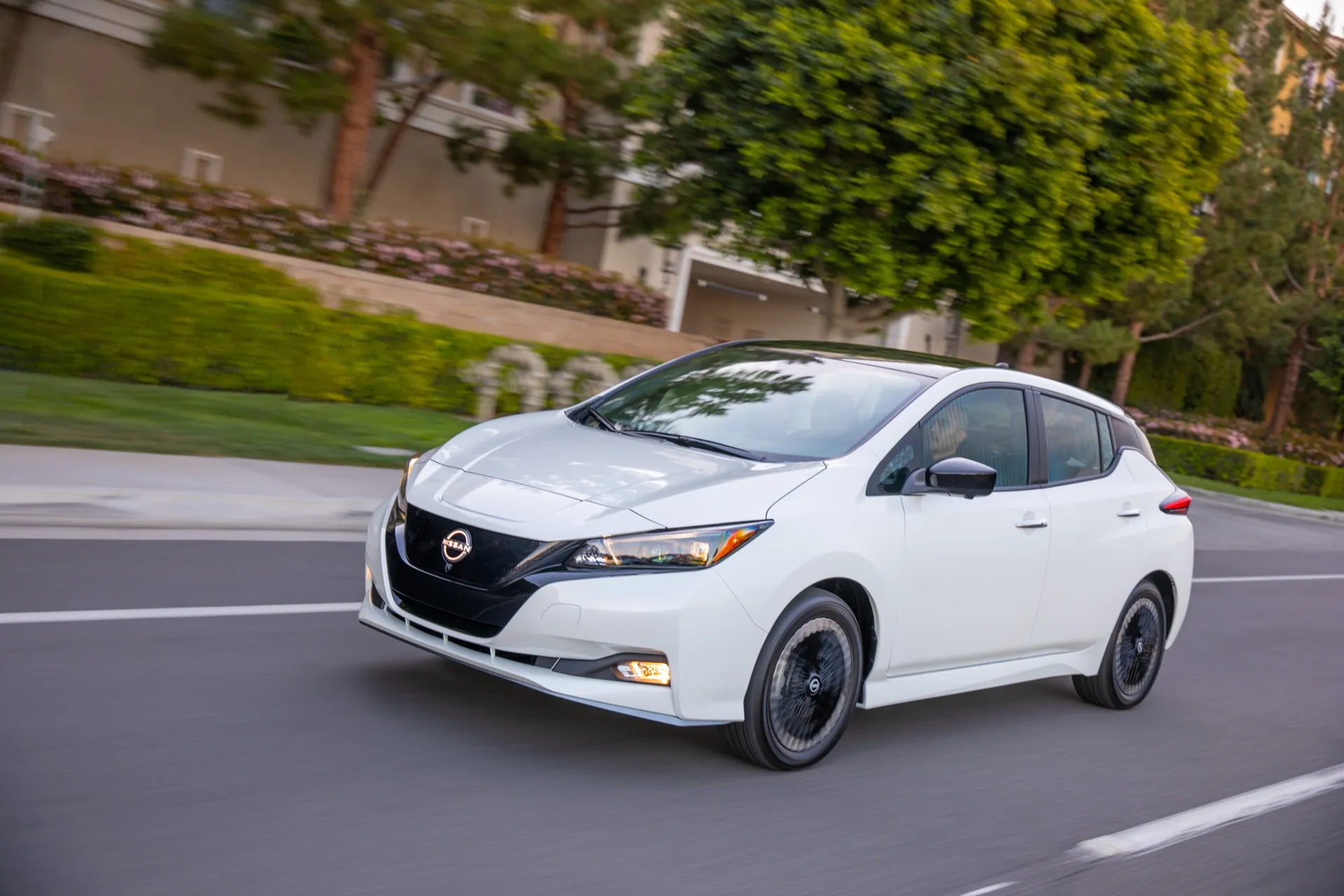
Aston Martin redesigned the DB11 for 2024, rebranding the car as the DB12 and exclusively offering it with twin-turbocharged V-8 power. The DB12 Volante convertible is available at launch, and we just tested it.
Morgan launched a redesigned Plus Four in 2020, and now the car has received a round of updates. The latest Plus Four is a crucial model for Morgan, as it will spearhead the brand’s return to four-wheel cars in the U.S. market.
A decade ago, Audi was working on a hybrid supercar equipped with a diesel engine as its internal-combustion component. It turns out the automaker got around to building a concept of the supercar, and today it’s on display at the August Horch Museum in Zwickau, Germany.
You’ll find these stories and more in today’s car news, right here at Motor Authority.
Review: 2024 Aston Martin DB12 Volante opens up a moving muse
Morgan plans to sell Plus Four roadster in US
Concept for Audi’s stillborn diesel-electric supercar surfaces
Subaru mostly keeps prices the same on 2025 Outback, Legacy
Tesla Model S Plaid finally gets sport seats
Half of 2024 EVs have lower 5-year ownership cost vs. ICE
Alfa Romeo 4C-based 1300 OT pays homage to an Abarth icon
2025 Kia K5 costs $1,600 more, no longer a value at $28,145
Maserati could phase out gas-powered cars by 2028
Could Honda soon outpace all but Tesla in US EV production?
Let’s face it, once we hit our forties we’ve grown out of our willingness to be uncomfortable. We’re more fixed in our ways and often have higher standards than we did in our twenties. Coachella, an annual music festival held in the middle of the Coachella Valley is a bucket-list-worthy experience, yet with scorching afternoon temperatures and evenings that drastically cool down, huge crowds, and an inhumane amount of walking required to get around, the desert music mecca tends to attract younger crowds who don’t kvetch when removed from their comfort zones. Despite these obstacles, yes, even those in their forties still may want to dance the day away in outfits that allow them to artistically express themselves without facing the judgment of others. Perhaps Burning Man is too much of an undertaking – the elements are harsher, survival skills are crucial, and discomfort is taken to the next level. Coachella, on the other hand, is more manageable, requires less planning, and is exponentially more cost-effective, while delivering an almost equal amount of desert wonder on a much, much smaller scale. Below are my tips on how to enjoy this world-famous festival with ease and pure bliss.
Dress light during the day and pack a layer for the evening when the temperatures drop. Wear your most comfortable shoes.
Sunscreen and lip balm are essential packing items.
Take empty plastic water bottles (metal ones are not permitted) – there are filtered water stations throughout the venue, and staying hydrated is mandatory.
Bring your ID. Once you pass security, there is an “ID Check” station where those who plan to drink alcohol attain a required wristband.
You’ll want your phone for photos and to access the Coachella app which is full of useful information. Side note: I lost my phone on the first day and it was miraculously delivered to lost and found and returned to me in less than twenty-four hours. Most people are good, I’ve regained my faith in humanity.
Leave your cash at home, this is a cashless world.
Although a hat makes sense to ward off the sun and keep those wrinkles at bay, mine became a nuisance when the evening wind kicked in. I recommend not wearing one and lathering up with a great facial sunscreen instead.
This is all you really need. Everything else might become a burden.
Book a luxury hotel as a home base.You’ll love walking into a gorgeous property after spending a sweaty day in the sun. Showering with high-end products and slipping on a lush robe is the ultimate way to decompress after a full day of stimulation. We chose The Ritz-Carlton Rancho Mirageas our unwinding destination. The staff is well-equipped for the Coachella crowd welcoming guests with essential kits filled with sunglasses, a bandana, lip balm, sunscreen, face wipes, and candy. They even have food stations set up in the lobby until 2:00 am to greet hungry festival goers as soon as they hand their cars to valet. On night one I downed a portabello burger at 12:30 am, on night two I shoved mahi mahi tacos down my mouth faster than I could say “fish tacos” – you’ll burn more calories than you can count dancing and walking and you’ll find yourself hungrier than a teenage boy. Waking up to a delicious breakfast and recovering at the quiet adult pool with a skinny margarita will help rejuvenate you for the fun ahead. Now that I’m in my forties the last thing I want to do is recover from partying at a pool party. Seriously, this is money well spent. Splurge on a luxe hotel, because you’re in your forties and sleeping in a parking lot tent is probably as unappealing to you as eating frozen chicken nuggets for dinner.
Spend more on a VIP pass and preferred parking pass. I know, spend, spend, spend. Yes, these things add up but unless you’re the kind of forty-year-old who doesn’t mind relieving yourself in nasty porta potties that will make your sunglasses fog in under one second while you struggle to hold your breath, I say spend the extra money so that you can pee in a civilized manner- in an airconditioned facility with running water to wash your hands. You’ll hopefully be staying very hydrated in the heat and will be making an unusual amount of bathroom runs; At this stage in life, I’ll pay any amount of money for a clean bathroom. In addition, the VIP pass gives you access to my favorite part of Coachella: The Rose Garden. This small haven is the perfect escape from the heat and crowds, when you need a moment to regroup amongst rose gardens, hit bars with no lines, and grab a bite to eat in a calm environment. Oh- and this is where you’ll find the best bathrooms too. Regular passes sell between $499-$599 and VIP passes go for $1069-$1269. Clean bathrooms and a line-free entrance into the festival make this a no-brainer if you can afford the price tag.
Keep note of where you parked. Yes, the festival is extremely well organized, except when it comes to parking. There are general parking zones but they are so vast that simply knowing which zone you’re in will never lead you to your car. During our first visit to Coachella in 2022 it took us over an hour to find our car. This time, we took meticulous notes counting cones and lanes to get us back to our vehicle. You won’t see the twenty-year-olds using this method. Instead, they pin their car location on Google Maps. I silently smirk at their tech-savvy ways, because with age comes wisdom, and we learned the hard way that this is an insufficient method. Go old school and take notes or get a Tesla.
Wear comfortable shoes. My only major complaint about Coachella is how spread out the stages are from one another and how much walking is required to get around. Our friend logged twenty-four miles over nine hours. No wonder my feet hurt so much at the end of the day! Considering that most of the ground is filled with neatly trimmed grass, I was surprised not to find one single barefooted soul. The festival should add one more VIP area to the property to save VIP party-goers the time it takes to schlep to the Rose Garden every time they choose to pee with dignity (ok, I sound like a spoiled brat, but as you get older your bladder isn’t as reliable as it used to be). Regardless, wear your most comfortable shoes, take seated breaks often to hydrate, and bring bandaids for those inevitable blisters.
Eat more than you think you can digest. I made the mistake on day one of not refueling with food because I wanted to dance to the tune of as many artists as possible and didn’t want to miss any bands on my list performing. FOMO is never a good idea. When we got to the hotel after a long day burning thousands of calories, I crashed. I was a super hangry woman. I learned from my mistake and the next day ate the largest breakfast burrito created, then had a full lunch that included a grilled cheese sandwich, Greek salad, and french fries, followed by a gigantic order of loaded tater tots with lots of in-between snacks. Forget about healthy eating in Coachella. Your body needs calories – as many of them as possible. So EAT more than you think you can consume. You’ll fit back into your Lulus in no time.
Stop to admire the art throughout the day. Although Coachella is mostly known for its music, it is technically an arts festival too. While two iconic structures are staples of the landscape (the Ferris wheel and the cylindrical tower (in the bottom right photo), new spectacular buildings emerge each year. Make sure to pay attention to how they change throughout the day from mid-day to sunset to nightfall. They truly are breathtaking every step of the way.
Just know that you’re never too old. While the majority of attendees are in their twenties, you’ll find people of all ages getting into Coachella mode. Watching Gwen Stefani performing with No Doubt was on my list of “must-sees”. We were shocked that practically everyone at the festival joined us to cheer her on. I thought I’d be joining the “older crowd” for this performance but everyone, everyone was there too. Get dressed up, express yourself, and let loose. Coachella is a place where nothing matters but creativity, music, and fun. I had a blast dressing my body with tattoos and glitter. Dancing freely to a variety of performers from Sublime to Sofi Tukker, John Batiste to Charlotte de Witte, and Kaskade to Lil Uzi Vert in the backdrop of the desert with the wind in my hair, as the sun painted the sky illuminating the stunning surrounding, and a handful of good friends to enjoy the experience with made me like I was twenty-two and forty-two all over again. When you’re dancing all day under the desert sky time is a useless construct. Dance your heart out, who cares how old you are? You’re alive. This realization is the most rewarding gift Coachella can give anyone, at any age, willing to let go and express themselve. Mark your calendars for next year and join us!
China is making too many EV batteries. Rivian is applying real-world letter grades to EV fast-chargers for smoother route planning. And despite depreciation woes, many EVs still pay back big over five years of ownership. This and more, here at Green Car Reports.
Rivian has announced that it’s rating EV fast-chargers for real-world reliability—and including those letter-grade ratings in its route planning and interface. It’s a situation that may put some pressure on networks to prioritize reliability, and in the meantime it may favor Tesla Supercharging and its generally superior reliability.
According to a recent deep dive into EV cost of ownership, half of new 2024 EVs cost less over five years versus ICE models—despite depreciation, which was far greater this past year.
And China now makes enough batteries for global EV production, according to data analyzed by Bloomberg New Energy Finance this past week. In 2023, manufacturing capacity was already double what global battery-cell demand amounted to for EVs and energy storage combined, and if companies keep to announcements there may be even more of a gap between supply of cells and demand by EV plants.
The Mercedes-Benz eSprinter electric van debuted for the 2024 model year with a long 170-inch wheelbase, a large 113-kwh battery, and a high roof. For 2025, it adds a shorter 144-inch wheelbase, a smaller 81-kwh battery, and a shorter standard roof, the brand announced on Monday.
In that configuration, the base price falls from $74,181 to $63,545 before the mandatory destination charge. Like the 2024 model, the 2024 eSprinter is offered with a choice of 100-kw (134-hp) and 150-kw (201-hp) rear-mounted permanent magnet motors. Both versions are limited to 75 mph.
The short-wheelbase, small-battery, small-motor, low-roof configuration becomes the payload leader in the lineup, with the ability to carry up to 3,516 pounds, almost 500 pounds more than the bigger body style. The lower roof and shorter wheelbase cut down cargo space from 488 cubic feet to 319 cubic feet.
The smaller battery cuts range to 192 miles on the more lenient European WLTP test cycle, versus 273 miles with the tall roof and larger pack. A U.S. EPA rating isn’t available, but we noted that with a relatively light load the eSprinter gets close to that in real-world U.S. driving. Like the bigger battery, it has a lithium-ion phosphate (LFP) chemistry, and it can DC fast charge at up to 115 kw. It also has the same 9.6-kw onboard charger that allows an overnight charge on a 240-volt outlet.
2025 Mercedes-Benz eSprinter
The shorter wheelbase and smaller battery give fleet buyers more options to best fit with their needs, though the eSprinter lineup still leaves plenty of room for vehicles such as campers, overlanders, and other more luxurious private use. The Mercedes Van.EA platform due in 2026 may be the answer to buyers interested in those types of vehicles, and it could offer the dual-motor all-wheel-drive configuration this version lacks. Mercedes has said Van.EA vehicles will sell alongside current eSprinters for awhile.
Standard safety systems on the 2025 eSprinter include automatic emergency braking that adds intersection assist. A new Sideguard Assist system combines with blind-spot monitors to detect other road users in a “danger area” on the passenger side of the vehicle and warn the driver with flashing LED lights and acoustic warnings.
A new optional Moving-off Information Assist system works in a similar manner, but’s aim is to prevent crashes when the driver sets off. It detects road users 12 feet in front of the van and 19.6 inches to the sides. It warns the driver of an impending collision at speeds up to 6 mph.
2025 Mercedes-Benz eSprinter
A new front camera enables active lane control. Also new for 2025 are adaptive cruise control, traffic-sign recognition, active lane control enabled by a new front camera, and a surround-view camera system.
The 2025 Mercedes-Benz eSprinter is available to order now, and is set to arrive in the second half of the year.
As a farewell present from a friend at work, (THANK YOU PATTY!) I got what I think is one of the coolest presents! As soon as I opened it, I knew I would be gifting one to my Sons Girlfriend for Christmas. Which is why I had to wait to write the article. I couldn’t give away the surprise!
I received a leather keychain from the WanderClub with 4 National Park tokens (or charms.) I thought it was the perfect little memento to remember my adventures, as well as track them!
My Wander Club Gift with Keychain
When I went and checked out their webpage for myself, I discovered that it wasn’t just charms for the National Parks. You can choose from counties, US States, landmarks, major cities, you can even create your own charm if you don’t see what you are looking for. They have spacer charms to create distinction between your states charms and city charms. They really have several options to make your Wanderer’s gift personalized for them.
When Jayden started dating Nikki, she was a little disappointed in all of the places that he had been. She felt like he had seen so many things that there wouldn’t be trips that they could take where he didn’t already have memories. Nothing would be THEIR trip. Now we were quickly able to change her mind and show her that although Jayden had been to 44 states at the time, that he didn’t do a whole lot in any of them, so anyplace they go they will always be able to make their own trip and create their own memories.
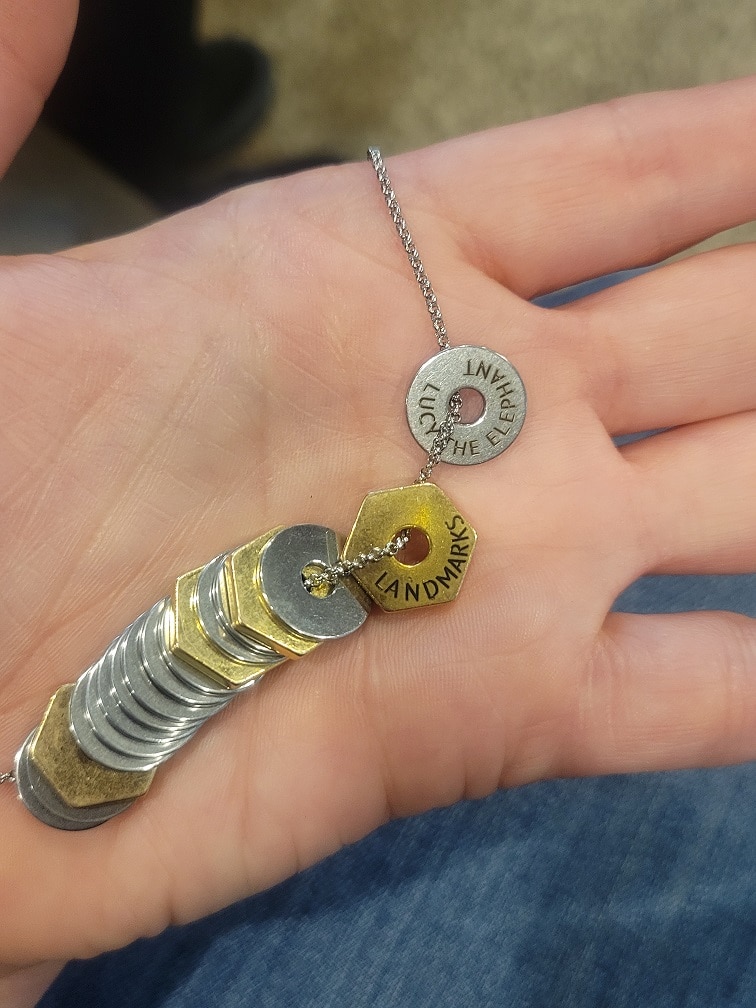
Nikki’s Necklace
They started dating 2 months before everything was shut down due to Covid restrictions. A new, young relationship – the two of them were bored out of their minds. But our roadtripping son decided to hop in the car and drive to Margate NJ to see Lucy The Elephant. They weren’t able to go inside, or even go out to dinner after the trip, but they were able to make a day trip to a new place and see something that neither one had seen before. It was their first travel adventure, in the same state we live, to a place we had never been.
Nikki’s Necklace On
For Christmas this year, my gift to Nikki was a necklace with a total of 18 tokens on it! We had the pleasure of bringing Nikki on our Cannonball Run trip when we completed the continental 48 states; find that article here. So her necklace included those states and 2 cities from that trip. But most important, I was able to custom make her a token for Lucy the Elephant.
Her Personalized “Lucy the Elephant” Token
She absolutely LOVED her present. I loved being able to give it to her and seeing the excitement on her face. And now she can start tracking her own adventures! Check them out at TheWanderClub.com
Carmakers often contend that plug-in hybrids are their stepping stone towards full electrification, offering the silent, zero-emission running of an electric vehicle with the convenience and hassle-free nature of a petrol- or diesel-powered car. This has contributed to a growing number of PHEV sales in Europe, where tightening emissions regulations are forcing companies to build more and more of these vehicles as a stopgap.
Of course, we’ve known that the eco credentials of PHEVs aren’t quite the slam dunk that carmakers have led us to believe, given that the driving habits of actual buyers differ greatly from the, shall we say, optimistic nature of laboratory-based driving cycles like WLTP. But a new study conducted by the European Environment Agency (EEA) has laid bare just how big a gap there is between the fuel consumption figure that is claimed and what owners are actually getting.
Crucially, the EEA obtained the data through the onboard fuel consumption monitoring devices installed in vehicles sold in the EU – a requirement as part of WLTP certification – that were supplied by the carmakers. While this provides a certain level of scope for manufacturers to manipulate the data, it does mean that the data represents real-world usage from actual customers, rather than just another test conducted by boffins.
In all, the EEA received data from 988,231 vehicles (including 916,216 cars and 12,301 vans) out of the 9,821,479 registered in the EU, Iceland and Norway in 2021 – the first year the aforementioned measuring devices were made mandatory. The agency said the study aimed to measure the discrepancy between WLTP and real-world fuel consumption and carbon dioxide emissions, as well as suggesting ways to tweak the WLTP cycle to be more realistic.
Click to enlarge
What the EEA found was that vehicles powered by internal combustion engines registered fuel consumption of 7.44 litres per 100 km, versus their claimed WLTP average of 6.13 l/100 km. This indicated that the drivers used around 1 to 1.5 l/100 km more than official estimates. A similar gap existed between real-world (180.3 grams per kilometre) and WLTP (148.8 g/km) CO2 emissions, a difference of 21.2%.
This gap widened to a chasm when it came to PHEVs, which registered a whopping 3.5 times (252%) greater fuel consumption (5.94 l/100 km) and CO2 emissions (139.5 g/km) in the real world compared to their claimed WLTP averages (1.69 l/100 km and 39.5 g/km respectively). The EEA said the result showed that plug-in hybrids were being charged and driven in electric mode much less than expected, and that the assumptions used for calculating the WLTP test do not represent real-world conditions.
The good news is that for all the fear-mongering about PHEVs being more polluting than even pure ICE vehicles, the study showed that plug-in hybrids still provided a net benefit. On average, they did manage to consume less fuel and release fewer emissions compared to their petrol- and diesel-powered counterparts – even if the reduction is only by an average of 23%.
Some PHEVs did better than others. For example, Kia plug-in hybrids built in Slovakia (that is, the Sportage and Ceed) consumed an average of just 3.87 l/100 km and produced just 88.13 g/km of CO2. That’s still a big jump from the WLTP estimates of 1.48 l/100 km and 33.72 g/km respectively, but it’s impressive nevertheless and proves that these cars either were more efficient or their owners were more diligent in plugging them in to charge. It’s a relatively small sample, however – just 82 cars were registered here.
On the flip side, luxury and performance PHEVs were the worst offenders on the list, reflecting badly on both their cars’ relative inefficiency, shorter all-electric range figures and their owners lackadaisical charging attitudes. Porsche’s PHEVs had an average fuel consumption of 10.79 l/100 km versus their WLTP estimate of 3.03 l/100 km, while the sole Bentley PHEV listed in the study used an average of 12.97 l/100 km versus its WLTP estimate of 3.6 l/100 km.
The worst of the worst, however, was Ferrari. Its 296 GTB and SF90 Stradale/Spider used a terrifying 20.06 l/100 km of fuel on average versus their average claimed WLTP figure of 6.88 l/100 km. That’s not exactly surprising, given that their electric motors are mainly used for increasing performance rather than for reducing fuel consumption. What’s more surprising is that they used much more fuel than even Maranello’s notoriously gas-guzzling pure petrol models, which only consumed an average of 16.28 l/100 km. Ouch.
Ferrari PHEVs like this SF90 Stradale used more fuel than their ICE counterparts
These figures are in line with the EEA’s findings, which were that heavier ICE vehicles like SUVs and luxury cars produced 1.5 to 2.5 times more carbon dioxide emissions than claimed, compared to a gap of 20 to 40 g/km for lighter vehicles. This adds to their already higher WLTP CO2 emissions figures and, given the wider industry trend towards larger, heavier vehicles, offsets the gains being made in terms of efficiency.
For its part, the EEA said that it’s too early to identify trends in fuel consumption and emission discrepancies, given that the vehicles registered have only been on the road for one year. However, the gap for PHEVs is huge, and the EU is already changing the way these figures are being calculated for plug-in hybrids. These changes will be applied in two steps, from 2025 and 2027 onwards.
So remember guys – just because you bought a plug-in hybrid doesn’t mean you will automatically save fuel. The savings in fuel bills and reduction in emissions rely heavily on how often you plug your car in to charge, and if you don’t, you may even use more fuel and pollute more than if you had just bought an ICE car to begin with.
From out of left field, Kia has announced it will be launching a new pick-up truck sometime next year. It’s called the Tasman, named after the island of Tasmania in Australia, and is said to “redefine the concept of a lifestyle pick-up.”
This statement, along with the brand calling it a “C-segment pick-up truck”, initially suggests that this will merely be a rebadge of the passenger car-based Hyundai Santa Cruz. However, it’s been reported that Kia is instead going it alone and building a proper body-on-frame one-tonne truck, similar to the all-conquering Toyota Hilux, Ford Ranger and Mitsubishi Triton. These reports were backed up by spyshots of a far more boxy, high-riding prototype compared to the more road-biased Hyundai.
All this tracks with the confirmation that, unlike the North America-only Santa Cruz, the Tasman will be sold in global markets like Australia, Africa and the Middle East – regions that overwhelmingly prefer ladder-frame trucks over their monocoque brethren. This, of course, raises the possibility that the truck will be offered in Southeast Asia, particularly in Thailand (and yes, Malaysia too) where one-tonne trucks reign supreme.
No technical details have been released, but Kia already has the building blocks for a decent pick-up, not least the 2.2 litre R four-cylinder turbodiesel long used in models like the Sorento and Carnival. In its latest form, it produces 202 PS and 440 Nm of torque, which is competitive – if not class-leading – with other models in the one-tonne truck segment. A lower 177 PS/431 Nm tune also exists, powering the Hyundai Staria. The mill is mated to an eight-speed automatic gearbox as standard.
Kia also has access to a plug-in hybrid powertrain to meet rising demand for electrified pick-up trucks. This pairs a 1.6 litre turbocharged petrol four-pot with a 90 hp electric motor, which in the Sorento develops a total output of 264 PS and delivers an all-electric range of 51 km thanks to a 13.8 kWh battery. Such a powertrain will help the Tasman compete with the Ranger PHEV.
Past spyshots and videos have shown a large double-bed pick-up that bears all the hallmarks of traditional one-tonne models, including an upright design with lots of angular lines and chiselled surfaces. Added to that are the latest Kia design cues, such as a wide “tiger nose” grille and vertical headlights, similar to the facelifted Sorento and Carnival.
There are also some distinctive touches, like thick black body cladding that only covers the upper part of the fenders. Elsewhere, you’ll find a solid rear axle and leaf springs at the back, while a toggle for selecting two-wheel drive, all-wheel drive and low-range all-wheel drive is located on the centre console. This hints at how seriously the Korean carmaker is taking building a rugged truck for harsh environments.
Just 24 months on from the announcement of the prototype example of the Bizzarrini 5300 GT Corsa Revival, the build of the 24th and final car has now been completed in a unique specification. Created in a green-flecked hue known as Bizzarrini Verde Bosco Ventiquattro, (VBV) it’s an appropriate celebration of the end of production of this hand-built continuation, authentically based on the car that won its class at the 24 Hours of Le Mans in 1965.
As with every part of the Corsa Revival continuation program, the color choice has its roots in authentic Bizzarrini history. A Concours-winning original example, owned by an American collector, wears a near-identical shade and he generously granted Bizzarrini’s bespoke team access to the car to gather samples to create a match for this modern-day Revival.
It’s an approach also applied to the limited examples of the car finished in Bizzarrini Rosso Corsa – just like the original Le Mans class-winning car – where the Bizzarrini team tracked down an original panel that had been hidden from light since it was first painted, perfectly preserving Bizzarrini Rosso Corsa. This shade was then color-matched for the Revival Edition to create Bizzarrini Rosso Corsa 222.
Each car in the Revival series is crafted with a lightweight single-piece composite body, over a steel frame. Inside, the two seats are protected by a more comprehensive six-point roll cage and safety fuel cell, meeting FIA Appendix K regulations. With a front-mid engine layout, independent rear suspension to Giotto’s innovative Corsa specification, and all-round disc brakes paired with a period-specific 5,300 cubic centimeter V8 developing over 400horsepower, the Bizzarrini 5300 GT Corsa Revival has a power-to-weight ratio comparable to a modern supercar.
Producing one bespoke, hand-built 5300 GT Corsa Revival each month at Bizzarrini’s dedicated facility in the UK is a sign of the maturity of the business as it continues preparations to launch the all-new Giotto hypercar. Designed by Giorgetto Giugiaro, alongside his son Fabrizio at GFG Style in Turin, Italy, it rekindles a brand partnership first established 60 years ago when a young Giorgetto, whilst at Bertone, contributed to the design of the original Bizzarrini 5300 GT. Focused on driving engagement, rather than pure lap times or outright speed, the Giotto will be powered by a bespoke V12 designed in collaboration with Cosworth.
Simon Busby, Bizzarrini CMO, said: “The 5300 GT Corsa Revival was envisioned as a reintroduction of the Bizzarrini brand to the elite tiers of the automotive world. Ever since we finished the first car 24 months ago, we’ve been working relentlessly to deliver authentic and perfect Revival models to the world’s most passionate car collectors. As we reach the end of this chapter and ready for the next, this feels like another significant step in our journey; the demand for this car and the interest in our future plans is exactly the reaction we felt that the rebirth of the Bizzarrini brand – attached to one of the greatest automotive engineers and designers of all times – deserved. Now, our attention shifts to the development of the Giotto, delivering a car that will be more than worthy to carry the revered name.”
Selling online products is more accessible and lucrative than ever before. If this is an area you’re interested in exploring, you’re in luck. In this post, I’ll be discussing some of the best things to sell online.
Whether you’re a small business owner looking to expand your reach or an individual hoping to make some extra cash, there are many different digital products to sell online.
The possibilities are almost endless, from e-books and courses to stock photos and even virtual coaching. I have personal experience with selling photography, consultancy, and even private tutoring services online, and I’ve taken my fair share of paid online courses too.
What Can I Sell Online?
With so many options to choose from, it can be overwhelming to know where to start. That’s why I’ve put together this guide to help you figure out the best things to sell online to make money in 2024.
1. eBooks
eBooks can cover practically any topic under the sun. If you can think of it, and you have knowledge to share about it, you can write an eBook on it. And because it’s self-published, you don’t need to worry about securing a publishing deal.
From specialized tech manuals to guides on travel, fashion, language learning, working as a freelancer, or even niche pet ownership, there are virtually no limits to what you can create. As long as you have interested readers, you’re good to go.
Pros of Selling eBooks
Low Production Costs: Creating an eBook usually requires minimal upfront costs, especially compared with print publishing. There are no printing or distribution costs. And if you write, edit, and design everything yourself, you can keep virtually all of the revenues as profit.
Global Reach: You can sell your eBook to customers all over the world. That’s a lot of potential customers!
Easy to Create: Tools like Canva make it incredibly easy and quick to create a professional-looking eBook with minimal tech knowledge using their pre-made templates and drag-and-drop features.
Easy to Update: eBooks are easy to update and revise. If you need to correct a mistake or update any information, you can do so without the cost and hassle of reprinting.
Instant Delivery: Customers get immediate access to your eBook upon purchase. There’s no need to wait (or pay) for shipping.
Passive Income Potential: Once you’ve created your eBook, it can provide a regular stream of passive income and can be sold indefinitely, on autopilot.
Cons of Selling eBooks
High Competition: Because it’s so easy to create eBooks, the market is pretty saturated, making it challenging to stand out and attract readers. This is made all the more challenging by the fact that many eBook creators give their creations away for free.
Piracy Risks: eBooks are fairly easy to copy and distribute illegally without the permission of the author and copyright holder (i.e. you). This can lead to lost revenue and unauthorized sharing of your work.
Limited Market for Certain Genres: Some genres and topics might not perform well in digital format, particularly if the target audience prefers physical books or if the content is more suited to print (like high-quality photography books).
Online courses are another great thing to create and sell online. If you have expertise and knowledge about something, why not create an online course teaching others? Like with eBooks, they can cover practically any field and allow people to learn at their own pace, wherever they choose.
As a course creator, you can custom-make your content to fit whatever niche you want to target. For example, I took this fantastic course on SEO and it taught me loads about the world of Search Engine Optimization and how to get my blog ranking on the first page of Google.
Pros of Selling Online Courses
Scalability: Once created, an online course can be sold to an unlimited number of students without additional production costs.
Flexible Access for Learners: Learners can access the course at their own pace and on their own schedule, which makes it appealing to a wide range of people (i.e. more potential customers).
Diverse Revenue Streams: You can monetize courses through one-time payments, subscriptions, or by offering them as part of a larger membership package.
Global Market Reach: There aren’t any geographical boundaries in selling online courses, allowing you to tap into a global audience.
Establishes Authority: Creating a course in your area of expertise can enhance your credibility and position you as an authority in whatever topic(s) you cover.
Customization and Variety: Courses can be tailored to virtually any subject (web design, cooking, motorbike repair, interior design, etc.), from beginner to advanced. The possibilities are endless!
Cons of Selling Online Courses
Time-Intensive to Create: Developing a high-quality online course can be time-consuming. You’ll need to invest a significant amount of time to design, create, and market your course.
Dependence on Technology: Because the course is delivered exclusively online, you need to ensure you have a stable platform and can troubleshoot any tech-related issues. This can involve a fairly steep learning curve depending on your level of tech expertise.
Engagement Challenges: Your course needs to be as engaging as possible. Keeping students engaged and motivated in an online learning environment can be challenging.
3. Paid Memberships
Offering paid memberships is a way to build up a community of dedicated followers who are willing to pay to receive exclusive content, advice, and/or discounts. For example, if you have a blog, the majority of your content will be free for anyone to access.
But, you could also create a “members only” area where you provide premium content and features. This helps you increase your income while simultaneously creating a loyal group of followers and building a stronger connection with your audience.
Pros of Selling Memberships
Recurring Revenue: You could choose to run your membership on a subscription basis, which provides a stream of repeat revenue and income.
Community Building: Offering a membership program is a good opportunity to create and nurture an engaged and loyal community.
Exclusivity: People tend to associate value with exclusivity, so having a paid “premium” version of your offering can make it seem more desirable. By tapping into this marketing psychology, you can increase the perceived value of what you offer and make more money in the process.
Feedback Loop: Interacting with your members allows you to get feedback on your offerings, helping you tailor and improve your services going forward.
Brand Loyalty: A membership model can foster strong loyalty, as members are likely to feel a deeper connection to your brand or community.
Cross-Selling Opportunities: With an engaged and enthusiastic audience, you’re in a great position to market additional products or services to them.
Cons of Selling Memberships
Upfront Effort: Establishing and growing a membership base requires quite a lot of initial investment in terms of time and effort.
Ongoing Work: Running a membership isn’t a “set and forget” model. You need to engage with your members regularly and offer continuous value if you want people to renew their subscriptions and recommend your offering to others. This can be a fairly time- and resource-consuming task.
4. Templates
Templates are a great way to leverage your expertise and make some extra money online. If you’re good at creating PowerPoint presentations, websites, resumes, complaint letters, or even legal documents, you could create templates of these for people to buy and customize for themselves.
By creating templates and selling them online, you can generate passive income while also showcasing your skills and creativity to potential clients.
Pros of Selling Templates
Passive Income: Once created, templates can be sold an infinite number of times without any additional effort or resources on your part.
Flexibility: You can create templates in your free time, making it a great side hustle if you have a full-time job or other commitments.
Easy to Create: Depending on the type of template in question, it might not even take you very long to create templates that you can sell for $$.
Ease of Distribution: Digital templates are ideally suited to online distribution, making them easy for your customers to buy and access.
Broad Customer Base: You can create templates on anything from formal documents to niche websites meaning that you can have an extremely broad customer base.
Scalability: The digital nature of templates means they’re easily scalable with minimal effort.
Marketing Benefits: Creating useful, high-quality templates can be a great way to showcase your skills and attract potential clients for other services you offer.
Cons of Selling Templates
Market Saturation: Depending on the type of templates you create, there may be a lot of competition out there. You’ll need to find ways to ensure your templates stand out from others to generate sales.
Intellectual Property Concerns: As with many other digital products, there’s always a risk of people illegally downloading, copying, or otherwise stealing your work. Copyright rights can be tricky to enforce in the digital world.
Dependence on Design Skills: Successful template creation requires a good eye for design and user experience.
5. Photography
Why not turn your amateur hobby into a profitable business? If you love photography and have a knack for capturing beautiful, high-quality images, you can sell your photos online. I’ve done this before and it’s a great way to make extra cash while doing something you love.
Platforms like Adobe Stock and Shutterstock allow you to upload your best photos and earn a commission when someone purchases or licenses them. You could specialize in whatever niche you want – travel, wildlife, cute pets, snowboarding, urban landscapes, hipster coffee, you name it!
Pros of Selling Photography
Passive Income: Once you’ve put in the up-front effort of creating and uploading your photos, any income you generate from them is truly passive.
Creative Outlet: Photography can be a fulfilling creative outlet, allowing you to explore your unique perspective and capture beautiful moments or scenes.
Monetize Your Hobby: If you enjoy taking photos and do this anyway for fun, why not try and make some money from it?
Scalability: You can upload as many or as few photos as you want, depending on how much time and effort you want to put into it.
Marketing Potential: By showcasing your photography online, you can attract potential clients for other services you offer, such as event or portrait photography.
Broad Market Appeal: High-quality photos are useful in virtually every industry, so you have a huge potential market to sell to.
Cons of Selling Photography
Market Saturation: The photography market is extremely saturated – even more so than the template market. Given how many people have smartphones and easy-to-use photo editing tools, there’s a huge amount of competition.
Quality is Key: Let’s face it, nobody’s going to pay for average photos. To be successful in selling photography, you need to be a skilled photographer with a good eye for composition and lighting.
Pricing Challenges: Setting prices for your photos can be tricky. With various free image catalogs available online (like Pixabay and Unsplash), customers may be hesitant to pay much (or anything) for photos.
6. Presets
In the last few years, I’ve noticed that presets for photos have become fairly popular items to sell online, especially among bloggers and social media influencers. These presets are essentially custom filters that can be applied to photos using photo-editing software like Adobe Lightroom.
Each preset contains specific settings to adjust aspects of a photo such as color balance, contrast, and saturation, transforming the look and feel of the image with just one click. They offer a quick and effective way for other photographers to achieve a consistent aesthetic across their work.
Pros of Selling Presets
High Demand: Presets can be useful for both amateur and professional photographers. Given the popularity of social media, there’s a growing demand for quick and easy ways to enhance photos.
Passive Income: As with many other items on this list, presets can be an excellent way to generate passive income with minimal ongoing effort.
Free to Create: Producing presets requires minimal upfront costs. Any revenue you generate is pure profit!
Quick to Make: As long as you have the right skills, presets don’t take a long time to create. This makes them an efficient use of your time.
Scalability: Once you’ve created a preset, you can sell it unlimited times.
Easy to Distribute: Presets are digital files that can be easily downloaded, making distribution straightforward.
Cons of Selling Presets
Dependent on Trends: Preset popularity can be subject to changing trends and preferences in photography and social media.
Competition: Given the relatively low barriers to entry, this is another type of online product with fierce competition.
7. Webinars and Masterclasses
If you have specialized knowledge or skills in a particular area, hosting paid webinars and masterclasses can be an excellent way to monetize your expertise.
I’ve attended Webinars on a wide range of topics, including blogging, SEO, web design, photography, cooking, cocktail making, wine tasting, and even various niche legal topics (I used to be a lawyer).
Pros of Selling Webinars and Masterclasses
Expert Positioning: Hosting webinars and masterclasses is a great way to establish yourself as an authority in your field, and build your personal brand and reputation.
Global Accessibility: Participants can join from anywhere in the world.
Networking Opportunities: A successful webinar is an ideal forum for networking with your participants.
Potential for High Revenue: With the right topic and marketing, selling paid webinars and masterclasses can be highly profitable.
Easy to Host: Today, platforms like Zoom and YouTube offer various tools to help you host and promote your webinars.
Cons of Selling Webinars and Masterclasses
Time-Consuming: Planning, promoting, and hosting a successful webinar or masterclass requires a significant investment of time and effort.
Equipment and Software Costs: To ensure high-quality audio and video for your participants, you may need to invest in equipment such as microphones and professional lighting.
Expertise Required: To be successful, you must have a high level of expertise in your chosen topic and be able to effectively communicate and engage with your audience.
Need Confidence: Hosting a webinar or class requires confidence and public speaking skills, which may not come naturally to everyone.
8. Paid Newsletters
With platforms like Substack and Patreon, it’s become relatively easy to create and distribute premium, paid newsletters. These newsletters can cover a wide range of topics, from politics and current affairs to hobbies and personal interests.
They can range from daily briefings to in-depth weekly essays, and typically focus on niche topics or exclusive insights, providing subscribers with regular, valuable updates that surpass what’s available for free on the internet.
Pros of Selling Paid Newsletters
Recurring Revenues: Regular subscriptions provide recurring revenue, making your income more consistent than with one-off product sales.
Low Overhead Costs: Newsletters are extremely cheap to produce and send out, so operational costs are minimal.
Relationship with Audience: Paid newsletters allow you to build a personal and direct relationship with your subscribers.
Direct Communication with Audience: Unlike social media platforms or SEO where algorithms determine who sees your content, a paid newsletter allows you to communicate directly with your subscribers.
Niche Market Appeal: Newsletters are perfect for targeting specific interests or industries, allowing for highly focused content.
Creative Control: As the creator, you have complete control over the content and style of your newsletter.
Flexibility in Format and Frequency: You can decide how often to send out your newsletter and what format it should take.
Potential for High Engagement: Subscribers who pay are more likely to be engaged with your content. This is good news when it comes to marketing additional products or services to them.
Cons of Selling Paid Newsletters
Content Creation Pressure: Subscribers pay for exclusive content, so you must consistently deliver high-quality content to retain their subscriptions.
Limited Audience Reach: Unlike free newsletters or social media platforms, paid newsletters have a smaller potential audience.
Subscription Fatigue: With so many subscription services available, readers may be hesitant to add another monthly expense.
Not Passive: It’s essential to offer unique and valuable content regularly to keep your subscribers happy. This can be quite demanding and time-consuming.
Risk of Unsubscriptions: If subscribers don’t perceive enough value, they may unsubscribe, affecting your revenue.
Can be Hard to Build an Audience: Gaining subscribers can be slow and challenging, especially when starting out.
9. Software Tools
If you’re a tech whizz, creating and selling your own software tools and solutions can be another great way to earn money online. With the rise of remote work and digital nomadism, there’s a growing demand for efficient and user-friendly software.
With a little coding knowledge and a good idea, you can create your own software and market it to the world. These tools could range from project management applications to graphic design software, catering to specific professional needs or general everyday use.
Pros of Selling Software Tools
Brand Building: Developing a popular software tool can significantly enhance your brand recognition in the industry.
High Demand: As more industries move online, there’s an increasing demand for efficient software tools.
Unlimited Earning Potential: If you create a popular and useful tool, you can sell it to a practically unlimited number of customers, meaning your earning potential can be limitless. Just look at the success of companies like Slack and Zoom.
Passive Income: Once your software is developed, you can continue to earn money from sales without much ongoing effort or investment. Offering subscriptions or licenses for your software can also provide a steady recurring income.
Ability to Solve Problems: With software tools, you have the power to solve common problems for businesses and individuals, which can be extremely valuable in today’s fast-paced digital world.
Continual Improvement: As you receive feedback and suggestions from users, you can continue to improve and update your software, making it even more valuable over time.
Cons of Selling Software Tools
Time-Consuming Development Process: Creating a software tool can take a significant amount of time and effort, especially if you don’t have prior coding experience. It can also be a lengthy process to test and improve the software before it’s ready for sale.
Requires Technical Knowledge: Developing software requires considerable technical knowledge, which not everyone possesses. You may need to hire additional help or skills if you’re not proficient in coding yourself.
Competition: There are plenty of software tools available on the market, so it can be challenging to stand out and attract customers. Researching your competitors and creating a unique selling point for your product is crucial.
High Initial Investment: Developing software can require a high initial investment, depending on the complexity of the tool and any additional help you may need. You also need to consider ongoing costs such as maintenance and updates.
Constantly Changing Technology: The world of technology is constantly evolving, so you must be prepared to adapt and update your software regularly to keep up with the latest trends and advancements. This can require additional time and resources.
10. Mobile Apps
Another popular and potentially lucrative way to make money online is by developing mobile apps. Given how many people have smartphones, there’s a significant market for well-designed and useful apps.
Apps can range from games to productivity tools, and with the right idea and execution, you could create the next big hit. As with developing other types of software, it requires technical skills and an up-front investment. But if you have a great idea and are willing to put in the work, it’s possible.
Pros of Selling Mobile Apps
Wide User Base: With millions of smartphone users worldwide, there’s a vast potential market for your app.
High Demand: The demand for new and innovative apps is continually growing, making it an excellent opportunity to tap into a constantly expanding market.
Variety of Monetization Options: You can generate income from your app in various ways including advertisements, in-app purchases, or subscriptions.
Potential for Passive Income: If you create a popular and valuable app, you can earn passive income from sales and in-app purchases without much ongoing effort.
Flexibility: You have the freedom to develop an app on any subject or idea that interests you, making it a fun and fulfilling creative project.
Constant Engagement: Apps encourage regular usage, keeping users engaged with your product and brand.
Cons of Selling Mobile Apps
Requires Technical Knowledge: Similar to developing software tools, creating a mobile app requires technical skills and knowledge. If you’re not proficient in coding, you may need to hire help or learn new skills.
Competitive Market: With millions of apps available on the market, it can be challenging to stand out and compete for attention from users. You must research your competition and develop a unique selling point for your app.
High Initial Investment: Developing an app can require a significant initial investment, including the cost of hiring developers and marketing your product to make it stand out.
Constant Updates and Maintenance: Apps typically require regular updates and improvements for changing user demands, bug fixes, and compatibility with the latest devices. This will probably require a continuous investment of time and money.
Risk of Failure: With any entrepreneurial venture, there’s always a risk of failure. If you spend considerable time and money creating your app and it doesn’t catch on, it can be a significant setback.
11. Online Tutoring Services
This is another area I’ve dabbled in. While studying at law school, I offered online tutoring services in a few different subjects, to students of all ages, as well as a resume-and-job-application-review service.
With the growth of remote learning, there’s been an increase in demand for online tutors in all subject areas, making it a potentially lucrative opportunity. It’s an excellent option if you have expertise in a particular subject and enjoy teaching others.
Ability to Work From Anywhere: Unlike regular teaching, as long as you have a stable internet connection, you can work as an online tutor from anywhere in the world.
Flexible Schedule: You have the freedom to set your own schedule and work as much or as little as you want.
Wide Range of Subjects: You can offer tutoring services in almost any subject area, from academic subjects to test preparation, and resume building to job application reviewing.
Potentially Lucrative: Online tutoring can be lucrative, depending on your field of expertise, your level of experience, the nature of your clients, and the demand for your services.
Cons of Selling Online Tutoring Services
Requires Expertise and Strong Knowledge: To be a successful online tutor, you must have expertise in your subject area and be able to effectively teach others.
Competitive Market: With the rise of remote learning, there’s an increasing number of online tutors available. You must stand out from the competition to attract clients.
Time Intensive: If you’re looking for passive income, online tutoring may not be the best option. It requires a significant amount of time and effort to plan and conduct sessions, communicate with students, and provide feedback.
Reputation Management: As an online tutor, your reputation is crucial. You must consistently provide high-quality services to maintain a good reputation.
Variable Income: Your income will vary depending on the number of clients you have and how often you work.
Technical Issues: Sessions can be disrupted by connectivity or software problems. Trust me, this is the last thing you want to deal with when someone is paying you for your time.
Building Trust and Credibility: New tutors may find it challenging to establish trust and credibility in the online market.
12. Virtual Coaching Sessions
Virtual coaching sessions have also become increasingly popular in recent years.
There’s quite a lot of overlap between coaching and tutoring, but coaching tends to focus more on personal or professional development rather than academic subjects.
Pros of Selling Virtual Coaching Sessions
High-ticket item: Virtual coaching sessions often have high revenue potential due to their personalized nature, allowing for higher pricing and increased revenue per client.
Direct Impact on Client Success: The focused, one-on-one approach of virtual coaching often leads to more immediate and tangible results for clients, enhancing the overall impact of your services.
Growing Demand for Personal and Professional Development: With increasing trends toward prioritizing personal and professional growth, there’s a growing market for virtual coaching.
Wide Range of Topics: As a coach, you can offer services in various areas, such as career development, entrepreneurship, life skills, and more.
Fully Customizable: You can specialize in coaching niches that align with your expertise and passions, and tailor your sessions to fit the individual needs of your clients.
Building Deep Relationships: The one-on-one nature of coaching allows for building strong, trusting relationships with clients.
Diverse Clientele: Work with a wide range of clients, all around the world, each with different backgrounds and objectives.
Cons of Selling Virtual Coaching Sessions
Requires Expertise and Training: To provide effective coaching, you must have the appropriate expertise and training in your chosen niche.
Time Intensive: Like tutoring, coaching requires a significant amount of time and effort to plan and conduct sessions, communicate with clients, and provide feedback.
Competitive Market: Virtual coaching is becoming increasingly popular, so it’s essential to differentiate yourself from other coaches by providing unique value to potential clients.
Building Trust and Credibility: As with tutoring, establishing trust and credibility in the online market can be challenging for new coaches.
Managing Client Expectations: It’s crucial to manage client expectations and ensure they understand the realistic outcomes of coaching sessions.
Technical Issues: Like tutoring, virtual coaching sessions can be disrupted by technical issues, impacting the quality of your services.
13. Digital Artwork
If you have a talent for creating digital art, there’s a growing market for your skills.
As with photography, many businesses are willing to pay for original artwork to use in their marketing materials, websites, and social media.
Pros of Selling Digital Artwork
High Demand: The popularity of visual content online means there’s an increasing demand for unique, eye-catching digital artwork.
Flexible Work: As a digital artist, you can work from anywhere, as long as you have access to your tools and software.
Potential for Passive Income: Once created, you can sell your digital artwork multiple times without needing to create new pieces constantly.
Low Start-up Costs: With the right tools and software, it’s relatively inexpensive to start selling your digital artwork.
Wide Range of Styles and Subjects: There’s a market for various styles and subjects, so you can explore your creativity without limiting yourself to a specific niche.
Collaboration Opportunities: Many businesses and individuals are seeking original artwork to use in their projects, offering opportunities for collaboration and exposure.
Cons of Selling Digital Artwork
Requires Technical Skills: To create digital artwork, you must have the necessary technical skills and be familiar with various software and tools.
Highly Competitive Market: With the growing popularity of digital art, there’s also an increasing number of artists competing for sales.
Intellectual Property Concerns: As a digital artist, it’s crucial to protect your work from copyright infringement. This can be challenging in the online market, as digital files can be easily copied and distributed without permission.
Time Intensive: Creating high-quality digital artwork can take a significant amount of time and effort, impacting your productivity and income potential.
14. Graphic Design Elements
If you consider yourself more of a graphic designer than an artist, there’s still a market for your skills in the online marketplace.
There’s a lot of demand for graphic design elements such as logos, social media graphics, visual advertisements, and website designs.
Pros of Selling Graphic Design Elements
High Demand: There’s a high demand for skilled graphic designers to create eye-catching materials.
Flexible Work: As a graphic designer, you can work from anywhere, as long as you have access to your tools and software.
Collaboration Opportunities: Like digital artwork, there are opportunities for collaboration with businesses and individuals seeking unique designs.
Low Start-up Costs: With the necessary tools and software, it’s relatively inexpensive to start offering graphic design services.
Potential for Passive Income: Once created, you can sell your graphics multiple times without needing to constantly create new designs.
Cons of Selling Graphic Design Elements
Requires Technical Skills: To provide high-quality graphic design services, you must have the appropriate technical skills and be familiar with graphic design software and tools.
High Competition: The market for graphic design elements is highly saturated, making it challenging to stand out.
Risk of Infringement: Your designs could be copied or used without permission, which can be difficult to monitor and control.
Client Communication: Working with clients on design projects can require effective communication skills to understand their needs and preferences.
15. Virtual Interactive Workshops
There’s also an increasing demand for interactive workshops conducted online. These online classes are typically held live, so participants can interact with you and ask questions in real-time.
These can range from educational seminars to creative workshops, offering a wide variety of opportunities for different skills and expertise.
Pros of Selling Virtual Interactive Workshops
Brand Building: Running interactive workshops is a great way to boost your brand visibility and reputation.
Interactive Learning Environment: Real-time interaction enhances the learning experience, making it more engaging for participants compared with a pre-recorded lecture or training session.
Direct Feedback: Immediate interaction with your audience provides valuable feedback to help you improve your future offerings.
Networking Opportunities: The interactive nature of these events makes them great for networking.
Easy to Host: You can host interactive workshops on various online platforms including Zoom and YouTube.
Cons of Selling Virtual Interactive Workshops
Technology Dependence: Relies heavily on technology, so is at the mercy of connectivity problems.
Skill and Preparation Required: Delivering an effective and interactive virtual workshop requires significant preparation and delivery skills.
Best Things To Sell Online: FAQs
Here are answers to some commonly asked questions about the best things to sell online.
What are the most profitable products to sell online?
The most profitable products to sell online typically include digital goods like online courses, eBooks, templates, and pre-recorded masterclasses. They are relatively quick and cheap to make and require minimal ongoing maintenance.
What are the best things to sell online from home?
The best things to sell online from home include digital products such as eBooks, templates, photography, and online courses. These all require minimal physical space, can be set up relatively easily using online platforms, and can generate passive income.
Where can I sell my digital products for free?
You can sell your digital products for free on platforms like Coursify, through social media channels, or even from your own blog or business website.
What are some easy digital products to sell?
Easy digital products to sell include templates, simple ebooks, photographs, and preset photo filters. Each of these requires relatively low levels of expertise to create, can be priced affordably, and has a broad appeal.
Can I make money selling digital products?
Yes, you can make money selling digital products. They often have lower overhead costs and can reach a global market, offering significant potential for profit.
In Closing
These are 15 of the most popular digital items to sell. However, this list is just the start. There are so many other opportunities to make money by selling digital products online.
As you’ve seen from this post, there’s a fair amount of overlap when it comes to both the pros and cons of selling products online, and that’s no coincidence. It’s relatively easy for anyone to set up an online store, and the barriers to entry are quite low.
This means that market saturation and fierce competition are common issues for most of these products. However, if you have a good idea and are prepared to put in the work to market it successfully, the rewards can be huge.
Production of the Gordon Murray-designed T.50 supercar is now underway at GMA’s new production facility in Highams Park, England. Once the 100 examples of that car are built, GMA will then start cranking out examples of the more extreme T.50s Niki Lauda track car.
Development of the T.50s Niki Lauda is ongoing, and this past weekend a prototype marked the car’s official dynamic debut during the Goodwood Members Meet at the Goodwood Motor Circuit. It was joined on the track by a prototype for the tamer T.33 supercar.
Like its road-going sibling, the T.50s Niki Lauda has a rear-mounted fan inspired by Murray’s Brabham BT46B “Fan Car” Formula 1 racer. But while the T.50 has six modes for this fan, the T50s only has one—high downforce. A maximum 2,645 pounds of downforce is the target.
In the T.50s, the fan spins at a constant 7,000 rpm to continuously generate that downforce. The car gets a number of other aerodynamic add-ons as well, including a roof scoop that works as a ram-air intake for the V-12 engine, a stabilizing fin like the ones used on Le Mans prototypes, and a large rear spoiler.
Behind the driver sits the Cosworth-developed 3.9-liter V-12 that’s shared with the T.50, but output here is increased to a maximum 725 hp, with the same 12,100-rpm redline as before. Drive goes to the rear wheels only via a 6-speed sequential gearbox developed by Xtrac. The road car sticks with a 6-speed manual.
Prior to the Goodwood dynamic debut, GMA announced that 24 examples of the T.50s Niki Lauda will each have a unique chassis name linked to a Grand Prix victory achieved by a Murray-designed car, starting with the 1974 South African Grand Prix at the Kyalami Circuit. It was Murray’s first success in F1, when the Brabham BT44 he designed was driven to victory by Carlos Reutemann.
One example of the T.50s Niki Lauda will have a name linked to the 1995 24 Hours of Le Mans, which was won by a McLaren F1 GTR.
The T.50s Niki Lauda is priced 3.1 million British pounds (approximately $3.9 million), and all build slots are already claimed, GMA has confirmed.
The technical storage or access is strictly necessary for the legitimate purpose of enabling the use of a specific service explicitly requested by the subscriber or user, or for the sole purpose of carrying out the transmission of a communication over an electronic communications network.
Preferences
The technical storage or access is necessary for the legitimate purpose of storing preferences that are not requested by the subscriber or user.
Statistics
The technical storage or access that is used exclusively for statistical purposes.The technical storage or access that is used exclusively for anonymous statistical purposes. Without a subpoena, voluntary compliance on the part of your Internet Service Provider, or additional records from a third party, information stored or retrieved for this purpose alone cannot usually be used to identify you.
Marketing
The technical storage or access is required to create user profiles to send advertising, or to track the user on a website or across several websites for similar marketing purposes.