Set to debut in 2024, the 2025 M5 Touring will arrive just as the Audi RS 6 Avant bows out. Production will commence in the fourth quarter of 2024 with cars arriving not long after.
BMW said the high-performance luxury sedan variant has entered the final stage of development with testing wrapping up. Testing of the Touring model is now underway with the team heading (back) to the Nürburgring soon. It’s possible the wagon will launch after the sedan variant.
A hybrid powertrain related to the BMW M Hybrid V8 GTP race car has been confirmed. This translates to a twin-turbo 4.0-liter V-8 and electric motor sitting under the hood. Race regulations limits this powertrain to an output of just 670 hp, but expect easily over 700 hp sent to all four wheels.
The M5 will take the latest 5-Series and punch out the fenders, ride on larger and wider wheels, feature larger brakes, and the trademark quad exhaust tips out back.
Expect a price that is solidly in the six-figure territory.
The latest iteration of the Porsche Taycan, the 2024 Taycan 4S, welcomes a model refresh. While aesthetic changes are subtle, significant technical advancements have been made, notably in charging capacity, motor performance, and battery size.
Christian Müller, who led the project, emphasizes that the most considerable investment in the new Taycan was in efficiency (29%), followed by performance (25%), and battery charging technology (16%). Two battery sizes are available: the ‘Performance’ with 89 kWh (83.2 usable) and the ‘Performance Plus’ with 105 kWh (97). A notable change in battery chemistry from Nickel-Cobalt-Manganese in a ratio of 811, compared to the previous 622, results in a nine-kilogram lighter battery. This alteration has improved the energy density from 148 to 168 Wh/kg and reduced the minimum temperature for maximum charge capacity from 35 to 15 degrees Celsius. Charging times have been significantly reduced; at 15 degrees, a charge from 10 to 80 percent takes 18 minutes, down from 37. The Taycan’s range has increased by up to 175 kilometers due to lower consumption and higher battery capacity, and the improved charging system now allows for a 315-kilometer top-up in just 10 minutes at a fast-charging station.
Available for sale this spring, the Taycan lineup includes the base Taycan (435 hp), 4S (598 hp), Turbo (884 hp), and Turbo S (952 hp). The first two models come standard with the smaller battery, with an option to upgrade to the 105-kWh pack for an additional €5,521. Peak charging power is 320 kW for the Performance Plus battery and 270 kW for the Performance variant. The engineers have also extended the plateau for the fastest charging.
The new Taycan models continue to boast a robust basic package, including a ladder frame, three mechanical differential locks, and a solid rear axle with front independent suspension. An updated ‘Offroad Cockpit’ makes operation easier, and the models maintain a 100% gradient capability, at least 24 centimeters of ground clearance between axles, a maximum wading depth of 70 centimeters, and stable tilting angles of up to 35 degrees.
The 4.0-liter eight-cylinder turbo engine, producing 430 kW / 585 hp and a maximum torque of 850 Nm, is reserved for the popular AMG 63 version. The starter generator and 48-volt on-board system provide a short boost from an electric motor delivering 15 kW / 20 hp / 200 Nm. The sporty version of the rugged G-Class accelerates from 0 to 100 km/h in 4.3 seconds with the appropriate performance package and reaches a maximum speed of 240 km/h (220 km/h for other versions) with a standard consumption of 14.7 liters per 100 kilometers.
For those who prefer a less dynamic approach, the other two combustion engine versions are ideal. The Mercedes G 500, powered by a 3.0-liter inline six-cylinder engine, produces 330 kW / 449 hp and 560 Nm, plus a short 15 kW / 20 hp / 200 Nm boost. Particularly in Europe, many might opt for the Mercedes G 450d, whose 3.0-liter common-rail diesel engine delivers 270 kW / 367 hp and 750 Nm, with the same boost function, and a more modest consumption of 8.7 liters per 100 kilometers.
All models transmit power through a nine-speed automatic gearbox to both axles, with a transfer case distributing torque 40% to the front and 60% to the rear. An intelligent multi-plate clutch ensures maximum maneuverability, acting like an automatically regulated locking differential and switching to a fixed lock with 100% locking effect when the switch for the lock in the center differential is activated.
New to the G-Class is the suspension with hydraulic roll stabilization and adaptive adjustable damping, available either as a separate option or as part of the off-road packages. Active hydraulic elements replace traditional mechanical torsion bar stabilizers. The adaptive shock absorbers are equipped with two hydraulic connections – one each for compression and rebound stages. The shock absorber chambers at all four wheels are connected via hydraulic lines and the valve island. The driver of the G-Class, priced at a minimum of €122,800, can enjoy not just the high-tech suspension but also new assistance systems and two 12.3-inch instrument displays with touch control.
Find this post helpful? Learn how you can support Bearfoot Theory’s work here. You can also shop for gear through the affiliate links in this blog post where we get a small commission at no cost to you. It helps keep our team running and the lights on. THANK YOU! -Kristen
I don’t know an outdoor enthusiast who doesn’t hate mosquitos. If you don’t repel mosquitos while hiking, they can turn an otherwise perfect adventure into a nightmare. A couple of years back, I was on a multi-day canoe trip through Labyrinth Canyon in Utah. The mosquitos were so bad that anytime we weren’t in the canoe, we had to be covered from head to toe – a tall order when it was 95 degrees out. The biggest lesson was to never go canoeing during mosquito season ever again!
I’ve also been on backpacking trips where I was so damn thankful I brought my nerdy head net. Without it, I would have been eating mosquitos for lunch.
Not only are mosquitos a nuisance that can leave you with itchy welts all over your body, but they can also carry diseases like West Nile Virus. Mosquitos LOVE my partner Ryan, and now that we are also traveling with our son (who I can’t just douse with DEET), we have to take some extra steps to avoid these annoying bugs. We cover up with lightweight clothing, apply natural mosquito repellent, and even avoid buggy trails and destinations altogether until mosquito season is over.
When you’re hiking and camping, the last thing you want is for swarms of mosquitos to derail your time outside. In this post, I share my best tips on mosquito protection for hikers and campers, along with my favorite protective gear and hiking mosquito repellents so you can enjoy nature without getting hundreds of bug bites in the process.
Download this FREE Day Hiking Packing Checklist
Be prepared on your next day hike! Enter your email below for access to this printable PDF.
Basic Mosquito Protection for Hikers
If you plan to go hiking, backpacking, or camping in a buggy area, you can take precautions before, during, and after your hike to deter mosquitos. Here are some tips to repel mosquitos to consider for your next adventure.
1. Research mosquito season
Mosquitos are more prevalent in certain parts of the country throughout the year. Look into when mosquito season occurs for the areas you plan to hike and camp.
In mountainous regions, mosquito season typically starts when the snow starts to melt. In lower areas, this could be late April to early June. In higher elevations, mosquito season could extend all the way into early August depending on how quickly the snow melts.
Once you know when you will likely encounter mosquitos, you can take the proper precautions to protect yourself. If your schedule is flexible, you can also avoid hiking and camping during peak mosquito season.
In mountainous regions, mosquito season can extend to early August depending on snowmelt
2. Avoid wearing scented products
Scented products tend to attract mosquitos. Before your hike, avoid applying sweet-smelling products like perfume, lotion, hair spray, shampoo, soap, and other cosmetics.
3. Choose open and dry trails and campsites
Mosquitos love dark, wet, boggy, marshy areas. If possible, pick open trails and campsites with lots of sunlight and dry conditions.
Although these trails can also have mosquitos, they are less prevalent than they are in forested trails that are shady and damp.
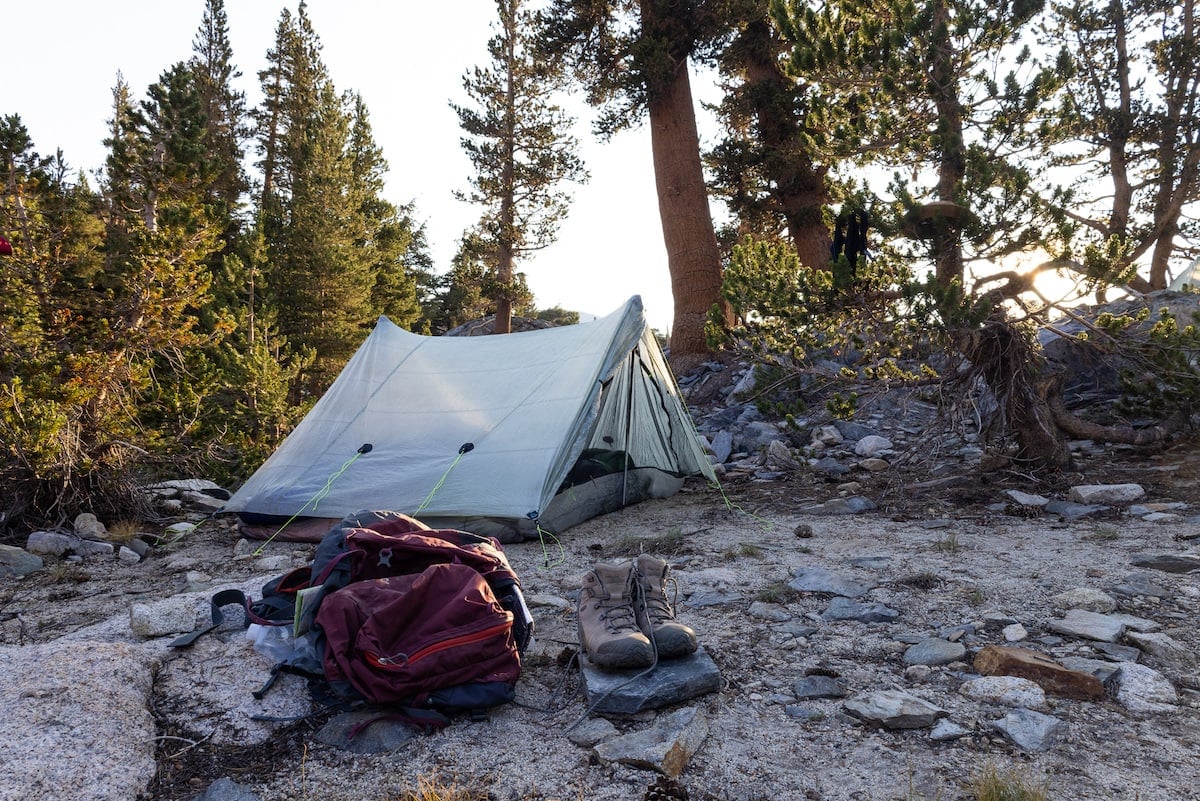
If you are backpacking, the further your campsite is from stagnant water, the better. The shoreline of ponds and lakes is where the mosquitos will be the thickest.
Trails that are sunny and dry tend to have fewer mosquitos
4. Apply sunscreen first
It is important to use both sun protection and mosquito repellent for hiking. If you plan to use hiking mosquito repellent as mentioned later in this article, it is important to apply sunscreen first.
Applying sunscreen before mosquito repellent maximizes the effectiveness of both, so you have the best chance of avoiding sunburns and bug bites.
5. Don’t pack pungent foods
When packing a hiking snack to enjoy on the trail, stick to simple food items that don’t have strong odors (like oranges), as the scent could attract mosquitos.
I also recommend packing your food and trash in sealed plastic bags. Odorless bags are even better.
Although some people may like to pack juice, Gatorade, or another sweet beverage to enjoy on the trail, these can attract mosquitos. If you crack open a drink at the summit, be ready for the little buggers to come your way.
BFT Contributor Linda stuck to odor-free snacks on a backpacking trip in Sequoia National Park
6. Bring a first-aid kit to treat bites
One of the 10 essential hiking items is a first-aid kit, and it can come in handy if an insect bites you while you’re hiking.
A wilderness first-aid booklet is an excellent addition to your backpacking first-aid kit. You can use it to quickly look up how to treat common bug bites and other injuries.
7. Avoid dawn and dusk
Mosquitos tend to be most common in the early morning dawn hours and at dusk. Although these times are often cooler and more scenic with sunrise and sunset, they are the worst times to hike as far as mosquitos are concerned.
If the temperature isn’t as big of a concern for your hike, I recommend hiking during the late morning or early afternoon to avoid the prime times for bugs. If you’re backpacking and you have the time, you can sleep in a bit, staying inside your tent until after the mosquitos have died down.
My friend Brad and I covered up and laughing off the bugs during sunset on a backpacking trip
What to Wear Hiking to Repel Mosquitos
When you are hiking and backpacking, you’re going to want to dress for success when it comes to protecting yourself from mosquitos. The more you cover up, the less places you’ll need to apply mosquito repellent.
From long-sleeve hiking tops and pants to hats and sunglasses, the items you decide to wear on the trail could significantly decrease your chances of getting bit.
8. Wear long sleeves and pants
Although you may assume t-shirts and shorts are a no-brainer for hiking during summertime, the truth is that breathable long-sleeve tops and hiking pants are the best things to wear if you’re in a dense mosquito zone.
Lightweight, moisture-wicking fabrics that cover your legs and arms can keep your body cool and your skin protected from bugs and the sun. I recommend sticking to light colors because they reflect the sun and allow you to spot mosquitos hovering near you before they bite.
Pick hiking shirts and pants that fit more loosely (as opposed to skintight leggings), which are more difficult for mosquitos to bite through. However, your clothes should still fit tight around the cuffs to keep insects out.
When the bugs are bad while I’m hiking, I wear long-sleeves and pants
9. Protect your ankles
While this won’t make you feel very fashionable, keep your ankles and legs protected from bites by tucking your pant legs into your socks. This tip also works well when hiking in areas prone to ticks.
Another option for protecting your ankles from mosquitos on the trail is to wear lightweight gaiters. These are also practical for keeping dirt and small rocks out of your shoes.
10. Wear a hiking mosquito net
Wide-brimmed hiking hats keep the sun and bugs off your head. Consider wearing a hiking mosquito net over that if you want to protect yourself even further.
I personally use the Sea to Summit mosquito head net that you can loosely wear over any hat to prevent mosquitos from biting your face or crawling inside your eyes, nose, mouth, and ears.
Although they may not be stylish, they are practical for buggy trails. The Sea to Summit head net in particular fits loosely, is easy to see through, and you won’t even know it’s there after a couple of minutes.
And whatever you do, DO NOT buy the Ben’s brand mosquito net. I have it and it’s awful. It’s super tight and uncomfortable.
Maybe wearing a mosquito head net for hiking isn’t the most stylish, but it is practical and effective!
11. Wear sunglasses
Having a mosquito land in your eyeball is no fun at all. If one gets stuck in your eyelid, they are quite difficult to get it out, especially in the middle of a trail with no mirrors or running water to help you. It’s even worse if you are wearing contacts!
If you decide not to sport the hiking mosquito net, full-coverage sunglasses are another way to protect your eyes from bugs. Pit Vipers is a fun sunglasses brand with many models offering side-eye protection.
12. Cover your neck
Your neck is another exposed area that is easy to accidentally forget to protect from mosquitos while hiking. I recommend wearing a bandana or Buff around your neck.
They even make a Buff CoolNet UV+ Insect Shield designed for hiking and backpacking on trails with heavy mosquitos. These Buffs are treated with an odorless insect repellent, which repels mosquitos for up to 70 washes.
Wearing a bandana or a Buff around your neck will help protect it from both sunburn and mosquitos. For added protection, you can apply a few drops of Oil of Lemon Eucalyptus directly to the cloth.
I like how my Buff protects my neck from both the sun and mosquitos while hiking
Best Mosquito Repellent for Hiking
In terms of mosquito repellent for hiking, you can choose between more natural products and ones that contain DEET or Picaridin. While it is ultimately your choice, I try to use natural hiking mosquito repellent as much as possible and only reach for something stronger if the trail is extremely buggy or the insects are known to carry serious diseases like Lyme-carrying ticks or malaria-carrying mosquitos.
No matter which you choose, apply mosquito repellent to exposed areas of skin, including your face, neck, hands, wrists, and ankles. Reapply throughout your hike as needed, especially when working up a sweat. Be careful not to get it in your eyes!
13. Use natural mosquito repellent when possible
To limit repeated synthetic chemical exposure while I’m traveling in my van, I like to use plant-based, DEET-free hiking mosquito repellent. Look for products made of Oil of Lemon Eucalyptus with a 30 to 40 percent concentration.
My go-to natural mosquito repellent for hiking is typically Natrapel because it is top-rated, has a pleasant smell, and doesn’t have any questionable ingredients. Again, I only rely on natural repellents when I’m not worried about the bugs carrying any serious diseases.
Natural repellents need to be reapplied more often than synthetic mosquito repellents, and the CDC doesn’t recommend using Oil of Lemon Eucalyptus on children under 3 years old.
I try to 1) cover up and 2) use natural mosquito repellent, especially when hiking with my son
14. Apply DEET or Picaridin if necessary
There are four instances where I’ll opt for DEET or Picaridin:
West Nile Virus Outbreak: If I’m hiking or camping somewhere the mosquitos carry more serious diseases, like West Nile Virus. In 2023, there were more than 2,400 cases of West Nile Virus in the US with the highest concentration of cases in Colorado and California.
Risk of other serious illnesses: If I’m traveling internationally to areas where there is malaria, Zika, or other serious mosquito-borne illnesses.
Tick-prone areas: If I’m in the Midwest or New England where I have to worry about ticks that carry Lyme and other diseases.
Peak season: If it’s peak mosquito season and the natural stuff just isn’t cutting it.
For the best mosquito repellent for hiking with DEET, choose one with a 7-30% solution. The higher the concentration, the more powerful it will be and the longer it will last.
If you are trying to protect yourself against ticks or need all-day protection, 20-30% DEET is recommended. The Environmental Working Group discourages concentrations higher than 30% as it can cause irritation. If you are concerned about the safety of DEET, I highly recommend you read this EWG article about insect repellents which dispels a lot of myths about DEET.
After applying, don’t let your dogs lick you as it can be harmful for them to ingest DEET applied to skin or gear.Also wash your hands when you’re done applying it to avoid getting it in your eyes or on your food, and take a shower to wash off the hiking mosquito repellent as soon as you get home.
While some hikers recommend applying DEET to your hiking gear instead of your skin, it can damage plastic, synthetic fabrics, and rubber products. Permethrin, which is discussed below, is a much better option for this.
If you have sensitive skin, Picaridin is a DEET alternative that is shown to be just as effective, but less irritating with fewer long-term concerns. It also doesn’t have any smell. Experts recommend 10-20% concentration, with 20% being more effective for ticks and West Nile mosquitos.
While backpacking in Sequoia, I wore DEET in the buggier areas of the trail
15. Wear a band or clip
If you prefer not to spray yourself with mosquito repellent for hiking, they also make mosquito repellent bands that you can wear on your wrists and ankles, along with clips that you can attach to your hiking pack. These aren’t as effective as the repellents mentioned above but can be helpful when combined with other protective measures.
Treating your Clothing and Gear with Permethrin
Before you set out for a hike, another way to repel mosquitos while hiking is to treat your clothes and gear with an insecticide called permethrin, which kills mosquitos on contact. The spray is affordable and easy to use.
One thing to keep in mind is permethrin is a registered insecticide rather than a repellent meaning it’s designed to kill insects rather than keep them at bay.
Some studies have found a link between permethrin and cardiovascular issues as well as it being an endocrine disrupter. This Consumer Reports article gives a good overview of the pros and cons of permethrin.
16. Apply permethrin on apparel and gear
If you purchase permethrin formulated for fabrics, you can safely treat your clothes, shoes, hats, and gear before you set out on the trail.
Hang your apparel and gear outside in a well-ventilated area away from animals on a clothing line or rack. Spray the items thoroughly, then flip them over to cover both sides. Give everything time to dry before you put it on.
The permethrin treatment lasts about 5-6 washing cycles before you need to treat your items again. You can also purchase clothing already treated with permethrin.
You can treat your hiking and camping gear with permethrin before visiting buggy areas
17. Buy pre-treated clothing
If you don’t feel like taking the time to apply permethrin yourself, you can buy clothing that has been pre-treated. This also helps reduce the risk of skin coming into direct contact with permethrin.
Permethrin-treated clothing lasts through multiple washes and has an even coating, which can be more difficult to achieve when you’re treating your clothes yourself.
One brand that designs outdoor apparel treated with permethrin is ExOfficio. Their BugsAway line includes hiking clothes like button-down shirts, pants, jackets, t-shirts, socks, shorts, tank tops, skorts, and leggings.
Before you head out on your next hike, check out these other helpful articles:
Save this post to Pinterest
Do you have any questions on how to repel mosquitos while hiking or an experience you’d like to share? Let me know in the comments below!
From gunky surfaces t0 embarrassing off-road exploits to malfunctioning after going through water, the stainless steel Tesla Cybertruck seems like an all-around mess. We cover a lot of those concerns here on Jalopnik, but if you want an even clearer picture of just how dire owners of this machine have it, look no further than the Cybertruck owners forums.
Tesla’s Cybertruck Has Finally Arrived
We decided to check out the forums for ourselves after we spotted a tweet by @salsadrunkard that featured a screenshot of a Cybertruck owner detailing how their truck broke down a mile from the delivery center. It didn’t take much digging to find the forum and the thread itself on Cybertrucks Owners Club. The initial post reads:
Took delivery today, AWD.. made it 1 mile down road, started getting steering error, flashing red screen, pulled off side of highway now the truck is dead and I’m waiting for a tow truck. Dealer couldn’t do anything for me. It was great for 5 minutes.. tried everything, restarting, screen is stuck black and keeps beeping
Tesla really rushed these trucks out, what a nightmare.
Click through some other posts, and you’ll quickly fall down a rabbit hole of malfunctions and issues. One owner, for example, described how their Cybertruck suddenly braked after passing another truck on the side of the highway:
I encountered a truck on the other side of a two-lane highway.
My Cybertruck suddenly made a hard brake stop when we both have a clear wide enough space between us.
Luckily there is no vehicle at the back as it would have been a definite collision.
Note: The auto-pilot is simply a glorified reactive cruise control.
Another owner gave their Cybertruck such a damning review that they were allegedly banned from one owners forum and had to turn to another, Tesla Motors Club, to warn prospective buyers about the “borderline dangerous” visibility issues:
It’s so, so bad. You can’t see the front corners adequately. It’s borderline dangerous! It’s a joke that there’s no rearview camera display where the rear view is, instead, it’s a tiny display on your main screen that shows you behind. So stupid. Cost cutting.
Another owner described how their Cybertruck threw some sort of error code while driving and then wouldn’t charge. None of their local service centers could help either for various reasons.
And yet another owner described how, after just two days of ownership, their Cybertruck simply stopped turning on, despite the 40-percent battery charge:
I’ve had my truck for two days, got in this morning, everything was on. Went to press the brake to put it in reverse and everything went black. Power door button wouldn’t even let me out, had to use manual release to get out. I can not get back in either. My battery is at 40%, so no it’s not dead. Has anyone had this problem?
We could spend all day plucking horror stories from these forums, but we think you get the picture: Plenty of owners are having a real bad time with their Tesla Cybertrucks. If you’re in the market for one, we’d recommend you do some digging in these forums, just so you know what you’re in for.
Iceland is a magical country. It just feels out of this world, like you’re on another planet. The rugged volcanoes and black-sand beaches give the island a desolate but striking appearance. If you ask me, it’s right up there with New Zealand and Norway in terms of the most beautiful countries in the world.
And, just like both of those destinations, it’s an amazing place to take a road trip.
Thanks to its stunning natural beauty, safety, and ease of transportation, Iceland has become a popular destination for solo travelers and first-time road trippers. Yes, it can be expensive, but it has so much to see and do, including tons of amazing hikes and waterfalls that are free to enjoy. You don’t need to break the bank here.
Having been to Iceland a handful of times over the years, I think taking a road trip is the best way to explore the country. So, to ensure you save time and money and stay safe during your trip, here are my top 13 Iceland road-trip tips:
In most destinations, this might seem like overkill. I mean, how often do you actually use your car insurance?
In Iceland, however, the weather changes often — and drastically.
Rain and snow are common, and gravel and sand often damage windows. But the real threat most drivers aren’t prepared for is the wind. The gusts here are so strong that car doors are regularly ripped off their hinges (every time I’ve rented a car here, the company has reminded me of this).
Combine that with winding, narrow roads and an abundance of active volcanoes, and you’ve got yourself a recipe for car trouble.
That’s why I always recommend travelers have comprehensive car rental coverage when they visit Iceland. Because it’s much better to be safe than sorry here!
When it comes to renting a car, I recommend Discover Cars. When you book, it’s super easy to add car insurance onto your purchase with the click of a button. They make it clear what is covered and how much it costs.
You can use the widget below to get a quote. It’s fast and free:
2. Rent the right vehicle
It’s easy to rent a car in Iceland. You don’t need an International Driving Permit if you have a valid license using Latin letters with a license number, photograph, and expiration date. That means Americans, Canadians, Australians, Brits, and New Zealanders can all rent a car here with their regular license.
When renting a vehicle in Iceland, you have three main choices:
A car
A 4×4 (4WD)
A van/RV
If you’re just planning to see the main sights while sleeping in hostels, hotels, and/or Airbnbs, a regular car will do the trick. It’s the cheapest option too.
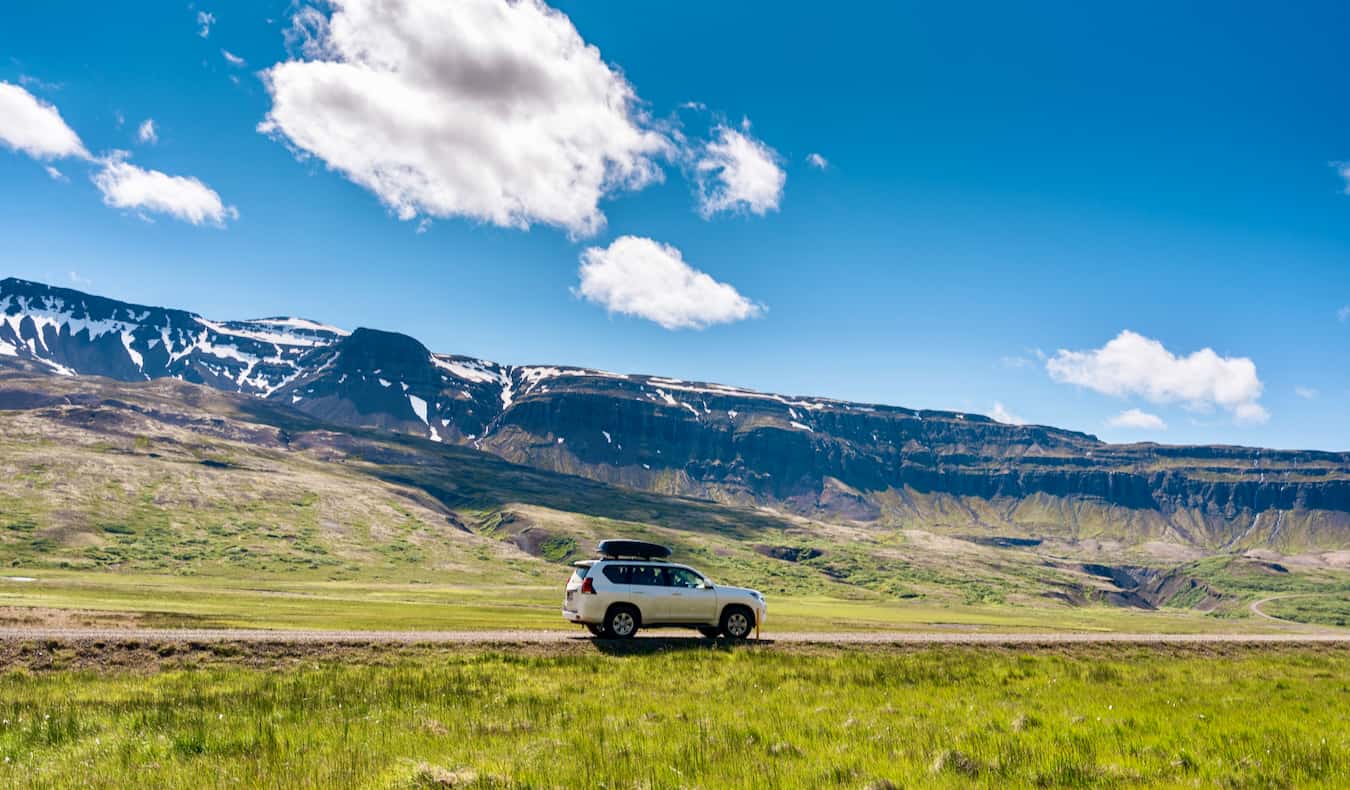
If you want to explore the rugged interior (known as the Highlands), a 4×4 is required, since the roads there are often unpaved, gravel ones called “F-roads,” which can only be traversed by 4×4 vehicles (if you drive a regular car on them, your insurance coverage will be void).
Your final choice is a campervan/RV. These are for travelers who want to sleep in their vehicle as they travel. They are the most expensive option, but you’ll save money on accommodation, so it kind of balances out.
Just keep in mind that standard transmissions are the norm here, so reserve an automatic-transmission vehicle if that’s a requirement for you.
(Note: No matter what type of vehicle you have, never drive off-road. It is highly illegal due to the fragility of Iceland’s ecosystem. Not only does off-roading damage this beautiful environment, but you could face stiff fines if caught.)
3. Download the right apps
Everyone road-tripping around Iceland should have the following apps downloaded to or websites bookmarked on their phone:
Google Translate – While English is widely spoken, the app can be helpful for reading signs and directions. Just make sure to download Icelandic for offline use so that you can still translate things even without mobile data.
Google Maps – The best app for looking up directions. Make sure to download your maps so you have them for offline use.
Safetravel.is – This app shares weather alerts, road closure information, and more. It’s good to have so you can be kept up to date should inclement weather or emergencies arise.
Vedur.is – This is the best weather app for Iceland.
Samferda – This website is great for finding passengers if you want to share a ride with someone. (If you’re a passenger and need a ride, you can post here too.) Another helpful site for finding passengers is Couchsurfing.
Check the international policies and charges on your phone plan before leaving, so as to avoid unexpected charges when using these apps and/or websites. If you want to stay connected with unlimited data on your trip, get an eSIM.
4. Bring a paper map
Whenever I go on a road trip, I always bring a paper map. I know, Google Maps is easy and free, and mobile data coverage in Iceland is reliable. But it’s better to be safe than sorry. You never know when your phone is going to break, if your signal will be lost, or there will be an emergency.
Give yourself peace of mind: bring a paper road map with you, and just leave it in the glove box. You likely won’t need it, but if you do, you’ll be glad you have it!
5. Choose your direction wisely
The vast majority of travelers road-tripping through Iceland drive the Ring Road (aka Route 1, the country’s main highway) counterclockwise. This allows you to start with the famous Golden Circle and then head toward popular sights like the Skógafoss and Seljalandsfoss waterfalls, the Sólheimasandur crash site, the glacier lagoon, and more. If you only have a few days to explore, this is the best direction to choose. If it’s your first-time visiting Iceland, this is the direction I suggest.
However, if you want to be contrarian or you want to get off the beaten path, head clockwise. There are still some sights you can visit to kick things off, such as the postcard-perfect Mount Kirkjufell and the rugged Snæfellsnes Peninsula.
If you really want to get off the beaten path and beat the crowds, head to the Westfjords. Only a fraction of travelers come here, so it’s home to some of the most unspoiled landscapes in the country. It was also the highlight of all my time in Iceland.
6. Avoid the F-roads (if you have a car)
As mentioned above, F-roads are rugged, unpaved routes that generally lead off the main Ring Road into the interior. Driving on these roads requires a 4×4 (4WD). If you have a regular car, you won’t be permitted to drive on them. You will void your insurance coverage while also risking blowing a tire or damaging the car. It’s not worth it!
7. Check the weather often
I’ve said it before and I’ll say it again: the weather in Iceland changes rapidly. For that reason, you’ll want to keep an eye on the forecast. While driving in wind or rain might not be an issue, if you’re planning to get out and hike or visit some of the waterfalls, you’ll want to make sure you’re prepared for the weather. The Vedur.is app (mentioned above) is a must.
No matter what time of year you visit, bring rain gear (including a hat), waterproof footwear, and a sweater. Even in the summer, Iceland is rarely hot, and rain isn’t uncommon either. Prepare accordingly so your trip isn’t ruined (especially if you plan on hiking).
8. Only pull over where there is space
You are going to be tempted to stop your car often to take photos. And I mean really often. Not only are the main sights in Iceland awe-inspiring, but the average sights are stunning too. You’ll come across random vistas and waterfalls, craggy moss-covered hills, black-sand beaches, and so much more.
It will be tempting to pull over to get out and take photos, but do so with caution. Try to pull off the road only at designated stops or where there is room to do so without impeding traffic. While the Ring Road isn’t a superhighway, it is a busy route with regular traffic in both directions. Don’t endanger yourself or others for a photo. Stick to designated stopping areas.
9. Keep an eye on your gas tank
Once you leave the busier part of the island around Reykjavik, gas stations become few and far between. For that reason, you’ll want to fill up when you can. Don’t just wait until you have a quarter tank, as you might run out of gas before you get to the next station.
While you can generally look up where gas stations are via Google Maps, I always make sure to top up when I can. The peace of mind is worth it. You’ll also be covered in case you get delayed or change your travel plans at the last minute.
10. Don’t rush
A lot of people think that, because Iceland is small, you can see the sights in just a matter of days.
You can’t.
If you’re looking to drive the entire Ring Road, plan for at least 10-14 days. While you can do it in less, you will be rushed and will spend more time driving than I’d recommend. (If you just want to see the main highlights in the south and east, 5-7 days is sufficient.)
I prefer quality over quantity, so I always suggest travelers slow down and really soak in the sights. You won’t regret it.
Iceland suffers from success. The country is swamped by travelers during the summer, between late June and early August, as that is when the weather is the warmest and the days are the longest. While “busy” in Iceland is a far cry from “busy” in cities like Barcelona or Venice, it can still be crowded around Reykjavik and the sights closest to the city.
For that reason, I suggest visiting in the shoulder season. The weather is still warm and there will be far fewer people. Everything will be a little cheaper too.
If you are set on going in the summer, I’d suggest heading off to the Westfjords. It’s the least-visited area of the country and offers some of the most untamed and beautiful landscapes in Iceland.
Additionally, I suggest avoiding winter visits too if you plan on driving. Road conditions are less than ideal, and snowstorms are frequent. Unless you have lots of experience with winter driving, skip that season. (You can definitely do a winter visit to see the northern lights, I just wouldn’t rent a car for that.)
Personally, I think late May to early June and late August to early September are the best times to visit. Prices are cheaper, the weather is decent, and the crowds are thinner.
12. Pick up passengers
If you’re traveling on a budget, consider taking passengers. Having people chip in for gas for a leg or two of your journey is a great way to save money while also connecting with like-minded travelers. As mentioned above, you can use websites like Samferda or Couchsurfing to find them.
Another option is to pick up hitchhikers. In the warmer months, hitchhiking is super common along the Ring Road (I hitchhiked here and had a great experience). While they generally don’t have money to contribute, they likely have cool stories and great tips. It’s an easy way to help other travelers and liven up your own trip.
13. Follow the rules of the road
Being a responsible traveler means following local norms and laws. Be aware that Iceland has stricter driving laws and penalties than you may be used to. Make sure to do the following:
Never drive off-road. Respect the fragile Icelandic ecosystem and never drive off-road.
Never drink and drive. Iceland has very strict laws about driving under the influence (0.02% is the limit). Not only are you endangering yourself and others, but the fines are extremely high (100,000 ISK).
Never use your phone while driving. Use a hands-free setup if you need to talk and drive, or else pull over. Not only is it dangerous, but you could face high fines as well.
Watch out for others on the road. This includes sheep (there are more sheep than people here) and cyclists. Pass slowly and give them a wide berth.
Know who to call. If you experience an emergency, dial 112 for assistance. It’s the equivalent of 911 in the US/Canada.
Iceland Road Trip FAQ
How difficult is a road trip in Iceland? Iceland is one of the easiest countries in the world for a road trip. The reason is that there is essentially just one long road that circles the country (known as Route 1, or the Ring Road). That makes it quite easy to get around and difficult to get lost.
How long do you need to road-trip around Iceland? If you plan to drive the entire Ring Road, you’ll want at least 10 days (14 days would be better). If you just want to see the main sights in the south and east, 5-7 days should be plenty.
Is Iceland very expensive? Iceland can be very expensive. Food, accommodation, rental cars, and gas are all pricey. However, there are plenty of ways to save too. By sharing a vehicle (and splitting costs), cooking all your meals, and camping or sticking to hostels, you can easily do it for under $100 USD per day.
Is it worth renting a 4×4? I would only rent a 4×4 if you have prior road trip experience and are planning to go off road. For the average visitor looking to see the main sights, a 4×4 is not necessary.
What is an F-road? An F-road is a route on which only 4×4 vehicles can travel. They are very rugged, unpaved roads, generally leading you into the interior.
If you have a regular rental vehicle, you’re forbidden to drive on them.
Is it safe to drive solo in Iceland? Iceland is consistently ranked as one of the safest countries in the world. If you’re new to solo travel, it’s the perfect place to start.
***
Iceland is one of the most beautiful countries in the world. It’s also one of the best (and easiest) places to do a road trip. While it may be expensive, it’s very safe and easy to get around, and there are lots of free things to see and do to keep costs down. Just follow the tips above, and you’ll have a fun and safe visit to this rugged island nation!
Want to plan the perfect trip to Iceland? Check out my comprehensive guide to Iceland written for budget travelers like you! It cuts out the fluff found in other guides and gets straight to the practical information you need. You’ll find suggested itineraries, tips, budgets, ways to save money, on and off the beaten path things to see and do, and my favorite non-touristy restaurants, markets, bars, transportation tips, and much more! Click here to learn more and get your copy today.
Book Your Trip to Iceland: Logistical Tips and Tricks
Book Your Flight Use Skyscanner to find a cheap flight. They are my favorite search engine because they search websites and airlines around the globe so you always know no stone is left unturned.
Book Your Accommodation You can book your hostel with Hostelworld as they have the biggest inventory and best deals. If you want to stay somewhere other than a hostel, use Booking.com as they consistently return the cheapest rates for guesthouses and cheap hotels.
Don’t Forget Travel Insurance Travel insurance will protect you against illness, injury, theft, and cancellations. It’s comprehensive protection in case anything goes wrong. I never go on a trip without it as I’ve had to use it many times in the past. My favorite companies that offer the best service and value are:
Looking for the Best Companies to Save Money With? Check out my resource page for the best companies to use when you travel. I list all the ones I use to save money when I’m on the road. They will save you money when you travel too.
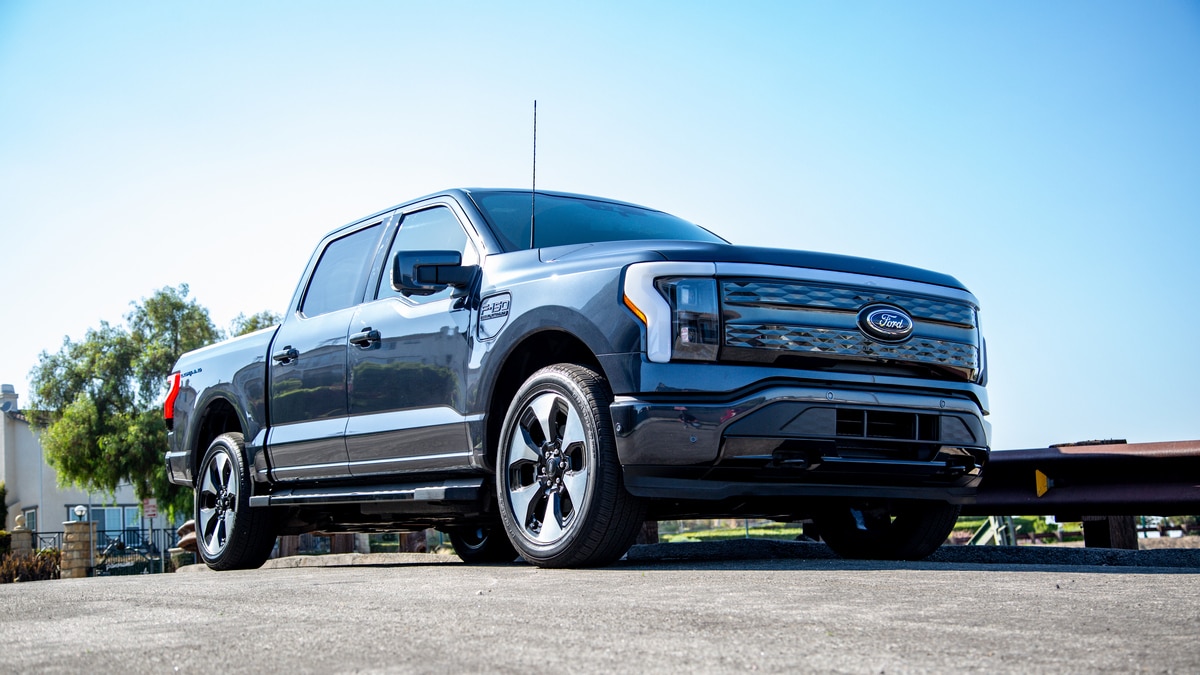
Ford announced today that it will push back production of a second electric truck by a year and plans to offer a hybrid variant of every gas-powered vehicle it sells by the end of the decade.
Ford says the move doesn’t mean it’s stepping back from its electric vehicle (EV) plans. The company “continues to invest in a broad set of EV programs as it works to build a full EV lineup.” However, Ford says it needs to develop “a differentiated and profitably growing EV business over time while Ford serves customers with the right mix of gas, hybrid and electric vehicles based on demand today.”
The company will also “retime” the launch of a planned 3-row electric vehicle, now aiming for 2027 instead of 2026.
An Industry-Wide Timing Problem
The automotive industry is trying to thread a series of needles simultaneously.
According to the EPA, the transportation industry is now the largest source of greenhouse gas emissions in America.
Both state and federal policymakers are pressuring automakers to go electric.
Federal policy gets to the same place obliquely. New EPA tailpipe emissions rules don’t require automakers to build any particular type of car but limit the harmful pollutants cars can produce. Analysts say the only way automakers can meet them is to build more EVs. Rules enacted last month would push most toward a lineup of at least 56% EVs by 2032.
But 2024 isn’t 2032.
EV sales are growing but at a slower pace. The adoption of new technologies typically follows an S-curve. Once the excited early adopters have jumped in, manufacturers run into more skeptical customers who must be convinced. That phase seems to have started.
In survey after survey, car shoppers say they need three things to improve before EVs can become mainstream. Prices need to come down. Range needs to improve. And they need to see more EV infrastructure in their communities.
Ranges are improving, with several mid-priced EVs now topping 300 miles between charges and a handful of luxury EVs managing well over 400. Infrastructure is improving, with most of the industry landing on a single standard charging port next year.
Those three factors may converge in the early 2030s, making mass-scale EV sales practical. Not coincidentally, that matches the timeline of the EPA regulations and most state mandates.
The Lamborghini Urus, unveiled in 2018, marked a groundbreaking moment for Lamborghini. With its entrance into the SUV market with the Urus was both a bold and strategic move. It shares the same platform as the Audi Q8, but the Urus has an extra flair meant to turn heads. Designed to blend the performance of a supercar with the practicality and versatility of an SUV, the Urus redefines what a luxury sport utility vehicle can be.
Its name, derived from one of the large, wild ancestors of domestic cattle, hints at its power and untamed spirit, setting a new benchmark in the luxury SUV segment.
At the heart of the Lamborghini Urus comes with a 4.0-liter twin-turbocharged V8 engine. This engine produces 641 hp and 627 lb-ft of torque, allowing it to go from 0 to 60 mph in just 3.6 seconds and achieve a top speed of 190 mph, making it one of the fastest SUVs in the world.
Coupled with an 8-speed automatic transmission and permanent all-wheel drive, the Urus offers not just explosive acceleration but also remarkable handling and stability, embodying Lamborghini’s racing DNA in a family-friendly package.
The exterior of the Lamborghini Urus blends Lamborghini’s signature sports car aesthetics with the functional requirements of an SUV. Its silhouette features sharp lines, aggressive angles, and aerodynamic elements that not only contribute to its breathtaking appearance but also enhance its performance.
The front fascia, with its large air intakes, emphasizes the vehicle’s power, while the Y-shaped LED headlights and distinctive hexagonal design mirrors Lamborghini’s iconic style.
Inside, the Lamborghini Urus offers an interior that combines sportiness with comfort. The interior is covered with premium materials like leather, Alcantara, carbon fiber, and aluminum. The customizable ambient lighting, advanced infotainment system, and a fully digital instrument cluster create a modern and sophisticated environment.
The Urus also comes with features, including adaptive cruise control, lane-keeping assist, and a high-fidelity sound system, ensuring a driving experience that is as comfortable as it is exhilarating.
The Lamborghini Urus features six distinct driving modes, each designed for different driving conditions and preferences:
Neve: Tailored for winter conditions, enhancing traction on snow and ice.
Sabbia: Optimized for off-road driving, particularly on sandy terrain, increasing ground clearance.
Sport: Focuses on agility for dynamic driving experiences, ideal for country roads with varying elevations and curves.
Corsa: The most performance-oriented mode, minimizing roll for a track-ready experience.
Strada: Enhances comfort for daily driving, adjusting ride height for speed.
Terra: Suited for off-road adventures, suggesting a tire change for trail readiness.
A few of the Lamborghini Urus include the Audi RSQ8, Bentley Bentayga, Porsche Cayenne Turbo S, Rolls-Royce Cullinan, Aston Martin DBX, and the Ferrari Purosangue, but the Lamborghini is for those who want to make a statement.
The Urus is one of the most exciting high-performance luxury SUVs to come out to date, it’s a blend of Lamborghini’s sports car DNA with the functionality and space of an SUV making it a standout choice for those seeking the ultimate in both performance and luxury.
Model Changes (Breakdown by Year)
2018 Lamborghini Urus
The 2018 model is the first full year of production for the Urus, it shares the same platform as the Audi Q8.
Equipped with a 4.0-liter twin-turbocharged V8 engine that produces 641 hp.
The starting price for the Lamborghini Urus was $200,000 slotting it between the Audi RSQ8, Bentley Bentayga, Porsche Cayenne Turbo S, Rolls-Royce Cullinan, Aston Martin DBX, and the Ferrari Purosangue.
2019 Lamborghini Urus
There were no significant updates for the 2019 Urus.
2020 Lamborghini Urus
There were no significant updates for the 2020 Urus.
The base price for the Urus is now $211,000 ($11,000 more than the previous year).
2021 Lamborghini Urus
For 2021, Lamborghini introduced the Pearl Capsule appearance package on the Urus, offering vibrant new color options and distinctive design elements. This package brings to the table a selection of eye-catching hues, complemented by contrasting features and matching interior upholstery, enhancing its aesthetic appeal.
Additionally, the 2021 model enriches its feature set with more standard driver assists and an array of new amenities such as adaptive cruise control, blind-spot monitoring, and a handful of other new standard and optional features., though it comes with a price increase.
The base price for the Urus is now $222,000 ($11,000 more than the previous year).
2022 Lamborghini Urus
There were no significant updates for the 2020 Urus.
The base price for the Urus is now $229,000 ($7,000 more than the previous year).
2023 Lamborghini Urus
In 2023, the Lamborghini Urus introduced enhanced performance versions with the new S and Performante models, featuring an increase to 657 hp.
The Performante variant distinguishes itself with a unique suspension setup featuring steel springs for a lower ride height, optimized for performance. It also offers specialized 23-inch wheels paired with high-performance Pirelli tires, aimed at maximizing grip and handling.
Further differentiation comes through significant weight reduction strategies, including the use of carbon-fiber components and the elimination of sound-dampening materials, contributing to a lighter overall vehicle compared to the Urus S.
This year also sees aesthetic and functional updates, including a redesigned exterior, a new fixed rear spoiler for improved aerodynamics on the Performante, and interior enhancements such as exclusive seating and trim options.
The base price for the Urus S started at $233,000 and Urus Performante started at $268,000.
2024 Lamborghini Urus
For the 2024 model year, Lamborghini plans minimal changes for the Urus, with a notable exception being the introduction of a hybrid powertrain, as confirmed by CEO Stefan Winkelmann.
This new addition is anticipated to either complement or replace the existing 657 hp twin-turbo V-8 engine, aiming to enhance the high-performance SUV’s efficiency and appeal. The hybrid version of the Urus is expected to debut in the 2025 model year, marking a significant shift towards electrification for Lamborghini’s lineup.
Lamborghini Urus Common Problems
The Lamborghini Urus shares its platform with the Audi Q8. This unique partnership allows it to inherit Audi’s renowned reliability and dependability. However, like any vehicle, the Urus is not immune to experiencing some issues over its lifetime.
Keep in mind, that it is crucial to perform a Pre-Purchase Inspection (PPI) from an authorized dealer or experienced independent mechanic to reveal all issues.
Transmission Problems: Some owners have faced issues with the eight-speed automatic transmission, including slipping or jerking movements. This can stem from low transmission fluid levels, faulty torque converters, or worn-out clutch plates. Addressing these issues might require fluid top-offs, part replacements, or a transmission flush.
Electrical System Glitches: The Urus is equipped with advanced electrical systems, and owners have reported problems such as the infotainment system freezing or the audio system cutting out. Solutions may involve system resets or software updates.
Suspension Concerns: The model is known for its adaptive air suspension system designed for comfort and agile handling. However, reports of a bumpy ride or suspension warning lights have emerged, suggesting a need for inspection and potential replacement of damaged components or system recalibration.
Engine Related Issues: Concerns like oil leaks, engine misfires, overheating, carbon build-up, and camshaft wear have been noted. These problems might manifest through decreased oil levels, rough idle, poor acceleration, and increased engine noise, necessitating checks and possible maintenance or repairs.
Fuel Leak Recall: Specifically, for the 2019-2020 Urus models, a recall was issued due to a risk of fuel leaks from the high temperatures in the engine compartment potentially damaging the fuel line quick connector. The solution involved replacing the fuel line and quick connector.
Production Defects in Engine Block Casting: A less common but notable issue traced back to a misalignment in the automated mold-extrusion stamp during the engine block casting process by a German parts supplier. This led to recalls requiring complete engine replacements, a significant fix undertaken by dealerships.
Recalls
2022 Urus vehicles
Back over prevention: Display function (Recall no. 22V804000)
The infotainment system may become damaged, which can result in an inoperative rearview camera display. As such, these vehicles fail to comply with the requirements of Federal Motor Vehicle Safety Standard number 111, “Rear Visibility.”
The middle-rear passenger seat belt automatic locking retractors may deactivate early, which can prevent the child restraint system from securing properly. As such, these vehicles fail to comply with the requirements of Federal Motor Vehicle Safety Standard number 208, “Occupant Crash Protection.”
2021 Urus vehicles
Engine (Recall no. 21V336000)
Cracks may develop on the surface of the engine cylinder bore.
High temperatures in the engine compartment may damage the fuel line quick connector, possibly resulting in a fuel leak.
Maintenance and Ownership Costs
The Lamborghini Urus is a reliable SUV that you can rely on and has relatively low maintenance requirements.
However, it is important to remember that regular maintenance and repairs will still be necessary, and the costs can vary depending on whether you take your car to a dealer or an independent mechanic.
Here are the suggested service schedule and intervals per Lamborghini:
1 YEAR Or 9,000 MILES
Replace engine oil and filter.
Conduct a thorough inspection in accordance with factory specifications.
Perform comprehensive factory diagnostics.
2 YEARS Or 18,000 MILES
Replace engine coolant.
Replace spark plugs.
Replace engine oil and filter.
Inspect and – if necessary – replace the V-belt and tensioner.
Replace pollen filters.
Replace brake fluid.
3 YEARS Or 27,000 MILES
Replace engine oil and filter.
Replace gearbox oil.
Here is a rough estimate of typical service costs associated with the Lamborghini Urus:
Oil Change – As low as $300 for independent mechanics and $900 for dealers.
Minor Service – Typically includes oil change, cabin filters, and engine filters. The cost from a dealer is around $1,500
Major Service – Typically includes all the above plus spark plugs, brake flush, and trans flush, expect about $2,500 from a dealer.
Tires – A set of high-performance tires like Pirelli P Zero will cost about $2,000.
Brakes – Rotors are carbon ceramic which should last forever. Aftermarket brake pads that are OE equivalent will cost about $800 for a full set.
Extended Warranty and Maintenance Plans
For newer Lamborghini Urus owners, the vehicles are covered by a 3-year/unlimited mileage vehicle comprehensive warranty, a 3-year/unlimited mileage powertrain warranty, and a 12-year/unlimited mileage anti-perforation (rust) warranty. Prepaid maintenance is available at various prices through Lamborghini Multi-Coverage Protection Packages. At the end of the 3-year standard warranty period, Lamborghini offers an extended warranty that can be purchased to extend out to 7 years from the vehicle’s initial date of service, for added assurance. If taken at the time of purchase, the extra costs of the extended warranty and extended maintenance plans can be incorporated into your monthly finance payment.
Options List
The Lamborghini Urus has a list of options and packages that customers can choose from.
Some options were packages featuring exterior upgrades, including high-gloss pieces and carbon-forged materials, specifically for high-performance variants such as the Urus S and Performante.
A popular option was to opt for the upgraded paint with a pearl, 4-layer, or matte finish, which often adds a premium to the car’s price.
There were several wheels to choose from for each Urus variant as well.
Another common option that was equipped was the Lamborghini Dynamic Steering wheel (LDS) in combination with the lifting system and magneto-rheologic suspension.
Some buyers also opted for the Sportivo interior option which lets you pick a unique color for the leather which could be in unicolor (just one color) or in bicolor (color on inserts of seats and door panel) and also the branding package with included the Lamborghini logo on the headrest.
The Pearl Capsule appearance package on the Urus would also be a nice option if you can find one.
A handful of Urus customers also went through the Ad Personam program which was a factory-in-house customization program that allowed customers to personalize their Urus with unique exterior and interior colors, materials, and features that were not available on regular production models.
Because of the strict approval requirements, cars that went through the Ad Personam program are considered highly desirable.
These cars usually command a higher premium in the market due to their exclusivity and uniqueness.
Key Options
Lamborghini Dynamic Steering Wheel LDS
High-gloss, carbon-forged exterior pieces
Optional wheels
Pearl, 4-layer, or matte finish paint
Pearl Capsule appearance package on the Urus
Sportivo interior option
Branding Package
Ad Personam exterior or interior (rare)
2023 Lamborghini Urus Sport options list
Lamborghini Urus Price and Values (S and Performante)
The Best Lamborghini Urus to Buy
When it comes to buying an Urus, there are a few key factors to consider that can affect the car’s long-term value.
Some of the criteria are broken down into a few categories.
For Urus that will most likely appreciate in value will be the performance variants such as the Peformante. Although it is more expensive, they will also depreciate much less.
When selecting an Urus, the exterior color and wheel option can also play a role in making the right choice. Opting for the optional pearl, 4-layer, or matte finish paint and upgraded optional wheels will add to the car’s appeal.
In terms of market stability, your best bet would be a 2018 to 2020 Lamborghini Urus.
Additionally, the Urus S is a more refined and capable version of the original Urus, featuring improved aerodynamics, engine power, transmission, suspension, braking, infotainment, four-wheel-steering, and driving modes. Combined with all of this, the Urus S is a great choice.
The Urus will remain a strong purchase simply because of its reputation for being an extremely well-built and reliable vehicle. These cars have a proven track record for being mechanically sound with few major issues.
As hybrid technology becomes more widespread among cars, naturally aspirated V8s are becoming highly sought after by enthusiasts who are looking for a fun SUV in the current market.
Keep in mind, the condition and mileage of the car are also important factors to consider when buying a Urus. There are many that have been driven hard and have been neglected. But the ones that are more likely to retain their value in the long run and will fetch the most money will be a well-maintained car with low mileage.
Therefore, it’s important to do your research, compare prices, and look for well-maintained cars if you are considering purchasing an Urus with the goal of not losing any money.
Conclusion
In conclusion, for around ($250,000+) the Lamborghini Urus is a great choice for the first high-performance luxury SUV that you can rely on.
While the Audi RSQ8, Bentley Bentayga, Porsche Cayenne Turbo S, Rolls-Royce Cullinan, Aston Martin DBX, and the Ferrari Purosangue are other alternatives, the Urus stands out as an exceptional SUV with the dependability of Audi underpinnings that you can rely on.
If you’re in the market for a great SUV that will turn heads, the Urus is a top choice you will not regret.
Car Hacking Shortcuts
Spec matters: Look for any Ad Personam colors or optional colors, Sportivo interior, and branding package.
2018 to 2020 Urus are great hacks.
Special editions like the Urus Performante will be desirable.
As Chairman and CEO of SUTL Group, which created the ONE°15 Marina brand, Arthur Tay has overseen the growth of its flagship Sentosa Cove facility, which is host and owner of the Singapore Yachting Festival and Blue Water EduFest events, and has been joined by Nirup Island.
Arthur Tay, Chairman and CEO, SUTL Group
Looking back, what was the response to the first Singapore Yachting Festival in April 2023, which ONE°15 Marina Sentosa Cove hosted following a four-year break from boat shows in Singapore?
The turnout for the four-day event was positive, with more than 9,500 visitors in attendance. A total of 50 boats were showcased, with 54 exhibitors participating. The high-tech water toys proved to be a major attraction, with numerous adventurous attendees trying out the electric surfboards, while others enjoyed drinks and relaxing on the floating lounge. The second edition will be held from April 25-28, 2024.
As owner of the ONE°15 Marina brand, why did SUTL decide to acquire the Singapore Yachting Festival?
Since 2011, ONE°15 Marina has consistently been the preferred venue for yacht exhibitions in Singapore. The success of these events has been propelled by the marina’s prestige, expertise and hospitality.
Tay with Thien Kwee Eng, CEO of Sentosa Development Corporation, and Wade Pearce of SG Marine Guide at last year’s Singapore Yachting Festival
This synergy between the venue and the event has become so evident that it’s a natural progression for the marina to assume ownership of the Singapore Yachting Festival under the ONE15 Events Management entity, guiding the show’s continuous growth and development.
In terms of participation, the event is now managed by ONE°15 Marina’s in-house team, ensuring a commitment to quality and high standards. Our aim is to enhance the festival experience and introduce Singaporeans and our neighbouring communities to the yachting lifestyle and culture, since more people are increasingly embracing boating and engaging in day trips on the water.
ONE°15’s vision is to be more than just a marina brand. The brand aims to deliver an unrivalled waterfront lifestyle. I believe the Singapore Yachting Festival provides us with the perfect platform to deliver this experience, not only to our members but to the wider community interested in the waterfront experience.
The Singapore Yachting Festival has been acquired by ONE15 Events Management
Taking ownership of the event gives us full control over its curation, enabling us to make adjustments that enhance the product to align with the changing demands of the intended demographic.
Can you explain the difference between the Singapore Yachting Festival and other boat shows ONE°15 Marina has hosted in the past?
In contrast to other boat shows that were focused on luxury, superyachts, fashion and high-end brands, the Singapore Yachting Festival acknowledges the diverse interests within the boating community. The event promotes the yachting lifestyle, showcasing the latest water toys and gadgets, and boats ranging from 10-60m.
The display has expanded to cater to first-time boat buyers and offer ancillary yachting equipment such as tenders, toys and recreational activities. Additionally, the festival enhances visitor experiences with an experiential zone featuring water toy demonstrations, trials and sea trials aboard charter vessels.
This year’s event will include a new ‘festival market’, plus water toys and cars
Since the pandemic, there has been a renewed emphasis on mental well-being and quality family time. As such, the new festival component aims to create a more inclusive and family-friendly atmosphere.
How will the 2024 event differ from last year’s edition?
We’ve significantly expanded the footprint of the event. In 2023, the event was focused purely on the on-water activities. Following the success of the first edition, we decided to invest further into the event by activating the land area surrounding the marina.
We’re delighted to introduce a new concept at this year’s event: a festival market that features upscale pop-up alfresco stalls offering artisan crafts, food, beverages and family-friendly activities. The festival market will enhance the event’s festivities and atmosphere.
This year’s event could feature about 70 yachts
It encompasses a broad audience, including food and lifestyle vendors, yacht enthusiasts, buyers and sellers, along with visitors seeking to immerse themselves in the yachting lifestyle.
For this year’s Singapore Yachting Festival, we’ve also partnered with ICOMIA to deliver a two-day conference ahead of the show, from April 23-24. Darren Vaux, the President of ICOMIA, will share ICOMIA’s landmark research on reducing carbon emissions in the recreational marine industry. The Yacht Style Awards will then be held on the Wednesday evening, April 24.
What are your thoughts on the first two editions of the Blue Water EduFest, your brainchild?
It’s designed to be educational and inspiring, serving as a wake-up call for everyone to recognise the pressing need to protect our precious marine ecosystem and combat climate change by altering our mindset and lifestyle. The event has undeniably met its stated goals, and it’s imperative to sustain the momentum in disseminating its message, raising further awareness, and catalysing change.
Tay’s brainchild, the Blue Water EduFest includes The Ocean Collective seminar
What has been the response to ONE°15 Marina Sentosa Cove since it completed its US$5 million upgrade and reconfiguration in 2021?
Following the reconfiguration, we were accredited by the Marina Industries Association as a superyacht-ready marina and are receiving more superyachts to Singapore. The marina can accommodate yachts of up to 220ft, as we have a 40m-wide channel that facilitates the smooth manoeuvring of larger vessels within the marina.
Additionally, we’ve upgraded our pedestals to meet the power requirements of superyachts, enhanced the speed of our Wi-Fi connection and improved superyacht privileges, while the new superyacht berths provide more convenient access to the clubhouse.
The positive feedback from our returning customers serves as a strong testament to the notable improvements made to the marina through the reconfiguration.
The Blue Water EduFest concludes with the ONE°15 Clean Up
How have the numbers of visiting and resident superyachts changed since 2021, which was still in the heart of the post-Covid era with limited sea travel between countries?
The numbers of visiting and resident superyachts have seen a significant change since 2021 due to various reasons. These include new purchases by high-end owners looking for permanent berthing here, as a safe base for travel in the region and spending more time with their family groups.
There were also vessels that typically travel across multiple regions and decided to find a safe location as a short-term base of operation, until the rest of the countries opened after Covid.
We also welcomed vessels that weathered the Covid period in remote locations, but couldn’t complete many aspects of their annual maintenance. Once they could travel freely, they came to the marina until they had an opportunity to book into a shipyard in Singapore.
ONE°15 Marina Sentosa Cove completed a US$5 million upgrade in 2021
These factors may have affected the numbers of visiting and resident superyachts in different ways and to varying degrees, depending on the specific region and circumstances. Detailed data and analysis from industry reports provide a more comprehensive understanding of the impact of these factors on superyacht activity.
As ONE°15 Marina activity is only a small part of SUTL Group, what are the other primary businesses in which you operate?
On the private company front, SUTL started as a ship chandelling and distribution business in 1968, and has evolved into a successful enterprise with a presence in 18 markets in Asia-Pacific. Fast-moving consumer goods remain a core pillar of the SUTL Group, which represents over 50 global brands and distributes an array of consumer and household goods, alcohol and tobacco. For over 25 years, we’ve also co-owned the KFC restaurant chain in Vietnam, where it now has over 180 stores.
ONE°15 Marina Sentosa Cove was inaugurated in 2007, a year after the first residences on Sentosa Cove opened
SUTL had never been involved in marinas before Sentosa Cove. Has the marina achieved what you hoped it would before it was launched in 2007, a year after Sentosa Cove’s first residence opened?
It has certainly exceeded my expectations. Seventeen years ago, we ventured into opening a marina in Singapore where such facilities were scarce and unfamiliar. Through dedicated efforts, we’ve successfully established ONE°15 Marina as Asia’s premier marina. I take great pride in seeing our team flourish and maintaining the brand’s equity and reputation, propelling it to new heights of success.
On that note, how has ONE°15 Marina benefited from and contributed to Sentosa’s reputation as one of Asia’s premier resort destinations, with Resorts World Sentosa opening in 2010?
ONE°15 Marina is privileged to occupy a serene and picturesque area of Sentosa Cove, close to Lazarus Island, St John’s Island and Sisters’ Islands, which greatly complements our charter business. Similarly, it enriches Sentosa’s appeal by allowing visitors to charter a boat and indulge in a leisurely cruise around Singapore’s waters, enjoying the sun, sand, and sea!
The Blue Water EduFest clean up includes beaches
How closely does SUTL work with the government, Sentosa Development Corporation and Sentosa Cove Resort Management (SCRM)?
We work together with our landlord to execute promotional campaigns, organise signature events, and implement green initiatives. ONE°15 Marina actively contributes to the Sentosa Carbon Neutral Network’s objective of achieving carbon neutrality by 2030.
In addition, ONE°15 Marina enhances Sentosa’s attractions, offering significant value and complementing the idyllic waterfront and upscale residential enclave of Sentosa Cove, with its vibrant yachting lifestyle.
Located just 8nm south of Singapore, ONE°15 Marina Nirup Island in Indonesia opened last year. What facilities can visitors enjoy there now?
The current amenities include a marina with 44 berths, a clubhouse, all-day restaurant, swimming pool, sea sports facilities, showers and laundry amenities.
ONE°15 Marina Nirup Island had an opening ceremony in July 2023 and currently offers 44 berths, a clubhouse, restaurant, pool and water sports
There’s also a ferry terminal adjacent to our marina and a CIQ (customs, immigration and quarantine) facility. Nirup Island has already garnered considerable attention among both Singaporeans and Indonesians as a holiday and wedding destination.
Future facilities include a Westin-operated hotel and villas, restaurants and bars, as well as frequent ferries to and from the island. The marina is currently at the soft opening stage and will only be fully operational when the Westin hotel and villas are opened, with additional activities introduced.
Ford has issued a recall for 1,902 Transit Trail vans from model years 2023 and 2024 because ordinary driving can damage the tires. The Transit Trail is an off-road version of Ford’s Transit cargo aimed at the #VanLife market. It has standard all-wheel drive (AWD), all-terrain tires, and a cargo space lined with drillable walls for conversion into a living space.
Ford tells the National Highway Traffic Safety Administration (NHTSA) that those all-terrain tires may not have sufficient clearance from the scratch-resistant wheel arch liners. Ford’s filing says, “Due to insufficient packaging allowance, the front tires may contact the front wheel arch liner and body flange under certain vehicle loading, steering angle, and braking conditions.”
A tire can wear quickly when repeatedly rubbed against a wheel liner. “Repeated contact of a front tire with the wheel arch liner and body flange may lead to rapid air loss and tread-belt separation, which can result in a loss of vehicle control and increase the risk of a crash,” Ford notes.
Ford says it knows of no accidents but has received five warranty reports, ten field reports, and one owner report related to the problem.
Ford is still working on a remedy. When it comes, it will be free. By law, dealers never charge for recall repairs.
Automakers recall many cars to fix safety defects, sometimes more than once. While automakers try to reach every owner to ask them to bring the vehicle in for repair, they rarely reach them all. Millions of cars on American roads need free recall repairs. Check the easy VIN tool at our recall center to determine if your car is one of them.
Editor’s note: This post is part of the AI Decoded series, which demystifies AI by making the technology more accessible, and which showcases new hardware, software, tools and accelerations for RTX PC users.
Digital characters are leveling up.
Non-playable characters often play a crucial role in video game storytelling, but since they’re usually designed with a fixed purpose, they can get repetitive and boring — especially in vast worlds where there are thousands.
Thanks in part to incredible advances in visual computing like ray tracing and DLSS, video games are more immersive and realistic than ever, making dry encounters with NPCs especially jarring.
Earlier this year, production microservices for the NVIDIA Avatar Cloud Engine launched, giving game developers and digital creators an ace up their sleeve when it comes to making lifelike NPCs. ACE microservices allow developers to integrate state-of-the-art generative AI models into digital avatars in games and applications. With ACE microservices, NPCs can dynamically interact and converse with players in-game and in real time.
Leading game developers, studios and startups are already incorporating ACE into their titles, bringing new levels of personality and engagement to NPCs and digital humans.
Bring Avatars to Life With NVIDIA ACE
The process of creating NPCs starts with providing them a backstory and purpose, which helps guide the narrative and ensures contextually relevant dialogue. Then, ACE subcomponents work together to build avatar interactivity and enhance responsiveness.
NPCs tap up to four AI models to hear, process, generate dialogue and respond.
The player’s voice first goes into NVIDIA Riva, a technology that builds fully customizable, real-time conversational AI pipelines and turns chatbots into engaging and expressive assistants using GPU-accelerated multilingual speech and translation microservices.
With ACE, Riva’s automatic speech recognition (ASR) feature processes what was said and uses AI to deliver a highly accurate transcription in real time. Explore a Riva-powered demo of speech-to-text in a dozen languages.
The transcription then goes into an LLM — such as Google’s Gemma, Meta’s Llama 2 or Mistral — and taps Riva’s neural machine translation to generate a natural language text response. Next, Riva’s Text-to-Speech functionality generates an audio response.
Finally, NVIDIA Audio2Face (A2F) generates facial expressions that can be synced to dialogue in many languages. With the microservice, digital avatars can display dynamic, realistic emotions streamed live or baked in during post-processing.
The AI network automatically animates face, eyes, mouth, tongue and head motions to match the selected emotional range and level of intensity. And A2F can automatically infer emotion directly from an audio clip.
Each step happens in real time to ensure fluid dialogue between the player and the character. And the tools are customizable, giving developers the flexibility to build the types of characters they need for immersive storytelling or worldbuilding.
Born to Roll
At GDC and GTC, developers and platform partners showcased demos leveraging NVIDIA ACE microservices — from interactive NPCs in gaming to powerful digital human nurses.
Ubisoft is exploring new types of interactive gameplay with dynamic NPCs. NEO NPCs, the product of its latest research and development project, are designed to interact in real time with players, their environment and other characters, opening up new possibilities for dynamic and emergent storytelling.
The capabilities of these NEO NPCs were showcased through demos, each focused on different aspects of NPC behaviors, including environmental and contextual awareness; real-time reactions and animations; and conversation memory, collaboration and strategic decision-making. Combined, the demos spotlighted the technology’s potential to push the boundaries of game design and immersion.
Using Inworld AI technology, Ubisoft’s narrative team created two NEO NPCs, Bloom and Iron, each with their own background story, knowledge base and unique conversational style. Inworld technology also provided the NEO NPCs with intrinsic knowledge of their surroundings, as well as interactive responses powered by Inworld’s LLM. NVIDIA A2F provided facial animations and lip syncing for the two NPCs real time.
Inworld and NVIDIA set GDC abuzz with a new technology demo called Covert Protocol, which showcased NVIDIA ACE technologies and the Inworld Engine. In the demo, players controlled a private detective who completed objectives based on the outcome of conversations with NPCs on the scene. Covert Protocol unlocked social simulation game mechanics with AI-powered digital characters that acted as bearers of crucial information, presented challenges and catalyzed key narrative developments. This enhanced level of AI-driven interactivity and player agency is set to open up new possibilities for emergent, player-specific gameplay.
Built on Unreal Engine 5, Covert Protocol uses the Inworld Engine and NVIDIA ACE, including NVIDIA Riva ASR and A2F, to augment Inworld’s speech and animation pipelines.
In the latest version of the NVIDIA Kairos tech demo built in collaboration with Convai, which was shown at CES, Riva ASR and A2F were used to significantly improve NPC interactivity. Convai’s new framework allowed the NPCs to converse among themselves and gave them awareness of objects, enabling them to pick up and deliver items to desired areas. Furthermore, NPCs gained the ability to lead players to objectives and traverse worlds.
Digital Characters in the Real World
The technology used to create NPCs is also being used to animate avatars and digital humans. Going beyond gaming, task-specific generative AI is moving into healthcare, customer service and more.
NVIDIA collaborated with Hippocratic AI at GTC to extend its healthcare agent solution, showcasing the potential of a generative AI healthcare agent avatar. More work underway to develop a super-low-latency inference platform to power real-time use cases.
“Our digital assistants provide helpful, timely and accurate information to patients worldwide,” said Munjal Shah, cofounder and CEO of Hippocratic AI. “NVIDIA ACE technologies bring them to life with cutting-edge visuals and realistic animations that help better connect to patients.”
Internal testing of Hippocratic’s initial AI healthcare agents is focused on chronic care management, wellness coaching, health risk assessments, social determinants of health surveys, pre-operative outreach and post-discharge follow-up.
UneeQ is an autonomous digital human platform focused on AI-powered avatars for customer service and interactive applications. UneeQ integrated the NVIDIA A2F microservice into its platform and combined it with its Synanim ML synthetic animation technology to create highly realistic avatars for enhanced customer experiences and engagement.
“UneeQ combines NVIDIA animation AI with our own Synanim ML synthetic animation technology to deliver real-time digital human interactions that are emotionally responsive and deliver dynamic experiences powered by conversational AI,” said Danny Tomsett, founder and CEO at UneeQ.
AI in Gaming
ACE is one of the many NVIDIA AI technologies that bring games to the next level.
NVIDIA DLSS is a breakthrough graphics technology that uses AI to increase frame rates and improve image quality on GeForce RTX GPUs.
NVIDIA RTX Remix enables modders to easily capture game assets, automatically enhance materials with generative AI tools and quickly create stunning RTX remasters with full ray tracing and DLSS.
NVIDIA Freestyle, accessed through the new NVIDIA app beta, lets users personalize the visual aesthetics of more than 1,200 games through real-time post-processing filters, with features like RTX HDR, RTX Dynamic Vibrance and more.
The NVIDIA Broadcast app transforms any room into a home studio, giving livestream AI-enhanced voice and video tools, including noise and echo removal, virtual background and AI green screen, auto-frame, video noise removal and eye contact.
Experience the latest and greatest in AI-powered experiences with NVIDIA RTX PCs and workstations, and make sense of what’s new, and what’s next, with AI Decoded.
Get weekly updates directly in your inbox by subscribing to the AI Decoded newsletter.
The technical storage or access is strictly necessary for the legitimate purpose of enabling the use of a specific service explicitly requested by the subscriber or user, or for the sole purpose of carrying out the transmission of a communication over an electronic communications network.
Preferences
The technical storage or access is necessary for the legitimate purpose of storing preferences that are not requested by the subscriber or user.
Statistics
The technical storage or access that is used exclusively for statistical purposes.The technical storage or access that is used exclusively for anonymous statistical purposes. Without a subpoena, voluntary compliance on the part of your Internet Service Provider, or additional records from a third party, information stored or retrieved for this purpose alone cannot usually be used to identify you.
Marketing
The technical storage or access is required to create user profiles to send advertising, or to track the user on a website or across several websites for similar marketing purposes.