The Chrysler 300 was a name that the brand would revisit time and again in both production and concept car form, but no 300 wore the badge better than the 300 Hemi C Concept.
The Chrysler 300C Ends Production
The Chrysler 300 and its letter series cars had gained legendary status from its run in the 1950s through the late 1960s, during which time it was used on everything from full on muscle cars to personal luxury coupes. During the 33 year period between the last Chrysler 300M in 1966 and the return of the nameplate in 1999, the 300 appeared as two different concept cars and one concept prototype, one of which was a near production ready concept.
1999 Chrysler 300MImage : Chrysler
By the last turn of the century the Chrysler 300M was already making a name for itself as a luxury performance sedan. Chrysler decided to keep the good times rolling:
“The straight-line power of the ‘50s and ‘60s has been replaced by a balance of crisp handling and sophisticated performance, yet the Chrysler 300 Hemi C still reflects the same philosophy and pedigree of those early letter series cars,” Tom Gale, then-Vice President at Chrysler said at the 300 Hemi C’s introduction in 2000. “This vehicle explores a direction we might take if we were to return to an all-American V-8, rear-wheel-drive luxury performance car such as the famed 1957 Chrysler 300 C convertible.”
The result was a concept that rode on the same LH platform as the brands cab-forward sedans at the time. It was a long, front-engined, rear wheel-drive convertible that was designed around an early version of the brand’s 5.7-liter Hemi V8 as Chrysler’s senior design manager at the time Joe Dehner described:
It is as if we stretched the body around the V8 HEMI engine. The concept’s rear-wheel-drive set-up allowed for a minimal front overhang, while the front fender air exhaust ports and the centrally placed chrome twin exhaust pipes signal its performance. And similar to […] the Chrysler Sebring, this concept is a true four-seat convertible.
Up front was the grille that was inspired by the original Chrysler 300 flanked by big round headlights that look almost identical to the ones used on the production 300M topped off by a massive hood with a center peak line. Alongside were chrome bodyside moldings with the exterior getting covered in a paint color called Frosted Mocha Pearlcoat that should have been used across all of Chrysler’s lineup at the time. Big 19-inch wheels helped emphasize the car’s design.
Image : Chrysler
The rear was just as handsome as the rest of the car, with taillights inspired by the 300M with amber turn signals, dual center exit exhaust and an integrated high mounted stop light that sat on top of Chrysler’s winged badge.
Under the hood, though, was the only thing from the concept that ever actually made it to production; the Hemi C was equipped with an early prototype version of Chrysler’s 5.7-liter Hemi V8. It made 353 horsepower and 353 lb-ft of torque and was paired to a four speed automatic transmission.
Image : Chrysler
The interior of the Hemi C really showed production intent though. Chrysler designers brought a fine attention to detail inside, from the California Walnut trim to the tailored seats, even in the one touch power folding top. From the gated shifter to the controls, this could have easily been built and sold well. It also had some impressive tech for the time.
Image : Chrysler
It featured an infotainment system Chrysler called “Infotronic” that included an in-dash GPS navigation system, an LCD display with voice command function for various features like the climate control and audio system, a trunk mounted laptop and even internet access to run it. Even the vehicle’s security was ahead of its time. The concept featured a fingerprint scanner that unlocked the vehicle. If a fingerprint was scanned that wasn’t registered to the vehicle’s system, it wouldn’t start or open.
While the concept eventually faded into obscurity with the almost shocking debut of the Chrysler 300C sedan a few years later, it’s cool to look back on what could have been had Chrysler gone a more luxurious route with the legendary nameplate.
It’s time to speak up. Has the climate impact of electric cars (EVs) improved global sustainability efforts?
Greenwashing in the EV market is real. Image: Malaya.com.ph.
That is different from how it appears. Automakers’ complete openness is currently shady. When the Polestar 2 Life Cycle Assessment was conducted in 2020, it used a comprehensive process to calculate its sustainability data. This report led other automakers to become more forthcoming about the impact of climate change on their products.
Electric vehicles are more environmentally friendly than traditional combustion-based vehicles. The topic of greenwashing by different OEMs has been debated for a while.
Nonetheless, several variables affect how environmentally friendly and sustainable EVs are overall. Let’s examine some main arguments favouring greener EVs and some common grounds for the automobile industry’s “greenwashing” of electric vehicles.
Claims proving electric cars are greener:
1) Reduced tailpipe emissions: Conventional gasoline and diesel vehicles release dangerous pollutants into the atmosphere, including carbon dioxide and nitrogen oxide, which worsen air pollution and accelerate climate change. On the other hand, when driving an electric vehicle, no exhaust pollutants are released.
2) Decreased greenhouse gas emissions: The total emissions of greenhouse gases linked to electric vehicles (EVs) depend on the composition of electricity generation in a given area.
3) Energy efficiency: Generally, internal combustion engines are less energy-efficient than electric motors. Compared to conventional cars, which waste a significant amount of energy as heat during combustion, electric vehicles (EVs) convert a more substantial percentage of grid energy into usable electricity to propel the car.
4) Lifecycle emissions: Research has demonstrated that EVs can still have smaller carbon footprints than conventional cars throughout their lifetime when manufacturing, charging, and end-of-life recycling are considered.
5) Technological advancements in batteries: As battery technology advances, the environmental impact of battery production is reduced. Research is being done to create more environmentally friendly battery materials and recycling techniques, increasing the ecological friendliness of EVs.
Volvo EX30 touts to be one of the most exciting EVs to debut. Image: Volvo.
5 Reasons for EV Greenwashing
Deceiving customers about a product or service’s environmental benefits is known as “greenwashing”.
False environmental allegations Certain automakers may exaggerate the environmental advantages of their EVs without offering enough proof or clear statistics to back up their assertions in an attempt to project a favourable image; this practice is known as “greenwashing” electric cars.
Presentation of Specific Data Only Electric car greenwashing is the practice of automakers emphasising certain features of their cars that seem environmentally sound while downplaying other, less eco-friendly characteristics. This practice can be done by cherry-picking data or using a limited scope.
Equilibrium Emissions Some automakers may advertise that their electric vehicles (EVs) are environmentally friendly by offsetting emissions in various ways, such as buying carbon credits or contributing to environmental programs, without considering the actual emissions from their supply chains or production processes.
Insufficient Transparency When businesses are opaque about the environmental effects of their products, greenwashing can flourish and make it difficult for customers to make wise decisions.
Sales Hype While some businesses may employ deceptive marketing strategies to give the impression that they care about the environment, they may not be making significant efforts to increase the sustainability of their product lines.
Are we saving the earth by recharging EVs instead of regular petrol cars? Image: Total-tool.com
So, do EVs qualify as green?
To demonstrate whether or not electric vehicles are greener, four main arguments are required.
Battery mining Even while it appears that there will be plenty of supply, we cannot ignore the harm that rare earth element (REE) exploitation causes to the ecosystem. Mined from underneath the earth’s surface, rare earth elements like lithium are utilised to build batteries for electric vehicles.
A recent Chinese Society of Rare Earth analysis states that 1 ton of radioactive residue and 75 tons of acid waste are needed to produce 1 ton of rare earth elements. This is because most energy required to make these batteries comes from non-low-carbon sources, contributing to about half of their environmental effects.
Recycling of Batteries Because lithium-ion batteries contain very little lithium and a highly complex mixture of chemical components, commercial recycling is not an attractive option.
This does not affect how greener EVs are. However, learning ways to recycle or recapture REEs (Rare Earth Elements) has become increasingly attractive as the market for EVs expands. Thus, there’s a significant chance that a healthy market for battery recycling will keep expanding, assisting in the environmental friendliness of electric vehicles.
Mining rare earth elements that are used in the manufacturing of EV batteries. Image: Gript.
Grid Sustainability for Charging Simply put, electric automobiles’ CO2 emissions will always be higher if they are powered by sources other than solar, wind, nuclear, or hydroelectric power.
For instance, it makes little difference if these automobiles emit no emissions while being driven if the electricity used to charge them is produced by burning fossil fuels; the pollution was previously discharged in a power plant some distance away.
Not All Output No cost Cars using electric motors are not entirely emission-free. Although these vehicles don’t release CO2 when they run, they do release CO2 when they are made and when the energy in their batteries is generated.
For example, mining activities that extract rare earth metals for battery production can use a lot of electricity, which pollutes the environment. When producing electricity, an engine running on fossil fuels still releases carbon dioxide into the atmosphere — but it’s doing so through a distant power plant rather than the exhaust. Regarding battery recycling, most EV batteries have yet to be recycled, making it an expensive and developing process.
Do your research before buying your EV. Image: Acardis.
Customers should do their homework and assess the environmental claims made by automakers closely to avoid being duped into buying electric cars. Governments and regulatory agencies are also essential in establishing guidelines and guaranteeing openness to stop the automobile industry from engaging in the “greenwashing” of electric vehicles.
Read the fine print and other related materials about EV Greenwashing. Certain automakers may not be transparent about sustainability. The buyer’s choice to purchase an electric vehicle (EV) due to environmental concerns will be based only on their judgment, investigation, and understanding of the auto industry.
For more on the latest automotive reads, click here.
In private aviation, one can easily assume every plane is equally esteemed. However, specific models are a class above the rest, which makes them extremely popular. Some travelers say they do not care how famous a plane is; they just want to fly. However, if you consider why certain planes are more popular than others, you begin to unravel the perks that come with flying in specific private jets. This article explores the most popular private jet models.
Let’s Board That Plane
No matter what the private jet model is, there will be one that suits your needs. From opulent interiors to onboard private chefs, nearly anything can be catered for. You should also consider plane performance in terms of their capabilities in the sky, speed, and distances they can travel. Here are some of the most popular private planes and what you can expect onboard.
Turboprops
This ultra-lightweight aircraft is ideal for groups of up to eight people and is excellent for shorter runways. These aircraft types are typically quite popular among young people who plan friendship getaways. Here are some of our favorite picks in this category.
Beechcraft King Air 200
The “go anywhere, go anytime” mantra rings true for the King Air 200, as it literally delivers on this statement. This nifty plane is one of the most popular turboprops ever made and is versatile enough to fly commercial, private, and cargo. The first iteration was released in 1974; since then, it has been a superstar choice. Seating up to seven passengers, eight if the enclosed lavatory is converted into an extra seat, this aircraft can fly you anywhere worldwide.
The baggage space includes four suitcases and two items of hand luggage, while the cabin was purposefully designed to eliminate as much noise as possible. The spacious interior features seven seats and one lavatory in its typical set-up; the space can be configured with a club four, a single chair, and a two-seat divan.
Cessna 441 Conquest II
The Conquest II might not be the first iteration of the Cessna, but it is one of the favorites. The development of this aircraft type started decades ago, and eventually, it became Conquest II in 1983. For over 40 years, this private plane has transported people from all walks of life. It comfortably seats eight passengers and can fly from London to Ibiza or New York to Miami.
Regarding the interior, this plane can accommodate five suitcases, including golf clubs. The cabin is ideally suited for eight passengers and can seat up to nine if needed. A few configuration types are available, but the most popular is five seats on the right and four on the left.
Mid-Size Jets
These are the most popular category of private jets all around. This is because many of these planes offer the perfect balance of comfort, speed, and low operating costs and can fly between four and five hours. Here are the most popular choices.
Cessna Citation Latitude
Not only is this one of the best private planes on the market, but it was designed to deliver on expectations of innovation, performance, and comfort. Suitable for eight passengers, the Citation Latitude was first taken to the skies in 2015 and can cover destinations such as Geneva, Dubai, LA, and New York.
One element many people will appreciate is that this plane’s baggage hold is significantly more significant than that of its competitors, such as the Hawker 900XP. You can store up to 14 suitcases, so don’t be afraid to pack.
Another factor that makes this jet one of the best is its spacious cabin and sleek yet modern design. The leather seats are fully reclinable, and you have all the legroom you need for a comfortable flight.
Hawker 850XP
When we evaluate the best private planes, Hawker is the only type that appears less frequently than others. The reason for this is just how particular these aircraft are. While you might think they fly under the radar in popularity, these planes are super versatile and well-liked.
The 850XP is one of the best mid-size jets with cabin space to match. Eight passengers can enjoy a comfortable flight. The 850XP works well for medium-length flights of between three and six hours.
The cabin configuration has a three-seat divan at the end of the plane with five single seats. There is enough space for seven suitcases. However, there is ample storage for smaller items and carry-on luggage.
The cabin also boasts LCD lights, touchscreen seat controls, and more. So, if you plan to take a trip across the country or an international trip six hours away, the 850XP is a great choice.
What Makes a Plane Popular?
There is no right or wrong answer to this question, but we can look at the most widely used jets and what people say about them. The list above is but four jets people have grown to love and appreciate, and a lot has to do with their onboard amenities, flight range, and comfort levels. The King Air 200 can go anywhere at any time; the Conquest II can fly from London to Ibiza or New York to Miami; the Citation Latitude has a more significant baggage hold as compared to its competitors, and 850XP is a top choice for medium-haul flights.
For more on the latest in luxury jet reads, click here.
It’s been a nice 69 years for Disneyland’s car attraction Autopia, but it’s finally getting an upgrade worthy of its neighbors. Situated in the futuristic area called Tomorrowland, nestled next to Space Mountain and Star Tours, the ride has used gas-powered cars since its debut in 1955. Now though, Disney has announced that the ride will soon make the pivot to electric cars.
Neolun Concept First Look : The First Full-Size Electric SUV From Genesis
“Since opening with Disneyland park in 1955, Autopia has remained a guest-favorite most popular with young kids experiencing driving for the first time,” Disneyland spokesperson Jessica Good said to the Los Angeles Times. “As the industry moves toward alternative fuel sources, we have developed a roadmap to electrify this attraction and are evaluating technology that will enable us to convert from gas engines in the next few years.”
That statement, of course, doesn’t give any specific timeline, nor answer whether the new vehicles will be fully electric or hybrid, but it’s a start.
As other sections of Disneyland continue to be renovated, improved, or removed, it’s always seemed a bit odd that Autopia hasremained unchanged. Not just because of the smell of gasoline and exhaust that overpowers the area, or because it’s a seemingly dated technology surrounded by a futuristic themed land. Mostly, it’s because it takes up so much real estate that could potentially be used for almost anything else. Anytime fans speculate about how Disneyland could change, removing Autopia is almost always part of the equation.
And yet, dated as it might be, Autopia lets children of all ages do something they really can’t do almost anywhere else in the world: drive a car. Which is pretty special. So that the ride will finally stop polluting the environment at the same time, is even more special.
Want more io9 news? Check out when to expect the latest Marvel, Star Wars, and Star Trek releases, what’s next for the DC Universe on film and TV, and everything you need to know about the future of Doctor Who.
Porsche’s electric flagship SUV big enough to fit third-row seats has been spotted testing for the first time.
The prototypes in our latest spy shots show a long SUV with a low profile and a relatively low ride height. The roof is also mostly flat all the way to the rear of the vehicle, which is vital for headroom in the third row.
The vehicle, which carries the code name K1, was confirmed by Porsche CEO Oliver Blume in 2022. At the time, he said it was being developed as part of a strategy to boost margins by focusing more on high-end segments.
He followed up with a few more details in 2023, including confirmation that the vehicle will ride on a newly developed EV platform known as the SSP Sport, which Porsche is developing. The platform is expected to share elements with parent company Volkswagen Group’s SSP platform that will feature common battery cells and software systems across a wide range of vehicles from the automaker’s diverse portfolio of brands.
2027 Porsche 3-row electric SUV (K1) spy shots – Photo credit: Baldauf
The SSP Sport is expected to feature technology previewed in Porsche’s Mission R concept shown in 2021, including a high-performance battery, a 920-volt electrical system, and oil-cooled electric motors. Future EVs from VW Group’s premium brands Audi, Bentley, and Lamborghini will also use the platform. Power outputs for vehicles on the platform could potentially top 1,000 hp, as Porsche’s recently revealed 2025 Taycan Turbo GT already delivers up to 1,092 hp.
For the interior, Blume has previously said Porsche will introduce a completely new concept as well as automated driving features. Porsche is working with Mobileye on the automated driving tech.
Production will be handled at Porsche’s plant in Leipzig, Germany, where the Panamera and Macan lines are built, including the recently revealed 2024 Macan EV.
Porsche has previously hinted at a launch date around 2027, which means the vehicle should arrive as a 2027 or possibly a 2028 model in the U.S. Before it arrives, Porsche will launch an electric 718 Boxster and an electric Cayenne. Those vehicles have also been spotted testing.
Going bird watching in Uganda is like stepping into a living, breathing aviary. But it’s important to know where to go to see the best birds.
Mabamba Swamp, located on Lake Victoria’s shores in Entebbe, is renowned for its elusive shoebill stork and over 300 bird species. Beyond Mabamba, Uganda’s national parks, including Murchison Falls, Kibale Forest, Semuliki, Queen Elizabeth, Bwindi Impenetrable Forest, and Mgahinga, offer birdwatching experiences as diverse as the country’s landscapes.
Each park hosts a unique set of species, from savannah birds in Murchison Falls to forest endemics in Kibale and Albertine Rift endemics in Bwindi and Mgahinga.
Here’s a breakdown of the best places to go bird-watching in Uganda.
Top Places for Bird Watching in Uganda
Uganda stands out as a top birdwatching destination, showcasing a wide range of habitats and species.
Mabamba swamp is located on the shorelines of Lake Victoria in Entebbe. Entebbe is the starting point of most safaris in Uganda, and birds always visit the Mabamba swamp found in Entebbe. Mabamba is famous for the Shoebill Stork, which is Uganda’s most sought after bird by bird watchers in the country.
More than 300 bird species have been recorded in Mabamba swamp so far. Bird-watching trips, which are done on motorized wooden boats through trails through the thick marshes, give birders opportunities to see some of the bird species recorded there. The best time to see the birds in Mabamba is in the morning, especially the shoebill stork.
Apart from the Shoebill, birders can see Papyrus Gonolek, Yellow-billed Duck, African Fish Eagle, Water Thick-knee, Grey Heron, Orange Weaver, Lesser Jacana, Goliath Heron, Black Crake, Woodland Kingfisher, Grey-crowned Crane, Hadada Ibis, Black Egret, Malachite Kingfisher, and Black-faced Rufous Warbler, among others.
Shoebill in Mabamba Swamp
Murchison Falls National Park
Over 541 bird species have been recorded so far in Murchison Falls National Park, making it one of the places you have to add to your birding areas on a Uganda safari. Bird watching in Murchison Falls National Park is carried out in places like Kaniyo Pabidi, the northern sector of the park, along the River Nile, and Royal Mile.
Northern Banks: In the northern sector of Murchison Falls National Park, the predominant bird species are Savannah birds, such as Abyssinian Ground Hornbill, Black-billed Barbet, Rufous-crowned Roller, Superb Starling, African Darter, Long-toed Plover, Grey-crowned Crane, Hadada Ibis, African Open-billed Stork, Chestnut-capped Flycatcher, and Little Egret, among others.
Kaniyo Pabidi: Bird watching in Kaniyo Pabidi, part of Budongo Forest, offers birders the chance to see forest birds such as Puvel’s Illadopsis and Yellow-footed Flycatcher, which are endemic to Budongo Forest. Other birds include Yellow-spotted Barbet, White-thighed Hornbill, Ituri Batis, Crested Guineafowl, and Little Greenbul, to mention but a few.
Royal Mile: The Royal Mile is another captivating birding destination in Murchison Falls National Park, known for forest birds. Bird species found there include Puvel’s Illadopsis, Nahan’s Francolin, Yellow-footed Flycatcher, Fire-crested Alethe, Dusky Long-tailed Cuckoo, White-spotted Greenbul, Red-headed Malimbe, Lemon-bellied Crombec, Western Oriole, and White-thighed Hornbill.
River Nile: Aquatic birds in Murchison Falls National Park can be observed along the River Nile. Birders can take a boat to the Nile Delta or to the bottom of the falls for a chance to see species like the Shoebill Stork, Papyrus Gonolek, Giant Kingfisher, African Darter, Giant Heron, Red-throated Bee-eater, and Veracious Dove, among others.
Taking a boat in Murchison Falls National Park
Kibale Forest National Park
Another famous birding destination in Uganda is the home to the highest population of chimpanzees in the world. The national park has over 370 bird species, which can be seen during guided forest walks and in areas like Bigodi Wetland Sanctuary.
Kibale Forest National Park is home to four bird species not recorded elsewhere in the country: Nahan’s Francolin, Cassin’s Spinetail, Masked Apalis, and Blue-headed Bee-eater. It is the premier location for sighting the highly sought-after African Pitta.
The birds of Kibale Forest National Park include the Green-breasted Pitta, Abyssinian Ground Thrush, Narina Trogon, Red-chested Owlet, Dusky Crimsonwing, African Shrike Flycatcher, Zebra Waxbill, Papyrus Canary, Black Bee-eater, African Emerald Cuckoo, Little Greenbul, Great Blue Turaco, Black-capped Waxbill, Great-throated Barbet, Olive Long-tailed Cuckoo, Afep Pigeon, and Little Sparrowhawk, among others.
Semuliki National Park
Semuliki National Park hosts approximately 441 bird species, including 23 Albertine Rift endemics. It stands out as one of the premier birdwatching destinations on a Uganda safari, offering unique opportunities such as spotting the rare Shoebill Stork during boat rides on Lake Albert.
Other notable birds in Semuliki include the Spot-breasted Ibis, Western Bronze-naped Pigeon, Red-thighed Sparrowhawk, Congo Serpent Eagle, Hartlaub’s Duck, Yellow-throated Cuckoo, Papyrus Gonolek, Long-tailed Hawk, Piping Hornbill, Black-throated Coucal, Nkulengu Rail, Icterine Greenbul, Swamp Palm Bulbul, and Northern Bearded Scrub Robin, among others.
Queen Elizabeth National Park
Queen Elizabeth National Park boasts the highest number of bird species among all national parks in the country. With over 600 bird species, the Park offers birders a variety of areas to spot them.
Birding spots include the Kasenyi area, Ishasha sector, Maramagambo Forest, Kazinga Channel, Katwe, Katunguru, Mweya Peninsula, and Lake Kikorongo area.
Kazinga Channel: Birding on the Kazinga Channel is conducted on a boat cruise, allowing tourists to observe numerous aquatic bird species. Birds in the Kazinga Channel include the African Jacana, Martial Eagle, Shoebill Stork, Saddle-billed Stork, Malachite Kingfisher, Yellow-billed Stork, Goliath Heron, Lesser Flamingo, Great Blue Turaco, Long-crested Eagle, and Grey-crowned Crane, among others.
Ishasha Sector: Birding in the Ishasha sector introduces birders to species such as the African Cuckoo, Black Bee-eater, African Wattled Plover, Brown Snake Eagle, Lappet-faced Vulture, African Green Pigeon, Grey-backed Fiscal, Black Coucal, Martial Eagle, African White-backed Vulture, Ross’s Turaco, and Senegal Plover, to name a few.
Maramagambo Forest: Maramagambo Forest, located within Queen Elizabeth National Park, offers birdwatching opportunities. Over 190 bird species can be spotted. Examples include the African Green Pigeon, Verreaux’s Eagle, Purple-headed Starling, Rwenzori Turaco, Fawn-breasted Waxbill, Dark-capped Yellow Warbler, and Little Grebe.
A Kingfisher perches in the reeds alongside the Kazinga Channel in Queen Elizabeth National Park.
Bwindi Impenetrable Forest National Park
Bwindi Impenetrable Forest National Park is home to over 350 bird species, 23 of which are Albertine Rift endemics. Bwindi is a prime destination for birdwatching in Uganda.
The best birding areas within the park include the Ruhija sector, Buhoma sector, and the Bwindi Neck.
Buhoma Sector: Using birding trails such as the Munyaga River Trail, Muzabajiro Loop, and Habinyanja Trail, birders in the Buhoma Sector can observe species like the African Broadbill, Equatorial Akalat, Black-billed Turaco, African Green Broadbill, Great Blue Turaco, White-tailed Blue Flycatcher, Handsome Francolin, Rwenzori Turaco, Mountain Masked Apalis, Ansorge’s Greenbul, Western Nicator, and White-headed Barbet, among others.
Ruhija Sector: In the Ruhija Sector, visiting areas like Mubwindi Swamp, Bamboo Trail, and Ruhija Hill will enable you to spot several bird species, including the Regal Sunbird, Rwenzori Apalis, Grauer’s Broadbill, Speckled Mousebird, Red-faced Barbet, Black Bee-eater, Zebra Waxbill, Kivu Ground Thrush, Black-billed Turaco, Montane Oriole, Shelley’s Crimsonwing, and Doherty’s Bushshrike, among others.
Mgahinga National Park
Mgahinga National Park is home to 180 bird species, 14 of which are endemic to the Albertine Rift region.
Notable bird species in Mgahinga include the Cinnamon Bracken Warbler, White-starred Robin, Rwenzori Turaco, Olive Pigeon, Double-collared Sunbird, Black Kite, Pin-tailed Whydah, Yellow-crowned Canary, Western Tinkerbird, Malachite Sunbird, Cape Robin-Chat, Yellow-billed Kite, and Hadada Ibis, among others.
When to do Birding in Uganda?
The optimal period for birdwatching in Uganda is during the dry seasons, spanning June to August and December to February. During these months, lower water levels create ideal feeding grounds, and shorter grass makes it easier to spot elusive species like the Shoebill without disturbance. However, the wet season, encompassing March, April, May, October, and November, attracts migratory birds due to the abundance of food.
While birding is a year-round activity in Uganda, it’s important to consider that some prime birding locations, such as Kibale Forest National Park and Bwindi Impenetrable Forest National Park, are situated in tropical rainforests where rain can be expected at any time. Visitors should come prepared with hiking boots, raincoats, long clothing, hand gloves, and other essentials for a comfortable experience.
Get in touch with Africa Adventure Vacations to book your birdwatching safari in Uganda. They will advise on the best time to visit and plan your entire safari for you!
Get your Binoculars Ready
Uganda’s rich tapestry of ecosystems, from the watery expanses of Mabamba Swamp to the diverse habitats of its national parks, positions it as a birdwatcher’s paradise. Each location offers a unique glimpse into the country’s abundant birdlife, including rare finds like the shoebill stork and numerous endemic species.
Whether you’re navigating the marshes of Mabamba or exploring the lush forests and savannahs of Uganda’s parks, the country promises an unforgettable birdwatching experience, cementing its status as a must-visit destination for bird enthusiasts around the globe.
Africa Adventure Vacations is a one-stop center for the best and most memorable African safaris. We are a renowned safari operator based in Uganda, offering exceptional tours throughout the East African region, ranging from wildlife adventures, culture, birding, luxury gorilla safaris to Kilimanjaro trekking tours. All our tours can be customized to best suit your travel needs, budget and time.
Ford has filed a patent application for power-actuated doors that automatically open when a person approaches the vehicle.
In the application, which was published by the United States Patent and Trademark Office (USPTO) on March 19, and originally filed on Dec. 3, 2021, Ford discusses using electric motors to open and close the doors, and cameras to identify an authorized user trying to get into the vehicle.
Ford automatic door patent image
Cameras would use facial recognition to determine a person’s identity and whether they’re trying to get into the vehicle. The latter would be accomplished by visually analyzing a person’s gait and comparing that to acceleration data from a phone or key fob the person is carrying.
The same concept can also be applied to a trunk, rear hatch, or EV frunk. Again, cameras would confirm a person’s identity and that they’re trying to access the vehicle, then automatically open the trunk, frunk, or hatch. This wouldn’t be as significant, though, as it’s not far off from the motion-activated tailgates that are already a common feature on SUVs from mainstream brands.
Ford automatic door patent image
Ford doesn’t go into detail about why it’s trying to patent automated doors, but convenience would likely be a factor. Such a system would be the next step from the pushbutton-close doors already available on some luxury cars.
So if this system makes it to production, it might make more sense for a future Lincoln than something from the main Ford brand. Lincoln is currently in the midst of shrinking its dealership network to boost profitability, and is scheduled to start pivoting to EVs next year, with the goal of making all-electric models account for nearly 90% of its sales volume by 2030.
America’s automakers are deep into a transition to electric propulsion, hoping to meet federal tailpipe emissions rules and state EV sales mandates. But Americans keep sending the same signals – we’ll buy these things when they’re cheaper.
It may be true.
Ford made one cheaper. The result? A sales surge.
Industry publication Automotive News explains, “Discounts begun in February of up to $8,100 on lingering 2023 Ford Mustang Mach-E’s are working: Sales are up, and inventory is down.”
Ford Slashed Prices When Government Incentives Disappeared
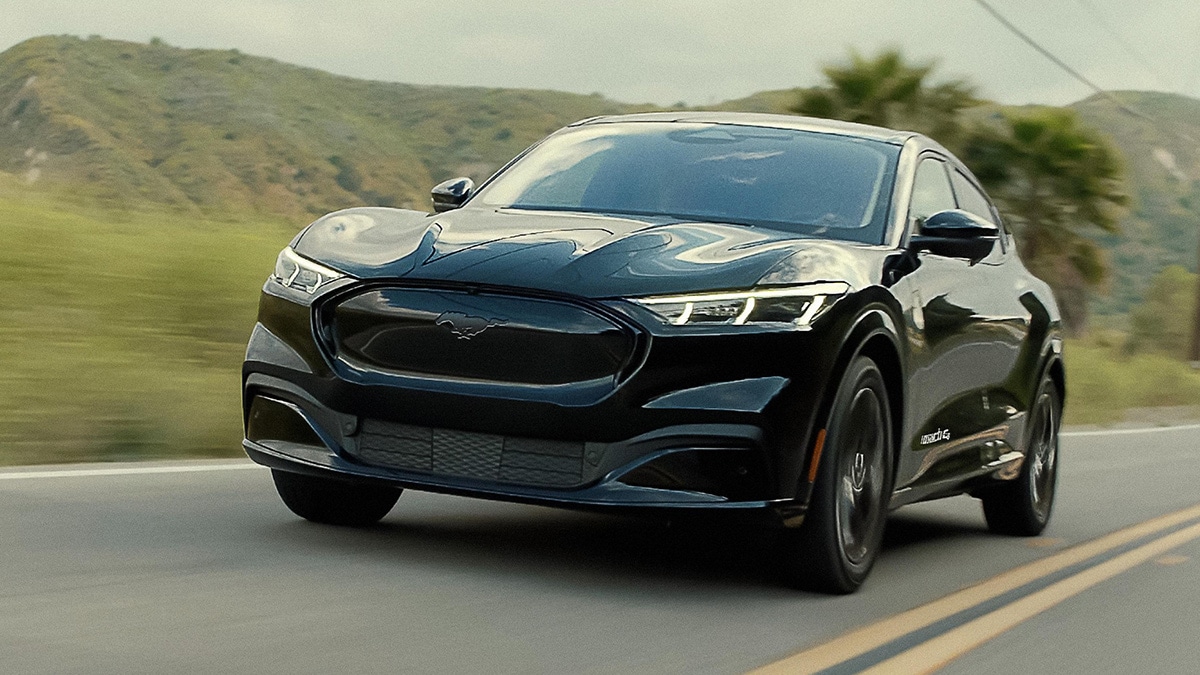
The Ford Mustang Mach-E is a sporty-looking all-electric SUV with seating for five and a range of up to 310 miles, depending on trim level. KBB expert test driver Colin Ryan calls it “a well-rounded electric vehicle with impressive range figures and some excellent tech, but also a sense of familiarity and heritage unavailable elsewhere in the segment.”
But Mustang Mach-E sales were more than cut in half early this year when the model lost access to federal electric vehicle (EV) tax credits. Some EVs are eligible for a federal tax rebate of up to $7,500. But the rules that qualify cars for the discount grow more stringent every year – an attempt to force automakers to rely less on China for critical battery minerals. The Mach-E was one of many cars that lost access this year. Ford responded with a series of price cuts.
AN says, “Since Ford announced the discounts in late February … movement of Mach-E inventory has nearly tripled.”
More Low-Cost EVs on the Way
The data reinforce a simple point – Americans say they want cheaper EVs. When EV prices come down, they make good on their word.
That’s good news for automakers and their quest to go electric.
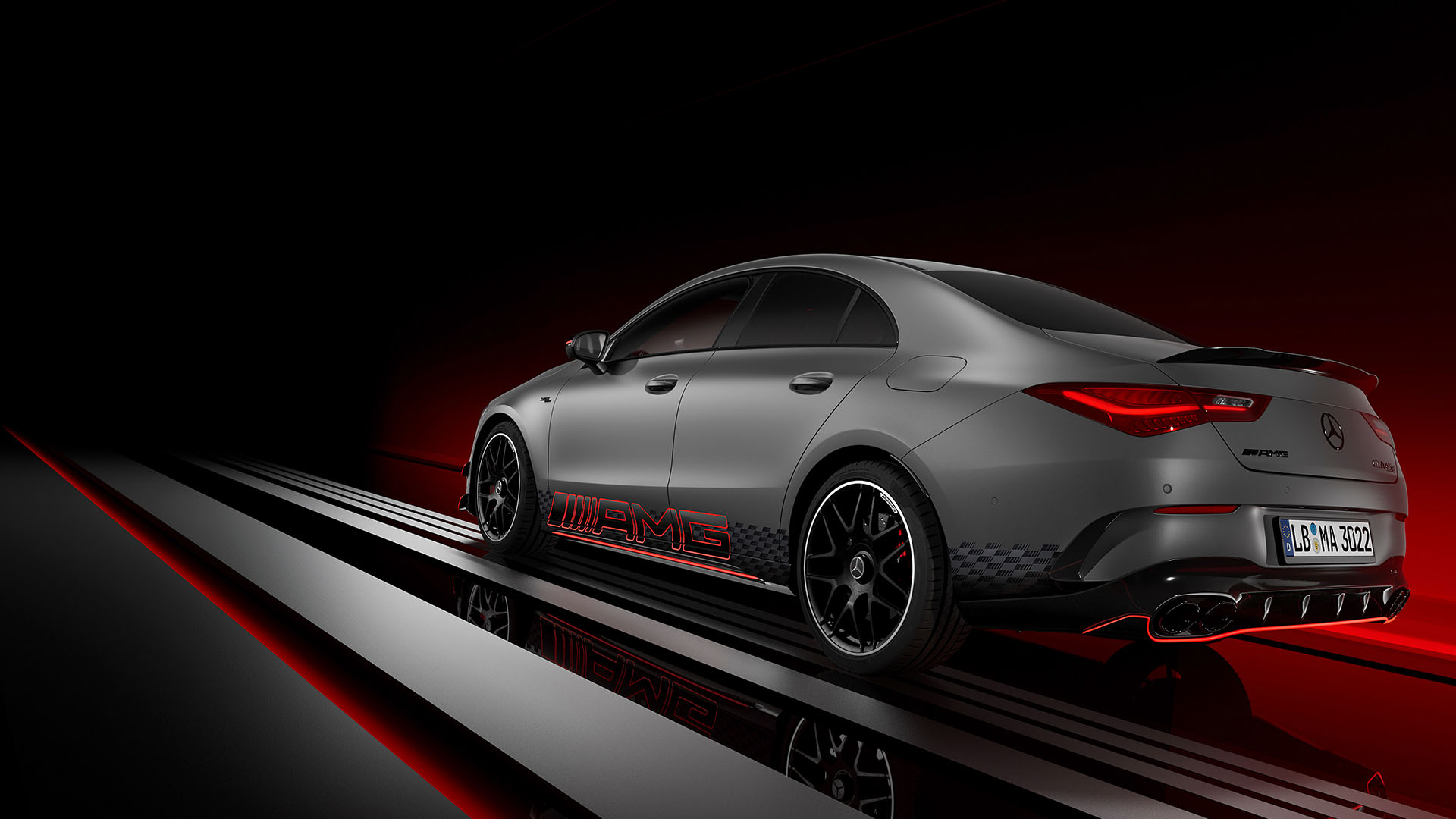
Mercedes-Benz USA elevates the most dynamic model of the AMG CLA portfolio with the new Mercedes-AMG CLA 45 S “Edition 1.” The special edition model features numerous unique exterior and interior design elements, in addition to a generous suite of standard equipment. Limited to only 25 units for the U.S. market, the 2024 Mercedes-AMG CLA 45 S “Edition 1” arrives soon at U.S. dealerships, priced at $81,195.
MANUFAKTUR Mountain Grey Magno paint and graphics along the vehicle’s profile featuring the AMG logo and AMG pattern in the checkered-flag design emphasize the dynamic character of the Edition 1. This is further underscored by exclusive design accents in orange, the AMG Night Package Plus, and the AMG Aerodynamics Package with a larger front splitter and rear spoiler, among other aerodynamic enhancements. 19-inch AMG cross-spoke forged wheels in matte black are fitted, and red AMG Performance brake calipers at the front and rear provide an attractive contrast.
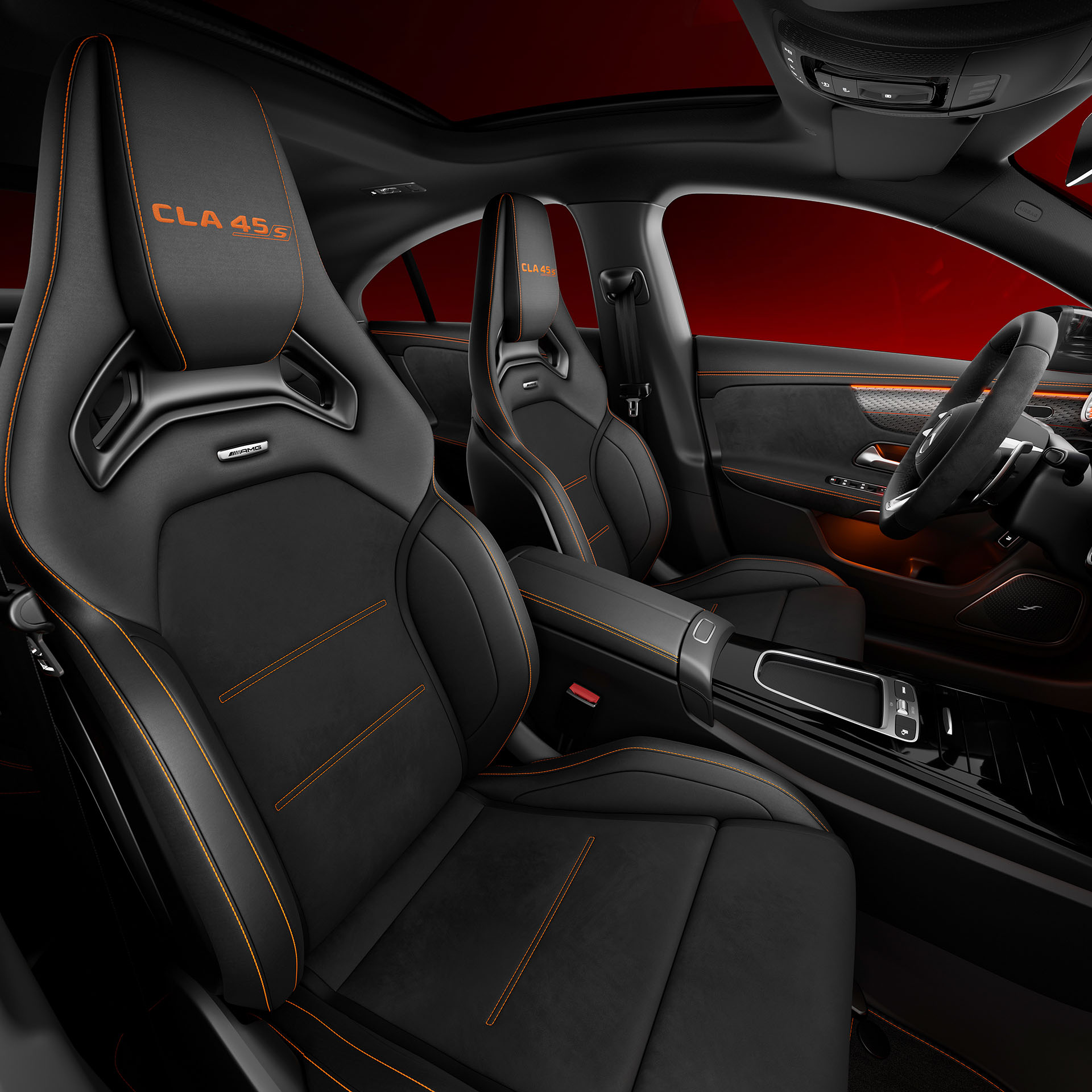
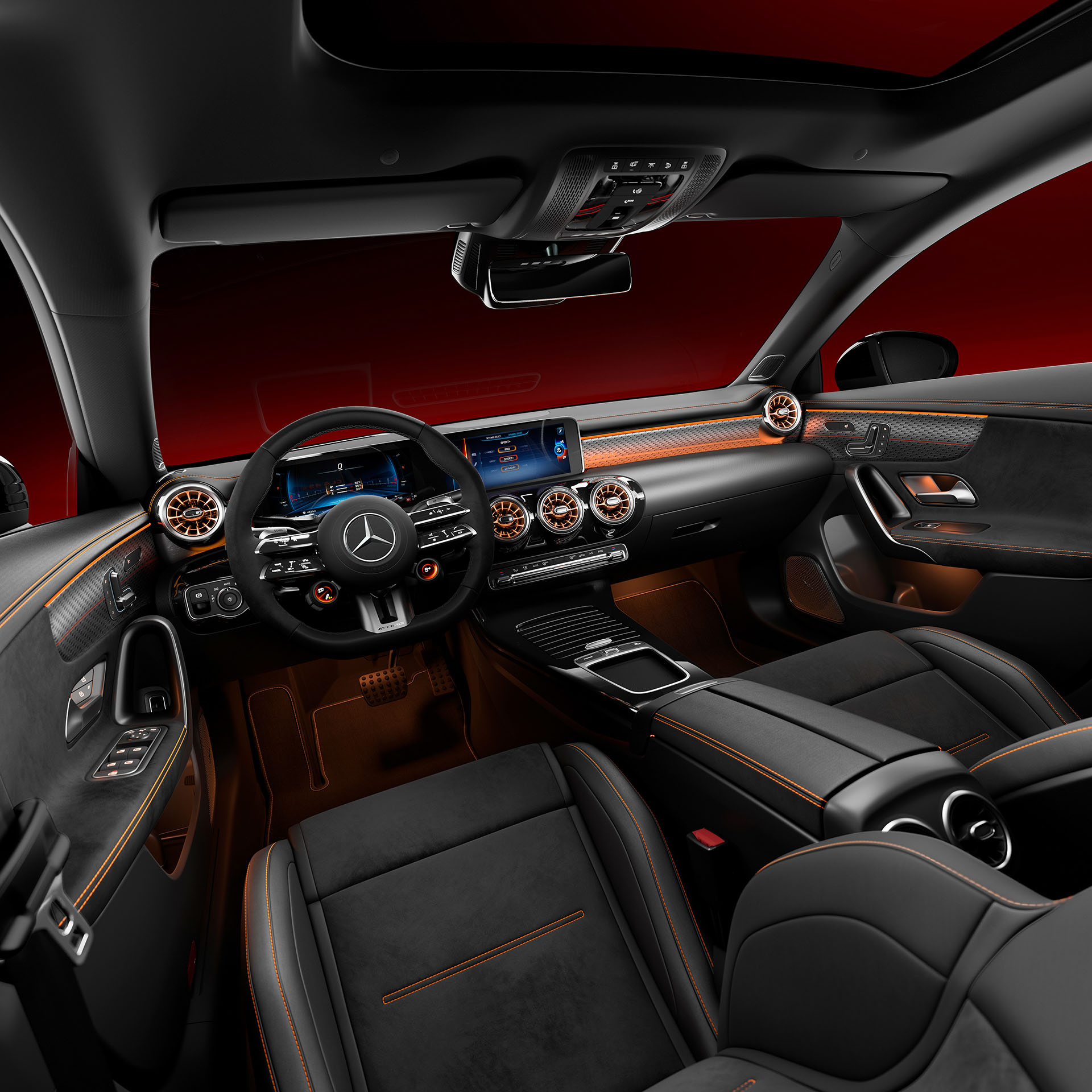
Distinctive design elements are visible throughout the interior. AMG Performance seats with black microfiber upholstery and orange stitching provide outstanding support during dynamic driving. “CLA 45 S” branding in orange adorns the integrated headrests. Striking accents further extend to the instrument panel with orange contrast stitching, red illuminated AMG door sill panels, and Edition 1-specific lighting in red. Other interior highlights include the AMG Performance steering wheel in Nappa leather/microfiber and AMG trim elements in aluminum and black, complimenting the same style as the exterior graphics.
A Handcrafted AMG 2.0-liter turbocharged M139 engine producing 416 hp and 369 lb-ft powers the AMG CLA 45 S “Edition 1.” It enables the sporty coupe to accelerate from 0 to 60 mph in 4.0 seconds. Standard AMG Performance 4MATIC+ fully variable all-wheel drive with AMG TORQUE CONTROL also contributes to the dynamic driving experience. The rear differential is equipped with two electronically controlled multi-plate clutches, each of which is connected to a rear axle driveshaft. This allows the drive power to be distributed variably between the front and rear axles, and selectively between the left and right rear wheels, further improving performance.
America’s roads grew a little safer last year – a welcome development after several years of increasing fatalities.
On Monday, the National Highway Traffic Safety Administration (NHTSA) released traffic fatality numbers for 2023. The agency “estimates that 40,990 people died in motor vehicle traffic crashes in 2023, a decrease of about 3.6% as compared to 42,514 fatalities reported to have occurred in 2022.”
The fourth quarter of 2023, NHTSA says, marked “the seventh consecutive quarterly decline in fatalities beginning with the second quarter of 2022.”
Traffic deaths hit a two-decade high in the first quarter of 2022. Experts blamed everything from people speeding on emptier pandemic-era roads to more distraction from phones and higher drug use.
Automakers have embraced automated safety systems to bring more safety to new cars. Safety advocates say that approach has flaws, as automatic emergency braking and similar systems don’t work well at night or at highway speeds.
Policymakers have several tools available to try to get the death count under control. A recent law could require Breathalyzer-like technology in all new cars as soon as 2026. A more extreme proposal, not yet part of any law, would require automakers to build in speed governors that prevent speeding.
But NHTSA believes it can also help by focusing on roads themselves. The agency says it has “awarded $1.7 billion in funding to improve roadway safety at the local, regional, and tribal levels” through a “safe system approach” emphasizing better lighting, rumble strips, and bicycle lanes.
The technical storage or access is strictly necessary for the legitimate purpose of enabling the use of a specific service explicitly requested by the subscriber or user, or for the sole purpose of carrying out the transmission of a communication over an electronic communications network.
Preferences
The technical storage or access is necessary for the legitimate purpose of storing preferences that are not requested by the subscriber or user.
Statistics
The technical storage or access that is used exclusively for statistical purposes.The technical storage or access that is used exclusively for anonymous statistical purposes. Without a subpoena, voluntary compliance on the part of your Internet Service Provider, or additional records from a third party, information stored or retrieved for this purpose alone cannot usually be used to identify you.
Marketing
The technical storage or access is required to create user profiles to send advertising, or to track the user on a website or across several websites for similar marketing purposes.