Home Blog Page 845

Porsche 991 GT3 RS Buyers Guide

0


The introduction of the Porsche 991.1 GT3 RS took the supercar world by storm. It replaced the 997.2 GT3 RS on an entirely new 991 chassis. It is regarded as one of the most hardcore street legal production cars around with Porsche’s trusted reliability.

Each time a new GT3 RS is released, it sets the bar high for the successor to follow.

Slotting in as the big brother to the lesser expensive GT3, the GT3 RS is a car meant for drivers that are serious about lap times. 

It features a 4.0 liter engine that pushes out 500 hp, versus 3.8 liters and 475 hp in the GT3. The RS engine revs up fast, helped by light titanium rods. Its middle titanium exhaust makes a very loud sound near the high 8800-rpm redline.

The GT3 RS has moved away from the manual transmission option, and now exclusively comes equipped with Porsche’s exceptional PDK dual-clutch transmission, which is renowned for its seamless gear shifting and performance capabilities. 

When you see a GT3 RS, you will not mistake it for a standard GT3. Immediately, you will notice the wider track, large rear wing, and more aggressive bodywork. Carrying on the tradition of high-performance GT3 RS models that began with the 996 generations in 2003 (not available in the U.S.), this newest iteration, like its predecessors, enhances track performance through increased tire grip and extensive aerodynamic improvements.

It comes with a wider body than the 911 Turbo models, making it 1.1 inches wider than the GT3. Porsche also changed the GT3 RS to use the rear fender ducts for air intake, which are used for intercoolers in the Turbo version.

The RS includes a magnesium roof and carbon-fiber front fenders, trunk lid, and rear engine cover. The front splitter, the ducktail-like engine cover, and the huge adjustable rear wing over five feet high are all part of the improved aerodynamics. These changes create three times more downforce than the GT3.

Inside the GT3 RS interior, you will find that it has the same dashboard as all other 991.1 911s, but a key difference is the Alcantara steering wheel and the carbon fiber racing seats that were also in the Porsche 918 hypercar. Although some came with comfort seats, the racing seats were the one that was most desirable.

The 991.1 GT3 RS’s driving dynamics were a much more drastic improvement over the 997.2 GT3 RS it replaced.

Driving the GT3 RS on public roads can be a bit disappointing, as you won’t be able to truly experience its full capabilities. This makes you more eager to take it to a racetrack and uncover its true potential. However, the GT3 RS surprisingly doesn’t demand many compromises compared to the standard GT3. Although it might be slightly noisier and wider, the car still offers a comfortable ride, and the PDK gearbox performs seamlessly.

It features a more advanced and sophisticated drivetrain, which results in a smoother and more controlled driving experience. 

Some of the competitors to the GT3 RS were the Ferrari 488 GTB, Lamborghini Huracan, and the McLaren 570S. The Porsche is the only one that is the most track-focused and hard-core that most resembles a street-legal race car out of the competition. 

Overall, the GT3 RS is an incredible performance car, and those that buy one are most likely track enthusiasts you will not regret buying one.

Model Changes (Breakdown by Year)

2015 Porsche GT3 RS

The 2015 model was the first year of the 991.1 GT3 RS, which replaced the 997.2 GT3 RS. 

Featuring a 4.0-litre engine that produces 500 hp and 340 lb-ft of torque.

As usual for Porsche, the design is based on function, and this feature helps push the front wheels down for better grip. A standout feature is the special air vents in the front wheel arches that reach the top part of the sides, just like a real race car.

The starting base price was around $176,000 slotting it right with the Ferrari 488 GTB, Lamborghini Huracan, and the McLaren 570s.

2016 Porsche GT3 RS

For the 2016 GT3 RS, everything remained the same with no changes. 

2017 Porsche GT3 RS

No GT3 RS was produced for the year 2017. 

That is because the 991.1 GT3 RS was in anticipation of the mid-life cycle update that came in 2018.

2018 Porsche GT3 RS

In 2018, the Porsche 991.2 GT3 RS was launched as an updated version. In short, an already great car became even better. 

This is the best 911 without turbochargers. Almost all 911 models use turbocharging for more power and less CO2, but the GT3 and GT3 RS stay naturally aspirated. This gives more accurate power, higher RPMs, and an exciting sound.

It now comes with 513 hp (38 hp more than the 991.1 GT3 RS) and 347 lb-ft of torque, providing increased performance and quicker acceleration for an even more exciting driving experience.

The most noticeable difference is the body, which is wider, has more openings and has larger spoilers. It shares its body with the 911 Turbo, which is why it has cooling vents in the rear arches. These vents were designed for the Turbo’s intercoolers, but in the GT3 RS, they supply air to the big airbox at the back.

The air ducts inside the car make the intake sound really amazing. The front part is wider than the Turbo, and it looks like a race car with its tilted position, thanks to the new 21-inch rear wheels and 20-inch front wheels.

The suspension is more advanced than the standard GT3, the aero kit produces increased downforce, and the 4.0-liter flat-six engine provides additional power and torque. This engine is closely connected to the one used in the 911 GT3 Cup race car.

Base price started at $188,000 ($12,000 more than the pre-facelift GT3 RS).

Porsche 991 GT3 RS Common Problems

The Porsche 991 GT3 RS is regarded as a supercar that is not only reliable but also one of the more hardcore track and street machines on the market. 

Many people have driven their Porsche GT3 RS for extended distances, some even exceeding 80,000 miles, proving its reliability. 

This breaks the traditional belief that supercars are inherently unreliable.

However, it is essential to keep in mind that all cars, even supercars, can have issues and it is crucial to perform a Pre-Purchase Inspection (PPI) from an authorized dealer or experienced independent mechanic to reveal all issues.

Fingerprint bearing failure: Earlier models of the 991 GT3 RS experienced engine failures due to faulty connecting rod bearings. Porsche addressed this issue by replacing the affected engines and updating the bearings in newer models.

Intermediate Shaft (IMS) bearing failure: Although more prevalent in earlier generations of the Porsche 911, some GT3 RS models have experienced IMS bearing failure, which could lead to catastrophic engine damage. Porsche has made significant improvements in recent years to address this issue.

Coolant leaks: Some GT3 RS engines have been reported to suffer from coolant leaks, mainly due to cracked coolant lines or faulty connections. Regular inspection and maintenance can help prevent this issue.

Overheating issues: There have been reports that the GT3 RS can sometimes face overheating problems, especially during extended periods of hard driving or in hot climates. Ensuring proper cooling system maintenance and using high-quality engine oil can help mitigate this issue.

Recalls

2016 GT3 RS vehicles

The Child Restraint System (CRS) instructions (Recall no. 19V875000)

The Child Restraint System (CRS) instructions within the Owner’s Manual may not provide enough specificity for proper installation.

2016 GT3 RS vehicles

Air bags: Frontal: Passenger side: Inflator module (Recall no. 17V134000)

The passenger frontal air bag inflator initiator may fail to ignite during a crash.

2016 GT3 RS vehicles

Passenger Frontal Air Bag may not Deploy (Recall no.17V134000)

If the air bag inflator initiator fails to ignite, the passenger frontal air bag will not deploy, increasing the risk of injury in the event of a crash. This recall affected 2016 GT3 RS vehicles. 

2018 GT3 RS vehicles. 

Air Bags (Recall no.19V179000)

The side air bag impact sensors may not have been properly tightened to the vehicle. This recall affected 2018 GT3 RS vehicles. 

Maintenance and Ownership Costs

In comparison to other supercars, the Porsche GT3 RS is known for its relatively minimal maintenance needs.

However, it is important to remember that regular maintenance and repairs will still be necessary, and the costs can vary depending on whether you take your car to a dealer or an independent mechanic.

Here is the suggested service schedule and intervals per Porsche:

Annual Maintenance or Every 6K Miles:

  • Vehicle Inspection
  • Change engine oil and filter
  • Update or replace maintenance items based on inspection
  • Replace engine air intake filters (GT3 RS)
  • Add the following maintenance items to the annual service, based on the time or mileage intervals shown below:

Additional Maintenance Every 12K or 2 years:

  • Replace Spark Plugs
  • Replace brake fluid
  • Replace cabin pollen filter
  • Replace cabin pre-filter element
  • Replace engine air intake filters

Additional Maintenance Every 24K or 4 Years:

Additional Maintenance Every 48K or 6 years:

  • Replace PDK clutch fluid
  • Clean throttle body

Additional Maintenance Every 96K or 12 years:

  • Replace manual transmission fluid
  • Replace PDK transmission oil

Here is a rough estimate of typical service costs associated with the Porsche GT3 RS:

  • Oil Change – As low as $300 for independent mechanics and $480 for dealers.
  • Minor Service – Typically includes oil change, cabin filters, and engine filters. The cost from a dealer is around $1,500
  • Major Service – Typically includes all the above plus spark plugs, brake flush, trans flush, expect about $2,500 from a dealer.
  • Tires – A set of high-performance tires like Michelin PS4 will cost about $2,000.
  • Brakes – Rotors are carbon ceramic which should last forever. Aftermarket brake pads that are OE equivalent will cost about $800 for a full set. Steel breaks would cost about $6,000 to replace.
  • Clutch – Dual clutch transmission should last the lifetime of the car so expect zero additional expenses for clutch or flywheel service.

Options List

Porsche is well-known for offering an extensive selection of customization options to choose from. Here, we’ll highlight some of the most sought-after choices among GT3 RS owners.

A popular option was the Sport Chrono Package which includes built-in timers and the Porsche Track Precision app for smartphones. This app uses GPS to measure lap times and records various driving data like speed, side-to-side movement, and acceleration or deceleration.

It organizes this information, allowing drivers to share and compare their data with others. 

The Porsche Ceramic Composite Brake (PCCB) is a favored choice, particularly for those who enjoy taking their cars to the track. These ceramic brakes are distinguishable by their yellow calipers, as opposed to the red calipers found on steel brakes. This feature is quite useful for GT3 RS owners who enjoy taking their cars to the racetrack.

A number of owners decided to forgo the sport bucket seats that come standard in the GT3 RS, instead opting for the more plush and comfortable seats. This alternative seating option was offered by Porsche at no extra charge, making it an attractive choice for those seeking a more relaxed driving experience.

However, they don’t help with resale value as more enthusiast prefer the sport bucket seats.

For the 991.2 Porsche released the Weissach Package for the GT3 RS. The package focuses on reducing vehicle weight and enhancing performance. It includes features such as a carbon fiber roof, anti-roll bars, and coupling rods, as well as unique Weissach badging.

This package results in improved handling and performance for the GT3 RS, making it a popular choice among driving enthusiasts.

Also, a handful of GT3 RS customers also went through the PTS (Porsche to Sample) program which was a factory-in-house customization program, that allowed customers to personalize their Porsche with unique exterior.

For individual unique interior colors, materials, and features that were not available on regular production models, you would have to go through the Porsche Exclusive Manufaktur department. 

Because of the strict approval requirements, cars that went through the PTS and Porsche Exclusive Manufaktur program are considered highly desirable. 

These cars usually command a higher premium in the market due to their exclusivity and uniqueness. 

Here are some examples of option changes

2015 Porsche GT3 RS Options List

2018 Porsche GT3 RS Options List

Some of the more desirable options to look for include:

  • Front-axle lift
  • Sport bucket seats
  • Carbon-ceramic brakes
  • Sport Chrono Pack
  • Weissach package (on 991.2 GT3 RS)
  • PTS and Porsche Exclusive Manufaktur interior

991.1 and 991.2 Porsche GT3 RS Price and Values (2015-2020)

The Best Porsche GT3 RS To Buy

When it comes to buying a GT3 RS, there are a few key factors to consider that can affect the car’s long-term value.

Some of the criteria break down into 3 key points. 

The 991.2 GT3 RS is likely to increase in value due to its facelift, minor power enhancements, and exterior improvements. As the final generation of the 991 GT3 RS before the introduction of the 992, it stands out as an appealing choice for collectors and enthusiasts alike.

Despite the pre-facelift 991.1 GT3 RS not featuring some of the enhancements present in the 991.2 version, it remains a dependable option that is hard to overlook.

However, on the other hand, all GT3 RS’s including the first pre-facelift will remain a strong purchase simply because of their reputation for being extremely well-built and reliable vehicles. These vehicles are known for their Porsche mechanical reliability, with only a small number of significant problems reported.

As hybrid and electric technology becomes more widespread among cars, collectors and enthusiasts are increasingly seeking out naturally aspirated engines in today’s market.

In addition, the condition and mileage of the car are also important factors to consider when buying a GT3 RS. There are many that have been driven hard on the track. But the ones that are more likely to retain their value in the long run and will fetch the most money will be a well-maintained car with low mileage.

Therefore, it’s important to do your research, compare prices, and look for well-maintained cars if you are considering purchasing an GT3 RS with the goal of not losing any money.

Conclusion

In conclusion, for around ($200,000+) the 991 Porsche GT3 RS is a great choice for a track focused supercar that you can rely on.

Although there are other vehicles in this segment to choose from, like the Ferrari 488 GTB, Lamborghini Huracan, and McLaren 570S, none can rival the raw, street-legal race car experience that the GT3 RS offers for public roads. 

As the saying “Porsche, there is no substitute” implies, the car truly stands apart in its own distinct class.

Car Hacking Shortcuts

  • Make sure the car has a front lift system.

  • Spec matters: Look for any PTS exterior colour and Porsche Exclusive Manufaktur interior. 

  • Sport Chrono package

  • Weissach Package on 991.2 

  • Look for well-maintained, low miles GT3 RS


Source link

Sales-Focused Fashion Industry Turns to Beauty

0


March 2024 sees the fashion industry enter a new precarious state. With a slew of longstanding creative directors stepping down, an impending economic downturn and sales slumps forcing brands to diversify, it appears as though the battle for profits comes down to the beauty industry. With consumers tightening their purse strings, brands are using their beauty and perfume lines vis-a-vis the “lipstick effect”, which is an economic term whereby customers are more likely to spend money on small indulgences like a premium lipstick as opposed to large purchases. LUXUO looks at how the fashion industry plans to leverage on its beauty counterparts in the near future.

Creative Director Conundrum

Dries Van Noten courtesy of Getty Images

First, the creative director conundrum. Last week, Dries Van Noten released a statement confirming that he will be stepping down from his namesake brand at the end of June. “I want to shift my focus to all the things I never had time for. I’m sad, but at the same time, happy,” said the Belgian fashion designer. Shortly after, Valentino’s creative director Pierpaolo Piccioli announced that he would be leaving the Italian fashion house after 25 years to be a part of a new “creative organisation”. However, if Ludovic de Saint Sernin’s return to his eponymous brand upon leaving Ann Demeulemeester after a six-month stint in 2023 has taught us anything, it’s that nothing is set in stone. These industry shifts could be a sign of new creative direction as seen with Alessandro Michele’s Gucci and Jeremy Scott’s Moschino or perhaps by the decisions made by anonymous stockholders. Perhaps now is the new era of the “all-encompassing creative director” — the multi-hyphenate who understands fashion and fragrances.

If one recalls, it was Tom Ford that revolutionised the Gucci brand during his tenure from 1994 to 2004 with fragrances playing a key part of Gucci’s expansion strategy. Gucci Envy, Gucci Rush and Gucci Pour Homme contributed to the brand’s success in the perfume market but it was also his salacious campaigns that caused a controversy. At Gucci, he made the now-famous “G” logo “landing strip” for Gucci’s Spring/Summer 2003 campaign but his rise in olfactory success arrived when he helmed his eponymous label Tom Ford with the Black Orchid and Neroli Portofino fragrance in the early 2000s. The fragrance line was marred with controversy for its hypersexualised (and now banned) “vulva” campaign visual which was a not-so-subliminal connotation that the fragrance was the smell of a woman’s nether region. Alongside this, his salacious representation of Gucci’s brand image saved the company from near bankruptcy.

Sales Slump Saved by Perfume Power

LVMH fragrances, make-up, and luxury skincare

Next came reports of luxury conglomerate Kering losing approximately USD 9 billion in market value after warning of a slump in China sales. As a result, luxury brands are turning to beauty. LUXUO previously discussed how luxury brands were leveraging on the growth of Southeast Asian countries. Now, LVMH-owned beauty brand Sephora aims to ride the “lipstick effect” wave as it sees more growth amid the continuing economic downturn.

As of 2023, LVMH’s Perfumes & Cosmetic sector is valued at USD 8,948 million with fragrance extensions of fashion houses including Stella by Stella McCartney, Parfums Christian Dior, Givenchy Parfums, Loewe Perfumes, Kenzo Parfums and most recently Celine Beauté. Large conglomerates understand the value of the beauty and fragrance industry. There is a reason why Kering does not own Gucci’s fragrance extension. In 2023, COTY CEO Sue Naby told journalists that “there will be no discussion on the renewal of any of our licences before at least 5 years,” when asked about whether Kering would take back the licence for beauty products for its fashion label Gucci.

BOSS Noble Wood Fragrance

Perfumes are no longer sold as separate entities but are now marketed as the sensorial counterpart to a brand’s sartorial selections and integrated into one’s wardrobe. Take Hugo Boss’ BOSS fragrance range for instance. Boss released a collection of 12 scents that mirror tailored pieces found in men’s wardrobes. From the Courageous Rose that is aimed to mirror the touch of a silk tie on a suit to The invincible Bergamot that forms a powerful liaison with an urban leather coat. In opposition to generic fragrance marketing that evokes a mood or a sensual “fantasy”, each composition is tailored to be paired with a fabric — from suede to silk or outfit the final touch on an individual’s look before heading out the door.

BOSS Invincible Bergamot fragrance

Read More: Luxury Powerhouses: Kering Buys 30 Percent of Valentino, LVMH Pays US $166 Million To Sponsor The Paris 2024 Summer Olympics

The Beauty Battle

Celine Women’s Winter ’24 Triomphe range

Once again LVMH finds itself squaring up against Kering as Celine Beauté was announced earlier this month as the extension to the French luxury label under the helm of creative director Hedi Slimane. The creation of Celine beauté is an expansion from Celine’s haute parfumerie collection launched in 2019 and is aimed at enriching the cultural roots, “promoting a French idea of femininity and allure, distilled over the last five years” by Hedi Slimane in his new institutional codes for the Maison.

So why are fashion houses venturing into the beauty industry? First off, beauty allows for brand extension. By venturing into beauty and perfumes, fashion houses can extend their brand and offer a more comprehensive lifestyle experience to their customers. Beauty and fragrances allow fashion houses to reach a broader audience and engage with consumers who may not (in the current economic climate) purchase their clothing or accessories. This is how the aforementioned “lipstick effect” strategy by LVMH comes into play. The division that houses Sephora was LVMH’s fastest growing by sales in 2023, with the beauty retailer garnering a 20 percent increase in sales to approximately USD 19.3 billion and a 76 percent rise in profits to USD 1.51 billion. LVMH’s new strategy is to hone in on the resilience of the beauty industry to carry them through any impending economic downturns in 2024.

Read More: 9 Beauty Superstars in Focus

Next, the diversification in launching beauty and perfume lines allows fashion houses to branch out into new revenue streams and reduce dependency on a single product category. This diversification can help mitigate risks associated with fluctuations in fashion trends and economic conditions. Next, the demand for luxury beauty and fragrance products is not as competitive as that of luxury fashion. Consumers seek quality and prestige over exclusivity. Fashion houses leverage their brands’ prestige and craftsmanship to attract customers to their beauty and perfume offerings.

For more on the latest in fashion and beauty industry reads, click here.


Source link

How TensorRT Accelerates AI on RTX PCs

0


Editor’s note: This post is part of the AI Decoded series, which demystifies AI by making the technology more accessible, and which showcases new hardware, software, tools and accelerations for RTX PC users.

As generative AI advances and becomes widespread across industries, the importance of running generative AI applications on local PCs and workstations grows. Local inference gives consumers reduced latency, eliminates their dependency on the network and enables more control over their data.

NVIDIA GeForce and NVIDIA RTX GPUs feature Tensor Cores, dedicated AI hardware accelerators that provide the horsepower to run generative AI locally.

Stable Video Diffusion is now optimized for the NVIDIA TensorRT software development kit, which unlocks the highest-performance generative AI on the more than 100 million Windows PCs and workstations powered by RTX GPUs.

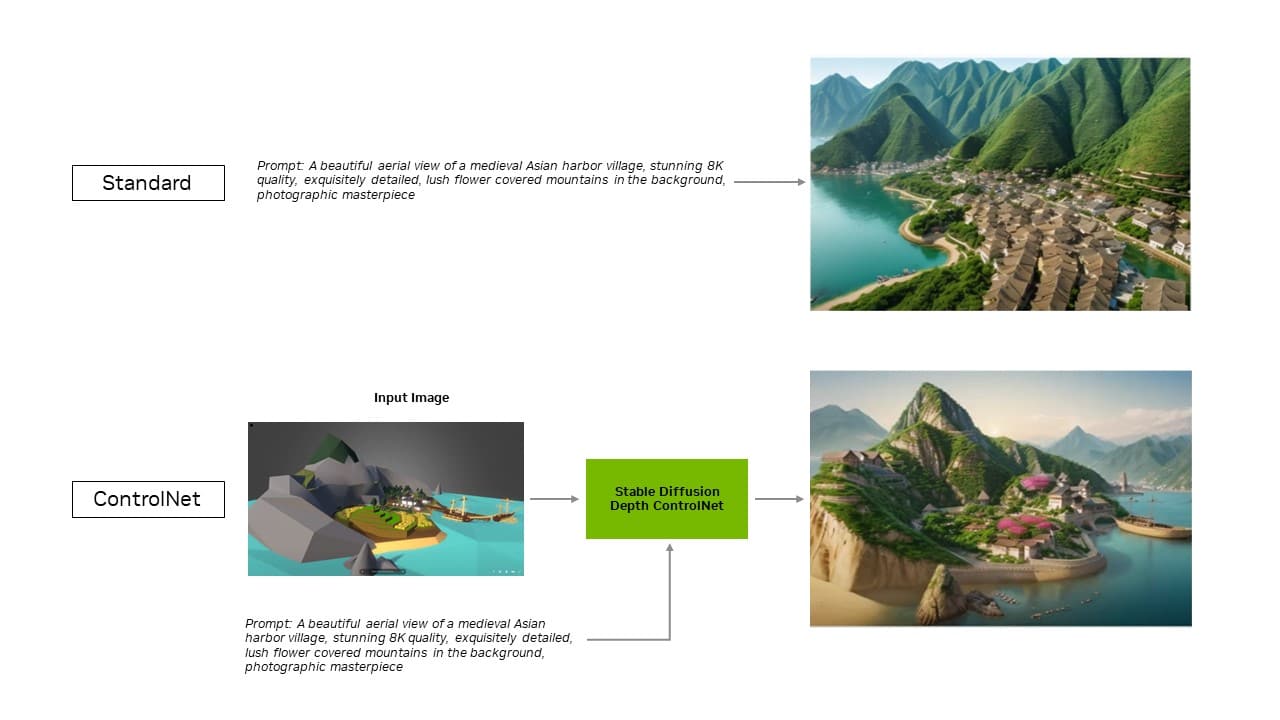
Now, the TensorRT extension for the popular Stable Diffusion WebUI by Automatic1111 is adding support for ControlNets, tools that give users more control to refine generative outputs by adding other images as guidance.

TensorRT acceleration can be put to the test in the new UL Procyon AI Image Generation benchmark, which internal tests have shown accurately replicates real-world performance. It delivered speedups of 50% on a GeForce RTX 4080 SUPER GPU compared with the fastest non-TensorRT implementation.

More Efficient and Precise AI

TensorRT enables developers to access the hardware that provides fully optimized AI experiences. AI performance typically doubles compared with running the application on other frameworks.

It also accelerates the most popular generative AI models, like Stable Diffusion and SDXL. Stable Video Diffusion, Stability AI’s image-to-video generative AI model, experiences a 40% speedup with TensorRT.

The optimized Stable Video Diffusion 1.1 Image-to-Video model can be downloaded on Hugging Face.

Plus, the TensorRT extension for Stable Diffusion WebUI boosts performance by up to 2x — significantly streamlining Stable Diffusion workflows.

With the extension’s latest update, TensorRT optimizations extend to ControlNets — a set of AI models that help guide a diffusion model’s output by adding extra conditions. With TensorRT, ControlNets are 40% faster.

TensorRT optimizations extend to ControlNets for improved customization.

Users can guide aspects of the output to match an input image, which gives them more control over the final image. They can also use multiple ControlNets together for even greater control. A ControlNet can be a depth map, edge map, normal map or keypoint detection model, among others.

Download the TensorRT extension for Stable Diffusion Web UI on GitHub today.

Other Popular Apps Accelerated by TensorRT

Blackmagic Design adopted NVIDIA TensorRT acceleration in update 18.6 of DaVinci Resolve. Its AI tools, like Magic Mask, Speed Warp and Super Scale, run more than 50% faster and up to 2.3x faster on RTX GPUs compared with Macs.

In addition, with TensorRT integration, Topaz Labs saw an up to 60% performance increase in its Photo AI and Video AI apps — such as photo denoising, sharpening, photo super resolution, video slow motion, video super resolution, video stabilization and more — all running on RTX.

Combining Tensor Cores with TensorRT software brings unmatched generative AI performance to local PCs and workstations. And by running locally, several advantages are unlocked:

  • Performance: Users experience lower latency, since latency becomes independent of network quality when the entire model runs locally. This can be important for real-time use cases such as gaming or video conferencing. NVIDIA RTX offers the fastest AI accelerators, scaling to more than 1,300 AI trillion operations per second, or TOPS.
  • Cost: Users don’t have to pay for cloud services, cloud-hosted application programming interfaces or infrastructure costs for large language model inference.
  • Always on: Users can access LLM capabilities anywhere they go, without relying on high-bandwidth network connectivity.
  • Data privacy: Private and proprietary data can always stay on the user’s device.

Optimized for LLMs

What TensorRT brings to deep learning, NVIDIA TensorRT-LLM brings to the latest LLMs.

TensorRT-LLM, an open-source library that accelerates and optimizes LLM inference, includes out-of-the-box support for popular community models, including Phi-2, Llama2, Gemma, Mistral and Code Llama. Anyone — from developers and creators to enterprise employees and casual users — can experiment with TensorRT-LLM-optimized models in the NVIDIA AI Foundation models. Plus, with the NVIDIA ChatRTX tech demo, users can see the performance of various models running locally on a Windows PC. ChatRTX is built on TensorRT-LLM for optimized performance on RTX GPUs.

NVIDIA is collaborating with the open-source community to develop native TensorRT-LLM connectors to popular application frameworks, including LlamaIndex and LangChain.

These innovations make it easy for developers to use TensorRT-LLM with their applications and experience the best LLM performance with RTX.

Get weekly updates directly in your inbox by subscribing to the AI Decoded newsletter.


Source link

NVIDIA Hopper Leaps Ahead in Generative AI at MLPerf

0


It’s official: NVIDIA delivered the world’s fastest platform in industry-standard tests for inference on generative AI.

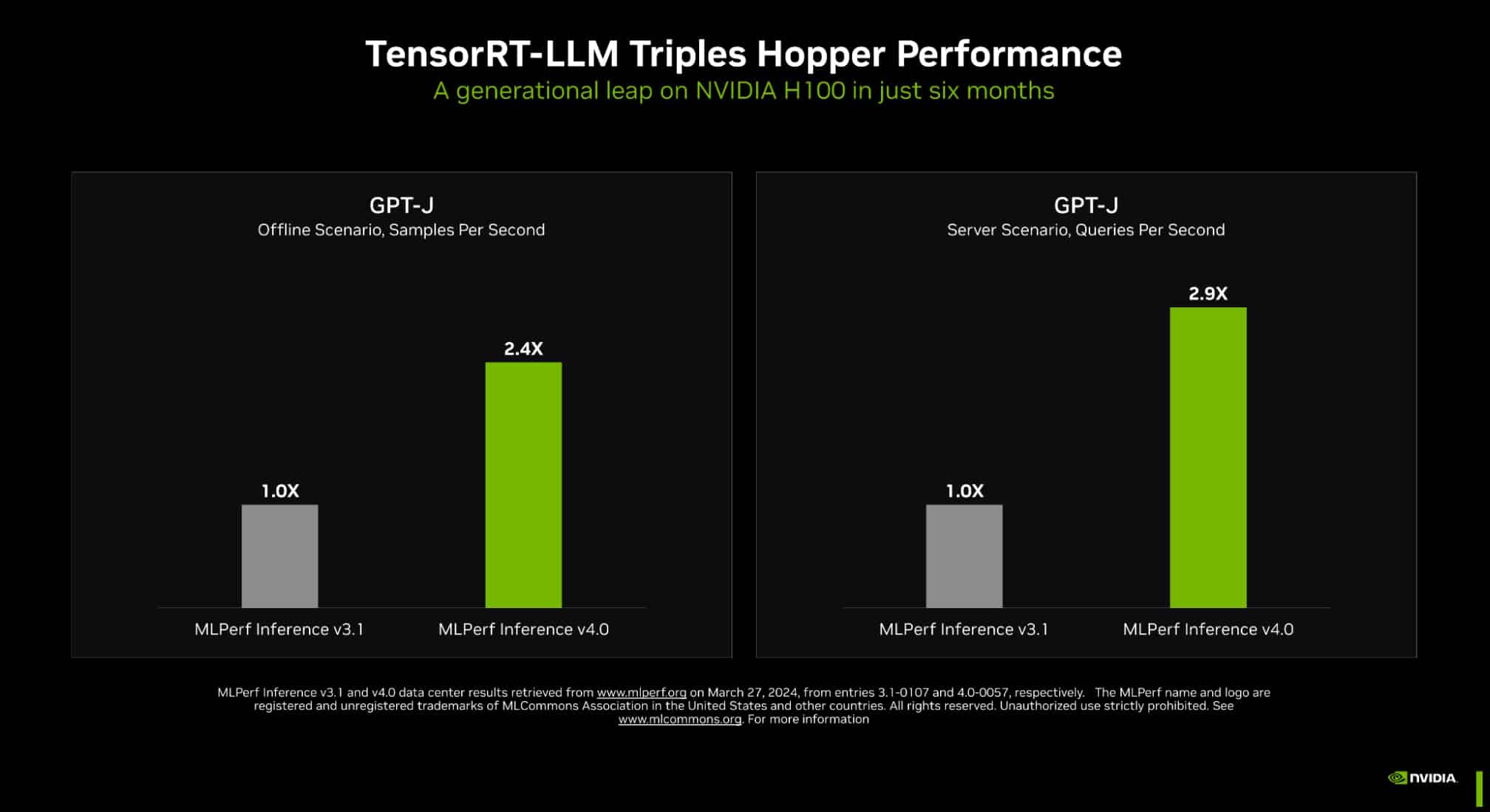
In the latest MLPerf benchmarks, NVIDIA TensorRT-LLM — software that speeds and simplifies the complex job of inference on large language models — boosted the performance of NVIDIA Hopper architecture GPUs on the GPT-J LLM nearly 3x over their results just six months ago.

The dramatic speedup demonstrates the power of NVIDIA’s full-stack platform of chips, systems and software to handle the demanding requirements of running generative AI.

Leading companies are using TensorRT-LLM to optimize their models. And NVIDIA NIM  — a set of inference microservices that includes inferencing engines like TensorRT-LLM — makes it easier than ever for businesses to deploy NVIDIA’s inference platform.

MLPerf inference results on GPT-J LLM with TensorRT-LLM

Raising the Bar in Generative AI

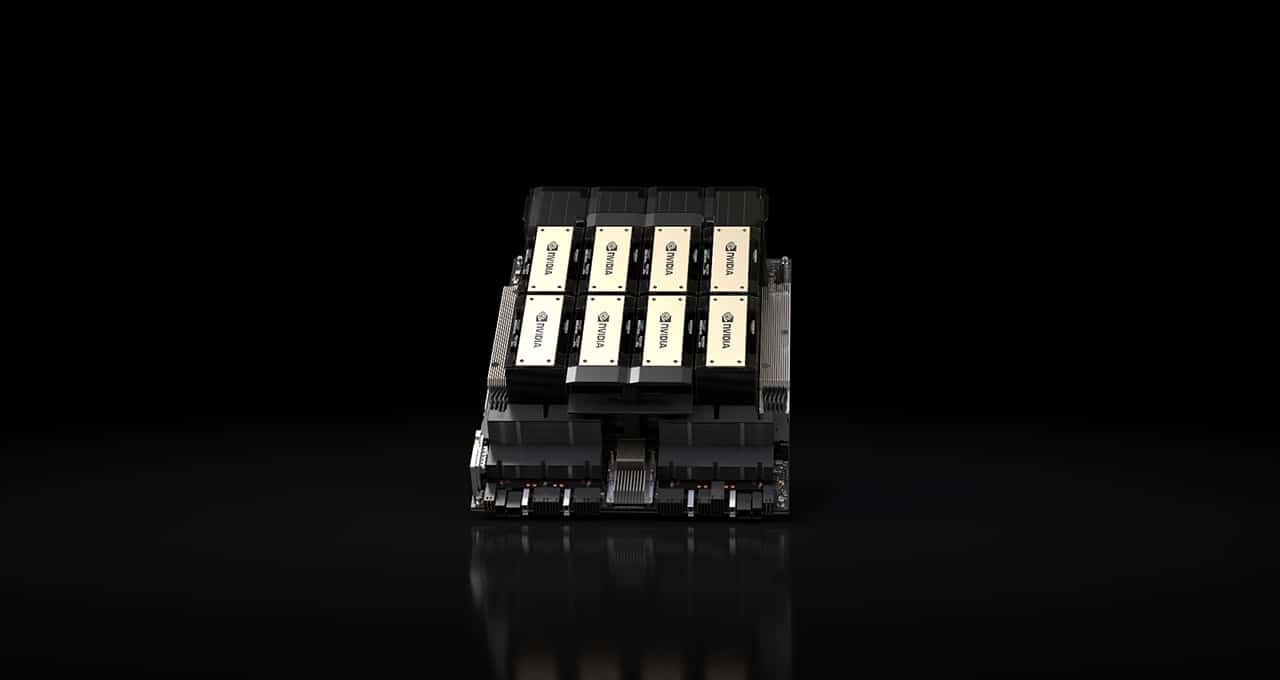
TensorRT-LLM running on NVIDIA H200 Tensor Core GPUs — the latest, memory-enhanced Hopper GPUs — delivered the fastest performance running inference in MLPerf’s biggest test of generative AI to date.

The new benchmark uses the largest version of Llama 2, a state-of-the-art large language model packing 70 billion parameters. The model is more than 10x larger than the GPT-J LLM first used in the September benchmarks.

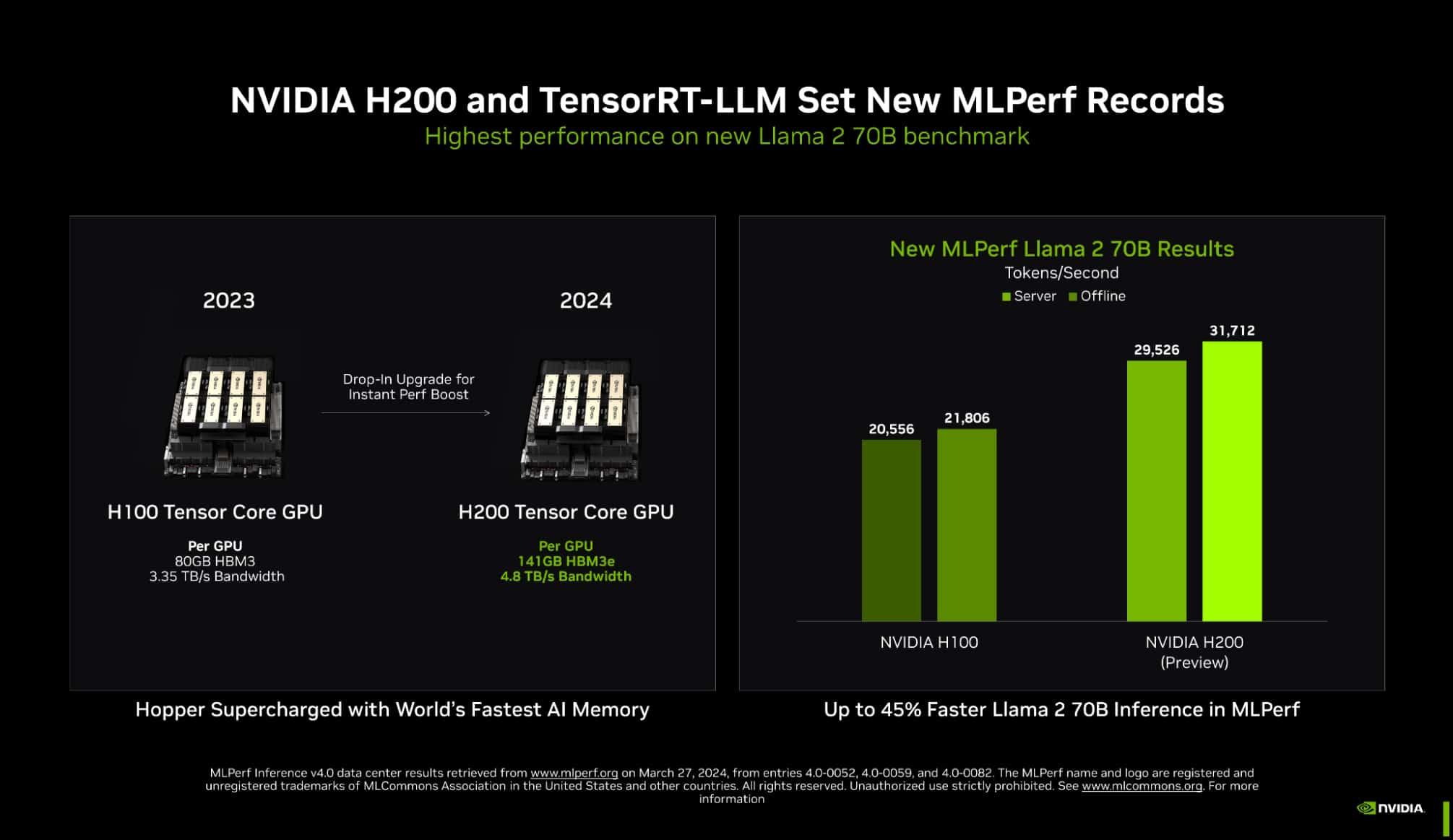
The memory-enhanced H200 GPUs, in their MLPerf debut, used TensorRT-LLM to produce up to 31,000 tokens/second, a record on MLPerf’s Llama 2 benchmark.

The H200 GPU results include up to 14% gains from a custom thermal solution. It’s one example of innovations beyond standard air cooling that systems builders are applying to their NVIDIA MGX designs to take the performance of Hopper GPUs to new heights.

MLPerf inference results on Llama 2 70B with H200 GPUs running TensorRT-LLM

Memory Boost for NVIDIA Hopper GPUs

NVIDIA is shipping H200 GPUs today. They’ll be available soon from nearly 20 leading system builders and cloud service providers.

H200 GPUs pack 141GB of HBM3e running at 4.8TB/s. That’s 76% more memory flying 43% faster compared to H100 GPUs. These accelerators plug into the same boards and systems and use the same software as H100 GPUs.

With HBM3e memory, a single H200 GPU can run an entire Llama 2 70B model with the highest throughput, simplifying and speeding inference.

GH200 Packs Even More Memory

Even more memory — up to 624GB of fast memory, including 144GB of HBM3e — is packed in NVIDIA GH200 Superchips, which combine on one module a Hopper architecture GPU and a power-efficient NVIDIA Grace CPU. NVIDIA accelerators are the first to use HBM3e memory technology.

With nearly 5 TB/second memory bandwidth, GH200 Superchips delivered standout performance, including on memory-intensive MLPerf tests such as recommender systems.

Sweeping Every MLPerf Test

On a per-accelerator basis, Hopper GPUs swept every test of AI inference in the latest round of the MLPerf industry benchmarks.

The benchmarks cover today’s most popular AI workloads and scenarios, including generative AI, recommendation systems, natural language processing, speech and computer vision. NVIDIA was the only company to submit results on every workload in the latest round and every round since MLPerf’s data center inference benchmarks began in October 2020.

Continued performance gains translate into lower costs for inference, a large and growing part of the daily work for the millions of NVIDIA GPUs deployed worldwide.

Advancing What’s Possible

Pushing the boundaries of what’s possible, NVIDIA demonstrated three innovative techniques in a special section of the benchmarks called the open division, created for testing advanced AI methods.

NVIDIA engineers used a technique called structured sparsity — a way of reducing calculations, first introduced with NVIDIA A100 Tensor Core GPUs — to deliver up to 33% speedups on inference with Llama 2.

A second open division test found inference speedups of up to 40% using pruning, a way of simplifying an AI model — in this case, an LLM — to increase inference throughput.

Finally, an optimization called DeepCache reduced the math required for inference with the Stable Diffusion XL model, accelerating performance by a whopping 74%.

All these results were run on NVIDIA H100 Tensor Core GPUs.

A Trusted Source for Users

MLPerf’s tests are transparent and objective, so users can rely on the results to make informed buying decisions.

NVIDIA’s partners participate in MLPerf because they know it’s a valuable tool for customers evaluating AI systems and services. Partners submitting results on the NVIDIA AI platform in this round included ASUS, Cisco, Dell Technologies, Fujitsu, GIGABYTE, Google, Hewlett Packard Enterprise, Lenovo, Microsoft Azure, Oracle, QCT, Supermicro, VMware (recently acquired by Broadcom) and Wiwynn.

All the software NVIDIA used in the tests is available in the MLPerf repository. These optimizations are continuously folded into containers available on NGC, NVIDIA’s software hub for GPU applications, as well as NVIDIA AI Enterprise — a secure, supported platform that includes NIM inference microservices.

The Next Big Thing  

The use cases, model sizes and datasets for generative AI continue to expand. That’s why MLPerf continues to evolve, adding real-world tests with popular models like Llama 2 70B and Stable Diffusion XL.

Keeping pace with the explosion in LLM model sizes, NVIDIA founder and CEO Jensen Huang announced last week at GTC that the NVIDIA Blackwell architecture GPUs will deliver new levels of performance required for the multitrillion-parameter AI models.

Inference for large language models is difficult, requiring both expertise and the full-stack architecture NVIDIA demonstrated on MLPerf with Hopper architecture GPUs and TensorRT-LLM. There’s much more to come.

Learn more about MLPerf benchmarks and the technical details of this inference round.


Source link

McLaren’s future design philosophy for its supercars revealed

0


McLaren has shared details of its new design philosophy for next-generation supercars, future SUVs and EVs. 

McLaren’s new design language, dubbed ‘Performance by Design’, is based on five core principles: Epic, Athletic, Functional, Focused and Intelligent.’

McLaren design philosophy future supercars-4

The brand’s future products will adopt a bold design influenced by aerodynamics and surfacing of Formula 1, Can-Am and GT racers. Extreme design traits like the central driving position of the McLaren F1, the jet-fighter-style canopy of the Solus GT, and the quad exhaust of the 765LT, will also be carried over.

The cars will have muscular bodywork designed with aero efficiency and weight saving in mind. Every element of the design will be functional. The cabin will be focused around the driver, offering unparalleled visibility and performance-driven ergonomics. 

McLaren design philosophy future supercars-1

The sketches shared by McLaren show a low nose section with large air intakes placed on the front bumper and distinctive ‘eye-socket’ headlights with integrated intakes. The iconic shoulder line is inspired by McLaren’s Can-Am racers, while the rear view is defined by an open back end, that not just looks extreme, but also helps with heat dissipation.

Tobias Sühlmann, Chief Design Officer, McLaren Automotive, said, “Racing is in our DNA, and beauty flows from this relentless pursuit of performance. We are deeply inspired by six decades of McLaren history, but we are not rooted in our past. Our Design DNA will build McLaren into a brand that delivers 60-years of motorsport heritage in incredible lightweight supercars and beyond. A new era, with new vehicles, more product differentiation, and with Performance by Design at the heart of it.”

McLaren design philosophy future supercars-3

Source: McLaren


Source link

The 6 Best Hotels in Milan (Updated2024)

0


The picturesque and historic canals of the Navigli neighborhood with string lights hung over them in the twilight of the evening in Milan, Italy
Posted: 3/27/2024 | March 27th, 2024

Italy’s second-largest city is best known as the fashion and design capital of the world, drawing millions of visitors each year. There’s also a ton of history here too (the city used to be the capital of the Western Roman Empire). And, shortly, Milan will take center-stage on the world’s arena as host city to the 2026 Winter Olympics.

But no matter what brings you to Milan, it’s important to pick a good hotel while you are here. I’ve been visiting the city for years and have stayed in a ton of different places.

To help you find a hotel that suits your needs and budget, here’s my list of the best hotels in Milan:

1. Brera Prestige B&B

A double bed in a hotel room decorated in minimalist style with varying shades of grey at Brera Prestige B&B, a hotel in Milan, ItalyA double bed in a hotel room decorated in minimalist style with varying shades of grey at Brera Prestige B&B, a hotel in Milan, Italy
This three-star hotel is in a perfect location in the heart of Brera, only a 10-minute walk from the famous Duomo (cathedral). There are just a few rooms at this newly renovated boutique property, which is stylish and modern. Each room has soundproof windows, a mini fridge, a desk, and a flatscreen TV. The rooms are decorated in calming, neutral tones, and even have chromotherapy lights that you can turn different colors (each color has different purported healing properties, but it’s also just fun too).

The bathrooms are spacious with a walk-in shower and bidet. The staff is very friendly too. It’s a nice and quiet place that’s still central to everything. Just note that, while it’s called a B&B, it does not actually offer breakfast.

Book here!


2. B&B Hotel Milano Sant’Ambrogio

A double bed in a hotel room with an open door leading to a terrace overlooking a basilica at the B&B Hotel Milano Sant'Ambrogio, a hotel in Milan, ItalyA double bed in a hotel room with an open door leading to a terrace overlooking a basilica at the B&B Hotel Milano Sant'Ambrogio, a hotel in Milan, Italy
This three-star hotel in Centro Storico offers simple rooms with large-scale photographs of Milan on the walls. The bright and airy rooms are a pretty good size and have lots of natural light thanks to the large windows. The beds are really comfortable, and all rooms have a desk, flatscreen TV, and wardrobe. The bathrooms are on the smaller side but have walk-in showers and bidets.

I especially love the fact that the breakfast buffet is quite varied and includes lots of pastries as well as fresh orange juice (it costs 9.50 EUR though). There’s also a rooftop terrace with great views as well as a little snack bar downstairs if you want to grab some late-night munchies but not leave the hotel. Overall, the hotel offers great value for first-time visitors who want to stay somewhere central but not spend an arm and a leg.

Book here!


3. Art Hotel Navigli

A king-sized bed in a spacious hotel room with a desk and small table with flowers, all decorated in wood and red accenting at Art Hotel Navigli, a hotel in Milan, ItalyA king-sized bed in a spacious hotel room with a desk and small table with flowers, all decorated in wood and red accenting at Art Hotel Navigli, a hotel in Milan, Italy
This four-star hotel is full of art (walking down the halls, it almost feels like you’re in a modern art museum). The hotel also has a wellness center with a small gym, sauna, and steam room. I love the expansive breakfast buffet too. It starts early (7am) and there’s a nice spread with eggs, meat, fresh pastries, and seasonal fruit. You can even make your own fresh juice with the juice maker.

The rooms are a bit dated, but they’re spacious and each has a flatscreen TV, minibar, electric kettle, and Nespresso machine. The showers are a bit small and dated as well, though they have great water pressure. It’s a unique place to stay that’s just steps from one of the Navigli’s beautiful canals.

Book here!


4. Magna Pars l’Hotel à Parfum

A king-sized bed, coffee table, leather armchair, and vases of flowers around in a suite at Magna Pars L'Hotel a Parfum, a five-star hotel in Milan, ItalyA king-sized bed, coffee table, leather armchair, and vases of flowers around in a suite at Magna Pars L'Hotel a Parfum, a five-star hotel in Milan, Italy
This five-star hotel continues the tradition of the perfume factory in which it is housed, with a perfume laboratory on site and calming scents throughout the property. The entire property features soft tones and has modern art everywhere. There’s an excellent complimentary buffet breakfast, rooftop bar, wine lounge, and a wellness center with a steam room and gym.

Each of the hotel’s 68 spacious suites has its own unique scent, which have also inspired the unique artwork created by local artists adorning the walls. All suites have floor-to-ceiling windows, hardwood floors, and comfy beds (you can even choose your pillow from a pillow menu). Every suite includes a desk, flatscreen TV, minibar, and leather chaise longue to relax in. The luxurious bathrooms are huge and entirely made of marble, with bespoke toiletries that are (of course) uniquely scented. Overall, this hotel is the perfect option for travelers looking for a luxurious retreat that’s still close to the Navigli canals with its great bars and restaurants.

Book here!


5. BB Hotels Aparthotel Isola

The kitchen area and living room area with a spiral staircase leading up to a loft at BB Hotels Aparthotel Isola in Milan, ItalyThe kitchen area and living room area with a spiral staircase leading up to a loft at BB Hotels Aparthotel Isola in Milan, Italy
Located in the street-art-filled neighborhood of Isola, this aparthotel offers spacious apartments with fully equipped kitchenettes. Each apartment includes a cooktop, dishwasher, and electric kettle. There’s a little supermarket right underneath the apartments too, making this the ideal choice if you want to prepare your own meals (there’s no breakfast offered).

The apartments are minimally decorated but have lots of natural light thanks to the floor-to-ceiling windows, and closets to store your stuff in. The bathrooms are spacious too, with a bidet, walk-in shower, towel warmers, and complimentary toiletries. This is a great choice for long-term travelers who want the full functionality of an apartment a bit away from the touristy Duomo area.

Book here!


6. Bulgari Hotel Milano

A luxurious hotel room with a velour sofa, leather armchair, bookcases, and king-sized bed covered in blankets at Bulgari Hotel Milano, a five-star hotel in Milan, ItalyA luxurious hotel room with a velour sofa, leather armchair, bookcases, and king-sized bed covered in blankets at Bulgari Hotel Milano, a five-star hotel in Milan, Italy
Housed within an 18th-century palazzo in Brera, this five-star boutique hotel is run by the fashion house of the same name. The Bulgari Hotel boasts lavish interiors crafted by renowned Italian architect Antonio Citterio, featuring exquisite marble, rich woods, and sleek furnishings. It’s right next to the botanical gardens, and the hotel has a huge private garden of its own, complete with a garden bar/restaurant. Another one of the hotel’s restaurants, The Bulgari Bar, serves breakfast 24/7. There’s a tranquil indoor swimming pool and spa too.

The hotel’s rooms are spacious and decorated with elegant Bulgari furnishings and wooden accenting. All rooms feature comfy beds, desks, walk-in closets, and minibars. The bathrooms are huge, with deep soaking tubs, walk-in showers, and complimentary bath products. If you want to spend some money, this is the hotel to do it at!

Book here!

***

Whether you’re visiting for fashion, design, history, or art, choosing a great hotel is paramount. As the city draws so many tourists, there are a lot of hotels in Milan. But not all of them are worth staying at. Choose from one of the list above and enjoy your visit to Italy’s second-largest city!

Book Your Trip to Milan: Logistical Tips and Tricks

Book Your Flight
Use Skyscanner to find a cheap flight. They are my favorite search engine because they search websites and airlines around the globe so you always know no stone is left unturned!

Book Your Accommodation
You can book your hostel with Hostelworld as they have the biggest inventory and best deals. If you want to stay somewhere other than a hostel, use Booking.com as they consistently return the cheapest rates for guesthouses and cheap hotels.

Don’t Forget Travel Insurance
Travel insurance will protect you against illness, injury, theft, and cancellations. It’s comprehensive protection in case anything goes wrong. I never go on a trip without it as I’ve had to use it many times in the past. My favorite companies that offer the best service and value are:

Looking for the Best Companies to Save Money With?
Check out my resource page for the best companies to use when you travel. I list all the ones I use to save money when I’m on the road. They will save you money when you travel too.

Need a Guide?
Rome has some really interesting tours. My favorite company is Take Walks. They have expert guides and can get you behind the scenes at the city’s best attractions.

Want More Information on Milan?
Be sure to visit our robust destination guide on Venice for even more planning tips!


Source link

You can now get a Pagani Huayra R simulator to match your track car

0


Pagani Huayra R owners can now hone their racing skills on a custom Huayra R simulator before taking their hypercars on an actual racetrack.

Pagani has partnered with Racing Unleashed to develop a high-end racing simulator for its customers. Like their road cars, the sim-rig is also made from carbon fibre, which can be customized to match the actual car.

Pagani-Huayra-R-Simulator-2

According to Pagani, their in-house teams have made sure that the simulator provides the feel and feedback of a real Huayra R. The handling is replicated using pitch, yaw and roll motions. A curved screen, VR headphones and a 5.1. audio system helps add to the immersive experience. It features a high-end gaming PC running Assetto Corsa Pro.

Pagani-Huayra-R-Simulator-3

According to Pagani’s Vehicle Dynamics Lead, Franco Morsino, “We aimed to create a professional, dynamic driving simulator with an extraordinary level of immersion and realism, intending to contribute to the constant refinement of our customers’ driving styles. Our ambition was to transform it into a genuine design object, a product with artistic value destined to occupy a prominent place within the homes of Huayra R owners.”

Pagani-Huayra-R-Simulator-4

The Pagani Huayra R simulator is currently offered exclusively to Huayra owners. However, the company does plan to sell it to others later.

Source: Pagani


Source link

2024 Lexus LBX review | CarExpert

0


The Lexus LBX is a critical model for the premium Japanese carmaker as it forms as a new entry point for customers to the brand.

This luxurious light SUV is technically Lexus’ smallest model ever, undercutting the CT hatch that was on sale locally from 2011 to 2021.

The LBX is based on the same GA-B platform as the Toyota Yaris Cross and is exclusively powered by a 1.5-litre three-cylinder petrol-electric hybrid drivetrain producing 100kW of power.

Deliveries of the LBX commenced in Australia on March 18, with Lexus Australia claiming around 1500 examples are set to arrive in the first 12 months. Despite this Lexus Australia chief executive officer John Pappas told CarExpert supply for the first 12 months will be tight.

This vehicle is one of the most luxurious light SUV offerings in Australia to date. Is it worth considering? Read along to find out.

How does the Lexus LBX compare?

View a detailed breakdown of the Lexus LBX against similarly sized vehicles.

Lexus LBX cutout image

Lexus

LBX

How much does the Lexus LBX cost?

Three variants are being offered at launch.

2024 Lexus LBX pricing:

  • 2024 Lexus LBX Luxury 2WD: $47,550
  • 2024 Lexus LBX Sports Luxury 2WD: $52,990
  • 2024 Lexus LBX Sports Luxury AWD: $56,990

Prices are before on-road costs

To see how the LBX compares with its rivals, use our comparison tool.

What is the Lexus LBX like on the inside?

Walking up to the LBX it has a cute yet striking presence that’s distinctly Lexus. There’s the classic spindle grille up front, some cladding around the wheel arches to emphasise that this is a crossover, as well as full-width tail light assembly.

Opening up the door is a strange experience but a very similar one if you’ve been in any recent Lexus model. The LBX has an E-Latch door handle system that requires you to press a button on the inside of the exterior door handle for it to open.

The exterior door handle doesn’t actually move when go to open it. This can be a little awkward for people unfamiliar with them as they think the door handles are broken.

Hopping in you’re presented with a set of sporty-looking seats with finishes that depend on which trim level you opt for. The entry-level Luxury receives black NuLuxe leatherette upholstery with red highlights, whereas the flagship Sports Luxury receives combination leather-accented and UltraSuede upholstery with contrasting orange highlights.

The driver’s seats in both LBX variants offer plenty of electric seat adjustment allowing you to dial in your desired seating position. I quite liked how much you’re able to dial up the thigh support.

Both the front seats offer heating across the entire LBX range which is incredibly handy when you first hop in the car on a chilly morning.

Ahead of the driver in the entry-level LBX Luxury is a NuLuxe leatherette-wrapped steering wheel which, like the seats, is incredibly soft to the touch. It may be controversial but I much prefer how this steering wheel feels to the proper leather-accented unit in the flagship LBX Sports Luxury.

Continuing why the LBX Luxury’s steering wheel is better is because it has regular steering wheel buttons that are logical and have a satisfying click.

The LBX Sports Luxury, like a number of recent Lexus SUV models, has touch-sensitive buttons that are confusing at first and a little distracting. The button’s purpose changes depending on which page you have selected, and you need to refer to the head-up display to see what functions the buttons will do.

The touch-sensitive steering wheel buttons in the LBX Sports Luxury are needlessly complicated. I don’t understand why Lexus didn’t just make the Luxury’s regular steering wheel buttons standard across the range because there’s no learning curve needed to use them.

Behind the steering wheel is a proper 12.3-inch digital instrument cluster that appears to be clear and high-resolution. It offers plenty of configuration with three main page layouts that can be customised to your liking.

Going back to those touch-sensitive steering wheel buttons in the LBX Sports Luxury, when you’re moving you can’t actually change the instrument page layout. You can however in the LBX Luxury which is so confusing.

The head-up display in the LBX Sports Luxury is bright and can be configured to display minimal or a lot of information. Unfortunately the head-up display isn’t available in the entry-level Luxury variant at all.

Moving across the 9.8-inch touchscreen infotainment system is the centrepiece of the LBX’s interior, sitting proud on the dashboard. It’s a square unit that like the digital instrument cluster is bright and high-resolution, though it’s a fingerprint magnet.

The touchscreen’s user interface is really easy to understand and to navigate. There aren’t a whole heap of sub-menus to get lost in which is a relief.

As standard the LBX offers both wireless Apple CarPlay and Android Auto. With my iPhone 15 Pro Max connected wirelessly I didn’t experience any dropouts.

Thankfully there’s a wireless charger at the base of the dashboard in a small storage cubby which helps keep you’re phone topped up. There are also two USB-C ports just below the touchscreen.

It’s nice to see there are some physical climate control switchgear in the LBX, unlike some its premium rivals which are completely integrating them into the touchscreen. You’re able to control items like the temperature and defrosters with physical switches and buttons, though adjusting things like the fan speed can only be done using the touchscreen.

Looking around the cabin there are a considerable amount of soft touches. This is definitely no Toyota Yaris Cross on the inside with harder plastics being difficult to find.

On the centre stack there’s a classic Lexus hybrid gear selector which has a somewhat confusing action for people unfamiliar with it. Cupholders are also few and far between. There’s one always readily available, however the second one is hidden by the sliding centre armrest.

Under the centre stack there’s an open area that’s large enough to house a handbag. This is a nice touch because the glovebox on the passenger side is so small the owner’s manual takes up all the space.

Moving to the second row is where the LBX’s appeal starts to come undone. The space on offer is really limited, meaning this car is obviously more geared towards single people or couples with no children.

Once I had pried myself into the second row I found there’s virtually no legroom behind my own driving position, plus head and shoulder room felt really cramped. In order to get out of the LBX I need to step like I was using a ladder because the door opening is so tight.

If the lack of space wasn’t enough of a sign that the LBX’s second row isn’t the best place to be, there aren’t many amenities at all. The only notable inclusion are two USB-C ports on the back of the centre console. There are no rear air vents, nor fold-down armrest for second-row passengers.

At the back the LBX comes as standard with a powered tailgate which is a premium feature for this segment. Once the tailgate is open the amount of space depends on which variant you opt for.

Lexus officially quotes boot space for the LBX 2WD variants at 402 litres with the rear seats up, whereas boot space for the LBX Sports Luxury AWD is a slightly tighter 315 litres. Folding the rear seats of the LBX 2WD variants expands boot capacity to 994 litres.

Boot space in the LBX 2WD variants is okay, while in the Sports Luxury AWD it’s not great as the rear electric motor-generator eats into the storage space. Both LBX variants have a high loading lip which isn’t ideal when you’re lifting heavy items into the boot.

Sure folding down the rear seats makes the boot space on offer larger, but it’s not necessarily more useable because there’s a steep lip where the seats fold. It’s unfortunate the rear seats don’t fold flat.

Lastly the entire Lexus LBX range only comes with a tyre repair kit. That means there’s no spare tyre whatsoever. For some people this might be okay, but for others it’s something to be really mindful of because you don’t want to get stuck in the middle of nowhere with a flat tyre waiting hours for roadside assistance.

What’s under the bonnet?

The Lexus LBX is hybrid-only. It’s available with either front- or all-wheel drive, depending on the variant.

ModelLexus LBX
Engine1.5L three-cylinder series-parallel hybrid
Engine power67kW
Engine torque120Nm
Front motor generatorSynchronous permanent magnet electric motor
Front motor generator power69kW
Front motor generator torque185Nm
Rear motor generator (AWD only)Asynchronous induction electric motor
Rear motor generator power4.7kW
Rear motor generator torque52Nm
Total system power100kW
BatteryNickel-metal hydride
Transmissione-CVT
Driven wheelsFront-wheel drive (all-wheel drive optional)
Weight1330kg (kerb 2WD)
1415kg (kerb AWD)
Fuel economy (claim)3.8L/100km
Fuel economy (observed)5.2L/100km (mixed driving 2WD)
5.4L/100km (mixed driving AWD)
4.4L/100km (urban driving 2WD)
Fuel tank size36 litres
Fuel requirement91 RON

To see how the LBX compares with its rivals, use our comparison tool.

How does the Lexus LBX drive?

Starting up the Lexus LBX is a simple process that feels very familiar if you’ve ever driven any Toyota hybrid vehicle. You press the start button and there’s a subtle beep and flash on the dash indicating you’re ready to drive.

Typically the startup process is completely silent, though on cold mornings the three-cylinder petrol engine may switch on to warm up the fluids and give the battery pack a slight charge.

As I noted in the interior section the LBX’s gear selector might take you a second to acquaint yourself with if you’ve never used a Lexus gear selector before. Once you know how it works it’s fairly self explanatory.

There are subtle differences with the gear selectors in the LBX Luxury and Sports Luxury. When you pull the gear selector directly downwards in the former it activates ‘B’ mode which amplifies regenerative braking and also uses the engine to slow you down more, whereas in the latter it activates ‘S’ mode which is essentially a sport mode.

Setting off the LBX will happily cruise around on EV mode at lower speeds. Once you reach a certain speed, are going uphill, or push the accelerator a little harder from a standstill however, the petrol engine will kick in.

There’s a noticeable difference in how the Lexus LBX’s 1.5-litre naturally aspirated three-cylinder petrol engine surges to life when compared to the Toyota Yaris Cross’s. It’s nowhere near as rattly and shaky which can sometimes be the case with three-cylinder engines as they’re not as balanced as four-cylinder engines.

This makes the engine startup process more subdued and less noticeable, which are both huge ticks for the LBX. If you weren’t paying attention in everyday traffic you’d be hard-pressed to know when the engine actually fires to life unless you’re looking at the digital instrument cluster.

Whenever the three-cylinder petrol engine does fire to life its fuel consumption is initially quite high. This is because it’s getting all the fluids moving around the engine again and it’s also charging up the nickel metal hydride high-voltage battery pack.

Although the LBX may produce 15kW more than the related Yaris Cross Hybrid, don’t expect its total system output of 100kW of power to blow you away. Thanks to the electric motor-generator (or generators in the AWD) however, the initial acceleration can get you ahead of traffic at the lights if you’re that way inclined.

It’s worth noting the all-wheel drive version of the LBX is 85kg heavier than the front-wheel drive versions which makes the claimed 0-100km/h sprint 0.4 seconds slower. Front-wheel drive LBX variants are claimed to be able to do the 0-100km/h sprint in a docile 9.2 seconds, whereas the all-wheel drive LBX takes 9.6 seconds.

Despite not being at outright sports car (save that for the not-yet-confirmed-for-production LBX Morizo RR), the LBX has direct steering and is still really chuckable and dynamic in the corners. I’ve had similar experiences with all the vehicles based on Toyota’s modular TNGA platform.

Once you’re cruising about in the city the LBX is much quieter and refined than the Yaris Cross. The only prominent noise you hear is the whine of the electric motor-generator, especially when you’re slowing down with regen.

The LBX’s ride and handling is yet another highlight of this luxurious light SUV. It feels like a proper Lexus in the sense the majority of the bumps are soaked up, though you still get a sense of what is happening underneath the car.

Two-wheel drive versions of the LBX have a torsion-beam rear suspension setup, whereas the all-wheel drive version has a more sophisticated double wishbone trailing arm rear suspension setup in order to accomodate the extra weight of the rear electric motor-generator.

Despite this I found it really hard to distinguish any real differences between the two types of rear suspension. I think that goes to show how well Lexus has tuned the two-wheel drive’s rear torsion-beam setup. Both of them are able to take on speed bumps like a champ.

Given it’s diminutive exterior dimensions, the LBX is an absolute dream to park. Its steering is really to turn lock-to-lock and it has really small turning circle of 5.6 metres.

As standard there are both front and rear parking sensors, as well as a surround-view camera. If you step up to the Sports Luxury variant you also get a semi-autonomous parking assist.

When you get out on the open road at higher speeds it becomes apparent the city is where the LBX feels most at home. The hybrid powertrain starts to run out puff when building up speed which causes the three-cylinder petrol engine to drone as it’s mated to an electric continuously variable transmission (e-CVT).

Once you reach a cruising speed however out on the open road the LBX is surprisingly refined. The hybrid SUV doesn’t get blown around too much and can hold its own on the road against larger vehicles.

The flagship Sports Luxury variants have active noise cancelling which does drown out some of the road and tyre noise that’s prevalent on coarse-chip bitumen roads. It’s worth calling out road noise in the entry-level Luxury variant wasn’t overly bad either.

On the safety front the entire LBX range comes with driver attention monitoring. While I was driving it didn’t cause any frustrations whatsoever, however when my co-driver was behind the wheel it beeped incessantly.

Adaptive cruise control comes as standard and it’s surprisingly very good. The system is able to respond naturally when cars merge into the lane ahead of you and not slam on the brakes immediately.

The car’s lane-keep assist function is also helpful on clearly marked highways and freeways with gentle curves, but I turned it off because I found it to be too forced on narrow and winding urban Sydney roads.

Lastly the entire LBX range comes with bright LED headlights that have an automatic high-beam function. Although I didn’t get an opportunity to test these out properly they’re really handy for those driving at night in rural and regional areas.

What do you get?

There are two different Lexus LBX variants offered locally. The entry-level Luxury can only be had with front-wheel drive, whereas the flagship Sports Luxury is available with either front- or all-wheel drive.

LBX Luxury 2WD highlights:

  • 18-inch alloy wheels
  • Tyre repair kit
  • Automatic LED headlights
  • Adaptive high-beam
  • LED tail lights
  • LED front fog lights, cornering lights
  • Rain-sensing wipers
  • E-Latch door handles
  • Auto-dimming driver’s side mirror
  • Shark fin antenna
  • Rear spoiler
  • Front, rear air spats
  • Rear privacy glass
  • Power tailgate
  • 12.3-inch digital instrument cluster
  • 9.8-inch touchscreen infotainment system
  • Wireless Apple CarPlay, Android Auto
  • Connected satellite navigation
  • ‘Hey Lexus’ natural voice recognition
  • DAB+ digital radio
  • 6-speaker Panasonic sound system
  • 5 x USB-C ports
  • 2 x 12V sockets
  • Wireless charger
  • Dual-zone climate control
  • Proximity entry and push-button start
  • NuLuxe leatherette-wrapped steering wheel
  • NuLuxe leatherette-wrapped shift-by-wire gear knob, door trim, ornamentation
  • ‘Tsuyasumi’ centre console ornamentation
  • Single-colour ambient interior lighting
  • Auto-dimming rear-view mirror
  • Front and rear carpet floor mats
  • Black NuLuxe leatherette upholstery with red highlights
  • Heated front seats
  • 8-way power driver’s seat with two-way lumbar and memory

LBX Sports Luxury 2WD adds:

  • Black 18-inch alloy wheels, 10 twin-spoke design
  • Rear pillar film ornamentation
  • Colour head-up display
  • Active Noise Control
  • Engine sound enhancement
  • 13-speaker Mark Levinson premium sound system
  • Multi-colour ambient interior lighting
  • Genuine leather-accented shift knob
  • Genuine leather-accented steering wheel
    • Paddle shifters
    • Heated steering wheel
    • Haptic touch-sensitive controls
  • Ultrasuede door trim and ornamentation
  • Combination leather-accented, Ultrasuede upholstery with contrast orange stitching

LBX Sports Luxury AWD adds:

  • AWD logo
  • Rear induction asynchronous motor-generator (4.7kW/52Nm)
  • Double wishbone trailing arm rear suspension (replaces torsion beam)

Is the Lexus LBX safe?

The Lexus LBX hasn’t been crash-tested by ANCAP or Euro NCAP at this stage.

The following safety equipment is standard across the range:

  • 8 airbags
  • Autonomous emergency braking (AEB)
    • Day, night pedestrian detection
    • Day, night cyclist detection
    • Day motorcycle detection
    • Junction assist
    • Reversing AEB
  • Blind-spot monitoring
  • Rear cross-traffic alert
  • Safe exit assist
  • Driver monitor camera
  • Adaptive cruise control
  • Traffic sign recognition
  • Front, rear parking sensors
  • Surround-view camera
  • Tyre pressure monitoring

The LBX Sports Luxury adds a semi-autonomous parking assist.

All Lexus LBX variants also receive a three-year complimentary subscription to Lexus Connected Services. It offers customers real-time vehicle information, remote functionality, and emergency calling.

How much does the Lexus LBX cost to run?

The Lexus LBX is covered by a five-year, unlimited-kilometre warranty like the rest of the Lexus lineup.

Logbook services are required every 12 months or 15,000km, whichever comes first. The first five services are capped at $595 each.

A three-year complimentary Encore subscription is also provided at no extra cost. It includes roadside assistance, complimentary service loan car, Ampol fuel discounts, as well as exclusive lifestyle event offers.

CarExpert’s Take on the Lexus LBX

It’s hard not to draw parallels to the Toyota Yaris Cross when driving and experiencing the Lexus LBX, but it still drives and feels like a Lexus should.

The ride is very compliant, it’s dynamic in the city, and the noise suppression is good for its segment.

I know certain people are going to love this car. Those people are likely singles and couples who don’t need to use the second row of seating all the time (if at all) and also don’t need an overly massive boot.

While this car offers plenty of luxurious touches and fuel-sipping hybrid efficiency, the LBX does come with a price premium that may turn people off straight away. A starting price of $50k drive-away for a fancy Yaris Cross Hybrid is a considerable amount of money.

As it currently stands, the sweet spot of the LBX range is the entry-level Luxury 2WD variant. It doesn’t feel like it’s missing much standard equipment, plus the NuLuxe leatherette finishes are softer and more supple than the proper leather-accented finishes in the flagship Sports Luxury variants.

Sure the LBX Sports Luxury may pick up features like active noise cancellation, a premium Mark Levinson sound system, and a head-up display, among others, it also has some annoying quirks including the finicky touch-sensitive steering wheel buttons.

The flagship AWD variant is also harder to recommend because besides potentially adding a touch more grip and security in slippy scenarios, it just weighs the car down and reduces boot capacity.

Click the images for the full gallery

MORE: Buy a Lexus LBX
MORE: Everything Lexus LBX


Source link

Navara ute among four new Nissans coming to Australia soon

0


Nissan has clarified its product plans for the next few years for our region, after it initially appeared to have just two new vehicles coming in the next few years.

In a press release from its AMIEO (Africa, Middle East, India, Europe and Oceania) division, Nissan has now confirmed it will launch four new vehicles over the next two years.

It has only confirmed what two of them will be: a new one-tonne ute developed with Mitsubishi, almost certain to be the next-generation Navara; and a “C crossover EV”, possibly the Ariya or an electric Qashqai successor.

The former will be, depending on the market, available with plug-in hybrid or electric power.

Nissan has said only that these vehicles are due “during The Arc period”, referring to the company’s recently announced mid-term business plan which sets various goals Nissan will achieve varyingly by fiscal year 2026 or by the end of that fiscal year.

Notably, Nissan doesn’t specify whether these four vehicles will arrive by the beginning or end of Japanese fiscal year 2026, which runs from April 1, 2025 to March 31, 2026.

It also doesn’t elaborate on what the other vehicles will be, though it says “additional new electric vehicles will be introduced to Oceania, as the transition to electrification gathers pace”.

It’s unclear what vehicles Nissan has planned for our market.

A new generation of Patrol is set to be introduced this year in markets like the US; and if it’ll still be offered in right-hand drive it’s likely Nissan will want to offer it here.

Nissan Australia has also previously said it will offer the electric Ariya mid-sized SUV here, though it has yet to confirm launch timing.

A replacement for the Leaf, now taking the shape of a coupe SUV, is in the works, as is an electric successor to the Juke, and overseas reports have indicated Nissan is working on electric replacements for the Qashqai and X-Trail aimed at Europe.

Nissan has previewed an electric replacement for the Micra light hatch and confirmed a new generation of Murano, but neither is likely for Australia given those models were discontinued here several years ago.

Two new electric vans confirmed for Europe, to be developed with Renault’s Ampere EV division, also seem unlikely for our market.

Nissan is aiming to increase its global sales by one million units, 300,000 of which will be in the AMIEO region.

It’s intending for India to become a key export hub, exporting 100,000 vehicles annually by 2026 to markets like Africa and the Middle East. It’ll also produce an EV in India.

Nissan also plans to export Chinese-built vehicles from 2025 in the same volumes. Rival Japanese brand Honda – with which Nissan recently announced a partnership – recently started exports of its own Chinese-built vehicles to markets like Japan and Europe.

MORE: Nissan cutting costs, boosting profits under new plan


Source link

Ferrari patents supercharged engine

0


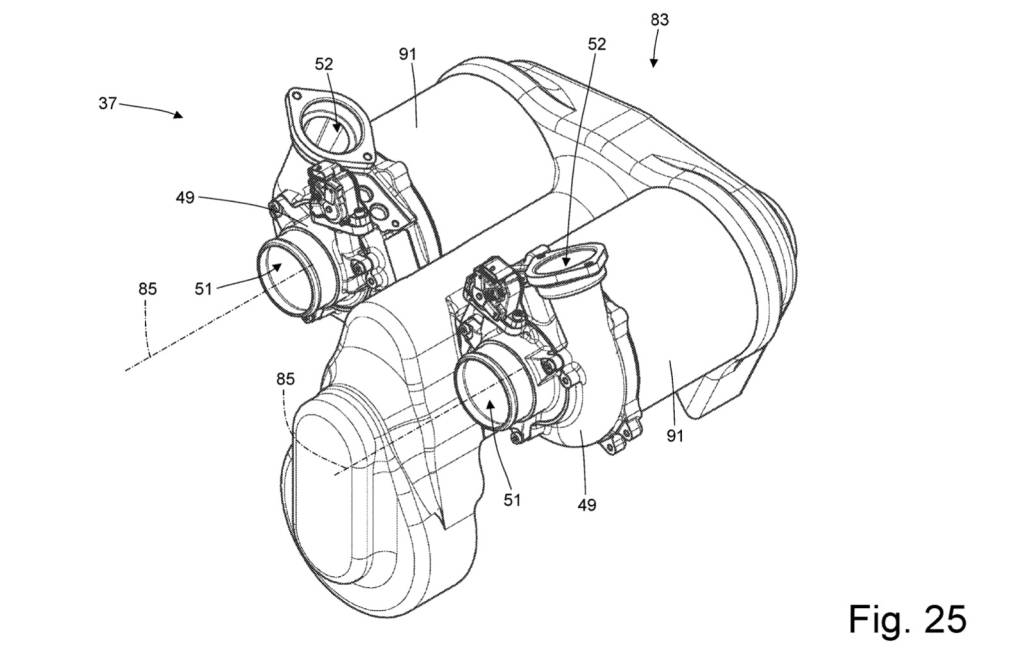
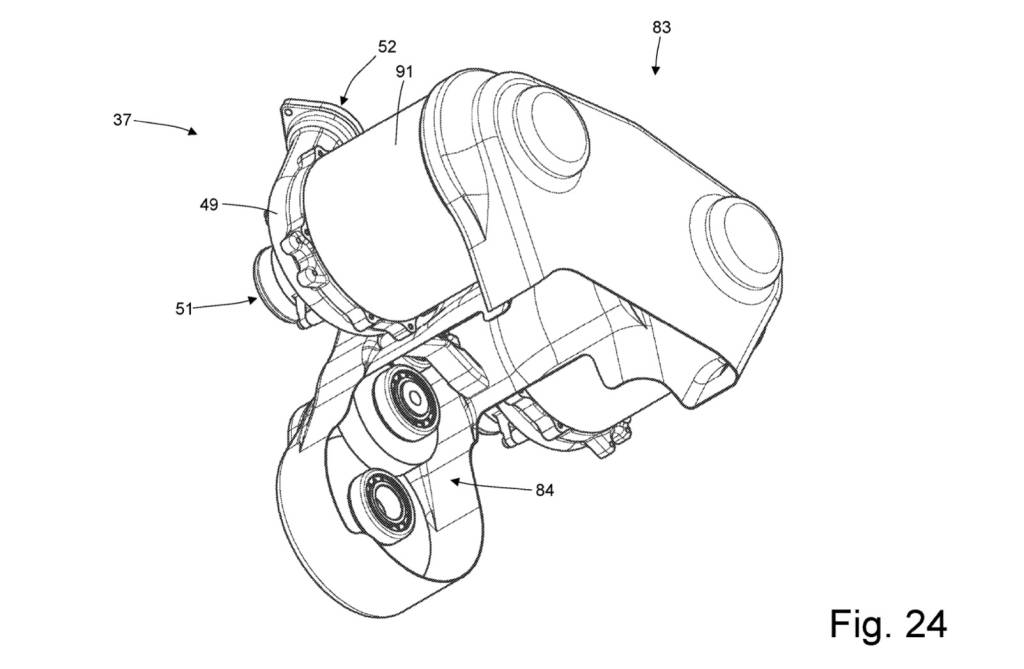
A new Ferrari patent filing has surfaced, hinting that the automaker is considering superchargers for future cars.

Aside from some early race cars, Ferrari has generally preferred turbocharging as a method of forced induction. But a patent application published by the United States Patent and Trademark Office (USPTO) on Feb. 29 (and originally filed on Aug. 24, 2023) specifically deals with supercharging.

Ferrari Supercharger patent image

Ferrari Supercharger patent image

According to the application, Ferrari’s main interest in supercharging seems to be packaging. The automaker currently uses turbocharged engines in its road cars, but in the application it notes that turbos require placing intake and exhaust ducts side by side, which could require plumbing with less-than-optimal airflow. It’s also possible to spin a turbo with an electric motor, but this adds weight, Ferrari notes.

A supercharger doesn’t come with these drawbacks, according to Ferrari. In the application, the automaker discusses a way to give engineers even greater flexibility. Instead of driving the supercharger via a belt and pulley attached to the engine, as in most current applications, Ferrari proposes driving it with a planetary gearset attached to the driveshaft.

Ferrari Supercharger patent image

Ferrari Supercharger patent image

An engine with this method of supercharging could be part of a hybrid powertrain, Ferrari suggests. In the application, it discusses an all-wheel-drive setup with an electric motor driving the front wheels and the supercharged engine driving the rear wheels.

Ferrari is in the midst of refreshing its lineup, although it’s unclear if any of the updated models will feature supercharged engines. A successor to the Ferrari SF90 plug-in hybrid has been spotted testing, and is expected to retain its electrified powertrain. A prototype of the replacement for the 812 Superfast has also been spied on the road, although it’s unclear if this model will add any form of electrification.


Source link