Choosing the right flooring solution for your property is a crucial decision that can significantly impact its appearance, functionality, and value. With a myriad of options available, from luxurious hardwood to practical laminate and everything in between, the quest for the perfect flooring can seem daunting. However, by following a well-structured approach, you can make an informed decision that complements your property’s aesthetic, meets your practical needs, and stays within your budget. In this blog post, we will guide you through 7 essential steps to achieving the perfect flooring solution for your property, ensuring that your space not only looks stunning but also caters to your lifestyle and preferences.
Image courtesy of unsplash.com
Material Options
When it comes to selecting the ideal material for your flooring, the options are both varied and plentiful. Each material comes with its unique set of characteristics, advantages, and considerations. From polished concrete floors and natural stone to carpeting and vinyl, it’s essential to research and understand each material’s pros and cons. Consider factors such as durability, maintenance requirements, comfort, and cost before making a decision. This step will help you narrow down your options and determine which materials are suitable for your property.
Consider Your Budget and Long-Term Maintenance Costs
The Budget plays a pivotal role in determining the type of flooring you can incorporate into your property. It’s not just about the initial cost of purchase and installation; consider also the long-term maintenance costs associated with different flooring types. For instance, hardwood floors might have a higher upfront cost but can add significant value to your property over time.
On the other hand, materials like laminate or vinyl are more budget-friendly initially but may not have the same lifespan or add as much value to your home. Assessing both the short-term and long-term financial implications is essential to making a choice that aligns with your financial situation and long-term property goals. Remember to factor in routine cleaning, repair, and potential replacement costs when calculating your budget.
Evaluate Durability and Resistance to Wear and Tear
Durability is a key factor when selecting the right flooring option for your property. Each type of flooring material has its resistance to wear and tear, which directly affects its longevity and overall appearance over time. For high-traffic areas, you’ll want to choose materials that can withstand a significant amount of wear without showing immediate signs of damage. Hardwood floors, for instance, are known for their durability and can last for decades if maintained properly. However, they may require refinishing over time.
Tiles and polished concrete are also excellent choices for durability and can resist scratches and stains well. On the other hand, carpet and vinyl, while cheaper options, may require more frequent replacements due to their lower resistance to heavy use. Consider the daily demands on your floors, including pet claws, furniture movements, and general foot traffic, to ensure that your chosen flooring material can stand up to the challenge and keep up its visual appeal for many years to come.
Image courtesy of pexels.com
Think About Aesthetic Appeal and Design Compatibility
The aesthetic appeal and design compatibility of your chosen flooring with the overall style of your property cannot be overstated. It’s paramount that the flooring complements the architectural features and interior decor, creating a cohesive and attractive environment. Whether you’re aiming for a modern and sleek look with polished concrete or a warm and inviting atmosphere with hardwood, the material you select plays a critical role in achieving your desired aesthetic.
Consider the color, pattern, and texture of the flooring and how these elements align with your furnishings, wall colors, and other decorative aspects of your space. Remember, your flooring choice can significantly influence the perceived size and brightness of a room, so opt for materials and colors that enhance natural light and contribute to the illusion of space if needed. By prioritizing aesthetics alongside functionality, you ensure that your property not only meets your practical needs but also reflects your style and enhances your living experience.
Image courtesy of unsplash.com
Explore Eco-Friendly and Sustainable Flooring Choices
Selecting eco-friendly and sustainable flooring options is more crucial than ever. Not only do these materials reduce your carbon footprint, but they also contribute to a healthier living environment within your property. Bamboo, cork, and reclaimed hardwood are excellent examples of sustainable flooring materials that are both stylish and durable. Bamboo, for instance, is highly renewable due to its fast growth rate, making it an ideal choice for eco-minded homeowners.
Cork, derived from the bark of cork oak trees without harming the tree itself, offers a uniquely soft, comfortable feel underfoot and possesses natural thermal and acoustic insulating properties. Reclaimed hardwood, on the other hand, repurposes existing wood from old buildings, bridges, and other structures, providing a rustic and character-rich flooring option. When exploring eco-friendly flooring, it’s also beneficial to consider the manufacturing processes and the use of non-toxic adhesives and finishes, which further minimise the environmental impact and contribute to the indoor air quality of your home.
Image courtesy of pixabay.com
Consult with Flooring Experts
Before making your final decision, it’s highly recommended to consult with flooring experts. These professionals possess a wealth of knowledge and experience that can be invaluable in guiding you through the selection process. They can provide insights on the latest trends, and durability ratings, and even offer suggestions tailored to your specific needs and conditions. Additionally, flooring experts can help you understand the installation process, potential challenges, and how different materials behave over time in various environments. Their expertise can also alert you to hidden costs or maintenance needs you might not have considered. Leveraging the advice of experts ensures you make a well-informed choice, ultimately leading to a more satisfying and long-lasting outcome for your flooring project.
Image courtesy of pixels.com
Assess Maintenance
An essential aspect to consider when selecting the perfect flooring for your property is the maintenance that different materials require to remain in top condition. Each type of flooring has its specific needs – while some may demand regular polishing or refinishing, others could need just a simple sweep and occasional mopping. For instance, hardwood floors, despite their durability and aesthetic appeal, require refinishing from time to time to maintain their shine and minimise wear.
On the other hand, laminate and vinyl flooring offer a more low-maintenance solution, needing only regular cleaning to keep them looking fresh. Tile floors are durable and easy to clean but might require grout cleaning to prevent discoloration. Assessing the maintenance requirements alongside your lifestyle and time availability for upkeeping your floors is crucial. Opting for flooring that matches your capacity for maintenance ensures that your floors stay beautiful and functional for years to come, adding value and comfort to your property.
In conclusion, selecting the perfect flooring solution for your property requires careful consideration of factors such as material options, budget and long-term costs, durability, design compatibility, eco-friendliness, consultation with experts, and maintenance needs. By following these 7 essential steps, you can make an informed decision that not only enhances the look and feel of your property but also meets your practical needs and aligns with your lifestyle and values.
For more on the latest in luxury design reads, click here.
Find our content helpful? You can support the BFT team by making your gear, apparel, and travel purchases through the affiliate links in this blog post. We get a small commission with no added cost to you. You can also say thanks by leaving a tip in our virtual tip jar. THANK YOU!
Sleeping comfortably in a tent takes practice. While there’s a world of information about the “best tents” and “best sleeping pads,” the process of sleeping in a tent is very personal. We all have different preferences and some of us just have a harder time getting shuteye outdoors than others. So finding your ideal sleeping system when camping requires trial and error to see what works for you — and what doesn’t.
That said, there are tried-and-true tips that will set you up to get better rest outdoors. For me, it took years, countless camping trips, and hundreds of miles of backpacking (along with establishing rituals at home) to nail down my ideal sleep setup.
And after fine-tuning my system while hiking the John Muir Trail, I now look forward to sleeping in a tent outside. Of course, I’m still adjusting as different things come up like dogs, injuries, and, well, aging. But those wildly wonderful nights under the stars make the extra effort well worth it.
So whether you’re a light sleeper, side sleeper, anxious sleeper, or all of the above , keep reading for 18 tips to make sleeping in a tent more comfortable. Sweet, starry dreams await!
Download my FREE Outdoor Trip Planning Toolkit
Enter your email to get access to printable PDF packing checklists, itineraries, and more.
1. Double-check that your camping spot *really* is flat
It’s hard to fall asleep (and stay asleep) when you’re shifting and sliding around throughout the night. So in addition to finding a campsite that meets the principles of Leave No Trace, try to set up your tent in a level area.
Take the time to find a flat patch of ground to set up your tent so you can get comfortable at night
I know that this is easier said than done depending on where you’re camping. Even though it’s tempting to settle for a sorta-ish flat spot that’s actually slightly slanted when you’re exhausted, tired of holding your pack, and ready to unwind, it’s worth double-checking that your spot is level.
Beyond eyeballing your campsite, try the water bottle technique – a simple hack that uses a transparent water bottle as a makeshift leveler. Place the mostly-filled water bottle on your desired camping spot horizontally. Is the bubble mostly in the middle? You’ve got a good flat spot!
2. Consider skipping busy campgrounds
Campgrounds can be loud because they’re usually filled with a lot of people. So if you prefer silence at night (insert: hand-raising emoji), large campgrounds could be the least conducive for getting shuteye.
Instead, try finding a nice quiet dispersed site or even a smaller private campground that isn’t quite as crowded as the public ones.
Not sure how to find free campsites? Check out our guide to dispersed camping.
3. Choose your sleeping pad wisely
Sleeping pads essentially act as mini mattresses, getting your body off the ground and helping keep you warm.
When you’re sifting through the many options available, make sure the pad is functional for your situation and sleeping preferences.
If you’re car camping, opting for a thicker pad can help you get a better night’s sleep. If you’re a side sleeper, you’ll want to look for a pad that can handle extra weight in the shoulders and hips.
Looking for sleeping pad recommendations? Here are some of our top picks:
The NEMO Roamer sleeping pad (double shown here) is one of the best sleeping pads for car camping
4. Use a foam mat under your sleeping pad
If you’re backpacking and willing to carry a little extra weight, add a foam mat to your pack like the NEMO Switchback Foam Sleeping Pad. When you place it under your sleeping pad, it creates extra insulation, elevates your back even more off the ground, and helps keep your pad in one place.
Beyond providing extra cushion, adding a foam mat under your pad also protects your sleeping pad, so it’s less likely to get poked and ruined by debris (rocks, sticks, etc). This is particularly important on bigger trips when you might not be able to repair your pad on the spot.
A foam mat can also serve as a pad to sit on when you’re cooking dinner and hanging outside your tent at camp.
Tip: Pack Repair Tape
Bring gear repair tape! It’s useful for so many things, including fixing a hole in your sleeping pad should it tear unexpectedly.
5. Invest in a good sleeping bag
Sleeping bags are arguably the most important piece of gear (see our favorite sleeping bags here). They are where you’ll spend at least 8 hours each day of your trip getting much-needed rest and staying warm as temperatures drop.
Temperature rating
Make sure your sleeping bag accommodates the temperatures of wherever you’re going. Something to keep in mind is that the temperature rating of a sleeping bag is an estimate, and if the air temperature drops to the temperature rating of the bag, it doesn’t mean you’ll actually be comfortable.
Instead, for a good night’s sleep in your tent, you’ll want a sleeping bag that’s rated at least 10-20 degrees lower than you expect the outside temperatures to reach.
Sleeping bag length
You’ll also want to make sure the sleeping bag is the right size for your body. Too long and your feet will be cold. Too short and you’ll be scrunched up in there trying to fit.
If you are someone who tosses and turns, you might prefer a backpacking quilt over a mummy bag. A quilt is just as warm and gives you more freedom to move around.
A quilt is a great choice for people who tend to move around a lot at night
6. Keep your feet warm
If you tend to get cold feet (literally), stash your down jacket down by your feet inside your sleeping bag. Alternatively, a good trick is to boil some water, pour it in a Nalgene water bottle, and throw that in your sleeping bag before you get in.
7. Use a pillow
You might be tempted to just stuff some clothes in a sleep sack and call that a pillow. While that’s better than nothing, bringing a camping pillow is a game-changer when sleeping in a tent.
There’s a range of camping pillows designed for camping and backpacking from inflatable to compressible.
Here are the pros and cons of each:
Inflatable Camping Pillows: These are super packable, ultralight, and easily adjustable so you can get the firmness you’re looking for. On the other hand, they sometimes feel less comfy and more balloon-like. Our pick is The Sea to Summit Aeros Ultralight Pillow.
Compressible Camping Pillow: For an option reminiscent of your pillow at home, compressible camping pillows are usually soft, cozy, and supportive. However, they tend to be heavier and bulkier than inflatable pillows, and they often need a little time to expand — sometimes even an hour.
Stuffable Camping Pillows: If you want a pillow that’s incredibly light and easy to pack, stuffable camping pillows fit the bill. But what you stuff it with can make or break the experience. Even the coziest jackets can end up feeling a little funky in the pillow.
**Overall, I prefer compressible camping pillows for comfort. Even though they take up more space and tend to be slightly heavier, the pros outweigh the cons for me.
If you’re car camping, consider bringing the pillow you normally sleep on to give you a sense of home in the tent.
Side sleepers, you may also benefit from using a knee pillow too (something I learned while pregnant). There are knee pillows designed specifically for travel. You can also double up on camping pillows and get one for your head and one for between your knees. Or you can simply crumple up a soft sweater and stash it between your knees to align your hips.
Read More
Camping Gear Recommendations
8. Pack a set of cozy (and clean) pajamas
Designate a set of clothes solely for sleeping. For me, that’s a pair of warm leggings, a long-sleeve shirt, and warm socks.
I find the act of putting on a “sleep outfit” helps tell my brain “oh, it’s time for rest now.” It’s also nice to put something on that hasn’t been worn (and sweated in) all day.
9. Cover your ears with a beanie or headband
Ear plugs are always an option to make your surroundings quieter. However, if you want to hear a bit of what’s going on just in case, try sleeping with a soft beanie instead. Beanies work double duty by keeping you warm and drowning out some of the stimuli.
A beanie not only helps keep you warm at night, it can also minimize sounds when sleeping in a tent
10. Consider upping your tent size
The difference between tossing and turning and sleeping in a tent peacefully may be a few inches of tent space. For example, if you’re camping with another person, consider a 3-person tent rather than just a 2-person tent, especially if you are backpacking with a dog. While a tent may claim to fit two people, that doesn’t necessarily mean it will be comfortable for two people.
I use a 3-person tent because it allows for more space to spread out with my two dogs and my partner Ryan.
If you don’t mind the few extra ounces, I recommend choosing a larger size tent if you will be sharing with a partner and/or pets. Here Ryan dnd I are in the 3-person Zpacks Triplex tent.
11. Use soft lighting
If you like to read before sleeping in a tent or simply want to keep your campsite lit, consider using string lights, a lantern, or a lightweight headlamp that emits softer light, like yellow, orange, or red wavelengths.
These softer lights are overall gentler and less obtrusive on fellow campers compared to blue light or white light.
12. Give yourself time to wind down
Arriving at a campsite and immediately going to sleep doesn’t work for everyone. Even if your body is tired, the adrenaline that comes from moving your body and getting from Point A to Point B can take a while to simmer down.
So when planning your days, it’s usually a good idea to carve out extra time to just be. Maybe this looks like sipping tea by the fire, chatting with a camping buddy while eating a meal, reflecting on your day, or doing simple nightly rituals.
Here are a few ideas for bedtime rituals that can help you wind down for a better night’s sleep in your tent:
Meditate
Relax around the fire
Sip tea
Listen to a podcast
Stretch
Journal
Admire the stars
Do a body scan
Reflect on highlights from the day
Just like the sleep outfit, these little rituals can help you phase into the next chapter of the day.
Give yourself time to wind down at the end of the day whether that’s stretching, reading a book, or relaxing around a campfire
13. Try a magnesium supplement
Magnesium supplements are thought to promote better sleep and may also help prevent cramping, which is common after a tough day of backpacking. I’ve been taking this mineral for the past few years along with Vitamin D, and slowly but surely feel it’s helped my overall well-being in and out of the tent.
If you’re not interested in supplements, look into packing some magnesium-rich foods instead. NUUN Tablets or SaltStick capsules might also help provide some extra electrolytes and nutrients (including magnesium) you may want after a day spent hiking and sweating.
14. Eat (and drink) enough
There’s nothing worse than lying down to fall asleep only to hear your stomach growl. If you’re on a backpacking trip, make sure you’ve planned ahead and have packed enough yummy backpacking food to keep you fueled and hunger-free.
The same goes for staying hydrated. Dehydration can contribute to poor sleep, so make sure you’re drinking enough water and replenishing your electrolytes.
On backpacking trips, plan ahead to make sure you have enough food to satisfy your hunger
15. Listen to white noise
Outside of my partner and dog, I’ve discovered since having a baby that white noise is my favorite sleep companion. While you may prefer listening to the sounds of nature, if you find that every creak coming out of the woods gives you anxiety or makes you jolt awake, you might find that listening to white noise helps you fall asleep.
Personally, the calming sound helps me enter a relaxed state, drowning out other sounds that would otherwise keep me up. Just be sure to download any sleep sounds in advance so you can play it even without WiFi.
Also, I recommend keeping the volume low, so if there is anything outside that you really do need to be aware of, you can still hear it.
16. Pee when you need to
Before you settle in your tent for the night, make sure you go to the bathroom. It’s irritating to get up in the middle of the night to pee even at home, and it’s especially frustrating when sleeping in a tent. So take a few minutes to get this out of the way, your future self will thank you.
You should also know how and where you’ll go to the bathroom in the middle of the night, so you aren’t stumbling around searching for a tree to duck behind. I like to choose a place that’s within eyeshot of my tent, but far enough away that I’m not peeing right in my campsite. The quicker and easier that midnight trip to pee is the easier it will be to fall back asleep.
Finally, when you get the urge to pee in the middle of the night, just go! Holding it will only disrupt your sleep in the long run.
17. Find ways to manage anxiety
You can have the best gear and find the flattest camping spot and still feel anxious about sleeping in a tent – whether it’s because of the animals or fear of the unknown. It’s common for these anxious thoughts to get especially intense right as you’re settling down in your tent after dark.
Prior to your trip, you’ll want to do a little research on the risks of where you’re going: the animals, the water, the weather, other safety conditions, etc. But give yourself no more than one hour to do so, that way you don’t end up going down a rabbit hole.
Then, when you’re in the tent and notice panic starting to set in, remember you’ve prepared for any potential risks, and you’re ok. From there, you can consider putting on a comforting playlist or practice some mindfulness exercises like gentle body scans, visualization practices, and box breathing.
If it’s permitted, I also pack bear spray to alleviate wildlife fears. So in the unlikely case that I need it… I have it. And I always bring a backcountry communication device (like Garmin inReach Mini 2-Way Satellite Communicator) so I have some sort of communication to help.
18. Get out there, reflect, and repeat
If you had a terrible night’s sleep in a tent, reflect on what wasn’t working. Was the campsite noisy? Maybe venture off further next time or turn on white noise. Did the ground hurt your back? You’d probably benefit from a different sleeping pad and/or sleeping bag. Sometimes solutions aren’t that simple, but sometimes they are!
My tent pitched at Hamilton Lake in Sequoia with all of the gear I need for a good night’s rest
The important thing is to get out there, listen to your body, and make adjustments over time. While getting advice and testing your gear at home helps, nothing compares to actually sleeping in your tent and using those experiences to make the next ones even better.
3 Things NOT To Do When Sleeping in a Tent
Sometimes it’s the little details that make the biggest difference, whether it’s with gear, backpacking, or, yes, sleeping. So here are a few simple tips on what not to do.
Don’t stress over your first night: Keep in mind that the first night or two of sleeping in a tent is often the hardest. Your body is adjusting to new elements and tends to be in a more alert mode.
So rather than allowing one night of bad sleep to set the tone for the entire trip, remember it’s likely your body’s way of getting used to a different environment. With time, it will probably get better.
Don’t ‘wing’ your nightly routine: This means getting organized before dark with all of your essentials in reach, including your headlamp, extra layers, water, toilet paper, and whatever else you need as you wind down. Rummaging around in your tent in the dark is a surefire way to get flustered, making it more difficult to fall asleep.
Don’t forget you know yourself best: Comfort is not one-size-fits-all — and neither is a camp sleeping system. While some people love going super lightweight with minimal gear, others, like myself, believe sleep-specific items are worth the extra weight.
I used to feel a little embarrassed by my jam-packed trunk and large pack, but now I am grateful for every single item that makes my trip not just doable, but also enjoyable, which wouldn’t be happening if I wasn’t sleeping in a tent comfortably!
Preparing for your next camping trip? Here are related blogs to help make camp life more comfortable:
Save this post to Pinterest
What’s your camping bedtime routine? Do you have any tips for sleeping in a tent more comfortably? Let us know in the comments!
“Oh, and one more thing.” It’s a Silicon Valley trope by now. But you have to tip your hat when someone does it well.
Electric vehicle (EV) builder Rivian invited the press to see one new vehicle today and showed off two. Perhaps 2.5, depending on your perspective.
Rivian, in case you haven’t encountered one in traffic yet, builds all-electric pickup trucks and SUVs recognizable by their rugged look and oval-shaped headlights that suggest giant cartoon eyes. Critics tend to praise the R1T pickup and R1S SUV for their long ranges and off-road capability – particularly in pricey quad-motor trim.
They’re not cheap, both starting near $80,000.
But many startup automakers use a top-down growth strategy, building their most expensive models first and introducing less costly cars as economies of scale make that possible.
Rivian took several steps down that path at once today.
The R2
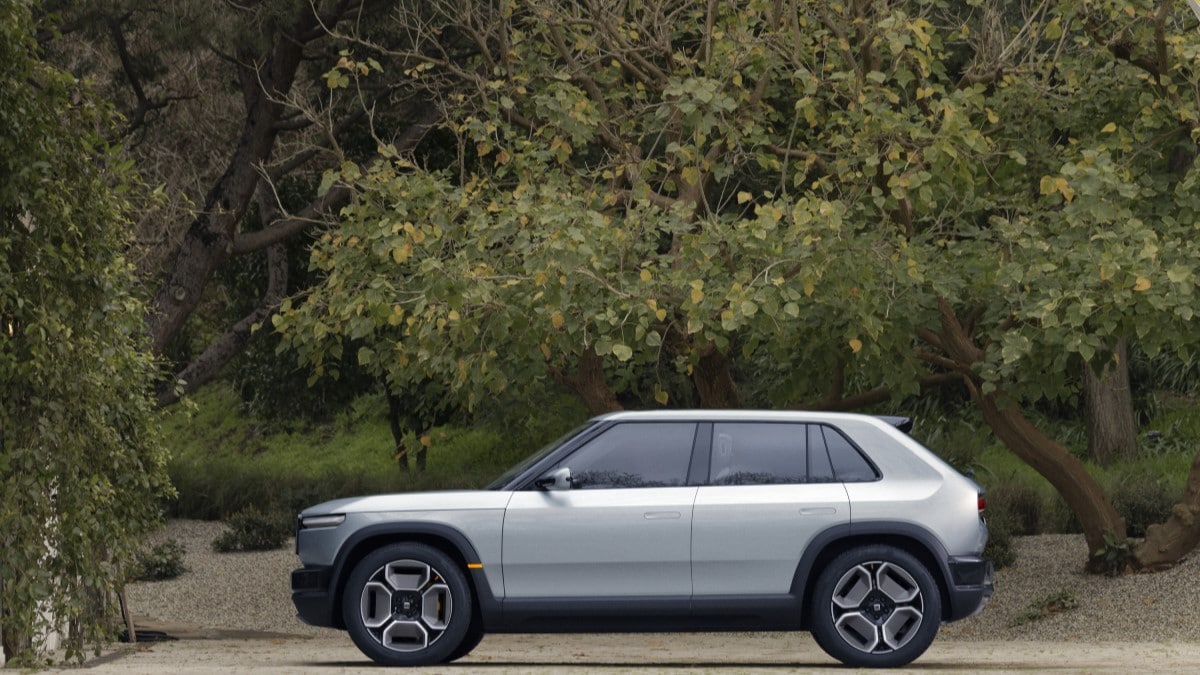
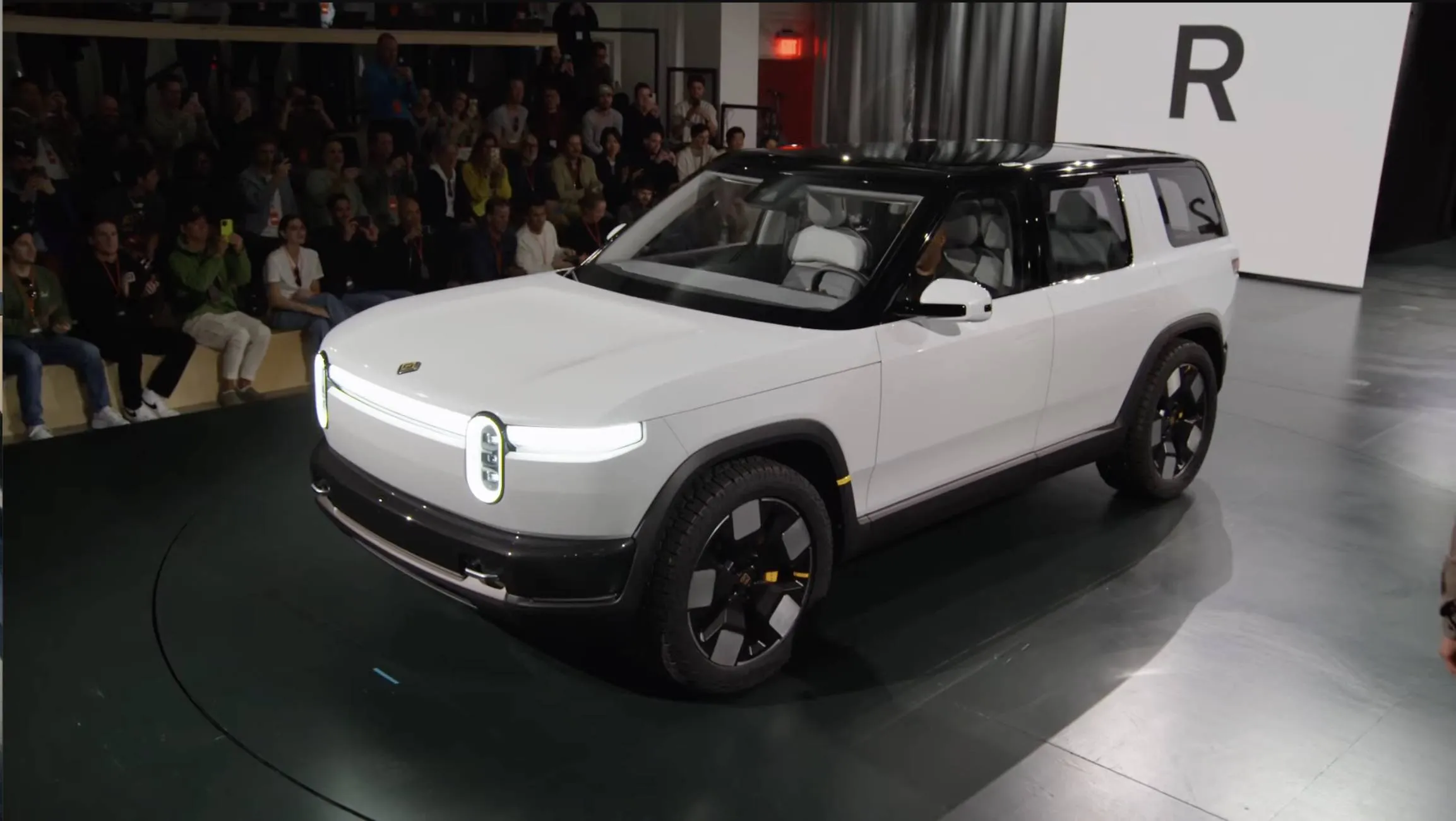
First, CEO RJ Scaringe unveiled what the assembled media expected – a 2-row compact SUV called the R2.
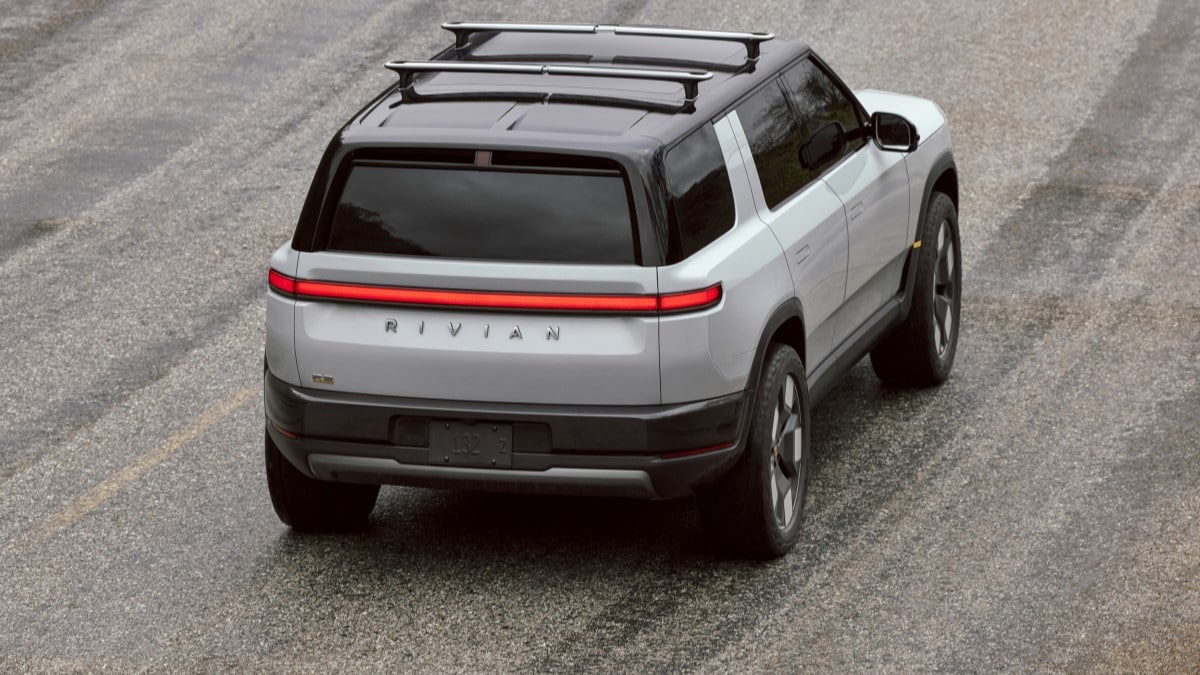
It bears a strong family resemblance to the 3-row R1S, shrunk to a smaller scale. The rear window glass goes down for easy access to the cargo area. Both rows of seats fold completely flat, Scaringe said, creating an area large enough for two to sleep in.
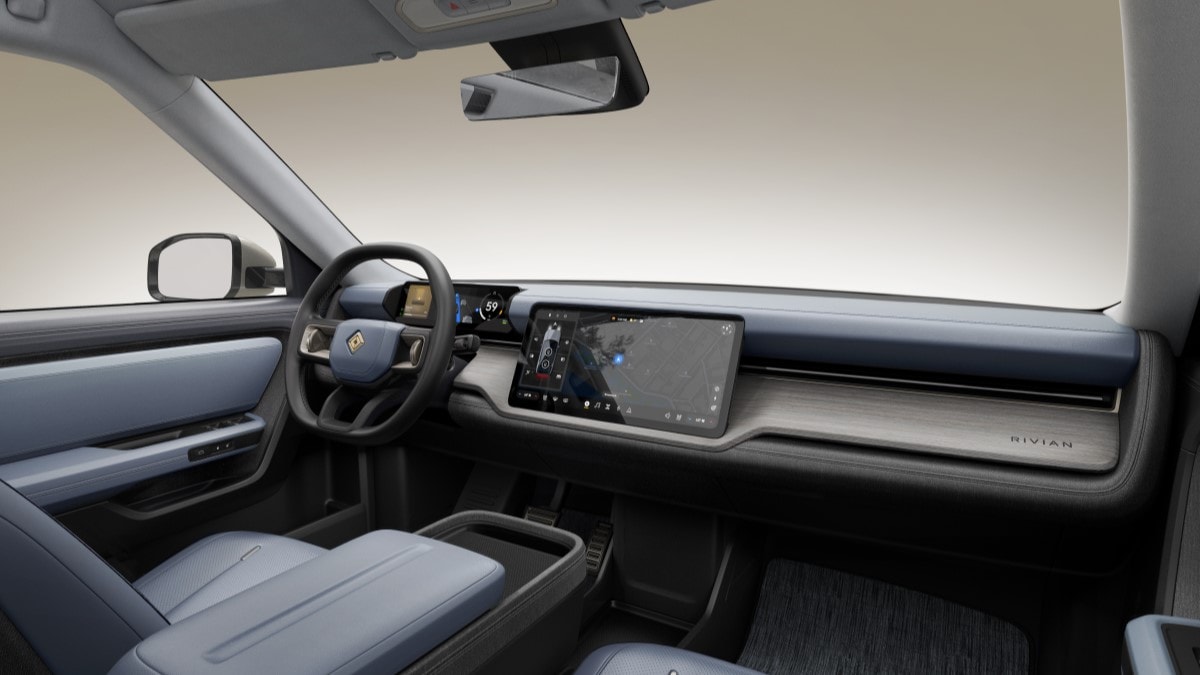
The interior features the expected pair of screens and an unexpected pair of glove boxes. Scaringe said early buyers of the R1 series had complained about the lack of glove box space, so Rivian created as much as it could.
Scaringe cited a $45,000 starting price. Rivian typically adds a $1,800 destination fee to its cars, so that price is functionally $46,800.
Scaringe said the car will be built in Normal, Illinois. That might enable it to qualify for part or all of the federal government’s $7,500 EV discount. We probably won’t know until closer to its expected 2026 on-sale date.
The R2 will be offered in single-motor rear-wheel-drive (RWD) or dual- or tri-motor all-wheel-drive (AWD) setups. Rivian did not offer performance details on any of the three.
The SUV “will feature two battery sizes,” Rivian said. It promised a range of over 300 miles for the larger size regardless of the number of motors. Each can charge from 10% to 80% capacity in about 30 minutes.
They’ll charge using the Tesla-style North American Charging System (NACS) connector but can use the Combined Charging System (CCS) connector with an adapter. That combination should give them access to virtually every public charging station in America.
Scaringe cited a 0-60 mph time under 3 seconds for the tri-motor edition. He promised partial automation capability to let owners “get on the highway, take your hands off the wheel, and get your time back.”
Orders have already opened with a $100 refundable deposit.
The R3
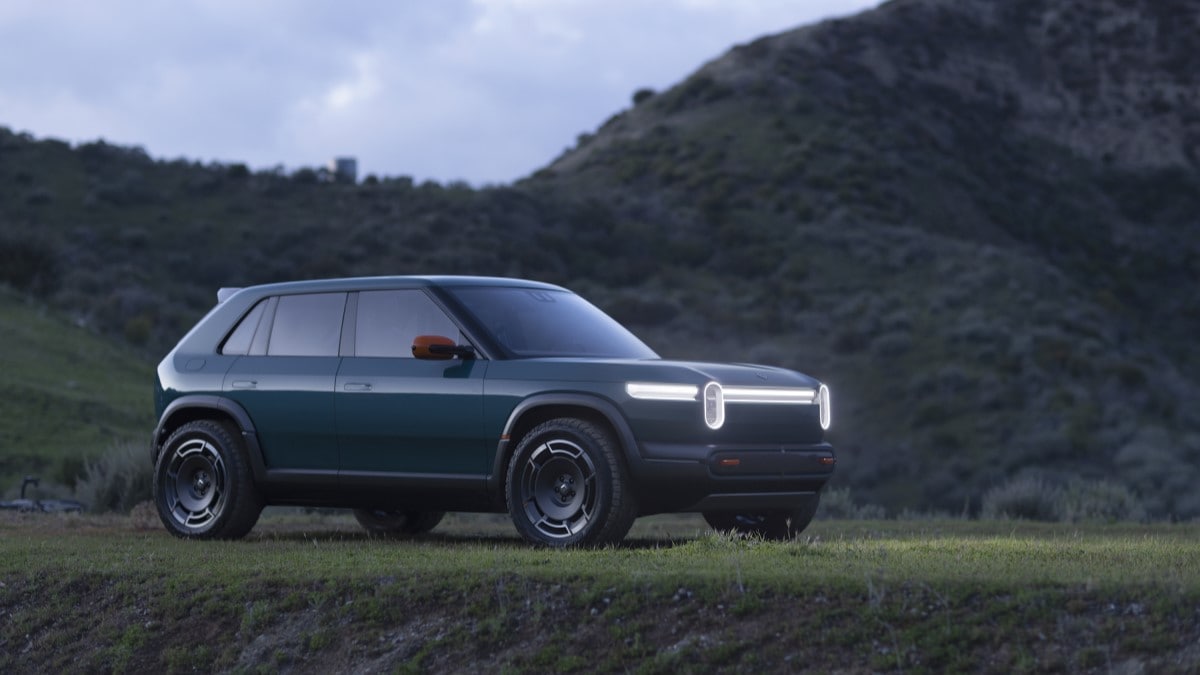
As the R2 presentation wrapped up, a door opened behind Scaringe, and a completely unexpected smaller model drove onstage. The R3, Scaringe said, is “our take on a crossover,” with a “shorter wheelbase and tighter dimensions” that “really enable it to be maneuverable.”
It appears likely to fit into the subcompact SUV segment.
It shares a platform with the R2 and will be offered with all three drivetrain setups. But Rivian has published no specifications.
A sharply-raked rear window gives it a 1980s vibe, reminding the assembled journalists of everything from an early Volkswagen Golf to a Yugo (“in the nicest possible way”). That glass opens, split-tailgate style, like an old-school SUV.
Scaringe also showed off a high-performance version called the R3X. In medium blue with orange side mirrors and lime seats, it looked like an R3 redesigned by an energy drink manufacturer. But we commend Rivian for experimenting with color when most automakers fear anything not gray.
Scaringe promised performance details on the R3X in the near future.
Cox Automotive, parent company of Kelley Blue Book and Autotrader, made a $350 million equity investment in Rivian in September 2019.
The actual cash value of your car is what it’s worth in its current condition or the amount you could reasonably expect to get for it if you sold it today.
When determining the value of a car, actual cash value accounts for the vehicle’s depreciation.
If an insurance appraiser returns with a higher ACV than the insurance company, you’ll have more leverage to negotiate with your carrier.
A car’s actual cash value (ACV) is how much it’s worth today. This value includes the depreciation of your vehicle. It also shows how much the insurance company pays out when it declares a car a total loss.
You may be able to negotiate a higher payout if you disagree with the insurer’s valuation. However, you will need to have the evidence to back it up. We’ll tell you about a vehicle’s ACV, how it differs from replacement cost, and expert tips for getting the most out of an insurance claim.
What Is Actual Cash Value of a Car?
The ACV of your car is what it’s worth in its current condition, factoring in depreciation. It’s the amount you could reasonably expect to get for it if you sold it today. And because cars begin depreciating as soon as you drive them off the lot, your vehicle’s ACV will be less than what you paid, even if it’s not that old.
How ACV Works
If the damage to your vehicle exceeds a certain percentage of the ACV, the insurer will declare it a total loss. They will reimburse you for the car’s actual cash value (minus your deductible). The threshold for “totaling” a vehicle varies by state and insurer.
Can I Ask the Insurance Company to Total My Car?
You can ask but it won’t do much good. The insurance company will only declare your car a total loss if the cost of repairs exceeds a certain percentage of the vehicle’s actual cash value.
Actual Cash Value vs. Replacement Cost of a Vehicle
When determining the value of a car, actual cash value considers the vehicle’s depreciation. Depreciation represents the loss of value since you purchased the car, and it’s determined based on multiple factors, including mileage, wear and tear, and accident history. The year, make, and model also affect how much a car depreciates because some vehicles hold their value better than others.
Replacement cost is how much you’d have to pay to buy a new version of the same or a similar vehicle. It’s higher than the ACV. Many carriers offer new car replacement policies, while others have policyholders use GAP insurance. Read more about that below.
Which Is Better: Actual Cash Value or Replacement Cash Value?
Because cars depreciate so quickly, it’s easy to become upside down on an auto loan or lease, especially if you put little or no money down. GAP insurance coverage, or guaranteed asset protection, can help mitigate this risk. It helps pay the difference between what your car is worth and what you owe the lender or leasing company. Some car lease contracts require GAP coverage.
Many GAP policies even cover your collision or comprehensive deductible. And with GAP coverage, you won’t have to worry about whether the ACV of your vehicle is high enough to pay off your loan or lease. Many drivers carry GAP insurance during the first several years of owning a car.
For example, if you owe $40,000 on your car loan but you wreck the car, and your vehicle’s actual cash value is $33,000, your insurance company will cover you for $33,000. You’ll have to come up with the extra $7,000 to pay off your loan. But GAP insurance, if you have it, covers you for the additional $7,000 for the replacement value. In this case, being covered for replacement value with the GAP insurance makes sense.
For car buyers who pay cash outright when they purchase the vehicle, it doesn’t make sense to carry GAP insurance because they don’t have any loan differences to worry about.
How Do Insurance Companies Determine the ACV of a Totaled Car?
Here’s how insurance companies determine the actual cash value after a car wreck totals a vehicle.
Proprietary models. According to Josh Damico, Vice President of Insurance Operations at Jerry, a car insurance comparison service, some insurers have internal proprietary models, yet most use a third-party vendor. “Most carriers are connected to a third-party vendor that they’re feeding the data into. The data on the vehicle and any damage gets loaded into the third-party system,” he said. Then the software aggregates the information to calculate the vehicle’s actual cash value.
Your car’s ACV is negotiable. The ACV depends on multiple factors, including the year, make, model, vehicle options, mileage, wear and tear, and accident history. If you disagree with the insurance company’s estimate of your vehicle’s value, you may be able to negotiate with them for a higher payout. But before you do, it’s a good idea to gather some evidence to improve your chance of success.
Research the value of your car. You can refer to Kelley Blue Book to find depreciation estimates and double-check the insurer’s valuation. It’s essential to provide as many details as possible about your specific car to ensure you get the most accurate estimate.
Tips for Negotiating the Actual Cash Value of Your Car
“A good first step is to talk to the appraiser that came out and looked at the vehicle,” Damico says. Discuss all your vehicle’s options to make sure the appraiser understands everything included in your car. Be sure to include upgrades or after-market products.
“If you have evidence of other cars that have sold in your area and done your own research, you can present that to the adjuster and have a conversation,” Damico said. However, your research may only get you so far. If you can’t agree with the adjuster, you can hire a private appraiser. But you’ll have to pay for it out of pocket, which typically costs about $200 to $300, according to Damico.
“Before you do that, it’s always good to check a site like Kelley Blue Book just to get an idea of whether what the appraiser is [offering] seems fair or whether [their valuation] is far enough off to assume the responsibility of hiring an appraiser,” he said.
You’ll have more leverage to negotiate if the appraiser returns with a higher ACV than the insurance company. But if the estimates are comparable, you may need to accept what the insurance company offers.
If you want to explore more options, you can always compare car insurance from various carriers before deciding.
Related Car Insurance Articles:
Editor’s Note: This article has been updated since its initial publication.
The 30th Dubai Show opened on Wednesday, with the five-day event now occupying the western stretch of Dubai Harbour, parallel to the cruise terminal, so giving visitors and exhibitors a direct view of the city skyline and iconic Ain Dubai Ferris wheel. For the past two years, the show has been held at the inside corner of the T-shaped Dubai Harbour development.
Organisers announced the participation of over 1,000 brands this year along with more than 200 boats, of which close to 90 are in the water in front of the main pavilion and a long row of exhibitor booths.
Dubai International Boat Show
Superyachts on display include the 47.5m Aquamarina built by Italy’s ISA Yachts and represented by TWW Yachts, the 46m Baglietto Lucky Me displayed by Behnemar, and Afra, the 50m wooden motor yacht exhibited by Bush & Noble, a UAE-based brokerage.
Other 100ft-plus yachts include the 38m Indigo Star by Italy’s Siar-Moschini and the Numarine 32XP Masha from Turkey.
Gulf Craft
Gulf Craft Group’s 16-strong display includes the Majesty 111, Majesty 100, Majesty 62 and Majesty 60 world premiere, alongside the Nomad 101, 75, 70 and 65.
The UAE builder’s smaller boats include the Oryx 379, Silvercraft 32 WA and six SilverCat power catamarans: 34 HT, 34 CC, 40 CC, 46 WA, 46 Lux and surprise addition, a 20ft prototype with an electric outboard motor.
Princess
Among international brands, Princess has the largest display with six yachts led by the British shipyard’s flagship X95 and including the X80 and new Y72, as well as the S62, F45 and V40. Dealer Yachts1 also represents Cranchi and is showing the Italian builder’s Settantotto 78, Sessantasette 67, A46 and E30, while fellow Italian builder Sanlorenzo is showing an SX88, SL86 and SL78.
Poland’s Sunreef Yachts is displaying three large catamarans: an 80 Sunreef Power Eco (Athena Too) and Sunreef 80 Eco (Marie-Joseph) from the solar-powered Eco series, as well as a 60 Sunreef Power.
Sunseeker
British builder Sunseeker is exhibiting five models, led by the 88 Yacht and including the Manhattan 55 and 68 flybridge motor yachts, 65 Sport Yacht and the Superhawk 55, which joined the line-up during the show.
Ferretti Group models include the Middle East debut of the Riva 82’ Diva, which had her world premiere at the Cannes Yachting Festival last September, while the four-strong line-up also features the Ferretti Yachts 780 and the Pershing 70 and 8X (84ft).
Dubai International Boat Show
Azimut is staging the Middle East premiere of the S7 sportbridge model along with the S6, Fly 53, Fly 68 and Grande 27M superyacht in cooperation with dealer Elite Yachts, part of Al Ameeri Group, which has participated in the show since its inception over three decades ago.
The SF Yachts dealership is showing a Riviera 72 Sports Motor Yacht and a Prestige M48 multihull motor yacht, Royal Yachting is exhibiting a Galeon 640 Fly, while a Sirena 88 and Absolute Navetta 52 are among other motor yachts on show.
Dubai International Boat Show
A Lagoon 55 sailing catamaran, Beneteau Oceanis 40.1 sailing monohull and a Dragonfly 32 sailing trimaran are being exhibited by dealer Tan Services. Sailing monohulls include a Dufour 41 from France by Eden Yachting and a Dehler 38 SQ from Germany’s Hanse Yachts group.
UAE builders exhibiting boats include Hareb Marine (Sea Master 56), Riviera Boats (Integrity 55), IMG Boats, Emirates Boats and Al Fajer Marine, while Bahrain’s Al Dhaen is exhibiting following its display at the Thailand International Boat Show.
Alongside the main pavilion, exhibitor booths overlooking the water included Azimut, Ferretti Group, Sunseeker with Bush & Noble, Sanlorenzo, Sunreef, Princess and the Swiss Yachts charter company.
To the west, superyacht builders with booths overlooking the water included Lurssen, Amels/Damen Yachting, Feadship, Heesen, Oceanco, Benetti, The Italian Sea Group, Baglietto and Numarine, along with superyacht broker Behnemar and Royal Yachts, a UAE-based charter company.
Dubai International Boat Show
Boats being shown on the hard included a trio of Saxdor motor yachts, the 205, 270 GTO and 320 GTO, exhibited by Seas & Deserts. As well as other boats, the hardstand area also included water toys, an impressive display of luxury cars, VIP hospitality and F&B outlets.
A Ferrari Enzo has crashed in Germany. The multi-million dollar supercar was driving down the Autobahn near Munich when the driver lost control and wrecked.
According to media reports, the Ferrari Enzo collided with the median barrier, scattering debris over a 200-meter stretch. The driver is said to have sustained minor injuries. Another vehicle was also damaged in the accident due to flying debris.
The images of the crash site show the Enzo in the second lane of the Autobahn, with its front end completely ripped apart. Prima facie, looks like a classic case of losing the rear end and crashing head-on into the barriers. Unlike the Ferrari Enzos that crashed in the UK and the Netherlands a few years ago, this car will require a complete front-end rebuild.
Given the value of these cars in today’s market, there’s no doubt, this Enzo will be restored to its former glory. That being said, it will put a massive dent in the pocket of the owner.
NVIDIA is offering a new professional certification in generative AI to enable developers to establish technical credibility in this important domain.
Generative AI is revolutionizing industries worldwide, yet there’s a critical skills gap and need to uplevel employees to more fully harness the technology.
Available for the first time from NVIDIA, this new professional certification enables developers, career professionals, and others to validate and showcase their generative AI skills and expertise. Our new professional certification program introduces two associate-level generative AI certifications, focusing on proficiency in large language models and multimodal workflow skills.
“Generative AI has moved to center stage as governments, industries and organizations everywhere look to harness its transformative capabilities,” NVIDIA founder and CEO Jensen Huang recently said.
The certification will become available starting at GTC, where in-person attendees can also access recommended training to prepare for a certification exam.
“Organizations in every industry need to increase their expertise in this transformative technology,” said Greg Estes, VP of developer programs at NVIDIA. “Our goals are to assist in upskilling workforces, sharpen the skills of qualified professionals, and enable individuals to demonstrate their proficiency in order to gain a competitive advantage in the job market.”
See AI’s Future. Learn How to Use It.
GTC 2024 — running March 18-21 in San Jose, Calif. — is the first in-person GTC event in five years, and more than 300,000 people are expected to register to attend in person or virtually. There will be 900 sessions and more than 300 exhibitors showcasing how organizations are deploying NVIDIA platforms to achieve industry breakthroughs.
Attendees can choose from 20 full-day, hands-on technical workshops, with many sessions available virtually in EMEA and APAC time zones. Also, sign up for the GTC Conference + Training package for more than 40 complimentary onsite training labs.
Sign up for GTC . Learn more about the generative AI course here and here.
2024 will be the year generative AI gets personal, the CEOs of NVIDIA and HP said today in a fireside chat unveiling new laptops that can build, test and run large language models.
“This is a renaissance of the personal computer,” said NVIDIA founder and CEO Jensen Huang at HP Amplify, a gathering in Las Vegas of about 1,500 resellers and distributors. “The work of creators, designers and data scientists is going to be revolutionized by these new workstations.”
“AI is the biggest thing to come to the PC in decades,” said HP’s Enrique Lores, in the runup to the announcement of what his company billed as “the industry’s largest portfolio of AI PCs and workstations.”
Greater Speed and Security
Compared to running their AI work in the cloud, the new systems will provide increased speed and security while reducing costs and energy, Lores said in a keynote at the event.
Entry-level systems with the NVIDIA RTX 500 Ada Generation Laptop GPU let users run generative AI apps and tools wherever they go.
High-end models pack the RTX 5000 to deliver up to 682 TOPS, so they can create and run LLMs locally, using retrieval-augmented generation (RAG) to connect to their content for results that are both personalized and private.
Access to Accelerated Software
The new workstations can tap into NVIDIA’s full-stack AI platform, including software that speeds the data science at the foundation of generative AI.
The systems’ Z by HP AI Studio platform — developed in collaboration with NVIDIA — links to NVIDIA NGC, a catalog of GPU-accelerated software for AI and data science. NGC includes NVIDIA NeMo, a framework to build, customize and deploy generative AI models.
In addition, HP and NVIDIA announced that NVIDIA CUDA-X libraries will be integrated with the systems to turbocharge the data preparation and processing that’s fundamental for generative AI.
Speedups for Data Scientists
The libraries include NVIDIA RAPIDS cuDF, which accelerates pandas, software used by nearly 10 million data scientists.
“It used to take them hours and sometimes days to process data that now they can do in minutes,” Huang said.
“This pandas library is insanely complex,” he added, noting NVIDIA engineers worked for more than five years on reformulating the code so it can be accelerated with GPUs.
Entering a New Era
In tandem with the new systems, HP announced a partner training program developed in collaboration with NVIDIA. It will equip computer vendors to advise customers on the right AI products and solutions to meet their needs.
Such programs pave the way for an industry that’s entering an era where AI lets software write software.
“We’ve reinvented the computer. We’ve reinvented how software is written, and now we have to reinvent how software is used,” said Huang. “Large language models, connected into other LLMs, will help solve application problems — that’s the future.”
Rivian CEO RJ Scaringe pulled a Steve Jobs “one more thing” moment at the debut of the R2 electric SUV.
On Thursday after the R2 rolled onto stage, Scaringe introduced its smaller, sportier sibling, the R3, as well as a stylized variant called the R3X.
Details on the R3 are slim, but the design makes a statement.
Rivian R3X
Sitting lower than the R2 with a squatter stance, the R3 is 5.0 inches shorter than the R2 and it looks like a hot hatch. In 2018, Scaringe teased the idea of the automaker’s third vehicle being a rally car-like vehicle.
The front of the R3 looks similar to the R2 thanks to the automaker’s trademark lighting signature. The roofline tapers down into a rear hatch with proportions that aren’t as squared off. It looks like a Subaru Outback Wilderness version of a Volkswagen Golf.
Rivian R3
The rear hatch opens like a traditional hatchback but hides a party trick. The glass itself can open separately from the hatch in a feature Rivian dubs the Flipper Glass. This allows long items, such as surf boards, to be housed within the R3’s smaller footprint.
Rivian’s packaging innovation extends to the R3. It has dual glove boxes, both the first- and second-row seats fold completely flat, and there’s a large front trunk for secure storage.
The simple dashboard features a digital gauge cluster and a large touchscreen housing most of the vehicle controls.
The R3X will feature cork and anodized metal inside its cabin. On outside, it has rally-style wheels, but it’s unclear if it will be a performance variant.
Rivian R3
The R3 will be built on the same skateboard chassis as the R2 with 4695-style battery cells. Power outputs haven’t been released, but we know the R3 will be offered with a single rear motor, dual motors with a motor at each axle, and a tri-motor powertrain with one motor up front and two on the rear axle.
Rivian has committed to the Tesla NACS charge port, and the R3 is expected to have its charge port on the passenger-side rear fender like the R2. CCS charging will likely work via an adapter.
Rivian plans to put five radar units and 11 cameras into both the R3 and R2 as part of its suite of active safety technology.
While the R2 will go into production in Normal, Illinois, in 2026, it’s unclear where and when the R3 will be built.
Rivian is looking to go mainstream with a lower cost model that will square off with everything from the Tesla Model Y to the Chevrolet Blazer EV.
On Thursday, the Rivian R2S debuted two years ahead of when it will arrive. When the R2S enters production in Normal, Illinois, it will cost $45,000 and have up to 330 miles of range.
The Rivian R2S looks like the automaker put the large three-row R1S SUV in a shrink ray. With a wheelbase of 115.6 inches and an overall length of 185.6 inches, the RS2 rides on a 5.5-inch shorter wheelbase and is 15.2 inches shorter overall than its R1S sibling. This makes the R2S wheelbase 1.8 inches longer than that of the Tesla Model Y, but the RS2 is 1.4 inches shorter overall than the Tesla.
At 66.9 inches tall, the R2S is 10.4 inches shorter than the R1S. The R2S skips the larger SUV’s split-tailgate design, but features front-hinged pop-out rear windows and a roll-down tailgate window like the Toyota 4Runner.
The Rivian R2S is a five-seat two-row SUV and will not offer a small third-row seat like the Model Y. Rivian has carved out a large frunk that can carry the SUV’s bike mounting system when not in use. That bike mounting system snaps into a rear accessory port without tools, according to Rivian. Expect a vast array of accessories to arrive alongside the R2S in 2026.
The R2S will ride on a Rivian skateboard chassis and feature a battery pack made of 4596 cells and one, two, or three electric motors for a combined. Rivian said the R2S will accelerate from 0-60 mph in less as 3.0 seconds.
The R2S won’t be capable of venturing quite as far into the wilderness as the larger R2S. Max ground clearance checks in at up to 9.8 inches with a 25-degree approach angle and a 27-degree departure angle with the available 32-inch all-terrain tires.
Every R2S will be capable of charging at Tesla Supercharging stations thanks to a standard NACS charge port. Rivian said the R2S will also be capable of high-speed charging via CCS, likely via an adapter. A design change from the R1S, which locates the charging port on the driver-side front corner, puts the charging port on the rear passenger-side fender for the R2S.
The technical storage or access is strictly necessary for the legitimate purpose of enabling the use of a specific service explicitly requested by the subscriber or user, or for the sole purpose of carrying out the transmission of a communication over an electronic communications network.
Preferences
The technical storage or access is necessary for the legitimate purpose of storing preferences that are not requested by the subscriber or user.
Statistics
The technical storage or access that is used exclusively for statistical purposes.The technical storage or access that is used exclusively for anonymous statistical purposes. Without a subpoena, voluntary compliance on the part of your Internet Service Provider, or additional records from a third party, information stored or retrieved for this purpose alone cannot usually be used to identify you.
Marketing
The technical storage or access is required to create user profiles to send advertising, or to track the user on a website or across several websites for similar marketing purposes.