The next salvo in Audi’s EV onslaught will come in the form of the Q6 E-Tron compact crossover, which the automaker has confirmed for a debut on March 18.
The vehicle is a sibling to the electric Porsche Macan, which debuted in late January, and both models ride on Volkswagen Group’s newly developed PPE platform designed for volume EVs from the premium brands.
Audi has been quiet on specifications for the Q6 E-Tron, but we know the Macan will come with a standard 100-kwh battery (95-kwh usable) and an electric motor driving each axle. Also standard will be an 800-volt electrical system that facilitates charging at rates of up to 270 kw. The most powerful grade at launch will be the Macan Turbo with 630 hp on tap.
The Macan has been confirmed to arrive in the U.S. as a 2024 model, though it isn’t clear whether the Audi will also arrive as a 2024 model or possibly a 2025. Both a regular crossover as shown here as well as a more coupe-like variant are planned. The latter will carry the Sportback designation, just like the larger Q8 Sportback E-Tron.
Audi Q6 E-Tron
Audi Q6 E-Tron
Audi Q6 E-Tron
Audi provided a preview of the Q6 E-Tron’s interior design last fall. For the dash, a curved panel will be angled toward the driver and integrate an 11.9-inch digital gauge cluster and a 14.5-inch infotainment touchscreen. A head-up display with augmented reality will also be available, likely as an option.
The infotainment system will be a new Android-based design developed by Cariad, VW Group’s software division. It will feature its own app store.
Cariad has also developed a feature for the Q6 E-Tron that will let owners change the light signatures of the daytime running lights for both the headlights and taillights.
Production of the Q6 E-Tron will be handled at Audi’s plant in Ingolstadt, Germany, which is being prepared for production of PPE-based vehicles, as well as batteries.
The first events of a new show season really set the tone of what’s to come, and if what I saw at Risenation‘s Hall Of Fame 2K24 event this past weekend in Belgium is anything to go by, it’s going to be a great year.
Risenation’s very first event was held at Château d’Enghien in Enghien, Wallonia back in 2017, and since then it has expanded with more annual stance-focused events – the first of the season for the past three years being Hall Of Fame. It’s come a long way from the 2022 event held in a 6,000m² space at the Brabanthal events center in Leuven, to this year taking over 20,000m² at the Nekkerhal in Mechelen, midway between Brussels and Antwerp. No less than 350 curated cars from 15 countries made this the biggest and best Risenation Hall Of Fame yet.
Shooting in this unique location, which was built in the 1980s as a produce storage facility and market, was a bit of a challenge. The dark walls, white concrete floor and curved roof full of windows with the midday sun beaming through did me no photography favors, but the subject matter within the expansive building more than made up for it.
Risenation’s mission is ‘to share the passion for stance through exceptional events’. Furthermore, they ‘want to bring together a community and create connections between enthusiasts throughout Europe.’ Itreally does seem like they’re achieving these things.
The incredibly diverse selection of cars on show ensured there was something for everyone. Old school, new school, OEM+ and performance builds were represented in full effect.
Liberty Walk Europe is now located just across the Belgium border in the Netherlands, and they made a big impression by showing up with four complete builds that were displayed front and center.
It’s the little things and attention to detail that really elevate an event, and special thought was put into the show floor layout with select cars raised up on podiums throughout the venue, which made it so much more interesting to view.
Hall Of Fame 2K24 was the first of three Risenation events scheduled for the year, their biggest – AllStars 2K24 – set to play out at the MECC Maastricht in the Netherlands in early August. That venue comes in at 30,000m², and Risenation will be selecting 550 cars to take part in it. The third and final show of the season, French Chapter IV, will happen a few weeks later in France on the grounds of the stunning Château Laverdines.
Given what I saw at this event, I can’t wait to see what the rest of the Risenation season has in store for everyone. As I live in the Netherlands, I’ll definitely be covering the Maastricht show.
In the meantime, there are many more images from the Hall Of Fame 2K24 in Belgium to check out below.
Collin Tiemens Instagram: collinclicksphotos
More IAMTHESPEEDHUNTER posts
How To join the IATS program: We have always welcomed readers to contact us with examples of their work and believe that the best Speedhunter is always the person closest to the culture itself, right there on the street or local parking lot. If you think you have what it takes and would like to share your work with us then you should apply to become part of the IAMTHESPEEDHUNTER program. Read how to get involved here.
In light of what the series is politely calling “the geopolitical situation in the Red Sea,” the FIA World Endurance Championship will be sending the full grid of 37 cars, plus all related equipment, by air instead of slower and far less expensive sea freight. The “situation” is that Houthi rebels in the Yemen have been firing on trade ships in the Red Sea in an attempt to support Hamas through ongoing warfare in Gaza. For obvious reasons, it’s much better for the series that these cars don’t get firebombed at sea.
‘The Bachelor’s Joey Graziadei Shares Stories Of His First Love – A Well-Used Lexus
The resulting ripple effect sea freight delays that these attacks have caused meant that much of the WEC grid didn’t arrive to Qatar in time for pre-season testing last month. The delay meant that the testing session was delayed two days, though Saturday’s first race of the season, the Qatar 1812KM, went off without a hitch. Shipping the cars by water to the Imola 6 Hour race, scheduled for April 21, would have meant traversing the Red Sea to travel through the Suez Canal into the Mediterranean Sea.
“This was the only viable solution which would guarantee the safety of the WEC’s freight, as well as everything arriving on time for Imola,” the series said in a statement.
The series isn’t simply being benevolent here, as the cost of air freighting will be passed along to the teams. According to reports from Motorsport.com, some teams face a shipping bill as high as $318,000 to get their cars to Italy this week. Teams participating in testing sessions at Imola this Sunday were given first shipping priority.
The Chip Ganassi Cadillac team was the only Hypercar team to opt to send their cars on the water, which meant their cars and components arrived late, while most of the GT3-class cars took that option. It makes sense that these smaller and lighter-funded lower-class cars would opt for a slower-but-cheaper method. For this upcoming round, at least, their decision was made for them by the series.
Tanzania, a country celebrated for its sprawling wilderness and diverse ecosystems, is a paradise for nature enthusiasts and adventurers alike. Among its most treasured jewels are the national parks in Tanzania, each offering unique landscapes, wildlife, and experiences that draw visitors from all corners of the globe.
These sanctuaries are about more than majestic wildlife or breathtaking scenery; they are about the very essence of Africa itself.
From the iconic Serengeti, known for its vast plains and the spectacular Great Migration, to the Ngorongoro Crater, a haven for wildlife nestled within an extinct volcano, Tanzania’s national parks are a testament to the country’s commitment to conservation and the celebration of the natural world.
Here are the top national parks in Tanzania to visit.
Top Five National Parks in Tanzania
Going on safari is one of the most popular things to do in Tanzania. If that’s your dream, make sure to include at least one of the below national parks in Tanzania in your itinerary.
Whether you’re a seasoned safari-goer or a first-time visitor, prepare to be captivated by the magic of Tanzania’s national parks.
Serengeti National Park is known for its vast savannas and the Great Migration. It is home to millions of wildebeest, zebras, and gazelles, as well as predators like cheetahs and crocodiles. It is adjacent to the Serengeti and characterized by acacia-dotted landscapes. It is part of the Great Migration route and hosts the “Big Five“—elephant, Cape buffalo, leopard, lion, and black rhino.
Here’s a closer look at what makes Serengeti so extraordinary:
Great Migration: The annual migration sees millions of wildebeest, accompanied by zebras and gazelles, traversing the Serengeti plains in search of food and water. This spectacle of nature is a breathtaking display of movement and survival instincts. Indeed, Serengeti National Park offers an unparalleled opportunity to witness the wonders of wildlife, particularly during the Great Migration.
Abundance of Wildlife: Apart from the Great Migration, Serengeti is home to an incredible diversity of wildlife. Visitors have the chance to spot the renowned Big Five – lion, elephant, buffalo, leopard, and rhinoceros – along with numerous other species, including cheetahs, giraffes, hyenas, and various bird species.
Landscape: The Serengeti’s vast savannas, dotted with acacia trees and rocky outcrops, provide a stunning backdrop for wildlife viewing. The open plains offer excellent visibility, making spotting animals in their natural habitat easier.
Conservation Efforts: Serengeti National Park is a hotspot for tourism and a crucial area for wildlife conservation. Efforts to protect the park’s ecosystem ensure the continued survival of its diverse fauna and flora.
Overall, Serengeti National Park stands as a testament to the raw beauty and abundance of wildlife in Africa, offering visitors an unforgettable safari experience
Serengeti, Tanzania
2. Arusha National Park
Arusha National Park is located in the northeastern region of Tanzania near the city of Arusha and is indeed a captivating destination offering a blend of scenic beauty and diverse wildlife. Its proximity to Mount Kilimanjaro provides breathtaking views of Africa’s highest peak, adding to its allure.
The park boasts a remarkable variety of landscapes, ranging from lush rainforests, sparkling lakes, and cascading waterfalls to volcanic formations and sprawling savannahs. This diverse terrain creates a habitat that supports a wide array of flora and fauna.
One of the park’s notable attractions is its rich avian population, with numerous species of birds calling it home. From the striking silvery-cheeked hornbill to the mesmerizing sight of thousands of pink flamingos adorning the lakes, birdwatchers are in for a treat.
Moreover, Arusha National Park is renowned as the prime location in northern Tanzania for observing the black-and-white colobus monkey, offering visitors a rare opportunity to witness these captivating primates in their natural habitat.
Whether you’re a nature enthusiast, wildlife lover, or simply seeking breathtaking landscapes, Arusha National Park promises a memorable experience with its captivating scenery and abundant wildlife.
Whether you are visiting for a day trip or having an overnight, Tarangire has something for everyone.
The park is impressive for its famous concentration of wild animals, especially the elephants, and it is also one of the finest birding destinations in East Africa.
The park’s name comes from the Tarangire River, which crosses it and covers an area of 2850 km2.
Tarangire has a bimodal rainfall with short rains starting from November to December, long rains from March to May and dry season from June to October and January to February. The park is located between 900m and 1250 meters with annual average rainfall ranging from 650 to 700mm.
The Park has remarkable attractions with large groups of Elephants, the spectacular natural beauty of the savanna landscape and magnificent majestic Baobabs. Over 550 different bird species have been recorded in the park, of which several are threatened or endemic.
Getting there:
The Park can be accessed by road or air
Road: The park is 121km through a tarmac road from Arusha city.
Air: The park can be reached by flight from Kilimanjaro International Airport, which is 46km from Arusha. Charted flights are also available from Arusha to Kuro Airstrip located inside the park
Boabab in Tarangire National Park, Tanzania
4. Ngorongoro National Park
The Ngorongoro Conservation Area indeed holds a remarkable place in the realm of natural wonders, particularly due to the stunning Ngorongoro Crater.
Here’s why it’s considered such a unique destination:
Volcanic Caldera: The Ngorongoro Crater is a geological marvel formed by the collapse of a massive volcano millions of years ago. Its circular shape and steep walls create a natural enclosure that supports a diverse ecosystem.
Wildlife Diversity: Despite its relatively small size compared to other national parks, the Ngorongoro Crater boasts an incredibly high concentration of wildlife. Visitors can see all of Africa’s iconic large predators, including lions, leopards, cheetahs, hyenas, and many herbivores such as elephants, buffalo, zebras, and wildebeest.
Scenic Beauty: The crater’s landscape is breathtaking, with sweeping vistas, lush grasslands, and shimmering soda lakes. The contrast between the verdant crater floor and the surrounding arid plains adds to its visual appeal.
Conservation Efforts: The Ngorongoro Conservation Area is dedicated to preserving the delicate balance of its ecosystem while promoting sustainable tourism. This ensures that future generations can continue to appreciate its natural splendor.
The Ngorongoro Crater features the largest unbroken caldera in the world. It is also rich in wildlife, including lions and critically endangered black rhinos.
Overall, the Ngorongoro Conservation Area, with its majestic crater and abundant wildlife, offers visitors an unforgettable safari experience and stands as a testament to the wonders of the natural world.
Book your Tanzania Safari
Gowitos Safaris and Holidays offers tours across Tanzania, including all of the mentioned national parks and more.
For example, their 8-day trip across the Northern Circuit includes visiting the Serengeti National park, Arusha, Tarangire National Park, Ngorongoro Crater.
Here’s a breakdown of the itinerary:
Day 1: Arriving at Kilimanjaro International Airport Day 2: Moshi -> Arusha Day 3: Arusha -> Tarangire Day 4: Tarangire -> Lake Eyas Day 5: Lake Eyas -> Serengeti National Park Day 6: Full-day safari in the Serengeti National Park Day 7: Serengeti National Park -> Ngorongoro Crater Day 8: Ngorongoro Crater -> Kilimanjaro International Airport
Lake Manyara National Park is a beautiful protected area located in Tanzania in the Arusha and Manyara regions. The nearest city is Arusha, Babati. This park stretches over Lake Manyara and the Great Rift Valley, covering an area of 325 square kilometers, with 230 square kilometers covered by Lake Manyara.
Lake Manyara National Park is located in Tanzania’s northern safari circuit. It is situated along the route leading to Ngorongoro Conservation Area and Serengeti National Park. The park is part of the larger Lake Manyara Biosphere Reserve, established in 1981 by UNESCO as part of its Man and the Biosphere Programme.
Historically, Lake Manyara National Park is named after a plant called Euphorbia tirucalli, locally known as Emanyara in the Masai language. These trees were planted in the area by the Masai people to guard their livestock from thieves and wild animals like lions and leopards.
Lake Manyara National Park was established as a reserve in 1957, but before that, it was used as a sports field and a residence area for the Masai people.
Lake Manyara
Lake Manyara is a shallow alkaline lake covering a reasonable Lake Manyara National Park area. The lake is a major attraction in the park, covering a surface area of 230 square kilometers and a depth of 3.7 meters. Lake Manyara is the 7th largest lake in Tanzania at the surface elevation of 1,045 meters above sea level, the lake is a great birding site hosting thousands of flamingoes which create a pink shade on the shores of the lake. Lake Manyara is a great site for a birding and canoeing safari experience.
Wildlife
Lake Manyara National Park hosts plenty of wildlife species thriving in marshlands, acacia woodlands, a savannah grassland-dominated area of the park, and the forest galleries. The park is famous for hosting tree-climbing trees, a huge population of elephants, and a troop of baboons with over 100 individuals, which is considered to be the largest in Africa.
Other animals residing in Lake Manyara National Park include hippos, antelopes, zebras, Thomson gazelle and Grant’s gazelle, wildebeests, waterbuck, impalas, warthogs, giraffes cape buffalo and many more. Lake Manyara National Park is a home to many predators such as lions, leopards, African wild cats, spotted hyenas, bat-eared foxes, genets, honey badgers and serval, cheetah and African golden cats are occasionally spotted in the park.
Birdlife
Lake Manyara National Park is a great habitat for bird life and hosts exceptional bird species. In the park, most bird species live on the banks and in the middle of Lake Manyara and others in the savannah woodlands. Lake Manyara National Park is a habitat for over 400 bird species with migratory species from Eurasian locations, raptors, unique and endangered species (Rufous-tailed weaver, Ashy starlings and black-collared lovebird).
Bird species in this park include pink-shaded flamingoes, pelicans, crowned eagles, crested guinea fowl, slivery checked hornbills, egrets, stilts, herons, spoonbills, stalks, wanders, Narina trogon, pangani long claw, crowned hornbills, Schalow’s turaco, emerald cuckoo, crowned plover, two-banded courser, black-faced sun grouse and many more.
Maji Moto Springs
Maji Moto Springs is a magnificent feature in the park’s southern region. These hot springs are named after a Swahili word meaning hot water. Maji Moto Springs is surrounded by palm and fig trees, making it a small paradise amidst the park. The springs heat to about 60 degrees Celsius, and the water creates a pool where visitors of the park can take a swim.
Lake Manyara National Park, Arusha, Tanzania
Tourist Activities to do in Lake Manyara National Park
Here are a few things to do in the Lake Manyara National Park in Tanzania.
Game viewing
Lake Manyara National Park is a grand destination for an exciting game-viewing experience, this experience offers an opportunity to explore the park and together with safari guide you will visit various sections of the park on a game drive.
During this experience, you will visit the magnificent lake Manyara, where you will spot thousands of animals as they drink water and birds. Then, you will drive through marshlands, woodlands, and acacia-dominated terrain, spotting animals like tree-climbing lions, elephants, hippos, antelopes, zebras, Thomson gazelle and Grant’s gazelle, wildebeests, waterbuck, impalas, warthogs, giraffes, cape buffalo, and many more.
Lake Manyara National Park offers both day and night game viewing, night is a very exciting safari experience offering sights of a new dimension of the park. This experience an opportunity to spot nocturnal animals and predators living in Lake Manyara National Park, with the help of a spotlight, you will spot lions who are more active at night, leopards, African wild cat, spotted hyena, bat-eared fox, genet, honey badger, serval and occasional cheetah.
Birding
Lake Manyara National Park is one of the best protected areas in Tanzania for birding experience. The park is home to over 400 bird species residing around Lake Manyara, savannah grasslands and the forest galleries dotted around.
Birding in Lake Manyara National Park offers an opportunity to spot wonderful and colorful bird species, such as thousands of pink-shaded flamingoes in the waters and shores of Lake Manyara, flocks of pelicans, the rare Pangani long claw, silvery-checked hornbill, crowned eagles, crested guinea fowl, slivery checked hornbills, egrets, stilts, herons, spoonbills, stalks, wanders, Narina trogon, Pangani long claw, crowned hornbills, Schalow’s turaco, emerald cuckoo, crowned plover, two-banded courser, black-faced sun grouse and many more.
The best site for birding in Lake Manyara National Park is Lake Manyara, which is always crowded with thousands of pelicans and pink flamingoes, the vast populations of birds make the park a paradise for birders.
Canoeing
Canoeing in Lake Manyara National Park offers a way of touring the beautiful Lake Manyara. This park is one of the few protected areas in Tanzania, offering a canoeing safari experience. Canoeing experience gets the tourists close to the aquatic life of Lake Manyara with sights of thousands of flamingoes, pelicans and many animals that come to the lake to drink water.
Masai local community is situated on the boundaries of Lake Manyara National Park, historically the Masai people are the early inhabitants of the park and visiting the Masai community offers cultural and traditional tours while in Lake Manyara National park.
In the Masai community, you will enjoy the sights of the circular the huts/bomas made out of mad and straws, be entertained traditional dances and songs, traditional wear of stripped shukas, local cuisines prepared locally and many more aspect of the indigenous cultural heritage.
Masai community in Arusha, Tanzania
Accommodation in Lake Manyara National Park
In Lake Manyara National Park, accommodation is available at various lodges and camps that are open to visitors throughout the year. These include the Lake Manyara Hotel, Lake Manyara Bush Camp, AndBeyond Lake Manyara Tree Lodge, Africa Safari Glamping, Lake Manyara Kilimamoja Lodge, Lake Manyara Wildlife Lodge, Migunga Tented Camp, Lake Manyara Singing Safari Lodge, Lake Manyara Tortilis Camp, and many more.
How to Get to Lake Manyara National Park
Lake Manyara National Park is about 126 kilometers southwest of Arusha, where most safari trips to Lake Manyara national park start from, from Arusha the park is accessed by road and air means of transport.
By road transport there are well kept routes leading to the park in a drive of approximately 1-2 hours by air means of transport domestic flights are offered from Arusha airport to Lake Manyara airport serving Lake Manyara national park and Manyara region.
Climate in Lake Manyara National Park
Lake Manyara National Park experiences two rainy seasons and one dry season. The rainy seasons in the park consist of short rains and long rains. Short rains are experienced in the period of November – to December and long rains from March to May, Lake Manyara national park experiences the high rainfall in April with 161 mm.
The dry season is experienced in July, August and September. September is the driest month, experiencing the lowest average of rainfall. Temperature the warmest months in Lake Manyara National Park are January, February and March, experiencing 30 degrees Celsius and the lowest average high temperature is experienced in June and July, with an average of 25 degrees Celsius.
8 Days Best Northern Circuit Tanzania Safari
Embark on an all-encompassing safari adventure through Tanzania’s most breathtaking landscapes and wildlife habitats. This journey is perfect for those eager to immerse themselves in Tanzania’s diverse natural beauty, from the golden plains of the Serengeti to the unique ecosystem of the Ngorongoro Crater, alongside cultural experiences with local tribes and visits to scenic landmarks like Lake Eyasi and Tarangire National Park.
Witness the vast array of wildlife, including the Big Five, in their natural environments, complemented by the warm hospitality and expert guidance of Gowitos Safari throughout your adventure.
Itinerary Highlights:
Day 1: Arrival at Kilimanjaro International Airport, transfer to Moshi.
Day 2: Explore the waterfalls and coffee plantation in Moshi, then proceed to Arusha.
Day 3: Safari in Tarangire National Park, known for its elephant population and baobab trees.
Day 4: Cultural tours and visits to Lake Eyasi, including interactions with the Hadzabe and Datoga tribes.
Day 5: Journey to Serengeti National Park for a game drive en-route to your camp.
Day 6: Full day of game drives in Serengeti National Park, exploring diverse landscapes and wildlife.
Day 7: Explore the Ngorongoro Crater, a haven for wildlife, before visiting a Maasai village.
Day 8: Return to Arusha for lunch, then transfer to Kilimanjaro International Airport for departure.
Inclusions:
Park fees for non-residents
All scheduled activities
Accommodations and meals as specified
Professional driver/guide and all transportation
Taxes/VAT and roundtrip airport transfers
Exclusions:
International flights
Optional activities and personal expenses
Additional accommodations outside the tour itinerary
At Gowitos Safaris, We Believe That Tourism Is Not Only A Way To Experience The Beauty Of Tanzania, But Also An Important Way To Support The Local Economy And Preserve The Country’s Natural And Cultural Heritage. By Visiting Tanzania And Experiencing Its Beauty Firsthand, You Are Contributing To The Growth And Development Of Local Communities, And Helping To Protect The Country’s Unique Wildlife And Landscapes.
RV Renovation can be so intimidating that it keeps us from ever getting started. We all have sat in our RV at some point and said “I wish this was over there” or “Why didn’t it come with this”.
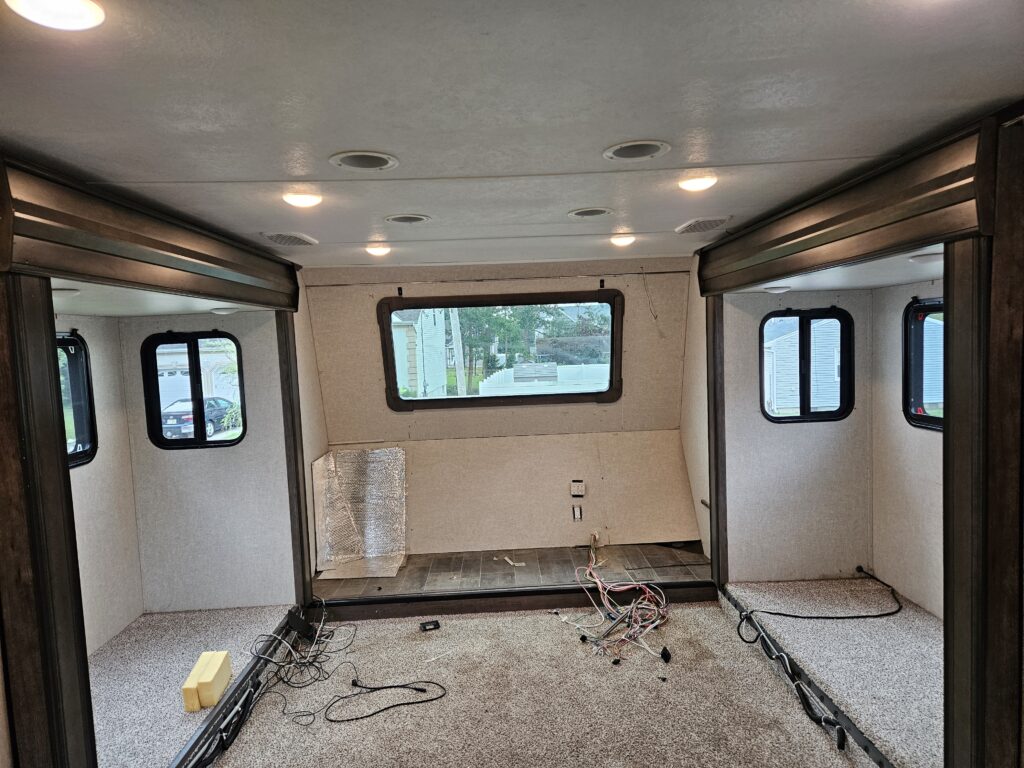
Today we started a complete gutting and RV Renovation Overhaul of our Keystone Montana 381TH. Now I’m not going to lie to you, we aren’t experts in this field. We do however know what we want (for the most part) and aren’t afraid of a little hard work.
Ok, maybe this is going to be a lot of hard work.
We decided the most logical way to tackle all of this, is to do it the same way you would with renovating a room in your home. The first thing you need to do is empty it out!
RV Renovation Step 1
Take all of your “stuff” out before you start your RV Renovation Projects. It’s just going to be in your way later anyway.
Once all your stuff is out, and you are done saying “Oh, I forgot we even bought this” it’s time to really dig in and get your hands dirty.
Furniture Removal
Start with the easy stuff first. Take out your couches and love seats. That alone will open up a lot of room making neat little piles of the rest of your furniture. It’s up to you to decide if your going to use a sledge hammer or a screw driver to remove it all.
If you are going sledge hammer, go ahead and get some paybacks for all those times your RV left ya wishing you bought the other one you were thinking about buying. And, don’t forget to get video and send us the link so we can giggle too.
We went with the screw driver method, because we plan to reinstall a lot of it, after we spruce it up a bit. Check out our YouTube video below to see how to remove stuff without using a sledge hammer, and follow along with our project.
While you’re on our Channel, be sure to subscribe. If you have a Gmail account its as simple as just clicking the subscribe button. We are going to have a LOT of How To Videos coming out this year on just about any RV subject you can think of, so it will definitely be worth your while. We are also going to review specific RV Products, and hook you guys up with exclusive discount codes from some of our friends in the industry!
Remove RV Countertop
On most RV countertops, if you look up from underneath, you will see screws holding them down to the top of your cabinets.
Removal of the countertop is as simple as finding all of the screws and removing them. Be sure to put them all in a bag so you don’t lose any during your RV Renovation Projects.
Once all your screws are out you can simply lift your countertop off your cabinets and put it into your storage area. Removing your cabinets will be a similar process, however the screws you are looking for will be going into the walls or floor of your RV or both!
Once you have all of your furniture out and the RV is completely empty, now you’re ready for the REAL Fun. Next stop is to remove the ceiling and the walls.
Stay tuned for our next article and video in the series where we show you how!
There’s a bunch of shit in space, and we keep putting more shit up there. Space is more accessible than ever before, and the U.S., China, and Russia are all hurtling toward potential space war and mutually-assured satellite destruction. It won’t be happening out among the stars, though; it’s likely to be waged in low earth orbit. You might have thought Space Force was a joke when President Donald Trump enshrined it as a part of the country’s armed forces in 2019, but it’s becoming increasingly more relevant every year.
“Both Russia and the PRC are evolving their military doctrines to extend into space,” Deputy Secretary of Defense Kathleen Hicks said. “They’re both deploying capabilities that can target GPS and other vital space-based systems, and we’ve seen both countries conduct operations against us and our allies and partners to degrade our space advantages. Our competitors’ aggressive actions seek to turn space into a warfighting domain.”
The Growing Inevitability of War in Space
All three major space superpowers have demonstrated an ability to launch rockets with the express purpose of destroying satellites. Similarly, all three countries have secretly been operating “tailing” satellites, capable of repositioning to be nearer satellites from other countries, potentially with the purpose of one-for-one ramming destruction events. Russia has launched satellites with hidden satellites inside them, as well as satellites capable of deploying high-speed projectiles.
‘The Bachelor’s Joey Graziadei Shares Stories Of His First Love – A Well-Used Lexus
If enough satellites are destroyed in collision events or targeted attacks, the debris field could become wide enough that every nearby satellite is rended into tens of thousands of hunks of space junk, potentially hitting other satellites and carrying on the pattern until they’re all gone. Analogous to nuclear warfare, this kind of space warfare could destroy the fabric of life as we know it.
Ever since the Ruskies launched old Sputnik, we’ve been looking to the stars as a potential battleground for international warfare. With decades of experience and technological advancement, it makes sense that powerful and potentially unhinged leaders of the world are racing to find advantages in space wars. Here’s hoping it never happens.
Launched in 1992, the McLaren F1 would go on to revolutionize the supercar industry with many of its core characteristics still referenced in the production of today’s most exotic vehicles. It is the McLaren model everybody knows. It paved the way for an increasingly mainstream use of materials such as carbon fiber, kevlar and titanium in sports cars and was the first production car to use a monocoque chassis.
While its composition and performance metrics certainly felt space-grade for the times, the McLaren F1 remained more down to earth in its approach to being comfortable and refined, with positive road manners. Its generously appointed interior was configured to seat up to three – albeit with its signature centre-located driver’s seat – and even came with luggage compartments fitted under each rear fender.
Designed by the legendary Gordon Murray, who had one goal in mind, the McLaren F1 was built to be the fastest and best handling production car in the world. Namely, the ultimate road car – one that is enjoyable in everyday conditions, while still at the zenith of road car performance.
BMW was contracted to built a bespoke V-12 engine, delivering 627 hp and 479 foot-pounds of torque. Unlike BMW’s concurrent 8 Series–based 12-cylinder engines, this V-12 was purpose-built, drawing inspiration from the company’s successful inline-six racing engines. The McLaren F1 had a 0-60 mph time of 3.1 seconds and a top speed of 240+ mph.
Merida is an incredible city in Mexico to visit. Nestled on the Yucatan Peninsular, around 3-4 hours west of Cancun, Merida is gorgeous, with heaps of restaurants, historic buildings and stunning neighbourhoods to visit. Honestly, there are heaps of the best things to do in Merida that will fill any trip to the city.
However, with so much choice, comes some tough decisions! After all, you want to make the most out of your visit to Merida and not waste any time once you’ve arrived.
We absolutely loved our time in Merida and we’d go back in a heartbeat. In fact, I’d go as far as saying that it’s my favourite city in all of Mexico.
So, to help you get the most out of your trip, I’m sharing the top things to do in Merida when you visit.
1.) Cathedral of Mérida
Situated right within the heart of the historic centre, the Cathedral of Mérida is one spot you don’t want to miss whilst strolling the city. Not only is it totally gorgeous, but it also has a history that dates back to the 1500s. This, alone, makes the Cathedral of Mérida one of the oldest cathedrals on the continent.
Now, the cathedral is incredible to visit, and you can head inside for free to explore the cathedral. Now, like lots of sites in modern-day Mexico, cathedrals are often trampled over and attempted to suppress local Mayan culture by the Spanish.
Their building was often an attempt to ‘convert’ locals to Catholicism; regularly at the expense of local culture and religious beliefs. In fact, the cathedral was even built using the stones from the Maya Temple that once stood in its place.
That all being said, the site is one spot you can’t miss in Merida, especially as it’s stood for almost 500 years.
Oh, and don’t forget to head outside the cathedral every Saturday at 8 pm every week.
The roads around the plaza are closed and you’ll get to witness a reenactment of the Maya Ballgame that was once integral to Maya culture. It’s all for free, so expect crowds and arrive about 25 minutes early if you want to be at the front.
If you’re already at Merida Cathedral, you will easily stop by Plaza Grande (that’s right outside). Now, the plaza itself is one of the busiest areas of Merida city centre, which makes it a great place to explore on foot.
In fact, the wider historic centre of Merida is perfect to explore on foot. Not only are there heaps of restaurants, cafes and bars, but the city of Merida is also pretty safe.
It’s one of the safest cities in Mexico to visit. This means you don’t need a guide when strolling the city and you can easily pinpoint places on Google Maps to walk between.
For us, a good hotel can make a trip to a new city; and we stayed in some gems in Merida that we totally loved.
Casa Olivia is a small ‘casa’ of about 4 rooms. It’s totally quaint and the whole property is totally beautiful and the team are so welcoming. Not only that, they have the most gorgeous pool in the centre of the Casa. It’s like an oasis in the heart of Merida and we loved it.
Now, Casa Olivia is a little on the pricier side when it comes to hotels in Merida; but it was well worth it for the experience.
Another gem in the city is Decu Merida. It’s another smaller style hotel (with less than 10 rooms) which is totally beautiful. Just like Casa Olivia, it has its own courtyard and outdoor pool that really feels like a secret garden in the city.
Now, within Decu Merida, you’ll get to choose rooms in the historic ‘casa’ part of the hotel, or the newer part of the hotel. Both are gorgeous, and your choice really does come down to the kind of style you like.
Oh, and don’t forget, they have their own little speakeasy that’s hidden behind the bookshelves.
4.) Museo Casa Montejo
Just on the fringes of Plaza Grande, Museo Casa Montejo is a museum that still houses some of the furniture and pieces dating back from the 1500s.
It’s easily one of the best things to do in Merida to get a feel of the Spanish influence in the city. Plus, it’s free to wander around and the rooms are just gorgeous.
Visits take around 25 minutes and they even have art exhibits that change seasonally. Heads up, there’s not much information in English, so make sure to brush up on your Spanish if you want to learn more about each of the exhibits whilst you’re there.
Merida is such a foodie city. In fact, I’d go as far as saying it’s one of my favourite cities in all of Mexico for its restaurants. It’s got that perfect mix of regional cuisine, but also really cool places that are all within walking distance around the city centre.
Now, for live music and hearty Mexican food, head over to La Nagrita Cantina. It’s a lively spot that’s well-known in Merida. We absolutely loved it here and the cocktails are really good.
Just be sure to arrive early in the evening if you want to be sat near the stage for live music. La Nagrita Cantina fills up really quick.
Alternatively, head on over to Holoch which has inside and outside dining options that are so good. We loved this spot for dinner and their frijol con puerco (Yucatan Style Black Beans with Pork) is so tasty.
Though, you should reserve a table if you’re going for dinner. We struggled to get a seat on our first visit.
If you want a cool vibe for dinner and drinks, then head over to Vana. This was one of our favourite places in Merida and was filled with locals and visitors alike.
Staying longer in Merida? Then, don’t forget to visit Dzalbay (for its live music), Café Riqueza (for its coffee) and Bird for drinks (that’s near Decu Merida).
6.) Chichen Itza
Around a two-hour drive from Merida, Chichen Itza is a day trip you have to take when visiting Merida. You see, it’s one of the world’s most important Maya sites.
Once here, you’ll get to walk around the Temple of Kukulcán (El Castillo) which is iconic. Like lots of Maya sites, you won’t be able to climb the pyramids – which I love. After all, we want to preserve them for as long as possible.
Oh, and don’t forget that you’ll get to walk through the ball courts that were played thousands of years ago.
Now, to make things easier, book this guided tour of Chichen Itza. Not only will you get a qualified guide to take you around Chichen Itza, but you’ll also get picked up from the centre of Merida. This makes it all so easy.
Just be sure to book your tickets before arriving in Merida. Spaces can sell out fast at peak times.
Another one of Mexico’s UNESCO World Heritage Sites, Uxmal is around 60 miles from the centre of Merida.
Long ago, Uxmal was a vibrant trading city for the Maya people and houses so many buildings that you can still see to this day. Just like Chichen Itza, you can book this day trip from Merida which will take you all around Uxmal.
Once here, be sure to stroll around the Pyramid of the Magician, stroll through the Governor’s Palace and visit the Quadrangle. It’s so impressive to see and one of the best things to do in Merida if you want to explore the region’s Mayan history.
Now, a visit to Uxmal (once you’ve arrived) will take around 2-4 hours, so plan ahead, especially on very hot days.
You see, there is very little in terms of shade and it can get very hot. Take cold water around on your walk and make sure to slap on that sunscreen.
Now, for a totally unique cenote in Mexico, head to Hacienda Mucuyché. It’s not too far from Uxmal (about 40 minutes away) and well worth combining with a trip there.
Now, what makes this cenote so special is that it’s also at the site of a historic hacienda that you can tour before hopping into the water. Though, just a heads up, you will need to book this Hacienda Mucuyché guided tour before arriving.
This does need to be arranged before turning up as some tours are all in Spanish or all in English.
After touring the grounds of Hacienda Mucuyché, you’ll get to jump into the cenotes itself. The team supply mandatory life jackets and lifeguards that follow your progress whilst there. We loved that, as we’ve been to some cenotes where there is very little in terms of safety precautions.
On the outskirts of Merida is the Mayan World Museum, a hub that shines a light on Maya culture and history that is well worth a visit.
In fact, I’d go as far as saying that it’s one of the best things to do in Merida to learn more about Maya history and the effects of Spanish colonialism.
Now, you do pay a small fee to enter (around $10 USD) and you’ll likely spend around 90 minutes looking around and learning the history of the Maya people.
Around a 5-minute walk from Plaza Grande, Palacio de la Música is well worth visiting if you want to learn more about Mexican music and the history of music from the wider Yucatan Peninsular.
Now, the museum itself is really good but I would say that it can feel a little less exciting if you’re not really interested in musical history. If that’s you, maybe give this spot a miss when visiting Merida.
Probably one of Merida’s most famous streets, Paseo de Montejo is as grand as it is long. In fact, it’s got some of the grandest buildings in all of Merida and is well worth taking a stroll down the avenue whilst visiting Merida.
Once here, start off at the Monument to the Fatherland and head south down Paseo de Montejo. As you stroll, you’ll get to stop by Casas Gemelas, the museums like Quinta Montes Molina and Palacio Cantón.
In some cases, you can head inside the houses which are now museums. Plus, others are still accessible with guided tours. Just make sure to give yourselves around 3 hours to stroll the avenue and stop by some of the impressive mansions.
Afterwards, stroll on over to Parroquia Santa Ana, which is a stunning Catholic Church that’s about a 10-minute walk from Paseo de Montejo itself. Along the way, you’ll be able to stop off at El Barrio, an unfussy lunch spot, that serves up some tasty Chilaquiles and horchata.
Fancy a trip to the coastline? Then book this tour to Celestun to explore the beautiful shores of the Yucatan Peninsular.
Once here, you’ll get to explore the wider Ria Celestún Biosphere Reserve and even spot some of the resident pink flamingos.
Not only that, you’ll get to board a boat and tour the reserve to get up close and personal with the flamingos. It’s one of the best things to do in Merida for a day trip, especially as it’s one of the most important areas for flamingoes north of the equator.
As I am walking into Ressence’s booth at some watchmaking trade show, I hear a loud, amused, and frankly unsettling declaration. Benoît Mintiens, the brand’s mastermind, is in the middle of a presentation, all smiles, and let out a roaring “But of course we don’t have a loupe (emphasis on don’t). We’re not watchmakers here!” How odd to hear someone from the watch industry bragging to be an outlier. But then again, this is really the essence of that exciting brand called Ressence. They are not Swiss, but their watches are entirely Swiss-made (except for straps and crystals). They are not part of the watchmaking establishment, although they are a recognized member of the envied independent watchmakers club. Not one member of its staff knows how to craft, assemble, tune or otherwise deal with a movement. They were not born from a watchmaking decision, tradition or inspiration. Nor are they from a marketing concept, that would act upon targeting, strategising and managing some desired brand equity. They have nothing to do with the resurrection of some long-dead, half-forgotten name from the 18th or 19th century, justifying some neo-retro design venture. Despite not checking any one of the usual boxes in the current watchmaking landscape, they still manage to be one of the rare names associated with a genuine vision of what a watch is, what it does, how it reads and how one interacts with it. In other words, we are dealing with a modern watch brand. And to understand how so, one must do a deep dive into the mind of founder, creative director, CEO and sole shareholder Benoît Mintiens.
Dial close-up of the Resistance x Alain Silberstein Type 1 Rev Grail Watch
Belgium’s Best
Benoit Mintiens is neither Swiss, nor French, although he is a native French speaker. To the trained ear, it is obvious he is Belgian. Not Hercule Poirot-Belgian like in one of the many series depicting the OCD-ridden detective. The real kind, with a rough accent. The redheaded fellow is from Antwerp. As his brand’s logo, he chose his city’s emblem – a hand that has a lot to do with the tactile dimension of his watches’ design. For he is a trained and experienced designer. Isn’t that an unusual trade for a watch brand creator and manager? Before being that, Mintiens penned street furniture, aircraft cabins, train coaches and also oncology radiotherapy equipment. He is an eclectic, pragmatic and opinionated creator. The one thing he had never thought of, at least not until that day when he picked up his pencil and started filling blank pages with ideas, was to make a watch. In fact, no one in his personal circle and family had ever thought of that either. So how did that story begin?
The caseback of the Type 1 model showcases its Swiss credentials and unusual winding and setting systems
Antwerp is one of the world’s three capitals of the diamond trade. One day, a gem-cutter friend of his asked him to start thinking about designing a watch for him. He roamed the alleys of the now-defunct BaselWorld trade show in search of suppliers. He grew increasingly dissatisfied with what he saw and heard. Back home, he spent a Sunday thinking and sketching. This is the moment when the core idea behind Ressence was born.
Type 1
“I gave myself a simple brief. It’s a format I’m familiar with so I used it,” says Mintiens. “The watch had to be affordable, meaning I could afford it. It had to be special, meaning it would be noticeable. And not an oddity, because it had to stay close to what one imagines a watch looks like.” That is what the man calls simple: a set of constraints that would seem to anyone, at best, vague, at worst, irrelevant. Especially since said brief also contained two personal elements that appear to be in total contradiction with each other. Elements that come from his personal and family history.
“My mother’s Dutch. She represents my Germanic, orderly side. My father is French-speaking Belgian. He is more Latin, more emphatic. As for me, I’m both of those things and so are my watches: beautiful and warm, technical and cold.” The truth is that structure and affability are intertwined in that man in a way that makes him extremely easy to like and to listen to. The last point in his brief is paramount: function must reign over his watches. Readability will be of the essence.
Type 3 EE
The Lightbulb
“I was in the middle of mowing my garden, sitting on my lawn tractor. It’s an old thing I had imported from Chicago. Its monotonous purring always sends my into my thoughts. And then I told myself ‘Benoît, you have to do it. You have to create your own brand’.” Said brand’s first act was the 2010 Type 0. A timepiece without hands, without crown, wound and set from its caseback. A rounded timepiece, that looks like it was cut from a sphere. “A Ressence watch is organic. Its face isn’t flat. Flat is not a natural thing. I’ve pushed the notion of face so far that the information goes beyond what we think to be the object’s physical limit.” Most important of all, his first watch does not tell time like any other. It is neither digital nor classically analogue. “It’s a mechanical screen : a dynamic, ergonomic surface that offers a relevant function.”
Type 1 Slim DX2
Visually speaking, the watch face is not a dial but a series of circles, rotating within one another. The hour hand is the largest disc. It contains a smaller one for the minutes, another for the power reserve and a last one for the day. Thanks to a clever mechanical device, implementing sophisticated spinning and counter-spinning, the large disc rotates and so do all the others with it. At the same time, these sub-dials spin counterclockwise in order to remain upright, with their reading scale still making complete sense. The basic information we use while looking at a dial, the relative position of two long-shaped indicators, is preserved. In a way, it still has hands. “It’s the only thing I decided not to reinvent,” says Mintiens. “Hands are too efficient a mental picture to do away with. The brain is very good at interpreting them.” Case in point, learning to read a Ressence takes a handful of seconds, and then becomes completely natural.
Type 3 EE
Rebirth Of The Essence
The year is 2010 and at the same time as Ressence’s first release, a few days apart actually, Harry Winston had presented their Opus X (where X stands for 10). It was a mad timepiece, typical of the brand at the time (or at least of the Opus series). This extreme project had been developed by Jean-Francois Mojon, the founder of movement maker Chronode, along the same display principle as Benoît Mintiens. That was just another case of great minds thinking alike…and at the exact same time, an occurrence more frequent than one would think in watchmaking. But Opus X was 10 times as expensive as a Type 0. The latter was much less dramatic, smaller and easier to wear, to read and to manufacture. It is one thing to come up with a great idea but there is a case to be made for those who shroud it in simplicity.
Type 8
That simplicity is one of several definitions of intelligence. So is being able to think outside the box. One quick look at a Ressence Type 3 may be evidence of yet another. The piece has no case to speak of, or to intrude on your field of vision (except the lugs) if you want a more precise description. It is all display, surface and rims (just look at it). It is shaped like a pebble, rendering the notions of diameter and opening irrelevant. This iteration is the result of a constant development effort, aiming at perfecting the system that operates the rotation-within-rotation display. It is called ROCS, which stands for Ressence Orbital Convex System, and it is constantly being modified, enhanced and perfected. Its simplest version, on the Type 8, requires machining tolerances so small, so demanding, that it took Ressence 10 years to get it done.
Simplicity then, paradoxically, defines the heart of Ressence. That such simplicity is so challenging speaks to the entire watchmaking endeavour. It seems a simple matter to calculate the passing of time, yet it is anything but. Ressence watches remind us of this truth.
This article first appeared on WOW’s Festive 2024 issue.
For more on the latest in watch reads, click here.
Infiniti will replace its QX80 flagship SUV for the 2025 model year. Nissan’s luxury arm will reveal the new car in full on March 20 but is slowly passing out details to whet shoppers’ appetites in the run-up to the big reveal.
This week, we get a peek under the hood. In a video posted to YouTube, Infiniti opens the engine bay. As with most modern luxury cars, that doesn’t give you a good look at the engine. A black plastic engine cover hides the powerplant. But the engine cover gives away the game. It reads “twin-turbo V6.”
The current QX80 comes exclusively with a V8.
But the drop in engine size doesn’t foretell a drop in power. Infiniti says, “The all-new QX80’s heart is a refined and efficient VR35DDT 3.5-liter twin-turbocharged engine, rated for 450 horsepower and 515 pound-feet of torque – increases of 50 horsepower and 102 pound-feet versus the current generation.” Power goes through a 9-speed automatic transmission.
Infiniti hasn’t yet said whether that power goes to two or four wheels. Today’s QX80 is available in rear- or all-wheel-drive (RWD or AWD). The company says the “newly available Electronic Air Suspension and Dynamic Digital Suspension technologies work in tandem to adapt the all-new QX80 to the exact driving situation.”
The technical storage or access is strictly necessary for the legitimate purpose of enabling the use of a specific service explicitly requested by the subscriber or user, or for the sole purpose of carrying out the transmission of a communication over an electronic communications network.
Preferences
The technical storage or access is necessary for the legitimate purpose of storing preferences that are not requested by the subscriber or user.
Statistics
The technical storage or access that is used exclusively for statistical purposes.The technical storage or access that is used exclusively for anonymous statistical purposes. Without a subpoena, voluntary compliance on the part of your Internet Service Provider, or additional records from a third party, information stored or retrieved for this purpose alone cannot usually be used to identify you.
Marketing
The technical storage or access is required to create user profiles to send advertising, or to track the user on a website or across several websites for similar marketing purposes.