These days, just about everyone is a content creator. But can generative AI help make people create high-quality films and other content affordably? Find out from Pinar Seyhan Demirdag, cofounder and CEO of Cuebric, during his conversation with NVIDIA AI Podcast host Noah Kravitz.
Cuebric is on a mission to offer new solutions in filmmaking and content creation through immersive, two-and-a-half-dimensional cinematic environments. Its AI-powered application aims to help creators quickly bring their ideas to life, making high-quality production more accessible.
Demirdag discusses how Cuebric uses generative AI to enable the creation of engaging environments affordably. Listen in to find out about the current landscape of content creation, the role of AI in simplifying the creative process, and Cuebric’s participation in NVIDIA’s GTC technology conference.
Explore generative AI sessions and experiences at NVIDIA GTC, the global conference on AI and accelerated computing, running March 18-21 in San Jose, Calif., and online.
Time Stamps:
1:15: Getting to know Pinar Seyhan Demirdag and Cuebric 2:30: The beginnings and goals of Cuebric 4:45: How Cuebric’s AI application works for filmmakers 9:00: Advantages of AI in content creation 13:20: Making high-quality production budget-friendly 17:35: The future of AI in creative endeavors 22:00: Cuebric at NVIDIA GTC
AI could help students work smarter, not harder. Anant Agarwal, founder of edX and chief platform officer at 2U, shares his vision for the future of online education and the impact of AI in revolutionizing the learning experience.
Joe Glover, provost and senior vice president of academic affairs at the University of Florida, discusses the university’s efforts to implement AI across all aspects of higher education, including a public-private partnership with NVIDIA that has helped transform UF into one of the leading AI universities in the country.
Cambridge-1, the U.K.’s most powerful supercomputer, ranks among the world’s top 3 most energy-efficient supercomputers and was built to help healthcare researchers make new discoveries. Marc Hamilton, vice president of solutions architecture and engineering at NVIDIA, speaks on how he remotely oversaw its construction.
Lamborghini is also going electric—step by step and deliberately slowly. The eye-catching debutant is named Lanzador and will only hit the market in 2028. We have already taken the first prototype for a spin.
The feedback from the fan community after the world premiere of the Lamborghini Lanzador was clear: thunderous applause. Much like the Urus study, Lamborghini’s first electric model was celebrated mainly for its design. But even if some interested parties around the millionaire enclave of Pebble Beach would have been all too eager to pull out cash and prepare electronic transfer forms, it will take some time—almost five years, to be precise—before the car becomes a motoring reality as Lamborghini’s first fully electric model. There’s plenty of time to dream and develop, and now is precisely the right time to clock the first miles on its formidable 23-inch wheels. Where better to do that than on the iconic 17-Mile-Drive, the charismatic automotive promenade that uniquely unites California and the Pacific?
Lamborghini Lanzador Drive
Getting into the blue Lanzador is a slow and cautious affair, as one must take care not to damage the one-off, especially since it’s raining this morning on the coast of Monterey. While Chief Development Officer Rouven Mohr briefly points out that the prototype lacks a windscreen wiper, the technicians around him are clearly more flustered due to the unforeseen rain.
However, with a push of the starter button on the futuristic centre console that separates the driver and copilot at chest height, the instruments come to life. If you didn’t know better, you’d have no doubts that you were in a space glider from a distant galaxy. Unlike its big brother Urus, the Lamborghini Lanzador will have only two doors despite its four individual seats. There’s ample space in the back, yet clambering into the second row will likely be a rarity for most customers. The interior of the crossover will be more sustainable than any Lamborghini before it.
Details such as the dashboard, seats, and door panels are made of fine Merino wool, while the coloured thread comes from recycled nylon. Most of the invisible plastics, like the foam of the sports seats, are made from 3D-printed recycled fibres. The fibres used for the centre console and door panels are also made from regenerated carbon—a new, two-layer composite material.
Despite its focus on sustainability, Lamborghini still opts for leather. However, this leather is sustainably tanned, using water from olive oil production which needs to be treated in wastewater plants due to its high acidity and antimicrobial effect. This residual water can also be reused by chemical manufacturers for tanning agents. Additional resources are saved by a newly developed 3D printing process for plastics, from which, among other things, the seat foams are made. The printing material for the Fused Deposition Modelling comes from recycled waste like used plastic bottles and can be recycled again after its usage period. In the two display caves in front of the driver and passenger, numbers and animations come alive as the colossus sets itself almost silently into motion.
The creaking and cracking sounds are typical for such an early prototype, which is more designed to garner applause on show stages rather than to clock some spirited miles. The Lamborghini Lanzador, with its bluish shimmering look, can do both. With the gas pedal pushed further down, we head towards Spanish Bay, while to the left, the churning Pacific seems to be displaying its first enthusiasm for this North Italian wonder. “Be careful when steering,” Rouven Mohr calmly explains, “it’s a drive-by-wire system that recalculates depending on the steering input. So steer slowly.” Said and done.
The whirring of the electric drive gets louder, the speedometer shows 40 km/h. Later in real operation, the planned output of more than 1,000 kW/1,360 horsepower should allow for top speeds approaching 300 km/h. That’s quite a pace for an electric model that takes its name from a bull that delighted Madrid in 1993. After next year, when all three current series will be electrified as plug-in hybrids, the Lanzador will become the first all-electric model from 2028 with a bull emblem. Shortly thereafter, the next generation of the also electric Urus is likely to follow. “With the fourth model, we are opening a new vehicle segment: that of the Ultra GT,” explains Lamborghini CEO Stephan Winkelmann, “this will offer customers an unparalleled new Lamborghini driving experience thanks to groundbreaking new technologies.”
On the 17-Mile-Drive, the test subject can only cruise leisurely as Rouven Mohr cycles through various programs and functions using the futuristic-looking controller. Later in the production version, the different driving modes can be varied, thereby also changing the way more than a megawatt is actively transmitted to the road via the torque-vectoring system. The power comes from a roughly 100 kWh battery pack situated between the axles—the first performance data are currently being specified in a requirement specification. A variable air suspension system with rear-wheel steering is set. “For us, electrification does not mean restriction, but an intelligent opportunity to develop more power, performance, and driveability,” explains Rouven Mohr.
Much dedication is put by the Lamborghini engineers into adaptable aerodynamics, as the elaborate airflow is supposed to hide subtly behind body elements, unlike the sports cars. Similar to the Huracan and Aventador, the electric SUV also gets aerodynamic modules that, depending on the driving program, speed, and pace, provide either maximum downforce or minimal air resistance to generate more range. The prototype can already do this at the push of a button. The flexible aerodynamic system uses, among other things, the front air flap along with a movable splitter, which opens the brake cooling channels and cooling fins as needed to achieve optimum performance. Optically concealed slats provide downforce without generating additional air resistance. Because despite all the power, the Lanzador must remain grounded. The same goes for Lamborghini fans. Don’t get carried away just yet, as it will still be a long five years until the Lanzador is available at dealers—a long time indeed.
Find our content helpful? You can support the BFT team by making your gear, apparel, and travel purchases through the affiliate links in this blog post. We get a small commission with no added cost to you. You can also say thanks by leaving a tip in our virtual tip jar. THANK YOU!
The American Southwest is one of the top destinations for hikers and backpackers with vast landscapes, unique geological features, and gorgeous sunrises and sunsets. A desert day hike or backpacking trip can be a wonderful way to explore the trails in this region even when snow blankets most mountainous backpacking destinations.
From my years of hiking and backpacking in the deserts of Utah, Arizona, and California, I’ve learned that preparation is key. Hiking in the desert is a completely different experience than hiking in the mountains. Knowing how to deal with heat, sun exposure, desert wildlife, and water supply are all key factors in planning a safe (and fun) desert hike.
Before you take off to the desert, you need to have to plan, and I’ve got you covered with these desert hiking and backpacking tips. Whether you’re a first-time or seasoned hiker, these tips will help you plan what gear to bring and how to stay cool and safe on the trail.
Download my FREE Outdoor Trip Planning Toolkit
Enter your email to get access to printable PDF packing checklists, itineraries, and more.
Basic Desert Hiking and Backpacking Tips
If you’ve never hiked in the desert before, these general tips can help you get started. It is crucial to think carefully about the time of year you plan to hike in the desert and how you will navigate the trail.
1. Hike in the spring or fall
The Southwest hosts millions of visitors each year, and while many people plan their trips during the summer months, it’s best to hike in the desert in the spring or fall.
In the winter, days are short, so you’ll have less sunlight to hike in and nights can be surprisingly cold. In the summer, daytime temps in the desert often exceed 100 degrees, which can be extremely dangerous for long hikes.
While spring and fall can be cool and wet across the U.S., it’s my favorite time to explore the desert since it’s one of the few times of year you’ll find pleasant hiking temperatures. Many popular national parks in the Southwest, like Utah’s Mighty 5, are less crowded during spring and fall, making for a more intimate and personal experience. Water is also more plentiful in the desert in the spring, and you may even catch some spring wildflowers and cactuses in bloom.
A spring prickly pear blooming in the Utah desert
2. Get an early start
Hiking in the desert can be HOT, and often in the desert, you are completely exposed to the sun with little to no shade. If you plan to hike in the desert when it’s hot outside, start hiking before sunrise.
Even though I hate setting my alarm that early, it’s always worth it to get a headstart on the day while enjoying the sunrise and the cooler morning temps. You also won’t feel as rushed on the trail if you give yourself ample time with an early start.
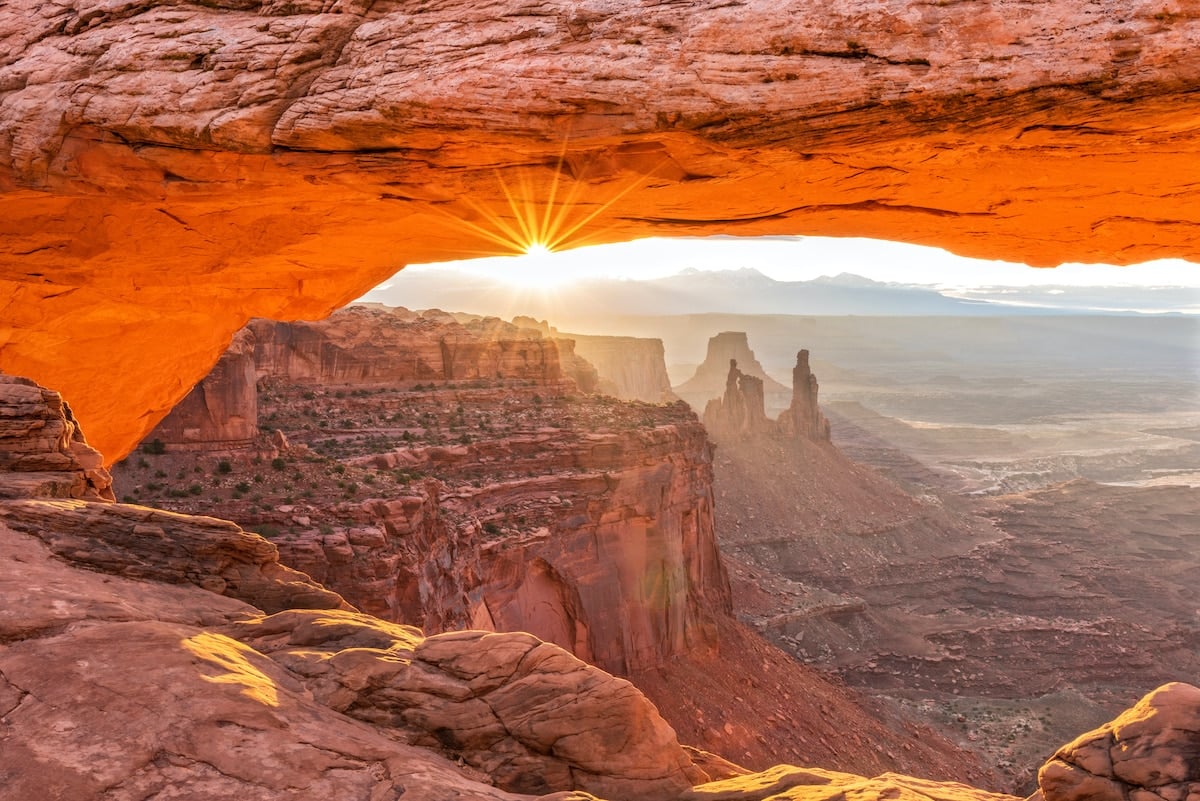
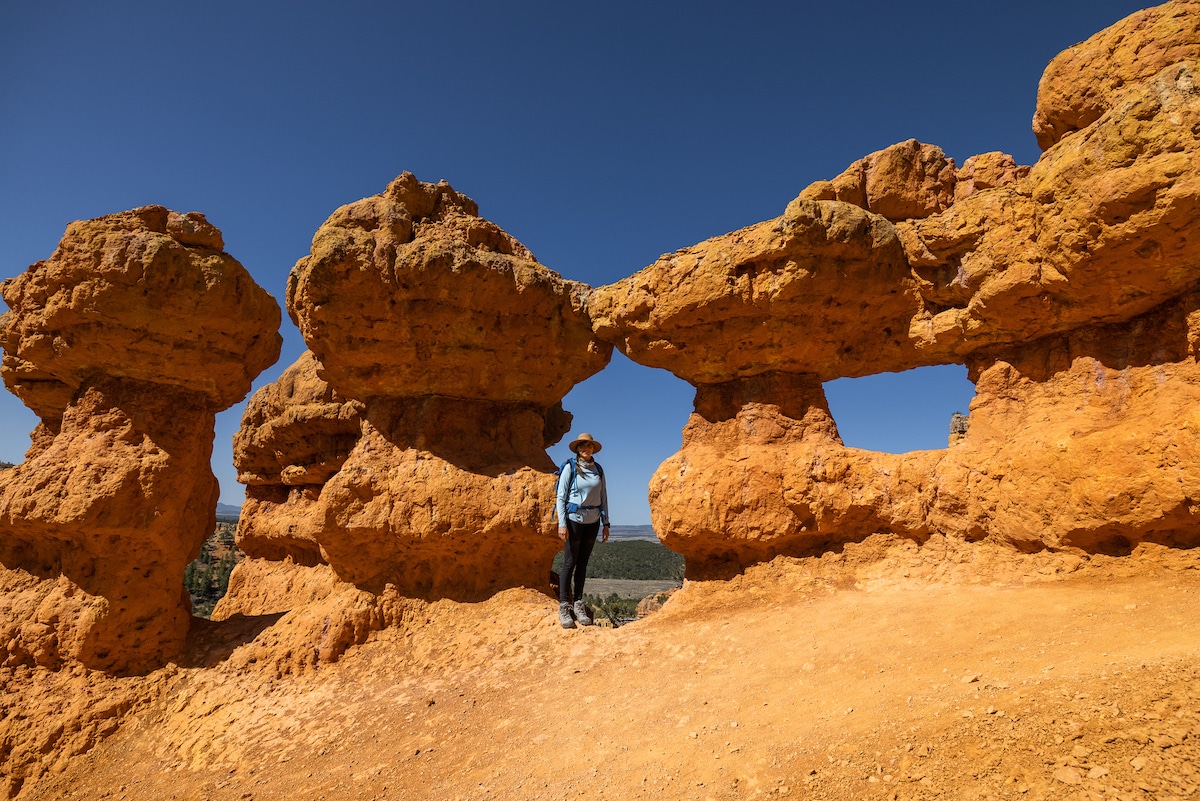
If you wake up early, you may even see an epic sunrise like this one at Mesa Arch in Canyonlands
3. Take breaks in the shade
The desert is usually hottest between 10am to 4pm. If you’re out on the trail during these hours, whatever you do, don’t take your lunch break in the direct sun. This will zap your energy and only leave you more tired.
Instead, wait to break until you find a shady spot – whether than be against a bush or on the ground behind a rock. You may have to get creative looking for shade since you might not be able to find a tall tree like you would in the mountains.
If you are backpacking, you might even consider taking an afternoon cat nap in the shade, while you let the heat of the day pass.
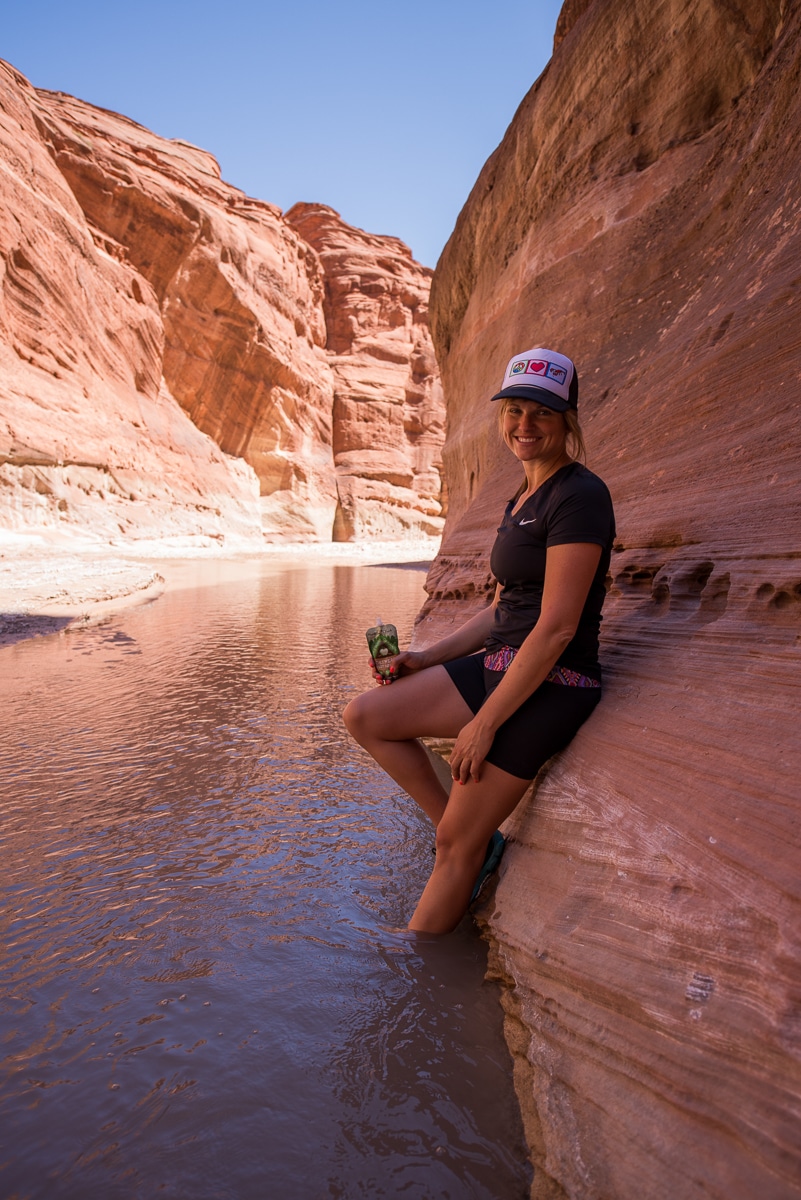
Taking a snack break in the shade against a rock in Paria Canyon
4. Keep an eye out for cairns
A rock cairn is a human-made rock formation of stones piled on top of each other. Their purpose is usually to help hikers navigate the trail, which can be helpful while hiking in the desert in sections where it might be unclear where to go.
Although you may have good intentions, you should NOT build cairns for fun. Only park rangers, trail maintenance volunteers, or trail creators should create new cairns; otherwise, they could send hikers in the wrong direction or misrepresent the trail.
Building a cairn also disrupts the natural ecosystem and alters nature for the next visitor while leaving a reminder you were there. Per Leave No Trace principles, you should leave no sign whatsoever that you were on a trail, which means not creating new cairns.
Follow Leave No Trace principles by not creating new rock cairns on the trail
5. Choose trails with shade and water
Research the trail you plan to hike to make sure there is plenty of shade and water. Shade provides relief from the sun, helping you regulate your body temperature on the trail and prevent overheating.
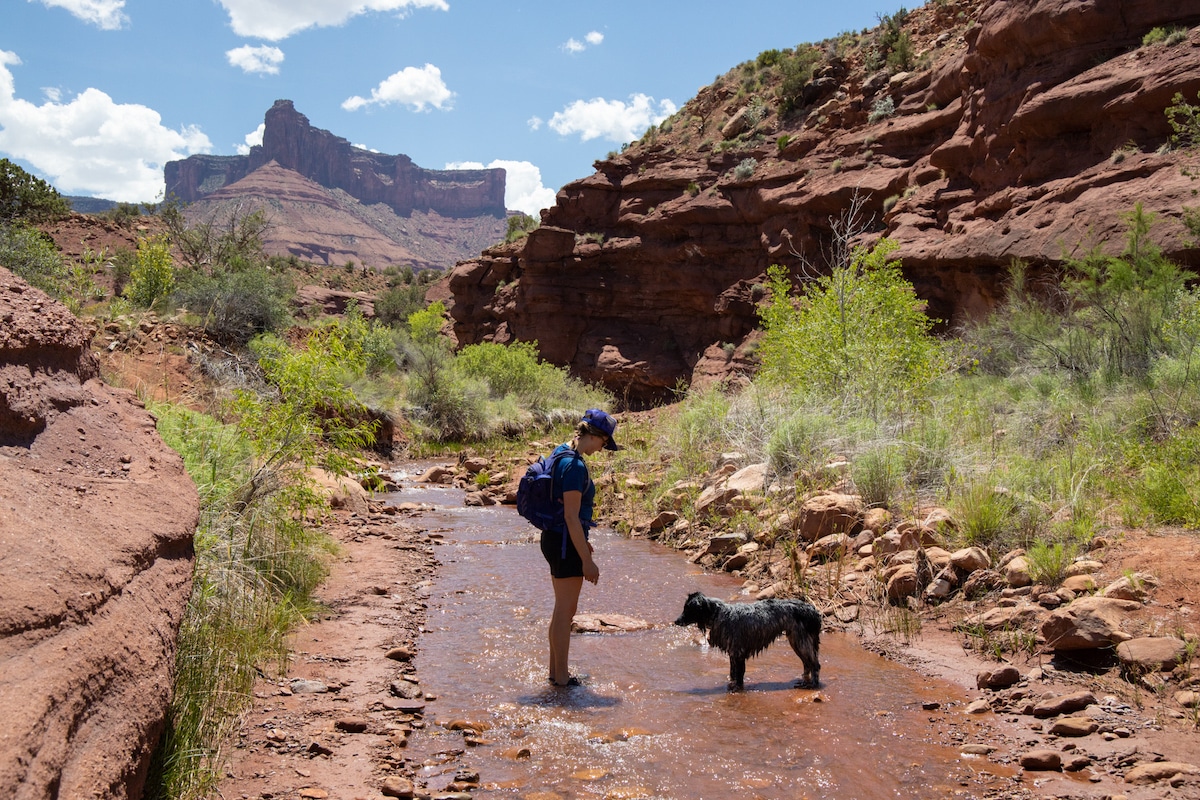
Not all trails in the desert have water sources, but those that do are a great choice. You can dunk your buff or hat in the water to cool off, and if you carry a water filter, you won’t have to pack as much water.
With that said, water sources in the desert can also dry up during certain parts of the year, so make sure you check current conditions before you go and plan accordingly.
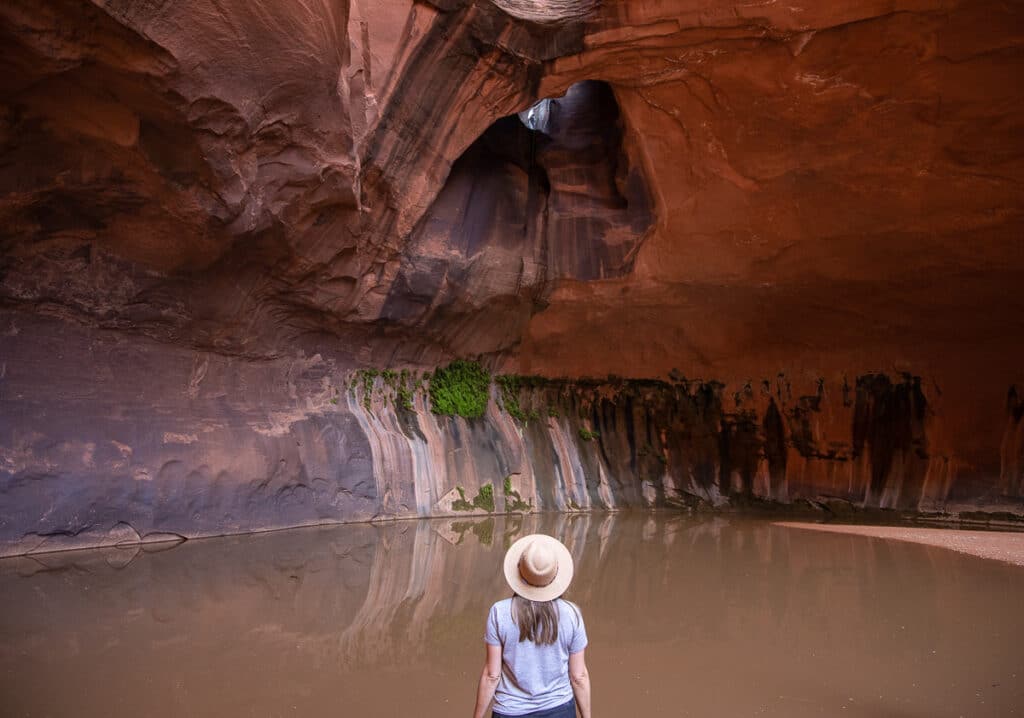
Hiking Mary Jane Falls in Moab, Utah where water and shade are plentiful
6. Don’t bust the crust
In certain areas in the Southwest, there is a bumpy layer of cryptobiotic soil made up of microorganisms. This fragile soil is crucial to desert environments because it helps prevent soil erosion, absorbs water, and improves nutrient availability for new growth.
Desert hikers often accidentally damage cryptobiotic soil because they are unaware of what it is or its importance in preventing desertification. With just one step, it can be damaged, and it can take thousands of years to reform in the desert.
The best way to protect cryptobiotic soil is to not go near it, stay on the trail, and make sure your dog doesn’t step on it. Without cryptobiotic soil, nothing new can grow, and the plants and animals that rely on it will not survive.
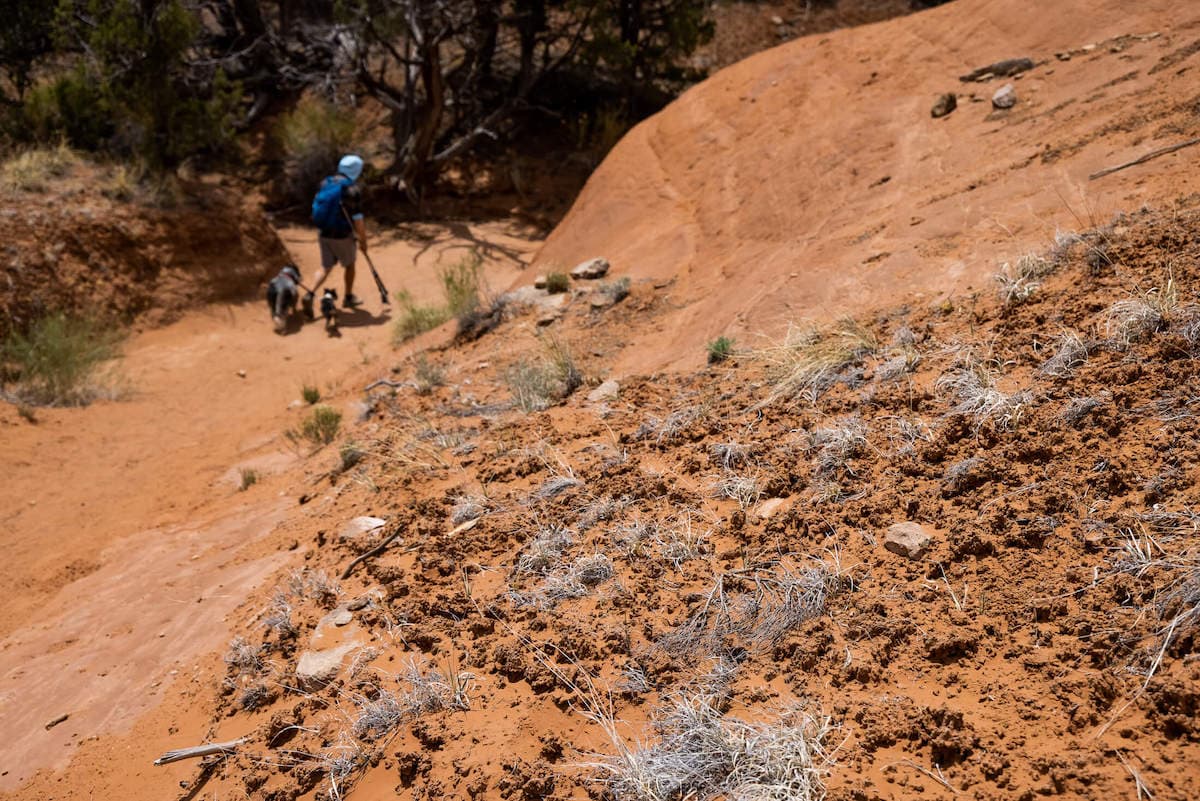
You may not notice cryptobiotic soil at a glance, but it’s vital to the desert ecosystem
What to Wear Hiking and Backpacking in the Desert
Conditions in the desert can be unforgiving, so bringing the right gear and wearing the right clothes while hiking and backpacking can make all the difference. Here is what I recommend wearing for a desert hike.
7. Cover your skin
You may think that a tank top and shorts would keep you cool in the desert. However, having direct sun contact on your skin can actually leave you hotter and sunburnt. So despite the heat, you should also try to cover as much skin as possible.
I always look for clothes made with sweat-wicking fabrics. Loose, long pants and lightweight, long-sleeve shirts, like the Patagonia Capilene Cool Daily Shirt, provide coverage without being unbearable.
Wearing long sleeves and leggings to shield my skin from the sun while hiking in Utah
8. Wear light colors and fabrics
Choose lightweight fabrics and light colors that reflect UV rays. While I usually wear darker colors because they hide dirt better, when hiking in the desert it’s best to avoid wearing colors like black or navy since dark colors absorb UV rays.
This doesn’t mean you always need to wear white while hiking in the desert, though. Just know that lighter colors will help keep you cooler.
9. Wear a wide-brimmed hat
Always wear a hat to protect your face and scalp from getting burnt – ideally a wide-brimmed hat. Some people also like hats with a neck flap that covers the back of your neck and ears while you’re on the trail.
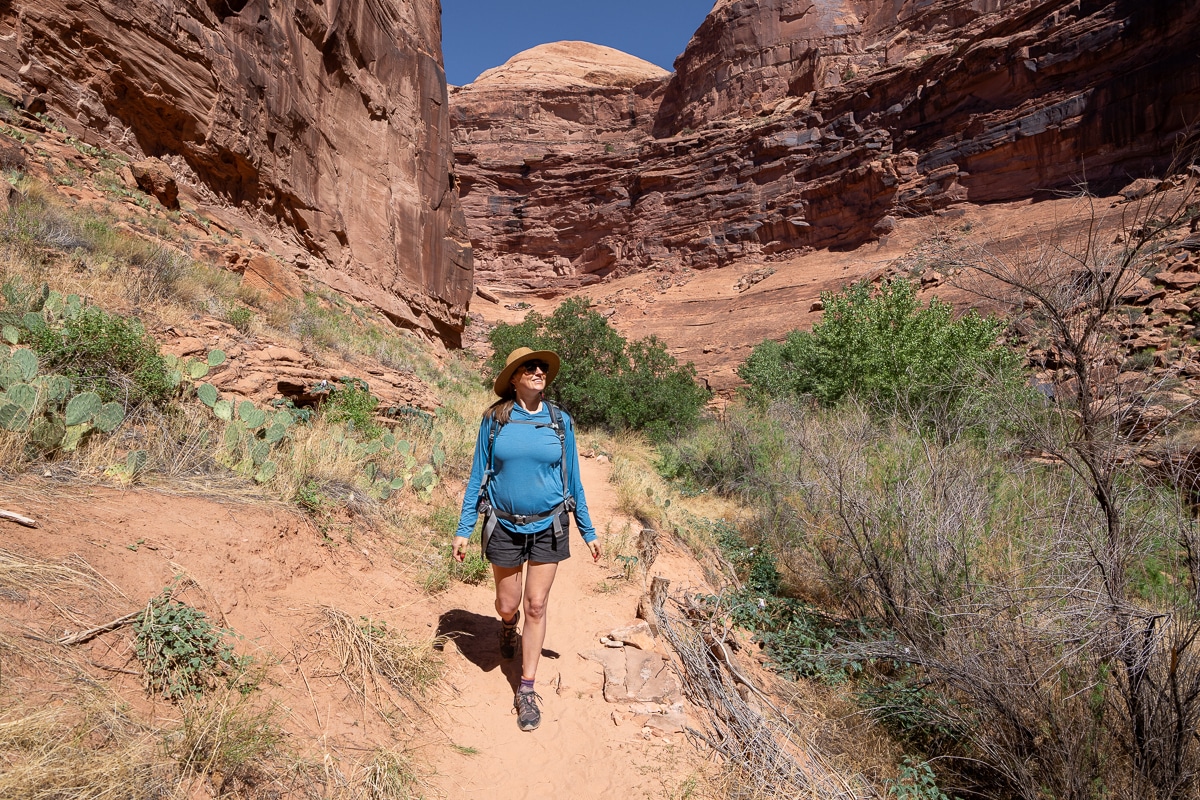
Wearing my wide-brimmed hat while hiking in Kodachrome Basin State Park in Utah
10. Apply sunscreen to exposed skin
Be sure to lather on sunscreen on any exposed areas of skin and reapply every 2 hours. I prefer to use something lightweight that’s easy to apply.
Don’t forget your lips, too! Bring chapstick with SPF to protect your lips from the sun and keep them from getting uncomfortably dry.
11. Wear sunglasses with UV protection
Harsh sunlight can be tough on the eyes. Don’t forget your UV-protecting sunglasses to take pressure off of your eyes and enjoy the views along the trail.
I love my Roka sunglasses because they are lightweight, durable, and have a little flex. They never hurt my nose or ears when I have a hat on. I also like Pit Vipers due to the side-eye protection.
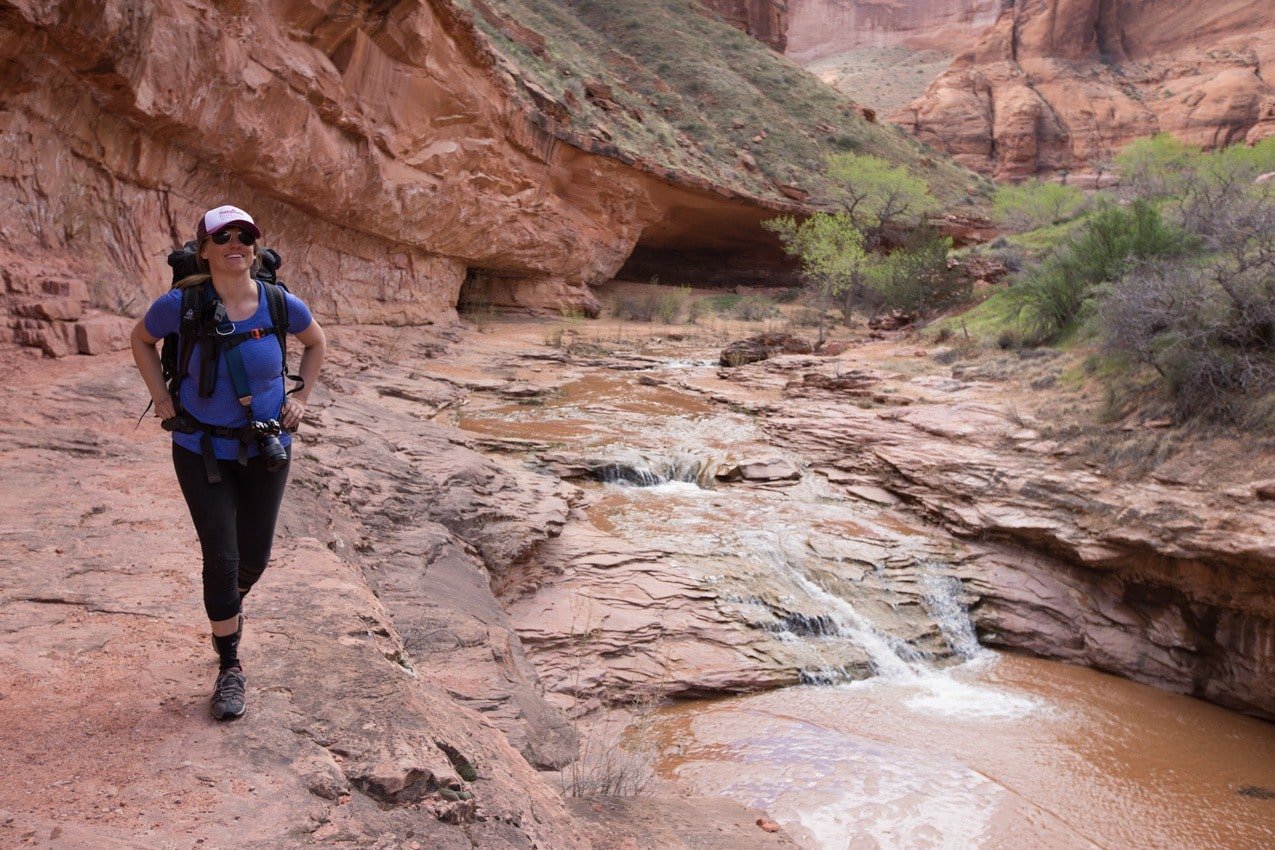
Wearing my shades to protect my eyes while backpacking in Coyote Gulch
No one wants sweaty feet on the trail while hiking in the desert. I recommend wearing desert hiking shoes or boots that are lightweight and breathable yet also durable enough to handle uneven terrain.
When deciding which shoes to wear for a desert hike, look for ones that are designed with good traction and moisture-wicking, quick-drying materials. Unless you’re hiking in winter when there’s a chance of bad weather, avoid waterproof boots for a desert hike since they aren’t as breathable and can cause blisters.
As good as it might feel to walk around barefoot, I don’t recommend doing this in the desert. Many of the spiky and sharp features on the ground would not feel good to step on!
Breathable desert hiking shoes can keep your feet comfortable and protected on the trail
13. Wear a Buff
I love wearing a Buff on hikes. There are so many uses for them!
You can wear it around your neck to protect it from getting burnt (or wet it to help your body cool down quickly) or use it as a headband. You can also use it to prefilter your water or breathe through if the air is dusty. A bandana even works as a makeshift sling in an emergency scenario.
I love wearing a Buff around my neck on hot hikes to protect my neck and keep cool
Gear for Hiking in the Desert
There are some essentials for hiking in the desert that you’ll want to make sure you have in your pack before you hit the trail. To avoid adding unnecessary extra weight to your pack, try to only stick to the items you truly need. Here are my recommendations for desert hiking gear.
14. Pack the 10 hiking essentials
When deciding what to pack, you’ll want to take into consideration how remote, difficult, and long your hike is. For a one-mile hike in a busy National Park, you can approach your gear list more casually.
However, for bigger hikes in wilderness areas where you’re unlikely to encounter lots of other hikers, it’s crucial to pack the 10 Day Hiking Essentials for the desert. Without proper safety gear, an emergency could quickly take a turn for the worse.
While I’ve touched on some of these essentials, the standing recommendation is to pack a first aid kit, knife/multi-tool, way to start a fire, shelter/emergency bivvy, food, extra water, and layers.
A daypack can hold all of the essentials you need for a desert hike
15. Carry a communication device
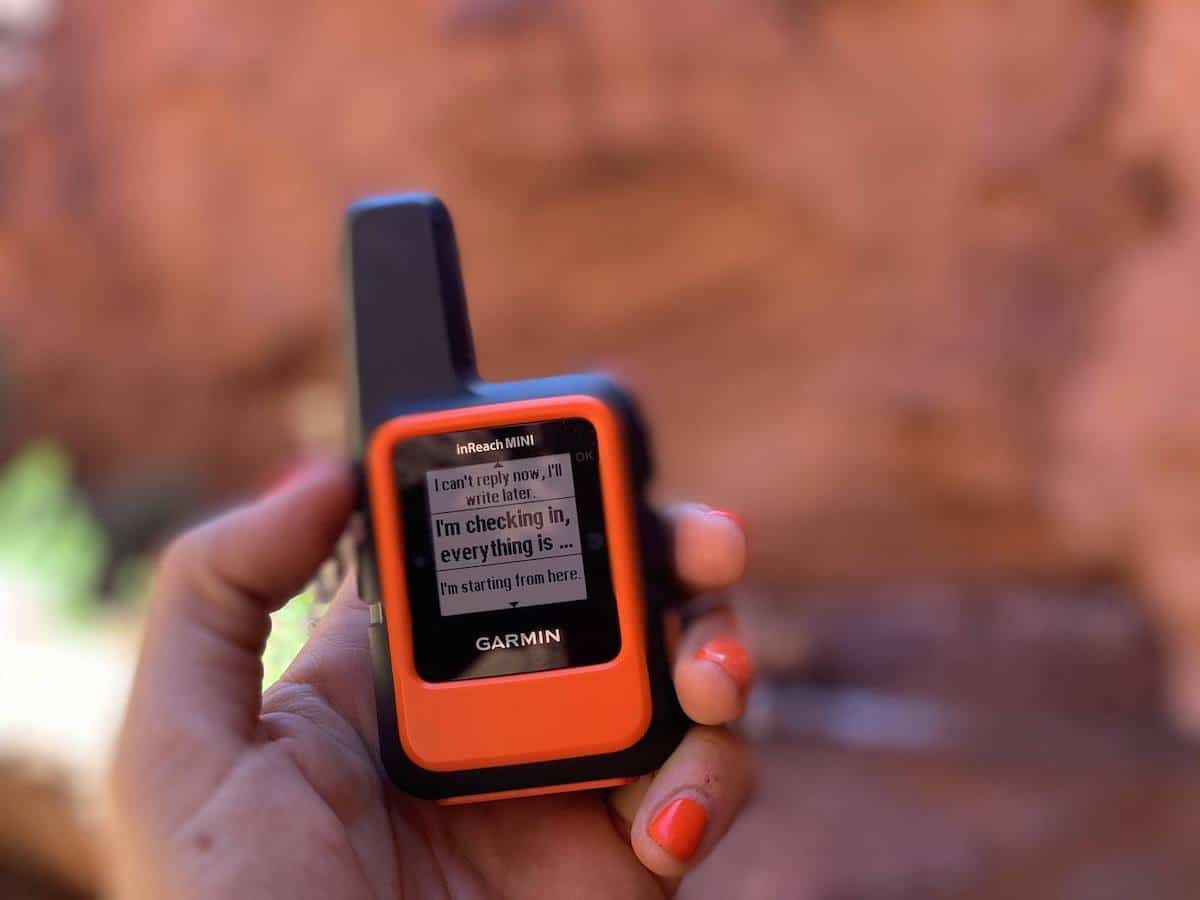
When hiking in the desert and other remote areas, I always bring a satellite communication device and GPS, like the Garmin inReach Mini.
Although these communication devices can be pricey, they are worth the investment. Especially when I’m with my partner, Ryan, who hikes with Type 1 Diabetes, it gives me peace of mind to know I can send an SOS message in case of an emergency even when I don’t have cell service.
These devices also allow you to send and receive custom text messages from your contacts and see your exact location on a map so you don’t get lost.
I always bring my Garmin inReach mini while hiking and backpacking
16. Have a reliable navigation tool (and a backup)
The desert can be a tricky place to navigate. Landmarks aren’t as obvious as they are in the mountains, and visual footpaths aren’t always as easy to see or follow.
Washes, dried riverbeds, and sandy areas can often be easily confused for trails (or sometimes that is the trail!), so pay attention and make sure you know where you’re going.
Always bring a reliable navigation device – whether that be your phone, a GPS, a compass, or a paper map. If you are using your phone, download the map for offline use on your favorite hiking app (this will also help you get back on the trail if you are lost).
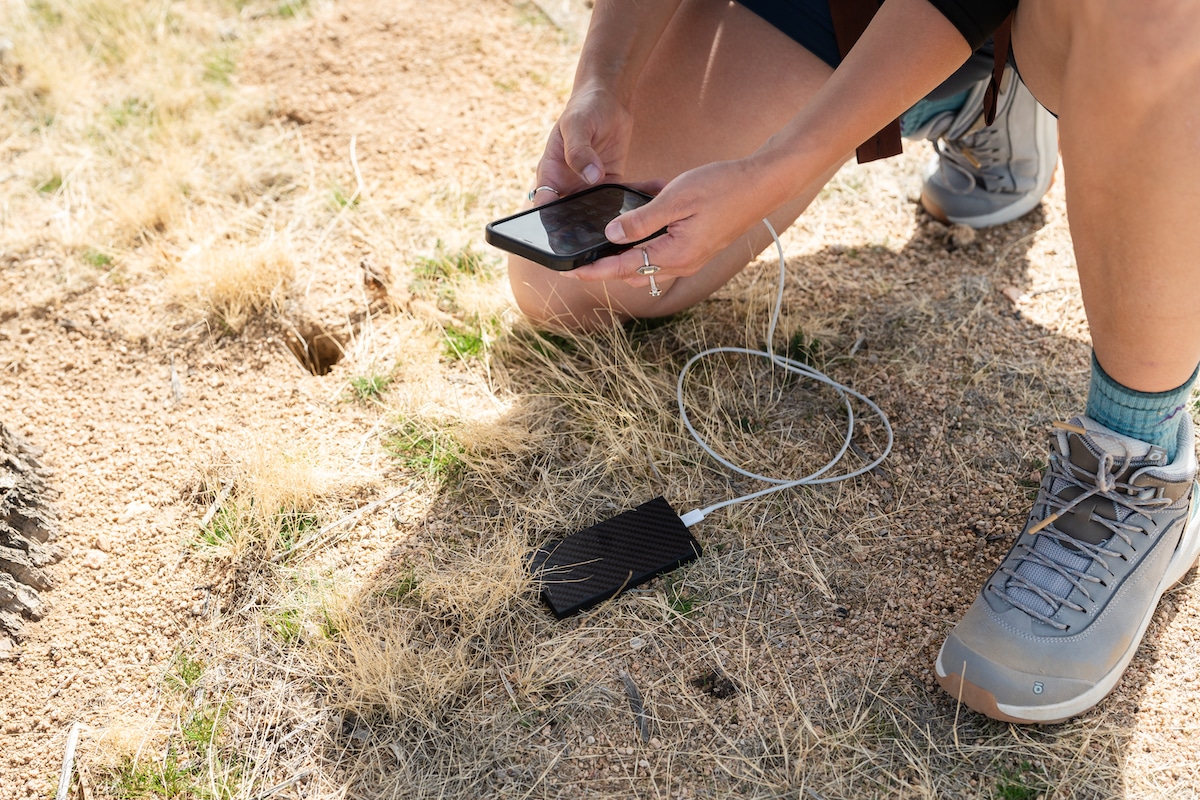
Make sure you have a way to keep your phone charged as well if you’re using it as your primary navigation device. Bring a battery pack and/or solar charger and keep your phone on airplane mode to save power.
If your phone dies on the trail, you can quickly charge it with a portable energy brick
17. Carry a hiking umbrella
An umbrella is an important piece of gear for hiking in the desert. You don’t want to be caught off guard in a downpour especially in the desert as there are often no trees or shelter that you can stand under to wait out the storm.
A hiking umbrella also helps shield you from the sun where there otherwise isn’t a lot of shade. I have the Silver Shadow Carbon Umbrella by Six Moon Designs, and it literally feels 20 degrees cooler under the umbrella than it does in direct sunlight.
It weighs only 6.8 ounces, and it’s slender enough to fit in your backpack’s side pocket when you aren’t using it. They also sell a hands-free umbrella kit that you can use to attach it to your backpack.
Safety Tips for Desert Hiking and Backpacking
When hiking in the desert, you must take extra safety precautions to prepare for the heat. Here are some tips to ensure you have a safe and enjoyable time on the trail.
18. Have a desert hiking safety plan
When formulating a safety plan for your desert hike, base it around the least experienced or abled person. The slowest hiker determines how much ground the group can cover.
You should be realistic about your goals. If you’re a beginner desert hiker, start with shorter, easier, well-marked trails. It’s also good to have an established turnaround time (even if this means not finishing the hike) so you don’t get caught in the dark or run out of water.
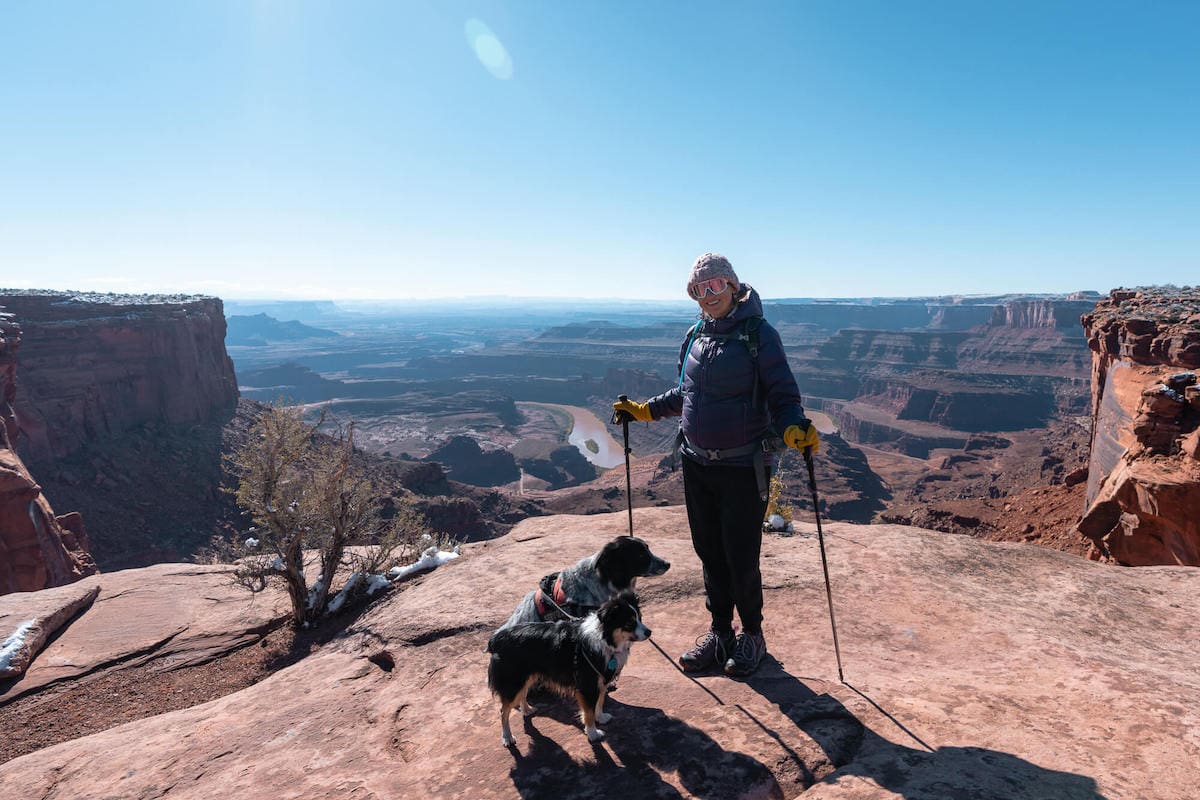
If you’re a beginner desert hiker, I recommend sticking to easy trails at first
19. Tell someone about your hiking plans
While this is something you should always do when you hike (especially if you hike solo), a vital piece of advice for desert hiking is to always inform someone of your hiking plan.
Tell this person your start and end times (including when you expect to be back in cell service), the trailhead and trail info, and who you’re hiking with. When you’re done hiking, let that person know you’re safely off the trail.
20. Be aware of wildlife
When you’re in the wilderness, it’s important to remember that you are just a guest of the animals that live there. In the Southwest, common animals include rattlesnakes, coyotes, javelinas, jackrabbits, bighorn sheep, and mountain lions.
It’s especially important to keep an ear out for the warning rattle of a rattlesnake and know how to safely avoid dangerous wildlife encounters. Be alert and if you are wearing headphones,keep one earbud out. If you do hear and see a rattlesnake on the trail, give it space and don’t make any sudden movements that might freak the snake out.
Rattlesnakes often blend in with the desert environment, so stay alert and listen for their rattle
21. Know the signs of heat exhaustion
Make sure you don’t push your limits in the desert and know the signs of heat exhaustion. Some common signs include heavy perspiration, fatigue, lightheadedness, nausea, muscle cramps, headache, goosebumps, high body temperature, fainting, and rapid heartbeat.
If you or someone you’re hiking with begins showing signs of heat exhaustion, act quickly so it doesn’t lead to heatstroke. Move to a cooler place, hydrate with water and electrolytes, loosen or remove clothing, and apply cool, wet rags to the skin.
22. Look out for cacti
Another desert hazard is cacti and other pointy plants. Staying on the trail and watching your surroundings will help you avoid brushing up on any plants. Carry tweezers in your first aid kit to be able to extract any needles should you get poked.
Cacti are beautiful to admire from a safe distance, but be careful not to get too close
Staying Fueled on Your Desert Hike
Staying hydrated and nourished on the trail is one of the most important desert hiking tips. Following these fuel suggestions can help you make sure your body gets the energy it needs.
23. Stay hydrated
It’s always recommended to carry extra water on you in the desert since there aren’t rivers and streams to refill like there are in the mountains. I personally like hiking with a hydration reservoir because it makes it easy to drink water on the move.
The general recommendation for hiking in the desert is to drink at least 4L per person/day, but on a very hot day when you’re sweating a lot, you might drink more.
24. Pack electrolytes
When you’re drinking that much water, it’s imperative that you also maintain your electrolytes. There is such a thing as overhydrating, and it can lead to the concentration of electrolytes in your body being too low. This actually happened to me once, and I got extremely lightheaded and dizzy and ended up with a medic having to pump electrolytes into me through an IV.
As you sweat, you also lose electrolytes. And since you are more prone to dehydration in the desert, getting enough electrolytes is key to keeping you hydrated and full of energy.
You can get electrolyte tablets or powders (such as Nuun tablets) that dissolve in water, or Salt Stick makes electrolyte capsules or chews that you can easily pop as you hike. If you go with the powder form, I like having a separate water bottle for electrolytes, so my hydration bladder stays clean.
25. Research water availability
This may be the most important desert hiking and backpacking tip. Unlike mountains, which commonly have plentiful water sources, you can easily go long stretches in the desert without a water source, and water sources are less reliable as they can seasonally dry up.
Be sure to call the Ranger Station to get the most up-to-date information on water sources for your hike. Carry a map with all water sources circled, and for longer hikes when you do come across water, chug some on the spot and then fill up before moving on.
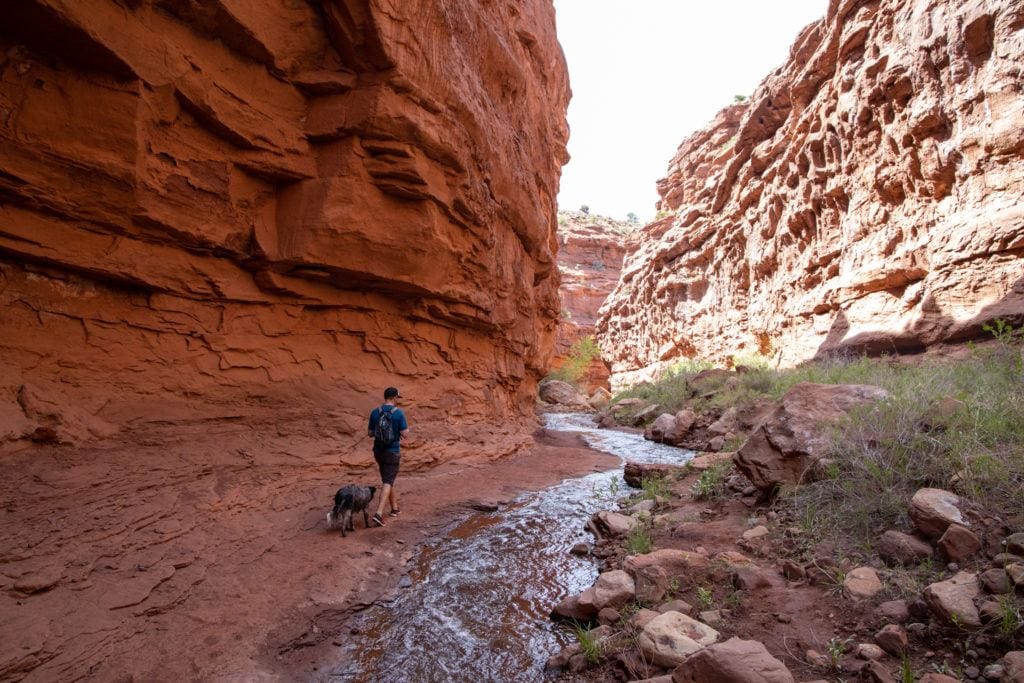
This hike in Escalante has plentiful water
26. Bring a reliable water filter (and a backup)
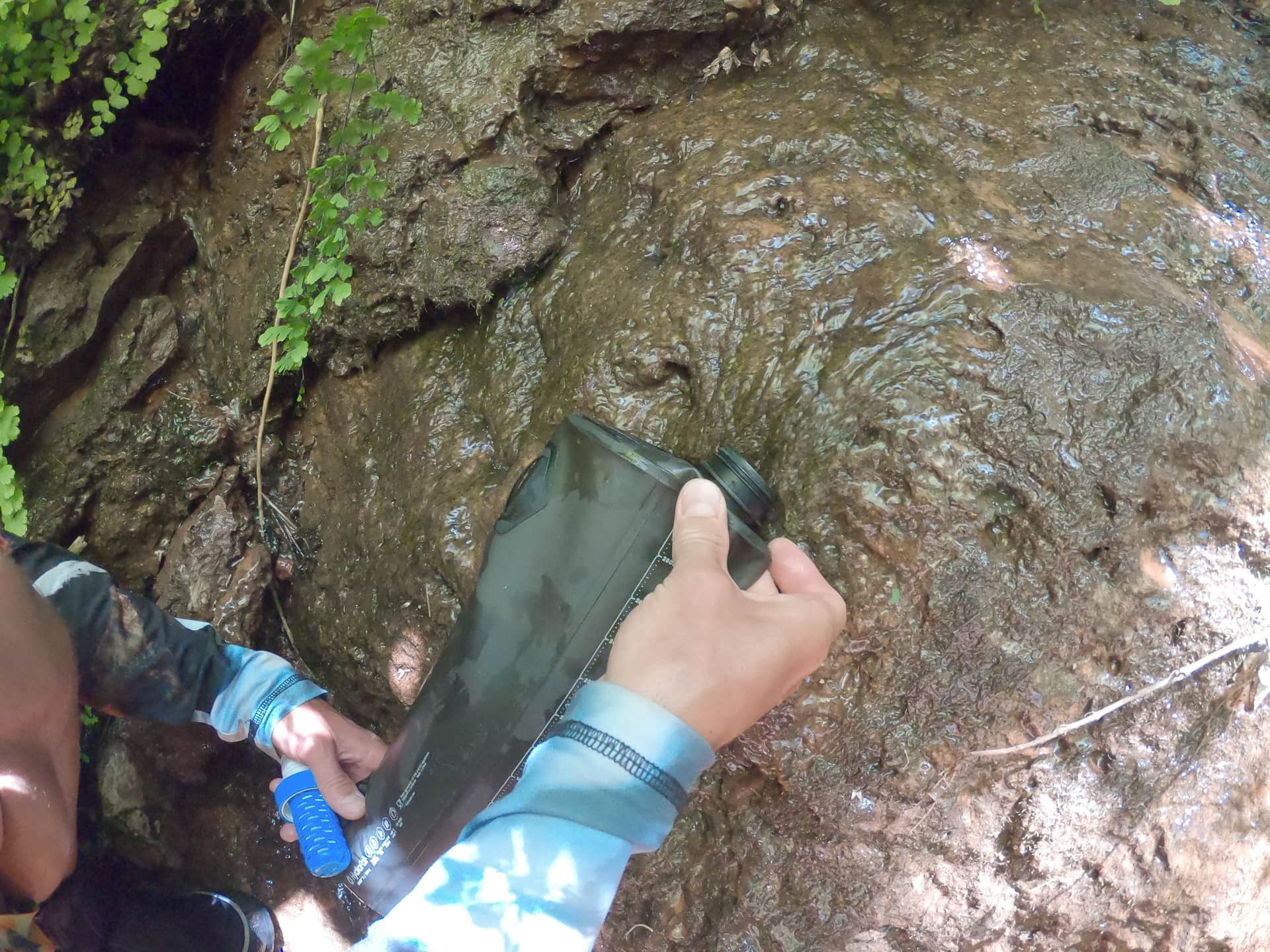
Water sources in the desert are often stagnant, cloudy, and contaminated by livestock. You need to research these water sources and make sure the filter you bring will work for the source. Your water filters are likely to get clogged and slow to use, so I recommendcarrying backup water treatment, like water purification tablets.
For example, if you are filtering from a stream that’s only a couple of inches deep, then something like the popular Platypus Gravityworks which requires you to fill up a big bag of dirty water before filtering may not work. Instead, you might need something like the Sawyer Squeeze or the MSR Trailshot.
Some desert hikes will have ample water availability, which is ideal
If the water is contaminated with more than your usual bacteria, then you might need a purifier that will work against viruses. If the water is full of sediment, you may need to pre-filter using a bandana and also the Steripen which uses UV light to kill bacteria will not work.
Case in point, you need to make sure whatever method you plan to use will work in the desert environment.
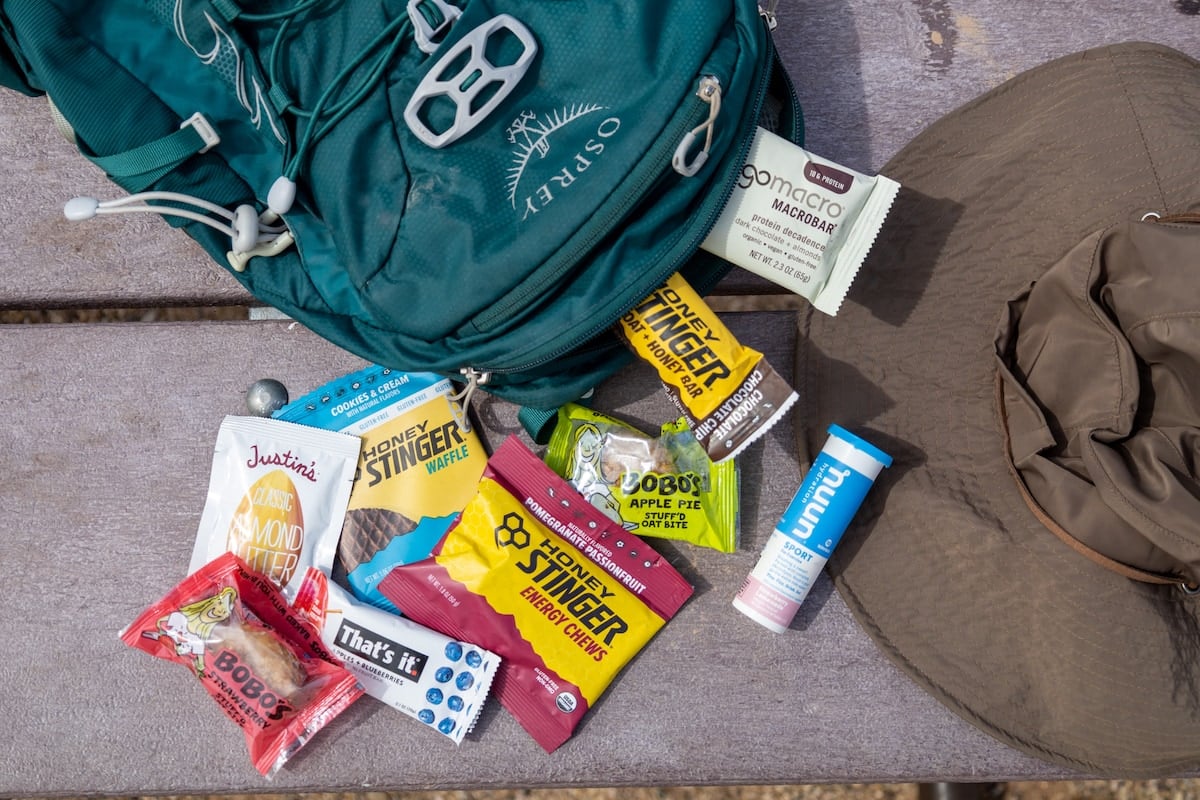
27. Pack salty snacks
Pack salty snacks will actually help your body retain water. Here are some of my favorite desert hiking snacks:
Salted nuts
Protein Bars
Peanut Butter Pretzels
Nut butter with apple
Trail Mix
There are so many hiking snack options out there to choose from for your desert hike
Desert Backpacking Tips
While desert hiking and backpacking tips often overlap, these are unique to desert backpacking. If you’re planning to stay in the desert backcountry overnight, use these tips to help you make sure you have an enjoyable (and safe) trip.
28. Pack Light
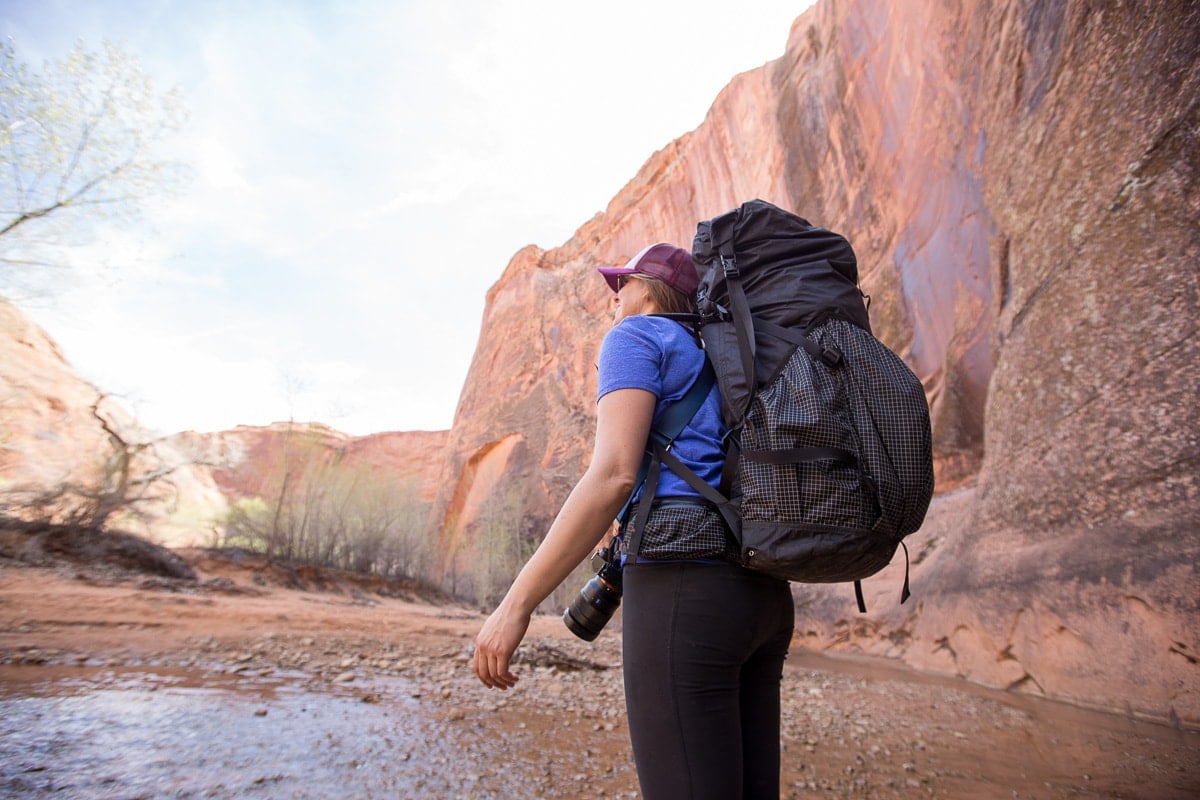
Since you will likely be carrying more water than your usual backpacking trip, it’s important tokeep your desert backpacking gear as light as possibleand pack lightly.
Now, this doesn’t mean skipping on the backpacking essentials, but anything you can do to slim down your load will make a world of difference when you’re carrying a pack heavy with water (for reference, 1 liter of water weighs roughly 2.2 lbs).
Swapping out your usual gear for a tarp-style tent, an ultralight quilt, and an ultralight backpack will go a long way in reducing your base weight. You’ll also want to plan out your meals so you aren’t carrying an excessive amount of extra food, and you should also choose foods that have a high calorie-to-weight ratio.
Although it’s tempting to bring comfort items while backpacking, I recommend keeping it light
29. Prepare for cool nights
Although it may feel warm and sunny during the day, the night can be an entirely different story. Depending on the time of year that you backpack, there can be big temperature swings. Frost and freezing nighttime temps are common in late fall, winter, and early spring.
Make sure you bring warm layers to wear at night. You can always remove layers if you get too warm, but you can’t add layers that you don’t have!
The desert can get chilly, so bring layers to wear in your tent while you sleep
30. Sweep for needles
When you pick a camp, be sure to sweep for loose needles before setting up your tent, and use a ground cloth if you have one. Always carry a patch kit for your sleeping pad just in case yours deflates in the desert.
31. Pack meals that require little water
If you are backpacking in the desert in a spot with limited water sources, prepare meals that require little to no water like peanut butter and jelly sandwiches, bars, wraps, and other hearty snacks, so you can save your water for drinking.
Freeze-dried backpacking meals are convenient only if you’re hiking on a trail with water access
32. Pick the right trail for your ability
The Southwest has PLENTY of desert backpacking trips. It is important to pick one that fits your (and your group’s) physical fitness level. Here are our favorites broken down by state:
Utah
Paria Canyon: A stunning 4-day/3 night trip hiking down a meandering riverbed in between two enormous walls of Navajo sandstone.
West Rim Trail: This 2-day/1 night trip in Zion National Park is the ultimate way to avoid the crowds.
Coyote Gulch: Located in Escalante National Monument, this trip can span 2-3 days and has awesome slot canyons and waterfalls.
California
California Hiking and Riding Trail: This 35-mile trip located in Joshua Tree National Park is great for beginners as it’s relatively flat and has awesome scenery.
Trans-Catalina Trail: Located on Catalina Island off the coast of Southern California, this 40-mile trail includes campsites on the beach and epic views.
Arizona
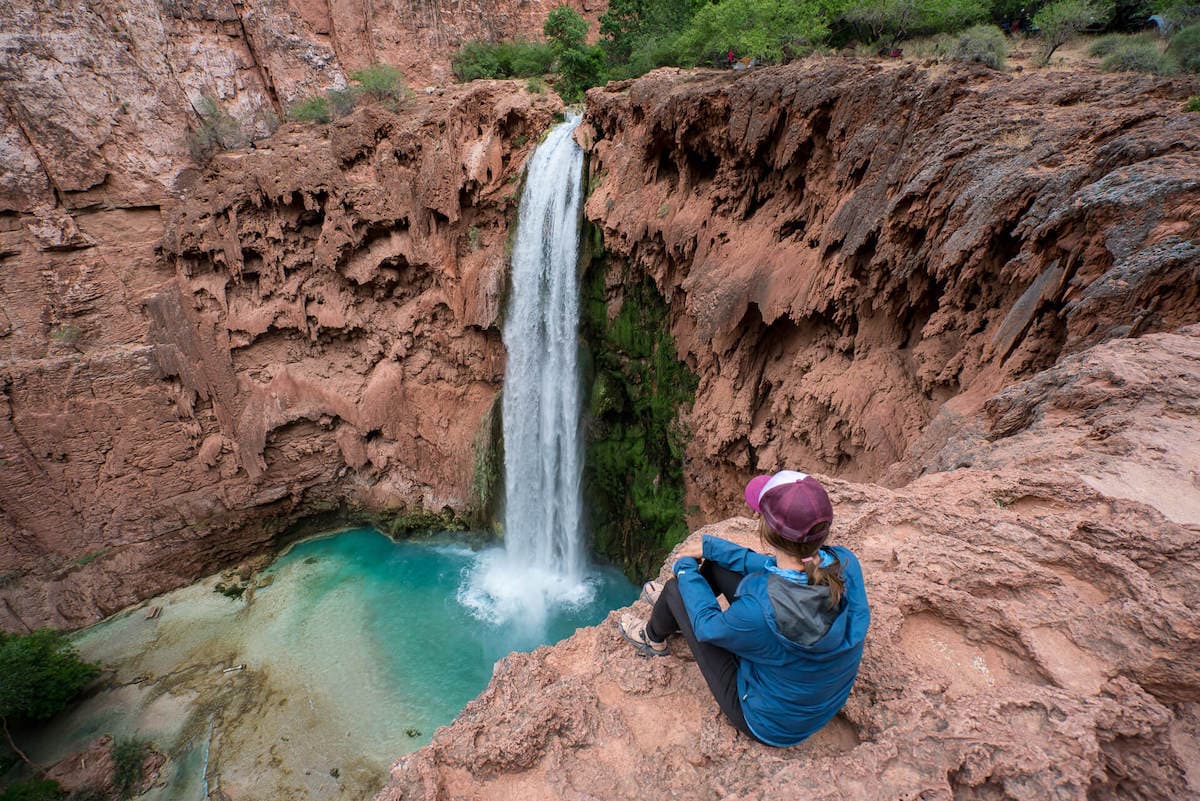
Havasu Falls – This is a great beginner desert backpacking trip. The campground is located 10 miles from the trailhead, and there is a spigot for you to refill your water.
Enjoying the view of Mooney Falls at Havasupai in Arizona
Planning a trip to the desert? Check out these day hikes.
Save this post to Pinterest
Are you planning a desert hike or backpacking trip? If you’ve spent some time in the desert, what are your favorite trails? Leave us a comment below!
Nations have long invested in domestic infrastructure to advance their economies, control their own data and take advantage of technology opportunities in areas such as transportation, communications, commerce, entertainment and healthcare.
AI, the most important technology of our time, is turbocharging innovation across every facet of society. It’s expected to generate trillions of dollars in economic dividends and productivity gains.
Countries are investing in sovereign AI to develop and harness such benefits on their own. Sovereign AI refers to a nation’s capabilities to produce artificial intelligence using its own infrastructure, data, workforce and business networks.
Why Sovereign AI Is Important
The global imperative for nations to invest in sovereign AI capabilities has grown since the rise of generative AI, which is reshaping markets, challenging governance models, inspiring new industries and transforming others — from gaming to biopharma. It’s also rewriting the nature of work, as people in many fields start using AI-powered “copilots.”
Sovereign AI encompasses both physical and data infrastructures. The latter includes sovereign foundation models, such as large language models, developed by local teams and trained on local datasets to promote inclusiveness with specific dialects, cultures and practices.
For example, speech AI models can help preserve, promote and revitalize indigenous languages. And LLMs aren’t just for teaching AIs human languages, but for writing software code, protecting consumers from financial fraud, teaching robots physical skills and much more.
In addition, as artificial intelligence and accelerated computing become increasingly critical tools for combating climate change, boosting energy efficiency and protecting against cybersecurity threats, sovereign AI has a pivotal role to play in equipping every nation to bolster its sustainability efforts.
Factoring In AI Factories
Comprising new, essential infrastructure for AI production are “AI factories,” where data comes in and intelligence comes out. These are next-generation data centers that host advanced, full-stack accelerated computing platforms for the most computationally intensive tasks.
Nations are building up domestic computing capacity through various models. Some are procuring and operating sovereign AI clouds in collaboration with state-owned telecommunications providers or utilities. Others are sponsoring local cloud partners to provide a shared AI computing platform for public- and private-sector use.
“The AI factory will become the bedrock of modern economies across the world,” NVIDIA founder and CEO Jensen Huang said in a recent media Q&A.
Sovereign AI Efforts Underway
Nations around the world are already investing in sovereign AI.
Since 2019, NVIDIA’s AI Nations initiative has helped countries spanning every region of the globe to build sovereign AI capabilities, including ecosystem enablement and workforce development, creating the conditions for engineers, developers, scientists, entrepreneurs, creators and public sector officials to pursue their AI ambitions at home.
France-based Scaleway, a subsidiary of the iliad Group, is building Europe’s most powerful cloud-native AI supercomputer. The NVIDIA DGX SuperPOD comprises 127 DGX H100 systems, representing 1,016 NVIDIA H100 Tensor Core GPUs interconnected by NVIDIA NVLink technology and the NVIDIA Quantum-2 InfiniBand platform. NVIDIA DGX systems also include NVIDIA AI Enterprise software for secure, supported and stable AI development and deployment.
Swisscom Group, majority-owned by the Swiss government, recently announced its Italian subsidiary, Fastweb, will build Italy’s first and most powerful NVIDIA DGX-powered supercomputer — also using NVIDIA AI Enterprise software — to develop the first LLM natively trained in the Italian language.
With these NVIDIA technologies and its own cloud and cybersecurity infrastructures, Fastweb plans to launch an end-to-end system with which Italian companies, public-administration organizations and startups can develop generative AI applications for any industry.
The government of India has also announced sovereign AI initiatives promoting workforce development, sustainable computing and private-sector investment in domestic compute capacity. India-based Tata Group, for example, is building a large-scale AI infrastructure powered by the NVIDIA GH200 Grace Hopper Superchip, while Reliance Industries will develop a foundation LLM tailored for generative AI and trained on the diverse languages of the world’s most populous nation. NVIDIA is also working with India’s top universities to support and expand local researcher and developer communities.
Japan is going all in with sovereign AI, collaborating with NVIDIA to upskill its workforce, support Japanese language model development, and expand AI adoption for natural disaster response and climate resilience. These efforts include public-private partnerships that are incentivizing leaders like SoftBank Corp. to collaborate with NVIDIA on building a generative AI platform for 5G and 6G applications as well as a network of distributed AI factories.
Finally, Singapore is fostering a range of sovereign AI programs, including by partnering with NVIDIA to upgrade its National Super Computer Center, or NSCC, with NVIDIA H100 GPUs. In addition, Singtel, a leading communications services provider building energy-efficient AI factories across Southeast Asia, is accelerated by NVIDIA Hopper architecture GPUs and NVIDIA AI reference architectures.
Read more about sovereign AI and its transformative potential.
Explore generative AI sessions and experiences at NVIDIA GTC, the global conference on AI and accelerated computing, running March 18-21 in San Jose, Calif., and online.
New five-passenger midsize SUV to have hybrid powertrains, standard AWD.
2025 Mazda CX-70
Mazda is in the final stages of preparing for the on-sale date of the 2025 CX-70. This midsize-class SUV will seat up to five and slot between the brand’s compact CX-50 and three-row CX-90. It will compete against models like the Chevrolet Blazer, Ford Edge, Honda Passport, Nissan Murano, and Toyota Venza.
It’s common for automakers to develop a single vehicle platform and adapt it to a variety of models, with changes coming in terms of physical size, rigidity, and such depending on application. For example, the Honda Passport rides a shortened version of the chassis used by the 2016-2022 Pilot. CX-70 is unusual in that it’s basically identical in size to the CX-90. The former is simply making do without the latter’s third-row seat. As Mazda is a comparatively small car company, it makes sense they would want to save development and engineering costs by going this route.
2025 Mazda CX-70
CX-70 will share its available powertrains with the CX-90 as well. All will come standard with all-wheel drive (AWD) and offer buyers the option of a gas/electric hybrid or plug-in gas/electric drivetrain. The former are dubbed 3.3 Turbo and sub-divided into Preferred, Premium, Premium Plus, S Premium, and S Premium Plus trim levels. The plug-in variant is called the PHEV and will come as the Premium or Premium Plus.
Preferred, Premium, and Premium Plus pair a 3.3-liter turbocharged inline 6-cylinder engine with a battery-powered electric motor for a combined output of 280 horsepower and 332 pound-feet of torque. The S Premium and S Premium Plus utilize a high-output version of the same engine, with horsepower and torque increasing to 340 and 369, respectively.
PHEV models adopt a 2.5-liter non-turbo four-cylinder gas engine and a 17.8 kWh battery pack for a combined 323 horsepower and 369 pound-feet of torque. Mazda claims up to 26 miles of electric-only driving. All CX-70s have an 8-speed automatic transmission.
Even the entry-level 3.3 Turbo Preferred will come with a surprisingly generous level of standard equipment, including leather upholstery, heated power-adjustable front seats, wireless Apple CarPlay and Android Auto, Amazon Alexa integration, automatic climate control, and a full suite of driver-assistance features including blind-spot alert, and full-speed adaptive radar cruise control.
The 3.3 Turbo Premium adds fully digital instrumentation, head-up display, Bose-brand audio system, driver-seat memory, and embedded GPS navigation that doesn’t need a compatible smartphone to work. This trim also brings some upgrades to the active safety features like rear-collision braking, traffic sign recognition, and front- and rear-obstacle detection.
Upgrading to the 3.3 Turbo Premium Plus nets upgraded Nappa leather upholstery, heated steering wheel, ventilated front seats, heated rear seats, windshield wiper de-icer, power-folding exterior mirrors, and a panoramic sunroof.
PHEV, S Premium, and S Premium Plus grades largely mirror their 3.3 Turbo counterparts in terms of standard equipment, with some unique exterior and interior trim differences. For example, the S Premium Plus gets quilted Nappa leather in a tan finish that isn’t available elsewhere in the lineup.
Options will mostly be limited to extra-cost paint colors along with dealer-installed functional and dress-up accessories.
The 2025 Mazda CX-70 starts at $40,445 for the 3.3 Turbo Preferred and tops out at $57,450 for the PHEV Premium Plus, not including the required $1,375 manufacturer destination fee. Initial deliveries will start this spring with a gradual rollout that is expected to be complete by fall.
We understand the need for Mazda to consolidate its development resources as much as possible, which is likely why there are virtually no physical differences between the CX-70 and CX-90. It seems strange that the CX-70 carries identical pricing to the 2024 CX-90, though we suspect this leaves the door open for the automaker to raise the three-row SUV’s MSRP for model-year ’25. In any case, expect the new five-seater to retain much of CX-90’s charm, an experience we said, “…delivers the premium-experience goods.”
Breguet has spent more than two centuries refining the tourbillon, the complication made famous by its founder Abraham-Louis Breguet, and most can surely agree that
the many, many tourbillon watches it has released in its history have been beautiful and well-made. With such a pedigree, it stands to reason that Breguet’s tourbillons tend to look highly traditional, tending towards designs that correspond to technical seriousness.
That is what makes Breguet’s two new tourbillon watches for women such delightful surprises. While aesthetic poetry often finds its place within the Reine de Naples collection, the Classique collection now hosts two reimagined Classique Ref. 3358 models that sparkle with playfulness and personality; these are quite different to the existing Ref. 3358…
The white gold “Starlit Night”, reminiscent of a serene night sky, features a varnished blue mother-of-pearl dial, with the hours and minutes placed in an off-centered subdial with rhodium-plated gold hands. Within this dial are five applied white gold stars, and a serial number occupying the 4 o’clock position. More stars adorn the rest of the watch face, with six of the larger ones set with a brilliant-cut diamond. But the real star of the watch is the one-minute tourbillon, proudly displayed through an aperture at the bottom of the dial and held in place by a shooting star-shaped bridge that has been snow-set with 45 diamonds, as well as a central blue spinel as its pivoting stone.
The Ref. 3358BB/VD/986D0 measures a comfortable 35mm by 9.43mm, with additional brilliant-cut diamonds decorating the bezel, lugs, and clasp, and a rose-cut diamond topping the crown.
Its rose gold counterpart is the Ref. 3358BR/8D/986D0 “Stunning Sight”, and it lives up to its name with 281 diamonds blanketing the dial. Snow-set diamonds fill the area inside the natural white mother-of-pearl chapter ring, while rows of graduated diamonds appear to radiate from the tourbillon on either side. The tourbillon bridge is a curved band of rose gold set with 14 diamonds and a ruby pivot.
Turning over either reference will reveal a sapphire caseback offering a view of the manual-winding 187 D movement that beats at 2.5Hz and offers a 50-hour power reserve. The hand-hammered base plate is engraved with the brand name, movement number, and “Brevet 7 Messidor An IX” — the year the tourbillon was patented according to the French Republican Calendar.
The “Starlit Night” gets a midnight blue alligator strap, while the “Stunning Sight” comes with a red one, both fastened by triple-folding gold clasps set with 42 diamonds. Water-resistant to 30m, the pair will be part of Breguet’s permanent collection, adding some contemporary dazzle to its stately lineup.
Movement: Manual calibre 187 D with tourbillon; 50-hour power reserve Case: 35mm in white gold and pink gold; water-resistant to 30m Strap: Blue and red alligator Price: From USD 207,900
This article first appeared on WOW’s Festive 2024 issue.
For more on the latest in watch reads, click here.
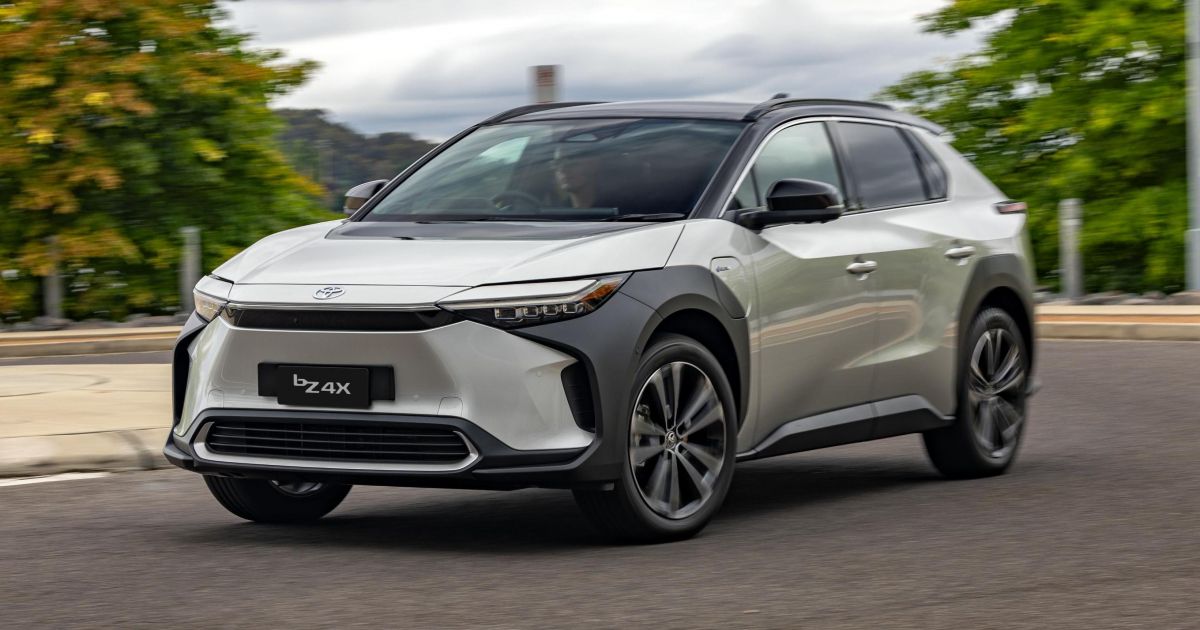
Toyota has officially delivered the first example of its bZ4X electric SUV in Australia to a couple in Canberra, Australian Capital Territory (ACT).
Ali and Nafiseh Lashkari opted for the flagship Toyota bZ4X AWD variant which is currently priced from $74,900 before on-road costs. Mr Lashkari previously owned a Camry and RAV4 Hybrid.
Toyota Australia vice president sales, marketing and franchise operations Sean Hanley and bZ4X chief engineer Masaya Uchiyama were present at Canberra Toyota to hand over the first Australian-delivered bZ4X to the owners.
“This is about choosing the car that aligns with my values, and this car basically aligns with all the vision and values I was looking for,” said Mr Lashkari.
“I wanted a sustainable solution which is an electric car, and I was looking for a manufacturer to give me the confidence that this car will work for me for a long time, so I was happy to wait for Toyota to bring this car to market.
“I wanted to have the opportunity to buy a Toyota bZ4X, because as I mentioned, I am a loyal customer to Toyota due to good experiences and my previous purchases.”
Mr Lashkari works as a civil engineer and plans to daily drive his bZ4X and charge it at home.
As recently reported, the Toyota bZ4X is available locally in two different variants – a front-wheel drive variant and an all-wheel drive variant.
They’re currently priced from $66,000 before on-roads and $74,900 before on-roads, respectively.
The front-wheel drive bZ4X is $600 more expensive than the Tesla Model Y RWD, while the all-wheel drive bZ4X undercuts the Model Y Long Range by $3500.
Under the skin, the bZ4X is a mechanical twin to the Subaru Solterra. The front-wheel drive option unique to the bZ4X – the Solterra is all-wheel drive only – helps drop the starting price by $3990, despite a pre-launch price cut to the Subaru.
Toyota Australia will be offering the bZ4X with a subscription-style full-service lease through Toyota Finance, along with its more traditional purchase methods.
Toyota Australia vice president of sales and marketing, Sean Hanley, confirmed Toyota has more than 122 orders and 7000 expressions of interest.
MORE: Everything Toyota bZ4X MORE: Toyota bZ4X review
Zeekr, one of Chinese automotive giant Geely’s numerous brands, has detailed an update to its oldest model which rivals the likes of the Tesla Model S.
The Zeekr 001 is an electric shooting brake which launched in China in 2021 and in Europe last year, but was originally revealed as a Lynk & Co (another Geely brand) concept back in 2020.
So far Zeekr has only detailed an update for the core 001 range. The high-performance quad-motor 001 FR which was only revealed last year remains unchanged for now.
Thanks to new silicon carbide-powered electric motors, the Zeekr 001 is now capable of accelerating from 0-100km/h in 3.3 seconds, which is 0.5 seconds quicker than the pre-update model.
Dual-motor all-wheel drive variants now produce total system outputs of 580kW of power and 810Nm of torque.
There’s also a new 800V electrical architecture that replaces the pre-update model’s less sophisticated 400V electrical architecture to help boost charging times.
Zeekr 001 variants equipped with the CATL-sourced 95kWh Shenxing battery pack are now claimed to add up to 256km of range in five minutes of charging. They also have a claimed range of 675km according to the lenient CLTC standards.
The long-range versions of the 001 with the CATL-sourced 100kWh Qilin battery pack on the other hand can now drive 750km according to CLTC standards.
Other changes the update has brought include Navigation Zeekr Pilot (NZP) which is a driving assistant system developed by Zeekr and Mobileye. It comprises LiDAR, high-definition cameras and milimeter-wave radars.
The system will initially be available for use in “over 60 Chinese cities” before March, and then “expand to 90 per cent of Chinese cities” in the second quarter of this year.
For now the updated Zeekr 001 is only available for the Chinese market and is priced from RMB 269,000 (~A$57,400).
As previously reported, Zeekr confirmed to CarExpert it’s aiming to start selling cars locally in the third quarter of 2024.
Where Chinese rivals such as MG and GWM have launched in high-volume and low-cost segments, Zeekr will instead position itself as a premium brand.
It’s also unclear how Zeekr plans to distribute its vehicles in Australia.
Zeekr was founded in 2021 as an all-electric brand to rivals the likes of Tesla and Nio. All of its electric vehicles (EVs) are built on the Geely’s SEA platform.
Investing is a keyword here. We’re not only investing our efforts and time. We’re investing our resources. The reason remains always the same. We know that there’s a lot to do and someone has to lead the way.
Not long ago I joined Mike Horn in Greenland during his What’s Left expedition. The changes in this area of the world illustrate how palpable climate issues can be. We understand how pressing the situation is and we understand our responsibilities as boat builders.
Many shipyards are saying what they will do in the future to make yachting cleaner. Our business is making things happen today.
How do you respond to the criticism that surrounds the yachting world?
First, Sunreef Yachts is a niche on its own. We are an island in this industry. Our company builds electric, hybrid and hydrogen catamarans. We try our best every day to convince people to switch to sustainable alternatives and today over 50 percent of our demand is for our Eco range.
Lapp in Greenland
There will always be criticism, it is natural. I accept it, but I also want to make sure that everyone understands how much effort and money it costs us to push innovation forward. We do almost everything by ourselves.
The full transition can’t happen overnight, but as a company, we feel our responsibilities and do everything possible to make it happen. The interest in alternatives to fossil fuel is massive and we are optimistic.
Changes in the superyacht world are not dynamic enough. Our vision of the superyacht experience is different from what you see in the industry. We are currently building two 43m electric sail yachts (Sunreef 43M Eco) that will rely on solar power, electric engines, hydrogeneration and performance sails. They will prove that superyachts can be energy-efficient and highly autonomous.
What is your vision of the industry’s future?
I think about the future almost every day. I try to imagine scenarios, environmental issues, expectations, trends, and new needs emerging. The industry will keep progressing towards cleaner technologies, but the speed of these changes will depend on our own initiative as industry players. Shipyards must do everything to turn words into actions.
While summer usually steals the spotlight for vacations, March unveils Barcelona’s charm in a different light, making it an equally enchanting time to visit this vibrant city. Spring’s arrival brings warmer weather, a delightful atmosphere, and many exciting events to partake in, transforming Barcelona in March.
Let’s check out Barcelona’s captivating events and activities during this delightful month!
Not to Miss Events in Barcelona in March
Visiting Barcelona in March? Add a few of these events and activities to your itinerary.
Beach Retreats
As March gracefully transitions into Spring, the blue skies, longer days, and rising temperatures beckon visitors to explore Barcelona’s pristine beaches. With March being an off-season for tourism, you can truly relish the beauty of beaches like Barceloneta, Sant Sebastià, Nova Icària, and Bogatell.
March provides a unique opportunity to immerse oneself in the breathtaking beauty of Barcelona’s coastal treasures without contending with the usual bustling crowds that characterize the peak tourist season.
Whether it’s unwinding on the sands, taking a leisurely swim, or indulging in a seaside picnic, the tranquility of March allows for a more intimate connection with Barcelona’s maritime allure.
Barcelona in March: A Guide to Events and Activities
Vibrant Festivals
Barcelona has many vibrant celebrations throughout the year, and March is no exception. This month unfolds with captivating festivals, each adding its unique flair to the city’s lively spirit.
The month commences with the enchanting Sant Medir Festival in the picturesque Grácia neighbourhood. The festivities start with a charming procession featuring horses, floats, music, and an abundance of sweets, creating an atmosphere that resonates with families and those eager to immerse themselves in an authentic Barcelona experience. The Sant Medir Festival is a visual and sensory delight, offering a delightful spectacle that captures the essence of the city’s celebratory vibe.
As March progresses, the city is graced with the Festes de Sant Josep Oriol. This celebration pays homage to the compassion and dedication of Sant Josep Oriol towards the sick and underprivileged. From the 16th to the 20th of March, this festival unfolds with captivating floating figures, mesmerizing dance performances, and lively music collectively contributing to an awe-inspiring ambiance. It is an event that beckons both locals and visitors to partake in the magic of Barcelona’s cultural heritage.
La Semana Santa is the final festival of March, marking Barcelona’s Easter period (which changes yearly but is typically anytime from late March to the end of April). This week-long celebration signifies the end of Lent and is adorned with many events, parades, processions, and masses.
For an immersive experience in the festive atmosphere, witnessing the ‘La Burreta‘ procession is highly recommended. Additionally, participating in the mass ceremony at the iconic La Sagrada Familia adds a sacred and spiritually enriching dimension to the celebration.
March in Barcelona is not merely a transition between seasons but a time when the city pulsates with energy, color, and cultural significance. This month’s diverse array of festivals offers both locals and visitors the chance to engage in Barcelona’s festive spirit and truly immerse themselves in the vibrant culture.
Barcelona in March: A Guide to Events and Activities
Arts and Culture
For music enthusiasts, the renowned Palau de la Música Catalana takes center stage as it hosts the highly anticipated annual OFF Maria Canals Barcelona Competition. This distinguished event serves as a global platform, spotlighting the immense talent of pianists who converge worldwide.
The competition promises an extraordinary and unforgettable experience, showcasing the artistry of exceptional musicians against the backdrop of the architectural marvel that is the Palau de la Música Catalana.
Additionally, for those who enjoy the theater, visitors can contribute to Catalonia’s vibrant performing arts scene through the ‘No Empty Seats’ campaign. Taking place on March 16th this year, this initiative aims to fill theaters across the city and breathe life into the local arts community.
By attending a theater performance during your visit, you immerse yourself in the rich tapestry of Catalonia’s artistic expression and support a commendable cause. It’s a chance to be a part of an audience that appreciates the magic of live theater and actively contributes to ensuring that every seat is occupied, fostering a sense of community and cultural vibrancy.
These cultural gems, whether the enchanting melodies at the Palau de la Música Catalana or the theatrical allure of Catalonia’s ‘No Empty Seats’ campaign, are invitations to immerse yourself in the dynamic arts and culture scene of Barcelona. March becomes a time to witness performances and actively engage with the artistic spirit that permeates the city, creating lasting memories and contributing to the flourishing cultural landscape.
Barcelona in March: A Guide to Events and Activities
Barcelona Marathon
Prepare yourself for an exhilarating experience as the annual Zurich Marató Barcelona unfolds its splendor. Esteemed as the 5th largest marathon in Europe and a highly anticipated event in Spain, this race offers a unique opportunity to witness athletic prowess and immerse yourself in Barcelona’s culture deeply.
As the city streets come alive with the rhythmic pounding of footsteps and the collective cheers of both participants and spectators, you can actively engage with the vibrant spirit of Barcelona. Joining the locals in cheering on the dedicated runners adds a communal element to the event, providing a shared sense of encouragement and celebration that transcends cultural boundaries.
Beyond the dynamic energy of the marathon, following its route unveils a remarkable opportunity to witness the iconic landmarks that define Barcelona’s skyline. As the runners traverse through the city, you’ll have the chance to marvel at architectural wonders like Passeig de Gràcia, Casa Batlló, the awe-inspiring La Sagrada Familia, and the majestic Arc de Triomf, among many others. Each stride along the marathon route becomes a journey through Barcelona’s rich history and architectural splendour, offering a visual feast for both participants and onlookers.
The Zurich Marató Barcelona is not just a race; it’s a celebration of athleticism, culture, and the vibrant spirit of Barcelona. Whether you’re a dedicated runner, an enthusiastic spectator, or a traveler seeking a unique way to explore the city, this marathon provides an immersive experience that goes beyond the typical tourist itinerary. So, mark the date, join the lively crowd, and let the Zurich Marató Barcelona become a memorable chapter in exploring this captivating city.
Barcelona in March: A Guide to Events and Activities
St Patrick’s Day
St. Patrick’s Day, once rooted in Irish traditions, has gracefully transcended its origins to become a vibrant and eagerly embraced celebration in the cosmopolitan city of Barcelona. The dynamic and diverse cultural influences that define Barcelona’s identity meld seamlessly with the festive spirit, transforming this Irish holiday into a key event on the city’s social calendar. The warmth and inclusivity of the celebrations not only reflect the global nature of Barcelona but also contribute to the cultural richness that defines the city’s ethos.
This lively and joyous festival extends an open invitation to individuals from various backgrounds, inviting them to partake in the spirited festivities that mark St. Patrick’s Day. The city, known for its cosmopolitan vibe, becomes a melting pot of cultures during this celebration, fostering a sense of unity and shared joy among locals and visitors alike.
To fully immerse yourself in the St. Patrick’s Day experience, take a stroll through the vibrant streets and seek out the lively Irish bars scattered across the city. These establishments serve as lively hubs where the celebratory spirit comes to life, providing a welcoming space for both locals and tourists to come together, revel, and share in the infectious joy of the occasion.
Barcelona in March: A Guide to Events and Activities
Barcelona Beer Festival
Embark on a weekend dedicated to the exploration of craft beers at the much-anticipated Barcelona Beer Festival. This event offers a captivating journey through the diverse and flavorful world of craft brews. With many exhibitors converging to showcase an impressive lineup of beverages, this festival promises a delightful experience for both seasoned beer enthusiasts and casual drinkers alike.
The Barcelona Beer Festival creates an inviting atmosphere, uniting like-minded beer lovers in a celebration that caters to every palate. The diverse range of brews, from innovative creations to timeless classics, ensures that there is something to delight every taste bud.
Immerse yourself in the diverse aromas, flavors, and stories behind each beer as you navigate the festival grounds. Engage with brewers, fellow enthusiasts, and perhaps discover a newfound favorite among the vast array of offerings. The Barcelona Beer Festival beckons you to savor, explore, and celebrate the world of craft beers in a lively and convivial setting.
So, mark your calendars and prepare for an unforgettable experience as the Barcelona Beer Festival invites you to raise your glass in the spirit of discovery and appreciation for the craft.
Barcelona in March: A Guide to Events and Activities
With an abundance of thrilling events and activities happening in Barcelona in March, it really is the ideal time to explore the lively city.
We are an expert agency in the tourism sector based in Barcelona, Catalonia. For over 10 years, we have offered holiday apartments and long-term apartments in Barcelona, to anyone wanting to visit or spend some time in the Catalan Capital.
The technical storage or access is strictly necessary for the legitimate purpose of enabling the use of a specific service explicitly requested by the subscriber or user, or for the sole purpose of carrying out the transmission of a communication over an electronic communications network.
Preferences
The technical storage or access is necessary for the legitimate purpose of storing preferences that are not requested by the subscriber or user.
Statistics
The technical storage or access that is used exclusively for statistical purposes.The technical storage or access that is used exclusively for anonymous statistical purposes. Without a subpoena, voluntary compliance on the part of your Internet Service Provider, or additional records from a third party, information stored or retrieved for this purpose alone cannot usually be used to identify you.
Marketing
The technical storage or access is required to create user profiles to send advertising, or to track the user on a website or across several websites for similar marketing purposes.