Massimo Frascella, alumnus of the Istituto d’Arte Applicata & Design in Turin, began his career at Stile Bertone.
Positions at Ford Motor Company and Kia followed. Since 2011, Frascella (52) held leading roles at Jaguar Land Rover, most recently as Head of Design for both brands.
Predecessor Marc Lichte headed Audi Design since 2014. Born in 1969 in Arnsberg/Sauerland, Germany, he joined Audi from Volkswagen AG, where he led the Exterior Design Studio.
Lichte’s time at Audi saw new generations of serial best sellers introduced as well as the brand’s first standalone electric model series – the Audi e-tron, the e-tron GT, and the Q4 model family.
Together with Massimo Frascella, the company is now setting the course for the coming generations of Audi models. Over the coming years, multiple surges in technological innovation are set to decisively change shapes and functions across all vehicle segments. For this reason, Audi has recently restructured its design department to report directly to the Chairman of the Board of Management.
Almost 55 years ago, on March 12, 1969, the legendary Porsche 917 made its debut at the Geneva Motor Show. Hans Mezger, the father of Porsche’s flat-six boxer engine, was not only responsible for the 917’s flat-12 engine, but as lead engineer oversaw the new race car’s entire development.
Due to a lack of downforce, the 917 initially proved to be unstable at high speeds, but with the help of John Wyer of J.W. Automotive – whose powder blue and tangerine orange GT40 Fords dominated Le Mans in 1968 and ’69 – the 917K (Kurzheck or ‘Short Tail’) version refined the design.
At the recent F.A.T. International Ice Race in Austria, I got to shoot a very special homage to the Le Mans-winning Gulf Oil Porsche 917K. The car’s creator, Knut Markegård from Norway, calls it the 917CFK, where ‘CF’ stands for carbon fiber.
Knut’s 917CFK project began in 2013, the same year several Norwegian car and bike clubs successfully lobbied the government on legislation that made it possible to register homebuilt vehicles and kit cars for road use. There were caveats of course. Projects needed to pass a road and safety inspection when finished, and had to have been built to standards that included a maximum power-to-weight ratio.
For Knut, that meant running a 917-spec flat-12 engine – which could deliver more than 1,000hp – wasn’t going to be an option. The solution? A twin-turbo Porsche flat-six.
It’s a unique air-cooled 3.6L unit with a short stroke (making it a 3.3L) built up with parts from the 911 SC to the newer 996 Turbo. While the engine itself is luftgekühlt, it does use water-to-air intercoolers to keep intake charge temps in check. The intake itself is a complete replica of what was used on the 917/10, which came after the 917K.
The engine was designed by Ninemeister, the same UK-based specialists that created a few of the first power plants for Singer restomods. For road use it’s restricted to 300hp, but with some adjustments it can produce over 400hp and 600Nm of torque. Knut says that this engine is not made for peak power, but rather low-end torque. Of course, it also needed to meet the Norwegian regulations for road use.
Engine output is sent through a robust Getrag G50 transaxle, which sits behind the engine and is flipped upside down in order for the car to go forward. For it to work and actually shift gears, Knut had to extend the shift rod linkage by an additional three feet.
The 917CFK’s tube frame chassis was constructed using the 917K’s original blueprints, but thicker steel was used to increase rigidity. The molds for its custom carbon fiber body parts were sourced from three different vehicles, and as it sits now features a narrow ‘Salzburg’ front, a wide 1970 Gulf 917K rear section, and doors from another variant.
Knut joked to me, that for a perfectionist it’s a bit hard to replicate a ‘917’ since the race car had at least 11 revisions throughout the years. For his own vision, Knut based most of his decisions on which parts would help him achieve road legal status.
Given the short tail rear, which was designed to accommodate 17-inch-wide tires, a reasonable question to ask would be who even makes studded winter rally rubber in that size? This is actually Knut’s own work – he built dual rims that take a double set of studded Pirelli Sottozero rally tires on each side.
A twin-turbo 917 replica in the snow sounds like the recipe for a whole lot of fun, and Knut says it’s a fantastic drift car: “As you are sitting over the front axle, you have all the feedback you need down your spine. The only issue is the turning radius. If you screw up and get to full lock, you are doomed.”
Knut paid special attention to the interior fit out, making it as close to original as possible. The seating position with the pedal box right there in the nose, all of the gauges and steering wheel – a Momo Prototipo in this case – are positioned exactly as shown in the 917K’s original technical drawings.
Some of the gauges have different functions in this car, but they still look authentic. Switches for the newly added climate control air conditioning and electric door mirrors are hidden in the door frame.
It started off as an ambitious idea, but a decade on Knut’s 917CFK is very much a reality – a road legal one at that. Even better, he’s ready to show it to everyone, even in the Austrian Alps over winter!
Vladimir Ljadov Instagram: wheelsbywovka because@wheelsbywovka.com www.wheelsbywovka.com
In 1975, Ferrari had Pininfarina restyle the 308 into what would become the real successor to the Dino 246, the 308 GTB Vetroresina. This car featured sweeping curves, two seats and a resemblance to the 512B. Highlighting the 308 GTB was a fiberglass, or vetroresina, body.
This new model not only introduced a groundbreaking production method for Scaglietti and Ferrari but also marked only the second V8-engined road model by the prestigious marque. The 308 GTB, mechanically-based on the 308 GT4, retained its predecessor’s framework and four-cam, 3.0-liter V8 engine, boasting 255bhp that propelled it to a top speed of 150 mph.
The Vetroresina models today represent the most coveted version of the iconic 308. With a significant weight reduction of around 80kg, these early examples fully unleash the dynamic chassis and spirited engine characteristics of the model.
There’s a lot to love about Macau, but if I could pick just one, it’s probably the fact that most of its attractions can be enjoyed for FREE! In this article, we’ll list down the places to visit and things to do in Macau that charge no entrance fees!
Macau may be home to some of the most flamboyant and most luxurious hotels on this side of Asia, but budget travelers can easily build an itinerary without much damage to their pockets. It is one of the most walkable cities, with its streets punctuated by multi-lingual signs. Many of the hotel companies offer free shuttle bus services, too.
But it doesn’t stop there. Macau’s map is dotted with several interesting attractions that can be enjoyed for free. Here are 13 of them.
WHAT’S COVERED IN THIS GUIDE?
1. Senado Square
If it’s your first time in Macau, you’ll find that it’s almost impossible to do brisk walking here at Senado Square. Why? Because there’s just so much to see here!
A giant outdoor museum, the Senado Square is a part of the extensive Historic Center of Macau, inscribed on the list of UNESCO World Heritage Sites. If you look around, you’ll see an architectural ensemble that perfectly exemplifies East-meets-West, a product of over 400 years of the Portuguese rule over the city. One of the edifices that will catch your attention is the two-story neo-classical Leal Senado Building.
Leal Senado Building
Today, while the Portuguese-style monument still stands proudly around the square, it is now often adorned with festive Chinese lanterns and other installations that match the season. When you walk deeper into the area, you’ll pass by lanes of shops, broken by other smaller praca like the St. Dominic’s Square with St. Dominic’s Church overlooking the area.
Follow the wave-patterned mosaic floor and it will lead you to another popular tourist spot – the Ruins of St. Paul’s!
2. Ruins of St. Paul’s
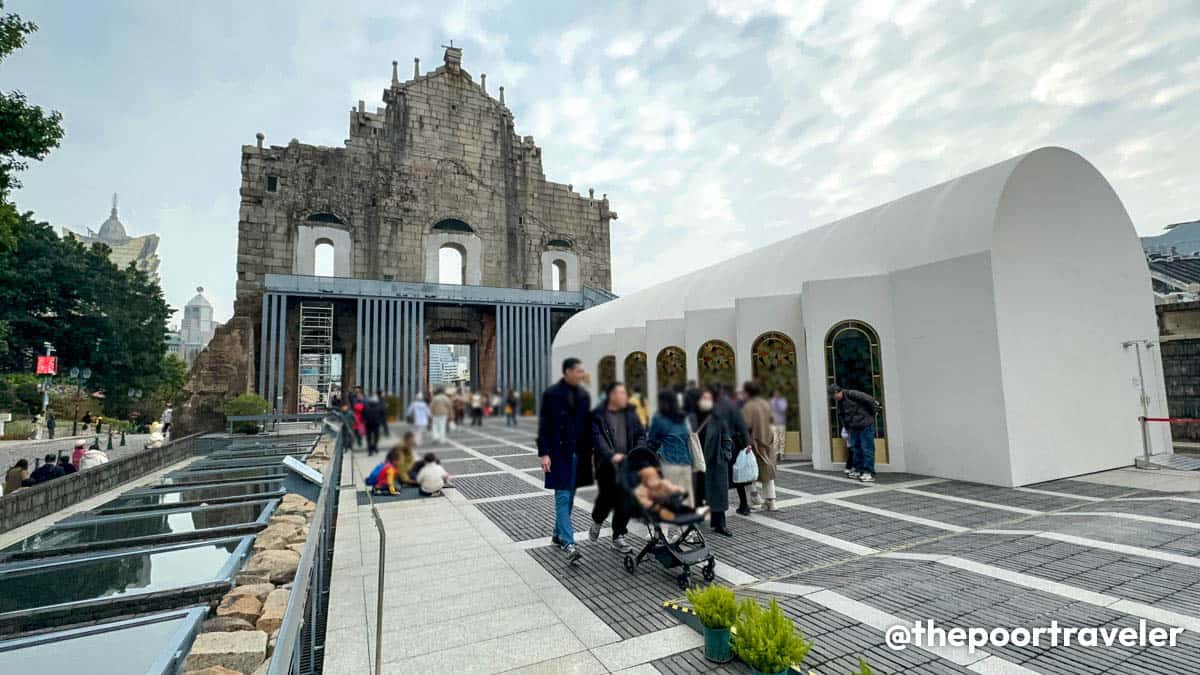
Probably the most iconic landmark in Macau, the Ruins of St. Paul’s (Ruinas de Sao Paulo) attracts droves of tourists all year round. This is perhaps the most crowded site in the city.
Like the Senado Square, it is also part of the city’s Historic Center. Built in the 16th century, this used to be a complex with a cathedral and an academic institution. The church itself was added later in the 17th century. But today, only the facade remains standing after being battered by a typhoon and three fires. The ruins stand atop a steep 68-step staircase that also gives a great view of the surrounding areas.
A guard is usually stationed by the main door of the façade, but there is no entrance fee here. Just walk right in. Beyond it is an area where you can catch a glimpse of the church’s original structures.
Also worth your time is the Museum of Sacred Art and Crypt at the bottom of the ruins. It presents religious artifacts including Sino-Portuguese crucifixes.
3. Na Tcha Temple
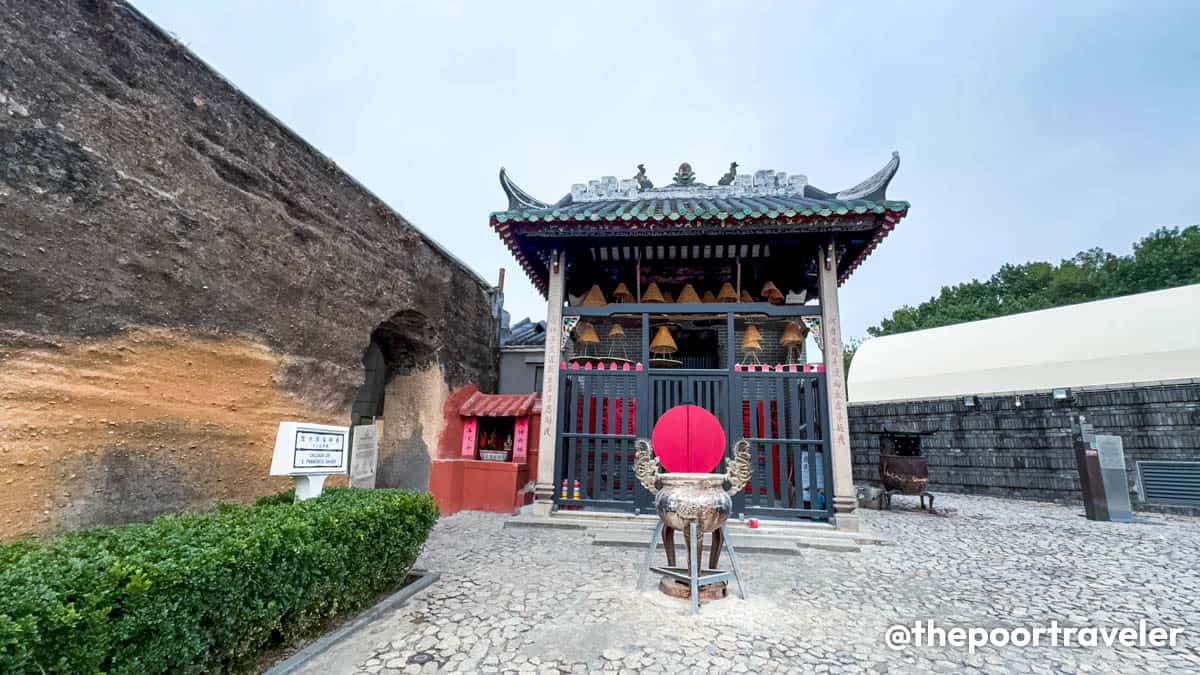
Just beside the Ruins of St. Paul’s stands a small single-chambered Chinese temple. Often overshadowed by the neighboring church ruins, Na Tcha Temple is often not crowded at all. But it is still part of the UNESCO-listed Historic Center of Macau.
Dedicated to guardian deity Na Tcha, it is said that it was built so that the protector would finally put an end to a plague that was spreading in the area at the time.
And yes, you can also visit it without paying an entrance fee.
Na Tcha Temple is open from: 8:00 AM – 5:00 PM Na Tcha Exhibition Room: 10:00 AM – 6:00 PM; Last entry at 5:30 PM (Closed on Wednesdays)
4. Ama Temple
If you could visit only one temple in the city, make it Ama Temple. Not only is this the oldest in Macau – built in 1488 — it is also believed that the city got its name from this temple.
According to accounts, when the Portuguese first set foot in this part of the world, they actually arrived here, where they spotted people worshipping at the temple. When they asked them for the name of the whole area, the worshippers thought they were asking about the specific site so they answered “A-Ma-Gau” meaning “Bay of A-Ma”. A-Ma-Gau eventually became Macau.
Ama, of course, refers to Chinese sea-goddess Mazu or Ama. Legend has it that the goddess helps seafarers and guides them during their journey, especially during a storm.
Located at Largo do Pagode da Barra in the southeastern tip of the peninsula, it is a bit isolated, making it a tiny isle of silence in the bustling ocean that is the city center.
Hours Open: 8:00 AM-6:00 PM
5. Guia Fortress
Standing proud at the tallest peak of the Macau Peninsula, Guia Fortress provides gorgeous panoramic views of the city, nearby islands, and even mainland China.
The centerpiece is the 15-meter-tall lighthouse, visible even from a great distance. Beside it is the Chapel of Our Lady of Guia that houses priceless paintings and other valuable artifacts. The lighthouse and the chapel were completed in 1865 and 1622 respectively.
Guia Fortress can be reached on foot, a great option for the physically fit and budget-conscious. But most tourists prefer taking the Guia Cable Car, which charges a minimal fare: MOP 2 one-way or MOP 3 round trip.
Hours open: 8:00 AM-6:00 PM Closed: Mondays. If a public holiday falls on Monday, it closes on the next day.
Let’s step away from the historic center for a bit and head over to Cotai Strip and take a look at the city’s more modern attractions.
Macau is best known for its luxury hotels that provide not just five-star accommodations but also a wide range of attractions. Many of these attractions can also be enjoyed free of charge.
6. SkyCab at Wynn Palace
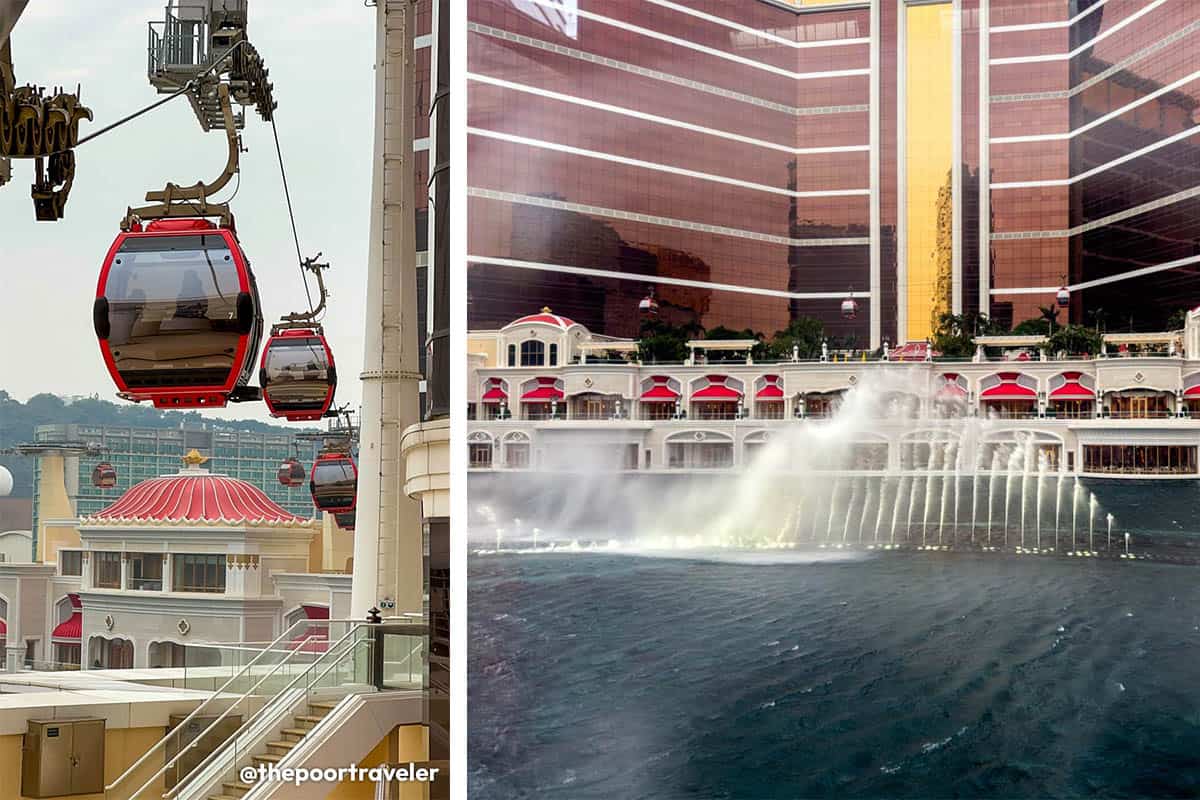
As you approach Wynn Palace Resort, I’m sure the very first thing you’ll notice is the line of cable cars that hang above it. This is called SkyCab. Yes, you can ride it for FREE.
Each cable car is air-conditioned and can accommodate 6 persons. Each ride lasts 10 minutes, soaring above the the vast fountain called Performance Lake because it shoots mesmerizing plumes. At night, they dance in sync with the lighting and music, which has become an attraction in its own right.
Unfortunately, we didn’t get to see the water show at night. But years ago, I was able to witness the dancing fountain at its sister Wynn Hotel in the Macau Peninsula. But I bet this one at the Wynn Palace is much grander and bigger.
SKYCAB Location: Wynn Palace Cotai (not to be confused with Wynn Macau) Hours open: 10:00 AM-11:40 PM
7. Eiffel Tower at The Parisian
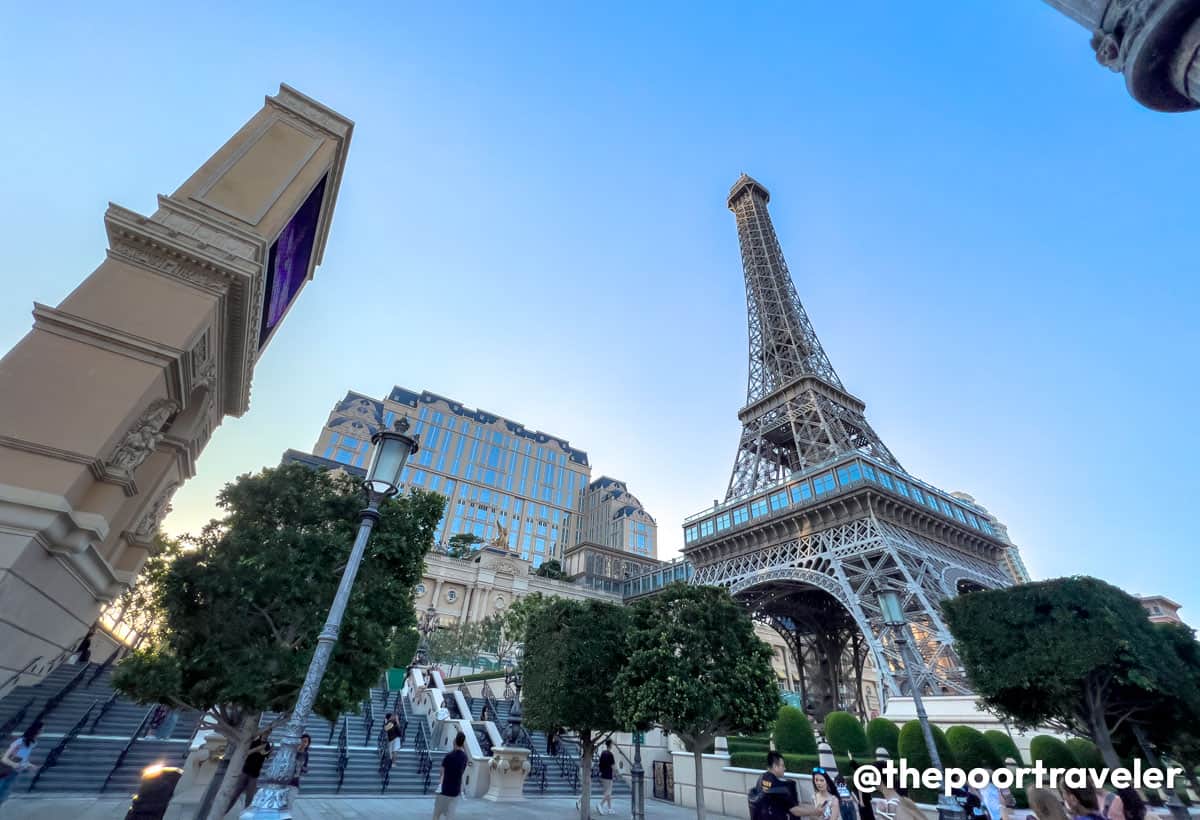
If visiting the Monsieur Eiffel in Paris isn’t feasible for now, well, there’s another Eiffel Tower in Macau. At roughly 160 meters tall, it’s just half the height of the real thing, but it’s still pretty captivating nonetheless, especially at night.
Every 15 minutes from 6:15 PM to midnight, every single night, the iconic landmark is covered in dazzling lights, creating an awesome show that bathes the surrounding area in various colors.
The tower has 2 observation decks: one on Level 37, which charges MOP 75 per person; and the other on Level 7, which is open to everyone FREE OF CHARGE.
As for us, we decided to just stay on the ground, admire it from afar, and snap countless photos with the vibrant structure as backdrop!
Eiffel Tower Light Show Every 15 minutes from 6:15PM – 12:00AM
8. The Londoner Macao
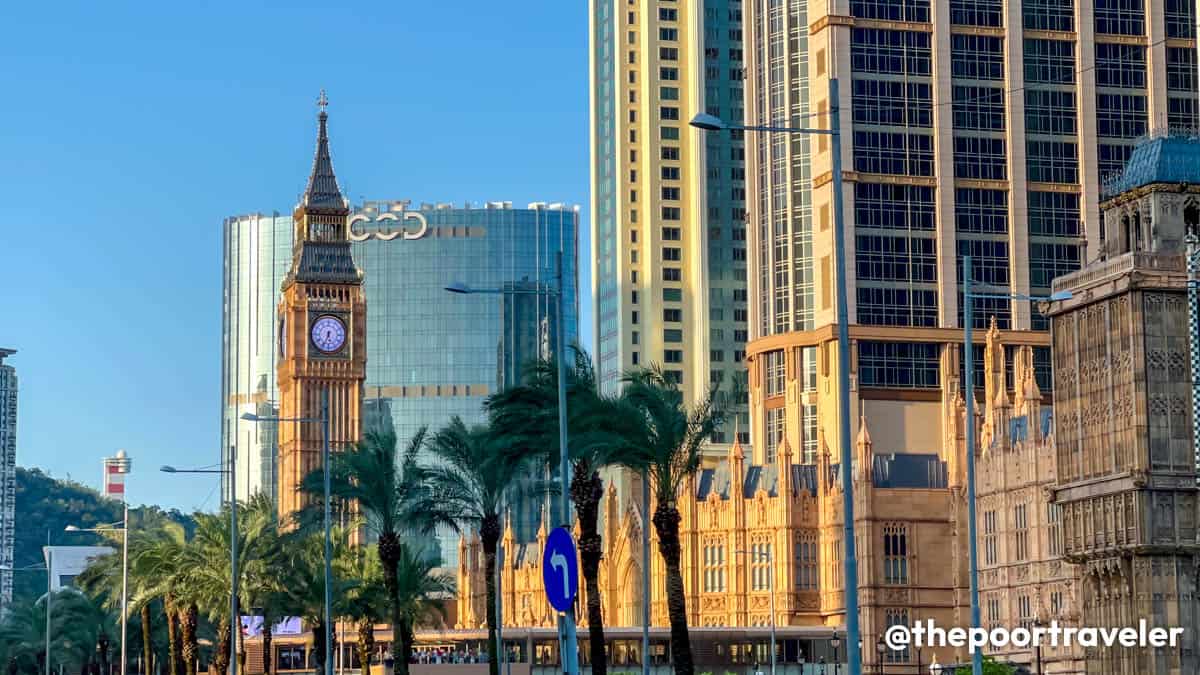
The first thing you’ll notice is its stunning façade, a lookalike of the Palace of Westminster and Houses of Parliament, and a replica of The Big Ben, trying to compete for attention with The Parisian’s Eiffel Tower just across the street. It chimes every hour, but it’s most spectacular at night!
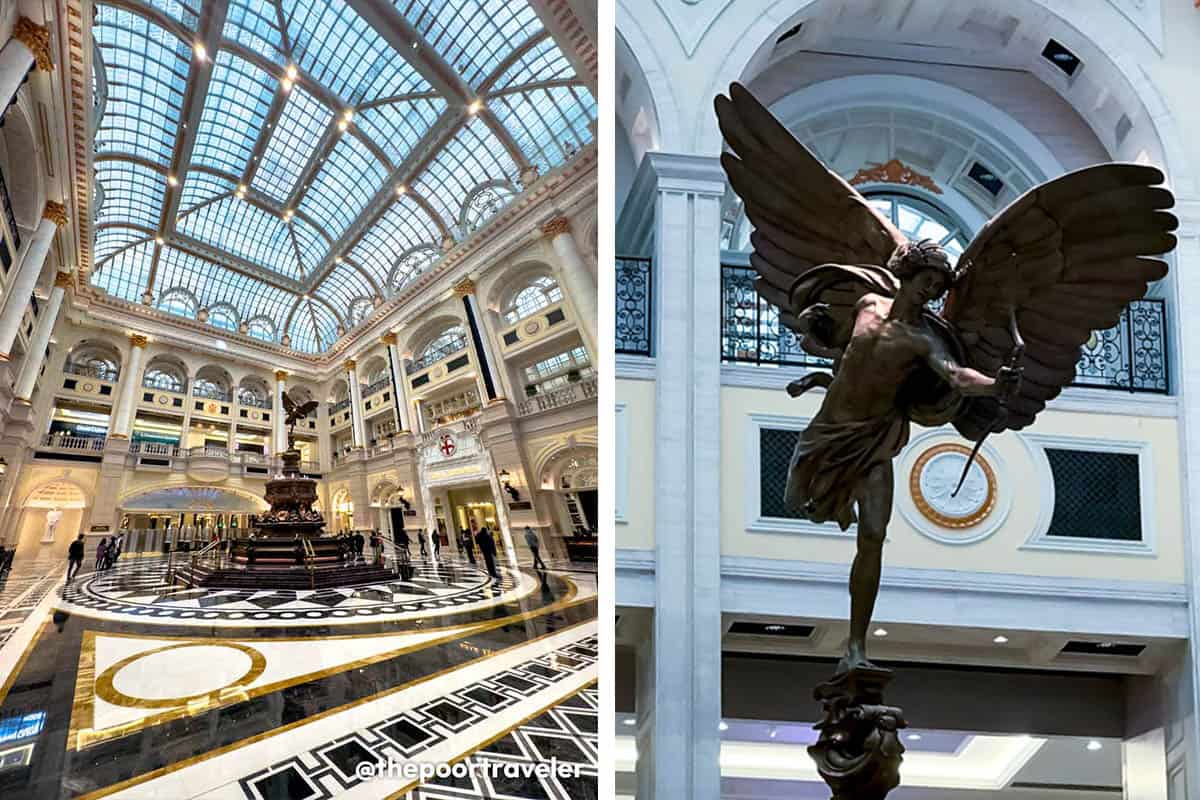
At the main lobby, you’ll find a replica of the Shaftesbury Memorial Fountain aka Eros Fountain. From here, you could get lost in mini-London and take unli-selfies at the many UK icons scattered around including this double-decker bus and a statue of Sir Winston Churchill greeting everyone at 10 Downing Street.
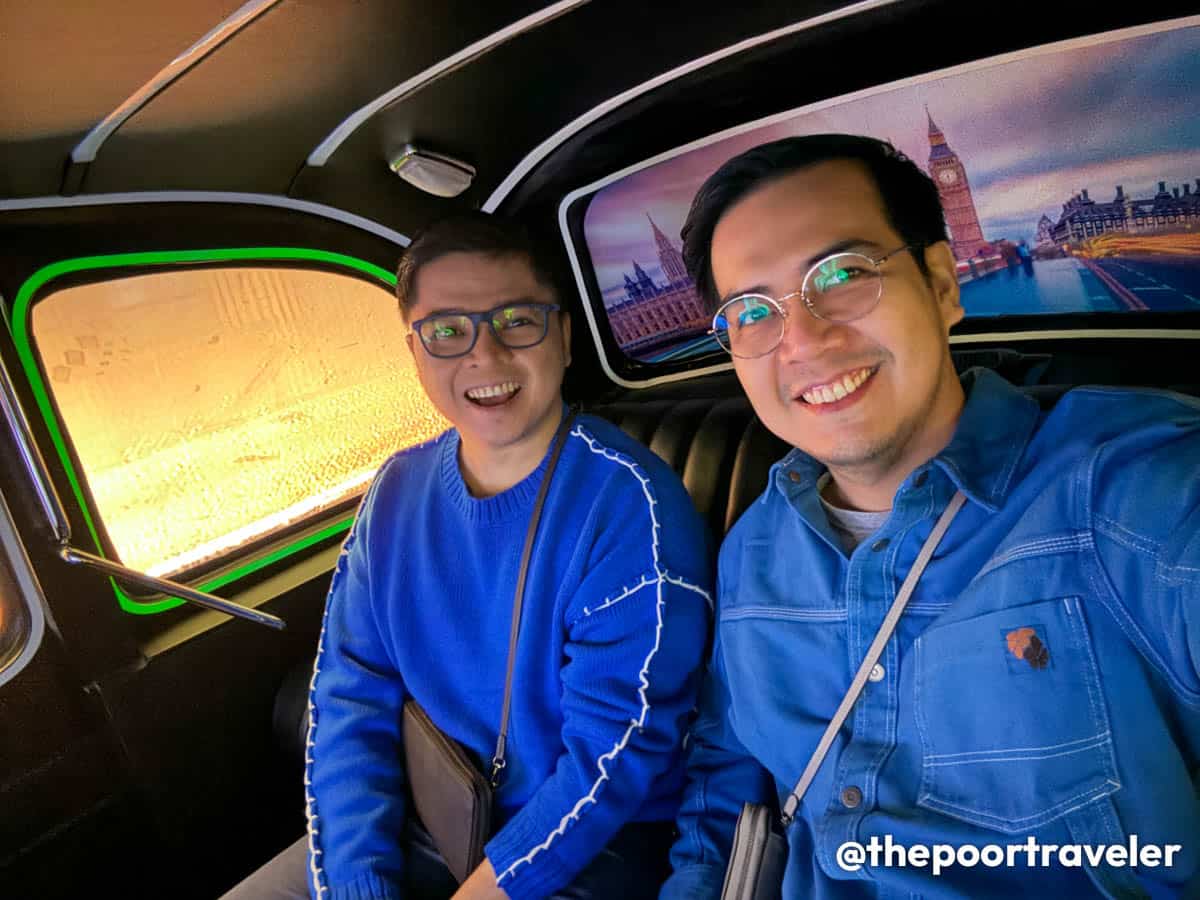
You can also hop into this taxi for what they call Black Cab Escape, where you’ll get to enjoy a virtual drive with David Beckham. All these can be accessed for FREE by the way.
Let’s head back to the peninsula to explore the quieter and less-visited spots of Macau!
9. Camoes Square
A fountain with a bronze sculpture symbolizing the centuries’ old friendship between Portugal and China.
The oldest park in Macau, the Camoes Square was named after legendary Portuguese poet Luis de Camoes. It is also the largest, covering an area of 20,000 square meters.
Three separate areas comprise the square:
Camoes Garden, where the poet composed many of his sonnets
Casa Garden, a parkette built in 1770 in front of the residence of Portuguese merchant Manuel Pereira and is now an art gallery
Protestant Cemetery, the final resting place of some prominent figures including Robert Morrison, the first Protestant missionary in China; and Anders Ljungstedt, Sweden’s first consul general in China.
Bust of Portuguese poet Luis de CamoesCasa Garden at Camoes SquareProtestant Cemetery
I remember how peaceful and quiet this park was. And I can totally imagine how this park inspired poets to write their best works.
10. Jardim Lou Lim Ioc
Another quiet spot in the city is the Jardim Lou Lim Ioc. We stumbled upon it by accident because it was close to our hotel at the time.
A stone walkway over a lotus-covered pond
Completed in 1906, Jardim de Lou Lim Ioc used to be a residential garden of Lou Kan, a local merchant, until it was donated to the Macau government. Today, it is a public park that has become a sanctuary for locals looking for some peace of mind. Victorian and traditional Chinese structures stand in between ponds that are carpeted by lotuses all over.
A pond at the garden and the entrance
One thing I noticed that time – again, this was years ago – there were no other tourists but us. Most people here were locals just passing the time or meeting friends or spending time with family. It was absolutely lovely. I hope it’s still this way.
11. Macau’s Free Museums
Macau harbors dozens of museums and most of them can be accessed for FREE! No entrance fee at all. For a complete list of these historic houses, check out this compilation and just look for those tagged with FREE ADMISSION.
Some of these museums include:
St. Dominic’s Church Museum – Treasure of Sacred Art
Maritime Museum
Fire Services Museum
Macao Museum of Art
General Ye Ting’s Former Residence
Jao Tsung-I Academy
Xian Xinghai Memorial Museum
The House of Macao Literature
Even the Macau Museum can be visited for FREE if your timing is right. Normally, it charges MOP 15, but on Tuesdays and every 15th of the month, entrance fee is waived. If your visit falls on either, lucky you!
The Macau Museum lodges significant artifacts narrating the history of Macau as a small settlement, as a Portuguese colony, and now as one of two Administrative Regions of China.
The fort now houses the Macau Museum
Its content isn’t the only thing worth admiring here. The location itself is of historical significance. The museum is set inside Mount Fortress (Fortaleza do Monte), Macau’s most important defense. Seated regally atop Mount Hill, the fortress affords gorgeous panoramic vistas of the city in all directions.
MACAU MUSEUM FREE on Tuesdays and every 15th of the month MOP 15 on other days
12. Macau Fisherman’s Wharf
A first of its kind, the Macau Fisherman’s Wharf is the only cultural-oriented theme park in the city. Covering an area of 111,500 square meters, it is divided into three sections: Dynasty Wharf, East Meets West, and Legend Wharf. It is a theme park, yes, but it is also a shopping and dining destination, perfect for families and barkadas.
13. Coloane Hiking Trails
While the Macau City and Taipa are becoming more and more urbanized, much of Coloane Island remains undeveloped. Thus, many publications call it the “lungs of Macau”, referring to its thick blanket of forests. This green oasis’s map is scribbled with a number of hiking trails, the most popular of which is known simply as Coloane Trail. It is also the longest trail, stretching for over 8 km at 100 meters above sea level on average, offering fantastic vistas of the surrounding areas.
Top Hotels in Macau
Studio City Macau, Celebrity King Vista Room
Here are some of the top hotels in Macau that are close to the attractions mentioned above.
Philippine Airlines offers direct flights from Manila to Macau! So if you haven’t booked a ticket yet, consider flying with PAL! One thing I love about PAL is the generous baggage allowance that automatically comes with each booking. For Macau flights, economy passengers can take advantage of:
25-kg check-in baggage
7-kg carry-on baggage
Another reason we prefer PAL is its four-star service and delicious inflight meals and unlimited drinks on board, which are already included in the booking.
We’ve all seen a camper going down the road, whether it’s
a big extravagant Class A motor home, a small tow behind pop up camper, to any
of the numerous variations in between.
But do you need one to take a long road trip?
The short answer is No.
You don’t need anything more than the car you drive everyday (provided
it has been maintained and can make the journey).
Is an SUV/ Car Road trip Possible?
We took our big Las Vegas road trip in a 1997 GMC Suburban. Including our faithful Dalmatian Tanker, there were only 4 of us, so the space was nice to have. For Tanker’s comfort, we opted to take the middle row of seats out and only utilize the back bench seat and the front driver and passenger seats. Our son had the back seat, and Tanker was crated middle of the truck. No RV required.
We made use of our tents and camping equipment when we
could, but for the most part we found ourselves in a Motel6 along the way to
our next stop. In all of our road
tripping adventures, we have never had a complaint with Motel6. Is it the Ritz? No.
But we weren’t looking for fancy; we were looking for a clean place that
was pet friendly that we could lay our heads down for the night. By not having a camper, we had to make sure
that we found a hotel or camp site each night, and we had to find food
everywhere we went (other than our snack bag).
Is an RV easier though?
An RV certainly has its benefits. When we took 11 days to go from NJ to TX, we rented a Class C motor home. You know the one’s that look like a van in the front. We had 7 people, 1 large dog, and 1 medium dog in there. Somehow we all fit, and all had beds. We didn’t have the expense of hotel stays every night. The RV provided the option of cooking with a real stove, and to eat food that we bought from the grocery store. We saved the hotel and food expense, in exchange for the cost of an RV rental. Additionally, everyone was fairly comfortable while driving down the road. You can’t lie in bed if you road trip in your car. By stocking the fridge, we didn’t have to make senseless stops because someone needed a drink, and we had a bathroom on board for the subsequent potty stops.
An RV is larger than a car, or even most SUV’s. They don’t fit as well when traversing the city streets. Most have a tow hitch, so you can tow your car; but then you need to park the RV for the day, disconnect your car, and reconnect everything when you are ready to get back on the road. This isn’t necessarily a disadvantage if you plan to spend a day or two at your stops. If you just like to drive to a target location, see what there is to see, and get back on the road, then disconnecting and reconnecting your car can turn into a hassle.
Our suggestion… Asses your budget, destinations, and accommodation expectations, and allow that to make the best decision for you.
Check out our list of Must Have Apps for road tripping!
If you live in Germany and own a classic or collectible car, the name Classic Remise won’t be unfamiliar to you. Whether you’re looking to buy, sell, maintain, or simply store your desirable or rare car, these facilities do it all.
For anyone who has a passion for cars, visiting Classic Remise is a great way to see a lot of interesting vehicles in a very casual setting. The facilities are open to the public, and they truly feel like museums more than anything else. Classic Remise has a location in Berlin – which Vladimir toured last year – along with Stuttgart, Frankfurt, Munich and Düsseldorf. Today, I want to take you on a tour around the latter.
The Classic Remise Düsseldorf facility is located in a restored locomotive roundhouse that is today under Germany’s monument protection, so it fits the theme of the preserved cars within very well. Illuminated by a translucent ceiling, the center hall is full of cars being offered up for sale by the on-site dealership.
Surrounding the hall are rows of cars displayed behind glass, many of which are privately owned. During my recent visit, the display was filled with a mix of newer sports cars, as well as classic icons, including two Aston Martin DB5s. As you’ll see while you scroll through this image gallery, there’s real diversity here.
The cars in the facility naturally change as business goes on, but the ones that are present at any given time feel like a cherry-picked showcase. And for those who are keen on rare specs and special models, you’ll always be pleasantly surprised by the curation.
Case in point, this Porsche 930 Turbo Flachbau that was for sale. Also known as a flat nose or slant nose,the option of pop-up headlights on the 930 was inspired by the 935 race car’s silhouette. The model came with a hefty price tag as the front-end modification was made off the production line, hence why original flat nose 930 Turbos are uncommon and a worth a lot more than ‘regular’ 930 Turbos.
The side intake was a feature only seen on the Flachbau 930 Turbo and the WLS or Werkstattleistungssteigerung (Works Performance Increase) 930 Turbo – the latter being an option pack that included a larger turbo, 5-speed manual gearbox, oil cooling, and special body panels.
Don’t fancy the Turbo model? Well, Classic Remise’s Porsche selection is pretty big, so you’ll surely find one that suits your needs. I saw everything from the original Ur-911 to legends like the 2.7 RS and 964 RS, as well as a couple of transaxle cars, such as the 928S.
Classic Remise Düsseldorf’s current supercar collection is also rather diverse. I never imagined seeing something as exotic as an Aston Martin Vanquish Zagato so casually.
There was no lack of Mercedes-Benz SLR McLarens either.
Need something that goes off road? Take a look at this Mercedes-AMG G63 4×4 Squared.
But what if supercars aren’t your cup of tea? Well, I found this JDM Honda City Turbo II sitting between a group of exotics. It seemed totally out of place at first glance, but it shows that anything goes inside the facility, as long as it’s unique and well maintained.
But by far the most interesting car for me was this black BMW M1. Based on a 1979 model, this was a project between C.A.R. – a Mannheim-based engineering company – and race driver Harald Erlt, supported by BP to promote liquid petroleum gas (LPG) as an alternate fuel. Known as the BP Autogas M1 or the BMW M1 Turbo, the car received two turbochargers to bump power up to 410hp, while its lightweight Kevlar-reinforced plastic body was designed for high speed runs. The car eventually achieved its engineering goals and broke the world record for the fastest LPG-powered car with a top speed of 301.4km/h.
After a troubled exchange of ownership in the 1980s, the BP Autogas M1 was last seen in 1993, before it finally surfaced again in 2019 as an abandoned car in a warehouse just outside of London.
The story continues with my visit to Classic Remise Düsseldorf, where the restored car sits today next to an original M1. I’d really love to have a chat with the people responsible for bringing this special BMW M1 back to its former glory.
I’d be lying if I didn’t say I was a little bemused when I saw this Daihatsu Materia on display. It turns out though, that this was the very last Daihatsu officially brought to Europe before the automaker closed up shop here in 2013. The car was signed by everyone who worked at Daihatsu’s European office and in its dealerships at the time of closure.
Tucked away in a corner of the facility was this original, one-of-28 Gemballa Avalanche, a staple of tuned ’80s supercars. The wide body with pronounced side intake looked pretty wild from a distance.
This is the 1967 Bayer K67, also known as ‘Kunststoffauto’ or ‘Plastic Car’. Designed by Hans Gugelot with engineering help from BMW and Bayer AG, the K67 was one of the earliest cars to feature an extensive use of plastic. The main structure uses glass fiber reinforced plastic (GFRP) sandwich construction, with the inner parts filled with foamed polyurethane. Out of the five examples that were ever built, only two survive today, including this one at Classic Remise Düsseldorf.
While many people choose to store their cars privately in their homes, I praise those who display them at facilities like Classic Remise Düsseldorf where everyone can enjoy them. If you’re ever in town – or near any of the other Classic Remise locations – I highly recommend you make time for a visit. You won’t be disappointed.
Steve Edward Instagram: stevedwrd
IAMTHESPEEDHUNTER related stories on Speedhunters
How To join the IATS program: We have always welcomed readers to contact us with examples of their work and believe that the best Speedhunter is always the person closest to the culture itself, right there on the street or local parking lot. If you think you have what it takes and would like to share your work with us then you should apply to become part of the IAMTHESPEEDHUNTER program. Read how to get involved here.
Contrary to the allegations made by the TSA, the same federal agency also claimed that the rogue passenger was somehow checked before the flight left the gate. The federal agency sent a statement to USA Today, reading:
“TSA is reviewing the circumstances of this matter, but can confirm that the traveler in question was physically screened, along with their carry-on items, without incident at the Nashville International Airport security checkpoint on February 7th before boarding the flight. TSA and its airline partners are cooperating with the ongoing law enforcement investigation.”
This isn’t even the first time in recent months that someone has circumvented airport security. In late December, a British man used the pandemonium of the holiday travel season to sneak through London Heathrow Airport security. He used other travelers as cover and got on to a British Airways flight to John F. Kennedy Airport in New York without a passport or boarding pass. The stowaway was eventually caught at customs in the United States.
There’s clearly a need for airport security because screening keep finding loaded guns in carry-on luggage. However, the system is reaching a point of massively diminishing returns. What is the point of having full-body scanners and facial recognition kiosks if someone can simply walk around it? Is all this expensive cutting-edge technology even the biggest deterrent to potential threat? I don’t think so.
The 2008 financial crisis marked a decisive turning point in the Chinese economy — adverse effects of which are still being felt today. Fearing a contagion that would affect their banking system and the detrimental consequences of a decline in exports due to the slowdown in global demand, Chinese officials believed—following the path laid out by the United States—that only intensive monetary creation would cushion the shocks. Chinese banks were therefore strongly encouraged by the state to lend, primarily for the construction of infrastructure that the country did not really need.
A view of the Tianducheng development in Hangzhou (Image courtesy of REUTERS/Aly Song)
The enthusiasm was indeed unprecedented, and enormous sums were dedicated to building several “Little Manhattans,” and “Little Hong Kongs,” a replica of the Red Square, a mini Paris, and other similarly frivolous and costly projects. Chinese investors, both private and institutional, as well as smaller savers, were literally pushed into the arms of intense real estate speculation, leading the country’s banks to commit to mass loans in just five years, equivalent to the loans accumulated by the entire United States banking system. This sudden enrichment, however, was fundamentally useless for the economy because wages—especially those of the most modest—stagnated and did not keep pace with this acceleration of prosperity, which we now know was artificial.
The Chinese stock market at a stock exchange hall in 2015 in Fuyang, China. Image courtesy of China Foto Press & Getty Images
The levels of indebtedness in the Chinese financial system gained attention globally, as 70 percent of the assets and portfolios of banks in the nation consisted of real estate. A harsh reality: a mere 5 percent decrease in this market would result in a loss of nearly USD 3 trillion, according to Bloomberg. The malaise is now widespread in China, and it is the result of a series of governance errors, exacerbated by a particular focus on security and technology.
A factory employee works on engines in Qingzhou, China (Image courtesy of Photo by AFP & China OUT)
It is of course crucial and very commendable for the ruling elites to have clearly favoured the production of electric vehicles, industrial machinery, ships, semiconductors, and so on. However, nothing has been done to stimulate household consumption, except for the false sense of wealth conferred by past real estate appreciations, which were nothing but smoke and mirrors. It is therefore a policy of excessive supply—almost caricatural—that was demanded of all actors at the expense of aggregate demand, which is condemned to remain chronically low for years to come.
Visitors at Shanghai’s Yu Garden during the 2024 Lunar New Year holiday (Image courtesy of Reuters)
China is now taking us by the hand towards deflation. Knowing that, on the other hand, its industry, both cutting-edge and highly competitive in terms of prices, will inevitably trigger protectionist reflexes around the world. The malevolent 3 Ds—Debt, Demand, and Demography—are not done wreaking havoc in China, where the Year of the Dragon may rhyme with stagnation.
Buenos Aires is an incredible city to visit in Argentina. Nestled on the eastern fringes of the country, it’s a city that’s got a little something for every type of traveller. There is so much to see and do. That being said, it can be hard to whittle down a list of the best things to do in Buenos Aires, especially if you’re in the city for a few days.
Over the years, we’ve visited Buenos Aires many times and absolutely love it. We first visited alongside our wider trip to Antarctica, Patagonia and Mendoza; all of which we loved.
In lots of ways, Buenos Aires is a gateway for many of us visiting Argentina and beyond. Though, don;’t be fooled into thinking that’s all Buenos Aires offers. The city is a destination in itself.
So, to help you get the most out of your time in the city, I’m sharing the top places in Buenos Aires that I really think you shouldn’t miss. Oh, and pop us a message anytime if you need any advice – we love Argentia so much.
1.) San Telmo Market
San Telmo Market is one area in Buenos Aires we didn’t visit on our first trip to the city. That in itself was a mistake. Thankfully, we remedied this on our most recent trip and loved it.
Open every day, San Telmo Market is a hive of activity and a place you really should visit hungry. You see, once inside, you’ll get to wander around the vast amount of stalls, eateries and kerbside takeaways that are all so delicious. Honestly, you can buy any and every type of food inside San Telmo Market.
We loved Beba Cocina for its delicious empanadas and Argentinian steaks. Like most places within San Telmo Market, it’s unfussy and packed full of people and a bustling atmosphere.
Just a heads up, on a hot summer day, it can get quite warm inside. Humitidy, hundreds of stalls cooking and thousands of people are a combination that will induce buckets of sweat.
Also, to make things nice and easy to get around, book this hop-on-hop-off bus ticket for Buenos Aires. This way, you can avoid all the stress of getting to the main sights and focus on making the most out of your time in the city.
Traditionally a working-class area of Buenos Aires, the colourful neighbourhood of La Boca is well worth a visit. In fact, I’d say it’s one of the best things to do in Buenos Aires if you’re wanting to explore the city’s unique neighbourhoods.
Nowadays, La Boca is a hive of activity and attracts visitors from all over the world. This means you should expect some crowds, especially on the weekends.
Once here, make sure to wander the colourful streets around Caminito and stop by some of the stalls and outdoor foodie spots for a bite to eat.
Make sure to stop by El Gran Paraiso for one of their Choripán. It’s a delicious asado sandwich that’s filled with flame-grilled sausage and served on freshly baked bread. These are typically crusty rolls and they’re so good.
Probably one of the world’s most famous bookshops, El Ateneo Grand Splendid is pretty amazing to visit. You see, not only do they have mountains of books (most are in Spanish) but it’s also housed in a historic theatre that’s just so impressive to see.
Take a wander around El Ateneo Grand Splendid, explore the different levels and hop onto the stage for a coffee. It’s so unique.
Afterwards, head down to El Cuartito for some of their iconic pizza. You see, Italian immigrants to Argentina brought lots of flavours from home, and El Cuartito serves some of the best. Make sure to try their Fugazzetta (onion and cheese stuffed pizza. Just be prepared for crowds; this place is always busy.
4.) National Congress building
As you walk around Buenos Aires, be sure to stop by Plaza del Congreso. It’s one of the best things to do in Buenos Aires if you want to explore some of Argentina’s history. You see, at this plaza, you have the National Congress Building that offers free tours that are pretty impressive to see.
Not only that, you’ll get to see Palácio Barolo where you can join another tour (with a small fee) which will take you all through the palace. Not only that but during some evening tours, you’ll be able to scale the lighthouse and see the lights shine over Buenos Aires.
If you’re short on time, book this 3-hour small group tour of Buenos Aires. It’s an incredible way to maximise your time in Buenos Aires and the guide is so much fun.
5.) Plaza de Mayo (Casa Rosada)
Carrying on down Avenue De Mayo (from Plaza del Congreso) you’ll reach Plaza de Mayo and Casa Rosada. The latter is a vast pastel pink house that was once the customs house for Buenos Aires. It’s lovely to see and there’s heaps to do around this area, too.
Once here, make sure to visit the Museo del Bicentenario which is a history museum that showcases the long history of modern-day Argentina.
Also, don’t forget to pop into Buenos Aires Metropolitan Cathedral that’s on the plaza, too. This was the former seat of Pope Francis and has a history that dates back centuries. Honestly, from the outside, the cathedral doesn’t look too impressive; but the inside is just beautiful and well worth a wander around.
6.) La Floralis Genérica
One great thing about Buenos Aires is that it has loads of green spaces that are so lovely for a stroll. Nestled in the Recoleta area of the city, La Floralis Genérica is one stunning sculpture you can’t miss.
You see, this huge flower was gifted to Buenos Aires by Eduardo Catalano and is so impressive to see. Now, what makes La Floralis Genérica special is that it moves depending on the time of day you visit. The huge petals open and close depending on weather conditions and ‘sleep’ at night when the flower closes.
It’s one of the best things to do in Buenos Aires if you’re looking for a relaxing stroll and easily partnered with a trip to nearby the National Museum of Bellas Artes. Though, a heads up, the National Museum of Bellas Artes is huge and it’s well worth giving yourself at least 2 hours to stroll through.
7.) Casa Mínima
Often missed by lots of visitors to Buenos Aires, Casa Mínima is a tiny little home whose width is only a few metres. Well, 2.5 to be exact.
Built back in the 1800s. Casa Mínima is Buenos Aires’ narrowest house. Although small, this type of house was commonplace in Buenos Aires a few centuries ago.
You see, they were often given to freed, enslaved people, by their former masters. These houses typically were attached to the sides of their former master’s homes, with Casa Mínima being the only one left in all of Buenos Aires.
Once here, head inside and learn more about the awful history of slavery and how small houses like this once covered Buenos Aires. After all, I always feel we must understand and continue to learn about the horrors of the past, so we don’t make the same mistakes in the future.
Now, it’s not often I say to visit a cemetery when visiting a new city; but Recoleta Cemetry is well worth a visit. You see, this cemetery is the final resting place of many iconic figures in history.
Once here, take a wander around the mausoleums and see the Tomb Of Eva Perón. To make things easier, this point is the exact place of her tomb on Google Maps.
Afterwards, you can see the mausoleums of Domingo Faustino Sarmiento, Bartolomé Mitre and so many more. A visit takes around 20 minutes and is easily included when you’re already strolling around Recoleta.
Getting peckish? Head on over (by taxi or Uber) to ) Pizzería Güerrin. It’s one of the best things to do in Buenos Aires if you want to try some authentic Argentinian pizza. Trust me, it’s a thing and it’s so delicious. Just be aware, that Pizzería Güerrin is always busy.
You’ll love every bite, as long as you’re prepared for crowds and its unfussy atmosphere at lunchtime.
9.) Colon Theatre (Plaza Lavalle)
Now, even if you’re not into opera or ballet, you need to visit the Colon Theatre. Nestled on the edges of Plaza Lavalle, it’s one of South America’s most iconic theatres.
Of course, you can book tickets to an opera (tickets range from around £5-100) but they do fill up fast. Alternatively, as we did, we joined an English language tour of Colon Theatre that lasted around 45 minutes.
Just be sure to book your tickets on their website before arriving (at least a day before) to get the best times.
Once inside, you’ll get to explore the grand hallways, visit the theatre itself and learn more about the history of this impressive building. Just make sure to keep your eyes peeled for the ‘widows seats’ that are hidden away behind metal grids. During mourning (after a death), widows were not allowed to be seen in public and had to be hidden from view for up to 2 years. Thankfully, all that’s changed but you can see these areas within the theatre itself.
We loved our visit and it’s easily one of the best things to do in Buenos Aires when visiting Plaza Lavalle.
If you’re looking for a chilled-out day in the Palermo district of Buenos Aires, then head over to Parque Tres de Febrero. It’s one of the best public parks in Buenos Aires and so lovely on a sunny day in the city.
Once here, take a stroll around the lake, and the vast rose garden and visit the Japanese Garden that’s just off Germany Square. The latter is a gifted park from Germany and well worth visiting.
11.) Don Julio
Regularly touted and awarded as one of the best places for steak in the world, Don Julio is something of an institution; and not just in Buenos Aires. You see, Don Julio is known the world over for its delicious steaks and is well worth visiting for lunch or dinner when in Buenos Aires.
Now, getting a reservation can be tough and we’ve heard stories of people waiting up to four hours for a table. Thankfully, this didn’t happen to us and I’ll tell you how we managed that.
If you’re going for dinner, start queuing at 5:20-5:30 pm at the latest. This way, you’ll be at the front of the queue to get your name on the ‘Waiting List’. We were about 40th in the queue, which started moving around 5:45 pm. Once we got to the front, we were given a time of 20:45 for dinner and just had to show up at that time. We left, went back to the hotel and got ready for dinner. In all, I think we queued for 20 minutes.
However, always be prepared for a long queue. Thankfully, Don Julio is aware of how bad their queues can be; so they give out free sparkling wines and freshly-baked empanadas whilst you wait.
It really is one of the best things to do in Buenos Aires, especially when looking for a world-renowned steak.
Tango is something of an institution in Argentina, and one experience you don’t want to miss when visiting Buenos Aires.
Now, there are a few options for Tango Shows or Tango Halls, where locals and visitors go to dance. We’ve done both and loved each of them; for very different reasons.
Now, there are a few options when booking a Tango Show in Buenos Aires and it can all be a little confusing. This is especially true when you’re trying to find the best one!
We chose Almacen, which is housed in a centuries-old building in the heart of Buenos Aires. We loved it as it’s much smaller and cosier than the big-hitting style shows and a little less glossy (if that makes sense). It felt very authentic and the dancers were just so talented. Plus, the whole team are so friendly.
Now, you can book dinner and a show at Almacen if you want. We tried the food, and although it was good, I wouldn’t rush back for the restaurant element. So, save yourself a little time and book the show ticket itself. It’s just so incredible and in a historic, cosy hall.
If you want to visit a traditional tango hall, then book this tour where you can attend a local milongas with an actual Tango guide. These typically aren’t flashy or glitzy but so authentic and lovely. We spent about 3 hours in the traditional milongas and all the locals were so friendly. We had so much fun.
13.) National Museum of Fine Arts
The National Museum of Fine Arts is an incredible place to visit. In fact, I’d go as far as saying that it’s one of the best things to do in Buenos Aires if you love art history. You see, is a treasure trove of exhibitions from some of the world’s most prestigious artists.
Once inside, you’ll get to see works from the likes of Goya, Van Gogh, Chagall and so many more. It’s incredible and you can easily spend 3 hours inside without even seeing everything.
Not only that, you can easily explore the museum after visiting Recoleta Cemetery. After all, it’s only about a 10-minute stroll away.
Hungry? Hop in an Uber or taxi and visit La Cocina which makes some of the tastiest (and fresh-to-order) empanadas in all of Buenos Aires.
Now, a heads up, this place is tiny and unfussy but it’s so worth visiting for a bite around lunchtime. Oh, and don’t forget to try their locro soup. It’s so good.
15.) Basilica of the Blessed Sacrament
Built at the start of the 1900s, the Basilica of the Blessed Sacrament is a stunning church to see whilst in Buenos Aires. Not only is the church beautiful to see, but it’s also just off Plaza General San Martín where you can see the Monument to the Fallen in Malvinas and the huge Clock Tower that was gifted by Britain back in 1916.
After working up an appetite, hop in a cab and visit Café Tortoni that’s about 9 minutes away. This is one of Buenos Aires’s most famous cafes and has been around since the 1800s. Over the years, it’s had presidents, actors and other iconic folk visit for a coffee or medialunas. They even have live music or tango performances on certain days. Though, a heads up, we had to queue for about 45 minutes to get a table; it’s always busy.
16.) Tigre Municipal Museum of Fine Art (Tigre Club)
Attentively, if you want to explore more of the city’s stunning buildings and institutions, then head over to the Tigre Municipal Museum of Fine Art (MAT). Here, you’ll get to explore the incredible exhibitions and also take a wander around the stunning building that is the Tigre Club which is beautiful.
Now, the Tigre Club is a little away from the downtown area of Buenos Aires (about 45 minutes in a cab), but it’s well worth visiting for an afternoon trip. It really is one of the best things to do in Buenos Aires.
What is transhumanism? Transhumanism in its essence is advocating the use of sophisticated technologies and artificial intelligence to enhance the human condition (and cognition) in the form of enhancing abilities and overcoming biological constraints. Transhumanism often gets a negative depiction in media and is sometimes pigeonholed as being a post-apocalyptic, post-human “nightmare”. This is what contemporary artist Joanna Grochowska tries to unpick in her latest exhibition with its motto: “What Future Do We Want? What Must We Do To Get There?”, which is a quote from Klaus Schwab’s “The Great Narrative: For a Better Future”. The exhibition is the continuation of her previous project dubbed “Opening the Future” that was presented in Munich in 2021.
Joanna Grochowska’s “The New World” (2022)
Read More: Art and Transhumanism: Humanity as a Project in the work of Joanna Grochowska
In 2020 LUXUO covered the work of Joanna Grochowska highlighting how she utilised the concept of “a Doll of Hans Bellmer” to depict eroticism, pain, and power in a posthuman modified body. This is what we see today, subversive imagery represented by unclothed human bodies. Her haute photography depicts eroticism, pain and power across faceless figures in lifeless poses without sexual organs and identifiable features.
Joanna Grochowska’s “Portrait” (2020)
Her 2024 showcase similarly explores transhumanism and human enhancement technologies as part of an ongoing dialogue about how the future will view morphological freedom. Using the notions of “transgression” and “singularity” as the conceptual basis of her art with transhuman and posthuman figurativeness being dominant themes, Joanna highlights the progression of technological evolution with the emergence of new paradigms in gender, body, and identity.
Joanna Grochowska’s “Buried II” (2024)
Author Natasha Vita-More writes that the philosophy of transhumanism deals with the fundamental nature of reality, knowledge, and existence. She states “as a worldview, it offers a cultural ecology for understanding the human integration with technology. As a scientific study, it provides the techniques for observing how technology is shaping society and the practice for investigating ethical outcomes.” She goes on to delve into how a social narrative emerges from humans overcoming odds and the continued desire to build a world worth living in. The processes that come out of it require critical thinking and visionary accounts to assess how technology is altering human nature and what it means to be human in an uncertain world.
Joanna Grochowska’s “Transfiguration” (2023)
German philosopher Stefan Lorenz Sorgner debunks widespread myths about transhumanism stating “transhumanism is widely misunderstood because the media has exaggerated current technologies and branded the movement as dangerous, leading many to believe that hybrid humans may soon walk among us and that immortality, achieved by means of mind-uploading, is imminent”.
Joanna Grochowska’s Slash Adornment (2020)
There is an element of the grotesque in the work of Joanna Grochowska but done purposefully and artfully. Grotesque in itself is a visual art genre that arguably started with the Romans but achieved notoriety in the 18th-century Renaissance era so it is interesting to see how Grochowska reinterprets his genre to include a futuristic take. Paying special attention to gender fluidity, many of Grochowska’s work delineate the body after a sex reassignment surgery. Her work of merging human and technology to denote hybrid forms is not simply an artful absurdity. Purposefully incongruous, distorted, and slightly disturbing imagery is intended to make the viewer stop, think, and question perceptions of pleasure, pain and beauty.
Joanna Grochowska’s Transhumanism exhibition will take place from 18 February to 17 March 2024 at the Galerie Verbeeck – Van Dyck in Antwerp, Belgium.
Head to Joanna Grochowska’s website and or check out her Instagram account @facelesshumanforms for more information.
For more on the latest in art reads from around the world, click here.
The technical storage or access is strictly necessary for the legitimate purpose of enabling the use of a specific service explicitly requested by the subscriber or user, or for the sole purpose of carrying out the transmission of a communication over an electronic communications network.
Preferences
The technical storage or access is necessary for the legitimate purpose of storing preferences that are not requested by the subscriber or user.
Statistics
The technical storage or access that is used exclusively for statistical purposes.The technical storage or access that is used exclusively for anonymous statistical purposes. Without a subpoena, voluntary compliance on the part of your Internet Service Provider, or additional records from a third party, information stored or retrieved for this purpose alone cannot usually be used to identify you.
Marketing
The technical storage or access is required to create user profiles to send advertising, or to track the user on a website or across several websites for similar marketing purposes.