The works ministry has announced that the Malaysian government is offering toll-free travel for Class 1 vehicles (private vehicles) on highways on February 8 and 9, 2024 in conjunction with the Chinese New Year that falls on February 10 this year.
The toll exemption will be from 12:01am on Thursday, February 8 until 11:59pm on Friday, February 9, according to the statement from the works ministry. This is estimated to have a financial implication of RM42.99 million, the ministry said.
Offered to Class 1 vehicles, which are private vehicles, the toll fare exemption will apply to all toll plazas in the country except those at national borders, namely Tol Bangunan Sultan Iskandar (BSI) and Plaza Tol Tanjung Kupang in Johor.
To make the most of toll-free travel, highway users are advised to plan one’s travels and take heed of the travel time advisories (TTAs) that will be released, as well as to be sufficiently rested and to have enough credit balance in one’s Touch ‘n Go cards and eWallets.
Anna Costamagna is an Italian Interior Design Manager working at Peugeot and Advanced Design Manager for Stellantis. While her mother worked as an assistant to Sergio Pininfarina, she was initially drawn to fashion design before venturing down the path in automotive. She began her career at Bertone in Caprie, a suburb of her native Turin, after studying engineering and management at the acclaimed Politecnico di Torino. Costamagna then moved to Paris, France, to bring Peugeot production cars to fruition. Despite not speaking a word of French, then design director Gérard Welter hired her on the spot.
Over her career, Costamagna has worked with a number of companies to develop future-looking concepts as well as groundbreaking interior proposals, including the Peugeot i-Cockpit, which made its debut on the 2010 SR1 concept and the production 208 two years later. In this episode of FORMCAST, Form Trends editor Eric Gallina spoke with Costamagna about her career path, interface and advanced design, diversity in the workplace and the role of the designer and manager in the corporate environment.
LISTEN
SHOW NOTES 01:00 – Background and Starting Out 04:00 – Joining Bertone 05:25 – Design Management 07:20 – Projects and Concepts at Bertone 09:45 – Moving to Peugeot 12:00 – The Language Barrier 13:15 – Peugeot projects 14:00 – i-Cockpit and Peugeot Design Vision 15:47 – Ergonomic Priorities 16:40 – The Role of the Screen 18:25 – The New 308 19:00 – User Interface – Buttons and Screens 20:50 – User Experience 21:45 – Architectural influence 23:40 – Transitional Phase 24:00 – Natural Interface 26:00 – Management Style 27:00 – Problem Solving and Anticipating Problems 28:00 – Managing People and the Gender Gap 29:40 – Diversity in the Workplace 33:00 – The Studio Imbalance 34:30 – Cancel Gender Friction 36:00 – People Creating for People 38:30 – Overcoming Challenges 41:00 – Managing Expectations 42:00 – Future Skills of the Designer 44:00 – Shifting Objectives 46:30 – Personal Life and Hobbies
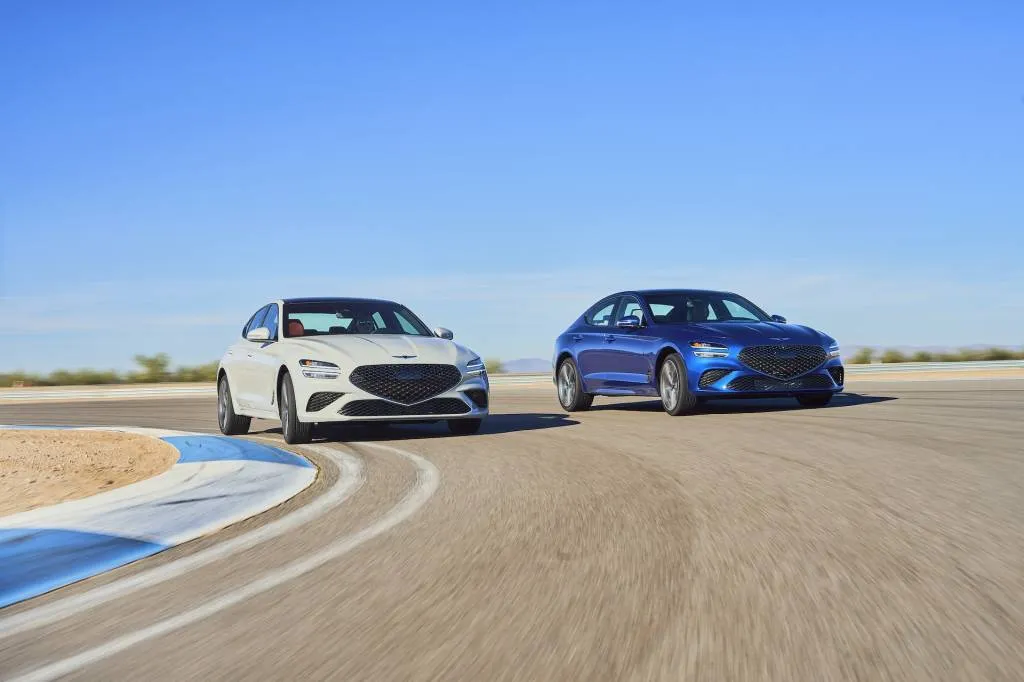
An autocross course at the first-drive event for the revised 2024 Genesis G70 highlights the Korean sport sedan’s dynamic strengths and weaknesses. Newly standard Brembo brakes (13.8-inch front rotors with 4-piston calipers and 13.4-inch rear rotors with 2-piston calipers) provide strong stopping power to get the car lined up for each turn, and it becomes quickly apparent that the new 2.5-liter turbo-4 is much stronger than the 2.0-liter turbo-4 it replaces.
The car is athletic and fun to whip around this tight course, but standard Michelin Primacy all-season tires and the lack of a limited-slip differential make it hard to put the power down exiting the many tight turns. Then, when it hooks up on corner exit, it has a tendency to understeer that spurs me to either back off or wait to apply the gas until after the apex. Summer performance tires would be better here, but they’re only available with the top engine.
2024 Genesis G70
2024 Genesis G70
2024 Genesis G70
The biggest gains for 2024 come in the 2.5T base models. They swap a 252-hp 2.0-liter turbo-4 for a 2.5-liter turbo-4 that makes 300 hp and 311 lb-ft of torque. With an extra 48 hp and 51 lb-ft on tap, it’s a much stronger engine that’s more ready and willing across the rev band. It helps this car leap from corner to corner on the autocross, and an earlier street drive showed that it makes highway passing a breeze. It’s a fairly smooth engine, too, and it unlocks a 0-60 mph sprint as low as 5.5 seconds, according to Genesis. That’s only possible with a launch control function that Genesis is reluctant to disclose. I think it involves going to the Sport+ mode and shutting off the stability control, but the power is strong enough that I never bother to try it. Without launch control, expect a 0-60 mph time around 6.0 seconds.
The turbo-4, as well as the available twin-turbo 3.3-liter V-6, is backed by an 8-speed automatic transmission. It shifts smoothly, and it gets more responsive by mode. The G70 has Eco, Comfort, Sport, Sport+, and Custom modes. Any mode works on the street, though Sport+ can make the powertrain feel a little too highly strung. On this autocross, however, Sport+ is essential for the laps I run when not using the steering wheel shift paddles. It holds lower gears longer and downshifts quicker to access more power. On a 24-second autocross, switching from Sport+ to Sport mode costs me 0.7-1.0 second.
2024 Genesis G70
2024 Genesis G70
2024 Genesis G70
Genesis G70 track drive
The autocross is held in the parking lot at Apex Motor Club in Maricopa, Arizona, and a second, more-intense exercise is six laps around the track’s 2.27-mile road course in a rear-drive version of the top 3.3T Sport Prestige model. It’s powered by a carryover twin-turbocharged 3.3-liter V-6 that ups the output to 365 hp and 376 lb-ft, which unlocks a 4.5-second 0-60 mph time.
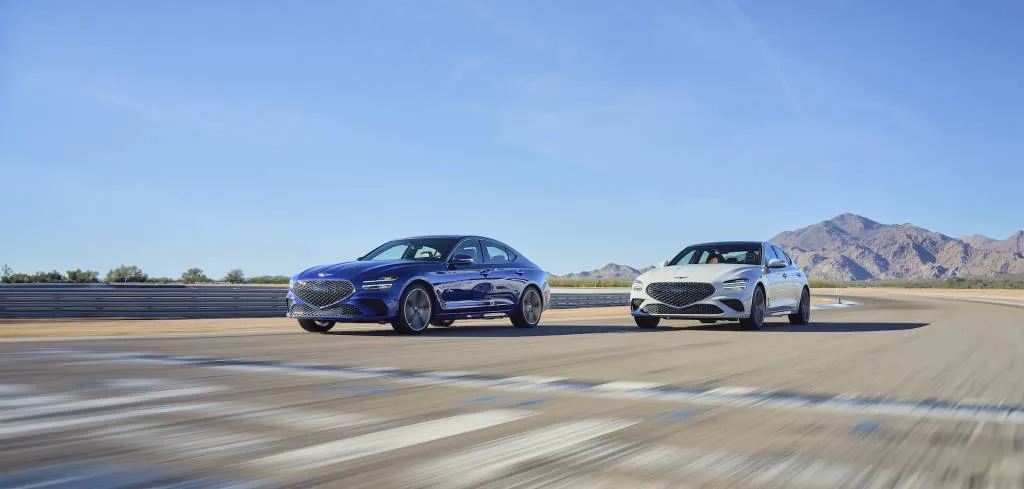
During my first three-lap session, I soon find myself falling behind British Touring Car racer Howard Fuller in an identical G70. The good news from my standpoint is the three other journalists behind me are falling farther behind. Part of the reason is certainly that Fuller’s a better driver than we are. He’s a pro, after all, and I’m a wanna-be hot shoe who’s better with words than lap times.
But the other reason is I’m just not as comfortable carrying speed through the long, sweeping corners of this track as I would be in, say, a BMW 3-Series. This car’s Michelin Pilot Sport 4 summer performance tires provide good, but not great grip, so it’s easy to slide the car when driving near the limit in tight turns. The handling is generally neutral mid-corner, but rather than hunkering down and taking a set, the G70 tends to push to the outside of corners when I’m digging into the V-6’s full 365 horsepower. This model’s standard limited-slip rear differential helps the G70 hook up, but that makes the car squat at the rear and lift at the front, and thus the understeer. This despite the fact that the 3.3T Sport Prestige model comes with adjustable dampers that are in their stiffest setting.
I grow more confident in the car’s handling during my second run, and find it easier to control on corner exit by simply going easier on the throttle. The new Brembo brakes also impress with strong stopping power and no fade, though Genesis did opt for no-metal pads to handle the rigors of track driving. That’s a small price to pay for viable track performance.
The at-the-limit understeer isn’t really a bad thing, as driving on a racetrack is an edge-case scenario that few, if any, G70 buyers will experience. The G70 is a sport sedan, and while it wasn’t built as a track car it’s still quick and fun on the track or the street; it just lacks the at-the-limit poise of the best in the class.
2024 Genesis G70
2024 Genesis G70
2024 Genesis G70
Genesis G70: Elegance comes standard
A pair of street drives also show the G70’s luxury sport sedan credentials. It’s generally quiet, but both the Primacy and Pilot Sport 4 tires emit notable thrum on the often coarsely paved Arizona roads. The steering has good heft and communicates well with what’s going on with the tires. The low-profile tires and sporty suspension tuning give the car a ride that may be too firm for some buyers, especially those in the Midwest who drive regularly on pockmarked roads.
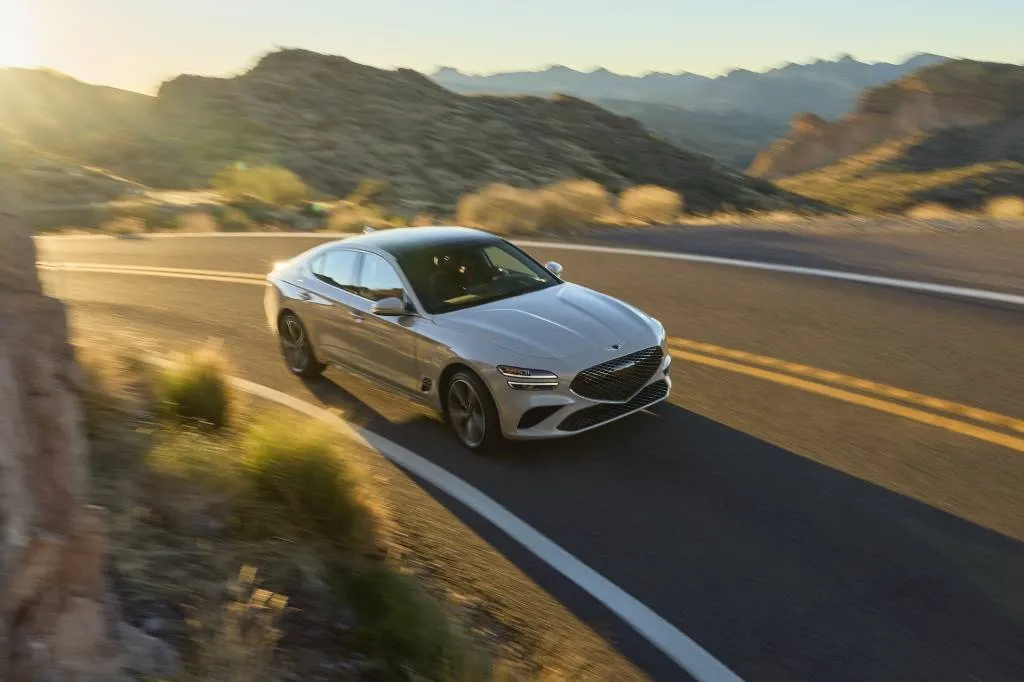
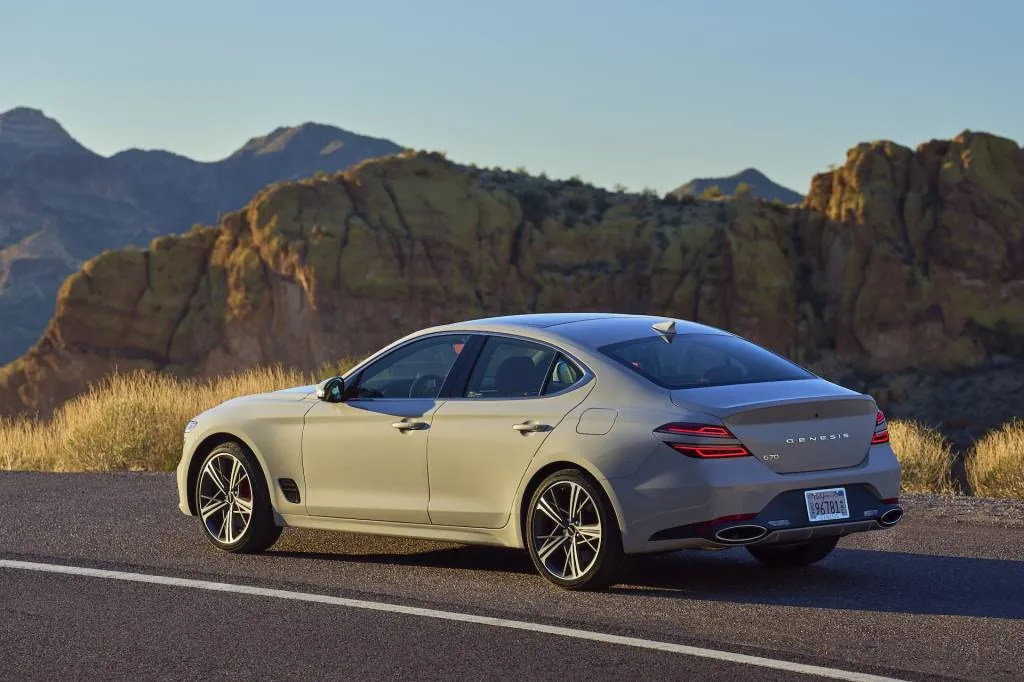
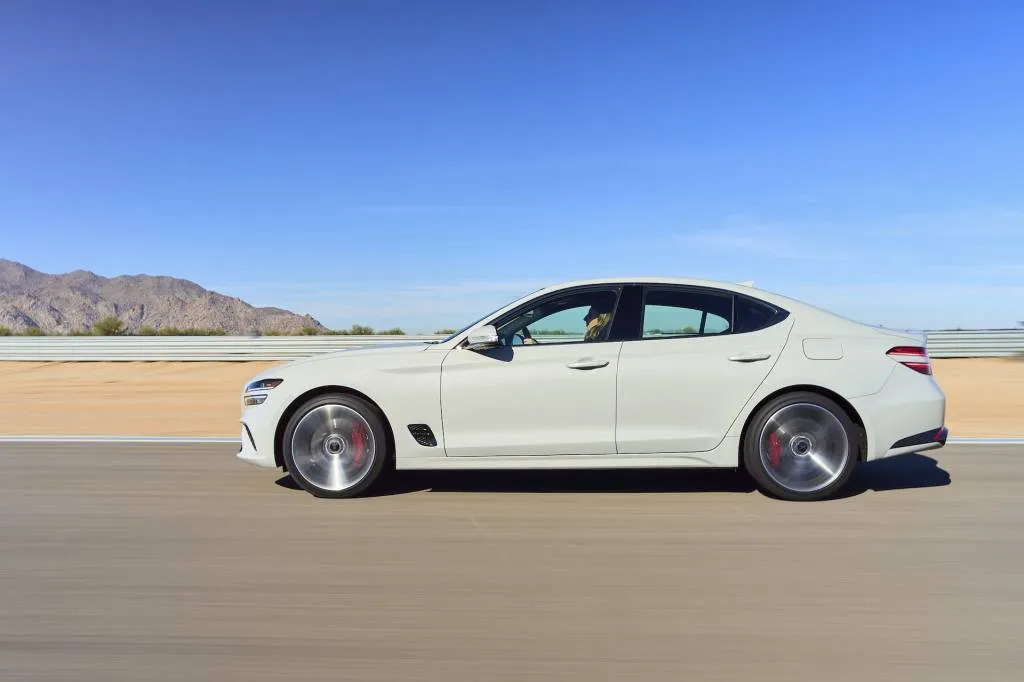
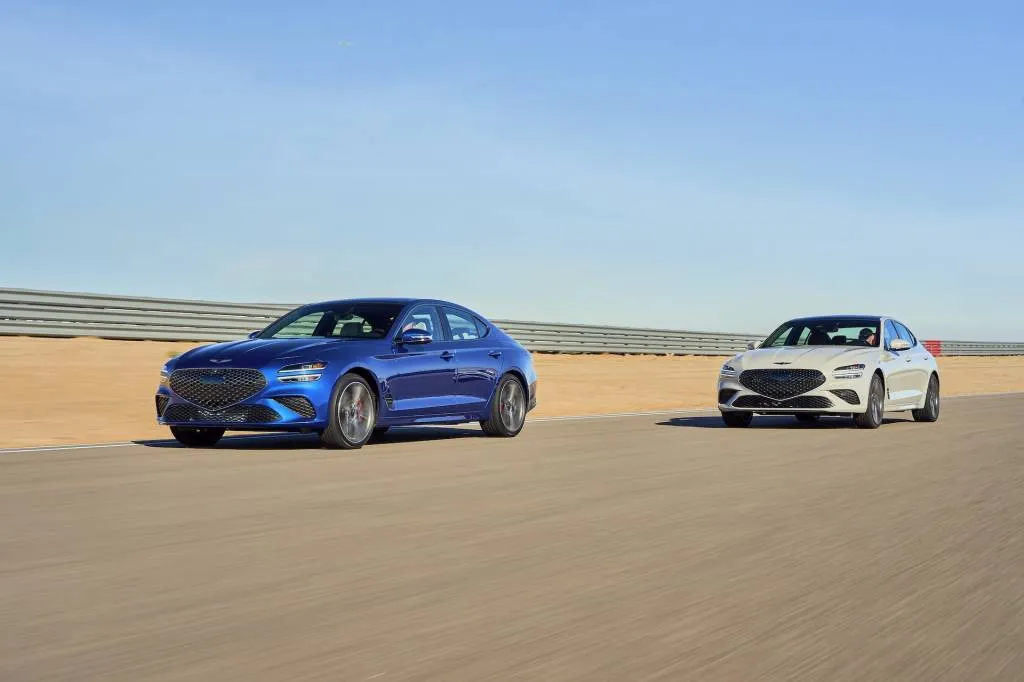
The G70 strength that didn’t come out in either of the dynamic exercises is its overall elegance. It becomes apparent when simply looking at the car, and especially when hopping inside. Every G70 looks striking, with a bold shield-shaped grille and stacked headlights fronting a low-set and sleek sedan shape. Standard 19-inch wheels pushed to the corners, staggered tire sizes (225/40R19 front and 255/35R19 rear), and air outlets behind the front wheels all hint at the car’s performance character.
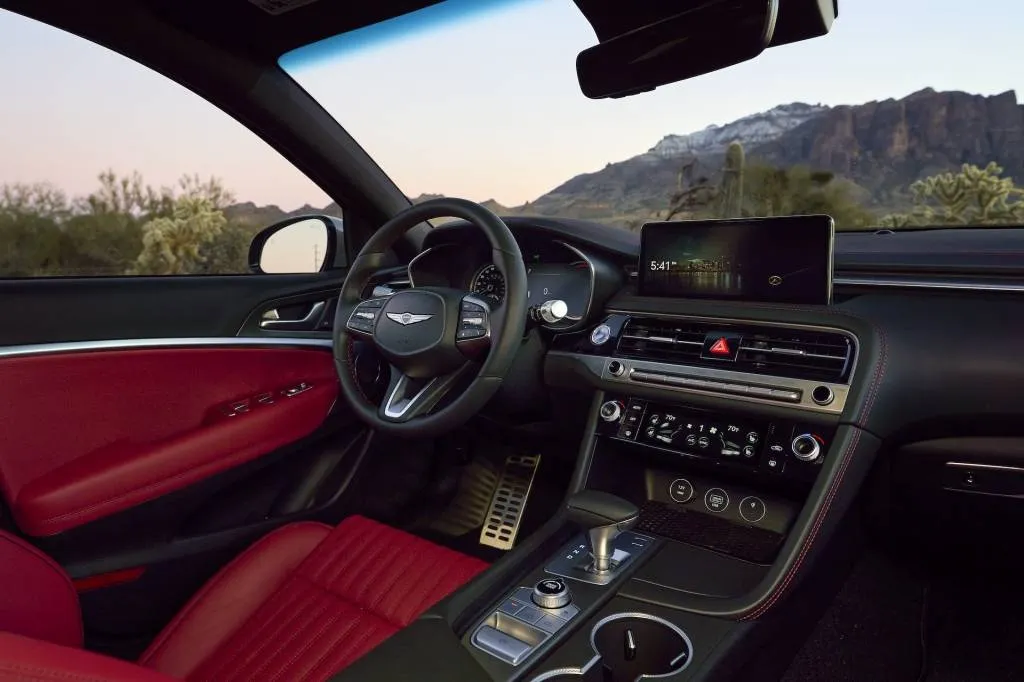
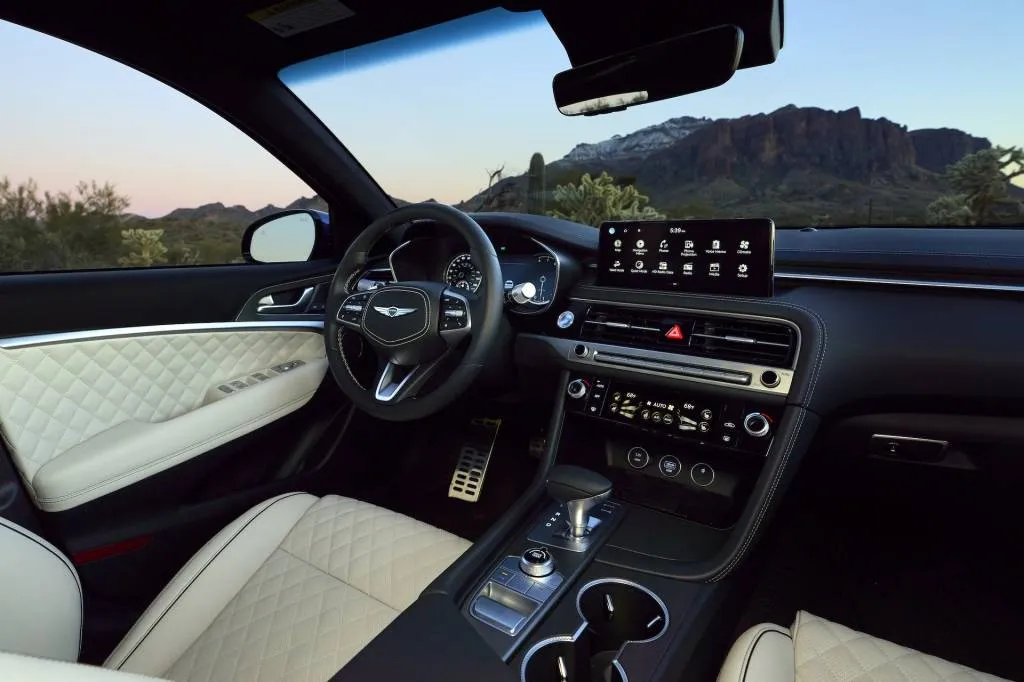
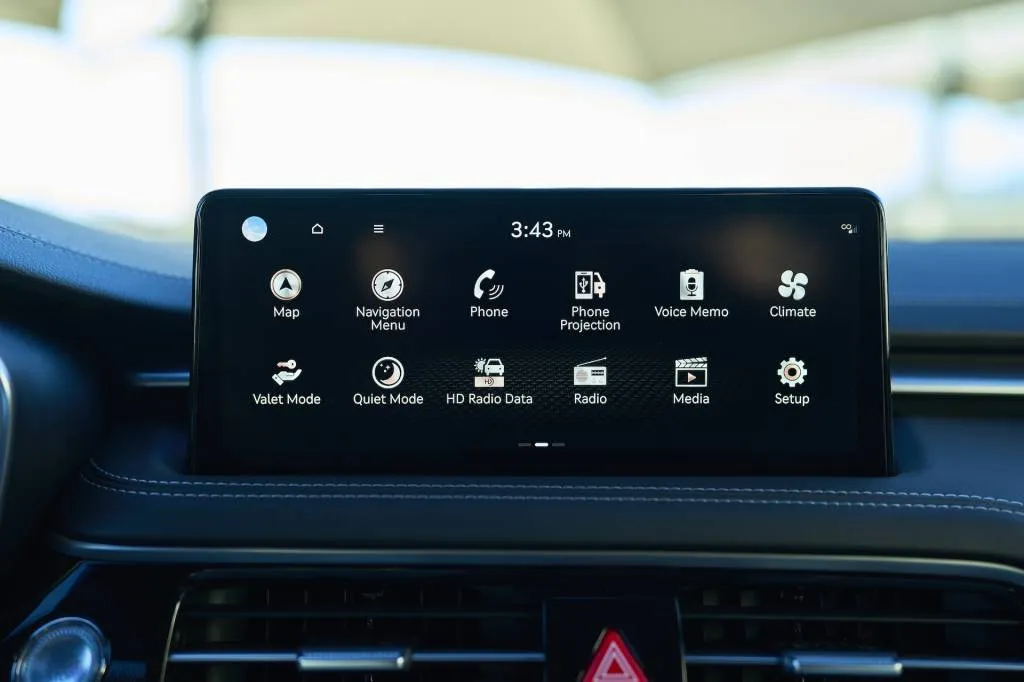
It’s even better inside, where synthetic leather wraps the seats, doors, and dash on the base model, and the seat upholstery becomes real leather with the first step up the lineup and nappa leather in the top 3.3T Sport Prestige model. Contrast stitching and diamond-stitched upholstery patterns add to the upscale flair, and that’s only enhanced by the available red or white upholstery options. Versions with the V-6 also get a suede headliner, while every G70 features a watch-like analog speedometer teamed with an 8.0-inch digital display that serves as the tachometer, vehicle information display, and blind-spot camera display when using the blinker. A 10.3-inch touchscreen for infotainment and a new touch-sensitive digital climate panel round out the interior tech.
The new 2.5-turbo makes the base model a better choice than last year. With a $42,695 base price, the 2024 G70 costs $2,180 more than a 2023 base model while also undercutting a base BMW 3-Series by about $3,000. All-wheel drive adds $2,100 on any model, and the 3.3T starts at $51,145 in Sport Advanced trim, though we’d spring for the extra $4,400 to get the adaptive dampers and limited-slip differential of the Sport Prestige. For good measure, this trim also adds the nappa leather upholstery and synthetic suede headliner, a head-up display, a power trunk, a heated steering wheel, the blind-spot cameras, and a surround-view camera system.
The Genesis G70 remains a luxury value with its 2024 update. While we prefer the extra power and performance equipment of the top model, the new base engine makes the G70 a much more fun, luxurious, and sporty choice than the numerous compact SUVs that cost about the same. You wouldn’t take those vehicles on an autocross or racetrack, either, and if you would you’d fall much farther behind Howard Fuller.
Genesis paid for travel, lodging, and track time for Motor Authority to bring you this firsthand report.
Opel, a German brand within the Stellantis fold, has been spotted testing a prototype for its redesigned Grandland compact crossover.
The prototype was for an electric version of the new Grandland, though additional powertrain types like a plug-in hybrid setup may be offered as an alternative.
The new Grandland is being developed on Stellantis’ STLA Medium EV platform designed for compact and midsize cars, and while it won’t be sold in the U.S. it may offer clues for future U.S.-bound vehicles based on the STLA Medium platform. Vehicles based on the STLA Medium platform come with front- or all-wheel-drive powertrains, the latter generated by having an electric motor at each axle.
The platform made its debut last year in the Peugeot 3008 compact crossover and has been designed to fit batteries with a usable capacity of up to 98 kwh, and offer power outputs up to 382 hp. It isn’t clear how much horsepower the Grandland will offer but at least one option matching or exceeding the 300 hp of the outgoing Grandland plug-in hybrid variant is likely.
The Grandland is expected to start sales in markets where Opel operates in the second half of 2024, meaning a debut should be coming soon..
Opel is also out testing a prototype for a redesigned version of the Crossland subcompact crossover. It will also debut as an EV and is likely to offer alternative powertrains at some point as well.
Styling for both crossovers will likely be similar to the lines of the Opel Mokka subcompact crossover launched in 2020. Central design themes include clean surfaces and Opel’s visor grille.
Opel, which operates as Vauxhall in the U.K., plans to be a fully electric brand in its main market of Europe by 2028. Being part of the Stellantis fold, Opel has access to various dedicated EV platforms ranging from designs for subcompact cars right up to full-size trucks and vans. One future dedicated EV that Opel has confirmed is a sporty crossover to be called the Manta E. It’s due around the middle of the decade.
Porsche’s approach to revamping its cars focuses more on mechanical enhancements than visual changes, as evident in the latest 2025 Taycan. Although its exterior mirrors the previous model, this electric sedan has undergone extensive revision under the surface.
The most striking update is the power boost in the Taycan Turbo S. Now producing 938 horsepower with launch control, up from the previous 750 hp, the model challenges competitors like Tesla and Lucid in the high-performance EV sedan market. This significant increase in power enables the Taycan Turbo S to sprint from 0-60 mph in just 2.3 seconds, making it the most powerful Porsche road car to date, surpassing the 887 hp 918 Spyder.
The enhanced performance stems from new motors, which, while maintaining the dimensions of the previous model’s, feature upgraded internals. The rear motor alone sees a power increase of up to 107 hp and is approximately 20 pounds lighter. Porsche is yet to release full specifications for the entire Taycan range, but the base rear-drive model now boasts 483 horsepower.
Beyond power, Porsche has focused considerably on efficiency and range improvements. The first Taycan iteration faced criticism for modest range figures, prompting Porsche to address these concerns. Although EPA figures for the new Taycan are pending, tests suggest significant improvements in real-world range.
The new Taycan benefits from a battery pack with enhanced cell chemistry. The larger Performance Battery Plus now offers a gross capacity of 105 kWh, up from 93.4 kWh, with a usable capacity of 98.6 kWh. The base model features an 89-kWh gross and 83.6-kWh net battery pack, both lighter than their predecessors.
Energy regeneration capabilities in the Taycan have also been upgraded. The new all-wheel-drive models can regenerate up to 400 kW, an increase from the previous 290 kW. The handover threshold between regenerative and friction braking has been raised for greater efficiency. Additionally, new wheels, summer tyres optimised for range, and improvements in aerodynamics and thermal management, including a new heat pump and pulse inverter, contribute to increased range.
Charging speeds have seen a boost too. Previously capable of 270 kW, the Taycan can now charge at 320 kW, allowing for rapid charging times. In terms of chassis, all US-spec Taycans now come standard with air suspension. All-wheel-drive models offer an optional Porsche Active Ride, an innovative active-suspension system.
Interior updates include a revised gauge cluster and infotainment system. Models equipped with the Sport Chrono package benefit from a push-to-pass button, providing additional power on demand. A leather-free interior option featuring Porsche’s Pepita trim is also available.
However, these advancements come with a higher price tag. The entry-level 2025 Taycan is priced at $101,395, an increase from the previous model. The top-of-the-line Turbo S Cross Turismo is now $213,695, reflecting its enhanced features and performance.
The 2025 Taycan, set for US delivery later this summer, heralds a new chapter in Porsche’s electric journey. With additional models like the GTS and a record-setting Nurburgring variant in the pipeline, Porsche continues to push the boundaries of electric vehicle technology.
Sicily is an incredible island to explore when visiting Italy. From the main cities of Palermo and Catania to the beautiful hilltop settlements like Notto; Sicily has something for every type of traveller. Though, don’t think Sicily is just about its towns and cities. There are heaps of the best beaches in Sicily dotted all across the island.
This all makes Sicily one incredible island to visit when exploring the south of Italy.
So, after exploring all the epic places to see in Sicily, make sure to leave ample time for the island’s top beaches. There are some world-class beaches, which are beautiful for a day in the Mediterranean sun.
Take a look, below, at the top beaches in Sicily that I just know you’ll love. Have an amazing time exploring Italy.
1.) Tonnara di Scopello
West of Palermo, Tonnara di Scopello is around a 1-hour drive from the city and worth visiting for a day trip. After driving to the area, park (in this spot) and head over to the shoreline itself. You do need to pay a daily rate to park your car (around 10 Euro in summer), so make sure you have change with you.
Now, the beach area itself is relatively small, but the historic fishing spot is so quaint and well worth visiting for a slow afternoon. We love how quaint and small this is; but be prepared, it can get quite busy in the peak summer times.
Afterwards, hop into La Cialoma. Their freshly cooked lobster is delicious.
If you’re looking for a larger beach, head over to nearby Guidaloca Beach. Here, you’ll find a few beachfront restaurants and loungers that you can rent on the beach.
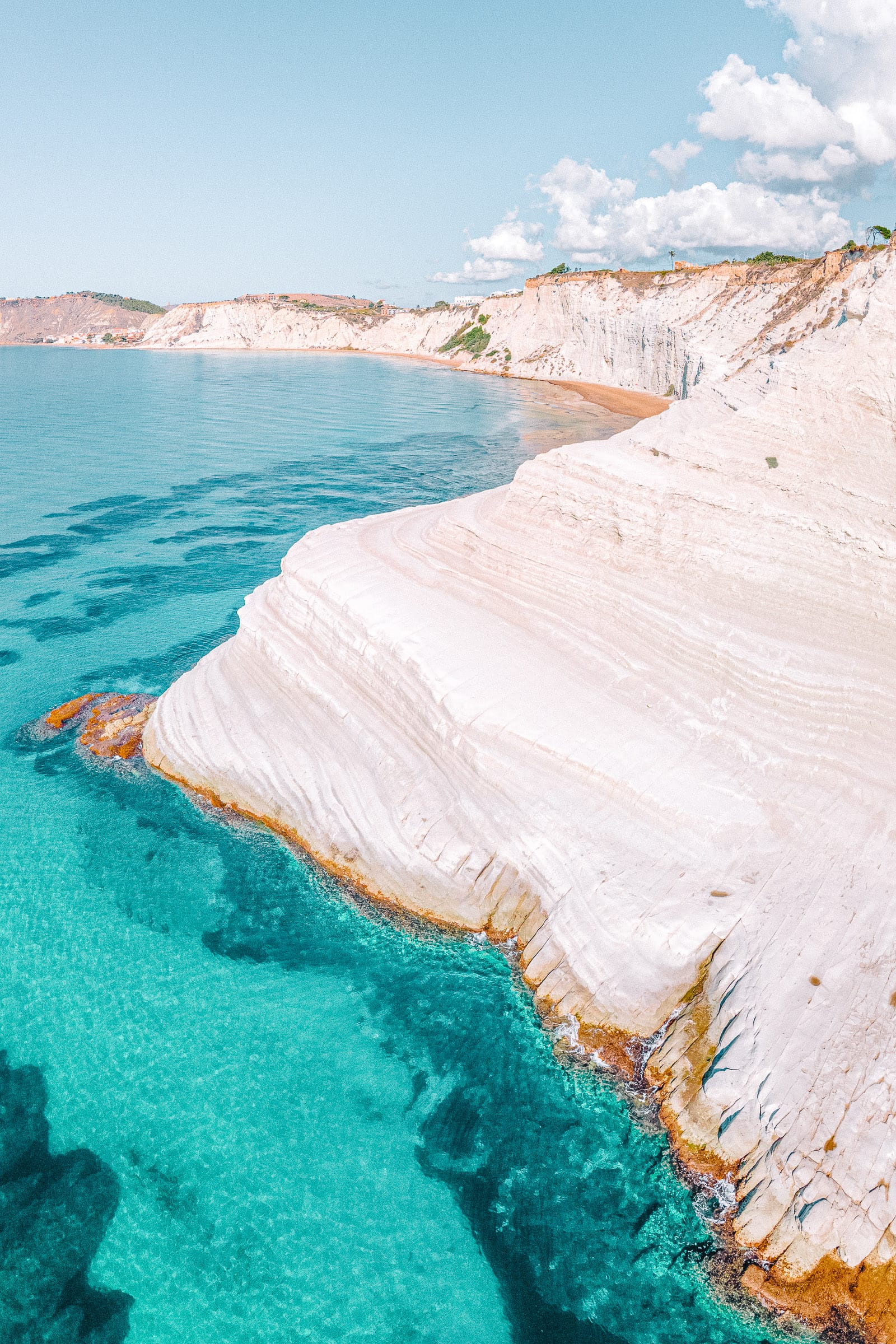
Nestled on the coastline at Porto Empedocle, Scala dei Turchi (Stair of the Turks) is one of the best beaches in Sicily that’s unique.
You see, the geological marl makes for a completely distinctive landscape that’s incredibly beautiful to see. Now, this point here doesn’t have a sandy beach in the traditional sense; but it’s one spot you don’t want to miss.
Altertntiaverly, pop into Porto Empedocle itself. Here, you’ll find Porto Empedocle Beach which has sandy shores and is totally easy to access.
The wider area is popular for its dramatic coastal scenery and its rich history, Porto Empedocle is a Sicilian town named after an Ancient Greek philosopher. Once a port of Agrigento during the medieval era, Porto Empedocle is now a famous coastal getaway for Agrigento.
Make sure you relax with the beautiful sea view and the artistic medieval streets found in the area. When it comes to nature, enjoy the golden sand of the beach and the unique rock formation called the Stair of the Turks.
Despite the buildings hugging. the Mediterranean shoreline, there’s still a gorgeous beach and island to relax and take a dip.
Of course, you’re going to visit Spiaggia di Isola Bella; this is the best beach in the region; but be aware that it can be busy.
If you want more space, Movida Beach is a much longer stretch where you’ll also find beach clubs and restaurants, too. It’s still as popular, but there’s much more space.
Meanwhile, on the north coast of Sicily, you will find Cefalu. At the foot of the historic old town is a long sandy beach which will allow you to sightsee while having a nice time at the beach.
The stone streets, Norman cathedral, Corso Ruggero and the fishing harbour are some of the nice things you get to see when visiting the place. Cefalu also offers a wide range of water activities and sports like sailing cruises and snorkelling, so if you’re up for these excursions, Cefalu is perfect.
Best of all, you can also rent loungers so you don’t need to cart everything to the beach.
Also, if you’re visiting from Palermo, book this half-day tour to Cefalu and Monreale. It’s a great way to experience this side of Sicily if you’re choosing not to drive.
Considered one of the best beaches in Sicily, San Vito Lo Capo is stunning to visit. Even the journey to San Vito Lo Capo is an interesting and beautiful experience. The views are just breathtaking.
Not only is the beach lovely at San Vito Lo Capo, but the wider region is stunning too. You see, it’s surrounded by mountainous terrain, and there are vineyards, open fields, and olive groves revealing whitewashed, seaside homes.
When you visit San Vito Lo Capo, take time to enjoy its crystal-clear waters and fine white sands together with its lofty palms. You can just lounge at the beach or enjoy the plenty of sea life you can find near the grottos and coves. Though, always be cautious of rip tides which can be quite strong in this area of Sicily.
If you just want a very quick trip and escape from the bustling streets of Palermo, then take a dip in Mondello.
You can reach the place within 40 minutes if you ride the bus (and much less by taxi). It’s wonderful white sand and the shallow shoreline are great for a little dip.
Way back when Mondello was initially a marshland with fishermen (like lots of towns in Sicily). However, Mondello is much more popular today and is a nice swim spot that both locals and visitors go to.
You can also sightsee the Liberty-style villas found in Mondello. The seafront promenade is another thing to enjoy in the place as you choose from the wide selection of seafood.
If you get to visit the southern part of Sicily, near Syracuse, you will be able to see where the waters of the Mediterranean meet those of the Ionian Sea.
Fontane Bianche Beach is stunning and the paler-coloured waters are totally beautiful on a very sunny day.
Now, this place is not highly developed but still has lots of amenities and loungers to rent. So, if you are looking for somewhere to relax, then it’s the place for you.
The beach offers some facilities like a restaurant close by and showers. Though, I found the food a little unremarkable here.
Technically not Sicily at all; but I couldn’t not mention the beautiful Aeolian Islands.
Mostly uncrowded, the Aeolian Islands are quite hard to reach, with most boats leaving from Milazzo.
Most services are offered by the largest island which is Lipari. However, if you’re a nature lover, Salina is more fit for you. Meanwhile, Panarea is more for the lively spot. But the main thing they all have in common is that they’re beautiful.
However be aware, that there’s only one easy-to-reach beach at Zimmari Bay on the Island of Panarea. Once here, you can rent a small motorboat to stroll around the place as you choose the island you want to visit.
Best reached by cycling or driving, Vendicari Nature Reserve is worth the effort and sweat when you get to the place. You will find a dirt track signed for an Agriturismo. Oh, and you have to pay at the booth before walking towards the main area. So, make sure to make some changes.
Once you’ve arrived, enjoy the beautiful sandy beach and a nice cove; though there’s not much in terms of facilities here. So, make sure to take drinks, food and sunblock with you.
Best of all, Calamosche doesn’t get too crowded. This makes it one of the best beaches in Sicily if you want lots of space for yourself.
Cala Rossa is a very fine and beautiful sandy beach where you can beautiful and calm waters that are perfect to explore when sailing over from Trapani.
Located on Favignana island, you just need to hop on the ferry and you’ll be there in no time at all. Well, 30 minutes to be precise.
After arriving on Favignana island, head over to Cala Rossa which is on the northeast coast of the island. It’s wonderful and even better if you stay overnight in Favignana.
If you’re seeking an extraordinary adventure in the heart of Southern Africa, set your sights on the untamed beauty of South Africa’s top Safari destination: Kruger National Park(and it’s surrounding private game reserves). This 10-day itinerary promises a journey through iconic landscapes, from the captivating wildlife encounters in Sabi Sands to the sprawling savannahs of Kruger National Park. As we delve into each day of this expedition, you’ll discover the thrill of sunrise safaris, the magic of Blyde River Canyon, and the unique experience of taking a self-drive tour in Kruger National Park.
Kruger National Park is the biggest national park in South Africa, and stands as an iconic testament to the country’s extraordinary wildlife and natural beauty. Encompassing a vast expanse of approximately 19,000 square kilometres, the park extends into both the Limpopo and Mpumalanga provinces, in the country’s Northeastern part. Renowned as one of the largest game reserves in Africa, Kruger National Park is a sanctuary for an incredible array of wildlife, including the famed Big Five—lion, elephant, buffalo, leopard, and rhinoceros. It is the most exciting place on earth to go in Safari and one of the best places to visit in South Africa.
This 10-day itinerary is made up of three main destinations: Blyde River Canyon (& surrounding Graskop region), Sabi Sands private game reserve (which actually is part of Kruger National Park, but is owned privately) and Kruger National Park. This itinerary is just what you need for an epic adventure in South Africa. Each spot brings something special to the table, showcasing the incredible beauty of South Africa.
Whether you’re a safari enthusiast, a nature lover, or an adventurer at heart, this itinerary promises to unravel the best of South Africa’s wild side, from the heart-stopping encounters with the Big Five to the breathtaking landscapes that stretch as far as the eye can see.
EXPLORE ALL AFRICA TRAVEL GUIDES Other travel guides you might find useful…
So without further ado, let’s jump into the 10-day roadtrip itinerary in South Africa’s North Eastern borders of Kruger National Park.
DAY 1: Drive from Johannesberg to Blyde River Canyon (5hrs driving)
Arrive at Johannesburg International Airport, head straight to the rental car area, and embark on a long drive to Blyde River Canyon. The journey is straightforward, taking the N4 highway until reaching Belfast and then turning onto the R540.
Safety tip: Ensure you arrive at Blyde before dark, as driving at night is not recommended. Consider booking an overnight flight arriving in the morning.
This first drive is the longest one (circa 5hrs) of the trip so stock up on snacks, water, energy drinks and set off to Forever Blyde Resort.
Now, if you google this resort on Booking.com, it might seem a little “family-friendly” and suburban, but it’s strategically located next to the Canyon, providing access to various hikes. Entry fees for these hikes are included in your accommodation booking, whereas others on tours would need to pay this separately (R50 per person per entry). So Forever Blyde resort is one of the best places to stay in Blyde River Canyon.
If you’re after smaller, trendier accommodation, then I’d recommend staying in Hoedspruit as there are more options there as Hoedspruit is a bit of a hub. (But if I’m being honest, most accommodations in this region are basic but comfortable hotels!)After reaching the hotel, drop off your bags and then make your way to the upper lookout so you can catch the sunset at one of the most iconic viewpoints in the region (and it’s a 5min drive from your bed, so you can then get some much-needed rest after a long drive).
DAY 2: Hiking in Blyde River Canyon
Blyde River Canyon is a hiking haven as there is so many different landscapes within the Canyon. The hike you choose to take will depend on your level of fitness & what you want to see!
The hikes within Forever Resort are:
Leopard Trail (4km): Offers a great view of the Three Rondavels and a hike through the canyon.
Kadishi-Tufai Waterfall Trail (2km): A loop passing through the Tufa waterfall.
Other popular hikes in Blyde River Canyon are
Bourkes Potholls (1km hike) – this hike is famous for the astonishing pothole formations the river created in the Canyon. Entrance fee is R65 per person.
Hippo trail (13.5km, for more experienced hikers) – the Hippo Trail is famous for unparalleled views of the canyon from a lower viewpoint, but also for the abundance of birdlife and wildlife, especially Hippos! Permits cost R20 per person and can be bought at Swadini Nature Reserve.
Belvedere hike by Dientjie falls (10km, for moderate to more experienced hikers) – this hike is a continuation of the Bourkes Potholes hike and leads to the stunning Dientjie falls. The costs is also R65 per person and you must start the hike before 11am.
Depending on your level of energy and hiking experience, there’s always the option to do two shorter hikes in one day to make the most of your full day at Blyde. But, you can always save one hike for the next morning if jetlag is still hitting you (or book on for another night and extend your trip a little longer past 10 days).
For the beginner to intermediate jet-lagged hikers, I’d recommend doing the two hikes within Forever Resort as they’re different hikes – one offers views and the other a chance to swim in a waterfall.
Finish the day with a short drive to Rondavels viewpoint for a different sunset angle. There is a small fee of R20 to access the viewpoint, and you must leave before 6 pm.
DAY 3: Blyde River Canyon & Sabi Sands (2.5hrs driving)
If one day of hiking is enough, then here are two options on how to spend your last morning at Blyde River Canyon before driving down to Sabi Sands Game reserve:
Option 1: Take a scenic boat cruise down Blyde River to experience the Canyon from the water. This tour is 1.5hrs long and costs circa R220 per person. This tour is for nature lovers as it offers a unique perspective of the Canyon’s majestic landscapes, giving you the chance to soak in the beauty of the cliffs, lush surroundings, and also allows you to get up close to the wildlife in the region. Tours start from 9 am onwards. After the tour, head back to the hotel, pack your bags, and start the drive to sabi Sands.
Option 2: Pack up the car with your belongings as the places you’ll visit today are on the way to sabi Sands. The route down to sabi Sands takes you through the Graskop region where there are a number of attractions you can stop at as you make your way down to Sabi Sands. One of them being Bourkes Luck Potholes mentioned above, so this could be an added stop on the way. The other two main attractions are: Lisbon Falls & God’s Window View.
Lisbon Falls is one of the most impressive waterfalls in south Africa. The dramatic landscapes and rocks make it a striking natural wonder. This is only a slight detour from the route to Sabi Sands and is well worth a stop at. There’s a small entrance fee to pay of R20.
Not far from Lisbon falls is God’s Window, a famous viewpoint in the region promising sights for sore eyes.It just feels full of life! The panoramic view at the end is also nothing short of breathtaking, a sweeping canvas of emerald-green treetops, deep valleys, and distant mountain ranges.
Depending on how early or late you set off, there are other places to stop along the way if you really want to tick everything off the list like:
Berlin Falls, an 80m waterfall
The pinnacle rock viewpoint, a 30m rock standing amidst dense forest
Whichever option you choose, just give yourself enough time be at your accommodation in Sabi Sands for 3pm so there’s enough time to join the evening safari drive!
We stayed at Umkumbe Bush Lodge in Sabi Sands and it was a-mazing! We were in their “honeymoon” suite which was the most luxurious tent I’ve ever stayed in. The suite’s attention to detail and the intimate connection to nature made our stay truly unforgettable. From cozy evenings on the private deck to waking up to the sounds of the African bush, every moment at Umkumbe Bush Lodge felt like a dream.
DAY 4 & 5: Safari game drives in Sabi Sands
Your itinerary for day 4 & 5 will be very similar as the purpose of staying within a private game reserve is to go on safari and see the incredible wildlife in action! But this does news to spread across a couple of days and drives as not everyone is lucky to see the big 5 in just one drive (but it does definitely happen!).
For the next two days, you’ll be waking at the crack of dawn to go a morning game drive from 5am to 8 am in the hopes of spotting the wildlife that are active in the early morning, followed by a delicious breakfast.
If you haven’t got enough dose of the wildlife, then there’s the option to go on a wildlife walk from 9am-11am where a knowledgeable guide takes you through the reserve on foot, offering insights into the smaller wonders of the ecosystem and sharing fascinating details about the wildlife.
If the 5am start for you was too much, then you can spend the rest of the morning relaxing at the lodge enjoying the pool and relaxing environment. Lunch is served between 12-2pm. Then there’s another 2hrs for you to relax until the evening game drive that sets off at 4pm and returns at 7pm.
The evening game drive is probably the best drive of the day as the African sunset really doesn’t disappoint but also because tracking and getting to see nocturnal animals is super exciting.
Most lodges also offer spa treatments so that’s another great thing to do in your free time!
This itinerary gives you a total of 5 game drives which is a pretty decent amount, but some people say the perfect nights number of nights to stay at a private game reserve is 3 nights to give you more opportunity to see all the animals. If time isn’t of the essence, then maybe booking a 3 night stay could be a good call!
DAY 6: Sabi Sands & Self Drive though Kruger National Park
If you’ve gotten used to the early game drives, there’s definitely an opportunity to sneak a last one in on the morning of day 6 of this road trip as the drive to Kruger National Park isn’t far (about 1hr).
Kruger National Park is a highlight of the trip. This national park spans 19,000 square kilometres and is known for its diverse landscapes and a wide variety of animals, including the famous Big Five. And as it’s so big, there are a number of different gates to access it. The roads are well maintained and there is 50 mile/ph speed limit so take this into consideration when planning routes!
For this itinerary, head to Paul Kruger gate and drive through to Skukuza for a snack and fill up with fuel. Start a little list on your phone listing all the animals you see on your way, this list will get very long very fast!
From Skukuza, head north east to the grasslands of Satara – the most open region of Kruger. Spend 1 night here and enjoy a night drive and sunrise drive, where you’re most likely to witness the big 5, especially the big cats. This is the best spot to view cheetah & leopard.
Warning for those with drones: Photographers, professional or hobbyists, flying drones in Kruger National Park is strictly prohibited and every gate will check your belongings to make sure these aren’t brought in. If you do have one, let the guard at the gate know and they will tie it up with a plastic lock so it can’t fly.
DAY 7: Kruger National Park (Satara & Lower Sabi)
After a night in the park, get up early and drive south along the eastern edge of Kruger through miles upon miles of grasslands, until you reach Nkumbe View Site, with a view across untouched savannah. This is one of my favourite spots.
After a quick stop to admire the view and spot a few animals in the distance, continue on to Lower Sabi, where you’ll spend the next night in a rest camp that borders the Sabi river.
DAY 8: Kruger National Park (Lower Sabi) & Malelane
Enjoy a sunrise drive in Lower Sabi where there is the highest density of leopard, then continue south towards Crocodile Bridge Gate at the southern tip of the park. A spot famous for lion, cheetah and wild dog sightings.
Exit Crocodile Bridge gate and drive 40mins towards Malelane, where you’ll spend the last night in a hotel right on the river bordering Kruger park. We stayed at River View Inn. The rooms were big and the beds were comfy!
DAY 9: Malelane & back to Johannesburg
From Malelane it is an easy journey back to Johannesburg, but if you have a late flight then you’ve also got time to enter the park one last time and enjoy a route around the southern region of Kruger. But I imagine by this point in the trip, you might just want a lie in before the 4.5hr drive back to Johannesburg.
As we didn’t fancy a night in Johannesburg, we took a late night flight back to London so simply stayed at the airport once we dropped off the car.
(OPTIONAL) DAY 10: Johannesburg
Spend the day recovering from an awesome trip before your flight back, and pop into Johannesburg for a final meal.
Have you got any recommendations for a Kruger National Park safari?
Anything we’ve missed? Anything you’d add?
Love as always and happy adventuring…
Did you find this post helpful? I’d love you to share it for me.
Porsche has unleashed even more power and potential with its electric Taycan sports car.
On Tuesday, the 2025 Porsche Taycan debuted with more power, more usable battery, faster charging times, and quicker performance specifications. The automaker even threw in more standard equipment.
When the 2025 Taycan sedan arrives this summer it’ll cost between $101,395 and $210,995 while the Cross Turismo models will follow in the fall costing between $113,095 and $213,695.
Porsche hasn’t fully outlined every change, performance specification, or configuration, yet, but what it has yields impressive gains all around for buyers.
2025 Porsche Taycan
2025 Porsche Taycan charges faster than before
Not to be outdone by Lucid and the automaker’s 900-volt electrical architecture, Porsche has become less conservative with its charging for the Taycan. The updated EV’s 800-volt architecture will now charge at up to 320 kw under ideal conditions, which lifts the ceiling by 50 kw. Porsche said it widened the charging curve, expanding how long the system will stay at a high rate of charge before tapering the charge rate. The 2025 Taycan will be able to recharge from 10% to 80% state-of-charge in 18 minutes, despite the gross battery capacity expanding from 93 kwh to 105 kwh.
On slower DC fast chargers, the Taycan’s newly standard 150 DC/DC converter will optimize charging speeds when hooked to a 400-volt system, according to Porsche.
Charge ports on both side of the Taycan’s front fenders are now standard and not limited to only certain trims.
Porsche said it’s modified the powertrain’s pulse inverter and software to go along with the larger, more powerful battery pack. In addition, the thermal management system has been revised to keep things cool both during repeated performance driving and fast-charging. A new heat pump has also been installed for increased efficiency.
2025 Porsche Taycan
2025 Porsche Taycan goes further with more range
Porsche hasn’t officially disclosed the range of the 2025 Taycan.
During a real-world test in Southern California last week, a prototype managed to cover 364 miles on a single charge. The current Taycan is EPA-rated at 246 miles of range.
2025 Porsche Taycan
2025 Porsche Taycan gains power, goes quicker
Porsche hasn’t fully outlined the updated Taycan powertrains, yet, but it’s clear from the base model to the top Turbo S trim, the Taycan lineup is more powerful and thus quicker.
The base rear-wheel-drive Taycan previously had 402 hp. Porsche said the 2025 model has 80 hp more than before, which should put the updated car as having 482 hp out of the box with a single rear motor. Porsche said this translates to a 0-60 mph time of 4.5 seconds in the Taycan’s slowest form, which is 0.6 seconds quicker than before.
Bookending the other end of the lineup, the updated Taycan Turbo S now has 938 hp, which is up 188 hp from the previous output of 750 hp. Performance wise, this lowers the Taycan Turbo S’s 0-60 mph sprint by 0.3 seconds with the car now doing the deed in 2.3 seconds. That makes it the quickest production Porsche in history.
The popular Sport Chrono package now features a push-to-pass function, which acts as an overboost function, increasing maximum power output by up to 93 hp depending on the trim, for up to 10 seconds.
Every 2025 Taycan has an adaptive air suspension while Porsche Active Ride suspension, which first debuted on the 2024 Porsche Panamera, is an option on dual-motor all-wheel-drive models.
2025 Porsche Taycan
2025 Porsche Taycan
It’ll take a keen eye to spot the exterior differences on the 2025 Taycan. Revised bumpers at each end house updated design elements and new LED lighting. The flatter headlights feature Porsche’s latest LED HD-Matrix technology and buyers can opt to have the Porsche script in the LED taillight lit with animations.
2025 Porsche Taycan
Inside, the digital instrument clusters, touchscreens, and optional front passenger display feature a streamlined interface similar to what’s debuted in the 2024 Cayenne and Panamera. Every Taycan now features a heated steering wheel, ambient lighting, power-folding mirrors, a drive mode controller, and wireless smartphone charging.
The 2025 Taycan will be the first Porsche delivered with the automaker’s deeper integration of Apple CarPlay, with the electric 2024 Macan to follow.
This is a step-by-step tutorial that will teach you how to create a digital car rendering yourself.
We start by clarifying what a good basis for each rendering is and how best to start. Next, we will use a digital brush to define the shapes. In the end, we will apply reflections and details to get an outstanding result.
1. Creating the sketch base
One of the most important tips for a successful rendering is to have a good and solid base. By “base,” I mean a hand sketch, digital sketch, or line model. If you don’t have a base, things can get complicated and frustrating. So do not explore shapes without a solid sketch base, simply because it’s easy to lose yourself and waste time.
After you’ve created a base, at this point, the actual design process and shape development has already taken place. The rendering is a more detailed illustration that helps make a visually appealing presentation, which, in turn, helps sell the proposal to the customer.
2. Defining the surroundings
Before the coloring process, you should be roughly aware of what your surroundings look like. It helps to prepare a scene to roughly visualize your thoughts. It’s not necessary to do this every time, but it helps you understand what’s going on.
In the example below, there is a primary light source coming near the front of the car, there is a wall behind the car in an outside environment, and the sun is shining. So, we should somehow transfer this scene to our reflections.
.
3. Blocking out
In this step, we divide the car into three different blocks. This helps you visualize the different materials later.
Divide the vehicle into the main body, greenhouse, and grill and wheels.
Then, create paths with which you get a sharp edge and an overall clean look. Select the path and fill it out with a base color.
Cut out the wheels from the original sketch and transform them a little bit. Make them elliptical and correct their position.
Once this step is done, half the rendering is done. You can’t go wrong anymore.
.
4 & 5. Shading
In this step, try to describe the shape using different gray values. The rule is: Whenever the value changes, the shape also changes.
Try to use the correct values. The rendering will look unrealistic if you use the wrong values. If you want to know more about the topic, I definitely recommend Scott Robertson and Thomas Bertling’s book “How to Draw,” in which they explain the fundamentals of light and shadow.
By the way, never choose white as your brightest value. It will not work. We will only paint certain spots white at the end when we use the color dodge tool in Photoshop to really highlight certain areas.
6. Adding reflections
Don’t draw a photorealistic render here. The reflections should be designed as simply and effectively as possible. It will be helpful to check the surfaces.
In the example mentioned earlier, the car is in front of a wall. That information should show in your reflection. Moreover, all surfaces that point upwards should reflect the sky. And don’t forget the greenhouse. If you want to create lighting effects, simply use the color dodge tool.
7. Adding details
Details take a lot of effort and time. If you don’t make an effort in this step and don’t invest time, the details will often just disturb and not help your rendering. I definitely recommend adding details because they help the rendering a lot and make it much more attractive to the viewer.
In order to create details quickly and effectively, I suggest using real photos. Use a photo of an existing car’s grill, and you’ll save time. Also, add some mirrors.
Many of the cars we see at events have had famous former owners or racing history, while others have been resurrected from the ashes or creatively reimagined. Some even have stories to tell before they roll off the production line.
What I’m trying to say is, most of these cars have interesting pasts; revealing them just depends on how deep you’re willing to dive. At the recent F.A.T. Ice Race in Austria, I was spoilt for choice went it came to interesting cars, because they were everywhere. For this follow up to my main event story last week, I chose six cars with fascinating stories to take a closer look at.
The Final Lotus Elise
This Lotus was absolutely impossible to miss in the F.A.T. Ice Race paddock, mostly because of its fluorescent orange paint. The color – RAL 2005 – is so special, that private vehicles in EU countries are not allowed to use it, as it’s reserved for emergency vehicles only. Luckily the owner is UK-based, and Lotus were able to be convinced to deliver it in the special color.
It’s special because back in the 1960s, Team Lotus used the luminous hue on its STP-livered Indy cars. Beyond the paint allure, this Elise Cup 250 Final Edition was the very last ‘250’ to leave the assembly line, hence the ‘FI NAL’ registration plates.
Porsche 997 R-GT Art Car
This 997 build was a truly collaborative effort. Its creators say the PlayStation livery pays homage to 1990s nostalgia, and I totally got that when I first saw it. My mind instantly traveled back around 25 years, to the day my older brother brought a PlayStation console home with a bunch of games, including Need for Speed 3: Hot Pursuit, which got me hooked on cars and racing in the first place.
The project was managed by James Howson, who came up with the concept together with digital artist Davide Virdis. Davide took care of the styling, but the actual paint was laid down by David Gwyther, AKA Death Spray Custom. Underneath the artwork is a rugged 997 R-GT that was originally built by Tuthill Porsche and competed in the 2014 World Rally Championship, where it claimed the first WRC finish for a Porsche 911 in almost 30 years.
Porsche 911 Projekt e01
I spotted this Porsche 911 on the road while travelling to the F.A.T. Ice Race’s registration spot, but couldn’t put my finger on what was different about it. When I caught up with it again at the carpark and took a closer look, I noted the lack of exhaust, at which point I more or less understood what was going on. But as it turned out, this isn’t your average electric-converted classic…
Projekt e01 is the work of Classic eCars in Germany, who reimagined the 911 with a retrofitted Direct eDrive electric drivetrain that delivers a crazy 3,250Nm of torque to its rear wheels. The company produces electric motors with impressive performance data: A single powertrain is good for 256kW/1,625Nm, but this Porsche has a double system in place, thus twice the output. The car now weighs 1,450kg (3,196lbs), but having batteries both front and rear helps with the weight distribution and keeps some of the car’s original handling characteristics intact.
Peter Rotenberger, Classic eCars’ chief technical officer, was behind the wheel of the 911 at the F.A.T. Ice Race, and from where I was watching, it handled the slushy track very well.
Porsche 356A Type 1 ‘European’
This striking silver and blue-flamed Porsche 356A race car (chassis #55301) started its life as an early Type 1 example built in December 1955. A US import model, during its lifetime in the States it was owned and raced by Pierre Honegger and David Loring, and even competed against F1 driver Jan Lammers in the La Carrera Panamericana race in Mexico.
As I found out later, this is a very rare model with ‘European’ badging. To explain, when the 356 T1 was first imported into the US, they were badged ‘Continental’, but after just 860 coupes and 69 cabriolets were shipped, Ford Motor Company asked Porsche to withdraw the name, as they owned the rights to it for the Lincoln Continental.
Back in Germany, Karosserie Reutter had already punched many more pairs of front fenders for the golden ‘Continental’ script badging, so a solution was needed. In the end, Porsche opted to re-badge the model ‘European’, which allowed the prepared fenders to still be used. It’s hard to know exactly how many cars received the ‘European’ badges on them, but the 356 Registry shows there are only 41 ‘European’ type 356s accounted for today.
These days the car resides in the UK, but still remains true to its racing DNA with a full roll cage installed and everything else you’d expect to find inside an old rally car. The power output is 130hp, which is not terrible for a 68-year-old car that weighs less than a tonne.
Adrian Stevens, the 356A’s current owner, continues to race it. Notably, the Porsche returned to Mexico in 2006 for that year’s La Carrera Panamericana, and prior to the 2024 F.A.T. Ice Race it participated in the 2020 event.
1972 Volkswagen Beetle
I’m going to go out on a limb here and say that despite this Volkswagen Beetle (owned by Michael Klein) looking rather original, it’s actually one of the most modified of its breed anywhere in the world.
Look close and you’ll see that the hood and boot lid, side skirts, and even the bumpers are all made from lightweight carbon fiber. Inside, only the important bits remain.
There’s still a Volkswagen flat-four out back, but now it’s a stroked 3,000cc WBX from a T3 van that was converted to air cooling and fitted with a glorious stainless steel exhaust system among other performance upgrades. The 250hp engine is connected to a dog ring gearbox for faster shifting, while Porsche brakes ensure the Beetle can easily stop from speed.
1991 Porsche 964 Carrera 4 Dakar
If you’re an Italian wine connoisseur, you might be familiar with Agostino Rizzardi, whose family winery in Bardolino has been around since 1678.
Apart from running the business today, Agostino is a serious motorsport fanatic who loves to compete in extreme rally events. His heavily-modified 911 was originally set up for rally use by Jimmy McRae (the late Colin McRae’s father), but in preparing it to conquer dunes, everything apart from the 3.6L flat-six was overhauled. The drivetrain in particular was modified to withstand long-distance and high-temperature runs.
The strengthened chassis, massive 160L fuel tank, quad double-wishbone suspension with adjustable Reiger shock absorbers are all there to help the owner compete in the Dakar, Tunisia, and Morocco rally raid events, plus others.
There is one more unique car from 2024 F.A.T Ice Race that I want to share with you – a road-legal homage to the legendary Gulf Porsche 917, recreated in carbon fiber in Norway. But as I managed to complete a full photoshoot while I was in Austria, look out for a standalone feature on this one very soon.
Vladimir Ljadov Instagram: wheelsbywovka because@wheelsbywovka.com www.wheelsbywovka.com
The technical storage or access is strictly necessary for the legitimate purpose of enabling the use of a specific service explicitly requested by the subscriber or user, or for the sole purpose of carrying out the transmission of a communication over an electronic communications network.
Preferences
The technical storage or access is necessary for the legitimate purpose of storing preferences that are not requested by the subscriber or user.
Statistics
The technical storage or access that is used exclusively for statistical purposes.The technical storage or access that is used exclusively for anonymous statistical purposes. Without a subpoena, voluntary compliance on the part of your Internet Service Provider, or additional records from a third party, information stored or retrieved for this purpose alone cannot usually be used to identify you.
Marketing
The technical storage or access is required to create user profiles to send advertising, or to track the user on a website or across several websites for similar marketing purposes.