The Modern Art Museum (MAM) Shanghai will experience one of its most ambitious and groundbreaking year to date. As the largest contemporary art museum in Shanghai, this year sees MAM Shanghai set to become a “go-to” destination for art lovers with a line-up that includes globally renowned artists including David Hockney, Marina Abramović and Robyn Ward alongside an array of Chinese artists. With public participation and engagement with art at the museum’s core, forthcoming exhibitions are already in the works and will include everything from interactive, participatory sculptures to paintings, immersive installations and contemporary Chinese art. Each activity is intended to broaden visitors’ perception of the modern world and to challenge their views of art while offering new experiences and perspectives.
The Modern Art Museum (MAM) Shanghai
The 2024 program begins in March, when contemporary Irish artist Robyn Ward opens his first exhibition in China with the launch of his immersive solo show, “Walking in the Dark”. What guests can expect to see in the experiential exhibition are abstract paintings and freestanding sculptures inspired by Ward’s own nomadic lifestyle. Driven by both escapism and avoidance, “Walking in the Dark” asks questions such as “Why do people roam?” and “What is the aftermath of perpetual movement?”
Ward’s exhibition runs until May 2024 at MAM Shanghai, and the following month sees the highly anticipated opening of “David Hockney: Paper Trails”, the largest exhibition of the acclaimed British artist’s prints. Renowned for his distinctive approach to printmaking, Hockney mirrors the vibrancy and diligent indexing seen in his broader body of work.
David Hockney’s “Eine (Part 1)”, 1991
The works in this exhibition – which runs from June to August 2024 – speak to Hockney’s ongoing dedication to capturing and indexing his life through intimate portraiture and snapshots from daily life.
Marina Abramović’s “Dozing Consciousness”, 1997
Finally, from September 2024 through January 2025, MAM Shanghai will host performance art pioneer Marina Abramović’s first Chinese museum exhibition with her “Transforming Energy” series. The Serbian artist has earned widespread acclaim over the past 50 years as a pioneer of conceptual performance art, bringing post-war European avant-garde showcases to the mainstream with her sheer endurance and dedication. Focusing on interactive, participatory sculptures, “Transforming Energy” is inspired by one of Abramović’s most renowned performances — her walk across the Great Wall of China with German performance artist Ulay in 1988. Engaging with various spiritual materials like quartz, amethyst, tourmaline, copper, iron and wood, Abramović invites the audience to directly interact with her works and to receive their energy as a means of transit to a meditative state of consciousness.
Marina Abramović poses with her work “Green Dragon” 1989,
MAM Shanghai aims to celebrate artists closer to home as well. Beginning in March 2024, “Multiply!!!: Power In Numbers in Contemporary Chinese Art” will feature 12 modern Chinese artists and their work. Curated by Barbara Pollack, this inspiring exhibition includes watercolours from Wu Jian’an, a series of cyanotypes from Ma Qiusha, oil paintings from Yuan Yuan, and a mural from Wang Qingsong.
Click here to find out about what MAM Shanghai has lined up.
For more on the latest in culture and art reads from around the world, click here.
Here’s some news to still beating hearts: AI is helping bring some clarity to cardiology. Caristo Diagnostics has developed an AI-powered solution for detecting coronary inflammation in cardiac CT scans. In this episode of NVIDIA’s AI Podcast, Dr. Keith Channon, the Field Marshal Earl Alexander Professor at the University of Oxford, and the cofounder and chief medical officer at the startup, speaks with host Noah Kravtiz about the technology. Called Caristo, it analyzes radiometric features in CT scan data to identify inflammation in the fat tissue surrounding coronary arteries, a key indicator of heart disease. Tune in to learn more about how Caristo uses AI to improve treatment plans and risk predictions by providing physicians with a patient-specific readout of inflammation levels.
Show Notes
1:56: What is Caristo and how does it work? 7:11 The key signal of a heart attack 10:34 How did Channon come up with the idea of using AI to drive breakthroughs? 22:40 How much has the CT scan changed over the years? 26:01: What’s ahead for Caristo? 30:14: How to take care of your own heart health
You Might Also Like
Immunai Uses Deep Learning to Develop New Drugs – Ep. 176 What if we could map our immune system to create drugs that can help our bodies win the fight against cancer and other diseases? That’s the big idea behind immunotherapy. The problem: the immune system is incredibly complex. Enter Immunai, a biotechnology company using AI technology to map the human immune system and speed the development of new immunotherapies against cancer and autoimmune diseases.
Overjet on Bringing AI to Dentistry – Ep. 179 Dentists get a bad rap. Dentists also get more people out of more aggravating pain than just about anyone, which is why the more technology dentists have, the better. Overjet, a member of the NVIDIA Inception program for startups, is moving fast to bring AI to dentists’ offices.
Democratizing Drug Discovery With Deep Learning – Ep. 172 It may seem intuitive that AI and deep learning can speed up workflows — including novel drug discovery, a typically years-long and several-billion-dollar endeavor. But, professors Artem Cherkasov and Olexandr Isayev were surprised that no recent academic papers provided a comprehensive, global research review of how deep learning and GPU-accelerated computing impact drug discovery.
Bed racks are a popular aftermarket accessory for pickup trucks, but a recently revealed patent filing indicates Rivian is developing its own version for electric pickups.
A patent application titled “Folding Vehicle Rack System” was filed by Rivian with the United States Patent and Trademark Office (USPTO) on Dec. 27, 2022, and published by the USPTO on Jan. 11 of this year. It shows a system of vertical and horizontal bars that Rivian claims can be easily stowed when not in use.
Rivian bed rack system patent image
When fully deployed, the rack system includes two horizontal bars, each held up by a pair of vertical bars that attach to the bed sides, with an additional pair of horizontal bars for support. The vertical bars are hinged, with mechanisms designed to minimize exposure to dust and dirt, according to Rivian.
To stow the rack system, the vertical bars detach from the bed sides and fold up, while the horizontal support bars unclip. These components don’t look like they would take up too much room in a garage, or even in the truck bed, when stowed.
Rivian bed rack system patent image
While the patent application deals specifically with pickup beds, Rivian notes that the same hardware could also be used for vehicle roof racks. That doesn’t mean that this rack system will be used in either application, though, as automaker’s don’t always put the ideas they patent into production.
Rivian has been investigating a number of different ways to maximize the utility of its vehicles. Other recent patent applications from the automaker include an underbed drop-down storage tray for pickup trucks and storage containers housed in the spare wheel of an electric SUV.
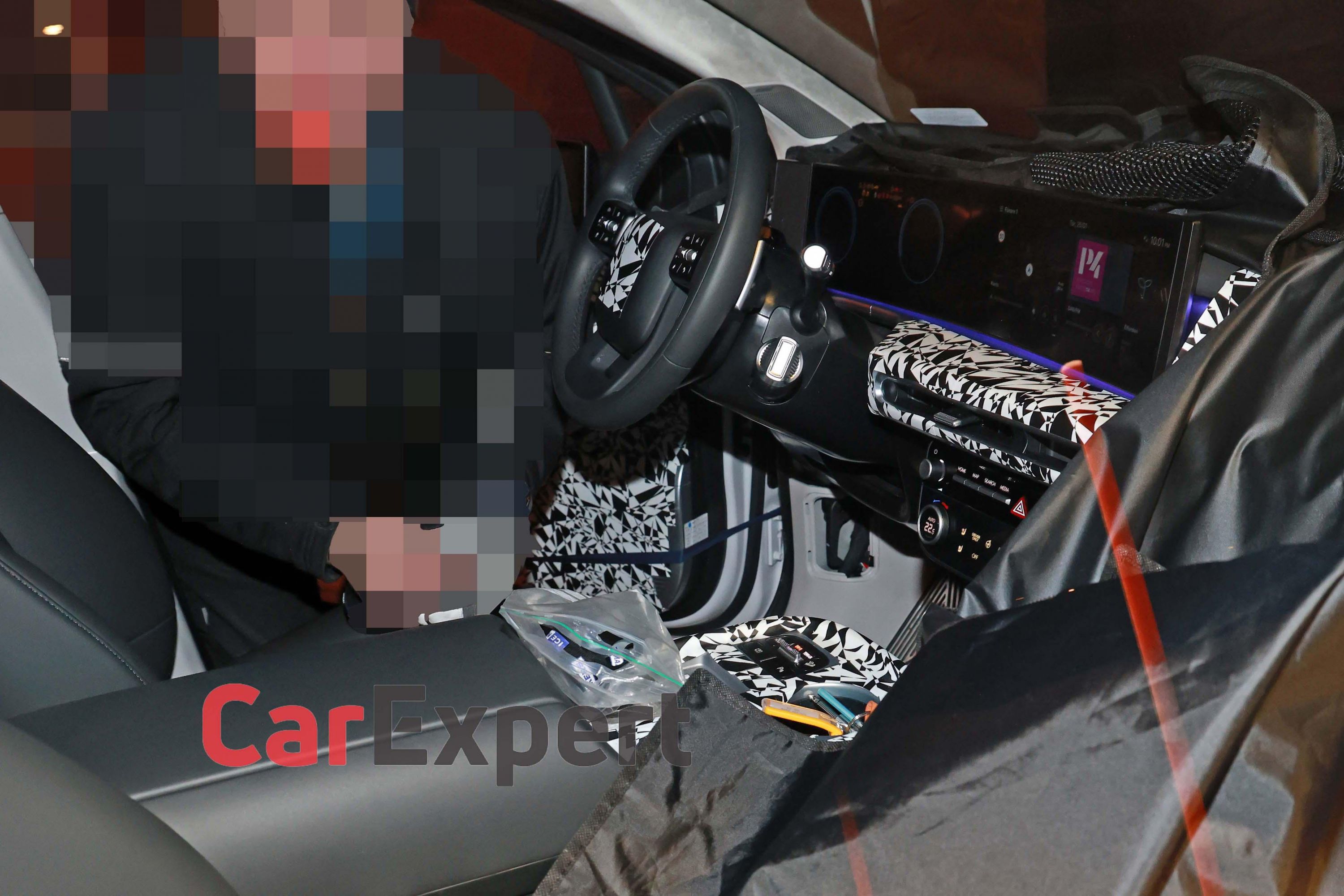
As Hyundai gets closer to revealing its Ioniq 7, spy photographers have snapped very revealing photos of the large electric SUV’s interior.
The Hyundai Ioniq 7 prototype was photographed while parked next to a DC fast charger in Europe. It’s due in Australia in the second half of 2024.
Its interior shares some design traits with the new Santa Fe, including its steering wheel, as well as dual 12.3-inch screens situated in the same curved assembly.
The Ioniq 7 does, however, go without the Santa Fe’s climate screen. Instead, there’s a smaller climate panel, and a gap between the dashboard and the centre console.
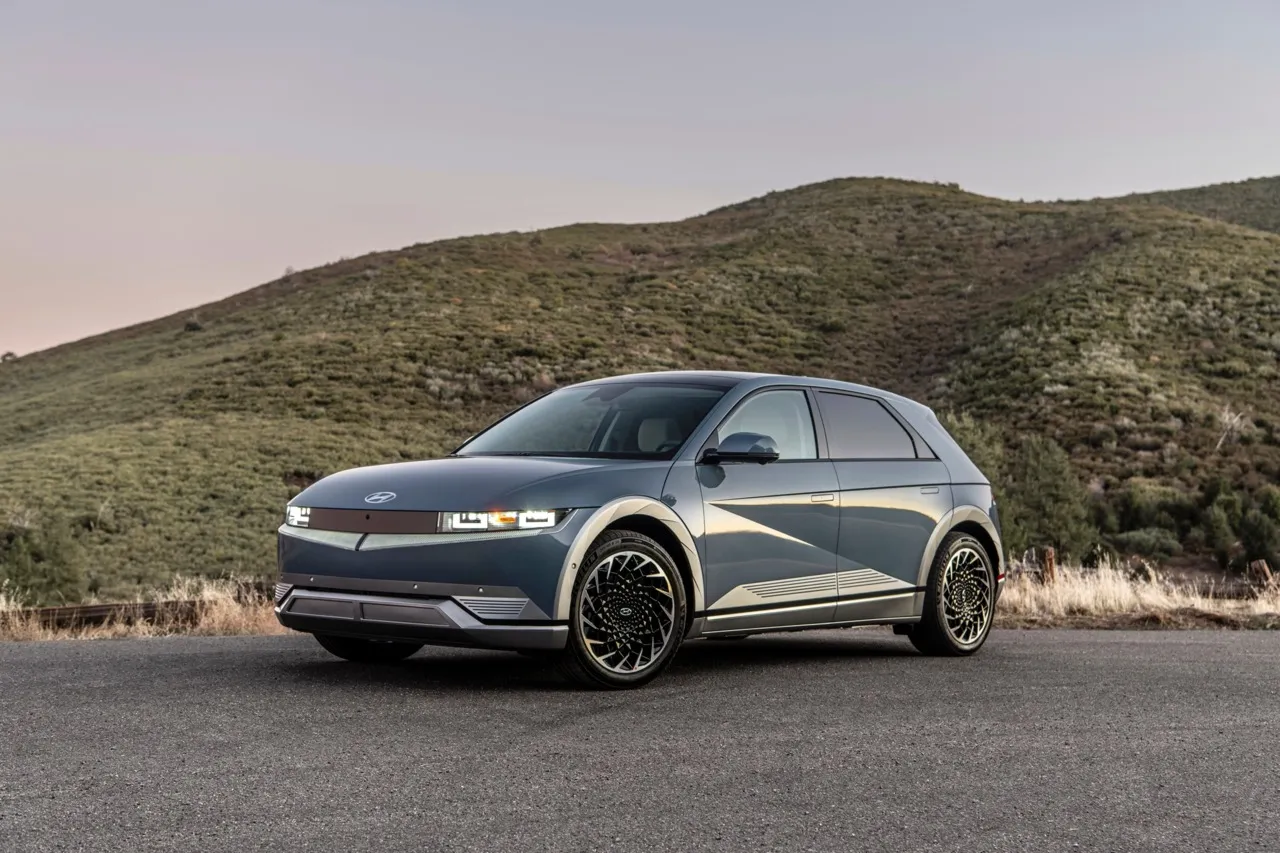
Whether this means the Ioniq 7 will have a moveable centre console like the related Ioniq 5 is unclear.
The centre tunnel features buttons for functions like auto hold, the cameras, and the parking sensors. There’s also a toggle for drive mode selection, but no shifter – that, as with other recent Hyundai products, is instead mounted on the steering column.
This particular prototype also has digital side mirrors.
While the production vehicle doesn’t stray too far from the 2021 Seven concept at the front, the back is where there are the most significant differences.
The rear windscreen is larger than on the concept, and a curved LED strip runs across the top of the rear window and flows into larger vertical tail lights.
Previous spy shots have shown the seats and door trims are very similar to those in the Ioniq 5 and Ioniq 6 EVs.
It’s unclear what powertrain options and range the Ioniq 7 will offer however the Seven concept had “more than 480km” of range.
The related Kia EV9, which also uses the dedicated E-GMP electric vehicle platform, opens with a single-motor rear-wheel drive Air variant with 160kW of power and 350Nm of torque.
The claimed 0-100km/h time is 8.2 seconds, while there’s a 76.1kWh lithium-ion battery providing 443km of WLTP range.
Both the Earth and GT-Line get a dual-motor all-wheel drive drivetrain, with 141kW/350Nm electric motors mounted to each axle – system outputs are 283kW/700Nm.
These AWD models score a Long Range battery with 99.8kWh of capacity granting them WLTP range of 512km.
All EV9s feature an 800V electrical system.
Quoted 0-100km/h acceleration times differ slightly for the AWD models: the Earth takes a claimed 6.0 seconds and the GT-Line cuts that to 5.3 seconds.
Previous spy photo
Prices for the EV9 start from $97,000 before on-road costs and stretch to $121,000 before on-roads. Therefore we can expect to see pricing for the Ioniq 7 to be in the same ballpark.
Hyundai Australia has previously projected 6000 sales for its Ioniq-branded electric vehicles in 2024.
The Ioniq 7 will form part of Hyundai Australia’s plans to offer an electrified option in all of its SUV segments by the end of the year, joining the Santa Fe Hybrid in the large SUV segment.
EV sales will reach 8.0% of the total U.S. new vehicle market this month, S&P Global Mobility has predicted.
The market share of EVs won’t increase dramatically over the previous month, as automakers, dealers, and consumers digest new federal tax credit rules brought on by the Inflation Reduction Act (IRA) that went into effect with the start of the year, analysts anticipated.
S&P expects this uncertainty to be a temporary speed bump to EV sales; in late 2023 it declared that it was doubling its U.S. EV sales forecast for 2030 due to the anticipated positive impact of IRA provisions.
2024 Honda Prologue
Analysts predicted steady growth in EV market share over the next few months in part due to the planned introduction of more affordable models like the Chevrolet Equinox EV, Honda Prologue, and Fiat 500.
S&P predicts a 3% increase in overall U.S. new-vehicle sales this year, more evidence that, at least for now, the U.S. gasoline fleet is growing alongside the EV fleet. Analysts didn’t say where that would leave EVs, but Bloomberg analysts earlier this month predicted that EVs could reach 13% market share this year, with sales of up to 1.9 million vehicles.
2024 Fiat 500e
In Europe, EVs now make up 16% of new vehicle sales, according to S&P. That rises to 23% when plug-in hybrids are factored in, and either way is well ahead of the diesel cars that were once the default choice for most European buyers. Diesel’s market share has slipped to 12%, making EVs the second most popular choice behind gasoline cars.
The sales trends in both the U.S. and Europe make a 2023 prediction from the Rocky Mountain Institute (RMI) that EVs will top two-thirds of global sales by 2030 seem a bit more likely. But RMI is still talking about a sixfold increase in EV sales by the end of the decade.
Aside from the GS3 Emzoom and Aion Y Plus, Warisan Tan Chong Automotif (WTCA) has also previewed the GAC Emkoo in Malaysia today. The Chinese carmaker’s latest C-segment SUV will enter the market later this year – likely CKD locally assembled at Tan Chong’s Segambut plant – following on from the smaller GS3 Emzoom that is now open for booking.
The Emkoo – which is strictly a five-seater – is fairly large by segment standards, measuring 4,680 mm long, 1,901 mm wide and 1,670 mm tall, as well as possessing a 2,750 mm wheelbase. This makes it 270 mm longer, 51 mm wider and 70 mm taller than the GS3 Emzoom, while its wheelbase is 100 mm longer.
Against what will be its main rival, the Proton X70, the GAC is a full 161 mm longer and 70 mm wider, plus it boasts a 70 mm longer wheelbase. In fact, it’s only 11 mm shorter and lower than the brand-new, sixth-generation Honda CR-V, while its width (+35 mm) and wheelbase (+49 mm) both shade its Japanese competitor’s.
Under the bonnet, the Emkoo is available with a choice of 1.5 litre and 2.0 litre turbocharged petrol engines, as well as a 2.0 litre hybrid powertrain. We’re expecting to get the smaller of the two petrol options, producing 177 PS at 5,500 rpm and 270 Nm of torque between 1,400 and 4,500 rpm, delivering a claimed fuel consumption figure of 6.8 litres per 100 km on the WLTP cycle. It’s paired to a seven-speed wet dual-clutch transmission, with drive sent to the front wheels only.
Sharing its Global Platform Modular Architecture (GPMA) with the GS3 Emzoom, the Emkoo is a sharp-looking crossover, with shades of new-age Peugeot at the front. You’ll find large L-shaped LED headlights and a distinctive “Borderless V-Shape Grille” – the latter consisting of a series of progressively larger chevron openings filling up the front end.
The chiselled sides and upswept window line kink, on the other hand, are reminiscent of the Lexus NX, while the rear end features slim vertical LED taillights. An aggressive tailgate spoiler and diffuser – the latter incorporating dual integrated exhaust exits – complete the Emkoo’s extroverted look.
The future-forward design continues on the inside, where the Emkoo sports tubular design elements on the centre air-con vents, floating centre console and door cards. The tech on board includes a seven-inch digital instrument display and a 10.1-inch infotainment touchscreen, the latter coming with Apple CarPlay and flanked by touch-sensitive volume and fan speed (not temperature, weirdly enough) sliders on either side.
In China, the Emkoo can be had with a larger displays – a 10.25-inch instrument display and a 14.6-inch touchscreen – as well as a 12-speaker Yamaha sound system. We should point out that the car you see here is simply a preview unit and is not representative of the final local spec.
The Emkoo’s sizeable proportions endow it with a large 638 litre boot, expandable to 1,586 litres with the rear seats folded. In terms of driver assists, the car can be had with six airbags, autonomous emergency braking, adaptive cruise control, traffic jam assist, lane change assist, blind spot monitoring, traffic sign recognition, rear collision warning and a door opening warning.
Mechanical watches can be beguiling and bewildering all at once, as the Bell & Ross BR 03-Cyber-CE demonstrates. While you might identify the design-forward watchmaker with the circles-within-squares aesthetic, it is really so much more ambitious. By the way, even here in the Cyber-CE limited edition (a celebration of angularity if we ever saw one), there are plenty of circles interacting with squares; curves and straight lines too. On the face of it, the Cyber-CE is a simple automatic time-only watch that modestly eschews any indication of seconds. Yet, this is no humble dress watch and its complexity is evident in its shape – that goes for both the matt ceramic case and the manufacture movement.
Bell & Ross BR 03-Cyber-CE
At first glance, the enthusiast will recognise the BR 03-Cyber-CE, given that it is an evolution of the special piece proposed by the brand for the abortive OnlyWatch auction last year. Both the case and the movement, calibre BR-Cal.383, appear to be descendants of the colourful B03 Cyber Rainbow. For the Cyber-CE though, Bell & Ross has made a 180-degree turn and gone for a stealthy appeal. Perhaps surprisingly, the approach has yielded a watch that draws the eye in with its faceted case in a way that the brightly hued piece unique ever quite manages to (we have seen the Cyber Rainbow in person but not the Cyber-CE – Ed).
Bell & Ross BR 03-Cyber-CE
In its press information for the Cyber-CE, Bell & Ross never mentions the word ‘skull’ anywhere yet the impression is clearly present. Just look at the watch and consider Bruno Belamich’s description of it as “a nod to the digital arts. When a digital image freezes, it reveals the pixels of which it is made;” Belamich is co-founder and lead designer of Bell & Ross. Thus, we suggest that the digital image here conveys the sense of the Jolly Roger or memento mori, itself an important motif for Bell & Ross (the brand was amongst the first to popularise skull-motif watches in fine watchmaking).
Bell & Ross BR 03-Cyber-CE
To close on the movement, it is certainly skeletonised to within an inch of its life, although certainly via the wizardry of contemporary industrial production. In the case of the relatively new BR-Cal.383, this is perfectly acceptable (considering its appeal to digital sensibilities anyway). Bell & Ross has not released many details on the movement since it debuted in the Cyber Rainbow; the brand did not even note that the Cyber-CE and the Cyber-Rainbow share the same engine. This is unfortunate because the movement is rated highly enough to allow for a five-year warranty, although the power reserve of 48 hours is a little below the standard offered by many manufacture movements.
Bell & Ross BR 03-Cyber-CE
The propositions of the Cyber-CE reflect the classic BR 03 at 42 x 43.7 mm, but there is an adaptation here as far as the lugs are concerned. Belamich asserts that the rubber strap is effectively connected directly to the case, without traditional lugs at all; this is once again exactly like the Cyber-Rainbow. The watch is a limited edition of 500 pieces.
For more on the latest in luxury watch reads, click here.
Istanbul is a busy, vibrant, and cultural city that offers a wonderful blend of old and new. It’s also a thriving spot for people choosing to work remotely. Choosing to be a digital nomad in Istanbul offers countless opportunities to travel further, see more, and try the most delicious food you can imagine. Put simply, living in this incredible city is an experience like no other, in all the best ways.
This is the only city in the world that straddles two continents; you can literally leave Europe and be in Asia in less than ten minutes. It’s a melting pot of traditions and customs, and you can live very cheaply if you know the shortcuts to take. And I should know; I lived in Istanbul for several months, and I still visit regularly now.
It’s one of my favorite cities in the world, and I know that it will be one of yours too. Life in Istanbul is never boring, always busy, and you’ll meet countless people simply by going to the supermarket.
About Istanbul
Contrary to popular opinion, Istanbul isn’t the capital of Turkey; that’s Ankara. However, back in the Ottoman days, it did used to be the capital, and it still stands as the biggest and busiest city in the country. If you think you’ve seen crowds and traffic before, you’ll reevaluate your opinion once you’ve experienced Istanbul!
The city is located in the northwest of Turkey and is very well connected by road, train, and air to all major Turkish and European cities. It was founded in the 7th century BCE and was originally called Byzantium; in fact, Istanbul has had several names over the years, with the most famous being Constantinople. Countless empires have tried, failed, and succeeded in conquering this supercity, which is evident through the endless historic sites dotted all around.
Whether you’re into history, shopping, culture, food, nature, or something else entirely, this is the city to find it. Of course, you also need to know how to navigate life in such a huge city, and that’s where this digital nomad guide to Istanbul will help you out. I’ll share plenty of secrets so you can work and sightsee with ease.
Digital Nomad in Istanbul: Personal Experience
Over the last few years, the digital nomad scene in Istanbul has exploded, and now you’ll find many co-working spaces, particularly in Beşiktaş, Beyoğlu, Üskudar, and Kadiköy. There are also countless amounts of coffee shops where you can happily work and meet other digital nomads. Yet for me, the thing that stands out about Istanbul is the overall vibe.
It’s new yet old, it’s trendy yet comfortable, and it’s somewhere I’ve never once felt uncomfortable, despite the particularly fast pace of life. And even then, you can easily escape to somewhere quieter for a few hours if you need to unwind, such as Bebek or Sariyer. There’s so much to see and do that you can get your work done in the morning and head out to see something historic and beautiful in the afternoon. Being able to say you’re a digital nomad living in Istanbul is a pretty special feeling.
I met so many new people during my time in Istanbul, and it’s a great spot for networking. The nightlife scene is extremely varied, and there are many events taking place throughout the year. For me, life in Istanbul gave me everything I wanted, and I never felt lonely or wished I was somewhere else; in fact, I never had the time to get bored for a second.
The cost of living in Istanbul has risen over the last couple of years, but it’s still affordable if you’re careful with your money. By spending more time in the city, you typically won’t head to tourist areas for food or nightlife; simply going where the locals go and choosing to cook at home will save you a lot of cash.
Is Istanbul Safe?
You’ve no doubt heard stories about Istanbul and its safety, and I’m not going to lie; things do happen occasionally. However, I’ve never felt unsafe, and I believe that as long as you use your common sense and stay away from certain areas at night, it’s a safe city.
For instance, Taksim Square is known for protests, so if you see a gathering of any kind, stay away from it. Similarly, Beyoğlu at night, particularly at the weekends, can be a little shady, so I’d just avoid it. When you’re living in Istanbul, you get to know the areas that just don’t feel all that wonderful – always listen to your gut.
Over the last decade or so there have been a few terrorist attacks in Istanbul, and this is something that understandably causes concern. However, these incidences aren’t any higher than in other major cities. Personally, I think if you’re as sensible as you would be in any other very large metropolis, Istanbul is as safe as anywhere else.
Best Areas to Live in Istanbul
Istanbul is massive. Many different neighborhoods make up its whole, and each has a distinct feel and personality. As a digital nomad living in Istanbul, you’ll need access to high-quality internet, a range of cafes and co-working spaces, and easy transport to areas of interest.
Beşiktaş is one of my favorite parts of Istanbul, and it’s somewhere I generally stay whenever I go back and visit. I like the vibrant feel of the area, but it also feels like a ‘local’ spot, with a far less touristic vibe. Despite that, there’s plenty to see and do around this neighborhood, and it spans over a large area.
This neighborhood is packed with coffee shops, and you’ll see many students and digital nomads working away. There are also several co-working spaces and affordable food and drink options here, (it’s a great area for street food). The nightlife around this part of the city is also ‘student-ish,’ which means it’s cheaper and more local, something I really enjoyed.
There are lots of Airbnbs and hostels around Beşiktaş, as well as room shares with other digital nomads and students in particular. It’s also very easy to get out and see more of the city from this district, with trams, buses, ferries, and easy walking routes.
2. Fatih
Fatih is the area just behind the Golden Horn, i.e. the most historic part of the city. Sultanahmet, Eminönü, Sirkeci, and Eyüp are all within walking or tram distance, and it’s close to major sights, such as Topkapı Palace, Blue Mosque, Hagia Sofia, Grand Bazaar, Suleymaniye Mosque, and Basilica Cistern. You’re also likely to see that iconic view over the Galata Bridge every single day, which is a bonus worth mentioning, in my opinion.
The Fatih area can be touristy, but it has a ‘normal life’ vibe, and there are plenty of regular people who live here and go to work every day. You’ll find many hostels here, and the price per night is a lot cheaper compared to anywhere else. There are also plenty of Airbnbs, and you may also find a room share with another digital nomad.
The great thing about staying in Fatih is that you’ll feel like you’re in the heart of old Istanbul, and it’s easy to get around thanks to Metro links, trams, ferries, and buses. This is a very busy area, but it’s easy to find a little peace and quiet too. There are also many cafes where you can head to do some work, as well as a couple of co-working spaces.
3. Beyoğlu
Beyoğlu is a sprawling area that includes Taksim, Tophane, Karaköy, and Galata, and it’s a vibrant area that never seems to sleep. However, this is also a great neighborhood if you want to meet new people, enjoy a fast-paced life, and have easy access to nightlife, gastronomy, shopping, and history. The only thing to mention is that certain parts of Beyoğlu aren’t ideal to be walking around alone at night, but common sense will see you right.
As a digital nomad living in Istanbul, choosing Beyoğlu means you’ll be very central, yet you’ll be able to live a ‘regular’ life by eating at home and living cheaply. There are a large number of cafes and co-working spaces around this area, and transportation links to other parts of the city are plentiful. You’ll also find many hostels and cheap apartments if you search carefully.
As a digital nomad living in Istanbul, Beyoğlu is a good choice because it offers a good blend of old and new – it’s what I like about this area the most. It’s also very international, so you’re likely to meet like-minded people on a daily basis, including other digital nomads. You’ll also be close to major landmarks, such as Taksim Square, and Galata Tower.
4. Kadiköy
Kadiköy is a large district on the Asian side of Istanbul; it’s quite student-orientated with fantastic places to eat and great nightlife. It’s also lower in cost compared to some other areas. I really like Kadiköy because it has an international feel but still maintains a lot of its traditional charm.
This is a district of coffee shops, so you’ll never struggle for somewhere to work, and there are a few co-working spots too. Accommodation around this part of the city is also slightly cheaper, and it’s another area with plentiful hostels. If you venture a little further back from the center of town, you’ll find low-cost Airbnbs that can be rented over longer periods.
Days off can be spent at the beach during the summer months. My favorite is Caddesbostan Beach, which is walkable from the center of town. You can also take a trip over to the Princes’ Islands, or take the ferry over to the European side and explore the top sights.
5. Üskudar
Üskudar sits next door to Kadiköy on the Asian side and is a great spot for working remotely in Istanbul. Here, you’ll find a much more laid-back and authentic way of life, and as such, it’s much cheaper on a day-to-day basis. It’s also very easy to get around, thanks to the ferry port, buses, and the Metro system.
There are a few co-working spaces in Üskudar but plentiful cafes and hostels. Airbnbs are abundant on this side of the city, and you may also be able to find a room to share with another digital nomad via online advertisements. Eating at home is very easy when you stay in this part of the city as there are large bazaars selling fresh fruit, vegetables, and fish, and plenty of butchers (kasap) to buy everything you need relatively cheaply.
Exploring the city is easy from Üskudar, and there are many great spots around the neighborhood. Çamlıca Hill is one of my favorite places, and the views right over the city are something very special. You can head over to Kadiköy for vibrant nightlife, and explore nearby Beylerbeyi Palace.
How to Find Accommodation in Istanbul
If you’re thinking about living in Istanbul, the first thing you need to consider is where you’re going to live. Most landlords don’t like renting apartments for less than 12 months, and even then, they often want a full year’s rent upfront.
Here’s how to find something suitable for your needs:
1. Hostels & Serviced Apartments via Booking.com: Hostels are a cheap way to meet other like-minded people and find somewhere to stay. However, if you prefer a little more privacy then there are many serviced apartment options that are listed on Booking.com. These are ideal for digital nomads, and if you share with another remote worker, you’ll cut costs even more.
2. Airbnb: Over the last few years, the number of properties listed on Airbnb in Istanbul has grown massively, and this means you can live in a house or apartment with everything you need. Again, if you can share with someone else, you’ll cut costs and can arrange longer terms with the owner. Airbnbs tend to be away from the main tourist areas.
3. Facebook groups: There are several Facebook groups dedicated to Istanbul, and the Istanbul Expat Community group is a good place to start. You’ll find lots of useful information on there, including accommodation listings and room share adverts.
4. House sitting: House sitting assignments tend to be short-term, but you can often find several that run concurrently. Trusted House Sitters is a reputable site that regularly features assignments in and around Istanbul. Use code GOATS20 for 20% off.
Cost of Living in Istanbul
Istanbul used to be an extremely cheap place, but over the last few years, costs have risen quite sharply. However, in comparison with a lot of other European cities, the cost of living in Istanbul is still fairly low. Plus, if you’re careful with your money, you can save here and there.
Restaurants and Groceries
When living in Istanbul, tourist restaurants in Taksim and Sultanahmet will probably be out of the question, except for a special occasion or perhaps when friends visit. Instead, try and shop and eat at regular places – this will not only save you money but also give you a more “normal” and authentic experience.
At a local restaurant, you can purchase ev yemek, e.g. home-cooked food such as güveç or kuru fasulye, for around 150TL ($8) including rice. Street food is also a cheap option, with a slice of pizza often costing around 50TL ($2.70), and döner kebab around 80TL ($4.30). However, if you go to an international restaurant in a tourist area, you’re looking at around 250TL ($17.50) for a pizza and 120-200TL ($6.40-$11) for a salad.
Choosing to cook at home is a more cost-efficient option, and supermarkets like Migros, BIM, and Şok are your best go-to’s. Migros in particular is a good option because they offer a home delivery service via the online app. If you want to buy meat, go to your local kasap (butcher), and find out the fruit and vegetable bazaar days wherever you choose to stay.
Accommodation Costs
These days, the average rent for a one-bedroomed apartment is anywhere between 5000TL – 10,000TL ($268-$538) per month with utilities on top. However, if you can share your accommodation, you’ll be able to live for less. I mentioned earlier that most landlords prefer to rent over the long term, which can be an issue for remote workers.
If you choose to stay in a hostel, you’re looking at around 700TL ($38) per night, but if you book for a block of time, you may be able to secure a discount. Airbnbs tend to be around 600-1300TL ($32-$70) per night for a small property, but many owners do occasionally allow longer reservations with discounts.
As for utility bills, the average electricity bill for a month is around 2500TL ($135), and water averages 1000TL ($54) per month. Most landlords charge utilities on top of the rent; it’s rare to find somewhere with your bills included in the price, other than a hostel or Airbnb. Keep in mind that during the summer months, your electricity bill may be higher if you use air conditioning.
Transportation Costs in Istanbul
You can walk around the European side of Istanbul more easily than you can on the Asian side; on the European side, it’s very easy to get around on foot as long as you wear comfortable shoes and take your time. Having said that, you’re not going to be able to walk absolutely everywhere because we’re talking about a massive city here.
The good news is that the public transport network is really straightforward to use, cheap, and frequent. The Istanbul Kart is a must-do if you want to use the ferries, Metro, tramway, buses, and Marmaray trains. You can buy this card from Metro stations or in local markets for 100TL ($5.40), and you then top it up regularly.
To use any of the city’s transportation options, you simply beep your card at the gate; a one-way journey on any form of transport costs 15TL ($0.80) per person.
If you’re traveling at night, taxis are the safest option; however, these can be costly so make sure that the driver always puts the taxi meter on. There’s a common scam of charging a set amount to foreigners rather than using the meter, and although this is forbidden it does happen. Uber is available in Turkey, but they tend to be on par with taxi prices; for instance, it will cost around 80TL ($4.30) from Taksim to Besiktaş, and around 100TL ($5.40) from Çamlıca Hill to Üskudar.
SIM Cards and Data
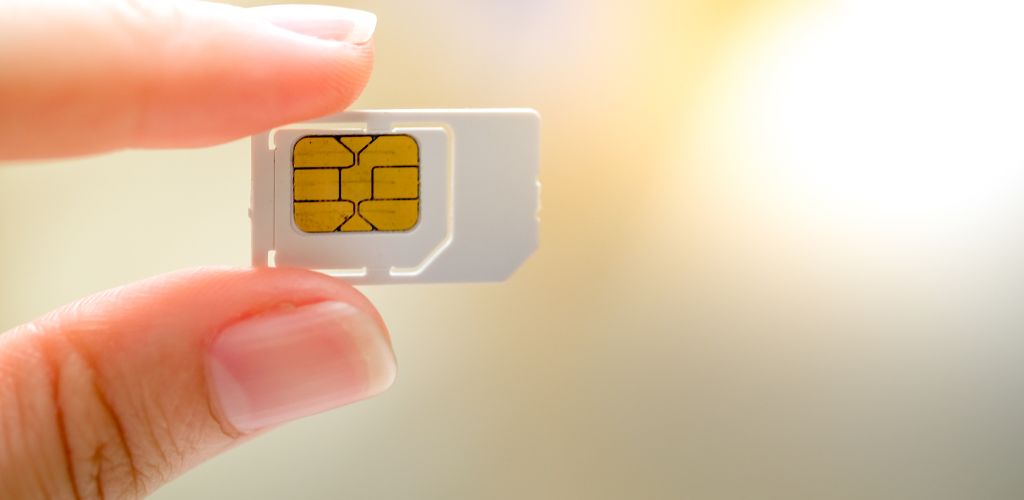
While WiFi is very common around the city, it’s much better to have a SIM card so you have access to data and can make calls if you need to. The main phone companies in Turkey are Turk Telekom, Turkcell, and Vodafone. These all offer SIM cards to foreign citizens, and you simply go to the nearest store with your passport and pay the fee, which is generally around 700-900TL ($38-$49).
As an Istanbul digital nomad, the good news is that WiFi is very reliable, but there may be times when you need to create a hotspot from your phone and share your data with your laptop; that’s entirely possible. However, many people are choosing eSIMs these days instead, and several companies offer them.
Airalo, Holafly, and Flexiroam are all reliable options for eSIMs, and they can be purchased online, activated, and topped up immediately. Prices vary, but you can often find great deals; I used Flexiroam because they offered 50GB for $100, valid for 90 days, and it was enough for what I needed. Most eSIMs in Turkey don’t offer calling minutes, but you can use WhatsApp/Skype/Facebook Messenger to make your calls instead.
Money Saving Tips for Istanbul
Get an Istanbul Museum Pass – This e-card covers the main sights, such as Topkapı Palace, Dolmabahçe Palace, Rumeli Fortress, and the countless museums across the city. It lasts for 15 days and costs 4000TL ($138). This is a major saving on the door price, and you don’t have to queue either.
Visit the local bazaars – You can get a lot of fresh produce from local bazaars for less money and better quality than in the supermarkets. Avoid buying meat from big supermarkets and head to the local butcher instead (kasap). If you want fish, similarly, go to a fish market; the one in Beşiktaş has a massive range of seafood at very reasonable prices.
Avoid New Year’s Eve – Istanbul’s accommodation prices tend to be relatively static across the year, however, New Year’s Eve and the week before are a lot more expensive. If you want to keep cash in your pocket, avoid that time and any other nationally important celebrations. The dates of these fluctuate yearly, so simply check online beforehand.
Don’t eat in Sultanahmet – You’ll find so many restaurants offering “authentic Turkish cuisine” in Sultanahmet. The biggest issue is that it’s not as authentic or high quality as it could be, and the prices are massively inflated. Instead, go to a local ev yemek lokanta, where you can enjoy better quality at lower prices. Alternatively, visit a local oçakbası for the best kebabs.
Use public transport – You can get around the city very easily and cheaply by using public transport. I mentioned earlier about the Istanbul Kart, and that’s definitely something you need to purchase and top up regularly. I will admit that the Metro and bus network looks a bit confusing at first glance, but once you use it, you’ll see that it’s extremely easy.
Visit Beşiktaş and Kadiköy for clothing – You’ll find all the big High Street names, but there are some serious bargains on clothing in the small shops and markets in Beşiktaş and Kadiköy.
Coworking Spaces in Istanbul and Wifi Speed
The city is home to a growing number of co-working spaces, and while there aren’t as many as there are in some other digital nomad hotspots, there’s no shortage of cafes to work from for digital nomads living in Istanbul. If you do want to use a co-working space, you generally have to book beforehand, and you’ll pay per day. It’s important to remember that the co-working scene in Istanbul is growing, so it’s likely to be more prevalent in the months and years to come.
The other plus point is that most places have good-quality WiFi, which is important for a digital nomad living in Istanbul. To give you an idea of Internet speeds in Istanbul, the average upload speed on a fixed connection is 8.78, and the average download speed is 38.12, according to a recent study by Speedtest.
I never found any major problems with the Internet in Istanbul; there were a few short outages occasionally, but it was pretty solid overall. However, if you want to watch videos or stream movies, you may notice that it stops occasionally; that’s when I used my eSIM rather than WiFi, (although this kind of usage will drain your data faster).
1. CoBAC
CoBAC is located in Fatih, with a fantastic view over the Golden Horn. It’s one of the newest co-working additions to the city, and it’s a modern option for digital nomads. There are several membership options available that cover different durations, so it’s worth exploring whether you’re likely to use it regularly or just as a one-off.
You can rent an individual desk or work within a collaborative area, and there’s free tea, coffee, and water throughout the day. The space also has 24/7 security, so you can choose to work late and feel comfortable. CoBAC is very easy to reach from most parts of the city as it’s in the center of Fatih – it’s connected via tram, Metro, bus, or on foot.
2. Workinton
Workinton is located in trendy Nişantaşı, close to the center of Beşiktaş. I used this space a few times, and I enjoyed the bright decor and the collaborative feel. It’s a good co-working space for productivity and feeling comfortable at the same time.
All furniture is ergonomic, and there are lockers to keep your personal items safe. Free tea and coffee are served all day, and there are plenty of cafes and restaurants close by if you want something to eat. The WiFi here was high quality for me; I conducted video calls without any glitches.
This space offers membership options, or you can hire a desk for the day; you’ll get cheaper rates the more days you choose.
3. DAM
The major advantage of choosing DAM as your co-working space is that it’s as central as can be; right in the heart of Taksim. This space is also open 24/7, so if you have to make calls at odd hours to fit in with your client’s needs you can do that without concern. The decor is also very vibrant, and the whole space is quite cozy.
You can rent a desk by the day or week here, and rates are reasonable for the location. Free refreshments are served all day, and there’s no shortage of eateries around the area. I found the staff very friendly, and I loved the large meeting room that can be used for collaboration and brainstorming.
Best Cafes to Work From in Istanbul
If co-working spaces aren’t your thing, you’ll find more than enough cafes in Istanbul where you can set up your temporary office for the day. I prefer to work from cafes because I like to watch the world go by while I’m working and co-working spaces can be costly. I saw many other Istanbul digital nomads working from cafes, and as long as you purchase drinks (more than one so as not to be rude), you’re good to go.
Starbucks Barbaros Beşiktaş: I know it’s predictable but I found this a great place to work from as it’s large, spacious, and bright, and the chairs were especially comfortable. The WiFi was also very good quality and solid throughout the few hours I was there, plus the noise level was perfect. Of course, the range of coffee and snacks on offer is pretty wide-ranging.
1 Kahve, Cihangir: This cafe is in a great spot, around five minutes walk from Taksim Square. It’s a comfortable spot with great WiFi and delicious coffee and pastries. Many other remote workers spend their time there, so you won’t feel uncomfortable, and there are adequate charging points.
Nevmekan Bağlarbaşı, Üsküdar: This huge cafe also houses a library and art gallery, so it’s a great place to spend a few hours. It’s also ideal for working as there are charging points dotted around the cafe, the WiFi is excellent, and the size means you’re never going to feel like you’re taking up a table unnecessarily. The coffee here is also some of the best I’ve had in Istanbul.
Activities and Things To Do in Istanbul
The beauty of working remotely in Istanbul is that there are so many things to see and do when you’ve finished working for the day, or at weekends if you work for a company. Of course, you’ll want to know where to head to make your spare time count.
Here are a few ideas for those of you considering the choice of being a digital nomad living in Istanbul:
1. Visit the Princes’ Islands
The perfect thing to do on a weekend off is to head to the beautiful Princes’ Islands for the day. Büyükada is the largest of these islands which are just over an hour away from Istanbul on the ferry. It’s the perfect way to get away from the hustle and bustle as traffic isn’t allowed on these islands.
During the summer months, you can enjoy the beautiful beaches, but you can also hike. While I was a digital nomad living in Istanbul, I really enjoyed the Aya Yorgi Monastery trail, which takes around 2.5 hours, but you can walk around on your own steam and check out the amazing views. There are also plenty of small cafes and restaurants where you can stop and enjoy a fresh lemonade or a cup of Turkish coffee.
The best way to reach Büyükada is via a tour. I took the Full Day Princes Islands Tour which also included lunch, and it was a great way to see the island. However, you can also take the regular ferry from Beşiktaş, Eminönü, and Karaköy. Ferries leave regularly throughout the day and are operated by IETT but various other tours also depart the main ports.
2. Explore Sultanahmet
Sultanahmet is home to some of Istanbul’s most famous sights, and you can see a few of them within just one day. You can either take a day off, perhaps at the weekend or spread the sights out over time and visit after you’ve finished work for the day. The must-visit spots include Blue Mosque, Hagia Sofia, Basilica Cistern, Topkapı Palace, Grand Bazaar, and Suleymaniye Mosque.
You’ll find many tours to these spots, such as the Istanbul Sightseeing Walking Tour, or you can visit each one individually. When you’re living in Istanbul, you can visit these famous attractions leisurely. You don’t have to rush from one to another and risk missing all the small details.
The best way to get to Sultanahmet is either via the bus from Taksim or the Asian side (several buses serve this route) or on the Marmaray from Kadiköy and then walk the short distance up the hill from Sirkeci. You can also take the tram from Kabataş, which is around a 15-minute walk from Beşiktaş.
3. Dolmabahçe Palace
Dolmabahçe Palace is a must-visit, especially if you’re looking for something to fill your time after you’ve finished work – I highly recommend this activity to any digital nomads living in Istanbul. The palace itself is so stunningly beautiful, but the gardens and the view over the Bosphorus are just as jaw-dropping. The only downside is that you can’t take photos inside the palace; as the guide told me, “Take photos with your eyes instead!”
The palace dates back to Ottoman times but it was also where Mustafa Kemal Atatürk died on 10 November 1938. It’s a place of great importance and opulent to the extreme. You can take a guided tour or you can visit yourself; the palace is included in the Museum Pass, or you can pay the 650TL ($34.90) entrance fee at the door.
It’s also very easy to get to, as it’s only around a 10-minute walk away from Beşiktaş, or you can take the tram from Sultanahmet or Karaköy and walk in around 5-10 minutes. If you’re on the Asian side, simply take the ferry over to Beşiktaş and walk from there.
4. Try a Food Tour
While working remotely in Istanbul, you’ll come across many different types of local cuisine, including street food. However, the best way to understand what you’re eating and appreciate it more, is to take a food tour.
Eating local food is the single best way to truly throw yourself into local life, but it also means you’ll save money. Taking this kind of tour will allow you to try different things you might not know about; I discovered different mezes this way and now I eat them all the time. You’ll also find small markets and stalls that you’ll go back to time and time again.
5. Bosphorus Cruise
Getting around Istanbul can take time; the traffic and crowds often make a short trip much longer than intended. That’s not ideal when you’ve got work to do, so a Bosphorus cruise is the best way to see a lot without getting stuck in a traffic jam. I took the Bosphorus Cruise with Audio App and I learned a lot simply by sitting there and observing my surroundings.
Cruises typically leave from either Eminönü, Beşiktaş, or Karaköy and you can find tours that take anything from one hour to a full day. You can choose the option that suits your day best, and sail leisurely down the Bosphorus taking in both the European and Asian sides of the city. Cruises usually go all the way down to Sariyer, (which is where you’ll find the second bridge over the Bosphorus), before turning back again.
Tours operate all year around and throughout the day, often without the need to pre-book. As a digital nomad living in Istanbul, it’s perfect for days when you’ve finished work a little earlier and want to find something to fill your spare time.
Weather in Istanbul
Istanbul is a year-round destination, and while there are distinct seasons, it can rain at any time of the year. Unlike the south coast of Turkey which rarely sees any rain between June to September, Istanbul is a typically rainy place, although during the summer months, there are some very warm days with bright blue skies. However, the winter can be extremely cold with the risk of snow.
Despite the cold, I like the winter months the best. There’s so much to see and do in this city that the weather isn’t really the biggest concern. You’ll find crowds everywhere you go, no matter whether it’s hot, sunny, rainy, or snowing. I find Istanbul truly beautiful when it snows.
To give you a quick round-up of Istanbul’s weather: December to February are considered winter when temperatures average between 43-47°F/6-8°C, and rain and snow are possible. Summer falls between June and August, with an average high of around 75°F/24°C, spring is from March to May, with an average high of 53-60°F/12-16°C, and fall is between September to November, with typical highs of 60-70°F/16-21°C.
Pros and Cons of Living in Istanbul
As with anywhere in the world, there are both pros and cons of living in Istanbul as a digital nomad. Let’s take a look at the plus points and negatives, so you can move a little closer to deciding whether this is the destination for you.
Pros of Living in Istanbul
Plenty of time to see the sights – the city is home to more history than most countries, and when you’re a digital nomad living in Istanbul, you have more time to explore without feeling overwhelmed and exhausted.
Low cost of living – While prices have risen recently, the cost of living is still lower than most other places in Europe.
Amazing food – Every single day you’ll get to try delicious cuisine, and if you need a break from traditional fare and fancy something international, you’ll find it without any problems at all.
Varied nightlife – When you feel like going out and mingling, there’s a huge range of things to do. If you want to go clubbing, you’ll find it, but similarly, there are countless coffee shops, cocktail spots, rooftop bars, fancy restaurants, pubs, and live music venues to try out. It’s also really easy to meet people at any of those places.
It’s easy to be productive – As a digital nomad living in Istanbul, you’ll need the right conditions for productivity, and you won’t be hindered. Internet is high-quality in most places, and you can set up your phone as a hotspot if necessary. There are also plenty of co-working spaces and cafes with strong WiFi where you can set up your “office” for the day.
It’s easy to get around – As a digital nomad living in Istanbul, you won’t be stuck in one place; it’s so easy to move around from neighborhood to neighborhood and even continent to continent! Public transport is cheap, efficient, and easy to use, plus it’s quite walkable in most areas.
Cons of Living in Istanbul
Crowds and traffic – Istanbul is amazing, but sometimes it’s a case of sensory overload. It can get so crowded that personal space doesn’t feel possible, and the traffic is from another planet. I often felt exhausted at the end of every day simply from having to navigate the hustle and bustle.
Rain – While the weather is unpredictable and can often be very sunny, especially during the summer months, it can rain at any time and when it does, it’s pretty miserable.
You can’t do anything quickly – Because it’s so busy, it’s hard to get anything done in a rush. Most of the time, things that should only take an hour end up taking three because of crowds and traffic. You have to be patient here.
It’s tricky to find accommodation that isn’t a hostel: Earlier, I talked about accommodation options and mentioned a few different ways to find somewhere to stay, but if you want to stay somewhere other than a hostel, it can be tricky. Connecting with other digital nomads and sharing finds is the best way, but if you don’t know anyone when you first arrive, you might find that hostels are your only option for a while.
Digital Nomad Visa for Istanbul
Living in Istanbul as a digital nomad is only possible for 90 days out of every 180 days. While Turkey isn’t in the Schengen zone, it does have similar visa requirements, i.e. a rolling 180-day period, and within it, you cannot spend more than 90 days in the country. Once you do, you must leave for 90 days before you can return.
You can apply for a residency permit if you want to stay longer than 90 days, but this is extremely difficult if not impossible for new applicants currently, especially in Istanbul. In addition to that, you cannot legally work on a residency permit. There is currently no digital nomad visa in place in Turkey.
British citizens do not need to apply for a tourist visa before they travel to Turkey, however Canadian and American citizens need to obtain an e-visa before travel: you can find application information here.
In Conclusion
Istanbul is such an amazing city, and no matter how many times I visit, I fall in love with it more with each trip. It’s such a melting pot of old and new, and you’ll meet people from all over the world almost every day. Of course, it’s also a place that’s brimming with history to explore and don’t even get me started on the food …
As a digital nomad living in Istanbul, you’re sure to have a wonderful experience, and even though it will be relatively short-lived due to visa rules, it’s somewhere you’ll no doubt return to more than once.
The 2026 Audi Q9 continued testing on public roads. The full-size crossover SUV is now undergoing cold-weather testing in the snow. Still completely covered in camouflage, the large luxury SUV sported a different wheel design than previous prototypes. Dual exhaust tips were present indicating a gas-powered engine under the hood.
Lamborghini recommitted to its plan of launching its first EV in 2028. The automaker said it will follow the electric 2+2 up with an “electric Super SUV” in 2029, according to a business update delivered on Tuesday. The first EV, a high-riding 2+2 GT, was previewed in 2023 in concept form, but little is known about the electric SUV.
Audi gave its three-row crossover SUV a refresh. The 2025 Audi Q7 debuted in Euro-spec with revised front and rear styling featuring next-generation LED lightning elements. Inside the updated interior software’s been reworked in the digital gauge cluster to show more information. A U.S.-spec debut should take place in the coming months.
You’ll find these stories and more in today’s car news, right here at Motor Authority.
Andretti, and subsequently Cadillac, won’t be joining the Formula 1 grid anytime soon.
On Wednesday, ESPN reported that Formula 1 has officially rejected Andretti and Cadillac’s bid to join the championship in 2025 or 2026. The door was left open for the joint team to enter in 2028.
The governing body of the Formula 1 World Championship approved Andretti Global’s Formula 1 bid in October on a technical basis. The team would enter the sport and mark the 11th team on the grid. Rules allow for up to 13 teams.
“Our assessment process has established that the presence of an 11th team would not, in and of itself, provide value to the Championship,” F1 said in a statement.
Andretti Cadillac told Motor Authority, “Andretti Cadillac has reviewed the information Formula One Management Limited has shared and strongly disagree with its contents. Andretti and Cadillac are two successful global motorsports organizations committed to placing a genuine American works team in F1, competing alongside the world’s best. We are proud of the significant progress we have already made on developing a highly competitive car and power unit with an experienced team behind it, and our work continues at pace.Andretti Cadillac would also like to acknowledge and thank the fans who have expressed their support.”
With the rejection of Andretti Global’s bid came word that the outfit has a good chance of joining the grid in 2028 if General Motors follows through on its plans to build its own F1 unit.
The original plan called for Andretti to use a Renault power unit initially with Cadillac branding.
F1 noted in its statement concern with a new, novice, team being competitive with a new car and power unit in 2025 before having to then prepare a new power unit for the updated 2026 regulations.
F1 will introduce a new power unit in 2026. The new powertrain will be similar to today’s, which combines a turbocharged 1.6-liter V-6 with hybrid systems. The goal will be to lower emissions by reducing power from the engine and increasing output from the hybrid systems.
Note – This story has been updated with comment from Andretti Cadillac.
The technical storage or access is strictly necessary for the legitimate purpose of enabling the use of a specific service explicitly requested by the subscriber or user, or for the sole purpose of carrying out the transmission of a communication over an electronic communications network.
Preferences
The technical storage or access is necessary for the legitimate purpose of storing preferences that are not requested by the subscriber or user.
Statistics
The technical storage or access that is used exclusively for statistical purposes.The technical storage or access that is used exclusively for anonymous statistical purposes. Without a subpoena, voluntary compliance on the part of your Internet Service Provider, or additional records from a third party, information stored or retrieved for this purpose alone cannot usually be used to identify you.
Marketing
The technical storage or access is required to create user profiles to send advertising, or to track the user on a website or across several websites for similar marketing purposes.