If there is one watch that we have praised in every issue this year, often with no good reason other than the fact that we like it, it must be the Parmigiani Fleurier Toric Petite Seconde. This is the sort of watch that we imagine ourselves wearing one day, when our tastes finally mature. Actually, we shall be so bold as to say it is exactly the kind of watch that all enthusiasts and collectors should want to own. Unlike far too many statement watches trying to give you whiplash, the Toric Petite Seconde invites quiet contemplation. Oh yes, and that is for owners only; onlookers will simply walk on by, none the wiser.
Now, in doing this story we run the risk of writing ourselves into a corner in the coming Festive issue. Longtime readers can guess that there will be a major story on Parmigiani Fleurier soon, and the specific subject has not been decided. By running this piece now, we risk having to go a different route. Think of it as taking a weekend trip to your dream destination, when you have an extended trip to the same spot coming up. But we love this watch too much to pass on any chance to celebrate it. To be fair, Parmigiani Fleurier just released some new materials to support the arrival of the new Toric watches in Singapore so the timing is right. The watch has also just been nominated for the GPHG, alongside notable Parmigiani Fleurier models in six categories. That has to be some kind of record but that is not the subject of this tale.
You may also have noticed that we covered the Toric collection once before, in the Summer issue, so what could we or Parmigiani Fleurier bring to the table. Certainly not a new watch. Instead, the brand doubled down on its sartorial ambitions and horological prowess with a special news pack on the Toric collection. This includes cleverly crafted takes on the Chronographe Rattrapante and Petite Seconde from the editors of The Rake (including Revolution founder and original gentleman influencer Wei Koh), and France’s Monsieur. These commentaries bring additional perspective into the conversation about a collection that needs more contemplation.
In recognition, Parmigiani Fleurier has made much more than just the basic information available from the original release during Watches and Wonders Geneva. CEO Guido Terreni told us then that he thinks most people only tune in to watch the news at special moments, like WWG for example, and perhaps Geneva Watch Days too; the GPHG probably only makes the news feeds of watch afficionados. Well, perhaps he has found a fresh way to get people to take notice but it probably only works when the collection is as well put together as the Toric is. For example, the Toric brings back the lost dial decorative art called “grenage,” which was revived by none other than Michel Parmigiani. Bridge-side, a lot of emphasis has been given over to the importance of handwork and traditional (antique) machining. When a watch collection is as low-key as the Toric, it needs a lot of careful explaining.
Simply saying that “grenage” has been used for the dial is meaningless because no one, or hardly anyone, will know what that means. Briefly, this technique sees tartar cream and sea salt ground together with a glass pestle, with the results joining forces with grains of silver and demineralised water to form a paste. This paste is applied to the base dial with a horn spoon. It is then brushed in all directions (presumably as evenly as possible) with a brush (with fine bristles) to eventually get the grains of silver to stick. This must all be done in semi-darkness because silver is famously photosensitive (meaning it reacts to light). If nothing else, this description evokes more questions so the value of space for explanations is clear.
The dial, along with the gold movement and the artisanal nubuck alligator strap, goes a long way to revealing the qualities of the Toric collection. Unfortunately, we do not have the space to get into details about the movements and straps but our longer treatise will hopefully cover it all. Consider for a moment that we have not even recounted the details of the watches, in terms of specifications. See you in the next installment of this evolving story, where we will dive even deeper into more of the details that define the Toric.
This article first appeared on WOW’s Legacy Issue #75
For more on the latest in luxury watch reads from WOW, click here.
Porsche is developing a new 911 Dakar. This time, though, the off-road-focused 911 will be a hybrid. It is expected to be launched in limited numbers by the end of this year.
According to Autocar, work on the new 911 Dakar has begun at Porsche’s engineering centre in Weissach. It will be based on the 992 generation.
The most significant change will come in the form of the T-hybrid powertrain. The new 911 Dakar is likely to use the same engine as the 911 Carrera GTS. It’s a 3.6-liter turbocharged flat-6 paired with an 8-speed automatic and a traction motor, good for 532 hp and 449 lb-ft of torque.
In comparison, the current model packs a twin-turbo flat-6 engine that delivers 473 hp and 420 lb-ft. The increased performance from the hybrid is expected to improve the car’s 0-62 mph time of 3.4 seconds.
When asked about the upcoming 911 Dakar, the Porsche spokesperson refrained from commenting on these reports.
It was a rainy winter evening in London, and it couldn’t have been a worse time for a breakdown. As luck would have it, this Aston Martin Valkyrie owner was left stranded after his $4 million hypercar stopped in the middle of the road.
The Valkyrie was seen parked in the fast lane on A40 just outside the Hilton London Metropole Hotel. It was travelling towards Regent’s Park when it reportedly broke down. A passerby shot this video showing the car with its hazard lights flashing.
The Valkyrie isn’t a car that one would drive daily. Yet there are owners who are brave enough to take their cars out in traffic and in suboptimal weather conditions.
The Aston Martin Valkyrie is powered by a Cosworth-built 6.5-liter naturally aspirated V12 mated to a Rimac-sourced KERS hybrid system. Its combined output is 1176 hp, which is channelled to the rear wheels via a 7-speed single-clutch automated manual transmission.
The federal government paused federal funds used to build new EV chargers late last week. A group of prominent automakers has asked them to turn the tap back on as soon as possible.
Like many industries, the automotive sector has formed several trade groups representing its interests in Washington. The Electric Drive Transportation Association is one. EDTA members include Ford, General Motors, Nissan, Stellantis, Toyota, charging providers like EVGo, and large retailers like Walmart that benefit from chargers in their parking lots.
The EDTA wrote to the U.S. Department of Transportation almost immediately after the funding pause was announced.
“We urge the Administration to quickly resume the critical work of the program and minimize uncertainty for states and their businesses, who have invested in infrastructure to serve local and national goals for advanced transportation,” the group said.
The funding freeze may not stop projects currently under construction. The Department of Transportation left it up to states to decide whether to complete or pause already-signed contracts.
It comes as part of an expanding legal fight over whether the president can decide not to spend money allocated by Congress.
Stellantis has a mobile service program pilot underway in the Southeast
The automaker ideally will launch the program on a larger scale in 2025
Jeep SVP Mike Koval Jr. said Ford and others have been benchmarked
Regardless of whether the vehicle is gas, electric, or a hybrid, Stellantis is preparing to meet customers where they are for repairs.
On Thursday, at the 2025 Chicago Auto Show, Jeep Senior Vice President Mike Koval Jr. told Motor Authority that it is preparing to roll out a mobile service program in 2025.
The program, which Koval Jr. didn’t have a name for yet, actually has launched as a pilot program in a handful of cities in the Southeast region with a couple of dealers. “It hasn’t been talked about yet because it’s not mature enough,” Koval Jr. said.
“Ford is much further along than we are,” Koval Jr. noted, referring to the Blue Oval’s mobile service program, which expanded to be nationwide with participating dealerships in 2023.
Koval Jr. said Stellantis has studied a lot of what Ford’s done. “I can learn from others,” Koval Jr. noted as he mentioned Stellantis has spent a lot of time benchmarking what others are doing in this area.
While Ford may have a head start, it’s Rivian and Tesla that have made headlines with mobile service programs. The startup EV automakers have fleets of mobile service techs that are company owned and operated.
Koval Jr. said Stellantis has been trying to get a mobile service program off the ground for years, but it’s happening in 2025 ideally.
“I will come to you, wherever you are, your home, your place of work, if I need to take your vehicle, I’ll bring alternate transportation, I don’t want you to have to lift a finger,” Koval Jr. said.
Mobile service techs will be able to handle all “light work,” like a lube, oil change, or tire rotation. That work could also include basic recalls and technical service bulletins.
Koval Jr. said he wants to develop a national program for this mobile service offering that includes dealers as partners.
The program wouldn’t use the same techs turning wrenches today at dealerships, because Koval Jr. said those mechanics can’t just leave the dealership. More technicians will need to be brought in for the program with “a slightly different skill set, and a slightly different profile.”
Stellantis is looking at multiple paths on how to accomplish this mobile service program, and one includes working with a third-party partner “because there’s a lot of infrastructure,” Koval Jr. said. “Like, who’s gonna buy the vans? Who’s gonna upfit the vans? That’s not inexpensive,” the exec continued.
Regardless of which route Stellantis takes for its mobile service program it won’t be looking at a direct sales models for vehicles. “Dealers are not the enemies,” Koval Jr. said. The exec said Stellantis will continue to sell vehicles through dealers.
On the 25th floor of the Park Hyatt New York, the living room of the brand-new Manhattan Suite is one of the more lavish places I’ve gathered my family to watch an Eagles playoff game. With windows nearly 18 feet high, a sculpture by An Te Lu; curving pink Vladimir Kagan–designed couches; dramatic rectangular brass fixtures, suspended from the ceiling; and the players larger than life on a 165-inch Sharp TV screen, my family and I felt far, far removed from our more demure living room just across town. And yet, we also felt right at home, in a kick-your-shoes-off, munch-on-popcorn kind of way, which was a surprise, given the grand environment.
Park Hyatt New York’s new Manhattan Suite, a sprawling, 3,500-square foot, three-bedroom, three-bathroom space, combines the best of what hotels do (room service; concierge access) with the best of what an apartment can offer (heated bathroom floors and full-service kitchen, anyone?). The Park Hyatt is set in midtown Manhattan, on a stretch of 57th street known as Billionaire’s Row, where several super-tall condominium towers cater to a fraction of the 1 percent. Built to the tune of $10 million, the suite debuted just in time for the hotel’s 10th anniversary—and I was there for a quick staycation.
Views from inside the bedroom.
Courtesy of Park Hyatt New York
A residential approach to design and amenities is taking off at hotels and resorts these days, as properties tap into underutilized areas or reconfigure smaller guest rooms into larger suites; build out villas on undeveloped land; and even sell club memberships to locals. To get in the game—and offer a premium choice for multigenerational groups—the Park Hyatt turned their former spa and salon on the 25th floor (a space that I found always had great bones, with soaring windows allowing for natural light) into the equivalent of a presidential suite.
“As the travel landscape continues to evolve, we saw the need for a space that blends luxury and comfort for all types of groups,” said Lauren Ebzant, area vice president and general manager of the Park Hyatt New York, in an interview with Travel + Leisure. “The Manhattan Suite was designed to meet the needs of today’s discerning travelers—whether they are multigenerational families seeking a spacious retreat, couples in pursuit of a romantic escape, executives embracing the work-from-anywhere lifestyle, or guests simply looking for a private sanctuary in the heart of New York City.”
Designed by Sawyer & Company, the suite, which is roughly shaped like a “U,” offers incredible, 270-degree views facing north, west, and south. We loved being able to see the treetops of Central Park from the two north-facing balconies, as well as craning our necks down to spy cars and pedestrians shuttling down 57th street from the main living area, which has a western exposure. The elevated experience does not come cheap: the suite costs $50,000 per night, if you book all three bedrooms (two can also be booked individually as Central Park Balcony Suites). That rate includes airport transfers, breakfast, a fridge and pantry stocked to your preference, and a spa treatment. (A new Spa Nalai will debut soon, also on the 25th floor, near the locker rooms close to the indoor pool.)
Interior of the suite’s dining and living room.
Courtesy of Park Hyatt New York
Tucked off the living room and accessible by a marble hallway, the primary bedroom is anchored by “Commission Base on the A,” an oversize graphite, oil, and acrylic piece on canvas from multi-disciplinary English artist Grace Watts. The large bathroom comes complete with a soaking tub, steam shower, Le Labo amenities, and hair dryer from stylist Rossano Ferretti. The closet is spacious, with ample drawers and hangers (a welcome upgrade from my apartment), but better still, personal shoppers from the nearby Nordstrom flagship are on-site to help you customize your wardrobe. The open-plan living and dining rooms felt gracious—not stuffy—with all of us easing into those pink couches for hours at night, and then sitting down to eggs Benedict for breakfast the next day at the eight-seat dining table. Books that nod to the city’s culture and history, including “New York Cocktails” and “The New York Tapes” were scattered throughout the suite, adding to the sense of place; I also relished seeing vibrant pieces by New York City-based artists Joanne Freeman and Erin O’Keefe.
A deep soaking tub in the suite’s bathroom.
Courtesy of Park Hyatt New York
If all three rooms are booked, the Manhattan Suite accommodates 10 guests overnight; that said, you could have many more over, with two powder rooms and a wet bar in the living room.
With executives continuing to work-from-anywhere, or even book in for longer-than average stays, Sawyer & Company Design, Inc. made room for a compact, modern office; a beautiful kitchen with Miele appliances, including a dishwasher and Master Cool fridge-freezer; and multiple common rooms, like the separate living area off one of the secondary bedrooms that faces north, toward Central Park.
“When designing, it was important to make the vast space feel comfortable and serene,” Tracey Sawyer, founder and CEO of Sawyer & Company Design, Inc, told T+L. “We used a combination of a soft neutral color palette with muted tones and natural materials like walnut wood to add warmth to the existing environment.”
For all the tactile perks–art curated by Tatar Art Projects; Sferra linens; Toto electric toilets; custom embroidered robes; and an in-room Peloton, upon request—I found that having a private hour for our family in the 65-foot-long saltwater pool, just a minute’s walk from the suite, was my favorite inclusion. The team opened it to us at 9:00 p.m., just as a handful of other guests were finishing up an evening swim. New York City, unlike Los Angeles or even London, is not known for its hotel pools. But the Park Hyatt has arguably one of the best, with music from Carnegie Hall piped underwater (the famous music hall is just across the street). Striding in and splashing solo in a hotel pool, as if we owned the place? That’s something we can all get used to.
New video shows a prototype of the Bugatti Tourbillon hybrid hypercar
The video provides a clear taste of the Tourbillon’s newly developed 8.3-liter V-16 engine
The Tourbillon enters production in 2026 and carries a starting price of about $4 million
Bugatti surprised many last year when, instead of revealing an electric successor to its Chiron hypercar, it introduced the gasoline-electric Tourbillon. But perhaps the most surprising aspect was the choice of the Tourbillon’s hybrid system’s internal combustion engine—a newly developed V-16.
Until now, there has been very little footage of prototypes, leaving enthusiasts wondering what the V-16 will sound like. While V-16-powered cars have existed before—most recently the Cizeta V16T supercar of the 1990s—the distinctive sound of a V-16 remains somewhat of a mystery.
That mystery is now starting to unravel. Mate Rimac, the head of the Bugatti Rimac partnership, recently took to social media to share a video of a Tourbillon prototype, giving us a clear taste of the new engine’s howl—and it’s brutal. The prototype is believed to be running exclusively on its gasoline engine, providing a glimpse of its raw performance even without the aid of electrification.
Power in the Tourbillon comes from a naturally aspirated 8.3-liter V-16 engine paired with three electric motors—two at the front and one at the rear. The V-16 alone produces approximately 986 hp, while the electric motors contribute an additional 790 hp, bringing the total system output to 1,776 hp.
The V-16 was developed by Cosworth, the legendary ex-Formula 1 power unit builder responsible for some of the most iconic engines in history, including the V-12s that power Aston Martin’s Valkyrie and GMA’s T.50 and T.33.
Working in tandem with the electric motors, Bugatti estimates the Tourbillon will accelerate from 0-62 mph in 2.0 seconds, 0-124 mph in less than 5.0 seconds, 0-186 mph in under 10.0 seconds, and 0-248 mph in under 25.0 seconds. Top speed is electronically limited to 276 mph, but Bugatti has hinted that at least one version of the Tourbillon might surpass 500 kph (310.7 mph).
Production of the Tourbillon is set to begin in 2026, with only 250 units planned. Prices start at approximately $4 million.
Just as there are widely understood empirical laws of nature — for example, what goes up must come down, or every action has an equal and opposite reaction — the field of AI was long defined by a single idea: that more compute, more training data and more parameters makes a better AI model.
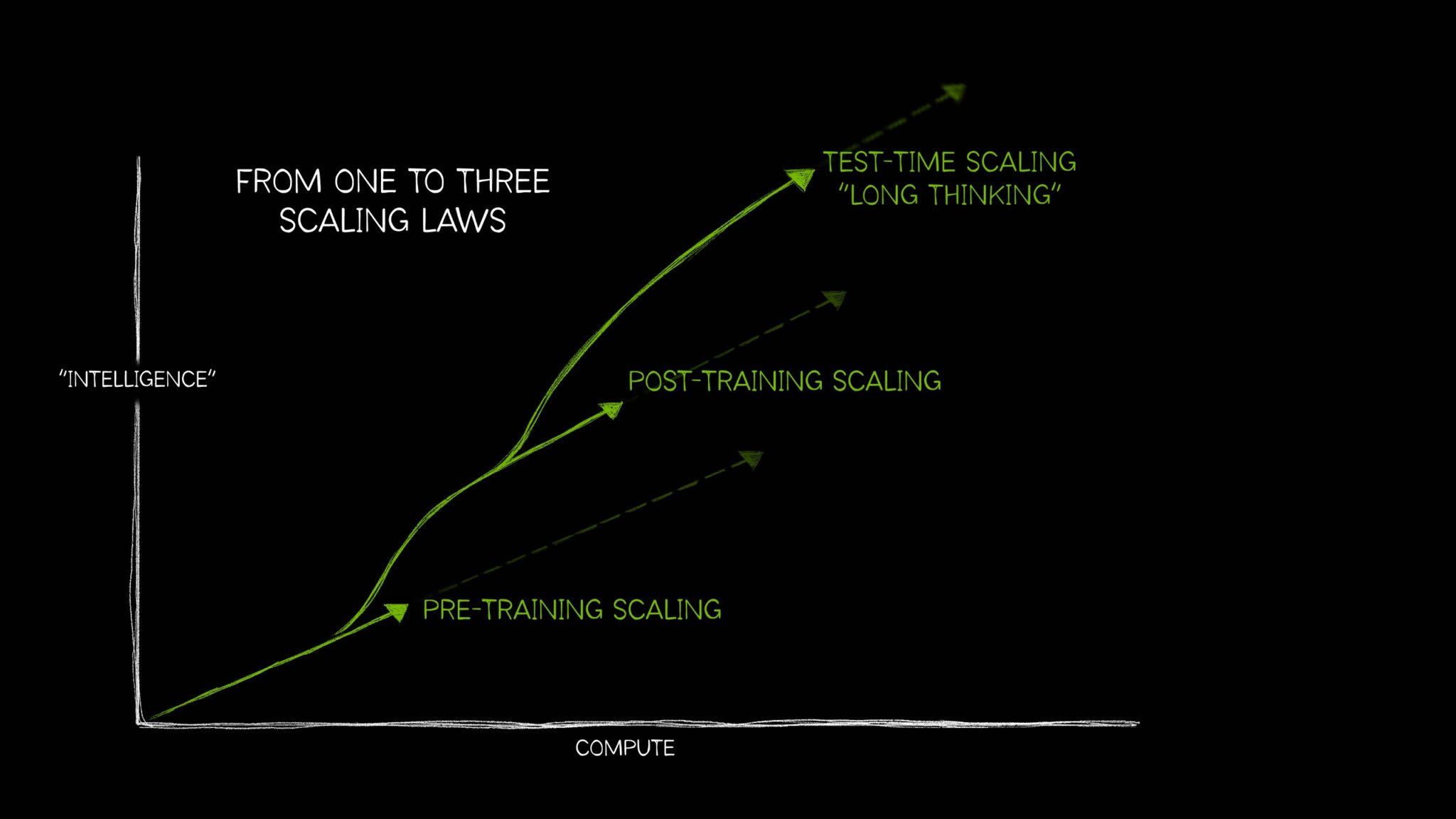
However, AI has since grown to need three distinct laws that describe how applying compute resources in different ways impacts model performance. Together, these AI scaling laws — pretraining scaling, post-training scaling and test-time scaling, also called long thinking — reflect how the field has evolved with techniques to use additional compute in a wide variety of increasingly complex AI use cases.
The recent rise of test-time scaling — applying more compute at inference time to improve accuracy — has enabled AI reasoning models, a new class of large language models (LLMs) that perform multiple inference passes to work through complex problems, while describing the steps required to solve a task. Test-time scaling requires intensive amounts of computational resources to support AI reasoning, which will drive further demand for accelerated computing.
What Is Pretraining Scaling?
Pretraining scaling is the original law of AI development. It demonstrated that by increasing training dataset size, model parameter count and computational resources, developers could expect predictable improvements in model intelligence and accuracy.
Each of these three elements — data, model size, compute — is interrelated. Per the pretraining scaling law, outlined in this research paper, when larger models are fed with more data, the overall performance of the models improves. To make this feasible, developers must scale up their compute — creating the need for powerful accelerated computing resources to run those larger training workloads.
This principle of pretraining scaling led to large models that achieved groundbreaking capabilities. It also spurred major innovations in model architecture, including the rise of billion- and trillion-parameter transformer models, mixture of experts models and new distributed training techniques — all demanding significant compute.
And the relevance of the pretraining scaling law continues — as humans continue to produce growing amounts of multimodal data, this trove of text, images, audio, video and sensor information will be used to train powerful future AI models.
Pretraining scaling is the foundational principle of AI development, linking the size of models, datasets and compute to AI gains. Mixture of experts, depicted above, is a popular model architecture for AI training.
What Is Post-Training Scaling?
Pretraining a large foundation model isn’t for everyone — it takes significant investment, skilled experts and datasets. But once an organization pretrains and releases a model, they lower the barrier to AI adoption by enabling others to use their pretrained model as a foundation to adapt for their own applications.
This post-training process drives additional cumulative demand for accelerated computing across enterprises and the broader developer community. Popular open-source models can have hundreds or thousands of derivative models, trained across numerous domains.
Developing this ecosystem of derivative models for a variety of use cases could take around 30x more compute than pretraining the original foundation model.
Developing this ecosystem of derivative models for a variety of use cases could take around 30x more compute than pretraining the original foundation model.
Post-training techniques can further improve a model’s specificity and relevance for an organization’s desired use case. While pretraining is like sending an AI model to school to learn foundational skills, post-training enhances the model with skills applicable to its intended job. An LLM, for example, could be post-trained to tackle a task like sentiment analysis or translation — or understand the jargon of a specific domain, like healthcare or law.
The post-training scaling law posits that a pretrained model’s performance can further improve — in computational efficiency, accuracy or domain specificity — using techniques including fine-tuning, pruning, quantization, distillation, reinforcement learning and synthetic data augmentation.
Fine-tuning uses additional training data to tailor an AI model for specific domains and applications. This can be done using an organization’s internal datasets, or with pairs of sample model input and outputs.
Distillation requires a pair of AI models: a large, complex teacher model and a lightweight student model. In the most common distillation technique, called offline distillation, the student model learns to mimic the outputs of a pretrained teacher model.
Reinforcement learning, or RL, is a machine learning technique that uses a reward model to train an agent to make decisions that align with a specific use case. The agent aims to make decisions that maximize cumulative rewards over time as it interacts with an environment — for example, a chatbot LLM that is positively reinforced by “thumbs up” reactions from users. This technique is known as reinforcement learning from human feedback (RLHF). Another, newer technique, reinforcement learning from AI feedback (RLAIF), instead uses feedback from AI models to guide the learning process, streamlining post-training efforts.
Best-of-n sampling generates multiple outputs from a language model and selects the one with the highest reward score based on a reward model. It’s often used to improve an AI’s outputs without modifying model parameters, offering an alternative to fine-tuning with reinforcement learning.
Search methods explore a range of potential decision paths before selecting a final output. This post-training technique can iteratively improve the model’s responses.
To support post-training, developers can use synthetic data to augment or complement their fine-tuning dataset. Supplementing real-world datasets with AI-generated data can help models improve their ability to handle edge cases that are underrepresented or missing in the original training data.
Post-training scaling refines pretrained models using techniques like fine-tuning, pruning and distillation to enhance efficiency and task relevance.
What Is Test-Time Scaling?
LLMs generate quick responses to input prompts. While this process is well suited for getting the right answers to simple questions, it may not work as well when a user poses complex queries. Answering complex questions — an essential capability for agentic AI workloads — requires the LLM to reason through the question before coming up with an answer.
It’s similar to the way most humans think — when asked to add two plus two, they provide an instant answer, without needing to talk through the fundamentals of addition or integers. But if asked on the spot to develop a business plan that could grow a company’s profits by 10%, a person will likely reason through various options and provide a multistep answer.
Test-time scaling, also known as long thinking, takes place during inference. Instead of traditional AI models that rapidly generate a one-shot answer to a user prompt, models using this technique allocate extra computational effort during inference, allowing them to reason through multiple potential responses before arriving at the best answer.
On tasks like generating complex, customized code for developers, this AI reasoning process can take multiple minutes, or even hours — and can easily require over 100x compute for challenging queries compared to a single inference pass on a traditional LLM, which would be highly unlikely to produce a correct answer in response to a complex problem on the first try.
This AI reasoning process can take multiple minutes, or even hours — and can easily require over 100x compute for challenging queries compared to a single inference pass on a traditional LLM.
This test-time compute capability enables AI models to explore different solutions to a problem and break down complex requests into multiple steps — in many cases, showing their work to the user as they reason. Studies have found that test-time scaling results in higher-quality responses when AI models are given open-ended prompts that require several reasoning and planning steps.
The test-time compute methodology has many approaches, including:
Chain-of-thought prompting: Breaking down complex problems into a series of simpler steps.
Sampling with majority voting: Generating multiple responses to the same prompt, then selecting the most frequently recurring answer as the final output.
Search: Exploring and evaluating multiple paths present in a tree-like structure of responses.
Post-training methods like best-of-n sampling can also be used for long thinking during inference to optimize responses in alignment with human preferences or other objectives.
Test-time scaling enhances inference by allocating extra compute to improve AI reasoning, enabling models to tackle complex, multi-step problems effectively.
How Test-Time Scaling Enables AI Reasoning
The rise of test-time compute unlocks the ability for AI to offer well-reasoned, helpful and more accurate responses to complex, open-ended user queries. These capabilities will be critical for the detailed, multistep reasoning tasks expected of autonomous agentic AI and physical AI applications. Across industries, they could boost efficiency and productivity by providing users with highly capable assistants to accelerate their work.
In healthcare, models could use test-time scaling to analyze vast amounts of data and infer how a disease will progress, as well as predict potential complications that could stem from new treatments based on the chemical structure of a drug molecule. Or, it could comb through a database of clinical trials to suggest options that match an individual’s disease profile, sharing its reasoning process about the pros and cons of different studies.
In retail and supply chain logistics, long thinking can help with the complex decision-making required to address near-term operational challenges and long-term strategic goals. Reasoning techniques can help businesses reduce risk and address scalability challenges by predicting and evaluating multiple scenarios simultaneously — which could enable more accurate demand forecasting, streamlined supply chain travel routes, and sourcing decisions that align with an organization’s sustainability initiatives.
And for global enterprises, this technique could be applied to draft detailed business plans, generate complex code to debug software, or optimize travel routes for delivery trucks, warehouse robots and robotaxis.
AI reasoning models are rapidly evolving. OpenAI o1-mini and o3-mini, DeepSeek R1, and Google DeepMind’s Gemini 2.0 Flash Thinking were all introduced in the last few weeks, and additional new models are expected to follow soon.
Models like these require considerably more compute to reason during inference and generate correct answers to complex questions — which means that enterprises need to scale their accelerated computing resources to deliver the next generation of AI reasoning tools that can support complex problem-solving, coding and multistep planning.
Learn about the benefits of NVIDIA AI for accelerated inference.
The last motorhome I owned was a Swift 496 Esprit. It’s 7.8m long and weighs a healthy 4 tonnes, give or take. We owned her for 18 months, which seemed a reasonable length of time to discuss the pros and cons of owning a motorhome over 3.5 tonnes, instead of a small motorhome like my current camper.
–
*We work hard to make this the best motorhome travel blog and road trip website possible, full of helpful content for you. The website is supported by our readers, so if you buy through links on this site we may earn a commission- at no extra cost to you. All opinions remain our own.
If you find this post useful, you can also treat us to a coffee – we promise to enjoy it while creating more useful content like this- we might even indulge in a biscuit (or two!)
Why did we buy a motorhome over 3.5 tonnes?
Back then, we didn’t set out looking for a motorhome over 3.5tonnes, but we DID see a layout we loved but couldn’t afford. (A brand new Bailey Autograph, if anyone’s interested!)
The Bailey motorhome was actually less than 3.5 tonnes (just!) but there was no way we could afford it, so we set out to find something similar on the market. Enter the Swift 496.
She has a fantastic layout AND we got her for a great price as she was an ex-hire vehicle and one of those great used motorhomes for sale. There were several problems, including the fridge and solar panel, but we knew we could sort those out with this used camper.
We discussed whether the weight would be a problem, as it meant I couldn’t drive our new motorhome due to licence restrictions, but we agreed that Mr WB preferred to drive anyway and I prefer to navigate, so it wouldn’t be an issue.
A large RV, over 3.5 tonnes, sitting in front of some snow-capped mountains.
Pros of a large motorhome
There are some obvious advantages to a bigger motorhome.
Let’s go through those a little. We deliberately chose a motorhome with an end lounge area and a separate dinette.
When buying a motorhome, it’s always a toss-up between cost, layout and availability- and somewhere there needs to be a compromise.
Better living space in a larger motorhome
We LOVED (and I still do!) the living space and it was perfect for us over all our travels, including 5 weeks in Norway, several weeks in Germany, France, Italy, and much more.
Better storage space
We also loved the storage space- the van holds SO. MUCH. KIT and campervan gadgets and it’s never an issue because our payload is crazy.
Seriously, we put hydraulic legs, kayak, paddleboard, solar panel, motorhome generator, and a million other things onto it… and we still had about 300kg of payload left if we wanted it.
We had always practice certain motorhome security basics to ensure all of our gear is secure.
Other than that though, I love having a motorhome where we don’t need to worry about storage if going off for a couple of months at a time.
However, we had hired a small motorhome under 3.5 tonnes and loved it. It was easy to park and loved how much storage there was inside.
Although the van we had back then wasn’t a dream layout, we really enjoyed experiencing a different type of motorhoming with an under 3.5-tonne motorhome hire. It opened our eyes to the possibility of what you could get with a smaller van.
Which brings us to the cons of a motorhome over 3.5 tonnes.
A motorhome over 3.5 tonnes, sitting in front of a beautiful lake with snow encrusted mountains in the background.
Cons of a motorhome over 3.5 tonnes
Speed limits are lower on roads in Europe
Toll charges are more
Difficult to get toll passes, vignettes or other such things for vehicle over 3.5 tonnes
I can’t drive it
Longer = harder to park
We loved our motorhome, we really did. But there are some things about it which just didn’t work for us- and most of them revolve around the weight/ size of owning a motorhome over 3.5 tonnes.
Reduced speed limit for motorhomes over 3.5 tonnes
One of the biggest problems is the reduced speed limits for vehicles over 3.5 tonnes. We did a LOT of driving both in the UK and Europe. So, having to almost double our journey time during a UK road trip can be frustrating. You can find a list of European speed limits here.
And no, it’s not a typo- if your vehicle weighs over 3.05 tonnes, you can only do 60mph on UK dual carriageways, 50mph on other roads unless a lower speed limit applies.
motorhome buying toolkit
Vignettes/ Toll passes
Also, we LOVED travelling Europe in our motorhome, but toll passes and some vignettes are only applicable to vehicles up to 3.5 tonnes. After that, you need to go to one of the official border crossings and fill in paperwork. In some countries, you need to have a box installed which tracks your mileage.
Restrictions on driving licences
All my travelling has made it really difficult to get my C1 (that, and a lack of motivation!!) But honestly, it’s silly having a motorhome over 3.5 tonnes that you can’t drive should your partner ever need to. Safety first.
Longer = harder to park
Lastly, this isn’t down to weight, but having a longer vehicle is harder to park- especially when we had attached a 3m motorbike trailer to the back of it! With our van and a trailer, we were longer than two parking spaces, making it tough to pop into a supermarket or car park as we travelled- we were always hanging over the edge somewhere!
We also had to avoid someaires around Europe, as they are restricted to up to 8m. With a shorter van, we could squeeze in, even with the trailer!
A large motorhome parked in front of a picturesque lake.
So, with all that said, we decided to sell our large motorhome and get a motorhome under 3.5 tonnes! People often say the third boat you buy is the perfect one for you- I wonder if the same applies to buying second-hand camper vans?
–
Should you buy a motorhome over 3.5 tonnes?
So, should you buy a motorhome of over 3.5 tonnes? Absolutely, if it’s right for you!
There are some INCREDIBLE used campers around and if you’re not affected/ not bothered by any of the above-mentioned points, then definitely go for it, especially if you have a family and see a fantastic motorhome for sale.
We had been ALL over the place in our motorhome and the size/ weight wasn’t a problem at all until our daughter stopped travelling with us and we realised we didn’t need a motorhome over 3.5 tonnes. If she were younger and still adventuring with us, we wouldn’t have downsized our motorhome at all.
Which is why there are so many types of second-hand motorhomes on the market- one size most definitely does NOT fit all and you need to pick a motorhome which works for the stage of life you’re in right now. You can also do a motorhome under 3.5 tonnes hire first and see if this size is right for you.
And if you’re choosing a motorhome or camper at the moment, let me know what you pick!
Next steps
If you’d like some more help figuring out what vehicle to get (and how to buy the RIGHT one for you), grab a copy of our Complete Beginners guide to Motorhome Buying here– a course of videos, downloadable eBook and worksheets to help you make the BEST decision for YOU!
Ford Mustang GTD Spirit of AmericaChicago Auto Show
Ford displayed its brand-new 2025 Mustang GTD Spirit of America at the 2025 Chicago Auto Show. Developed as a tribute to American design and engineering prowess, this version of the brand’s iconic pony car is its most striking yet.
Sporting a white paint job with red and blue racing stripes, red brake calipers and mirror caps, and a massive red and black rear spoiler, the show car looks every bit as mean as its performance figures would suggest.
Ford Mustang GTD Spirit of America
2025 Ford Mustang GTD Spirit of America
Engines and Specs
Under the hood is a supercharged 5.2-liter V8 engine that produces an eye-watering 815 horsepower and 664 pound-feet of torque. Mated to an 8-speed dual-clutch automatic transmission, Ford says this combo is good enough to propel the GTD to a top speed of 202 mph. Forged carbon ceramic brake discs and high-performance calipers are designed to erase all that speed as quickly as possible.
Prices
The Spirit of America edition will be an option package for the standard GTD. Pricing has not been announced but expect each example of the very limited production run to sell out immediately despite an expected MSRP in excess of $325,000.
CG Says
If we are truly approaching the end of the internal combustion age, we can think of no better tribute than this vehicle. We just hope the lucky few who are able to purchase a Mustang GTD will actually drive them and not lock them in storage waiting for a huge payday at a high-end auction.
Ford Mustang GTD Spirit of America
Listen to the Car Stuff Podcast
2025 Ford Mustang GTD Spirit of America Pictures
(Click below for enlarged images)
2025 Ford Mustang GTD Spirit of America
2025 Ford Mustang GTD Spirit of America
2025 Ford Mustang GTD Spirit of America
Forgotten Concept: Ford Mustang Milano
Consumer Guide Car Stuff Podcast Episode 261: Chevy Drops Model, EV Infrastructure Funding, Buying Off-Road Tires
The technical storage or access is strictly necessary for the legitimate purpose of enabling the use of a specific service explicitly requested by the subscriber or user, or for the sole purpose of carrying out the transmission of a communication over an electronic communications network.
Preferences
The technical storage or access is necessary for the legitimate purpose of storing preferences that are not requested by the subscriber or user.
Statistics
The technical storage or access that is used exclusively for statistical purposes.The technical storage or access that is used exclusively for anonymous statistical purposes. Without a subpoena, voluntary compliance on the part of your Internet Service Provider, or additional records from a third party, information stored or retrieved for this purpose alone cannot usually be used to identify you.
Marketing
The technical storage or access is required to create user profiles to send advertising, or to track the user on a website or across several websites for similar marketing purposes.










:max_bytes(150000):strip_icc()/TAL-header-living-room-manhattan-suite-park-hyatt-new-york-PHNYMANHTNSUITE0225-cfc7ff262d584e8cba45cdd0c22a9c8e.jpg "Park Hyatt New York Debuts the Manhattan Suite—See Inside")
:max_bytes(150000):strip_icc():format(jpeg)/TAL-header-living-room-manhattan-suite-park-hyatt-new-york-PHNYMANHTNSUITE0225-cfc7ff262d584e8cba45cdd0c22a9c8e.jpg)