Home Blog Page 202

Fast, Low-Cost Inference Offers Key to Profitable AI

0


Businesses across every industry are rolling out AI services this year. For Microsoft, Oracle, Perplexity, Snap and hundreds of other leading companies, using the NVIDIA AI inference platform — a full stack comprising world-class silicon, systems and software — is the key to delivering high-throughput and low-latency inference and enabling great user experiences while lowering cost.

NVIDIA’s advancements in inference software optimization and the NVIDIA Hopper platform are helping industries serve the latest generative AI models, delivering excellent user experiences while optimizing total cost of ownership. The Hopper platform also helps deliver up to 15x more energy efficiency for inference workloads compared to previous generations.

AI inference is notoriously difficult, as it requires many steps to strike the right balance between throughput and user experience.

But the underlying goal is simple: generate more tokens at a lower cost. Tokens represent words in a large language model (LLM) system — and with AI inference services typically charging for every million tokens generated, this goal offers the most visible return on AI investments and energy used per task.

Full-stack software optimization offers the key to improving AI inference performance and achieving this goal.

Cost-Effective User Throughput

Businesses are often challenged with balancing the performance and costs of inference workloads. While some customers or use cases may work with an out-of-the-box or hosted model, others may require customization. NVIDIA technologies simplify model deployment while optimizing cost and performance for AI inference workloads. In addition, customers can experience flexibility and customizability with the models they choose to deploy.

NVIDIA NIM microservices, NVIDIA Triton Inference Server and the NVIDIA TensorRT library are among the inference solutions NVIDIA offers to suit users’ needs:

  • NVIDIA NIM inference microservices are prepackaged and performance-optimized for rapidly deploying AI foundation models on any infrastructure — cloud, data centers, edge or workstations.
  • NVIDIA Triton Inference Server, one of the company’s most popular open-source projects, allows users to package and serve any model regardless of the AI framework it was trained on.
  • NVIDIA TensorRT is a high-performance deep learning inference library that includes runtime and model optimizations to deliver low-latency and high-throughput inference for production applications.

Available in all major cloud marketplaces, the NVIDIA AI Enterprise software platform includes all these solutions and provides enterprise-grade support, stability, manageability and security.

With the framework-agnostic NVIDIA AI inference platform, companies save on productivity, development, and infrastructure and setup costs. Using NVIDIA technologies can also boost business revenue by helping companies avoid downtime and fraudulent transactions, increase e-commerce shopping conversion rates and generate new, AI-powered revenue streams.

Cloud-Based LLM Inference

To ease LLM deployment, NVIDIA has collaborated closely with every major cloud service provider to ensure that the NVIDIA inference platform can be seamlessly deployed in the cloud with minimal or no code required. NVIDIA NIM is integrated with cloud-native services such as:

  • Amazon SageMaker AI, Amazon Bedrock Marketplace, Amazon Elastic Kubernetes Service
  • Google Cloud’s Vertex AI, Google Kubernetes Engine
  • Microsoft Azure AI Foundry coming soon, Azure Kubernetes Service
  • Oracle Cloud Infrastructure’s data science tools, Oracle Cloud Infrastructure Kubernetes Engine

Plus, for customized inference deployments, NVIDIA Triton Inference Server is deeply integrated into all major cloud service providers.

For example, using the OCI Data Science platform, deploying NVIDIA Triton is as simple as turning on a switch in the command line arguments during model deployment, which instantly launches an NVIDIA Triton inference endpoint.

Similarly, with Azure Machine Learning, users can deploy NVIDIA Triton either with no-code deployment through the Azure Machine Learning Studio or full-code deployment with Azure Machine Learning CLI. AWS provides one-click deployment for NVIDIA NIM from SageMaker Marketplace and Google Cloud provides a one-click deployment option on Google Kubernetes Engine (GKE). Google Cloud provides a one-click deployment option on Google Kubernetes Engine, while AWS offers NVIDIA Triton on its AWS Deep Learning containers.

The NVIDIA AI inference platform also uses popular communication methods for delivering AI predictions, automatically adjusting to accommodate the growing and changing needs of users within a cloud-based infrastructure.

From accelerating LLMs to enhancing creative workflows and transforming agreement management, NVIDIA’s AI inference platform is driving real-world impact across industries. Learn how collaboration and innovation are enabling the organizations below to achieve new levels of efficiency and scalability.

Serving 400 Million Search Queries Monthly With Perplexity AI

Perplexity AI, an AI-powered search engine, handles over 435 million monthly queries. Each query represents multiple AI inference requests. To meet this demand, the Perplexity AI team turned to NVIDIA H100 GPUs, Triton Inference Server and TensorRT-LLM.

Supporting over 20 AI models, including Llama 3 variations like 8B and 70B, Perplexity processes diverse tasks such as search, summarization and question-answering. By using smaller classifier models to route tasks to GPU pods, managed by NVIDIA Triton, the company delivers cost-efficient, responsive service under strict service level agreements.

Through model parallelism, which splits LLMs across GPUs, Perplexity achieved a threefold cost reduction while maintaining low latency and high accuracy. This best-practice framework demonstrates how IT teams can meet growing AI demands, optimize total cost of ownership and scale seamlessly with NVIDIA accelerated computing.

Reducing Response Times With Recurrent Drafter (ReDrafter)

Open-source research advancements are helping to democratize AI inference. Recently, NVIDIA incorporated Redrafter, an open-source approach to speculative decoding published by Apple, into NVIDIA TensorRT-LLM.

ReDrafter uses smaller “draft” modules to predict tokens in parallel, which are then validated by the main model. This technique significantly reduces response times for LLMs, particularly during periods of low traffic.

Transforming Agreement Management With Docusign

Docusign, a leader in digital agreement management, turned to NVIDIA to supercharge its Intelligent Agreement Management platform. With over 1.5 million customers globally, Docusign needed to optimize throughput and manage infrastructure expenses while delivering AI-driven insights.

NVIDIA Triton provided a unified inference platform for all frameworks, accelerating time to market and boosting productivity by transforming agreement data into actionable insights. Docusign’s adoption of the NVIDIA inference platform underscores the positive impact of scalable AI infrastructure on customer experiences and operational efficiency.

“NVIDIA Triton makes our lives easier,” said Alex Zakhvatov, senior product manager at Docusign. “We no longer need to deploy bespoke, framework-specific inference servers for our AI models. We leverage Triton as a unified inference server for all AI frameworks and also use it to identify the right production scenario to optimize cost- and performance-saving engineering efforts.”

Enhancing Customer Care in Telco With Amdocs

Amdocs, a leading provider of software and services for communications and media providers, built amAIz, a domain-specific generative AI platform for telcos as an open, secure, cost-effective and LLM-agnostic framework. Amdocs is using NVIDIA DGX Cloud and NVIDIA AI Enterprise software to provide solutions based on commercially available LLMs as well as domain-adapted models, enabling service providers to build and deploy enterprise-grade generative AI applications.

Using NVIDIA NIM, Amdocs reduced the number of tokens consumed for deployed use cases by up to 60% in data preprocessing and 40% in inferencing, offering the same level of accuracy with a significantly lower cost per token, depending on various factors and volumes used. The collaboration also reduced query latency by approximately 80%, ensuring that end users experience near real-time responses. This acceleration enhances user experiences across commerce, customer service, operations and beyond.
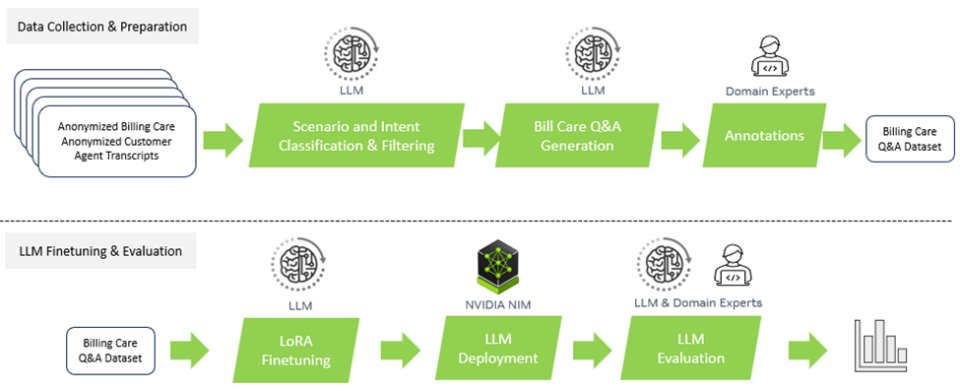
Amdocs process flow, from data collection and preparation to LLM fine-tuning and evaluation.

Revolutionizing Retail With AI on Snap

Shopping for the perfect outfit has never been easier, thanks to Snap’s Screenshop feature. Integrated into Snapchat, this AI-powered tool helps users find fashion items seen in photos. NVIDIA Triton played a pivotal role in enabling Screenshop’s pipeline, which processes images using multiple frameworks, including TensorFlow and PyTorch.
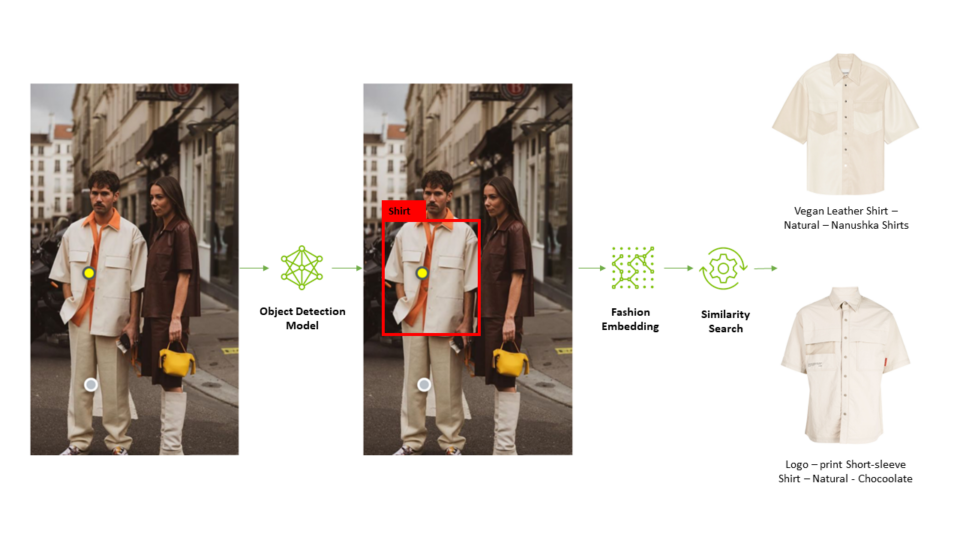
Snap’s Screenshop AI workflow.

By consolidating its pipeline onto a single inference serving platform, Snap significantly reduced development time and costs while ensuring seamless deployment of updated models. The result is a frictionless user experience powered by AI.

“We didn’t want to deploy bespoke inference serving platforms for our Screenshop pipeline, a TF-serving platform for TensorFlow and a TorchServe platform for PyTorch,” explained Ke Ma, a machine learning engineer at Snap. “Triton’s framework-agnostic design and support for multiple backends like TensorFlow, PyTorch and ONNX was very compelling. It allowed us to serve our end-to-end pipeline using a single inference serving platform, which reduces our inference serving costs and the number of developer days needed to update our models in production.”

Following the successful launch of the Screenshop service on NVIDIA Triton, Ma and his team turned to NVIDIA TensorRT to further enhance their system’s performance. By applying the default NVIDIA TensorRT settings during the compilation process, the Screenshop team immediately saw a 3x surge in throughput, estimated to deliver a staggering 66% cost reduction.

Financial Freedom Powered by AI With Wealthsimple

Wealthsimple, a Canadian investment platform managing over C$30 billion in assets, redefined its approach to machine learning with NVIDIA’s AI inference platform. By standardizing its infrastructure, Wealthsimple slashed model delivery time from months to under 15 minutes, eliminating downtime and empowering teams to deliver machine learning as a service.

By adopting NVIDIA Triton and running its models through AWS, Wealthsimple achieved 99.999% uptime, ensuring seamless predictions for over 145 million transactions annually. This transformation highlights how robust AI infrastructure can revolutionize financial services.

“NVIDIA’s AI inference platform has been the linchpin in our organization’s ML success story, revolutionizing our model deployment, reducing downtime and enabling us to deliver unparalleled service to our clients,” said Mandy Gu, senior software development manager at Wealthsimple.

Elevating Creative Workflows With Let’s Enhance

AI-powered image generation has transformed creative workflows and can be applied to enterprise use cases such as creating personalized content and imaginative backgrounds for marketing visuals. While diffusion models are powerful tools for enhancing creative workflows, the models can be computationally expensive.

To optimize its workflows using the Stable Diffusion XL model in production, Let’s Enhance, a pioneering AI startup, chose the NVIDIA AI inference platform.

Product images with backgrounds created using Let’s Enhance platform powered by SDXL.

Let’s Enhance’s latest product, AI Photoshoot, uses the SDXL model to transform plain product photos into beautiful visual assets for e-commerce websites and marketing campaigns.

With NVIDIA Triton’s robust support for various frameworks and backends, coupled with its dynamic batching feature set, Let’s Enhance was able to seamlessly integrate the SDXL model into existing AI pipelines with minimal involvement from engineering teams, freeing up their time for research and development efforts.

Accelerating Cloud-Based Vision AI With OCI

Oracle Cloud Infrastructure (OCI) integrated NVIDIA Triton to power its Vision AI service, enhancing prediction throughput by up to 76% and reducing latency by 51%. These optimizations improved customer experiences with applications including automating toll billing for transit agencies and streamlining invoice recognition for global businesses.

With Triton’s hardware-agnostic capabilities, OCI has expanded its AI services portfolio, offering robust and efficient solutions across its global data centers.

“Our AI platform is Triton-aware for the benefit of our customers,” said Tzvi Keisar, a director of product management for OCI’s data science service, which handles machine learning for Oracle’s internal and external users.

Real-Time Contextualized Intelligence and Search Efficiency With Microsoft

Azure offers one of the widest and broadest selections of virtual machines powered and optimized by NVIDIA AI. These virtual machines encompass multiple generations of NVIDIA GPUs, including NVIDIA Blackwell and NVIDIA Hopper systems.

Building on this rich history of engineering collaboration, NVIDIA GPUs and NVIDIA Triton now help accelerate AI inference in Copilot for Microsoft 365. Available as a dedicated physical keyboard key on Windows PCs, Microsoft 365 Copilot combines the power of LLMs with proprietary enterprise data to deliver real-time contextualized intelligence, enabling users to enhance their creativity, productivity and skills.

Microsoft Bing also used NVIDIA inference solutions to address challenges including latency, cost and speed. By integrating NVIDIA TensorRT-LLM techniques, Microsoft significantly improved inference performance for its Deep Search feature, which powers optimized web results.

Deep search walkthrough courtesy of Microsoft

Microsoft Bing Visual Search enables people around the world to find content using photographs as queries. The heart of this capability is Microsoft’s TuringMM visual embedding model that maps images and text into a shared high-dimensional space. Because it operates on billions of images across the web, performance is critical.

Microsoft Bing optimized the TuringMM pipeline using NVIDIA TensorRT and NVIDIA acceleration libraries including CV-CUDA and nvImageCodec. These efforts resulted in a 5.13x speedup and significant TCO reduction.

Unlocking the Full Potential of AI Inference With Hardware Innovation

Improving the efficiency of AI inference workloads is a multifaceted challenge that demands innovative technologies across hardware and software.

NVIDIA GPUs are at the forefront of AI enablement, offering high efficiency and performance for AI models. They’re also the most energy efficient: NVIDIA accelerated computing on the NVIDIA Blackwell architecture has cut the energy used per token generation by 100,000x in the past decade for inference of trillion-parameter AI models.

The NVIDIA Grace Hopper Superchip, which combines NVIDIA Grace CPU and Hopper GPU architectures using NVIDIA NVLink-C2C, delivers substantial inference performance improvements across industries.

Unlocking Advertiser Value With Meta Andromeda’s Industry-Leading ML

Meta Andromeda is using the superchip for efficient and high-performing personalized ads retrieval. By creating deep neural networks with increased compute complexity and parallelism, on Facebook and Instagram it has achieved an 8% ad quality improvement on select segments and a 6% recall improvement.

With optimized retrieval models and low-latency, high-throughput and memory-IO aware GPU operators, Andromeda offers a 100x improvement in feature extraction speed compared to previous CPU-based components. This integration of AI at the retrieval stage has allowed Meta to lead the industry in ads retrieval, addressing challenges like scalability and latency for a better user experience and higher return on ad spend.

As cutting-edge AI models continue to grow in size, the amount of compute required to generate each token also grows. To run state-of-the-art LLMs in real time, enterprises need multiple GPUs working in concert. Tools like the NVIDIA Collective Communication Library, or NCCL, enable multi-GPU systems to quickly exchange large amounts of data between GPUs with minimal communication time.

Future AI Inference Innovations

The future of AI inference promises significant advances in both performance and cost.

The combination of NVIDIA software, novel techniques and advanced hardware will enable data centers to handle increasingly complex and diverse workloads. AI inference will continue to drive advancements in industries such as healthcare and finance by enabling more accurate predictions, faster decision-making and better user experiences. 

Learn more about how NVIDIA is delivering breakthrough inference performance results and stay up to date with the latest AI inference performance updates.


Source link

Next Audi RS 7 rumored to be a V-6 plug-in hybrid

0


Audi is close to revealing a new generation of its A7, and once again, there will be a high-performance RS 7 variant developed by the Audi Sport division.

Prototypes of the RS 7 in a new Avant wagon body style have been spotted ahead of an expected debut late this year or early next year.

The new A7 lineup will still feature gas engines, some of which will be paired with plug-in hybrid technology. The RS 7 is likely to be one of the variants adopting an electrified setup.

While it was previously believed that the new RS 7 would combine plug-in hybrid technology with the outgoing RS 7’s twin-turbocharged 4.0-liter V-8 engine, Car Magazine reported on Jan. 22 that the vehicle will instead feature a V-6 plug-in hybrid setup.

2024 Audi RS 7 Sportback Performance

2024 Audi RS 7 Sportback Performance

According to the magazine, the same setup is expected to power a new RS 5, which is also being tested. The RS 5 is anticipated to deliver around 600 hp, while the RS 7 is projected to produce closer to 725 hp. A more powerful RS 7 Performance model with an output nearing 800 hp is also reportedly in development.

Output from the V-6 will remain consistent across both models, according to the magazine, with the electric component differentiating their power levels. The system will also be capable of providing a temporary 50-hp boost.

Audi is preparing to phase out gas engines in the years ahead, which could explain the decision to forego the V-8 in the new RS 7. A V-6 will also create a connection to Audi’s new Formula 1 power unit, which is currently being developed for its factory team and will also feature an electrified V-6 setup. Audi’s F1 team, utilizing this new power unit, is scheduled to begin racing in 2026, which will roughly coincide with the market launch of the new RS 7.


Source link

Ford Shelby GT350 returns for 2025, but not via Ford

0


  • Shelby American has revealed the 2025 Ford Shelby GT350
  • The new GT350 is based on the seventh-generation Mustang and delivers up to 810 hp
  • A more hardcore GT350R version is also available with up to 830 hp and parts borrowed from an upcoming Trans Am race car

After launching the Super Snake last year, Shelby American’s tuning of the latest seventh-generation Ford Mustang continues with the arrival of the 2025 GT350 and its more track-focused GT350R sibling.

The previous GT350 duo was offered directly from Ford and remains a formidable sports car able to keep up with Europe’s finest. For the seventh-generation Mustang, the nameplate returns to Shelby American. It also takes the supercharged route, unlike the previous generation, which was naturally aspirated.

The 2025 GT350 made its debut on Thursday at the Barrett-Jackson auction currently underway in Scottsdale, Arizona, marking 60 years since the launch of the original. The latest car is the most powerful GT350 yet, thanks to an available supercharged 5.0-liter V-8 delivering 810 hp. The standard engine skips the supercharger and delivers a still impressive 480 hp.

Shelby American hasn’t released full pricing but said the supercharged GT350 starts at $109,999, which includes the cost of the donor Mustang. Buyers can choose between a 10-speed automatic or a 6-speed manual.

Regardless of the powertrain selected, the GT350 comes standard with a Borla cat-back exhaust system, suspension lowering springs, sway bars front and rear, 20-inch forged wheels, a vented aluminum hood, and an aero kit that includes a three-piece front splitter.

The GT350R comes with the supercharged V-8 but with a more potent 830-hp rating. It also comes exclusively with a manual transmission.

2025 Ford Shelby GT350R

2025 Ford Shelby GT350R

For the GT350R, Shelby used components from a race car currently being developed for the modern Trans Am racing series. The race car, which is being developed with Turn Key Automotive, is scheduled to start racing in 2026.

Some of the additional performance upgrades of the GT350R include a track-tuned suspension setup with parts from JRI, plus Alcon Racing brakes, Forgeline racing wheels, carbon-fiber aero parts, a half cage for chassis stiffness, and carbon-fiber reinforcements for the interior.

2025 Ford Shelby GT350R

2025 Ford Shelby GT350R

As a nod to the original GT350R of 1965, officially the GT350 Competition, the modern GT350 will be offered in white with the choice of two stripe packages that match Shelby’s original race package colors. There’s the signature blue stripes as well as a gold, silver, and black combination.

Production of the 2025 GT350 will be limited to 562 units, matching the total production for the original GT350 in 1965. An additional 36 GT350Rs will be made, once again matching the build count of the original car. Shelby will also enable an additional limited number of cars to be built by other shops and distributors for markets outside the U.S.


Source link

Savoring San Antonio: Dining at Domingo and Otro at the Canopy by Hilton

0


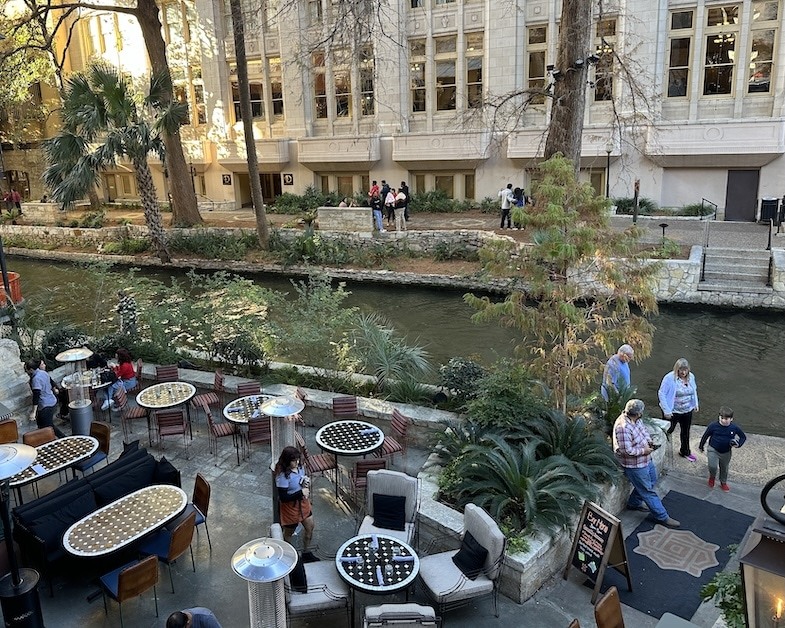
It’s often said that a meal isn’t merely about the food on the plate—it’s an experience that should engage all the senses. Nowhere is this more evident than at Domingo and Otro, two distinct dining destinations tucked inside the Canopy by Hilton San Antonio Riverwalk. From a rustic-yet-chic patio right along the famed Riverwalk, to a breezy balcony bar overhead, each space delivers its own flavorful slice of Texan hospitality.

Savoring San Antonio: Dining at Domingo and Otro at the Canopy by Hilton

Domingo: An Evening Under the Stars

A Patio with Character
Our first night in San Antonio found us at Domingo, the hotel’s signature restaurant. The Riverwalk’s charm was on full display here, especially from the outside patio where a repurposed cistern curves around bistro tables. The subtle glow of nearby lanterns and a discreet heat lamp behind our chairs provided both mood lighting and cozy warmth, drawing us into a world that felt intimate and inviting.

Cocktails with a Twist

Cocktails at Domingo along the Riverwalk in San Antonio.

Eager to settle into the laid-back atmosphere, we began with two spirited concoctions. The Signature Margarita, built with house-blend blanco tequila, balanced sweet agave with bright Texas citrus and a faint dusting of chili. Its citrus-tinged tang was both refreshing and slightly bracing—a sip that teased the palate. Meanwhile, the Chili + Cucumber Spiced Blanco Tequila cocktail introduced a sharper snap of heat, tempered by cool cucumber and a splash of blood-orange liqueur. Each drink felt meticulously crafted, reflecting the flair and boldness of local flavors.

A Taste of Tex-Mex
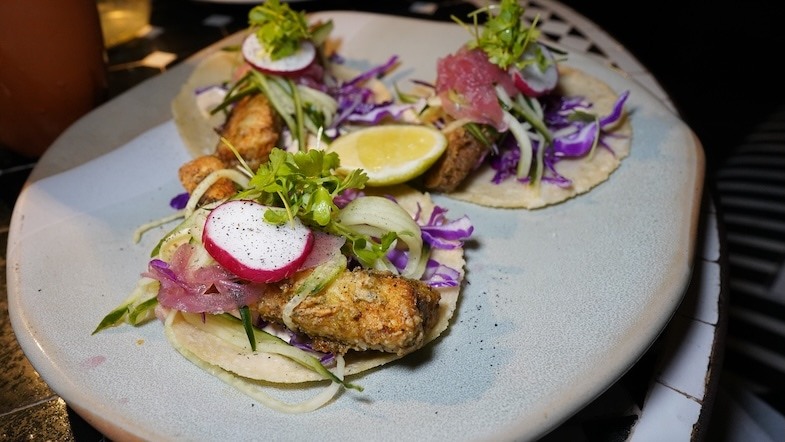
Our mains illustrated Domingo’s ability to blend tradition with modern culinary touches. The Green Chile and Chicken Enchiladas arrived drizzled in tangy yogurt crema, with avocado and jalapeño lending a fresh green brightness. Beside them, the Baja Fish Tacos showcased tender pieces of fish blanketed by crunchy cabbage, pickled onions, and a velvety drizzle of sauce—an ode to coastal flavors delivered in the heart of the city.

Fish tacos at Domingo Restaurante at the Canopy by Hilton in San Antonio - Photo by Mike Shubic

Just when we thought the meal couldn’t get any better, dessert arrived. The Toasted Chile Brownie was an exercise in decadent contrast: a gently spiced chocolate base crowned with pepita brittle and a dollop of Mexican vanilla ice cream. Each forkful revealed layers of sweet, salty, and subtly smoky notes that made for a triumphant finale to our riverside dinner.

Dessert at Domingo - Photo by Mike Shubic

Bright and Early at Domingo

Breakfast tacos at Domingo

Morning Comforts
The next day, we wandered back to Domingo for breakfast, hoping the sunshine would cast a new light on the flavors we’d enjoyed the night before. Our instincts were right—daytime dining here carries the same thoughtful attention to detail. The Breakfast Burrito, brimming with scrambled eggs, jalapeños, sausage, and bacon, provided a hearty start, while the Scrambled Egg Tacos were enlivened by pepper jack cheese, pico de gallo, and guacamole. A side dish of Greek Yogurt & Berries looked promising, though we wished for a slightly more generous helping of fruit. Still, everything else on the table delivered a satisfying morning boost.


Otro: Elevated Sips and Bites

A Balcony Escape
For our final night, we ascended to Otro Bar En El Balcón—which translates aptly to “Another Bar on the Balcony”—seeking a lighter meal with an impressive view. Overlooking Domingo and the meandering Riverwalk below, Otro balances a relaxed lounge vibe with just enough bustle to keep things lively. That evening, the brisk night air was tempered by a well-placed heat lamp, allowing us to unwind at a table by the railing while people-watching from above.

Cocktails with Depth

cocktails at Otro Bar in San Antonio by Mike Shubic

Our beverage choices here felt simultaneously playful and sophisticated. The Pina en mi Bourbon found its footing in bourbon, amaro, and Aperol, with tropical undertones from passion fruit and pineapple lending just the right hint of sweetness. Meanwhile, the Firma Antigua fused bourbon with a touch of vanilla demerara and black walnut bitters, resulting in an aromatic sip that hinted at toasty autumn nights.

Shareable Flavors

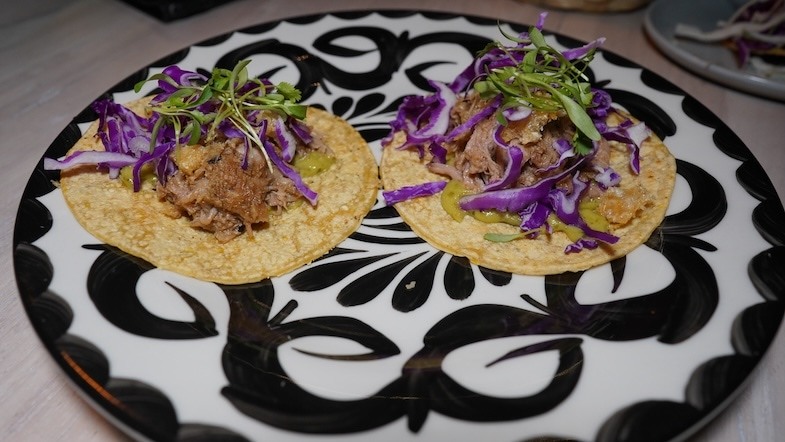
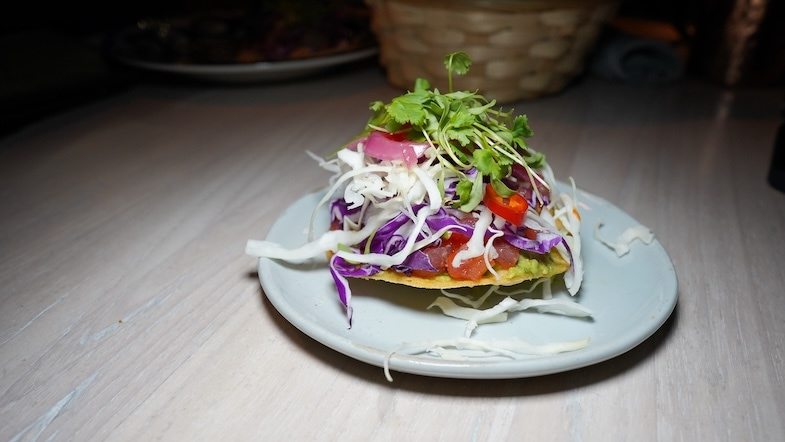
Rather than another full meal, we opted for a few shareable plates. The Guacamole with Chips had an earthy quality, sprinkled with a delicate dash of spice. A crisp Tuna Tostada arrived piled high with smashed avocado, pickled onions, cilantro, and a gentle sting of pickled Fresno chiles—a bright, satisfying bite. Last came the Pork Carnita Tacos, where charred tomatillo salsa and a garnish of chicharrón lent crunch and depth to savory morsels of pork. Light enough to keep conversation flowing, yet substantial enough to satisfy, these dishes felt tailor-made for relaxed balcony dining.

Street Corn at Domingo - Phot by Mike Shubic

A Taste Worth Returning For

From its sun-kissed morning offerings to its twilight cocktails, the culinary journey at both Domingo and Otro reflects the spirit of San Antonio itself: dynamic, historic, and warm. Each dish and drink at this duo of venues underscores the hotel’s commitment to weaving local influences into contemporary interpretations. If you’re staying at the Canopy byHilton San Antonio Riverwalk, it’s well worth carving out time to experience both spots. Even if you aren’t a guest, these restaurants make a memorable addition to any Riverwalk itinerary.

Domingo and Otro Contact Information:

  • Address: 123 N. Saint Marys St., San Antonio, Texas, 78205
  • Hotel Website: https://www.hilton.com/en/hotels/satpypy-canopy-san-antonio-riverwalk/
  • Phone: 210-404-7516
  • Dining Info & Reservations: Domingo and Otro

Have a favorite dish at Domingo or Otro, or curious about planning your own culinary adventure in San Antonio? Let us know in the comments—we’d be delighted to share more tips and insights. Click the following link if you’d like to read about our stay at the Canopy by Hilton San Antonio.

The post Savoring San Antonio: Dining at Domingo and Otro at the Canopy by Hilton first appeared on Mike’s Road Trip.

The post Savoring San Antonio: Dining at Domingo and Otro at the Canopy by Hilton appeared first on Mike's Road Trip.


Source link

Forget V8s, Cadillac’s quickest car yet is an electric SUV

0


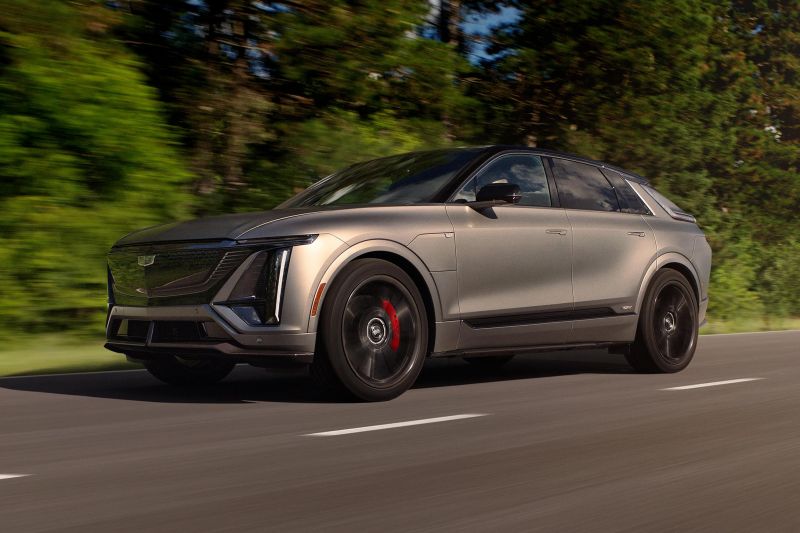
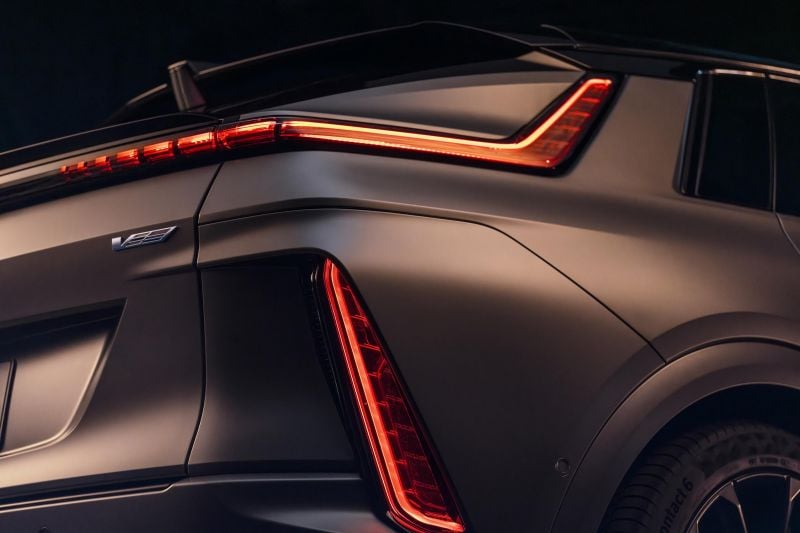
The 2026 Cadillac Lyriq-V, the American luxury brand’s first electric performance SUV, has been detailed and it boasts some heady performance figures.

Its dual-motor electric powertrain pumps out 459kW of power and 880Nm of torque, giving it a 0-60mph (0-96km/h) time of just 3.3 seconds in V-Mode or Velocity Max mode.

That just shades the 3.4-second sprint time of the supercharged V8-powered CT5-V Blackwing sedan when equipped with an auto, despite being down 40kW and 13Nm and weighing more.

Hundreds of new car deals are available through CarExpert right now. Get the experts on your side and score a great deal. Browse now.

It also puts the Lyriq-V in the same rarefied air as performance electric SUVs like the BMW iX M60, which has a 0-60mph claim of 3.6 seconds and pumps out 455kW and 110Nm.

General Motors had already confirmed the Lyriq-V for Australia. It’ll go on sale in early 2026, with pricing and specifications to be announced closer to then.

However, Cadillac has confirmed it’ll be priced at US$79,990 (~$127,000) in its home market, while the regular Lyriq range opens at US$58,595 (~A$93,000).

For context, the Australian-market Lyriq range opens at $117,000 before on-roads.

Production will begin in early 2025 at GM’s Spring Hill, Tennessee plant.

Here are the key stats:

PowertrainDual electric motors
Drive typeAll-wheel drive
Power459kW
Torque880Nm
Battery capacity102kWh
Battery chemistryLithium-ion NCMA
Range459km (GM-estimated)
Kerb weight2713kg

Cadillac claims it’ll take 41 minutes to bring the Lyriq-V from a “low state of charge” to 80 per cent, with up to 121km of range added in 10 minutes of charging.

The Lyriq-V pumps out an extra 71kW and 270Nm over the regular dual-motor Lyriq.

Cadillac hasn’t just upped the outputs and called it a day, however, with the Lyriq-V receiving various mechanical upgrades.

Continuous Damping Control is standard, and has been calibrated for the Lyriq-V and its five-link independent suspension. There’s no Magnetic Ride Control, Cadillac’s magnetorheological damping system found in other models like the CT5-V Blackwing.

The Lyriq-V sits lower than the regular Lyriq and also boasts a quicker steering ratio plus standard Brembo front brakes with red calipers.

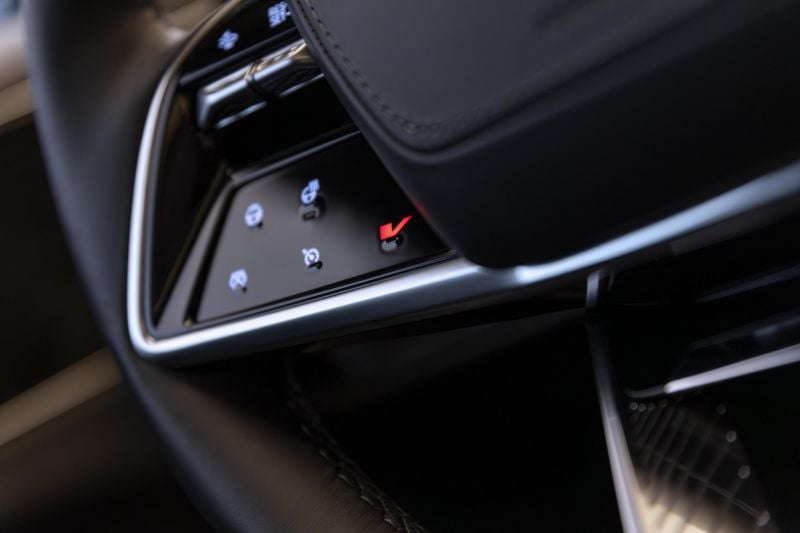
Cadillac says a new Competitive Mode enables “a suite of traction management features specifically engineered to increase vehicle agility”, and a customisable V-Mode allows drivers to save performance-focused settings.

V-Mode is activated with the press of a steering wheel button.

There’s also a “unique, multi-layered sound experience”, indicating the Lyriq-V’s artificial propulsion sound is different to that of the regular Lyriq.

“With the combination of its rigid body structure and lower center of gravity, our team was able to improve the suspension to achieve the right level of precision and isolation, adding to its outstanding canyon-carving abilities,” said Dave Stutzman, chief engineer of the Lyriq-V.

The Lyriq-V is distinguished visually via a unique lower front fascia with a new chin spoiler and V-pattern mesh on the lower front grille.

There are also unique rocker panels, as well as body-coloured lower trim, a black roof, and available carbon-fibre accents.

It rides on unique 22-inch alloy wheels with a dark finish, and is available with a unique Magnus Metal Frost exterior finish.

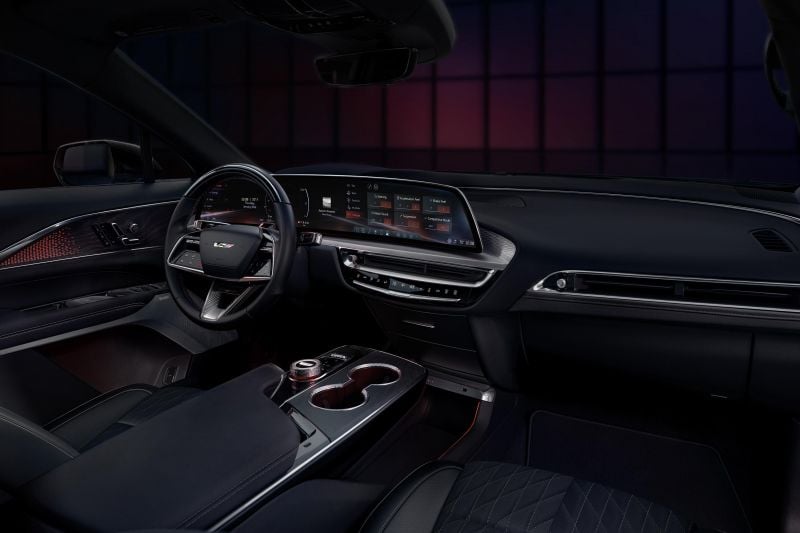
Inside, the 33-inch wraparound display and 23-speaker AKG9 sound system with Dolby Atmos remain standard, as does a panoramic fixed glass roof.

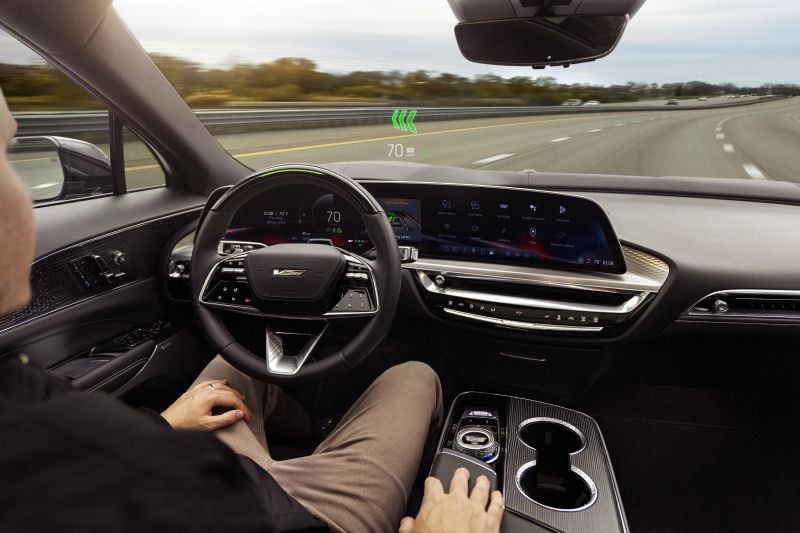
The Lyriq-V gains a ‘dual-plane’ augmented reality head-up display, while there’s a new steering wheel with sculpted hand grips and aluminium Regen on Demand paddle.

The seats have power-adjustable bolsters, and are available in Nappa leather. Paperwood decor is standard, and there are illuminated sill plates with V-Series badging.

The Lyriq-V is only the second V-Series SUV, after the V8-powered Escalade-V, and the first electric V-Series model.

Cadillac repositioned the V-Series as a less hardcore performance line with its latest V-Series sedans, the CT4-V and CT5-V, introducing the Blackwing line to sit above it.

While the Lyriq-V is unlikely to be as track-focused as the CT4-V Blackwing and CT5-V Blackwing, however, it still offers a sprint time better than either.

MORE: Everything Cadillac Lyriq


Source link

2025 Lamborghini Temerario: An In-Depth Look

0


When the Huracán went out of production, it signaled only one thing: The next model was coming soon. We honestly did not have to wait long, as the Lamborghini Temerario was revealed in August 2024 during Monterey Car Week in California. Labelled by the company as the very essence of a “Fuoriclasse” (Italian for “Outstanding”) supercar, the Temerario is the first of the turbo V8 hybrids that have been developed to produce more power, but be more efficient about it, than the vaunted and well-respected V10 that came before.

That, however, is just one aspect of the car that is set to define a new generation, even a new era, for Lamborghini, so let’s take a deeper dive into the specs, the tech, and the new stuff!

Note: All of the images used in this in-depth look are from Lamborghini Media

Design & Aesthetics

In the simplest terms possible, the Temerario is a Lamborghini. What we mean by that is that it continues the classic wedge shape, the aggressive angles and sharp edges, and being the kind of car that is a computer background or poster on a wall. While it may look small in pictures, the truth is that at 4,706 mm in length, 1,996 mm in width (excluding mirrors), and a height of 1,201 mm, it’s marginally bigger than the Huracán it replaces.

2025 Lamborghini Temerario2025 Lamborghini Temerario2025 Lamborghini Temerario

On top of that, thanks to a new all-aluminum frame that’s not only 20% more torsionally stiff than its predecessor but also utilizes less welding and materials, the Temerario comes in at a very impressive 1,690 kg (3,726 lbs) dry. In fact, it can proudly boast about using quite literally 50% less materials compared to the Huracán.

The exterior design of the Temerario is All Lambo, All Day, featuring the signature hexagon-shaped daytime running lamps that double as aerodynamic elements. The bodywork, designed from the ground up, is shaped to improve high-speed stability, cooling performance, and braking efficiency. This makes it 118% more aerodynamically efficient than even the Huracán Evo. 

2025 Lamborghini Temerario2025 Lamborghini Temerario2025 Lamborghini Temerario

Underneath, you might have spotted in pictures that it has a pretty big diffuser. This is thanks to some development of the Lamborghini WEC Hypercar, which translated across to the new car to make it much more efficient with underbody air. The diffuser is a full 70% larger in terms of aerodynamic surface area, and combines with a concave roof profile to manage the air above and below the car to slice into it at the front and add significant downforce to the rear of the car.

The front splitter, side skirts, and rear wing are all designed to work together with active aero elements that are adjusting in real-time to the vehicle’s dynamics. In effect, about a hundred times a second the on board computer is sensing what the car is doing and how the air could be better used, and can offer up to 350 kg of downforce, at speeds up to 300 km/h. This means that unlike previous Lamborghini’s, there should be absolutely no front end lift when you’re giving it some stick.

Power & Performance

The thundering heart of the Temerario is a 4.0-liter twin-turbo V8 engine, a completely new design from Sant’Agata Bolognese, producing 789 hp at a positively howling 9,000-9,750 rpm. It is a technical achievement that is worth drooling over, such as it comes with a flat-plane crankshaft, it revs to 10,000 rpm, and is made out of cast aluminum, with titanium parts and even “Diamond-Like Carbon,” a totally new way of using carbon in supercars.

2025 Lamborghini Temerario engine cover2025 Lamborghini Temerario engine cover2025 Lamborghini Temerario engine cover

On top of that, the hybrid system includes three electric motors, one for each front wheel and a third in the transaxle. When everything is working at maximum power, the output of the Temerario is a near hypercar level 907 hp. As well, with everything spinning in anger, 590 lbs-ft of torque is almost certainly going to plant you deep into the seats. Of course, it comes with launch control, which will catapult the Temerario from 0 to 100 km/h in a mere 2.7 seconds, with a top speed estimated at 213 MPH (343 km/h).

While all the straight line stuff is well and good, The Temerario’s performance isn’t just meant for drag racing. With its new high-strength aluminum space frame, the car’s dynamics have been sharpened over the Huracán, turning it into a corner-hungry, apex-hunting monster. The suspension system, paired with the advanced e-4WD system and advanced torque vectoring, ensures that the supercar doesn’t have any type of oversteer or understeer until you pass the limit of the tires. Which would be hard, as even some of the test drivers couldn’t get it to break loose in the most aggressive, road-hugging mode of its 13 different driving mode combinations.

2025 Lamborghini Temerario brakes2025 Lamborghini Temerario brakes2025 Lamborghini Temerario brakes

The braking system is equally next-gen, with carbon ceramic discs measuring 410 mm at the front and 390 mm at the rear. This is the first third generation carbon-ceramic system that Lamborghini has implemented and includes regenerative braking assist from all three electric motors, ensuring that the Temerario can come to a dead stop faster and in a shorter distance than even the Huracán STO. The car’s aerodynamics also come into play, with air brakes that deploy at high speeds when you push hard enough on the brakes. 

Technology & Innovation

Lamborghini has not skimped on tech, equipping the Temerario with their Human Machine Interface (HMI) system. The interior comes with three displays: a 12.3-inch digital instrument cluster, an 8.4-inch central touchscreen, and a 9.1-inch passenger screen, all designed to integrate seamlessly into the “Feel like a pilot” cockpit. Wireless Apple CarPlay and Android Auto come standard, alongside a Sonus Faber audio system for those that don’t like a V8 howling at over 9,000 RPM.

2025 Lamborghini Temerario interior2025 Lamborghini Temerario interior2025 Lamborghini Temerario interior

The Temerario also introduces the Lamborghini Vision Unit (LAVU), a system with three cameras for performance analysis and recording laps at tracks. Combined with Lamborghini Telemetry 2.0, this turns every drive into a data-rich experience, giving real time information on lap times, performance analysis, and even adjusting the active aero across 150 different racing circuits that come in the memory banks as standard. Speaking of memory, the “Memories Recorder” feature allows for up to two minutes of off-track recording, acting both as a dash cam and a system that if you had a particularly good few corners in a canyon, you can save that recording for later..

The tech doesn’t stop there. The Temerario employs a suite of connected technologies, from adaptive cruise control with lidar and radar sensing stop & go, lane departure warning, and blind spot detection. It even features a 360-degree camera system so you won’t scrape the bumper on a parking spot bollard, and can ensure the surrounding area is clear before doing the most difficult tasks in a Lambo: Reversing (which has a reversing camera dedicated for it as well!). 

2025 Lamborghini Temerario interior details2025 Lamborghini Temerario interior details2025 Lamborghini Temerario interior details

The car’s battery management system works in tandem with regenerative braking to optimize energy use. It is not the largest battery at 3.8 kWh, with the entire pack within the central tunnel to optimize weight distribution, but it is a fast-charge-fast-discharge style battery. This means when you need it, it will give you full power, and when you brake hard, it will regenerate that power incredibly quickly.

For those who crave connectivity, the Temerario is the first Lamborghini that will offer OTA (Over-The-Air) updates for both software and firmware within the car. The car also supports NFC technology for keyless entry and start, and can even register with an app to allow you to make your smartphone your key.

All said and done, the Temerario is quite possibly the most technologically advanced Lamborghini street car… ever.

Materials & Construction

The Temerario’s chassis is one of those things you might call “An engineering marvel.” It features a new composition of high-strength aluminum alloy formed through high-pressure castings, which reduces the number of welds needed by over 80% compared to the Huracán. This not only lowers weight but also improves the car’s structural integrity, as several joins are cast instead of connected. The use of hollow castings with thin closed inertia profiles, a technique that was first used on the Revuelto, allows for complex shapes that were not possible even five years ago in automotive manufacturing.

2025 Lamborghini Temerario aluminum frame2025 Lamborghini Temerario aluminum frame2025 Lamborghini Temerario aluminum frame

Inside, Lamborghini has chosen materials that are both functional and aesthetic. Carbon fiber isn’t just there to look pretty, it’s used extensively for weight-saving, from the central console to door panels. Leather and Corsatex by Dinamica suede are employed for soft-touch but resilient surfaces, with options for almost every interior component to be either bare carbon or wrapped in the suede and leather. The seats, which come as standard with the leather and Corsatex suede, are carbon fiber pressure formed, and offer 18-way adjustment.

The Temerario is also the first Lamborghini to use 3D printing for some interior components like the air vents. This is notable because 3D printing allows for much more complex shapes to be made than traditional computer aided manufacturing allows. On top of that, the materials used for the 3D printing adds to the weight savings of the car.

Customization & Personalization

With the Temerario, Lamborghini planned for it to be fully customizable through their Ad Personam program. From the outset, customers can choose from over 400 body colors, get a custom color made, and can even select special liveries. The wheels come in three designs – cast, forged, or carbon – with various finishes to match each customer’s preferences. The Alleggerita package takes customization even further, offering weight reduction through carbon rims, a titanium exhaust system, and lightweight body components, dropping the car’s dry weight by an additional 55 lbs.

Interior customization is equally as spectacular. Clients can select from a rainbow of colors for the leather, opt for carbon fiber accents throughout, or even add the 3D-printed air vents and a few other interior touches to make it futuristic and high tech. From brake caliper colors to the stitching on the seats, every detail can be tailored to reflect each client’s personal style or racing aspirations.

Lamborghini Temerario in a galleryLamborghini Temerario in a galleryLamborghini Temerario in a gallery

Moreover, the Temerario also has package options, meaning it can be fitted with things like a time-attack, track-specific suspension setup, or more aggressive aerodynamics. It basically means that whatever the client wants within reason, the client can get. This is nearing Rolls-Royce levels of personalization, which is something we think makes the Temerario a particularly special car.

The Lamborghini of the Future is Here

Often in automotive journalism, the line “X car is not just a car, it’s a (thing/emotion/memory here). We were expecting much the same from Sant’Agata Bolognese when the Huracán was discontinued, and boy were we wrong. 

The Lamborghini Temerario isn’t just a car, it’s a return of Lamborghini to its “let’s see what we can do if we get properly mental with it” type of car design. They went positively mad with it (in the best way possible), making it way overpowered (907 HP in 1,690 kg, or 0.5 HP per kilogram) for its size but also giving it a hybrid powertrain that does a complex dance to to keep the car AWD at all times. They’ve fitted the most spectacular V8 turbo engine this side of Cosworth to the thing, and then turned it all up to 11!

Lamborghini Temerario on road imageLamborghini Temerario on road imageLamborghini Temerario on road image

With the Temerario, and this is a pretty bold statement we’re making, Lamborghini is back. The real Lamborghini. The Lamborghini that gets drunk at a party, falls over a hedge, stumbles home and has a cold shower, then goes out again and pins it down the empty freeway. Not that we suggest you do that, but it’s pretty much what every journalist out there has said, although not as crudely, about their first visits with the car. 

We don’t have any driving impressions from them yet, as none have actually done a proper review for it, so when they do publish their videos and articles, you can be certain we will link them here as with all of our in-depth guides.

First Looks

Top Gear

Schmee150

CarSpyMedia

At the Nürburgring doing tire testing, you can see in some shots the active aero under the car activating to produce downforce.

Supercar Blondie


Source link

Lucid dumped Alexa, aims for EV context with new voice assistant

0


  • Lucid’s new voice assistant incorporates natural-language interactivity
  • SoundHound tech doesn’t rely entirely on a cellular connection
  • Already available in Air, coming soon to Gravity

Lucid wants you to have a conversation with your Air or Gravity electric vehicle, and it goes far beyond the requisite wake-up of “Hey Lucid.”

Earlier this month I sat in the passenger seat of an Air, while the driver asked: “My friend suggested that I go check out the NFL stadium while I’m in Vegas; what’s it called?”

A synthetic voice replied within a fraction of a second: “The NFL Stadium in Vegas is called the Allegiant stadium. It’s super cool.”

“Navigate there,” said my seatmate.

The voice eventually confirmed, “Navigating to Allegiant stadium. Follow the road.”

Lucid Assistant powered by SoundHound (demo)

Lucid Assistant powered by SoundHound (demo)

The one in the driver’s seat walking me through Lucid Assistant voice interactivity was Kyle Halstvedt, the technical program manager at SoundHound who helped coordinate this completely new voice assistant for Lucid EVs

With SoundHound’s voice-and-AI-focused team based in Santa Clara, California, near Lucid’s Newark headquarters, the companies worked closely on the project. Halstvedt aimed to show me that every voice query now has a lot of flexibility, and the voice functionality is now fully in tune with Lucid’s needs—like the need to find the fastest chargers along the way, plan the EV’s route, and precondition its battery to prepare for them. 

2022 Lucid Air fast-charging in Garberville, CA

2022 Lucid Air fast-charging in Garberville, CA

Here it’s especially important that this functionality navigates the nuance—because in a Lucid it can be the difference between one of the quickest EV charging experiences in the world versus one that’s just par. 

“That was a fun aspect of this project, that they want to drive things through their own navigation system,” Halstvedt said. “We’re not just using a separate data provider; we’re deeply integrated with their navigation system, and that had to happen.”

Halstvedt noted that’s something SoundHound has experience doing before, and it’s something that Lucid had a particular requirement surrounding the project and the integration. “They appreciated the flexibility of our technical team to build the experience they’re looking for, something that takes a bit of creativity on the technical side,” he said. 

Lucid UX 2.4 update

Lucid UX 2.4 update

Way more flexibility, better than Alexa

The Lucid Assistant was rolled out starting in September, replacing Alexa as part of Lucid’s UX 2.4 software update. According to Lucid, all Air models in North America and the Middle East now have access to it. Early Gravity models don’t yet have the Lucid Assistant, but they will soon, the automaker told Green Car Reports.  

The new assistant, already configurable in six languages, will now better manage navigation and audio, climate control features, or heated seats—all basics that owners previously found challenging. But that’s just the start. 

Lucid made a strategic choice about where it wanted its core competency, and voice is at the center of it, Lucid Motors head of user experience Dave Flint explained to Green Car Reports in November, when that system was still rolling out in Air. “It’s not just, I’m ordering the car around; it’s like, how does the car begin to communicate with me through voice?”

“That really wasn’t possible with our old system,” Flint bluntly summed.

Alexa wasn’t working for Lucid, and Lucid didn’t mince words about it—although there were likely plenty of drivers’ words minced. The California EV maker announced back in 2020 that it would employ an advanced version of Amazon Alexa to access an extensive array of vehicle functions ranging from small adjustments to finding charging stations, as well as tap into smart home controls. But what owners were finding out in the real world was that such commands within the vehicle depended too much on a strong data connection; account permissions and other factors could get in the way; and ultimately Lucid didn’t have a lot of control over how smoothly it all worked in the real world.

2025 Lucid Air Pure

2025 Lucid Air Pure

Context is everything to new Lucid Assistant

“What we need to do a good job, at the natural language commands, is surrounding context—whether that’s the history of the conversation, knowledge about the natural world, or the position, where the user is,” Halstvedt said. 

Consumers expect to be able to have an extended conversation about a location or series of locations, filtering it iteratively, and then they want to be able to act on it based on the cumulative results, he said. But few new vehicles can actually deliver that even in perfect connectivity.

SoundHound hasn’t ignored the uncanny smoothness of AI-based queries and chatbots, but it understands that way more is needed within the vehicle—and it needs to pair some of those advantages with traditional in-vehicle voice processing. 

“If you just plugged OpenAI’s APIs into your vehicle it would do a really good job of talking but it wouldn’t do a really good job of acting,” Halstvedt said. “We want to bring together those strengths.” 

To do that, the voice assistant runs on the reality that it won’t always have a cellular connection out on the road. In what SoundHound calls a native-hybrid model, it streams audio to servers or to a local embedded engine, balancing that in whatever way makes sense. 

“Alongside the voice we’re sending, we’re also sending a set of data which we call request info, that represents all of the different attributes, like location, time zone, and more,” Halstvedt said. “That’s a key aspect of answering these questions.”

2025 Lucid Air Grand Touring

2025 Lucid Air Grand Touring

2025 Lucid Air Pure

2025 Lucid Air Pure

2025 Lucid Air Pure

2025 Lucid Air Pure

Fewer “AI hallucinations,” connectivity optional

The approach also lowers the chances of so-called “AI hallucinations,” according to SoundHound—startling or tangential responses that seemingly have nothing to do with what was asked. 

While it can seamlessly support those complicated natural conversation queries, it can, as Halstvedt put it, “Work decently well without a connection,” and provide some degree of the same experience. 

As an example of something that needs to capture the nuance but doesn’t require a connection, he said, “It’s a little hot in here.”

“Decreasing temperature by two degrees Fahrenheit,” the voice replied. 

“If we have cloud connectivity we can enhance those results with better results from the cloud and really mix in various voice generative AI features without having to be really costly from a computing standpoint,” Halstvedt added. 

But in Lucid’s new approach, it’s also drawing from around 20 years of SoundHound’s work in understanding natural-language commands without access to the large-language model built into generative AI. 

Lucid Air Touring steering wheel controls

Lucid Air Touring steering wheel controls

Lucid’s voice assistant knows the owner’s manual

Versus the previous voice commands, SoundHound brings in new features, including what it calls vehicle intelligence—meaning “relevant and official information about all of the features the vehicle supports, like where things are and what the buttons do,” it explained in a recent press release on the feature set.

SoundHound has worked with other automakers, but it points to Lucid’s vehicle intelligence questions as where this integration covers new ground in natural language and AI. The whole owner’s manual is available via voice, and the system can sift through it based on your questions—even when you can only describe icons, symbols, or warning lights. 

“We applied some computer vision techniques to allow symbols to be described from the vehicle manual… to make knowledge about the car a lot more accessible at the times a user might need to access it,” Halstvedt said.

2025 Lucid Gravity Grand Touring

2025 Lucid Gravity Grand Touring

Voice controls in the 2025 Lucid Gravity

The hybrid model has also made the voice system easy for Lucid to adapt and customize as the Air and Gravity evolve and differ among trim levels. The teams overseeing functionality can change the way something works via the cloud almost instantly, with the local/native backup changed soon after via an update. 

“We’re investing heavily in voice; it’s going to be a strategically important UX for us, with a lot of implications around what it means for natural-language interaction and natural-language engagement from the car,” Flint said.

2025 Lucid Gravity Grand Touring

2025 Lucid Gravity Grand Touring

2025 Lucid Gravity Grand Touring

2025 Lucid Gravity Grand Touring

2025 Lucid Gravity Grand Touring

2025 Lucid Gravity Grand Touring

Indeed, in its 2025 Lucid Gravity SUV, which has a revamped interface, the automaker is offering a digital detox mode that goes with minimalist displays, and there’s a set of mood-and-ambience modes called Vibes. As Flint hinted, be prepared for voice controls to continue to take center stage there and beyond. 

And among all of today’s AI hallucinations, observing that digital detox in voice form too might help drivers simply stay focused on what matters. 


Source link

How to Spend 3 Days in Wisconsin’s Door County

0


Standing atop Ellison Bluff in Wisconsin’s Door County, I could have sworn I was staring at the Pacific. Waves crashed against the 100-foot-high limestone cliff, and deep-blue water extended to the horizon.

“I had no idea,” my mom said, her eyes fixed on the thrashing shore. She was visiting from Irvine, California, where she can gaze upon the actual Pacific — whenever she can beat the traffic. 

But here, there are no interstate highways, few stop signs, and even fewer traffic lights. Door County isn’t on the way to anywhere. Known as Wisconsin’s “thumb,” the county juts up some 80 miles into Lake Michigan and is a succession of sandy beaches and bluffs, waterfront villages, and waves everywhere you turn. 

About 30,000 people live on the peninsula year-round, a third of them in and around the city of Sturgeon Bay. But in tourist season, the population explodes: the county sees about 2.5 million visitors a year, who go for its natural beauty, fresh air, and Wisconsin’s nostalgic lake culture. A three-hour drive from my home in Madison, Door County offered me the chance to show my mom a different side of Wisconsin, one that isn’t all dairy farms and Packers games. It was a place to slow down and spend a weekend exploring an endless shoreline.

A cottage at the Alpine, a waterfront resort in Egg Harbor.

Jason Mann/Courtesy of Alpine Resort


Friday

Our first destination was the Alpine, a 102-year-old Swiss-style resort with little white cottages on the water’s edge in Egg Harbor. Like many of Wisconsin’s classic resorts, regulars make up the majority of its guests. “We’ve been here fourteen times,” our cottage neighbor said. “This place is practically home.” The resort is also known for golf; its 18th hole is one of Wisconsin’s finest: the tee lies atop the Niagara Escarpment, a wall of rock that rises out of the water like a skyscraper.

After settling in, we took a 45-minute ferry from Ellison Bay across Death’s Door, a storied passage famous for shipwrecks, to Washington Island. Our first stop was Fragrant Isle, a photogenic lavender farm run by Edgar Anderson and his French wife, Martine. After a delightful afternoon exploring the purple maze, where we picked the flowers and inhaled their scent as we strolled — and enjoyed one or two sangrias infused with them — we felt as tipsy as the bees. 

Another scene-stealer is nearby Schoolhouse Beach, which is made up of smooth white limestone rocks. After skipping a few pebbles, we went to Wis-Co, a local coffeehouse, and grabbed several cherry hand pies (the county is a cherry haven), which we snacked on during our ferry ride back.

For dinner, we ordered scallops and goat-cheese grits at the Alpine’s restaurant, Burton’s on the Bay. As we were finishing, the waiter mentioned that we could hop aboard the resort’s vintage schooner to catch the sunset. I’ve never dropped my fork faster. 

Saturday

We found ourselves on the water again the following day. After some breakfast sandwiches at the New Orleans–themed café Big Easy, we watched three generations of fishermen fillet whitefish at Baileys Harbor Fish Co., which dates back to 1967. From there, we walked barefoot across the causeway to the Cana Island Lighthouse, one of 11 historic lighthouses in Door County. 

We continued to the 1,700-acre Ridges Sanctuary, a unique landscape formed by Lake Michigan’s shifting coastline over thousands of years. Next, we headed to Sister Bay, the busiest village on the peninsula. Its most famous residents are the goats on the sod roof of Al Johnson’s, a Swedish log-cabin-style restaurant that nods to the huge Scandinavian community that settled here in the 1800s. I assumed the goats were sculptures, but as we got closer, I learned that they were real, with names like Floppy, Harry, and Snowflake.

We could see them munching away from our room at the Dörr Hotel, named after the Swedish spelling of the county. Opened in 2021, this stylish contemporary hotel — with its antler chandeliers and oversize firewood racks — is evidence of the direction the county is moving: less herring and cheese curds, more cocktails and caviar. 

For dinner, we walked down Bay Shore Drive to Wild Tomato, an always-packed joint known for wood-fired pizzas and, in true Door County style, cherry-smothered everything, including salads and cheesecake. 

Fishermen from Baileys Harbor Fish Co.

Courtesy of Baileys Harbor Fish Company


Sunday

The day started off sunny, so we decided to get back out on the water. We chose a gentle paddle through the Mink River Estuary, a pristine waterway and important nesting ground for migratory birds. Our guide, Mark Vincent from Door County Adventure Center, dropped dad jokes in between sightings of great blue herons, bald eagles, and wrens in the sedge grass. But about two hours into the paddle, the waves turned rough. Vincent tied his kayak to ours, then steered us safely across the whitecaps to the mainland. “I do love a good, calming float,” my mom joked, wringing out her shirt. 

After drying off, we went cherry picking at Hyline Orchards. The little red gems we brought back with us would eventually go in my homemade version of a Wisconsin Old-Fashioned, which swaps brandy for the bourbon and is topped off with soda. 

Speaking of Old-Fashioneds, supper clubs — cozy lounges that invite patrons to linger over drinks and comfort food — are part of Wisconsin’s dining tradition, and Alexander’s is a jewel-toned classic. It’s known for prime rib and fish fry, but we opted for local specialties: cherry-barbecued salmon and roasted cherry duck.

For our final night — which just happened to be my 34th birthday — we got back on the water to join Fish Creek Scenic Boat Tours on an evening cruise around the Strawberry Islands — four tiny specks with fantastical names like Pirate and Adventure. As we sailed, cormorants, terns, eagles, and egrets distracted us from the gorgeous sunset, their screeches and honks echoing by the thousands. 

“My kind of traffic noise,” my mom said, her face golden in the fading light. 

A version of this story first appeared in the February 2025 issue of Travel + Leisure under the headline “American Beauty.”


Source link

Our Biggest Mistake (& 29 essential Tips!)

0


Planning to work while you travel? Whether you call yourself a digital nomad or a remote worker, there are some things you can do to make life a LOT easier for yourself while working remotely. After four years of travelling and working from my motorhome, here are some of my best tips and tricks for working on the road.


*We work hard to make this the best motorhome travel blog and road trip website possible, full of helpful content for you. The website is supported by our readers, so if you buy through links on this site we may earn a commission- at no extra cost to you. All opinions remain our own.

If you find this post useful, you can also treat us to a coffee – we promise to enjoy it while creating more useful content like this- we might even indulge in a biscuit (or two!)


Working on the Road – our story from 2017

When I quit my job to travel, I had no plans to become a digital nomad or a remote worker. It wasn’t something I planned for in any way, shape or form whilst figuring out our travelling lifestyle.

On the flip side, my ex husband always planned to work from the road. We downsized our life to live on his income, and knew that he would have to do so many days/ calls/ trips to see clients etc. whilst we were travelling.

So before we left, we discussed his internet requirements, and how often he might need to travel to the UK or overseas to see clients and keep his work running smoothly. And we added that all into our budget.


Becoming a Digital Nomad

However, two months in to travelling, I got BORED. Travelling full time is awesome but, coming straight out of a high-paced job like air traffic control, planning a motorhome route or finding a park up just wasn’t enough for me.

I’d already started a Youtube Channel (with absolutely no idea what I was doing!) but to keep myself occupied, I started a teeny tiny blog as an online diary so family and friends could follow our adventures.

That was the start of this website Wandering Bird.

Most of the site and Youtube Channel (and social media, writing the emails, books and courses and all the other hundreds of tasks which go into it!) have been done from the road. Which I guess now makes me a digital nomad, and a vanlife couple who work from the road.


Working from the Road- the downsides

Both my ex husband and I worked almost every day… and it wasn’t without its pitfalls. (Two people, in a small space, one trying to work on Zoom while the other is trying to film a video…!)

Still, it comes down to a simple equation. If we don’t work, we don’t travel. (Or eat!) So we made it work as a van life couple, working on the road.

I know many many people are in a similar position and want to work while travelling, even if it’s just creating Youtube videos or doing something to keep your brain engaged.

With that in mind, here are 3 things you MUST have while working remotely.

Working From the Road: Our biggest mistake (and 3 essential things you need!)

We hope you found the video useful. If you did, we’d love it if you followed us on Youtube. New videos with tips for motorhoming and campervanning in the UK and Europe are released weekly.


Internet

Without doubt, THE most essential thing you need when working from the road is a decent internet connection. Here you can see my blog on Motorhome Internet: Your Complete Guide to staying online on the road.

Sure, there are tasks that you can do offline, like editing Youtube videos, writing or editing photos (if you’re a blogger), but for pretty much everything else you need internet. Even if you’re a small business selling physical products, you’ll probably need internet for Instagram and social media at the very least.

Getting a signal

It’s amazing to think that 20 years or so ago, we didn’t have the internet, especially on our phones. It’s now such an integral part of our life that when we DON’T have a signal on our phone or wi-fi device, it’s a DRAMA.

Now sure, there are people who go travelling to escape the internet. To be ‘off-line’.

But I guarantee those people aren’t working on the road, trying to run a business remotely or stay in touch with valued customers.

When us digital nomads lose internet for longer than a couple of hours, it can be a real stress to not have internet or wifi on your motorhome (unless it’s something you planned for.)

Still, there are some things you can do if the park up or campsite you’ve chosen doesn’t have internet. (We experienced that whilst roadtripping around Norfolk- the campsite we were on was lovely but had ZERO phone signal. Even a booster wouldn’t fix it.) So it’s useful to have some other options up your sleeve (see below.)

READ MORE: 15 easy ways to save money on a road trip

Wi-fi

While we were touring Europe in our motorhome, we had a fantastic system installed called Wifi on Board. If you’d like to know more about it, here’s the video of us installing it.

Alternatively, if you’d prefer a slightly cheaper motorhome wifi solution, here’s what I recommend in your van at the bare minimum:

  • wifi dongle with sim card (make sure data roaming is allowed)
  • aerial for the roof to boost signal (that’s the thing we love most about the wifi-on-board system; the aerial is brilliant
  • If you don’t want to attach an aerial permanently, you can get removable ones which you put on when you need it. Just don’t forget about it when you drive off!

READ MORE: 3 best ways to get wi-fi or mobile internet in your motorhome & campervan

Places to go if you can’t get wifi:

Other places I use around the UK and worldwide when I need internet and can’t use our onboard wifi/ phones are:

  • McDonalds/ fast food establishments. They always have decent signal, but not always great for uploading videos or large files
  • Wetherspoons/ pubs. Love a Wetherspoons as the tea/ coffee is refillable. You can also generally find a table near a plug socket, which is great if you need a little power boost.
  • Local cafes. Sometimes it’s nice just to be around people, but be warned the environment could be noisy
  • Co-working spaces. Much quieter than public places, but can be expensive/ hard to find
  • Regus Offices. If you want a part-time office, this is a great solution. Mr WB is a Regus member, purely so he can rent a nearby local office at a Regus as he’s travelling around the UK. This is really useful for when he has important conference calls or needs to meet with clients.
Remote working on the road: Chilling in Wetherspoons

Other things to consider with wifi and internet are:

  • Are you able to use your sim/ wi-fi unit overseas? (if you’re going overseas) Make sure it is unlocked
  • How to avoid paying data roaming charges in the EU (or at least reducing the costs
  • KNOW what your data usage is. Very few networks allow the same usage overseas as they do in the UK (if you’re on a UK network).
  • Are you planning to use your wifi dongle as a hotspot for multiple devices? If yes, how many can you connect at one time and are there restrictions on band width etc.
  • If you’re travelling overseas for an extended period and you’re worried you might use up all your data, consider buying a local SIM card. You can normally get the most popular networks from a supermarket or post office. Make sure they are the right size for your unit and are the correct type for data usage. If in doubt, find a phone shop, take the unit in and mime with a confused look on your face. The locals should get the gist! Be sure to check it all works in the store before you leave.
  • It may not be as fast as you’re used to! We’ve lived on a boat for years. We’re used to much slower internet than the rest of the western world. So travelling and working from the road isn’t as frustrating for us as it is for many of the other remote workers and vanlife digital nomads we’ve chatted to. Be prepared if you’re used to Fibre!

Power

Ahhhh, power. The never-ending bane of anyone who likes to spend time off-grid/ wild parking with a motorhome or campervan.

No matter how much power you have, or think you have, the simple fact of life is that you will never ever ever have enough. Not even if you choose lithium motorhome leisure batteries.

Still there are a couple of things you can do to make life easier for working on the road.

Charge EVERYTHING while driving

Doing a trip of 60 minutes or longer? Charge ALL the things, including:

E.V.E.R.Y.T.H.I.N.G

Do this using an inverter (see below). You probably won’t have enough sockets to charge everything all at once, so take a pit stop and change everything around.

However, if the drive is less than 60 minutes, be very selective and don’t charge anything for the first 20 minutes. This allows the starter and leisure batteries to get a good charge before you start putting extra strain on them again.


Get a 12v inverter

Firstly, an inverter and a powerbank are not the same thing.

An inverter takes the 12v power generated while driving (yes, I have simplified that because I don’t understand it) and turn it into 230v power you can use to charge any devices with a standard 3-pin plug (if you’re from the UK).

There are plenty of inverters on the market and you only really need to decide one thing:

Whichever option you choose, please make sure it is CE compliant and if in any doubt, ask a qualified vehicle electrician.


Get a Powerbank or portable power station

But what happens on the days when you AREN’T driving? How do you power things like your laptop and iPad which you need when working from the road?

Answer: Powerbanks & power stations

We LOVE Portable power units. These things have made vanlife and remote working so much fricking easier.

They are different from inverters because these are used while you’re not going anywhere; ie- not generating any additional power.

There are many types of powerbank on the market and I’ve been lucky enough to try several of the most popular models on the market, including the Jackery Explorer 500 and the Ecoflow River Max.

Here’s how to choose the best powerbank for vanlife and working on the road

(DISCLAIMER: Both were gifted to us in exchange for an honest review. But we are under no obligation to include them in this post or to continue recommending them- we do that because we genuinely feel they’re awesome products)

IF you’re not working from the road and just want a boost in power, they may be too expensive for you- but we’ve used ours so much now that in our opinion they’re worth the investment. And yes, we would spend our own money on one of them.

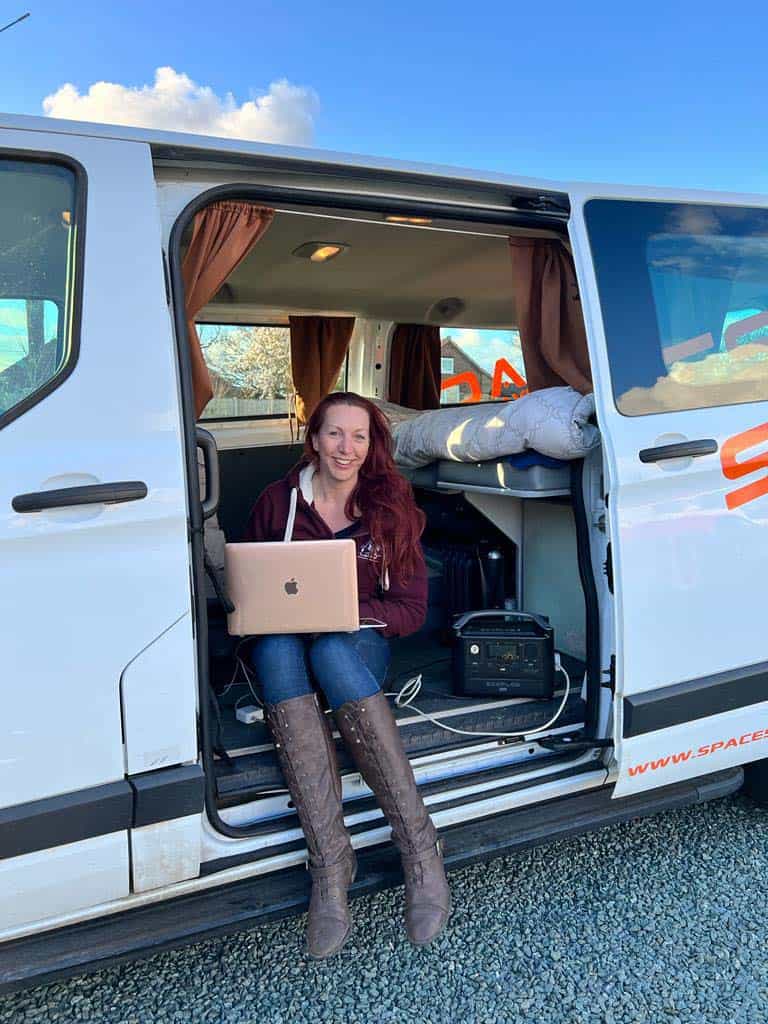
Using my powerbank in my campervan: Working on the Road

Power Bank vs Generator

Many people ask if they need a generator for their motorhome or campervan and, honestly, my answer is ‘probably not’. Especially not if you have a power bank.

Here are some reasons I prefer a powerbank over a generator:

  • Silent
  • Lighter
  • No need to carry fuel (which is illegal if you’re campervanning in Portugal)
  • Can be carried away from the van easily if you want to work outdoors

There are two big pros for a generator instead of a powerbank:

  • No need to charge it (because it uses fuel)
  • Can have a larger power output (our generator is 2kw, instead of 600w)

We do carry both a generator and a powerbank, but that’s only because we bought the generator years ago when we were going motorhoming touring around Norway. If we did it now, I wouldn’t bother- I think we’ve used it 4 times in 4 years!


Solar Power

One of the best things you can do if you’re going to be spending a lot of time off-grid in your van, and plan to use a lot of electronic devices, is to get a good solar system set up.

We only have a 100w solar panel, and we only have one leisure battery. That works well for us at the moment, using a mix of wild camping spots and campsites.

If you’re getting a powerbank, you probably want the portable solar panel to go with it too.

Do you need a second leisure battery?

Nope, not in my opinion. We’ve managed very well with just one. There are a couple of caveats to that though:

  • If your van has an electric bed or excessive electric ‘things’, like electric sunroofs etc, a second leisure battery might be a good idea.
  • If you don’t have a solar panel, a second battery might be useful (but personally I’d add a solar panel over a second battery)

Before you fit a second one, make sure there is proper space for it in the battery compartment. If there’s not, don’t fit one.

I changed over to a lithium battery with an upgraded inverter – this set up was the best option for me as I was planning an epic trip to Ireland, where I spent most, if not, all the time off grid – see my video here.

So if you’re thinking of changing to Lithium check out my video on all you need to know about Lithium Batteries.


Make your van power efficient

As well as all the devices you’ll be using while working on the road, it’s important to make sure the rest of the systems in your van use as little power as possible.
Things like changing lighting to energy-efficient bulbs, or making sure the fridge can run on gas rather than 12v, will make your time off-grid much less stressful.

Of course, if you’re only ever planning to use campsites with electric hookup, this is not such a concern and I wouldn’t waste money on a solar panel, second battery or expensive but better lighting.


Be clever with your laptop

As a blogger and Youtube video creator, I do ALL the things. All the time. But one of the biggest things I do is edit video.

That’s why I treated myself to a MacBook Pro and it was EPIC. Fast, lightweight (even with the bigger screen) and tons of memory/ processing power. I was in love.

Until the battery died after two hours.

TWO HOURS.

How the heck was I supposed to work remotely while off-grid if I needed to charge up my laptop every couple of hours?

Now, full disclosure, I am a ‘multi-tabber’. Right now, I have (oh dear) 17 tabs open. And that’s only because I just shut down the second window! ?

I know if I was better at closing tabs down, I would reduce power consumption. But, the fact is, the MacBook Pro was too power hungry for me. If you’re planning to be a digital nomad and work from the road without being on campsites every night, I don’t recommend it for you either.

I now have a MacBook Air and it’s PERFECT. Smaller screen, less memory BUT the battery lasts between 6-8 hours, depending on what I’m doing. Which means I only need to charge it once a day or so. Much much more manageable.

Motorhome wild camping guides for the UK & Europe

Motorhome wild parking guide

Being a Digital Nomad- tips for working on the road

Here are a few tips to help you get set up efficiently and making life easier for yourself (and your partner!)

The biggest mistake while working from the road

On our first trip as remote workers, we didn’t really have a schedule for work time- and it caused endless friction. My ex husband needed to work, and I wanted to explore. Or I’d have planned a ‘driving day’ on the same day he’d planned an important 3-hour conference call.

We hadn’t found a groove- and that was our biggest mistake.

Have a schedule

Now, I scheduled in 2/3 ‘work days’ a week, or at least part of the day. That allowed both of us to get work done, without stressing during the time off.

It’s ok to change this time, as long as you both agree it.

Downtime is sacred

It’s just as important to plan downtime as it is to plan work time. Otherwise your brain will never switch off. Remember, you no longer have that drive home to decompress and get into ‘not at work’ mode.

I am AWFUL at this, but try to have set hours and stick to them as much as possible. (She says, while typing this at 9pm…!)

Being respectful (making brews)

If you’re travelling and enjoy solo van life, this is easier, but if you’re travelling with another person, it’s important that you both are respectful.

For example, my ex husband drinks a LOT of coffee while he’s working. And he likes to make it fresh each time, rather than drink from a Thermos. This is fine, but our van kettle (which I LOVE) has a whistle.

Him trying to make a brew or clatter around the galley whilst I was trying to film a video caused a HUGE row early on in our travels.

Same as me trying to cook dinner while he was in the middle of an important conference call (at 8pm!)

This is my #1 Couples road trip tip and it goes back to having a schedule and communicating with each other. I often do Youtube Lives or podcast interviews late at night. If I know that’s coming up, I needed to remember to share that info with him well in advance, so we can plan in when to cook dinner and prepare drinks in advance.

READ MORE: Get more tips for van life couples who live and work together (and don’t want to go to jail for murder…)


Get noise-cancelling headphones

Another thing which you will find essential are noise-cancelling headphones. These are the ones I have and they are worth every fricking penny. You’re welcome.

(They also make great gifts for motorhome owners 😉 )


Be organised

One of the hardest things about living in a small space is staying organised. Make sure you keep all your work stuff together, so you can find things easily if you need to.

This is also a time for ‘less is more’- but make sure it’s enough. You want the least amount of work gear you can safely get away with, bearing in mind its importance in your life on the road.


Anticipate things

I am an early bird. I loved to get up at about 5.30/6 am and work for 2/3 hours before my ex husband and dog get up. It’s my favourite time.

However, when we first started, I wasn’t organised in terms of how things might work while the bed was in use. So my chargers or something else essential would be under the seat, meaning I had to disturb him to get to them (you can imagine his joy…!)

Similarly, he liked to go to bed later than me, so needed to have everything he needs ready so he won’t disturb me.

Make sure your insurance covers your gear

If you’re working from the road, it’s likely that you’re carrying more electronic equipment than the average traveller. Therefore, it’s important to make sure your motorhome insurance covers you for all the devices or gear you have with you.

If you’re renting a motorhome, it’s just as important to check this too.


Increase Security

Similarly, you might want to consider adding extra security to your vehicle. We have an additional habitation door lock which we highly recommend, and motorhome window locks.

See all the motorhome and campervan security devices we recommend here


Remote working- Making it work for you

In the end, the trick to working on the road is making sure it works for YOU and your new lifestyle. Here are a couple of things to consider.

Doing a good job

If you’re working remotely for a company, make sure you do an EXCEPTIONAL job for the first few months. You want them to feel warm and fuzzy that this set-up is going to be effective.

Don’t forget, most people are still new to the idea of digital nomads and remote working, even despite the working from home everyone did in 2020! You need to ease your boss into it gently.

Communicating well with clients

Same thing with clients. Many of them may not know you’ve changed your lifestyle, but you may wish to tell those who are affected by the change, and make an extra effort with them for the first few months.

Depending on your job, if you’re going somewhere like the Dolomites or Alps and will be out of reach for a few days, tell the important people well in advance so they know.


Stay connected/ pop back once a month

My ex husband returned to the UK regularly, and we used to budget for that. If this is the case for you, book flights as far in advance as possible. Yes, it might restrict your travelling slightly, but that’s one of the compromises.


Have a ‘smart’ Zoom Call top & Use a background

If you’ll be doing a lot of Zoom, Google or video chats, be sure to pack at least one ‘smart’ top. You might only ever wear it for half an hour once a week, but it will make you look and feel more professional

When on video calls, like Zoom, make sure you use a background – this can remove any “issue” with the meeting audience seeing you’re in a van and to be honest, using a background is great so you’re not displaying your bin or dirty dishes – that you forgot to wash up 🙂


Remember time zone differences

While you’re travelling, you’ll probably be in a different time zone. Some digital nomads are in totally different time zones from their boss or the rest of the company.

Remember this while working from the road- you might need to do the odd early morning/ late night to stay connected.


10 working from the road jobs you could do to earn money as you travel

If you’re looking to change your life and are not sure what you could do to earn money as you travel, here are some ideas you don’t need much, if any, experience or qualifications for:

  • Freelance Writer- sell stories of your travels to magazines or websites
  • Vlogger- create Youtube videos of your travels. You could also get support via Patreon
  • Video editor- Alternatively, use your skills and get paid to help others edit their videos
  • Virtual Assistant- help others with things like social media
  • Photographer/ Photo editor- Sell your photos, or edit other people’s photos for them to use
  • Graphic Designer- use your artistic talent on places like Fiverr and Upwork
  • Translator- Speak another language almost fluently? There’s plenty of work for good translators
  • Teach English Online- use your mother tongue to teach other students, either adults or kids
  • Teach anything online- Same for music, art, crafts, singing… think of a skill you have that people might want to learn. Then set up and start teaching them!
  • Website developer- know how to build a website? Help others do just that

I hope you enjoyed our article on tips and tricks for working from the road. If you have any other tips we haven’t mentioned, please do drop a comment below.

You might find these posts useful:

Last update on 2025-01-23 / Affiliate links / Images from Amazon Product Advertising API

Sharing is caring!


Source link

Deepal S07 previewed in Malaysia – up to 258 PS, 475 km WLTP EV range; Tesla Model Y rival; launch soon?

0


Deepal S07 previewed in Malaysia – up to 258 PS, 475 km WLTP EV range; Tesla Model Y rival; launch soon?

The Xpeng X9 wasn’t the only electric vehicle (EV) to be previewed by Bermaz Auto (BAuto) at today’s media event, as the company also showed off the Deepal S07 (also claimed to be a development unit). This comes a few weeks after it was announced that BAuto secured distributorship rights for Deepal brand EVs in Malaysia, with sales handled by Bermaz Changan (an 85% owned subsidiary of BAuto).

The S07 is one of two Deepal models confirmed for Malaysia, with the other being the S05. The S07 is larger than the latter, measuring in at 4,750 mm long, 1,930 mm wide, 1,625 mm tall and with a wheelbase of 2,900 mm. For context, the S07 is around the size of the Xpeng G6 and Tesla Model Y.

It’s worth noting that the S07 isn’t an all-new model but a facelifted and renamed version of the S7, which was first introduced in China in 2023. In its home market, the S07 – launched there last July – retails for between 149,900 yuan and 176,900 yuan (about RM91k and RM108k).

Deepal S07 previewed in Malaysia – up to 258 PS, 475 km WLTP EV range; Tesla Model Y rival; launch soon?

In terms of powertrains, the S07 in China can be had with a 68.82-kWh lithium iron phosphate (LFP) battery for up to 520 km of range following the CLTC standard. This variant will get from 0-100 km/h in 7.6 seconds thanks to a rear electric motor rated at 258 PS (255 hp or 190 kW) and 320 Nm.

Thailand, which has already welcomed the S07, gets two variants, including a “standard range” option that has a 66.8-kWh nickel manganese cobalt (NMC) battery for 485 km of range (NEDC), paired with a rear electric motor rated at 258 PS (255 hp or 190 kW) and 320 Nm. Based on the remaining range (430 km) and battery charge level (90%) shown on the digital instrument cluster, the theoretical max NEDC range for this unit being displayed is similar to the “standard range” S07 sold in Thailand.

The second variant called the S07 L ups the range to 560 km NEDC (or 475 km WLTP as listed for Australia) with a 79.97-kWh NMC battery, although its rear electric motor is rated lower at 218 PS (215 hp or 160 kW) and 320 Nm. Pricing in Thailand for the S07 is from 1.399 million baht to 1.499 million baht (RM183k to RM196k). Based on the remaining range (430 km WLTP) and battery charge level (90%) shown on the digital instrument cluster at the time of writing, the theoretical max WLTP range for this unit being displayed is similar to the S07 sold in Australia.

Deepal S07 previewed in Malaysia – up to 258 PS, 475 km WLTP EV range; Tesla Model Y rival; launch soon?

Styling-wise, the S07 is a rather sporty-looking EV with an X-shaped front bumper, large air curtains, a “floating roof” and three-point lighting signatures for both the split headlamps and full-width taillights.

On the inside, a large 15.6-inch infotainment touchscreen integrates most of the vehicles controls, while other features include a panoramic glass roof, powered front seats with heating, ventilation and massage functions.

For now, there’s no official word on when the S07 will go on sale and for how much. Are you looking forward to the arrival of another Chinese EV brand to Malaysia? Is the S07 worth considering over the Tesla Model Y and other comparable models?

Looking to sell your car? Sell it with Carro.

Learn more: Deepal S07


Source link