Report-card grades are derived from a consensus of test-driver evaluations. All grades are versus other vehicles in the same class. Value grade is for specific trim level evaluated, and may not reflect Consumer Guide’s impressions of the entire model lineup.
Big & Tall Comfort
Big Guy
B-
Tall Guy
C+
Big & Tall comfort ratings are for front seats only. “Big” rating based on male tester weighing approximately 350 pounds, “Tall” rating based on 6’6″-tall male tester.
Base price: $71,250 (not including $1195 destination charge)
Options on test vehicle: Luggage cover ($390)
Price as tested: $72,835
Pros and Cons
The great: Powerful, efficient, fun to drive
The good: Practical, easy on the gas, comfortable seats, solid feel
The not so good: Firm ride, road noise
Review
There’s irony in the 2025 Volvo lineup, and we’re happy to see it. Volvo’s global electric-vehicle sales leapt an impressive 50 percent last year, this while other European luxury carmakers are struggling to sell EVs, especially Mercedes-Benz. Volvo also sells a good number of plug-in hybrid models, especially in Europe, giving the Swedish carmaker some bragging rights in the “new-energy” vehicle community.
Volvo V60 Polestar Engineered
Station Wagons
Of course, Volvo’s core bread-and-butter lineup of traditional gas-powered models still accounts for most of the maker’s volume, but there is one segment—which has nothing to do with powertrains—that is sadly slipping away, and that’s wagons. Old-school station wagons.
Completely replaced in showrooms by crossover over the past few decades, the station wagon no longer amounts to a rounding error when calculating annual vehicle sales in the U.S. Amazingly, Volvo still makes available three wagon models, though, none of which is what anyone could call conventional.
Volvo V60 Polestar Engineered
Once famous for its solid, stolid, rear-wheel drive, famously reliable station wagons, Volvo now sells only a trio of wagons, each of which is a little like a cosplay example of the breed.
Available for 2025 are the:
V60 Cross Country
Starts price: $51,495
Based on the compact S60 sedan, the V60 Cross County wagon boasts an elevated ride height, off-road capable tires, and SUV-style body cladding. Think of it as a Swedish Subaru Outback, and you have the idea. Power comes from a mild-hybrid 2.0-liter turbocharged 4-cylinder engine. AWD is standard.
V90 Cross Country
Starting price: $60,995
Basically, as above, but based on the longer Volvo S90 sedan. Enjoys greater rear-seat knee and leg room than the V60. Is otherwise very similar in look and feel, though highway ride quality is better than that of the V60 Cross Country.
V60 Polestar Engineered
Starting price: $72,445
Volvo V60 Polestar Engineered
Unlike the other tow wagons on Volvo’s 2025 lineup, the Polestar Engineered example comes without off-road pretensions. Instead, the Polestar is strictly about on-road performance. Packing a 455-horsepower plug-in hybrid drivetrain and performance-tuned suspension, the lone Polestar-tuned member of the Volvo wagon family delivers an EPA-estimated 41 miles of battery only range, and reaches 60 mph from a stop in a claimed 4.1 seconds.
Performance Car
Not a conventional wagon in the bunch, but an interesting trio, to be sure. Consumer Guide recently spent a week behind the wheel of a—full name coming—2025 Volvo V60 T8 AWD Polestar Engineered. And to clarify, Polestar is—or has been—Volvo’s performance brand, a little like AMG at Mercedes-Benz, or “M” at BMW. And yes, Polestar is also the name of the Volvo-adjacent EV-performance brand recently launched in the U.S. And no, the two Polestars are not related, not directly, at least. Also, T80 is Volvo speak for the plug-in hybrid drivetrain found in our test car.
Speaking of our test car, it arrived in Crystal White and came to $72,685 including destination charge. Not cheap, but also not expensive relative to the aforementioned performance offerings from BMW and Mercedes.
Room and Comfort
The V60 cabin is Volvo familiar, in a mostly good way. Though the door openings are a little tight both front and rear, there’s a decent amount of space in the front row once situated. The rear seating accommodations are a little tighter, with knee room a commodity behind taller front-seat occupants. The said, the seats are comfortable and supportive, and likely well suited for very-long drives.
Connectivity
Though the V60 employs Google built-in to drive the native connectivity suite, wireless Apple CarPlay and Android Auto are part of the deal as well. The Google built-in system can be largely ignored, but is surprisingly handy when entering navigation destinations.
The V60’s infotainment system still incorporates Volvo’s “stacked bar” interface, which we always initially find off-putting, but quickly become accustomed to. That said, the screen is well lit and easy to read, and responds promptly to touch inputs. Also, the Polestar’s standard Bowers and Wilkins-brand audio system is breathtakingly good, and helps to justify the model’s price tag.
Power and Performance
Volvo V60 Polestar Engineered
Power, as noted above, comes from a 2.0-liter turbocharged AND Supercharged 4-cylinder engine mated to an electric motor and an 8-speed automatic transmission. Combined system output is 455 horsepower. Also, as noted above, AWD is standard.
Though not entirely seamless, the powertrain delivers almost immediate power from a stop, making short work of urban-environment traffic maneuvers. And, predictably, there’s a surplus of highway passing and merging power, making for thrilling on-ramp runs.
Ride and Handling
And, thanks in part to the Polestar-tuned suspension, and Brembo-brand brakes, the V60 Polestar Engineered is a joy to throw into corners and push through cloverleaf exchanges. Part of fun comes from the level of engagement enjoyed as a result of the firm suspension and beefy, solid-feeling steering.
This comes at the expense of ride quality. Though the ride is harsh, it is rigid, and shoppers will want to take note of this situation on a test drive. We absolutely love the chassis setup, but folks looking for a more-traditional luxury experience—a typically more Volvo experience—may be put off by the suspension tuning. On a related note, our test car was noisier around town than other V60 and V90 models we’ve evaluated. The sound making its way into the cabin is mostly road noise, and comes in part from the standard high-performance tires.
Fuel Economy
And, despite all the power, and despite all the fun—and despite only charging the car completely just once—we average 27.9 mpg. Impressive given the power, we think.
Is it ironic that one of Volvo’s most enjoyable 2025 offerings does not come from the brands expanding portfolio of EVs? Perhaps it’s ironic that this fun-to-drive sporty wagon also returns close to 30 mpg in routine drive—and much better if you work daily charging into your daily commuting regimen.
Value
Yes, $75,000 is a lot to pay for a smallish midsize wagon, and yes, the ride is on the firm side. But we found the V60 Polestar Engineered both frugal and fun to drive, and its wagon utility a delightful bonus. There really isn’t much in the way of direct competition for this athletic Swede, adding uniqueness to its many charms. The audience for this old-school wagon is pretty limited, but to the right buyer, it’s probably close to perfect.
The luxury goods market is worth hundreds of billions of dollars, and it is projected to keep growing every year. This presents a unique opportunity for anyone who wants to market their products as luxury items. It’s difficult to specifically state what a luxury brand is. To some people, the quality and design of a product make it stand out, while to others, the price is the most important factor. People also check the rarity of a brand to determine whether it qualifies to be classified as luxurious.
So, how can you create the perception that your brand is luxurious? Here are some pointers.
Maintain a Consistent Digital Presence
Most of your customers will first make contact with you online. That means your online presence should be consistent and polished. You don’t necessarily need to spend a lot of money hiring a programmer to set up your website. You can spend a few minutes learning how to design an online store using a website builder. Don’t worry, these tools are very easy to use, even for complete novices. You also need to pay attention to your domain name. Domain names for luxury brands have to be short and easy to remember. You shouldn’t add confusion by using numbers or hyphens in the name. Also, it’s essential to use your brand name in the domain.
Focus on First Impressions
Although many people will shop for your products online, you’ll still be getting walk-in customers. That means you need to create a professional appearance around your stores. The space should be well organized, and your staff should always pay attention to the smallest details.
A Compelling Brand Story
A brand story is meant to build trust among your customers and humanize your company. It needs to be compelling enough to evoke emotion as it conveys the mission and purpose of the brand. Your brand story needs to answer a few questions. Here are some of the key ones:
Why was the company launched?
What do you contribute to the world?
What’s your unique selling point?
Do you solve any problems in the world?
What are some actions you take to meet your goals?
Your brand story needs to be crafted carefully, and it has to be consistent across all channels.
Consider Influencer Marketing
If you want your brand to be considered luxurious, you’ll need to partner with influencers. These personalities are able to captivate their audiences, making them essential in your marketing campaign. As you market your products using influencers, you can incorporate your brand story in the ads. It’s important to make the content appear as authentic as possible.
Conclusion
A good way to outshine your competitors is to position your brand as luxurious. You can do this by polishing your first impressions, both online and offline. You also need a compelling brand story which will have to be consistent across all channels. Finally, you should consider influencer marketing.
For more on the latest in business reads, click here.
Alfa Romeo is adding a second special series across its three-vehicle lineup for the 2025 model year.
After announcing the Tributo Italiano special series in late 2023, Alfa Romeo announced the follow-up series, dubbed Intensa, at the 2025 Brussels auto show. Like the Tributo Italiano series, the Intensa series brings unique cosmetic touches to the Stelvio and Tonale crossovers, as well as the Giulia sedan.
2025 Alfa Romeo Tonale Intensa (European spec)
Regardless of which model it’s specified on, the Intensa treatment includes darkened exhaust tips, black brake calipers with gold “Alfa Romeo” lettering, and black 20-inch wheels with a gold-trimmed machined finish. Three exterior colors are available: Alfa Black, Alfa Rosso, and Verde Montreal on the Tonale, and Rosso Etna, Verde Fangio, and Vulcano Black on the Giulia and Stelvio.
The special series also includes black-and-tan two-tone interior treatment, with an Alcantara-wrapped dashboard and seats in the Tonale and leather upholstery in the Giulia and Stelvio. The latter two also get aluminum pedals and paddle shifters.
2025 Alfa Romeo Stelvio Intensa (European spec)
The Intensa, along with the Tributo Italiano, which also reaches the U.S. for the 2025 model year, represents Alfa Romeo’s new strategy of emphasizing special series and option packages over trim levels. The Giulia, Stelvio, and Tonale are all available in a single trim level for 2025, but the two special series and multiple option packages for each model mean individual vehicles can still be equipped quite differently.
Intensa-series models are available to order now. Tonale versions cost $46,490 with non-hybrid and $56,490 with plug-in hybrid powertrains, while Giulia and Stelvio versions cost $51,990 and $57,390, respectively (all prices include a $1,995 destination charge). All versions are available to order now.
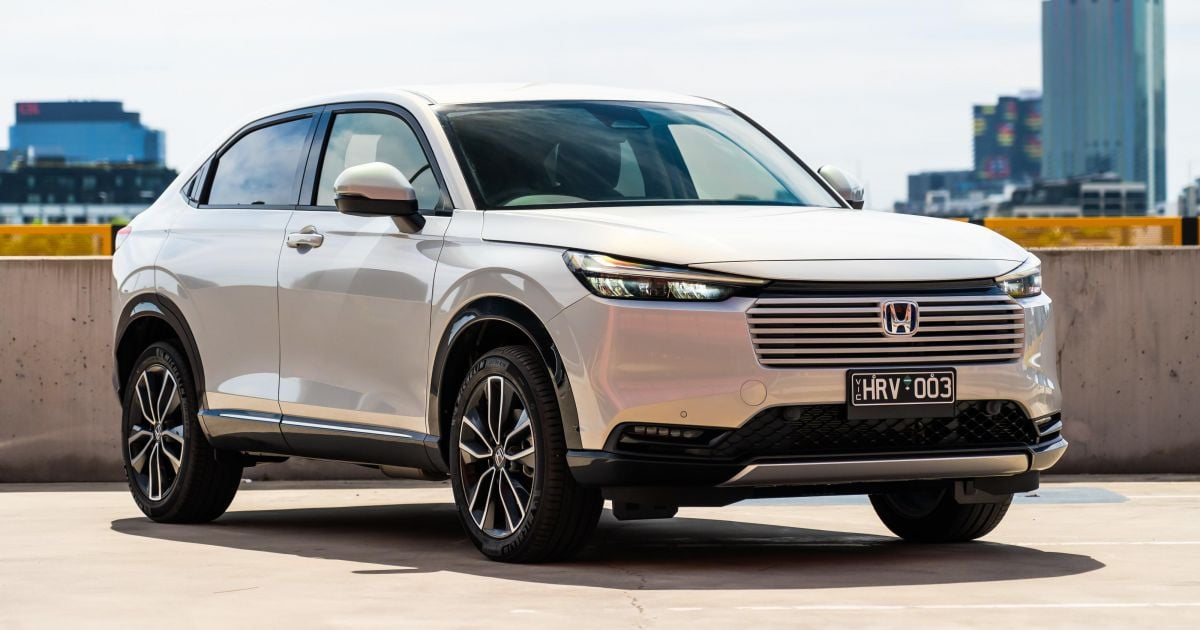
Honda’s smallest SUV is a unique choice in Australia’s modern automotive market.
Available in only three variants – one petrol, two hybrid – it remains a sensible alternative to something a little bigger like Honda’s own ZR-V, and like that model it has the advantage of being available with a refined hybrid powertrain.
It’s also well-built and well-presented, even if a lot of the nicer stuff isn’t available at the very bottom of the range.
If you want most of that though, the least you’ll pay is $39,900 drive-away for the keys to the Honda HR-V e:HEV X on test here.
This model variant is the newest addition to the front-wheel drive HR-V range and only arrived in October last year, bridging the gap between the non-hybrid entry-level Vi X and the more premiium e:HEV L flagship to offer a more realistic alternative to some of the other segment heavy-hitters.
WATCH: Paul’s video review of the 2022 Honda HR-V e:HEV L
One such model is the Toyota Yaris Cross. Toyota’s smallest SUV is available in Australia with only a hybrid powertrain, and it’s classed in a smaller vehicle category to the HR-V on the VFACTS sales charts (light SUV), so it costs much less.
Even so, it found 8206 homes last year, while the HR-V managed just 3350. For comparison, the Hyundai Kona – also available as a hybrid – outsold both cars in 2024 with 17,374 deliveries.
Then there’s the Subaru Crosstrek, which is Subaru’s smallest SUV and also available with a hybrid powertrain. It also sold well with 11,545 deliveries throughout 2024, leaving a lot of ground to make up for the endearing Honda.
Does the HR-V deserve more attention, especially in hybrid form, or is it just not what buyers are after?
How does the Honda HR-V compare?
View a detailed breakdown of the Honda HR-V against similarly sized vehicles.
Honda
HR-V
How much does the Honda HR-V cost?
At $39,900 drive-away, the HR-V seems pricey – especially when you consider some of the competition.
The Yaris Cross is hybrid-only and costs as little as $30,900 before on-roads, while the cheapest Hyundai Hybrid is priced at $36,500 before on-roads – though the latter will likely work out to be roughly the same as this HR-V once it’s in your driveway.
For $38,590 before on-road costs you could pick up the cheapest Crosstrek Hybrid, though again that’ll end up costing more than the HR-V.
Given the e:HEV X is technically the bottom-spec hybrid HR-V, its standard equipment list may not appear to justify the nearly $40,000 price tag – but we’ll get into that below.
Model
Drive-away price
Honda HR-V Vi X
$32,900
Honda HR-V e:HEV X
$39,900
Honda HR-V e:HEV L
$42,900
To see how the Honda HR-V stacks up against its rivals, use our comparison tool
What is the Honda HR-V like on the inside?
Plain and simple, but if you’re familiar with Honda you’ll feel right at home.
There are similarities between the interior of the HR-V and the ZR-V/Civic pair, though it’s understandably much more stripped-back in this cheaper model.
You’ll therefore find more plain surfaces and simple designs, and we like that here. It’s much less intimidating than in many other new cars and you’ll quickly figure out where everything is and what it does, plus you get the bonus of Honda’s exceptional build quality and satisfying, tactile buttons.
Headlining the front of the cabin is the 9.0-inch touchscreen infotainment, which might sound comparatively small on paper but doesn’t look that compact from behind the wheel.
It’s simple in presentation yet has crisp resolution, while also responding consistently to inputs both via touch and when using the handful of physical buttons on the right-hand bezel.
There may be a hint of aftermarket head unit here, but we can appreciate Honda’s simple approach when it all works reliably.
As a bonus you get wireless smartphone mirroring, which had no issues with during our week with the car.
A beauty of the HR-V line-up is the fact that while the e:HEV X is a mid-range model, buyers of the range-opening Vi X hardly miss out on any of the key features found throughout its cabin – beyond the hybrid powertrain absent under the bonnet.
Similarly, buyers of this car won’t go begging compared to the e:HEV L. The small price difference between the two e:HEV models reflect that, but of course there are some creature comforts you don’t get elsewhere, like added side mirror functionality, a power tailgate and rain-sensing wipers.
One of the systems that is consistent across the range is climate control, found below the infotainment display. As is typical of Honda it’s entirely physical, comprised of a simple mix of dials and buttons, while the vents themselves are easily controlled by separated individual dials.
All the settings are shown on the small integrated screen, and it’s easy to work with on the move. The dials rotate with a sharp, notchy action – incredibly satisfying to interact with.
In front of the driver is a nicely sized, leather-wrapped steering wheel. It’s not unexpectedly basic, but is entirely appropriate for the HR-V, and again it’s the same as what you’ll find across the rest of the range.
The only complaint is that its spokes are finished in gloss black plastic, including the buttons on either side. After a while behind the wheel, fingerprints and smudges will become painfully apparent.
On the note of materials, the wheel’s centre pad is also finished in a scratchy textured plastic, which stands out from the cabin’s other flat surfaces. It’s a minor thing, but doesn’t fit quite as well with the rest of the interior.
It’s nevertheless reassuring that the buttons on the wheel are all easy to use given their clear markings. Even if something isn’t immediately obvious, there’s no harm done by poking at a few to see what pops up.
Most of that will be visible on the instrument cluster ahead, which raises a few points within the context of both the HR-V’s price point and the rest of Honda’s catalogue.
The first thing you’ll notice about it is how simple it is in appearance. That’s partly because Honda’s graphics are inherently minimalistic, but it also has a lot to do with the fact it’s not entirely digital.
The left gauge and centre portions are both digital, which allows you to scroll through different menus to find all the driving-related information tucked away. We don’t mind that, but it’s the fact the speedometer on the right is still analogue that is interesting to us.
Given I’m used to older cars, I’m a fan of analogue gauges, so it’s never a complaint in cheaper cars that fall under the $30,000 mark.
The problem is the HR-V starts at $34,900 drive-away. At that price we can almost forgive a cluster that’s only partly digital, but once you start pushing $40,000 as with the HR-V e:HEVs, it becomes somewhat disappointing.
A few years ago this would’ve been totally fine, especially at the bottom of the range. Now, our tester costs just $300 less than the base ZR-V – which features a 10.2-inch fully digital instrument cluster.
We still think it looks nice and it’s perfectly functional, so we can understand why people might not mind.
Moving further down, you’ll find the large traditional gear selector surrounded by more gloss black plastic. Fortunately, there are no buttons to press in this area, but we expect dust will begin to collect and scratches will show after a few months of daily driving.
Following the two silver streaks backwards brings you to the centre console, finished in hard plastic. Here you’ll find two large cupholders and a small array of controls for drive mode, hill descent control, parking brake, and auto-hold.
Unfortunately, the hard plastic is pretty much the same as on the steering wheel, but given it’s mostly out of the driver’s line of sight we don’t think it’s as big of a deal here. We at least like how simple everything is in this area, and none of these controls caused any hiccups.
Storage up front isn’t outstanding, but it does the job. There are those cupholders, as well as a decent centre storage box and two cubbies ahead of the gear selector.
Additionally, there are bottle holders in the doors and a typical passenger-side glovebox, as well as the two USB ports up front. To top it off, the HR-V hybrids are both fitted with Honda’s more premium leatherette-and-fabric upholstery as opposed to the full-cloth look in the base model.
The seats are super comfortable as a result, and easy to get positioned up front even if the adjustment is only manual. I had no problem with its seating position at roughly 172cm in height, but taller people may run into issues with headroom.
Moving to the rear reveals the same upholstery, and there’s a fair bit to unpack here once you climb through the narrow door opening.
First up is the fact there are only two seats, due to ADR stipulations that require top-tether child seat anchors to be fitted to rear seats with a seatbelt. Markets like Japan and the UK don’t have that requirement and Honda won’t produce a bespoke setup for Australia, which means we miss out on the three-person bench.
Honda’s Magic Seats remain though, and they can be folded in a number of configurations to accommodate various items of challenging sizes.
If we miss out on a centre seat, we can at least appreciate the creative functionality we still get here.
To keep passengers comfortable there’s only a fold-down centre armrest with cupholders. Rear-facing air vents and dual USB-C ports are locked away in only the top-spec e:HEV L, with a pair of storage nooks fitted instead. At least the seats are comfortable and there’s plenty of space all round.
Boot capacity with the rear seats up is quoted at 304 litres, which is down on rivals like the Kona (407 litres) and Yaris Cross (390 litres), but still more than you get in a Crosstrek (291 litres).
That may not seem incredible, but it’s still a useable space thanks to its mostly square dimensions and two small cubbies on either side. With the rear seats folded the floor remains almost perfectly flat.
Unfortunately there’s no spare wheel, and buyers will instead have to make do with a tyre repair kit. Beyond a narrow space at the very rear of the boot there’s also no under-floor storage to be found.
For privacy you do get a cover at the top, which can latch to the tailgate to stay out of the way when loading and unloading. Using the boot is made even easier by the inclusion of lights on either side.
All up, it’s a well put-together interior, even if it is more basic than some other new Hondas. There are of course some shortcomings that, if resolved, would elevate this car further, but it’s perfectly liveable as is.
Dimensions
Honda HR-V
Length
4345mm
Width
1790mm
Height
1590mm
Wheelbase
2610mm
Cargo capacity
304L (rear seats up) 956L (rear seats folded, to window) 1274L (rear seats folded, to roof)
To see how the Honda HR-V stacks up against its rivals, use our comparison tool
What’s under the bonnet?
Both Honda HR-V e:HEV models are powered by the same 1.5-litre four-cylinder petrol-electric hybrid system, mated with a continuously variable transmission (CVT). Total system outputs are quoted at 96kW of power and 253Nm of torque, though Honda doesn’t list a capacity for its lithium-ion battery pack.
Specifications
Honda HR-V e:HEV X
Engine
1.5-litre hybrid four-cylinder
Engine outputs
78kW / 131Nm
System outputs
96kW / 253Nm
Battery
Lithium-ion
Transmission
CVT
Drive type
Front-wheel drive
Kerb weight
1378kg
Fuel economy (claimed)
4.3L/100km
Fuel economy (as tested)
5.1L/100km
Fuel tank capacity
40L
Fuel requirement
91 octane regular unleaded
CO2 emissions
98g/km
Emissions standard
Euro 6b
For context, the non-hybrid HR-V Vi X is powered by a 1.5-litre naturally aspirated four-cylinder engine producing 89kW and 145Nm.
It maintains the CVT and front-wheel drive delivery, though the lack of a battery pack reduces its kerb weight by more than 100kg compared to the hybrids. Fuel economy is quoted at 6.2L/100km.
In our week with the car we couldn’t match Honda’s fuel economy claim, but the figure we saw was still competitive in the context of other hybrids.
Our driving primarily involved freeway and highway use, so we expect urban-focused travel would bring the number closer to Toyota’s benchmark with the Yaris Cross.
To see how the Honda HR-V stacks up against its rivals, use our comparison tool
How does the Honda HR-V drive?
With surprising confidence, though not in quite as refined a manner as some of its siblings.
HR-V e:HEV L shown
Its hybrid-ness makes itself apparent almost immediately, given the HR-V will start up in electric-only mode and only fire up the combustion engine if you sit stationary for a long period of time with the air-con blasting.
Setting off is quiet as well; the only things audible are the exterior warning sound and a very faint motor noise. When it is time for the engine to kick in, it’ll do so without making itself known.
The transition from electric to combustion power is almost seamless, and the cabin is insulated well enough to the point that you probably won’t even hear the engine running. You’ll have to pay attention to the ‘EV’ light on the dash to notice.
At low speed the engine may be a little more obvious than on the highway, but in city driving the car will prioritise electric driving and only fire up the engine when battery charge is getting low. When you’re trundling around in stop/start traffic, charge should last for a fair while too.
That’ll help it get close to Honda’s urban efficiency claim of just 2.9L/100km, though with predominantly highway driving the engine needs to operate more of the time.
It’s able to cruise along in electric mode at 80km/h without too much trouble, though the battery quickly discharges and requires the engine to supplement its power. Likewise, inclines will have the HR-V calling on its petrol power much more often.
Because of the hybrid boost the HR-V is still fairly peppy off the line, as it’s able to quickly scoot away before the engine kicks in. On a decline, the car can even get up to the speed limit only on electric power – provided you don’t step on the throttle too aggressively.
When you do, the petrol engine will do almost all of the heavy lifting, bringing with it more of the noise you’d associate with a small displacement engine mated to a CVT. That noise is far from unbearable though, much like the minimal tyre noise you’ll hear on average roads.
At high revs the CVT will simulate gears to feel more like a torque converter auto, which brings a bit of life to a transmission type that is otherwise known for its dreariness. Switching into Sport mode will also help with this, making the HR-V feel much more alive in the context of its economical focus.
It’s not quite as fast as the larger, higher-output ZR-V, but it doesn’t feel strained.
There’s also an Eco driving mode that will prioritise electric power in all settings and minimise the use of the engine. Power output is also slightly dulled, while the transmission is adjusted to prevent the engine from revving to rev too high when it’s running.
You’ll notice a ‘B’ on the gear selector bezel too, which Honda labels as ‘regenerative braking mode’ in both hybrid HR-Vs. In this mode, the driver is granted full control over the car’s regen braking, allowing for a bit of ‘engine’ braking and more charge to be recuperated while on the move.
It’s not quite one-pedal driving, but in its strongest setting it’ll still slow the car substantially without having to use the brake pedal. The strength of the regenerative braking effect is dependent on how much charge the battery has, as it’ll be much more subdued if the battery is mostly full.
Further, the strength of the regen braking is controlled using paddles on the wheel. In the non-hybrid HR-V these paddles are used for ‘shifting’, but their repurposing for use here improves the on-road experience.
It’s still possible to adjust the level of regenerative braking while in Drive as normal, but only temporarily.
As far as comfort and ergonomics go, the HR-V has it just about nailed. The steering is appropriately weighted and provides good feedback as the tyres ride over imperfections in the road, while the throttle and brakes are nicely calibrated and aren’t too touchy nor too soft.
The seats prove to be comfortable on longer drives, while the ride quality is good enough for bumps and holes to cause little trouble.
That said, it doesn’t quite feel as solid as something like the ZR-V in a way that’s hard to describe. Where the ZR-V feels chunky, planted and robust, the HR-V tends to lean a little more on the ‘flimsy’ side – for the lack of a better word.
That could be a result of its stilted stance and relatively narrow tyres. That’s not to say it feels like it’s going to fall over or bounce away in bends because it corners quite well, but the handling deficit to its Honda siblings is definitely noticeable.
The hybrid HR-V is still plenty sure of itself and will handle turns better than many of its rivals, but you may find the odd unsettled moment on rough rural roads.
Its on-road safety tech is well-calibrated too. Both HR-V e:HEVs share in the same safety gear and add systems like blind-spot monitoring compared to the base Vi X, which is infinitely helpful given the poor rearward visibility caused by its obstructive rear-end packaging.
Engaging and controlling adaptive cruise control is easily done using the buttons on the right of the steering wheel. The HR-V will hold its lane confidently and match the speed of cars ahead with no issue, making it a breeze to travel along long stretches of freeway.
Only occasionally did its passive lane-keep system flare up, but only on narrower regional roads. In most cases it took issue with us drifting out of our lane to avoid a pothole, but it wouldn’t steer us back into the lane with force – instead keeping it to audiovisual warnings in the cabin.
Its reversing camera may not be terribly high-resolution, but when paired with parking sensors it’s still easy to park and manoeuvre in tight areas like carparks.
In general, the HR-V is a solid little performer on-road, and will cover your daily commutes without too much sweat.
To see how the Honda HR-V stacks up against its rivals, use our comparison tool
What do you get?
There are three grades of HR-V available in Australia, and the e:HEV X sits right in the middle.
2025 Honda HR-V Vi X equipment highlights:
18-inch alloy wheels
Tyre repair kit
LED headlights
Auto dusk-sensing
Auto high-beam
LED daytime running lights
LED tail-lights
Rear privacy glass
Power-adjustable side mirrors
Matte black wheel arch cladding, side skirts, front and rear bumper trim
9.0-inch touchscreen infotainment system
Wireless Apple CarPlay, Android Auto
DAB+ digital radio
Satellite navigation
2 USB ports
7.0-inch LED driver information interface
4-speaker sound system
Single-zone climate control
Black cloth upholstery
Leather-wrapped steering wheel
Leather-wrapped gear selector
Paddle shifters
Manual front seat adjustment
Rear Magic Seats
60/40 split, fold down and tip up
Smart keyless entry
HR-V e:HEV X adds:
Auto-levelling headlights
LED front fog lights
LED active cornering lights
Gloss black wheel arch cladding, side skirts, front and rear bumper trim
Acoustic windscreen
6-speaker sound system
Heated front seats
Black leatherette and cloth upholstery
Is the Honda HR-V safe?
The Honda HR-V has a four-star safety rating from ANCAP, based on testing conducted in 2022.
Category
Honda HR-V
Adult occupant protection
82 per cent
Child occupant protection
77 per cent
Vulnerable road user protection
72 per cent
Safety assist
69 per cent
Standard safety features include:
6 airbags
Front
Front side
Full-length curtain
Autonomous emergency braking
Oncoming motorcycle collision detection
Pedestrian and bicycle front cross-traffic collision
Lane-keep assist
Lane departure warning
Adaptive cruise control
Traffic Jam Assist
Traffic sign recognition
Reversing camera
Front, rear parking sensors
Hill descent control
Tyre pressure monitoring
Automatic walk-away door locking
HR-V e:HEV X adds:
Blind-spot monitoring
Intelligent speed limiter
Rear cross-traffic alert
How much does the Honda HR-V cost to run?
The Honda HR-V is backed by a five-year, unlimited-kilometre warranty, plus five years of roadside assist, and is offered with five years of capped-price servicing.
Servicing and Warranty
Honda HR-V
Warranty
5 years, unlimited kilometres
Battery warranty
8 years (e:HEV X, e:HEV L)
Roadside assistance
5 years
Service intervals
12 months, 10,000km
Capped-price servicing
5 years ($199 each)
Total capped-price service cost
$995
Honda also includes a five-year complimentary navigation map update and a five-year Honda Connect subscription with new HR-V purchases.
To see how the Honda HR-V stacks up against its rivals, use our comparison tool
CarExpert’s Take Honda HR-V e:HEV X
The HR-V is a good thing, and this e:HEV X variant is probably the pick of the bunch.
It’s economical and quiet, while also being easy to drive in a way that sets it apart from a lot of other new cars on sale right now. Better yet, Honda quality shines through in every aspect of the car, which means it’ll likely hold up as the kilometres mount.
The seamless and economical hybrid powertrain has enough punch for what it needs to do, and we always appreciate well-calibrated safety gear. Its infotainment provisions are also top-notch, if not a little small-screened for some people, but I’m in the function over form camp and it’s hard to argue with a system that has no faults.
We can also appreciate the HR-V’s instrument cluster for its simplicity, though it still seems a little strange that the base ZR-V has a fully digital cluster for a nearly identical price.
If you can get past the lack of five seats, a somewhat small boot and no spare wheel, you’d do well to get behind the wheel of the e:HEV X.
The Vi X is cheaper but lacks hybrid tech and a bunch of nicer gear like heated seats, fog lights and a decent sound system, and in our opinion it doesn’t look as sharp due to its matte black exterior cladding.
The e:HEV L, meanwhile, is essentially the same car but more expensive, and probably not worth the extra money unless you consider creature comforts like rain-sensing wipers, dual-zone climate control, and a heated steering wheel to be make-or-break equipment.
You may get a car that could better suit your needs with something like the base ZR-V, but you won’t get hybrid tech in that vehicle unless you pay more and move further up the range.
The only real criticism is that it’s on the pricey side, but if you can get past that the HR-V e:HEV X is well worth a look.
Interested in buying a Honda HR-V? Get in touch with one of CarExpert’s trusted dealers here
The Ferrari F40 has been in the news a lot lately, mostly for all the wrong reasons. So, we’re not sure why Lewis Hamilton decided to pose with one on his first day at work with the Scuderia Ferrari Formula 1 team.
Every F1 driver dreams of driving for Ferrari at least once in their career. After 356 starts, 105 wins, and 7 World Driver’s Championships, Lewis will finally race in red in 2025. It has been touted as the beginning of a new era in F1 as one of the most successful drivers of the sport moves to Maranello.
Lewis posted this image to mark his first official day with the team. In the background is Enzo Ferrari’s iconic office – an old structure with white walls and red windows and doors.
“There are some days that you know you’ll remember forever and today, my first as a Ferrari driver, is one of those days,” Lewis wrote.
“I’ve been lucky enough to have achieved things in my career I never thought possible, but part of me has always held on to that dream of racing in red. I couldn’t be happier to realise that dream today.”
“Today we start a new era in the history of this iconic team, and I can’t wait to see what story we will write together.”
Hamilton in car #44 will race alongside Charles Leclerc.
We have been travel blogging for then past 15 years, and most of those trips were done backpacking style. But sometimes, we like to trade hostels for something a little more bougie — preferably on the high seas. Because, let’s face it, every now and then, we all deserve a little pampering. And what screams “pampering” louder than a cruise? Floating buffets, stunning ocean views, and new destination each day? We’re on board!
Cruising is the ultimate travel “hack” — unpack once, feast like royalty, and let your floating resort-hotel take you to some of the most incredible spots in the world. It’s perfect for families, couples, or even solo adventurers looking for a mix of relaxation and exploration. Whether you’re lounging by the pool, savoring global cuisines, or stepping off the ship to explore a new port, cruising offers a hassle-free way to see more while doing less.
But going on a cruise isn’t exactly top-of-mind for most travelers. And we get it. Cruising has some pretty wild stereotypes attached to it. When we asked our friends what they thought cruises were like before they actually tried one, the answers were hilariously predictable. It can be summed up to this: “It’s an excessive vacation for rich retirees who spend their days lounging, sipping cocktails, and partying like it’s their second 20s.” I had the same misconceptions before, too. Blame Hollywood.
But cruising has seriously leveled up over the years, becoming way more accessible and affordable. So no, you don’t need a trust fund to join the fun.
If you’re considering to try cruising or you’re just curious, no cruise line is better for your high-seas debut than Royal Caribbean. They own the top seven largest cruise ships in the world. Right now, they operate two ships in Asia:
Spectrum of the Seas, homeporting in Shanghai, sailing to Japan (Okinawa, Nagasaki, Fukuoka, Kumamoto, Kagoshima, Osaka, Tokyo, Kobe) and South Korea (Busan and Jeju Island).
Anthem of the Seas, based in Singapore, sailing to Malaysia (Port Kland/Kuala Lumpur and Penang), Thailand (Phuket), and Indonesia (Bali and Lombok).
Ovation of the Seas is also set to return to Asia later this year, replacing Anthem in Singapore.
But in this article, we’ll be focusing on Spectrum of the Seas.
Not really. Not all the time. It can be expensive sometimes but it can be affordable, too.
Cruise prices can swing wildly depending on the destination, travel dates, length of the cruise, number of guests, and type of cabin you book. In short, it’s all about finding the combo that works for you (and your wallet).
First up—travel dates. If you do a quick search, you’ll notice that cruises with the exact same itinerary (same nights, same stops) can have wildly different price tags depending on when they sail. It’s basically like booking a flight. The good news? Scoring budget-friendly dates isn’t difficult.
I did a quick search and here are the cheapest sailings for three, four, and five nights.
See? Snagging an affordable cruise is totally doable, especially if you’re ahead of the game. Royal Caribbean just rolled out their 2025 and 2026 schedules, so now’s the perfect time to dive in. Early bird gets the best deals—and maybe even a better cabin view!
In many cases, prices also tend to go cheaper when the sailing date is really close. Cruise companies would rather sell slots at a lower rate than not sell at all.
But note that December and January tend to have the steepest rates because they’re around major holidays — Christmas, New Year, and Chinese New Year! You’ll also notice the big difference between room types.
Speaking of room types, the most affordable cabin is the Interior state room. I’ll break it down and explain further in the next section.
The rates vary depending on a number of factors.
Again, here are the cheapest sailings.
A 3-night cruise that makes a stop in Jeju Island can cost as low as USD 331 (PHP 19,400) per person (interior room, excluding gratuities) for an October 2025 sailing. This can go even lower if you’re traveling with seniors, who are often eligible for a substantial discount.
I think that’s a fantastic deal considering that it’s inclusive of the following:
3-night accommodations (interior)
UNLIMITED meals
entertainment (theatre, movies, etc.)
access to amenities (pools, some attractions)
stop in Jeju Island (tour not included)
taxes
So for me, if you’re able to snag a good deal, going on a cruise is pretty much like your typical land trip budget-wise.
YES, most of the time! Senior guests (55 years old and above) can get a 10% discount off the cruise fare. This is equivalent to around SGD 80 – 120 per room (USD 58-88), depending on cabin type.
Royal Caribbean also has several KIDS SAIL FREE promos, which could reduce the cruise fare for 3rd or 4th guests who are 12 years old or below, staying in the same room as the primary guests.
However, these promos are not available year-round and may not apply to certain dates. These discounts also cover the CRUISE FARE only. Taxes and other fees still need to be settled by the guests.
Royal Caribbean has an international website. But if you’re in the Philippines, consider booking via www.cruising.com.ph, which is managed by the official Royal Caribbean partners in the country.
You might notice that prices on Cruising.com.ph is slightly higher. That’s because Cruising already includes the mandatory gratuities. If you book on the international website, this amount is excluded but you’ll still have to pay for it on board. With Cruising, you won’t need to worry about this because it’s pre-paid.
One big perk of booking through www.cruising.com.ph is that you get customer service right here at home. Whether you made a booking mistake, want to tweak your reservation, or need help with payment extensions, there’s someone ready to assist. Most importantly, you have a reliable contact in case of emergencies—a lifesaver, especially these days. The travel scene is still pretty unpredictable. Having a local team on your side can make all the difference in navigating any last-minute surprises.
Plus, cruising isn’t as straightforward as your typical land tour. There’s a ton to juggle—flight schedules, cruise timings, travel requirements, check-ins, boarding processes, activity and dining reservations, shore excursions… the list goes on. A local support team can help keep all these moving parts in sync for a stress-free adventure.
If you book on the international website, you’re essentially flying solo. Any issues? You’ll have to call their U.S. hotline, which is not exactly convenient. Case in point: my aunt once booked through the international site and accidentally ended up with a cabin on the opposite end of the ship from her companions. Fixing it meant dealing with time zones and international calls. Not exactly smooth sailing!
And if you use our promo code — WORTHIT — you’ll get an additional 5% DISCOUNT on the cruise fare! You can use this on top of any existing promos or discounts.
Although prices on both sites are almost always the same (if you remove the gratuities), we still encourage you to compare. Sometimes, there are promos that are only available on the Cruising website, and sometimes only on the international site.
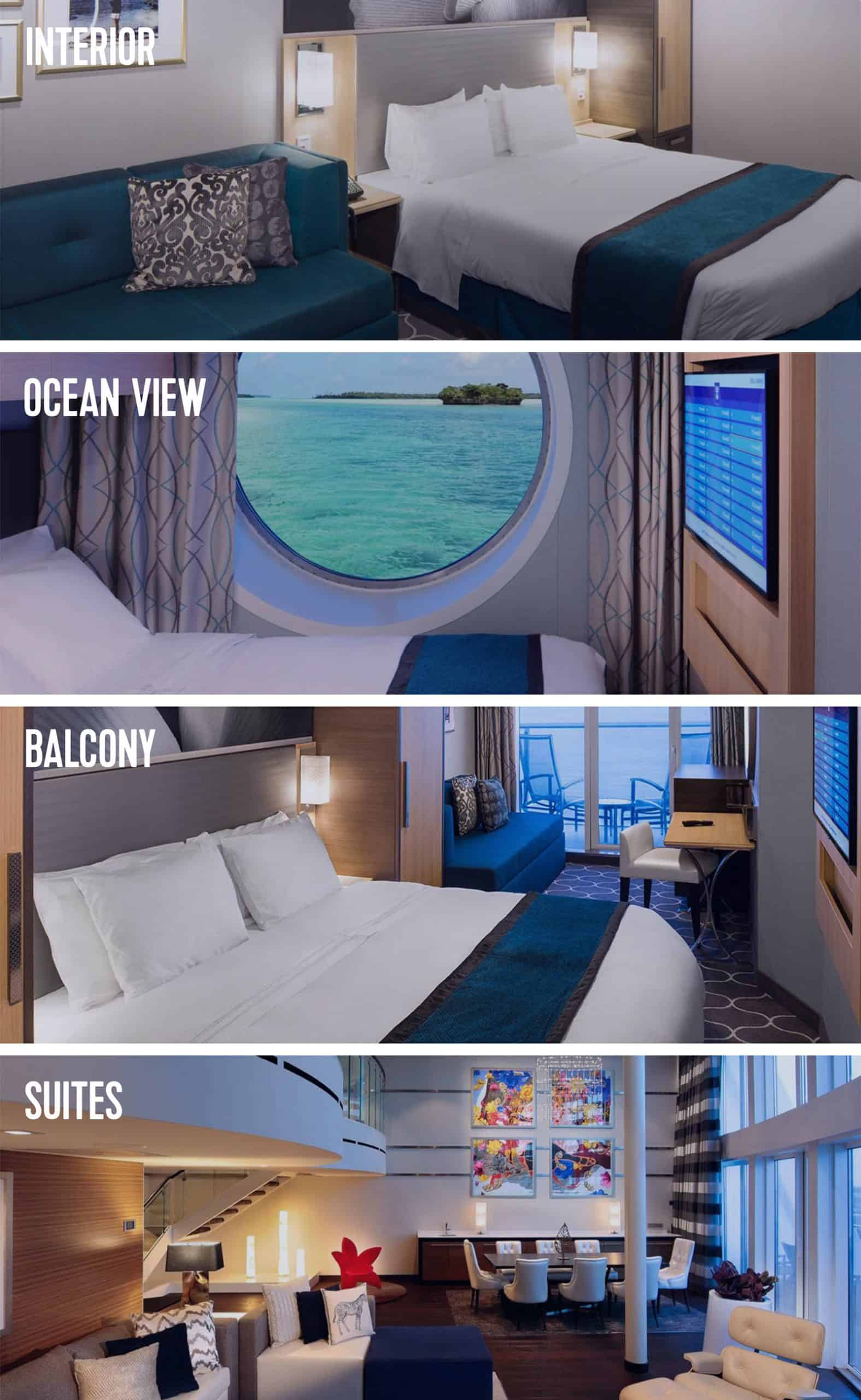
Spectrum of the Seas has four main stateroom categories, but not all rooms are created equal. Each category has different configurations and sizes, so it’s not just a “one size fits all” deal. Here’s a quick breakdown of what you can expect in each category, from the most budget-friendly to the splurge-worthy suites, and what makes them stand out from each other.
Interior Room. No windows. Usually 166 square feet. Some interior rooms have a virtual balcony, which is basically a screen showing some footage of the sea.
Ocean View Room. Bigger, usually 182 square feet, and with a large window.
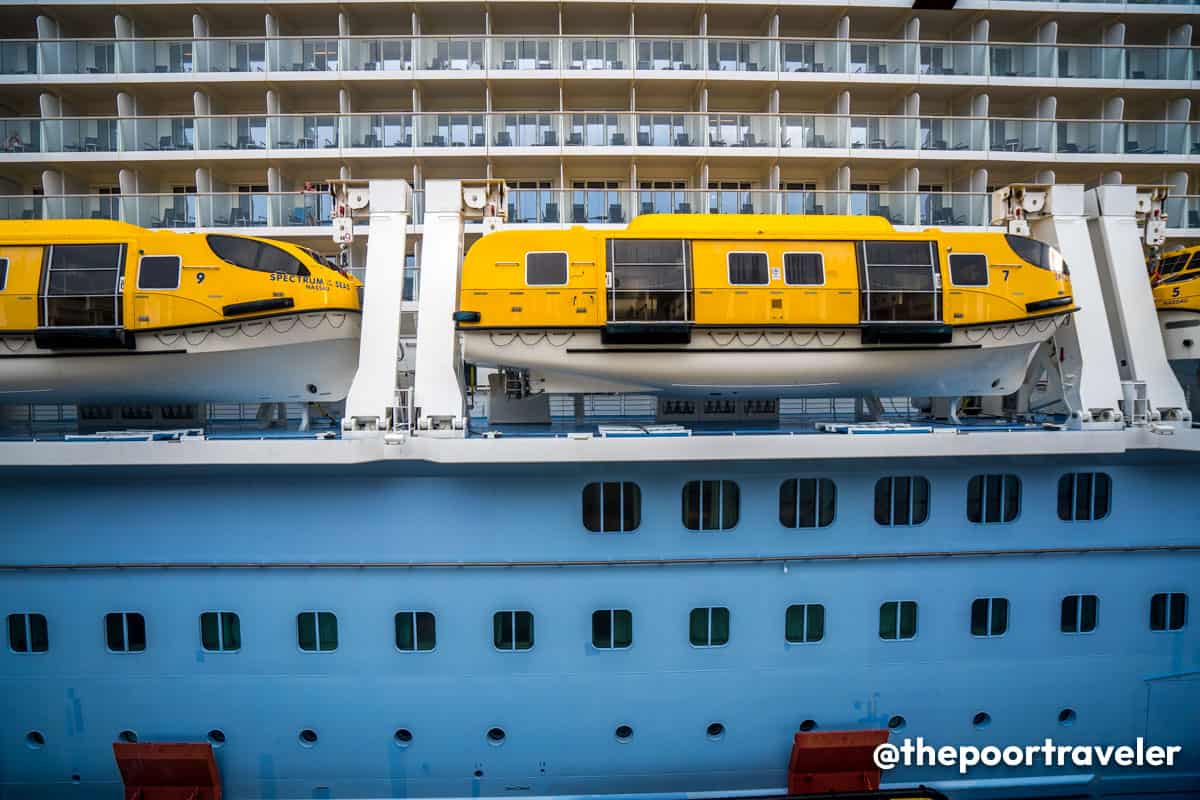
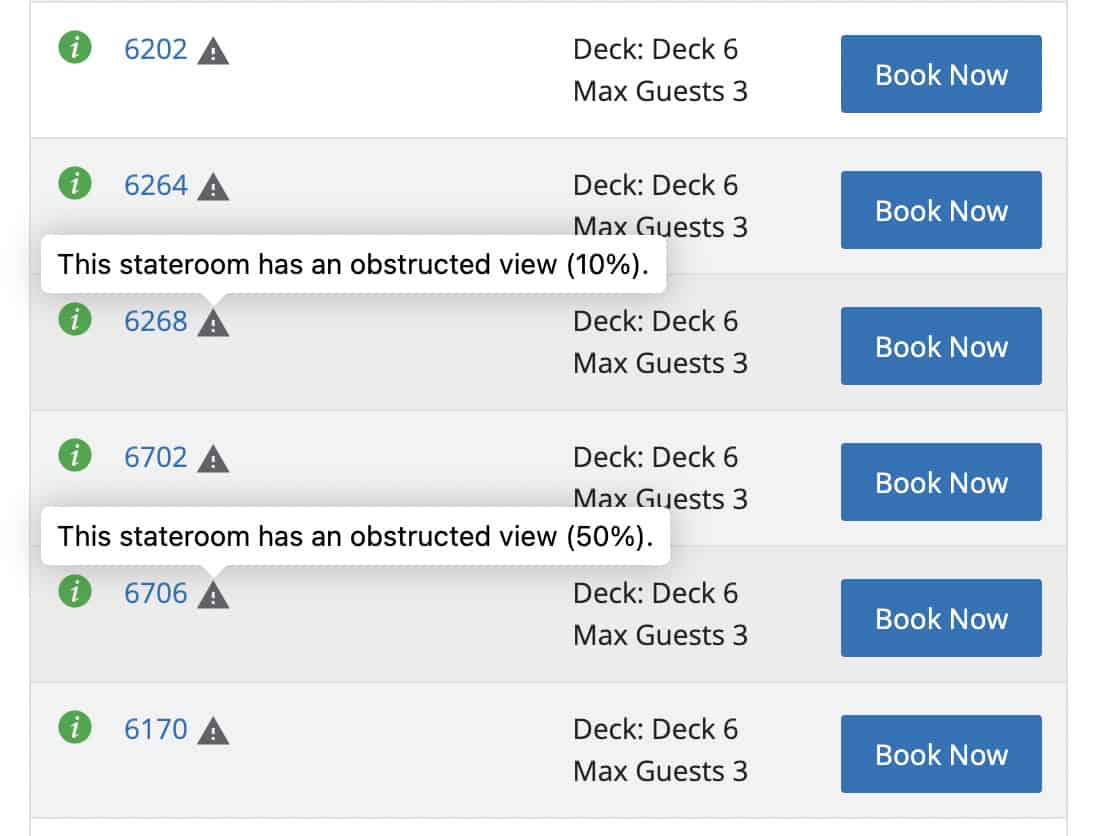
Balcony Ocean View Room. Or simply “balcony rooms”. More spacious, usually 198 square feet. The glass wall facing the sea also makes it look bigger. With a spacious balcony. – You’ll also find rooms tagged “Obstructed Ocean View Balcony“, which refers to those rooms that have a balcony but the view is partially blocked by something. For example, on Spectrum, Deck 6 is where the smaller boats are placed, obstructing the view of many of the rooms here. Because of this, obstructed balcony rooms are often cheaper than non-balcony ocean view rooms.
Suites. The largest, most luxurious, and most expensive accommodations. They come with a lot of perks, too. Some amenities are open only to suite guests. On Spectrum, here are the different suite types sorted by size and price. – Silver junior suite – Grand suite (1-bedroom) – Owner’s suite – Grand loft suite – Ultimate family suite (a two-level suite that has an indoor slide, an entertainment room, and three bedrooms, good for 11 pax)
Most staterooms (excluding suites) can fit up to four guests—though a few Interior rooms max out at 2–3 people. But squeezing four people into one room doesn’t always give you the best bang for your buck. The price difference between booking two rooms for two guests each versus cramming four into one room is usually pretty small.
Why? Because when you book a cruise, you’re not just paying for a bed to sleep in. You’re also getting access to an all-you-can-eat feast, tons of amenities, and nonstop entertainment. In most cases, cruise pricing works on a per-person basis, not per room—so everyone gets a piece of the action, no matter how many you’re bunking with!
This was my actual room on my most recent cruise — an Ocean View BALCONY State Room
Note that a minor always has to share a room with an adult. You cannot book a stateroom for an unaccompanied minor.
That depends on your personal preferences and budget.
Anything with an ocean view -— balcony or no balcony —- is always a solid pick. It gives you breathing space, daily dose of sunshine, and the perfect spot to admire those endless blue horizons. If you’re into photography, a balcony is a game-changer, especially when the ship is docked at a picturesque port. Plus, having a window makes it super easy to check the weather before heading out for a shore excursion.
That said, if you’re on a budget, an interior stateroom isn’t a bad deal. I’ve stayed in one a few times before and didn’t mind the lack of a view. I was out exploring the ship most of the time anyway. On our last cruise, we had a balcony room, but to be honest, I barely used it aside from snapping a few photos the coast.
Which brings me to another great option: the obstructed ocean view balcony room. While I haven’t tried it yet, it seems like the perfect middle ground —- spacious like a balcony room but priced closer to a regular ocean view. Since I don’t mind a slightly blocked view, it feels like a great compromise for the price.
Some balcony views are obstructed by these boats
If you’re eyeing an obstructed ocean view room, here’s a tip: check how much of the view is blocked. While this info isn’t available on the international website, cruising.com.ph makes it crystal clear. You can even pick the room with the least obstruction at the same price. Here’s an example:
Needless to say, if you’re going for an obstructed ocean view room, pick one with the least view blockage.
YES. Each booking comes with complimentary dining.
On Spectrum of the Seas, you have access to six (6) inclusive restaurants and food spots.
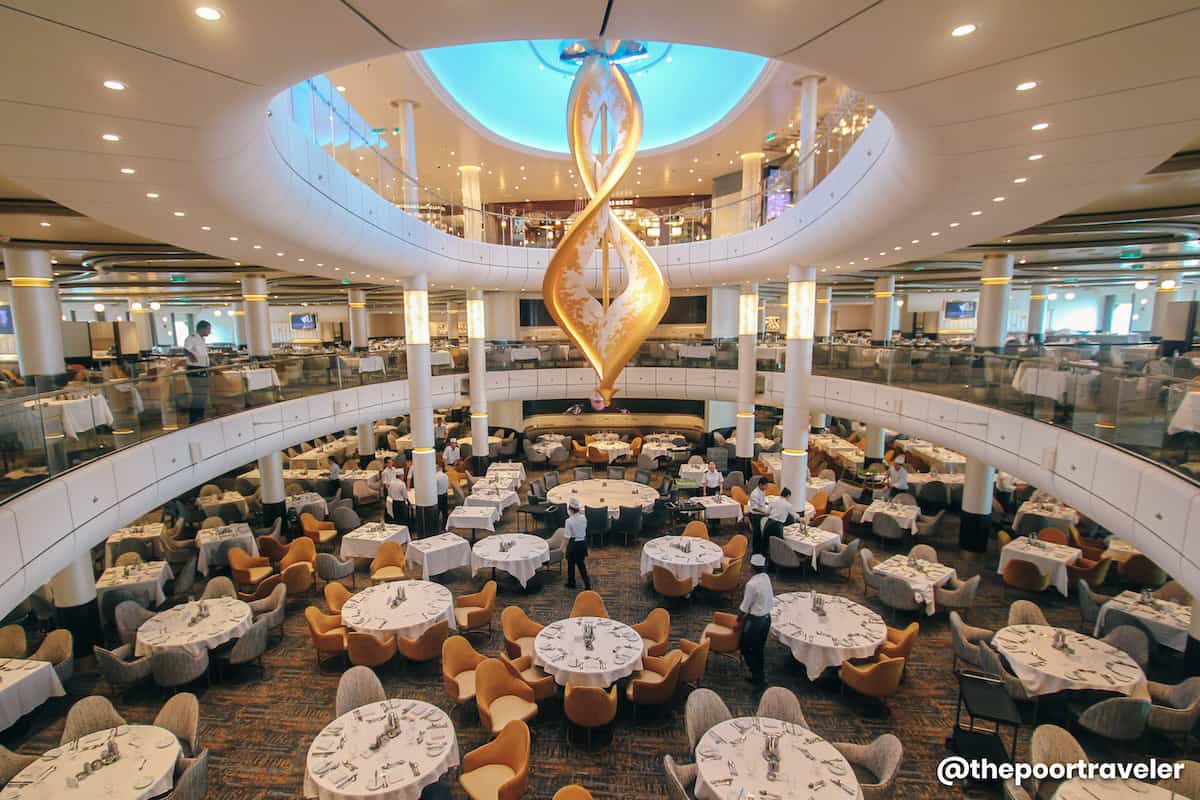
Main Dining Room, a proper restaurant
Windjammer Marketplace, buffet-style
Noodle Bar
Splashaway Café
Sorrento’s – Authentic New York Pizzeria
The Café @Two70®
SeaPlex Dog House, a “food truck” serving tasty hot dogs!
Dining at any of these spots? Totally FREE —- and yes, you can eat to your heart’s content. If I fall in love with a dish, I shamelessly order seconds (or thirds). At the Main Dining Room and I like two dishes, I don’t even bother choosing -— I just get both. And guess what? It’s completely allowed. You can even go rogue and ask for something that’s not on the menu. Case in point: I always request a cheese platter, menu be damned (LOL).
With the incredible variety of cuisines available at no extra cost, it’s 100% possible to complete your cruise without spending a single peso more on food.
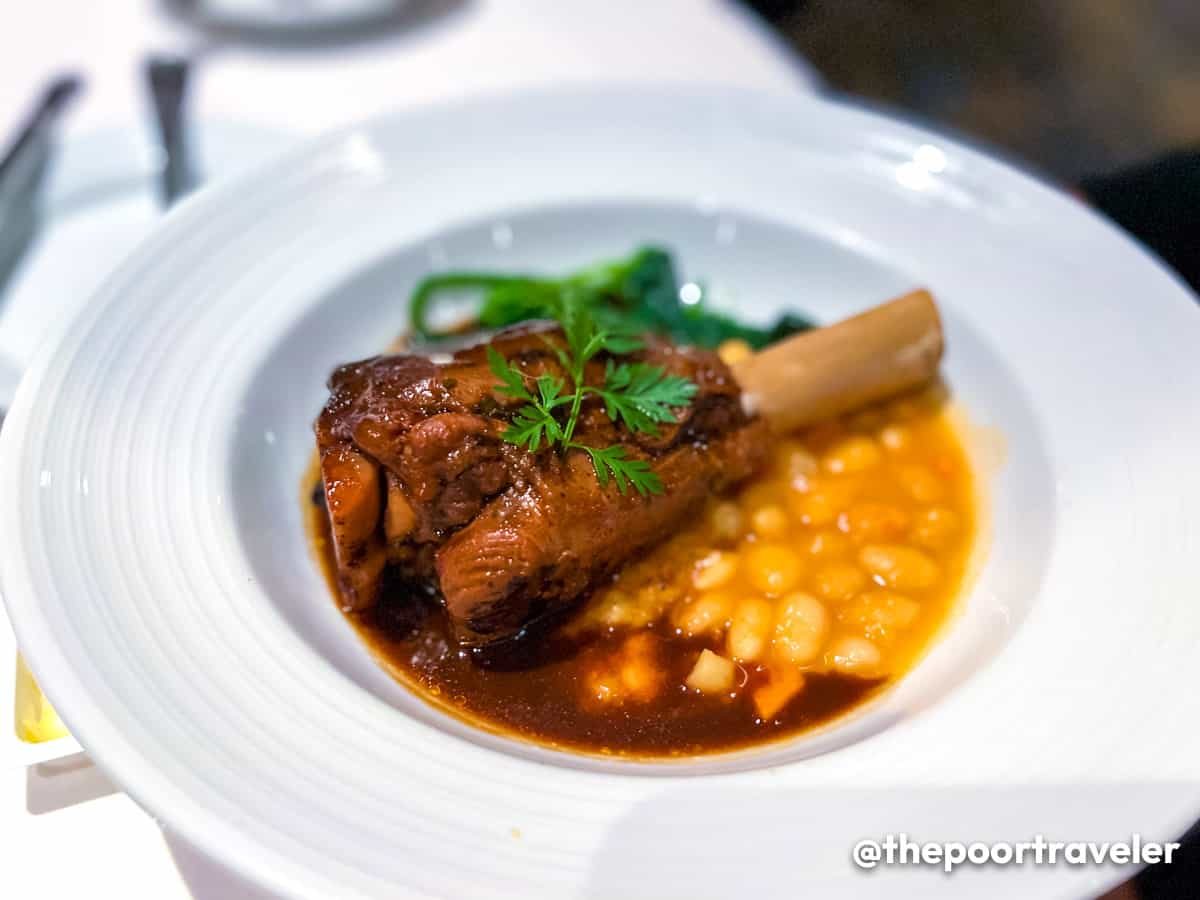
Main Dining RoomLamb Shank served at the Main Dining HallSome of the dishes served at the Main Dining Hall. These are all complimentary or FREE.
Sorrento’s Pizza is also complimentary
But if you’re in the mood to treat yourself, there are also specialty restaurants on board that come with an extra charge. Perfect for when you’re feeling fancy or just want to spice things up a bit!
On Spectrum of the Seas, these include:
Chops Grille, steakhouse
Teppanyaki, Japanese food prepared and served by entertaining chefs
Jamie’s Italian by Jamie Oliver
Wonderland, creative and innovative Alice-in-Wonderland-themed dining
La Patisserie, pastries and desserts
Chef’s Table
Izumi
Sichuan Red
The Hot Pot
Vintages
Leaf & Bean cafe
Teppanyaki, an entertaining Japanese dining experienceSome of the magical dishes served at Wonderland
Room service is also available but a US$7.95 service charge + 18% gratuity applies per stateroom order except for continental breakfast.
YES, gratuities are mandatory. Here are the rates:
USD 18.50 per night per guest in any stateroom
USD 21.00 per night per guest in any suite
If you book with Cruising.com.ph, this will be included in the booking (pre-paid), so you don’t need to worry about this when you’re already sailing.
If you book on the international site, you’ll have to settle this before you check out.
Gratuities on board are shared with the crew members who make your cruise experience amazing, like the dining, bar, and culinary staff, stateroom attendants, hotel services, and other hardworking folks behind the scenes.
In addition, an automatic 18% gratuity is tacked onto all pre-cruise and onboard purchases for beverages (including beverage packages), specialty dining, room service, and mini bar items. If you’re treating yourself to some pampering at the spa or salon, an automatic 20% gratuity will be added to those purchases as well.
So in theory, you don’t need to tip the crew members individually, but feel free to do so if you received excellent service and you want to show appreciation.
I asked a few friends who’d never thought about cruising before: “What do you think happens on board?” Unsurprisingly, most of them answered, “Eat, drink, and party.” And that’s it. To be fair, years ago, I thought the exact same thing!
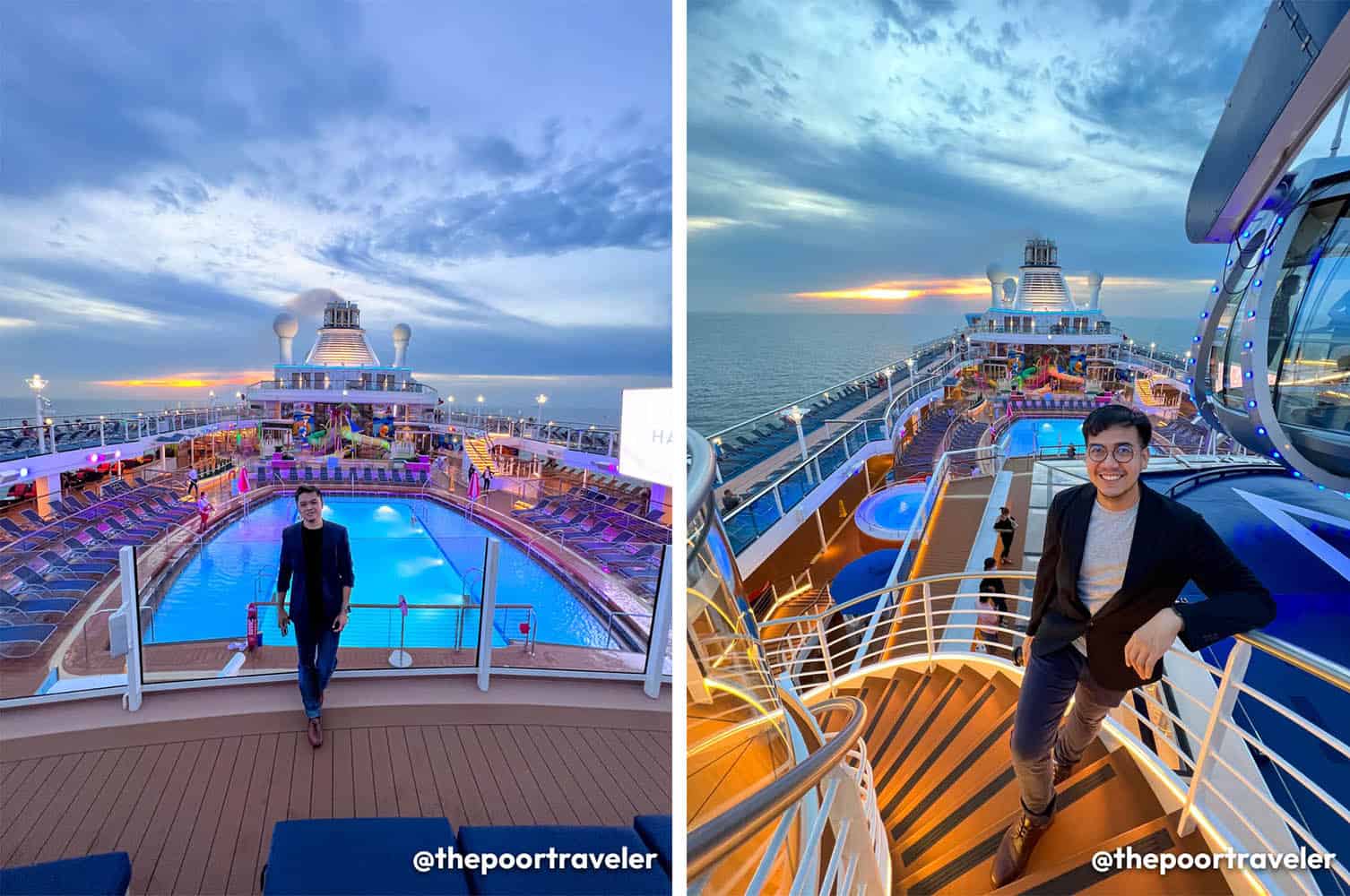
But let me tell you, stepping onto a cruise ship is like entering an entirely different world. There’s a whole universe of activities to explore! With cruise lines in fierce competition, they’re constantly leveling up their game with new features to cater to their audiences. Take Royal Caribbean, for example—they’re experts at packing their ships with fun and exciting amenities. Case in point: Spectrum of the Seas, which is bursting with thrilling attractions and lifestyle spaces. It’s basically a floating adventure park!
Here are some of them:
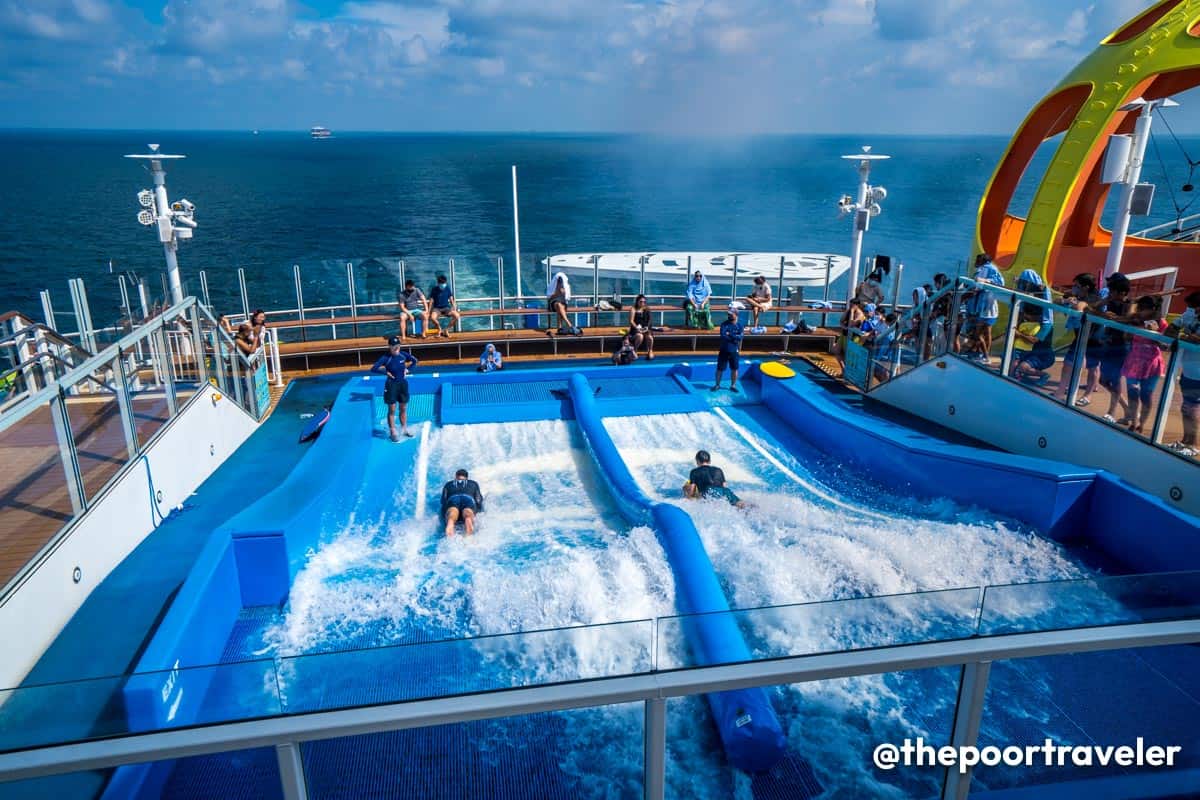
Some of the attractions on board (clockwise): Ripcord by iFly, North Star, Rock Climbing Wall, Flowrider (surfing)
RipCord by iFly, simulated skydiving experience (with extra cost)
FlowRider, simulated surfing activity (FREE, but instructor fees apply if you need one)
Skypad, bungee trampoline with virtual reality headset (FREE)
Rock climbing wall (FREE)
Royal Theatre, where musical and other entertaining performances are regularly staged (most shows are FREE)
SeaPlex, a sports complex where you can ride bumper cars; play tennis, pingpong and basketball; try archery; and more! (FREE)
North Star, a glass-enclosed observation pod and capsule ride that allows a 360-degree view (with extra cost)
Swimming pools and whirlpools (FREE)
Music hall, with band performances every night (FREE)
Star Moment, karaoke! (FREE)
Spas and gym (FREE)
Video game arcade
We were able to try almost everything on the list and we really had a lot of fun! We were at the Music Hall every night and would spend our high-seas day trying most of the rides and attractions.
SkyPad Trampoline Bungee. Perhaps I shouldn’t have worn orange! I blended!
And oh, don’t forget to catch at least one of the awesome shows at the Royal Theatre and the Two70!
Fantastic performances at the Royal Theatre await you!
The Silk Road, a colorful musical show featuring Asian cultures.
YES. Children have their own swimming area, complete with water slides.
The SeaPlex, a sports complex, composed of game rooms and a lot of kid-friendly attractions like an arcade, video game rooms, archery room, bumper cars, and claw machines.
Some of the shows at the Royal Theatre are also wholesome, which kids can enjoy.
The Spectrum of the Seas also has a so-called Adventure Ocean program, which is basically a youth club or day care, where children ages 3 to 11 can play with other kids. Parents can drop off their kids here.
YES, of course. It’s no mystery why people often think cruising is just for retirees—it’s a travel style beloved by the elderly! And honestly, it’s easy to see why.
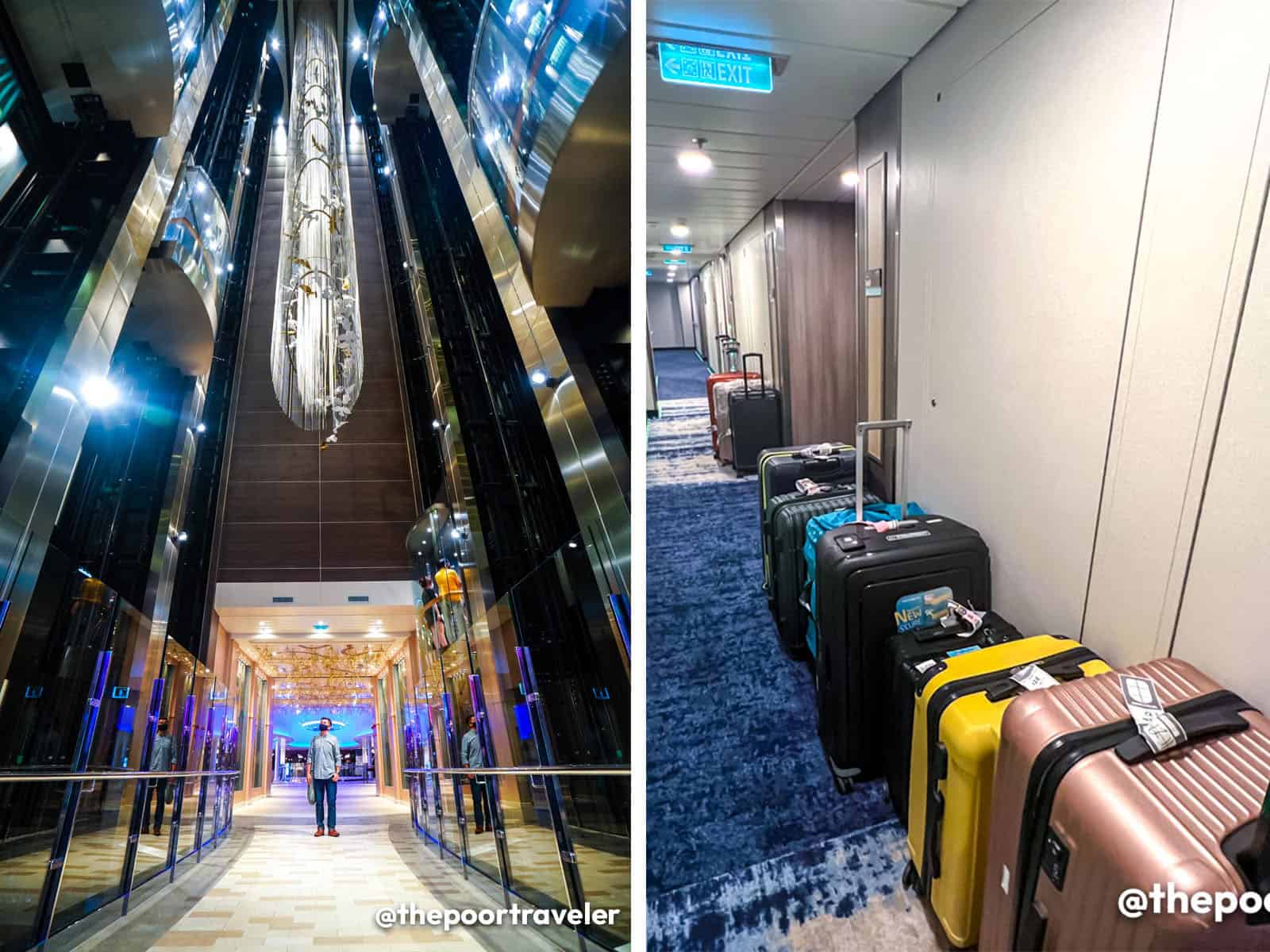
Despite the ship’s massive size, getting around is a breeze. There are at least 16 guest elevators: 10 between the aft (that’s cruise speak for the back) and midship, and another 6 toward the forward section. From here, most of the ship’s key attractions are just a short stroll away.
There are plenty of elevators and the staff will take care of your luggage.
For guests with mobility challenges, cabins near the elevators are an option, and some rooms are specifically designed with PWD guests in mind. Talk about accessibility!
The convenience is what makes cruising such a hit with senior travelers. Guests are pampered from start to finish. Take your luggage, for example: once you check it in, the staff takes care of everything, delivering it straight to your room. On your last night, simply leave it in the hallway, and they’ll handle it again. You’ll only see it next when you disembark. Zero hassle, zero stress.
And the best part? Everything you need is on board. Even if you skip exploring the ports of call entirely, you’ll still have an amazing time soaking up all the ship has to offer!
This season, the journey almost always starts and ends in Shanghai. But the usual stops, called ports of call, are usually in South Korea or Japan. Here are some of them:
3 NIGHTS • Shanghai – Jeju Island (Seogwipo) – Shanghai
You’ve got two options for exploring your destination: book a guided Shore Excursion (or SHOREX) with Royal Caribbean or go full DIY and explore on your own.
The beauty of a SHOREX? They take care of everything —- from port transfers to perfectly timed schedules. But keep in mind, this convenience often comes with a catch: a pretty fixed itinerary. So, if you’re a “go with the flow” type, it might feel a bit too structured.
Okinawa stops: Naha and Ishigaki
If freedom and flexibility are more your style, exploring independently is the way to go! Just make sure to keep an eye on the clock. You absolutely need to be back on the ship before the set departure time. Pro tip: you can check the ship’s arrival and departure times easily on the Royal Caribbean app. Missing the boat isn’t exactly the kind of adventure you want!
No, it’s not included.
Some travel agencies offer convenient fly-and-cruise packages, but if you’re planning everything yourself, you’ll need to book the flight separately.
If you’re on a budget, aim for that sweet spot where both the cruise and flights align with lower rates. Easier said than done? Maybe. But trust me, it’s doable, especially if you keep an eye out for airline seat sales!
Here’s how I usually do it: Start by scanning for cheap flights. No need to book yet; just scout. Once you spot affordable flights to Shanghai, check for cruises that match those dates. If the stars align and you find a good deal for both, book them ASAP. Timing is key here. Double-check the cruise departure and arrival schedules before locking in your flight.
Pro tip: Arrive in Shanghai at least a day before your cruise begins. Booking a same-day flight is risky business. One delay and your ship will sail off without you. Ships wait for no one, babe!
NO. The cruise booking only covers your ONBOARD accommodations (plus meals and amenities).
Anything that is outside when you’re not on the ship, you have to book on your own.
If you decide to spend some nights in Shanghai, you’ll have to take care of independently. Don’t worry, there are plenty of hotel options in Shanghai. Choose one in Huangpu, especially the area surrounding People’s Park, so you can easily access major tourist attractions that are FREE of charge.
Here are some of the top properties online as ranked by actual customers:
That really depends on a bunch of factors—room type, travel dates, you name it. But let’s say you’re all about snagging the cheapest deal possible: an interior stateroom on a cruise set for an off-peak month, booked months in advance. If you’re a couple flying out from Manila, here’s a ballpark of what you’re likely to spend per person:
P12,775 – roundtrip Manila-Shanghai flight
P1,620 – Philippine travel tax
P3,448 – China visa (double entry)
P24,620 – 4-night Shanghai-Okinawa Cruise (inclusive of meals)
P4,335 – Cruise gratuities
P1,700 – Port fees
P2,500 – 1 night at a hotel in Shanghai (P5000/night divided by 2 pax)
P5,000 – transportation and incidental expenses
P1,000 – meals in Shanghai
P56,998 – TOTAL
Let’s round it off to a clean P57,000.
This is the minimum you can expect to spend. But it’s always wise to add some allowance for other possible expenses. You might find yourself wanting a drink, buy a souvenir, try a specialty restaurant or visit an attraction in your free time in Shanghai. Having a wiggle room would allow you to enjoy more!
Of course, if you fail to find flights and sailings at these prices, you’ll end up with a higher total cost, so plan your trip well.
Okay, before anything else, full disclosure: Our most recent cruise was sponsored by Royal Caribbean, so I may have biases. But I have booked with Royal Caribbean at my own expense a few times before, and in my honest opinion, sponsored or not, a SPECTRUM OF THE SEAS cruise is worth it! Especially if you’re able to snag promos and low prices!
It’s a travel experience that I could recommend in a heartbeat for families, friends, and couples celebrating a special occasion. When I was on board, I kept thinking about how much my sister and my senior mother would love the experience.
Book at www.cruising.com.ph, the official website of Royal Caribbean Philippines, managed by Arpan Air, the official representatives of Royal Caribbean in the Philippines.
You can get extra 5% DISCOUNT when you use this promo code:.
By booking on this site, you can get easier access to customer support, which is extremely valuable in case you’ll have to make a change to your booking or you need further help.
And by using this code, you’ll also help us maintain this website because we’ll get a little something at NO EXTRA COST to you. So if this article or this blog in general is able to help you, use this promo code to show your support. Thank you so much!
Battery supplier SK On recently gave an update on its research into solid-state batteries for electric vehicles, claiming “breakthroughs” that could bring these batteries closer to production-readiness.
In a press release, SK On said it’s developing two types of solid-state batteries: one with a sulfide-based electrolyte, and one with an oxide-based electrolyte, with “commercial prototypes” expected by 2027 and 2029, respectively. The company aims to complete a solid-state battery pilot plant at its research center in Daejeon, South Korea, later this year.
This timeline will be made possible in part by the aforementioned breakthroughs, which SK On claims will allow a longer life cycle for solid-state batteries in the near future. They come from separate studies into methods for improving the robustness of both solid-state chemistries it plans to commercialize.
BlueOvalSK Battery Park – rendering, September 2021
In one study, SK On claims to have gotten encouraging results from photonic sintering of oxide-based electrolyte materials, a process the company says could address the brittleness of material produced using current methods, while potentially reducing costs. Testing was done with a hybrid solid-state battery cell that used a gel electrolyte, but SK On appears to believe that the results extend to all-solid-state batteries as well.
Researchers also tested lithium- and manganese-rich layered oxide (LMRO) cathodes for sulfide-based solid-state batteries. With a special coating applied to prevent oxidization of the sulfide electrolyte, SK On claims to have reached a satisfactory life cycle for these cells.
BlueOvalSK Battery Park – rendering, September 2021
It’s not unusual for startups to hype their achievements in the name of survival, but SK On is a large, established battery manufacturer that’s generally more conservative. So a declaration of breakthroughs from this company—which has automotive customers like Ford, Ferrari, and Hyundai—is a big deal.
The race to develop commercially-viable solid-state batteries has attracted a field of competitors ranging from startups and established firms like SK On to automakers themselves. Both Honda and Toyota are planning to produce solid-state batteries in-house, albeit likely on a small scale, by the end of the decade. Other automakers, such as Stellantis and Volkswagen, are allying with startups for access to the tech.
RM Sotheby’s Paris 2025 auction will feature a standout example of Ferrari’s first hybrid hypercar, the 2015 LaFerrari, which could fetch up to $4,150,000.
The LaFerrari represents a significant milestone as Ferrari’s first hybrid hypercar. A naturally aspirated 6,262-cc V12 engine is at its core paired with a Formula 1-inspired KERS (Kinetic Energy Recovery System). This combination produces a staggering 963 horsepower—789 hp from the V12 and an additional 161 hp from the electric motor.
Power is channeled to the rear wheels through a seven-speed dual-clutch transmission, propelling the car from 0 to 100 km/h in just 2.9 seconds. Ferrari quotes a top speed of over 350 km/h, with a lap time 1:19.7 around its Fiorano test track—five seconds quicker than its predecessor, the Enzo.
This LaFerrari is finished in bespoke Giallo (yellow) with a contrasting Nero (black) roof, a color scheme that pays homage to Ferrari’s emblem and its hometown of Modena. Carbon fiber accents adorn the mirror arms, front splitter, rear diffuser, and rear fog light housing, highlighting its aerodynamic design. The interior mirrors the striking exterior with black and yellow accents, including carbon fiber trim and race-style bucket seats stitched with Ferrari’s iconic Cavallino logo.
Delivered initially with Argento Nürburgring-painted five-spoke wheels, this LaFerrari now sports center-lock forged wheels from the track-only FXX-K. These wheels, paired with yellow brake calipers for the carbon-ceramic Brembo brakes, further enhance the car’s aggressive stance and performance capabilities.
This LaFerrari has been meticulously cared for, showing just 3,459 kilometers on the odometer. The car retains its original documentation, including owner’s manuals and the coveted “Yellow Book” for unique edition models. Additionally, it comes with a two-year extended warranty valid until March 2026.
If you ever travel between West African states, and find yourself only having 48 hours in Niamey Niger – a country in West Africa and is close to Burkina Faso – then don’t worry!
I visited Gambia and Fogo Island – both really amazing places in West Africa too! Quick tip: it really does feel relaxing to go on such adventures with both health insurance and travel insurance. Don’t forget to grab yours too!
And speaking of grabbing yours, I’d like to offer you TMTG’s eBook: “The A-Z on How to Become a Digital Nomad” for helpful and detailed info on becoming a digital nomad like me!
Start your day in the African Country with a visit to the National Museum of Niger. It’s a great place to learn about the country’s history and culture.
Nigerien Authorities in it made sure that they fill it up with amazing artifacts, traditional clothes, and even some dinosaur fossils!
After the museum, head to the Grand Marché. This busy market is full of energy, and you can find everything from colorful fabrics to handmade crafts. I spent some time browsing and picking up souvenirs like jewelry and baskets.
Day 1: Afternoon – A Walk by the River
After lunch, take a walk by the Niger River. It’s peaceful and beautiful, and you might even spot some fishermen. There are also boats that offer short rides, which I found to be a relaxing way to enjoy the water.
From there, I made my way to the Niamey Grand Mosque. Even if you’re not religious, the architecture is stunning. It’s one of the most important landmarks in the city.
While walking through the city, I overheard locals discussing regional efforts by neighboring countries like Mali, Benin, Chad, Algeria, and Togo to mediate and resolve political tensions in Niger.
These talks often highlight the role of the former colonial power and the impact of heavy economic sanctions imposed by various entities.
Day 1: Evening – Sunset at the Dunes
For a perfect end to your first day, take a short drive to the Sahélien dunes outside the city.
On day two, I decided to visit another market, the Petit Marché. It’s smaller than Grand Marché but just as lively.
I found fresh fruits and spices and enjoyed chatting about any information and related topics with the friendly vendors.
No need to look for souvenirs or stuff online like a portable mini fan – any traveler will find something interesting to bring home from the local market!
Afterward, I grabbed some lunch at a local café. I had a delicious meal of grilled chicken and rice – a common dish in Niamey. I got to talk to locals about the actions of the French government, including the refusal of the French ambassador to leave the country.
Conversations about the presidential guard and their role in recent events often involved the previous president Mohammed Bazoum. The locals also shared opinions on the use of armed force and the sanctions that have affected daily life in Niger.
I learned that discussions often happen on Fridays, when leaders issue a series of statements about the political situation. Reports from AFP highlighted the challenges of maintaining stability and supporting the legitimate elected Nigerien authorities. The French military presence and related foreign affairs discussions were also a major topic of debate.
This West African nation has been at the center of discussions about the constitutional order and the interests of Niger, with ongoing efforts by the regional bloc to address tensions involving the Nigerien army and the military rulers. The locals had diverse opinions, but many hoped for peaceful resolutions in the wider Sahel region.
Day 2: Evening – Relaxing by the River Again
As my time in Niamey came to a close, I returned to the Niger River to relax and enjoy the calm evening breeze. It was a peaceful way to reflect on the city’s charm before my trip ended.
That’s how I spent my 48 hours in Niamey! My visit to the Islamic state was a short but memorable visit, and I left with a greater appreciation for the culture and beauty of the West African country.
If you ever find yourself with just a couple of days in this city, I hope this guide helps you make the most of it!
FAQ
What is Niamey Niger famous for?
Niamey offers unique open-air markets that are great for people watching; they’re patronized by members of the Tuareg, Sonuri and Fulani tribes, as well as wrestling, some beautiful views of the Niger river and the massive Grand Mosque.
Can Americans travel to Niger?
A paper or embassy visa is the only visa available for travelers visiting Niger. The visa is typically a stamp or sticker added to the passport. Travelers must obtain this visa from a local embassy, consulate or visa center before traveling.
What to wear as a tourist in Nigeria?
Casual Wear: In everyday settings, casual wear is common. Western-style clothing, such as jeans, T-shirts, and casual dresses, is widely accepted. However, modesty is generally valued, especially in more conservative regions.
Beyond just pushing electric vehicles (EV), BMW Group Malaysia is looking at the holistic ecosystem, as part of its circularity philosophy, covering the possible reuse, repurpose and/or recycling of plug-in hybrid (PHEV) and EV batteries, including second life programmes.
“We’re looking into several projects and topics – recycling is a big topic, so that’s something that we want to try and establish in a very authentic manner here. We already have partners that we work with in that space, but I think driving it forward a little bit more, the second life projects are something that the group is very passionate about,” said BMW Group Malaysia corporate communications and sustainability head Sashi Ambi.
Citing the BMW Brilliance joint-venture in China, which in 2022 established a closed loop for the reuse of raw materials from PHEV and EV batteries, he said: “if we can find something for Malaysia and the region, I think that’s something that (will also be of) value not just for the group but for the entire automotive industry.”
In China, BMW Brilliance works with a local recycler to dismantle retired batteries and recover from their cells a large proportion of nickel, lithium and cobalt, which are then used to produce new battery cells for the BMW Group, cutting CO2 emissions by 70%.
“We look at the entire circularity – from the time we start developing a car, the team already has in mind what materials to use so that we can recycle and reuse them; (for instance), the alloys on MINIs are recycled aluminium and the seats are made from recycled materials. Over the next few years, (recycling) will be a more and more important global topic because resources are scarce,” BMW Group Malaysia MD Benjamin Nagel said.
Regarding second life programmes, where batteries are reused or repurposed whole, Sashi said: “We have plug-in hybrids since 2013 (and therefore their batteries), (for) BEVs not yet, but in the future you’ll see this.”
“It’s best to set up understanding or an ecosystem of that, and there are already players in the market that are already looking at this. The Malaysian government has a strong mandate in this direction and if we can cooperate to establish something like this, we are open to it,” he added.
“In Malaysia, the era of the EV really started two, three, four years ago. It’s ramping up, and there will be a phase when these cars, the first ones, are at the end of their life cycle after 10, 15, 20 years, depending on the car, or you get accidents and the car can’t be used anymore, so we need to be prepared,” Nagel chipped in.
For now in Malaysia, these batteries could have possible second lives as part of a battery energy storage system (BESS) – where they could be used to power EV chargers in remote locations without a direct power supply – or as a backup for EV chargers, although Sashi admitted that “at the moment, we’re not even at the tipping point.”
“A lot of the charging point operators (CPO) understand this, but I think as they ramp up, this could be a solution. The most important thing is to have close partnerships with not just the automakers, but also CPOs and the government, so that there’s a clear understanding of how this concept would work,” he said, adding that such a move would benefit the entire ecosystem.
“The good thing is, since 2013 when we globally launched the i3, we have experience of the car batteries on the road, and we see how durable the batteries are. After 12 years, the cars are still on the road and they are fully in use.
“(In Malaysia) the German ambassador is driving one, very happily every day, so we see that our batteries last long, and that’s a good thing so we can reuse or repurpose them and if not, recycle them and use the materials for future generations of batteries,” Nagel said.
The technical storage or access is strictly necessary for the legitimate purpose of enabling the use of a specific service explicitly requested by the subscriber or user, or for the sole purpose of carrying out the transmission of a communication over an electronic communications network.
Preferences
The technical storage or access is necessary for the legitimate purpose of storing preferences that are not requested by the subscriber or user.
Statistics
The technical storage or access that is used exclusively for statistical purposes.The technical storage or access that is used exclusively for anonymous statistical purposes. Without a subpoena, voluntary compliance on the part of your Internet Service Provider, or additional records from a third party, information stored or retrieved for this purpose alone cannot usually be used to identify you.
Marketing
The technical storage or access is required to create user profiles to send advertising, or to track the user on a website or across several websites for similar marketing purposes.


 Text by Tom Appel
 Text by Tom Appel