The 50 Yacht is among nine Aquila cats at the 2025 Miami International Boat Show
The new Aquila 50 Yacht was designed to replace the brand’s 48 Yacht, but this recently debuted model is not a simple rehash of an existing vessel. The voluminous motor cat has a new running surface, an enhanced master suite, a more elaborate tender launching system, and dozens of small details that differentiate it not only from its predecessor but also its competitors.
The new 50 fits well between Aquila’s 44 Yacht and 54 Yacht flybridge models. Because of their wide beams, all the Aquilas designed by J&J Design in Slovenia offer interior volume similar to monohulls with much longer lengths.
While boarding the boat at Lauderdale Marina, a few days after the official premiere at Fort Lauderdale International Boat Show 2024 (October 30-November 3), the first difference was obvious: it has a tall, explorer-style profile that looks way cooler than other big, boxy power cats in its class.
The Aquila 50 Yacht has a tall, explorer-style profile
“It’s the first boat of its size with this kind of look,” said Nick Harvey, Aquila’s Chief Revenue Officer, who hosted the sea trial. “You [usually] see that look only on 100ft-plus power cats.”
The 50 Yacht is also about 0.60m (2ft) taller than the 48, largely because the designers gave the master suite a flat floor rather than a sunken one, hence needing to build a taller hull so as not to compromise on the suite’s headroom. “It also lets us create these amazing side windows,” Harvey added.
This extra height is not enough to impact the boat’s performance in winds, but it does add to visibility from the helm station, which was the only steering area on this first hull.
The 25.6sqm main-deck saloon has wraparound windows
A second helm station in the main saloon is an option, but if I were a buyer, I’d go for the single on the flybridge. It’s protected enough, with great visibility, and adding another to the saloon would devastate the feng shui that Aquila designed into this 25.6sqm (276sqft) social area.
Wraparound windows extending along both sides and across the front deliver excellent natural light. The decor here is the Light option, incorporating a light-coloured wood composite and white accents, with neutral greys delivering subtlety. The Dark version is what it sounds like, with darker woods and trims.
In hull one, the fully-equipped galley joins the aft cockpit through a large door and fold-down windows
The aft full-featured galley is equipped with a full-size American-style fridge, microwave, convection oven and a large ‘country’ stainless steel sink – with a covering to transform into a countertop – and is joins the rear cockpit through a large door and fold-down windows.
These openings turn the interior and outer section into one large social space extending back to the stern. Outside, two bar seats adjoin a counter that connects to the galley.
The main deck’s interior and outer sections become a large social space extending to the aft cockpit
Back inside, the large U-shaped lounge with table serves as the master dining area, but the table also drops down electrically to form a large berth to create an extra sleeping area. Stairways to port and starboard to the other staterooms, in different areas of the saloon, give an asymmetrical appeal to the layout.
The control panels are located on the starboard rear side, with AC and DC controls and a CZone control and monitoring system for onboard functions. “It’s all digital switching, so you can manage the lighting, pumps and multiple systems just from this screen,” Harvey said.
As well as a second steering station, options include captain’s quarters, although Aquila’s many global owners are also operators. Encouragingly, the engine room has good space around the 480hp Volvo Penta D6 engines, which can be upgraded to 550hp Yanmars.
With 480hp Volvo Penta D6 engines, the 50 Yacht topped 20 knots during the sea trial
Our sea trial into the Atlantic happened on a calm, sunny day, with seas running under a metre. Being a big cat, the 50 feels different underway than a similar-sized monohull, but it handles nicely as we head south along the Florida coast.
The new Aquila comes with a bulbous hull design, which helps navigation in big seas and limits wave impact. The 50 Yacht also has an optional foil system that increases fuel efficiency and performance. On our sea trial, the cat topped out at just over 20 knots, turned decently on its twin hulls, with minimal rock and roll.
Raymarine electronics are used on the flybridge helm console
Visibility of the water and the Raymarine electronics on the console were both good. There was no chance to see how it would handle serious waves, but it ran well in near-ideal conditions.
The hardtop, with solar panels on its rooftop, has isinglass (gelatin) that wraps around the large, 361sqft (33.4sqm) upper deck during inclement weather. That would likely be a fire-drill to set up in a
squall, but a full, glassed-in hardtop would make this cat a different animal, a feat of engineering that would change weight distribution and add significant costs.
The flybridge hardtop has clear isinglass (gelatin) that wraps around the 33.4sqm space in bad weather
For social events, this upper-deck area is the place to be. Aquila designed lots of space into it, including a large lounge and table, and 2.6m (8ft 7in-wide) sunbeds on the rear of the cat. This boat also had a full outdoor galley, including an electric Kenyon Signature Grill with an induction stove, wet bar, and stainless-steel ice maker.
Another nice touch is the two-step side passage down to the foredeck. Rather than being a centre passage like other big cats, this more discreet feature allows quick access for dock-handling or other needed access.
The foredeck can be reached from the flybridge or side decks
On the forward space, double sunbeds on either side offer social gathering points, along with flip-up seats at the base. There are also two seats on the outer forward edges for a couple of people to look back and converse with others. The high guardrails are good safety features, as is the rail height along the wide gunwales.
Aquila left the lower, forward part of the bow open across the full beam – this is a really nice touch that allows full visibility from the master suite. The full-beam main suite measures 25sqm (270sqft), with good headroom and the flush floor that is a differentiator in its class.
Designers gave the master suite a flat floor rather than a sunken one
To starboard is an L-shaped lounge, with a vanity and seat beside, and on the other side of the king-size bed are two sinks and drawers. The full head, with a separate toilet and shower with teak-grate flooring, is divided from the bedroom by a frosted-glass door that is stylish and functional.
The sense of space is good, thanks to the wide-open layout and large windows, which Harvey said are “twice the size of others in this class, thanks to the extra height of the boat”.
The suite also has excellent storage space, thanks to the cat’s pontoons, which let owners stow not only personal items but also gear and even a mattress for the saloon table, stored below the floor. The closet space is also decent.
The second stateroom is a VIP with a large, private head and shower
The second stateroom is a VIP, with a large, private head and shower, and a sense of privacy, given the way Aquila has designed the long entryway. Across is the third stateroom, a double for the kids. The boat comes in a four-stateroom layout but would compromise the size of the VIP.
On the stern is one of the 50’s most noteworthy features. Its 14ft tender catamaran, which Aquila also manufactures at its production facility in China, is on an electric crane system that lifts the boat outwards for launch and retrieval – a distinctive feature among competitors.
The Aquila tender is deployed by a retractable crane in the cockpit overhang
When the tender has been launched, the deck drops down so it’s flush with the aft decks, creating a large platform for easy access to the water. “The way the winch retracts in and out of the flybridge is unique,” said Harvey. “It’s really part of the 50’s DNA.”
The designers left enough space in the engine compartments to create a hybrid diesel-electric propulsion system when that becomes available. The current options list allows owners to upgrade standard house batteries to four lithium batteries with an inverter and charger, allowing for longer times to run at anchor on charged battery power.
“We’ve designed it so that owners can order the hybrid system when it becomes available,” said Harvey. “Our goal was to futureproof for sustainability as much as possible.”
aquilaboat.com
This story was first seen on Yachtstyle.Co.
For more on the latest in yachting news, click here.
Welcome to 2025! As always, January kicks off the Speedhunting year with a strong focus on Japanese car culture, especially with the Tokyo Auto Salon just days away. And we’re going big this year.
But before we get stuck into Japan’s largest aftermarket tuning show and all the car gatherings surrounding it, let’s start with a tradition that’s been firmly cemented over the last decade: the unofficial New Year Meet at Daikoku Parking Area.
While enthusiasts flock to Yokohama’s most iconic car meet-up spot from the first day of the year, January 3 usually has the biggest turnout. If you’re planning to attend, getting to Daikoku early is a must.
I rolled in before 8:00am, and the place was already packed.
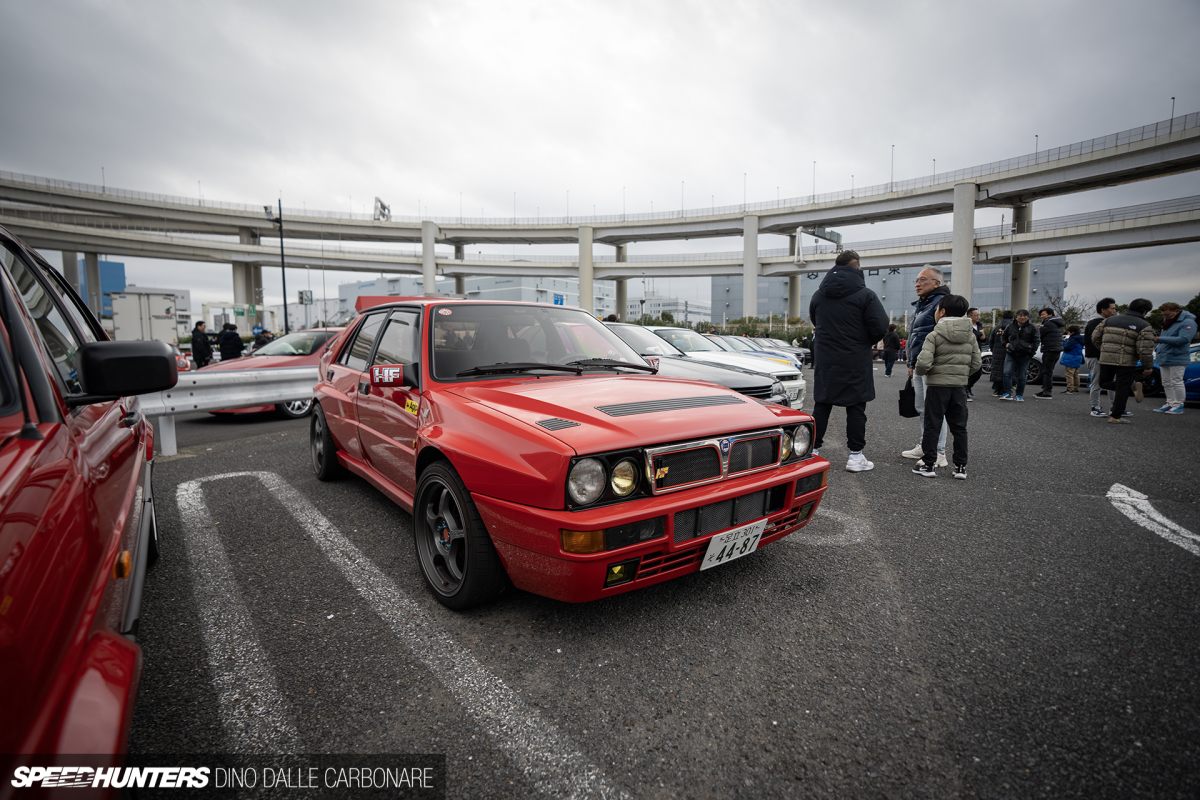
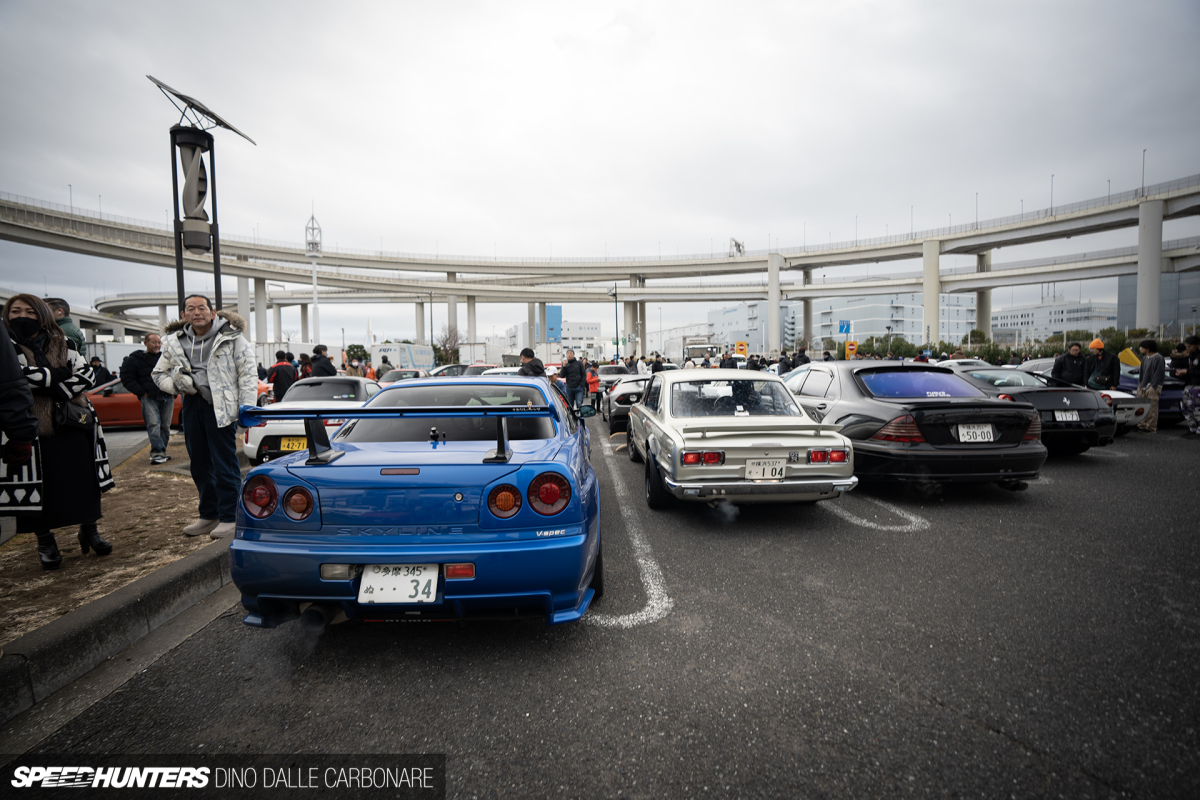
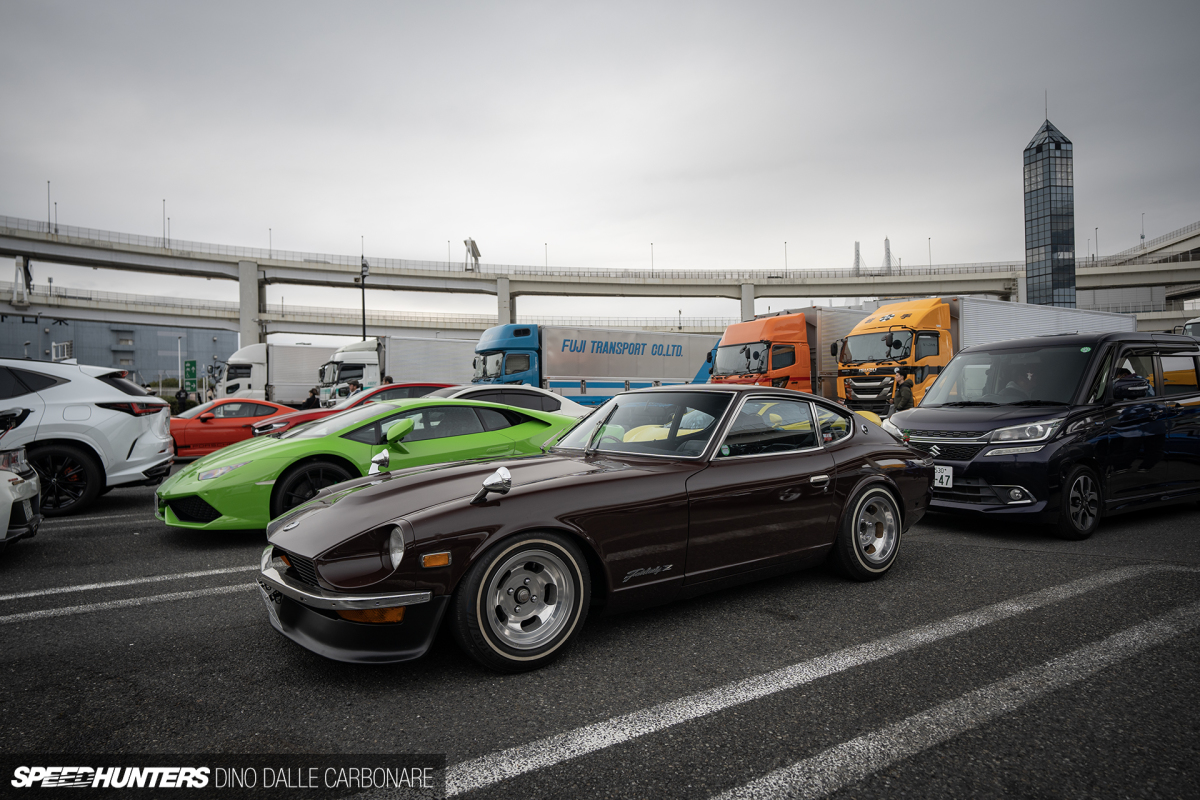
The variety was simply outrageous – a perfect example of what makes Japan’s car culture so unique. Take the picture above, for instance: a 1960s Prince Skyline parked beside an ‘80s Ford van, with a Lancia Delta Integrale completing the trio. That’s something you’ll only see in Japan.
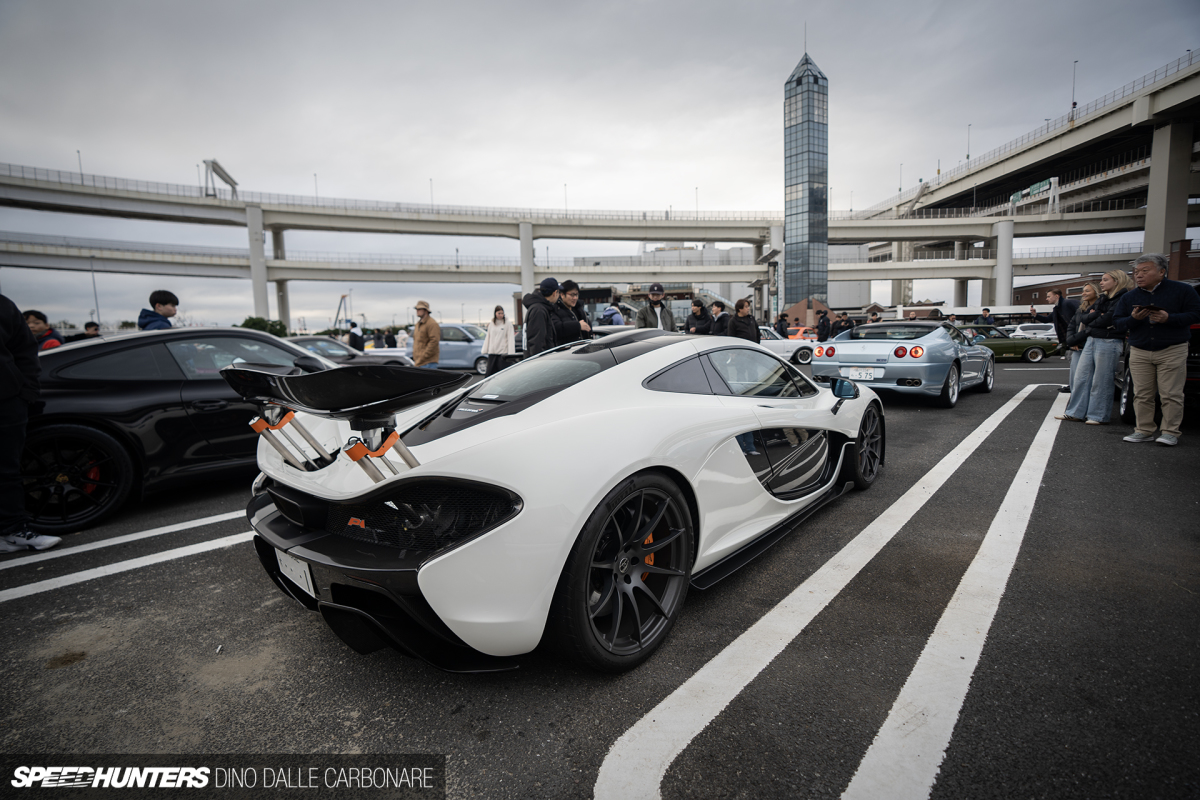
You’ll always guaranteed a great mix of vehicles at Daikoku PA, but extra special stuff shows up for the New Year Meet, like the white McLaren P1 parked just behind a Ferrari 575 Superamerica.
We saw this Strosek 964 a few years back but it’s always a pleasure to see these rare examples of automotive awesomeness.
I won’t interrupt the flow of the images here; they really speak for themselves.
Moments like these really drive home the importance of preserving gathering spots like Daikoku.
Where else can you witness such an organic celebration of pure automotive passion?
It’s funny I mention this, because just as I was soaking everything in, the police showed up, blaring through the PA system, telling everyone it was time to leave.
I’m not sure what triggered this early-morning clear out — maybe the truck drivers weren’t too thrilled about their parking spots being taken — but it surprised a lot of people.
I heard plenty of comments like, “What, already?” and “Seriously, today?”
Despite the announcements, most people weren’t in any rush to pack up and go.
There were still about a hundred cars I hadn’t seen yet, and a few latecomers managed to sneak in before the police blocked off Daikoku PA’s spiralling entry ramp from the highway above.
I made my way up to the top of the parking area — the usual trouble zone — and sure enough, the truck spaces were fully taken over.
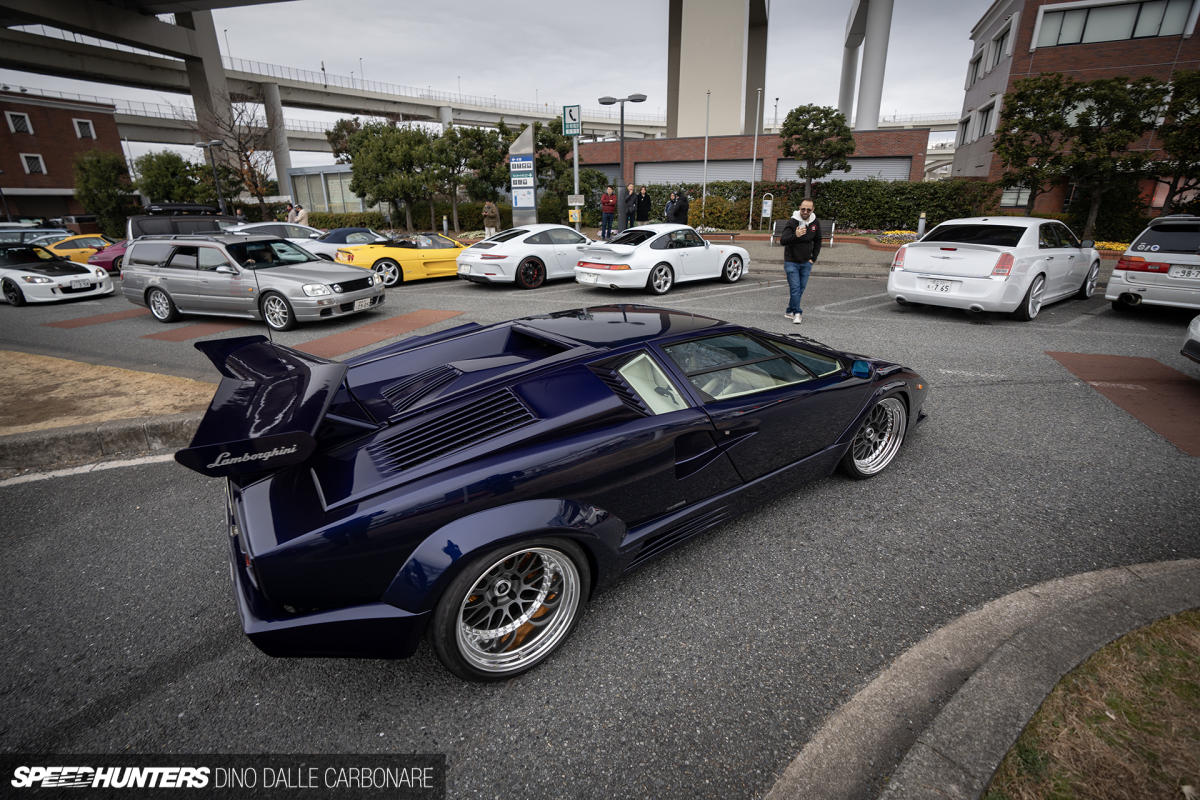
The Lamborghini crew, who had been incessantly revving their engines for a good 10 minutes, had parked in dramatic style. Among them was even a Reventón – still completely stock, and by far the quietest of the bunch.
With the constant barrage of police announcements, screaming engines, and exhaust bangs, the whole scene felt chaotic, but in the best possible way. It made for an unforgettable start to the year.
By this point, the access roads in and out of Daikoku were gridlocked. Cars leaving were forced to join an impromptu roll-out parade in which many owners did launches as they exited.
The hold-up was actually a blessing in disguise – it gave me more time to discover cars I’d missed, like this stunning De Tomaso Pantera.
And even a Daihatsu Charade De Tomaso (Bianca variant). How cool is that?
By 10:00am, the place was almost empty – a new record for the Daikoku PA New Year Meet!
A police officer approached and told me to stop taking photos and leave, but as I was doing so, I spotted one last car I couldn’t resist grabbing a couple of shots of.
I mean, how often do you see a genuine Lancia 037 Stradale – in Martini Racing livery no less? Nuts!
The cherry on top? On the way home, I got to have a little fun playing with it on the highway from behind the wheel of my newly-acquired BMW M4 Cabrio. Weighing in at just over a ton, the Lancia still held its own when the Abarth supercharger hit full boost.
And that’s a wrap on my first motoring adventure of 2025! I can only hope the rest of the year is as good as this albeit brief morning at Daikoku Parking Area was.
Dino Dalle Carbonare Instagram: dino_dalle_carbonare dino@speedhunters.com
When the Porsche 718 Cayman GT4 was introduced in 2019, it brought an exciting moment for Porsche enthusiasts, bringing naturally aspirated power back to the mid-engine lineup. Designed to deliver performance on both the road and track, the GT4 revived the raw driving dynamics that purists crave.
Three years later, in 2022, Porsche unveiled the 718 Cayman GT4 RS, taking the platform to new heights with the race-focused philosophy that defines every RS model in Porsche’s lineup.
At the heart of the 718 Cayman GT4 lies a 4.0-liter naturally aspirated flat-six engine, delivering 414 hp and 309 lb-ft of torque. This engine offers a high-revving character, with a redline of 8,000 rpm, paired with either a 6-speed manual transmission for purists or an optional 7-speed PDK dual-clutch transmission for faster, more precise shifts.
The GT4 RS raises the bar even higher, borrowing the 4.0-liter flat-six from the 992-generation 911 GT3, producing an impressive 493 hp and 331 lb-ft of torque, exclusively paired with the PDK transmission. This ensures lightning-fast acceleration, with the GT4 RS sprinting from 0 to 60 mph in just 3.2 seconds.
The exterior design of the 718 Cayman GT4 and GT4 RS is both aggressive and functional. The GT4 features a fixed rear wing, large front air intakes, and an aerodynamic splitter, all optimized to generate significant downforce while maintaining it’s timeless styling.
The GT4 RS takes aerodynamics to a new level, with a swan-neck rear wing, enlarged front diffuser, and a lightweight carbon-fiber hood. Lightweight materials such as aluminum and carbon fiber are used extensively in both variants. Inside, the cabin is tailored for a driver-focused experience. Both models feature sport bucket seats, Alcantara upholstery.
The GT4 RS further emphasizes weight savings, offering carbon-fiber-reinforced plastic (CFRP) seats, reduced sound insulation, and door pull straps in place of traditional handles. Advanced technology like Porsche Communication Management (PCM) with Apple CarPlay ensures a modern touch within a purpose-built cockpit.
Despite the competition, the GT4 and GT4 RS are in a league of their own with their naturally aspirated engines, mid-engine balance, and Porsche’s unmatched motorsport heritage, making them favorites among enthusiasts seeking the best driving experience.
Model Changes (Breakdown by Year)
2019 Porsche 718 GT4
In 2019, Porsche unveiled the 718 Cayman GT4, a high-performance addition to the 718 lineup.
Powered by a 4.0-liter flat-six engine producing 414 hp and 309 lb-ft of torque, the GT4 was offered exclusively with a 6-speed manual transmission, with the 7-speed PDK dual-clutch transmission being introduced as an option later, in 2021.
Designed with lightweight materials and optimized for track performance, the GT4 featured a fixed rear wing for increased downforce and an upgraded suspension system with Porsche Active Suspension Management (PASM), ensuring exceptional handling and agility.
In 2020, the Porsche 718 Cayman GT4 had a starting price of $100,550.
2021 Porsche 718 GT4
In 2021, Porsche expanded the appeal of the 718 Cayman GT4 by introducing the option of a 7-speed dual-clutch PDK transmission, making the car more accessible to a wider range of enthusiasts.
The PDK brought performance improvements, including an enhanced 0–60 mph time of 3.7 seconds, compared to 4.2 seconds with the manual transmission. The faster and more precise shifts of the PDK also contributed to slightly better lap times, making it a good choice for drivers who are focused on getting the fastest lap times.
Apart from the transmission upgrade, no significant changes were made to the platform for this model year.
In 2021, the Porsche 718 Cayman GT4 had a starting price of $102,900.
2022 Porsche 718 GT4 and GT4 RS
In 2022, Porsche enhanced the 718 Cayman GT4 by introducing several customization options, allowing owners to tailor their vehicles to personal preferences. These enhancements included a broader selection of exterior colors, such as special and custom paint options, and interior materials, offering choices between standard Race-Tex and extended leather trims.
Additionally, Porsche provided various wheel designs and finishes, including the option for 20-inch forged magnesium wheels for improved performance and aesthetics.
For the standard 718 Cayman GT4, Porsche made minor updates in 2022. These enhancements included a broader selection of exterior colors, such as special and custom paint options, and interior materials, offering choices between standard Race-Tex and extended leather trims.
Additionally, Porsche provided various wheel designs and finishes, including the option for 20-inch forged magnesium wheels for improved performance.
In 2022, the Porsche 718 Cayman GT4 had a starting price of $106,500. The newly introduced 718 Cayman GT4 RS began at $141,700.
2023 Porsche 718 GT4 and GT4 RS
In 2023, Porsche expanded the customization options for the 718 Cayman GT4 and GT4 RS, further enhancing their appeal to enthusiasts.
The introduction of an expanded Paint to Sample (PTS) program allowed buyers to create more bespoke builds, offering a wider selection of unique colors and finishes to personalize their cars.
In 2023, the Porsche 718 Cayman GT4 had a starting price of $106,500, while the 718 Cayman GT4 RS began at $149,100.
2024 Porsche 718 GT4 and GT4 RS
In 2024, Porsche made subtle refinements to the 718 Cayman GT4 and GT4 RS.
Updates to the infotainment system included support for the latest versions of Apple CarPlay and additional tech updates included improved navigation with real-time traffic updates, a more intuitive interface, and wireless software updates, ensuring the system stayed up to date without requiring dealership visits.
Porsche also offered exclusive limited-edition models, featuring heritage-inspired colors such as classic shades from the brand’s history, like Gulf Blue or Signal Yellow. Inside, these editions came with rare interior trim combinations, including unique stitching patterns, Alcantara, and extended leather options with contrasting accents
In 2024, Porsche adjusted the pricing for its 718 Cayman lineup. The 718 Cayman GT4 RS now starts at $160,700.
2025 Porsche 718 GT4 and GT4 RS
In 2025, Porsche confirmed the 718 platform’s gradual transition to electrification, signaling a significant shift in the brand’s future direction.
This announcement positioned the 718 Cayman GT4 RS as potentially one of the last naturally aspirated, mid-engine models in Porsche’s storied lineup.
Enthusiasts speculated that 2025 could mark the final production year of the GT4 RS, with rumors circulating about a potential farewell edition, though Porsche has yet to confirm these reports.
In 2025, the Porsche 718 Cayman GT4 RS had a starting price of $164,200. Notably, the 718 Cayman GT4 model was discontinued for the 2024 model year and was not available in 2025.
Porsche 718 GT4 and GT4 RS Common Problems
While the Porsche 718 Cayman GT4 and GT4 RS a true performance sports cars, no car is entirely free of potential issues. Owners have reported a few recurring problems that, while not universal, are worth noting for prospective buyers. These concerns primarily revolve around mechanical reliability, manufacturing defects, and usability quirks, particularly under high-performance conditions. Below is a detailed look at some of the most commonly reported issues with these cars.
Keep in mind, that it is essential that all cars, even supercars, can have issues and it is crucial to perform a Pre-Purchase Inspection (PPI) from an authorized dealer or experienced independent mechanic to reveal all issues.
Engine Reliability Concerns: Some 718 GT4 RS owners have reported significant engine issues, including complete engine failures. These failures often required full engine replacements, even on relatively low-mileage cars. While not widespread, these problems have raised concerns about long-term reliability under extended track use or high-performance driving conditions.
Connecting Rod Defects: A number of 2021 GT4 models were delayed or recalled due to defective connecting rods, which are critical for the engine’s function. These defects were identified during quality control and led to engine replacements prior to delivery. Porsche addressed this issue, but affected cars caused frustration for early adopters.
Wheel Detachment Risk: Porsche issued a recall for certain 718 models, including the GT4 and GT4 RS, due to issues with defective central locking wheel nuts. If not replaced, these nuts could fail, resulting in wheels potentially detaching while driving. This issue posed serious safety risks, particularly at high speeds or during track use, where wheel stresses are greater.
Lifter Noise in GTS 4.0 Engines: Some owners of the 4.0-liter flat-six engine, especially in the GTS 4.0 variant, reported lifter noise, which could indicate wear or improper lubrication. While the noise does not always signify a critical problem, it has raised concerns about long-term engine durability, especially for those using the car extensively on track days.
Fueling Difficulties: Certain 718 models, including the GT4, have exhibited a problem where the fuel nozzle prematurely shuts off during refueling. This issue makes it difficult to fill the tank and can be particularly inconvenient on longer trips or at the track. Owners have reported inconsistent fixes for this problem, ranging from software updates to replacing fuel system components.
The center lock wheel bolt may fracture and cause the wheel to detach. Wheel detachment can result in a loss of vehicle control, increasing the risk of a crash.
Maintenance and Ownership Costs
Compared to other high-performance sports cars, owning a Porsche 718 Cayman GT4 or GT4 RS is generally considered to come with relatively manageable maintenance requirements.
However, it’s important to keep in mind that regular maintenance and occasional repairs are essential to ensure optimal performance, especially if the car is frequently used for track driving. Maintenance costs can vary significantly depending on whether you choose to service the car at an authorized Porsche dealership or through a trusted independent mechanic.
Below are the recommended service schedules and intervals provided by Porsche:
Annual Maintenance (Every 10,000 miles or 1 year):
Every 20,000 miles or 2 years:
Brake Fluid Replacement
Cabin Air Filter Replacement
Engine Air Filter Replacement
Coolant Level and Condition Check
Every 30,000 miles or 3 years:
Every 40,000 miles or 4 years:
Every 60,000 miles or 6 years:
Here is a rough estimate of typical service costs associated with the Porsche 718 Cayman GT4 or GT4 RS:
Oil Change – Oil changes are essential to keep the 4.0-liter flat-six engine running smoothly, especially under the demands of spirited driving or track use. At a Porsche dealership, an oil change typically costs between $300 and $500, reflecting the use of Porsche-approved synthetic oil and OEM filters. Independent shops can often perform the same service for $200 to $350, depending on labor rates and parts pricing.
Minor Service – A minor service includes an oil change, fluid top-offs, brake system inspection, and a multi-point vehicle check to ensure all systems are functioning properly. At a dealership, this service usually costs around $500 to $700, while independent shops may offer it for $400 to $600, providing similar thoroughness at a slightly reduced price.
Major Service – Major services are more comprehensive, covering all aspects of a minor service while also including spark plug replacements, air and cabin filter changes, brake fluid replacement, and detailed inspections. At a dealership, a major service typically ranges from $1,200 to $1,500, reflecting the labor-intensive nature of the service and the use of genuine Porsche parts. Independent shops can often complete the same service for $900 to $1,200, offering a cost-effective alternative without compromising quality.
Tires – High-performance tires like the Michelin Pilot Sport Cup 2 are a crucial part of the 718 GT4 and GT4 RS experience, providing exceptional grip and handling. However, these tires wear faster due to the car’s aggressive driving dynamics. Replacing a set of four performance tires at a Porsche dealership generally costs between $1,800 and $2,500, including mounting and balancing. Independent shops may charge slightly less, with prices ranging from $1,500 to $2,200, depending on the tire brand and specifications.
Brakes – The high-performance braking systems in these models, particularly when subjected to frequent track use, require regular maintenance. Replacing the brake pads and rotors on all four wheels costs approximately $2,000 to $2,500 at a dealership, while independent shops typically charge between $1,500 and $2,000. Owners also have the option to choose high-quality aftermarket components for additional cost savings.
Clutch – For manual transmission models, clutch replacement is a labor-intensive service costing $2,500 to $3,500 at a dealership and $2,000 to $3,000 at independent shops. For PDK-equipped models, while clutch replacement isn’t needed, the PDK transmission fluid requires periodic replacement, costing around $800 to $1,200 at dealerships and $600 to $1,000 at independent shops. Regular maintenance ensures smooth operation, especially for track use.
Options List
When it comes to the Porsche 718 Cayman GT4 and GT4 RS, the extensive options list allows buyers to spec their car to the way they want it.
For those focused on maximizing track capabilities, Porsche provides several performance-enhancing options. Ceramic Composite Brakes (PCCB) deliver lightweight, fade-resistant stopping power, perfect for extended track sessions. The Front Axle Lift System is an invaluable addition, allowing the car to navigate steep driveways or speed bumps without damaging the front splitter.
Lightweight magnesium wheels, available on the GT4 RS, further improve handling by reducing unsprung weight. Additionally, the Weissach Package, exclusive to the GT4 RS, includes extensive use of carbon fiber on the hood, air intakes, and rear wing, along with titanium exhaust tips and an Alcantara-wrapped steering wheel, giving the car a motorsport-inspired edge.
Despite their performance focus, the GT4 and GT4 RS are not without comfort and convenience. Options such as Adaptive Sport Seats Plus offer 18-way adjustability, providing the ideal balance of support and comfort for both spirited driving and long-distance trips.
The Porsche Communication Management (PCM) system comes with navigation, Apple CarPlay, and real-time traffic updates, ensuring modern connectivity. Audiophiles can upgrade to either the BOSE or Burmester sound system, delivering premium audio quality within the cabin.
Porsche’s attention to detail extends to the exterior and interior customization of the 718 lineup. The Paint to Sample (PTS) program offers a vast selection of heritage-inspired and custom colors. Vehicles that go through this program tend to command a higher premium on the resale market due to its exclusiveness.
Inside, buyers can opt for extended leather and Race-Tex upholstery with contrast stitching or choose carbon fiber trim for a lightweight, performance-oriented aesthetic.
For enthusiasts planning frequent track use, Porsche provides additional accessories to enhance the experience. The Track Precision App allows drivers to monitor and analyze lap data directly through the infotainment system.
When selecting options for the GT4 or GT4 RS, it’s worth considering how they can affect the car’s performance and resale value.
Performance upgrades like PCCB brakes, the Weissach Package, and lightweight wheels not only improve driving dynamics but also increase the car’s desirability in the market. Customization features such as Paint to Sample (PTS) and premium interior materials further boost exclusivity, making these models highly sought after by collectors and enthusiasts.
2020 Porsche 718 GT4 options list
Key Options
Paint to Sample (PTS) colors
Carbon bucket seats (GT4)
Front Axle Lift System
Lightweight Magnesium Wheels (GT4 RS)
Weissach Package (GT4 RS)
Porsche 718 Cayman GT4 and GT4 RS Price and Values
The Best Porsche 718 Cayman GT4 and GT4 RS to Buy
When it comes to choosing the best Porsche 718 Cayman GT4 or GT4 RS, several factors can influence your decision.
For those seeking the most refined version of the 718 Cayman GT4, models from 2021 onward are an excellent choice. These later GT4s benefit from the addition of the PDK transmission option, which offers faster gear shifts and improved acceleration while retaining the manual transmission as an option for purists.
Additionally, the later production years of the GT4 are known for minor reliability updates and expanded customization options.
When considering the 718 Cayman GT4 RS, the 2023 model year offers significant appeal. It combines the cutting-edge technology and engineering introduced at launch with the expanded Paint to Sample program, allowing for a bespoke build that enhances exclusivity.
The Weissach Package and lightweight magnesium wheels, available as options, further elevate the car’s track-ready performance and desirability.
Regardless of the model year, the condition and mileage of the vehicle are critical factors. Well-maintained examples with full-service history and lower mileage are more likely to retain their value over time.
It’s also important to consider how the car has been used, as vehicles subjected to frequent track use may require additional maintenance. Thorough inspections and documentation reviews are essential to ensure you’re making a sound investment.
For those prioritizing long-term value and performance, targeting a later-model GT4 or a 2023 GT4 RS with low mileage, desirable options like PCCB brakes, and a complete service history is a wise choice.
It’s important to conduct thorough research, compare prices, and look for models with a documented service history if you are considering purchasing a Porsche 718 Cayman GT4 and GT4 RS with long-term value in mind.
Conclusion
In summary, with a starting price of over $120,000+, the Porsche 718 Cayman GT4 and GT4 RS stand out as excellent choices for enthusiasts seeking a high-performance sports car.
While alternatives like the Chevrolet Corvette Z06, Lotus Emira, and Jaguar F-Type SVR Coupe offer strong competition, the GT4 and GT4 RS distinguish themselves with their mid-engine layout, naturally aspirated flat-six engines, and unparalleled driving dynamics.
The GT4 caters to purists with its engaging manual transmission, while the GT4 RS takes performance to new heights with its PDK gearbox and motorsport-inspired enhancements.
For those who value an amazing driving experience, exclusivity, and Porsche’s rich heritage, the 718 Cayman GT4 and GT4 RS offer an unmatched ownership experience that is hard to replicate in this segment.
There is no substitute.
Car Hacking Shortcuts
Look for models equipped with Ceramic Composite Brakes (PCCB)
Front Axle Lift System for added functionality and resale value
Opt for a GT4 RS with the Weissach Package and lightweight magnesium wheels
Carbon bucket seats are desirable in GT4 cars
Spec matters: Paint to Sample (PTS) colored cars are desirable
Prioritize well-maintained, low-mileage vehicles with a complete service history
The Alfa Romeo SZ Trofeo is an Italian icon that was designed for the one-make Alfa Romeo Trofeo Series, this particular car boasts a unique racing pedigree and is for sale with Formula GT in Munich. It was campaigned by Andrea de Adamich, a former Formula One driver, adding an exceptional layer of provenance. Few cars represent Alfa Romeo’s racing spirit as vividly as the SZ Trofeo, making this an unmissable opportunity for collectors.
Finished in classic Alfa red with distinctive Trofeo branding, this SZ Trofeo is both visually striking and purpose-built to excel on track. Beneath its sharp lines sits a race-tuned 3.0-litre V6 engine, delivering unmatched performance for its era. It features lightweight construction and a stripped-out cabin, true to its motorsport roots. With only a handful of these cars produced, its rarity makes it all the more desirable.
This particular SZ Trofeo has undergone meticulous preparation, ensuring it remains track-ready. It’s equipped with competition suspension, race-spec brakes, and period-correct enhancements, offering an authentic driving experience. Whether for historic racing events or private collection, it promises to turn heads and deliver unforgettable thrills accompanied by a soundtrack to die for.
Boasting Alfa Romeo heritage, rarity, and exhilarating performance, the SZ Trofeo is a treasure for any Alfisti. This is your chance to own an ex-works racing car with a rich legacy.
A woman in Southern California is suing a Lyft driver for negligence after she jumped out the window of the moving ride-share vehicle last year after the driver became unresponsive and began driving erratically.
The Ford Flex Was So Unexpectedly Cool
Lyft rider Lal Finci jumped out the window of the moving ride-share vehicle just before it hit a parked car, sustaining injuries. Christian Denis Cooper, the Lyft driver, is looking to have the case dismissed, because he says he actually passed out while behind the wheel due to a medical emergency.
According to the suit, everything started on the afternoon of July 16, 2021, when Finci called for a Lyft to take her from Santa Monica to Rodeo Drive in Beverly Hills. A Lyft arrived driven by a man named Christian Denis Cooper. The suit, which was filed in 2023, says Cooper picked up Finci but didn’t immediately begin to take her to destination because he needed to grab some things from 7-Eleven, according to the Los Angeles Daily News:
Cooper told Finci that his spouse had cancer and that he needed to stop to buy some things from a 7-Eleven store on Wilshire Boulevard in Santa Monica, the suit filed in July 2023 states. The driver returned 15 to 20 minutes later and asked Finci, “Are you ready for the ride?” according to the suit.
Even after asking “are you ready for the ride,” Cooper still didn’t start driving, which made her ask if he was feeling OK to drive, Finci’s complaint says. She says that when he came out of the store he didn’t look right, describing him as looking “very scary and creepy.” When he did start driving, Finci says that he was driving “unsafely.” She claims that other drivers were yelling at him and that at one point, as they made their way down Wilshire Boulevard, Cooper sometimes drove on the sidewalk all while ignoring her yells for him to stop. Finci says that’s when she noticed that Cooper’s eyes were shut. It turns out Cooper was having a diabetic emergency.
The suit states that a few moments later, Finci saw that the driver’s eyes were shut, so she reached over and tried to awaken him after he appeared to be unconscious. He momentarily woke up and then passed out again,” the suit states.
As the Daily News reports, thinking the car would crash Finci tried opening the door to get out, but it was locked. That’s when she managed to roll the window down and jump out of the car. As she hit the ground, Finci says she heard a crash as Cooper’s Lyft hit a parked car and came to a stop. According to Finci’s attorneys, she suffered “severe physical and emotional harm” from the ride and jumping out the car. Despite that, Finci didn’t wait around until police arrived; she left before they got there. After calling a friend to come pick her up, she went to file a police report.
She told police that said she feared she was being kidnapped, calling Cooper a “psychopath.” Finci eventually filed suit against Lyft, claiming “negligence, negligent hiring, supervision and retention, negligent infliction of emotional distress, employer liability and breach of contract” over Cooper’s actions. However, the suit was dropped in February 2024 after Finci decided not to pursue the case anymore. Instead, she went after Cooper.
Finci and her lawyers claim Cooper was negligent, as the LA Daily News pointed out. “The sole alleged nature of his negligence was his failure to deliver her safely to her destination,” Cooper’s lawyer hit back, saying there’s no way he could be negligent given the medical emergency he was experiencing because of his type 1 diabetes. “He was transporting her as a passenger under the Lyft rideshare platform when, for the first time in his life, he suffered a medical emergency due to acute hypoglycemia,” Cooper’s complaint says. His lawyers say that he purchased Red Bulls when he went into 7-Eleven to help with his low blood sugar, and he has no memory of the ride with Finci. All he remembers is waking up from the crash and being surrounded by police and paramedics.
Despite this, Finci and her lawyers think Cooper should be held responsible for her injuries. Cooper’s lawyers are arguing Finci caused her own injuries by jumping out the window of the car. Ultimately it’ll be up to the court to decide. The Daily News says a hearing is scheduled in the Santa Monica Superior Court for the end of April, where Cooper’s lawyers will seek to have him removed as a defendant in the case because “he could not have breached any obligation regarding Finci’s safety while he was incapacitated.”
In-wheel motors are now a much-discussed topic for performance electric vehicles, but Ferdinand Porsche, the founder of the Porsche engineering company and father to Ferry Porsche, the founder of the Porsche sports car brand, worked on them over 100 years ago.
At the turn of the 20th century, electric cars gave internal combustion a run for its money, and Ferdinand Porsche was experimenting with both technologies. On Apr. 14, 1900, an EV that the 24-year-old Porsche helped develop was unveiled at the Paris World’s Fair—and notably featuring in-wheel hub motors.
Having previously designed an electric car in 1898, Porsche designed motors to be integrated with the front wheel hubs of a vehicle built by the Austrian firm of Jacob Lohner & Co. in a period of only 10 weeks. The electric motors each generated 2.4 hp, which got the vehicle, referred to as a Lohner-Porsche, up to a top speed of 19.8 mph. The Lohner Porsche also featured four-wheel braking—a rarity at the time.
Replica of in-wheel electric motor used in 1900 Lohner-Porsche
Working with Ludwig Lohner, Porsche continued development of hub motors, creating three sizes with outputs up to 11.8 hp. Intended for use in trucks and buses as well as passenger cars, these motors were powered by lead-acid batteries that provided a claimed 31 miles of range.
Porsche also designed an all-wheel-drive electric race car named La Toujours Contente (French for “the one who’s always happy”), with one 13.8-hp motor powering each wheel. But the engineer’s in-wheel motors saw the most use in a hybrid.
The Lohner-Porsche Semper Vivus (Latin for “always alive”) combined hub motors with a gasoline engine to extend range and address lack of charging infrastructure (two problems EV drivers of today are still familiar with). Porsche claims that about 300 vehicles using this powertrain were built, including 40 for the Viennese fire department, as well as some taxis.
Lohner-Porsche Semper Vivus hybrid
In-wheel motors are now finding their way into modern vehicles—gradually. In 2023, Chinese automaker Dongfeng claimed to have the first production-ready passenger car with in-wheel motors, and prior to that they’d been slated for use in the Lightyear 0 and Lordstown Endurance pickup that didn’t quite make it to full-scale production, as well as the NEVS Emily GT prototype.
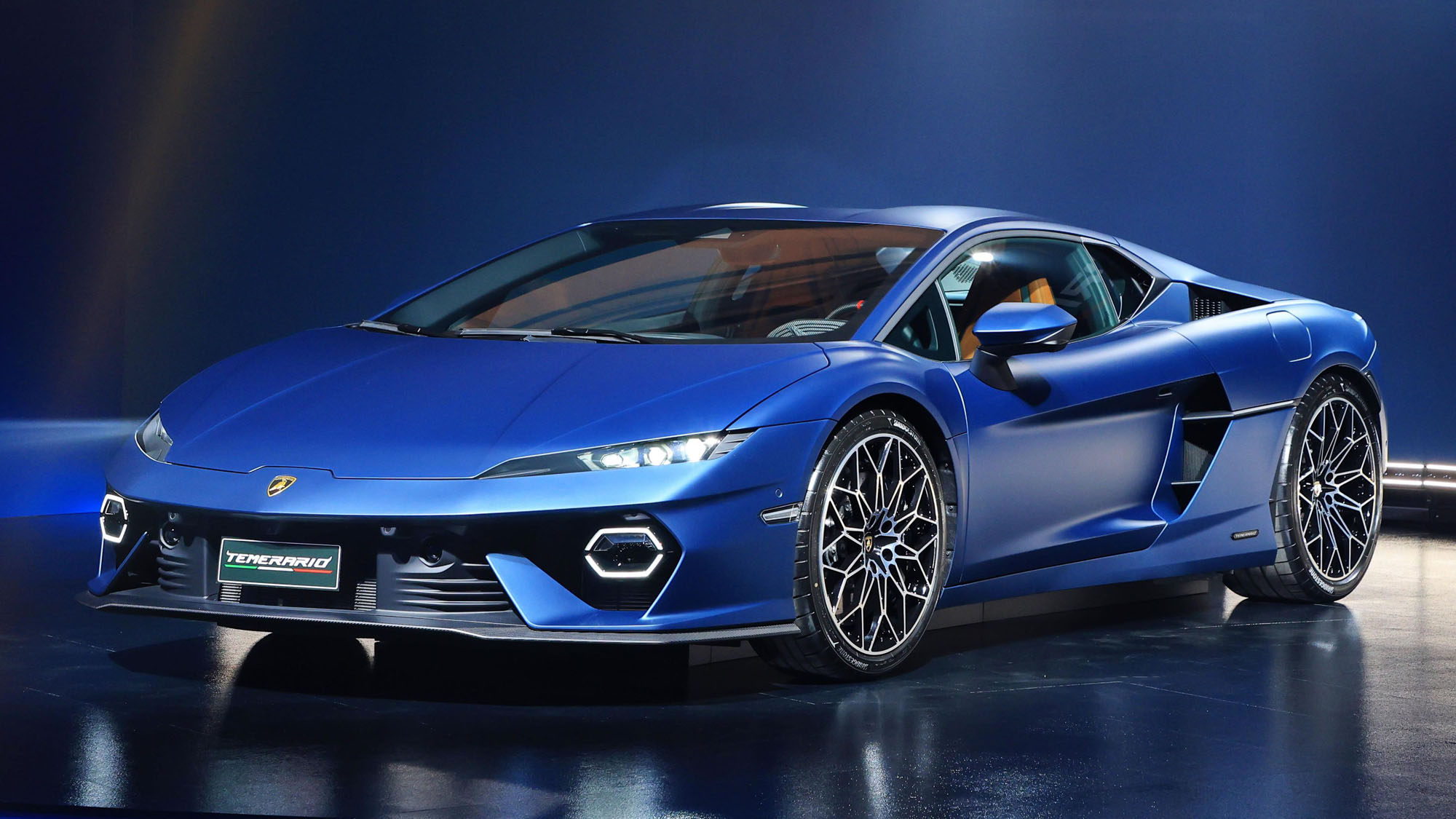
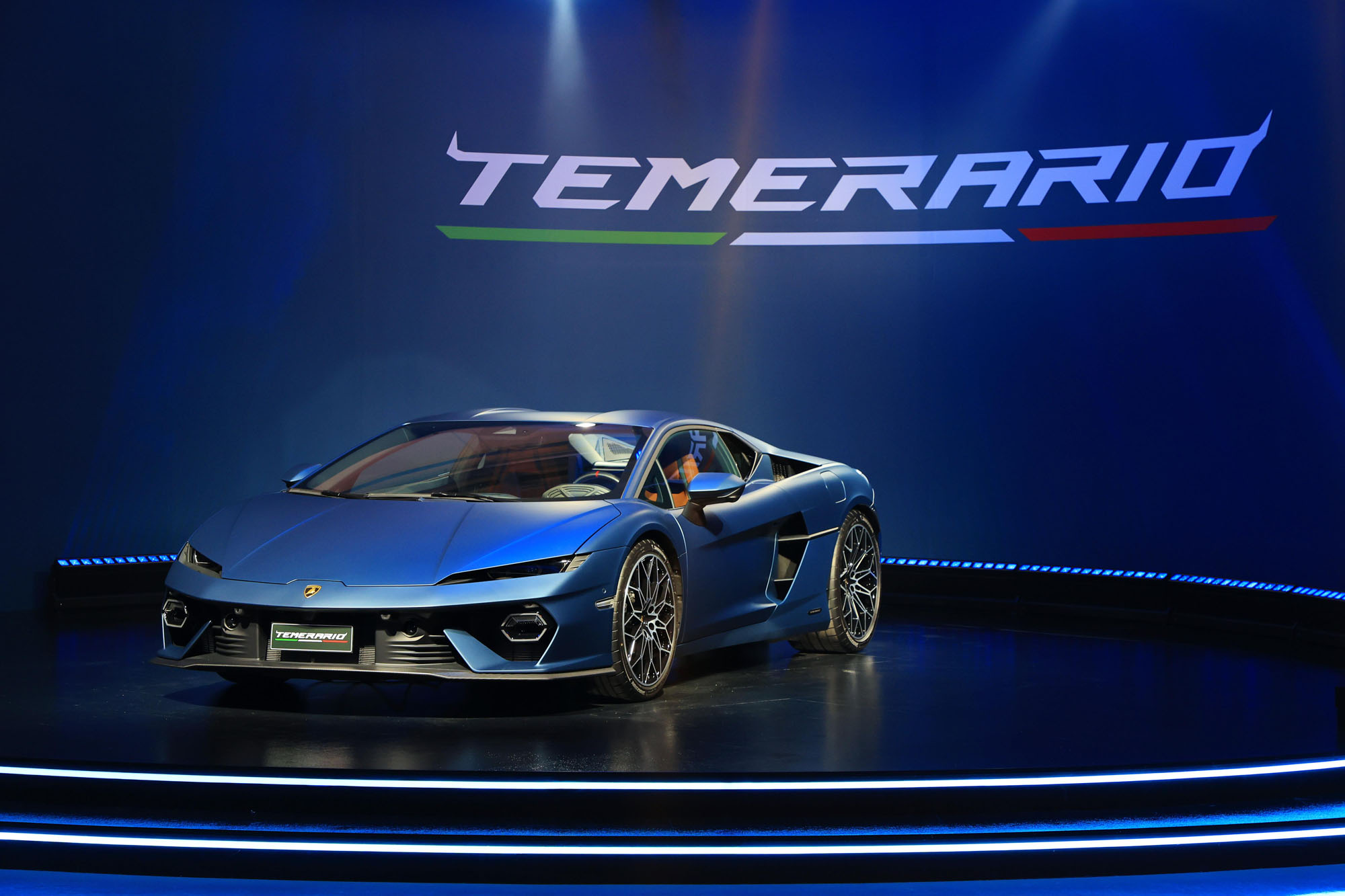
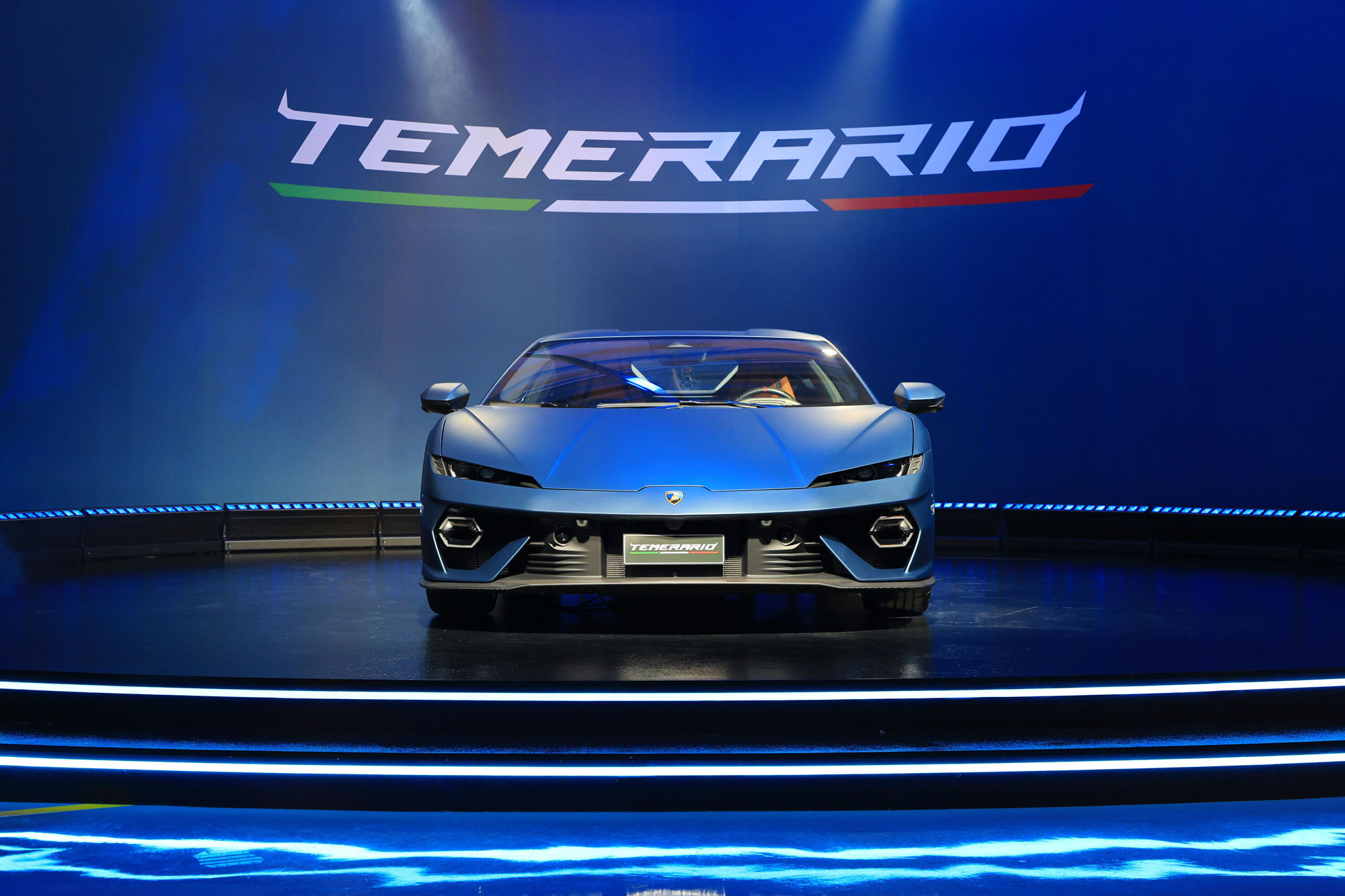
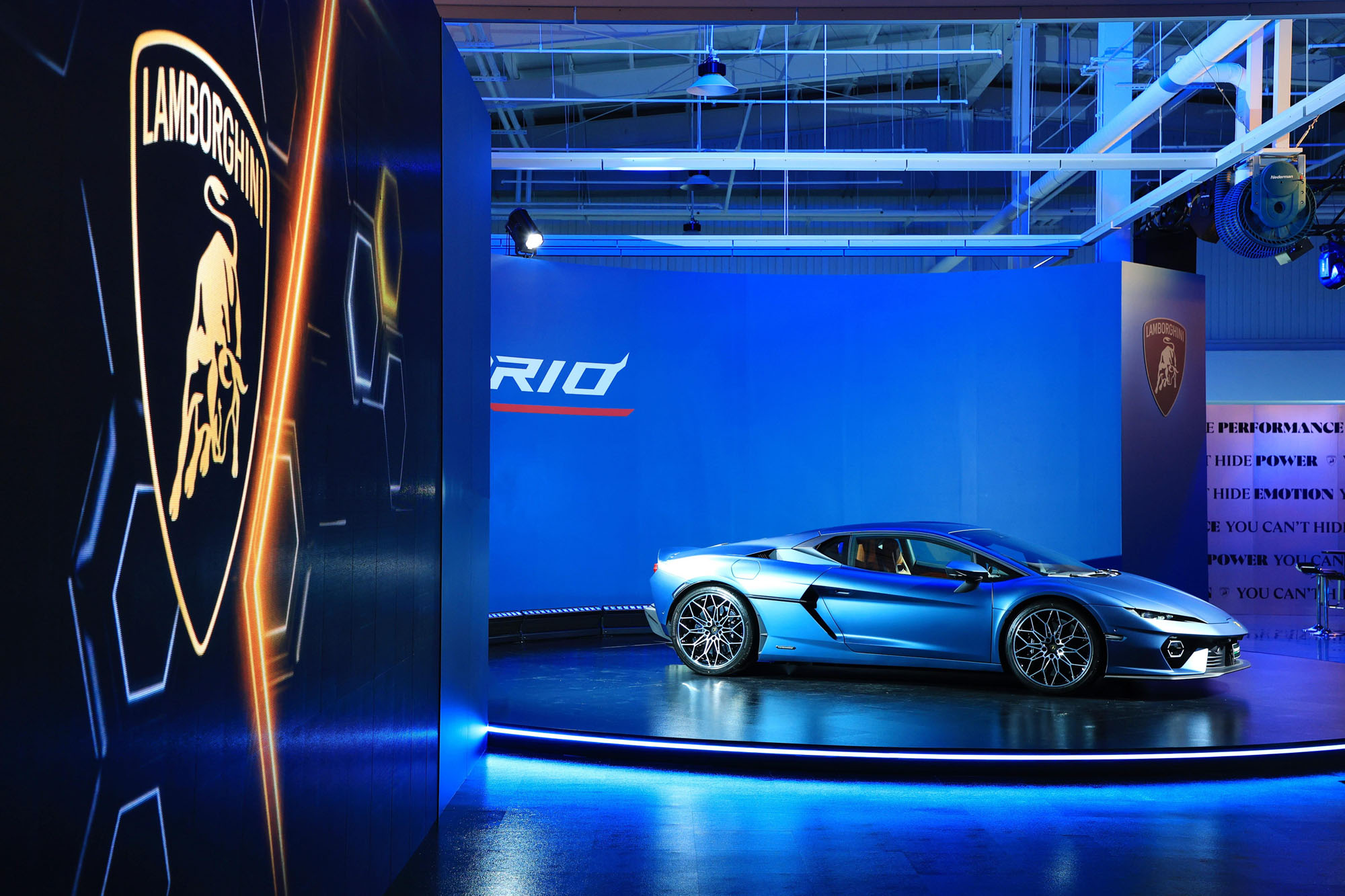
Following its Asia Pacific premiere in Japan last November, Lamborghini Taipei proudly introduces the highly anticipated Temerario to dynamically kick off the year. The second market in Asia to showcase this groundbreaking model, Lamborghini Taipei offers Taiwanese enthusiasts their first look at the latest addition to the brand’s line-up, marking a significant milestone for the hybrid transformation of Sant’Agata Bolognese’s iconic vehicles and underscoring the importance of this market.
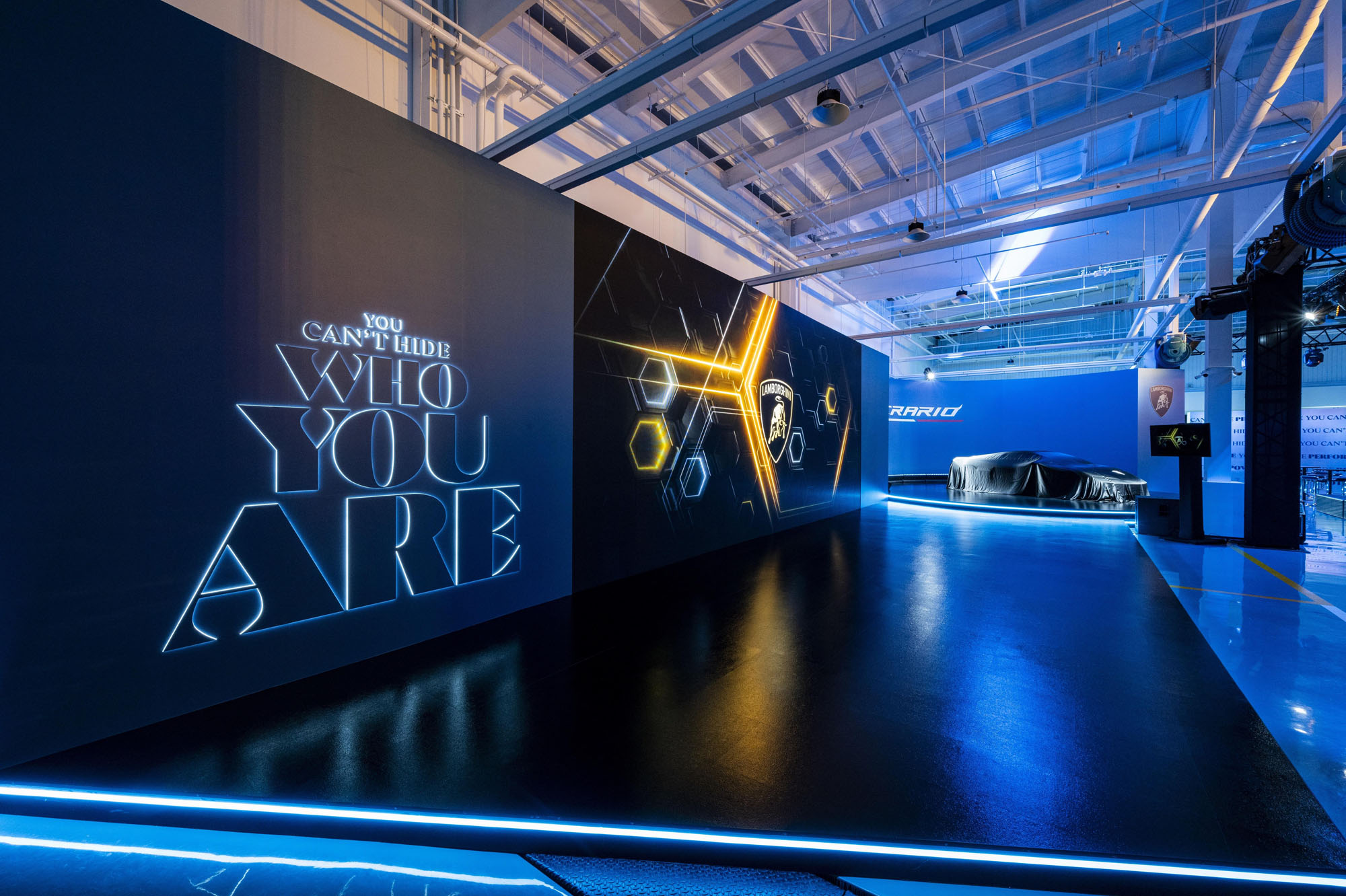
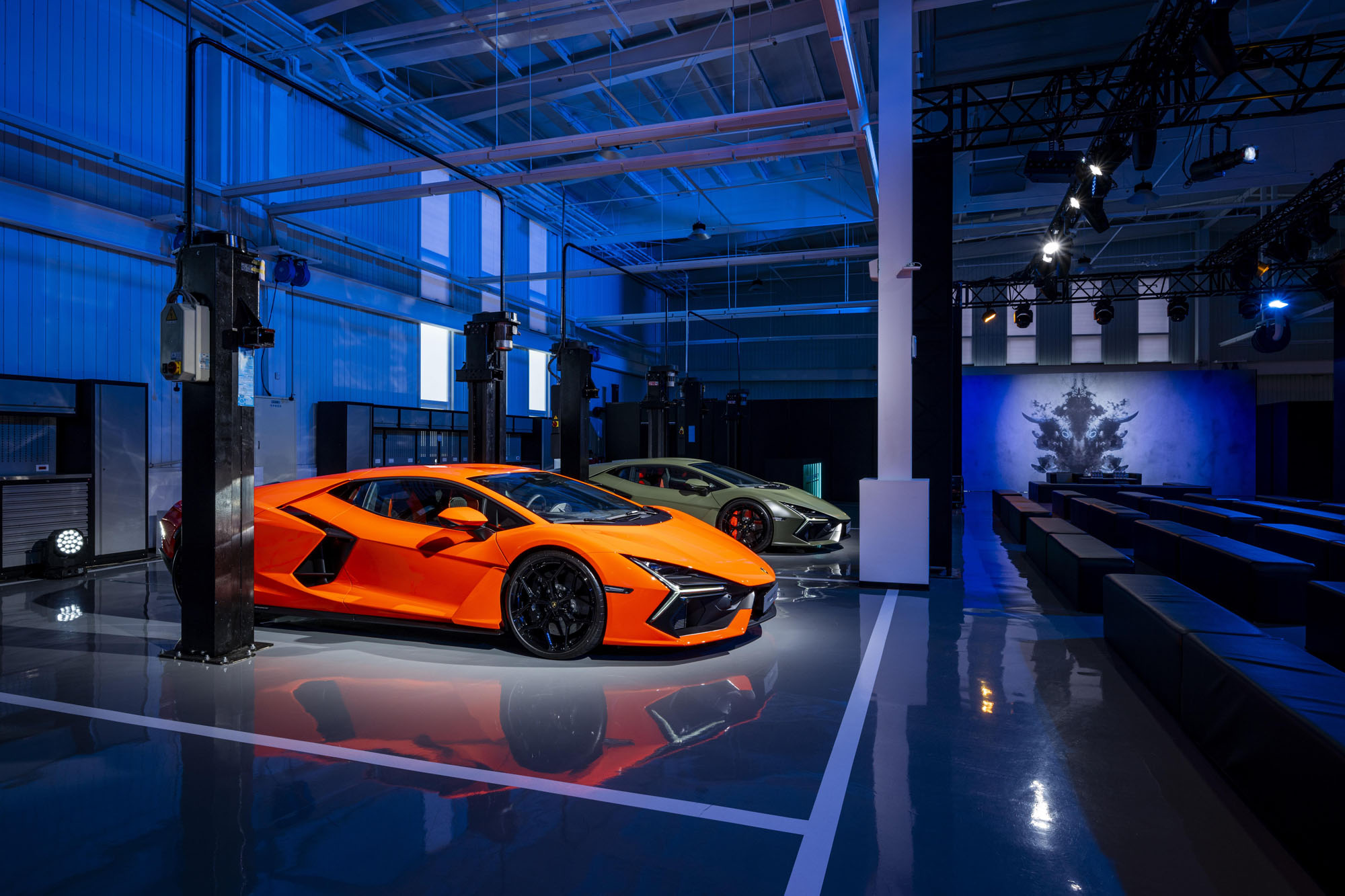
Held at the newly opened Lamborghini Taipei Service Center, the exclusive event welcomed esteemed customers and media representatives. Federico Foschini, Automobili Lamborghini’s Chief Marketing and sales Officer, and Francesco Scardaoni, Regional Director of Automobili Lamborghini Asia Pacific, honored the event.
The Temerario is the second vehicle in Lamborghini’s HPEV (High Performance Electrified Vehicle) range, following on from the Revuelto. It redefines performance, driving pleasure and comfort and, together with the Urus SE[3], makes Lamborghini the first luxury automotive brand to offer a completely hybridized range.
Temerario presents itself as the new benchmark in the super sports car segment, delivering unmatched performance. The new hybrid powertrain, designed and developed from scratch in Sant’Agata Bolognese, combines a completely new twin-turbo V8 engine with three electric motors, delivering a total power output of 920 CV and is the first production super sports car to achieve 10,000 rpm. The performance is an absolute revelation: maximum speed of 343 km/h (210+ mph), 0 to 100 km/h (0-62 mph) in just 2.7 seconds.
“We are honored to unveil the Temerario in Taipei, a car in a class of its own and embodying innovation and performance from both a technical and stylistic point of view. Temerario, Revuelto and Urus SE complete our lineup, finalizing our electrified roster within the Direzione Cor Tauri strategy. Hybridization for Lamborghini always brings additional features to a car: we are redefining the concept of sportiness and dynamic driving pleasure with improved efficiency and reduced emissions, always consistent with our DNA of emotive performance,” said Federico Foschini, Automobili Lamborghini Chief Marketing & Sales Officer.
Francesco Scardaoni, Region Director of Automobili Lamborghini Asia Pacific, commented, “We are thrilled to welcome the New Year with the highly anticipated premiere of the Temerario in Taipei. The Temerario showcases Lamborghini’s dedication to combining exceptional performance with cutting-edge hybrid technology. We are confident that the Temerario will resonate strongly with customers, media and enthusiasts across the Taiwanese market.”
Powertrain
The heart of a Lamborghini has always been its drive system. With the new Temerario, Lamborghini takes an entirely new approach, with five years of development delivering an unprecedented super sports car powertrain, comprised of an extremely high-revving biturbo Internal Combustion Engine concept combined with three electric motors.
The new powertrain is integral to the second super sports car in Lamborghini’s High-Performance Electrified Vehicle (HPEV) product range. The first target was to achieve the highest possible specific power and torque while at the same time offering the response of a classic high-revving naturally aspirated engine. Therefore, only high-performance components are used in the drivetrain: the new 4.0-liter V8 biturbo engine has a specific output of 200 CV per liter and works together with an oil-cooled axial flow electric motor fully integrated in the V8 housing. Propulsion is supported by two electric motors on the front axle.
The linearity and progression with high revving characteristics, which was previously only possible with naturally aspirated engines, now offers high torque up to very high engine speeds thanks to the turbochargers.
The new engine with the internal designation L411 is one of the segment’s most powerful engines. The V8 biturbo delivers its peak power of 800 CV from 9,000 to 9,750 rpm and 730 Nm of torque between 4,000 and 7,000 rpm. The electric motor, in P1 position (between the V8 engine and the gearbox), ensures immediate response starting from low engine speed and continues consistently through gear transitions, working as a “torque gap filler” and improving the transient response, giving the sensation of linear and limitless progression up to 10,000 revs. Thanks to the two large turbochargers, efficiency and performance are increased at top speeds. These are located compactly in the V of the engine as a “hot V8” to optimize the packaging and thermal management. The V8 biturbo can rev up to 10,000 revolutions per minute: the maximum boost pressure of the turbochargers is 2.5 bar (abs). The turbines are controlled with an electrical wastegate and a wheel-speed sensor. Lamborghini has designed air filter boxes with tubular cartridges, making them extremely compact to create space and become even more efficient.
At the heart of the crankshaft housing is a flat-plane crankshaft with a 180-degree angle between the crankshaft bends. This crankshaft, which is typically used in racing engines, ensures optimal fluid-dynamic behavior due to even firing orders compared to the cross-plane crankshaft and a unique engaging sound. Titanium conrods reduce the rotating masses and offer excellent material properties in terms of strength and lightness, reducing weight. The engine casting material consists of A357+Cu, the same used in motorsport applications.
The particularly robust and reliable finger followers covered in DLC (Diamond Like Carbon) can withstand speeds of up to 11,000 revolutions per minute – a range previously reserved for racing engines in motorsport. This is also where the engineers drew their inspiration for the engine layout concept. As is usual in motorsport, most of the auxiliary units are located on one side, including the two water pumps for the intercooler and engine cooling, as well the electronically-controlled barrel valve for fine temperature control.
The oil and water pumps, which are arranged in series on the right-hand side of the engine, are driven up to a specific ratio up to a pump speed of 7,800 rpm. The engineers integrated the oil tank in one side of the engine that works according to the dry sump principle with five-stage gear scavenge pumps. As a result, the drive unit is flat, sits low in the Temerario, and lowers the Temerario’s center of gravity, improving its handling characteristics. A newly designed water-cooling system ensures a balanced temperature regime. The internal cooling of the cylinder heads has been extremely refined using 3D printing technology for the casting core, allowing a uniform cooling of the combustion chamber and high knock resistance. The direct petrol injection atomizes the fuel extremely finely into the eight combustion chambers at up to 350 bar, thus ensuring fast and clean combustion.
The characteristics of a smoothly revving, naturally aspirated engine, with the power delivery of a turbo engine in combination with electric drives, is unique in the way it works and sounds. Lamborghini has thus succeeded in developing a new V8 biturbo that combines the pronounced linearity of the rev development in the previous Lamborghini aspirated V10 with the enormous power and torque of a modern turbo engine. The system output is an outstanding 920 CV / 676 kW in conjunction with the three electric motors.
Sound
Lamborghini has invested significant technical effort in developing a unique and unmistakable audio experience from Temerario’s completely new drive system, ensuring a highly emotive and unmistakably Lamborghini sound and sensation feedback.
The technical complexity of this special soundscape is immense. To ensure that the crescendo up to 10,000 rpm provides an emotional, sporty sound, Lamborghini integrates various technical measures and enriches them with high-frequency modulation effects.
A special connection between the engine banks enhances the sound effect of the power unit subject to the engine speed. Depending on the driving mode, the silencer box and exhaust valve of the V8 biturbo work in the low rev range to improve acoustic comfort. At the same time, the different driving modes are clearly differentiated through acoustic tuning.
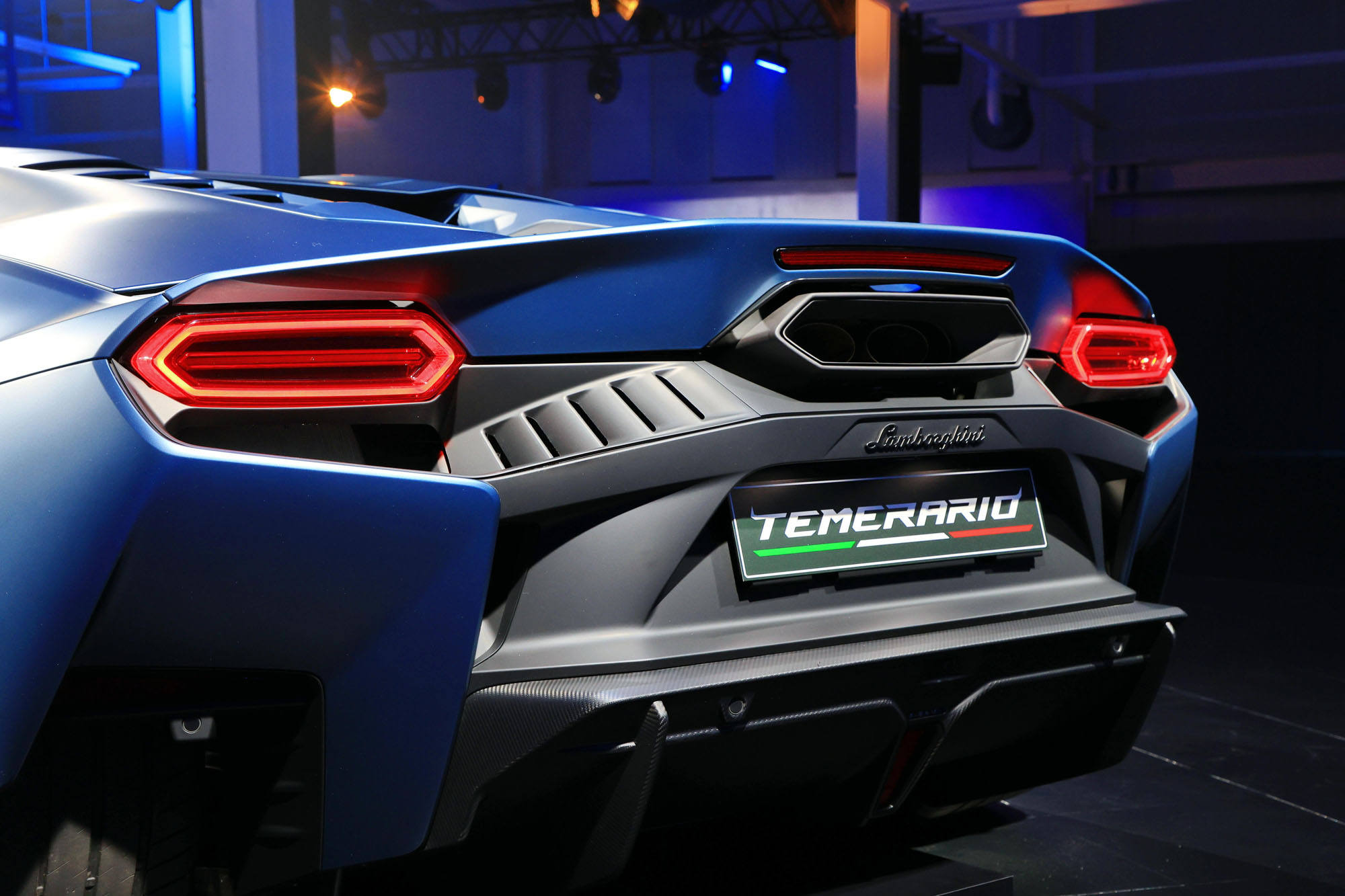
An exhaust system routed from the manifold to the tailpipes also acoustically emphasizes the engine’s combustion processes. Thanks to the smoothed pipe routing, Lamborghini guarantees a clear and clean sound. The height and position along the transverse axis of the exhaust tailpipes further focus the sharpness of the engine with a high-frequency component, thus emphasizing its power.
In addition, Lamborghini has designed the engine mounts and body so that the drive has a flat crankshaft character that can be felt by the driver at high engine speeds and under full load. Thanks to the flat-plane crankshaft, in which the crank pins are at an angle of 180 degrees, the V8 biturbo produces subtle vibrations.
Lamborghini makes the amplitude of these vibrations more pronounced at high engine speeds, which enhances the overall impression of speed and power at high revs. The sound engineers also manage to transport the pleasantly sporty acoustics into the interior and at the same time emphasize the desired frequencies using lightweight body parts and panels. The light vibrations transmitted to the frame provide a comprehensive sensory experience in addition to the thrilling soundtrack. As the engine speed increases, the seat vibrations intensify, especially at higher engine speeds of up to 10,000 rpm: a speed range previously only known from motorsport.
Furthermore, an additional sound symposer emits acoustic waves into the interior, creating an immersive auditory experience in every driving mode.
Lamborghini has also designed a completely different soundscape for the different driving modes Città, Strada, Sport and Corsa. In Città mode, Lamborghini offers a high level of comfort with a special sound from the electric drive unit. The composition achieves a smooth and pleasant listening experience in urban environments. In Città mode, the Temerario is emission-free and quiet.
In Strada mode for country roads and fast autoroutes, occupants enjoy a comfortable and homogeneous V8 biturbo sound experience with evenly distributed frequencies, without any barking or sharp peaks for sporty yet discreet driving pleasure. In Sport and Corsa modes, Lamborghini amplifies the second- and fourth-order overtones of a V8 four-stroke engine and air-intake harmonics, creating an exhilarating and powerful listening experience. At speeds of up to 10,000 rpm, the engine not only delivers incredible power of up to 920 CV but also an inimitable sound – a new Lamborghini sound of a new generation.
Three electric motors for support
The new drivetrain incorporates three electric motors. With 110 kW of power each, the electric motors are an integral part of the powertrain strategy. Two oil-cooled axial flow electric motors with a total peak output of 220 kW and up to 2,150 Nm of torque (the continuous output is 60 kW) drive the front axle when required to achieve all-wheel drive. The electric front axle weighs just 73 kilograms, and each electric motor only 15.5 kilograms.
A major challenge was the design of the powertrain to be as compact as possible. To achieve this, the engineers integrated the electric motor into the housing of the V8 biturbo, directly, without an intermediate clutch. This fills any turbo lag, no matter how small, at any speed delivering 300 Nm of torque. The entire electric drive unit is located compactly between the combustion engine and the dual clutch transmission. This electric motor also works as a starter motor and three-phase generator.
Furthermore, the two electric motors on the front axle also improve the power output and can transform the new Temerario into a fully electric super sports car. In this way, Lamborghini reduces CO2 emissions by up to 50 percent compared to the Huracán[4].
Battery
The Lamborghini Temerario is equipped with a lithium-ion high-specific-power (4500 W/kg) battery pack situated within the central tunnel. This keeps the car’s center of gravity as low as possible and ensures optimal weight distribution. The battery is protected by a lower structural layer and connected to the front electric motors, the rear electric motor, and an integrated recharging unit.
The battery pack is 1550 mm long, 301 mm high, and 240 mm wide, containing pouch cells with an overall capacity of 3.8 kWh. When the charge drops down to zero it can be recharged using both ordinary domestic alternating and charging column current up to 7 kW in power, and completely recharges in just 30 minutes. It can also be recharged under regenerative braking from the front wheels or directly from the V8 engine.
Thanks to the e-axle, the Temerario incorporates the Lamborghini Dinamica Veicolo (LDV) 2.0 system. Electric torque vectoring increases the car’s agility in narrow cornering as well as its stability in high-speed cornering, distributing torque optimally to each wheel. Unlike conventional systems, the new torque vectoring intervenes on the brakes only when strictly necessary to maximize efficiency and ensure a more natural driving style as well as an even higher level of performance. When braking, the e-axle and rear electric motor contribute to deceleration, reducing stress on the brakes while recharging the battery.
Dual-clutch transmission
The eight gears of the second Lamborghini super sports car in the High-Performance Electrified Vehicle (HPEV) category are shifted by an eight-speed dual-clutch transmission (DCT) installed transversally behind the V8. The newly-designed compact transmission meets all the requirements of such a powerful drive unit.
To save installation space and weight, the layout is not a standard DTC one. An additional hollow shaft is used to share the same synchronizers for different gear torque paths. Without electrical components, the new DCT weighs less than the Huracán’s seven-speed dual-clutch transmission and achieves faster shift times. At 560 millimeters long, 750 millimeters wide and just 580 millimeters high, the new DCT also remains extremely compact.
Lamborghini has installed the new eight-speed dual-clutch transmission behind the V8 biturbo. This creates sufficient space in the center tunnel for the lithium-ion battery that powers the electric motors. Another advantage is that this technical layout optimizes the weight distribution of the Temerario and ensures a compact wheelbase for ideal driving dynamics and balanced handling.
With the new eight-speed dual-clutch transmission, drivers experience extremely fast shift times even with a very sporty driving style, even in daily driving. Continuous downshifts in particular are easy: when braking and simultaneously pressing and holding the left shift paddle the transmission shifts down gears sequentially, allowing the driver to feel and hear the gear change. The long ratio eighth gear reduces the engine speed, which helps to optimize fuel consumption and improves drivability at cruising speed. The Temerario gearbox has been equipped with a mechanical reverse gear system.
Design
Brave, unexpected and authentically a Lamborghini: with the Temerario Lamborghini Centro Stile has created a new and inimitable super sports car that opens a fresh chapter in Lamborghini design DNA. following the new styling with its own essential and iconic identity. The new design creates its own essential and iconic identity.
The new car’s design points towards the future of Lamborghini’s legendary mid-engine sports cars, while its shapes stay pure, athletic, and well-defined. With a clean-sheet design and new drive concept, the Temerario connects to its legendary predecessors, while its all-new persona is characterized by reduction, clarity, sharpness, and recognizability.
Exteriors
From first glance, the Temerario reveals Lamborghini DNA in its typical Lamborghini silhouette: clear and puristic lines, short and compact overhangs, integrated aerodynamics and a bold shark nose.
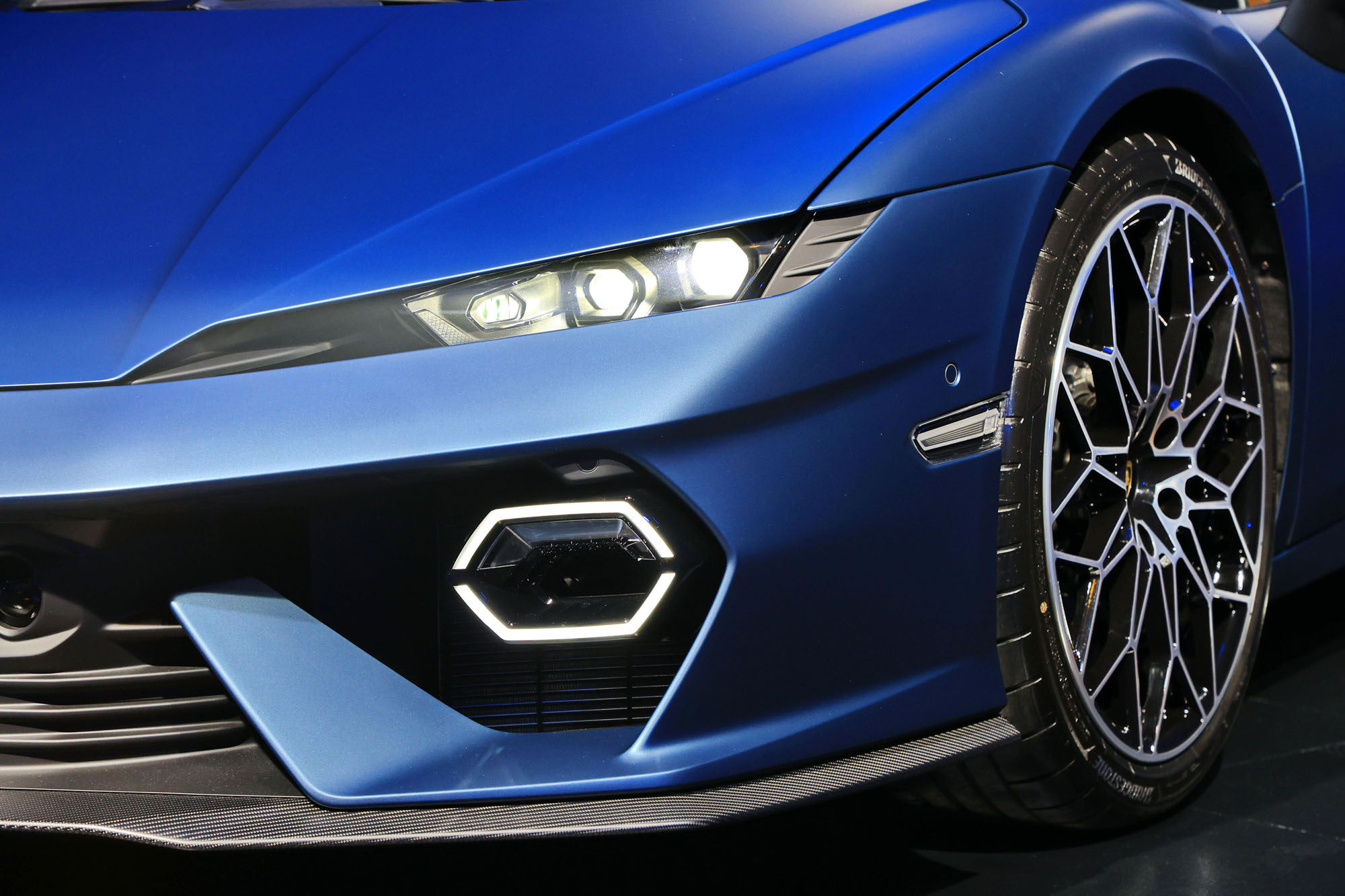
The Lamborghini design language has evolved to create a new hexagonal Daytime Running Light (DRL) signature, rendering it strongly recognizable and identifiable from far away. The hexagon concept can be found as the main design theme throughout the car: on the main bodywork, the side air intakes, the taillights and in the remarkable hexagonal exhaust pipe. “This unique hexagonal light signature ensures a high recognition value within the Lamborghini range, and is also a clearly identifiable in the distance,” emphasizes Mitja Borkert: the geometric hexagon paradigm has been one of Lamborghini’s most recognizable symbols since the 1960s.
The hexagonal daytime running lights incorporate an integrated radar sensor as well as an air tunnel, part of the design philosophy of incorporating lights within the aerodynamic concept. Furthermore, air channels positioned just below the headlights improve the aero performance and cooling of the front high-performance braking system for even better efficiency.
The Temerario’s designers combine elements from aviation with a visceral muscularity that starts at the front. The design is characterized by well-formed athletic surfaces and a cabin that tapers towards the hexagonal tailpipes. The tip of the hood dominates the entire front end in a strong and striking shark’s nose design: a symbol of bravery and speed. The sharp, elegant headlights are slightly overlapped by the hood, drawing inspiration from the sports motorcycle world. Air-guiding slats connect the low front spoiler with the hood, while fins on the sides direct the airflow along the flanks. Sharply shaped side skirts support the aerodynamics and increase downforce at the same time.
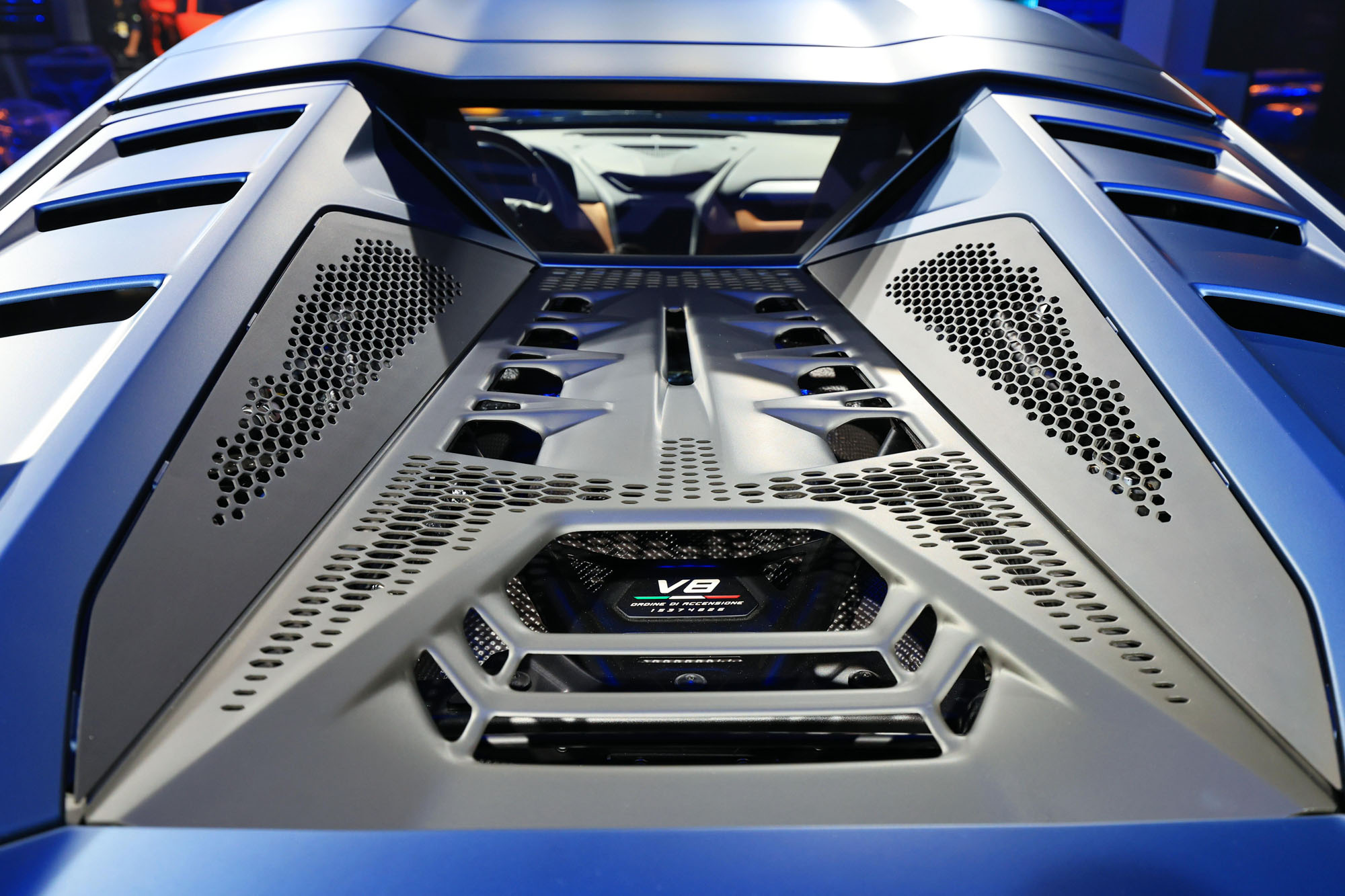
The heart of the Temerario is the completely new 4.0-liter V8 biturbo engine with an integrated axial flux electric motor. In realizing the new powertrain concept, designers and engineers developed a new chassis and a new body: the Centro Stile Lamborghini had the greatest possible freedom to present the drive system in a visually appropriate way to emphasize a true mid-engine feeling. Lamborghini presents the V8 biturbo openly, like a motorcycle’s engine under a transparent hood.
Interiors: “Feel like a pilot”
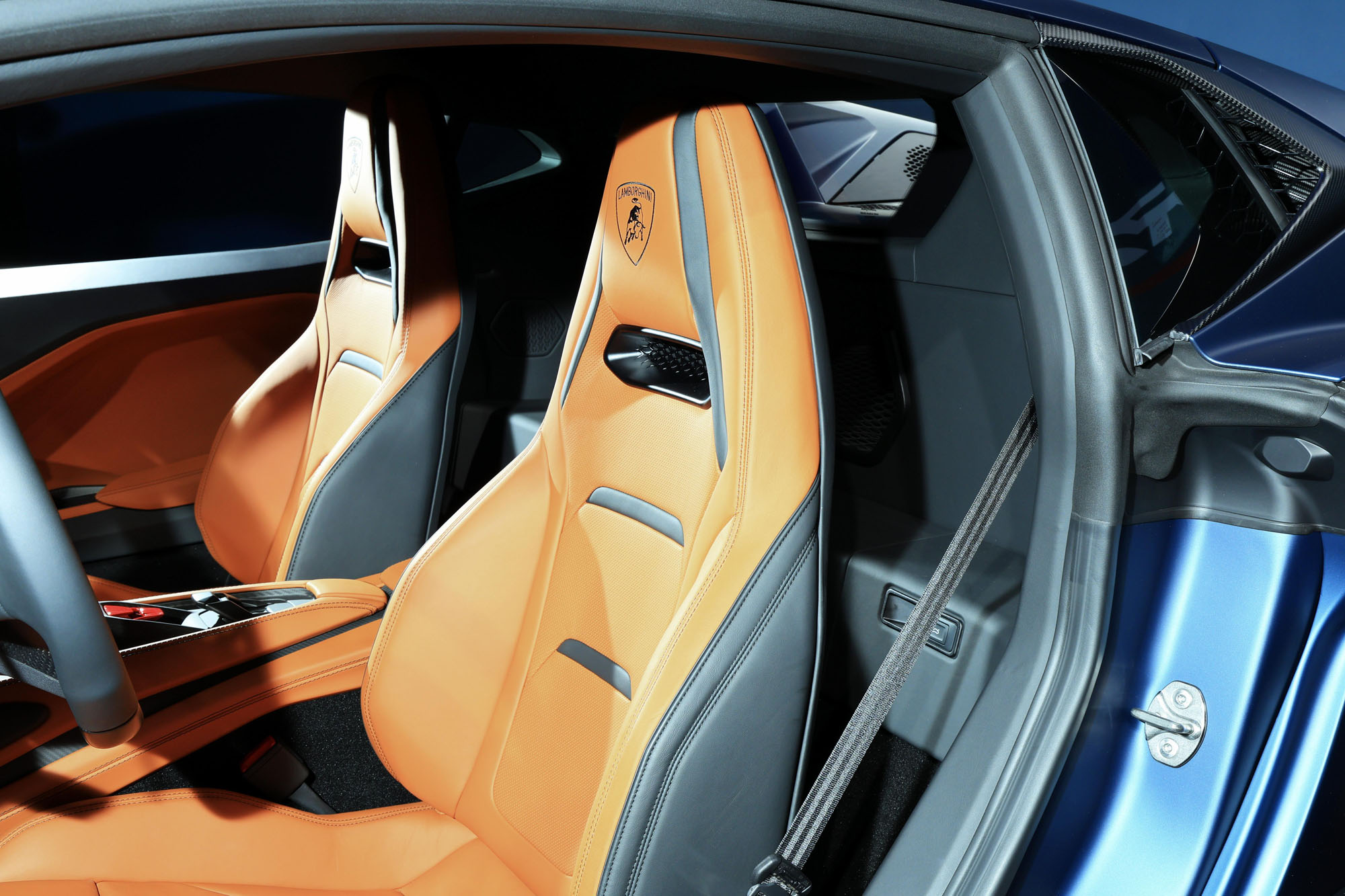
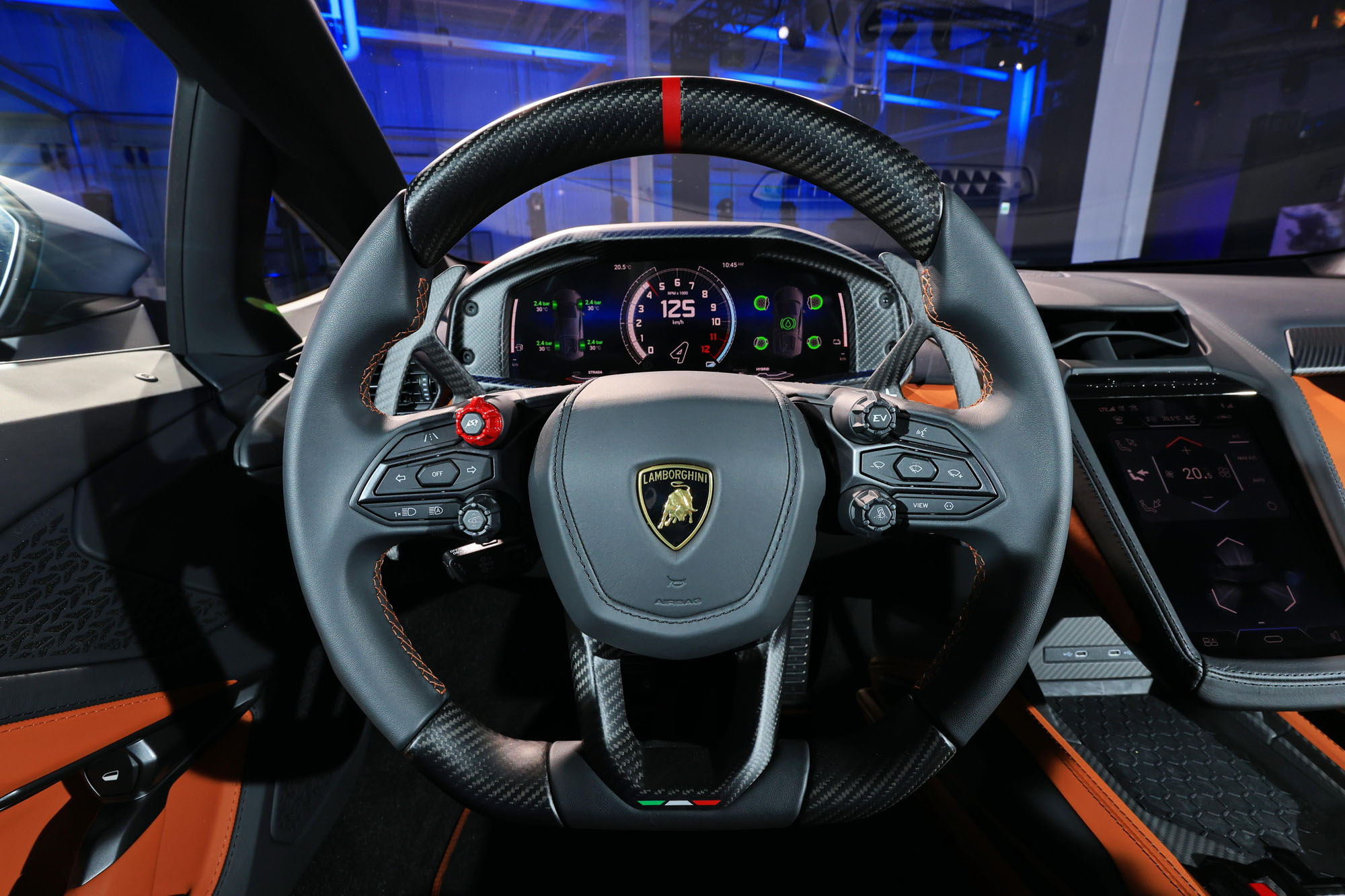
Lamborghini’s ‘Feel like a pilot’ philosophy comes to life in a new way in the Temerario, through a low seat position; the slim and lightweight dashboard; and a perfect inclination of the steering wheel allowing the driver to feel part of the typic fun-to-drive approach of Lamborghini. The combination of digital screens and mechanical and physical buttons such as the iconic start button or the racing car inspired steering wheel, results in the unique experience of ‘pilot interaction. New, electrically adjustable and comfortable sports seats are standard, or optional carbon fiber double-shell sports seats encompass the passengers within the vehicle like a perfectly fitting glove, ergonomically surrounding them with the cockpit and center console unit. The seats are available in many different colors and four different stitching patterns. No other Lamborghini seat currently offers such a wide range of options as the newly developed comfort seat in the Temerario: the 18-way adjustable comfort seat is heated and ventilated.
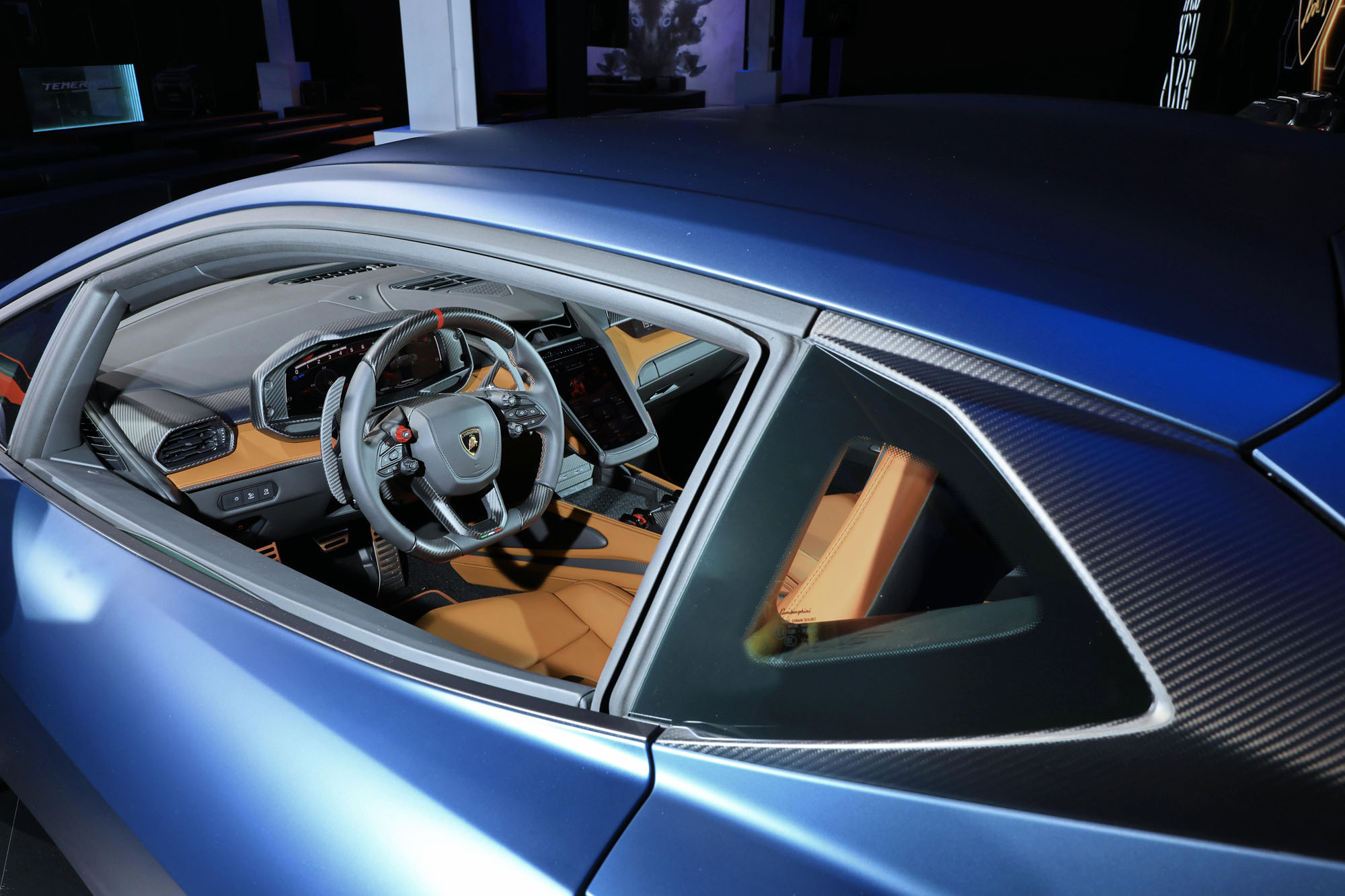
The interior mirrors the extraordinary exterior design, balancing digital and physical experiences. Lamborghini uses best-quality materials such as carbon, leather and Corsatex microfiber throughout the interior, combining them to create a high-quality interior experience with a special feel. Many interior elements can also be ordered in carbon fiber as an option, including parts of the center console, air vents, door panels, dashboard parts, steering wheel and steering column. In addition to the elegant lightweight materials, customers can find classical Lamborghini elements such as the Start/Stop “Power button” inspired by aviation; e-gear lever; and red ‘line-up’ indicator on the steering wheel to emphasize the extreme sportiness of the new Temerario.
Following the “Feel like a pilot” philosophy, thanks to the new generation dashboard, the pilot and co-pilot quickly become one with the new car. Clear and intuitive to operate, the pilot can reach all the controls from their perfect seating position. Iconic hexagonal air vents are elegantly integrated into the cockpit, and the center console has space for a smartphone and wallet.
The newly developed steering wheel with optional carbon elements takes inspiration from the racing world and allows the driver to control the main driving functions. On the left-hand side of the steering wheel is the red-crowned rotor, which is used to select driving modes. Below this are buttons for the lift function to raise the vehicle; the ‘race start’ button; and between them the switches for the indicators. The driver can operate Launch Control with a simple touch of a button, for maximum control.
Pilot Interaction
For the first time, the co-pilot has their own slim and informative display, which they can use to call up driving information and vehicle functions. Pilots operate the important driving instruments in analog form, while those for the entertainment system and navigation are operated by touch via the display in the center console. The “Pilot Interaction” concept actively involves the driver even more closely in the operation of the Temerario, providing perfect control in driving.
The new Human-Machine Interface (HMI) “Pilot Interaction” serves as the information center of the new Temerario. Lamborghini developed the new graphics and design exclusively for the Temerario, evolving the new graphic design DNA started with Revuelto. A new 8.4-inch display mounted on the center console gives the option to swipe and individualize the themes. The pilot and copilot can use it to slide apps and information left and right from the central display to the driver’s and co-pilot’s screens, just like a smartphone. While the driver receives information on the 12.3-inch digital instrument cluster, the data for the front passenger is shown simultaneously on a 9.1-inch screen in front of them. If the pilot changes the driving mode, the display graphics change to match the drive.
More space and room for everyday life
The interior of the Temerario has been completely redesigned compared to the Huracán, while at the same time further developing the design language first seen on the Revuelto. The Temerario offers significantly more interior space than its predecessor, thanks to the new spaceframe chassis. A low and ergonomic seating position offers the pilot and co-pilot a perfect connection and integration with the vehicle while at the same time providing a high level of comfort, true to the Lamborghini philosophy of “Feel like a pilot”.
The new spaceframe chassis concept increases headroom by 34 mm and legroom by 46 mm, plus a 4.8° increase in visibility and accommodates passengers up to 200 cm tall even when wearing a helmet. This means that even the tallest drivers wearing a helmet can comfortably complete their laps on a racetrack. There is room for items such as sports equipment in the load compartment under the front hood with 112 liters of stowage volume available equivalent to two cabin trolleys. Other everyday items can be stowed behind the seats.
Personalization and ‘Alleggerita’ Package
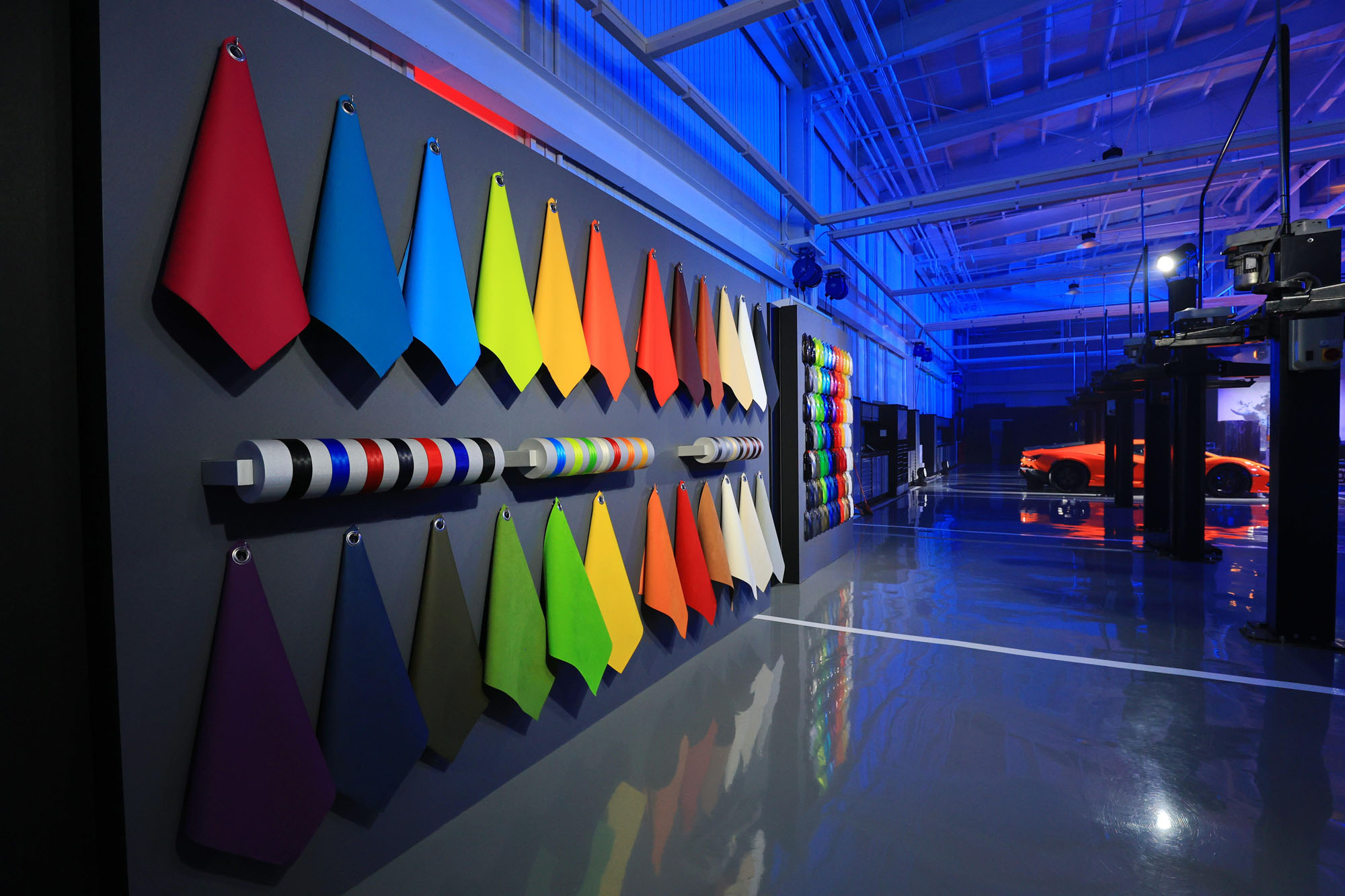
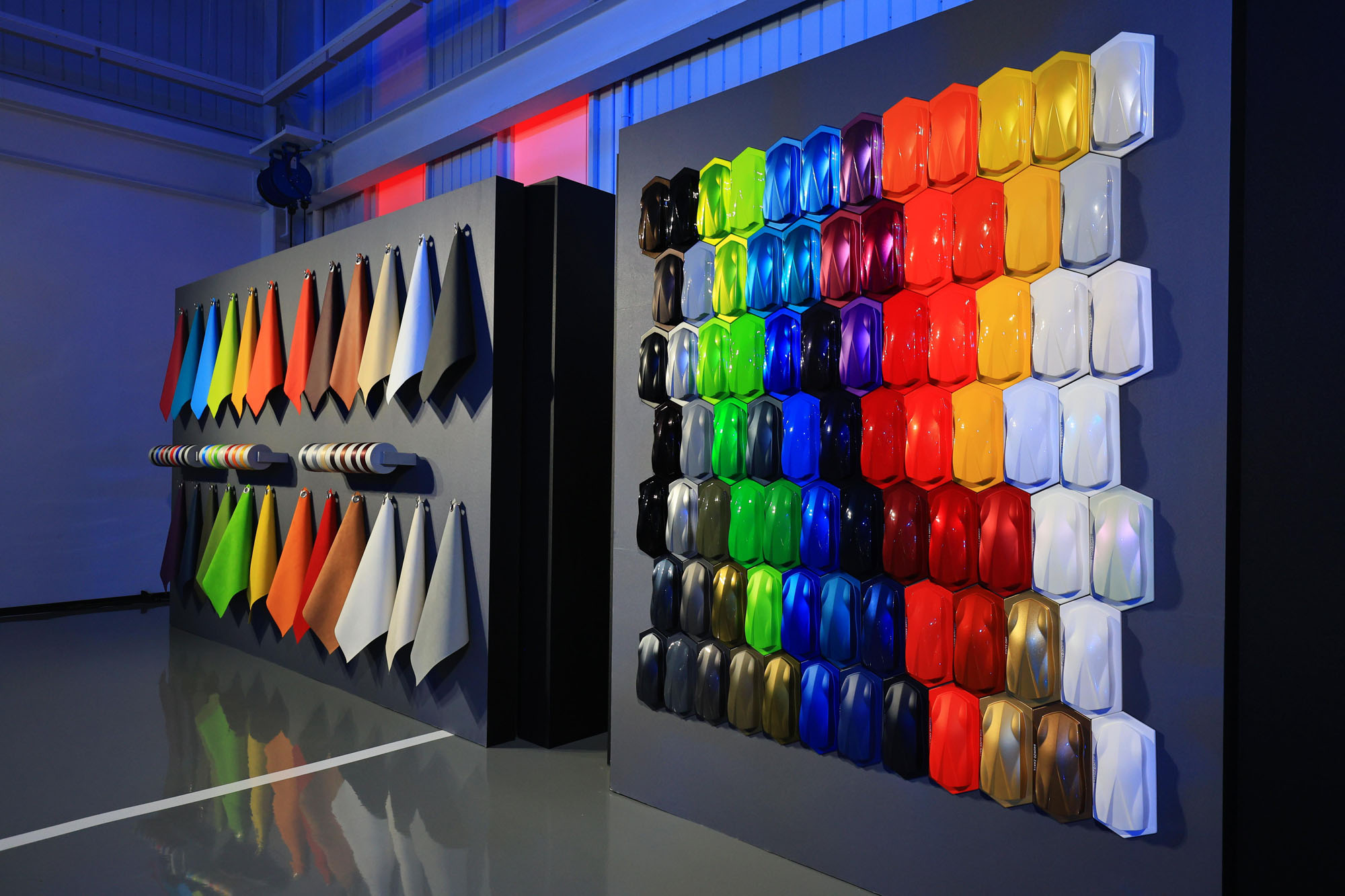
The Temerario is launched with two new dedicated colors, Blu Marinus (blue) and Verde Mercurius (green). Over 400 body colors and special liveries will be available, offering clients almost infinite customization possibilities through Lamborghini’s Ad Personam program. The new rims, 20” at the front and 21” at the rear, are available in three different designs and materials: cast rims (three colors), forged (four colors), and carbon. A wide range of carbon fiber elements for exteriors and interiors is offered: front splitter, mirror caps, side upper vents, rear diffuser, central tunnel, instrument cluster, air vents, door switch frame; steering wheel in carbon; steering column cover and gearshift.
The Temerario will also be available with the ‘Alleggerita’ (lightweight), package for customers more oriented towards track driving. It reduces the car’s weight by 12.65 kg through body components alone, with a reduction of over 25 kg when incorporating lightweight interior elements and carbon rims and is even more efficient from an aerodynamic point of view (+67% aerodynamic load).
The Alleggerita pack includes a splitter made of CFRP carbon fiber reinforced polymers (-0.19 kg) and recycled carbon fiber underbody panels (-0.55 kg): a further step in Lamborghini’s commitment to sustainability. New side skirts in CFRP deliver a further 0.6 kg of weight saving, as do the rear bonnet (-9.2 kg) and the panel where the high-load spoiler is integrated (-1.6 kg).
Inside, the Lightweight Pack incorporates carbon fiber door panels and structural carbon twin-shell sports seats to offer a driving experience inspired by the world of competition. Window weights are also reduced: the rear window in lightweight glass saves 0.85 kg, while the fixed side windows are in polycarbonate (-0.45 kg).
Aerodynamics
With the Temerario, Lamborghini has achieved the peak of aerodynamic efficiency through the attainment of three primary design goals: stability at high speeds; increased cooling performance; and maximum braking efficiency.
Lamborghini’s designers and engineers took into account the new hybrid powertrain and the increased aerodynamic load targets, particularly at the rear, when developing the bodywork and underbody of the Temerario: the result is +103% rear downforce compared to the Huracán EVO, increasing to +158% if the car is equipped with the Alleggerita Pack.
Each indivudual element was designed to contribute to excellent aerodynamic performance. Starting with the front, where the DRLs have also become aerodynamic elements, the hexagonal lights with dedicated air intakes and deflectors convey airflow from the bumper to the upper part of the side radiators, where two fins have been installed on the inlets. The upper fin with a wing-shaped profile diverts the flow downwards, which is captured by the second horizontal fin, directing it to enter the radiator perpendicularly and maximizing cooling efficiency.
Moreover, the fins which make up the grilles on the wheel arches convey the flow to the outside of the wheel, moving it away from the side radiator and minimizing its slipstream, with the dual effect of reducing aerodynamic resistance and moving the downforce towards the rear.
The wing mirrors, working in unison with the front of the vehicle, have the goal of not only minimizing drag, but also of directing the air towards the side radiators, increasing the cooling capacity of the mechanical components.
The roof’s design with a central channel directs air towards the rear spoiler, integrated in the vehicle body and thus improving the aerodynamic efficiency and increasing downforce. The curved sides of the engine hood also contribute to this result, increasing the portion of air which flows through the side part of the spoiler. The optional Alleggerita package features a high-load lightweight rear spoiler, obtained by increasing the height of the trailing edge with consequent increase in curvature.
The vehicle’s underside also plays a structural role in aerodynamic efficiency. The underbody is equipped with vortex generators: three pairs of fins arranged like the branches of a tree increase the rear aerodynamic load, assisting the action of the diffuser, which, thanks to a 70% greater surface area compared to the Huracán EVO and an angle increased by 4°, maximizes the vertical extraction of the air flow from the bottom. The increased cooling demand dictated by the new turbo-hybrid powertrain has necessitated the development of a new radiator layout, providing a 30% improvement in cooling performance.
Moreover, to maximize the Temerario’s exceptional performance, a new brake cooling concept has been developed to optimize vehicle braking. The front section incorporates a deflector fastened to the lower suspension arm, which exploits the flow diverted by the front diffuser and directs it towards the front brake caliper, helping to cool it. Another two specific inlets have been incorporated into the bumper to convey a high air flow from the bumper itself towards the disc ventilation channels; then a wye duct – with dual inlet but a single outlet – draws in air at high pressure, helping to improve the brake system cooling. The overall result is a total improvement in cooling performance over the Huracán EVO of 20% for the discs and 50% for the calipers.
The rear incorporates a solution already successfully tested on the Revuelto. The ventilation channels of the rear discs are fed via a NACA duct positioned in the front part of the rear wheel housing, which collects the high-energy flow of the underbody and directs it towards the brake cooling duct.
Spaceframe
The structural assembly of the Temerario sees the new Body-in-White constructed with a multi-technology spaceframe approach to withstand the higher stresses deriving from the new hybrid power unit. This guarantees excellent mechanical qualities together with remarkable efficiency in weight reductions.
Made entirely of aluminum, the frame of the Temerario debuts a new high-strength alloy for high-pressure castings; the use of high-strength hydroformed extrusions; and an increase in the number of hollow castings with thin closed inertia sections, achieved through the use of internal cores. These technologies allowed the constructional complexity of the spaceframe to be minimized and weight to be optimized, while at the same time the new hybrid powertrain adopts over 50% fewer components compared to the same parameters on the Huracán. In addition, the Temerario incorporates a significant reduction in the number of heat welds: over 80% less total weld bead length compared to the Huracán.
The new construction archetype has delivered increases in torsional stiffness of over 20% compared to the previous generation spaceframe. It also offers the best possible vehicle weight limitation, ensures the highest level of occupant safety, and significantly contributes to the vehicle’s excellent driving dynamics.
Driving Experience
Temerario offers 13 driving experiences that make the super sports car versatile and capable of exciting both in daily driving and on the curbs of a circuit. The drive modes can be selected via the rotors on the steering wheel: the upper left, red-crowned rotor allows the driver to choose between Città, Strada, Sport, Corsa and Corsa Plus (ESC Off – electronic controls deactivated); furthermore, by pressing the “checkered flag” button for two seconds, Launch Control is activated to exploit the maximum potential when starting from a standing start.
“Temerario offers an innovative and puristic driving experience at the same time. The e-4WD system combined with torque vectoring is a perfect combination,” comments Rouven Mohr, Chief Technical Officer at Lamborghini. On the one hand we have a car that is absolutely precise and effective on the track, on the other we can have a more typically rear-wheel drive character, oriented towards maximum involvement for the driver.”
Together with the hybrid system, three new dedicated driving modes also debut: Recharge, Hybrid and Performance, selectable via the upper right rotor. The choice of driving mode is displayed on the driver’s 12.3-inch digital dashboard, where the animated graphics replicate the rotation of the selectors to make the selection made immediately intuitive.
Città is the experience designed for driving in urban areas, which can be used both in Hybrid mode (fully electric with 2WD traction via the front e-axle, which delivers a maximum power of 140 kW – 190 CV) and in Recharge mode, to allow to the V8 to quickly recharge the battery if necessary. Strada is ideal for extra-urban routes and long autoroute journeys, for efficient and sporty driving, with all-wheel drive that activates on demand. The V8 engine always supports electric motors, with maximum power of 800 CV delivered by the powertrain in Hybrid mode, while in Recharge mode the maximum power output is 725 CV. The front e-axle supports torque vectoring and the active aerodynamics work to offer maximum stability at high speeds, for example on the motorway.
By selecting Sport, the Temerario changes character and the car’s behavior is set to offer emotive, fun and responsive driving in each of the three combinable modes: Recharge, Hybrid and Performance. The combustion engine, assisted by the hybrid system, is active in all three situations, delivering a maximum of 920 CV of power while the sound of the V8 becomes more present; the gearbox responds with maximum responsiveness while the suspension and aerodynamics enhance the agility of the car and the pleasure of driving in corners.
The pinnacle of effectiveness and power expressed, both in terms of performance and sound, is reached with Corsa, the mode designed to enhance the dynamic capabilities of Temerario on the track. In Performance the powertrain expresses the peak of its potential by delivering 920 CV, and the control of the hybrid system is calibrated to get the most out of the e-axle both in terms of torque vectoring and all-wheel drive, for ultra-sporty driving but accessible at the same time. The sound also reaches maximum emotiveness for an engaging and exhilarating sound experience.
The Drift Mode option also makes its debut on the Temerario, to help the driver generate controlled oversteer and maximize driving fun. Operated via the lower rotor on the right side of the steering wheel, Drift Mode is adjustable according to three different levels: from level 1, which facilitates oversteer while maintaining a limited yaw angle, up to level three dedicated to expert drivers to allow a wide angle of yaw.
The Lamborghini Temerario embodies the essence of the authentic “Fuoriclasse,” redefining excellence in the super sports car realm with its groundbreaking hybrid technology and unparalleled performance. As a masterpiece of engineering and design from Sant’Agata Bolognese, the Temerario stands as a symbol of Lamborghini’s relentless pursuit of innovation. For those seeking to experience this extraordinary creation, Lamborghini Taipei offers an exclusive gateway to the next chapter of the brand’s storied legacy.
The warm Pacific Ocean breeze was sweeping across the deck of the yacht as I readied my snorkel and mask. We slipped into the sea, met by a color wheel of pinks, oranges, purples, and reds. Corals and fish pulsed around us as black and brown blobs inched along the bottom. Suddenly, one of them heaved itself upward toward me, a sea cucumber rising to stare us down. It was just the latest unexpected delight on my visit to the pristine seas of Palau.
And that was only day two of my stay on the Four Seasons Explorer, a newly refurbished, 11-cabin vessel that sails around the more than 300 islands of Palau. The tiny tropical country, with a population of just 22,000, sits north of Indonesia and east of the Philippines, near what’s called the Coral Triangle. In Palau, low mountains rise from cerulean seas and, beneath the waves, the drama is just as pronounced. Among divers and snorkelers, it’s regarded as a life-list destination, with crystal-clear water, 1,500 species of fish, and reefs that are among the world’s most spectacular.
Guests gearing up to dive.
Courtesy of Four Seasons
What fascinated me about the Explorer, which is operated by the luxury hotel company, is how it felt by turns like a traditional resort or a cruise ship, depending on the moment. For example, there’s no fixed “departure”; guests can check in and out on any day. To reach the Explorer, new arrivals are transferred, like they might be in, say, the Maldives, by speedboat from Koror, home to Palau’s international airport. (During my five days aboard, several couples cycled through.)
But there’s also plenty of cruising. On my visit, we sailed through the Rock Islands Southern Lagoon, a UNESCO World Heritage site, with a couple of days spent around Mecherchar and Ngeruktabel islands, which are both surrounded by dive sites. Every day, we had a choice of following either the Diver or Explorer program. Scuba enthusiasts got at least two, and often more, opportunities daily, accompanied by a staff marine biologist. Those on the Explorer track had the option to snorkel or to head ashore, perhaps for a guided walk through one of Palau’s many small villages or for a cultural program about, say, traditional dance.
While the daily itineraries were packed, they were also flexible, with plenty of room for modification. One word to Abdul Latheef, the cruise director, and I could be whisked away for a massage, spend the day on a stand-up paddleboard, or enjoy a picnic lunch on a secluded beach. (While there were no kids aboard during my trip, Explorer does welcome children as young as eight years old, with programming tailored to their needs and interests.)
In the evenings, we all got back together for meals in the ship’s main dining room. The satisfying choices included plenty of nods to our location, including chicken satay, Vietnamese summer rolls, Indonesian stir-fried noodles, and a whole fish wrapped in a banana leaf. As a vegetarian, I was never overlooked and had plenty of excellent options.
After dinner, a DJ would sometimes spin low-key tunes for us, but I was more enthusiastic about what Four Seasons calls the After Glow. Each night, the staff would play a quick cut of the video footage that the guides and crew had captured during the day’s adventures — a mini-movie recap of all that we’d seen and done. We got to see the couple from San Diego swimming through a World War II–era shipwreck, one of many in these waters. Then came a clip of me, snorkeling alongside tens of thousands of (non-stinging) golden jellyfish in a lake on Mecherchar Island. Seeing the video after another thrilling day helped drive home the fact that, like Palau, the Explorer is one of a kind.
5 More Adventure Ships
Top cruise lines, including Seabourn and Viking, have recently launched small expedition ships. At the same time, niche operators are going even smaller — while still going big on excitement.
Learning in Ecuador
After an extensive refurb, the six-cabin Galápagos Explorer from andBeyond has been brought up to five-star standards. The ship does a pair of eight-day itineraries in the famed archipelago, one focused on the east, the other on the west.
Birding in Rwanda
The conservation-minded Mantis Collection operates the comfortable, 10-cabin Kivu Queen uBuranga on two- and three-night itineraries around the lush islands of Lake Kivu, where sensational birdlife abounds.
Cruising in Croatia
Active-travel specialist Butterfield & Robinson offers weeklong trips aboard the Agape Rose, a 12-cabin yacht loaded with e-bikes and kayaks, with departures from Dubrovnik or Split that visit the Kornati Islands, a national park.
Hiking in Australia
Luxury Lodges of Australia recently unveiled Odalisque III, a seven-cabin power catamaran that sails the waters off Tasmania, with four- to six-night expeditions and shore excursions that include guided hikes and beach time.
Exploring in Peru
Abercrombie & Kent has announced a 12-cabin ship, slated to set sail in 2025. Pure Amazon will travel its namesake region, with two cabins specifically for solo travelers, plus expert guides leading three- and four-night trips on rivers in the Pacaya Samiria National Reserve.
A version of this story first appeared in the October 2024 issue of Travel + Leisure under the headline “Just Dive In.”
The Federal Trade Commission (FTC) and General Motors (GM) announced an agreement yesterday that will see the automaker banned from selling data its cars gather about their drivers for five years.
The move comes after a New York Times investigation triggered an outcry over how automakers handle owner data. GM is the only automaker to respond publicly so far.
Your Car May Track Where and How You Drive
Many of today’s cars collect telematics data. That information can include a car’s location, mileage, speed, and sudden acceleration or hard braking incidents.
Last summer, a New York Times investigation found that several automakers keep and sell this data. They’re not alone – several phone apps do the same.
The buyers are typically auto insurers, often through third-party companies that collect the data, create reports on individual drivers, and sell them to auto insurance companies.
The investigation began when the Times looked into General Motors’ OnStar Smart Driver program – which GM marketed as a sort of driving coach. It advised owners on how to drive to save fuel. It also collected reports that GM sold to data giant LexisNexis, which resold them to insurers.
Further research found that Mitsubishi, Hyundai, and both Honda and its Acura luxury arm all offered similar driver coaching systems and sold related data to LexisNexis and a similar company, Verisk.
Some seemingly unrelated phone apps, including Life360 and the gas price service GasBuddy, do the same.
GM Shut its Program Down
After the report, GM shut the Smart Driver program down.
It hired a chief trust and privacy officer to overhaul how the company handled drivers’ data.
Yesterday the FTC banned the company “from disclosing consumers’ sensitive geolocation and driver behavior data to consumer reporting agencies” for five years. In a statement, GM says it “discontinued Smart Driver across all GM vehicles, unenrolled all customers, and ended our third-party telematics relationships with LexisNexis and Verisk” before the FTC’s action.
The company has also committed to “obtain affirmative customer consent to collect, use, or disclose certain types of connected vehicle data (with exceptions for certain purposes)” for 20 years.
Driver Privacy a Growing Concern
To date, GM is the only automaker to publicly admit to changing its practices. But others may soon be forced to follow suit.
In July, a pair of U.S. Senators issued a report noting that other automakers still sell similar driver data. Honda, the pair said, “shared data from 97,000 cars with Verisk, which paid Honda $25,920, or 26 cents per car, and it did so without obtaining informed consent from consumers.” Hyundai sold data from 1.7 million for about “61 cents per car.”
Both companies say they obtain consent for the practice in the documents buyers sign at purchase. But those can be difficult to understand, and buyers are often pressured to sign them quickly without a thorough review as part of a purchase.
In a 2023 analysis, privacy researchers from a prominent tech watchdog group found “cars the official worst category of products for privacy ever reviewed.”
Researchers found that many automakers reserved the right to collect and sell data from cars and even the phones that connect to them. Owners often consented to the practices in paperwork signed as part of a car sale, though Subaru’s policy even specifies that passengers consent to data collection just by entering a car.
Nissan’s privacy notice, the group said, says the company “can collect and share your sexual activity, health diagnosis data, and genetic information and other sensitive personal information for targeted marketing purposes. We absolutely aren’t making that up.”
We recently went on a spectacular cruise from Shanghai to Japan on board the Royal Caribbean Spectrum of the Seas. If it’s something you also want to try, read on because in this article, we’ll share with you the entire experience, from the travel requirements to the check in process, to the boarding procedure to the shore excursions.
You’ve probably heard of the Royal Caribbean Spectrum of the Seas before. It is one of the largest cruise ships operating in Asia, and we’ve covered it a number of times here on this blog, when it was homeported in Singapore and Hong Kong. But now until 2026, this sea mammoth is now based in Shanghai, China, sailing mostly to Japan (Okinawa, Fukuoka, Nagasaki, Osaka, Tokyo, Kagoshima, Kobe, and Kumamoto). Thankfully, we also got to experience it on our own upon the invitation of Royal Caribbean Philippines (Arpan Air). It also sails to Jeju Island and Busan in South Korea, but we only got to try Shanghai-Okinawa.
It was an adventure that combines two of Asia’s most iconic destinations —- China and Japan. Our trip began in the vibrant metropolis of Shanghai, a city where ancient traditions meet futuristic skylines, and then we cruised in style to the Land of the Rising Sun. From Japan’s historic temples to its buzzing shopping arcades, every stop offers a new chapter of unforgettable experiences. Whether you’re a seasoned cruiser or trying this for the first time, this is the perfect way to explore two incredible cultures in one seamless trip.
This cruise guide is great if you’re joining a Spectrum cruise soon and you need info on what to do or how to prepare. But if you’ve yet to book but considering it or you’re simply curious about the prices, we have a separate post about that here: ROYAL CARIBBEAN SHANGHAI CRUISE PRICES
And if you decide to go on a cruise, book at www.cruising.com.ph, managed by the official Royal Caribbean representatives in the Philippines, Arpan Air. By booking on this site, you automatically get Customer Support. If you book on the international website, you’ll have to call the Royal Caribbean office in the United States.
And if you use our promo code — WORTHIT — you’ll get an additional 5% DISCOUNT on the cruise fare! You can use this on top of any existing promos or discounts.
What are the Royal Caribbean Shanghai cruise travel requirements?
Here’s a checklist of the things you need to prepare before the cruise.
Passport. Must be valid for at least six (6) months.
Photocopy of passport. You will be leaving your passport with the cruise staff upon boarding, so it’s best to have a copy of it with you. Don’t worry, you’ll get it back before you disembark.
Visa(s). Since you’re sailing from Shanghai, you need a China visa (double entry). If you’re visiting Busan on this cruise, you’ll also need a Korean visa.
Credit card. This will make your life easier, but it’s also best to bring USD as backup.
Royal Caribbean App. Use this mobile app to check in at least three (3) days ahead of the sailing date. You can also use this app to make reservations for restaurants and activities on board. Download it here.
SetSail Pass. After checking in using the app, you’ll get a SetSail Pass, which serves as your boarding pass. You may take a screenshot of it or print it out because you’ll need it when boarding. It looks like a flight boarding pass. More info about this below.
Luggage Tags. When you book a cruise, you’ll be sent a set of e-docs (Guest Ticket Booklet), with all the reminders and other details of the trip. You’ll also find your luggage tags there. Print them out but don’t attach them to your bags just yet. It looks like this:
Do I need a visa to cruise from Shanghai?
YES, Philippine passport holders must have a double-entry China Visa. You’ll be flying into China and when the cruise starts, you’ll be exiting, and then re-entering after. Hence, you need a visa that will allow you at least 2 entries.
For Japan destinations, no need for a Japan visa. Cruise passengers are visa-exempt as long as they will be leaving on the same cruise ship.
For South Korea, you’ll need a visa if you’re visiting Busan but NOT for Jeju Island.
What are the vaccination and testing requirements?
Royal Caribbean Spectrum of the Seas does NOT have COVID-19 vaccination or testing requirements anymore. Vaccination is highly recommended, but not required.
Likewise, the governments of China, Japan and Korea have long removed vaccination requirements from incoming tourists. Meaning, you may board the ship and enter these countries even if you’re not fully vaccinated.
IMPORTANT! These policies may change in the future. Check this page for the latest updates.
How to check in using the Royal Caribbean App
You should check in not later than 3 days before your scheduled sailing. Here’s how:
Link your cruise to your app by entering your last name, date of birth, and reservation number. It will then display your upcoming cruise.
On the home page, click CHECK IN at the bottom menu. It will display a review of possible health requirements. Click CONTINUE TO CHECK IN.
Fill out the Travel Info section. You’ll need to provide the following: – A scan of your passport – Security photo – Country of residence/birth – Crown & Anchor Society Loyalty Number – Address – Emergency contact details
Enter your credit card details. Internationally-accepted debit cards work, too.
Read the Legal Notice and Health Acknowledgment page. If everything looks good to you, click CONTINUE.
Enter your preferred Arrival Time. Our sailing was scheduled at 4:30 PM. The earliest Arrival Time available was 1:00 PM-1:30 PM. The latest was 3:00PM-3:30 PM. DO NOT BE LATE. If you arrive outside the time slot you chose, you may be delayed boarding.
Click VIEW SET SAIL PASS. Print it out because it will be checked at check in and before boarding. You can also take a screenshot of your SetSail Pass for easier use. You’ll also receive an email notification.
The Set Sail Pass looks like this:
What to pack? What to wear?
One of the biggest myths about cruising? That it’s way too formal. It’s not, at least not on Royal Caribbean.
Pre-pandemic, there used to be one formal night per sailing, but not anymore. But even if there were, it’s completely optional. If dressing to the nines isn’t your thing, you can totally skip it. And even if you do join, the dress code isn’t as strict as you might think. On Spectrum of the Seas, for example, jeans are fair game on formal night. Just steer clear of t-shirts, shorts, slippers, and sneakers if you’re planning to attend.
Funny enough, every time we cruise, with or without a formal night, we still choose to glam up for one evening -—just for the vibes. 😄
Some restaurants do enforce a dress code, but don’t worry—it’s not about tuxedos and ball gowns. Think more smart casual. For the Main Dining Room and specialty restaurants, a simple dress or blazer for women, or anything with a collar for men, works perfectly. The only no-nos? T-shirts, shorts, and sneakers.
Outside these venues, casual is totally cool. Pro tip: Pack a versatile blazer that can double as semi-formal or business attire. It’ll save you from any last-minute wardrobe dilemmas and help you breeze into the less casual spots and events.
When I go on a cruise, I always pack two outfits per day. Is this mandatory? Nope. Just a personal quirk. During the day, I’m all about casual and comfy clothes, especially when exploring off the ship. But come evening? I seize the chance to dress up a little. (As a full-time travel blogger, moments to glam up are rare. Gotta take what I can get, right? LOL!)
Oh, and if you plan on taking a dip in the pool or hot tubs, don’t forget your swimwear!
Beyond clothes, here are some essentials you should definitely bring along:
US dollars: just in case you experience trouble with your credit/debit card
Toothbrush and toothpaste: which will not be provided on board
Travel adaptor: the ship uses North American standard, 110V AC; and standard European 220/230 volts AC plug outlets
What items are NOT ALLOWED on board a Royal Caribbean ship?
Here are things that are PROHIBITED on board. If found, these items will be confiscated immediately.
illegal drugs and substances
firearms and ammunition (including replicas)
flammable liquids and explosives
sharp object (shaving razors and scissors with less than 4 inches blade length are allowed)
items that produce heat and an open flame like candles, incense, coffee maker, hot plates, clothes iron, etc. (curling iron and hair straighteners are allowed)
extension cords
hoverboards
alcoholic beverages like beer, hard liquor, and fortified wines (On boarding day, guests may bring up to two 750-ml bottles of wine or champagne per stateroom but these must only be consumed inside their respective staterooms. It must be brought via carry on.)
other beverages
On a previous Royal Caribbean cruise, I learned the hard way that extension cords are a no-go. I usually pack a small power strip when I travel, and I didn’t realize it was prohibited. When my suitcase didn’t make it to my room, I got curious and called to check. Turned out, my bag was being held because the power strip showed up during their scan.
To get my bag, I had to go to the baggage area, where they confiscated the extension cord. The good news? They handed it back to me before I disembarked. Lesson learned: double-check the prohibited items list before packing! 😅
Where to stay in Shanghai
Although it is possible to catch and early flight and board the ship on the next day, it is best practice to arrive in Shanghai at least a day before, just in case your flight gets delayed or cancelled. Hence, we recommend that you book a hotel in Shanghai for the night before. This will also give you some time to explore the city.
Choose a hotel in Huangpu, especially the area surrounding People’s Park, so you can easily access major tourist attractions that are FREE of charge.
Here are some of the top properties online as rated by Agoda customers:
If you booked via the international website of Royal Caribbean, you may call its United States hotline: 866-562-7625.
If you booked atwww.cruising.com.ph, the website of the official Royal Caribbean representatives in the Philippines (Arpan Air), you may simply contact them via call, SMS, Viber, or Whatsapp at these numbers:
+63 998 983 7315
+63 948 526 6174
If you haven’t booked yet, consider booking at www.cruising.com.ph to get easier customer support. They have access to the same system and inventory, and they can make changes to your booking or extend your payment. They can also assist you in preparing for your cruise.
What cruise terminal does Royal Caribbean use in Shanghai? How to get there?
In Shanghai, Royal Caribbean uses Wusongkou Int’l Cruise Terminal, located at this address:
Wusongkou Int’l Cruise Terminal No.1 Baoyang Road Shanghai, China
It is also known as Baoshan Port because it’s in the Baoshan district of Shanghai, north of downtown.
Do NOT confuse this with Shanghai Port International Cruise Terminal, which is a completely separate cruise terminal in the city center.
Here’s how to get to Baoshan Port.
IF YOU’RE COMING FROM SHANGHAI CITY CENTER:
By Taxi: CNY 100 fare
By Metro: Take Metro Line 3 to Baoyang Road then take a cab to the cruise terminal (CNY 25)
By Bus: Take Bus 51, 160, 508, or 728, which all stop in Baoyang area, close to the terminal. But you might need to transfer on foot or by taxi to the cruise terminal building.
IF YOU’RE COMING FROM SHANGHAI PUDONG INTERNATIONAL AIRPORT:
Unless you’re taking a cab or private transfer, there is no direct way to reach Baoshan Port. Taking the public transportation involves a lot of transfers, which is not ideal if you have heavy luggage in tow.
Travel time: around 1 hour. Fare: roughly CNY 200.
How to check in and board the ship?
First, make sure you check in online (via the Royal Caribbean website or app) at least 3 days before sailing. This would make the boarding process so much easier!
Check your Guest Ticket Booklet, a set of e-documents sent to you when you booked, and on the CRUISE SUMMARY PAGE (likely page 3), look for the Sailing Time. In our case, it’s 4:30 pm.
IMPORTANT! Be at the pier within Arrival Time period that picked when you checked in online. Otherwise, you may be pushed back and be allowed to board much later.
Here’s the boarding process:
Attach the luggage tags to your check-in bags. You’ll find it in the Guest Ticket Booklet, usually towards the last page. Print them out but attach it only after you’ve landed in Shanghai. (The tags might get lost or damaged if you attach it before your flight.) You can also do this while falling in line but bring some scotch tape.
Go to the luggage drop off area. It’s located outside the terminal building. Make sure you have your documents with you. Best to have a small carry-on or hand-carry bag.
Enter the terminal for Customs and security check. There is often two queues here that start outside: one line for those who already have a SetSail pass and the other for those who do not. When you pass the security check, you will be directed to the check-in hall.
Clear a quick document check. A staff member will check your passport, and SetSail Pass. Once satisfied, they will stick a number on the back of your passport. That number corresponds to the area where you should fall in line for check in.
Finalize your check-in and present your travel documents at the counters. You will also be filling out a short form here where you’ll supply your personal info. If you check your Royal Caribbean app, it should display you’re CLEARED TO BOARD.
Proceed to the Customs check area. You’ll have to queue up again. The lines here are looooong. Your bags will be scanned.
Go to the Immigration Area. You’ll see several immigration counters, but there are a few that are dedicated to foreign or non-Chinese travelers. These are manned counters, so expect questions from the officers. They’ll scan your passport and get your biometrics (photo and fingerprints). Note that you’re technically exiting China at this point, so they will check if you have a double-entry or multiple-entry visa.
As you board the ship, another staff member will collect your passport. You will get your passport back a day before you disembark. If you forget to bring a photocopy of your passport, there is a photocopy machine stationed nearby.
That’s it! You’re in! Welcome aboard!
What to do after boarding?
Attend a safety demo. Check your Royal Caribbean app for the venue. It will also show you a map and instructions on how to reach it. Once completed, you’ll be given a colored sticker that you must attach to your shirt, somewhere visible.
Have lunch or chill at a waiting area. This can be the Windjammer Marketplace on Deck 14, the Main Dining Room on Decks 3-4, or the Two70. Help yourself with treats from their extensive international buffet selection as you wait for your room to be ready (usually 2-3 hours after boarding but can be as late as 6pm). You may also explore the top deck or the pool area and admire the view.
Proceed to your stateroom. You’ll find your SailPass card attached to your door. Don’t ever lose this card. This acts as your key card as well your wallet/credit card as purchases on board can only be made via this card. This is also the only way for you to get on and off the ship. The SeaPass card looks like this:
Find your check-in luggage in the hallway, just outside your room. If you can’t find it, contact Guest Services because they might be holding it because they suspect it contains a restricted/prohibited item or the luggage tag might have gotten lost.
Where to Eat on Board
Each booking comes with access to six (6) complimentary dining options:
Main Dining Room: a proper restaurant, international cuisine; multi-level dining place; open for breakfast, lunch, and dinner; Deck 3-4, Aft
Windjammer Marketplace: international cuisine; buffet style; open for breakfast, lunch, and dinner; Deck 14, Aft
Noodle Bar: Asian noodles; open for breakfast, lunch, and dinner; located inside Windjammer Marketplace
Splashaway Café: kiddie meals; open for breakfast and lunch;located near the kid’s pool area; Deck 14, Mid
Sorrento’s – Authentic New York Pizzeria, open for lunch and dinner; Deck 14, Aft
The Café @Two70®: continental food; serves mostly salads, sandwiches, and soups; open for breakfast and lunch; Deck 5, Aft section
SeaPlex Dog House, a “food truck” serving tasty hot dogs, located inside SeaPlex, open for lunch and dinner, until 7PM only; Deck 15, Aft
Dining at any of the above is FREE of charge, and you can have as much food as you like. When I like a particular dish, I order another serving. Even at the Main Dining Room, if I like two main dishes, I order both. It’s okay and it’s allowed. You can even ask for items that are not on the current menu. The first time I had a meal here, they served a cheese platter, which I enjoyed. But it was no longer on the menu after that but I always ordered it regardless and they would bring oblige (LOL).
The menu at the Main Dining Room changes every meal, but here’s a sample:
Because of the sheer diversity of the cuisines that are available for FREE, it is entirely possible to complete the trip without spending anything more on food.
Main Dining RoomLamb Shank served at the Main Dining HallSome of the dishes served at the Main Dining Hall. These are all complimentary or FREE.
Sorrento’s Pizza is also complimentary
But if you want to splurge a little, aside from these complimentary food spots, you’ll also find specialty restaurants that incur additional charges, including:
Chops Grille: steakhouse, best for prime meat and Maine lobster; open for lunch (on sea days only) and dinner; Deck 5, Midship
Teppanyaki: Japanese food prepared and served by entertaining chefs; open for lunch and dinner; reservation and purchase via Royal mobile app or cruise planner; Deck 14, Mid
Jamie’s Italian by Jamie Oliver: Italian cuisine; popular on the menu are meat plank and pasta; open for lunch and dinner; Deck 5, Aft
Wonderland: creative and innovative Alice-in-Wonderland-themed dining; open for dinner; Deck 5, Midship
La Patisserie, pastries, desserts, ice cream, and coffee; Deck 4, Midship
Chef’s Table: continental food; five-course meal and wine tasting; open for dinner; Deck 5, midship
Izumi: Japanese cuisine; popular on the menu are the sushi and sashimi options; open for lunch and dinner; Deck 5, Midship
Sichuan Red: Chinese cuisine; specially designed for Spectrum of the Seas; open for lunch and dinner; reservation and purchase via Royal mobile app or cruise planner; Deck 4, Midship
The Hot Pot: Chinese cuisine; hot pot style cooking; located inside Windjammer Marketplace, Aft
Vintages
Leaf & Bean cafe: wide selection of hot and cold drinks with pastry offerings; Deck 4, Midship
Teppanyaki, an entertaining Japanese dining experienceSome of the magical dishes served at Wonderland
For these, reservations may be required. You may do so using the Royal Caribbean app. If you book in advance, you’ll get discounts ranging from 15-50%.
We’ll be creating a separate article discussing each of the dining spots we have tried on board, so watch out for that.
Reminder: ALWAYS wash and sanitize your hand BEFORE and AFTER you eat. There’s a hand-washing or hand-sanitizing station at every restaurant’s entrance/exit.
Room service is also available but a US$7.95 service charge + 18% gratuity applies per stateroom order except for continental breakfast.
Things to Do On Board
Royal Caribbean goes all out when it comes to packing their new ships with fun and exciting amenities, and Spectrum of the Seas is no exception. As one of their largest and most impressive ships, it boasts an array of thrilling attractions and lifestyle spaces that cater to every kind of traveler—whether you’re a thrill-seeker, a foodie, or someone just looking to relax in style.
Here are some of them:
Some of the attractions on board (clockwise): Ripcord by iFly, North Star, Rock Climbing Wall, Flowrider (surfing)
RipCord by iFly, simulated skydiving experience (with extra cost)
Skypad, bungee trampoline with virtual reality headset (FREE)
Rock climbing wall (FREE)
Royal Theatre, where musical and other entertaining performances are regularly staged (most shows are FREE)
SeaPlex, a sports complex where you can ride bumper cars; play tennis, pingpong and basketball; try archery; and more! (FREE)
North Star, a glass-enclosed observation pod and capsule ride that allows a 360-degree view (with extra cost)
Swimming pools and whirlpools (FREE)
Music hall, with band performances every night (FREE)
Star Moment, karaoke! (FREE)
Spas and gym (FREE)
Video game arcade
We were able to try almost everything on the list and we really had a lot of fun! We were at the Music Hall every night and would spend our high-seas day trying most of the rides and attractions.
SkyPad Trampoline Bungee. Perhaps I shouldn’t have worn orange! I blended!
And oh, don’t forget to catch at least one of the awesome shows at the Royal Theatre and the Two70!
Fantastic performances at the Royal Theatre await you!The Silk Road, a colorful musical show featuring Asian cultures.
Attractions for children/toddlers
Children have their own swimming area called Splashaway Bay, complete with water slides.
The SeaPlex, a sports complex, composed of game rooms and a lot of kid-friendly attractions like an arcade, video game rooms, archery room, bumper cars, and claw machines.
Some of the shows at the Royal Theatre are also wholesome, which kids can enjoy.
The Spectrum of the Seas also has a so-called Adventure Ocean program, which is basically a youth club or day care, where children ages 3 to 11 can play with other kids. Parents can drop off their kids here.
Exploring Ports of Call
Here are the available routes, as of this writing.
3 NIGHTS • Shanghai – Jeju Island (Seogwipo) – Shanghai
You have the option to book a guided tour from Royal Caribbean called SHOREX (Shore Excursion) or you can explore the destination on your own.
The beauty of joining a shorex is they will be taking care of everything for you, including the transfers to and from the port, but it usually comes with a rigid itinerary. Visit the Shore Excursion Kiosks on Deck 5 (Midship) to know more about the different tour packages before the day of docking.
Okinawa stops: Naha and Ishigaki
If you want more freedom and flexibility, you can explore independently. But just make sure that you’ll be back to the ship before the set time. You can see the arrival and departure times on the Royal Caribbean app.
Our route was Shanghai-Naha-Ishigaki-Shanghai. In Naha (Okinawa), Royal Caribbean provides shuttle service to Kokusai Dori (shopping street) and back for USD 25 (roundtrip). From there, it’s easy to explore the city because public buses are plenty.
In Ishigaki, however, the only reliable mode of transportation is the taxi, which costs JPY 4500 per hour. We toured for 3 hours and got to visit four tourist spots.
Whether joining an arranged group tour or doing a DIY, don’t forget your SeaPass Card and a photocopy of your passport.
Things to do on your last day on board
Claim your passport at the designated area. It’s usually at the lobby or elevator space nearest your state room.
Pack your things and leave your bag outside your door by 10PM. Set aside some clothes for the next day and all your valuables and travel documents in your carry-on bag. Your room attendant will leave another set of luggage tags on your bed or at the door. Don’t forget to attach the tags to your suitcase before leaving it outside.
If paying cash or if your credit card didn’t work, settle your bill if you made any purchases. Just approach the GUEST SERVICES desk to do so. If using a credit card, the bill with be automatically charged to your card. These days, most bookings already cover pre-paid tips/gratuities, so no need to worry about that (but check your booking to be sure).
Is tipping mandatory?
YES, gratuities are mandatory. Here are the rates:
USD 18.50 per night per guest in any stateroom
USD 21.00 per night per guest in any suite
If you book with Cruising.com.ph, this will already be included in the booking (pre-paid), so you don’t need to worry about this when you’re already sailing.
If you book on the international site, you’ll have to settle this before you check out.
Gratuities on board are shared with the crew members who make your cruise experience amazing, like the dining, bar, and culinary staff, stateroom attendants, hotel services, and other hardworking folks behind the scenes.
In addition, an automatic 18% gratuity is tacked onto all pre-cruise and onboard purchases for beverages (including beverage packages), specialty dining, room service, and mini bar items. If you’re treating yourself to some pampering at the spa or salon, an automatic 20% gratuity will be added to those purchases as well.
So in theory, you don’t need to tip the crew members individually, but we still recommend that you tip the staff — especially your room attendant and the waiters at proper restaurants if they did a great job to show your appreciation.
How to disembark
You can still have your breakfast the morning on the day of your departure. Breakfast is served as early as 6:00am. Here are the food places that normally serve breakfast: Windjammer Marketplace (Deck 14), Café @ Two70 (Deck 5), and Main Dining Room (Deck 3).
When it’s time to get off the ship, follow these procedure:
Proceed to your departure lounge and then the gangway on Deck 5. Upon exiting, a staff member will scan your SeaPass card or your passport.
Undergo immigration check for arrival clearance.
Once cleared, collect your luggage at the baggage claim area. Check your luggage tag number to be sure.
One more thing: if you’re flying to the Philippines after the cruise, you’ll also need to accomplish ETRAVEL PASS, which is a requirement by the Philippine government.
This post is brought to you by Royal Caribbean International and Royal Caribbean Philippines (Arpan Air).
Royal Caribbean International is an award-winning global cruise brand. Its many achievements include the “Best Cruise Line Overall” for 15 consecutive years (TTG Travel Awards) and the “Best Cruise Line” since 2015 (Travel Weekly Asia’s Reader’s Choice Awards. It boasts 26 of the world’s most innovative cruise ships to famous destinations such as Bermuda and the Caribbean, Europe, Canada and New England, Alaska, South America, Asia, and Australia and New Zealand.
Arpan Air Inc. is the official representatives of Royal Caribbean in the Philippines.
The technical storage or access is strictly necessary for the legitimate purpose of enabling the use of a specific service explicitly requested by the subscriber or user, or for the sole purpose of carrying out the transmission of a communication over an electronic communications network.
Preferences
The technical storage or access is necessary for the legitimate purpose of storing preferences that are not requested by the subscriber or user.
Statistics
The technical storage or access that is used exclusively for statistical purposes.The technical storage or access that is used exclusively for anonymous statistical purposes. Without a subpoena, voluntary compliance on the part of your Internet Service Provider, or additional records from a third party, information stored or retrieved for this purpose alone cannot usually be used to identify you.
Marketing
The technical storage or access is required to create user profiles to send advertising, or to track the user on a website or across several websites for similar marketing purposes.