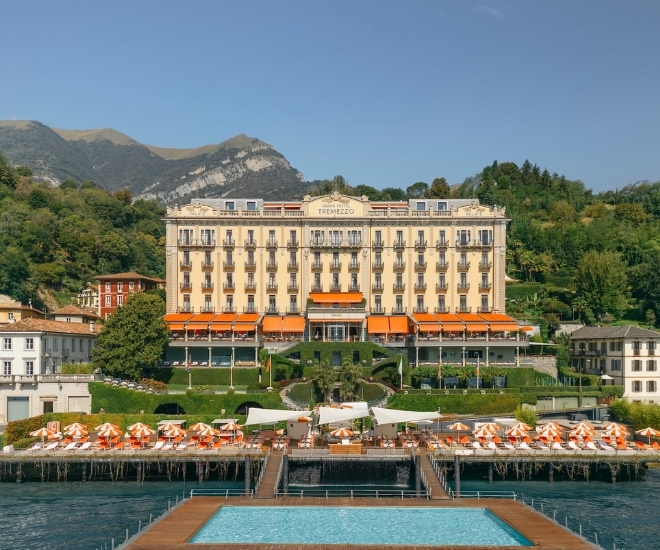
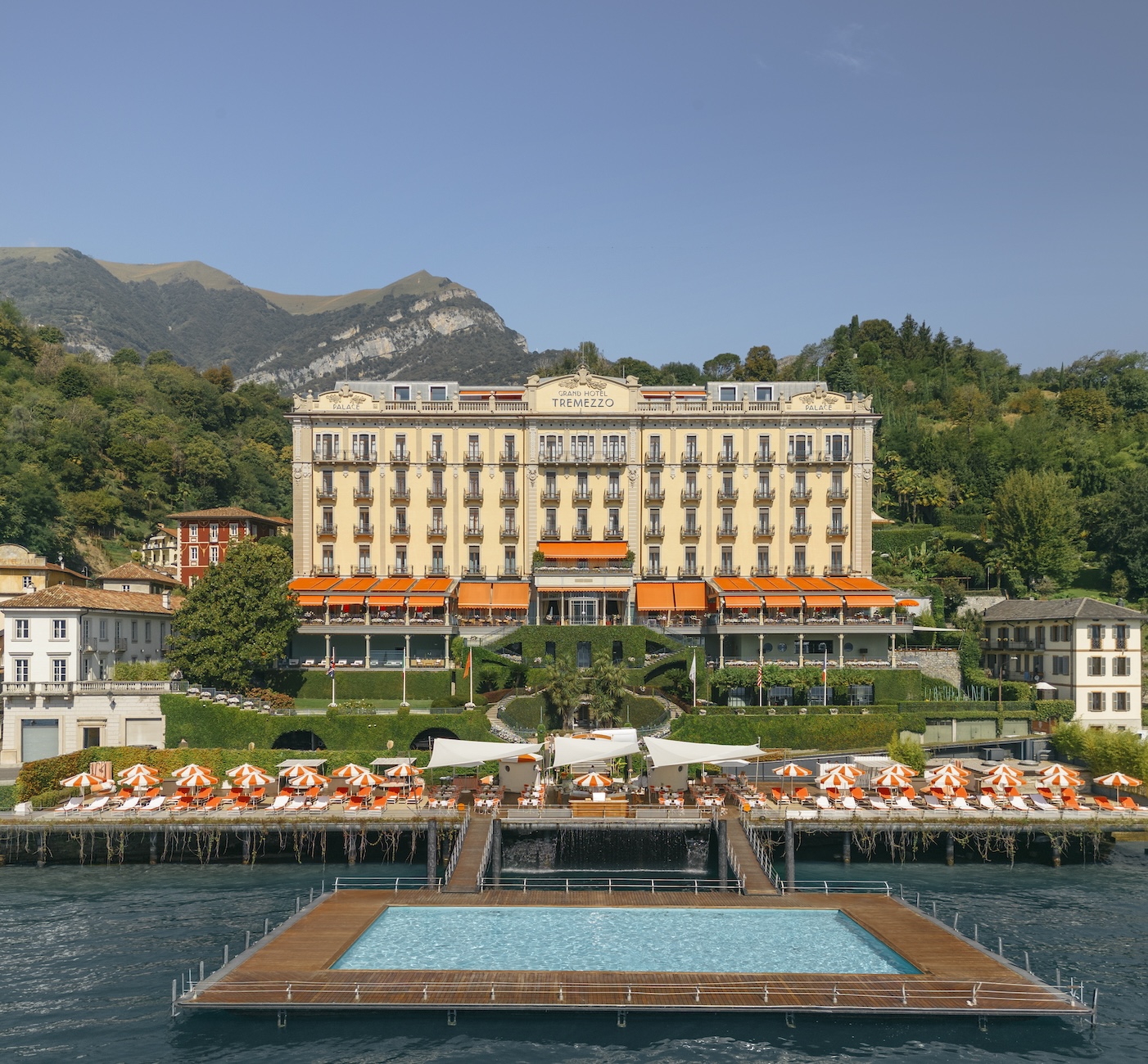
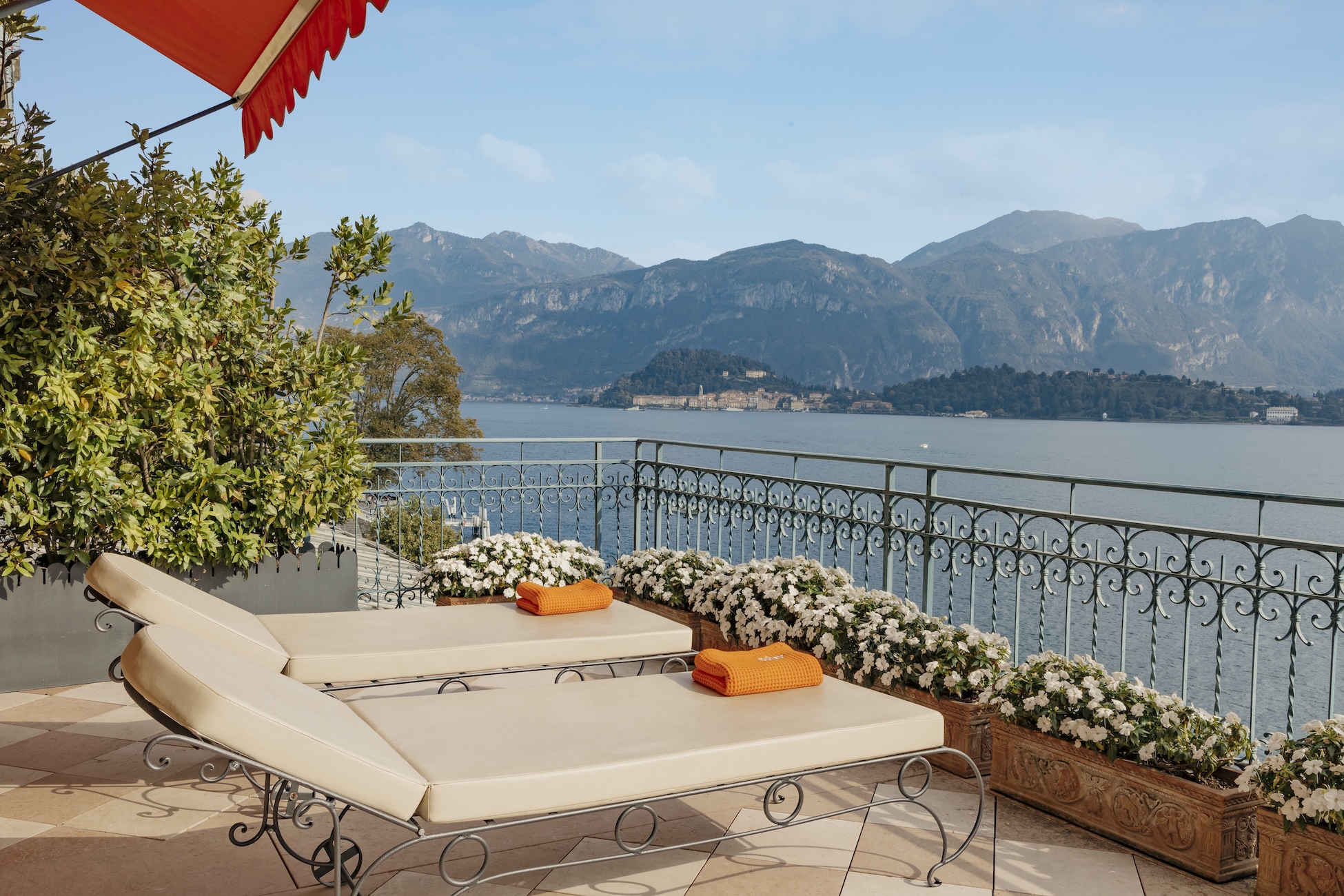
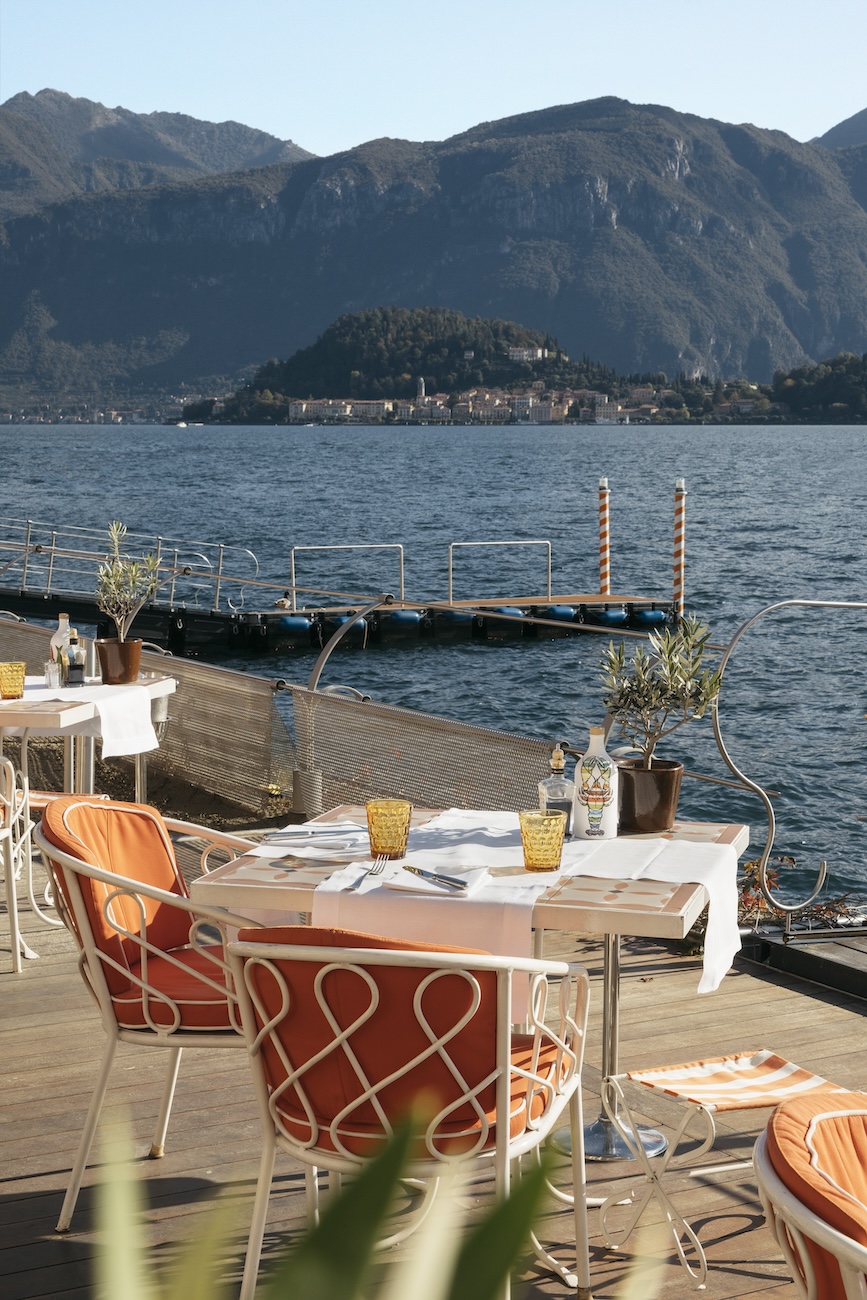
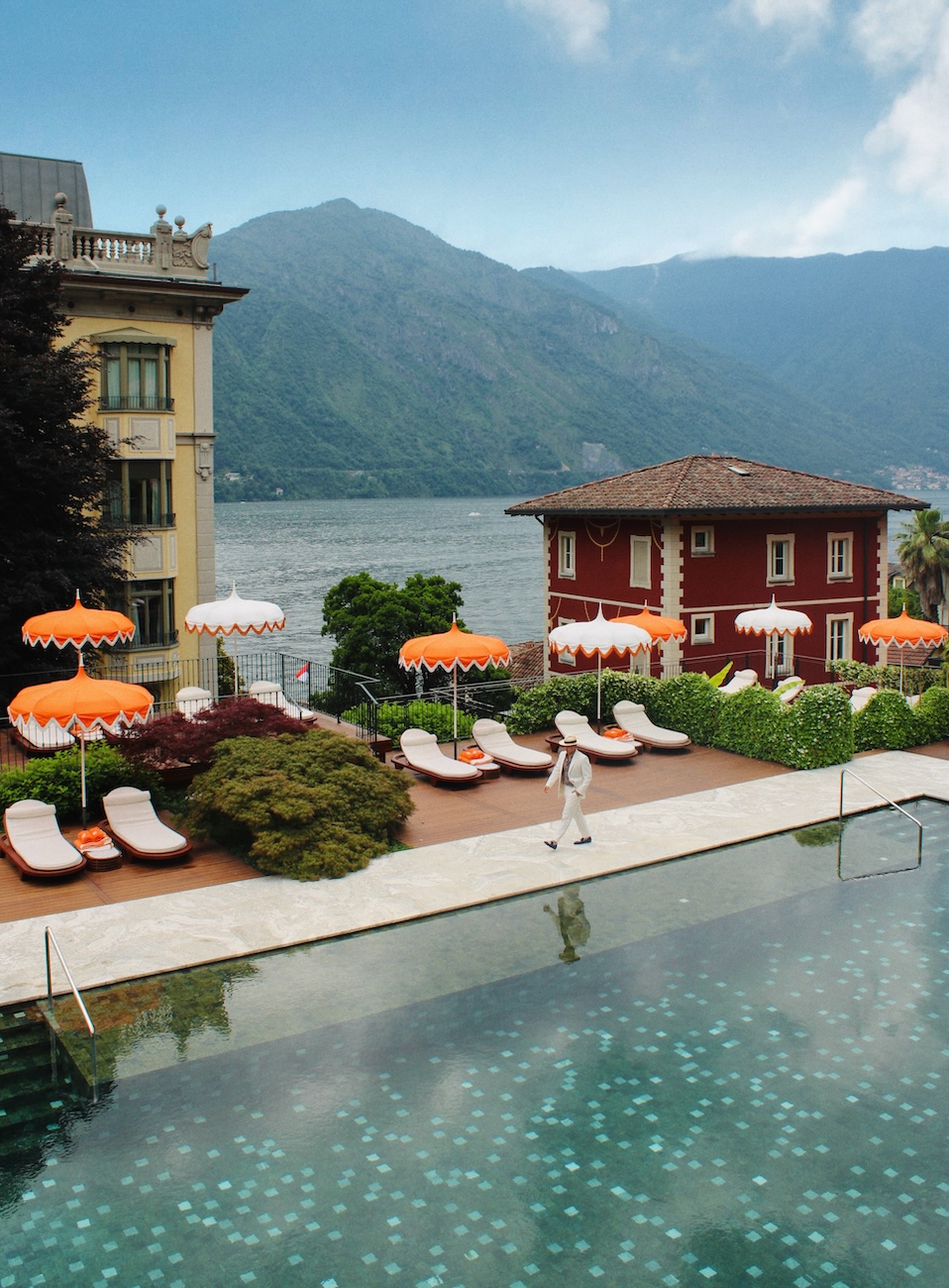
Let’s be clear: you are not here to “reconnect with nature.” A visit here sees guests waited on by a team of staff who fold napkins like origami and pour prosecco like hydration is a luxury sport. The Grand Hotel Tremezzo is not just a hotel — it is a five-star power move dressed in Italian charm. No bugs. No tents. No nonsense. Just pure, unapologetic indulgence with a view so good, you won’t soon forget.
Built for the Elite, Now Accepting Men with Taste
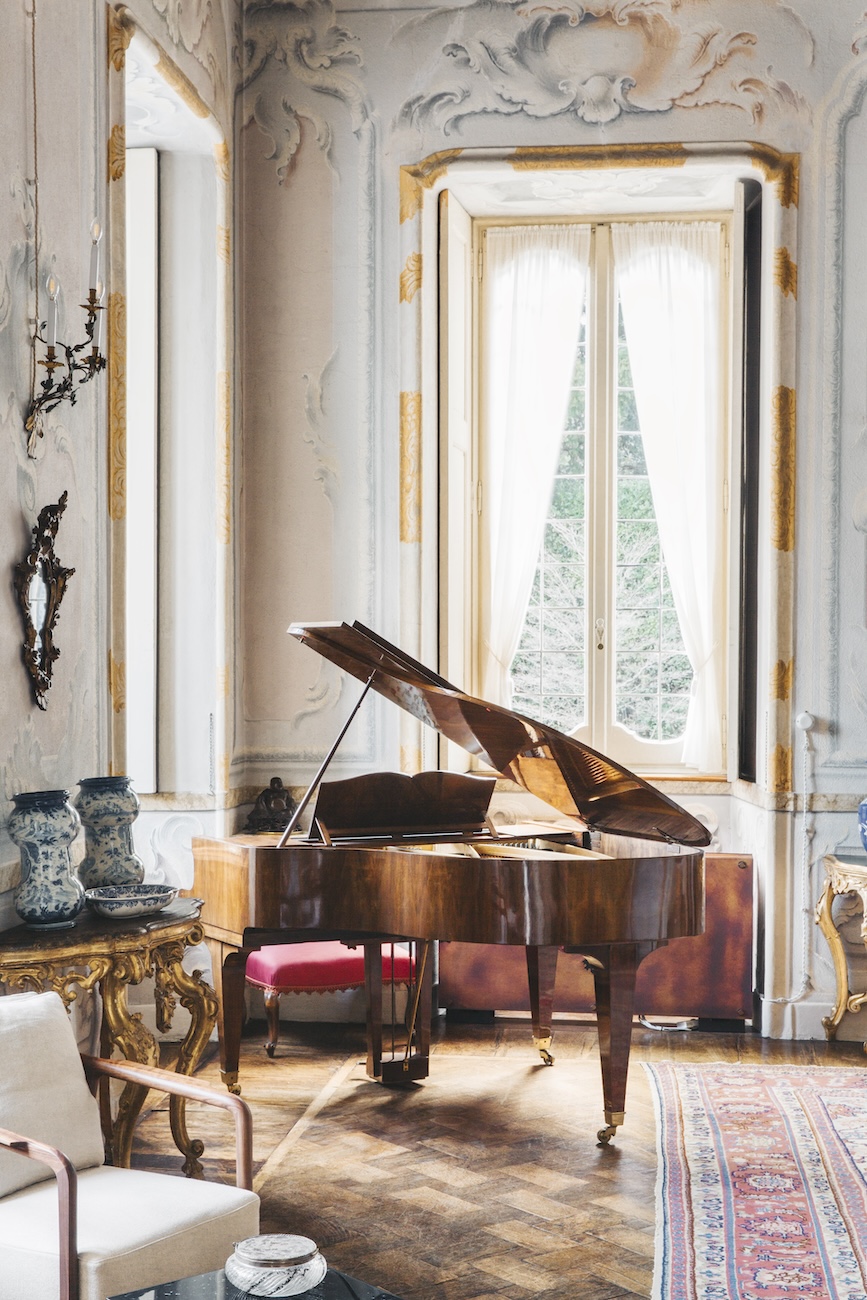
Since 1910, this location has been where aristocrats, moguls and other luxury travellers have come to relax. It is still owned by the same family, which tells you two things. The first is that they have got taste, and the second is that they will not let anything tarnish that reputation of grandeur. This is legacy luxury — where you check in and instantly forget what day it is.
The Rooms: Designed for Sleeping, Lounging, and Occasional Swagger
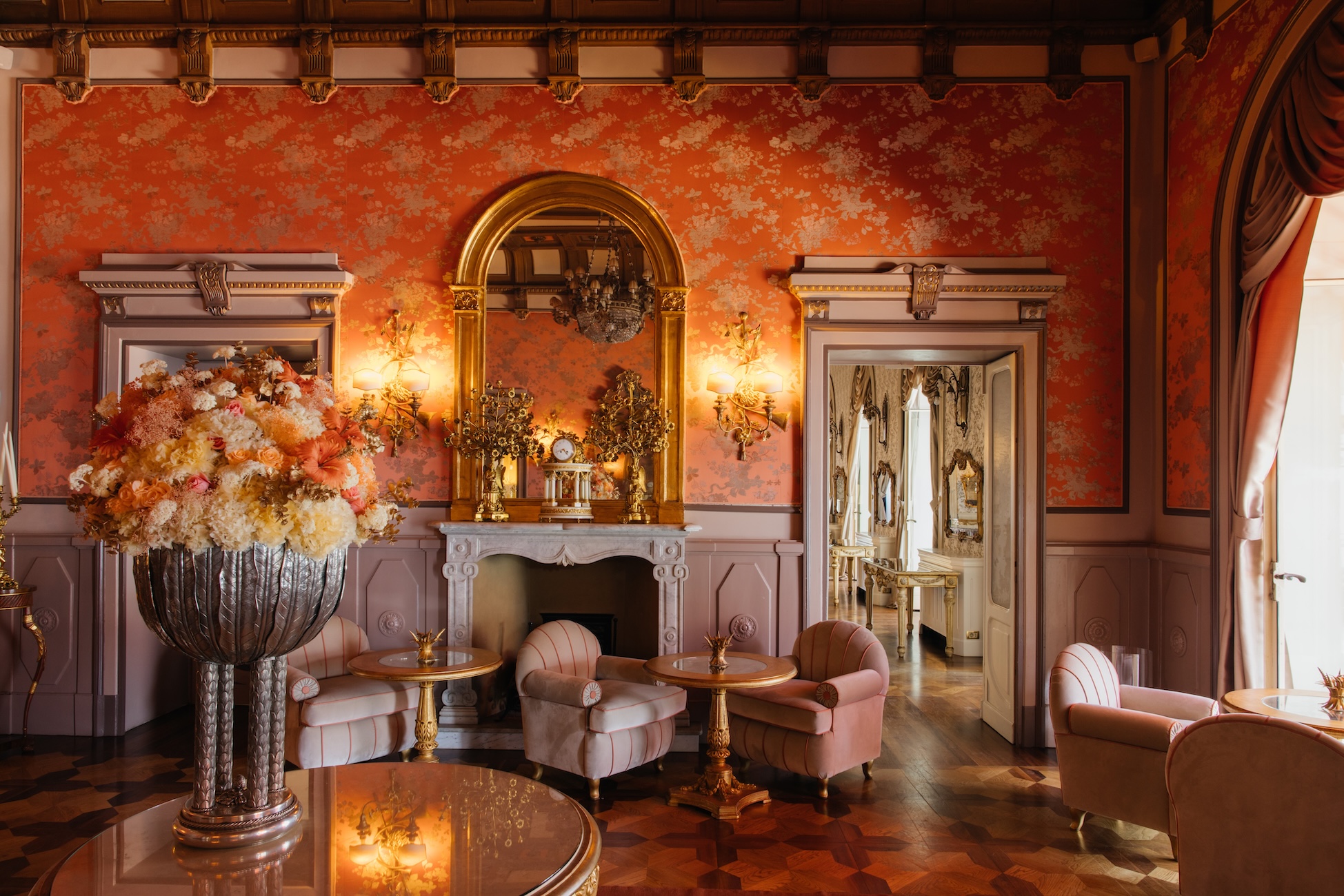
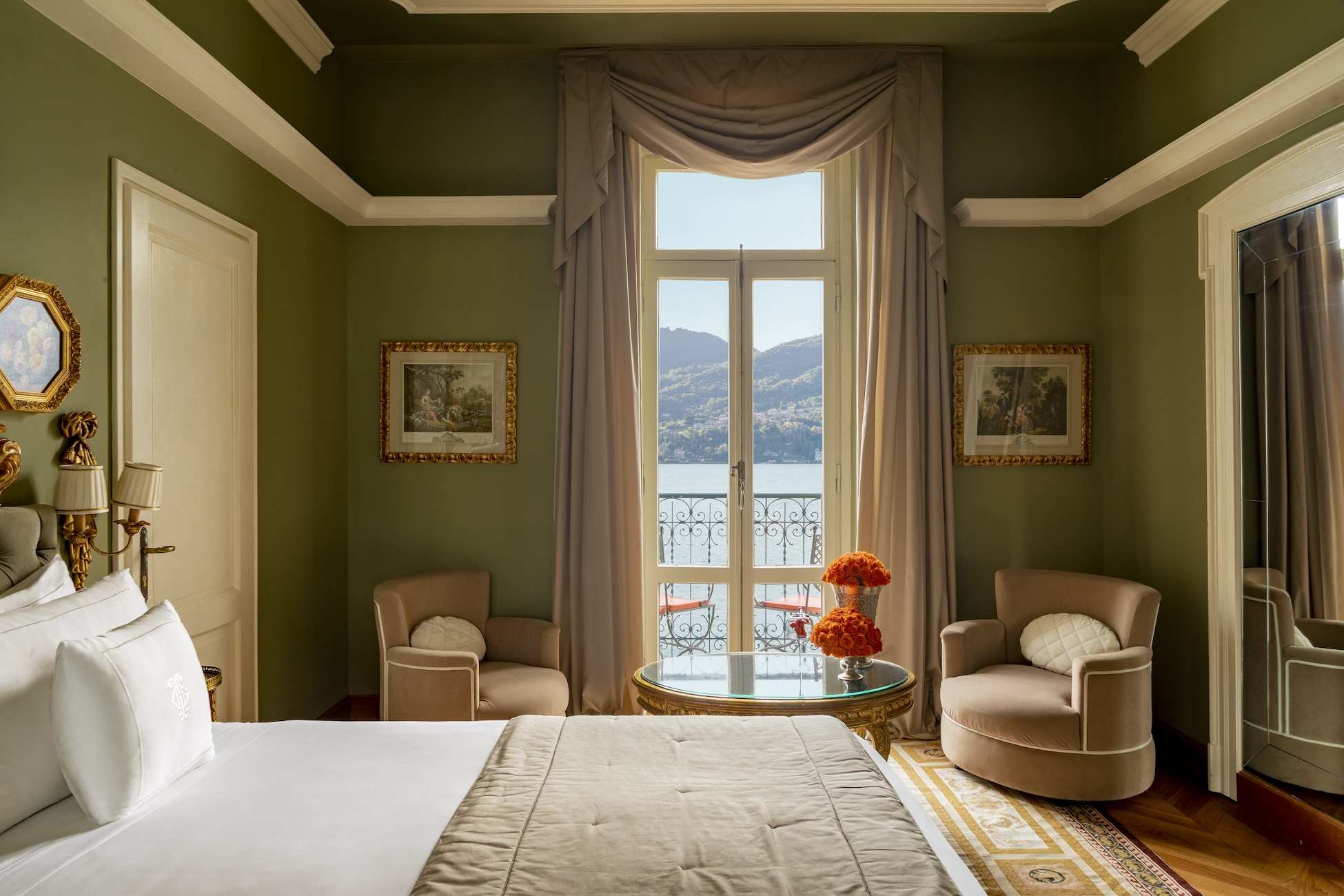
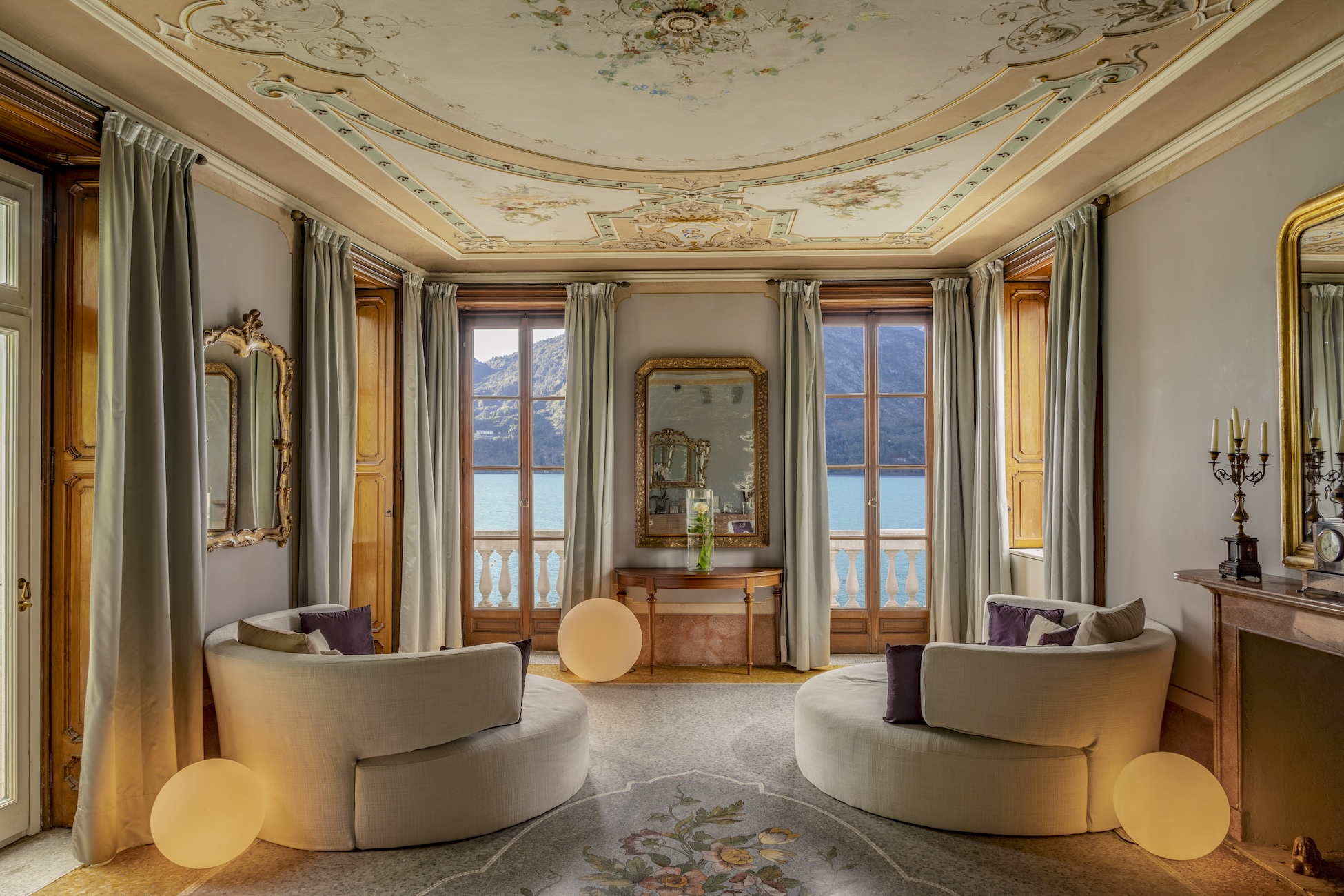
Each room feels like something out of a James Bond movie set, only minus the explosions. Think floor-to-ceiling windows, marble bathrooms and beds engineered by someone who clearly has opinions about thread count. The bedding? Softer than a whispered compliment, tougher than your morning alarm. If you are not tempted to cancel your plans and spend the day in a robe, you’re doing it wrong.
Yes, There’s Wi-Fi. No, You Won’t Use It
Sure, they have high-speed internet. But once you are parked on a sun lounger with a drink in one hand and the Alps in the background, the notion of answering emails just won’t feel the same. You are not here to connect — unless it is with the cocktail menu.
The Food: Where Even the Pizza Feels VIP
Indulge in fine dining at La Terrazza. Gold-leaf risotto? Sure. Monkfish that makes your usual takeout taste like cardboard? Absolutely. Want something more casual? Head to T Pizza by the pool. Wood-fired, hand-tossed and best enjoyed while you pretend you are not checking out the real estate nearby.
TBar: For Those Who Enjoy the Power of a Well-Timed Nightcap
Sink into a leather chair, order something aged and impressive and look like you own at least one vintage car. The atmosphere is pure understated cool — soft jazz, better-than-you cologne and a crowd that knows how to talk without name-dropping. This is where you toast victories, recover from romantic missteps, or just enjoy the best cocktail you didn’t have to make yourself.
The Crowd: Polished, Worldly and Surprisingly Chill
This is no spring break. It is more executive leisure meets espresso-fueled glamour. You will rub shoulders with fashion insiders, CEOs on downtime and couples celebrating things you will pretend not to overhear. No one is trying too hard — and that’s the point. It’s confidence, not flash. For instance, wearing a linen shirt and actually pulling it off.
The Grounds: So Good, You’ll Forget to Leave
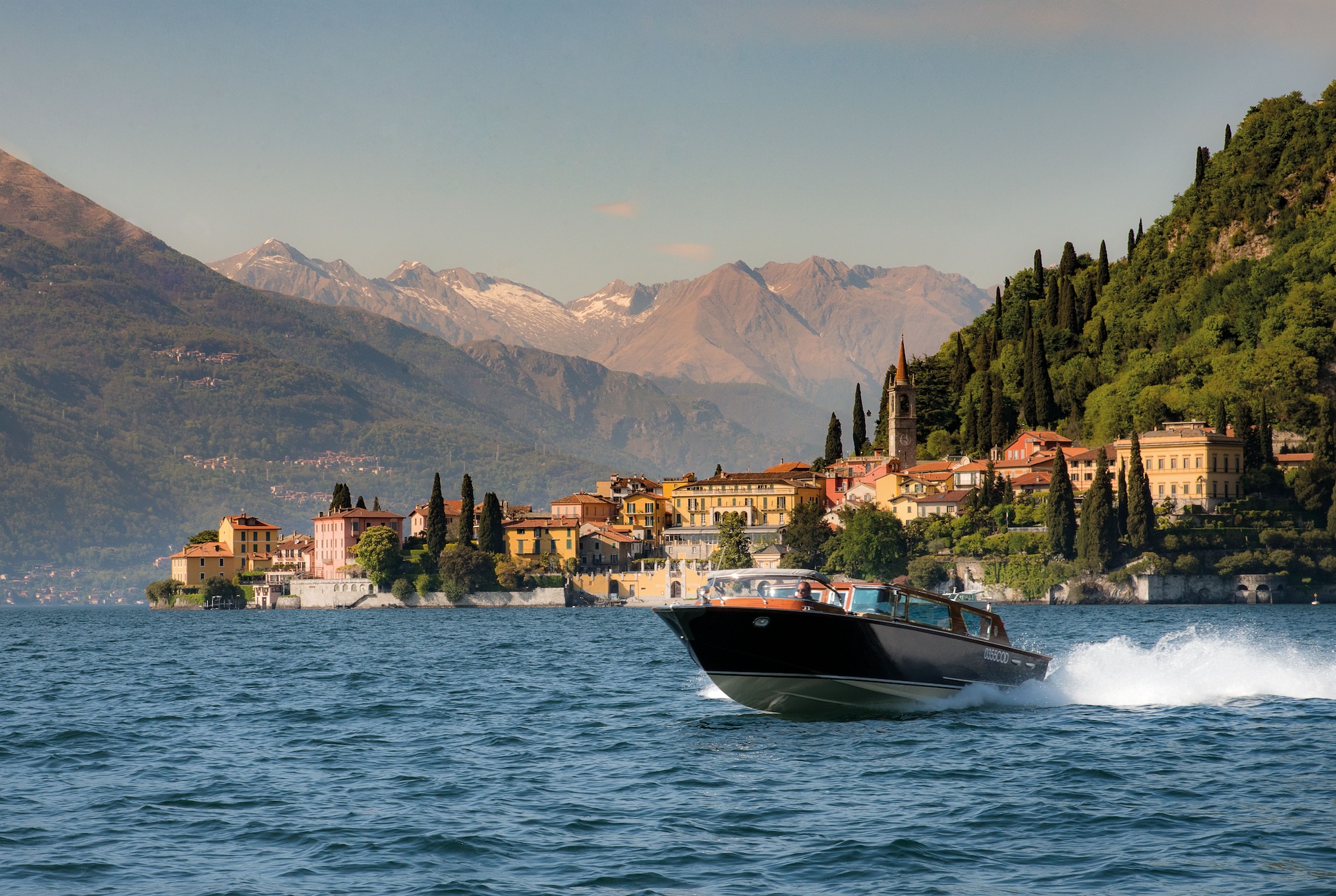
Yes, the region’s full of charming towns and lakeside villas. You should see them. But odds are, once you get a taste of the floating pool, the secret garden, or the private spa, you will politely decline all outside plans in favor of “just one more day” here. The view from your balcony alone is worth more than most vacations.
Don’t Just Book a Room. Make an Entrance.
Grand Hotel Tremezzo is not about staying somewhere fancy. It is about choosing to live very, very well for a few unforgettable days. Pack the jacket. Leave the itinerary loose. And trust us: this is one of those places that sets a new standard. You will check in as a man who “needed a break.” You’ll check out wondering why your real life doesn’t come with turn-down service and lake views.
For more on the latest in lifestyle, culture and travel reads, click here.
The Overseas by Vacheron Constantin — more specifically, the Perpetual Calendar Ultra-thin—was first released in 2016. Since then, the Maison has been slowly bolstering the line, slowly tinkering with the details. A pink gold case in 2018, a blue lacquered dial in 2019, then a skeletonised white gold iteration in 2021.
Now in 2025, they’re introducing two fresh updates: a golden-toned dial and a burgundy lacquered dial. Hot and cold, warm and sharp.
VACHERON CONSTANTIN
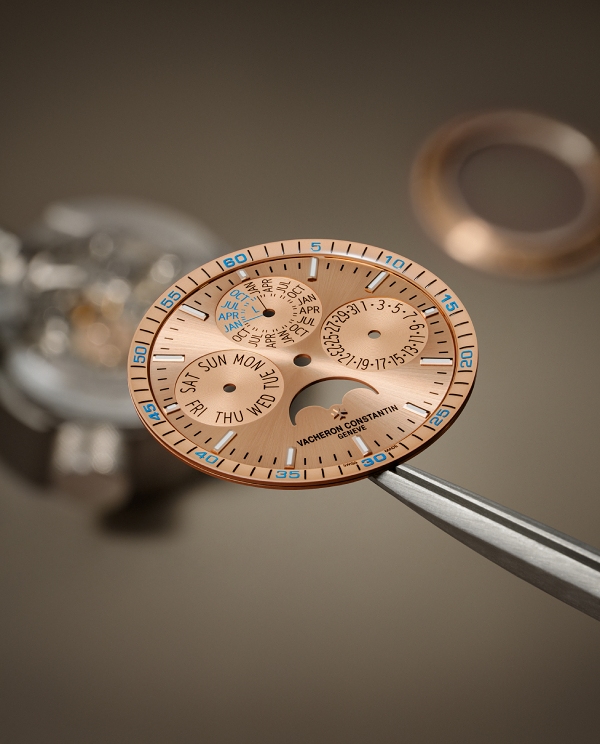
We’ll start with the fancier-looking one, the one that looks like it’s been licked by the flames of the open sun before returning a balmy mass of time-telling gold. Pink gold makes up the 41.5mm case, triple-blade folding clasp bracelet, and sunburst satin-finished dial. Only a slight touch of blue on the dial’s markers disrupts the tone-on-tone harmony.
This detail intrigues us particularly because it not only feels like a callback to the ‘90s, but also to the Crusades. Due to the extreme value of lapis lazuli back then, only the wealthiest could afford the rare synergy of blue and gold. This could be a subtle nod to the period when the Maltese Cross existed, which, of course, Vacheron Constantin has ties with. But then again, it could just be a visual pairing the Maison thought looked cool, and we’re just thinking too much into things.
VACHERON CONSTANTIN
If the golden-toned model reminds one of the sun, it’s only fair to liken its burgundy counterpart to the moon. Just as a rising moon bathes the night sky into a dim plum, the burgundy lacquer dial version distils that melancholy into a 41.5mm white gold case. The moon phase disc at 6 o’clock looks particularly dreamy (and fittingly so) set against the sunburst satin-finished dial and velvet-finished flange.
Beneath the surface, the guts of the watch remain identical of its predecessors. The self-winding calibre 1120 QP/1 still drives the perpetual calendar, displaying the date, day of the week, month, and leap year across four registers, all within a movement of just 4.05mm thick. This means that the new additions to the Overseas Perpetual Calendar Ultra-thin collection won’t be getting an upgrade to its thinness, but at 8.1mm, who’s really complaining?
Travelers dreaming of a luxury South African safari but think it’s outside their price range may be in luck thanks to a new pay-what-you-can initiative aimed at helping visitors engage with their surroundings.
It’s all thanks to Few & Far Luvhondo, a carbon-negative safari retreat in South Africa’s Limpopo province, which launched the reservation system as a way “to challenge the old ways.” The limited program opens the lodge “to anyone who needs it, regardless of budget.”
To participate, travelers must fill out an application covering their dates, the number of guests, why they are drawn to the property, and what they are able to pay. Applications are reviewed on a rolling basis.
“Travel isn’t a frivolous indulgence—it’s a vital act of connection,” Sarah Dusek, a co-founder of Few & Far Luvhondo, said in a statement shared with Travel + Leisure. “It nurtures our well-being, strengthens global empathy, and fuels the preservation of our planet. We launched this initiative with the belief that when you truly experience a place, you begin to care—and when you care, you naturally want to give back.
“By removing cost as a barrier, we’re making transformative, purpose-led travel more accessible without diluting its impact,” Dusek added. “Today, true luxury isn’t just comfort or exclusivity—it’s a conscious choice. It’s choosing responsibility, choosing connection, and choosing to leave the world better than you found it.”
Guests on a Game Drive in the Soutpansberg Mountains of Limpopo.
Jemma Wild/Few & Far Luvhondo
The luxury property, which was opened by the founders of the popular glamping brand Under Canvas, features six tented cliff suites in South Africa’s Soutpansberg Mountains, surrounded by UNESCO’s Vhembe Biosphere Reserve. Guests are treated to over-the-top amenities like private plunge pools and expansive decks to spot wildlife from, along with sustainably-minded design featuring highlights like locally-sourced eucalyptus wood.
Bespoke activities beckon from guided nature walks and scenic e-bike rides to excursions to Mapungubwe National Park where you can spot elephants, leopards, wildebeest, lions, and more. In October, the lodge plans to open a solar-powered cable car, offering a unique way to take in the landscape and wildlife that call the area home.
Few & Far Luvhondo also offers the opportunity to become a conservationist for a day, including participating in a vet visit or helping the carbon sequestration team plan shrubs, trees, and grasses.
The luxury experience is extended to dinners where you can feast on five-course tasting menus in the lodge restaurant or enjoy a torch-lit meal under the stars out in the bush.
Think of the Eiffel Tower in Paris, the Golden Gate Bridge in San Fran, Gaudí’s Sagrada Família in Barcelona, or the Taj Mahal in India—all those architectural wonders so iconic they instantly stand in for their home cities. Can you even imagine visiting and not being able to find them?
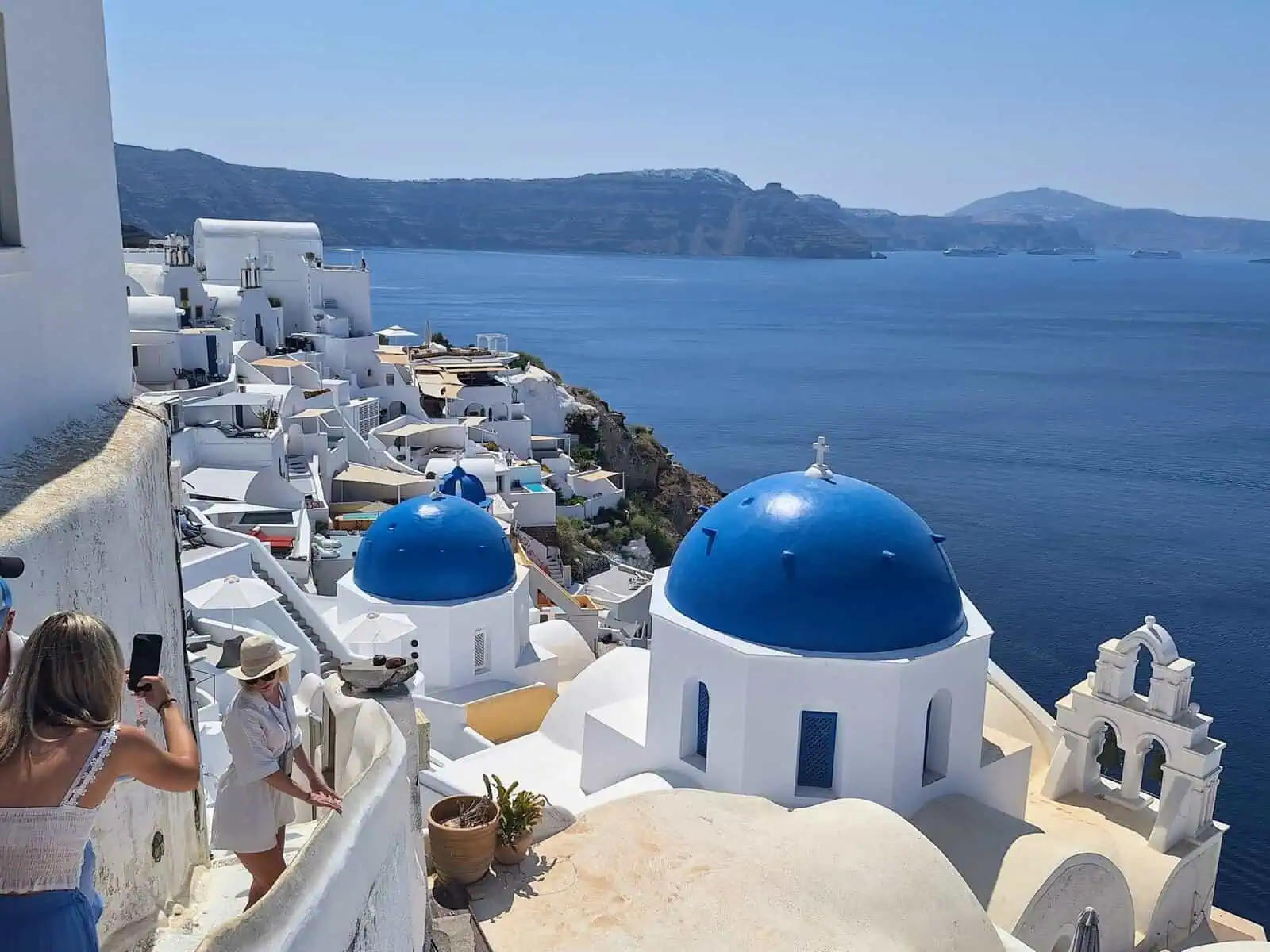
Yet that’s exactly the grand puzzle of Santorini: our famous blue domes in Santorini are shockingly hard to pin down! They’re on every guidebook cover, behind every honeymoon selfie, and even printed on Greek yogurt tubs in supermarkets thousands of miles away—so why do we locals insist on hiding them from you?
Here’s the thing we’re afraid to tell you: taking a half-decent photograph at that world-famous visual is something straight from Mission Impossible 99 or, if you like, Homer’s Odyssey. They sit behind mazes of alleyways, crammed into crevices between hotels, or atop private terraces. And when you do spot them, you’re more or less guaranteed to elbow thirty other travelers who had the same bright idea. If it’s not the other travelers, then it’s the pro photoshoots—or just the weather working against you, such as those dreaded low- and shoulder-season squalls.
The trick, as I learned the hard way throughout my years as a local tour guide, is timing. The rule of thumb being: the more famous the dome, the earlier you have to wake up.
So, here’s my guide to finding the famous blue domes in Santorini.
Here’s a snapshot:
Experience Authentic Santorini in Just 5 Hours
Discover the magic of Santorini on a small-group adventure designed to showcase the island’s most iconic spots, including the world-famous blue domes.
→ Capture the perfect photo at Firostefani’s Blue Domed Church, one of Santorini’s most recognizable landmarks. → Stroll through Oia’s charming streets, with its whitewashed houses, caldera views, and unforgettable atmosphere. → Relax at the unique Black Beach of Perivolos, where volcanic sands meet the sparkling Aegean Sea. → Explore Megalochori, a traditional village full of authentic Cycladic charm and history. → With expert local guidance, comfortable transport, and stunning views at every turn, this 5-hour experience is the ultimate way to see the best of Santorini.
Book below 👇
Mamma Oia, Here We Go Again!
Oia is the one, the big drama queen teetering on the edge between a beautiful dream and an overcrowded nightmare. The twin domes in the 19th-century heart of the village have indeed launched a thousand ships, and booked just as many flights. And they are drop-dead gorgeous even to a jet-lagged visitor—but they can also ruin your whole vacation if you come at the wrong moment.
Rookie mistake number one: arrive minutes before the sunset the first time around, camera and group primed and ready. Gorgeous glow? Sure, if you’re fine taking a quick snap over the railing and then continuing on your way. But you would be cast entirely in the shadow, not to mention the sun setting behind the buildings, entirely out of your view. The skyline was fantastic, of course, but that’s when it dawned on me: Oia’s main domes are not for sunset.
Think after sunrise but before the crowds (about between 7 a.m. and 7:45 a.m. in summer), when light pours in from the east and colors the village pale gold. Or, if mornings aren’t your thing, two hours before sunset (June to September timing)—just before the “gold” rush picture hunt begins.
What about the shoulder/low season, then, you may ask? Well, you’re in luck—March to April and October are a lot less high-stakes. The morning and pre-sunset rule still applies, but you’re on a much “looser” schedule there. 9 a.m. or one hour before sunset is just perfect!
The truth is, half the pleasure’s in finding them, especially before everyone else. Whoever said picture-taking couldn’t be competitive? On Santorini, it’s one of the two main extreme sports!
You turn off the main street down those curling, winding, gravity-defying alleys and discover that the pictures could never do it justice—the good, the bad and the wonderful.
How to Find and Capture the Famous Blue Domes in Santorini
Firo-Sorry, What Again?
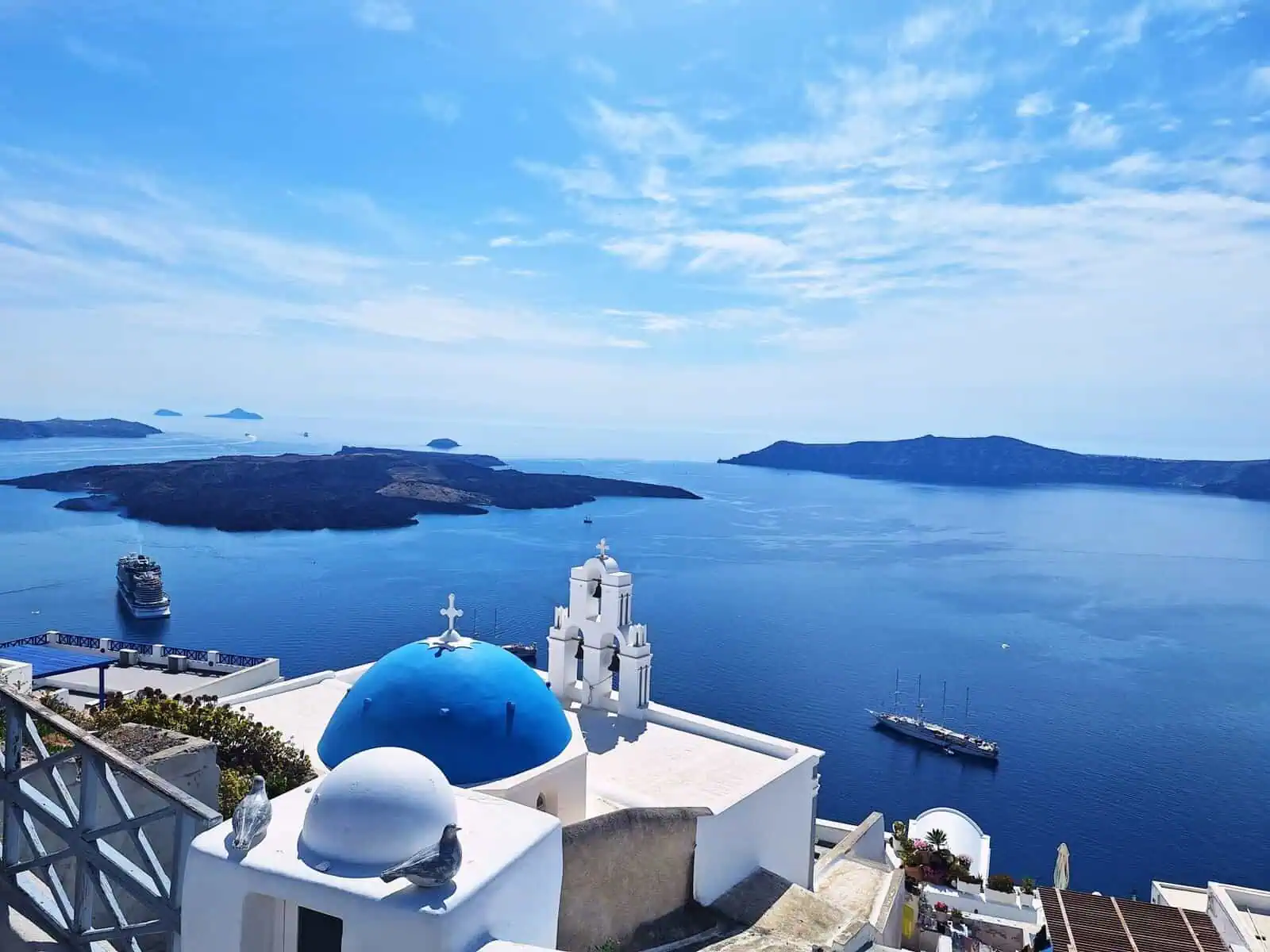
Just a tiny, briefest piece of the hike to the north of Fira (the capital), is the tiny cliffside village of Firostefani, which boasts the second most famous magazine cover of the island: the Three Bells church, a former two-cave Jesuit infirmary from the 17th century. It has delighted photographers, travel writers and local guides for decades for a very simple reason—it’s the only one where you can park and shoot, that is, the only celebrity dome that can be considered accessible by any stretch.
The other positive aspect is, you do not necessarily have to be a dawn visitor here. Rather, we tend to plan the visit around the other activities and groups in town, finding a window of opportunity when it’s less busy. Somewhere around 8:00–10:00 a.m. when the light is optimal—light enough to illuminate the dome and the caldera, soft enough to avoid harsh shadows. And the crowds coming off the cruise ships? Those are still converging around Fira proper, though beware of an occasional wedding- and/or Insta-shoot.
The true challenge? Realizing you need to go up from Saint Gerasimos square, which is, by the way, another blue-domed beauty.
How to Find and Capture the Famous Blue Domes in Santorini
Instagramville
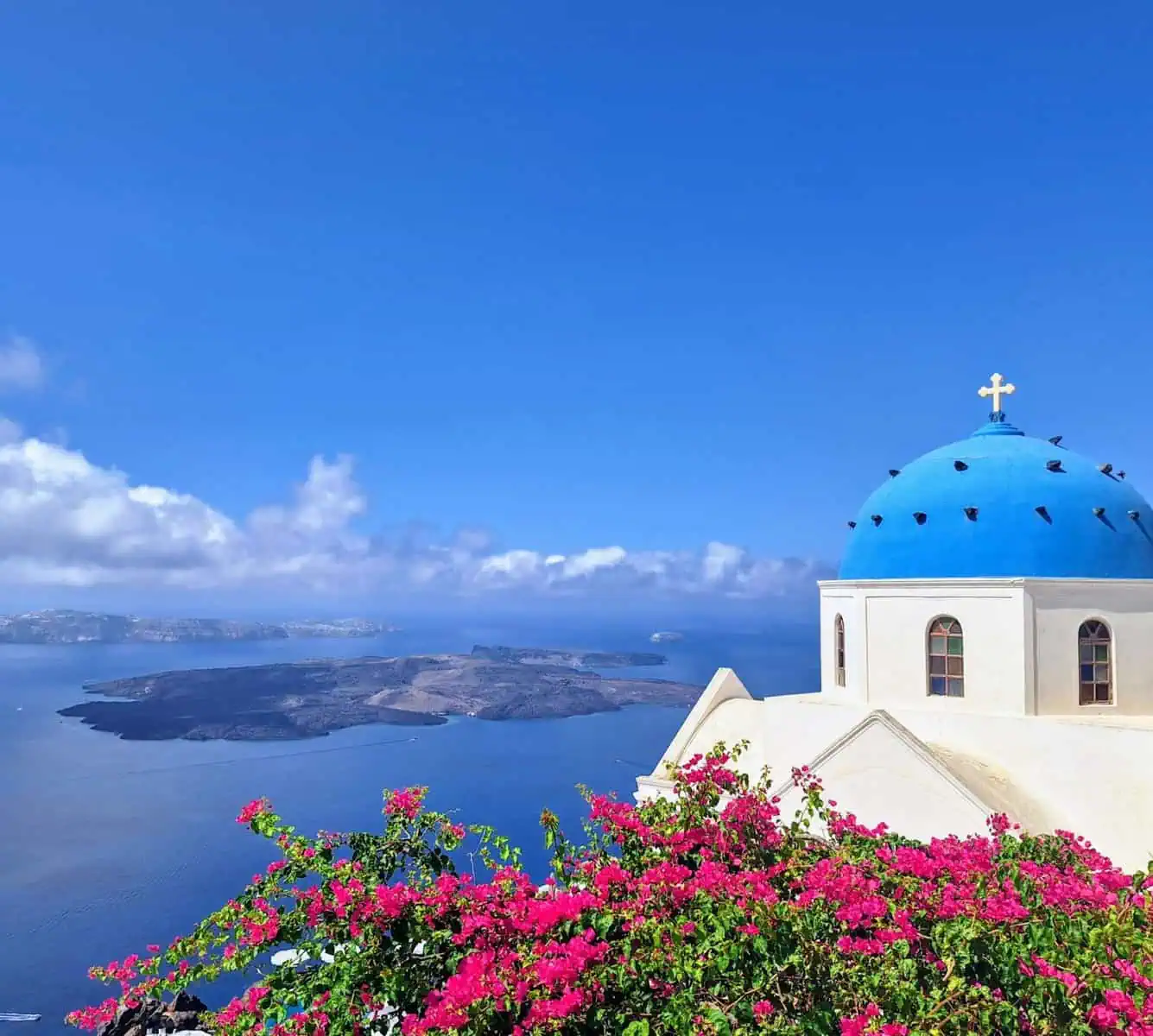
Of all the villages, Imerovigli feels the most like stepping into a photograph, with its clean, perfect white lines and sweeping angles. Perched the highest on the caldera rim (up to 1,000 feet), it’s more boutique than Oia and less commercial than Fira. Its most striking church, Anastasi, used to host an occasional destination wedding—and keeps “serving looks” and outclassing the competition.
The same rules as in Oia apply, though—come early or at the golden hour; beat the flying-dress people and other photo-chasers and enjoy the view.
How to Find and Capture the Famous Blue Domes in Santorini
Pretty-Steepos
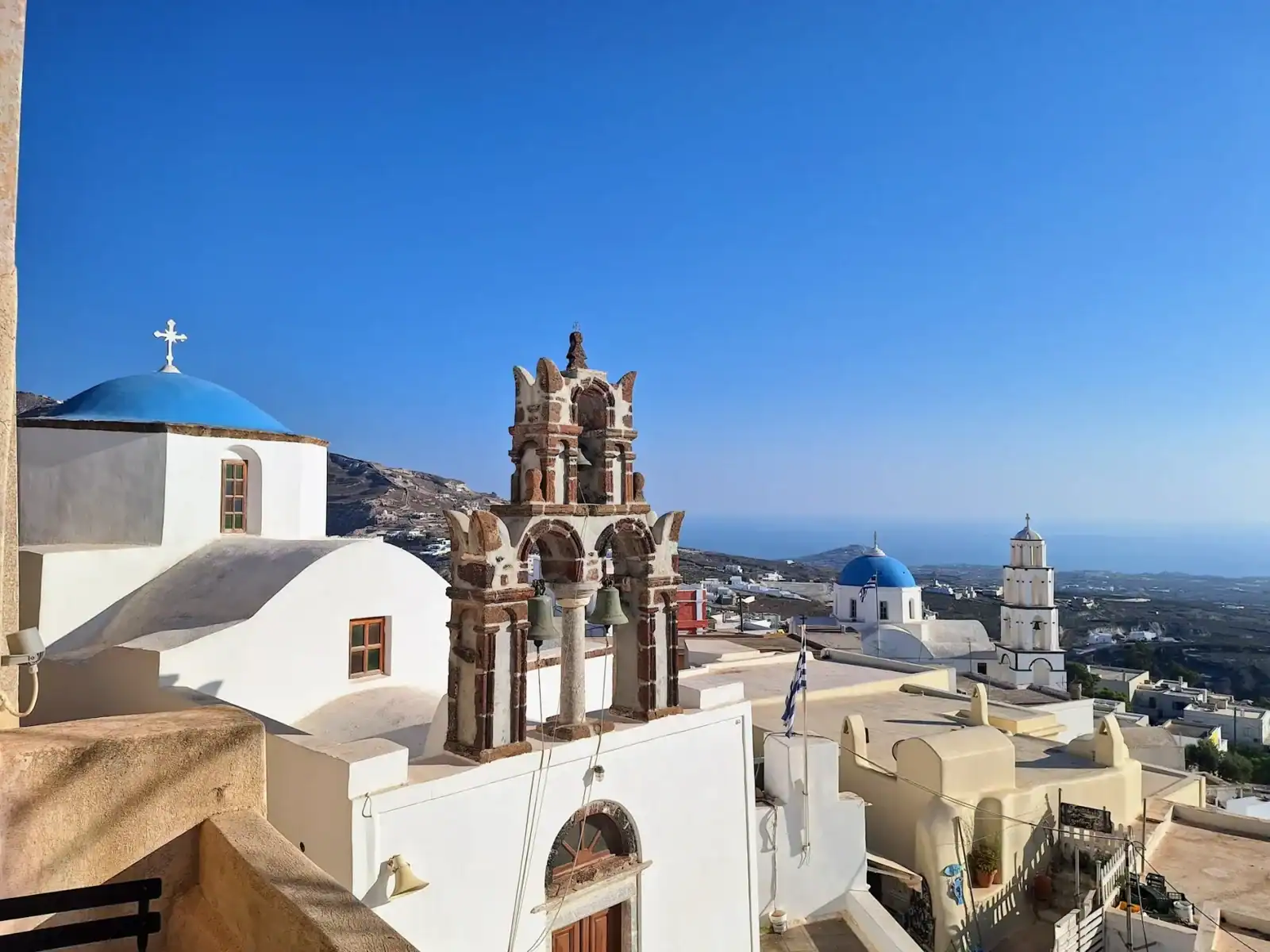
Inland, beyond the caldera, is Pyrgos, a hilltop village boasting a former capital status, more churches than houses and UNESCO-status aspirations. Here, they seem to spring out of every place: above the courtyards, hidden away between sets of stairs, stacked higgledly-piggledly along the skyline.
What’s wonderful about Pyrgos is that there is no competition for space. As early as the morning (at sunrise in the summer) or as late as the sunset, you will typically find a place to yourself, such as the wonderful Franco’s Bar or Penelope’s Cafe (did you know it sits under a blue domed church of Transfiguration of Christ and has a picture of Yannis before he got famous on their little family picture wall)?
Climb to the summit of the destroyed kasteli (castle-like wall settlement typical of the Venetian rule in the Aegean), and you will find a vista of domes below, vineyards and sea to the horizon. It is less postcard and more living, breathing village—because it is.
How to Find and Capture the Famous Blue Domes in Santorini
Bonus Blue Domes in Santorini
Still here? Well, here’s a faithful reader’s bonus:
Mesaria: Some of the best golden- hour shots I’ve ever taken—head over to the Argyros Mansion Museum / Markezinis Suites (yes, like the politician) and find Saint Dimitrios Church—you won’t be disappointed. A friend of mine and fellow guide who’s never ventured into these back alleyways truly fell in love with that view!
Megalochori: Not famous for the domes, but it should be. Even the one above the new ferry port used to host bored kids gazing into the horizon.
Perissa: Down by the Black Sand Beach by the final bus stop, and you can actually catch an evening service at ca. 7 pm. The domes here face the sea, not the caldera. Photograph them at sunrise, with the Aegean shimmering behind.
Why Timing is Everything
I’m repeating it, because it’s the most important piece of advice of them all: the more well-known the dome is, the earlier you will need to set your alarm clock.
Oia’s duo (the third one’s a belltower!)? Get there early, around 7:00 a.m. if you want them without a crowd.
Firostefani’s Three Bells? Mid-morning is okay, but by midday the light is too harsh and the heat gets you down.
Imerovigli? Don’t step on any skirt trains!
Pyrgos? Pretty much whenever, although at sunrise and sunset it’s bathed in special magic.
And if you’re tempted to go for Oia at sunset, don’t do it where the domes are. As another friend-colleague of mine does, come after dark—and admire the beautiful illumination of the glowing pools and Venus / Afroditi star in the sky.
Santorini’s domes are its hallmark, but they weren’t built to be easy on your feet (just the eyes!). In fact, their location tended to be a sort of anti-pirate defence, protecting the families’ most precious relics. It takes early mornings, stubbornness, and a whole lot of patience.
But then, they’ll yield the photograph you crossed the seas for—and perhaps something more: a perfect moment when everything just comes together for you, the light is soft, and the domes are radiant because, and perhaps only because, they are yours to admire, if not touch—exactly like the sky they seek to mirror.
We offer a range of services designed to make your time in Santorini, Thessaloniki, Halkidiki, and Athens truly unforgettable. Whether you’re looking to kick back and relax, dive into some adventure, or mix a bit of both, we’re here to help you craft the perfect experience.
We offer a range of services designed to make your time in Santorini, Thessaloniki, Halkidiki, and Athens truly unforgettable. Whether you’re looking to kick back and relax, dive into some adventure, or mix a bit of both, we’re here to help you craft the perfect experience.
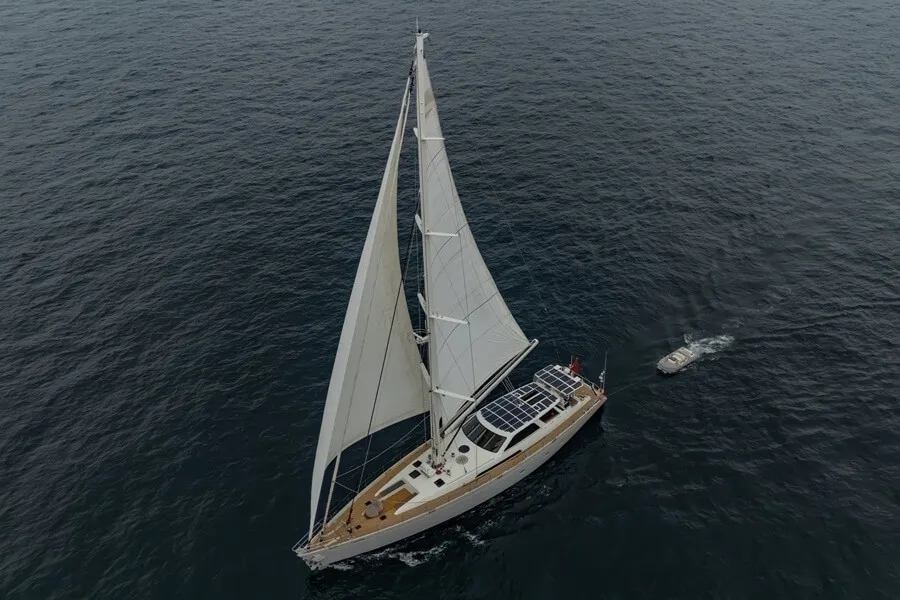
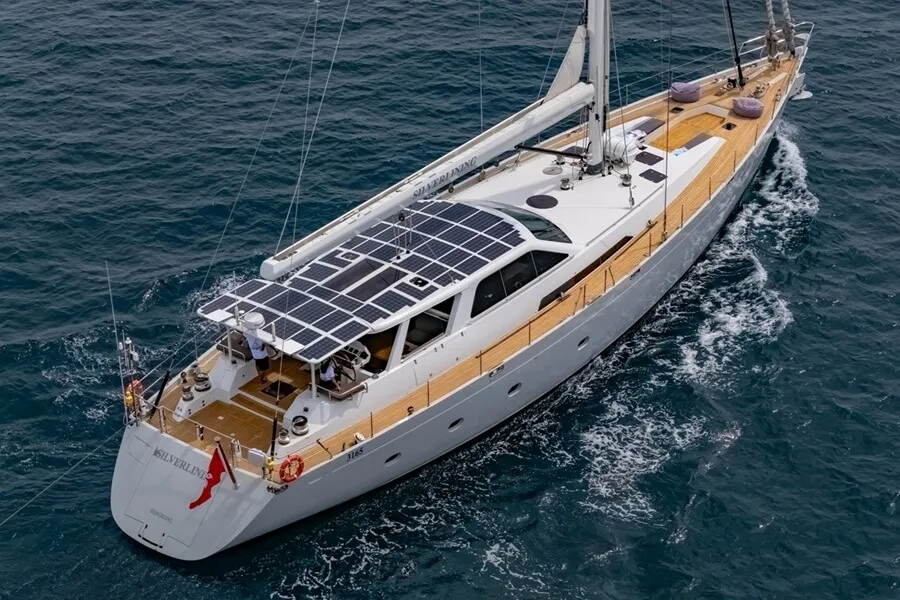
Silverlining has a carbon mast and boom, and Harken sailing system
From the very beginning, SilverLining was destined to be a world explorer. The brief from her first owner was to build a superyacht that could be used by him and his family to circumnavigate the world on a multi-year expedition, with his children being home-schooled while on board.
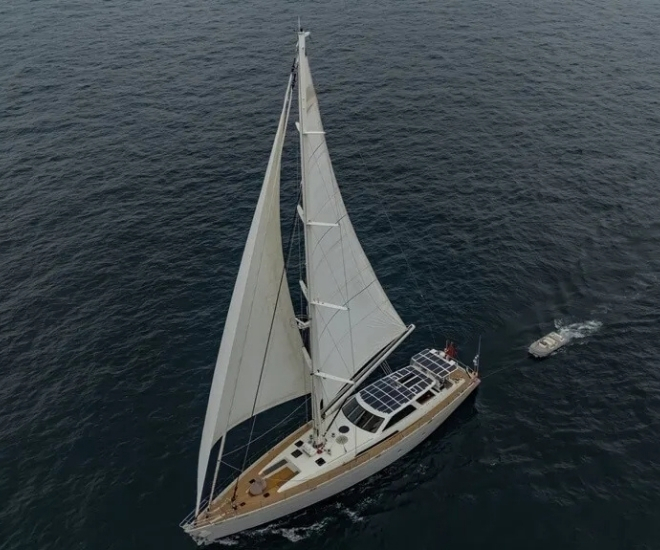
Designed by Sparkman & Stephens in collaboration with the owner, the result was a 31.6m, 120GT aluminium sailing yacht, constructed at the Phithak shipyard in Thailand, built to ABS class and launched in 2011. Her broker describes the layout of the S&S 104’ RS (Raised Saloon) as “tailored to tropical cruising”.
SilverLining’s entire coachroof and cockpit hardtop are covered by solar panels
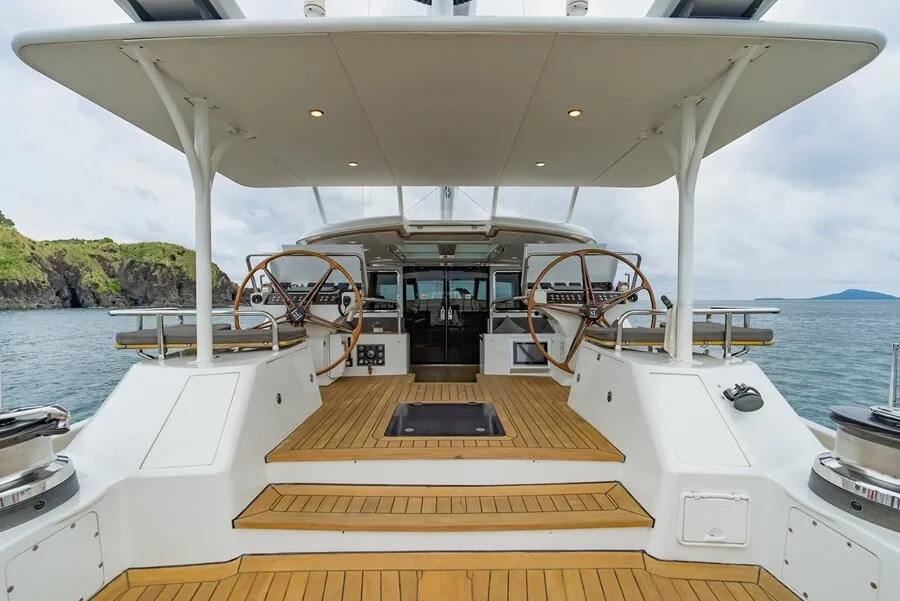
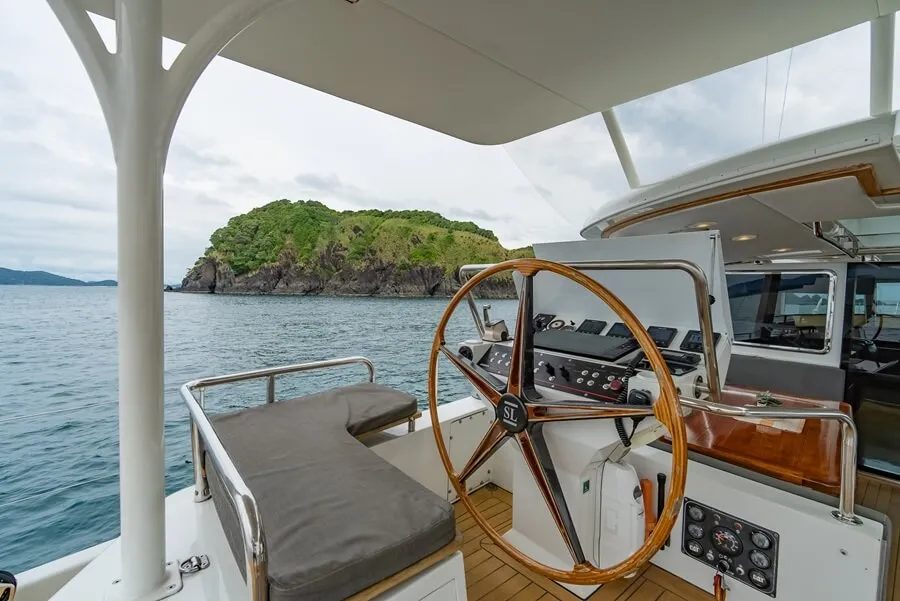
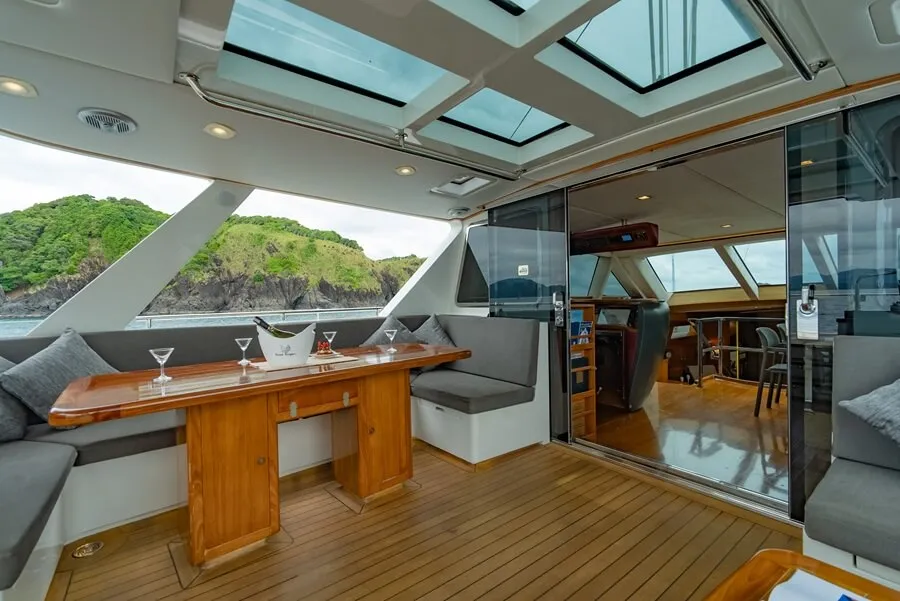
The covered cockpit has two spacious helm stations, each with a huge yet stylish steering wheel. Forward of the port wheel is an alfresco dining area illuminated from above by four rectangular skylights in the hardtop.
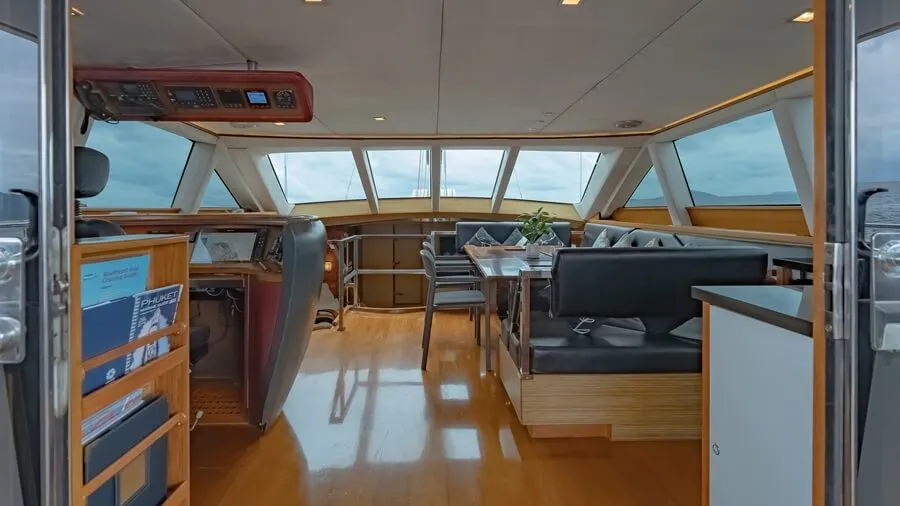
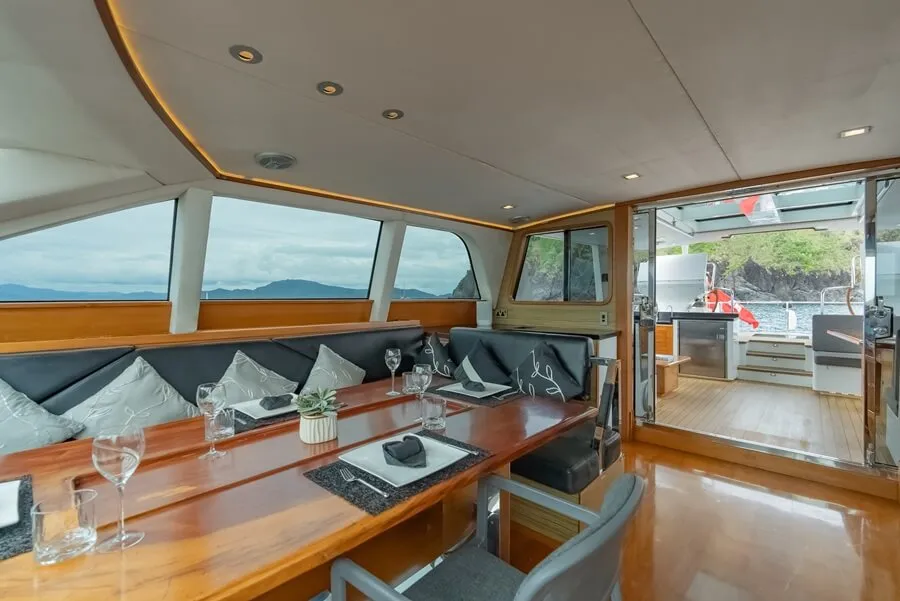
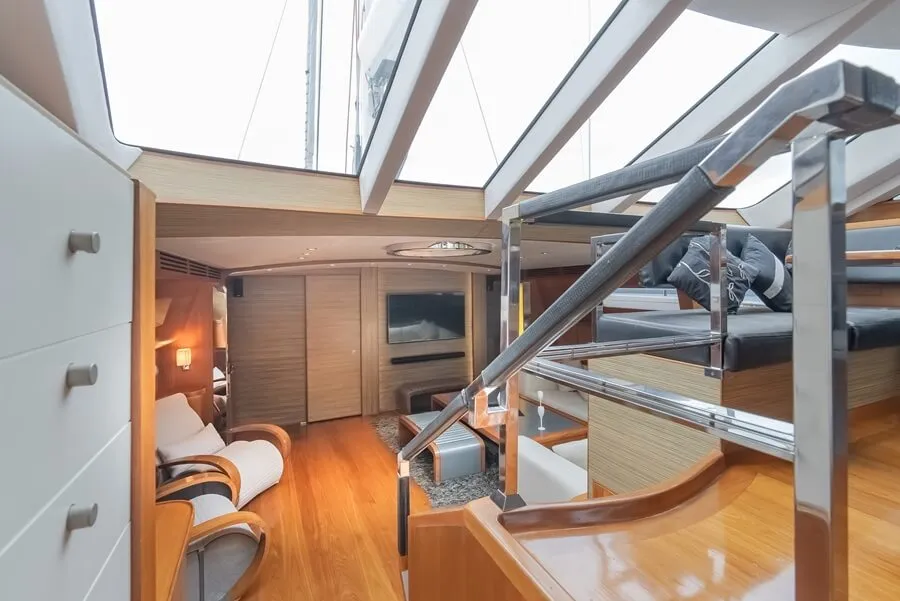
SilverLining’s interiors, designed by Chris Lenz, are finished in classic-style wood panelling and offer light, cooled entertaining spaces. Entered via large sliding doors, the interior starts with a high-tech, semi-cocooned helm ‘pod’ opposite a dining table arranged lengthways.
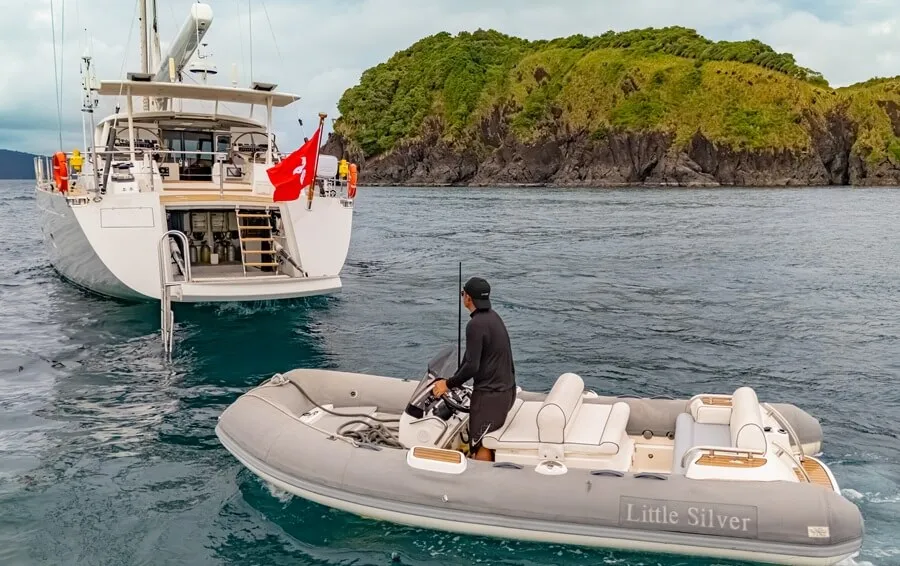
A 16ft Williams diesel-jet tender is among water toys
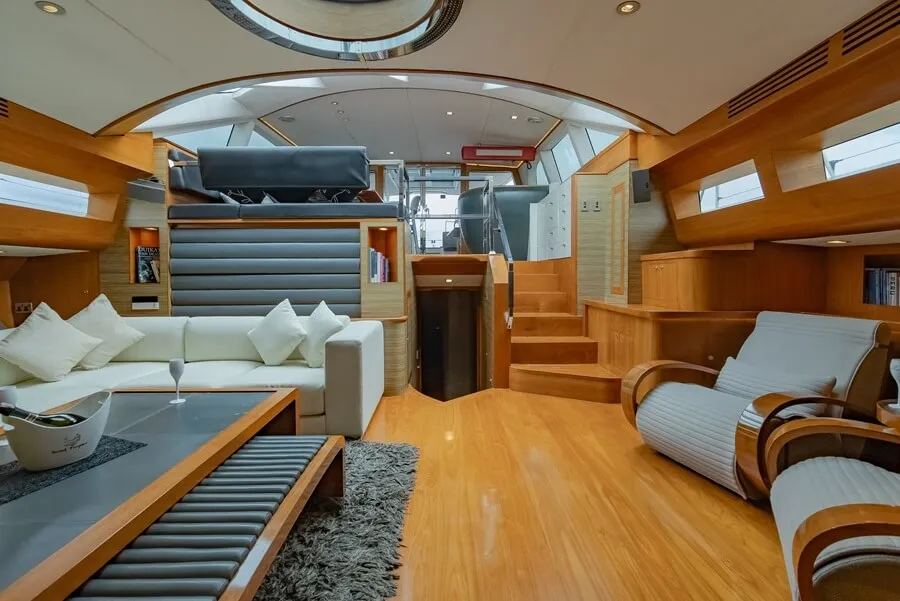
Six steps down leads to the lounge, where a pair of attractive, curved wooden chairs face a coffee table, stools and an L-shaped sofa. Aft of the lounge are the four guest cabins, which include an ensuite VIP facing a double cabin with sliding-door access to a room with bunk beds.
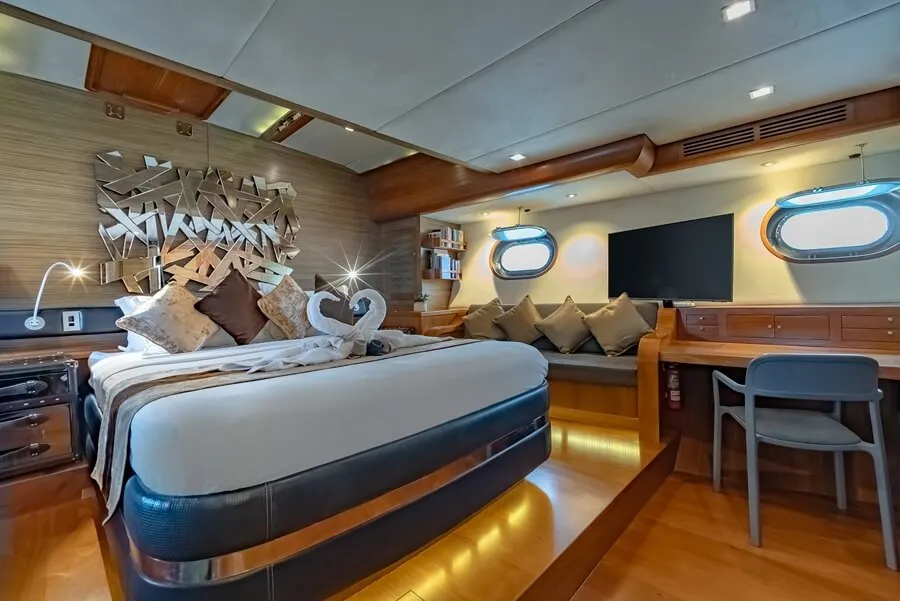
At the end of the lobby is the full-beam master suite, where there’s a window-facing desk and a showpiece bathroom with a bespoke, hand-crafted wooden bathtub. The crew area is forward of the lower lounge and includes the galley, crew dining, laundry area, captain’s cabin and two twin cabins.
BUILT FOR THE LONG HAUL
However, it’s SilverLining’s performance at sea that makes the superyacht stand out from the crowd – and what attracted her second and current owner to purchase the superyacht in 2018. “SilverLining is a remarkable vessel with a host of sophisticated systems and an impressive layout,” he describes.
The covered cockpit offers good sight lines from each helm
“During the first visit, the width and high freeboard of SilverLining were immediately striking,” he recalls, adding that these details together with her weight “have been beneficial in maintaining comfort and stability through the waves”.
On a technical level, the owner notes that the carbon mast and boom by Italy’s Maxspar, along with Hundeberg steering and Harken sailing systems powered by hydraulics “contribute to her exceptional performance”.
Despite not having a spinnaker or gennaker on board, SilverLining can reach speeds of 11.5 knots under sail, though her owner attests that “she has not been pushed to her absolute limits yet”.
Each outdoor helm has an L-shaped bench and attractive SL-branded wheel
He details that SilverLining has cruised comfortably in windspeeds of up to 35 knots and in waves of up to 4m. “At no point did the crew and guests feel endangered by wind or sea state, even during the numerous squalls typical of Southeast Asia”.
When conditions are not suitable for sailing, SilverLining can rely on her 480hp Caterpillar engine and large fuel capacity of 10,000 litres to help her reach far-flung destinations.
“SilverLining’s performance under both sail and power has proven to be reliable and efficient, making her well-suited for destination cruising,” her owner declares.
There’s alfresco dining forward of the port helm
EXPLORER’S SPIRIT
Following in the spirit of the original owner’s intentions, the second owner of SilverLining bought her to sail extensively across tropical destinations. Throughout his ownership, he and his family covered 16,500nm, spending as much as 10 months on board each year.
To date, SilverLining has an impressive 50,000nm of cruising under her belt, much of which has taken place in Asia-Pacific’s warm waters.
Before putting her up for sale, her current owner extensively sailed SilverLining across the region, exploring Indonesia in depth with visits to Bali, Lombok, Komodo, Flores, the Anambas Islands, the Riau Archipelago and even West Papua.
Sliding doors open to the indoor helm and dining area
Other adventurous destinations on the SilverLining itinerary included Thailand, Malaysian Borneo, as well as Palawan and its surrounding islands in the Philippines.
A large garage with a fold-out platform and a fleet of water toys – including a 16ft Williams diesel-jet tender, dive gear, kayaks, paddleboards and game fishing gear – also contributed to the creation of memorable experiences for the owner and his family.
Recalling his years spent on the superyacht, the owner states: “Life aboard SilverLining is filled with unforgettable moments and cherished routines”.
Aft view of the upper saloon
He specifically pinpoints watching sunrises and sunsets from the deck as standout memories from his time aboard. And when not being enjoyed by her owner, SilverLining was also a successful charter yacht in the region.
TIP-TOP CONDITION
The owner adds that “SilverLining is in top shape”, following a major refit during 2022 and 2023. The project featured upgrades made to the navigation and communication systems, alongside a complete rigging replacement and full engine overhaul.
Interiors were also refreshed during the refit, with the installation of a Starlink Wi-Fi system throughout the yacht, the replacement of all cabin TVs, and new appliances added in the galley. To ensure additional safety during long stretches at sea, a full MCA Category A medical kit (MSN 1905 compliant) was also brought on board.
Steps down to the lower lounge
Her eco-conscious owner further enhanced the yacht by installing custom-made solar panels on the roof, providing a sustainable power supply for SilverLining’s domestic, navigation and emergency needs.
“All these upgrades have added at least €1 million to the investment, significantly improving SilverLining’svalue, safety, performance and comfort, making her a standout vessel,” he states.
After many years of exploring Asian waters, her current owner is now ready to spend more time with his extended family back on shore.
Aft view of the lower lounge
He is searching for a new custodian who will continue to use SilverLining to her full potential, as a yacht that “offers a unique opportunity to explore the world, experience the beauty of the ocean, and find peace and reflection in the process”.
Although Southeast Asia may be familiar territory, her owner confirms that SilverLining has the potential to go even further afield. He notes that her hull and topside possess the necessary “durability and strength” for more tasking voyages to locations such as Alaska and Antarctica.
SilverLining is listed for sale with Fraser, with an asking price of US$3.5 million. She is currently stationed in Phuket, with plans for one last exploration to Raja Ampat Marine National Park, until she meets her new owner.
The full-beam master suite is one of four guest cabins
“The ideal owner for SilverLining would be someone who appreciates the vessel’s sophisticated systems, formidable layout, and the extensive upgrades and customisations that have been made,” the owner states.
“This person would likely value the comfort, performance and safety features that SilverLining offers, and have a passion for cruising and exploring beautiful destinations. I trust that the next owner will find as much joy and fulfilment in SilverLining as I have.”
For more information visit fraseryachts.com
This article was first seen on YACHT STYLE.
For more on the latest in luxury yachting reads, click here.
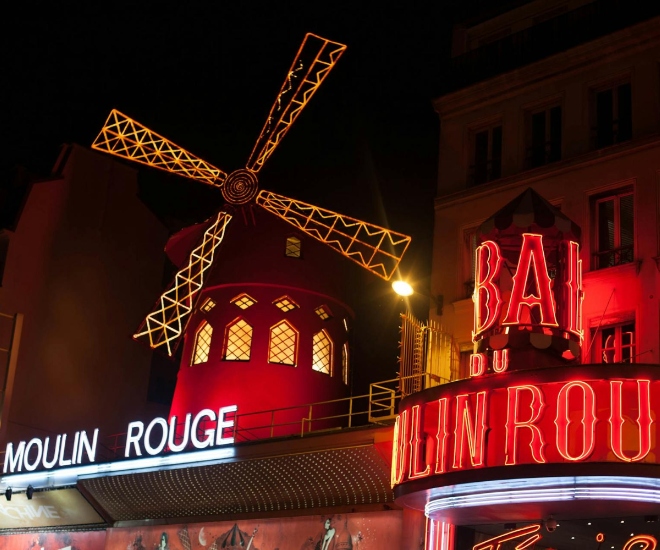
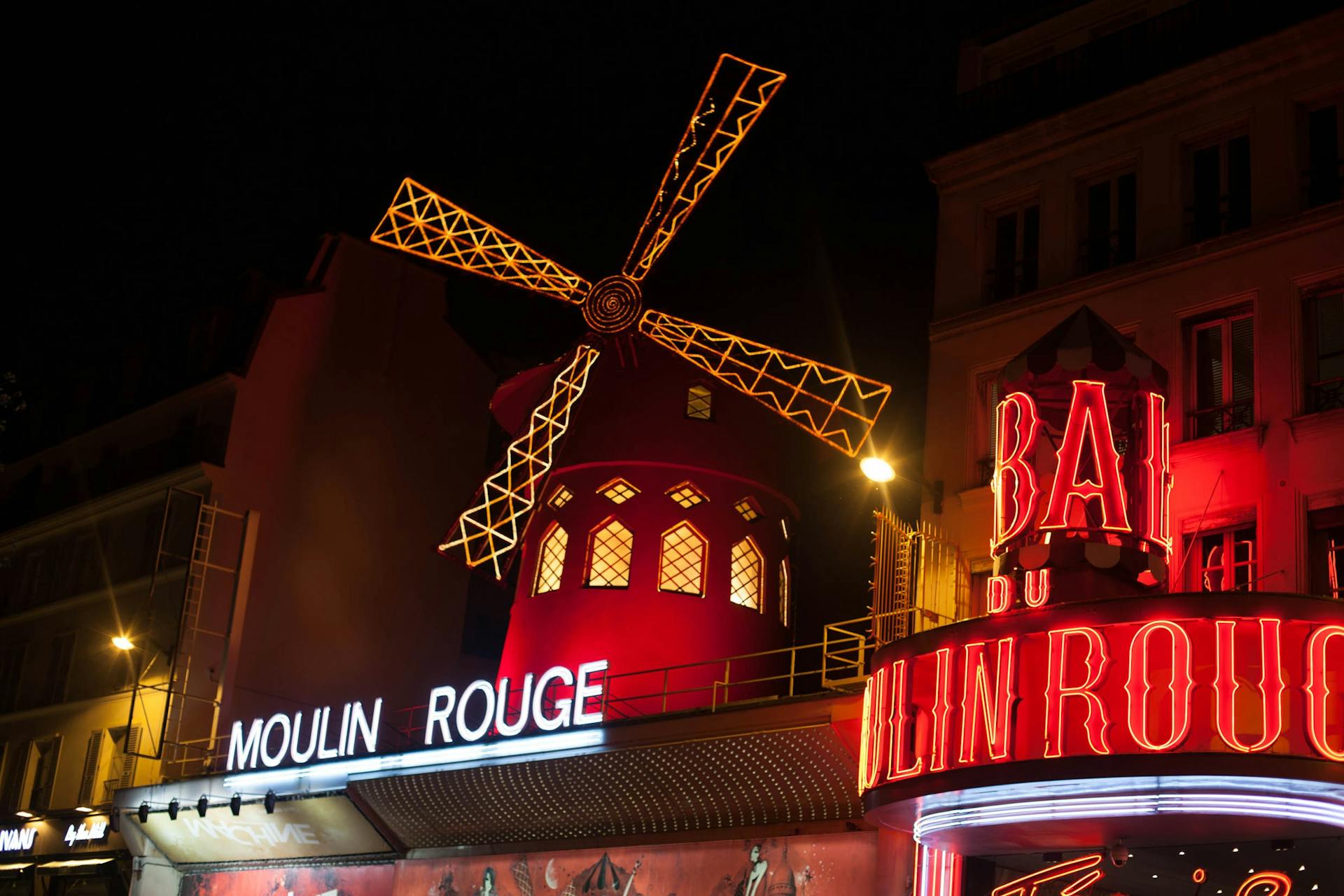
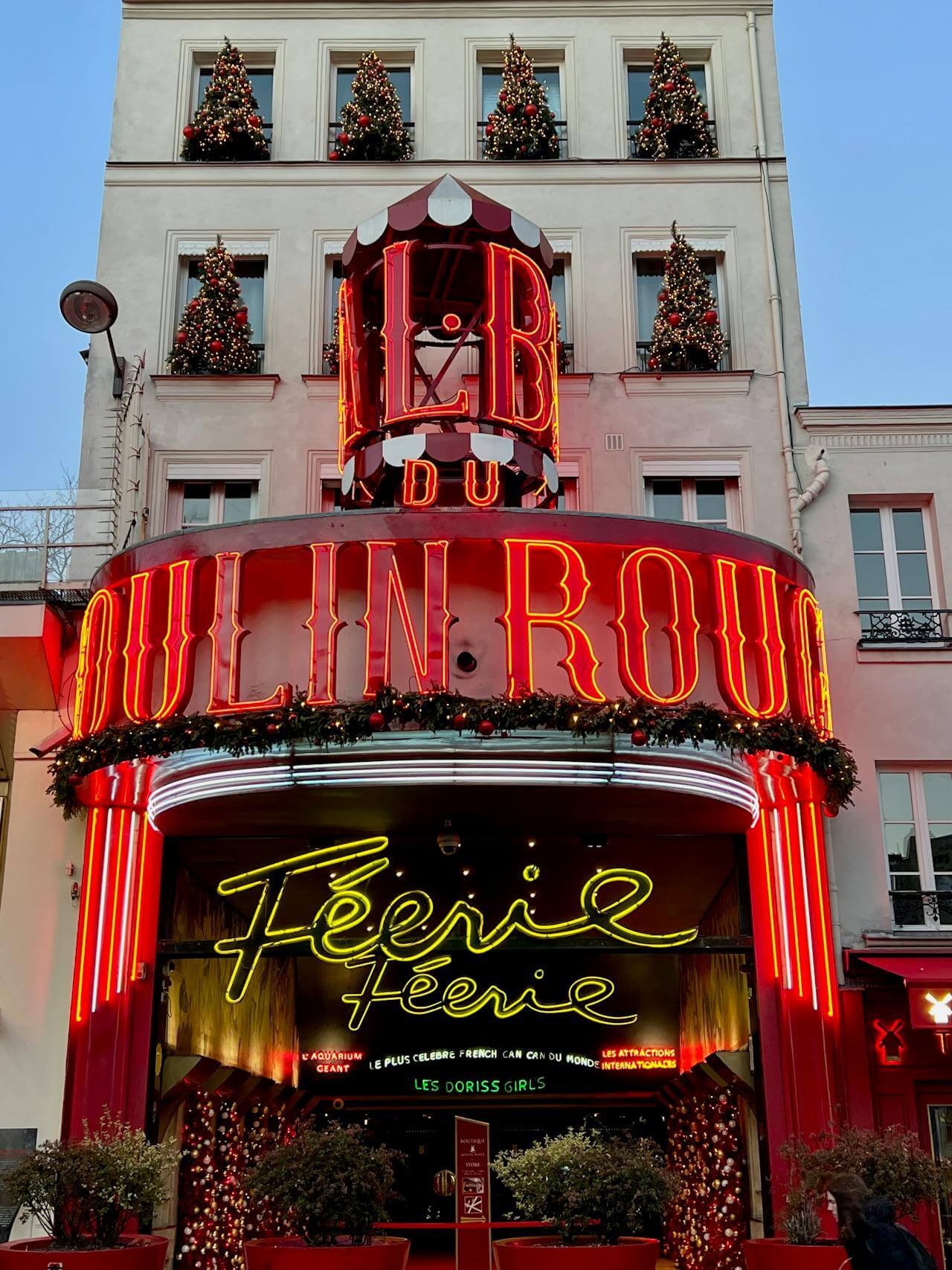
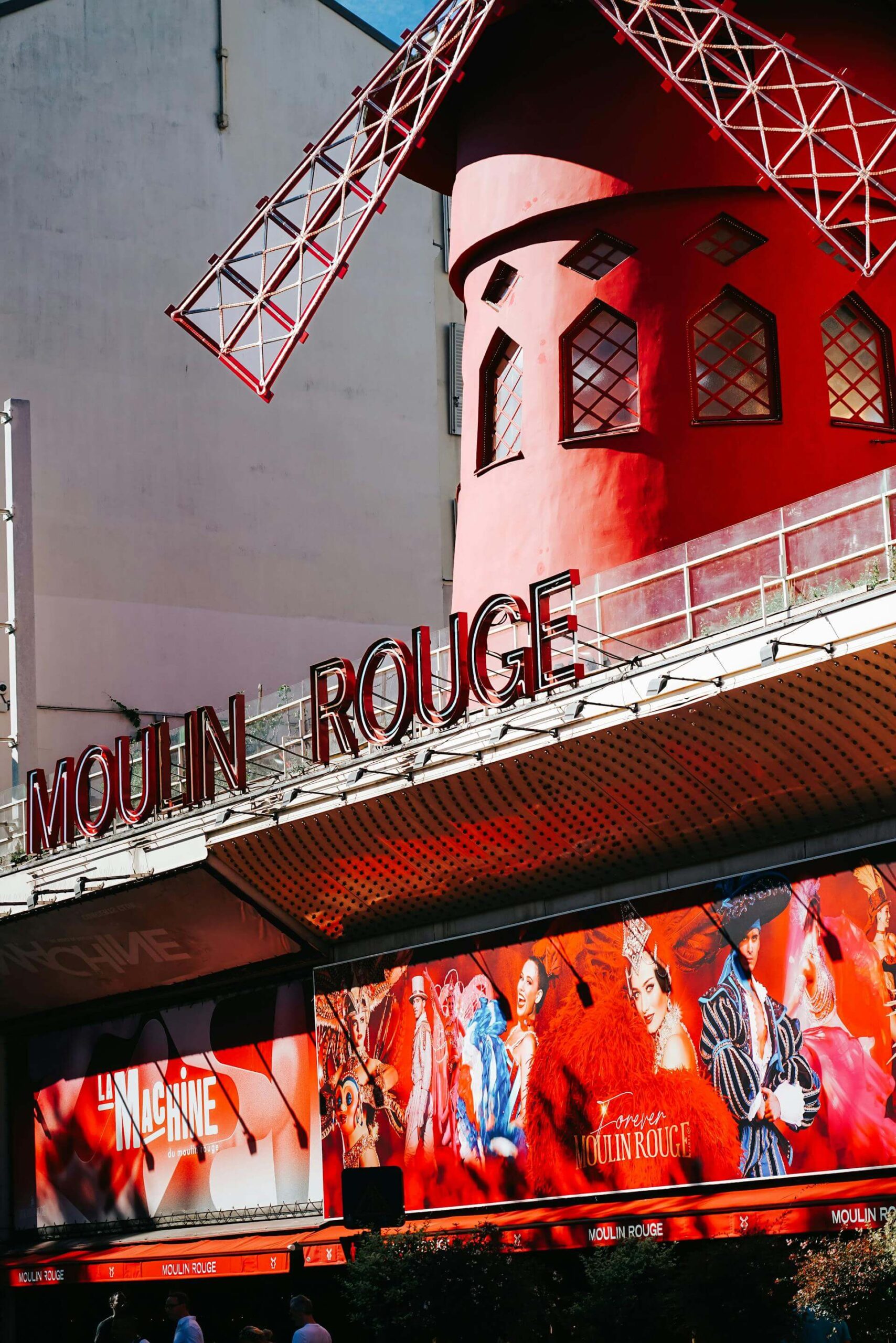
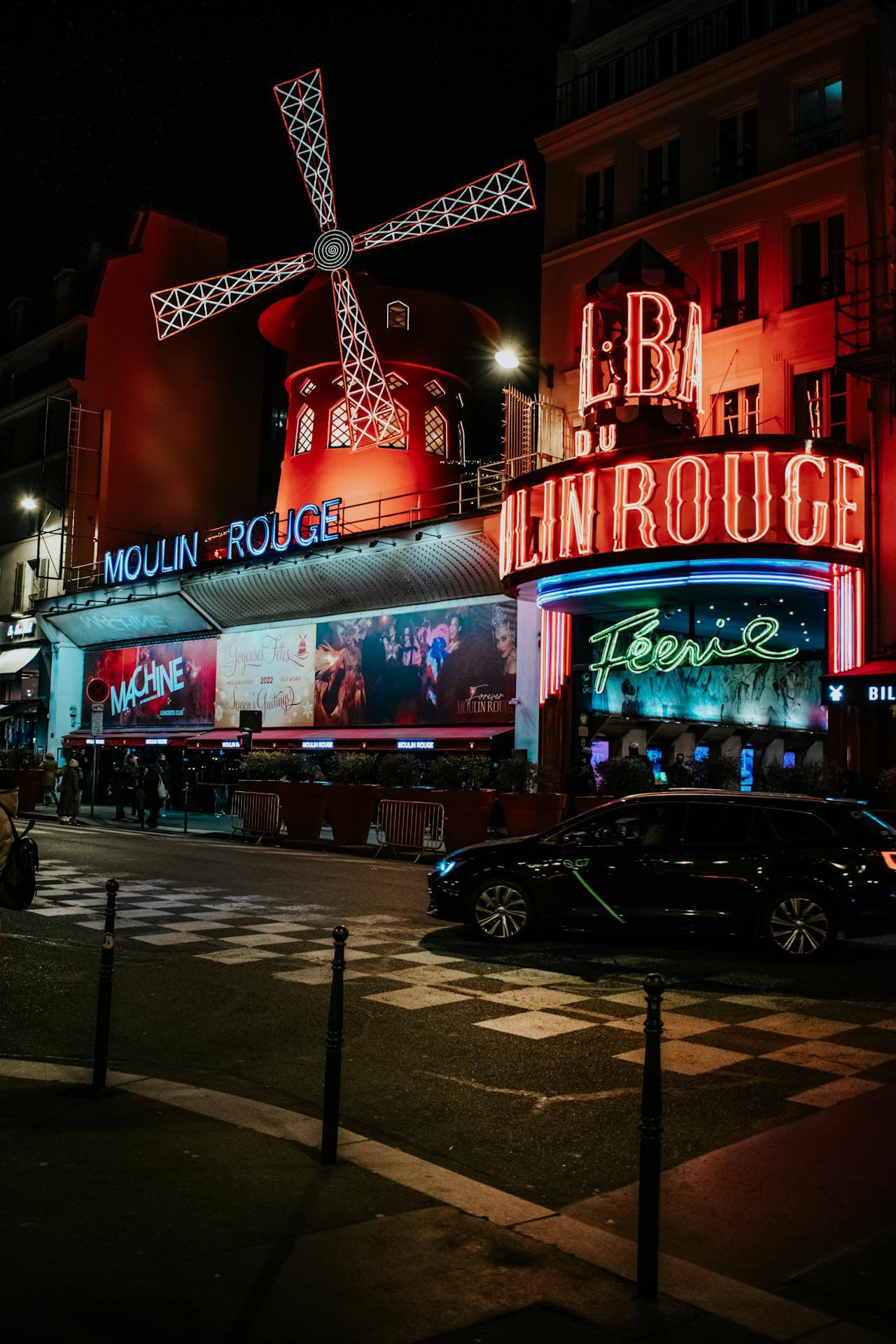
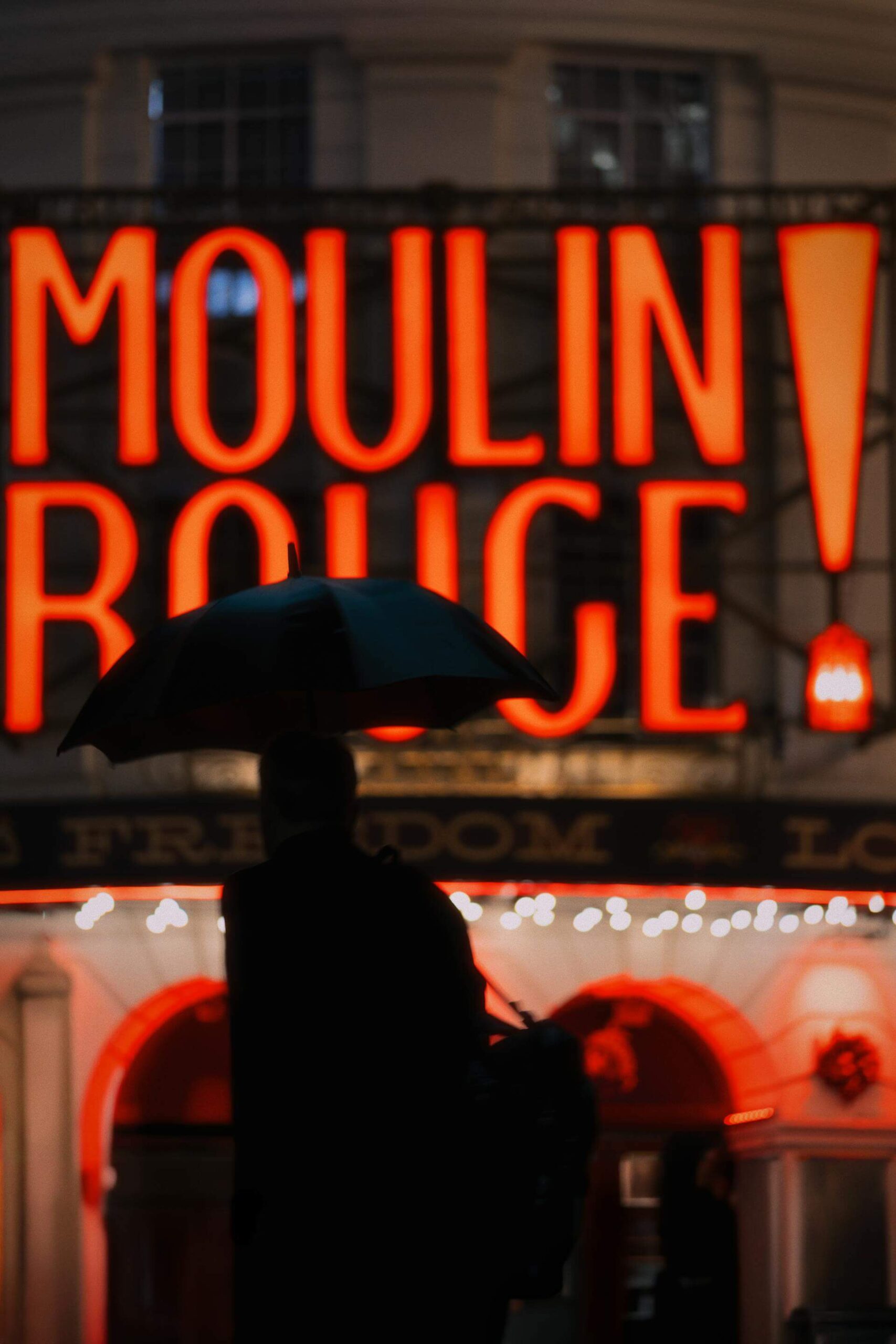
For many tourists, it is an absolute must to see the Moulin Rouge while in Paris. Even for those who don’t step inside, they usually take a picture below the “iconic” red windmill, which has become a landmark. Since it opened 120 years ago, the cabaret has played a significant role in preserving the French cancan’s enduring popularity. It has made its way into many paintings, posters, and films that aim to capture the Moulin Rouge’s naughty yet romanticised ideas of excess.
Most of the Moulin Rouge’s cabaret performances continue to sell out, particularly during peak season. But what are the highlights of a visit to the Moulin Rouge shows in Paris?
A Legendary History
The Moulin Rouge, apart from being a cabaret, is an iconic element of Parisian culture and history. For over a century, the Moulin Rouge has represented art, pleasure, and happiness. From its origin as a dance hall in the 19th century to a now world famous spectacle, the experience is a representation of the glorious past of the city. The elephant may no longer be there, but the storied history of can-can and acrobatics is well preserved.
Staying true to its roots as a flour mill, the windmill is still on the building. The windmill attracted sightseers from all over the world and became a powerful icon of the original Parisian cabaret show, which brought visitors from around the world to Paris.
World-Class Performances
Going to a Moulin Rouge show in Paris is more than simply seeing a performance. You will be whisked away to a world of glitz and glamour the second the curtain rises. Wonderful sets complement hours of performances that fuse modern-day dance and vintage cabaret elements.
The shows typically feature a blend of singers, dancers, and acrobats, who add to the eclectic blend of entertainment. And what would a Moulin Rouge show be without a high-energy performance of the world-famous French Cancan? The high-flying kicks and swirling skirts of the dancers make this visual performance unforgettable.
Costumes and Glamour
The show is a feast for the senses. The lavish production design and values of Moulin Rouge is reflected both in the decorative sets and the elaborate costumes. The costumes are just as colourful, flashy, and extravagant as the sets.
The costumes are inspired by the ostentatious fashions of 19th century Parisian cabaret. They feature sequins, feathered trims, lace, silk and showcase numerous designs and textures. The Victorian era’s bustles and corsets, for example, served as inspiration for some of the outfits.
Dinner and Show
If you are looking to supplement your night out, the Moulin Rouge has several restaurants. The evening performance packages feature an amazing three-course meal, which represents the best of French food. To ensure you enjoy the most flavourful and freshest foods, the menus change by season.
The courses are served alongside exquisite wines to enhance your experience. You can choose from several combinations to get the right experience for you. The “Dinner and Show” package is highly sought-after since it guarantees you the finest seats in the house with a reserved table for the performance. For those celebrating a special occasion or simply wishing to make the night even more memorable, the “VIP Dinner” package offers exclusive seating, elevated service, and a touch of added luxury.
Final Thoughts
Going to Paris and seeing the Moulin Rouge is an experience you will never forget. The well-lit atmosphere, stunning décor, and shiny lights of this magnificent cabaret illustrate a beautiful glimpse into the city’s active nightlife. No matter what draws you to the Moulin Rouge, you will not be disappointed. Be sure to get your tickets in advance, dress your best and get ready to enjoy the magical charm of the shows.
For more on the latest in lifestyle, culture and travel reads, click here.
We have just wrapped up another trip to Taipei, yes, not even a year after our last one because we just felt like there was still a lot about the city that we had not explored yet.
In this article, we’re listing out the most IG-worthy attractions or the trendiest spots that are a hit among locals and tourists alike, or both!
Note: This is not in any particular order. The numbers are just there for easier reference.
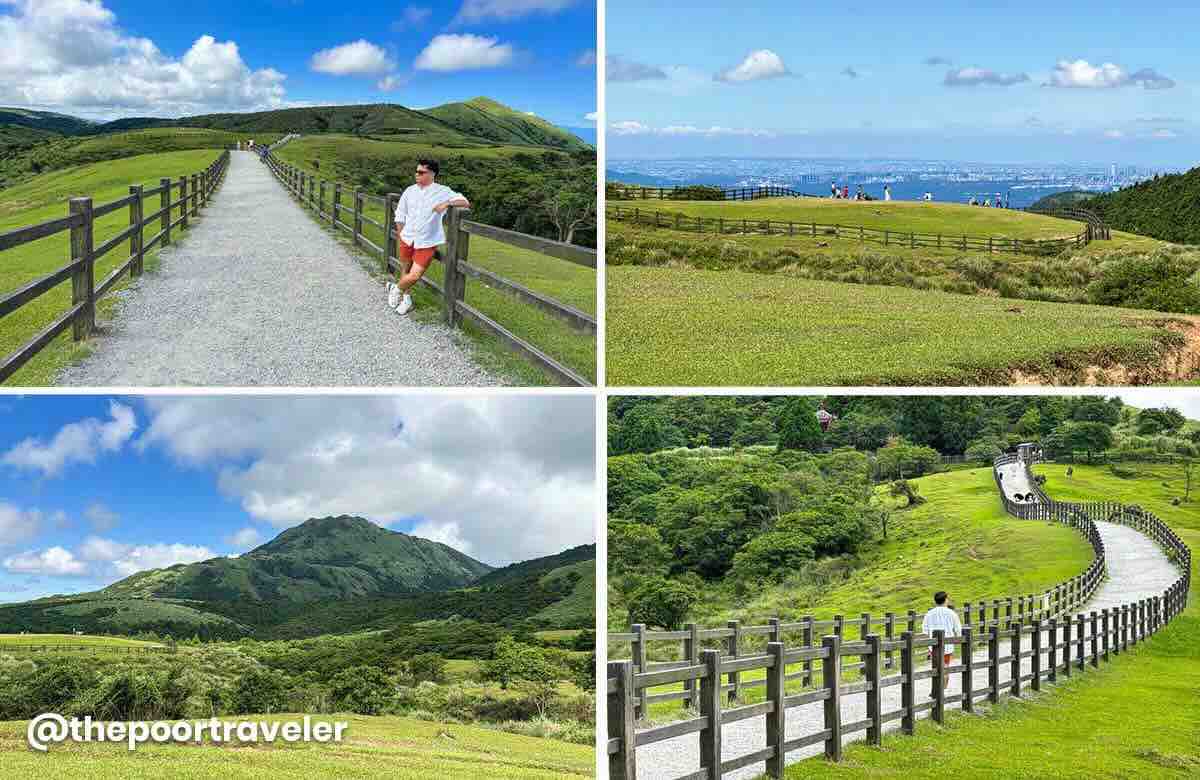
When I first saw photos of this place online, it took me a while before I realized it was located in Taipei. It looks a bit like a Studio Ghubli scene, a bit like a K-drama location, and a bit like our very own Batanes. But this is Qingtiangang Grassland. And yes, it really is within the Taipei City limits.
Perched about 800 meters above sea level in Yangmingshan National Park, Qingtiangang Grassland is a sprawling plateau formed by ancient volcanic lava flows. But today, this is a scenic park where locals gather for picnics, tourists enjoy a leisurely stroll, and cows peacefully graze. Yes, you’ll find lots of cows here, often lowkey but sometimes photobombing tourist selfies.
They say that these almost endless green hills are in its most aesthetic state when slightly covered in fog, fostering a more cinematic atmosphere. When we visited, however, it was clear and sunny as clear and sunny could be, but it was still wonderful because it meant sweeping views of the surrounding mountains and the concrete jungle that is Taipei City in the distance.
There’s also a well-maintained walking trail that scribbles the grassland, perfect for casual walkers, reluctant hikers, and people who packed cute outfits instead of trekking gear for that slightly-leaning-on-the-fence poses. Just don’t expect a quiet moment on weekends, when it gets packed. For fewer crowds and clearer paths, aim for a weekday morning like we did! We visited on a Wednesday morning and it was pretty chill.
How to Get to Qingtiangang Grassland
From Taipei City Center: Take the MRT or bus to Jiantan Station. From the station, catch Bus S15 to Qingtiangang. Then, walk to the park. Travel Time: 1-1.5 hours
From Yangmingshan Bus Terminal: Board Bus 108, then hop off at the Qingtiangang stop. Travel Time: around 35 minutes
If public transpo feels like too much work, a taxi or Uber can take you straight to the trailhead.
2. Datun Falls
This is still part of the Yangmingshan National Park. To be honest with you, our intended destination here was the Yangmingshan Flower Clock, a giant clock artwork in the garden by the western entrance. However, during our visit, they had just removed the flowers to replace it for the next season. Thankfully, there’s another picturesque site not too far away. Enter Datun Falls, a multi-tiered waterfall tucked into Yangmingshan’s back trails.
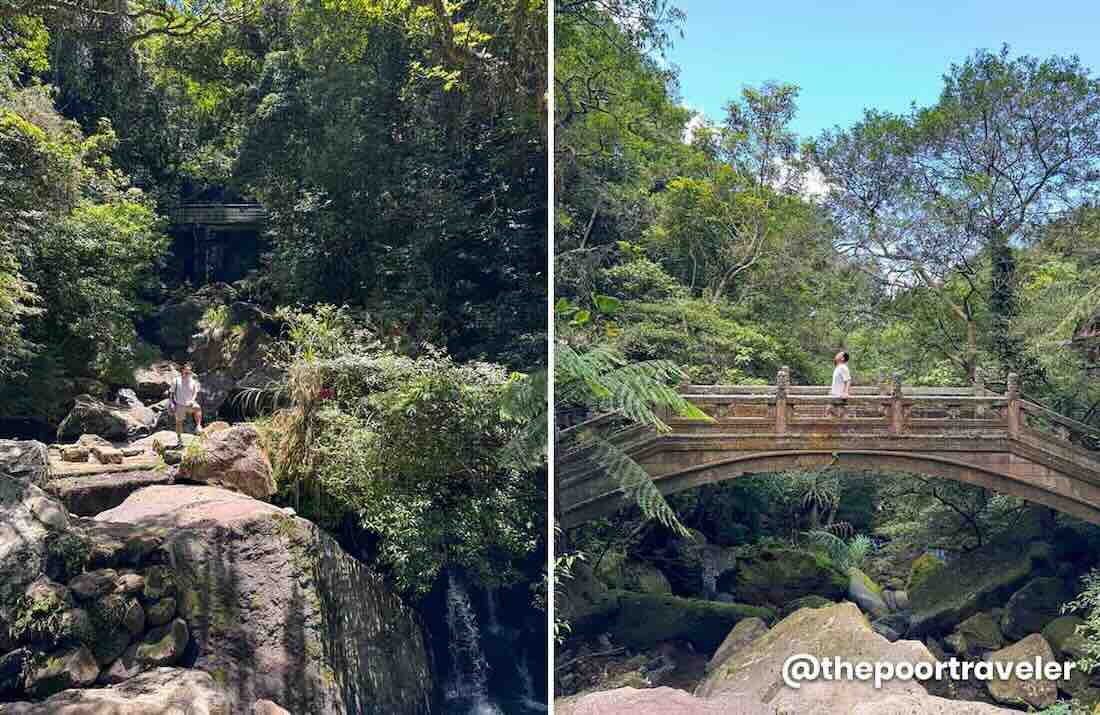
To get here, you’ll have to walk for 10 minutes, and along the way, you’ll see a platform, which is a great lookout. Then, after that, you’ll stroll through an enchanting mossy arcade that will make you feel like you’re stepping into another world.
It’s not a single waterfall but a charming series of cascades, each tumbling over boulders. The main upper falls tumble nearly three stories high, while lower tiers are perfect for dramatic close-ups or even daring foot dips. It looks best in the rainy season but since it was peak summer when we visited, it wasn’t as splashy as usual. But it’s still so photogenic, especially the arch bridge straddling it. And you can also use this bridge as your vantage point for shots with the falls in the backdrop. Either way, they make for fantastic photos.
You can reach Datun Falls via public transport. Take bus lines 128, 129, S8, S9, or the 260 series to the Yangmingshan Park area, then walk to the falls. It’s a very easy trail.
How to Get to Datun Falls: Make your way to Yangmingshan Bus Terminal, then catch Bus S8 or S9 to Yangmingshan Park area (Hushan Road Sec 2). Travel on foot for 10 minutes to Datun Falls. You’ll find plenty of signs along the way.
3. Bamboo Lake
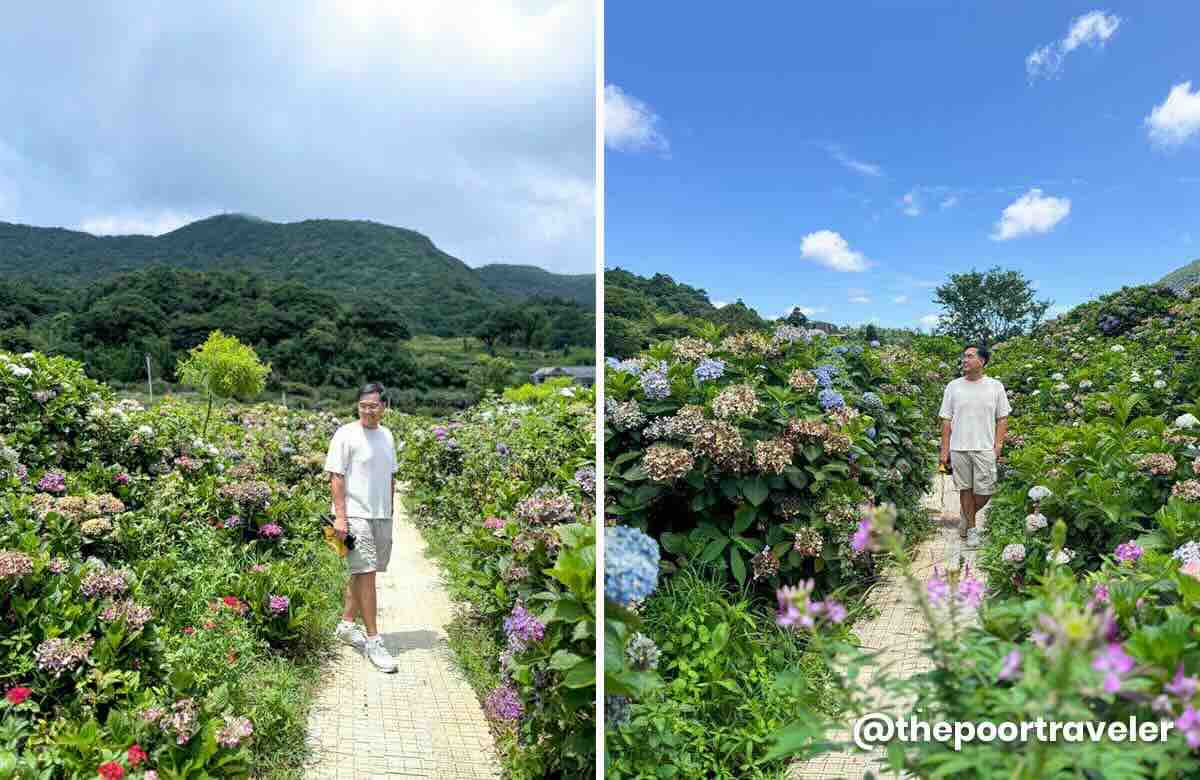
If Qingtiangang and Datun Falls can be described as vibey and moody, Bamboo Lake, also known as Zhuzihu, is the total opposite. It’s an explosion of color, like a pastel garden fiesta — flower power at its most Instagrammable. Tucked into a volcanic valley, this former lava-formed lake is now a lush field occupied by independently run gardens. Some grows calla lilies, some cosmos, hydrangeas, daylilies, and more, on rotation depending on the season.
From March to May, white calla lilies dominate the scene. Then, from May to June, violet hydrangeas and orange daylilies paint the valley in brighter hues. We visited in July, and it was mostly hydrangeas. At Liang Chien Garden, you can follow a path in between hydrangeas. Other gardens have their own installations for photos too, some even have their own café. Entrance fee is usually NTD 100 per garden.
But if you want a proper meal, head over to nearby Shanzhongyuan Wild Herb Restaurant, which serves mostly Taiwanese favorites including Hakka stir-fry, which is pork belly, dried tofu, leeks or spring onions, and garlic in soy sauce; pineapple shrimp balls, which are battered and fried shrimps with pineapples, drizzled with tasty mayonnaise and spinkled with, uhm, oddly enough, sprinkles, it’s like a party plate.
We also enjoyed the stir-fried white water snowflake stems. It’s like water spinach or morning glory, but firmer and thinner, and had a nice crunch to it and retains the flavor of its sauce really well. We also had mapo tofu, which we also liked because it wasn’t overpowered by Sichuan peppers.
How to Get to Bamboo Lake: From Yangmingshan Bus Terminal, catch Buses S8 or S9. Travel Time: 40–60 minutes
4. Taipei Botanical Garden
The first three I mentioned are all in Yangmingshan National Park and within the city limits, but if you’re looking for something within the city center, look no further than the Taipei Botanical Garden.
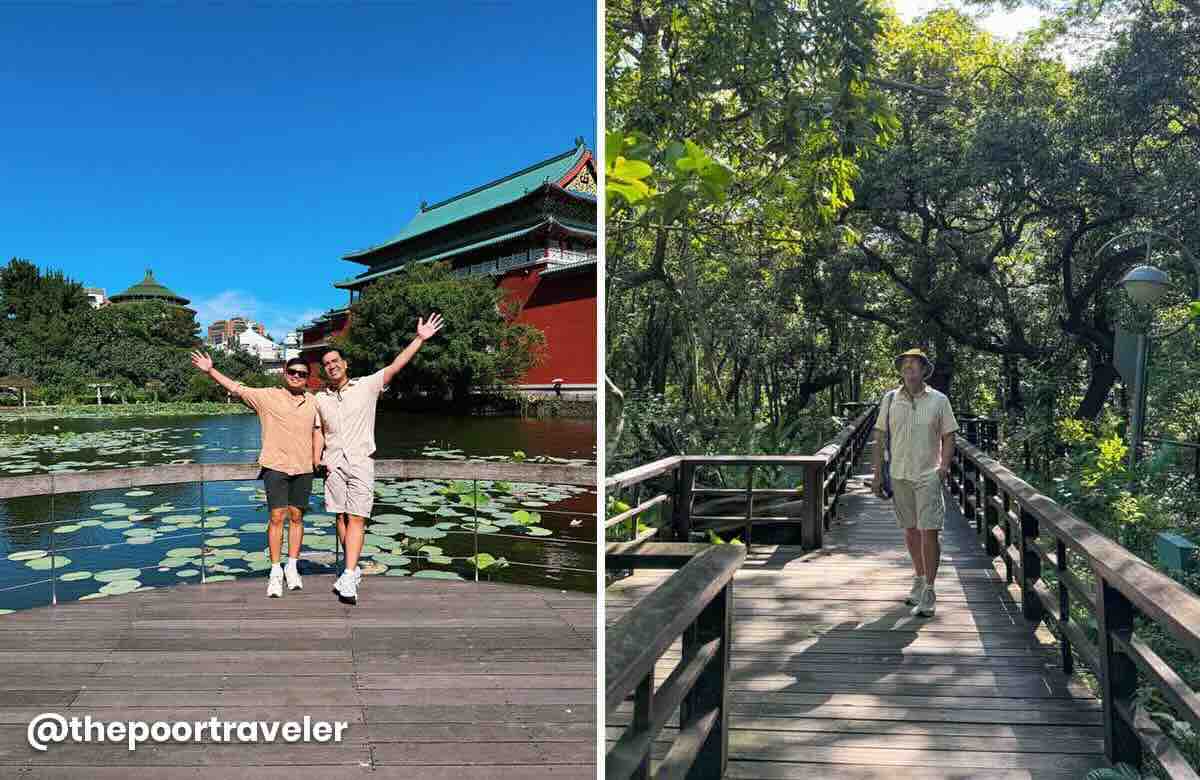
It’s so green and tranquil inside that it’ll be hard to believe you haven’t left the bustling city. Yet, here we are, surrounded by nature right smack in the heart of Taipei. Established as a nursery in 1896 and officially becoming Taiwan’s first botanical garden in 1921, this eight-hectare oasis now hosts over 2,000 plants scattered along well-marked paths and wooden boardwalks through 17 themed zones, usually by plant type. There’s also a Buddhism garden. But the main attractions here are its lotus ponds, which lie just next to the National Museum of History.
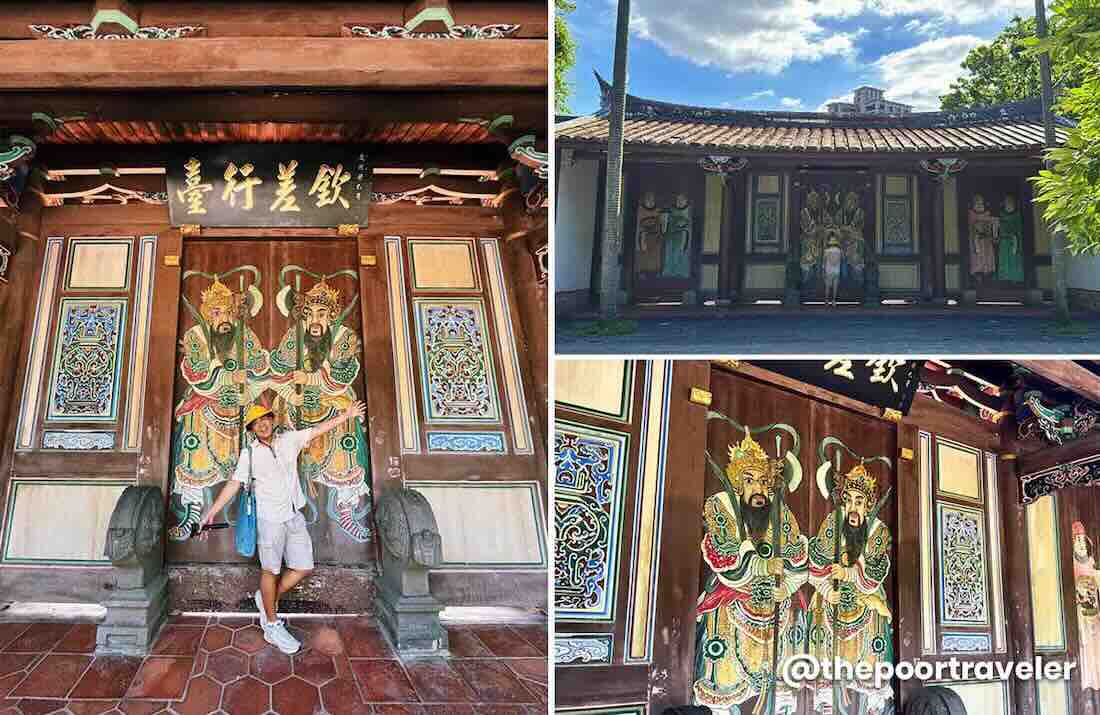
On the other end of the park stands the Guest House for the Imperial Envoy, which is a historical landmark. Unfortunately, it’s temporary closed, so we could only admire its beautifully painted gates for now.
Whether you’re after a botanical immersion or a bit of history or just some good old peace and quiet, the Taipei Botanical Garden can give you a city escape packed with scenery.
In case you need a drink, you’ll be glad to know that just outside the garden are a couple of good coffee shops: the library-esque Peloso Coffee Roasters and the understated FF.Coffeeholic. We’ll discuss these in detail in a separate Where to Eat in Taipei article.
How to Get to Taipei Botanical Garden: Take the MRT to Xiaonanmen Station (Exit 3), then walk for 10 minutes.
5. Dihua Street
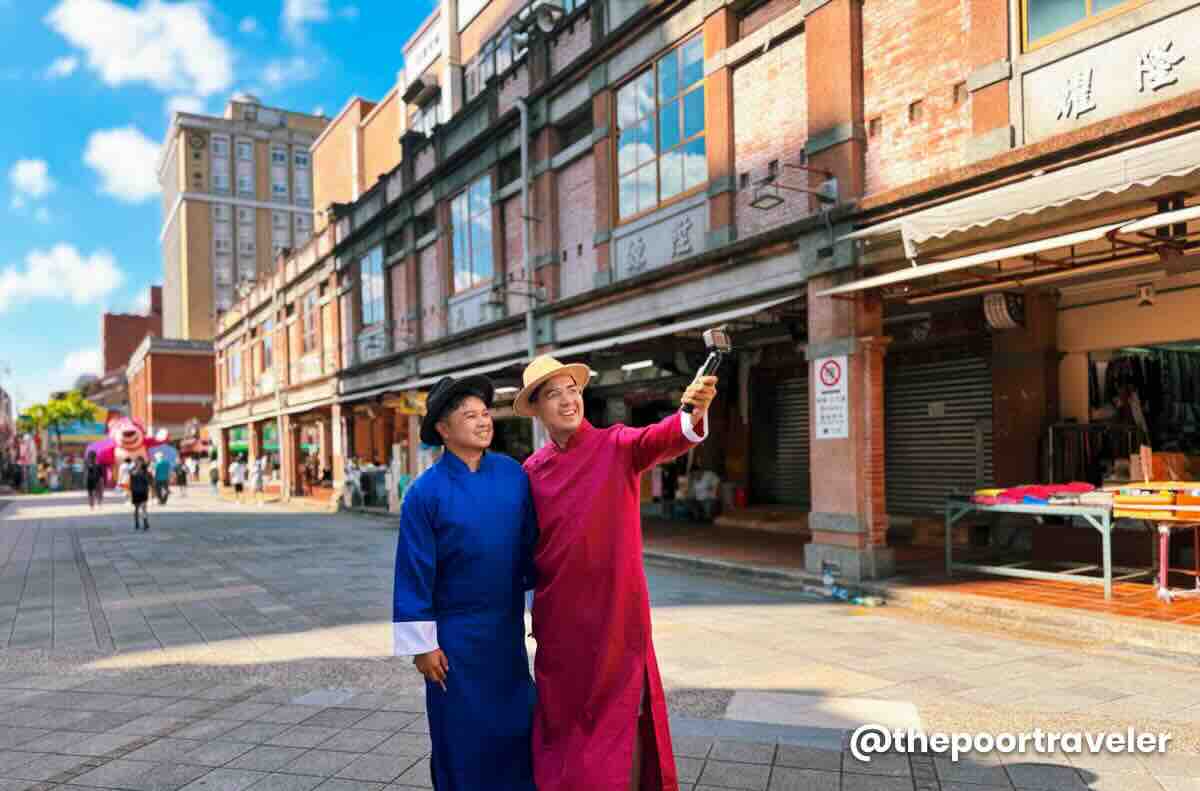
This is said to be Taipei’s oldest street, dating back to the 1850s! This wasn’t our first time here, we’d been here just a couple of years ago. But this is our first time exploring it in style! And by style, I mean wearing traditional attires, which you can use for FREE. Just head to the Dadaocheng Visitor Center, then you just need to give a deposit worth NTD 1000, which is refundable as long as you return the garments without damage.
You can choose from any of their wide selection of attires, and you also get an accessory, which can be a bag, a pipe, or a hat. And while in your period drama era, explore the historic street, which is flanked by shophouses selling traditional medicine, tea, herbs, fabric, and more. It has always been like this for centuries! But today, you’ll also find more modern cafes and milk tea stalls.
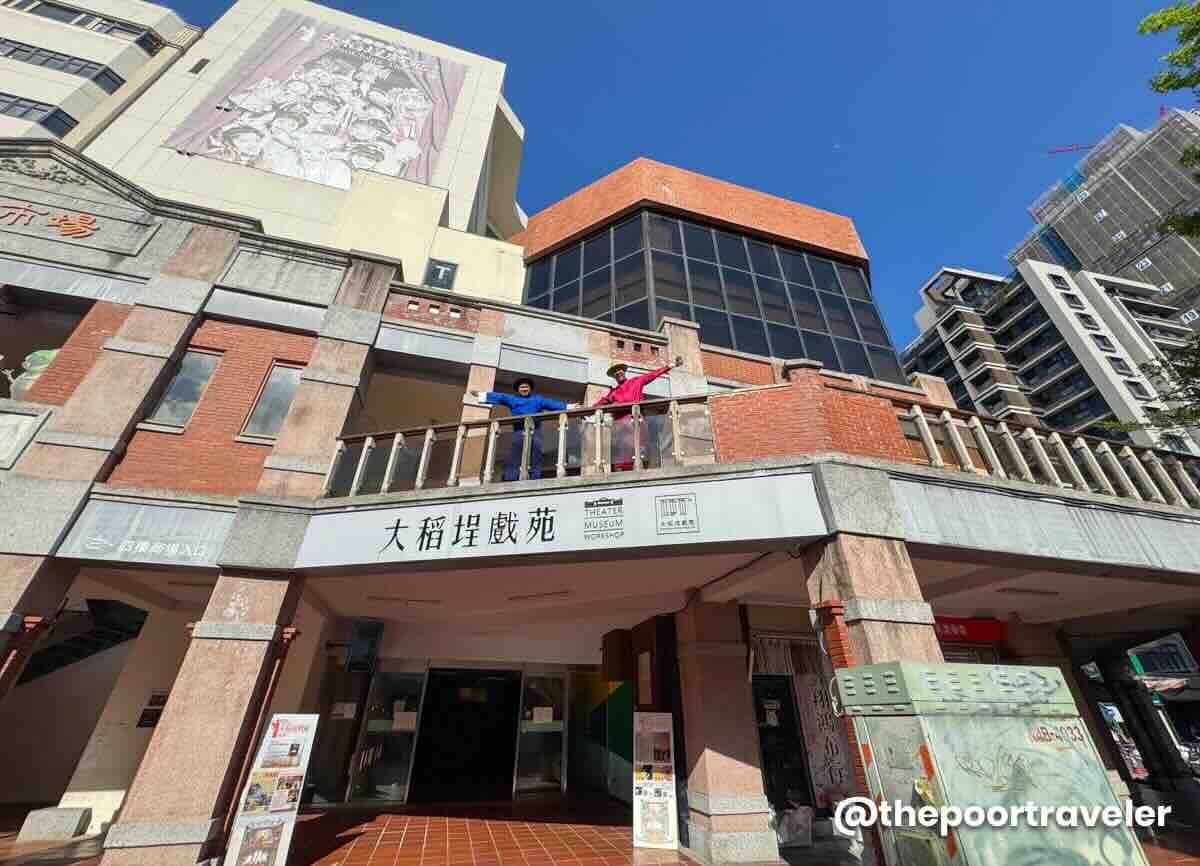
One of the largest buildings here houses the Yongle Market. Built in 1896, this kaleidoscope of textiles spans multiple floors filled with silks, satins, lace, and tailor services. The street-level wet market is where you’ll find freshest produce, herbal teas, and snacks, too.
On the 8th floor of the same building, you’ll find Dadaocheng Theater, a branch of the Taipei Cultural Center. This is a great venue for performances, and even to this day, you can catch traditional puppet plays here. There’s also a mini-museum showcasing the various types of puppets and the history of puppetry in Taipei.
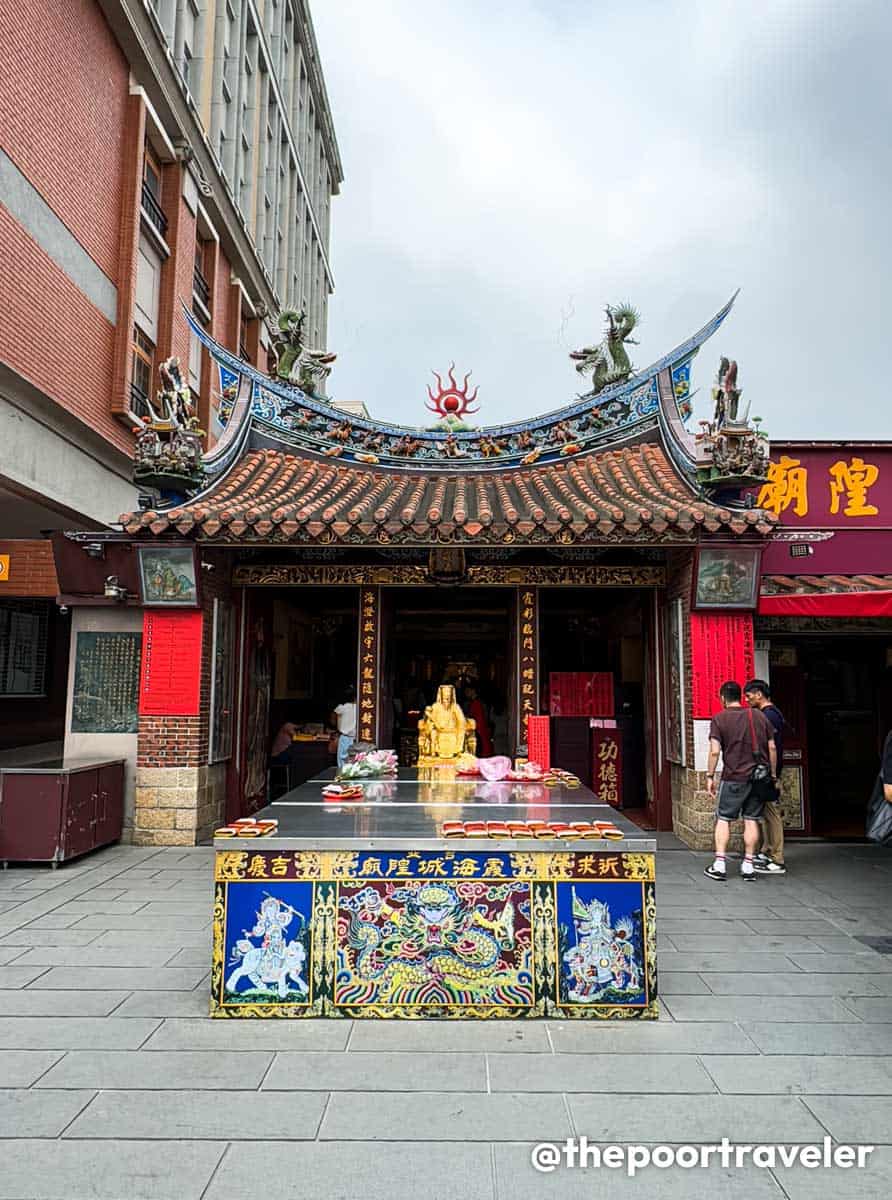
Then, just down the street is the small but extremely popular Xia Hai City God Temple. Completed in 1859 in honor of the the City God, Chenghuang, who ensures local peace and prosperity. Later on, a statue of his wife was added. Today, many visitors, especially tourists come here to pray for a happy love life.
So whether you’re hunting delicate fabric rolls, seeking divine romantic luck, or slipping into vintage threads for a retro shoot, Dihua Street is the place for you — with layers of culture, color, and charisma.
Traditional Attire Use: Rental Fee, NONE/FREE; Deposit, NTD 1000 (refundable)
6. Dadaocheng Wharf
Depending on which part of Dihua Street you’re coming from, walk for 5-10 minutes westward and you’ll eventually find Dadaocheng Wharf Plaza. From its origins as a bustling trade pier on the Tamsui River to its 21st-century renaissance as a riverside hangout, it mixes history with modern fun.
The murals on its super lengthy wall are top-notch, depicting various scenes of Taipei. You can even bike alongside it. YouBike stations and bike rental shops are available, offering an easy way to explore the 18 km riverside cycling route, which leads to Guandu or back to the city. Bike rental costs NTD 80 per hour. YouBike is much cheaper. By the way, Guandu is another underrated attraction in the city. You can read more of that and other under-the-radar places in Taipei here.
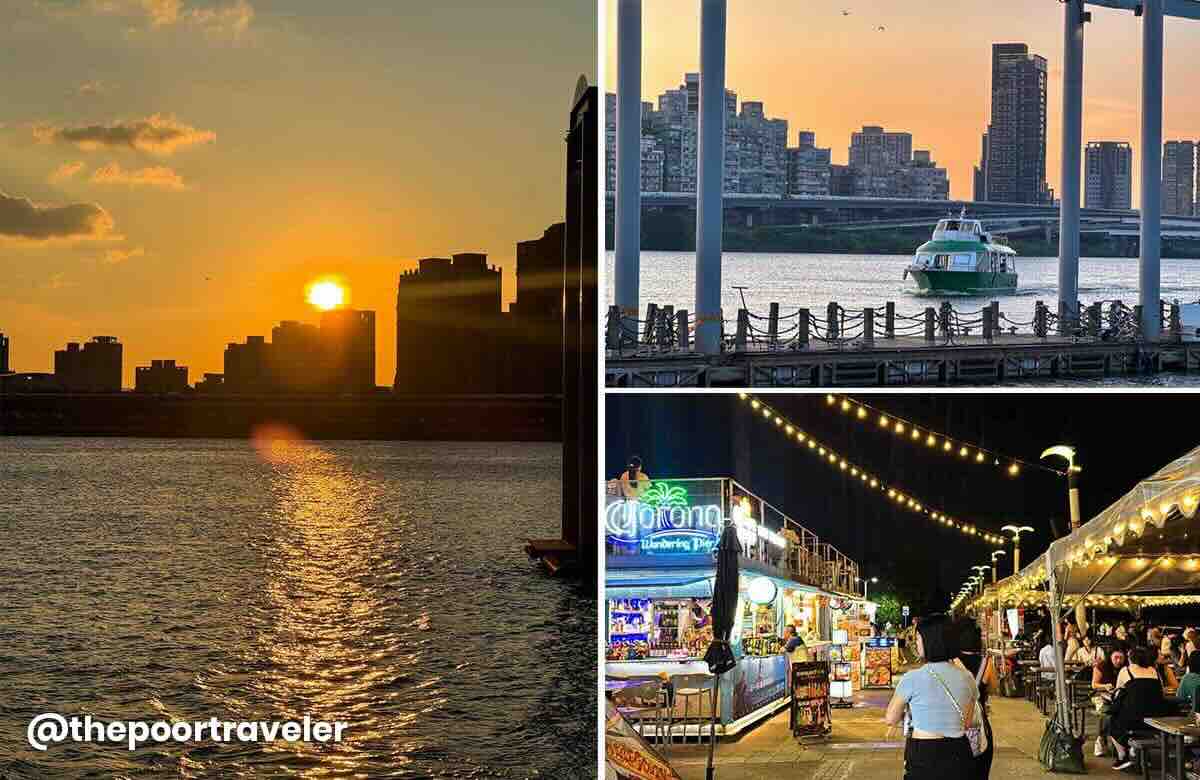
If biking isn’t your thing, how about a boat cruise? Here, you can hop on a sunset‐time river cruise heading upriver toward Tamsui and beyond. A ride offers a scenic drifting shot of iconic bridges, lush riverside parks, and of course, Taipei’s skyline, which is magnificent at sunset. You can even spot Taipei 101 from here! And it’s surprisingly affordable too, at only NTD 300 for an hour-long cruise.
It’s best to visit in late afternoon and evening, when the wharf really comes to life, especially at the Pier-5 Container Food Park, where you’ll find dozens of stalls pumping out craft beer, boba, burgers, seafood, Thai, Korean, and Italian. Grab a table seat (some atop containers!), let the river breeze flow, and snap those casual food shots as city lights glimmer across the water.
Bike Rental: NTD 80/hour Boat Cruise: NTD 300/hour Closest MRT Stations: Beimen or Daqiaotou Station
How to Get to Dadaocheng Wharf:
From either Beimen or Daqiaotou Station, you can get there on foot in five minutes.
From Dihua Street, it’s a 5-10-minute walk.
7. Huashan 1914 Creative Park
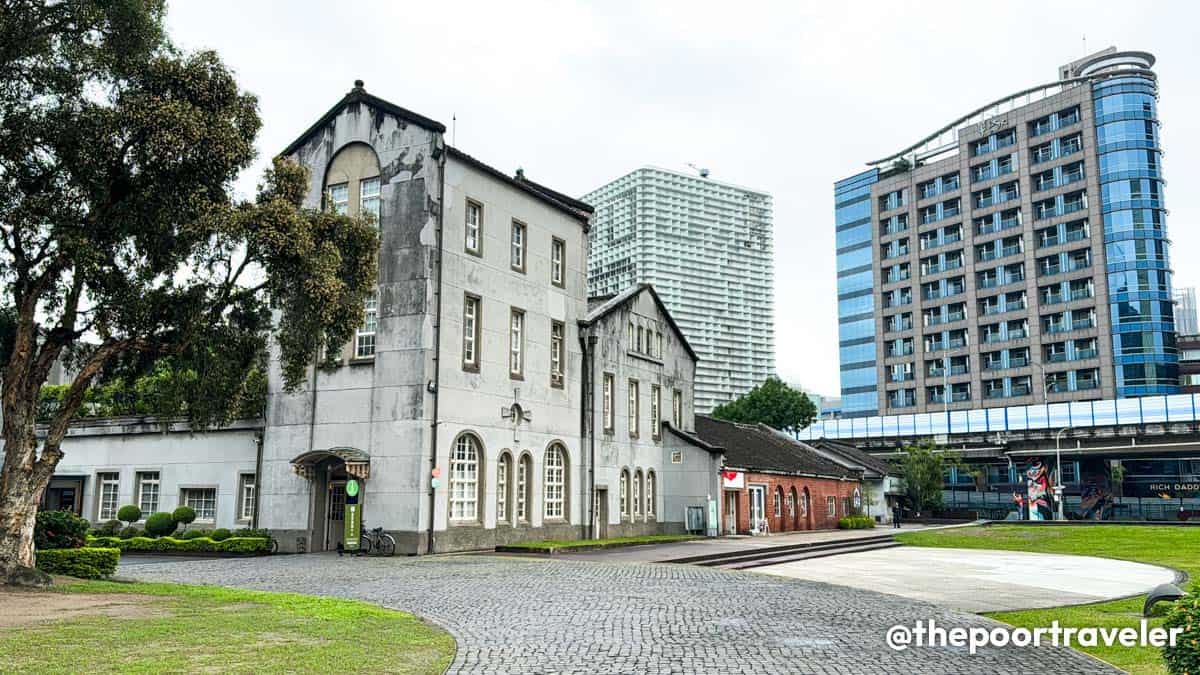
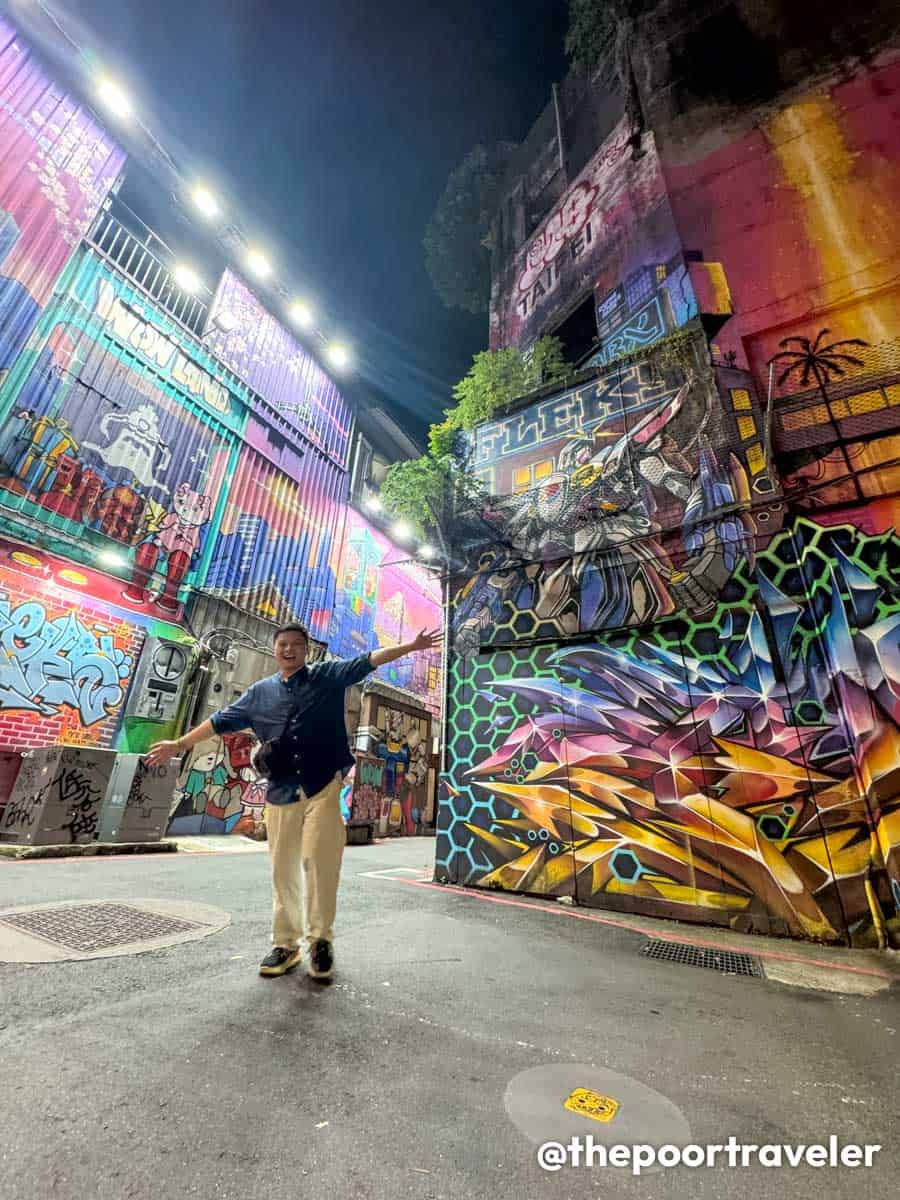
Once a 1914 winery turned art-lovers’ playground, Huashan 1914 Creative Park is Taipei’s ultimate blend of industrial charm, indie creativity, and pop-culture chic. Wandering through its weathered brick warehouses and green lawns, you’ll find everything from laid-back cafes and indie cinemas to spontaneous performances and street-art backdrops — an endless scroll of photo ops waiting to happen.
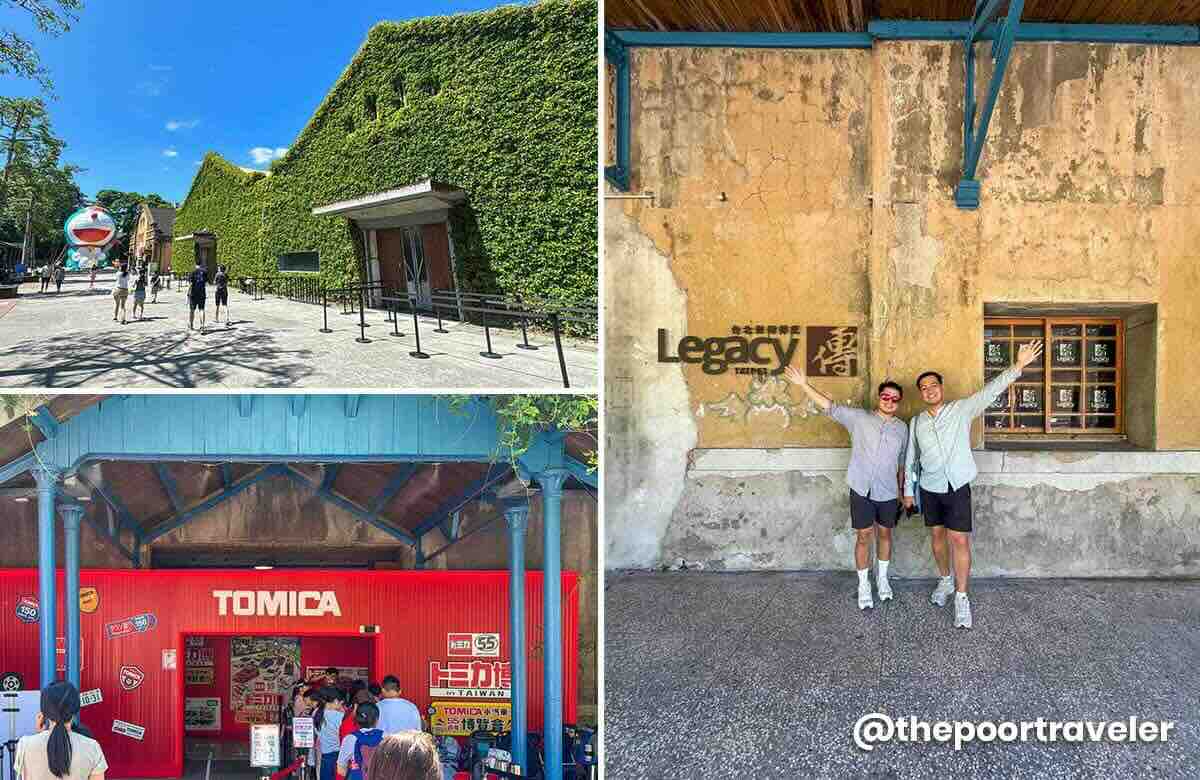
And it changes a lot! Last year, when we visited, there was a completely different set of pop-up stores and attractions. This time around, Doraemon was dominating the site. There was an ongoing 100% Doraemon and Friends exhibition and a gigantic 12-meter inflatable Doraemon attracting kids and kids at heart alike.
Next door, a whimsical Tomica toy car pop-up revved up nostalgia with mini-streets and model-display zones. Our new friend Andrea also brought us to Legacy, the park’s signature music venue inside one of the old red-brick warehouses. She said don’t expect a mainstream club or pop scene, though, because it mostly showcases homegrown indie rock bands and performers.
Just a stone’s throw away is Syntrend Creative Park, Taipei’s go-to gadget mall packed with tech stalls selling phones, tablets, cameras, drones, and even home appliances. And when you need a caffeine recharge, Simple Kaffa Huashan Flagship is the chicest pick. Again, we’ll be discussing this more in a separate article.
8. Xinzhongshan Linear Park & Chifeng Street
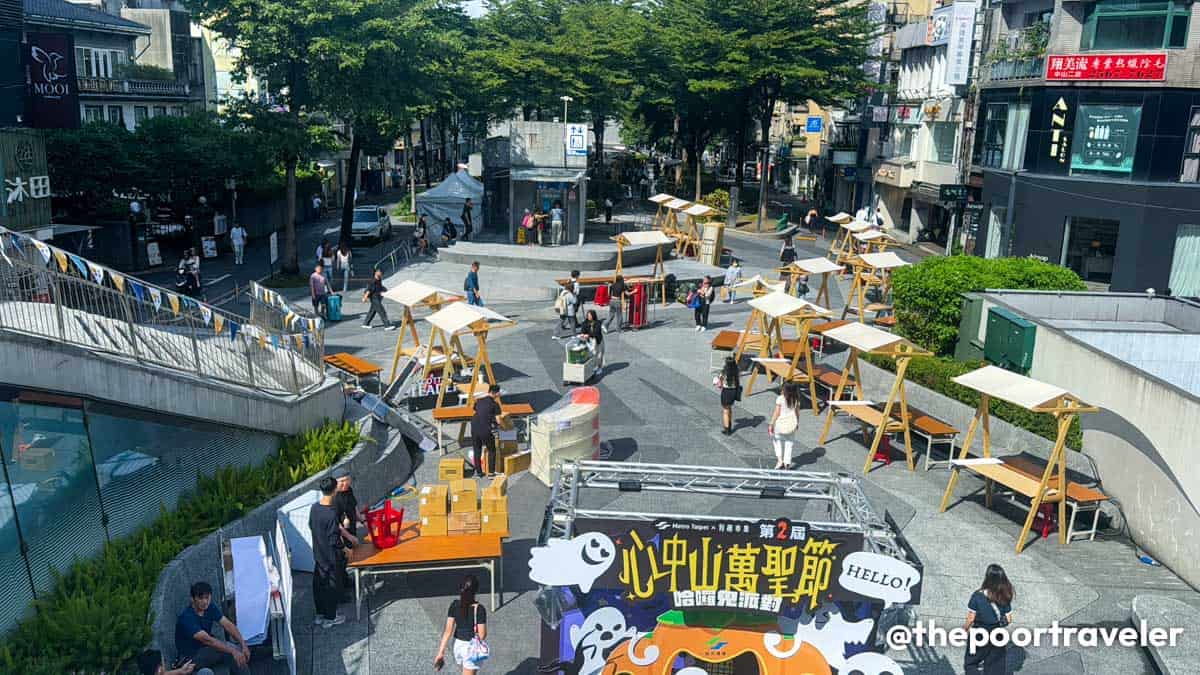
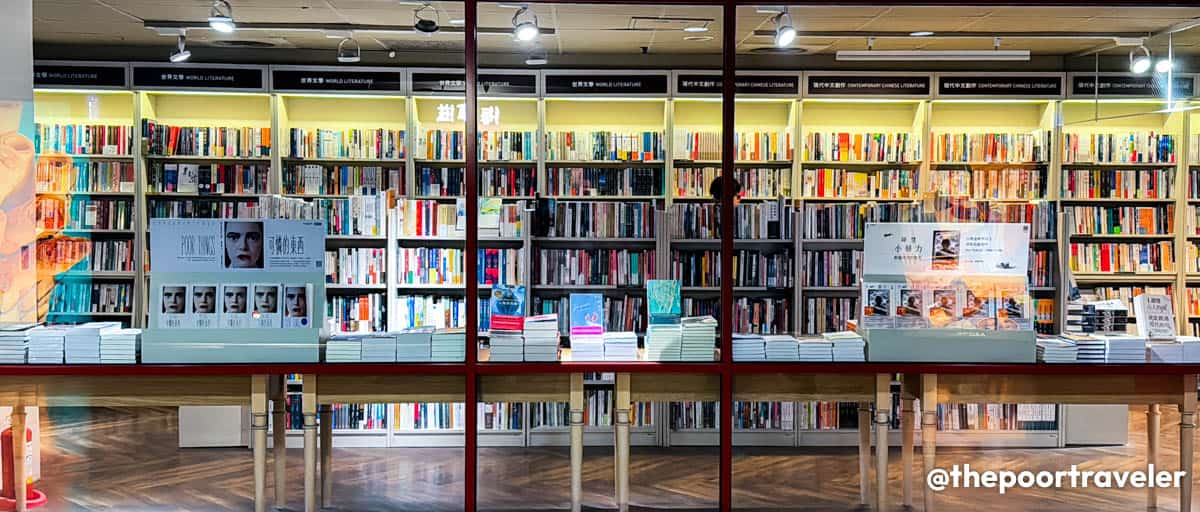
Another site that we made sure to return to this trip is the Xinzhongshan Linear Park. On the surface, it’s adorned with sculptural benches, floating walkways, and seasonal blooms. But underneath is a whole new world. Welcome to the Zhongshan Underground Book Street, a hidden treasure trove of literary finds, mostly in Chinese but you’ll also find English books.
Then right across is the Eslite Underground Music Store (anchoring the Eslite Spectrum Nanxi mall), which is a paradise for music lovers looking for specific records. There are vinyls, CDs, DVDs, and others, ranging from contemporary pop acts like Taylor Swift, Sabrina Carpenter and Chappel Roan to legends like Michael Jackson and David Bowie. There’s Milli Vanilli, too!
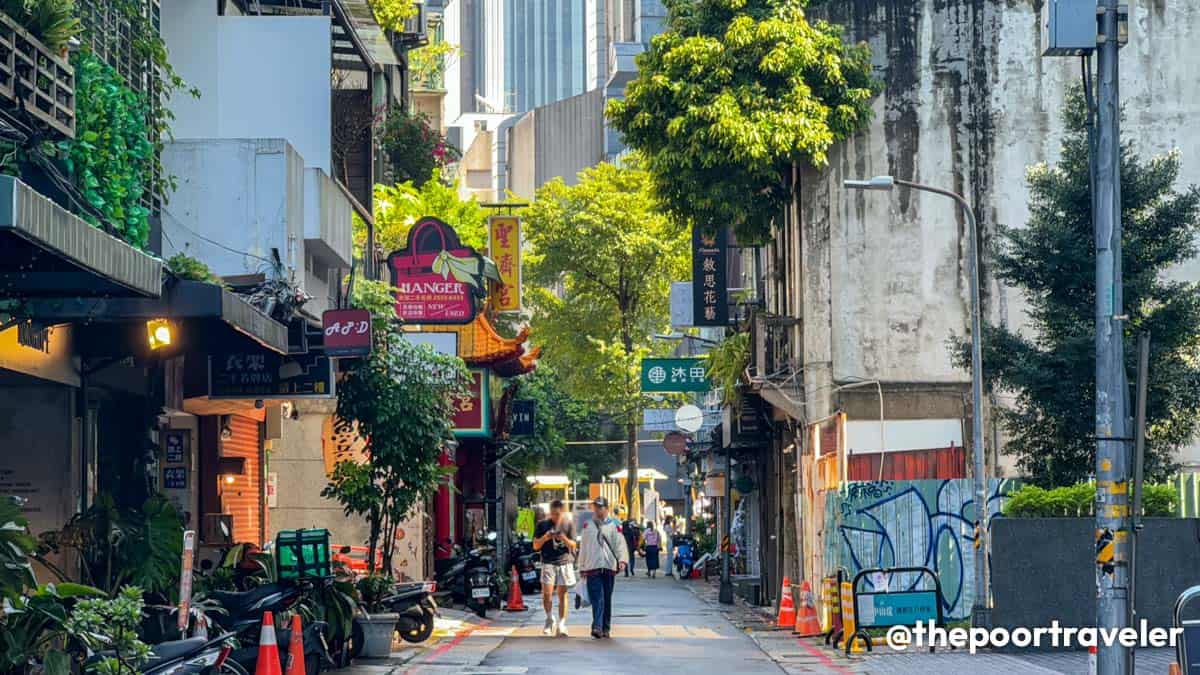
A few steps off the path lies Chifeng Street, once the town’s auto-parts alley but has reinvented itself as a hipster sanctuary of vintage boutiques and indie cafés. Andrea highly recommended her favorite shop here called PAR Store, which sells garments, accessories, and music records. We also visited Mitty, which sells pre-loved vintage clothes.
But the real reason we came back here was the FOOD! One of the most iconic here is Mian Xian Ding, which serves bowl after bowl of piping hot mee sua or rice flour noodles and Master Spicy Noodle Zhongshan Restaurant, famous for its well, spicy noodles and beef noodle soup.
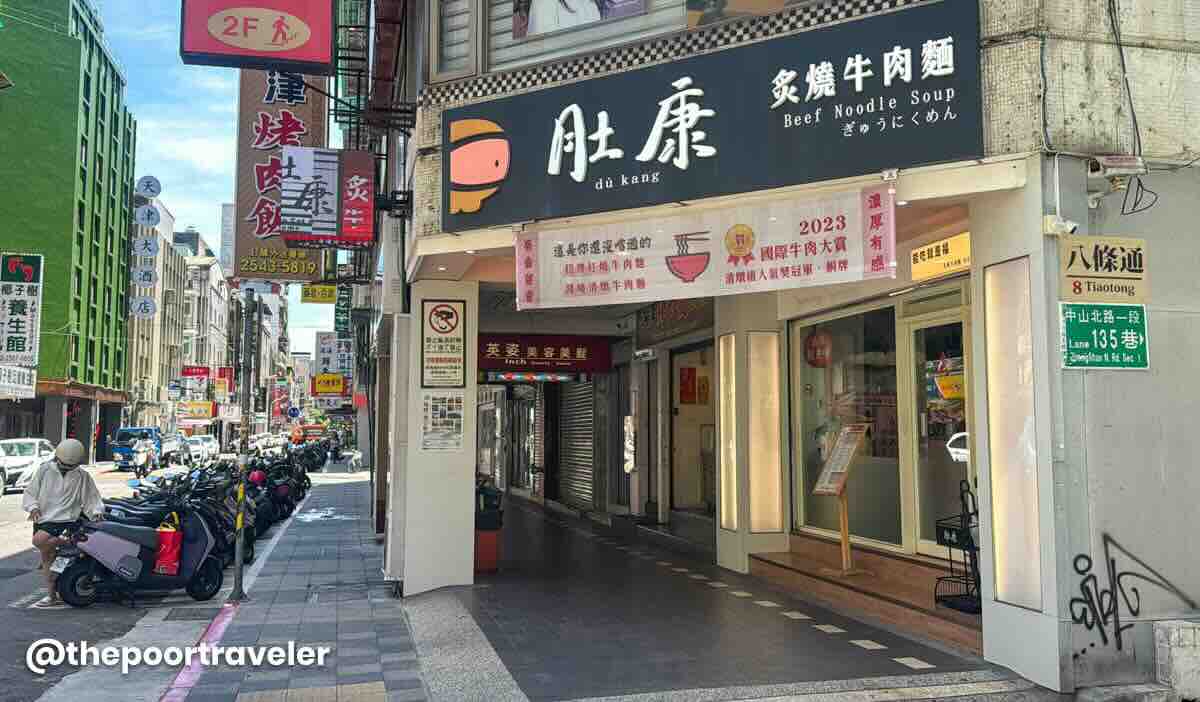
Also within the area is the highly underrated Tiao Tong, which is Taipei’s “Little Tokyo” as it is lined with Japanese restaurants, ramen bars, izakayas and even kawaii-culture and trinket shops like Gacha Hunter (扭蛋獵人), with wall-to-wall gachapon or capsule vending machines and blind-box collectibles on display.
The Xinzhongshan Linear Park and Chifeng Street is sandwiched by the MRT Zhongshan and Shuanglian Stations, so depending on your target attraction, either could do. Tiaotong and Underground Book Street is closer to Zhongshan Station.
Closest MRT Stations: Underground Book Street (Zhongshan Station); Chifeng Street (Zhongshan or Shuanglian Station); Tiao Tong (Zhongshan)
9. Ximending
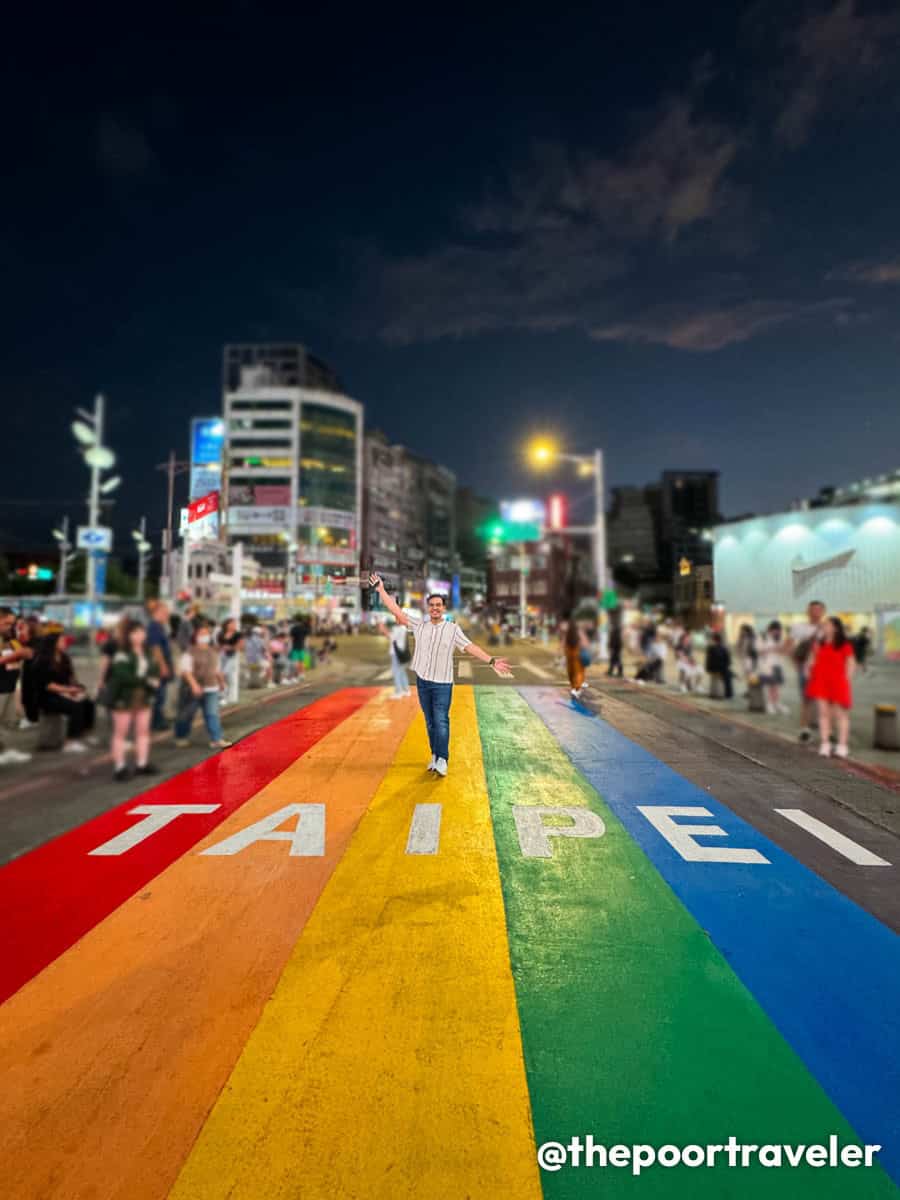
This list won’t be complete without the OG IG paradise — Ximending. I mean, I can’t think of any other free site that attracts more social media natives than the rainbow six crosswalk right by the entrance to Ximen Walker. And it’s not difficult to understand why.
Ximending is where Taipei shows up in full color — think Harajuku with a Taiwanese twist. It’s loud, it’s crowded, it’s chaotic…and it’s a vibe! This pedestrian zone is packed with fashion shops, sneaker stores, street food, and more selfie backdrops than your phone can handle. Yes, it’s gotten so touristy these days — but let’s be real, it’s trendy for a reason.
This is where local teens still hang out, artists perform, cosplayers gather, and subcultures thrive in full technicolor. But that’s not to say there are no quiet corners.
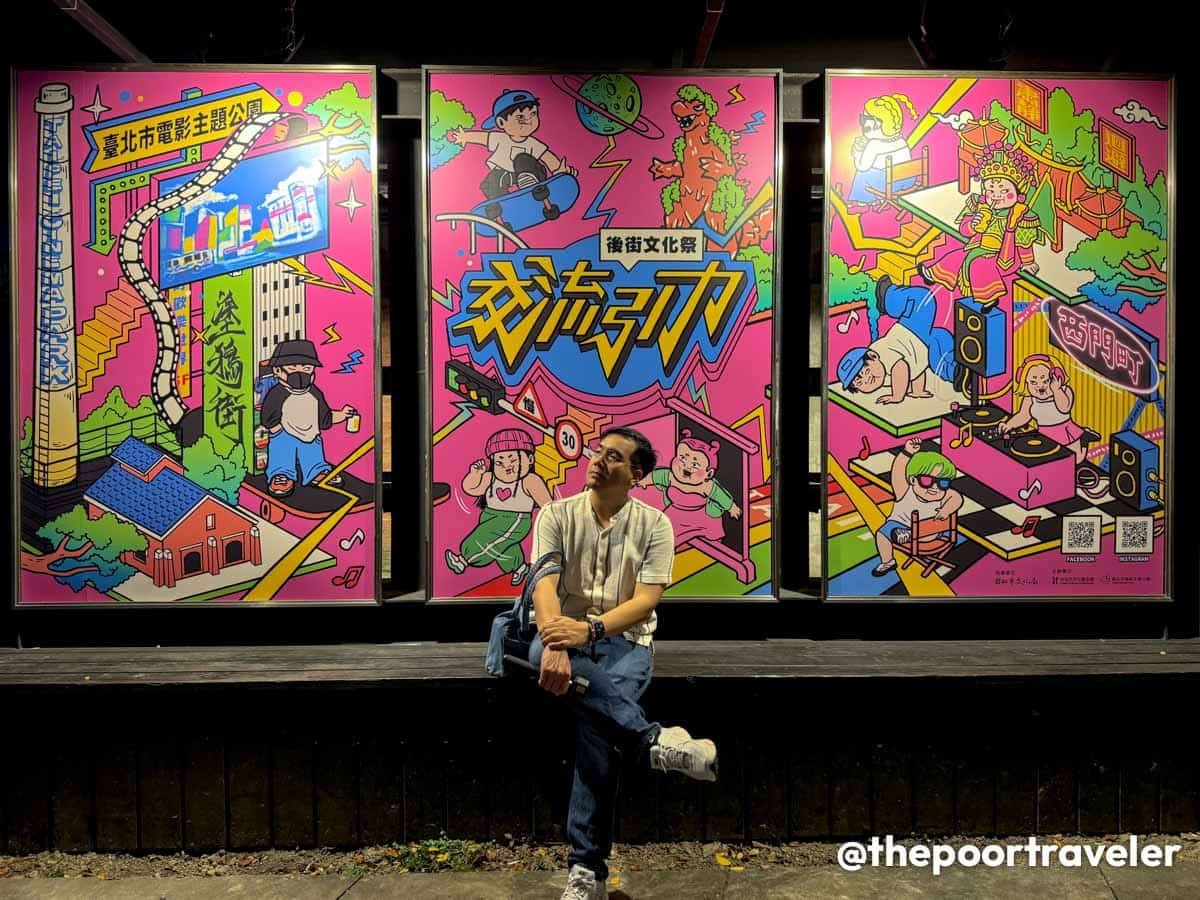
Just walk a bit further and you’ll reach Taipei Cinema Park, a chill spot with street art-covered walls, outdoor installations, and an open space where skaters, dancers, and lowkey photographers hang out. It’s way less crowded than the main square and gives off serious indie-cool energy.
There are lots of food spots, too!
Closest MRT Station: Ximen Station
10. Taipei 101 and Xinyi District
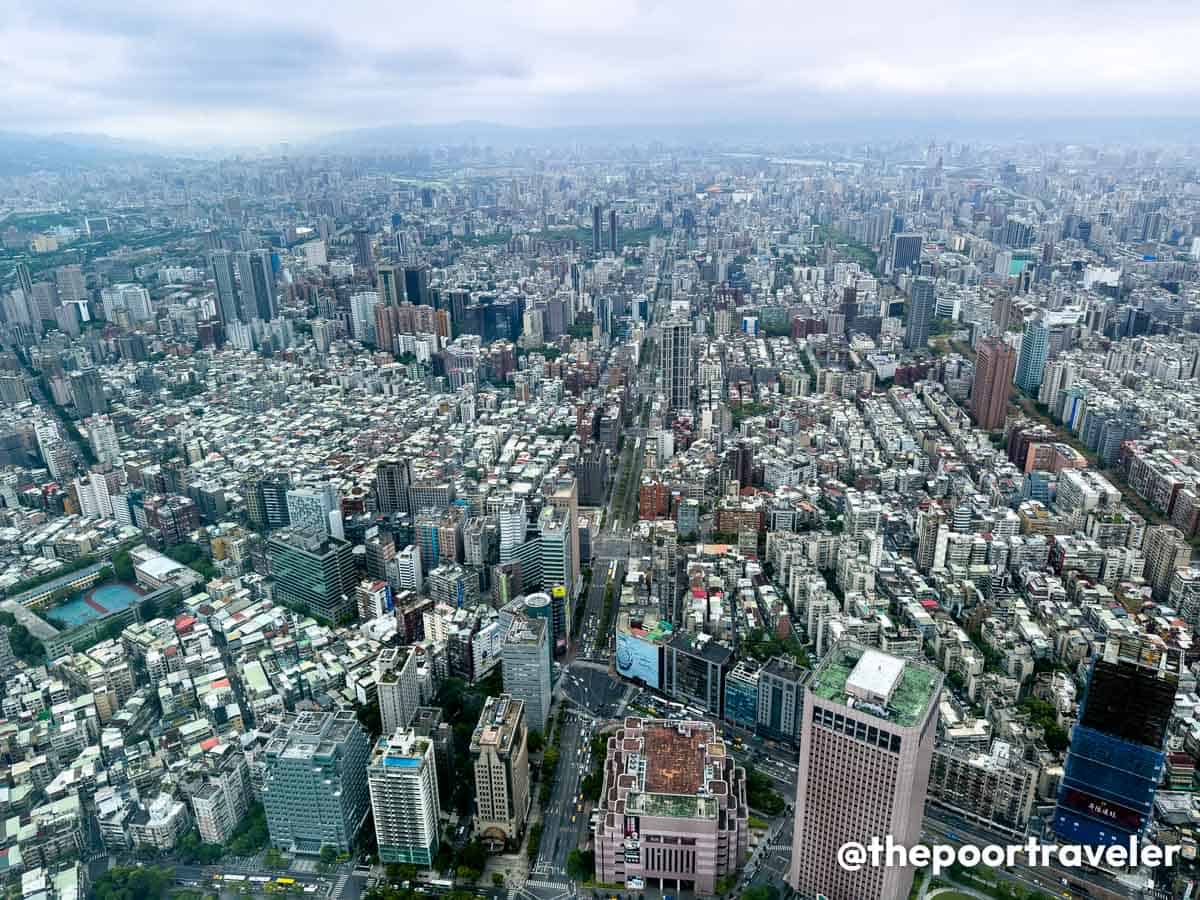
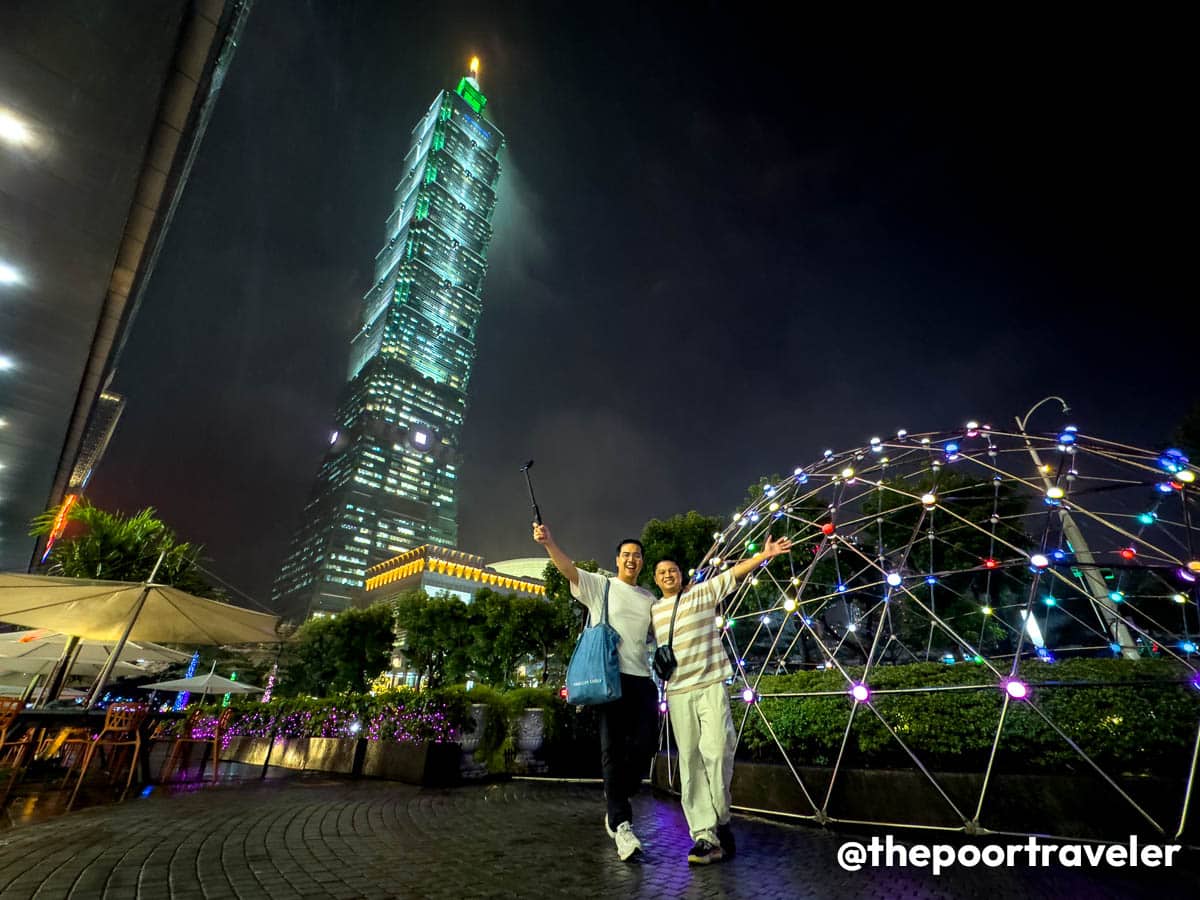
You can’t visit Taipei and not see Taipei 101. This 508-meter, bamboo-inspired mega-skyscraper once held the title of tallest building in the world, and it’s still the undisputed icon of the city. Whether you want to take photos of it or take photos from it, Taipei 101 is going to be involved in your camera roll one way or another.
Inside, 101’s lower floors are decked out with luxury brands, art installations, and one of the world’s fastest elevators that’ll shoot you to the top in just 37 seconds.
I remember my very first visit climbing to the 89th floor observatory more than a decade ago. It was mostly the view and the tuned mass damper, that 660-ton golden ball which holds the building together in shaky times. But these days, the observation deck is also bursting with installations and photo spots and it changes every time I visit.
If you wish to go up to the observation deck, you can secure your ticket in advance online through accredited booking sites like Klook!
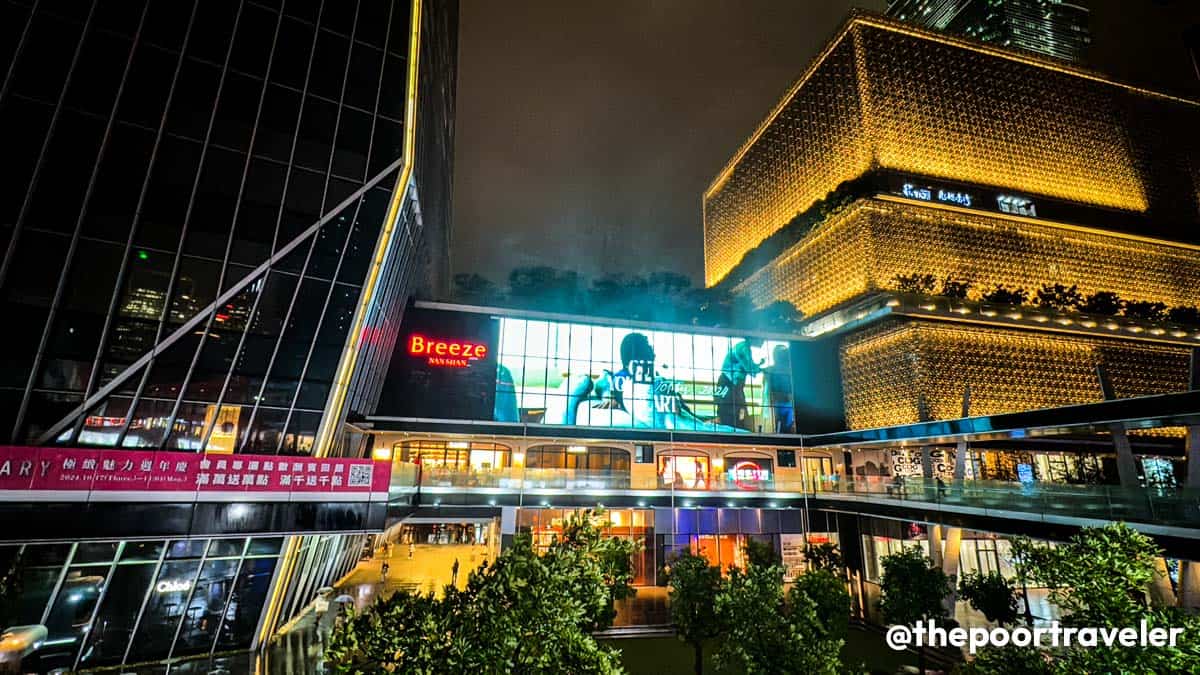
Outside, cross the road to the Xinyi Shopping District, which is a complex of malls, bursting at the seams with all sorts of shops and restaurants. This pedestrian-friendly zone is lined with gleaming malls like ATT 4 FUN, Breeze, Shin Kong Mitsukoshi, and Eslite Spectrum, where you can shop, dine, and strut. And oh, the Apple Store at Xinyi A13 is also just around the corner. Two stories of minimalist shop with floor-to-ceiling glass walls, floating staircases, and those crisp, clean displays that make you want to splurge.
By the way, Taipei is a bona-fide shopping destination. It’s not just the number of malls or the diversity of the shops, but also the competitive prices. We always find that the costs here — be it perfumes, luxury items, or even the usual chains — are much lower than in most other countries. Yes, cheaper than the Philippines, too.
And I almost forgot, don’t leave without getting that “mandatory” low-angle shot of Taipei 101!
Where to Stay in Taipei
Here’s a list of the hotels and hostels we tried in Taipei:
Getting a travel insurance is optional, but we highly recommend this, especially when traveling abroad. Travel can be unpredictable, and though we hope we’ll never use it, having it gives us peace of mind in case of unexpected delays, cancellations, or emergencies.
For international destinations, consider PGA Sompo’s TravelJOY Plus insurance. You can GET IT HERE. Don’t forget to use WORTHIT for a special affordable rate.
The Pagani Zonda 760 Riviera needs no introduction. This one-off Pagani has swapped hands multiple times since it was delivered to a collector in Saudi Arabia in 2017. Now, the supercar is back on sale. This time, it will share the stage with an Aston Martin One-77 at RM Sotheby’s Abu Dhabi auction on December 5, 2025.
The last time this car went under the hammer, it sold for $5.5 million. However, that was six years ago, and Zondas have gone up in value since then. The one-off Riviera is estimated to fetch between $9.5 million and $10.5 million.
The Zonda Riviera is a one-off based on the 760 spec. It started life as a Zonda F. The car is finished in pearl white with bare carbon fiber surfaces and blue accents. The spec is said to be inspired by the French Riviera, and hence the name. It has twin carbon canards on either side and a carbon splitter. The front fender flares are also finished in carbon. It has a carbon roof scoop and a shark fin. The interior features polished carbon and black aluminium. The seats are wrapped in blue leather, while the headliner is Alcantara.
The Riviera is powered by a 7.3-liter V12 engine that produces 750 hp and 575 lb-ft of torque. In comparison, the regular Zonda F had just 594 hp and 561 lb-ft of torque.
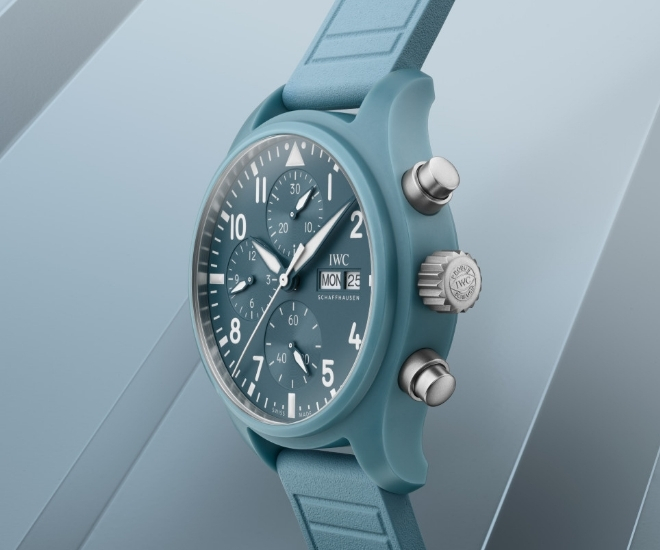
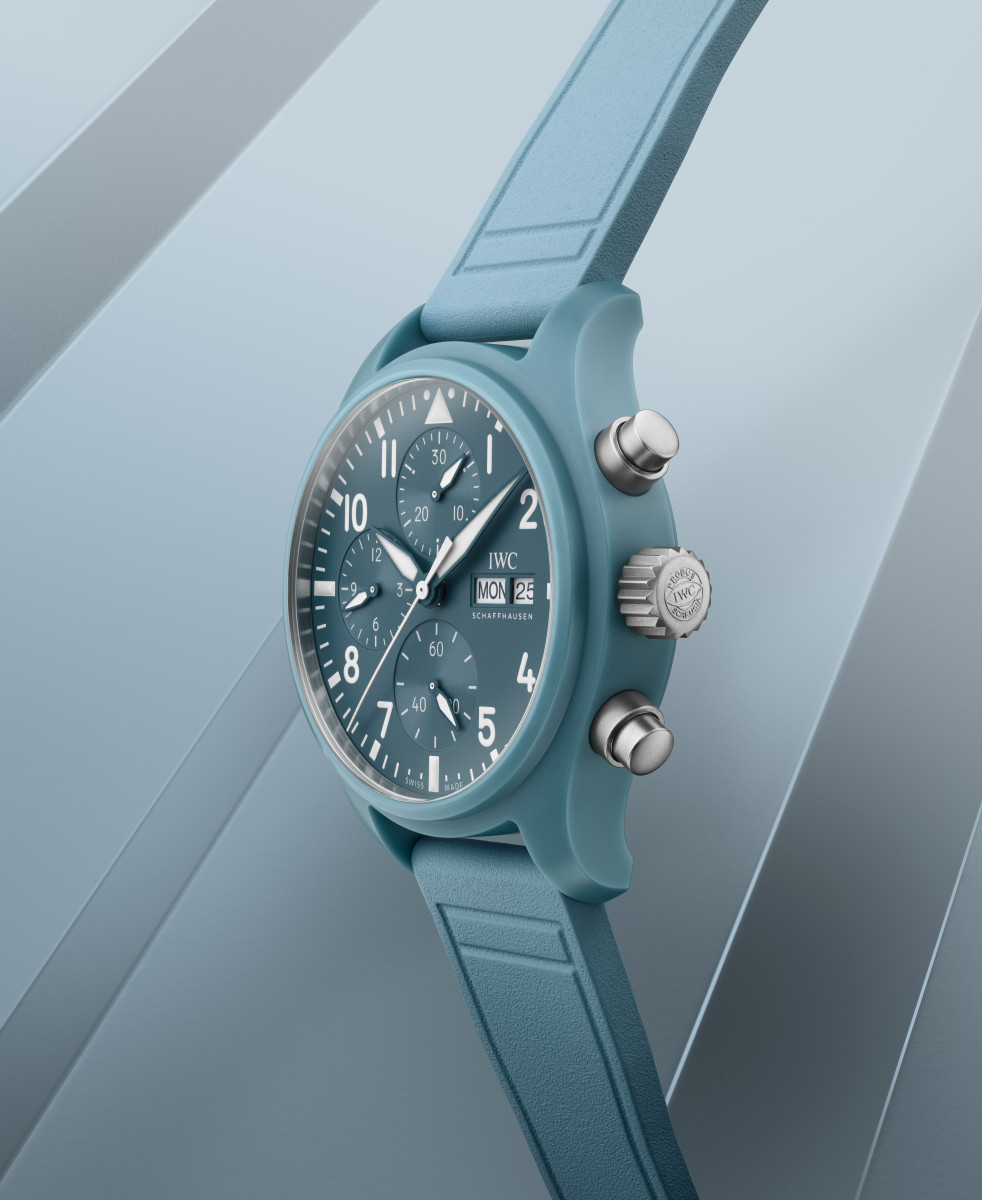
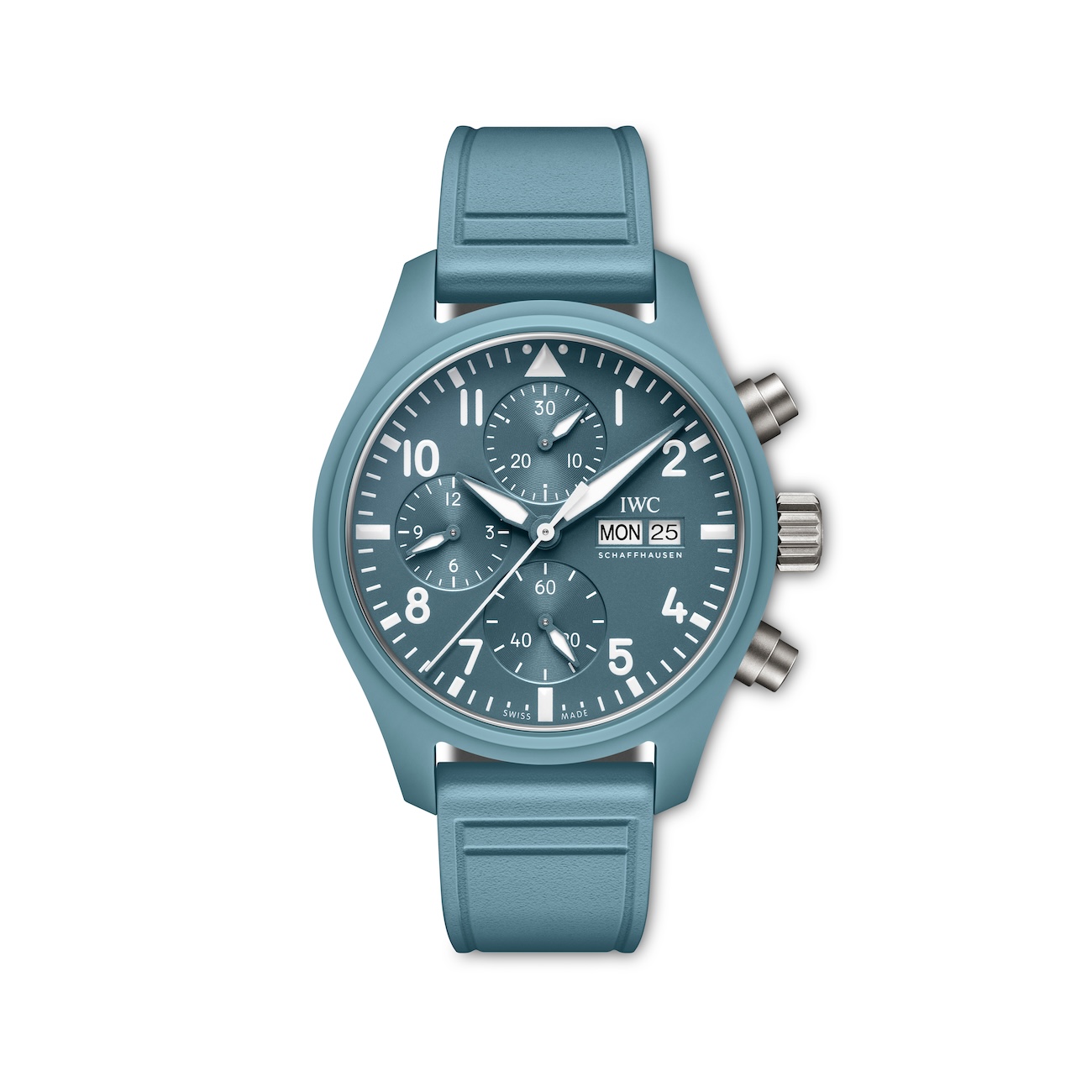
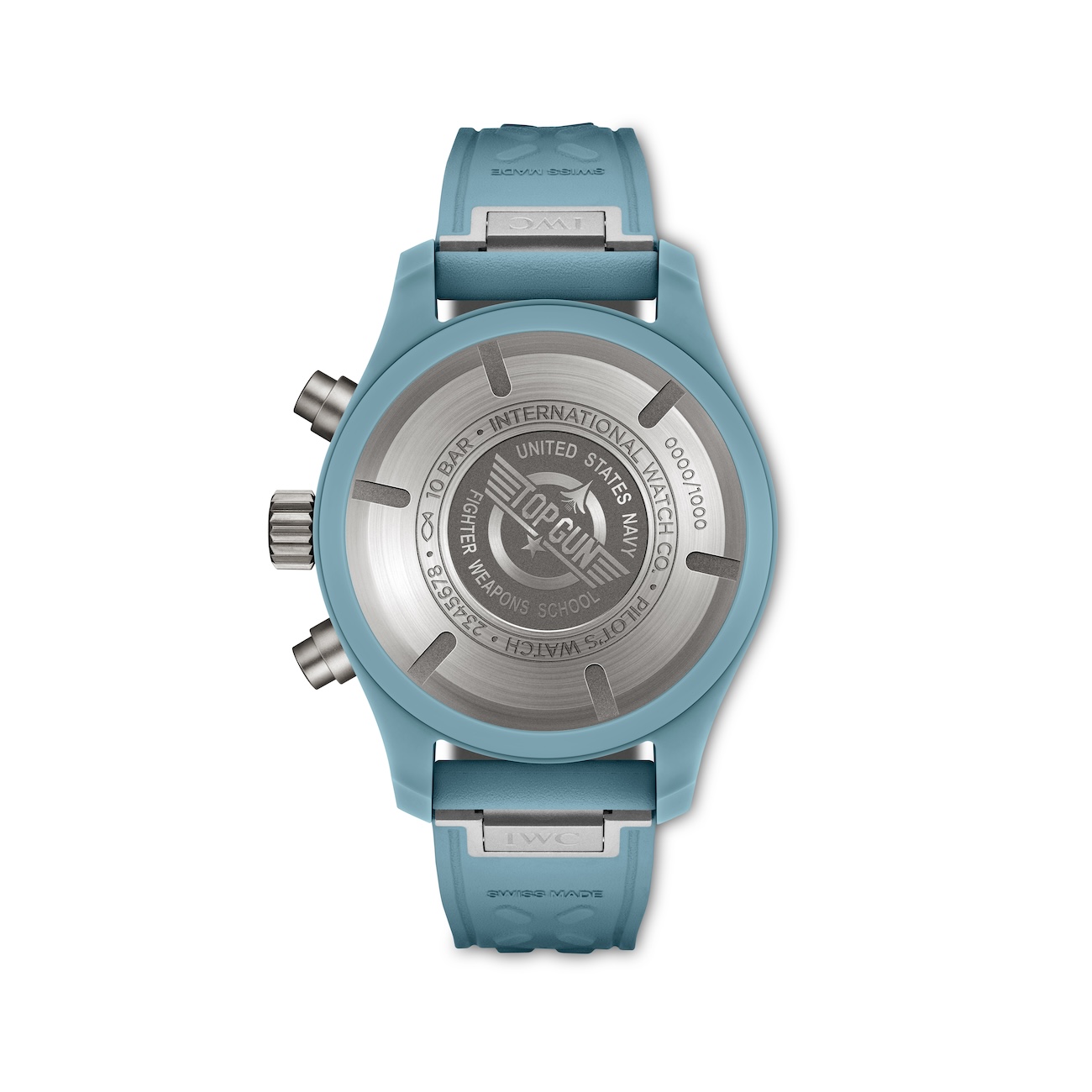
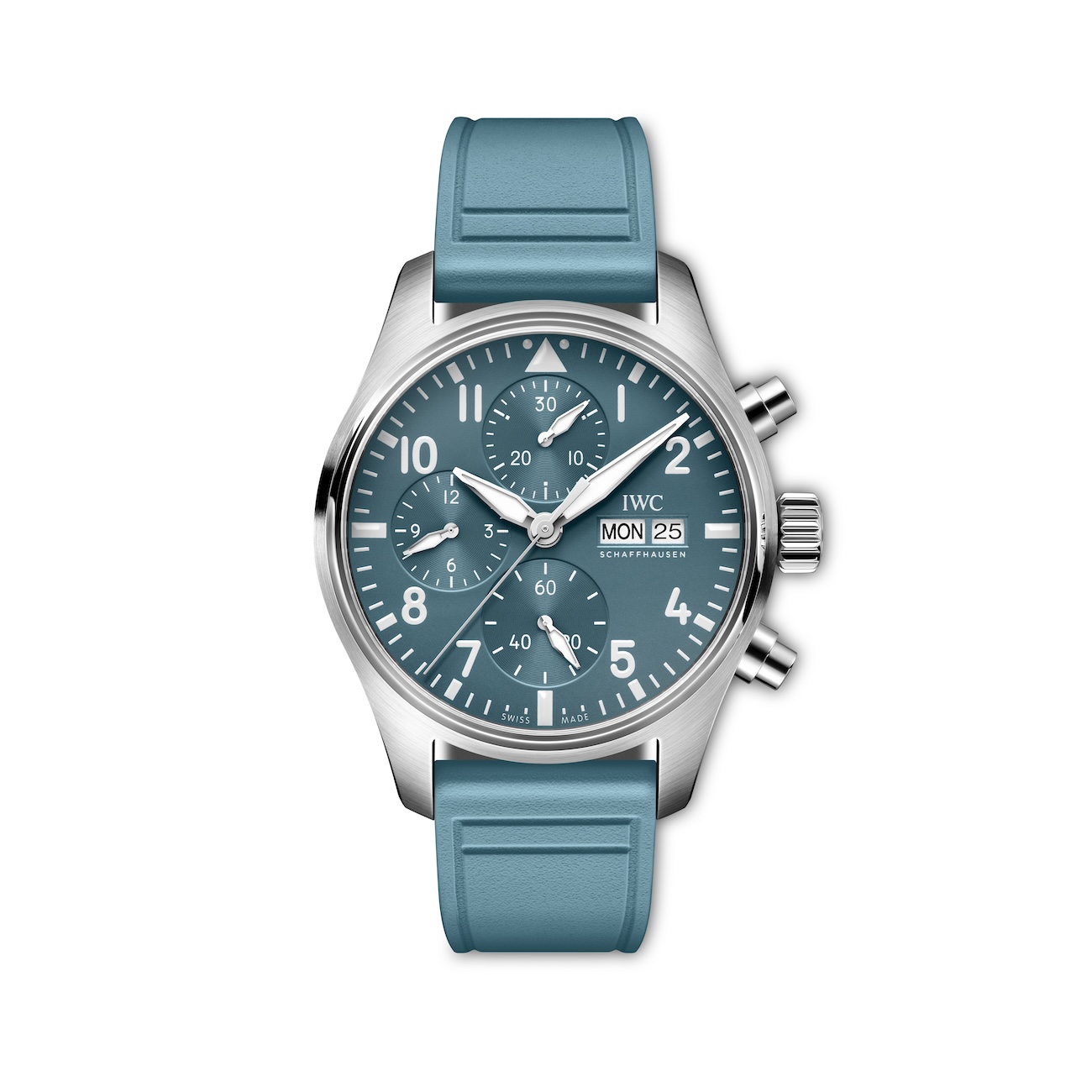
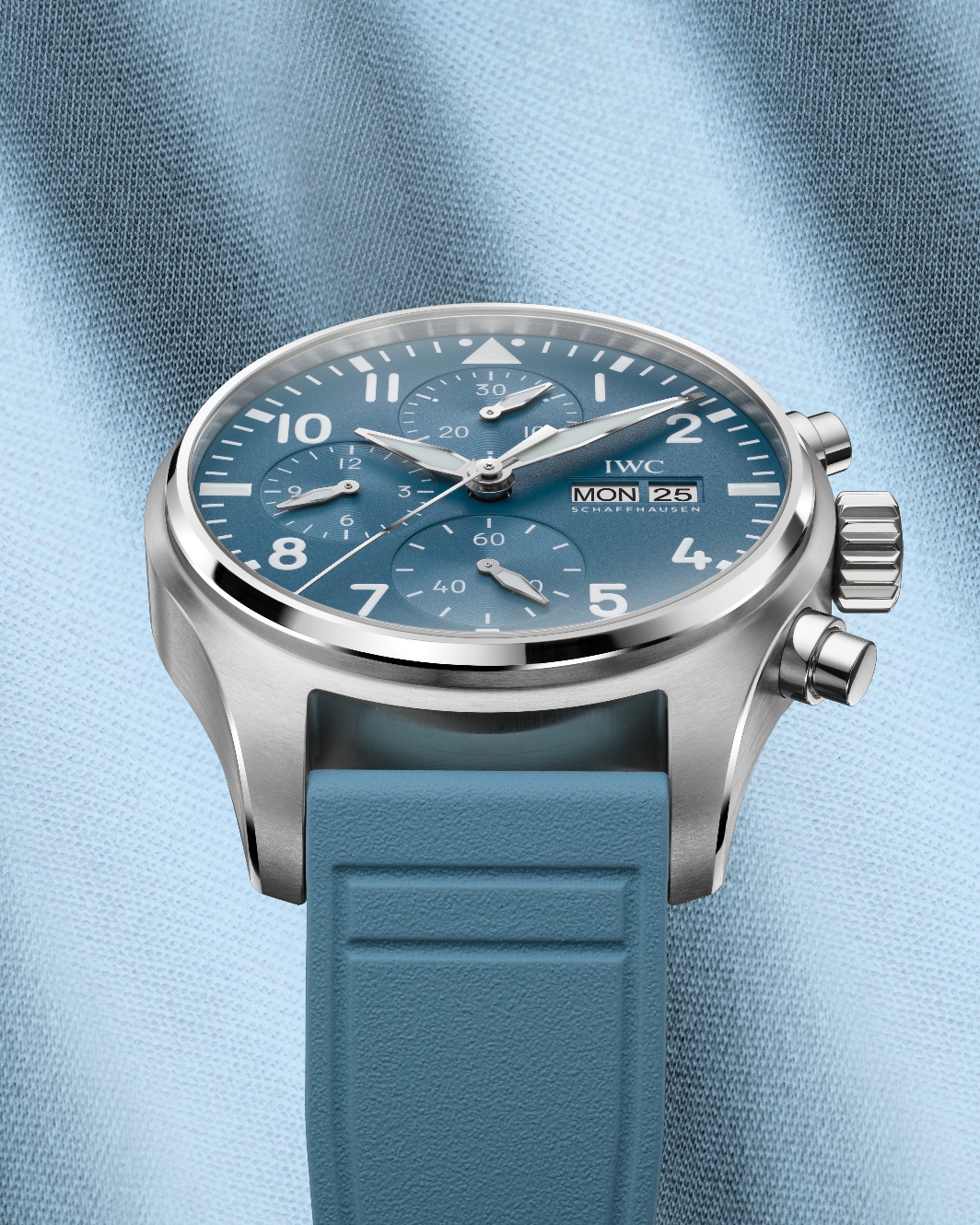
When we write about IWC’s Top Gun range, it is typically a salute to clever materials and bold colours and that is partly the case (pun ever-so-slightly-intended) here. The Pilot’s Watch Chronograph 41 Top Gun Miramar presents itself in a delightful shade of called (no prizes for guessing) Top Gun Miramar. Your eyes do not deceive you; it is indeed a sort of light blue that is reportedly inspired by the tees worn by the US Navy Fighter Weapons School instructors (under their flight suits). These are, of course, the best of the best and they work on training the next generation of the same. That is not a trivial detail for anyone who might be interested in this version of the Pilot’s chronograph, and neither is the fact that the colour was developed in collaboration with Pantone, the industrial titan of production colours.
The Pilot’s Watch Chronograph 41 Top Gun Miramar, which we will address for the rest of this story as the Top Gun Miramar, is also distinguished by a first. While the Pantone partnership has been limited to watches with ceramic cases so far, IWC is offering a steel version this time, with the dial and rubber strap in the signature light blue; getting steel to feature colour that goes beyond the surface is currently beyond the ability of the experts. In any case, Ref. IW388117 is a significant model thanks to its material. The ceramic version features case, dial and strap in Top Gun Miramar, paired with SuperLuminova-coated blue hands; the steel variant has SuperLuminova-filled hands, which are rhodium-plated. Both models wear tall, at 15.5mm.
The 41mm Top Gun Miramar watches are both powered by the automatic IWC calibre 69380, with column wheel and oscillating pinion clutch. The ceramic version in particular is a tribute to IWC’s material expertise. The brand was one of the first to experiment with this material in the 1980s, as far as Swiss high-end makers of mechanical watches go. This know-how is what allows IWC engineers to create precision Pantone colours. Only the steel model has an exhibition caseback, with the Ref. IW389409 model having a closed caseback in titanium (engraved with the Top Gun logo) and a soft iron inner case to protect the movement from magnetic forces.
Both watches are also equipped with IWC’s own interchangeable strap system, EasX-CHANGE system, which is reportedly quick and easy (as advertised), with no additional tools required.
The island of Sint Maarten is known for its beautiful beaches and one of the most unique airport runways in the world, and it will soon welcome one more thing: Southwest Airlines.
The carrier will launch flights between both Orlando and Baltimore to the island’s Princess Juliana International Airport (SXM) next year, according to Southwest. This marks the airline’s first new international destination since 2021.
Southwest will launch daily flights from Orlando International Airport (MCO) on April 7, 2026, followed by weekend service from Baltimore/Washington International Airport (BWI) a few days later.
“These nonstop routes allow roundtrip connections with more than 45 airports across the U.S.,” Southwest wrote in a statement, calling the destination “one island” with “two heartbeats.”
The Caribbean island is split into two sides: the Dutch Sint Maarten and the French Saint-Martin. The main airport is on the Dutch side and known for its incredible plane spotting with the chance to see low-flying aircraft right from the nearby beach and snap memorable photos from the ocean or the sand with an up-close plane in the background. Travelers to the island can also sample classic Caribbean eats, hang out at one of the many popular beaches, head out on a scuba diving expedition, enjoy sailing excursions, and more.
Travelers looking to get a jump start on their spring break or winter getaways can start planning now since Southwest also opened its flight schedule through June 3, 2026.
Beyond Sint Maarten, Southwest is also making it easier for travelers to head to Asia thanks to a new partnership with Taiwanese carrier EVA Air. This marks Southwest’s third airline partnership, joining similar agreements the carrier has with Icelandair and China Airlines.
The expansion comes as Southwest undergoes a host of changes. In May, the airline ended its long-standing (and often tested) policy of offering free checked bags. And in January 2026, the carrier will debut its new assigned seating policy, putting an end to its open seating format. The carrier is also overhauling its fare classes, introducing new options of “Basic,” “Choice,” “Choice Preferred,” and “Choice Extra.”
And this week, Southwest also changed its plus-size seating policy, advising customers who need more room to purchase their extra seat during booking. Previously, Southwest allowed plus-sized passengers to either request a free additional seat at the airport or pay for the extra seat and receive a refund after the flight. The new policy will go into effect on Jan. 27, 2026.
The technical storage or access is strictly necessary for the legitimate purpose of enabling the use of a specific service explicitly requested by the subscriber or user, or for the sole purpose of carrying out the transmission of a communication over an electronic communications network.
Preferences
The technical storage or access is necessary for the legitimate purpose of storing preferences that are not requested by the subscriber or user.
Statistics
The technical storage or access that is used exclusively for statistical purposes.The technical storage or access that is used exclusively for anonymous statistical purposes. Without a subpoena, voluntary compliance on the part of your Internet Service Provider, or additional records from a third party, information stored or retrieved for this purpose alone cannot usually be used to identify you.
Marketing
The technical storage or access is required to create user profiles to send advertising, or to track the user on a website or across several websites for similar marketing purposes.



:max_bytes(150000):strip_icc()/TAL-header-cliff-suites-few-far-luvhondo-south-africa-PAYWHATUCANSAFARI0825-c31b057d240946188ee7adbc5fd8af64.jpg "This Luxury Safari Lodge in South Africa Just Launched a Pay-What-You-Can Program")
:max_bytes(150000):strip_icc():format(jpeg)/TAL-header-cliff-suites-few-far-luvhondo-south-africa-PAYWHATUCANSAFARI0825-c31b057d240946188ee7adbc5fd8af64.jpg)











:max_bytes(150000):strip_icc()/TAL-st-maartin-SW2STMAARTEN0825-9d98b19f028e4604a7ff95dbb7a5ecdf.jpg "Southwest Is Adding Nonstop Flights to This Stunning Caribbean Island")
:max_bytes(150000):strip_icc():format(jpeg)/TAL-st-maartin-SW2STMAARTEN0825-9d98b19f028e4604a7ff95dbb7a5ecdf.jpg)