Hyundai developing holographic windshield display with Germany’s Zeiss
Technology enables augmented reality displays to span width of windshield
Production planned to start in 2027
In the not too distant future, head-up displays will be able to present a whole lot more than the tiny window of static information we’re used to today.
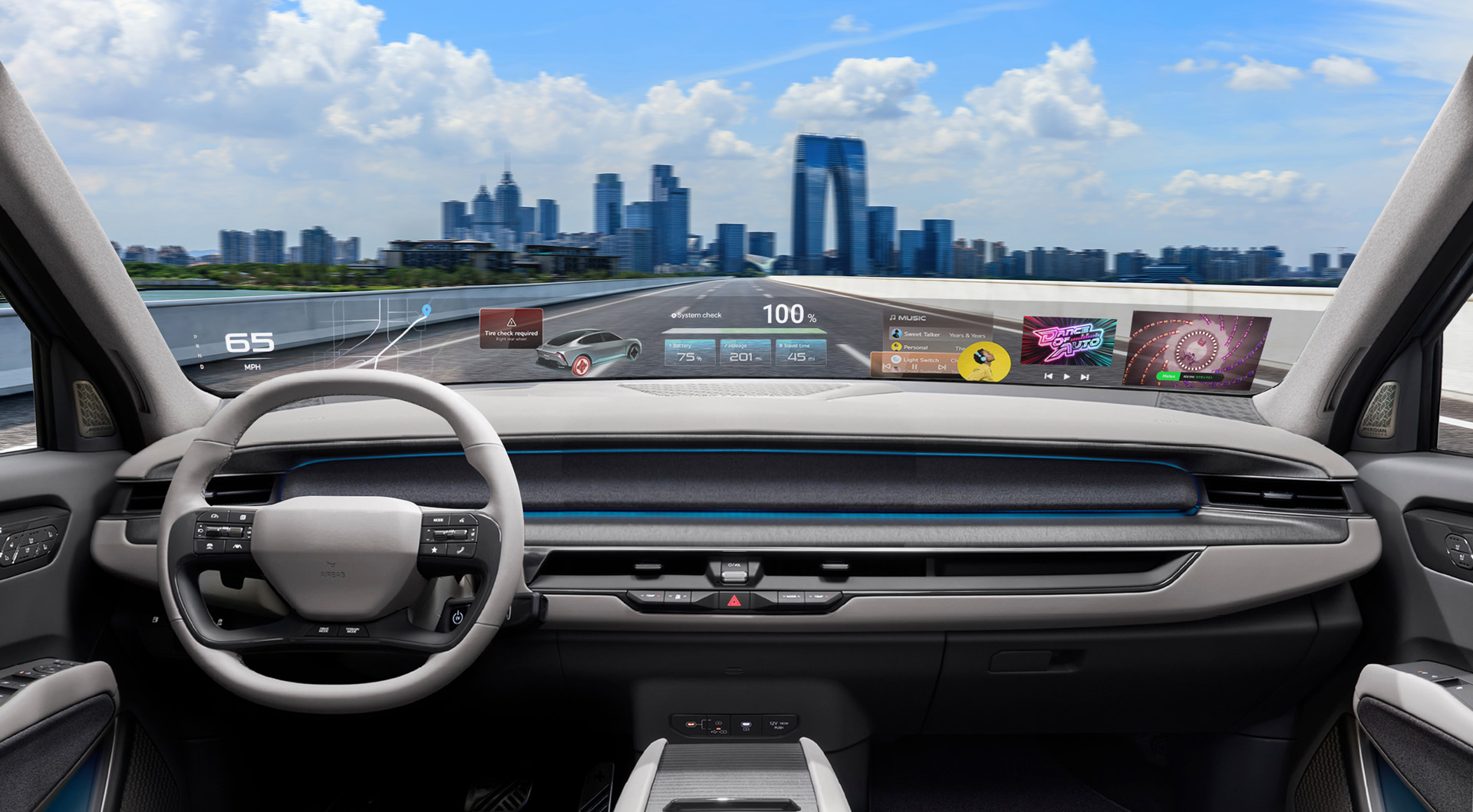
Hyundai is one of a growing number of automakers that plans to use the entire width of the windshield to display information, and announced on Oct. 13 a partnership with German optical company Zeiss to help develop the technology.
The key is holographic augmented reality technology, which could enable numerous possibilities, from showing you which turns to take on your selected route, the perfect racing line during track days, or highlighting potential dangers ahead—all without you having to take your eyes off the road.
The augmented reality aspect means the visuals are dynamic, meaning they can track moving objects, like a pedestrian, cyclist, or animal entering the road. A feed of traffic and weather information could also be displayed, using a cloud connection or other types of vehicle-to-infrastructure communications.
There could also be a section for a front passenger, for displaying media content, a video call, or information about the current location, like listing nearby restaurants or tourist attractions.
Hyundai said the technology may be introduced as soon as 2027, and that the introduction could end up changing the way vehicle cabins are designed. Since the traditional gauge cluster could be removed, the top of the dash could be mounted much lower, leaving more open space for a windshield.
The technology relies on a transparent film with a thickness less than a human hair being applied to the windshield. The film is then able to recreate images and video using light signals sent from LED-based projectors.
Ford displayed a prototype of a similar system in September, which the automaker is developing with a company called Ceres Holographics.
BMW previewed its own system last year in the i Vision Dee concept car and confirmed some form of the technology will make its way into next-generation electric vehicles referred to internally as the Neue Klasse family. The first Neue Klasse EV will be a compact crossover arriving in 2025.
Nissan’s design chief, Alfonso Albaisa, told Motor Authority in an interview earlier this year that screens in the dash will eventually be replaced by windshields capable of displaying all of the same information. And patents from General Motors also surfaced earlier this year showing a system that could potentially display information on all parts of the screen.
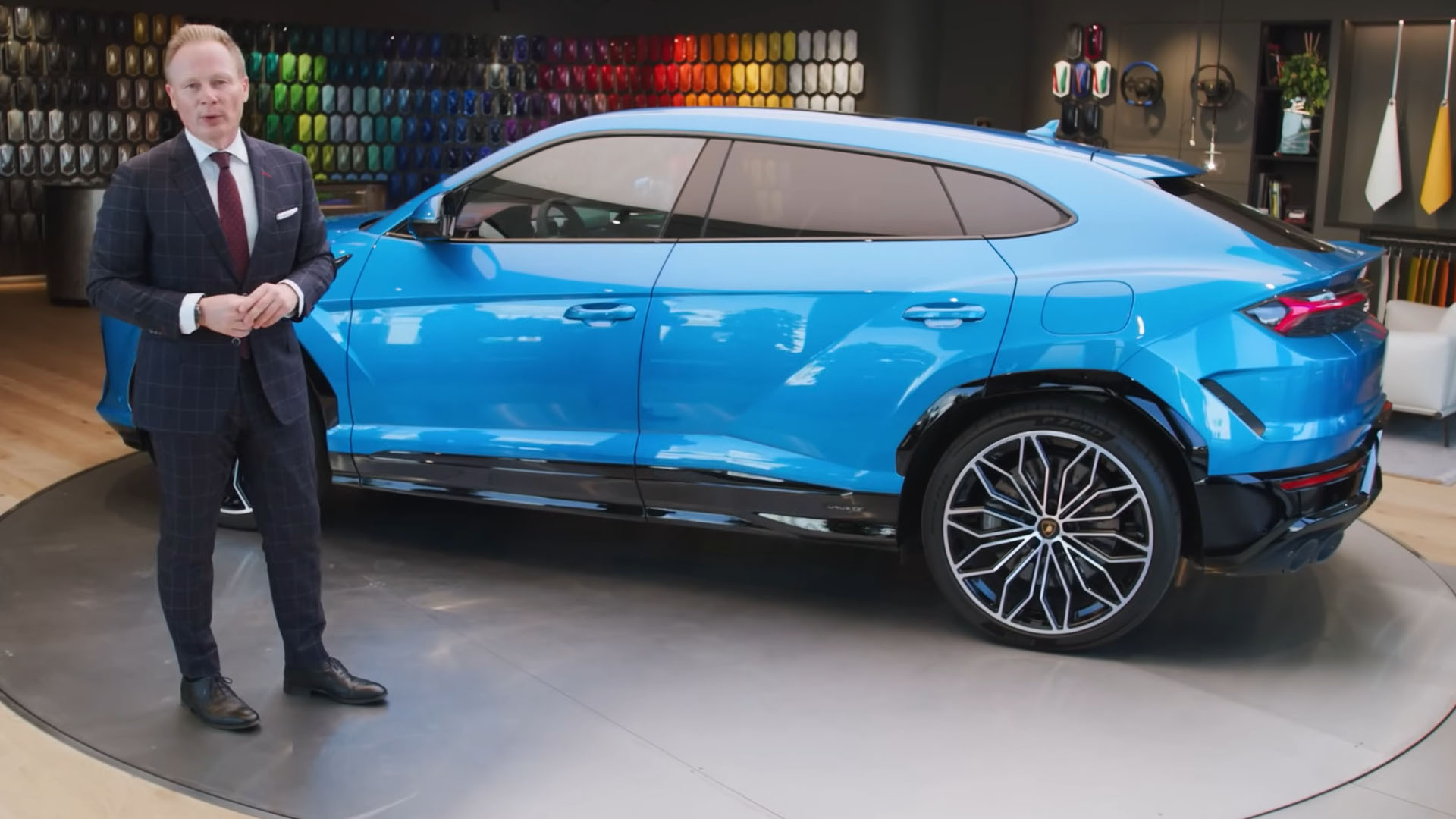
Lamborghini is quickly evolving their model lineup with hybrid models, last year the by now legendary Aventador V12 was replaced with the Revuelto, Lamborghini’s first production hybrid, still powered by a magnificent V12 engine, but fitted with electric motors to become a hybrid, while the Sian and Countach LPI 900-4 were very limited edition hybrid models, the Revuelto was in fact the first actual normal production model, since then we’ve seen the introduction of the Temerario, the V8 hybrid to replace the Huracan, but no customer cars have been delivered yet, so the brand new Lamborghini Urus SE has become the second production hybrid made in Sant’Agata.
And let’s not forget the Lamborghini Urus is by far the most successful model ever from Lamborghini, and with the SE version becoming a hybrid, the Urus SE is the most powerful Super SUV out there with a total of 800 hp, so let’s take a look at what some of the people at Automobili Lamborghini SpA have to say about this milestone model from Sant’Agata:
It’s hard to imagine a hotel more firmly ingrained in pop culture than The Stanley Hotel. Even if you don’t know it by name, you likely know it by reputation: It’s the hotel where, on one fateful night, Stephen King roamed the empty halls and dreamed up one of the best horror tales ever written. But even before it was “The Shining”hotel, people were calling it the most haunted hotel in America.
I spent a weekend there this October, and had some truly chilling moments — but, of course, that’s exactly what I was hoping would happen.
If you visit the hotel in Estes Park, Colorado — even if you don’t know anything about “The Shining”or the hotel’s outsized reputation as a delightfully spooky destination — you’d likely sense that there’s something special about this place. As you ascend the mountains that lead up to Rocky Mountain National Park, and then drive down into Estes Valley, there’s a real sense of building anticipation. And once you’re in the valley, you’ll see it: a majestic white hotel with a red roof, set against a pine-covered mountain with a serene lake below. During the day, The Stanley is a beacon to weary travelers, hungry diners, and appreciators of grand, historic hotels. At night during spooky season, it glows a sinister red, a harbinger of what you’ll find inside: REDRUM.
From left: The hotel’s main staircase, a common place for reported ghost sightings; The Victorian seance room.
Julie Tremaine/Travel + Leisure
“It has just got a sense of place and belonging where the customer honestly believes it’s theirs,” Stanley Hotel owner John Cullen told Travel + Leisure. “Everybody leaves here with a story they can tell.”
I’ve stayed in a lot of allegedly haunted locations before, like the Mount Washington Hotel in New Hampshire and the Queen Mary, a cruise ship-turned-floating hotel in Los Angeles. They accept their spooky reputations — any staffer at the Mount Washington can tell you a story of a paranormal experience, and the Queen Mary offers ghost tours — but The Stanley goes a step further to embrace its haunted legends. The Colorado hotel doesn’t just offer ghost tours; it hosts recreations of Victorian seances, shows by master illusionists, and regular lectures by visiting paranormal experts.
The Stanley is also home to the “frozen dead guy” who inspired the annual Frozen Dead Guy Festival, which Cullen described as “sort of a winter festival, sort of a Burning Man” that brings in 10,000 revelers every March to see Bredo Morstoel, a cryogenically frozen Norwegian man whom The Stanley adopted when too many visitors were overwhelming his original resting place. There’s a Frozen Dead Guy Tour, in addition to historic daytime hotel tours and those aforementioned ghost tours. Cullen said that 184,000 people take a tour of the hotel every year.
The hotel’s “frozen dead guy” spends his afterlife in the former ice house.
Julie Tremaine/Travel + Leisure
You could definitely visit The Stanley for a scare-free stay and not see any ghosts. In my three nights there, I didn’t experience anything overtly supernatural, other than attending lectures by paranormal investigators Amy Bruni of Kindred Spirits and Greg and Dana Newkirk from Hellier. But you definitely couldn’t miss a certain air of mystery about the place, largely inspired by the legend of Stephen King’s infamous visit.
The story goes like this: King and his wife Tabitha checked into the hotel for one night in late September 1974, not realizing it was the last night of service before closing down for the season. They were the only guests in the hotel, and they stayed in Room 217, the Presidential Suite. It was purely serendipity that that particular room is among the hotel’s most haunted. In 1919, a gas explosion severely injured a chambermaid in that room, but she healed — with hospital bills paid by the hotel — and worked there for the rest of her life. Today, her ghost is rumored to be so attached to the hotel that she tidies up the space — whether living guests want her to or not.
The plaque on the “Stephen King Suite” at The Stanley Hotel.
Julie Tremaine/Travel + Leisure
By King’s stay, the hotel had fallen on hard times. It looked nothing like it does today, thanks to hundreds of millions of dollars in renovations and an enormous resurgence in interest, due in large part to the book King wrote after his visit, and the mini-series adaptation of “The Shining”that King filmed there in 1997. (He famously did not like the Kubrick version.) “That night, I dreamed of my three-year-old son running through the corridors, looking back over his shoulder, eyes wide, screaming… I woke up with a tremendous jerk, sweating all over, within an inch of falling out of bed.” King wrote of The Stanley on his website. “I got up, lit a cigarette, sat in the chair looking out the window at the Rockies, and by the time the cigarette was done, I had the bones of the book firmly set in my mind.”
King has always been clear that The Overlook from “The Shining”isn’t directly inspired by The Stanley, and that he didn’t experience anything otherworldly there. “Some of the most beautiful resort hotels in the world are located in Colorado, but the hotel in these pages is based on none of them,” the author writes on the second page of “The Shining,” just after the dedication. “The Overlook and the people associated with it exist wholly within the author’s imagination.”
So while he was inspired to write about a hotel filled with sinister, murderous ghosts at The Stanley, he isn’t writing about the hotel in that book. But you tell that to the people who buy wine glasses with REDRUM (Danny Torrance’s recurring warning about “murder”) engraved on them, keychains with antique keys to Room 217, or stickers of typewriters that say “all work and no play,” the line Jack Torrance repeats over and over as he loses his mind. Fans have stolen the room number plaque to Room 217 so many times that there are replicas for sale, as well.
The Redrum Punch from The Cascades bar.
Julie Tremaine/Travel + Leisure
Those same people wander the hedge maze built after so many visitors asked where the hotel’s was, expecting to see it because The Overlook has one in the film. They sit at the antique wooden bar in The Cascades, the hotel’s fine dining restaurant, and order Redrum Punch, or retire to the wine bar for a glass of 217 Cabernet made for the hotel in Napa Valley. They watch the hotel’s dedicated television channel that plays both the Kubrick and the King versions of “The Shining”on a 24-hour loop.
Today, Room 217 is the Stephen King Suite. It’s filled with his books, including a hardcover copy of Black House which fans have turned into a journal detailing their experiences in the room, writing notes to slip between the pages of their own spooky encounters. The most die-hard King followers address their notes to “fellow Constant Reader,” the term he uses to refer to his fans, before detailing experiences of doors opening and closing on their own, lights flickering on and off, or shadow figures appearing in darkened corners.
A note left to “fellow Constant Readers” inside the Stephen King Suite.
Julie Tremaine/Travel + Leisure
There’s another way to step into “The Shining” for fans of the film. “The Shining” Suite in the caretaker’s cottage is a faithful recreation of Room 237 from Kubrick’s “The Shining”(it was changed from 217 in the film adaptation). The carpets are that unmistakable geometric pattern, and the furniture is iconically midcentury. The only thing that’s out of place is an oil painting of Stephen King hanging on one wall. In the closet, a safe guards an original screen-used axe from Kubrick’s movie, which cost the hotel $250,000 at auction.
“And of course, you can’t have a ‘Shining’ bedroom without…” Cullen said as he opened the bathroom door for me to reveal a mint green room, with a tiled floor leading to a bathtub with sheer shower curtains hanging ominously from above. It’s an exact, to the detail, replica of the bathroom from the movie, the scariest scene in one of the scariest movies of all time. I’ve read “The Shining”probably five times, and I’ve seen furniture move on its own in a haunted hotel room at the Mount Washington, so not many things truly creep me out. But the sight of that bathroom was positively chilling, and it took me a few minutes to steel my nerves to walk inside.
The scariest bathroom in the world, inside The Shining Suite at The Stanley Hotel.
Julie Tremaine/Travel + Leisure
“The Shining” Suite is only available to stay in one weekend a year, and it’s booked through an auction. “It went for $100,000 for one weekend, and 100 percent goes to charity,” Cullen said, adding with a laugh: “We have the lowest-occupancy hotel room ever built.” You might not be able to book the room to stay in, but you can definitely see it — “The Shining” tour runs every day, and it includes other spooky tales, like the real-life origin of the spectral twins in their blue dresses from the book.
I loved my stay at The Stanley Hotel, but I will admit: I wanted to experience more ghosts on my visit. There are tales of a ghostly Flora Stanley, hotel founder F.O. Stanley’s wife, who’s rumored to play her beloved piano in the concert hall, and of a security guard who died nearly 20 years ago but still patrols that building at night. Mr. Stanley’s ghost has been seen at the reception desk. The lobby stairs are a common place for people to report seeing glimpses of people who aren’t really there (or are they?), and on the fourth floor, people often say they hear children running and playing when there are none around. And then, of course, there’s Room 217. If you want to try your luck sleeping there, you’ll have to put some planning into it — that room sells out months in advance and is booked years out for Halloween night.
I’ve lived in 3 different Sprinter Vans since 2016, so I know that finding the perfect gift ideas for van lifers can be difficult. What do you get the person who lives tiny and doesn’t have a lot of storage space?
In this 2024 Van Life Gift Guide, I’ve rounded up the best van life gear I’ve used over the last 8 years. These gifts are practical, multi-functional, and take up minimal room – ensuring your favorite van lifer will actually bring it with them on the road.
From compact camp furniture to practical safety gear to fun outdoor games, I’ve checked off every box to make sure there’s something for every kind of van lifer in your life.
Need more gift suggestions?
I have a variety of gift guides for all types of adventurers. Here are the ones to check out.
This post may contain affiliate links.
1. CGear Sand-Free Mat
An outdoor mat is something that every van lifer needs. A sand mat keeps sand and dirt from getting tracked inside and creates a nice “patio” space for hanging out. This CGear Sand-Free Mat is what I use because it allows sand and dirt to filter through (rather than pile up on top like a regular outdoor rug), and it folds down small for easier storage.
Save this post!
Enter your email & I’ll send this post to your inbox! You’ll also receive my weekly newsletter full of helpful advice for planning your adventures.
2. Dometic GO Compact Camp Table
I upgraded to the Dometic Go Camp Table this year and it’s been one of my favorite gear additions. It folds in half for easy storage and the solid bamboo top has a nice elegant feel while still being durable enough for extended outdoor use. Plus, its adjustable leg height means you can swiftly transition from a cooking station to a coffee table, or even downsize it to a kiddo’s play table.
3. MoonShade Awning
If your favorite van lifer doesn’t have an awning, the MoonShade Awning fits on nearly any vehicle, does well in windy conditions, and packs down small for easy portability. And it’s easy to set up too! Read my full review of the MoonShade awning for all the details. *Save 10% by using the code BEARFOOTTHEORYat checkout*
4. Helinox Sunset Chair
I’ve tried so many different chairs over the years. The Helinox Sunset Chair strikes the best balance between packability, weight, and comfort with the high back. It only takes about 30 seconds to set up, and even van lifers with the smallest vans should have room for this awesome chair. For more recommendations, see my post of my favorite camp chairs.
5. Rumpl Blanket
Rumpl Blankets are my favorite van life comforters because they’re snuggly and soft yet still durable for the road. I’ve used mine since 2017 and can’t believe how well it’s held up! The blankets come in several different materials including recycled synthetic (the most durable), a warmer NanoLoft synthetic, and down. Since they’re water and dirt-resistant and can be thrown into the wash – which is especially great if you have dogs.
6. West Paw Big Sky Nap Bed
If you’re traveling with a dog in your van, it’s nice for them to have a comfy space of their own. My dog Charlie likes to hang out in his West Paw Big Sky Nap Bed between the two front seats. He seems to love it, and the best part is it’s totally machine-washable, which is a must for van life.
7. Trelino Composting Toilet
There’s a new toilet that’s quickly becoming a favorite among van lifers: the Trelino Composting Toilet. It’s more compact than your traditional composting toilets, plus it doesn’t require any outside venting or a power source. The best part is the solid waste compartment can be used with handy bags for easier cleanup. This is the toilet I’m planning to have in my new truck camper we are getting soon. Check out my full roundup of the best van toilets here.
8. Mr. Buddy Portable Heater
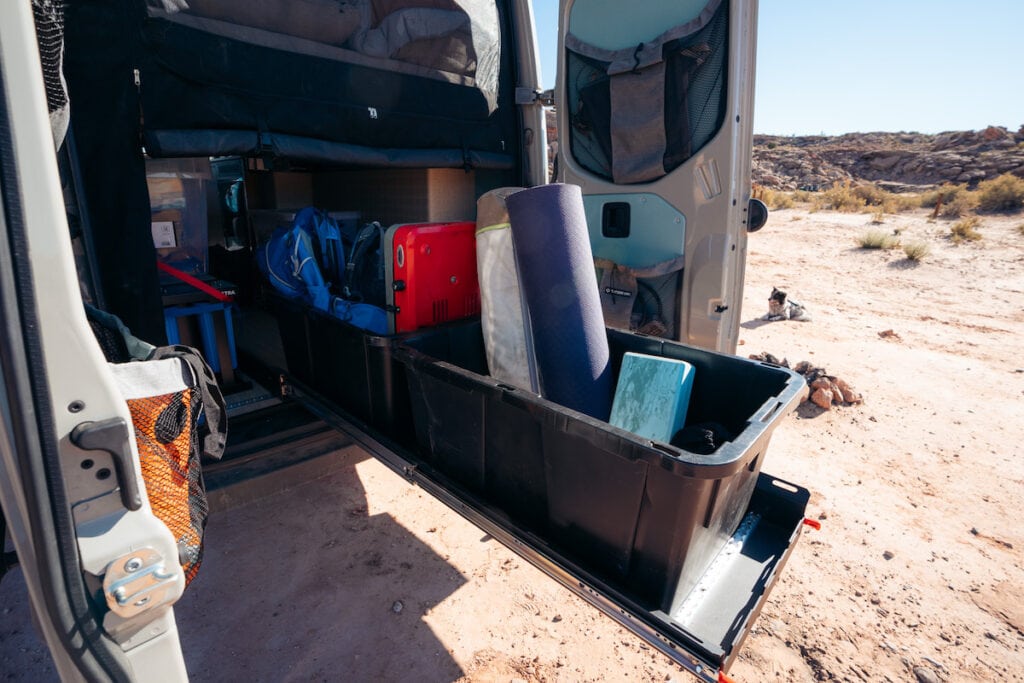
The portable Mr. Buddy Heater is a great gift for van lifers that don’t have heat in their van. This heater runs on 1 lb propane cylinders, so there’s no worry about draining your van battery on a chilly night. It also comes with several auto shut-off safety mechanisms, like turning off if it gets tipped over, if it detects low oxygen levels, and if the pilot light turns off.
9. Scrubba Wash Bag
Laundry day is one of my least favorite chores as a van lifer. This clever Scrubba Wash Bag allows you to wash a few items of clothes without having to go to the laundromat. You simply fill the bag up with warm water and a bit of biodegradable soap, then ‘scrub’ your clothes clean on the washboard nodules.
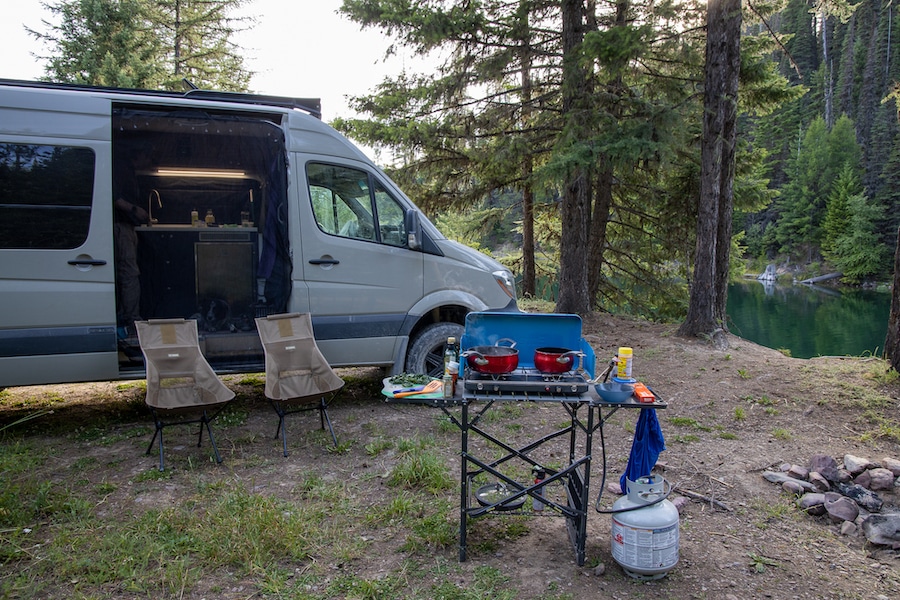
10. GCI Outdoor Slim-Fold Cook Station
If you’re buying a gift for a van lifer who loves to cook, this is another great table option that Ryan and I use. The GCI Outdoor Slim-Fold Cook Station is incredibly easy to set up (it just folds open and closed) and packs up flat so you can store it in a narrow space. I love how it has multiple levels and tiers to give you space to whip up gourmet meals.
11. Magma Nesting Cookware
I love this Magma Nesting Cookware set. It comes with everything you need to cook, including a 12″ pan and several pots. Everything nests together perfectly so it takes up a lot less space. It’s easy to clean and the handles are detachable, making them even easier to stash away. Plus, this cookware is induction-friendly for those with an induction stove in their van. I prefer the stainless steel version since it doesn’t scratch when things move around in your drawers.
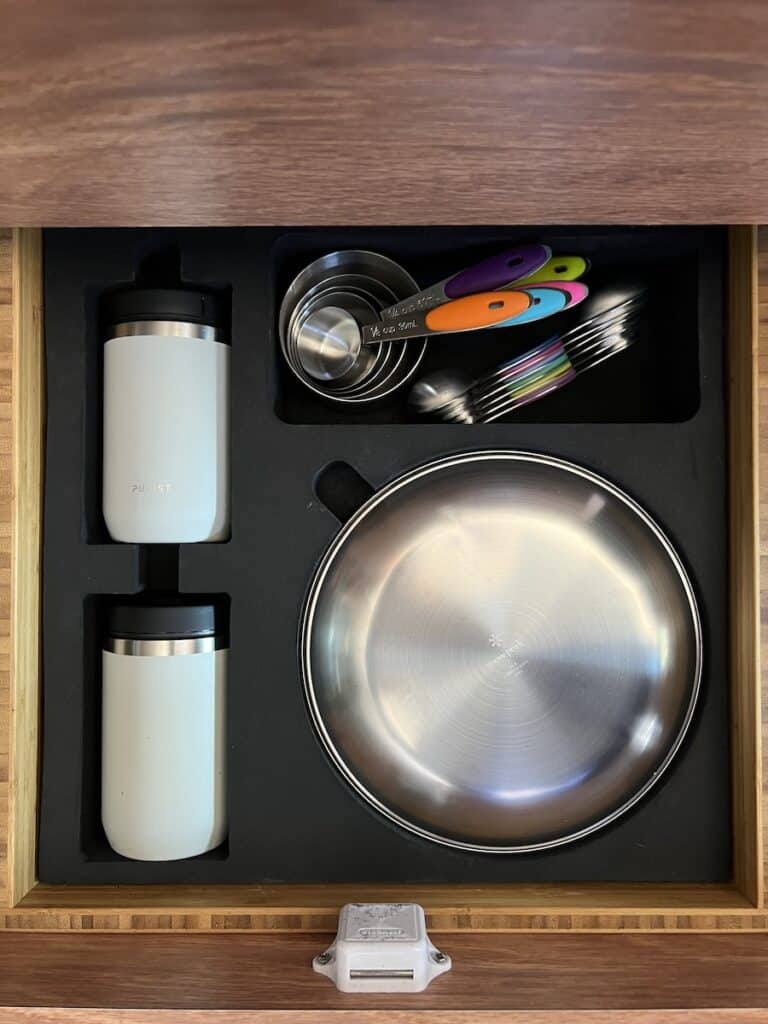
12. Snow Peak Tableware Set
I recently ditched the plastic dinnerware I’d be using in my van for years for something more non-toxic, and I’ve been really impressed with the Snow Peak Tableware Set. The stainless steel set is durable and everything nests together for easy storage — it comes with a plate, a dish, and 2 different sized bowls.
13. Omnia Stovetop Oven
I really miss having an oven in my van. However, with the Omnia Oven, you can bake right on your stovetop! From pizza to cakes to bread to casseroles, this compact “oven” is the perfect gift for the van life baker in your life.
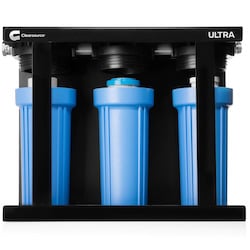
14. Clearsource RV Water Filter
We added a Clearsource RV Water Filter to our van last year after several experiences with heavily chlorinated campground water. Apart from the bad taste, it got me thinking about what else might be in the water we are filling our van up with. The Clearsource Ultra is a three-stage water filter that reduces or removes all of the nasty stuff and harmful chemicals, and our water tastes so much better!
15. Bose Noise Cancelling Headphones 700
For those moments when you crave a personal escape or need to zero in on work without distractions, these Bose Noise Cancelling Headphones are a godsend. I love being able to pop on my favorite music, podcasts, or a meditative track – all while maintaining the harmony of shared space with my partner Ryan.
16. Hyperlite Camera Pod
The Hyperlite Camera Pod is what I use to store my camera in the van. Made from ultralight, durable, and weatherproof material, it allows me to throw my camera in a drawer without having to worry about it getting banged up. It also doubles as a camera bag while hiking. You can carry this pod in your hiking bag or clip it to your hipbelt for easy access.
17. Nocs Provisions Binoculars
Binoculars are a fun gift for van lifers – it’s great to have a pair while hiking or hanging out at camp. Most recently, we used ours while watching whales from our van on the Olympic Peninsula, and I was so happy to have them. These Nocs Provisions binoculars are compact, waterproof, and fog proof. They come in fun colors and have a durable housing too.
18. Manduka PROlite Yoga Mat
I love my Manduka PROlite Yoga Mat. It’s a little lighter than a traditional yoga mat, taking up just a bit less room. Yet it’s still cushioned enough for stretching and yoga at your campsite. It’s made with certified OEKO-TEX materials, meaning that there are no harmful chemicals, and it has a slip-resistant surface for when you get sweaty.
19. iPad/Tablet Holder
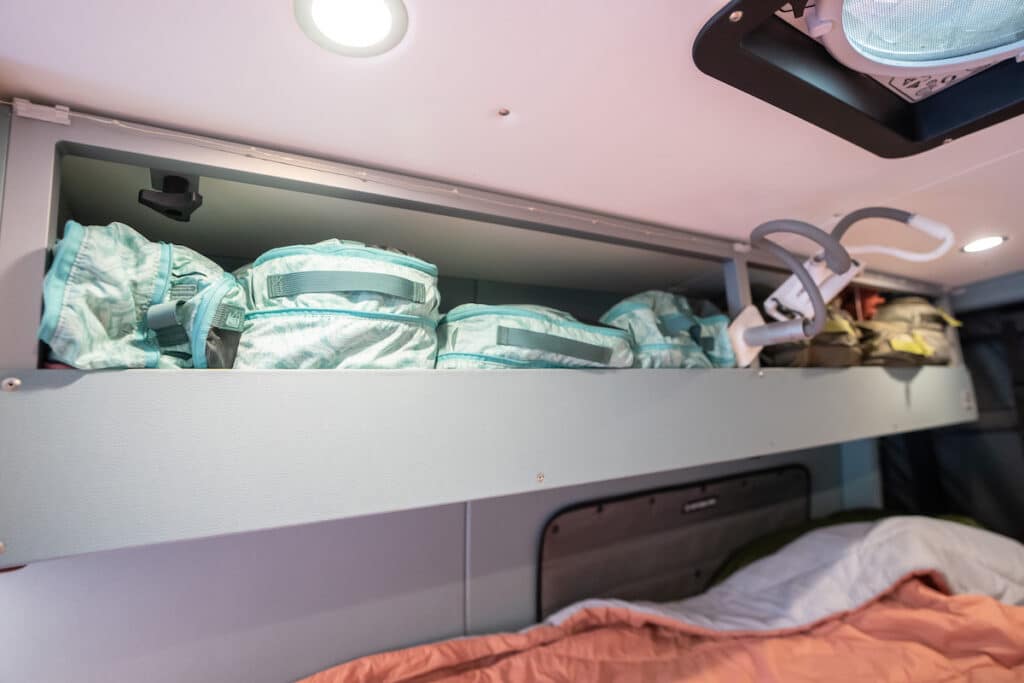
Sometimes you just want to Netflix and Chill (even in a van). This flexible iPad/Tablet holder makes it incredibly easy to watch your favorite shows from anywhere in your van. We clamp this to one of our overhead cabinets and use it to hold our iPad to easily watch our favorite shows from bed. It’s versatile and can be clamped to a variety of objects, and has a flexible arm so you can move the iPad to the right angle.
20. Table Top Ping Pong Set
When we are staying at an established campsite with a picnic table, Ryan and I love busting out this table top ping pong set. It doesn’t take up any room in our van, and is a fun way to kill time, especially when our little guy is napping in our van.
21. Ekrin 365 Massage Gun
Most van lifers are pretty active, and this Ekrin massage gun will help them recover after a long day on the trail. I even enjoy using this after a big day of driving to work out some of the stiffness from sitting. This particular model is small enough that it won’t take up a bunch of room, and it comes with a compact carrying case for easy storage. Plus the battery lasts for over 4 hours on a single charge!
22. Kindle
Physical books take up a LOT of space in a van, so switching to a Kindle eReader is perfect for book lovers on the road – plus the Paperwhite version is waterproof! A little known trick: If you have a library card, you can rent books for free using the Libby app. I love being able to download books for offline use, and the battery life lasts for weeks. You can also enjoy audiobooks by pairing Bluetooth headphones to switch seamlessly between reading and listening.
23. Trash Grabber
I love having a Trash Grabber for when we stumble on an otherwise great campsite that is littered with garbage. It makes it easy to pick up trash without having to touch anything gross. It’s foldable so it can easily be stowed away in a drawer, and it’s a nice way to give back to the public lands that van lifers depend on.
24. Pickleball Paddles
Ryan and I discovered pickleball when we were doing van life in Florida, and it’s since become one of our favorite sports. There are courts everywhere, the gear takes up little room, and it’s a great way to exercise on days we aren’t hiking. It’s also a fun opportunity to meet other people when you travel. Gift a pair of pickleball paddles to your favorite van lifer, and I bet they’ll be hooked.
25. North Face Thermoball Booties
I love being able to take off my hiking boots and slip on these warm North Face ThermoBall Traction Booties. They are so comfy for mozying around the campsite and much easier to put on than normal shoes when I have to let the dogs out first thing in the morning.
26. CEP Ultralight Compression Calf Sleeves
Let’s face it, those long hours behind the wheel on a van adventure can take a toll on our legs. These CEP Ultralight Compression Calf Sleeves have been essential for me on those long driving stretches (especially when I was pregnant). Not only do they help improve circulation, but they also combat that heavy leg feeling, making your journey more comfortable and enjoyable. They also come in a men’s version.
27. Max Trax Recovery Boards
Ryan and I got stuck in our van on a sketchy pass in Colorado once, and immediately after, I invested in these Max Trax Recovery boards. These boards can help you self-recover if you get stuck in sand, loose dirt, or mud, which is really important if you are miles from help (and especially if you don’t have cell service).
28. Benchmark Road Atlases
Benchmark Road Atlases are my go-to paper maps and make a great gift for van lifers. They show recreation activities, have categorized listings, and show public land ownership lines and backroads. They also differentiate between 2wd and 4wd roads which is key if you are trying to find secluded campsites. They’re super useful to have for each state you’ll be traveling in, especially if you plan to drive on remote dirt roads where you don’t have cell service.
29. Air Compressor
I have an onboard air compressor in my van, but if your favorite van lifer doesn’t, it’s an essential piece of safety gear. Airing down your tires before driving on soft surfaces (like sand) helps you avoid getting stuck, however, you need a way to air back up your tires when you get back to pavement. This portable ARB Air Compressor that comes in this tool box makes this very easy, and it can also be used to blow up your bike tires.
30. Hulkman Jump Starter
Waking up to a dead car battery is never fun, but when you’re out on National Forest land without another car in sight? That can be really scary. I know because it’s happened to us. For peace of mind, we always carry a portable car battery jump starter – which requires no other vehicle for a jump!
31. Garmin InReach Mini 2
I consider the Garmin InReach Mini 2 to be essential for all van lifers. This is a two-way communication device that can be used even when you don’t have cell service. I carry this when I’m hiking and it’s always accessible in the van. Last winter, Ryan and I woke up to a dead car battery in below-freezing temperatures in Idaho – and we didn’t have cell service or a way to jump ourselves. Luckily, I was able to use my Garmin to text my Dad the details of where we were so he could call help for us.
32. Birdie Alarm Keychain
I have this Birdie Alarm on my keychain, and I think it’s an especially great gift for solo van lifers. In the case of an emergency, you press a button and it sets off a loud siren and blinking lights to help deter an attack.
33. My Medic First Aid Kit
My Medic makes my favorite first aid kits, and I always carry one in my van. I love that it’s compact enough to be tossed anywhere in the van, but includes all the first-aid essentials you need to keep on hand. My Medic also offers refill packs so you can easily restock any of the items that you have used. This is a great van life gift, especially for van lifers who like to get off the beaten path.
34. Gerber Folding Shovel
A folding shovel is something that gets more use in a van than you probably think. A shovel is great in case you get stuck and need to dig yourself out and can also be used to follow Leave No Trace guidelines for responsibly using the bathroom outdoors. This folding Gerber shovel is great because it takes up very little room, weighs less than 3 pounds, and has a serrated edge for digging where the ground is tough.
35. REI Gift Card
For the adventurous van lifer who seems to have everything they need, or the newbie just starting their van life journey, an REI gift card allows them to get whatever they might need that will also fit their space. I personally always appreciate an REI gift card!
Save this post to Pinterest
I hope this list of best gifts for van lifers helps simplify your shopping so you can get off your computer, out of the stores, and spend more time outside this holiday season.
NVIDIA is expanding its collaboration with Microsoft to support global AI startups across industries — with an initial focus on healthcare and life sciences companies.
Announced today at the HLTH healthcare innovation conference, the initiative connects the startup ecosystem by bringing together the NVIDIA Inception global program for cutting-edge startups and Microsoft for Startups to broaden innovators’ access to accelerated computing by providing cloud credits, software for AI development and the support of technical and business experts.
The first phase will focus on high-potential digital health and life sciences companies that are part of both programs. Future phases will focus on startups in other industries.
Microsoft for Startups will provide each company with $150,000 of Microsoft Azure credits to access leading AI models, up to $200,000 worth of Microsoft business tools, and priority access to its Pegasus Program for go-to-market support.
NVIDIA Inception will provide 10,000 ai.nvidia.com inference credits to run GPU-optimized AI models through NVIDIA-managed serverless APIs; preferred pricing on NVIDIA AI Enterprise, which includes the full suite of NVIDIA Clara healthcare and life sciences computing platforms, software and services; early access to new NVIDIA healthcare offerings; and opportunities to connect with investors through the Inception VC Alliance and with industry partners through the Inception Alliance for Healthcare.
Both companies will provide the selected startups with dedicated technical support and hands-on workshops to develop digital health applications with the NVIDIA technology stack on Azure.
Supporting Startups at Every Stage
Hundreds of companies are already part of both NVIDIA Inception and Microsoft for Startups, using the combination of accelerated computing infrastructure and cutting-edge AI to advance their work.
Artisight, for example, is a smart hospital startup using AI to improve operational efficiency, documentation and care coordination in order to reduce the administrative burden on clinical staff and improve the patient experience. Its smart hospital network includes over 2,000 cameras and microphones at Northwestern Medicine, in Chicago, and over 200 other hospitals.
The company uses speech recognition models that can automate patient check-in with voice-enabled kiosks and computer vision models that can alert nurses when a patient is at risk of falling. Its products use software including NVIDIA Riva for conversational AI, NVIDIA DeepStream for vision AI and NVIDIA Triton Inference server to simplify AI inference in production.
“Access to the latest AI technologies is critical to developing smart hospital solutions that are reliable enough to be deployed in real-world clinical settings,” said Andrew Gostine, founder and CEO of Artisight. “The support of NVIDIA Inception and Microsoft for Startups has enabled our company to scale our products to help top U.S. hospitals care for thousands of patients.”
Another company, Pangaea Data, is helping healthcare organizations and pharmaceutical companies identify patients who remain undertreated or untreated despite available intelligence in their existing medical records. The company’s PALLUX platform supports clinicians at the point of care by finding more patients for screening and treatment. Deployed with NVIDIA GPUs on Azure’s HIPAA-compliant, secure cloud environment, PALLUX uses the NVIDIA FLARE federated learning framework to preserve patient privacy while driving improvement in health outcomes.
PALLUX helped one healthcare provider find 6x more cancer patients with cachexia — a condition characterized by loss of weight and muscle mass — for treatment and clinical trials. Pangaea Data’s platform achieved 90% accuracy and was deployed on the provider’s existing infrastructure within 12 weeks.
“By building our platform on a trusted cloud environment, we’re offering healthcare providers and pharmaceutical companies a solution to uncover insights from existing health records and realize the true promise of precision medicine and preventative healthcare,” said Pangaea Data CEO Vibhor Gupta. “Microsoft and NVIDIA have supported our work with powerful virtual machines and AI software, enabling us to focus on advancing our platform, rather than infrastructure management.”
Other startups participating in both programs and using NVIDIA GPUs on Azure include:
Artificial, a lab orchestration startup that enables researchers to digitize end-to-end scientific workflows with AI tools that optimize scheduling, automate data entry tasks and guide scientists in real time using virtual assistants. The company is exploring the use of NVIDIA BioNeMo, an AI platform for drug discovery.
BeeKeeperAI, which enables secure computing on sensitive data, including regulated data that can’t be anonymized or de-identified. Its EscrowAI platform integrates trusted execution environments with confidential computing and other privacy-enhancing technologies — including NVIDIA H100 Tensor Core GPUs — to meet data protection requirements and protect data sovereignty, individual privacy and intellectual property.
Niramai, a startup that has developed an AI-powered medical device for early breast cancer detection. Its Thermalytix solution is a low-cost, portable screening tool that has been used to help screen over 250,000 women in 18 countries.
Building on a Trove of Healthcare Resources
Microsoft earlier this year announced a collaboration with NVIDIA to boost healthcare and life sciences organizations with generative AI, accelerated computing and the cloud.
Aimed at supporting projects in clinical research, drug discovery, medical imaging and precision medicine, this collaboration brought together Microsoft Azure with NVIDIA DGX Cloud, an end-to-end, scalable AI platform for developers.
It also provides users of NVIDIA DGX Cloud on Azure access to NVIDIA Clara, including domain-specific resources such as NVIDIA BioNeMo, a generative AI platform for drug discovery; NVIDIA MONAI, a suite of enterprise-grade AI for medical imaging; and NVIDIA Parabricks, a software suite designed to accelerate processing of sequencing data for genomics applications.
Join the Microsoft for Startups Founders Hub and the NVIDIA Inception program.
Ahead of a visit to the hospital for a surgical procedure, patients often have plenty of questions about what to expect — and can be plenty nervous.
To help minimize pre-surgery jitters, NVIDIA and Deloitte are developing AI agents using NVIDIA AI to bring the next generation of digital, frontline teammates to patients before they even step foot inside the hospital.
These virtual teammates can have natural, human-like conversations with patients, answer a wide range of questions and provide supporting guidance prior to preadmission appointments at hospitals.
This demo shows one virtual representative in action, answering patient questions:
Working with NVIDIA, Deloitte has developed Frontline AI Teammate for use in settings like hospitals, where the digital avatar can have practical conversations — in any language — that give the end user, such as a hospital patient, instant answers to pressing questions.
”Avatar-based conversational AI agents offer an incredible opportunity to reduce the productivity paradox that our healthcare system faces with digitization,” said Niraj Dalmia, partner, Deloitte Canada. “It could possibly be the complimentary innovation that reduces administrative burden, complements our healthcare human resources to free up capacity, and helps solve for patient experience challenges.”
Next-Gen Technologies Powering Digital Humans
Digital humans can provide lifelike interactions that can enhance experiences for doctors and patients.
Developers can tap into NVIDIA NIM microservices, which streamline the path for developing AI-powered applications and moving AI models into production, to craft digital humans for healthcare industry applications. NIM includes an easily adaptable NIM Agent Blueprint developers can use to create interactive, AI-driven avatars that are ideal for telehealth — as well as NVIDIA NeMo Retriever, an industry-leading embedding, retrieval and re-ranking model that allows for fast responses based on up-to-date healthcare data.
Customizable digital humans — like James, an interactive demo developed by NVIDIA — can handle tasks such as scheduling appointments, filling out intake forms and answering questions about upcoming health services. This can make healthcare services more efficient and more accessible to patients.
NVIDIA ACE is a suite of AI, graphics and simulation technologies for bringing digital humans to life. It can integrate every aspect of a digital human into healthcare applications — from speech and translation abilities capable of understanding diverse accents and languages, to realistic animations of facial and body movements.
Deloitte’s Frontline AI Teammate, powered by the NVIDIA AI Enterprise platform and built on Deloitte’s Conversational AI Framework, is designed to deliver human-to-machine experiences in healthcare settings. Developed within the NVIDIA Omniverse platform, Deloitte’s lifelike avatar can respond to complex, domain-specific questions that are pivotal in healthcare delivery.
The avatar uses NVIDIA Riva for fluid, multilingual communication, helping ensure no patient is left behind due to language barriers. It’s also equipped with the NeMo Megatron-Turing 530B large language model for accurate understanding and processing of patient data. These advanced capabilities can make clinical visits less intimidating, especially for patients who may feel uneasy about medical environments.
Personalized Experiences for Hospital Patients
Patients can get overwhelmed with the amount of pre-operative information. Typically, they have only one preadmission appointment, many weeks before the surgery, which can leave them with lingering questions and escalating concerns. The stress of a serious diagnosis may prevent them from asking all the necessary questions during these brief interactions.
This can result in patients arriving unprepared for their preadmission appointments, lacking knowledge about the appointment’s purpose, duration, location and necessary documents, and potentially leading to delays or even rescheduling of their surgeries.
To enhance patient preparation and reduce pre-procedure anxiety, The Ottawa Hospital is using AI agents, powered by NVIDIA and Deloitte technologies, to provide more consistent, accurate and continuous access to information.
With the digital teammate, patients can experience benefits including:
24/7 access to the digital teammate using a smartphone, tablet or home computer.
Reliable, preapproved answers to detailed questions, including information around anesthesia or the procedure itself.
Post-surgery consultation to resolve any questions about the recovery process, potentially improving treatment adherence and health outcomes.
In user acceptance testing of the digital teammate conducted this summer, a majority of the testers noted that responses provided were clear, relevant and met the needs of the given interaction.
“The Frontline AI Teammate offers a novel and innovative solution to help combat our health human resource crisis — it has the potential to reduce the administrative burden, giving back time to healthcare providers to provide the quality care our population deserves and expects from The Ottawa Hospital,” said Mathieu LeBreton, digital experience lead, The Ottawa Hospital. “The opportunity to explore these technologies is well-timed, given the planning of the New Campus Development, a new hospital project in Ottawa. Proper identification of the problems we are trying to solve is imperative to ensure this is done responsibly and transparently.”
Deloitte is working with other hospitals and healthcare institutions to deploy digital agents. A patient-facing pilot with Ottawa Hospital is expected to go live by the end of the year.
What you need to know about the bi-annual switchover.
What is winter-blend gasoline?
If you’re a routine commuter who at least occasionally takes in the news, you’re likely aware that the gasoline you buy comes in two blends: summer and winter. This complication comes in addition to fuel varieties defined by octane and alcohol content. Mercifully, the transition between blends takes place behind the scene, and shoppers aren’t required to do much, beside fill up as usual—and occasionally pay more for the privilege.
What is Winter-Blend Gas?
But what is winter-blend gasoline? Why do we need it? Does it cost more? Is it good for my car? Here’s a quick look at why we need seasonal gas blends, and why we’re pumping them into our cars and trucks.
What is Winter-Blend Gas?
It may surprise you to learn that what we now call winter-blend gas is actually old-school regular gas. It is actually summer-blend gasoline that has been modified. Summer-blend gasoline is formulated to reduce certain smog-creating emissions that are more easily created in warm weather. Summer-blend gasoline is usually sold between June 1 and September 15 of each year, though the dates vary state by state, and in some cases city by city.
When Was Seasonally Formulated Gasoline First Introduced?
The Environmental Protection Agency (EPA) first required gas stations to carry summer-blend gasoline in 1995. Summer-blend gasoline came about as a result of the Reformulated Gasoline Program (RFG), which was enacted by Congress in 1990. Reformulated gasoline was rolled out as part of the same legislation which banned chlorofluorocarbons in spray cans.
What does Summer-Blend Gas Do?
Contrary to expectations, summer-blend gasoline does little to reduce tailpipe emissions, instead, the fuel has been reformulated to cut down on evaporative emissions. These emissions are generated primarily during fueling. When fuel is added to a car, it displaces the air in the vehicle’s fuel tank. That air is dense with gasoline vapor, some of which is captured by the car’s Evaporative Emissions Control System (EVAP), the remainder escapes into the atmosphere. The escaped vapors are not only generally harmful, they also contribute to the formation of ground-level ozone, also known as smog. Smog is known to cause or exacerbate conditions including respiratory and neurological disorders, cardiovascular disfunction, and cancer.
Due to its lower Reid Vapor Pressure (VPR) rating, summer-blend gasoline is less prone to evaporation, reducing the amount of vapor which escapes into the atmosphere.
Note that in addition to refueling, gasoline vapors also escape when a station’s underground fuel storage tanks are being refilled, and, to some extent from the tanks themselves. Because summer-blend gasoline is formulated to evaporate more slowly, the net amount of gas vapor released into the environment is reduced.
Octane ratings, as seen here, are unaffected by the switch between winter- and summer-blends.
Why is the Reformulated Gasoline Only Produced in the Summer?
Because gasoline evaporates more easily in warm weather, and because summer-blend fuel costs more to produce. Note that in some states, including California, summer-blend fuel remains on the market for a longer period of time each year.
How is Summer-Blend Gasoline Different From Winter-Blend?
Summer-blend gasoline is formulated with less butane, which evaporates very easily, and a greater quantity of alkylates, which are more stable.
Is Summer-Blend Gas More Expensive?
Yes, roughly $.15 more per gallon.
Does Summer-Blend Gasoline Reduce Fuel Economy?
No. Summer-blend gas boasts an energy content roughly two percent higher than that of winter-blend fuel. It should return slight improved mileage.
Will My Car Perform Better Using Summer-Blend Gasoline?
Maybe, just a little. Likely not enough to take note of.
Will My Car Run Better On Summer or Winter-blend Gas?
There shouldn’t be much difference in a car’s operation when switching between the two fuel types. That said, summer-blend fuel used in cold temperatures in a very-old carbureted car could contribute to difficult starting. Maybe.
Should I Do Anything to Prepare for the Use of Winter or Summer-Blend Gasoline?
No. Just be aware that, from time to time, a shortage of a particular blend of fuel can result in temporary spikes in gas prices. If you have time, shop around for the best fuel price, though these price bumps are usually temporary, and occur only during the fuel-type changeover.
Lobby your local Renault dealer now if you want to see the electric R5 on Australian shores, as it’s a car that gets under your skin.
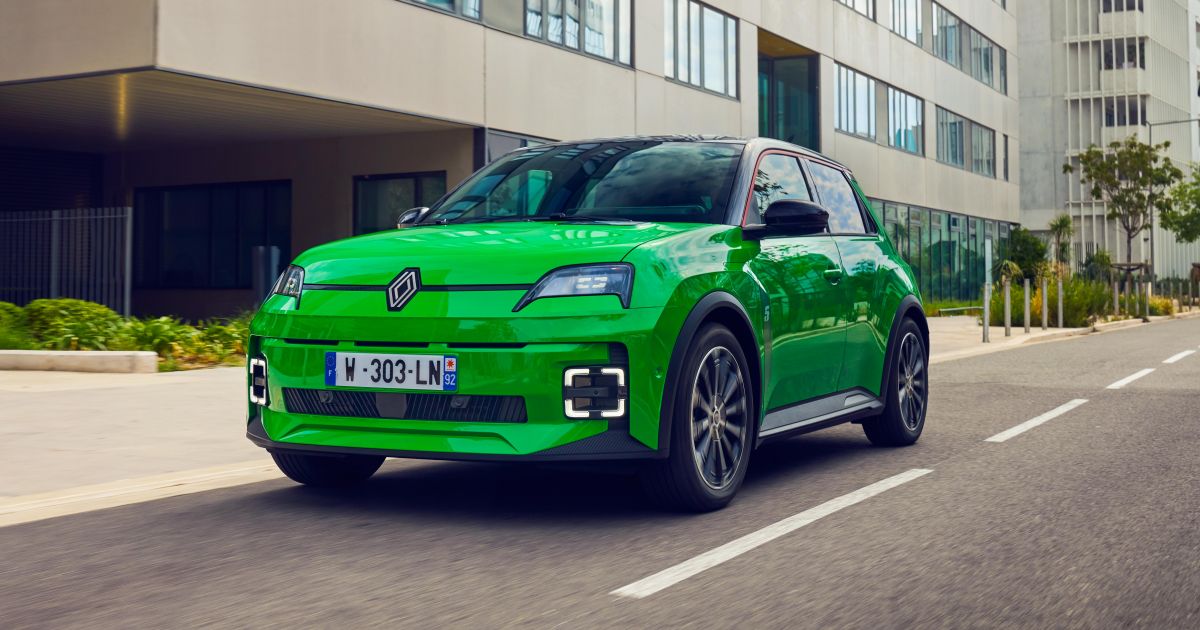
The new Renault 5 is the first in a series of retro-inspired EVs from the French manufacturer, unashamedly drawing on the original of the 1970s for its design. The detailing and the technology underneath are bang up to date, however, while Renault has also paid attention to how the car drives by keeping weight down.
In terms of the Australian market, the R5 would sit in the not-very-popular city-car class, so it is unclear whether it will be sold here at all, but our first impressions suggest it could net a whole new generation of EV drivers – if it was priced appropriately.
To find out if it cuts the mustard alongside potential rivals like the Fiat 500e and Mini Cooper Electric, we drove the new Renault 5 at its European media launch in and around the city of Nice in France, battling with traffic in town, spending some time on a fast-moving highway and even driving into the clouds on some entertaining mountain roads.
How much does the Renault 5 E-Tech cost?
In Europe, the Renault 5 is priced from €25,000, which is the equivalent of nearly $A41,000 and almost $15,000 less than the price of the Megane E-Tech small electric SUV sold in Australia ($54,990 plus on-road costs).
However, if the R5 comes to Australia, its pricing is unlikely to be a direct exchange and, either way, that headline-grabbing starting price in Europe is for a low-spec variant with a small battery and less powerful motor.
If it makes it to Oz, odds are only the higher-spec model grade would be offered. Our best guess would be a drive-away price just south of $50,000.
What is the Renault 5 E-Tech like on the inside?
A mix of modern tech and materials with some retro detailing defines the R5’s cabin.
The best seats are up front, as should be of no surprise in a compact car such as this. And the seats are worthy of special mention, as their H-shaped backrests mimic those of the original R5 Turbo with little side bolsters that hold you in place without pinching your kidneys.
The upholstery on the seats varies by variant, though is always made from 100 per cent recycled plastic. It has a denim-like quality in the lower versions or a grey finish with bold yellow panels in the top-spec car.
It’s tactile to the touch and the same material can be found on the padded dashboard in front of the passenger. That, and the textured roof lining, is pretty much the end of the retro design cues inside, though the rectangular air vents do reference the distinctive lighting signature up front, found in the headlights and prominent fog lights.
Behind a chunky, tactile steering wheel is an all-digital dashboard, with 10-inch instrumentation and a 10.1-inch touchscreen. This runs Renault’s OpenR multimedia system, backed up by Google software, which makes it easy to get to grips with. Assuming you use Google Maps and have a Google account already, the car seamlessly connects to the rest of your online life.
Thankfully, there’s a separate bank of physical switches underneath to control the heating and air-conditioning so not everything is done via the touchscreen.
While the buttons on the steering wheel are solidly made and easy to use, the space around the wheel is a little crowded, especially on the right, as there is an individual stalk to control the volume and music as well as one for the wipers, and that’s where the drive selector is as well.
An owner will likely get used to it soon enough, but other car brands do this better.
The positioning of the drive selector frees up the space between the front seats for a wireless phone charger, cupholders and some extra storage, but there isn’t much room there, and curiously, there’s no ‘P’ for Park option in the transmission.
There is, however, notably generous amounts of adjustment in the driver’s seat and steering wheel, so most sizes and shapes should find a suitable driving position. The seats proved to be comfortable after a long day at the wheel, too.
It’s worth remembering that, at less than four metres long, the Renault 5 is shorter than the MG 3, for example, so it’s quite a small car. Judged on that, the rear legroom is acceptable, but some will assume the electric platform would have freed up more space.
There is a completely flat floor in the rear, but no air vents or charging ports to be found. And while there are three seatbelts back there, kneeroom will be the restriction to carrying three big adults, or bulky rear-facing baby seat for that matter.
By way of compensation, the boot is a decent size, holding 326 litres. That’s more than the MG 3 manages, and there’s a neat underfloor pocket that’s more than big enough to hold the charging cable, too.
The rear seats split 60:40 and folds down if you need to fit longer loads in, though they create a step rather than folding flat. And before you ask, no, there is no ‘frunk’ storage up front.
What’s under the bonnet?
The Renault 5 is made on an EV-only platform so don’t expect a petrol version in the future. The electric motor is mounted up front, making this car exclusively front-wheel drive and – in Europe at least – there is a choice of power output and battery capacity.
Specifications
Renault 5 E-Tech
Drivetrain
Single-motor electric
Battery
52kWh lithium-ion
Power
110kW
Torque
245Nm
Driven wheels
Front
0-100km/h – claimed
8.0 seconds
Energy consumption – as tested
16kWh/100km
Claimed range – WLTP
410km
Max AC charge rate
11kW
Max DC charge rate
100kW
The battery pack sits under the cabin between the wheels, and it features four separate modules. They can be individually replaced in the event of a crash or cell failure. There’s also a firefighter access opening at the top of the battery that allows for complete flooding of it with water in the event of a fire.
How does the Renault 5 E-Tech drive?
There’s a Mini Cooper-like playfulness to the chassis of the Renault 5 that puts a smile on your face at any speed.
The R5 isn’t as darty, but has direct, responsive steering and is all too keen to change direction at your bidding.
Renault worked hard to keep the weight below 1500kg and that’s admirable in a world seemingly dominated by two-tonne EVs. And of course, the biggest weight – that of the battery – is mounted low down under the floor of the cabin to the benefit of weight distribution and the centre of gravity.
This shows in the way this car tackles a series of bends, feeling nimble and chuckable as the mood takes you. It has a more neutral stance than most front-drive cars, too.
The instant torque of the electric motor adds to the fun, as well, as the car quickly recovers any lost speed. This is particularly useful in a busy urban environment as you can nip in and out of gaps with the kind of low-speed acceleration usually associated with big-engined motorcycles.
A button on the steering wheel marked ‘Multi Sense’ allows for quick selection of the Comfort, Eco, Sport or Perso (that’s the individual mode you can customise) driving modes, but as it only alters response to the accelerator and the amount of power steering assistance, it’s almost redundant in this car and we found it perfectly fine left in the default (Comfort) setting.
Sure, with just 110kW maximum power, the performance runs out as speeds climb, but that feels more than ample in normal driving. And actually, the torque on tap can momentarily overcome traction at the front if the surface is wet or you boot it on the exit of a junction.
It’s never unruly as such – and the stability control quickly reins it in – but the onset of this happening isn’t communicated to the driver very well.
The brakes are worth a special mention, however. Many electric and hybrid cars suffer from inconsistent brake pedal feel due to the tricky requirements of balancing brake energy regeneration to charge the battery and traditional friction brakes.
Renault’s engineers could teach others a thing or two about that as the R5’s pedal is incredibly well-judged.
Unlike most modern-day Minis, the R5 manages to mix fun with suppleness, so owners that just want to get to their destination will find it comfortable, smooth and exceptionally good at absorbing bumps.
It’s quiet, too, even by the standards of an electric car, with little road noise, barely a whisper from the front-mounted electric motor and well-contained wind roar.
What do you get?
In Europe, the R5 is offered in three different trim levels offering varying levels of equipment, and there will be a special-edition each year as well to keep buyers interested.
Renault 5 E-Tech highlights:
Charge indicator on the bonnet
10-inch digital instrumentation
Electric parking brake
18-inch wheels
Full-LED headlights
Multi Sense drive mode selector
Reversing camera
10.1-inch touchscreen infotainment system
Wireless Apple CarPlay and Android Auto
Air-conditioning
Satellite navigation
Is the Renault 5 E-Tech safe?
The Renault 5 has yet to be assessed by ANCAP or Euro NCAP.
Renault generally fares well in these tests. From the driver’s point of view, the R5 features a useful button next to the steering wheel that Renault calls ‘My Safety Switch’. You can choose which of the driver assistance features you’d like enabled or not, and group the settings into just two presses of this button.
Standard safety equipment includes:
Driver attention monitoring
Automatic emergency braking in reverse
Safe passenger exit
Semi-autonomous parking assist
Lane departure warning
Situation-sensitive adaptive cruise control
How much does the Renault 5 E-Tech cost to run?
The Renault 5 is covered by a five-year vehicle warranty and an eight-year battery warranty.
Running costs
Renault 5 E-Tech
Warranty
5 years, 100,000 kilometres
Battery warranty
8 years, 160,000 kilometres
Roadside assistance
5 years
Capped-price servicing
5 years
Renault quotes a WLTP range of 410 kilometres for the 52kWh battery pack and we reckon most drivers should easily get 350km from a charge. Despite no efforts at driving efficiently, we averaged 16kWh/100km, so if you can charge up at home, this thing will cost cents to run.
CarExpert’s Take on the Renault 5 E-Tech
We really hope Renault Australia can make the R5 happen here.
The Renault 5 is a joyous car, one that will grab buyers’ attention with its cheeky looks and keep it with a sensible, efficient package.
While keen drivers will love how it steers, you don’t need to be a driving enthusiast to appreciate its ability, either. Likewise, this is a great car full stop, not just a great EV.
If the world is intent on going electric, it needs more compelling cars like the Renault 5 in it.
It’s well known that car enthusiasts often have a passion for miniatures, especially ultra-realistic ones. One brand that stands out in this niche is Amalgam. While many people enjoy watching speed-build videos of these intricate models, Amalgam takes the art of miniature automotive replicas to an entirely new level.
One GTspirit correspondent has been following Amalgam for some time, even before discovering the company’s Hungarian connection. So, when a representative named “Beni” greeted them in Hungarian at Fuori Concorso earlier this year, the excitement was palpable as they admired the brand’s stunning displays.
For those unfamiliar with Amalgam, the company was founded in 1985, initially focusing on creating fine architectural models for leading British and German architects, including Foster & Partners. They also offered prototyping services. In 1995, they expanded into automotive miniatures, developing a close relationship with Ferrari and other major F1 teams and manufacturers by 1998.
After the chance encounter at Fuori Concorso, the GTspirit team reached out to Amalgam, sharing photos taken of their models and expressing admiration for the company’s work, particularly with the knowledge that Hungarians play a key role in crafting these mesmerizing hand-made miniatures (though calling a 1:8 scale model a “miniature” might be an understatement ☺). They inquired about visiting the Hungarian facility in Pécs to capture more photos, meet the artisans behind the work, and delve deeper into Amalgam’s story.
This led them to the heart of Pécs’s Zsolnay district, a cultural hub not just for the city, but arguably for all of Hungary. Nestled among historic buildings is a charming entrance that leads to Amalgam’s Hungarian manufacturing site. Miklós, the facility’s manager, warmly welcomed the team and provided an exclusive tour.
Miklós shared that the team started with just a handful of employees but has since grown to about 60 people, all primarily focused on assembling these ultra-realistic, meticulously detailed models. Their expertise and success have expanded their role within the company, as they now contribute to engineering processes as well, underscoring their skill and capability.
Currently, the Hungarian team’s portfolio centers on 1:8 scale models, predominantly Ferraris, though Porsches and other luxury brands are also represented throughout the workshop. One of the most unique aspects of their work is the production of 1:1 replicas of F1 steering wheels, which are exclusively crafted at the Hungarian facility.
The workshop operates much like a car factory, albeit on a smaller scale, with an even higher attention to detail. Anyone familiar with model building knows that parts rarely fit perfectly without some manual adjustment. The craftsmen at Amalgam ensure that everything aligns flawlessly. Much like a full-scale car factory, the process here includes various stages: test fitting, bodywork, painting, assembly, and everything in between. The team even has an in-house studio for capturing stunning images of the finished products.
Sensing the team’s enthusiasm, the staff went above and beyond, unpacking models that were already boxed up and providing an up-close look at their creations. It was an experience akin to being a child in a candy store.
The GTspirit correspondent hopes that readers enjoy the “documentary-style” photos taken during the visit. With any luck, this won’t be the last encounter with Amalgam, and maybe one day, they’ll have the opportunity to feature one of these exquisite miniatures in their own collection.
Marbella, a jewel on Spain’s Costa del Sol, has long attracted discerning investors in search of luxury real estate. With its mix of Mediterranean charm and modern sophistication, this prestigious destination significantly impacts the global property market. More investors are turning to Marbella’s exclusive properties, recognising their potential for strong returns.
Marbella’s status as an international luxury hotspot is further enhanced by the influx of high-end brands and significant investments in the area. Notable developments include the Maria by Missoni residences, the Lamborghini residences and the Karl Lagerfeld Villas. Offering year-round sunshine, top-tier amenities, and a refined lifestyle, Marbella stands out as an appealing option for diversifying investment portfolios. This article highlights key areas for luxury property investment and explores why Marbella continues to captivate global investors.
Read more: Luxurious New York Properties For Sale
Exclusive Lifestyle Offerings
The allure of Marbella extends beyond its luxurious properties. The city is renowned for its world-class amenities, including prestigious golf courses, marinas, a vibrant culinary scene and exclusive beach clubs. With over 325 sunny days per year, Marbella offers a perfect climate for outdoor activities, from sandy beaches to hikes in the mountains. The cosmopolitan nature of the city, with over 150 nationalities residing in the area, has transformed Marbella from a tourist destination to a thriving residential area.
Rental Income Prospects
The rental market in Marbella is vibrant, driven by high demand for both long-term and short-term rentals. This demand stems from Marbella’s popularity as a tourist destination and a preferred location for expatriates, particularly from Northern Europe. Properties in prime locations can yield substantial rental income, contributing to a favourable return on investment. Yields in the region of 4 to 5 percent can be expected with the right property and rental agency.
Read more: Luxurious London Homes For Sale
Capital Appreciation
Marbella has consistently demonstrated strong potential for capital appreciation. Property prices have been steadily increasing, and this trend is expected to continue, especially in prime locations and luxury segments. The limited availability of land for new developments in desirable areas suggests that property values could continue to rise.
The strong demand for large, modern, and impeccable villas in prime Marbella areas has led the demand across all real estate price ranges. In 2024, the sale of properties in the luxury end of the market, priced over EUR 2 million, has shown stronger numbers compared to 2023. Indeed over the previous number of years appreciation averaged 7.5 percent for villas and just over 5 percent for apartments. As always, choosing the right area is essential.
Key Areas for Luxury Property Investment in Marbella
Marbella offers a diverse range of luxury property investment opportunities, each with its unique charm and appeal. Three areas stand out as prime locations for discerning investors: the Golden Mile, Nueva Andalucía, and La Zagaleta.
Read more: Luxury Mediterranean Properties To Invest In
Golden Mile
The Golden Mile, stretching from Marbella’s western edge to Puerto Banús, epitomises luxury living. This prestigious strip boasts some of the most exclusive properties in Marbella, including opulent villas and high-end apartments. The area is home to world-renowned hotels like Marbella Club and Puente Romano, offering residents access to top-tier amenities.
Investors can find beachside villas ranging from 300m² to 2,000m², offering direct beach access and private pools. Mountainside villas, often located in prestigious areas like Sierra Blanca, provide panoramic views of the Mediterranean and surrounding mountains. Luxury apartments in the Golden Mile typically range from 100m² to 400m², featuring communal pools and 24/7 security.
Nueva Andalucía
Nueva Andalucía, the largest residential neighbourhood in Marbella, caters to a wide range of preferences and budgets. The western side features authentic townhouses and villas built into mountain slopes, while the eastern side boasts luxurious modern apartments and exclusive gated communities.
This area is particularly popular among golf enthusiasts, with world-class courses such as Las Brisas, Aloha, Los Naranjos, and La Quinta. Nueva Andalucía offers a perfect balance of tranquil Costa del Sol living while being close to the vibrant Puerto Banús and Marbella town centre.
La Zagaleta
La Zagaleta stands as one of Europe’s most exclusive and prestigious gated communities. Spanning 900 hectares of protected woodlands and green valleys, this former hunting estate offers unparalleled privacy and luxury. The community currently houses 230 properties, with potential for expansion to 420 homes.
Residents of La Zagaleta enjoy access to 50 km of internal roads, two golf courses, two clubhouses, an equestrian centre, a tennis club, and a concierge service. La Zagaleta is renowned for its exceptional villas for sale. Property prices in La Zagaleta range from about EUR 6,000,000 to over EUR 30,000,000, with an average value of around EUR 10,000,000.
Conclusion
Choosing an experienced real estate agency, such as Cilo Marbella, will help to guide you through the potential pitfalls of purchasing a property in Marbella. With our integrated approach from our sales and rental teams, we can advise on exactly where the best investment opportunities are to be found.
For more on the latest in luxury property reads, click here.
The technical storage or access is strictly necessary for the legitimate purpose of enabling the use of a specific service explicitly requested by the subscriber or user, or for the sole purpose of carrying out the transmission of a communication over an electronic communications network.
Preferences
The technical storage or access is necessary for the legitimate purpose of storing preferences that are not requested by the subscriber or user.
Statistics
The technical storage or access that is used exclusively for statistical purposes.The technical storage or access that is used exclusively for anonymous statistical purposes. Without a subpoena, voluntary compliance on the part of your Internet Service Provider, or additional records from a third party, information stored or retrieved for this purpose alone cannot usually be used to identify you.
Marketing
The technical storage or access is required to create user profiles to send advertising, or to track the user on a website or across several websites for similar marketing purposes.