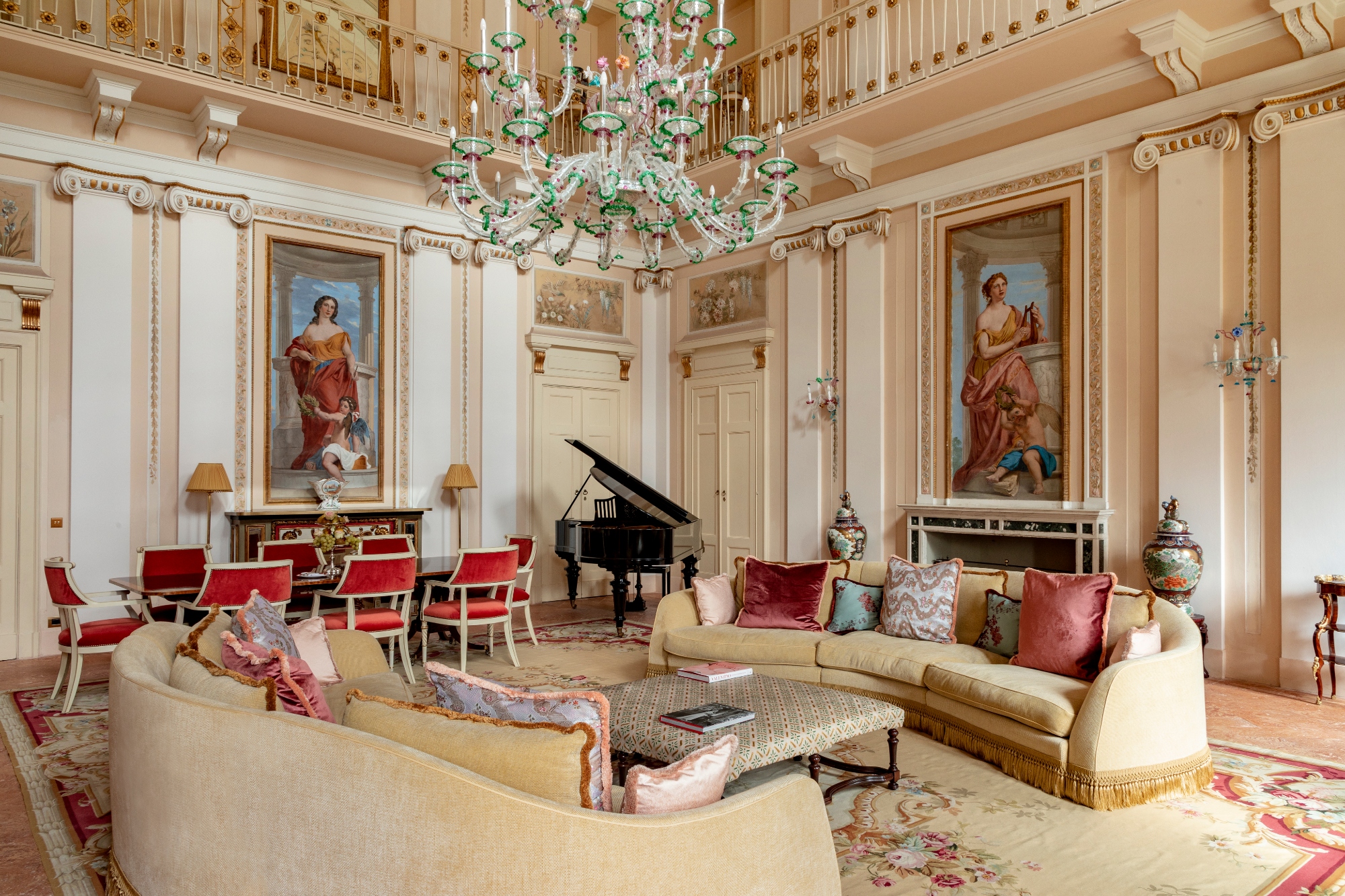
Lake Como doesn’t do subtle. And neither does Passalacqua. This place isn’t just another boutique hotel — it’s the kind of villa that looks like it was designed by an 18th-century duke with taste and a bottomless bank account. Which, as it turns out, isn’t far off.
Set on the hills of Moltrasio, Passalacqua is an unapologetic masterclass in old-world Italian opulence —marble, frescoes, stucco, silk — the works. It is what happens when you take a historic villa, throw EUR 20 million at it, and let a family of perfectionist hoteliers (the De Santis crew, of Grand Hotel Tremezzo fame) go completely nuts with restoration. The result: 24 rooms, more handblown chandeliers than you can count, and enough character to make most other five-star joints feel like IKEA with a minibar.
Let’s be clear: this place is not minimalist. It doesn’t try to be cool in that beige-and-bronze, Scandinavian way that makes you feel like you’re living inside a startup office. No, this is a cigar-in-hand, opera-in-the-background, Murano-chandelier-above-the-bed kind of cool. Baroque flourishes, deep leather chairs, and ceilings that probably took longer to paint than most modern hotels take to build.
Read More: Experience Tantalising Tuscany with COMO Castello Del Nero
Yet it somehow doesn’t feel stuffy. Maybe it’s the down-to-earth staff in sharp Giuliva Heritage tailoring, the roaming chickens in the terraced gardens, or the bocce court casually perched next to an 18th-century fountain. Maybe it’s the Aperol-colored Fiat 500 that zips you back up from the lake. It’s the sort of place that knows exactly what it is: a luxury villa with history and swagger, but one that doesn’t take itself too seriously.
The Rooms
The main villa houses the grandest suites — 12 in total, each one named after a Bellini opera character (mine was Beatrice, a tragic heroine, which felt a little ironic as I bathed in Carrara marble surrounded by silk). There are more suites in the Palazz (a converted stable that now smells faintly of cedar and expensive cologne), and Casa al Lago, which you can take over with your entourage or keep to yourself if you’re the solitary billionaire type.
Expect king-size everything: carved ceilings, heavy doors, antique furniture, and beds so comfortable you might rethink your mattress situation at home. Tech is slickly hidden — TVs vanish into vintage trunks, outlets are future-proofed with USB-Cs (a first, even for Lake Como), and bathrooms come stocked with the full Dyson arsenal: hairdryer, straightener, and Airwrap. Overkill? Maybe. Appreciated? Absolutely.
The Grounds
Seven acres of terraced gardens spill down to the lake, and you could easily lose half a day wandering around and pretending you’re scouting locations for a Bond film. Olive groves, roses, magnolia trees, and jasmine hit you with that effortless Italian countryside smell that makes you question your life choices back in the city.
The pool is set against an old greenhouse, with striped parasols that look like they wandered in from a fashion shoot. There’s a garden-level bocce court, a kitchen garden, and yes—live chickens. Because nothing says “I’ve made it” quite like watching a sunset over Lake Como while a hen named Sofia pecks nearby.
The Food
The dining setup is as low-key — or high-key — as you want it. You can eat in the main restaurant (designed like someone’s very rich grandmother’s dining room), by the lake, in the rose garden, or even in the open kitchen where the chef will ask you what you’re in the mood for like you’ve known each other for years.
The food is Italian comfort done right: homemade pastas, heirloom tomatoes that taste like they were just slapped awake by the sun, fresh-baked everything. Nothing flashy, just solid ingredients and a chef who knows what he’s doing. Breakfast is a full-blown event, with cakes, pies, and an omelette bar that could feed an army.
The Vibe
Passalacqua feels like someone very wealthy and tasteful decided to open up their family villa to a few lucky guests — except the staff are more polished, the towels are fluffier, and there’s a boat at the dock with your name on it. Whether you’re sipping a Negroni on the terrace, playing bocce in linen trousers, or pretending not to notice George Clooney’s seaplane overhead, you’ll find yourself settling into a kind of cinematic, unbothered existence.
Sure, it’s extravagant. But Passalacqua earns it. Every detail, from the scent of the room to the hand-stitched leather ottoman, feels intentional. Nothing is done halfway, and somehow, it still all feels easy.
Read More: Luxury Mediterranean Properties To Invest In
Passalacqua is Lake Como on expert mode. If you like your luxury with a heavy side of history, craftsmanship, and personality, this place is your play. It’s not for everyone — if your idea of five stars includes LED mood lighting and 24-hour room service for smoothies, maybe stick to the city. But if you want to live like a gentleman for a few days — with access to some of the most beautiful views in Europe, a boat, a bar, and a bocce court — this is your spot.
Just be warned: you’ll never look at another hotel the same way again.
For more on the latest in lifestyle, culture and travel reads, click here.
A rare McLaren P1 GTR converted for road use by Lanzante is now for sale in Dubai. The hypercar has been listed at F1rst Motors for $3.3 million.
In 2015, Lanzante launched the road conversion package for the P1 GTR. Since then, 27 units have been converted for road use. This one featured here is particularly special, as it’s virtually new, with zero miles on the clock.
The P1 GTR comes with a high-downforce package, which includes a front splitter, canards, side skirts, a rear diffuser and a massive fixed rear spoiler. It has centre-lock wheels and a bespoke exhaust as well.
Even though this P1 GTR is street-legal, it retains its race-spec interior. The cabin has been completely stripped out but has leather seats, a leather-wrapped race steering wheel and red-tinted carbon interior trim.
The P1 GTR is powered by a 3.8-liter twin-turbocharged V8 engine that produces 986 hp – which is 83 hp more than the standard McLaren P1 road car. It also weighs 50 kg less. The P1 GTR can accelerate from 0-60 mph in 2.8 seconds and will reach a top speed of 217 mph.
Vins and I recently traveled to New Zealand. And yes, New Zealand was a dream. Like, ridiculously beautiful. One of those places where you start questioning if it’s even real. But as stunning as it is, traveling around came with a few surprises, missteps, and “Wait, WHAT?” moments we didn’t exactly see coming. Now that we’re back (a little sunburned, slightly broke, but very much in love with the country), we thought we’d round up the travel mistakes we personally made or almost made, so you don’t have to.
From underestimating drive times to forgetting just how intense that Kiwi sun really is, consider this our humble little PSA from one set of travelers to another. Because as magical as New Zealand is and how friendly Kiwis are, New Zealand can also humble a traveler real quick, especially if it’s your first time.
So before you pack your bags and say “Kia ora!” to the adventure of a lifetime, continue watching this video featuring our list of travel mistakes to avoid.
We almost didn’t make it to Hobbiton. And it would’ve been such a shame because it’s one of the biggest attractions that we were looking forward to before the trip, and we almost failed to grab tickets.
One thing you should know about Hobbiton is that these days, you can only explore it with a guide, so you must book a Hobbiton Movie Set Tour. There are many ways to do it:
If you prefer to drive or take a public bus on your own, you can just purchase a ticket.
You can join a day tour from Auckland or Rotorua, which already includes transfers. Most tours depart from the Shire’s Rest, a café that serves as the gateway to Hobbiton.
When we tried to book, tickets were sold out! This was one month before our target date. We knew it was popular, but we were waiting for everyone in the group to be granted a visa before we book.
Thankfully, there are a few tours departing from Matamata iSite. We were a group of five, and by sheer luck, we were able to get the LAST 5 TICKETS! Talk about meant to be. Everything went well in the end.
But yes, whether you’re joining a tour or buying a ticket only, best to secure it in advance.
If you’re required to secure a visa prior to arrival in New Zealand, like us, I have good news and bad news. The good news is, it’s actually pretty easy to apply for a visitor visa. The list of requirements isn’t too long and the whole process (100% of it) is done online.
The bad news is, just because it’s easy to apply doesn’t mean it’s easy to be granted a visa. This is not just a formality or simple e-Visas given by other less strict countries; they really do evaluate applications meticulously, so you can’t just wing it.
For example, when you look at the list of supporting documents, only three are tagged as REQUIRED: passport, photo, and itinerary. You can technically submit an application with just those three attachments. But that doesn’t mean you’ll get approved. Of course, it is recommended that you upload other documents that visa officers can use to assess your application especially evidence of genuine intent or rootedness, and evidence of funds if you declare you’re shouldering the cost of the trip yourself.
It is important that you paint a full picture of your background and your plans in New Zealand, and prove that you intend to leave the country and not overstay.
I know people who have been denied a visa, so take your application seriously.
Speaking of denied…
3. Not reapplying when rejected.
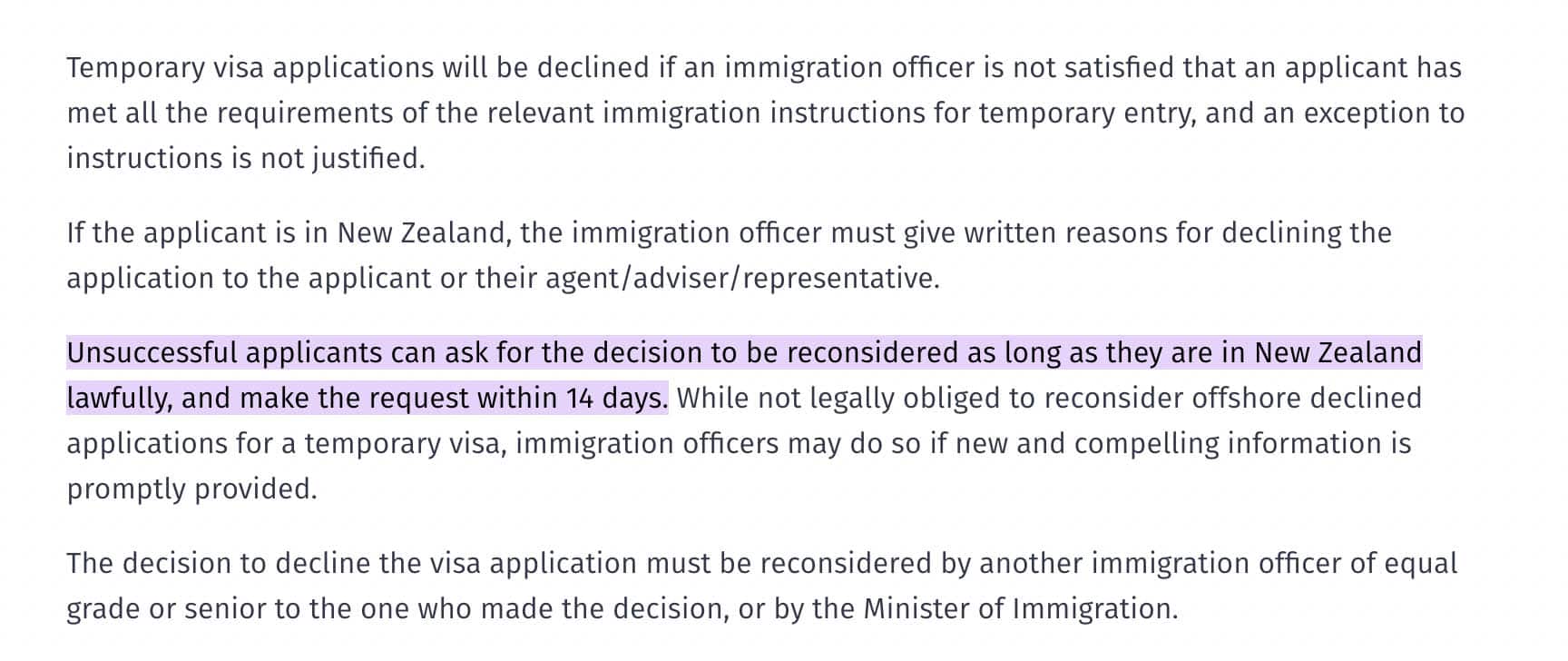
Let’s say your application is declined and you are refused a visa. What now? Can you appeal or ask for reconsideration?
NO, if you applied outside New Zealand and I’m assuming most of you reading this are not based in NZ. Here’s an excerpt from a refusal letter that my friend received.
Here’s an excerpt from the Refusal Letter that a friend received when she was denied a New Zealand visa.
But that doesn’t mean there’s nothing else you can do. What you can do is reapply. This means you’ll need to start a new application and pay another visa fee.
But before you reapply, make sure you have new supporting documents to add that could address the reasons for refusal. If you’ll be submitting the exact same pile of documents, you might just be wasting another NZD 100.
If you’re currently in New Zealand, YES, you can appeal as long as you make the request within 14 days.
This screenshot is from the official New Zealand Immigration website
But please note that what I share should NOT be taken as official Immigration advice. Think of me as just a friend sharing my experience. Check out the official New Zealand website or consult an immigration advisor for official advice or assistance.
4. Failing to Declare Risk Items Upon Entry
Agriculture and tourism are two of New Zealand’s biggest industries, and the government does everything they can to protect the environment and ensure biosecurity. That’s why they are very strict when it comes to what enters their border.
It is important that you’re familiar with items that are allowed, restricted, and downright prohibited, and follow their policies so you won’t run into any problem at the airport. You must also be aware of the items that you must declare.
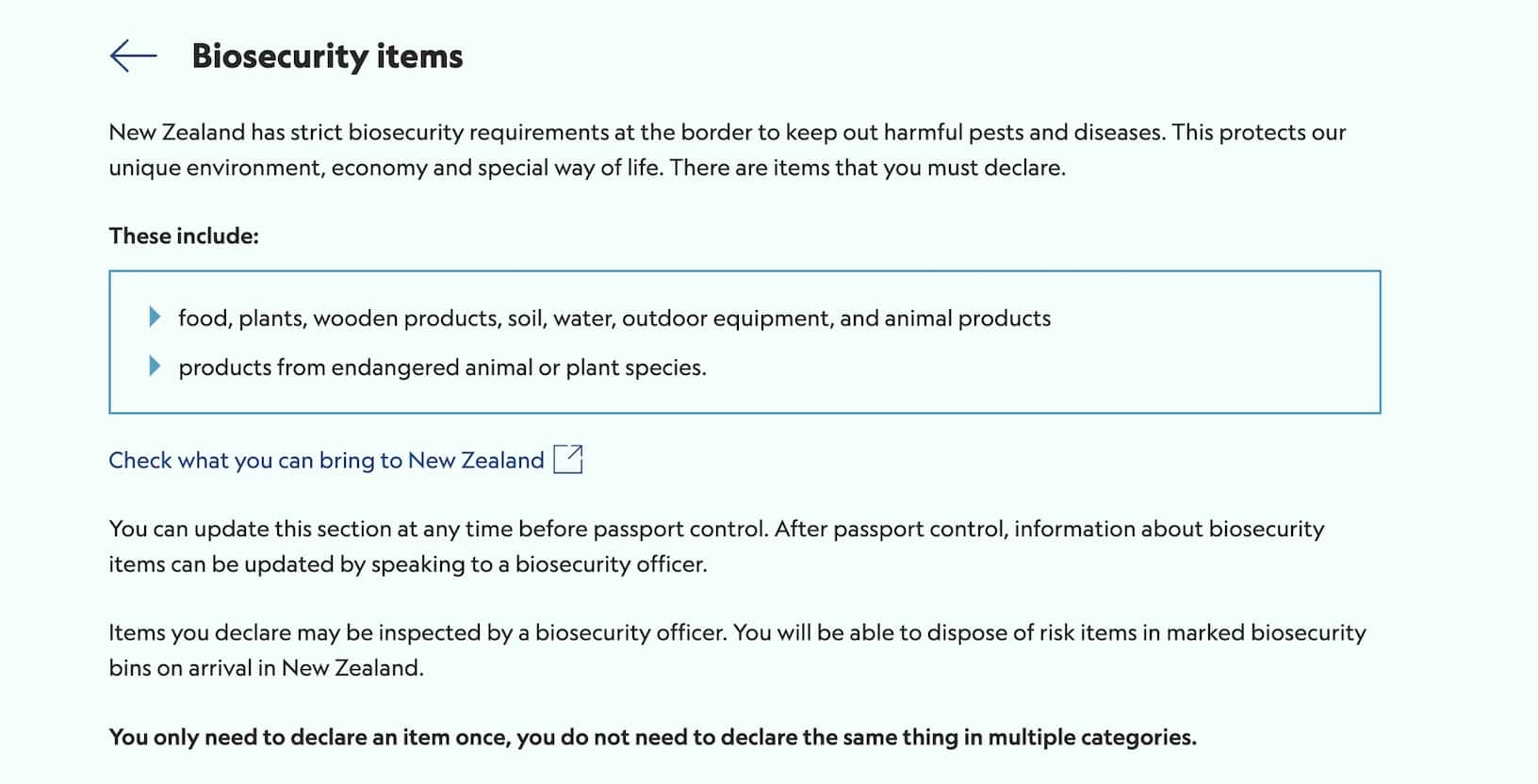
Before your trip to New Zealand, you will be required to accomplish the New Zealand Traveller Declaration Form, which has two sections specifically about what you’re bringing into the country. The first is BIOSECURITY, and you have to declare if you carry in your hand luggage or check-in luggage items like:
Risk Items
Screenshot of a page on the official website
Any food: cooked, uncooked, fresh, preserved, packaged or dried, including chocolate, candies, potato chips, crackers, biscuits, cookies, instant noodles, coffee, tea bags, soft drinks and even snacks served inside the plane.
Animals or animal products: including meat, dairy products, fish, honey, bee products, eggs, feathers, shells, raw wool, skins, bones or insects
Plants or plant products: fruit, flowers, seeds, bulbs, wood, bark, leaves, nuts, vegetables, parts of plants, fungi, cane, bamboo or straw, including for religious offerings or medicinal use
Biological products: Animal medicines, biological cultures, organisms, soil or water
Equipment: Equipment/clothing used with animals, plants or water, including for gardening, beekeeping, fishing, water sport or diving activities?
Outdoor gear: Items that have been used for outdoor activities, including any footwear, tents, camping, hunting, hiking, golf or sports equipment
I was carrying chocolates and other food products, so I just declared them.
Restricted Items
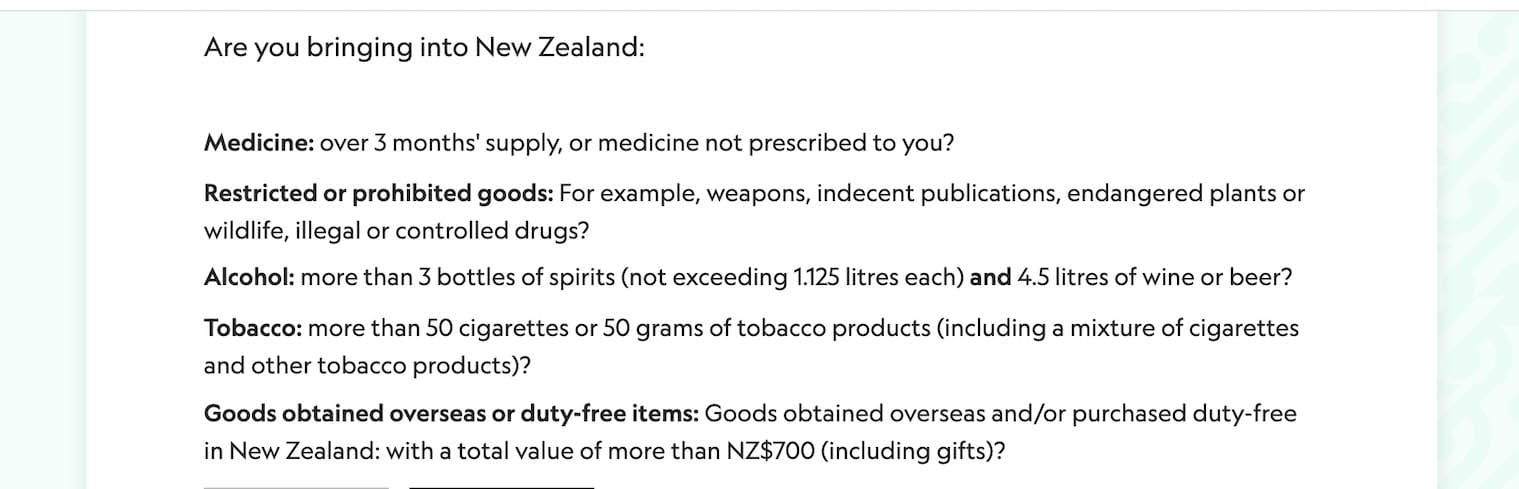
You’ll also be asked if you’re carrying more than the allowed amount of restricted items like medicine and alcohol.
At the airport, the border officers just asked what items I declared and directed me to the right lane. It was pretty smooth. I’m guessing because it’s just chocolates and snacks.
So if it’s meant to be declared, declare them. You can get fined if you fail to do so.
5. Underestimating New Zealand’s size and distances.
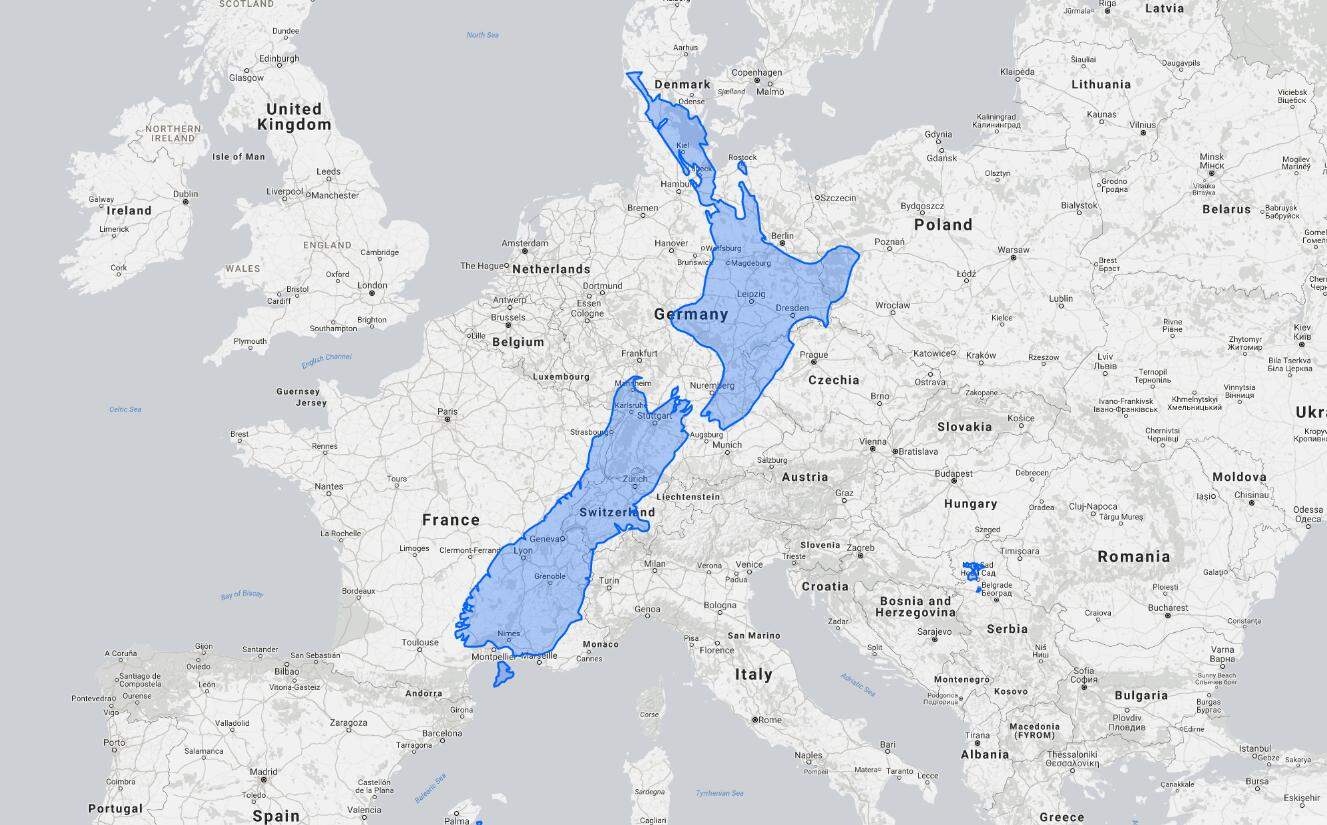
When you’re looking at a map, it’s easy to see New Zealand as a group of small islands in the far corner of the Pacific, especially when the ginormous Australia is in the same frame. It just looks snack-size compared to its neighbor, which is a full continent, but don’t assume New Zealand is small. New Zealand’s land area is bigger than the UK and just a bit smaller than the Philippines. If you superimpose it on Europe, you’ll find that it stretches from Denmark all the way to the South of France.
So no, it will be impractical to assume it only takes a few days to explore or that you can see it all in a week. Same goes for distances. Just because Milford Sound appears to be sitting pretty next to Queenstown doesn’t mean it only takes a quick drive. To get there from Queenstown, the route goes around the mountains and takes almost four hours, excluding stops and trust me, you will make some stops because the route is just so scenic.
Waitomo Caves, which is often a favorite destination from Rotorua or Auckland, is actually 2 to 2 and a half hours away. Even Hobbiton is not “just outside Auckland”. It’s 2 hours from the city center, too.
This is why it’s important to build a strategic and solid itinerary, especially if you’re driving.
6. Driving on the Wrong Side of the Road
Driving in a foreign country is often unnerving. But while in theory, driving in New Zealand should be easy because most roads are paved and there are plenty of signs everywhere, there are a few things you need to remember before you decide to take the wheel.
First, New Zealand drives on the left side of the road. And if you’re used to driving on the right like where I’m from, it’s pretty disorienting. It takes some getting used to. It’s not just the position of the wheel inside the vehicle or your position on the road. You’ll have to unlearn certain things especially when taking a turn at intersections.
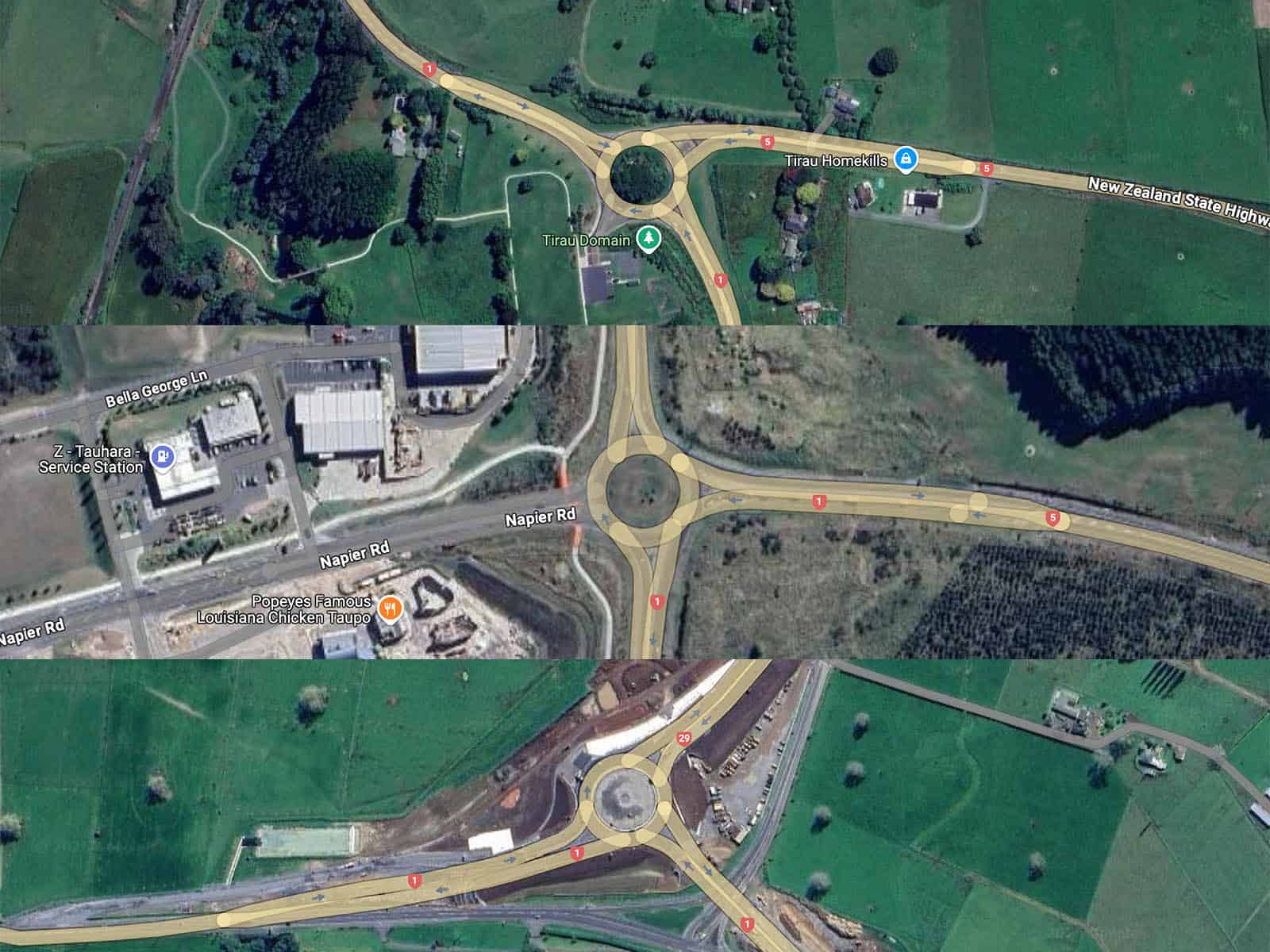
I also noticed that New Zealand’s roads deeper into the countryside are usually two-lane and narrow, but vehicles move fast here. And instead of stoplights, there are a lot of roundabouts, which is great in minimizing traffic jams.
But know that when you’re using Waze or Google Maps, you’ll be counting exits a lot. It’s not difficult, but it just takes some getting used to.
It’s best to have a navigator or a co-pilot riding shotgun so you can focus on the driving and there is someone to remind you in case you get confused.
Also, gas stations or petrol stations are few and far between especially when driving between cities, so when you see one, grab the chance and fill up because the next one might be many, many miles away.
7. Thinking It’s Difficult to Explore for Non-Drivers
When we started posting about our New Zealand trip on Instagram, we received a lot of questions about whether it is possible to explore the country even if you don’t know how to drive. And the answer is YES.
They say that the best way to explore New Zealand is to rent a vehicle and drive. And I agree. It’s also cost-efficient if you’re a group. But not everyone is able or willing to drive. For that, you can take public transportation like Intercity Buses. But make sure you sync your itinerary with the available bus journeys because for some routes, the options are limited.
Some non-drivers would take the bus to another city and then take a day tour of another attraction. Example, a common practice is to stay in Auckland then go on a day trip of Hobbiton and then return to Auckland. Then the next day, take the bus to Rotorua.
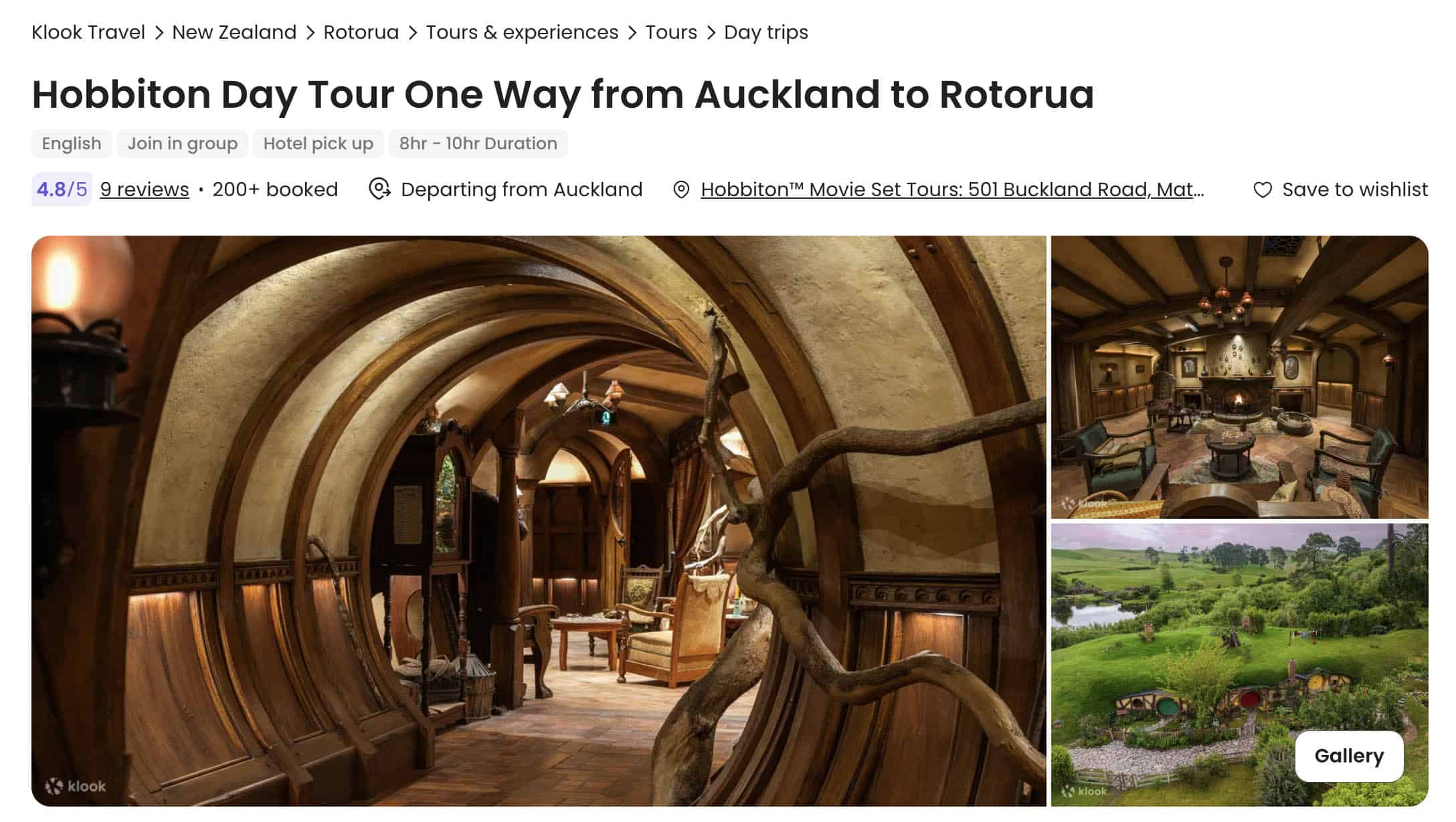
But there are one-way tours available. For instance, there is an Auckland-Hobbiton-Rotorua one-way tour. This way, once you’re done with Auckland, this tour can pick you up in the city, make a stop in Hobbiton so you could explore and then after, drop you off at your next hotel in Rotorua. It’s like a tour and transfer in one. And yes, you can bring your luggage with you.
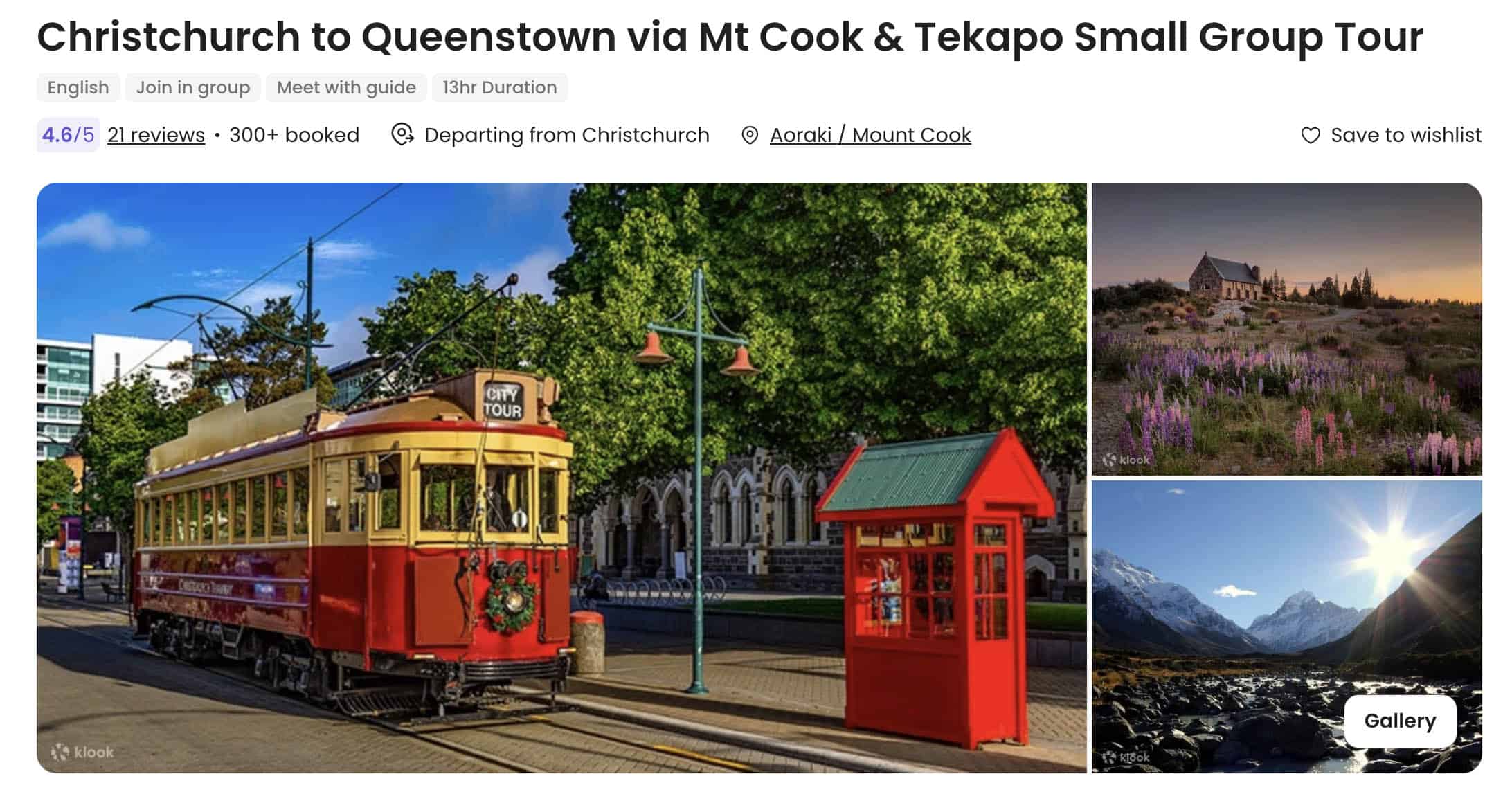
We got to try the Christchurch-Queenstown one-way tour. The shuttle picked us up at our hotel in Christchurch along with our bags. And along the way, we stopped at various tourist spots like Lake Tekapo and Hooker Valley in the shadows of Mt. Cook before terminating in Queenstown.
It’s a good option for non-drivers and will end up less costly than taking a roundtrip tour one day and then boarding an intercity bus separately.
Whether you’re booking tours or hotels, redeem our exclusive discount voucher by visiting www.thepoortraveler.net/klook or use our promo codes TPTKLOOK5 for up to P500 OFF or THEPOORTRAVELERKLOOK for up to P300 OFF. These codes may change in the future, so check the description or pinned comment for the updated codes and links.
8. Skipping sunscreen.
New Zealand’s climate is pretty mild, and it can still get cool even in summer months, so you might think “Sunscreen? Nah, I’m good.” And by lunchtime? Boom—your face is redder than a blushing teenager. This happened to me. Well, sort of. I apply sunscreen before leaving the hotel but I usually forget to reapply.
The chilly atmosphere can lull you into a false sense of safety. But the thing is: New Zealand has one of the highest UV levels on the planet especially under the crisp, clear summer skies.
So don’t forget to bring sunscreen with plenty of SPF and actually use it. And pack a hat, while you’re at it.
9. Missing the operating hours.
If you’re used to staying out until late night, know that in many destinations in New Zealand, some establishments close much earlier, especially in smaller towns. For example, in Rotorua and even in Queenstown, most cafes tend to close at around 3 or 4pm. Some as early as 2pm. Starbucks in Rotorua closes at 5pm most days, and Starbucks Queenstown at 6pm. That’s not to say that ALL cafes are like that. You can still find some that remain open at night, but it will be harder. But don’t worry, bars and malls tend to be open much later than cafes.
This isn’t unique to New Zealand, though. We also noticed this in some cities in Australia. Could be something to do with wages and work-life balance.
Some attractions also close early. Te Puia in Rotorua is only open until 4pm and Wai-o-Tapu until 4:30pm, understandably. Christchurch Gondola only operates until 5pm and the last ride down is at 5:30PM.
We also noticed that car rental companies close early, with the exception of airport branches. Europcar in Auckland city center closes at 4pm on weekdays, and 12 noon on weekends. Some branches are closed on Sundays too. So make sure to check operating hours when building your itinerary.
10. Paying for water.
Tap water in most places in New Zealand is safe to drink. At least in all the destinations we visited. So you don’t really need to spend money on bottled water at the convenience store or supermarket. It’s not cheap. If you have a refillable water bottle, you can just fill it up at your hotel or when you can. It’s just a matter of taste, sometimes.
If you’re joining full day tours like Milford Sound or Lake Tekapo and Hookers Valley, there’s a big chance they will be providing a bottle of water too.
11. Underestimating Prices.
New Zealand is expensive. My local friends always tell me that the cost of living here is pretty high. And so is the cost of travel.
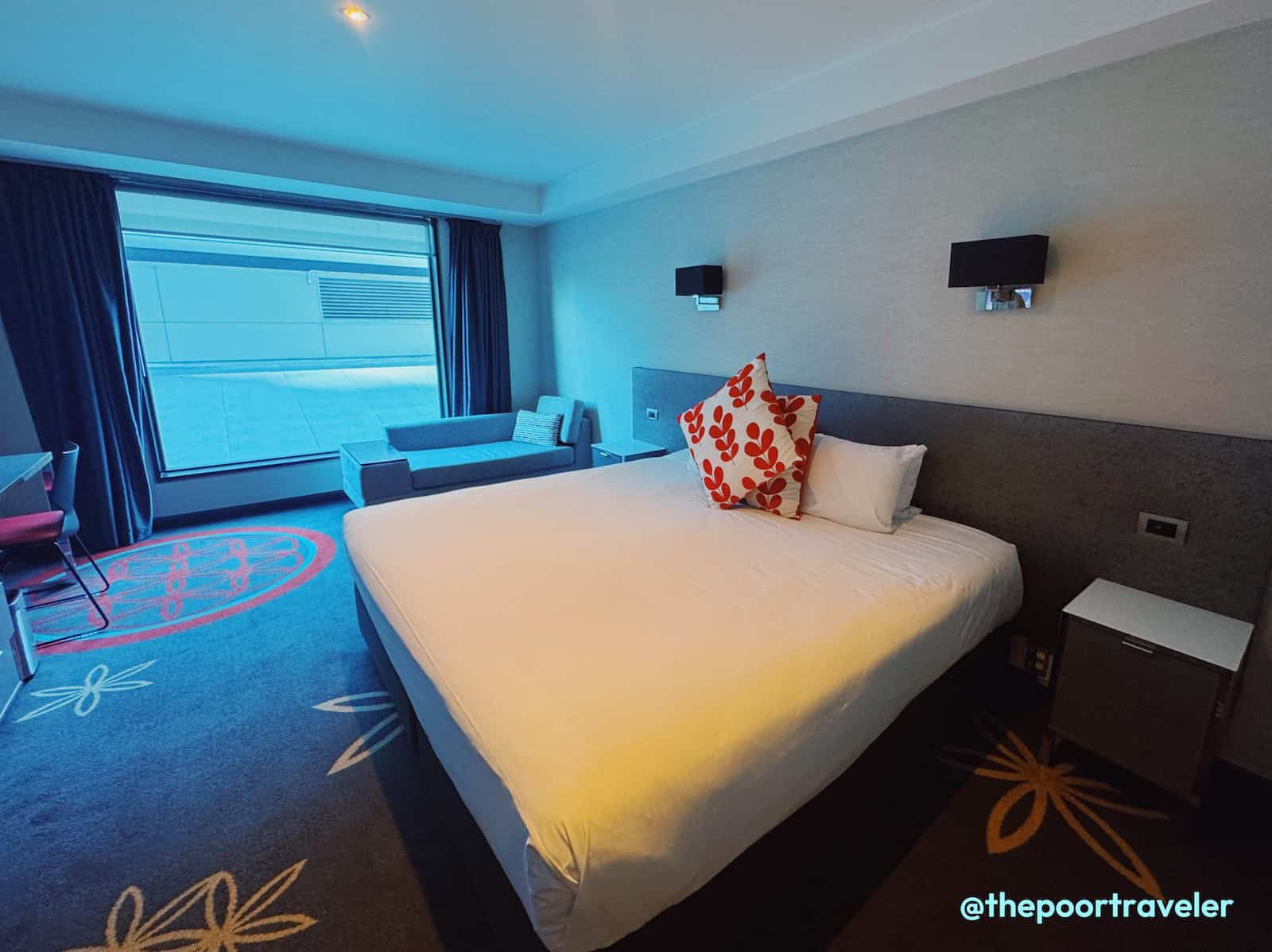
The accommodation rates alone could eat up a big chunk of your budget. There’s a reason Auckland is the only stop where we stayed at a proper full-service hotel. In Rotorua, Christchurch and Queenstown, we spent our nights at a hostel primarily because of the cost.
This is how much we paid for a private room for 2 per night.
Just look at how much we paid per night for our Queenstown room. This was already the cheapest centrally-located properties we found at the time — the cheapest – and this room does not have its own toilet and bath. We still had a great stay, though. We actually loved all these hostels.
We’re probably gonna create a separate review of all these lodging options, so if you don’t want to miss that, make sure to subscribe to this channel, ring the bell beside it and select ALL so you’re always updated.
For a meal, prepare to shell out:
Fast food: NZD 15-20 (USD9-12, PHP506-675)
Full-service restaurant: NZD 25-40 (USD 15-24, PHP 845-1350) for a main course, but higher for more premium dishes like steak or ribs
But one thing I noticed is that a serving is usually huge, even when they say it’s good for just one person. Even their burgers here are ginormous. Since we were a group, we usually just share the food and split the bill, although some restaurants have a one meal per person policy.
One of the reasons we like staying at hostels is they usually have kitchens where you can prepare your own food. It’s especially useful for long-term travelers. Eating out every day may not be sustainable. If budgeting gets a little tight, just buy something at a supermarket or convenience store and eat at the hostel.
12. Not staying long enough.
This is one thing we’re guilty of. One of the first things we said when we got home from our New Zealand trip was, “That was quick.” We spent 10 days thinking it was long enough, but we really felt like we should have extended our trip. And we would have if we had more moolah to spend.
New Zealand isn’t really a stopover kind of destination. It’s the main event. The headliner. The Beyonce of your itinerary. And much like Beyonce, she deserves your time and money. Hahaha.
The best destinations in New Zealand are spread out, so the drives are long. They’re worth it, but they’re long. And there’s a lot to do in every destination. Queenstown alone can oh-so-easily fill a week-long itinerary.
We also regretted not spending more days in Christchurch. We just didn’t expect it to be so full of charm. And because we wanted to see a lot, we tumbled into the pitfall of treating our trip as a list of sights to tick. But when we were there, we found New Zealand to be a place to slow down, linger, and absorb the surroundings.
So give yourself at least two weeks if you want to explore both islands without spiraling into an Amazing Race episode. More if you can swing it.
If you have questions, sound off in the comments section below or tag us on your Instagram stories and X (Twitter) posts. You can also follow us there and on Tiktok.
That’s all for now, remember, plan smart, travel safe, and make every trip WORTH IT!
The Fifty Fathoms Automatique in case sizes: 38, 42 and 45 mm.
With the Blancpain Fifty Fathoms Automatique 38mm, the brand has finally given us the more restrained dive watch the community has been hankering for since the model returned to the fold in 2003. Since that time, Blancpain has heard from us all that we wanted a more compact version of the Fifty Fathoms, one of two claimants to the title of “world’s first dive watch.” Sticking to its guns, Blancpain maintained that the Fifty Fathoms model was made for professionals in 1953 and thus could not be smaller than its 45mm size. Of course, that original model was 41mm so…
The new 38 mm models are designed to suit every wrist, style and preference.
Barring some limited editions over the years, Blancpain has never given any indication that it would ever yield to persistent requests for a smaller diver. Even for women, who are an important part of the diving world. Well, we can all stop our bellyaching, as they say, because there are now a slew of Fifty Fathoms Automatique models to satisfy those consistent requests, and they are 38.2mm, to be precise. Now, we have to say that this was a bit of a wink-and-a-nod sort of drop from the brand, with the first two 38.2mm releases last week looking like standalone news. In fact, we wrote this entire story (for the most part) without knowing that more watches were on the way… One clue that more models were coming was that the Internet reacted slowly, uncharacteristically.
The Fifty Fathoms Automatique
On those two ladies’ models last week, could either of these ostensibly made-for-her watches appeal to men? That is down to taste, of course, but – for the Singapore audience – we think one of these models would be perfect for SG60…
Anyway, if we are being honest, we think most professional commentators (ourselves included) never thought the day would come when there would be a Fifty Fathoms model smaller than 40mm…and the smallest watch in the range is actually 42mm, with anything smaller (hello Hodinkee!) being restricted to very special runs. Indeed, the existence of the Bathyscaphe line, which does offer more restrained proportions, seemed to render questions about smaller Fifty Fathoms options moot. Such suggestions seem downright churlish, it could be argued. After all, the Bathyscaphe is quite an excellent dive watch in its own right; however, it is not the Fifty Fathoms.
Fifty Fathoms Automatique Ref. 5007
The Blancpain Fifty Fathoms is a right proper icon and, if it is your flavour of dive watch, nothing can substitute it. This is what all dive watches descend from- it is an Ur form that precedes ISO standards. In many ways, the original Fifty Fathoms set the standard, or predicted them, if you prefer. This means that its form and character are sacrosanct, and yet… Blancpain itself has clearly altered the watch from the 1953 original. No one imagines that even the 2003 contemporary Fifty Fathoms was an exact replica, nor the 2007 version that heralded the return of the watch to the regular collection. Blancpain does not do replicas, and neither does any watchmaking brand that invests in its own identity.
Fifty Fathoms Automatique Ref. 5007
Before we go further, though, an actual introduction is called for, and we shall organise by order of release. What we have first, then, are the two ladies’ automatic 38.2mm dive watches, one in red gold and one in brushed grade 23 titanium – Ref. 5007 3644A and Ref. 5007 12B44R, respectively. Both are 12mm thick so nothing extraordinary there and are powered by the same automatic Calibre 1153, which boasts 100 hours of power reserve but are not chronometer certified. Water resistance is 300 metres and Blancpain has of course not shorted us on an exhibition caseback. The titanium model has a pink dégradé mother-of-pearl dial while the red gold watch sports a black dégradé mother-of-pearl dial. Blancpain calls these colours petal pink and smoky black. The titanium model in particular leans into pink very heavily, as you can see.
Joining these two early birds are three officially “genderless” models, all sharing the same size and the same Calibre 1153. These are Ref. 5007 1130 71S (polished steel with black dial and bezel); Ref. 5007 12B40 98S (satin brushed grade 23 titanium with blue dial and bezel); and Ref. 5007 36B40 O52B (red gold with blue dial and bezel, this one with sail cloth strap). Intriguingly, all 38.2mm models are sans date, which is a first for the Fifty Fathoms collection. While that move may be lauded by the most peevish of the date window debaters, the same may not hold true for the horn spacing for all 38.2mm models, which is 19mm. This is different to the 42mm models (21.5mm) and the 45mm models (23mm); this has implications for those who like to swap out straps frequently and should be noted.
Not having worn these watches in any form, prototypes or otherwise, it is difficult to assess them relative to anything else. It might be that the balance will be slightly off or just right but we will hazard a guess that the fit over a wetsuit might be less than optimal. It should be obvious from the look of the watches that these latest propositions are recreational tools, not professional ones. And that leaves us with the idea that this is meant to be a second watch, or the primary watch of a person who does not use it for diving. On that note, the logo engraved on the case flank remains in place in the 38.2mm model, and this too is a feature that is much discussed. It is probably good that the collection holds onto to more elements of its shared identity – it did not occur to us to even ask after the flank logo initially.
Marc A. Hayek. Image: Blancpain
We close this first look (at pictures and specifications) with a message from Marc A. Hayek, President and CEO of Blancpain (which was included in the press information and is quite delicious. “The Fifty Fathoms is much more than a diver’s watch, it’s a symbol of exploration and innovation. With the addition of new models, we’re responding to a clear demand while reaffirming that this collection was always meant for all wrists. It’s a natural and important evolution for a watch born underwater, made to be worn anywhere.”
For more on the latest in luxury watch reads, click here.
Galeon’s 435 GTI had its world premiere earlier this year
A world premiere at Boot Düsseldorf 2025, the Galeon 435 GTI model is the twin-inboard version of 2024’s 435 GTO (Grand Touring Outboard). Due to their streamlined designs and seaworthy handling, the 435 GTO/GTI models won the Motoryacht 13-15m category at this year’s Yacht Style Awards, held on the eve of the Singapore Yachting Festival in April.
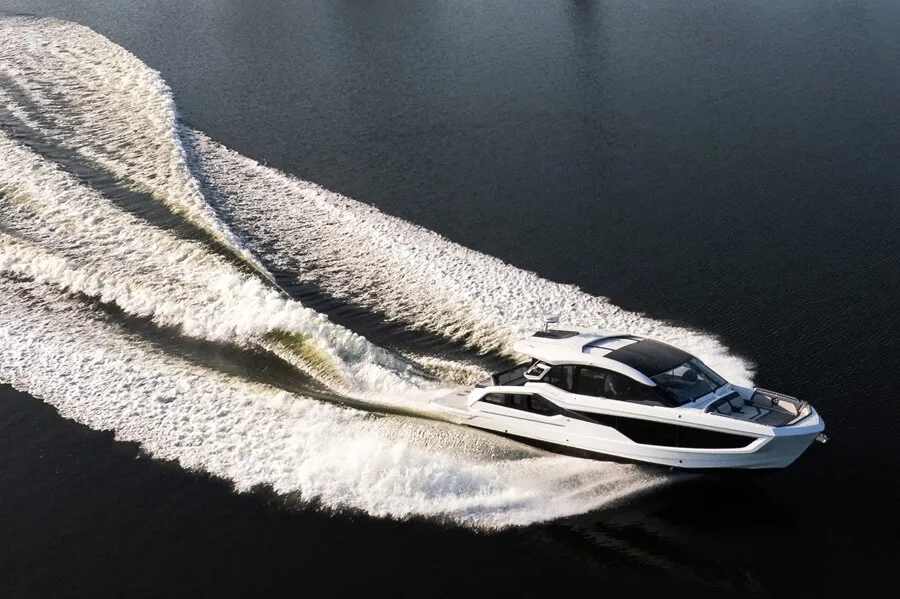
The two-cabin 435 GTI is a fine performer, and can reach in the region of 38 knots with two 480hp Volvo Penta IPS650 engines, and top 40 knots with the 600hp IPS800 options. There’s even a four-engine option available, with each one limited to 500hp.
The yacht can top 40 knots, depending on engine options
Design highlights include a climate-controlled wheelhouse enveloped in glass, partially glazed balconies and ample deck space aft and at the bow. The 435 GTO is available in Asia, while the GTI version will be coming to the region in the last quarter of 2025, with one unit sold following an inspection by its owner at the Düsseldorf show.
The model marks a second consecutive Yacht Style Awards win in this category for Galeon, following last year’s success with its 440 Fly. Both reflect Galeon’s bold vision and the UK-based Tony Castro Yacht Design studio’s commitment to innovation, performance and aesthetics. The 435 GTO/GTI line stands out for its design philosophy that balances form and function to elevate life on the water.
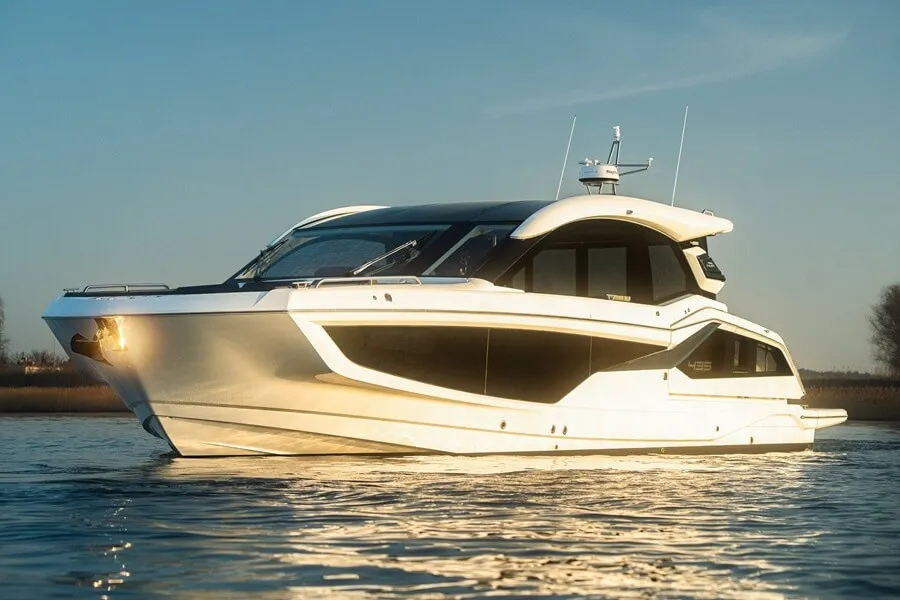
The Galeon 435 GTI has a dynamic silhouette
Established in 1982, Galeon remains a family-owned and operated company specialising in constructing luxury yachts and motorboats on the outskirts of Gdansk, in northern Poland. With clear vision and steady growth, today, Galeon has 1,400 people working within 36,000 sqm of production and assembly halls.
With models ranging from 32ft to 80ft and represented by regional dealer Asiamarine (and MarineMax in the US), Galeon is known for its attention to detail, cutting-edge on-board technology and great designs, often incorporating additional space thanks to its pioneering drop-down sides.
The saloon has a two-piece opening sunroof
The 435 GTI’s two-tone exterior boasts full-length windows and partially glazed balconies complemented by striking sporty details. The Tony Castro studio, which has been designing for Galeon since 2001, created a climate-controlled wheelhouse in wraparound glass to offer unobstructed, panoramic views while protecting the passengers from the elements.
VERSATILE EXTERIOR LAYOUT
Two distinct outside leisure areas located bow and aft provide ample space for entertaining guests while cruising or anchored. The GTI cockpit showcases significant improvements over the GTO’s, including transformable seating that allows guests to face bow or aft, as well as fold into a completely flat sunpad.
The balconies expand space on the swim platform
Concealed beneath the seats is a compact garage, ideal for storing a Zodiac 200 roll-up dinghy or water toys. Further enhancing functionality is the hydraulic swim platform, providing easy access to the water. For added comfort, a retractable sunshade offers respite from the sun while stationary or during cruising. The cockpit stands out for its spaciousness and array of practical features.
The hydraulic swim platform has a built-in folding ladder to provide effortless access to the sea, and it doubles as a lift. In ‘Beach Mode’, folding balconies on the port and starboard sides substantially extend the deck space, creating a social, open atmosphere while at anchor.
Access to the foredeck is on the port side
Forward, the flush floor facilitates easy access on the port side to the wide bow area that offers luxurious seating with a flexible configuration for either a sunpad or a dining table at its centre.
The bench lounger, just fore of the helm windshield, is ergonomically designed in a reclined position, featuring sporty headrests, drink holders and stylish two-tone quilted upholstery. Soft, foam decking enhances comfort underfoot, adding a touch of sophistication.
INTERESTING INTERIOR
The surprisingly spacious interior of the main deck features a U-shaped dining area, a wet bar area with fridge and sink, and three sporty helm seats – all under a large, two-section opening sunroof, with side windows that lower to allow in fresh breezes and natural light.
The saloon features a U-shaped dining area, stylish bar and three sporty helm seats
Below deck, the master cabin located in the bow offers a comfortable double bed and ample storage space. Enhanced natural light fills the interior, courtesy of oversized windows, a ceiling skylight and dispersed LED illumination.
The quality and finish uphold Galeon’s renowned standards, showcasing sophisticated curved woodwork, stainless-steel accents, and a range of customisable options to suit individual preferences.
Below deck, the finely appointed galley boasts ample storage
Midships, the guest cabin features both a single and a double berth with full-sized doors for privacy, while the galley and a spacious bathroom with separate shower cabin ensure a high level of comfort during extended day cruises or overnighters.
The finely appointed galley area boasts ample storage and plenty of headroom, ensuring easy access to both guest cabins. The bathroom is equipped with upscale cabinetry and a walk-in shower – a neat, well-organised environment. All lower-deck areas are illuminated by recessed LED lighting.
The master cabin is in the bow
The Galeon 435 GTI offers dynamic performance, versatile comfort and sophisticated style – all in one exceptional package, setting the stage for memorable day trips, overnighters or weekend getaways.
Lamborghini is all set to reveal a new limited-edition model this year at Pebble Beach. We’ve been told that it’s likely to be called ‘Fenomeno’, which is Spanish for “phenomenon”.
So, the new Lamborghini Fenomeno will be based on the Revuelto. However, we’ve also learnt that it will be “the most powerful Lamborghini ever made”. This statement puts an end to all speculations about the engine, which was initially expected to be the same 1001 hp hybrid V12.
While the Fenomeno will be powered by the same 6.5-liter naturally aspirated V12 hybrid, the overall output will be way more than 1001 hp. The exact details about the powertrain will be revealed at the time of the unveiling.
Lamborghini recently held a private preview of the Fenomeno for select customers. One of the clients who has seen the car has described it as “a car that will change everything”. He also said that the design is inspired by one of the most iconic models from the brand’s history.
Lamborghini has already made a Countach tribute. So, could the Fenomeno be an homage to the Miura or Diablo?
Earlier, we had said that the production would be limited to less than 50 units. Well, as per the latest rumors only 29 examples of the Fenomeno will be built.
The Marie Kondo method can be applied to your summer vacation packing list, too. In addition to “does it spark joy?” ask yourself, “does it make me want to sip an Aperol spritz in the sun?” If the answer is yes, then by all means bring it along.
Following the clicks of seasoned Amazon trendspotters, we found a matching set that evokes that very feeling. Reviewers say this cute two-piece strikes the perfect balance between being airy and elegant, yet as comfortable as pajamas. Now, that is the holy grail of vacation outfits—and it’s under $45.
Automet Two-piece Shorts Set
Amazon
The gauzy set comes with an oversized button-down shirt that tucks into (or drapes casually over) the matching drawstring shorts. The rayon it’s made of is soft and thin, the fit loose and flowy. One reviewer called it “heaven,” while another said it’s “the most comfortable outfit ever.” More than one shopper compared it to a much higher-end Aritzia set, the organic cotton Sail Shorts and Sail Shirt, which costs about $150.
For much less, the Automet lookalike has impressed customers with its quality. One who wrote that they’re “absolutely in love with this set” said the material is great for the price—good enough to even pass for “summer evening wear.” The brand is already well-known and loved for its viral jumpsuits and other lounge sets, which have earned high praise among travelers.
Automet Two-piece Shorts Set
Amazon
“This set is so multifaceted,” a shopper said. “I wear it as a bathing suit cover-up on the boat at the lake, and [I] also wear [it] as pajamas.” Another said they were going for “a cute coastal feel” for a beach trip, and this set was just the thing for that aesthetic.
Some are saying the lighter shades can be slightly see-through, so check the feedback before you settle on a color. There are also mixed reviews on whether it wrinkles, though most agree the creases almost blend in with the natural texture—nothing a portable steamer can’t handle.
The general two-piece set format is an effortless summer travel uniform that allows you to spend some extra minutes working on your reading list instead of stressing over what to wear. You can wear the pieces separately, too, if you feel like pairing the top with jeans or slacks for an elevated look.
Planning a summer vacation? Shop for even more comfortable, lightweight shorts sets at Amazon, below.
More Shorts Sets for Summer Travel:
Fixmatti Button-down Set
Amazon
Tankaneo Lounge Set
Amazon
Prettygarden Vest Set
Amazon
Flygo Cotton-linen Set
Amazon
Tankaneo Striped Set
Amazon
At the time of publishing, the price started at $38.
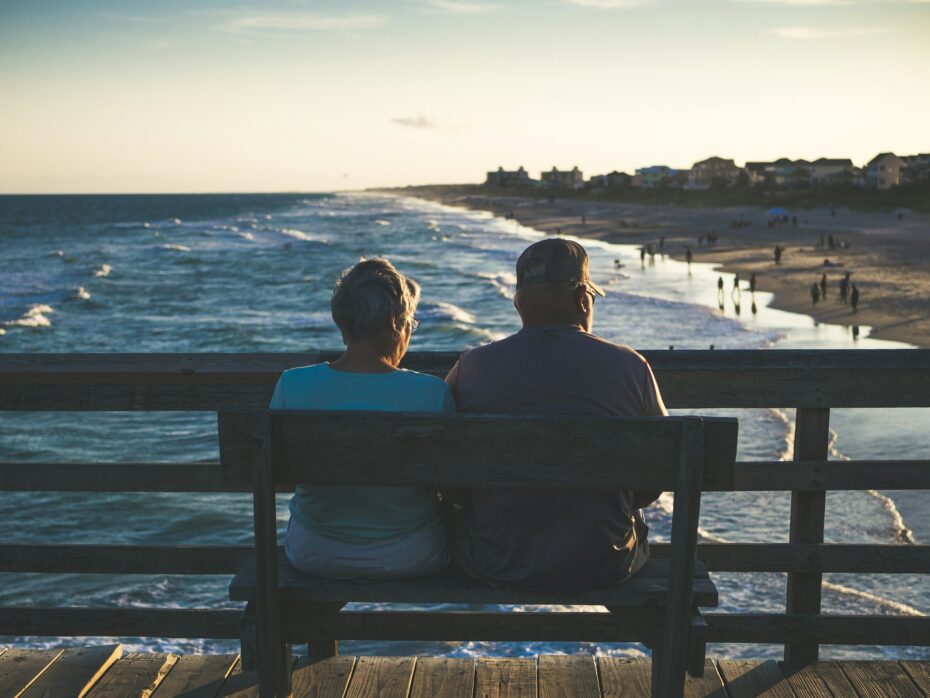
Retirement looks very different from what it did even a decade ago, and today’s seniors are embracing this next chapter with energy, curiosity, and a desire for experiences that reflect the lives they’ve built. Gone are the days of slowing down just for the sake of it. These days, many older adults are leaning into wellness, travel, learning, and social connection in ways that feel vibrant and fulfilling.
Innovation is playing a big role in this shift, not just in technology, but in how services, spaces, and opportunities are designed to meet real needs while offering more than just comfort. It’s about giving seniors the freedom to live fully, surrounded by convenience, beauty, and meaningful engagement with the world around them.
Living spaces for older adults are being reimagined with a focus on style, function, and experience, blending convenience with elegance. Today’s retirees are looking for more than just practicality–they want homes that feel inspiring, connected, and ready to support a social and active lifestyle.
Choosing a luxurious senior living community doesn’t mean giving up independence. In fact, many of these communities are designed to enhance it by offering everything from chef-prepared meals and spa services to curated fitness classes and arts programming. The surroundings reflect a sense of ease, but they also make space for daily joy and personal growth.
Wellness Beyond Routine Healthcare
Wellness is about living in a way that keeps both the body and mind active, supported, and thriving. Many modern retirement communities now include yoga studios, meditation gardens, therapy services, and nutrition-focused meal plans that are personalised and enjoyable.
Holistic wellness also means focusing on mental stimulation and emotional connection. From brain fitness workshops to music therapy and guided journaling, there’s a broader view of health that’s focused on creating long-term quality of life, not just managing medical charts.
Technology as a Supportive Companion
Seniors today are more tech-savvy than people tend to assume, and they’re using technology to stay connected, learn new things, and manage daily life with ease. From voice-activated assistants to virtual fitness classes and video chats with family, innovation is becoming a natural part of daily routines.
There’s also a rise in smart devices specifically designed to support independence at home, including fall detection sensors, medication reminders, and simplified tablets. These tools help seniors feel more confident and in control, making it easier to enjoy life without worrying about every little detail.
Travel with Ease and Inspiration
Retirement often means having the time to finally explore places that once felt out of reach. Whether it’s visiting family abroad or booking that dream cruise, many seniors are making travel a regular part of life. What’s changing is how travel is supported to be more accessible, flexible, and enjoyable.
There’s now a wide variety of travel gadgets for seniors that make exploring the world simpler and more comfortable. From portable seat supports and noise-canceling headphones to translation devices and compact pill organizers, these tools remove stress and allow older travelers to focus on the experience instead of the logistics.
Embracing Purpose in Daily Life
One of the most meaningful shifts in how retirement is viewed today is the growing focus on purpose. Many seniors are finding fulfillment through volunteering, mentoring younger generations, or diving into causes that matter deeply to them. These activities offer structure, connection, and a sense of impact that can be incredibly rewarding.
Rather than stepping away from contribution, retirees are often just shifting the way they give back. Whether it’s helping out at a local food bank, supporting community art programs, or sharing professional expertise with nonprofits, staying engaged helps bring a sense of identity and direction to daily life; something that’s just as important as comfort and convenience.
A key part of redefining retirement is the commitment to keep learning, growing, and staying curious. Seniors are enrolling in university-style programs, attending local workshops, or joining virtual classes that cover everything from creative writing to world history and digital photography.
These opportunities help build confidence and spark conversations. Whether it’s joining a book club, learning a new language, or exploring art techniques, education is becoming a pillar of a fulfilling retirement lifestyle.
Creative expression and the arts
Art is a powerful tool for joy and self-discovery, and many retirees are rediscovering passions for painting, music, sculpture, or dance later in life. Retirement communities and cultural centers are recognizing this and building programs that invite seniors to create, perform, and share their work with others.
Creative expression supports emotional health, builds community, and offers new ways to engage with the world. It’s not about being perfect–it’s about having the freedom to try, explore, and enjoy the process, with no pressure to turn it into anything more than what it is.
Community and Connection
Living well in retirement means more than staying active; it also means staying connected. Relationships and social opportunities play a huge role in emotional health and life satisfaction, and today’s retirees are prioritizing that in how and where they choose to live.
Communities that offer shared events, casual meetups, and structured clubs create the space for friendships to grow naturally. Whether it’s gathering for morning coffee, joining a walking group, or planning a trip with neighbors, connection is the thread that keeps retirement vibrant and fulfilling.
Personalised Living and Flexible Support
One of the most encouraging changes in how retirement is evolving is the move toward flexibility. Rather than being limited by age or assumptions, today’s living options and services focus on giving seniors the freedom to make choices that work for them.
That might mean choosing a hybrid lifestyle where someone spends part of the year traveling and part at home, or it could involve bringing in just the right amount of support as health needs shift. The focus is on living with purpose and confidence, not restriction or routine.
Retirement today is about more than slowing down; it’s about stepping into a lifestyle that reflects everything someone has worked for and dreamed about. Through innovation, thoughtful design, and a focus on meaningful living, seniors are creating new definitions of what this chapter can be, and they’re doing it with joy, intention, and plenty of style.
For more on the latest in lifestyle and culture reads, click here.
The fictional small town of Stars Hollow, Connecticut, may only exist in Gilmore Girls, but there are hundreds, if not thousands, of equally charming destinations within the U.S. that offer a similar setting and slower pace of life. Of course, real life requires more amenities than what appears in Amy Sherman-Palladino’s hit series—although a local diner is certainly appreciated—and there are many factors that ensure a small town is a great place to live.
The most livable small towns have access to health and educational facilities, green spaces, and cultural activities. Affordable housing is also critical. With those characteristics in mind, we asked a few real estate experts to share their picks for the best small towns to live in the U.S. right now.
Phoenixville, Pennsylvania
The Colonial Theater in Phoenixville, Pennsylvania.
Bastiaan Slabbers/NurPhoto via Getty Images
“Phoenixville is a town that got knocked down—and then turned that comeback into a community-wide celebration,” says Casey Gaddy, realtor at The Gaddy Group, referencing the closure of the Phoenix Steel Company in the 1980s. “What used to be steel and soot is now sidewalk cafés, murals, music, and pizzazz.” About an hour outside of Philadelphia, Phoenixville is a hub for those who want to experience culture without battling city traffic. “Come First Friday, Bridge Street shuts down and becomes a block party, music spills out of storefronts, and families explore among art vendors,” he adds.
Those hoping to buy a home in Phoenixville may also be able to find a good real estate deal. “With home prices around $400,000, this is one of the last Philly-adjacent towns where you can still find magic, momentum, and a mortgage that doesn’t break you or your wallet,” he says.
West Richland, Washington
Birds in a West Richland, Washington park.
DaleBaxter/Getty Images
Now’s the time to call West Richland home, at least according to Cary McGee, a realtor based in Tri-Cities. “West Richland is growing faster than any of our local towns. New developments are going up, new schools are being built, and new shopping and restaurants are following.” She also adds that West Richland has been named one of the safest cities in Washington, and the weather and average home prices are significantly more appealing than what you’ll experience in Seattle.
“People from the west side of the state sometimes move here for the weather—we get about 20 percent of the rain that Seattle gets—and because their dollar goes further, especially when it comes to real estate,” she explains. The median sale price for a home in West Richland is around $500,000, while the homes in Emerald City frequently rise above $900,000.
Belmont, North Carolina
City hall building in Belmont, North Carolina.
Nikolaus/Adobe Stock
Charlie Williams of the Williams Property Collective calls Belmont “one of the best older smaller towns in the Charlotte metro area.” The cost of living is 10 percent lower than the national average, and Williams says its residents benefit from “the proximity to the historic downtown shops, homes, and parks.” The downtown area is where you’ll find that classic small-town feel—visit the Belmont Historical Society, take a class at Belmont Yoga, and discover stunning public art in the form of large-scale murals. Not to mention, you’re just a 12-minute drive from Charlotte Douglas International Airport, so you’ll also get some of the perks and convenience of city living.
Lambertville, New Jersey
A person walking along The Delaware River in Lambertville, New Jersey.
Jon Lovette/Getty Images
Though Lambertville, New Jersey, is classified as a city, its population was last recorded at just over 4,000 people—and Gaddy describes it as a destination that “lives at the intersection of elegance and soul.” “Explore and find quaint galleries, antique shops, and Lambertville Station, where dinner comes with a view and a little local history served on the side. Weekends mean wandering the stalls at the Golden Nugget Flea Market, where treasure hunting is practically a sport,” he says. Plus, he notes, that it’s “one of those rare places where people still say hello on the sidewalk and where every corner feels like it belongs on a postcard.”
Given its proximity to two major cities, New York City and Philadelphia, real estate does tend to run on the higher side; according to Redfin, the median sale price for a home is around $617,500. For many, the cost of living is still worth it when you factor in the community atmosphere and relatively low crime rate.
Frisco, Colorado
A museum in Frisco, Colorado.
Jacob/Adobe Stock
Anyone who loves the outdoors will likely have Colorado on their shortlist of places to move. But where, exactly, in the Centennial State should you move? Well, if you like the small-town feel of Breckenridge but don’t want to pay the resort town prices, shift your search to nearby Frisco. While real estate is on the high end—the average home value is just over $970,000—you’ll have a year-round outdoor playground right outside your door. In the winter, head over to Keystone, Copper Mountain, or Breckenridge slopes; in the summer, you’ve got both land and water-based activities. The Dillon Reservoir allows for boating and fishing, and you can camp, hike, and bike around the shoreline.
Penngrove, California
“Penngrove is a charming small town in Sonoma County that feels like stepping into a cozy TV re-run. Though it’s just a one-light town tucked into the foothills, it offers easy access to modern conveniences while providing a peaceful escape from city life,” says Holly Schaefer, a West Coast-based realtor with Corcoran Icon Properties.
“The lifestyle blends country living with a touch of funk, with many homes on generous lots (averaging nearly three acres) and a community full of character—from working farms to unique and vibrant local businesses. Longstanding traditions like the Fourth of July parade and the beloved K–6 school give Penngrove its warm, tight-knit feel and make it a truly special place to call home,” she says. Real estate in Penngrove, however, doesn’t come cheap. Zillow estimates the average home value in Penngrove is more than $1.2 million. If that’s in your budget, and you appreciate a rural community with easy access to cities (including Petaluma and Santa Rosa), this may be your definition of the perfect small town.
Maplewood, Missouri
Recently named by GoBankingRates as the best small town to retire in, Maplewood, Missouri, bats above average in a few categories—namely, cost of living, livability, and crime rate. As a resident, your living expenses will be around 10 percent lower than the national average, and you’ll have access to a variety of amenities that help increase the town’s liveability score; there’s a strong sense of community, a highly rated public school system, and top-tier healthcare facilities in nearby St. Louis.
Lewes, Delaware
The harbor of Lewes, Delaware.
Dana Dagle Photography/Getty Images
If you’re considering moving to Delaware for its tax advantages—like low property taxes and no tax on Social Security benefits—you may want to check out Lewes, a 3,604-person town located where the Delaware Bay meets the Atlantic Ocean. “Lewes has this way of slowing you down without asking. The town is walkable, historic, and close to the water, but what stands out most is that no one is performing here,” says Gaddy. “You’ll get a wave from the person across the street and maybe a tip on where to get the best crab roll without even asking.”
Real estate is significantly more affordable in Lewes, as compared to the beach communities of Rehoboth and Dewey Beach to the south. “Home prices hover around $500,000, and for that, you’re getting more than just a beach town—you’re buying into a community that still feels like itself. It’s the kind of place where people come for the weekend and quietly start checking the real estate listings before they leave,” Gaddy adds.
Campton Hills, Illinois
A church in Campton Hills, Illinois.
Bruce Leighty/Getty Images
There are three major reasons to move to Campton Hills, Illinois: safety, schools, and proximity to a major city. Safewise recently named the 10,731-person community the “Safest City in America,” and the town’s school districts continue to receive high ratings. While a good portion of Campton Hills is considered rural, keep in mind that the bustling city of Chicago is only 60 miles away; the commute is certainly doable, especially if you only plan on making the journey a couple of times a week.
Dunedin, Florida
Bike path in downtown Dunedin, Florida.
SR Productions/Adobe Stock
Though it has a population of around 36,000 (the highest on this list), this Florida town offers plenty of quaint charm. “Home to iconic Honeymoon Island State Park, Caladesi Island, and the recently restored Dunedin Golf Club, home buyers see Dunedin as one of the true small-town gems,” says real estate advisor Jim Henkel. He also credits its “amazing, walkable downtown with many shops, restaurants, and breweries” for its livability. If you plan on living in this coastal town full-time, you’ll reap the benefits of a decent cost of living (6 percent lower than the national average), a 52 percent lower crime rate than Florida as a whole, and the aforementioned scenic beauty and recreational opportunities. Spend your free time kayaking, swimming, and soaking up the Gulf Coast weather. Of course, no place is perfect; Dunedin is at risk for hurricane damage and was hit by Hurricane Helene in 2024.
Koenigsegg has dropped another teaser of its upcoming hypercar. It’s more likely to be a more extreme version of the Jesko. It will be officially revealed on June 25, 2025.
The latest teaser shows the rear wing of the new hypercar. It looks like the dual-plane, top-mounted rear spoiler of the Jesko Attack. Unlike the standard car, the hardcore version has a vertical stop lamp/rain light mounted just below the rear wing.
What this means is that the track-focused Jesko is likely to feature a redesigned engine cover. Similarly, from the earlier teaser, it’s clear that the front clamshell will have a NACA duct.
The modified aero package on the new track version could be complemented by a slight boost in performance. In the standard car, the 5.0-liter twin-turbo V8 engine puts out 1280 hp and 1106 lb-ft of max torque. The engine is paired with a 9-speed multi-clutch transmission.
The technical storage or access is strictly necessary for the legitimate purpose of enabling the use of a specific service explicitly requested by the subscriber or user, or for the sole purpose of carrying out the transmission of a communication over an electronic communications network.
Preferences
The technical storage or access is necessary for the legitimate purpose of storing preferences that are not requested by the subscriber or user.
Statistics
The technical storage or access that is used exclusively for statistical purposes.The technical storage or access that is used exclusively for anonymous statistical purposes. Without a subpoena, voluntary compliance on the part of your Internet Service Provider, or additional records from a third party, information stored or retrieved for this purpose alone cannot usually be used to identify you.
Marketing
The technical storage or access is required to create user profiles to send advertising, or to track the user on a website or across several websites for similar marketing purposes.


















:max_bytes(150000):strip_icc()/tal-amazon-one-off-summer-matching-set-tout-3697a111be674502bdb512e606550067.jpg "This Two-piece Set Will Be Your Summer Travel Go-to")
:max_bytes(150000):strip_icc():format(jpeg)/tal-amazon-one-off-summer-matching-set-tout-3697a111be674502bdb512e606550067.jpg)

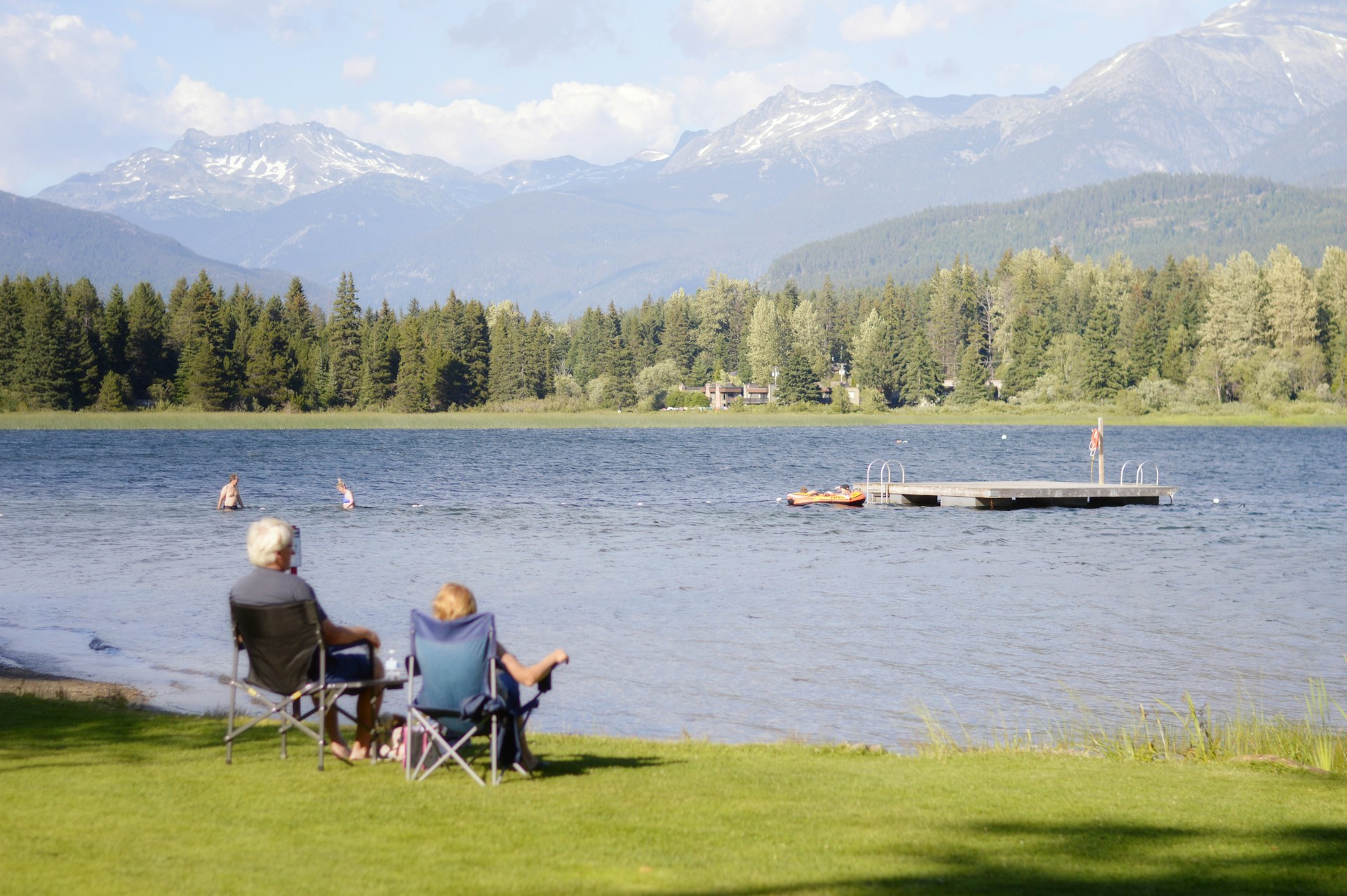


:max_bytes(150000):strip_icc()/TAL-lead-image-lewes-delaware-LIVEUSSMTWNS0625-a7938c6ed41148219c3f3bb4d88aceb6.jpg "10 Best Small Towns to Live in the U.S.")
:max_bytes(150000):strip_icc():format(jpeg)/TAL-lead-image-lewes-delaware-LIVEUSSMTWNS0625-a7938c6ed41148219c3f3bb4d88aceb6.jpg)