The Australian Grand Prix, which for years has served as the opening round of the season, remains a popular event on the calendar, and this year there has already been some action ahead of the race.
After crashing his car during a practice session on Friday, Williams’ Alex Albon will now use the car of his teammate Logan Sargeant for the remainder of the weekend. Sargeant will have to sit out as the team doesn’t have a spare car and the damage to Albon’s car is too severe to repair.
While Sargeant sits out, Ferrari’s Carlos Sainz makes a return in Melbourne after missing the previous Saudi Arabian Grand Prix due to surgery for an appendicitis. Ferrari reserve driver Oliver Bearman sat in for Sainz and managed to score some points after finishing a respectable seventh.
Albert Park Circuit, home of the Formula 1 Australian Grand Prix
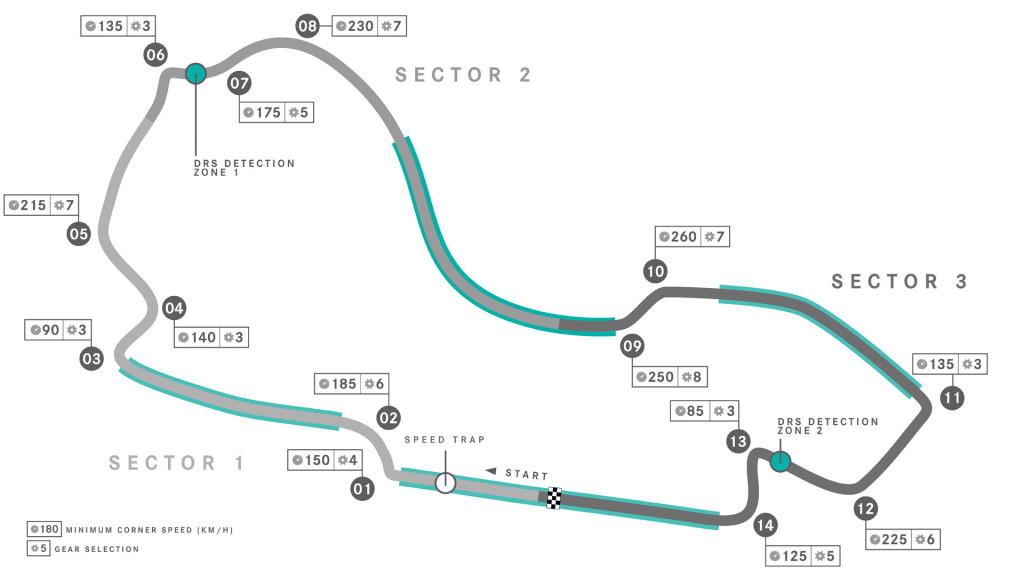
The Australian Grand Prix takes place at Albert Park Circuit, a street circuit that has been on the F1 calendar since 1996. The current layout measures 3.28 miles and features 14 turns.
With 72% of the lap time, and 79% of lap distance, spent at full throttle, the Albert Park Circuit ranks third highest of any circuit on the calendar judged on both these metrics. The circuit also has the shortest pit lane on the calendar, at just over 900 feet, meaning cars spend only about 13 seconds at pit lane speed.
Weather can be a mixed bag in Melbourne, but the current forecast calls for mild temperatures and mostly sunny conditions for both Saturday’s qualifying and Sunday’s race. In a change from last year, Pirelli has nominated its softest tires in the range: the C3 as the white hard, the C4 as the yellow medium, and the C5 as the red soft.
Going into the weekend, Red Bull Racing’s Max Verstappen leads the 2024 Drivers’ Championship with 51 points. Fellow Red Bull driver Sergio Perez is second with 36 points and Ferrari’s Charles Leclerc is third with 28 points. In the Constructors’ Championship, Red Bull leads with 87 points, versus the 49 of Ferrari and 28 of McLaren. Last year’s winner in Melbourne was Verstappen, driving for Red Bull.
Mitsubishi Motors Malaysia (MMM) is running a range-wide promotion that runs until March 31, with cash rebates, equipment upgrades, low financing interest rates and complimentary service labour, depending on model.
Headlining the promotions on offer is the Triton range of double-cab pick-up trucks, with the model’s top variants, the Triton Athlete (from RM155,900) and the Triton VGT AT Premium (from RM135,900) offered during this time with a choice of either:
Up to RM7,000 in cash rebates or
Wheel set upgrade for RM900, plus RM3,000 cash rebate or
Additionally, the selection of any of these deals for the Triton Athlete and Triton VGT AT Premium will come with RM2,000 in duit raya.
Cash rebates are also offered for other variants of the Triton during this promotion period. Purchases of the Triton VGT MT Premium (from RM122,200) and Triton VGT MT (from RM110,000) will come with cash rebates of up to RM3,000, while purchases of the Triton VGT AT (from RM113,890) and Triton Quest (from RM87,390) will come with cash rebates of up to RM4,000.
For those who need to transport a larger head count, the Mitsubishi Xpander (from RM100,980) is offered during this promotion with cash rebates of up to RM1,000, and the seven-seater MPV model in particular gets one year of servicing labour, free of charge.
As for terms and conditions, financing partners for these models in the promotion are Maybank, Public Bank, and Hong Leong Bank, with the first two being the required choice for those opting for low monthly instalments.
Availability of upgrades in the promotion is subject to the model variant, model year, booking and registration period, as well as remaining stock. All vehicle prices are on-the-road without insurance including 10% SST, for individual private owners in Peninsular Malaysia. More details on the promotion, here.
There’s been a changing of the guard at Aston Martin. The British performance marque today named Adrian Hallmark, the current CEO of Bentley, as its new chief. He replaces Ferrari veteran Amedeo Felisa, who is likely retiring.
Rimac was also in the headlines today with news the company plans to reveal a hatchback-like vehicle on June 26. Rather than a new hot hatch in the same vein as the recently revealed Rivian R3X, the mystery vehicle is thought to be for a robotaxi service Rimac plans to launch by 2026.
Mercedes-Benz AMG appears to be cooking up a new version of its GT Coupe that keeps the V-8 but holds off on electrification. A prototype for the new version, which may be badged as the GT 63 S, was just spotted.
You’ll find these stories and more in today’s car news, right here at Motor Authority.
The Bentley Speed Six continuation cars are now in production, bringing back a design that first appeared over nine decades ago.
Bentley unveiled the prototype Speed Six continuation car last year, but is now working on the first of 12 customer cars, all of which have already been sold, the automaker said in a press release. Each car will take 10 months to build, Bentley estimates.
Production is being handled by Bentley’s Mulliner personalization department, with help from outside suppliers, all using period-correct materials and tools. For example, Bentley commissioned special tooling to press the Speed Six’s steel frame rails and crossmembers, a process that by itself took six months, according to the automaker.
1930 Bentley Speed Six Continuation Series production
As with the original cars, handmade ash-wood bodywork wrapped in fabric is mounted on the chassis. The continuation cars are then fitted with headlights, radiators, and fuel tanks supplied by restoration specialists. The latter is made from hand-beaten steel and copper.
The 6.5-liter inline-6 is recreated using 3D models generated from the original blueprints. This engine made about 200 hp in its day, while the continuation cars produce 205 hp. Output could have been raised even further with modern materials, according to Bentley, but the automaker wanted the continuation cars to be as close to the originals as possible.
The Speed Six is one of the cars that helped create the Bentley legend. Introduced in 1928, it won the 24 Hours of Le Mans that year and in 1930. Wold Barnato, then head of the company, also used a sedan-bodied Speed Six to race a train across France in 1930. Barnato and co-driver Dale Bourne covered 570 miles, averaging 43.4 mph on unpaved roads.
1930 Bentley Speed Six Continuation Series production
The continuation cars, Bentley’s second continuation project following modern examples of the 1929 Bentley Blower, used two original cars as templates: GU409, which is owned by the company, and “Old Number 3,” the 1930 Le Mans winner, which was made available by its owner for this purpose. The continuation cars incorporate changes made in period to improve reliability for the 1929 and 1930 Le Mans races.
The customer cars also benefit from testing of the prototype Speed Six continuation car, which went through 40 hours of engine testing, 6,213 miles of durability testing, and top-speed runs where it achieved 112 mph.
It’s always an exciting time of year when Scandinavian enthusiasts begin to emerge from their winter hibernation.
With the first Gatebil event of the 2024 summer season just two months away, new builds are in their final throes, and old favorites are being refreshed. As we’ve learned over the years, you always have to expect the unexpected, and back in 2014, Mike and Larry got a firsthand taste of that with a stock-looking Volvo 245 wagon.
What’s this sleeper build all about? Let’s wind back the clock a decade and check it out.
2014 Feature
Could there a be a more perfect combination than a Volvo 245 wagon and a Toyota’s famous 2JZ-GTE engine? Ok, at first it might not sound so great. I mean, why waste the time putting a motor like that in a heavy old Volvo? Think about it a little more though, and you realize just how great an idea it is.
Old Volvos, while not known for being especially thrilling, have developed an incredible reputation for durability. These cars are quite simple; they’re overbuilt and they have a basic structure that can handle just about any abuse you throw at it. Like a tank, as they say.
Then you have the 2JZ. Its design might be old now, but there’s a reason it’s still such a popular power plant around the world. First, it can make some serious power. We’re quite familiar with the countless 2JZ-powered vehicles out there making well north of 1,000hp.
But more than its power capabilities, the 2JZ is so sought after because of its durability. Not only can these motors make big horsepower, but they can do it while being extremely reliable. Strength is their key virtue, just like the aforementioned Volvos.
So yes, combining an old boxy Volvo with Toyota’s beloved inline-six is about as natural as it gets. It’s taking one of the world’s strongest cars and mixing it with one of the world’s strongest and most capable performance engines.
If that’s not enough to sell you on the idea, there’s also the whole sleeper factor. It’s hard to find a more unassuming car than a beat-up burgundy Volvo 245 wagon like this one, and combined with a hotted-up 2JZ, you’ve got a recipe for huge grins and lots of strange looks from other motorists. That’s what it’s all about, right?
Sweden’s Peter Björck is the man responsible for this car, and there’s a good chance that name will sound familiar to you. That’s because Peter is also the guy who built a 1,294 horsepower JZA80 Supra.
While the Supra was a full-on mega-build with a ton of time and money invested in it, the idea was for the Volvo to be more laid back. A car that was built for fun above all else.
When Peter got hold of the engine-less Volvo chassis, he knew he wanted a car that he wouldn’t have to care so much about. Something that could be driven and driven hard without much worry. This is where that great Volvo/2JZ combination comes in.
Peter’s goal at first was to create a car that would be used primarily on the street. You know, load the thing up with some friends and then head out and have some fun.
Over the years, Peter served up embarrassment to many a high-end performance car, but eventually word got out about what was lurking under the hood and nobody wanted to race him any more. Sleeper problems.
When it came to building the car, Peter says that getting the 2JZ into the Volvo was rather easy, and given how much space is in the 245’s engine bay it’s not hard to see why.
And while even a stock 2JZ would be quite fun in a car like this, we all know that stock never suffices. Especially in Scandinavia.
Most of the work done on the car has been directed at the engine bay. The 2JZ’s pistons are stock, but the rods and head studs have been strengthened with parts from Eagle and ARP.
Boost meanwhile comes from a single KKK29 turbocharger mounted on a PRC manifold.
Other supporting engine modifications include Bosch 2,200cc injectors, a Nuke Performance fuel rail, Walbro fuel pump, PRC wastegate and Nuke blow-off valve. Control and tuning comes via a Link G4 Extreme engine management system.
The 2JZ is then mated to a V160 6-speed transmission with a Tilton clutch, and power leaves the car through a BMW M5 differential mounted in the factory axle assembly.
Elsewhere, the old Volvo is very stock and that’s really what makes it so great. Suspension modifications, for example, consist only of some R-Sport shocks with basic lowering springs and a Kaplhenke quick steer roll correction kit.
Peter says the brakes on the car are essentially stock, while the wheels are modified 17-inch steelies from a Peugeot 407. They aren’t flashy, but that’s the point. It’s hard to think of something else that better suits the character of this car.
Inside, the Volvo has a simple roll bar set-up and a Sparco driver’s seat for track days. Let’s not forget the stereo and subwoofer setup either.
Can’t you just imagine that dog staring out the back of the Volvo as it pulls away from some unassuming fellow in a fancy sports car? I love it!
After Peter sold off the Supra, the Volvo became his only car – meaning it would have to serve both as a street car and as a track machine when Gatebil came around.
While he says it isn’t the easiest car to drift, the Volvo has no problem driving to Norway with extra tires on the roof rack, being punished on the track and then driving back to Sweden with no problems.
It’s pretty clear that Peter has built one of the coolest sleepers we’ve ever seen. I’ve always thought that a great car should make you laugh with joy, and this one looks like it delivers laughter by the wagon load.
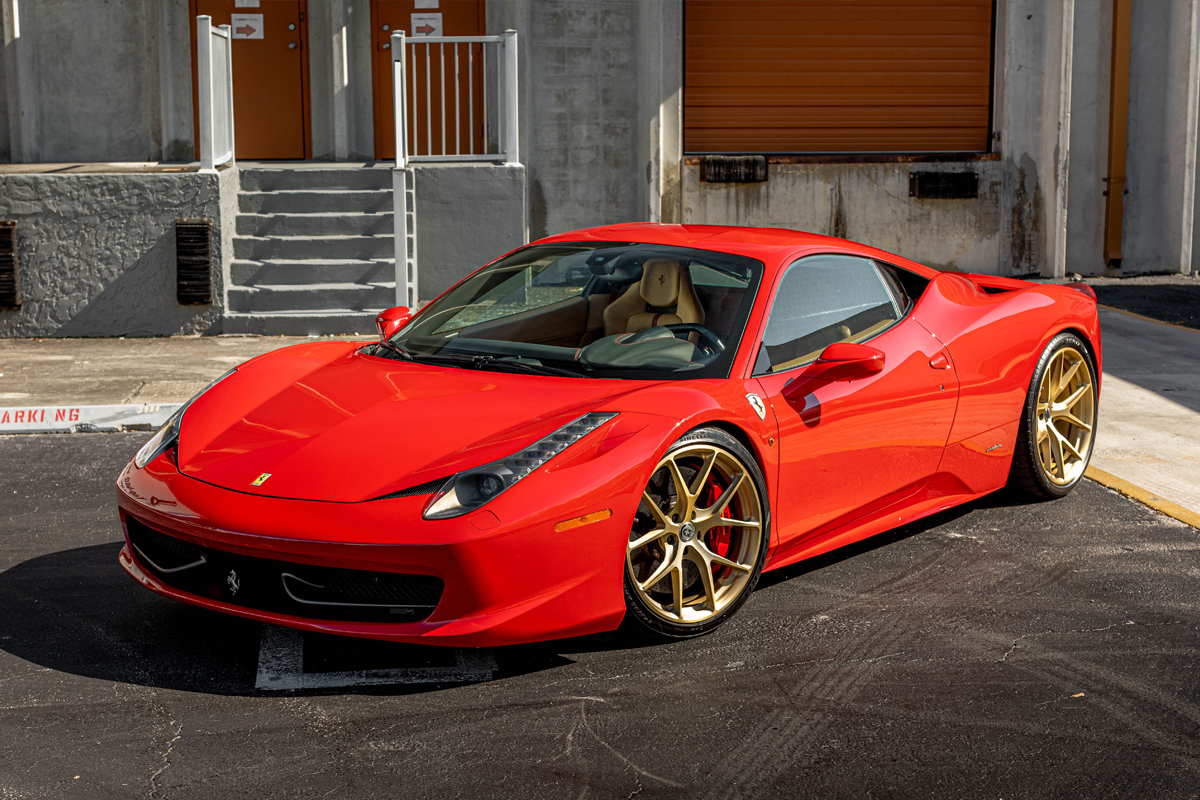
The Ferrari 458 Italia needs no introduction, as it’s one of the most praised and reliable Ferrari that has ever been released in 2010. On the street or the racetrack, there’s hardly any criticism of Ferrari’s achievements with the innovative design of the 458. It’s adaptability and driving pleasure are unparalleled.
Replacing the F430, the 458 marked a new era for the mid engine V8 Ferrari. The level of refinement and improvement between the Ferrari F430 and the 458 can nearly be measured in light years.
The 458’s design is unmistakably Ferrari, showcasing a blend of simplicity, elegance, and aggressiveness that has shown to be timeless over time. It was a new design language for Ferrari that proved to work and look modern even today.
Revving up to 9,000 rpm with 562 hp, the 458’s V8 engine is a 4.5-liter naturally aspirated powerhouse, delivering an impressive 125 bhp per liter. A seven-speed dual-clutch transmission is the only available choice for buyers.
With the use of thinner aluminum body panels and a touch of carbon-fiber composites, the 458 maintains a curb weight of 3,400 pounds, which is less than a 100-pound increase compared to the F430.
Aerodynamics is a big deal in the 458’s design, which creates an impressive 309 pounds of downforce at 120 mph, even without a typical spoiler. The vents on the fenders help release slow air from under the headlights and over the fenders, reducing lift and improving the car’s aerodynamics on the sides.
You can see the large carbon ceramic brakes under the 20-inch wheels, and they give the 458 amazing stopping power that keeps it stable.
The car’s steering is super responsive and is considered more sensitive than many other supercars. This gives drivers a precise feel for the wheel position during turns, ensuring great stability.
For the 458’s suspension features a double wishbone design at the front and a multi-link arrangement at the back, optimized for the best grip and handling. The suspension can be further customized through various driving modes, thanks to the well-known Manettino switch on the steering wheel.
If you sit in the F430 and then get into the 458 Italia, it feels like you’ve jumped ahead by two generations of Ferrari instead of just one. Everything in the 458 feels up-to-date and gives off a feeling of carefully crafted quality that wasn’t there in the older model.
You will notice that it is a very driver-focused cabin, where most of the controls are on the steering wheel and the vents are protruding towards the driver cockpit.
The 458 has several adjustable driving modes that you can select on the steering wheel Mannetino (little lever), including Low-traction mode for slippery conditions, Sport for daily driving, and Race when you’re in a daring mood. The last two settings, CT-off and CST-off, are best suited for track use.
The 2010 model is the first full year of production for the 458, which replaced the Ferrari F430.
Featuring a 4.5-liter V8 engine that produces 562hp.
The starting price of the 458 was $226,000, which was comparable to its rivals in the market.
2011 Ferrari 458
Mechanically, the 2011 Ferrari 458 was basically the same as 2010.
However, 2011 gave birth to the 458 Spider, featuring an open-top roof to experience the full symphony of the screaming V8 engine.
The 458 isn’t like the fabric convertible tops found on the 348-through-430 Spiders; instead, it closely resembles the targa-style GTS versions of the earlier 308 and 328 models. Rather, it features a retractable hardtop convertible, offering the ideal combination of both styles.
The downside of a retractable hardtop convertible is that the 458 loses its glass cover to show off the engine like the 360 and F430 Spider and The Spider is said to weigh 110 pounds more than the coupe, and its frame isn’t as rigid, even with the reinforced sills and structural supports.
Base price starts at $257,000 ($31,000 more than coupe).
2012 Ferrari 458
In 2012, the 458 saw only minor changes, including updates to the software and a few tweaks to the options. Software upgrades for this model provided a more forceful shift in race mode and a gentler exhaust sound, eliminating pops, crackles, and bangs. Other modifications involved updated engine maps, along with tweaks to the dampers and chassis to enhance handling.
The most appealing update was the inclusion of a free 7-year maintenance package, in addition to the 3-year factory warranty.
Other notable changes for the 2012 Ferrari 458:
Handling Kit Upgrade: Includes a new ECU, accelerometer, hardware, and installation for about $10,000.
2013 Ferrari 458
For 2013, there were no known updates to the Ferrari 458. This was in preparation for the release of the high-performance variant of the 458 to be released in the following year.
2014 Ferrari 458
In 2014, Ferrari introduced the 458 Speciale. Similar to the previous F430 Scuderia and 360 Challenge Stradale, the 458 Speciale was a limited-edition, track-ready version with more power and lighter weight than the standard model.
The Speciale is packed with enhancements that you might not have imagined possible or needed if you’ve ever driven the 458 Italia.
It offers faster gear shifts, quicker cornering, and shorter braking distances. The Speciale underwent several revisions, including redesigned pistons, intake ports, crankshaft, and a titanium exhaust system, which increased the compression which made it 597hp (35hp more than the standard 458) and 200 pounds less weight, it’s faster than the base model, both on straightaways and around the track.
In addition, the Speciale saw some electronic upgrades, including the introduction of a Side Slip Angle Control (SSC) system. This innovative system was designed to improve vehicle control at the highest performance levels by managing torque distribution through the electronic differential.
The SSC system essentially performs a continuous, millisecond-by-millisecond analysis of the car’s position to optimize torque and traction control management.
We cannot forget that the transmission software has also been updated, so it shifts much quicker now.
The updated body design showcased a vented hood, new bumpers, forged wheels, a redesigned rear bumper and diffuser, and new side skirts with an added winglet.
These modifications not only improved downforce but also made the 458 Speciale the most aerodynamic Ferrari produced at that time.
For the interior, it features extensive carbon fiber and Alcantara elements. There’s no glove box, carpeting on the floors, or even an armrest on the doors. However, it does come equipped with a stereo, navigation system, and an optional advanced telemetry system that collects data through GPS.
Base price started at $298,000 ($72,000 more than the standard 458).
2015 Ferrari 458
In celebration of the 458’s final chapter before its successor arrives, Ferrari unveiled the convertible Speciale, the Aperta edition. It is only limited to 1 of 499 produced and was sold out very quickly.
The Speciale Aperta mirrored the coupe in design, although it carried additional weight because of its retractable hardtop. However without a doubt, one could overlook being slightly slower to reach 60mph when it’s got the 597hp V8 engine that revs up to 9000rpm.
Base price started at $400,000 ($102,000 more than Speciale coupe).
For 2015, all 4 other 458 variants had no change and Ferrari was preparing for the launch of the 488 GTB.
Ferrari 458’s common problems
The Ferrari 458 is regarded as one of the most reliable Ferraris ever. There are plenty of owners on the market that have well over 50,000 miles and even past 100,000 miles have been achieved.
This breaks the traditional stereotype of supercars being unreliable.
However, it is essential to keep in mind that all cars, even supercars, can have issues and it is crucial to perform a Pre-Purchase Inspection (PPI) from an authorized dealer or experienced independent mechanic to reveal all issues.
Transmission failure: Multiple accounts of transmission issues have emerged for the 2010-2011 Ferrari 458 Italia models. While there hasn’t been any official acknowledgment or recall from Ferrari, it’s interesting to note that the 2012 models were introduced with updated transmission software. This suggests that Ferrari might have been aware of the problem from the beginning.
Galvanic corrosion around wheel arches: Look for any bubbling around wheel arches, as galvanic corrosion can happen on some 458’s and it can be costly to refinish.
Dashboard leather can tear: It is a known issue that the leather on Ferrari dashboards may tear over time. The appearance of wrinkles can serve as an early indication of this potential problem.
Interior buttons can be sticky: Make sure to inspect the buttons in the interior, as Ferrari is known to have sticky buttons as the car ages.
Recalls
2011 and 2012 Ferrari 458
Engine seizure (Recall no. 12V211000)
Ferrari has issued a recall for a faulty crankshaft that can cause sudden engine seizure, possibly resulting in a crash. It was found that some crankshafts were machined incorrectly during manufacturing and should be replaced. Ferrari has given owners the option of having a new crankshaft and bearings installed or a completely new engine instead.
2010 to 2014 Ferrari 458
Trunk latch (Recall no. 14V487000)
The secondary component of the trunk latch may not release when the car is stationary. This is a relatively small issue but nevertheless, should be replaced by the dealer.
2010 Ferrari 458
Rear fender adhesive (Recall no. 10V389000)
Ferrari issued a recall to 2010 458’s due to the adhesive in the rear fenders. At high temperatures this adhesive can ignite, leading to a fire in the engine bay itself and potential loss of the entire car. Ferrari has remedied this issue with scraping the use of an adhesive altogether and has opted instead for five rivets that will secure the components together. This fix will come at no cost for 458 owners.
Maintenance and Ownership Costs
Compared to other high-performance supercars, owning a Ferrari 458 is considered to have relatively low maintenance requirements.
For individuals who purchase a 2010 or 2011 model, the Ferrari 458 is generally regarded as a low-maintenance vehicle.
Apart from regular maintenance tasks such as oil changes, the 458 Italia demands little additional care. Its DCT transmission is designed to endure the car’s lifespan, eliminating the need for clutch replacements.
The 458 also utilizes timing chains, not timing belts, and does not require replacement either.
With that said, it is important to remember that regular maintenance and repairs will still be necessary, and the costs can vary depending on whether you take your car to a dealer or an independent mechanic.
Here is the suggested service schedule and intervals per Ferrari:
ANNUAL or EVERY 6,000 MILES:
Replace Engine Oil & Filter
Replace Pollen Filter
DEIS Scan
Brake Inspection
Inspect Transmission Oil and Hydraulic Fluid Levels & Top-Up if Necessary
Inspect Front & Rear Suspension Systems
Inspection of Transmission & Differential Assembly
Inspection of Tire Wear
EVERY 2 YEARS or 12,500 MILES (Includes 6,000 Mile Service Plus)
Replace Brake Fluid
Electronic Parking Brake inspection
Tightening of Engine & Transmission Mounts & Fasteners
Replace Engine Air Filter
EVERY 4 YEARS or 37,500 MILES (Includes 12,500 Mile Service Plus)
Replace Auxiliary Belts & Replace Spark Plugs
Here is a rough estimate of typical service costs associated with the Ferrari 458:
Oil change – As low as $300 for independent mechanics and $800 for dealers.
Minor Service – Typically includes oil change, cabin filters, and engine filters. The cost from a dealer is around $1,100
Major Service – Typically includes all the above plus spark plugs, brake flush, and trans flush, expect about $3,000 from a dealer.
Tires – A set of high-performance tires like Michelin PS4 will cost about $2,000.
Brakes – Rotors are carbon ceramic which should last forever.
Clutch – Dual clutch transmission should last the lifetime of the car so expect zero additional expenses for clutch or flywheel service.
Options List
The Ferrari 458 has a list of options and packages that customers can choose from.
458 owners have a range of exterior customization choices, including bespoke paint colors, choosing from an assortment of brake caliper colors to complement the overall design, and browsing through various wheel options such as Stock, Sport, darker Sport, and Diamond Cut Sport to find the perfect match.
The interior of the car offers an even larger scope for personalization, with numerous options such as selecting the rev counter color (red, yellow or white), determining the color for the front and upper dashboard, choosing a leather headliner, and picking a steering wheel color. Additional customizations include opting for Alcantara lining, selecting between seat options like race bucket seats and Daytona seats, fire extinguisher and including colored seat belts.
A handful of 458 customers also went through the Tailor Made program which was a factory-in-house customization program, that allowed customers to personalize their 458 with unique exterior and interior colors, materials, and features that were not available on regular production models.
Because of the strict approval requirements, cars that went through the Tailor Made program are considered highly desirable.
These cars usually command a higher premium in the market due to their exclusivity and uniqueness.
Here is some examples of the ordering guide
2011 Ferrari 458 Italia Options List
Some of the more desirable options to look for include:
LED steering wheel
Upgraded wheels (Sport, darker Sport, and Diamond Cut Sport)
Painted calipers
Upgraded seats (Racing bucket seats and Daytona seats)
Back up camera/sensors
Scuderia shields on fender
Headliner in leather
Bespoke colours
Tailor Made exterior/interior (rare)
Ferrari 458 Price and Values (Coupe/Spider and Speciale/Aperta)
The Best Ferrari 458 to Buy
When it comes to buying a 458, there are a few key factors to consider that can affect the car’s long-term value.
Some of the criteria break down into a few categories.
Without a doubt, the high-performance limited edition 458 Speciale and even more rare 458 Aperta is the safest choice to purchase. While they are now expensive, they will continue to hold value and also appreciate in value in the long run. These limited edition Ferraris are very sought after by collectors,
For the 458 being such a great car, all the years from 2010 to 2014 will remain a strong purchase simply because of their reputation for being extremely well-built and reliable vehicles. These cars have a proven track record for being mechanically sound with few major issues.
As hybrid technology becomes more widespread among cars, naturally aspirated V8s are becoming highly sought after by collectors and enthusiasts in the current market.
In addition to limited edition models, the condition and mileage of the car are also important factors to consider when buying a 458. There are many that have been driven hard and have been highly modified.
But the ones that are more likely to retain their value in the long run and will fetch the most money will be a well-maintained car with low mileage.
Therefore, it’s important to do your research, compare prices, and look for well-maintained cars if you are considering purchasing an Huracan with the goal of not losing any money.
Conclusion
In conclusion, for around ($200,000+) the Ferrari 458 Italia is a great choice for a supercar that you can rely on.
Although the rivals in this category are great cars, Ferrari has designed a car that not only redefines the brand but also proves their ability to create dependable vehciles. The 458 can be used everyday, but double as a track car and have minimal upkeep costs.
In summary, the 458 will continue to be a sought after car for the years to come and it is an ideal time to invest in one if you have been contemplating the purchase.
Car Hacking Shortcuts
Limited edition models such as 458 Speciale and 458 Aperta are collectables, and will continue to appreciate in value.
Spec matters: Look for any Tailor Made colors or optional colors.
Perched in the northernmost fringes of the US, Montana is an incredible state to explore. It’s the kind of state that’s got a little something for every traveller, especially if you love the great outdoors. Not only that, there are so many of the best places to see in Montana that are perched all over the state.
This makes it one of the best US states to visit on a road trip, especially if you’re already in the wider northerly area of the US. After all, you can include a trip to Montana as part of a visit to Yellowstone National Park, Wyoming and even following the Rockies towards Alberta in Canada.
Though, don’t think you need to be a pro skier or hiker to enjoy Montana. There’s also a heap of smaller cities that are well worth a visit whilst you’re driving around the state.
Take a look, below, at the best places to see in Montana when you visit. After all, you don’t want to travel all that way and miss some of the top places. Have fun!
1.) Big Sky Resort
Big Sky is one of the most famous and largest winter resorts in all the United States. Not just that, it’s situated within the southwesterly fringes of Montana and around 50 miles from Yellowstone International Airport (Bozeman).
With almost 6,000 acres of skiable terrain and the most beautiful pistes, it’s the kind of place that’s well worth visiting if you’re an avid skier. Though, don’t fret if you’re not a pro! There are a range of slopes at Big Sky that are suited to all abilities. Honestly, it’s huge and you can easily spend 2-3 days and not even come close to ‘completing’ it.
Now, daily lift passes (that you can grab here) can be a little on the pricier side, so make sure to plan your days well to maximise your time on the slopes before booking any tickets.
Also, don’t forget that Big Sky is not just a resort for winter activities. In the warmer summer months, you can head out on activities like horseback riding, swimming, and zip-lining which are so much fun.
Yes, Bozeman might be relatively small in comparison to other cities in the US, but it’s well worth a visit when you’re in the area.
Around a 1 hour drive from Big Sky, Bozeman is a great city to visit for an overnight stay after skiing. You see, it’s got a heap of restaurants and museums that make it really fun; especially if you’re visiting with the family.
Once here, make sure to check out the Museum of the Rockies. Now, don’t be fooled, the museum does not just showcase prehistoric artefacts and paleontological collections, but it also comes with a variety of sections that are so incredible to see. The Japanese woodblock prints exhibit is fairly popular as well as the numerous Native American exhibits.
Afterwards, head to downtown Bozeman and explore the Gallatin History Museum. It’s a little smaller than the Museum of the Rockies, but well worth visiting if you’re interested in the history of battles in Montana.
Finally, head over to Jam! for their epic brunches. Their eggs benedict and biscuits are so tasty. Though, just be aware, it does get busy on weekends, so be prepared for a wait.
Popularly known as the Quake Lake, Earthquake Lake was created after a massive earthquake struck back in 1959. Perched just west of Yellowstone National Park, it’s well worth making a visit whilst exploring the wider area, especially when driving Jackson Road (Highway 287).
It’s easily one of the best places to see in Montana and well worth taking a drive through this area.
That being said, if you fancy stretching your legs, then join the Refuge Point hiking trail. It’s a totally gorgeous way to explore more of the area around Boat Mountain and Quake Lake itself.
For me, Glacier National Park is a must-see when visiting Montana.
In fact, I’d go as far as saying that it’s one of the best national parks in the US to visit. The whole landscape is absolutely incredible to see.
Surrounded by ancient forests, glacial valleys and carved mountains and lakes, it’s the kind of place that acts as a ‘timestamp’ of geological processes in the region.
You see, you can easily head between valleys that were carved by vast glaciers, or head around the lakes that were formed over thousands of years of glacial melt.
Now, a heads up, Glacier National Park is huge! This means you’ll never really see it all, but you can certainly make a good attempt.
As you drive around the park, make sure to stop off at Grinnell Glacier which is incredible to see. You can drive lots of the area around Glacier Route 1 road; but be aware, that it’s closed in winter.
If it’s a hike you’re after, make sure you prep and you’re a keen and advanced hiker. You see, the hike to Grinnell Glacier is challenging to say the least. If you are considering this hike, the Garden Wall Trail will be best.
This will get you right to the top, overlooking Grinnell Glacier itself.
Staying for a few days? Make sure to also visit Swiftcurrent Lake in Glacier National Park. It’s easily reached by road and the views from here are stunning.
If you’re interested in the battles that happened in Montana, then make sure to visit Little Bighorn Battlefield National Monument.
It is a memorial ground for the United States Army’s 7th Cavalry and the Native Americans. Here, you’ll get to learn more about the history that led to this infamous battle at this very site. It’s one of the country’s most well-known battles and it’s well worth learning more on a visit here.
From an international perspective, I can’t say I knew much about Little Bighorn Battlefield; but it’s well worth a visit when driving through Montana.
Not too far from Yellowstone Airport, the Grizzly and Wolf Discovery Center is one of the best places to see in Montana when visiting West Yellowstone itself.
Open all year round, Grizzly & Wolf Discovery Center is a perfect stop to just stretch your legs and explore this not-for-profit centre. It’s incredible and you’ll get to see grizzly bears, wolves and otters that can no longer be released into the wild or are temporarily housed while they heal or orphans.
Their work is invaluable in the area and is such a lovely place to visit. Just be sure to give yourself around 90 minutes to fully enjoy the experience.
Afterwards, head on over to Running Bear Pancake House for some of the world-class pancakes. Also, make sure to try one of their homemade cinnamon rolls. They’re incredible.
Lewis and Clark State Park is the oldest in all of Montana and is located outside Three Forks. This makes it one of the best places in Montana to visit whilst driving west from Boseman towards Glacier National Park.
Once here, make sure to explore the incredible caverns on a guided tour and follow some of the gorgeous hiking trails from the cavern’s visitor centre.
The Middle View Trail is a great one to stroll, but the Greer Gulch Loop Trail can be a little more accessible if you’re short on time.
Located at the centre of Montana, Great Falls is a city that’s well worth stopping for an overnight stay.
Known locally as Electric City, Great Falls (due to the energy it produces) has heaps of restaurants, bars and a downtown area that are well worth a gander.
Once here, make sure to check out the Children’s Museum of Montana. It’s so cute and the exhibitions are a throwback that is lovely to see. Oh, and stop by Tracy’s for the best chicken and waffles in town.
If you’ve got time, also head over to Malmstrom Museum and Air Park. This is a great place to stop if you’re interested in military history and well worth a visit for a few hours whilst in Great Falls.
If you want to slow down a little on your trip to Montana, then make sure to head over to Billings. You see, it’s got heaps to do and a great stopping point if you’re heading east to North Dakota.
Once here, head over to Moss Mansion Museum to take a tour inside the home that’s over 100 years old. It’s really incredible to see and the historical artefacts inside are priceless. Just be sure to check opening times; Moss Mansion Museum does close during some of the colder months.
Also, don’t forget to visit the Yellowstone Art Museum, too. It’s a great place to explore both contemporary and historic exhibits. We loved it and it’s well worth visiting for a 45-minute trip. Though, a heads up, if you’re not an overly keen art fan, then you might want to give this one a miss.
Being the capital of the state, Helena is one of the best places in Montana you have to visit.
Now, it’s not as big as other US cities like New York but that doesn’t mean it’s not worth staying a night or two. There are heaps of things to do when you arrive in the city.
Once here, make sure to explore the area around the Montana State Capitol which is stunning.
Fancy a hike from the city? Then head around the trails of Mount Helena. These are pretty accessible in the summer months and you can get some great views from up here.
Oh, and don’t forget to pop into Steve’s Cafe for their hearty breakfasts. It’s an unfussy place that’s all about the food. Just be sure to try their ‘big bird’ sandwich. It’s huge and delicious.
11.) Hamilton
Not too far from the border with Idaho, Hamilton is one of the best places in Montana to visit as you travel via Highway 93 to Idaho.
Now, this is the kind of town you can visit for a few hours (you don’t need to spend any longer). That being said, you can use it as a base to explore some of the nearby peaks that mark the state border.
Once here, be sure to check out the Daly Mansion. It was once the home of Copper King Marcus Daly who founded Hamilton. Inside, you’ll get to explore the building and learn more about the establishment of Hamilton.
Oh, and for one of the best brews in Montana, head to Big Creek Coffee Roasters. Their coffee is some of the best in the state.
The first Ferrari SF90 XX Stradale has just been delivered. The supercar was handed over to the customer by H.R. Owen Ferrari in London.
The SF90 XX Stradale is a more track-focused iteration of the standard SF90. It made its debut almost a year ago and with production of the 812 Competizione winding down, Ferrari is now shifting its focus to the SF90 XX.
The first customer SF90 XX Stradale is finished in Rosso Magma. This shade of deep red does suit, especially with contrasting black roof and carbon elements. The XX also has a unique rear design, featuring a continuous LED light bar. This car is also equipped with the carbon wheels.
Powering the SF90 XX is a 4.0-liter twin-turbo V8 engine paired with three electric motors. While the standard SF90 packs 986 hp, the powertrain has now been tuned to 1016 hp. The powertrain is hooked up with an 8-speed dual-clutch transmission, which now gets revised software. It enables the car to hit 0-62 mph in 2.3 seconds and reach a top speed of 199 mph.
Fuel up your dirt bikes, load up the camping gear, schedule a house move and book a trip to the dump – it’s time to get physical with Pandem and their new range of pickup (AKA ute) kits.
I love a good ute, and who doesn’t? But what is better than one ute? Three utes, of course. A little while back, I featured J.Beat Custom’s Datsun Sunny pickup. But it’s not the only utility vehicle to get the Pandem treatment. Today, we’ll take a spin in the Hardcore Tokyo Nissan Frontier, and next time I’ll show you the TRA Kyoto Hilux. A terrific trio of mini trucks, if you will.
You might be wondering about my enthusiasm for the humble ute, and a little back story should explain it. While studying at university in Australia, my dad gifted me a grandma-spec Nissan Pulsar when he moved back to the UK. In retrospect, it was probably a very sensible and perfectly adequate daily driver for a poor student. But my housemate owned a Holden Torana and I longed for something equally cool.
I sold the little white hatchback and bought a 1970s GM Holden HQ ute with a straight-six up front, three on the tree, a bench front seat and plenty of space in the back for my husky child, Kazu. The HQ was a proper classic hunk of Aussie iron and set the ball rolling for my love of oddball cars.
But huskies aren’t the only things you can haul in a ute. Fridges, camping gear, and more is all easy work for a light truck. The Aussies have had some beauties, the king being the Holden Special Vehicles (HSV) Maloo. What my mates and I wouldn’t have done to get behind the wheel of one of those…
Need to move house? Need to rip an almighty burnout while leaving the motocross circuit? The Maloo could do both with ease.
Less performance-orientated and more likely to be found at a building site was the Nissan D22 Navara. Known as the Nissan Frontier in other markets, this ute was the hammer to the HSV’s laser level.
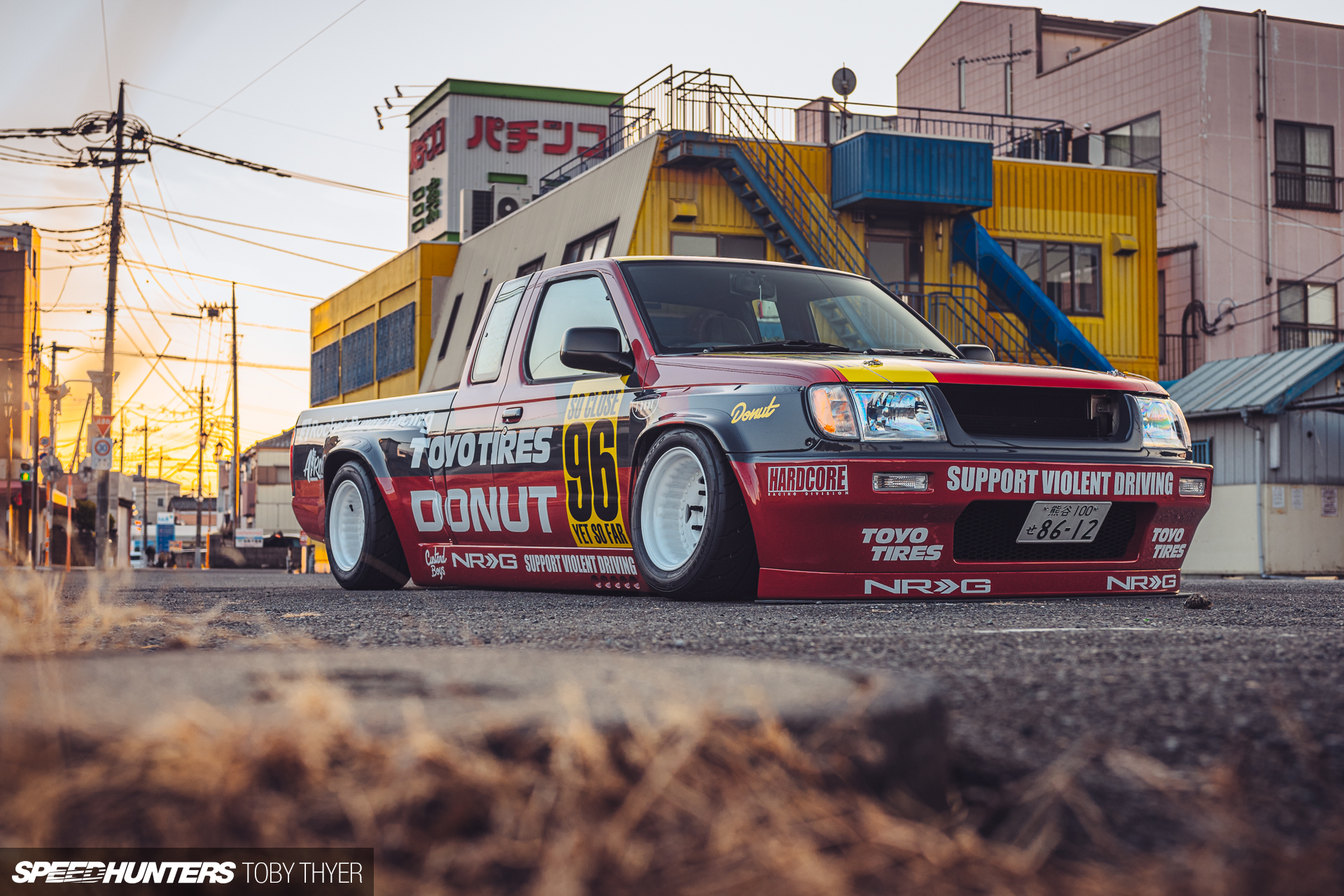
Fast forward 20 years, and Jun Takahashi of Hardcore Tokyo decided to import this Frontier from Thailand and transform it. The brief for the D22 build was simple: how Americans would customise the truck in JDM style.
Jun told me they kept things simple, sticking to a home garage-built ethos rather than going down the route of a fully-blown hot rod.
The body kit is unique to Pandem, and the livery takes cues from the Hardcore Tokyo line of merchandise.
Bar the bucket seats, steering wheel and shifter, the interior is building-site-spec. You can almost smell the corn beef sandwiches and chocolate milk in here.
Slamming the Frontier required a bit of fabrication work. Custom front upper arms, a custom rear 4-link, and an Airmext air suspension system featuring DJM shocks get the job done.
It would have been easy to swap in an SR20DET but, keeping with the build theme, Jun has retained the ute’s original KA24DE. With a custom exhaust system – and a little witchcraft – it somehow sounds like a rumbling V8.
Ok, so Jun’s Frontier may have lost its load capacity of a smidge over a tonne, but I think you could still enjoy the lifestyle that fast estate car owners and fast ute owners alike are known for with this build.
However, Jun-san might have to fabricate an extra floor panel to cover the Level 7 fuel tank on display in the middle of the ute bed if he wants to transport any dirt bikes…
But if things go a bit sideways doing the dump run, he’ll be safe in knowing that the 15×10-inch Centerline wheels fitted with 235/50R15 Toyo Proxes R888R semi-slicks will provide plenty of grip.
When you make a certain type of vehicle do something it was never intended to do, it’s instantly cool in my book. And that’s exactly what the Pandem x Hardcore Tokyo Nissan Frontier is.
Cheryl Hines’ First Ride : A Dodge Dart Swinger Without A Radio
Bidding on the 2024 Tesla Cybertruck Foundation Series definitely started off strong. By the end of the first day, it had already crossed the $100,000 threshold, and if bidding had continued at that rate for the rest of the week, we would have been looking at a final sale price of more than $700,000, netting the seller a significant, well-deserved profit.
Unfortunately for the flipper, bidding on their 70-mile Cybertruck quickly slowed down, with day two only seeing the highest bid rise to $133,000. Day three saw the price rise to $150,000, almost assuring a final selling price north of $200,000. And yet, for some reason, those big bids never appeared, and the auction ended at $158,000, presumably well short of what we can only assume was a very fair reserve price.
With an original price of $101,985 after destination, that $158,000 bid would have meant a mere $56,000 profit for the seller, so we’re not surprised they “weren’t quite able to close the gap.” After all, taking less than twice what you paid for a truck you barely even drove would simply be insulting. It’s a Tesla Cybertruck Foundation Series, not a Ford F-150 Lightning. Maybe it’s time to accept that people just don’t want to pay $200,000 for a Tesla Cybertruck anymore.
The technical storage or access is strictly necessary for the legitimate purpose of enabling the use of a specific service explicitly requested by the subscriber or user, or for the sole purpose of carrying out the transmission of a communication over an electronic communications network.
Preferences
The technical storage or access is necessary for the legitimate purpose of storing preferences that are not requested by the subscriber or user.
Statistics
The technical storage or access that is used exclusively for statistical purposes.The technical storage or access that is used exclusively for anonymous statistical purposes. Without a subpoena, voluntary compliance on the part of your Internet Service Provider, or additional records from a third party, information stored or retrieved for this purpose alone cannot usually be used to identify you.
Marketing
The technical storage or access is required to create user profiles to send advertising, or to track the user on a website or across several websites for similar marketing purposes.