As time goes on, the restomod specialist shops like Singer, Alfaholics, Eagle E-Types and Redux continue to raise the bar when it comes to reimagining classics, and that is a very good thing.
As you’d expect though, these bespoke builds come with huge price tags, which mean only a very few get to enjoy them from the driver’s seat. It also means that many owners will ultimately treat their restomods like investments, and not use them. I don’t know about you, but I can’t see the fun the in that. What I can see the fun in, is ‘Bob’ Tanabe‘s Nissan Silvia S15, which I’m calling a restotune.
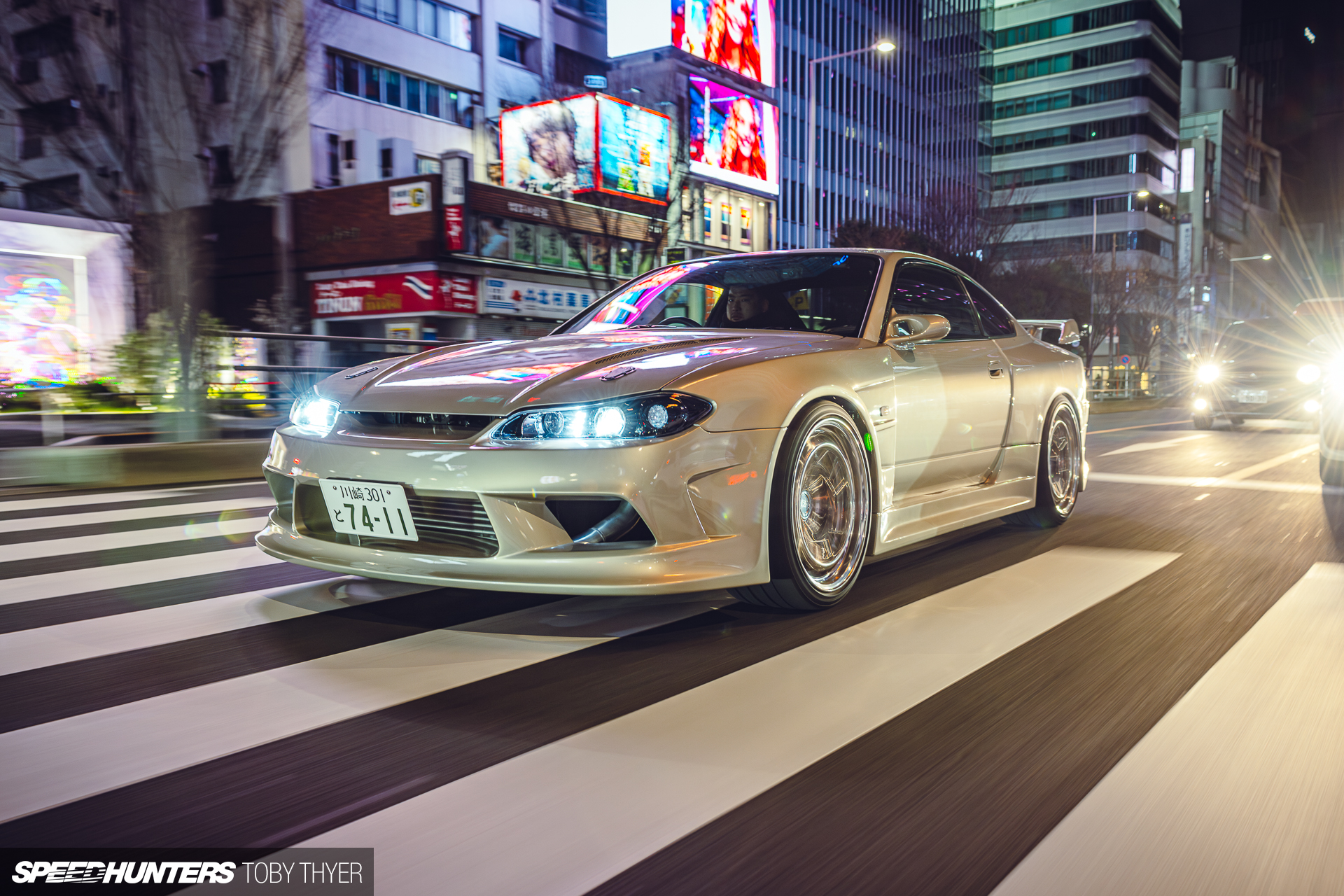
Built out of D Language Racing Service in Saitama, Tanabe-san’s Silvia is angry enough to be thrashed on the track yet refined enough to be driven to a fancy restaurant on Friday night. It’s the full spa treatment, head to toe tailoring – the complete package. It’s a tuner car elevated just enough to make people stand back and say ‘ooh, that’s a bit special’.
The S15 has real presence on the street thanks to its Vertex Edge body kit paired with a G Corporation rear wing. But it’s the custom gold paint which makes the car appear much bigger than it actually is, and undoubtably gives it an air of elegance.
With 19×10-inch ESR LP2-Duo wheels shod in 275/30R19 tyres at all four corners, the Silvia’s proportions can seem a little caricature-like from some angles, but nevertheless, this is one of the best-looking S15s I have ever seen.
But it’s not just about the looks. As a Spec S, the S15 came from the factory with a naturally aspirated SR20DE. That was never going to cut it for Tanabe-san, but instead of taking the easy route and swapping in a turbo SR20DET, he’s retrofitted a 1JZ-GTE VVTi from a JZX100 Toyota Mark ll. Internally the Toyota engine is stock, as is the turbo, but Tanabe-san has fitted a modified GP Sports exhaust system with a Sard Racing sports cat, an HPI intercooler and oil cooler, Ignition Projects (IP) Power Coils, and a Link engine management system. Backing it up is Toyota’s venerable R154 5-speed manual gearbox.
I didn’t go for a ride along this time around, but I can imagine the car feels firm yet compliant thanks to a full suite of Nismo bushings and A/M/S Type-PD coilover suspension. GP Sports 380mm brakes (8-pot front, 6-pot rear) provide plenty of stopping power.
The exterior has new aggression, the engine bay has new a level of performance, but it’s the interior where I think the biggest improvement has been made.
Japanese enthusiast cars from the ’90s and 2000s were never renowned for their interiors, with the exception perhaps being the Honda NSX. Most cars from the era were clad in cheap plastic, and even if they were designed well, they fell short in the manufacturing process. You paid for performance, not plush.
To give his S15’s cabin a more luxurious feel, Tanabe-san had Replus Upholstery complete a full custom-trim makeover, which has elevated it to a new level. Importantly though, it still maintains a ‘tuner’ feel with Bride seats and Defi gauges.
Is this the new gold standard for Japanese tuner cars? Because by comparison, stock Japanese performance cars of a certain vintage just feel ‘cheap’, regardless of how much cash has been fed under the hood or thrown at the bodywork. Purists may say keep it original, but if given the choice I think we’d all like a little Alcantara under our fingertips.
I hope the way Tanabe-san has approached this build serves as some sort of inspiration for those of you with project cars. It certainly has for me.
Despite its rocky, mountainous location it was possible to construct a ski resort in Val d’Isere.
Not everyone was convinced that a ski village could succeed in such a harsh environment but it did, and now the area known as Espace Killy has a global reputation.
Henri Oreiller, the first Olympic champion to hail from Val d’Isere, was famous for his daring style, tearing recklessly over bumps and balancing himself mid-air. His speed-driven successor, Jean-Claude Killy, won three gold medals at the 1992 Winter Olympics and is still inextricably linked to the village.
History
In the days before widespread road transport, Val d’Isere was accessible only by a mountain track which was dangerous in winter with snow avalanches and dangerous in summer with rock falls. At the time it was a tiny village of around 100 people, huddled round its 17th Century octagonal church spire.
French industrialist Jacques Mouflier saw the potential for Val d’Isere as a ski resort. Mayor Nicolas Bazile thought it was utter madness but Mouflier persevered and public infrastructures like running water and electricity were created. The first hotels opened in 1888 and improvements to the mountain access road facilitated growth.
Since then the resort has grown to become one of the most famous and lively in France. It’s home to Olympic champions including triple gold medallist Jean-Claude Killy and hosts the Alpine Skiing World Cup each year.
The village is also more animated than many other high-altitude French resorts with plenty of enticing shops, restaurants and bars.
Accommodation
Val d’Isere offers a fantastic range of accommodation to suit all tastes and budgets. There are a number of luxury 5-star hotels clustered next to the ski lifts & village laneways in the center of the resort, along with a good selection of 3-star hotels and a wide choice of private chalets & apartments.
For those looking for the ultimate in ski-in/ski-out, there are a number of luxurious apartments and chalets located in the hamlets of Le Legettaz, La Joseray and Le Chatelard which offer direct access to the slopes. The center of the resort also has a great selection of hotels offering ski-in/ski-out options.
There are plenty of bars and restaurants at Val d’Isere to keep you fuelled for your day on the snow. The famous Folie Douce at the top of the La Daille gondola is one of the most renowned apres-ski venues in the Alps, with live bands and DJs to get you dancing long into the night.
Houses and hotels in Val d’Isere in the French Alps.
Dining
If Val d’Isere has one thing going for it, it is its food. There has been a huge boom in high-quality restaurants dotted across the resort, offering everything from melted cheese dishes (fondue, raclette and tartiflette) to first class French and Italian cuisine.
If you are looking to treat yourself, then be sure to reserve a table at the two Michelin starred Maison Benoit Vidal. The restaurant’s authentic chalet interior provides the perfect contrast to chef Benoit Vidal’s inventive cuisine.
Avancher is a great place for a traditional Savoyard menu, including fondue, raclette and grilled meats. For something a little different, try the truffle pizza and pistachio linguini or the Alpine pot au feu casserole.
There are also a number of piste-side restaurants that offer a warm, welcoming atmosphere and mouthwatering menus. Halfway down La Face in the Bellevarde sector is a favourite, Peau de Vache. Alternatively, try the brand new restaurant at Folie Douce this season, The Kitchen, which boasts amazing views and simple yet indulgent dishes.
Lunch outside in the sun at the Folie Douce in Val d’Isere in the French Alps.
Activities
In winter, skiing takes centre stage in Val d’Isere, but there are plenty of non-ski activities too. For a fun day out with the family, visit the Adroit Farm to learn about local cheese production and meet the pigs, goats, horses, hens and cows that make it all possible.
Or, try a guided snowshoe hike. Discover the frozen landscapes of the Alps with the help of an expert guide, and enjoy a break in the snow with a cup of hot chocolate. You can also try out electric scooters in the village lanes for a simple, efficient and environmentally-friendly way to get around between your activities.
Throughout the year, Val d’Isere celebrates its culture with fun events and festivals. Visit the village’s historic streets to admire 17th-century buildings, or stroll to the hamlet of Le Fornet to enjoy high altitude flora and fauna from the Col de l’Iseran. Afterwards, sit down for a delicious meal at a local mountain restaurant and sample the area’s many Savoyard specialities.
Skiing in Val d’Isere in the French Alps.
I’m sure you’ve had similar experiences I had whilst traveling. You’re in a certain place and a fellow traveler, or a local, tip you off on a little-known beach, bar or accommodation. Great travel tips from other travelers or locals always add something special to our travels. That was the inspiration for Travel Dudes.
On a warm afternoon in the middle of nowhere, Antony Lindsay, the newly-appointed CEO of Fabergé sits before us as the ice in a glass next to an unopened can of Coke, tinkles as it melts. As the CEO of a storied brand like Fabergé, Lindsay’s task is to spread the word (and work) of the Romanov’s favourite jewellery house. With Sincere Watch Limited as its official retailer in Singapore, Fabergé continues to make its presence known. And yes, Fabergé is synonymous with the gem-encrusted eggs but the house has other achievements like jewelled boxes; animals carved out of precious stones and other ornamental objects.
In 2007, the brand underwent a revival. Taking inspiration from its storied past, Fabergé created original pieces like the Vissionnaire watches, where a Chronograph model displays two time zones at once, and the Altruist line, which has a clean and simple-to-read dial, with a crown that’s reminiscent of winding up a traditional clock. The collection that secured Fabergé’s footing in the hard jewellery world is the Compliquée models, which won the 2015 Grand Prix d’Horlogerie de Genève award.
As water pools at the bottom of the glass, Lindsay talks to us. About his history, where Fabergé is at and the future.
Antony Lindsay, CEO of Fabergé
LUXUO: Did Sean Gilbertson (Fabergé’s last CEO) leave you with any wisdom when you took over?
ANTONY LINDSAY: [laughs] There’s been many over the years. I’ve known Sean, coming up to almost 14 years, and we shared some moments, both good and challenging. Nothing springs to mind… except for this Winston Churchill quote, “If you ever find yourself going through hell, keep walking.”
LUXUO: What’s your journey been like?
AL: I come from a family of jewellers and had an interest in gemmology at a young age. I’ve been neurolinguistically programmed to appreciate jewellery, timepieces and objets d’art just by hanging out at my dad’s atelier on the weekends. I’d look at the gemstones handled by the craftspeople. I have an appreciation for hard luxury and completed my apprenticeship as a bench jeweller. I’m proud of having played such an important role within Fabergé for about 14 years. I’ve worn different hats as well. Proud when I was appointed MD and was invited to join the board of Gemfields UK Limited. As well as becoming CEO this year.
I feel privileged and fortunate to be part of a team to write the next chapter of one of the most celebrated names in luxury. I see that as an honour. It’s the revival of the coloured gemstones on one hand and it’s also the revival of Fabergé on the other. It’s what keeps us very busy.
Fabergé store-front image
LUXUO: What sets Fabergé apart from the rest of your competition?
AL: I’d say that Fabergé’s reputation for unrivalled craftsmanship and design is globally recognised. I’d say Fabergé’s diverse use of techniques like the guilloché enamel with the use of hard stone or visible setting. In keeping with tradition, we seek to work with the finest ateliers. Because we don’t have our own workshop, we seek out workmasters all around the world. That’s quite unique to us.
LUXUO: Speaking of tradition, how do you maintain that heritage while courting the newer generation?
AL: That’s a good question. It’s important to us that we pay homage and recognise what was done in the past. We draw inspiration from Peter Carl Fabergé, whether that be through his philosophies, values or craftsmanship. To apply it in a modern and contemporary and relevant way; we like to consider ourselves as a forward-thinking brand.
LUXUO: How did your partnership with Sincere come about?
AL: I’d say that we are actively looking to partner with the finest retailers in existence. We don’t profess to understand every market on the planet. So, we believe that by partnering with the best of the best, who understands how to represent a brand like Fabergé; and how to offer first-class customer service… that’s very important to us. Sincere Watch Group is the perfect fit for Fabergé and we’re delighted that they are representing us here in Singapore and soon in other parts of South East Asia.
Compliquée Peacock Emerald Watch
LUXUO: What would you introduce to someone new to Fabergé?
AL: I would introduce the Compliquée Peacock watch, which is quintessentially Fabergé. We took inspiration from the Imperial Peacock Egg and, in keeping with the Fabergé tradition, we sought out the finest watch movement manufacturer and that led us to Jean-Marc Wiederrecht of Agenhor and now his two sons, Nicolas and Laurent, who run the business on a day-to-day basis. Throughout the discussions with them, we made the Peacock watch that has a special retrograde movement, that functions off four gears, and that allows us to add a feature for the peacock’s tail to unfurl.
LUXUO: Peacocks, playing cards; are there other motifs that will utilise that movement in the future?
AL: There are some plans and they are confidential. [laughs]
LUXUO: You talked about Fabergé as a book that you’re proud to be part of. What is the next chapter?
AL: To continue this revival and personally—and I know I speak on behalf of my co-workers—it’s about ensuring that the Fabergé story can still be told. What Fabergé symbolises is more than simply luxury and decadence. For us, it’s about creating prized possessions that can stand the test of time and be passed down through the generations. That’s important to us and runs through our DNA. You can scour through Christie’s and see that Fabergé is one of the highly sought-after hard luxury names in existence.
This article first appeared on EsquireSG.com
For more on the latest in exclusive interviews, click here.
Nestled inbetween the hills in the Sri Lankan highlands sits a rather unassuming village pathed with just one road that acts as the gateway to one of the most famous walks in Sri Lanka – Adams peak or Sri Pada.
For many, a hike up to Adams peak will make the ultimate Sri Lanka bucket list having just completed it myself, I agree. The hike up to Adam’s Peak is a very unique and humbling experience physically, but also offers the chance to dive deep into the culture and traditions here in Sri Lanka. Adams peak is without a doubt one of the best things to do in Sri Lanka!
If you’re currently planning your Sri Lanka adventure and have no idea what Adam’s Peak is… Adam’s Peak is a 2,243 meter tall conical mountain located in central Sri Lanka. The mountain is a sacred pilgrimage site for Buddhists, Hindus, Muslims and Christians due to the footprint imprinted at its summit, which each faith attributes to its own sacred figure.
If you’re looking for the best time to hike Adam’s Peak, the best way to get to Adam’s Peak, the best place to stay for Adam’s Peak and just a general guide for Adam’s Peak (what to pack and wear etc) – you’re in the right place!
This is an Adam’s Peak travel guide.
Pens and paper at the ready – it’s time to plan your Sri Pada pilgrimage.
Other travel guides you might find useful…
Sri Lanka Google Map Legend
Add to basket
How long will you need for Adam’s Peak?
Depending on your fitness a hike to the summit of Adams peak will take you anything between 1-5 hours, there are 5 500 steps!! Yes, this hike is no joke, it’s an adventure! On the way down it’s a lot quicker for obvious reasons, it took us just under an hour and a half to descend.
Do not worry about your fitness level, just leave yourself enough time to not worry about getting back for a certain time. There are families with small children walking this route and there are stopping points, seats, refreshments and toilets dotted all the way up. I had no idea how many facilities would be on this route – it surprised me! Take some money and you’ll never be far from what you need – water, rest or glucose.
Due to the early recommended start time of 2am (if you want to catch sunrise and avoid the midday heat), I would recommend booking a night before the summit and then a night after. Getting a good sleep before hand is key. and you will definitely need to rest after! Our legs were sore for DAYS!
How to get to Adam’s Peak?
Adam’s Peak is located in central Sri Lanka, about 40km northeast of the hill town of Ratnapura. When planning your route to Adam’s Peak, you’ll want to pop Dalhousie or Nallathanniya into your sat nav, this small town provides the main access point to the mountain (which is about an 8 hour drive from Colombo).
There is no escaping it. To get to Nallathanniya you have no choice but to take on the rough winding roads, covered in gravel and pot holes as you wind through acres upon acres of tea plantations and estates. Whether you do that by bus, tuk tuk or car is up to you, we opted for a car as we were travelling from Kandy (3-4 hours) and then onward to Hiriketiya (5-6 hours) and we wanted comfort!
Most people will get a train via Columbo / Ella / Kandy to Hatton which is the nearest access train station to Adams Peak. From there you can pick up a tuk tuk or car to ride the final stretch!
Tip: If you hike during off peak season, public buses and tuk tuks are harder to come by.
The mountain itself sits in the Peak Wilderness Sanctuary, home to lush montane forests and tea plantations, a combined adventure with visiting some local tea plantations is a must.
Tip: We would highly recommend our driver Dilshan who drove us from Kandy to Adam’s Peak and then back to the coast! You can contact him on WhatsApp here: +94 71 985 6115
Where do you stay for Adam’s Peak?
For the most convenience and to base yourself at the start of the trail, you’ll want to find somewhere in Nallathanniya. This is where the Adam’s Peak walk begins – you can’t get any closer!
We chose a local homestay very last minute and would highly recommend Lavendra Guest House. It was just £8 a night for the two of us, double bed, hot shower, perfect location and a HUGE breakfast upon our return from the hike. See below images.
When is the best time to hike Adam’s Peak?
Time of year
There are some months where the peak is actually closed and some months where the weather will certainly add additional challenge and so there are definitely better times throughout the year to plan your Adam’s Peak hike.
June/July: The monsoon season means the mountain is usually closed these months.
August to October: The mountain is open during these months too but you risk more chance of rain. Less crowded though than the main season which could be great!
December to May: This is the main pilgrimage season when the mountain is open and conditions are best for hiking to see the sunrise. Of course though, these are the busier months with the busiest months being April and May.
I cannot write this blog post without warning you about how busy the Adams peak pilgrimage gets during public holidays, full moons and other religious events. As a sacred site for Buddhists, Hindus and Christians there are a few dates in particular where this route is chaos!
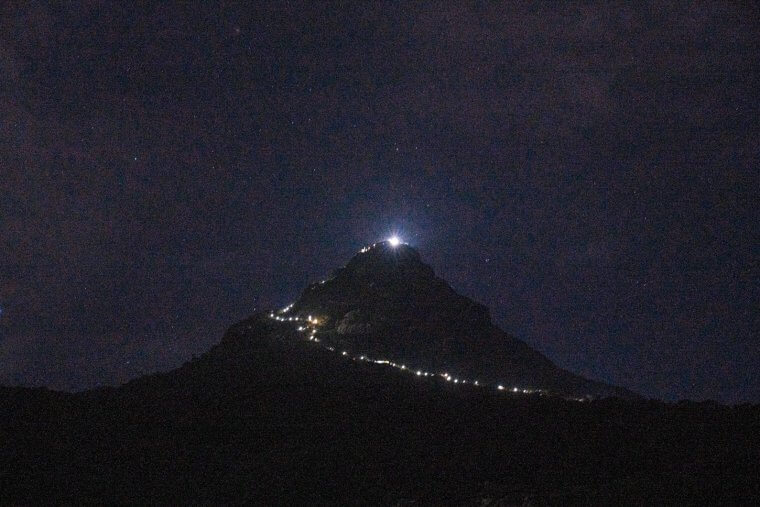
I have no idea what special day we accidentally timed ours with (12th March 2023 if anyone wants to enlighten me) but we set off at 2am and were 1km from the top by 4.30am but it took us another 4 hours (yes!) to actually reach the peak at 8:23am.
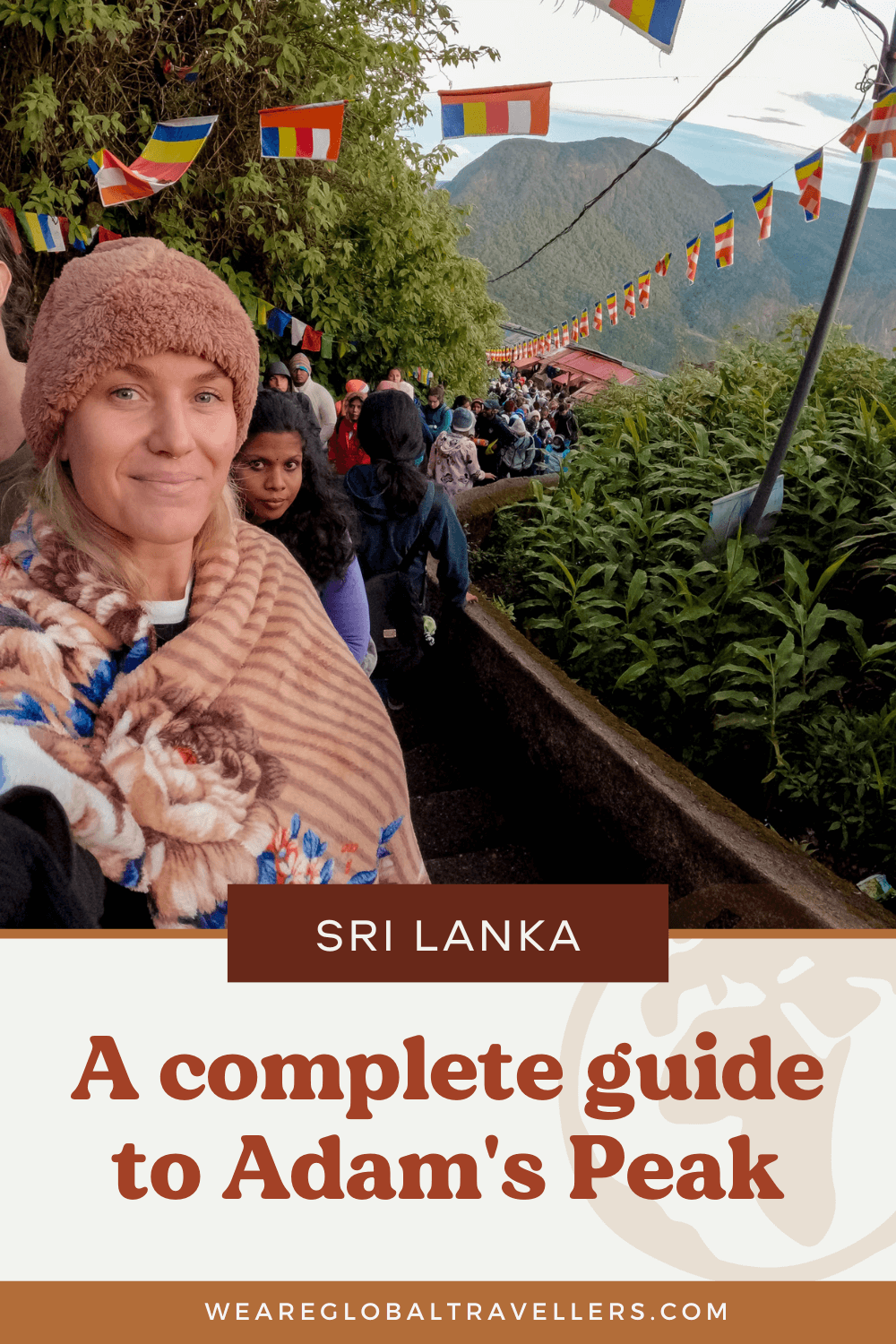
Why? As the path gets toward the end it gets steeper and narrower, I’m talking very steep! Combine this with another 20,000 people and a limited summit area and you have yourself a very long traffic jam. At one point we didn’t move for an hour!
There were no signs (in English anyway) that indicated how far you were from the top, it was only when fellow European travellers tipped us off on their descent that there’s an alternative route to the summit (a fork at one of the temples) that will bypass this main queue!
So if you find yourself stumbling across a very busy summit like we did (which I don’t think is that common), take the right turning at the intersection in the image below and follow the other path!
Time of day
When you read up online about Adams peak and do your research you’ll notice that most people recommend to begin the hike around 2am. I’d agree with this as the sun rises around 6am which gives you 4 hours to reach the peak and enjoy the dawn of a brand new day from the summit.
Hiking before the sun rises also means you avoid the added challenge of the heat – which if you’ve been in Sri Lanka for a while before planning this – you’ll understand the benefit of.
How much does it cost to climb Adam’s Peak?
There’s no official entry fee for Adam’s Peak but you are asked to make a donation, sign your name and you get a string tied around your wrist at the start of the hike. We followed the lead of the hikers before us and placed 1000rph down. We have no idea of the recommended amount, if you know, please leave a comment!
I would definitely recommend bringing cash on this hike (and everywhere in Sri Lanka).
What to pack for Adams Peak?
Whilst you want to go as light as possible in terms of weight, you will also need to prepare a little for this hike. You’ll be breaking a sweat and putting your body through its paces so some fuel, water and essentials are needed. Because of the popularity of this hike, even though Dalhousie is a small town, they have local stalls and shops selling everything you need including wooly hats, local glucose filled treats, waterproofs, umbrellas – literally anything and everything!
Here are a few essentials I’d like to bring to your attention:
Comfy trainers – some people were barefoot but I’d be wearing your comfiest active trainers / hiking boots if you’re travelling with them!
Head torch or a torch – In pilgrimage season the path is lit up. However, you will need a head torch if you climb Adam’s Peak at any other time as there are no lights and the route is completely dark.
Layers – if you set off at 2am it’s chilly and so until you warm up (happens quickly) you’ll need a layer to entice you out of bed. When you reach the top and wait for sunrise, you may appreciate your layer again. However when that Sri Lankan sunshine hits – you’ll be taking it right off! As you’re getting the picture – layers is key to your comfort!
Cash money – for snacks / donations
A camera – of course!
Suncream / hat / glasses – you’ll appreciate the relief on the way back down.
Snacks and water!! As much as you can carry.
Top tips for Adam’s Peak:
Have a chilled couple of days planned afterwards, we could hardly walk up and down stairs for about 3 days afterwards!
Try some of the local sweets in the town before hand, super cheap and supports the locals!
Don’t worry about getting hungry or thirsty – there are PLENTY of options the whole way up!
Enjoy the experience!
My honest opinion of this adventure?
I absolutely loved it. It was a real physical challenge (we really went for it on the ascent) and then it was a mental challenge being at a stand still for 2-3 hours amongst the locals as we queued to reach the summit.
The Sri Pada hike truly encouraged us to enjoy the journey and not be focused on the destination. We surrendered to the thousands of people we had been accompanied by and bathed in the laughter and song of families in the queue besides us, all trying to pass the time. It was humbling to see 70-80 year olds walking and to see families really pull together as a unit, holding each others hands, carrying each other and smiling at the summit.
The summit itself is not what you’d expect if you’re used to mountain hikes, it’s a sacred site and so there are wires and railings all around making it hard to see the view. Another reason to enjoy the journey and not be focused on the destination… the best views are on the way!
Sri Lanka Google Map Legend
Add to basket
That’s it for my Adam’s Peak travel guide!
Anything you’d add? Any questions? Leave a comment if you’d like to pick my brains any more!
Love as always and happy adventuring…
Did you find this post helpful? I’d love you to share it for me.
When car enthusiasts get together in groups, it’s inevitable that the bench racing hypotheticals will start flying. If Betty White was driving a Viper, do you think you could beat her in a race driving your Toyota Celica? Would Michael Schumacher in his primebeat Fangio if they were both driving the same car? How far back would you have to go for your race car to be fast enough to qualify for the Indy 500? That last one has been my favorite bench race query for over a decade, and it always gets my mind working.
2024 Porsche Cayenne S Review : Worthy Of The High Price Tag?
A friend’s father once told me he had a C2-generation Corvette “with an experimental Can Am motor” that turned a lap at Indy “fast enough for pole” that year. It’s total bullshit, and definitely not possible, because Indy roadsters were pretty damn fast by the mid-1960s, and Corvettes, uh, weren’t. But could a C8 Corvette qualify for the 1966 Indy 500? Yeah, I bet it could.
With advances in aerodynamics, tires, and reliability, modern road cars are faster than ever before, and even faster than the most bonkers racing specials of yesteryear. I will probably end up doing more of these in the future, but figured I would start with a pretty simple one. If you bought one of Mazda’s $60,000 MX-5 Cup race cars, based on the standard Miata drivetrain and bodywork, what’s the most modern Indianapolis 500 Mile Race that you could win outright? And how many years later would you be kicked out on bump day?
Let’s do some math!
First of all, let’s determine what an MX-5 Cup car can do. These cars actually raced at Indianapolis in 2017, but the series used the road course, so the data from that race isn’t particularly useful. To figure out our MX-5 Cup’s top speed, let’s look to the recent race at Daytona International Speedway. Below is an onboard video from Gresham Wagner’s race one victory. The car’s data recorder shows a maximum speed of 146-ish miles per hour for the MX-5 Cup, but that’s running in a pack in the draft, so let’s say our max speed for solo qualifying at Indy would be around 140 miles per hour.
Onboard Win at Daytona – 2024 MX-5 Cup | Final 2 Laps
Given the ability to set the car up correctly for the four left-hand turns at the brickyard, the right tires to last a full stint at speed, and we’ll allow a little bit of downforce if necessary, I wouldn’t doubt that an MX-5 Cup could go flat out at Indy for the full lap, so we’ll say our theoretical average qualifying speed over three flying laps would be exactly 140.0 miles per hour.
The last year that our theoretical MX-5 Cup would qualify for pole at the Indy 500 is 1955, matching polesitter Jerry Hoyt’s 140.045 pole. Okay, so we’re on pole, but do we have a shot at winning?
Back then Indy roadsters needed to pit for fuel three times in the 500 mile race, meaning they could go 125 miles, more or less, on a full tank. An MX-5’s fuel tank is 11.9 gallons, meaning we’d have to achieve at least 10.5 miles per gallon at V-max. It isn’t necessarily RPM that determines fuel consumption, so much as it is load, and a Miata is going to be under serious load at 140 miles per hour. It’s rated at 30 MPG combined, so I think it could possibly go 125 miles on a tank.
Even still, we’ll be conservative and say the MX-5 needs an additional stop over an Indy Roadster to complete the 500. Four stops in 500 miles. In those days Indy pit stops saw the car stationary for around 25 seconds each stop, which is probably a bit longer than a well-oiled machine running a fuel dump and tire change on the Miata. I’m going to say that the MX-5 could brake from speed quicker than the Roadster, and accelerate back to V-max quicker than the long-gear Roadsters could, so overall time lost in the pits is going to be about equal for the Miata and the competitors at Indy. It washes out, pit stops won’t be the thing that kills our Miata’s win.
Image : IMS Museum
Bob Sweikert (above) won the 1955 Indy 500 in his pink Zink special with an average speed of 128.209 miles per hour. Given four stops at 20 seconds each, plus faster acceleration and braking, we’ll spend about 120 seconds of the race not running flat out. Stick it in top gear and put your foot to the floor, you’ll be stuck at 140.0 miles per hour for 100 mile stints. And if you catch a draft, you might even run faster than that. I think we’re in with a shot to win the 1955 Indy 500 from pole position in a 2024 Mazda MX-5 Cup car.
Our finishing time, after pit stops, assuming nothing went wrong, would be three hours, 36 minutes, and 12 seconds. Sweikert’s winning time in 1955 was three hours, 53 minutes, and 24 seconds. We won by 17 minutes!
So with a qualifying speed of 140 miles per hour, and a race average speed of 138.76 miles per hour, we can look to history to determine a few things.
The last Indy 500 we could qualify on pole for was 1955.
The last Indy 500 we could win based on our average time to finish was 1959.
Though we might come out on top in a 1960 photo finish against Jim Rathmann’s Ken-Paul Special, which averaged 138.767 miles per hour in the race, we wouldn’t have run a fast enough qualifying lap to make it into the big show. The slowest qualifier in 1960 was Jim McWithey’s Epperly-Offenhauser, which ran a 140.37 MPH in qualifying, and retired on lap 60 with brake failure.
Obviously this is all in fun, and there are a hundred thousand different variables that would have to go exactly our way in order for this to happen. But, if you ever get the opportunity to travel to 1959, and you can bring a 2024 Mazda MX-5 Cup with you, try to win the Indy 500. You just might.
Now I’m curious if a new Porsche GT3 Cup could beat the 1970 Porsche 917 to win Le Mans… That’s a question for some other time.
Over the last 25 years, visualisation teams have relied heavily on a lot of computing power to render animations, and Drive’s experience has developed with the technology and we now create cg animations for automotive advertising.
Not so long ago an animation of a minute or so, might take days to output on dozens of computers packed out in air conditioned server rooms. Once the rendering is done, a whole load of post production has to be done afterwards to fine tune and colour grade too. Hold on a minute, not quite right? Need a last minute change? The product has been updated? Back to the farm it goes for another couple of days.
But the new technology gives us the opportunity to refine the output and deliver a higher quality animation because we are able to make adjustments closer to the cut off deadline.
In our previous blog explaining the creation of the scene, here , we showcased a few images using Unreal of our favourite Mclaren, the 720s. Following on from this, the above animation has been created with the camera pans, edit and tonal adjustments all refined in Unreal and outputted in near real time.
Beyond that, the scene is ready for interaction for a configurator or Virtual Reality.
CG animations can be used to help promote a car manufacturer’s products, and these two have been screened grabbed from the above animation.
Every shot created is different and every car has certain angles that show it off at its best, Drive’s team of creative visualisers and automotive designers combine to create and ensure great results.
When the Fisker Ocean finally rolled off the production line, the initial reaction was one of surprise. Fisker did it, the company managed to release a product in a highly sought-after segment. Maybe this could be the automaker turning over a new leaf, showing the world it can really build cars with broad appeal.
2024 Porsche Cayenne S Review : Worthy Of The High Price Tag?
That hope, though, now seems short-lived. In a new report from TechCrunch, Ocean owners spoke about all kinda of issues with the car — key fob problems, seat sensor issues, even loss of brakes or drive power. It appears that, while the Ocean may have made it off the factory floor, the company may not have been as successful in building the crossover as it hoped. From TechCrunch:
In the months since, Fisker Ocean SUV customers have reported more than 100 separate loss-of-power incidents, the internal documents show. The company told TechCrunch it believes these problems are rare, and that it has resolved “almost all the issues” with software updates.
Problems with the Ocean SUV, however, are not limited to the vehicle suddenly losing power, a review of nearly 200 documents shows. Customers have also reported sudden loss of braking power, problematic key fobs causing them to get locked inside or outside of the vehicle, seat sensors that don’t detect the driver’s presence and the SUV’s front hood suddenly flying up at high speeds.
TechCrunch spoke with a number of owners about their individual issues with their cars, all the problems and struggles they’d faced. The whole piece is truly worth the read, it shows off the truly massive scale of these faults.
It seems that, in Fisker’s decision to build the Ocean, the company forced its buyers to suffer the slings and arrows of mechanic misfortune — to take up arms against an ocean of troubles. Now, all those owners can do it hope that by their opposition, Fisker can end them.
Like its internal-combustion counterpart, the 2025 Cadillac Escalade IQ electric SUV will get a long-wheelbase variant.
First reported by Car and Driver, and subsequently confirmed to Motor Authority by a Cadillac spokesperson, the long-wheelbase model will be called the Escalade IQL. It’s not expected to reach dealerships until after the standard Escalade IQ, which is scheduled to start deliveries this summer.
2025 Cadillac Escalade IQ
The Escalade IQL will likely follow the template of the current long-wheelbase Escalade ESV, with styling carried over from the standard-wheelbase model and a stretch in the middle to increase space in the rear two rows of seats.
The standard Escalade IQ already measures 224.3 inches long, 76.1 inches tall, and 94.1 inches wide, with a 136.2-inch wheelbase. That means its wheelbase is already about two inches longer than that of the internal-combustion Escalade ESV, although the electric model is about three inches shorter overall.
2025 Cadillac Escalade IQ
First shown last summer, the Escalade IQ boasts up to 750 hp and 785 lb-ft of torque from a dual-motor all-wheel-drive powertrain. This will launch the IQ to 60 mph in about five seconds, while an Ultium 24-module, 200-plus-kwh battery pack shared with the GMC Hummer EV Pickup should allow for 450 miles of range, according to Cadillac. The Escalade IQ also gets a version of the Hummer EV’s Crab Walk, dubbed Cadillac Arrival.
In addition to the Escalade IQ and IQL, Cadillac has the smaller Optiq and Vistiq SUVs in the pipeline, as well as the Celestiq flagship. But the launches of these models could be affected by continued issues with the ramp up of General Motors’ Ultium EVs. The automaker struggled to accelerate EV production in 2023 as planned.
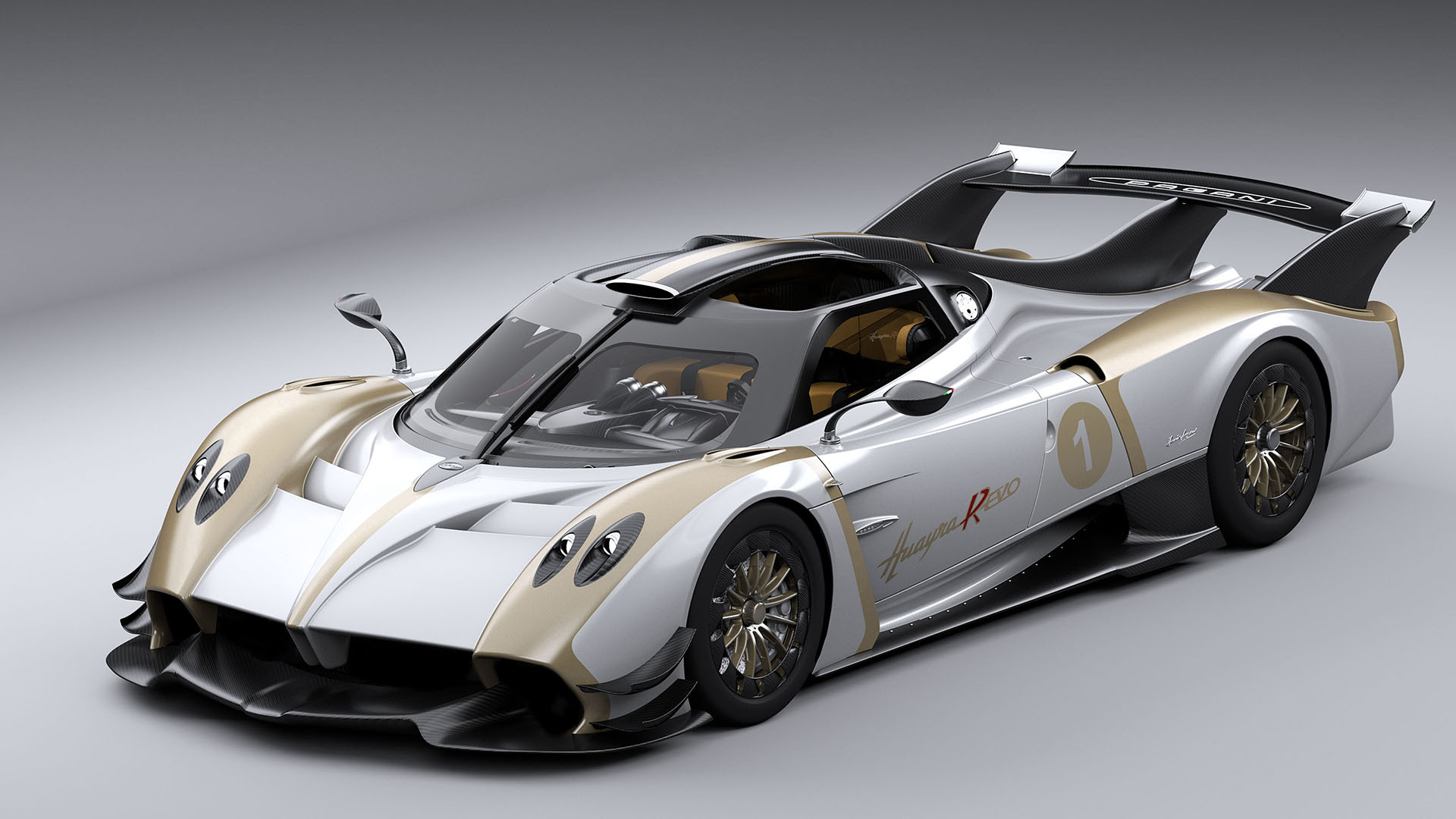
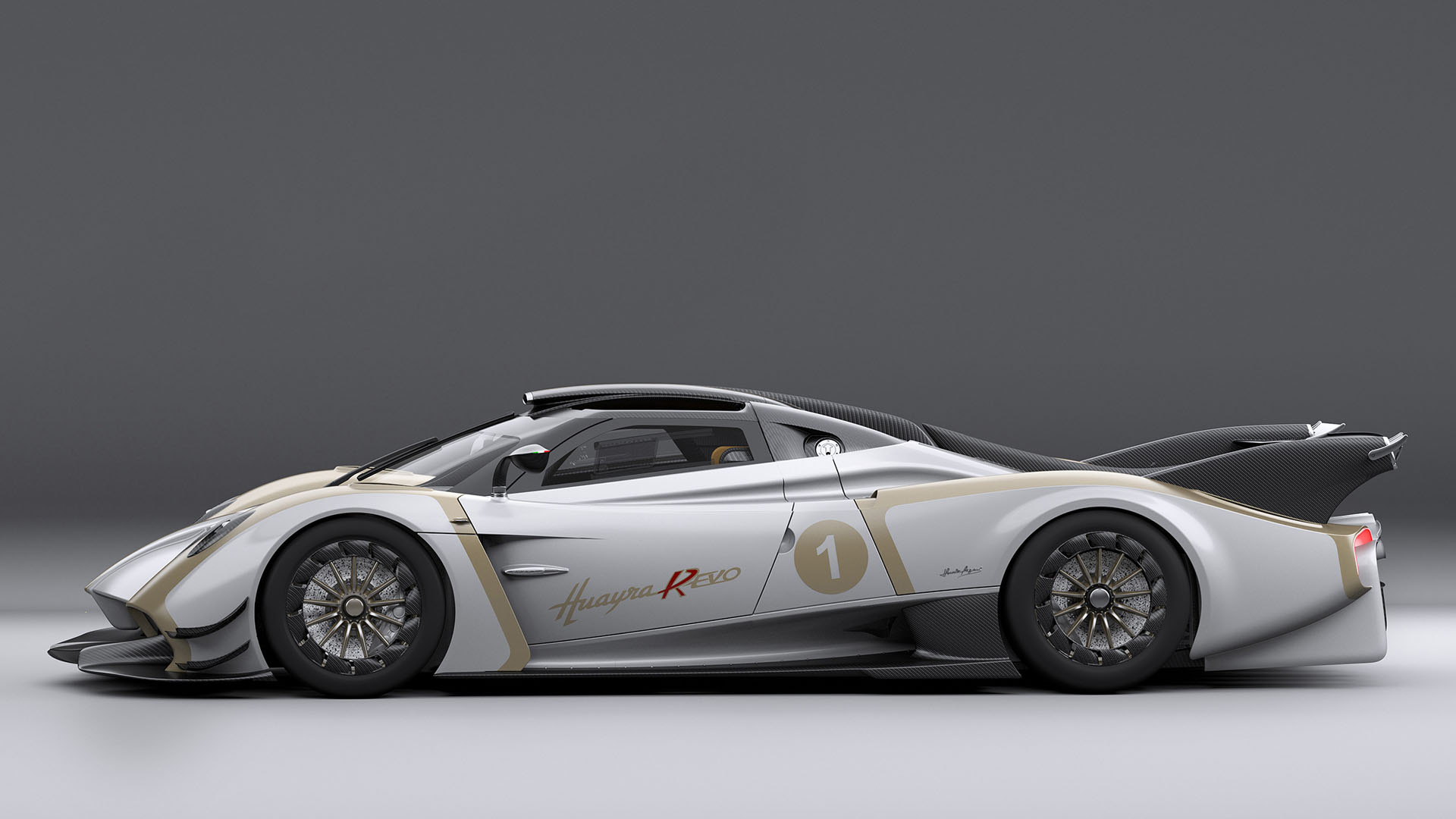
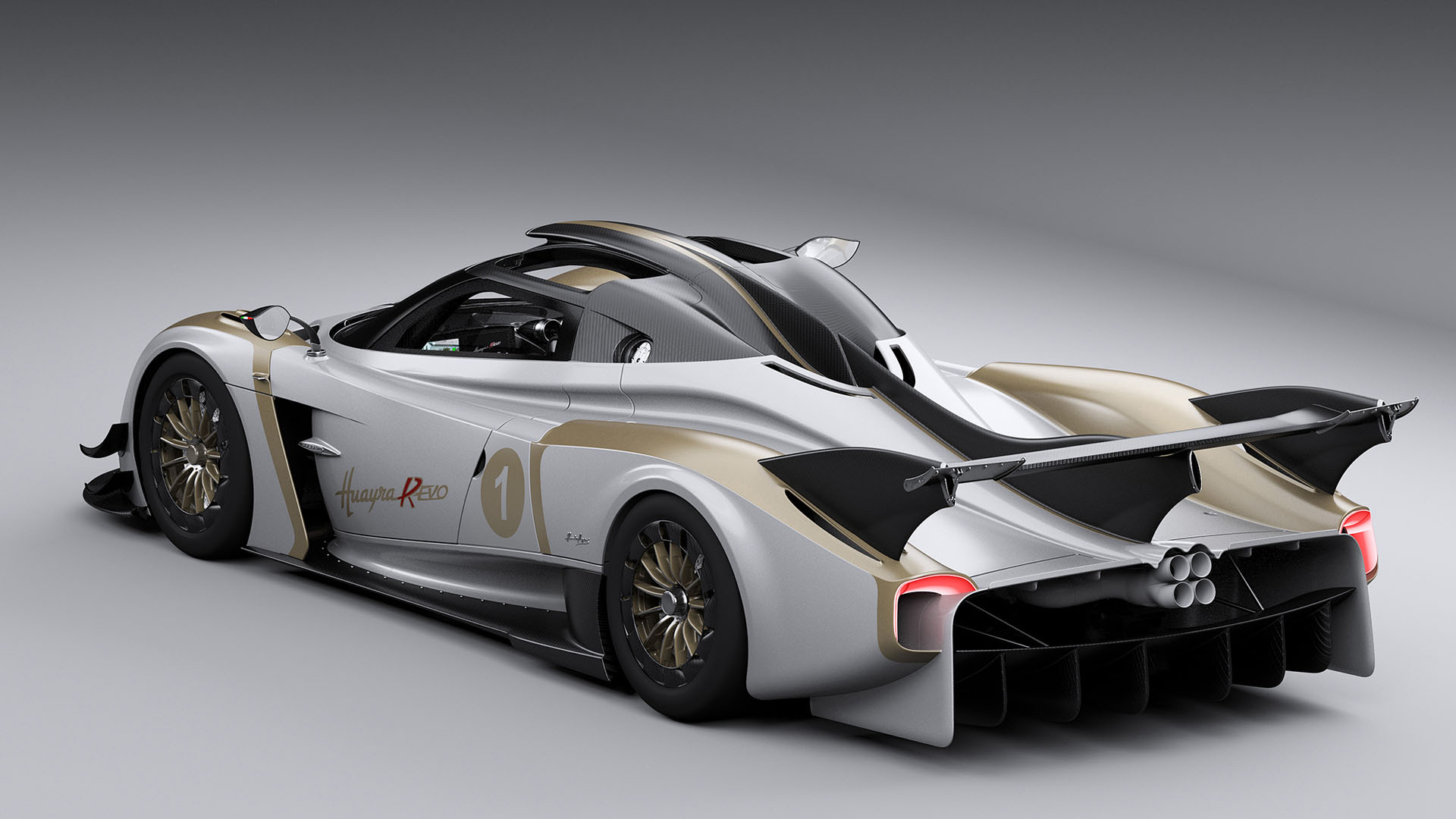
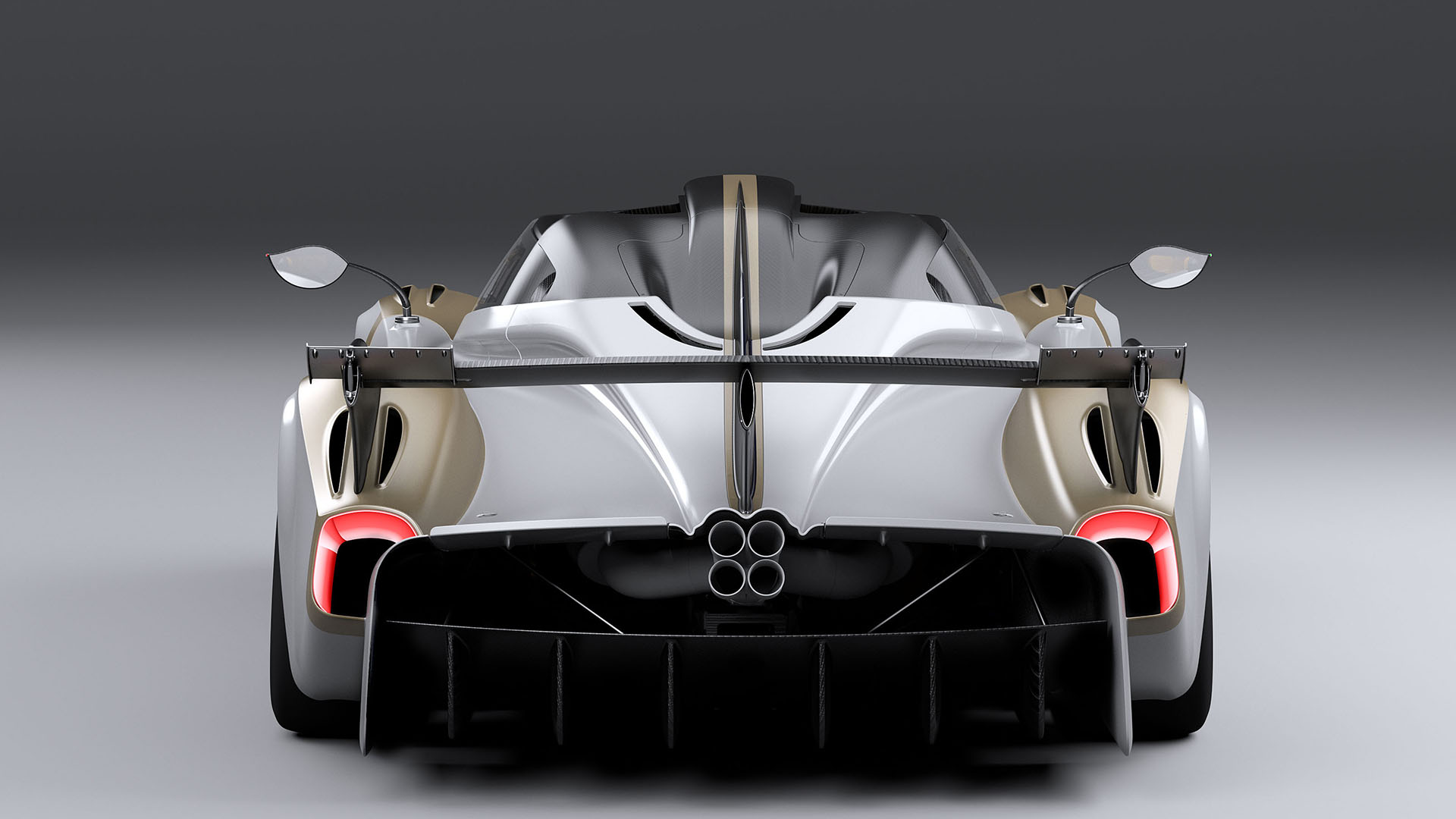
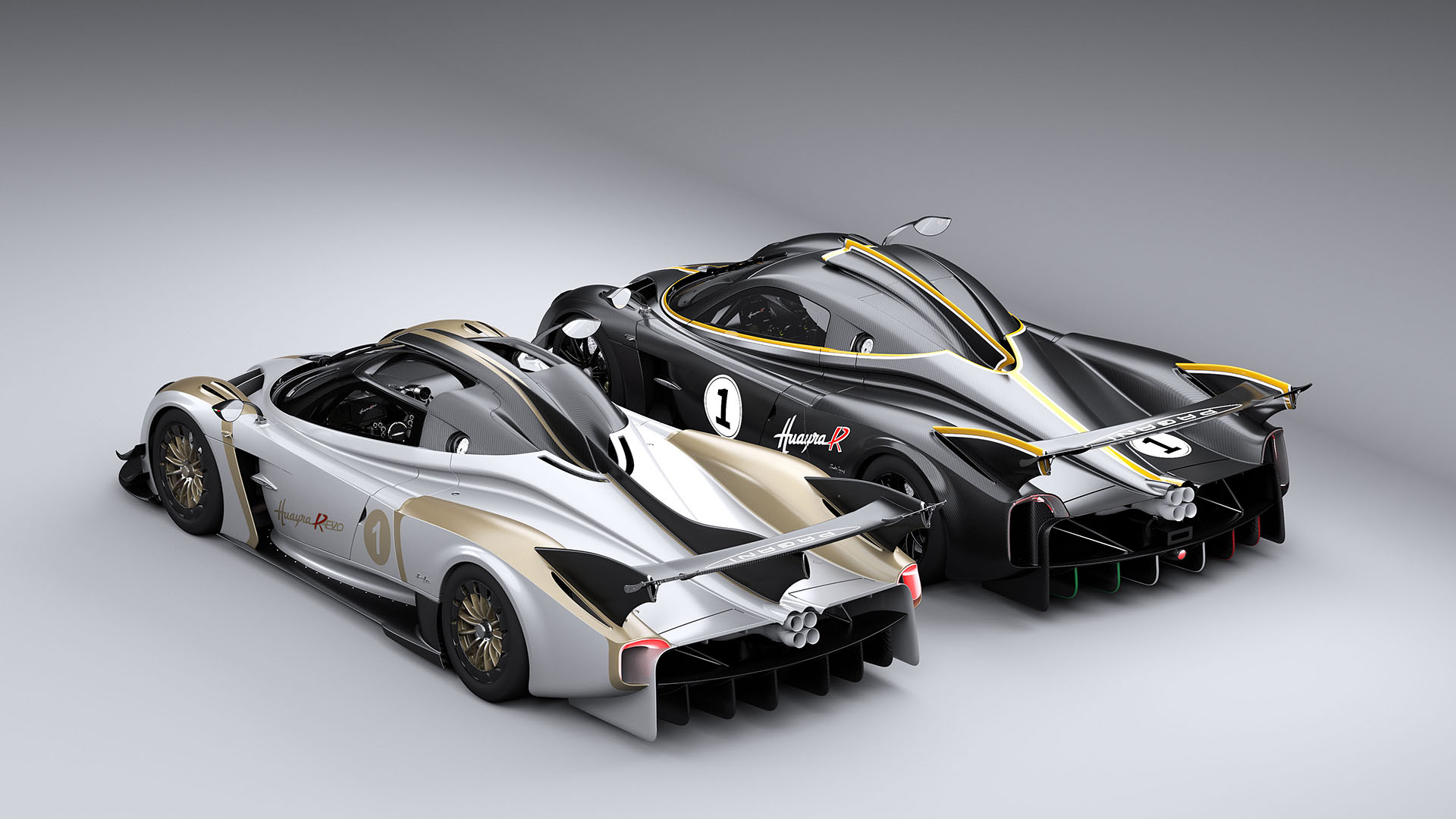
Pagani Automobili presents the Huayra R Evo, the new open-top car that enhances the experiences of clients in the Arte in Pista program. Focusing on this exclusive club of track-hypercar owners, the Pagani team explored new stylistic and technical potential, giving rise to an even more thrilling and extreme vehicle.
“The Huayra R and the Arte in Pista program have expanded our clients’ experience with the Pagani brand beyond our wildest dreams, giving a new opportunity to owners of the Zonda R and Zonda Revolución. The demand for the Arte In Pista program, where adrenaline-seekers from around the world meet to share their common passion, led us to think about an addition to the program. It is our pleasure to share the Huayra R Evo with you, pushing the boundaries of performance and emotion even further. Let’s start by removing the roof and take it from there…” Horacio Pagani, Founder & Chief Designer of Pagani Automobili.
In 2021, for the launch of the Huayra R, Pagani Automobili announced the beginning of the new Arte In Pista program, a rich calendar of personalized events allowing owners of the new model, alongside those of the Zonda R and Zonda Revolución, to take it to its highest levels of performance. The essence of Arte in Pista consists of non-competitive track events at the most prestigious FIA circuits in the world, featuring both high-octane sessions and leisurely moments. The format includes a complete track experience and the technical assistance of the Pagani team, including the technical director for data analysis, track engineers and mechanics, and a motorsports physiotherapist and nutritionist. The program’s highlight is the support of professional drivers, who contribute to improving the client’s driving skills.
“I was fortunate to be able to attend all of the Arte in Pista events during 2022 and I am so pleased I made the time to do so. I felt very much part of the Pagani family, and the level of care and organization were extraordinary. I had nothing to worry about, the Pagani team took care of everything, allowing me to focus all my time and energy on my new Huayra R at the amazing circuits we visited. My family and friends were made to feel very welcome, which made the whole experience even more special for me. I feel I should also mention the driver coaching and race mechanics that were there to support each event. Having raced myself in the past, I could appreciate the quality and level of detail. It does feel like you’re part of a professional race team, with data analysis, driver coaching, timing, and physio.” M.R. – Huayra R owner
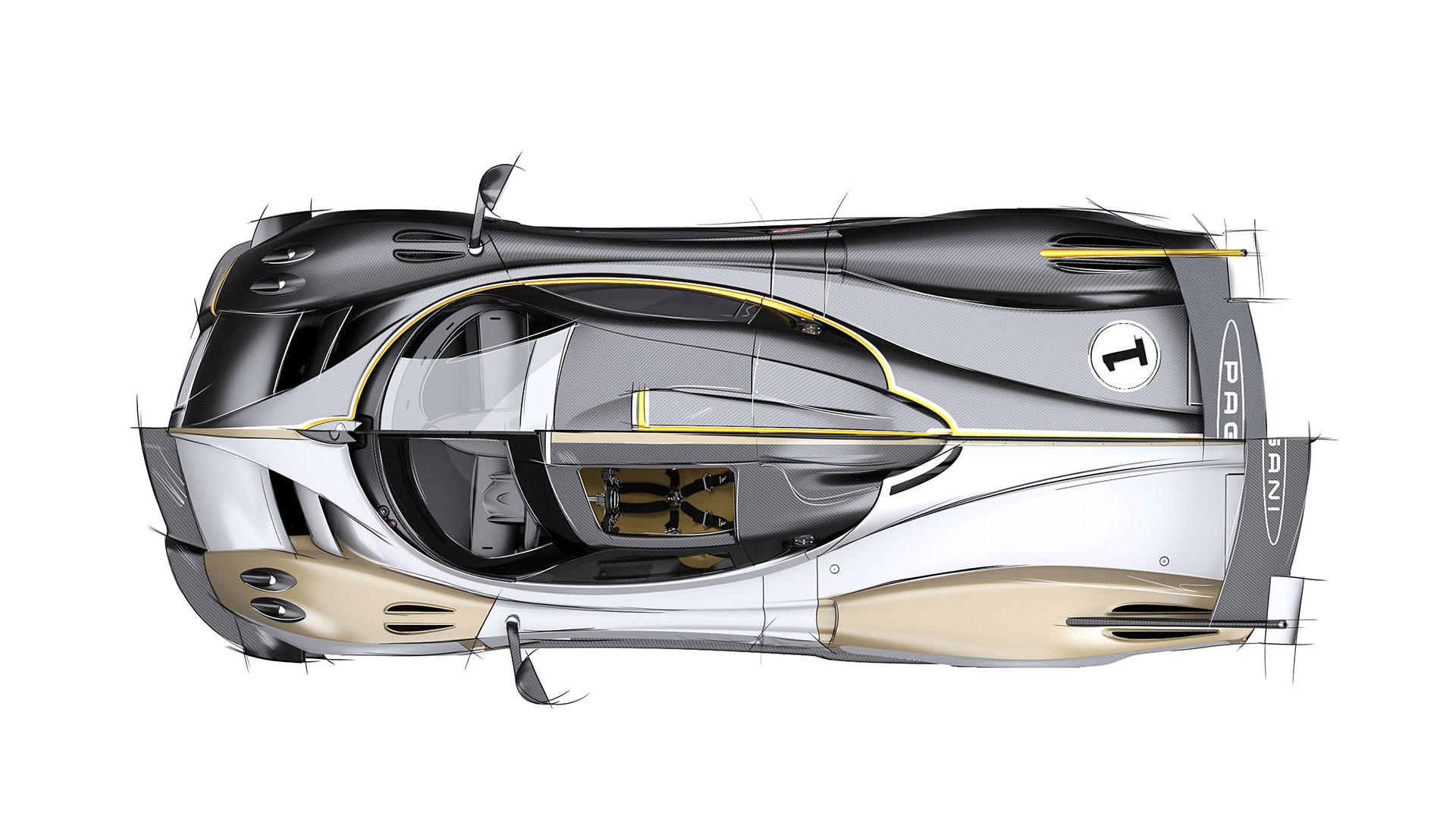
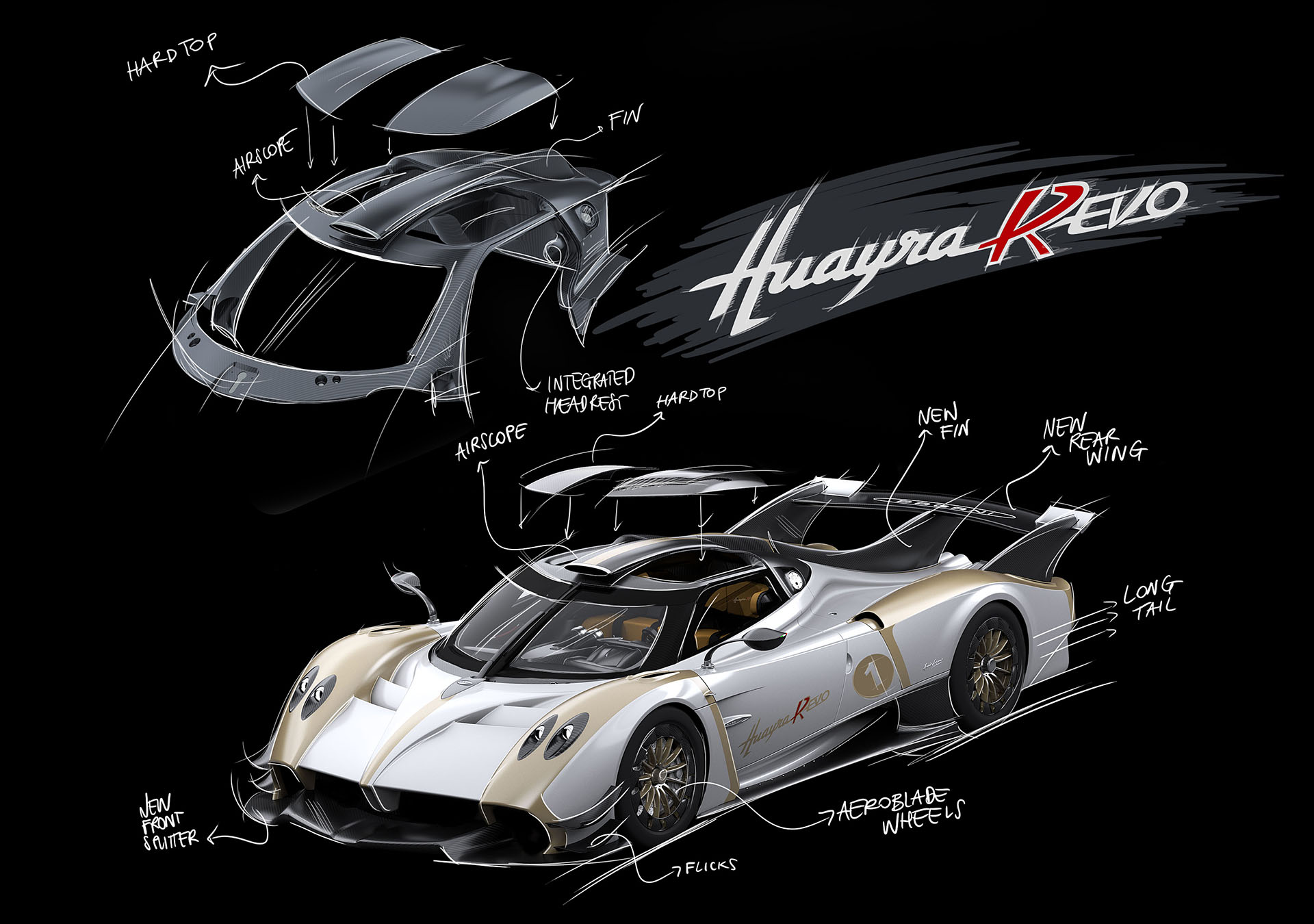
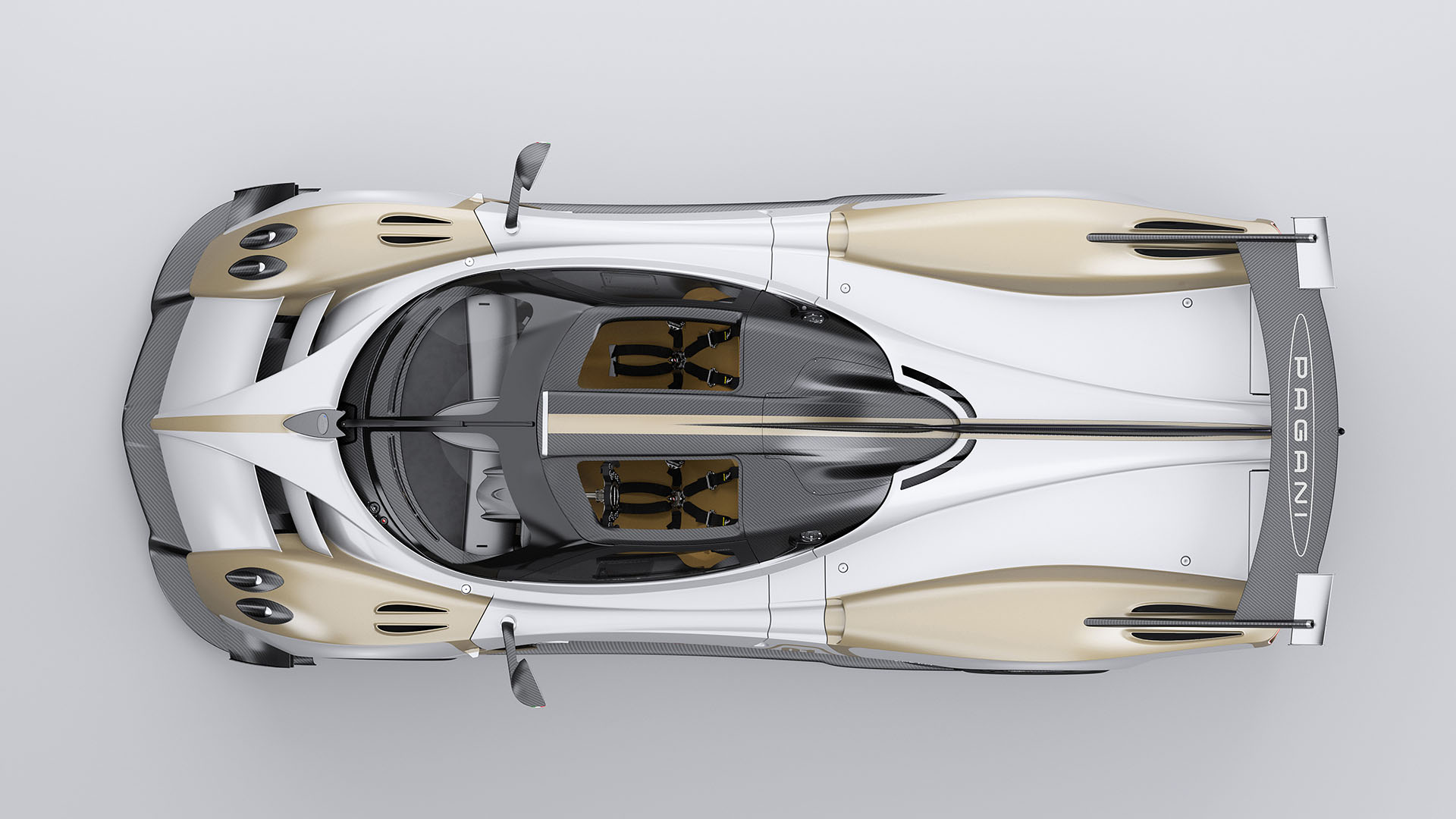
“The inspiration for the design of the Huayra R Evo struck me during a Formula Indy race in Nashville: as I observed the single-seater cars with their Aeroscreens, the idea of creating a car with protective polycarbonate surfaces and the option to remove the two roof panels to be fully immersed in the allure of the air and the captivating sound of the engine dawned on me. From that moment on, we set out with the goal of creating a beautiful car, subjective as that term may be, harmonious in its lines and strong in its character. The final result is a true descendant of the Huayra R, one of the cars our customers love the most. We also drew inspiration from the elegance of Le Mans cars that graced the tracks in the ’60s and ’70s, including the swift ‘codalunga’ long-tail prototypes.
With these stylistic foundations, we meticulously addressed aerodynamics, design, and every minute detail, adhering to the high standards synonymous with Pagani Automobili and the expectations of our discerning customers. This fascinating project engaged the entire team for approximately two years, involving extensive testing and participation in Arte in Pista events on track. We gathered valuable insights from our customers, collaborating closely with longstanding partners such as Pirelli and Brembo to develop top-tier components for a high-performance and distinctive vehicle like the Huayra R Evo.” Horacio Pagani, Founder & Chief Designer of Pagani Automobili.
Many of the design peculiarities of the Huayra R Evo are evident at first glance: at the front, the team of designers conceived a compact and aerodynamically efficient layout through a sophisticated system of air ducts to manage the optimal distribution of cooling required for brake discs, calipers, and the water radiator. This ducting system is integrated and supported by the supplier, extended forward by 101 mm (approx. 4 inches), featuring a dedicated aerodynamic profile that enhances the car’s capabilities. Alongside it, the double row of flicks on the hood contributes to the aerodynamic load on the front axle, essential for maximum control during corner entry. From the front hood, the sinuous beltline and the shaped side sills enhance the perception of lightness and efficiency, giving rise to a flow system essential for functionality in extreme conditions. It represents a complex fusion of shapes and surfaces that, on one hand, allows the release of air and heat accumulated in the front wheel arches, and on the other hand, contributes to generating an airflow that aerodynamically cleans the rear engine compartment.
These features are complemented by a 190 mm (approx. 7.5 inches) extension at the rear, following the ‘codalunga’ (long-tail) concept. The expansive and gracefully contoured rear hood supports the newly introduced central stabilizing fin and the integrated supports within the wing, featuring metal side flaps reminiscent of iconic designs from the past. The body is completed by a rear extractor that incorporates essential aerodynamic fins to streamline the airflow at the rear of the vehicle. All these developments have also led to an increase in the surface area of the aerodynamic underbody, an aspect carefully considered during the design of every detail of the vehicle and its drivability to ensure it is both extreme and intuitive – whether observed in the pits through the expression of its design or experienced while driving on the most prestigious tracks.
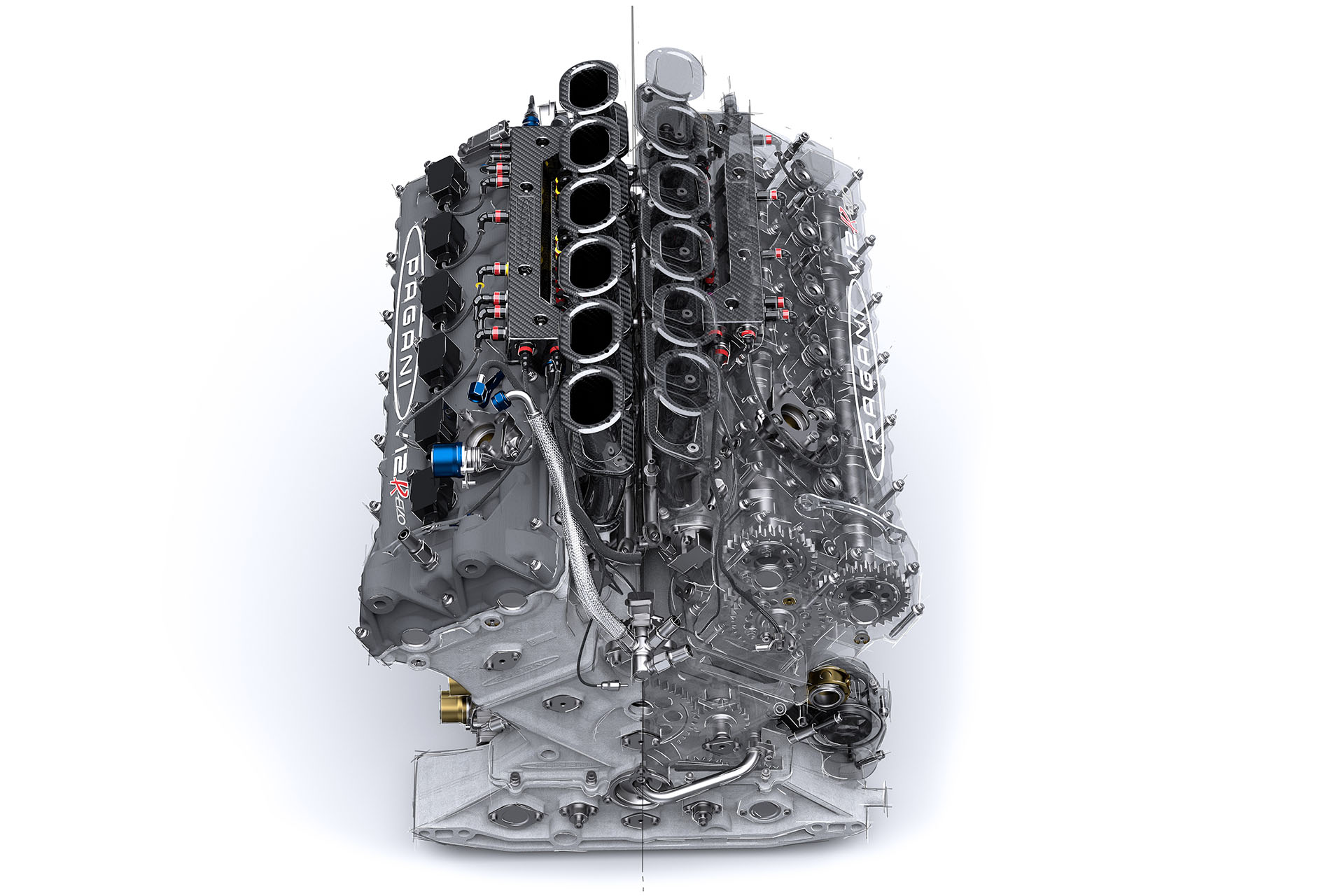
The strategic collaboration between Pagani and HWA AG remains the cornerstone of the Huayra R Evo project, by giving life to the upgraded and enhanced V12-R Evo engine, unleashing all the potential of the new track Hypercar. Equipped with the most modern technology derived from the racing world, the new engine delivers 900 hp (662 kW) at 8,750 rpm with a maximum torque of 770 Nm, which is directly available from 5,800 to 8,2000 rpm. The Huayra R Evo offers great track performance with a redline at 9,200 rpm. HWA AG and Pagani engineers did not solely focus on increasing power; they also intervened in other crucial components, such as the intake manifold. It has been optimized with a new trumpet design and new camshafts to enhance the delicate aspiration process.
Every line and surface of the new Hypercar has been designed to generate the greatest aerodynamic load; at 320 km/h (199 mph), in a lowered setup, the vehicle generates a greater vertical aerodynamic load than its total weight in running order. Achieving this potential required precise balancing, maintaining a distribution of 45% – 55% throughout the entire speed range, and minimizing sensitivity to ground clearance. This design ensures stability during braking and in corners, aided by the contribution of the two movable rear flaps and sophisticated active aerodynamic management strategies. Particularly relevant is the open roof, which enhances aerodynamic efficiency, contrary to expectations. The open-top configuration increases both front and rear vertical load, boosting the total downforce by an additional 5%.
The new cockpit ensures full frontal visibility and introduces a touch of uncommon elegance in track cars: from the inside, lifting the gaze, a play of sinuous lines seamlessly integrates onto the roof structure. This allows for enjoying a meticulously crafted interior even during the most extreme track sessions. The spectacle is accessible for both the right-hand and left-hand seated driver, as the Huayra R Evo can be configured with either driving position. This underscores the exclusivity and distinctive craftsmanship of Pagani.
The Huayra R Evo includes brand new P Zero™ Slick tires, 280/680 R19 in the front and 345/725 R20 in the rear, resulting from a comprehensive development process starting from the structure to withstand demanding dynamic loads. The increased tread width has expanded the performance boundaries of the vehicle and improved durability under intense usage conditions. Specifically developed by Pirelli Motorsport and Pagani Automobili using virtual simulation methodology, similar to the recent Trofeo RS for the road, the Huayra R Evo tires provide maximum precision and a sense of complete control for the gentleman driver. This is achieved through a new type of compound, ensuring exceptional traction during launches and stable braking behavior.
So much so that every time we visit Iceland we always make it a point to stay at the Blue Lagoon.
It’s actually something of a tradition now because it’s what we did on the first trip and as we have such fond memories of it, it’s become a must-do on every trip to Iceland.
It’s also really close to the airport so it also feels quite practical too.
Let me show you around the room and the general area here.
The rooms are absolutely gorgeous but in that stripped-back minimalist way Iceland and a lot of the Nordic countries are famous for.
There’s champagne to welcome you in the room and everything in the minibar is included with your stay – even the alcoholic beverages.
And it all gets topped up/replaced in the evening with the turndown service.
On this trip, we actually originally tried to book the Silica Hotel at Blue Lagoon but as I mentioned in this post here, hotel bookings in Iceland in summer are wild.
So many had sold out and the Silica Hotel at The Blue Lagoon was one of them.
This left us with The Retreat at Blue Lagoon to book and so that’s how we ended up staying there.
The Retreat at Blue Lagoon however just take things up a notch compared to The Silica Hotel at Blue Lagoon.
Several notches actually.
For starters, you are welcomed with champagne while the check-in staff all flutter around you to make sure you have everything you need.
The main spa is here and it has this thing called The Rituals which is like a skin cleansing and rejuvenation treatment which, to be honest, I kinda initially rolled my eyes at.
I think I was just sceptical because I have been to so many spas where people try to sell this idea of giving you this incredible treatment that’s unique to them but actually has you feeling no different to any other spa or even like you had been to a spa to begin with.
Still, we were here and I decided we’d have to try it.
It’s so worth it by the way.
Your skin feels so incredible after and even for days after, I’d forget that we’d done it and wonder why my skin looks and feels so good and then the memories of the treatment we’d had here would come flooding back.
I can’t recommend it enough.
You are not allowed to take photos in the spa so I can’t show you much there.
There’s also a private blue lagoon area that only guests of The Retreat at Blue Lagoon can visit (you can also if you are paying to go to the spa) and I realise now that you are not allowed to take photos there but we actually did while we were there.
To be fair, it was fairly late and there was no one else around so it didn’t really make much of a difference.
It did feel so nice to have no one else around though because it kinda felt like we had the whole place all to ourselves.
Afternoon tea is also provided as part of your stay here and aside from that and a visit to the restaurant for dinner, we pretty much spent the entire day just relaxing in the rather warm waters of The Retreat at Blue Lagoon.
It was magnificent.
It was also the perfect rest stop before re-attempting to hike to the nearby erupting volcano.
The technical storage or access is strictly necessary for the legitimate purpose of enabling the use of a specific service explicitly requested by the subscriber or user, or for the sole purpose of carrying out the transmission of a communication over an electronic communications network.
Preferences
The technical storage or access is necessary for the legitimate purpose of storing preferences that are not requested by the subscriber or user.
Statistics
The technical storage or access that is used exclusively for statistical purposes.The technical storage or access that is used exclusively for anonymous statistical purposes. Without a subpoena, voluntary compliance on the part of your Internet Service Provider, or additional records from a third party, information stored or retrieved for this purpose alone cannot usually be used to identify you.
Marketing
The technical storage or access is required to create user profiles to send advertising, or to track the user on a website or across several websites for similar marketing purposes.