Home Blog Page 989

Bespoke Bentley Bentayga for Peninsula’s flagship Belgravia hotel

0


Guests of the new Peninsula London hotel can now experience the company’s legendary luxury even before alighting at the hotel entrance, as they are driven through London in one of the property’s new, bespoke Bentayga Hybrids. The Peninsula London has commissioned four Bentayga Hybrid SUVs to provide luxurious, near-silent transportation for guests, whether within the city’s Ultra-Low Emission Zone or further afield.

Bentley’s Bentayga Hybrid is the only hybrid SUV in the bespoke automotive sector and offers a compelling blend of refinement, effortless performance, and cosseting luxury. The combination of a 3.0-litre V6 petrol engine, electric motor, and 18.0 kWh battery delivers a remarkable performance spectrum, from the calm of near-silent zero-emission EV mode to powerful open road acceleration. An EV range of up to 28 miles will enable the majority of The Peninsula London’s journeys to be completed without emitting a single gram of CO2. For journeys further afield, the combined output of 462 PS (456 bhp) delivers the effortless performance that Bentley is renowned for.

The Peninsula’s exacting specifications were executed by the artisans of Mulliner, Bentley’s personal commissioning division. Finishes and trim were carefully chosen to reflect the Group’s distinctive livery, recognized the world over. Exterior bodywork, roof rails, and brightware are finished in Peninsula Green, with the subtlest of two-piece coachlines in Honey. A discreet ‘The Peninsula London’ graphic adorns the front doors. Unique welcome lamps project The Peninsula logo upon the ground to guide guests when the doors are opened.

All four Bentayga Hybrids feature the Azure specification, with an emphasis on wellness and comfort. Saddle main hide color and Beluga secondary hide create an ambiance of timeless serenity; the seat backs feature ‘wellness quilting’, while the deep gloss of Burr Walnut veneer provides a tactile and visual contrast to the soft sheen of the hide. Veneered picnic tables and individual entertainment screens are provided for each of the rear compartment’s passengers. Bentley mood lighting and Signature audio system provide atmosphere and entertainment.

For the comfort and convenience of its guests, The Peninsula London also specified bespoke metal badges across the interior denoting bespoke areas for tissues and used refreshment towels in the rear doors, stowage for periodical magazines in the front seat backs, and notifications inviting guests not to smoke. Additional USB sockets and bespoke ‘The Peninsula’ illuminated treadplates complete the cabin.

The latest addition to The Peninsula Hotel’s portfolio, The Peninsula London is located in the heart of Belgravia and is a showcase for the best of British craftsmanship and design. The Peninsula London’s choice of Bentley’s Bentayga Hybrid for its liveried fleet confirms the two companies’ shared commitment to the highest standards of luxury. Guests will be able to settle into the welcoming comfort of Bentley’s hand-crafted, flawless hide upholstery for their journey while the landmarks of London spool silently past.

Sonja Vodusek, Managing Director of The Peninsula London comments: “The Peninsula is known for its global collection of impeccable bespoke vehicles, and Bentley makes a natural fit with our standards and ethos. As a brand, Bentley has a remarkable heritage of British design and craftsmanship, yet the Bentayga Hybrid shows the company is confidently meeting the challenges of the future. Sustainability and enlightened luxury matter to The Peninsula Hotels and we welcome Bentley’s luxury hybrids to The Peninsula London’s fleet.”


Source link

14 Very Best Things To Do In Liverpool – Hand Luggage Only

0


Liverpool is one of England’s most famous cities for music. From the Beatles to Frankie Goes To Hollywood, the list is long! Not only that, it has some of the best things to do in Liverpool that are dotted all across the city. You’ll be spoilt for choice when visiting Liverpool. 

Over the years, we’ve visited Liverpool heaps of times; and love it. Not only is the city totally fun, it’s also a great place to start a trip around the wider places in Yorkshire that are stunning. That being said, you can even head over to Wales or the Peak District National Park, too. 

Oh yeah, and let’s not forget that Liverpool is only around 2 hours by train from London. This makes Liverpool a really easy city to visit for a day trip or a long weekend. 

So, to help you maximise your time on the ground, I’m sharing my top places in Liverpool to visit once you arrive. Have the most amazing time in Liverpool!

Read more: Best places in England to visit

1.) The Beatles Story Museum

Best Things To Do In Liverpool England The Beatles Story

Now, one place you have to visit in Liverpool is The Beatles Story Museum. After all, Liverpool is the city where the Beatles came from; and played loads of their early gigs. 

Nestled on the Albert Docks shoreline, The whole museum is dedicated to telling The Beatles’ story and their rise to world domination. It is the largest permanent Beatles exhibition in the world and it’s just so good to see. 

Best Things To Do In Liverpool England Albert Docks

Throughout the museum, you’ll get to learn all about the Beatles’ rise to fame and the immense journey that was their music career. The whole exhibition takes you on a step-by-step journey of The Beatles including The Cavern Club, Abbey Road Studios, and other global venues. 

Now, I’m not the biggest Beatles music fan, to be honest. But, hear me out, I really enjoyed The Beatles Museum. Just be sure to book these Beatles Story Museum tickets before you arrive. This way, you won’t miss a slot when visiting. 

Read more: Best places in England to visit

2.) Ferry across the Mersey

Best Things To Do In Liverpool England Ferry Mersey River

Sound familiar? Well, there’s a song exactly about riding the ferry across the Mersey! Now, although a ride on the Mersey Ferry is, pretty short, it’s well worth the trip.

If you’re in Liverpool, head to the Dock that’s right next to the British Music Experience (another great spot if you’re into your music) and takes you right over to Seacombe in a matter of minutes. 

The ticket for the Ferry is pretty cheap and once onboard you’ll be treated to some of the best views of Liverpool. After arriving at the Seacombe docking area, head over to the Eureka! Science and Discovery Centre that’s totally fun for the whole family.

For a short visit, you can take the Mersey Ferry and visit Eureka! in around two hours. 

3.) Baltic Triangle

The Baltic Triangle is an area, not too far from the Albert Docks, that is filled with independent music venues, bars and fun nights out in the old industrial area of Liverpool. 

If you’re into your music, then you’ll want to book tickets to upcoming live music or themed nights at Camp and Furnace. Situated on Greenland Street, Camp and Furnace is one of my favourite, and more alternative venues which is situated in a disused warehouse. 

Just be sure to book venue tickets in advance; tickets can sell out for popular music nights. 

Oh, and don’t forget about the Baltic Market, too. It’s a foodie market spot that’s great for dinner and drinks in one of the old industrial units. Plus, you’ll find something to suit every taste; from fluffy pancakes to freshly made sushi. The atmosphere is fantastic, and you’ll leave stuffed. 

Also, don’t forget about these other venues dotted all around the Baltic Triangle, you’ve got some cool little bars like; Arts Bar Baltic, the Botanical Garden and another music venue, District close by. Plus, you’ve got Bongo’s Bingo (so much fun) and so many tap houses for some local brews, too. 

Read more: Best places in England to visit

4.) Museum of Liverpool

Best Things To Do In Liverpool England Museum

The Museum of Liverpool is the world’s first museum wholely dedicated to the vibrant city of Liverpool. Perched on the harbour area of Mann Island, not too far from the British Museum Experience, the Museum of Liverpool is amazing to visit.

It celebrates the unique arts and culture of the city relating to the food, culture and people as a whole. It’s so important to see, especially in a city like Liverpool There are so many collections which include archaeological history, period fashions, medieval artefacts and so much more.

Not only that, it’s free to enter. 

To make it easy to get around Liverpool, book this hop-on-hop-off bus tour that will take you around the main sights of the city. This way, you can focus all your energy on exploring, without any of the faff of finding all the places in Liverpool to visit. 

Read more: Best places in the north of England to visit

5.) Tate Liverpool

Best Things To Do In Liverpool England Tate Gallery

Right on the banks of the Albert Docks, visiting the Tate Liverpool is one of the best things to do in Liverpool when on the harbourfront area. 

Fun fact, Tate Liverpool is even the most visited art gallery and visual art centre outside of London; which says a lot about how good it is.

Best Things To Do In Liverpool England Mann Island

Once here, you’ll get to explore all forms of art, from contemporary, period and modern art over the centuries. The best part about the Tate Liverpool is the fact that their exhibits are often changing each year. This all means that there’s always something new to see during every visit.

Plus, it’s free to enter. 

Read more: Best places in the north of England to visit

6.) Maritime Museum

Best Things To Do In Liverpool England Albert Docks

If you’re totally into your museums and want to learn more about the maritime history of Liverpool, then this is the place for you.

The Maritime Museum has four floors of exhibits detailing maritime history, whilst being totally engaging and easy to follow.

This museum is filled with so much rich history and remembrance of the people that once resided in Liverpool. There are several gallery floors in this building; World Gateway, Lusitania and Empress of Ireland gallery, the Battle of the Atlantic and heaps more. 

It’s the perfect place to visit around lunchtime as you can take a stroll around the Albert Dock and stop off at one of the restaurants or bars for food. 

Read more: Best cities in England to visit

7.) Liverpool Metropolitan Cathedral

Best Things To Do In Liverpool England Liverpool metropolitan cathedral

Probably one of the UK’s most famous modern cathedrals, the Liverpool Metropolitan Cathedral is a place you can’t miss. It took five years to complete when it opened its doors in 1967 and well worth a gander inside.

Following the architects, Gibberd’s design, it’s stood proudly overlooking Liverpool for decades. 

Best Things To Do In Liverpool England Liverpool metropolitan cathedral inside

Once inside, be sure to look around the main nave and sanctuary of the cathedral.

It’s unique and the whole building is pretty impressive. Oh, and don’t forget to spot the famous organ, which has over 4000 pipes! 

Read more: Best cities in England to visit

8.) The Royal Liver Building

Best Things To Do In Liverpool England Liver Building

Right on the shorefront, The Royal Liver Building is one of Liverpool’s most famous buildings. Not only that, visiting this area is one of the best things to do in Liverpool as you wander the waterfront area. 

Now, you won’t be able to go inside but you can spot the city’s most famous birds; Bertie and Bella that stand proudly overlooking Liverpool. These two sculptured birds are said to protect Liverpool, whilst the other greets incoming sailors (a nod to its maritime past). Also, you might notice that both concrete birds are chained.

Best Things To Do In Liverpool England Canal

Well, local legend states that if the birds disappear from Liverpool, then the city will crumble. Who knows if that’s true? 

Afterwards, be sure to stop by the nearby bronze Beatles Statue and head over to the Titanic Memorial. 

9.) The Cavern Pub

Best Things To Do In Liverpool England The Cavern Club

Easily one of the best things to do in Liverpool, the Cavern Pub is one of the country’s most famous music venues. Yeah, it’s small but it’s where The Beatles and so many others cut their teeth.  

If you want to see some live music, just be sure to book tickets before arriving in Liverpool. You don’t want to travel and find out all the gigs have sold out. 

Best Things To Do In Liverpool England The Cavern Club

If it’s more of a tour you’re after, book this Liverpool walking tour that takes in the Cavern Club, The Beatles Statue and more. It’s such a great way to explore Liverpool. 

10.) Liverpool Football Club

Best Things To Do In Liverpool England LFC Football

Into your football? Then head over to the Liverpool Football Club for this stadium tour. It’s an incredible way to explore Anfield (the stadium) and learn so much more about the club’s history within Liverpool and its rise to international domination.

Tours and the visit to the museum take around 90 minutes and it’s well worth booking these tickets before arriving. At peak times, tickets do sell out. 

Read more: Best cities in England to visit

11.) Liverpool Cathedral 

Best Things To Do In Liverpool England Liverpool Cathedral

Not to be confused with the much newer Liverpool Metropolitan Cathedral, Liverpool Cathedral is the largest cathedral in all of the UK. 

Nearby the Univeristy of Liverpool buildings, the Liverpool Cathedral is massive and towers over the surrounding areas. Built-in the early 1900s, visiting is one of the best things to do in Liverpool as you explore the city’s long history. 

Once inside, be sure to keep your eyes peeled for the Lady Chapel and the vaulted ceilings that are just so impressive. Plus, from the outside, you can see the cathedral’s bell tower, which is still one of the tallest in the whole world. 

Read more: Best cities in England to visit

12.) Chinatown

Best Things To Do In Liverpool England Chinatown

For some tasty pan-Asian cuisine, head over to Chinatown that’s west of the Baltic Triangle. Now, although small if you compare it to Chinatowns in places like Vancouver or New York, it’s got a fair few little restaurants to grab a bite. 

Read more: Best things to do in Yorkshire

13.)  Sefton Park

Best Things To Do In Liverpool England Palm House Park

Although a little way from the shorefront areas of Liverpool, a visit to Sefton Park is lovely if you want a more relaxed day in the city. 

Once here, make sure to stroll from the Sefton Park Obelisk and make your way to the Sefton Park Palm House which is so impressive to see. The latter is a huge Victorian glass house that is beautiful to explore. It’s totally free to enter and epic to see. 

14.) Formby Beach

Best Things To Do In Liverpool England Formby Sands

If you’re fancying a short trip out of Liverpool, head over to nearby Formby Beach. It’s around 14 miles away from Liverpool city centre and the sandy beach is so lovely. 

Best Things To Do In Liverpool England Formby sands

Once here, and parked up at this spot (on Google Maps), head out on foot and explore the dunes and shoreline. You can walk this coastline for hours – it stretches so long. 

Just be sure to take some snacks and be prepared for blustery days if the wind is coming from the west. 

Read more: Best things to do in Yorkshire

16 Very Best Places In Yorkshire To Visit


Check Out The Very Best Of Great Britain!

Hand Luggage Only Great Britain Travel Book Advert Banner


Pop Over To Our YouTube Channel For Travel Videos!


Source link

Report: Ford to Offer $1,000 Off Bronco to Jeep Owners

0


Report: Ford to Offer $1,000 Off Bronco to Jeep Owners

Some cars compete with each other because buyers often choose one or the other. Other vehicles compete with each other like they were best friends in grade school until the incident. It’s like there’s one spot left on the roster. Like there can be only one.

Take the Ford Bronco and the Jeep Wrangler, for instance.

They’re each boxy, American-made SUVs built for the trail more than the road. They sell themselves on their off-road prowess and rugged cool. A prolonged interruption suspended their rivalry, but the Bronco moved back to town in 2021, and it’s been elbows and hard glares in the lunch line ever since.

Ford is about to up the ante, according to CarsDirect. The site cites a “bulletin sent to dealers,” reporting that Ford is offering Jeep owners a $1,000 discount on the Bronco. It doesn’t have to be a Wrangler, but we know Ford would prefer it that way. You don’t even have to trade in your Jeep – Ford will give you the discount for parking a Bronco next to it in your driveway.

The incentive is also available on the Bronco Sport – a cheaper, lighter compact SUV more biased toward the road but still capable off-road.

Some Limitations

The Jeep, however, must be from 1995 or newer. The deal excludes the extreme Bronco Raptor.

It’s not available everywhere. CarsDirect says Ford dealers in the Chicago, New York, and Phoenix areas will offer the deal, while those in Atlanta and Dallas will offer $500.

So-called “conquest offers” used to be expected in the automotive industry, but they’ve grown rare in recent years. The supply of new cars shrank during the COVID-19 pandemic, creating a seller’s market where dealerships didn’t have to discount cars to sell them. But we’re seeing a return to incentives as inventories build up and dealers compete.

Kelley Blue Book analysts expect 2024 to bring a buyer’s market, so we wouldn’t be surprised to see more conquest incentives return. And, somehow, we’re not surprised this one came first.


Source link

Turkish Food: 15 Traditional Dishes to Try in Turkey

0


Turkey is famous for so many things, including history, beaches, nature, and its traditions, but I’ll let you in on a secret—the food in Turkey is like nowhere else on earth. If you’re a foodie, you’ve just found your match: every region is famous for something, and the top dishes are well-loved for a very good reason. Traditional dishes to try in Turkey are plentiful.

I lived in Turkey for several years, and I still visit frequently now. My husband is Turkish and if it wasn’t for him, I wouldn’t have opened my culinary mind and tried as many delicious types of Turkish food as I have. This is hands down one of the best places to try something new, and even if you’re a picky eater, you’re sure to be tempted to give new dishes a go simply because of how amazing they look and smell.

15 Best Foods to Try in Turkey

There’s so much famous food in Turkey, that you might struggle to know where to start—that’s where this list comes in. The first time I visited, I didn’t understand a lot when it came to the food, and as ashamed as I am to admit this now, I stuck with the regular international fare. Don’t make the same mistake; there’s far too much deliciousness to get stuck in a culinary rut.

In this list, you’ll find 15 of the tastiest and most famous foods to try during your visit to Turkey. It doesn’t matter where you’re visiting in Turkey, or what region, as you’ll find these foods everywhere, and they’re all pretty reasonable in terms of cost too. You might recognize some of them, but even if you don’t, be brave and sample them anyway: I promise you won’t be disappointed.

1. Döner Kebab
(Most Famous Food to Try in Turkey Overall)

A plate of a mix of meat and vegetables in a pita.

When you think of Turkish food, you probably think of the döner kebab first. Now, I should point out that this is nothing like the dry or greasy kebab you get on a night out after the club back home; this is a juicy, delicious, and downright mouth-watering treat. You don’t have to smother this in ketchup and mayonnaise to make it taste good – it does all that on its own.

Döner kebab is typically either beef (most commonly) or chicken, and it’s cooked on a large rotisserie. The server slices pieces off the vertical “skewer” and layers them in your wrap, bread, or pitta, along with salad and often fries. You can tell them if you don’t want any specific ingredients added, and particularly with chicken, a yogurt sauce may be added.

As far as Turkish street food goes, this is the most famous of them all, and you’ll find vendors selling it everywhere. However, the best döner I’ve ever tried was from Karadeniz Döner Asım Usta in Beşiktaş, Istanbul. The meat is always juicy, and the queue should tell you how good it is—get there early because once it’s gone, they close for the day.

Karadeniz Döner Asım Usta Information

Address: Sinanpaşa, Mumcu Bakkal Sokağı No:6, 34353 Beşiktaş/İstanbul
Phone: +90 212 261 7693
Operating Hours: Monday – Saturday, 10.30 am – 5.30 pm, closed on Sundays
Average Cost of the Dish: 150TL/$5

2. Turkish Breakfast (Including Menemen)

Traditional Turkish dish. Fried vegetables with scrambled eggs in a cast iron frying pan on a wooden table.

I’m going to cheat a little here and add a whole meal rather than a specific food: if I listed everything in a Turkish breakfast, I’d be here all day. Breakfast is the most famous meal of the day in Turkey, and it’s known locally as ‘kahvaltı’. You may have seen pictures of a table filled with small plates containing various foods, such as cheese, tomatoes, cucumber, cold meats, eggs, jam, honey, and much more – well, that’s a Turkish breakfast.

A typical breakfast in Turkey goes on for hours, and you simply spend time talking, sipping çay (tea), and nibbling on everything on the table. My favorite thing about a Turkish breakfast is menemen – a hot breakfast dish consisting of peppers, sometimes onions, tomatoes, tomato paste, and eggs. It’s mixed together, and you eat it with bread—amazing.

For the most epic Turkish breakfast, head to Van Kahvaltı Evi in Beyoğlu, close to Taksim, Istanbul. If you’re visiting at the weekend, get there early as it’s extremely popular with locals. However, I always think that’s the best mark of quality, and this place hasn’t disappointed me once (and I’ve been many times).

Van Kahvaltı Evi Information

Address: Kılıçali Paşa, Defterdar Ykş. 52/A, 34425 Beyoğlu/İstanbul
Phone: +90 212 293 6437
Operating Hours: Monday – Sunday, 8 am – 5 pm
Average Cost of the Dish: 400TL/$14

3. Lahmacun

Grind meat on a layer of pita and tomato with green leaves on the top—a side dish of vegetables, lime, and mayonnaise.

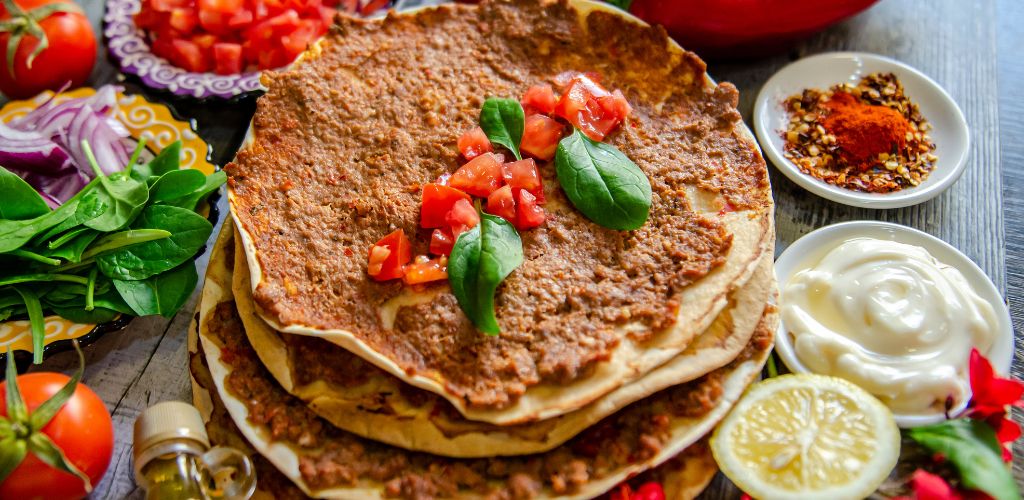
Another famous dish of Turkey is lahmacun, often referred to as Turkish pizza, although I don’t think it’s anything like pizza at all. Lahmacun is a thin and crispy flatbread that’s topped with minced lamb, tomatoes, and spices and then cooked in a wood-fired oven. It’s then eaten rolled up with onions, greens, and tomatoes inside, smothered in lemon juice.

Gaziantep is famous for lahmacun, and this is where you’ll find the spiciest of them all. The server will ask you if you want it acılı (spicy) or acısiz (not spicy), so choose according to your preferences. I always go for the non-spicy option because in Turkey, when they say spicy, they really do mean spicy!

You’ll find lahmacun very easily across the entire country, and the best I had was at Düveroğlu Kebap Salonu in Ankara, famed amongst locals as the best in the area. In some places, the lahmacun can be a little soggy, but here was the crispiest and tastiest; I highly recommend stopping in to try it for yourself if you’re in the area.

Düveroğlu Kebap Salonu Information

Address: Mutlukent Mahallesi, 2432. Cadde & 1924 Sk. 117-119-121, 06810 Ümitköy/Çankaya/Ankara
Phone: +90 031 223 51111
Operating Hours: Monday – Sunday, 11 am – 10 pm
Average Cost of the Dish: 90TL/$3
Website: https://duveroglu.com.tr

4. Pide

Turkish pides with vegetables on wooden cutting board.

One of the most popular foods in Turkey is without a doubt pide. Just like lahmacun, you’ll find this absolutely everywhere, and it comes in different types. Pide is a flatbread, but this is a little thicker than lahmacun and shaped like a boat, with an open filling in the middle.

The most common filings include mince meat (kıyma), cheese, cheese and spinach, meat, and peppers (kuşbaşılı), and sometimes you’ll find it with a fried egg on top. This is an affordable food in Turkey and is often served with salad on the side. It’s traditionally from the Black Sea coast, particularly Trabzon; if you happen to be in the area, it’s the best place to try it.

I had the best kıymalı pide from Terminal Pide Trabzon, and I stumbled upon it by accident, simply because there seemed to be a queue forming outside, so I figured it would be good. I wasn’t wrong. However, no matter what city or region you’re in, pide is a food that’s very easy to find.

Terminal Pide Trabzon Information

Address: Sanayi, Terminal Sk. No:4, 61100 Ortahisar/Trabzon
Phone: +90 462 325 0436
Operating Hours: Monday – Saturday, 8 am – 7 pm, Sunday 8 am – 6 pm
Average Cost of the Dish: 200TL/$7

5. Gözleme

on a wooden table, there is a pancake Gözleme with cheese and herbs. A cherry tomato, tea, and a fork and bread knife

Another of my favorite foods, and one that traditionally goes with breakfast. Gözleme is another type of flatbread, but this one is slightly different as it’s made from either homemade bread or yufka, which is filo pastry. It’s stuffed with a variety of different fillings, including potato, cheese, and spinach, or minced meat and onion.

Gözleme is typically cooked on a sac griddle, which is a large, domed pan over a high heat. Watching gözleme being made in the traditional way in a village is quite hypnotic, and you’ll likely want to give it a go yourself after witnessing it. It’s a traditional local food in Turkey, and it can also be eaten as a street food.

My favorite filling is potato, but you can also find sweet versions, such as Nutella on its own or with banana, or tahini. Gözleme is a typical food in Turkey to enjoy with a hot glass of çay (tea), and I loved the one I had in Ankara at Sevgi Anne Gözleme. This is a food famous from the central Anatolian region and trying it from where it originated will give you the tastiest results.

Sevgi Anne Gözleme Information

Address: Üniversiteler, Şht. Jnd. Astğmn. Mustafa Tayyarcan Cd. No:129, 06800 Çankaya/Ankara
Phone: +90 312 227 0201
Operating Hours: Monday – Sunday, 9 am – 7 pm
Average Cost of the Dish: 100TL/$3.50

6. Mantı

Traditional Turkish food. Dough stuffed with meat and onions serving with garlic yogurt topping.

If you’ve ever been to Cappadocia or done any research into it, you’ll probably know that mantı is a famous food from this beautiful region, but overall, it’s a must-eat in Turkey regardless of where you are. It’s difficult to put into words what this dish actually is, but the closest description is a type of ravioli or dumpling that’s filled with meat or cheese, and then either boiled or fried (çıtır mantı). It’s usually served with yogurt and garlic.

This is a popular dish all over the country, but if you’re in Cappadocia or the central part of the country, you’ll find the tastiest mantı. I tried it for the first time at CANCAN Cafe & Restaurant in Cappadocia, and it’s a great spot to go if you’re traveling with children; the prices are really reasonable, and it’s a laid-back spot to enjoy your meal. The mantı was really flavorful, and you can choose between the fried or boiled/steamed versions.

You’ll probably hear mantı referred to as Turkish ravioli, especially on international menus, so if you do see that, they’re one and the same.

CANCAN Cafe & Restaurant Information

Address: Avcılar Mahallesi, No.27, 50180 Göreme/Nevşehir Merkez/Nevşehir
Phone: +90 038 427 12440
Operating Hours: Monday – Sunday, 11 am – 11 pm
Average Cost of the Dish: 250TL/$8.50

7. Güveç

A mix vegetables on casserole and a wood spoon on the top.

If you want to try truly authentic Turkish food, you have to give güveç a try; in fact, once you’ve had it, you’ll be hooked, and you’ll want it over and over again – trust me. You can eat this delicious meal any time of the year, but I think it works really well in the winter months when you’re after something warm and hearty to fill you up.

Güveç is one of the most traditional dishes in Turkey, and it’s a stew-style meal that’s made with slow-boiled meat, usually beef. The meat is left to cook for several hours, so it falls apart and melts in your mouth. Peppers, onions, tomatoes, and garlic are added, along with pepper salça, which is a type of tomato paste, and it’s left to cook until everything melts into one another.

This dish is usually served with rice, but don’t be afraid to grab some fresh crusty bread and use it to mop up that delicious tomato gravy at the end. Güveç is one of my favorite traditional dishes and if you’re in the Istanbul area, head to Nişantaşı Güveç for an unforgettable version of this famous meal.

Nişantaşı Güveç Information

Address: Teşvikiye, Akkavak Sk. No:36, 34365 Şişli/İstanbul
Phone: +90 212 224 2464
Operating Hours: Monday – Saturday, 8 am – 8 pm, closed on Sundays
Average Cost of the Dish: 200TL/$7

8. Cağ Kebabı

A large amount of meat cooked on a steel stick in a wood oven.

The first time I visited Istanbul my husband insisted that we go to a small restaurant in Fatih called Şehzade Cağ Kebap. I had no idea what I was it was, but once we arrived, the place was packed; I figured it must be good. I wasn’t wrong; cağ kebabı is one of the top must-try dishes in Turkey, and if you love lamb, you’ll adore this famous street food.

Rather than cooking the meat on a vertical rotisserie like döner, cağ kebabı is cooked on a horizontal spit with layers of marinated lamb that’s so juicy, you won’t quite believe it. I should explain that I don’t like lamb when I’m in the UK, but this lamb is something very special indeed. It’s served on a large kebab stick, and you eat it with fresh lavaş, onions, and tomatoes.

I enjoyed the meal I had at Şehzade Cağ Kebap so much, and I’m reliably informed that this is the best one, despite the fact that the dish actually hails from Erzurum. I’ve returned several times since, and if you happen to be in the area, I highly recommend you grab a table here.

Şehzade Cağ Kebap Information

Address: Hoca Paşa, Hoca Paşa Sk. No:6 D:4, 34110 Fatih/İstanbul
Phone: +90 212 520 3361
Operating Hours: Monday – Saturday, 10.30 am – 10.30 pm, closed on Sundays
Average Cost of the Dish: 170TL/$7

9. Köfte

A meatballs and green leaf garnished and a fork on the side.

One of the most famous and easily found types of food in Turkey is köfte, which is essentially a type of grilled or barbecued meatball. There are different types of köfte, including Muğla köfte and Izmir köfte to mention just two, and the difference comes down to its shape and the spices used. However, I think Izmir köfte is the tastiest of them all, and if you’re in the city, this is something you have to try. You’ll find regular köfte absolutely everywhere.

Köfte can be served on a plate with potatoes, peppers, tomatoes, and rice as a main meal, or it can be enjoyed as a street food in either a wrap or on bread. Either way, it’s delicious and is a famous dish in Turkey, thanks to its versatility. You’ll also find köfte in a sauce or a stew.

If you’re walking around Istanbul or Izmir in particular, you’ll find street vendors cooking köfte in front of you and the smell is sure to make your mouth water. It’s quite a challenge to walk past without giving in. I had the best köfte at a small spot in Izmir called Köfteci Turgay; the köfte was so juicy, and I enjoyed it so much, that I went back again the very next day.

Köfteci Turgay Information

Address: Alsancak, 1456. Sk. No:92/B, 35280 Konak/İzmir
Phone: +90 232 404 0033
Operating Hours: Monday – Sunday, 11 am – 9 pm
Average Cost of the Dish: 200TL/$7

10. Adana Kebab

A meat shape on long, two grilled green peppers, grilled tomato, and scrambled egg on a white plate.

As the name suggests, Adana kebab is a type of Turkish cuisine that hails from the southern city of Adana. If you like spice, you’re going to enjoy this one, but you can also ask for it to be made slightly less spicy if your tastebuds can’t quite handle the heat. Either way, it’s a very famous and easily found dish, although the best ones are without a doubt found in its namesake city.

Adana kebab is made of minced lamb and spices which are combined together and shaped over a long kebab skewer. It’s then cooked over an open fire to ensure a slight crunch on the outside and plenty of juiciness in the middle. The skewer is removed before dishing up, and it’s typically enjoyed with lavaş, tomatoes, and onions, and served alongside rice or bulgur.

You can also get Adana kebab in a wrap, which is a famous type of street food you can grab on the go. Either way, if you’re in Adana itself, make sure you add this to your must-try list; I can highly recommend Adana Ege Kebap Salonu, as can the many locals who flock there, especially at weekends.

Adana Ege Kebap Salonu Information

Address: Cemalpaşa, Ege Taksi içi, Kapalı Spor Salonu Karşısı, 63014. Sk. No:2, 01120 Seyhan/Adana
Phone: +90 543 457 3628
Operating Hours: Monday – Sunday, 9 am – 11 pm
Average Cost of the Dish: 200TL/$7

11. Dolma

A rolled green vegetable on a wooden bowl.

Dolma is a common food in Turkey and also around the Balkans, dating back to Ottoman times. There are different types of dolma, but the most famous is vine leaves stuffed with rice and spices. You can also find dolma containing minced meat, or fish, however, the seafood version is less common.

The dolma is wrapped up into a cigar-like shape and then boiled in liquid until it is all absorbed and served while still warm. You’ll usually find dolma served with lemon slices, and I like to drench mine for a really zingy taste. The great thing about this dish is that you can eat it hot or cold, so if you have any left, simply put them in the refrigerator and enjoy them later on.

Dolma is found all over the country, and it’s a super traditional dish that most families will make at some point through any given week. I had really delicious dolma in Kadıköy on the Asian side of Istanbul, in a small restaurant called Çiya Sofrası; the flavors burst in my mouth, and that’s where I learned my love for this famous dish.

Çiya Sofrası Information

Address: Caferağa, Güneşli Bahçe Sok, 34710 Kadıköy/İstanbul
Phone: +90 216 418 5115
Operating Hours: Monday – Thursday & Sunday, 11.30 am – 10 pm, Friday & Saturday, 11.30 am – 10.30 pm
Average Cost of the Dish: 170TL/$6

12. Iskender Kebab

Traditional Turkish Iskender Kebab with Roasted Vegetables

You’ll probably have come to realize by now that there are countless types of kebab to try, and believe me, I’ve only introduced you to a small handful; there are countless more. However, Iskender kebab is one of the most famous and traditional foods in Turkey. The dish hails from Bursa, but as with most of these dishes, you’ll find it very easily no matter where you are in the country.

Here, sliced döner meat is served on top of chopped pitta bread, and is then covered in yogurt and a hot tomato and butter sauce. You’ll find this dish in restaurants and small takeaways, although you would generally eat it inside, as it can be quite messy! What I like about Iskender is that it’s not dry like some other grilled meat kebabs can be, and the bread perfectly soaks up the yogurt and tomato sauce.

In terms of what to eat in Turkey, this dish is very famous, and even if you’re not Bursa, it’s another option you’ll find everywhere. However, it’s always best in its home place, and I’d highly recommend Uludağ Kebapçısı Cemal & Cemil Usta in the Osmangazi area of Bursa for a truly traditional version.

Uludağ Kebapçısı Cemal & Cemil Usta Information

Address: Ulu Mahalle, Uluyol Caddesi, 16. Şirin Sk. No:12, 16220 Osmangazi/Bursa
Phone: +90 224 254 7264
Operating Hours: Monday – Sunday, 11 am – 7 pm
Average Cost of the Dish: 250TL/$8.50
Website: uludagkebapcisi.com

13. Baklava

Baklava with Ground Pistachios on a white plate.

When visiting Turkey, you must try baklava, whether it’s your first time or not. This is one of those foods that tourists love, and locals enjoy on special occasions, and it’s famous across the country. You’ll find baklava in most high-end restaurants as a dessert and in local patisseries (bakeries) to buy by weight.

Baklava is one of those foods in Turkey that you only need a very small amount of it, because it’s quite rich and sweet, but there are different types so you can find your favorite version. I like the original type the most, which is made of layers of filo pastry with honey syrup and pistachio filling – it’s delicious with ice cream too.

I think baklava makes a great gift for friends and family back home, and Köşkeroğlu Baklava Tophane is a top spot to buy it. The choice on offer is huge, and they gift wrap it in a tin to make it look really fancy. Of course, it might not make it that far – I wouldn’t blame you for eating it yourself before your return home…

Köşkeroğlu Baklava Tophane Information

Address: Hacımimi, Kemeraltı Cd. No:46, 34425 Beyoğlu/İstanbul
Phone: +90 053 097 74821
Operating Hours: Monday – Sunday, 8 am – 12 pm
Average Cost of the Dish: Varies depending on weight
Website: koskeroglu.com.tr

14. Kuru Fasulye

Turkish cuisine; Lamb and beans in tomato sauce and onions.

Kuru fasulye is arguably the staple food of Turkey and it’s a traditional home-cooked food that most families enjoy at least once a week. You’ll also find it in most home food restaurants around the country, known as ‘ev yemek,’ and it’s quite reasonable in terms of price and is easy to make.

Put simply, kuru fasulye means ‘dry beans,’ but the dish in general is a white bean stew in a tomato sauce. It’s typically served with rice and bread and often comes as the main course after soup and salad. The dish can be made with a small amount of meat (usually beef), or it can be vegetarian.

This is a typical Turkish food that’s cooked throughout the year and is found absolutely everywhere, however, the tastiest home-cooked food like this is found in the southeast, with a whole host of delicious spices to make the dishes even more delicious. İspir Fasülyeci Diyarbakır is highly recommended by many locals as a top place to try this traditional food.

İspir Fasülyeci Diyarbakır Information

Address: Yenişehir, Lise 5. Sk. No:6, 21100 Yenişehir/Diyarbakır
Phone: +90 412 999 4720
Operating Hours: Monday – Sunday, 9 am – 10 pm
Average Cost of the Dish: 100TL/$3.50

15. Çiğ Köfte

A raw meatball in Turkish with lettuce, tomato, pickle, and lemon, hot çiğköfte

When you first see çiğ köfte you’ll wonder what on earth it is, but looks can be very deceiving and you have to give it a try. This is a very healthy and flavorful food of Turkey and one that you’ll find in many small vendor stores around the country. The other plus point is that it’s super cheap so it’s a great street food option if you’re on a budget.

Çiğ köfte hails originally from the southeast of Turkey, particularly the Urfa and Adıyaman area. It’s a mixture of bulgur wheat, tomato paste, and spices that are kneaded together until extremely smooth and served either in lettuce with pomegranate and lemon juice or in a wrap with whatever salad ingredients you like. You can also ask for a spicy or non-spicy version.

There are large companies that make this famous dish, such as Komagene and Oses, but there are small vendors too, and you often find the tastiest versions from places like that. Çiğ köfte all over the country but if you want to try the most traditional version, head to Adıyaman and check out Yeni Nesil Adıyaman Çiğköfte Kenan Usta, a favorite amongst locals.

Yeni Nesil Adıyaman Çiğköfte Kenan Usta Information

Address: Kapcami, Eski Kahta Cd. No:10, 02100 Adıyaman Merkez/Adıyaman
Phone: +90 416 216 0282
Operating Hours: Monday – Sunday, 10 am – 12 pm
Average Cost of the Dish: 100TL/$3.50

Must-Try Foods in Turkey: FAQs

Here are some answers to the most commonly asked questions about must-try foods in Turkey:

What are the most traditional foods in Turkey?

A typical meal in Turkey involves soup to start, rice, meat, vegetables, and salad. The most famous traditional foods are therefore güveç and kuru fasulye. However, kebabs are also common, with a huge range available, including Adana kebab, Urfa kebab, and Iskender.

What is the national food of Turkey?

Turkish cuisine is extremely varied, but the kebab is undoubtedly the country’s most famous dish. You’ll find countless different types of kebabs with varied meats. Doner kebab is probably the most famous of them all, and you’ll find these types of restaurants throughout the entire country.

What’s the most popular food in Turkey?

The most popular food in Turkey is hard to pinpoint, but doner kebab is extremely popular, along with lahmacun and pide.

Which area is best for food in Turkey?

Every part of Turkey is famous for a specific cuisine, with Izmir famous for köfte, Cappadocia famed for its mantı, and Adana for its Adana kebab. However, for a varied mix of dishes, you can’t beat Istanbul; you’ll find everything you’re looking for in this huge city.

Is Turkey known for street food?

Some of the best food in Turkey falls under the street food umbrella. Doner kebab, börek, pide, çiğ köfte, köfte, and kokoreç are some of the most famous types of street food on offer.

In Conclusion

Turkish food is some of the best in the world. Perhaps I’m a little biased, but spending large amounts of time in the country has opened my palate to completely different flavors that I probably wouldn’t have dared try otherwise. Whether you’re a meat lover, all about the vegetables, or you’re into super-spicy cuisine, you’ll find something you’ll fall in love with.

Different parts of the country are famous for specific dishes, but there are some all-rounders, such as lahmacun, pide, and güveç that excel no matter where you are. And of course, you can’t start the day without a full and hearty Turkish breakfast!

So, prepare your stomach for a plethora of delicious tastes on your upcoming visit to Turkey—you certainly won’t leave hungry.


Source link

Boston Children’s Researchers, in Joint Effort, Deploy AI Across Their Hip Clinic to Support Patients, Doctors

0


Boston Children’s Researchers, in Joint Effort, Deploy AI Across Their Hip Clinic to Support Patients, Doctors

Hip disorders, comprising some of the world’s most common joint diseases, are especially prevalent among adolescents and young adults, causing stiffness, pain or a limp. But they can be hard to diagnose using solely 2D medical imaging.

Helping to treat these disorders, the Boston Children’s Hospital’s (BCH’s) Adolescent and Young Adult Hip Preservation Program is the U.S.’s first to deploy a fully automated AI tool across its clinic.

Called VirtualHip, the tool can create a 3D model of a hip from routine medical images, assess anatomy and movement-related issues, and provide clinicians with diagnostic and treatment guidance. It was built at an orthopedic research lab at BCH, Harvard Medical School’s primary pediatric hospital, using the NVIDIA DGX platform.

A team of 10 researchers are working on the project, funded in part by an NVIDIA Academic Hardware Grant, including engineers, computer scientists, orthopedic surgeons, radiologists and software developers.

“Using AI, clinicians can get more value out of the clinical data they routinely collect,” said Dr. Ata Kiapour, the lab’s principal investigator, director of the musculoskeletal informatics group at BCH and assistant professor of orthopedic surgery at Harvard Medical School. “This tool can augment their performance to make better choices in diagnosis and treatment, and free their time to focus on giving patients the best care.”

Getting Straight to the Joint

Often, clinicians must determine a treatment plan — with levels of intervention ranging from physical therapy to total hip replacement — based on just a 2D image, such as an X-ray, CT scan or MRI. Automatically creating 3D models from these images, and using them to conduct comprehensive joint assessments, can help improve the accuracy of diagnosis to inform treatment planning.

“I started a postdoc with an orthopedic surgeon at BCH in 2013, when I saw how an engineer or scientist could help with patient treatment,” said Dr. Kiapour, who’s also trained as a biomedical engineer. “Over the years, I saw that hospitals have a ton of data, but efficient data processing for clinical use was a huge, unmet need.”

VirtualHip, fully integrated with BCH’s hip clinic and radiology database, helps to fill this gap.

Clinicians can log in to the software tool through a web-based portal, view and interact with 3D simulations of 2D medical images, submit analysis requests and see results within an hour — 4x quicker on average than receiving a radiology report after imaging.

The tool, which produces 3D models with a margin of error less than one millimeter, can assess morphological abnormalities and identify issues related to hip motion, such as pain from hip bones rubbing against each other.

VirtualHip was developed using a database with tens of millions of clinical notes and imaging data from patients seen at BCH over the past two decades. Using natural language processing models and computer vision algorithms, Dr. Kiapour’s team processed this data, training the tool to analyze normal versus pathologic hip development and identify factors influencing the injury risk and treatment outcomes.

This will enable VirtualHip to offer patient-specific risk assessment and treatment planning by comparing current patients to previously treated ones with similar demographic backgrounds.

“The hardware support that we got from NVIDIA made all of this possible,” Dr. Kiapour said. “DGX enabled advanced computations on more than 20 years’ worth of historical data for our fine-tuned clinical AI model.”

Clearer Explanations, Better Outcomes for Patients

In addition to assisting doctors in diagnosis and treatment planning, VirtualHip helps patients better understand their condition.

“When patients look at an X-ray, it doesn’t look like a real hip — but with a 3D model that can be rotated, the doctor can show exactly where the joints are impinging or unstable,” Dr. Kiapour said. “This lets the patient better understand their disorder, which usually makes them more compliant with whatever the doctor’s prescribing.”

This type of visualization is especially helpful for children and younger adults, Kiapour added.

The VirtualHip project is under continuous development, including work toward a patient-facing platform — using large language models and generative AI — for personalized analyses and treatment recommendations.

The BCH researchers plan to commercialize the product for use in other hospitals.

Subscribe to NVIDIA healthcare news.


Source link

Hermès Autumn/Winter ’24 Menswear Collection Review

0


Hermès
Hermès Autumn/Winter 2024 menswear show 

Unlike most other brands, Hermès always does things a little differently. While it’s become common practice for brands to furnish fashion editors and journalists with a list of celebrities who will be attending their shows (we’ve sadly all become glorified paparazzis), Hermès does nothing of the sort. In fact, I attempted to press the Hermès Singapore team multiple times so that I can be prepared for who to look out for before the Hermès Autumn/Winter 2024 menswear show for soundbites and general content, but they maintained that they themselves had no clue.

But there they were. A sizeable number of celebrities—both established and up-and-coming—entered the Palais d’Iena to a runway show audience that was mingling with pre-show drinks in hand. James Marsden walked in wearing a suit over a white turtleneck. And from the corner of my eye, in an outfit from Hermès’ Spring/Summer 2022 menswear collection, was Swedish singer-actor Omar Rudberg of Young Royals—he paired the look expertly with a statement Hermès necklace and a bag with matching hardware. Queer Eye‘s Antoni Porowski rocked up in a shearling jacket with leather details, young Danish actors Alex Høgh Andersen and Lucas Lynggaard Tønnesen (known for Vikings and 1899 respectively) arrived together, The White Lotus‘ Leo Woodall was there too, and so was Luka Sabbat. I’m sure I’ve missed out a number of other celebrities but Hermès was very low-key about it.

The younger famous faces at the front row perhaps seemed like a calculated move. Does a venerable brand like Hermès need the awareness of a younger generation? Arguably, every brand could. Yet, the very spirit of the House is one that’s irreverently playful and artistic director Véronique Nichanian has always channeled that into every collection. If anything, the appearance of these young faces could further help communicate the true nature of Hermès, one that’s even more apparent in its Autumn/Winter 2024 menswear collection.

The fit: Right off the bat, it felt like as though the Hermès Autumn/Winter 2024 menswear collection was inspired by a rather British sensibility with the use of Prince of Wales checks and argyle knits. The styling seemed to have carried over some of the influences of the punk-inspired Autumn/Winter 2023 menswear collection. Yet, the overarching theme of the collection was simply one of versatility and paradox. The merging of traditional menswear with non-traditional fabrications, timeless motifs rendered anew, and a decidedly contemporary take on the familiar.

Hermès
Hermès Autumn/Winter 2024 menswear show 

It was evident from the trousers in the collection. They were cut slimmer than ever while tops remained oversized. Jackets (a number of them reversible) were slightly cropped, but not too much—just enough to be a modern update. The argyle motifs were spliced and reconstructed with other colours and patterns, while waterproof gum canvas were cut into functional layers with its translucent nature affording multiple ways of styling and wear. Layering was a focus with sleeveless elements (a definite buy for this side of the equator) either worn on their own or layered over a multitude of other lighter layers.

Hermès
Hermès Autumn/Winter 2024 menswear show 

The highlight for me though were the calfskin ensembles that were paraded towards the end. I initially thought that they were ponyhair pieces owed to the incredible sheen, but at the collection’s re-see the very next day, it was revealed that they were polished calfskin. Fashioned into a number of outerwear, suiting and even a stunning vest, they were beautiful examples of Hermès craftsmanship and that spirit of playfulness.

The details: Nichanian has a knack for styling every facet from the Hermès menswear universe into one cohesive look without ever making it feel too much. Jewellery for Autumn/Winter 2024 were simple and effective. A personal favourite were the pebble-shaped necklaces in palladium and wrapped with a bit of leather for a chic statement that doesn’t shout. Silk scarves turned into snoods with a reversible plain leather side, and ties echoed the Prince of Wales check suiting but rendered in fine topstitching.

Hermès
Hermès Autumn/Winter 2024 menswear show details

But of course, the bags were what I’m certain everyone had their eyes on. I adored the Hermès Équipier pouches that were designed to fit comfortably on bicycle bars and fitted with multiple zipped compartments. The Fouree-Tout Étrivère—essentially an oversized holdall—was crafted with a sturdy top panel where its top handle is attached to while the bottom half is made of more supple leather that gave it a beautiful shape when carried using its shoulder strap. And the classic Haut à Courroies was given an appliqué treatment with leathers of different finishes for a more rugged appeal.

Three exceptional looks: Look 11’s play on layers that’s especially visible thanks to the gum canvas turtleneck; Look 34’s simple monochromatic ensemble of a leather jacket with slim-cut trousers; and the closing look that should be worn to an awards show pretty soon.

The takeaway: You don’t need to design wide-cut trousers to be relevant and cool; a contemporary aesthetic is more than just about being trendy.

View the full Hermès Autumn/Winter 2024 menswear collection in the gallery below.

This article was first seen on Esquire.sg.

For the latest in luxury fashion reads, click here.


Source link

2023 Dodge Charger Super Bee

0


As we bid farewell to Dodge’s muscle car twins, the Challenger and Charger, most of the attention has gone to the Hellcat-powered variants and rightly so. The Hellcat engine is one of the most impressive engines ever put into a production car. But the standard Hemi engine is no slouch. Dodge delivered to us a Super Bee Special Edition, another of Dodge’s Last Call cars, with the standard Hemi engine under the hood and we were able to enjoy it one final time while comparing it to the Hellcat engine.

Our Super Bee showed up in the more attractive of two Super Bee colors: B5 Blue, another color resurrected from the classic muscle car palette of the early 1970’s. Super Bee badges adorned the flanks and grille of the car, while applique’s were set upon the hood and the rear fenders. The look was classic muscle car throwback and Dodge even threw in another fun muscle car attribute: hood pins. Parked in our lot, the Super Bee looked like it wanted to go play, bully some Prius’, and maybe goad some Mustang Shelby Cobras into running for pink slips.

Inside was black leather and alcantara – pretty monochromatic but tastefully done and comfortable. The controls were simple and straightforward to use. Seats were supportive and comfortable; well bolstered but not difficult to get into and out of. Adjustable for just about every body size and shape. The seats were heated and ventilated.

Under the hood was Dodge’s venerable 6.4L Hemi V8, which roars like a lion and chases down everything that dares threaten it. Huge amounts of horsepower and torque, as you can imagine. The power is transferred through an 8-speed automatic to the rear wheels, wrapped in drag racing tires that stuck like glue to the asphalt and turned 0-60 times of just over 4 seconds. While not as powerful or as fast as it’s Hellcat brethren, it seemed easier to make use of the power when driving. The paddle shifters worked with the engine rather well, while in the Hellcat cars it’s easy to get caught up in the acceleration and you forget to shift and just bang against the rev limiter. The Super Bee had a good balance of power.

The suspension, while not the adjustable type, was firm and composed but very forgiving. I’d have liked a little firmer setup but I was happy enough with it. Dodge found a happy medium that should keep nearly everyone happy. They call it “drag-oriented” suspension so I assume it’s not exactly meant for twisty roads but it did just fine on them.

The brakes were Brembo 4-piston calipers straddling large brake rotors. They stopped the car amazingly fast and never faded, which wasn’t unexpected since we didn’t push it on the track or anything while we had it. But they were there when we needed them and they did amazingly well at scrubbing off speed fast. Very confidence inspiring.

We got plenty of attention in the Super Bee. I think the fun B5 blue paint and Super Bee design cues got people’s attention.

EPA mileage was supposed to be 15 in the city and 24 on the highway for an average of 18mpg. I doubt we got that, as often as we were stomping on the gas peddle, but there’s more to cars that mileage. Can I get an “amen”?

Our Super Bee stickered at $63,985, which we didn’t think was bad given all the technology, performance, and creature comforts it came with. Base price was only $50k.

As inventory of Dodge muscle cars dwindles, Dodge has set up a special website, accessible from their homepage, to help you find the Dodge muscle car of your dreams. This is Last Call and they don’t want you to be denied.

We’ve tried a few different models of the Charger over the years and have loved every one of them. We’re sad to see it go, but we’ll enjoy plenty of fond memories of burnouts and high speed runs. Thank you, Dodge, for making some of the coolest cars on the planet and reigniting our love with Detroit muscle. Godspeed.


Source link

How to Be a Digital Nomad in Europe (Updated 2024)

0


A train traveling along the rugged cliffside villages of Italy at sunset
Posted: 1/29/24 | January 29th, 2024

For many people, being able to work and travel is the dream. Logging on to your laptop from a new destination, spending your days off admiring the Wonders of the World, feasting on delicious cuisines. It should come as no surprise that there’s been a rise in remote work over the past few years (especially after COVID).

One of the best — and most popular — regions in the world to work remotely from is Europe.

Offering a diverse array of countries and cultures, incredible food, reliable infrastructure, and plenty of overnight trains and airport hubs that make it easy to get around, Europe is arguably the best region in the world to work remotely.

And with a growing number of countries offering visas specifically to remote workers and digital nomads, being a digital nomad in Europe has never been easier.

I’ve been a digital nomad for over 15 years and have spent countless months working and traveling around Europe. In this post, I’ll share everything you need to know about being a digital nomad in Europe.


The Benefits of Being a Digital Nomad in Europe

There are a lot of reasons why Europe is one of the most popular and sought-after destinations for digital nomads. Here are a few:

Variety – The major selling point for being a digital nomad in Europe is the variety. Depending on what list you use, there are between 40-50 countries in Europe. That means 40-50 different cuisines, languages, and landscapes. There are sunny beaches and rugged mountains, charming villages and lively cities. No matter what you’re looking for, you can find it in Europe.

Ease of Transportation – Between Flixbus and Ryanair, it’s possible to travel Europe for essentially pennies. There’s also a massive, interconnected rail system with both high-speed and overnight trains. And if you’re in the Schengen Area, there are no border controls so it’s super easy to travel between countries.

On a smaller scale, European cities have amazing public transportation that is fast, safe, and affordable. You don’t need a car here and can get pretty much anywhere using public transportation.

Location – You can reach Europe from the USA in as little as a five-hour flight. From here, you can fly directly to every continent. It’s a super convenient hub for those looking to travel long term with plans to visit other continents.

Climate – Europe has bustling beaches and snowy ski towns. You can see the Northern Lights up in Lapland or skip the winter entirely in the Greek Islands. It’s an amazing year-round destination offering tons of flexibility to digital nomads.

Language – English is widely spoken in much of Europe. While it’s always a good idea to try and learn as much of the local language as possible, being able to fall back on English when you’ve just arrived can be super helpful.
 

Things to Consider When Picking a Destination in Europe

Internet and Data Connectivity
If you’re working online, reliable Wi-Fi is vital. When booking accommodation, always check the reviews for comments about the Wi-Fi. If there is nothing mentioned, email the hotel/hostel/Airbnb and ask them for specific Wi-Fi speeds. There’s nothing worse than having slow internet when you’re trying to work!

Additionally, check to see if there are co-working space (or at least cafes) nearby so you can get out of the house, network, and see some of your destination instead of just working inside your accommodation all day.

Since you won’t be spending all day in the apartment and want to make the most of the digital nomad experience in Europe, it’s essential to have a reliable data plan to stay connected. This will allow you to safely explore places, check for local recommendations, make reservations, and use social media on the go.

The easiest and most modern way to stay connected is by acquiring an international eSIM card. It provides digital data access throughout your entire trip, eliminating the need for physical SIM cards. By using the Holafly eSIM for Europe, you’ll enjoy coverage in over 30 countries with unlimited data and a local number. With just one payment, you can seamlessly travel from one country to another without hassle. This solution will automatically save you time and money while reducing stress, thanks to their easy installation process.

Cost of Living
Europe has cities that run the gamut from super cheap to super expensive. There’s a world of difference between the cost of living in, say, Reykjavik, Iceland versus the cost of living in Krakow, Poland. That’s not to say you have to stick to cheap, affordable cities but rather that you need to budget accordingly. Maybe that means staying a few weeks in an expensive destination and then a few months in a cheaper one to balance things out.

Everyone’s budget is going to be different, but just make sure that you factor in the cost of living when planning where to go. Rent/accommodation, food, activities, and transportation all add up. Make sure you don’t go broke by researching costs before you arrive.

Community
Working remotely as a digital nomad offers a lot of freedom. But it can also be lonely. Make sure that the destinations you pick allow you to get out and meet people from time to time. Whether that’s at coworking space or using apps like Meetup.com or Couchsurfing’s Hangouts, it’s important to get away from the laptop regularly.

Moreover, if you’re running a business from your laptop then it’s important to also network with people in your industry in person. Make sure you pick a destination where that’s possible.

Activities
Finding a work/life balance is tricky. But it’s also vital. Burn out is common for people who travel full-time, and it’s also common for remote workers since there is no hard end to your day. To avoid burning the candle at both ends, make sure you schedule lots of time to sightsee and actually explore the destination you’re in. That means you want to visit destinations with lots of things to see and do. Walking tours, food tours, pub crawls, museums. Whatever you’re into, make sure the places you visit have things you actually want to see and do outside of work. It will make finding that work/life balance all the easier.

Transportation
Working from some remote island may sound relaxing, but if you have to buy an expensive flight each and every time you want to travel or go home to visit family, you’re going to break the bank sooner rather than later. When deciding where to go, consider how easy (and affordable) it is to get there. While Europe has plenty of trains and cheap airlines, some regions are more expensive to visit than others. Plan ahead so you can avoid blowing your budget on pricey flights or trains.
 

How to Stay Connected in Europe

The Internet in Europe is fast and readily available. Free Wi-Fi is available all around the continent, though having your own mobile data is a must. I visit Europe every year and I always make sure I have mobile data. It’s a must for using Google Maps, Google Translate, calling Ubers, and booking activities on the go.

And while Europe is super safe, having mobile data and the ability to make calls can be super helpful in an emergency.

The best way to access mobile data in Europe, as mentioned earlier, is through an international eSIM. It’s faster, more cost-effective, and easier to use than purchasing physical SIM cards. The installation and activation process is also very straightforward, and I’ll share the steps with you.

How to Get an International eSIM

  1. Go to Holafly and search for the Europe plan.
  2. Specify the number of days you’ll be staying. You have the flexibility to choose from 5 to 90 days (which is perfect for long trips as it will cost less than $1 per day).
  3. If you have questions, contact support. Their support is available 24/7, which is super helpful in case something occurs before or during your trip.

How to Install your eSIM

  1. First, verify that your phone has eSIM compatibility.
  2. Next, buy the eSIM you want (as outlined above).
  3. Once you place your order, you’ll get an email with a QR code. Scan that with your phone to finish the process. If there is an issue with the QR code setup, manual instructions are also emailed with your purchase.

A screenshot from the Holafly eSIM website

Be sure to activate your eSIM on your phone before your next adventure. You’ll have data as soon as you land, ready to fully explore the beauty of Europe.
 

The Best Digital Nomad Cities in Europe

While you can pretty much work from anywhere in Europe, owing to the prevalence of reliable internet, some cities are better than others. Here’s a list of the best destinations in Europe for digital nomads:

1. Berlin, Germany – Berlin has been Europe’s primary digital nomad and freelancer hub for years. It’s a super cool, progressive city that provides easy access to the rest of
Europe. It’s safe, has efficient transportation, and has tons of things to see and do. If you want to live in a big city, this is likely your best choice.

2. Lisbon, Portugal – I fell in love with Lisbon the moment I arrived. While it’s become more popular with tourists in recent years, it’s the perfect choice for digital nomads who want to stay in Europe during the winter but don’t want to embrace the continent’s colder climates. You’ll find marvelous food, music, dance, lots of co-working spaces, and tons of creatives and entrepreneurs. If you love Portugal but want to stay somewhere smaller, try Lagos instead.

3. Budapest, Hungary – Budapest is one of the most underrated cities in Europe. It’s super affordable, there’s lots of cool museums, the food is hearty and delicious, and the nightlife is unrivaled. The ruin bars here are some of the coolest bars in the world. There are also plenty of spas that are actually very affordable. You get a lot of value here.

4. Tallinn, Estonia – Tallinn is like a more affordable version of Prague. It’s just as beautiful but costs way less and is way less crowded. They are very tech friendly here (it has the most tech start-ups per capita in Europe) and have a visa specifically designed for remote workers. It’s just a short ride from Helsinki, Finland and Riga, Latvia too, offering access to some of Europe’s most overlooked capitals.

5. Tbilisi, Georgia – Georgia is an up-and-coming backpacker and digital nomad hub. It doesn’t get a lot of visitors, but the people who do visit love it (myself included). Tbilisi has a young vibe and English is widely spoken, and the cost of living is low too. The food here is amazing and cheap, and there are plenty of coworking spaces here so it’s super easy to network and meet people. It’s a very friendly, welcoming country.

These are just a few of the best digital nomad hubs in Europe. There are tons of other amazing destinations all around the continent that offer affordability, reliable infrastructure, community, and more!
 

12 Budget Tips for Europe

A scenic view over the historic walled area of a city in sunny Spain during a summer day
While every country (and region) around Europe will be different, here are a few budget tips to help you keep you from breaking the bank:

1. Picnic – Europe is brimming with small shops where you can buy pre-made sandwiches or ingredients to make your own. Instead of eating out, grab some food and picnic. There are tons of greenspace and plenty of parks in every major city where you can picnic. It’s something you’ll see the locals do whenever the weather is nice.

2. Eat cheap – If you do want to eat out, stick to sandwich shops, pizza, kebab stalls, and outdoor street vendors. These places are cheap no matter where you go. You can usually find cheap eats for as little as 2-5 EUR.

3. Stay with a local – Hostels/Hotels/Airbnbs add up quickly. If you’re on a budget, stay with a local via Couchsurfing. It’s a great way to connect with a local who can share their insider tips and advice.
4. Take the bus – If you’re traveling around the continent, use Flixbus. They have routes all around Europe with prices starting at just 5 EUR. It’s not fancy, but they can get you pretty much anywhere in Europe!

5. Get a Rail Pass – If you’re going to be bouncing around Europe, consider getting a Eurail Pass. If you are traveling far distances and through many countries, they can save you a fortune.

6. Take the free city tours – Free walking tours can be found in pretty much every major city in Europe. They’re the perfect way to see the main sights of a city while connecting with a local guide that can share their tips and suggestions.

7. Fly cheap – Wizz and Ryanair are two of the cheapest airlines in Europe. If you’re flexible and book early, you can find flights around Europe for as little as 10 EUR!

8. Pack light – Budget airlines charge extra for luggage. If you’re going to be flying around Europe during your trip, travel carry-on only. You’ll not only save money on luggage fees but you’ll save time since you won’t have to wait for your baggage when you arrive. You’ll avoid getting your bag lost too!

9. Hitchhike – If you’re an intrepid digital nomad, hitchhiking around Europe is definitely an option. In many countries, hitchhiking is perfectly safe. It might take you a while to find a ride, but if you’re patient and flexible it’s an amazing way to meet people as you travel. Iceland, Ireland, the Netherlands, and Romania are all countries where it’s easy (and common) to hitchhike. Check out Hitchwiki for more info.

10. Avoid popular cities in the summer – Summers in European cities are energetic and beautiful but they’re also crowded and expensive. If you’re here in the summer, avoid the big tourist hubs (London, Paris, Barcelona, etc.) and head to smaller cities. You’ll find things less crowded and less expensive.

11. Head east – Eastern Europe has everything you’ll find in Western Europe but for a fraction of the price. Poland, Albania and the Balkans, Romania, and Georgia all have everything you’ll need as a digital nomad and are much cheaper than countries in Western Europe.

12. Bring a water bottle – The tap water is safe to drink in most of Europe, so bring a reusable water bottle to save money and reduce your plastic use. LifeStraw is my go-to brand as their bottles have built-in filters to ensure your water is always clean and safe.
 

Do You Need a Visa to Visit Europe as a Digital Nomad?

While many tourists can visit Europe visa-free, if you’re going to be working during your stay, you need to apply for a visa in advance.

Often digital nomads will enter Europe on a tourist visa and then work without informing immigration. This is illegal and can lead to you being deported and banned from entering Europe in the future. For that reason, you’re going to want to apply for the proper visa if you’re going to be visiting Europe long-term and working as a digital nomad.

Fortunately, more and more countries are creating visas specifically for digital nomads and freelancers. Schengen countries that offer freelancer or remote worker visas include:

  • Croatia
  • Czechia
  • Estonia
  • Germany (the most popular destination)
  • Greece
  • Hungary
  • Malta
  • Portugal

You’ll need, among many other things, to prove that you have an income to get this visa. The exact amount varies between countries, but it’s at least 2,000 EUR per month (some destinations require you to have savings instead, upwards of 10,000 EUR).

There are also some non-Schengen countries that have visas. They include:

Most of these visas follow a similar format: apply, pay a fee, submit proof that your business can stay afloat, then wait to be accepted. However, some have more stringent requirements. You’ll need to check with each country’s embassy for complete details.

***

Europe is an amazing destination for digital nomads. I visit every year and never get tired of its charm. With incredible sights, stunning landscapes, and a massive variety of cuisines and cultures, it’s impossible to get bored here. Just make sure to plan ahead when it comes to staying connected.

By doing your research and getting an international eSIM, you can ensure you stay productive, keep in touch with friend and family back home, and have the tools you need to make the most out of your experience!

Get Your In-Depth Budget Guide to Europe!

Get Your In-Depth Budget Guide to Europe!

My detailed 200+ page guidebook is made for budget travelers like you! It cuts out the fluff found in other guides and gets straight to the practical information you need to travel while in Europe. It has suggested itineraries, budgets, ways to save money, on and off the beaten path things to see and do, non-touristy restaurants, markets, bars, safety tips, and much more! Click here to learn more and get your copy today.

Book Your Trip to Europe: Logistical Tips and Tricks

Book Your Flight
Use Skyscanner to find a cheap flight. They are my favorite search engine because they search websites and airlines around the globe so you always know no stone is left unturned!

Book Your Accommodation
You can book your hostel with Hostelworld as they have the biggest inventory and best deals. If you want to stay somewhere other than a hostel, use Booking.com as they consistently return the cheapest rates for guesthouses and cheap hotels.

For suggestions on where to stay during your trip, here is a list of my favorite hostels in Europe.

Don’t Forget Travel Insurance
Travel insurance will protect you against illness, injury, theft, and cancellations. It’s comprehensive protection in case anything goes wrong. I never go on a trip without it as I’ve had to use it many times in the past. My favorite companies that offer the best service and value are:

Looking for the Best Companies to Save Money With?
Check out my resource page for the best companies to use when you travel. I list all the ones I use to save money when I’m on the road. They will save you money when you travel too.

Want More Information on Europe?
Be sure to visit our robust destination guide on Europe for even more planning tips!


Source link

2024 Mazda CX-5 Carbon Turbo | The Daily Drive

0


2024 Mazda CX-5 Carbon Turbo

Consumer Guide Test Drive

2024 Mazda CX-5 2.5 Carbon Turbo

Class: Compact Crossover/SUV

Color: Zircon Sand

Seating capacity: 5

CG Report Card
Room and ComfortB
Power and PerformanceB+
Fit and FinishA
Fuel EconomyB
ValueB+
Report-card grades are derived from a consensus of test-driver evaluations. All grades are versus other vehicles in the same class. Value grade is for specific trim level evaluated, and may not reflect Consumer Guide’s impressions of the entire model lineup.
Big & Tall Comfort
Big GuyB
Tall GuyA-
Big & Tall comfort ratings are for front seats only. “Big” rating based on male tester weighing approximately 350 pounds, “Tall” rating based on 6’6″-tall male tester.
Drivetrain
Engine Specs227-horsepower, 2.5-liter
Engine TypeTurbo 4-cylinder
Transmission6-speed automatic
Drive WheelsAWD

Miles driven: 471

Observed fuel economy: 24.0 mpg

Driving mix: 75% city, 25% highway

EPA-estimated fuel economy: 22/27/24 (mpg city/highway/combined)

Fuel type: Regular gas

Snow Performance: N/A

Base price: $37,000 (not including $1375 destination charge)

Options on test vehicle: Special paint ($450), navigation system ($450), rear bumper guard ($135)

Price as tested: $39,410


Quick Hits

The great: Sporty character, upscale feel

The good: Comfortable cabin, plenty of power

The not so good: Coarse-sounding engine, near-premium price


Tom Appel:

Mazda knows a good thing when it sees it. Though the brand’s crossover lineup has been extensively reworked over in the past couple of years, one model remains resolutely fixed in place. While the small CX-3 gave way for the more upscale CX-30, and the midsize CX-9 was deleted from the lineup to make room for the CX-90, the compact CX-5 stayed put, despite the addition of the like-size CX-50 to the Mazda U.S. portfolio.

2024 Mazda CX-5 Carbon Turbo
2024 Mazda CX-5 Carbon Turbo, Christmas Lights

The CX-5 has long been Mazda’s best-selling model, and the additional of upscale “2-digit” (30, 50, 90) crossovers to the lineup has done little to challenge the CX-5’s popularity. While the new crossovers are meant to look a little more rugged, and to gently nudge the Japanese brand upmarket, consumers have not given up on the CX-5’s tempting blend of sporty character, cabin comfort, and dollar value. Last year, customers snapped up 154,000 CX-5s. Mazda’s 2nd-best selling model, the CX-30, accounted for less than half as many sales. For the record, the CX-50 came in at around 45,000 units.

2025 Chevrolet Equinox: First Look

2024 Mazda CX-5 Carbon Turbo

For 2024, Mazda sweetens the CX-5 pot somewhat, by adding a second, turbocharged Carbon Edition trim level to the lineup up. The Carbon Edition includes unique Polymetal Gray paint, red leather seating, unique wheels, and several other features for a value price. A non-turbo Carbon Edition was added to the lineup for the 2021 model year.

2023 Mini Cooper S Countryman “Untamed”: Test Drive

2024 Mazda CX-5 Carbon Turbo

The full—and expansive—CX-5 lineup starts with the 2.5 S Select (around $31,000), and ascends through the 2.5 S Preferred ($32,000), 2.5 S Carbon Edition ($33,000), 2.5 S Premium ($34,000), 2.5 S Premium Plus ($36,000), 2.5 Carbon Turbo ($38,000), 2.5 Turbo Premium ($39,000), and 2.5 Turbo Signature ($42,000).

All non-turbo CX-5s are powered by a 187-horsepower 2.5-liter four. Turbocharged models also come with a 2.5-liter four, but rated at 227 horsepower. All engines mate to a 6-speed automatic transmission, and all run on regular-grade gas. Note that running turbocharged CX-5s on premium-grade gas bumps the rated power output to 250 horsepower. For 2024 all CX-5 trim levels included standard AWD.

Note that the slightly longer and lower CX-50 more or less matches the CX-5 trim levels, with each coming in around $1000 higher in price. We seriously recommend that shoppers considering either vehicle test drive each. There’s a lot to like about both.

Consumer Guide recently spent a week behind the wheel of a 2024 CX-5 Carbon Turbo in optional Zircon Sand Metallic. With destination and a few options, our test car rang in at $39,410.

Inside, the CX-5 mostly lives up to Mazda’s upscale intentions. Cabin materials are of a high grade, and assembly quality appears top notch. We also found the seats to be both substantial and comfortable. Thanks, at least in part, to its upright posture, visibility out of the CX-5 is generally excellent, and the generous glass area gives the crossover’s interior an open and airy feel. Rear-seat space is also generous, and four adults will find long-trips more than tolerable.

Underway the CX-5 shines. Mazda’s “Skyactiv-G” turbocharged engine delivers plenty of power for around-town traffic handling, and offers up a deep reserve of power for passing and merging. We tested the CX-5 using regular-grade fuel. Running premium fuel will boost the fun by a meaningful 23 horsepower. Despite Mazda’s upscale aspirations, the Skyactiv engine is a little coarse at idle, and doesn’t produce the smoothest sounds when pushed. Mazda loyalists will defend the engine’s lack of refinement as character, and we’re OK with that.

Test Drive: 2023 Dodge Hornet GT Plus

2024 Mazda CX-5 Carbon Turbo

In terms of ride and handling, the CX-5 shines as few small crossovers do. Handling is entertainingly sporty, with firm, nicely weighted steering, strong-feeling brakes, and well controlled lean in corners. Despite its athletic nature, ride quality is impressive, with well-controlled body motion over larger road imperfections and no harshness over broken road surfaces.

We should address the love-it or hate-it infotainment interface. The CX-5 employs a center-console situated rotary knob for most digital actuation. The knob both rotates and acts as a plunger, the later to engage deeper menus and sub menus. Initial response to the setup—even by the automotive media—is generally negative, primarily because most other brands have moved on to simpler touch-screen systems.

They said, there is much to like about the Mazda system once a driver has become familiar with the arrangement. This author finds the system an excellent way to keep a driver’s eyes on the road. It takes only a few days to become familiarized with the system, after which many drivers come to prefer it to conventional touch-screen operation. Be sure to spend time learning how the Mazda knob-driven infotainment-system works should you take a test drive in a CX-5, or any Mazda, for that matter.

We’re big fans of the CX-5. We find that Mazda’s best-selling crossover represents a deft blend of utility, luxury, and sporty character. Some consumers may balk at the infotainment-system interface, but we promise that it becomes more familiar, and easier to use, over time. More importantly, the CX-5 can seem pricey compared to other small crossovers. But, when you compare the CX-5’s upscale cabin, available power, and general utility, the Mazda justifies its extra cost. When you test drive the CX-5, take time to check out the more-modern-looking CX-50, it’s also very good.

First Spin: 2024 Kia Seltos

2024 Mazda CX-5 Carbon Turbo

Listen to the Consumer Guide Car Stuff Podcast

Follow Tom on Twitter

2024 Mazda CX-5 Carbon Turbo Gallery

(Click below for enlarged images)

Test Drive Gallery: 2023 Mazda CX-50 Premium Plus

Consumer Guide Car Stuff Podcast Episode 203: Cadillac Lyriq Review, Top Auto Innovations, Chevrolet Trailblazer


Source link

Exclusive! Bugatti Chiron successor to set new benchmarks with V16 engine & design

0


We are all set to witness the beginning of a new era of Bugatti hypercars in 2024. The automaker is finally phasing out the legendary 8.0-liter W16 engine that powered the Veyron since 2005 and then featured in the Chiron in its upgraded form. With its next-gen hypercar, Bugatti is gearing up to set new benchmarks.

The Chiron successor is likely to make its global debut sometime between March and June 2024. Bugatti has been showcasing the car to prospective clients since late last year. However, concrete information about the new model has been hard to come by.

Bugatti Veyron W16 Engine cutaway

There has been internet chatter about a V16 engine, and for the first time, we can confirm that these rumors are indeed true. That’s right, the Chiron successor will be powered by a naturally aspirated V16 engine that revs to 9000 rpm! The motor has been developed by Cosworth, who also built the screaming V12s powering the Aston Martin Valkyrie and GMA T.50.

This masterpiece will be a “zenith of engine design and engineering”.

Sources say that the 8.3-liter V16 will be paired with three electric motors, with the internal combustion engine developing 1000 hp, while the electric motors will add another 800 hp, for a total of 1800 hp.

Bugatti Chiron Super Sport 57 One of One-3

Now, here’s a low down on the design of the Chiron replacement based on the information we have.

We are likely to see a different iteration of Bugatti’s iconic horseshoe grille on the upcoming hypercar. A wider grille will adorn the front, while the rear design is being described as “McLaren P1-ish”.

The interior of the next-gen Bugatti hypercar will be more like an expensive mechanical Swiss timepiece than an Apple Watch. We might see a blend of modern tech with Pagani-like timeless design.

01 BUGATTI_CHIRON-Profilee

Sources have told us that Bugatti plans to build fewer units of the new-gen hypercar. It is estimated that less than 300 cars will be built – a low number compared to the 450 Veyrons and 500 Chirons that have rolled out of the Molsheim factory. Initially, only those customers who own a Veyron or Chiron will be able to order one. It will not only make the new model super exclusive but will also boost the values of its predecessors.

That’s all we have for now. We hope Bugatti will unveil the Chiron successor publicly as early as in the month of March.


Source link